EP3663390A1 - Verfahren zur herstellung eines produktes - Google Patents
Verfahren zur herstellung eines produktes Download PDFInfo
- Publication number
- EP3663390A1 EP3663390A1 EP18853414.3A EP18853414A EP3663390A1 EP 3663390 A1 EP3663390 A1 EP 3663390A1 EP 18853414 A EP18853414 A EP 18853414A EP 3663390 A1 EP3663390 A1 EP 3663390A1
- Authority
- EP
- European Patent Office
- Prior art keywords
- cells
- culture vessel
- producing
- designated
- cell
- Prior art date
- Legal status (The legal status is an assumption and is not a legal conclusion. Google has not performed a legal analysis and makes no representation as to the accuracy of the status listed.)
- Pending
Links
- 238000004519 manufacturing process Methods 0.000 title claims abstract description 35
- 210000004027 cell Anatomy 0.000 claims description 245
- 239000012528 membrane Substances 0.000 claims description 53
- 239000007788 liquid Substances 0.000 claims description 46
- 239000006285 cell suspension Substances 0.000 claims description 44
- 238000000926 separation method Methods 0.000 claims description 40
- 238000000034 method Methods 0.000 claims description 25
- 239000012510 hollow fiber Substances 0.000 claims description 13
- 238000005339 levitation Methods 0.000 claims description 12
- 239000012737 fresh medium Substances 0.000 claims description 7
- 239000012141 concentrate Substances 0.000 claims description 6
- 210000004978 chinese hamster ovary cell Anatomy 0.000 claims description 5
- 238000009295 crossflow filtration Methods 0.000 claims description 4
- 238000001471 micro-filtration Methods 0.000 claims description 3
- 238000005516 engineering process Methods 0.000 abstract description 14
- 239000000047 product Substances 0.000 description 34
- 230000004083 survival effect Effects 0.000 description 18
- 238000011156 evaluation Methods 0.000 description 12
- 238000004113 cell culture Methods 0.000 description 11
- 230000010412 perfusion Effects 0.000 description 9
- 238000005054 agglomeration Methods 0.000 description 8
- 230000000052 comparative effect Effects 0.000 description 8
- 230000002776 aggregation Effects 0.000 description 7
- 230000007423 decrease Effects 0.000 description 7
- 238000005259 measurement Methods 0.000 description 7
- 230000006378 damage Effects 0.000 description 6
- 239000002609 medium Substances 0.000 description 6
- 238000001542 size-exclusion chromatography Methods 0.000 description 6
- 239000006228 supernatant Substances 0.000 description 6
- 238000010586 diagram Methods 0.000 description 5
- 230000035899 viability Effects 0.000 description 5
- 238000000746 purification Methods 0.000 description 4
- 208000032843 Hemorrhage Diseases 0.000 description 3
- 210000004102 animal cell Anatomy 0.000 description 3
- 208000034158 bleeding Diseases 0.000 description 3
- 230000000740 bleeding effect Effects 0.000 description 3
- 238000010790 dilution Methods 0.000 description 3
- 239000012895 dilution Substances 0.000 description 3
- 239000012634 fragment Substances 0.000 description 3
- 230000003287 optical effect Effects 0.000 description 3
- 238000001228 spectrum Methods 0.000 description 3
- 238000003756 stirring Methods 0.000 description 3
- 239000000126 substance Substances 0.000 description 3
- 238000002965 ELISA Methods 0.000 description 2
- 239000004695 Polyether sulfone Substances 0.000 description 2
- 102000007056 Recombinant Fusion Proteins Human genes 0.000 description 2
- 108010008281 Recombinant Fusion Proteins Proteins 0.000 description 2
- 239000000872 buffer Substances 0.000 description 2
- 230000000694 effects Effects 0.000 description 2
- 238000002474 experimental method Methods 0.000 description 2
- 239000000203 mixture Substances 0.000 description 2
- 239000012466 permeate Substances 0.000 description 2
- 229920006393 polyether sulfone Polymers 0.000 description 2
- 230000002062 proliferating effect Effects 0.000 description 2
- QKNYBSVHEMOAJP-UHFFFAOYSA-N 2-amino-2-(hydroxymethyl)propane-1,3-diol;hydron;chloride Chemical compound Cl.OCC(N)(CO)CO QKNYBSVHEMOAJP-UHFFFAOYSA-N 0.000 description 1
- IVLXQGJVBGMLRR-UHFFFAOYSA-N 2-aminoacetic acid;hydron;chloride Chemical compound Cl.NCC(O)=O IVLXQGJVBGMLRR-UHFFFAOYSA-N 0.000 description 1
- 244000063299 Bacillus subtilis Species 0.000 description 1
- 235000014469 Bacillus subtilis Nutrition 0.000 description 1
- 241000282693 Cercopithecidae Species 0.000 description 1
- 241000699800 Cricetinae Species 0.000 description 1
- 102100023033 Cyclic AMP-dependent transcription factor ATF-2 Human genes 0.000 description 1
- 102000004190 Enzymes Human genes 0.000 description 1
- 108090000790 Enzymes Proteins 0.000 description 1
- 241000588724 Escherichia coli Species 0.000 description 1
- LFQSCWFLJHTTHZ-UHFFFAOYSA-N Ethanol Chemical compound CCO LFQSCWFLJHTTHZ-UHFFFAOYSA-N 0.000 description 1
- 101000974934 Homo sapiens Cyclic AMP-dependent transcription factor ATF-2 Proteins 0.000 description 1
- 101000997829 Homo sapiens Glial cell line-derived neurotrophic factor Proteins 0.000 description 1
- 241001465754 Metazoa Species 0.000 description 1
- 241000699666 Mus <mouse, genus> Species 0.000 description 1
- 241000283973 Oryctolagus cuniculus Species 0.000 description 1
- 241000700159 Rattus Species 0.000 description 1
- 240000004808 Saccharomyces cerevisiae Species 0.000 description 1
- FAPWRFPIFSIZLT-UHFFFAOYSA-M Sodium chloride Chemical compound [Na+].[Cl-] FAPWRFPIFSIZLT-UHFFFAOYSA-M 0.000 description 1
- 238000002835 absorbance Methods 0.000 description 1
- 238000001042 affinity chromatography Methods 0.000 description 1
- 239000003242 anti bacterial agent Substances 0.000 description 1
- 238000010364 biochemical engineering Methods 0.000 description 1
- 230000003115 biocidal effect Effects 0.000 description 1
- 230000032823 cell division Effects 0.000 description 1
- 230000010261 cell growth Effects 0.000 description 1
- 230000003833 cell viability Effects 0.000 description 1
- 238000012512 characterization method Methods 0.000 description 1
- 238000004587 chromatography analysis Methods 0.000 description 1
- 238000004140 cleaning Methods 0.000 description 1
- 230000003750 conditioning effect Effects 0.000 description 1
- 239000012531 culture fluid Substances 0.000 description 1
- 238000012136 culture method Methods 0.000 description 1
- 210000004748 cultured cell Anatomy 0.000 description 1
- 230000003247 decreasing effect Effects 0.000 description 1
- 238000000502 dialysis Methods 0.000 description 1
- 238000007599 discharging Methods 0.000 description 1
- 238000009826 distribution Methods 0.000 description 1
- 238000001962 electrophoresis Methods 0.000 description 1
- 239000012149 elution buffer Substances 0.000 description 1
- 210000003527 eukaryotic cell Anatomy 0.000 description 1
- 230000007717 exclusion Effects 0.000 description 1
- 239000000284 extract Substances 0.000 description 1
- 238000001914 filtration Methods 0.000 description 1
- 230000001678 irradiating effect Effects 0.000 description 1
- 238000011068 loading method Methods 0.000 description 1
- 210000004962 mammalian cell Anatomy 0.000 description 1
- 238000006386 neutralization reaction Methods 0.000 description 1
- 238000005192 partition Methods 0.000 description 1
- 239000008363 phosphate buffer Substances 0.000 description 1
- 239000011148 porous material Substances 0.000 description 1
- 238000012545 processing Methods 0.000 description 1
- 210000001236 prokaryotic cell Anatomy 0.000 description 1
- 102000005962 receptors Human genes 0.000 description 1
- 108020003175 receptors Proteins 0.000 description 1
- 238000005185 salting out Methods 0.000 description 1
- 239000011780 sodium chloride Substances 0.000 description 1
- 238000002415 sodium dodecyl sulfate polyacrylamide gel electrophoresis Methods 0.000 description 1
- 230000001954 sterilising effect Effects 0.000 description 1
- 238000004659 sterilization and disinfection Methods 0.000 description 1
- 230000007704 transition Effects 0.000 description 1
- 229910021642 ultra pure water Inorganic materials 0.000 description 1
- 238000000108 ultra-filtration Methods 0.000 description 1
- 239000012498 ultrapure water Substances 0.000 description 1
Images

Classifications
-
- B—PERFORMING OPERATIONS; TRANSPORTING
- B01—PHYSICAL OR CHEMICAL PROCESSES OR APPARATUS IN GENERAL
- B01D—SEPARATION
- B01D61/00—Processes of separation using semi-permeable membranes, e.g. dialysis, osmosis or ultrafiltration; Apparatus, accessories or auxiliary operations specially adapted therefor
- B01D61/14—Ultrafiltration; Microfiltration
- B01D61/147—Microfiltration
-
- C—CHEMISTRY; METALLURGY
- C12—BIOCHEMISTRY; BEER; SPIRITS; WINE; VINEGAR; MICROBIOLOGY; ENZYMOLOGY; MUTATION OR GENETIC ENGINEERING
- C12M—APPARATUS FOR ENZYMOLOGY OR MICROBIOLOGY; APPARATUS FOR CULTURING MICROORGANISMS FOR PRODUCING BIOMASS, FOR GROWING CELLS OR FOR OBTAINING FERMENTATION OR METABOLIC PRODUCTS, i.e. BIOREACTORS OR FERMENTERS
- C12M35/00—Means for application of stress for stimulating the growth of microorganisms or the generation of fermentation or metabolic products; Means for electroporation or cell fusion
- C12M35/04—Mechanical means, e.g. sonic waves, stretching forces, pressure or shear stimuli
-
- C—CHEMISTRY; METALLURGY
- C12—BIOCHEMISTRY; BEER; SPIRITS; WINE; VINEGAR; MICROBIOLOGY; ENZYMOLOGY; MUTATION OR GENETIC ENGINEERING
- C12M—APPARATUS FOR ENZYMOLOGY OR MICROBIOLOGY; APPARATUS FOR CULTURING MICROORGANISMS FOR PRODUCING BIOMASS, FOR GROWING CELLS OR FOR OBTAINING FERMENTATION OR METABOLIC PRODUCTS, i.e. BIOREACTORS OR FERMENTERS
- C12M23/00—Constructional details, e.g. recesses, hinges
- C12M23/34—Internal compartments or partitions
-
- C—CHEMISTRY; METALLURGY
- C12—BIOCHEMISTRY; BEER; SPIRITS; WINE; VINEGAR; MICROBIOLOGY; ENZYMOLOGY; MUTATION OR GENETIC ENGINEERING
- C12M—APPARATUS FOR ENZYMOLOGY OR MICROBIOLOGY; APPARATUS FOR CULTURING MICROORGANISMS FOR PRODUCING BIOMASS, FOR GROWING CELLS OR FOR OBTAINING FERMENTATION OR METABOLIC PRODUCTS, i.e. BIOREACTORS OR FERMENTERS
- C12M29/00—Means for introduction, extraction or recirculation of materials, e.g. pumps
- C12M29/10—Perfusion
-
- C—CHEMISTRY; METALLURGY
- C12—BIOCHEMISTRY; BEER; SPIRITS; WINE; VINEGAR; MICROBIOLOGY; ENZYMOLOGY; MUTATION OR GENETIC ENGINEERING
- C12M—APPARATUS FOR ENZYMOLOGY OR MICROBIOLOGY; APPARATUS FOR CULTURING MICROORGANISMS FOR PRODUCING BIOMASS, FOR GROWING CELLS OR FOR OBTAINING FERMENTATION OR METABOLIC PRODUCTS, i.e. BIOREACTORS OR FERMENTERS
- C12M33/00—Means for introduction, transport, positioning, extraction, harvesting, peeling or sampling of biological material in or from the apparatus
- C12M33/14—Means for introduction, transport, positioning, extraction, harvesting, peeling or sampling of biological material in or from the apparatus with filters, sieves or membranes
-
- C—CHEMISTRY; METALLURGY
- C12—BIOCHEMISTRY; BEER; SPIRITS; WINE; VINEGAR; MICROBIOLOGY; ENZYMOLOGY; MUTATION OR GENETIC ENGINEERING
- C12M—APPARATUS FOR ENZYMOLOGY OR MICROBIOLOGY; APPARATUS FOR CULTURING MICROORGANISMS FOR PRODUCING BIOMASS, FOR GROWING CELLS OR FOR OBTAINING FERMENTATION OR METABOLIC PRODUCTS, i.e. BIOREACTORS OR FERMENTERS
- C12M41/00—Means for regulation, monitoring, measurement or control, e.g. flow regulation
- C12M41/48—Automatic or computerized control
-
- C—CHEMISTRY; METALLURGY
- C12—BIOCHEMISTRY; BEER; SPIRITS; WINE; VINEGAR; MICROBIOLOGY; ENZYMOLOGY; MUTATION OR GENETIC ENGINEERING
- C12M—APPARATUS FOR ENZYMOLOGY OR MICROBIOLOGY; APPARATUS FOR CULTURING MICROORGANISMS FOR PRODUCING BIOMASS, FOR GROWING CELLS OR FOR OBTAINING FERMENTATION OR METABOLIC PRODUCTS, i.e. BIOREACTORS OR FERMENTERS
- C12M47/00—Means for after-treatment of the produced biomass or of the fermentation or metabolic products, e.g. storage of biomass
- C12M47/10—Separation or concentration of fermentation products
-
- B—PERFORMING OPERATIONS; TRANSPORTING
- B01—PHYSICAL OR CHEMICAL PROCESSES OR APPARATUS IN GENERAL
- B01D—SEPARATION
- B01D2311/00—Details relating to membrane separation process operations and control
- B01D2311/25—Recirculation, recycling or bypass, e.g. recirculation of concentrate into the feed
- B01D2311/252—Recirculation of concentrate
- B01D2311/2523—Recirculation of concentrate to feed side
-
- C—CHEMISTRY; METALLURGY
- C12—BIOCHEMISTRY; BEER; SPIRITS; WINE; VINEGAR; MICROBIOLOGY; ENZYMOLOGY; MUTATION OR GENETIC ENGINEERING
- C12N—MICROORGANISMS OR ENZYMES; COMPOSITIONS THEREOF; PROPAGATING, PRESERVING, OR MAINTAINING MICROORGANISMS; MUTATION OR GENETIC ENGINEERING; CULTURE MEDIA
- C12N2510/00—Genetically modified cells
- C12N2510/02—Cells for production
-
- C—CHEMISTRY; METALLURGY
- C12—BIOCHEMISTRY; BEER; SPIRITS; WINE; VINEGAR; MICROBIOLOGY; ENZYMOLOGY; MUTATION OR GENETIC ENGINEERING
- C12N—MICROORGANISMS OR ENZYMES; COMPOSITIONS THEREOF; PROPAGATING, PRESERVING, OR MAINTAINING MICROORGANISMS; MUTATION OR GENETIC ENGINEERING; CULTURE MEDIA
- C12N2527/00—Culture process characterised by the use of mechanical forces, e.g. strain, vibration
Definitions
- the disclosed technology relates to a method for producing a product produced from cells.
- perfusion culture in which a medium including antibodies is continuously extracted from a culture vessel while a fresh medium is continuously supplied to the culture vessel in order to increase the productivity of antibodies.
- the product quality of a product is increased while the productivity of the product based on high cell concentration culture is maintained.
- a method for producing a product according to the disclosed technology is a method for producing a product that is produced from cells accommodated in a culture vessel, the method comprising: adjusting a concentration of cells in the culture vessel to a value of from 3 ⁇ 10 7 cells/ml to 3 ⁇ 10 8 cells/ml; in a case in which an average diameter of single cells in the culture vessel is designated as A, adjusting a number proportion of cells having a single cell diameter of 1.4 ⁇ A or larger in the culture vessel to 5% or less, and adjusting the number proportion of cells having a single cell diameter in the range of A ⁇ A/7 in the culture vessel to 50% or more.
- Cells having a single cell diameter of 1.4 ⁇ A or larger may be selectively reduced by applying an external force to the cells accommodated in the culture vessel. It is preferable that a standard deviation of the single cell diameter in the culture vessel is set to A/4 or less.
- the method for producing a product according to the disclosed technology can include a step of performing a separation treatment of separating a cell suspension that has been extracted from a culture vessel using a pump, into a cell concentrate having cells concentrated therein and a liquid having a cell concentration that is lower than that of the cell suspension; a step of returning the cell concentrate into the culture vessel; and a step of supplying a fresh medium into the culture vessel.
- the above-mentioned pump may be a magnetic levitation type pump that rotates a rotating blade suspended in a cell suspension by means of a magnetic force, and cells having a single cell diameter of 1.4 ⁇ A or larger may be selectively reduced by applying an external force caused by the liquid flow generated by the pump to the cells.
- Y corresponds to the shear stress acting on the cell suspension by the rotation of the rotating blade of the pump. Furthermore, it is preferable that the relationship: 0.1 ⁇ Y ⁇ 3 is satisfied, and it is preferable that the relationship: 500 ⁇ P ⁇ 80,000 is satisfied.
- the separation treatment cells and products can be separated by a known method.
- the separation treatment may be a membrane separation treatment using a hollow fiber membrane, and the hollow fiber membrane may be a microfiltration membrane.
- the membrane separation treatment may be carried out by a tangential flow filtration method.
- the method for producing a product according to the specified technology can include a collecting step of collecting the liquid that has passed through a hollow fiber membrane. Furthermore, the method can include a step of purifying the liquid collected in the collecting step.
- the cells accommodated in the culture vessel may be CHO cells, and the product produced from the cells may be an antibody.
- the product quality of the product can be increased while the productivity of the product based on high cell concentration culture is maintained.
- the cells used as the cells that produce a product are not particularly limited; however, examples include eukaryotic cells such as animal cells, plant cells, and yeasts; prokaryotic cells such as Bacillus subtilis ; and Escherichia coli. Animal cells such as CHO cells, BHK-21 cells, and SP2/0-Ag14 cells are preferred, and CHO cells are more preferred.
- the product produced by cells according to the present disclosure is not particularly limited as long as it is a substance produced by the above-described cells in the culture fluid, and examples include substances such as an alcohol, an enzyme, an antibiotic substance, a recombinant protein, and an antibody. Above all, preferred as the product is a recombinant protein or an antibody, and an antibody is more preferred.
- An antibody produced by an animal cell is not particularly limited; however, examples include an anti-IL-6 receptor antibody, an anti-IL-6 antibody, an anti-glypican-3 antibody, an anti-CD3 antibody, an anti-CD20 antibody, an anti-GPIIb/IIIa antibody, an anti-TNF antibody, an anti-CD25 antibody, an anti-EGFR antibody, an anti-Her2/neu antibody, an anti-RSV antibody, an anti-CD33 antibody, an anti-CD52 antibody, an anti-IgE antibody, an anti-CD11a antibody, an anti-VEGF antibody, and an anti-VLA4 antibody.
- the antibodies include monoclonal antibodies derived from animals such as human being, mouse, rat, hamster, rabbit, and monkey, as well as artificially modified antibodies such as a chimeric antibody, a humanized antibody, and a bispecific antibody.
- the antibody thus obtained or a fragment thereof can be purified until the antibody or the fragment becomes approximately uniform. Separation and purification of the antibody or a fragment thereof may be carried out using conventional separation and purification methods. For example, in a case in which a column for chromatography such as affinity chromatography, a filter, ultrafiltration, salting out, dialysis, SDS polyacrylamide gel electrophoresis, and isoelectric point electrophoresis are selected as appropriate and combined, the antibody can be separated and purified; however, the methods are not limited to these. Measurement of the concentration of the antibody thus obtained can be carried out by measurement of the absorbance, an enzyme-linked immunosorbent assay (ELISA), or the like.
- ELISA enzyme-linked immunosorbent assay
- the method for producing an antibody according to an embodiment of the specified technology includes a step of performing a separation treatment of separating a cell suspension that has been continuously extracted from a culture vessel using a pump, into a cell concentrate having cells concentrated therein, and a liquid having a lower cell concentration than the cell suspension; a step of returning the cell concentrate thus obtained by the separation treatment to the culture vessel; a step of supplying a fresh medium into the culture vessel; a step of collecting the liquid having a lower cell concentration than the cell suspension, the liquid having been separated by the separation treatment; and a step of purifying an antibody included in the liquid thus collected.
- the inventors of the present invention found that in perfusion culture including the respective steps described above, in a case in which the concentration of cells in the culture vessel is maintained in a predetermined range, and at the same time, the number proportion of cells that have grown excessively (hereinafter, referred to as excessively grown cells) in the culture vessel is adjusted to a predetermined value or less, the product quality of an antibody can be increased while the productivity of the antibody based on high concentration culture is maintained by maintaining a high survival ratio for the cultured cells.
- Excessively grown cells are aged cells, and they have a lower production capacity for an antibody compared to normal cells and are likely to produce antibodies of low quality. Therefore, by selectively removing excessively grown cells and adjusting the number proportion of excessively grown cells to a predetermined value or less, the quality of the antibody can be increased while a high production capacity for an antibody based on perfusion culture is maintained.
- the concentration of the cells to be accommodated in the culture vessel increases, cell division is inhibited, and excessively grown cells are likely to be produced. Furthermore, a decrease in the viability of cells is brought about.
- the concentration of the cells to be accommodated in the culture vessel is decreased, the productivity of the antibody decreases. Therefore, it is preferable that the concentration of the cells to be accommodated in the culture vessel is controlled to a range in which the productivity of the antibody can be secured while the increase of excessively grown cells and the decrease in the viability of the cells are suppressed, during the culture period.
- the concentration of cells in the culture vessel is maintained in the range of from 3 ⁇ 10 7 cells/ml to 3 ⁇ 10 8 cells/ml, more preferably in the range of from 4 ⁇ 10 7 cells/ml to 2 ⁇ 10 8 cells/ml, even more preferably in the range of from 5 ⁇ 10 7 cells/ml to 1.5 ⁇ 10 8 cells/ml, and most preferably in the range of from 6 ⁇ 10 7 cells/ml to 1.2 ⁇ 10 8 cells/ml.
- the concentration of cells in the culture vessel can be adjusted by, for example, a cell bleeding treatment of taking out a portion of cells in a culture vessel 10 at an appropriate timing during the culture period.
- the concentration of the cells can be obtained by using a known method, for example, an autoanalyzer or can be obtained using an optical microscope.
- the number proportion of excessively grown cells included in the culture vessel is adjusted to a predetermined value or less during the culture period.
- the average value of the diameter of single cells accommodated in the culture vessel is designated as A
- cells having a single cell diameter of 1.4 ⁇ A or larger are designated as excessively grown cells.
- the number proportion of excessively grown cells having a diameter of 1.4 ⁇ A or larger in the culture vessel is adjusted to 5% or less, more preferably 4% or less, even more preferably 3% or less, and most preferably from 0.01% to 2.5%.
- the number proportion of excessively grown cells having a diameter of 1.4 ⁇ A or larger in the culture vessel being 5% or less implies that removal of the excessively grown cells is appropriately implemented, and thereby the product quality of antibodies can be increased while the production capacity for an antibody is increased thereby.
- the single cell diameter or the number proportion of excessively grown cells can also be obtained by, for example, using an autoanalyzer or can be obtained by processing an image obtained using an optical microscope.
- the number proportion of excessively grown cells having a diameter of 1.4 ⁇ A or larger in the culture vessel can be determined by the following formula.
- Number proportion % of excessively grown cells having a diameter of 1.4 ⁇ A or larger in the culture vessel Number of excessively grown cells having a diameter of 1.4 ⁇ A or larger ⁇ total number of cells ⁇ 100
- the standard deviation ⁇ of the diameters of single cells in the culture vessel is adjusted to be A/4 or less, and more preferably from A/100 to A/5.
- the standard deviation ⁇ of the diameters of single cells in the culture vessel being A/4 or less implies that exclusion of excessively grown cells is being appropriately carried out, and thereby the production capacity for an antibody can be increased, while the product quality of the antibody can be increased at the same time.
- the number proportion of cells having a single cell diameter in the range of A ⁇ A/7 in the culture vessel is adjusted to 50% or greater, more preferably 55% or greater, and even more preferably from 60% to 95%.
- the number proportion of cells having a single cell diameter in the range of A ⁇ A/7 is 50% or greater, it is implied that normal cells are included in a large quantity in the culture vessel, and the homogeneity of cells is high. Thereby, the product quality of the antibody can be stabilized.
- the number proportion of cells having a single cell diameter in the range of A ⁇ A/7 in the culture vessel can be determined by the following formula.
- Number proportion % of cells having a single cell diameter in range of A ⁇ A / 7 in the culture vessel Number of cells having a single cell diameter in the range of A ⁇ A / 7 ⁇ total number of cells ⁇ 100
- the survival rate of cells in the culture vessel at at least any one time point during the culture period is preferably 90% or higher, more preferably 92% or higher, even more preferably 95% or higher, and most preferably 97% or higher.
- the survival rate of cells is the number proportion of living cells among all the cells in the culture vessel at a certain time point. By having a survival rate of cells of 90% or higher, the production capacity for an antibody can be increased.
- the survival rate of cells can be obtained by a known method, for example, using an autoanalyzer, or can be obtained using an optical microscope.
- the separation treatment carried out in the separation step described above may be a membrane separation treatment using a hollow fiber membrane.
- a microfiltration membrane MF membrane
- the method for the membrane separation treatment may be a tangential flow method.
- the tangential flow method is a method of pouring a liquid as an object of the membrane separation treatment so as to cause the liquid to flow along the membrane surface of a filtration membrane and sending small-sized components toward the permeation side.
- a separation treatment method other than membrane separation for example, it is also possible to use a sonic agglomeration method.
- the separation treatment for a cell suspension using a sonic agglomeration method the cell suspension is separated into cells and a supernatant by irradiating the cell suspension with sound waves and thereby agglomerating and settling cells.
- a pump installed in a cell culture apparatus can be used, or an external force can be applied by means of ultrasonic waves.
- the pump for applying an external force to cells may be, for example, a pump intended for conveying a cell suspension from the culture vessel to the separation treatment unit.
- a magnetic levitation type pump can be suitably used.
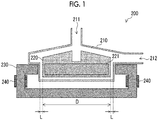
- Fig. 1 is a diagram illustrating an example of the configuration of a magnetic levitation type pump 200 that is applicable to the implementation of the method for producing an antibody according to the present embodiment.
- the pump 200 is configured to include a case 210 having a suction port 211 for suctioning a cell suspension and a discharge port 212 for discharging the cell suspension; a rotating blade 220 accommodated in the case 210; a rotor magnet 221 provided at the bottom of the rotating blade 220; a stator 230 rotating the rotor magnet 221; and a coil 240 wound around the stator 230.
- a case 210 having a suction port 211 for suctioning a cell suspension and a discharge port 212 for discharging the cell suspension
- a rotating blade 220 accommodated in the case 210
- a rotor magnet 221 provided at the bottom of the rotating blade 220
- a stator 230 rotating the rotor magnet 221
- a coil 240 wound around the stator 230.
- the rotating blade 220 suspended in the cell suspension inside the case 210 rotates under the effect of the magnetic force generated by the stator 230.
- the stator 230 rotates, the cell suspension is suctioned through the suction port 211 and is discharged through the discharge port 212. Since the pump 200 does not have an axis of rotation for driving the rotating blade 220 to rotate, the workload imposed at the time of performing a cleaning treatment and a sterilization treatment can be reduced.
- the diameter of the rotating blade 220 is designated as D meters (see Fig. 1 ); the distance between a tip of the rotating blade 220 and the inner wall of the case 210 surrounding the periphery of the rotating blade 220 is designated as L meters (see Fig. 1 ); the rotation speed per second of the rotating blade 220 is designated as R; the ratio of the circumference to the diameter of a circle is designated as ⁇ ; and the viscosity of the cell suspension is designated as X pascal-seconds, the shear stress Y exerted on the cell suspension by the rotation of the rotating blade 220 can be roughly estimated by the following Formula (1).
- the rotation speed means the rotation speed set for an apparatus of a rotating blade.
- the viscosity can be measured based on the method of JIS Z 8803, which is a method for measuring the viscosity of a liquid.
- Y X ⁇ D ⁇ ⁇ ⁇ R / L
- the liquid feeding pressure of the pump 200 is designated as P pascals
- a value obtained by weighting addition of the shear stress Y and the liquid feeding pressure P is used as an index value F of the external force exerted to the cells by means of a liquid flow generated by the pump 200.
- Weighting of the shear stress Y by 10,000 times is carried out because the influence of the shear stress Y is greater than the influence of the liquid feeding pressure P with regard to selective removal of excessively grown cells.
- Excessively grown cells are easily destroyable by application of an external force compared to normal cells, and by controlling the index value F represented by Formula (2), excessively grown cells can be destroyed while damage to normal cells is suppressed.
- the index value F satisfies the expression: 2,000 ⁇ F ⁇ 80,000, more preferably the expression: 4,000 ⁇ F ⁇ 60,000, even more preferably the expression: 6,000 ⁇ F ⁇ 40,000, and most preferably the expression: 7,000 ⁇ F ⁇ 30,000.
- the index value F is adjusted to 2,000 or more, excessively grown cells can be destroyed efficiently.
- the index value F is adjusted to 80,000 or less, damage to normal cells can be suppressed.
- the index value F is within the range described above, in a case in which the shear stress Y is excessively large, there is a risk that normal cells may be damaged. Furthermore, in a case in which the liquid feeding pressure P of the pump is merely made large, there is a risk that destruction of excessively grown cells may not be promoted. Therefore, it is preferable to control not only the index value F but also the ratio between the shear stress Y and the liquid feeding pressure P. Specifically, it is preferable to satisfy the relationship: 3 ⁇ log 10 (P/Y) ⁇ 5.6, and more preferably the relationship: 3.7 ⁇ log 10 (P/Y) ⁇ 5. In a case in which the value of log 10 (P/Y) is adjusted to 3 or greater, damage to normal cells can be suppressed. In a case in which log 10 (P/Y) is adjusted to 5.6 or less, excessively grown cells can be destroyed efficiently.
- the shear stress Y satisfies the range: 0.1 ⁇ Y ⁇ 3, more preferably the range: 0.2 ⁇ Y ⁇ 2.5, and even more preferably the range: 0.25 ⁇ Y ⁇ 2.
- the shear stress Y is adjusted to 0.1 or greater, excessively grown cells can be destroyed efficiently.
- the shear stress Y is adjusted to 3 or less, damage to normal cells can be suppressed.
- the liquid feeding pressure P satisfies the range: 500 ⁇ P ⁇ 80,000, more preferably 1,500 ⁇ P ⁇ 50,000, and even more preferably the range: 3,000 ⁇ P ⁇ 30,000.
- the liquid feeding pressure P is adjusted to 500 or greater, excessively grown cells can be destroyed efficiently.
- the liquid feeding pressure P is adjusted to 80,000 or less, damage to normal cells can be suppressed.
- Fig. 2 is a diagram illustrating an example of the configuration of a cell culture apparatus 100 that is applicable to the implementation of the method for producing an antibody according to an embodiment of the specified technology.
- the cell culture apparatus 100 includes a culture vessel 10 that accommodates cells together with a medium; a filter unit 20 having a filter membrane 24 that applies a membrane separation treatment to a cell suspension extracted from the culture vessel 10; a flow channel 52 that returns the components blocked by the filter membrane 24 to the culture vessel 10; a flow channel 53 that allows the components passed through the filter membrane 24 to pass through; and a collecting tank 40 connected to the flow channel 53.
- a stirring apparatus having a stirring blade 11 is provided inside the culture vessel 10. As the stirring blade 11 is rotated, the medium accommodated inside the culture vessel 10 is stirred, and homogeneity of the medium is maintained.
- the flow channel 51 is such that one end is connected to the bottom of the culture vessel 10, and the other end is connected to an inflow port 20a of the filter unit 20.
- a pump PU1 that extracts the cell suspension accommodated in the culture vessel 10 and sends the cell suspension to the filter unit 20 is provided.
- the pump PU1 is used as a means for applying an external force to cells in order to perform selective removal of excessively grown cells. That is, while a cell suspension is transported from the culture vessel 10 to the filter unit 20, an external force caused by a liquid flow generated by the pump PU1 is exerted to cells, excessively grown cells are selectively destroyed.
- a magnetic levitation type pump 200 illustrated in Fig. 1 can be used as the pump PU1.
- the shear stress Y applied on the cell suspension can be adjusted by the diameter D of the rotating blade 220, the distance L between a tip of the rotating blade 220 and the inner wall of the case 210 surrounding the periphery of the rotating blade 220, and the rotation speed R per second of the rotating blade 220.
- the liquid feeding pressure P can be measured using a pressure gauge 60 provided between the pump PU1 and the filter unit 20.
- the liquid feeding pressure P of the pump PU1 can be adjusted by the degree of opening of a pinch valve V provided on the flow channel 52.
- the filter unit 20 includes a vessel 21; and a filter membrane 24 that partitions the space inside the vessel 21 into a supply side 22 and a permeation side 23 and applies a membrane separation treatment to a cell suspension extracted from the culture vessel 10. Furthermore, the filter unit 20 has an inflow port 20a through which the cell suspension flows in; and an outflow port 20b through which the cell suspension flows out, on the supply side 22.
- the cell suspension extracted from the culture vessel 10 passes through the filter membrane 24 while the cell suspension flows in through the inflow port 20a to the inside of the vessel 21 and flows out through the outflow port 20b to the outside of the vessel 21.
- the filter unit 20 performs a membrane separation treatment by a tangential flow method of pouring a liquid as an object of the membrane separation treatment so as to cause the liquid to flow along the membrane surface of a filter membrane 24 (in a direction parallel to the membrane surface) and sending small-sized components toward the permeation side 23.
- the membrane separation treatment based on the tangential flow method may form a flow, in which the cell suspension extracted from the culture vessel 10 circulates in one direction that is parallel to the membrane surface of the filter membrane 24, or may form a flow in which the cell suspension reciprocates along the membrane surface of the filter membrane 24.
- a circulating flow for example, a KrosFlo perfusion culture flow pass apparatus (KML-100, KPS-200, or KPS-600) of Spectrum Laboratories, Inc., or PuraLev series manufactured by Levitronix GmbH can be suitably used.
- KML-100, KPS-200, or KPS-600 of Spectrum Laboratories, Inc.
- PuraLev series manufactured by Levitronix GmbH can be suitably used.
- ATF system of REPLIGEN Corporation can be suitably used.
- the cells included in the cell suspension do not penetrate through the filter membrane 24, flow out from the outflow port 20b to the outside of the vessel 21, and are returned to the inside of the culture vessel 10 through the flow channel 52.
- the antibodies included in the cell suspension penetrate through the filter membrane 24 and discharged to the outside of the vessel 21 through the discharge port 20c provided on the permeation side 23.
- a flow channel 53 provided with a pump PU2 is connected, and the permeation liquid containing the antibodies that have penetrated to the permeation side 23 is collected in the collecting tank 40 through the flow channel 53.
- the pump PU2 may be a magnetic levitation type pump 200 illustrated in Fig. 1 .
- a mesh filter composed of a fibrous member woven into a network form can be used as the filter membrane 24.
- a mesh filter By using a mesh filter, discharge of components that are unnecessary for cell culture, including dead bodies of cells and debris of cells, to the permeation side can be promoted, compared to the case of using a hollow fiber membrane. Thereby, components that are unnecessary for cell culture inside the culture vessel 10 can be effectively removed, and the proliferative properties of cells in the culture vessel 10 can be increased.
- a hollow fiber membrane can be used as the filter membrane 24.
- a risk that cells penetrate into the permeation side can be reduced, compared to the case of using a mesh filter.
- a risk that loading caused by cells infiltrating into the filter membrane 24 occurs can be reduced. Thereby, loss of cells can be reduced.
- the cell culture apparatus 100 has a flow channel 54 for supplying a fresh medium to the culture vessel 10; and a pump PU3 provided in the middle of the flow channel 54.
- the pump PU3 may be a magnetic levitation type pump 200 illustrated in Fig. 1 .
- a cell bleeding treatment of taking out a portion of cells inside the culture vessel 10 at an appropriate timing during the culture period is carried out.
- the cells in the culture vessel 10 are discharged to the outside of the culture vessel 10 through a flow channel 55.
- the cell culture apparatus 100 illustrated in Fig. 2 performs a separation treatment by means of a membrane separation treatment using the filter unit 20; however, it is also possible to replace the filter unit 20 with a treatment unit of performing a separation treatment according to a sonic agglomeration method.
- Example 13 An experiment of producing an antibody was performed by performing cell culture by a perfusion culture system under a plurality of conditions that are different from one another, using the cell culture apparatus 100 illustrated in Fig. 2 .
- Example 13 a separation treatment according to a sonic agglomeration method was carried out instead of a membrane separation treatment using a filter unit 20.
- Cells were seeded such that the cell concentration in the culture vessel 10 would be 1.0 ⁇ 10 6 cells/ml. CHO cells were used in Examples 1 to 15 and Comparative Examples 1 to 5.
- the pump PU1 was driven under predetermined conditions, and a cell suspension was sent to a separation treatment unit (filter unit 20 or a separation treatment unit based on sonic agglomeration). A permeate or a supernatant obtained by a separation treatment was continuously taken out at a rate of 15 L/day, and at the same time, a fresh medium was continuously supplied so that the liquid amount inside the culture vessel 10 would be maintained at 10 L.
- a separation treatment unit filter unit 20 or a separation treatment unit based on sonic agglomeration
- a magnetic levitation type pump (Examples 1 to 15 and Comparative Examples 1 to 5) and a diaphragm reciprocating ATF pump (Comparative Example 1) were used.
- a diaphragm reciprocating ATF pump (Comparative Example 1)
- PuraLev i30SU, i100SU, 600SU, and 2000SU manufactured by Levitronix GmbH were used.
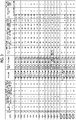
- the rotating blade was processed as appropriate such that the diameter D of the rotating blade and the distance L between a tip of the rotating blade and the inner wall surrounding the periphery of the rotating blade would have the respective values shown in Fig. 3 .
- Pump [1] represents i100SU.
- Pump [2] represents i100SU with a processed rotating blade.
- Pump [3] represents i30SU with a processed rotating blade.
- Pump [4] represents 600SU with a processed rotating blade.
- Pump [5] represents 2000SU with a processed rotating blade.
- ATF2 manufactured by Repligen Corporation was used for the diaphragm reciprocating ATF pump.
- the rotation speed R per second of the rotating blade of the magnetic levitation type pump and the liquid feeding pressure P were adjusted so as to have the respective values shown in Fig. 3 .
- the liquid feeding pressure P was adjusted by means of the degree of opening of a pinch valve V.
- the shear stress Y was calculated using Formula (1).
- the separation treatment was carried out by a membrane separation method using a hollow fiber type MF membrane (Examples 1 to 12, 14, and 15, and Comparative Examples 1 to 5) and a sonic agglomeration method (Example 13).
- a PES (polyether sulfone) filter S06-P20U-10-S having a pore diameter of 0.2 ⁇ m of Spectrum Laboratories, Inc. was used.
- a sonic agglomeration Biosep Acoustic Perfusion System of Applikon Biotechnology B.V. was used.
- the cell suspension in the culture vessel 10 was extracted, and the concentration of cells, the survival rate of cells, and the diameter of cells were measured using Cell Viability Analyzer Vi-CELL XR of BECKMAN COULTER, Inc.
- Vi-CELL XR2.04 was used, and the parameters at the time of measurement were set as follows.
- Dilution In a case in which the cell concentration was 100 ⁇ 10 5 cells/ml or lower, the sample was not diluted, and measurement was made by setting the Dilution as 1. In a case in which the cell concentration was 100 ⁇ 10 5 cells/ml or lower, the sample was diluted 10 times, and then measurement was made by setting the Dilution as 10.
- the output value of Vi-CELL was used.
- the standard deviation ⁇ of the diameter of a single cell, the number proportion of cells having a single cell diameter of 1.4 ⁇ A or greater, and the number proportion of cells having a single cell diameter in the range of A ⁇ A/7 were calculated from the data of the diameter and the number of cells outputted from Vi-CELL.
- a KrosFlo digital pressure monitor (ACPM-201-01N) of Spectrum Laboratories, Inc. was installed immediately after the discharge port of the pump PU1, and the liquid feeding pressure P of the pump PU1 was measured.
- a decomposition-agglomeration state of the antibody was evaluated by the following procedure by size exclusion chromatography.
- the evaluation determination criteria related to the survival rate of cells are as follows.
- the evaluation determination criteria related to the proportion of the main peak obtained by size exclusion chromatography are as follows.
- Comparative Examples 1 to 5 are different from Example 1 to Example 15 from the viewpoint that the number proportion of cells having a single cell diameter in the range of A ⁇ A/7 is lower than 50%, and the standard deviation ⁇ of the diameters of single cells is larger than A/4.
- the evaluation related to the survival rate of cells resulted in decision E (lower than 90%) in both cases.
- the evaluation related to the proportion of the main peak obtained by size exclusion chromatography resulted in decision D (lower than 95%) in all cases.
- it is thought that selective removal of excessively grown cells is insufficient, and the product quality of the antibody was deteriorated owing to this insufficient removal.
- Examples 1 to 15 the evaluation related to the survival rate of cells resulted in any one of decision A, decision B, decision C, and decision D, and the evaluation related to the proportion of the main peak obtained by size exclusion chromatography resulted in any one of decision A, decision B, and decision C.
- the survival rate of cells was increased thereby, and the product quality of the antibody was enhanced. That is, in Examples 1 to 15, the product quality of the product (antibody) could be increased, while the productivity of the product (antibody) by high-concentration culture of cells was maintained.
- Example 1 to Example 5 and Example 14 to Example 15 in which the number proportion of cells having a single cell diameter of 1.4 ⁇ A or greater (that is, excessively grown cells) was adjusted to 2.5% or lower, and the number proportion of cells having a single cell diameter in the range of A ⁇ A/7 was adjusted to 60% or higher by performing selective removal of excessively grown cells, the evaluation related to the survival rate of cells and the evaluation related to the proportion of the main peak resulted in decision A in all cases.
Landscapes
- Engineering & Computer Science (AREA)
- Life Sciences & Earth Sciences (AREA)
- Health & Medical Sciences (AREA)
- Chemical & Material Sciences (AREA)
- Wood Science & Technology (AREA)
- Organic Chemistry (AREA)
- Bioinformatics & Cheminformatics (AREA)
- Zoology (AREA)
- Biotechnology (AREA)
- Genetics & Genomics (AREA)
- Microbiology (AREA)
- Biomedical Technology (AREA)
- Sustainable Development (AREA)
- Biochemistry (AREA)
- General Engineering & Computer Science (AREA)
- General Health & Medical Sciences (AREA)
- Analytical Chemistry (AREA)
- Water Supply & Treatment (AREA)
- Clinical Laboratory Science (AREA)
- Mechanical Engineering (AREA)
- Computer Hardware Design (AREA)
- Molecular Biology (AREA)
- Cell Biology (AREA)
- Chemical Kinetics & Catalysis (AREA)
- Micro-Organisms Or Cultivation Processes Thereof (AREA)
- Apparatus Associated With Microorganisms And Enzymes (AREA)
- Preparation Of Compounds By Using Micro-Organisms (AREA)
Applications Claiming Priority (3)
| Application Number | Priority Date | Filing Date | Title |
|---|---|---|---|
| JP2017171331 | 2017-09-06 | ||
| JP2017217395 | 2017-11-10 | ||
| PCT/JP2018/032678 WO2019049843A1 (ja) | 2017-09-06 | 2018-09-03 | 産生物の製造方法 |
Publications (2)
| Publication Number | Publication Date |
|---|---|
| EP3663390A1 true EP3663390A1 (de) | 2020-06-10 |
| EP3663390A4 EP3663390A4 (de) | 2020-08-05 |
Family
ID=65634072
Family Applications (1)
| Application Number | Title | Priority Date | Filing Date |
|---|---|---|---|
| EP18853414.3A Pending EP3663390A4 (de) | 2017-09-06 | 2018-09-03 | Verfahren zur herstellung eines produktes |
Country Status (5)
| Country | Link |
|---|---|
| US (1) | US11685888B2 (de) |
| EP (1) | EP3663390A4 (de) |
| JP (1) | JP6929947B2 (de) |
| CN (1) | CN111051496B (de) |
| WO (1) | WO2019049843A1 (de) |
Families Citing this family (5)
| Publication number | Priority date | Publication date | Assignee | Title |
|---|---|---|---|---|
| WO2021107123A1 (ja) * | 2019-11-29 | 2021-06-03 | 富士フイルム株式会社 | 細胞培養方法、抗体製造方法、有機酸除去方法、及び、抗体 |
| CN120530198A (zh) | 2023-01-17 | 2025-08-22 | 富士胶片株式会社 | 核酸导入细胞的制造方法及有用物质的制造方法 |
| CN120981576A (zh) | 2023-03-27 | 2025-11-18 | 富士胶片株式会社 | 病毒产生方法 |
| KR20260048589A (ko) | 2023-08-29 | 2026-04-10 | 후지필름 가부시키가이샤 | 바이러스의 제조 방법 및 세포로의 핵산 도입 방법 |
| CN121941757A (zh) | 2023-09-27 | 2026-04-28 | 富士胶片株式会社 | 细胞培养液的处理装置、处理方法及产物的制造方法 |
Family Cites Families (9)
| Publication number | Priority date | Publication date | Assignee | Title |
|---|---|---|---|---|
| EP1720972B1 (de) * | 2004-03-05 | 2014-01-08 | DSM IP Assets B.V. | Verfahren zur zellkultivierung mit dauerperfusion und wechselndem tangentialstrom |
| KR20090021339A (ko) * | 2006-04-21 | 2009-03-03 | 바이엘 헬스케어 엘엘씨 | 관류 배양을 위한 포유류 세포에서의 항-세포소멸성 유전자의 적용 |
| JP5821847B2 (ja) * | 2010-07-01 | 2015-11-24 | 株式会社カネカ | 細胞培養用ディスポセット、細胞培養装置及び細胞調製方法 |
| EP2686415B1 (de) | 2011-03-18 | 2017-11-15 | GE Healthcare Bio-Sciences AB | Flexibler beutel zur kultivierung von zellen |
| US20140093952A1 (en) * | 2012-10-02 | 2014-04-03 | David Serway | Bioreactor Tangential Flow Perfusion Filter System |
| JP6062845B2 (ja) | 2013-03-25 | 2017-01-18 | 株式会社ユニバーサルエンターテインメント | 遊技システム |
| EP3234099B1 (de) * | 2014-12-18 | 2020-06-03 | Flodesign Sonics, Inc. | Akustische perfusionsvorrichtungen |
| JP6811022B2 (ja) | 2016-03-23 | 2021-01-13 | J&T環境株式会社 | 平パレット |
| JP6625017B2 (ja) | 2016-06-10 | 2019-12-25 | 株式会社オカムラ | 肘掛け、及び、椅子 |
-
2018
- 2018-09-03 EP EP18853414.3A patent/EP3663390A4/de active Pending
- 2018-09-03 WO PCT/JP2018/032678 patent/WO2019049843A1/ja not_active Ceased
- 2018-09-03 JP JP2019540952A patent/JP6929947B2/ja active Active
- 2018-09-03 CN CN201880056019.4A patent/CN111051496B/zh active Active
-
2020
- 2020-03-03 US US16/807,740 patent/US11685888B2/en active Active
Also Published As
| Publication number | Publication date |
|---|---|
| US11685888B2 (en) | 2023-06-27 |
| CN111051496A (zh) | 2020-04-21 |
| JP6929947B2 (ja) | 2021-09-01 |
| CN111051496B (zh) | 2024-03-08 |
| EP3663390A4 (de) | 2020-08-05 |
| US20200216792A1 (en) | 2020-07-09 |
| JPWO2019049843A1 (ja) | 2020-03-26 |
| WO2019049843A1 (ja) | 2019-03-14 |
Similar Documents
| Publication | Publication Date | Title |
|---|---|---|
| US11685888B2 (en) | Method for producing product | |
| US12049614B2 (en) | Cell culture apparatus and cell culture method | |
| KR102539167B1 (ko) | 교번 접선 유동식의 신속한 수확 | |
| US12624330B2 (en) | Cell culture method, product producing method, and cell culture device | |
| EP3770266A1 (de) | Produktherstellungsverfahren | |
| US20160068565A1 (en) | Method for harvesting culture product | |
| EP3630937A1 (de) | Tangentiale durchflussfiltrationsvorrichtung für perfusionsanwendungen | |
| WO2017180724A1 (en) | Perfusion filtration systems | |
| US20210087512A1 (en) | Cell culture system and cell culture method | |
| US20250361289A1 (en) | Method for producing product by cells, method for purifying product produced by cells, method for suppressing decrease in membrane permeability of product produced by cells, system for producing product by cells, and system for purifying product produced by cells | |
| US20260085110A1 (en) | Production method for product | |
| EP4711467A1 (de) | Produktherstellungsverfahren, hohlfasermembranfilter und produktherstellungsvorrichtung | |
| EP4722338A1 (de) | Zellkulturverfahren und produktherstellungsverfahren | |
| CN117642502A (zh) | 病毒的回收方法 |
Legal Events
| Date | Code | Title | Description |
|---|---|---|---|
| STAA | Information on the status of an ep patent application or granted ep patent |
Free format text: STATUS: THE INTERNATIONAL PUBLICATION HAS BEEN MADE |
|
| PUAI | Public reference made under article 153(3) epc to a published international application that has entered the european phase |
Free format text: ORIGINAL CODE: 0009012 |
|
| STAA | Information on the status of an ep patent application or granted ep patent |
Free format text: STATUS: REQUEST FOR EXAMINATION WAS MADE |
|
| 17P | Request for examination filed |
Effective date: 20200303 |
|
| AK | Designated contracting states |
Kind code of ref document: A1 Designated state(s): AL AT BE BG CH CY CZ DE DK EE ES FI FR GB GR HR HU IE IS IT LI LT LU LV MC MK MT NL NO PL PT RO RS SE SI SK SM TR |
|
| AX | Request for extension of the european patent |
Extension state: BA ME |
|
| A4 | Supplementary search report drawn up and despatched |
Effective date: 20200702 |
|
| RIC1 | Information provided on ipc code assigned before grant |
Ipc: C12M 1/00 20060101ALI20200626BHEP Ipc: C12N 5/071 20100101AFI20200626BHEP Ipc: B01D 63/00 20060101ALI20200626BHEP |
|
| DAV | Request for validation of the european patent (deleted) | ||
| DAX | Request for extension of the european patent (deleted) | ||
| RAP3 | Party data changed (applicant data changed or rights of an application transferred) |
Owner name: FUJIFILM CORPORATION |