EP3663397A2 - Novel psicose-6-phosphate phosphatase, composition for producing psicose including said enzyme, method for producing psicose using said enzyme - Google Patents
Novel psicose-6-phosphate phosphatase, composition for producing psicose including said enzyme, method for producing psicose using said enzyme Download PDFInfo
- Publication number
- EP3663397A2 EP3663397A2 EP18841900.6A EP18841900A EP3663397A2 EP 3663397 A2 EP3663397 A2 EP 3663397A2 EP 18841900 A EP18841900 A EP 18841900A EP 3663397 A2 EP3663397 A2 EP 3663397A2
- Authority
- EP
- European Patent Office
- Prior art keywords
- phosphate
- psicose
- glucose
- phosphatase
- coli
- Prior art date
- Legal status (The legal status is an assumption and is not a legal conclusion. Google has not performed a legal analysis and makes no representation as to the accuracy of the status listed.)
- Pending
Links
- 108090000790 Enzymes Proteins 0.000 title claims abstract description 82
- 102000004190 Enzymes Human genes 0.000 title claims abstract description 80
- 229910019142 PO4 Inorganic materials 0.000 title claims abstract description 53
- 239000010452 phosphate Substances 0.000 title claims abstract description 53
- 238000004519 manufacturing process Methods 0.000 title claims abstract description 34
- 239000000203 mixture Substances 0.000 title claims abstract description 19
- 102000045595 Phosphoprotein Phosphatases Human genes 0.000 title description 2
- 108700019535 Phosphoprotein Phosphatases Proteins 0.000 title description 2
- LKDRXBCSQODPBY-JDJSBBGDSA-N D-allulose Chemical compound OCC1(O)OC[C@@H](O)[C@@H](O)[C@H]1O LKDRXBCSQODPBY-JDJSBBGDSA-N 0.000 title 2
- -1 said enzyme Chemical compound 0.000 title 1
- BJHIKXHVCXFQLS-PUFIMZNGSA-N D-psicose Chemical compound OC[C@@H](O)[C@@H](O)[C@@H](O)C(=O)CO BJHIKXHVCXFQLS-PUFIMZNGSA-N 0.000 claims abstract description 56
- 102000004160 Phosphoric Monoester Hydrolases Human genes 0.000 claims abstract description 43
- 108090000608 Phosphoric Monoester Hydrolases Proteins 0.000 claims abstract description 43
- 229940088598 enzyme Drugs 0.000 claims description 76
- 244000005700 microbiome Species 0.000 claims description 52
- 102000006029 inositol monophosphatase Human genes 0.000 claims description 38
- 238000000034 method Methods 0.000 claims description 34
- 108020004707 nucleic acids Proteins 0.000 claims description 32
- 102000039446 nucleic acids Human genes 0.000 claims description 32
- 150000007523 nucleic acids Chemical class 0.000 claims description 32
- GSXOAOHZAIYLCY-NGJCXOISSA-N D-psicose 6-phosphate Chemical compound OCC(=O)[C@H](O)[C@H](O)[C@H](O)COP(O)(O)=O GSXOAOHZAIYLCY-NGJCXOISSA-N 0.000 claims description 29
- 101710144867 Inositol monophosphatase Proteins 0.000 claims description 29
- 238000006243 chemical reaction Methods 0.000 claims description 29
- 229920002774 Maltodextrin Polymers 0.000 claims description 27
- 239000005913 Maltodextrin Substances 0.000 claims description 27
- 229940035034 maltodextrin Drugs 0.000 claims description 27
- NBSCHQHZLSJFNQ-GASJEMHNSA-N D-Glucose 6-phosphate Chemical compound OC1O[C@H](COP(O)(O)=O)[C@@H](O)[C@H](O)[C@H]1O NBSCHQHZLSJFNQ-GASJEMHNSA-N 0.000 claims description 26
- VFRROHXSMXFLSN-UHFFFAOYSA-N Glc6P Natural products OP(=O)(O)OCC(O)C(O)C(O)C(O)C=O VFRROHXSMXFLSN-UHFFFAOYSA-N 0.000 claims description 26
- 229920002472 Starch Polymers 0.000 claims description 24
- 239000008107 starch Substances 0.000 claims description 24
- 235000019698 starch Nutrition 0.000 claims description 24
- 229910052740 iodine Inorganic materials 0.000 claims description 23
- 229910052720 vanadium Inorganic materials 0.000 claims description 23
- GSXOAOHZAIYLCY-UHFFFAOYSA-N D-F6P Natural products OCC(=O)C(O)C(O)C(O)COP(O)(O)=O GSXOAOHZAIYLCY-UHFFFAOYSA-N 0.000 claims description 22
- 108090000637 alpha-Amylases Proteins 0.000 claims description 22
- GSXOAOHZAIYLCY-HSUXUTPPSA-N keto-D-fructose 6-phosphate Chemical compound OCC(=O)[C@@H](O)[C@H](O)[C@H](O)COP(O)(O)=O GSXOAOHZAIYLCY-HSUXUTPPSA-N 0.000 claims description 22
- WQZGKKKJIJFFOK-GASJEMHNSA-N Glucose Natural products OC[C@H]1OC(O)[C@H](O)[C@@H](O)[C@@H]1O WQZGKKKJIJFFOK-GASJEMHNSA-N 0.000 claims description 20
- HXXFSFRBOHSIMQ-VFUOTHLCSA-N alpha-D-glucose 1-phosphate Chemical compound OC[C@H]1O[C@H](OP(O)(O)=O)[C@H](O)[C@@H](O)[C@@H]1O HXXFSFRBOHSIMQ-VFUOTHLCSA-N 0.000 claims description 20
- 239000008103 glucose Substances 0.000 claims description 20
- 229930006000 Sucrose Natural products 0.000 claims description 18
- CZMRCDWAGMRECN-UGDNZRGBSA-N Sucrose Chemical compound O[C@H]1[C@H](O)[C@@H](CO)O[C@@]1(CO)O[C@@H]1[C@H](O)[C@@H](O)[C@H](O)[C@@H](CO)O1 CZMRCDWAGMRECN-UGDNZRGBSA-N 0.000 claims description 18
- 239000005720 sucrose Substances 0.000 claims description 18
- 229910052731 fluorine Inorganic materials 0.000 claims description 14
- 102000030595 Glucokinase Human genes 0.000 claims description 13
- 108010021582 Glucokinase Proteins 0.000 claims description 13
- 108091000115 phosphomannomutase Proteins 0.000 claims description 13
- 229910052721 tungsten Inorganic materials 0.000 claims description 13
- 102000009569 Phosphoglucomutase Human genes 0.000 claims description 12
- 102100022624 Glucoamylase Human genes 0.000 claims description 11
- 235000011073 invertase Nutrition 0.000 claims description 11
- 108010073178 Glucan 1,4-alpha-Glucosidase Proteins 0.000 claims description 10
- 108010028688 Isoamylase Proteins 0.000 claims description 10
- 101710184309 Probable sucrose-6-phosphate hydrolase Proteins 0.000 claims description 10
- 102400000472 Sucrase Human genes 0.000 claims description 10
- 101710112652 Sucrose-6-phosphate hydrolase Proteins 0.000 claims description 10
- 102000004139 alpha-Amylases Human genes 0.000 claims description 10
- 229940024171 alpha-amylase Drugs 0.000 claims description 10
- 125000003729 nucleotide group Chemical group 0.000 claims description 10
- 108050004944 Alpha-glucan phosphorylases Proteins 0.000 claims description 9
- 239000002773 nucleotide Substances 0.000 claims description 9
- 108020000005 Sucrose phosphorylase Proteins 0.000 claims description 8
- 108010085781 maltodextrin phosphorylase Proteins 0.000 claims description 8
- NBIIXXVUZAFLBC-UHFFFAOYSA-K phosphate Chemical compound [O-]P([O-])([O-])=O NBIIXXVUZAFLBC-UHFFFAOYSA-K 0.000 claims description 8
- 108010043943 Starch Phosphorylase Proteins 0.000 claims description 7
- 229910052727 yttrium Inorganic materials 0.000 claims description 6
- 108010073135 Phosphorylases Proteins 0.000 claims description 3
- 102000009097 Phosphorylases Human genes 0.000 claims description 3
- CJWXCNXHAIFFMH-AVZHFPDBSA-N n-[(2s,3r,4s,5s,6r)-2-[(2r,3r,4s,5r)-2-acetamido-4,5,6-trihydroxy-1-oxohexan-3-yl]oxy-3,5-dihydroxy-6-methyloxan-4-yl]acetamide Chemical compound C[C@H]1O[C@@H](O[C@@H]([C@@H](O)[C@H](O)CO)[C@@H](NC(C)=O)C=O)[C@H](O)[C@@H](NC(C)=O)[C@@H]1O CJWXCNXHAIFFMH-AVZHFPDBSA-N 0.000 claims description 3
- 125000003275 alpha amino acid group Chemical group 0.000 claims 3
- 241001198387 Escherichia coli BL21(DE3) Species 0.000 description 70
- 108090000623 proteins and genes Proteins 0.000 description 47
- 102000004169 proteins and genes Human genes 0.000 description 36
- 235000018102 proteins Nutrition 0.000 description 33
- 150000001413 amino acids Chemical class 0.000 description 24
- 210000004027 cell Anatomy 0.000 description 21
- 230000000694 effects Effects 0.000 description 14
- 108700001293 Inositol monophosphatases Proteins 0.000 description 13
- 230000030609 dephosphorylation Effects 0.000 description 11
- 238000006209 dephosphorylation reaction Methods 0.000 description 11
- 230000037361 pathway Effects 0.000 description 11
- 108020004414 DNA Proteins 0.000 description 10
- 239000013598 vector Substances 0.000 description 9
- 108091033319 polynucleotide Proteins 0.000 description 8
- 102000040430 polynucleotide Human genes 0.000 description 8
- 239000002157 polynucleotide Substances 0.000 description 8
- 239000013604 expression vector Substances 0.000 description 7
- TWRXJAOTZQYOKJ-UHFFFAOYSA-L Magnesium chloride Chemical compound [Mg+2].[Cl-].[Cl-] TWRXJAOTZQYOKJ-UHFFFAOYSA-L 0.000 description 6
- 238000006911 enzymatic reaction Methods 0.000 description 6
- 238000000746 purification Methods 0.000 description 6
- 239000000758 substrate Substances 0.000 description 6
- 241000588724 Escherichia coli Species 0.000 description 5
- 108091028043 Nucleic acid sequence Proteins 0.000 description 5
- 239000007795 chemical reaction product Substances 0.000 description 5
- 238000004128 high performance liquid chromatography Methods 0.000 description 5
- 238000003752 polymerase chain reaction Methods 0.000 description 5
- 229920001184 polypeptide Polymers 0.000 description 5
- 102000004196 processed proteins & peptides Human genes 0.000 description 5
- 108090000765 processed proteins & peptides Proteins 0.000 description 5
- 238000003259 recombinant expression Methods 0.000 description 5
- RFSUNEUAIZKAJO-ARQDHWQXSA-N Fructose Chemical compound OC[C@H]1O[C@](O)(CO)[C@@H](O)[C@@H]1O RFSUNEUAIZKAJO-ARQDHWQXSA-N 0.000 description 4
- 235000001014 amino acid Nutrition 0.000 description 4
- 229940024606 amino acid Drugs 0.000 description 4
- 238000004458 analytical method Methods 0.000 description 4
- 239000000872 buffer Substances 0.000 description 4
- 229910052751 metal Inorganic materials 0.000 description 4
- 239000002184 metal Substances 0.000 description 4
- 229910021645 metal ion Inorganic materials 0.000 description 4
- 238000012546 transfer Methods 0.000 description 4
- PKAUICCNAWQPAU-UHFFFAOYSA-N 2-(4-chloro-2-methylphenoxy)acetic acid;n-methylmethanamine Chemical compound CNC.CC1=CC(Cl)=CC=C1OCC(O)=O PKAUICCNAWQPAU-UHFFFAOYSA-N 0.000 description 3
- QKNYBSVHEMOAJP-UHFFFAOYSA-N 2-amino-2-(hydroxymethyl)propane-1,3-diol;hydron;chloride Chemical compound Cl.OCC(N)(CO)CO QKNYBSVHEMOAJP-UHFFFAOYSA-N 0.000 description 3
- 241000640374 Alicyclobacillus acidocaldarius Species 0.000 description 3
- 241000410435 Anaerolinea thermophila Species 0.000 description 3
- 241000205042 Archaeoglobus fulgidus Species 0.000 description 3
- 108020004705 Codon Proteins 0.000 description 3
- RFSUNEUAIZKAJO-VRPWFDPXSA-N D-Fructose Natural products OC[C@H]1OC(O)(CO)[C@@H](O)[C@@H]1O RFSUNEUAIZKAJO-VRPWFDPXSA-N 0.000 description 3
- 241000690801 Dictyoglomus turgidum Species 0.000 description 3
- 241000193385 Geobacillus stearothermophilus Species 0.000 description 3
- 241000921344 Meiothermus cerbereus Species 0.000 description 3
- 241000508310 Meiothermus chliarophilus Species 0.000 description 3
- 241000589496 Meiothermus ruber Species 0.000 description 3
- 241000047036 Meiothermus rufus Species 0.000 description 3
- 241000508289 Meiothermus silvanus Species 0.000 description 3
- 241000706576 Meiothermus taiwanensis Species 0.000 description 3
- 241000762460 Pseudothermotoga lettingae Species 0.000 description 3
- 241001223919 Pyrobaculum ferrireducens Species 0.000 description 3
- 241000205156 Pyrococcus furiosus Species 0.000 description 3
- 241001148570 Rhodothermus marinus Species 0.000 description 3
- 241000205098 Sulfolobus acidocaldarius Species 0.000 description 3
- 241000202694 Thermoanaerobacter wiegelii Species 0.000 description 3
- 241000205180 Thermococcus litoralis Species 0.000 description 3
- 241000974459 Thermosulfidibacter takaii Species 0.000 description 3
- 241000589499 Thermus thermophilus Species 0.000 description 3
- 150000001720 carbohydrates Chemical class 0.000 description 3
- 229910001629 magnesium chloride Inorganic materials 0.000 description 3
- LFGREXWGYUGZLY-UHFFFAOYSA-N phosphoryl Chemical group [P]=O LFGREXWGYUGZLY-UHFFFAOYSA-N 0.000 description 3
- 238000011160 research Methods 0.000 description 3
- 150000003839 salts Chemical class 0.000 description 3
- 230000009466 transformation Effects 0.000 description 3
- 238000011426 transformation method Methods 0.000 description 3
- 108091032973 (ribonucleotides)n+m Proteins 0.000 description 2
- 108010043797 4-alpha-glucanotransferase Proteins 0.000 description 2
- 102100040894 Amylo-alpha-1,6-glucosidase Human genes 0.000 description 2
- 108030002106 D-psicose 3-epimerases Proteins 0.000 description 2
- 108030002100 D-tagatose 3-epimerases Proteins 0.000 description 2
- DHMQDGOQFOQNFH-UHFFFAOYSA-N Glycine Chemical compound NCC(O)=O DHMQDGOQFOQNFH-UHFFFAOYSA-N 0.000 description 2
- CSNNHWWHGAXBCP-UHFFFAOYSA-L Magnesium sulfate Chemical compound [Mg+2].[O-][S+2]([O-])([O-])[O-] CSNNHWWHGAXBCP-UHFFFAOYSA-L 0.000 description 2
- 239000002202 Polyethylene glycol Substances 0.000 description 2
- 108060007030 Ribulose-phosphate 3-epimerase Proteins 0.000 description 2
- 241000204664 Thermotoga neapolitana Species 0.000 description 2
- 238000002835 absorbance Methods 0.000 description 2
- 230000001580 bacterial effect Effects 0.000 description 2
- 238000004061 bleaching Methods 0.000 description 2
- 239000001506 calcium phosphate Substances 0.000 description 2
- 229910000389 calcium phosphate Inorganic materials 0.000 description 2
- 238000004587 chromatography analysis Methods 0.000 description 2
- 210000000349 chromosome Anatomy 0.000 description 2
- 230000002328 demineralizing effect Effects 0.000 description 2
- 238000006345 epimerization reaction Methods 0.000 description 2
- 238000001727 in vivo Methods 0.000 description 2
- 150000002500 ions Chemical class 0.000 description 2
- 230000002427 irreversible effect Effects 0.000 description 2
- 239000007788 liquid Substances 0.000 description 2
- 239000011159 matrix material Substances 0.000 description 2
- 230000035772 mutation Effects 0.000 description 2
- 239000000546 pharmaceutical excipient Substances 0.000 description 2
- 239000013600 plasmid vector Substances 0.000 description 2
- 229920001223 polyethylene glycol Polymers 0.000 description 2
- 238000001556 precipitation Methods 0.000 description 2
- 239000000047 product Substances 0.000 description 2
- 239000002994 raw material Substances 0.000 description 2
- 230000010076 replication Effects 0.000 description 2
- 108091008146 restriction endonucleases Proteins 0.000 description 2
- 102000004688 ribulosephosphate 3-epimerase Human genes 0.000 description 2
- 230000037432 silent mutation Effects 0.000 description 2
- 238000002415 sodium dodecyl sulfate polyacrylamide gel electrophoresis Methods 0.000 description 2
- 238000013519 translation Methods 0.000 description 2
- QORWJWZARLRLPR-UHFFFAOYSA-H tricalcium bis(phosphate) Chemical compound [Ca+2].[Ca+2].[Ca+2].[O-]P([O-])([O-])=O.[O-]P([O-])([O-])=O QORWJWZARLRLPR-UHFFFAOYSA-H 0.000 description 2
- 238000011144 upstream manufacturing Methods 0.000 description 2
- 239000003981 vehicle Substances 0.000 description 2
- 239000004475 Arginine Substances 0.000 description 1
- DCXYFEDJOCDNAF-UHFFFAOYSA-N Asparagine Natural products OC(=O)C(N)CC(N)=O DCXYFEDJOCDNAF-UHFFFAOYSA-N 0.000 description 1
- 240000006439 Aspergillus oryzae Species 0.000 description 1
- 235000002247 Aspergillus oryzae Nutrition 0.000 description 1
- 244000063299 Bacillus subtilis Species 0.000 description 1
- 235000014469 Bacillus subtilis Nutrition 0.000 description 1
- UXVMQQNJUSDDNG-UHFFFAOYSA-L Calcium chloride Chemical compound [Cl-].[Cl-].[Ca+2] UXVMQQNJUSDDNG-UHFFFAOYSA-L 0.000 description 1
- 229910021580 Cobalt(II) chloride Inorganic materials 0.000 description 1
- 241000186216 Corynebacterium Species 0.000 description 1
- 241000186226 Corynebacterium glutamicum Species 0.000 description 1
- IAZDPXIOMUYVGZ-UHFFFAOYSA-N DMSO Substances CS(C)=O IAZDPXIOMUYVGZ-UHFFFAOYSA-N 0.000 description 1
- 230000004543 DNA replication Effects 0.000 description 1
- 230000006820 DNA synthesis Effects 0.000 description 1
- 229920002307 Dextran Polymers 0.000 description 1
- 241000588722 Escherichia Species 0.000 description 1
- 229930091371 Fructose Natural products 0.000 description 1
- 239000005715 Fructose Substances 0.000 description 1
- WHUUTDBJXJRKMK-UHFFFAOYSA-N Glutamic acid Natural products OC(=O)C(N)CCC(O)=O WHUUTDBJXJRKMK-UHFFFAOYSA-N 0.000 description 1
- 239000004471 Glycine Substances 0.000 description 1
- ONIBWKKTOPOVIA-BYPYZUCNSA-N L-Proline Chemical compound OC(=O)[C@@H]1CCCN1 ONIBWKKTOPOVIA-BYPYZUCNSA-N 0.000 description 1
- QNAYBMKLOCPYGJ-REOHCLBHSA-N L-alanine Chemical compound C[C@H](N)C(O)=O QNAYBMKLOCPYGJ-REOHCLBHSA-N 0.000 description 1
- DCXYFEDJOCDNAF-REOHCLBHSA-N L-asparagine Chemical compound OC(=O)[C@@H](N)CC(N)=O DCXYFEDJOCDNAF-REOHCLBHSA-N 0.000 description 1
- CKLJMWTZIZZHCS-REOHCLBHSA-N L-aspartic acid Chemical compound OC(=O)[C@@H](N)CC(O)=O CKLJMWTZIZZHCS-REOHCLBHSA-N 0.000 description 1
- AGPKZVBTJJNPAG-WHFBIAKZSA-N L-isoleucine Chemical compound CC[C@H](C)[C@H](N)C(O)=O AGPKZVBTJJNPAG-WHFBIAKZSA-N 0.000 description 1
- ROHFNLRQFUQHCH-YFKPBYRVSA-N L-leucine Chemical compound CC(C)C[C@H](N)C(O)=O ROHFNLRQFUQHCH-YFKPBYRVSA-N 0.000 description 1
- FFEARJCKVFRZRR-BYPYZUCNSA-N L-methionine Chemical compound CSCC[C@H](N)C(O)=O FFEARJCKVFRZRR-BYPYZUCNSA-N 0.000 description 1
- COLNVLDHVKWLRT-QMMMGPOBSA-N L-phenylalanine Chemical compound OC(=O)[C@@H](N)CC1=CC=CC=C1 COLNVLDHVKWLRT-QMMMGPOBSA-N 0.000 description 1
- QIVBCDIJIAJPQS-VIFPVBQESA-N L-tryptophane Chemical compound C1=CC=C2C(C[C@H](N)C(O)=O)=CNC2=C1 QIVBCDIJIAJPQS-VIFPVBQESA-N 0.000 description 1
- OUYCCCASQSFEME-QMMMGPOBSA-N L-tyrosine Chemical compound OC(=O)[C@@H](N)CC1=CC=C(O)C=C1 OUYCCCASQSFEME-QMMMGPOBSA-N 0.000 description 1
- ROHFNLRQFUQHCH-UHFFFAOYSA-N Leucine Natural products CC(C)CC(N)C(O)=O ROHFNLRQFUQHCH-UHFFFAOYSA-N 0.000 description 1
- WHXSMMKQMYFTQS-UHFFFAOYSA-N Lithium Chemical compound [Li] WHXSMMKQMYFTQS-UHFFFAOYSA-N 0.000 description 1
- KDXKERNSBIXSRK-UHFFFAOYSA-N Lysine Natural products NCCCCC(N)C(O)=O KDXKERNSBIXSRK-UHFFFAOYSA-N 0.000 description 1
- 239000004472 Lysine Substances 0.000 description 1
- 229910021380 Manganese Chloride Inorganic materials 0.000 description 1
- GLFNIEUTAYBVOC-UHFFFAOYSA-L Manganese chloride Chemical compound Cl[Mn]Cl GLFNIEUTAYBVOC-UHFFFAOYSA-L 0.000 description 1
- 229910021586 Nickel(II) chloride Inorganic materials 0.000 description 1
- 102100026367 Pancreatic alpha-amylase Human genes 0.000 description 1
- 102100030999 Phosphoglucomutase-1 Human genes 0.000 description 1
- 229920000388 Polyphosphate Polymers 0.000 description 1
- ONIBWKKTOPOVIA-UHFFFAOYSA-N Proline Natural products OC(=O)C1CCCN1 ONIBWKKTOPOVIA-UHFFFAOYSA-N 0.000 description 1
- 206010038997 Retroviral infections Diseases 0.000 description 1
- MTCFGRXMJLQNBG-UHFFFAOYSA-N Serine Natural products OCC(N)C(O)=O MTCFGRXMJLQNBG-UHFFFAOYSA-N 0.000 description 1
- 241000607720 Serratia Species 0.000 description 1
- 241000193996 Streptococcus pyogenes Species 0.000 description 1
- AYFVYJQAPQTCCC-UHFFFAOYSA-N Threonine Natural products CC(O)C(N)C(O)=O AYFVYJQAPQTCCC-UHFFFAOYSA-N 0.000 description 1
- 239000004473 Threonine Substances 0.000 description 1
- QIVBCDIJIAJPQS-UHFFFAOYSA-N Tryptophan Natural products C1=CC=C2C(CC(N)C(O)=O)=CNC2=C1 QIVBCDIJIAJPQS-UHFFFAOYSA-N 0.000 description 1
- 241000700605 Viruses Species 0.000 description 1
- INAPMGSXUVUWAF-GCVPSNMTSA-N [(2r,3s,5r,6r)-2,3,4,5,6-pentahydroxycyclohexyl] dihydrogen phosphate Chemical compound OC1[C@H](O)[C@@H](O)C(OP(O)(O)=O)[C@H](O)[C@@H]1O INAPMGSXUVUWAF-GCVPSNMTSA-N 0.000 description 1
- 239000002253 acid Substances 0.000 description 1
- 150000007513 acids Chemical class 0.000 description 1
- 238000001042 affinity chromatography Methods 0.000 description 1
- 235000004279 alanine Nutrition 0.000 description 1
- 238000000137 annealing Methods 0.000 description 1
- ODKSFYDXXFIFQN-UHFFFAOYSA-N arginine Natural products OC(=O)C(N)CCCNC(N)=N ODKSFYDXXFIFQN-UHFFFAOYSA-N 0.000 description 1
- 235000009582 asparagine Nutrition 0.000 description 1
- 229960001230 asparagine Drugs 0.000 description 1
- 235000003704 aspartic acid Nutrition 0.000 description 1
- WQZGKKKJIJFFOK-VFUOTHLCSA-N beta-D-glucose Chemical compound OC[C@H]1O[C@@H](O)[C@H](O)[C@@H](O)[C@@H]1O WQZGKKKJIJFFOK-VFUOTHLCSA-N 0.000 description 1
- OQFSQFPPLPISGP-UHFFFAOYSA-N beta-carboxyaspartic acid Natural products OC(=O)C(N)C(C(O)=O)C(O)=O OQFSQFPPLPISGP-UHFFFAOYSA-N 0.000 description 1
- 230000015572 biosynthetic process Effects 0.000 description 1
- 235000011010 calcium phosphates Nutrition 0.000 description 1
- 125000002091 cationic group Chemical group 0.000 description 1
- 150000001768 cations Chemical class 0.000 description 1
- 239000013592 cell lysate Substances 0.000 description 1
- 238000010367 cloning Methods 0.000 description 1
- KTVIXTQDYHMGHF-UHFFFAOYSA-L cobalt(2+) sulfate Chemical compound [Co+2].[O-]S([O-])(=O)=O KTVIXTQDYHMGHF-UHFFFAOYSA-L 0.000 description 1
- 239000005515 coenzyme Substances 0.000 description 1
- 238000004440 column chromatography Methods 0.000 description 1
- 238000004590 computer program Methods 0.000 description 1
- 238000012258 culturing Methods 0.000 description 1
- 235000018417 cysteine Nutrition 0.000 description 1
- XUJNEKJLAYXESH-UHFFFAOYSA-N cysteine Natural products SCC(N)C(O)=O XUJNEKJLAYXESH-UHFFFAOYSA-N 0.000 description 1
- 230000001419 dependent effect Effects 0.000 description 1
- 239000002270 dispersing agent Substances 0.000 description 1
- 238000001962 electrophoresis Methods 0.000 description 1
- 238000004520 electroporation Methods 0.000 description 1
- 230000002255 enzymatic effect Effects 0.000 description 1
- 238000001640 fractional crystallisation Methods 0.000 description 1
- 230000002068 genetic effect Effects 0.000 description 1
- 235000013922 glutamic acid Nutrition 0.000 description 1
- 239000004220 glutamic acid Substances 0.000 description 1
- ZDXPYRJPNDTMRX-UHFFFAOYSA-N glutamine Natural products OC(=O)C(N)CCC(N)=O ZDXPYRJPNDTMRX-UHFFFAOYSA-N 0.000 description 1
- HNDVDQJCIGZPNO-UHFFFAOYSA-N histidine Natural products OC(=O)C(N)CC1=CN=CN1 HNDVDQJCIGZPNO-UHFFFAOYSA-N 0.000 description 1
- 239000012535 impurity Substances 0.000 description 1
- 238000000338 in vitro Methods 0.000 description 1
- 230000000977 initiatory effect Effects 0.000 description 1
- 239000002054 inoculum Substances 0.000 description 1
- 229910052742 iron Inorganic materials 0.000 description 1
- BAUYGSIQEAFULO-UHFFFAOYSA-L iron(2+) sulfate (anhydrous) Chemical compound [Fe+2].[O-]S([O-])(=O)=O BAUYGSIQEAFULO-UHFFFAOYSA-L 0.000 description 1
- 229910000359 iron(II) sulfate Inorganic materials 0.000 description 1
- AGPKZVBTJJNPAG-UHFFFAOYSA-N isoleucine Natural products CCC(C)C(N)C(O)=O AGPKZVBTJJNPAG-UHFFFAOYSA-N 0.000 description 1
- 229960000310 isoleucine Drugs 0.000 description 1
- BPHPUYQFMNQIOC-NXRLNHOXSA-N isopropyl beta-D-thiogalactopyranoside Chemical compound CC(C)S[C@@H]1O[C@H](CO)[C@H](O)[C@H](O)[C@H]1O BPHPUYQFMNQIOC-NXRLNHOXSA-N 0.000 description 1
- 239000007951 isotonicity adjuster Substances 0.000 description 1
- 239000002502 liposome Substances 0.000 description 1
- 229910052744 lithium Inorganic materials 0.000 description 1
- 229910052943 magnesium sulfate Inorganic materials 0.000 description 1
- 229910052748 manganese Inorganic materials 0.000 description 1
- 239000011565 manganese chloride Substances 0.000 description 1
- 229930182817 methionine Natural products 0.000 description 1
- 238000000520 microinjection Methods 0.000 description 1
- 230000004048 modification Effects 0.000 description 1
- 238000012986 modification Methods 0.000 description 1
- 229910052759 nickel Inorganic materials 0.000 description 1
- QMMRZOWCJAIUJA-UHFFFAOYSA-L nickel dichloride Chemical compound Cl[Ni]Cl QMMRZOWCJAIUJA-UHFFFAOYSA-L 0.000 description 1
- LGQLOGILCSXPEA-UHFFFAOYSA-L nickel sulfate Chemical compound [Ni+2].[O-]S([O-])(=O)=O LGQLOGILCSXPEA-UHFFFAOYSA-L 0.000 description 1
- 229910000363 nickel(II) sulfate Inorganic materials 0.000 description 1
- 238000005580 one pot reaction Methods 0.000 description 1
- COLNVLDHVKWLRT-UHFFFAOYSA-N phenylalanine Natural products OC(=O)C(N)CC1=CC=CC=C1 COLNVLDHVKWLRT-UHFFFAOYSA-N 0.000 description 1
- 239000013612 plasmid Substances 0.000 description 1
- 238000006116 polymerization reaction Methods 0.000 description 1
- 239000001205 polyphosphate Substances 0.000 description 1
- 235000011176 polyphosphates Nutrition 0.000 description 1
- 239000003755 preservative agent Substances 0.000 description 1
- 230000008569 process Effects 0.000 description 1
- 239000011347 resin Substances 0.000 description 1
- 229920005989 resin Polymers 0.000 description 1
- 238000012552 review Methods 0.000 description 1
- 238000000926 separation method Methods 0.000 description 1
- 239000001488 sodium phosphate Substances 0.000 description 1
- 229910000162 sodium phosphate Inorganic materials 0.000 description 1
- 239000003381 stabilizer Substances 0.000 description 1
- 238000010561 standard procedure Methods 0.000 description 1
- 238000003756 stirring Methods 0.000 description 1
- 239000000126 substance Substances 0.000 description 1
- 239000006228 supernatant Substances 0.000 description 1
- 239000000375 suspending agent Substances 0.000 description 1
- 238000003786 synthesis reaction Methods 0.000 description 1
- 238000013518 transcription Methods 0.000 description 1
- 230000035897 transcription Effects 0.000 description 1
- 230000005030 transcription termination Effects 0.000 description 1
- 230000001131 transforming effect Effects 0.000 description 1
- RYFMWSXOAZQYPI-UHFFFAOYSA-K trisodium phosphate Chemical compound [Na+].[Na+].[Na+].[O-]P([O-])([O-])=O RYFMWSXOAZQYPI-UHFFFAOYSA-K 0.000 description 1
- OUYCCCASQSFEME-UHFFFAOYSA-N tyrosine Natural products OC(=O)C(N)CC1=CC=C(O)C=C1 OUYCCCASQSFEME-UHFFFAOYSA-N 0.000 description 1
- 230000003612 virological effect Effects 0.000 description 1
- 239000000080 wetting agent Substances 0.000 description 1
- 229910052725 zinc Inorganic materials 0.000 description 1
- NWONKYPBYAMBJT-UHFFFAOYSA-L zinc sulfate Chemical compound [Zn+2].[O-]S([O-])(=O)=O NWONKYPBYAMBJT-UHFFFAOYSA-L 0.000 description 1
- 229910000368 zinc sulfate Inorganic materials 0.000 description 1
- 239000011686 zinc sulphate Substances 0.000 description 1
Images



Classifications
-
- C—CHEMISTRY; METALLURGY
- C12—BIOCHEMISTRY; BEER; SPIRITS; WINE; VINEGAR; MICROBIOLOGY; ENZYMOLOGY; MUTATION OR GENETIC ENGINEERING
- C12N—MICROORGANISMS OR ENZYMES; COMPOSITIONS THEREOF; PROPAGATING, PRESERVING, OR MAINTAINING MICROORGANISMS; MUTATION OR GENETIC ENGINEERING; CULTURE MEDIA
- C12N9/00—Enzymes; Proenzymes; Compositions thereof; Processes for preparing, activating, inhibiting, separating or purifying enzymes
- C12N9/14—Hydrolases (3)
- C12N9/16—Hydrolases (3) acting on ester bonds (3.1)
-
- C—CHEMISTRY; METALLURGY
- C12—BIOCHEMISTRY; BEER; SPIRITS; WINE; VINEGAR; MICROBIOLOGY; ENZYMOLOGY; MUTATION OR GENETIC ENGINEERING
- C12Y—ENZYMES
- C12Y301/00—Hydrolases acting on ester bonds (3.1)
- C12Y301/03—Phosphoric monoester hydrolases (3.1.3)
- C12Y301/03025—Inositol-phosphate phosphatase (3.1.3.25)
-
- C—CHEMISTRY; METALLURGY
- C12—BIOCHEMISTRY; BEER; SPIRITS; WINE; VINEGAR; MICROBIOLOGY; ENZYMOLOGY; MUTATION OR GENETIC ENGINEERING
- C12N—MICROORGANISMS OR ENZYMES; COMPOSITIONS THEREOF; PROPAGATING, PRESERVING, OR MAINTAINING MICROORGANISMS; MUTATION OR GENETIC ENGINEERING; CULTURE MEDIA
- C12N15/00—Mutation or genetic engineering; DNA or RNA concerning genetic engineering, vectors, e.g. plasmids, or their isolation, preparation or purification; Use of hosts therefor
- C12N15/09—Recombinant DNA-technology
- C12N15/11—DNA or RNA fragments; Modified forms thereof; Non-coding nucleic acids having a biological activity
- C12N15/52—Genes encoding for enzymes or proenzymes
-
- C—CHEMISTRY; METALLURGY
- C12—BIOCHEMISTRY; BEER; SPIRITS; WINE; VINEGAR; MICROBIOLOGY; ENZYMOLOGY; MUTATION OR GENETIC ENGINEERING
- C12N—MICROORGANISMS OR ENZYMES; COMPOSITIONS THEREOF; PROPAGATING, PRESERVING, OR MAINTAINING MICROORGANISMS; MUTATION OR GENETIC ENGINEERING; CULTURE MEDIA
- C12N9/00—Enzymes; Proenzymes; Compositions thereof; Processes for preparing, activating, inhibiting, separating or purifying enzymes
- C12N9/10—Transferases (2.)
- C12N9/1048—Glycosyltransferases (2.4)
- C12N9/1051—Hexosyltransferases (2.4.1)
-
- C—CHEMISTRY; METALLURGY
- C12—BIOCHEMISTRY; BEER; SPIRITS; WINE; VINEGAR; MICROBIOLOGY; ENZYMOLOGY; MUTATION OR GENETIC ENGINEERING
- C12N—MICROORGANISMS OR ENZYMES; COMPOSITIONS THEREOF; PROPAGATING, PRESERVING, OR MAINTAINING MICROORGANISMS; MUTATION OR GENETIC ENGINEERING; CULTURE MEDIA
- C12N9/00—Enzymes; Proenzymes; Compositions thereof; Processes for preparing, activating, inhibiting, separating or purifying enzymes
- C12N9/10—Transferases (2.)
- C12N9/12—Transferases (2.) transferring phosphorus containing groups, e.g. kinases (2.7)
- C12N9/1205—Phosphotransferases with an alcohol group as acceptor (2.7.1), e.g. protein kinases
-
- C—CHEMISTRY; METALLURGY
- C12—BIOCHEMISTRY; BEER; SPIRITS; WINE; VINEGAR; MICROBIOLOGY; ENZYMOLOGY; MUTATION OR GENETIC ENGINEERING
- C12N—MICROORGANISMS OR ENZYMES; COMPOSITIONS THEREOF; PROPAGATING, PRESERVING, OR MAINTAINING MICROORGANISMS; MUTATION OR GENETIC ENGINEERING; CULTURE MEDIA
- C12N9/00—Enzymes; Proenzymes; Compositions thereof; Processes for preparing, activating, inhibiting, separating or purifying enzymes
- C12N9/14—Hydrolases (3)
- C12N9/24—Hydrolases (3) acting on glycosyl compounds (3.2)
- C12N9/2402—Hydrolases (3) acting on glycosyl compounds (3.2) hydrolysing O- and S- glycosyl compounds (3.2.1)
- C12N9/2405—Glucanases
- C12N9/2408—Glucanases acting on alpha -1,4-glucosidic bonds
- C12N9/2411—Amylases
- C12N9/2414—Alpha-amylase (3.2.1.1.)
-
- C—CHEMISTRY; METALLURGY
- C12—BIOCHEMISTRY; BEER; SPIRITS; WINE; VINEGAR; MICROBIOLOGY; ENZYMOLOGY; MUTATION OR GENETIC ENGINEERING
- C12N—MICROORGANISMS OR ENZYMES; COMPOSITIONS THEREOF; PROPAGATING, PRESERVING, OR MAINTAINING MICROORGANISMS; MUTATION OR GENETIC ENGINEERING; CULTURE MEDIA
- C12N9/00—Enzymes; Proenzymes; Compositions thereof; Processes for preparing, activating, inhibiting, separating or purifying enzymes
- C12N9/14—Hydrolases (3)
- C12N9/24—Hydrolases (3) acting on glycosyl compounds (3.2)
- C12N9/2402—Hydrolases (3) acting on glycosyl compounds (3.2) hydrolysing O- and S- glycosyl compounds (3.2.1)
- C12N9/2405—Glucanases
- C12N9/2408—Glucanases acting on alpha -1,4-glucosidic bonds
- C12N9/2411—Amylases
- C12N9/2428—Glucan 1,4-alpha-glucosidase (3.2.1.3), i.e. glucoamylase
-
- C—CHEMISTRY; METALLURGY
- C12—BIOCHEMISTRY; BEER; SPIRITS; WINE; VINEGAR; MICROBIOLOGY; ENZYMOLOGY; MUTATION OR GENETIC ENGINEERING
- C12N—MICROORGANISMS OR ENZYMES; COMPOSITIONS THEREOF; PROPAGATING, PRESERVING, OR MAINTAINING MICROORGANISMS; MUTATION OR GENETIC ENGINEERING; CULTURE MEDIA
- C12N9/00—Enzymes; Proenzymes; Compositions thereof; Processes for preparing, activating, inhibiting, separating or purifying enzymes
- C12N9/14—Hydrolases (3)
- C12N9/24—Hydrolases (3) acting on glycosyl compounds (3.2)
- C12N9/2402—Hydrolases (3) acting on glycosyl compounds (3.2) hydrolysing O- and S- glycosyl compounds (3.2.1)
- C12N9/2405—Glucanases
- C12N9/2451—Glucanases acting on alpha-1,6-glucosidic bonds
- C12N9/2457—Pullulanase (3.2.1.41)
-
- C—CHEMISTRY; METALLURGY
- C12—BIOCHEMISTRY; BEER; SPIRITS; WINE; VINEGAR; MICROBIOLOGY; ENZYMOLOGY; MUTATION OR GENETIC ENGINEERING
- C12N—MICROORGANISMS OR ENZYMES; COMPOSITIONS THEREOF; PROPAGATING, PRESERVING, OR MAINTAINING MICROORGANISMS; MUTATION OR GENETIC ENGINEERING; CULTURE MEDIA
- C12N9/00—Enzymes; Proenzymes; Compositions thereof; Processes for preparing, activating, inhibiting, separating or purifying enzymes
- C12N9/14—Hydrolases (3)
- C12N9/24—Hydrolases (3) acting on glycosyl compounds (3.2)
- C12N9/2402—Hydrolases (3) acting on glycosyl compounds (3.2) hydrolysing O- and S- glycosyl compounds (3.2.1)
- C12N9/2405—Glucanases
- C12N9/2451—Glucanases acting on alpha-1,6-glucosidic bonds
- C12N9/246—Isoamylase (3.2.1.68)
-
- C—CHEMISTRY; METALLURGY
- C12—BIOCHEMISTRY; BEER; SPIRITS; WINE; VINEGAR; MICROBIOLOGY; ENZYMOLOGY; MUTATION OR GENETIC ENGINEERING
- C12N—MICROORGANISMS OR ENZYMES; COMPOSITIONS THEREOF; PROPAGATING, PRESERVING, OR MAINTAINING MICROORGANISMS; MUTATION OR GENETIC ENGINEERING; CULTURE MEDIA
- C12N9/00—Enzymes; Proenzymes; Compositions thereof; Processes for preparing, activating, inhibiting, separating or purifying enzymes
- C12N9/90—Isomerases (5.)
-
- C—CHEMISTRY; METALLURGY
- C12—BIOCHEMISTRY; BEER; SPIRITS; WINE; VINEGAR; MICROBIOLOGY; ENZYMOLOGY; MUTATION OR GENETIC ENGINEERING
- C12P—FERMENTATION OR ENZYME-USING PROCESSES TO SYNTHESISE A DESIRED CHEMICAL COMPOUND OR COMPOSITION OR TO SEPARATE OPTICAL ISOMERS FROM A RACEMIC MIXTURE
- C12P19/00—Preparation of compounds containing saccharide radicals
- C12P19/02—Monosaccharides
-
- C—CHEMISTRY; METALLURGY
- C12—BIOCHEMISTRY; BEER; SPIRITS; WINE; VINEGAR; MICROBIOLOGY; ENZYMOLOGY; MUTATION OR GENETIC ENGINEERING
- C12Y—ENZYMES
- C12Y204/00—Glycosyltransferases (2.4)
- C12Y204/01—Hexosyltransferases (2.4.1)
- C12Y204/01001—Phosphorylase (2.4.1.1)
-
- C—CHEMISTRY; METALLURGY
- C12—BIOCHEMISTRY; BEER; SPIRITS; WINE; VINEGAR; MICROBIOLOGY; ENZYMOLOGY; MUTATION OR GENETIC ENGINEERING
- C12Y—ENZYMES
- C12Y204/00—Glycosyltransferases (2.4)
- C12Y204/01—Hexosyltransferases (2.4.1)
- C12Y204/01007—Sucrose phosphorylase (2.4.1.7)
-
- C—CHEMISTRY; METALLURGY
- C12—BIOCHEMISTRY; BEER; SPIRITS; WINE; VINEGAR; MICROBIOLOGY; ENZYMOLOGY; MUTATION OR GENETIC ENGINEERING
- C12Y—ENZYMES
- C12Y207/00—Transferases transferring phosphorus-containing groups (2.7)
- C12Y207/01—Phosphotransferases with an alcohol group as acceptor (2.7.1)
- C12Y207/01002—Glucokinase (2.7.1.2)
-
- C—CHEMISTRY; METALLURGY
- C12—BIOCHEMISTRY; BEER; SPIRITS; WINE; VINEGAR; MICROBIOLOGY; ENZYMOLOGY; MUTATION OR GENETIC ENGINEERING
- C12Y—ENZYMES
- C12Y501/00—Racemaces and epimerases (5.1)
- C12Y501/03—Racemaces and epimerases (5.1) acting on carbohydrates and derivatives (5.1.3)
-
- C—CHEMISTRY; METALLURGY
- C12—BIOCHEMISTRY; BEER; SPIRITS; WINE; VINEGAR; MICROBIOLOGY; ENZYMOLOGY; MUTATION OR GENETIC ENGINEERING
- C12Y—ENZYMES
- C12Y503/00—Intramolecular oxidoreductases (5.3)
- C12Y503/01—Intramolecular oxidoreductases (5.3) interconverting aldoses and ketoses (5.3.1)
- C12Y503/01009—Glucose-6-phosphate isomerase (5.3.1.9)
-
- C—CHEMISTRY; METALLURGY
- C12—BIOCHEMISTRY; BEER; SPIRITS; WINE; VINEGAR; MICROBIOLOGY; ENZYMOLOGY; MUTATION OR GENETIC ENGINEERING
- C12Y—ENZYMES
- C12Y504/00—Intramolecular transferases (5.4)
- C12Y504/02—Phosphotransferases (phosphomutases) (5.4.2)
- C12Y504/02002—Phosphoglucomutase (5.4.2.2)
-
- C—CHEMISTRY; METALLURGY
- C12—BIOCHEMISTRY; BEER; SPIRITS; WINE; VINEGAR; MICROBIOLOGY; ENZYMOLOGY; MUTATION OR GENETIC ENGINEERING
- C12Y—ENZYMES
- C12Y302/00—Hydrolases acting on glycosyl compounds, i.e. glycosylases (3.2)
- C12Y302/01—Glycosidases, i.e. enzymes hydrolysing O- and S-glycosyl compounds (3.2.1)
- C12Y302/01001—Alpha-amylase (3.2.1.1)
-
- C—CHEMISTRY; METALLURGY
- C12—BIOCHEMISTRY; BEER; SPIRITS; WINE; VINEGAR; MICROBIOLOGY; ENZYMOLOGY; MUTATION OR GENETIC ENGINEERING
- C12Y—ENZYMES
- C12Y302/00—Hydrolases acting on glycosyl compounds, i.e. glycosylases (3.2)
- C12Y302/01—Glycosidases, i.e. enzymes hydrolysing O- and S-glycosyl compounds (3.2.1)
- C12Y302/01026—Beta-fructofuranosidase (3.2.1.26), i.e. invertase
-
- C—CHEMISTRY; METALLURGY
- C12—BIOCHEMISTRY; BEER; SPIRITS; WINE; VINEGAR; MICROBIOLOGY; ENZYMOLOGY; MUTATION OR GENETIC ENGINEERING
- C12Y—ENZYMES
- C12Y302/00—Hydrolases acting on glycosyl compounds, i.e. glycosylases (3.2)
- C12Y302/01—Glycosidases, i.e. enzymes hydrolysing O- and S-glycosyl compounds (3.2.1)
- C12Y302/01041—Pullulanase (3.2.1.41)
Definitions
- the psicose-6-phosphate phosphatase of the present application may include a protein consisting of a sequence that has a homology, similarity or identity of at least 90%, at least 95%, at least 97%, at least 99% or 100% to the sequence of motif A and/or motif B in the sequences set forth in SEQ ID NOS: 1 to 20 and has a homology, similarity or identity of at least 70%, at least 75%, at least 80%, at least 85%, at least 90%, at least 95%, at least 97%, at least 99% or 100% to an amino acid sequence other than motif A and/or motif B in the sequences set forth in SEQ ID NOS: 1 to 20 or a homology, similarity or identity in the range defined by any two of the above values.
- Another aspect of the present application provides a nucleic acid encoding the psicose-6-phosphate phosphatase.
- the enzyme comprising motif A and motif B according to the present application may be derived from a thermoresistant or thermophilic strain.
- the enzyme consisting of any one of the amino acid sequences set forth in SEQ ID NOS: 1 to 20 may be an enzyme derived from Rhodothermus marinus, Thermotoga lettingae, Meiothermus ruber, Dictyoglomus turgidum, Pyrobaculum ferrireducens, Thermoanaerobacter wiegelii, Thermus thermophilus, Thermococcus litoralis, Geobacillus stearothermophilus, Anaerolinea thermophila, Sulfolobus acidocaldarius, Thermosulfidibacter takaii, Pyrococcus furiosus, Archaeoglobus fulgidus, Alicyclobacillus acidocaldarius, Meiothermus silvanus, Meiothermus rufus, Meiothermus taiwanens
- Percent homology, similarity or identity of polynucleotides or polypeptides can be determined, for example, by comparing sequence information using a GAP computer program (e.g. Needleman et al., (1970) J. Mol. Biol. 48:443 , as revised by Smith and Waterman, Adv. Appl. Math (1981) 2:482 ). Briefly, the GAP program defines similarity as the number of aligned symbols (i.e ., nucleotides or amino acids) which are similar, divided by the total number of symbols in the shorter of the two sequences.
- Default parameters for the GAP program can include: (1) a unary comparison matrix (containing a value of 1 for identities and 0 for non-identities) and the weighted comparison matrix of Gribskov et al. (1986) Nucl. Acids Res. 14:6745 , as described by Schwartz and Dayhoff, eds., Atlas Of Protein Sequence And Structure, National Biomedical Research Foundation, pp. 353-358 (1979 ); (2) a penalty of 3.0 for each gap and an additional 0.10 penalty for each symbol in each gap(or gap open penalty 10.0, gap extension penalty 0.5); and (3) no penalty for end gaps. Therefore, the terms "homology", or "identity” as used herein indicate comparison between polypeptides or polynucleotides.
- vector refers to any vehicle for the cloning and/or transfer of bases nucleic acid into a host cell.
- a vector may be a replicon to which another DNA segment may be attached so as to bring about the replication of the attached segment.
- a "replicon” refers to any genetic element (e.g., plasmid, phage, cosmid, chromosome or virus) that functions as an autonomous unit of DNA replication in vivo, i.e. capable of replication under its own control.
- the term “vector” may include both viral and nonviral vehicles for introducing nucleic acid into a host cell in vitro, ex vivo or in vivo.
- the term “vector” may also include minicircle DNAs.
- the vector comprising the nucleic acid encoding the psicose-6-phosphate phosphatase may be pET21a-CJ_Rma, pET21a-CJ_Tle, pET21a-CJ_Mrub, pET21a-CJ_Dtu, pET21a-CJ_Msi, pET21a-CJ_Mruf, pET21a-CJ_Mta, pET21a-CJ Mch, pET21a-CJ_Mce, pBT7-C-His-CJ_Pfe, pBT7-C-His-CJ_Twi, pBT7-C-His-CJ_Tth, pBT7-C-His-CJ_Tli, pBT7-C-His-CJ_Gst, pBT7-C-His-CJ_Ath, pBT7-C-C
- the expression cassette includes a promoter operably linked to the nucleic acid, a transcription termination signal, a ribosome-binding domain, and a translation termination signal.
- the expression cassette may be in the form of a self-replicable expression vector.
- the nucleic acid as it is may be introduced into the host cell and operably linked to sequence required for expression in the host cell.
- operably linked refers to a functional linkage between a promoter sequence initiating and mediating the transcription of the nucleic acid encoding the target protein of the present application and a gene sequence.
- Any transformation method for introducing the nucleic acid into a cell may be used.
- the transformation method may be carried out by a suitable standard technique known in the art depending on the type of host cell. Examples of such transformation methods include, but are not limited to, electroporation, calcium phosphate (CaPO 4 ) precipitation, calcium chloride (CaCl 2 ) precipitation, retroviral infection, microinjection, the polyethylene glycol (PEG) method, the DEAE-dextran method, the cationic liposome method, and the lithium acetate-DMSO method.
- E. coli_ P4_CJ_Dtu, KCCM12060P E . coli BL21(DE3)/pBT7-C-His-CJ_Pfe( E . coli _P5_CJ_Pfe, KCCM12061P), E. coli BL21(DE3)/pBT7-C-His-CJ_Twi( E . coli _P6_CJ_Twi, KCCM12062P), E. coli BL21(DE3)/pBT7-C-His-CJ_Tth( E . coli _P7_CJ_Tth, KCCM12063P), E.
- the inositol-mono-phosphatase of the present application may include motif A represented by X a1 -X a2 -X a3 -DPLDG-X a4 wherein X a1 is W, F, V, I or A, X a2 is I, F, V, A or a gap, X a3 is V, I or L, and X a4 is T or S and motif B represented by Y a1 -D-Y a2 -W a1 -Y a3 -W a2 -Y a4 -W a3 wherein Y a1 is W, Y, T, L or V, Y a2 is V, I, C, F or A, W a1 is AAG, AAS, SAG, APG, APF, AGG, APL or AGA, Y a3 is W, I, P, M, V, Y, F, R, L, T or S, W a
- the inositol-mono-phosphatase can be used interchangeably with the psicose-6-phosphate phosphatase.
- the explanations of the psicose-6-phosphate phosphatase can be applied to the inositol-mono-phosphatase.
- the inositol-mono-phosphatase may be an enzyme consisting of any one of the amino acid sequences set forth in SEQ ID NOS: 1 to 20.
- composition of the present application may further comprise an enzyme and/or a substrate involved in the D-psicose production pathway (see FIG. 1 ) [(i) starch, maltodextrin, sucrose or a combination thereof; (ii) a phosphate; (iii) a D-fructose-6-phosphate-3-epimerase; (iv) a D-glucose-6-phosphate-isomerase; (v) a phosphoglucomutase or a glucokinase; and/or (vi) an ⁇ -glucan phosphorylase, a starch phosphorylase, a maltodextrin phosphorylase, a sucrose phosphorylase, an ⁇ -amylase, a pullulanase, an isoamylase, a glucoamylase or a sucrase]; a microorganism expressing the enzyme involved in the D-psicose production pathway; or a culture of the micro
- the starch/maltodextrin phosphorylase (EC 2.4.1.1) and ⁇ -glucan phosphorylase may include any protein that is active in phosphoryl transfer to glucose to produce D-glucose-1-phosphate from starch or maltodextrin.
- the protein active in producing D-glucose-1-phosphate from starch or maltodextrin may consist of the amino acid sequence set forth in SEQ ID NO: 59.
- the protein active in producing D-glucose-1-phosphate from starch or maltodextrin may be encoded by the sequence set forth in SEQ ID NO: 60.
- the sucrose phosphorylase (EC 2.4.1.7) may include any protein that is active in phosphoryl transfer to glucose to produce D-glucose-1-phosphate from sucrose.
- the ⁇ -amylase (EC 3.2.1.1), pullulanase (EC 3.2.1.41), glucoamylase (EC 3.2.1.3), and isoamylase are starch liquefying enzymes and may include any protein that is active in converting starch or maltodextrin to glucose.
- the sucrase (EC 3.2.1.26) may include any protein that is active in converting sucrose to glucose.
- the phosphoglucomutase may include any protein that is active in converting D-glucose-1-phosphate to D-glucose-6-phosphate.
- the protein active in converting D-glucose-1-phosphate to D-glucose-6-phosphate may comprise the amino acid sequence set forth in SEQ ID NO: 61.
- the protein active in converting D-glucose-1-phosphate to D-glucose-6-phosphate may be encoded by the sequence set forth in SEQ ID NO: 62.
- the glucokinase may include any protein that is active in phosphoryl transfer to glucose to convert glucose to D-glucose-6-phosphate.
- the glucokinase may be a polyphosphate-dependent glucokinase. More specifically, the glucokinase may be a protein consisting of the amino acid sequence set forth in SEQ ID NO: 77 or 78.
- the D-glucose-6-phosphate-isomerase may include any protein that is active in converting D-glucose-6-phosphate to D-fructose-6-phosphate. Specifically, the D-glucose-6-phosphate-isomerase may be a protein comprising the amino acid sequence set forth in SEQ ID NO: 63.
- the D-glucose-6-phosphate-isomerase may be encoded by the sequence set forth in SEQ ID NO: 64.
- the D-fructose-6-phosphate-3-epimerase may include any protein that is active in converting D-fructose-6-phosphate to D-psicose-6-phosphate.
- the D-fructose-6-phosphate-3-epimerase may be a protein comprising the amino acid sequence set forth in SEQ ID NO: 65.
- the D-fructose-6-phosphate-3-epimerase may be encoded by the sequence set forth in SEQ ID NO: 66.
- the composition for D-psicose production according to the present application may further include a metal ion or a metal salt.
- the metal ion may be a divalent metal cation.
- the metal ion may be selected from the group consisting of Ni, Mg, Co, Mn, Fe, and Zn ions.
- the composition for D-psicose production according to the present application may further include a metal salt.
- the metal salt may be selected from the group consisting of NiSO 4 , MgSO 4 , MgCl 2 , NiCl 2 , CoSO 4 , CoCl 2 , MnCl 2 , FeSO 4 , ZnSO 4 , and mixtures thereof.
- Another aspect of the present application provides a method for producing D-psicose comprising contacting an inositol-mono-phosphatase, a microorganism expressing the enzyme or a culture of the microorganism with D-psicose-6-phosphate to convert the D-psicose-6-phosphate to D-psicose.
- the inositol-mono-phosphatase may include motif A represented by X a1 -X a2 -X a3 -DPLDG-X a4 and motif B represented by Y a1 -D-Y a2 -W a1 -Y a3 -W a2 -Y a4 -W a3 .
- the inositol-mono-phosphatase may be used interchangeably with the psicose-6-phosphate phosphatase.
- the method of the present application may further include, prior to the conversion of D-psicose-6-phosphate to D-psicose, bringing a D-fructose-6-phosphate-3-epimerase, a microorganism expressing the D-fructose-6-phosphate-3-epimerase or a culture of the microorganism expressing the D-fructose-6-phosphate-3-epimerase into contact with D-fructose-6-phosphate to convert the D-fructose-6-phosphate to D-psicose-6-phosphate.
- the method of the present application may further include, prior to the conversion of D-fructose-6-phosphate to D-psicose-6-phosphate, bringing a D-glucose-6-phosphate-isomerase, a microorganism expressing the D-glucose-6-phosphate-isomerase or a culture of the microorganism expressing the D-glucose-6-phosphate-isomerase into contact with D-glucose-6-phosphate to convert the D-glucose-6-phosphate to D-fructose-6-phosphate.
- the method of the present application may further include, prior to the conversion of D-glucose-6-phosphate to D-fructose-6-phosphate, bringing a glucokinase, a microorganism expressing the glucokinase or a culture of the microorganism expressing the glucokinase and a phosphate into contact with glucose to convert the glucose to D-glucose-6-phosphate.
- the method of the present application may further include, prior to the conversion of glucose to D-glucose-6-phosphate, bringing an ⁇ -amylase, a pullulanase, a glucoamylase, a sucrase or an isoamylase, a microorganism expressing the ⁇ -amylase, pullulanase, glucoamylase, sucrase or isoamylase or a culture of the microorganism expressing the ⁇ -amylase, pullulanase, glucoamylase, sucrase or isoamylase into contact with starch, maltodextrin, sucrose or a combination thereof to convert the starch, maltodextrin, sucrose or combination thereof to glucose.
- the contact reaction may be carried out at a pH of 5.0 to 9.0, specifically a pH of 6.0 to 8.0.
- the contact reaction may be carried out at a temperature of 40°C to 80°C, specifically a temperature of 40°C to 60°C or 50°C to 60°C.
- the contact reaction may be carried out for 2 hours to 24 hours, specifically 6 to 24 hours.
- the contact reaction may be carried out at a pH of 5.0 to 9.0, at a temperature of 40°C to 80°C and/or for 2 hours to 24 hours. Specifically, the contact reaction may be carried out at a pH of 6.0 to 8.0, at a temperature of 40°C to 60°C or 50°C to 60°C and/or for 6 hours to 24 hours.
- the method of the present application may further comprise purifying the reaction product D-psicose.
- D-psicose may be purified by any suitable method known in the art. Non-limiting examples of such purification methods include chromatography, fractional crystallization, and ion purification, which may be carried out alone or in combination.
- D-psicose may be purified by chromatography.
- the target saccharide may be separated based on small differences in binding force between saccharides and metal ions attached to an ionic resin.
- Each of the methods according to the present application may further comprise bleaching and/or demineralizing before or after the purification step.
- the bleaching and/or demineralizing makes D-psicose purer without impurities.
- the novel psicose-6-phosphate phosphatase of the present application is a thermoresistant inositol-mono-phosphatase. Due to its thermoresistance, the enzyme of the present application can participate in the pathway for the conversion of D-psicose-6-phosphate to D-psicose, enabling the production of D-psicose on an industrial scale.
- the use of the enzyme according to the present application allows the pathway for the synthesis of D-psicose from glucose or starch (e.g., maltodextrin) as an inexpensive raw material to proceed.
- D-psicose when the enzyme of the present application is used, D-psicose can be produced through the irreversible dephosphorylation of D-psicose-6-phosphate. Therefore, the use of the enzyme according to the present application considerably increases the conversion rate to D-psicose.
- the methods of the present application based on the use of the inositol-mono-phosphatase enable the production of a high concentration of D-psicose at a high conversion rate, simplifying or omitting the separation and purification of the reaction product. Therefore, the methods of the present application can be carried out in a simple manner and are advantageous from an economic viewpoint.
- Example 1 Production of recombinant expression vectors of inositol-mono-phosphatases and transformed microorganisms
- thermoresistant inositol-mono-phosphatase genes were screened. Specifically, inositol-mono-phosphatase genes (Rma, Tie, Mrub, Dtu, Msi, Mruf, Mta, Mch, and Mce) were screened from the genomic sequences of Rhodothermus marinus, Thermotoga lettingae, Meiothermus ruber, Dictyoglomus turgidum, Pyrobaculum ferrireducens, Thermoanaerobacter wiegelii, Thermus thermophilus, Thermococcus litoralis, Geobacillus stearothermophilus, Anaerolinea thermophila, Sulfolobus acidocaldarius, Thermosulfidibacter takaii, Pyrococcus furiosus, Archaeoglobus
- the genes were amplified from the genomic DNAs of Rhodothermus marinus, Thermotoga lettingae, Meiothermus ruber, Dictyoglomus turgidum, Meiothermus silvanus, Meiothermus rufus, Meiothermus taiwanensis, Meiothermus chliarophilus, and Meiothermus cerbereus by polymerase chain reaction (PCR) using the synthesized primers.
- PCR polymerase chain reaction
- the amplified inositol-mono-phosphatase genes were inserted into plasmid vector pET21a (Novagen) for E.
- coli expression using restriction enzymes Ndel and XhoI or Sa1I to construct recombinant expression vectors which were named pET21a-CJ_Rma(Nde I/Xho I), pET21a-CJ_Tle(Nde I/Xho I), pET21a-CJ_Mrub(Nde I/Xho I), pET21a-CJ_Dtu(Nde I/Xho I), pET21a-CJ_Msi(Nde I/Sal I), pET21a-CJ_Mruf(Nde I/Sal I), pET21a-CJ_Mta(Nde I/Sal I), pET21a-CJ_Mch(Nde I/Sal I), and pET21a-CJ_Mce(Nde I/Sal I).
- inositol-mono-phosphatase genes (Pfe, Twi, Tth, Tli, Gst, Ath, Sac, Tta, Pfu, Afu, and Aac) derived from Pyrobaculum ferrireducens, Thermoanaerobacter wiegelii, Thermus thermophilus, Thermococcus litoralis, Geobacillus stearothermophilus, Anaerolinea thermophila, Sulfolobus acidocaldarius, Thermosulfidibacter takaii, Pyrococcus furiosus, Archaeoglobus fulgidus, and Alicyclobacillus acidocaldarius were screened.
- the DNAs were inserted into vector pBT7-C-His (Bioneer) to construct recombinant expression vectors, which were named pBT7-C-His-CJ_Pfe, pBT7-C-His-CJ_Twi, pBT7-C-His-CJ_Tth, pBT7-C-His-CJ_Tli, pBT7-C-His-CJ_Gst, pBT7-C-His-CJ_Ath, pBT7-C-His-CJ_Sac, pBT7-C-His-CJ_Tta, pBT7-C-His-CJ Pfu, pBT7-C-His-CJ Afu, and pBT7-C-His-CJ_Aac.
- pBT7-C-His-CJ_Pfe pBT7-C-His-CJ_Tw
- E. coli BL21(DE3) The expression vectors were transformed into strain E. coli BL21(DE3) by a general transformation technique (see Sambrook et al. 1989) to produce transformed microorganisms, which were named E. coli BL21(DE3)/pET21a-CJ_Rma ( E. coli _P1_CJ_Rma, KCCM12057P), E. coli BL21(DE3)/pET21a-CJ_Tle ( E . coli _P2_CJ_Tle, KCCM12058P), E . coli BL21(DE3)/pET21a-CJ_Mrub ( E. coli _P3_CJ_Mrub, KCCM12059P), E.
- E. coli BL21(DE3)/pET21a-CJ_Dtu E. coli _P4_CJ_Dtu, KCCM12060P
- E. coli BL21(DE3)/pBT7-C-His-CJ_Pfe E. coli _P5_CJ_Pfe, KCCM12061P
- E. coli BL21(DE3)/pBT7-C-His-CJ_Twi E. coli_P6_CJ_Twi, KCCM12062P
- E. coli BL21(DE3)/pBT7-C-His-CJ_Tth E.
- E. coli BL21(DE3)/pBT7-C-His-CJ_Sac E. coli _P11_CJ_Sac, KCCM12067P
- E. coli BL21(DE3)/pBT7-C-His-CJ_Tta E. coli _P12_CJ_Tta, KCCM12068P
- E. coli BL21(DE3)/pBT7-C-His-CJ_Pfu E. coli _P13_CJ_Pfu, KCCM12069P
- E. coli BL21(DE3)/pBT7-C-His-CJ_Afu E.
- E. coli _P14_CJ_Afu, KCCM12070P E. coli BL21(DE3)/pBT7-C-His-CJ_Aac
- E. coli _P15_CJ_Aac, KCCM12071P E. coli BL21(DE3)/pET21a-CJ_Msi
- E. coli _P16_CJ_Msi, KCCM12072P E. coli BL21(DE3)/pET21a-CJ_Mruf ( E. coli _P17_CJ_Mruf , KCCM12073P)
- E. coli BL21(DE3)/pET21a-CJ_Mta E.
- E. coli _P18_CJ_Mta, KCCM12074P E. coli BL21(DE3)/pET21a-CJ_Mch ( E. coli _P19_CJ_Mch, KCCM12075P), and E. coli BL21(DE3)/pET21a-CJ_Mce ( E. coli _P20_CJ_Mce, KCCM12076P).
- the transformed strains were deposited at the Korean Culture Center of Microorganisms (KCCM) on July 10, 2017 under the Budapest Treaty (Accession Nos.: KCCM12057P to KCCM12076P).
- thermoresistant enzymes necessary for the D-psicose production pathway genes corresponding to the enzymes were screened (ct1, ct2, tn1 and fp3e in the order of the enzymes).
- PCR was performed for a total of 25 cycles using the following conditions: denaturization at 95°C for 30 sec, annealing at 55°C for 30 sec, and polymerization at 68°C for 2 min.
- the amplified enzyme genes were inserted into plasmid vector pET21a (Novagen) for E. coli expression using restriction enzymes Ndel and Xhol to construct recombinant expression vectors, which were named pET21a-CJ_ct1, pET21a-CJ_ct2, pET21a-CJ_tn1, and pET21a-CJ_fp3e.
- the recombinant expression vectors were transformed into strain E .
- E. coli BL21(DE3) by a general transformation technique (see Sambrook et al. 1989) to produce transformed microorganisms, which were named E. coli BL21(DE3)/pET21a-CJ_ct1 (KCCM11990P), E. coli BL21(DE3)/pET21a-CJ_ct2 (KCCM11991P), E. coli BL21(DE3)/pET21a-CJ_tn1 (KCCM11992P), and E. coli BL21(DE3)/CJ_tn_fp3e (KCCM11848P).
- the strains were deposited at the Korean Culture Center of Microorganisms (KCCM) on June 23, 2016 under the Budapest Treaty.
- recombinant enzymes were produced.
- a culture tube containing 5 ml of LB liquid medium was inoculated with each of the transformed microorganisms produced in Examples 1 and 2.
- the inoculum was cultured in a shaking incubator at 37°C until an absorbance of 2.0 at 600 nm was reached.
- the culture broth was added to LB liquid medium in a culture flask, followed by main culture. When the absorbance of the culture at 600 nm reached 2.0, 1 mM IPTG was added to induce the expression and production of a recombinant enzyme.
- the culture temperature was maintained at 37°C with stirring at 180 rpm.
- the culture broth was centrifuged at 8,000 ⁇ g and 4°C for 20 min to collect bacterial cells.
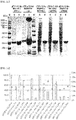
- the collected bacterial cells were washed twice with 50 mM Tris-HCl buffer (pH 8.0) and suspended in the same buffer. Then, cells were disrupted using an ultrasonic homogenizer. The cell lysate was centrifuged at 13,000 ⁇ g and 4°C for 20 min. The recombinant enzyme was purified from the supernatant by His-tag affinity chromatography. The purified recombinant enzyme was dialyzed against 50 mM Tris-HCl buffer (pH 8.0) and was then used for subsequent reaction. The molecular weight of the purified recombinant enzyme was determined by SDS-PAGE.
- FIGS. 2a , 2b and 2c The names and molecular weights of the purified enzymes produced using the transformed microorganisms are as follows ( FIGS. 2a , 2b and 2c ):
- D-psicose-6-phosphate was difficult to purchase.
- the inventors directly produced D-psicose-6-phosphate from D-fructose-6-phosphate and investigated the activities of the inositol-mono-phosphatases for D-psicose production.
- D-fructose-6-phosphate was suspended in 50 mM Tris-HCl (pH 7.0), and then the D-fructose-6-phosphate-3-epimerase (FP3E) produced in Example 3 and 0.1 unit/ml of each of the 20 inositol-mono-phosphatases were added thereto. The mixture was allowed to react at 70 ⁇ for 1 h. The production of D-psicose was confirmed by HPLC (SP_0810 column (Shodex), Aminex HPX-87C column (Bio-RAD), 80°C, mobile phase flow rate 0.6 ml/min, refractive index detector).
- HPLC SP_0810 column (Shodex), Aminex HPX-87C column (Bio-RAD), 80°C, mobile phase flow rate 0.6 ml/min, refractive index detector.
- D-psicose-6-phosphate The specific dephosphorylation rates of D-psicose-6-phosphate in a mixture containing D-glucose-6-phosphate, D-glucose-1-phosphate, D-fructose-6-phosphate, and D-psicose-6-phosphate in the presence of the inositol-mono-phosphatases were measured.
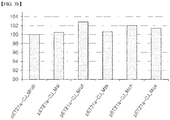
- the enzyme MRUB showed the highest specific dephosphorylation rate of D-psicose-6-phosphate ( FIG. 3a ).
- Example 5 Analysis of activities of the enzymes through multiple enzymatic reactions
- the enzymes CT1, CT2, TN1, FP3E and MRUB were allowed to simultaneously react with maltodextrin.
- 5 %(w/v) maltodextrin was added to 0.1 unit/ml of each enzyme, 5 mM MgCl 2 , and 20 mM sodium phosphate (pH 7.0).
- the mixture was allowed to react at a temperature of 50 ⁇ for 12 h.
- the reaction products were analyzed by HPLC (Aminex HPX-87C column (Bio-RAD), 80°C, mobile phase flow rate 0.6 ml/min), refractive index detector).
Landscapes
- Chemical & Material Sciences (AREA)
- Life Sciences & Earth Sciences (AREA)
- Health & Medical Sciences (AREA)
- Organic Chemistry (AREA)
- Engineering & Computer Science (AREA)
- Zoology (AREA)
- Wood Science & Technology (AREA)
- Genetics & Genomics (AREA)
- Bioinformatics & Cheminformatics (AREA)
- General Engineering & Computer Science (AREA)
- Biochemistry (AREA)
- General Health & Medical Sciences (AREA)
- Biotechnology (AREA)
- Microbiology (AREA)
- Molecular Biology (AREA)
- Biomedical Technology (AREA)
- Medicinal Chemistry (AREA)
- General Chemical & Material Sciences (AREA)
- Chemical Kinetics & Catalysis (AREA)
- Biophysics (AREA)
- Plant Pathology (AREA)
- Physics & Mathematics (AREA)
- Enzymes And Modification Thereof (AREA)
- Micro-Organisms Or Cultivation Processes Thereof (AREA)
- Preparation Of Compounds By Using Micro-Organisms (AREA)
- Pharmaceuticals Containing Other Organic And Inorganic Compounds (AREA)
Abstract
Description
- The present application relates to a novel psicose-6-phosphate phosphatase, a composition for producing D-psicose including the enzyme, and methods for producing D-psicose using the enzyme.
- D-psicose-3-epimerase (EC 5.1.3.30) and D-tagatose-3-epimerase (EC 5.1.3.31) are known as enzymes that catalyze the 3-epimerization of D-fructose to produce D-psicose. When D-psicose is produced through a single enzymatic reaction using the enzyme, reaction equilibrium between the substrate (i.e. D-fructose) and the product (i.e. D-psicose) exists at a constant level (product/substrate = ∼20-35%). Thus, the production of high-purity D-psicose requires an additional process for separating and removing a relatively high concentration of D-fructose from the enzymatic reaction product.
- On the other hand, Chan et al. (2008. Biochemistry. 47:9608-9617) reported D-ribulose-5-phosphate-3-epimerase (EC 5.1.3.1) derived from Streptococcus pyogenes and D-psicose 6-phosphate-3-epimerase (EC 5.1.3.-) derived from E. coli capable of catalyzing the 3-epimerization of D-fructose-6-phosphate and D-psicose-6-phosphate. However, these enzymes are not industrially applicable due to their poor thermoresistance.
- Under such circumstances, the present inventors have earnestly conducted research to develop a method for increasing the conversion rate of D-psicose on an industrial scale in an economical manner. As a result, the present inventors have found that, after sucrose or starch (e.g., maltodextrin) as an inexpensive raw material is converted to D-psicose-6-phosphate, the use of a psicose-6-phosphate phosphatase specific to the D-psicose-6-phosphate and participating in the irreversible reaction pathway enables the production of D-psicose through one-pot enzymatic conversions with two or more enzymes involved in the D-psicose production pathways and can significantly increase the conversion rate to D-psicose. The present application has been accomplished based on this finding.
- It is one object of the present application to provide a novel psicose-6-phosphate phosphatase comprising motif A and motif B.
- It is another object of the present application to provide a nucleic acid encoding the psicose-6-phosphate phosphatase described herein and a transformant comprising the nucleic acid.
- It is a further object of the present application to provide a composition for producing D-psicose comprising an inositol-mono-phosphatase, a microorganism expressing the inositol-mono-phosphatase or a culture of the microorganism.
- It is yet another object of the present application to provide a method for producing D-psicose comprising contacting an inositol-mono-phosphatase, a microorganism expressing the inositol-mono-phosphatase or a culture of the microorganism with D-psicose-6-phosphate to convert the D-psicose-6-phosphate to D-psicose.
- The present application will now be described in detail. Meanwhile, the explanations of aspects and embodiments disclosed in the present application may also be applied to explanations of other aspects and embodiments. In addition, all combinations of various elements disclosed in the present application fall within the scope of the present application. Furthermore, it is not considered that the scope of the present application is limited by the following detailed description.
- In order to achieve the above and other objects of the present application, one aspect of the present application provides a psicose-6-phosphate phosphatase comprising motif A represented by Xa1-Xa2-Xa3-DPLDG-Xa4 wherein Xa1 is W, F, V, I or A, Xa2 is I, F, V, A or a gap, Xa3 is V, I or L, and Xa4 is T or S and motif B represented by Ya1-D-Ya2-Wa1-Ya3-Wa2-Ya4-Wa3 wherein Ya1 is W, Y, T, L or V, Ya2 is V, I, C, F or A, Wa1 is AAG, AAS, SAG, APG, APF, AGG, APL or AGA, Ya3 is W, I, P, M, V, Y, F, R, L, T or S, Wa2 is LLV, LIV, LLI, LII, ILI, FIA, ALV, IIA, VLV, VIL, TIG, NFC or PIF, Ya4 is E, R, S, T, L, K or P, and Wa3 is EAGG, EGGG, EAKG, KAGG, AAGG, YVDG, EAGA or RLGV.
- Specifically, in motif A, Xa1 may be W or F, Xa2 may be I or V, Xa3 may be V or I, and Xa4 may be T. Specifically, in motif B, Ya1 may be W, Ya2 may be V or I, Wa1 may be AAG, Ya3 may be W, I or V, Wa2 may be LLV, LIV, LII or LLI, Ya4 may be E, R or S, and Wa3 may be EAGG or EGGG.
- One or more amino acids may be present between motif A and motif B, at one end of motif A or at one end of motif B. The amino acid sequences other than motif A and motif B may be defined from the sequences of known inositol-mono-phosphatases (for example, the sequences other than motif A and motif B in the sequences set forth in SEQ ID NOS: 1 to 20).
- Motif A and/or motif B is an active site in the sequence of the inositol-mono-phosphatase. Motif A and/or motif B is also known as a binding site of inositol phosphate as a substrate of the enzyme (see Federation of European Biochemical Societies, Volume 294, ). The present inventors have found that the inositol-mono-phosphatase exhibits a psicose-6-phosphate phosphatase activity. The present inventors have also found that motif A and/or motif B of the inositol-mono-phosphatase may be a substrate binding site of the phosphatase.
- The psicose-6-phosphate phosphatase may comprise for example any one of the amino acid sequences set forth in SEQ ID NOS: 1 to 20.
- The psicose-6-phosphate phosphatase of the present application may be an enzyme that has the functions of known inositol-mono-phosphatases.
- The psicose-6-phosphate phosphatase of the present application more selectively catalyzes the dephosphorylation of D-psicose-6-phosphate and may be non-specific for D-glucose-1-phosphate, D-glucose-6-phosphate or D-fructose-6-phosphate.
- The psicose-6-phosphate phosphatase of the present application may be produced by transforming a strain with the enzyme as it is or DNA expressing the enzyme (for example, SEQ ID NOS: 21 to 40), culturing the transformed strain, disrupting the culture, followed by purification. The purification can be performed by column chromatography. The strain may be, for example, Escherichia coli, Corynebacterium glutamicum, Aspergillus oryzae or Bacillus subtilis.
- According to one embodiment of the present application, the psicose-6-phosphate phosphatase of the present application may include an enzyme that has a homology, similarity or identity of at least 90%, at least 95%, at least 97%, at least 99% or 100% to the sequence of motif A and/or motif B and exhibits psicose-6- phosphate phosphatase activity. Alternatively, the psicose-6-phosphate phosphatase of the present application may be an enzyme that has a homology, similarity or identity of at least 70%, at least 75%, at least 80%, at least 85%, at least 90%, at least 95%, at least 97%, at least 99% or 100% to the sequences other than motif A and/or motif B. In one embodiment, the psicose-6-phosphate phosphatase of the present application may include a protein consisting of a sequence that has a homology, similarity or identity of at least 90%, at least 95%, at least 97%, at least 99% or 100% to the sequence of motif A and/or motif B in the sequences set forth in SEQ ID NOS: 1 to 20 and has a homology, similarity or identity of at least 70%, at least 75%, at least 80%, at least 85%, at least 90%, at least 95%, at least 97%, at least 99% or 100% to an amino acid sequence other than motif A and/or motif B in the sequences set forth in SEQ ID NOS: 1 to 20 or a homology, similarity or identity in the range defined by any two of the above values. For example, any amino acid sequence that has the homology, similarity or identity defined above and exhibits an efficacy corresponding to that of the psicose-6-phosphate phosphatase protein, for example, a protein consisting of any one of the sequences set forth in SEQ ID NOS: 1 to 20, and is partially deleted, modified, substituted or added is also within the scope of the present application.
- Proteins in which irrelevant sequences are added upstream and downstream of the sequences of motif A and motif B are within the scope of the present application and naturally occurring mutations or silent mutations thereof are not excluded from the scope of the present application as long as they have an activity corresponding to that of the psicose-6-phosphate phosphatase comprising motif A and motif B. Particularly, proteins in which irrelevant sequences are added upstream and downstream of any one of the amino acid sequences set forth in SEQ ID NOS: 1 to 20, naturally occurring mutations, and silent mutations thereof are not excluded from the scope of the present application as long as they have an activity corresponding to that of the psicose-6-phosphate phosphatase comprising motif A and motif B. Proteins comprising motif A and motif B or proteins comprising the amino acid sequences set forth in SEQ ID NOS: 1 to 20 are also within the scope of the present application as long as they have an activity corresponding to that of the psicose-6-phosphate phosphatase comprising motif A and motif B.
- Another aspect of the present application provides a nucleic acid encoding the psicose-6-phosphate phosphatase.
- As used herein, the term "nucleic acid" encompasses DNA and RNA molecules, and a nucleotide as a basic unit of the nucleic acid includes a natural nucleotide as well as an analogue with a modified sugar or base (see Scheit, Nucleotide Analogs, John Wiley, New York(1980); Uhlman and Peyman, Chemical Reviews, 90:543-584(1990)).
- Specifically, the nucleic acid encoding the psicose-6-phosphate phosphatase may include sequences including nucleotides that can be translated into motif A and motif B. In one embodiment, the nucleic acid of the present application may consist of any one of the nucleotide sequences set forth in SEQ ID NOS: 21 to 40. More specifically, the nucleic acid of the present application may include a nucleic acid that has a homology, similarity or identity of at least 90%, at least 95%, at least 99% or 100% to nucleotides that can be translated into motif A and motif B and can exhibit the desired enzyme activity after translation. Specifically, the nucleic acid of the present application may include a nucleic acid that has a homology, similarity or identity of at least 90%, at least 95%, at least 99% or 100% to nucleotides that can be translated into motif A and motif B in the sequences set forth in SEQ ID NOS: 21 to 40. Alternatively, the nucleic acid of the present application may be a nucleic acid that has a homology, similarity or identity of at least 80%, at least 90%, at least 95%, at least 97% or at least 99% to nucleotides that can be translated into motifs other than motif A and motif B in the sequences set forth in SEQ ID NOS: 21 to 40. Proteins that can be translated into proteins including motif A and motif B due to codon degeneracy, specifically, proteins consisting of any one of the amino acid sequences set forth in SEQ ID NOS: 1 to 20 or polynucleotides that can be translated into proteins having a homology, similarity or identity to the proteins consisting of any one of the amino acid sequences set forth in SEQ ID NOS: 1 to 20 are also within the scope of the present application.
- The enzyme comprising motif A and motif B according to the present application may be derived from a thermoresistant or thermophilic strain. Specifically, the enzyme consisting of any one of the amino acid sequences set forth in SEQ ID NOS: 1 to 20 may be an enzyme derived from Rhodothermus marinus, Thermotoga lettingae, Meiothermus ruber, Dictyoglomus turgidum, Pyrobaculum ferrireducens, Thermoanaerobacter wiegelii, Thermus thermophilus, Thermococcus litoralis, Geobacillus stearothermophilus, Anaerolinea thermophila, Sulfolobus acidocaldarius, Thermosulfidibacter takaii, Pyrococcus furiosus, Archaeoglobus fulgidus, Alicyclobacillus acidocaldarius, Meiothermus silvanus, Meiothermus rufus, Meiothermus taiwanensis, Meiothermus chliarophilus or Meiothermus cerbereus.
- As used herein, the term "homology" or "identity" indicates the degree of relatedness between two given amino acid sequences or nucleotide sequences, which can be expressed as a percentage.
- The terms "homology" and "identity" are often used interchangeably.
- The sequence homology or identity of conserved polynucleotides or polypeptides is determined by standard alignment algorithms and can be used with default gap penalties established by programs used. Substantially, homologous, or identical sequence would hybridize typically at moderate stringency or at high stringency all along at least about 50%, 60%, 70%, 80% or 90% of the full-length polynucleotide or polypeptide of interest. Also contemplated are polynucleotides that contain degenerate codons in place of codons in the hybridizing polynucleotides.
- Whether any two polynucleotide or polypeptide sequences are homologous, similar or identical can be determined using known computer algorithms such as the "FASTA" program, using for example, the default parameters as in Pearson et al. (1988), Proc. Natl. Acad. Sci. USA 85: 2444. Alternatively, the sequence homology, similarity or identity may be determined using the Needleman-Wunsch algorithm (Needleman and Wunsch, 1970, J. Mol. Biol. 48: 443-453) as implemented in the Needle program of the EMBOSS package (EMBOSS: The European Molecular Biology Open Software Suite, Rice et al., 2000, Trends Genet. 16: 276-277), version 5.0.0 or later. Other programs include the GCG program package (Devereux, J., et al, Nucleic Acids Research 12: 387 (1984)), BLASTP, BLASTN, FASTA (Atschul, [S.] [F.,] [ET AL, J MOLEC BIOL 215]: 403 (1990); Guide to Huge Computers, Martin J. Bishop, [ED.,] Academic Press, San Diego, 1994, and [CARILLO et al.] (1988) SIAM J Applied Math 48: 1073). For instance, the BLAST tool of the NCBI database can be used to determine homology, similarity or identity. Other commercially or publicly available programs such as ClustalW may also be used.
- Percent homology, similarity or identity of polynucleotides or polypeptides can be determined, for example, by comparing sequence information using a GAP computer program (e.g. Needleman et al., (1970) J. Mol. Biol. 48:443, as revised by Smith and Waterman, Adv. Appl. Math (1981) 2:482). Briefly, the GAP program defines similarity as the number of aligned symbols (i.e., nucleotides or amino acids) which are similar, divided by the total number of symbols in the shorter of the two sequences. Default parameters for the GAP program can include: (1) a unary comparison matrix (containing a value of 1 for identities and 0 for non-identities) and the weighted comparison matrix of Gribskov et al. (1986) Nucl. Acids Res. 14:6745, as described by Schwartz and Dayhoff, eds., Atlas Of Protein Sequence And Structure, National Biomedical Research Foundation, pp. 353-358 (1979); (2) a penalty of 3.0 for each gap and an additional 0.10 penalty for each symbol in each gap(or gap open penalty 10.0, gap extension penalty 0.5); and (3) no penalty for end gaps. Therefore, the terms "homology", or "identity" as used herein indicate comparison between polypeptides or polynucleotides.
- A further aspect of the present application provides a vector comprising the nucleic acid encoding the psicose-6-phosphate phosphatase described herein or a transformant comprising the nucleic acid encoding the psicose-6-phosphate phosphatase or the vector comprising the nucleic acid encoding the psicose-6-phosphate phosphatase.
- As used herein, the term "vector" refers to any vehicle for the cloning and/or transfer of bases nucleic acid into a host cell. A vector may be a replicon to which another DNA segment may be attached so as to bring about the replication of the attached segment. A "replicon" refers to any genetic element (e.g., plasmid, phage, cosmid, chromosome or virus) that functions as an autonomous unit of DNA replication in vivo, i.e. capable of replication under its own control. The term "vector" may include both viral and nonviral vehicles for introducing nucleic acid into a host cell in vitro, ex vivo or in vivo. The term "vector" may also include minicircle DNAs. Specifically, the vector comprising the nucleic acid encoding the psicose-6-phosphate phosphatase according to the present application may be pET21a-CJ_Rma, pET21a-CJ_Tle, pET21a-CJ_Mrub, pET21a-CJ_Dtu, pET21a-CJ_Msi, pET21a-CJ_Mruf, pET21a-CJ_Mta, pET21a-CJ Mch, pET21a-CJ_Mce, pBT7-C-His-CJ_Pfe, pBT7-C-His-CJ_Twi, pBT7-C-His-CJ_Tth, pBT7-C-His-CJ_Tli, pBT7-C-His-CJ_Gst, pBT7-C-His-CJ_Ath, pBT7-C-His-CJ_Sac, pBT7-C-His-CJ_Tta, pBT7-C-His-CJ Pfu, pBT7-C-His-CJ Afu or pBT7-C-His-CJ_Aac.
- As used herein, the term "transformation" refers to the introduction of a vector including a nucleic acid encoding a target protein into a host cell to express the protein encoded by the nucleic acid in the host cell. The transformed nucleic acid may be either inserted into and located in the chromosome of the host cell or may exist extrachromosomally as long as it can be expressed in the host cell. The nucleic acid includes DNA and RNA encoding the target protein. The nucleic acid may be introduced in any form as long as it can be introduced into and expressed in the host cell. For example, the nucleic acid may be introduced into the host cell in the form of an expression cassette, which is a gene construct including all elements required for its autonomous expression, but its form is not limited thereto. Typically, the expression cassette includes a promoter operably linked to the nucleic acid, a transcription termination signal, a ribosome-binding domain, and a translation termination signal. The expression cassette may be in the form of a self-replicable expression vector. The nucleic acid as it is may be introduced into the host cell and operably linked to sequence required for expression in the host cell.
- As used herein, the term "operably linked" refers to a functional linkage between a promoter sequence initiating and mediating the transcription of the nucleic acid encoding the target protein of the present application and a gene sequence.
- The following abbreviations and names are used for the amino acids mentioned in the present application.
[Table 1] Type of amino acid Abbreviation Alanine A Arginine R Asparagine N Aspartic acid D Cysteine C Glutamic acid E Glutamine Q Glycine G Histidine H Isoleucine I Leucine L Lysine K Methionine M Phenylalanine F Proline P Serine S Threonine T Tryptophan W Tyrosine Y Valine V - Any transformation method for introducing the nucleic acid into a cell may be used. The transformation method may be carried out by a suitable standard technique known in the art depending on the type of host cell. Examples of such transformation methods include, but are not limited to, electroporation, calcium phosphate (CaPO4) precipitation, calcium chloride (CaCl2) precipitation, retroviral infection, microinjection, the polyethylene glycol (PEG) method, the DEAE-dextran method, the cationic liposome method, and the lithium acetate-DMSO method.
- The host cells are preferably host cells into which DNA is introduced with high efficiency and in which the introduced DNA is expressed at a high level. Examples of the host cells include, but are not limited to, cells of microorganisms belonging to the genera Corynebacterium, Escherichia, and Serratia. Specifically, the host cells may be E. coli cells.
- The transformant of the present application may be E. coli BL21(DE3)/pET21a-CJ_Rma(E. coli_P1_CJ_Rma, KCCM12057P), E. coli BL21(DE3)/pET21a-CJ_Tle(E. coli_P2_CJ_Tle, KCCM12058P), E. coli BL21(DE3)/pET21a-CJ_Mrub(E. coli_P3_CJ_Mrub, KCCM12059P), E. coli BL21(DE3)/pET21a-CJ_Dtu(E. coli_P4_CJ_Dtu, KCCM12060P), E. coli BL21(DE3)/pBT7-C-His-CJ_Pfe(E. coli_P5_CJ_Pfe, KCCM12061P), E. coli BL21(DE3)/pBT7-C-His-CJ_Twi(E. coli_P6_CJ_Twi, KCCM12062P), E. coli BL21(DE3)/pBT7-C-His-CJ_Tth(E. coli_P7_CJ_Tth, KCCM12063P), E. coli BL21(DE3)/pBT7-C-His-CJ_Tli(E. coli_P8_CJ_Tli, KCCM12064P), E. coli BL21(DE3)/pBT7-C-His-CJ_Gst(E. coli_P9_CJ_Gst, KCCM12065P), E. coli BL21(DE3)/pBT7-C-His-CJ_Ath(E. coli_P10_CJ_Ath, KCCM12066P), E. coli BL21(DE3)/pBT7-C-His-CJ_Sac(E. coli_P11_CJ_Sac, KCCM12067P), E. coli BL21(DE3)/pBT7-C-His-CJ_Tta(E. coli_P12_CJ_Tta, KCCM12068P), E. coli BL21(DE3)/pBT7-C-His-CJ_Pfu(E. coli_P13_CJ_Pfu, KCCM12069P), E. coli BL21(DE3)/pBT7-C-His-CJ_Afu(E. coli_P14_CJ_Afu, KCCM12070P), E. coli BL21(DE3)/pBT7-C-His-CJ_Aac(E. coli_P15_CJ_Aac, KCCM12071P), E. coli BL21(DE3)/pET21a-CJ_Msi(E. coli_P16_CJ_Msi, KCCM12072P), E. coli BL21(DE3)/pET21a-CJ_Mruf(E. coli_P17_CJ_Mruf, KCCM12073P), E. coli BL21(DE3)/pET21a-CJ_Mta(E. coli_P18_CJ_Mta, KCCM12074P), E. coli BL21(DE3)/pET21a-CJ_Mch(E. coli_P19_CJ_Mch, KCCM12075P) or E. coli BL21(DE3)/pET21a-CJ Mce(E. coli_P20_CJ_Mce, KCCM12076P).
- Another aspect of the present application provides a composition for producing D-psicose comprising an inositol-mono-phosphatase, a microorganism expressing the inositol-mono-phosphatase or a culture of the microorganism expressing the inositol-mono-phosphatase.
- The inositol-mono-phosphatase of the present application may include motif A represented by Xa1-Xa2-Xa3-DPLDG-Xa4 wherein Xa1 is W, F, V, I or A, Xa2 is I, F, V, A or a gap, Xa3 is V, I or L, and Xa4 is T or S and motif B represented by Ya1-D-Ya2-Wa1-Ya3-Wa2-Ya4-Wa3 wherein Ya1 is W, Y, T, L or V, Ya2 is V, I, C, F or A, Wa1 is AAG, AAS, SAG, APG, APF, AGG, APL or AGA, Ya3 is W, I, P, M, V, Y, F, R, L, T or S, Wa2 is LLV, LIV, LLI, LII, ILI, FIA, ALV, IIA, VLV, VIL, TIG, NFC or PIF, Ya4 is E, R, S, T, L, K or P, and Wa3 is EAGG, EGGG, EAKG, KAGG, AAGG, YVDG, EAGA or RLGV. That is, the inositol-mono-phosphatase can be used interchangeably with the psicose-6-phosphate phosphatase. Thus, the explanations of the psicose-6-phosphate phosphatase can be applied to the inositol-mono-phosphatase. In one embodiment, the inositol-mono-phosphatase may be an enzyme consisting of any one of the amino acid sequences set forth in SEQ ID NOS: 1 to 20.
- The composition of the present application may further comprise an enzyme and/or a substrate involved in the D-psicose production pathway (see
FIG. 1 ) [(i) starch, maltodextrin, sucrose or a combination thereof; (ii) a phosphate; (iii) a D-fructose-6-phosphate-3-epimerase; (iv) a D-glucose-6-phosphate-isomerase; (v) a phosphoglucomutase or a glucokinase; and/or (vi) an α-glucan phosphorylase, a starch phosphorylase, a maltodextrin phosphorylase, a sucrose phosphorylase, an α-amylase, a pullulanase, an isoamylase, a glucoamylase or a sucrase]; a microorganism expressing the enzyme involved in the D-psicose production pathway; or a culture of the microorganism expressing the enzyme involved in the D-psicose production pathway. The additional enzyme and substrate are merely illustrative and are not limited as long as D-psicose can be produced using the psicose-6-phosphate phosphatase of the present application. - The starch/maltodextrin phosphorylase (EC 2.4.1.1) and α-glucan phosphorylase may include any protein that is active in phosphoryl transfer to glucose to produce D-glucose-1-phosphate from starch or maltodextrin. Specifically, the protein active in producing D-glucose-1-phosphate from starch or maltodextrin may consist of the amino acid sequence set forth in SEQ ID NO: 59. The protein active in producing D-glucose-1-phosphate from starch or maltodextrin may be encoded by the sequence set forth in SEQ ID NO: 60.
- The sucrose phosphorylase (EC 2.4.1.7) may include any protein that is active in phosphoryl transfer to glucose to produce D-glucose-1-phosphate from sucrose.
- The α-amylase (EC 3.2.1.1), pullulanase (EC 3.2.1.41), glucoamylase (EC 3.2.1.3), and isoamylase are starch liquefying enzymes and may include any protein that is active in converting starch or maltodextrin to glucose.
- The sucrase (EC 3.2.1.26) may include any protein that is active in converting sucrose to glucose.
- The phosphoglucomutase (EC 5.4.2.2) may include any protein that is active in converting D-glucose-1-phosphate to D-glucose-6-phosphate. Specifically, the protein active in converting D-glucose-1-phosphate to D-glucose-6-phosphate may comprise the amino acid sequence set forth in SEQ ID NO: 61. The protein active in converting D-glucose-1-phosphate to D-glucose-6-phosphate may be encoded by the sequence set forth in SEQ ID NO: 62.
- The glucokinase may include any protein that is active in phosphoryl transfer to glucose to convert glucose to D-glucose-6-phosphate. Specifically, the glucokinase may be a polyphosphate-dependent glucokinase. More specifically, the glucokinase may be a protein consisting of the amino acid sequence set forth in SEQ ID NO: 77 or 78. The D-glucose-6-phosphate-isomerase may include any protein that is active in converting D-glucose-6-phosphate to D-fructose-6-phosphate. Specifically, the D-glucose-6-phosphate-isomerase may be a protein comprising the amino acid sequence set forth in SEQ ID NO: 63. The D-glucose-6-phosphate-isomerase may be encoded by the sequence set forth in SEQ ID NO: 64.
- The D-fructose-6-phosphate-3-epimerase may include any protein that is active in converting D-fructose-6-phosphate to D-psicose-6-phosphate. Specifically, the D-fructose-6-phosphate-3-epimerase may be a protein comprising the amino acid sequence set forth in SEQ ID NO: 65. The D-fructose-6-phosphate-3-epimerase may be encoded by the sequence set forth in SEQ ID NO: 66.
- The composition for D-psicose production according to the present application may further include a protein that is active in converting glucose to starch, maltodextrin or sucrose. The protein may be, for example, a 4-α-glucanotransferase. The protein active in converting glucose to starch, maltodextrin or sucrose may be an enzyme comprising the amino acid sequence set forth in SEQ ID NO: 67. Specifically, the protein active in converting glucose to starch, maltodextrin or sucrose may be encoded by the nucleotide sequence set forth in SEQ ID NO: 68. The composition for D-psicose production according to the present application may further include any suitable excipient known in the art. Examples of such excipients include, but are not limited to, preservatives, wetting agents, dispersants, suspending agents, buffers, stabilizers, and isotonic agents.
- The composition for D-psicose production according to the present application may further include a metal ion or a metal salt. In one embodiment, the metal ion may be a divalent metal cation. Specifically, the metal ion may be selected from the group consisting of Ni, Mg, Co, Mn, Fe, and Zn ions. More specifically, the composition for D-psicose production according to the present application may further include a metal salt. Even more specifically, the metal salt may be selected from the group consisting of NiSO4, MgSO4, MgCl2, NiCl2, CoSO4, CoCl2, MnCl2, FeSO4, ZnSO4, and mixtures thereof.
- Another aspect of the present application provides a method for producing D-psicose comprising contacting an inositol-mono-phosphatase, a microorganism expressing the enzyme or a culture of the microorganism with D-psicose-6-phosphate to convert the D-psicose-6-phosphate to D-psicose.
- The inositol-mono-phosphatase may include motif A represented by Xa1-Xa2-Xa3-DPLDG-Xa4 and motif B represented by Ya1-D-Ya2-Wa1-Ya3-Wa2-Ya4-Wa3. Herein, the inositol-mono-phosphatase may be used interchangeably with the psicose-6-phosphate phosphatase.
- The method of the present application may further include, prior to the conversion of D-psicose-6-phosphate to D-psicose, bringing a D-fructose-6-phosphate-3-epimerase, a microorganism expressing the D-fructose-6-phosphate-3-epimerase or a culture of the microorganism expressing the D-fructose-6-phosphate-3-epimerase into contact with D-fructose-6-phosphate to convert the D-fructose-6-phosphate to D-psicose-6-phosphate.
- The method of the present application may further include, prior to the conversion of D-fructose-6-phosphate to D-psicose-6-phosphate, bringing a D-glucose-6-phosphate-isomerase, a microorganism expressing the D-glucose-6-phosphate-isomerase or a culture of the microorganism expressing the D-glucose-6-phosphate-isomerase into contact with D-glucose-6-phosphate to convert the D-glucose-6-phosphate to D-fructose-6-phosphate.
- The method of the present application may further include, prior to the conversion of D-glucose-6-phosphate to D-fructose-6-phosphate, bringing a phosphoglucomutase, a microorganism expressing the phosphoglucomutase or a culture of the microorganism expressing the phosphoglucomutase into contact with D-glucose-1-phosphate to convert the D-glucose-1-phosphate to D-glucose-6-phosphate.
- The method of the present application may further include, prior to the conversion of D-glucose-6-phosphate to D-fructose-6-phosphate, bringing a glucokinase, a microorganism expressing the glucokinase or a culture of the microorganism expressing the glucokinase and a phosphate into contact with glucose to convert the glucose to D-glucose-6-phosphate.
- The method of the present application may further include, prior to the conversion of D-glucose-1-phosphate to D-glucose-6-phosphate, bringing an α-glucan phosphorylase, a starch phosphorylase, a maltodextrin phosphorylase or a sucrose phosphorylase, a microorganism expressing the phosphorylase or a culture of the microorganism expressing the phosphorylase and a phosphate into contact with starch, maltodextrin, sucrose or a combination thereof to convert the starch, maltodextrin, sucrose or combination thereof to D-glucose-1-phosphate.
- The method of the present application may further include, prior to the conversion of glucose to D-glucose-6-phosphate, bringing an α-amylase, a pullulanase, a glucoamylase, a sucrase or an isoamylase, a microorganism expressing the α-amylase, pullulanase, glucoamylase, sucrase or isoamylase or a culture of the microorganism expressing the α-amylase, pullulanase, glucoamylase, sucrase or isoamylase into contact with starch, maltodextrin, sucrose or a combination thereof to convert the starch, maltodextrin, sucrose or combination thereof to glucose.
- Yet another aspect of the present application provides a method for producing D-psicose comprising bringing (a) an inositol-mono-phosphatase, a D-fructose-6-phosphate-3-epimerase, a D-glucose-6-phosphate-isomerase, a phosphoglucomutase or a glucokinase and an α-glucan phosphorylase, a starch phosphorylase, a maltodextrin phosphorylase, a sucrose phosphorylase, an α-amylase, a pullulanase, an isoamylase, a glucoamylase or a sucrase or (b) a microorganism expressing the enzymes (a) or a culture of the microorganism into contact with starch, maltodextrin, sucrose or a combination thereof and a phosphate.
- In the method of the present application, the contact reaction may be carried out at a pH of 5.0 to 9.0, specifically a pH of 6.0 to 8.0.
- In the method of the present application, the contact reaction may be carried out at a temperature of 40°C to 80°C, specifically a temperature of 40°C to 60°C or 50°C to 60°C.
- In the method of the present application, the contact reaction may be carried out for 2 hours to 24 hours, specifically 6 to 24 hours.
- In the method of the present application, the contact reaction may be carried out at a pH of 5.0 to 9.0, at a temperature of 40°C to 80°C and/or for 2 hours to 24 hours. Specifically, the contact reaction may be carried out at a pH of 6.0 to 8.0, at a temperature of 40°C to 60°C or 50°C to 60°C and/or for 6 hours to 24 hours.
- The method of the present application may further comprise purifying the reaction product D-psicose. There is no particular restriction on the method for purifying D-psicose. D-psicose may be purified by any suitable method known in the art. Non-limiting examples of such purification methods include chromatography, fractional crystallization, and ion purification, which may be carried out alone or in combination. For example, D-psicose may be purified by chromatography. In this case, the target saccharide may be separated based on small differences in binding force between saccharides and metal ions attached to an ionic resin.
- Each of the methods according to the present application may further comprise bleaching and/or demineralizing before or after the purification step. The bleaching and/or demineralizing makes D-psicose purer without impurities.
- The novel psicose-6-phosphate phosphatase of the present application is a thermoresistant inositol-mono-phosphatase. Due to its thermoresistance, the enzyme of the present application can participate in the pathway for the conversion of D-psicose-6-phosphate to D-psicose, enabling the production of D-psicose on an industrial scale. The use of the enzyme according to the present application allows the pathway for the synthesis of D-psicose from glucose or starch (e.g., maltodextrin) as an inexpensive raw material to proceed. In addition, when the enzyme of the present application is used, D-psicose can be produced through the irreversible dephosphorylation of D-psicose-6-phosphate. Therefore, the use of the enzyme according to the present application considerably increases the conversion rate to D-psicose.
- Furthermore, the methods of the present application based on the use of the inositol-mono-phosphatase enable the production of a high concentration of D-psicose at a high conversion rate, simplifying or omitting the separation and purification of the reaction product. Therefore, the methods of the present application can be carried out in a simple manner and are advantageous from an economic viewpoint.
-
-
FIG. 1 schematically shows the enzymatic reaction pathways for the production of D-psicose from starch (e.g., maltodextrin) or glucose. -
FIGS. 2a ,2b and2c show SDS-PAGE gel images of size markers (M), expressed coenzymes (S), and purified recombinant enzymes (E) (pET21a-CJ_Rma, pET21a-CJ_Tle, pET21a-CJ_Mrub, pET21a-CJ_Dtu, pBT7-C-His-CJ_Pfe, pBT7-C-His-CJ_Twi, pBT7-C-His-CJ_Tth, pBT7-C-His-CJ_Tli, pBT7-C-His-CJ_Gst, pBT7-C-His-CJ_Ath, pBT7-C-His-CJ_Sac, pBT7-C-His-CJ_Tta, pBT7-C-His-CJ_Pfu, pBT7-C-His-CJ_Afu, pBT7-C-His-CJ_Aac, pET21a-CJ_Msi, pET21a-CJ_Mruf, pET21a-CJ_Mta, pET21a-CJ_Mch, pET21a-CJ_Mce) to determine molecular weights thereof, which were taken after protein electrophoresis. -
FIG. 3a shows the relative activities of inositol-mono-phosphatases (pET21a-CJ_Rma, pET21a-CJ_Tle, pET21a-CJ_Mrub, pET21a-CJ_Dtu, pBT7-C-His-CJ_Pfe, pBT7-C-His-CJ_Twi, pBT7-C-His-CJ_Tth, pBT7-C-His-CJ_Tli, pBT7-C-His-CJ_Gst, pBT7-C-His-CJ_Ath, pBT7-C-His-CJ_Sac, pBT7-C-His-CJ_Tta, pBT7-C-His-CJ_Pfu, pBT7-C-His-CJ_Afu, pBT7-C-His-CJ_Aac) for dephosphorylation (%, left Y axis, histogram) and the selective dephosphorylation rates by the inositol-mono-phosphatases in a dephosphorylation mixture containing D-glucose-6-phosphate, D-glucose-1-phosphate, D-fructose-6-phosphate, and D-psicose-6-phosphate (%, right Y axis, square dots). -
FIG. 3b compares the relative activities (%) of inositol-mono-phosphatases (pET21a-CJ Mrub, pET21a-CJ_Msi, pET21a-CJ_Mruf, pET21a-CJ_Mta, pET21a-CJ_Mch, pET21a-CJ_Mce) for dephosphorylation. -
FIG. 4a shows HPLC chromatograms confirming the production of D-psicose from maltodextrin through multiple enzymatic reactions with an α-glucan phosphorylase, a phosphoglucomutase, a D-glucose-6-phosphate-isomerase, a 4-α-glucanotransferase, a D-fructose-6-phosphate-3-epimerase, and a psicose-6-phosphate phosphatase. -
FIG. 4b shows HPLC chromatograms confirming the production of D-psicose through selective dephosphorylation of D-psicose-6-phosphate in a reaction solution containing D-glucose-1-phosphate, D-glucose-6-phosphate, D-fructose-6-phosphate, and D-psicose-6-phosphate in the presence of an inositol-mono-phosphatase according to the present application. - The present application will be explained in detail with reference to the following examples. However, these examples are provided to assist in understanding the present application and do not limit the scope of the present application.
- To provide psicose-6-phosphate phosphatase necessary for the D-psicose production pathway, thermoresistant inositol-mono-phosphatase genes were screened. Specifically, inositol-mono-phosphatase genes (Rma, Tie, Mrub, Dtu, Msi, Mruf, Mta, Mch, and Mce) were screened from the genomic sequences of Rhodothermus marinus, Thermotoga lettingae, Meiothermus ruber, Dictyoglomus turgidum, Pyrobaculum ferrireducens, Thermoanaerobacter wiegelii, Thermus thermophilus, Thermococcus litoralis, Geobacillus stearothermophilus, Anaerolinea thermophila, Sulfolobus acidocaldarius, Thermosulfidibacter takaii, Pyrococcus furiosus, Archaeoglobus fulgidus, Alicyclobacillus acidocaldarius, Meiothermus silvanus, Meiothermus rufus, Meiothermus taiwanensis, Meiothermus chliarophilus, and Meiothermus cerbereus registered in GenBank.
- Based on information on the nucleotide sequences (SEQ ID NOS: 21, 22, 23, 24, 36, 37, 38, 39, and 40 in the order of the genes) and the amino acid sequences (SEQ ID NOS: 1, 2, 3, 4, 16, 17, 18, 19, and 20 in the order of the genes) of the screened genes, forward primers (SEQ ID NOS: 41, 43, 45, 47, 49, 51, 53, 55, and 57) and reverse primers (SEQ ID NOS: 42, 44, 46, 48, 50, 52, 54, 56, and 58) were designed. The genes were amplified from the genomic DNAs of Rhodothermus marinus, Thermotoga lettingae, Meiothermus ruber, Dictyoglomus turgidum, Meiothermus silvanus, Meiothermus rufus, Meiothermus taiwanensis, Meiothermus chliarophilus, and Meiothermus cerbereus by polymerase chain reaction (PCR) using the synthesized primers. The amplified inositol-mono-phosphatase genes were inserted into plasmid vector pET21a (Novagen) for E. coli expression using restriction enzymes Ndel and XhoI or Sa1I to construct recombinant expression vectors, which were named pET21a-CJ_Rma(Nde I/Xho I), pET21a-CJ_Tle(Nde I/Xho I), pET21a-CJ_Mrub(Nde I/Xho I), pET21a-CJ_Dtu(Nde I/Xho I), pET21a-CJ_Msi(Nde I/Sal I), pET21a-CJ_Mruf(Nde I/Sal I), pET21a-CJ_Mta(Nde I/Sal I), pET21a-CJ_Mch(Nde I/Sal I), and pET21a-CJ_Mce(Nde I/Sal I).
- Additionally, inositol-mono-phosphatase genes (Pfe, Twi, Tth, Tli, Gst, Ath, Sac, Tta, Pfu, Afu, and Aac) derived from Pyrobaculum ferrireducens, Thermoanaerobacter wiegelii, Thermus thermophilus, Thermococcus litoralis, Geobacillus stearothermophilus, Anaerolinea thermophila, Sulfolobus acidocaldarius, Thermosulfidibacter takaii, Pyrococcus furiosus, Archaeoglobus fulgidus, and Alicyclobacillus acidocaldarius were screened. Based on information on the nucleotide sequences (SEQ ID NOS: 25, 26, 27, 28, 29, 30, 31, 32, 33, 34, and 35 in the order of the genes) and the amino acid sequences (SEQ ID NOS: 5, 6, 7, 8, 9, 10, 11, 12, 13, 14, and 15 in the order of the genes) of the screened genes, DNA synthesis was requested to Bioneer (Korea). The DNAs were inserted into vector pBT7-C-His (Bioneer) to construct recombinant expression vectors, which were named pBT7-C-His-CJ_Pfe, pBT7-C-His-CJ_Twi, pBT7-C-His-CJ_Tth, pBT7-C-His-CJ_Tli, pBT7-C-His-CJ_Gst, pBT7-C-His-CJ_Ath, pBT7-C-His-CJ_Sac, pBT7-C-His-CJ_Tta, pBT7-C-His-CJ Pfu, pBT7-C-His-CJ Afu, and pBT7-C-His-CJ_Aac.
- The expression vectors were transformed into strain E. coli BL21(DE3) by a general transformation technique (see Sambrook et al. 1989) to produce transformed microorganisms, which were named E. coli BL21(DE3)/pET21a-CJ_Rma (E. coli_P1_CJ_Rma, KCCM12057P), E. coli BL21(DE3)/pET21a-CJ_Tle (E. coli_P2_CJ_Tle, KCCM12058P), E. coli BL21(DE3)/pET21a-CJ_Mrub (E. coli_P3_CJ_Mrub, KCCM12059P), E. coli BL21(DE3)/pET21a-CJ_Dtu (E. coli_P4_CJ_Dtu, KCCM12060P), E. coli BL21(DE3)/pBT7-C-His-CJ_Pfe (E. coli_P5_CJ_Pfe, KCCM12061P), E. coli BL21(DE3)/pBT7-C-His-CJ_Twi (E. coli_P6_CJ_Twi, KCCM12062P), E. coli BL21(DE3)/pBT7-C-His-CJ_Tth (E. coli_P7_CJ_Tth, KCCM12063P), E. coli BL21(DE3)/pBT7-C-His-CJ_Tli (E. coli_P8_CJ_Tli, KCCM12064P), E. coli BL21(DE3)/pBT7-C-His-CJ_Gst (E. coli_P9_CJ_Gst, KCCM12065P), E. coli BL21(DE3)/pBT7-C-His-CJ_Ath (E. coli_P10_CJ_Ath, KCCM12066P), E. coli BL21(DE3)/pBT7-C-His-CJ_Sac (E. coli_P11_CJ_Sac, KCCM12067P), E. coli BL21(DE3)/pBT7-C-His-CJ_Tta (E. coli_P12_CJ_Tta, KCCM12068P), E. coli BL21(DE3)/pBT7-C-His-CJ_Pfu (E. coli_P13_CJ_Pfu, KCCM12069P), E. coli BL21(DE3)/pBT7-C-His-CJ_Afu (E. coli_P14_CJ_Afu, KCCM12070P), E. coli BL21(DE3)/pBT7-C-His-CJ_Aac (E. coli_P15_CJ_Aac, KCCM12071P), E. coli BL21(DE3)/pET21a-CJ_Msi (E. coli_P16_CJ_Msi, KCCM12072P), E. coli BL21(DE3)/pET21a-CJ_Mruf (E. coli_P17_CJ_Mruf, KCCM12073P), E. coli BL21(DE3)/pET21a-CJ_Mta (E. coli_P18_CJ_Mta, KCCM12074P), E. coli BL21(DE3)/pET21a-CJ_Mch (E. coli_P19_CJ_Mch, KCCM12075P), and E. coli BL21(DE3)/pET21a-CJ_Mce (E. coli_P20_CJ_Mce, KCCM12076P).
- The transformed strains were deposited at the Korean Culture Center of Microorganisms (KCCM) on July 10, 2017 under the Budapest Treaty (Accession Nos.: KCCM12057P to KCCM12076P).
- To provide an α-glucan phosphorylase, a phosphoglucomutase, a D-glucose-6-phosphate-isomerase, and a D-fructose-6-phosphate-3-epimerase derived from Thermotoga neapolitana as thermoresistant enzymes necessary for the D-psicose production pathway, genes corresponding to the enzymes were screened (ct1, ct2, tn1 and fp3e in the order of the enzymes).
- Based on the nucleotide sequences (SEQ ID NOS: 60, 62, 64, and 66 in the order of the enzymes) and the amino acid sequences (SEQ ID NOS: 59, 61, 63, and 65 in the order of the enzymes) of the screened genes, forward primers (SEQ ID NOS: 69, 71, 73 and 75) and reverse primers (SEQ ID NOS: 70, 72, 74 and 76) were designed. The enzyme genes were amplified from the genomic DNA of Thermotoga neapolitana as a template by polymerase chain reaction (PCR) using the primers. PCR was performed for a total of 25 cycles using the following conditions: denaturization at 95°C for 30 sec, annealing at 55°C for 30 sec, and polymerization at 68°C for 2 min. The amplified enzyme genes were inserted into plasmid vector pET21a (Novagen) for E. coli expression using restriction enzymes Ndel and Xhol to construct recombinant expression vectors, which were named pET21a-CJ_ct1, pET21a-CJ_ct2, pET21a-CJ_tn1, and pET21a-CJ_fp3e. The recombinant expression vectors were transformed into strain E. coli BL21(DE3) by a general transformation technique (see Sambrook et al. 1989) to produce transformed microorganisms, which were named E. coli BL21(DE3)/pET21a-CJ_ct1 (KCCM11990P), E. coli BL21(DE3)/pET21a-CJ_ct2 (KCCM11991P), E. coli BL21(DE3)/pET21a-CJ_tn1 (KCCM11992P), and E. coli BL21(DE3)/CJ_tn_fp3e (KCCM11848P). The strains were deposited at the Korean Culture Center of Microorganisms (KCCM) on June 23, 2016 under the Budapest Treaty.
- In this example, recombinant enzymes were produced. First, a culture tube containing 5 ml of LB liquid medium was inoculated with each of the transformed microorganisms produced in Examples 1 and 2. The inoculum was cultured in a shaking incubator at 37°C until an absorbance of 2.0 at 600 nm was reached. The culture broth was added to LB liquid medium in a culture flask, followed by main culture. When the absorbance of the culture at 600 nm reached 2.0, 1 mM IPTG was added to induce the expression and production of a recombinant enzyme. The culture temperature was maintained at 37°C with stirring at 180 rpm. The culture broth was centrifuged at 8,000×g and 4°C for 20 min to collect bacterial cells. The collected bacterial cells were washed twice with 50 mM Tris-HCl buffer (pH 8.0) and suspended in the same buffer. Then, cells were disrupted using an ultrasonic homogenizer. The cell lysate was centrifuged at 13,000×g and 4°C for 20 min. The recombinant enzyme was purified from the supernatant by His-tag affinity chromatography. The purified recombinant enzyme was dialyzed against 50 mM Tris-HCl buffer (pH 8.0) and was then used for subsequent reaction. The molecular weight of the purified recombinant enzyme was determined by SDS-PAGE.
- The names and molecular weights of the purified enzymes produced using the transformed microorganisms are as follows (
FIGS. 2a ,2b and2c ): - 30.3 kDa for the enzyme (RMA) produced from E. coli BL21(DE3)/pET21a-CJ_Rma (E. coli_P1_CJ_Rma);
- 28.5 kDa for the enzyme (TLE) produced from E. coli BL21(DE3)/pET21a-CJ_Tle (E. coli_P2_CJ_Tle);
- 28 kDa for the enzyme (MRUB) produced from E. coli BL21 (DE3)/pET21a-CJ_Mrub (E. coli_P3_CJ_Mrub);
- 30.2 kDa for the enzyme (DTU) produced from E. coli BL21(DE3)/pET21a-CJ_Dtu (E. coli_P4_CJ_Dtu);
- 27.2 kDa for the enzyme (PFE) produced from E. coli BL21(DE3)/pBT7-C-His-CJ Pfe (E. coli_P5_CJ_Pfe);
- 28.8 kDa for the enzyme (TWI) produced from E. coli BL21(DE3)/pBT7-C-His-CJ_Twi (E. coli_P6_CJ_Twi);
- 28.6 kDa for the enzyme (TTH) produced from E. coli BL21(DE3)/pBT7-C-His-CJ_Tth (E. coli_P7_CJ_Tth);
- 28 kDa for the enzyme (TLI) produced from E. coli BL21(DE3)/pBT7-C-His-CJ_Tli (E. coli_P8_CJ_Tli);
- 29.6 kDa for the enzyme (GST) produced from E. coli BL21(DE3)/pBT7-C-His-CJ_Gst (E. coli_P9_CJ_Gst);
- 28.7 kDa for the enzyme (ATH) produced from E. coli BL21(DE3)/pBT7-C-His-CJ_Ath (E. coli_P10_CJ_Ath);
- 29.9 kDa for the enzyme (SAC) produced from E. coli BL21(DE3)/pBT7-C-His-CJ_Sac (E. coli_P11_CJ_Sac);
- 28.6 kDa for the enzyme (TTA) produced from E. coli BL21(DE3)/pBT7-C-His-CJ_Tta (E. coli_P12_CJ_Tta);
- 27.9 kDa for the enzyme (PFU) produced from E. coli BL21(DE3)/pBT7-C-His-CJ_Pfu (E. coli_P13_CJ_Pfu);
- 28 kDa for the enzyme (AFU) produced from E. coli BL21(DE3)/pBT7-C-His-CJ_Afu (E. coli_P14_CJ_Afu);
- 29 kDa for the enzyme (AAC) produced from E. coli BL21(DE3)/pBT7-C-His-CJ_Aac (E. coli_P15_CJ_Aac);
- 28.1 kDa for the enzyme (MSI) produced from E. coli BL21(DE3)/pET21a-CJ_Msi (E. coli_P16_CJ_Msi);
- 28 kDa for the enzyme (MRUF) produced from E. coli BL21(DE3)/pET21a-CJ_Mruf (E. coli_P17_CJ_Mruf);
- 28.1 kDa for the enzyme (MTA) produced from E. coli BL21(DE3)/pET21a-CJ_Mta (E. coli_P18_CJ_Mta);
- 28.4 kDa for the enzyme (MCH) produced from E. coli BL21(DE3)/pET21a-CJ_Mch (E. coli_P19_CJ_Mch);
- 28.1 kDa for the enzyme (MCE) produced from E. coli BL21(DE3)/pET21a-CJ_Mce (E. coli_P20_CJ_Mce);
- The enzyme (CT1) produced from E. coli BL21(DE3)/pET21a-CJ_ct1 (KCCM11990P);
- The enzyme (CT2) produced from E. coli BL21(DE3)/pET21a-CJ_ct2 (KCCM11991P);
- The enzyme (TN1) produced from E. coli BL21(DE3)/pET21a-CJ_tn1 (KCCM11992P); and
- The enzyme (FP3E) produced from E. coli BL21(DE3)/CJ_tn_fp3e (KCCM11848P).
- Psicose-6-phosphate was difficult to purchase. Thus, the inventors directly produced D-psicose-6-phosphate from D-fructose-6-phosphate and investigated the activities of the inositol-mono-phosphatases for D-psicose production.
- Specifically, 50 mM D-fructose-6- phosphate was suspended in 50 mM Tris-HCl (pH 7.0), and then the D-fructose-6-phosphate-3-epimerase (FP3E) produced in Example 3 and 0.1 unit/ml of each of the 20 inositol-mono-phosphatases were added thereto. The mixture was allowed to react at 70□ for 1 h. The production of D-psicose was confirmed by HPLC (SP_0810 column (Shodex), Aminex HPX-87C column (Bio-RAD), 80°C, mobile phase flow rate 0.6 ml/min, refractive index detector).
- The dephosphorylation potency of the all 20 inositol-mono-phosphatases for D-psicose-6-phosphate were investigated (
FIGS. 3a and3b ). - The specific dephosphorylation rates of D-psicose-6-phosphate in a mixture containing D-glucose-6-phosphate, D-glucose-1-phosphate, D-fructose-6-phosphate, and D-psicose-6-phosphate in the presence of the inositol-mono-phosphatases were measured.
- Specifically, 0.1 unit/ml of each of the inositol-mono-phosphatases and 5 mM MgCl2 were added to a mixture of 1%(w/v) D-glucose-6-phosphate, D-glucose-1-phosphate, D-fructose-6-phosphate, and D-psicose-6-phosphate. The reaction was allowed to proceed at 50□ for 12 h. The reaction products were analyzed by HPLC (Aminex HPX-87C column (Bio-RAD), 80°C, mobile phase flow rate 0.6 ml/min). A refractive index detector was used to detect the production of D-psicose and other saccharides (fructose and glucose).
- As a result, the enzyme MRUB showed the highest specific dephosphorylation rate of D-psicose-6-phosphate (
FIG. 3a ). - For the production of D-psicose from maltodextrin, the enzymes CT1, CT2, TN1, FP3E and MRUB were allowed to simultaneously react with maltodextrin. 5 %(w/v) maltodextrin was added to 0.1 unit/ml of each enzyme, 5 mM MgCl2, and 20 mM sodium phosphate (pH 7.0). The mixture was allowed to react at a temperature of 50□ for 12 h. The reaction products were analyzed by HPLC (Aminex HPX-87C column (Bio-RAD), 80°C, mobile phase flow rate 0.6 ml/min), refractive index detector).
- As a result, the production of D-psicose from maltodextrin through the multiple enzymatic reactions was confirmed (
FIG. 4a ). - While the embodiment of the present application has been described in detail, it will be understood by those skilled in the art that the application can be implemented in other specific forms without changing the spirit or essential features of the application. Therefore, it should be noted that the forgoing embodiments are merely illustrative in all aspects and are not to be construed as limiting the application. The scope of the application is defined by the appended claims rather than the detailed description of the application. All changes or modifications or their equivalents made within the meanings and scope of the claims should be construed as falling within the scope of the application.


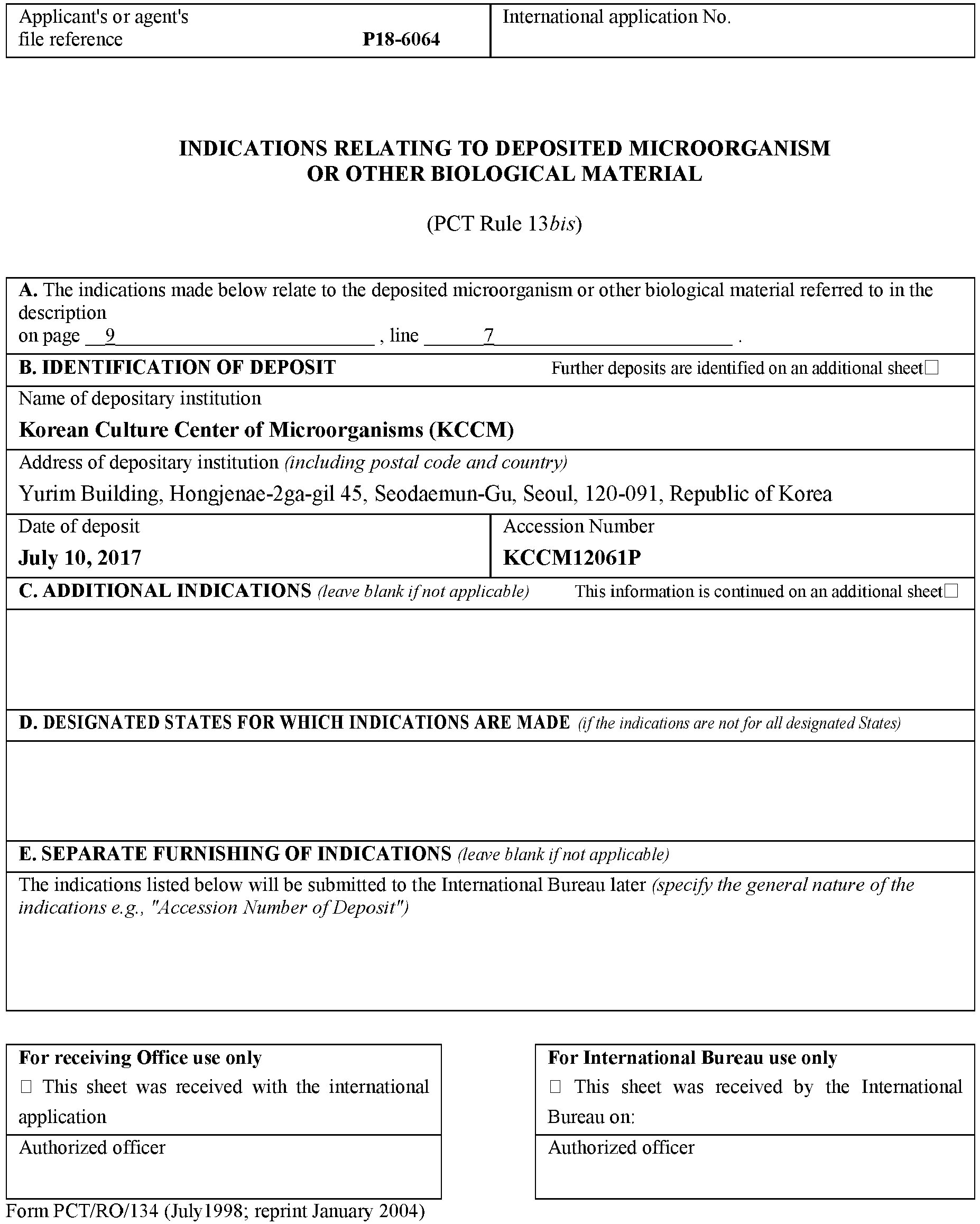


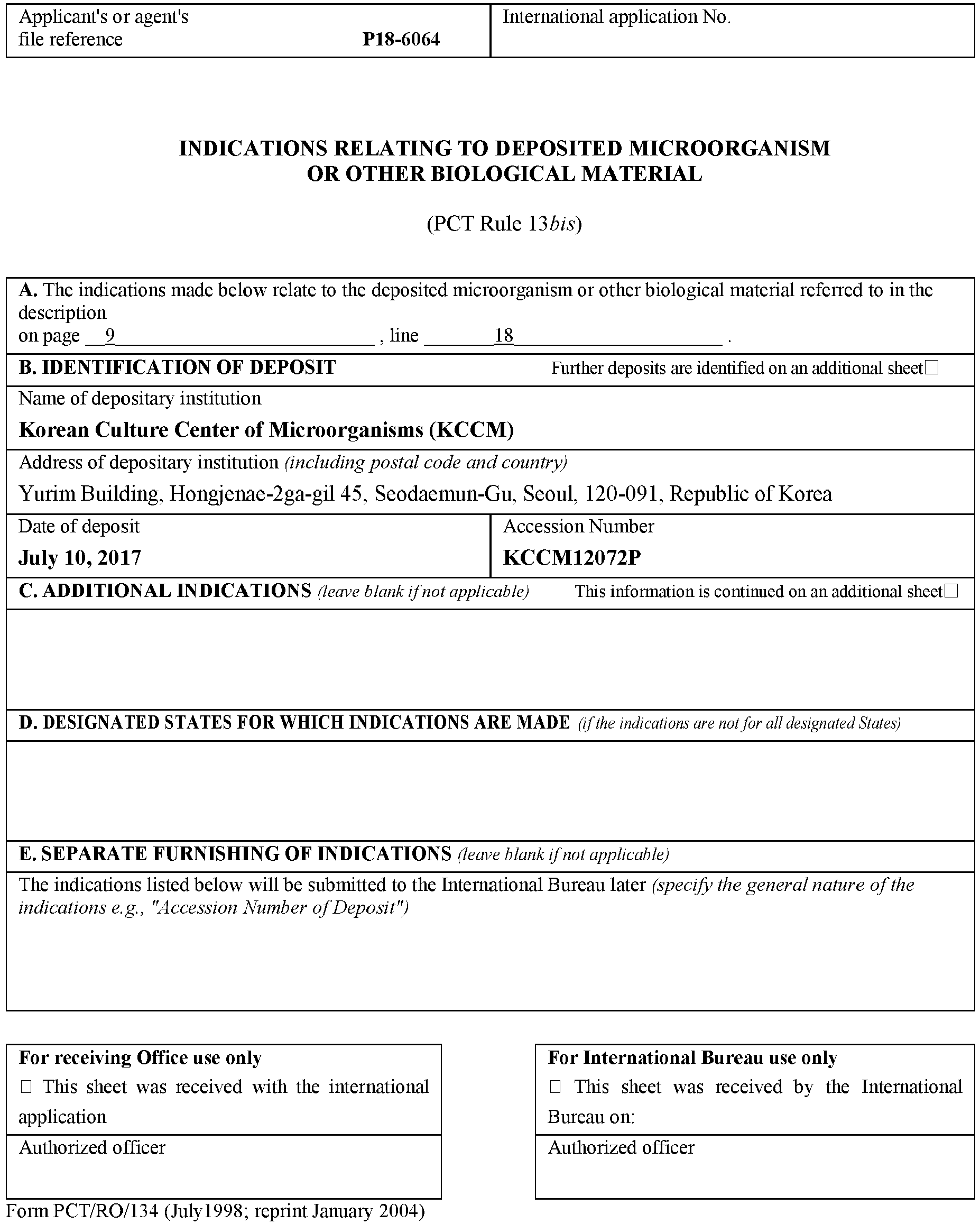


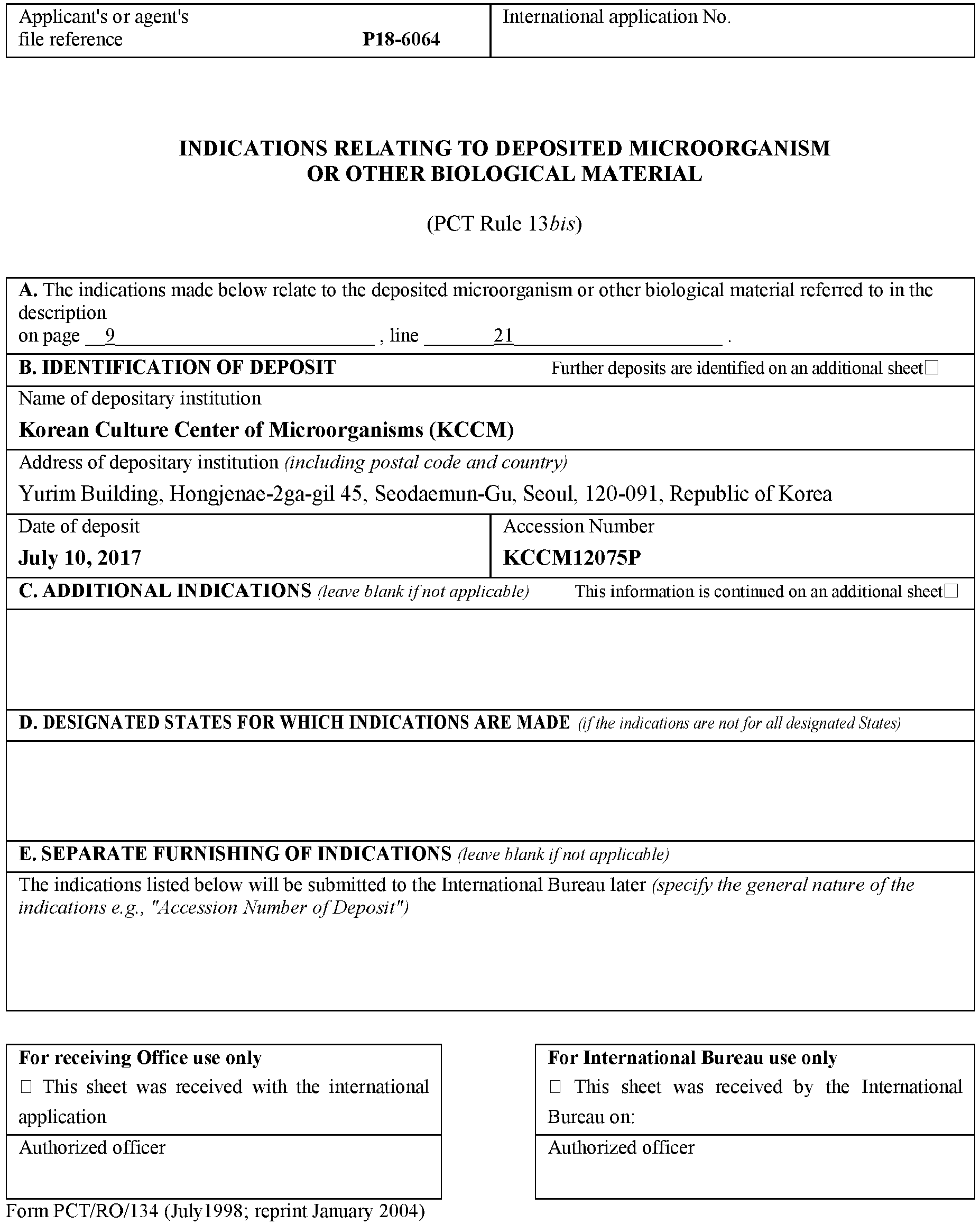


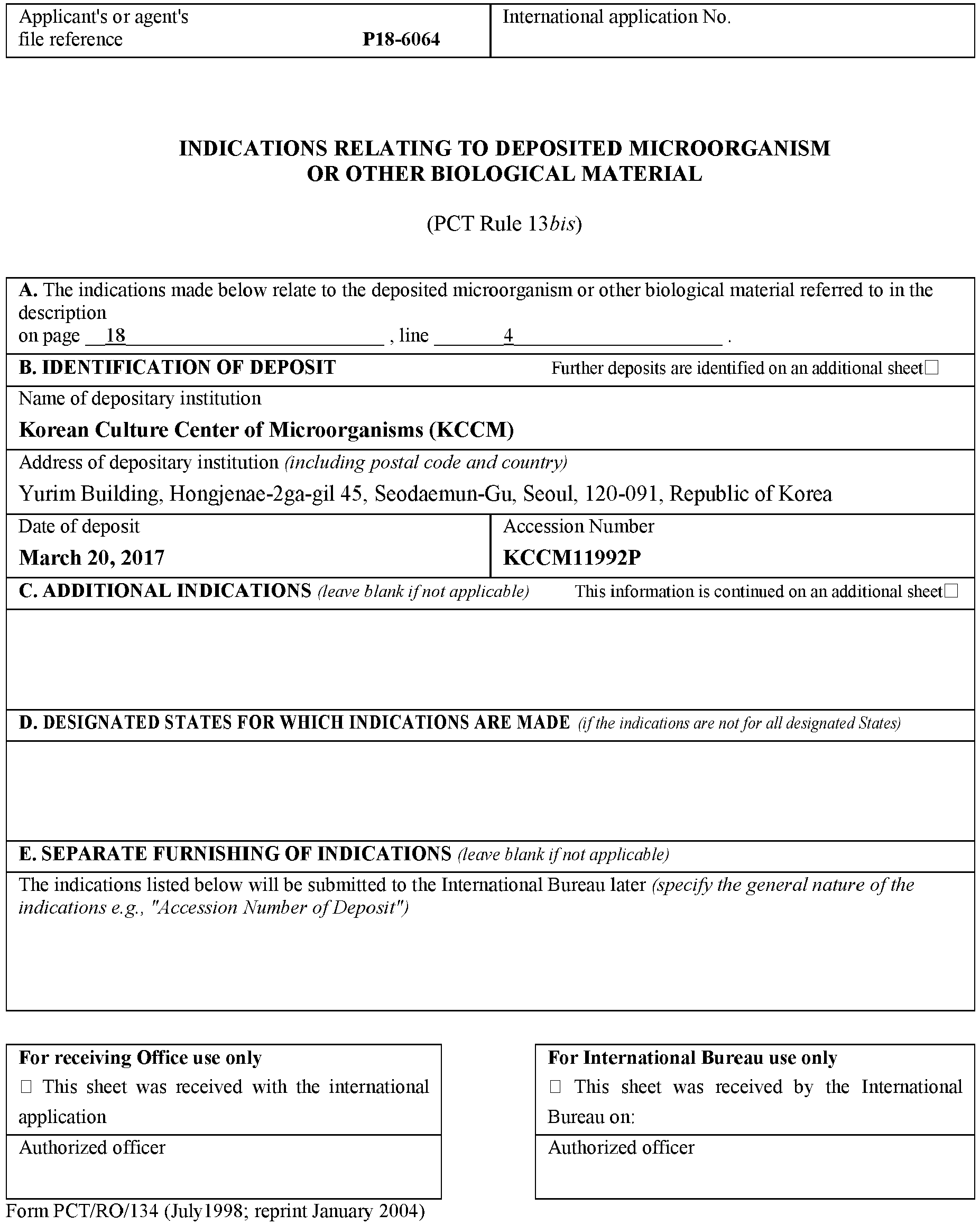


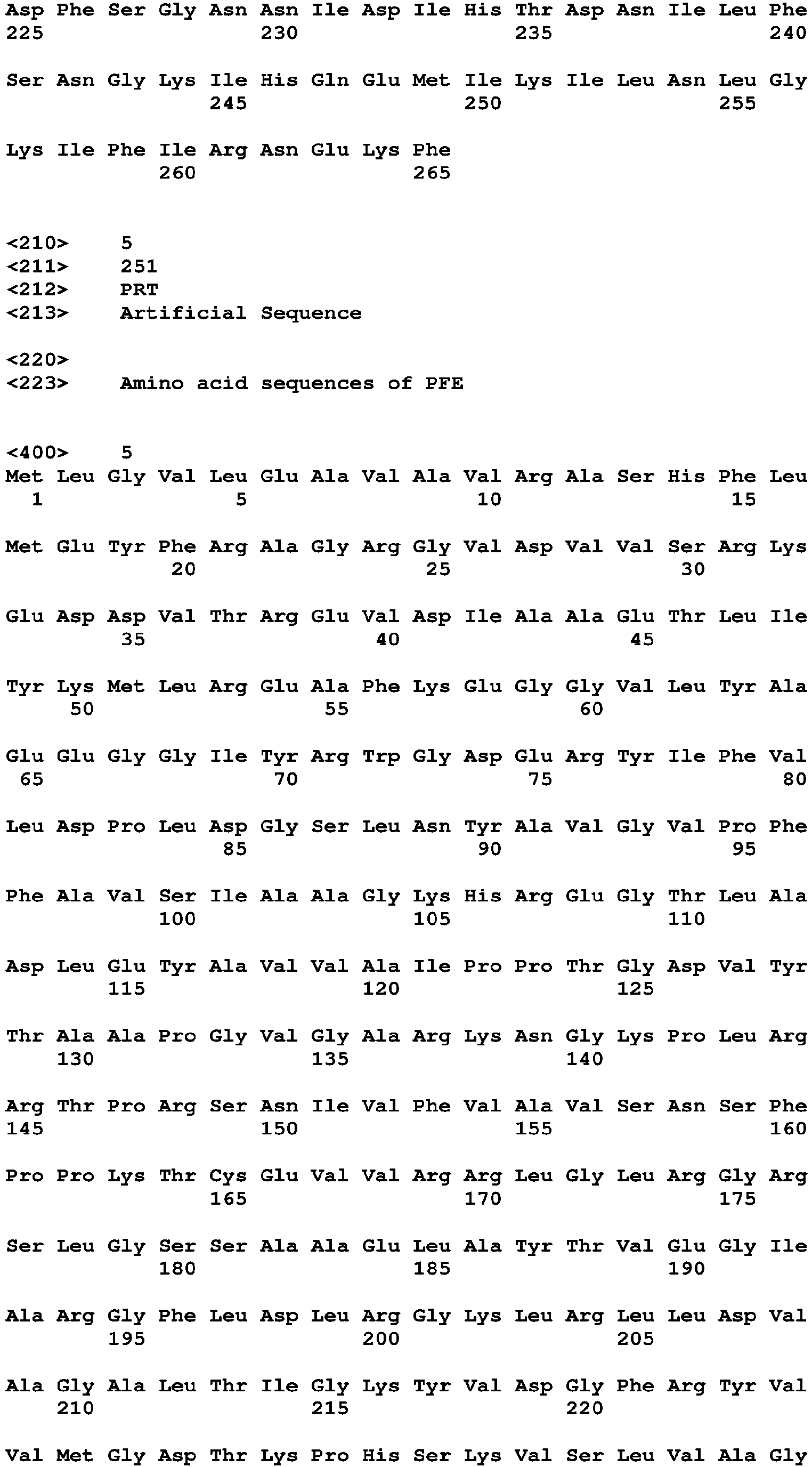


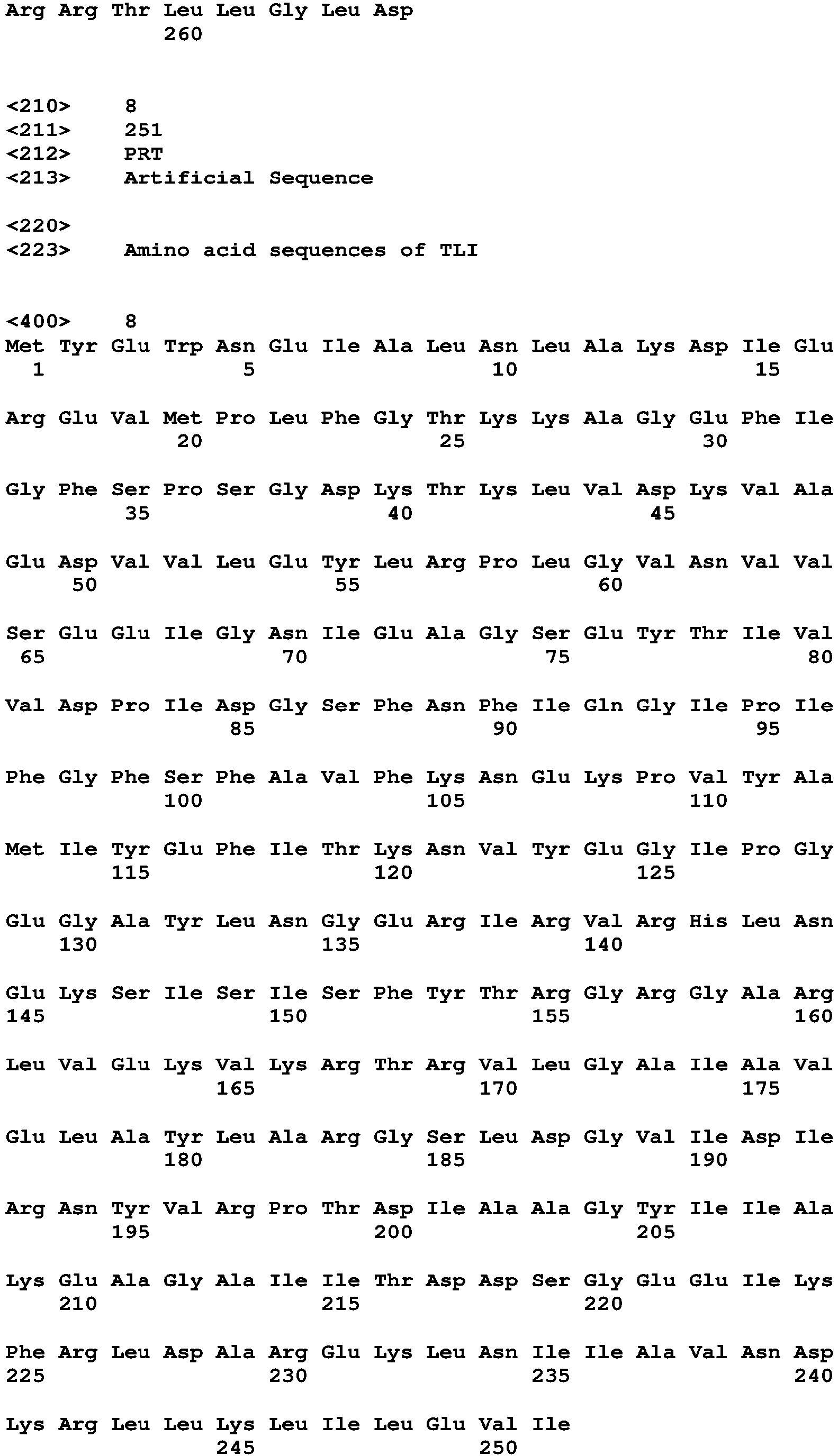


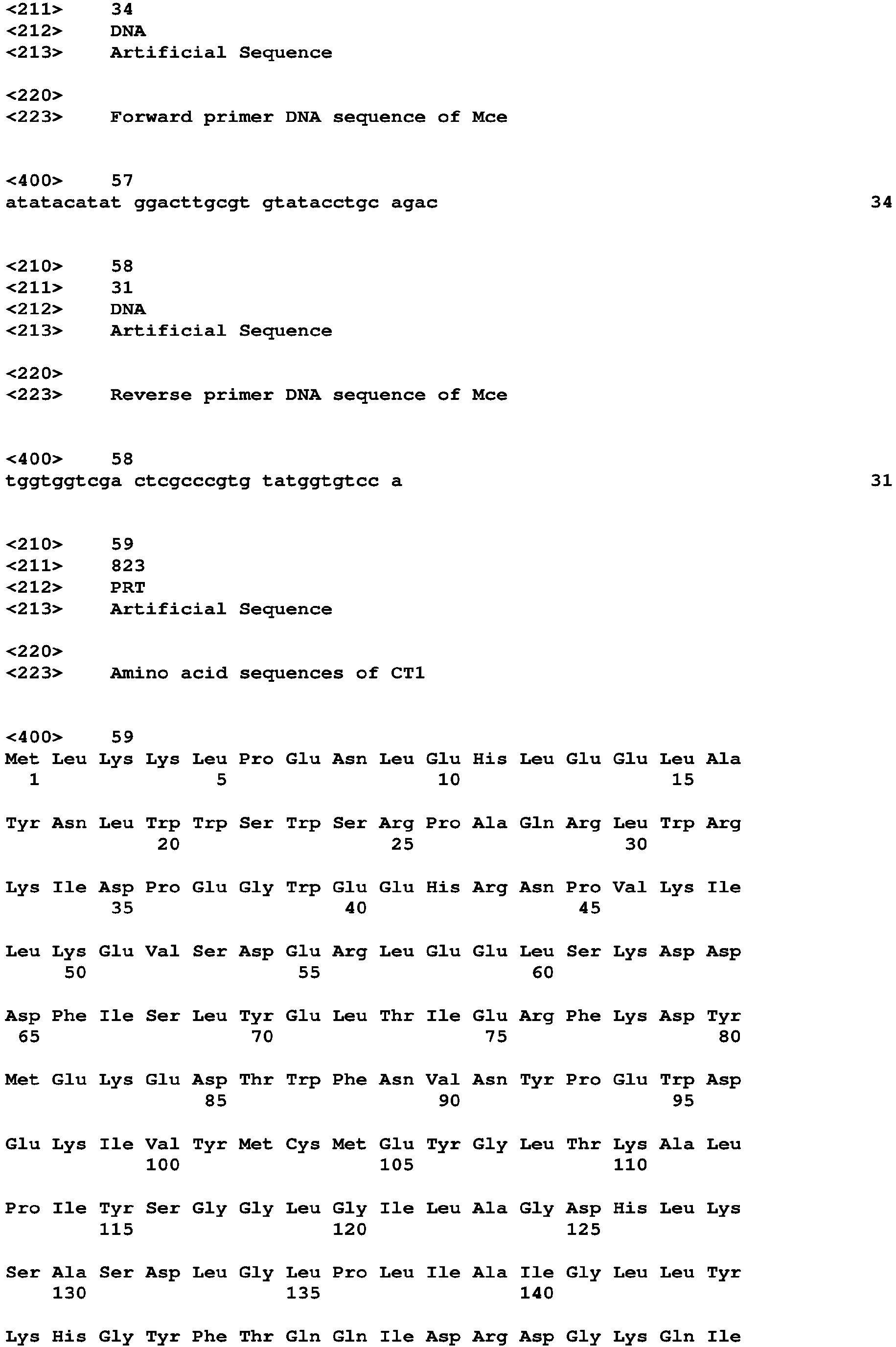

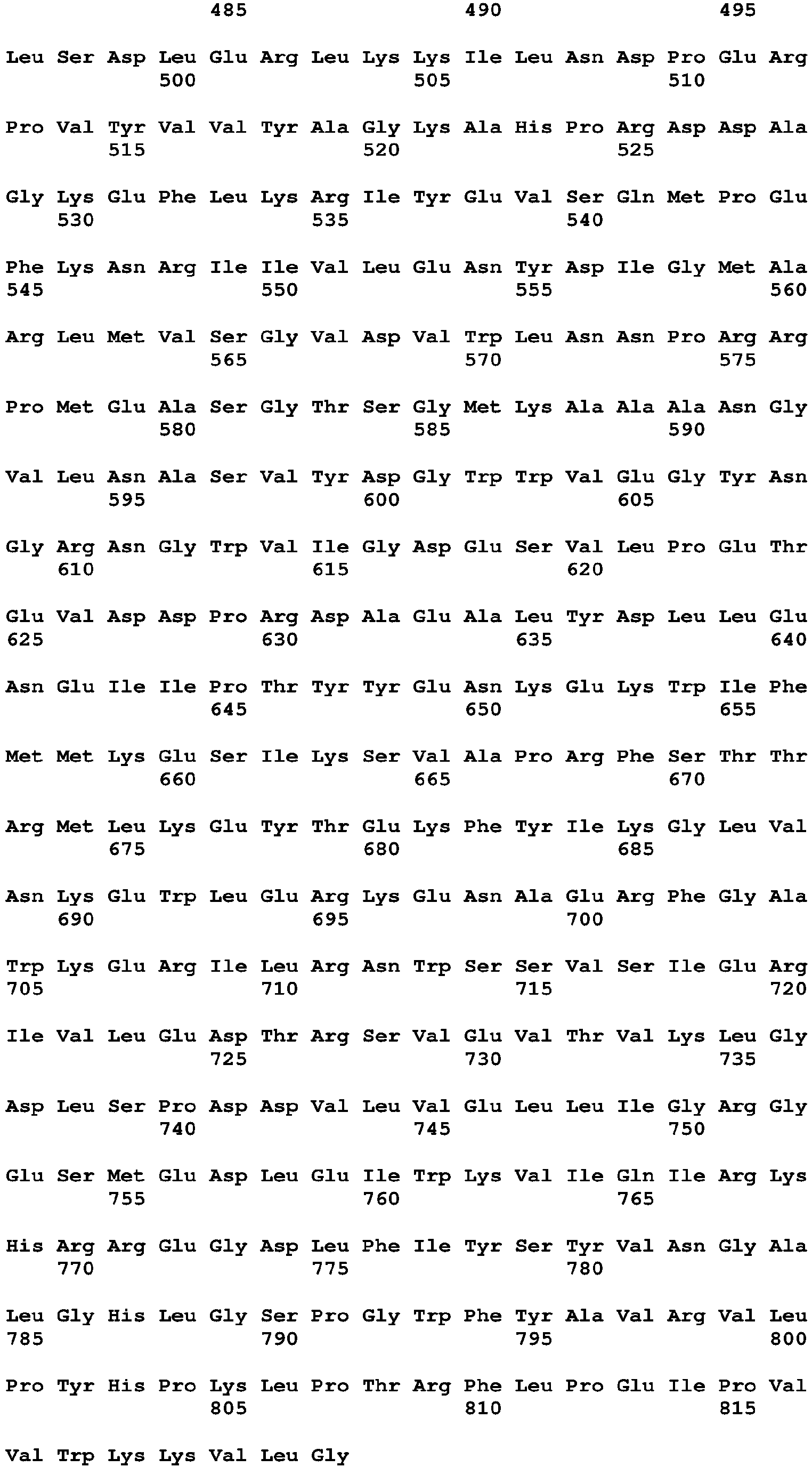
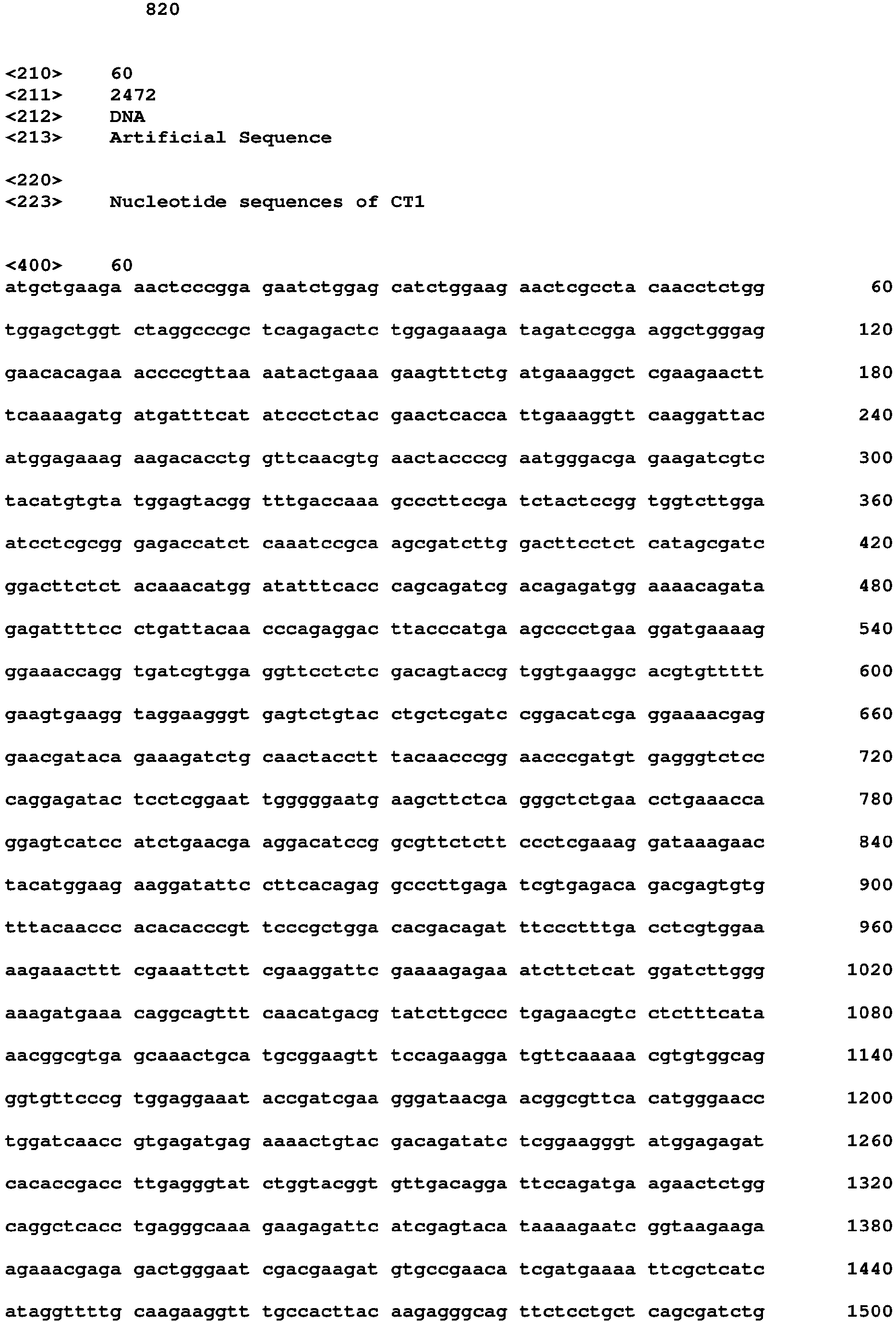


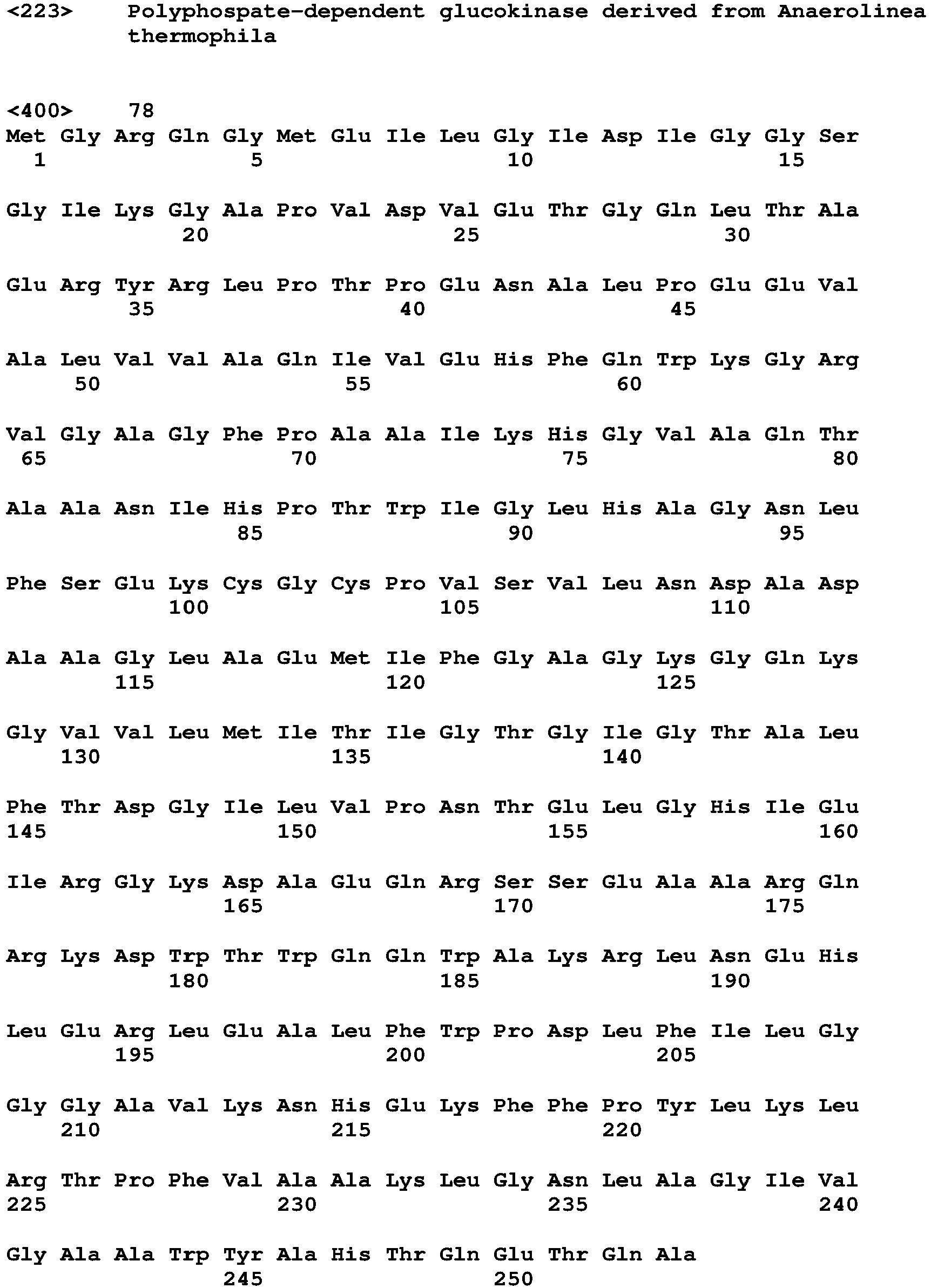
Claims (19)
- A psicose-6-phosphate phosphatase comprising motif A represented by Xa1-Xa2-Xa3-DPLDG-Xa4 wherein Xa1 is W, F, V, I or A, Xa2 is I, F, V, A or absent, Xa3 is V, I or L, and Xa4 is T or S and motif B represented by Ya1-D-Ya2-Wa1-Ya3-Wa2-Ya4-Wa3 wherein Ya1 is W, Y, T, L or V, Ya2 is V, I, C, F or A, Wa1 is AAG, AAS, SAG, APG, APF, AGG, APL or AGA, Ya3 is W, I, P, M, V, Y, F, R, L, T or S, Wa2 is LLV, LIV, LLI, LII, ILI, FIA, ALV, IIA, VLV, VIL, TIG, NFC or PIF, Ya4 is E, R, S, T, L, K or P, and Wa3 is EAGG, EGGG, EAKG, KAGG, AAGG, YVDG, EAGA or RLGV.
- The psicose-6-phosphate phosphatase according to claim 1, wherein, in motif A, Xa1 is W or F, Xa2 is I or V, Xa3 is V or I, and Xa4 is T; and in motif B, Ya1 is W, Ya2 is V or I, Wa1 is AAG, Ya3 is W, I or V, Wa2 is LLV, LIV, LII or LLI, Ya4 is E, R or S, and Wa3 is EAGG or EGGG.
- The psicose-6-phosphate phosphatase according to claim 1, wherein the psicose-6-phosphate phosphatase comprises any one of the amino acid sequences set forth in SEQ ID NOS: 1, 2, 3, 4, 5, 6, 7, 8, 9, 10, 11, 12, 13, 14, 15, 16, 17, 18, 19, and 20 or a sequence having a identity of at least 85% to an amino acid sequence other than motif A and motif B in the sequences set forth in SEQ ID NOS: 1, 2, 3, 4, 5, 6, 7, 8, 9, 10, 11, 12, 13, 14, 15, 16, 17, 18, 19, and 20.
- The psicose-6-phosphate phosphatase according to claim 3, wherein the psicose-6-phosphate phosphatase consists of the amino acid sequence set forth in SEQ ID NO: 1, 2, 3, 4, 5, 6, 7, 8, 9, 10, 11, 12, 13, 14, 15, 16, 17, 18, 19 or 20 is encoded by the nucleotide sequence set forth in SEQ ID NO: 21, 22, 23, 24, 25, 26, 27, 28, 29, 30, 31, 32, 33, 34, 35, 36, 37, 38, 39 or 40, respectively.
- A nucleic acid encoding the psicose-6-phosphate phosphatase according to any one of claims 1 to 4.
- A transformant comprising the nucleic acid according to claim 5.
- A composition for producing D-psicose comprising an inositol-mono-phosphatase, a microorganism expressing the enzyme or a culture of the microorganism.
- The composition according to claim 7, wherein the inositol-mono-phosphatase is the psicose-6-phosphate phosphatase according to any one of claims 1 to 4.
- The composition according to claim 8, further comprising: (a) (i) starch, maltodextrin, sucrose or a combination thereof, (ii) a phosphate, (iii) a D-fructose-6-phosphate-3-epimerase, (iv) a D-glucose-6-phosphate-isomerase, (v) a phosphoglucomutase or a glucokinase, and (vi) an α-glucan phosphorylase, a starch phosphorylase, a maltodextrin phosphorylase, a sucrose phosphorylase, an α-amylase, a pullulanase, an isoamylase, a glucoamylase or a sucrase; or (b) a microorganism expressing the enzymes (a) or a culture of the microorganism.
- A method for producing D-psicose comprising contacting the enzyme according to any one of claims 1 to 4 or an inositol-mono-phosphatase, a microorganism expressing the enzyme or a culture of the microorganism with D-psicose-6-phosphate to convert the D-psicose-6-phosphate to D-psicose.
- The method according to claim 10, wherein the inositol-mono-phosphatase is the psicose-6-phosphate phosphatase according to any one of claims 1 to 4.
- The method according to claim 10, further comprising, prior to the conversion of D-psicose-6-phosphate to D-psicose, bringing a D-fructose-6-phosphate-3-epimerase, a microorganism expressing the D-fructose-6-phosphate-3-epimerase or a culture of the microorganism into contact with D-fructose-6-phosphate to convert the D-fructose-6-phosphate to D-psicose-6-phosphate.
- The method according to claim 11, further comprising, prior to the conversion of D-fructose-6-phosphate to D-psicose-6-phosphate, bringing a D-glucose-6-phosphate-isomerase, a microorganism expressing the D-glucose-6-phosphate-isomerase or a culture of the microorganism into contact with D-glucose-6-phosphate to convert the D-glucose-6-phosphate to D-fructose-6-phosphate.
- The method according to claim 13, further comprising, prior to the conversion of D-glucose-6-phosphate to D-fructose-6-phosphate, bringing a phosphoglucomutase, a microorganism expressing the phosphoglucomutase or a culture of the microorganism into contact with D-glucose-1-phosphate to convert the D-glucose-1-phosphate to D-glucose-6-phosphate.
- The method according to claim 14, further comprising, prior to the conversion of D-glucose-6-phosphate to D-fructose-6-phosphate, bringing a glucokinase, a microorganism expressing the glucokinase or a culture of the microorganism and a phosphate into contact with glucose to convert the glucose to D-glucose-6-phosphate.
- The method according to claim 15, further comprising, prior to the conversion of D-glucose-1-phosphate to D-glucose-6-phosphate, bringing an α-glucan phosphorylase, a starch phosphorylase, a maltodextrin phosphorylase or a sucrose phosphorylase, a microorganism expressing the phosphorylase or a culture of the microorganism and a phosphate into contact with starch, maltodextrin, sucrose or a combination thereof to convert the starch, maltodextrin, sucrose or combination thereof to D-glucose-1-phosphate.
- The method according to claim 15, further comprising, prior to the conversion of glucose to D-glucose-6-phosphate, bringing an α-amylase, a pullulanase, a glucoamylase, a sucrase or an isoamylase, a microorganism expressing the α-amylase, pullulanase, glucoamylase, sucrase or isoamylase or a culture of the microorganism into contact with starch, maltodextrin, sucrose or a combination thereof to convert the starch, maltodextrin, sucrose or combination thereof to glucose.
- A method for producing D-psicose comprising bringing (a) the psicose-6-phosphate phosphatase according to claim 1, a D-fructose-6-phosphate-3-epimerase, a D-glucose-6-phosphate-isomerase, a phosphoglucomutase or a glucokinase and an α-glucan phosphorylase, a starch phosphorylase, a maltodextrin phosphorylase, a sucrose phosphorylase, an α-amylase, a pullulanase, an isoamylase, a glucoamylase or a sucrase or (b) a microorganism expressing the enzymes (a) or a culture of the microorganism into contact with starch, maltodextrin, sucrose or a combination thereof and a phosphate.
- The method according to any one of claims 10 and 12 to 18, wherein the contact reaction is carried out at a pH of 5.0 to 9.0, at a temperature of 40°C to 80°C and/or for 2 hours to 24 hours.
Applications Claiming Priority (2)
| Application Number | Priority Date | Filing Date | Title |
|---|---|---|---|
| KR20170097334 | 2017-07-31 | ||
| PCT/KR2018/008396 WO2019027173A2 (en) | 2017-07-31 | 2018-07-25 | Novel psicose-6-phosphate phosphatase, composition for producing psicose including said enzyme, method for producing psicose using said enzyme |
Publications (2)
| Publication Number | Publication Date |
|---|---|
| EP3663397A2 true EP3663397A2 (en) | 2020-06-10 |
| EP3663397A4 EP3663397A4 (en) | 2021-04-28 |
Family
ID=65232692
Family Applications (1)
| Application Number | Title | Priority Date | Filing Date |
|---|---|---|---|
| EP18841900.6A Pending EP3663397A4 (en) | 2017-07-31 | 2018-07-25 | NEW PSICOSE-6-PHOSPHATE PHOSPHATASE, COMPOSITION FOR THE PRODUCTION OF PSICOSIS INCLUDING THE SAID ENZYME, PROCESS FOR THE PRODUCTION OF PSICOSIS BY MEANS OF THE SAID ENZYME |
Country Status (12)
| Country | Link |
|---|---|
| US (1) | US12203108B2 (en) |
| EP (1) | EP3663397A4 (en) |
| JP (1) | JP6973898B2 (en) |
| KR (1) | KR102086494B1 (en) |
| CN (1) | CN111819278B (en) |
| AR (1) | AR112587A1 (en) |
| AU (1) | AU2018310072B2 (en) |
| CA (1) | CA3071275C (en) |
| MX (1) | MX2019015868A (en) |
| RU (1) | RU2757229C2 (en) |
| TW (1) | TWI729305B (en) |
| WO (1) | WO2019027173A2 (en) |
Cited By (1)
| Publication number | Priority date | Publication date | Assignee | Title |
|---|---|---|---|---|
| EP3916089A4 (en) * | 2019-05-21 | 2022-05-11 | CJ Cheiljedang Corporation | RIBULOSE-PHOSPHATE 3-EPIMERASE PATTERN HAVING LOWER LATERAL REACTIVITY AND ENZYME COMPRISING IT |
Families Citing this family (6)
| Publication number | Priority date | Publication date | Assignee | Title |
|---|---|---|---|---|
| US20110112434A1 (en) | 2009-11-06 | 2011-05-12 | Ethicon Endo-Surgery, Inc. | Kits and procedures for natural orifice translumenal endoscopic surgery |
| KR102233375B1 (en) * | 2018-12-11 | 2021-03-31 | 씨제이제일제당 주식회사 | A novel psicose-6-phosphatase, a composition for producing psicose comprising the same, and a method for producing psicose using the same |
| KR102138862B1 (en) * | 2019-03-08 | 2020-07-30 | 씨제이제일제당 주식회사 | Allulose-producing Staphylococcus microorganism and method for producing allulose using the same |
| KR102193207B1 (en) * | 2019-05-21 | 2020-12-21 | 씨제이제일제당 주식회사 | Novel thermostable ribulose-phosphate 3-epimerases comprising two motifs |
| KR20230009372A (en) * | 2020-05-11 | 2023-01-17 | 코나겐 인크. | D-allulose 3-epimerase for bioconversion of D-fructose to D-allulose |
| CN114790469B (en) * | 2021-01-26 | 2024-03-26 | 中国科学院天津工业生物技术研究所 | Method for enzymatic synthesis of psicose |
Family Cites Families (12)
| Publication number | Priority date | Publication date | Assignee | Title |
|---|---|---|---|---|
| JP3333969B2 (en) | 1992-10-08 | 2002-10-15 | 株式会社林原生物化学研究所 | D-Ketohexose-3-epimerase, its production method and use |
| FR2878850B1 (en) | 2004-12-02 | 2008-10-31 | Cis Bio Internat Sa | DERIVATIVES OF INOSITOL-1-PHOSPHATE |
| KR20110035805A (en) | 2009-09-30 | 2011-04-06 | 씨제이제일제당 (주) | Immobilization of Pseudomonas-Epimerase and Method for Producing Psychos using the Same |
| US9505795B2 (en) | 2012-02-02 | 2016-11-29 | Asahi Kasei Chemicals Corporation | Method for producing scyllo-inositol |
| KR101539096B1 (en) | 2012-08-10 | 2015-07-24 | 주식회사 삼양제넥스 | Composition for converting fructose into psicose, and method for producing psicose using the same |
| KR101455624B1 (en) * | 2013-04-12 | 2014-10-28 | 주식회사한국야쿠르트 | Novel D-psicose-3-epimerase from Clostridium bolteae having production of functional rare sugar D-psicose and production method of D-psicose using thereof |
| KR20140140215A (en) * | 2013-05-28 | 2014-12-09 | 경상대학교산학협력단 | Corynebacterium including polynucleotide coding psicose 3-epimerase and producing method for Psicose using the same |
| US20150110940A1 (en) | 2013-10-22 | 2015-04-23 | Pepsico, Inc. | D-Psicose In Zero Or Low Calorie Frozen Beverages |
| KR101539097B1 (en) * | 2013-12-26 | 2015-07-23 | 주식회사 삼양제넥스 | Polynucleotide encoding psicose epimerase and method of producing psicos using the same |
| KR101473918B1 (en) | 2014-05-28 | 2014-12-17 | 대상 주식회사 | D-psicose 3-epimerase, manufacturing method thereof and manufacturing method of D-psicose using the same |
| WO2017002978A1 (en) | 2015-07-02 | 2017-01-05 | 協和発酵バイオ株式会社 | Method for producing rare sugar |
| CN119286951A (en) * | 2016-12-14 | 2025-01-10 | 博努莫斯有限责任公司 | Enzymatic production of D-psicose |
-
2018
- 2018-07-25 CN CN201880048274.4A patent/CN111819278B/en active Active
- 2018-07-25 EP EP18841900.6A patent/EP3663397A4/en active Pending
- 2018-07-25 KR KR1020180086408A patent/KR102086494B1/en active Active
- 2018-07-25 AU AU2018310072A patent/AU2018310072B2/en active Active
- 2018-07-25 MX MX2019015868A patent/MX2019015868A/en unknown
- 2018-07-25 JP JP2020505148A patent/JP6973898B2/en active Active
- 2018-07-25 WO PCT/KR2018/008396 patent/WO2019027173A2/en not_active Ceased
- 2018-07-25 US US16/635,474 patent/US12203108B2/en active Active
- 2018-07-25 RU RU2020104267A patent/RU2757229C2/en active
- 2018-07-25 CA CA3071275A patent/CA3071275C/en active Active
- 2018-07-30 TW TW107126353A patent/TWI729305B/en active
- 2018-07-31 AR ARP180102158 patent/AR112587A1/en unknown
Cited By (2)
| Publication number | Priority date | Publication date | Assignee | Title |
|---|---|---|---|---|
| EP3916089A4 (en) * | 2019-05-21 | 2022-05-11 | CJ Cheiljedang Corporation | RIBULOSE-PHOSPHATE 3-EPIMERASE PATTERN HAVING LOWER LATERAL REACTIVITY AND ENZYME COMPRISING IT |
| US12371686B2 (en) | 2019-05-21 | 2025-07-29 | Cj Cheiljedang Corporation | Ribulose-phosphate 3-epimerase motif having low side reactivity and enzyme including the same |
Also Published As
| Publication number | Publication date |
|---|---|
| TW201920667A (en) | 2019-06-01 |
| EP3663397A4 (en) | 2021-04-28 |
| AU2018310072A1 (en) | 2020-01-30 |
| TWI729305B (en) | 2021-06-01 |
| AR112587A1 (en) | 2019-11-13 |
| JP6973898B2 (en) | 2021-12-01 |
| CN111819278B (en) | 2024-06-18 |
| JP2020529205A (en) | 2020-10-08 |
| CN111819278A (en) | 2020-10-23 |
| AU2018310072B2 (en) | 2022-03-10 |
| US12203108B2 (en) | 2025-01-21 |
| RU2020104267A (en) | 2021-09-02 |
| RU2020104267A3 (en) | 2021-09-02 |
| WO2019027173A3 (en) | 2019-04-04 |
| MX2019015868A (en) | 2021-04-12 |
| KR20190013558A (en) | 2019-02-11 |
| RU2757229C2 (en) | 2021-10-12 |
| CA3071275C (en) | 2024-05-21 |
| US20210355461A1 (en) | 2021-11-18 |
| BR112020001938A2 (en) | 2020-08-04 |
| CA3071275A1 (en) | 2019-02-07 |
| KR102086494B1 (en) | 2020-03-10 |
| WO2019027173A2 (en) | 2019-02-07 |
Similar Documents
| Publication | Publication Date | Title |
|---|---|---|
| US12203108B2 (en) | Psicose-6-phosphate phosphatase, composition for producing psicose including said enzyme, method for producing psicose using said enzyme | |
| US12305203B2 (en) | Psicose-6-phosphate phosphatase, composition for producing psicose comprising the same, and method for producing psicose using the same | |
| JP7566993B2 (en) | Motif for ribulose phosphate 3-epimerase with low side reactivity and enzyme containing same | |
| JP2023554112A (en) | Allulose epimerase mutant with excellent thermostability, method for producing the same, and method for producing allulose using the same | |
| US9926542B2 (en) | Practical method for enzymatically synthesizing cyclic di-GMP | |
| KR102114865B1 (en) | Novel psicose-6-phosphate phosphatase, composition for producing psicose including the phosphatase, and method for producing psicose using the phosphatase | |
| KR102328650B1 (en) | A Novel Fructose C4 epimerases and Preparation Method for producing Tagatose using the same | |
| KR102078272B1 (en) | A Fructose C4 epimerases and Preparation Method for producing Tagatose using the same | |
| RU2792229C2 (en) | Ribulose phosphate-3-epimerase motif with low side reactivity and an enzyme containing this motif | |
| BR112020001938B1 (en) | METHODS TO PRODUCE D-PSYCHOSIS |
Legal Events
| Date | Code | Title | Description |
|---|---|---|---|
| STAA | Information on the status of an ep patent application or granted ep patent |
Free format text: STATUS: THE INTERNATIONAL PUBLICATION HAS BEEN MADE |
|
| PUAI | Public reference made under article 153(3) epc to a published international application that has entered the european phase |
Free format text: ORIGINAL CODE: 0009012 |
|
| STAA | Information on the status of an ep patent application or granted ep patent |
Free format text: STATUS: REQUEST FOR EXAMINATION WAS MADE |
|
| 17P | Request for examination filed |
Effective date: 20200130 |
|
| AK | Designated contracting states |
Kind code of ref document: A2 Designated state(s): AL AT BE BG CH CY CZ DE DK EE ES FI FR GB GR HR HU IE IS IT LI LT LU LV MC MK MT NL NO PL PT RO RS SE SI SK SM TR |
|
| AX | Request for extension of the european patent |
Extension state: BA ME |
|
| DAV | Request for validation of the european patent (deleted) | ||
| DAX | Request for extension of the european patent (deleted) | ||
| A4 | Supplementary search report drawn up and despatched |
Effective date: 20210331 |
|
| RIC1 | Information provided on ipc code assigned before grant |
Ipc: C12N 9/16 20060101AFI20210325BHEP Ipc: C12P 19/02 20060101ALI20210325BHEP |
|
| P01 | Opt-out of the competence of the unified patent court (upc) registered |
Effective date: 20230606 |
|
| STAA | Information on the status of an ep patent application or granted ep patent |
Free format text: STATUS: EXAMINATION IS IN PROGRESS |
|
| 17Q | First examination report despatched |
Effective date: 20240904 |