EP3663420A1 - Natriumentfernungsverfahren, metallkonzentrierungsverfahren und metallrückgewinnungsverfahren - Google Patents
Natriumentfernungsverfahren, metallkonzentrierungsverfahren und metallrückgewinnungsverfahren Download PDFInfo
- Publication number
- EP3663420A1 EP3663420A1 EP18840703.5A EP18840703A EP3663420A1 EP 3663420 A1 EP3663420 A1 EP 3663420A1 EP 18840703 A EP18840703 A EP 18840703A EP 3663420 A1 EP3663420 A1 EP 3663420A1
- Authority
- EP
- European Patent Office
- Prior art keywords
- sodium
- metal
- containing solution
- concentration
- solution
- Prior art date
- Legal status (The legal status is an assumption and is not a legal conclusion. Google has not performed a legal analysis and makes no representation as to the accuracy of the status listed.)
- Pending
Links
Images


Classifications
-
- C—CHEMISTRY; METALLURGY
- C22—METALLURGY; FERROUS OR NON-FERROUS ALLOYS; TREATMENT OF ALLOYS OR NON-FERROUS METALS
- C22B—PRODUCTION AND REFINING OF METALS; PRETREATMENT OF RAW MATERIALS
- C22B3/00—Extraction of metal compounds from ores or concentrates by wet processes
- C22B3/20—Treatment or purification of solutions, e.g. obtained by leaching
- C22B3/22—Treatment or purification of solutions, e.g. obtained by leaching by physical processes, e.g. by filtration, by magnetic means, or by thermal decomposition
-
- C—CHEMISTRY; METALLURGY
- C22—METALLURGY; FERROUS OR NON-FERROUS ALLOYS; TREATMENT OF ALLOYS OR NON-FERROUS METALS
- C22B—PRODUCTION AND REFINING OF METALS; PRETREATMENT OF RAW MATERIALS
- C22B3/00—Extraction of metal compounds from ores or concentrates by wet processes
- C22B3/04—Extraction of metal compounds from ores or concentrates by wet processes by leaching
- C22B3/06—Extraction of metal compounds from ores or concentrates by wet processes by leaching in inorganic acid solutions, e.g. with acids generated in situ; in inorganic salt solutions other than ammonium salt solutions
- C22B3/08—Sulfuric acid, other sulfurated acids or salts thereof
-
- B—PERFORMING OPERATIONS; TRANSPORTING
- B01—PHYSICAL OR CHEMICAL PROCESSES OR APPARATUS IN GENERAL
- B01D—SEPARATION
- B01D9/00—Crystallisation
- B01D9/0004—Crystallisation cooling by heat exchange
-
- B—PERFORMING OPERATIONS; TRANSPORTING
- B01—PHYSICAL OR CHEMICAL PROCESSES OR APPARATUS IN GENERAL
- B01D—SEPARATION
- B01D9/00—Crystallisation
- B01D9/02—Crystallisation from solutions
-
- C—CHEMISTRY; METALLURGY
- C22—METALLURGY; FERROUS OR NON-FERROUS ALLOYS; TREATMENT OF ALLOYS OR NON-FERROUS METALS
- C22B—PRODUCTION AND REFINING OF METALS; PRETREATMENT OF RAW MATERIALS
- C22B26/00—Obtaining alkali, alkaline earth metals or magnesium
- C22B26/10—Obtaining alkali metals
- C22B26/12—Obtaining lithium
-
- C—CHEMISTRY; METALLURGY
- C22—METALLURGY; FERROUS OR NON-FERROUS ALLOYS; TREATMENT OF ALLOYS OR NON-FERROUS METALS
- C22B—PRODUCTION AND REFINING OF METALS; PRETREATMENT OF RAW MATERIALS
- C22B7/00—Working up raw materials other than ores, e.g. scrap, to produce non-ferrous metals and compounds thereof; Methods of a general interest or applied to the winning of more than two metals
-
- C—CHEMISTRY; METALLURGY
- C22—METALLURGY; FERROUS OR NON-FERROUS ALLOYS; TREATMENT OF ALLOYS OR NON-FERROUS METALS
- C22B—PRODUCTION AND REFINING OF METALS; PRETREATMENT OF RAW MATERIALS
- C22B7/00—Working up raw materials other than ores, e.g. scrap, to produce non-ferrous metals and compounds thereof; Methods of a general interest or applied to the winning of more than two metals
- C22B7/006—Wet processes
- C22B7/007—Wet processes by acid leaching
-
- H—ELECTRICITY
- H01—ELECTRIC ELEMENTS
- H01M—PROCESSES OR MEANS, e.g. BATTERIES, FOR THE DIRECT CONVERSION OF CHEMICAL ENERGY INTO ELECTRICAL ENERGY
- H01M10/00—Secondary cells; Manufacture thereof
- H01M10/05—Accumulators with non-aqueous electrolyte
- H01M10/052—Li-accumulators
- H01M10/0525—Rocking-chair batteries, i.e. batteries with lithium insertion or intercalation in both electrodes; Lithium-ion batteries
-
- H—ELECTRICITY
- H01—ELECTRIC ELEMENTS
- H01M—PROCESSES OR MEANS, e.g. BATTERIES, FOR THE DIRECT CONVERSION OF CHEMICAL ENERGY INTO ELECTRICAL ENERGY
- H01M10/00—Secondary cells; Manufacture thereof
- H01M10/54—Reclaiming serviceable parts of waste accumulators
-
- B—PERFORMING OPERATIONS; TRANSPORTING
- B01—PHYSICAL OR CHEMICAL PROCESSES OR APPARATUS IN GENERAL
- B01D—SEPARATION
- B01D11/00—Solvent extraction
- B01D11/04—Solvent extraction of solutions which are liquid
- B01D11/0492—Applications, solvents used
-
- Y—GENERAL TAGGING OF NEW TECHNOLOGICAL DEVELOPMENTS; GENERAL TAGGING OF CROSS-SECTIONAL TECHNOLOGIES SPANNING OVER SEVERAL SECTIONS OF THE IPC; TECHNICAL SUBJECTS COVERED BY FORMER USPC CROSS-REFERENCE ART COLLECTIONS [XRACs] AND DIGESTS
- Y02—TECHNOLOGIES OR APPLICATIONS FOR MITIGATION OR ADAPTATION AGAINST CLIMATE CHANGE
- Y02E—REDUCTION OF GREENHOUSE GAS [GHG] EMISSIONS, RELATED TO ENERGY GENERATION, TRANSMISSION OR DISTRIBUTION
- Y02E60/00—Enabling technologies; Technologies with a potential or indirect contribution to GHG emissions mitigation
- Y02E60/10—Energy storage using batteries
-
- Y—GENERAL TAGGING OF NEW TECHNOLOGICAL DEVELOPMENTS; GENERAL TAGGING OF CROSS-SECTIONAL TECHNOLOGIES SPANNING OVER SEVERAL SECTIONS OF THE IPC; TECHNICAL SUBJECTS COVERED BY FORMER USPC CROSS-REFERENCE ART COLLECTIONS [XRACs] AND DIGESTS
- Y02—TECHNOLOGIES OR APPLICATIONS FOR MITIGATION OR ADAPTATION AGAINST CLIMATE CHANGE
- Y02P—CLIMATE CHANGE MITIGATION TECHNOLOGIES IN THE PRODUCTION OR PROCESSING OF GOODS
- Y02P10/00—Technologies related to metal processing
- Y02P10/20—Recycling
-
- Y—GENERAL TAGGING OF NEW TECHNOLOGICAL DEVELOPMENTS; GENERAL TAGGING OF CROSS-SECTIONAL TECHNOLOGIES SPANNING OVER SEVERAL SECTIONS OF THE IPC; TECHNICAL SUBJECTS COVERED BY FORMER USPC CROSS-REFERENCE ART COLLECTIONS [XRACs] AND DIGESTS
- Y02—TECHNOLOGIES OR APPLICATIONS FOR MITIGATION OR ADAPTATION AGAINST CLIMATE CHANGE
- Y02W—CLIMATE CHANGE MITIGATION TECHNOLOGIES RELATED TO WASTEWATER TREATMENT OR WASTE MANAGEMENT
- Y02W30/00—Technologies for solid waste management
- Y02W30/50—Reuse, recycling or recovery technologies
- Y02W30/84—Recycling of batteries or fuel cells
Definitions
- the present invention relates to a method for removing sodium from a sodium-containing solution containing a sodium ion. More particularly, the present invention proposes a technique capable of effectively removing sodium without any significant loading.
- the present invention also relates to a metal concentrating method for increasing a concentration of metal ions in a metal-containing solution containing a sodium ion and metal ions to be concentrated, and a metal recovery method using the same. More particularly, the present invention proposes a technique capable of effectively concentrating metal ions to be concentrated in a short period of time and improving a recovery process of such metals.
- Metal recovery methods include a dry method of melting and recovering a metal, and a wet method of dissolving a metal in a solution such as an acid to recover the metal(s).
- the wet method is generally carried out by separating and recovering the dissolved metal (metal ion) by precipitating it in the form of metal or compound from the solution.
- the metal-dissolved solution is acidic
- sodium salts are used as alkalis for pH adjustment and neutralization.
- the most typical alkali is sodium hydroxide, among others.
- the solution will contain a large amount of a sodium ion.
- the solution containing a large amount of the sodium ion causes a problem that for example, when a target metal is concentrated and recovered by solvent extraction, sodium is also extracted into the solvent to inhibit concentration of the target metal.
- a method for recovering lithium from lithium ion battery scrap by the wet method generally removes a harmful electrolyte by roasting the lithium ion battery scrap, and then carries out crushing and sieving in this order, and then adding battery powder obtained under a sieve of the sieving to a leaching solution to leach it, and dissolves lithium, nickel, cobalt, manganese, iron, copper, aluminum, and the like in the solution. Subsequently, among the metal elements dissolved in the leached solution, iron, copper, aluminum and the like are sequentially or simultaneously removed to recover valuable metals such as cobalt, manganese and nickel.
- the leached solution is subjected to solvent extraction neutralization at a plurality of stages depending on the metals to be separated, and further, each solution obtained at each stage is subjected to stripping, electrolysis, carbonation or other As a result, a lithium-containing solution containing a lithium ion is obtained.
- the lithium-containing solution is preferably concentrated to increase the lithium ion concentration.
- a metal-containing solution such as the above lithium-containing solution
- solvent extraction or resin adsorption is carried out, or concentration is carried out by heating.
- concentration is carried out by heating.
- influences of other metal components that may be contained in the metal-containing solution cannot be ignored, and depending on coexisting components, the concentration may not be efficiently and effectively achieved.
- the heating cost is greatly increased, and the heat treatment requires a long period of time, which causes a problem in terms of efficiency, as well as other components such as a sodium ion which may be contained in addition to the lithium ion will be concentrated, for example.
- An object of the present is to provide a sodium removal method capable of effectively removing a sodium ion in a sodium-containing solution to allow a sodium concentration of the sodium-containing solution to relatively easily decreased.
- Another object of the present invention is to provide a metal concentrating method capable of effectively concentrating certain metal ions to be concentrated, at a relatively low cost and in a short period of time, and to provide a metal recovery method using the same.
- the present inventors have focused on other ions such as a sulfate ion that may be contained in the sodium-containing solution, and found that the other ions and the sodium ion form a sodium salt(s) depending on a temperature of the solution.
- a sodium removal method is a method for removing sodium from a sodium-containing solution by precipitating a sodium ion in the sodium-containing solution as a sodium salt, the method comprising: a sodium precipitating step of precipitating the sodium salt by decreasing a temperature of the sodium-containing solution so that a sodium concentration in the sodium-containing solution exceeds solubility of the sodium salt at said temperature; and a solid-liquid separation step of removing the precipitated sodium salt by solid-liquid separation.
- the sodium-containing solution is preferably a sulfuric acid acidic solution.
- the sodium removal method according to the present invention may comprise adding sulfuric acid to the sodium-containing solution before the sodium precipitating step and/or during the sodium precipitating step.
- the sodium salt precipitated in the sodium precipitating step is preferably sodium sulfate.
- the sodium-containing solution preferably has a sodium concentration of 20.0 g/L or more.
- the temperature of the sodium-containing solution is decreased to 10 °C or less in the sodium precipitating step.
- the sodium-containing solution preferably comprises a sodium-containing solution obtained by a wet treatment of lithium ion secondary battery scrap.
- the sodium-containing solution contains a lithium ion.
- the sodium-containing solution preferably has a lithium concentration of from 0.1 g/L to 40.0 g/L.
- the sodium-containing solution preferably has a molar ratio of the lithium concentration to the sodium concentration (Li/Na molar ratio) of larger than 0.08.
- a molar ratio of the lithium concentration to the sodium concentration (Li/Na molar ratio) in a separated solution obtained in the solid-liquid separation step is preferably larger than a molar ratio of the lithium concentration to the sodium concentration in the sodium-containing solution before the sodium precipitating step.
- the present inventors have focused on the fact that the metal-containing solution contains not only the metal ions to be concentrated, but also other ions such as a sodium ion and a sulfate ion, and found that the sodium ion and other ions form a sodium salt having a hydrate, depending on the temperature of the solution. Then, the present inventors have considered that the metal ions to be concentrated can be effectively concentrated by utilizing this fact.
- a metal concentrating method for increasing a concentration of metal ions in a metal-containing solution containing a sodium ion and metal ions to be concentrated, the method comprising: a sodium precipitating step of precipitating the sodium ion in the metal-containing solution as a sodium salt, wherein a temperature of the metal-containing solution is decreased so that a sodium concentration in the metal-containing solution exceeds solubility of the sodium salt at said temperature to precipitate the sodium salt having crystal water; and a solid-liquid separation step of removing the precipitated sodium salt by solid-liquid separation after the sodium precipitating step.
- the metal-containing solution is preferably a sulfuric acid acidic solution.
- the metal concentrating method according to the present invention may comprise adding sulfuric acid to the metal-containing solution before the sodium precipitating step and/or during the sodium precipitating step.
- the sodium salt having crystal water precipitated in the sodium precipitating step is preferably a sodium sulfate hydrate.
- the metal-containing solution preferably has a sodium concentration of 20.0 g/L or more.
- the temperature of the metal-containing solution is decreased to 10 °C or less in the sodium precipitating step.
- the metal-containing solution preferably comprises a metal-containing solution obtained by a wet treatment of lithium ion secondary battery scrap.
- the metal ions to be concentrated comprise a lithium ion.
- the metal-containing solution preferably has a lithium concentration of from 0.1 g/L to 40.0 g/L.
- the metal-containing solution preferably has a molar ratio of the lithium concentration to the sodium concentration (Li/Na molar ratio) of larger than 0.08.
- a molar ratio of the lithium concentration to the sodium concentration (Li/Na molar ratio) in a separated solution obtained in the solid-liquid separation step is preferably larger than a molar ratio of the lithium concentration to the sodium concentration in the metal-containing solution before the sodium precipitating step.
- a metal recovery method comprises recovering metals of the metal ions to be concentrated using any one of the metal concentrating methods as described above.
- the sodium salt is intentionally precipitated by the sodium precipitating step of decreasing the temperature of the sodium-containing solution so that the sodium concentration in the sodium-containing solution exceeds the solubility of the sodium salt, and then removing it, thereby enabling sodium to be effectively removed without significant loading.
- the sodium precipitating step of precipitating the sodium salt having crystal water by decreasing the temperature of the metal-containing solution so that the sodium concentration in the metal-containing solution exceeds the solubility of the sodium salt intentionally precipitate the sodium salt having crystal water and then remove it, so that an apparent amount of the solution is decreased with the removal of the sodium salt.
- This increases the concentration of the metal ions to be concentrated, an amount of which does not change before and after the step, so that the metal ions can be efficiently concentrated at a relatively low cost.
- a sodium removal method in order to remove sodium from a sodium-containing solution, includes: a sodium precipitating step of decreasing a temperature of the sodium-containing solution so that a sodium concentration in the sodium-containing solution exceeds solubility of a sodium salt at that temperature to precipitate the sodium salt; and then a solid-liquid separation step of removing the precipitated sodium salt by solid-liquid separation.
- the present invention can be applied to any sodium-containing solution as long as it contains at least the sodium ion.
- the sodium-containing solution can suitably result from a wet treatment of lithium-ion secondary battery scrap, for example, battery powder obtained by sequentially carrying out roasting, crushing, sieving and other required treatments for lithium-ion secondary batteries discarded due to the life of the battery product, manufacturing defects or other reasons.
- the wet treatment includes leaching of the battery powder in an acidic leaching solution such as sulfuric acid or hydrochloric acid or other mineral acid, followed by a multiple-stage solvent extraction or neutralization for the leached solution, and various solutions obtained after separating iron, aluminum, manganese, cobalt, nickel, and the like in a recovery step of performing the solvent extraction or neutralization can be used as a sodium-containing solution.
- the sodium-containing solution is a sulfuric acid solution.
- sulfuric acid may also be added to the sodium-containing solution.
- the sodium-containing solution contains sulfuric acid, its concentration is preferably from 30 g/L to 330 g/L, and more preferably 50 g/L to 190 g/L as a sulfate ion concentration.
- the sodium concentration in the sodium-containing solution is, for example, from 1.0 g/L to 80.0 g/L, typically 20.0 g/L or more, and more typically 40.0 g/L to 60.0 g/L. It is effective that such a sodium-containing solution containing a relatively high concentration of the sodium ion is subjected to sodium removal.
- An excessively low sodium concentration in the sodium-containing solution may decrease a temperature leading to the solubility at the time when sodium is to be removed by cooling in the sodium precipitating step as described below. In some cases, that temperature may be below freezing, and the target solution itself may solidify.
- an excessively high sodium concentration may increase an amount of the sodium salt generated in the sodium precipitating step, and it is thus concerned that a loss of the components to be recovered to adhesive water in the solid-liquid separation step is relatively increased.
- the sodium-containing solution further contains a lithium ion in addition to the sodium ion. This is because the lithium can be effectively recovered after removing sodium as described later.
- the lithium concentration in the sodium-containing solution is, for example, from 0.1 g/L to 40.0 g/L, typically from 2.0 g/L to 20.0 g/L, and more typically from 5.0 g/L to 12.0 g/L.
- a molar ratio of the lithium concentration to the sodium concentration in the sodium-containing solution is preferably larger than 0.08. The higher the Li/Na molar ratio, the higher the lithium recovery rate when recovering lithium carbonate as described below.
- a pH of the sodium-containing solution before the sodium precipitating step as described blew is, for example, in a range of an acid concentration region to 13, typically from 1 to 5.
- the sodium ion in the sodium-containing solution as described above may be unintentionally precipitated as a sodium salt in the subsequent certain step.
- the lithium carbonate will contain a considerable amount of sodium, so that the purity of lithium carbonate will be decreased and burdens on purification of lithium carbonate will be increased. Therefore, it is desirable to remove the sodium ion in the sodium-containing solution in advance.
- this is addressed by strict control of the pH and periodic removal of a sodium concentrated solution. However, this leads to a loss of other metal components to be recovered.
- an embodiment of the present invention carries out a sodium precipitating step of precipitating a sodium salt by decreasing a temperature of the sodium-containing solution to a predetermined lower temperature.
- the sodium salt begins to be precipitated as the sodium concentration in the sodium-containing solution exceeds the solubility of the predetermined sodium salt which is a solute, depending on an amount of a solvent of the sodium-containing solution. Accordingly, after the sodium ion in the sodium-containing solution is sufficiently precipitated as a sodium salt by such a decrease in the temperature, it can be removed in the solid-liquid separation step as described below, so that sodium contained in the sodium-containing solution can be effectively removed without any large burden.
- the method according to this embodiment reduces the sodium concentration, so that the recovery rate of the metal components to be recovered can be improved.
- the solution temperature can be returned to the predetermined temperature after the solid-liquid separation step.
- the sodium salt precipitated due to a decrease in the temperature of the sodium-containing solution is, for example, at least one selected from the group consisting of sodium sulfate, sodium sulfate heptahydrate and sodium sulfate decahydrate, although it depends on the type of the sodium-containing solution.
- the sodium-containing solution is the sulfuric acid acidic solution
- sodium sulfate is precipitated in a form having crystal water, so that there is an advantage that an apparent amount of the solution is decreased and other components are relatively concentrated.
- the sulfate ion in the sodium-containing solution is also decreased, so that it is effective when it is desired to remove the sulfate ion.
- a target temperature when the temperature of the sodium-containing solution is decreased is 10 °C or lower. If the temperature is higher than 10 °C, the precipitation of the sodium salt may be insufficient. On the other hand, since the sodium salt is more precipitated as the temperature is decreased, any preferable lower limit of the target temperature is not limited in terms of a precipitation amount of the sodium salt. However, if the temperature is excessively decreased, the target solution itself may solidify. Therefore, the target temperature is preferably 0 °C or higher. Thus, more preferably, the temperature of the sodium-containing solution is decreased to 0 °C to 10 °C. Even more preferably, the temperature of the sodium-containing solution is decreased to 3 °C to 7 °C.
- a cooling rate for decreasing the temperature of the sodium-containing solution can be from 0.5 °C/min to 2.0 °C/min. If the rate is too high, a temperature may be too decreased locally and the solution may solidify. Also, if it is too slow, the resulting sodium salt will be coarse, and the solution will be involved during the precipitation, possibly resulting in a loss of the components to be recovered.
- the cooling rate is an average value of rates that can be calculated from the solution temperatures measured at an interval of one minute and from the time intervals.
- the target temperature can be maintained for 60 to 180 minutes from the time when the temperature reaches the target temperature. If the retention time is shorter, the precipitation of the sodium salt may be insufficient. On the other hand, if the retention time is longer, the precipitated sodium salt leads to crystal growth. In this case, it will entrain the solution, possibly resulting in a loss of the components to be recovered.
- the sodium-containing solution When cooling and maintaining the sodium-containing solution at the predetermined low temperature, the sodium-containing solution can be stirred as needed. This can lead to fine crystals of the precipitated sodium salt, so that the loss of the components to be recovered due to a decrease in entrainment of the solution is reduced.
- the stirring speed at this time can be, for example, from about 300 rpm to 600 rpm, but it may vary depending on the apparatus or the like. Therefore, the stirring speed is not limited to this range, and the stirring may be preferably carried out as strong as possible.
- a cooling apparatus for decreasing the temperature of the sodium-containing solution is preferably made of a material having a relatively high thermal conductivity while at the same time a solution contacting portion can withstand properties of the sodium-containing solution.
- various known cooling apparatuses may be used.
- the sodium concentration of the separated solution will preferably be 40 g/L or less, and more preferably 30 g/L or less.
- the lithium concentration in the separated solution is preferably from 10 g/L to 40 g/L, and more preferably from 20 g/L to 30 g/L.
- a molar ratio of the lithium concentration to the sodium concentration in the separated solution is larger than a molar ratio of the lithium concentration to the sodium concentration in the sodium-containing solution before the sodium precipitating step.
- a pH of the separated solution is, for example, generally from an acidic concentration region to 13, typically from 1 to 4.
- the sodium precipitating step and the solid-liquid separation step may be either continuous processing or batch processing.
- the separated solution obtained through the sodium precipitating step and the solid-liquid separation step as described above can be subjected to a carbonation treatment in order to recover lithium contained in the separated solution.
- the lithium ion in the separated solution is recovered as lithium carbonate by adding a carbonate salt to the separated solution or blowing a carbon dioxide gas into the separated solution.
- the solution temperature is in a range of from 20 °C to 50 °C, and maintained for a certain period of time optionally with stirring.
- the carbonate salt to be added to the separated solution includes sodium carbonate, ammonium carbonate and the like. Sodium carbonate is preferred in terms of the recovery rate.
- An amount of the carbonate salt added can be, for example, from 1.0 to 1.7 times, preferably from 1.2 to 1.5 times, the molar amount of Li.
- the amount of the carbon dioxide gas added can be, for example, from 1.0 to 1.7 times, preferably from 1.2 to 1.5 times, the molar amount of Li.
- the carbonate salt is preferably added to the separated solution as a solid without being dissolved in water or the like. This is because when the carbonate salt is dissolved and added as a solution, an amount of the solution increases by the added fraction, so that an amount of lithium carbonate dissolved increases, leading to a loss of lithium.
- a pH of the separated solution during carbonation is relatively high, such as from 10 to 13. If the carbonate salt is added in a state of a lower pH, it will escape as a carbon dioxide gas, so that a reaction efficiency may be decreased.
- Lithium carbonate thus obtained does not contain sodium because sodium has been removed in the sodium removal step as stated above, and it will have higher purity.
- the lithium quality of lithium carbonate is preferably at least 17%, and more preferably at least 18%. If the lithium quality of lithium carbonate is lower than a predetermined value, the lithium carbonate can be purified to obtain lithium carbonate having higher quality. The purification can be carried out by a generally known technique.
- the metal concentrating method includes: a sodium precipitating step of precipitating a sodium salt having crystal water by decreasing a temperature of a metal-containing solution in order to increase a concentration of metal ions to be concentrated, which are contained in the metal-containing solution, so that a sodium concentration in the metal-containing solution exceeds solubility of a sodium salt at that temperature; and then a solid-liquid separation step of removing the precipitated sodium salt by solid-liquid separation.
- the present invention can be applied to any metal-containing solution as long as it contains at least a sodium ion and metal ions to be concentrated.
- the metal-containing solution can suitably result from a wet treatment of lithium-ion secondary battery scrap, for example, battery powder is obtained by sequentially carrying out roasting, crushing, sieving and other required treatments for lithium-ion secondary batteries discarded due to the life of the battery product, manufacturing defects or other reasons.
- the wet treatment includes leaching of the battery powder in an acidic leaching solution such as sulfuric acid or hydrochloric acid or other mineral acid, followed by a multiple-stage solvent extraction or neutralization for the leached solution, and various solutions obtained after separating iron, aluminum, manganese, cobalt, nickel, and the like in a recovery step of performing the solvent extraction or neutralization can be used as a metal-containing solution.
- the sodium-containing solution is a sulfuric acid solution.
- sulfuric acid may also be added to the metal-containing solution.
- the metal-containing solution contains sulfuric acid, its concentration is preferably from 30 g/L to 330 g/L, and more preferably 50 g/L to 190 g/L as a sulfate ion concentration.
- the sodium concentration in the metal-containing solution is, for example, from 1.0 g/L to 50.0 g/L, typically from 20.0 g/L to 40.0 g/L. It is effective that such a metal-containing solution containing a relatively high concentration of the sodium ion is used as a target.
- An excessively low sodium concentration in the metal-containing solution may decrease a temperature leading to the solubility at the time when sodium is to be removed by cooling in a sodium precipitating step as described below. In some cases, that temperature may be below freezing, and the target solution itself may solidify.
- an excessively high sodium concentration may increase an amount of the sodium salt generated in the sodium precipitating step, and it is thus concerned that a loss of the components to be recovered to adhesive water in the solid-liquid separation step is relatively increased.
- the metal ions to be concentrated, which are contained in the metal-containing solution include at least a lithium ion. This is because the lithium can be effectively recovered after removing sodium as described later.
- the lithium concentration in the metal-containing solution is, for example, from 0.1 g/L to 40.0 g/L, typically from 2.0 g/L to 20.0 g/L, and more typically from 5.0 g/L to 12.0 g/L.
- a molar ratio of the lithium concentration to the sodium concentration in the metal-containing solution is preferably larger than 0.08. The higher the Li/Na molar ratio, the higher the lithium recovery rate when recovering lithium carbonate as described below.
- the metal-containing solution may further contain from 0.3 g/L to 1.0 g/L of nickel ion, and from 0.05 g/L to 0.15 g/L of magnesium ion.
- the nickel ion and the magnesium ion in the metal-containing solution will also be concentrated in the sodium precipitating step as described below, as with the lithium ion.
- a component having higher solubility at a lower temperature is contained, such a component can also be concentrated.
- a pH of the metal-containing solution before the sodium precipitating step as described blew is, for example, in a range of an acid concentration region to 13, typically from 1 to 5.
- the conventional method carries out concentration by solvent extraction or resin adsorption, or heating concentration.
- concentration by solvent extraction or resin adsorption, or heating concentration.
- the solvent extraction and the resin absorption cannot allow any effective concentration due to the influence of the other components, and the heating concentration requires a significant cost and time for heating, and would lead to concentration of unintended components such as sodium together.
- the embodiment according to the present invention carries out a sodium precipitating step of precipitating a sodium salt having crystal water by decreasing the temperature of the metal-containing solution to a predetermined low temperature, thereby allowing an increase in the concentration of metal ions to be concentrated due to a decrease in an apparent solution amount. More particularly, when the temperature of the metal-containing solution is being decreased, the sodium salt begins to be precipitated as the sodium concentration in the metal-containing solution exceeds the solubility of the predetermined sodium salt which is a solute, depending on an amount of a solvent of the sodium-containing solution.
- the sodium salt precipitated by such a temperature decrease contains crystal water which is thus removed in a solid-liquid separation step as described below, resulting in a decrease in an apparent solution amount and an increase in concentrations of the metal ions to be concentrated.
- the solution temperature can be returned to the predetermined temperature after the solid-liquid separating step.
- the sodium salt precipitated due to a decrease in the temperature of the metal-containing solution should be a sodium salt having crystal water in order to allow a decrease in an apparent solution amount, and incudes, for example, sodium sulfate hydrate, sodium sulfate heptahydrate, and sodium sulfate decahydrate, although it depends on the type of the metal-containing solution.
- the sodium sulfate hydrate is generally a decahydrate, and when the metal-containing solution is the sulfuric acid acidic solution, sodium sulfate is precipitated in a form having crystal water.
- a target temperature when the temperature of the metal-containing solution is decreased is 10 °C or lower. If the temperature is higher than 10 °C, the precipitation of the sodium salt having crystal water may be insufficient. On the other hand, since the sodium salt is more precipitated as the temperature is decreased, any preferable lower limit of the target temperature is not limited in terms of a precipitation amount of the sodium salt having crystal water. However, if the temperature is excessively decreased, the target solution itself may solidify. Therefore, the target temperature is preferably 0 °C or higher. Thus, more preferably, the temperature of the metal-containing solution is decreased to a range of from 0 °C to 10 °C. Even more preferably, the temperature of the metal-containing solution is decreased to 3 °C to 7 °C.
- a cooling rate for decreasing the temperature of the metal-containing solution can be from 0.5 °C/min to 2.0 °C/min. If the rate is too high, a temperature may be too decreased locally and the solution may solidify. Also, if it is too slow, the resulting sodium salt will be coarse, and the solution will be involved during the precipitation, possibly resulting in a loss of the components to be recovered.
- the cooling rate is an average value of rates that can be calculated from the solution temperatures measured at an interval of one minute and from the time intervals.
- the target temperature can be maintained for 60 to 180 minutes from the time when the temperature reaches the target temperature. If the retention time is shorter, the precipitation of the sodium salt may be insufficient. On the other hand, if the retention time is longer, the precipitated sodium salt leads to crystal growth. In this case, it will entrain the solution, possibly resulting in a loss of the components to be recovered.
- the metal-containing solution When cooling and maintaining the metal-containing solution at the predetermined low temperature, the metal-containing solution can be stirred as needed. This can lead to fine crystals of the precipitated sodium salt, so that the loss of the components to be recovered due to a decrease in entrainment of the solution is reduced.
- the stirring speed at this time can be, for example, from about 300 rpm to 600 rpm, but it may vary depending on the apparatus or the like. Therefore, the stirring speed is not limited to this range, and the stirring may be preferably carried out as strong as possible.
- a cooling apparatus for decreasing the temperature of the sodium-containing solution is preferably made of a material having a relatively high thermal conductivity while at the same time a solution contacting portion can withstand properties of the metal-containing solution.
- various known cooling apparatuses may be used.
- the sodium concentration in the separated solution will preferably be 40 g/L or less, and more preferably 30 g/L or less.
- the lithium concentration in the separated solution is preferably from 10 g/L to 40 g/L, and more preferably from 20 g/L to 30 g/L. It is preferable that a molar ratio of the lithium concentration to the sodium concentration in the separated solution is larger than a molar ratio of the lithium concentration to the sodium concentration in the sodium-containing solution before the sodium precipitating step.
- a pH of the separated solution is, for example, generally from an acidic concentration region to 13, typically from 1 to 4.
- the sodium precipitating step and the solid-liquid separation step may be either continuous processing or batch processing.
- a concentration ratio of the metal to be concentrated is preferably from 1.1 to 1.5 times.
- the concentration ratio is a concentration ratio of metals in the solution before and after the treatment comprised of the sodium precipitating step and the solid-liquid separation step, that is, a ratio obtained by dividing the concentration of the metals in the separated solution by the concentration of the metals in the metal-containing solution before the sodium precipitating step.
- the separated solution obtained through the sodium precipitating step and the solid-liquid separation step as described above can be subjected to a carbonation treatment in order to recover lithium contained in the separated solution.
- the lithium ion in the separated solution is recovered as lithium carbonate by adding a carbonate salt to the separated solution or blowing a carbon dioxide gas into the separated solution.
- the solution temperature is in a range of from 20 °C to 50 °C, and maintained for a certain period of time optionally with stirring.
- the carbonate salt to be added to the separated solution includes sodium carbonate, ammonium carbonate and the like. Sodium carbonate is preferred in terms of the recovery rate.
- An amount of the carbonate salt added can be, for example, from 1.0 to 1.7 times, preferably from 1.2 to 1.5 times, the molar amount of Li.
- the amount of the carbon dioxide gas added can be, for example, from 1.0 to 1.7 times, preferably from 1.2 to 1.5 times, the molar amount of Li.
- the carbonate salt is preferably added to the separated solution as a solid without being dissolved in water or the like. This is because when the carbonate salt is dissolved and added as a solution, an amount of the solution increases by the added fraction, so that an amount of lithium carbonate dissolved increases, leading to a loss of lithium.
- a pH of the separated solution during carbonation is relatively high, such as from 10 to 13. If the carbonate salt is added in a state of a lower pH, it will escape as a carbon dioxide gas, so that a reaction efficiency may be decreased.
- Lithium carbonate thus obtained does not contain sodium because sodium has been removed in the sodium removal step as stated above, and it will have higher purity.
- the lithium quality of lithium carbonate is preferably at least 17%, and more preferably at least 18%. If the lithium quality of lithium carbonate is lower than a predetermined value, the lithium carbonate can be further purified to obtain lithium carbonate having higher quality. The purification can be carried out by a generally known technique.
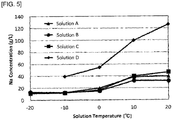
- solutions A to D of sodium-containing solutions each having mainly different sodium concentrations were prepared.
- Each of the solutions A to D was gradually cooled to 20 °C, 10 °C, 0 °C, -10 °C, and -20 °C, and was maintained for one hour from the time when each target temperature was reached. During the maintaining, stirring was carried out. The sodium concentration was measured at each of the above temperatures during cooling. The results are shown by a graph in FIG. 3 . After cooling and maintaining, solid-liquid separation was carried out to remove the precipitated sodium salt. In FIG. 3 , the solution D is only showed for the sodium concentrations at the tempratures from 20 °C to -10 °C, because the solution solidified at a lower temperature and so any sample could not be obtained.
- the sodium concentration of each of the solutions A to D was gradually decreased with a decrease in the temperature, indicating that the sodium ion was effectively precipitated as a sodium salt.
- the temperature was decreased between 0 °C to 10 °C, the sodium concentration became sufficiently low.
- the sodium removal method of the present invention it was found that the sodium ion of the sodium-containing solution can be effectively remove to achieve a decrease in the sodium concentration in the sodium-containing solution by a relatively simple method.
- the metal concentrating method according to the present invention could effectively increase the concentration of metal ions to be concentrated.
Landscapes
- Chemical & Material Sciences (AREA)
- Engineering & Computer Science (AREA)
- Manufacturing & Machinery (AREA)
- Materials Engineering (AREA)
- Metallurgy (AREA)
- Organic Chemistry (AREA)
- Life Sciences & Earth Sciences (AREA)
- Environmental & Geological Engineering (AREA)
- General Life Sciences & Earth Sciences (AREA)
- Geology (AREA)
- Mechanical Engineering (AREA)
- Chemical Kinetics & Catalysis (AREA)
- General Chemical & Material Sciences (AREA)
- Electrochemistry (AREA)
- Geochemistry & Mineralogy (AREA)
- Inorganic Chemistry (AREA)
- Crystallography & Structural Chemistry (AREA)
- Physics & Mathematics (AREA)
- Thermal Sciences (AREA)
- Manufacture And Refinement Of Metals (AREA)
- Secondary Cells (AREA)
- Removal Of Specific Substances (AREA)
Priority Applications (1)
| Application Number | Priority Date | Filing Date | Title |
|---|---|---|---|
| EP20159890.1A EP3686300B1 (de) | 2017-08-02 | 2018-08-01 | Natriumentfernungsverfahren, lithiumkonzentrierungsverfahren und lithiumrückgewinnungsverfahren |
Applications Claiming Priority (3)
| Application Number | Priority Date | Filing Date | Title |
|---|---|---|---|
| JP2017150166A JP6513748B2 (ja) | 2017-08-02 | 2017-08-02 | リチウム回収方法 |
| JP2017150165A JP2019025455A (ja) | 2017-08-02 | 2017-08-02 | ナトリウム除去方法 |
| PCT/JP2018/028928 WO2019026977A1 (ja) | 2017-08-02 | 2018-08-01 | ナトリウム除去方法ならびに、金属濃縮方法及び金属回収方法 |
Related Child Applications (2)
| Application Number | Title | Priority Date | Filing Date |
|---|---|---|---|
| EP20159890.1A Division EP3686300B1 (de) | 2017-08-02 | 2018-08-01 | Natriumentfernungsverfahren, lithiumkonzentrierungsverfahren und lithiumrückgewinnungsverfahren |
| EP20159890.1A Division-Into EP3686300B1 (de) | 2017-08-02 | 2018-08-01 | Natriumentfernungsverfahren, lithiumkonzentrierungsverfahren und lithiumrückgewinnungsverfahren |
Publications (2)
| Publication Number | Publication Date |
|---|---|
| EP3663420A1 true EP3663420A1 (de) | 2020-06-10 |
| EP3663420A4 EP3663420A4 (de) | 2021-07-07 |
Family
ID=65232820
Family Applications (2)
| Application Number | Title | Priority Date | Filing Date |
|---|---|---|---|
| EP18840703.5A Pending EP3663420A4 (de) | 2017-08-02 | 2018-08-01 | Natriumentfernungsverfahren, metallkonzentrierungsverfahren und metallrückgewinnungsverfahren |
| EP20159890.1A Active EP3686300B1 (de) | 2017-08-02 | 2018-08-01 | Natriumentfernungsverfahren, lithiumkonzentrierungsverfahren und lithiumrückgewinnungsverfahren |
Family Applications After (1)
| Application Number | Title | Priority Date | Filing Date |
|---|---|---|---|
| EP20159890.1A Active EP3686300B1 (de) | 2017-08-02 | 2018-08-01 | Natriumentfernungsverfahren, lithiumkonzentrierungsverfahren und lithiumrückgewinnungsverfahren |
Country Status (6)
| Country | Link |
|---|---|
| US (1) | US20200239981A1 (de) |
| EP (2) | EP3663420A4 (de) |
| KR (1) | KR102372078B1 (de) |
| CN (1) | CN110997956A (de) |
| TW (2) | TWI779241B (de) |
| WO (1) | WO2019026977A1 (de) |
Families Citing this family (7)
| Publication number | Priority date | Publication date | Assignee | Title |
|---|---|---|---|---|
| KR102869531B1 (ko) * | 2019-02-20 | 2025-10-13 | 가부시키가이샤 사사꾸라 | 리튬 회수 방법 |
| JP7106121B2 (ja) * | 2019-02-20 | 2022-07-26 | 株式会社ササクラ | コバルト回収方法 |
| JP7051114B2 (ja) * | 2019-02-20 | 2022-04-11 | 株式会社ササクラ | リチウム回収方法 |
| JP2021017627A (ja) * | 2019-07-22 | 2021-02-15 | 株式会社ササクラ | リチウム回収方法 |
| CN113825848A (zh) | 2019-03-29 | 2021-12-21 | 锂业美洲公司 | 从沉积粘土中提取锂的方法 |
| CA3219911A1 (en) * | 2021-05-25 | 2022-12-01 | Jakob LIEDBERG | Process for treatment of a sodium sulfate containing residue process stream of a battery manufacturing facility, a battery recycling facility, or a steel production plant |
| CN115105858B (zh) * | 2022-06-22 | 2023-05-26 | 重庆大学 | Ito刻蚀液结晶抑制装置 |
Family Cites Families (14)
| Publication number | Priority date | Publication date | Assignee | Title |
|---|---|---|---|---|
| KR960007454A (ko) * | 1994-08-22 | 1996-03-22 | 최봉수 | 황산화나트륨(Na₂SO₄)의 정제방법 |
| CN1214981C (zh) * | 2002-09-30 | 2005-08-17 | 南通泛亚锂业有限公司 | 一水氢氧化锂生产工艺 |
| KR101176164B1 (ko) * | 2010-03-22 | 2012-08-22 | 한창산업 주식회사 | Li-제올라이트 제조공정에서 배출된 이온교환 폐액으로부터 염화리튬의 회수방법 |
| KR101220149B1 (ko) * | 2011-02-17 | 2013-01-11 | 한국지질자원연구원 | 폐배터리로부터 유가금속 황산용액의 제조방법 및 양극활물질의 제조방법 |
| JP5791917B2 (ja) * | 2011-02-23 | 2015-10-07 | Jx日鉱日石金属株式会社 | リチウム回収方法 |
| CN102249262B (zh) * | 2011-04-29 | 2012-11-21 | 史永军 | 沉钒母液高盐废水中硫酸钠、硫酸铵浓缩、冷析分离方法 |
| CN103145187B (zh) * | 2013-03-22 | 2014-11-05 | 中南大学 | 一种无害化高纯五氧化二钒的生产工艺 |
| CN103408046B (zh) * | 2013-08-29 | 2015-03-18 | 北京安珂罗工程技术有限公司 | 一种从红土镍矿冶炼一次废水中分离钠镁的方法 |
| CN104140115A (zh) * | 2014-08-25 | 2014-11-12 | 湖南江冶机电科技股份有限公司 | 脱硫铅膏净化处理后滤液回收无水硫酸钠的方法及其装置 |
| CN104944447B (zh) * | 2015-06-25 | 2017-01-25 | 江苏容汇通用锂业股份有限公司 | 一种电池级一水氢氧化锂的制备方法 |
| CN105384293B (zh) * | 2015-11-16 | 2019-02-22 | 河钢股份有限公司承德分公司 | 一种经过除杂脱氨后的沉钒废水的处理方法 |
| CN105742744B (zh) * | 2016-03-03 | 2017-10-31 | 中南大学 | 一种从废旧锂离子电池回收过程产生的含锂废液中提取锂的方法 |
| CN105819472A (zh) * | 2016-03-09 | 2016-08-03 | 江苏容汇通用锂业股份有限公司 | 一种用硫酸锂溶液生产高纯度电池级碳酸锂的方法 |
| CN106629787B (zh) * | 2016-12-20 | 2018-09-18 | 阿坝中晟锂业有限公司 | 一种电池级氢氧化锂的制备方法 |
-
2018
- 2018-08-01 EP EP18840703.5A patent/EP3663420A4/de active Pending
- 2018-08-01 WO PCT/JP2018/028928 patent/WO2019026977A1/ja not_active Ceased
- 2018-08-01 TW TW108138398A patent/TWI779241B/zh active
- 2018-08-01 CN CN201880050521.4A patent/CN110997956A/zh active Pending
- 2018-08-01 TW TW107126717A patent/TWI693097B/zh active
- 2018-08-01 KR KR1020207003254A patent/KR102372078B1/ko active Active
- 2018-08-01 US US16/635,932 patent/US20200239981A1/en not_active Abandoned
- 2018-08-01 EP EP20159890.1A patent/EP3686300B1/de active Active
Also Published As
| Publication number | Publication date |
|---|---|
| CN110997956A (zh) | 2020-04-10 |
| US20200239981A1 (en) | 2020-07-30 |
| EP3686300A1 (de) | 2020-07-29 |
| TWI779241B (zh) | 2022-10-01 |
| EP3686300C0 (de) | 2024-04-03 |
| TWI693097B (zh) | 2020-05-11 |
| TW202003083A (zh) | 2020-01-16 |
| EP3686300B1 (de) | 2024-04-03 |
| EP3663420A4 (de) | 2021-07-07 |
| KR20200026940A (ko) | 2020-03-11 |
| TW201909982A (zh) | 2019-03-16 |
| KR102372078B1 (ko) | 2022-03-08 |
| WO2019026977A1 (ja) | 2019-02-07 |
Similar Documents
| Publication | Publication Date | Title |
|---|---|---|
| EP3686300A1 (de) | Natriumentfernungsverfahren, metallkonzentrierungsverfahren und metallrückgewinnungsverfahren | |
| EP3845492B1 (de) | Verfahren zur herstellung von lithiumcarbonat | |
| TWI746818B (zh) | 回收鋰之程序 | |
| JP6622998B2 (ja) | リチウムイオン電池スクラップからの鉄及びアルミニウムの除去方法及び、有価金属の回収方法 | |
| CA2868086C (en) | Method for producing high-purity nickel sulfate | |
| WO2016159002A1 (ja) | リチウムイオン電池スクラップからの銅の除去方法および金属の回収方法 | |
| CA3058314C (en) | Lithium recovery method | |
| JP2019508587A5 (de) | ||
| JP6448684B2 (ja) | リチウム回収方法 | |
| JP6480235B2 (ja) | リチウムイオン電池スクラップからの鉄及びアルミニウムの除去方法 | |
| JP2012172223A (ja) | リチウム回収方法 | |
| JP2019153562A (ja) | 炭酸リチウムの製造方法及び、炭酸リチウム | |
| JP2024508733A (ja) | 金属の回収 | |
| JP7303947B1 (ja) | コバルト溶液の製造方法、コバルト塩の製造方法、ニッケル溶液の製造方法、及びニッケル塩の製造方法 | |
| JP2013209267A (ja) | 硫酸マンガンの製造方法 | |
| JP6513748B2 (ja) | リチウム回収方法 | |
| JP2019025455A (ja) | ナトリウム除去方法 | |
| KR102095495B1 (ko) | 아연제련공정 중 탈륨제거 방법 | |
| TW202442880A (zh) | 從電池中回收金屬之方法 | |
| JP2013209266A (ja) | 硫酸マンガンの製造方法 |
Legal Events
| Date | Code | Title | Description |
|---|---|---|---|
| STAA | Information on the status of an ep patent application or granted ep patent |
Free format text: STATUS: THE INTERNATIONAL PUBLICATION HAS BEEN MADE |
|
| PUAI | Public reference made under article 153(3) epc to a published international application that has entered the european phase |
Free format text: ORIGINAL CODE: 0009012 |
|
| STAA | Information on the status of an ep patent application or granted ep patent |
Free format text: STATUS: REQUEST FOR EXAMINATION WAS MADE |
|
| 17P | Request for examination filed |
Effective date: 20200227 |
|
| AK | Designated contracting states |
Kind code of ref document: A1 Designated state(s): AL AT BE BG CH CY CZ DE DK EE ES FI FR GB GR HR HU IE IS IT LI LT LU LV MC MK MT NL NO PL PT RO RS SE SI SK SM TR |
|
| AX | Request for extension of the european patent |
Extension state: BA ME |
|
| DAV | Request for validation of the european patent (deleted) | ||
| DAX | Request for extension of the european patent (deleted) | ||
| A4 | Supplementary search report drawn up and despatched |
Effective date: 20210608 |
|
| RIC1 | Information provided on ipc code assigned before grant |
Ipc: C22B 26/12 20060101AFI20210601BHEP Ipc: C22B 3/22 20060101ALI20210601BHEP Ipc: C22B 7/00 20060101ALI20210601BHEP Ipc: B01D 9/00 20060101ALI20210601BHEP Ipc: B01D 11/04 20060101ALI20210601BHEP |
|
| RAP1 | Party data changed (applicant data changed or rights of an application transferred) |
Owner name: JX METALS CIRCULAR SOLUTIONS CO., LTD. |