EP3663426B1 - HEIßBAD-GALVANISIERTES STAHLBLECH - Google Patents
HEIßBAD-GALVANISIERTES STAHLBLECH Download PDFInfo
- Publication number
- EP3663426B1 EP3663426B1 EP17920296.5A EP17920296A EP3663426B1 EP 3663426 B1 EP3663426 B1 EP 3663426B1 EP 17920296 A EP17920296 A EP 17920296A EP 3663426 B1 EP3663426 B1 EP 3663426B1
- Authority
- EP
- European Patent Office
- Prior art keywords
- steel sheet
- hot
- layer
- less
- thickness
- Prior art date
- Legal status (The legal status is an assumption and is not a legal conclusion. Google has not performed a legal analysis and makes no representation as to the accuracy of the status listed.)
- Revoked
Links
Images
Classifications
-
- B—PERFORMING OPERATIONS; TRANSPORTING
- B32—LAYERED PRODUCTS
- B32B—LAYERED PRODUCTS, i.e. PRODUCTS BUILT-UP OF STRATA OF FLAT OR NON-FLAT, e.g. CELLULAR OR HONEYCOMB, FORM
- B32B15/00—Layered products comprising a layer of metal
- B32B15/01—Layered products comprising a layer of metal all layers being exclusively metallic
- B32B15/013—Layered products comprising a layer of metal all layers being exclusively metallic one layer being formed of an iron alloy or steel, another layer being formed of a metal other than iron or aluminium
-
- C—CHEMISTRY; METALLURGY
- C22—METALLURGY; FERROUS OR NON-FERROUS ALLOYS; TREATMENT OF ALLOYS OR NON-FERROUS METALS
- C22C—ALLOYS
- C22C38/00—Ferrous alloys, e.g. steel alloys
- C22C38/18—Ferrous alloys, e.g. steel alloys containing chromium
- C22C38/40—Ferrous alloys, e.g. steel alloys containing chromium with nickel
- C22C38/58—Ferrous alloys, e.g. steel alloys containing chromium with nickel with more than 1.5% by weight of manganese
-
- C—CHEMISTRY; METALLURGY
- C21—METALLURGY OF IRON
- C21D—MODIFYING THE PHYSICAL STRUCTURE OF FERROUS METALS; GENERAL DEVICES FOR HEAT TREATMENT OF FERROUS OR NON-FERROUS METALS OR ALLOYS; MAKING METAL MALLEABLE, e.g. BY DECARBURISATION OR TEMPERING
- C21D6/00—Heat treatment of ferrous alloys
- C21D6/001—Heat treatment of ferrous alloys containing Ni
-
- C—CHEMISTRY; METALLURGY
- C21—METALLURGY OF IRON
- C21D—MODIFYING THE PHYSICAL STRUCTURE OF FERROUS METALS; GENERAL DEVICES FOR HEAT TREATMENT OF FERROUS OR NON-FERROUS METALS OR ALLOYS; MAKING METAL MALLEABLE, e.g. BY DECARBURISATION OR TEMPERING
- C21D6/00—Heat treatment of ferrous alloys
- C21D6/002—Heat treatment of ferrous alloys containing Cr
-
- C—CHEMISTRY; METALLURGY
- C21—METALLURGY OF IRON
- C21D—MODIFYING THE PHYSICAL STRUCTURE OF FERROUS METALS; GENERAL DEVICES FOR HEAT TREATMENT OF FERROUS OR NON-FERROUS METALS OR ALLOYS; MAKING METAL MALLEABLE, e.g. BY DECARBURISATION OR TEMPERING
- C21D6/00—Heat treatment of ferrous alloys
- C21D6/005—Heat treatment of ferrous alloys containing Mn
-
- C—CHEMISTRY; METALLURGY
- C21—METALLURGY OF IRON
- C21D—MODIFYING THE PHYSICAL STRUCTURE OF FERROUS METALS; GENERAL DEVICES FOR HEAT TREATMENT OF FERROUS OR NON-FERROUS METALS OR ALLOYS; MAKING METAL MALLEABLE, e.g. BY DECARBURISATION OR TEMPERING
- C21D6/00—Heat treatment of ferrous alloys
- C21D6/008—Heat treatment of ferrous alloys containing Si
-
- C—CHEMISTRY; METALLURGY
- C21—METALLURGY OF IRON
- C21D—MODIFYING THE PHYSICAL STRUCTURE OF FERROUS METALS; GENERAL DEVICES FOR HEAT TREATMENT OF FERROUS OR NON-FERROUS METALS OR ALLOYS; MAKING METAL MALLEABLE, e.g. BY DECARBURISATION OR TEMPERING
- C21D8/00—Modifying the physical properties of ferrous metals or ferrous alloys by deformation combined with, or followed by, heat treatment
- C21D8/02—Modifying the physical properties of ferrous metals or ferrous alloys by deformation combined with, or followed by, heat treatment during manufacturing of plates or strips
-
- C—CHEMISTRY; METALLURGY
- C21—METALLURGY OF IRON
- C21D—MODIFYING THE PHYSICAL STRUCTURE OF FERROUS METALS; GENERAL DEVICES FOR HEAT TREATMENT OF FERROUS OR NON-FERROUS METALS OR ALLOYS; MAKING METAL MALLEABLE, e.g. BY DECARBURISATION OR TEMPERING
- C21D8/00—Modifying the physical properties of ferrous metals or ferrous alloys by deformation combined with, or followed by, heat treatment
- C21D8/02—Modifying the physical properties of ferrous metals or ferrous alloys by deformation combined with, or followed by, heat treatment during manufacturing of plates or strips
- C21D8/0221—Modifying the physical properties of ferrous metals or ferrous alloys by deformation combined with, or followed by, heat treatment during manufacturing of plates or strips characterised by the working steps
- C21D8/0236—Cold rolling
-
- C—CHEMISTRY; METALLURGY
- C21—METALLURGY OF IRON
- C21D—MODIFYING THE PHYSICAL STRUCTURE OF FERROUS METALS; GENERAL DEVICES FOR HEAT TREATMENT OF FERROUS OR NON-FERROUS METALS OR ALLOYS; MAKING METAL MALLEABLE, e.g. BY DECARBURISATION OR TEMPERING
- C21D9/00—Heat treatment, e.g. annealing, hardening, quenching or tempering, adapted for particular articles; Furnaces therefor
- C21D9/46—Heat treatment, e.g. annealing, hardening, quenching or tempering, adapted for particular articles; Furnaces therefor for sheet metals
-
- C—CHEMISTRY; METALLURGY
- C22—METALLURGY; FERROUS OR NON-FERROUS ALLOYS; TREATMENT OF ALLOYS OR NON-FERROUS METALS
- C22C—ALLOYS
- C22C38/00—Ferrous alloys, e.g. steel alloys
- C22C38/002—Ferrous alloys, e.g. steel alloys containing In, Mg, or other elements not provided for in one single group C22C38/001 - C22C38/60
-
- C—CHEMISTRY; METALLURGY
- C22—METALLURGY; FERROUS OR NON-FERROUS ALLOYS; TREATMENT OF ALLOYS OR NON-FERROUS METALS
- C22C—ALLOYS
- C22C38/00—Ferrous alloys, e.g. steel alloys
- C22C38/005—Ferrous alloys, e.g. steel alloys containing rare earths, i.e. Sc, Y, Lanthanides
-
- C—CHEMISTRY; METALLURGY
- C22—METALLURGY; FERROUS OR NON-FERROUS ALLOYS; TREATMENT OF ALLOYS OR NON-FERROUS METALS
- C22C—ALLOYS
- C22C38/00—Ferrous alloys, e.g. steel alloys
- C22C38/02—Ferrous alloys, e.g. steel alloys containing silicon
-
- C—CHEMISTRY; METALLURGY
- C22—METALLURGY; FERROUS OR NON-FERROUS ALLOYS; TREATMENT OF ALLOYS OR NON-FERROUS METALS
- C22C—ALLOYS
- C22C38/00—Ferrous alloys, e.g. steel alloys
- C22C38/06—Ferrous alloys, e.g. steel alloys containing aluminium
-
- C—CHEMISTRY; METALLURGY
- C22—METALLURGY; FERROUS OR NON-FERROUS ALLOYS; TREATMENT OF ALLOYS OR NON-FERROUS METALS
- C22C—ALLOYS
- C22C38/00—Ferrous alloys, e.g. steel alloys
- C22C38/08—Ferrous alloys, e.g. steel alloys containing nickel
-
- C—CHEMISTRY; METALLURGY
- C22—METALLURGY; FERROUS OR NON-FERROUS ALLOYS; TREATMENT OF ALLOYS OR NON-FERROUS METALS
- C22C—ALLOYS
- C22C38/00—Ferrous alloys, e.g. steel alloys
- C22C38/16—Ferrous alloys, e.g. steel alloys containing copper
-
- C—CHEMISTRY; METALLURGY
- C22—METALLURGY; FERROUS OR NON-FERROUS ALLOYS; TREATMENT OF ALLOYS OR NON-FERROUS METALS
- C22C—ALLOYS
- C22C38/00—Ferrous alloys, e.g. steel alloys
- C22C38/18—Ferrous alloys, e.g. steel alloys containing chromium
- C22C38/22—Ferrous alloys, e.g. steel alloys containing chromium with molybdenum or tungsten
-
- C—CHEMISTRY; METALLURGY
- C22—METALLURGY; FERROUS OR NON-FERROUS ALLOYS; TREATMENT OF ALLOYS OR NON-FERROUS METALS
- C22C—ALLOYS
- C22C38/00—Ferrous alloys, e.g. steel alloys
- C22C38/18—Ferrous alloys, e.g. steel alloys containing chromium
- C22C38/26—Ferrous alloys, e.g. steel alloys containing chromium with niobium or tantalum
-
- C—CHEMISTRY; METALLURGY
- C22—METALLURGY; FERROUS OR NON-FERROUS ALLOYS; TREATMENT OF ALLOYS OR NON-FERROUS METALS
- C22C—ALLOYS
- C22C38/00—Ferrous alloys, e.g. steel alloys
- C22C38/18—Ferrous alloys, e.g. steel alloys containing chromium
- C22C38/28—Ferrous alloys, e.g. steel alloys containing chromium with titanium or zirconium
-
- C—CHEMISTRY; METALLURGY
- C22—METALLURGY; FERROUS OR NON-FERROUS ALLOYS; TREATMENT OF ALLOYS OR NON-FERROUS METALS
- C22C—ALLOYS
- C22C38/00—Ferrous alloys, e.g. steel alloys
- C22C38/18—Ferrous alloys, e.g. steel alloys containing chromium
- C22C38/32—Ferrous alloys, e.g. steel alloys containing chromium with boron
-
- C—CHEMISTRY; METALLURGY
- C22—METALLURGY; FERROUS OR NON-FERROUS ALLOYS; TREATMENT OF ALLOYS OR NON-FERROUS METALS
- C22C—ALLOYS
- C22C38/00—Ferrous alloys, e.g. steel alloys
- C22C38/18—Ferrous alloys, e.g. steel alloys containing chromium
- C22C38/38—Ferrous alloys, e.g. steel alloys containing chromium with more than 1.5% by weight of manganese
-
- C—CHEMISTRY; METALLURGY
- C22—METALLURGY; FERROUS OR NON-FERROUS ALLOYS; TREATMENT OF ALLOYS OR NON-FERROUS METALS
- C22C—ALLOYS
- C22C38/00—Ferrous alloys, e.g. steel alloys
- C22C38/18—Ferrous alloys, e.g. steel alloys containing chromium
- C22C38/40—Ferrous alloys, e.g. steel alloys containing chromium with nickel
- C22C38/42—Ferrous alloys, e.g. steel alloys containing chromium with nickel with copper
-
- C—CHEMISTRY; METALLURGY
- C22—METALLURGY; FERROUS OR NON-FERROUS ALLOYS; TREATMENT OF ALLOYS OR NON-FERROUS METALS
- C22C—ALLOYS
- C22C38/00—Ferrous alloys, e.g. steel alloys
- C22C38/18—Ferrous alloys, e.g. steel alloys containing chromium
- C22C38/40—Ferrous alloys, e.g. steel alloys containing chromium with nickel
- C22C38/44—Ferrous alloys, e.g. steel alloys containing chromium with nickel with molybdenum or tungsten
-
- C—CHEMISTRY; METALLURGY
- C23—COATING METALLIC MATERIAL; COATING MATERIAL WITH METALLIC MATERIAL; CHEMICAL SURFACE TREATMENT; DIFFUSION TREATMENT OF METALLIC MATERIAL; COATING BY VACUUM EVAPORATION, BY SPUTTERING, BY ION IMPLANTATION OR BY CHEMICAL VAPOUR DEPOSITION, IN GENERAL; INHIBITING CORROSION OF METALLIC MATERIAL OR INCRUSTATION IN GENERAL
- C23C—COATING METALLIC MATERIAL; COATING MATERIAL WITH METALLIC MATERIAL; SURFACE TREATMENT OF METALLIC MATERIAL BY DIFFUSION INTO THE SURFACE, BY CHEMICAL CONVERSION OR SUBSTITUTION; COATING BY VACUUM EVAPORATION, BY SPUTTERING, BY ION IMPLANTATION OR BY CHEMICAL VAPOUR DEPOSITION, IN GENERAL
- C23C2/00—Hot-dipping or immersion processes for applying the coating material in the molten state without affecting the shape; Apparatus therefor
- C23C2/02—Pretreatment of the material to be coated, e.g. for coating on selected surface areas
-
- C—CHEMISTRY; METALLURGY
- C23—COATING METALLIC MATERIAL; COATING MATERIAL WITH METALLIC MATERIAL; CHEMICAL SURFACE TREATMENT; DIFFUSION TREATMENT OF METALLIC MATERIAL; COATING BY VACUUM EVAPORATION, BY SPUTTERING, BY ION IMPLANTATION OR BY CHEMICAL VAPOUR DEPOSITION, IN GENERAL; INHIBITING CORROSION OF METALLIC MATERIAL OR INCRUSTATION IN GENERAL
- C23C—COATING METALLIC MATERIAL; COATING MATERIAL WITH METALLIC MATERIAL; SURFACE TREATMENT OF METALLIC MATERIAL BY DIFFUSION INTO THE SURFACE, BY CHEMICAL CONVERSION OR SUBSTITUTION; COATING BY VACUUM EVAPORATION, BY SPUTTERING, BY ION IMPLANTATION OR BY CHEMICAL VAPOUR DEPOSITION, IN GENERAL
- C23C2/00—Hot-dipping or immersion processes for applying the coating material in the molten state without affecting the shape; Apparatus therefor
- C23C2/02—Pretreatment of the material to be coated, e.g. for coating on selected surface areas
- C23C2/022—Pretreatment of the material to be coated, e.g. for coating on selected surface areas by heating
- C23C2/0224—Two or more thermal pretreatments
-
- C—CHEMISTRY; METALLURGY
- C23—COATING METALLIC MATERIAL; COATING MATERIAL WITH METALLIC MATERIAL; CHEMICAL SURFACE TREATMENT; DIFFUSION TREATMENT OF METALLIC MATERIAL; COATING BY VACUUM EVAPORATION, BY SPUTTERING, BY ION IMPLANTATION OR BY CHEMICAL VAPOUR DEPOSITION, IN GENERAL; INHIBITING CORROSION OF METALLIC MATERIAL OR INCRUSTATION IN GENERAL
- C23C—COATING METALLIC MATERIAL; COATING MATERIAL WITH METALLIC MATERIAL; SURFACE TREATMENT OF METALLIC MATERIAL BY DIFFUSION INTO THE SURFACE, BY CHEMICAL CONVERSION OR SUBSTITUTION; COATING BY VACUUM EVAPORATION, BY SPUTTERING, BY ION IMPLANTATION OR BY CHEMICAL VAPOUR DEPOSITION, IN GENERAL
- C23C2/00—Hot-dipping or immersion processes for applying the coating material in the molten state without affecting the shape; Apparatus therefor
- C23C2/02—Pretreatment of the material to be coated, e.g. for coating on selected surface areas
- C23C2/024—Pretreatment of the material to be coated, e.g. for coating on selected surface areas by cleaning or etching
-
- C—CHEMISTRY; METALLURGY
- C23—COATING METALLIC MATERIAL; COATING MATERIAL WITH METALLIC MATERIAL; CHEMICAL SURFACE TREATMENT; DIFFUSION TREATMENT OF METALLIC MATERIAL; COATING BY VACUUM EVAPORATION, BY SPUTTERING, BY ION IMPLANTATION OR BY CHEMICAL VAPOUR DEPOSITION, IN GENERAL; INHIBITING CORROSION OF METALLIC MATERIAL OR INCRUSTATION IN GENERAL
- C23C—COATING METALLIC MATERIAL; COATING MATERIAL WITH METALLIC MATERIAL; SURFACE TREATMENT OF METALLIC MATERIAL BY DIFFUSION INTO THE SURFACE, BY CHEMICAL CONVERSION OR SUBSTITUTION; COATING BY VACUUM EVAPORATION, BY SPUTTERING, BY ION IMPLANTATION OR BY CHEMICAL VAPOUR DEPOSITION, IN GENERAL
- C23C2/00—Hot-dipping or immersion processes for applying the coating material in the molten state without affecting the shape; Apparatus therefor
- C23C2/04—Hot-dipping or immersion processes for applying the coating material in the molten state without affecting the shape; Apparatus therefor characterised by the coating material
- C23C2/06—Zinc or cadmium or alloys based thereon
-
- C—CHEMISTRY; METALLURGY
- C23—COATING METALLIC MATERIAL; COATING MATERIAL WITH METALLIC MATERIAL; CHEMICAL SURFACE TREATMENT; DIFFUSION TREATMENT OF METALLIC MATERIAL; COATING BY VACUUM EVAPORATION, BY SPUTTERING, BY ION IMPLANTATION OR BY CHEMICAL VAPOUR DEPOSITION, IN GENERAL; INHIBITING CORROSION OF METALLIC MATERIAL OR INCRUSTATION IN GENERAL
- C23C—COATING METALLIC MATERIAL; COATING MATERIAL WITH METALLIC MATERIAL; SURFACE TREATMENT OF METALLIC MATERIAL BY DIFFUSION INTO THE SURFACE, BY CHEMICAL CONVERSION OR SUBSTITUTION; COATING BY VACUUM EVAPORATION, BY SPUTTERING, BY ION IMPLANTATION OR BY CHEMICAL VAPOUR DEPOSITION, IN GENERAL
- C23C2/00—Hot-dipping or immersion processes for applying the coating material in the molten state without affecting the shape; Apparatus therefor
- C23C2/26—After-treatment
- C23C2/28—Thermal after-treatment, e.g. treatment in oil bath
- C23C2/29—Cooling or quenching
-
- C—CHEMISTRY; METALLURGY
- C23—COATING METALLIC MATERIAL; COATING MATERIAL WITH METALLIC MATERIAL; CHEMICAL SURFACE TREATMENT; DIFFUSION TREATMENT OF METALLIC MATERIAL; COATING BY VACUUM EVAPORATION, BY SPUTTERING, BY ION IMPLANTATION OR BY CHEMICAL VAPOUR DEPOSITION, IN GENERAL; INHIBITING CORROSION OF METALLIC MATERIAL OR INCRUSTATION IN GENERAL
- C23C—COATING METALLIC MATERIAL; COATING MATERIAL WITH METALLIC MATERIAL; SURFACE TREATMENT OF METALLIC MATERIAL BY DIFFUSION INTO THE SURFACE, BY CHEMICAL CONVERSION OR SUBSTITUTION; COATING BY VACUUM EVAPORATION, BY SPUTTERING, BY ION IMPLANTATION OR BY CHEMICAL VAPOUR DEPOSITION, IN GENERAL
- C23C2/00—Hot-dipping or immersion processes for applying the coating material in the molten state without affecting the shape; Apparatus therefor
- C23C2/34—Hot-dipping or immersion processes for applying the coating material in the molten state without affecting the shape; Apparatus therefor characterised by the shape of the material to be treated
- C23C2/36—Elongated material
- C23C2/40—Plates; Strips
-
- C—CHEMISTRY; METALLURGY
- C21—METALLURGY OF IRON
- C21D—MODIFYING THE PHYSICAL STRUCTURE OF FERROUS METALS; GENERAL DEVICES FOR HEAT TREATMENT OF FERROUS OR NON-FERROUS METALS OR ALLOYS; MAKING METAL MALLEABLE, e.g. BY DECARBURISATION OR TEMPERING
- C21D2211/00—Microstructure comprising significant phases
- C21D2211/001—Austenite
-
- C—CHEMISTRY; METALLURGY
- C21—METALLURGY OF IRON
- C21D—MODIFYING THE PHYSICAL STRUCTURE OF FERROUS METALS; GENERAL DEVICES FOR HEAT TREATMENT OF FERROUS OR NON-FERROUS METALS OR ALLOYS; MAKING METAL MALLEABLE, e.g. BY DECARBURISATION OR TEMPERING
- C21D2211/00—Microstructure comprising significant phases
- C21D2211/002—Bainite
-
- C—CHEMISTRY; METALLURGY
- C21—METALLURGY OF IRON
- C21D—MODIFYING THE PHYSICAL STRUCTURE OF FERROUS METALS; GENERAL DEVICES FOR HEAT TREATMENT OF FERROUS OR NON-FERROUS METALS OR ALLOYS; MAKING METAL MALLEABLE, e.g. BY DECARBURISATION OR TEMPERING
- C21D2211/00—Microstructure comprising significant phases
- C21D2211/005—Ferrite
-
- C—CHEMISTRY; METALLURGY
- C21—METALLURGY OF IRON
- C21D—MODIFYING THE PHYSICAL STRUCTURE OF FERROUS METALS; GENERAL DEVICES FOR HEAT TREATMENT OF FERROUS OR NON-FERROUS METALS OR ALLOYS; MAKING METAL MALLEABLE, e.g. BY DECARBURISATION OR TEMPERING
- C21D2211/00—Microstructure comprising significant phases
- C21D2211/008—Martensite
Definitions
- the present invention relates to a high-strength hot-dip galvanized steel sheet excellent in ductility, bendability, hole expandability, and plating adhesion at the time of bending deformation and excellent in continuous bending fatigue resistance.
- Patent Literatures 1 to 3 there were proposed methods of forming oxides inside a steel sheet and reducing the oxides at an interface between a base iron and a plating layer that cause plating peeling.
- carbon in the surface layer of the steel sheet bonds to oxygen to be gasified.
- the carbon is released from the steel sheet, and thus, the strength of the region of the steel sheet from which the carbon has been released decreases significantly in some cases.
- the strength of the surface layer of the steel sheet decreases, fatigue resistance that strongly depends on the properties of the surface layer portion deteriorates, giving rise to a concern about a great decrease in fatigue strength.
- Patent Literature 4 in order to enhance the adhesion of the plating layer, in Patent Literature 4, there was proposed a method of enhancing plating adhesion by additionally applying a new annealing step and an acid pickling step before an ordinary annealing step to thereby reform the surface of a base steel sheet.
- the number of steps is increased as compared to a normal method of manufacturing a high-strength metal coated steel sheet, thus causing a problem in costs.
- Patent Literature 5 there was proposed a method of enhancing plating adhesion by removing carbon from a surface layer portion of a base steel sheet.
- the strength of the region from which carbon has been removed decreases significantly. Therefore, the method described in Patent Literature 5 makes fatigue resistance, which strongly depends on the properties of the surface layer portion, deteriorate, giving rise to a concern about a great decrease in fatigue strength.
- Patent Literatures 6 and 7 there were proposed steel sheets with improved plating adhesion that have a plating layer whose contents of Mn, Al, and Si were controlled to suitable ranges.
- Patent Literature 8 there was proposed a high-strength steel sheet in which a microstructure of the steel sheet was made of only ferrite as a method for enhancing plating adhesion.
- the microstructure is made of only soft ferrite in the steel sheet described in Patent Literature 8, it is impossible to obtain a sufficiently high strength.
- Patent Literature 12 discloses a hot-dip galvanized steel sheet having a refined layer.
- an object of the present invention is to provide a high-strength hot-dip galvanized steel sheet excellent in formabilities of a steel sheet, which are represented by, particularly, bendability and stretch flange formability (to be also referred to as stretch flangeability simply below) and excellent in plating appearance uniformity, fatigue resistance, weldability, corrosion resistance, and plating adhesion.
- the present inventors have repeatedly conducted intensive investigations for obtaining a high-strength hot-dip galvanized steel sheet excellent in formabilities of a steel sheet represented by bendability and stretch flange formability and fatigue resistance, weldability, corrosion resistance, and plating adhesion.
- the present inventors have improved stretch flangeability (hole expandability) by appropriately controlling structural fractions of a microstructure of a steel sheet.
- the present inventors have improved bendability and fatigue resistance by controlling a volume fraction of a hard phase at the side of a base steel sheet from an interface between a plating layer and the base steel sheet.
- the present inventors have found out that even when using a steel sheet containing large amounts of Si and Mn as a plating substrate, a specific fine-grain layer made of ultrafine particles of a ferrite phase is formed immediately under a Fe-Al alloy layer formed at an interface between a plating layer formed by using a plating bath with Al added thereto and a base steel sheet, thereby making it possible to suppress occurrence and propagation of cracks at the time of working and suppress plating peeling starting from the cracks.
- the thicknesses of the fine-grain layer and the Fe-Al alloy layer in the width direction of the steel sheet are controlled to fall within specific ranges, thereby making it possible to obtain a hot-dip galvanized steel sheet excellent not only in plating adhesion but also in appearance uniformity.
- thermoforming a hot-dip galvanized steel sheet excellent in plating appearance uniformity, formability, fatigue resistance, weldability, corrosion resistance, and plating adhesion.
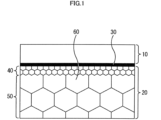
- Fig. 1 is a view illustrating one example of a schematic view of a cross-sectional structure of a hot-dip galvanized steel sheet of the present invention.
- a hot-dip galvanized steel sheet according to the present invention is formed by forming a hot-dip galvanizing layer (to be also referred to as a plating layer simply below) on a surface of a base steel sheet (to be also referred to as a steel sheet simply below) having chemical components containing, in mass%, C: 0.040% to 0.280%, Si: 0.05% to 2.00%, Mn: 0.50% to 3.50%, P: 0.0001% to 0.100%, S: 0.0001% to 0.0100%, Al: 0.001% to 1.500%, O: 0.0001% to 0.0100%, N: 0.0001% to 0.0100%, and a balance composed of Fe and impurities.
- the sheet thickness of the base steel sheet is 0.6 mm or more and less than 5.0 mm.
- the sheet thickness of the base steel sheet is less than 0.6 mm, it is difficult to keep the shape of the base steel sheet flat, which is not appropriate.
- the sheet thickness of the base steel sheet is 5.0 mm or more, the control of cooling in a manufacturing process becomes difficult, to fail to obtain a predetermined microstructure, resulting in that formability sometimes deteriorates.
- the plating layer has a Fe content of more than 0% and 3.0% or less and an Al content of more than 0% and 1.0% or less.
- the C content is contained to increase the strength of the base steel sheet.
- the C content exceeds 0.280%, spot weldability deteriorates, and thus the C content is set to 0.280% or less.
- the C content is preferably 0.250% or less and more preferably 0.220% or less.
- the C content is set to 0.040% or more.
- the C content is preferably 0.055% or more and more preferably 0.070% or more.
- the Si content is set to 0.05% or more.
- the Si content is preferably 0.10% or more and more preferably 0.25% or more.
- Mn is contained to increase strength by increasing hardenability of the base steel sheet.
- the Mn content exceeds 3.50%, a coarse Mn-concentrated portion is generated in the thickness middle portion of the base steel sheet and embrittlement easily occurs, and thus, a trouble such as cracking of a cast slab easily occurs. Therefore, the Mn content is set to 3.50% or less.
- an increase in the Mn content results in deterioration in the spot weldability of the hot-dip galvanized steel sheet. For this reason, the Mn content is preferably 3.00% or less and more preferably 2.80% or less.
- the Mn content when the Mn content is less than 0.50%, a large amount of soft structure is formed during cooling after annealing, to thus be difficult to secure a sufficiently high maximum tensile strength. Accordingly, the Mn content needs to be 0.50% or more.
- the Mn content is preferably 0.80% or more and more preferably 1.00% or more.
- P is an element that makes a steel material brittle, and when the P content exceeds 0.1000%, troubles such as cracking of a cast slab and cracking of a slab during hot rolling easily occur, and therefore, the P content is set to 0.1000% or less.
- P is also an element that makes a molten portion generated by spot welding brittle, and the P content is preferably set to 0.0400% or less and further preferably set to 0.0200% or less in order to obtain a sufficient welded joint strength.
- setting the P content to less than 0.0001% results in a great increase in manufacturing cost, and thus, the P content is preferably set to 0.010% or more with its lower limit value set to 0.0001%.
- S is an element that bonds to Mn to form coarse MnS and impair formabilities such as ductility, hole expandability (stretch flangeability), and bendability, and thus the S content is set to 0.0100% or less.
- S is also an element that impairs spot weldability. Therefore, the S content is preferably set to 0.0060% or less and more preferably set to 0.0035% or less.
- setting the S content to less than 0.0001% results in a great increase in manufacturing cost. Therefore, the S content is preferably set to 0.0005% or more and further preferably set to 0.0010% or more with its lower limit value set to 0.0001%.
- Al is an element that makes a steel material brittle.
- the Al content exceeds 1.500%, a trouble such as cracking of a cast slab easily occurs, and thus the Al content is set to 1.500% or less.
- the Al content is more preferably set to 1.200% or less and further preferably set to 1.000% or less.
- the Al content is set to 0.001% or more.
- Al is an element effective also as a deoxidizing material, but in order to obtain a deoxidation effect more sufficiently, the Al content is more preferably set to 0.010% or more.
- N is an element that forms coarse nitrides to impair formabilities such as ductility, hole expandability (stretch flangeability), and bendability, and thus, it is necessary to suppress its content.
- the N content exceeds 0.0100%, the deterioration in formabilities becomes significant, and thus the upper limit of the N content is set to 0.0100%. Further, containing N excessively causes occurrence of blowholes at the time of welding, and thus a lower content thereof is better. From these viewpoints, the N content is preferably 0.0070% or less and more preferably 0.0050% or less.
- the lower limit of the N content is set to 0.0001% or more.
- the N content is preferably 0.0003% or more and more preferably 0.0005% or more.
- O forms oxides to impair the formabilities such as ductility, hole expandability (stretch flangeability), and bendability of the hot-dip galvanized steel sheet, and thus, it is necessary to suppress the O content.
- the O content exceeds 0.0100%, the deterioration in the formabilities becomes significant, and thus the upper limit of the O content is set to 0.0100%.
- the O content is preferably 0.0050% or less and more preferably 0.0030% or less. Even when the lower limit of the O content is not particularly determined, the effects of the invention are exhibited, but setting the O content to less than 0.0001% results in a great increase in manufacturing cost, and thus its lower limit is set to 0.0001%.
- the O content is preferably 0.0003% or more and more preferably 0.0005% or more.
- the following elements may be contained in the base steel sheet of the hot-dip galvanized steel sheet according to this embodiment as necessary.
- the base steel sheet according to the invention optionally contains one or two or more selected from a group consisting of Ti: 0.001% to 0.150%, Nb: 0.001% to 0.100%, and V: 0.001% to 0.300%.
- Ti is an element that contributes to an increase in the strength of the hot-dip galvanized steel sheet by precipitate strengthening, strengthening by grain refinement through the suppression of the growth of ferrite crystal grains, and dislocation strengthening through the suppression of recrystallization.
- the Ti content exceeds 0.150%, the amount of precipitated carbonitrides increases and formability deteriorates, and thus, the Ti content is set to 0.150% or less.
- the Ti content is preferably 0.080% or less.
- the Ti content is preferably 0.001% or more.
- the Ti content is more preferably 0.010% or more.
- Nb is an element that contributes to an increase in the strength of the hot-dip galvanized steel sheet by precipitate strengthening, strengthening by grain refinement through the suppression of the growth of ferrite crystal grains, and dislocation strengthening through the suppression of recrystallization.
- the Nb content exceeds 0.100%, the amount of precipitated carbonitrides increases and the formability of the hot-dip galvanized steel sheet deteriorates, and thus the Nb content is set to 0.100% or less. From the viewpoint of formability, the Nb content is preferably 0.060% or less.
- the Nb content is preferably 0.001% or more.
- the Nb content is more preferably 0.005% or more.
- V is an element that contributes to an increase in the strength of the hot-dip galvanized steel sheet by precipitate strengthening, strengthening by grain refinement through the suppression of the growth of ferrite crystal grains, and dislocation strengthening through the suppression of recrystallization.
- the V content is set to 0.300% or less.
- the V content is preferably 0.200% or less.
- the V content is preferably 0.001% or more and further preferably 0.010% or more.
- the base steel sheet according to the invention optionally contains one or two or more selected from a group consisting of Cr: 0.01% to 2.00%, Ni: 0.01% to 2.00%, Cu: 0.01% to 2.00%, Mo: 0.01% to 2.00%, B: 0.0001% to 0.0100%, and W: 0.01% to 2.00%.
- Cr is an element that suppresses phase transformation at a high temperature and is effective for high-strengthening of the hot-dip galvanized steel sheet and may be contained instead of part of C and/or Mn.
- the Cr content is preferably set to 2.00% or less and is further preferably 1.20% or less.
- the Cr content is preferably 0.01% or more and further preferably 0.10% or more.
- Ni is an element that suppresses phase transformation at a high temperature and is effective for high-strengthening of the hot-dip galvanized steel sheet and may be contained instead of part of C and/or Mn.
- the Ni content exceeds 2.00%, weldability is impaired, and thus, the Ni content is preferably set to 2.00% or less and further preferably 1.20% or less.
- the Ni content is preferably 0.01% or more and further preferably 0.10% or more.
- Cu is an element that increases the strength of the hot-dip galvanized steel sheet by being present in steel as fine particles and can be contained instead of part of C and/or Mn.
- the Cu content exceeds 2.00%, weldability is impaired, and thus, the Cu content is set to 2.00% or less.
- the Cu content is preferably 1.20% or less.
- the Cu content is preferably 0.01% or more and further preferably 0.10% or more.
- B is an element that suppresses phase transformation at a high temperature and is effective for high-strengthening of the hot-dip galvanized steel sheet and may be contained instead of part of C and/or Mn.
- the B content is set to 0.0100% or less.
- the B content is preferably 0.0050% or less.
- the B content is preferably set to 0.0001% or more.
- the B content is more preferably 0.0005% or more.
- W is an element that suppresses phase transformation at a high temperature and is effective for high-strengthening of the hot-dip galvanized steel sheet and may be contained instead of part of C and/or Mn.
- the W content is preferably 1.20% or less.
- the W content is preferably 0.01% or more and further preferably 0.10% or more.
- Ca, Ce, Mg, Zr, La, and REM are elements effective for improving the formability of the hot-dip galvanized steel sheet, and one or two or more of these elements can be contained.
- the total content of one or two or more selected from a group consisting of Ca, Ce, Mg, Zr, La, and REM exceeds 0.0100%, ductility may be impaired, and thus, the total content of the respective elements is set to 0.0100% or less.
- the total content of these respective elements is preferably 0.0070% or less.
- the total content of these respective elements is preferably 0.0001% or more.
- the total content of one or two or more selected from a group consisting of Ca, Ce, Mg, Zr, La, and REM is further preferably 0.0010% or more.
- a balance other than the above-described respective elements is Fe and impurities.
- Ca, Ce, Mg, Zr, La, and REM a minute amount of them, which is less than the above-described lower limit value of the total content of them, is allowed to be contained as an impurity.
- a microstructure of the base steel sheet of the hot-dip galvanized steel sheet according to the present invention.
- the properties of the steel material change according to the microstructure, but when the microstructure is quantified, it is unrealistic to quantify and define the microstructure over the entire region of the steel material. Therefore, in the present invention, a microstructure in a range of 1/8 thickness to 3/8 thickness of which center is a 1/4 thickness from the surface of the base steel sheet, which indicates a typical microstructure of the steel material, is quantified and defined.
- the microstructure in a sheet thickness middle portion is a microstructure representing the steel material because the microstructure changes by strong solidification segregation.
- the microstructure in a portion close to the surface layer of the steel sheet is a microstructure representing the steel material because the microstructure changes by a local temperature change or reaction with the outside air.
- the microstructure in the base steel sheet of the hot-dip galvanized steel sheet according to the present invention is that, in a range of 1/8 thickness to 3/8 thickness of which center is a 1/4 thickness from the surface of the base steel sheet, a volume fraction of a ferrite phase (to be referred to as ferrite, hereinafter) is less than 50%, a volume fraction of the total of a hard structure composed of one or more of a bainite structure (to be referred to as bainite, hereinafter), a bainitic ferrite phase (to be referred to as bainitic ferrite, hereinafter), a fresh martensite phase (to be referred to as fresh martensite, hereafter), and a tempered martensite phase (to be referred to as tempered martensite, hereafter) is 50% or more, a volume fraction of a retained austenite phase (to be referred to as retained austenite, hereafter) is 0% to 8% (including 0%), and a volume fraction of the total of a pearl
- the volume fraction of the hard structure composed of one or more of the bainite, the bainitic ferrite, the fresh martensite, and the tempered martensite to 50% or more.
- the volume fraction of the hard structure is preferably set to 58% or more and further preferably set to 65% or more.
- the volume fraction of the hard structure is preferably 93% or less and further preferably 85% or less.
- the bainitic ferrite and the bainite each are a structure excellent in a balance between the strength and the formability of the hot-dip galvanized steel sheet, and the volume fraction of the bainitic ferrite and the bainite may be 100% in total.
- the bainitic ferrite and the bainite are microstructures that have an intermediate strength between soft ferrite and hard martensite and an intermediate strength between tempered martensite and retained austenite, and from the viewpoint of stretch flangeability, 5% or more of them is preferably contained and 10% or more of them is further preferably contained.
- the volume fraction of the bainitic ferrite and/or the bainite exceeds 90%, the yield stress increases excessively, giving rise to a concern about deterioration in shape fixability, and thus it is not preferable.
- the volume fraction of the tempered martensite is preferably set to 5% or more from the viewpoint of a tensile strength of the hot-dip galvanized steel sheet. Further, the tempered martensite is a structure that greatly improves a tensile strength and the volume fraction may be 100%. On the other hand, when the volume fraction of the tempered martensite contained in the structure of the steel sheet exceeds 90%, the yield stress increases excessively, giving rise to a concern about deterioration in shape fixability, and thus the volume fraction of the tempered martensite is preferably set to 90% or less.
- the fresh martensite increases the tensile strength of the hot-dip galvanized steel sheet greatly, but becomes a starting point of breakage to make stretch flangeability deteriorate, and thus 30% or less by volume fraction is preferably contained in the structure of the steel sheet.
- the volume fraction of the fresh martensite is more preferably set to 20% or less and further preferably set to 10% or less.
- Structures other than the above, such as pearlite and/or coarse cementite, may be contained in the steel sheet structure of the hot-dip galvanized steel sheet according to the present invention.
- ductility deteriorates when the content of the pearlite and/or the coarse cementite increases in the steel sheet structure of the hot-dip galvanized steel sheet.
- the volume fraction of the pearlite and/or the coarse cementite contained in the structure of the steel sheet is set to 8% or less in total.
- the volume fraction of the pearlite and/or the coarse cementite is preferably 5% or less in total.
- the volume fraction of the retained austenite is limited 0% to to 3% (including 0%) in a surface layer portion starting from an interface between a plating layer and the base steel sheet (base iron) to 20 ⁇ m in depth in the thickness direction of the steel sheet, and at the same time, a volume fraction "V1" of the aforementioned hard structure in the aforementioned surface layer portion is in a range of 0.10 times or more to 0.90 times or less of a volume fraction "V2" of the aforementioned hard structure in a range of 1/8 thickness to 3/8 thickness of which center is a 1/4 thickness from the surface of the steel sheet.
- the retained austenite in the vicinity of the interface between, of the hot-dip galvanized steel sheet, the plating layer and the base steel sheet is transformed into hard martensite as its deforms and works as a starting point of breakage at the time of bending deformation in which a large strain is added to the vicinity of the surface of the hot-dip galvanized steel sheet, and therefore is a structure that contributes to deteriorations in bendability and fatigue resistance.
- a lower volume fraction of the retained austenite in the surface layer portion is more preferable, and the volume fraction may be 0%.
- V1/V2 is a ratio of these is set to 0.10 or more, and then, it is necessary to sufficiently increase the strength in the surface layer portion of the hot-dip galvanized steel sheet.
- V1/V2 is preferably 0.20 or more, more preferably 0.30 or more, and further preferably 0.40 or more.
- V1/V2 is set to 0.90 or less, preferably set to 0.85 or less, and more preferably set to 0.80 or less.
- the volume fraction of each of the structures contained in the base steel sheet of the hot-dip galvanized steel sheet according to the present invention can be measured by the following method, for example.
- each measurement point is determined whether it is iron in BCC (body-centered cubic structure) or iron in FCC (face-centered cubic structure), the point determined as FCC iron is set as the retained austenite, an area fraction of the retained austenite is measured, and this area fraction can be regarded as the volume fraction.
- the area fraction becomes equivalent to the volume fraction when a sufficient broad region is measured, and thus in the above case, the area fraction of the retained austenite can be regarded as the volume fraction by measuring crystal orientations in a region of 10000 ⁇ m 2 or more in total.
- the fine-grain layer is defined that the fine-grain layer is present when the average grain diameter of the ferrite phase in the outermost layer of the base steel sheet is 1/2 or less of the average grain diameter of the ferrite phase in the decarburized layer.
- the boundary at which the average grain diameter of the ferrite phase in the fine-grain layer is greater than 1/2 of the average grain diameter of the ferrite phase in the decarburized layer is defined as a boundary between the fine-grain layer and the decarburized layer.
- the difference between the maximum thickness and the minimum thickness of the aforementioned fine-grain layer in the width direction of the steel sheet is preferably within 2.0 ⁇ m.
- the maximum thickness and the minimum thickness of the aforementioned fine-grain layer in the width direction of the steel sheet indicate the maximum thickness and the minimum thickness respectively among thicknesses obtained when the thickness of the fine-grain layer is measured totally at eight places, that is, positions 50 mm distant from both edges and positions dividing a gap between these 50 mm-distant positions into seven equal parts.
- the oxide of one or more of Si and Mn contained in the fine-grain layer for example, there can be cited one or two or more selected from among SiO 2 , Mn 2 SiO 4 , MnSiO 3 , Fe 2 SiO 4 , FeSiO 3 , and MnO.
- the maximum diameter of the oxide of one or more of Si and Mn contained in the fine-grain layer is 0.01 ⁇ m to 0.4 ⁇ m.
- This oxide is, as described later, formed inside the base steel sheet in a specific temperature zone at the time of annealing, and by particles of this oxide, the growth of crystals of the ferrite phase in the surface layer of the base steel sheet is suppressed and the fine-grain layer is formed.
- the maximum diameter of the oxide is less than 0.01 ⁇ m, the fine-grain layer is not formed sufficiently and plating adhesion decreases.
- the average thickness of the fine-grain layer and the average grain diameter of the ferrite phase in the fine-grain layer are measured by the following method.
- a sample with a sheet thickness cross section parallel to the rolling direction of the base steel sheet set as an observation surface is collected from the hot-dip galvanized steel sheet.
- the observation surface of the sample is processed by a CP (Cross section polisher) device and a reflected electron image in FE-SEM (Field Emission Scanning Electron Microscopy) is observed at a magnification of 5000 times and the measurement is performed.
- the base steel sheet is manufactured by casting a slab containing alloy elements according to properties, performing hot rolling, and performing cold rolling.
- the completion temperature of the hot rolling is preferably set to 850°C or more and more preferably set to 870°C or more.
- setting the completion temperature of the hot rolling to more than 980°C requires a device to heat the steel sheet in a step from the time when the slab heating is finished to the time when the hot rolling is completed, and a high cost is required. Therefore, the completion temperature of the hot rolling is set to 980°C or less and more preferably set to 950°C or less.
- the hot-rolled steel sheet that has undergone the hot rolling is coiled as a coil.
- An average cooling rate in a cooling process from the hot rolling to the coiling is preferably set to 10°C /second or more. This is because promoting transformation at a lower temperature makes the grain diameter of the hot-rolled steel sheet fine and makes the effective crystal grain diameter of the base steel sheet that has undergone cold rolling and annealing fine.
- a coiling temperature of the hot-rolled steel sheet is preferably set to 450°C or more and 650°C or less. This is because in the microstructure of the hot-rolled steel sheet, pearlite and/or coarse cementite having a major axis of 1 ⁇ m or more are/is dispersedly generated to localize strain introduced by cold rolling. Thereby, reverse transformation to austenite in various crystal orientations is caused in the annealing step, thereby being capable of making effective crystal grains of the base steel sheet that has undergone annealing fine.
- the coiling temperature is less than 450°C, pearlite and/or coarse cementite are/is not generated in some cases, which is not preferable.
- an internal oxide layer is sometimes formed nonuniformly (to be thicker in a center portion than in edge portions) under a scale layer.
- the coiling temperature exceeds 650°C, it becomes prominent.
- the coiling temperature is preferably reduced to 650°C or less.
- the decarburization behavior is controlled by controlling a cooling rate to control the temperature of the steel sheet, in a section from the time when finish rolling is completed (the hot rolling is completed) to the time when the temperature reaches 300°C.
- the second integral term includes the influence of the contents of Si and Mn, and the value of the formula (1) increases as the contents of Si and Mn in the steel are larger, which indicates that the decarburization progresses.
- the total reduction ratio is preferably set to 85% or less. From this viewpoint, the total reduction ratio is more preferably set to 75% or less and further preferably set to 70% or less.
- the lower limit of the total reduction ratio in the cold rolling step is not particularly determined.
- the total reduction ratio is less than 0.05%, the shape of the base steel sheet becomes nonuniform and plating does not adhere uniformly, resulting in that appearance is impaired. Therefore, it is preferably set to 0.05% or more and further preferably set to 0.10% or more.
- the cold rolling is preferably performed in a plurality of passes, but any number of passes of the cold rolling and any distribution of the reduction ratio to each pass are applicable.
- VF indicates the volume fraction of the ferrite
- C, Si, Mn, Cr, Ni, and Al are the contents of these elements [mass%] respectively.
- the effective Al amount in the plating bath exceeds 0.250%, the Fe-Al alloy layer at the interface between the base steel sheet and the plating layer is excessively generated and plating adhesion is impaired.
- the effective Al amount in the plating bath needs to be set to 0.250% or less, preferably set to 0.240% or less, and further preferably set to 0.230% or less.
- the temperature of the plating bath is preferably set to 440°C to 470°C.
- the temperature of the plating bath is preferably 440°C or more and further preferably set to 445°C or more.
- the plating bath temperature is preferably 470°C or less and further preferably set to 460°C or less.
- the temperature when the base steel sheet enters the plating bath falls below 430°C, a large quantity of heat needs to be given to the plating bath to stabilize the temperature of the plating bath at 440°C or more, which is not practical.
- the temperature of the steel sheet when the base steel sheet enters the plating bath exceeds 480°C, on the other hand, facilities for removing a large quantity of heat from the plating bath need to be introduced to stabilize the temperature of the plating bath at 470°C or less, which is not suitable in terms of the manufacturing cost. Therefore, the temperature when the base steel sheet enters the plating bath is set to 430°C or more and 480°C or less in order to stabilize the bath temperature of the plating bath. Further, to appropriately control the Fe-Al alloy layer, the temperature when the base steel sheet enters the plating bath is further preferably limited to 440°C or more and 470°C or less.
- the temperature of the plating bath is preferably stabilized at a temperature falling within a range of 440°C to 470°C.
- An unstable temperature of the plating bath makes the Fe content in the Fe-Al alloy layer and the plating layer nonuniform to make the appearance and the adhesion of the plating layer nonuniform.
- the temperature of the steel sheet when it enters the plating bath is preferably substantially equal to the temperature of the plating bath.
- the temperature of the steel sheet when it enters the plating bath is preferably set to within ⁇ 10°C of the plating bath temperature, and more preferably set to within ⁇ 5°C of the plating bath temperature.
- a bainite transformation treatment that retains the steel sheet in a temperature range of 250°C to 350°C for 15 seconds to 500 seconds may be performed.
- a bainite transformation treatment temperature is less than 250°C, martensite is generated and the retained austenite cannot be sufficiently obtained. Therefore, the bainite transformation treatment temperature is preferably set to 250°C or more and more preferably set to 300°C or more.
- the bainite transformation treatment temperature is preferably set to 350°C or less and more preferably set to 330°C or less.
- the treatment time is preferably set to 1000 seconds or less.
- bending-unbending deformation is performed on the metal coated steel sheet in order to reduce the retained austenite in the surface layer of the base steel sheet.
- the bending can be performed by using a roll with a diameter of 50 mm to 800 mm.
- the roll diameter is less than 50 mm, a large amount of strain is introduced into the surface layer of the base steel sheet by bending deformation, and thus, the formability of the steel sheet is impaired.
- the roll diameter is more than 800 mm, the amount of strain in the surface layer of the base steel sheet is small, and thus, the retained austenite is not reduced sufficiently.
- the hot-dip galvanized steel sheet according to the invention can be manufactured by the manufacturing method explained above, but the present invention is not limited to the above-described embodiment.
- the film made of the phosphorus oxide or the composite oxide containing phosphorus can be made to function as a lubricant when the hot-dip galvanized steel sheet is worked and can protect the galvanizing layer formed on the surface of the base steel sheet.
- cold rolling may be performed on the hot-dip galvanized steel sheet cooled down to a room temperature at a reduction ratio of 3.00% or less for shape correction.
- the manufacturing method of the hot-dip galvanized steel sheet according to the present invention described above is preferably applied to the manufacture of a hot-dip galvanized steel sheet with a base steel sheet having a sheet thickness of 0.6 mm or more and less than 5.0 mm.
- the sheet thickness of the base steel sheet is less than 0.6 mm, it becomes difficult to keep the shape of the base steel sheet flat, which is not appropriate in some cases.
- the sheet thickness of the base steel sheet is 5.0 mm or more, it becomes difficult to control the cooling in the annealing step and the plating step in some cases.
- the hot-rolled steel sheets were subjected to acid pickling (immersion in 10% hydrochloric acid at 80°C, the immersion time illustrated in Table 2 and Table 3) and subjected to cold rolling under the cold rolling step condition (the reduction ratio) illustrated in Table 2 and Table 3, and then cold-rolled steel sheets were obtained.
- the obtained cold-rolled steel sheets were subjected to annealing under the heating step conditions in the annealing step (the air ratio in the preheating zone, Log(P(H 2 O)/P(H 2 )) in the preheating zone atmosphere, Log(P(H 2 O)/P(H 2 )) in the soaking zone atmosphere, the average heating rate in the temperature zone of 600°C to 750°C, and the maximum heating temperature) illustrated in Table 4 to Table 7.
- These steel sheets were subjected to cooling under the conditions (a cooling rate 1 (the average cooling rate in a temperature zone of 760°C to 700°C), a cooling rate 2 (the average cooling rate in a temperature zone of 650°C to 500°C), martensite transformation treatment conditions (the treatment temperature, the treatment time), and conditions of a bainite transformation treatment 1 (the treatment temperature, the treatment time)) illustrated in Table 3, and then base steel sheets for a plating treatment were obtained.
- a cooling rate 1 the average cooling rate in a temperature zone of 760°C to 700°C
- a cooling rate 2 the average cooling rate in a temperature zone of 650°C to 500°C
- martensite transformation treatment conditions the treatment temperature, the treatment time
- a bainite transformation treatment 1 the treatment temperature, the treatment time
- the base steel sheets were immersed in a galvanizing bath under the conditions (the effective Al amount, the plating bath temperature, the entrance temperature of the steel sheet) illustrated in Table 4 to Table 7, and were subjected to cooling after plating under the conditions (a cooling rate 3 (the average cooling rate to 350°C), a cooling rate 4 (the average cooling rate in a temperature zone of 350°C to 250°C), conditions of a bainite transformation treatment 2 (the treatment temperature, the treatment time), and reheat treatment conditions (the treatment temperature, the treatment time)) illustrated in Table 4 to Table 7.
- a cooling rate 3 the average cooling rate to 350°C
- a cooling rate 4 the average cooling rate in a temperature zone of 350°C to 250°C
- conditions of a bainite transformation treatment 2 the treatment temperature, the treatment time
- reheat treatment conditions the treatment temperature, the treatment time
- a sample with a sheet thickness cross section parallel to the rolling direction of the base steel sheet set as an observation surface was collected from each of the hot-dip galvanized steel sheets, a microstructure observation with a field emission scanning electron microscope (FE-SEM) and a high-resolution crystal orientation analysis by an EBSD method were performed, and volume fractions of the microstructure in the range of 1/8 thickness to 3/8 thickness of which center is 1/4 of the sheet thickness (1/4 thickness) and volume fractions of the microstructure in the surface layer portion starting from an interface between the plating layer and the base steel sheet to 20 ⁇ m in depth (base iron surface layer portion) were each measured.
- FE-SEM field emission scanning electron microscope
- MARTENSITE indicates fresh martensite
- OTHERS in the microstructure indicate pearlite and/or coarse cementite.
- HARD STRUCTURE indicates a hard structure composed of one or more of bainite, bainitic ferrite, fresh martensite, and tempered martensite.
- the plating layer was melted using inhibitor-added hydrochloric acid and the weight before the melting and that after the melting were compared.
- Fe and Al were quantified by ICP simultaneously, and thereby the Fe concentration and the Al concentration in the plating layer were measured.
- the tensile test was performed by the method described in JIS Z 2241 on a No. 5 specimen described in JIS Z 2201, which was fabricated from each of the metal coated steel sheets, and a yield strength (YS), a maximum tensile strength (TS), and total elongation (El) were found. Note that, in cases where the maximum tensile strength TS was 550 MPa or more, the tensile property was evaluated as good.
- the hole expanding test was performed by the method described in JIS Z 2256.
- a No. 5 specimen described in JIS Z 2201 was fabricated from each of the hot-dip galvanized steel sheets and a 90° V-bending test was performed by using a V block method described in JIS Z 2248.
- a radius at a bottom portion of a V block is varied from 1.0 mm to 6.0 mm at intervals of 0.5 mm, and the smallest radius at which crack did not occur in the specimen is set as a minimum bend radius r [mm].
- the bendability was evaluated by "r/t" obtained by normalizing the minimum bend radius r with the sheet thickness t [mm], and the case of "r/t" being 2.0 or less was evaluated as good bendability.
- a No. 1 specimen described in JIS Z 2275 was fabricated from each of the hot-dip galvanized steel sheets and a pulsating plane bending fatigue test was performed according to JIS Z 2273.
- a fatigue limit DL and a fatigue limit ratio DL/TS were evaluated by setting the maximum number of repetitions to 10 million times, and the case of the fatigue limit ratio being 0.30 or more was evaluated as good fatigue resistance.
- a Dupont impact test was performed on each of the metal coated steel sheets to which a 5% uniaxial tensile strain was given.
- An adhesive tape was pasted on each of the metal coated steel sheets having undergone the impact test and thereafter was peeled off, and the case where plating did not detach was evaluated as particularly good ( ⁇ ), the case where 5% or more of the plating detached was evaluated as bad ( ⁇ ), and the case where less than 5% of the plating detached was evaluated as good ( ⁇ ).
- ⁇ particularly good
- ⁇ the case where 5% or more of the plating detached was evaluated as bad
- ⁇ the case where less than 5% of the plating detached was evaluated as good
- an impact head having a tip with a 112 inch radius of curvature was used, and a 3 kg weight was dropped from a height of 1 m.
- spot weldability For the evaluation of spot weldability, an electrode tip life test was performed. Spot welding was continuously performed 1000 times under a welding condition that the diameter of a molten portion became 5.3 times to 5.7 times the square root of the sheet thickness. Then, the diameter of the molten portion at the first point d 1 and that at the 1000th point d 1000 were compared, and the case of d 1000 /d 1 being 0.90 or more was evaluated as pass ( ⁇ ), and the case of it being less than 0.90 was evaluated as failure ( ⁇ ).
- a specimen cut out from each of the metal coated steel sheets to have a size of 150 mm ⁇ 70 mm was used.
- the specimen was subjected to a zinc phosphate-based dip-type chemical conversion treatment, and subsequently, had cationic electrodeposition coating of 20 ⁇ m applied thereto, and further, had intermediate coating of 35 ⁇ m and top coating of 35 ⁇ m applied thereto, and then the rear surface and the end portion were sealed with an insulating tape.
- CCT having one cycle of SST 6 hr ⁇ drying 4 hr ⁇ wetting 4 hr ⁇ freezing 4 hr was used.
- the chipping resistance was evaluated by using a 70 mm ⁇ 50 mm specimen cut out from each of the metal coated steel sheets. First, the specimen was subjected to steps of degreasing for automobiles, formation of a chemical conversion film, and three-coat painting. Next, while the specimen was kept in a state of being cooled to -20°C, ten crushed stones (0.3 g to 0.5 g) were vertically sprayed to it with an air pressure of 2 kgf/cm 2 . The spraying of the crushed stones was repeated five times per specimen. Thereafter, totally 50 chipping traces were observed in each of the specimens, and the evaluation was made according to the following criteria, based on the positions of their peeling interfaces.
- the powdering resistance was evaluated by using V-bending (JIS Z 2248).
- the metal coated steel sheets were each cut into 50 mm ⁇ 90 mm, molded bodies were formed with a 1R-90°C V-shaped die press, and they were used as test objects. On valley portions of the test objects, tape peeling was performed. Concretely, a cellophane adhesive tape with a width of 24 mm was pressed onto a bent portion of each of the test objects and then pulled off, and a 90 mm length portion of the cellophane adhesive tape was visually observed. Evaluation criteria were as follows.
- Experimental example 81 is an example where the C content was small and the volume fraction of the hard structure V2 in the range of 1/8 thickness to 3/8 thickness of which center is 1/4 of the sheet thickness decreased, failing to obtain a sufficient tensile strength.
- Experimental example 85 is an example where the Mn content was small, and in the annealing step and the plating step, large amounts of pearlite and coarse cementite were generated, failing to sufficiently obtain the tensile strength and the formability of the steel sheet.
- Experimental example 86 is an example where the Mn content was large, in the hot rolling step, the slab cracked during rolling, and thus the experiment was stopped.
- Experimental example 90 is an example where the N content was large and a large amount of coarse nitride was generated, and thus the ductility, the hole expandability, the bendability, and the fatigue resistance deteriorated.
- Experimental example 91 is an example where the O content was large and a large amount of coarse oxide was generated, and thus the ductility, the hole expandability, the bendability, and the fatigue resistance deteriorated.
- Experimental example 77 is an example where in the heating step of the annealing step, Log(P(H 2 O)/P(H 2 )) in the preheating zone was large, the fine-grain layer in the surface layer thickened excessively, the alloying of the plating layer (generation of the Zn-Fe alloy) progressed excessively, and the Fe content in the plating layer increased, and thus the plating adhesion deteriorated. Further, the difference between the maximum value and the minimum value of the thickness of the Fe-Al alloy layer in the width direction of the steel sheet was more than 0.5 ⁇ m and the plating appearance was nonuniform.
- Experimental examples 24 and 59 each are an example where in the heating step of the annealing step, the maximum heating temperature was low, the fraction of the ferrite to the microstructure increased excessively, and further the volume fraction of the hard structure V2 in the range of 1/8 thickness to 3/8 thickness of which center is 1/4 of the sheet thickness decreased, and the yield ratio deteriorated.
- Experimental examples 34 and 62 each are an example where in the first cooling step of the annealing step, the cooling rate from 650°C to 500°C (the cooling rate 2) was small, a large amount of pearlite was generated, and further the volume fraction of the hard structure V2 in the range of 1/8 thickness to 3/8 thickness of which center is 1/4 of the sheet thickness decreased, and thus the tensile strength, the ductility, and the yield ratio deteriorated.
Landscapes
- Chemical & Material Sciences (AREA)
- Engineering & Computer Science (AREA)
- Materials Engineering (AREA)
- Mechanical Engineering (AREA)
- Metallurgy (AREA)
- Organic Chemistry (AREA)
- Thermal Sciences (AREA)
- Physics & Mathematics (AREA)
- Chemical Kinetics & Catalysis (AREA)
- Crystallography & Structural Chemistry (AREA)
- Oil, Petroleum & Natural Gas (AREA)
- Heat Treatment Of Sheet Steel (AREA)
- Coating With Molten Metal (AREA)
Claims (5)
- Ein Heißbad-galvanisiertes Stahlblech, umfassend eine Heißbad-Galvanisierungsschicht auf mindestens einer Seite eines Basisstahlblechs, wobeidas Basisstahlblech chemische Komponenten aufweist, die, in Massen-%, bestehen ausC: 0,040% bis 0,280%,Si: 0,05% bis 2,00%,Mn: 0,50% bis 3,50%,P: 0,0001% bis 0,1000%,S: 0,0001% bis 0,0100%,AI: 0,001% bis 1,500%,N: 0,0001% bis 0,0100%,O: 0,0001% bis 0,0100%,Ti: 0% bis 0,150%,Nb: 0% bis 0,100%,V: 0% bis 0,300%,Cr: 0% bis 2,00%,Ni: 0% bis 2,00%,Cu: 0% bis 2,00%,Mo: 0% bis 2,00%,B: 0% bis 0,0100%,W: 0% bis 2,00% undCa, Ce, Mg, Zr, La und Seltenerdmetalle: insgesamt 0% bis 0,0100% undeinem Rest aus Fe und Verunreinigungen unddas Basisstahlblech eine Mikrostruktur aufweist, bei derin einem Bereich von 1/8 Dicke bis 3/8 Dicke, wobei die Mitte eine 1/4 Dicke der Gesamtdicke des Basisstahlblechs ausgehend von der Oberfläche des Basisstahlblechs ist,ein Volumenanteil einer Ferritphase 0% oder mehr und weniger als 50% beträgt,ein Volumenanteil der Gesamtmenge einer harten Struktur, die aus einer oder mehreren aus einer Bainitstruktur, einer bainitischen Ferritphase, einer frischen Martensitphase und einer angelassenen Martensitphase zusammengesetzt ist, 50% oder mehr beträgt,ein Volumenanteil einer Restaustenitphase 0% bis 8% beträgt undein Volumenanteil der Gesamtmenge einer Perlitphase und einer groben Zementitphase 0% bis 8% beträgt,in einem Oberflächenschichtabschnitt ausgehend von einer Grenzfläche zwischen der Heißbad-Galvanisierungsschicht und dem Basisstahlblech bis zu einer Tiefe von 20 µm in der Dickenrichtung des Stahlblechs,ein Volumenanteil an Restaustenit 0% bis 3% beträgt undV1/V2 ein Verhältnis eines Volumenanteils V1 der harten Struktur in dem Oberflächenschichtabschnitt zu einem Volumenanteil V2 der harten Struktur in dem Bereich von 1/8 Dicke bis 3/8 Dicke, wobei dessen Mitte die 1/4 Dicke ausgehend von der Oberfläche des Basisstahlblechs ist, innerhalb eines Bereichs von 0,10 oder mehr und 0,90 oder weniger begrenzt ist, undder Volumenanteil der Basisstahlblech-Mikrostrukturphasen mit Hilfe von Verfahren gemessen wird, die in der Beschreibung beschrieben sind, undin der Heißbad-Galvanisierungsschicht ein Fe-Gehalt mehr als 0% und 3,0% oder weniger beträgt und ein Al-Gehalt mehr als 0% und 1,0% oder weniger beträgt,wobei das Heißbad-galvanisierte Stahlblech umfasst:eine Fe-AI-Legierungsschicht, die an einer Grenzfläche zwischen der Heißbad-Galvanisierungsschicht und dem Basisstahlblech vorgesehen ist, wobei die Fe-Al-Legierungsschicht eine mittlere Dicke von 0,1 µm bis 2,0 µm aufweist und eine Differenz zwischen einer maximalen Dicke und einer minimalen Dicke in einer Breitenrichtung des Stahlblechs innerhalb von 0,5 µm liegt; undeine feinkörnige Schicht, die in dem Basisstahlblech vorgesehen ist und direkt mit der Fe-AI-Legierungsschicht in Kontakt steht, wobei die feinkörnige Schicht eine mittlere Dicke von 0,1 µm bis 5,0 µm, gemessen mit einem Verfahren gemäß der Beschreibung, aufweist, wobei die feinkörnige Schicht eine Ferritphase mit einem mittleren Korndurchmesser von 0,1 µm bis 3,0 µm, gemessen mit einem Verfahren gemäß der Beschreibung, beinhaltet, wobei die feinkörnige Schicht ein Oxid eines oder mehrerer aus Si und Mn enthält, wobei ein maximaler Durchmesser des Oxids 0,01 µm bis 0,4 µm, gemessen mit einem Verfahren gemäß der Beschreibung, beträgt und die feinkörnige Schicht eine Differenz zwischen einer maximalen Dicke und einer minimalen Dicke in der Breitenrichtung des Stahlblechs innerhalb von 2,0 µm, gemessen mit einem Verfahren gemäß der Beschreibung, aufweist.
- Das Heißbad-galvanisierte Stahlblech nach Anspruch 1, wobei
eine Plattierungsabscheidungsmenge pro einer Seite der Heißbad-Galvanisierungsschicht 10 g/m2 oder mehr und 100 g/m2 oder weniger beträgt. - Das Heißbad-galvanisierte Stahlblech nach Anspruch 1 oder 2, wobeidas Basisstahlblech ferner, in Massen-%, ein oder zwei oder mehrere, ausgewählt aus einer Gruppe bestehend ausTi: 0,001% bis 0,150%,Nb: 0,001% bis 0,100% undV: 0,001% bis 0,300%enthält.
- Das Heißbad-galvanisierte Stahlblech nach einem der Ansprüche 1 bis 3, wobeidas Basisstahlblech ferner, in Massen-%, ein oder zwei oder mehrere, ausgewählt aus einer Gruppe bestehend ausCr: 0,01% bis 2,00%,Ni: 0,01% bis 2,00%,Cu: 0,01% bis 2,00%,Mo: 0,01% bis 2,00%,B: 0,0001% bis 0,0100% undW: 0,01% bis 2,00%enthält.
- Das Heißbad-galvanisierte Stahlblech nach einem der Ansprüche 1 bis 4, wobei
das Basisstahlblech ferner, in Massen-%, insgesamt 0,0001% bis 0,0100% eines oder zweier oder mehrerer, ausgewählt aus einer Gruppe bestehend aus Ca, Ce, Mg, Zr, La und Seltenerdmetallen, enthält.
Applications Claiming Priority (1)
| Application Number | Priority Date | Filing Date | Title |
|---|---|---|---|
| PCT/JP2017/027659 WO2019026116A1 (ja) | 2017-07-31 | 2017-07-31 | 溶融亜鉛めっき鋼板 |
Publications (3)
| Publication Number | Publication Date |
|---|---|
| EP3663426A1 EP3663426A1 (de) | 2020-06-10 |
| EP3663426A4 EP3663426A4 (de) | 2020-11-25 |
| EP3663426B1 true EP3663426B1 (de) | 2024-07-03 |
Family
ID=62069356
Family Applications (1)
| Application Number | Title | Priority Date | Filing Date |
|---|---|---|---|
| EP17920296.5A Revoked EP3663426B1 (de) | 2017-07-31 | 2017-07-31 | HEIßBAD-GALVANISIERTES STAHLBLECH |
Country Status (7)
| Country | Link |
|---|---|
| US (1) | US11426975B2 (de) |
| EP (1) | EP3663426B1 (de) |
| JP (1) | JP6315155B1 (de) |
| KR (1) | KR102331003B1 (de) |
| CN (1) | CN110959047B (de) |
| BR (1) | BR112020001128A2 (de) |
| WO (1) | WO2019026116A1 (de) |
Families Citing this family (20)
| Publication number | Priority date | Publication date | Assignee | Title |
|---|---|---|---|---|
| JP6315154B1 (ja) * | 2017-07-31 | 2018-04-25 | 新日鐵住金株式会社 | 溶融亜鉛めっき鋼板 |
| US11268181B2 (en) * | 2017-07-31 | 2022-03-08 | Nippon Steel Corporation | Hot-dip galvanized steel sheet |
| KR102321269B1 (ko) * | 2019-07-29 | 2021-11-03 | 주식회사 포스코 | 고강도 강판 및 이의 제조방법 |
| CN114040988B (zh) | 2019-07-29 | 2022-12-09 | Posco公司 | 高强度钢板及其制造方法 |
| US12467108B2 (en) | 2019-07-29 | 2025-11-11 | Posco Co., Ltd | High-strength steel sheet and manufacturing method thereof |
| KR102321268B1 (ko) * | 2019-07-29 | 2021-11-03 | 주식회사 포스코 | 고강도 강판 및 이의 제조방법 |
| CN110819895B (zh) * | 2019-10-23 | 2021-03-19 | 首钢集团有限公司 | 一种复合镀层钢及其制备方法 |
| KR102826744B1 (ko) * | 2020-02-28 | 2025-06-30 | 제이에프이 스틸 가부시키가이샤 | 강판, 부재 및 그들의 제조 방법 |
| WO2021193632A1 (ja) * | 2020-03-27 | 2021-09-30 | 日本製鉄株式会社 | 溶融亜鉛めっき鋼板 |
| CN115362279B (zh) * | 2020-03-31 | 2024-03-01 | 杰富意钢铁株式会社 | 钢板、部件及其制造方法 |
| WO2021200578A1 (ja) * | 2020-03-31 | 2021-10-07 | Jfeスチール株式会社 | 鋼板、部材及びそれらの製造方法 |
| CN111394679B (zh) * | 2020-06-08 | 2020-08-28 | 育材堂(苏州)材料科技有限公司 | 具有薄的铝合金镀层的镀层钢板及其涂镀方法 |
| KR102490313B1 (ko) * | 2020-08-10 | 2023-01-19 | 주식회사 포스코 | 우수한 강도와 성형성을 갖는 냉연강판 및 그 제조방법 |
| KR102412400B1 (ko) * | 2020-08-10 | 2022-06-24 | 주식회사 포스코 | 우수한 점용접성, 강도 및 성형성을 갖는 냉연강판 및 그 제조방법 |
| EP4296396A4 (de) * | 2021-03-31 | 2024-08-07 | Nippon Steel Corporation | Stahlplatte, verfahren zur herstellung einer stahlplatte und verfahren zur herstellung einer zwischenstahlplatte |
| WO2023067371A1 (en) * | 2021-10-19 | 2023-04-27 | Arcelormittal | Surface preparation for jvd |
| KR20240155912A (ko) | 2022-03-31 | 2024-10-29 | 제이에프이 스틸 가부시키가이샤 | 강판, 부재 및 그들의 제조 방법 |
| CN116657044A (zh) * | 2023-06-02 | 2023-08-29 | 鞍钢集团北京研究院有限公司 | 一种具有优良低温磨损性能的钢板及其制备方法 |
| WO2025187448A1 (ja) * | 2024-03-08 | 2025-09-12 | Jfeスチール株式会社 | 高強度亜鉛めっき鋼板、部材、自動車部品、高強度亜鉛めっき鋼板の製造方法および部材の製造方法 |
| JP7754376B1 (ja) * | 2024-03-08 | 2025-10-15 | Jfeスチール株式会社 | 高強度亜鉛めっき鋼板、部材、自動車部品、高強度亜鉛めっき鋼板の製造方法および部材の製造方法 |
Citations (2)
| Publication number | Priority date | Publication date | Assignee | Title |
|---|---|---|---|---|
| EP3216892A1 (de) | 2014-11-05 | 2017-09-13 | Nippon Steel & Sumitomo Metal Corporation | Feuerverzinktes stahlblech |
| EP3216886A1 (de) | 2014-11-05 | 2017-09-13 | Nippon Steel & Sumitomo Metal Corporation | Feuerverzinktes stahlblech |
Family Cites Families (23)
| Publication number | Priority date | Publication date | Assignee | Title |
|---|---|---|---|---|
| JP3126911B2 (ja) | 1995-12-27 | 2001-01-22 | 川崎製鉄株式会社 | めっき密着性の良好な高強度溶融亜鉛めっき鋼板 |
| JP3520741B2 (ja) | 1997-11-05 | 2004-04-19 | Jfeスチール株式会社 | めっき密着性に優れた合金化溶融亜鉛めっき鋼板 |
| JP3752898B2 (ja) | 1999-07-15 | 2006-03-08 | Jfeスチール株式会社 | 高強度溶融亜鉛めっき鋼板および高強度合金化溶融亜鉛めっき鋼板の製造方法 |
| JP4552310B2 (ja) | 1999-11-08 | 2010-09-29 | Jfeスチール株式会社 | 強度−延性バランスとめっき密着性に優れた溶融亜鉛めっき鋼板およびその製造方法 |
| TW504519B (en) | 1999-11-08 | 2002-10-01 | Kawasaki Steel Co | Hot dip galvanized steel plate excellent in balance of strength and ductility and in adhesiveness between steel and plating layer, and method for producing the same |
| JP3661559B2 (ja) | 2000-04-25 | 2005-06-15 | 住友金属工業株式会社 | 加工性とめっき密着性に優れた合金化溶融亜鉛めっき高張力鋼板とその製造方法 |
| BR0210265B1 (pt) | 2001-06-06 | 2013-04-09 | folha de aÇo galvanizado ou galvanelado com imersço a quente. | |
| JP3898923B2 (ja) | 2001-06-06 | 2007-03-28 | 新日本製鐵株式会社 | 高加工時のめっき密着性および延性に優れた高強度溶融Znめっき鋼板及びその製造方法 |
| JP4631241B2 (ja) | 2001-09-21 | 2011-02-16 | Jfeスチール株式会社 | 強度延性バランス、めっき密着性と耐食性に優れた高張力溶融亜鉛めっき鋼板および高張力合金化溶融亜鉛めっき鋼板 |
| JP4119804B2 (ja) | 2003-08-19 | 2008-07-16 | 新日本製鐵株式会社 | 密着性の優れた高強度合金化溶融亜鉛めっき鋼板及びその製造方法 |
| JP4192051B2 (ja) | 2003-08-19 | 2008-12-03 | 新日本製鐵株式会社 | 高強度合金化溶融亜鉛めっき鋼板の製造方法と製造設備 |
| JP4457673B2 (ja) | 2004-01-19 | 2010-04-28 | Jfeスチール株式会社 | 耐二次加工脆性およびめっき密着性に優れた高成形性燃料タンク用めっき冷延鋼板およびその製造方法 |
| JP4837464B2 (ja) | 2006-07-11 | 2011-12-14 | 新日本製鐵株式会社 | めっき密着性に優れた高強度溶融亜鉛めっき鋼板及びその製造方法 |
| BRPI0621421B8 (pt) | 2006-01-30 | 2019-05-21 | Nippon Steel & Sumitomo Metal Corp | chapa de aço galvanizada por imersão a quente, chapa de aço galvanizada e recozida e métodos de produção das mesmas |
| CN101323942B (zh) * | 2008-07-31 | 2010-06-02 | 攀钢集团研究院有限公司 | 热镀锌钢板的生产方法 |
| ES2725803T3 (es) * | 2011-09-30 | 2019-09-27 | Nippon Steel Corp | Lámina de acero galvanizado y recocido de alta resistencia, de alta capacidad de temple por cocción, lámina de acero galvanizado y recocido, aleada de alta resistencia, y procedimiento para fabricar la misma |
| EP2762603B1 (de) | 2011-09-30 | 2019-03-20 | Nippon Steel & Sumitomo Metal Corporation | Hochfestes, durch schmelztauchen galvanisiertes stahlblech |
| US9708679B2 (en) * | 2011-09-30 | 2017-07-18 | Nippon Steel & Sumitomo Metal Corporation | High-strength hot-dip galvanized steel sheet and high-strength alloyed hot-dip galvanized steel sheet excellent in mechanical cutting property, and manufacturing method thereof |
| JP5780171B2 (ja) * | 2012-02-09 | 2015-09-16 | 新日鐵住金株式会社 | 曲げ性に優れた高強度冷延鋼板、高強度亜鉛めっき鋼板及び高強度合金化溶融亜鉛めっき鋼板とその製造方法 |
| TWI586834B (zh) | 2014-03-21 | 2017-06-11 | China Steel Corp | Method of Hot - dip Galvanizing for Si - Mn High Strength Steel |
| KR20160072479A (ko) * | 2014-12-15 | 2016-06-23 | 대한민국 (관리부서 : 환경부 국립환경과학원장) | 항 인간 노로바이러스 항체 및 그의 용도 |
| WO2016111273A1 (ja) * | 2015-01-09 | 2016-07-14 | 株式会社神戸製鋼所 | 高強度めっき鋼板、並びにその製造方法 |
| CN106811708A (zh) * | 2015-11-30 | 2017-06-09 | 侯霞 | 钢板的镀锌方法 |
-
2017
- 2017-07-31 CN CN201780093467.7A patent/CN110959047B/zh active Active
- 2017-07-31 JP JP2017558567A patent/JP6315155B1/ja active Active
- 2017-07-31 BR BR112020001128-2A patent/BR112020001128A2/pt not_active Application Discontinuation
- 2017-07-31 EP EP17920296.5A patent/EP3663426B1/de not_active Revoked
- 2017-07-31 KR KR1020207001812A patent/KR102331003B1/ko active Active
- 2017-07-31 WO PCT/JP2017/027659 patent/WO2019026116A1/ja not_active Ceased
- 2017-07-31 US US16/635,499 patent/US11426975B2/en active Active
Patent Citations (2)
| Publication number | Priority date | Publication date | Assignee | Title |
|---|---|---|---|---|
| EP3216892A1 (de) | 2014-11-05 | 2017-09-13 | Nippon Steel & Sumitomo Metal Corporation | Feuerverzinktes stahlblech |
| EP3216886A1 (de) | 2014-11-05 | 2017-09-13 | Nippon Steel & Sumitomo Metal Corporation | Feuerverzinktes stahlblech |
Non-Patent Citations (2)
| Title |
|---|
| ANONYMOUS: "Coating Processes and Surface Treatments", GALVINFO CENTER - TABLE OF CONTENTS SERIES, 1 January 2013 (2013-01-01), pages 1 - 7, XP093269490 |
| MARDER A R: "The metallurgy of zinc-coated steel", PROGRESS IN MATERIALS SCIENCE, vol. 45, 1 June 2000 (2000-06-01), GB , pages 191 - 271, XP002308910, ISSN: 0079-6425, DOI: 10.1016/S0079-6425(98)00006-1 |
Also Published As
| Publication number | Publication date |
|---|---|
| JPWO2019026116A1 (ja) | 2019-08-08 |
| WO2019026116A1 (ja) | 2019-02-07 |
| JP6315155B1 (ja) | 2018-04-25 |
| US20200230918A1 (en) | 2020-07-23 |
| CN110959047A (zh) | 2020-04-03 |
| EP3663426A4 (de) | 2020-11-25 |
| CN110959047B (zh) | 2022-01-04 |
| KR102331003B1 (ko) | 2021-12-01 |
| KR20200020857A (ko) | 2020-02-26 |
| BR112020001128A2 (pt) | 2020-07-21 |
| US11426975B2 (en) | 2022-08-30 |
| EP3663426A1 (de) | 2020-06-10 |
Similar Documents
| Publication | Publication Date | Title |
|---|---|---|
| EP3663425B1 (de) | Schmelztauchgalvanisiertes stahlblech | |
| EP3663426A1 (de) | Feuerverzinktes stahlblech | |
| EP3663424B1 (de) | Heissbad-galvanisiertes stahlblech | |
| EP3216886B1 (de) | Schmelztauchgalvanisiertes stahlblech | |
| EP3216887B1 (de) | Schmelztauchgalvanisiertes stahlblech | |
| EP3216892B1 (de) | Feuerverzinktes stahlblech | |
| EP2738283B1 (de) | Legierte feuerverzinkte beschichtungsschicht, stahlblech damit und herstellungsverfahren dafür |
Legal Events
| Date | Code | Title | Description |
|---|---|---|---|
| STAA | Information on the status of an ep patent application or granted ep patent |
Free format text: STATUS: THE INTERNATIONAL PUBLICATION HAS BEEN MADE |
|
| PUAI | Public reference made under article 153(3) epc to a published international application that has entered the european phase |
Free format text: ORIGINAL CODE: 0009012 |
|
| STAA | Information on the status of an ep patent application or granted ep patent |
Free format text: STATUS: REQUEST FOR EXAMINATION WAS MADE |
|
| 17P | Request for examination filed |
Effective date: 20200221 |
|
| AK | Designated contracting states |
Kind code of ref document: A1 Designated state(s): AL AT BE BG CH CY CZ DE DK EE ES FI FR GB GR HR HU IE IS IT LI LT LU LV MC MK MT NL NO PL PT RO RS SE SI SK SM TR |
|
| AX | Request for extension of the european patent |
Extension state: BA ME |
|
| DAV | Request for validation of the european patent (deleted) | ||
| DAX | Request for extension of the european patent (deleted) | ||
| A4 | Supplementary search report drawn up and despatched |
Effective date: 20201023 |
|
| RIC1 | Information provided on ipc code assigned before grant |
Ipc: C23C 2/02 20060101ALI20201019BHEP Ipc: C23C 2/40 20060101ALI20201019BHEP Ipc: B32B 15/01 20060101ALI20201019BHEP Ipc: C23C 2/06 20060101ALI20201019BHEP Ipc: C22C 38/00 20060101AFI20201019BHEP Ipc: C22C 38/28 20060101ALI20201019BHEP Ipc: C22C 38/38 20060101ALI20201019BHEP Ipc: C22C 38/22 20060101ALI20201019BHEP Ipc: C21D 8/02 20060101ALI20201019BHEP Ipc: C22C 38/08 20060101ALI20201019BHEP Ipc: C22C 38/06 20060101ALI20201019BHEP Ipc: C22C 38/02 20060101ALI20201019BHEP Ipc: C22C 38/16 20060101ALI20201019BHEP Ipc: C23C 2/28 20060101ALI20201019BHEP Ipc: C22C 38/58 20060101ALI20201019BHEP Ipc: C21D 6/00 20060101ALI20201019BHEP Ipc: C21D 9/46 20060101ALI20201019BHEP Ipc: C22C 38/26 20060101ALI20201019BHEP |
|
| GRAP | Despatch of communication of intention to grant a patent |
Free format text: ORIGINAL CODE: EPIDOSNIGR1 |
|
| STAA | Information on the status of an ep patent application or granted ep patent |
Free format text: STATUS: GRANT OF PATENT IS INTENDED |
|
| INTG | Intention to grant announced |
Effective date: 20231006 |
|
| GRAJ | Information related to disapproval of communication of intention to grant by the applicant or resumption of examination proceedings by the epo deleted |
Free format text: ORIGINAL CODE: EPIDOSDIGR1 |
|
| STAA | Information on the status of an ep patent application or granted ep patent |
Free format text: STATUS: REQUEST FOR EXAMINATION WAS MADE |
|
| INTC | Intention to grant announced (deleted) | ||
| GRAP | Despatch of communication of intention to grant a patent |
Free format text: ORIGINAL CODE: EPIDOSNIGR1 |
|
| STAA | Information on the status of an ep patent application or granted ep patent |
Free format text: STATUS: GRANT OF PATENT IS INTENDED |
|
| INTG | Intention to grant announced |
Effective date: 20240307 |
|
| GRAS | Grant fee paid |
Free format text: ORIGINAL CODE: EPIDOSNIGR3 |
|
| GRAA | (expected) grant |
Free format text: ORIGINAL CODE: 0009210 |
|
| STAA | Information on the status of an ep patent application or granted ep patent |
Free format text: STATUS: THE PATENT HAS BEEN GRANTED |
|
| AK | Designated contracting states |
Kind code of ref document: B1 Designated state(s): AL AT BE BG CH CY CZ DE DK EE ES FI FR GB GR HR HU IE IS IT LI LT LU LV MC MK MT NL NO PL PT RO RS SE SI SK SM TR |
|
| REG | Reference to a national code |
Ref country code: CH Ref legal event code: EP |
|
| REG | Reference to a national code |
Ref country code: DE Ref legal event code: R096 Ref document number: 602017083108 Country of ref document: DE |
|
| PGFP | Annual fee paid to national office [announced via postgrant information from national office to epo] |
Ref country code: DE Payment date: 20240731 Year of fee payment: 8 |
|
| REG | Reference to a national code |
Ref country code: LT Ref legal event code: MG9D |
|
| REG | Reference to a national code |
Ref country code: NL Ref legal event code: MP Effective date: 20240703 |
|
| PG25 | Lapsed in a contracting state [announced via postgrant information from national office to epo] |
Ref country code: PT Free format text: LAPSE BECAUSE OF FAILURE TO SUBMIT A TRANSLATION OF THE DESCRIPTION OR TO PAY THE FEE WITHIN THE PRESCRIBED TIME-LIMIT Effective date: 20241104 |
|
| REG | Reference to a national code |
Ref country code: AT Ref legal event code: MK05 Ref document number: 1699861 Country of ref document: AT Kind code of ref document: T Effective date: 20240703 |
|
| PG25 | Lapsed in a contracting state [announced via postgrant information from national office to epo] |
Ref country code: NL Free format text: LAPSE BECAUSE OF FAILURE TO SUBMIT A TRANSLATION OF THE DESCRIPTION OR TO PAY THE FEE WITHIN THE PRESCRIBED TIME-LIMIT Effective date: 20240703 |
|
| PG25 | Lapsed in a contracting state [announced via postgrant information from national office to epo] |
Ref country code: PT Free format text: LAPSE BECAUSE OF FAILURE TO SUBMIT A TRANSLATION OF THE DESCRIPTION OR TO PAY THE FEE WITHIN THE PRESCRIBED TIME-LIMIT Effective date: 20241104 Ref country code: NL Free format text: LAPSE BECAUSE OF FAILURE TO SUBMIT A TRANSLATION OF THE DESCRIPTION OR TO PAY THE FEE WITHIN THE PRESCRIBED TIME-LIMIT Effective date: 20240703 |
|
| PG25 | Lapsed in a contracting state [announced via postgrant information from national office to epo] |
Ref country code: NO Free format text: LAPSE BECAUSE OF FAILURE TO SUBMIT A TRANSLATION OF THE DESCRIPTION OR TO PAY THE FEE WITHIN THE PRESCRIBED TIME-LIMIT Effective date: 20241003 |
|
| PG25 | Lapsed in a contracting state [announced via postgrant information from national office to epo] |
Ref country code: GR Free format text: LAPSE BECAUSE OF FAILURE TO SUBMIT A TRANSLATION OF THE DESCRIPTION OR TO PAY THE FEE WITHIN THE PRESCRIBED TIME-LIMIT Effective date: 20241004 Ref country code: FI Free format text: LAPSE BECAUSE OF FAILURE TO SUBMIT A TRANSLATION OF THE DESCRIPTION OR TO PAY THE FEE WITHIN THE PRESCRIBED TIME-LIMIT Effective date: 20240703 Ref country code: PL Free format text: LAPSE BECAUSE OF FAILURE TO SUBMIT A TRANSLATION OF THE DESCRIPTION OR TO PAY THE FEE WITHIN THE PRESCRIBED TIME-LIMIT Effective date: 20240703 |
|
| PG25 | Lapsed in a contracting state [announced via postgrant information from national office to epo] |
Ref country code: BG Free format text: LAPSE BECAUSE OF FAILURE TO SUBMIT A TRANSLATION OF THE DESCRIPTION OR TO PAY THE FEE WITHIN THE PRESCRIBED TIME-LIMIT Effective date: 20240703 |
|
| PG25 | Lapsed in a contracting state [announced via postgrant information from national office to epo] |
Ref country code: LV Free format text: LAPSE BECAUSE OF FAILURE TO SUBMIT A TRANSLATION OF THE DESCRIPTION OR TO PAY THE FEE WITHIN THE PRESCRIBED TIME-LIMIT Effective date: 20240703 |
|
| PG25 | Lapsed in a contracting state [announced via postgrant information from national office to epo] |
Ref country code: IS Free format text: LAPSE BECAUSE OF FAILURE TO SUBMIT A TRANSLATION OF THE DESCRIPTION OR TO PAY THE FEE WITHIN THE PRESCRIBED TIME-LIMIT Effective date: 20241103 Ref country code: AT Free format text: LAPSE BECAUSE OF FAILURE TO SUBMIT A TRANSLATION OF THE DESCRIPTION OR TO PAY THE FEE WITHIN THE PRESCRIBED TIME-LIMIT Effective date: 20240703 |
|
| PG25 | Lapsed in a contracting state [announced via postgrant information from national office to epo] |
Ref country code: CZ Free format text: LAPSE BECAUSE OF FAILURE TO SUBMIT A TRANSLATION OF THE DESCRIPTION OR TO PAY THE FEE WITHIN THE PRESCRIBED TIME-LIMIT Effective date: 20240703 Ref country code: HR Free format text: LAPSE BECAUSE OF FAILURE TO SUBMIT A TRANSLATION OF THE DESCRIPTION OR TO PAY THE FEE WITHIN THE PRESCRIBED TIME-LIMIT Effective date: 20240703 |
|
| PG25 | Lapsed in a contracting state [announced via postgrant information from national office to epo] |
Ref country code: ES Free format text: LAPSE BECAUSE OF FAILURE TO SUBMIT A TRANSLATION OF THE DESCRIPTION OR TO PAY THE FEE WITHIN THE PRESCRIBED TIME-LIMIT Effective date: 20240703 Ref country code: RS Free format text: LAPSE BECAUSE OF FAILURE TO SUBMIT A TRANSLATION OF THE DESCRIPTION OR TO PAY THE FEE WITHIN THE PRESCRIBED TIME-LIMIT Effective date: 20241003 |
|
| PG25 | Lapsed in a contracting state [announced via postgrant information from national office to epo] |
Ref country code: RS Free format text: LAPSE BECAUSE OF FAILURE TO SUBMIT A TRANSLATION OF THE DESCRIPTION OR TO PAY THE FEE WITHIN THE PRESCRIBED TIME-LIMIT Effective date: 20241003 Ref country code: PL Free format text: LAPSE BECAUSE OF FAILURE TO SUBMIT A TRANSLATION OF THE DESCRIPTION OR TO PAY THE FEE WITHIN THE PRESCRIBED TIME-LIMIT Effective date: 20240703 Ref country code: NO Free format text: LAPSE BECAUSE OF FAILURE TO SUBMIT A TRANSLATION OF THE DESCRIPTION OR TO PAY THE FEE WITHIN THE PRESCRIBED TIME-LIMIT Effective date: 20241003 Ref country code: LV Free format text: LAPSE BECAUSE OF FAILURE TO SUBMIT A TRANSLATION OF THE DESCRIPTION OR TO PAY THE FEE WITHIN THE PRESCRIBED TIME-LIMIT Effective date: 20240703 Ref country code: IS Free format text: LAPSE BECAUSE OF FAILURE TO SUBMIT A TRANSLATION OF THE DESCRIPTION OR TO PAY THE FEE WITHIN THE PRESCRIBED TIME-LIMIT Effective date: 20241103 Ref country code: HR Free format text: LAPSE BECAUSE OF FAILURE TO SUBMIT A TRANSLATION OF THE DESCRIPTION OR TO PAY THE FEE WITHIN THE PRESCRIBED TIME-LIMIT Effective date: 20240703 Ref country code: GR Free format text: LAPSE BECAUSE OF FAILURE TO SUBMIT A TRANSLATION OF THE DESCRIPTION OR TO PAY THE FEE WITHIN THE PRESCRIBED TIME-LIMIT Effective date: 20241004 Ref country code: FI Free format text: LAPSE BECAUSE OF FAILURE TO SUBMIT A TRANSLATION OF THE DESCRIPTION OR TO PAY THE FEE WITHIN THE PRESCRIBED TIME-LIMIT Effective date: 20240703 Ref country code: ES Free format text: LAPSE BECAUSE OF FAILURE TO SUBMIT A TRANSLATION OF THE DESCRIPTION OR TO PAY THE FEE WITHIN THE PRESCRIBED TIME-LIMIT Effective date: 20240703 Ref country code: CZ Free format text: LAPSE BECAUSE OF FAILURE TO SUBMIT A TRANSLATION OF THE DESCRIPTION OR TO PAY THE FEE WITHIN THE PRESCRIBED TIME-LIMIT Effective date: 20240703 Ref country code: BG Free format text: LAPSE BECAUSE OF FAILURE TO SUBMIT A TRANSLATION OF THE DESCRIPTION OR TO PAY THE FEE WITHIN THE PRESCRIBED TIME-LIMIT Effective date: 20240703 Ref country code: AT Free format text: LAPSE BECAUSE OF FAILURE TO SUBMIT A TRANSLATION OF THE DESCRIPTION OR TO PAY THE FEE WITHIN THE PRESCRIBED TIME-LIMIT Effective date: 20240703 |
|
| REG | Reference to a national code |
Ref country code: CH Ref legal event code: PL |
|
| PG25 | Lapsed in a contracting state [announced via postgrant information from national office to epo] |
Ref country code: LU Free format text: LAPSE BECAUSE OF NON-PAYMENT OF DUE FEES Effective date: 20240731 |
|
| PG25 | Lapsed in a contracting state [announced via postgrant information from national office to epo] |
Ref country code: LU Free format text: LAPSE BECAUSE OF NON-PAYMENT OF DUE FEES Effective date: 20240731 |
|
| REG | Reference to a national code |
Ref country code: DE Ref legal event code: R026 Ref document number: 602017083108 Country of ref document: DE |
|
| PLBI | Opposition filed |
Free format text: ORIGINAL CODE: 0009260 |
|
| PG25 | Lapsed in a contracting state [announced via postgrant information from national office to epo] |
Ref country code: RO Free format text: LAPSE BECAUSE OF FAILURE TO SUBMIT A TRANSLATION OF THE DESCRIPTION OR TO PAY THE FEE WITHIN THE PRESCRIBED TIME-LIMIT Effective date: 20240703 Ref country code: DK Free format text: LAPSE BECAUSE OF FAILURE TO SUBMIT A TRANSLATION OF THE DESCRIPTION OR TO PAY THE FEE WITHIN THE PRESCRIBED TIME-LIMIT Effective date: 20240703 Ref country code: SM Free format text: LAPSE BECAUSE OF FAILURE TO SUBMIT A TRANSLATION OF THE DESCRIPTION OR TO PAY THE FEE WITHIN THE PRESCRIBED TIME-LIMIT Effective date: 20240703 |
|
| PLAX | Notice of opposition and request to file observation + time limit sent |
Free format text: ORIGINAL CODE: EPIDOSNOBS2 |
|
| PG25 | Lapsed in a contracting state [announced via postgrant information from national office to epo] |
Ref country code: CH Free format text: LAPSE BECAUSE OF NON-PAYMENT OF DUE FEES Effective date: 20240731 Ref country code: MC Free format text: LAPSE BECAUSE OF FAILURE TO SUBMIT A TRANSLATION OF THE DESCRIPTION OR TO PAY THE FEE WITHIN THE PRESCRIBED TIME-LIMIT Effective date: 20240703 Ref country code: BE Free format text: LAPSE BECAUSE OF NON-PAYMENT OF DUE FEES Effective date: 20240731 Ref country code: EE Free format text: LAPSE BECAUSE OF FAILURE TO SUBMIT A TRANSLATION OF THE DESCRIPTION OR TO PAY THE FEE WITHIN THE PRESCRIBED TIME-LIMIT Effective date: 20240703 |
|
| PG25 | Lapsed in a contracting state [announced via postgrant information from national office to epo] |
Ref country code: IT Free format text: LAPSE BECAUSE OF FAILURE TO SUBMIT A TRANSLATION OF THE DESCRIPTION OR TO PAY THE FEE WITHIN THE PRESCRIBED TIME-LIMIT Effective date: 20240703 Ref country code: SK Free format text: LAPSE BECAUSE OF FAILURE TO SUBMIT A TRANSLATION OF THE DESCRIPTION OR TO PAY THE FEE WITHIN THE PRESCRIBED TIME-LIMIT Effective date: 20240703 |
|
| 26 | Opposition filed |
Opponent name: STRAWMAN LIMITED Effective date: 20250402 |
|
| REG | Reference to a national code |
Ref country code: BE Ref legal event code: MM Effective date: 20240731 |
|
| PLBB | Reply of patent proprietor to notice(s) of opposition received |
Free format text: ORIGINAL CODE: EPIDOSNOBS3 |
|
| RDAF | Communication despatched that patent is revoked |
Free format text: ORIGINAL CODE: EPIDOSNREV1 |
|
| REG | Reference to a national code |
Ref country code: DE Ref legal event code: R064 Ref document number: 602017083108 Country of ref document: DE Ref country code: DE Ref legal event code: R103 Ref document number: 602017083108 Country of ref document: DE |
|
| GBPC | Gb: european patent ceased through non-payment of renewal fee |
Effective date: 20241003 |
|
| PG25 | Lapsed in a contracting state [announced via postgrant information from national office to epo] |
Ref country code: GB Free format text: LAPSE BECAUSE OF NON-PAYMENT OF DUE FEES Effective date: 20241003 |
|
| PGFP | Annual fee paid to national office [announced via postgrant information from national office to epo] |
Ref country code: FR Payment date: 20250610 Year of fee payment: 9 |
|
| PG25 | Lapsed in a contracting state [announced via postgrant information from national office to epo] |
Ref country code: IE Free format text: LAPSE BECAUSE OF NON-PAYMENT OF DUE FEES Effective date: 20240731 |
|
| PG25 | Lapsed in a contracting state [announced via postgrant information from national office to epo] |
Ref country code: SE Free format text: LAPSE BECAUSE OF FAILURE TO SUBMIT A TRANSLATION OF THE DESCRIPTION OR TO PAY THE FEE WITHIN THE PRESCRIBED TIME-LIMIT Effective date: 20240703 |
|
| RDAG | Patent revoked |
Free format text: ORIGINAL CODE: 0009271 |
|
| STAA | Information on the status of an ep patent application or granted ep patent |
Free format text: STATUS: PATENT REVOKED |
|
| REG | Reference to a national code |
Ref country code: CH Ref legal event code: N12 Free format text: ST27 STATUS EVENT CODE: U-0-0-N10-N12 (AS PROVIDED BY THE NATIONAL OFFICE) Effective date: 20251006 |
|
| 27W | Patent revoked |
Effective date: 20250623 |