EP3663593A1 - Baugruppe, welche aus einem hohlprofil und einer stirnseitig daran verankerten verbindungsbaugruppe besteht - Google Patents
Baugruppe, welche aus einem hohlprofil und einer stirnseitig daran verankerten verbindungsbaugruppe besteht Download PDFInfo
- Publication number
- EP3663593A1 EP3663593A1 EP19000540.5A EP19000540A EP3663593A1 EP 3663593 A1 EP3663593 A1 EP 3663593A1 EP 19000540 A EP19000540 A EP 19000540A EP 3663593 A1 EP3663593 A1 EP 3663593A1
- Authority
- EP
- European Patent Office
- Prior art keywords
- hollow profile
- clamping part
- assembly
- face
- contact areas
- Prior art date
- Legal status (The legal status is an assumption and is not a legal conclusion. Google has not performed a legal analysis and makes no representation as to the accuracy of the status listed.)
- Granted
Links
Images



Classifications
-
- F—MECHANICAL ENGINEERING; LIGHTING; HEATING; WEAPONS; BLASTING
- F16—ENGINEERING ELEMENTS AND UNITS; GENERAL MEASURES FOR PRODUCING AND MAINTAINING EFFECTIVE FUNCTIONING OF MACHINES OR INSTALLATIONS; THERMAL INSULATION IN GENERAL
- F16B—DEVICES FOR FASTENING OR SECURING CONSTRUCTIONAL ELEMENTS OR MACHINE PARTS TOGETHER, e.g. NAILS, BOLTS, CIRCLIPS, CLAMPS, CLIPS OR WEDGES; JOINTS OR JOINTING
- F16B7/00—Connections of rods or tubes, e.g. of non-circular section, mutually, including resilient connections
- F16B7/18—Connections of rods or tubes, e.g. of non-circular section, mutually, including resilient connections using screw-thread elements
-
- F—MECHANICAL ENGINEERING; LIGHTING; HEATING; WEAPONS; BLASTING
- F16—ENGINEERING ELEMENTS AND UNITS; GENERAL MEASURES FOR PRODUCING AND MAINTAINING EFFECTIVE FUNCTIONING OF MACHINES OR INSTALLATIONS; THERMAL INSULATION IN GENERAL
- F16B—DEVICES FOR FASTENING OR SECURING CONSTRUCTIONAL ELEMENTS OR MACHINE PARTS TOGETHER, e.g. NAILS, BOLTS, CIRCLIPS, CLAMPS, CLIPS OR WEDGES; JOINTS OR JOINTING
- F16B9/00—Connections of rods or tubular parts to flat surfaces at an angle
- F16B9/05—Connections of rods or tubular parts to flat surfaces at an angle by way of an intermediate member
- F16B9/054—Connections of rods or tubular parts to flat surfaces at an angle by way of an intermediate member the intermediate member being threaded
-
- F—MECHANICAL ENGINEERING; LIGHTING; HEATING; WEAPONS; BLASTING
- F16—ENGINEERING ELEMENTS AND UNITS; GENERAL MEASURES FOR PRODUCING AND MAINTAINING EFFECTIVE FUNCTIONING OF MACHINES OR INSTALLATIONS; THERMAL INSULATION IN GENERAL
- F16B—DEVICES FOR FASTENING OR SECURING CONSTRUCTIONAL ELEMENTS OR MACHINE PARTS TOGETHER, e.g. NAILS, BOLTS, CIRCLIPS, CLAMPS, CLIPS OR WEDGES; JOINTS OR JOINTING
- F16B7/00—Connections of rods or tubes, e.g. of non-circular section, mutually, including resilient connections
- F16B7/04—Clamping or clipping connections
-
- F—MECHANICAL ENGINEERING; LIGHTING; HEATING; WEAPONS; BLASTING
- F16—ENGINEERING ELEMENTS AND UNITS; GENERAL MEASURES FOR PRODUCING AND MAINTAINING EFFECTIVE FUNCTIONING OF MACHINES OR INSTALLATIONS; THERMAL INSULATION IN GENERAL
- F16B—DEVICES FOR FASTENING OR SECURING CONSTRUCTIONAL ELEMENTS OR MACHINE PARTS TOGETHER, e.g. NAILS, BOLTS, CIRCLIPS, CLAMPS, CLIPS OR WEDGES; JOINTS OR JOINTING
- F16B7/00—Connections of rods or tubes, e.g. of non-circular section, mutually, including resilient connections
- F16B7/04—Clamping or clipping connections
- F16B7/044—Clamping or clipping connections for rods or tubes being in angled relationship
- F16B7/0446—Clamping or clipping connections for rods or tubes being in angled relationship for tubes using the innerside thereof
-
- F—MECHANICAL ENGINEERING; LIGHTING; HEATING; WEAPONS; BLASTING
- F16—ENGINEERING ELEMENTS AND UNITS; GENERAL MEASURES FOR PRODUCING AND MAINTAINING EFFECTIVE FUNCTIONING OF MACHINES OR INSTALLATIONS; THERMAL INSULATION IN GENERAL
- F16B—DEVICES FOR FASTENING OR SECURING CONSTRUCTIONAL ELEMENTS OR MACHINE PARTS TOGETHER, e.g. NAILS, BOLTS, CIRCLIPS, CLAMPS, CLIPS OR WEDGES; JOINTS OR JOINTING
- F16B9/00—Connections of rods or tubular parts to flat surfaces at an angle
- F16B9/05—Connections of rods or tubular parts to flat surfaces at an angle by way of an intermediate member
- F16B9/056—Connections of rods or tubular parts to flat surfaces at an angle by way of an intermediate member the intermediate member extending through the flat surface; the rod or tubular part extending through the flat surface
-
- E—FIXED CONSTRUCTIONS
- E04—BUILDING
- E04B—GENERAL BUILDING CONSTRUCTIONS; WALLS, e.g. PARTITIONS; ROOFS; FLOORS; CEILINGS; INSULATION OR OTHER PROTECTION OF BUILDINGS
- E04B1/00—Constructions in general; Structures which are not restricted either to walls, e.g. partitions, or floors or ceilings or roofs
- E04B1/38—Connections for building structures in general
- E04B1/58—Connections for building structures in general of bar-shaped building elements
- E04B1/5825—Connections for building structures in general of bar-shaped building elements with a closed cross-section
- E04B1/5837—Connections for building structures in general of bar-shaped building elements with a closed cross-section of substantially circular form
- E04B1/585—Connections for building structures in general of bar-shaped building elements with a closed cross-section of substantially circular form with separate connection devices
-
- F—MECHANICAL ENGINEERING; LIGHTING; HEATING; WEAPONS; BLASTING
- F16—ENGINEERING ELEMENTS AND UNITS; GENERAL MEASURES FOR PRODUCING AND MAINTAINING EFFECTIVE FUNCTIONING OF MACHINES OR INSTALLATIONS; THERMAL INSULATION IN GENERAL
- F16B—DEVICES FOR FASTENING OR SECURING CONSTRUCTIONAL ELEMENTS OR MACHINE PARTS TOGETHER, e.g. NAILS, BOLTS, CIRCLIPS, CLAMPS, CLIPS OR WEDGES; JOINTS OR JOINTING
- F16B2/00—Friction-grip releasable fastenings
- F16B2/02—Clamps, i.e. with gripping action effected by positive means other than the inherent resistance to deformation of the material of the fastening
Definitions
- the invention relates to an assembly which consists of a hollow profile and a connection assembly anchored thereon on the end face.
- the writings DE 4210488 A1 , DE 6945755 U , DE 102004053758 A1 , DE 102006041211 A1 and AT 351738 B show a hollow profile with a connection assembly anchored on the end face.
- the connection between the hollow profile and the connecting assembly is based on the principle of spreading between wedge or cone surfaces, one or more parts being pressed onto the inner surface of the hollow profile.
- the connection assembly typically serves to anchor a further hollow profile on the first-mentioned hollow profile, so that, for example, a T-connection is formed between two hollow profiles.
- An advantage of the connection methods using an expanding wedge or expanding cone is that no preparation steps - such as drilling, thread cutting, milling, welding, etc.
- connection assembly for anchoring at the end region of a hollow profile, the connection assembly not needing to touch the outer circumferential surface of the hollow profile, and it not being necessary to process the hollow profile for anchoring the connection assembly. Compared to the construction methods according to the above-mentioned writings, the manufacturing effort can be kept lower for the connection assembly.
- the known designs are used, in which the connecting assembly has a part abutting the end face of the hollow profile, as well as a part abutting the inner circumferential surface of the hollow profile, and a connecting part, which is one between the two aforementioned parts on the other of the exerts tensile force directed towards both parts.
- the part abutting the inner lateral surface of the hollow profile be canted with the inner lateral surface of the hollow profile against movement in the longitudinal direction of the hollow profile.
- This design enables comfortable and robust function to be achieved and it is easy to find what you are looking for using only very easy to manufacture individual parts, which makes the design very cost-effective.
- Fig. 1 consists of a hollow profile 1 and a connecting assembly 2, which in turn consists of a clamping part 3, a cover part 4, a screw 5, a threaded nut 6 and a connecting plate 7.
- the cover part 4 lies against the end face 8 of the hollow profile 1 from the outside.
- the clamping part 3 is located in the interior of the hollow profile 1 and bears with contact areas 9, 10 on the inner lateral surface of the hollow profile 1.
- the contact areas 9, 10 are offset from one another with respect to the longitudinal direction of the hollow profile 1.
- the contact area 9 is closer to the end face 8 of the hollow profile 1 than the two contact areas 10, which are at the same distance from one another to the end face 8.
- Fig. 2 it can be clearly seen that at least with regard to a direction coordinate lying parallel to the cross-sectional plane of the hollow profile 1, the contact areas 10 on the one hand and the contact area 9 on the other hand enclose the clamping part 3 between them from opposite sides.
- the tendency to tilt is particularly strong when the angle between the cross-sectional plane of the hollow profile 1 and the plane spanned by the contact areas 9, 10 of the clamping part 3 is smaller than the angle of friction between the materials of the clamping part 3 and the hollow profile 1.
- the angle of friction in this sense is the angle that an inclined plane makes with respect to the horizontal when a body lying on it is just starting to move.
- the tendency to tilt can be increased if the connection assembly is equipped with a prestressed elastic spring, which acts on the clamping part 3 in such a way that, in the absence of other effects, it is rotated relative to the hollow profile 1 in such a way that the contact areas 9, 10 of the Clamping part 3 spanned plane in the parallel to the cross-sectional plane of the hollow profile 1 is pivoted.
- connection assembly 2 To assemble the connection assembly 2 on the hollow profile 1, only the connection assembly 2 with the threaded nut 6 and the clamping part 3 need to be inserted into the hollow profile 1 from the end face 8 until the cover part 4 rests on the end face 8, and then the screw 5 to be attracted.
- the connecting strap 7 is used in this example.
- Their exemplary shape and the advantageous manner of fastening to the cover part 4 are shown in FIG Fig. 3 good to see.
- the connecting lug 7 has approximately the shape of a U-shaped clip which surrounds a through opening 11 and whose free leg ends are bent outward to form extensions 13. It is inserted through a recess in the cover part 3 and with two recesses 12, which are each on the outside of the two Legs are engaged on opposite edge areas of the recess on the cover part 4.
- the two legs of the connecting lug 7 are pressed somewhat towards one another with elastic deformation of their connecting area and inserted with said connecting area first through the aforementioned recess in the lid part 4.
- the length of the extensions 13 is dimensioned such that they rest on the inner lateral surface of the hollow profile 1 when the cover part 4 is mounted on the hollow profile 1. In this way, the cover part 4 can be moved well into a defined position in relation to the hollow profile 1 and fixed there.
- connection assembly 2 covers part 4, clamping part 3 and connecting lug 5 of the connection assembly can be produced very well as flat laser cut parts made of sheet steel. Apart from the desired countersinking of a screw through-hole and the desired surface finishing, no further steps are required to manufacture these parts after laser cutting. This means that these parts can also be provided very cheaply in small series; the assembly of the parts to one another is simple and therefore inexpensive.
- the remaining parts of the connection assembly 2 are the screw 5 and the threaded nut 6; these parts are mass-produced parts that can be bought at very low cost. Since the clamping part 3 pivots with respect to the screw when the screw 5 is tightened, it is advantageous to use a transverse threaded nut as the threaded nut 6, as shown. (A cross nut has the outer shape of a circular cylinder, with the direction of the threaded hole being normal to the axis of the circular cylinder.)
- the clamping part 15 not only canted directly on the hollow profile 1 (as in the construction according to 1 to 3 ), but on the one hand on the hollow profile 1 and on the other hand on the connecting lug 16.
- the contact areas 17 lying on the connecting lug 16 are closer to the end face 8 of the hollow profile 1 than the contact areas 18 lying on the inner lateral surface of the hollow profile 1, which are closer to the axis of the screw 5 than that Contact areas 17.
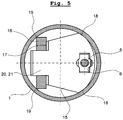
- the connecting lug 16 is provided with contact areas 19 ( Fig. 5 ) strongly pressed against the inner lateral surface of the hollow profile 1, with which the entire connecting assembly 14 is held on the hollow profile 1.
- the clamping part 15 can be preassembled on the connecting lug 16 by using a tongue 20 ( Fig. 5 ) in an extension 21 ( Fig. 6 ) is inserted between the legs of the connecting strap 16.
- the tongue 20 and the extension 21 are dimensioned such that the tongue 20 between the legs of the connecting bracket 16 is kept free of play by friction but still movable.
- the construction according to 4 to 6 is slightly more expensive but much easier to assemble and disassemble than the construction 1 to 3 .
Landscapes
- Engineering & Computer Science (AREA)
- General Engineering & Computer Science (AREA)
- Mechanical Engineering (AREA)
- Mutual Connection Of Rods And Tubes (AREA)
- Clamps And Clips (AREA)
Abstract
Description
- Die Erfindung betrifft eine Baugruppe, welche aus einem Hohlprofil und einer stirnseitig daran verankerten Verbindungsbaugruppe besteht.
- Beispielsweise die Schriften
DE 4210488 A1 ,DE 6945755 U ,DE 102004053758 A1 ,DE 102006041211 A1 undAT 351738 B
Die der Erfindung zu Grunde liegende Aufgabe besteht darin, eine Verbindungsbaugruppe für das Verankern am Stirnbereich eines Hohlprofils bereitzustellen, wobei die Verbindungsbaugruppe nicht die Außenmantelfläche des Hohlprofils zu berühren braucht, und wobei es nicht erforderlich ist, das Hohlprofil für das Verankern der Verbindungsbaugruppe zu bearbeiten. Gegenüber den Bauweisen entsprechend den oben erwähnten Schriften soll der Herstellungsaufwand für die Verbindungsbaugruppe niedriger gehalten werden können. - Zum Lösen der Aufgabe wird von den bekannten Bauweisen ausgegangen, bei welchen die Verbindungsbaugruppe einen stirnseitig am Hohlprofil anliegenden Teil aufweist, sowie einen an der Innenmantelfläche des Hohlprofils anliegenden Teil, sowie einen Verbindungsteil, welcher zwischen den beiden zuvor genannten Teilen eine auf den jeweils anderen der beiden Teile hin ausgerichtete Zugkraft ausübt.
Als erfindungsgemäße Weiterentwicklung dazu wird vorgeschlagen, dass der an der Innenmantelfläche des Hohlprofils anliegende Teil mit der Innenmantelfläche des Hohlprofils gegen Bewegung in Längsrichtung des Hohlprofils verkantet ist. - Durch diese Bauweise ist komfortable und robuste Funktion erreichbar und es ist einfach ausschließlich mit sehr einfach herstellbaren Einzelteilen das Auslangen zu finden, womit die Bauweise sehr kostengünstig ist.
- Die Erfindung wird an Hand von zwei Ausführungsbeispielen, die durch Zeichnungen veranschaulicht sind, näher erläutert.
- Fig. 1:
- zeigt eine erste erfindungsgemäße Baugruppe in Teilschnittansicht, wobei die Schnittebene parallel zur Profilrichtung des Hohlprofils liegt.
- Fig. 2:
- zeigt die Baugruppe von
Fig. 1 in der in Fig. mit "AA" angedeuteten Schnittdarstellung. - Fig. 3:
- zeigt zwei Teile der Baugruppe von
Fig. 1 in der inFig. 1 mit "BB" angedeuteten Schnittdarstellung. - Fig. 4:
- zeigt eine zweite erfindungsgemäße Baugruppe in Teilschnittansicht, wobei die Schnittebene parallel zur Profilrichtung des Hohlprofils liegt.
- Fig. 5:
- zeigt die Baugruppe von
Fig. 4 in der in Fig. mit "CC" angedeuteten Schnittdarstellung. - Fig. 6:
- zeigt zwei Teile der Baugruppe von
Fig. 1 in der inFig. 1 mit "DD" angedeuteten Schnittdarstellung. - Die erfindungsgemäße Baugruppe von
Fig. 1 besteht aus einem Hohlprofil 1 und einer Verbindungsbaugruppe 2, welche wiederum aus einem Klemmteil 3, einem Deckelteil 4, einer Schraube 5, einer Gewindemutter 6 und einer Anschlusslasche 7 besteht. - Der Deckelteil 4 liegt von außen her an der Stirnfläche 8 des Hohlprofils 1 an. Der Klemmteil 3 befindet sich im Inneren des Hohlprofils 1 und liegt mit Berührungsbereichen 9, 10 an der Innenmantelfläche des Hohlprofils 1 an. Die Berührungsbereiche 9, 10 liegen bezüglich der Längsrichtung des Hohlprofils 1 zueinander versetzt. Der Berührungsbereich 9 liegt näher an der Stirnfläche 8 des Hohlprofils 1 als die beiden Berührungsbereiche 10, welche zueinander zur Stirnfläche 8 auf gleichem Abstand liegen. In
Fig. 2 ist gut erkennbar, dass zumindest bezüglich einer zur Querschnittsebene des Hohlprofils 1 parallel liegenden Richtungskoordinate die Berührungsbereiche 10 einerseits und der Berührungsbereich 9 andererseits den Klemmteil 3 von gegenüberliegenden Seiten her zwischen sich einschließen. Die Achse der Schraube 5, welche mit ihrem Kopf von der vom Hohlprofil 1 abgewandten Seite her am Deckelteil 4 anliegt und mit der Gewindemutter 6, welche an der vom Deckelteil 4 abgewandten Seite des Klemmteils 3 anliegt, liegt näher an der Verbindungslinie zwischen den beiden Berührungsbereichen 10, welche von der Stirnfläche 8 weiter beabstandet sind, als der Berührungsbereich 9. Durch diese geometrischen Gegebenheiten - Lage der Berührungsbereiche 9, 10 bezüglich Hohlprofil 1 und Achse der Schraube 5 - neigt der Klemmteil 3 zum Verkanten an der der Innenmantelfläche des Hohlprofils 1, wenn die Schraube 5 angezogen wird, also eine Zugkraft auf den Klemmteil 3 ausübt, welche zur Stirnfläche 8 des Hohlprofils 1 hin ausgerichtet ist. - Die Neigung zum Verkanten ist dann besonders stark, wenn der Winkel zwischen der Querschnittsebene des Hohlprofils 1 und der durch die Berührungsbereiche 9, 10 des Klemmteils 3 aufgespannten Ebene kleiner ist als der Reibungswinkel zwischen den Materialien des Klemmteils 3 und des Hohlprofils 1.
(Der Reibungswinkel in diesem Sinne ist jener Winkel, den eine schiefe Ebene bezüglich der Horizontalen einnimmt, wenn ein auf ihr liegender Körper gerade eben in Bewegung kommt.)
Die Neigung zum Verkannten kann verstärkt werden, wenn die Verbindungsbaugruppe mit einer vorgespannten elastischen Feder ausgestattet wird, welche dahingehend auf den Klemmteil 3 einwirkt, dass dieser bei Abwesenheit anderer Einwirkungen gegenüber dem Hohlprofil 1 so gedreht wird, dass die durch die Berührungsbereiche 9, 10 des Klemmteils 3 aufgespannten Ebene in die Parallele zur Querschnittsebene des Hohlprofils 1 geschwenkt wird. - Zur Montage der Verbindungsbaugruppe 2 am Hohlprofil 1 braucht nur die Verbindungsbaugruppe 2 mit der Gewindemutter 6 und dem Klemmteil 3 voran von der Stirnfläche 8 her in das Hohlprofil 1 eingeschoben zu werden, bis der Deckelteil 4 an der Stirnfläche 8 anliegt, und dann die Schraube 5 angezogen zu werden.
- Um an der Verbindungsbaugruppe 2 weitere Teile (nicht dargestellt) befestigen zu können, dient in diesem Beispiel die Anschlusslasche 7. Ihre beispielhafte Form und die vorteilhafte Befestigungsweise am Deckelteil 4 sind in
Fig. 3 gut erkennbar. Die Anschlusslasche 7 hat etwa die Form einer U-förmigen Klammer, welche eine Durchgangsöffnung 11 umringt und deren freie Schenkelenden zu Fortsätzen 13 nach außen geknickt sind. Sie ist durch eine Ausnehmung im Deckelteil 3 hindurchgesteckt und mit zwei Vertiefungen 12, die sich jeweils an der Außenseite der beiden Schenkel befinden, an einander gegenüberliegenden Randbereichen der Ausnehmung am Deckelteil 4 eingerastet. Zur Montage der Anschlusslasche 7 am Deckelteil 4 werden die beiden Schenkel der Anschlusslasche 7 unter elastischer Verformung ihres Verbindungsbereiches etwas aufeinander zu gedrückt und mit dem besagten Verbindungsbereich voran durch die erwähnte Ausnehmung im Deckelteil 4 eingeschoben.
Idealerweise ist die Länge der Fortsätze 13 so bemessen, dass sie bei am Hohlprofil 1 montiertem Deckelteil 4 an der Innenmantelfläche des Hohlprofils 1 anliegen. Damit kann der Deckelteil 4 bei der Montage gegenüber dem Hohlprofil 1 gut in eine definierte Lage gerückt und dort fixiert werden. - Deckelteil 4, Klemmteil 3 und Anschlusslasche 5 der Verbindungsbaugruppe können sehr gut als ebene Laserschnittteile aus Stahlblech hergestellt werden. Bis auf ggf. erwünschtes Ansenken einer Schraubendurchgangsbohrung und ggf. erwünschte Oberflächenveredelung sind nach dem Laserschnitt keine weiteren Schritte zur Herstellung dieser Teile erforderlich. Damit sind diese Teile auch in Kleinserien sehr kostengünstig bereitstellbar; auch die Montage der Teile aneinander ist einfach und damit kostengünstig. Die restlichen Teile der Verbindungsbaugruppe 2 sind die Schraube 5 und die Gewindemutter 6; diese Teile sind sehr kostengünstig zukaufbare Massenfertigungsteile.
Da sich der Klemmteil 3 beim Anziehen der Schraube 5 gegenüber der Schraube verschwenkt, ist es vorteilhaft, als Gewindemutter 6 - wie dargestellt - eine Quergewindemutter zu verwenden. (Eine Quergewindemutter hat die äußere Form eines Kreiszylinders, wobei die Richtung der Gewindebohrung normal zur Achse des Kreiszylinders ausgerichtet ist.) - Bei der Bauweise gemäß
Fig. 4 bis Fig. 6 der Verbindungsbaugruppe 14 verkantet der Klemmteil 15 nicht nur unmittelbar am Hohlprofil 1 (wie bei der Bauweise gemäßFig. 1 bis Fig. 3 ), sondern einerseits am Hohlprofil 1 und andererseits an der Anschlusslasche 16. Die an der Anschlusslasche 16 liegenden Berührungsbereiche 17 liegen näher an der Stirnfläche 8 des Hohlprofils 1 als die an der Innenmantelfläche des Hohlprofils 1 liegenden Berührungsbereiche 18, welche näher an der Achse der Schraube 5 liegen als die Berührungsbereiche 17. Durch das Verkanten des Klemmteils 15, welches im Prinzip genau gleich erfolgt wie das weiter oben beschriebene Verkanten des Klemmteils 3 der Verbindungsbaugruppe 2, wird die Anschlusslasche 16 mit Berührungsbereichen 19 (Fig. 5 ) stark gegen die Innenmantelfläche des Hohlprofils 1 angedrückt, womit die gesamte Verbindungsbaugruppe 14 am Hohlprofil 1 gehalten wird. - Der Klemmteil 15 kann an der Anschlusslasche 16 vormontiert werden, indem er mit einer Zunge 20 (
Fig. 5 ) in eine Erweiterung 21 (Fig. 6 ) zwischen den Schenkeln der Anschlusslasche 16 eingesteckt wird. Idealerweise sind die Zunge 20 und die Erweiterung 21 so bemessen, dass die Zunge 20 zwischen den Schenkeln der Anschlusslasche 16 schon durch Reibung spielfrei aber doch noch bewegbar gehalten wird.
Die Bauweise gemäßFig. 4 bis Fig. 6 ist geringfügig materialaufwändiger aber deutlich handlicher zu montieren und zu demontieren als die Bauweise gemäßFig. 1 bis Fig. 3 .
Claims (5)
- Baugruppe, welche aus einem Hohlprofil (1) und einer stirnseitig daran verankerten Verbindungsbaugruppe (2, 14) besteht, wobei die Verbindungsbaugruppe (2, 14) einen stirnseitig am Hohlprofil (8) anliegenden Deckelteil (4) aufweist, sowie einen an der Innenmantelfläche des Hohlprofils (1) anliegenden Klemmteil (3, 15), sowie eine Schraube (5), welche zwischen Klemmteil (3, 15) und Deckelteil (4) eine jeweils auf den anderen Teil hin ausgerichtete Zugkraft ausübt,
dadurch gekennzeichnet, dass
der Klemmteil (3, 15) mit der Innenmantelfläche des Hohlprofils (1) gegen Bewegung in Längsrichtung des Hohlprofils (1) verkantet ist. - Baugruppe nach Anspruch 1, dadurch gekennzeichnet, dass der Klemmteil (3, 15) mit Berührungsbereichen (9, 10, 17, 18) an der Innenmantelfläche des Hohlprofils (1) und/oder an einer sich in das Hohlprofil (1) hinein erstreckenden Anschlusslasche (16) anliegt, wobei die Berührungsbereiche (9, 10; 17, 18) bezüglich der Längsrichtung des Hohlprofils (1) zueinander versetzt liegen, wobei der Berührungsbereich (9, 17) näher an der Stirnfläche (8) des Hohlprofils (1) liegt als der Berührungsbereich (10, 18), wobei die Berührungsbereiche (9, 10; 17, 18) den Klemmteil (3, 15) von gegenüberliegenden Seiten her zwischen sich einschließen und der weiter von der Stirnfläche (8) entfernt liegende Berührungsbereich (10, 18) näher an der Achse der Schraube (5) liegt als der gegenüberliegende Berührungsbereich (9, 17).
- Baugruppe nach Anspruch 2, dadurch gekennzeichnet, dass der Winkel zwischen der Querschnittsebene des Hohlprofils (1) und der durch die Berührungsbereiche (9, 10; 17, 18) des Klemmteils (3, 15) aufgespannten Ebene kleiner ist als der Reibungswinkel zwischen den Materialien des Klemmteils (3, 15) und des Hohlprofils (1).
- Baugruppe nach einem der Ansprüche 1 bis 3, dadurch gekennzeichnet, dass die Verbindungsbaugruppe (2, 14) eine Anschlusslasche (7, 16) aufweist, welche die Gestalt einer U-förmigen Klammer aufweist, welche eine Durchgangsöffnung (11) umringt und durch eine Ausnehmung im Deckelteil (4) hindurchgesteckt ist.
- Baugruppe nach Anspruch 4, dadurch gekennzeichnet, dass die Anschlusslasche (7, 16) an der Innenmantelfläche des Hohlprofils (1) anliegt.
Applications Claiming Priority (1)
| Application Number | Priority Date | Filing Date | Title |
|---|---|---|---|
| ATA365/2018A AT521378B1 (de) | 2018-12-03 | 2018-12-03 | Baugruppe, welche aus einem Hohlprofil und einer stirnseitig daran verankerten Verbindungsbaugruppe besteht |
Publications (2)
| Publication Number | Publication Date |
|---|---|
| EP3663593A1 true EP3663593A1 (de) | 2020-06-10 |
| EP3663593B1 EP3663593B1 (de) | 2024-07-17 |
Family
ID=68766450
Family Applications (1)
| Application Number | Title | Priority Date | Filing Date |
|---|---|---|---|
| EP19000540.5A Active EP3663593B1 (de) | 2018-12-03 | 2019-12-02 | Baugruppe, welche aus einem hohlprofil und einer stirnseitig daran verankerten verbindungsbaugruppe besteht |
Country Status (2)
| Country | Link |
|---|---|
| EP (1) | EP3663593B1 (de) |
| AT (1) | AT521378B1 (de) |
Citations (7)
| Publication number | Priority date | Publication date | Assignee | Title |
|---|---|---|---|---|
| GB1160389A (en) * | 1968-09-25 | 1969-08-06 | Daniel Charles Lawrence Hobbs | Wedge Bar Clamping Device for Tube End Fittings. |
| DE6945755U (de) | 1969-10-28 | 1970-03-12 | Klaus Hoffmann | Vorrichtung zum anschluss von bauelementen an hohlprofile, insbesondere von obergurtprofilen an hohlkantstuetzen von balkongelaendern |
| AT351738B (de) | 1974-01-12 | 1979-08-10 | Alusuisse | Bausatz fuer die erstellung eines aus pfosten, handlauf und mindestens einem holm bestehenden gelaenders |
| DE4210488A1 (de) | 1992-03-31 | 1993-10-07 | Wilke Heinrich Hewi Gmbh | Verbindungseinrichtung für ein insbesondere rohrförmiges Bauteil |
| DE102004053758A1 (de) | 2004-11-08 | 2006-05-11 | Dieda Systembauteile Gmbh + Co.Kg | Rohrabschlusselement |
| DE102006041211A1 (de) | 2006-09-02 | 2008-03-06 | Klaus Peter Abel | Befestigungsvorrichtung für Profilrohre |
| ITPD20120231A1 (it) * | 2012-07-26 | 2014-01-27 | Carletto Stefano | Dispositivo di bloccaggio |
Family Cites Families (4)
| Publication number | Priority date | Publication date | Assignee | Title |
|---|---|---|---|---|
| GB2343722B (en) * | 1998-10-01 | 2002-05-29 | Yau King Choy | Connectors for tubes or pipes |
| US8858141B2 (en) * | 2008-05-16 | 2014-10-14 | Marty Williams | Barrel nut assembly |
| DE202010010045U1 (de) * | 2010-07-11 | 2010-10-21 | Palten, Werner | Eckverbinder insbesondere für auf Gehrung geschnittene Rohre bzw. Stangen |
| US9841042B2 (en) * | 2014-03-13 | 2017-12-12 | Raytheon Company | Clamp for internally coupling and decoupling two components |
-
2018
- 2018-12-03 AT ATA365/2018A patent/AT521378B1/de not_active IP Right Cessation
-
2019
- 2019-12-02 EP EP19000540.5A patent/EP3663593B1/de active Active
Patent Citations (7)
| Publication number | Priority date | Publication date | Assignee | Title |
|---|---|---|---|---|
| GB1160389A (en) * | 1968-09-25 | 1969-08-06 | Daniel Charles Lawrence Hobbs | Wedge Bar Clamping Device for Tube End Fittings. |
| DE6945755U (de) | 1969-10-28 | 1970-03-12 | Klaus Hoffmann | Vorrichtung zum anschluss von bauelementen an hohlprofile, insbesondere von obergurtprofilen an hohlkantstuetzen von balkongelaendern |
| AT351738B (de) | 1974-01-12 | 1979-08-10 | Alusuisse | Bausatz fuer die erstellung eines aus pfosten, handlauf und mindestens einem holm bestehenden gelaenders |
| DE4210488A1 (de) | 1992-03-31 | 1993-10-07 | Wilke Heinrich Hewi Gmbh | Verbindungseinrichtung für ein insbesondere rohrförmiges Bauteil |
| DE102004053758A1 (de) | 2004-11-08 | 2006-05-11 | Dieda Systembauteile Gmbh + Co.Kg | Rohrabschlusselement |
| DE102006041211A1 (de) | 2006-09-02 | 2008-03-06 | Klaus Peter Abel | Befestigungsvorrichtung für Profilrohre |
| ITPD20120231A1 (it) * | 2012-07-26 | 2014-01-27 | Carletto Stefano | Dispositivo di bloccaggio |
Also Published As
| Publication number | Publication date |
|---|---|
| AT521378A4 (de) | 2020-01-15 |
| EP3663593B1 (de) | 2024-07-17 |
| AT521378B1 (de) | 2020-01-15 |
Similar Documents
| Publication | Publication Date | Title |
|---|---|---|
| DE3927529C1 (de) | ||
| EP2739445B1 (de) | Backenpaar zum ausstanzen von löchern | |
| EP2997278B1 (de) | Sattelscheibenbremse eines fahrzeugs und niederhalteeinrichtung einer solchen bremse | |
| WO2018041578A1 (de) | Kippsegmentlager | |
| EP3237773B1 (de) | Scheibenbremse für ein nutzfahrzeug | |
| EP3707396B1 (de) | Verliersicherung für schrauben und montageeinheit | |
| EP3204202B1 (de) | Messerkopf zur spanenden bearbeitung von werkstoffen und messer hierfür | |
| EP2420900A2 (de) | Schwingkörper, mechanisches Schwingsystem für Armbanduhren mit einem solchen Schwingkörper sowie Uhr mit einem derartigen Schwingsystem | |
| EP2730456B1 (de) | Antrieb einer Sitzverstelleinrichtung für Kraftfahrzeuge | |
| DE3118896C2 (de) | Drehgelenk, insbesondere für Sitze mit verstellbarer Rückenlehne | |
| EP3158208B1 (de) | Bauteilverbindung | |
| EP3047157B1 (de) | Anordnung zur verbindung von bauteilen | |
| DE102010033714B3 (de) | Werkzeug zum Setzen von Vollstanznieten | |
| DE112015002909T5 (de) | Rollenheber | |
| WO2004094837A1 (de) | Befestigungselement und darauf abgestimmter zylinderdeckel eines fluidbetätigen arbeitszylinders | |
| AT521378B1 (de) | Baugruppe, welche aus einem Hohlprofil und einer stirnseitig daran verankerten Verbindungsbaugruppe besteht | |
| DE102015221765B3 (de) | Zylinderanordnung mit einem Boden und Vorrichtung zur Herstellung einer Formschlussverbindung zwischen dem Boden und einem Zylinder | |
| EP2987924B1 (de) | Anschlaghalter für eine wandschalung | |
| DE102014101464A1 (de) | Befestigungseinrichtung | |
| EP1377397A2 (de) | Werkzeug zum nietartigen verbinden | |
| EP1857197B1 (de) | Matrize zum mechanischen Fügen | |
| DE102016209395A1 (de) | Befestigungselement für den Toleranzausgleich | |
| DE212014000020U1 (de) | Bearbeitungssystem | |
| DE202010004534U1 (de) | Befestigungseinrichtung mit Spannschraube | |
| AT522362B1 (de) | Halterung für die lösbare Befestigung eines Schilds |
Legal Events
| Date | Code | Title | Description |
|---|---|---|---|
| PUAI | Public reference made under article 153(3) epc to a published international application that has entered the european phase |
Free format text: ORIGINAL CODE: 0009012 |
|
| STAA | Information on the status of an ep patent application or granted ep patent |
Free format text: STATUS: THE APPLICATION HAS BEEN PUBLISHED |
|
| AK | Designated contracting states |
Kind code of ref document: A1 Designated state(s): AL AT BE BG CH CY CZ DE DK EE ES FI FR GB GR HR HU IE IS IT LI LT LU LV MC MK MT NL NO PL PT RO RS SE SI SK SM TR |
|
| AX | Request for extension of the european patent |
Extension state: BA ME |
|
| STAA | Information on the status of an ep patent application or granted ep patent |
Free format text: STATUS: REQUEST FOR EXAMINATION WAS MADE |
|
| 17P | Request for examination filed |
Effective date: 20201130 |
|
| RBV | Designated contracting states (corrected) |
Designated state(s): AL AT BE BG CH CY CZ DE DK EE ES FI FR GB GR HR HU IE IS IT LI LT LU LV MC MK MT NL NO PL PT RO RS SE SI SK SM TR |
|
| STAA | Information on the status of an ep patent application or granted ep patent |
Free format text: STATUS: EXAMINATION IS IN PROGRESS |
|
| 17Q | First examination report despatched |
Effective date: 20221012 |
|
| GRAP | Despatch of communication of intention to grant a patent |
Free format text: ORIGINAL CODE: EPIDOSNIGR1 |
|
| STAA | Information on the status of an ep patent application or granted ep patent |
Free format text: STATUS: GRANT OF PATENT IS INTENDED |
|
| INTG | Intention to grant announced |
Effective date: 20240220 |
|
| GRAS | Grant fee paid |
Free format text: ORIGINAL CODE: EPIDOSNIGR3 |
|
| GRAA | (expected) grant |
Free format text: ORIGINAL CODE: 0009210 |
|
| STAA | Information on the status of an ep patent application or granted ep patent |
Free format text: STATUS: THE PATENT HAS BEEN GRANTED |
|
| AK | Designated contracting states |
Kind code of ref document: B1 Designated state(s): AL AT BE BG CH CY CZ DE DK EE ES FI FR GB GR HR HU IE IS IT LI LT LU LV MC MK MT NL NO PL PT RO RS SE SI SK SM TR |
|
| REG | Reference to a national code |
Ref country code: CH Ref legal event code: EP |
|
| REG | Reference to a national code |
Ref country code: DE Ref legal event code: R096 Ref document number: 502019011663 Country of ref document: DE |
|
| REG | Reference to a national code |
Ref country code: IE Ref legal event code: FG4D Free format text: LANGUAGE OF EP DOCUMENT: GERMAN |
|
| REG | Reference to a national code |
Ref country code: LT Ref legal event code: MG9D |
|
| REG | Reference to a national code |
Ref country code: NL Ref legal event code: MP Effective date: 20240717 |
|
| PG25 | Lapsed in a contracting state [announced via postgrant information from national office to epo] |
Ref country code: PT Free format text: LAPSE BECAUSE OF FAILURE TO SUBMIT A TRANSLATION OF THE DESCRIPTION OR TO PAY THE FEE WITHIN THE PRESCRIBED TIME-LIMIT Effective date: 20241118 |
|
| PG25 | Lapsed in a contracting state [announced via postgrant information from national office to epo] |
Ref country code: NL Free format text: LAPSE BECAUSE OF FAILURE TO SUBMIT A TRANSLATION OF THE DESCRIPTION OR TO PAY THE FEE WITHIN THE PRESCRIBED TIME-LIMIT Effective date: 20240717 |
|
| PG25 | Lapsed in a contracting state [announced via postgrant information from national office to epo] |
Ref country code: PT Free format text: LAPSE BECAUSE OF FAILURE TO SUBMIT A TRANSLATION OF THE DESCRIPTION OR TO PAY THE FEE WITHIN THE PRESCRIBED TIME-LIMIT Effective date: 20241118 Ref country code: NL Free format text: LAPSE BECAUSE OF FAILURE TO SUBMIT A TRANSLATION OF THE DESCRIPTION OR TO PAY THE FEE WITHIN THE PRESCRIBED TIME-LIMIT Effective date: 20240717 |
|
| PG25 | Lapsed in a contracting state [announced via postgrant information from national office to epo] |
Ref country code: NO Free format text: LAPSE BECAUSE OF FAILURE TO SUBMIT A TRANSLATION OF THE DESCRIPTION OR TO PAY THE FEE WITHIN THE PRESCRIBED TIME-LIMIT Effective date: 20241017 |
|
| PG25 | Lapsed in a contracting state [announced via postgrant information from national office to epo] |
Ref country code: FI Free format text: LAPSE BECAUSE OF FAILURE TO SUBMIT A TRANSLATION OF THE DESCRIPTION OR TO PAY THE FEE WITHIN THE PRESCRIBED TIME-LIMIT Effective date: 20240717 Ref country code: GR Free format text: LAPSE BECAUSE OF FAILURE TO SUBMIT A TRANSLATION OF THE DESCRIPTION OR TO PAY THE FEE WITHIN THE PRESCRIBED TIME-LIMIT Effective date: 20241018 Ref country code: PL Free format text: LAPSE BECAUSE OF FAILURE TO SUBMIT A TRANSLATION OF THE DESCRIPTION OR TO PAY THE FEE WITHIN THE PRESCRIBED TIME-LIMIT Effective date: 20240717 |
|
| PG25 | Lapsed in a contracting state [announced via postgrant information from national office to epo] |
Ref country code: BG Free format text: LAPSE BECAUSE OF FAILURE TO SUBMIT A TRANSLATION OF THE DESCRIPTION OR TO PAY THE FEE WITHIN THE PRESCRIBED TIME-LIMIT Effective date: 20240717 |
|
| PG25 | Lapsed in a contracting state [announced via postgrant information from national office to epo] |
Ref country code: LV Free format text: LAPSE BECAUSE OF FAILURE TO SUBMIT A TRANSLATION OF THE DESCRIPTION OR TO PAY THE FEE WITHIN THE PRESCRIBED TIME-LIMIT Effective date: 20240717 |
|
| PG25 | Lapsed in a contracting state [announced via postgrant information from national office to epo] |
Ref country code: IS Free format text: LAPSE BECAUSE OF FAILURE TO SUBMIT A TRANSLATION OF THE DESCRIPTION OR TO PAY THE FEE WITHIN THE PRESCRIBED TIME-LIMIT Effective date: 20241117 |
|
| PG25 | Lapsed in a contracting state [announced via postgrant information from national office to epo] |
Ref country code: HR Free format text: LAPSE BECAUSE OF FAILURE TO SUBMIT A TRANSLATION OF THE DESCRIPTION OR TO PAY THE FEE WITHIN THE PRESCRIBED TIME-LIMIT Effective date: 20240717 |
|
| PG25 | Lapsed in a contracting state [announced via postgrant information from national office to epo] |
Ref country code: ES Free format text: LAPSE BECAUSE OF FAILURE TO SUBMIT A TRANSLATION OF THE DESCRIPTION OR TO PAY THE FEE WITHIN THE PRESCRIBED TIME-LIMIT Effective date: 20240717 Ref country code: RS Free format text: LAPSE BECAUSE OF FAILURE TO SUBMIT A TRANSLATION OF THE DESCRIPTION OR TO PAY THE FEE WITHIN THE PRESCRIBED TIME-LIMIT Effective date: 20241017 |
|
| PG25 | Lapsed in a contracting state [announced via postgrant information from national office to epo] |
Ref country code: RS Free format text: LAPSE BECAUSE OF FAILURE TO SUBMIT A TRANSLATION OF THE DESCRIPTION OR TO PAY THE FEE WITHIN THE PRESCRIBED TIME-LIMIT Effective date: 20241017 Ref country code: PL Free format text: LAPSE BECAUSE OF FAILURE TO SUBMIT A TRANSLATION OF THE DESCRIPTION OR TO PAY THE FEE WITHIN THE PRESCRIBED TIME-LIMIT Effective date: 20240717 Ref country code: NO Free format text: LAPSE BECAUSE OF FAILURE TO SUBMIT A TRANSLATION OF THE DESCRIPTION OR TO PAY THE FEE WITHIN THE PRESCRIBED TIME-LIMIT Effective date: 20241017 Ref country code: LV Free format text: LAPSE BECAUSE OF FAILURE TO SUBMIT A TRANSLATION OF THE DESCRIPTION OR TO PAY THE FEE WITHIN THE PRESCRIBED TIME-LIMIT Effective date: 20240717 Ref country code: IS Free format text: LAPSE BECAUSE OF FAILURE TO SUBMIT A TRANSLATION OF THE DESCRIPTION OR TO PAY THE FEE WITHIN THE PRESCRIBED TIME-LIMIT Effective date: 20241117 Ref country code: HR Free format text: LAPSE BECAUSE OF FAILURE TO SUBMIT A TRANSLATION OF THE DESCRIPTION OR TO PAY THE FEE WITHIN THE PRESCRIBED TIME-LIMIT Effective date: 20240717 Ref country code: GR Free format text: LAPSE BECAUSE OF FAILURE TO SUBMIT A TRANSLATION OF THE DESCRIPTION OR TO PAY THE FEE WITHIN THE PRESCRIBED TIME-LIMIT Effective date: 20241018 Ref country code: FI Free format text: LAPSE BECAUSE OF FAILURE TO SUBMIT A TRANSLATION OF THE DESCRIPTION OR TO PAY THE FEE WITHIN THE PRESCRIBED TIME-LIMIT Effective date: 20240717 Ref country code: ES Free format text: LAPSE BECAUSE OF FAILURE TO SUBMIT A TRANSLATION OF THE DESCRIPTION OR TO PAY THE FEE WITHIN THE PRESCRIBED TIME-LIMIT Effective date: 20240717 Ref country code: BG Free format text: LAPSE BECAUSE OF FAILURE TO SUBMIT A TRANSLATION OF THE DESCRIPTION OR TO PAY THE FEE WITHIN THE PRESCRIBED TIME-LIMIT Effective date: 20240717 |
|
| PG25 | Lapsed in a contracting state [announced via postgrant information from national office to epo] |
Ref country code: RO Free format text: LAPSE BECAUSE OF FAILURE TO SUBMIT A TRANSLATION OF THE DESCRIPTION OR TO PAY THE FEE WITHIN THE PRESCRIBED TIME-LIMIT Effective date: 20240717 Ref country code: DK Free format text: LAPSE BECAUSE OF FAILURE TO SUBMIT A TRANSLATION OF THE DESCRIPTION OR TO PAY THE FEE WITHIN THE PRESCRIBED TIME-LIMIT Effective date: 20240717 Ref country code: SM Free format text: LAPSE BECAUSE OF FAILURE TO SUBMIT A TRANSLATION OF THE DESCRIPTION OR TO PAY THE FEE WITHIN THE PRESCRIBED TIME-LIMIT Effective date: 20240717 |
|
| REG | Reference to a national code |
Ref country code: DE Ref legal event code: R097 Ref document number: 502019011663 Country of ref document: DE |
|
| PG25 | Lapsed in a contracting state [announced via postgrant information from national office to epo] |
Ref country code: EE Free format text: LAPSE BECAUSE OF FAILURE TO SUBMIT A TRANSLATION OF THE DESCRIPTION OR TO PAY THE FEE WITHIN THE PRESCRIBED TIME-LIMIT Effective date: 20240717 |
|
| PG25 | Lapsed in a contracting state [announced via postgrant information from national office to epo] |
Ref country code: CZ Free format text: LAPSE BECAUSE OF FAILURE TO SUBMIT A TRANSLATION OF THE DESCRIPTION OR TO PAY THE FEE WITHIN THE PRESCRIBED TIME-LIMIT Effective date: 20240717 |
|
| PG25 | Lapsed in a contracting state [announced via postgrant information from national office to epo] |
Ref country code: SK Free format text: LAPSE BECAUSE OF FAILURE TO SUBMIT A TRANSLATION OF THE DESCRIPTION OR TO PAY THE FEE WITHIN THE PRESCRIBED TIME-LIMIT Effective date: 20240717 |
|
| PLBE | No opposition filed within time limit |
Free format text: ORIGINAL CODE: 0009261 |
|
| STAA | Information on the status of an ep patent application or granted ep patent |
Free format text: STATUS: NO OPPOSITION FILED WITHIN TIME LIMIT |
|
| 26N | No opposition filed |
Effective date: 20250422 |
|
| PG25 | Lapsed in a contracting state [announced via postgrant information from national office to epo] |
Ref country code: MC Free format text: LAPSE BECAUSE OF FAILURE TO SUBMIT A TRANSLATION OF THE DESCRIPTION OR TO PAY THE FEE WITHIN THE PRESCRIBED TIME-LIMIT Effective date: 20240717 |
|
| PG25 | Lapsed in a contracting state [announced via postgrant information from national office to epo] |
Ref country code: LU Free format text: LAPSE BECAUSE OF NON-PAYMENT OF DUE FEES Effective date: 20241202 |
|
| GBPC | Gb: european patent ceased through non-payment of renewal fee |
Effective date: 20241202 |
|
| PG25 | Lapsed in a contracting state [announced via postgrant information from national office to epo] |
Ref country code: SE Free format text: LAPSE BECAUSE OF FAILURE TO SUBMIT A TRANSLATION OF THE DESCRIPTION OR TO PAY THE FEE WITHIN THE PRESCRIBED TIME-LIMIT Effective date: 20240717 |
|
| REG | Reference to a national code |
Ref country code: BE Ref legal event code: MM Effective date: 20241231 |
|
| PG25 | Lapsed in a contracting state [announced via postgrant information from national office to epo] |
Ref country code: GB Free format text: LAPSE BECAUSE OF NON-PAYMENT OF DUE FEES Effective date: 20241202 Ref country code: BE Free format text: LAPSE BECAUSE OF NON-PAYMENT OF DUE FEES Effective date: 20241231 |
|
| PG25 | Lapsed in a contracting state [announced via postgrant information from national office to epo] |
Ref country code: FR Free format text: LAPSE BECAUSE OF NON-PAYMENT OF DUE FEES Effective date: 20241231 |
|
| PG25 | Lapsed in a contracting state [announced via postgrant information from national office to epo] |
Ref country code: IE Free format text: LAPSE BECAUSE OF NON-PAYMENT OF DUE FEES Effective date: 20241202 |
|
| REG | Reference to a national code |
Ref country code: CH Ref legal event code: U11 Free format text: ST27 STATUS EVENT CODE: U-0-0-U10-U11 (AS PROVIDED BY THE NATIONAL OFFICE) Effective date: 20260101 |
|
| PGFP | Annual fee paid to national office [announced via postgrant information from national office to epo] |
Ref country code: AT Payment date: 20251230 Year of fee payment: 7 |
|
| PG25 | Lapsed in a contracting state [announced via postgrant information from national office to epo] |
Ref country code: IT Free format text: LAPSE BECAUSE OF FAILURE TO SUBMIT A TRANSLATION OF THE DESCRIPTION OR TO PAY THE FEE WITHIN THE PRESCRIBED TIME-LIMIT Effective date: 20240717 |
|
| PG25 | Lapsed in a contracting state [announced via postgrant information from national office to epo] |
Ref country code: CY Free format text: LAPSE BECAUSE OF FAILURE TO SUBMIT A TRANSLATION OF THE DESCRIPTION OR TO PAY THE FEE WITHIN THE PRESCRIBED TIME-LIMIT; INVALID AB INITIO Effective date: 20191202 |
|
| PGFP | Annual fee paid to national office [announced via postgrant information from national office to epo] |
Ref country code: DE Payment date: 20251223 Year of fee payment: 7 |
|
| PGFP | Annual fee paid to national office [announced via postgrant information from national office to epo] |
Ref country code: CH Payment date: 20260101 Year of fee payment: 7 |