EP3663750B1 - Particules de polymère d'acide nucléique échafaudées et procédés de fabrication et d'utilisation - Google Patents
Particules de polymère d'acide nucléique échafaudées et procédés de fabrication et d'utilisation Download PDFInfo
- Publication number
- EP3663750B1 EP3663750B1 EP19205891.5A EP19205891A EP3663750B1 EP 3663750 B1 EP3663750 B1 EP 3663750B1 EP 19205891 A EP19205891 A EP 19205891A EP 3663750 B1 EP3663750 B1 EP 3663750B1
- Authority
- EP
- European Patent Office
- Prior art keywords
- nucleic acid
- acid polymer
- polymer particles
- particles
- primer
- Prior art date
- Legal status (The legal status is an assumption and is not a legal conclusion. Google has not performed a legal analysis and makes no representation as to the accuracy of the status listed.)
- Active
Links
Images


Classifications
-
- C—CHEMISTRY; METALLURGY
- C12—BIOCHEMISTRY; BEER; SPIRITS; WINE; VINEGAR; MICROBIOLOGY; ENZYMOLOGY; MUTATION OR GENETIC ENGINEERING
- C12N—MICROORGANISMS OR ENZYMES; COMPOSITIONS THEREOF; PROPAGATING, PRESERVING, OR MAINTAINING MICROORGANISMS; MUTATION OR GENETIC ENGINEERING; CULTURE MEDIA
- C12N15/00—Mutation or genetic engineering; DNA or RNA concerning genetic engineering, vectors, e.g. plasmids, or their isolation, preparation or purification; Use of hosts therefor
- C12N15/09—Recombinant DNA-technology
- C12N15/10—Processes for the isolation, preparation or purification of DNA or RNA
- C12N15/1034—Isolating an individual clone by screening libraries
- C12N15/1093—General methods of preparing gene libraries, not provided for in other subgroups
-
- C—CHEMISTRY; METALLURGY
- C12—BIOCHEMISTRY; BEER; SPIRITS; WINE; VINEGAR; MICROBIOLOGY; ENZYMOLOGY; MUTATION OR GENETIC ENGINEERING
- C12Q—MEASURING OR TESTING PROCESSES INVOLVING ENZYMES, NUCLEIC ACIDS OR MICROORGANISMS; COMPOSITIONS OR TEST PAPERS THEREFOR; PROCESSES OF PREPARING SUCH COMPOSITIONS; CONDITION-RESPONSIVE CONTROL IN MICROBIOLOGICAL OR ENZYMOLOGICAL PROCESSES
- C12Q1/00—Measuring or testing processes involving enzymes, nucleic acids or microorganisms; Compositions therefor; Processes of preparing such compositions
- C12Q1/68—Measuring or testing processes involving enzymes, nucleic acids or microorganisms; Compositions therefor; Processes of preparing such compositions involving nucleic acids
- C12Q1/6806—Preparing nucleic acids for analysis, e.g. for polymerase chain reaction [PCR] assay
-
- C—CHEMISTRY; METALLURGY
- C12—BIOCHEMISTRY; BEER; SPIRITS; WINE; VINEGAR; MICROBIOLOGY; ENZYMOLOGY; MUTATION OR GENETIC ENGINEERING
- C12Q—MEASURING OR TESTING PROCESSES INVOLVING ENZYMES, NUCLEIC ACIDS OR MICROORGANISMS; COMPOSITIONS OR TEST PAPERS THEREFOR; PROCESSES OF PREPARING SUCH COMPOSITIONS; CONDITION-RESPONSIVE CONTROL IN MICROBIOLOGICAL OR ENZYMOLOGICAL PROCESSES
- C12Q1/00—Measuring or testing processes involving enzymes, nucleic acids or microorganisms; Compositions therefor; Processes of preparing such compositions
- C12Q1/68—Measuring or testing processes involving enzymes, nucleic acids or microorganisms; Compositions therefor; Processes of preparing such compositions involving nucleic acids
- C12Q1/6813—Hybridisation assays
- C12Q1/6834—Enzymatic or biochemical coupling of nucleic acids to a solid phase
-
- C—CHEMISTRY; METALLURGY
- C12—BIOCHEMISTRY; BEER; SPIRITS; WINE; VINEGAR; MICROBIOLOGY; ENZYMOLOGY; MUTATION OR GENETIC ENGINEERING
- C12Q—MEASURING OR TESTING PROCESSES INVOLVING ENZYMES, NUCLEIC ACIDS OR MICROORGANISMS; COMPOSITIONS OR TEST PAPERS THEREFOR; PROCESSES OF PREPARING SUCH COMPOSITIONS; CONDITION-RESPONSIVE CONTROL IN MICROBIOLOGICAL OR ENZYMOLOGICAL PROCESSES
- C12Q1/00—Measuring or testing processes involving enzymes, nucleic acids or microorganisms; Compositions therefor; Processes of preparing such compositions
- C12Q1/68—Measuring or testing processes involving enzymes, nucleic acids or microorganisms; Compositions therefor; Processes of preparing such compositions involving nucleic acids
- C12Q1/6844—Nucleic acid amplification reactions
- C12Q1/6853—Nucleic acid amplification reactions using modified primers or templates
Definitions
- amplicons are either in a planar format (e.g. Mitra et al, cited above; Adessi et al, Nucleic Acids Research, 28: e87 (2000 )), which limits ease of manipulation and/or reagent access, or the amplicons are on bead surfaces, which lack sufficient fragment density or concentration for adequate signal-to-noise ratios.
- amplifications must be done in emulsions in order to obtain clonal populations of templates. Such emulsion reactions are labor intensive and require a high degree of expertise, which significantly increases costs.
- Gels have been widely used as supports in analytical and synthetic processes and as encapsulating agents, e.g. Weaver et al, U.S. patent 5,055,390 ; Tmovsky et al, U.S. patent 6,586,176 , and have interiors accessible to analytical reagents.
- particulates are limited in that they are typically produced with widely varying size distributions, particularly at lower size ranges, e.g. less than about 30 ⁇ m, which makes them unsuitable for many exacting analytical applications, such as large scale DNA sequencing.
- EP 1 256 632 A2 discloses methods for determining the identity of a polymorphic nucleotide in a complex mixture of nucleic acids where one or more distinct polymorphisms can be present in the mixture.
- WO 2008/109176 A2 generally relates to droplets and/or emulsions which may be used for a number of applications including PCRs.
- CN 101413034 A is generally directed to a method for preparing a molecular cloning chip by cloning high flux nucleic acid molecule.
- the present invention provides a method of amplifying a target polynucleotide in a sample, the method comprising combining a sample and nucleic acid polymer particles in an amplification reaction mixture, each such particle comprising a non-nucleosidic polymer network having attached throughout its volume a primer at a concentration of at least 1 ⁇ 10 5 primers per ⁇ m 3 , a region of the target polynucleotide capable of annealing to the primer, the volumes of the polymer networks have a coefficient of variation of fifteen percent or less, the non-nucleosidic polymer network including a polyacrylamide gel having a total monomer percentage in a range of 3% to 20% and being permeable to proteins having a size in the range of 50 kilodaltons to 200 kilodaltons, and performing an amplification reaction so that primers on a nucleic acid polymer particle are repeatedly extended along a target polynucleotide annealed thereto so that
- Porous microparticles may comprise three-dimensional scaffolds for attaching greater numbers of template molecules than possible with solid beads that have only a two-dimensional surface available for attachment. Such porous microparticles may be referred to herein as nucleic acid polymer particles.
- Such porous microparticles may comprise particles having shapes with larger surface to volume ratios than spherical particles.
- Such shapes include tubes, shells, hollow spheres with accessible interiors (e.g. nanocapsules), barrels, multiply connected solids, including doubly connected solids, such as donut-shaped solids and their topological equivalents, triply connected solids and their topological equivalents, four-way connected solids and their topologically equivalents, and the like.
- Such porous microparticles are referred to herein as "non-spheroidal microparticles.” Techniques for producing and characterizing such particles are disclosed in Elaissari, editor, Colloidal Polymers: Synthesis and Characterization (Marcel Dekker, Inc., New York, 2003 ), and like references.
- the polynucleotide is a DNA fragment in the range of from 100 to 500 nucleotides in length, or in the range of from 100 to 200 nucleotides in length.
- such polynucleotide is a double stranded DNA (dsDNA) having a length in the range of from 150 to 250 basepairs.
- dsDNA double stranded DNA
- volumes of the gel particles of such monodisperse populations have coefficients of variation of less than twelve percent.
- the practice of the present invention may employ, unless otherwise indicated, conventional techniques and descriptions of organic chemistry, molecular biology (including recombinant techniques), cell biology, and biochemistry, which are within the skill of the art.
- conventional techniques include, but are not limited to, preparation of synthetic polynucleotides, polymerization techniques, chemical and physical analysis of polymer particles, nucleic acid sequencing and analysis, and the like. Specific illustrations of suitable techniques can be had by reference to the example herein below. However, other equivalent conventional procedures can, of course, also be used.
- Such conventional techniques and descriptions can be found in standard laboratory manuals such as Genome Analysis: A Laboratory Manual Series (Vols.
- the invention is directed to methods for enhancing the sensitivity of nucleic acid analysis, particularly where many different nucleic acid fragments are assayed simultaneously, such as in large-scale parallel DNA sequencing reactions.
- the compositions disclosed herein result from the conversion of a library of individual nucleic acid fragments into a library of individual solid phase amplicons that provide higher concentrations of fragments per amplicon and greater uniformity of amplicon size than current methodologies.
- Solid phase amplicons are composite materials made up of a framework, or scaffold, of a hydrophilic covalent non-nucleosidic polymer (referred to herein as a "polymer network” or as a “porous microparticle”) and covalently attached copies of usually one kind of nucleic acid fragment, or in some cases two kinds of nucleic acid fragment.
- the nucleic acid fragment may be a nucleic acid primer or a DNA fragment from a library, which may have been formed on a polymer network by extension of a covalently attached primer, it is understood that a single "kind” in this case, may include unextended primers or partially extended primers, which have different lengths but otherwise identical sequences).
- polymer networks are stable in a wide pH range, e.g. from 4 to 10, and especially from 6 to 9, and they are chemically and physically stable in physiological salt solutions and/or electrolytes.
- polymer networks are preferably inert to reactants, reagents and/or reaction conditions and buffers used in analytical assays and reactions for nucleic acids, including, but not limited to, polymerase reactions, ligase reactions, nuclease reactions, polymerase chain reactions, and the like.
- Polymer networks are preferably chemically and physically stable over a wide temperature range, e.g.
- polymer networks are substantially nonswelling in under a wide range of reaction conditions, particularly polymerase extension reaction conditions.
- substantially nonswelling it is meant that the volume of a polymer network changes by no more than five percent within a temperature range of from 25°C to 70°C and under chemical conditions of physiological or assay salt and pH in the range of from 6 to 10, and especially in the range of from 7 to 9.
- the porosity of polymer networks permits free or substantially free diffusion of proteins having a size in the range of from 50 to 150 kilodaltons, or from 50 to 125 kilodaltons.
- the porosity of polymer networks permits free or substantially free diffusion of nucleic acid polymerases.
- such porosity may be selected to permit free or substantially free diffusion of primers and/or a DNA polymerase, including but not limited to, a Taq polymerase, a 9°N polymerase, an E. coli DNA polymerase I, a T7 DNA polymerase, a Bsu DNA polymerase, a Klenow fragment DNA polymerase, a Phusion DNA polymerase, a Vent DNA polymerase, a Bst DNA polymerase, a phi29 DNA polymerase, a T4 DNA polymerase, or the like.
- a DNA polymerase including but not limited to, a Taq polymerase, a 9°N polymerase, an E. coli DNA polymerase I, a T7 DNA polymerase, a Bsu DNA polymerase, a Klenow fragment DNA polymerase, a Phusion DNA polymerase, a Vent DNA polymerase,
- polymer networks have a porosity that renders them permeable to proteins having a size in the range of from 50 to 150 kilodaltons, or from 50 to 125 kilodaltons.
- the porosity of polymer networks is selected so that such permeability is at least fifty percent of the diffusability in polymer-free solution, or at least twenty-five percent of such diffusability, or at least ten percent of such diffusability.
- polymer networks have an average pore size in the range of from 20 to 200 nm in diameter, or from 25 to 100 nm in diameter, or from 30 to 100 nm in diameter.
- polymer networks may have empty channels or hollow cores that when taken together with the polymer network volume comprise at least 10%, at least 20%, at least 30%, at least 40%, at least 50%, at least 60%, at least 70%, at least 80%, at least 90% of the combined volume.
- primers are uniformly attached throughout the volume of polymer networks.
- primers are uniformly and randomly attached throughout the volume of polymer networks (i.e. as approximately a Poisson distribution).
- primers may be attached throughout a layer or portion of a polymer network.
- primers may be attached non-uniformly throughout the volume of polymer networks.
- a concentration of attached primers may be a function of distance from the center of such polymer network. In one such embodiment, such function describes a monotonically decreasing concentration from the surface of a polymer network to its center.
- the density of nucleic acids may be expressed in terms of expected or average nearest neighbor distance, which allows surface densities to be compared with volume densities. Equivalent densities of nucleic acids distributed throughout a spheroidal volume have larger expected nearest neighbor distances than those of nucleic acids distributed on the surface of such a volume. Expected nearest neighbor distances for Poisson distributed points or molecules are readily computed for surfaces or volumes, e.g. Pielou, Introduction to Mathematical Ecology (Wiley-Interscience, New York, 1977 ). Since large molecules or molecular complexes of interest (e.g.
- template-primer-polymerase complexes have volumes roughly in the range of from 1000 to 1.2x 10 5 nm 3 ( Holmes et al, Electrophoresis, 12: 253-263 (1991 )), higher concentrations of such can be achieved by attaching them throughout a volume rather than on a surface.
- Polymer networks may have a variety of shapes, including but not limited to, spherical, cylindrical, barrel shaped, toroidal, conical, tubular, hemispherical, cubical, and topological equivalents of the foregoing.
- polymer networks are spherically shaped, which are readily obtained from emulsion-based methods of making them.
- An important application of nucleic acid polymer particle compositions is their use in massively parallel sequencing reactions where nucleic acids attached to the polymer networks making up such particles are derived from fragments of a target polynucleotide of interest, such as a genome.
- clonal populations of fragments are subjected to sequencing reactions in microwells, or equivalent enclosures, e.g. as disclosed in Rothberg et al, U.S. patent publication 2009/0127589 ; Gamal et al, U.S. patent 7.595,883 ; Leamon et al, U.S. patent 7,323,305 ; and the like.
- approaches based on making electrochemical measurements, such as Rothberg et al benefit from populations of nucleic acid polymer particles that have low coefficients of variation.
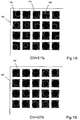
- Figs. 1A and 1B illustrate top views of ISFET sensor arrays (100), e.g.
- Fig. 1A the coefficient of variation of the diameters of microparticles (104) is 51%, and in Fig. 1B the corresponding coefficient of variation is 22%.
- populations of nucleic acid polymer particles with sizes, e.g. volumes, or diameters for spherical particles, which have a low coefficient of variation.
- populations of particles have volumes with coefficients of variation less than 10 percent; or less than 5 percent.
- populations of spherical polymer networks have coefficients of variation less than 10 percent, or less than 5 percent.
- spherical polymer networks have average sizes (diameters) less than 30 ⁇ m, or in the range of from 0.5 ⁇ m to 30 ⁇ m, or in the range of from 0.5 ⁇ m to 15 ⁇ m, or in the range of from 0.5 ⁇ m to 10 ⁇ m.
- the porous microparticle is hollow (i.e., it has a hollow core); while in other embodiments it has a porous core.
- Polymer networks may be made of a wide variety of components and the method of manufacturing may vary widely.
- Design factors for making polymer networks include, but are not limited to, the following: (i) the polymers of the networks are hydrophilic, (ii) they are capable of having a pore and/or network structure (e.g. average pore diameter, tortuosity, and the like) that permits interior access to various enzymes, especially polymerases, (iii) they are physically and chemically stable under conditions where biomolecules, such as enzymes, are functional and they are substantially non-swelling under the same conditions.
- pore and/or network structure e.g. average pore diameter, tortuosity, and the like
- polymer networks further comprise polymers selected from the following group: agarose; polyoxybutylene; diethylacrylamide; polyoxyethylene; polyoxypropylene; N,N -polydimethylacrylamide; poly( N -isopropylacrylamide); polyvinylpyrrolidone; poly- N -hydroxyacrylamide; and the like.
- polymers may be formed into polymer networks using conventional methodologies, e.g. cross-linking methods, methods for producing desired shapes, and the like.
- the nucleic acids are bound to polymer networks with one or more non-nucleic acid polymers or linking groups.
- the non-nucleic acid polymers are polyethylene glycol (PEG) polymers.
- the PEG polymers may be of varying lengths.
- the non-nucleic acid polymers are dextran polymers and/or chitosan polymers.
- the non-nucleic acid polymers include PEG polymers and dextran polymers.
- the non-nucleic acid polymers include PEG polymers and chitosan polymers.
- the non-nucleic acid polymers may be linear or branched.
- nucleic acid polymer particles are made by first making polymer networks that incorporate either bromoacetyl groups or alternative thiol groups, then reacting either a thiol derivatized oligonucleotide or a bromoacetyl-derivatized oligonucleotide respectively, as taught by Ghosh et al, U.S. patent 5,478,893 . Synthesizing bromoacetyl-derivatized and thiol-derivatized oligonucleotides is further disclosed by Gryaznov, U.S. patent 5,830,658 . Polyacrylamide particles are employed that may be size selected either before or after bromoacetyl- and thiol-derivatized components are reacted.
- nucleic acid polymer particles are made by preparing a polymer network that incorporates a click chemistry functionality then combining it with oligonucleotides having a complementary click chemistry functionality, so that rapid and specific bonds are formed and a nucleic acid polymer particle results.
- Click chemistry functionalities and reactions are well-known and are disclosed in the following references,
- the click chemistry reactive functionality is an azide and the click chemistry complementary functionality is an alkyne. In one embodiment, a reaction between such functionalities is catalyzed by copper(I). In another aspect, a click chemistry reactive functionality or complementary functionality is incorporated into a polyacrylamide polymer matrix.
- Polyacrylamide gels are formed by copolymerization of acrylamide and bis-acrylamide ("bis," N,N'-methylene-bisacrylamide).
- the reaction is a vinyl addition polymerization initiated by a free radical-generating system.
- Polymerization is initiated by ammonium persulfate and TEMED (tetramethylethylenediamine): TEMED accelerates the rate of formation of free radicals from persulfate and these in turn catalyze polymerization.
- the persulfate free radicals convert acrylamide monomers to free radicals which react with unactivated monomers to begin the polymerization chain reaction.
- Riboflavin (or riboflavin-5'-phosphate) may also be used as a source of free radicals, often in combination with TEMED and ammonium persulfate. In the presence of light and oxygen, riboflavin is converted to its leuco form, which is active in initiating polymerization, which is usually referred to as photochemical polymerization.
- T represents the total percentage concentration (w/v, in mg/mL) of monomer (acrylamide plus crosslinker) in the gel.
- C refers to the percentage of the total monomer represented by the crosslinker. For example, an 8%, 19:1 (acrylamide/bisacrylamide) gel would have a T value of 8% and a C value of 5%.
- polymer networks comprise polyacrylamide gels with total monomer percentages in the range of from 5 to 10 percent.
- crosslinker percentage of monomers is in the range of from 5 to 10 percent.
- polymer networks comprise 10 percent total acrylamide of which 10 percent is bisacrylamide.
- Polyacrylamide particles may have an average particle size of less than 15 ⁇ m with a coefficient of variation of less than 15 percent. In one embodiment, the polyacrylamide particles have a weight:volume percentage of twenty-five percent or less. In another embodiment, the polyacrylamide particles are spheroidal and have an average diameter of less than 15 ⁇ m with a coefficient of variation of less than 15 percent.
- Nucleic acid polymer particles may be made by a wide variety of methods. Methods may include the steps of (i) forming a reaction mixture whose polymerization may be controlled by physical conditions, e.g. heat, or the addition of a catalyst; (ii) performing a polymerization reaction to produce polymer networks or candidate polymer networks or nucleic acid polymer particles or candidate polymer particles depending on reactants and conditions employed, and (iii) optionally, selecting candidate polymer networks or candidate nucleic acid polymer particles in a predetermined size range. Nucleic acid polymer particles may be made by first making polymer networks followed by attachment of polynucleotides, or they may be made by copolymerization of oligonucleotide components along with monomers and crosslinkers.
- Such physical processes include, but are not limited to, flow focusing using microfluidics devices, e.g. Nisisako et al, LabChip, 8: 287-293 (2008 ); Kumaresan et al, Anal. Chem., 80: 3522-3529 (2008 ), pneumatic disruption of a sheath-sample flow stream, e.g. Lin et al, Biomed Microdevices, 9: 833-843 (2007 ); sieving, molding, e.g. Rolland et al, J. Am. Chem.
- Polymer networks may be made by polymerization of acrylamide spray droplets generated by single or multiple nozzles located on an oscillating membrane, such as in a commercially available system from The Technology Partnership (www.ttp.com) which sprays droplets from single or multiple nozzles located on a stainless steel membrane by piezo electronically actuating the membrane and allowing it to oscillate at its natural resonance frequency.
- These droplets are then streamed passed a strong UV light source for photoinitiated polymerization.
- Polymerization with molding involves the molding of a paste which disperses the acrylamide, bisacrylamide and acrydite labeled oligonucleotides in a sacrificial "porogen" followed by, but not limited to, photoinitiated radical polymerization of the acrylamide monomers with subsequent removal of the porogen my dissolution and repeated washing.
- the molding technology is available through Liquidia Technologies (Research Triangle Park, NC) and disclosed in DeSimone et al, PCT publication WO 2007/024323 , and like references.
- non-spheroidal microparticles in defined shapes, such as tetrahedral shapes, hemispherical shapes, barrel shapes, open capsular shapes, toroidal shapes, tube shapes, and the like, which have greater surface areas than spheroidal shaped particles with the same solid volume.
- the areas of the non-spheroidal microparticles in a composition are substantially the same.
- non-spheroidal microparticles substantially the same in reference to non-spheroidal microparticles means that the areas of the microparticles in a composition have a coefficient of variation of less than 15 percent, or less than 10 percent, or less than 5 percent.
- non-spherical microparticles have at least twice the surface area of a sphere with equal volume, or preferably, at least three times the surface area, or at least four time the surface area, or at least five times the surface area.
- the polyacrylamide gel is made using acryldite oligonucleotides so that the resulting non-spheroidal microparicles have covalently attached oligonucleotides, which may be used as primers in extension reactions, ligation reactions, amplification reactions, or the like.
- oligonucleotides or other reagents such as antibodies, may be attached by using linking groups and chemistries known in the art, such as described above.
- non-spheroidal microparticles are compact in that they may be closely enclosed within a microwell or other reaction chamber.
- non-spheroidal microparticles may be enclosed by a sphere having a volume twice that of the non-spheroidal microparticle, or a volume three times that of such microparticle, or four time that of such microparticle.
- non-spheroidal microparticles are enclosed by a cylinder having a diameter:height aspect ratio of 1:1.5 and a diameter of 10 ⁇ m, or 5 ⁇ m, or 2 ⁇ m, or a cylinder having a diameter: height aspect ratio of 1:1 and a diameter of 10 ⁇ m, or 5 ⁇ m, or 2 ⁇ m, or 1 ⁇ m.
- Membrane emulsification Polymerization of emulsified acrylamide requires a) control of particle size distribution during polymerization, and b) a controllable polymerization method. Control of size distribution requires both the minimization of polydispersity due to the emulsification process as well as minimization of instability of the emulsion leading to coalescence of individual drops prior to polymerization. Highly monodisperse emulsions may be achieved through microsieve emulsification techniques (such as provided commercially by Nanomi B.V., The Netherlands) and disclosed the following exemplary references: Wissink et al, PCT publication WO2005/115599 ; Nakajima et al, U.S.
- a discontinuous phase aqueous solution of monomers and other components
- a stream of continuous phase oil formulation with surfactant
- Fig. 2A illustrates apparatus in one approach to membrane emulsification.
- Aqueous phase gel reaction mixture (200) is passed through membrane (208) held in reaction vessel (210).
- Membrane (208) has pores or orifices (209) that create droplets (211) of a predetermined size (as shown in expanded view (212)) dispersed in an immiscible continuous phase fluid (202).
- droplets (211) are formed, slowly flowing continuous phase (222) sweeps them away from membrane (208) to tubing (214) where droplets (211) are polymerized by applying heat (216).
- the flow of continuous phase (202) may be controlled by syringe pump (204).
- the length and diameter of tubing (214) is selected to correspond to the amount of time required for polymerization given the amount of heat applied.
- Polymerized droplets (218) are deposited in collection vessel (220), after which they are removed and washed to remove traces of continuous phase (202).
- the volume of the aqueous phase gel reaction mixture (200) is a relatively small (200 ul ⁇ 5 ml) and is pumped at low flow rates (200 uL/hr to 1 mL/hr) such that the rate of droplet formation at each orifice (209) is about 2 -20 drops / second.
- a syringe pump or gravity flow may be used for this purpose.
- Continuous phase (202), an oil/surfactant formulation is a much larger volume, e.g. 100-1000x greater than the aqueous flow.
- a large syringe pump (204) or pressure driven flow (pneumatic) may be used to control its flow and volume.
- the stream containing an emulsion of aqueous drops in oil/surfactant formulation passing through tubing (214) is passed through a heated section of tubing (the I.D. of the tubing may be increased to reduce the linear flow rate, backpressure and increase the residence time in the heated section.
- the polymerized particles are finally collected in collection vessel (220) for extraction of the polymer particles.
- membrane (208) is microfabricated, e.g. from a silicon substrate, using conventional micromachining techniques described in the above references.
- the diameters of orifices (209) are 25 to 35 percent of the expected diameters of particles (211). It is important that the aqueous solution (200) does not wet the membrane surfaces, particularly in and/or at the orifices so that the droplets or micelles entering the continuous phase have a quick break off from the rest of the aqueous phase.
- droplets of gel reaction mixture may be formed then polymerized by exposure to initiator and heat in a batch mode by at least the following methods.
- monodisperse polyacrylamide particles may be made by first producing an emulsion with monodisperse droplets of polyacrylamide reaction mixture without an initiator followed by combining with either a second emulsion with an initiator in the disperse phase or a continuous phase (equivalent to that of the first emulsion) saturated with an initiator.
- Method 1 A monodisperse emulsion is mixed with a micro or macro emulsion of initiator in the same oil/surfactant system.
- the initiator emulsion is generated rapidly by vortexing or using an Ultra Turrax, or like immiscible phase fluid. Since the monomers are soluble in the continuous phase polymerization of monomer in the initiator emulsion has been observed.
- Method 2 An initiator soluble in the continuous phase is used to initiate the polymerization in a previously generated emulsion.
- Use of oil-soluble initiators is well-known in the art as evidenced by the following references: Alduncin et al, Macromolecules, 27: 2256-2261 (1994 ); Capek, Adv. Colloid and Interface Science, 91: 295-334 (2001 ); Gromov et al, Vysokomol. Soyed. A30: 1164-1168 (1988 ); U.S.
- the pre-made emulsion is simply diluted with a saturated solution of initiator (for example, a 1:1 ratio of emulsion to initiator solution in a polyacrylamide system) and heated to a temperature up to or below 96°C.
- initiator for example, a 1:1 ratio of emulsion to initiator solution in a polyacrylamide system
- the emulsion is heated to 90°C for 2h.
- a water soluble initiator can be used which will not require the dilution of the emulsion, or the oil used during the formation of the monodisperse emulsion can be saturated with an appropriate initiator.
- water soluble initiators would be used which includes azo type compounds as well as inorganic peroxides.
- Exemplary initiators include ammonium persulfate, hydroxymethanesulfinic acid monosodium salt dihydrate, potassium persulfate, sodium persulfate, and the like.
- water soluble (in dispersed phase) or oil soluble initiators may be used. Example of each are given below in Tables I and II. Note: The temperature at which the initiator has a half-life of 10h is given. The lower the temperature the more reactive the initiator. Selection of appropriately reactive initiator allows one of ordinary skill in the art to tune the rate at which the polymerization is initiated and what maximum temperatures are used during the reaction.
- Nucleic acid polymer particles may be made in a batch-mode process where a polymerization initiator is introduced after droplets of gel reaction mixture are formed.
- a similar membrane emulsion apparatus (248) as described in Fig. 2A is used to generate spheroidal droplets of gel reaction mixture (249) in an immiscible continuous phase (202), except that gel reaction mixture does not contain a polymerization initiator.
- continuous phase and droplets (250) are placed in tube (252), after which the mixture is centrifuged (254) to drive droplets (255) to the bottom of the tube and supernatant (257) comprising the continuous phase is removed (256).
- Droplets (253) are then resuspended (258) in continuous phase fluid that contains a suitable initiator, after which the mixture is immediately placed (260) in oven (261) where it is heated to drive the polymerization reaction. After polymerization is complete, the mixture is cooled and washed (262) several times to remove the continuous phase material from the resulting nucleic acid polymer particles.
- An embodiment not covered by the invention includes a method of making nucleic acid polymer particles comprising the following steps: (a) combining in a reaction mixture hydrophilic monomers each having at least one reactive functionality and at least one complementary functionality and hydrophilic cross-linkers each having at least two of either the reactive functionality or complementary functionality, (i) wherein the reactive functionality and complementary functionality are capable of reacting with one another under catalytic conditions to form covalent linkages, (ii) wherein a proportion of the monomer have an ancillary functionality or an oligonucleotide attached, the ancillary functionality being capable of reacting with a capture moiety without cross reacting with the reactive functionality or the complementary functionality, and (iii) wherein concentrations of the monomers and cross-linkers, and the proportion of monomers having an ancillary functionality or oligonucleotide in the reaction mixture are selected so that a cross-linked polymer is capable of forming that has a density of oligonucleotides or ancillary functionalities of at
- ancillary functionalities include monomer derivatives that include reactive groups such as thiol or bromoacetyl groups disclosed by Ghosh et al (cited above), groups comprising one of a pair of click chemistry reactants, or the like
- the porous membrane comprises a silicon membrane having a plurality of identical orifices through which the reaction mixture passes.
- the method includes a further step of removing the polymer networks from said non-aqueous phase and washing the polymer networks.
- the hydrophilic monomer may be an acrylamide and the hydrophilic cross-linker is an N,N'-methylenebisacylamide.
- a proportion of the hydrophilic monomer may be an acrydite oligonucleotide.
- An embodiment not covered by the invention includes includes a method of making monodisperse populations of polyacrylamide particles comprising the step of combining a monodisperse emulsion of a polyacrylamide reaction mixture without an initiator and an emulsion with a dispersed phase containing an initiator or a continuous phase solution saturated with an initiator.
- reaction mixture includes a nucleic acid acrydite monomer.
- Table I Water Soluble Azo Initiator Compounds Structure 10 hour half-life decomposition temperature 44°C 47°C 56°C 57°C 60°C 61°C 67°C 80°C 87°C Table II.
- size distributions of bulk manufactured nucleic acid polymer particles are controlled so that their coefficients of variation are as small as possible.
- Many techniques are available for making such measurements, including laser diffraction, flow cytometry, coulter counting, image analysis, acoustical spectroscopy, and the like.
- Instruments for laser diffraction are commercially available, e.g. Malvern Instruments (Malvern, United Kingdom); instruments for flow analysis are commercially available from Becton Dickinson (San Jose, CA); Image analysis systems and software are widely available commercially, e.g.
- Nucleic acid polymer particles are particularly useful in multiplex genetic assays, including analysis of single nucleotide polymorphisms, DNA sequencing, and the like, where polynucleotide analytes, i.e. target polynucleotides, in a sample must be amplified in the course of analysis.
- Such analytical techniques use a wide variety of amplification methodologies which can be used with nucleic acid polymer particles including, but not limited to, emulsion PCR (emPCR), bridge amplification, NASBA, rolling circle amplification, and the like.
- Exemplary references disclosing such techniques are described in the following references, : Marguiles et al, Nature, 437: 376-380 (2005 ); Adams et al, U.S. patent 5,641,658 ; Boles et al, U.S. patent 6,300,070 ; Berka et al, U.S. patent publication 2005/0079510 ; Shapero et al (cited above); and
- a substrate (300) is provided that has attached via their 5' ends at least two primer sequences, A (302) and B (304).
- Template (306) having 3' primer binding site A' (308) (that is complementary to A) and primer sequence B (310) (that has the same sequence as B on surface (300)) anneals to a primer A on surface (300) so that primer A may be extended, e.g. by a polymerase, along template (306) to produce double stranded product (316).
- Template (306) is melted off (314) leaving single stranded extention product (318) attached to surface (300).
- Conditions are applied so that single stranded extension product (318) anneals to an adjacent primer B (302) on surface (300) so that such primer B may be extended (320) to form extension product (322).
- extension products (318) and (322) are available (324) for additional cycles of annealing and extension which form populations of extension products having identical sequences to (318) and (322).
- one of primers A and B may have a scissile linkage for its removal to obtain a single population on surface (300).
- a bridge PCR may be performed on nucleic acid polymer particles described herein.
- the method may be employed to make amplicon libraries without the use of emulsion reactions.
- suspension (400) of nucleic acid polymer particles (402) is combined with template (404), the latter being in a very dilute concentration relative to the concentration of nucleic acid polymer particles, so that the probability of two different templates annealing to the same nucleic acid polymer particle is very low.
- nucleic acid polymer particle may be present at 10 times, or 100 times the concentration of template.
- template (404) has primer binding region at its 5' end (406) that is complementary to one (408) of two primers on the nucleic acid polymer particles and a sequence at its 3' end (409) identical to that of the other primer on the nucleic acid polymer particles.
- primer (408) is extended to form extension product (410), after which template (404) is melted and released (414).
- Extension product (410) may then anneal to other primers on the nucleic acid polymer particle to form additional extension products and eventually a bi-clonal population (412) of templates and its complement in reverse orientation.
- the spacing or concentration of such particles is controlled to reduce the probability that such an event occurs (which otherwise may cross contaminate another particle with a second template amplicon).
- the spacing or concentration of such particles is controlled to reduce the probability that such an event occurs (which otherwise may cross contaminate another particle with a second template amplicon).
- this may be prevented or reduced by including inert spacer particles (500) along with nucleic acid polymer particles (502).
- the number and size of spacing particles (500) may be selected to control expected distance (504) between nucleic acid polymer particles (502).
- a ratio of spacer particle to nucleic acid polymer particle is 10:1, or 100:1, or 1000:1.
- Spacer particles may also be selected that are smaller in size than nucleic acid polymer particles so that interstitial spaces between them have smaller cross sections and create longer diffusion paths.
- spacer particles may be swellable so that interstitial spaces are reduced or eliminated upon swelling.
- Spacer particles may also contain tethered nucleases for digesting released or unused surplus templates that remain in the reaction solution. Compositions and techniques for making selecting and making spacer particles with covalently attached or trapped nucleases are described in Hermanson, Bioconjugate Techniques, 2nd edition (Academic Press ); and like references.
- An embodiment not covered by the invention includes a method of making an amplicon library comprising the steps of: (a) combining in a polymerase chain reaction mixture a library of polynucleotide fragments each having a first primer binding site at one end and a second primer binding site at the other end, and a population of nucleic acid polymer particles each comprising a non-nucleosidic polymer network having attached thereto a first primer and a second primer each at a concentration of at least 1 ⁇ 10 5 primers per ⁇ m 3 such that each polynucleotide fragment is capable of annealing to a first primer by its first primer binding site and to a second primer by a complement of its second primer binding site; and (b) performing a polymerase chain reaction in the presence of a quantity of spacer particles so that primers of the polymer networks are extended along polynucleotide fragments annealed thereto so that clonal populations of complements of such polynucleotide fragments are formed
- the polymer networks each have a volume and a concentration of the polynucleotide fragments and a concentration of said polymer networks are selected so that in said step of combining at least 10 percent of said polymer networks have at a single said polynucleotide fragment within its volume.
- the non-nucleosidic polymer network has a volume of less than 1.4 ⁇ 10 4 ⁇ m 3 .
- the amplicon library is made by performing a bridge polymerase chain reaction on a composition of monodisperse nucleic acid polymer particles.
- the composition of monodisperse nucleic acid polymer particles may include a quantity of spacer particles.
- nucleic acid polymer particles being used in bridge PCR may be amplified in a thermocycler instrument that provides agitation or rotation of the reaction chambers or tubes to present settling or prolonged particle-particle contact.
- a simple device shown in Fig. 7 may be used as such a thermocycler.
- Reaction tubes (not shown) are placed in holders near the outer periphery of wheel (702) which may be lowered into heated oil bath (700) and rotated by motor (704).
- Wheel (702) rotates at a predetermined speed and depth in oil bath (700), whose temperature is controlled by controller (710) by way of thermometer (708) and heater (706).
- controller (710) By programming controller (710) a thermocycler is provided, which ensures that nucleic acid polymer particles do not settle during amplification.
- Methods of making amplicon libraries may also include a step of enriching nucleic acid polymer particles having clonal populations of polynucleotide fragments. Such enrichment may be accomplished by affinity purification, for example, by annealing an oligonucleotide with a capture moiety, such as biotin, to a primer binding site of the polynucleotide fragments, after which the resulting complexes may be captured, e.g. by streptavidinated magnetic beads, and separated from particles without polynucleotide fragments.
- Nucleic acid polymer particles having clonal populations of polynucleotide fragments may be separated from particles without polynucleotide fragments by electrophoresis, e.g. using a commercially available instrument (such as, PippinPrep automated prep gel system, Sage Science, Beverly, MA).
- Nucleic acid polymer particles may further be used in analysis of selected sets of genes or other polynucleotide sequences. Sets of such particles with specificities for particular predetermined polynucleotide targets are readily prepared from a single batch of particles using the technique outlined in Fig. 6 .
- annealed adaptor oligonucleotide 602 that comprises 3' end (604) that is complementary to primer (608) and that includes 5' end (606) which has a sequence identical to a target polynucleotide to be captured and amplified.
- polymerase (610) is added in a conventional polymerase reaction mixture so that primer (608) is extended along 5' end of oligonucleotide (602) as a template. After such extension (614), oligonucleotide (602) is released to leave sequence-specific primer (616) on nucleic acid polymer particle (600).
- sequence-specific primer (616) on nucleic acid polymer particle (600).
- the same steps may be followed to add a second primer for bridge amplification on the resulting set of nucleic acid polymer particles.
- primer (608) (or a second primer) may be extended in a template-driven ligation reaction, where a 5' phosphorylated oligonucleotide (not shown) complementary to 5' segment (606) is provided.
- This technique may be used to prepare a set of nucleic acid polymer particles containing a plurality of particles each with a different specificity. Such a set may be used to selectively amplify a predetermined set of target polynucleotides in a bridge PCR for analysis.
- the invention may be used for carrying out label-free DNA sequencing, and in particular, pH-based DNA sequencing.
- label-free DNA sequencing including pH-based DNA sequencing
- the concept of label-free DNA sequencing, including pH-based DNA sequencing, has been described in the literature, including the following references that : Rothberg et al, U.S. patent publication 2009/0026082 ; Anderson et al, Sensors and Actuators B Chem., 129: 79-86 (2008 ); Pourmand et al, Proc. Natl. Acad. Sci., 103: 6466-6470 (2006 ); and the like.
- base incorporations are determined by measuring hydrogen ions that are generated as natural byproducts of polymerase-catalyzed extension reactions.
- Nucleic acid polymer particles are used advantageously in pH-based sequencing because greater concentrations of templates may be attached to them thereby increasing the signal-to-noise ratio of the pH signal associated with base incorporations.
- Nucleic acid polymer particles are used to make amplicon libraries as described above which, in turn, are used with apparatus as described in Rothberg et al (cited above). Templates each having a primer and polymerase operably bound may be loaded into reaction chambers (such as the microwells disclosed in Rothberg et al, cited above), after which repeated cycles of deoxynucleoside triphosphate (dNTP) addition and washing are carried out.
- dNTP deoxynucleoside triphosphate
- templates may be attached as clonal populations to a solid support, such as a microparticle, bead, or the like, and such clonal popultations are loaded into reaction chambers.
- a solid support such as a microparticle, bead, or the like
- templates may be prepared as disclosed in U.S. patent 7,323,305
- "operably bound” means that a primer is annealed to a template so that the primer's 3' end may be extended by a polymerase and that a polymerase is bound to such primer-template duplex, or in close proximity thereof so that binding and/or extension takes place whenever dNTPs are added.
- the polymerase extends the primer by incorporating added dNTP only if the next base in the template is the complement of the added dNTP. If there is one complementary base, there is one incorporation, if two, there are two incorporations, if three, there are three incorporations, and so on. With each such incorporation there is a hydrogen ion released, and collectively a population of templates releasing hydrogen ions changes the local pH of the reaction chamber.
- the production of hydrogen ions is monotonically related to the number of contiguous complementary bases in the template (as well as the total number of template molecules with primer and polymerase that participate in an extension reaction). Thus, when there is a number of contiguous identical complementary bases in the template (i.e.
- the number of hydrogen ions generated, and therefore the magnitude of the local pH change is proportional to the number of contiguous identical complementary bases.
- the corresponding output signals are sometimes referred to as "1-mer”, “2-mer”, “3-mer” output signals, and so on). If the next base in the template is not complementary to the added dNTP, then no incorporation occurs and no hydrogen ion is released (in which case, the output signal is sometimes referred to as a "0-mer” output signal.)
- an unbuffered wash solution at a predetermined pH is used to remove the dNTP of the previous step in order to prevent misincorporations in later cycles.
- the four different kinds of dNTP are added sequentially to the reaction chambers, so that each reaction is exposed to the four different dNTPs one at a time, such as in the following sequence: dATP, dCTP, dGTP, dTTP, dATP, dCTP, dGTP, dTTP, and so on, with each exposure followed by a wash step.
- dATP dCTP
- dGTP dGTP
- dTTP dATP
- dCTP dGTP
- dTTP dATP
- dCTP dGTP
- dTTP dATP
- dCTP dGTP
- dTTP dATP
- dCTP dGTP
- dTTP dGTP
- wash step (890) follows, after which the next dNTP (dCTP) is added (892).
- a dNTP-destroying agent such as apyrase
- a sequencing method exemplified in Fig. 8 may be carry out using the apparatus in the following steps: (a) disposing a plurality of template nucleic acids into a plurality of reaction chambers disposed on a sensor array, the sensor array comprising a plurality of sensors and each reaction chamber being disposed on and in a sensing relationship with at least one sensor configured to provide at least one output signal representing a sequencing reaction byproduct proximate thereto, and wherein each of the template nucleic acids is hybridized to a sequencing primer and is bound to a polymerase; (b) introducing a known nucleotide triphosphate into the reaction chambers; (c) detecting incorporation at a 3' end of the sequencing primer of one or more nucleotide triphosphates by a sequencing reaction byproduct if such one or more nucleotide triphosphates are complementary to corresponding nucleotides in the template nucleic acid; (d) washing unincorporated nucleotide triphosphates from the reaction chambers; and (
- the reactions further should be conducted under weak buffer conditions, so that the maximum number of hydrogen ions reacts with a sensor and not extraneous components (e.g. microwell or solid supports that may have surface buffering capacity) or chemical constituents (in particular pH buffering compounds).
- a weak buffer allows detection of a pH change of at least ⁇ 0.1 in said reaction chamber, or at least ⁇ 0.01 in said reaction chambers.
- This example describes the method and apparatus for production of uniformly sized droplets of aqueous solution in non-miscible continuous phase by extrusion through a micro fabricated plate with multiple through holes (nozzles, orifices) and the subsequent transformation of the emulsion into polymer particles by radical polymerization.
- the fabrication of the plate with multiple through holes is described in the above references.
- a solution of specific amounts of acrylamide and methylene-N,N-bisacrylamide containing a specified concentration of acrodyte 5'-labled oligonucleotides is degassed by bubbling an inert atmosphere (Argon, Nitrogen, Helium) through the solution for a minimum of 30 minutes.
- an inert atmosphere Argon, Nitrogen, Helium
- a radical initiator is added.
- the radical initiator can be a combination of ammonium persulfate (APS) and N, N, N', N'-tetramethylethylenediamine (TMED) which catalyses the radical initiation by APS.
- APS ammonium persulfate
- TMED trimethylethylenediamine
- APS and V-50 initiate thermally above ⁇ 65 degrees celsius.
- a photoinitiator such 2,2'-Azobis(2-methylpropionamidine)dihydrochloride (V-50) may be used in conjunction with a UV light source with strong emission peaks at 220 nm and 365 nm.
- the aqueous solution above may be dispersed into a continuous phase via several techniques. For example: The aqueous solution may be subdivided into droplets by a vibrating membrane with several appropriately sized holes (typically 50-70% smaller than the intended diameter of the droplet) after which the droplets are allowed to enter an immiscible continuous phase which may or may not contain surfactants.
- the droplets may be irradiated with UV prior to entering the continuous phase (after leaving the nozzle, in mid air) or after entering the continuous phase.
- the drops are allowed to polymerize prior to entering the continuous phase which may be miscible with the un-polymerized dispersed phase.
- the humidity of the atmosphere needs to be controlled to prevent uncontrolled evaporative shrinking of the droplets and the atmosphere needs to be largely oxygen free to allow radical polymerization in the droplets.
- An alternative emulsification technique can be described as follows: The aqueous phase is pumped through a porous membrane (with uniformly sized pores) into an immiscible continuous phase.
- the beads are recovered from the continuous phase by either breaking the emulsion (by addition of n-butanol, n-propanol i-propanol or other appropriate chemicals) followed by centrifugation to pellet the beads in the bottom of the eppendorf tube or filtration through an appropriately sized filter. After washing with an appropriate buffer, the beads can be used for PCR amplification of DNA library elements or direct hybridization of DNA fragments with the reverse complement to the attached oligonucleotide.
- This example describes membrane emulsification and the subsequent transformation of the aqueous micelles of the emulsion into polyacrylamide particles by radical polymerization in batch mode using an initiator-saturated oil phase.
- the steps of the process comprise (a) formation of a gel reaction mixture-in-oil emulsion using a membrane, (b) particle polymerization, and (c) particle extraction and washing.
- SNAPP Oil comprises the following mixture: TegosoftTM DEC oil (730 mL), ABIL WE09 (70 gm), and mineral oil (200 mL) (SNAPP oil is stored under argon);
- SNAPP Buffer 1x TE, 0.1% Triton X-100, .02% sodium azide;
- Acrylamide Solution 50 mg N,N-methylene bisacrylamide, 450 mg acrylamide, 550 uL double distilled H 2 O kept under argon;
- DNA Mix 10 umol 30-mer acrydite oligonucleotide with 18C spacer in 2.5 mL H 2 O.
- Gel Reaction Mixture is formed by mixing the following together under argon for a total volume of 1400 uL: 526.4 uL DNA Mix, 14 mL TMED, 299.6 mL H 2 O, and 560 mL Acrylamide Solution. Under argon, 1 mL of the Gel Reaction Mixture is added to the upper compartment of a two-compartment rig (see Figs. 2A & 2B ) having an emulsification membrane dividing the upper compartment from the lower compartment, so that the Gel Reaction Mixture flows under gravity from the upper compartment through the emulsification membrane (thereby forming droplets or micelles) into a flow of SNAPP Oil in the lower compartment.
- SNAPP Oil is driven into the lower chamber at a rate of 2.4 mL/hr. About 50 mL of the SNAPP Oil-Gel Reaction Mixture emulsion is collected in a centrifuge tube, after which it is centrifuged so that the Gel Reaction Mixture micelles are driven to the bottom. All but about 1 mL of the supernatant SNAPP Oil is removed, after which the micelles are resuspended by adding 20 mL of initiator (1,1'-azobis(cyclohexanecarbonitrile))-saturated SNAPP Oil. (Initiator-saturated SNAPP Oil is made by mixing 500 mg initiator in 25 mL SNAPP Oil under argon with vigorous mixing).
- the resuspended micelles undergo polymerization by placing them in an oven at 90°C under argon and constant rotation for 2 hr. and 2 min, after which they are removed and immediately place in a 4°C refrigerator for at least 1 hr.
- the SNAPP Oil is removed from the polymerized particles by centrifuging to form a pellet followed by resuspension in butanol with vortexing, and then repeating, after which the polymerized particles are resuspended in 0.1% SDS and sonicated for 3 min.
- the polymerized particles are then twice centrifuged, resuspended in SNAPP Buffer, and sonicated for 3 min, after which they are resuspended in SNAPP Buffer and stored at 4°C.
- the size distribution of the above nucleic acid polymer particles may be measured using a Guava flow cytometer after hybridizing a labeled oligonucleotide with a sequence complementary to at least one of those of the nucleic acid polymer particle.
- An exemplary protocol is as follows: (1) suspend about 5 million particles in 9 ⁇ L 1x PBS 0.2% Tween, (2) add 2 ⁇ L of 100 ⁇ M biotinylated oligonucleotide complement, (3) anneal at 95oC for 2 min followed by 37oC for 2 min, (4) centrifuge to remove supernatant, (5) wash 2x with 1x PBS 0.2% Tween, (6) resuspend in 10 ⁇ L 1x PBS 0.2% Tween, (7) add 0.5 ⁇ L streptavidin-FITC (commercial reagent, e.g.
- Size distributions of nucleic acid polymer particles may also be measured by staining and counting them using a fluorescent microscope with automatic particle counting software. A series of dilutions of nucleic acid polymer particles are stained with a series of concentrations of a nucleic acid stain, such as SYBR Gold (Invitrogen), after which they are place in separate wells of multi-welled poly-I-lysine coated slides (e.g. Tekdon Inc.). A comparison of particle sizing and counting data from flow system and microscope measurements shows good correlation. CVs of size distributions of samples from a batch of nucleic acid polymer particles, designated B4, was determined by slide counting (described above) and by flow cytometry counting (described above).
- Amplicon means the product of a polynucleotide amplification reaction; that is, a clonal population of polynucleotides, which may be single stranded or double stranded, which are replicated from one or more starting sequences.
- the one or more starting sequences may be one or more copies of the same sequence, or they may be a mixture of different sequences that contain a common region that is amplified, for example, a specific exon sequence present in a mixture of DNA fragments extracted from a sample.
- amplicons are formed by the amplification of a single starting sequence. Amplicons may be produced by a variety of amplification reactions whose products comprise replicates of the one or more starting, or target, nucleic acids.
- amplification reactions producing amplicons are "template-driven” in that base pairing of reactants, either nucleotides or oligonucleotides, have complements in a template polynucleotide that are required for the creation of reaction products.
- template-driven reactions are primer extensions with a nucleic acid polymerase or oligonucleotide ligations with a nucleic acid ligase.
- Such reactions include, but are not limited to, polymerase chain reactions (PCRs), linear polymerase reactions, nucleic acid sequence-based amplification (NASBAs), rolling circle amplifications, and the like, disclosed in the following references : Mullis et al, U.S.
- reaction mixture including an “amplification reaction mixture,” means a solution containing all the necessary reactants for performing a reaction, which may include, but not be limited to, buffering agents to maintain pH at a selected level during a reaction, salts, co-factors, scavengers, and the like.
- a “solid phase amplicon” means a solid phase support, such as a particle or bead, having attached a clonal population of nucleic acid sequences, which may have been produced by a process such as emulsion PCR, or like technique. Amplicons may be produced by isothermal reactions, such as rolling circle amplification reactions, NASBAs, or helicase-mediated amplification reactions, e.g. U.S. patent 7,282,328 .
- Microwell which is used interchangeably with “reaction chamber,” means a special case of a “reaction confinement region,” that is, a physical or chemical attribute of a solid substrate that permit the localization of a reaction of interest.
- Reaction confinement regions may be a discrete region of a surface of a substrate that specifically binds an analyte of interest, such as a discrete region with oligonucleotides or antibodies covalently linked to such surface.
- reaction confinement regions are hollows or wells having well-defined shapes and volumes which are manufactured into a substrate. These latter types of reaction confinement regions are referred to herein as microwells or reaction chambers, and may be fabricated using conventional microfabrication techniques, e.g.
- Microwells may have square, rectangular, or octagonal cross sections and be arranged as a rectilinear array on a surface. Microwells may also have hexagonal cross sections and be arranged as a hexagonal array, which permit a higher density of microwells per unit area in comparison to rectilinear arrays. Exemplary configurations of microwells are as follows: the reaction chamber array comprises 10 2 , 10 3 , 10 4 , 10 5 , 10 6 or 10 7 reaction chambers. As used herein, an array is a planar arrangement of elements such as sensors or wells. The array may be one or two dimensional. A one dimensional array is an array having one column (or row) of elements in the first dimension and a plurality of columns (or rows) in the second dimension.
- microwell arrays may be fabricated as follows: After the semiconductor structures of a sensor array are formed, the microwell structure is applied to such structure on the semiconductor die. That is, the microwell structure can be formed right on the die or it may be formed separately and then mounted onto the die, either approach being acceptable. To form the microwell structure on the die, various processes may be used.
- the entire die may be spin-coated with, for example, a negative photoresist such as Microchem's SU-8 2015 or a positive resist/polyimide such as HD Microsystems HD8820, to the desired height of the microwells.
- a negative photoresist such as Microchem's SU-8 2015
- a positive resist/polyimide such as HD Microsystems HD8820
- the desired height of the wells e.g., about 3 - 12 ⁇ m in the example of one pixel per well, though not so limited as a general matter
- predetermined rates which can be found by reference to the literature and manufacturer specifications, or empirically
- Well height typically may be selected in correspondence with the lateral dimension of the sensor pixel, preferably for a nominal 1:1 - 1.5:1 aspect ratio, height:width or diameter.
- multiple layers of different photoresists may be applied or another form of dielectric material may be deposited.
- Various types of chemical vapor deposition may also be used to build up a layer of materials suitable for microwell formation therein.
- Microwells may be formed in a layer of tetra-methyl-ortho-silicate (TEOS).
- TEOS tetra-methyl-ortho-silicate
- An embodiment not covered by the invention includes an apparatus comprising at least one two-dimensional array of reaction chambers, wherein each reaction chamber is coupled to a chemically-sensitive field effect transistor ("chemFET") and each reaction chamber is no greater than 10 ⁇ m 3 (i.e., 1 pL) in volume.
- chemFET chemically-sensitive field effect transistor
- each reaction chamber is no greater than 0.34 pL, and more preferably no greater than 0.096 pL or even 0.012 pL in volume.
- a reaction chamber can optionally be 2 2 , 3 2 , 4 2 , 5 2 , 6 2 , 7 2 , 8 2 , 9 2 , or 10 2 square microns in cross-sectional area at the top.
- the array has at least 10 2 , 10 3 , 10 4 , 10 5 , 10 6 , 10 7 , 10 8 , 10 9 , or more reaction chambers.
- the reaction chambers may be capacitively coupled to the chemFETs, and preferably are capacitively coupled to the chemFETs.
- PCR Polymerase chain reaction
- PCR is a reaction for making multiple copies or replicates of a target nucleic acid flanked by primer binding sites, such reaction comprising one or more repetitions of the following steps: (i) denaturing the target nucleic acid, (ii) annealing primers to the primer binding sites, and (iii) extending the primers by a nucleic acid polymerase in the presence of nucleoside triphosphates.
- the reaction is cycled through different temperatures optimized for each step in a thermal cycler instrument.
- a double stranded target nucleic acid may be denatured at a temperature >90°C, primers annealed at a temperature in the range 50-75°C, and primers extended at a temperature in the range 72-78°C.
- PCR encompasses derivative forms of the reaction, including but not limited to, RT-PCR, real-time PCR, nested PCR, quantitative PCR, multiplexed PCR, concatemeric PCR, and the like. Reaction volumes range from a few hundred nanoliters, e.g. 200 nL, to a few hundred ⁇ L, e.g. 200 ⁇ L.
- Polymer network means a structure comprising covalently connected subunits (monomers, crosslinkers, and the like) in which all such subunits are connected to every other subunit by many paths through the polymer phase, and wherein there are enough polymer chains bonded together (either physically or chemically) such that at least one large molecule is coextensive with the polymer phase (i.e. the structure is above its gel point).
- a polymer network has a volume in the range of from 65 aL to 15 pL, or from 1 fL to 1 pL.
- Polynucleotide or “oligonucleotide” are used interchangeably and each mean a linear polymer of nucleotide monomers.
- Monomers making up polynucleotides and oligonucleotides are capable of specifically binding to a natural polynucleotide by way of a regular pattern of monomer-to-monomer interactions, such as Watson-Crick type of base pairing, base stacking, Hoogsteen or reverse Hoogsteen types of base pairing, or the like.
- Such monomers and their internucleosidic linkages may be naturally occurring or may be analogs thereof, e.g. naturally occurring or non-naturally occurring analogs.
- Non-naturally occurring analogs may include PNAs, phosphorothioate internucleosidic linkages, bases containing linking groups permitting the attachment of labels, such as fluorophores, or haptens, and the like.
- PNAs phosphorothioate internucleosidic linkages
- bases containing linking groups permitting the attachment of labels such as fluorophores, or haptens, and the like.
- labels such as fluorophores, or haptens, and the like.
- oligonucleotide or polynucleotide requires enzymatic processing, such as extension by a polymerase, ligation by a ligase, or the like, one of ordinary skill would understand that oligonucleotides or polynucleotides in those instances would not contain certain analogs of internucleosidic linkages, sugar moities, or bases at any or some positions.
- Polynucleotides typically range in size from a few monomeric units,
- oligonucleotides when they are usually referred to as "oligonucleotides,” to several thousand monomeric units.
- A denotes deoxyadenosine
- C denotes deoxycytidine
- G denotes deoxyguanosine
- T denotes thymidine
- I denotes deoxyinosine
- U denotes uridine, unless otherwise indicated or obvious from context.
- polynucleotides comprise the four natural nucleosides (e.g. deoxyadenosine, deoxycytidine, deoxyguanosine, deoxythymidine for DNA or their ribose counterparts for RNA) linked by phosphodiester linkages; however, they may also comprise non-natural nucleotide analogs, e.g. including modified bases, sugars, or internucleosidic linkages.
- nucleosides e.g. deoxyadenosine, deoxycytidine, deoxyguanosine, deoxythymidine for DNA or their ribose counterparts for RNA
- non-natural nucleotide analogs e.g. including modified bases, sugars, or internucleosidic linkages.
- Primer means an oligonucleotide, either natural or synthetic that is capable, upon forming a duplex with a polynucleotide template, of acting as a point of initiation of nucleic acid synthesis and being extended from its 3' end along the template so that an extended duplex is formed.
- Extension of a primer is usually carried out with a nucleic acid polymerase, such as a DNA or RNA polymerase.
- the sequence of nucleotides added in the extension process is determined by the sequence of the template polynucleotide.
- primers are extended by a DNA polymerase. Primers usually have a length in the range of from 14 to 40 nucleotides, or in the range of from 18 to 36 nucleotides.
- Primers are employed in a variety of nucleic amplification reactions, for example, linear amplification reactions using a single primer, or polymerase chain reactions, employing two or more primers.
- Guidance for selecting the lengths and sequences of primers for particular applications is well known to those of ordinary skill in the art, as evidenced by the following references : Dieffenbach, editor, PCR Primer: A Laboratory Manual, 2nd Edition (Cold Spring Harbor Press, New York, 2003 ).
- sample in one aspect means a quantity of material from a biological, environmental, medical, or patient source in which detection or measurement of one or more analytes is sought.
- a sample may also include a specimen of synthetic origin.
- Biological samples may be animal, including human, fluid, solid (e.g., stool) or tissue, as well as liquid and solid food and feed products and ingredients such as dairy items, vegetables, meat and meat by-products, and waste.
- Biological samples may include materials taken from a patient including, but not limited to cultures, blood, saliva, cerebral spinal fluid, needle aspirates, and the like. Biological samples also may be obtained from animals.
- sample means a material or substance extracted, partially purified, separated, or otherwise obtained by sample preparation techniques from a sample as defined in the previous sentences (collectively referred to as “extracted material”).
- extracted material includes but are not limited to nucleic acids (for example, DNA or RNA extracted material), protein extracted material, lipid extracted material, and the like.
Landscapes
- Chemical & Material Sciences (AREA)
- Life Sciences & Earth Sciences (AREA)
- Organic Chemistry (AREA)
- Health & Medical Sciences (AREA)
- Engineering & Computer Science (AREA)
- Zoology (AREA)
- Wood Science & Technology (AREA)
- Genetics & Genomics (AREA)
- Proteomics, Peptides & Aminoacids (AREA)
- Biotechnology (AREA)
- General Engineering & Computer Science (AREA)
- Bioinformatics & Cheminformatics (AREA)
- Analytical Chemistry (AREA)
- Biophysics (AREA)
- Molecular Biology (AREA)
- Biochemistry (AREA)
- Microbiology (AREA)
- Physics & Mathematics (AREA)
- General Health & Medical Sciences (AREA)
- Immunology (AREA)
- Chemical Kinetics & Catalysis (AREA)
- Biomedical Technology (AREA)
- Bioinformatics & Computational Biology (AREA)
- Crystallography & Structural Chemistry (AREA)
- Plant Pathology (AREA)
- Measuring Or Testing Involving Enzymes Or Micro-Organisms (AREA)
Claims (15)
- Procédé d'amplification d'un polynucléotide cible dans un échantillon, le procédé comprenant :la combinaison d'un échantillon et de particules de polymère d'acide nucléique dans un mélange réactionnel d'amplification, chacune desdites particules comprenant un réseau polymère non nucléosidique auquel est liée sur tout son volume une amorce à une concentration d'au moins 1 × 10⁵ amorces par µm3, une région du polynucléotide cible capable de s'hybrider à l'amorce, les volumes des réseaux polymères ont un coefficient de variation de quinze pour cent ou moins, le réseau polymère non nucléosidique comprenant un gel de polyacrylamide ayant un pourcentage total de monomère compris dans une plage de 3 % à 20 % et étant perméable aux protéines ayant une taille comprise dans la plage de 50 kilodaltons à 200 kilodaltons ; etla mise en œuvre d'une réaction d'amplification de sorte que les amorces sur une particule de polymère d'acide nucléique sont prolongées de manière répétée le long d'un polynucléotide cible hybridé à celle-ci de sorte qu'une population clonale de compléments d'un tel polynucléotide cible est formée sur les réseaux polymères.
- Procédé selon la revendication 1, dans lequel la réaction d'amplification comprend une réaction en chaîne par polymérase (PCR).
- Procédé selon la revendication 2, dans lequel la réaction en chaîne par polymérase comprend la PCR en émulsion.
- Procédé selon la revendication 2, dans lequel la réaction en chaîne par polymérase comprend la PCR en pont.
- Procédé selon la revendication 1, dans lequel la réaction d'amplification comprend une amplification en cercle tournant.
- Procédé selon la revendication 1, dans lequel le coefficient de variation est de 10 pour cent ou moins.
- Procédé selon la revendication 6, dans lequel le coefficient de variation est de 5 pour cent ou moins.
- Procédé selon la revendication 1, dans lequel le pourcentage total de monomère est compris dans une plage de 5 % à 10 %.
- Procédé selon la revendication 1, dans lequel la particule de polymère d'acide nucléique est stable sur une plage de pH de 6 à 10.
- Procédé selon la revendication 1, dans lequel les particules de polymère d'acide nucléique ont un diamètre moyen d'environ 0,5 µm à environ 30 µm.
- Procédé selon la revendication 1, dans lequel les particules de polymère d'acide nucléique sont de forme sensiblement sphérique ou sphéroïdale.
- Procédé selon la revendication 1, dans lequel le gel de polyacrylamide est formé par copolymérisation d'acrylamide et de bis-acrylamide.
- Procédé selon la revendication 1, dans lequel, après l'amplification, le nombre de compléments de polynucléotides cibles est d'au moins 6,9 × 10⁴ par µm3.
- Procédé selon une ou plusieurs des revendications 1 à 13, dans lequel la particule comprenant un réseau polymère non nucléosidique possède liée sur tout son volume une seconde amorce à une concentration d'au moins 1 × 10⁵ amorces par µm3, une région du polynucléotide cible capable de s'hybrider à l'amorce.
- Procédé selon l'une quelconque des revendications 1 à 14, comprenant en outre :le dépôt des particules de polymère d'acide nucléique sur un réseau plan ; etla mise en œuvre d'une réaction de séquençage simultanément sur les populations clonales sur les particules de polymère d'acide nucléique.
Applications Claiming Priority (11)
| Application Number | Priority Date | Filing Date | Title |
|---|---|---|---|
| US12/475,311 US20100301398A1 (en) | 2009-05-29 | 2009-05-29 | Methods and apparatus for measuring analytes |
| US12/474,897 US20100137143A1 (en) | 2008-10-22 | 2009-05-29 | Methods and apparatus for measuring analytes |
| US24236909P | 2009-09-14 | 2009-09-14 | |
| US25227609P | 2009-10-16 | 2009-10-16 | |
| US26373409P | 2009-11-23 | 2009-11-23 | |
| US29178809P | 2009-12-31 | 2009-12-31 | |
| US29720310P | 2010-01-21 | 2010-01-21 | |
| US12/785,685 US8574835B2 (en) | 2009-05-29 | 2010-05-24 | Scaffolded nucleic acid polymer particles and methods of making and using |
| PCT/US2010/001549 WO2010138187A1 (fr) | 2009-05-29 | 2010-05-27 | Particules de polymère d'acide nucléique échafaudées et procédés de fabrication et d'utilisation de celles-ci |
| EP17185272.6A EP3301104B1 (fr) | 2009-05-29 | 2010-05-27 | Particules de polymère d'acide nucléique échafaudées et procédés de fabrication et d'utilisation |
| EP10780934.5A EP2435461B1 (fr) | 2009-05-29 | 2010-05-27 | Particules de polymère d'acide nucléique échafaudées et procédés de fabrication et d'utilisation de celles-ci |
Related Parent Applications (2)
| Application Number | Title | Priority Date | Filing Date |
|---|---|---|---|
| EP10780934.5A Division EP2435461B1 (fr) | 2009-05-29 | 2010-05-27 | Particules de polymère d'acide nucléique échafaudées et procédés de fabrication et d'utilisation de celles-ci |
| EP17185272.6A Division EP3301104B1 (fr) | 2009-05-29 | 2010-05-27 | Particules de polymère d'acide nucléique échafaudées et procédés de fabrication et d'utilisation |
Publications (2)
| Publication Number | Publication Date |
|---|---|
| EP3663750A1 EP3663750A1 (fr) | 2020-06-10 |
| EP3663750B1 true EP3663750B1 (fr) | 2021-11-03 |
Family
ID=43223000
Family Applications (3)
| Application Number | Title | Priority Date | Filing Date |
|---|---|---|---|
| EP10780934.5A Active EP2435461B1 (fr) | 2009-05-29 | 2010-05-27 | Particules de polymère d'acide nucléique échafaudées et procédés de fabrication et d'utilisation de celles-ci |
| EP19205891.5A Active EP3663750B1 (fr) | 2009-05-29 | 2010-05-27 | Particules de polymère d'acide nucléique échafaudées et procédés de fabrication et d'utilisation |
| EP17185272.6A Active EP3301104B1 (fr) | 2009-05-29 | 2010-05-27 | Particules de polymère d'acide nucléique échafaudées et procédés de fabrication et d'utilisation |
Family Applications Before (1)
| Application Number | Title | Priority Date | Filing Date |
|---|---|---|---|
| EP10780934.5A Active EP2435461B1 (fr) | 2009-05-29 | 2010-05-27 | Particules de polymère d'acide nucléique échafaudées et procédés de fabrication et d'utilisation de celles-ci |
Family Applications After (1)
| Application Number | Title | Priority Date | Filing Date |
|---|---|---|---|
| EP17185272.6A Active EP3301104B1 (fr) | 2009-05-29 | 2010-05-27 | Particules de polymère d'acide nucléique échafaudées et procédés de fabrication et d'utilisation |
Country Status (2)
| Country | Link |
|---|---|
| EP (3) | EP2435461B1 (fr) |
| WO (1) | WO2010138187A1 (fr) |
Families Citing this family (22)
| Publication number | Priority date | Publication date | Assignee | Title |
|---|---|---|---|---|
| US8349167B2 (en) | 2006-12-14 | 2013-01-08 | Life Technologies Corporation | Methods and apparatus for detecting molecular interactions using FET arrays |
| US20120156728A1 (en) | 2010-12-17 | 2012-06-21 | Life Technologies Corporation | Clonal amplification of nucleic acid on solid surface with template walking |
| US9334531B2 (en) | 2010-12-17 | 2016-05-10 | Life Technologies Corporation | Nucleic acid amplification |
| US9309557B2 (en) | 2010-12-17 | 2016-04-12 | Life Technologies Corporation | Nucleic acid amplification |
| US8574835B2 (en) | 2009-05-29 | 2013-11-05 | Life Technologies Corporation | Scaffolded nucleic acid polymer particles and methods of making and using |
| US8653567B2 (en) | 2010-07-03 | 2014-02-18 | Life Technologies Corporation | Chemically sensitive sensor with lightly doped drains |
| US9184099B2 (en) | 2010-10-04 | 2015-11-10 | The Board Of Trustees Of The Leland Stanford Junior University | Biosensor devices, systems and methods therefor |
| NZ610129A (en) | 2010-10-04 | 2014-08-29 | Genapsys Inc | Systems and methods for automated reusable parallel biological reactions |
| US9399217B2 (en) | 2010-10-04 | 2016-07-26 | Genapsys, Inc. | Chamber free nanoreactor system |
| WO2012109615A1 (fr) | 2011-02-10 | 2012-08-16 | Life Technologies Corporation | Systèmes et procédés de purification |
| WO2012142132A1 (fr) * | 2011-04-11 | 2012-10-18 | Life Technologies Corporation | Particules polymères et méthodes pour leur fabrication et leur utilisation |
| US8585973B2 (en) | 2011-05-27 | 2013-11-19 | The Board Of Trustees Of The Leland Stanford Junior University | Nano-sensor array |
| US9926596B2 (en) | 2011-05-27 | 2018-03-27 | Genapsys, Inc. | Systems and methods for genetic and biological analysis |
| DK2729580T3 (en) | 2011-07-08 | 2015-12-14 | Keygene Nv | SEQUENCE BASED genotyping BASED ON OLIGONUKLEOTIDLIGERINGSASSAYS |
| CN106591103B (zh) | 2011-12-01 | 2021-06-04 | 吉纳普赛斯股份有限公司 | 用于高效电子测序与检测的系统和方法 |
| WO2014151961A1 (fr) * | 2013-03-14 | 2014-09-25 | Life Technologies Corporation | Réseaux matriciels et leurs procédés de fabrication |
| EP2971141B1 (fr) | 2013-03-15 | 2018-11-28 | Genapsys, Inc. | Systèmes pour l'analyse biologique |
| WO2015089238A1 (fr) | 2013-12-11 | 2015-06-18 | Genapsys, Inc. | Systèmes et procédés d'analyse et d'informatique biologiques |
| EP3556864B1 (fr) | 2014-04-18 | 2020-12-09 | Genapsys, Inc. | Procédés et systèmes d'amplification d'acide nucléique |
| US10544456B2 (en) | 2016-07-20 | 2020-01-28 | Genapsys, Inc. | Systems and methods for nucleic acid sequencing |
| CA3076378A1 (fr) | 2017-09-21 | 2019-03-28 | Genapsys, Inc. | Systemes et procedes de sequencage d'acides nucleiques |
| DE102017011013A1 (de) | 2017-11-28 | 2019-05-29 | Albert-Ludwigs-Universität Freiburg | Verfahren zur Erzeugung von biofunktionalen Polymerpartikeln |
Family Cites Families (44)
| Publication number | Priority date | Publication date | Assignee | Title |
|---|---|---|---|---|
| US3284393A (en) | 1959-11-04 | 1966-11-08 | Dow Chemical Co | Water-in-oil emulsion polymerization process for polymerizing watersoluble monomers |
| US4485224A (en) | 1983-09-02 | 1984-11-27 | The Goodyear Tire & Rubber Company | Acrylamide polymerization |
| US4683202A (en) | 1985-03-28 | 1987-07-28 | Cetus Corporation | Process for amplifying nucleic acid sequences |
| US4965188A (en) | 1986-08-22 | 1990-10-23 | Cetus Corporation | Process for amplifying, detecting, and/or cloning nucleic acid sequences using a thermostable enzyme |
| US4683195A (en) | 1986-01-30 | 1987-07-28 | Cetus Corporation | Process for amplifying, detecting, and/or-cloning nucleic acid sequences |
| US4800159A (en) | 1986-02-07 | 1989-01-24 | Cetus Corporation | Process for amplifying, detecting, and/or cloning nucleic acid sequences |
| US5055390A (en) | 1988-04-22 | 1991-10-08 | Massachusetts Institute Of Technology | Process for chemical manipulation of non-aqueous surrounded microdroplets |
| US5237016A (en) | 1989-01-05 | 1993-08-17 | Siska Diagnostics, Inc. | End-attachment of oligonucleotides to polyacrylamide solid supports for capture and detection of nucleic acids |
| CA2020958C (fr) | 1989-07-11 | 2005-01-11 | Daniel L. Kacian | Methodes d'amplification de sequences d'acide nucleique |
| US5043406A (en) | 1990-03-26 | 1991-08-27 | Nalco Chemical Company | Fluorescent acrylamide polymers |
| US5210015A (en) | 1990-08-06 | 1993-05-11 | Hoffman-La Roche Inc. | Homogeneous assay system using the nuclease activity of a nucleic acid polymerase |
| JP3080178B2 (ja) | 1991-02-18 | 2000-08-21 | 東洋紡績株式会社 | 核酸配列の増幅方法およびそのための試薬キット |
| US5641658A (en) | 1994-08-03 | 1997-06-24 | Mosaic Technologies, Inc. | Method for performing amplification of nucleic acid with two primers bound to a single solid support |
| US5830658A (en) | 1995-05-31 | 1998-11-03 | Lynx Therapeutics, Inc. | Convergent synthesis of branched and multiply connected macromolecular structures |
| US5785832A (en) | 1995-07-26 | 1998-07-28 | Chiari; Marcella | Covalently cross-linked, mixed-bed agarose-polyacrylamide matrices for electrophoresis and chromatography |
| US5854033A (en) | 1995-11-21 | 1998-12-29 | Yale University | Rolling circle replication reporter systems |
| JP2975943B2 (ja) | 1996-02-20 | 1999-11-10 | 農林水産省食品総合研究所長 | エマルションの製造方法及びエマルションの製造装置 |
| JP4540754B2 (ja) | 1996-06-04 | 2010-09-08 | ユニバーシティ オブ ユタ リサーチ ファウンデーション | Pcr中のハイブリダイゼーションのモニタリング |
| US5932711A (en) | 1997-03-05 | 1999-08-03 | Mosaic Technologies, Inc. | Nucleic acid-containing polymerizable complex |
| US6511803B1 (en) * | 1997-10-10 | 2003-01-28 | President And Fellows Of Harvard College | Replica amplification of nucleic acid arrays |
| WO2000008212A1 (fr) | 1998-08-07 | 2000-02-17 | Cellay, Llc | Microgouttelettes de gel utilisees en analyse genetique |
| US6300070B1 (en) | 1999-06-04 | 2001-10-09 | Mosaic Technologies, Inc. | Solid phase methods for amplifying multiple nucleic acids |
| US6372813B1 (en) | 1999-06-25 | 2002-04-16 | Motorola | Methods and compositions for attachment of biomolecules to solid supports, hydrogels, and hydrogel arrays |
| EP1256632A3 (fr) * | 2001-05-07 | 2004-01-02 | Smithkline Beecham Corporation | Criblage à haut rendement de polymorphismes |
| US6656725B2 (en) | 2001-08-15 | 2003-12-02 | The University Of Chicago | Method of fabrication of microarray of gel-immobilized compounds on a chip by copolymerization |
| EP1488006B1 (fr) | 2002-03-20 | 2008-05-28 | InnovativeBio.Biz | Microcapsules encapsulant un melange de reaction d'amplification de l'acide nucleique et utilisation de celles-ci en tant que compartiments de reaction pour des reactions paralleles |
| JP4638225B2 (ja) | 2002-05-30 | 2011-02-23 | ザ スクリプス リサーチ インスティテュート | 銅を触媒とするアジドとアセチレンのライゲーション |
| US7595883B1 (en) | 2002-09-16 | 2009-09-29 | The Board Of Trustees Of The Leland Stanford Junior University | Biological analysis arrangement and approach therefor |
| CA2498764C (fr) | 2002-09-20 | 2015-11-10 | New England Biolabs, Inc. | Amplification dependant de l'helicase des acides nucleiques |
| CA2513899C (fr) | 2003-01-29 | 2013-03-26 | 454 Corporation | Procede d'amplification et de sequencage d'acides nucleiques |
| DE602004009681T2 (de) | 2003-05-16 | 2008-08-14 | Velocys, Inc., Plain City | Verfahren zur erzeugung einer emulsion durch verwendung einer mikrokanalverfahrentechnologie |
| AU2005216549A1 (en) * | 2004-02-27 | 2005-09-09 | President And Fellows Of Harvard College | Polony fluorescent in situ sequencing beads |
| NL1026261C2 (nl) | 2004-05-25 | 2005-11-28 | Nanomi B V | Sproei inrichting met een nozzleplaat voorzien van structuren ter bevordering van self-breakup, een nozzleplaat, alsmede werkwijzen ter vervaardiging en toepassing van een dergelijke nozzleplaat. |
| EP2270228B1 (fr) | 2005-05-02 | 2013-08-21 | baseclick GmbH | Nouvelles stratégies de marquage pour la détection sensible d'analytes |
| CN102016814B (zh) | 2005-06-17 | 2013-10-23 | 北卡罗来纳大学查珀尔希尔分校 | 纳米粒子制备方法、系统及材料 |
| EP2530167A1 (fr) * | 2006-05-11 | 2012-12-05 | Raindance Technologies, Inc. | Dispositifs microfluidiques |
| US8262900B2 (en) | 2006-12-14 | 2012-09-11 | Life Technologies Corporation | Methods and apparatus for measuring analytes using large scale FET arrays |
| GB2457851B (en) | 2006-12-14 | 2011-01-05 | Ion Torrent Systems Inc | Methods and apparatus for measuring analytes using large scale fet arrays |
| US9029085B2 (en) * | 2007-03-07 | 2015-05-12 | President And Fellows Of Harvard College | Assays and other reactions involving droplets |
| JP2010537643A (ja) * | 2007-08-29 | 2010-12-09 | アプライド バイオシステムズ, エルエルシー | 代替的な核酸配列決定法 |
| GB0722998D0 (en) | 2007-11-23 | 2008-01-02 | Shturman Leonid | Blood pressure measuring cuff |
| GB2461127B (en) | 2008-06-25 | 2010-07-14 | Ion Torrent Systems Inc | Methods and apparatus for measuring analytes using large scale FET arrays |
| WO2010033200A2 (fr) * | 2008-09-19 | 2010-03-25 | President And Fellows Of Harvard College | Création de bibliothèques de gouttelettes et d'espèces apparentées |
| CN101413034B (zh) * | 2008-11-21 | 2011-02-09 | 东南大学 | 高通量核酸分子克隆制备分子克隆芯片的方法 |
-
2010
- 2010-05-27 EP EP10780934.5A patent/EP2435461B1/fr active Active
- 2010-05-27 EP EP19205891.5A patent/EP3663750B1/fr active Active
- 2010-05-27 EP EP17185272.6A patent/EP3301104B1/fr active Active
- 2010-05-27 WO PCT/US2010/001549 patent/WO2010138187A1/fr not_active Ceased
Also Published As
| Publication number | Publication date |
|---|---|
| EP3301104A1 (fr) | 2018-04-04 |
| EP2435461A4 (fr) | 2015-07-22 |
| EP2435461A1 (fr) | 2012-04-04 |
| EP3301104B1 (fr) | 2019-10-30 |
| EP2435461B1 (fr) | 2017-08-09 |
| EP3663750A1 (fr) | 2020-06-10 |
| WO2010138187A1 (fr) | 2010-12-02 |
Similar Documents
| Publication | Publication Date | Title |
|---|---|---|
| US12234452B2 (en) | Scaffolded nucleic acid polymer particles and methods of making and using | |
| EP3663750B1 (fr) | Particules de polymère d'acide nucléique échafaudées et procédés de fabrication et d'utilisation | |
| KR102321863B1 (ko) | 핵산 시퀀싱 라이브러리의 제조 방법 및 시스템 및 이를 이용하여 제조한 라이브러리 | |
| US12098423B2 (en) | Methods and systems for processing polynucleotides | |
| US11591637B2 (en) | Compositions and methods for sample processing | |
| CN110592182B (zh) | 用于样品处理的组合物和方法 | |
| US11319587B2 (en) | Immobilized buffer particles and uses thereof | |
| CN107002117B (zh) | 核酸测序方法 | |
| JP2019068824A (ja) | 固形支持体でのサンプル調製 | |
| US20240301465A1 (en) | Systems and methods for analyzing biological samples | |
| EP4208291B1 (fr) | Dispositifs, systèmes et procédés de formation de gouttelettes à haut rendement | |
| US20250027149A1 (en) | Methods and systems for processing polynucleotides | |
| EP4208292B1 (fr) | Dispositifs, systèmes de focalisation d'écoulement, et procédés pour la formation de gouttelettes à haut débit | |
| US20240376519A1 (en) | Compositions and methods for sample processing |
Legal Events
| Date | Code | Title | Description |
|---|---|---|---|
| PUAI | Public reference made under article 153(3) epc to a published international application that has entered the european phase |
Free format text: ORIGINAL CODE: 0009012 |
|
| STAA | Information on the status of an ep patent application or granted ep patent |
Free format text: STATUS: THE APPLICATION HAS BEEN PUBLISHED |
|
| AC | Divisional application: reference to earlier application |
Ref document number: 2435461 Country of ref document: EP Kind code of ref document: P Ref document number: 3301104 Country of ref document: EP Kind code of ref document: P |
|
| AK | Designated contracting states |
Kind code of ref document: A1 Designated state(s): AL AT BE BG CH CY CZ DE DK EE ES FI FR GB GR HR HU IE IS IT LI LT LU LV MC MK MT NL NO PL PT RO SE SI SK SM TR |
|
| STAA | Information on the status of an ep patent application or granted ep patent |
Free format text: STATUS: REQUEST FOR EXAMINATION WAS MADE |
|
| STAA | Information on the status of an ep patent application or granted ep patent |
Free format text: STATUS: EXAMINATION IS IN PROGRESS |
|
| 17P | Request for examination filed |
Effective date: 20201202 |
|
| RBV | Designated contracting states (corrected) |
Designated state(s): AL AT BE BG CH CY CZ DE DK EE ES FI FR GB GR HR HU IE IS IT LI LT LU LV MC MK MT NL NO PL PT RO SE SI SK SM TR |
|
| 17Q | First examination report despatched |
Effective date: 20210111 |
|
| GRAP | Despatch of communication of intention to grant a patent |
Free format text: ORIGINAL CODE: EPIDOSNIGR1 |
|
| STAA | Information on the status of an ep patent application or granted ep patent |
Free format text: STATUS: GRANT OF PATENT IS INTENDED |
|
| INTG | Intention to grant announced |
Effective date: 20210623 |
|
| GRAS | Grant fee paid |
Free format text: ORIGINAL CODE: EPIDOSNIGR3 |
|
| GRAA | (expected) grant |
Free format text: ORIGINAL CODE: 0009210 |
|
| STAA | Information on the status of an ep patent application or granted ep patent |
Free format text: STATUS: THE PATENT HAS BEEN GRANTED |
|
| AC | Divisional application: reference to earlier application |
Ref document number: 2435461 Country of ref document: EP Kind code of ref document: P Ref document number: 3301104 Country of ref document: EP Kind code of ref document: P |
|
| AK | Designated contracting states |
Kind code of ref document: B1 Designated state(s): AL AT BE BG CH CY CZ DE DK EE ES FI FR GB GR HR HU IE IS IT LI LT LU LV MC MK MT NL NO PL PT RO SE SI SK SM TR |
|
| REG | Reference to a national code |
Ref country code: GB Ref legal event code: FG4D |
|
| REG | Reference to a national code |
Ref country code: AT Ref legal event code: REF Ref document number: 1444410 Country of ref document: AT Kind code of ref document: T Effective date: 20211115 Ref country code: CH Ref legal event code: EP |
|
| REG | Reference to a national code |
Ref country code: DE Ref legal event code: R096 Ref document number: 602010067784 Country of ref document: DE |
|
| REG | Reference to a national code |
Ref country code: IE Ref legal event code: FG4D |
|
| REG | Reference to a national code |
Ref country code: LT Ref legal event code: MG9D |
|
| REG | Reference to a national code |
Ref country code: NL Ref legal event code: MP Effective date: 20211103 |
|
| REG | Reference to a national code |
Ref country code: AT Ref legal event code: MK05 Ref document number: 1444410 Country of ref document: AT Kind code of ref document: T Effective date: 20211103 |
|
| PG25 | Lapsed in a contracting state [announced via postgrant information from national office to epo] |
Ref country code: LT Free format text: LAPSE BECAUSE OF FAILURE TO SUBMIT A TRANSLATION OF THE DESCRIPTION OR TO PAY THE FEE WITHIN THE PRESCRIBED TIME-LIMIT Effective date: 20211103 Ref country code: FI Free format text: LAPSE BECAUSE OF FAILURE TO SUBMIT A TRANSLATION OF THE DESCRIPTION OR TO PAY THE FEE WITHIN THE PRESCRIBED TIME-LIMIT Effective date: 20211103 Ref country code: BG Free format text: LAPSE BECAUSE OF FAILURE TO SUBMIT A TRANSLATION OF THE DESCRIPTION OR TO PAY THE FEE WITHIN THE PRESCRIBED TIME-LIMIT Effective date: 20220203 Ref country code: AT Free format text: LAPSE BECAUSE OF FAILURE TO SUBMIT A TRANSLATION OF THE DESCRIPTION OR TO PAY THE FEE WITHIN THE PRESCRIBED TIME-LIMIT Effective date: 20211103 |
|
| PG25 | Lapsed in a contracting state [announced via postgrant information from national office to epo] |
Ref country code: IS Free format text: LAPSE BECAUSE OF FAILURE TO SUBMIT A TRANSLATION OF THE DESCRIPTION OR TO PAY THE FEE WITHIN THE PRESCRIBED TIME-LIMIT Effective date: 20220303 Ref country code: SE Free format text: LAPSE BECAUSE OF FAILURE TO SUBMIT A TRANSLATION OF THE DESCRIPTION OR TO PAY THE FEE WITHIN THE PRESCRIBED TIME-LIMIT Effective date: 20211103 Ref country code: PT Free format text: LAPSE BECAUSE OF FAILURE TO SUBMIT A TRANSLATION OF THE DESCRIPTION OR TO PAY THE FEE WITHIN THE PRESCRIBED TIME-LIMIT Effective date: 20220303 Ref country code: PL Free format text: LAPSE BECAUSE OF FAILURE TO SUBMIT A TRANSLATION OF THE DESCRIPTION OR TO PAY THE FEE WITHIN THE PRESCRIBED TIME-LIMIT Effective date: 20211103 Ref country code: NO Free format text: LAPSE BECAUSE OF FAILURE TO SUBMIT A TRANSLATION OF THE DESCRIPTION OR TO PAY THE FEE WITHIN THE PRESCRIBED TIME-LIMIT Effective date: 20220203 Ref country code: NL Free format text: LAPSE BECAUSE OF FAILURE TO SUBMIT A TRANSLATION OF THE DESCRIPTION OR TO PAY THE FEE WITHIN THE PRESCRIBED TIME-LIMIT Effective date: 20211103 Ref country code: LV Free format text: LAPSE BECAUSE OF FAILURE TO SUBMIT A TRANSLATION OF THE DESCRIPTION OR TO PAY THE FEE WITHIN THE PRESCRIBED TIME-LIMIT Effective date: 20211103 Ref country code: HR Free format text: LAPSE BECAUSE OF FAILURE TO SUBMIT A TRANSLATION OF THE DESCRIPTION OR TO PAY THE FEE WITHIN THE PRESCRIBED TIME-LIMIT Effective date: 20211103 Ref country code: GR Free format text: LAPSE BECAUSE OF FAILURE TO SUBMIT A TRANSLATION OF THE DESCRIPTION OR TO PAY THE FEE WITHIN THE PRESCRIBED TIME-LIMIT Effective date: 20220204 Ref country code: ES Free format text: LAPSE BECAUSE OF FAILURE TO SUBMIT A TRANSLATION OF THE DESCRIPTION OR TO PAY THE FEE WITHIN THE PRESCRIBED TIME-LIMIT Effective date: 20211103 |
|
| PG25 | Lapsed in a contracting state [announced via postgrant information from national office to epo] |
Ref country code: SM Free format text: LAPSE BECAUSE OF FAILURE TO SUBMIT A TRANSLATION OF THE DESCRIPTION OR TO PAY THE FEE WITHIN THE PRESCRIBED TIME-LIMIT Effective date: 20211103 Ref country code: SK Free format text: LAPSE BECAUSE OF FAILURE TO SUBMIT A TRANSLATION OF THE DESCRIPTION OR TO PAY THE FEE WITHIN THE PRESCRIBED TIME-LIMIT Effective date: 20211103 Ref country code: RO Free format text: LAPSE BECAUSE OF FAILURE TO SUBMIT A TRANSLATION OF THE DESCRIPTION OR TO PAY THE FEE WITHIN THE PRESCRIBED TIME-LIMIT Effective date: 20211103 Ref country code: EE Free format text: LAPSE BECAUSE OF FAILURE TO SUBMIT A TRANSLATION OF THE DESCRIPTION OR TO PAY THE FEE WITHIN THE PRESCRIBED TIME-LIMIT Effective date: 20211103 Ref country code: DK Free format text: LAPSE BECAUSE OF FAILURE TO SUBMIT A TRANSLATION OF THE DESCRIPTION OR TO PAY THE FEE WITHIN THE PRESCRIBED TIME-LIMIT Effective date: 20211103 Ref country code: CZ Free format text: LAPSE BECAUSE OF FAILURE TO SUBMIT A TRANSLATION OF THE DESCRIPTION OR TO PAY THE FEE WITHIN THE PRESCRIBED TIME-LIMIT Effective date: 20211103 |
|
| REG | Reference to a national code |
Ref country code: DE Ref legal event code: R097 Ref document number: 602010067784 Country of ref document: DE |
|
| PLBE | No opposition filed within time limit |
Free format text: ORIGINAL CODE: 0009261 |
|
| STAA | Information on the status of an ep patent application or granted ep patent |
Free format text: STATUS: NO OPPOSITION FILED WITHIN TIME LIMIT |
|
| 26N | No opposition filed |
Effective date: 20220804 |
|
| PG25 | Lapsed in a contracting state [announced via postgrant information from national office to epo] |
Ref country code: AL Free format text: LAPSE BECAUSE OF FAILURE TO SUBMIT A TRANSLATION OF THE DESCRIPTION OR TO PAY THE FEE WITHIN THE PRESCRIBED TIME-LIMIT Effective date: 20211103 |
|
| PG25 | Lapsed in a contracting state [announced via postgrant information from national office to epo] |
Ref country code: SI Free format text: LAPSE BECAUSE OF FAILURE TO SUBMIT A TRANSLATION OF THE DESCRIPTION OR TO PAY THE FEE WITHIN THE PRESCRIBED TIME-LIMIT Effective date: 20211103 |
|
| REG | Reference to a national code |
Ref country code: BE Ref legal event code: MM Effective date: 20220531 |
|
| PG25 | Lapsed in a contracting state [announced via postgrant information from national office to epo] |
Ref country code: MC Free format text: LAPSE BECAUSE OF FAILURE TO SUBMIT A TRANSLATION OF THE DESCRIPTION OR TO PAY THE FEE WITHIN THE PRESCRIBED TIME-LIMIT Effective date: 20211103 Ref country code: LU Free format text: LAPSE BECAUSE OF NON-PAYMENT OF DUE FEES Effective date: 20220527 |
|
| PG25 | Lapsed in a contracting state [announced via postgrant information from national office to epo] |
Ref country code: IE Free format text: LAPSE BECAUSE OF NON-PAYMENT OF DUE FEES Effective date: 20220527 |
|
| PG25 | Lapsed in a contracting state [announced via postgrant information from national office to epo] |
Ref country code: IT Free format text: LAPSE BECAUSE OF FAILURE TO SUBMIT A TRANSLATION OF THE DESCRIPTION OR TO PAY THE FEE WITHIN THE PRESCRIBED TIME-LIMIT Effective date: 20211103 Ref country code: BE Free format text: LAPSE BECAUSE OF NON-PAYMENT OF DUE FEES Effective date: 20220531 |
|
| PG25 | Lapsed in a contracting state [announced via postgrant information from national office to epo] |
Ref country code: MK Free format text: LAPSE BECAUSE OF FAILURE TO SUBMIT A TRANSLATION OF THE DESCRIPTION OR TO PAY THE FEE WITHIN THE PRESCRIBED TIME-LIMIT Effective date: 20211103 Ref country code: CY Free format text: LAPSE BECAUSE OF FAILURE TO SUBMIT A TRANSLATION OF THE DESCRIPTION OR TO PAY THE FEE WITHIN THE PRESCRIBED TIME-LIMIT Effective date: 20211103 |
|
| PG25 | Lapsed in a contracting state [announced via postgrant information from national office to epo] |
Ref country code: HU Free format text: LAPSE BECAUSE OF FAILURE TO SUBMIT A TRANSLATION OF THE DESCRIPTION OR TO PAY THE FEE WITHIN THE PRESCRIBED TIME-LIMIT; INVALID AB INITIO Effective date: 20100527 |
|
| PG25 | Lapsed in a contracting state [announced via postgrant information from national office to epo] |
Ref country code: TR Free format text: LAPSE BECAUSE OF FAILURE TO SUBMIT A TRANSLATION OF THE DESCRIPTION OR TO PAY THE FEE WITHIN THE PRESCRIBED TIME-LIMIT Effective date: 20211103 |
|
| PG25 | Lapsed in a contracting state [announced via postgrant information from national office to epo] |
Ref country code: MT Free format text: LAPSE BECAUSE OF FAILURE TO SUBMIT A TRANSLATION OF THE DESCRIPTION OR TO PAY THE FEE WITHIN THE PRESCRIBED TIME-LIMIT Effective date: 20211103 |
|
| PGFP | Annual fee paid to national office [announced via postgrant information from national office to epo] |
Ref country code: DE Payment date: 20250417 Year of fee payment: 16 |
|
| PGFP | Annual fee paid to national office [announced via postgrant information from national office to epo] |
Ref country code: FR Payment date: 20250506 Year of fee payment: 16 |
|
| PGFP | Annual fee paid to national office [announced via postgrant information from national office to epo] |
Ref country code: CH Payment date: 20250601 Year of fee payment: 16 |
|
| PGFP | Annual fee paid to national office [announced via postgrant information from national office to epo] |
Ref country code: GB Payment date: 20260316 Year of fee payment: 17 |