EP3663992A1 - Procédé, dispositif, programme, puce de ci et système d'intégration de modèles finis d'apprentissage - Google Patents
Procédé, dispositif, programme, puce de ci et système d'intégration de modèles finis d'apprentissage Download PDFInfo
- Publication number
- EP3663992A1 EP3663992A1 EP18815931.3A EP18815931A EP3663992A1 EP 3663992 A1 EP3663992 A1 EP 3663992A1 EP 18815931 A EP18815931 A EP 18815931A EP 3663992 A1 EP3663992 A1 EP 3663992A1
- Authority
- EP
- European Patent Office
- Prior art keywords
- learned
- node
- learning
- integrating
- learned models
- Prior art date
- Legal status (The legal status is an assumption and is not a legal conclusion. Google has not performed a legal analysis and makes no representation as to the accuracy of the status listed.)
- Granted
Links
Images





Classifications
-
- G—PHYSICS
- G06—COMPUTING OR CALCULATING; COUNTING
- G06N—COMPUTING ARRANGEMENTS BASED ON SPECIFIC COMPUTATIONAL MODELS
- G06N20/00—Machine learning
- G06N20/20—Ensemble learning
-
- G—PHYSICS
- G06—COMPUTING OR CALCULATING; COUNTING
- G06F—ELECTRIC DIGITAL DATA PROCESSING
- G06F16/00—Information retrieval; Database structures therefor; File system structures therefor
- G06F16/90—Details of database functions independent of the retrieved data types
- G06F16/901—Indexing; Data structures therefor; Storage structures
- G06F16/9027—Trees
-
- G—PHYSICS
- G06—COMPUTING OR CALCULATING; COUNTING
- G06N—COMPUTING ARRANGEMENTS BASED ON SPECIFIC COMPUTATIONAL MODELS
- G06N5/00—Computing arrangements using knowledge-based models
- G06N5/01—Dynamic search techniques; Heuristics; Dynamic trees; Branch-and-bound
Definitions
- the present invention relates to a learned model integration method, apparatus, program, IC chip, and system for performing integration processing of learned models generated by predetermined learning processing, and particularly to a learned model integration method, apparatus, program, IC chip, and system for performing integration of learned models having tree structures.
- Patent Literature 1 proposes a framework of new machine learning having a tree structure.
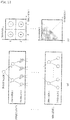
- Figure 13 is an explanatory diagram showing the framework of the above-described new machine learning, that is, an explanatory diagram showing the structure of a learning tree.
- Figure 13(a) shows the structure of a learning tree in the learning method
- Figure 13(b) shows the image of the state space corresponding to the structure.
- nodes corresponding to the respective hierarchically divided state spaces are arranged from the top node (starting node or root node) to the bottom node (terminal node or leaf node) in a tree shape or lattice shape.
- the drawing shows an example of the case where N is 2, d is 2, and n is 2 in the learning tree with N levels, d dimensions, and n divisions, and the numbers 1 to 4 representing the four terminal nodes in the first level of the learning tree shown in Figure 13(a) correspond to the four state spaces shown in Figure 13(b) , respectively.
- the input data are sequentially associated with the respective divided state spaces and are accumulated in the respective state spaces.
- new nodes are sequentially generated.
- the predicted output is calculated by taking the arithmetic mean of the values or vectors of the data included in the respective state spaces after learning.
- Patent Literature 1 Japanese Patent Laid-Open No. 2016-173686
- An object of the present invention which has been made under the technical background described above, is to provide an apparatus, method, program, IC chip, system, and the like for generating a single learned model by integrating multiple learned models obtained using a framework of new machine learning having a tree structure.
- a learned model integration method for integrating multiple different learned models obtained by letting a learning model learn a predetermined data group, the learning model having a tree structure in which multiple nodes associated with respective hierarchically divided state spaces are hierarchically arranged, the method comprising: a data reading step of reading data related to the multiple different learned models from a predetermined memory unit; and an integrating step in which, for each node constituting a tree structure related to the multiple different learned models, when a node exists in only one learned model, the node is duplicated, and when nodes exist in corresponding positions in the multiple learned models, the corresponding nodes are integrated, thereby integrating the multiple different learned models into a single learned model.
- different learned models can be integrated using suitability for integration of learned models having tree structures, so that a single learned model closer to perfection can be generated from multiple learned models that have been subjected to partial learning.
- the node and all the nodes below that node may be duplicated.
- Each node of the multiple different learned models may be associated with a learning-related parameter generated in the process of the learning, and the number of pieces of data included in a state space corresponding to each node, and the integrating step may further comprise: a number of pieces of data adding step of adding, for integration of the nodes, the numbers of pieces of data related to multiple nodes to be integrated, and an error amount adding step of performing, for integration of the nodes, weighted addition on the learning-related parameters associated with multiple nodes to be integrated, according to the numbers of pieces of data.
- weighted addition is performed according to the number of pieces of included data, so that learning-related parameters can be integrated according to the reliability.
- the learning-related parameter may be generated in the process of the learning for each node and may be an error amount corresponding to prediction accuracy.
- the data reading step may further comprise a parameter file reading step of reading a parameter file including parameters corresponding to learning conditions of the learned models
- the learned model integration method may further comprise a determination step in which when predetermined parameters among the parameters corresponding to the respective learning conditions match, the integrating step is performed, and when the predetermined parameters do not match, the integrating step is not performed.
- Such a configuration enables preliminary determination of whether or not the learned models can be integrated based on predetermined parameters in the parameter files including parameters corresponding to the learning conditions, so that only appropriate integration processing that satisfies the preconditions for integration can be performed.
- a learned model integrating apparatus for integrating multiple different learned models obtained by letting a learning model learn a predetermined data group, the learning model having a tree structure in which multiple nodes associated with respective hierarchically divided state spaces are hierarchically arranged, the apparatus comprising: a data reading unit for reading data related to the multiple different learned models from a predetermined memory unit; and an integrating unit in which, for each node constituting a tree structure related to the multiple different learned models, when a node exists in only one learned model, the node is duplicated, and when nodes exist in corresponding positions in the multiple learned models, the corresponding nodes are integrated, thereby integrating the multiple different learned models into a single learned model.
- a learned model integrating program is a learned model integrating program for making a computer function as a learned model integrating apparatus for integrating multiple different learned models obtained by letting a learning model learn a predetermined data group, the learning model having a tree structure in which multiple nodes associated with respective hierarchically divided state spaces are hierarchically arranged, the program comprising: a data reading step of reading data related to the multiple different learned models from a predetermined memory unit; and an integrating step in which, for each node constituting a tree structure related to the multiple different learned models, when a node exists in only one learned model, the node is duplicated, and when nodes exist in corresponding positions in the multiple learned models, the corresponding nodes are integrated, thereby integrating the multiple different learned models into a single learned model.
- An IC chip according to the present disclosure is an IC chip having a function of integrating multiple different learned models obtained by letting a learning model learn a predetermined data group, the learning model having a tree structure in which multiple nodes associated with respective hierarchically divided state spaces are hierarchically arranged, the IC chip comprising: a data reading unit for reading data related to the multiple different learned models from a predetermined memory unit; and an integrating unit in which, for each node constituting a tree structure related to the multiple different learned models, when a node exists in only one learned model, the node is duplicated, and when nodes exist in corresponding positions in the multiple learned models, the corresponding nodes are integrated, thereby integrating the multiple different learned models into a single learned model.
- an integration processing system is an integration processing system comprising: a learning apparatus layer including one or more learning apparatuses for performing learning processing based on a predetermined data group according to a learning model having a tree structure in which multiple nodes associated with respective hierarchically divided state spaces are hierarchically arranged, thereby generating learned models; and an integrating apparatus layer including one or more learned model integrating apparatuses that are connected to the learning apparatus layer via communication and integrate the learned models generated in the learning apparatuses, the learned model integrating apparatus comprising: a data reading unit for reading data related to the different learned models from a predetermined memory unit; and an integrating unit in which, for each node constituting a tree structure related to the different learned models, when a node exists in only one learned model, the node is duplicated, and when nodes exist in corresponding positions in the multiple learned models, the corresponding nodes are integrated, thereby integrating the different learned models.
- a system in which learned models generated in the learning apparatus layer including one or more learning apparatuses can be integrated as appropriate through one or more learned model integrating apparatuses in the integrating apparatus layer, particularly a system suitable for large-scale learning/integration processing can be provided.
- different learned models can be integrated using suitability for integration of learned models having tree structures, so that a single comprehensive learned model can be generated from multiple learned models.
- FIG. 1 is an explanatory diagram showing the hardware configuration of an integration processing apparatus 10 according to this embodiment.
- the integration processing apparatus 10 includes a control unit 1, an I/O unit 2 for controlling input/output to/from an external device, a communication unit 3 for controlling wireless or wired communication, and a memory unit 4, which are connected to each other via a system bus.
- the control unit 1 consists of a CPU and executes various programs including a program for performing integration processing of a learned model having a tree structure which will be described later.
- a microprocessor, a microcontroller, a graphics processing unit (GPU), or the like may be used instead of this CPU or the like.
- the memory unit 4 serves as various storage devices including a ROM, a RAM, a flash memory, and a hard disk, for example, and temporarily or non-temporarily stores various data related to a learned model having a tree structure, data corresponding to teaching data, and a program having a function of performing integration processing of a learned model, for example.
- the configuration of the integration processing apparatus 10 is not limited to the configuration shown in the drawing, but can be freely changed within the scope of technical common sense at the time of filing. Accordingly, for example, the memory unit 4 may be separately provided as an external storage or the like. Similarly, the control unit 1 may perform distribution processing or the like in cooperation with a control unit or the like in another information processing apparatus. Further, processing using a virtualization technique or the like may be performed.
- Figure 2 is a general flow chart related to the learning processing.
- data to be learned is first input to a learning model having a tree structure (S101).
- the state space to which the data should belong and the node corresponding to that state space are specified, so that one path between multiple nodes, that is, from the root node to the terminal node is specified (S102).
- S102 the state space to which the data should belong and the node corresponding to that state space
- S102 the state space to which the data should belong and the node corresponding to that state space
- one path between multiple nodes that is, from the root node to the terminal node
- a new node is generated in the position.
- processing for calculation of an error corresponding to the predicted error of each node is performed (S103).
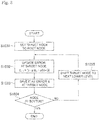
- Figure 3 is a flow chart showing the details of the error calculation processing (S103) .
- the root node is first set as a target node (S1031).
- error updating processing is performed according to the following equation (S1032).
- E t + 1 1 ⁇ ⁇ E t + ⁇ ⁇ ⁇ O
- E t+1 represents an updated error
- Et represents a non-updated data
- ⁇ represents the forgetting factor (0 ⁇ ⁇ ⁇ 1).
- the updated error E t+1 is calculated by performing weighted addition, which uses a forgetting factor ⁇ , on the non-updated error E t and the absolute value of a difference between a predicted output O (e.g., the arithmetic mean value of the value or vector of each piece of data included in the target node) based on the value or vector of each piece of data included in the target node and the value or vector corresponding to the teaching data.
- a predicted output O e.g., the arithmetic mean value of the value or vector of each piece of data included in the target node
- E t+1 decreases, which means that as the error E t+1 decreases, higher prediction accuracy is obtained.
- the updated error E t+1 is stored in the memory unit 4 as an error E in association with the target node (S1033).
- determination processing for determining whether or not this target node is at the bottom (S1034). If the node is not at the bottom, processing for shifting the target node to the next lower level is performed (S1035). This series of processing including processing for shifting the node to the next lower level on the path of the target node (S1035), error updating processing (S1032), and storage processing (S1033) is repeated until it reaches a node at the bottom (NO in S1034). On the other hand, when the target node reaches the node at the bottom (terminal node) (YES in S1034), the processing ends. In other words, this series of processing generates an error E corresponding to prediction accuracy for each of all nodes on the path.
- the method of calculating the error E is not limited to the above-described one. Accordingly, an error obtained, for example, by referring to a node present on the path at a level lower than that of the target node may be used, for example.
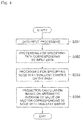
- FIG. 4 is a flow chart related to prediction processing.
- new input data is first read from the memory unit 4 (S201).
- the state space (node) to which it should belong is specified, so that one path consisting of a series of nodes is specified (S202).
- a node having the smallest error E on the path is specified (S203), and a predicted output is generated based on the arithmetic mean of the value or vector of each piece of data corresponding to the node with the minimum error E (S204).
- a prediction output is generated based on the node with the minimum error on the path.
- a predicted output can be generated based on the node predicted to have comparatively high prediction accuracy.
- the predicted output is generated based on the data corresponding to the node with the minimum error on the path in this embodiment, but this is not the only way of processing. Accordingly, for example, a predicted output may be always generated based on the data corresponding to a terminal node.
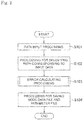
- Figure 5 is a general flow chart related to integration processing.
- S301 parameter files, which are generated when the learned models are generated, are read (S301).
- Each parameter file includes, for example, a value range (learning space) to be learned, that is, the maximum value and minimum value of input/output data, information about the structure of the learning model (N levels, d dimensions, and n divisions), and the like.
- a value range learning space
- N levels, d dimensions, and n divisions information about the structure of the learning model
- S303 an error message notifying the user that integration cannot be performed is output through a display (not shown in the drawing) or the like (S303), and the processing ends.
- a rough match between learning sections refers to, for example, a situation in which, within a range in which a margin of a predetermined rate (e.g., about 10%) is given to the maximum value and minimum value of the data included in one of the learned models, the maximum value and minimum value of the data included in the other learned model are included.
- a margin of a predetermined rate e.g., about 10%
- Such a configuration enables preliminary determination of whether or not the learned models can be integrated based on predetermined parameters in the parameter files including parameters corresponding to the learning conditions, so that only appropriate integration processing that meets the preconditions for integration can be performed.
- Figure 6 is a detailed flow chart related to integration processing (S305).
- the first node position is set to a target node (S3051).
- determination processing is performed to determine whether a node exists in both of the learning trees (S3052). If the node exists in both of the learning trees (YES in S3052) in the target position, processing for integration of the two nodes is performed (S3053).
- Figure 8 is a conceptual diagram related to node integration processing (S3053).
- Figure 8(a) is a first example of integration in which the two upper left-right colored nodes are integrated into one lower colored node.
- E represents the above-mentioned error
- C represents the number of pieces of data that has been included so far.
- the error E of the upper left node is ⁇ (> 0)
- the number of pieces of data C is k (an integer greater than or equal to 0)
- the error E of the upper right node is ⁇ (> 0)
- the number of pieces of data C is m (an integer greater than or equal to 0).
- the data associated with each node is integrated so as to be associated with one node.
- the integrated error E is calculated by performing weighted addition, which uses the numbers of pieces of data k and m, on the above-described errors ⁇ and ⁇ .
- the number of pieces of data C after integration is calculated by adding up the numbers of pieces of data k and m.
- the nodes are integrated by weighted addition according to the number of pieces of included data, so that learning-related parameters can be integrated according to the reliability based on the number of pieces of data.
- Figure 8(b) is a second example of integration in which the two upper left-right colored nodes are integrated into one lower colored node.
- the error E of the upper left node is ⁇ (> 0)
- the number of pieces of data C is n (an integer greater than or equal to 0)
- the error E of the upper right node is ⁇
- the number of pieces of data C is one.
- the error E is ⁇ which is a value given for convenience because the number of pieces of data associated with the node is still one and the error is not defined.
- the error E after integration is calculated as ⁇ on the basis of the above-described errors ⁇ and ⁇ .
- the number of pieces of data C after integration is calculated as n + 1 by adding up the numbers of pieces of data n and 1.
- the data associated with each node, the error E, and the number of pieces of data C are targets to be integrated during node integration processing.
- the integration targets are not limited to these parameters. Accordingly, it is a matter of course that during node integration, other parameters associated with the node may be targets to be integrated.
- the integrated node is stored in the memory unit 4 (S3053). Afterwards, determination processing is performed for determining whether or not all node positions have been processed (S3055).
- determination processing is then performed for determining whether or not a node exists in any one of the learning trees (S3057). If any one of the learning trees does not include a node (NO in S3057), determination processing is performed for determining whether or not all node positions have been processed (S3055). If there is a node in the target position of any one of the learning trees (YES in S3057), the node in the target position of data of the learning trees and the nodes below the target node are duplicated and saved as integrated data (S3058). Afterwards, determination processing is performed for determining whether or not all node positions have been processed (S3055).
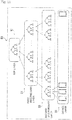
- Figure 7 is a conceptual diagram related to integration of learning trees. As is clear from the drawing, when the first learning tree at the upper left of the drawing and the second learning tree at the upper right of the drawing are integrated, as shown in the bottom row of the drawing, integration processing is performed at the black nodes, whereas the nodes of the first learning tree or the second learning tree are duplicated at the white nodes.
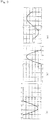
- Figure 9 shows the experimental results (Part 1) of processing for integration of two learned models.
- Figure 9(a) shows the predicted output of the first learned model that has been made learn a sine curve for 1/2 period from - ⁇ to 0.
- Figure 9(b) shows the predicted output of the second learned model that has been made learn a sine curve for 1/2 period from 0 to ⁇ .
- Figure 10 shows the experimental results (Part 2) of processing for integration of two learned models.
- Figure 10(a) shows the predicted output of the first learned model that has learned one period from - ⁇ to ⁇ with poor accuracy.
- Figure 10(b) shows the predicted output of the second learned model that has learned a sine curve accurately in the range of - ⁇ /2 to ⁇ /2 but in such a manner that the separate line segments are substantially extended and parallel to the horizontal axis in the range of - ⁇ to - ⁇ /2 and the range of ⁇ /2 to ⁇ .
- these two learned models are integrated using the integration processing apparatus 10, they are integrated into a single learned model with the predicted output shown in Figure 10(c) .
- the sine curve is roughly represented in the range of - ⁇ to - ⁇ /2, and the sine curve is accurately represented in the range of - ⁇ /2 to ⁇ /2, and the sine curve is roughly represented in the range of ⁇ /2 to ⁇ .
- a learned model can be generated which accurately generates a predicted output in a range in which it has accurately learned, and generates a rough predicted output in a range in which it has roughly learned.
- the present disclosure is not limited to such a configuration. Accordingly, for example, it may be configured to be a large-scale integration processing system.
- FIG 11 is a schematic configuration diagram of a large-scale integration processing system 80.
- the large-scale integration processing system 80 includes, from the top, a top layer 81 including one or more integration processing apparatuses 10, a first intermediate layer 82 including one or more integration processing apparatuses 10, a second intermediate layer 83 including one or more learning processing apparatuses, and a device layer 84 including multiple devices, and these layers are connected to each other by wired or wireless communication.
- Data to be learned (e.g., sensor data) acquired by each device in the device layer 84 is transmitted to the second intermediate layer 83, and in the second intermediate layer 83, learning processing is performed on learning models having a tree structure according to the data.
- multiple learned models are generated in the second intermediate layer 83.
- the first intermediate layer receives data on the learned models in the second intermediate layer and performs processing for integration of each learned model. Consequently, multiple integrated learned models are generated in the first intermediate layer 82.
- the data on the learned models in the first intermediate layer 82 is then transmitted to the top layer, and integration processing is performed again in the integration processing apparatus in the top layer.
- a system in which learned models generated in the learning apparatus layer (the second intermediate layer) including one or more learning apparatuses can be integrated as appropriate through one or more learned model integrating apparatuses in the integrating apparatus layer (the top layer 81 or the first intermediate layer 82), particularly a system suitable for large-scale learning/integration processing can be provided.
- the processing for integration of learned models is always performed in the integration processing apparatus 10.
- the present disclosure is not limited to the such a configuration. Accordingly, for example, it may be configured to be an information processing system (server client system or SaaS system) consisting of a server apparatus 40 and a client apparatus 30.
- server client system or SaaS system
- FIG 12 is a schematic configuration diagram of the information processing system 100.
- the client apparatus 30 consists of a control unit 31 for controlling the client apparatus 30, an I/O unit 32 for input and output operations, a communication unit 33 for communicating with the server apparatus 40, and a memory unit 34 for storing various kinds of information.
- the server apparatus 40 consists of a control unit 41 for controlling the server apparatus 40, an I/O unit 42 for input and output operations, a communication unit 43 for communicating with the client apparatus 30, and a memory unit 44 for storing various kinds of information.
- the server apparatus 40 executes learning processing based on the data file.
- the server apparatus 40 returns the parameter file including the learning conditions (e.g., input/output dimensions and various parameters) and the data file related to the learned model as a binary file to the user.
- the user transmits multiple (e.g., two) different parameter files and data files to the server apparatus 40 and also issues an integration processing instruction to the server apparatus 40 via communication, allowing the user to perform data integration processing on the server apparatus 40.
- the client apparatus 30 is not required to have high computing power and storage capability, thereby facilitating learning processing or integration processing.
- a learned model integration method, apparatus, program, IC chip, and system for performing integration processing of learned models generated by predetermined learning processing particularly a learned model integration method, apparatus, program, IC chip, and system for performing integration of learned models having tree structures.
Landscapes
- Engineering & Computer Science (AREA)
- Theoretical Computer Science (AREA)
- Software Systems (AREA)
- General Engineering & Computer Science (AREA)
- Data Mining & Analysis (AREA)
- Physics & Mathematics (AREA)
- General Physics & Mathematics (AREA)
- Evolutionary Computation (AREA)
- Computing Systems (AREA)
- Mathematical Physics (AREA)
- Artificial Intelligence (AREA)
- Databases & Information Systems (AREA)
- Computer Vision & Pattern Recognition (AREA)
- Medical Informatics (AREA)
- Computational Linguistics (AREA)
- Image Analysis (AREA)
- Information Retrieval, Db Structures And Fs Structures Therefor (AREA)
- Machine Translation (AREA)
Applications Claiming Priority (2)
| Application Number | Priority Date | Filing Date | Title |
|---|---|---|---|
| JP2017148319 | 2017-07-31 | ||
| PCT/JP2018/027774 WO2019026703A1 (fr) | 2017-07-31 | 2018-07-24 | Procédé, dispositif, programme, puce de ci et système d'intégration de modèles finis d'apprentissage |
Publications (3)
| Publication Number | Publication Date |
|---|---|
| EP3663992A1 true EP3663992A1 (fr) | 2020-06-10 |
| EP3663992A4 EP3663992A4 (fr) | 2021-05-05 |
| EP3663992B1 EP3663992B1 (fr) | 2026-02-18 |
Family
ID=65232554
Family Applications (1)
| Application Number | Title | Priority Date | Filing Date |
|---|---|---|---|
| EP18815931.3A Active EP3663992B1 (fr) | 2017-07-31 | 2018-07-24 | Procédé, dispositif, programme, puce de ci et système d'intégration de modèles finis d'apprentissage |
Country Status (4)
| Country | Link |
|---|---|
| US (1) | US11475371B2 (fr) |
| EP (1) | EP3663992B1 (fr) |
| JP (1) | JP6713099B2 (fr) |
| WO (1) | WO2019026703A1 (fr) |
Families Citing this family (1)
| Publication number | Priority date | Publication date | Assignee | Title |
|---|---|---|---|---|
| US11240153B1 (en) | 2020-07-31 | 2022-02-01 | Cisco Technology, Inc. | Scoring policies for predictive routing suggestions |
Family Cites Families (17)
| Publication number | Priority date | Publication date | Assignee | Title |
|---|---|---|---|---|
| US7293000B2 (en) * | 2002-02-22 | 2007-11-06 | Lee Shih-Jong J | Information integration method for decision regulation in hierarchic decision systems |
| US7480640B1 (en) * | 2003-12-16 | 2009-01-20 | Quantum Leap Research, Inc. | Automated method and system for generating models from data |
| JP2006293442A (ja) * | 2005-04-05 | 2006-10-26 | Sony Corp | 情報処理装置および方法、並びにプログラム |
| US8805861B2 (en) * | 2008-12-09 | 2014-08-12 | Google Inc. | Methods and systems to train models to extract and integrate information from data sources |
| US8429110B2 (en) * | 2010-06-10 | 2013-04-23 | Microsoft Corporation | Pattern tree-based rule learning |
| JP2012008659A (ja) * | 2010-06-22 | 2012-01-12 | Sony Corp | データ処理装置、データ処理方法、およびプログラム |
| JP2012108748A (ja) * | 2010-11-18 | 2012-06-07 | Sony Corp | データ処理装置、データ処理方法、およびプログラム |
| US8620837B2 (en) * | 2011-07-11 | 2013-12-31 | Accenture Global Services Limited | Determination of a basis for a new domain model based on a plurality of learned models |
| US8209271B1 (en) * | 2011-08-15 | 2012-06-26 | Google Inc. | Predictive model training on large datasets |
| US20140236875A1 (en) * | 2012-11-15 | 2014-08-21 | Purepredictive, Inc. | Machine learning for real-time adaptive website interaction |
| US20140358828A1 (en) * | 2013-05-29 | 2014-12-04 | Purepredictive, Inc. | Machine learning generated action plan |
| US9646262B2 (en) * | 2013-06-17 | 2017-05-09 | Purepredictive, Inc. | Data intelligence using machine learning |
| JP6444494B2 (ja) * | 2014-05-23 | 2018-12-26 | データロボット, インコーポレイテッド | 予測データ分析のためのシステムおよび技術 |
| US10452992B2 (en) * | 2014-06-30 | 2019-10-22 | Amazon Technologies, Inc. | Interactive interfaces for machine learning model evaluations |
| JP6565925B2 (ja) * | 2014-10-28 | 2019-08-28 | 日本電気株式会社 | 推定結果表示システム、推定結果表示方法および推定結果表示プログラム |
| JP6547171B2 (ja) | 2015-03-16 | 2019-07-24 | 国立大学法人岩手大学 | 情報処理装置 |
| US20180039905A1 (en) * | 2016-08-03 | 2018-02-08 | International Business Machines Corporation | Large scale distributed training of data analytics models |
-
2018
- 2018-07-24 JP JP2019534067A patent/JP6713099B2/ja active Active
- 2018-07-24 EP EP18815931.3A patent/EP3663992B1/fr active Active
- 2018-07-24 WO PCT/JP2018/027774 patent/WO2019026703A1/fr not_active Ceased
- 2018-12-26 US US16/232,333 patent/US11475371B2/en active Active
Also Published As
| Publication number | Publication date |
|---|---|
| US20190138936A1 (en) | 2019-05-09 |
| JP6713099B2 (ja) | 2020-06-24 |
| JPWO2019026703A1 (ja) | 2020-05-28 |
| EP3663992A4 (fr) | 2021-05-05 |
| EP3663992B1 (fr) | 2026-02-18 |
| WO2019026703A1 (fr) | 2019-02-07 |
| US11475371B2 (en) | 2022-10-18 |
Similar Documents
| Publication | Publication Date | Title |
|---|---|---|
| US20240320566A1 (en) | Debugging Correctness Issues in Training Machine Learning Models | |
| CN110651280B (zh) | 投影神经网络 | |
| US11100403B2 (en) | Cooperative execution of a genetic algorithm with an efficient training algorithm for data-driven model creation | |
| JP6648352B2 (ja) | 汎用学習済モデルの生成方法 | |
| US11995520B2 (en) | Efficiently determining local machine learning model feature contributions | |
| CN108062302B (zh) | 一种文本信息的识别方法及装置 | |
| CN113762502B (zh) | 神经网络模型的训练方法及装置 | |
| CN112698977B (zh) | 服务器故障定位方法方法、装置、设备及介质 | |
| CN112257751A (zh) | 神经网络剪枝方法 | |
| CN111967917B (zh) | 预测用户流失的方法以及设备 | |
| US20220318917A1 (en) | Intention feature value extraction device, learning device, method, and program | |
| CN117349424A (zh) | 应用于语言模型的提示模板的处理方法、装置及电子设备 | |
| EP3663991A1 (fr) | Procédé de compression de quantité de données, dispositif, programme et puce de circuit intégré | |
| CN117273143B (zh) | 基于马尔可夫逻辑网络的时序知识图谱推理方法及系统 | |
| EP3663992B1 (fr) | Procédé, dispositif, programme, puce de ci et système d'intégration de modèles finis d'apprentissage | |
| US20240249044A1 (en) | Machine learning models for electrical power simulations | |
| EP3792837A1 (fr) | Programme et procédé d'apprentissage | |
| CN110990256A (zh) | 开源代码检测方法、装置及计算机可读存储介质 | |
| US11080359B2 (en) | Stable data-driven discovery of a symbolic expression | |
| WO2020075255A1 (fr) | Dispositif d'apprentissage, procédé d'apprentissage et support non transitoire lisible par ordinateur comportant un programme mémorisé sur ce dernier | |
| JP2021135683A (ja) | 学習装置、推論装置、学習方法及び推論方法 | |
| EP4170556A1 (fr) | Dispositif de commande, procédé, et programme | |
| CN117061330A (zh) | 根因定位模型训练方法、根因定位方法及装置 | |
| KR20240059092A (ko) | 반도체 설계 과정에서 데이터베이스 기반의 자동 시뮬레이션 방법, 이를 수행하는 자동 시뮬레이션 생성 장치 및 반도체 설계 자동화 시스템 | |
| US11521092B2 (en) | Inference system, inference method, and recording medium |
Legal Events
| Date | Code | Title | Description |
|---|---|---|---|
| STAA | Information on the status of an ep patent application or granted ep patent |
Free format text: STATUS: UNKNOWN |
|
| STAA | Information on the status of an ep patent application or granted ep patent |
Free format text: STATUS: THE INTERNATIONAL PUBLICATION HAS BEEN MADE |
|
| PUAI | Public reference made under article 153(3) epc to a published international application that has entered the european phase |
Free format text: ORIGINAL CODE: 0009012 |
|
| STAA | Information on the status of an ep patent application or granted ep patent |
Free format text: STATUS: REQUEST FOR EXAMINATION WAS MADE |
|
| 17P | Request for examination filed |
Effective date: 20181221 |
|
| AK | Designated contracting states |
Kind code of ref document: A1 Designated state(s): AL AT BE BG CH CY CZ DE DK EE ES FI FR GB GR HR HU IE IS IT LI LT LU LV MC MK MT NL NO PL PT RO RS SE SI SK SM TR |
|
| AX | Request for extension of the european patent |
Extension state: BA ME |
|
| DAV | Request for validation of the european patent (deleted) | ||
| DAX | Request for extension of the european patent (deleted) | ||
| REG | Reference to a national code |
Ref country code: DE Ref legal event code: R079 Free format text: PREVIOUS MAIN CLASS: G06N0099000000 Ipc: G06N0005000000 |
|
| A4 | Supplementary search report drawn up and despatched |
Effective date: 20210406 |
|
| RIC1 | Information provided on ipc code assigned before grant |
Ipc: G06N 5/00 20060101AFI20210329BHEP Ipc: G06N 20/20 20190101ALI20210329BHEP |
|
| RAP3 | Party data changed (applicant data changed or rights of an application transferred) |
Owner name: AISING LTD. |
|
| STAA | Information on the status of an ep patent application or granted ep patent |
Free format text: STATUS: EXAMINATION IS IN PROGRESS |
|
| 17Q | First examination report despatched |
Effective date: 20230828 |
|
| REG | Reference to a national code |
Ref country code: DE Ref legal event code: R079 Ref country code: DE Ref legal event code: R079 Ref document number: 602018089248 Country of ref document: DE Free format text: PREVIOUS MAIN CLASS: G06N0005000000 Ipc: G06N0005010000 |
|
| RIC1 | Information provided on ipc code assigned before grant |
Ipc: G06N 5/01 20230101AFI20250721BHEP Ipc: G06N 20/20 20190101ALI20250721BHEP |
|
| GRAP | Despatch of communication of intention to grant a patent |
Free format text: ORIGINAL CODE: EPIDOSNIGR1 |
|
| STAA | Information on the status of an ep patent application or granted ep patent |
Free format text: STATUS: GRANT OF PATENT IS INTENDED |
|
| INTG | Intention to grant announced |
Effective date: 20250912 |
|
| GRAS | Grant fee paid |
Free format text: ORIGINAL CODE: EPIDOSNIGR3 |
|
| GRAA | (expected) grant |
Free format text: ORIGINAL CODE: 0009210 |
|
| STAA | Information on the status of an ep patent application or granted ep patent |
Free format text: STATUS: THE PATENT HAS BEEN GRANTED |
|
| AK | Designated contracting states |
Kind code of ref document: B1 Designated state(s): AL AT BE BG CH CY CZ DE DK EE ES FI FR GB GR HR HU IE IS IT LI LT LU LV MC MK MT NL NO PL PT RO RS SE SI SK SM TR |
|
| REG | Reference to a national code |
Ref country code: CH Ref legal event code: F10 Free format text: ST27 STATUS EVENT CODE: U-0-0-F10-F00 (AS PROVIDED BY THE NATIONAL OFFICE) Effective date: 20260218 Ref country code: GB Ref legal event code: FG4D |
|
| REG | Reference to a national code |
Ref country code: IE Ref legal event code: FG4D |
|
| REG | Reference to a national code |
Ref country code: DE Ref legal event code: R096 Ref document number: 602018089248 Country of ref document: DE |
|
| P01 | Opt-out of the competence of the unified patent court (upc) registered |
Free format text: CASE NUMBER: UPC_APP_0005807_3663992/2026 Effective date: 20260217 |