EP3664586A1 - Differenzielle erwärmung bei der herstellung einer gekrümmten elektronischen vorrichtung - Google Patents
Differenzielle erwärmung bei der herstellung einer gekrümmten elektronischen vorrichtung Download PDFInfo
- Publication number
- EP3664586A1 EP3664586A1 EP18209756.8A EP18209756A EP3664586A1 EP 3664586 A1 EP3664586 A1 EP 3664586A1 EP 18209756 A EP18209756 A EP 18209756A EP 3664586 A1 EP3664586 A1 EP 3664586A1
- Authority
- EP
- European Patent Office
- Prior art keywords
- substrate
- component
- electronic component
- area
- light
- Prior art date
- Legal status (The legal status is an assumption and is not a legal conclusion. Google has not performed a legal analysis and makes no representation as to the accuracy of the status listed.)
- Withdrawn
Links
- 238000004519 manufacturing process Methods 0.000 title claims description 10
- 238000010438 heat treatment Methods 0.000 title abstract description 18
- 239000000758 substrate Substances 0.000 claims abstract description 138
- 239000000463 material Substances 0.000 claims abstract description 72
- 239000012815 thermoplastic material Substances 0.000 claims abstract description 36
- 238000010521 absorption reaction Methods 0.000 claims abstract description 31
- 238000000034 method Methods 0.000 claims description 59
- 230000009477 glass transition Effects 0.000 claims description 24
- 238000000576 coating method Methods 0.000 claims description 20
- 239000011248 coating agent Substances 0.000 claims description 19
- 238000005286 illumination Methods 0.000 claims description 17
- 230000002035 prolonged effect Effects 0.000 claims description 3
- 238000003856 thermoforming Methods 0.000 abstract description 20
- 238000011067 equilibration Methods 0.000 description 7
- 239000004417 polycarbonate Substances 0.000 description 5
- 229920000515 polycarbonate Polymers 0.000 description 5
- 239000004416 thermosoftening plastic Substances 0.000 description 5
- 230000005855 radiation Effects 0.000 description 4
- 229920001169 thermoplastic Polymers 0.000 description 4
- 239000003086 colorant Substances 0.000 description 3
- 239000011888 foil Substances 0.000 description 3
- 238000005452 bending Methods 0.000 description 2
- 238000001816 cooling Methods 0.000 description 2
- 239000004033 plastic Substances 0.000 description 2
- 229920003023 plastic Polymers 0.000 description 2
- 238000004088 simulation Methods 0.000 description 2
- 230000007704 transition Effects 0.000 description 2
- XUIMIQQOPSSXEZ-UHFFFAOYSA-N Silicon Chemical compound [Si] XUIMIQQOPSSXEZ-UHFFFAOYSA-N 0.000 description 1
- BQCADISMDOOEFD-UHFFFAOYSA-N Silver Chemical compound [Ag] BQCADISMDOOEFD-UHFFFAOYSA-N 0.000 description 1
- 239000000853 adhesive Substances 0.000 description 1
- 230000001070 adhesive effect Effects 0.000 description 1
- 239000012080 ambient air Substances 0.000 description 1
- 238000000071 blow moulding Methods 0.000 description 1
- 239000002178 crystalline material Substances 0.000 description 1
- 230000003247 decreasing effect Effects 0.000 description 1
- 239000012776 electronic material Substances 0.000 description 1
- 239000000945 filler Substances 0.000 description 1
- 239000003292 glue Substances 0.000 description 1
- 238000001746 injection moulding Methods 0.000 description 1
- 230000002452 interceptive effect Effects 0.000 description 1
- 230000031700 light absorption Effects 0.000 description 1
- 230000000670 limiting effect Effects 0.000 description 1
- 239000011159 matrix material Substances 0.000 description 1
- 238000002844 melting Methods 0.000 description 1
- 230000008018 melting Effects 0.000 description 1
- 239000002923 metal particle Substances 0.000 description 1
- 239000000203 mixture Substances 0.000 description 1
- 238000013021 overheating Methods 0.000 description 1
- 239000002245 particle Substances 0.000 description 1
- 230000000704 physical effect Effects 0.000 description 1
- 230000019612 pigmentation Effects 0.000 description 1
- 239000002985 plastic film Substances 0.000 description 1
- 230000002829 reductive effect Effects 0.000 description 1
- 230000002441 reversible effect Effects 0.000 description 1
- 238000001175 rotational moulding Methods 0.000 description 1
- 229910052710 silicon Inorganic materials 0.000 description 1
- 239000010703 silicon Substances 0.000 description 1
- 229910052709 silver Inorganic materials 0.000 description 1
- 239000004332 silver Substances 0.000 description 1
- 239000000126 substance Substances 0.000 description 1
- 230000002195 synergetic effect Effects 0.000 description 1
- 238000007666 vacuum forming Methods 0.000 description 1
Images



Classifications
-
- H—ELECTRICITY
- H05—ELECTRIC TECHNIQUES NOT OTHERWISE PROVIDED FOR
- H05K—PRINTED CIRCUITS; CASINGS OR CONSTRUCTIONAL DETAILS OF ELECTRIC APPARATUS; MANUFACTURE OF ASSEMBLAGES OF ELECTRICAL COMPONENTS
- H05K1/00—Printed circuits
- H05K1/02—Details
- H05K1/0284—Details of three-dimensional rigid printed circuit boards
-
- B—PERFORMING OPERATIONS; TRANSPORTING
- B29—WORKING OF PLASTICS; WORKING OF SUBSTANCES IN A PLASTIC STATE IN GENERAL
- B29C—SHAPING OR JOINING OF PLASTICS; SHAPING OF MATERIAL IN A PLASTIC STATE, NOT OTHERWISE PROVIDED FOR; AFTER-TREATMENT OF THE SHAPED PRODUCTS, e.g. REPAIRING
- B29C53/00—Shaping by bending, folding, twisting, straightening or flattening; Apparatus therefor
- B29C53/80—Component parts, details or accessories; Auxiliary operations
- B29C53/84—Heating or cooling
-
- H—ELECTRICITY
- H05—ELECTRIC TECHNIQUES NOT OTHERWISE PROVIDED FOR
- H05K—PRINTED CIRCUITS; CASINGS OR CONSTRUCTIONAL DETAILS OF ELECTRIC APPARATUS; MANUFACTURE OF ASSEMBLAGES OF ELECTRICAL COMPONENTS
- H05K1/00—Printed circuits
- H05K1/02—Details
- H05K1/0274—Optical details, e.g. printed circuits comprising integral optical means
-
- H—ELECTRICITY
- H05—ELECTRIC TECHNIQUES NOT OTHERWISE PROVIDED FOR
- H05K—PRINTED CIRCUITS; CASINGS OR CONSTRUCTIONAL DETAILS OF ELECTRIC APPARATUS; MANUFACTURE OF ASSEMBLAGES OF ELECTRICAL COMPONENTS
- H05K1/00—Printed circuits
- H05K1/02—Details
- H05K1/0277—Bendability or stretchability details
- H05K1/0278—Rigid circuit boards or rigid supports of circuit boards locally made bendable, e.g. by removal or replacement of material
-
- H—ELECTRICITY
- H05—ELECTRIC TECHNIQUES NOT OTHERWISE PROVIDED FOR
- H05K—PRINTED CIRCUITS; CASINGS OR CONSTRUCTIONAL DETAILS OF ELECTRIC APPARATUS; MANUFACTURE OF ASSEMBLAGES OF ELECTRICAL COMPONENTS
- H05K3/00—Apparatus or processes for manufacturing printed circuits
- H05K3/0011—Working of insulating substrates or insulating layers
- H05K3/0014—Shaping of the substrate, e.g. by moulding
-
- B—PERFORMING OPERATIONS; TRANSPORTING
- B29—WORKING OF PLASTICS; WORKING OF SUBSTANCES IN A PLASTIC STATE IN GENERAL
- B29B—PREPARATION OR PRETREATMENT OF THE MATERIAL TO BE SHAPED; MAKING GRANULES OR PREFORMS; RECOVERY OF PLASTICS OR OTHER CONSTITUENTS OF WASTE MATERIAL CONTAINING PLASTICS
- B29B13/00—Conditioning or physical treatment of the material to be shaped
- B29B13/08—Conditioning or physical treatment of the material to be shaped by using wave energy or particle radiation
-
- B—PERFORMING OPERATIONS; TRANSPORTING
- B29—WORKING OF PLASTICS; WORKING OF SUBSTANCES IN A PLASTIC STATE IN GENERAL
- B29C—SHAPING OR JOINING OF PLASTICS; SHAPING OF MATERIAL IN A PLASTIC STATE, NOT OTHERWISE PROVIDED FOR; AFTER-TREATMENT OF THE SHAPED PRODUCTS, e.g. REPAIRING
- B29C53/00—Shaping by bending, folding, twisting, straightening or flattening; Apparatus therefor
- B29C53/02—Bending or folding
- B29C53/04—Bending or folding of plates or sheets
-
- B—PERFORMING OPERATIONS; TRANSPORTING
- B29—WORKING OF PLASTICS; WORKING OF SUBSTANCES IN A PLASTIC STATE IN GENERAL
- B29L—INDEXING SCHEME ASSOCIATED WITH SUBCLASS B29C, RELATING TO PARTICULAR ARTICLES
- B29L2031/00—Other particular articles
- B29L2031/34—Electrical apparatus, e.g. sparking plugs or parts thereof
-
- H—ELECTRICITY
- H05—ELECTRIC TECHNIQUES NOT OTHERWISE PROVIDED FOR
- H05K—PRINTED CIRCUITS; CASINGS OR CONSTRUCTIONAL DETAILS OF ELECTRIC APPARATUS; MANUFACTURE OF ASSEMBLAGES OF ELECTRICAL COMPONENTS
- H05K1/00—Printed circuits
- H05K1/02—Details
- H05K1/11—Printed elements for providing electric connections to or between printed circuits
- H05K1/119—Details of rigid insulating substrates therefor, e.g. three-dimensional details
-
- H—ELECTRICITY
- H05—ELECTRIC TECHNIQUES NOT OTHERWISE PROVIDED FOR
- H05K—PRINTED CIRCUITS; CASINGS OR CONSTRUCTIONAL DETAILS OF ELECTRIC APPARATUS; MANUFACTURE OF ASSEMBLAGES OF ELECTRICAL COMPONENTS
- H05K2201/00—Indexing scheme relating to printed circuits covered by H05K1/00
- H05K2201/01—Dielectrics
- H05K2201/0104—Properties and characteristics in general
- H05K2201/0112—Absorbing light, e.g. dielectric layer with carbon filler for laser processing
-
- H—ELECTRICITY
- H05—ELECTRIC TECHNIQUES NOT OTHERWISE PROVIDED FOR
- H05K—PRINTED CIRCUITS; CASINGS OR CONSTRUCTIONAL DETAILS OF ELECTRIC APPARATUS; MANUFACTURE OF ASSEMBLAGES OF ELECTRICAL COMPONENTS
- H05K2201/00—Indexing scheme relating to printed circuits covered by H05K1/00
- H05K2201/01—Dielectrics
- H05K2201/0104—Properties and characteristics in general
- H05K2201/0129—Thermoplastic polymer, e.g. auto-adhesive layer; Shaping of thermoplastic polymer
-
- H—ELECTRICITY
- H05—ELECTRIC TECHNIQUES NOT OTHERWISE PROVIDED FOR
- H05K—PRINTED CIRCUITS; CASINGS OR CONSTRUCTIONAL DETAILS OF ELECTRIC APPARATUS; MANUFACTURE OF ASSEMBLAGES OF ELECTRICAL COMPONENTS
- H05K2201/00—Indexing scheme relating to printed circuits covered by H05K1/00
- H05K2201/01—Dielectrics
- H05K2201/0183—Dielectric layers
- H05K2201/0187—Dielectric layers with regions of different dielectrics in the same layer, e.g. in a printed capacitor for locally changing the dielectric properties
-
- H—ELECTRICITY
- H05—ELECTRIC TECHNIQUES NOT OTHERWISE PROVIDED FOR
- H05K—PRINTED CIRCUITS; CASINGS OR CONSTRUCTIONAL DETAILS OF ELECTRIC APPARATUS; MANUFACTURE OF ASSEMBLAGES OF ELECTRICAL COMPONENTS
- H05K2201/00—Indexing scheme relating to printed circuits covered by H05K1/00
- H05K2201/01—Dielectrics
- H05K2201/0183—Dielectric layers
- H05K2201/0191—Dielectric layers wherein the thickness of the dielectric plays an important role
-
- H—ELECTRICITY
- H05—ELECTRIC TECHNIQUES NOT OTHERWISE PROVIDED FOR
- H05K—PRINTED CIRCUITS; CASINGS OR CONSTRUCTIONAL DETAILS OF ELECTRIC APPARATUS; MANUFACTURE OF ASSEMBLAGES OF ELECTRICAL COMPONENTS
- H05K2201/00—Indexing scheme relating to printed circuits covered by H05K1/00
- H05K2201/01—Dielectrics
- H05K2201/0183—Dielectric layers
- H05K2201/0195—Dielectric or adhesive layers comprising a plurality of layers, e.g. in a multilayer structure
-
- H—ELECTRICITY
- H05—ELECTRIC TECHNIQUES NOT OTHERWISE PROVIDED FOR
- H05K—PRINTED CIRCUITS; CASINGS OR CONSTRUCTIONAL DETAILS OF ELECTRIC APPARATUS; MANUFACTURE OF ASSEMBLAGES OF ELECTRICAL COMPONENTS
- H05K2201/00—Indexing scheme relating to printed circuits covered by H05K1/00
- H05K2201/09—Shape and layout
- H05K2201/09818—Shape or layout details not covered by a single group of H05K2201/09009 - H05K2201/09809
- H05K2201/09972—Partitioned, e.g. portions of a PCB dedicated to different functions; Boundary lines therefore; Portions of a PCB being processed separately or differently
-
- H—ELECTRICITY
- H05—ELECTRIC TECHNIQUES NOT OTHERWISE PROVIDED FOR
- H05K—PRINTED CIRCUITS; CASINGS OR CONSTRUCTIONAL DETAILS OF ELECTRIC APPARATUS; MANUFACTURE OF ASSEMBLAGES OF ELECTRICAL COMPONENTS
- H05K2201/00—Indexing scheme relating to printed circuits covered by H05K1/00
- H05K2201/20—Details of printed circuits not provided for in H05K2201/01 - H05K2201/10
- H05K2201/2054—Light-reflecting surface, e.g. conductors, substrates, coatings, dielectrics
-
- H—ELECTRICITY
- H05—ELECTRIC TECHNIQUES NOT OTHERWISE PROVIDED FOR
- H05K—PRINTED CIRCUITS; CASINGS OR CONSTRUCTIONAL DETAILS OF ELECTRIC APPARATUS; MANUFACTURE OF ASSEMBLAGES OF ELECTRICAL COMPONENTS
- H05K2203/00—Indexing scheme relating to apparatus or processes for manufacturing printed circuits covered by H05K3/00
- H05K2203/11—Treatments characterised by their effect, e.g. heating, cooling, roughening
- H05K2203/1105—Heating or thermal processing not related to soldering, firing, curing or laminating, e.g. for shaping the substrate or during finish plating
-
- H—ELECTRICITY
- H05—ELECTRIC TECHNIQUES NOT OTHERWISE PROVIDED FOR
- H05K—PRINTED CIRCUITS; CASINGS OR CONSTRUCTIONAL DETAILS OF ELECTRIC APPARATUS; MANUFACTURE OF ASSEMBLAGES OF ELECTRICAL COMPONENTS
- H05K2203/00—Indexing scheme relating to apparatus or processes for manufacturing printed circuits covered by H05K3/00
- H05K2203/14—Related to the order of processing steps
- H05K2203/1484—Simultaneous treatments, e.g. soldering lead-in-hole components simultaneously with surface mounted components
-
- H—ELECTRICITY
- H05—ELECTRIC TECHNIQUES NOT OTHERWISE PROVIDED FOR
- H05K—PRINTED CIRCUITS; CASINGS OR CONSTRUCTIONAL DETAILS OF ELECTRIC APPARATUS; MANUFACTURE OF ASSEMBLAGES OF ELECTRICAL COMPONENTS
- H05K2203/00—Indexing scheme relating to apparatus or processes for manufacturing printed circuits covered by H05K3/00
- H05K2203/15—Position of the PCB during processing
- H05K2203/1572—Processing both sides of a PCB by the same process; Providing a similar arrangement of components on both sides; Making interlayer connections from two sides
-
- H—ELECTRICITY
- H05—ELECTRIC TECHNIQUES NOT OTHERWISE PROVIDED FOR
- H05K—PRINTED CIRCUITS; CASINGS OR CONSTRUCTIONAL DETAILS OF ELECTRIC APPARATUS; MANUFACTURE OF ASSEMBLAGES OF ELECTRICAL COMPONENTS
- H05K2203/00—Indexing scheme relating to apparatus or processes for manufacturing printed circuits covered by H05K3/00
- H05K2203/15—Position of the PCB during processing
- H05K2203/1581—Treating the backside of the PCB, e.g. for heating during soldering or providing a liquid coating on the backside
-
- H—ELECTRICITY
- H05—ELECTRIC TECHNIQUES NOT OTHERWISE PROVIDED FOR
- H05K—PRINTED CIRCUITS; CASINGS OR CONSTRUCTIONAL DETAILS OF ELECTRIC APPARATUS; MANUFACTURE OF ASSEMBLAGES OF ELECTRICAL COMPONENTS
- H05K2203/00—Indexing scheme relating to apparatus or processes for manufacturing printed circuits covered by H05K3/00
- H05K2203/30—Details of processes not otherwise provided for in H05K2203/01 - H05K2203/17
- H05K2203/304—Protecting a component during manufacturing
Definitions
- the present disclosure relates to methods of manufacturing curved electronic devices, and resulting products.
- Curved substrates can be manufactured e.g. using processes such as thermoforming.
- Thermoforming typically involves deformation of a material (stack) at elevated temperature.
- deformation usually requires stretchability of all materials including the electronic. Especially at transitions between more and less thermoplastic materials, the strain can result in failure of electronic paths.
- Materials used in a stack may include e.g. a carrier (substrate) and electronic materials which are typically dissimilar with regards to their thermal behavior, plastic behavior and stretch behavior. So friction and shear may occur which can result in risks for the integrity of the electronic system.
- interconnects can be fortified e.g. by additional materials deposited like underfill. material underneath the components or globtopping components.
- materials can be optimized in thermoplastic properties by application of a more flexible glue.
- Tracks can be fortified by support materials that are less thermoplastic in order to take up strain instead of the most vulnerable materials.
- meander shapes the required stretchability can be achieved by extrinsic deformation of the meanders combined to intrinsic deformation of the material itself. In this way the stretchability is not only achieved by deformation of the material and thus risks reduced.
- Design of the electronics can be matched to the design of the 3D shape to locate vulnerable connection in areas that are less deformed.
- thermoforming processes There remains a need for improved manufacturing of curved electronic devices using thermoforming processes while the electrical components are and remain attached upon thermoforming.
- a stack may be provided with substrate comprising a thermoplastic material.
- One electronic component may be disposed on, or integrated in the substrate.
- the component may be connected to an electronic circuit arranged on or in the substrate.
- a surface of the substrate may be illuminated with light (e.g. IR or other wavelengths) to heat at least part of the thermoplastic material above its glass transition temperature.
- a deformation process can be applied to the (at least partially) heated substrate to deform the stack, e.g. including the electronic circuitry and components, into any desired three-dimensional shape to form the curved electric interface.
- a component area of the substrate surface localized around the electronic component comprises a first material providing relatively low absorption of the light.
- a surrounding area of the substrate, outside the component area comprises a second material providing relatively high absorption of the light.
- the difference in absorption causes buildup of a differential temperature profile in the thermoplastic material along a surface coordinate of the substrate. So the component area around the electronic component can maintain a lower temperature than the surrounding area.
- the thermoplastic material at the surrounding area may have a relatively high temperature, e.g.
- thermoplastic material at the component area around the electronic component may have a relatively low temperature, e.g. below the glass transition temperature, to provide a relatively high resistance to deformation process.
- This higher resistance may prevent excess stress on the electronic component and/or its connection to the electronic circuit.
- FIG 1 top illustrates a cross-section view of a substrate 13 with different materials M1,M2 providing different amounts of light absorption A1,A2.
- the lower part of the figure illustrates a schematic graph of corresponding temperature profiles T1-T7 as a function of substrate position X for a period of illumination (t1-t5) and subsequent cooling (t6,t7).
- a method of manufacturing a curved electronic device 10c comprises providing a stack 10.
- the stack comprises a substrate 13 with a thermoplastic material Ms.
- the stack may comprise one or more electronic components 14.
- the components may be connected e.g. to an electronic circuit 15 disposed on the substrate 13.
- Components can e.g. be silicon based. Additionally, or alternatively, the components may comprise printed structures.
- the thermo-formability of the components is typically less in comparison to the substrate and additional graphics and conductive pastes for circuitry.
- a surface 11,12 of the substrate 13 is illuminated with light L to heat at least part of the thermoplastic material M above its glass transition temperature Tg.
- a deformation process can be is applied to the at least partially heated substrate 13 to deform the stack 10 into the curved electric interface 10c.
- the curved device may deviate from a flat plate e.g. comprising localized curvatures formed by bumpy features such as buttons, or the whole device may be curved.
- a component area 11 of the substrate surface 11,12 localized around the electronic component 14 comprises a first material M1 providing relatively low absorption A1 of the light L.
- a surrounding area 12 of the substrate 13, outside the component area 11, comprises a second material M2 providing relatively high absorption A2 of the light L.
- the difference in absorption A2-A1 may cause buildup of a differential temperature profile T1-T5 in the thermoplastic material Ms along a surface coordinate X of the substrate 13.
- the component area 11 around the electronic component 14 maintains a lower temperature than the surrounding area 12.
- the thermoplastic material Ms at the surrounding area 12 has a relatively high temperature Th above the glass transition temperature Tg to provide a relatively low resistance to the deformation process D.
- the thermoplastic material Ms at the component area 11 around the electronic component 14 has a relatively low temperature Tl below the glass transition temperature Tg to provide a relatively high resistance to deformation process D. For example, this may contribute to preventing excess stress on the electronic component 14 and/or its connection to the electronic circuit 15.
- the substrate is preferably heated by illumination, e.g. infrared or other radiation.
- the substrate is illuminated until the section 12 with the more absorptive material M2 (without component) has reached an optimum (thermo)forming temperature, at least at the time of the deformation process D.
- the optimum thermoforming temperature may be a temperature above the glass transition temperature Tg of the thermoplastic material Ms, preferably a few degrees (Celsius or Kelvin) above Tg, e.g. in a range between one and thirty degrees above Tg, preferably in a range between five and twenty degrees above Tg, most preferably between five and ten degrees above Tg, e.g. around a temperature where the material becomes soft and pliable.
- a difference in the amount of absorption (A1-A2) between the materials M1,M2 is such that the component area 11 localized around the electronic component 14 stays below the glass transition temperature Tg when the surrounding area 12 reaches the optimum thermoforming temperature, e.g. as mentioned above.
- the relatively low temperature Tl at the component area 11 is below the glass transition temperature Tg of the thermoplastic material Ms to be thermoformed, preferably at least five degrees, or even more than ten degrees below Tg. The more the temperature is kept below Tg, the better it can be ensured that the substrate at the electronic component 14 sufficiently resists deformation, e.g. also in case there is some temperature variation or equilibration between sections.
- the relatively low temperature Tl at the component area 11 around the electronic component 14 can be at least five degrees (Celsius) lower than the relatively high temperature Th at the surrounding area 12, preferably the difference is even higher, e.g. more than ten degrees, more than fifteen degrees, or even more than twenty degrees. The more the difference in temperature, the better it may be ensured that the different section may provide different resistance to the deformation process D.
- thermoplastic material Ms can be used to form the substrate 13.
- the present figures illustrate polycarbonate (PC) which has a glass transition temperature Tg of about 150 °C (423 K), so it softens gradually around this point and becomes deformable above about 155 °C (428 K).
- Tg glass transition temperature
- an optimum thermoforming temperature of polycarbonate (at the surrounding area 12) is typically between about 155 and 160 °C.
- the temperature at the component area 11 may be kept below 140 °C. Of course these example temperatures may be different for other materials.
- the temperature in the section M2 at the end of illumination can be somewhat higher than the optimum thermoforming temperature.
- the substrate may experience some cooling, e.g. by radiative dissipation.
- variable radiative dissipation may also be used to tune the temperature.
- there may also be some temperature equilibration, e.g. by conduction, between the differentially heated sections M1,M2 so the temperature differential should be sufficiently high.
- the time (t6-t5) between the end of illumination (t5) and the start of the thermoforming process (t6) is kept as short as possible, e.g.
- thermoforming may immediately follow or even (partially) coincide with the end of the illumination or heating process.
- the heated substrate surface 11 is adapted to provide different absorption by selective application of a coating in the component area 11 and/or surrounding area 12.
- the coating may be dielectric so it does not interfere with electric functionality.
- the application of a coating can be integrated into a manufacturing process, e.g. before placement of electronic components, wherein the coating is applied at or around their designated locations.
- the coating may be applied on a bottom side opposite the electronic component so there will be no interference even if the coating is electrically conductive.
- the thermoplastic material Ms itself may be adapted to provide different absorption and/or reflection at different areas.
- thermoplastic material Ms absorbing and/or reflecting particles or other substances may be mixed in the thermoplastic material Ms, or different thermoplastic materials can be used.
- metal particles, non-electrical fillers and matrix materials optimized for absorption or reflection can be used as coating or in the substrate material.
- areas of the thermoplastic material Ms are selectively irradiated, e.g. using a mask or scanning laser, wherein the patterned irradiation, e.g. by UV or other wavelength, causes a local change of the substrate material or coating making it more or less absorptive to the subsequent illumination by the (homogeneous) light L, as described herein.
- a UV pattern may cause a localized change in pigmentation for the subsequent IR heating.
- the substrate 13 is uniformly illuminated.
- light intensity over the illuminated surface of the substrate varies by less than twenty percent, less than ten percent, or less than five percent.
- the heating for different reasons can be more predictable while the differential heating can be accurately controlled using the specifically configured difference in absorption of different substrate regions.
- the substrate can be selectively illuminated, e.g. using a mask, to preferentially heat the surrounding area 12 and avoid the electronic component 14. This may be combined with the present teachings of different material use.
- the electronic component 14 is disposed on a top side of the substrate 13, wherein the substrate 13 is illuminated from a bottom side opposite the electronic component 14 (not shown). By exclusively illuminating the substrate from the bottom, overheating of the electronic component 14 may be alleviated.
- the substrate 13 is illuminated from both sides. Preferably, in that case the respective surfaces on both sides of the substrate 13 are adapted to provide the lower absorption at the component area 11 around the electronic component 14 compared to the surrounding area 12. Illumination from both sides may increase heat uptake and provide a more uniform heating along the thickness of the substrate, especially for relatively thick substrates, e.g. more than one millimeter thick. Adapting both sides to selectively absorb the light may improve the division of temperature between the regions with different materials.
- illuminating comprises prolonged application of light, e.g. infrared radiation, during a time period t1-t5, e.g. between one second up to one minute or more depending on the substrate thickness. For example, for a 250 ⁇ m thick polycarbonate substrate an illumination period of about five seconds is sufficient, while 2 mm thickness polycarbonate substrate may be illuminated around fifty seconds.
- the illuminating comprises application of a short light pulse e.g. less than one second. For example, a flash lamp may be used.
- the illuminating comprises application of light from at least two different light sources with different wavelength.
- one wavelength may be absorbed relatively uniformly, while the other wavelength is selectively absorbed leading to the main temperature differential.
- a light source may be infrared while a second light source is visible or UV.
- a first wavelength which is absorbed uniformly e.g. infrared is applied for a prolonged period of time, e.g. more than five seconds, while a second wavelength which is absorbed selectively by the material M1,M2 e.g. UV or visible, is applied for a relatively short period of time, e.g. less than two seconds.
- a substrate may be uniformly heated by IR light followed by a short flash of UV light to induce the temperature differential.
- FIGs 2A illustrates a top view of a stack 10 with different materials M1,M2.
- FIG 2B illustrates a cross-section view of the stack being illuminated.
- FIG 2C illustrates a deformation process D of the differentially heated stack 10 including substrate 13.
- the relatively low temperature Tl of the component area 11 around the electronic component 14 compared to the relatively high temperature Th of the surrounding area 12 causes the component area 11 of the substrate 13 to be more resistant to the deformation process D than the surrounding area 12.
- the increased resistance to the deformation process D in the component area 11 compared to the surrounding area 12 may cause the component area 11 to deform less than the surrounding area 12 as a result of the deformation process D.
- the deformation may include bending, stretching, or compressing of substrate sections.
- the decreased bending, stretching and/or compressing in the component area 11 compared to the surrounding area 12 is configured to prevent damage to the electronic component 14 and/or prevent disconnection between the electronic component 14 and the circuit 15 during and after the deformation process D.
- the (maximum) amount of stretching S1 in the component area 11 around the electronic component 14 is less than the amount of stretching S2 in the surrounding area 12.
- the surface of the component area 11 (comprising the first material M1) is stretched (compared to the original surface) by a factor less than 1.1 (ten percent), less than 1.05 (five percent), or even less than 1.01 (one percent).
- the relative amount of stretching S2 in the surrounding area 12 (comprising the second material M2, without electronic component 14) can be much higher, e.g. (compared to the original surface) by a factor more than 1.1, more than 1.2, more than 1.5, or even more than a factor two.
- the substrate 13 preferably undergoes stretching predominantly at regions which are distanced from the electronic components. Typically, the more stretched the substrate 13 experienced locally, the thinner the resulting substrate. Accordingly, the amount of stretching can also be determined afterwards by the relative thickness T1,T2 in the regions 11,12, e.g. compared to each other or compared to the original (uniform) thickness T0.
- the present disclosure may relate to a curved electronic device 10c manufactured e.g. according to the methods described herein.
- the device comprises or is formed by a stack with a curved substrate 13 comprising a thermoplastic material Ms, and at least one electronic component 14 connected to an electronic circuit 15 disposed on the substrate 13.
- a component area 11 of the substrate surface 11,12 around the electronic component 14 comprises a first material M1 providing relatively low absorption A1 to (e.g. infrared) light L
- a surrounding area 12 of the substrate 13, outside the component area 11 comprises a second material M2 providing relatively high absorption A2 of said light L.
- a thickness T1 of the substrate 13 in the curved electronic device 10c is relatively high in the component area 11 compared to the thickness T2 of the surrounding area 12.
- the thickness T1 e.g. in a section comprising the first material M1
- the thickness T2 e.g. in a section comprising the second material M2
- the more the difference in thickness the less the substrate was stretched during the deformation process D at the component area 11 around the electronic component 14 compared to the surrounding area 12.
- the (minimum) radius of curvature R1 in the component area 11 around the electronic component 14 is higher than the radius of curvature R2 in the surrounding area 12.
- the surface of the component area 11 (comprising the first material M1 with the electronic component 14) has a minimum radius of curvature R1 at least twice the (maximum) radius of curvature R2 in the surrounding area 12 (comprising the second material M2, without electronic component 14).
- the surface of the component area 11 has a minimum radius of curvature more than five centimeters, more than ten centimeters, more than twenty centimeters, more than half a meter, or more than one meter. The higher the local radius of curvature at the electronic component 14, the flatter the surface and the less stress on the component.
- the stack 10 or substrate 13 preferably comprises one or more electronic components 14 and/or circuits 15 so a curved electronic device 10c can be formed from the stack 10 as a result of the deformation process D.
- the electronic components may include electrically powered components such integrated circuit (IC) chips, light emitting devices (display or LED), audio components, and/or haptic components.
- IC integrated circuit
- LED light emitting devices
- haptic components interactive electrical components such as touch buttons/regions, et cetera may be arranged in various regions of the substrate.
- other types of electrical transducers can be envisioned.
- the electronic component 14 and/or circuit can be placed on top of the substrate 13 or integrated in the substrate. Components can also be covered by a second substrate during manufacture or after.
- the electronic component 14 stays relatively rigid during the deformation process D compared to the substrate 13.
- the electronic component 14 does not deform during this process.
- the substrate 13 comprises a plurality of electronic component 14 distributed over different locations on the substrate 13.
- Each one or more electronic components 14 may have its own or shared component area 11 with the first material M1 while the surrounding areas 12 between the electronic components comprise the second material M2.
- the curved electronic device 10c forms a dashboard, e.g. for use in a vehicle.
- thermoforming electronic foils, films, or other substrates in order to avoid large strain on certain locations.
- strain in the substrate can lead to bond failure, as the rigid component cannot follow this strain. If the strain level on such a location can be limited, this can reduce the risk of failure significantly. This especially holds if the local substrate temperature can be kept below the substrate's glass transition temperature Tg, as the rigidity can be much higher below this point.
- Glass transition is generally understood as the gradual and reversible transition in amorphous materials or in amorphous regions within semi-crystalline materials, from a hard and relatively brittle "glassy" state into a viscous or rubbery state as the temperature is increased.
- the glass-transition temperature Tg of a material may characterize a small range of temperatures over which this glass transition occurs (e.g. indicated in the graphs as grayscale gradient). Depending on the material, the difference in stiffness below and above Tg can be several orders of magnitude. While different definitions of Tg may vary by a few degrees Celsius (Kelvin) it will be qualitatively clear that the material will be substantially more malleable once a critical threshold in the range over which the glass transition occurs has been crossed. To resolve ambiguity of relative temperatures as used herein the glass transition temperature can be defined with reference to the viscosity, fixing Tg at a value of 10 13 poise or 10 12 Pa ⁇ s.
- the deformation process D comprises thermoforming.
- the deformation process D comprises applying a predefined macroscopic shape to the stack for thermoforming to the stack.
- Thermoforming is generally understood as a manufacturing process where a substrate of a thermoplastic thermosoftening plastic material is heated to a pliable forming temperature. Typically, above its glass transition temperature Tg and below its melting point, the physical properties of a thermoplastic change drastically without an associated phase change.
- the heated substrate can be formed to a specific shape e.g. using a mold, and trimmed to create a usable product.
- the substrate e.g. sheet or film, is heated to a high-enough temperature that permits it to be stretched into or onto a mold and cooled to a finished shape.
- thermoforming is also known as vacuum forming.
- a machine can be used to heat small cut sections of plastic sheet and stretch it over a mold using vacuum. This method is typically used for sample and prototype parts.
- production machines can be utilized to heat and form the substrate and optionally trim the formed parts from the substrate, e.g. sheet, in a continuous high-speed process.
- other deformation processes can be used for application of the present teachings such as injection molding, blow molding, rotational molding and other forms of processing plastics at elevated temperatures. So where reference herein is made to a thermoforming process or temperature, this may also be applicable to other similar processes.
- the first material M1 comprises a reflective coating with a higher reflection coefficient R1 to the light L than the thermoplastic material Ms of the substrate 13 beneath and/or higher than the second material M2.
- the reflective coating is configured to reflect more than fifty, seventy, ninety, or even more than ninety-five percent of the light L. The more light is reflected at the component area 11, the less the light will be absorbed there and the lower the temperature of the thermoplastic material Ms around the electronic component 14.
- the second material M2 comprises an absorptive coating having a higher absorption coefficient A2 to the light L than the thermoplastic material Ms of the substrate 13 beneath and/or higher than the first material M1.
- the absorptive coating is configured to absorb more than eighty, ninety, ninety-five, ninety-seven, or even more than ninety-nine percent of the light L. The more of the light L is absorbed at the surrounding area 12, the higher the temperature of the thermoplastic material Ms there.
- a graphic material can be used wherein a black coating absorbs more and a white coating absorbs less.
- the substrate 13 comprises at least three different areas each with different materials having different heat absorption rate. Also a gradual change in absorption can be effected using e.g. a gradient of different materials and/or colors.
- FIG 3A illustrate perspective images of simulated geometry (Finite Element Model) to gain further insight into the process.
- the representative simulation describes the heating of a substrate 13, supplied with a (printed) conductive track 15, an adhesively bonded electronic component 14 and two different graphical coating materials M1,M2 on the top surface.
- energy heat supply occurs on upper and lower surface of the foil.
- heating stops and the foil cools down for 1.5 s, which is approximately the time interval between heating and forming.
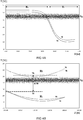
- FIGs 3B illustrates a resulting temperature distribution according to one of the simulated geometries, here with a substrate thickness of 2 mm.
- the grayscale indicates the temperatures where the darker colors illustrate the colder region around the electronic component and the lighter colors illustrate the hotter parts of the surrounding area.
- thermal processes may be considered:
- the present image shows the temperature one and half seconds (1.5s) after illumination which may be representative of a desired timescale between the end of the heating phase and the forming of the heated substrate.
- the temperature profile in the substrate is calculated along various plotlines.
- FIG 4A illustrates horizontal plotlines through the centre of the 2 mm substrate at different times t5,t6.
- the plotline is shown in FIG 3B as crossing the M2 and M1 section and the sections below the bonded component.
- the first time t5 corresponds to the end of illumination and the second time t6 corresponds to the thermoforming time, which can be a bit later (here 1.5 seconds). It may be noted that the temperature at the center of the substrate is still increasing after illumination due to (conductive) equilibration with the outer surface regions.
- FIG 4B illustrates vertical plotlines through the M1 section, from lower to upper surface, and vertical plotline through the M2 section, from lower to upper surface.
- the temperature equilibration between the center and outer surface regions of the substrate actually improve the temperature differential ⁇ Tlh between the lowest point of the relatively high temperature Th in section M2 and the highest point of the relatively low temperature Tl in section M1.
- this differential ⁇ Tlh is larger than the glass transition range, here schematically indicated by the gray gradient so there will be a maximal difference between the malleability of the two regions M1,M2.
- FIGs 5A and 5B illustrates similar plots as FIGs 4A and 4B , but now for a relatively thin substrate of 250 ⁇ m.
- the relatively thin substrate has approximately the same temperature on both sides and at the center even though the different material M1,M2 was only coated on one side. Also after illumination there is hardly any temperature equilibration in the direction transverse to the substrate.
- FIG 5A there is some equilibration along the substrate surface between the regions M1 and M2, but within the relatively short time scale (here 1.5 seconds) a sufficient temperature differential ⁇ Tlh across the glass transition temperature Tg remains, particularly at the position of the electronic component 14 which is preferably arranged with a certain margin within the border between the sections M1 and M2.
- a border B can be defined between the component area 11 of the substrate 13 comprising the first material M1, and the surrounding area 12 comprising the second material M2.
- the electronic component 14 may be disposed in the component area 11 having a maximum component size Xc (across the substrate 13 surface).
- the border B is distanced from a closest edge E of the electronic component 14 by an edge margin Xe which is at least twenty or at least fifty percent the maximum component size Xc.
- the margin much larger, e.g. Xe is larger than Xc by at least a factor two, three, five, ten, or more.
- the margin if the margin is too large, the substrate may not allow sufficient overall deformation. Accordingly, it may be preferred in some embodiments to keep the factor smaller than hundred, preferably smaller than fifty, more preferably smaller than twenty. For example, Xc ⁇ Xe ⁇ 20*Xe.
- a component with a footprint of dimensions 2 mm by 1 mm may be surrounded by a section of first material M1 having radius (Xc/2 + Xe) of 10 mm.
- radius (Xc/2 + Xe) of 10 mm may be used depending on various circumstances.
- the substrate 13 comprises thermal isolator material(not shown) arranged e.g. at the border B as a moat around the component area 11, wherein the thermal isolator material has a lower thermal conductivity than the other thermoplastic material Ms of the substrate 13 by at least a factor two, three, four, ten, or more. Using thermally isolating material between the regions 11,12 may improve the temperature differential by preventing conductive equilibration.
- the substrate 13 has different thicknesses already before the deformation process D, wherein the different thicknesses contribute to the differential temperature buildup during illumination.
Landscapes
- Engineering & Computer Science (AREA)
- Microelectronics & Electronic Packaging (AREA)
- Manufacturing & Machinery (AREA)
- Mechanical Engineering (AREA)
- Structure Of Printed Boards (AREA)
- Structures Or Materials For Encapsulating Or Coating Semiconductor Devices Or Solid State Devices (AREA)
- Non-Metallic Protective Coatings For Printed Circuits (AREA)
- Production Of Multi-Layered Print Wiring Board (AREA)
- Lining Or Joining Of Plastics Or The Like (AREA)
- Shaping Of Tube Ends By Bending Or Straightening (AREA)
Priority Applications (6)
| Application Number | Priority Date | Filing Date | Title |
|---|---|---|---|
| EP18209756.8A EP3664586A1 (de) | 2018-12-03 | 2018-12-03 | Differenzielle erwärmung bei der herstellung einer gekrümmten elektronischen vorrichtung |
| PCT/NL2019/050796 WO2020117049A1 (en) | 2018-12-03 | 2019-12-02 | Manufacture of a curved electronic device using differential heating and curved electronic device |
| JP2021531605A JP7453231B2 (ja) | 2018-12-03 | 2019-12-02 | 差動加熱を使用する湾曲電子デバイスの製造および湾曲電子デバイス |
| US17/293,348 US12349272B2 (en) | 2018-12-03 | 2019-12-02 | Manufacture of a curved electronic device using differential heating and curved electronic device |
| EP19816947.6A EP3892071B1 (de) | 2018-12-03 | 2019-12-02 | Herstellung einer gekrümmten elektronischen vorrichtung mittels differenzielle erwärmung und gekrümmte elektronische vorrichtung |
| CN201980076925.5A CN113170583B (zh) | 2018-12-03 | 2019-12-02 | 使用差温加热的弯曲电子设备的制造以及弯曲电子设备 |
Applications Claiming Priority (1)
| Application Number | Priority Date | Filing Date | Title |
|---|---|---|---|
| EP18209756.8A EP3664586A1 (de) | 2018-12-03 | 2018-12-03 | Differenzielle erwärmung bei der herstellung einer gekrümmten elektronischen vorrichtung |
Publications (2)
| Publication Number | Publication Date |
|---|---|
| EP3664586A1 true EP3664586A1 (de) | 2020-06-10 |
| EP3664586A8 EP3664586A8 (de) | 2020-07-22 |
Family
ID=64604452
Family Applications (2)
| Application Number | Title | Priority Date | Filing Date |
|---|---|---|---|
| EP18209756.8A Withdrawn EP3664586A1 (de) | 2018-12-03 | 2018-12-03 | Differenzielle erwärmung bei der herstellung einer gekrümmten elektronischen vorrichtung |
| EP19816947.6A Active EP3892071B1 (de) | 2018-12-03 | 2019-12-02 | Herstellung einer gekrümmten elektronischen vorrichtung mittels differenzielle erwärmung und gekrümmte elektronische vorrichtung |
Family Applications After (1)
| Application Number | Title | Priority Date | Filing Date |
|---|---|---|---|
| EP19816947.6A Active EP3892071B1 (de) | 2018-12-03 | 2019-12-02 | Herstellung einer gekrümmten elektronischen vorrichtung mittels differenzielle erwärmung und gekrümmte elektronische vorrichtung |
Country Status (5)
| Country | Link |
|---|---|
| US (1) | US12349272B2 (de) |
| EP (2) | EP3664586A1 (de) |
| JP (1) | JP7453231B2 (de) |
| CN (1) | CN113170583B (de) |
| WO (1) | WO2020117049A1 (de) |
Cited By (1)
| Publication number | Priority date | Publication date | Assignee | Title |
|---|---|---|---|---|
| EP4472362A1 (de) * | 2023-05-30 | 2024-12-04 | Fundació Eurecat | Herstellungsverfahren für eine elektronische vorrichtung mit einem nicht flachen laminaren element mit einer nicht flachen elektronischen schaltung darauf |
Families Citing this family (1)
| Publication number | Priority date | Publication date | Assignee | Title |
|---|---|---|---|---|
| DE102019135176A1 (de) * | 2019-12-19 | 2021-06-24 | Hauni Maschinenbau Gmbh | Modulares Verdampfersystem zum Verdampfen einer Zusammensetzung |
Citations (2)
| Publication number | Priority date | Publication date | Assignee | Title |
|---|---|---|---|---|
| WO2017167875A1 (en) * | 2016-03-30 | 2017-10-05 | At & S Austria Technologie & Systemtechnik Aktiengesellschaft | Laminated component carrier with a thermoplastic structure |
| WO2018077555A1 (de) * | 2016-10-26 | 2018-05-03 | Osram Gmbh | Flexibles leuchtmodul, trägeranordnung zum montieren von plattenelementen und verfahren zum montieren eines flexiblen leuchtmoduls |
Family Cites Families (12)
| Publication number | Priority date | Publication date | Assignee | Title |
|---|---|---|---|---|
| US3244780A (en) | 1962-06-29 | 1966-04-05 | Levey John | Differential heating and drawing of plastics |
| US4156626A (en) * | 1977-07-18 | 1979-05-29 | Souder James J | Method and apparatus for selectively heating discrete areas of surfaces with radiant energy |
| JPS63104499A (ja) * | 1986-10-22 | 1988-05-09 | キヤノン株式会社 | 筐体基板 |
| WO2002014051A1 (en) | 2000-08-10 | 2002-02-21 | Display Pack, Inc. | Method for thermoforming contoured products by using temperature differential |
| JP4932434B2 (ja) * | 2006-11-02 | 2012-05-16 | 矢崎総業株式会社 | プロテクタの製造方法 |
| JP2009252801A (ja) * | 2008-04-01 | 2009-10-29 | Toshiba Corp | 部品実装基板及び部品実装基板の製造方法 |
| US20100079989A1 (en) * | 2008-09-27 | 2010-04-01 | Kuang-Chao Yeh | Flexible Thin-Type Light-Emitting-Diode Circuit Substrate and a Light-Emitting-Diode Lamp Strip |
| JP5431788B2 (ja) | 2009-05-21 | 2014-03-05 | 三菱瓦斯化学株式会社 | 曲げ加工可能な光透過型電磁波シールド積層体およびその製造方法 |
| EP2346108A1 (de) * | 2010-01-15 | 2011-07-20 | Nederlandse Organisatie voor toegepast -natuurwetenschappelijk onderzoek TNO | Folienförmiges elektrooptisches Produkt, halbfertiges Produkt und Verfahren und Vorrichtung zur Herstellung davon |
| US8865394B2 (en) * | 2010-08-23 | 2014-10-21 | Koninklijke Philips N.V. | Self-aligned coverage of opaque conductive areas |
| WO2015198865A1 (ja) * | 2014-06-23 | 2015-12-30 | 株式会社村田製作所 | 樹脂基板組合せ構造体 |
| DE102016013749A1 (de) * | 2016-11-18 | 2018-05-24 | Azur Space Solar Power Gmbh | Stapelförmige Halbleiterstruktur |
-
2018
- 2018-12-03 EP EP18209756.8A patent/EP3664586A1/de not_active Withdrawn
-
2019
- 2019-12-02 CN CN201980076925.5A patent/CN113170583B/zh active Active
- 2019-12-02 JP JP2021531605A patent/JP7453231B2/ja active Active
- 2019-12-02 EP EP19816947.6A patent/EP3892071B1/de active Active
- 2019-12-02 WO PCT/NL2019/050796 patent/WO2020117049A1/en not_active Ceased
- 2019-12-02 US US17/293,348 patent/US12349272B2/en active Active
Patent Citations (2)
| Publication number | Priority date | Publication date | Assignee | Title |
|---|---|---|---|---|
| WO2017167875A1 (en) * | 2016-03-30 | 2017-10-05 | At & S Austria Technologie & Systemtechnik Aktiengesellschaft | Laminated component carrier with a thermoplastic structure |
| WO2018077555A1 (de) * | 2016-10-26 | 2018-05-03 | Osram Gmbh | Flexibles leuchtmodul, trägeranordnung zum montieren von plattenelementen und verfahren zum montieren eines flexiblen leuchtmoduls |
Cited By (2)
| Publication number | Priority date | Publication date | Assignee | Title |
|---|---|---|---|---|
| EP4472362A1 (de) * | 2023-05-30 | 2024-12-04 | Fundació Eurecat | Herstellungsverfahren für eine elektronische vorrichtung mit einem nicht flachen laminaren element mit einer nicht flachen elektronischen schaltung darauf |
| WO2024246191A1 (en) | 2023-05-30 | 2024-12-05 | Fundació Eurecat | Manufacturing method and electronic arrangment for designing an electronic device comprising a non-flat laminar item with a non-flat electronic circuit thereon |
Also Published As
| Publication number | Publication date |
|---|---|
| EP3892071A1 (de) | 2021-10-13 |
| JP7453231B2 (ja) | 2024-03-19 |
| EP3664586A8 (de) | 2020-07-22 |
| JP2022512094A (ja) | 2022-02-02 |
| EP3892071B1 (de) | 2023-07-26 |
| CN113170583A (zh) | 2021-07-23 |
| US12349272B2 (en) | 2025-07-01 |
| WO2020117049A1 (en) | 2020-06-11 |
| CN113170583B (zh) | 2024-08-23 |
| EP3892071C0 (de) | 2023-07-26 |
| US20220015229A1 (en) | 2022-01-13 |
Similar Documents
| Publication | Publication Date | Title |
|---|---|---|
| JP7654705B2 (ja) | 電気機械的構造体を製造するための方法およびその方法を実施するための装置 | |
| CN203818580U (zh) | 加热平台与立体打印装置 | |
| JP6190038B2 (ja) | レーザ粉末積層造形装置及びレーザ粉末積層造形方法及び3次元積層造形装置 | |
| EP3892071B1 (de) | Herstellung einer gekrümmten elektronischen vorrichtung mittels differenzielle erwärmung und gekrümmte elektronische vorrichtung | |
| US11071205B2 (en) | Control unit | |
| CN108367544A (zh) | 制造用于机动车的复合玻璃板的方法 | |
| CN110815878B (zh) | 树脂成形薄片、树脂成形薄片的制造方法、造形物以及造形物的制造方法 | |
| CN114630746B (zh) | 用于接合热塑性膜与金属构件的方法 | |
| JP7746255B2 (ja) | 多層積層体を備えている電子デバイス | |
| JP4332016B2 (ja) | プラスチック積層体の製造方法 | |
| US20140146501A1 (en) | Electronic device in plastic | |
| JP2022508794A5 (de) | ||
| JP7725505B2 (ja) | Oledディスプレイを有する熱成形されたデバイス及びその製造の方法 | |
| JP4977715B2 (ja) | 凹凸パターン形成方法 | |
| EP4151390B1 (de) | Verfahren zur herstellung einer nicht flachen vorrichtung durch verformung eines flachen vorrichtungslaminats | |
| EP3300467A1 (de) | Verfahren zur herstellung formbeständiger nichtflacher vorrichtungen | |
| JP7026367B1 (ja) | 配線基板及びその製造方法 | |
| CN118696607A (zh) | 具有集成器件的三维形状的模块和方法 | |
| JP5556865B2 (ja) | カード、カード製造方法 | |
| JP2022084366A (ja) | フレキシブル回路基板の成形装置及び成形方法 | |
| JP2023530279A5 (de) | ||
| WO2018065604A1 (en) | Control unit |
Legal Events
| Date | Code | Title | Description |
|---|---|---|---|
| PUAI | Public reference made under article 153(3) epc to a published international application that has entered the european phase |
Free format text: ORIGINAL CODE: 0009012 |
|
| STAA | Information on the status of an ep patent application or granted ep patent |
Free format text: STATUS: THE APPLICATION HAS BEEN PUBLISHED |
|
| AK | Designated contracting states |
Kind code of ref document: A1 Designated state(s): AL AT BE BG CH CY CZ DE DK EE ES FI FR GB GR HR HU IE IS IT LI LT LU LV MC MK MT NL NO PL PT RO RS SE SI SK SM TR |
|
| AX | Request for extension of the european patent |
Extension state: BA ME |
|
| RIN1 | Information on inventor provided before grant (corrected) |
Inventor name: VAN DELFT, JAN PIETER HEIN Inventor name: VAN DEN BRAND, JEROEN Inventor name: SCHRAM, JEROEN FRANCISCUS MARINUS Inventor name: KUSTERS, ROEL HENRY LOUIS Inventor name: VAN DER WAAL, ADRI Inventor name: DE KOK, MARGARETHA MARIA Inventor name: RUBINGH, JAN-ERIC MARTIJN |
|
| RIN1 | Information on inventor provided before grant (corrected) |
Inventor name: RUBINGH, JAN-ERIC JACK MARTIJN Inventor name: DE KOK, MARGARETHA MARIA Inventor name: VAN DELFT, JAN PIETER HEIN Inventor name: SCHRAM, JEROEN FRANCISCUS MARINUS Inventor name: KUSTERS, ROEL HENRY LOUIS Inventor name: VAN DEN BRAND, JEROEN Inventor name: VAN DER WAAL, ADRI |
|
| STAA | Information on the status of an ep patent application or granted ep patent |
Free format text: STATUS: THE APPLICATION IS DEEMED TO BE WITHDRAWN |
|
| 18D | Application deemed to be withdrawn |
Effective date: 20201211 |