EP3665172B1 - Verbindungen als potenzielle farbstoffmoleküle - Google Patents
Verbindungen als potenzielle farbstoffmoleküle Download PDFInfo
- Publication number
- EP3665172B1 EP3665172B1 EP18844418.6A EP18844418A EP3665172B1 EP 3665172 B1 EP3665172 B1 EP 3665172B1 EP 18844418 A EP18844418 A EP 18844418A EP 3665172 B1 EP3665172 B1 EP 3665172B1
- Authority
- EP
- European Patent Office
- Prior art keywords
- alkyl
- optionally substituted
- group
- compound
- aromatic ring
- Prior art date
- Legal status (The legal status is an assumption and is not a legal conclusion. Google has not performed a legal analysis and makes no representation as to the accuracy of the status listed.)
- Active
Links
Images








Classifications
-
- C—CHEMISTRY; METALLURGY
- C07—ORGANIC CHEMISTRY
- C07D—HETEROCYCLIC COMPOUNDS
- C07D471/00—Heterocyclic compounds containing nitrogen atoms as the only ring hetero atoms in the condensed system, at least one ring being a six-membered ring with one nitrogen atom, not provided for by groups C07D451/00 - C07D463/00
- C07D471/22—Heterocyclic compounds containing nitrogen atoms as the only ring hetero atoms in the condensed system, at least one ring being a six-membered ring with one nitrogen atom, not provided for by groups C07D451/00 - C07D463/00 in which the condensed systems contains four or more hetero rings
-
- C—CHEMISTRY; METALLURGY
- C09—DYES; PAINTS; POLISHES; NATURAL RESINS; ADHESIVES; COMPOSITIONS NOT OTHERWISE PROVIDED FOR; APPLICATIONS OF MATERIALS NOT OTHERWISE PROVIDED FOR
- C09B—ORGANIC DYES OR CLOSELY-RELATED COMPOUNDS FOR PRODUCING DYES, e.g. PIGMENTS; MORDANTS; LAKES
- C09B3/00—Dyes with an anthracene nucleus condensed with one or more carbocyclic rings
- C09B3/14—Perylene derivatives
- C09B3/18—Preparation from starting materials already containing the perylene nucleus
-
- C—CHEMISTRY; METALLURGY
- C09—DYES; PAINTS; POLISHES; NATURAL RESINS; ADHESIVES; COMPOSITIONS NOT OTHERWISE PROVIDED FOR; APPLICATIONS OF MATERIALS NOT OTHERWISE PROVIDED FOR
- C09B—ORGANIC DYES OR CLOSELY-RELATED COMPOUNDS FOR PRODUCING DYES, e.g. PIGMENTS; MORDANTS; LAKES
- C09B5/00—Dyes with an anthracene nucleus condensed with one or more heterocyclic rings with or without carbocyclic rings
- C09B5/24—Dyes with an anthracene nucleus condensed with one or more heterocyclic rings with or without carbocyclic rings the heterocyclic rings being only condensed with an anthraquinone nucleus in 1-2 or 2-3 position
-
- C—CHEMISTRY; METALLURGY
- C09—DYES; PAINTS; POLISHES; NATURAL RESINS; ADHESIVES; COMPOSITIONS NOT OTHERWISE PROVIDED FOR; APPLICATIONS OF MATERIALS NOT OTHERWISE PROVIDED FOR
- C09B—ORGANIC DYES OR CLOSELY-RELATED COMPOUNDS FOR PRODUCING DYES, e.g. PIGMENTS; MORDANTS; LAKES
- C09B5/00—Dyes with an anthracene nucleus condensed with one or more heterocyclic rings with or without carbocyclic rings
- C09B5/62—Cyclic imides or amidines of peri-dicarboxylic acids of the anthracene, benzanthrene, or perylene series
Definitions
- perylene based compounds which may be dye molecules, with tailored absorbance and emission spectral maxima.
- Red light absorbing and near-IR absorbing perylene dyes are useful in a range of applications, including in vat dyes 1-4 and organic solar cells. 5-9
- Perylene 3,4,9,10 tetracarboxylic dianhydride ( Figure 1 ) is a useful precursor to generate numerous perylenes dyes.
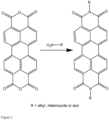
- a primary amine may be reacted with the anhydride group to form the corresponding perylenes diimide ( Figure 2 ).
- the tetraphenoxy perylene core is utilised to achieve red shifted molecules.
- the actual production of these dyes may begin with condensation of the tetra halogenated core (e.g., 1,6,7, 12-tetrachloro-3,4;9,10-perylenetetracarboxydianhydride) and perform the phenoxy substitution reaction as a second step.
- the tetra halogenated core e.g., 1,6,7, 12-tetrachloro-3,4;9,10-perylenetetracarboxydianhydride
- the inventors have taken a different approach to provide perylene dyes with an extended aryl imidazoles at the 3,4;9,10 positions.
- Disclosed herein are compounds functionalised at 2 bay positions, for example the 1,6 or 1,7 positions. Compounds obtained accordingly, may be used as a dye whose absorbance and fluorescence spectrum are red-shifted.
- Disclosed herein are a series of compounds based on the generation of an extended aryl imidazole structure on a 1,6 or 1,7 di-substituted perylene core to achieve a series of perylene molecules that may display unique spectroscopic properties (namely absorption and fluorescence maxima) compared to the analogous tetra substituted perylenes bearing the same aryl imidazole groups, thus forming a different series of perylenes dyes.
- a dye composition comprising a compound according to the first aspect.
- a method of synthesising a compound according to the first aspect comprising the step of contacting a compound of Formula (II) wherein each of R 15 , R 16 and R 17 is independently selected from hydrogen, bromine or chlorine, with the proviso that two of R 15 , R 16 and R 17 are either bromine or chlorine, and the other is hydrogen, with a compound of Formula (III): wherein R 19 and R 20 : are joined to form an optionally substituted monocyclic aromatic ring; or are joined to form an optionally substituted polycyclic aromatic group.
- a compound produced by a method according to the third aspect is a compound produced by a method according to the third aspect.
- the advantages of the disclosed series of perylenes dyes may include, but are not limited to:
- range format is included for convenience and should not be interpreted as an inflexible limitation on the scope of the disclosure. Accordingly, the description of a range should be considered to have specifically disclosed all the possible sub-ranges as well as individual numerical values within that range, unless specifically indicated. For example, description of a range such as from 1 to 5 should be considered to have specifically disclosed sub-ranges such as from 1 to 3, from 1 to 4, from 1 to 5, from 2 to 4, from 2 to 5, from 3 to 5 etc., as well as individual and partial numbers within the recited range, for example, 1, 2, 3, 4, 5, 5.5 and 6, unless where integers are required or implicit from context. This applies regardless of the breadth of the disclosed range. Where specific values are required, these will be indicated in the specification.
- the structural formula of a compound may represent a certain isomer for convenience in some cases, but the present disclosure, unless otherwise indicated, includes all isomers, such as geometrical isomers, for example syn- and anti- isomers, optical isomers based on an asymmetrical carbon, stereoisomers, tautomers, and the like.
- a crystal polymorphism may be present for the compounds represented by the formula. It is noted that any crystal form, crystal form mixture, or anhydride or hydrate thereof is included in the scope of the present disclosure.
- “Isomerism” means compounds that have identical molecular formulae but differ in the sequence of bonding of their atoms or in the arrangement of their atoms in space. Isomers that differ in the arrangement of their atoms in space are termed “stereoisomers”. Stereoisomers that are not mirror images of one another are termed “diastereoisomers”, and stereoisomers that are non-superimposable mirror images of each other are termed “enantiomers” or sometimes optical isomers. A mixture containing equal amounts of individual enantiomeric forms of opposite chirality is termed a "racemic mixture”.
- Chiral isomer means a compound with at least one chiral centre. Compounds with more than one chiral centre may exist either as an individual diastereomer or as a mixture of diastereomers, termed "diastereomeric mixture". When one chiral centre is present, a stereoisomer may be characterized by the absolute configuration (R or S) of that chiral centre. Absolute configuration refers to the arrangement in space of the substituents attached to the chiral centre.
- “Geometric isomer” means the diastereomers that owe their existence to hindered rotation about double bonds. These configurations are differentiated in their names by the prefixes cis and trans, or Z and E, which indicate that the groups are on the same or opposite side of the double bond in the molecule
- atropic isomers are a type of stereoisomer in which the atoms of two isomers are arranged differently in space. Atropic isomers owe their existence to a restricted rotation caused by hindrance of rotation of large groups about a central bond.
- the compounds of Formula (I) may exist in either the “syn” or the “anti” form.
- the compounds of Formula (I) may exist in either the “syn” or the “anti” form.
- Tautomer is one of two or more structural isomers that exist in equilibrium and is readily converted from one isomeric form to another. This conversion results in the formal migration of a hydrogen atom accompanied by a switch of adjacent conjugated double bonds. Tautomers exist as a mixture of a tautomeric set in solution. In solid form, usually one tautomer predominates. In solutions where tautomerisation is possible, a chemical equilibrium of the tautomers will be reached. The exact ratio of the tautomers depends on several factors, including temperature, solvent and pH. The concept of tautomers that are inter-convertible by tautomerisations is called tautomerism.
- Alkyl means a straight chain or branched, noncyclic or cyclic, saturated aliphatic hydrocarbon.
- the alkyl group may contain from 1 to 24 carbon atoms.
- Representative saturated straight chain alkyls include methyl, ethyl, n-propyl, n-butyl, n-pentyl, n-hexyl, and the like; while saturated branched alkyls include isopropyl, sec-butyl, isobutyl, tert-butyl, isopentyl, and the like.
- saturated cyclic alkyls include cyclopropyl, cyclobutyl, cyclopentyl, cyclohexyl, and the like; while unsaturated cyclic alkyls include cyclopentenyl and cyclohexenyl, and the like.
- Alkenyl means an alkyl, as defined above, containing at least one double bond between adjacent carbon atoms.
- the alkenyl group may contain from 2 to 24 carbon atoms.
- Alkenyls include both cis and trans isomers.
- Representative straight chain and branched alkenyls include ethylenyl, propylenyl, 1-butenyl, 2-butenyl, isobutylenyl, 1-pentenyl, 2-pentenyl, 3-methyl-I-butenyl, 2-methyl-2-butenyl, 2,3-dimethyl-2-butenyl, and the like.
- Alkynyl means any alkyl or alkenyl, as defined above, which additionally contains at least one triple bond between adjacent carbons.
- the alkynyl group may contain from 2 to 24 carbon atoms.
- Representative straight chain and branched alkynyls include acetylenyl, propynyl, 1-butynyl, 2-butynyl, 1-pentynyl, 2-pentynyl, 3-methyl-1-butynyl, and the like.
- aryl refers to a mono- or polycyclic aromatic hydrocarbon systems.
- the aryl systems may have having 3 to 22 carbon atoms, which can be optionally substituted.
- aryl also includes systems in which the aromatic cycle is part of a bi- or polycyclic saturated, partially unsaturated and/or aromatic system, such as where the aromatic cycle is fused to an aryl, cycloalkyl, heteroaryl or heterocyclyl group as defined herein via any desired and possible ring member of the aryl radical.
- the bonding to the compounds of the Formula (1) can be affected via any possible ring member of the aryl radical.
- Suitable aryl radicals are phenyl, biphenyl, naphthyl, 1-naphthyl, 2-naphthyl and anthracenyl, but likewise indanyl, indenyl or 1,2,3,4-tetrahydronaphthyl.
- the compound of Formula (I) is a salt.
- the compound of Formula (I) is a compound of Formula (I-B). In another embodiment the compound of Formula (I) is a compound of Formula (I-B1).
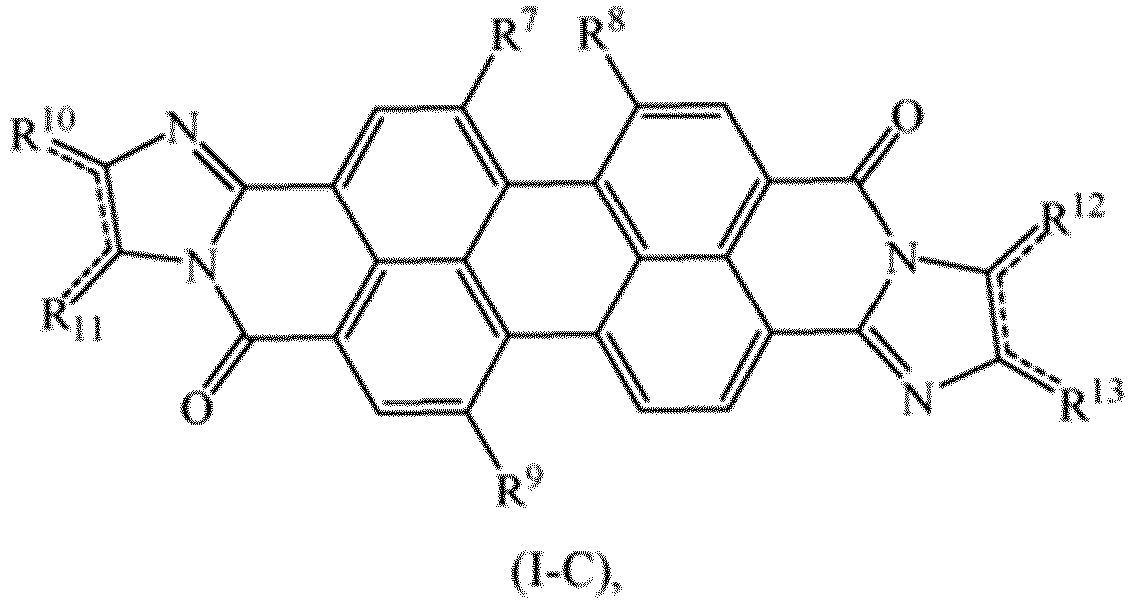
- the compound of Formula (I) is a compound of Formula (I-C). In another embodiment the compound of Formula (I) is a compound of Formula (I-C1).
- the compound of Formula (I) is a compound of Formula (I-D). In another embodiment the compound of Formula (I) is a compound of Formula (I-D1).
- joined to form an optionally substituted monocyclic aromatic ring or “are joined to form an optionally substituted polycyclic aromatic ring” means that two identified groups (for example R 10 and R 11 and/or R 12 and R 13 ) are taken with intervening atoms to form an optionally substituted monocyclic aromatic ring, such as an optionally substituted group, or an optionally substituted polycyclic aromatic group, such as an optionally substituted group, respectively.
- R 10 and R 11 are joined to form an optionally substituted monocyclic aromatic ring, and/or R 12 and R 13 are joined to form an optionally substituted monocyclic aromatic ring. In another embodiment R 10 and R 11 are joined to form an optionally substituted monocyclic aromatic ring, and R 12 and R 13 are joined to form an optionally substituted monocyclic aromatic ring.
- R 10 and R 11 are joined to form an optionally substituted polycyclic aromatic ring, and/or R 12 and R 13 are joined to form an optionally substituted polycyclic aromatic ring. In another embodiment R 10 and R 11 are joined to form an optionally substituted polycyclic aromatic ring, and R 12 and R 13 are joined to form an optionally substituted polycyclic aromatic ring.
- R 10 and R 11 , and R 12 and R 13 both independently form a monocyclic aromatic ring which is unsubstituted. In another embodiment R 10 and R 11 , and R 12 and R 13 both independently form a polycyclic aromatic group which is unsubstituted. In another embodiment R 10 and R 11 , and R 12 and R 13 both independently form a monocyclic aromatic ring which is substituted. In yet another embodiment R 10 and R 11 , and R 12 and R 13 both independently form a polycyclic aromatic group which is substituted.
- the polycyclic aromatic group may comprise 2, 3, 4, 5 or 6 fused ring systems, wherein each ring is optionally substituted.
- the polycyclic aromatic group comprises a plurality of ring structures, wherein at least one of these rings is aromatic. In one embodiment all the rings are aromatic.
- the optionally substituted monocyclic aromatic ring may be a heterocycle.
- the optionally substituted polycyclic aromatic group may comprise one or more heterocycles.
- Exemplary heterocycles include, but are not limited to optionally substituted: acridine; adenine; azepine; azole; 2 H -azole; 3 H -azole; benzimidazole; benzisoxazole; 2,1-benzisoxazole; benzofuran; 2 H -1-benzopyran; 2 H -1-benzopyran-2-one; 4 H -1-benzopyran-4-one; 1 H -2-benzopyran-1-one; 3 H -2-benzopyran-3-one; benzothiazole; benzo[ b ]thiophene; benzo[ c ]thiophene; 1 H -2,3-benzoxazine; 2 H -1,3-benzoxazine; 2 H -1,4-benzoxa
- the optionally substituted monocyclic aromatic ring or optionally substituted polycyclic aromatic group formed by R 10 and R 11 is the same as the optionally substituted monocyclic aromatic ring or the optionally substituted polycyclic aromatic group formed by R 12 and R 13 .
- Examples of monocyclic aromatic rings and polycyclic aromatic rings which may optionally be substituted includes, but is not limited to: phenyl, naphthalene, anthracene, phenanthrene, tetracene, chrysene, triphenylene, pyrene, pentacene, benzo[ a ]pyrene, and dibenz[ a,h ]anthracene rings, or mixtures thereof.
- monocyclic aromatic rings and polycyclic aromatic rings which may optionally be substituted includes, but is not limited to any one of: In these compounds indicates possible positions of attachment.
- the monocyclic aromatic ring or polycyclic aromatic group may be selected from, but not limited to, optionally substituted: or mixtures thereof.
- the monocyclic aromatic ring or polycyclic aromatic group may be selected from, but not limited to, optionally substituted: or mixtures thereof.
- the monocyclic aromatic ring or polycyclic aromatic group may be selected from, but not limited to, optionally substituted:
- the monocyclic aromatic ring or polycyclic aromatic group may be selected from, but not limited to, optionally substituted:
- the monocyclic aromatic ring or polycyclic aromatic group may be selected from, but not limited to, optionally substituted: for example
- the monocyclic aromatic ring or polycyclic aromatic group may be selected from, but not limited to, optionally substituted:
- R 7 , R 8 and R 9 may be whilst the remaining group is hydrogen.
- R 1 may be O or N. In one embodiment R 1 is O. In another embodiment R 1 is N.
- R 4 may be O or N. In one embodiment R 4 is O. In another embodiment R 4 is N.
- R 6 may be O or N. In one embodiment R 6 is O. In another embodiment R 6 is N.
- R 1 is O and R 3 is N, and R 2 and R 3 are joined by a group.
- R 3 is O and R 1 is N, and R 2 and R 1 are joined by a group.
- R 4 is O and R 6 is N, and R 5 and R 6 are joined by a group.
- R 6 is O and R 4 is N, and R 5 and R 4 are joined by a group.
- R 7 and R 9 may both be whilst R 8 is hydrogen.
- R 8 and R 9 may both be whilst R 7 is hydrogen.
- Each R 14 group may be an optionally substituted: a C 1 -C 24 alkyl group, a C 1 -C 24 alkenyl group, a C 1 -C 24 alkynyl group, halogen, nitro, cyano, hydroxy, sulfonic, thiol, ether, amino, alkylamino, dialkylamino, haloalkyl, hydroxyalkyl, alkoxy, haloalkoxy, aryloxy, heteroaryloxy, aralkyloxy, alkylthio, carboxamido, sulfonamido, alkylcarbonyl, arylcarbonyl, alkylsulfonyl, arylsulfonyl, carboxy, carboxyalkyl, cycloalkyl, aryl, heteroaryl, heterocyclo, alkoxyalkyl, (amino)alkyl, hydroxyalkylamino, (alkylamino)alkyl
- each R 14 may be selected from, but not limited to an optionally substituted appended: aryl, heteroaryl, pyridine, bipyridine, terpyridine or phenanthroline group.
- Each R 14 may be selected from: and wherein R 14 may be attached at any carbon on an aryl ring in the aforementioned structures.
- R 14 is an optionally substituted alkyl group.
- R 14 is an optionally substituted perylene.
- optionally substituted perylenes include those disclosed in: WO 2015/024064 Al , ChemPhysChem, 2011, 12, 595-608 ; J. AM. CHEM. SOC., 2004, 126, 8284-8294 ; Eur. J. Org. Chem., 2008, 4559-4562 ; J. Mater. Chem., 2010, 20, 3814-3826 ; Angew Chem Int Ed, 2002, 41(11), 1900 ; and Chem. Eur. J., 2004, 10, 1398 - 1414 .
- n may be selected from 0, 1, 2, 3, 4 or 5. In one embodiment n is 0. In another embodiment n is 1. In yet another embodiment, n is 2. In yet another embodiment, n is 3. In yet another embodiment, n is 4. In yet another embodiment, n is 5. When n is 2 or greater, each R 14 group may be the same or different.
- Examples of compounds of Formula (I), (I-A) , (I-B), (I-C) or (I-D) include, but are not limited, to optionally substituted: or an isomer or salt thereof, wherein R 7 , R 8 or R 9 are as defined herein.
- Examples of compounds of Formula (I), (I-A) , (I-B), (I-C) or (I-D) include compounds where R 7 , R 8 , R 9 , and the combinations of: R 10 and R 11 ; and R 12 and R 13 , are limited to the following optionally substituted substituents in Table 1: Table 1 - Exemplified substituents R 10 and R 11 R 12 and R 13 R 7 R 8 R 9 H H H H H H H H H H H H H H H H H H H H H H H H H H H H H H H H H H H H H H H H H H H H H H H H H H H H H H H H H H H H H H H H H H H H H H H H H H H H H H H H H H H H H H H H H H H H H H H H H H H H H H H H H H H H H H H H H H H H H H H H H H H H H H H H H H H H H H H H H H H H H H H H
- a compound of Formula (I), (I-A) , (I-B), (I-C) or (I-D) may have a purity in a range of about 85 to about 95%.
- a compound of Formula (I), (I-A), (I-B), (I-C) or (I-D) may have a purity of: at least 95%, at least 96%, at least 97%, at least 98% or a purity of greater than 98% .
- Compounds of Formula (I) or Formula (II) may be used as dyes, for example fluorescent dyes. They may also serve as charge transfer dyes or light harvesting dyes for organic solar cells or organic light emitting diodes (OLEDs). They may also serve as vat dyes for textiles. They may also be useful as dyes for dispersion in polymeric resins.
- polymeric resins include polymers which comprise: an acrylic, a urethane; an ester; a methacrylate; a thiophene; a co-polymer of any bond conjugated polymer; a light transparent polymer; a low ultra violet absorbent polymer; a heat conducting polymer; or an electrically conducting polymer.
- the polymer may be: aniline based; pyrrole based; acetylene based; or furan based.
- the polymer may comprise polyurethane, polyester, polyamide, polyurea, polycarbonate and polymethyl methacrylate.
- the constituent monomers in the polymers of the present disclosure may be methacrylate-based, carbonate-based, acrylamide-based, methacrylamide-based, or styrene-based monomers.
- Constituent monomers of the vinyl polymers include acrylic esters, specifically, e.g., methyl acrylate, ethyl acrylate, n-propyl acrylate, isopropyl acrylate, n-butyl acrylate, isobutyl acrylate, sec-butyl acrylate, tert-butyl acrylate, amyl acrylate, hexyl acrylate, 2-ethylhexyl acrylate, octyl acrylate, tert-octyl acrylate, 2-chloroethyl acrylate, 2-bromoethyl acrylate, 4-chlorobutyl acrylate, cyanoethyl acrylate, 2-acetoxyethyl acrylate, dimethylaminoethyl acrylate, benzyl acrylate, methoxybenzyl acrylate, 2-chlorocyclohexyl acrylate,
- Methacrylic esters specifically, e.g., methyl methacrylate, ethyl methacrylate, n-propyl methacrylate, isopropyl methacrylate, n-butyl methacrylate, isobutyl methacrylate, sec-butylmethacrylate, tert-butylmethacrylate, amyl methacrylate, hexylmethacrylate, cyclohexylmethacrylate, benzyl methacrylate, chlorobenzyl methacrylate, octyl methacrylate, stearylmethacrylate, sulfopropylmethacrylate, N-ethyl-N-phenylaminoethyl methacrylate, 2-(3-phenylpropyloxy)ethyl methacrylate, dimethylaminophenoxyethyl methacrylate, furfuryl meth
- Vinylesters specifically, e.g., vinylacetate, vinyl propionate, vinyl butyrate, vinyl isobutyrate, vinyl caproate, vinyl chloroacetate, vinylmethoxy acetate, vinylphenyl acetate, vinyl benzoate and vinyl salicylate can be exemplified.
- Acrylamides e.g., acrylamide, methylacrylamide, ethylacrylamide, propylacrylamide, isopropylacrylamide, n-butylacrylamide, sec-butylacrylamide, tert-butylacrylamide, cyclohexylacrylamide, benzylacrylamide, hydroxymethylacrylamide, methoxyethylacrylamide, dimethylaminoethylacrylamide, phenylacrylamide, dimethylacrylamide, diethylacrylamide, ⁇ -cyanoethylacrylamide, N-(2-acetoacetoxyethyl)acrylamide, and diacetoneacrylamide can be exemplified.
- Olefins e.g., dicyclopentadiene, ethylene, propylene, 1-butene, 1-pentene, vinyl chloride, vinylidene chloride, isoprene, chloroprene, butadiene, and 2,3-dimethylbutadiene can be exemplified.
- Styrenes e.g., styrene, methylstyrene, dimethylstyrene, trimethylstyrene, ethylstyrene, isopropylstyrene, chloromethylstyrene, methoxystyrene, acetoxystyrene, chlorostyrene, dichlorostyrene, bromostyrene, and vinylbenzoic acid methyl ester can be exemplified.
- Vinyl ethers e.g., methylvinyl ether, butylvinyl ether, hexylvinyl ether, methoxyethylvinyl ether and dimethylaminoethylvinyl ether can be exemplified.
- Two or more monomers may be used as co-monomers with each other according to purposes (e.g., improvement of hardness, flexibility, tensile strength and light fastness), thereby producing co-polymers.
- a compound of Formula (I), (I-A), (I-B), (I-C) or (I-D) may have an absorbance in a range of about 600 nm to about 800 nm in a UV/visible (UV/vis) spectrum.
- the UV/vis spectrum may be measured using appropriate equipment as known in the art, for example an ultraviolet-visible spectrophotometer.
- the fluorescence maxima may be measured using appropriate equipment as known in the art, for example a fluorescence spectrophotometer.
- Solvents that could be used to dissolve the compounds for a spectroscopic analysis can include: methylene chloride, chloroform, toluene, halogenated toluenes, xylene, chlorinated benzenes, nitro benzene, dimethyl sulphoxide, diethyl formamide, dimethyl formamide and ethers.
- compositions which comprise a compound of Formula (I), (I-A), (I-B), (I-C), and/or (I-D).
- compositions which consist essentially of Formula (I), (I-A) , (I-B), (I-C), and/or (I-D).
- composition comprises a compound of Formula (I).
- composition comprises a compound of Formula (I-A). In another embodiment the composition comprises a compound of Formula (I-A1).
- composition comprises a compound of Formula (I-C). In another embodiment the composition comprises a compound of Formula (I-C1).
- the composition may be a dye composition.
- the starting dibromo dianhydride may be reacted with 2 different o-aryl diamines or an alkyl amine mixed with an o-aryl amine to form a statistical mixtures of variously functionalised 3,4 and 9,10 carboxy groups.
- This mixtures can then be further reacted with one or more different types of phenols to further differentiate the products to form a varied mixture of dyes.
- This mixture may be used directly as a dye composition.
- a compound of Formula (I), (I-A), (I-B), (I-C) or (I-D) comprises the core of a multi-chromophore array wherein 2 other dyes bearing phenolic groups are reacted with the dibromo diaryl imidazole starting material to form a trimer where the other dyes groups are appended to the 2 bay positions of the core perylene.
- the phenol bearing chromophore is reacted with only one bay position of the patent dye and the second bromo group is then reacted with a different phenol.
- the second phenolic group may or may not be chromophoric.
- a compound of Formula (I), (I-A), (I-B), (I-C) or (I-D) may be used in conjunction with at least one other compound, for example a compound comprising a perylene core, to form a multi-chromophore complex.
- at least one other compound include, but are not limited to, the compounds disclosed in WO 2015/024064 Al ; ChemPhysChem, 2011, 12, 595-608 ; J. AM. CHEM. SOC., 2004, 126, 8284-8294 ; Eur. J. Org. Chem., 2008, 4559-4562 ; J. Mater. Chem., 2010, 20, 3814-3826 ; Angew Chem Int Ed, 2002, 41(11), 1900 ; and Chem. Eur. J., 2004, 10, 1398-1414 .
- a compound of Formula (I), (I-A), (I-B), (I-C) or (I-D) may be synthesised by a method that comprises the step of contacting a compound of Formula (II) wherein:
- R 15 , R 16 and R 17 may be and the remaining group is hydrogen.
- R 15 and R 17 may both be whilst R 16 is hydrogen.
- R 17 and R 18 may both be whilst R 15 is hydrogen.
- Each R 18 group may be an optionally substituted: alkyl, alkenyl, alkynyl, halogen, nitro, cyano, hydroxy, sulfonic, thiol, ether, amino, alkylamino, dialkylamino, haloalkyl, hydroxyalkyl, alkoxy, haloalkoxy, aryloxy, heteroaryloxy, aralkyloxy, alkylthio, carboxamido, sulfonamido, alkylcarbonyl, arylcarbonyl, alkylsulfonyl, arylsulfonyl, carboxy, carboxyalkyl, cycloalkyl, aryl, heteroaryl, heterocyclo, alkoxyalkyl, (amino)alkyl, hydroxyalkylamino, (alkylamino)alkyl, (dialkylamino)alkyl, (cyano)alkyl, (carboxamido)
- two of R 15 , R 16 and R 17 may be bromine and the remaining group is hydrogen.
- R 15 and R 17 may both be bromine, whilst R 16 is hydrogen.
- R 16 and R 17 may both be bromine, whilst R 15 is hydrogen.
- two of R 15 , R 16 and R 17 may be chlorine and the remaining group is hydrogen.
- R 15 and R 17 may both be chlorine, whilst R 16 is hydrogen.
- R 16 and R 17 may both be chlorine, whilst R 15 is hydrogen.
- R 18 is an optionally substituted alkyl group.
- each R 18 may be selected from, but not limited to an optionally substituted appended: aryl, heteroaryl, pyridine, bipyridine, terpyridine or phenanthroline group.
- Each R 18 may be selected from: and wherein R 18 may be attached at any carbon on an aryl ring in the aforementioned structures.
- R 18 is an optionally substituted alkyl group.
- R 18 is an optionally substituted perylene.
- optionally substituted perylenes include those disclosed in WO 2015/024064 Al ; ChemPhysChem, 2011, 12, 595-608 ; J. AM. CHEM. SOC., 2004, 126, 8284-8294 ; Eur. J. Org. Chem., 2008, 4559-4562 ; J. Mater. Chem., 2010, 20, 3814-3826 ; Angew Chem Int Ed, 2002, 41(11), 1900 ; and Chem. Eur. J., 2004, 10, 1398 - 1414 .
- Integer "p" may be selected from 0, 1, 2, 3, 4 or 5. In one embodiment p is 0. In another embodiment p is 1. In yet another embodiment p is 2.
- each R 18 group may be the same of different.
- R 19 and R 20 are joined to form an optionally substituted monocyclic aromatic ring. In another embodiment R 19 and R 20 are joined to form an optionally substituted polycyclic aromatic group. In another embodiment R 19 and R 20 form a monocyclic aromatic ring which is unsubstituted. In another embodiment R 19 and R 20 form a polycyclic aromatic group which is unsubstituted. In another embodiment R 19 and R 20 form a monocyclic aromatic ring which is substituted. In yet another embodiment R 19 and R 20 form a polycyclic aromatic group which is substituted.
- polycyclic aromatic group consists of 2, 3, 4, 5 or 6 fused ring systems, wherein each ring is optionally substituted.
- Examples of monocyclic aromatic rings and polycyclic aromatic rings which may optionally be substituted includes, but is not limited to: phenyl, naphthalene, anthracene, phenanthrene, tetracene, chrysene, triphenylene, pyrene, pentacene, benzo[a]pyrene, and dibenz[a,h]anthracene rings, or mixtures thereof.
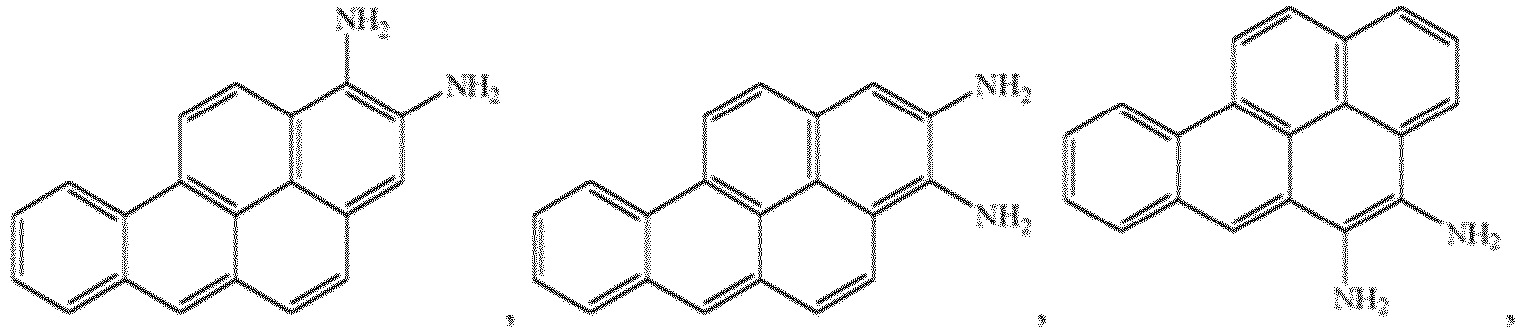
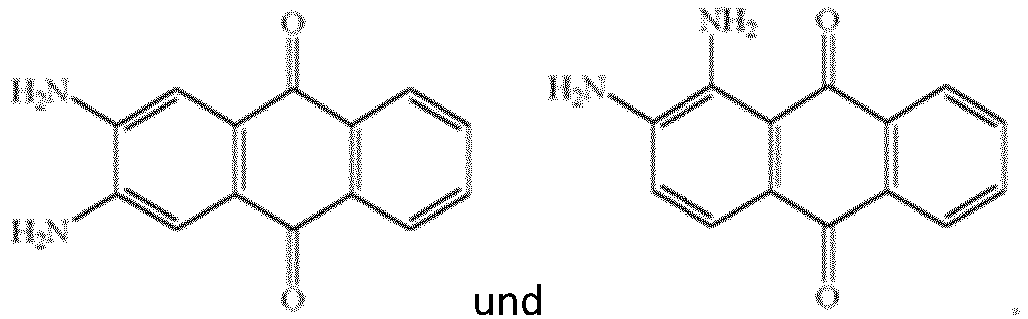
- a compound of Formula (III) is selected from the group consisting of optionally substituted:
- a compound of Formula (III) is selected from the group consisting of optionally substituted:
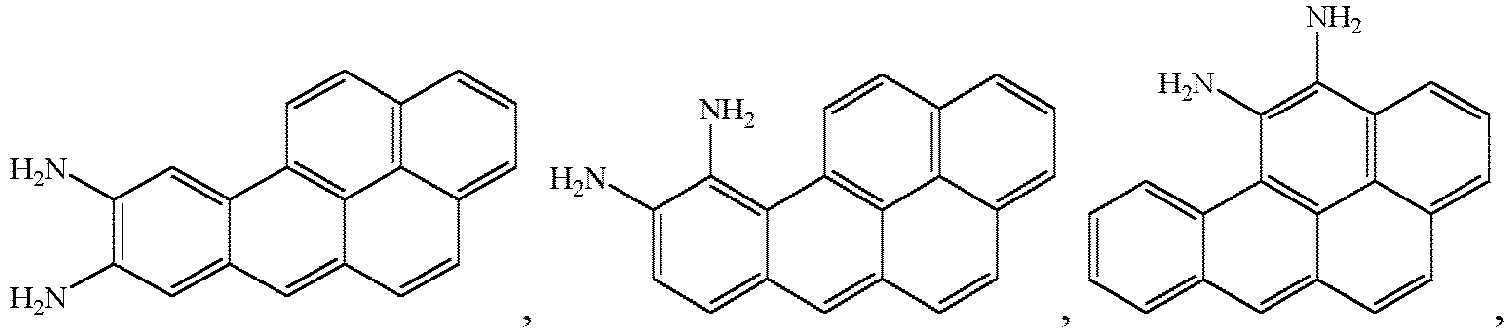
- the compound of Formula III is selected from: o-phenylene diamine, 2,3 diamino naphthalene, 1,2 diamino naphthalene, or 2,3 diamino anthroquinone.
- the resulting product of a compound of Formula (II) and a compound of Formula (III) may be reacted with appropriate alcohols to yield a compound of Formula (I).
- Also disclosed herein is a compound produced by a method as described herein.
- Perylene 3,4:9,10 tetracarboxylic bis anhydride (128-69-8), 4-tertbutyl phenol (CAS: 98-54-4 ), 4-dodecyl phenol (mixture of isomers; CAS: 27193-86-8 ), 1,2-diamino benzene ( CAS: 95-54-5 ), 1,2 diamino anthroquinone ( CAS: 1758-68-5 ) were purchased from Sigma Aldrich and used without further purification.
- Reagent grade dimethylformamide (DMF) was subjected to high vacuum while stirring at room temperature to extract free dimethyl amine and moisture directly before use.
- HBr gas formed during the reaction was vented from the top of the condenser by a gentle stream of N 2 gas into a 500 mL aqueous quenching solution of w/w 5% NaOH,0.05% Na 2 S 2 O 5 .
- the reaction was cooled to room temperature and excess bromine was removed by bubbling the reaction with N 2 gas into the quenching solution.
- 65 mL of water was added carefully to precipitate the product.
- the resulting precipitate was separated by filtration through a G4 funnel, washed with 3 ⁇ 300 g of 86% sulfuric acid followed by a large amount of water.
- the product was dried in a vacuum to give 135g (96%) of an isomeric mixture of 1,7 & 1,6 dibromoperylene-3,4:9, 10-tetracarboxylic acid bisanhydride as a red powder.
- the crude product could not be purified since it is insoluble in organic solvents and was used without further purification.
- trans and cis isomers typically in an 8:2 ratio, along with trace amounts of 1,6,7 tribromoperylene-3,4:9,10-tetracarboxylic acid bisanhydride (>2%) are formed in this procedure. These isomers generally persist in the same ratios in the dyes derived from them described herein .
- Scheme 2 shows the trans isomer. Trans and cis dibromo species are formed along with the possible anti and syn isomers for the benzimidazole groups. In total there are four possible isomers, as well as trace amounts of the tribromo species.
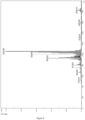
- Figure 6 shows a MALDI spectrum of Compound 2.
- the peak at 772.236 shows the tribromo species that was not isolated.
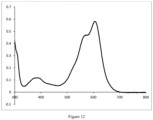
- MALDI and UV/vis characterisation data are shown in Figure 11 and Figure 12 , respectively.
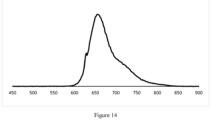
- UV/vis absorbance, fluorescence and MALDI characterisation data are shown in Figure 13 , Figure 14 and Figure, respectively.
- Figure 15 the artefact peak near 630 nm arises from excitation light source in the fluorometer
Landscapes
- Chemical & Material Sciences (AREA)
- Organic Chemistry (AREA)
- Pharmaceuticals Containing Other Organic And Inorganic Compounds (AREA)
- Nitrogen Condensed Heterocyclic Rings (AREA)
- Plural Heterocyclic Compounds (AREA)
Claims (15)
- Verbindung der Formel (I):
 - bei R1, R2 und R3 entweder:(i) R1 O ist, R3 N ist und R2 und R3 durch eine
 (ii) R3 O ist, R1 N ist und R1 und R2 durch eine
 - bei R4, R5 und R6 entweder:(i) R4 O ist, R6 N ist und R5 und R6 durch eine
 (ii) R6 O ist, R4 N ist und R4 und R5 durch eine
 - R10 und R11 verbunden sind, um zu bilden: einen optional substituierten monozyklischen aromatischen Ring; oder eine optional substituierte polyzyklische aromatische Gruppe, wobei der optional substituierte monozyklische aromatische Ring ein Heterozyklus sein kann und die optional substituierte polyzyklische aromatische Gruppe einen oder mehrere Heterozyklen umfassen kann;- R12 und R13 verbunden sind, um zu bilden: einen optional substituierten monozyklischen aromatischen Ring; oder eine optional substituierte polyzyklische aromatische Gruppe, wobei der optional substituierte monozyklische aromatische Ring ein Heterozyklus sein kann und die optional substituierte polyzyklische aromatische Gruppe einen oder mehrere Heterozyklen umfassen kann;- jedes von R7, R8 und R9 ist:- unabhängig ausgewählt aus Wasserstoff oder
 - jedes R14 unabhängig ausgewählt ist aus: einer C1-C24-Alkylgruppe, einer C2-C24-Alkenylgruppe, einer C2-C24-Alkinylgruppe, Halogen-, Nitro-, Cyano-, Hydroxy-, Sulfonsäure-, Thiol-, Ether-, Amino-, Alkylamino-, Dialkylamino-, Halogenalkyl-, Hydroxyalkyl-, Alkoxy-, Halogenalkoxy-, Aryloxy-, Heteroaryloxy-, Aralkyloxy-, Alkylthio-, Carboxamido-, Sulfonamido-, Alkylcarbonyl-, Arylcarbonyl-, Alkylsulfonyl-, Arylsulfonyl-, Carboxy-, Carboxyalkyl-, Cycloalkyl-, Aryl-, Heteroaryl-, Heterocyclo-, Alkoxyalkyl-, (Amino)alkyl-, Hydroxyalkylamino-, (Alkylamino)alkyl-, (Dialkylamino)alkyl-, (Cyano)alkyl- , (Carboxamido)alkyl-, Mercaptoalkyl-, (Heterocyclo)alkyl-, (Cycloalkylamino)alkyl-, (C1-C4-Halogenalkoxy)alkyl-, (Heteroaryl)alkyl- oder Perylengruppen, von denen jedes optional einen oder mehrere Substituenten umfasst;- - - - - - - das Vorhandensein einer Einfach- oder Doppelbindung darstellt; und- n eine ganze Zahl, ausgewählt aus 0, 1, 2, 3, 4 oder 5 ist;- Salze ausgewählt sind aus Acetat-, Benzolsulfonat-, Benzoat-, Bicarbonat-, Bitartrat-, Bromid-, Calciumedetat-, Camsylat-, Carbonat-, Chlorid-, Bromid-, lodid-, Citrat- , Dihydrochlorid-, Edetat-, Edisylat-, Estolat-, Esylat-, Fumarat-, Gluceptat-, Gluconat-, Glutamat-, Glycollylarsanilat-, Hexylresorcinat-, Hydrabamin-, Hydroxynaphthoat-, Isethionat-, Lactat-, Lactobionat-, Malat-, Maleat-, Mandelat-, Methansulfonat- (Mesylat- ), Methylsulfat-, Muskat-, Napsylat-, Nitrat-, Pantothenat-, Phosphat/Diphosphat-, Polygalacturonat-, Salicylat-, Stearat-, Succinat-, Sulfat-, Tannat-, Tartrat-, Teoclat-, Triethiodid- oder Pamoatsalzen, Alkalimetall- oder Erdalkalimetallsalzen, Calcium-, Magnesium-, Natrium-, Lithium-, Zink-, Kalium- und Eisensalzen; und- optionale Substituenten unabhängig ausgewählt sind aus Alkyl, Alken, Alkin, Halogen, Nitro, Cyano, Hydroxy, Sulfonsäure, Thiol, Ether, Amino, Alkylamino, Dialkylamino, Halogenalkyl, Hydroxyalkyl, Alkoxy, Halogenalkoxy, Aryloxy, Heteroaryloxy, Aralkyloxy, Alkylthio, Carboxamido, Sulfonamido, Alkylcarbonyl, Arylcarbonyl, Alkylsulfonyl, Arylsulfonyl, Carboxy, Carboxyalkyl, Alkyl, Cycloalkyl, Alkenyl, Alkinyl, Aryl, Heteroaryl, Heterocyclo, Alkoxyalkyl, (Amino)alkyl, Hydroxyalkylamino, (Alkylamino)alkyl, (Dialkylamino)alkyl, (Cyano)alkyl, (Carboxamido)alkyl, Mercaptoalkyl, (Heterocyclo)alkyl, (Cycloalkylamino)alkyl, (C1-C4-Halogenalkoxy)alkyl, (Heteroaryl)alkyl, oder Perylen, Oxo, Heterocyclus, -ORX, -NRx RY, -NRx C(=O)Ry -NRx SO2 Ry, -C(=O)Rx, - C(=O)ORx, -C(=O)NR×Ry, - SOq Rx und -SOq NRx Ry, wobei q 0, 1 oder 2 ist, Rx und Ry gleich oder verschieden sind und unabhängig ausgewählt sind aus Wasserstoff, Alkyl oder Heterocyclus, und jeder der Alkyl- und Heterocyclus-Substituenten weiter mit einem oder mehreren substituiert sein kann von Oxo, Halogen, -OH, -CN, Alkyl, -ORx, Heterocyclus, -NRx Ry, -NRx C(=O)Ry -NRx SO2Ry, -C(=O)Rx, -C(=O)ORx, -C(=O)NRx Ry, -SORx und -SONRx Ry.
 - Verbindung nach Anspruch 1 der Formel (I-A), Formel (I-B), Formel (I-C) oder Formel (I-D):



- Verbindung nach Anspruch 1 oder Anspruch 2, wobei R7 und R9

- Verbindung nach Anspruch 1 oder Anspruch 2, wobei R8 und R9

- Verbindung nach einem der vorstehenden Ansprüche, wobei der optional substituierte monozyklische aromatische Ring oder die optional substituierte polyzyklische aromatische Gruppe, der/die durch R10 und R11 gebildet wird, der-/dieselbe ist wie der optional substituierte monozyklische aromatische Ring oder die optional substituierte polyzyklische aromatische Gruppe, der/die durch R12 und R13 gebildet wird.
- Verbindung nach einem der vorstehenden Ansprüche, wobei der optional substituierte monozyklische aromatische Ring oder die optional substituierte polyzyklische aromatische Gruppe ausgewählt ist aus der Gruppe bestehend aus optional substituierten: Phenyl-, Naphthalin-, Anthracen-, Phenanthren-, Tetracen-, Chrysen-, Triphenylen-, Pyren-, Pentacen-, Benzo[α]pyren und Dibenz[α,h]anthracen-Gruppen.
- Verbindung nach einem der vorstehenden Ansprüche, wobei der optional substituierte monozyklische aromatische Ring oder die optional substituierte polyzyklische aromatische Gruppe ausgewählt ist aus der Gruppe bestehend aus optional substituierten:


- Verbindung nach einem der vorstehenden Ansprüche, wobei der optional substituierte monozyklische aromatische Ring ist:

- Verbindung nach einem der vorstehenden Ansprüche, wobei R14 ist:- eine optional substituierte C1-C24-Alkylgruppe; oder- ein optional substituiertes Perylen.
- Verbindung nach einem der vorstehenden Ansprüche, wobei n 0 ist.
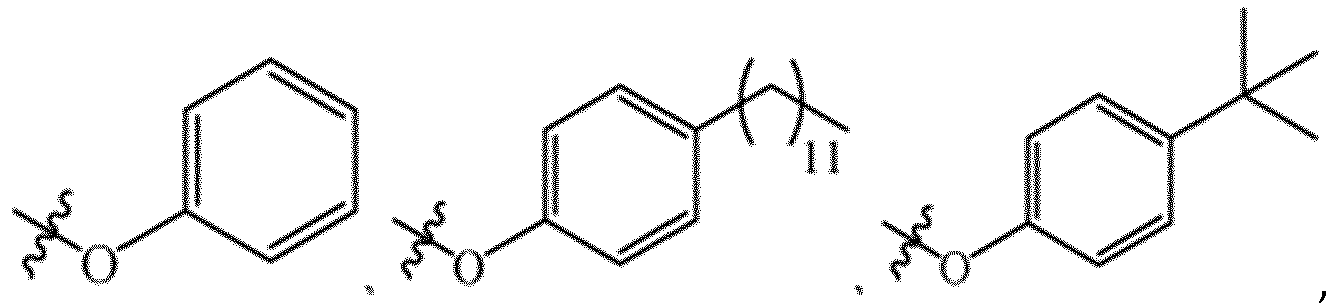
- Verbindung nach einem der vorstehenden Ansprüche, wobei

- Verbindung nach einem der vorstehenden Ansprüche, wobei:- die Verbindung eine Absorption in einem Bereich von 600 nm bis 800 nm in einem UV/Vis-Spektrum aufweist; oder- die Verbindung ein Fluoreszenz-Maximum in einem Bereich von 625 nm bis 900 nm aufweist.
- Farbstoffzusammensetzung, die eine Verbindung nach einem der vorstehenden Ansprüche umfasst.
- Verfahren zum Synthetisieren einer Verbindung nach einem der Ansprüche 1 bis 12, wobei das Verfahren den Schritt des Inkontaktbringens einer Verbindung der Formel (II)
 wobei R15, R16 und R17 jeweils unabhängig ausgewählt sind aus Wasserstoff, Brom oder Chlor, mit der Maßgabe, dass zwei von R15, R16 und R17 entweder Brom oder Chlor sind und das andere Wasserstoff ist, mit einer Verbindung der Formel (III):
 wobei R19 und R20: verbunden sind, um einen optional substituierten monozyklischen aromatischen Ring zu bilden; oder verbunden sind, um eine optional substituierte polyzyklische aromatische Gruppe zu bilden, wobei der optional substituierte monozyklische aromatische Ring oder die optional substituierte polyzyklische aromatische Gruppe optional aus der Gruppe ausgewählt ist, bestehend aus optional substituierten: Phenyl-, Naphthalin-, Anthracen-, Phenanthren-, Tetrazen-, Chrysen-, Triphenylen-, Pyren-, Pentazen-, Benzo[α]pyren- und Dibenz[α,h] anthracen-Gruppen.
 - Verfahren nach Anspruch 14, wobei die Verbindung der Formel (III) aus der Gruppe ausgewählt ist, bestehend aus optional substituiertem:






Applications Claiming Priority (2)
| Application Number | Priority Date | Filing Date | Title |
|---|---|---|---|
| AU2017903150A AU2017903150A0 (en) | 2017-08-08 | Novel dyes | |
| PCT/AU2018/050828 WO2019028508A1 (en) | 2017-08-08 | 2018-08-08 | COMPOUNDS AS POTENTIAL COLOR MOLECULES |
Publications (4)
| Publication Number | Publication Date |
|---|---|
| EP3665172A1 EP3665172A1 (de) | 2020-06-17 |
| EP3665172A4 EP3665172A4 (de) | 2020-12-23 |
| EP3665172B1 true EP3665172B1 (de) | 2025-03-19 |
| EP3665172C0 EP3665172C0 (de) | 2025-03-19 |
Family
ID=65273008
Family Applications (1)
| Application Number | Title | Priority Date | Filing Date |
|---|---|---|---|
| EP18844418.6A Active EP3665172B1 (de) | 2017-08-08 | 2018-08-08 | Verbindungen als potenzielle farbstoffmoleküle |
Country Status (4)
| Country | Link |
|---|---|
| US (1) | US10995217B2 (de) |
| EP (1) | EP3665172B1 (de) |
| AU (1) | AU2018315623B2 (de) |
| WO (1) | WO2019028508A1 (de) |
Families Citing this family (1)
| Publication number | Priority date | Publication date | Assignee | Title |
|---|---|---|---|---|
| WO2020163917A1 (en) * | 2019-02-14 | 2020-08-20 | Lleaf Pty Ltd | Photoperiodic control of phytochrome with materials |
Family Cites Families (7)
| Publication number | Priority date | Publication date | Assignee | Title |
|---|---|---|---|---|
| JP2002038044A (ja) * | 2000-07-31 | 2002-02-06 | Toyo Ink Mfg Co Ltd | 蛍光着色剤 |
| US20070259475A1 (en) * | 2006-05-04 | 2007-11-08 | Basf Aktiengesellschaft | Method for producing organic field-effect transistors |
| EP2022105B1 (de) * | 2006-05-04 | 2011-08-10 | Basf Se | Verfahren zum herstellen organischer feldeffekttransistoren |
| JP6176858B2 (ja) * | 2012-07-09 | 2017-08-09 | シャープ株式会社 | 化合物、太陽電池モジュール及び太陽光発電装置 |
| MA37097B1 (fr) | 2013-07-09 | 2017-04-28 | Saudi Basic Ind Corp (Sabic) | Conduction d'energie solaire en utilisant thermoplastics pour des applications agricoles |
| EP3036289A4 (de) | 2013-08-23 | 2016-09-14 | Flurosol Ind Pty Ltd | Lichtsammelanordnung |
| KR101793681B1 (ko) * | 2015-12-07 | 2017-11-06 | 한국생산기술연구원 | 페릴렌 계열의 광차단막용 안료 및 그를 이용한 광경화성 조성물 |
-
2018
- 2018-08-08 US US16/637,024 patent/US10995217B2/en active Active
- 2018-08-08 WO PCT/AU2018/050828 patent/WO2019028508A1/en not_active Ceased
- 2018-08-08 EP EP18844418.6A patent/EP3665172B1/de active Active
- 2018-08-08 AU AU2018315623A patent/AU2018315623B2/en active Active
Non-Patent Citations (4)
| Title |
|---|
| L. GISSLéN, R. SCHOLZ: "Crystallochromy of perylene pigments: Influence of an enlarged polyaromatic core region", PHYSICAL REVIEW B, AMERICAN PHYSICAL SOCIETY, US, vol. 83, no. 15, 1 April 2011 (2011-04-01), US , XP055750421, ISSN: 1098-0121, DOI: 10.1103/PhysRevB.83.155311 * |
| SHABIR GHULAM ET AL: "Multichromic Bis-Axially Extended Perylene Chromophore with Schiff Bases: Synthesis, Characterization and Electrochemical Studies", JOURNAL OF FLUORESCENCE, SPRINGER US, NEW YORK, vol. 26, no. 6, 27 September 2016 (2016-09-27), pages 2247 - 2255, XP036087081, ISSN: 1053-0509, [retrieved on 20160927], DOI: 10.1007/S10895-016-1920-2 * |
| ULRIKE SELIG ET AL: "Similarities and Differences in the Optical Response of Perylene-Based Hetero-Bichromophores and Their Monomeric Units", CHEMPHYSCHEM, vol. 14, no. 7, 19 April 2013 (2013-04-19), DE, pages 1413 - 1422, XP055750400, ISSN: 1439-4235, DOI: 10.1002/cphc.201300062 * |
| WENXIN FU ET AL: "Synthesis of a Polymeric Electron Acceptor Based on Perylenediimide-Bridged Ladder Polysiloxane", MACROMOLECULES, vol. 44, no. 2, 25 January 2011 (2011-01-25), US, pages 203 - 207, XP055750403, ISSN: 0024-9297, DOI: 10.1021/ma1025797 * |
Also Published As
| Publication number | Publication date |
|---|---|
| US20200199367A1 (en) | 2020-06-25 |
| WO2019028508A1 (en) | 2019-02-14 |
| EP3665172A1 (de) | 2020-06-17 |
| US10995217B2 (en) | 2021-05-04 |
| AU2018315623B2 (en) | 2022-03-24 |
| EP3665172A4 (de) | 2020-12-23 |
| AU2018315623A1 (en) | 2020-03-26 |
| EP3665172C0 (de) | 2025-03-19 |
Similar Documents
| Publication | Publication Date | Title |
|---|---|---|
| JP7188865B2 (ja) | 光捕集アレイ | |
| Wang et al. | Synthesis, photophysical and electrochemical properties of aza-boron-diquinomethene complexes | |
| Wang et al. | Functionalized coumarin derivatives containing aromatic-imidazole unit as organic luminescent materials | |
| Wang et al. | Facile synthesis and controllable bromination of asymmetrical intermediates of perylene monoanhydride/monoimide diester | |
| Lu et al. | New frog-type Dibenzo [a, c][1, 2, 5] thiadiazolo [3, 4-i] phenazine heterocyclic derivatives with aggregation-enhanced one-and two-photon excitation NIR fluorescence | |
| CN103172650A (zh) | 含有三苯胺结构的强荧光氟硼二吡咯化合物及其制备方法与应用 | |
| Kumsampao et al. | Solid‐State Fluorophores with Combined Excited‐State Intramolecular Proton Transfer‐Aggregation‐Induced Emission as Efficient Emitters for Electroluminescent Devices | |
| CN104910139A (zh) | 线粒体荧光染色剂3-杂芳基取代-2h-吲唑类衍生物的制备及应用 | |
| KR20170040301A (ko) | 유기 반도체를 개발하기 위한 신규의 신톤 | |
| CN110668997A (zh) | 一类细胞器靶向的聚集诱导发光材料及其制备方法 | |
| Xu et al. | High-performance two-photon absorption luminophores: large action cross sections, free from fluorescence quenching and tunable emission of efficient non-doped organic light-emitting diodes | |
| Zhao et al. | Photo-and electro-luminescence properties of the organic bipolar molecules containing phenothiazine and phenanthoimidazole moieties | |
| Liu et al. | A new synthesis strategy for acridine derivatives to constructing novel host for phosphorescent organic light-emitting diodes | |
| EP3665172B1 (de) | Verbindungen als potenzielle farbstoffmoleküle | |
| Barros et al. | Synthesis, photophysical and electrochemical properties of π-conjugated pyrene based down-shifting molecules with fluorinated aryl groups | |
| Mattiello et al. | Enhancement of fluorescence and photostability of luminescent radicals by quadruple addition of phenyl groups | |
| CN106478626A (zh) | 一类喹吖啶酮衍生物及其制备方法与应用 | |
| CN108530474A (zh) | 一类吡咯腙肼双氟硼强荧光染料及其制备方法 | |
| Zhang et al. | Bipolar fluorene-cored derivatives containing carbazole-benzothiazole hybrids as non-doped emitters for deep-blue electroluminescence | |
| Shao et al. | Regiochemically Pure 1, 6-Ditriflato-Perylene Diimide: Preparation and Transformation | |
| CN105131641B (zh) | 一类可用于染料敏化太阳能电池的吲哚啉卟啉染料 | |
| US9000170B2 (en) | Process for the preparation of tetracarboxynaphthalenediimide compounds disubstituted with heteroaryl groups | |
| CN116606284B (zh) | 一种二苯酮衍生物有机发光材料及其制备方法与应用 | |
| Damaceanu et al. | Tuning the light emission of novel donor-acceptor phenoxazine dye-based materials towards the red spectral range | |
| DE102007004016A1 (de) | Bichromophore Perylenabkömmlinge für Solarenergiesysteme |
Legal Events
| Date | Code | Title | Description |
|---|---|---|---|
| STAA | Information on the status of an ep patent application or granted ep patent |
Free format text: STATUS: THE INTERNATIONAL PUBLICATION HAS BEEN MADE |
|
| PUAI | Public reference made under article 153(3) epc to a published international application that has entered the european phase |
Free format text: ORIGINAL CODE: 0009012 |
|
| STAA | Information on the status of an ep patent application or granted ep patent |
Free format text: STATUS: REQUEST FOR EXAMINATION WAS MADE |
|
| 17P | Request for examination filed |
Effective date: 20200306 |
|
| AK | Designated contracting states |
Kind code of ref document: A1 Designated state(s): AL AT BE BG CH CY CZ DE DK EE ES FI FR GB GR HR HU IE IS IT LI LT LU LV MC MK MT NL NO PL PT RO RS SE SI SK SM TR |
|
| AX | Request for extension of the european patent |
Extension state: BA ME |
|
| DAV | Request for validation of the european patent (deleted) | ||
| DAX | Request for extension of the european patent (deleted) | ||
| A4 | Supplementary search report drawn up and despatched |
Effective date: 20201125 |
|
| RIC1 | Information provided on ipc code assigned before grant |
Ipc: C07D 471/22 20060101AFI20201119BHEP Ipc: H01L 51/40 20060101ALI20201119BHEP Ipc: C09B 5/62 20060101ALI20201119BHEP |
|
| STAA | Information on the status of an ep patent application or granted ep patent |
Free format text: STATUS: EXAMINATION IS IN PROGRESS |
|
| 17Q | First examination report despatched |
Effective date: 20220902 |
|
| RIC1 | Information provided on ipc code assigned before grant |
Ipc: C09B 5/62 20060101ALI20240827BHEP Ipc: C07D 471/22 20060101AFI20240827BHEP |
|
| GRAP | Despatch of communication of intention to grant a patent |
Free format text: ORIGINAL CODE: EPIDOSNIGR1 |
|
| STAA | Information on the status of an ep patent application or granted ep patent |
Free format text: STATUS: GRANT OF PATENT IS INTENDED |
|
| INTG | Intention to grant announced |
Effective date: 20241007 |
|
| GRAS | Grant fee paid |
Free format text: ORIGINAL CODE: EPIDOSNIGR3 |
|
| GRAA | (expected) grant |
Free format text: ORIGINAL CODE: 0009210 |
|
| STAA | Information on the status of an ep patent application or granted ep patent |
Free format text: STATUS: THE PATENT HAS BEEN GRANTED |
|
| AK | Designated contracting states |
Kind code of ref document: B1 Designated state(s): AL AT BE BG CH CY CZ DE DK EE ES FI FR GB GR HR HU IE IS IT LI LT LU LV MC MK MT NL NO PL PT RO RS SE SI SK SM TR |
|
| REG | Reference to a national code |
Ref country code: GB Ref legal event code: FG4D |
|
| REG | Reference to a national code |
Ref country code: CH Ref legal event code: EP |
|
| REG | Reference to a national code |
Ref country code: IE Ref legal event code: FG4D |
|
| REG | Reference to a national code |
Ref country code: DE Ref legal event code: R096 Ref document number: 602018080333 Country of ref document: DE |
|
| U01 | Request for unitary effect filed |
Effective date: 20250410 |
|
| U07 | Unitary effect registered |
Designated state(s): AT BE BG DE DK EE FI FR IT LT LU LV MT NL PT RO SE SI Effective date: 20250416 |
|
| PG25 | Lapsed in a contracting state [announced via postgrant information from national office to epo] |
Ref country code: RS Free format text: LAPSE BECAUSE OF FAILURE TO SUBMIT A TRANSLATION OF THE DESCRIPTION OR TO PAY THE FEE WITHIN THE PRESCRIBED TIME-LIMIT Effective date: 20250619 |
|
| U20 | Renewal fee for the european patent with unitary effect paid |
Year of fee payment: 8 Effective date: 20250602 |
|
| PG25 | Lapsed in a contracting state [announced via postgrant information from national office to epo] |
Ref country code: NO Free format text: LAPSE BECAUSE OF FAILURE TO SUBMIT A TRANSLATION OF THE DESCRIPTION OR TO PAY THE FEE WITHIN THE PRESCRIBED TIME-LIMIT Effective date: 20250619 |
|
| PG25 | Lapsed in a contracting state [announced via postgrant information from national office to epo] |
Ref country code: HR Free format text: LAPSE BECAUSE OF FAILURE TO SUBMIT A TRANSLATION OF THE DESCRIPTION OR TO PAY THE FEE WITHIN THE PRESCRIBED TIME-LIMIT Effective date: 20250319 |
|
| PG25 | Lapsed in a contracting state [announced via postgrant information from national office to epo] |
Ref country code: GR Free format text: LAPSE BECAUSE OF FAILURE TO SUBMIT A TRANSLATION OF THE DESCRIPTION OR TO PAY THE FEE WITHIN THE PRESCRIBED TIME-LIMIT Effective date: 20250620 |
|
| PG25 | Lapsed in a contracting state [announced via postgrant information from national office to epo] |
Ref country code: SM Free format text: LAPSE BECAUSE OF FAILURE TO SUBMIT A TRANSLATION OF THE DESCRIPTION OR TO PAY THE FEE WITHIN THE PRESCRIBED TIME-LIMIT Effective date: 20250319 |
|
| PG25 | Lapsed in a contracting state [announced via postgrant information from national office to epo] |
Ref country code: ES Free format text: LAPSE BECAUSE OF FAILURE TO SUBMIT A TRANSLATION OF THE DESCRIPTION OR TO PAY THE FEE WITHIN THE PRESCRIBED TIME-LIMIT Effective date: 20250319 |
|
| PG25 | Lapsed in a contracting state [announced via postgrant information from national office to epo] |
Ref country code: PL Free format text: LAPSE BECAUSE OF FAILURE TO SUBMIT A TRANSLATION OF THE DESCRIPTION OR TO PAY THE FEE WITHIN THE PRESCRIBED TIME-LIMIT Effective date: 20250319 |
|
| PG25 | Lapsed in a contracting state [announced via postgrant information from national office to epo] |
Ref country code: CZ Free format text: LAPSE BECAUSE OF FAILURE TO SUBMIT A TRANSLATION OF THE DESCRIPTION OR TO PAY THE FEE WITHIN THE PRESCRIBED TIME-LIMIT Effective date: 20250319 |
|
| PG25 | Lapsed in a contracting state [announced via postgrant information from national office to epo] |
Ref country code: SK Free format text: LAPSE BECAUSE OF FAILURE TO SUBMIT A TRANSLATION OF THE DESCRIPTION OR TO PAY THE FEE WITHIN THE PRESCRIBED TIME-LIMIT Effective date: 20250319 |
|
| PG25 | Lapsed in a contracting state [announced via postgrant information from national office to epo] |
Ref country code: IS Free format text: LAPSE BECAUSE OF FAILURE TO SUBMIT A TRANSLATION OF THE DESCRIPTION OR TO PAY THE FEE WITHIN THE PRESCRIBED TIME-LIMIT Effective date: 20250719 |
|
| PLBE | No opposition filed within time limit |
Free format text: ORIGINAL CODE: 0009261 |
|
| STAA | Information on the status of an ep patent application or granted ep patent |
Free format text: STATUS: NO OPPOSITION FILED WITHIN TIME LIMIT |
|
| REG | Reference to a national code |
Ref country code: CH Ref legal event code: L10 Free format text: ST27 STATUS EVENT CODE: U-0-0-L10-L00 (AS PROVIDED BY THE NATIONAL OFFICE) Effective date: 20260128 |
|
| 26N | No opposition filed |
Effective date: 20251222 |
|
| REG | Reference to a national code |
Ref country code: CH Ref legal event code: H13 Free format text: ST27 STATUS EVENT CODE: U-0-0-H10-H13 (AS PROVIDED BY THE NATIONAL OFFICE) Effective date: 20260324 |
|
| PG25 | Lapsed in a contracting state [announced via postgrant information from national office to epo] |
Ref country code: MC Free format text: LAPSE BECAUSE OF FAILURE TO SUBMIT A TRANSLATION OF THE DESCRIPTION OR TO PAY THE FEE WITHIN THE PRESCRIBED TIME-LIMIT Effective date: 20250319 |