EP3665706B1 - Grafische benutzeroberfläche zur personalisierten vorhersagemodellierung - Google Patents
Grafische benutzeroberfläche zur personalisierten vorhersagemodellierung Download PDFInfo
- Publication number
- EP3665706B1 EP3665706B1 EP18755676.6A EP18755676A EP3665706B1 EP 3665706 B1 EP3665706 B1 EP 3665706B1 EP 18755676 A EP18755676 A EP 18755676A EP 3665706 B1 EP3665706 B1 EP 3665706B1
- Authority
- EP
- European Patent Office
- Prior art keywords
- patient
- processors
- proposed
- predictive model
- treatment
- Prior art date
- Legal status (The legal status is an assumption and is not a legal conclusion. Google has not performed a legal analysis and makes no representation as to the accuracy of the status listed.)
- Active
Links
Images








Classifications
-
- G—PHYSICS
- G16—INFORMATION AND COMMUNICATION TECHNOLOGY [ICT] SPECIALLY ADAPTED FOR SPECIFIC APPLICATION FIELDS
- G16H—HEALTHCARE INFORMATICS, i.e. INFORMATION AND COMMUNICATION TECHNOLOGY [ICT] SPECIALLY ADAPTED FOR THE HANDLING OR PROCESSING OF MEDICAL OR HEALTHCARE DATA
- G16H20/00—ICT specially adapted for therapies or health-improving plans, e.g. for handling prescriptions, for steering therapy or for monitoring patient compliance
- G16H20/10—ICT specially adapted for therapies or health-improving plans, e.g. for handling prescriptions, for steering therapy or for monitoring patient compliance relating to drugs or medications, e.g. for ensuring correct administration to patients
-
- G—PHYSICS
- G16—INFORMATION AND COMMUNICATION TECHNOLOGY [ICT] SPECIALLY ADAPTED FOR SPECIFIC APPLICATION FIELDS
- G16H—HEALTHCARE INFORMATICS, i.e. INFORMATION AND COMMUNICATION TECHNOLOGY [ICT] SPECIALLY ADAPTED FOR THE HANDLING OR PROCESSING OF MEDICAL OR HEALTHCARE DATA
- G16H50/00—ICT specially adapted for medical diagnosis, medical simulation or medical data mining; ICT specially adapted for detecting, monitoring or modelling epidemics or pandemics
- G16H50/50—ICT specially adapted for medical diagnosis, medical simulation or medical data mining; ICT specially adapted for detecting, monitoring or modelling epidemics or pandemics for simulation or modelling of medical disorders
Definitions
- This application is generally related to developing a personalized prediction model, and, more specifically, to a system and method for adapting a general prediction model to an individual patient.
- Medical treatment of a patient is generally complicated and often times involves a strategic analysis of various risks and benefits. Changes made to label practices by regulatory drug administrations, e.g., U.S. Food and Drug Administration (FDA), may further complicate the treatment as well as affect medical personnel's, e.g., physicians, perceived complexity to treat the patient. As such, it may be difficult for a physician to conceptualize the risks and the benefits among various treatment options, as well as contextualize a risk-benefit profile of the each treatment for the patient.
- FDA U.S. Food and Drug Administration
- Example systems and methods for treating a patient are herein described, wherein a system and/or method for treating a patient with a medical condition related to an undesirable occurrence in at least one population of in vivo cells includes applying an adaptive dynamically predictive model to information associated with the patient, and treating the patient based on an output prediction from the model.
- a system and/or method for treating a patient with a medical condition related to an undesirable occurrence in at least one population of in vivo cells includes applying an adaptive dynamically predictive model to information associated with the patient, and treating the patient based on an output prediction from the model.
- one or more aspects of the invention utilize model predictive control theory to model physiology, biology, and cell population dynamics to predict the impact of pharmaceuticals and other medical treatment on those populations.
- the models are adaptable to measurements of the underlying biological systems and thereby become personalized to individual patients.
- Formal specifications of software and/or hardware embodiments of the mathematical models may be constructed and logically verified to ensure accurate representation of a corresponding mathematical model.
- mathematical models may be implemented as a simulator to enable a user to forecast a patient response, or as a controller to provide a user with mechanisms to construct strategies for achieving a desired patient response.
- Statistical verification may be utilized to verify that simulations of biological systems match experimental measurements made on such systems.
- Clinical protocols governing the therapeutic use of pharmaceuticals including the interaction with the software systems modeling the biological systems to which the pharmaceuticals are being applied, may be formally specified, and protocols formalizing the therapeutic use of pharmaceuticals may be defined and logically verified to ensure that the defined protocol satisfies its specification.
- One or more of these aspects and/or criteria may be embodied in a smart device, e.g., code-generated provably-correct software and/or firmware.
- the system and/or method utilizes fully dynamic, adaptive, and/or predictive physiological mathematical models to predict one or more pivotal physiological properties of a patient given measurements of a limited number of physiological properties and any treatment option specified by a physician.
- This allows physicians to analytically evaluate multiple treatment options by examining the predicted effects of those options. Physicians can then use this predictive information to select the treatment that they believe is best.
- the mathematical model is adaptive, it adjusts its characterization of the patient each time a new measurement is made. In this way, the model very rapidly becomes personalized to the individual patient being treated.
- the method comprises providing an adaptive dynamically predictive model for treating the patient; receiving, by one or more processors, a clinical value of a clinical event associated with the patient; receiving, by the one or more processors, a treatment strategy for treating the patient based on the clinical value; utilizing, by the one or more processors, the received treatment strategy and the adaptive dynamically predictive model and predicting a response of the patient to the treatment strategy; and displaying, by the one or more processors, a time profile of the predicted response of the patient to the treatment strategy.
- a system comprises one or more processors communicatively coupled to an electronic medical record; a memory operatively coupled to the one or more processors; a user interface operatively coupled to the one or more processors; a treatment strategy module stored in the memory, which when executed on the one or more processors, provides a proposed treatment strategy at the user interface, including watchful waiting, watchful waiting with a transfusion, and dosing according to a label; and a prediction module stored in the memory, which when executed on the one or more processors, utilizes a selected treatment strategy to generate a result at the user interface including the patient's predicted response to the selected treatment strategy, wherein one or more generated results may be evaluated.
- a tangible non-transitory computer-readable medium having instructions stored thereon for providing an adaptive dynamically predictive model for treating a patient with a medical condition related to an undesirable occurrence in at least one population of in vivo cells
- the instructions when executed by one or more processors of a computer system, cause the one or more processors to: receive a clinical value of a clinical event associated with the patient; receive a treatment strategy for treating the patient based on the clinical value; utilize the received treatment strategy and the adaptive dynamically predictive model and predict a response of the patient to the treatment strategy; and display a time profile of the predicted response of the patient to the treatment strategy.
- the disclosed system and method utilize a personalized mathematical model based on physiological data to forecast an individual patient's response to a proposed medical treatment.
- the system and method is capable of being applied across a variety of indications and drugs.
- Some indications include, and are not limited to, anemia, including but not limited to chemotherapy induced anemia or radiation induced anemia, congestive heart failure, cytopenia, including but not limited to chemotherapy induced thrombocytopenia or radiation induced thrombocytopenia, hemodialysis related anemia, LDL hyperlipidemia, asthma, neutropenia, including chemotherapy induced neutropenia or radiation induced neutropenia, and hyperparathyroidism.
- the system and/or method predicts a trend of one or more physiological properties of the patient in response to one or more treatment strategies. If available, the system and method may utilize one or more measured physiological properties of the patient to predict the trend of the one or more physiological properties.
- the system and/or method is used with patients susceptible to developing chemotherapy induced anemia (CIA). More specifically, the system and/or method predicts a trend of the patient's hemoglobin (Hg) concentration level in response to one or more proposed treatment strategies.
- Hg hemoglobin
- the model may predict the individual patient's behavior response in alignment with that particular patient's cohort population. That is, when there is limited data available for an individual patient, the model can utilize known data from a stratified population associated with the individual patient to predict the patient's hemoglobin trend.
- additional information is attained, e.g., actual hemoglobin measurements, the model is adapted to the individual patient.
- the model can be fitted to a particular patient's data, including the patient's endogenous erythropoietin (EPO) levels and the patient's bone marrow reserves.
- Additional data that may be utilized in the model, include, and are not limited to: red blood cell age distribution; chemotherapy type and dose; chemotherapy history of the patient; patient's sex, age, height, and weight; patient's general health condition; and any "clinical events" that may occur during chemotherapy treatment, e.g., fever.
- the predicted hemoglobin trend from one or more proposed medical treatments can be displayed for viewing by the physician and/or patient. Each proposed treatment may then be placed into a context to facilitate an understanding of the risk-benefit profile associated with each treatment.
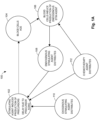
- FIG. 1A An overview of one embodiment of the mathematical model(s) utilized by the system and method of the embodiments described herein is illustrated in a diagram 100 shown in Fig. 1A .
- the diagram 100 depicts feedback to achieve homeostasis in erythropoiesis as well as the effects of erythropoiesis stimulating agents (ESAs) and chemotherapy.
- ESAs erythropoiesis stimulating agents
- the body's maturation of red blood cell precursors and the age distribution of these precursors are modeled 102 by the system and method.
- the production of precursors may be induced by the body's endogenous erythropoietin (EPO), as well as administered exogenous erythropoiesis stimulating agents (ESA), e.g., but not limited to, Aranesp ® , Epogen ® , Procrit ® or biosimilars thereof.
- ESA exogenous erythropoiesis stimulating agents
- the red blood cell precursors reside in the bone marrow and will typically eventually mature into red blood cells.
- the system and method model 104 the ever changing age distribution of the red blood cells within the body's blood stream. When there are not enough red blood cells in the blood stream, the body increases the rate of production of erythropoietin, which is needed to stimulate stem cells to produce more red blood cell precursors.
- the body's process for inducing production of erythropoietin is modeled 106 by the system and method.
- the system and method further model 108 the distribution of the erythropoietin.
- the system and method are capable of modeling multiple agents utilized to affect multiple cell population, such as a dosing of an erythropoiesis stimulating agent 110 and a distribution of a chemotherapy agent 112 into the body.
- Figure 1B is a flow diagram for adapting a generalized model 150 to an individual patient.
- the model 150 may be any one of the models 102-112, and/or any combination thereof, as described with respect to Fig. 1A .
- the model 150 may include both parameters associated with the patient that are known (such as gender, age, blood type, age range, etc.), as well as parameters associated with the patient that are difficult to measure and/or characterize.
- the model 150 may include a probability density function (PDF) 164 (illustrated as P) to model the potential variances for the latter type of parameters (illustrated as 0).
- PDF probability density function
- the output of the model for any particular parameter may also be represented as a PDF function.
- the parameters modeled by the PDF 164 may include sensitivity to ESAs, distributivity of dosages, a rate at which blood cells age, and so on.
- the PDF 164 may not generate a single value, but, rather, a probability that the value falls within a particular range of values.
- the mean, median, or mode of the PDF 164 is utilized to convert the output 166 (illustrated as B ⁇ ) of the PDF 164 to a value that may be utilized in non-heuristic systems and/or models. That said, other techniques may be utilized to convert the PDF 164 into a suitable output 166 for the model 150.
- the model 150 may be adapted over time using a tool for Bayesian prediction and fitting of stochastic models, such as Markov models.
- the tool may utilize particle filtering techniques.
- particle filtering each state and the corresponding set of parameter values is referred to as a "particle" (or, sometimes, a “sample”).
- particle filtering each state and the corresponding set of parameter values is referred to as a "particle" (or, sometimes, a "sample”).
- Each of these particles may then be input into the model 150 to determine a predictive output of the model 150.
- the methods and systems may involve selecting a particular particle to utilize as an input to a subsequent state of the model 150.
- the flow diagram may begin with an initial state 162 of the model 150 (illustrated as X ⁇ 0 ) and an initial set of parameters 168 modeled by the PDF 164 (illustrated as ⁇ 0 ).
- the initial state 162 may be the generalized model for the system that represents the modeled behavior for an entire population.
- the generalized model may provide the initial set of parameters 168.
- the known parameters associated with the patient may be input into the model 150.
- one or more processors may evolve the PDF 164.
- Evolving the PDF 164 may include incrementing a time parameter to cause the model 150 to enter the next state.
- the PDF 164 may utilize the incremented time parameter, as well as the set of parameters 8 to generate a new output 166.
- the output 166 may be the value (or particle) associated with the median marginal density for the PDF function corresponding to the parameter.
- the one or more processors may update the parameters ⁇ associated with the model 150.
- the parameters included in the output 166 may be used as the set of parameters 8 in the next state of the model 150.
- the set of parameters included in the output 166 may be modified based on the measurement 170.
- the measurement(s) 170 enable model 150 to narrow the variances of the model 150 around the region associated with the measured values. Said another way, the width of the PDF functions associated with the parameters ⁇ may be reduced.
- the model 150 is adapted to be tailored the patient's measured responses.
- Figure 1C is a graphical representation 175 that depicts the improvement in prediction provided by the present adaptation techniques.
- the graph 175 depicts the patient's measured hemoglobin levels 180 over time, as well as the predicted hemoglobin levels produced by the generalized model without adaptation 182 and the predicted hemoglobin levels produced by the model adapted utilizing the present techniques 184.
- the predicted hemoglobin levels 182 and 184 both are relatively accurate at the onset of the prediction horizon. Over time, the predicted hemoglobin levels produced from the generalized model 184 begin to drift further away from the measured hemoglobin levels 180. Conversely, as more measurements made, the predicted hemoglobin levels from the adapted model 184 track more closely to the measured hemoglobin levels 180. As a result, when setting a treatment strategy for the patient, the predictions relied upon to ensure the patient does not experience a critical hemoglobin are more accurate and can reduce the likelihood that predictive error results in the patient experiencing an unexpected medical event.
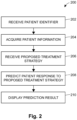
- Fig. 2 is a flow diagram of an example method 200 capable of being implemented by an embodiment of the system and method described herein.
- the method 200 is directed to treating a patient with a medical condition related to an undesirable occurrence in at least one population of in vivo cells.
- the method 200 applies an adaptive dynamically predictive model to information associated with the patient, wherein the patient is treated based on the output predicted by the predictive model.
- the method 200 is used by medical personnel to treat a cancer patient at risk of developing chemotherapy induced anemia (CIA).
- CIA chemotherapy induced anemia
- the patient is exclusively associated with an identifier, which may be newly generated or already exist (block 202), e.g., social security number; and is used to access information about the patient (block 204).
- the patient information may be acquired from one or more devices and be in one or more types of format, e.g., electronic and/or non-electronic format.
- the device may be an electronic medical record (EMR), patient record, (EPR), health record (EHR), or personal health record (PHR), and the patient information may be stored on a single storage device or stored in several storage devices distributed in different locations.
- EMR electronic medical record
- EPR patient record,
- EHR health record
- PHR personal health record
- the device may also be a sensor capable of being operatively coupled to the patient and the system, wherein current or stored patient information acquired and/or stored within the sensor and/or data memory may be accessed by the system and method.
- the patient information includes values, or clinical values, related to clinical events associated with the patient.
- Clinical events may include, and are not limited to, tests, treatments, measurements, and assessments associated with the patient.
- the clinical values may include biological and/or physiological information and/or characteristics, such as: measured hemoglobin levels; red blood cell age distribution; chemotherapy history (type and dose); sex, age, height, and weight; general health condition; and any clinical "events" that may occur during a medical treatment, e.g., test results, prescriptions, administered medicaments, patient condition.
- Medical personnel may utilize the patient information to develop and or propose a treatment strategy for the patient.
- the proposed treatment strategy may include one or more separate or combinable strategies.
- the treatment strategy may include an action that is performed on, or with, the patient as well as an inaction that is not performed on, or with, the patient, such as waiting a determined period of time.
- Some examples of a treatment strategy include, and are not limited to, watchful waiting (and consideration of further treatment at a later time); watchful waiting and transfusion of the patient's blood if the hemoglobin concentration level is below 8 g/dL; and dosing a drug according to its label.
- the treatment strategy of watchful waiting may primarily include "watching" the patient for a period of time.
- the patient may be monitored by medical personnel and continue whatever treatment may currently be prescribed, if any, and then record and/or report the patient's condition, e.g., signs of symptoms. For example, periodically checking the patient's hemoglobin concentration for a predetermined time.
- the treatment strategy of watchful waiting and transfusion of the patient's blood if the hemoglobin concentration is below 8 g/dL requires monitoring the patient's hemoglobin level for a predetermined time, and if patient's hemoglobin concentration falls below 8 g/dL, initiate a blood transfusion on the patient.
- the treatment strategy of dosing a drug e.g., erythropoiesis stimulating agents (ESAs)
- ESAs erythropoiesis stimulating agents
- a label for a drug used to treat anemia may require that the drug be used at its lowest dose and only when the patient's hemoglobin concentration is below 10 g/dL.
- the proposed treatment strategy is submitted or provided to the system (block 206) and the system predicts the patient's likely response or reaction to the treatment strategy (block 208). For example, the system will determine how the proposed treatment strategy will likely affect the patient's hemoglobin concentration level. If the prediction is conducted early in the treatment of the patient, such that patient information may be limited, the calculation will be based on statistical averages of other individuals who have the same or similar characteristics of the particular patient. e.g., a cohort-based prediction facilitated by machine-learning analyses. As more patient information becomes attainable, the prediction can be adapted to the particular patient. As described with respect to Fig. 1B , the measured values of the patient's clinical events can be used to adapt the corresponding clinical event parameter of the predictive model implemented by the system to fit the model to the patient.
- the system and method of an embodiment described herein may provide or suggest one or more proposed treatment strategies to the physician for selection.
- the treatment strategies provided by the system and method may be in response to queries or information presented by or received from treatment personnel. For example, a physician may request the latest date to dose according to the label and maintain the patient's hemoglobin concentration above a specified level.
- a model predictive controller may use the predicted results to compute a possible dosing that will lead to a desired outcome.
- the prediction result is displayed by the system and method (block 210) and may also be stored with the proposed treatment strategy on a memory device for later recall and implementation.
- the prediction result may include a time profile of the patient's likely response and may be presented in any desired format.
- the time profile may include time-related information of the patient's expected response to the proposed treatment strategy and in one example, the time profile includes, at least: a line representing an expected trend of the patient's hemoglobin concentration; proposed treatments, e.g., dosing, blood transfusion; and critical hemoglobin levels.
- the system and method of embodiments described herein are capable of simultaneously displaying one or more time profiles to facilitate comparison between the prediction results of multiple proposed treatment strategies.
- the physician and/or patient may select to display the time profiles side-by-side, overlapping, in different colors or shapes, etc.
- the displayed time profile provides an image to the physician and/or patient that may contribute to a better understanding of the proposed treatment strategy itself, and in relation to one or more other proposed treatment strategies. For example, the times when a dosing or transfusion may be necessary or when the patient may more likely become symptomatic, can be readily observed on the time profile. By visually comparing one or more time profiles, the physician and/or the patient may be better able to identify and/or determine a more favorable treatment strategy.
- Additional proposed treatment strategies may later be provided to the system that are continuations of earlier or other previous treatment strategies.
- additional information about the patient may be attained and adapted to the model for predicting the patient's response to a proposed treatment strategy.
- the additional information may include values for clinical events associated with the patient, such as biological or physiological information and/or characteristics that were not available earlier, e.g., hemoglobin measurements and/or chemotherapy treatments since the last proposed treatment strategy was evaluated or prescribed.
- the patient's clinical values may be adapted to respective clinical event parameters that are incorporated in the predictive module implemented by embodiments of the system and method described herein.
- a treatment strategy may also be adapted or modified by changing one or more aspects of a predictive result.
- the display of the time profile may be modified by selecting an aspect of the display and changing it. For example, an aspect such as a dosing date appearing on a touch-screen display may be selected by medical personnel and moved to a different date or deleted, and/or another aspect may be added to and/or removed from the time profile, e.g., a chemotherapy treatment, a blood transfusion, or a dosing event.
- the modified time profile may be considered a "new" proposed treatment strategy, and a request to generate a prediction of the patient's response to the modified proposed treatment strategy may then be submitted to the system.
- the proposed treatment includes a dosing that violates the medicament's label, or the predictive result of a proposed treatment strategy includes a dosing a medicament that violates its label
- a notification can be provided advising of the violation and the execution to predict the patient's response to the prohibited proposed treatment strategy may not be initiated and/or the associated prediction results, e.g., time profile, may not be displayed.
- measured data from the patient may be forensically analyzed to determine an effectiveness of the predictive module.
- the predictive module as adapted to the particular patient, is applied to a set of patient data observed at the onset of a treatment strategy. From this historical state, a traditional treatment strategy may be input into the system to predict how the patient would have responded in a traditional scenario. In some scenarios where the present systems and methods generated a treatment strategy that avoided a transfusion, applying the predictive module to the set of data at the onset indicates that if the patient had been treated according to a traditional treatment strategy, the patient would have required a transfusion.
- this technique may be utilized to develop other outcome measurements, such as a reduction in the number of dosages, increasing the amount of time a patient experiences a healthy level of hemoglobin, avoidance of chemotherapy events, and so on.
- this technique may be applied across multiple patients to generate statistics that prove the effectiveness of the present systems and methods.
- this forensic analysis may be utilized to improve the predictive module itself.
- forensic analysis may be utilized to more accurately determine the impact of patient characteristics, such as age or weight, on the developed models.
- the forensic analysis may include applying clustering techniques to a pool of anonymized treatment data to determine the impact of treatment events for patients that share common characteristics. Accordingly, when the known patient characteristics are input into the generalized model, the corresponding parameters more closely model the patient from the onset. Said another way, the ⁇ 0 used at the start of the modeling process more accurately models the patient. It should be appreciated that even with these improvements, the generalized model may still be improved by adaptation based on the patient's observed responses.
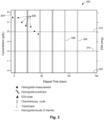
- FIG. 3 An example chart 300 that may be used by medical personnel to monitor the hemoglobin concentration of an example patient during chemotherapy is shown in Fig. 3 .
- the chart 300 includes an X-axis 302 representing time (days) and a Y-axis 304 representing a hemoglobin concentration (g/dL) of the patient.
- Completed and/or scheduled chemotherapy cycles 306 administered to the patient are shown by the bands of three vertical lines (in this example, the chemotherapy agent is given every day for three days per cycle, hence the three lines) and instances of measured hemoglobin concentrations are shown by circular markers 308 (e.g., tracked on a weekly basis).
- Two hemoglobin concentration levels of particular interest are 8 g/dL and 10 g/dL, and each is shown by a horizontal dashed line 310, 312, respectively.
- a physician is able to predicts a patient's likely behavior to a proposed treatment strategy and thus prescribe a treatment strategy for the patient accordingly in an effort to attain a desired result, and/or modify a proposed treatment strategy to likely attain a result different than initially predicted.
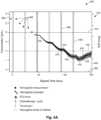
- Example charts 400, 400', and 400" respectively depicted in Figs. 4A , 4B , and 4C are similar to the chart 300 shown in Fig. 3 .
- the charts 400, 400', and 400" in Figs. 4A , 4B , and 4C each include a predicted result respectively associated with a distinctive proposed patient treatment strategy, which is capable of being calculated by the system and method described herein.
- the proposed treatment strategy may have been presented to and/or provided by the physician via the system's user interface.
- a prediction module when executed by one or more processors of the system, generates the predicted result of the proposed treatment strategy.
- the predicted result includes a time profile of the patient's likely response to the proposed treatment strategy and is capable of being stored on the system and displayed on the system's user interface.
- the prediction module may be stored in the system's memory and include one or more models for modeling homeostasis.
- the prediction module may also be referred to herein as the module, mathematical module, and/or predictive module.
- the proposed treatment strategy employs watchful waiting and consideration of additional treatment later on.
- the system utilizes the available patient information and the predictive model to provide a time profile 414 including a relatively thick solid line representing the patient's expected trend of hemoglobin level 416 over a period of time.
- the thinner, lighter shade, "gray" line(s) 418 proximate the predicted trend line 416 represent prediction errors that may occur due to the sample distribution, which may be attained by sampling the distribution multiple times and determining an error band.
- FIG. 4A shows the predicted trend 416 of the patient's hemoglobin concentration will drop below 8 g/dL 410 at around 100 days. It is likely that the physician would prescribe a blood transfusion at around this time. If a dosing (not shown in Fig. 4A ) or a blood transfusion (not shown in Fig. 4A ) was proposed by the system in the predicted result, the amount and time of the dosing and/or blood transfusion would be presented on the chart.
- a predicted dosing is represented by a triangular marker aligned with a day along the horizontal axis 402 and a quantitative amount (e.g., mcg) along a vertical axis 424 positioned on the right side of the chart 400.
- a blood transfusion is represented by a vertical line that generally coincides with a vertical segment of the projected hemoglobin trend 416, which may appear as having two seemingly separate and disconnected sections.
- the vertical rise in the hemoglobin trend line is indicative of the immediate effect that occurs to the hemoglobin concentration in response to the blood transfusion.
- the system and method of the embodiments described herein may be performed at any time during a patient's treatment, e.g., before some or any hemoglobin measurements were taken.
- the system's prediction of the patient's hemoglobin trend in such an instance would be based on statistical averages of other individuals who have the same or similar characteristics of the particular patient, e.g., a cohort-based prediction.
- the predictive model is able to adapt or "personalize" the hemoglobin trend prediction toward the particular patient.
- the system is able to adapt the proposed treatment strategy to the patient because the chemotherapy acts like an impulse to the system, and the parameters of the predicted result may therefore be attained or characterized more readily than otherwise.
- the predicted result is in response to a proposed treatment strategy that includes watchful waiting and transfusing if the patient's hemoglobin level drops below 8 g/dL.
- the predicted trend 416' of the patient's hemoglobin concentration level is shown to drop below 8 g/dL 410' a few days after 100 days, wherein the time profile 414' includes the blood transfusion 420'.
- the physician and/or the system may have provided a specific amount of blood to be transfused, e.g., 1 or more units(s) (bag(s)) into the predictive model, which may appear in the time profile 414'.
- the physician may have queried the predictive model as to the amount of blood required for the transfusion to bring the patient's hemoglobin concentration to a desired level, e.g., above 9g/dL.
- the predictive effect of a transfusion takes into consideration that the blood provided during the transfusion likely has a shorter "life span" than blood generated by the body. In some instances the life span of the transfused blood may be estimated to be 50 days, or perhaps as short as 30 days or less.
- the transfusion provides an immediate augmentation of red blood cells into the patient's circulatory system, which can be easily observed in the time profile displayed on the chart. Since the red blood cell age population distribution is being tracked in the model(s), the predictive model takes into consideration how quickly the effect of the transfusion may dissipate. Thus, it is important to accurately predict the magnitude of the increase in the patient's hemoglobin level. Other consequences that may be considered by the predictive model concern iron concentration that results when iron is released into the body when the hemoglobin expires.
- the predicted result is in response to a proposed treatment strategy that includes dosing an erythropoiesis stimulating agent (ESA), e.g., Aranesp ® , according to the label after two rounds of chemotherapy.
- ESA erythropoiesis stimulating agent
- the system may have provided a specific amount and time for the dosing or the physician may have queried the predictive model as to the time and amount of dosing on label to maintain the patient's hemoglobin above a specified level, e.g., above 8.5 g/dL.
- the predicted dosings 422" are represented by a triangular marker aligned with a day along the horizontal axis 402".
- the quantitative amount (e.g., mcg) of the dosing 422" is readily observable by the alignment of the triangular marker with the vertical axis 424" positioned on the right side of the chart.
- Medical personnel and/or the patient may use the charts 400, 400', and 400" in Figs. 4A , 4B , and 4C to compare the risk-benefit between the respective treatment strategies.
- the amount and timing of the blood transfusion 420' and/or dosing 422" are readily observable on the chart and aspects of the time profiles 416, 416', 416" may also be easily adjusted via a treatment strategy module to modify and/or propose a different treatment strategy.
- the treatment strategy module may be stored in the system's memory, and when executed on one or more processors, allows a physician to propose changes to the treatment strategy by enabling the user to modify aspects of an available treatment, e.g., watchful waiting, blood transfusion, dosing, hemoglobin concentration level, etc.
- a prediction module utilizes a selected treatment strategy to predict an outcome including the patient's response to the treatment strategy and displays the calculate result, e.g., time profile, on the system's user interface.
- One or more predictions, e.g., time profiles may be arranged for display on the user interface in various configurations, such as side-by-side, overlapping, and in different colors or shapes for evaluation by medical personnel.
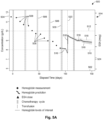
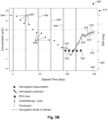
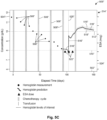
- the example charts 500, 500', 500" illustrated in Figs 5A , 5B , and 5C each include a predictive result for a particular patient in response to a different proposed treatment strategy prescribed after the completion of four cycles of chemotherapy, which may have been presented to and/or provided by the physician via the system's user interface.
- the proposed treatment strategy includes watchful waiting and a blood transfusion if the patient's hemoglobin level drops below 8 g/dL after two rounds of chemotherapy, and the same proposed treatment strategy after four rounds of chemotherapy.
- the predicted trend 516 of the patient's hemoglobin concentration level is shown to drop below 8 g/dL a few days after 100 days, wherein the time profile 514 includes the blood transfusion 520.
- the physician and/or the system may have provided a specific amount of blood to be transfused, e.g., 1 or more unit(s) (bag(s)) into the predictive model.
- the physician may have queried the predictive model as to the amount of blood required for the transfusion to bring the patient's hemoglobin concentration to a desired level, e.g., above 9 g/dL.
- the chart 500' of the predictive results displays a time profile 514' including a predictive trend 516' of the particular patient's hemoglobin level in response to a proposed treatment strategy, which may have been presented to, or provided by, the physician.
- the proposed treatment strategy includes watchful waiting and a blood transfusion if the hemoglobin level drops below 8 g/dL after two rounds of chemotherapy, and dosing an erythropoiesis stimulating agent (ESA), e.g., Aranesp ® , according to the label after four rounds of chemotherapy.
- ESA erythropoiesis stimulating agent
- the predicted trend 516' of the patient's hemoglobin concentration is shown to drop below 8 g/dL 510; a few days after initiation of the dosing 522' and the completion of the fifth therapy cycle.
- the system may have provided a specific amount and time for the dosing or the physician may have queried the predictive model via the system's user interface as to the time and amount of dosing on label to maintain the patient's hemoglobin above a specified level, e.g., above 8.0 g/dL.
- the predicted dosings 520' are represented by a triangular marker aligned with a day along the horizontal axis.
- the quantitative amount (e.g., mcg) of the dosing 520' is readily observable by the alignment of the triangular marker with the vertical axis 524' positioned on the right side of the chart 500'.
- the chart 500" of the predictive results displays a time profile 514" including a predictive trend 516" of the particular patient's hemoglobin concentration level in response to a proposed treatment strategy, which may have been presented to and/or provided by the physician via the system's user interface.
- the proposed treatment strategy includes watchful waiting and transfusion if the patient's hemoglobin level drops below 8 g/dL after two rounds of chemotherapy, and dosing an erythropoiesis stimulating agent (ESA), e.g., Aranesp ® , according to the label after four rounds of chemotherapy.
- ESA erythropoiesis stimulating agent
- the predicted dosing 522' is shown to begin just after the completion of the fifth chemotherapy cycle.
- the predicted trend 516' of the patient's hemoglobin concentration level is shown to drop below 8 g/dL 510" after dosing 522" has begun.
- a predicted near immediate increase in the hemoglobin concentration level is shown by the expected upward spike in the hemoglobin concentration trend 516" resulting from the blood transfusion 520".
- Medical personnel and/or the patient may use the respective charts 500, 500', 500" in Figs. 5A , 5B , and 5C to analyze the risk-benefit of each proposed treatment strategy.
- the proposed transfusion treatment shown in Fig. 5A an immediate increase to the patient's hemoglobin concentration 516 in response to the transfusion 520 can be observed.
- the proposed dosing treatment 522' shown in Fig. 5B a continued decrease in the predicted hemoglobin trend 516' is shown to drop below the 8 g/dL level, followed by a steeper decrease in the hemoglobin level, before the hemoglobin level begins to increase.
- Fig. 5A an immediate increase to the patient's hemoglobin concentration 516 in response to the transfusion 520 can be observed.
- the proposed dosing treatment 522' shown in Fig. 5B a continued decrease in the predicted hemoglobin trend 516' is shown to drop below the 8 g/dL level, followed by a steeper decrease in the hemoglobin level, before the hemo
- the "synergistic" effect resulting from the timing and amount of the dosing 522" and the blood transfusion 520" may generally be considered an inefficient management of the patient's treatment and that such a proposed treatment strategy may yield less than favorable results.
- Figs. 6A and 6B respectively illustrate a chart 600, 600', respectively, including a predictive result in response to a prescribed treatment strategy proposed for a particular patient after the completion of two cycles of chemotherapy.
- the treatment strategy may have been presented to and/or provided by the physician via the system's user interface.
- the proposed treatment strategy includes watchful waiting and consideration of later treatment.
- the example chart 600 of the predictive results displays a time profile 614 including a predictive trend 616 of the patient's hemoglobin concentration level in response to the proposed treatment strategy.
- the predictive model did not predict a dosing or a transfusion of the patient.
- the physician may monitor the patient and if the patient has no symptoms, the patient may be able to complete chemotherapy without a dosing and/or a blood transfusion.
- the proposed treatment strategy includes watchful waiting and consideration of later treatment after another two rounds of chemotherapy, and dosing an ESA according to the label after four rounds of chemotherapy.
- the example chart 600' of the predictive results displays a time profile 614' including a predictive trend 616' of the patient's hemoglobin concentration level in response to the proposed treatment strategy.
- the system predicted a projected dosing 622' time and amount and the projected trend 616' of the hemoglobin level.
- Providing a single ESA dose 622' in this case may help the patient not develop symptoms that may occur as the hemoglobin concentration trends toward 8 g/dL, which also risks the need for a blood transfusion if the hemoglobin concentration should fall below 8 g/dL 610'.
- the patient's hemoglobin concentration level is more likely to stay above the 8 g/dL level 610' and the patient is less likely to develop symptoms.
- the physician as well as the patient can readily observe this information on the display.
- the predicted hemoglobin trend 616' and the prescribed dosing 622' it can be seen that a few days after dosing 622', the patient's hemoglobin concentration level 616' continues to descend and then there is a reversal and the patient's hemoglobin concentration 616' begins to increase.
- This increase in the hemoglobin concentration level 616' may reflect the body's response to sensing the decrease in hemoglobin concentration level and producing more endogenous EPO to raise the hemoglobin concentration level.
- the degree to which the predictive trend increases indicates how sensitive the body is to its own endogenous EPO.
- Figs 7A , 7B , and 7C each include a predictive result for an example patient in response to a proposed treatment strategy prescribed after the completion of two cycles of chemotherapy.
- the treatment strategy may have been presented to and/or provided by the physician via the system's user interface.
- Fig. 7A the example chart 700 illustrates a predictive result to the patient's prescribed treatment strategy of watchful waiting and consideration of further treatment after two rounds of chemotherapy. This patient appears very sensitive to chemotherapy as alluded to by the system's predicted time profile 714 and the hemoglobin concentration trend 716 showing that two transfusions 720 are likely to be needed during the chemotherapy treatment.
- an example chart 700' of the displayed predictive result shows a time profile 714' including a predictive trend 716'of the patient's hemoglobin concentration in response to another proposed treatment strategy including dosing an erythropoiesis stimulating agent (ESA) according to the label after two rounds of chemotherapy and then watchful waiting with consideration of later treatment thereafter.
- ESA erythropoiesis stimulating agent
- Fig. 7C the predictive result for another proposed treatment strategy for the example patient is illustrated in example chart 700".
- the proposed treatment strategy includes dosing according to the label throughout the chemotherapy treatment.
- the system predicts that the patient can avoid the first and second transfusions 720 shown in Fig. 1 by prescribing four doses 722" of ESA according to the label.
- Medical personnel and/or the patient may use the respective charts 700, 700', 700" in Figs. 7A , 7B , and 7C to analyze the risk-benefit of each proposed treatment strategy.
- the proposed transfusion treatment shown in Fig. 7C four proposed dosings of an ESA according to the label may avert the need for the blood transfusions suggested as necessary in the prescribed treatment strategies of Figs. 7A and 7B .
- Figs. 8 and 9 provide examples of a structural basis for the network and computational platforms related to such an electronic computing system.
- Fig. 8 illustrates an exemplary block diagram of a network 800 and computer hardware that may be utilized in an exemplary system for treating a patient in accordance with the described embodiments.
- the network 800 may be the internet, a virtual private network (VPN), or any other network that allows one or more computers, communication devices, databases, etc., to be communicatively connected to each other.
- the network 800 may be connected to a personal computer 812, and a computer terminal 814 via an Ethernet 816 and a router 818, and a landline 820.
- the Ethernet 816 may be a subnet of a larger Internet Protocol network.
- Other networked resources such as projectors or printers (not depicted), may also be supported via the Ethernet 816 or another data network.
- the network 800 may be wirelessly connected to a laptop computer 822 and a personal data assistant 824 via a wireless communication station 826 and a wireless link 828.
- a server 830 may be connected to the network 800 using a communication link 832 and a mainframe 834 may be connected to the network 800 using another communication link 836.
- the network 800 may be useful for supporting peer-to-peer network traffic.
- Patient information e.g., EMR
- EMR may also be received from a remotely-accessible, free-standing memory device (not shown) on the network 800.
- the patient information may be received by more than one computer.
- the patient information may be received from more than one computer and/or remotely-accessible memory device.
- Some or all calculations performed in the determination of a patient's response to proposed treatment strategies may be performed by one or more computing devices such as the personal computer 812, laptop computer 822, server 830, and/or mainframe 834, for example. In some embodiments, some or all of the calculations may be performed by more than one computer.
- Providing a time profile of the predicted results attained by the embodiment described herein may also be performed by one or more computing devices as the personal computer 812, laptop computer 822, server 830, and/or mainframe 834, for example.
- displaying the predicted results, e.g., hemoglobin trend may include sending data over a network such as network 800 to another computing device or display device.
- Fig. 9 illustrates an exemplary block diagram of a system 900 on which an exemplary method for treating a patient may operate in accordance with the described embodiments.
- the system 900 of Fig. 9 includes a computing device in the form of a computer 910.
- Components of the computer 910 may include, and are not limited to, a processing unit 920, a system memory 930, and a system bus 921 that couples various system components including the system memory to the processing unit 920.
- the system bus 921 may be any of several types of bus structures including a memory bus or memory controller, a peripheral bus, and a local bus using any of a variety of bus architectures.
- such architectures include the Industry Standard Architecture (ISA) bus, Micro Channel Architecture (MCA) bus, Enhanced ISA (EISA) bus, Video Electronics Standards Association (VESA) local bus, and Peripheral Component Interconnect (PCI) bus (also known as Mezzanine bus).
- ISA Industry Standard Architecture
- MCA Micro Channel Architecture
- EISA Enhanced ISA
- VESA Video Electronics Standards Association
- PCI Peripheral Component Interconnect
- the computer 910 typically includes a variety of computer readable media.
- Computer readable media can be any available media that can be accessed by the computer 910 and may include volatile and/or nonvolatile media, as well as removable and/or non-removable media.
- Computer readable media may comprise computer storage media and communication media.
- Computer storage media includes volatile and nonvolatile, removable and non-removable media implemented in any method or technology for storage of information such as computer readable instructions, data structures, program modules or other data.
- Computer storage media includes, but is not limited to, RAM, ROM, EEPROM, FLASH memory or other memory technology, CD-ROM, digital versatile disks (DVD) or other optical disk storage, magnetic cassettes, magnetic tape, magnetic disk storage or other magnetic storage devices, or any other medium which can be used to store the desired information and which can be accessed by computer 910.
- Communication media typically embodies computer readable instructions, data structures, program modules, or other data in a modulated data signal such as a carrier wave or other transport mechanism and includes any information delivery media.
- modulated data signal means a signal that has one or more of its characteristics set or changed in such a manner as to encode information in the signal.
- communication media includes wired media such as a wired network or direct-wired connection, and wireless media such as acoustic, radio frequency (RF), infrared, and other wireless media. Combinations of any of the above are also included within the scope of computer readable media.
- wired media such as a wired network or direct-wired connection
- wireless media such as acoustic, radio frequency (RF), infrared, and other wireless media. Combinations of any of the above are also included within the scope of computer readable media.
- RF radio frequency
- the system memory 930 includes computer storage media in the form of volatile and/or nonvolatile memory such as read only memory (ROM) 931 and random access memory (RAM) 932.
- ROM read only memory
- RAM random access memory
- BIOS basic input/output system 933
- RAM 932 typically contains data and/or program modules or routines, e.g., analyzing, calculating, predicting, indicating, determining, etc., that are immediately accessible to and/or presently being operated on by a processing unit 920, e.g., prediction module, treatment strategy module.
- Fig. 9 illustrates operating system 934, application programs 935, other program modules 936, and program data 937.
- the computer 910 may also include other removable/non-removable, volatile/nonvolatile computer storage media.
- Fig. 9 illustrates a hard disk drive 941 that reads from or writes to non-removable, nonvolatile magnetic media, a magnetic disk drive 951 that reads from or writes to a removable, nonvolatile magnetic disk 952, and an optical disk drive 955 that reads from or writes to a removable, nonvolatile optical disk 956 such as a CD ROM or other optical media.
- removable/non-removable, volatile/nonvolatile computer storage media that can be used in the exemplary operating environment include, but are not limited to, magnetic tape cassettes, flash memory cards, digital versatile disks, digital video tape, solid state RAM, solid state ROM, and the like.
- the hard disk drive 941 is typically connected to the system bus 921 through a non-removable memory interface such as interface 940, and magnetic disk drive 951 and optical disk drive 955 are typically connected to the system bus 921 by a removable memory interface, such as interface 950.
- Fig. 9 provides storage of computer readable instructions, data structures, program modules and other data for the computer 910.
- hard disk drive 941 is illustrated as storing operating system 944, application programs 945, other program modules 946, and program data 947. Note that these components can either be the same as or different from operating system 934, application programs 935, other program modules 936, and program data 937.
- Operating system 944, application programs 945, other program modules 946, and program data 947 are given different numbers here to illustrate that, at a minimum, they are different copies.
- a user may enter commands and information into the computer 910 through a user interface module including input devices such as a keyboard 962 and cursor control device 961, commonly referred to as a mouse, trackball, touch-screen, or touch pad.
- input devices such as a keyboard 962 and cursor control device 961, commonly referred to as a mouse, trackball, touch-screen, or touch pad.
- a screen 991 or other type of display device is also connected to the system bus 921 via an interface, such as a graphics controller 990.
- computers may also include other peripheral output devices such as printer 996, which may be connected through an output peripheral interface 995.
- the computer 910 may operate in a networked environment using logical connections to one or more remote computers, such as a remote computer 980.
- the remote computer 980 may be an integrated monitoring system operatively coupled to an individual via an input/output component or device, e.g., one or more sensors capable of being connected or attached to the patient and sensing biological and/or physiological information.
- the logical connections depicted in Fig. 9 include a local area network (LAN) 971 and a wide area network (WAN) 1273, but may also include other networks.
- LAN local area network
- WAN wide area network
- the computer 910 When used in a LAN networking environment, the computer 910 is connected to the LAN 971 through a network interface or adapter 970. When used in a WAN networking environment, the computer 910 typically includes a modem 972 or other means for establishing communications over the WAN 973, such as the internet.
- the modem 972 which may be internal or external, may be connected to the system bus 921 via the input interface 960, or other appropriate mechanism.
- program modules depicted relative to the computer 910, or portions thereof may be stored in the remote memory storage device 981.
- Fig. 9 illustrates remote application programs 985 as residing on memory device 981.
- the communications connections 970, 972 allow the device to communicate with other devices.
- the communications connections 970, 972 are an example of communication media, which may include both storage media and communication media.
- the computing 910 may perform the various processing functions described herein in conjunction with the one or more computers 980 or the various functions may be performed solely by the computing device 910. That is, the processing functions performed by the system may be distributed among a plurality of computes configured in an arrangement known as "cloud computing.”
- This arrangement may provide several advantages, such as, for example, enabling near real-time uploads and downloads of information as well as periodic uploads and downloads of information.
- This arrangement may provide for a thin-client embodiment of a mobile computer or tablet and/or stationary computer described in Fig. 8 as a primary backup of some or all of the data gathered by the one or more computers.
- the embodiments for the methods of determining predictive results associated with a patient's response to a proposed treatment strategy described above may be implemented in part or in their entirety using one or more computer systems such as the computer system 900 illustrated in Fig. 9 .
- the patient information and/or predictive models may be received by a computer such as the computer 910, for example.
- the patient information and/or predictive models may be received over a communication medium such as local area network 971 or wide area network 973, via network interface 970 or user-input interface 960, for example.
- the patient information and/or predictive models may be received from a remote source such as the remote computer 980 where the data is initially stored on memory device such as the memory storage device 981.
- the patient information and/or predictive models may be received from a removable memory source such as the nonvolatile magnetic disk 952 or the nonvolatile optical disk 956.
- the patient information and/or predictive models may be received as a result of a human entering data through a user interface, such as a touch-screen, touch pad, and/or keyboard 962.
- Some or all analyzing or calculating performed in the prediction of a patient's response to a proposed treatment strategy described above may be performed by a computer such as the computer 910, and more specifically may be performed by one or more processors, such as the processing unit 920, for example.
- some calculations may be performed by a first computer such as the computer 910 while other calculations may be performed by one or more other computers such as the remote computer 980.
- the analyses and/or calculations may be performed according to instructions that are part of a program such as the application programs 935, the application programs 945 and/or the remote application programs 985, for example.
- Predicting a patient's response to a proposed treatment strategy as described above in the embodiments may also be performed by a computer such as the computer 910.
- the indications may be made by setting the value of a data field stored in the ROM memory 931 and/or the RAM memory 932, for example.
- displaying prediction results including the time profile to a user may include sending data over a network such as the local area network 971 or the wide area network 973 to another computer, such as the remote computer 981.
- displaying prediction results including the time profile to a user may include sending data over a video interface such as the video interface 990 to display information relating to the prediction on an output device such as the screen 991 or the printer 996, for example.
- ESAs erythropoiesis stimulating agents
- ESAs are pharmaceutical agents that act to stimulate red blood cell production (erythropoiesis) in a subject in need thereof.
- Nonlimiting examples include Aranesp ® (darbepoetin alfa), Epogen ® or Procrit ® (epoetin alfa), NeoRecormon ® (epoetin beta), or Mircera ® (methoxy polyethylene glycol-epoetin beta).
- biosimilars of the above innovator ESAs, and additionally other classes of ESAs that may act in a mechanistically different manner e.g. HIF inhibitors
- chemotherapy is a type of cancer treatment that uses chemical substances (chemotherapeutics) to kill or inhibit the undesired growth or overgrowth of cells. Cancer is an example of this undesired growth or overgrowth of cells.
- Nonlimiting examples of chemotherapeutic agents can include anti-neoplastic agents including, for example, alkylating agents including: nitrogen mustards, such as mechlorethamine, cyclophosphamide, ifosfamide, melphalan and chlorambucil; nitrosoureas, such as carmustine (BCNU), lomustine (CCNU), and semustine (methyl-CCNU); ethylenimines/methylmelamine such as thriethylenemelamine (TEM), triethylene, thiophosphoramide (thiotepa), hexamethylmelamine (HMM, altretamine); alkyl sulfonates such as busulfan; triazines such as dacarbazine (DTIC); antimetabolites including folic acid analogs such as methotrexate and trimetrexate, pyrimidine analogs such as 5-fluorouracil, fluorodeoxyuridine, gemcitabine, cytosine arabinoside (Ara
- routines, subroutines, applications, or instructions may constitute either software (e.g., code embodied on a machine-readable medium) or hardware.
- routines, etc. are tangible units capable of performing certain operations and may be configured or arranged in a certain manner.
- one or more computer systems e.g., a standalone, client or server computer system
- one or more hardware modules of a computer system e.g., a processor or a group of processors
- software e.g., an application or application portion
- a hardware module may be implemented mechanically or electronically.
- a hardware module may comprise dedicated circuitry or logic that is permanently configured (e.g., as a special-purpose processor, such as a field programmable gate array (FPGA) or an application-specific integrated circuit (ASIC) to perform certain operations.
- a hardware module may also comprise programmable logic or circuitry (e.g., as encompassed within a general-purpose processor or other programmable processor) that is temporarily configured by software to perform certain operations. It will be appreciated that the decision to implement a hardware module mechanically, in dedicated and permanently configured circuitry, or in temporarily configured circuitry (e.g., configured by software) may be driven by cost and time considerations.
- the term "hardware module” should be understood to encompass a tangible entity, be that an entity that is physically constructed, permanently configured (e.g., hardwired), or temporarily configured (e.g., programmed) to operate in a certain manner or to perform certain operations described herein.
- hardware modules are temporarily configured (e.g., programmed)
- each of the hardware modules need not be configured or instantiated at any one instance in time.
- the hardware modules comprise a general-purpose processor configured using software
- the general-purpose processor may be configured as respective different hardware modules at different times.
- Software may accordingly configure a processor, for example, to constitute a particular hardware module at one instance of time and to constitute a different hardware module at a different instance of time.
- Hardware modules can provide information to, and receive information from, other hardware modules. Accordingly, the described hardware modules may be regarded as being communicatively coupled. Where multiple of such hardware modules exist contemporaneously, communications may be achieved through signal transmission (e.g., over appropriate circuits and buses) that connect the hardware modules. In embodiments in which multiple hardware modules are configured or instantiated at different times, communications between such hardware modules may be achieved, for example, through the storage and retrieval of information in memory structures to which the multiple hardware modules have access. For example, one hardware module may perform an operation and store the output of that operation in a memory device to which it is communicatively coupled. A further hardware module may then, at a later time, access the memory device to retrieve and process the stored output. Hardware modules may also initiate communications with input or output devices, and can operate on a resource (e.g., a collection of information).
- a resource e.g., a collection of information
- processors may be temporarily configured (e.g., by software) or permanently configured to perform the relevant operations. Whether temporarily or permanently configured, such processors may constitute processor-implemented modules that operate to perform one or more operations or functions.
- the modules referred to herein may, in some example embodiments, comprise processor-implemented modules.
- the methods or routines described herein may be at least partially processor-implemented. For example, at least some of the operations of a method may be performed by one or more processors or processor-implemented hardware modules. The performance of certain operations may be distributed among the one or more processors, not only residing within a single machine, but deployed across a number of machines. In some example embodiments, the processor or processors may be located in a single location (e.g., within a home environment, an office environment or as a server farm), while in other embodiments the processors may be distributed across a number of locations.
- the performance of certain operations may be distributed among the one or more processors, not only residing within a single machine, but deployed across a number of machines.
- the one or more processors or processor-implemented modules may be located in a single geographic location (e.g., within a home environment, an office environment, or a server farm). In other example embodiments, the one or more processors or processor-implemented modules may be distributed across a number of geographic locations.
- any reference to "one embodiment” or “an embodiment” means that a particular element, feature, structure, or characteristic described in connection with the embodiment is included in at least one embodiment.
- the appearances of the phrase “in one embodiment” in various places in the specification are not necessarily all referring to the same embodiment.
- Coupled and “connected” along with their derivatives.
- some embodiments may be described using the term “coupled” to indicate that two or more elements are in direct physical or electrical contact.
- the term “coupled,” however, may also mean that two or more elements are not in direct contact with each other, but yet still cooperate or interact with each other.
- the embodiments are not limited in this context.
- the terms “comprises,” “comprising,” “includes,” “including,” “has,” “having” or any other variation thereof, are intended to cover a non-exclusive inclusion.
- a process, method, article, or apparatus that comprises a list of elements is not necessarily limited to only those elements but may include other elements not expressly listed or inherent to such process, method, article, or apparatus.
- “or” refers to an inclusive or and not to an exclusive or. For example, a condition A or B is satisfied by any one of the following: A is true (or present) and B is false (or not present), A is false (or not present) and B is true (or present), and both A and B are true (or present).
Landscapes
- Engineering & Computer Science (AREA)
- Health & Medical Sciences (AREA)
- Public Health (AREA)
- Medical Informatics (AREA)
- Primary Health Care (AREA)
- General Health & Medical Sciences (AREA)
- Epidemiology (AREA)
- Databases & Information Systems (AREA)
- Pathology (AREA)
- Data Mining & Analysis (AREA)
- Biomedical Technology (AREA)
- Chemical & Material Sciences (AREA)
- Bioinformatics & Cheminformatics (AREA)
- Medicinal Chemistry (AREA)
- External Artificial Organs (AREA)
- Investigating Or Analysing Biological Materials (AREA)
Claims (15)
- Verfahren zum Erzeugen einer graphischen Benutzeroberfläche, wobei das Verfahren umfasst:Zugreifen durch einen oder mehrere Prozessoren auf eine Mehrzahl von Patienteninformationen, wobei die Patienteninformationen zeitlich sequenzierte Daten beinhalten, die Ereignisse für einen Patienten und Hämoglobinmessungen für den Patienten anzeigen;Erzeugen durch den einen oder die mehreren Prozessoren von einem oder mehreren vorgeschlagenen Behandlungsplänen, wobei die Behandlungspläne eine vorgeschlagene Zeitlinie angeben, zu der Ereignisse auftreten sollen;Zugreifen durch den einen oder die mehreren Prozessoren auf ein Vorhersagemodell, das zukünftige Hämoglobinspiegel für den Patienten entlang vorgeschlagener Zeitlinien vorhersagt;Eingeben des einen oder der mehreren vorgeschlagenen Behandlungspläne in das Vorhersagemodell, um einen vorhergesagten Trend für Hämoglobinspiegel für den Patienten zu bestimmen, der jeweils dem einen oder den mehreren vorgeschlagenen Behandlungsplänen zugeordnet ist;Anzeigen eines Diagramms auf der grafischen Benutzeroberfläche, das eine visuelle Darstellung der Patienteninformationen für den Patienten, des einen oder der mehreren vorgeschlagenen Behandlungspläne und der vorhergesagten Trends für die Hämoglobinspiegel anzeigt, die jeweils den vorgeschlagenen Behandlungsplänen zugeordnet sind.
- Verfahren nach Anspruch 1, das ferner umfasst:
Empfangen in dem einen oder den mehreren Prozessoren von gemessenen Patienteninformationen, die einem Ereignis zugeordnet sind, das in einem Behandlungsplan beinhaltet ist, der aus dem einen oder den mehreren vorgeschlagenen Behandlungsplänen ausgewählt ist. - Verfahren nach einem der vorhergehenden Ansprüche, wobei:das Vorhersagemodell entwickelt wird, um eine erwartete Reaktion für eine Population zu modellieren; unddas Empfangen der gemessenen Patienteninformation den einen oder die mehreren Prozessoren veranlasst, das Vorhersagemodell an den Patienten anzupassen.
- Verfahren nach einem der vorhergehenden Ansprüche, wobei:das Vorhersagemodell ein stochastisches Modell ist, das einem Satz von Parametern zugeordnet ist; unddas Anpassen des Vorhersagemodells die Anwendung von Bayes'schen Vorhersage- und Anpassungstechniken zum Anpassen des Satzes von Parametern beinhaltet.
- Verfahren nach einem der vorhergehenden Ansprüche, wobei die Bayes'schen Vorhersage- und Anpassungstechniken Partikelfiltertechniken beinhalten.
- Verfahren nach einem der vorhergehenden Ansprüche, wobei:Parameter innerhalb des Satzes von Parametern einer Varianz zugeordnet sind; unddas Anpassen des Vorhersagemodells die den Parametern zugeordnete Varianz reduziert.
- Verfahren nach einem der vorhergehenden Ansprüche, ferner umfassend:Eingeben durch den einen oder die mehreren Prozessoren einer anderen als der ausgewählten Behandlungsstrategie in das angepasste Vorhersagemodell unter Verwendung von Patienteninformationen zu einem historischen Zeitpunkt; undVergleichen durch den einen oder die mehreren Prozessoren der nach dem historischen Zeitpunkt gemessenen Patienteninformationen mit dem durch das angepasste Vorhersagemodell erzeugten vorhergesagten Trend für Hämoglobinspiegel, um eine Wirksamkeit des ausgewählten Behandlungsplans zu bestimmen.
- Verfahren nach einem der vorhergehenden Ansprüche, ferner umfassend:
Empfangen einer Anpassung eines bestimmten vorgeschlagenen Behandlungsplans über die grafische Benutzerschnittstelle, wobei die Anpassung wenigstens eines von einem Einschluss eines Ereignisses, einer Löschung eines Ereignisses, einer Verschiebung des Zeitpunkts, zu dem ein Ereignis auftritt, oder einer Änderung einer Art von Ereignis ist. - Verfahren nach einem der vorhergehenden Ansprüche, ferner umfassend:
als Reaktion auf den Empfang der Anpassung:Eingeben durch den einen oder die mehreren Prozessoren des angepassten vorgeschlagenen Behandlungsplans in das Vorhersagemodell; undauf Grundlage der Ausgabe des Vorhersagemodells, dynamisches Aktualisieren durch den einen oder die mehreren Prozessoren des vorhergesagten Trends für die Hämoglobinspiegel, die dem bestimmten vorgeschlagenen Behandlungsplan zugeordnet sind. - Verfahren nach einem der vorhergehenden Ansprüche, wobei:der eine oder die mehreren Prozessoren einen ersten Satz von Prozessoren, die eine Komponente eines ersten Computersystems sind, und einen zweiten Satz von Prozessoren beinhalten, die eine Komponente eines zweiten Computersystems sind;das erste Computersystem speziell dazu konfiguriert ist, das Vorhersagemodell auszuführen und anzupassen; unddas zweite Computersystem dazu konfiguriert ist, die grafische Benutzeroberfläche anzuzeigen.
- System zum Erzeugen einer grafischen Benutzerschnittstelle, wobei das System umfasst:einen oder mehrere Prozessoren;eine grafische Benutzeroberfläche;eine nichtflüchtige Speichervorrichtung, die betriebsmäßig mit dem einen oder den mehreren Prozessoren gekoppelt ist; undeine oder mehrere Anweisungen, die in dem Speicher gespeichert sind, die, wenn sie von dem einen oder den mehreren Prozessoren ausgeführt werden, das System veranlassen, zum:Zugreifen auf eine Mehrzahl von Patienteninformationen, wobei die Patienteninformationen zeitlich sequenzierte Daten beinhalten, die Ereignisse für einen Patienten und Hämoglobinmessungen für den Patienten anzeigen;Erzeugen von einem oder mehreren vorgeschlagenen Behandlungsplänen, wobei die Behandlungspläne eine vorgeschlagene Zeitlinie angeben, zu der Ereignisse auftreten sollen;Zugreifen auf ein Vorhersagemodell, das zukünftige Hämoglobinspiegel für den Patienten entlang vorgeschlagener Zeitlinien vorhersagt;Eingeben des einen oder der mehreren vorgeschlagenen Behandlungspläne in das Vorhersagemodell, um einen vorhergesagten Trend für Hämoglobinspiegel für den Patienten zu bestimmen, der jeweils dem einen oder den mehreren vorgeschlagenen Behandlungsplänen zugeordnet ist;Anzeigen eines Diagramms auf der grafischen Benutzeroberfläche, das eine visuelle Darstellung der Patienteninformationen für den Patienten, des einen oder der mehreren vorgeschlagenen Behandlungspläne und der vorhergesagten Trends für die Hämoglobinspiegel anzeigt, die jeweils den vorgeschlagenen Behandlungsplänen zugeordnet sind.
- System nach Anspruch 11, wobei die Anweisungen, wenn sie von dem einen oder den mehreren Prozessoren ausgeführt werden, das System ferner dazu veranlassen, zum:
Empfangen gemessener Patienteninformationen, die einem Ereignis zugeordnet sind, das in einem Behandlungsplan beinhaltet ist, der aus dem einen oder den mehreren vorgeschlagenen Behandlungsplänen ausgewählt ist. - System nach einem der Ansprüche 11-12, wobei:das Vorhersagemodell entwickelt wird, um eine erwartete Reaktion für eine Population zu modellieren; unddie Anweisungen, wenn sie von dem einen oder den mehreren Prozessoren ausgeführt werden, ferner das System veranlassen, das Vorhersagemodell auf Grundlage der gemessenen Patienteninformationen an den Patienten anzupassen.
- System nach einem der Ansprüche 11-13, wobei:das Vorhersagemodell einem Satz von Parametern zugeordnet ist; undum das Vorhersagemodell anzupassen, die Anweisungen, wenn sie von dem einen oder den mehreren Prozessoren ausgeführt werden, ferner das System veranlassen, eine Partikelfilterung anzuwenden, um den Satz von Parametern anzupassen.
- System nach einem der Ansprüche 11-14, wobei die Anweisungen, wenn sie von dem einen oder den mehreren Prozessoren ausgeführt werden, das System ferner veranlassen, zum:Eingeben einer anderen Behandlungsstrategie als der ausgewählten Behandlungsstrategie in das angepasste Vorhersagemodell unter Verwendung von Patienteninformationen ab einem historischen Zeitpunkt; undVergleichen der nach dem historischen Zeitpunkt gemessenen Patienteninformationen mit dem Patienteninformation, die nach dem historischen Zeitpunkt gemessen wurde, mit dem vorhergesagten Trend für Hämoglobinwerte, der durch das angepasste Vorhersagemodell erzeugt wurde, um eine Wirksamkeit des ausgewählten Behandlungsplans zu bestimmen.
Applications Claiming Priority (2)
| Application Number | Priority Date | Filing Date | Title |
|---|---|---|---|
| US15/671,310 US20180330062A1 (en) | 2013-09-24 | 2017-08-08 | Graphical user interface for personalized prediction modeling |
| PCT/US2018/045118 WO2019032391A1 (en) | 2017-08-08 | 2018-08-03 | GRAPHIC USER INTERFACE FOR CUSTOMIZED PREDICTION MODELING |
Publications (2)
| Publication Number | Publication Date |
|---|---|
| EP3665706A1 EP3665706A1 (de) | 2020-06-17 |
| EP3665706B1 true EP3665706B1 (de) | 2023-08-02 |
Family
ID=63209742
Family Applications (1)
| Application Number | Title | Priority Date | Filing Date |
|---|---|---|---|
| EP18755676.6A Active EP3665706B1 (de) | 2017-08-08 | 2018-08-03 | Grafische benutzeroberfläche zur personalisierten vorhersagemodellierung |
Country Status (5)
| Country | Link |
|---|---|
| EP (1) | EP3665706B1 (de) |
| AU (2) | AU2018313712A1 (de) |
| CA (1) | CA3072485A1 (de) |
| MA (1) | MA49973A (de) |
| WO (1) | WO2019032391A1 (de) |
Families Citing this family (1)
| Publication number | Priority date | Publication date | Assignee | Title |
|---|---|---|---|---|
| EP3745409A1 (de) * | 2019-05-29 | 2020-12-02 | Koninklijke Philips N.V. | Verfahren und vorrichtung zur erzeugung einer grafischen darstellung |
-
2018
- 2018-08-03 MA MA049973A patent/MA49973A/fr unknown
- 2018-08-03 AU AU2018313712A patent/AU2018313712A1/en not_active Abandoned
- 2018-08-03 EP EP18755676.6A patent/EP3665706B1/de active Active
- 2018-08-03 WO PCT/US2018/045118 patent/WO2019032391A1/en not_active Ceased
- 2018-08-03 CA CA3072485A patent/CA3072485A1/en active Pending
-
2024
- 2024-07-03 AU AU2024204611A patent/AU2024204611A1/en active Pending
Also Published As
| Publication number | Publication date |
|---|---|
| AU2018313712A1 (en) | 2020-02-27 |
| CA3072485A1 (en) | 2019-02-14 |
| MA49973A (fr) | 2020-06-17 |
| WO2019032391A1 (en) | 2019-02-14 |
| EP3665706A1 (de) | 2020-06-17 |
| AU2024204611A1 (en) | 2024-07-18 |
Similar Documents
| Publication | Publication Date | Title |
|---|---|---|
| US20180330062A1 (en) | Graphical user interface for personalized prediction modeling | |
| US20220051773A1 (en) | Systems, methods, and apparatuses for managing data for artificial intelligence software and mobile applications in digital health therapeutics | |
| US8494871B2 (en) | Decision support system for acute dynamic diseases | |
| US20140358576A1 (en) | System and method for surveillance and evaluation of safety risks associated with medical interventions | |
| Somanchi et al. | Early prediction of cardiac arrest (code blue) using electronic medical records | |
| CA2905072A1 (en) | Self-evolving predictive model | |
| TW201606696A (zh) | 用於促進病患照護之實施的系統及方法 | |
| US10622099B2 (en) | Systems and methods for supporting hospital discharge decision making | |
| US20240274297A1 (en) | Surgical warning | |
| US20130191097A1 (en) | Erythropoietic stimulating agent (esa) dosage determination | |
| EP3805807A1 (de) | Verfahren und vorrichtung zur tomographischen bildvorhersage | |
| WO2017083735A1 (en) | System and methods for extubation device utilization following liberation from mechanical ventilation | |
| US20230020908A1 (en) | Machine learning models for automated selection of executable sequences | |
| JP2020144471A (ja) | 予後予測システム、予後予測プログラム作成装置、予後予測装置、予後予測方法及び予後予測プログラム | |
| AU2024204611A1 (en) | Graphical user interface for personalized prediction modeling | |
| Kocsis et al. | Assessing machine learning algorithms for self-management of asthma | |
| Patel et al. | Artificial Intelligence in Perioperative Medication-Related Clinical Decision Support | |
| Schey et al. | Assessing the relationship between individual attributes identified in review of multi-criteria decision analysis (MCDA) of rare diseases and annual treatment costs in rare endocrine disorders | |
| EP3646034B1 (de) | Parameterwertschätzung in einem koagulationssystem | |
| Vannieuwenborg et al. | Integrating digital health services: the role of the government and the challenge of cost allocation | |
| Goh et al. | Active postmarketing drug surveillance for multiple adverse events | |
| WO2024107108A1 (en) | Computer implemented methods of generating dose recommendations | |
| KR102587466B1 (ko) | 중성구 수치 회복 예측방법 및 그 장치 | |
| EP4682899A1 (de) | Beurteilung einer nierendenervierungsbehandlung mit ambulantem blutdruckmonitor | |
| Bender | Where does health communication technology fit into allergy practice? |
Legal Events
| Date | Code | Title | Description |
|---|---|---|---|
| STAA | Information on the status of an ep patent application or granted ep patent |
Free format text: STATUS: UNKNOWN |
|
| STAA | Information on the status of an ep patent application or granted ep patent |
Free format text: STATUS: THE INTERNATIONAL PUBLICATION HAS BEEN MADE |
|
| PUAI | Public reference made under article 153(3) epc to a published international application that has entered the european phase |
Free format text: ORIGINAL CODE: 0009012 |
|
| STAA | Information on the status of an ep patent application or granted ep patent |
Free format text: STATUS: REQUEST FOR EXAMINATION WAS MADE |
|
| 17P | Request for examination filed |
Effective date: 20200218 |
|
| AK | Designated contracting states |
Kind code of ref document: A1 Designated state(s): AL AT BE BG CH CY CZ DE DK EE ES FI FR GB GR HR HU IE IS IT LI LT LU LV MC MK MT NL NO PL PT RO RS SE SI SK SM TR |
|
| AX | Request for extension of the european patent |
Extension state: BA ME |
|
| RIN1 | Information on inventor provided before grant (corrected) |
Inventor name: BROWN, ALLEN, L., JR. Inventor name: TOUPIKOV, MIKHAIL Inventor name: BALABAN, DAVID, J. Inventor name: LEWIS-SANDY, DARRELL, L. Inventor name: GNACADJA, GILLES Inventor name: DURST, MARK, J. |
|
| GRAP | Despatch of communication of intention to grant a patent |
Free format text: ORIGINAL CODE: EPIDOSNIGR1 |
|
| STAA | Information on the status of an ep patent application or granted ep patent |
Free format text: STATUS: GRANT OF PATENT IS INTENDED |
|
| INTG | Intention to grant announced |
Effective date: 20230213 |
|
| GRAS | Grant fee paid |
Free format text: ORIGINAL CODE: EPIDOSNIGR3 |
|
| GRAA | (expected) grant |
Free format text: ORIGINAL CODE: 0009210 |
|
| STAA | Information on the status of an ep patent application or granted ep patent |
Free format text: STATUS: THE PATENT HAS BEEN GRANTED |
|
| AK | Designated contracting states |
Kind code of ref document: B1 Designated state(s): AL AT BE BG CH CY CZ DE DK EE ES FI FR GB GR HR HU IE IS IT LI LT LU LV MC MK MT NL NO PL PT RO RS SE SI SK SM TR |
|
| P01 | Opt-out of the competence of the unified patent court (upc) registered |
Effective date: 20230628 |
|
| REG | Reference to a national code |
Ref country code: GB Ref legal event code: FG4D |
|
| REG | Reference to a national code |
Ref country code: CH Ref legal event code: EP |
|
| REG | Reference to a national code |
Ref country code: DE Ref legal event code: R096 Ref document number: 602018054554 Country of ref document: DE |
|
| REG | Reference to a national code |
Ref country code: IE Ref legal event code: FG4D |
|
| REG | Reference to a national code |
Ref country code: LT Ref legal event code: MG9D |
|
| REG | Reference to a national code |
Ref country code: NL Ref legal event code: MP Effective date: 20230802 |
|
| REG | Reference to a national code |
Ref country code: AT Ref legal event code: MK05 Ref document number: 1595736 Country of ref document: AT Kind code of ref document: T Effective date: 20230802 |
|
| PG25 | Lapsed in a contracting state [announced via postgrant information from national office to epo] |
Ref country code: GR Free format text: LAPSE BECAUSE OF FAILURE TO SUBMIT A TRANSLATION OF THE DESCRIPTION OR TO PAY THE FEE WITHIN THE PRESCRIBED TIME-LIMIT Effective date: 20231103 |
|
| PG25 | Lapsed in a contracting state [announced via postgrant information from national office to epo] |
Ref country code: IS Free format text: LAPSE BECAUSE OF FAILURE TO SUBMIT A TRANSLATION OF THE DESCRIPTION OR TO PAY THE FEE WITHIN THE PRESCRIBED TIME-LIMIT Effective date: 20231202 |
|
| PG25 | Lapsed in a contracting state [announced via postgrant information from national office to epo] |
Ref country code: SE Free format text: LAPSE BECAUSE OF FAILURE TO SUBMIT A TRANSLATION OF THE DESCRIPTION OR TO PAY THE FEE WITHIN THE PRESCRIBED TIME-LIMIT Effective date: 20230802 Ref country code: RS Free format text: LAPSE BECAUSE OF FAILURE TO SUBMIT A TRANSLATION OF THE DESCRIPTION OR TO PAY THE FEE WITHIN THE PRESCRIBED TIME-LIMIT Effective date: 20230802 Ref country code: PT Free format text: LAPSE BECAUSE OF FAILURE TO SUBMIT A TRANSLATION OF THE DESCRIPTION OR TO PAY THE FEE WITHIN THE PRESCRIBED TIME-LIMIT Effective date: 20231204 Ref country code: NO Free format text: LAPSE BECAUSE OF FAILURE TO SUBMIT A TRANSLATION OF THE DESCRIPTION OR TO PAY THE FEE WITHIN THE PRESCRIBED TIME-LIMIT Effective date: 20231102 Ref country code: NL Free format text: LAPSE BECAUSE OF FAILURE TO SUBMIT A TRANSLATION OF THE DESCRIPTION OR TO PAY THE FEE WITHIN THE PRESCRIBED TIME-LIMIT Effective date: 20230802 Ref country code: LV Free format text: LAPSE BECAUSE OF FAILURE TO SUBMIT A TRANSLATION OF THE DESCRIPTION OR TO PAY THE FEE WITHIN THE PRESCRIBED TIME-LIMIT Effective date: 20230802 Ref country code: LT Free format text: LAPSE BECAUSE OF FAILURE TO SUBMIT A TRANSLATION OF THE DESCRIPTION OR TO PAY THE FEE WITHIN THE PRESCRIBED TIME-LIMIT Effective date: 20230802 Ref country code: IS Free format text: LAPSE BECAUSE OF FAILURE TO SUBMIT A TRANSLATION OF THE DESCRIPTION OR TO PAY THE FEE WITHIN THE PRESCRIBED TIME-LIMIT Effective date: 20231202 Ref country code: HR Free format text: LAPSE BECAUSE OF FAILURE TO SUBMIT A TRANSLATION OF THE DESCRIPTION OR TO PAY THE FEE WITHIN THE PRESCRIBED TIME-LIMIT Effective date: 20230802 Ref country code: GR Free format text: LAPSE BECAUSE OF FAILURE TO SUBMIT A TRANSLATION OF THE DESCRIPTION OR TO PAY THE FEE WITHIN THE PRESCRIBED TIME-LIMIT Effective date: 20231103 Ref country code: FI Free format text: LAPSE BECAUSE OF FAILURE TO SUBMIT A TRANSLATION OF THE DESCRIPTION OR TO PAY THE FEE WITHIN THE PRESCRIBED TIME-LIMIT Effective date: 20230802 Ref country code: AT Free format text: LAPSE BECAUSE OF FAILURE TO SUBMIT A TRANSLATION OF THE DESCRIPTION OR TO PAY THE FEE WITHIN THE PRESCRIBED TIME-LIMIT Effective date: 20230802 |
|
| PG25 | Lapsed in a contracting state [announced via postgrant information from national office to epo] |
Ref country code: PL Free format text: LAPSE BECAUSE OF FAILURE TO SUBMIT A TRANSLATION OF THE DESCRIPTION OR TO PAY THE FEE WITHIN THE PRESCRIBED TIME-LIMIT Effective date: 20230802 |
|
| REG | Reference to a national code |
Ref country code: CH Ref legal event code: PL |
|
| PG25 | Lapsed in a contracting state [announced via postgrant information from national office to epo] |
Ref country code: LU Free format text: LAPSE BECAUSE OF NON-PAYMENT OF DUE FEES Effective date: 20230803 |
|
| PG25 | Lapsed in a contracting state [announced via postgrant information from national office to epo] |
Ref country code: ES Free format text: LAPSE BECAUSE OF FAILURE TO SUBMIT A TRANSLATION OF THE DESCRIPTION OR TO PAY THE FEE WITHIN THE PRESCRIBED TIME-LIMIT Effective date: 20230802 |
|
| REG | Reference to a national code |
Ref country code: DE Ref legal event code: R026 Ref document number: 602018054554 Country of ref document: DE |
|
| PG25 | Lapsed in a contracting state [announced via postgrant information from national office to epo] |
Ref country code: SM Free format text: LAPSE BECAUSE OF FAILURE TO SUBMIT A TRANSLATION OF THE DESCRIPTION OR TO PAY THE FEE WITHIN THE PRESCRIBED TIME-LIMIT Effective date: 20230802 Ref country code: RO Free format text: LAPSE BECAUSE OF FAILURE TO SUBMIT A TRANSLATION OF THE DESCRIPTION OR TO PAY THE FEE WITHIN THE PRESCRIBED TIME-LIMIT Effective date: 20230802 Ref country code: LU Free format text: LAPSE BECAUSE OF NON-PAYMENT OF DUE FEES Effective date: 20230803 Ref country code: ES Free format text: LAPSE BECAUSE OF FAILURE TO SUBMIT A TRANSLATION OF THE DESCRIPTION OR TO PAY THE FEE WITHIN THE PRESCRIBED TIME-LIMIT Effective date: 20230802 Ref country code: EE Free format text: LAPSE BECAUSE OF FAILURE TO SUBMIT A TRANSLATION OF THE DESCRIPTION OR TO PAY THE FEE WITHIN THE PRESCRIBED TIME-LIMIT Effective date: 20230802 Ref country code: DK Free format text: LAPSE BECAUSE OF FAILURE TO SUBMIT A TRANSLATION OF THE DESCRIPTION OR TO PAY THE FEE WITHIN THE PRESCRIBED TIME-LIMIT Effective date: 20230802 Ref country code: CZ Free format text: LAPSE BECAUSE OF FAILURE TO SUBMIT A TRANSLATION OF THE DESCRIPTION OR TO PAY THE FEE WITHIN THE PRESCRIBED TIME-LIMIT Effective date: 20230802 Ref country code: CH Free format text: LAPSE BECAUSE OF NON-PAYMENT OF DUE FEES Effective date: 20230831 Ref country code: SK Free format text: LAPSE BECAUSE OF FAILURE TO SUBMIT A TRANSLATION OF THE DESCRIPTION OR TO PAY THE FEE WITHIN THE PRESCRIBED TIME-LIMIT Effective date: 20230802 |
|
| VS25 | Lapsed in a validation state [announced via postgrant information from nat. office to epo] |
Ref country code: MD Free format text: LAPSE BECAUSE OF FAILURE TO SUBMIT A TRANSLATION OF THE DESCRIPTION OR TO PAY THE FEE WITHIN THE PRESCRIBED TIME-LIMIT Effective date: 20230802 |
|
| PLBI | Opposition filed |
Free format text: ORIGINAL CODE: 0009260 |
|
| REG | Reference to a national code |
Ref country code: BE Ref legal event code: MM Effective date: 20230831 |
|
| PLAX | Notice of opposition and request to file observation + time limit sent |
Free format text: ORIGINAL CODE: EPIDOSNOBS2 |
|
| REG | Reference to a national code |
Ref country code: IE Ref legal event code: MM4A |
|
| PG25 | Lapsed in a contracting state [announced via postgrant information from national office to epo] |
Ref country code: IT Free format text: LAPSE BECAUSE OF FAILURE TO SUBMIT A TRANSLATION OF THE DESCRIPTION OR TO PAY THE FEE WITHIN THE PRESCRIBED TIME-LIMIT Effective date: 20230802 Ref country code: MC Free format text: LAPSE BECAUSE OF FAILURE TO SUBMIT A TRANSLATION OF THE DESCRIPTION OR TO PAY THE FEE WITHIN THE PRESCRIBED TIME-LIMIT Effective date: 20230802 |
|
| 26 | Opposition filed |
Opponent name: FRESENIUS MEDICAL CARE AG Effective date: 20240429 |
|
| PG25 | Lapsed in a contracting state [announced via postgrant information from national office to epo] |
Ref country code: IE Free format text: LAPSE BECAUSE OF NON-PAYMENT OF DUE FEES Effective date: 20230803 |
|
| PG25 | Lapsed in a contracting state [announced via postgrant information from national office to epo] |
Ref country code: IE Free format text: LAPSE BECAUSE OF NON-PAYMENT OF DUE FEES Effective date: 20230803 Ref country code: SI Free format text: LAPSE BECAUSE OF FAILURE TO SUBMIT A TRANSLATION OF THE DESCRIPTION OR TO PAY THE FEE WITHIN THE PRESCRIBED TIME-LIMIT Effective date: 20230802 |
|
| PG25 | Lapsed in a contracting state [announced via postgrant information from national office to epo] |
Ref country code: BE Free format text: LAPSE BECAUSE OF NON-PAYMENT OF DUE FEES Effective date: 20230831 |
|
| PLBB | Reply of patent proprietor to notice(s) of opposition received |
Free format text: ORIGINAL CODE: EPIDOSNOBS3 |
|
| PG25 | Lapsed in a contracting state [announced via postgrant information from national office to epo] |
Ref country code: BG Free format text: LAPSE BECAUSE OF FAILURE TO SUBMIT A TRANSLATION OF THE DESCRIPTION OR TO PAY THE FEE WITHIN THE PRESCRIBED TIME-LIMIT Effective date: 20230802 |
|
| PG25 | Lapsed in a contracting state [announced via postgrant information from national office to epo] |
Ref country code: BG Free format text: LAPSE BECAUSE OF FAILURE TO SUBMIT A TRANSLATION OF THE DESCRIPTION OR TO PAY THE FEE WITHIN THE PRESCRIBED TIME-LIMIT Effective date: 20230802 |
|
| PG25 | Lapsed in a contracting state [announced via postgrant information from national office to epo] |
Ref country code: CY Free format text: LAPSE BECAUSE OF FAILURE TO SUBMIT A TRANSLATION OF THE DESCRIPTION OR TO PAY THE FEE WITHIN THE PRESCRIBED TIME-LIMIT; INVALID AB INITIO Effective date: 20180803 |
|
| PG25 | Lapsed in a contracting state [announced via postgrant information from national office to epo] |
Ref country code: HU Free format text: LAPSE BECAUSE OF FAILURE TO SUBMIT A TRANSLATION OF THE DESCRIPTION OR TO PAY THE FEE WITHIN THE PRESCRIBED TIME-LIMIT; INVALID AB INITIO Effective date: 20180803 |
|
| APAH | Appeal reference modified |
Free format text: ORIGINAL CODE: EPIDOSCREFNO |
|
| APAW | Appeal reference deleted |
Free format text: ORIGINAL CODE: EPIDOSDREFNO |
|
| APBP | Date of receipt of notice of appeal recorded |
Free format text: ORIGINAL CODE: EPIDOSNNOA2O |
|
| PGFP | Annual fee paid to national office [announced via postgrant information from national office to epo] |
Ref country code: DE Payment date: 20250724 Year of fee payment: 8 |
|
| PGFP | Annual fee paid to national office [announced via postgrant information from national office to epo] |
Ref country code: GB Payment date: 20250724 Year of fee payment: 8 |
|
| PGFP | Annual fee paid to national office [announced via postgrant information from national office to epo] |
Ref country code: FR Payment date: 20250725 Year of fee payment: 8 |
|
| VS25 | Lapsed in a validation state [announced via postgrant information from nat. office to epo] |
Ref country code: MA Free format text: FAILURE TO ELECT DOMICILE IN THE NATIONAL COUNTRY Effective date: 20231103 |
|
| PLAB | Opposition data, opponent's data or that of the opponent's representative modified |
Free format text: ORIGINAL CODE: 0009299OPPO |
|
| APBQ | Date of receipt of statement of grounds of appeal recorded |
Free format text: ORIGINAL CODE: EPIDOSNNOA3O |
|
| R26 | Opposition filed (corrected) |
Opponent name: FRESENIUS MEDICAL CARE AG Effective date: 20240429 |
|
| PG25 | Lapsed in a contracting state [announced via postgrant information from national office to epo] |
Ref country code: TR Free format text: LAPSE BECAUSE OF FAILURE TO SUBMIT A TRANSLATION OF THE DESCRIPTION OR TO PAY THE FEE WITHIN THE PRESCRIBED TIME-LIMIT Effective date: 20230802 |
|
| VS25 | Lapsed in a validation state [announced via postgrant information from nat. office to epo] |
Ref country code: MA Free format text: LAPSE BECAUSE OF FAILURE TO SUBMIT A TRANSLATION OF THE DESCRIPTION OR TO PAY THE FEE WITHIN THE PRESCRIBED TIME-LIMIT Effective date: 20230802 |