EP3666077B1 - Système d'agrafage pour casiers de saucisses - Google Patents
Système d'agrafage pour casiers de saucisses Download PDFInfo
- Publication number
- EP3666077B1 EP3666077B1 EP18382922.5A EP18382922A EP3666077B1 EP 3666077 B1 EP3666077 B1 EP 3666077B1 EP 18382922 A EP18382922 A EP 18382922A EP 3666077 B1 EP3666077 B1 EP 3666077B1
- Authority
- EP
- European Patent Office
- Prior art keywords
- staple
- supply channel
- staples
- legs
- protrusion formation
- Prior art date
- Legal status (The legal status is an assumption and is not a legal conclusion. Google has not performed a legal analysis and makes no representation as to the accuracy of the status listed.)
- Active
Links
Images


Classifications
-
- A—HUMAN NECESSITIES
- A22—BUTCHERING; MEAT TREATMENT; PROCESSING POULTRY OR FISH
- A22C—PROCESSING MEAT, POULTRY, OR FISH
- A22C11/00—Sausage making ; Apparatus for handling or conveying sausage products during manufacture
- A22C11/12—Apparatus for tying sausage skins ; Clipping sausage skins
- A22C11/125—Apparatus for tying sausage skins ; Clipping sausage skins by clipping; Removal of clips
-
- B—PERFORMING OPERATIONS; TRANSPORTING
- B65—CONVEYING; PACKING; STORING; HANDLING THIN OR FILAMENTARY MATERIAL
- B65B—MACHINES, APPARATUS OR DEVICES FOR, OR METHODS OF, PACKAGING ARTICLES OR MATERIALS; UNPACKING
- B65B51/00—Devices for, or methods of, sealing or securing package folds or closures; Devices for gathering or twisting wrappers, or necks of bags
- B65B51/04—Applying separate sealing or securing members, e.g. clips
- B65B51/05—Stapling
-
- F—MECHANICAL ENGINEERING; LIGHTING; HEATING; WEAPONS; BLASTING
- F16—ENGINEERING ELEMENTS AND UNITS; GENERAL MEASURES FOR PRODUCING AND MAINTAINING EFFECTIVE FUNCTIONING OF MACHINES OR INSTALLATIONS; THERMAL INSULATION IN GENERAL
- F16B—DEVICES FOR FASTENING OR SECURING CONSTRUCTIONAL ELEMENTS OR MACHINE PARTS TOGETHER, e.g. NAILS, BOLTS, CIRCLIPS, CLAMPS, CLIPS OR WEDGES; JOINTS OR JOINTING
- F16B15/00—Nails; Staples
- F16B15/08—Nails; Staples formed in integral series but easily separable
Definitions
- the invention belongs to the field of manufacturing sausage and particularly to a system for stapling sausage casings.
- the stapler mechanism comprises a staple supply channel, with an inlet end and an outlet end; an anvil placed close to the outlet end of the supply channel; and a slidable punch with adjusting along the supply channel, all of this suitable so that a staple can be introduced into the supply channel through the inlet end and be pushed by the punch in the sliding thereof towards the outlet end and towards the anvil against which the aforementioned staples are flattened and the legs thereof shaped into closing, with the interposition of the casing to be closed.
- the strip of staples is assembled to be slidable by a guide element such that the first staple is in a receiving area of the stapler mechanism, specifically on the inlet end of the supply channel and aligned with the punch.
- This staple stays free on the lower portion thereof due to the fact that the guide element ends before reaching the mouth of the supply channel, and it stays suspended from the strip by the tape which adheres the staples to each other.
- the movement of the punch towards the supply channel pulls the staple from the strip and introduces it into the supply channel on the inside of which it will be dragged to the anvil.
- a first objective of the invention is a solution for ensuring the correct alignment of the staple with respect to the receiving channel and of the staple with respect to the punch in the path thereof towards the supply channel.
- An incorrect alignment could cause a seizure in the stapler mechanism upon flattening the staple against the mouth of the inlet end of the supply channel without introducing it therein or blocking the supply channel preventing the correct performance of subsequent stapling operations.
- one same stapler mechanism be compatible with staples with a different configuration or size.
- the characteristics of the sausage and/or of the casing may require a slightly different staple in each case, which is able to hold the amount of material according to said characteristics. For example, staples with longer legs will be required when they have to hold a larger amount of material, and staples with shorter legs will be required when they have to hold less material.
- the U-shaped staples originally have the legs slightly divergent from each other and that the connection thereof with the joining bridge, and the shape of said joining bridge, is arched and preferably with a circumference arc for creating a clamp afterwards, when the legs are closed on the intestine casing, as homogeneously as possible along the outline thereof.
- This geometry does not precisely contribute to the fact that, even if there is an eventual support between the distal end of the legs and side closing walls, this support is enough to prevent the rotation of the staples.
- the proposed system combines a succession of staples which are juxtaposed and related to each other in a separable manner, two legs facing each other and a connection bridge between said legs being distinguished in each staple; and a stapler mechanism with a staple supply channel having an inlet end and an outlet end and that is determined by at least one rear wall and two side closing walls; an anvil placed underneath and close to the outlet end of the supply channel; and a punch slidable along the supply channel, all of this suitable so that a staple can be introduced into the supply channel through the inlet end and be pushed by the punch in the sliding thereof towards the outlet end and towards the anvil against which the aforementioned staple is flattened and the legs thereof shaped into closing.
- the system is characterised in that the aforementioned rear wall of the supply channel extends, preferably without interruption, beyond the inlet end along a staple receiving area determining a rear receiving wall for the arrangement therein of the first staple of the succession of staples, at least this rear receiving wall having a protrusion formation which extends in the same direction that the supply channel extends and which determines a sort of rail for accommodating the staple and guiding it in the path thereof in the direction to the feeding channel, for which reason said protrusion formation has a width related to the separation between the legs of the staple in one area close to the connection bridge thereof, said staple being prevented or limited from rotation in the receiving area and in the movement thereof towards the supply channel by the inner face of the legs contacting with respective sides of the protrusion formation.
- the body of the staples has a groove with an outline and dimensions sufficient to prevent mechanical interference with the protrusion formation which alters the alignment of the staple with the punch and the aforementioned supply channel, for example, which would alter the coplanarity thereof.
- the staples therefore are not guided from the outside, which requires widths for passage or guides in correspondence with the maximum width of the staples.
- the system is extremely versatile, such that a single stapler mechanism can be used for different staples, especially for one same type of staples varying the length of the legs between them while they keep a similar separation between the legs in an area adjacent to the joining bridge.
- the system is compatible with staples with the legs slightly divergent between them.
- the two side closing walls of the supply channel also extend along the receiving area of the staple feeder determining corresponding side receiving walls, the width of the passage determined between these side receiving walls in the aforementioned receiving area being greater than the width of the passage determined between the side closing walls of the supply channel, a sufficiently subtle transition segment being distinguished between said side receiving walls and side closing walls of the feeding channel so as to cause the folding of the legs of the staple when the width thereof is greater than the width of passage of the supply channel and thus enabling the introduction thereof into the supply channel by pushing from the punch, thereby adjusting the legs on the side closing walls thereof.
- the guiding of the staples in the receiving area is compatible with other needs or wants of a system for stapling casings for sausage, such as the fact that the staples fit within the supply channel.
- the invention envisages the protrusion formation extending from the receiving area to the supply channel along the rear wall thereof, throughout at least one section thereof.
- At least another protrusion formation analogous to that of the rear receiving wall can extend along at least one section of the front wall of the supply channel.
- the staples in correspondence with this other protrusion formation the staples have another groove with an outline and dimensions sufficient to prevent mechanical interference with this other protrusion formation during the movement of the staples along the supply channel.
- the protrusion formation or if applicable one of the protrusion formations is a projection with a transverse cross section configured as essentially rectangular, which determines a central support surface for the bridge of the staple and corresponding side support surfaces, each one for an edge of the inner face of a leg of the staple.
- the punch of the system has a rear face, which slides facing the rear receiving walls of the receiving area and rear walls of the supply channel, which can have an outline in accordance with these in order to minimise the separation spaces between the punch and the walls and to perfect the guiding thereof.
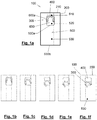
- a conventional system 100 for applying staples 300 is partially shown in the sequence of Figs 1a to 1f .
- the system 100 comprises a stapler mechanism 200 with a staple feeder 210 with an essentially oblong configuration which is usually vertically fastened in a chassis or frame and that is crossed from top to bottom by a hole 500 with a rectangular transverse cross section and smooth walls.
- a receiving window 600a is formed which connects to the hole 500 and which determines a receiving area 600 which enables a staple 300 to be received such that it is arranged to be aligned with the hole 500.
- three sections are distinguished in the hole 500: an upper section 510 wherein the hole 500 has a closed cross section, a section 520 coinciding with the receiving area 600 wherein the hole 500 has an open cross section, and a lower section which is immediately below the receiving area 600 and which carries out, as explained below, the function of a staple supply channel 530.
- the staple 300 being in this receiving area 600 (see Fig. 1a ) when the stapler mechanism 200 performs a closing operation, the staple 300 is pushed by a punch 400 inserted in a sliding manner through the hole 500 and actuated downwards such that, in a first dragging phase, the staple 300 is moved until it is introduced through an inlet end 530a in the supply channel 530; and in a second dragging phase, the staple 300 is moved from the aforementioned inlet end 530a to the outlet end 530b of the supply channel 530 underneath which an anvil is located, not shown.
- the staple 300 moves in the same vertical plane, with respect to which the supply channel 530 and the punch 400 are coplanar.
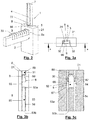
- Figs. 2 and 3a to 3c schematically show a variant of a system 1 exemplifying the invention.
- This system 1 combines a stapler mechanism 2 with a strip 33 of staples 3, both the stapler mechanism 2 and the staples 3 being especially designed to cooperate in a safer manner during the stapling operation.
- the stapler mechanism 2 of the system 1 which is shown in Fig. 2 comprises a staple feeder 21, with an especially oblong configuration, with a similar shape to that of the system 100.
- the staple feeder 21 can be made of one part or, as explained later, can be made up of assembled portions, connected or joined to each other in a firm or mobile manner.
- the staple feeder 21 is intended to be fastened essentially vertical and is crossed from top to bottom (in the direction of the drawings) by a hole 5.
- a staple 3 receiving window 6a connects to said hole 5 and defines a staple receiving area 6 underneath which the hole 5 carries out the function of a staple supply channel 53 (see Fig. 3b ).
- the stapler mechanism 2 is equipped with a slidable punch 4 adjusting along the hole 5.
- the punch 4 will first slide from a waiting position, wherein it leaves the receiving area 6 free, enabling a staple 3 to be received in a downwards direction dragging the staple until it is applied against the anvil; and, subsequently, in an upwards direction to recover the waiting position thereof and enable a new staple to be received.
- the punch 4 can be actuated manually or automatically. In any case, the mechanism which transmits these downward and upward movements to the punch are not explained in detail since they do not make up part of the invention.
- the hole 5 crossing the staple feeder 21 does not have a rectangular transverse cross section along all the length thereof.
- the rear receiving wall 65 whereon the staple 3 is arranged or applied in the receiving area 6 of the staple feeder 21 is equipped with a protrusion formation 8 determining a sort of rail, the purpose of which is to accommodate the arranged staple 3 and guide it in the path thereof in the direction to the feeding channel 53 during the first dragging phase of the staple 3.
- said protrusion formation 8 has a width related to the separation between the legs 32 of the staple 3 in an area adjacent to the connection bridge 31, with the goal of preventing or limiting the rotation of said staple 3 in the receiving area 6 and in the movement thereof towards the supply channel 53 by the inner face of the legs 32 contacting sides of the protrusion formation 8.
- the protrusion formation 8 is a projection with an essentially rectangular transverse cross section (see Fig. 5a ), which determines a central support surface 81 for the bridge 31 of the staple 3 and corresponding side support surfaces 82, each one for an edge of the inner face of a leg 32 of the staple 3, all of this as shown in Figs. 3a to 3c .
- the protrusion formation 8 formed, or added, to the rear receiving wall 65 of the receiving area 6 can extend to other sectors of the hole 5.
- this protrusion formation 8 extends uninterrupted along all the rear wall of the hole 5, also along the upper section 51 thereof and along the supply channel 53. Providing the protrusion formation 8 throughout the upper section 51 of the hole 5 contributes to the control of the movement of the punch 4 from the waiting position thereof; and providing the protrusion formation 8 throughout the supply channel 53 can contribute to the control of the movement of the staple especially when it juts out of the outlet end 53b and interacts with the anvil, as will be explained later.
- the front wall 56 of the hole 5 is equipped with a protrusion formation 88 analogous to the protrusion formation 8 of the rear wall.
- Providing the analogous protrusion formation 88 throughout the upper section 51 of the hole 5 further contributes to the control of the movement of the punch 4 from the waiting position thereof; and providing the analogous protrusion formation 88 throughout the supply channel 53 can be beneficial under certain circumstances for increasing the control of the movement of the staple when it juts out from the outlet end 53b of the feeding channel.
- the punch 4 (see Fig. 2 ) is equipped on the rear and front faces thereof, intended to stay facing the rear walls and front walls of the hole 5, with corresponding recesses 7 and 77. It can be of interest that mutual adjusting between these recesses 7, 77 and the protrusion 8 and analogous 88 formations, respectively, which naturally enables the sliding of the punch 4 through the hole 5 but with adjusting, contributes to perfecting the guiding of the punch 4 throughout the hole 5.
- the width of the protrusion formation 8 can be constant or it can vary. In the examples, the width is constant throughout the length of the protrusion formation, a width that is determined by the distance separating the side surfaces 82, parallel to each other.
- the invention also envisages other variants, for example, wherein the width of the protrusion formation is reduced in the advance direction of the staples 3.
- Fig. 2 and Figs. 3a to 3c show that, having seen the staple 3 in a plan view, the side of the staple 3 facing the rear wall of the hole 5 has a groove 9 with an outline and dimensions sufficient to prevent mechanical interference with the protrusion formation 8 during the presentation and receiving of the staple in the receiving area 6 and during the movement of the staple 3 in the direction to the supply channel 53.
- the groove 9 can be a negative of the protrusion formation 8.
- the groove 9 is dimensioned such that the bridge 31 of the staple 3 rests in a sliding manner on the protrusion formation 8 without this resting action moving the staple 3 out of the ideal vertical plane of movement in the direction to the aforementioned supply channel 53.
- the staples 3 are symmetrical with respect to a longitudinal cutting plane and have identical grooves 9 and 99 on the two sides thereof.
- the invention envisages that the staples 3 of a system according to the invention have a groove 9 only on one side of the staple 3 which is facing the rear wall of the hole 5; that the staples have grooves 9 and 99 on both sides; and even in this latter case that the grooves on one side are different from the ones of the other side.
- the staple 3 will need to have two grooves, one on each side and configured to correspond with the associated protrusion formation of the wall whereon the staple slides in the staple feeder 21.
- the staple 3 can be made starting from metal material in the form of a band which gives the staple 3 an oblong transverse cross section, in other words, with a width dimension, although it is variable, which is always greater than the thickness dimension thereof.
- the distal portion of the legs 32 of the staples 3 has a constant width, both edges of the legs being straight and parallel to each other. This distal portion of the legs 32 connects to the bridge 31, with a smaller width, by means of a short linking or transition portion with slightly curved edges.
- the width of the bridge 31 is constant, offering corresponding flat edges intended to slide on the protrusion formation or formations 8, 88. With all of this (see Fig. 3a ) in the plan view, each staple 3 has a general H-shaped configuration.
- Fig. 3c shows that, in the system 1 exemplifying the invention, in the receiving area 6 the side closing walls 64 of the hole 5 are at a greater distance than in, for example, the supply channel 53.
- This characteristic enables the staple feeder 21 to be more versatile and to be able to accommodate staples 3 with different shapes, for example, with different lengths for the legs 32.
- a staple 3 has been shown, the legs 32 thereof being parallel, it is common and the invention envisages that the legs 32 of the staples are slightly divergent from each other, all of this as explained later in reference to Fig. 4a .
- these side closing walls 64 in the receiving area 6 are connected uninterrupted with the side closing walls 54 of the section of the hole 5 determining the supply channel 53 of the staples to the anvil, corresponding tilted, straight, curved or mixed transition sections 67 being distinguished, which converge to direct the legs 32 of the staples and direct them for the adequate insertion thereof in the aforementioned supply channel 53, occasionally folding them slightly.
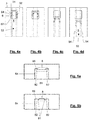
- Figs. 4a to 4d enables the technical effect obtained by this particular configuration of the staple feeder 21 to be shown in order to understand a form of interest for the staples 3 according to another embodiment.
- the groove 9 completely affects the bridge portion 31 and part of both legs 32, originally slightly divergent from each other.
- the staples 3 can be similar to the staples of Fig. 2 .
- Fig. 4a illustrates how the receiving area 6 is able to accommodate staples 3 of this type, meaning with slightly divergent legs 32, with a different length for the legs 32 thereof.
- legs with different lengths have been superimposed.
- Fig. 4b intends to illustrate what occurs if the staple 3 tends to rotate, in this case, in a clockwise direction. This rotation will be prevented by the inner face of the right side leg 32 of the staple 3 contacting with the right side of the protrusion formation 8; and by the inner face of the leg 32 of the opposite side of the staple 3, in an area adjacent to the joining bridge 31, contacting with the left side of the protrusion formation.
- the location of the contact point or area between the leg 32 of the right side of the staple 3 with the right side of the protrusion formation 8 will vary.
- Figs. 4c and 4d also include highlighted contact points between the outer faces of the legs 32 of the staple 3 and the side closing walls 54 of the supply channel 53.
- the original separation between the legs 32 of the staples must be such that they are required to be slightly folded, mutually getting closer to each other, due to the effect of the tilted transition sections 67.
- the friction between the outer faces of the legs 32 of the staple 3 and the side closing walls 54 in the supply channel 53 ensures that the staples will advance along the aforementioned supply channel 53 as pushed by the punch 4 instead of the staples 3 falling due to gravity, without control of the advance, through said supply channel 53.
- the anti-rotation effect can be provided by protrusion formations with configurations different from that with which the system 1 exemplifying the invention is equipped.
- Fig. 5b shows an alternative that would have an effect similar to that of the protrusion formation 8 of Fig. 5a .
- the same numerical references have been used to designate the portions that carry out a function equivalent to those of the protrusion 8 of the embodiment according to Fig. 5a .
- Other configurations are possible within the scope of the present invention, as long as they offer support surfaces for the inner face of the legs 32 of the staples to be used.
- Figs. 6a to 6d show a moment during the second dragging phase of a staple 3, the staple 3 already being in the supply channel 53.
- the staple 3 moves in a fitted manner, the outside of the legs 32 making contact, at least on the lowest edge thereof, with the side closing walls 54 of the supply channel 53. Then the staple offers a slight resistance to the advance thereof while it is pushed by the punch 4 (not shown).
- Figs. 7 and 8 show respective alternatives for a stapler mechanism 2 according to the invention, specifically insomuch as it relates to the constructive solution for the staple feeder 21, to the relation thereof with the anvil 10 and also with the casing to be stapled (not shown), for which the staple feeder 21 must be provided with an access opening 22 in order to be able to arrange said wrapping between the anvil 10 and the outlet end 53b of the staple supply channel 53.
- Fig. 8 is used to show a variant of the invention according to which the supply channel 53 is determined by two portions of the staple feeder 21a and 21b which are joined and articulated.
- a protrusion formation 8 in one of the front walls or rear walls, in the example the rear wall 54, of the supply channel 53, in the vicinity of the outlet end 53a thereof may in certain circumstances contribute to preventing the rotation of the staple 3 moments before the legs 32 make contact with the anvil 10 and start a third dragging phase of said staple 3 (see Figs. 7a and 8a ).
- FIGs. 7a and 8a attempt to illustrate this circumstance, having highlighted contact points between a protrusion formation 8 and the inner faces of the legs 32 of the staple which contribute to controlling the rotation of this staple 3 with short legs 32 and therefore ensure a correct interaction with the anvil 10.
Landscapes
- Engineering & Computer Science (AREA)
- Life Sciences & Earth Sciences (AREA)
- Mechanical Engineering (AREA)
- Wood Science & Technology (AREA)
- Zoology (AREA)
- Food Science & Technology (AREA)
- Portable Nailing Machines And Staplers (AREA)
- Dovetailed Work, And Nailing Machines And Stapling Machines For Wood (AREA)
Claims (6)
- Système (1) d'agrafage pour casiers de saucisses, qui combine- une succession d'agrafes qui sont juxtaposées et reliées entre elles de manière séparable, deux pattes orientées l'une vers l'autre (32) et un pont de connexion (31) entre les pattes mentionnées antérieurement étant distingués sur chaque agrafe (3) ; et- un mécanisme d'agrafeuse (2) avec un canal d'alimentation d'agrafes (53) qui a une extrémité d'entrée (53a) et une extrémité de sortie (53b) et qui est déterminé par au moins une paroi arrière (55) et deux parois de fermeture latérales (54) ; une enclume (10) placée dessous et près de l'extrémité de sortie (53b) du canal d'alimentation (53) ; et un poinçon (4) qui peut glisser le long du canal d'alimentation (53), tout ceci adéquat de manière à ce qu'une agrafe (3) peut être introduite dans le canal d'alimentation (53) à travers l'extrémité d'entrée (53a) et peut être poussée par le poinçon (4) dans le glissement de celui-ci vers l'extrémité de sortie (53b) et vers l'enclume (10) contre laquelle s'aplatit l'agrafe (3) mentionnée antérieurement et les pattes (32) de celle-ci se configurent pour se fermer, le système étant caractérisé en ce que la paroi arrière (55) mentionnée antérieurement du canal d'alimentation (53) s'étend au-delà de l'extrémité d'entrée (53a) le long d'une zone de réception (6) d'agrafe (3) qui détermine une paroi de réception arrière (65) pour la disposition sur celle-ci de la première agrafe (3) de la succession d'agrafes, au moins cette paroi de réception arrière (65) ayant une formation en saillie (8) qui s'étend dans la même direction que celle dans laquelle s'étend le canal d'alimentation (53) et qui détermine un type de rail pour loger l'agrafe (3) et la guider dans la trajectoire de celle-ci dans la direction du canal d'alimentation (53), raison pour laquelle ladite formation en saillie (8) a une largeur en relation avec la séparation entre les pattes (32) de l'agrafe (3) dans une zone près du pont de connexion (31) de celle-ci, empêchant ou limitant que ladite agrafe (3) tourne dans la zone de réception (6) et dans le mouvement de celle-ci vers le canal d'alimentation (53) par la face interne des pattes (32) qui entrent en contact avec des côtés de la formation en saillie (8) et en ce que, vu en plan, et au moins sur le côté avant qui est orienté vers la paroi de réception arrière (65) lorsque les agrafes (3) sont disposées dans la zone de réception (6) mentionnée antérieurement, le corps des agrafes (3) a une rainure (9) avec un contour et des dimensions suffisants pour empêcher l'interférence mécanique avec la formation en saillie (8) ce qui altérerait l'alignement de l'agrafe (3) avec le poinçon (4) et le canal d'alimentation (53) mentionné antérieurement.
- Système (1) selon la revendication précédente, caractérisé en ce que les deux parois de fermeture latérales (54) du canal d'alimentation s'étendent aussi le long de la zone de réception (6) de l'alimentateur d'agrafes (21) qui détermine des parois de réception latérales correspondantes (64), la largeur du passage déterminé entre ces parois de réception latérales (64) dans la zone de réception (6) mentionnée antérieurement étant plus grande que la largeur du passage déterminé entre les parois de fermeture latérales (54) du canal d'alimentation (53), un segment de transition suffisamment subtil (67) étant distingué entre lesdites parois de réception latérales (64) et parois de fermeture latérales (54) du canal d'alimentation (53) pour provoquer le pliage des pattes (32) de l'agrafe (3) lorsque la largeur de celle-ci est plus grande que la largeur du passage du canal d'alimentation (53) et permettre par conséquent l'introduction de celle-ci dans le canal d'alimentation (53) en poussant depuis le poinçon (4), ajustant de cette manière les pattes (32) sur les parois de fermeture latérales (54) de celui-ci.
- Système (1) selon la revendication 1 ou 2, caractérisé en ce que la formation en saillie (8) s'étend depuis la zone de réception (6) jusqu'au canal d'alimentation (53) le long de la paroi arrière (55) de celui-ci, à travers au moins une section de celle-ci, ou à travers la totalité de celle-ci, s'étend ladite formation en saillie (8).
- Système (1) selon l'une quelconque des revendications précédentes, caractérisé en ce qu'une autre formation en saillie (88) analogue à celle de la paroi de réception arrière (65) s'étend le long d'au moins une section de la paroi avant (56) du canal d'alimentation (53), et en ce que, en correspondance avec cette autre formation en saillie (88), les agrafes (3) ont une autre rainure (99) avec un contour et des dimensions suffisants pour empêcher l'interférence mécanique avec cette autre formation en saillie (88) pendant le mouvement des agrafes (3) le long du canal d'alimentation (53).
- Système (1) selon l'une quelconque des revendications précédentes, caractérisé en ce que la ou, le cas échéant, une des formations en saillie (8, 88) est une protubérance avec une section transversale configurée comme essentiellement rectangulaire, qui détermine une surface d'appui central (8a) pour le pont de l'agrafe (31) et des surfaces d'appui latérales (8b) correspondantes, chacune pour un bord de la face interne d'une patte (32) de l'agrafe (3).
- Système (1) selon l'une quelconque des revendications précédentes, caractérisé en ce que le poinçon (4) présente une face arrière, qui glisse orientée vers la paroi de réception arrière (65) de la zone de réception (6) et la paroi arrière (55) du canal d'alimentation (53), avec un contour selon celles-ci.
Priority Applications (3)
| Application Number | Priority Date | Filing Date | Title |
|---|---|---|---|
| ES18382922T ES2898675T3 (es) | 2018-12-13 | 2018-12-13 | Un sistema para grapar envolturas de embutidos |
| PL18382922T PL3666077T3 (pl) | 2018-12-13 | 2018-12-13 | System spinania klamrami osłonek do kiełbas |
| EP18382922.5A EP3666077B1 (fr) | 2018-12-13 | 2018-12-13 | Système d'agrafage pour casiers de saucisses |
Applications Claiming Priority (1)
| Application Number | Priority Date | Filing Date | Title |
|---|---|---|---|
| EP18382922.5A EP3666077B1 (fr) | 2018-12-13 | 2018-12-13 | Système d'agrafage pour casiers de saucisses |
Publications (2)
| Publication Number | Publication Date |
|---|---|
| EP3666077A1 EP3666077A1 (fr) | 2020-06-17 |
| EP3666077B1 true EP3666077B1 (fr) | 2021-08-25 |
Family
ID=65234382
Family Applications (1)
| Application Number | Title | Priority Date | Filing Date |
|---|---|---|---|
| EP18382922.5A Active EP3666077B1 (fr) | 2018-12-13 | 2018-12-13 | Système d'agrafage pour casiers de saucisses |
Country Status (3)
| Country | Link |
|---|---|
| EP (1) | EP3666077B1 (fr) |
| ES (1) | ES2898675T3 (fr) |
| PL (1) | PL3666077T3 (fr) |
Family Cites Families (4)
| Publication number | Priority date | Publication date | Assignee | Title |
|---|---|---|---|---|
| US3210835A (en) * | 1964-05-14 | 1965-10-12 | Rheem Mfg Co | Apparatus for fastening casings and the like |
| DE3333875A1 (de) * | 1983-09-20 | 1985-03-28 | Herbert Dipl.-Ing. 6240 Königstein Niedecker | Vorrichtung zum verschliessen von schlauchartigen verpackungshuellen mit u-foermigen verschlussklammern |
| US5586424A (en) * | 1992-05-15 | 1996-12-24 | Delaware Capital Formation, Inc. | Apparatus for movement of U-shaped clips along a rail |
| HUE047408T2 (hu) * | 2017-04-12 | 2020-04-28 | Noguera Sagar Lorenzo | Tûzõkapocs-csík |
-
2018
- 2018-12-13 EP EP18382922.5A patent/EP3666077B1/fr active Active
- 2018-12-13 PL PL18382922T patent/PL3666077T3/pl unknown
- 2018-12-13 ES ES18382922T patent/ES2898675T3/es active Active
Also Published As
| Publication number | Publication date |
|---|---|
| EP3666077A1 (fr) | 2020-06-17 |
| PL3666077T3 (pl) | 2022-01-17 |
| ES2898675T8 (es) | 2022-03-17 |
| ES2898675T3 (es) | 2022-03-08 |
Similar Documents
| Publication | Publication Date | Title |
|---|---|---|
| JP2758986B2 (ja) | 書類とじ器の可動折り曲げ翼部を有する案内アンビル | |
| EP0178940B1 (fr) | Agrafeuse chirurgicale | |
| EP2362106A2 (fr) | Agrafes interconnectées et cartouche d'agrafes | |
| EP2822733B1 (fr) | Configurations de ressort moteur pour un dispositif de fixation | |
| JP2004345863A (ja) | 小冊子製本機 | |
| WO2019168808A1 (fr) | Cartouche d'agrafes et procédés pour agrafeuses chirurgicales | |
| US11160388B2 (en) | System for manufacturing string of pocketed coil springs | |
| WO1994000277A1 (fr) | Agrafeuse comportant un mecanisme aplatissant les agrafes | |
| EP3666077B1 (fr) | Système d'agrafage pour casiers de saucisses | |
| CN112334321B (zh) | 装订夹 | |
| DE102007047050A1 (de) | Heftkopf | |
| US8146906B2 (en) | Sheet processing apparatus | |
| KR20260017007A (ko) | 결속기 | |
| JP2021070172A (ja) | 記録材処理装置および画像形成システム | |
| US6059504A (en) | Binding device | |
| CN105513790B (zh) | 封闭磁芯绕线装置及绕线机 | |
| JP6451255B2 (ja) | 綴じ装置 | |
| JP4811388B2 (ja) | 綴じ部品 | |
| US20070272720A1 (en) | Partially-formed staple sheet and stapler for using same | |
| US9776451B2 (en) | Binding device | |
| JPWO2015156332A1 (ja) | リングファイル用シート体及びリングファイル用パンチ | |
| EP1075420B1 (fr) | Dispositif de faconnage, procede permettant de faconner un tuyau flexible en une bande continue avec des flans d'emballage mutuellement sequentiels | |
| US20100240512A1 (en) | Method for making a string of bags provided with a cursor | |
| JP2003128017A (ja) | クリップ結束機におけるクリップ切断機構 | |
| JP4832792B2 (ja) | 排紙面上にシートのスタックを形成するための装置および方法 |
Legal Events
| Date | Code | Title | Description |
|---|---|---|---|
| PUAI | Public reference made under article 153(3) epc to a published international application that has entered the european phase |
Free format text: ORIGINAL CODE: 0009012 |
|
| STAA | Information on the status of an ep patent application or granted ep patent |
Free format text: STATUS: THE APPLICATION HAS BEEN PUBLISHED |
|
| AK | Designated contracting states |
Kind code of ref document: A1 Designated state(s): AL AT BE BG CH CY CZ DE DK EE ES FI FR GB GR HR HU IE IS IT LI LT LU LV MC MK MT NL NO PL PT RO RS SE SI SK SM TR |
|
| AX | Request for extension of the european patent |
Extension state: BA ME |
|
| STAA | Information on the status of an ep patent application or granted ep patent |
Free format text: STATUS: REQUEST FOR EXAMINATION WAS MADE |
|
| 17P | Request for examination filed |
Effective date: 20201202 |
|
| RBV | Designated contracting states (corrected) |
Designated state(s): AL AT BE BG CH CY CZ DE DK EE ES FI FR GB GR HR HU IE IS IT LI LT LU LV MC MK MT NL NO PL PT RO RS SE SI SK SM TR |
|
| GRAP | Despatch of communication of intention to grant a patent |
Free format text: ORIGINAL CODE: EPIDOSNIGR1 |
|
| STAA | Information on the status of an ep patent application or granted ep patent |
Free format text: STATUS: GRANT OF PATENT IS INTENDED |
|
| INTG | Intention to grant announced |
Effective date: 20210407 |
|
| GRAS | Grant fee paid |
Free format text: ORIGINAL CODE: EPIDOSNIGR3 |
|
| GRAA | (expected) grant |
Free format text: ORIGINAL CODE: 0009210 |
|
| STAA | Information on the status of an ep patent application or granted ep patent |
Free format text: STATUS: THE PATENT HAS BEEN GRANTED |
|
| AK | Designated contracting states |
Kind code of ref document: B1 Designated state(s): AL AT BE BG CH CY CZ DE DK EE ES FI FR GB GR HR HU IE IS IT LI LT LU LV MC MK MT NL NO PL PT RO RS SE SI SK SM TR |
|
| REG | Reference to a national code |
Ref country code: CH Ref legal event code: EP |
|
| REG | Reference to a national code |
Ref country code: IE Ref legal event code: FG4D Ref country code: AT Ref legal event code: REF Ref document number: 1422862 Country of ref document: AT Kind code of ref document: T Effective date: 20210915 |
|
| REG | Reference to a national code |
Ref country code: DE Ref legal event code: R096 Ref document number: 602018022340 Country of ref document: DE |
|
| REG | Reference to a national code |
Ref country code: LT Ref legal event code: MG9D |
|
| REG | Reference to a national code |
Ref country code: NL Ref legal event code: MP Effective date: 20210825 |
|
| REG | Reference to a national code |
Ref country code: AT Ref legal event code: MK05 Ref document number: 1422862 Country of ref document: AT Kind code of ref document: T Effective date: 20210825 |
|
| PG25 | Lapsed in a contracting state [announced via postgrant information from national office to epo] |
Ref country code: SE Free format text: LAPSE BECAUSE OF FAILURE TO SUBMIT A TRANSLATION OF THE DESCRIPTION OR TO PAY THE FEE WITHIN THE PRESCRIBED TIME-LIMIT Effective date: 20210825 Ref country code: RS Free format text: LAPSE BECAUSE OF FAILURE TO SUBMIT A TRANSLATION OF THE DESCRIPTION OR TO PAY THE FEE WITHIN THE PRESCRIBED TIME-LIMIT Effective date: 20210825 Ref country code: HR Free format text: LAPSE BECAUSE OF FAILURE TO SUBMIT A TRANSLATION OF THE DESCRIPTION OR TO PAY THE FEE WITHIN THE PRESCRIBED TIME-LIMIT Effective date: 20210825 Ref country code: FI Free format text: LAPSE BECAUSE OF FAILURE TO SUBMIT A TRANSLATION OF THE DESCRIPTION OR TO PAY THE FEE WITHIN THE PRESCRIBED TIME-LIMIT Effective date: 20210825 Ref country code: LT Free format text: LAPSE BECAUSE OF FAILURE TO SUBMIT A TRANSLATION OF THE DESCRIPTION OR TO PAY THE FEE WITHIN THE PRESCRIBED TIME-LIMIT Effective date: 20210825 Ref country code: BG Free format text: LAPSE BECAUSE OF FAILURE TO SUBMIT A TRANSLATION OF THE DESCRIPTION OR TO PAY THE FEE WITHIN THE PRESCRIBED TIME-LIMIT Effective date: 20211125 Ref country code: AT Free format text: LAPSE BECAUSE OF FAILURE TO SUBMIT A TRANSLATION OF THE DESCRIPTION OR TO PAY THE FEE WITHIN THE PRESCRIBED TIME-LIMIT Effective date: 20210825 Ref country code: NO Free format text: LAPSE BECAUSE OF FAILURE TO SUBMIT A TRANSLATION OF THE DESCRIPTION OR TO PAY THE FEE WITHIN THE PRESCRIBED TIME-LIMIT Effective date: 20211125 Ref country code: PT Free format text: LAPSE BECAUSE OF FAILURE TO SUBMIT A TRANSLATION OF THE DESCRIPTION OR TO PAY THE FEE WITHIN THE PRESCRIBED TIME-LIMIT Effective date: 20211227 |
|
| PG25 | Lapsed in a contracting state [announced via postgrant information from national office to epo] |
Ref country code: LV Free format text: LAPSE BECAUSE OF FAILURE TO SUBMIT A TRANSLATION OF THE DESCRIPTION OR TO PAY THE FEE WITHIN THE PRESCRIBED TIME-LIMIT Effective date: 20210825 Ref country code: GR Free format text: LAPSE BECAUSE OF FAILURE TO SUBMIT A TRANSLATION OF THE DESCRIPTION OR TO PAY THE FEE WITHIN THE PRESCRIBED TIME-LIMIT Effective date: 20211126 |
|
| REG | Reference to a national code |
Ref country code: ES Ref legal event code: FG2A Ref document number: 2898675 Country of ref document: ES Kind code of ref document: T3 Effective date: 20220308 |
|
| PG25 | Lapsed in a contracting state [announced via postgrant information from national office to epo] |
Ref country code: NL Free format text: LAPSE BECAUSE OF FAILURE TO SUBMIT A TRANSLATION OF THE DESCRIPTION OR TO PAY THE FEE WITHIN THE PRESCRIBED TIME-LIMIT Effective date: 20210825 |
|
| PG25 | Lapsed in a contracting state [announced via postgrant information from national office to epo] |
Ref country code: DK Free format text: LAPSE BECAUSE OF FAILURE TO SUBMIT A TRANSLATION OF THE DESCRIPTION OR TO PAY THE FEE WITHIN THE PRESCRIBED TIME-LIMIT Effective date: 20210825 |
|
| REG | Reference to a national code |
Ref country code: DE Ref legal event code: R097 Ref document number: 602018022340 Country of ref document: DE |
|
| PG25 | Lapsed in a contracting state [announced via postgrant information from national office to epo] |
Ref country code: SM Free format text: LAPSE BECAUSE OF FAILURE TO SUBMIT A TRANSLATION OF THE DESCRIPTION OR TO PAY THE FEE WITHIN THE PRESCRIBED TIME-LIMIT Effective date: 20210825 Ref country code: SK Free format text: LAPSE BECAUSE OF FAILURE TO SUBMIT A TRANSLATION OF THE DESCRIPTION OR TO PAY THE FEE WITHIN THE PRESCRIBED TIME-LIMIT Effective date: 20210825 Ref country code: RO Free format text: LAPSE BECAUSE OF FAILURE TO SUBMIT A TRANSLATION OF THE DESCRIPTION OR TO PAY THE FEE WITHIN THE PRESCRIBED TIME-LIMIT Effective date: 20210825 Ref country code: EE Free format text: LAPSE BECAUSE OF FAILURE TO SUBMIT A TRANSLATION OF THE DESCRIPTION OR TO PAY THE FEE WITHIN THE PRESCRIBED TIME-LIMIT Effective date: 20210825 Ref country code: CZ Free format text: LAPSE BECAUSE OF FAILURE TO SUBMIT A TRANSLATION OF THE DESCRIPTION OR TO PAY THE FEE WITHIN THE PRESCRIBED TIME-LIMIT Effective date: 20210825 Ref country code: AL Free format text: LAPSE BECAUSE OF FAILURE TO SUBMIT A TRANSLATION OF THE DESCRIPTION OR TO PAY THE FEE WITHIN THE PRESCRIBED TIME-LIMIT Effective date: 20210825 |
|
| PLBE | No opposition filed within time limit |
Free format text: ORIGINAL CODE: 0009261 |
|
| STAA | Information on the status of an ep patent application or granted ep patent |
Free format text: STATUS: NO OPPOSITION FILED WITHIN TIME LIMIT |
|
| PG25 | Lapsed in a contracting state [announced via postgrant information from national office to epo] |
Ref country code: MC Free format text: LAPSE BECAUSE OF FAILURE TO SUBMIT A TRANSLATION OF THE DESCRIPTION OR TO PAY THE FEE WITHIN THE PRESCRIBED TIME-LIMIT Effective date: 20210825 |
|
| REG | Reference to a national code |
Ref country code: CH Ref legal event code: PL |
|
| 26N | No opposition filed |
Effective date: 20220527 |
|
| PG25 | Lapsed in a contracting state [announced via postgrant information from national office to epo] |
Ref country code: SI Free format text: LAPSE BECAUSE OF FAILURE TO SUBMIT A TRANSLATION OF THE DESCRIPTION OR TO PAY THE FEE WITHIN THE PRESCRIBED TIME-LIMIT Effective date: 20210825 |
|
| REG | Reference to a national code |
Ref country code: BE Ref legal event code: MM Effective date: 20211231 |
|
| PG25 | Lapsed in a contracting state [announced via postgrant information from national office to epo] |
Ref country code: LU Free format text: LAPSE BECAUSE OF NON-PAYMENT OF DUE FEES Effective date: 20211213 Ref country code: IE Free format text: LAPSE BECAUSE OF NON-PAYMENT OF DUE FEES Effective date: 20211213 |
|
| PG25 | Lapsed in a contracting state [announced via postgrant information from national office to epo] |
Ref country code: FR Free format text: LAPSE BECAUSE OF NON-PAYMENT OF DUE FEES Effective date: 20211231 Ref country code: BE Free format text: LAPSE BECAUSE OF NON-PAYMENT OF DUE FEES Effective date: 20211231 |
|
| PG25 | Lapsed in a contracting state [announced via postgrant information from national office to epo] |
Ref country code: LI Free format text: LAPSE BECAUSE OF NON-PAYMENT OF DUE FEES Effective date: 20211231 Ref country code: CH Free format text: LAPSE BECAUSE OF NON-PAYMENT OF DUE FEES Effective date: 20211231 |
|
| PG25 | Lapsed in a contracting state [announced via postgrant information from national office to epo] |
Ref country code: CY Free format text: LAPSE BECAUSE OF FAILURE TO SUBMIT A TRANSLATION OF THE DESCRIPTION OR TO PAY THE FEE WITHIN THE PRESCRIBED TIME-LIMIT Effective date: 20210825 |
|
| P01 | Opt-out of the competence of the unified patent court (upc) registered |
Effective date: 20230527 |
|
| PG25 | Lapsed in a contracting state [announced via postgrant information from national office to epo] |
Ref country code: HU Free format text: LAPSE BECAUSE OF FAILURE TO SUBMIT A TRANSLATION OF THE DESCRIPTION OR TO PAY THE FEE WITHIN THE PRESCRIBED TIME-LIMIT; INVALID AB INITIO Effective date: 20181213 |
|
| GBPC | Gb: european patent ceased through non-payment of renewal fee |
Effective date: 20221213 |
|
| PG25 | Lapsed in a contracting state [announced via postgrant information from national office to epo] |
Ref country code: GB Free format text: LAPSE BECAUSE OF NON-PAYMENT OF DUE FEES Effective date: 20221213 |
|
| PG25 | Lapsed in a contracting state [announced via postgrant information from national office to epo] |
Ref country code: MK Free format text: LAPSE BECAUSE OF FAILURE TO SUBMIT A TRANSLATION OF THE DESCRIPTION OR TO PAY THE FEE WITHIN THE PRESCRIBED TIME-LIMIT Effective date: 20210825 |
|
| PG25 | Lapsed in a contracting state [announced via postgrant information from national office to epo] |
Ref country code: MT Free format text: LAPSE BECAUSE OF FAILURE TO SUBMIT A TRANSLATION OF THE DESCRIPTION OR TO PAY THE FEE WITHIN THE PRESCRIBED TIME-LIMIT Effective date: 20210825 |
|
| PG25 | Lapsed in a contracting state [announced via postgrant information from national office to epo] |
Ref country code: TR Free format text: LAPSE BECAUSE OF FAILURE TO SUBMIT A TRANSLATION OF THE DESCRIPTION OR TO PAY THE FEE WITHIN THE PRESCRIBED TIME-LIMIT Effective date: 20210825 |
|
| PGFP | Annual fee paid to national office [announced via postgrant information from national office to epo] |
Ref country code: IT Payment date: 20251219 Year of fee payment: 8 |
|
| PGFP | Annual fee paid to national office [announced via postgrant information from national office to epo] |
Ref country code: PL Payment date: 20251201 Year of fee payment: 8 |
|
| PGFP | Annual fee paid to national office [announced via postgrant information from national office to epo] |
Ref country code: ES Payment date: 20260105 Year of fee payment: 8 |
|
| PGFP | Annual fee paid to national office [announced via postgrant information from national office to epo] |
Ref country code: DE Payment date: 20251229 Year of fee payment: 8 |