EP3666414A1 - Procédé et moule permettant de fabriquer des pièces moulées métalliques - Google Patents
Procédé et moule permettant de fabriquer des pièces moulées métalliques Download PDFInfo
- Publication number
- EP3666414A1 EP3666414A1 EP19215857.4A EP19215857A EP3666414A1 EP 3666414 A1 EP3666414 A1 EP 3666414A1 EP 19215857 A EP19215857 A EP 19215857A EP 3666414 A1 EP3666414 A1 EP 3666414A1
- Authority
- EP
- European Patent Office
- Prior art keywords
- mold
- casting
- metal
- casting mold
- cooling medium
- Prior art date
- Legal status (The legal status is an assumption and is not a legal conclusion. Google has not performed a legal analysis and makes no representation as to the accuracy of the status listed.)
- Granted
Links
Images




Classifications
-
- B—PERFORMING OPERATIONS; TRANSPORTING
- B22—CASTING; POWDER METALLURGY
- B22C—FOUNDRY MOULDING
- B22C9/00—Moulds or cores; Moulding processes
- B22C9/02—Sand moulds or like moulds for shaped castings
- B22C9/04—Use of lost patterns
-
- B—PERFORMING OPERATIONS; TRANSPORTING
- B22—CASTING; POWDER METALLURGY
- B22D—CASTING OF METALS; CASTING OF OTHER SUBSTANCES BY THE SAME PROCESSES OR DEVICES
- B22D29/00—Removing castings from moulds, not restricted to casting processes covered by a single main group; Removing cores; Handling ingots
-
- B—PERFORMING OPERATIONS; TRANSPORTING
- B22—CASTING; POWDER METALLURGY
- B22D—CASTING OF METALS; CASTING OF OTHER SUBSTANCES BY THE SAME PROCESSES OR DEVICES
- B22D30/00—Cooling castings, not restricted to casting processes covered by a single main group
-
- B—PERFORMING OPERATIONS; TRANSPORTING
- B33—ADDITIVE MANUFACTURING TECHNOLOGY
- B33Y—ADDITIVE MANUFACTURING, i.e. MANUFACTURING OF THREE-DIMENSIONAL [3D] OBJECTS BY ADDITIVE DEPOSITION, ADDITIVE AGGLOMERATION OR ADDITIVE LAYERING, e.g. BY 3D PRINTING, STEREOLITHOGRAPHY OR SELECTIVE LASER SINTERING
- B33Y80/00—Products made by additive manufacturing
Definitions
- the invention lies in the field of mechanical engineering and specifically in the field of foundry technology. It can be used with particular advantage in the production of metal cast workpieces.
- the object of the present invention is to develop a method which allows the production of metal cast workpieces with high complexity of the shape and at the same time enables good structural properties to be achieved.
- the object is achieved with the features of the invention by a method according to claim 1.
- the dependent claims show possible implementations of such a method.
- the invention relates to a casting mold produced by the method and to a device for producing a metal casting workpiece.
- the invention relates to a method for producing metal cast workpieces, in which a molten metal is poured into a mold, then after the solidification of the molten metal has started and still during the cooling process, the mold is at least partially removed from the metal cast workpiece and thereby the metal cast workpiece with a the mold surrounding, flowable cooling medium is brought into contact, which is suitable for extracting thermal energy from the metal casting workpiece faster than the casting mold.
- the mold is at least partially removed after a stable or self-supporting layer of solidified molten metal has formed.
- the removal of the mold can in particular take place before the molten metal has completely solidified.
- the invention is based on the idea that the metal casting workpiece first obtains its shape by pouring the molten metal into a casting mold, but that as soon as possible not only the cooling of the molten metal or the solidified workpiece takes place via the casting mold, but also that The mold is at least partially removed, so that the workpiece is cooled further and intensively by a flowable cooling medium, since the workpiece comes into contact with the medium by removing the mold or a part of the mold.
- the medium is selected so that it extracts the thermal energy from the metal casting workpiece faster than the casting mold.
- the material of the medium can be suitably selected and tempered, as will be explained in more detail below.
- the mold can be spring-loaded and unlocked so that it snaps open by a spring force, or it can be provided with an explosive charge in order to remove it from the workpiece as quickly as possible.
- the casting mold is broken, for example by introducing the casting mold into the cooling medium together with the poured-in metal melt while the metal melt is cooling.
- a suitable temperature of the cooling medium can be set, which is advantageously significantly colder than the molten metal or as the metal casting workpiece at the point in time at which the casting mold is introduced into the cooling medium.
- the material of the casting mold can be selected and the wall thickness can be adjusted so that the casting mold breaks due to thermal stress when the cooling medium is introduced. In this case, by breaking away smaller or larger parts of the casting mold, the cooling medium can get directly to the metal casting workpiece and subsequently cool it faster than the casting mold would have achieved if the workpiece had remained in contact.
- the cooling medium has a lower specific thermal resistance and / or a higher specific thermal capacity than the material of the casting mold and / or that the cooling medium is at least 400 degrees colder than the metal casting workpiece at the time of first contact with the mold.
- the mold is heated before and / or during the pouring of the molten metal.
- the advantages of a heated casting mold for achieving complex shapes of the metal casting workpiece can be optimally used and combined with the advantages of rapid cooling.
- a fluid in particular a liquid, more particularly water
- a fluid in particular a liquid, more particularly water
- a cold gas or a liquid other than water such as oil or mercury
- the use of water has advantages because of its availability, simple handling and high heat capacity.
- the temperature of the cooling medium before the contact with the casting mold and the time of the first contact of the casting mold with the cooling medium is selected such that the casting mold breaks at least partially when it comes into contact with the cooling medium due to sudden cooling .
- it can also be provided when using a fluid that the mold itself does not break due to thermal stresses, but is removed by other effects, such as spring force or explosive action. In this case too, the use of water as the cooling medium is of great advantage.
- the invention also relates to a casting mold, which can be produced in particular by the method according to one of Claims 1 to 6, for use in a metal casting method.
- the mold can consist of a fired ceramic.
- the casting mold can have one or more predetermined breaking points, which are formed by recesses and / or notches. Preparing the mold in this way makes it easier to control the breaking of the mold during the solidification process of the workpiece. This applies to the various configurations of the method for breaking the Mold, but in a special way for breaking through the introduction of thermal stresses.
- the invention also relates to a mold which can be produced by the method described above, and additionally or alternatively to a method for producing a mold for use in a method according to one of claims 1 to 6, wherein the mold and / or the
- the method is characterized in that a positive model is generated and that the positive model is then covered with one or more layers of a liquid ceramic slip, the positive model being applied before and / or alternating with the application and drying of Slip layers are partially covered with a hydrophobic substance.
- the targeted application of hydrophobic substances controls the adhesion of the slip to the positive model in such a way that the mold is weakened.
- the invention also relates to a mold which can be produced by the method described above and, additionally or alternatively, to a method for producing a mold for use in a method of the type explained above, in which and / or in which a positive Model is generated and then the positive model is covered with one or more layers of a liquid ceramic slip, the dried or fired slip body being provided with recesses and / or notches for producing predetermined breaking points by a removal, in particular machining process.
- the invention also relates to a device for producing a metal casting workpiece, with a device for melting metal, a casting mold and a device for sudden cooling of the casting mold and the metal casting workpiece, in particular by means of water.
- the device for producing the metal casting workpiece can comprise the casting mold of the type explained above.
- Such a device provides a suitable casting mold which, as described above, can have predetermined breaking points, for example.
- the device can also have a heating device for the casting mold, as well as a container in which the casting mold is held and in which with sufficient speed Water, especially chilled water, can be introduced. A water supply with sufficient capacity must be provided for this.
- the casting mold can also be arranged such that it can be moved during the solidification or shortly after the metal casting workpiece solidifies and can be conveyed to a water reservoir in which the casting mold can then cool down quickly.
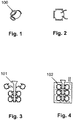
- FIG 1 a wax model 100 for a metal casting workpiece to be produced is shown schematically.
- Figure 2 the wax model is shown with a sprue system.
- Figure 3 shows the arrangement of several similar wax models in a cast cluster 101. After its manufacture, the cast cluster looks like Figure 4 can be seen, immersed several times in a slip bath 102 and dried in the meantime and possibly also heated.
- Figure 5 shows the firing process in which, after the application of sufficiently thick layers of slip, the wax models are burned out and melted out by heating, so that they leave correspondingly shaped cavities 105 in the slip bodies. At the same time, the slip mass can be fired into a ceramic form.
- the slip mass can be fired into a ceramic form.
- 103 denotes a device for heating the cast cluster with the slip layers.
- FIG 7 A cast workpiece 108 is shown which is removed as a finished metal part from the ceramic molds and from which the individual metal cast workpieces 401 ′, which have the shape of the wax model 100, can be removed.
- Figures 15 to 17 shows how predetermined breaking points can be introduced into the molds in such a method for producing slip molds.
- FIGs 8 to 11 a method for the production of molds by means of plastic deformation is shown.
- 200 is in Figure 8 denotes a plastically deformable ceramic material or other heat-resistant material, which is shown between two molds, a lower part 201 and an upper part 202.
- the plastic ceramic material 200 is, as in Figure 9 is shown, pressed between the parts of the molding tool 201, 202 and brought into a target shape, which is shown in Figure 10 shown and designated 203.
- the part 203 represents one half of a casting mold.
- a complete mold is shown, which consists of two parts 203.
- the mold is in Figure 11 shown in simplified form and is intended to produce an exemplary simple cuboid body.
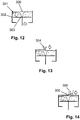
- FIG. 12 to 14 A 3D printing process for ceramic molds is shown, in which within a building container 302 on a building platform 303 successive layers 301 of a ceramic molded part 300 to be molded are stacked. After application of one layer 301 by means of a coater 304, part of the last layer can be selectively provided with a binder 306 by means of a print head 305. The areas of the layer provided with the binder 306 can be cured by drying or firing and thus solidified. Other areas of layer 301 that do not come into contact with a binder 306 are later removed by shaking or other methods and separated from the solidified areas. In this way, three-dimensional shapes of almost any kind are possible. The creation of notches or material weaknesses in various areas of the mold is particularly suitable for introducing predetermined breaking points.
- Figures 15 to 17 shows how the thickness of the applied slip layer varies in a slip coating method for producing a ceramic casting mold and thus thinned areas of the slip layer can be produced on the casting mold.
- a wax model 100 'in the form of a cuboid is coated with a hydrophobic material in the areas 100'a, 100'b, 100'c.
- the consequence of this is that when the model body 100 'is immersed in the aqueous slip, it does not adhere to the model body 100' in the areas 100'a, 100'b, 100'c.
- the slip adheres to the remaining areas of the surface of the model body 100 'and dries after the model body has been removed from the slip bath.
- the model body 100 ′ can then be immersed in the slip bath one or more times, so that the slip layers are built up with increasing thickness.
- the slip layers adhere significantly less, so that the resulting slip layer is thinner than in the areas not coated with a hydrophobic substance.
- the coating with a hydrophobic substance can be repeated one or more times during the repetition of the dipping process in the slip bath.
- the result shows in Figure 17 a slip body which surrounds the model body 100 'and which has thin-walled areas in the regions 100'a, 100'b, 100'c which act as predetermined breaking points of the slip body. If the model body 100 ' melted out, the slip body is burned into a mold with predetermined breaking points.
- the manufacturing method for a casting mold shown can, for example, already incorporate predetermined breaking points into the molding tools 202, 201, in that the shaping of the molding tools provides material recesses at the desired predetermined breaking points.
- predetermined breaking points can be provided at desired locations on the casting mold by suitable design of the casting mold.
- a mold with predetermined breaking points has been produced in one way or another, it can be used for the method according to the invention for producing a metal casting workpiece.
- the mold 204 is first filled with a molten metal via a sprue system, not shown, so that a cast metal body 401 is produced.
- the form 204 is provided with predetermined breaking points, one of which is designated by the reference numeral 400.
- Reference number 600 denotes an area in which a particularly high density of predetermined breaking points is provided. In this way, the intended density of predetermined breaking points can be used to control in which areas of a casting mold predetermined breaking points break first.
- the mold 204 with the metal casting 401 located therein is immersed in a liquid 500, in particular water. Since the water has a temperature that is significantly lower than the temperature of the mold 204 after the casting process, the mold 204 jumps due to thermal stresses in the area of the predetermined breaking points. As a result, parts 502 of the mold are removed and the metal casting 401 is immediately exposed to contact with the liquid 500 and thereby suddenly cooled. This results in an optimized structure that is considerably improved compared to the product of a slow cooling process within the mold 204.
- FIG. 20 The region 600 is shown with an increased density of predetermined breaking points, which leads to the fact that the casting mold is most likely to break in this region when the mold 204 is introduced into water.
- a device for regulating the temperature of the liquid in particular the water, is designated 501.
- other flowable substances can also be selected, such as other liquids or even granules or powders, for example made of metal.
- a liquid metal such as mercury can also be selected, which can be suitable for cooling in hot molds.
- insulating vapor layers can form around the mold 204 to be cooled or around the metal casting 401 to be cooled, which slow down the further cooling. This effect is not to be expected when using mercury or a metal granulate or powder.
- good metallic structures can also be achieved in metal castings in investment casting molds by rapid cooling.
Landscapes
- Engineering & Computer Science (AREA)
- Mechanical Engineering (AREA)
- Chemical & Material Sciences (AREA)
- Manufacturing & Machinery (AREA)
- Materials Engineering (AREA)
- Molds, Cores, And Manufacturing Methods Thereof (AREA)
Applications Claiming Priority (1)
| Application Number | Priority Date | Filing Date | Title |
|---|---|---|---|
| DE102018221750.5A DE102018221750A1 (de) | 2018-12-14 | 2018-12-14 | Verfahren und Gussform zum Herstellen von Metallgusswerkstücken |
Publications (2)
| Publication Number | Publication Date |
|---|---|
| EP3666414A1 true EP3666414A1 (fr) | 2020-06-17 |
| EP3666414B1 EP3666414B1 (fr) | 2022-07-27 |
Family
ID=68916292
Family Applications (1)
| Application Number | Title | Priority Date | Filing Date |
|---|---|---|---|
| EP19215857.4A Active EP3666414B1 (fr) | 2018-12-14 | 2019-12-12 | Procédé et moule permettant de fabriquer des pièces moulées métalliques |
Country Status (3)
| Country | Link |
|---|---|
| EP (1) | EP3666414B1 (fr) |
| DE (1) | DE102018221750A1 (fr) |
| ES (1) | ES2929174T3 (fr) |
Citations (3)
| Publication number | Priority date | Publication date | Assignee | Title |
|---|---|---|---|---|
| WO2004007120A1 (fr) * | 2002-07-11 | 2004-01-22 | Consolidated Engineering Company, Inc. | Procede et appareil permettant d'aider a retirer des moulages au sable de coulees |
| US20090250185A1 (en) * | 2008-04-03 | 2009-10-08 | Deepak Saha | Methods for casting stainless steel and articles prepared therefrom |
| US20140190653A1 (en) * | 2011-08-19 | 2014-07-10 | Instytut Odlewnictwa | Method for producing investment castings |
Family Cites Families (8)
| Publication number | Priority date | Publication date | Assignee | Title |
|---|---|---|---|---|
| DE4116609A1 (de) * | 1991-01-19 | 1992-07-23 | Thyssen Industrie | Verfahren zur herstellung von keramischen schalen als giessform |
| US5678583A (en) * | 1995-05-22 | 1997-10-21 | Howmet Research Corporation | Removal of ceramic shell mold material from castings |
| DE19936734C1 (de) * | 1999-08-06 | 2001-02-15 | Fraunhofer Ges Forschung | Verfahren zur Herstellung eines Metall- oder Keramikwerkstücks |
| DE20320923U1 (de) * | 2003-12-19 | 2005-06-09 | Hydro Aluminium Alucast Gmbh | Fertigungslinie zum im kontinuierlichen Durchlauf erfolgenden Herstellen von Gussteilen aus einer metallischen Schmelze, insbesondere einer Leichtmetallschmelze |
| DE102004033053A1 (de) * | 2004-07-08 | 2006-01-05 | Daimlerchrysler Ag | Verfahren zur Herstellung eines Metallgussteils und zusammengesetzte Gießform |
| DE102006031583A1 (de) * | 2006-07-03 | 2008-01-10 | Deutsches Zentrum für Luft- und Raumfahrt e.V. | Verfahren zur Herstellung von Carbidkeramik-Bauteilen, Vorkörperverbund zur Herstellung von Carbidkeramik-Bauteilen und Carbidkeramik-Bauteilverbund |
| DE102007041445B4 (de) * | 2007-08-31 | 2014-03-27 | Bühler Druckguss AG | Verfahren zur Kühlung von Gussteilen |
| DE102007048419B3 (de) * | 2007-10-09 | 2009-06-18 | Albert Handtmann Metallgusswerk Gmbh & Co. Kg | Verfahren zur beschleunigten Abkühlung von Gußstücken |
-
2018
- 2018-12-14 DE DE102018221750.5A patent/DE102018221750A1/de not_active Ceased
-
2019
- 2019-12-12 EP EP19215857.4A patent/EP3666414B1/fr active Active
- 2019-12-12 ES ES19215857T patent/ES2929174T3/es active Active
Patent Citations (3)
| Publication number | Priority date | Publication date | Assignee | Title |
|---|---|---|---|---|
| WO2004007120A1 (fr) * | 2002-07-11 | 2004-01-22 | Consolidated Engineering Company, Inc. | Procede et appareil permettant d'aider a retirer des moulages au sable de coulees |
| US20090250185A1 (en) * | 2008-04-03 | 2009-10-08 | Deepak Saha | Methods for casting stainless steel and articles prepared therefrom |
| US20140190653A1 (en) * | 2011-08-19 | 2014-07-10 | Instytut Odlewnictwa | Method for producing investment castings |
Non-Patent Citations (1)
| Title |
|---|
| BEELEY P R ET AL: "Investment Casting, passages", 1 January 1995, INVESTMENT CASTING, THE INSTITUTE OF METALS, LONDON, PAGE(S) 66 - 68, 89, ISBN: 978-0-901716-66-8, XP002558778 * |
Also Published As
| Publication number | Publication date |
|---|---|
| ES2929174T3 (es) | 2022-11-25 |
| DE102018221750A1 (de) | 2020-06-18 |
| EP3666414B1 (fr) | 2022-07-27 |
Similar Documents
| Publication | Publication Date | Title |
|---|---|---|
| DE60311824T2 (de) | Giessverfahren | |
| DE602004006342T2 (de) | Verfahren zum Präzisionsgiessen | |
| RU2461439C2 (ru) | Способ и устройство изготовления керамических литейных стержней для лопаток газотурбинных двигателей | |
| DE69429233T2 (de) | Verfahren zur Herstellung eines Feingussmodells | |
| EP3349928B1 (fr) | Procédé et dispositif de fabrication additive | |
| EP2155418A1 (fr) | Procédé de fabrication d'une pièce coulée, moule de coulée et pièce coulée fabriquée avec ce dernier | |
| DE19528215A1 (de) | Verfahren zur Herstellung von dreidimensionalen Modellen und Formen | |
| DE102007030096A1 (de) | Verfahren zur Gestaltung von Gussformen | |
| EP3215286A1 (fr) | Procédé de fabrication d'une roue mobile de compresseur | |
| DE102013203372A1 (de) | Formkernpaket zum formen eines powder-slush-formwerkzeugs | |
| CH635010A5 (en) | Method for the production of precision castings | |
| EP2059356B1 (fr) | Moule de coulée perdu, monobloc, pouvant être tempéré, destiné a des éléments moulés en métal et procédé de fabrication du moule | |
| DE102007017690A1 (de) | Verfahren und Vorrichtung zur Herstellung eines Gussteils | |
| EP3666414B1 (fr) | Procédé et moule permettant de fabriquer des pièces moulées métalliques | |
| DE69327714T2 (de) | Feingiessverfahren zur Herstellung von Gussstücken | |
| DE69609898T2 (de) | Feingiessverfahren zur Erzeugung von Gegenständen mit sehr präziser Oberfläche | |
| DE2352492A1 (de) | Verfahren zur herstellung von durch unterdruck stabilisierten hohlen giessformen | |
| EP3038770B1 (fr) | Procédé de fabrication de surfaces de codage à partir d'une pièce brute | |
| DE102014211350A1 (de) | Gussverfahren zur Herstellung eines Kolbens und Kolben für Brennkraftmaschinen | |
| DE102014007889B4 (de) | Verfahren zur Herstellung eines Salzkörpers, insbesondere für den Druckguss | |
| EP4355512B1 (fr) | Procédé de coulée de pièces moulées | |
| AT503391B1 (de) | Verfahren zum feingiessen von metallischen formteilen und vorrichtung hierfür | |
| DE19853814A1 (de) | Verfahren zum Herstellen von Bauteilen durch Auftragstechnik | |
| DE102014119736A1 (de) | Gussform und Verfahren zu deren Herstellung sowie Verfahren zur Herstellung von Gussteilen | |
| EP2081744B1 (fr) | Procédé de réalisation d'un corps moulé céramique |
Legal Events
| Date | Code | Title | Description |
|---|---|---|---|
| PUAI | Public reference made under article 153(3) epc to a published international application that has entered the european phase |
Free format text: ORIGINAL CODE: 0009012 |
|
| STAA | Information on the status of an ep patent application or granted ep patent |
Free format text: STATUS: THE APPLICATION HAS BEEN PUBLISHED |
|
| AK | Designated contracting states |
Kind code of ref document: A1 Designated state(s): AL AT BE BG CH CY CZ DE DK EE ES FI FR GB GR HR HU IE IS IT LI LT LU LV MC MK MT NL NO PL PT RO RS SE SI SK SM TR |
|
| AX | Request for extension of the european patent |
Extension state: BA ME |
|
| STAA | Information on the status of an ep patent application or granted ep patent |
Free format text: STATUS: REQUEST FOR EXAMINATION WAS MADE |
|
| 17P | Request for examination filed |
Effective date: 20201214 |
|
| RBV | Designated contracting states (corrected) |
Designated state(s): AL AT BE BG CH CY CZ DE DK EE ES FI FR GB GR HR HU IE IS IT LI LT LU LV MC MK MT NL NO PL PT RO RS SE SI SK SM TR |
|
| STAA | Information on the status of an ep patent application or granted ep patent |
Free format text: STATUS: EXAMINATION IS IN PROGRESS |
|
| 17Q | First examination report despatched |
Effective date: 20210716 |
|
| GRAP | Despatch of communication of intention to grant a patent |
Free format text: ORIGINAL CODE: EPIDOSNIGR1 |
|
| STAA | Information on the status of an ep patent application or granted ep patent |
Free format text: STATUS: GRANT OF PATENT IS INTENDED |
|
| INTG | Intention to grant announced |
Effective date: 20220216 |
|
| RAP3 | Party data changed (applicant data changed or rights of an application transferred) |
Owner name: FRAUNHOFER-GESELLSCHAFT ZUR FOERDERUNG DER ANGEWANDTEN FORSCHUNG E.V. |
|
| GRAS | Grant fee paid |
Free format text: ORIGINAL CODE: EPIDOSNIGR3 |
|
| GRAA | (expected) grant |
Free format text: ORIGINAL CODE: 0009210 |
|
| STAA | Information on the status of an ep patent application or granted ep patent |
Free format text: STATUS: THE PATENT HAS BEEN GRANTED |
|
| AK | Designated contracting states |
Kind code of ref document: B1 Designated state(s): AL AT BE BG CH CY CZ DE DK EE ES FI FR GB GR HR HU IE IS IT LI LT LU LV MC MK MT NL NO PL PT RO RS SE SI SK SM TR |
|
| REG | Reference to a national code |
Ref country code: CH Ref legal event code: EP |
|
| REG | Reference to a national code |
Ref country code: AT Ref legal event code: REF Ref document number: 1506731 Country of ref document: AT Kind code of ref document: T Effective date: 20220815 |
|
| REG | Reference to a national code |
Ref country code: DE Ref legal event code: R096 Ref document number: 502019005067 Country of ref document: DE |
|
| REG | Reference to a national code |
Ref country code: IE Ref legal event code: FG4D Free format text: LANGUAGE OF EP DOCUMENT: GERMAN |
|
| REG | Reference to a national code |
Ref country code: LT Ref legal event code: MG9D |
|
| REG | Reference to a national code |
Ref country code: ES Ref legal event code: FG2A Ref document number: 2929174 Country of ref document: ES Kind code of ref document: T3 Effective date: 20221125 |
|
| REG | Reference to a national code |
Ref country code: NL Ref legal event code: MP Effective date: 20220727 |
|
| PG25 | Lapsed in a contracting state [announced via postgrant information from national office to epo] |
Ref country code: SE Free format text: LAPSE BECAUSE OF FAILURE TO SUBMIT A TRANSLATION OF THE DESCRIPTION OR TO PAY THE FEE WITHIN THE PRESCRIBED TIME-LIMIT Effective date: 20220727 Ref country code: RS Free format text: LAPSE BECAUSE OF FAILURE TO SUBMIT A TRANSLATION OF THE DESCRIPTION OR TO PAY THE FEE WITHIN THE PRESCRIBED TIME-LIMIT Effective date: 20220727 Ref country code: PT Free format text: LAPSE BECAUSE OF FAILURE TO SUBMIT A TRANSLATION OF THE DESCRIPTION OR TO PAY THE FEE WITHIN THE PRESCRIBED TIME-LIMIT Effective date: 20221128 Ref country code: NO Free format text: LAPSE BECAUSE OF FAILURE TO SUBMIT A TRANSLATION OF THE DESCRIPTION OR TO PAY THE FEE WITHIN THE PRESCRIBED TIME-LIMIT Effective date: 20221027 Ref country code: NL Free format text: LAPSE BECAUSE OF FAILURE TO SUBMIT A TRANSLATION OF THE DESCRIPTION OR TO PAY THE FEE WITHIN THE PRESCRIBED TIME-LIMIT Effective date: 20220727 Ref country code: LV Free format text: LAPSE BECAUSE OF FAILURE TO SUBMIT A TRANSLATION OF THE DESCRIPTION OR TO PAY THE FEE WITHIN THE PRESCRIBED TIME-LIMIT Effective date: 20220727 Ref country code: LT Free format text: LAPSE BECAUSE OF FAILURE TO SUBMIT A TRANSLATION OF THE DESCRIPTION OR TO PAY THE FEE WITHIN THE PRESCRIBED TIME-LIMIT Effective date: 20220727 Ref country code: FI Free format text: LAPSE BECAUSE OF FAILURE TO SUBMIT A TRANSLATION OF THE DESCRIPTION OR TO PAY THE FEE WITHIN THE PRESCRIBED TIME-LIMIT Effective date: 20220727 |
|
| PG25 | Lapsed in a contracting state [announced via postgrant information from national office to epo] |
Ref country code: PL Free format text: LAPSE BECAUSE OF FAILURE TO SUBMIT A TRANSLATION OF THE DESCRIPTION OR TO PAY THE FEE WITHIN THE PRESCRIBED TIME-LIMIT Effective date: 20220727 Ref country code: IS Free format text: LAPSE BECAUSE OF FAILURE TO SUBMIT A TRANSLATION OF THE DESCRIPTION OR TO PAY THE FEE WITHIN THE PRESCRIBED TIME-LIMIT Effective date: 20221127 Ref country code: HR Free format text: LAPSE BECAUSE OF FAILURE TO SUBMIT A TRANSLATION OF THE DESCRIPTION OR TO PAY THE FEE WITHIN THE PRESCRIBED TIME-LIMIT Effective date: 20220727 Ref country code: GR Free format text: LAPSE BECAUSE OF FAILURE TO SUBMIT A TRANSLATION OF THE DESCRIPTION OR TO PAY THE FEE WITHIN THE PRESCRIBED TIME-LIMIT Effective date: 20221028 |
|
| PG25 | Lapsed in a contracting state [announced via postgrant information from national office to epo] |
Ref country code: SM Free format text: LAPSE BECAUSE OF FAILURE TO SUBMIT A TRANSLATION OF THE DESCRIPTION OR TO PAY THE FEE WITHIN THE PRESCRIBED TIME-LIMIT Effective date: 20220727 Ref country code: RO Free format text: LAPSE BECAUSE OF FAILURE TO SUBMIT A TRANSLATION OF THE DESCRIPTION OR TO PAY THE FEE WITHIN THE PRESCRIBED TIME-LIMIT Effective date: 20220727 Ref country code: DK Free format text: LAPSE BECAUSE OF FAILURE TO SUBMIT A TRANSLATION OF THE DESCRIPTION OR TO PAY THE FEE WITHIN THE PRESCRIBED TIME-LIMIT Effective date: 20220727 Ref country code: CZ Free format text: LAPSE BECAUSE OF FAILURE TO SUBMIT A TRANSLATION OF THE DESCRIPTION OR TO PAY THE FEE WITHIN THE PRESCRIBED TIME-LIMIT Effective date: 20220727 |
|
| REG | Reference to a national code |
Ref country code: DE Ref legal event code: R097 Ref document number: 502019005067 Country of ref document: DE |
|
| PG25 | Lapsed in a contracting state [announced via postgrant information from national office to epo] |
Ref country code: SK Free format text: LAPSE BECAUSE OF FAILURE TO SUBMIT A TRANSLATION OF THE DESCRIPTION OR TO PAY THE FEE WITHIN THE PRESCRIBED TIME-LIMIT Effective date: 20220727 Ref country code: EE Free format text: LAPSE BECAUSE OF FAILURE TO SUBMIT A TRANSLATION OF THE DESCRIPTION OR TO PAY THE FEE WITHIN THE PRESCRIBED TIME-LIMIT Effective date: 20220727 |
|
| PLBE | No opposition filed within time limit |
Free format text: ORIGINAL CODE: 0009261 |
|
| STAA | Information on the status of an ep patent application or granted ep patent |
Free format text: STATUS: NO OPPOSITION FILED WITHIN TIME LIMIT |
|
| PG25 | Lapsed in a contracting state [announced via postgrant information from national office to epo] |
Ref country code: AL Free format text: LAPSE BECAUSE OF FAILURE TO SUBMIT A TRANSLATION OF THE DESCRIPTION OR TO PAY THE FEE WITHIN THE PRESCRIBED TIME-LIMIT Effective date: 20220727 |
|
| 26N | No opposition filed |
Effective date: 20230502 |
|
| REG | Reference to a national code |
Ref country code: CH Ref legal event code: PL |
|
| REG | Reference to a national code |
Ref country code: BE Ref legal event code: MM Effective date: 20221231 |
|
| PG25 | Lapsed in a contracting state [announced via postgrant information from national office to epo] |
Ref country code: SI Free format text: LAPSE BECAUSE OF FAILURE TO SUBMIT A TRANSLATION OF THE DESCRIPTION OR TO PAY THE FEE WITHIN THE PRESCRIBED TIME-LIMIT Effective date: 20220727 Ref country code: LU Free format text: LAPSE BECAUSE OF NON-PAYMENT OF DUE FEES Effective date: 20221212 |
|
| PG25 | Lapsed in a contracting state [announced via postgrant information from national office to epo] |
Ref country code: LI Free format text: LAPSE BECAUSE OF NON-PAYMENT OF DUE FEES Effective date: 20221231 Ref country code: IE Free format text: LAPSE BECAUSE OF NON-PAYMENT OF DUE FEES Effective date: 20221212 Ref country code: CH Free format text: LAPSE BECAUSE OF NON-PAYMENT OF DUE FEES Effective date: 20221231 |
|
| PG25 | Lapsed in a contracting state [announced via postgrant information from national office to epo] |
Ref country code: BE Free format text: LAPSE BECAUSE OF NON-PAYMENT OF DUE FEES Effective date: 20221231 |
|
| PG25 | Lapsed in a contracting state [announced via postgrant information from national office to epo] |
Ref country code: HU Free format text: LAPSE BECAUSE OF FAILURE TO SUBMIT A TRANSLATION OF THE DESCRIPTION OR TO PAY THE FEE WITHIN THE PRESCRIBED TIME-LIMIT; INVALID AB INITIO Effective date: 20191212 |
|
| PG25 | Lapsed in a contracting state [announced via postgrant information from national office to epo] |
Ref country code: CY Free format text: LAPSE BECAUSE OF FAILURE TO SUBMIT A TRANSLATION OF THE DESCRIPTION OR TO PAY THE FEE WITHIN THE PRESCRIBED TIME-LIMIT Effective date: 20220727 |
|
| PG25 | Lapsed in a contracting state [announced via postgrant information from national office to epo] |
Ref country code: MK Free format text: LAPSE BECAUSE OF FAILURE TO SUBMIT A TRANSLATION OF THE DESCRIPTION OR TO PAY THE FEE WITHIN THE PRESCRIBED TIME-LIMIT Effective date: 20220727 |
|
| PG25 | Lapsed in a contracting state [announced via postgrant information from national office to epo] |
Ref country code: MC Free format text: LAPSE BECAUSE OF FAILURE TO SUBMIT A TRANSLATION OF THE DESCRIPTION OR TO PAY THE FEE WITHIN THE PRESCRIBED TIME-LIMIT Effective date: 20220727 |
|
| PG25 | Lapsed in a contracting state [announced via postgrant information from national office to epo] |
Ref country code: TR Free format text: LAPSE BECAUSE OF FAILURE TO SUBMIT A TRANSLATION OF THE DESCRIPTION OR TO PAY THE FEE WITHIN THE PRESCRIBED TIME-LIMIT Effective date: 20220727 Ref country code: MC Free format text: LAPSE BECAUSE OF FAILURE TO SUBMIT A TRANSLATION OF THE DESCRIPTION OR TO PAY THE FEE WITHIN THE PRESCRIBED TIME-LIMIT Effective date: 20220727 |
|
| PG25 | Lapsed in a contracting state [announced via postgrant information from national office to epo] |
Ref country code: BG Free format text: LAPSE BECAUSE OF FAILURE TO SUBMIT A TRANSLATION OF THE DESCRIPTION OR TO PAY THE FEE WITHIN THE PRESCRIBED TIME-LIMIT Effective date: 20220727 |
|
| PG25 | Lapsed in a contracting state [announced via postgrant information from national office to epo] |
Ref country code: MT Free format text: LAPSE BECAUSE OF FAILURE TO SUBMIT A TRANSLATION OF THE DESCRIPTION OR TO PAY THE FEE WITHIN THE PRESCRIBED TIME-LIMIT Effective date: 20220727 |
|
| P01 | Opt-out of the competence of the unified patent court (upc) registered |
Free format text: CASE NUMBER: UPC_APP_326252/2023 Effective date: 20230524 |
|
| PGFP | Annual fee paid to national office [announced via postgrant information from national office to epo] |
Ref country code: DE Payment date: 20241216 Year of fee payment: 6 |
|
| PGFP | Annual fee paid to national office [announced via postgrant information from national office to epo] |
Ref country code: GB Payment date: 20241218 Year of fee payment: 6 |
|
| PGFP | Annual fee paid to national office [announced via postgrant information from national office to epo] |
Ref country code: FR Payment date: 20241219 Year of fee payment: 6 |
|
| PGFP | Annual fee paid to national office [announced via postgrant information from national office to epo] |
Ref country code: IT Payment date: 20241216 Year of fee payment: 6 |
|
| PGFP | Annual fee paid to national office [announced via postgrant information from national office to epo] |
Ref country code: ES Payment date: 20250117 Year of fee payment: 6 |
|
| REG | Reference to a national code |
Ref country code: AT Ref legal event code: MM01 Ref document number: 1506731 Country of ref document: AT Kind code of ref document: T Effective date: 20241212 |
|
| PG25 | Lapsed in a contracting state [announced via postgrant information from national office to epo] |
Ref country code: AT Free format text: LAPSE BECAUSE OF NON-PAYMENT OF DUE FEES Effective date: 20241212 |
|
| PGFP | Annual fee paid to national office [announced via postgrant information from national office to epo] |
Ref country code: AT Payment date: 20260410 Year of fee payment: 5 |