EP3666730A2 - Filtre, ensemble filtre, dispositif de filtre et système de purification d'eau - Google Patents
Filtre, ensemble filtre, dispositif de filtre et système de purification d'eau Download PDFInfo
- Publication number
- EP3666730A2 EP3666730A2 EP19215243.7A EP19215243A EP3666730A2 EP 3666730 A2 EP3666730 A2 EP 3666730A2 EP 19215243 A EP19215243 A EP 19215243A EP 3666730 A2 EP3666730 A2 EP 3666730A2
- Authority
- EP
- European Patent Office
- Prior art keywords
- filter
- filters
- filter assembly
- filter device
- water
- Prior art date
- Legal status (The legal status is an assumption and is not a legal conclusion. Google has not performed a legal analysis and makes no representation as to the accuracy of the status listed.)
- Withdrawn
Links
- XLYOFNOQVPJJNP-UHFFFAOYSA-N water Substances O XLYOFNOQVPJJNP-UHFFFAOYSA-N 0.000 title claims abstract description 236
- 238000000746 purification Methods 0.000 title claims abstract description 33
- 239000000203 mixture Substances 0.000 claims abstract description 115
- RMAQACBXLXPBSY-UHFFFAOYSA-N silicic acid Chemical compound O[Si](O)(O)O RMAQACBXLXPBSY-UHFFFAOYSA-N 0.000 claims abstract description 63
- 235000012239 silicon dioxide Nutrition 0.000 claims abstract description 63
- 239000012876 carrier material Substances 0.000 claims abstract description 57
- 239000002210 silicon-based material Substances 0.000 claims abstract description 49
- UFHFLCQGNIYNRP-UHFFFAOYSA-N Hydrogen Chemical compound [H][H] UFHFLCQGNIYNRP-UHFFFAOYSA-N 0.000 claims abstract description 47
- OKTJSMMVPCPJKN-UHFFFAOYSA-N Carbon Chemical compound [C] OKTJSMMVPCPJKN-UHFFFAOYSA-N 0.000 claims description 77
- 239000005543 nano-size silicon particle Substances 0.000 claims description 50
- 239000002245 particle Substances 0.000 claims description 39
- 239000012510 hollow fiber Substances 0.000 claims description 23
- 239000012528 membrane Substances 0.000 claims description 21
- 238000011144 upstream manufacturing Methods 0.000 claims description 17
- 239000008187 granular material Substances 0.000 claims description 15
- 125000006850 spacer group Chemical group 0.000 claims description 15
- VYPSYNLAJGMNEJ-UHFFFAOYSA-N Silicium dioxide Chemical compound O=[Si]=O VYPSYNLAJGMNEJ-UHFFFAOYSA-N 0.000 claims description 14
- 239000000969 carrier Substances 0.000 claims description 14
- XUIMIQQOPSSXEZ-UHFFFAOYSA-N Silicon Chemical compound [Si] XUIMIQQOPSSXEZ-UHFFFAOYSA-N 0.000 claims description 13
- -1 ore Substances 0.000 claims description 13
- 229910052710 silicon Inorganic materials 0.000 claims description 13
- 239000010703 silicon Substances 0.000 claims description 13
- 230000000845 anti-microbial effect Effects 0.000 claims description 12
- 229920005594 polymer fiber Polymers 0.000 claims description 11
- HCHKCACWOHOZIP-UHFFFAOYSA-N Zinc Chemical compound [Zn] HCHKCACWOHOZIP-UHFFFAOYSA-N 0.000 claims description 9
- 239000011701 zinc Substances 0.000 claims description 9
- 229910052725 zinc Inorganic materials 0.000 claims description 9
- 239000011230 binding agent Substances 0.000 claims description 7
- 239000004575 stone Substances 0.000 claims description 7
- 235000017166 Bambusa arundinacea Nutrition 0.000 claims description 6
- 235000017491 Bambusa tulda Nutrition 0.000 claims description 6
- 241001330002 Bambuseae Species 0.000 claims description 6
- 239000005909 Kieselgur Substances 0.000 claims description 6
- 235000015334 Phyllostachys viridis Nutrition 0.000 claims description 6
- 239000006004 Quartz sand Substances 0.000 claims description 6
- BQCADISMDOOEFD-UHFFFAOYSA-N Silver Chemical compound [Ag] BQCADISMDOOEFD-UHFFFAOYSA-N 0.000 claims description 6
- 229910021536 Zeolite Inorganic materials 0.000 claims description 6
- 239000004599 antimicrobial Substances 0.000 claims description 6
- 239000011425 bamboo Substances 0.000 claims description 6
- 239000000919 ceramic Substances 0.000 claims description 6
- 239000003610 charcoal Substances 0.000 claims description 6
- HNPSIPDUKPIQMN-UHFFFAOYSA-N dioxosilane;oxo(oxoalumanyloxy)alumane Chemical compound O=[Si]=O.O=[Al]O[Al]=O HNPSIPDUKPIQMN-UHFFFAOYSA-N 0.000 claims description 6
- 239000007788 liquid Substances 0.000 claims description 6
- NTHWMYGWWRZVTN-UHFFFAOYSA-N sodium silicate Chemical compound [Na+].[Na+].[O-][Si]([O-])=O NTHWMYGWWRZVTN-UHFFFAOYSA-N 0.000 claims description 6
- 239000010457 zeolite Substances 0.000 claims description 6
- 239000007789 gas Substances 0.000 claims description 4
- 235000019353 potassium silicate Nutrition 0.000 claims description 3
- 230000002776 aggregation Effects 0.000 claims description 2
- 238000004220 aggregation Methods 0.000 claims description 2
- 238000000034 method Methods 0.000 description 12
- 238000001914 filtration Methods 0.000 description 10
- 235000016213 coffee Nutrition 0.000 description 9
- 235000013353 coffee beverage Nutrition 0.000 description 9
- 244000005700 microbiome Species 0.000 description 9
- 230000001954 sterilising effect Effects 0.000 description 9
- 230000000712 assembly Effects 0.000 description 8
- 238000000429 assembly Methods 0.000 description 8
- 230000001965 increasing effect Effects 0.000 description 8
- 238000004519 manufacturing process Methods 0.000 description 8
- 241000282414 Homo sapiens Species 0.000 description 7
- 235000013405 beer Nutrition 0.000 description 7
- 230000008569 process Effects 0.000 description 7
- 238000009360 aquaculture Methods 0.000 description 6
- 244000144974 aquaculture Species 0.000 description 6
- 210000004027 cell Anatomy 0.000 description 6
- 239000003651 drinking water Substances 0.000 description 6
- 235000020188 drinking water Nutrition 0.000 description 6
- 238000000635 electron micrograph Methods 0.000 description 6
- 230000033116 oxidation-reduction process Effects 0.000 description 6
- 238000004659 sterilization and disinfection Methods 0.000 description 6
- 235000013618 yogurt Nutrition 0.000 description 6
- PEDCQBHIVMGVHV-UHFFFAOYSA-N Glycerine Chemical compound OCC(O)CO PEDCQBHIVMGVHV-UHFFFAOYSA-N 0.000 description 5
- 238000006243 chemical reaction Methods 0.000 description 5
- 238000004891 communication Methods 0.000 description 5
- 230000000694 effects Effects 0.000 description 5
- 238000000855 fermentation Methods 0.000 description 5
- 230000004151 fermentation Effects 0.000 description 5
- 239000001257 hydrogen Substances 0.000 description 5
- 229910052739 hydrogen Inorganic materials 0.000 description 5
- 239000012535 impurity Substances 0.000 description 5
- 230000003020 moisturizing effect Effects 0.000 description 5
- 230000002093 peripheral effect Effects 0.000 description 5
- CIWBSHSKHKDKBQ-JLAZNSOCSA-N Ascorbic acid Chemical compound OC[C@H](O)[C@H]1OC(=O)C(O)=C1O CIWBSHSKHKDKBQ-JLAZNSOCSA-N 0.000 description 4
- XEEYBQQBJWHFJM-UHFFFAOYSA-N Iron Chemical compound [Fe] XEEYBQQBJWHFJM-UHFFFAOYSA-N 0.000 description 4
- 235000013361 beverage Nutrition 0.000 description 4
- 201000010099 disease Diseases 0.000 description 4
- 208000037265 diseases, disorders, signs and symptoms Diseases 0.000 description 4
- 230000001815 facial effect Effects 0.000 description 4
- 239000012530 fluid Substances 0.000 description 4
- 230000036541 health Effects 0.000 description 4
- JVTAAEKCZFNVCJ-UHFFFAOYSA-N lactic acid Chemical compound CC(O)C(O)=O JVTAAEKCZFNVCJ-UHFFFAOYSA-N 0.000 description 4
- 235000013336 milk Nutrition 0.000 description 4
- 210000004080 milk Anatomy 0.000 description 4
- 238000002156 mixing Methods 0.000 description 4
- 230000036542 oxidative stress Effects 0.000 description 4
- 239000011148 porous material Substances 0.000 description 4
- 238000010992 reflux Methods 0.000 description 4
- 239000002002 slurry Substances 0.000 description 4
- 238000003756 stirring Methods 0.000 description 4
- FYYHWMGAXLPEAU-UHFFFAOYSA-N Magnesium Chemical compound [Mg] FYYHWMGAXLPEAU-UHFFFAOYSA-N 0.000 description 3
- 241001465754 Metazoa Species 0.000 description 3
- ZMXDDKWLCZADIW-UHFFFAOYSA-N N,N-Dimethylformamide Chemical compound CN(C)C=O ZMXDDKWLCZADIW-UHFFFAOYSA-N 0.000 description 3
- KWYUFKZDYYNOTN-UHFFFAOYSA-M Potassium hydroxide Chemical compound [OH-].[K+] KWYUFKZDYYNOTN-UHFFFAOYSA-M 0.000 description 3
- HEMHJVSKTPXQMS-UHFFFAOYSA-M Sodium hydroxide Chemical compound [OH-].[Na+] HEMHJVSKTPXQMS-UHFFFAOYSA-M 0.000 description 3
- 230000001580 bacterial effect Effects 0.000 description 3
- KRKNYBCHXYNGOX-UHFFFAOYSA-N citric acid Chemical compound OC(=O)CC(O)(C(O)=O)CC(O)=O KRKNYBCHXYNGOX-UHFFFAOYSA-N 0.000 description 3
- 239000006210 lotion Substances 0.000 description 3
- 239000008267 milk Substances 0.000 description 3
- 239000004745 nonwoven fabric Substances 0.000 description 3
- 229920000642 polymer Polymers 0.000 description 3
- 239000003642 reactive oxygen metabolite Substances 0.000 description 3
- 238000005245 sintering Methods 0.000 description 3
- 239000002904 solvent Substances 0.000 description 3
- 235000019614 sour taste Nutrition 0.000 description 3
- 230000002087 whitening effect Effects 0.000 description 3
- GVJHHUAWPYXKBD-UHFFFAOYSA-N (±)-α-Tocopherol Chemical compound OC1=C(C)C(C)=C2OC(CCCC(C)CCCC(C)CCCC(C)C)(C)CCC2=C1C GVJHHUAWPYXKBD-UHFFFAOYSA-N 0.000 description 2
- NWUYHJFMYQTDRP-UHFFFAOYSA-N 1,2-bis(ethenyl)benzene;1-ethenyl-2-ethylbenzene;styrene Chemical compound C=CC1=CC=CC=C1.CCC1=CC=CC=C1C=C.C=CC1=CC=CC=C1C=C NWUYHJFMYQTDRP-UHFFFAOYSA-N 0.000 description 2
- 241000894006 Bacteria Species 0.000 description 2
- 208000031968 Cadaver Diseases 0.000 description 2
- OYPRJOBELJOOCE-UHFFFAOYSA-N Calcium Chemical compound [Ca] OYPRJOBELJOOCE-UHFFFAOYSA-N 0.000 description 2
- 208000024172 Cardiovascular disease Diseases 0.000 description 2
- 241000195493 Cryptophyta Species 0.000 description 2
- 208000012902 Nervous system disease Diseases 0.000 description 2
- 239000004743 Polypropylene Substances 0.000 description 2
- PPBRXRYQALVLMV-UHFFFAOYSA-N Styrene Chemical compound C=CC1=CC=CC=C1 PPBRXRYQALVLMV-UHFFFAOYSA-N 0.000 description 2
- 230000002378 acidificating effect Effects 0.000 description 2
- 230000002411 adverse Effects 0.000 description 2
- 229910052782 aluminium Inorganic materials 0.000 description 2
- XAGFODPZIPBFFR-UHFFFAOYSA-N aluminium Chemical compound [Al] XAGFODPZIPBFFR-UHFFFAOYSA-N 0.000 description 2
- 239000003963 antioxidant agent Substances 0.000 description 2
- 230000003078 antioxidant effect Effects 0.000 description 2
- 235000006708 antioxidants Nutrition 0.000 description 2
- 206010003246 arthritis Diseases 0.000 description 2
- 230000015572 biosynthetic process Effects 0.000 description 2
- 230000009172 bursting Effects 0.000 description 2
- 239000011575 calcium Substances 0.000 description 2
- 229910052791 calcium Inorganic materials 0.000 description 2
- 150000001768 cations Chemical class 0.000 description 2
- 239000006071 cream Substances 0.000 description 2
- 230000003247 decreasing effect Effects 0.000 description 2
- 238000007872 degassing Methods 0.000 description 2
- 238000001523 electrospinning Methods 0.000 description 2
- 230000002708 enhancing effect Effects 0.000 description 2
- RRAFCDWBNXTKKO-UHFFFAOYSA-N eugenol Chemical compound COC1=CC(CC=C)=CC=C1O RRAFCDWBNXTKKO-UHFFFAOYSA-N 0.000 description 2
- 239000000835 fiber Substances 0.000 description 2
- 239000000796 flavoring agent Substances 0.000 description 2
- 235000019634 flavors Nutrition 0.000 description 2
- 239000006260 foam Substances 0.000 description 2
- 235000011389 fruit/vegetable juice Nutrition 0.000 description 2
- 239000011521 glass Substances 0.000 description 2
- 235000011187 glycerol Nutrition 0.000 description 2
- 238000007731 hot pressing Methods 0.000 description 2
- XLYOFNOQVPJJNP-UHFFFAOYSA-M hydroxide Chemical compound [OH-] XLYOFNOQVPJJNP-UHFFFAOYSA-M 0.000 description 2
- 229910052500 inorganic mineral Inorganic materials 0.000 description 2
- 239000003456 ion exchange resin Substances 0.000 description 2
- 229920003303 ion-exchange polymer Polymers 0.000 description 2
- 229910052742 iron Inorganic materials 0.000 description 2
- 239000004310 lactic acid Substances 0.000 description 2
- 235000014655 lactic acid Nutrition 0.000 description 2
- 239000011777 magnesium Substances 0.000 description 2
- 229910052749 magnesium Inorganic materials 0.000 description 2
- VTHJTEIRLNZDEV-UHFFFAOYSA-L magnesium dihydroxide Chemical compound [OH-].[OH-].[Mg+2] VTHJTEIRLNZDEV-UHFFFAOYSA-L 0.000 description 2
- 239000000347 magnesium hydroxide Substances 0.000 description 2
- 229910001862 magnesium hydroxide Inorganic materials 0.000 description 2
- 239000000463 material Substances 0.000 description 2
- 238000005259 measurement Methods 0.000 description 2
- 230000007246 mechanism Effects 0.000 description 2
- 238000002844 melting Methods 0.000 description 2
- 230000008018 melting Effects 0.000 description 2
- 239000011707 mineral Substances 0.000 description 2
- 235000010755 mineral Nutrition 0.000 description 2
- 230000003647 oxidation Effects 0.000 description 2
- 238000007254 oxidation reaction Methods 0.000 description 2
- 238000004806 packaging method and process Methods 0.000 description 2
- 239000000419 plant extract Substances 0.000 description 2
- 229920000139 polyethylene terephthalate Polymers 0.000 description 2
- 239000005020 polyethylene terephthalate Substances 0.000 description 2
- 229920001155 polypropylene Polymers 0.000 description 2
- 238000012545 processing Methods 0.000 description 2
- 230000002829 reductive effect Effects 0.000 description 2
- 239000011347 resin Substances 0.000 description 2
- 229920005989 resin Polymers 0.000 description 2
- 239000011856 silicon-based particle Substances 0.000 description 2
- 235000019640 taste Nutrition 0.000 description 2
- WGTYBPLFGIVFAS-UHFFFAOYSA-M tetramethylammonium hydroxide Chemical compound [OH-].C[N+](C)(C)C WGTYBPLFGIVFAS-UHFFFAOYSA-M 0.000 description 2
- 241001148471 unidentified anaerobic bacterium Species 0.000 description 2
- KIUKXJAPPMFGSW-DNGZLQJQSA-N (2S,3S,4S,5R,6R)-6-[(2S,3R,4R,5S,6R)-3-Acetamido-2-[(2S,3S,4R,5R,6R)-6-[(2R,3R,4R,5S,6R)-3-acetamido-2,5-dihydroxy-6-(hydroxymethyl)oxan-4-yl]oxy-2-carboxy-4,5-dihydroxyoxan-3-yl]oxy-5-hydroxy-6-(hydroxymethyl)oxan-4-yl]oxy-3,4,5-trihydroxyoxane-2-carboxylic acid Chemical compound CC(=O)N[C@H]1[C@H](O)O[C@H](CO)[C@@H](O)[C@@H]1O[C@H]1[C@H](O)[C@@H](O)[C@H](O[C@H]2[C@@H]([C@@H](O[C@H]3[C@@H]([C@@H](O)[C@H](O)[C@H](O3)C(O)=O)O)[C@H](O)[C@@H](CO)O2)NC(C)=O)[C@@H](C(O)=O)O1 KIUKXJAPPMFGSW-DNGZLQJQSA-N 0.000 description 1
- AAWZDTNXLSGCEK-LNVDRNJUSA-N (3r,5r)-1,3,4,5-tetrahydroxycyclohexane-1-carboxylic acid Chemical compound O[C@@H]1CC(O)(C(O)=O)C[C@@H](O)C1O AAWZDTNXLSGCEK-LNVDRNJUSA-N 0.000 description 1
- BJEPYKJPYRNKOW-REOHCLBHSA-N (S)-malic acid Chemical compound OC(=O)[C@@H](O)CC(O)=O BJEPYKJPYRNKOW-REOHCLBHSA-N 0.000 description 1
- CWVRJTMFETXNAD-FWCWNIRPSA-N 3-O-Caffeoylquinic acid Natural products O[C@H]1[C@@H](O)C[C@@](O)(C(O)=O)C[C@H]1OC(=O)\C=C\C1=CC=C(O)C(O)=C1 CWVRJTMFETXNAD-FWCWNIRPSA-N 0.000 description 1
- ZCYVEMRRCGMTRW-UHFFFAOYSA-N 7553-56-2 Chemical compound [I] ZCYVEMRRCGMTRW-UHFFFAOYSA-N 0.000 description 1
- 229920000178 Acrylic resin Polymers 0.000 description 1
- 239000004925 Acrylic resin Substances 0.000 description 1
- 208000009304 Acute Kidney Injury Diseases 0.000 description 1
- 208000024827 Alzheimer disease Diseases 0.000 description 1
- 208000023275 Autoimmune disease Diseases 0.000 description 1
- 206010065687 Bone loss Diseases 0.000 description 1
- PZIRUHCJZBGLDY-UHFFFAOYSA-N Caffeoylquinic acid Natural products CC(CCC(=O)C(C)C1C(=O)CC2C3CC(O)C4CC(O)CCC4(C)C3CCC12C)C(=O)O PZIRUHCJZBGLDY-UHFFFAOYSA-N 0.000 description 1
- QRYRORQUOLYVBU-VBKZILBWSA-N Carnosic acid Natural products CC([C@@H]1CC2)(C)CCC[C@]1(C(O)=O)C1=C2C=C(C(C)C)C(O)=C1O QRYRORQUOLYVBU-VBKZILBWSA-N 0.000 description 1
- 108010087806 Carnosine Proteins 0.000 description 1
- NPBVQXIMTZKSBA-UHFFFAOYSA-N Chavibetol Natural products COC1=CC=C(CC=C)C=C1O NPBVQXIMTZKSBA-UHFFFAOYSA-N 0.000 description 1
- 102000008186 Collagen Human genes 0.000 description 1
- 108010035532 Collagen Proteins 0.000 description 1
- AAWZDTNXLSGCEK-UHFFFAOYSA-N Cordycepinsaeure Natural products OC1CC(O)(C(O)=O)CC(O)C1O AAWZDTNXLSGCEK-UHFFFAOYSA-N 0.000 description 1
- ZZZCUOFIHGPKAK-UHFFFAOYSA-N D-erythro-ascorbic acid Natural products OCC1OC(=O)C(O)=C1O ZZZCUOFIHGPKAK-UHFFFAOYSA-N 0.000 description 1
- MYMOFIZGZYHOMD-UHFFFAOYSA-N Dioxygen Chemical compound O=O MYMOFIZGZYHOMD-UHFFFAOYSA-N 0.000 description 1
- 208000035240 Disease Resistance Diseases 0.000 description 1
- 102000004190 Enzymes Human genes 0.000 description 1
- 108090000790 Enzymes Proteins 0.000 description 1
- LFQSCWFLJHTTHZ-UHFFFAOYSA-N Ethanol Chemical compound CCO LFQSCWFLJHTTHZ-UHFFFAOYSA-N 0.000 description 1
- 239000005770 Eugenol Substances 0.000 description 1
- 201000005569 Gout Diseases 0.000 description 1
- 235000008694 Humulus lupulus Nutrition 0.000 description 1
- 206010020669 Hypermagnesaemia Diseases 0.000 description 1
- 206010020751 Hypersensitivity Diseases 0.000 description 1
- 239000002211 L-ascorbic acid Substances 0.000 description 1
- 235000000069 L-ascorbic acid Nutrition 0.000 description 1
- CQOVPNPJLQNMDC-UHFFFAOYSA-N N-beta-alanyl-L-histidine Natural products NCCC(=O)NC(C(O)=O)CC1=CN=CN1 CQOVPNPJLQNMDC-UHFFFAOYSA-N 0.000 description 1
- CWVRJTMFETXNAD-KLZCAUPSSA-N Neochlorogenin-saeure Natural products O[C@H]1C[C@@](O)(C[C@@H](OC(=O)C=Cc2ccc(O)c(O)c2)[C@@H]1O)C(=O)O CWVRJTMFETXNAD-KLZCAUPSSA-N 0.000 description 1
- 206010028980 Neoplasm Diseases 0.000 description 1
- 208000025966 Neurological disease Diseases 0.000 description 1
- 206010029350 Neurotoxicity Diseases 0.000 description 1
- BPQQTUXANYXVAA-UHFFFAOYSA-N Orthosilicate Chemical compound [O-][Si]([O-])([O-])[O-] BPQQTUXANYXVAA-UHFFFAOYSA-N 0.000 description 1
- 239000004952 Polyamide Substances 0.000 description 1
- 239000004698 Polyethylene Substances 0.000 description 1
- 239000002202 Polyethylene glycol Substances 0.000 description 1
- 239000004721 Polyphenylene oxide Substances 0.000 description 1
- 239000004372 Polyvinyl alcohol Substances 0.000 description 1
- ZLMJMSJWJFRBEC-UHFFFAOYSA-N Potassium Chemical compound [K] ZLMJMSJWJFRBEC-UHFFFAOYSA-N 0.000 description 1
- UVMRYBDEERADNV-UHFFFAOYSA-N Pseudoeugenol Natural products COC1=CC(C(C)=C)=CC=C1O UVMRYBDEERADNV-UHFFFAOYSA-N 0.000 description 1
- AAWZDTNXLSGCEK-ZHQZDSKASA-N Quinic acid Natural products O[C@H]1CC(O)(C(O)=O)C[C@H](O)C1O AAWZDTNXLSGCEK-ZHQZDSKASA-N 0.000 description 1
- 208000033626 Renal failure acute Diseases 0.000 description 1
- 240000004808 Saccharomyces cerevisiae Species 0.000 description 1
- BUGBHKTXTAQXES-UHFFFAOYSA-N Selenium Chemical compound [Se] BUGBHKTXTAQXES-UHFFFAOYSA-N 0.000 description 1
- 239000004115 Sodium Silicate Substances 0.000 description 1
- FEWJPZIEWOKRBE-UHFFFAOYSA-N Tartaric acid Natural products [H+].[H+].[O-]C(=O)C(O)C(O)C([O-])=O FEWJPZIEWOKRBE-UHFFFAOYSA-N 0.000 description 1
- 244000269722 Thea sinensis Species 0.000 description 1
- 206010044221 Toxic encephalopathy Diseases 0.000 description 1
- 206010070863 Toxicity to various agents Diseases 0.000 description 1
- 241000251539 Vertebrata <Metazoa> Species 0.000 description 1
- 229930003268 Vitamin C Natural products 0.000 description 1
- 229930003316 Vitamin D Natural products 0.000 description 1
- QYSXJUFSXHHAJI-XFEUOLMDSA-N Vitamin D3 Natural products C1(/[C@@H]2CC[C@@H]([C@]2(CCC1)C)[C@H](C)CCCC(C)C)=C/C=C1\C[C@@H](O)CCC1=C QYSXJUFSXHHAJI-XFEUOLMDSA-N 0.000 description 1
- 229930003427 Vitamin E Natural products 0.000 description 1
- PTFCDOFLOPIGGS-UHFFFAOYSA-N Zinc dication Chemical compound [Zn+2] PTFCDOFLOPIGGS-UHFFFAOYSA-N 0.000 description 1
- 238000010521 absorption reaction Methods 0.000 description 1
- 238000009825 accumulation Methods 0.000 description 1
- 239000002253 acid Substances 0.000 description 1
- 230000001154 acute effect Effects 0.000 description 1
- 201000011040 acute kidney failure Diseases 0.000 description 1
- 208000012998 acute renal failure Diseases 0.000 description 1
- 230000004931 aggregating effect Effects 0.000 description 1
- 230000032683 aging Effects 0.000 description 1
- 239000012670 alkaline solution Substances 0.000 description 1
- 230000007815 allergy Effects 0.000 description 1
- BJEPYKJPYRNKOW-UHFFFAOYSA-N alpha-hydroxysuccinic acid Natural products OC(=O)C(O)CC(O)=O BJEPYKJPYRNKOW-UHFFFAOYSA-N 0.000 description 1
- 235000015197 apple juice Nutrition 0.000 description 1
- 229960005070 ascorbic acid Drugs 0.000 description 1
- 230000009286 beneficial effect Effects 0.000 description 1
- 239000007844 bleaching agent Substances 0.000 description 1
- 238000009835 boiling Methods 0.000 description 1
- 238000013124 brewing process Methods 0.000 description 1
- 201000011510 cancer Diseases 0.000 description 1
- 229910052799 carbon Inorganic materials 0.000 description 1
- 238000003763 carbonization Methods 0.000 description 1
- CQOVPNPJLQNMDC-ZETCQYMHSA-N carnosine Chemical compound [NH3+]CCC(=O)N[C@H](C([O-])=O)CC1=CNC=N1 CQOVPNPJLQNMDC-ZETCQYMHSA-N 0.000 description 1
- 229940044199 carnosine Drugs 0.000 description 1
- 230000001413 cellular effect Effects 0.000 description 1
- 239000001913 cellulose Substances 0.000 description 1
- 229920002678 cellulose Polymers 0.000 description 1
- 230000008859 change Effects 0.000 description 1
- CWVRJTMFETXNAD-JUHZACGLSA-N chlorogenic acid Chemical compound O[C@@H]1[C@H](O)C[C@@](O)(C(O)=O)C[C@H]1OC(=O)\C=C\C1=CC=C(O)C(O)=C1 CWVRJTMFETXNAD-JUHZACGLSA-N 0.000 description 1
- 229940074393 chlorogenic acid Drugs 0.000 description 1
- FFQSDFBBSXGVKF-KHSQJDLVSA-N chlorogenic acid Natural products O[C@@H]1C[C@](O)(C[C@@H](CC(=O)C=Cc2ccc(O)c(O)c2)[C@@H]1O)C(=O)O FFQSDFBBSXGVKF-KHSQJDLVSA-N 0.000 description 1
- 235000001368 chlorogenic acid Nutrition 0.000 description 1
- 208000037976 chronic inflammation Diseases 0.000 description 1
- 230000006020 chronic inflammation Effects 0.000 description 1
- BMRSEYFENKXDIS-KLZCAUPSSA-N cis-3-O-p-coumaroylquinic acid Natural products O[C@H]1C[C@@](O)(C[C@@H](OC(=O)C=Cc2ccc(O)cc2)[C@@H]1O)C(=O)O BMRSEYFENKXDIS-KLZCAUPSSA-N 0.000 description 1
- ACTIUHUUMQJHFO-UPTCCGCDSA-N coenzyme Q10 Chemical compound COC1=C(OC)C(=O)C(C\C=C(/C)CC\C=C(/C)CC\C=C(/C)CC\C=C(/C)CC\C=C(/C)CC\C=C(/C)CC\C=C(/C)CC\C=C(/C)CC\C=C(/C)CCC=C(C)C)=C(C)C1=O ACTIUHUUMQJHFO-UPTCCGCDSA-N 0.000 description 1
- 229920001436 collagen Polymers 0.000 description 1
- 210000002808 connective tissue Anatomy 0.000 description 1
- 238000011109 contamination Methods 0.000 description 1
- 230000001276 controlling effect Effects 0.000 description 1
- 238000001816 cooling Methods 0.000 description 1
- 206010012601 diabetes mellitus Diseases 0.000 description 1
- 230000004069 differentiation Effects 0.000 description 1
- 229910001882 dioxygen Inorganic materials 0.000 description 1
- 238000007599 discharging Methods 0.000 description 1
- 239000003814 drug Substances 0.000 description 1
- 229940079593 drug Drugs 0.000 description 1
- 238000001035 drying Methods 0.000 description 1
- 239000000686 essence Substances 0.000 description 1
- 229960002217 eugenol Drugs 0.000 description 1
- 235000013305 food Nutrition 0.000 description 1
- WIGCFUFOHFEKBI-UHFFFAOYSA-N gamma-tocopherol Natural products CC(C)CCCC(C)CCCC(C)CCCC1CCC2C(C)C(O)C(C)C(C)C2O1 WIGCFUFOHFEKBI-UHFFFAOYSA-N 0.000 description 1
- 229920002674 hyaluronan Polymers 0.000 description 1
- 229960003160 hyaluronic acid Drugs 0.000 description 1
- 150000002431 hydrogen Chemical class 0.000 description 1
- 125000002887 hydroxy group Chemical group [H]O* 0.000 description 1
- 230000002401 inhibitory effect Effects 0.000 description 1
- 229910001410 inorganic ion Inorganic materials 0.000 description 1
- 229910052740 iodine Inorganic materials 0.000 description 1
- 239000011630 iodine Substances 0.000 description 1
- 238000005342 ion exchange Methods 0.000 description 1
- 208000018937 joint inflammation Diseases 0.000 description 1
- 208000017169 kidney disease Diseases 0.000 description 1
- 239000001630 malic acid Substances 0.000 description 1
- 235000011090 malic acid Nutrition 0.000 description 1
- 230000004060 metabolic process Effects 0.000 description 1
- 229910021645 metal ion Inorganic materials 0.000 description 1
- 238000012544 monitoring process Methods 0.000 description 1
- 238000000465 moulding Methods 0.000 description 1
- 239000008239 natural water Substances 0.000 description 1
- 210000000653 nervous system Anatomy 0.000 description 1
- 230000004770 neurodegeneration Effects 0.000 description 1
- 208000015122 neurodegenerative disease Diseases 0.000 description 1
- 230000007135 neurotoxicity Effects 0.000 description 1
- 231100000228 neurotoxicity Toxicity 0.000 description 1
- 235000016709 nutrition Nutrition 0.000 description 1
- 239000003960 organic solvent Substances 0.000 description 1
- 210000002997 osteoclast Anatomy 0.000 description 1
- 239000007800 oxidant agent Substances 0.000 description 1
- 230000001590 oxidative effect Effects 0.000 description 1
- 210000002826 placenta Anatomy 0.000 description 1
- 229920000747 poly(lactic acid) Polymers 0.000 description 1
- 229920002239 polyacrylonitrile Polymers 0.000 description 1
- 229920002647 polyamide Polymers 0.000 description 1
- 229920001707 polybutylene terephthalate Polymers 0.000 description 1
- 229920000515 polycarbonate Polymers 0.000 description 1
- 239000004417 polycarbonate Substances 0.000 description 1
- 229920000728 polyester Polymers 0.000 description 1
- 229920000570 polyether Polymers 0.000 description 1
- 229920000573 polyethylene Polymers 0.000 description 1
- 229920001223 polyethylene glycol Polymers 0.000 description 1
- 239000004626 polylactic acid Substances 0.000 description 1
- 238000006116 polymerization reaction Methods 0.000 description 1
- 229920005862 polyol Polymers 0.000 description 1
- 229920000098 polyolefin Polymers 0.000 description 1
- 150000003077 polyols Chemical class 0.000 description 1
- 229920001296 polysiloxane Polymers 0.000 description 1
- 229920002451 polyvinyl alcohol Polymers 0.000 description 1
- 239000011591 potassium Substances 0.000 description 1
- 229910052700 potassium Inorganic materials 0.000 description 1
- 238000002360 preparation method Methods 0.000 description 1
- 238000003825 pressing Methods 0.000 description 1
- 235000021489 probiotic drink Nutrition 0.000 description 1
- 230000009257 reactivity Effects 0.000 description 1
- 230000001105 regulatory effect Effects 0.000 description 1
- 238000011160 research Methods 0.000 description 1
- 239000011369 resultant mixture Substances 0.000 description 1
- 238000001223 reverse osmosis Methods 0.000 description 1
- 238000001878 scanning electron micrograph Methods 0.000 description 1
- 229910052711 selenium Inorganic materials 0.000 description 1
- 239000011669 selenium Substances 0.000 description 1
- 239000000377 silicon dioxide Substances 0.000 description 1
- 229910052709 silver Inorganic materials 0.000 description 1
- 239000004332 silver Substances 0.000 description 1
- 229910052911 sodium silicate Inorganic materials 0.000 description 1
- 239000002689 soil Substances 0.000 description 1
- 239000007787 solid Substances 0.000 description 1
- 238000009987 spinning Methods 0.000 description 1
- 238000011146 sterile filtration Methods 0.000 description 1
- 239000000126 substance Substances 0.000 description 1
- 235000019605 sweet taste sensations Nutrition 0.000 description 1
- 239000011975 tartaric acid Substances 0.000 description 1
- 235000002906 tartaric acid Nutrition 0.000 description 1
- 235000013616 tea Nutrition 0.000 description 1
- 238000012360 testing method Methods 0.000 description 1
- 239000011573 trace mineral Substances 0.000 description 1
- 235000013619 trace mineral Nutrition 0.000 description 1
- 235000019154 vitamin C Nutrition 0.000 description 1
- 239000011718 vitamin C Substances 0.000 description 1
- 235000019166 vitamin D Nutrition 0.000 description 1
- 239000011710 vitamin D Substances 0.000 description 1
- 150000003710 vitamin D derivatives Chemical class 0.000 description 1
- 235000019165 vitamin E Nutrition 0.000 description 1
- 229940046009 vitamin E Drugs 0.000 description 1
- 239000011709 vitamin E Substances 0.000 description 1
- 229940046008 vitamin d Drugs 0.000 description 1
Images












Classifications
-
- B—PERFORMING OPERATIONS; TRANSPORTING
- B01—PHYSICAL OR CHEMICAL PROCESSES OR APPARATUS IN GENERAL
- B01D—SEPARATION
- B01D39/00—Filtering material for liquid or gaseous fluids
- B01D39/14—Other self-supporting filtering material ; Other filtering material
- B01D39/20—Other self-supporting filtering material ; Other filtering material of inorganic material, e.g. asbestos paper, metallic filtering material of non-woven wires
- B01D39/2055—Carbonaceous material
- B01D39/2058—Carbonaceous material the material being particulate
- B01D39/2062—Bonded, e.g. activated carbon blocks
-
- C—CHEMISTRY; METALLURGY
- C02—TREATMENT OF WATER, WASTE WATER, SEWAGE, OR SLUDGE
- C02F—TREATMENT OF WATER, WASTE WATER, SEWAGE, OR SLUDGE
- C02F1/00—Treatment of water, waste water, or sewage
-
- C—CHEMISTRY; METALLURGY
- C01—INORGANIC CHEMISTRY
- C01B—NON-METALLIC ELEMENTS; COMPOUNDS THEREOF; METALLOIDS OR COMPOUNDS THEREOF NOT COVERED BY SUBCLASS C01C
- C01B32/00—Carbon; Compounds thereof
- C01B32/30—Active carbon
- C01B32/354—After-treatment
- C01B32/372—Coating; Grafting; Microencapsulation
-
- B—PERFORMING OPERATIONS; TRANSPORTING
- B01—PHYSICAL OR CHEMICAL PROCESSES OR APPARATUS IN GENERAL
- B01D—SEPARATION
- B01D24/00—Filters comprising loose filtering material, i.e. filtering material without any binder between the individual particles or fibres thereof
- B01D24/02—Filters comprising loose filtering material, i.e. filtering material without any binder between the individual particles or fibres thereof with the filter bed stationary during the filtration
- B01D24/10—Filters comprising loose filtering material, i.e. filtering material without any binder between the individual particles or fibres thereof with the filter bed stationary during the filtration the filtering material being held in a closed container
- B01D24/105—Filters comprising loose filtering material, i.e. filtering material without any binder between the individual particles or fibres thereof with the filter bed stationary during the filtration the filtering material being held in a closed container downward filtration without specifications about the filter material supporting means
-
- B—PERFORMING OPERATIONS; TRANSPORTING
- B01—PHYSICAL OR CHEMICAL PROCESSES OR APPARATUS IN GENERAL
- B01J—CHEMICAL OR PHYSICAL PROCESSES, e.g. CATALYSIS OR COLLOID CHEMISTRY; THEIR RELEVANT APPARATUS
- B01J20/00—Solid sorbent compositions or filter aid compositions; Sorbents for chromatography; Processes for preparing, regenerating or reactivating thereof
- B01J20/02—Solid sorbent compositions or filter aid compositions; Sorbents for chromatography; Processes for preparing, regenerating or reactivating thereof comprising inorganic material
- B01J20/10—Solid sorbent compositions or filter aid compositions; Sorbents for chromatography; Processes for preparing, regenerating or reactivating thereof comprising inorganic material comprising silica or silicate
- B01J20/103—Solid sorbent compositions or filter aid compositions; Sorbents for chromatography; Processes for preparing, regenerating or reactivating thereof comprising inorganic material comprising silica or silicate comprising silica
-
- B—PERFORMING OPERATIONS; TRANSPORTING
- B01—PHYSICAL OR CHEMICAL PROCESSES OR APPARATUS IN GENERAL
- B01J—CHEMICAL OR PHYSICAL PROCESSES, e.g. CATALYSIS OR COLLOID CHEMISTRY; THEIR RELEVANT APPARATUS
- B01J20/00—Solid sorbent compositions or filter aid compositions; Sorbents for chromatography; Processes for preparing, regenerating or reactivating thereof
- B01J20/02—Solid sorbent compositions or filter aid compositions; Sorbents for chromatography; Processes for preparing, regenerating or reactivating thereof comprising inorganic material
- B01J20/10—Solid sorbent compositions or filter aid compositions; Sorbents for chromatography; Processes for preparing, regenerating or reactivating thereof comprising inorganic material comprising silica or silicate
- B01J20/14—Diatomaceous earth
-
- B—PERFORMING OPERATIONS; TRANSPORTING
- B01—PHYSICAL OR CHEMICAL PROCESSES OR APPARATUS IN GENERAL
- B01J—CHEMICAL OR PHYSICAL PROCESSES, e.g. CATALYSIS OR COLLOID CHEMISTRY; THEIR RELEVANT APPARATUS
- B01J20/00—Solid sorbent compositions or filter aid compositions; Sorbents for chromatography; Processes for preparing, regenerating or reactivating thereof
- B01J20/02—Solid sorbent compositions or filter aid compositions; Sorbents for chromatography; Processes for preparing, regenerating or reactivating thereof comprising inorganic material
- B01J20/10—Solid sorbent compositions or filter aid compositions; Sorbents for chromatography; Processes for preparing, regenerating or reactivating thereof comprising inorganic material comprising silica or silicate
- B01J20/16—Alumino-silicates
- B01J20/18—Synthetic zeolitic molecular sieves
-
- B—PERFORMING OPERATIONS; TRANSPORTING
- B01—PHYSICAL OR CHEMICAL PROCESSES OR APPARATUS IN GENERAL
- B01J—CHEMICAL OR PHYSICAL PROCESSES, e.g. CATALYSIS OR COLLOID CHEMISTRY; THEIR RELEVANT APPARATUS
- B01J20/00—Solid sorbent compositions or filter aid compositions; Sorbents for chromatography; Processes for preparing, regenerating or reactivating thereof
- B01J20/02—Solid sorbent compositions or filter aid compositions; Sorbents for chromatography; Processes for preparing, regenerating or reactivating thereof comprising inorganic material
- B01J20/20—Solid sorbent compositions or filter aid compositions; Sorbents for chromatography; Processes for preparing, regenerating or reactivating thereof comprising inorganic material comprising free carbon; comprising carbon obtained by carbonising processes
-
- B—PERFORMING OPERATIONS; TRANSPORTING
- B01—PHYSICAL OR CHEMICAL PROCESSES OR APPARATUS IN GENERAL
- B01J—CHEMICAL OR PHYSICAL PROCESSES, e.g. CATALYSIS OR COLLOID CHEMISTRY; THEIR RELEVANT APPARATUS
- B01J20/00—Solid sorbent compositions or filter aid compositions; Sorbents for chromatography; Processes for preparing, regenerating or reactivating thereof
- B01J20/28—Solid sorbent compositions or filter aid compositions; Sorbents for chromatography; Processes for preparing, regenerating or reactivating thereof characterised by their form or physical properties
- B01J20/28002—Solid sorbent compositions or filter aid compositions; Sorbents for chromatography; Processes for preparing, regenerating or reactivating thereof characterised by their form or physical properties characterised by their physical properties
- B01J20/28004—Sorbent size or size distribution, e.g. particle size
-
- B—PERFORMING OPERATIONS; TRANSPORTING
- B01—PHYSICAL OR CHEMICAL PROCESSES OR APPARATUS IN GENERAL
- B01J—CHEMICAL OR PHYSICAL PROCESSES, e.g. CATALYSIS OR COLLOID CHEMISTRY; THEIR RELEVANT APPARATUS
- B01J20/00—Solid sorbent compositions or filter aid compositions; Sorbents for chromatography; Processes for preparing, regenerating or reactivating thereof
- B01J20/28—Solid sorbent compositions or filter aid compositions; Sorbents for chromatography; Processes for preparing, regenerating or reactivating thereof characterised by their form or physical properties
- B01J20/28014—Solid sorbent compositions or filter aid compositions; Sorbents for chromatography; Processes for preparing, regenerating or reactivating thereof characterised by their form or physical properties characterised by their form
- B01J20/28028—Particles immobilised within fibres or filaments
-
- B—PERFORMING OPERATIONS; TRANSPORTING
- B01—PHYSICAL OR CHEMICAL PROCESSES OR APPARATUS IN GENERAL
- B01J—CHEMICAL OR PHYSICAL PROCESSES, e.g. CATALYSIS OR COLLOID CHEMISTRY; THEIR RELEVANT APPARATUS
- B01J20/00—Solid sorbent compositions or filter aid compositions; Sorbents for chromatography; Processes for preparing, regenerating or reactivating thereof
- B01J20/28—Solid sorbent compositions or filter aid compositions; Sorbents for chromatography; Processes for preparing, regenerating or reactivating thereof characterised by their form or physical properties
- B01J20/28014—Solid sorbent compositions or filter aid compositions; Sorbents for chromatography; Processes for preparing, regenerating or reactivating thereof characterised by their form or physical properties characterised by their form
- B01J20/2803—Sorbents comprising a binder, e.g. for forming aggregated, agglomerated or granulated products
-
- B—PERFORMING OPERATIONS; TRANSPORTING
- B01—PHYSICAL OR CHEMICAL PROCESSES OR APPARATUS IN GENERAL
- B01J—CHEMICAL OR PHYSICAL PROCESSES, e.g. CATALYSIS OR COLLOID CHEMISTRY; THEIR RELEVANT APPARATUS
- B01J20/00—Solid sorbent compositions or filter aid compositions; Sorbents for chromatography; Processes for preparing, regenerating or reactivating thereof
- B01J20/30—Processes for preparing, regenerating, or reactivating
- B01J20/32—Impregnating or coating ; Solid sorbent compositions obtained from processes involving impregnating or coating
- B01J20/3202—Impregnating or coating ; Solid sorbent compositions obtained from processes involving impregnating or coating characterised by the carrier, support or substrate used for impregnation or coating
- B01J20/3204—Inorganic carriers, supports or substrates
-
- B—PERFORMING OPERATIONS; TRANSPORTING
- B01—PHYSICAL OR CHEMICAL PROCESSES OR APPARATUS IN GENERAL
- B01J—CHEMICAL OR PHYSICAL PROCESSES, e.g. CATALYSIS OR COLLOID CHEMISTRY; THEIR RELEVANT APPARATUS
- B01J20/00—Solid sorbent compositions or filter aid compositions; Sorbents for chromatography; Processes for preparing, regenerating or reactivating thereof
- B01J20/30—Processes for preparing, regenerating, or reactivating
- B01J20/32—Impregnating or coating ; Solid sorbent compositions obtained from processes involving impregnating or coating
- B01J20/3231—Impregnating or coating ; Solid sorbent compositions obtained from processes involving impregnating or coating characterised by the coating or impregnating layer
- B01J20/3234—Inorganic material layers
-
- B—PERFORMING OPERATIONS; TRANSPORTING
- B01—PHYSICAL OR CHEMICAL PROCESSES OR APPARATUS IN GENERAL
- B01J—CHEMICAL OR PHYSICAL PROCESSES, e.g. CATALYSIS OR COLLOID CHEMISTRY; THEIR RELEVANT APPARATUS
- B01J20/00—Solid sorbent compositions or filter aid compositions; Sorbents for chromatography; Processes for preparing, regenerating or reactivating thereof
- B01J20/30—Processes for preparing, regenerating, or reactivating
- B01J20/32—Impregnating or coating ; Solid sorbent compositions obtained from processes involving impregnating or coating
- B01J20/3291—Characterised by the shape of the carrier, the coating or the obtained coated product
- B01J20/3293—Coatings on a core, the core being particle or fiber shaped, e.g. encapsulated particles, coated fibers
-
- B—PERFORMING OPERATIONS; TRANSPORTING
- B01—PHYSICAL OR CHEMICAL PROCESSES OR APPARATUS IN GENERAL
- B01J—CHEMICAL OR PHYSICAL PROCESSES, e.g. CATALYSIS OR COLLOID CHEMISTRY; THEIR RELEVANT APPARATUS
- B01J20/00—Solid sorbent compositions or filter aid compositions; Sorbents for chromatography; Processes for preparing, regenerating or reactivating thereof
- B01J20/30—Processes for preparing, regenerating, or reactivating
- B01J20/32—Impregnating or coating ; Solid sorbent compositions obtained from processes involving impregnating or coating
- B01J20/3291—Characterised by the shape of the carrier, the coating or the obtained coated product
- B01J20/3295—Coatings made of particles, nanoparticles, fibers, nanofibers
-
- C—CHEMISTRY; METALLURGY
- C02—TREATMENT OF WATER, WASTE WATER, SEWAGE, OR SLUDGE
- C02F—TREATMENT OF WATER, WASTE WATER, SEWAGE, OR SLUDGE
- C02F1/00—Treatment of water, waste water, or sewage
- C02F1/20—Treatment of water, waste water, or sewage by degassing, i.e. liberation of dissolved gases
-
- C—CHEMISTRY; METALLURGY
- C02—TREATMENT OF WATER, WASTE WATER, SEWAGE, OR SLUDGE
- C02F—TREATMENT OF WATER, WASTE WATER, SEWAGE, OR SLUDGE
- C02F1/00—Treatment of water, waste water, or sewage
- C02F1/42—Treatment of water, waste water, or sewage by ion-exchange
-
- C—CHEMISTRY; METALLURGY
- C02—TREATMENT OF WATER, WASTE WATER, SEWAGE, OR SLUDGE
- C02F—TREATMENT OF WATER, WASTE WATER, SEWAGE, OR SLUDGE
- C02F1/00—Treatment of water, waste water, or sewage
- C02F1/50—Treatment of water, waste water, or sewage by addition or application of a germicide or by oligodynamic treatment
-
- C—CHEMISTRY; METALLURGY
- C02—TREATMENT OF WATER, WASTE WATER, SEWAGE, OR SLUDGE
- C02F—TREATMENT OF WATER, WASTE WATER, SEWAGE, OR SLUDGE
- C02F1/00—Treatment of water, waste water, or sewage
- C02F1/68—Treatment of water, waste water, or sewage by addition of specified substances, e.g. trace elements, for ameliorating potable water
- C02F1/683—Treatment of water, waste water, or sewage by addition of specified substances, e.g. trace elements, for ameliorating potable water by addition of complex-forming compounds
-
- C—CHEMISTRY; METALLURGY
- C02—TREATMENT OF WATER, WASTE WATER, SEWAGE, OR SLUDGE
- C02F—TREATMENT OF WATER, WASTE WATER, SEWAGE, OR SLUDGE
- C02F9/00—Multistage treatment of water, waste water or sewage
-
- B—PERFORMING OPERATIONS; TRANSPORTING
- B01—PHYSICAL OR CHEMICAL PROCESSES OR APPARATUS IN GENERAL
- B01D—SEPARATION
- B01D2239/00—Aspects relating to filtering material for liquid or gaseous fluids
- B01D2239/04—Additives and treatments of the filtering material
- B01D2239/0442—Antimicrobial, antibacterial, antifungal additives
-
- B—PERFORMING OPERATIONS; TRANSPORTING
- B01—PHYSICAL OR CHEMICAL PROCESSES OR APPARATUS IN GENERAL
- B01D—SEPARATION
- B01D2239/00—Aspects relating to filtering material for liquid or gaseous fluids
- B01D2239/04—Additives and treatments of the filtering material
- B01D2239/0471—Surface coating material
- B01D2239/0485—Surface coating material on particles
-
- B—PERFORMING OPERATIONS; TRANSPORTING
- B01—PHYSICAL OR CHEMICAL PROCESSES OR APPARATUS IN GENERAL
- B01D—SEPARATION
- B01D2239/00—Aspects relating to filtering material for liquid or gaseous fluids
- B01D2239/08—Special characteristics of binders
-
- B—PERFORMING OPERATIONS; TRANSPORTING
- B01—PHYSICAL OR CHEMICAL PROCESSES OR APPARATUS IN GENERAL
- B01D—SEPARATION
- B01D2239/00—Aspects relating to filtering material for liquid or gaseous fluids
- B01D2239/12—Special parameters characterising the filtering material
- B01D2239/1241—Particle diameter
-
- C—CHEMISTRY; METALLURGY
- C02—TREATMENT OF WATER, WASTE WATER, SEWAGE, OR SLUDGE
- C02F—TREATMENT OF WATER, WASTE WATER, SEWAGE, OR SLUDGE
- C02F1/00—Treatment of water, waste water, or sewage
- C02F1/001—Processes for the treatment of water whereby the filtration technique is of importance
-
- C—CHEMISTRY; METALLURGY
- C02—TREATMENT OF WATER, WASTE WATER, SEWAGE, OR SLUDGE
- C02F—TREATMENT OF WATER, WASTE WATER, SEWAGE, OR SLUDGE
- C02F1/00—Treatment of water, waste water, or sewage
- C02F1/28—Treatment of water, waste water, or sewage by sorption
- C02F1/281—Treatment of water, waste water, or sewage by sorption using inorganic sorbents
-
- C—CHEMISTRY; METALLURGY
- C02—TREATMENT OF WATER, WASTE WATER, SEWAGE, OR SLUDGE
- C02F—TREATMENT OF WATER, WASTE WATER, SEWAGE, OR SLUDGE
- C02F1/00—Treatment of water, waste water, or sewage
- C02F1/28—Treatment of water, waste water, or sewage by sorption
- C02F1/283—Treatment of water, waste water, or sewage by sorption using coal, charred products, or inorganic mixtures containing them
-
- C—CHEMISTRY; METALLURGY
- C02—TREATMENT OF WATER, WASTE WATER, SEWAGE, OR SLUDGE
- C02F—TREATMENT OF WATER, WASTE WATER, SEWAGE, OR SLUDGE
- C02F1/00—Treatment of water, waste water, or sewage
- C02F1/28—Treatment of water, waste water, or sewage by sorption
- C02F1/288—Treatment of water, waste water, or sewage by sorption using composite sorbents, e.g. coated, impregnated, multi-layered
-
- C—CHEMISTRY; METALLURGY
- C02—TREATMENT OF WATER, WASTE WATER, SEWAGE, OR SLUDGE
- C02F—TREATMENT OF WATER, WASTE WATER, SEWAGE, OR SLUDGE
- C02F1/00—Treatment of water, waste water, or sewage
- C02F1/30—Treatment of water, waste water, or sewage by irradiation
- C02F1/32—Treatment of water, waste water, or sewage by irradiation with ultraviolet light
-
- C—CHEMISTRY; METALLURGY
- C02—TREATMENT OF WATER, WASTE WATER, SEWAGE, OR SLUDGE
- C02F—TREATMENT OF WATER, WASTE WATER, SEWAGE, OR SLUDGE
- C02F1/00—Treatment of water, waste water, or sewage
- C02F1/44—Treatment of water, waste water, or sewage by dialysis, osmosis or reverse osmosis
-
- C—CHEMISTRY; METALLURGY
- C02—TREATMENT OF WATER, WASTE WATER, SEWAGE, OR SLUDGE
- C02F—TREATMENT OF WATER, WASTE WATER, SEWAGE, OR SLUDGE
- C02F1/00—Treatment of water, waste water, or sewage
- C02F1/50—Treatment of water, waste water, or sewage by addition or application of a germicide or by oligodynamic treatment
- C02F1/505—Treatment of water, waste water, or sewage by addition or application of a germicide or by oligodynamic treatment by oligodynamic treatment
-
- C—CHEMISTRY; METALLURGY
- C02—TREATMENT OF WATER, WASTE WATER, SEWAGE, OR SLUDGE
- C02F—TREATMENT OF WATER, WASTE WATER, SEWAGE, OR SLUDGE
- C02F1/00—Treatment of water, waste water, or sewage
- C02F1/68—Treatment of water, waste water, or sewage by addition of specified substances, e.g. trace elements, for ameliorating potable water
-
- C—CHEMISTRY; METALLURGY
- C02—TREATMENT OF WATER, WASTE WATER, SEWAGE, OR SLUDGE
- C02F—TREATMENT OF WATER, WASTE WATER, SEWAGE, OR SLUDGE
- C02F2303/00—Specific treatment goals
- C02F2303/04—Disinfection
-
- C—CHEMISTRY; METALLURGY
- C02—TREATMENT OF WATER, WASTE WATER, SEWAGE, OR SLUDGE
- C02F—TREATMENT OF WATER, WASTE WATER, SEWAGE, OR SLUDGE
- C02F2305/00—Use of specific compounds during water treatment
- C02F2305/08—Nanoparticles or nanotubes
-
- Y—GENERAL TAGGING OF NEW TECHNOLOGICAL DEVELOPMENTS; GENERAL TAGGING OF CROSS-SECTIONAL TECHNOLOGIES SPANNING OVER SEVERAL SECTIONS OF THE IPC; TECHNICAL SUBJECTS COVERED BY FORMER USPC CROSS-REFERENCE ART COLLECTIONS [XRACs] AND DIGESTS
- Y02—TECHNOLOGIES OR APPLICATIONS FOR MITIGATION OR ADAPTATION AGAINST CLIMATE CHANGE
- Y02E—REDUCTION OF GREENHOUSE GAS [GHG] EMISSIONS, RELATED TO ENERGY GENERATION, TRANSMISSION OR DISTRIBUTION
- Y02E60/00—Enabling technologies; Technologies with a potential or indirect contribution to GHG emissions mitigation
- Y02E60/30—Hydrogen technology
- Y02E60/36—Hydrogen production from non-carbon containing sources, e.g. by water electrolysis
Definitions
- the present disclosure relates to a filter, as well as a filter assembly, a filter device, and a water purification system including the same, and more particularly to a filter for producing a water composition containing silicic acid and hydrogen gas.
- Hydrogen-dissolved drinking water is advantageous to human beings for it can neutralize reactive oxygen species or free radicals present in the body. Therefore, research topics related to hydrogen-dissolved drinking water has become popular in recent years.
- magnesium hydroxide that is produced by reacting magnesium with water may not be simultaneously taken with some drugs used for treating cardiovascular diseases. Moreover, if the content of magnesium hydroxide is too high, it is likely to lead to acute drug poisoning, acute renal failure, hypermagnesemia or other adverse health conditions.
- an object of the present disclosure is to provide a filter, a filter assembly, a filter device, and a water purification system for producing a water composition containing silicic acid and hydrogen gaswhich can alleviate at least one of the drawbacks of the prior art.
- the filter includes a carrier material and a silicon material that is adhered to or supported on the carrier material.
- the filter has a diameter ranging from 50 ⁇ m to 10 mm.
- the filter assembly includes a plurality of the abovementioned filters.
- the filter device includes a first housing and the abovementioned filter assembly.
- the first housing defines a first receiving space and includes a first inlet and a first outlet that are in fluid communication with the first receiving space.
- the filter assembly is received in the first receiving space of the first housing.
- the water purification system includes at least one filter device as mentioned above as a first filter device, a pipeline unit, and optionally a discharge unit.
- the pipeline unit fluidly connects with the first filter device.
- the discharge unit is disposed downstream of the first filter device and is connected to the pipeline unit to discharge a liquid, a gas or the combination thereof from the pipeline unit.
- a first embodiment of a filter 10 is adapted for purifying water and producing a water composition containing silicic acid and hydrogen gas.
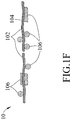
- the filter 10 includes a carrier material 102 having a surface 104, and a silicon material 106 adhered to or supported on the surface 104 of the carrier material 102.
- the carrier material 102 includes at least one carrier 1021.
- the carrier 1021 may include, but are not limited to, activated carbon, ceramic, bamboo charcoal, medical stone, quartz sand, diatomaceous earth, ore, zeolite, silicon granule, polymer granule (such as polyethylene, polyethylene terephthalate, polycarbonate, polypropylene), and polymer fiber.
- the carrier material 102 may be porous or non-porous.
- the carrier material 102 may have an average particle diameter that ranges from 25 ⁇ m to 2.5 mm, preferably from 75 ⁇ m to 2 mm, more preferably from 125 ⁇ m to 1.5 mm, and even more preferably from 150 ⁇ m to 1.2 mm.
- the carrier material 102 is the activated carbon having a plurality of micropores distributed on the surface 104 thereof.
- the activated carbon may be purchased, for example, from Haycarb PLC with a mesh dimension of 12 ⁇ 40 (Model No. : RWAP 1074), or from Jacobi Carbons with a mesh dimension of 60 ⁇ 100.
- a portion of the silicon material 106 adsorbed on the surface 104 is deposited in the micropores of the activated carbon, such that the contact area between the to-be-treated water and the silicon material 106 can be increased, thereby increasing the hydrogen gas and silicic acid concentration in the water composition produced therefrom.
- the silicon material 106 may include a plurality of nano silicon particles having an average particle diameter (D50) that ranges from 50 nm to 800 nm, preferably from 100 nm to 400 nm, more preferably from 150 nm and 350 nm, and even more preferably from 200 nm to 300 nm.
- the average particle diameter (D50) may be measured using a laser diffraction particle size analyzer (Manufacturer: Horiba, Ltd.;Model No.: LA950V2).
- the average particle diameter of the nano silicon particles is preferably greater than 50 nm, more preferably ranging from 100 nm to 400 nm, resulting in a moderate production rate of the water composition containing the silicic acid and hydrogen gas.
- the silicon material 106 may include a plurality of micro silicon particles having an average particle diameter that ranges from 800 nm to 1.5 ⁇ m, even though a lower production rate of the water composition containing the silicic acid and the hydrogen gas is expected.
- the filter 10 may have a diameter that ranges from 50 ⁇ m to 10 mm, preferably from 75.5 ⁇ m to 8 mm, more preferably from 300 ⁇ m to 6 mm, even more preferably from 600 ⁇ m to 5 mm, and still even more preferably from 1 mm to 4 mm.
- the silicon material 106 covers a portion (such as 10% to 80%) of an area of the surface 104 of the carrier material 102, preferably larger than 50%, and more preferably around 80% of the area of the surface 104 of the carrier material 102.
- the area of the surface 104 covered by the silicon material 106 is larger, the binding force between the nano silicon particles as well as the binding force between the silicon material 106 and the carrier material 102 may be stronger, such that the silicon material 106 may not be easily separated from the surface 104 of the carrier material 102 due to water current. Therefore, the silicon material 106 can be supported on the surface 104 for a longer time period, thereby extending the service life of the filter 10.
- the silicon material 106 may be present in an amount larger than 10%, preferably ranging from 40 wt% to 95 wt% based on 100 wt% of the filter 10.
- the amount of the silicon material 106 can be determined by contacting the filter 10 with an organic solvent (such as tetramethylammonium hydroxide) or an alkaline solution (such as sodium hydroxide or potassium hydroxide), so as to separate the carrier material 102 from the silicon material 106, and then measuring the amount of the carrier material 102 after a drying or filtering process, so as to determine the amount of the silicon material 106.
- an organic solvent such as tetramethylammonium hydroxide
- an alkaline solution such as sodium hydroxide or potassium hydroxide
- a second embodiment of the filter 10 according to the present disclosure is substantially the same as the first embodiment of the filter 10, except that the silicon material 106 in this embodiment entirely covers the surface 104 of the carrier material 102, and forms an active layer on the carrier material 102.
- the active layer formed by the nano silicon particles entirely covering the surface 104 of the carrier material 102 may have an average thickness that ranges from 200 nm to 3 mm, preferably from 500 nm to 2.5 mm, so that a predetermined time period of the service life of the filter 10 (such as 3 months or half a year) is expected to be achieved.
- the active layer thus formed may be thicker, such that binding between the nano silicon particles may be stronger and service life of the filter 10 may be longer.
- the active layer is too thick, the surface area 104 of the carrier material 102 per unit volume of the nano silicon particles will become small, resulting in a lower production rate of the water composition containing the silicic acid and the hydrogen gas.
- the active layer is too thin, the silicon material 106 would quickly lose its capability of producing the water composition.
- a third embodiment of the filter 10 according to the present disclosure is substantially similar to the second embodiment.
- the carrier material 102 in third embodiment includes multiple carriers 1021.
- these carriers 1021 are the same.
- the carriers 1021 of this embodiment may be formed by splitting the carrier material 102 of the filter 10 of the second embodiment during preparation process of the filter 10.
- the carrier material 102 (such as an activated carbon) may have an average diameter that ranges from 25 ⁇ m to 2.5 mm, which may be split into a plurality of the carriers 1021, each of which has an average diameter that ranges from 0.2 ⁇ m to 2 mm, preferably from 0.2 ⁇ m to 1.5 mm.
- the carriers 1021 may aggregate with the nano silicon particles to form the filter 10. Therefore, as compared to the first and second embodiments which have one carrier 1021, the carrier material 102 of the thus prepared filter 10 in this embodiment may have a larger surface 104 for the silicon material 106 to be supported thereon, thereby extending the time period for continuous release of silicic acid and hydrogen gas.
- the filter 10 of this embodiment may have a diameter larger than that of the first or second embodiment, such that stability of the filter 10 can be enhanced so as to extend the service life thereof.
- the carriers 1021 that do not split from the carrier material 102 of the filter 10 of the second embodiment may have the same range of average particle diameter as the aforementioned carrier material 102 of the second embodiment.
- a fourth embodiment of the filter 10 according to the present disclosure is substantially the same as the third embodiment, except that the carrier material 102 includes different carriers 1021.
- a portion of the carriers 1021 may be activated carbon, and another portion of the carriers 1021 may be ore, the surfaces 1041 of these carriers 1021 being entirely covered by the nano silicon particles, which form an active layer.
- a fifth embodiment of the filter 10 is substantially similar to the second embodiment, except that the carrier material 102 is a silicon granule formed by aggregation of a plurality of nano silicon particles, and the silicon material 106 includes a plurality of the nano silicon particles that entirely covers the surface 104 of the silicon granule.
- the carrier material 102 may be a silicon granule that consists of a single micro silicon particle.
- the silicon granule may have an average particle diameter that ranges from 0.2 mm to 2 mm, and the nano silicon particles have an average particle diameter that is not greater than 800 nm.
- the silicon granule and the nano silicon particles are present in an amount that ranges from 99 wt% to 100 wt% based on 100 wt% of the filter 10.
- a sixth embodiment of the filter 10 includes a polymer fiber serving as the carrier material 102, and the silicon material 106 supported on the surface of the polymer fiber.
- the polymer fiber may be made by subjecting a plurality of fiber resin to an electrospinning process or a melt-blown process, and may have an average cross-sectional diameter that ranges from 0.5 ⁇ m to 100 ⁇ m.
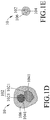
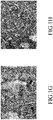
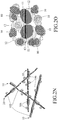
- a partially enlarged electron micrograph of the first embodiment of the filter 10 shows that the activated carbon has a plurality of micropores (as indicated by the arrows) distributed on the surface 104 thereof, and the nano silicon particles (as indicated by light color area) partially cover the surface 104 of the activated carbon, i.e., the silicon material 106 covers between 10% to 80% of an area of the surface 104 of the activated carbon, and are partially deposited in the micropores of the activated carbon.
- a partially enlarged electron micrograph of the second embodiment of the filter 10 shows that the nano silicon particles entirely cover the surface 104 of the activated carbon, i.e., the silicon material 106 covers 100% of an area of the surface 104 of the activated carbon, and are entirely deposited in the micropores on the surface 104 of the activated carbon, which renders the micropores thereon invisible.
- a filter assembly adapted for producing the water composition containing silicic acid and hydrogen gas includes a plurality of the filters 10, which may be any one of the first to the sixth embodiments of the filters 10 as mentioned in the foregoing, or combinations thereof.
- the filter assembly may further include at least one auxiliary filter 11 as shown, e.g., in FIG. 2M below.
- the auxiliary filter 11 may include, but are not limited to, activated carbon, ceramic, bamboo charcoal, medical stone, quartz sand, diatomaceous earth, ore, zeolite, silicon granules, polymer granule, polymer fiber, water glass, and combinations thereof.
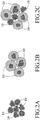
- the amount ratio of the filters 10 and the auxiliary filters 11 of the filter assembly may be adjusted according to practical requirements, and is not limited to those examples as shown in FIGS. 2A to 2O .
- a first example of a filter assembly according to the present disclosure includes a plurality of the first embodiment of the filters 10, i.e., each of the carrier materials 102 includes activated carbon and each of the silicone materials 106 includes nano silicon particles.
- a second example of the filter assembly according to the present disclosure is substantially the same as the first example, except that the second example of the filter assembly includes a plurality of the second embodiments of the filters 10. Since the nano silicon particles entirely cover the surface 104 of each of the activated carbon, the filter assembly may have a longer service life.
- a third example of the filter assembly includes a plurality of the first and second embodiments of the filters 10.
- the service life of the filter assembly may be controlled by adjusting the amount ratios of the first and second embodiments of the filters 10. For example, when the amount of the silicon material 106 in the first embodiment of the filters 10 becomes low, the second embodiment of the filters 10 may be added to increase the overall amount of the silicon materials 106 in the filter assembly.
- the filters 10 of the filter assembly may include at least two different groups of filters 10 (e.g., a first group of filters 10 and a second group of filters 10), in which the carrier material 102 of each of the first group of filters 10 is different from that of each of the second group of filters 10.
- groups of filters 10 e.g., a first group of filters 10 and a second group of filters 10
- a fourth example of the filter assembly according to the present disclosure includes a first group of filters (i.e., the second embodiment of the filters 10 having one carrier 1021) and a second group of filters (i.e., the third and fourth embodiments of the filters 10 having multiple carriers 1021), and the amounts thereof may be adjusted according to practical requirements.
- a fifth example of the filter assembly includes the second, third and fifth embodiments of the filters 10, and the amounts thereof may be adjusted according to practical requirements. It should be noted that, when the filter assembly contains the second embodiment of the filters 10 in a majority, one of the third and fifth embodiments of the filters 10 may be omitted therefrom. Likewise, when the filter assembly contains the third embodiment of the filters 10 in a majority, one of the first and fifth embodiments of the filters 10 may be omitted therefrom.
- a sixth example of the filter assembly includes the first and second embodiments of the filter 10.
- the carrier material 102 of each of the filters 10 may be the same or different.
- the carrier material 102 for two of the second embodiments of the filter 10 is the activated carbon
- the carrier materials 102 for the remaining one of the second embodiment of the filter 10 and the first embodiment of the filter 10 are ores that may exhibit additional function.
- the ores may be capable of emitting far infrared light, which creates a resonance effect through vibration of molecular motion of water molecules of the water composition so as to divide the water molecules into smaller size, thereby the water molecules of the water composition can be easily adsorbed.
- a seventh example of the filter assembly includes the second and third embodiments of the filters 10, and at least one auxiliary filter 11.
- the amounts of the filters 10 and the auxiliary filter 11 may be adjusted according to practical requirements.
- the auxiliary filter 11 is added for adjusting the amount ratio of the filters 10 in the filter assembly, and/or to provide additional functions.
- the auxiliary filter 11 may be the medical stone that is rich in minerals such as iron, calcium, zinc, potassium, silica, aluminum, etc., and has a strong ion exchange capacity, and thus may be utilized to remove harmful substances, adjust pH value, increase oxygen gas content, and dissolve a proper amount of the aforesaid minerals in water.
- the auxiliary filter 11 may include a material that is capable of releasing trace elements (such as iodine and selenium).
- an eighth example of the filter assembly according to the present disclosure is substantially similar to the fifth example of the filter assembly, except that the eighth example further includes a plurality of the fourth embodiment of the filters 10.
- a ninth example of the filter assembly according to the present disclosure is substantially similar to the first example of the filter assembly, except that the ninth example further includes multiple auxiliary filters 11, which may be the activated carbon for adjusting the amount ratio of the silicon material 106 of the filters 10 in the filter assembly.
- the auxiliary filters 11 may have an average particle diameter that is different from that of the carrier material 102 of the filter 10.
- a tenth example of the filter assembly according to the present disclosure is substantially similar to the second example of the filter assembly, except that the tenth example further includes multiple auxiliary filters 11.
- each of the auxiliary filters 11 includes an antimicrobial component supported on a surface thereof for effectively avoiding excessive growth of microorganisms, such as bacteria, in the filters 10 and in the thus produced water composition.
- the antimicrobial component may include, but are not limited to, nano silver particles, nano zinc particles, and the combination thereof.
- an eleventh example of the filter assembly according to the present disclosure is substantially similar to the third example, except that the eleventh example further includes multiple auxiliary filters 11 as shown in FIGS. 2I and 2J .
- a twelfth example of the filter assembly according to the present disclosure is substantially similar to the eleventh example, except that the first embodiment of the filters 10 in the eleventh example are replaced by the fifth embodiment of the filters 10.
- a thirteenth example of the filter assembly according to the present disclosure is substantially similar to the seventh example of the filter assembly, except that multiple auxiliary filters 11 are included in this example.
- a fourteenth example of the filter assembly includes a plurality of the sixth embodiment of the filters 10, in which each of the carrier materials 102 is a polymer fiber, which may be in nanoscale or microscale range.
- the filter assembly may be prepared by subjecting a mixture that includes the nano silicon particles and a polymer (such as polyacrylonitrile) dissolved in a spinning solvent (such as N,N-dimethylformamide) to an electrospinning process.
- the filter assembly may be further subjected to oxidation and carbonization reactions, so as to obtain a carbonized polymer fiber having the nano silicon particles adsorbed thereon.
- the fourteenth example of the filter assembly may be made by subjecting a mixture of the nano silicon particles and a resin (such as polypropylene, polyethylene terephthalate, polybutylene terephthalate and polylactic acid, etc.) to a melt-blown process using a screw extruder.
- a resin such as polypropylene, polyethylene terephthalate, polybutylene terephthalate and polylactic acid, etc.
- a fifteenth example of the filter assembly includes the first, third and fifth embodiments of the filters 10, and optionally the auxiliary filters 11.
- the filter assembly may further include at least one binder 12 for binding the filters 10 therebetween, and for binding the filters 10 to the auxiliary filters 11 so as to enhance the overall strength of the filter assembly.
- the binder 12 may be in a melting state or in a partially melting state. Examples of the binder 12 may include, but are not limited to, polyether, acrylic resin, styrene, polyamide, polyester, polyolefin, cellulose, glycerol, polyethylene glycol, polyvinyl alcohol, and combinations thereof.
- the carrier materials 102 of the filters 10 are the activated carbon, and the activated carbon and the silicon material 106 (i.e., the nano silicon particles) cooperatively form a sintered activated carbon or a compressed activated carbon (i.e., a molding active carbon as observed from the overall appearance of the filters 10).
- the nano silicon particles cover larger than 10% of an area of the surface 104 of the activated carbons, preferably larger than 40% of the area thereof.
- the filter assembly of this example are prepared by mixing the activated carbon, the nano silicon particles and the binder 12, and then hot pressing the resultant mixture in a mold to form a green body, followed by sintering the green body at a predetermined temperature.
- the filter assembly may be prepared by mixing any of the abovementioned embodiments of the filters 10 with the binder 12 and then subjecting the mixture to a hot pressing process and a sintering process. It is worth mentioning that after sintering, the binder 12 may be formed with a plurality of holes (not shown in the figures) to allow the to-be-treated water to flow therethrough.
- FIG. 2P is an electron micrograph image of the fifth example of the filter assembly which is taken using a scanning electron microscope (SEM) (Manufacturer: Hitachi, Ltd.; Model No. : S-400) .
- the filter assembly includes the filters 10 that have a dimension of 1 mm ⁇ 1.3 mm, in which a plurality of the nano silicon particles cover the carrier material 102 (i.e., the activated carbon (Manufacturer: Haycarb PLC; Model No. : RWAP 1074 with a mesh dimension of 12x40 and a diameter ranging from 0.425 mm to 1.7 mm).
- the carrier material 102 i.e., the activated carbon
- FIG. 2Q is a partially enlarged image of FIG. 2P , showing the nano silicon particles aggregating on the surface 104 of the carrier material 102.
- Each of the nano silicon particles has an average diameter ranging from 75 nm to 450 nm, which is determined by analyzing the SEM image.
- the diameter of the filter 10 and the nano silicon particle may be determined using a laser diffraction particle size analyzer (Manufacturer: Horiba, Ltd.;Model No.: LA950V2) that can measure a particle diameter that ranges from 10 nm to 3 mm.
- a mesh screen may be used for determining the diameter of the filter 10 and the nano silicon particle that falls within a microscale range and a nanoscale range.
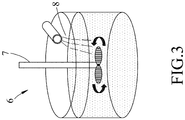
- a stirring apparatus 6 equipped with an impeller 7 for providing an appropriate shear force is exemplified, which is suitable to be applied in a method for preparing the abovementioned examples of the filter assembly according to the present disclosure.
- the method includes the steps of: (a) mixing the silicon material 106 (such as the nano silicon particles) with a solvent (such as an alcohol) in the stirring apparatus 6 to obtain a nano silicon slurry 8; and (b) mixing the carrier material 102 (such as the activated carbon) and the nano silicon slurry 8 under stirring, such that the nano silicon particles and the activated carbon collide and aggregate to one another so as to obtain the filter assembly having a diameter that ranges from 50 ⁇ m to 10 mm.
- the speed and mode of rotation (i.e., continuous or discontinuous rotation) of the impellar 7 may be adjusted according to practical requirements.
- step (b) is conducted at a temperature ranging from 50°C to 300°C to remove the solvent.
- the nano silicon particles of the nano silicon slurry 8 may be present in an amount ranging from 10 wt% to 40 wt% based on the total amount of the nano silicon slurry 8.
- the nano silicon particles are present in an amount that ranges from 40 wt% to 95 wt% based on a total weight of the silicon material 106 and the carrier material 102.
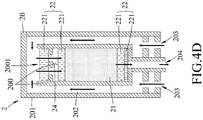
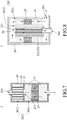
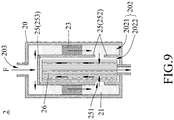
- a first embodiment of a filter device 2 is adapted for purifying a to-be-treated water and producing the water composition containing silicic acid and hydrogen gas.
- the filter device 2 which is in a tubular form, includes a first housing 20 and a filter assembly 21.
- the first housing 20 defines a first receiving space 202, and has a first inlet 203 and a first outlet 204 which are fluidly communicated with the first receiving space 202.
- the first inlet 203 and the first outlet 204 are disposed at a same side (i.e., a top side) of the first housing 20.
- the first housing 20 includes an inner tubular wall 200 that is formed with a flow channel 2001 communicating with the first outlet 204 and that extends from the top side of the first housing 20 toward a bottom side of the first housing 20, and an outer tubular wall 201 that surrounds the inner tubular wall 200.
- the filter assembly 21 is disposed in the first receiving space 202 of the first housing 20 and is positioned at a region between the inner tubular wall 200 and the outer tubular wall 201.
- the filter assembly 21 may include at least one of the abovementioned examples of the filter assemblies (e.g., the first to the fourteenth examples of the filter assemblies) or a plurality of the abovementioned filters 10 (e.g., the first to the sixth embodiments of the filters 10) .
- the filters 10 may be further mixed with the auxiliary filter 11.
- the amounts (in terms of quantity or weight) of the filter 10 and the auxiliary filter 11 in the filter assembly 21 may be adjusted according to practical requirements.
- the filter device 2 may further include at least one primary filter unit 22 (such as non-woven fabric, fiber mesh, sponge, etc.) which is received in the first receiving space 202 and is adapted for filtering impurities having large particle size from the to-be-treated water.
- the filter device 2 includes two primary filter units 22 that are disposed upstream and downstream of the filter assembly 21 along a water flow direction F, respectively (i.e., the upstream and downstream primary filter units 22) .
- a predetermined amount of the to-be-treated water is introduced to the first housing 20 through the first inlet 203, flows through the upstream primary filter units 22, the filter assembly 21 and the downstream primary filter units 22 along the water flow direction F, where the to-be-treated water is reacted with the silicon material 106 of the filter assembly 21 to produce the water composition containing the silicic acid and the hydrogen gas.
- the water composition then flows along the flow channel 2001 and leaves the first housing 20 through the first outlet 204.
- the filter assembly 21 completely fills a region of the first receiving space 202 between the upstream and downstream primary filter units 22, but is not limited thereto in practice.
- the filter assembly 21 partially fills the region between the upstream and downstream primary filter units 22. For example, only 40% to 70% of the region between the upstream and downstream primary filter units 22 is filled with the filter assembly 21, such that when the to-be-treated water flows into the region of the first receiving space 202, additional space available in the region allows the filter assembly 21 to be flipped by the turbulent currents generated by the water flow, so as to increase the contact and reaction between the to-be-treated water and the filter assembly 21, thereby increasing the concentration of the silicic acid and the hydrogen gas in the thus produced water composition in a shorter time period, as well as enhancing the service life of the filter assembly 21.
- a hollow fiber membrane (not shown) may be received in the first receiving space 202 of the first housing 20, for example, in the flow channel 2001.
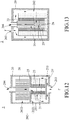
- a second embodiment of a filter device 2 is similar to the first embodiment of the filter device 2, except that the second embodiment of the filter device 2 further includes an auxiliary filter assembly 23 composed of one or more auxiliary filters 11, each of which may optionally include an antimicrobial component supported on a surface thereof.
- auxiliary filter 11 may include, but are not limited to, activated carbon, ceramic, bamboo charcoal, medical stone, quartz sand, diatomaceous earth, ore, zeolite, silicon granules, polymer fiber, soluble glass (such as sodium silicate), and combinations thereof.
- antimicrobial component may include, but are not limited to, nano silver particles, nano zinc particles, and the combination thereof.
- the auxiliary filter 11 is an activated carbon that includes nano zinc particles adsorbed on the surface thereof.
- the auxiliary filter 11 is a combination of an activated carbon and a soluble glass, and includes nano zinc particles supported on the surface thereof.
- the nano silver particles and the nano zinc particles supported on the auxiliary filters 11 are capable of releasing silver ions and zinc ions for inhibiting microorganisms that may grow in the filter assembly 21 and the thus produced water composition.
- the auxiliary filter assembly 23 is interposed in a middle portion of the filter assembly 21, but is not limited thereto.
- the auxiliary filter assembly 23 may be substantially mixed with the filter assembly 21, so that these assemblies 21, 23 are evenly distributed in the first receiving space 202.
- FIG. 4C is a graph illustrating oxidation-reduction potential (ORP) and silicic acid concentration determined of a water composition produced by the first embodiment of the filter device 2 at different output amount of the water composition.
- the carrier material 102 of the filter assembly 21 in the filter device 2 was activated carbon purchased from Haycarb PLC (Model No. : RWAP 1074, 12 X 40 mesh), and has a diameter ranging from 0.425 mm to 1.7 mm and a total weight of 4587.5 g.
- the silicon material 106 is present in an amount of 78.2 wt% based on 100 wt% of the filter assembly 21.
- the ORP of the water composition was measured using electrodes (Manufacturer: JAQUA; Model: EO221) and an oxidation-reduction potential (ORP) analyzer (Manufacturer: Horiba Ltd.; Model: F-51).
- the water composition was subjected to colorimetric measurement using a silicate test kit (MColortestTM, Merck) to determine silicic acid concentration.
- the silicic acid concentration and the ORP value thereof were 30 mg/L and -677 mV, respectively, and when the output amount of the water composition increased to 477 L, the silicic acid concentration decreased to 12 mg/L, and the ORP value slightly increased to -574 mV.
- a third embodiment of a filter device 2 is similar to the first embodiment, except that the first housing 20 in this embodiment includes at least two first inlets 203 spaced apart from the first outlet 204, all of which are disposed at the bottom side of the first housing 20.
- the filter assembly 21 and the upstream and downstream primary filtering units 22 are disposed in the flow channel 2001 defined by the inner tubular wall 200, which extends from the bottom side of the first housing 20 towards the top side of the first housing 20.
- the upstream primary filter unit 22 may include at least one elastic foam sponge 221 (e.g., having a pore diameter ranging from 5 to 40 ⁇ m) to effectively slow down the flow rate of the to-be-treated water.
- the downstream primary filter unit 22 may include the elastic foam sponge 221 and a non-woven fabric 222 (e.g., having a pore diameter of 5 ⁇ m) .
- the auxiliary filter assembly 23 (not shown) can be optionally interposed in the middle portion of the filter assembly 21, but is not limited thereto.
- the to-be-treated water before reaching the filter assembly 21, is required to travel a long distance (e.g., approximate the length of the first housing 20) from the first inlet 203 toward the top side of the first housing 20, and then downward to the upstream primary filter unit 22.
- the flow rate of the to-be-treated water can be effectively slowed down, thereby reducing the loss of the silicon material 106 from the filter assembly 21.
- contamination caused by fallen silicon material 106 in the water composition e.g., becoming turbid
- clogging of the downstream primary filter unit 22 can be reduced, thereby extending the service life of the filter assembly 21.
- an elastic component 24 (e.g., a spring) may be further disposed on the inner tubular wall 200 for applying pressure to the primary filter unit 22, so as to compress the filter assembly 21 that is disposed downstream of the primary filter unit 22.
- FIG. 4E is a graph illustrating oxidation-reduction potential (ORP) and silicic acid concentration determined at different output amount of the water composition that is produced by the filter device 2 of the third embodiment.
- the filter assembly 21 of the filter device 2 includes the activated carbon (Manufacturer: Haycarb PLC; Model No. : RWAP 1074 with 12 x40 mesh, i.e., a diameter ranging from 0.425 mm to 1.7 mm) as the carrier material 102, and is prepared using the apparatus as shown in FIG. 3 and then screened using three different sieve meshes.
- the activated carbon Manufacturer: Haycarb PLC; Model No. : RWAP 1074 with 12 x40 mesh, i.e., a diameter ranging from 0.425 mm to 1.7 mm
- the filter assembly 21 includes the filters 10 having three different average particle diameters, which are, 14.3 wt% of the filters 10 having a first average particle diameter of less than 0.55 mm (i.e., ⁇ 30 mesh), 47.6 wt% of the filters 10 having a second average particle diameter ranging from 0.55 mm to 2 mm (i.e., 8 to 30 mesh), and 38.1 wt% of the filters 10 having a third average particle diameter ranging from 2 mm to 4 mm (i.e., 5 to 8 mesh).
- the water composition produced by the filter device 2 was collected for 3 minutes in every hour, for a total of 90 L per day, and then the collected water composition was subjected to the silicic acid concentration and the ORP value measurement as described above.
- the highest silicic acid concentration and the lowest ORP value were 90 mg/L and -715 mV, respectively.
- the output amount of the water composition increased up to 3212 L
- the silicic acid concentration was still maintained at 38 mg/L
- the ORP value was maintained at -587 mV.
- the filter assembly 21 composed of the three classes of filters 10 with the predetermined weight percentage ratio has better performance than that of the filter assembly 21 composed of only one of the three classes of filters 10 (data not shown) .
- the contact area between the filter assembly 21 and the water composition may be optimized, which results in an improved performance of the filter assembly 21 of the filter device 2 as compared to the filter assembly 21 composed of merely the filters 10 having small, large or random size of the average particle diameter.
- the filter assembly 21 includes filters 10 having at least two different average particle diameters, the water composition produced thereby may exhibit improved desired properties.
- a fourth embodiment of a filter device 2 is similar to the first embodiment, except that the fourth embodiment of the filter device 2 includes one primary filter unit 22 that is disposed upstream of the filter assembly 21 along the water flow direction (F).
- the inner tubular wall 200 of the first housing 20 extends from the top side to the bottom side of the first housing 20, and has multiple pores (not shown in the figures) for water to pass through.
- the filter assembly 21 is integrally shaped as a columnar block, such as sintered activated carbon or compressed activated carbon.
- the filter assembly 21 may also be shaped as two spaced-apart columnar blocks, each having a central through hole.
- a predetermined amount of the to-be-treated water is introduced to the first housing 20 through the first inlet 203 along the water flow direction (F), and then sequentially flows through the primary filter unit 22 and the filter assembly 21 to react with the silicon material 106 therein. After that, the resultant water composition produced by the filter assembly 21 passes through the pores of the inner tubular wall 200 and flows along the flow channel 2001 and leaves the first housing 20 through the first outlet 204.
- a hollow fiber membrane (not shown in the figures) may be received in the first receiving space 202 of the first housing 20, for example, in the flow channel 2001.
- a fifth embodiment of a filter device 2 is similar to the fourth embodiment, except that the fifth embodiment of the filter device 2 further includes the auxiliary filter assembly 23 as described in the second embodiment of the filter device 2.
- the auxiliary filter assembly 23 is formed as a filter layer that is disposed on an inner side of the filter assembly 21, but is not limited thereto.
- the auxiliary filter assembly 23 may be thoroughly mixed with the filter assembly 21, so that these assemblies 21, 23 are evenly distributed within the first receiving space 202.
- a sixth embodiment of a filter device 2 includes a first housing 20, a filter assembly 21, a spacer 25 and a hollow fiber membrane 26.
- the first housing 20 defines a first receiving space 202, and has a first inlet 203 and a first outlet 204 which are respectively positioned at opposite sides (i.e., a bottom side and a top side) of the first housing 20.
- the spacer 25 extends from a lateral surface of the first housing 20 into the first receiving space 202, so as to divide the first receiving space 202 into a first sub-receiving space 2021 and a second sub-receiving space 2022 that are respectively fluidly communicated with the first inlet 203 and the first outlet 204.
- the spacer 25 is formed with at least one opening 251 for fluidly communicating the first sub-receiving space 2021 and the second sub-receiving space 2022.
- the diameter and the number of the opening 251 can be adjusted according to the practical requirements.
- the filter assembly 21 is received in the first sub-receiving space 2021, and the hollow fiber membrane 26 is received in the second sub-receiving space 2022.
- at least one auxiliary filter 11 as described above may be optionally disposed in the first sub-receiving space 2021 or thoroughly mixed with the filter assembly 21 to be evenly distributed within the first sub-receiving space 2021.
- auxiliary filters 11 i.e., the abovementioned auxiliary filter assembly 23
- auxiliary filter assembly 23 multiple auxiliary filters 11 are interposed in the middle portion of the filter assembly 21.
- a predetermined amount of the to-be-treated water is introduced to the first housing 20 through the first inlet 203 along the water flow direction (F), and flows through the filter assembly 21 and the auxiliary filter assembly 23 to produce the water composition containing the silicic acid and hydrogen gas.
- the water composition flows into the second sub-receiving space 2022 where a further filtration is conducted by the hollow fiber membrane 26, and then flows out of the first housing 20 through the first outlet 204.
- a seventh embodiment of a filter device 20 is similar to the sixth embodiment of the filter device 2. The difference resides in that, in the seventh embodiment, both of the first inlet 203 and the first outlet 204 are positioned at the bottom side of the first housing 20.
- the spacer 25 includes a peripheral wall 252 extending from the bottom side of the first housing 20 toward the top side the first housing 20 to define the opening 251 that is proximate to the top side of the first housing 20.
- Each of the filter assembly 21 and the auxiliary filter assembly 23 is formed with a central through hole which corresponds in position to the second sub-receiving space 2022. As shown in FIG.
- the length of the hollow fiber membrane 26 would be greater than that in the sixth embodiment, which means the water composition would flow through the hollow fiber membrane 26 along the water flow direction (F) for a relatively longer distance and time, thereby improving the filtering effect so as to effectively remove undesired microorganisms and/or impurities.
- an eighth embodiment of a filter device 2 is similar to the seventh embodiment of the filter device 2, except for the following differences.
- the first inlet 203 and the first outlet 204 are positioned at the top side and the bottom side of the first housing 20, respectively.
- the spacer 25 further includes a covering wall 253 that is spaced apart from the top side of the first housing 20, and that covers a terminal end of the peripheral wall 252 proximate to the top side of first housing 20.
- the peripheral wall 252 of the spacer 25 is formed with at least one opening 251 proximate to the bottom side of the first housing 20 for fluidly communicating the first sub-receiving space 2021 and the second sub-receiving space 2022.
- a ninth embodiment of a filter device 2 is similar to the eighth embodiment of the filter device 2, except for the following differences.
- the first inlet 203 and the first outlet 204 are positioned at the bottom side and the top side of the first housing 20, respectively.
- the spacer 25 includes the covering wall 253 that is spaced apart from the bottom side of the first housing 20, and the peripheral wall 252 that extends from a periphery of the covering wall 253 toward the top side of the first housing 20 to define at least one opening 251 that is proximate to the top side of the housing 20.
- the water composition produced by the filter assembly 21 flows into the second sub-receiving space 2022 through the opening 251
- some of the water composition would flow in a direction downward toward the covering wall 253 of the spacer 25 and then in a direction upward toward the first outlet 204 (i.e., approximate twice the length of the hollow fiber membrane 26). That is, the water composition may flow through the hollow fiber membrane 26 for a relatively longer distance and period, thereby achieving an excellent filtering effect.
- a tenth embodiment of a filter device 2 is similar to the seventh embodiment of the filter device 2, except for the following differences.
- the peripheral wall 252 of the spacer 25 includes a first section 2521 that is adjacent to the bottom side of the first housing 20, and a second section 2522 that connects to the first section 2521 and that has a diameter larger than a diameter of the first section 2521.
- the first section 2521 is configured to define an outlet flow channel 254 that is in fluid communication with the first outlet 204 and the second sub-receiving space 2022 that is defined by the second section 2522.
- the filter device 2 includes two first inlets 203 that are spaced apart from each other, and further includes a primary filter unit 22 as described in the first embodiment of the filter device 2, which is disposed in the second section 2522 and downstream of the filter assembly 21 along the water flow direction (F).
- the water composition produced by the filter assembly 21 flows through the primary filter unit 22 to remove impurities with a large particle size, then flows through the hollow fiber membrane 26, and finally flows out of the first housing 20 along the outlet flow channel 254.
- the filter assemblies 21 used in the above sixth to the tenth embodiments of the filter devices 2 may include at least one of the abovementioned examples of the filter assemblies (e.g., the first to the fifteenth examples of the filter assemblies) or the abovementioned filters 10 (e.g., the first to the sixth embodiments of the filters 10) .
- the filters 10 may be further mixed with at least one auxiliary filter 11.
- the filter assembly 21 may be partially filled in the first sub-receiving space 2021, for example, 40% to 80% of a total volume of the first sub-receiving space 2021.
- an eleventh embodiment of a filter device 2 is similar to the sixth embodiment of the filter device 2, except for the following differences.
- the eleventh embodiment of the filter device 2 further includes an additional spacer 25' that is spaced apart from the spacer 25 and proximate to the bottom side of the first housing 20, and that is configured to form an inlet flow channel 255 that is in fluid communication with the first inlet 203 and the filter assembly 21.
- Each of the auxiliary filter assembly 23 and the filter assembly 21 is formed with a central through hole (as shown in FIG. 6B ) that is in spatial communication with the opening 251.
- the filter assembly 21 is disposed to surround the auxiliary filter assembly 23.
- the auxiliary filter assembly 23 may be omitted or evenly mixed with the filter assembly 21.
- the to-be-treated water introduced to the first housing 20 through the first inlet 203 substantially fills the inlet flow channel 255 and then flows through the filter assembly 21 and the auxiliary filter assembly 23 to produce the water composition containing the silicic acid and hydrogen gas.
- the water composition then flows into the second sub-receiving space 2022 through the opening 251 to be filtered by the hollow fiber membrane 26, and then flows out of the first housing 20 through the first outlet 204.
- a twelfth embodiment of a filter device 2 is similar to the eleventh embodiment of the filter device 2, except for the following differences.
- the spacers 25, 25' are omitted in this embodiment.
- the first inlet 203 and the first outlet 204 are disposed at the top side of the first housing 20.
- the filter assembly 21 is formed with a central hole (rather than a through hole) for the disposition of the auxiliary filter assembly 23 and the hollow fiber membrane 26, which is surrounded by the auxiliary filter assembly 23.
- the to-be-treated water introduced to the first housing 20 through the first inlet 203 substantially fills the first receiving space 202 and flows through the filter assembly 21 to produce the water composition, and then the water composition flows through the auxiliary filter assembly 23 and the hollow fiber membrane 26, and finally flows out of the first housing 20 through the first outlet 204.
- the auxiliary filter assembly 23 may be optionally included in all of the aforementioned embodiments of the filter device 2, and the auxiliary filter assembly 23 may or may not include the antimicrobial component.
- a water purification system 4 which is adapted for purifying water and producing a water composition containing silicic acid and hydrogen gas, includes at least one filter device 2 as mentioned above as a first filter device 2.
- a first embodiment of a water purification system 4 is adapted for purifying water and producing a water composition containing silicic acid and hydrogen gas.
- the water purification system 4 includes at least one embodiment of the filter device 2 mentioned above as a first filter device 2, a second filter device 3, and a pipeline unit 41.
- the first inlet 203 and the first outlet 204 are disposed on the top side of the first housing 20, but is not limited thereto.
- the second filter device 3 is disposed downstream of the first filter device 2 along the water flow direction (F).
- the second filter device 3 has a second housing 30 that defines a second receiving space 301, and a hollow fiber membrane 31 that is received in the second receiving space 301.
- the second housing 30 includes a second inlet 302 and a second outlet 303 that are disposed at the same side (i.e., a top side) of the second housing 30 and that are in fluid communication with the second receiving space 301.
- the second inlet 302 and the second outlet 303 may be disposed on a bottom side of the second housing 30, or may be respectively disposed on two opposite sides of the second housing 30 according to the practical requirements.
- the second filter device 3 can be optionally omitted.
- the pipeline unit 41 includes a inlet pipe 410 that is connected to the first inlet 203, a outlet pipe 411 that is connected to the second outlet 303, and a first transport pipe 412 that fluidly connects the first outlet 204 of the first filter device 2 and the second inlet 302 of the second filter device 3.
- a to-be-treated water delivered by the inlet pipe 410 is first introduced to the first filter device 2 through the first inlet 203 along the water flow direction (F), and flows through the filter assembly 21 to produce the water composition.
- the thus produced water composition flows into a first transport pipe 412 through the first outlet 204, and then is introduced to the second filter device 3 through the second inlet 302 for filtration.
- the filtered water composition flows into the outlet pipe 411 through the second outlet 303.
- the hollow fiber membrane 31 may include a plurality of hollow fibers, and each of which is formed with through holes having diameters ranging from 10 nm to 200 nm, so that impurities having diameters larger than those of the through holes, e.g., microorganisms, silicon material (such as nano silicon particles), nano silver/zinc particles that are potentially present in the water composition, would be filtered out by the hollow fibers, thereby preventing these impurities from flowing out from the second outlet 303.
- impurities having diameters larger than those of the through holes e.g., microorganisms, silicon material (such as nano silicon particles), nano silver/zinc particles that are potentially present in the water composition
- the water purification system 4 may optionally further include at least one ultraviolet light sterilization unit 42.
- the water purification system 4 includes two ultraviolet light sterilization unit 42, 42' that are disposed upstream of the first filter device 2 for sterilizing the to-be-treated water and disposed downstream of the second filter device 3 for sterilizing the thus produced and filtered water composition, and are fluidly connected to the first filter device 2 via the inlet pipe 410 and to the second filter device 3 via the outlet pipe 411, respectively.
- the ultraviolet light sterilization unit 42 may be disposed between the first and second filter devices 2, 3 for sterilizing the thus produced water composition along the water flow direction (F), and is fluidly connected to the first and second filter devices 2, 3 via the first transport pipe 412 (not shown in the figures) .
- the microorganisms present in the to-be-treated water that might enter into the first filter device 2 is greatly reduced, which may effectively prevent the microorganisms from growing in the filter assembly 21, and also avoid polymerization of the silicic acid in the water composition.
- the water purification system 4 may include at least one discharge unit 43 that is a pressure relief valve for discharging, a liquid including silicic acid, a gas including hydrogen gas or the combination thereof.
- first and second discharge units 43, 43' are disposed downstream of the first filter device 2 and downstream of the second filter device 3, and are operationally connected to the first transport pipe 412 and the outlet pipe 411 of the pipeline unit 41, respectively.
- silicic acid and hydrogen gas will be continuously generated and accumulated, causing undesired high pressure in the first transport pipe 412 that can adversely affect liquid flow or even cause the pipeline unit 41 to burst.
- the first discharge unit 43 may release the undesired high pressure in the first transport pipe 412 so as to enhance the liquid flow and to avoid bursting thereof, as well as to prevent accumulation of silicic acid.
- the second discharge unit 43' is used to discharge a portion of the water composition and undesired high pressure in the outlet pipe 411 if the thus produced water composition and hydrogen gas accumulate to a relatively high level, so as to enhance the liquid flow and to avoid bursting of the outlet pipe 411, as well as to prevent microorganism from growing therein.
- the water purification system 4 further includes two measuring units 44, 44' (i.e., total dissolved solids (TDS) meters) that are respectively mounted upstream and downstream of the first filter device 2 along the water flow direction (F) for measuring the TDS amounts of the to-be-treated water and the thus produced water composition.
- TDS total dissolved solids
- the measuring unit 44 disposed upstream of the first filter device 2 is operationally connected to the inlet pipe 410 that connects a water supply system 51 (see FIG. 17 ) and the first inlet 203 of the first filter device 2
- the measuring unit 44' disposed downstream of the first filter device 2 is operationally connected to the outlet pipe 411 that connects the second outlet 304 of the second filter device 3 and the ultraviolet light sterilization unit 42' .
- the TDS amount (hereinafter referred to as V t ) measured by the measuring unit 44' is greater than the TDS amount (hereinafter referred to as V o ) measured by the measuring unit 44.
- V t the TDS amount measured by the measuring unit 44'
- V o the TDS amount measured by the measuring unit 44.
- a second embodiment of the water purification system 4 is similar to the first embodiment of the water purification system 4, except that the second embodiment of the water purification system 4 further includes a third filter device 3' that is disposed upstream of the first filter device 2 along the water flow direction (F), but is not limited thereto.
- the third filter device 3' is disposed downstream of the first filter device 2' along the water flow direction (F).
- the third filter device 3' includes a third housing 30' that defines a third receiving space 301', and a third inlet 302' and a third outlet 303' which are fluidly communicated with the third receiving space 301'.
- the third inlet 302' and the third outlet 303' are disposed on a top side of the third housing 30', but is not limited thereto.
- the third inlet 302' and the third outlet 303' may be disposed on a bottom side of the third housing 30', or may be respectively disposed on two opposite sides of the third housing 30'.
- the third filter device 3' includes at least one auxiliary filter 32 having an antimicrobial component supported thereon as described above that is received in the third receiving space 301' of the third housing 30'.
- the third outlet 303' of the third filter device 3' and the first inlet 203 of the first filter device 2' are fluidly connected to each other through a second transport pipe 413 of the pipeline unit 41 and the third inlet 302' is fluidly connected to the inlet pipe 410.
- the to-be-treated water is first introduced to and filtrated by the third filter device 3' through the third inlet 302' along the water flow direction (F), after which the filtered water is delivered from the third outlet 303' into the second transport pipe 413 , and then is introduced to the first filter device 2 through the first inlet 203 to produce the water composition containing the silicic acid and hydrogen gas.
- the thus produced water composition flows out from the first outlet 204 and then into the second filter device 3 for further filtration.
- a third embodiment of the water purification system 4 is similar to the second embodiment of the water purification system 4, except that the third filter device 3' of the second embodiment is replaced by another first filter device 2' in the third embodiment, and the pipeline unit 41 of the third embodiment is designed to deliver the to-be-treated water to the two first filter devices 2, 2' which are disposed in parallel.
- the pipeline unit 41 includes an inlet pipe 410 that is fluidly connected to the first inlets 203, 203' of the first filter devices 2, 2', a first transport pipe 412 that is fluidly connected to the first outlets 204, 204' of the two first filter devices 2, 2' and the second inlet 302, and an outlet pipe 411 that is fluidly connected to the second outlet 303' .
- a reflux unit (not shown in the figures) may be further included and may be disposed downstream of the first filter device(s) 2 (2') for circulating the treated water (i.e., the water composition) flowing out therefrom back thereto, so as to allow the treated water to be reacted again with the silicon material 106 in the first filter device (s) 2. Therefore, the water composition can be obtained in an efficient manner and may have a relatively higher concentration of silicic acid and hydrogen gas.
- the concentration of the silicic acid and the hydrogen gas present in the water composition can be adjusted by controlling the circulating times of the treated water back to the first filter device (s) 2 by the reflux unit (i.e., the times of the treated water undergoing reaction with the silicon material 106) .
- at least one flow switch may be further disposed upstream of the first filter (s) 2 to control the water flow direction (F) of the to-be-treated water in the water purification system 4, thereby further modulating the production rate and the concentration of the silicic acid and the hydrogen gas present in the water composition.
- the to-be-treated water may be controlled to flow through the first filter device (s) 2 if a relatively lower concentration of silicic acid and hydrogen gas is required. If a higher concentration of silicic acid and hydrogen gas is required, the to-be-treated water may be controlled by the flow switch in combination with the reflux unit to flow through the first filter device (s) 2 for multiple times.
- the water purification system 4 further includes a computerized control panel (not shown in the figures), which is configured to control the reflux unit (i.e., the circulating times of the treated water back to the first filter device (s) 2) and/or to control whether a given amount of drinking water is required to be mixed with the treated water, thereby obtaining a desired concentration of the silicic acid and hydrogen gas.
- the water purification system 4 may further include a degassing unit for removing hydrogen gas and/or an auxiliary filter device containing an ion exchange resin or oxide or hydroxide of a polyvalent cation for removing or absorbing silicic acid, so as to prepare different types of water (i.e., other than the abovementioned water composition), such as hydrogen-dissolved water that is devoid of silicic acid, silicic acid-dissolved water that is devoid of hydrogen gas, and pure water that is devoid of hydrogen gas and silicic acid.
- a degassing unit for removing hydrogen gas and/or an auxiliary filter device containing an ion exchange resin or oxide or hydroxide of a polyvalent cation for removing or absorbing silicic acid, so as to prepare different types of water (i.e., other than the abovementioned water composition), such as hydrogen-dissolved water that is devoid of silicic acid, silicic acid-dissolved water that is devoid of hydrogen gas, and pure water that is devoid of hydrogen
- the to-be-treated water can be selectively determined to flow through one of the first filter device 2, the second filter device 3, the degassing unit, the auxiliary filter device containing an ion exchange resin, the auxiliary filter device containing oxide or hydroxide of a polyvalent cation, and combinations thereof, so as to obtain the abovementioned different types of water or the water composition according to the user's requirements.
- a water processing apparatus 5 includes a water supply system 51, the water purification system 4 as described above that is fluidly connected to the water supply system 51, and optionally, a water temperature-regulating system 52 that is fluidly connected to the water supply system 51 and/or the water purification system 4 for regulating the temperature of the to-be-treated water and/or the thus produced water composition.
- the water supply system 51 may include a commercially available reverse osmosis (R.O.) device, or any other type of water purification equipment, so as to supply filtered water to the water purification system 4.
- R.O. reverse osmosis
- the water temperature-regulating system 52 may heat and/or cool down the water temperature so as to obtain the water composition having a desired temperature (cold, hot or warm).
- the water composition which may be produced by any of the abovementioned embodiments and examples of the filters 10, the filter assemblies, the filter devices 2, and the water purification systems 4 of the present disclosure, has a silicic acid concentration that ranges between 8 mg/L and 90 mg/L, preferably between 10 mg/L and 50 mg/L; has an oxidation-reduction potential (ORP) value that is not higher than -100 mV, preferably not higher than -300 mV, more preferably not higher than -550 mV, and even more preferably not higher than -650 mV.
- ORP oxidation-reduction potential
- the water composition can be added into a product to slow down the oxidation rate of the product or applied to animals to facilitate formation of connective tissue thereof.
- the product may be externally or internally applied to the animals. Examples of the product may include, but are not limited to, a skin care product and a beverage.
- the animal may be a vertebrate, but is not limited thereto.
- Examples of the skin care product may include, but are not limited to, toning lotions, moisturizing lotions, moisturizing creams, essences, whitening lotions, whitening milks, whitening creams, etc.
- the water composition may be added to existing composition of the skin care product, or may be added to a non-woven fabric that may optionally contain a well-known component used in a facial mask composition, such as L-ascorbic acid, alpha hydroxyl acid, placenta, various plant extracts, etc., so as to prepare a moisturizing facial mask.
- the water composition may be used to replace at least one of an antioxidant component (such as vitamin C, vitamin E, carnosine and coenzyme Q 10 ) and a moisturizing component (such as hyaluronic acid, polyols such as glycerin and collagen) of the facial mask composition.
- the moisturizing facial mask may be packaged in an airtight manner, e.g., in an airtight bottle, to prevent loss of hydrogen gas therefrom.
- the water composition may also be filled in an airtight bottle such as an airtight glass bottle, which is in combination with a face mask that may contain well-known components (such as whitening agents, plant extracts, enzymes, etc.) in a dry form, so as to be packaged as a face mask kit.
- the face mask can be wetted with the water composition.
- the beverage may include, but are not limited to, juices that are easily oxidized (e.g., apple juice), sparkling water, beer, coffee, tea, yogurt, functional drinks, etc., in which the silicic acid and the hydrogen gas can be added to enhance flavor.
- acidic juice is more suitable to be added with the silicic acid present in the water composition.
- the beverage may be packaged in an airtight manner, preferably in an airtight glass bottle.
- the silicic acid and the hydrogen gas present in the water composition may be used to change the flavor and the taste of the beer.
- a low ORP value of the water composition may activate facultative or obligate anaerobes, such as lactic acid bacteria.
- the hydrogen gas present in the water composition may be synergized with the gas dissolved in the sparkling water to generate different levels of effervescence taste, and the silicic acid may enhance the nutritional value of the sparking water.
- the silicic acid present in the water composition may neutralize acidic molecules in the coffee, such that the coffee loses its acidity.
- the sour taste of the coffee is usually derived from lactic acid and malic acid
- the sweet taste thereof is usually derived from citric acid
- the pungent smell is usually derived from quinic acid and chlorogenic acid
- the aroma is usually derived from eugenol, in addition to tartaric acid present therein.
- the sour taste of the coffee can be moderately diluted when the silicic acid present in the water composition to be added to the coffee is in a concentration ranging from 10 mg/L to 20 mg/L, and for more removal of the sour taste from the coffee, the water composition having the silicic acid concentration that ranges from 20 mg/L to 40 mg/L may be added to the coffee.
- the water composition can also be used in any other applications where water is needed.
- the water composition can be applied in a beer brewing process that includes the steps of: (a) subjecting milled grain and water to saccharification to obtain a wort; (b) separating the wort from the milled grain by lautering; (c) boiling the wort with hops; (d) cooling the wort; (e) adding yeast such that the wort is subjected to a fermentation process so as to obtain a beer; (f) subjecting the beer to sterile filtration; and (g) packaging the beer.
- the water composition may be added in at least one of steps (a), (c), and (e), so as to adjust the concentration of silicic acid that is originally derived from the milled grain, and ensure that the fermentation process is conducted under anaerobic condition.
- the water composition can be applied in a manufacturing process of food and beverages which utilizes bacterial fermentation such as yogurt, probiotic drinks, etc.
- the manufacturing process of yogurt includes the steps of: (a) subjecting milk to sterilization; (b) adding bacterial culture to the milk such that the milk is subjected to a fermentation treatment; (c) evenly stirring the resultant fermentate; (d) filtering the fermentate to obtain the yogurt; and (e) packaging the yogurt, wherein the water composition may be added in at least one of steps (a) and (b) to enhance the fermentation treatment by the bacterial culture.
- the water composition may be applied in the fields of agriculture and fishery.
- the water composition may be added to an aquaculture pond that contains algae and other microorganisms, where silicic acid present in the water composition may contribute to enhance the growth and metabolism of the algae and the microorganisms in the aquaculture pond.
- the water composition that has a low ORP value provides an environment that may be conducive to the growth of certain obligate and facultative anaerobic bacteria in the aquaculture pond.
- the ORP value may gradually increase due to atmospheric exposure, and thus the aquaculture pond will not be dominated by anaerobic bacteria.
- the water composition can be added into the aquaculture pond in different amount and times according to the desired environment of the aquaculture pond.
- the water composition may be added to a soil for enhancing corps growth and providing cells of corps with a desired ORP value, thereby increasing disease resistance and yield of the crops.
- the water composition containing the silicic acid and the hydrogen gas may also be applied in health care, where it is capable of coordinating various systems in a human body which may be related to oxidative stress-associated diseases, nervous system diseases, skeletal diseases, etc., through different mechanisms.
- monitoring the level of oxidative stress and avoiding elevation thereof are important factors in delaying and preventing currently known diseases which are associated with oxidative stress, such as aging, chronic inflammation, cancer, neurodegenerative diseases, cardiovascular diseases, arthritis, diabetes, gout, allergies, autoimmune diseases, and kidney diseases.
- the presence of silicic acid that is dissolved in the water composition can be used to regulate the formation and activity of metal ions in the cells, which is essential for maintaining cellular balance of oxidant and antioxidant.
- the silicic acid can form complex with inorganic ions to safely isolate iron from cells, so as to reduce the cells' ability to form reactive oxygen species.
- the hydrogen gas present in the water composition can neutralize free radicals including the reactive oxygen species in the cells. Therefore, the water composition can contribute to health care by protecting the human body from oxidative stress-associated diseases.
- the silicic acid present in the water composition may help in the absorption of calcium and vitamin D by the human body, which prevents bone loss.
- the hydrogen gas present in the water composition can be used to treat joint inflammation and to inhibit differentiation of osteoclasts. Therefore, the water composition can contribute to health care by protecting the skeletal system of the human body.
- the nervous system since the silicic acid and the hydrogen gas are capable of assimilating into different mechanisms of the various systems in the human body, cell neurotoxicity induced by aluminum can be inhibited, thereby reducing the risk of neurological diseases such as Alzheimer's disease, etc.
- the filter 10 (which includes the carrier material 102 and the silicon material 106 supported on the carrier material 102), the filter assembly, the filter device 2, and the water purification system 4 of the present disclosure is capable of producing the water composition containing increased amount of silicic acid and hydrogen gas by reacting the to-be-treated water with the silicon material 106.
Landscapes
- Chemical & Material Sciences (AREA)
- Organic Chemistry (AREA)
- Engineering & Computer Science (AREA)
- Life Sciences & Earth Sciences (AREA)
- Hydrology & Water Resources (AREA)
- Environmental & Geological Engineering (AREA)
- Water Supply & Treatment (AREA)
- Chemical Kinetics & Catalysis (AREA)
- Analytical Chemistry (AREA)
- Inorganic Chemistry (AREA)
- Health & Medical Sciences (AREA)
- Medicinal Chemistry (AREA)
- Materials Engineering (AREA)
- Geology (AREA)
- Nanotechnology (AREA)
- Geochemistry & Mineralogy (AREA)
- Solid-Sorbent Or Filter-Aiding Compositions (AREA)
- Filtering Materials (AREA)
- Water Treatment By Sorption (AREA)
- Gas Separation By Absorption (AREA)
- Silicon Compounds (AREA)
- Separation Using Semi-Permeable Membranes (AREA)
Applications Claiming Priority (2)
| Application Number | Priority Date | Filing Date | Title |
|---|---|---|---|
| TW107145237 | 2018-12-14 | ||
| TW108141991A TWI720695B (zh) | 2018-12-14 | 2019-11-19 | 濾材、濾水裝置、淨水系統及生物用水組成 |
Publications (2)
| Publication Number | Publication Date |
|---|---|
| EP3666730A2 true EP3666730A2 (fr) | 2020-06-17 |
| EP3666730A3 EP3666730A3 (fr) | 2020-08-19 |
Family
ID=68886835
Family Applications (1)
| Application Number | Title | Priority Date | Filing Date |
|---|---|---|---|
| EP19215243.7A Withdrawn EP3666730A3 (fr) | 2018-12-14 | 2019-12-11 | Filtre, ensemble filtre, dispositif de filtre et système de purification d'eau |
Country Status (4)
| Country | Link |
|---|---|
| US (1) | US20200188825A1 (fr) |
| EP (1) | EP3666730A3 (fr) |
| JP (1) | JP2020116566A (fr) |
| CN (1) | CN111320250A (fr) |
Cited By (1)
| Publication number | Priority date | Publication date | Assignee | Title |
|---|---|---|---|---|
| CN114436427A (zh) * | 2020-11-04 | 2022-05-06 | 友达晶材股份有限公司 | 产氢材、产氢块、氢水产生装置及净水系统 |
Families Citing this family (3)
| Publication number | Priority date | Publication date | Assignee | Title |
|---|---|---|---|---|
| US20230302393A1 (en) * | 2022-03-25 | 2023-09-28 | Xiwang Qi | System and method for direct air capture of carbon dioxide utilizing a microwave desorption technique |
| CN117886462A (zh) * | 2023-01-14 | 2024-04-16 | 李建东 | 一种加速白酒老熟的无极加浆水的制备装置及方法 |
| CN120984664B (zh) * | 2025-07-04 | 2026-03-10 | 湖南师范大学 | 一种稻壳灰的资源化处理方法 |
Family Cites Families (15)
| Publication number | Priority date | Publication date | Assignee | Title |
|---|---|---|---|---|
| JP2002177970A (ja) * | 2000-12-12 | 2002-06-25 | Hukko:Kk | 貯水の浄化方法および浄化装置 |
| JP2004115349A (ja) * | 2002-09-30 | 2004-04-15 | Honda Motor Co Ltd | 水素発生方法 |
| JP2006224101A (ja) * | 2006-05-29 | 2006-08-31 | Furukawa Co Ltd | 機能水の製造装置及び製造法 |
| JP2011507683A (ja) * | 2007-12-21 | 2011-03-10 | スリーエム イノベイティブ プロパティズ カンパニー | 流体濾過システム |
| CN201264954Y (zh) * | 2008-06-11 | 2009-07-01 | 陈擎 | 纳米高能量六化健康水制水机 |
| CN202478694U (zh) * | 2011-07-20 | 2012-10-10 | 林祥利 | 一种滤芯的安装结构以及含有这种滤芯的净水器 |
| CN102295317B (zh) * | 2011-08-16 | 2013-11-06 | 岑占波 | 用于去除饮用水中铊的过滤介质及其制备方法 |
| CN102350323B (zh) * | 2011-08-18 | 2013-06-05 | 奇迪电器集团有限公司 | 用于去除饮用水中人工合成麝香的过滤介质及制法 |
| CN102649592B (zh) * | 2012-05-02 | 2014-09-10 | 平湖美嘉保温容器工业有限公司 | 用于去除饮用水中大环内酯类抗生素的过滤介质及制法 |
| CN204474459U (zh) * | 2015-02-13 | 2015-07-15 | 彭智群 | 能生成弱碱性水质并释放氢分子的多机能净水器 |
| JP2016155118A (ja) * | 2015-02-24 | 2016-09-01 | 小林 光 | 水素水、その製造方法及び製造装置 |
| JP2017104848A (ja) * | 2015-12-04 | 2017-06-15 | 小林 光 | シリコン微細ナノ粒子及び/又はその凝集体及び生体用水素発生材及びその製造方法並びに水素水とその製造方法及び製造装置 |
| CN206142935U (zh) * | 2016-11-02 | 2017-05-03 | 北京科泰兴达高新技术有限公司 | 一种节水型净水机 |
| CN109126268B (zh) * | 2017-06-16 | 2021-07-02 | 友达晶材股份有限公司 | 生物用水组成、其集合体、滤材、其滤芯与其净水系统 |
| US20190126178A1 (en) * | 2017-10-30 | 2019-05-02 | Auo Crystal Corporation | Filter and Method of Preparing the Same |
-
2019
- 2019-12-11 US US16/710,789 patent/US20200188825A1/en not_active Abandoned
- 2019-12-11 EP EP19215243.7A patent/EP3666730A3/fr not_active Withdrawn
- 2019-12-13 JP JP2019225256A patent/JP2020116566A/ja active Pending
- 2019-12-13 CN CN201911280124.9A patent/CN111320250A/zh active Pending
Cited By (2)
| Publication number | Priority date | Publication date | Assignee | Title |
|---|---|---|---|---|
| CN114436427A (zh) * | 2020-11-04 | 2022-05-06 | 友达晶材股份有限公司 | 产氢材、产氢块、氢水产生装置及净水系统 |
| CN114436427B (zh) * | 2020-11-04 | 2024-04-02 | 友达晶材股份有限公司 | 产氢材、产氢块、氢水产生装置及净水系统 |
Also Published As
| Publication number | Publication date |
|---|---|
| US20200188825A1 (en) | 2020-06-18 |
| JP2020116566A (ja) | 2020-08-06 |
| CN111320250A (zh) | 2020-06-23 |
| EP3666730A3 (fr) | 2020-08-19 |
Similar Documents
| Publication | Publication Date | Title |
|---|---|---|
| EP3666730A2 (fr) | Filtre, ensemble filtre, dispositif de filtre et système de purification d'eau | |
| CN109126268B (zh) | 生物用水组成、其集合体、滤材、其滤芯与其净水系统 | |
| CN215208936U (zh) | 一种滤芯及应用其的单级净水器与多级净水器 | |
| EP1658236B1 (fr) | Cartouche de traitement d'eau et procede associe | |
| CN101306348A (zh) | 用于去除水的颜色、异味和胶体物的过滤介质及制备方法 | |
| TWI720695B (zh) | 濾材、濾水裝置、淨水系統及生物用水組成 | |
| CN215712112U (zh) | 一种用于净水器的复合滤芯及净水器 | |
| TWM615796U (zh) | 濾水裝置 | |
| CN206173142U (zh) | 去除饮用水中铁锰的装置 | |
| CN206467077U (zh) | 一种十级水质净化装置 | |
| JP2021037454A (ja) | 水質浄化材、水質浄化装置、水質浄化方法、およびフルボ酸固定化複合材の製造方法 | |
| CN206173143U (zh) | 去除饮用水中铁锰的装置 | |
| Wang et al. | Manganese removal and characterization of manganese oxides induced by biologically and chemically on the matured sand | |
| CN204897598U (zh) | 一种自动化多功能超纯水处理系统 | |
| CN207347312U (zh) | 净水机复合滤芯 | |
| CN210855643U (zh) | 一种新型过滤装置 | |
| KR200294930Y1 (ko) | 천연물질을 이용한 알칼리 환원 정수기 | |
| KR102048734B1 (ko) | 세라믹옥필터를 이용한 광물활성수 제조장치 및 광물활성수 제조방법 | |
| JP6583672B2 (ja) | 水素水生成器および水素水生成器を含む水素水生成装置 | |
| TWI635055B (zh) | 氫氧機能水生成方法及其設備 | |
| TWI720459B (zh) | 濾心與使用其濾心的淨水系統 | |
| TWI670236B (zh) | 濾材 | |
| CN207243608U (zh) | 净水器滤芯 | |
| CN201914997U (zh) | 一种具有矿磁化功能的非亲水性滤膜制水机 | |
| CN204529589U (zh) | 一种高磁活化净水器 |
Legal Events
| Date | Code | Title | Description |
|---|---|---|---|
| PUAI | Public reference made under article 153(3) epc to a published international application that has entered the european phase |
Free format text: ORIGINAL CODE: 0009012 |
|
| STAA | Information on the status of an ep patent application or granted ep patent |
Free format text: STATUS: THE APPLICATION HAS BEEN PUBLISHED |
|
| AK | Designated contracting states |
Kind code of ref document: A2 Designated state(s): AL AT BE BG CH CY CZ DE DK EE ES FI FR GB GR HR HU IE IS IT LI LT LU LV MC MK MT NL NO PL PT RO RS SE SI SK SM TR |
|
| AX | Request for extension of the european patent |
Extension state: BA ME |
|
| PUAL | Search report despatched |
Free format text: ORIGINAL CODE: 0009013 |
|
| AK | Designated contracting states |
Kind code of ref document: A3 Designated state(s): AL AT BE BG CH CY CZ DE DK EE ES FI FR GB GR HR HU IE IS IT LI LT LU LV MC MK MT NL NO PL PT RO RS SE SI SK SM TR |
|
| AX | Request for extension of the european patent |
Extension state: BA ME |
|
| RIC1 | Information provided on ipc code assigned before grant |
Ipc: B01J 20/10 20060101ALI20200713BHEP Ipc: C01B 32/372 20170101AFI20200713BHEP Ipc: B01J 20/20 20060101ALI20200713BHEP |
|
| STAA | Information on the status of an ep patent application or granted ep patent |
Free format text: STATUS: THE APPLICATION IS DEEMED TO BE WITHDRAWN |
|
| 18D | Application deemed to be withdrawn |
Effective date: 20210220 |