EP3666975A1 - Kunstrasen und kunstrasenfüllung - Google Patents
Kunstrasen und kunstrasenfüllung Download PDFInfo
- Publication number
- EP3666975A1 EP3666975A1 EP18212778.7A EP18212778A EP3666975A1 EP 3666975 A1 EP3666975 A1 EP 3666975A1 EP 18212778 A EP18212778 A EP 18212778A EP 3666975 A1 EP3666975 A1 EP 3666975A1
- Authority
- EP
- European Patent Office
- Prior art keywords
- artificial turf
- mineral particles
- polyurethane coating
- microporous zeolite
- zeolite mineral
- Prior art date
- Legal status (The legal status is an assumption and is not a legal conclusion. Google has not performed a legal analysis and makes no representation as to the accuracy of the status listed.)
- Withdrawn
Links
- 239000010457 zeolite Substances 0.000 claims abstract description 149
- HNPSIPDUKPIQMN-UHFFFAOYSA-N dioxosilane;oxo(oxoalumanyloxy)alumane Chemical compound O=[Si]=O.O=[Al]O[Al]=O HNPSIPDUKPIQMN-UHFFFAOYSA-N 0.000 claims abstract description 147
- 239000002245 particle Substances 0.000 claims abstract description 146
- 229910021536 Zeolite Inorganic materials 0.000 claims abstract description 145
- 229910052500 inorganic mineral Inorganic materials 0.000 claims abstract description 132
- 239000011707 mineral Substances 0.000 claims abstract description 132
- 239000011527 polyurethane coating Substances 0.000 claims abstract description 89
- 239000011148 porous material Substances 0.000 claims abstract description 46
- 238000000576 coating method Methods 0.000 claims abstract description 37
- 239000011248 coating agent Substances 0.000 claims abstract description 36
- 239000000835 fiber Substances 0.000 claims abstract description 24
- 239000011541 reaction mixture Substances 0.000 claims description 38
- 239000007788 liquid Substances 0.000 claims description 35
- 239000004814 polyurethane Substances 0.000 claims description 35
- 229920002635 polyurethane Polymers 0.000 claims description 35
- VYPSYNLAJGMNEJ-UHFFFAOYSA-N Silicium dioxide Chemical compound O=[Si]=O VYPSYNLAJGMNEJ-UHFFFAOYSA-N 0.000 claims description 27
- 239000008187 granular material Substances 0.000 claims description 23
- TZCXTZWJZNENPQ-UHFFFAOYSA-L barium sulfate Chemical compound [Ba+2].[O-]S([O-])(=O)=O TZCXTZWJZNENPQ-UHFFFAOYSA-L 0.000 claims description 21
- VTYYLEPIZMXCLO-UHFFFAOYSA-L Calcium carbonate Chemical compound [Ca+2].[O-]C([O-])=O VTYYLEPIZMXCLO-UHFFFAOYSA-L 0.000 claims description 18
- HEMHJVSKTPXQMS-UHFFFAOYSA-M Sodium hydroxide Chemical compound [OH-].[Na+] HEMHJVSKTPXQMS-UHFFFAOYSA-M 0.000 claims description 18
- IMNIMPAHZVJRPE-UHFFFAOYSA-N triethylenediamine Chemical compound C1CN2CCN1CC2 IMNIMPAHZVJRPE-UHFFFAOYSA-N 0.000 claims description 18
- 125000002887 hydroxy group Chemical group [H]O* 0.000 claims description 16
- 239000004576 sand Substances 0.000 claims description 16
- 239000000945 filler Substances 0.000 claims description 15
- GQHTUMJGOHRCHB-UHFFFAOYSA-N 2,3,4,6,7,8,9,10-octahydropyrimido[1,2-a]azepine Chemical compound C1CCCCN2CCCN=C21 GQHTUMJGOHRCHB-UHFFFAOYSA-N 0.000 claims description 14
- 239000000654 additive Substances 0.000 claims description 14
- 238000000518 rheometry Methods 0.000 claims description 13
- 230000000996 additive effect Effects 0.000 claims description 12
- 239000000049 pigment Substances 0.000 claims description 12
- 239000003054 catalyst Substances 0.000 claims description 10
- -1 cyclic tertiary amines Chemical class 0.000 claims description 10
- 229910021485 fumed silica Inorganic materials 0.000 claims description 10
- 229910000019 calcium carbonate Inorganic materials 0.000 claims description 9
- ARUVKPQLZAKDPS-UHFFFAOYSA-L copper(II) sulfate Chemical compound [Cu+2].[O-][S+2]([O-])([O-])[O-] ARUVKPQLZAKDPS-UHFFFAOYSA-L 0.000 claims description 9
- 229910000366 copper(II) sulfate Inorganic materials 0.000 claims description 9
- 229920000642 polymer Polymers 0.000 claims description 9
- 235000008733 Citrus aurantifolia Nutrition 0.000 claims description 8
- 239000004721 Polyphenylene oxide Substances 0.000 claims description 8
- 235000011941 Tilia x europaea Nutrition 0.000 claims description 8
- UNYSKUBLZGJSLV-UHFFFAOYSA-L calcium;1,3,5,2,4,6$l^{2}-trioxadisilaluminane 2,4-dioxide;dihydroxide;hexahydrate Chemical compound O.O.O.O.O.O.[OH-].[OH-].[Ca+2].O=[Si]1O[Al]O[Si](=O)O1.O=[Si]1O[Al]O[Si](=O)O1 UNYSKUBLZGJSLV-UHFFFAOYSA-L 0.000 claims description 8
- 229910052676 chabazite Inorganic materials 0.000 claims description 8
- QDOXWKRWXJOMAK-UHFFFAOYSA-N dichromium trioxide Chemical compound O=[Cr]O[Cr]=O QDOXWKRWXJOMAK-UHFFFAOYSA-N 0.000 claims description 8
- 229920001971 elastomer Polymers 0.000 claims description 8
- 239000012948 isocyanate Substances 0.000 claims description 8
- 150000002513 isocyanates Chemical class 0.000 claims description 8
- 239000004571 lime Substances 0.000 claims description 8
- 229910052680 mordenite Inorganic materials 0.000 claims description 8
- 229920005906 polyester polyol Polymers 0.000 claims description 8
- 229920000570 polyether Polymers 0.000 claims description 8
- 229920005862 polyol Polymers 0.000 claims description 8
- 150000003077 polyols Chemical class 0.000 claims description 8
- JYIBXUUINYLWLR-UHFFFAOYSA-N aluminum;calcium;potassium;silicon;sodium;trihydrate Chemical compound O.O.O.[Na].[Al].[Si].[K].[Ca] JYIBXUUINYLWLR-UHFFFAOYSA-N 0.000 claims description 7
- 229910001603 clinoptilolite Inorganic materials 0.000 claims description 7
- 229910052675 erionite Inorganic materials 0.000 claims description 7
- 239000006096 absorbing agent Substances 0.000 claims description 6
- JEWHCPOELGJVCB-UHFFFAOYSA-N aluminum;calcium;oxido-[oxido(oxo)silyl]oxy-oxosilane;potassium;sodium;tridecahydrate Chemical compound O.O.O.O.O.O.O.O.O.O.O.O.O.[Na].[Al].[K].[Ca].[O-][Si](=O)O[Si]([O-])=O JEWHCPOELGJVCB-UHFFFAOYSA-N 0.000 claims description 6
- 239000007799 cork Substances 0.000 claims description 6
- 229910001743 phillipsite Inorganic materials 0.000 claims description 6
- 239000010428 baryte Substances 0.000 claims description 5
- 229910052601 baryte Inorganic materials 0.000 claims description 5
- 229910000278 bentonite Inorganic materials 0.000 claims description 5
- 239000000440 bentonite Substances 0.000 claims description 5
- SVPXDRXYRYOSEX-UHFFFAOYSA-N bentoquatam Chemical compound O.O=[Si]=O.O=[Al]O[Al]=O SVPXDRXYRYOSEX-UHFFFAOYSA-N 0.000 claims description 5
- 239000012013 faujasite Substances 0.000 claims description 5
- 239000003063 flame retardant Substances 0.000 claims description 5
- 230000002209 hydrophobic effect Effects 0.000 claims description 5
- 239000005057 Hexamethylene diisocyanate Substances 0.000 claims description 4
- 239000005058 Isophorone diisocyanate Substances 0.000 claims description 4
- XLOMVQKBTHCTTD-UHFFFAOYSA-N Zinc monoxide Chemical compound [Zn]=O XLOMVQKBTHCTTD-UHFFFAOYSA-N 0.000 claims description 4
- RRAMGCGOFNQTLD-UHFFFAOYSA-N hexamethylene diisocyanate Chemical compound O=C=NCCCCCCN=C=O RRAMGCGOFNQTLD-UHFFFAOYSA-N 0.000 claims description 4
- 150000002484 inorganic compounds Chemical class 0.000 claims description 4
- 229910010272 inorganic material Inorganic materials 0.000 claims description 4
- NIMLQBUJDJZYEJ-UHFFFAOYSA-N isophorone diisocyanate Chemical compound CC1(C)CC(N=C=O)CC(C)(CN=C=O)C1 NIMLQBUJDJZYEJ-UHFFFAOYSA-N 0.000 claims description 4
- 239000000178 monomer Substances 0.000 claims description 4
- DVKJHBMWWAPEIU-UHFFFAOYSA-N toluene 2,4-diisocyanate Chemical compound CC1=CC=C(N=C=O)C=C1N=C=O DVKJHBMWWAPEIU-UHFFFAOYSA-N 0.000 claims description 4
- NIXOWILDQLNWCW-UHFFFAOYSA-M Acrylate Chemical compound [O-]C(=O)C=C NIXOWILDQLNWCW-UHFFFAOYSA-M 0.000 claims description 3
- 239000012266 salt solution Substances 0.000 claims description 2
- XLYOFNOQVPJJNP-UHFFFAOYSA-N water Substances O XLYOFNOQVPJJNP-UHFFFAOYSA-N 0.000 description 34
- 239000000463 material Substances 0.000 description 15
- 238000002156 mixing Methods 0.000 description 11
- 230000009286 beneficial effect Effects 0.000 description 9
- 238000004519 manufacturing process Methods 0.000 description 9
- 238000007711 solidification Methods 0.000 description 8
- 230000008023 solidification Effects 0.000 description 8
- 238000006243 chemical reaction Methods 0.000 description 7
- UQSXHKLRYXJYBZ-UHFFFAOYSA-N Iron oxide Chemical compound [Fe]=O UQSXHKLRYXJYBZ-UHFFFAOYSA-N 0.000 description 6
- 244000025254 Cannabis sativa Species 0.000 description 5
- 238000004132 cross linking Methods 0.000 description 4
- 230000035515 penetration Effects 0.000 description 4
- 150000003839 salts Chemical class 0.000 description 4
- 230000009974 thixotropic effect Effects 0.000 description 4
- WGLPBDUCMAPZCE-UHFFFAOYSA-N Trioxochromium Chemical compound O=[Cr](=O)=O WGLPBDUCMAPZCE-UHFFFAOYSA-N 0.000 description 3
- 230000000844 anti-bacterial effect Effects 0.000 description 3
- 230000015556 catabolic process Effects 0.000 description 3
- 229910000423 chromium oxide Inorganic materials 0.000 description 3
- 238000006731 degradation reaction Methods 0.000 description 3
- 238000001179 sorption measurement Methods 0.000 description 3
- 125000004429 atom Chemical group 0.000 description 2
- 230000015572 biosynthetic process Effects 0.000 description 2
- 238000003795 desorption Methods 0.000 description 2
- 230000000694 effects Effects 0.000 description 2
- 230000008020 evaporation Effects 0.000 description 2
- 238000001704 evaporation Methods 0.000 description 2
- NLYAJNPCOHFWQQ-UHFFFAOYSA-N kaolin Chemical compound O.O.O=[Al]O[Si](=O)O[Si](=O)O[Al]=O NLYAJNPCOHFWQQ-UHFFFAOYSA-N 0.000 description 2
- 229910052751 metal Inorganic materials 0.000 description 2
- 239000002184 metal Substances 0.000 description 2
- 238000000034 method Methods 0.000 description 2
- 125000004430 oxygen atom Chemical group O* 0.000 description 2
- 150000003335 secondary amines Chemical class 0.000 description 2
- 238000005507 spraying Methods 0.000 description 2
- 229910052678 stilbite Inorganic materials 0.000 description 2
- 239000012970 tertiary amine catalyst Substances 0.000 description 2
- VXEGSRKPIUDPQT-UHFFFAOYSA-N 4-[4-(4-methoxyphenyl)piperazin-1-yl]aniline Chemical compound C1=CC(OC)=CC=C1N1CCN(C=2C=CC(N)=CC=2)CC1 VXEGSRKPIUDPQT-UHFFFAOYSA-N 0.000 description 1
- 239000005995 Aluminium silicate Substances 0.000 description 1
- 229920001661 Chitosan Polymers 0.000 description 1
- VYZAMTAEIAYCRO-UHFFFAOYSA-N Chromium Chemical compound [Cr] VYZAMTAEIAYCRO-UHFFFAOYSA-N 0.000 description 1
- 239000006004 Quartz sand Substances 0.000 description 1
- XUIMIQQOPSSXEZ-UHFFFAOYSA-N Silicon Chemical compound [Si] XUIMIQQOPSSXEZ-UHFFFAOYSA-N 0.000 description 1
- 229910052770 Uranium Inorganic materials 0.000 description 1
- 238000005299 abrasion Methods 0.000 description 1
- 230000002745 absorbent Effects 0.000 description 1
- 239000002250 absorbent Substances 0.000 description 1
- 238000010521 absorption reaction Methods 0.000 description 1
- 238000003916 acid precipitation Methods 0.000 description 1
- 150000001252 acrylic acid derivatives Chemical class 0.000 description 1
- 238000005054 agglomeration Methods 0.000 description 1
- 230000002776 aggregation Effects 0.000 description 1
- 229910052782 aluminium Inorganic materials 0.000 description 1
- XAGFODPZIPBFFR-UHFFFAOYSA-N aluminium Chemical compound [Al] XAGFODPZIPBFFR-UHFFFAOYSA-N 0.000 description 1
- PNEYBMLMFCGWSK-UHFFFAOYSA-N aluminium oxide Inorganic materials [O-2].[O-2].[O-2].[Al+3].[Al+3] PNEYBMLMFCGWSK-UHFFFAOYSA-N 0.000 description 1
- 235000012211 aluminium silicate Nutrition 0.000 description 1
- 229910001579 aluminosilicate mineral Inorganic materials 0.000 description 1
- 150000001412 amines Chemical class 0.000 description 1
- 238000000889 atomisation Methods 0.000 description 1
- 239000002585 base Substances 0.000 description 1
- 229910052804 chromium Inorganic materials 0.000 description 1
- 239000011651 chromium Substances 0.000 description 1
- 239000003086 colorant Substances 0.000 description 1
- 238000001816 cooling Methods 0.000 description 1
- 229910052593 corundum Inorganic materials 0.000 description 1
- 239000013078 crystal Substances 0.000 description 1
- 230000007547 defect Effects 0.000 description 1
- 230000001419 dependent effect Effects 0.000 description 1
- 239000006185 dispersion Substances 0.000 description 1
- 238000010891 electric arc Methods 0.000 description 1
- 230000007613 environmental effect Effects 0.000 description 1
- 238000009408 flooring Methods 0.000 description 1
- 239000012530 fluid Substances 0.000 description 1
- 239000010881 fly ash Substances 0.000 description 1
- 230000008014 freezing Effects 0.000 description 1
- 238000007710 freezing Methods 0.000 description 1
- 238000010438 heat treatment Methods 0.000 description 1
- 238000010348 incorporation Methods 0.000 description 1
- 229910001387 inorganic aluminate Inorganic materials 0.000 description 1
- 229910052909 inorganic silicate Inorganic materials 0.000 description 1
- 230000002452 interceptive effect Effects 0.000 description 1
- 239000004611 light stabiliser Substances 0.000 description 1
- 238000012423 maintenance Methods 0.000 description 1
- 238000005065 mining Methods 0.000 description 1
- 230000001681 protective effect Effects 0.000 description 1
- 238000000197 pyrolysis Methods 0.000 description 1
- 230000001105 regulatory effect Effects 0.000 description 1
- 229910052710 silicon Inorganic materials 0.000 description 1
- 239000010703 silicon Substances 0.000 description 1
- 239000005049 silicon tetrachloride Substances 0.000 description 1
- 229910052709 silver Inorganic materials 0.000 description 1
- 239000004332 silver Substances 0.000 description 1
- 239000000243 solution Substances 0.000 description 1
- 239000003381 stabilizer Substances 0.000 description 1
- 239000007858 starting material Substances 0.000 description 1
- 238000003786 synthesis reaction Methods 0.000 description 1
- 229910052645 tectosilicate Inorganic materials 0.000 description 1
- 238000005303 weighing Methods 0.000 description 1
- 229910001845 yogo sapphire Inorganic materials 0.000 description 1
Images


Classifications
-
- E—FIXED CONSTRUCTIONS
- E01—CONSTRUCTION OF ROADS, RAILWAYS, OR BRIDGES
- E01C—CONSTRUCTION OF, OR SURFACES FOR, ROADS, SPORTS GROUNDS, OR THE LIKE; MACHINES OR AUXILIARY TOOLS FOR CONSTRUCTION OR REPAIR
- E01C13/00—Pavings or foundations specially adapted for playgrounds or sports grounds; Drainage, irrigation or heating of sports grounds
- E01C13/08—Surfaces simulating grass ; Grass-grown sports grounds
Definitions
- the invention relates to artificial turf and a method for the manufacture of an artificial turf infill.
- Artificial turf or artificial grass is a surface that is made up of fibers and is used to replace grass.
- the structure of the artificial turf is designed such that the artificial turf has an appearance that resembles grass.
- Artificial turf is typically used as a surface for sports such as soccer, American football, rugby, tennis and golf, or for playing fields or exercise fields. Furthermore, artificial turf is frequently used for landscaping applications.
- Artificial turf may be manufactured using techniques for manufacturing carpets. For example, artificial turf fibers, which have the appearance of grass blades, may be tufted or attached to a backing. Oftentimes, artificial turf infill is placed between the artificial turf fibers.
- Artificial turf infill is a granular material that covers the bottom portion of the artificial turf fibers.
- the use of artificial turf infill may have a number of advantages. For example, artificial turf infill may help the artificial turf fibers stand up straight. Artificial turf infill may also absorb impact from walking or running and provide an experience similar to being on real turf. The artificial turf infill may also help keep the artificial turf carpet flat and in place by weighing it down.
- US 10,066,345 B2 discloses an artificial turf field system comprising a plurality of turf strands attached to a backing layer and an infill material positioned between the synthetic turf strands.
- the infill material includes a plurality of porous particles, wherein at least a portion of the porous particles have a partial polymer coating thereon and wherein the porous particles have varying amounts of their outer surface covered by the coating. Since the porous particles disclosed in US 10,066,345 show good water retention and the particles are partially covered, the porous particles are beneficial in inclement weather and the wear of the porous particles is reduced due to the partial cover. US 10,066,345 B2 further discloses that this polymer cover is applied to the porous particles by e.g. atomization of the polymer and spraying the polymer onto the particles as the particles are moving or falling. Hence, the particles are partially covered on one side with the polymer. The cover completely covers the pores of the porous particles in the area of the cover.
- the invention provides for an improved artificial turf and artificial turf infill.
- the problem is solved by the features as specified in the independent claims.
- Embodiments of the invention are given in the dependent claims.
- the embodiments and examples described herein can freely be combined with each other unless they are mutually exclusive.
- the invention relates to an artificial turf, comprising an artificial turf carpet, wherein the artificial turf carpet comprises multiple artificial turf fiber tufts and an artificial turf infill.
- the artificial turf may have a pile height between 2.5 cm and 7.5 cm. The pile height is the length of the artificial turf fibers above the backing or base of the artificial turf carpet.
- the artificial turf fiber tufts may be arranged in rows and may have a row spacing between 0.5 cm and 1.95 cm.
- the artificial turf further comprises granular artificial turf infill spread between the multiple artificial turf fiber tufts.
- the artificial turf infill material may provide support for the artificial turf grass fibers and may have a thickness of about 5-60 mm.
- the artificial turf infill is scattered or brushed between the multiple artificial turf fiber tufts. It is within the scope of the invention that the artificial turf infill comprises a plurality of microporous zeolite mineral particles.
- zeolite mineral refers to a group of more than 60 soft, white aluminosilicate minerals of tectosilicate type - a three-dimensional framework of interconnected tetrahedra, comprising to a large extent aluminum, silicon and oxygen atoms. Zeolite minerals have a crystalline structure built from [AlO 4 ] 5- and [SiO 4 ] 4- bonded together in such a way that all four oxygen atoms, located at the corners of each tetrahedron, are shared with adjacent tetrahedral crystals.
- zeolites can be described as Me 2/n O ⁇ Al 2 O 3 ⁇ xSiO 2 ⁇ yH 2 O, whereby Me is any alkaline or alkaline earth atom, n is the charge on that atom, x is the number of Si tetrahedrons (varying from 2 to 10), and y is the number of water molecules, typically between 2 and 7.
- Examples of natural zeolites include chabazite, erionite, mordenite, clinoptilolite, phillipsite and stilbite.
- Preferred zeolites according to the invention may include chabazite, erionite, mordenite, clinoptilolite, phillipsite and stilbite and may be obtained by mining due to their abundance in nature, resulting in lower production costs compared with the same amount of synthetic zeolites, such as faujasite, zeolite A, zeolite L, zeolite Y, zeolite X and ZSM-5. Synthetic zeolite minerals may also be used instead of or in addition to natural zeolites.
- microporous zeolite mineral particle refers to porous zeolite mineral particles such as those disclosed above, which are able to absorb and adsorb (also referred to as sorption) water, which can be reversibly released from the microporous zeolite mineral particles.
- microporous zeolite mineral particles are distributed between the artificial turf fiber tufts, water may be taken up by the microporous zeolite mineral particles and stored within the microporous zeolite mineral particles in an enhanced matter, compared to known commonly used infill materials, such as rubber granules. In addition, seeping of water into the deeper layers of the sports flooring, from where it is not recoverable, may be reduced.
- microporous zeolite mineral particles have pores that form openings on the outer surface of the microporous zeolite mineral particles.
- the use of the microporous zeolite mineral as an infill material is advantageous, as the particles are able to regulate the presence of water and may thus provide for a cooling effect of the surface of the artificial turf. Hence, an increased playing comfort can be reached when the outside temperatures are high.
- the outer surface of at least some microporous zeolite mineral particles is partly covered with a polyurethane coating. It may be feasible that 75 % to 99 % of the outer surface of a microporous zeolite mineral particle is partly covered with a polyurethane coating.
- the partial covering is applied on each side of each microporous zeolite mineral particle, but that there are gaps (holes) in the covering enclosing the particles.
- the partial coating is advantageous, since water can be absorbed and/or released by the microporous zeolite mineral particles through the pores contained in its surface areas, which are not covered by the polyurethane coating.
- the microporous zeolite mineral particles are partly coated with the polyurethane coating, natural occurrence of abrasion and wear of the microporous zeolite mineral during use may be reduced, since the polyurethane coating may provide for a harder and thus protective surface compared to uncoated microporous zeolite mineral particles.
- the Mohs hardness of polyurethane coating can be chosen to be higher or much higher than the Mohs hardness of the microporous zeolite mineral particles. It may be thus beneficial that the Mohs hardness of the polyurethane coating is at least one Mohs unit higher than the Mohs hardness of the selected microporous zeolite mineral particles.
- the gaps in the coating of the inventive infill material may result during the manufacture of the infill material, as during the mixing, e.g. in a flow reactor or a batch reactor or a tumbler, the microporous zeolite mineral particles and a liquid polyurethane reaction mixture are mixed and while they are being mixed a solidification reaction is initiated.
- the microporous zeolite mineral particles physically touch and interact with each other, thereby causing collision defects (e.g. gaps) in the coating and partly leaving the surface of the microporous zeolite particles uncovered.
- collision defects e.g. gaps
- the polyurethane coating extends over some of the pores forming respective covers of the pore openings, wherein the polyurethane coating coats a portion of the inner surface of the covered pores in the region of the cover.
- the coating may penetrate a slight distance, for example between 0.2 ⁇ m and 500 ⁇ m, preferably between 1 and 150 ⁇ m and most preferred between 10 ⁇ m and 100 ⁇ m into the surface pores and thus may interfere with the pores in a form-locking manner.
- the hold of the coating on the microporous zeolite mineral particles may be increased and at the same time the overall stability and hardness of the microporous zeolite mineral particles may be increased.
- the infill material is preferably produced by mixing the microporous zeolite mineral particles with a liquid polyurethane reaction mixture and initializing the solidification reaction during the mixing, the microporous zeolite mineral particles have the same amount of their outer surface covered by the coating relative to the total outer surface. Substantially the same amount means that the outer surface of each of the partly coated microporous zeolite mineral particle is coated between 20 % and 99 %, preferably between 50 % to 98 % or between 70% to 99 %, with the polyurethane coating. Further, since the outer surface of each of the partly coated microporous zeolite mineral particle is - with the exception of the gaps - essentially fully coated, fine dusts may be bound.
- the granular artificial turf infill may further be comprised of microporous zeolite mineral particles, the surfaces of which are partly coated with a polyurethane coating, which are mixed with other artificial turf infill granules, such as rubber granules and/or cork granules.
- the rubber granules and/or cork granules may be coated with a polyurethane coating.
- the artificial turf infill comprising microporous zeolite mineral particles, which may be in the form of a granule, may be advantageous for regulating the presence of water on an artificial turf.
- water may be sprayed onto the artificial turf, and the microporous zeolite mineral particles of the turf infill may absorb an amount of water.
- the sun or hot air heats the artificial turf with the artificial turf infill during the game, the evaporation of water may cool the playing surface and make the use of the artificial turf more pleasant for the players.
- the spraying of water may be performed manually with a water hose or automatically with a sprinkler system.
- the artificial turf comprises a sprinkler system.
- a sprinkler system may be beneficial because it may be used to automatically moisten the surface of the artificial turf.
- this may be a convenient means of watering the artificial turf surface during a time period that is defined based on the minimum release rate of the water from the microporous zeolite mineral.
- the selected microporous mineral may have a specific surface area that enables the water to steadily release over a time period of two to three hours.
- the sprinkler system may be configured to water the artificial turf at a predefined time (or predefined time duration) before a match.
- the microporous zeolite mineral particle is selected from the group consisting of chabazite, erionite, mordenite, clinoptilolite, faujasite, phillipsite, zeolite A, zeolite L, zeolite Y, zeolite X and ZSM-5.
- the zeolite used within the scope of the invention may thus be a zeolite that can be natural or obtained by synthesis.
- a microporous zeolite with a Mohs hardness above 3 and/or a strong absorbent power and/or a color that approximately resembles one of the well-known surface colors (e.g., red, brown, green), may preferably be used.
- the most preferred microporous zeolite mineral may be of the chabazite and/or clinoptinolite and/or mordenite type.
- the specific surface area of the microporous zeolite mineral particle can be chosen to be smaller than a predetermined maximum specific surface area.
- the maximum specific surface area of the mineral may, for example, be determined as the surface specific area that enables the water in the mineral to release, under a certain ambient temperature, at a predefined minimum rate.
- the polyurethane coating of the artificial turf infill is based on a liquid polyurethane reaction mixture, which may be a dispersion or solution, comprising
- liquid polyurethane reaction mixture may be advantageous, because it is a reaction mixture that can be solidified or cured (e.g., by cross-linking) under heat and/or by adding water. Therefore, the zeolite mineral particles and the liquid polyurethane reaction mixture may be mixed and solidified simultaneously in a batch reactor, a continuous reactor or a tumbler, resulting in the partial polyurethane coating or the coating with gaps. Further, the resulting polyurethane coating may be a waterborne polyurethane coating.
- the polyurethane coating of the artificial turf infill is based on a liquid polyurethane reaction mixture comprising:
- liquid polyurethane reaction mixture may be advantageous, because it is a reaction mixture that can be solidified or cured (e.g., by cross-linking) by adding a catalyst, e.g. a secondary amine catalyst, a tertiary amine catalyst, such as triethylenediamine or e.g.1,4-Diazabicyclo[2.2.2]octane, cyclic amines such as 1,8-Diazabicyclo(5.4.0)undec-7-ene (DBU) or a metal organic catalyst, and water. Therefore, the zeolite mineral particles and the liquid polyurethane reaction mixture may be mixed and solidified simultaneously in a controlled manner in a batch or continuous reactor, resulting in the partial polyurethane coating or the coating with holes.
- a catalyst e.g. a secondary amine catalyst, a tertiary amine catalyst, such as triethylenediamine or e.g.1,4-Diazabicyclo[2.2.2]octane, cycl
- the polyurethane coating of the artificial turf infill comprises at least one further component selected from the group consisting of sand, colored sand, chalk, lime, colored pigments, copper(II)sulfate particles, flame retardants, UV absorbers and fillers.
- Adding one or more of these further components to the polyurethane coating of the artificial turf infill may be beneficial in several different situations.
- the colored pigments may be infrared-reflective pigments, which are beneficial due to their ability to reflect infrared light. This may further reduce the heating of the artificial turf infill. Further, as the infrared-reflective colored pigments may be contained solely in the partially applied polyurethane coating, the costs for the comparably expensive and precious pigments, since they are merely on the partly covered surface of the zeolite minerals, is reduced compared to fully coated infill materials.
- the colored pigments may be copper(II) sulfate particles, chromium oxide particles or iron oxide particles.
- Copper(II) sulfate particles and/or or iron oxide particles and/or chromium oxide particles may be beneficial due to their color, relatively low manufacturing costs and/or antibacterial properties.
- Other antibacterial components that may be used are silver and/or chitosan particles, which both have natural antibacterial properties.
- Sand, colored sand, chalk or lime can be beneficial since they are relatively cheap starting materials and they are naturally earth-colored.
- sand, colored sand, chalk or lime can be beneficial due to their ability to increase the viscosity of the polyurethane coating during the coating process.
- the coating which is based on a liquid polyurethane reaction mixture, may thus solidify into the polyurethane coating while covering the microporous zeolite mineral particles.
- High viscosity of the polyurethane coating may largely prevent too deep of penetration of the polyurethane coating into the surface pores of the microporous minerals.
- the color of the artificial turf infill is identical or similar to the color of the fibers or tufts that are used to manufacture an artificial turf carpet. This may provide a more realistic-looking playing surface or field.
- the zeolite mineral particles which are usually softer than conventionally used artificial turf infill materials, are strengthened by the polyurethane coating with added further components and may therefore have superior wear qualities or increased weight, or may be better protected from environmental influences such as rain, acid rain, wind or others.
- Fillers can be beneficial as they are ably to increase the weight of the coating and thus the overall weight of the artificial turf infill.
- the used fillers may be selected from the group consisting of barium sulphate (barite), calcium carbonate (chalk), china clay (kaolin) or cold fly ash.
- the coating may comprise between 0.1 wt.% to 80 wt.% of fillers.
- the polyurethane coating of the artificial turf infill comprises fillers, in particular barium sulphate (barite) and/or calcium carbonate (chalk), to increase the total weight of the artificial turf infill.
- fillers in particular barium sulphate (barite) and/or calcium carbonate (chalk)
- Barium sulphate and calcium carbonate may be particular advantageous, as they have a high density, e.g. calcium carbonate has a density of 2.7 g/cm 3 and barium sulphate has a density between 4.0 and 4.5 g/cm 3 , are relatively cheap materials and may be used to provide a dense coating.
- the coating may comprise between 0.1 wt.% to 80 wt.%, preferably between 20 wt.% to 50 wt.%, of barium sulfate as filler or between 0.1 wt.% to 65 wt.%, preferably between 20 wt.% to 40 wt.%, of calcium carbonate as filler.
- the increase in total weight of the artificial turf infill may provide the advantage that the artificial turf infill can be better protected from being washed away by rain or wind.
- the polyurethane coating of the artificial turf infill comprises a rheology additive that is adapted to induce a thixotropic flow behavior in the liquid polyurethane reaction mixture.
- Adding a rheology additive with thixotropic capabilities may be advantageous in order to achieve a controllable viscosity-increasing thixotropic flow behavior of the (e.g., liquid or fluid) polyurethane coating while applying it, e.g. by mixing the liquid polyurethane reaction mixture with the microporous zeolite mineral particles, to the surface of the microporous zeolite mineral particles in order to control or reduce the depth of penetration of the liquid polyurethane reaction mixture into the pores contained in the surfaces of the microporous zeolite mineral particles.
- the (e.g., liquid or fluid) polyurethane coating e.g., liquid or fluid) polyurethane coating while applying it, e.g. by mixing the liquid polyurethane reaction mixture with the microporous zeolite mineral particles, to the surface of the microporous zeolite mineral particles in order to control or reduce the depth of penetration of the liquid polyurethane reaction mixture into the pores contained in the surfaces
- Suitable rheology additives may be e.g. fumed silica (e.g. synthetic, hydrophobic, amorphous silica), also known as pyrogenic silica, made from flame pyrolysis of silicon tetrachloride or from quartz sand vaporized in a 3000 °C electric arc, hydrophobic fumed silica, bentonite, acrylates or a combination of the aforementioned additives.
- fumed silica e.g. synthetic, hydrophobic, amorphous silica
- pyrogenic silica made from flame pyrolysis of silicon tetrachloride or from quartz sand vaporized in a 3000 °C electric arc
- hydrophobic fumed silica bentonite
- acrylates or a combination of the aforementioned additives.
- the grain size of the microporous zeolite minerals is between 0.03 mm and 8.0 mm.
- the layer thickness of the polyurethane coating is between 0.001 mm and 2.0 mm.
- the polyurethane coating contains the following components, stated by weight: 0.1 - 80 wt.% of the at least one isocyanic prepolymer, 0.001 - 0.5 wt.% of 1,8-diazabicyclo(5.4.0)undec-7-ene (DBU) and at least one further component selected from the group consisting of 0.001 - 30.0 wt.% colored pigments, 0.001 - 3.0 wt.% copper(II) sulfate, 0.05 - 60.0 wt.% flame retardants, 0.01 - 1.0 wt.% U.V.
- DBU 1,8-diazabicyclo(5.4.0)undec-7-ene
- absorbers 0.01 - 60 wt.% filler, 0.01 - 1.0 wt.% rheology additive, 0.001 - 20.0 wt.% water, wherein the amounts by weight add up to 100 wt.% and the amounts by weight are based on the total weight of the polyurethane coating.
- the colored pigments in this embodiment may be copper(II)sulfate particles and/or or iron oxide particles and/or chromium oxide particles. Which colored particles are used depends on the desired color.
- the filler in this embodiment may be calcium carbonate and/or china clay.
- the rheology additive in this embodiment may be fumed silica and/or bentonite.
- HALS hindered amine light stabilizer
- the at least one further component further comprises a thermo-stabilizing agent, protecting the polyurethane coating against thermal degradation.
- microporous zeolite mineral particles may be charged with salt ions, in order to allow for an increased water adsorption and/or water desorption effect.
- microporous zeolite mineral particles allows a synergy to operate between the following properties: the adsorption, absorption and release of water of the microporous zeolite mineral particle, and the ability to lower the freezing temperature of the water.
- the microporous mineral particle in a position to adsorb and/or absorb this humidity in order to prevent, on the one hand, a surface formation of a layer of slippery frost, in the case of a negative temperature, and on the other hand, an agglomeration of the artificial turf infills.
- the microporous mineral particle, loaded with salt and water further may allow a further increased release of the water and the maintenance of relative humidity at the surface of said turf.
- the microporous mineral particle loaded with salt adsorbs and/or absorbs the water and then continuously releases those water molecules by desorption. This continuous release of the water by the microporous mineral particles avoids rapid evaporation of the water after watering the surface and allows a lower temperature to be maintained at the level of the field surface compared to the ambient temperature. Said microporous mineral particles loaded with salt thus further allows the amount of watering usually necessary to refresh a turf surface to be further reduced.
- the invention relates to an artificial turf infill, wherein the artificial turf infill comprises a plurality of microporous zeolite mineral particles.
- the microporous zeolite mineral particles comprise pores that form openings on the outer surface of the microporous zeolite mineral particles.
- the outer surface of at least some of the microporous zeolite mineral particles is partly coated with a polyurethane coating, wherein the coating extends over some of the pores forming respective covers of the openings and wherein the polyurethane coating coats a portion of the inner surface of the covered pores in the region of the cover.
- each of the partly coated microporous zeolite mineral particles have approximately the same amount of their outer surface coated by the coating relative to the total outer surface.
- the artificial turf infill may be an artificial turf infill as described above.
- the artificial turf infill may comprise the same features and advantages as herein described embodiments and examples of the artificial turf infill of the artificial turf.
- the polyurethane coating comprises at least one further component selected from the group consisting of sand, colored sand, chalk, lime, colored pigments, copper(II) sulfate particles, chromium particles, flame retardants, U.V. absorbers and fillers.
- the artificial turf infill further comprises at least one granular component selected from the group consisting of cork granules, coated cork granules, rubber granules and coated rubber granules.
- microporous zeolite mineral particles are charged with a salt solution.
- the microporous zeolite mineral particles are selected from the group consisting of chabazite, erionite, mordenite, clinoptilolite, faujasite, phillipsite, zeolite A, zeolite L, zeolite Y, zeolite X and ZSM-5.
- the polyurethane coating of the microporous zeolite mineral particles comprises a rheology additive, in particular fumed silica, hydrophobic fumed silica, bentonite, acrylate or a combination thereof.
- the polyurethane coating of the microporous zeolite mineral particles comprises fillers, in particular barium sulphate (barite) and/or calcium carbonate (chalk), to increase the total weight of the artificial turf infill.
- fillers in particular barium sulphate (barite) and/or calcium carbonate (chalk), to increase the total weight of the artificial turf infill.
- liquid polyurethane reaction mixture may be advantageous, because it is a reaction mixture that can be solidified or cured (e.g., by cross-linking) under heat and/or by adding water. Therefore, the zeolite mineral particles and the liquid polyurethane reaction mixture may be mixed and solidified simultaneously in a batch reactor, a continuous reactor or a tumbler, resulting in the partial polyurethane coating or the coating with gaps. Further, the resulting polyurethane coating may be a waterborne polyurethane coating.
- liquid polyurethane reaction mixture may be advantageous, because it is a reaction mixture that can be solidified or cured (e.g., by cross-linking) by adding a catalyst, e.g. a secondary amine catalyst, a tertiary amine catalyst, such as triethylenediamine or e.g.1,4-Diazabicyclo[2.2.2]octane, cyclic amines such as 1,8-Diazabicyclo(5.4.0)undec-7-ene (DBU) or a metal organic catalyst, and water. Therefore, the zeolite mineral particles and the liquid polyurethane reaction mixture may be mixed and solidified simultaneously in a controlled manner in a batch or continuous reactor, resulting in the partial polyurethane coating or the coating with holes.
- a catalyst e.g. a secondary amine catalyst, a tertiary amine catalyst, such as triethylenediamine or e.g.1,4-Diazabicyclo[2.2.2]octane, cycl
- Figs. 1 and 2 illustrate the manufacture of an artificial turf 600 using an artificial turf carpet 500 and artificial turf infill 10.
- an artificial turf carpet 500 is shown.
- the artificial turf carpet 500 contains a backing 502.
- the artificial turf carpet 500 shown in Fig. 1 is a tufted artificial turf carpet.
- the artificial turf carpet is formed by artificial turf fiber tufts 504 that are tufted into the backing 502.
- the artificial turf fiber tufts 504 are tufted in rows. There is row spacing 506 between adjacent rows of tufts.
- the artificial turf fiber tufts 504 also extend a distance above the backing 502. The distance that the fibers 504 extend above the backing 502 is the pile height 508.
- the artificial turf carpet 500 has been installed by placing or attaching it to the ground 510 or a floor.
- the artificial turf infill is made with partially polyurethane-coated zeolite mineral particles such as those shown in Figs. 5 to 6 and is spread out on the surface and distributed between the artificial turf fiber tufts 504.
- Fig. 2 shows the artificial turf carpet 500 after the artificial turf infill 10 has been spread out and distributed between the artificial turf fiber tufts 504. It can be seen that the artificial turf infill 10 is a granulate made up of individual grains 100 or granules, such as is depicted in Figs. 3 and 5 .
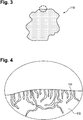
- Fig. 3 shows a schematic sectional view of a microporous zeolite mineral particle 110, whose surface contains pores (indicated by the dots).
- the microporous zeolite mineral 110 could be of the chabazite, erionite, and mordenite or clinoptilolite type.
- a dotted circle is indicated, the schematic content of which is enlarged in Fig. 4 .
- the surface of the microporous zeolite mineral particle 110 contains pores 111, through which water may be absorbed and adsorbed and through which water can be reversibly released.
- Fig. 5 shows the same microporous zeolite mineral particle after it has been partially coated with a polyurethane coating 120 and may thus be used as an infill material 10. As can be seen, at least some parts of the surface of the coated microporous zeolite mineral particle 110 are not covered by the polyurethane coating. In Fig. 5 a dotted circle is also indicated, the schematic content of which is enlarged in Fig. 6 .
- the microporous zeolite mineral particle 110 which contains pores 111, has been partially coated with a polyurethane coating 120.
- the polyurethane coating 120 was formed by providing microporous zeolite mineral particles 110 and a liquid polyurethane reaction mixture in a batch reactor, tumbler or continuous reactor. Simultaneous mixing and initialization of the solidification reaction lead to the desired partial coating of the polyurethane coating 120 on the surface of the microporous zeolite mineral particle 110.
- the partial coating results from microporous zeolite mineral particles 110 colliding while being mixed with the initialized liquid polyurethane reaction mixture.
- the polyurethane coating 120 coats a portion of the inner surface of the microporous zeolite mineral particle 110 in the region of the cover.
- the coating 120 may penetrate with a slight distance, for example between 0.2 ⁇ m and 500 ⁇ m, preferably between 1 and 150 ⁇ m and most preferred between 10 ⁇ m and 100 ⁇ m into the surface pores 111 and thus may interfere with the pores 111 in a form-locking manner.
- the hold of the coating on the microporous zeolite mineral particle 110 may be increased and at the same time the overall stability and hardness of the microporous zeolite mineral particle 110 may be increased.
- the infill material 10 is preferably produced by mixing the microporous zeolite mineral particles with a liquid polyurethane reaction mixture and initializing the solidification reaction during the mixing, the microporous zeolite mineral particles have substantially the same amount of their outer surface covered by the coating relative to the total outer surface. Substantially the same amount means that the outer surface of each microporous zeolite mineral particle is covered between 20 % and 99 %, preferably between 50 % to 98 % or between 70% to 99 %, with the polyurethane coating 120.
- the polyurethane coating 120 of this artificial turf infill granule contains a further component 121.
- the further component 121 may be for example sand and/or colored sand and/or chalk and/or lime. With the addition of sand and/or colored sand and/or chalk and/or lime to the liquid polyurethane reaction mixture of the polyurethane coating 120, the viscosity of the liquid polyurethane reaction mixture can be increased.
- the polyurethane coating 120 of this artificial turf infill may comprise a rheology additive 122.
- the rheology additive may be added in order to achieve thixotropic flow behavior of the liquid polyurethane reaction mixture during mixing of the liquid polyurethane reaction mixture with the microporous zeolite mineral particle 110.
- the viscosity of the liquid polyurethane reaction mixture is controllable via the addition of the rheology additive and thus the depth of penetration of the liquid polyurethane reaction mixture into the pores 111 contained in the surfaces of the microporous zeolite mineral particles 110 can be controlled.
- the polyurethane coating is mainly solidified or cured on the outer surface of the microporous zeolite mineral particles 110, however the polyurethane coating 120 also coats a portion of the inner surface of the pores 111 in the region of the cover.
- the coating 120 may penetrate a slight distance, for example between 1 ⁇ m and 500 ⁇ m, into the surface pores 111, thereby interfering with the pores 111 in a form-locking manner.
- the hold of the coating on the microporous zeolite mineral particles 110 may be increased and at the same time the overall stability and hardness of the microporous zeolite mineral particles 110 may be increased.
- the microporous zeolite mineral particle110 which contains pores 111, has been partially coated with a polyurethane coating 120.
- the microporous zeolite mineral particles 110 contain pores 111 that have openings on the outer surface of the microporous zeolite mineral particles 110.
- the outer surface of the microporous zeolite mineral particle 110 is partly coated with a polyurethane coating 120, wherein the coating extends over some of the pores 111 forming respective covers (equals the pore size at the outer surface; indicated by 130) of the openings.
- the cover 130 covers the pore 111 in the area of the pore opening.
- the polyurethane coating 120 coats a portion of the inner surface of the covered pores 111 in the region of the cover 130.
- the polyurethane coating 120 of the inner surface may be in the form of a plug, as indicated in the left covered pore 111 or in the form of a film, as indicated in the right covered pore 111.
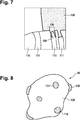
- Fig. 8 depicts an inventive artificial turf infill granule 10 (i.e., partly coated microporous zeolite mineral particles 110).
- the microporous zeolite mineral particle 110 has pores 111 that form openings on the outer surface of the microporous zeolite mineral particles 110.
- the outer surface of the microporous zeolite mineral particles 110 is partly coated with a polyurethane coating 120, wherein the coating extends over most of the pores 111, thereby forming respective covers of the openings.
- the polyurethane coating 120 was formed by providing a plurality of microporous zeolite minerals particles 110 and a liquid polyurethane reaction mixture in a batch reactor, tumbler or continuous reactor.
- Simultaneous mixing and initialization of the solidification reaction lead to the desired partial coating of the polyurethane coating 120 on the surface of the microporous zeolite mineral particle 110.
- the partial coating results from collisions of microporous zeolite mineral particles 110 while being mixed with the initialized liquid polyurethane reaction mixture. Since the initialization of the solidification reaction takes place simultaneously, uncovered spaces (e.g., gaps or holes), created by collisions, remain on the surface of the microporous zeolite mineral particles and thus the artificial turf infill 10 granule. As indicated in Fig. 8 , it may be feasible that 75 % to 99 % of the outer surface of the microporous zeolite mineral particle is partly covered with a polyurethane coating 120.
Landscapes
- Engineering & Computer Science (AREA)
- Architecture (AREA)
- Civil Engineering (AREA)
- Structural Engineering (AREA)
- Road Paving Structures (AREA)
Priority Applications (9)
| Application Number | Priority Date | Filing Date | Title |
|---|---|---|---|
| EP18212778.7A EP3666975A1 (de) | 2018-12-14 | 2018-12-14 | Kunstrasen und kunstrasenfüllung |
| MA054444A MA54444A (fr) | 2018-12-14 | 2019-12-16 | Remplissage de gazon artificiel et gazon artificiel |
| PCT/EP2019/085384 WO2020120800A1 (en) | 2018-12-14 | 2019-12-16 | Artificial turf infill and artificial turf |
| PCT/EP2019/085381 WO2020120799A1 (en) | 2018-12-14 | 2019-12-16 | Artificial turf infill and artificial turf |
| US17/299,830 US20220042252A1 (en) | 2018-12-14 | 2019-12-16 | Artificial turf infill and artificial turf |
| EP19817754.5A EP3894632A1 (de) | 2018-12-14 | 2019-12-16 | Kunstrasenfüllung und kunstrasen |
| CA3118800A CA3118800A1 (en) | 2018-12-14 | 2019-12-16 | Artificial turf infill and artificial turf |
| AU2019398780A AU2019398780B2 (en) | 2018-12-14 | 2019-12-16 | Artificial turf infill and artificial turf |
| AU2023202696A AU2023202696A1 (en) | 2018-12-14 | 2023-05-02 | Artificial turf infill and artificial turf |
Applications Claiming Priority (1)
| Application Number | Priority Date | Filing Date | Title |
|---|---|---|---|
| EP18212778.7A EP3666975A1 (de) | 2018-12-14 | 2018-12-14 | Kunstrasen und kunstrasenfüllung |
Publications (1)
| Publication Number | Publication Date |
|---|---|
| EP3666975A1 true EP3666975A1 (de) | 2020-06-17 |
Family
ID=64665720
Family Applications (1)
| Application Number | Title | Priority Date | Filing Date |
|---|---|---|---|
| EP18212778.7A Withdrawn EP3666975A1 (de) | 2018-12-14 | 2018-12-14 | Kunstrasen und kunstrasenfüllung |
Country Status (1)
| Country | Link |
|---|---|
| EP (1) | EP3666975A1 (de) |
Cited By (1)
| Publication number | Priority date | Publication date | Assignee | Title |
|---|---|---|---|---|
| GB2624517A (en) * | 2022-09-22 | 2024-05-22 | Vuba Building Products Ltd | Resin bonded/bound surfacing |
Citations (5)
| Publication number | Priority date | Publication date | Assignee | Title |
|---|---|---|---|---|
| WO2012058555A2 (en) * | 2010-10-29 | 2012-05-03 | The Quantum Group, Inc. | Artificial turf systems and applications thereof |
| EP2749350A2 (de) * | 2012-12-28 | 2014-07-02 | Benoit Pintat | Zusammensetzung, die zur Regulierung der Präsenz von Wasser auf einer Außenfläche dienen soll |
| US20160333535A1 (en) * | 2015-05-15 | 2016-11-17 | Bayer Materialscience Llc | Free-flowing coated rubber particles, methods for their production and use |
| EP3216821A1 (de) * | 2016-03-11 | 2017-09-13 | Polytex Sportbeläge Produktions-GmbH | Kunstrasenfüllung |
| US10066345B2 (en) | 2014-04-25 | 2018-09-04 | Profile Products Llc | Artificial turf field system |
-
2018
- 2018-12-14 EP EP18212778.7A patent/EP3666975A1/de not_active Withdrawn
Patent Citations (5)
| Publication number | Priority date | Publication date | Assignee | Title |
|---|---|---|---|---|
| WO2012058555A2 (en) * | 2010-10-29 | 2012-05-03 | The Quantum Group, Inc. | Artificial turf systems and applications thereof |
| EP2749350A2 (de) * | 2012-12-28 | 2014-07-02 | Benoit Pintat | Zusammensetzung, die zur Regulierung der Präsenz von Wasser auf einer Außenfläche dienen soll |
| US10066345B2 (en) | 2014-04-25 | 2018-09-04 | Profile Products Llc | Artificial turf field system |
| US20160333535A1 (en) * | 2015-05-15 | 2016-11-17 | Bayer Materialscience Llc | Free-flowing coated rubber particles, methods for their production and use |
| EP3216821A1 (de) * | 2016-03-11 | 2017-09-13 | Polytex Sportbeläge Produktions-GmbH | Kunstrasenfüllung |
Cited By (1)
| Publication number | Priority date | Publication date | Assignee | Title |
|---|---|---|---|---|
| GB2624517A (en) * | 2022-09-22 | 2024-05-22 | Vuba Building Products Ltd | Resin bonded/bound surfacing |
Similar Documents
| Publication | Publication Date | Title |
|---|---|---|
| WO2020120800A1 (en) | Artificial turf infill and artificial turf | |
| ES2785669T3 (es) | Relleno de césped artificial y método para confeccionarlo | |
| US20240060248A1 (en) | Artificial turf infill with natural fiber and rubber granulate | |
| AU2017304474B2 (en) | Artificial turf infill with coated natural fiber | |
| KR102090150B1 (ko) | 친환경 인조잔디 시공구조 | |
| KR102374726B1 (ko) | 인조잔디 구조체 | |
| EP3604677A1 (de) | Kunstrasenfüllung mit pu-beschichtetem maiskolbengranulat | |
| EP3666975A1 (de) | Kunstrasen und kunstrasenfüllung | |
| EP3666976B1 (de) | Kunstrasenfüllung und kunstrasen | |
| EP3336251A1 (de) | Kunstrasenfüllung mit natürlichen fasern und gummigranulat | |
| US20240200283A1 (en) | Artificial turf system and support layer | |
| WO2019224378A1 (en) | A sports field, in particular a tennis court, a method of constructing a tennis court and top layer composition for a court | |
| KR101926680B1 (ko) | 친환경 인조잔디용 충진재 조성물 | |
| HK40005775A (en) | Natural fiber coated artificial turf infill | |
| HK40000256A (en) | Artificial turf infill with natural fiber and rubber granulate |
Legal Events
| Date | Code | Title | Description |
|---|---|---|---|
| PUAI | Public reference made under article 153(3) epc to a published international application that has entered the european phase |
Free format text: ORIGINAL CODE: 0009012 |
|
| STAA | Information on the status of an ep patent application or granted ep patent |
Free format text: STATUS: THE APPLICATION HAS BEEN PUBLISHED |
|
| AK | Designated contracting states |
Kind code of ref document: A1 Designated state(s): AL AT BE BG CH CY CZ DE DK EE ES FI FR GB GR HR HU IE IS IT LI LT LU LV MC MK MT NL NO PL PT RO RS SE SI SK SM TR |
|
| AX | Request for extension of the european patent |
Extension state: BA ME |
|
| STAA | Information on the status of an ep patent application or granted ep patent |
Free format text: STATUS: THE APPLICATION IS DEEMED TO BE WITHDRAWN |
|
| 18D | Application deemed to be withdrawn |
Effective date: 20201218 |