EP3667527A1 - Client-server-system - Google Patents
Client-server-system Download PDFInfo
- Publication number
- EP3667527A1 EP3667527A1 EP18866011.2A EP18866011A EP3667527A1 EP 3667527 A1 EP3667527 A1 EP 3667527A1 EP 18866011 A EP18866011 A EP 18866011A EP 3667527 A1 EP3667527 A1 EP 3667527A1
- Authority
- EP
- European Patent Office
- Prior art keywords
- terminal apparatus
- unit
- url
- authentication
- business server
- Prior art date
- Legal status (The legal status is an assumption and is not a legal conclusion. Google has not performed a legal analysis and makes no representation as to the accuracy of the status listed.)
- Withdrawn
Links
Images


Classifications
-
- G—PHYSICS
- G06—COMPUTING OR CALCULATING; COUNTING
- G06F—ELECTRIC DIGITAL DATA PROCESSING
- G06F21/00—Security arrangements for protecting computers, components thereof, programs or data against unauthorised activity
- G06F21/30—Authentication, i.e. establishing the identity or authorisation of security principals
- G06F21/31—User authentication
-
- G—PHYSICS
- G06—COMPUTING OR CALCULATING; COUNTING
- G06F—ELECTRIC DIGITAL DATA PROCESSING
- G06F21/00—Security arrangements for protecting computers, components thereof, programs or data against unauthorised activity
- G06F21/30—Authentication, i.e. establishing the identity or authorisation of security principals
- G06F21/31—User authentication
- G06F21/40—User authentication by quorum, i.e. whereby two or more security principals are required
-
- G—PHYSICS
- G06—COMPUTING OR CALCULATING; COUNTING
- G06F—ELECTRIC DIGITAL DATA PROCESSING
- G06F13/00—Interconnection of, or transfer of information or other signals between, memories, input/output devices or central processing units
-
- G—PHYSICS
- G06—COMPUTING OR CALCULATING; COUNTING
- G06F—ELECTRIC DIGITAL DATA PROCESSING
- G06F21/00—Security arrangements for protecting computers, components thereof, programs or data against unauthorised activity
- G06F21/30—Authentication, i.e. establishing the identity or authorisation of security principals
- G06F21/44—Program or device authentication
-
- G—PHYSICS
- G06—COMPUTING OR CALCULATING; COUNTING
- G06F—ELECTRIC DIGITAL DATA PROCESSING
- G06F21/00—Security arrangements for protecting computers, components thereof, programs or data against unauthorised activity
- G06F21/60—Protecting data
- G06F21/62—Protecting access to data via a platform, e.g. using keys or access control rules
-
- H—ELECTRICITY
- H04—ELECTRIC COMMUNICATION TECHNIQUE
- H04L—TRANSMISSION OF DIGITAL INFORMATION, e.g. TELEGRAPHIC COMMUNICATION
- H04L63/00—Network architectures or network communication protocols for network security
- H04L63/08—Network architectures or network communication protocols for network security for authentication of entities
-
- H—ELECTRICITY
- H04—ELECTRIC COMMUNICATION TECHNIQUE
- H04L—TRANSMISSION OF DIGITAL INFORMATION, e.g. TELEGRAPHIC COMMUNICATION
- H04L63/00—Network architectures or network communication protocols for network security
- H04L63/08—Network architectures or network communication protocols for network security for authentication of entities
- H04L63/083—Network architectures or network communication protocols for network security for authentication of entities using passwords
-
- G—PHYSICS
- G06—COMPUTING OR CALCULATING; COUNTING
- G06F—ELECTRIC DIGITAL DATA PROCESSING
- G06F2221/00—Indexing scheme relating to security arrangements for protecting computers, components thereof, programs or data against unauthorised activity
- G06F2221/21—Indexing scheme relating to G06F21/00 and subgroups addressing additional information or applications relating to security arrangements for protecting computers, components thereof, programs or data against unauthorised activity
- G06F2221/2137—Time limited access, e.g. to a computer or data
Definitions
- the present invention relates to a client server system.
- the mobile terminal generates a call signal including a telephone number of the own mobile terminal and transmits the call signal to the content provider. Further, the mobile terminal receives an email from the content provider and accesses the content provider by using a password included in the email.
- the content provider receives the call signal, extracts the telephone number included in the call signal, compares the telephone number included in the call signal with a telephone number of a user who is under contract, and authenticates the mobile terminal, the content provider generates and registers a password, and transmits an email in which a uniform resource locator (URL) including the password is described to the mobile terminal by using the telephone number included in the call signal.
- URL uniform resource locator
- the content provider compares the password included in the URL with the registered password, and, when the passwords match, the content provider allows the mobile terminal to access the URL and supplies predetermined content thereto.
- Patent Literature 1 JP 2003-30146 A
- the present invention has been made in view of the above circumstances, and an object thereof is to provide a client server system capable of suppressing unauthorized access to a server.
- a client server system includes: a first terminal apparatus; a second terminal apparatus; and a server, in which: the first terminal apparatus includes a data acquisition unit that acquires data from the server by transmitting an access request to the server based on first access information received from the server; the second terminal apparatus includes a request transmission unit that switches a state of the server by transmitting a switch request to switch the state of the server to the server based on second access information received from the server; the server includes an access information generation unit that generates the first access information and the second access information, an expiration date setting unit that sets an expiration date of the first access information and an expiration date of the second access information, an access information transmission unit that transmits the first access information to the first terminal apparatus and transmits the second access information to the second terminal apparatus, an authentication processing unit that executes an authentication process for authenticating a transmission source of the access request, and a state setting unit that, upon receipt of the switch request, sets either a first state in which execution of the authentication process by the authentication
- a state setting unit upon receipt of a switch request, sets either a first state in which execution of an authentication process is permitted or a second state in which execution of the authentication process is prohibited. Then, in a case where an authentication processing unit receives an access request from a data acquisition unit, the authentication processing unit starts the authentication process when the first state is set, and avoids executing the authentication process when the second state is set.
- the state setting unit once executes the authentication process for a terminal apparatus and then switches a state thereof to the second state, authentication is not executed by the authentication processing unit even if access information is intercepted and an access request is received from another terminal apparatus. Therefore, unauthorized access to a server is suppressed and security can be enhanced.
- first access information is transmitted to a first terminal apparatus
- second access information is transmitted to a second terminal apparatus.
- the second terminal apparatus can switch a state of the server by transmitting the switch request to the server on the basis of the second access information.
- the server when a server receives an authentication request from a terminal apparatus, the server transmits URL information indicating a one-time URL to the terminal apparatus. Then, when the terminal apparatus accepts user operation for accessing the one-time URL indicated by the URL information, the terminal apparatus transmits an access request to the server. Upon receipt of the access request from the terminal apparatus, the server executes an authentication process of the terminal apparatus in a case where execution of the authentication process is permitted.
- the one-time URL is access information including network information and authentication information. Examples of the authentication information encompass login information and a token.
- the client server system includes a terminal apparatus 1 owned by a user and a business server 2 and an authentication server 3 owned by, for example, a company that provides web content.
- the terminal apparatus 1, the business server 2, and the authentication server 3 are connected via a network NT.
- the network NT includes a local area network (LAN) and the Internet.
- the terminal apparatus 1 is, for example, a general-purpose personal computer having a communication function, and, as shown in FIG. 2 , includes a central processing unit (CPU) 101, a random access memory (RAM) (not shown), a read only memory (ROM) (not shown), a storage 102, an input unit 105, a display unit 103, and a communication unit 104.
- the RAM includes a volatile memory and is used as a work area for the CPU 101.
- the ROM includes a non-volatile memory such as a magnetic disk or a semiconductor memory.
- the input unit 105 is, for example, a keyboard, accepts various kinds of operation information input by the user, and outputs the accepted operation information to the CPU 101.
- the display unit 103 is, for example, a liquid crystal display and displays various kinds of information input from the CPU 101.
- the ROM of the terminal apparatus 1 stores programs for achieving various functions of the terminal apparatus 1.
- the CPU 101 reads those programs from the ROM to the RAM and executes the programs, thereby functioning as a login acceptance unit 111, a request transmission unit 112, and a data acquisition unit 113.
- the login acceptance unit 111 displays a login screen on the display unit 103 and accepts login information indicating user identification information and a password input by the user via the input unit 105.
- the request transmission unit 112 transmits an authentication request to request authentication of the terminal apparatus 1 to the business server 2.
- This authentication request includes the login information including the user identification information and information indicating the password accepted by the login acceptance unit 111.
- the data acquisition unit 113 When the data acquisition unit 113 receives URL information indicating a one-time URL from the business server 2 and then accepts user operation for accessing the one-time URL via the input unit 105, the data acquisition unit 113 transmits a request to access the one-time URL to the business server 2. Then, when the data acquisition unit 113 transmits the request to access the one-time URL and then a session with the business server 2 is established, the data acquisition unit 113 acquires data from the business server 2. The data acquisition unit 113 stores the data received from the business server 2 in the storage.
- the business server 2 is, for example, a general-purpose personal computer having a communication function, and includes a CPU 201, a RAM (not shown), a storage 202, and a communication unit 204.
- the storage 202 includes a business database (hereinafter, referred to as "business DB") 221 that stores data to be provided for the user of the terminal apparatus 1, and a login DB 222 that stores login information.
- business DB business database
- the storage 202 stores programs for achieving a function of generating a one-time URL and transmitting the one-time URL to the terminal apparatus, a function of transmitting data to the terminal apparatus 1, and a function of inquiring of the authentication server 3 about access authority of the terminal apparatus 1 to access the business server 2.
- the CPU 201 reads those programs from the storage 202 to the RAM and executes the programs, thereby functioning as a request reception unit 211, a URL generation unit 212 serving as an access information generation unit, an expiration date setting unit 213, and a URL transmission unit 214 serving as an access information transmission unit, a state setting unit 215, an authentication processing unit 216, and a data transmission unit 217.
- the request reception unit 211 receives an authentication request from the terminal apparatus 1.
- the request reception unit 211 extracts identification information of the terminal apparatus 1 that is a transmission source of the authentication request, and notifies the URL transmission unit 214 of the identification information.
- the URL generation unit 212 generates a one-time URL.
- the expiration date setting unit 213 sets an expiration date of the one-time URL generated by the URL generation unit 212.
- the URL transmission unit 214 generates URL information indicating the one-time URL generated by the URL generation unit 212, and transmits the URL information to the terminal apparatus 1 on the basis of the identification information of the terminal apparatus 1 that is the transmission source, the identification information being transmitted as the notification from the request reception unit 211.
- the authentication processing unit 216 executes an authentication process for authenticating the terminal apparatus 1 that is a transmission source of a data acquisition request.
- the authentication processing unit 216 first transmits inquiry information for inquiring whether or not the terminal apparatus 1 has authority to access the business server 2 to the authentication server 3 via the communication unit 204.
- This inquiry information includes the user identification information and the information indicating the password corresponding to the target terminal apparatus 1.
- the authentication processing unit 216 determines that authentication has succeeded and then establishes a session with the terminal apparatus 1.
- the authentication processing unit 216 determines that the authentication has failed and avoids establishing the session with the terminal apparatus 1. Further, upon receipt of the authentication request from the terminal apparatus 1, the authentication processing unit 216 extracts the login information included in the received authentication request and stores the login information in the login DB 222.
- the state setting unit 215 sets, within the expiration date of the one-time URL, either an authentication function active state (first state) in which execution of the authentication process by the authentication processing unit 216 is permitted or an authentication function inactive state (second state) in which execution of the authentication process by the authentication processing unit 216 is prohibited. Then, in a case where the authentication processing unit 216 receives an access request from the data acquisition unit 113, the authentication processing unit 216 starts the authentication process when the authentication function active state is set. Meanwhile, when the authentication function inactive state is set, the authentication processing unit 216 avoids executing the authentication process.
- first state an authentication function active state
- second state authentication function inactive state
- the state setting unit 215 may set either the authentication function active state or the authentication function inactive state in accordance with an IP address of the terminal apparatus 1 that is the transmission source of the received access request, a time period in which the access request is received, and a location where the terminal apparatus 1 that is the transmission source exists.
- the data transmission unit 217 transmits data stored in the business DB 221 to the terminal apparatus 1 via the communication unit 204.
- the authentication server 3, as well as the business server 2 is, for example, a general-purpose personal computer having a communication function, and includes a CPU 301, a RAM (not shown), a storage 302, and a communication unit 304.
- the storage 302 includes a repository 321 in which information regarding the access authority of the terminal apparatus 1 is registered.
- the storage 302 stores a program for achieving a function of referring to the repository 321, determining whether or not the terminal apparatus 1 corresponding to the inquiry information received from the business server 2 has the authority to access the business server 2, and transmitting the determination result to the business server 2 as a response. Then, the CPU 301 reads this program from the storage 302 to the RAM and executes the program, thereby functioning as an access authority determination unit 311 and an authority presence/absence notification unit 312.
- the access authority determination unit 311 refers to the repository 321 and determines whether or not the terminal apparatus 1 corresponding to the inquiry information received from the business server 2 has the authority to access the business server 2.
- the access authority determination unit 311 determines whether or not the user identification information and the information indicating the password included in the inquiry information are registered in the repository 321. In a case where the user identification information and the information indicating the password included in the inquiry information are registered in the repository 321, the access authority determination unit 311 determines that the corresponding terminal apparatus 1 has the access authority.
- the authority presence/absence notification unit 312 transmits response information indicating the determination result of the presence/absence of the access authority by the access authority determination unit 311 to the business server 2 via the communication unit 304.
- the URL generation unit 212 generates a one-time URL (step S1).
- the expiration date setting unit 213 of the business server 2 sets an expiration date of the one-time URL generated by the URL generation unit 212 (step S2).
- URL information indicating the URL generated by the URL generation unit 212 is transmitted to the terminal apparatus 1 from the business server 2 (step S3).
- the URL information is transmitted to the terminal apparatus 1 from the business server 2 in the form of, for example, an email including description of the URL generated by the URL generation unit 212.
- the data acquisition unit 113 upon receipt of the URL information, displays the one-time URL indicated by the URL information on the display unit 103 (step S4).
- the data acquisition unit 113 displays a browser screen including the description of the one-time URL on the display unit 103.
- the data acquisition unit 113 of the terminal apparatus 1 accepts the click operation of the one-time URL (step S5).
- an access request to request access to the one-time URL is transmitted to the business server 2 from the terminal apparatus 1 (step S6).
- login input information specified by the one-time URL is transmitted to the terminal apparatus 1 from the business server 2 (step S7).
- This login input information is, for example, information for displaying a login screen on the display unit 103 of the terminal apparatus 1.
- the login acceptance unit 111 of the terminal apparatus 1 accepts the login operation (step S8).
- the login operation is, for example, user operation of inputting the user identification information, the password, and the like.
- an authentication request to request the business server 2 to authenticate the terminal apparatus 1 is transmitted to the business server 2 from the terminal apparatus 1 (step S9).
- the authentication processing unit 216 extracts the login information including the user identification information, the password, and the like input by the login operation and included in the received authentication request, and stores the login information in the login DB 222.
- the state setting unit 215 sets the business server 2 to the authentication function active state in which the authentication process by the authentication processing unit 216 is permitted (step S10).
- the authentication processing unit 216 starts the authentication process (step S11).
- the authentication processing unit 216 of the business server 2 determines that the authentication has succeeded (step S12)
- the authentication processing unit 216 establishes a session between the terminal apparatus 1 and the business server 2 (step S13).
- data corresponding to the access request is transmitted to the terminal apparatus 1 from the business server 2 (step S14).
- the data acquisition unit 113 stores the received data in the storage (step S15).
- the data acquired from the business server 2 can be used in the terminal apparatus 1.
- the state setting unit 215 sets the business server 2 to the authentication function inactive state within the expiration date of the one-time URL (step S16).
- the data acquisition unit 113 displays the one-time URL indicated by the URL information on the display unit 103 (step S17) and then accepts the click operation of the one-time URL (step S18).
- an access request to request access to the one-time URL is transmitted to the business server 2 from the terminal apparatus 1 (step S19).
- the authentication processing unit 216 avoids executing the authentication process.
- the URL generation unit 212 invalidates the one-time URL (step S20).
- the state setting unit 215 sets, within the expiration date of the one-time URL, either the authentication function active state in which execution of the authentication process is permitted or the authentication function inactive state in which execution of the authentication process is prohibited. Then, upon receipt of an access request from the data acquisition unit 113, the authentication processing unit 216 starts the authentication process when the authentication function active state is set. Meanwhile, when the authentication function inactive state is set, the authentication processing unit 216 avoids executing the authentication process.
- the state setting unit 215 once executes the authentication process for the terminal apparatus 1 and then switches to the authentication function inactive state, authentication is not performed by the authentication processing unit 216 even if the URL information is intercepted and an access request is received from another terminal apparatus. Thus, unauthorized access to the business server 2 is suppressed.
- the present invention is not limited to the configuration of the above embodiment.
- another one-time URL may be generated in the business server 2, and a so-called C-mail (short mail service (SMS) mail) including description of the generated one-time URL may be transmitted to the terminal apparatus 1 from the business server 2.
- SMS short mail service
- the user clicks the one-time URL described in the C-mail via the input unit 105 while the content of the C-mail is being displayed on the display unit 103 of the terminal apparatus 1 an authentication request may be transmitted to the business server 2 from the terminal apparatus 1.
- the state setting unit 215 may set the business server 2 to the authentication function active state.
- the present invention is not limited thereto, and, for example, the authentication process may be executed by using both a one-time token and a one-time URL.
- the business server 2 may include a token generation unit that generates a one-time token, and the expiration date setting unit 213 may set an expiration date of the one-time token.
- the terminal apparatus 1 may include a URL generation unit serving as an access information generation unit that generates a one-time URL in the same manner as the URL generation unit 212 of the business server 2 and an expiration date setting unit that sets an expiration date of the generated URL.
- login input information is transmitted to the terminal apparatus 1 from the business server 2 (step S201).
- the login acceptance unit 111 of the terminal apparatus 1 accepts the login operation (step S202).
- a first authentication request is transmitted to the business server 2 from the terminal apparatus 1 (step S203).
- the one-time token generation unit generates a one-time token (step S204).
- the expiration date setting unit 213 of the business server 2 sets an expiration date of the one-time token (step S205).
- token information indicating the one-time token generated by the token generation unit is transmitted to the terminal apparatus 1 from the business server 2 (step S206).
- the token information is transmitted to the terminal apparatus 1 from the business server 2 in the form of, for example, an html file including description of the one-time token.
- the login acceptance unit 111 of the terminal apparatus 1 accepts the input operation of the token (step S207).
- a second authentication request is transmitted to the business server 2 from the terminal apparatus 1 (step S208).
- the URL generation unit generates a one-time URL (step S209), and the expiration date setting unit sets an expiration date of the one-time URL generated by the URL generation unit (step S210).
- the URL generation unit 212 upon receipt of the second authentication request from the terminal apparatus 1, in the business server 2, the URL generation unit 212 generates a one-time URL (step S211).
- the expiration date setting unit 213 of the business server 2 sets an expiration date of the one-time URL generated by the URL generation unit 212 (step S212).
- the data acquisition unit 113 displays the one-time URL generated by the URL generation unit on the display unit 103 (step S213). Thereafter, when the user performs click operation on the one-time URL via the input unit 105 while the one-time URL displayed on the display unit 103 is being selected, the data acquisition unit 113 of the terminal apparatus 1 accepts the click operation of the one-time URL (step S214). Next, a request to access the one-time URL is transmitted to the business server 2 from the terminal apparatus 1 (step S215). Meanwhile, in the business server 2, upon receipt of the access request, the state setting unit 215 sets the business server 2 to the authentication function active state (step S216). Thereafter, the processing in steps S217 to S226 is performed. The processing in steps S217 to S226 is similar to the processing in steps S11 to S20 described in the embodiment.
- the authentication process is executed only when the three steps using the login information, the one-time token, and the one-time URL are normally performed. Therefore, it is possible to improve security, as compared to the embodiment.
- the terminal apparatus 1 may include a URL generation unit that generates a one-time URL, and, when the user clicks the one-time URL, the URL generation unit of the terminal apparatus 1 may generate another one-time URL and display the another one-time URL on the display unit 103. Then, when the user clicks the one-time URL displayed on the display unit 103 of the terminal apparatus 1, an authentication request may be transmitted to the business server 2 from the terminal apparatus 1 to set the business server 2 to the authentication function active state.
- the URL generation unit of the terminal apparatus 1 may generate another one-time URL and display the another one-time URL on the display unit 103.
- the business server 2 may include an agent information storage unit and an agent information determination unit.
- the agent information storage unit stores a plurality of pieces of user agent information corresponding to terminal apparatuses that are allowed to establish a section with the business server 2.
- the agent information determination unit determines whether or not the user agent information included in the authentication request received from the terminal apparatus 1 matches with any of the pieces of the user agent information stored in the agent information storage unit.
- the agent information determination unit determines whether or not the user agent information included in the authentication request matches with any of the pieces of the user agent information stored in the agent information storage unit.
- the state setting unit 215 sets the business server 2 to the authentication function active state.
- the business server 2 may include a request notification unit that, upon receipt of the authentication request, transmits request notification information notifying that the authentication request has been received to another terminal apparatus.
- a request notification unit that, upon receipt of the authentication request, transmits request notification information notifying that the authentication request has been received to another terminal apparatus.
- the request notification unit of the business server 2 transmits the request notification information to, for example, another terminal apparatus owned by an administrator.
- the response information is transmitted to the business server 2 from the another terminal apparatus.
- the state setting unit 215 may set the business server 2 to the authentication function active state.
- the state setting unit 215 when, after the state setting unit 215 sets the authentication function active state, unauthorized access to the business server 2 is detected before the expiration date of the one-time URL, the state setting unit 215 may set the business server 2 to the authentication function inactive state.
- the business server 2 may further include an access restriction unit that, when there is a plurality of terminal apparatuses 1 and a session is established between a single terminal apparatus 1 and the business server 2, prohibits access to a one-time URL from another terminal apparatus 1.
- the login information includes the user identification information and the information indicating the password.
- information included in the login information is not limited thereto.
- the login information may include a random number sequence (token) that can identify the user.
- the state setting unit 215 switches the state of the business server 2 from the authentication function active state to the authentication function inactive state only once before the expiration date of the one-time URL.
- the present invention is not limited thereto, and the state setting unit 215 may switch the state of the business server 2 from the authentication function active state to the authentication function inactive state, or from the authentication function inactive state to the authentication function active state a plurality of times.
- the terminal apparatus 1 may have a function of a business server.
- the terminal apparatus 1 displays the one-time URL on the display unit 103.
- the present invention is not limited thereto, and, for example, the terminal apparatus 1 may not display the one-time URL on the display unit 103.
- the terminal apparatus 1 upon receipt of URL information, the terminal apparatus 1 may be configured to display an icon on the display unit 103, and, when the icon is clicked, access the business server 2 on the basis of a one-time URL indicated by the URL information.
- the business server 2 may transmit a token to the terminal apparatus 1 at the timing of step S13 in FIG. 3 .
- the client server system may include an apparatus having both the function of the business server 2 and the function of the authentication server 3.
- the user may set the business server 2 to the authentication function active state or the authentication function inactive state by using a terminal apparatus.
- the client server system according to this modification example includes the terminal apparatus 1 owned by the user that receives provision of data, the business server 2, the authentication server 3, and a terminal apparatus 21 owned by an administrator of the business server 2.
- the same configurations as those in the embodiment are denoted by the same reference signs as those in FIG. 1 .
- a hardware configuration of the terminal apparatus 21 is similar to that of the terminal apparatus 1 described in the embodiment.
- configurations similar to those of the embodiment will be described by using the same reference signs as those in FIG. 1 or 2 .
- the CPU 101 of the terminal apparatus 21 reads a program from the storage 102 to the RAM and executes the program, thereby functioning as an acceptance unit 2111 and a request transmission unit 2112 as shown in FIG. 6 .
- the acceptance unit 2111 accepts, from the business server 2, operation for specifying an access control one-time URL or operation for switching the authentication function of the business server 2.
- the request transmission unit 2112 transmits a switch request to request the business server 2 to switch the authentication function of the business server 2.
- This authentication request includes information indicating whether the authentication function of the business server 2 is activated or inactivated.
- the URL generation unit 212 generates a login one-time URL that is a first one-time URL and an access control one-time URL that is a second one-time URL.
- the login one-time URL is used when, for example, the login information is transmitted to the terminal apparatus 1 owned by the user who receives provision of data
- the access control one-time URL is used by the administrator to receive switch information from the business server 2 via the terminal apparatus 21.
- This switch information is, for example, information for displaying, on the display unit 103 of the terminal apparatus 21, a switching operation screen for switching the authentication function of the business server 2.
- the URL generation unit 212 generates an access control one-time URL corresponding to each login one-time URL at the same time or during the same execution process.
- a single access control one-time URL may be generated for each login one-time URL, or a plurality of one-time URLs may be generated.
- the URL transmission unit 214 generates login URL information, which is first URL information indicating the login one-time URL, and access control URL information, which is second URL information indicating the access control one-time URL. Then, the URL transmission unit 214 transmits the login URL information to the terminal apparatus 1 on the basis of the identification information of the terminal apparatus 1 that is the transmission source, the identification information being transmitted as the notification from the request reception unit 211. The URL transmission unit 214 also transmits the access control URL information to the terminal apparatus 21 on the basis of identification information of the terminal apparatus 21 that is a transmission source, the identification information being transmitted as a notification from the request reception unit 211.
- the authentication processing unit 216 executes an authentication process for authenticating the terminal apparatus 1 that is a transmission source of a data acquisition request.
- the state setting unit 215 sets either the authentication function active state (first state) or the authentication function inactive state (second state) on the basis of the switch request received from the terminal apparatus 21 within an expiration date of the access control one-time URL. Then, upon receipt of an access request, the authentication processing unit 216 starts the authentication process when the authentication function active state is set. Meanwhile, when the authentication function inactive state is set, the authentication processing unit 216 avoids executing the authentication process.
- the functions of the expiration date setting unit 213 and the data transmission unit 217 are similar to those in the embodiment.
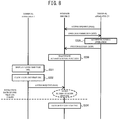
- the URL generation unit 212 generates a login one-time URL (step S301) and also generates an access control one-time URL (step S302). That is, the URL generation unit 212 generates the login one-time URL and the access control one-time URL at the same time or during the same execution process.
- the expiration date setting unit 213 of the business server 2 sets an expiration date of the login one-time URL generated by the URL generation unit 212 (step S303).
- login URL information indicating the login one-time URL generated by the URL generation unit 212 is transmitted to the terminal apparatus 1 from the business server 2 (step S304), and login URL information indicating the access control one-time URL generated by the URL generation unit 212 is transmitted to the terminal apparatus 21 from the business server 2 (step S305).
- the login URL information and the access control URL information are transmitted to the terminal apparatus 1 from the business server 2 in the form of, for example, an email including description of the login one-time URL and the access control one-time URL generated by the URL generation unit 212.
- the access control one-time URL is transmitted to the terminal apparatus 21 owned by the administrator (e.g., a higher authorized person, a boss, or a guardian) by, for example, e-mail.
- the data acquisition unit 113 upon receipt of the login URL information, displays the login one-time URL indicated by the login URL information on the display unit 103 (step S306).
- the data acquisition unit 113 displays a browser screen including the description of the one-time URL on the display unit 103.
- the request transmission unit 2112 upon receipt of the access control URL information, displays the access control one-time URL indicated by the access control URL information on the display unit 103 (step S307).
- the request transmission unit 2112 of the terminal apparatus 21 accepts the click operation of the access control one-time URL (step S308).
- an access request to request access to the access control one-time URL is transmitted to the business server 2 from the terminal apparatus 21 (step S309).
- switch information specified by the access control one-time URL is transmitted to the terminal apparatus 21 from the business server 2 (step S310).
- This switch information is, for example, information for displaying, on the display unit 103 of the terminal apparatus 21, a switching operation screen for switching the authentication function of the business server 2.
- step S311 when the user performs switching operation via the input unit 105 while the switching operation screen is being displayed on the display unit 103 of the terminal apparatus 21, the acceptance unit 2111 of the terminal apparatus 1 accepts the switching operation (step S311). Thereafter, a switch request to switch the authentication function of the business server 2 is transmitted to the business server 2 from the terminal apparatus 21 (step S312).
- the state setting unit 215 sets the business server 2 to the authentication function active state in which the authentication process by the authentication processing unit 216 is permitted (step S313).
- the authentication function of the business server 2 is activated, and thus the terminal apparatus 1 can acquire data from the business server 2.
- the state setting unit 215 activates only an authentication function regarding a request to access the login one-time URL generated in association with the access control one-time URL corresponding to the received switch request.
- LURL-A and “LURL-B” are generated as the login one-time URLs
- AURL-A and “AURL-B” are generated as the access control one-time URLs associated with the respective login one-time URLs.
- the state setting unit 215 activates only an authentication function for a request to access the login one-time URL "LURL-A”, and maintains the authentication function for the request to access "LURL-A" in the inactive state.
- the data acquisition unit 113 of the terminal apparatus 1 accepts the click operation of the login one-time URL (step S314).
- an access request to request access to the login one-time URL is transmitted to the business server 2 from the terminal apparatus 1 (step S315).
- login input information specified by the login one-time URL is transmitted to the terminal apparatus 1 from the business server 2 (step S316).
- This login input information is, for example, information for displaying a login screen on the display unit 103 of the terminal apparatus 1.
- the business server 2 transmits the login information specified by the login one-time URL to the terminal apparatus 1.
- "LURL-A" and "LURL-B" are generated as the login one-time URLs, and only an authentication function for a request to access the login one-time URL "LURL-A" is active.
- the business server 2 transmits the login information to the terminal apparatus 1, whereas, in a case where the business server 2 receives a request to access the login one-time URL "LURL-B", the business server 2 avoids transmitting the login information to the terminal apparatus 1.
- the login acceptance unit 111 of the terminal apparatus 1 accepts the login operation (step S317).
- the login operation is, for example, user operation of inputting the user identification information, the password, and the like.
- an authentication request to request the business server 2 to authenticate the terminal apparatus 1 is transmitted to the business server 2 from the terminal apparatus 1 (step S318).
- the authentication processing unit 216 extracts the login information including the user identification information, the password, and the like input by the login operation and included in the received authentication request, and stores the login information in the login DB 222.
- the authentication processing unit 216 starts the authentication process (step S319).
- the authentication processing unit 216 of the business server 2 determines that the authentication has succeeded (step S320)
- the authentication processing unit 216 establishes a session between the terminal apparatus 1 and the business server 2 (step S321).
- data corresponding to the access request is transmitted to the terminal apparatus 1 from the business server 2 (step S322).
- the data acquisition unit 113 stores the received data in the storage (step S323).
- the request transmission unit 2112 of the terminal apparatus 21 displays the access control one-time URL indicated by the access control URL information on the display unit 103 (step S324).
- the acceptance unit 2111 accepts the click operation of the access control one-time URL (step S325).
- an access request to request access to the access control one-time URL is transmitted to the business server 2 from the terminal apparatus 21 (step S326).
- switch information specified by the access control one-time URL is transmitted to the terminal apparatus 21 from the business server 2 (step S327).
- the state setting unit 215 sets the business server 2 to the authentication function inactive state in which the authentication process by the authentication processing unit 216 is permitted (step S330).
- the data acquisition unit 113 displays the one-time URL indicated by the URL information on the display unit 103 (step S331) and then accepts the click operation of the one-time URL (step S332).
- an access request to request access to the one-time URL is transmitted to the business server 2 from the terminal apparatus 1 (step S333).
- the authentication processing unit 216 avoids executing the authentication process.
- the URL generation unit 212 invalidates the login one-time URL and the access control one-time URL (step S334).
- a switch request is transmitted to the business server 2 from the terminal apparatus 21 in a state where a session is established between the business server 2 and the terminal apparatus 1 in step S321.
- the session is forcibly invalidated.
- the authentication function of the business server 2 can be switched by the terminal apparatus 21 owned by the administrator. This improves convenience for the administrator of the business server 2. Further, according to this configuration, user authentication is performed after the login one-time URL is transmitted as a notification. Then, by accessing the access control one-time URL from a second terminal apparatus, the authentication function of the business server 2 can be switched to the active state or inactive state.
- there may be two access control one-time URLs i.e., one for activating the authentication function of the business server 2 and the other for inactivating the authentication function thereof.
- the URL generation unit 212 may generate a third one-time URL for switching a state of the access control one-time URL between a valid state and an invalid state.
- the state setting unit 215 of the business server 2 may set the business server 2 to the authentication function active state in which the authentication process by the authentication processing unit 216 is permitted or the authentication function inactive state. That is, the access request transmitted from the terminal apparatus 21 may function as a switch request.
- the processing in steps S310 to S312 in FIG. 7 and the processing in steps S327 to S329 in FIG. 8 are omitted, and thus the processing can be simplified.
- terminal apparatus 1 and the business server 2 can be achieved by using a normal computer system, without using a dedicated system.
- the terminal apparatus 1 and the business server 2 that execute the above processing may be configured by storing a program for executing the above operation in a non-transitory recording medium (compact disc read only memory (CD-ROM) or the like) readable by a computer system, distributing the program to a computer connected to the network, and installing the program in the computer system.
- a non-transitory recording medium compact disc read only memory (CD-ROM) or the like
- a method of providing the program to a computer is arbitrary.
- the program may be uploaded to a bulletin board system (BBS) of a communication line and be distributed to the computer via the communication line.
- BSS bulletin board system
- OS operating system
- the computer functions as the terminal apparatus 1 and the business server 2 that execute the above processing.
- the present invention is suitable for a client server system that executes single sign-on.
Landscapes
- Engineering & Computer Science (AREA)
- Theoretical Computer Science (AREA)
- Computer Security & Cryptography (AREA)
- General Engineering & Computer Science (AREA)
- Computer Hardware Design (AREA)
- Physics & Mathematics (AREA)
- General Physics & Mathematics (AREA)
- Software Systems (AREA)
- Computing Systems (AREA)
- Computer Networks & Wireless Communication (AREA)
- Signal Processing (AREA)
- Health & Medical Sciences (AREA)
- Bioethics (AREA)
- General Health & Medical Sciences (AREA)
- Information Transfer Between Computers (AREA)
Applications Claiming Priority (3)
| Application Number | Priority Date | Filing Date | Title |
|---|---|---|---|
| JP2017198703 | 2017-10-12 | ||
| JP2018148913A JP6473879B1 (ja) | 2017-10-12 | 2018-07-21 | クライアントサーバシステム |
| PCT/JP2018/038234 WO2019074127A1 (ja) | 2017-10-12 | 2018-10-01 | クライアントサーバシステム |
Publications (2)
| Publication Number | Publication Date |
|---|---|
| EP3667527A1 true EP3667527A1 (de) | 2020-06-17 |
| EP3667527A4 EP3667527A4 (de) | 2021-04-28 |
Family
ID=65516882
Family Applications (1)
| Application Number | Title | Priority Date | Filing Date |
|---|---|---|---|
| EP18866011.2A Withdrawn EP3667527A4 (de) | 2017-10-12 | 2018-10-01 | Client-server-system |
Country Status (5)
| Country | Link |
|---|---|
| US (1) | US11222100B2 (de) |
| EP (1) | EP3667527A4 (de) |
| JP (1) | JP6473879B1 (de) |
| CN (1) | CN111201527B (de) |
| WO (1) | WO2019074127A1 (de) |
Families Citing this family (5)
| Publication number | Priority date | Publication date | Assignee | Title |
|---|---|---|---|---|
| US11632361B2 (en) * | 2020-10-02 | 2023-04-18 | Citrix Systems, Inc. | Combined authentication and connection establishment for a communication channel |
| CN113162924B (zh) * | 2021-04-17 | 2022-10-25 | 北京长亭未来科技有限公司 | 一种Web通信的防攻击方法、装置及存储介质 |
| JP7587782B2 (ja) * | 2021-04-19 | 2024-11-21 | Hennge株式会社 | 情報処理装置、アクセス制御システム、プログラム及び情報処理方法 |
| US11727145B1 (en) | 2022-06-10 | 2023-08-15 | Playback Health Inc. | Multi-party controlled transient user credentialing for interaction with patient health data |
| JP7575561B1 (ja) | 2023-11-28 | 2024-10-29 | 株式会社三井住友銀行 | サーバ、方法、および、プログラム |
Family Cites Families (22)
| Publication number | Priority date | Publication date | Assignee | Title |
|---|---|---|---|---|
| JP2003085084A (ja) * | 2001-09-12 | 2003-03-20 | Sony Corp | コンテンツ配信システム及びコンテンツ配信方法、携帯端末、配信サーバ、並びに記憶媒体 |
| EP1315064A1 (de) * | 2001-11-21 | 2003-05-28 | Sun Microsystems, Inc. | Authentifizierung zu einer Mehrzahl von Diensten durch eine einzige Anmeldung |
| AU2003223802A1 (en) * | 2002-05-10 | 2003-11-11 | Protexis Inc. | System and method for multi-tiered license management and distribution using networked clearinghouses |
| US20040019801A1 (en) * | 2002-05-17 | 2004-01-29 | Fredrik Lindholm | Secure content sharing in digital rights management |
| KR20030092920A (ko) * | 2002-05-31 | 2003-12-06 | 주식회사 현대시스콤 | 이동통신 시스템에서 교환기 부하조절 방법 |
| JP2006031522A (ja) * | 2004-07-20 | 2006-02-02 | Dainippon Printing Co Ltd | コンテンツ中継配信サーバ、コンテンツ中継配信コンピュータプログラム |
| JP4913624B2 (ja) * | 2007-02-21 | 2012-04-11 | 株式会社野村総合研究所 | 認証システムおよび認証方法 |
| JP5487374B2 (ja) * | 2008-06-30 | 2014-05-07 | エヌエイチエヌ エンターテインメント コーポレーション | サービス提供方法及びオンラインサービスシステム |
| JP5085605B2 (ja) * | 2009-05-08 | 2012-11-28 | ヤフー株式会社 | ログインを管理するサーバ、方法、およびプログラム |
| JP5669521B2 (ja) * | 2010-10-29 | 2015-02-12 | オリンパス株式会社 | 無線通信端末および接続設定方法 |
| JP5613596B2 (ja) * | 2011-03-08 | 2014-10-29 | Kddi株式会社 | 認証システム、端末装置、認証サーバ、およびプログラム |
| US9767807B2 (en) * | 2011-03-30 | 2017-09-19 | Ack3 Bionetics Pte Limited | Digital voice signature of transactions |
| JP5350502B2 (ja) * | 2012-02-01 | 2013-11-27 | みずほ情報総研株式会社 | アクセス管理システム、アクセス管理方法及びアクセス管理プログラム |
| JP2014078173A (ja) * | 2012-10-11 | 2014-05-01 | Osaka Gas Security Service Kk | 認証処理装置 |
| US10798090B2 (en) * | 2013-05-23 | 2020-10-06 | Passlogy Co., Ltd. | User authentication method, system for implementing the same, and information communication terminal used in the same |
| JP6177020B2 (ja) * | 2013-06-18 | 2017-08-09 | キヤノン株式会社 | 認証システム、その制御方法、サービス提供装置およびコンピュータプログラム |
| JP2015111329A (ja) * | 2013-11-06 | 2015-06-18 | 株式会社あいびし | ネットワークサービス提供システム、ネットワークサービス提供方法、及びプログラム |
| JP2015103194A (ja) * | 2013-11-28 | 2015-06-04 | キヤノン株式会社 | メールアドレス管理システム |
| JP2015231177A (ja) * | 2014-06-06 | 2015-12-21 | 日本電信電話株式会社 | 装置認証方法、装置認証システム及び装置認証プログラム |
| US9723090B2 (en) | 2014-09-30 | 2017-08-01 | Anthony Tan | Digital certification analyzer temporary external secured storage system tools |
| JP6677496B2 (ja) * | 2015-12-08 | 2020-04-08 | キヤノン株式会社 | 認証連携システム及び認証連携方法、認可サーバー、アプリケーションサーバー及びプログラム |
| JP6088101B1 (ja) * | 2016-07-20 | 2017-03-01 | 株式会社三菱電機ビジネスシステム | 電子申請支援サーバ、電子申請支援方法、及び電子申請支援プログラム |
-
2018
- 2018-07-21 JP JP2018148913A patent/JP6473879B1/ja not_active Expired - Fee Related
- 2018-10-01 WO PCT/JP2018/038234 patent/WO2019074127A1/ja not_active Ceased
- 2018-10-01 CN CN201880065759.4A patent/CN111201527B/zh active Active
- 2018-10-01 EP EP18866011.2A patent/EP3667527A4/de not_active Withdrawn
- 2018-10-01 US US16/755,351 patent/US11222100B2/en active Active
Also Published As
| Publication number | Publication date |
|---|---|
| JP2019075089A (ja) | 2019-05-16 |
| WO2019074127A1 (ja) | 2019-04-18 |
| US20200302037A1 (en) | 2020-09-24 |
| JP6473879B1 (ja) | 2019-02-27 |
| CN111201527A (zh) | 2020-05-26 |
| US11222100B2 (en) | 2022-01-11 |
| EP3667527A4 (de) | 2021-04-28 |
| CN111201527B (zh) | 2023-06-02 |
Similar Documents
| Publication | Publication Date | Title |
|---|---|---|
| EP3667527A1 (de) | Client-server-system | |
| CN109688114B (zh) | 单点登录方法、认证服务器及应用服务器 | |
| EP1946514B1 (de) | System und verfahren zum durchführen sicherer transaktionen | |
| US7500262B1 (en) | Implementing single sign-on across a heterogeneous collection of client/server and web-based applications | |
| US8572701B2 (en) | Authenticating via mobile device | |
| JP2005317022A (ja) | モバイルデバイスを介したアカウント作成 | |
| JPWO2011083867A1 (ja) | 認証装置、認証方法、及び、プログラム | |
| JP2011215753A (ja) | 認証システムおよび認証方法 | |
| US7949603B1 (en) | Secure online transaction system and method | |
| CN108200040A (zh) | 移动客户端免密登录的方法、系统、浏览器及移动终端 | |
| US8381269B2 (en) | System architecture and method for secure web browsing using public computers | |
| JP2013041514A (ja) | アクセス制御システム、アクセス制御装置、アクセス制御方法 | |
| KR102055897B1 (ko) | 전화번호를 이용한 인터넷 사이트 서비스 접속 인증 방법 및 시스템 | |
| US20100250954A1 (en) | Website login processing method and apparatus | |
| US12445487B2 (en) | Anti-phishing based on wrong flow detection | |
| US12445486B2 (en) | Preventing phishing attempts of one-time passwords | |
| US20190268323A1 (en) | On demand multifactor authentication | |
| US12169547B2 (en) | Communications device, method and communications system for managing an authentication event | |
| JP5197681B2 (ja) | ログインシール管理システム及び管理サーバ | |
| JP6354382B2 (ja) | 認証システム、認証方法、認証装置及びプログラム | |
| JP7519977B2 (ja) | 認証システム、認証端末及び認証プログラム | |
| CN104917755A (zh) | 一种基于移动通信终端和短信的登录方法 | |
| CN112383542B (zh) | 一种用户登录的方法和系统、认证端以及用户端 | |
| US20250348571A1 (en) | Device and Method for Providing Customizable Secure Access to a Computer System | |
| US12204984B2 (en) | Method and apparatus for using a sequential QR code to validate a scanned QR code |
Legal Events
| Date | Code | Title | Description |
|---|---|---|---|
| STAA | Information on the status of an ep patent application or granted ep patent |
Free format text: STATUS: THE INTERNATIONAL PUBLICATION HAS BEEN MADE |
|
| PUAI | Public reference made under article 153(3) epc to a published international application that has entered the european phase |
Free format text: ORIGINAL CODE: 0009012 |
|
| STAA | Information on the status of an ep patent application or granted ep patent |
Free format text: STATUS: REQUEST FOR EXAMINATION WAS MADE |
|
| 17P | Request for examination filed |
Effective date: 20200311 |
|
| AK | Designated contracting states |
Kind code of ref document: A1 Designated state(s): AL AT BE BG CH CY CZ DE DK EE ES FI FR GB GR HR HU IE IS IT LI LT LU LV MC MK MT NL NO PL PT RO RS SE SI SK SM TR |
|
| AX | Request for extension of the european patent |
Extension state: BA ME |
|
| DAV | Request for validation of the european patent (deleted) | ||
| DAX | Request for extension of the european patent (deleted) | ||
| A4 | Supplementary search report drawn up and despatched |
Effective date: 20210325 |
|
| RIC1 | Information provided on ipc code assigned before grant |
Ipc: G06F 21/31 20130101AFI20210319BHEP Ipc: G06F 13/00 20060101ALI20210319BHEP Ipc: G06F 21/40 20130101ALI20210319BHEP Ipc: H04L 29/06 20060101ALI20210319BHEP Ipc: G06F 21/62 20130101ALI20210319BHEP |
|
| STAA | Information on the status of an ep patent application or granted ep patent |
Free format text: STATUS: THE APPLICATION HAS BEEN WITHDRAWN |
|
| 18W | Application withdrawn |
Effective date: 20210810 |