EP3667557B1 - Procédé et dispositif de suivi d'un objet - Google Patents
Procédé et dispositif de suivi d'un objet Download PDFInfo
- Publication number
- EP3667557B1 EP3667557B1 EP18212206.9A EP18212206A EP3667557B1 EP 3667557 B1 EP3667557 B1 EP 3667557B1 EP 18212206 A EP18212206 A EP 18212206A EP 3667557 B1 EP3667557 B1 EP 3667557B1
- Authority
- EP
- European Patent Office
- Prior art keywords
- point cloud
- feature vectors
- occlusion
- tracking
- feature vector
- Prior art date
- Legal status (The legal status is an assumption and is not a legal conclusion. Google has not performed a legal analysis and makes no representation as to the accuracy of the status listed.)
- Active
Links
Images

Classifications
-
- G—PHYSICS
- G06—COMPUTING OR CALCULATING; COUNTING
- G06V—IMAGE OR VIDEO RECOGNITION OR UNDERSTANDING
- G06V20/00—Scenes; Scene-specific elements
- G06V20/40—Scenes; Scene-specific elements in video content
- G06V20/41—Higher-level, semantic clustering, classification or understanding of video scenes, e.g. detection, labelling or Markovian modelling of sport events or news items
- G06V20/42—Higher-level, semantic clustering, classification or understanding of video scenes, e.g. detection, labelling or Markovian modelling of sport events or news items of sport video content
-
- G—PHYSICS
- G06—COMPUTING OR CALCULATING; COUNTING
- G06V—IMAGE OR VIDEO RECOGNITION OR UNDERSTANDING
- G06V20/00—Scenes; Scene-specific elements
- G06V20/50—Context or environment of the image
- G06V20/52—Surveillance or monitoring of activities, e.g. for recognising suspicious objects
-
- G—PHYSICS
- G06—COMPUTING OR CALCULATING; COUNTING
- G06F—ELECTRIC DIGITAL DATA PROCESSING
- G06F18/00—Pattern recognition
- G06F18/20—Analysing
- G06F18/22—Matching criteria, e.g. proximity measures
-
- G—PHYSICS
- G06—COMPUTING OR CALCULATING; COUNTING
- G06F—ELECTRIC DIGITAL DATA PROCESSING
- G06F18/00—Pattern recognition
- G06F18/20—Analysing
- G06F18/25—Fusion techniques
-
- G—PHYSICS
- G06—COMPUTING OR CALCULATING; COUNTING
- G06T—IMAGE DATA PROCESSING OR GENERATION, IN GENERAL
- G06T7/00—Image analysis
- G06T7/20—Analysis of motion
- G06T7/246—Analysis of motion using feature-based methods, e.g. the tracking of corners or segments
-
- G—PHYSICS
- G06—COMPUTING OR CALCULATING; COUNTING
- G06T—IMAGE DATA PROCESSING OR GENERATION, IN GENERAL
- G06T7/00—Image analysis
- G06T7/20—Analysis of motion
- G06T7/246—Analysis of motion using feature-based methods, e.g. the tracking of corners or segments
- G06T7/248—Analysis of motion using feature-based methods, e.g. the tracking of corners or segments involving reference images or patches
-
- G—PHYSICS
- G06—COMPUTING OR CALCULATING; COUNTING
- G06T—IMAGE DATA PROCESSING OR GENERATION, IN GENERAL
- G06T7/00—Image analysis
- G06T7/20—Analysis of motion
- G06T7/292—Multi-camera tracking
-
- G—PHYSICS
- G06—COMPUTING OR CALCULATING; COUNTING
- G06T—IMAGE DATA PROCESSING OR GENERATION, IN GENERAL
- G06T7/00—Image analysis
- G06T7/70—Determining position or orientation of objects or cameras
- G06T7/73—Determining position or orientation of objects or cameras using feature-based methods
-
- G—PHYSICS
- G06—COMPUTING OR CALCULATING; COUNTING
- G06V—IMAGE OR VIDEO RECOGNITION OR UNDERSTANDING
- G06V20/00—Scenes; Scene-specific elements
- G06V20/40—Scenes; Scene-specific elements in video content
- G06V20/46—Extracting features or characteristics from the video content, e.g. video fingerprints, representative shots or key frames
-
- G—PHYSICS
- G06—COMPUTING OR CALCULATING; COUNTING
- G06V—IMAGE OR VIDEO RECOGNITION OR UNDERSTANDING
- G06V40/00—Recognition of biometric, human-related or animal-related patterns in image or video data
- G06V40/10—Human or animal bodies, e.g. vehicle occupants or pedestrians; Body parts, e.g. hands
- G06V40/103—Static body considered as a whole, e.g. static pedestrian or occupant recognition
-
- H—ELECTRICITY
- H04—ELECTRIC COMMUNICATION TECHNIQUE
- H04N—PICTORIAL COMMUNICATION, e.g. TELEVISION
- H04N23/00—Cameras or camera modules comprising electronic image sensors; Control thereof
- H04N23/90—Arrangement of cameras or camera modules, e.g. multiple cameras in TV studios or sports stadiums
-
- H—ELECTRICITY
- H04—ELECTRIC COMMUNICATION TECHNIQUE
- H04N—PICTORIAL COMMUNICATION, e.g. TELEVISION
- H04N7/00—Television systems
- H04N7/18—Closed-circuit television [CCTV] systems, i.e. systems in which the video signal is not broadcast
- H04N7/181—Closed-circuit television [CCTV] systems, i.e. systems in which the video signal is not broadcast for receiving images from a plurality of remote sources
-
- G—PHYSICS
- G06—COMPUTING OR CALCULATING; COUNTING
- G06T—IMAGE DATA PROCESSING OR GENERATION, IN GENERAL
- G06T2207/00—Indexing scheme for image analysis or image enhancement
- G06T2207/10—Image acquisition modality
- G06T2207/10016—Video; Image sequence
-
- G—PHYSICS
- G06—COMPUTING OR CALCULATING; COUNTING
- G06T—IMAGE DATA PROCESSING OR GENERATION, IN GENERAL
- G06T2207/00—Indexing scheme for image analysis or image enhancement
- G06T2207/10—Image acquisition modality
- G06T2207/10028—Range image; Depth image; 3D point clouds
-
- G—PHYSICS
- G06—COMPUTING OR CALCULATING; COUNTING
- G06T—IMAGE DATA PROCESSING OR GENERATION, IN GENERAL
- G06T2207/00—Indexing scheme for image analysis or image enhancement
- G06T2207/30—Subject of image; Context of image processing
- G06T2207/30196—Human being; Person
-
- G—PHYSICS
- G06—COMPUTING OR CALCULATING; COUNTING
- G06T—IMAGE DATA PROCESSING OR GENERATION, IN GENERAL
- G06T2207/00—Indexing scheme for image analysis or image enhancement
- G06T2207/30—Subject of image; Context of image processing
- G06T2207/30232—Surveillance
Definitions
- the present invention relates to tracking of objects in video, and in particular to recovery of tracking of an object following an occlusion incident or another incident where an object disappears from a camera view, fully or partly, for a longer or shorter time period.
- object re-identification is well known in the field of video surveillance, or more broadly, in the field of analysis of video data.
- re-identification is applicable during tracking of an individual.
- a tracked individual could be fully or partly occluded by another person, or a constructional detail etc., during a limited amount of time. If a human operator monitors the scene and the tracking is performed manually this type of occlusion is not a problem, since the operator will readily be able to find the individual again following the occlusion.
- the occlusion results in that the individual disappears from view, and the tracking is ended, or rather, it results in that the tracking algorithm no longer has enough data to track the individual.
- the algorithm will identify it as a new object, and a new tracking sequence will be initiated.
- any discernible object may be tracked, be it a person, a rabbit, a car, etc.
- the object and track identified following the occlusion can be labelled as being one and the same as the corresponding object and track recorded before the occlusion.
- an identifier of the object and/or the track before and after the occlusion may be set as one and the same.
- the object and/or the track may of course be coupled in other ways than a straightforward merge of identifiers.
- the "track" is the path that the object has followed. Data concerning the track may correspond to each position in which the tracking algorithm has detected the object, in combination with the time stamp. The track may or may not be visualized to a user, as the video is displayed, yet the data is usually logged.
- Techniques where the actual track is used include methods where a present track up to the occlusion event is extrapolated so as to enable a filtering of new tracks as they appear following the occlusion. Also, various descriptors or feature vectors used for characterisation of an object or individual may be used. If the feature vector of a disappearing object is similar enough to the feature vector of a new object that appears in the scene, it may be likely that the object is one and the same. These two techniques may be trivially combined.
- the present invention may be used for track recovery during full or partial occlusion, yet it may also be used for object having disappeared for a longer time than what is usually implied by the word "occlusion" in the present field, as well as for situations where an object disappears from a first camera view and re-appears in a second camera view. This will be exemplified in the detailed description.
- An object of the invention is to solve the problems mentioned above, in providing a new method for tracking an object in scenes being video monitored.
- Such a method for tracking an object in video-monitoring scenes comprises a number of steps: Detecting a first object in a scene, tracking the first object over a first sequence of image frames, acquiring first feature data in the form of multiple first feature vectors for the first object, assembling the multiple first feature vectors as a first point cloud in a feature vector space, and detecting an occlusion of the first object.
- These first steps essentially correspond to the first half of the method, and it should be noted that the steps do not necessarily have to be performed in the stated order. For instance, the detection of occlusion could take place prior to the multiple first feature vectors being assembled as a first point cloud.
- the step of detecting an occlusion more often than not corresponds to that a tracking algorithm loses the track of an object as a result of insufficient data available for tracking. At that time, the occlusion can be said to have been detected.
- the method further comprises detecting a second object subsequently appearing in a scene, tracking the second object over a second sequence of image frames, acquiring second feature data in the form of multiple second feature vectors for the second object, assembling the multiple second feature vectors as a second point cloud in the feature vector space, and comparing at least a selected portion of the first point cloud to at least a selected portion of the second point cloud in the point cloud space.
- the outcome of the comparison is used to deduce if the first object and the second object may be considered to be the same object and, if so, associating the first object with the second object and in particular the respective track thereof into. The outcome consequently enables a track recovery, where a first track lost may be recovered in the form of a second track.
- the identity of the second object may be set to the identity of the first object, or vice versa, directly in the tracking algorithm, or associated in another way, e.g. in a separate directory mapping objects.
- the order of steps may differ from the above, e.g. the comparison may be initiated prior to the second point cloud is formed, or at least fully formed.
- the inventive method will enable a dynamic comparison between the feature vectors emanating from different occurrences of objects. Entire point clouds may be compared, yet selection of portions within such point clouds may also be used. If the first object is associated with the second, the consequence may be that they are given the same object ID, e.g. the object ID for the second object may be cancelled and replaced by the ID for the first one.
- an object ID is one of the parameters generated in most object trackers. Other parameters that are commonly generated are a measure of object position, and some measure of object size.
- Each newly detected object is given an object ID, so before the comparison is made the first and second appearance of the same object may be given different object ID:s.
- Each image frame is a potential source for extracting one or more feature vectors, and since common frame speeds are 30 or 60 frames per second, a point cloud may contain representation of a large number of feature vectors.
- the one or both selections of portion to be used for comparison is based on an occlusion period, the occlusion period being a time elapsed between the occlusion of the first object and the appearance of the second object.
- occlusion is mentioned in several places of the present application, and within the context of tracking it often refers to a point in time where the presently used tracking algorithm is no longer able to track the object, often due to lack of image information when the object has been fully or partly occluded, e.g. by another object. So, occlusion could correspond to a full or partial object disappearance from a camera view.
- the occlusion period may be used as a parameter when deciding which part of the point clouds that should be used when a comparison is made.
- assigning a value to the occlusion period it is assumed that the second object that reappears is the same as the first object that disappeared earlier. This may later prove to be an incorrect assumption (see the example of Fig. 1 as described in the detailed description), yet for the purposes of controlling the selection of the portion to be used for comparison the assumption is valid.
- the occlusion period will affect a distribution of statistical weights given to each individual feature vector in the one or both selections.
- the shorter occlusion periods will shift higher weights to feature vectors acquired closer to the occlusion period, compared to longer occlusion periods where other distribution of weights may be used.
- the selection of which portion of a point cloud that is to be used for comparison is based, fully or partly, on a pose of the tracked object associated with the point cloud.
- This embodiment is particularly relevant for tracking of individuals.
- the assembled point clouds are particularly well suited to be used as collections from which any existing parameter may be used for making a selection, and it is likely that using feature vectors emanating from the same pose (for the same individual) are likely to be more similar than if different (or random) poses are used.
- a neighbouring technique of making a defined selection is to allow for the poses to determine a weight used in comparison, thus corresponding to a "softer" selection, so that each acquired feature vector is provided with a weight, and wherein the weight is affected by the pose of the object, thereby enhancing the desired poses while still maintaining some input from other poses.
- An assembled point cloud enables correlated evaluations where a certain pose is found to result in a particularly well-defined portion of the point cloud, enabling that portion to be selected for comparison, or to be given a greater weight.
- a selection of a portion of the point cloud to be used for comparison is made from a parameter selected from the group comprising, in an image area of the first or second object: a level of motion blur, a level of signal to noise ratio, the lighting conditions, and a viewing angle of the tracked object or combinations thereof.
- the basic idea is to compare feature vectors that are likely to be similar (if the object is the same), and by using one of the presented parameters as selectors the chances of such similarity is increased.
- the image area referred to includes the object and a small area around the object, and in the most likely approach the area will correspond to an area used by the tracking algorithm, since this is readily available.
- the size of the area could be larger in some applications, and it could also be restricted to the actual object or even a portion of the object.
- a selector implies that the particular parameter should be similar (within a predetermined threshold) for a feature vector to be selected from the point cloud.
- one or more of the point clouds are evaluated so as to identify a portion of each point cloud having a particularly dense concentration of feature vectors, since such a dense concentration may provide excellent statistics. What is considered to be "particularly dense” may be defined in relation to a predetermined threshold, yet it may also be determined based on a statistical analysis of the particular point cloud, such that the concentration is dense in comparison to other portions of the point cloud. In an embodiment where a particular portion is selected in a first point cloud, the corresponding portion may be used in point cloud to which the first point cloud is compared, so that the comparison is not distorted. In other embodiment this approach is not used.
- the first point cloud may be compared to the second point cloud in a manifold of the point cloud space where the first point cloud and the second point cloud reside (or at least the point cloud portions used for comparison).
- the first point cloud may be acquired using a first monitoring camera, whereas the second point cloud may be acquired using a second monitoring camera, while in other embodiments the same camera is used.
- the present invention relates to a device comprising at least one video-imaging unit for acquiring video images of a scene, and a control unit configured to perform the steps of the method for performing the method of an embodiment described in the specification.
- the device is a video monitoring camera, while in another embodiment the device is a system of video monitoring cameras.
- the control unit may be a control unit of one of the video monitoring cameras or be a centralized control unit located as a separate device, on a server, or on a client device remote from the video monitoring cameras.
- the present invention relates to a computer-readable medium comprising instructions which, when executed by a computer, cause the computer to carry out the method according to one or any embodiments disclosed.
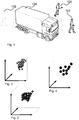
- Fig. 1 illustrates, in a time condensed manner, a scene being surveilled by a monitoring camera.
- the figure represents a course of events during a period of time, as indicated by the multiple appearances of the same object, and it will be described in the following.
- a first person 102 enters the scene to the left and walks to the right (in the imaged scene). At a point in time and in the scene this first person 102 is occluded by a truck 104, which either is parked or moves through the scene. The first person 102 is occluded for a while, and subsequently emerges on the right side (as seen from the camera) of the truck 104.
- a second person 106 appears from behind (as seen from the camera) the truck 104.
- the scene is simplified, but it may be used to introduce the present invention, according to one embodiment thereof. It is appreciated that Fig. 1 is represented by several images captured as a video sequence by the monitoring camera.
- a tracking algorithm or any object detector, would readily detect three isolated moving objects in the imaged scene (possibly four if the truck is moving through the scene), at different times. Each object will follow a track or tracklet (as detected by the tracking algorithm), and there will be a challenge in concluding that two of these objects are actually the same (if that is the case), and that the third is not.
- a timeline may be used with success, since one single object cannot be in two places at once.
- a Kalman filter may be used with success, provided that the motion of the object (the first person 102) is readily predictable from its motion in previously captured frames and that the occlusion period is limited.
- feature vectors are extracted from each detected moving object continuously. This may be done for every single image frame in the video sequence captured by the monitoring camera, yet the frequency of the acquisition of feature vectors may also be lower than the frequency of acquisition of image frames (i.e. lower than the actual number of frames per second (fps) in the captured video sequence). Instead of having a fixed frequency, the acquisition may be based on the content of the image, i.e. a feature vector will be extracted only if the content of the image fulfills one or more criteria.
- the evaluation of feature vectors of a detected object may also, in addition to other evaluations, be made using a neural network evaluating features such as gait or motion pattern apart from more physical attributes of the object such as pose, so that such features may be added to the identification process.
- several feature vectors may be extracted from a single view of the same object.
- one feature vector may be extracted for the face or head of an individual, while another is extracted for the full body.
- several point clouds of different feature vectors may be gradually assembled in parallel, in the same or in different vector spaces. For a subsequent comparison to be meaningful the compared point clouds should reside in the same vector space.
- a feature vector, or an appearance vector is a descriptor of an object, or of an image containing an object.
- the feature vector may be a semantic description (person, red shirt, bag, etc.) but in the present context it is more often than not a numerical descriptor extracted by means of applying algorithms for computer vision, machine learning, or neural networks, or a combination thereof, to an image selection comprising the object in question.
- the extraction of a feature vector may be preceded by a cropping (or feature selection) procedure, so that a resulting image crop evaluated consists of, to the highest possible degree, the object of interest.
- This object may be a person, but it may also be the face of a person, as well as any other distinguishable object or part thereof.
- a feature vector may include temporally resolved information rather than only parameters relating to physical appearance.
- the velocity of a person may be accounted for, or even the gait of the person, e.g. by use of a recurrent neural network (RNN).
- RNN recurrent neural network
- each feature vector may comprise implicitly encoded information, such as information regarding a time stamp, and general information regarding the analysed object, such as the present pose. Consequently, it is possible to use the implicitly encoded information for the purpose of filtering and/or selecting particular feature vectors or a group of feature vectors.
- feature vectors as such is in fact not a part of the present invention in the sense that the invention adds to the field of feature extraction as such.
- the use of feature extraction is relied upon for the purposes of the present invention, and while not any and every feature extraction algorithm may be suitable for use with the present invention, the use of feature extraction algorithms should be considered straightforward for a person skilled in the art.
- the extraction of feature vectors, or appearance vectors is a living field of research that evolves with evolution in image processing, neural networks and with the increasing computational power available. For the purposes of the present invention many different approaches for feature vector extraction may be utilized.
- a feature vector is generally multidimensional, and a numerical vector may have tens, hundreds or even thousands of parameters, corresponding to the same number of dimensions. For the purposes of facilitating the understanding of the description to follow, the number of dimensions has been reduced to three.
- Fig. 2 illustrates a point cloud of feature vectors extracted for the first person 102, up to the point in time where the person is occluded and lost to the tracking algorithm, i.e. for the first part of the persons track. In a monitoring video sequence this first portion of the track may correspond to thousands of image frames, and there may be one feature vector extracted for each frame. In other embodiments feature vectors are extracted at predetermined time intervals, or for image frames fulfilling certain criteria (e.g.
- the extraction may be governed by a desire to evaluate feature vectors from as many directions of the object as possible, or from a particularly favoured direction, an embodiment which of course may be combined with any of the other embodiments and examples.
- the feature vectors may readily be associated with the same object due to the tracking of that same object, and they are sequentially added to a memory. Once the object is occluded the addition of feature vectors to the memory is finalized.
- the memory could be located on the camera acquiring the video, or on the device performing the feature extraction, yet it could equally well be located at another server or in the point cloud.
- the feature vectors may be stored at more than one location, if such an approach is considered suitable.
- the feature vectors (predominantly each feature vector) will comprise a time stamp so that it may be associated with a particular image frame at a later stage if so desired. An image crop including the tracked object may be stored for later review, yet this is rarely necessary unless there is a step of active learning of a neural network, which is not a part of the present invention.
- a camera, or a controller for a camera may transmit direct requests concerning feature vectors to the storage of other monitoring cameras when trying to find earlier (or later) s of the same object. This may be done by accessing all available data, yet if the topology (e.g. the location) of other monitoring cameras is known, such information may be used to make the evaluation more efficient, an example being that information from nearby cameras is evaluated first. Notably, this relates more to the issue of what data to evaluate than to the evaluation as such, and consequently it is not intimately related to the present invention, although it may be an important issue to ponder on when evaluation large amounts of data.
- Fig. 2 is a feature vector point cloud extracted that very well could have been extracted from the same object as the cloud illustrated in Fig. 4 , while the object leading to the feature vector point cloud of Fig. 3 most probably is not the result of the same object. Consequently, the second appearance of the first object 102 may be determined to be just that, and the tracks and object identities may be combined to one, and by that a track recovery has been successfully accomplished.
- the comparison of aggregations of data amounts may be done with established techniques.
- Parameters to be compared may be the shape of the point clouds, statistical features of the point clouds, Euclidian distance between portions of the point clouds, distance as measured in an alternative manifold in which the entire or portions of the point clouds resides.
- Another example of a distance measure that can be used in the comparison is Mahalanobis distance, which is both unitless and scale invariant.
- the recording of a point cloud is put into use in another respect.
- the time during which an object has been occluded, the occlusion period may be added as a parameter when evaluating and comparing point clouds.
- the occlusion period is the time between the disappearance of an object (i.e. detection of occlusion) and the re of the object (i.e. detection of potentially the same object).
- several possible objects may be present at the same time, and there may be several candidates to which is the second (or thirds etc.) appearance of an object that has been tracked previously.
- each feature vector includes a time stamp
- the problem is trivially solved by comparing the time stamp of the last feature vector of a tracklet with the time stamp of the first feature vector in another tracklet, a tracklet being a fragment of a full track.
- the occlusion period it may in particular affect the weight given to individual points (i.e. feature vectors) in the point cloud. In a situation where the occlusion period is short, in the order of a few seconds or fractions of a second, individual points closer to the time of disappearance and appearance will be given a greater weight than individual points farther away from the same.
- the weight given to individual points may be less diverse due to this parameter.
- the typical meaning of "occlusion" within the present field is a full or partial disappearance of an object for a limited amount of time. While this is the case, the embodiments as described relating to occlusion may applied to embodiments relating to a longer disappearance of an object, such as if the object enters a building in a single scene, and exits the building at a later stage (after a couple of minutes or even after a working day), or in embodiments where an object disappears from the view of a first camera and appears in a second (or other) camera.
- occlusion period has been given, and in particular this embodiment is relevant for short occlusion periods, where, at least hypothetically, the appearance of the object at the time just before occlusion is very similar to the appearance immediately following occlusion. In such an embodiment it is reasonable to use a greater weight for feature vectors extracted closer to the time of occlusion than further away thereof.
- Some examples include a straightforward weighted moving average (i.e. an average that has multiplying factors to give different weights to data at different positions in the sample window) or an exponential weighted moving average (i.e.
- information of poses may be included in the respective point cloud, so that a comparison is made between selections of the respective point cloud based on a particular pose.
- Adding a pose estimation to the extraction of a feature vector may be readily effected, and there are several pose estimation algorithms available.
- an alternative could be to use a feature vector that includes a parameter indicating a pose estimation.
- frontal views of an individual rather than rear views or profile views are given a higher weight compared to other views, ranging from a slightly higher weight to a full discrimination of other views. In other embodiments other views are rated higher instead.
- the preferred pose may vary, and as a simplistic example one may consider a situation where an individual carries a bright red rucksack, in which case a feature vector from a rear view may be more indicative than a frontal view.
- this embodiment there may be a cluster of individual feature vectors that are particularly close to each other in their assembled point cloud, and by analysing the point cloud it is possible both to find the cluster and to analyse the feature vectors of the cluster. Since "close to each other" may be construed as somewhat relative, an example could be that a concentration of feature vectors is higher than in other portions of the point cloud.
- the cluster could correspond to views including the bright red rucksack, while it could equally well correspond to views including a particular pose proving to be particularly characteristic for a particular individual.
- This information may be useful when an individual is to be identified following a disappearance (be it a short-term occlusion or a disappearance for a longer period of time), since the first (or second, etc.) tracking may result in the identification of the most promising portion of the point cloud.
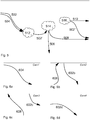
- Fig. 5 illustrates a scene including moving objects, yet in an even more schematic layout than the illustration of Fig. 1 .
- Each arrow 502-510 corresponds to the track of an object (not shown) as detected by a tracking algorithm, and the partial tracks 502-510 are sometimes referred to as tracklets.
- Each schematic shrubbery 512, 514, 516 in Fig. 5 corresponds to a position where objects disappear or gets occluded, or indeed appears.
- the leftmost shrubbery 512 could correspond to a tree or a car, while the other two shrubberies 514, 516 could correspond to the entrances of a building.
- the shrubberies 512, 514, 516 could also represent a group of people, resulting in full or partial occlusion during a longer or shorter period of time. There are of course other common situations where occlusions occur, such as when two individuals meet so that they overlap in the camera field of view. In total, there are 7 tracklets in Fig. 5 , and by using the inventive method it will be possible to associate detected objects and tracklets representing an individual entering from the left, being temporarily occluded by the shrubbery 512, entering into the shrubbery 514 and appearing from the shrubbery 516 before leaving the scene, regardless of the occlusions being short-term or long-term.
- this may correspond to the tracklets 502, 502', and 502" all associated with the same object.
- the invention may be applied in one or more of the manners as described in the present application, where the most decisive parameter may be the occlusion period.
- the camera imaging the scene of Fig. 5 may be surrounded by additional cameras, illustrated by the views of cameras 1-4 shown in the scenes of Figs. 6a-6d .
- Figs. 6b, 6c, and 6d For the purpose of further highlighting an advantage of the present invention of using the point cloud of feature vectors we can linger a bit longer on Figs. 6b, 6c, and 6d .
- the object in question is an individual, and that the camera offers a view from the side, slightly from above.
- the tracklet 602b it is likely that there is a lot of frontal views of the individual, provided that the camera surveilles the scene from the side or from a slightly elevated position and that the individual is turned in the direction of the tracklet in each position thereof. This means that feature vectors relating to frontal views will be well represented and in abundance.
- a tracking method may e.g. enhance the importance of feature vectors representing the frontal views, so as to facilitate the re-identification.
- the feature vectors extracted from the tracklet 602c may be added to the rest for the associated object. This results in that when re-identifying the same object in Fig. 6d , the importance of the sideviews may be enhanced in the corresponding way when comparing the point clouds. This corresponds to making a selection in among the feature vector assembled in the point cloud for a first tracklet (e.g. tracklet 602c) and a corresponding selection in the point cloud for a second tracklet (e.g. tracklet 602d).
- Fig. 7 illustrates a flowchart of a method according to an embodiment of the present invention.
- the flowchart is readily correlated with the description of Figs. 1-6 , yet in short it describes the method as comprising: Detecting a first object in a scene, tracking 720 the first object over a first sequence of image frames, extracting 722 feature data in the form of multiple first feature vectors for the first object, assembling 724 the multiple first feature vectors as a first point cloud in a feature vector space, and detecting 726 an occlusion of the first object.
- the method continues with detecting a second object subsequently appearing in a scene, tracking 728 the second object over a second sequence of image frames, extracting 730 data in the form of multiple second feature vectors for the second object, assembling 732 the multiple second feature vectors as a second point cloud in the feature vector space.
- a selected portion of the first point cloud is compared 734 to at least a selected portion of the second point cloud in the point cloud space, and the outcome of the comparison is used to deduce if the first object and the second object may be considered to be the same object and, if so, the first object is associated 738 with the second object, and their respective tracklet is associated with each other. If the objects are deemed not to be the same, the two tracks/objects are maintained 736 as separate tracks/objects or tracklets.
Landscapes
- Engineering & Computer Science (AREA)
- Theoretical Computer Science (AREA)
- Physics & Mathematics (AREA)
- General Physics & Mathematics (AREA)
- Multimedia (AREA)
- Computer Vision & Pattern Recognition (AREA)
- Data Mining & Analysis (AREA)
- Signal Processing (AREA)
- Bioinformatics & Computational Biology (AREA)
- Bioinformatics & Cheminformatics (AREA)
- Artificial Intelligence (AREA)
- Evolutionary Biology (AREA)
- Evolutionary Computation (AREA)
- General Engineering & Computer Science (AREA)
- Life Sciences & Earth Sciences (AREA)
- Computational Linguistics (AREA)
- Software Systems (AREA)
- Human Computer Interaction (AREA)
- Image Analysis (AREA)
- Closed-Circuit Television Systems (AREA)
Claims (10)
- Procédé de suivi d'un objet dans des scènes de vidéosurveillance, comprenant
la détection d'un premier objet dans une scène,
le suivi (720) du premier objet sur une première séquence de trames d'images en utilisant un algorithme de suivi,
l'extraction (722) de données sous la forme de multiples premiers vecteurs de caractéristiques pour le premier objet,
l'assemblage (724) des multiples premiers vecteurs de caractéristiques sous forme d'un premier nuage à points dans un espace de vecteurs de caractéristiques, chaque vecteur de caractéristiques formant un point dans le nuage à points,
la détection (726) d'une occlusion du premier objet suivant un algorithme de suivi ayant des données insuffisantes pour continuer le suivi de l'objet,
la détection d'un second objet apparaissant ensuite dans une scène,
le suivi (728) du second objet sur une seconde séquence de trames d'images,
l'extraction (730) de données sous la forme de multiples seconds vecteurs de caractéristiques pour le second objet,
l'assemblage (732) des multiples seconds vecteurs de caractéristiques sous la forme d'un second nuage à points dans l'espace de vecteurs de caractéristiques,
la comparaison (734) du premier nuage à points avec le second nuage à points dans l'espace de nuages à points
l'utilisation du résultat de la comparaison pour déduire si le premier objet et le second objet peuvent être considérés comme étant le même objet et, si c'est le cas, l'activation d'une récupération de suivi là où une identité d'objet du second objet peut être définie comme identité d'objet du premier objet ou vice versa,
caractérisé en ce que,
pour la comparaison, les multiples vecteurs de caractéristiques des premier et second nuages à points sont pondérés en se basant sur une période d'occlusion, c'est-à-dire une durée entre l'occlusion du premier objet et l'apparence du second objet, par le fait qu'une application ou une distribution de pondérations à chaque vecteur de caractéristiques individuel dans les premier et second nuages à points respectivement, est basée sur une période d'occlusion telle que
soit des périodes d'occlusion plus courtes décalent des pondérations plus élevées jusqu'à des vecteurs de caractéristiques extraits plus proches de la période d'occlusion comparativement à des périodes d'occlusion plus longues,
soit des pondérations plus élevées un ou deux, mesure sont décalées vers des sections spécifiques du nuage à points, lesdites sections spécifiques correspondant à des poses spécifiques de l'objet suivi. - Procédé selon l'une quelconque des revendications précédentes, dans lequel les multiples vecteurs de caractéristiques des premier et second nuages à points sont pondérés en se basant sur un paramètre sélectionné dans le groupe comprenant, dans une zone d'image du premier ou second objet : un niveau de brouillage de mouvement, un niveau du rapport de signal au bruit, les conditions d'éclairage, et un angle de visualisation de l'objet suivi ou leurs combinaisons.
- Procédé selon l'une quelconque des revendications précédentes, comprenant en outre l'évaluation du premier et/ou second nuage à points de manière à identifier une section du nuage à points ayant une concentration particulièrement dense de vecteurs de caractéristiques, et à sélectionner cette section pour la comparaison.
- Procédé selon l'une quelconque des revendications précédentes, dans lequel une distance euclidienne est utilisée lors de la comparaison du premier nuage à points avec le second nuage à points.
- Procédé selon l'une quelconque des revendications précédentes, dans lequel le premier nuage à points est comparé au second nuage à points dans un collecteur où une section majeure du premier nuage à points et du second nuage à points réside.
- Procédé selon l'une quelconque des revendications précédentes, dans lequel le premier nuage à points est acquis en utilisant une première caméra de surveillance, tandis que le second nuage à points est acquis en utilisant une seconde caméra de surveillance.
- Dispositif de réalisation du procédé selon la revendication 1 ou l'une quelconque des revendications précédentes, le dispositif comprenant au moins une unité d'imagerie vidéo pour acquérir d'images vidéo d'une scène, et une unité de commande conçue pour réaliser les étapes du procédé.
- Dispositif selon la revendication 7, le dispositif étant une caméra de vidéosurveillance.
- Système comprenant de multiple dispositif selon la revendication 7 ou la revendication 8, dans lequel l'unité de commande est une unité de commande d'une des caméras de vidéosurveillance, ou l'unité de commande est une unité de commande centralisée située au niveau d'un dispositif séparé sur un serveur ou sur un dispositif de client distant des caméras de vidéosurveillance.
- Support lisible sur ordinateur comprenant des instructions qui, une fois exécutées par un ordinateur, amènent l'ordinateur à réaliser le procédé selon la revendication 1, plus préférentiellement selon l'une quelconque de toutes les revendications précédentes 1 à 6.
Priority Applications (3)
| Application Number | Priority Date | Filing Date | Title |
|---|---|---|---|
| EP18212206.9A EP3667557B1 (fr) | 2018-12-13 | 2018-12-13 | Procédé et dispositif de suivi d'un objet |
| US16/686,240 US11024039B2 (en) | 2018-12-13 | 2019-11-18 | Method and device for tracking an object |
| CN201911250705.8A CN111325089B (zh) | 2018-12-13 | 2019-12-09 | 跟踪对象的方法和设备 |
Applications Claiming Priority (1)
| Application Number | Priority Date | Filing Date | Title |
|---|---|---|---|
| EP18212206.9A EP3667557B1 (fr) | 2018-12-13 | 2018-12-13 | Procédé et dispositif de suivi d'un objet |
Publications (3)
| Publication Number | Publication Date |
|---|---|
| EP3667557A1 EP3667557A1 (fr) | 2020-06-17 |
| EP3667557A8 EP3667557A8 (fr) | 2020-07-29 |
| EP3667557B1 true EP3667557B1 (fr) | 2021-06-16 |
Family
ID=64949030
Family Applications (1)
| Application Number | Title | Priority Date | Filing Date |
|---|---|---|---|
| EP18212206.9A Active EP3667557B1 (fr) | 2018-12-13 | 2018-12-13 | Procédé et dispositif de suivi d'un objet |
Country Status (3)
| Country | Link |
|---|---|
| US (1) | US11024039B2 (fr) |
| EP (1) | EP3667557B1 (fr) |
| CN (1) | CN111325089B (fr) |
Families Citing this family (29)
| Publication number | Priority date | Publication date | Assignee | Title |
|---|---|---|---|---|
| US11256910B2 (en) * | 2017-03-19 | 2022-02-22 | Pointgrab Ltd. | Method and system for locating an occupant |
| JP7040147B2 (ja) * | 2018-03-09 | 2022-03-23 | セイコーエプソン株式会社 | 制御装置、ロボット、ロボットシステム,及び、物体を認識する方法 |
| US11660758B2 (en) * | 2019-03-12 | 2023-05-30 | Bear Robotics, Inc. | Robots for serving food and/or drinks |
| US11176693B1 (en) * | 2019-07-24 | 2021-11-16 | Amazon Technologies, Inc. | Rapid point cloud alignment and classification with basis set learning |
| CN110706258B (zh) * | 2019-10-10 | 2022-10-04 | 北京百度网讯科技有限公司 | 对象追踪方法及装置 |
| US12175696B2 (en) * | 2020-01-13 | 2024-12-24 | Samsung Electronics Co., Ltd. | Method and apparatus with object information estimation and virtual object generation |
| US11436827B1 (en) * | 2020-02-25 | 2022-09-06 | Tp Lab, Inc. | Location tracking system using a plurality of cameras |
| CN111507222B (zh) * | 2020-04-09 | 2023-07-07 | 中山大学 | 一种基于多源数据知识迁移的三维物体检测框架 |
| CN111722245B (zh) * | 2020-06-22 | 2023-03-10 | 阿波罗智能技术(北京)有限公司 | 定位方法、定位装置和电子设备 |
| WO2022014327A1 (fr) * | 2020-07-14 | 2022-01-20 | ソニーセミコンダクタソリューションズ株式会社 | Dispositif de traitement d'informations, procédé de traitement d'informations et programme |
| CN112102370B (zh) * | 2020-09-22 | 2024-09-06 | 珠海格力电器股份有限公司 | 目标的跟踪方法和装置、存储介质、电子装置 |
| US12080100B2 (en) * | 2020-11-10 | 2024-09-03 | Nec Corporation | Face-aware person re-identification system |
| CN112396654B (zh) * | 2020-11-17 | 2024-08-27 | 闪耀现实(无锡)科技有限公司 | 用于在图像跟踪过程中确定跟踪对象的位姿的方法及装置 |
| CN112906452A (zh) * | 2020-12-10 | 2021-06-04 | 叶平 | 羚牛水鹿自动识别跟踪统计方法及系统 |
| CN115049696A (zh) * | 2021-03-08 | 2022-09-13 | 北京金茂绿建科技有限公司 | 一种基于雷达数据的人员监测方法和装置 |
| US11429406B1 (en) * | 2021-03-08 | 2022-08-30 | Bank Of America Corporation | System for implementing auto didactic content generation using reinforcement learning |
| JP7528009B2 (ja) * | 2021-03-17 | 2024-08-05 | 株式会社東芝 | 画像処理装置および画像処理方法 |
| JP7380633B2 (ja) * | 2021-04-01 | 2023-11-15 | トヨタ自動車株式会社 | 監視装置、監視方法及び監視システム |
| JP2022178802A (ja) * | 2021-05-21 | 2022-12-02 | 株式会社Albert | 物体追跡装置、物体追跡方法、及びプログラム |
| US12033390B2 (en) * | 2021-10-26 | 2024-07-09 | Hitachi, Ltd. | Method and apparatus for people flow analysis with inflow estimation |
| TWI813072B (zh) * | 2021-11-17 | 2023-08-21 | 瑞昱半導體股份有限公司 | 用於物件追蹤的電子裝置及方法 |
| JP2023074040A (ja) * | 2021-11-17 | 2023-05-29 | コベルコ建機株式会社 | 監視エリア設定システム |
| DE102022202620A1 (de) | 2022-03-17 | 2023-09-21 | Robert Bosch Gesellschaft mit beschränkter Haftung | Überwachungsanordnung zur Darstellung von bewegten Objekten Überwachungsbereich, Verfahren zur Darstellung von einem bewegten Objekt in einem Überwachungsbereich, Computerprogramm und Speichermedium |
| US11625909B1 (en) | 2022-05-04 | 2023-04-11 | Motional Ad Llc | Track segment cleaning of tracked objects |
| EP4276770B1 (fr) | 2022-05-09 | 2024-10-09 | Axis AB | Réidentification d'objets dans les flux vidéo |
| US20240078799A1 (en) * | 2022-09-02 | 2024-03-07 | Electronics And Telecommunications Research Institute | Intruder detection method based on multiple camera images and video surveillance system suitable for the same |
| GB2627454A (en) * | 2023-02-22 | 2024-08-28 | Nokia Technologies Oy | Apparatus, method, and system for spatial-temporal authentication |
| EP4428819B1 (fr) * | 2023-03-09 | 2025-02-19 | Axis AB | Dispositif et procédé pour améliorer le suivi d'objets dans une scène capturée dans une séquence vidéo |
| EP4456008B1 (fr) * | 2023-04-25 | 2025-09-17 | Axis AB | Procédés, systèmes et supports d'informations lisibles par ordinateur non transitoires permettant de détecter un objet d'un premier type d'objet dans une séquence vidéo |
Family Cites Families (33)
| Publication number | Priority date | Publication date | Assignee | Title |
|---|---|---|---|---|
| US7436887B2 (en) * | 2002-02-06 | 2008-10-14 | Playtex Products, Inc. | Method and apparatus for video frame sequence-based object tracking |
| US7606425B2 (en) * | 2004-09-09 | 2009-10-20 | Honeywell International Inc. | Unsupervised learning of events in a video sequence |
| DE602006017812D1 (de) * | 2005-03-17 | 2010-12-09 | British Telecomm | Verfahren zur verfolgung von objekten in einer videosequenz |
| EP1859411B1 (fr) * | 2005-03-17 | 2010-11-03 | BRITISH TELECOMMUNICATIONS public limited company | Reperage d'objets dans une sequence video |
| EP1862941B1 (fr) * | 2006-05-22 | 2016-10-26 | Axis AB | Procédé et appareil d'identification des propriétés d'un objet détecté par une caméra de surveillance vidéo |
| US20090002489A1 (en) * | 2007-06-29 | 2009-01-01 | Fuji Xerox Co., Ltd. | Efficient tracking multiple objects through occlusion |
| GB2452512B (en) * | 2007-09-05 | 2012-02-29 | Sony Corp | Apparatus and method of object tracking |
| WO2010098024A1 (fr) * | 2009-02-24 | 2010-09-02 | 三菱電機株式会社 | Dispositif de suivi d'humain et programme de suivi d'humain |
| US8285060B2 (en) * | 2009-08-31 | 2012-10-09 | Behavioral Recognition Systems, Inc. | Detecting anomalous trajectories in a video surveillance system |
| EP2549738B1 (fr) * | 2011-07-19 | 2013-08-28 | Axis AB | Méthode et caméra pour déterminer un paramètre d'ajustement d'image |
| WO2014132841A1 (fr) * | 2013-02-28 | 2014-09-04 | 株式会社日立国際電気 | Procédé de recherche de personnes et dispositif de recherche d'occupant de plate-forme |
| EP2801958B1 (fr) * | 2013-05-08 | 2016-09-14 | Axis AB | Caméra et procédé de surveillance |
| US9523772B2 (en) * | 2013-06-14 | 2016-12-20 | Microsoft Technology Licensing, Llc | Object removal using lidar-based classification |
| US9684830B2 (en) * | 2014-11-14 | 2017-06-20 | Intel Corporation | Automatic target selection for multi-target object tracking |
| US9582895B2 (en) | 2015-05-22 | 2017-02-28 | International Business Machines Corporation | Real-time object analysis with occlusion handling |
| DE102015212932A1 (de) * | 2015-07-10 | 2017-01-12 | Kuka Roboter Gmbh | Verfahren zum Steuern eines Roboters und/oder eines autonomen fahrerlosen Transportsystems |
| CN106373143A (zh) | 2015-07-22 | 2017-02-01 | 中兴通讯股份有限公司 | 一种自适应跨摄像机多目标跟踪方法及系统 |
| EP3246874B1 (fr) * | 2016-05-16 | 2018-03-14 | Axis AB | Procédé et appareil de mise à jour d'un modèle de fond utilisé pour la soustraction d'arrière-plan d'une image |
| EP3255585B1 (fr) * | 2016-06-08 | 2018-05-09 | Axis AB | Procédé et appareil de mise à jour d'un modèle d'arrière-plan |
| US10185877B2 (en) * | 2016-07-08 | 2019-01-22 | Huawei Technologies Co., Ltd. | Systems, processes and devices for occlusion detection for video-based object tracking |
| EP3306528B1 (fr) * | 2016-10-04 | 2019-12-25 | Axis AB | Algorithmes d'analyse destines a fournir des donnees d'apprentissage a des reseaux neuronaux |
| EP3312762B1 (fr) * | 2016-10-18 | 2023-03-01 | Axis AB | Procédé et système permettant de suivre un objet dans une zone définie |
| EP3321844B1 (fr) * | 2016-11-14 | 2021-04-14 | Axis AB | Reconnaissance d'action dans une séquence vidéo |
| EP3336774B1 (fr) * | 2016-12-13 | 2020-11-25 | Axis AB | Procédé, produit-programme informatique et dispositif de formation d'un réseau neuronal |
| US10096125B1 (en) * | 2017-04-07 | 2018-10-09 | Adobe Systems Incorporated | Forecasting multiple poses based on a graphical image |
| CN107194950B (zh) * | 2017-04-26 | 2020-06-12 | 天津大学 | 一种基于慢特征分析的多人跟踪方法 |
| EP3422255B1 (fr) * | 2017-06-30 | 2023-03-15 | Axis AB | Procédé et système de formation d'un réseau de neurones pour classifier des objets ou des événements |
| US10025950B1 (en) * | 2017-09-17 | 2018-07-17 | Everalbum, Inc | Systems and methods for image recognition |
| DE112019000049T5 (de) * | 2018-02-18 | 2020-01-23 | Nvidia Corporation | Für autonomes fahren geeignete objekterfassung und erfassungssicherheit |
| US10445599B1 (en) * | 2018-06-13 | 2019-10-15 | Luminar Technologies, Inc. | Sensor system augmented with thermal sensor object confirmation |
| US20190387185A1 (en) * | 2018-06-13 | 2019-12-19 | Luminar Technologies, Inc. | Thermal imager with enhanced processing |
| WO2020018585A1 (fr) * | 2018-07-16 | 2020-01-23 | Accel Robotics Corporation | Système de suivi de magasin autonome |
| US10621444B1 (en) * | 2019-10-25 | 2020-04-14 | 7-Eleven, Inc. | Action detection during image tracking |
-
2018
- 2018-12-13 EP EP18212206.9A patent/EP3667557B1/fr active Active
-
2019
- 2019-11-18 US US16/686,240 patent/US11024039B2/en active Active
- 2019-12-09 CN CN201911250705.8A patent/CN111325089B/zh active Active
Non-Patent Citations (1)
| Title |
|---|
| A. ESS ET AL: "Object Detection and Tracking for Autonomous Navigation in Dynamic Environments", THE INTERNATIONAL JOURNAL OF ROBOTICS RESEARCH, vol. 29, no. 14, 1 December 2010 (2010-12-01), pages 1707 - 1725, XP055170047, ISSN: 0278-3649, DOI: 10.1177/0278364910365417 * |
Also Published As
| Publication number | Publication date |
|---|---|
| EP3667557A1 (fr) | 2020-06-17 |
| EP3667557A8 (fr) | 2020-07-29 |
| CN111325089B (zh) | 2022-09-02 |
| US11024039B2 (en) | 2021-06-01 |
| CN111325089A (zh) | 2020-06-23 |
| US20200193619A1 (en) | 2020-06-18 |
Similar Documents
| Publication | Publication Date | Title |
|---|---|---|
| US11024039B2 (en) | Method and device for tracking an object | |
| US10185877B2 (en) | Systems, processes and devices for occlusion detection for video-based object tracking | |
| D'Orazio et al. | A semi-automatic system for ground truth generation of soccer video sequences | |
| JP5001260B2 (ja) | オブジェクト追跡方法及びオブジェクト追跡装置 | |
| US8614741B2 (en) | Method and apparatus for intelligent and automatic sensor control using multimedia database system | |
| US10430667B2 (en) | Method, device, and computer program for re-identification of objects in images obtained from a plurality of cameras | |
| US7660439B1 (en) | Method and system for flow detection and motion analysis | |
| KR102217253B1 (ko) | 행동패턴 분석 장치 및 방법 | |
| JP6833708B2 (ja) | 非同期信号を処理するための方法 | |
| CN114359976B (zh) | 一种基于人物识别的智能安防方法与装置 | |
| CN120495963A (zh) | 基于ai的安防监控视频分析方法及系统 | |
| JP2021089717A (ja) | 対象の再特定の方法 | |
| CN120431318A (zh) | 基于人工智能的视频目标识别方法、装置及存储介质 | |
| WO2016019973A1 (fr) | Procede pour la determination de foules stationnaires | |
| KR20090044957A (ko) | 도난 및 방치 감시 시스템 및 도난 및 방치 검출 방법 | |
| CN114519532A (zh) | 基于机器视觉的人员状态检测方法及相关装置 | |
| Singh et al. | A multi-gait dataset for human recognition under occlusion scenario | |
| CN111062294B (zh) | 一种客流排队时间的检测方法、装置及系统 | |
| Tang et al. | Hybrid blob and particle filter tracking approach for robust object tracking | |
| CN119941794A (zh) | 一种结合选择机制的多目标跟踪系统及方法 | |
| CN119131342A (zh) | 一种基于真实性和遮挡恢复的人员跟踪方法及系统 | |
| CN117854010A (zh) | 一种人员行为类型的检测方法、检测装置、设备及介质 | |
| ELBAŞI et al. | Control charts approach for scenario recognition in video sequences | |
| Senior | An introduction to automatic video surveillance | |
| WO2020139071A1 (fr) | Système et procédé de détection d'activité de comportement agressif |
Legal Events
| Date | Code | Title | Description |
|---|---|---|---|
| STAA | Information on the status of an ep patent application or granted ep patent |
Free format text: STATUS: EXAMINATION IS IN PROGRESS |
|
| PUAI | Public reference made under article 153(3) epc to a published international application that has entered the european phase |
Free format text: ORIGINAL CODE: 0009012 |
|
| 17P | Request for examination filed |
Effective date: 20191021 |
|
| AK | Designated contracting states |
Kind code of ref document: A1 Designated state(s): AL AT BE BG CH CY CZ DE DK EE ES FI FR GB GR HR HU IE IS IT LI LT LU LV MC MK MT NL NO PL PT RO RS SE SI SK SM TR |
|
| AX | Request for extension of the european patent |
Extension state: BA ME |
|
| RAP1 | Party data changed (applicant data changed or rights of an application transferred) |
Owner name: AXIS AB |
|
| GRAP | Despatch of communication of intention to grant a patent |
Free format text: ORIGINAL CODE: EPIDOSNIGR1 |
|
| STAA | Information on the status of an ep patent application or granted ep patent |
Free format text: STATUS: GRANT OF PATENT IS INTENDED |
|
| INTG | Intention to grant announced |
Effective date: 20210324 |
|
| GRAS | Grant fee paid |
Free format text: ORIGINAL CODE: EPIDOSNIGR3 |
|
| GRAA | (expected) grant |
Free format text: ORIGINAL CODE: 0009210 |
|
| STAA | Information on the status of an ep patent application or granted ep patent |
Free format text: STATUS: THE PATENT HAS BEEN GRANTED |
|
| AK | Designated contracting states |
Kind code of ref document: B1 Designated state(s): AL AT BE BG CH CY CZ DE DK EE ES FI FR GB GR HR HU IE IS IT LI LT LU LV MC MK MT NL NO PL PT RO RS SE SI SK SM TR |
|
| REG | Reference to a national code |
Ref country code: GB Ref legal event code: FG4D |
|
| REG | Reference to a national code |
Ref country code: CH Ref legal event code: EP |
|
| REG | Reference to a national code |
Ref country code: DE Ref legal event code: R096 Ref document number: 602018018624 Country of ref document: DE |
|
| REG | Reference to a national code |
Ref country code: SE Ref legal event code: TRGR |
|
| REG | Reference to a national code |
Ref country code: AT Ref legal event code: REF Ref document number: 1402935 Country of ref document: AT Kind code of ref document: T Effective date: 20210715 |
|
| REG | Reference to a national code |
Ref country code: IE Ref legal event code: FG4D |
|
| REG | Reference to a national code |
Ref country code: LT Ref legal event code: MG9D |
|
| PG25 | Lapsed in a contracting state [announced via postgrant information from national office to epo] |
Ref country code: HR Free format text: LAPSE BECAUSE OF FAILURE TO SUBMIT A TRANSLATION OF THE DESCRIPTION OR TO PAY THE FEE WITHIN THE PRESCRIBED TIME-LIMIT Effective date: 20210616 Ref country code: LT Free format text: LAPSE BECAUSE OF FAILURE TO SUBMIT A TRANSLATION OF THE DESCRIPTION OR TO PAY THE FEE WITHIN THE PRESCRIBED TIME-LIMIT Effective date: 20210616 Ref country code: FI Free format text: LAPSE BECAUSE OF FAILURE TO SUBMIT A TRANSLATION OF THE DESCRIPTION OR TO PAY THE FEE WITHIN THE PRESCRIBED TIME-LIMIT Effective date: 20210616 Ref country code: BG Free format text: LAPSE BECAUSE OF FAILURE TO SUBMIT A TRANSLATION OF THE DESCRIPTION OR TO PAY THE FEE WITHIN THE PRESCRIBED TIME-LIMIT Effective date: 20210916 |
|
| REG | Reference to a national code |
Ref country code: AT Ref legal event code: MK05 Ref document number: 1402935 Country of ref document: AT Kind code of ref document: T Effective date: 20210616 |
|
| REG | Reference to a national code |
Ref country code: NL Ref legal event code: MP Effective date: 20210616 |
|
| REG | Reference to a national code |
Ref country code: DE Ref legal event code: R079 Ref document number: 602018018624 Country of ref document: DE Free format text: PREVIOUS MAIN CLASS: G06K0009000000 Ipc: G06V0010000000 |
|
| PG25 | Lapsed in a contracting state [announced via postgrant information from national office to epo] |
Ref country code: RS Free format text: LAPSE BECAUSE OF FAILURE TO SUBMIT A TRANSLATION OF THE DESCRIPTION OR TO PAY THE FEE WITHIN THE PRESCRIBED TIME-LIMIT Effective date: 20210616 Ref country code: LV Free format text: LAPSE BECAUSE OF FAILURE TO SUBMIT A TRANSLATION OF THE DESCRIPTION OR TO PAY THE FEE WITHIN THE PRESCRIBED TIME-LIMIT Effective date: 20210616 Ref country code: NO Free format text: LAPSE BECAUSE OF FAILURE TO SUBMIT A TRANSLATION OF THE DESCRIPTION OR TO PAY THE FEE WITHIN THE PRESCRIBED TIME-LIMIT Effective date: 20210916 Ref country code: GR Free format text: LAPSE BECAUSE OF FAILURE TO SUBMIT A TRANSLATION OF THE DESCRIPTION OR TO PAY THE FEE WITHIN THE PRESCRIBED TIME-LIMIT Effective date: 20210917 |
|
| PG25 | Lapsed in a contracting state [announced via postgrant information from national office to epo] |
Ref country code: SM Free format text: LAPSE BECAUSE OF FAILURE TO SUBMIT A TRANSLATION OF THE DESCRIPTION OR TO PAY THE FEE WITHIN THE PRESCRIBED TIME-LIMIT Effective date: 20210616 Ref country code: SK Free format text: LAPSE BECAUSE OF FAILURE TO SUBMIT A TRANSLATION OF THE DESCRIPTION OR TO PAY THE FEE WITHIN THE PRESCRIBED TIME-LIMIT Effective date: 20210616 Ref country code: EE Free format text: LAPSE BECAUSE OF FAILURE TO SUBMIT A TRANSLATION OF THE DESCRIPTION OR TO PAY THE FEE WITHIN THE PRESCRIBED TIME-LIMIT Effective date: 20210616 Ref country code: ES Free format text: LAPSE BECAUSE OF FAILURE TO SUBMIT A TRANSLATION OF THE DESCRIPTION OR TO PAY THE FEE WITHIN THE PRESCRIBED TIME-LIMIT Effective date: 20210616 Ref country code: AT Free format text: LAPSE BECAUSE OF FAILURE TO SUBMIT A TRANSLATION OF THE DESCRIPTION OR TO PAY THE FEE WITHIN THE PRESCRIBED TIME-LIMIT Effective date: 20210616 Ref country code: CZ Free format text: LAPSE BECAUSE OF FAILURE TO SUBMIT A TRANSLATION OF THE DESCRIPTION OR TO PAY THE FEE WITHIN THE PRESCRIBED TIME-LIMIT Effective date: 20210616 Ref country code: RO Free format text: LAPSE BECAUSE OF FAILURE TO SUBMIT A TRANSLATION OF THE DESCRIPTION OR TO PAY THE FEE WITHIN THE PRESCRIBED TIME-LIMIT Effective date: 20210616 Ref country code: PT Free format text: LAPSE BECAUSE OF FAILURE TO SUBMIT A TRANSLATION OF THE DESCRIPTION OR TO PAY THE FEE WITHIN THE PRESCRIBED TIME-LIMIT Effective date: 20211018 Ref country code: NL Free format text: LAPSE BECAUSE OF FAILURE TO SUBMIT A TRANSLATION OF THE DESCRIPTION OR TO PAY THE FEE WITHIN THE PRESCRIBED TIME-LIMIT Effective date: 20210616 |
|
| PG25 | Lapsed in a contracting state [announced via postgrant information from national office to epo] |
Ref country code: PL Free format text: LAPSE BECAUSE OF FAILURE TO SUBMIT A TRANSLATION OF THE DESCRIPTION OR TO PAY THE FEE WITHIN THE PRESCRIBED TIME-LIMIT Effective date: 20210616 |
|
| REG | Reference to a national code |
Ref country code: DE Ref legal event code: R097 Ref document number: 602018018624 Country of ref document: DE |
|
| PLBE | No opposition filed within time limit |
Free format text: ORIGINAL CODE: 0009261 |
|
| STAA | Information on the status of an ep patent application or granted ep patent |
Free format text: STATUS: NO OPPOSITION FILED WITHIN TIME LIMIT |
|
| PG25 | Lapsed in a contracting state [announced via postgrant information from national office to epo] |
Ref country code: DK Free format text: LAPSE BECAUSE OF FAILURE TO SUBMIT A TRANSLATION OF THE DESCRIPTION OR TO PAY THE FEE WITHIN THE PRESCRIBED TIME-LIMIT Effective date: 20210616 |
|
| 26N | No opposition filed |
Effective date: 20220317 |
|
| PG25 | Lapsed in a contracting state [announced via postgrant information from national office to epo] |
Ref country code: AL Free format text: LAPSE BECAUSE OF FAILURE TO SUBMIT A TRANSLATION OF THE DESCRIPTION OR TO PAY THE FEE WITHIN THE PRESCRIBED TIME-LIMIT Effective date: 20210616 |
|
| PG25 | Lapsed in a contracting state [announced via postgrant information from national office to epo] |
Ref country code: MC Free format text: LAPSE BECAUSE OF FAILURE TO SUBMIT A TRANSLATION OF THE DESCRIPTION OR TO PAY THE FEE WITHIN THE PRESCRIBED TIME-LIMIT Effective date: 20210616 Ref country code: IT Free format text: LAPSE BECAUSE OF FAILURE TO SUBMIT A TRANSLATION OF THE DESCRIPTION OR TO PAY THE FEE WITHIN THE PRESCRIBED TIME-LIMIT Effective date: 20210616 |
|
| REG | Reference to a national code |
Ref country code: CH Ref legal event code: PL |
|
| REG | Reference to a national code |
Ref country code: BE Ref legal event code: MM Effective date: 20211231 |
|
| PG25 | Lapsed in a contracting state [announced via postgrant information from national office to epo] |
Ref country code: LU Free format text: LAPSE BECAUSE OF NON-PAYMENT OF DUE FEES Effective date: 20211213 Ref country code: IE Free format text: LAPSE BECAUSE OF NON-PAYMENT OF DUE FEES Effective date: 20211213 |
|
| PG25 | Lapsed in a contracting state [announced via postgrant information from national office to epo] |
Ref country code: BE Free format text: LAPSE BECAUSE OF NON-PAYMENT OF DUE FEES Effective date: 20211231 |
|
| PG25 | Lapsed in a contracting state [announced via postgrant information from national office to epo] |
Ref country code: LI Free format text: LAPSE BECAUSE OF NON-PAYMENT OF DUE FEES Effective date: 20211231 Ref country code: CH Free format text: LAPSE BECAUSE OF NON-PAYMENT OF DUE FEES Effective date: 20211231 |
|
| P01 | Opt-out of the competence of the unified patent court (upc) registered |
Effective date: 20230505 |
|
| PG25 | Lapsed in a contracting state [announced via postgrant information from national office to epo] |
Ref country code: CY Free format text: LAPSE BECAUSE OF FAILURE TO SUBMIT A TRANSLATION OF THE DESCRIPTION OR TO PAY THE FEE WITHIN THE PRESCRIBED TIME-LIMIT Effective date: 20210616 |
|
| PG25 | Lapsed in a contracting state [announced via postgrant information from national office to epo] |
Ref country code: HU Free format text: LAPSE BECAUSE OF FAILURE TO SUBMIT A TRANSLATION OF THE DESCRIPTION OR TO PAY THE FEE WITHIN THE PRESCRIBED TIME-LIMIT; INVALID AB INITIO Effective date: 20181213 |
|
| PG25 | Lapsed in a contracting state [announced via postgrant information from national office to epo] |
Ref country code: MK Free format text: LAPSE BECAUSE OF FAILURE TO SUBMIT A TRANSLATION OF THE DESCRIPTION OR TO PAY THE FEE WITHIN THE PRESCRIBED TIME-LIMIT Effective date: 20210616 |
|
| PG25 | Lapsed in a contracting state [announced via postgrant information from national office to epo] |
Ref country code: TR Free format text: LAPSE BECAUSE OF FAILURE TO SUBMIT A TRANSLATION OF THE DESCRIPTION OR TO PAY THE FEE WITHIN THE PRESCRIBED TIME-LIMIT Effective date: 20210616 |
|
| PG25 | Lapsed in a contracting state [announced via postgrant information from national office to epo] |
Ref country code: MT Free format text: LAPSE BECAUSE OF FAILURE TO SUBMIT A TRANSLATION OF THE DESCRIPTION OR TO PAY THE FEE WITHIN THE PRESCRIBED TIME-LIMIT Effective date: 20210616 |
|
| PGFP | Annual fee paid to national office [announced via postgrant information from national office to epo] |
Ref country code: DE Payment date: 20251126 Year of fee payment: 8 |
|
| PGFP | Annual fee paid to national office [announced via postgrant information from national office to epo] |
Ref country code: GB Payment date: 20251119 Year of fee payment: 8 |
|
| PGFP | Annual fee paid to national office [announced via postgrant information from national office to epo] |
Ref country code: FR Payment date: 20251120 Year of fee payment: 8 |
|
| PGFP | Annual fee paid to national office [announced via postgrant information from national office to epo] |
Ref country code: SE Payment date: 20251119 Year of fee payment: 8 |