EP3667564A1 - Système d'acquisition de geste - Google Patents
Système d'acquisition de geste Download PDFInfo
- Publication number
- EP3667564A1 EP3667564A1 EP17920688.3A EP17920688A EP3667564A1 EP 3667564 A1 EP3667564 A1 EP 3667564A1 EP 17920688 A EP17920688 A EP 17920688A EP 3667564 A1 EP3667564 A1 EP 3667564A1
- Authority
- EP
- European Patent Office
- Prior art keywords
- arm
- wrist
- flexion
- adduction
- abduction
- Prior art date
- Legal status (The legal status is an assumption and is not a legal conclusion. Google has not performed a legal analysis and makes no representation as to the accuracy of the status listed.)
- Withdrawn
Links
Images




Classifications
-
- G—PHYSICS
- G06—COMPUTING OR CALCULATING; COUNTING
- G06F—ELECTRIC DIGITAL DATA PROCESSING
- G06F3/00—Input arrangements for transferring data to be processed into a form capable of being handled by the computer; Output arrangements for transferring data from processing unit to output unit, e.g. interface arrangements
- G06F3/01—Input arrangements or combined input and output arrangements for interaction between user and computer
- G06F3/017—Gesture based interaction, e.g. based on a set of recognized hand gestures
-
- G—PHYSICS
- G06—COMPUTING OR CALCULATING; COUNTING
- G06F—ELECTRIC DIGITAL DATA PROCESSING
- G06F3/00—Input arrangements for transferring data to be processed into a form capable of being handled by the computer; Output arrangements for transferring data from processing unit to output unit, e.g. interface arrangements
- G06F3/01—Input arrangements or combined input and output arrangements for interaction between user and computer
- G06F3/011—Arrangements for interaction with the human body, e.g. for user immersion in virtual reality
- G06F3/014—Hand-worn input/output arrangements, e.g. data gloves
-
- H—ELECTRICITY
- H04—ELECTRIC COMMUNICATION TECHNIQUE
- H04R—LOUDSPEAKERS, MICROPHONES, GRAMOPHONE PICK-UPS OR LIKE ACOUSTIC ELECTROMECHANICAL TRANSDUCERS; ELECTRIC HEARING AIDS; PUBLIC ADDRESS SYSTEMS
- H04R1/00—Details of transducers, loudspeakers or microphones
- H04R1/20—Arrangements for obtaining desired frequency or directional characteristics
- H04R1/32—Arrangements for obtaining desired frequency or directional characteristics for obtaining desired directional characteristic only
- H04R1/40—Arrangements for obtaining desired frequency or directional characteristics for obtaining desired directional characteristic only by combining a number of identical transducers
- H04R1/406—Arrangements for obtaining desired frequency or directional characteristics for obtaining desired directional characteristic only by combining a number of identical transducers microphones
-
- H—ELECTRICITY
- H04—ELECTRIC COMMUNICATION TECHNIQUE
- H04R—LOUDSPEAKERS, MICROPHONES, GRAMOPHONE PICK-UPS OR LIKE ACOUSTIC ELECTROMECHANICAL TRANSDUCERS; ELECTRIC HEARING AIDS; PUBLIC ADDRESS SYSTEMS
- H04R3/00—Circuits for transducers
- H04R3/005—Circuits for transducers for combining the signals of two or more microphones
Definitions
- the present invention relates to the technical field of man-machine interaction and in particular to a gesture acquisition system.
- Man-machine interaction between human beings and smart devices is increasing.
- Contact man-machine interaction is more mature and complete.
- Non-contact man-machine interaction is still at the starting stage.
- non-contact man-machine interaction has been a hot but difficult issue in man-machine interaction research.
- Research on non-contact man-machine interaction is valuable in practical use.
- gesture is an important means for human beings to exchange information with each other due to its quick expression and rich meaning.
- gesture recognition the content to be expressed by a gesture is recognized according to certain rules, with high consistency and expandability.
- a gesture recognition system can directly manipulate software or virtual objects in application software.
- how to recognize a gesture more effectively to realize a better man-machine interaction state is a hot but difficult issue in research.
- An objective of the present invention is to provide a gesture acquisition system that can acquire finger posture information accurately with less recognition time.
- a gesture acquisition system comprising a finger posture acquisition device, the finger posture acquisition device comprising a main acquisition module which is located below a palm and synchronously swings with the palm, the main acquisition module being configured to acquire finger postures.
- the gesture acquisition system further comprises a wrist posture acquisition device configured to acquire adduction-abduction postures of a wrist and flexion-extension postures of the wrist, the wrist posture acquisition device comprising a wrist posture acquisition arm that does an adduction-abduction motion and a flexion-extension motion together with the wrist and a sensing module configured to acquire flexion-extension information and adduction-abduction information of the wrist posture acquisition arm.
- the gesture acquisition system further comprises a wristband tied around the wrist, the wrist posture acquisition arm being connected to the wristband, and the wrist posture acquisition arm doing an adduction-abduction motion and a flexion-extension motion together with the wrist by the wristband.
- the wrist posture acquisition arm comprises an adduction-abduction arm that does an adduction-abduction motion together with the wrist and a flexion-extension arm that does a flexion-extension motion together with the wrist; and the sensing module comprises two angle sensors that are, respectively, an adduction-abduction angle sensor configured to acquire an adduction-abduction angle of the adduction-abduction arm and a flexion-extension angle sensor configured to acquire a flexion-extension angle of the flexion-extension arm.
- the wristband and an adduction-abduction axis of the wrist during adduction-abduction have two points of intersection which are corresponding to the adduction-abduction arm
- the wristband and an flexion-extension axis of the wrist during flexion-extension have two points of intersection which are corresponding to the flexion-extension arm
- each of the adduction-abduction arm and the flexion-extension arm has a fixed end and a free end opposite to the fixed end
- the fixed end of one of the adduction-abduction arm and the flexion-extension arm is mounted on the wristband and located at one of two corresponding points of intersection, with a corresponding angle sensor being mounted there, and the free end thereof is wound, along the wristband (7), to one of two points of intersection corresponding to the other one of the adduction-abduction arm and the flexion-extension arm and connected to the fixed end of the other one of the adduction-abduction arm and the flexion-
- the flexion-extension angle sensor is arranged along the flexion-extension axis and the adduction-abduction angle sensor is arranged along the adduction-abduction axis.
- the free end, located on the wrist at a position in proximity to the hand, of the adduction-abduction arm and the flexion-extension arm is wound to the bottom of the wrist at a position in proximity to the hand, with the main acquisition module being mounted there.
- the wrist posture acquisition arm is a telescopic pole; the wrist posture acquisition arm is connected to the wristband and comprises a first end located above or lateral to the wristband and a second end fixedly connected to the hand; the wrist posture acquisition arm and the wristband has a point of intersection located between the first end and the second end; the first end is able to swing around the point of intersection; and the sensing module acquires flexion-extension information and adduction-abduction information of the wrist posture acquisition arm by acquiring swing information of the first end.
- a fisheye bearing is arranged on the wristband, and the wrist posture acquisition arm is connected to the wrist posture acquisition arm by running through the fisheye bearing.
- the sensing module is a Hall sensor; a magnet is arranged at the first end of the wrist posture acquisition arm; and the sensing module acquires flexion-extension information and adduction-abduction information of the wrist posture acquisition arm by acquiring magnetic field information at the first end.
- the sensing module is located in an extension direction of the wrist posture acquisition arm and is farther from the second end of the wrist posture acquisition arm than the first end of the wrist posture acquisition arm.
- the gesture acquisition system further comprises a fixation structure that is fixed on the wrist at a position in proximity to the hand, the second end of the wrist posture acquisition arm being fixed on the fixation structure, and the main acquisition module being fixed on the fixation structure.
- the gesture acquisition system further comprises a forearm posture acquisition device mounted on the wristband, the forearm posture acquisition device being configured to acquire forearm postures.
- the forearm posture acquisition device comprises a three-axis gyroscope, a three-axis magnetometer and a three-axis acceleration sensor.
- the wristband is shaped in a sleeve; a first fixation portion and a second fixation portion are arranged on the wristband at interval; and the first fixation portion and the second fixation portion are matched with parts, protruded on the body skin, of styloid process of radius and styloid process of ulna to fixedly mount the wristband on the wrist, respectively.
- first fixation portion and the second fixation portion are through-holes or grooves formed on the wristband.
- the gesture acquisition system further comprises an ambient information acquisition device configured to search for, in the ambient environment, electronic devices to be controlled.
- the gesture acquisition system further comprises a processor connected to other electronic elements in the gesture acquisition system.
- the main acquisition module is a camera.
- the main acquisition module is mounted within 0-5 cm from the wrist joint to fingers and 0-3 cm from the wrist to a person's arm, and 0-3 cm away from the body skin.
- the present invention has the following beneficial effects.
- the main acquisition module of the finger posture acquisition device is arranged below a palm and synchronously swings with the palm. In this way, the angle of view and the position of the main acquisition module are fixed relative to the palm. Thus, for a same gesture, it is recognized by images captured from one fixed angle. The recognition time is reduced, the recognition accuracy is improved, and the computation for background deletion is eliminated.
- an embodiment of the present invention provides a gesture acquisition system, comprising a finger posture acquisition device 1.
- the finger posture acquisition device 1 comprises a main acquisition module 11 which is located below a palm and synchronously swings with the palm, and an auxiliary acquisition module (not shown).
- the main acquisition module 11 may be configured to acquire finger postures.
- the main acquisition module 11 may be, for example, a camera.
- the main acquisition module 11 acquires finger posture information by acquiring an image of a finger.
- the auxiliary acquisition module is also configured to assist in acquiring finger posture information.
- the auxiliary acquisition module may be located on the hand at any position where finger postures can be acquired, to assist in acquiring finger posture information.
- the auxiliary acquisition module may be, for example, a camera that acquires finger posture information by acquiring an image of a finger.
- the gesture acquisition system in the present invention further comprises, for example, a wrist posture acquisition device 2 configured to acquire adduction-abduction posture information of the wrist and flexion-extension posture information of the wrist.
- a wrist posture acquisition device 2 configured to acquire adduction-abduction posture information of the wrist and flexion-extension posture information of the wrist.
- the wrist posture acquisition device 2 in the present invention can acquire an adduction-abduction motion and a flexion-extension motion of the wrist so as to acquire the adduction-abduction posture information of the wrist and flexion-extension posture information of the wrist.
- the wrist posture acquisition device 2 comprises a wrist posture acquisition arm 22 that does an adduction-abduction motion and a flexion-extension motion together with the wrist and a sensing module 24 configured to acquire flexion-extension information and adduction-abduction information of the wrist posture acquisition arm 22.
- the wrist posture information is acquired.
- the wrist posture acquisition arm 22 is usually made of hard material.
- the wrist posture acquisition arm 22 is less likely to deform.
- the influence to the adduction-abduction motion and flexion-extension motion of the wrist posture acquisition arm 22, and thus to the acquisition accuracy, due to the easy deformation of the wrist posture acquisition arm 22, can be avoided.
- the gesture acquisition system in the present invention further comprises, for example, a forearm posture acquisition device 3 configured to acquire forearm posture information.
- the forearm posture acquisition device 3 comprises a three-axis gyroscope, a three-axis magnetometer and a three-axis acceleration sensor, wherein the three-axis gyroscope is configured to detect the three-axis angular velocity of the forearm, the three-axis acceleration sensor is configured to detect the three-axis acceleration of the forearm, the three-axis magnetometer is configured to detect the three-axis magnetism of the state of the forearm. With the arrangement of them, the detected forearm posture information is more accurate.
- the gesture acquisition system in the present invention can also determine electronic devices to be controlled.
- the gesture acquisition system in the present invention further comprises, for example, an ambient information acquisition device 4 configured to search for, in the ambient environment, electronic devices (computers, tablets, household appliances, IOTs, on-vehicle devices, etc.) to be controlled in interaction and to position a person's arm relative to the indoor or outdoor local ambient environment.
- the ambient information acquisition device 4 is an ambient information camera.
- the forearm posture acquisition device 3 further comprises a light reflecting point arranged on the wristband. The ambient information acquisition device 4 can acquire information about the position of the light reflecting point.
- the gesture acquisition system in the present invention further comprises a processor 5 and a wireless communication module 6.
- the finger posture acquisition device 1, the wrist posture acquisition device 2, the forearm posture acquisition device 3, the ambient information acquisition device 4 and the wireless communication module 6 are all connected to the processor 5.
- the finger posture information acquired by the finger posture acquisition device 1, the wrist posture information acquired by the wrist posture acquisition device 2, the forearm posture information acquired by the forearm posture acquisition device 3, the electronic devices to be controlled which are searched by the ambient information acquisition device 4, and space information of the forearm are all sent to the processor 5.
- the processor 5 determines the electronic devices to be controlled and calculates spatial coordinates of the forearm according to those information, and outputs corresponding operating instructions according to those information, which operating instructions are sent to the electronic devices to be controlled via the wireless communication module 6. In this way, man-machine interaction with the electronic devices to be controlled is realized. That is, electronic devices can be controlled by gestures.
- the gesture acquisition system in the present invention further comprises a wristband 7 tied around the wrist.
- the main acquisition module 11, the wrist posture acquisition device 2, the forearm posture acquisition device 3, the ambient information acquisition device 4, the wireless communication module 6 and the processor 5 may be, for example, all connected to the wristband 7.
- “connected to the wristband 7” includes “connected to the wristband 7 directly” and “connected to the wristband 7 indirectly, i.e., by an element, for example, a connecting rod or the like".
- the arrangement of the wristband 7 is to conveniently realize the synchronous swing of the main acquisition module 11 with the palm.
- the wrist posture acquisition arm 22 of the wrist posture acquisition device 2 moves together with the wristband 7. The way of connecting the main acquisition module 11 and the wrist posture acquisition device 2 to the wristband 7 will be described below in details.
- the wristband 7 may be omitted, and the main acquisition module 11 may be fixed below the palm by a sucker or in other ways.
- the wrist posture acquisition device 2 may be arranged on the wrist by a sucker.
- the forearm posture acquisition device 3, the ambient information acquisition device 4, the wireless communication module 6 and the processor 5 may be fixed on a person's arm, or connected to a person's arm by structures such as connecting rods and located on an outer side of the arm.
- the way of mounting the forearm posture acquisition device 3, the ambient information acquisition device 4, the wireless communication module 6 and the processor 5 is not limited thereto, as long as the corresponding signal acquisition, transmission and processing can be realized.
- the wristband 7 is shaped in a sleeve; a first fixation portion 71 and a second fixation portion 72 are arranged on the wristband 7 at interval; and the first fixation portion 71 and the second fixation portion 72 are matched with parts, protruded on the body skin, of styloid process of radius and styloid process of ulna to fixedly mount the wristband 7 on the wrist, respectively, in order to prevent the wristband 7 from falling off or sliding at the wrist.
- the first fixation portion 71 and the second fixation portion 72 are through-holes or grooves formed on the wristband 7.
- a wristband to be worn on the left hand is structurally the same as the wristband to be worn on the right hand, except that the first fixation portion (71) and the second fixation portion (72) need to be formed correspondingly to parts, protruded on the body skin, of styloid process of radius on the left hand and styloid process of ulna on the left hand, respectively.
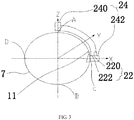
- the wrist posture acquisition arm 22 comprises an adduction-abduction arm 220 that does an adduction-abduction motion together with the wrist and a flexion-extension arm 222 that does a flexion-extension motion together with the wrist; and the sensing module 24 comprises two angle sensors that are, respectively, an adduction-abduction angle sensor 240 configured to acquire an adduction-abduction angle of the adduction-abduction arm 220 and a flexion-extension angle sensor 242 configured to acquire a flexion-extension angle of the flexion-extension arm 222.
- the adduction-abduction angle of the adduction-abduction arm 220 together with the adduction-abduction motion of the wrist is acquired by the adduction-abduction arm 220, and the flexion-extension angle of the flexion-extension arm 222 together with the flexion-extension motion of the wrist is acquired by the flexion-extension angle sensor 242.
- the adduction-abduction angle and the flexion-extension angle of the wrist are acquired accurately.
- the wrist postures are acquired.
- the wristband 7 and an adduction-abduction axis of the wrist during adduction-abduction have two points of intersection which are corresponding to the adduction-abduction arm 220
- the wristband 7 and an flexion-extension axis of the wrist during flexion-extension have two points of intersection which are corresponding to the flexion-extension arm 222.
- the adduction-abduction arm 220 has a fixed end and a free end opposite to the fixed end, and the flexion-extension arm 222 also has a fixed end and a free end opposite to the fixed end, wherein the fixed end of one of the adduction-abduction arm 220 and the flexion-extension arm 222 is mounted on the wristband 7 and located at one of two corresponding points of intersection, with a corresponding angle sensor being mounted there, and the free end thereof is wound, along the wristband 7, to one of two points of intersection corresponding to the other one of the adduction-abduction arm 220 and the flexion-extension arm 222 and connected to the fixed end of the other one of the adduction-abduction arm 220 and the flexion-extension arm 222; a join point of the adduction-abduction arm 220 and the flexion-extension arm 222 has an included angle, with the other angle sensor being mounted there; the free end of the other one of the adduction-a
- the free end is fixed on the hand at a position in proximity to the wrist, by clamping the acquisition arm to the hand at a position in proximity to the wrist.
- the flexion-extension arm 222 will do a flexion-extension motion together with the wrist, and the flexion-extension angle sensor 242 can sense the change in the angle of the flexion-extension arm 222, thus the flexion-extension postures of the wrist.
- the adduction-abduction arm 220 When the wrist does an adduction-abduction motion, the adduction-abduction arm 220 will do an adduction-abduction motion together with the wrist, and the adduction-abduction angle sensor can sense the change in the angle of the adduction-abduction arm 220, thus the adduction-abduction postures of the wrist.
- the free end, located on the wrist at a position in proximity to the hand, of the adduction-abduction arm 220 and the flexion-extension arm 222 is wound to the bottom of the wrist at a position in proximity to the hand, with the main acquisition module 11 being mounted there, in order to ensure that the main acquisition module 11 can swing with the palm.
- a connecting rod may be extended from the wristband 7 to be located below the palm, and the main acquisition module 11 is mounted on the connecting rod.
- the flexion-extension angle sensor 242 is arranged along the flexion-extension axis and the adduction-abduction angle sensor 240 is arranged along the adduction-abduction axis. That is, both the flexion-extension angle sensor 242 and the adduction-abduction angle sensor 240 are perpendicular to the tangent of the corresponding point of intersection.
- X is the flexion-extension axis
- Z is the adduction-abduction axis
- Y is the axial direction of the wristband 7.
- the wristband 7 and the adduction-abduction axis have two points of intersection A and B
- the wristband 7 and the flexion-extension axis have two points of intersection C and D.
- One end of the flexion-extension arm 222 is mounted at any one of points of intersection of the wristband 7 and the flexion-extension axis, for example, point of intersection C.
- the flexion-extension angle sensor 242 is connected to the fixed end of the flexion-extension arm 222 and arranged along the X-axis.
- the free end of the flexion-extension arm 222 is arranged around the wristband 7, and wound to the point A; then, the fixed end of the adduction-abduction arm 220 is connected to the free end of the flexion-extension arm 222; and the free end of the adduction-abduction arm 220 is wound to the outer side of the wristband 7 and fixed on the hand at a position in proximity to the wrist.
- the free end of the adduction-abduction arm 220 is extended to the outer side of the wristband 7 while being wound toward the point of intersection C, and then wound toward the hand at a position in proximity to the wrist to be located on the outer side of the wristband 7 and fixed on the hand at a position in proximity to the wrist.
- the free end of the adduction-abduction arm 220 is fixed on the hand at a position in proximity to the wrist, by clamping the adduction-abduction arm 220 on the hand at a position in proximity to the wrist.
- the flexion-extension arm 222 swings, by the wristband 7, around the flexion-extension axis together the wrist, and the flexion-extension angle sensor 242 swings together with the flexion-extension arm 222, so that the flexion-extension angle sensor 242 acquires the swing angle of the flexion-extension arm 222 so as to acquire the flexion-extension postures of the wrist.
- the adduction-abduction arm 220 will not swing around the adduction-abduction axis and the adduction-abduction angle sensor 240 will not acquire the adduction-abduction angle of the adduction-abduction arm 220.
- the adduction-abduction arm 220 When the wrist does an adduction-abduction motion, the adduction-abduction arm 220 is fixed on the hand in proximity to the wrist and thus swings around the adduction-abduction axis together with the wrist, the angle between the flexion-extension arm 222 and the adduction-abduction arm 220 changes as the adduction-abduction arm 220 swings, and the adduction-abduction angle sensor 240 acquires the swing angle of the adduction-abduction arm 220 so as to acquire the adduction-abduction postures of the wrist. In this case, the flexion-extension arm 222 will not swing around the flexion-extension axis and the flexion-extension angle sensor 242 will not acquire the flexion-extension angle of the flexion-extension arm 222.
- the free end of the adduction-abduction arm 220 may be wound to the bottom of the hand at a position in proximity to the wrist and then extended toward the palm.
- the main acquisition module 11 is mounted at the free end of the adduction-abduction arm 220 to ensure that the main acquisition module 11 synchronously swings together with the palm.
- X is the flexion-extension axis
- Z is the adduction-abduction axis
- Y is the axial direction of the wristband 7.
- the fixed end of the adduction-abduction arm 220 is mounted at any one of points of intersection of the wristband 7 and the adduction-abduction axis, for example, point of intersection A.
- the adduction-abduction angle sensor 240 is fixed at the fixed end of the adduction-abduction arm 220 and arranged along the Z-axis.
- the free end of the adduction-abduction arm 220 is arranged around the wristband 7, and then wound to, for example, the point C.
- the fixed end of the flexion-extension arm 222 is connected to the free end of the adduction-abduction arm 220.
- the flexion-extension angle sensor 242 is mounted at the join point of the flexion-extension arm 222 and the adduction-abduction arm 220.
- the flexion-extension angle sensor 242 is arranged along the X-axis.
- the free end of the flexion-extension arm 222 is wound to the outer side of the wristband 7 and fixed on the hand at a position in proximity to the wrist.
- the free end of the flexion-extension arm 222 is wound toward the point of intersection A and then toward the point of intersection D and extended to the outer side of the wristband 7 while being wound, and then wound toward the hand at a position in proximity to the wrist to be located on the outer side of the wristband 7 and fixed on the hand at a position in proximity to the wrist.
- the free end of the flexion-extension arm 222 is fixed on the hand at a position in proximity to the wrist, by clamping the flexion-extension arm 222 on the hand at a position in proximity to the wrist.
- the flexion-extension arm 222 is fixed on the hand in proximity to the wrist and thus swings around the flexion-extension axis together with the wrist, the angle between the flexion-extension arm 222 and the adduction-abduction arm 220 changes, and the flexion-extension angle sensor 242 thus acquires the swing angle of the flexion-extension arm 222 so as to acquire the flexion-extension postures of the wrist.
- the adduction-abduction arm 220 will not swing around the adduction-abduction axis and the adduction-abduction angle sensor 240 will not acquire the adduction-abduction angle of the adduction-abduction arm 220.
- the adduction-abduction arm 220 swings, by the wristband 7, around the adduction-abduction axis together the wrist, and the adduction-abduction angle sensor 240 swings together with the adduction-abduction axis, so that the adduction-abduction angle sensor 240 acquires the swing angle of the adduction-abduction arm 220 so as to acquire the adduction-abduction postures of the wrist.
- the flexion-extension arm 222 will not swing around the flexion-extension axis and the flexion-extension angle sensor 242 will not acquire the flexion-extension angle of the flexion-extension arm 222.
- the free end of the flexion-extension arm 222 may be wound to the bottom of the hand at a position in proximity to the wrist and then extended toward the palm.
- the main acquisition module 11 is mounted at the free end of the flexion-extension arm 222 to ensure that the main acquisition module 11 synchronously swings together with the palm.
- the wrist posture acquisition arm 22 is a telescopic pole; the wrist posture acquisition arm 22 is connected to the wristband 7 and comprises a first end located above, lateral to or below the wristband 7 and a second end fixedly connected to the wrist in proximity to the hand; the wrist posture acquisition arm 22 and the wristband 7 has a point of intersection located between the first end and the second end; the first end of the wrist posture acquisition arm 22 is able to swing around the point of intersection; and the sensing module 24 acquires flexion-extension information and adduction-abduction information of the wrist posture acquisition arm 22 by acquiring swing information of the first end.
- a fisheye bearing 75 is arranged on the wristband 7, and the wrist posture acquisition arm 22 is connected to the wrist posture acquisition arm 22 by running through the fisheye bearing 75.
- the wrist posture acquisition arm 22 can swing together with the wrist by the fisheye bearing 75 arranged on the wristband 7.
- the part, between the fisheye bearing 75 and the second end of the wrist posture acquisition arm 22, of the wrist posture acquisition arm 22 extends or retracts, depending upon actual requirements.
- the first end of the wrist posture acquisition arm 22 swings together with the wrist by the fisheye bearing 75.
- the sensing module 24 can acquire the posture of the wrist by acquiring the swing information of the first end.
- the sensing module 24 acquires the adduction-abduction posture information of the wrist by acquiring the lateral swing angle of the first end.
- the sensing module 24 is a Hall sensor.
- a magnet 26 is arranged at the first end of the wrist posture acquisition arm 22.
- the magnet 26 forms a magnetic field in vicinity of the first end of the wrist posture acquisition arm 22.
- the Hall sensor senses the magnetic field formed by the magnet 26.
- the Hall sensor can sense the change in the magnetic field, which is caused by the swing of the first end of the wrist posture acquisition arm 22. Therefore, the sensing module 24 acquires the up-down swing angle and left-right swing angle of the first end of the wrist posture acquisition arm 22, and thus flexion-extension information and adduction-abduction information of the wrist, by acquiring magnetic field information at the first end of the wrist posture acquisition arm 22.
- the sensing module 24 is located in an extension direction of the wrist posture acquisition arm 22 and is farther from the second end of the wrist posture acquisition arm 22 than the first end of the wrist posture acquisition arm 22, so that the sensing module 24 can acquire the magnetic field information at the first end of the wrist posture acquisition arm 22 accurately.
- the gesture acquisition system in the present invention further comprises a fixation structure 8 that is C-shaped.
- the fixation structure 8 may be formed by bending a hard plastic board.
- the fixation structure 8 is fixed on the wrist at a position in proximity to the hand, for example, fixed by means of clamping.
- the fixation structure 8 is closer to the hand than the wristband 7.
- the second end of the wrist posture acquisition arm 22 is fixed on the fixation structure 8, and the main acquisition module 11 is fixed on the fixation structure 8.
- a connecting rod is extended from the fixation structure 8 to be located below the palm, for example in a direction to fingers, and the main acquisition module 11 is fixed on the connecting rod.
- the main acquisition module 11 is mounted within 0-5 cm from the wrist joint to fingers and 0-3 cm from the wrist to a person's arm, and 0-3 cm, preferably 0-2 cm, away from the body skin.
- the arrangement of the main acquisition module 11 in this region can realize the accurate acquisition of the finger posture information.
- the gesture acquisition system of the present invention has the following advantages:
- gesture recognition devices capture images of external environments to recognize gestures.
- each device to be controlled needs to be equipped with a recognition device (keyboard, mouse, hand sign).
- a recognition device keyboard, mouse, hand sign
- the electronic devices to be controlled are determined by the ambient information acquisition device 4. Multiple devices to be controlled are controlled by only one gesture recognition device.
- the gesture recognition is required to be in real time. It will not be appreciated by users if it takes too much time to recognize a gesture.
- the power consumption of the recognition system is related to the number of floating point operations (multiplication of neural network weights).
- the hand When the camera is used in external environments, it is necessary to put the hand within the area where the camera is located. Even by the method as employed in hololens, it is also required to raise a person's arm to ensure that the camera in the hamlet can capture the hand. In contrast, by the method of the present invention, the hand may be sensed anywhere.
Landscapes
- Engineering & Computer Science (AREA)
- Physics & Mathematics (AREA)
- Theoretical Computer Science (AREA)
- General Engineering & Computer Science (AREA)
- Health & Medical Sciences (AREA)
- Otolaryngology (AREA)
- Acoustics & Sound (AREA)
- Signal Processing (AREA)
- General Physics & Mathematics (AREA)
- Human Computer Interaction (AREA)
- General Health & Medical Sciences (AREA)
- User Interface Of Digital Computer (AREA)
- Measurement Of The Respiration, Hearing Ability, Form, And Blood Characteristics Of Living Organisms (AREA)
Applications Claiming Priority (1)
| Application Number | Priority Date | Filing Date | Title |
|---|---|---|---|
| PCT/CN2017/096362 WO2019028650A1 (fr) | 2017-08-08 | 2017-08-08 | Système d'acquisition de geste |
Publications (2)
| Publication Number | Publication Date |
|---|---|
| EP3667564A1 true EP3667564A1 (fr) | 2020-06-17 |
| EP3667564A4 EP3667564A4 (fr) | 2021-04-07 |
Family
ID=65272994
Family Applications (1)
| Application Number | Title | Priority Date | Filing Date |
|---|---|---|---|
| EP17920688.3A Withdrawn EP3667564A4 (fr) | 2017-08-08 | 2017-08-08 | Système d'acquisition de geste |
Country Status (3)
| Country | Link |
|---|---|
| US (2) | US11507192B2 (fr) |
| EP (1) | EP3667564A4 (fr) |
| WO (1) | WO2019028650A1 (fr) |
Families Citing this family (8)
| Publication number | Priority date | Publication date | Assignee | Title |
|---|---|---|---|---|
| AU2019448100B2 (en) * | 2019-05-28 | 2025-01-30 | Humain Solutions UG (haftungsbeschränkt) | Wearable human-machine interface and method which can be carried out using same |
| CN111158482B (zh) * | 2019-12-30 | 2023-06-27 | 华中科技大学鄂州工业技术研究院 | 一种人体动作姿态捕捉方法及系统 |
| CN111369626B (zh) * | 2020-03-04 | 2023-05-16 | 刘东威 | 基于深度学习的无标志点上肢运动分析方法及系统 |
| WO2022011344A1 (fr) * | 2020-07-10 | 2022-01-13 | Arizona Board Of Regents On Behalf Of Arizona State University | Système comprenant un dispositif de surveillance de gestes de la main personnalisés |
| CN114067424B (zh) * | 2020-07-30 | 2024-11-08 | 中国移动通信有限公司研究院 | 一种人体交互行为识别方法、装置、设备及可读存储介质 |
| CN112215206B (zh) * | 2020-11-09 | 2025-02-07 | 胡团伟 | 一种图像采集端不被遮挡的穿戴设备 |
| CN113408737B (zh) * | 2021-05-12 | 2024-07-05 | 联合汽车电子有限公司 | 移动终端姿态识别方法、装置和可读存储介质 |
| CN114052358B (zh) * | 2021-11-05 | 2023-12-05 | 杭州中芯微电子有限公司 | 一种用于aoa多功能人员腕带式标签生产磁力扣安装设备 |
Family Cites Families (24)
| Publication number | Priority date | Publication date | Assignee | Title |
|---|---|---|---|---|
| US5313968A (en) * | 1990-04-23 | 1994-05-24 | Washington University | Joint range of motion analyzer using euler angle |
| WO1992015247A1 (fr) * | 1991-03-07 | 1992-09-17 | Exos, Incorporated | Systeme de mesure exosquelettique |
| US6104379A (en) * | 1996-12-11 | 2000-08-15 | Virtual Technologies, Inc. | Forearm-supported exoskeleton hand-tracking device |
| US6110130A (en) * | 1997-04-21 | 2000-08-29 | Virtual Technologies, Inc. | Exoskeleton device for directly measuring fingertip position and inferring finger joint angle |
| US6651352B2 (en) * | 2002-01-04 | 2003-11-25 | Liberty Mutual | Wrist motion measurement device |
| WO2008010024A1 (fr) * | 2006-07-16 | 2008-01-24 | Cherradi I | Technologie de dactylographie à doigts libres |
| EP2634670A1 (fr) * | 2012-03-01 | 2013-09-04 | Asplund Data AB | Dispositif de saisie de données |
| US10321873B2 (en) * | 2013-09-17 | 2019-06-18 | Medibotics Llc | Smart clothing for ambulatory human motion capture |
| US10234941B2 (en) * | 2012-10-04 | 2019-03-19 | Microsoft Technology Licensing, Llc | Wearable sensor for tracking articulated body-parts |
| US9389684B2 (en) * | 2013-03-13 | 2016-07-12 | Visual Music Systems, Inc. | Platform for finger controls |
| US9213044B2 (en) * | 2013-10-14 | 2015-12-15 | Nokia Technologies Oy | Deviational plane wrist input |
| HK1222733A1 (zh) * | 2013-10-24 | 2017-07-07 | 苹果公司 | 使用手腕移動的腕帶設備輸入 |
| CN103793057B (zh) * | 2014-01-26 | 2017-02-01 | 华为终端有限公司 | 信息处理方法、装置及设备 |
| CN104267807A (zh) * | 2014-09-16 | 2015-01-07 | 华东理工大学 | 基于手部动作肌音信号的人机交互方法及交互系统 |
| US10488936B2 (en) * | 2014-09-30 | 2019-11-26 | Apple Inc. | Motion and gesture input from a wearable device |
| US10705619B2 (en) * | 2014-11-21 | 2020-07-07 | Abhishek Johri | System and method for gesture based data and command input via a wearable device |
| JP2018506773A (ja) * | 2014-12-16 | 2018-03-08 | ソマティクス, インコーポレイテッド | ジェスチャベースの行動を監視し、それに影響を与える方法およびシステム |
| CN104856707B (zh) * | 2015-05-14 | 2018-10-23 | 上海大学 | 基于机器视觉的压力传感数据手套及其抓握过程判断方法 |
| US10067564B2 (en) * | 2015-08-11 | 2018-09-04 | Disney Enterprises, Inc. | Identifying hand gestures based on muscle movement in the arm |
| US11106273B2 (en) * | 2015-10-30 | 2021-08-31 | Ostendo Technologies, Inc. | System and methods for on-body gestural interfaces and projection displays |
| KR102437106B1 (ko) * | 2015-12-01 | 2022-08-26 | 삼성전자주식회사 | 마찰음을 이용하는 장치 및 방법 |
| CN105868738B (zh) * | 2016-05-03 | 2021-11-09 | 深圳市君康源智能科技有限公司 | 一种智能手环 |
| US10894204B2 (en) * | 2016-05-04 | 2021-01-19 | Contact Control Interfaces, LLC | Exo-tendon motion capture glove device with haptic grip response |
| US10481699B2 (en) * | 2017-07-27 | 2019-11-19 | Facebook Technologies, Llc | Armband for tracking hand motion using electrical impedance measurement |
-
2017
- 2017-08-08 WO PCT/CN2017/096362 patent/WO2019028650A1/fr not_active Ceased
- 2017-08-08 EP EP17920688.3A patent/EP3667564A4/fr not_active Withdrawn
-
2020
- 2020-02-07 US US16/785,552 patent/US11507192B2/en active Active
-
2022
- 2022-10-17 US US17/967,043 patent/US20230195234A1/en not_active Abandoned
Also Published As
| Publication number | Publication date |
|---|---|
| US11507192B2 (en) | 2022-11-22 |
| WO2019028650A1 (fr) | 2019-02-14 |
| US20230195234A1 (en) | 2023-06-22 |
| US20200192487A1 (en) | 2020-06-18 |
| EP3667564A4 (fr) | 2021-04-07 |
Similar Documents
| Publication | Publication Date | Title |
|---|---|---|
| US11507192B2 (en) | Gesture acquisition system | |
| KR101606628B1 (ko) | 포인팅 방향 검출 장치 및 그 방법과, 프로그램 및 컴퓨터 판독가능한 매체 | |
| CN107102749B (zh) | 一种基于超声波和惯性传感器的三维笔式定位方法 | |
| US20160299606A1 (en) | User input processing device using limited number of magnetic field sensors | |
| CN103019559B (zh) | 手势控制投影显示装置及其控制方法 | |
| CN115461794A (zh) | 从二维图像估计用户手势的方法、系统和非暂时性计算机可读记录介质 | |
| US20140085177A1 (en) | Method and apparatus for responding to input based upon relative finger position | |
| US20170090555A1 (en) | Wearable device | |
| CN111930226A (zh) | 手势追踪方法及装置 | |
| KR101343748B1 (ko) | 포인터를 표시하지 않는 투명 디스플레이 가상 터치 장치 | |
| CN105159539A (zh) | 可穿戴设备的触控响应方法、装置及可穿戴设备 | |
| TWI471764B (zh) | 座標感測系統、座標感測方法及顯示系統 | |
| KR101678292B1 (ko) | 웨어러블 디바이스를 이용한 사물 인터넷 기기의 제어 방법, 시스템 및 컴퓨터 판독 가능한 기록 매체 | |
| CN103977539A (zh) | 颈椎康复保健辅助训练系统 | |
| CN113867562B (zh) | 触摸屏报点的校正方法、装置和电子设备 | |
| CN205050078U (zh) | 一种可穿戴设备 | |
| JPS61196317A (ja) | 情報入力方式 | |
| CN107301415B (zh) | 手势采集系统 | |
| US20240144727A1 (en) | Multiview depth-sensing wearable device | |
| Yamato et al. | Hand gesture interaction with a low-resolution infrared image sensor on an inner wrist | |
| CN107403178B (zh) | 手势采集系统 | |
| TWI536794B (zh) | 具非接觸式手部控制功能之行動電話 | |
| WO2015064991A2 (fr) | Dispositif intelligent permettant une commande d'une opération sans contact et procédé de commande d'une opération sans contact l'utilisant | |
| CN118116078A (zh) | 识别挥动动作的方法及相关装置 | |
| CN207704451U (zh) | 手势采集系统 |
Legal Events
| Date | Code | Title | Description |
|---|---|---|---|
| STAA | Information on the status of an ep patent application or granted ep patent |
Free format text: STATUS: THE INTERNATIONAL PUBLICATION HAS BEEN MADE |
|
| PUAI | Public reference made under article 153(3) epc to a published international application that has entered the european phase |
Free format text: ORIGINAL CODE: 0009012 |
|
| STAA | Information on the status of an ep patent application or granted ep patent |
Free format text: STATUS: REQUEST FOR EXAMINATION WAS MADE |
|
| 17P | Request for examination filed |
Effective date: 20200305 |
|
| AK | Designated contracting states |
Kind code of ref document: A1 Designated state(s): AL AT BE BG CH CY CZ DE DK EE ES FI FR GB GR HR HU IE IS IT LI LT LU LV MC MK MT NL NO PL PT RO RS SE SI SK SM TR |
|
| AX | Request for extension of the european patent |
Extension state: BA ME |
|
| DAV | Request for validation of the european patent (deleted) | ||
| DAX | Request for extension of the european patent (deleted) | ||
| REG | Reference to a national code |
Ref country code: DE Ref legal event code: R079 Free format text: PREVIOUS MAIN CLASS: G06K0009200000 Ipc: G06F0003010000 |
|
| A4 | Supplementary search report drawn up and despatched |
Effective date: 20210310 |
|
| RIC1 | Information provided on ipc code assigned before grant |
Ipc: G06F 3/01 20060101AFI20210303BHEP |
|
| STAA | Information on the status of an ep patent application or granted ep patent |
Free format text: STATUS: EXAMINATION IS IN PROGRESS |
|
| 17Q | First examination report despatched |
Effective date: 20220705 |
|
| STAA | Information on the status of an ep patent application or granted ep patent |
Free format text: STATUS: THE APPLICATION IS DEEMED TO BE WITHDRAWN |
|
| 18D | Application deemed to be withdrawn |
Effective date: 20250730 |