EP3668204B1 - Netzwerkregistrierungsverfahren für internet-der-dinge-vorrichtung und vorrichtung dafür - Google Patents
Netzwerkregistrierungsverfahren für internet-der-dinge-vorrichtung und vorrichtung dafür Download PDFInfo
- Publication number
- EP3668204B1 EP3668204B1 EP18860524.0A EP18860524A EP3668204B1 EP 3668204 B1 EP3668204 B1 EP 3668204B1 EP 18860524 A EP18860524 A EP 18860524A EP 3668204 B1 EP3668204 B1 EP 3668204B1
- Authority
- EP
- European Patent Office
- Prior art keywords
- electronic device
- network
- lpwan
- information
- wireless communication
- Prior art date
- Legal status (The legal status is an assumption and is not a legal conclusion. Google has not performed a legal analysis and makes no representation as to the accuracy of the status listed.)
- Active
Links
Images




Classifications
-
- H—ELECTRICITY
- H04—ELECTRIC COMMUNICATION TECHNIQUE
- H04W—WIRELESS COMMUNICATION NETWORKS
- H04W8/00—Network data management
- H04W8/26—Network addressing or numbering for mobility support
- H04W8/265—Network addressing or numbering for mobility support for initial activation of new user
-
- H—ELECTRICITY
- H04—ELECTRIC COMMUNICATION TECHNIQUE
- H04L—TRANSMISSION OF DIGITAL INFORMATION, e.g. TELEGRAPHIC COMMUNICATION
- H04L63/00—Network architectures or network communication protocols for network security
- H04L63/08—Network architectures or network communication protocols for network security for authentication of entities
- H04L63/0853—Network architectures or network communication protocols for network security for authentication of entities using an additional device, e.g. smartcard, SIM or a different communication terminal
-
- H—ELECTRICITY
- H04—ELECTRIC COMMUNICATION TECHNIQUE
- H04W—WIRELESS COMMUNICATION NETWORKS
- H04W12/00—Security arrangements; Authentication; Protecting privacy or anonymity
- H04W12/08—Access security
- H04W12/084—Access security using delegated authorisation, e.g. open authorisation [OAuth] protocol
-
- H—ELECTRICITY
- H04—ELECTRIC COMMUNICATION TECHNIQUE
- H04W—WIRELESS COMMUNICATION NETWORKS
- H04W4/00—Services specially adapted for wireless communication networks; Facilities therefor
-
- H—ELECTRICITY
- H04—ELECTRIC COMMUNICATION TECHNIQUE
- H04W—WIRELESS COMMUNICATION NETWORKS
- H04W4/00—Services specially adapted for wireless communication networks; Facilities therefor
- H04W4/80—Services using short range communication, e.g. near-field communication [NFC], radio-frequency identification [RFID] or low energy communication
-
- H—ELECTRICITY
- H04—ELECTRIC COMMUNICATION TECHNIQUE
- H04W—WIRELESS COMMUNICATION NETWORKS
- H04W60/00—Affiliation to network, e.g. registration; Terminating affiliation with the network, e.g. de-registration
-
- H—ELECTRICITY
- H04—ELECTRIC COMMUNICATION TECHNIQUE
- H04W—WIRELESS COMMUNICATION NETWORKS
- H04W60/00—Affiliation to network, e.g. registration; Terminating affiliation with the network, e.g. de-registration
- H04W60/04—Affiliation to network, e.g. registration; Terminating affiliation with the network, e.g. de-registration using triggered events
-
- H—ELECTRICITY
- H04—ELECTRIC COMMUNICATION TECHNIQUE
- H04W—WIRELESS COMMUNICATION NETWORKS
- H04W8/00—Network data management
- H04W8/18—Processing of user or subscriber data, e.g. subscribed services, user preferences or user profiles; Transfer of user or subscriber data
- H04W8/183—Processing at user equipment or user record carrier
-
- H—ELECTRICITY
- H04—ELECTRIC COMMUNICATION TECHNIQUE
- H04W—WIRELESS COMMUNICATION NETWORKS
- H04W8/00—Network data management
- H04W8/22—Processing or transfer of terminal data, e.g. status or physical capabilities
- H04W8/24—Transfer of terminal data
-
- H—ELECTRICITY
- H04—ELECTRIC COMMUNICATION TECHNIQUE
- H04W—WIRELESS COMMUNICATION NETWORKS
- H04W88/00—Devices specially adapted for wireless communication networks, e.g. terminals, base stations or access point devices
- H04W88/02—Terminal devices
- H04W88/04—Terminal devices adapted for relaying to or from another terminal or user
-
- H—ELECTRICITY
- H04—ELECTRIC COMMUNICATION TECHNIQUE
- H04W—WIRELESS COMMUNICATION NETWORKS
- H04W88/00—Devices specially adapted for wireless communication networks, e.g. terminals, base stations or access point devices
- H04W88/02—Terminal devices
- H04W88/06—Terminal devices adapted for operation in multiple networks or having at least two operational modes, e.g. multi-mode terminals
-
- H—ELECTRICITY
- H04—ELECTRIC COMMUNICATION TECHNIQUE
- H04L—TRANSMISSION OF DIGITAL INFORMATION, e.g. TELEGRAPHIC COMMUNICATION
- H04L2101/00—Indexing scheme associated with group H04L61/00
- H04L2101/60—Types of network addresses
- H04L2101/618—Details of network addresses
- H04L2101/654—International mobile subscriber identity [IMSI] numbers
-
- H—ELECTRICITY
- H04—ELECTRIC COMMUNICATION TECHNIQUE
- H04W—WIRELESS COMMUNICATION NETWORKS
- H04W4/00—Services specially adapted for wireless communication networks; Facilities therefor
- H04W4/70—Services for machine-to-machine communication [M2M] or machine type communication [MTC]
-
- Y—GENERAL TAGGING OF NEW TECHNOLOGICAL DEVELOPMENTS; GENERAL TAGGING OF CROSS-SECTIONAL TECHNOLOGIES SPANNING OVER SEVERAL SECTIONS OF THE IPC; TECHNICAL SUBJECTS COVERED BY FORMER USPC CROSS-REFERENCE ART COLLECTIONS [XRACs] AND DIGESTS
- Y02—TECHNOLOGIES OR APPLICATIONS FOR MITIGATION OR ADAPTATION AGAINST CLIMATE CHANGE
- Y02D—CLIMATE CHANGE MITIGATION TECHNOLOGIES IN INFORMATION AND COMMUNICATION TECHNOLOGIES [ICT], I.E. INFORMATION AND COMMUNICATION TECHNOLOGIES AIMING AT THE REDUCTION OF THEIR OWN ENERGY USE
- Y02D30/00—Reducing energy consumption in communication networks
- Y02D30/70—Reducing energy consumption in communication networks in wireless communication networks
Definitions
- the present disclosure relates to network registration of a mobile internet-of-things device.
- the Internet is evolving from a human-oriented connection network in which humans generate and consume information, to an internet-of-things (IoT) network in which distributed components, such as things, exchange and process information.
- IoT internet-of-things
- IT intelligence Internet technology
- electronic devices which may belong to the IoT, have a relatively lower processing ability and a lower battery capacity.
- electronic devices since various things are connected with a network, more many electronic devices may be connected with the network as compared to communication equipment such as an existing telephone.
- the above-described characteristic of the IoT may be identically applied to machine type communication. Accordingly, there may be required a communication method based on the characteristics, such as lower power consumption and multiple accesses, of the IoT and the machine type communication.
- WO 2016/208960 A1 Further devices and methods known from the art are disclosed in WO 2016/208960 A1 .
- This disclosure relates to a pre-5th-Generation (5G) or 5G communication system to be provided for supporting higher data rates Beyond 4th-Generation (4G) communication system such as Long Term Evolution (LTE).
- 4G 4th-Generation
- LTE Long Term Evolution
- a subscriber server supporting subscription of an electronic device in a communication system is provided.
- the subscriber server includes a transceiver configured to transmit and receive a signal, and a controller configured to receive a first subscription connection request message of the electronic device from a terminal, the first subscription connection request message including subscription terminal information of the terminal and identification information of the electronic device, authenticate a user of the terminal on a basis of the subscription terminal information included in the received first subscription connection request message, and transmit a second subscription connection request message of the electronic device to a support server if the user authentication has succeeded.
- the subscription terminal information of the terminal is used to acquire subscription information of the electronic device so as to subscribe the electronic device.
- EP 2946346 A1 discloses using subscriber identification information stored in mobile user equipment (UE) to connect to a communication service over a public wireless network in the UE, establishing a communication link between the UE and a device, generating network access information (NAI) associated with the communication service in the UE, and sending the NAI from the UE to the device via the communication link.
- the method further comprises connecting the communication service in the device using the NAI and terminating the connection of the communication service in the UE.
- WO 2016112214 A1 generally relates to secure data management techniques.
- Techniques are described for pairing devices and using the pairing information for granting or denying requests (e.g., data exchange requests) from the devices, for example, in a cloud environment, including Internet of Things (IoT) cloud.
- IoT Internet of Things
- Devices can be paired with each other according to their identification information.
- the pre-registered pairing information is used to determine whether the first and second devices form a valid pair and the original request is granted or denied based upon that determination.
- the request may be granted only if it is determined that the first device and the second device have been previously paired.
- additional checks may be performed to determine whether to grant or deny the original request from the first device.
- the IoT communication may be performed based on a cellular network.
- the IoT communication may be performed through a low power wide area network (LPWAN) based on the cellular network.
- LPWAN low power wide area network
- the LPWAN may include networks based on various communication standards, such as category-machine (Cat-M), narrowband-IoT (NB-IoT) or extended coverage GSM for IoT (EC-GSM).
- Cat-M category-machine
- NB-IoT narrowband-IoT
- E-GSM extended coverage GSM for IoT
- the electronic device may be first signed in to a network service provider of a cellular network.
- the IoT device may be produced with a longer battery lifespan at lower costs. Accordingly, the IoT device may have limited functionality. For example, the IoT device may have lower data throughput in uplink and downlink. For another example, the IoT device may support only half-duplex communication. For another example, the IoT may not include a component, such as a display, for displaying complex information. For another example, the IoT may include only a user interface such as a simple physical button to receive a user input. Accordingly, there is required a method for signing in the IoT device to a network through a simple user interface such as a physical button.
- an aspect of the present disclosure is to provide a method and a device for registering an IoT device in a network.
- the IoT device may be signed in through an external electronic device communicating with the IoT device through a short-range wireless network.
- various requirements depending on service providers may be processed by an external server by transmitting registration information to a service provider server through an external server.
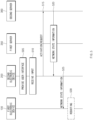
- the invention is shown in figure 8 .
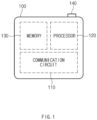
- FIG. 1 is a view illustrating the configuration of a first electronic device, according to an embodiment.
- a first electronic device 100 may be an electronic device making wireless communication through an IoT network.
- the first electronic device 100 may be referred as bandwidth reduced low complexity user equipment (BLUE), narrowband internet-of-things (NB loT) UE, cellular IoT UE, a mobile IoT device, or another term having the same technical meaning as those of the terms.
- BLUE bandwidth reduced low complexity user equipment
- N loT narrowband internet-of-things
- cellular IoT UE cellular IoT UE
- mobile IoT device or another term having the same technical meaning as those of the terms.
- the first electronic device 100 may include a communication circuit 110, a processor 120, a memory 130, and a user interface 140.
- the components of the first electronic device 100 of FIG. 1 are provided only for the illustrative purpose, and the first electronic device 100 may further include other components not illustrated in FIG. 1 .
- the first electronic device 100 may further include an indicator exposed through a portion of a housing of the first electronic device 100.
- the first electronic device 100 may further include at least one of a motion sensor (not illustrated) or a location information obtaining unit.
- the processor 120 may be electrically and/or operatively connected with the memory 130, the communication circuit 110, the user interface 140, and another component illustrated in FIG. 1 .
- components e.g., the memory 130, the processor 120, and the communication circuit 110
- components may refer to components located inside the housing of the first electronic device 100.
- the communication circuit 110 may provide an interface for making communication with different entities (e.g., base stations included in the network).
- the communication circuit 110 may convert a bit string transmitted to the different entity into a physical signal and may convert a physical signal received from the different entity into a bit string.
- the communication circuit 110 may transmit and receive a signal. Accordingly, the communication circuit 110 may be referred to as a "transmitter", “receiver” or “transceiver”.
- the first electronic device 100 may support an LPWAN (e.g., NB-IoT network).
- the communication circuit 110 may transceive data with the network through a pre-determined frequency band.
- the pre-determined frequency band may be used as a portion of a frequency band used in another cellular network (e.g., long term evolution (LTE), a universal mobile telecommunication system (UMTS), or a global system for mobile communications (GSM)) (hereinafter, referred to as "In-Band”), may include a guard band used in another cellular network, or may be used as a frequency band or a dedicated frequency band used in another cellular network (hereafter, referred to as " standalone").
- LTE long term evolution
- UMTS universal mobile telecommunication system
- GSM global system for mobile communications
- the communication circuit 110 may make communication with the network through a limited bandwidth.
- the limited bandwidth may be narrower than that used in another cellular network and may be, for example, 20 MHz, 1.4 MHz, or 180 KHz.
- the communication circuit 110 may access a network (e.g., a cellular network, or a LPWAN) based on various communication standards, such as category-machine (Cat-M), narrowband-IoT (NB-IoT) or extended coverage GSM for IoT (EC-GSM).
- a network e.g., a cellular network, or a LPWAN
- Cat-M category-machine
- NB-IoT narrowband-IoT
- EC-GSM extended coverage GSM for IoT
- the LPWAN may include at least one of a NB-IoT network, a Cat-M network, or an EC-GSM network.
- the Cat-M may be referred to as Cat-M or LTE-M.
- the NB-IoT may be referred to as Cat-M2.
- the communication circuit 110 may transceive data through a wireless local area network (WLAN) (e.g., WiFi).
- WLAN wireless local area network
- the communication circuit 110 may communicate with an external server through a WLAN.
- the communication circuit 110 may communicate with an external electronic device through a short-range wireless network.
- the short-range wireless network may be a network based on Bluetooth, Bluetooth Low Energy (BLE), or near field communication (NFC).
- the communication circuit 110 may include a plurality of communication circuits.
- the communication circuit 110 may include a first wireless communication circuit configured to provide first wireless communication using LPWAN, a second wireless communication circuit configured to provide second wireless communication using a WAN (e.g., Wi-Fi), and a third wireless communication circuit configured to provide third wireless communication using low-power Bluetooth.
- the re-booting of the communication circuit 110 may include the re-booting of at least some communication circuits of the communication circuit 110.
- the processor 120 may include at least one processor.
- the processor 120 may include at least one of an application processor or a cellular processor.
- the processor 120 may be run based on a program stored in the memory 130 of the first electronic device 100.
- the memory 130 may store instructions causing the processor 120 to perform various operations.
- the operation of the processor 120 may be performed in response to instructions stored in the memory 130.
- the processor 120 may be configured to control other components of the first electronic device 100. Unless otherwise specified in the following description, the operation of the first electronic device 100 may be referred to as the operation performed by the processor 120.
- the user interface 140 may include at least one physical button exposed through a portion of the housing of the first electronic device 100.
- the first electronic device 100 may not include a display. Accordingly, the first electronic device 100 may receive a user input only through the user interface 140.
- description will be made with reference to FIG. 2 regarding the configuration of an external electronic device that may communicate with the first electronic device 100 through a Bluetooth network or a BLE network.
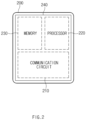
- FIG. 2 is a block diagram of a second electronic device, according to an embodiment.
- a second electronic device 200 may be the external electronic device making communication with the first electronic device 100 through a Bluetooth network or a BLE network.
- the second electronic device 200 may be referred to as a terminal, user equipment (UE), a mobile station, a subscriber station, a remote terminal, a wireless terminal, a user device, or another term having the same technical meaning as those of the above components.
- the second electronic device 200 may include a communication circuit 210, a processor 220, a memory 230, and a user display 240.
- the components of the second electronic device 200 of FIG. 2 are provided only for the illustrative purpose, and the second electronic device 200 may further include other components not illustrated in FIG. 2 .
- the processor 220 may be electrically and/or operatively connected with the memory 230, the communication circuit 210, the user display 240, and another component not illustrated in FIG. 2 .
- the communication circuit 210 may provide an interface for making communication with different entities (e.g., base stations included in the network).
- the communication circuit 210 may convert a bit string to be transmitted to the different entity into a physical signal and may convert a physical signal received from the different entity into a bit string.
- the communication circuit 210 may transmit and receive a signal. Accordingly, the communication circuit 210 may be referred to as a "transmitter", “receiver” or “transceiver”.
- the second electronic device 200 may support a cellular network.
- the communication circuit 210 may transceive data with the network through a pre-determined frequency band.
- the pre-determined frequency band may be used as a portion of a frequency band used in another cellular network (e.g., long term evolution (LTE), a universal mobile telecommunication system (UMTS), or a global system for mobile communications (GSM)) (hereinafter, referred to as "In-Band”), may include a guard band used in another cellular network, or may be used as a frequency band or a dedicated frequency band used in another cellular network (hereafter, referred to as " standalone").
- LTE long term evolution
- UMTS universal mobile telecommunication system
- GSM global system for mobile communications
- the communication circuit 210 may transceive data through a WLAN (e.g., WiFi).
- the communication circuit 210 may communicate with an external server through the WLAN.
- the communication circuit 210 may communicate with the first electronic device 100 through a short-range wireless network.
- the short-range wireless network may be a network based on Bluetooth, Bluetooth Low Energy (BLE), or near field communication (NFC).
- the communication circuit 210 may include a plurality of communication circuits.
- the communication circuit 210 may include a first wireless communication circuit configured to provide first wireless communication using LPWAN, a second wireless communication circuit configured to provide second wireless communication using a WAN (e.g., Wi-Fi), and a third wireless communication circuit configured to provide third wireless communication using low-power Bluetooth.
- a first wireless communication circuit configured to provide first wireless communication using LPWAN
- a second wireless communication circuit configured to provide second wireless communication using a WAN (e.g., Wi-Fi)
- a third wireless communication circuit configured to provide third wireless communication using low-power Bluetooth.
- the description of the processor 220 and the memory 230 may be understood by making reference to the description of the processor 120 and the memory 130 of FIG. 1 , respectively. For clarity, redundant details will not be repeated in the following description.
- the first electronic device 100 and the second electronic device 200 may communicate with each other through various networks.
- the connection between the first electronic device 100 and the second electronic device 200 under a network environment will be described with reference to FIG. 3 , according to various embodiments.
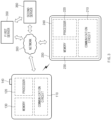
- FIG. 3 is a view illustrating a network environment supporting an IoT, according to various embodiments.
- Each component may be one entity and a set of multiple entities.
- the first electronic device 100 and the second electronic device 200 may communicate with a first server 350 and/or a second server 360 through a network 300.
- the network 300 may include one or more entities making communication with the first electronic device 100 and the second electronic device 200 through a wired/wireless channel.
- the network 300 may include at least one of a base station (e.g., an access point (AP), an eNodeB (eNB), a 5G node ( 5 th generation node), a wireless point, a transmission/reception point (TRP), a 5GNB (5 th generation NodeB) or another term having the same technical meaning as those of the above components), a mobility management entity (MME), a gateway (GW), a home subscriber server (HSS), and a service capability exposure function (SCEF).
- a base station e.g., an access point (AP), an eNodeB (eNB), a 5G node ( 5 th generation node), a wireless point, a transmission/reception point (TRP), a 5GNB (5 th generation NodeB) or another term having the same technical meaning as those of the above components
- MME mobility management entity
- GW gateway
- HSS home subscriber server
- SCEF service capability exposure function
- the network 300 may correspond to a cellular
- the first electronic device 100 and the second electronic device 200 may communicate with the first server 350 and/or the second server 360 through a WLAN (e.g., a WiFi network).
- a WLAN e.g., a WiFi network
- the first electronic device 100 and the second electronic device 200 may communicate with each other through a network 310.
- the network 310 may correspond to a short-range wireless network (e.g., Bluetooth, Bluetooth Low Energy (BLE), or a network based on near field communication (NFC)).
- the network 310 may be referred to as a network (e.g., a communication link) that is constructed between the first electronic device 100 and the second electronic device 200 without the invention of another network entity.
- the first server 350 may be a relay server between the second electronic device 200 and the second server 360.
- the first server 350 may receive, from the second electronic device 200, information (e.g., information used for identifying the first electronic device 100) associated with the first electronic device 100 and may transmit the received information to the second server 360.
- the first server 350 may transmit, to the second server 360, a request (e.g., a sign-in request, a sign-out request, or a state information request), which is associated with the first electronic device 100, received from the second electronic device 200.
- the first server 350 may transmit, to the second electronic device 200, a response to the request, which is associated with the first electronic device 100, received from the second server 360.
- the first server 350 may determine a service provider, based on the identification information of the first electronic device 100. For example, the first server 350 may determine the second server 360 as a server corresponding to the determined service provider. The management of an IoT device (e.g., the first electronic device 100) for various service providers may be efficiently performed, by using the request associated with the first electronic device 100 through the first server 350.
- an IoT device e.g., the first electronic device 100
- the first server 350 may be configured to process the request associated with the loT device (e.g., the first electronic device 100).
- the first server 350 may include a database having information (at least one of identification information or state information) associated with the IoT device.
- the first server 350 may be a work with smart things cloud server (e.g., Samsung IoT cloud server).
- the first server 350 may be connected with the second server 360 while maintaining security.
- the first electronic device 100 and the second electronic device 200 may communicate with each other through the first server 350.
- the first server 350 may include a database including account information associated with the second electronic device 200.
- an account associated with the second electronic device 200 may be associated with a plurality of electronic devices.
- the account associated with the second electronic device 200 may be associated with the first electronic device 100.
- the account may be associated with a user and a plurality of electronic devices (e.g., the first electronic device 100 and the second electronic device 200) may be registered in the account associated with the user.
- the first server 350 may manage one or more electronic devices through one account.
- the second server 360 may correspond to a service provider server of a cellular network (e.g., the network 300).
- the second server 360 may be configured to manage sign-in information, registration information, or status information of an electronic device (e.g., the first electronic device 100 and the second electronic device 200).
- the second server 360 may receive, from the first server 350, a request (e.g., a sign-in request, a sign-out request, or a state information request), which is associated with the first electronic device 100.
- the second server 360 may transmit, to the first server 350, a response to the request associated with the first electronic device 100.
- the first electronic device 100 may include only a simple physical button (e.g., the user interface 140) without including a display.
- the first electronic device 100 may obtain information (hereinafter, referred to as "network state information") on a network state only by using the simple physical button.
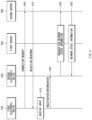
- FIG. 4 is a flowchart illustrating a method of obtaining the network state information, according to an embodiment.
- the first electronic device 100 is not registered (unregistered state) in an LPWAN (e.g., the network 300) at the initial stage.
- the first electronic device 100 is connected with the second electronic device 200 through a short-range wireless network (e.g., the network 310).
- operations illustrated in FIG. 4 may be performed in a procedure of registering the first electronic device 100 in the second electronic device 200.
- the first electronic device 100 may transmit a connection request to a service provider server (e.g., the second server 360) of the LPWAN through the LPWAN (e.g., the network 300) using a communication circuit 110.
- the connection request may be an attach request.
- the first electronic device 100 may perform the attach request by transmitting a request to a base station provided by a service provider of the LPWAN by using communication information (e.g., an international mobile subscriber identity (IMSI) recorded in an embedded subscriber identity module (eSIM)) stored in the first electronic device 100.
- IMSI international mobile subscriber identity
- eSIM embedded subscriber identity module
- the base station may obtain information on an activation state (e.g., subscription state) associated with communication information from the service provider server (e.g., the second server 360) by using the communication information included in the attach request.
- the service provider server may transmit a reject response to the first electronic device 100 through the base station when the activation information associated with communication information is not present (e.g., inactive or unregistered state).
- the first electronic device 100 may transmit a connection request to the second server 360 when the first electronic device 100 may be turned on or may have data to be transmitted.
- the first electronic device 100 may periodically transmit the connection request to the second server 360.
- the first electronic device 100 may provide, through an indicator (e.g., the LED unit), a notification of indicating that the first electronic device 100 is unregistered in the LPWAN.
- the first electronic device 100 may receive the rejection response from the second server 360 through the LPWAN (e.g., the network 300) by using the communication circuit 110.
- the rejection response may be an attach reject.
- the rejection response may include information on a cause of the rejection. The cause of the rejection may directly or indirectly indicate that the first electronic device 100 is not registered in the LPWAN.
- the first electronic device 100 may stay in a standby state. For example, since the first electronic device 100 does not include a display to display the detailed information, the state information of the first electronic device 100 may be provided for a user through the second electronic device 200.
- the first electronic device 100 and the second electronic device 200 may communicate with each other through a short-range wireless network (e.g., the network 310).
- the first electronic device 100 and the second electronic device 200 may be connected with each other based on a short-range wireless network technology (e.g., a Bluetooth, BLE, or NFC).
- a short-range wireless network technology e.g., a Bluetooth, BLE, or NFC
- the first electronic device 100 may receive a user input. Accordingly, the first electronic device 100 may receive the user input only through the user interface 140. According to an embodiment, the user input may be applied to perform a procedure of pairing between the first electronic device 100 and the second electronic device 200. For example, the second electronic device 200 may transmit, to the first electronic device 100, a message for pairing. According to an embodiment, the first electronic device 100 may provide a notification through an indicator to correspond to the reception of the message for pairing. According to an embodiment, after providing the notification, the first electronic device 100 may receive the user input through the user interface 140.
- the first electronic device 100 may transmit, to the second electronic device 200, registration information (e.g., information including at least one of international mobile equipment identity (IMEI), an integrated circuit card identifier (ICCID), an international mobile scriber identity (IMSI), or a serial number) including identification information of the first electronic device 100 through a short-range wireless network (e.g., the network 310).
- registration information e.g., information including at least one of international mobile equipment identity (IMEI), an integrated circuit card identifier (ICCID), an international mobile scriber identity (IMSI), or a serial number
- IMEI international mobile equipment identity
- ICCID integrated circuit card identifier
- IMSI international mobile scriber identity
- serial number e.g., a serial number
- the first electronic device 100 may transmit, to the second electronic device 200, the registration information in the form of a plain text.
- the first electronic device 100 may have identification information of the first electronic device 100 set in the manufacturing process of the first electronic device 100.
- the first electronic device 100 may receive, from the first server 350, registration information created based on the identification information of the first electronic device 100.
- the first server 350 may receive the identification information from the first electronic device 100 and may create the registration information based on the identification information.
- the registration information may be encrypted by the first server 350.
- the second electronic device 200 may not decrypt the encrypted registration information.
- the first server 350 may decrypt the encrypted registration information.
- the second electronic device 200 may transmit a request for the network state information to the second server 360 through the first server 350.
- the second electronic device 200 may transmit, to the first server 350, the request for the network state information through a cellular network (e.g., the network 300) or a WLAN by using the communication circuit 210.
- the first server 350 may transmit the request for the network state information to the second server 360.
- the first server 350 may transmit the request for the network state information to the second server 360 while maintaining security.
- the request for the network state information may include the registration information of the first electronic device 100.
- the second electronic device 200 may transmit the request for the network state information including the encrypted identifier to the first server 350.
- the first server 350 may decrypt the encrypted identifier.
- the first server 350 may determine a service provider associated with the first electronic device 100 based on the registration information of the first electronic device 100.
- the first server 350 may determine the service provider based on a country code (e.g., mobile country code) and a network code (e.g., a mobile network code) included in the registration information of the first electronic device 100.
- the first server 350 may transmit the request for the network state information to the second server 360, based on the determined service provider.
- the request for the network state information may include the registration information of the first electronic device 100.
- the first server 350 may decrypt the encrypted identifier and may transmit registration information including the decrypted identifier to the second server 360 through the network state information.
- the second server 360 may transmit the network state information to the second electronic device 200 through the first server 350.
- the second server 360 may transmit, to the first server 350, the network state information of the first electronic device 100.
- the second server 360 may transmit the network state information to the first server 350 while maintaining security.
- the first server 350 may transmit, to the second electronic device 200, the received network state information through a cellular network (e.g., the network 300) or a WLAN.
- the network state information may include information associated with the sign-in state of the first electronic device 100 to the network.
- the network state information include information indicating that the first electronic device 100 is unregistered, inactive, active, or in pending.
- the network state information may include at least one of a uniform resource locator (URL) or an application identifier for the registration/activation of the first electronic device 100 in the LPWAN.
- URL uniform resource locator
- the second electronic device 200 may transmit at least a portion of the network state information to the first electronic device 100 through a short-range communication network (e.g., the network 310).
- a short-range communication network e.g., the network 310
- the second electronic device 200 when receiving the network state information, may display a user interface on the display 240 based on the network state information.
- the first electronic device 100 has to be signed in to a network service provider to transmit/receive data through the cellular network (e.g., the network 300).
- the first electronic device 100 may include only a simple physical button (e.g., the user interface 140) without including a display.
- the second electronic device 200 may receive information on the registration/activation of the first electronic device 100 through the user interface.
- a method of activating (e.g., registering) the first electronic device 100 will be described with reference to FIG. 5 .
- FIG. 5 is a flowchart illustrating a sign-in method to a network (hereinafter, referred to as "network sign-in method"), according to an embodiment.
- the first electronic device 100 and the second electronic device 200 may communicate with each other through a short-range wireless network (e.g., the network 310).
- the first electronic device 100 may be paired with the second electronic device 200.
- the network sign-in method to be described below may be performed in a procedure (e.g., Samsung Easy Setup, Samsung Connect or Application for registration) of registering the first electronic device 100 in the second electronic device 200.
- the second electronic device 200 e.g., the processor 220
- a short-range wireless network technology e.g., Bluetooth, BLE, or NFC
- the second electronic device 200 may display an external electronic device (e.g., the first electronic device 100), which is searched, on a user interface of the display 240.
- the second electronic device 200 may receive a user input for the first electronic device 100 and may be paired with the first electronic device 100 based on the short-range wireless network technology.
- the second electronic device 200 may transmit a pairing request message to the first electronic device 100 through the short-range wireless network using the communication circuit 210.
- the first electronic device 100 e.g., the processor 120
- the first electronic device 100 may transmit, to the second electronic device 200, registration information (e.g., information including at least one of IMEI, an ICCID, an IMSI, or a serial number) including identification information of the first electronic device 100 through the short-range wireless network by using the communication circuit 110.
- registration information e.g., information including at least one of IMEI, an ICCID, an IMSI, or a serial number
- the second electronic device 200 may request for network state information of the first electronic device 100 (e.g., operation 430 of FIG. 4 ) by using the registration information of the first electronic device 100 and receive the network state information (e.g., operation 435 of FIG. 4 ).
- the second electronic device 200 may register the first electronic device 100 in a database of the first server 350 by using the registration information of the first electronic device 100.
- the second electronic device 200 may register the first electronic device 100 in an account associated with the second electronic device 200, which is included in the first server 350.
- the second electronic device 200 may obtain, from the first server 350, information for the access to the first server 350 by the first electronic device 100.
- the second electronic device 200 may obtain an authentication code of the first electronic device 100 from the account associated with the second electronic device 200 and may request the first server 350 to provide an access token to the first electronic device 100 by using the obtained authentication code.
- the second electronic device 200 may receive the access token provided from the first server 350 and may transmit the access token to the first electronic device 100.
- the network state information may represent the state that the first electronic device 100 is unregistered or inactive.
- the second electronic device 200 may provide, for a user, a user interface for the registration or the activation of the first electronic device 100.
- the second electronic device 200 may provide a user interface for activation (e.g., registration) of the first electronic device 100 on the display 240.
- the user interface may be provided based on the network state information.
- the network state information may represent the state that the first electronic device 100 is unregistered or inactive.
- the network state information may include an URL or an application identifier for the registration or the activation of the first electronic device 100.
- the second electronic device 200 may display, on the display 240, a web-page, which corresponds to the URL included in the network state information, serving as a user interface through the web-browser.
- the second electronic device 200 may display, on the display 240, the user interface by executing an application (e.g., Samsung Connect or a specified Application) corresponding to the application identifier included in the network state information.
- an application e.g., Samsung Connect or a specified Application
- the second electronic device 200 may provide a user interface on the display 240 by using a specified application (e.g., Samsung Connect or Application for registration) or a specified web-page.
- the second electronic device 200 may receive a user input to the user interface.
- the second electronic device 200 may obtain a selection of information for user authentication (e.g., information for identifying the user) or information on a payment system of the first electronic device 100 through the user input.
- the second electronic device 200 may transmit a request for activation to the second server 360 through a cellular network (e.g., the network 300) or WLAN (e.g., WiFi) by using the communication circuit 210.
- the request for the activation may include at least one of registration information of the first electronic device 100, information for user authentication, or information on a payment system of the first electronic device 100.
- the second server 360 may be a service provider server of a service provider different for a service provider in which the second electronic device 200 is signed in.
- the second electronic device 200 may receive the network state information from the second server 360 through the first server 350.
- the second server 360 may process the activation of the first electronic device 100 based on the received activation request and may transmit, to the first server 350, network state information including the activation result.
- the second server 360 may transmit the network state information to the first server 350 while maintaining security.
- the first server 350 may transmit the received network state information to the second electronic device 200 through the cellular network (e.g., a network 300) or a WLAN (e.g., Wi-Fi).
- the network state information may represent that the first electronic device 100 is registered, active, or in pending.
- the second electronic device 200 may display the received network state information on the display 240.
- the second electronic device 200 may transmit the network state information to the first electronic device 100 through a short-range wireless network using the communication circuit 210. According to an embodiment, the second electronic device 200 may transmit, to the first electronic device 100, a message indicating that a network is available.
- the first electronic device 100 when receiving, from the second electronic device 200, the message (e.g., the network state information) indicating that the network is available, the first electronic device 100 (e.g., the processor 120) may reboot at least a portion of the first electronic device 100.
- the first electronic device 100 may reboot the communication circuit 110.
- the second electronic device 200 may transmit, to the first electronic device 100, information directing the rebooting of the first electronic device 100.
- the second electronic device 200 may display, on the display 240, information guiding the rebooting of the first electronic device 100.
- the first electronic device 100 may transmit a request for access to an LPWAN (e.g., the network 300).
- the rebooting of the first electronic device 100 may be omitted.
- the rebooting of the communication circuit 110 may include the re-booting of at least a portion of the communication circuit 110.
- the first electronic device 100 may access to the first server 350 through the LPWAN (e.g., the network 300).
- the first electronic device 100 may access the first server 350 by using the access token of the first electronic device 100, which is received from the second electronic device 200.
- the access token of the first electronic device 100 may be obtained from the second electronic device 200 in the procedure of registering the first electronic device 100 to the second electronic device 200.
- the first electronic device 100 may access the account associated with the second electronic device 200, which is included in the first server 350 by using the access token.
- the first electronic device 100 may sign in or log in the account associated with the second electronic device 200.
- the information on the access to the first server 350 by the first electronic device 100 may be provided through the second electronic device 200.
- the sign-in/registration of the first electronic device 100 may be performed through the second electronic device 200 and the first server 350.
- the activation information for signing in the first electronic device 100 may be received from a user by using the second electronic device 200.
- various requirements of various service providers e.g., the second server 360
- the procedure of signing out the first electronic device 100 may be performed through a similar mechanism.
- FIG. 6 is a flowchart illustrating a sign-out method, according to an embodiment.
- the second electronic device 200 may transmit, to the second server 360, a request for sign-out of the first electronic device 100 through a cellular network (e.g., the network 300) or the WLAN (e.g., Wi-Fi) by using the communication circuit 210.
- the second electronic device 200 may display a user interface for receiving the request for sign-out on the display 240.
- the user interface for receiving the request for sign-out may be provided through a specified application (e.g., Samsung Connect or Application for registration) or a web-page.
- the second electronic device 200 may receive sign-out result information from the second server 360 through the first server 350.
- the second server 360 may process the sign-out of the first electronic device 100 based on the received sign-out request and may transmit, to the first server 350, the sign-out result information.
- the second server 360 may transmit information on a sign-out result state to the first server 350 while maintaining security.
- the first server 350 may transmit the received the sign-out result information to the second electronic device 200 through the cellular network (e.g., the network 300) or a WLAN (e.g., Wi-Fi).
- the first server 350 may delete at least a portion of data, which is associated with the first electronic device 100, from the account associated with the second electronic device 200.
- the first server 350 may delete the at least a portion of data associated with the first electronic device 100.
- the second electronic device 200 may deactivate the first electronic device 100 by deleting the first electronic device 100 from the second electronic device 200.
- the deactivation of the first electronic device 100 may include the deactivation (e.g., the release from registration, or deletion) of the first electronic device 100 on a specified application (e.g., Samsung Connect) or the deletion of plug-in corresponding to the first electronic device 100 on the specified application (e.g., Samsung Connect).
- the deactivation of the first electronic device 100 may include the deletion of an application associated with the sign-in or the sign-out of the first electronic device 100.
- the second electronic device 200 may display the sign-out result information on the display 240.
- operation 615 may be omitted.
- the first server 350 may delete the at least a portion of data associated with the first electronic device 100 from the account associated with the second electronic device 200.
- the second electronic device 200 may transmit, to the first server 350, information on the deactivation of the first electronic device 100 in addition to the deactivation of the first electronic device 100.
- the first server 350 may delete the at least a portion of data associated with the first electronic device 100.
- the second electronic device 200 may transmit the sign-out result information to the first electronic device 100 through the short-range wireless network (e.g., Bluetooth, BLE, or NFC) using the communication circuit.
- the short-range wireless network e.g., Bluetooth, BLE, or NFC
- the first electronic device 100 may provide, through an indicator, a notification corresponding to the reception of the sign-out result information.
- the first electronic device 100 may be initialized.
- the first electronic device 100 may be initialized when receiving the sign-out result information from the second electronic device 200.
- the first electronic device 100 may perform an initialization of the first electronic device 100 based on receiving a direction corresponding to the initialization from the second electronic device 200 or based on a preset input to the interface 140.
- FIG. 7 is a flowchart illustrating a method for receiving notification information, according to an embodiment.
- the second electronic device 200 may receive notification information from the second server 360 through the first server 350.
- the second server 360 may transmit the notification information to the first server 350.
- the second server 360 may transmit the notification information to the first server 350 while maintaining security.
- the first server 350 may transmit the received notification information to the second electronic device 200 through the cellular network (e.g., the network 300) or the WLAN (e.g., Wi-Fi).
- the notification information may include warning information (e.g., warning about the usage of data) or information (e.g., tariiff expiration) on the deactivation of the first electronic device
- the second electronic device 200 may display the received notification information on the display 240.
- the notification for the first electronic device 100 may be provided for a user through the second electronic device 200.
- the second electronic device 200 may transmit the network state information to the first electronic device 100 through the short-range wireless network (e.g., the network 310) using the communication circuit 210.
- the network state information may include information the sign-out or the cancelling of the activation of the first electronic device 100.
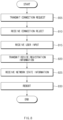
- FIG. 8 is a flowchart illustrating a method for signing in the first electronic device 100 to a network, according to an embodiment.
- the first electronic device 100 may transmit, to an LPWAN, a request for connection to the LPWAN through the LPWAN (e.g., the network 300).
- the request for the connection to the LPWAN may correspond to an attach request.
- the description of operation 805 may be understood by making reference to the description of operation 405 made with reference to FIG. 4 .
- the first electronic device 100 may receive a response indicating a rejection of the request from the LPWAN.
- the LPWAN may include at least one of a NB-IoT network, a Cat-M network, or an EC-GSM network.
- the response may correspond to an attach reject.
- the description of operation 810 may be understood by making reference to the description of operation 410 made with reference to FIG. 4 .
- the first electronic device 100 may receive a user input through the user interface 140.
- the user interface 140 may include a button (e.g., a physical button) and may not include a display.
- the description of operation 815 may be understood by making reference to the description of operation 415 made with reference to FIG. 4 .
- the first electronic device 100 may provide, to an external electronic device (e.g., the second electronic device 200), device registration information through the BLE.
- the device registration information may include at least one of IMEI, an ICCID, IMSI, or a serial number.
- the device registration information may be obtained from an eSIM of the first electronic device 100.
- the description of operation 820 may be understood by making reference to the description of operation 425 made with reference to FIG. 4 .
- the first electronic device 100 may receive the network state information from the external electronic device (e.g., the second electronic device 200).
- the network state information may include information representing at least one of an unregistered state, an inactive state, an active state, a pending state, an URL, or an application identifier.
- the description of operation 825 may be understood by making reference to the descriptions of operation 430 and operation 435 made with reference to FIG. 4 .
- the first electronic device 100 may reboot.
- the first electronic device 100 may reboot when the network state information is received.
- the rebooting of the first electronic device 100 may include the re-booting of at least a portion of the communication circuit 110.
- the first electronic device 100 is rebooted, only the RF circuit of the communication circuit 110 may be rebooted.
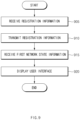
- FIG. 9 is a flowchart illustrating a method of obtaining network state information of the second electronic device 200, according to an embodiment.
- the second electronic device 200 may receive, from a first external electronic device (e.g., the first electronic device 100), registration information including an identifier (e.g., IMEI, ICCID, IMSI, or a serial number) of the first external electronic device through a short-range wireless network (e.g., the network 300) using the communication circuit 210.
- the registration information may include an encrypted identifier.
- the first external electronic device may be an LPWAN (e.g., a NB-IoT network, a Cat-M network, or an EC-GSM network) user device.
- the description of operation 905 may be understood by making reference to the description of operation 425 made with reference to FIG. 4 .
- the second electronic device 200 may transmit information for registering the first external electronic device to a second external electronic device (e.g., the first server 350) through a cellular network (e.g., the network 300) or a WLAN (e.g., WiFi) using the communication circuit 210.
- the registration information may be transmitted through the request for the network state information.
- the second electronic device 200 may receive first network state information of the first external electronic device from the second external electronic device through the cellular network (e.g., the network 300) or a WLAN (e.g., WiFi) using the communication circuit 210.
- the first network state information may include at least one of an indicator for indicating an inactive state of the first external electronic device, a uniform resource locator (URL) for the activation of the first external electronic device, or an application identifier.
- an indicator for indicating an inactive state of the first external electronic device
- a uniform resource locator URL
- the descriptions of operation 910 and operation 915 may be understood by making reference to the descriptions of operation 430 and operation 435 made with reference to FIG. 4 .
- the second electronic device 200 may display, on the display 240, a user interface for the registration of the first external electronic device to the cellular network (e.g., LPWAN) based at least on the first network state information.
- the description of operation 920 may be understood by making reference to the description of operation 505 made with reference to FIG. 5 .
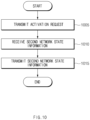
- FIG. 10 is a flowchart illustrating a method for signing in a second electronic device to a network, according to an embodiment.
- the second electronic device 200 may receive a user input through the user interface provided in operation 920 of FIG. 9 .
- the second electronic device 200 may obtain a selection of information for user authentication (e.g., information for identifying the user) or information on a payment system of the first external electronic device (e.g., the first electronic device 100) through the user input.
- information for user authentication e.g., information for identifying the user
- information on a payment system of the first external electronic device e.g., the first electronic device 100
- the second electronic device 200 may transmit, to the service provider server (e.g., the second server 360), a request for the activation of the first external electronic device based at least on registration information of the first external electronic device and the user input through a cellular network (e.g., the network 300) or an WLAN (e.g., WiFi) using the communication circuit 210.
- the service provider server e.g., the second server 360
- a request for the activation of the first external electronic device based at least on registration information of the first external electronic device and the user input through a cellular network (e.g., the network 300) or an WLAN (e.g., WiFi) using the communication circuit 210.
- a cellular network e.g., the network 300
- WLAN e.g., WiFi
- the second electronic device 200 may receive second network state information corresponding to the request for the activation through a cellular network (e.g., the network 300) or a WLAN (e.g., WiFi) using the communication circuit 210.
- the second network state information may include information (e.g., the activation, the registration, or the standby of the first external electronic device) representing the result of the request of the activation.
- the description of operation 1010 may be understood by making reference to the description of operation 520 made reference to FIG. 5 .
- the second electronic device 200 may transmit the second network state information to the first external electronic device through a short-range wireless network (e.g., network 300) using the communication circuit 210.
- a short-range wireless network e.g., network 300
- the description of operation 1015 may be understood by making reference to the description of operation 525 made with reference to FIG. 5 .
- FIG. 11 illustrates the reception of the user input according to an embodiment.
- the first electronic device 100 may include the user interface 140 and an indicator 150 exposed through a portion of a housing of the first electronic device 100.
- the user interface 140 may include at least one physical button.
- the user interface 140 may include at least one physical button capable of receiving at least one of a push input or a touch input.
- a user input 1100 may include a click, a double click, a touch, and a hold for a specified time or more of a user interface 140.
- the indicator 150 may include a light emitting diode (LED) module.
- the indicator 150 may be configured to out at least one color.
- the indicator 150 may provide a notification to a user, based on the output (e.g., the switch on and off) of light and/or the color of the output light.
- a notification may be provided for a user through the indicator 150.
- information for requesting the user input 1100 to the user interface 140 may be displayed on the display 240 of the second electronic device 200.
- the second electronic device 200 e.g., the processor 220
- the second electronic device 200 may be display, on the display 240, at least one of a text or graphic (e.g., an image similar to an image illustrated in FIG. 11 ) for requesting the user input 1100.
- the user input 1100 may be received in the procedure of the pairing between the first electronic device 100 and the second electronic device 200.
- the user input 1100 may be received corresponding to the reception of a message for requesting the pairing.
- the first electronic device 100 may transmit the registration information to the second electronic device 200.
- the IoT electronic device e.g., the first electronic device 100
- an external electronic device e.g., the second electronic device 200
- an electronic device e.g., the first electronic device 100
- the electronic device may include a first wireless communication circuit (e.g., a physical or logical component inside the communication circuit 110) to provide first wireless communication using a lower power wide area network (LPWAN), a second wireless communication circuit (e.g., a physical or logical component inside the communication circuit 110) to provide second wireless communication by using Wi-Fi, a third wireless communication circuit (e.g., a physical or logical component inside the communication circuit 110) to provide third wireless communication by using Bluetooth Low Energy (BLE), a user interface (e.g., the interface 140), a processor (e.g., the processor 120), and a memory (e.g., the memory 130).
- LPWAN lower power wide area network
- BLE Bluetooth Low Energy
- a user interface e.g., the interface 140
- a processor e.g., the processor 120
- a memory e.g., the memory 130
- the processor may be electrically connected with the first, second, and third wireless communication circuits, the user interface, and the memory.
- the memory stores instructions that, when executed, may cause the processor to transmit a request for access to a network to the LPWAN through the first wireless communication circuit, to receive a response indicating a rejection of the request from the LPWAN through the first wireless communication circuit, to receive a user input through the user interface after receiving the response, to provide device registration information to an external mobile device (e.g., the second electronic device 200) by using the third communication circuit when the user input is received, to receive network state information from the external mobile device after providing the device registration information, and to reboot the electronic device.
- an external mobile device e.g., the second electronic device 200
- the user interface may include a button and a display may be absent in the user interface.
- the device registration information may include at least one of an IMEI, an ICCID, an IMSI, or a serial number.
- the network state information may include information on at least one of an unregistered state, an inactive state, an active state, a pending state, a uniform resource locator for registration of the electronic device (e.g., the first electronic device 100), or an application identifier for registration of the electronic device.
- the LPWAN may include at least one of an LTE-M network, a NB IoT network, and an EC-GSM network.
- the rebooting of the electronic device may include rebooting of at least a portion of a wireless communication circuit at least including the first wireless communication circuit, the second wireless communication circuit, and the third wireless communication circuit.
- an internet of things (IoT) device e.g., the first electronic device 100
- IoT internet of things
- a communication circuit e.g., the communication circuit 110
- BLE second wireless communication employing BLE
- a physical button e.g., the interface 140
- an indicator e.g., the indicator 150
- a processor e.g., the processor 120
- the processor is configured to receive a first message from an external mobile device (e.g., the second electronic device 200) through the second wireless communication by using the communication circuit, to display a notification indicating reception of the first message through the indicator, to receive a user input to the physical button after displaying the notification, and to transmit, to the external mobile device, device registration information through the second wireless communication by using the communication circuit, so as to register the IoT device in the LPWAN, when the user input is received, to receive a second message associated with the LPWAN from the external mobile device through the second wireless communication by using the communication circuit, after transmitting the device registration information, and to access the LPWAN through the second wireless communication by using the communication circuit, based at least on the second message.
- an external mobile device e.g., the second electronic device 200
- the processor is configured to receive a first message from an external mobile device (e.g., the second electronic device 200) through the second wireless communication by using the communication circuit, to display a notification indicating reception of the first message through the indicator, to receive
- the communication circuit may be further configured to provide third wireless communication using a WLAN.
- the processor may be configured to transmit, to the LPWAN, a request for an access to the LPWAN through the first wireless communication by using the communication circuit and to receive a response indicating a rejection of the request from the LPWAN through the first wireless communication circuit by using the communication circuit.
- the response indicating the rejection may include clause information indicating that the loT device is in an unregistered state in the LPWAN.
- the indicator may include at least one light emitting diode (LED).
- the processor may be configured to reboot at least a portion of the communication circuit when the second message is received.
- the second message may include at least one of information on the registration of the IoT device in the LPWAN or information on an activation state of the IoT device in the LPWAN.
- the device registration information may include at least one of an IMEI, an ICCID, an IMSI, or a serial number.
- an electronic device e.g., the second electronic device 200
- a communication circuit e.g., the communication circuit 210) to provide first wireless communication using a cellular network, second wireless communication using a WLAN, and third wireless communication using BLE
- a display e.g., the display 240
- a processor e.g., the processor 220
- the processor may be configured to receive registration information including an identifier of the first external electronic device through the third wireless communication from the first external electronic device (e.g., the first electronic device 100) by using the communication circuit, to transmit, to the second external electronic device (e.g., the first server 350), the registration information through the first wireless communication or the second wireless communication, by using the communication circuit, to receive, from the second external electronic device, first network state information of the first external electronic device through the first wireless communication or the second wireless communication, by using the communication circuit, and to display, on the display, a user interface for registration of the first external electronic device in an LPWAN based at least on the first network state information.
- the first network state information may include at least one of an indicator indicating that the first external electronic device is an inactive state, a uniform resource locator (URL) for activation of the first external electronic device, or an application identifier.
- the second external electronic device may be connected with a service provider server (e.g., the second server 360) while maintaining security.
- the processor may be configured to receive a user input through the user interface, to transmit, to the service provider server, a request for activation of the first external electronic device, based at least on the registration information and the user input through the first wireless communication or the second wireless communication, by using the communication circuit, to receive, from the second external electronic device, second network state information, which corresponds to an activation request, through the first wireless communication or the second wireless communication, by using the communication circuit, and to transmit, to the first external electronic device, the second network state information through the third wireless communication by using the communication circuit.
- the processor may be configured to transmit, to the service provider server, a request for sign-out of the first external electronic device through the first wireless communication or the second wireless communication, by using the communication circuit, to receive, from the second external electronic device, sign-out result information through the first wireless communication or the second wireless communication, by using the communication circuit, and to transmit, to the first external electronic device, the sign-out result information through the third wireless communication by using the communication circuit.
- the identifier of the first external electronic device may include at least one of an IMEI, an ICCID, an IMSI, or a serial number.
- the LPWAN may include at least one of an LTE-M network, a NB IoT network, and an EC-GSM network.
- FIG. 12 is a block diagram of an electronic device 1201 (e.g., the first electronic device 100 or the second electronic device 200) in a network environment 1200 according to various embodiments.
- the electronic device 1201 may communicate with an electronic device 1202 through a first network 1298 (e.g., a short-range wireless network 310) or may communicate with an electronic device 1204 or a server 1208 (e.g., the first server 350 or the second server 360) through a second network 1299 (e.g., a long-distance wireless communication) (e.g., the network 300) in the network environment 1200.
- the electronic device 1201 may communicate with the electronic device 1204 through the server 1208.
- the electronic device 1201 may include a processor 1220 (e.g., the processor 120 or the processor 22), a memory 1230 (e.g., the memory 110 or the memory 210), an input device 1250, a sound output device 1255, a display device 1260, an audio module 1270, a sensor module 1276, an interface 1277 (e.g., the user interface 140), a haptic module 1279, a camera module 1280, a power management module 1288, a battery 1289, a communication module 1290 (e.g., the communication circuit 110 or the communication circuit 210), a subscriber identification module 1296, and an antenna module 1297.
- a processor 1220 e.g., the processor 120 or the processor 22
- a memory 1230 e.g., the memory 110 or the memory 210
- an input device 1250 e.g., a sound output device 1255, a display device 1260, an audio module 1270, a sensor module 1276, an interface 1277 (e.g
- At least one (e.g., the display device 1260 or the camera module 1280) among components of the electronic device 1201 may be omitted or other components may be added to the electronic device 1201.
- some components may be integrated and implemented as in the case of the sensor module 1276 (e.g., a fingerprint sensor, an iris sensor, or an illuminance sensor) embedded in the display device 1260 (e.g., a display).
- the processor 1220 may operate, for example, software (e.g., a program 1240) to control at least one of other components (e.g., a hardware or software component) of the electronic device 1201 connected to the processor 1220 and may process and compute a variety of data.
- the processor 1220 may load a command set or data, which is received from other components (e.g., the sensor module 1276 or the communication module 1290), into a volatile memory 1232, may process the loaded command or data, and may store result data into a nonvolatile memory 1234.
- the processor 1220 may include a main processor 1221 (e.g., a central processing unit or an application processor) and an auxiliary processor 1223 (e.g., a graphic processing device, an image signal processor, a sensor hub processor, or a communication processor), which operates independently from the main processor 1221, additionally or alternatively uses less power than the main processor 1221, or is specified to a designated function.
- the auxiliary processor 1223 may operate separately from the main processor 1221 or embedded.
- the auxiliary processor 1223 may control, for example, at least some of functions or states associated with at least one component (e.g., the display device 1260, the sensor module 1276, or the communication module 1290) among the components of the electronic device 1201 instead of the main processor 1221 while the main processor 1221 is in an inactive (e.g., sleep) state or together with the main processor 1221 while the main processor 1221 is in an active (e.g., an application execution) state.
- the auxiliary processor 1223 e.g., the image signal processor or the communication processor
- the auxiliary processor 1223 may be implemented as a part of another component (e.g., the camera module 1280 or the communication module 1290) that is functionally related to the auxiliary processor 1223.
- the memory 1230 may store a variety of data used by at least one component (e.g., the processor 1220 or the sensor module 1276) of the electronic device 1201, for example, software (e.g., the program 1240) and input data or output data with respect to commands associated with the software.
- the memory 1230 may include the volatile memory 1232 or the nonvolatile memory 1234.
- the program 1240 may be stored in the memory 1230 as software and may include, for example, an operating system 1242, a middleware 1244, or an application 1246.
- the input device 1250 may be a device for receiving a command or data, which is used for a component (e.g., the processor 1220) of the electronic device 1201, from an outside (e.g., a user) of the electronic device 1201 and may include, for example, a microphone, a mouse, or a keyboard.
- the sound output device 1255 may be a device for outputting a sound signal to the outside of the electronic device 1201 and may include, for example, a speaker used for general purposes, such as multimedia play or recordings play, and a receiver used only for receiving calls. According to an embodiment, the receiver and the speaker may be either integrally or separately implemented.
- the display device 1260 may be a device for visually presenting information to the user and may include, for example, a display, a hologram device, or a projector and a control circuit for controlling a corresponding device. According to an embodiment, the display device 1260 may include a touch circuitry or a pressure sensor for measuring an intensity of pressure on the touch.
- the audio module 1270 may convert a sound and an electrical signal in dual directions. According to an embodiment, the audio module 1270 may obtain the sound through the input device 1250 or may output the sound through an external electronic device (e.g., the electronic device 1202 (e.g., a speaker or a headphone)) wired or wirelessly connected to the sound output device 1255 or the electronic device 1201.
- an external electronic device e.g., the electronic device 1202 (e.g., a speaker or a headphone)
- the sensor module 1276 may generate an electrical signal or a data value corresponding to an operating state (e.g., power or temperature) inside or an environmental state outside the electronic device 1201.
- the sensor module 1276 may include, for example, a gesture sensor, a gyro sensor, a barometric pressure sensor, a magnetic sensor, an acceleration sensor, a grip sensor, a proximity sensor, a color sensor, an infrared sensor, a biometric sensor, a temperature sensor, a humidity sensor, or an illuminance sensor.
- the interface 1277 may support a designated protocol wired or wirelessly connected to the external electronic device (e.g., the electronic device 1202).
- the interface 1277 may include, for example, an HDMI (high-definition multimedia interface), a USB (universal serial bus) interface, an SD card interface, or an audio interface.
- a connecting terminal 1278 may include a connector that physically connects the electronic device 1201 to the external electronic device (e.g., the electronic device 1202), for example, an HDMI connector, a USB connector, an SD card connector, or an audio connector (e.g., a headphone connector).
- the external electronic device e.g., the electronic device 1202
- an HDMI connector e.g., a USB connector
- SD card connector e.g., an SD card connector
- an audio connector e.g., a headphone connector
- the haptic module 1279 may convert an electrical signal to a mechanical stimulation (e.g., vibration or movement) or an electrical stimulation perceived by the user through tactile or kinesthetic sensations.
- the haptic module 1279 may include, for example, a motor, a piezoelectric element, or an electric stimulator.
- the camera module 1280 may shoot a still image or a video image.
- the camera module 1280 may include, for example, at least one lens, an image sensor, an image signal processor, or a flash.
- the power management module 1288 may be a module for managing power supplied to the electronic device 1201 and may serve as at least a part of a power management integrated circuit (PMIC).
- PMIC power management integrated circuit
- the battery 1289 may be a device for supplying power to at least one component of the electronic device 1201 and may include, for example, a non-rechargeable (primary) battery, a rechargeable (secondary) battery, or a fuel cell.
- the communication module 1290 may establish a wired or wireless communication channel between the electronic device 1201 and the external electronic device (e.g., the electronic device 1202, the electronic device 1204, or the server 1208) and support communication execution through the established communication channel.
- the communication module 1290 may include at least one communication processor operating independently from the processor 1220 (e.g., the application processor) and supporting the wired communication or the wireless communication.
- the communication module 1290 may include a wireless communication module 1292 (e.g., a cellular communication module, a short-range wireless communication module, or a GNSS (global navigation satellite system) communication module) or a wired communication module 1294 (e.g., an LAN (local area network) communication module or a power line communication module) and may communicate with the external electronic device using a corresponding communication module among them through the first network 1298 (e.g., the short-range communication network such as a Bluetooth, a WiFi direct, Bluetooth low energy (BLE) or an IrDA (infrared data association)) or the second network 1299 (e.g., the long-distance wireless communication network such as a cellular network, an internet, or a computer network (e.g., LAN or WAN)).
- the above-mentioned various communication modules 1290 may be implemented into one chip or into separate chips, respectively.
- the wireless communication module 1292 may identify and authenticate the electronic device 1201 using user information stored in the subscriber identification module 1296 in the communication network.
- the antenna module 1297 may include one or more antennas to transmit or receive the signal or power to or from an external source.
- the communication module 1290 e.g., the wireless communication module 1292
- Some components among the components may be connected to each other through a communication method (e.g., a bus, a GPIO (general purpose input/output), an SPI (serial peripheral interface), or an MIPI (mobile industry processor interface)) used between peripheral devices to exchange signals (e.g., a command or data) with each other.
- a communication method e.g., a bus, a GPIO (general purpose input/output), an SPI (serial peripheral interface), or an MIPI (mobile industry processor interface) used between peripheral devices to exchange signals (e.g., a command or data) with each other.
- the command or data may be transmitted or received between the electronic device 1201 and the external electronic device 1204 through the server 1208 connected to the second network 1299.
- Each of the electronic devices 1202 and 1204 may be the same or different types as or from the electronic device 1201.
- all or some of the operations performed by the electronic device 1201 may be performed by another electronic device or a plurality of external electronic devices.
- the electronic device 1201 may request the external electronic device to perform at least some of the functions related to the functions or services, in addition to or instead of performing the functions or services by itself.
- the external electronic device receiving the request may carry out the requested function or the additional function and transmit the result to the electronic device 1201.
- the electronic device 1201 may provide the requested functions or services based on the received result as is or after additionally processing the received result.
- a cloud computing, distributed computing, or client-server computing technology may be used.
- the electronic device may be various types of devices.
- the electronic device may include, for example, at least one of a portable communication device (e.g., a smartphone), a computer device, a portable multimedia device, a mobile medical appliance, a camera, a wearable device, or a home appliance.
- a portable communication device e.g., a smartphone
- a computer device e.g
- a first”, “a second”, “the first”, or “the second”, used in herein may refer to various components regardless of the order and/or the importance, but do not limit the corresponding components.
- the above expressions are used merely for the purpose of distinguishing a component from the other components. It should be understood that when a component (e.g., a first component) is referred to as being (operatively or communicatively) "connected,” or “coupled,” to another component (e.g., a second component), it may be directly connected or coupled directly to the other component or any other component (e.g., a third component) may be interposed between them.
- module used herein may represent, for example, a unit including one or more combinations of hardware, software and firmware.
- module may be interchangeably used with the terms “logic”, “logical block”, “part” and “circuit”.
- the “module” may be a minimum unit of an integrated part or may be a part thereof.
- the “module” may be a minimum unit for performing one or more functions or a part thereof.
- the “module” may include an application-specific integrated circuit (ASIC).
- ASIC application-specific integrated circuit
- Various embodiments of the present disclosure may be implemented by software (e.g., the program 1240) including an instruction stored in a machine-readable storage media (e.g., an internal memory 1236 or an external memory 1238) readable by a machine (e.g., a computer).
- the machine may be a device that calls the instruction from the machine-readable storage media and operates depending on the called instruction and may include the electronic device (e.g., the electronic device 1201).
- the processor e.g., the processor 1220
- the processor may perform a function corresponding to the instruction directly or using other components under the control of the processor.
- the instruction may include a code generated or executed by a compiler or an interpreter.
- the machine-readable storage media may be provided in the form of non-transitory storage media.
- non-transitory is a limitation of the medium itself (i.e., tangible, not a signal) as opposed to a limitation on data storage persistency.
- the method according to various embodiments disclosed in the present disclosure may be provided as a part of a computer program product.
- the computer program product may be traded between a seller and a buyer as a product.
- the computer program product may be distributed in the form of machine-readable storage medium (e.g., a compact disc read only memory (CD-ROM)) or may be distributed only through an application store (e.g., a Play Store TM ).
- an application store e.g., a Play Store TM
- at least a portion of the computer program product may be temporarily stored or generated in a storage medium such as a memory of a manufacturer' s server, an application store's server, or a relay server.
- Each component may include at least one of the above components, and a portion of the above sub-components may be omitted, or additional other sub-components may be further included.
- some components e.g., the module or the program
- Operations performed by a module, a programming, or other components according to various embodiments of the present disclosure may be executed sequentially, in parallel, repeatedly, or in a heuristic method. Also, at least some operations may be executed in different sequences, omitted, or other operations may be added.
Landscapes
- Engineering & Computer Science (AREA)
- Computer Networks & Wireless Communication (AREA)
- Signal Processing (AREA)
- Databases & Information Systems (AREA)
- Computer Security & Cryptography (AREA)
- Computer Hardware Design (AREA)
- Computing Systems (AREA)
- General Engineering & Computer Science (AREA)
- Mobile Radio Communication Systems (AREA)
- Telephone Function (AREA)
Claims (11)
- Elektronische Vorrichtung (100), die Folgendes umfasst:eine erste drahtlose Kommunikationsschaltung, die zur Bereitstellung einer ersten drahtlosen Kommunikation unter Verwendung eines Niedrigenergieweitverkehrnetzes (LPWAN, Lower Power Wide Area Network) ausgelegt ist;eine zweite drahtlose Kommunikationsschaltung, die zur Bereitstellung einer zweiten drahtlosen Kommunikation unter Verwendung eines drahtlosen Netzes mit kurzer Reichweite ausgelegt ist;eine Benutzerschnittstelle;einen Prozessor (120), der mit der ersten drahtlosen Kommunikationsschaltung, der zweiten drahtlosen Kommunikationsschaltung und der Benutzerschnittstelle betriebsmäßig verbunden ist; undeinen Speicher (130), der mit dem Prozessor (120) elektrisch verbunden ist;wobei in dem Speicher (130) Anweisungen gespeichert sind, die bei Ausführung den Prozessor (120) zu Folgendem veranlassen:Übertragen (805) einer Anforderung zur Verbindung mit dem LPWAN über die erste drahtlose Kommunikationsschaltung an das LPWAN;Empfangen (810) einer von dem LPWAN stammenden Antwort, die eine Ablehnung der Anforderung über die erste drahtlose Kommunikationsschaltung anzeigt;Empfangen (815) einer Benutzereingabe über die Benutzerschnittstelle nach dem Empfangen der Antwort;Bereitstellen (820) von Vorrichtungsregistrierungsinformationen an eine externe mobile Vorrichtung (200) unter Verwendung der zweiten drahtlosen Kommunikationsschaltung, wenn die Benutzereingabe empfangen wird, wobei die Vorrichtungsregistrierungsinformationen eine internationale Mobilgeräteidentität (IMEI, International Mobile Equipment Identity), einen Kartenidentifikator für integrierte Schaltkreise (ICCID, Integrated Circuit Card Identifier), eine internationale Mobilteilnehmerkennung (IMSI, International Mobile Subscriber Identity) und/oder eine Seriennummer enthalten;Empfangen (825) von Netzzustandsinformationen aus der externen mobilen Vorrichtung (200) nach dem Bereitstellen der Vorrichtungsregistrierungsinformationen, wobei die Netzzustandsinformationen Informationen enthalten, die das Ergebnis der Aktivierung/Registrierung der elektronischen Vorrichtung (100) in dem LPWAN durch die externe mobile Vorrichtung (200) darstellen; undNeustarten (830) mindestens eines Abschnitts der elektronischen Vorrichtung, wenn die Netzzustandsinformationen anzeigen, dass das LPWAN verfügbar ist.
- Elektronische Vorrichtung (100) nach Anspruch 1, wobei die Benutzerschnittstelle eine Taste einschließt und keine Anzeige in der Benutzerschnittstelle vorhanden ist.
- Elektronische Vorrichtung (100) nach Anspruch 1, wobei das LPWAN mindestens eines der folgenden Netze einschließt: ein Long-Term-Evolution-Machine-Type-Kommunikationsnetz (LTE-M-Netz), ein Schmalband-Internet-der-Dinge-Netz (NB-IoT-Netz, Narrowband Internet of Things) und ein Extended-Coverage-Global-System for Mobile Communication for IoT-Netz (EC-GSM-Netz).
- Elektronische Vorrichtung (100) nach Anspruch 1, wobei das Neustarten mindestens eines Abschnitts der elektronischen Vorrichtung ein Neustarten mindestens eines Abschnitts einer drahtlosen Kommunikationsschaltung einschließlich der ersten drahtlosen Kommunikationsschaltung und der zweiten drahtlosen Kommunikationsschaltung einschließt.
- Elektronische Vorrichtung (100) nach Anspruch 1, ferner umfassend ein Gehäuse und einen durch den Abschnitt des Gehäuses freiliegenden Anzeiger, wobei es sich bei der Benutzerschnittstelle um eine physische Taste handelt, die durch mindestens einen Teil des Gehäuses freiliegt;
wobei der Anzeiger vorzugsweise mindestens eine Leuchtdiode umfasst. - Verfahren zum Aktivieren einer elektronischen Vorrichtung, die nicht in einem Niedrigenergieweitverkehrnetz (LPWAN, Lower Power Wide Area Network) registriert ist, durchgeführt von der elektronischen Vorrichtung und umfassend:Übertragen (805) einer Anforderung zur Verbindung mit dem LPWAN an das LPWAN;Empfangen (810) einer von dem LPWAN stammenden Antwort, die eine Ablehnung der Anforderung anzeigt;Empfangen (815) einer Benutzereingabe über die Benutzerschnittstelle der elektronischen Vorrichtung nach dem Empfangen der Antwort;Bereitstellen (820) von Vorrichtungsregistrierungsinformationen an eine externe mobile Vorrichtung durch ein drahtloses Netz mit kurzer Reichweite, wenn die Benutzereingabe empfangen wird, wobei die Vorrichtungsregistrierungsinformationen eine internationale Mobilgeräteidentität (IMEI, International Mobile Equipment Identity), einen Kartenidentifikator für integrierte Schaltkreise (ICCID, Integrated Circuit Card Identifier), eine internationale Mobilteilnehmerkennung (IMSI, International Mobile Subscriber Identity) und/oder eine Seriennummer enthalten;Empfangen (825) von zweiten Netzzustandsinformationen aus der externen mobilen Vorrichtung (200) nach dem Bereitstellen der Vorrichtungsregistrierungsinformationen, wobei die zweiten Netzzustandsinformationen Informationen enthalten, die das Ergebnis der Aktivierung/Registrierung der elektronischen Vorrichtung (100) in dem LPWAN durch die externe mobile Vorrichtung (200) darstellen; undNeustarten mindestens eines Abschnitts der elektronischen Vorrichtung, wenn die zweiten Netzzustandsinformationen anzeigen, dass das LPWAN verfügbar ist.
- Verfahren nach Anspruch 6, wobei die Benutzerschnittstelle eine Taste ohne Anzeige einschließt.
- Verfahren nach Anspruch 6, wobei ferner:die externe mobile Vorrichtung (200) bei Empfang der Vorrichtungsregistrierungsinformationen eine Anforderung für erste Netzzustandsinformationen an einen Server überträgt, und zwar unter Verwendung der ersten drahtlosen Kommunikationsschaltung, die zur Bereitstellung einer ersten drahtlosen Kommunikation unter Verwendung eines Niedrigenergieweitverkehrnetzes (LPWAN, Lower Power Wide Area Network) ausgelegt ist, oder unter Verwendung einer zweiten Kommunikationsschaltung, die zur Bereitstellung einer zweiten drahtlosen Kommunikation unter Verwendung eines drahtlosen Netzes mit kurzer Reichweite ausgelegt ist;die externe mobile Vorrichtung (200) erste Netzzustandsinformationen aus dem Server empfängt, wobei die ersten Netzzustandsinformationen Informationen über mindestens einen von einem unregistrierten Zustand, einem inaktiven Zustand, einem aktiven Zustand und einem anstehenden Zustand der elektronischen Vorrichtung (100) im LPWAN enthalten; und wenn die elektronische Vorrichtung (100) unregistriert oder inaktiv ist, einen einheitlichen Ressourcenverorter (URL, Uniform Resource Locator) für die Registrierung der elektronischen Vorrichtung oder einen Anwendungsbezeichner für die Registrierung der elektronischen Vorrichtung enthalten;die externe mobile Vorrichtung (200) eine Aktivierung/Registrierung der elektronischen Vorrichtung (100) im LPWAN durchführt;die externe mobile Vorrichtung (200) die zweiten Netzzustandsinformationen empfängt und sie an die elektronische Vorrichtung (100) überträgt.
- Verfahren nach Anspruch 6, wobei das LPWAN mindestens eines der folgenden Netze einschließt: ein Long-Term-Evolution-Machine-Type-Kommunikationsnetz (LTE-M-Netz), ein Schmalband-Internet-der-Dinge-Netz (NB-IoT-Netz, Narrowband Internet of Things) und ein Extended-Coverage-Global-System for Mobile Communication for IoT-Netz (EC-GSM-Netz).
- Verfahren nach Anspruch 6, wobei es sich bei der Benutzerschnittstelle um eine physische Taste handelt, die durch mindestens einen Teil eines Gehäuses der elektronischen Vorrichtung freiliegt.
- Verfahren nach Anspruch 6, das ferner Folgendes umfasst:Anzeigen eines Empfangs der Antwort durch den Anzeiger nach dem Empfangen der Antwort,wobei der Anzeiger mindestens eine Leuchtdiode einschließt.
Applications Claiming Priority (2)
| Application Number | Priority Date | Filing Date | Title |
|---|---|---|---|
| KR1020170123886A KR102429535B1 (ko) | 2017-09-26 | 2017-09-26 | 사물인터넷 장치의 네트워크 등록 방법 및 그 장치 |
| PCT/KR2018/011292 WO2019066424A1 (ko) | 2017-09-26 | 2018-09-21 | 사물인터넷 장치의 네트워크 등록 방법 및 그 장치 |
Publications (3)
| Publication Number | Publication Date |
|---|---|
| EP3668204A1 EP3668204A1 (de) | 2020-06-17 |
| EP3668204A4 EP3668204A4 (de) | 2020-09-30 |
| EP3668204B1 true EP3668204B1 (de) | 2024-10-30 |
Family
ID=65902046
Family Applications (1)
| Application Number | Title | Priority Date | Filing Date |
|---|---|---|---|
| EP18860524.0A Active EP3668204B1 (de) | 2017-09-26 | 2018-09-21 | Netzwerkregistrierungsverfahren für internet-der-dinge-vorrichtung und vorrichtung dafür |
Country Status (4)
| Country | Link |
|---|---|
| US (1) | US11102645B2 (de) |
| EP (1) | EP3668204B1 (de) |
| KR (1) | KR102429535B1 (de) |
| WO (1) | WO2019066424A1 (de) |
Families Citing this family (12)
| Publication number | Priority date | Publication date | Assignee | Title |
|---|---|---|---|---|
| KR102480623B1 (ko) * | 2018-08-08 | 2022-12-23 | 삼성전자 주식회사 | 전자 장치, 외부 전자 장치 및 외부 전자 장치의 eSIM 관리 방법 |
| US10548084B1 (en) | 2019-03-29 | 2020-01-28 | Schlage Lock Company Llc | Technologies for associating an offline Wi-Fi system with a wireless access point |
| KR102223430B1 (ko) * | 2019-11-20 | 2021-03-08 | 숭실대학교산학협력단 | 사물인터넷 시스템에서의 무선 공유기 네트워크 설정 방법, loT 장치 및 시스템 |
| KR102269269B1 (ko) * | 2020-02-14 | 2021-06-28 | 숭실대학교산학협력단 | 스마트 팜에서의 저전력 무선 센서를 이용한 온실 온도 측정 방법, 카메라용 허브 및 IoT 시스템 |
| KR102267492B1 (ko) * | 2020-02-14 | 2021-06-22 | 숭실대학교산학협력단 | 스마트 팜 이미지 획득을 위한 무선 공유기 네트워크 설정 방법, IoT 카메라 및 IoT 시스템 |
| KR102295063B1 (ko) * | 2020-10-21 | 2021-08-30 | 쿠팡 주식회사 | 단말 개통 관련 정보 제공 방법 및 이의 전자 장치 |
| KR102425688B1 (ko) * | 2021-03-26 | 2022-07-28 | (주)에이아이큐브 | 중계용 키오스크 장치 및 이를 기반으로 한 통신 방법 |
| CN117296302A (zh) | 2021-05-10 | 2023-12-26 | 三星电子株式会社 | 电子装置、系统及其操作方法 |
| KR20220152683A (ko) * | 2021-05-10 | 2022-11-17 | 삼성전자주식회사 | 전자 장치, 시스템 및 그의 동작 방법 |
| CN113965904B (zh) * | 2021-10-28 | 2023-08-04 | 武汉慧联无限科技有限公司 | 设备注册方法、装置和存储介质 |
| KR20240045004A (ko) * | 2022-09-29 | 2024-04-05 | 삼성전자주식회사 | 전자 장치 및 이의 제어 방법 |
| US11825004B1 (en) * | 2023-01-04 | 2023-11-21 | Mattel, Inc. | Communication device for children |
Citations (3)
| Publication number | Priority date | Publication date | Assignee | Title |
|---|---|---|---|---|
| EP2945346A1 (de) * | 2014-05-13 | 2015-11-18 | Samsung Electronics Co., Ltd | Vorrichtung und verfahren zum zugang zu einem drahtlosen netzwerk |
| WO2016112214A1 (en) * | 2015-01-07 | 2016-07-14 | Kii, Inc. | Secure data management techniques |
| US9826564B2 (en) * | 2015-06-22 | 2017-11-21 | Samsung Electronics Co., Ltd. | Method and apparatus for subscribing electronic device in mobile communication system |
Family Cites Families (16)
| Publication number | Priority date | Publication date | Assignee | Title |
|---|---|---|---|---|
| JP2008078881A (ja) * | 2006-09-20 | 2008-04-03 | Mitsubishi Electric Corp | 携帯端末及びこれを用いた緊急通報システム |
| KR100936603B1 (ko) * | 2007-10-11 | 2010-01-13 | 주식회사 케이티테크 | 블루투스를 이용한 이동통신접속 중계 방법 |
| JP5383736B2 (ja) * | 2011-03-31 | 2014-01-08 | ヤフー株式会社 | 携帯端末、閲覧情報受信方法及びプログラム |
| KR20150124741A (ko) * | 2014-04-29 | 2015-11-06 | 삼성전자주식회사 | 통신 방법, 전자 장치 및 저장 매체 |
| US20180160453A1 (en) | 2015-04-14 | 2018-06-07 | Samsung Electronics Co., Ltd. | Method and apparatus for allocating resources for random access channel in wireless communication system |
| EP3327973B1 (de) | 2015-07-22 | 2019-09-04 | Samsung Electronics Co., Ltd. | Verfahren und vorrichtung zum betreiben einer maschinenvorrichtung in einem drahtloskommunikationssystem |
| KR102522569B1 (ko) | 2015-07-22 | 2023-04-17 | 삼성전자주식회사 | 협대역 시스템에서 통신 방법 및 장치 |
| EP3327962B1 (de) | 2015-07-22 | 2020-12-02 | Samsung Electronics Co., Ltd. | Techniken zum betreiben eines nb-iot-gerätes in einem zellularen kommunikationssystem |
| US10425392B2 (en) | 2015-08-05 | 2019-09-24 | Facebook, Inc. | Managing a device cloud |
| US10498764B2 (en) * | 2015-12-08 | 2019-12-03 | Jpu.Io Ltd | Network routing and security within a mobile radio network |
| US20170180095A1 (en) | 2015-12-22 | 2017-06-22 | Samsung Electronics Co., Ltd. | Method and apparatus for operating narrow bandwidth communications in wireless communication system |
| KR102475937B1 (ko) * | 2016-01-22 | 2022-12-09 | 삼성전자주식회사 | 네트워크 연결을 위한 전자 장치 및 방법 |
| KR102301825B1 (ko) | 2016-03-14 | 2021-09-14 | 삼성전자 주식회사 | 셀룰러 사물 인터넷 네트워크에서의 동기화 동작을 위한 방법 및 장치 |
| US10616808B2 (en) * | 2016-07-19 | 2020-04-07 | Qualcomm Incorporated | Exchanging network server registration credentials over a D2D network |
| KR101737806B1 (ko) | 2016-08-03 | 2017-05-19 | 이재운 | 스마트 페이저 |
| EP3607729A1 (de) * | 2017-04-05 | 2020-02-12 | Sony Mobile Communications Inc | Drahtloser rücksetzmechanismus für maschine-zu-maschine-vorrichtung |
-
2017
- 2017-09-26 KR KR1020170123886A patent/KR102429535B1/ko active Active
-
2018
- 2018-09-21 WO PCT/KR2018/011292 patent/WO2019066424A1/ko not_active Ceased
- 2018-09-21 US US16/650,193 patent/US11102645B2/en active Active
- 2018-09-21 EP EP18860524.0A patent/EP3668204B1/de active Active
Patent Citations (3)
| Publication number | Priority date | Publication date | Assignee | Title |
|---|---|---|---|---|
| EP2945346A1 (de) * | 2014-05-13 | 2015-11-18 | Samsung Electronics Co., Ltd | Vorrichtung und verfahren zum zugang zu einem drahtlosen netzwerk |
| WO2016112214A1 (en) * | 2015-01-07 | 2016-07-14 | Kii, Inc. | Secure data management techniques |
| US9826564B2 (en) * | 2015-06-22 | 2017-11-21 | Samsung Electronics Co., Ltd. | Method and apparatus for subscribing electronic device in mobile communication system |
Also Published As
| Publication number | Publication date |
|---|---|
| US20200221293A1 (en) | 2020-07-09 |
| WO2019066424A1 (ko) | 2019-04-04 |
| US11102645B2 (en) | 2021-08-24 |
| KR20190035076A (ko) | 2019-04-03 |
| KR102429535B1 (ko) | 2022-08-05 |
| EP3668204A1 (de) | 2020-06-17 |
| EP3668204A4 (de) | 2020-09-30 |
Similar Documents
| Publication | Publication Date | Title |
|---|---|---|
| EP3668204B1 (de) | Netzwerkregistrierungsverfahren für internet-der-dinge-vorrichtung und vorrichtung dafür | |
| US11979251B2 (en) | Home device control method and device | |
| US9246883B2 (en) | Subscriber identity module provisioning | |
| US11122404B2 (en) | Electronic device, external electronic device, and method of managing embedded subscriber identity modules of external electronic device | |
| KR20190075644A (ko) | 네트워크에서 노드를 제어하는 전자 장치 및 제어 방법 | |
| KR20200038304A (ko) | 와이파이 핫스팟 연결 방법 및 단말 | |
| KR102527868B1 (ko) | Nan 프로토콜에 기반한 네트워크 환경에서 데이터 통신을 위한 장치 및 방법 | |
| JP2024515008A (ja) | 電子装置及び電子装置に組み込み型加入者識別モジュールのプロファイルをインストールする方法 | |
| US20190253862A1 (en) | Electronic device and method for providing location information of user in emergency | |
| KR102876000B1 (ko) | 페이징 메시지를 수신하는 전자 장치 및 전자 장치의 동작 방법 | |
| US20210144543A1 (en) | Electronic device, external electronic device, and method for managing esim of external electronic device | |
| KR102924444B1 (ko) | 액세서리 장치와 무선 통신을 수행하는 전자 장치 및 그 운용 방법 | |
| KR102456913B1 (ko) | 단말 대 단말 통신을 수행하는 전자 장치 및 그 방법 | |
| KR20200073811A (ko) | 세컨더리 노드 추가를 지원하는 전자 장치 및 그 방법 | |
| KR102786840B1 (ko) | 전자 장치 및 복수의 sim을 지원하는 전자 장치에서 단문 메시지를 수신하는 방법 | |
| US12563399B2 (en) | Apparatus and method for remote control of electronic device | |
| US12457495B2 (en) | Electronic device supporting profile transfer between electronic devices and operating method thereof | |
| KR20220010981A (ko) | 복수 개의 타이머를 관리하는 전자 장치 및 그 동작 방법 | |
| KR20230131081A (ko) | 임베디드 sim의 프로파일의 재사용을 지원하는 전자 장치 및 그 동작 방법 | |
| US20240406711A1 (en) | Electronic device supporting profile transfer between electronic devices and operating method thereof | |
| KR20240030855A (ko) | 서비스들에 대한 웨이크 업 시점들을 관리하는 전자 장치 및 그 동작 방법 | |
| KR20250098787A (ko) | 전자 장치 및 이의 통신 방법 | |
| KR20250171662A (ko) | 긴급 통화를 수행하는 전자 장치 및 그 방법 | |
| KR20240139877A (ko) | 검색 서비스를 제공하는 전자 장치 및 그 동작 방법 | |
| KR20240157504A (ko) | 위성 통신을 지원하는 네트워크 장치 및 그의 동작 방법 |
Legal Events
| Date | Code | Title | Description |
|---|---|---|---|
| STAA | Information on the status of an ep patent application or granted ep patent |
Free format text: STATUS: THE INTERNATIONAL PUBLICATION HAS BEEN MADE |
|
| PUAI | Public reference made under article 153(3) epc to a published international application that has entered the european phase |
Free format text: ORIGINAL CODE: 0009012 |
|
| STAA | Information on the status of an ep patent application or granted ep patent |
Free format text: STATUS: REQUEST FOR EXAMINATION WAS MADE |
|
| 17P | Request for examination filed |
Effective date: 20200310 |
|
| AK | Designated contracting states |
Kind code of ref document: A1 Designated state(s): AL AT BE BG CH CY CZ DE DK EE ES FI FR GB GR HR HU IE IS IT LI LT LU LV MC MK MT NL NO PL PT RO RS SE SI SK SM TR |
|
| AX | Request for extension of the european patent |
Extension state: BA ME |
|
| A4 | Supplementary search report drawn up and despatched |
Effective date: 20200831 |
|
| RIC1 | Information provided on ipc code assigned before grant |
Ipc: H04W 4/80 20180101ALN20200825BHEP Ipc: H04W 8/24 20090101ALN20200825BHEP Ipc: H04W 8/26 20090101AFI20200825BHEP Ipc: H04W 60/04 20090101ALI20200825BHEP Ipc: H04W 88/04 20090101ALN20200825BHEP Ipc: H04W 4/70 20180101ALN20200825BHEP Ipc: H04W 88/06 20090101ALN20200825BHEP |
|
| DAV | Request for validation of the european patent (deleted) | ||
| DAX | Request for extension of the european patent (deleted) | ||
| STAA | Information on the status of an ep patent application or granted ep patent |
Free format text: STATUS: EXAMINATION IS IN PROGRESS |
|
| 17Q | First examination report despatched |
Effective date: 20220307 |
|
| REG | Reference to a national code |
Ref country code: DE Ref legal event code: R079 Free format text: PREVIOUS MAIN CLASS: H04W0060000000 Ipc: H04W0008220000 Ref country code: DE Ref legal event code: R079 Ref document number: 602018076091 Country of ref document: DE Free format text: PREVIOUS MAIN CLASS: H04W0060000000 Ipc: H04W0008220000 |
|
| GRAP | Despatch of communication of intention to grant a patent |
Free format text: ORIGINAL CODE: EPIDOSNIGR1 |
|
| STAA | Information on the status of an ep patent application or granted ep patent |
Free format text: STATUS: GRANT OF PATENT IS INTENDED |
|
| RIC1 | Information provided on ipc code assigned before grant |
Ipc: H04W 12/084 20210101ALN20240313BHEP Ipc: H04L 9/40 20220101ALN20240313BHEP Ipc: H04W 60/00 20090101ALN20240313BHEP Ipc: H04W 4/00 20180101ALN20240313BHEP Ipc: H04W 8/20 20090101ALN20240313BHEP Ipc: H04W 8/24 20090101ALN20240313BHEP Ipc: H04W 88/06 20090101ALN20240313BHEP Ipc: H04W 88/04 20090101ALN20240313BHEP Ipc: H04W 4/70 20180101ALN20240313BHEP Ipc: H04W 4/80 20180101ALN20240313BHEP Ipc: H04W 8/06 20090101ALI20240313BHEP Ipc: H04W 60/04 20090101ALI20240313BHEP Ipc: H04W 8/26 20090101ALI20240313BHEP Ipc: H04W 8/22 20090101AFI20240313BHEP |
|
| RIC1 | Information provided on ipc code assigned before grant |
Ipc: H04W 12/084 20210101ALN20240321BHEP Ipc: H04L 9/40 20220101ALN20240321BHEP Ipc: H04W 60/00 20090101ALN20240321BHEP Ipc: H04W 4/00 20180101ALN20240321BHEP Ipc: H04W 8/20 20090101ALN20240321BHEP Ipc: H04W 8/24 20090101ALN20240321BHEP Ipc: H04W 88/06 20090101ALN20240321BHEP Ipc: H04W 88/04 20090101ALN20240321BHEP Ipc: H04W 4/70 20180101ALN20240321BHEP Ipc: H04W 4/80 20180101ALN20240321BHEP Ipc: H04W 8/06 20090101ALI20240321BHEP Ipc: H04W 60/04 20090101ALI20240321BHEP Ipc: H04W 8/26 20090101ALI20240321BHEP Ipc: H04W 8/22 20090101AFI20240321BHEP |
|
| INTG | Intention to grant announced |
Effective date: 20240405 |
|
| GRAJ | Information related to disapproval of communication of intention to grant by the applicant or resumption of examination proceedings by the epo deleted |
Free format text: ORIGINAL CODE: EPIDOSDIGR1 |
|
| STAA | Information on the status of an ep patent application or granted ep patent |
Free format text: STATUS: EXAMINATION IS IN PROGRESS |
|
| GRAP | Despatch of communication of intention to grant a patent |
Free format text: ORIGINAL CODE: EPIDOSNIGR1 |
|
| STAA | Information on the status of an ep patent application or granted ep patent |
Free format text: STATUS: GRANT OF PATENT IS INTENDED |
|
| INTC | Intention to grant announced (deleted) | ||
| RIC1 | Information provided on ipc code assigned before grant |
Ipc: H04W 12/084 20210101ALN20240709BHEP Ipc: H04L 9/40 20220101ALN20240709BHEP Ipc: H04W 60/00 20090101ALN20240709BHEP Ipc: H04W 4/00 20180101ALN20240709BHEP Ipc: H04W 8/20 20090101ALN20240709BHEP Ipc: H04W 8/24 20090101ALN20240709BHEP Ipc: H04W 88/06 20090101ALN20240709BHEP Ipc: H04W 88/04 20090101ALN20240709BHEP Ipc: H04W 4/70 20180101ALN20240709BHEP Ipc: H04W 4/80 20180101ALN20240709BHEP Ipc: H04W 8/06 20090101ALI20240709BHEP Ipc: H04W 60/04 20090101ALI20240709BHEP Ipc: H04W 8/26 20090101ALI20240709BHEP Ipc: H04W 8/22 20090101AFI20240709BHEP |
|
| INTG | Intention to grant announced |
Effective date: 20240724 |
|
| GRAS | Grant fee paid |
Free format text: ORIGINAL CODE: EPIDOSNIGR3 |
|
| GRAA | (expected) grant |
Free format text: ORIGINAL CODE: 0009210 |
|
| STAA | Information on the status of an ep patent application or granted ep patent |
Free format text: STATUS: THE PATENT HAS BEEN GRANTED |
|
| AK | Designated contracting states |
Kind code of ref document: B1 Designated state(s): AL AT BE BG CH CY CZ DE DK EE ES FI FR GB GR HR HU IE IS IT LI LT LU LV MC MK MT NL NO PL PT RO RS SE SI SK SM TR |
|
| REG | Reference to a national code |
Ref country code: GB Ref legal event code: FG4D |
|
| REG | Reference to a national code |
Ref country code: CH Ref legal event code: EP |
|
| REG | Reference to a national code |
Ref country code: IE Ref legal event code: FG4D |
|
| REG | Reference to a national code |
Ref country code: DE Ref legal event code: R096 Ref document number: 602018076091 Country of ref document: DE |
|
| REG | Reference to a national code |
Ref country code: LT Ref legal event code: MG9D |
|
| REG | Reference to a national code |
Ref country code: NL Ref legal event code: MP Effective date: 20241030 |
|
| PG25 | Lapsed in a contracting state [announced via postgrant information from national office to epo] |
Ref country code: PT Free format text: LAPSE BECAUSE OF FAILURE TO SUBMIT A TRANSLATION OF THE DESCRIPTION OR TO PAY THE FEE WITHIN THE PRESCRIBED TIME-LIMIT Effective date: 20250228 Ref country code: HR Free format text: LAPSE BECAUSE OF FAILURE TO SUBMIT A TRANSLATION OF THE DESCRIPTION OR TO PAY THE FEE WITHIN THE PRESCRIBED TIME-LIMIT Effective date: 20241030 Ref country code: IS Free format text: LAPSE BECAUSE OF FAILURE TO SUBMIT A TRANSLATION OF THE DESCRIPTION OR TO PAY THE FEE WITHIN THE PRESCRIBED TIME-LIMIT Effective date: 20250228 |
|
| PG25 | Lapsed in a contracting state [announced via postgrant information from national office to epo] |
Ref country code: NL Free format text: LAPSE BECAUSE OF FAILURE TO SUBMIT A TRANSLATION OF THE DESCRIPTION OR TO PAY THE FEE WITHIN THE PRESCRIBED TIME-LIMIT Effective date: 20241030 Ref country code: FI Free format text: LAPSE BECAUSE OF FAILURE TO SUBMIT A TRANSLATION OF THE DESCRIPTION OR TO PAY THE FEE WITHIN THE PRESCRIBED TIME-LIMIT Effective date: 20241030 |
|
| REG | Reference to a national code |
Ref country code: AT Ref legal event code: MK05 Ref document number: 1738127 Country of ref document: AT Kind code of ref document: T Effective date: 20241030 |
|
| PG25 | Lapsed in a contracting state [announced via postgrant information from national office to epo] |
Ref country code: BG Free format text: LAPSE BECAUSE OF FAILURE TO SUBMIT A TRANSLATION OF THE DESCRIPTION OR TO PAY THE FEE WITHIN THE PRESCRIBED TIME-LIMIT Effective date: 20241030 |
|
| PG25 | Lapsed in a contracting state [announced via postgrant information from national office to epo] |
Ref country code: ES Free format text: LAPSE BECAUSE OF FAILURE TO SUBMIT A TRANSLATION OF THE DESCRIPTION OR TO PAY THE FEE WITHIN THE PRESCRIBED TIME-LIMIT Effective date: 20241030 |
|
| PG25 | Lapsed in a contracting state [announced via postgrant information from national office to epo] |
Ref country code: NO Free format text: LAPSE BECAUSE OF FAILURE TO SUBMIT A TRANSLATION OF THE DESCRIPTION OR TO PAY THE FEE WITHIN THE PRESCRIBED TIME-LIMIT Effective date: 20250130 |
|
| PG25 | Lapsed in a contracting state [announced via postgrant information from national office to epo] |
Ref country code: LV Free format text: LAPSE BECAUSE OF FAILURE TO SUBMIT A TRANSLATION OF THE DESCRIPTION OR TO PAY THE FEE WITHIN THE PRESCRIBED TIME-LIMIT Effective date: 20241030 Ref country code: AT Free format text: LAPSE BECAUSE OF FAILURE TO SUBMIT A TRANSLATION OF THE DESCRIPTION OR TO PAY THE FEE WITHIN THE PRESCRIBED TIME-LIMIT Effective date: 20241030 Ref country code: GR Free format text: LAPSE BECAUSE OF FAILURE TO SUBMIT A TRANSLATION OF THE DESCRIPTION OR TO PAY THE FEE WITHIN THE PRESCRIBED TIME-LIMIT Effective date: 20250131 |
|
| PG25 | Lapsed in a contracting state [announced via postgrant information from national office to epo] |
Ref country code: PL Free format text: LAPSE BECAUSE OF FAILURE TO SUBMIT A TRANSLATION OF THE DESCRIPTION OR TO PAY THE FEE WITHIN THE PRESCRIBED TIME-LIMIT Effective date: 20241030 |
|
| PG25 | Lapsed in a contracting state [announced via postgrant information from national office to epo] |
Ref country code: RS Free format text: LAPSE BECAUSE OF FAILURE TO SUBMIT A TRANSLATION OF THE DESCRIPTION OR TO PAY THE FEE WITHIN THE PRESCRIBED TIME-LIMIT Effective date: 20250130 |
|
| PG25 | Lapsed in a contracting state [announced via postgrant information from national office to epo] |
Ref country code: SM Free format text: LAPSE BECAUSE OF FAILURE TO SUBMIT A TRANSLATION OF THE DESCRIPTION OR TO PAY THE FEE WITHIN THE PRESCRIBED TIME-LIMIT Effective date: 20241030 |
|
| PG25 | Lapsed in a contracting state [announced via postgrant information from national office to epo] |
Ref country code: DK Free format text: LAPSE BECAUSE OF FAILURE TO SUBMIT A TRANSLATION OF THE DESCRIPTION OR TO PAY THE FEE WITHIN THE PRESCRIBED TIME-LIMIT Effective date: 20241030 |
|
| PG25 | Lapsed in a contracting state [announced via postgrant information from national office to epo] |
Ref country code: EE Free format text: LAPSE BECAUSE OF FAILURE TO SUBMIT A TRANSLATION OF THE DESCRIPTION OR TO PAY THE FEE WITHIN THE PRESCRIBED TIME-LIMIT Effective date: 20241030 |
|
| PG25 | Lapsed in a contracting state [announced via postgrant information from national office to epo] |
Ref country code: RO Free format text: LAPSE BECAUSE OF FAILURE TO SUBMIT A TRANSLATION OF THE DESCRIPTION OR TO PAY THE FEE WITHIN THE PRESCRIBED TIME-LIMIT Effective date: 20241030 |
|
| PG25 | Lapsed in a contracting state [announced via postgrant information from national office to epo] |
Ref country code: SK Free format text: LAPSE BECAUSE OF FAILURE TO SUBMIT A TRANSLATION OF THE DESCRIPTION OR TO PAY THE FEE WITHIN THE PRESCRIBED TIME-LIMIT Effective date: 20241030 |
|
| PG25 | Lapsed in a contracting state [announced via postgrant information from national office to epo] |
Ref country code: CZ Free format text: LAPSE BECAUSE OF FAILURE TO SUBMIT A TRANSLATION OF THE DESCRIPTION OR TO PAY THE FEE WITHIN THE PRESCRIBED TIME-LIMIT Effective date: 20241030 |
|
| PG25 | Lapsed in a contracting state [announced via postgrant information from national office to epo] |
Ref country code: IT Free format text: LAPSE BECAUSE OF FAILURE TO SUBMIT A TRANSLATION OF THE DESCRIPTION OR TO PAY THE FEE WITHIN THE PRESCRIBED TIME-LIMIT Effective date: 20241030 |
|
| REG | Reference to a national code |
Ref country code: DE Ref legal event code: R097 Ref document number: 602018076091 Country of ref document: DE |
|
| PLBE | No opposition filed within time limit |
Free format text: ORIGINAL CODE: 0009261 |
|
| STAA | Information on the status of an ep patent application or granted ep patent |
Free format text: STATUS: NO OPPOSITION FILED WITHIN TIME LIMIT |
|
| PG25 | Lapsed in a contracting state [announced via postgrant information from national office to epo] |
Ref country code: SE Free format text: LAPSE BECAUSE OF FAILURE TO SUBMIT A TRANSLATION OF THE DESCRIPTION OR TO PAY THE FEE WITHIN THE PRESCRIBED TIME-LIMIT Effective date: 20241030 |
|
| 26N | No opposition filed |
Effective date: 20250731 |
|
| PGFP | Annual fee paid to national office [announced via postgrant information from national office to epo] |
Ref country code: DE Payment date: 20250820 Year of fee payment: 8 |