EP3668555B2 - Revêtements polymères - Google Patents
Revêtements polymères Download PDFInfo
- Publication number
- EP3668555B2 EP3668555B2 EP18769588.7A EP18769588A EP3668555B2 EP 3668555 B2 EP3668555 B2 EP 3668555B2 EP 18769588 A EP18769588 A EP 18769588A EP 3668555 B2 EP3668555 B2 EP 3668555B2
- Authority
- EP
- European Patent Office
- Prior art keywords
- alkyl
- optionally substituted
- formula
- photoinitiator
- alkylene
- Prior art date
- Legal status (The legal status is an assumption and is not a legal conclusion. Google has not performed a legal analysis and makes no representation as to the accuracy of the status listed.)
- Active
Links
Images
Classifications
-
- A—HUMAN NECESSITIES
- A61—MEDICAL OR VETERINARY SCIENCE; HYGIENE
- A61L—METHODS OR APPARATUS FOR STERILISING MATERIALS OR OBJECTS IN GENERAL; DISINFECTION, STERILISATION OR DEODORISATION OF AIR; CHEMICAL ASPECTS OF BANDAGES, DRESSINGS, ABSORBENT PADS OR SURGICAL ARTICLES; MATERIALS FOR BANDAGES, DRESSINGS, ABSORBENT PADS OR SURGICAL ARTICLES
- A61L29/00—Materials for catheters, medical tubing, cannulae, or endoscopes or for coating catheters
- A61L29/08—Materials for coatings
- A61L29/085—Macromolecular materials
-
- A—HUMAN NECESSITIES
- A61—MEDICAL OR VETERINARY SCIENCE; HYGIENE
- A61L—METHODS OR APPARATUS FOR STERILISING MATERIALS OR OBJECTS IN GENERAL; DISINFECTION, STERILISATION OR DEODORISATION OF AIR; CHEMICAL ASPECTS OF BANDAGES, DRESSINGS, ABSORBENT PADS OR SURGICAL ARTICLES; MATERIALS FOR BANDAGES, DRESSINGS, ABSORBENT PADS OR SURGICAL ARTICLES
- A61L29/00—Materials for catheters, medical tubing, cannulae, or endoscopes or for coating catheters
- A61L29/04—Macromolecular materials
- A61L29/041—Macromolecular materials obtained by reactions only involving carbon-to-carbon unsaturated bonds
-
- A—HUMAN NECESSITIES
- A61—MEDICAL OR VETERINARY SCIENCE; HYGIENE
- A61L—METHODS OR APPARATUS FOR STERILISING MATERIALS OR OBJECTS IN GENERAL; DISINFECTION, STERILISATION OR DEODORISATION OF AIR; CHEMICAL ASPECTS OF BANDAGES, DRESSINGS, ABSORBENT PADS OR SURGICAL ARTICLES; MATERIALS FOR BANDAGES, DRESSINGS, ABSORBENT PADS OR SURGICAL ARTICLES
- A61L29/00—Materials for catheters, medical tubing, cannulae, or endoscopes or for coating catheters
- A61L29/14—Materials characterised by their function or physical properties, e.g. lubricating compositions
-
- A—HUMAN NECESSITIES
- A61—MEDICAL OR VETERINARY SCIENCE; HYGIENE
- A61L—METHODS OR APPARATUS FOR STERILISING MATERIALS OR OBJECTS IN GENERAL; DISINFECTION, STERILISATION OR DEODORISATION OF AIR; CHEMICAL ASPECTS OF BANDAGES, DRESSINGS, ABSORBENT PADS OR SURGICAL ARTICLES; MATERIALS FOR BANDAGES, DRESSINGS, ABSORBENT PADS OR SURGICAL ARTICLES
- A61L29/00—Materials for catheters, medical tubing, cannulae, or endoscopes or for coating catheters
- A61L29/14—Materials characterised by their function or physical properties, e.g. lubricating compositions
- A61L29/16—Biologically active materials, e.g. therapeutic substances
-
- C—CHEMISTRY; METALLURGY
- C09—DYES; PAINTS; POLISHES; NATURAL RESINS; ADHESIVES; COMPOSITIONS NOT OTHERWISE PROVIDED FOR; APPLICATIONS OF MATERIALS NOT OTHERWISE PROVIDED FOR
- C09D—COATING COMPOSITIONS, e.g. PAINTS, VARNISHES OR LACQUERS; FILLING PASTES; CHEMICAL PAINT OR INK REMOVERS; INKS; CORRECTING FLUIDS; WOODSTAINS; PASTES OR SOLIDS FOR COLOURING OR PRINTING; USE OF MATERIALS THEREFOR
- C09D133/00—Coating compositions based on homopolymers or copolymers of compounds having one or more unsaturated aliphatic radicals, each having only one carbon-to-carbon double bond, and at least one being terminated by only one carboxyl radical, or of salts, anhydrides, esters, amides, imides, or nitriles thereof; Coating compositions based on derivatives of such polymers
- C09D133/02—Homopolymers or copolymers of acids; Metal or ammonium salts thereof
-
- A—HUMAN NECESSITIES
- A61—MEDICAL OR VETERINARY SCIENCE; HYGIENE
- A61L—METHODS OR APPARATUS FOR STERILISING MATERIALS OR OBJECTS IN GENERAL; DISINFECTION, STERILISATION OR DEODORISATION OF AIR; CHEMICAL ASPECTS OF BANDAGES, DRESSINGS, ABSORBENT PADS OR SURGICAL ARTICLES; MATERIALS FOR BANDAGES, DRESSINGS, ABSORBENT PADS OR SURGICAL ARTICLES
- A61L2300/00—Biologically active materials used in bandages, wound dressings, absorbent pads or medical devices
- A61L2300/40—Biologically active materials used in bandages, wound dressings, absorbent pads or medical devices characterised by a specific therapeutic activity or mode of action
- A61L2300/404—Biocides, antimicrobial agents, antiseptic agents
-
- A—HUMAN NECESSITIES
- A61—MEDICAL OR VETERINARY SCIENCE; HYGIENE
- A61L—METHODS OR APPARATUS FOR STERILISING MATERIALS OR OBJECTS IN GENERAL; DISINFECTION, STERILISATION OR DEODORISATION OF AIR; CHEMICAL ASPECTS OF BANDAGES, DRESSINGS, ABSORBENT PADS OR SURGICAL ARTICLES; MATERIALS FOR BANDAGES, DRESSINGS, ABSORBENT PADS OR SURGICAL ARTICLES
- A61L2300/00—Biologically active materials used in bandages, wound dressings, absorbent pads or medical devices
- A61L2300/60—Biologically active materials used in bandages, wound dressings, absorbent pads or medical devices characterised by a special physical form
- A61L2300/606—Coatings
-
- A—HUMAN NECESSITIES
- A61—MEDICAL OR VETERINARY SCIENCE; HYGIENE
- A61L—METHODS OR APPARATUS FOR STERILISING MATERIALS OR OBJECTS IN GENERAL; DISINFECTION, STERILISATION OR DEODORISATION OF AIR; CHEMICAL ASPECTS OF BANDAGES, DRESSINGS, ABSORBENT PADS OR SURGICAL ARTICLES; MATERIALS FOR BANDAGES, DRESSINGS, ABSORBENT PADS OR SURGICAL ARTICLES
- A61L2300/00—Biologically active materials used in bandages, wound dressings, absorbent pads or medical devices
- A61L2300/60—Biologically active materials used in bandages, wound dressings, absorbent pads or medical devices characterised by a special physical form
- A61L2300/606—Coatings
- A61L2300/608—Coatings having two or more layers
-
- A—HUMAN NECESSITIES
- A61—MEDICAL OR VETERINARY SCIENCE; HYGIENE
- A61L—METHODS OR APPARATUS FOR STERILISING MATERIALS OR OBJECTS IN GENERAL; DISINFECTION, STERILISATION OR DEODORISATION OF AIR; CHEMICAL ASPECTS OF BANDAGES, DRESSINGS, ABSORBENT PADS OR SURGICAL ARTICLES; MATERIALS FOR BANDAGES, DRESSINGS, ABSORBENT PADS OR SURGICAL ARTICLES
- A61L2400/00—Materials characterised by their function or physical properties
- A61L2400/10—Materials for lubricating medical devices
-
- A—HUMAN NECESSITIES
- A61—MEDICAL OR VETERINARY SCIENCE; HYGIENE
- A61L—METHODS OR APPARATUS FOR STERILISING MATERIALS OR OBJECTS IN GENERAL; DISINFECTION, STERILISATION OR DEODORISATION OF AIR; CHEMICAL ASPECTS OF BANDAGES, DRESSINGS, ABSORBENT PADS OR SURGICAL ARTICLES; MATERIALS FOR BANDAGES, DRESSINGS, ABSORBENT PADS OR SURGICAL ARTICLES
- A61L2420/00—Materials or methods for coatings medical devices
- A61L2420/02—Methods for coating medical devices
-
- A—HUMAN NECESSITIES
- A61—MEDICAL OR VETERINARY SCIENCE; HYGIENE
- A61L—METHODS OR APPARATUS FOR STERILISING MATERIALS OR OBJECTS IN GENERAL; DISINFECTION, STERILISATION OR DEODORISATION OF AIR; CHEMICAL ASPECTS OF BANDAGES, DRESSINGS, ABSORBENT PADS OR SURGICAL ARTICLES; MATERIALS FOR BANDAGES, DRESSINGS, ABSORBENT PADS OR SURGICAL ARTICLES
- A61L2420/00—Materials or methods for coatings medical devices
- A61L2420/08—Coatings comprising two or more layers
-
- A—HUMAN NECESSITIES
- A61—MEDICAL OR VETERINARY SCIENCE; HYGIENE
- A61M—DEVICES FOR INTRODUCING MEDIA INTO, OR ONTO, THE BODY; DEVICES FOR TRANSDUCING BODY MEDIA OR FOR TAKING MEDIA FROM THE BODY; DEVICES FOR PRODUCING OR ENDING SLEEP OR STUPOR
- A61M25/00—Catheters; Hollow probes
- A61M25/0017—Catheters; Hollow probes specially adapted for long-term hygiene care, e.g. urethral or indwelling catheters to prevent infections
-
- A—HUMAN NECESSITIES
- A61—MEDICAL OR VETERINARY SCIENCE; HYGIENE
- A61M—DEVICES FOR INTRODUCING MEDIA INTO, OR ONTO, THE BODY; DEVICES FOR TRANSDUCING BODY MEDIA OR FOR TAKING MEDIA FROM THE BODY; DEVICES FOR PRODUCING OR ENDING SLEEP OR STUPOR
- A61M25/00—Catheters; Hollow probes
- A61M25/002—Packages specially adapted therefor ; catheter kit packages
Definitions
- Coatings for medical devices e.g. urinary catheters, are provided, which comprise photoinitiator monomers with acrylamide photoinitiator functionality.
- UV radiation requires efficient methods of initiating the chemical reaction responsible for the curing process.
- Photoinitiators convert radiation into chemical energy, and are employed in many cases to promote curing of various materials.
- Intermittent urinary catheters should be lubricious (i.e. with low coefficient of friction), so that they can readily be inserted into and removed from the urinary tract.
- catheters are provided with wet, lubricious (e.g. hydrophilic) polymeric coatings which have low coefficient of friction properties.
- polymeric coatings on urinary catheters should be readily attached to the underlying surface, so that coating is simplified, and physical degradation of the coating during use is reduced.
- WO2015/061097A1 which describes lubricious anti-adhesive coatings for medical devices
- WO00/68218A1 which describes macrophotoinitiators obtained by polymerisation preferably unsaturated monomers with photoinitiators comprising chain transfer groups
- EP0445641A1 which describes ethylenically unsaturated monomers comprising photochemically active groups
- WO2017/173114 which describes lubricious coatings for medical devices including an acrylamide copolymer with photoreactive groups.
- acidic polymer coatings provide useful properties, e.g. lubricity and bacteria repellence.
- properties such as lubricity (low friction) can depend heavily on the particular pKa of the polymer moieties, and the pH at which they are used.
- the present technology aims to provide acidic polymer coatings, and methods for their formation in which good lubricity and bacterial repellency can be maintained, even at low pH values.
- a urinary catheter is provided as recited in claim 1.
- a kit comprising the intermittent catheter set out herein, and a catheter package, wherein said intermittent catheter is sealed within said catheter package, and wherein a swelling liquid is also present within said catheter package and in contact with said intermittent catheter, wherein said swelling liquid has a pH of 5 or less, such as 3 or less.
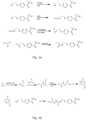
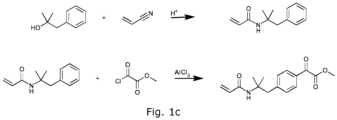
- FIGS 1a-1c show possible synthetic routes to photoinitiators of general formula (I).
- a part of a molecule is described as " optionally substituted " it is meant that said part may be substituted by one or more substituents selected from: C 1 -C 6 linear, branched or cyclic alkyl, aryl, -OH, -CN, halogens, amines, amides, alcohols, ethers, thioethers, sulfones and derivatives thereof, sulfoxides and derivatives thereof, carbonates, isocyanates, nitrates and acrylates.
- substituents selected from: C 1 -C 6 linear, branched or cyclic alkyl, aryl, -OH, -CN, halogens, amines, amides, alcohols, ethers, thioethers, sulfones and derivatives thereof, sulfoxides and derivatives thereof, carbonates, isocyanates, nitrates and acrylates.
- Z is C 1 -C 12 alkylene substituted with
- heterocyclyl means a non-aromatic saturated monocyclic or multicyclic ring system comprising about 3 to about 10 ring atoms, preferably about 5 to about 10 ring atoms, in which one or more of the atoms in the ring system is an element other than carbon, for example nitrogen, oxygen or sulfur, alone or in combination.
- Preferred heterocyclyls contain about 5 to about 6 ring atoms.
- the prefix aza, oxa or thia before the heterocyclyl root name means that at least a nitrogen, oxygen or sulfur atom respectively is present as a ring atom.
- the heterocyclyl can be optionally substituted as described above.
- the nitrogen or sulfur atom of the heterocyclyl can be optionally oxidized to the corresponding N-oxide, S-oxide or S,S-dioxide.
- suitable monocyclic heterocyclyl rings include piperidyl, pyrrolidinyl, piperazinyl, morpholinyl, thiomorpholinyl, thiazolidinyl, 1,3-dioxolanyl, 1,4-dioxanyl, tetrahydrofuranyl, tetrahydrothiophenyl, tetrahydrothiopyranyl, and the like.
- alkylene is used in the following to specify moieties derived from alkanes in which two H atoms have been removed to form a diradical species.
- the simplest alkylene is methylene -CH 2 -, and other alkylenes include ethylene -CH 2 -CH 2 -, propylene -C 3 H 6 - and butylene -C 4 H 8 -.
- alkylene includes branched, linear and cyclic alkylenes, with branched alkylenes being most preferred.
- An alkylene which is a C 1 -C 12 alkylene is one which contains between 1 and 12 carbon atoms.
- Preferred alkylenes contain between 1 and 6 carbon atoms (i.e. C 1 -C 6 alkylenes).
- aryl or arylene are used to define an unsaturated cyclic system which contains a delocalised ⁇ -electron system about the ring.
- Aryl or arylene groups may comprise from 4-12 atoms, suitably from 6-8 atoms, most suitably 6 atoms.
- “Aryl” is preferably phenyl (-C 6 H 5 ).
- Arylene is used to define a disubstituted aryl moiety, and is preferably phenylene.
- aryl or arylene is also used to include unsaturated heterocycles - rings in which one or more atoms in the ring (e.g. 1-3 atoms) are N, S, P or O.
- heterocycles include pyrrole, furan, thiophene, imidazole, imidazoline, pyrazole, pyrazoline, oxazole, oxazoline, isoxazole, isoxazoline, thiazole, thiazoline, isothiazole, isothiazoline (5-membered rings), pyridine, pyran, thiopyran (6-membered rings).
- aryl also includes fused ring systems and biaryl (particularly biphenyl) systems.
- Curing is primarily initiated by exposing the substances to high energy irradiation, preferably UV light.
- high energy irradiation preferably UV light.
- the photoinitiated process takes place by methods which are known per se, through irradiation with light or UV irradiation in the wavelength range from 100 to 500 nm.
- Irradiation sources which may be used are sunlight or artificial lamps or lasers.
- Mercury highpressure, medium pressure or low-pressure lamps and xenon and tungsten lamps, for example, are advantageous.
- excimer, solid-state and diode-based lasers are advantageous.
- Diode-based light sources in general are advantageous for initiating the chemical reactions.
- the ultraviolet spectrum is divided into A, B and C segments where UV A extend from 400 nm down to 315 nm, UV B from 315 to 280 nm, and UV C from 280 to 100 nm.
- a light source that generates light with wavelengths in the visible region (400 to 800 nm) some advantages are obtained with respect to the depth of the curing, provided that the photoinitiator can successfully cure the material at these wavelengths.
- scattering phenomena are less pronounced at longer wavelength, thus giving a larger penetration depth in the material.
- photoinitiators which absorb, and can induce curing, at longer wavelength are of interest.
- substituents on the photoinitiator moieties the absorption spectrum of the photoinitiator can to some extent be red-shifted, which would then facilitate curing at comparatively greater depths.
- a polymeric coating for a urinary catheter is provided.
- the polymeric coating is a copolymer of a first photoinitiator monomer and at least one second monomer.
- the content of first photoinitiator monomer in said polymeric coating is between 0.1 - 5 mol%, more suitably between 0.5 - 5 mol%.
- One component of the polymeric coating is a first photoinitiator monomer having the general formula (I):
- a photoinitiator is defined as a substance (other than a reactant) which, on absorption of light, generates reactive species (ions or radicals) and initiates one or several chemical reactions or transformation.
- One preferred property of the photoinitiator is good overlap between the UV light source spectrum and the photoinitiator absorption spectrum.
- Another desired property is a minor or no overlap between the photoinitiator absorption spectrum and the intrinsic combined absorption spectrum of the other components in the matrix.
- Good compatibility of the photoinitiator in the matrix of material to be cured is also a property of interest.
- the photoinitiator monomers with the general formula I comprise a photoinitiator moiety, Pi, which provides the photoinitiator monomers with the required response to UV radiation.
- the photoinitiator moieties are efficient in transforming light from the UV or visible light source to reactive radicals which can abstract hydrogen atoms and other labile atoms from other molecules.
- Radical photoinitiator moieties can be classified as either cleavable (Norrish type I reaction) or non-cleavable. Upon excitation, Norrish Type-I photoinitiator moieties spontaneously break down into two radicals. In one aspect, the photoinitiator moiety is a Norrish Type-I photoinitiator moiety.
- Photoinitiator moieties (Pi) in Formula (I) may be selected from, but not exclusively restricted to, the group consisting of: benzoin ethers, 1-phenyl-2-hydroxy-2-alkyl ketones, 1-phenyl-2-amino-2-alkyl ketones, benzophenones, thioxanthones, xanthones, acridones, anthraquinones, fluorenones, dibenzosuberones, benzils, benzil ketals, acetophenones, ⁇ -alkoxy-acetophenones, ⁇ , ⁇ -dialkoxy-acetophenones, ⁇ -hydroxy- ⁇ -alkyl-phenones, ⁇ -hydroxy-a, ⁇ -dialkyl-phenones, alkyl phenylglyoxylates, camphorquinones, acyl-phosphine oxides, and phenyl ketocoumarins.
- preferred photoinitiator moieties are selected from acetophenones, ⁇ -alkoxy-acetophenones, ⁇ , ⁇ -dialkoxy-acetophenones, ⁇ -hydroxy- ⁇ -alkyl-phenones, ⁇ -hydroxy- ⁇ , ⁇ -dialkyl-phenones and alkyl phenylglyoxylates.
- Pi may be a Norrish Type-I photoinitiator moiety having the general formula (V): -(Ph)-(X) m (V)
- X is suitably present at the para-position on Ph.
- m is 1 or 2, preferably 1.
- Linker Z therefore has two ends. At one end, therefore, Z is joined to the photoinitiator moiety Pi; at the other end, Z is joined to an acrylamide functionality.
- the size of the linker Z is selected according to the desired properties of the photoinitiator.
- the linker Z has a molecular weight of less than 10000Da, suitably less than 5000Da, most suitably less than 1000Da.
- the linker Z preferably comprises no more than 50 atoms, preferably no more than 30 atoms.
- the linker Z has the structure: -C(R 3 )(R 4 )-Za-
- Photoinitiators with such linkers may be advantageously synthesised via the Ritter reaction (cf. Figure 1c ).
- R 3 and R 4 are not hydrogen.
- Z may comprise a combination of the above-mentioned groups
- the technology encompasses photoinitiators in which Z is made up of two or more of the above-mentioned groups in series.
- the -(C 1 -C 12 alkylene)- and -aryl- groups may be substituted or unsubstituted.
- Photoinitiators of Formula (I) in which Z comprises an electron-donating group adjacent to Pi are advantageous, as this provides opportunities to tailor the UV absorption of the photoinitiator moiety.
- R 1 is suitably H or optionally substituted C 1 -C 6 alkyl, such as e.g. methyl, ethyl, propyl, butyl, pentyl or hexyl.
- R 1 may be straight-chain, branched or cyclic alkyl.
- R 2 is H.
- a sub-structure which describes photoinitiator monomers of Formula I has the general formula (Ia): wherein R 1 , R 2 , R 3 , Z, Ph, X, and m are as defined above.
- Za is a linker moiety selected from a single bond, -C 1- C 6 alkylene- or - O-(C 1 -C 6 alkylene)-; R 1 and R 2 are as defined above; R 3 and R 4 are methyl; X is selected from
- Suitable photoinitiator monomers include: Photoinitiator monomers of particular interest are
- the polymeric coating further comprises at least one second monomer.
- the second monomer may be selected from acrylic acid, an acrylamide or an acrylic acid ester, or mixtures thereof.
- Particular monomers which may be used are acrylic acid, C1-C6 acrylic esters such as methyl acrylate or ethyl acrylate, 2-acrylamido-2-methylpropane sulfonic acid, 2-acrylamido-2-methylpropane sulfonic acid sodium salt, 4-acryloyl-morpholine, hydroxyethyl methacrylate, acrylamide, N,N-dimethylacrylamide, methyl vinyl ether and ethyl vinyl ether.
- acrylic acid C1-C6 acrylic esters such as methyl acrylate or ethyl acrylate, 2-acrylamido-2-methylpropane sulfonic acid, 2-acrylamido-2-methylpropane sulfonic acid sodium salt, 4-acryloyl-morpholine, hydroxyethyl methacrylate, acrylamide, N,N-dimethylacrylamide, methyl vinyl ether and ethyl vinyl ether.
- the polymeric coating comprises two second monomers, which are copolymerised together with the first photoinitiator monomer.
- the two second monomers are acrylic acid and sodium 2-acrylamido-2-methylpropane sulfonic acid (Na-AMPS).
- a method for coating a urinary catheter comprises the steps of:
- the polymeric coating is grafted to the outer surface of the urinary catheter in an easy manner. Further details of the coating method are described in the experimental section.
- the polymeric coating may additionally comprise a plasticiser.
- a plasticizer will improve the physical properties of the coating, and will reduce the tendency of the coatings to detach from the substrate when dried.
- Suitable plasticizers include PEG, 1,2-propylene carbonate, propylene glycol, ethylene carbonate, glycerol, sorbitol, citrofol A1, citrofol A2, monoacetin, diacetin and triacetin.
- plasticizer is dependent on the polymer composition.
- PEG is a suitable plasticizer.
- Poly(Na-AMPS) can be plasticized with glycerol, and poly(ACMO) can be plasticized with 1,2-propylene carbonate.
- the plasticiser may be incorporated into the polymeric coating during UV irradiation of the polymeric coating.
- the plasticiser may be present in admixture with the polymeric coating.
- Suitable solvents for use in the synthesis, formulation and coating of the polymeric coating are alcohols (e.g. methanol, ethanol, 1-propanol, 2-propanol) and water, and combinations thereof.
- said urinary catheter comprises a substrate material and a primer layer, and wherein the primer layer constitutes the outer surface of the urinary catheter.
- said primer layer is a layer of photoinitiator (e.g. a polymeric multifunctional photoinitiator) and optionally an acrylate monomer or a multifunctional acrylate monomer.
- an intermittent urinary catheter coated with the polymeric coating described herein is provided.
- the intermittent catheter is suitably wet-stored and ready-to-use.
- kits which comprises the intermittent catheter as described herein, and a catheter package.
- the intermittent catheter is sealed within said catheter package.
- a swelling liquid is also present within said catheter package and makes contact with said intermittent catheter. Said swelling liquid has a pH of 5 or less, such as 3 or less.
- Suitable groups as alternatives to tertiary alcohols include benzylic alcohols, geminal disubstituted alkenes and trisubstituted alkenes.
- Primary and secondary alcohols and mono- and vicinal di-substituted alkenes can sometimes be used, but usually require harsher reaction conditions and give poorer yields.
- the tertiary carbocations are most stable and common choices for the Ritter reaction are formed from tertiary alcohols or geminal dialkylated alkenes.
- An aromatic ring adjacent to the carbocation also has a stabilizing effect and benzylic alcohols may thus be used. It is desirable that the carbocation group does not contain anything that strongly activates the aromatic ring to electrophilic attack.
- the photoinitiators of the general formula (I), can be synthesised via a method comprising the steps of:
- Triphenylphosphine (8.69 g, 33.1 mmol) is added to a solution of 1-[4-(2-azidoethoxy)phenyl]-2-hydroxy-2-methylpropan-1-one (7.50 g, 30.1 mmol) in tetrahydrofuran (120 mL) and water (12 mL) and the solution is stirred at room temperature for 18 h. Water (240 mL) is added and the mixture is acidified to pH 1 using 37% aqueous HCl solution.
- Impurities are extracted into ethyl acetate (3 ⁇ 100 mL) and the organic washes are discarded.
- the aqueous phase is basified to pH 14 using 20% aqueous sodium hydroxide solution, then extracted with ethyl acetate (3 ⁇ 150 mL).
- the combined organic phases are dried (Na 2 SO 4 ) and concentrated to give the product as a clear liquid (5.70 g, 82%).
- a 1 H NMR spectrum of the compound (400 MHz, CDCl 3 ) seems to indicate the formation of a complex mixture of oligomers in solution, nevertheless the product is used in the next step without further purification.
- N -(2-Methyl-1-phenylpropan-2-yl)prop-2-enamide Acrylonitrile (18.0 mL, 0.260 mol) is added to a solution of 2-methyl-1-phenyl-1-propanol (35.0 g, 0.233 mol) in glacial acetic acid (125 mL) at 5-10 °C. Concentrated sulfuric acid (13.6 mL, 0.260 mol) is added dropwise while maintaining the reaction temperature at ⁇ 10 °C. The mixture is stirred at room temperature for 16 h, then is heated at 60 °C for 6 h. The mixture is stirred at room temperature for a further 16 h then is cooled in an ice bath to ⁇ 10 °C.
- Methyl ⁇ 4-[2-(acryloylamino)-2-methylpropyl]phenyl ⁇ (oxo)acetate Methyl chlorooxoacetate (16.0 mL, 0.174 mol) is added to a solution of N -(2-methyl-1-phenylpropan-2-yl)prop-2-enamide (25.0 g, 0.123 mol) in dichloromethane (200 mL) at 5-10 °C. Aluminium chloride (41.0 g, 0.308 mol) is added portion-wise over 30 minutes and the resulting red solution is stirred at room temperature for 20 h. The resulting heterogeneous slurry is poured into ice water (600 mL) and the mixture is stirred for 15 minutes.
- Ethyl ⁇ 4-[2-(acryloylamino)-2-methylpropyl]phenyl ⁇ (oxo)acetate Ethyl chlorooxoacetate (7.80 mL, 69.7 mmol) is added to a solution of N -(2-methyl-1-phenylpropan-2-yl)prop-2-enamide (10.0 g, 49.8 mmol) in dichloromethane (70 mL) at 5-10 °C. Aluminium chloride (16.6 g, 145 mmol) is added portion-wise over 30 minutes and the resulting red solution is stirred at room temperature for 20 h.
- the heterogeneous slurry is cooled in an ice bath to ⁇ 10 °C and acetonitrile (20 mL) is added dropwise while maintaining the temperature at ⁇ 20 °C.
- the resulting homogeneous solution is then poured into ice water (350 mL) and the mixture is stirred for 15 minutes.
- Dichloromethane 300 mL is added and organic materials are extracted into dichloromethane.
- Combined organic phases are washed with saturated aqueous sodium bicarbonate solution (200 mL), dried (Na 2 SO 4 ) and concentrated to give the crude product. Recrystallization from tert-butyl methyl ether:hexane gives the pure product as a colourless solid (6.30 g, 42%).
- TPP triphenyl phosphine
- DIPE diisopropyl ether
- DCM diichloromethane
- BHT butylated hydroxytoluene
- IPA isopropanol
- TEA triethyl amine
- DMSO dimethylsulfoxide
- EtOH ethanol
- TPPO triphenylphosphine oxide
- DMF dimethylformamide
- MeOH methanol
- AcOH acetic acid.
- ICAA 1- ⁇ 2-[p-(2-Hydroxy-2-methylpropionyl)phenoxy]ethylamino ⁇ -2-propen-1-one
- Example 1 an acrylic acid coating (without sulfonate-containing monomer), (not according to the invention):
- Topcoat 5,4 g of the acrylate solution synthesized above + 0,45 g PEG35k + 3,77 g water + 5,39 g ethanol is weighed into a 20 mL brown screw cap vial and stirred until a clear homogeneous solution is obtained.
- Substrate (24x24x1 mm squares made from Estane polyurethane) is treated with plasma (3 mBar air, 800W, 15 seconds) and used within 24 hours.
- the substrate in mounted in the spincoater. Program is started (2000 rpm, 15 sec). As soon as sample is up to speed, a brief burst of primer is applied.
- Coating procedure topcoat The primer coated substrate is mounted in the spincoater. A drop of topcoat is placed on top and the program (1800 rpm/15sec + 2400 rpm/5 sec) is started immediately after. The coated sample is dried in an oven for 10 minutes/100°C
- UV-curing Sample is placed on a hot-plate at 140°C for 1 minute, and then irradiated with UV, 5J/cm2 at 60-70°C
- Example 2 a poly(Na-AMPS-co-acrylic acid) based coating (not according to the invention).
- This topcoat is then spin-coated onto primer coated samples and UV-cured as described in example 1.
- Samples are immersed in water overnight.
- the coating is firm, cohesive and have a low friction when tested wet against skin.
- Example 3 catheters coated with a poly(Na-AMPS-co-acrylic acid) based coating (not according to the invention).
- pH4 Buffer 10 mM formic acid, 5 mM citric acid, 0.9% NaCl, pH adjusted to 4 with 1M NaOH
- Uncoated Estane catheters are treated with plasma (3 mBar air, 800W, 15 sec). They are then dipped in primer and dried in an oven at 130°C for 30 sec. Then they are dipped in topcoat. They are air-dried for 1 minute and then in an oven at 130°C for 200 sec. They are then irradiated with 1 J/cm2 UV at 75°C. When immersed in water, the coating feels firm, cohesive and slippery.
- the catheters are packaged in pH4 buffer and some are sterilized ( ⁇ , 2x40 kGy). Catheters are removed from the buffer and friction coefficient against polished stainless steel is measured at 0 and 5 minutes on both sterilized and unsterilized samples: Friction coefficient 0 min 5 min - ⁇ 0.0215 0.0209 + ⁇ 0.0273 0.0238
- Example 4 A poly(ACMO-co-ICAA) based coating (not according to the invention).
- Topcoat and coating 9 g acrylate solution as synthesized above + 2.25 g 1,2-propylene carbonate + 3.75 g ethanol is stirred until a homogeneous solution is obtained. This topcoat is then spin-coated onto primer coated samples and UV-cured as described in example 1. Sample is immersed in water overnight and has a lowered friction when tested wet against skin compared to the base material.
- Example 5 A poly(Na-AMPS-co-ICAA) based coating (not according to the invention).
- Topcoat and coating 7,56 g acrylate solution as synthesized above + 1.89 g glycerol + 2.75 g water + 2.80 g ethanol is stirred until a homogeneous solution is obtained. This topcoat is then spin-coated onto primer coated samples and UV-cured as described in example 1.
- Samples are immersed in water overnight. They are firm, cohesive and have a low friction when tested wet against skin.
- Topcoat 24 g PVP K90 + 40 g citrofol A1 + 20 g N-methylpyrrolidone + 0,12 g esacure KIP 150 + 116 g ethanol is stirred until all components are dissolved.
- This solution is coated onto plasma treated estane squares as in example 1.
- the samples are dried in an oven at 100°C for 10 minutes. They are placed in an aluminium tray on a hotplate 140°C/1minute. The tray is then placed on the conveyer belt of a Fusion UV-tunnel, I6P1 (Fusion UV Systems Inc.) at 40% intensity and 2.7 m/s. When cooled, a sample is immersed in water overnight. The coating is firm, cohesive and slippery.
- Plates coated as in example 2 are immersed in buffer as in example 3 at pH 3 overnight. They are compared to a SpeediCath coating (control). This coating is immersed in PVP-liquid (6%wt PVP k-15, 0.9%wt NaCl).
- Unsterile square samples and controls are placed in 70% EtOH for 20 minutes on a shaking table. Next the samples are washed once in sterile swelling media, and then placed in sterile swelling media O/N at RT.
- E. Coli are transferred to an agar plate 2 days before use. 1 day before use, one colony is transferred to growth medium and placed in a shaking cabinet at 35°C. The bacteria are washed 1 time in 0.9% NaCl and resuspended in 0.9% NaCl. The inoculum concentration should be between 1 x 10 7 - 2,5 x 10 7 CFU/mL.
- the square samples with coating are transferred to a sterile petri dish with the coating side up.
- 150 ⁇ L of the bacterial solution is applied to the coating.
- a coverfilm is placed on top of the bacterial solution to ensure that the bacterial solution covers the entire sample and to avoid drying of the coating under test.
- Contact time is 5 minutes.
- Samples are washed 3 x 1 min in 100 ml 0.9% NaCl on a shaking table.
- the samples are transferred to a tube containing 3 ml of sterile 0.9% NaCl.
- the samples are positioned so that the coating is in contact with the liquid.
- the samples are treated in a degas bath for 5 minutes and ultrasound treated for 5 minutes to release the attached bacteria from the surface.
- 100 ⁇ L is spread-plated to a LB agar plate, in duplicate, and placed at 35 °C O/N. CFU is counted after 24 hours.
- test results are measured as CFU number and Log10 to CFU.
Landscapes
- Health & Medical Sciences (AREA)
- Life Sciences & Earth Sciences (AREA)
- Epidemiology (AREA)
- Animal Behavior & Ethology (AREA)
- General Health & Medical Sciences (AREA)
- Public Health (AREA)
- Veterinary Medicine (AREA)
- Chemical & Material Sciences (AREA)
- Engineering & Computer Science (AREA)
- Wood Science & Technology (AREA)
- Materials Engineering (AREA)
- Organic Chemistry (AREA)
- Chemical Kinetics & Catalysis (AREA)
- Biomedical Technology (AREA)
- Medicinal Chemistry (AREA)
- Molecular Biology (AREA)
- Paints Or Removers (AREA)
- Polymerisation Methods In General (AREA)
- Organic Low-Molecular-Weight Compounds And Preparation Thereof (AREA)
- Materials For Medical Uses (AREA)
- Addition Polymer Or Copolymer, Post-Treatments, Or Chemical Modifications (AREA)
Claims (9)
- Cathéter urinaire intermittent revêtu par un revêtement polymérique, qui est un copolymère d'au moins un premier monomère photoinitiateur et d'au moins un deuxième monomère ;ledit premier monomère possédant la formule (I) :
 dans laquelle :Pi est un groupement photoinitiateur ;le lieur Z dans la formule (I) possédant la structure :
-C(R3)(R4)-Za-
dans laquelle le groupement -C(R3)(R4)- est lié à l'atome de N de l'acrylamide dans la formule (I) ;Za étant un groupement lieur choisi parmi une simple liaison, C1-C12 alkylène éventuellement substitué ; -O- ; -S- ; -NRa- ; -CO-NRa- ; hétérocyclyle éventuellement substitué ; arylène éventuellement substitué ; -[O-(C1-C12 alkylène)]n- éventuellement substitué ; -[S-(C1-C12 alkylène)]n- éventuellement substitué ; et des combinaisons correspondantes ; n étant un entier de 1 à 20, et Ra étant H ou C1-C6 alkyle éventuellement substitué;R3 et R4 étant indépendamment choisis parmi C1-C6 alkyle éventuellement substitué ;R1 étant choisi parmi H et C1-C6 alkyle éventuellement substitué ;R2 étant choisi parmi H ;et ledit au moins un deuxième monomère comprenant une liaison C=C insaturée. - Cathéter urinaire intermittent revêtu par un revêtement polymérique selon la revendication 1, Za dans la formule (I) étant choisi parmi une simple liaison, C1-C12 alkylène, -O-(C1-C12 alkylène)-, C1-C6 alkylène, et - O-(C1-C6 alkylène)-.
- Cathéter urinaire intermittent revêtu par un revêtement polymérique selon l'une quelconque des revendications précédentes, Pi dans la formule (I) étant un groupement photoinitiateur Norrish de type I.
- Cathéter urinaire intermittent revêtu par un revêtement polymérique selon l'une quelconque des revendications précédentes, Pi dans la formule (I) étant choisi dans le groupe constitué par : des éthers de benzoïne, des 1-phényl-2-hydroxy-2-alkylcétones, des 1-phényl-2-amino-2-alkylcétones, des dibenzosubérones, des benziles, des benzilcétals, des acétophénones, des α-alcoxy-acétophénones, des α,α-dialcoxy-acétophénones, des α-hydroxy-α-alkyl-phénones, des α-hydroxy-α, des α-dialkyl-phénones, des phénylglyoxylates d'alkyle, des camphorquinones, des oxydes d'acyl-phosphines, et des phénylcétocoumarines.
- Cathéter urinaire intermittent revêtu par un revêtement polymérique selon l'une quelconque des revendications précédentes, Pi dans la formule (I) étant un groupement photoinitiateur choisi dans le groupe constitué par : des acétophénones, des α-alcoxy-acétophénones, des α,α-dialcoxy-acétophénones, des α-hydroxy-α-alkyl-phénones, des α-hydroxy-α, des α-dialkyl-phénones, et des phénylglyoxylates d'alkyle.
- Cathéter urinaire intermittent revêtu par un revêtement polymérique selon l'une quelconque des revendications précédentes, Pi dans la formule (I) étant un groupement photoinitiateur Norrish de type I possédant la formule générale (V) :
-Ph-(X)m (V)
Ph étant un cycle phényle éventuellement substitué ;m étant un entier de 1 à 5, de sorte que m groupements X peuvent être présents au niveau d'une quelconque position sur Ph ;et X étant choisi parmi dans lesquels R est choisi parmi H et C1-C6 alkyle éventuellement substitué.
 - Cathéter urinaire intermittent revêtu par un revêtement polymérique selon l'une quelconque des revendications 1 à 6, dans lequel le monomère de formule (I) est choisi parmi :


- Cathéter urinaire intermittent revêtu par un revêtement polymérique selon l'une quelconque des revendications précédentes, ledit revêtement comprenant de plus un plastifiant.
- Kit comprenant le cathéter intermittent selon l'une quelconque des revendications 1 à 8, et un emballage de cathéter, ledit cathéter intermittent étant scellé dans ledit emballage de cathéter, et un liquide de gonflement étant également présent dans ledit emballage de cathéter et en contact avec ledit cathéter intermittent, ledit liquide de gonflement possédant un pH de 5 ou moins, tel que de 4 ou moins.
Applications Claiming Priority (2)
| Application Number | Priority Date | Filing Date | Title |
|---|---|---|---|
| DKPA201770623 | 2017-08-17 | ||
| PCT/DK2018/050199 WO2019034222A1 (fr) | 2017-08-17 | 2018-08-16 | Revêtements polymères |
Publications (3)
| Publication Number | Publication Date |
|---|---|
| EP3668555A1 EP3668555A1 (fr) | 2020-06-24 |
| EP3668555B1 EP3668555B1 (fr) | 2021-10-06 |
| EP3668555B2 true EP3668555B2 (fr) | 2024-07-24 |
Family
ID=59856325
Family Applications (1)
| Application Number | Title | Priority Date | Filing Date |
|---|---|---|---|
| EP18769588.7A Active EP3668555B2 (fr) | 2017-08-17 | 2018-08-16 | Revêtements polymères |
Country Status (6)
| Country | Link |
|---|---|
| US (1) | US12070531B2 (fr) |
| EP (1) | EP3668555B2 (fr) |
| CN (1) | CN111032102B (fr) |
| BR (1) | BR112020002377A2 (fr) |
| RU (1) | RU2020110828A (fr) |
| WO (1) | WO2019034222A1 (fr) |
Families Citing this family (18)
| Publication number | Priority date | Publication date | Assignee | Title |
|---|---|---|---|---|
| MX348673B (es) | 2008-05-01 | 2017-06-23 | Convatec Tech Inc * | Dispositivo de drenaje rectal. |
| CN108578044A (zh) | 2011-03-17 | 2018-09-28 | 康沃特克科技公司 | 高阻隔性弹性体粪便导管或造口袋 |
| BR112016002257A2 (pt) | 2013-08-01 | 2017-12-12 | Convatec Technologies Inc | conector de saco de fechamento automático |
| WO2019094635A1 (fr) | 2017-11-09 | 2019-05-16 | 11 Health and Technologies Inc. | Système et procédé de surveillance de stomie |
| GB201721955D0 (en) | 2017-12-27 | 2018-02-07 | Convatec Ltd | Catheter wetting devices |
| GB201721956D0 (en) | 2017-12-27 | 2018-02-07 | Convatec Ltd | Female catheter locator tip |
| USD893514S1 (en) | 2018-11-08 | 2020-08-18 | 11 Health And Technologies Limited | Display screen or portion thereof with graphical user interface |
| WO2020251979A1 (fr) | 2019-06-11 | 2020-12-17 | Convatec Technologies Inc. | Poches de recueil d'urine destinées à être utilisées avec des produits de cathéter, kits les intégrant et procédés associés |
| US20220265560A1 (en) | 2019-07-22 | 2022-08-25 | Novo Nordisk A/S | Capsule device having improved self-righting ability |
| EP4138969B1 (fr) | 2020-04-24 | 2026-02-18 | ConvaTec Limited | Emballage pour dispositif médical |
| GB202006056D0 (en) | 2020-04-24 | 2020-06-10 | Convatec Ltd | A catheter |
| GB202006055D0 (en) | 2020-04-24 | 2020-06-10 | Convatec Ltd | A wetting mechanism for a catheter |
| AU2021259368A1 (en) | 2020-04-24 | 2022-09-29 | Convatec Limited | A wetting mechanism for a catheter |
| GB202006059D0 (en) | 2020-04-24 | 2020-06-10 | Convatec Ltd | A wetting mechanism for a catheter |
| JP2023545504A (ja) | 2020-10-15 | 2023-10-30 | コンバテック・テクノロジーズ・インコーポレイテッド | オストミーシステムおよび方法 |
| ES3027643T3 (en) * | 2020-11-19 | 2025-06-16 | Agfa Nv | Uv curable inkjet inks and inkjet printing methods |
| JP7448067B1 (ja) | 2023-04-19 | 2024-03-12 | artience株式会社 | 帯電防止性ハードコートフィルム |
| WO2026013405A1 (fr) * | 2024-07-11 | 2026-01-15 | Convatec Limited | Cathéters intermittents |
Citations (4)
| Publication number | Priority date | Publication date | Assignee | Title |
|---|---|---|---|---|
| WO1995010552A1 (fr) † | 1993-10-13 | 1995-04-20 | Lowell Engineering Corporation | Photo-initiateurs a base d'acetylarylcetones disubstituees fonctionnelles acrylamide |
| WO2007065721A2 (fr) † | 2005-12-09 | 2007-06-14 | Dsm Ip Assets B.V. | Revêtement hydrophile |
| US8287890B2 (en) † | 2009-12-15 | 2012-10-16 | C.R. Bard, Inc. | Hydrophilic coating |
| EP2303346B1 (fr) † | 2008-06-16 | 2013-09-25 | Coloplast A/S | Milieux gonflants tamponnés pour revêtements hydrophyles stérilisés par radiation |
Family Cites Families (25)
| Publication number | Priority date | Publication date | Assignee | Title |
|---|---|---|---|---|
| US828789A (en) | 1906-03-16 | 1906-08-14 | Constantin Wagner | Testing device. |
| US3991416A (en) * | 1975-09-18 | 1976-11-09 | Hughes Aircraft Company | AC biased and resonated liquid crystal display |
| DE3738567A1 (de) * | 1987-03-12 | 1988-09-22 | Merck Patent Gmbh | Coreaktive fotoinitiatoren |
| DE4007318A1 (de) * | 1990-03-08 | 1991-09-12 | Basf Ag | Ethylenisch ungesaettigte verbindungen |
| US5278200A (en) * | 1992-10-30 | 1994-01-11 | Medtronic, Inc. | Thromboresistant material and articles |
| KR970704849A (ko) * | 1994-07-29 | 1997-09-06 | 워렌 리차드 보비 | 가교 점탄성 물질로 경화가능한 아크릴 시럽 |
| US6673850B1 (en) * | 1999-05-10 | 2004-01-06 | Ciba Specialty Chemicals Corporation | Photoinitiators and their applications |
| US7348055B2 (en) * | 2001-12-21 | 2008-03-25 | Surmodics, Inc. | Reagent and method for providing coatings on surfaces |
| PT1457531E (pt) * | 2002-10-23 | 2010-11-02 | Chugoku Marine Paints | Composição de tinta anti-incrustação, películas de tinta anti-incrustação e navios, estruturas submarinas, equipamento de pesca e redes de pesca recobertas com as películas |
| ITVA20050032A1 (it) * | 2005-05-13 | 2006-11-14 | Lamberti Spa | Esteri fenilgliossilici generanti residui a bassa migrabilita' e odore |
| DE102005024246A1 (de) * | 2005-05-27 | 2006-11-30 | Degussa Ag | Copolymere, ein Verfahren zu deren Herstellung und die Verwendung als Bindemittel |
| US7279587B2 (en) * | 2005-11-30 | 2007-10-09 | Xerox Corporation | Photoinitiator with phase change properties and gellant affinity |
| JP5623416B2 (ja) * | 2008-11-03 | 2014-11-12 | ビーエーエスエフ ソシエタス・ヨーロピアBasf Se | 光開始剤混合物 |
| EP2199273B1 (fr) * | 2008-12-18 | 2018-02-21 | Agfa Nv | Photo-initiateurs polymérisables et compositions durcissables par rayonnement |
| US9045651B2 (en) * | 2010-06-22 | 2015-06-02 | University Of Florida Research Foundation, Inc. | Antifouling surfaces, methods of manufacture thereof and articles comprising the same |
| SG190259A1 (en) | 2010-11-12 | 2013-06-28 | Coloplast As | Novel polymeric photoinitiators |
| BR112014002399B1 (pt) * | 2011-08-29 | 2020-12-08 | Coloplast A/S | conjunto |
| WO2015061097A1 (fr) * | 2013-10-21 | 2015-04-30 | Basf Se | Revêtements antiadhésifs et lubrifiants |
| JP6118284B2 (ja) * | 2014-03-07 | 2017-04-19 | 富士フイルム株式会社 | 高分子機能性膜の製造方法 |
| CN103951576A (zh) * | 2014-05-06 | 2014-07-30 | 中国海洋大学 | 单官能度具类辣椒素功能结构的丙烯酰胺化合物及其制备方法与应用 |
| CN104262511B (zh) * | 2014-09-02 | 2016-11-23 | 天津久日新材料股份有限公司 | 可聚合共引发剂和uv可固化组合物 |
| CN104804111A (zh) * | 2015-03-13 | 2015-07-29 | 江西科技师范大学 | 一种米氏酮类光引发剂的合成方法及其应用 |
| JP6245705B2 (ja) * | 2015-05-22 | 2017-12-13 | 大日精化工業株式会社 | ハードコート膜形成用組成物、硬化膜、及び帯電防止性物品 |
| US11278647B2 (en) | 2016-03-31 | 2022-03-22 | Surmodics, Inc. | Lubricious coating for medical device |
| EP3601213B1 (fr) * | 2017-03-31 | 2022-05-11 | Coloplast A/S | Photoinitiateurs d'acrylamide |
-
2018
- 2018-08-16 BR BR112020002377-9A patent/BR112020002377A2/pt not_active Application Discontinuation
- 2018-08-16 WO PCT/DK2018/050199 patent/WO2019034222A1/fr not_active Ceased
- 2018-08-16 CN CN201880053137.XA patent/CN111032102B/zh active Active
- 2018-08-16 RU RU2020110828A patent/RU2020110828A/ru unknown
- 2018-08-16 EP EP18769588.7A patent/EP3668555B2/fr active Active
- 2018-08-16 US US16/639,130 patent/US12070531B2/en active Active
Patent Citations (4)
| Publication number | Priority date | Publication date | Assignee | Title |
|---|---|---|---|---|
| WO1995010552A1 (fr) † | 1993-10-13 | 1995-04-20 | Lowell Engineering Corporation | Photo-initiateurs a base d'acetylarylcetones disubstituees fonctionnelles acrylamide |
| WO2007065721A2 (fr) † | 2005-12-09 | 2007-06-14 | Dsm Ip Assets B.V. | Revêtement hydrophile |
| EP2303346B1 (fr) † | 2008-06-16 | 2013-09-25 | Coloplast A/S | Milieux gonflants tamponnés pour revêtements hydrophyles stérilisés par radiation |
| US8287890B2 (en) † | 2009-12-15 | 2012-10-16 | C.R. Bard, Inc. | Hydrophilic coating |
Also Published As
| Publication number | Publication date |
|---|---|
| US12070531B2 (en) | 2024-08-27 |
| RU2020110828A (ru) | 2021-09-17 |
| EP3668555B1 (fr) | 2021-10-06 |
| WO2019034222A1 (fr) | 2019-02-21 |
| US20200206389A1 (en) | 2020-07-02 |
| BR112020002377A2 (pt) | 2020-09-01 |
| CN111032102B (zh) | 2022-03-22 |
| EP3668555A1 (fr) | 2020-06-24 |
| CN111032102A (zh) | 2020-04-17 |
Similar Documents
| Publication | Publication Date | Title |
|---|---|---|
| EP3668555B2 (fr) | Revêtements polymères | |
| US11685708B2 (en) | Acrylamide photoinitiators | |
| EP2176243B1 (fr) | Matériaux pour lentilles ophtalmiques contenant des chromophores qui absorbent les uv et la lumière visible à onde courte | |
| JP6389245B2 (ja) | 糖を含有する両親媒性コポリマー | |
| Oesterreicher et al. | Low migration type I photoinitiators for biocompatible thiol-ene formulations | |
| WO2014050993A1 (fr) | Membrane de polymère fonctionnel et son procédé de fabrication | |
| Alvaradejo et al. | Maleimide end-functionalized poly (2-oxazoline) s by the functional initiator route: synthesis and (bio) conjugation | |
| WO2006075373A1 (fr) | COMPOSÉ β-ALCOXYPROPIONAMIDE, SOLVANT, DÉTERGENT, COMPOSITION LIQUIDE D'UN PRODUIT CHIMIQUE ET PROCÉDÉ SERVANT À PRODUIRE UN COMPOSÉ β-ALCOXYPROPIONAMIDE | |
| US11034779B2 (en) | Amide and imide photoinitiators | |
| Cınar et al. | Structure-reactivity relationships of novel monomeric photoinitiators | |
| CN114478436B (zh) | 一种含有可聚合的衣康酸基团改性的α-氨基酮类光引发剂及其制备方法和用途 | |
| KR20220069220A (ko) | 광가교형 공중합 히알루론산 스펀지 및 이의 제조방법 | |
| CN113943309B (zh) | 吲哚螺[苯并呋喃-2,2′-吡咯烷]类化合物及其制备方法和在防治植物病毒的应用 | |
| KR102319171B1 (ko) | 광가교형 히알루론산 스펀지 및 이의 제조방법 | |
| Denizkusu et al. | Structure-reactivity relationships of novel α-hydroxyketone-functionalized cyclopolymerizable and cyclopolymeric photoinitiators | |
| Khan | An improved method for the synthesis of 5-arylidene barbiturates using BiCl3 | |
| MXPA01013369A (es) | Nuevo proceso para la purificacion de impurezas de aldehido. | |
| CN111670176B (zh) | 新的交联剂化合物和通过使用其制备的超吸收性聚合物 | |
| Katritzky et al. | Molecular engineering of benzo [b] pyrylium salts by indirect electrophilic substitution | |
| CN111072959A (zh) | 聚吡咯衍生物及其制备方法和应用 | |
| CN105566283B (zh) | 含有ent‑贝叶烷骨架的手性冠醚及其制备方法和应用 | |
| CN117120502A (zh) | 树脂组合物 | |
| JPS58206594A (ja) | ポリアルキルジアザスピロデカン誘導体、その製造方法およびその用途 | |
| EP4378930A1 (fr) | Composé de fluoropolyéther | |
| WO2009154568A1 (fr) | Polymères hydrosolubles et pouvant gonfler dans l'eau et utilisation de ceux-ci |
Legal Events
| Date | Code | Title | Description |
|---|---|---|---|
| STAA | Information on the status of an ep patent application or granted ep patent |
Free format text: STATUS: UNKNOWN |
|
| STAA | Information on the status of an ep patent application or granted ep patent |
Free format text: STATUS: THE INTERNATIONAL PUBLICATION HAS BEEN MADE |
|
| PUAI | Public reference made under article 153(3) epc to a published international application that has entered the european phase |
Free format text: ORIGINAL CODE: 0009012 |
|
| STAA | Information on the status of an ep patent application or granted ep patent |
Free format text: STATUS: REQUEST FOR EXAMINATION WAS MADE |
|
| 17P | Request for examination filed |
Effective date: 20200317 |
|
| AK | Designated contracting states |
Kind code of ref document: A1 Designated state(s): AL AT BE BG CH CY CZ DE DK EE ES FI FR GB GR HR HU IE IS IT LI LT LU LV MC MK MT NL NO PL PT RO RS SE SI SK SM TR |
|
| AX | Request for extension of the european patent |
Extension state: BA ME |
|
| RAP1 | Party data changed (applicant data changed or rights of an application transferred) |
Owner name: COLOPLAST A/S |
|
| DAV | Request for validation of the european patent (deleted) | ||
| DAX | Request for extension of the european patent (deleted) | ||
| GRAP | Despatch of communication of intention to grant a patent |
Free format text: ORIGINAL CODE: EPIDOSNIGR1 |
|
| STAA | Information on the status of an ep patent application or granted ep patent |
Free format text: STATUS: GRANT OF PATENT IS INTENDED |
|
| INTG | Intention to grant announced |
Effective date: 20210401 |
|
| GRAS | Grant fee paid |
Free format text: ORIGINAL CODE: EPIDOSNIGR3 |
|
| GRAA | (expected) grant |
Free format text: ORIGINAL CODE: 0009210 |
|
| STAA | Information on the status of an ep patent application or granted ep patent |
Free format text: STATUS: THE PATENT HAS BEEN GRANTED |
|
| AK | Designated contracting states |
Kind code of ref document: B1 Designated state(s): AL AT BE BG CH CY CZ DE DK EE ES FI FR GB GR HR HU IE IS IT LI LT LU LV MC MK MT NL NO PL PT RO RS SE SI SK SM TR |
|
| REG | Reference to a national code |
Ref country code: GB Ref legal event code: FG4D |
|
| REG | Reference to a national code |
Ref country code: CH Ref legal event code: EP Ref country code: AT Ref legal event code: REF Ref document number: 1435674 Country of ref document: AT Kind code of ref document: T Effective date: 20211015 |
|
| REG | Reference to a national code |
Ref country code: IE Ref legal event code: FG4D |
|
| REG | Reference to a national code |
Ref country code: DE Ref legal event code: R096 Ref document number: 602018024730 Country of ref document: DE |
|
| REG | Reference to a national code |
Ref country code: LT Ref legal event code: MG9D |
|
| REG | Reference to a national code |
Ref country code: NL Ref legal event code: MP Effective date: 20211006 |
|
| REG | Reference to a national code |
Ref country code: AT Ref legal event code: MK05 Ref document number: 1435674 Country of ref document: AT Kind code of ref document: T Effective date: 20211006 |
|
| PG25 | Lapsed in a contracting state [announced via postgrant information from national office to epo] |
Ref country code: RS Free format text: LAPSE BECAUSE OF FAILURE TO SUBMIT A TRANSLATION OF THE DESCRIPTION OR TO PAY THE FEE WITHIN THE PRESCRIBED TIME-LIMIT Effective date: 20211006 Ref country code: LT Free format text: LAPSE BECAUSE OF FAILURE TO SUBMIT A TRANSLATION OF THE DESCRIPTION OR TO PAY THE FEE WITHIN THE PRESCRIBED TIME-LIMIT Effective date: 20211006 Ref country code: FI Free format text: LAPSE BECAUSE OF FAILURE TO SUBMIT A TRANSLATION OF THE DESCRIPTION OR TO PAY THE FEE WITHIN THE PRESCRIBED TIME-LIMIT Effective date: 20211006 Ref country code: BG Free format text: LAPSE BECAUSE OF FAILURE TO SUBMIT A TRANSLATION OF THE DESCRIPTION OR TO PAY THE FEE WITHIN THE PRESCRIBED TIME-LIMIT Effective date: 20220106 Ref country code: AT Free format text: LAPSE BECAUSE OF FAILURE TO SUBMIT A TRANSLATION OF THE DESCRIPTION OR TO PAY THE FEE WITHIN THE PRESCRIBED TIME-LIMIT Effective date: 20211006 |
|
| PG25 | Lapsed in a contracting state [announced via postgrant information from national office to epo] |
Ref country code: IS Free format text: LAPSE BECAUSE OF FAILURE TO SUBMIT A TRANSLATION OF THE DESCRIPTION OR TO PAY THE FEE WITHIN THE PRESCRIBED TIME-LIMIT Effective date: 20220206 Ref country code: SE Free format text: LAPSE BECAUSE OF FAILURE TO SUBMIT A TRANSLATION OF THE DESCRIPTION OR TO PAY THE FEE WITHIN THE PRESCRIBED TIME-LIMIT Effective date: 20211006 Ref country code: PT Free format text: LAPSE BECAUSE OF FAILURE TO SUBMIT A TRANSLATION OF THE DESCRIPTION OR TO PAY THE FEE WITHIN THE PRESCRIBED TIME-LIMIT Effective date: 20220207 Ref country code: PL Free format text: LAPSE BECAUSE OF FAILURE TO SUBMIT A TRANSLATION OF THE DESCRIPTION OR TO PAY THE FEE WITHIN THE PRESCRIBED TIME-LIMIT Effective date: 20211006 Ref country code: NO Free format text: LAPSE BECAUSE OF FAILURE TO SUBMIT A TRANSLATION OF THE DESCRIPTION OR TO PAY THE FEE WITHIN THE PRESCRIBED TIME-LIMIT Effective date: 20220106 Ref country code: NL Free format text: LAPSE BECAUSE OF FAILURE TO SUBMIT A TRANSLATION OF THE DESCRIPTION OR TO PAY THE FEE WITHIN THE PRESCRIBED TIME-LIMIT Effective date: 20211006 Ref country code: LV Free format text: LAPSE BECAUSE OF FAILURE TO SUBMIT A TRANSLATION OF THE DESCRIPTION OR TO PAY THE FEE WITHIN THE PRESCRIBED TIME-LIMIT Effective date: 20211006 Ref country code: HR Free format text: LAPSE BECAUSE OF FAILURE TO SUBMIT A TRANSLATION OF THE DESCRIPTION OR TO PAY THE FEE WITHIN THE PRESCRIBED TIME-LIMIT Effective date: 20211006 Ref country code: GR Free format text: LAPSE BECAUSE OF FAILURE TO SUBMIT A TRANSLATION OF THE DESCRIPTION OR TO PAY THE FEE WITHIN THE PRESCRIBED TIME-LIMIT Effective date: 20220107 Ref country code: ES Free format text: LAPSE BECAUSE OF FAILURE TO SUBMIT A TRANSLATION OF THE DESCRIPTION OR TO PAY THE FEE WITHIN THE PRESCRIBED TIME-LIMIT Effective date: 20211006 |
|
| REG | Reference to a national code |
Ref country code: DE Ref legal event code: R026 Ref document number: 602018024730 Country of ref document: DE |
|
| PLBI | Opposition filed |
Free format text: ORIGINAL CODE: 0009260 |
|
| PLAB | Opposition data, opponent's data or that of the opponent's representative modified |
Free format text: ORIGINAL CODE: 0009299OPPO |
|
| PLAX | Notice of opposition and request to file observation + time limit sent |
Free format text: ORIGINAL CODE: EPIDOSNOBS2 |
|
| PG25 | Lapsed in a contracting state [announced via postgrant information from national office to epo] |
Ref country code: SM Free format text: LAPSE BECAUSE OF FAILURE TO SUBMIT A TRANSLATION OF THE DESCRIPTION OR TO PAY THE FEE WITHIN THE PRESCRIBED TIME-LIMIT Effective date: 20211006 Ref country code: SK Free format text: LAPSE BECAUSE OF FAILURE TO SUBMIT A TRANSLATION OF THE DESCRIPTION OR TO PAY THE FEE WITHIN THE PRESCRIBED TIME-LIMIT Effective date: 20211006 Ref country code: RO Free format text: LAPSE BECAUSE OF FAILURE TO SUBMIT A TRANSLATION OF THE DESCRIPTION OR TO PAY THE FEE WITHIN THE PRESCRIBED TIME-LIMIT Effective date: 20211006 Ref country code: EE Free format text: LAPSE BECAUSE OF FAILURE TO SUBMIT A TRANSLATION OF THE DESCRIPTION OR TO PAY THE FEE WITHIN THE PRESCRIBED TIME-LIMIT Effective date: 20211006 Ref country code: DK Free format text: LAPSE BECAUSE OF FAILURE TO SUBMIT A TRANSLATION OF THE DESCRIPTION OR TO PAY THE FEE WITHIN THE PRESCRIBED TIME-LIMIT Effective date: 20211006 Ref country code: CZ Free format text: LAPSE BECAUSE OF FAILURE TO SUBMIT A TRANSLATION OF THE DESCRIPTION OR TO PAY THE FEE WITHIN THE PRESCRIBED TIME-LIMIT Effective date: 20211006 |
|
| 26 | Opposition filed |
Opponent name: HOLLISTER INCORPORATED Effective date: 20220706 |
|
| R26 | Opposition filed (corrected) |
Opponent name: HOLLISTER INCORPORATED Effective date: 20220706 |
|
| PG25 | Lapsed in a contracting state [announced via postgrant information from national office to epo] |
Ref country code: AL Free format text: LAPSE BECAUSE OF FAILURE TO SUBMIT A TRANSLATION OF THE DESCRIPTION OR TO PAY THE FEE WITHIN THE PRESCRIBED TIME-LIMIT Effective date: 20211006 |
|
| PLBB | Reply of patent proprietor to notice(s) of opposition received |
Free format text: ORIGINAL CODE: EPIDOSNOBS3 |
|
| PG25 | Lapsed in a contracting state [announced via postgrant information from national office to epo] |
Ref country code: SI Free format text: LAPSE BECAUSE OF FAILURE TO SUBMIT A TRANSLATION OF THE DESCRIPTION OR TO PAY THE FEE WITHIN THE PRESCRIBED TIME-LIMIT Effective date: 20211006 |
|
| PG25 | Lapsed in a contracting state [announced via postgrant information from national office to epo] |
Ref country code: MC Free format text: LAPSE BECAUSE OF FAILURE TO SUBMIT A TRANSLATION OF THE DESCRIPTION OR TO PAY THE FEE WITHIN THE PRESCRIBED TIME-LIMIT Effective date: 20211006 |
|
| REG | Reference to a national code |
Ref country code: CH Ref legal event code: PL |
|
| PG25 | Lapsed in a contracting state [announced via postgrant information from national office to epo] |
Ref country code: LU Free format text: LAPSE BECAUSE OF NON-PAYMENT OF DUE FEES Effective date: 20220816 Ref country code: LI Free format text: LAPSE BECAUSE OF NON-PAYMENT OF DUE FEES Effective date: 20220831 Ref country code: CH Free format text: LAPSE BECAUSE OF NON-PAYMENT OF DUE FEES Effective date: 20220831 |
|
| REG | Reference to a national code |
Ref country code: BE Ref legal event code: MM Effective date: 20220831 |
|
| PG25 | Lapsed in a contracting state [announced via postgrant information from national office to epo] |
Ref country code: IT Free format text: LAPSE BECAUSE OF FAILURE TO SUBMIT A TRANSLATION OF THE DESCRIPTION OR TO PAY THE FEE WITHIN THE PRESCRIBED TIME-LIMIT Effective date: 20211006 |
|
| P01 | Opt-out of the competence of the unified patent court (upc) registered |
Effective date: 20230524 |
|
| PG25 | Lapsed in a contracting state [announced via postgrant information from national office to epo] |
Ref country code: IE Free format text: LAPSE BECAUSE OF NON-PAYMENT OF DUE FEES Effective date: 20220816 |
|
| PG25 | Lapsed in a contracting state [announced via postgrant information from national office to epo] |
Ref country code: BE Free format text: LAPSE BECAUSE OF NON-PAYMENT OF DUE FEES Effective date: 20220831 |
|
| PG25 | Lapsed in a contracting state [announced via postgrant information from national office to epo] |
Ref country code: CY Free format text: LAPSE BECAUSE OF FAILURE TO SUBMIT A TRANSLATION OF THE DESCRIPTION OR TO PAY THE FEE WITHIN THE PRESCRIBED TIME-LIMIT Effective date: 20211006 |
|
| PG25 | Lapsed in a contracting state [announced via postgrant information from national office to epo] |
Ref country code: MK Free format text: LAPSE BECAUSE OF FAILURE TO SUBMIT A TRANSLATION OF THE DESCRIPTION OR TO PAY THE FEE WITHIN THE PRESCRIBED TIME-LIMIT Effective date: 20211006 Ref country code: HU Free format text: LAPSE BECAUSE OF FAILURE TO SUBMIT A TRANSLATION OF THE DESCRIPTION OR TO PAY THE FEE WITHIN THE PRESCRIBED TIME-LIMIT; INVALID AB INITIO Effective date: 20180816 |
|
| PUAH | Patent maintained in amended form |
Free format text: ORIGINAL CODE: 0009272 |
|
| STAA | Information on the status of an ep patent application or granted ep patent |
Free format text: STATUS: PATENT MAINTAINED AS AMENDED |
|
| PG25 | Lapsed in a contracting state [announced via postgrant information from national office to epo] |
Ref country code: TR Free format text: LAPSE BECAUSE OF FAILURE TO SUBMIT A TRANSLATION OF THE DESCRIPTION OR TO PAY THE FEE WITHIN THE PRESCRIBED TIME-LIMIT Effective date: 20211006 |
|
| 27A | Patent maintained in amended form |
Effective date: 20240724 |
|
| AK | Designated contracting states |
Kind code of ref document: B2 Designated state(s): AL AT BE BG CH CY CZ DE DK EE ES FI FR GB GR HR HU IE IS IT LI LT LU LV MC MK MT NL NO PL PT RO RS SE SI SK SM TR |
|
| REG | Reference to a national code |
Ref country code: DE Ref legal event code: R102 Ref document number: 602018024730 Country of ref document: DE |
|
| PG25 | Lapsed in a contracting state [announced via postgrant information from national office to epo] |
Ref country code: MT Free format text: LAPSE BECAUSE OF FAILURE TO SUBMIT A TRANSLATION OF THE DESCRIPTION OR TO PAY THE FEE WITHIN THE PRESCRIBED TIME-LIMIT Effective date: 20211006 |
|
| PGFP | Annual fee paid to national office [announced via postgrant information from national office to epo] |
Ref country code: DE Payment date: 20250827 Year of fee payment: 8 |
|
| PGFP | Annual fee paid to national office [announced via postgrant information from national office to epo] |
Ref country code: GB Payment date: 20250827 Year of fee payment: 8 |
|
| PGFP | Annual fee paid to national office [announced via postgrant information from national office to epo] |
Ref country code: FR Payment date: 20250825 Year of fee payment: 8 |