EP3668712B1 - Cellulose microfibrillée comme modificateur de rhéologie dans des adhésifs - Google Patents
Cellulose microfibrillée comme modificateur de rhéologie dans des adhésifs Download PDFInfo
- Publication number
- EP3668712B1 EP3668712B1 EP18753188.4A EP18753188A EP3668712B1 EP 3668712 B1 EP3668712 B1 EP 3668712B1 EP 18753188 A EP18753188 A EP 18753188A EP 3668712 B1 EP3668712 B1 EP 3668712B1
- Authority
- EP
- European Patent Office
- Prior art keywords
- starch
- microfibrillated cellulose
- amount
- adhesive
- further preferably
- Prior art date
- Legal status (The legal status is an assumption and is not a legal conclusion. Google has not performed a legal analysis and makes no representation as to the accuracy of the status listed.)
- Active
Links
Images





Classifications
-
- C—CHEMISTRY; METALLURGY
- C09—DYES; PAINTS; POLISHES; NATURAL RESINS; ADHESIVES; COMPOSITIONS NOT OTHERWISE PROVIDED FOR; APPLICATIONS OF MATERIALS NOT OTHERWISE PROVIDED FOR
- C09J—ADHESIVES; NON-MECHANICAL ASPECTS OF ADHESIVE PROCESSES IN GENERAL; ADHESIVE PROCESSES NOT PROVIDED FOR ELSEWHERE; USE OF MATERIALS AS ADHESIVES
- C09J11/00—Features of adhesives not provided for in group C09J9/00, e.g. additives
- C09J11/08—Macromolecular additives
-
- C—CHEMISTRY; METALLURGY
- C08—ORGANIC MACROMOLECULAR COMPOUNDS; THEIR PREPARATION OR CHEMICAL WORKING-UP; COMPOSITIONS BASED THEREON
- C08B—POLYSACCHARIDES; DERIVATIVES THEREOF
- C08B31/00—Preparation of derivatives of starch
- C08B31/003—Crosslinking of starch
-
- B—PERFORMING OPERATIONS; TRANSPORTING
- B32—LAYERED PRODUCTS
- B32B—LAYERED PRODUCTS, i.e. PRODUCTS BUILT-UP OF STRATA OF FLAT OR NON-FLAT, e.g. CELLULAR OR HONEYCOMB, FORM
- B32B29/00—Layered products comprising a layer of paper or cardboard
- B32B29/08—Corrugated paper or cardboard
-
- C—CHEMISTRY; METALLURGY
- C08—ORGANIC MACROMOLECULAR COMPOUNDS; THEIR PREPARATION OR CHEMICAL WORKING-UP; COMPOSITIONS BASED THEREON
- C08J—WORKING-UP; GENERAL PROCESSES OF COMPOUNDING; AFTER-TREATMENT NOT COVERED BY SUBCLASSES C08B, C08C, C08F, C08G or C08H
- C08J3/00—Processes of treating or compounding macromolecular substances
- C08J3/005—Processes for mixing polymers
-
- C—CHEMISTRY; METALLURGY
- C08—ORGANIC MACROMOLECULAR COMPOUNDS; THEIR PREPARATION OR CHEMICAL WORKING-UP; COMPOSITIONS BASED THEREON
- C08L—COMPOSITIONS OF MACROMOLECULAR COMPOUNDS
- C08L1/00—Compositions of cellulose, modified cellulose or cellulose derivatives
- C08L1/02—Cellulose; Modified cellulose
-
- C—CHEMISTRY; METALLURGY
- C08—ORGANIC MACROMOLECULAR COMPOUNDS; THEIR PREPARATION OR CHEMICAL WORKING-UP; COMPOSITIONS BASED THEREON
- C08L—COMPOSITIONS OF MACROMOLECULAR COMPOUNDS
- C08L29/00—Compositions of homopolymers or copolymers of compounds having one or more unsaturated aliphatic radicals, each having only one carbon-to-carbon double bond, and at least one being terminated by an alcohol, ether, aldehydo, ketonic, acetal or ketal radical; Compositions of hydrolysed polymers of esters of unsaturated alcohols with saturated carboxylic acids; Compositions of derivatives of such polymers
- C08L29/02—Homopolymers or copolymers of unsaturated alcohols
- C08L29/04—Polyvinyl alcohol; Partially hydrolysed homopolymers or copolymers of esters of unsaturated alcohols with saturated carboxylic acids
-
- C—CHEMISTRY; METALLURGY
- C09—DYES; PAINTS; POLISHES; NATURAL RESINS; ADHESIVES; COMPOSITIONS NOT OTHERWISE PROVIDED FOR; APPLICATIONS OF MATERIALS NOT OTHERWISE PROVIDED FOR
- C09D—COATING COMPOSITIONS, e.g. PAINTS, VARNISHES OR LACQUERS; FILLING PASTES; CHEMICAL PAINT OR INK REMOVERS; INKS; CORRECTING FLUIDS; WOODSTAINS; PASTES OR SOLIDS FOR COLOURING OR PRINTING; USE OF MATERIALS THEREFOR
- C09D101/00—Coating compositions based on cellulose, modified cellulose, or cellulose derivatives
- C09D101/02—Cellulose; Modified cellulose
-
- C—CHEMISTRY; METALLURGY
- C09—DYES; PAINTS; POLISHES; NATURAL RESINS; ADHESIVES; COMPOSITIONS NOT OTHERWISE PROVIDED FOR; APPLICATIONS OF MATERIALS NOT OTHERWISE PROVIDED FOR
- C09D—COATING COMPOSITIONS, e.g. PAINTS, VARNISHES OR LACQUERS; FILLING PASTES; CHEMICAL PAINT OR INK REMOVERS; INKS; CORRECTING FLUIDS; WOODSTAINS; PASTES OR SOLIDS FOR COLOURING OR PRINTING; USE OF MATERIALS THEREFOR
- C09D129/00—Coating compositions based on homopolymers or copolymers of compounds having one or more unsaturated aliphatic radicals, each having only one carbon-to-carbon double bond, and at least one being terminated by an alcohol, ether, aldehydo, ketonic, acetal, or ketal radical; Coating compositions based on hydrolysed polymers of esters of unsaturated alcohols with saturated carboxylic acids; Coating compositions based on derivatives of such polymers
- C09D129/02—Homopolymers or copolymers of unsaturated alcohols
- C09D129/04—Polyvinyl alcohol; Partially hydrolysed homopolymers or copolymers of esters of unsaturated alcohols with saturated carboxylic acids
-
- C—CHEMISTRY; METALLURGY
- C09—DYES; PAINTS; POLISHES; NATURAL RESINS; ADHESIVES; COMPOSITIONS NOT OTHERWISE PROVIDED FOR; APPLICATIONS OF MATERIALS NOT OTHERWISE PROVIDED FOR
- C09J—ADHESIVES; NON-MECHANICAL ASPECTS OF ADHESIVE PROCESSES IN GENERAL; ADHESIVE PROCESSES NOT PROVIDED FOR ELSEWHERE; USE OF MATERIALS AS ADHESIVES
- C09J101/00—Adhesives based on cellulose, modified cellulose, or cellulose derivatives
-
- C—CHEMISTRY; METALLURGY
- C09—DYES; PAINTS; POLISHES; NATURAL RESINS; ADHESIVES; COMPOSITIONS NOT OTHERWISE PROVIDED FOR; APPLICATIONS OF MATERIALS NOT OTHERWISE PROVIDED FOR
- C09J—ADHESIVES; NON-MECHANICAL ASPECTS OF ADHESIVE PROCESSES IN GENERAL; ADHESIVE PROCESSES NOT PROVIDED FOR ELSEWHERE; USE OF MATERIALS AS ADHESIVES
- C09J101/00—Adhesives based on cellulose, modified cellulose, or cellulose derivatives
- C09J101/02—Cellulose; Modified cellulose
-
- C—CHEMISTRY; METALLURGY
- C09—DYES; PAINTS; POLISHES; NATURAL RESINS; ADHESIVES; COMPOSITIONS NOT OTHERWISE PROVIDED FOR; APPLICATIONS OF MATERIALS NOT OTHERWISE PROVIDED FOR
- C09J—ADHESIVES; NON-MECHANICAL ASPECTS OF ADHESIVE PROCESSES IN GENERAL; ADHESIVE PROCESSES NOT PROVIDED FOR ELSEWHERE; USE OF MATERIALS AS ADHESIVES
- C09J103/00—Adhesives based on starch, amylose or amylopectin or on their derivatives or degradation products
-
- C—CHEMISTRY; METALLURGY
- C09—DYES; PAINTS; POLISHES; NATURAL RESINS; ADHESIVES; COMPOSITIONS NOT OTHERWISE PROVIDED FOR; APPLICATIONS OF MATERIALS NOT OTHERWISE PROVIDED FOR
- C09J—ADHESIVES; NON-MECHANICAL ASPECTS OF ADHESIVE PROCESSES IN GENERAL; ADHESIVE PROCESSES NOT PROVIDED FOR ELSEWHERE; USE OF MATERIALS AS ADHESIVES
- C09J103/00—Adhesives based on starch, amylose or amylopectin or on their derivatives or degradation products
- C09J103/02—Starch; Degradation products thereof, e.g. dextrin
-
- C—CHEMISTRY; METALLURGY
- C09—DYES; PAINTS; POLISHES; NATURAL RESINS; ADHESIVES; COMPOSITIONS NOT OTHERWISE PROVIDED FOR; APPLICATIONS OF MATERIALS NOT OTHERWISE PROVIDED FOR
- C09J—ADHESIVES; NON-MECHANICAL ASPECTS OF ADHESIVE PROCESSES IN GENERAL; ADHESIVE PROCESSES NOT PROVIDED FOR ELSEWHERE; USE OF MATERIALS AS ADHESIVES
- C09J129/00—Adhesives based on homopolymers or copolymers of compounds having one or more unsaturated aliphatic radicals, each having only one carbon-to-carbon double bond, and at least one being terminated by an alcohol, ether, aldehydo, ketonic, acetal, or ketal radical; Adhesives based on hydrolysed polymers of esters of unsaturated alcohols with saturated carboxylic acids; Adhesives based on derivatives of such polymers
-
- C—CHEMISTRY; METALLURGY
- C09—DYES; PAINTS; POLISHES; NATURAL RESINS; ADHESIVES; COMPOSITIONS NOT OTHERWISE PROVIDED FOR; APPLICATIONS OF MATERIALS NOT OTHERWISE PROVIDED FOR
- C09J—ADHESIVES; NON-MECHANICAL ASPECTS OF ADHESIVE PROCESSES IN GENERAL; ADHESIVE PROCESSES NOT PROVIDED FOR ELSEWHERE; USE OF MATERIALS AS ADHESIVES
- C09J129/00—Adhesives based on homopolymers or copolymers of compounds having one or more unsaturated aliphatic radicals, each having only one carbon-to-carbon double bond, and at least one being terminated by an alcohol, ether, aldehydo, ketonic, acetal, or ketal radical; Adhesives based on hydrolysed polymers of esters of unsaturated alcohols with saturated carboxylic acids; Adhesives based on derivatives of such polymers
- C09J129/02—Homopolymers or copolymers of unsaturated alcohols
- C09J129/04—Polyvinyl alcohol; Partially hydrolysed homopolymers or copolymers of esters of unsaturated alcohols with saturated carboxylic acids
-
- D—TEXTILES; PAPER
- D21—PAPER-MAKING; PRODUCTION OF CELLULOSE
- D21J—FIBREBOARD; MANUFACTURE OF ARTICLES FROM CELLULOSIC FIBROUS SUSPENSIONS OR FROM PAPIER-MACHE
- D21J1/00—Fibreboard
- D21J1/08—Impregnated or coated fibreboard
-
- C—CHEMISTRY; METALLURGY
- C08—ORGANIC MACROMOLECULAR COMPOUNDS; THEIR PREPARATION OR CHEMICAL WORKING-UP; COMPOSITIONS BASED THEREON
- C08J—WORKING-UP; GENERAL PROCESSES OF COMPOUNDING; AFTER-TREATMENT NOT COVERED BY SUBCLASSES C08B, C08C, C08F, C08G or C08H
- C08J2303/00—Characterised by the use of starch, amylose or amylopectin or of their derivatives or degradation products
- C08J2303/02—Starch; Degradation products thereof, e.g. dextrin
-
- C—CHEMISTRY; METALLURGY
- C08—ORGANIC MACROMOLECULAR COMPOUNDS; THEIR PREPARATION OR CHEMICAL WORKING-UP; COMPOSITIONS BASED THEREON
- C08J—WORKING-UP; GENERAL PROCESSES OF COMPOUNDING; AFTER-TREATMENT NOT COVERED BY SUBCLASSES C08B, C08C, C08F, C08G or C08H
- C08J2401/00—Characterised by the use of cellulose, modified cellulose or cellulose derivatives
- C08J2401/02—Cellulose; Modified cellulose
Definitions
- the present invention relates to starch-based adhesive compositions comprising microfibrillated cellulose ("MFC").
- MFC microfibrillated cellulose
- these adhesive compositions comprise at least one starch and/or at least one starch derivative.
- the present invention also relates to a process for making MFC-modified starch (derivative)-based adhesives.
- the present invention also relates a process for making cardboard, as well as to cardboard comprising the starch-based adhesive composition.
- the present invention also relates to the use of MFC as a rheology modifying additive in adhesive compositions, in particular in adhesive compositions comprising at least one starch and/or at least one starch derivative.
- MFC-modified and starch-based adhesives in the manufacture of corrugated cardboards is particularly preferred.
- Starch-based adhesives (or adhesives based on starch derivatives) are generally known, in particular in the paper industries.
- US 3 434 901 discloses a suspension of raw or uncooked starch in a suitable liquid carrier.
- a suitable liquid carrier for example, raw corn, tapioca or potato starch, comprising up to 40% by weight of the adhesive, suspended in a carrier consisting of water and smaller amounts of cooked starch, borax and caustic soda would constitute a typical raw starch formulation.
- the starch has limited or no adhesive qualities.
- the starch granules will absorb the liquid of suspension available and swell, causing gelation of the suspension.
- the starch has superior adhesion abilities and will form a bond between many substrates, including paper.
- US 2,884,389 and US 2,886,541 disclose that a starch based corrugating adhesive can be produced that is highly water resistant or waterproof in nature.
- These two patents disclose reacting phenolic compounds, such as resorcinol, with an aldehyde, such as formaldehyde, under alkaline conditions in the presence of pasted starch so as to form in situ a phenolic-aldehyde resin-starch reaction product.
- the teaching of these two patents has been employed on a commercial scale in the production of highly water-resistant to waterproof corrugated and laminated paperboard products.
- CN 105 542 676 discloses the use of oxidized nanocellulose cellulose as a matrix for starch-based adhesives.
- the compositions generally comprise 100 parts of an oxidized nanocellulose pulp having an oxidation rate of 5-30%, 10-40 parts of starch, 2-5 parts of an oxidizing agent, 0.1-2 parts of a stabilizer, 0.1-2 parts of a preservative, and 0.1-2 parts of emulsified paraffin.
- starch based adhesives or adhesives based on starch derivatives
- the viscosity is commonly not stable enough over extended periods of time, in particular over a longer period of storage, nor is it stable under high shear. This is a problem for the use of starch (derivative)-based adhesives in various areas of application, in particular for making corrugated cardboards, i.e. in the process of gluing different paper sheets together.
- Paper used for cardboards is typically more absorbent than paper used for other purposes which means that the water content in any adhesive used to bond these types of paper together should ideally be comparatively low and/or the adhesive should be formulated to not overly penetrate into the absorbent patent. This requirement may lead to further requirements in regard to controlling the overall viscosity.
- starch based adhesives or adhesives based on starch derivatives that allow for improved viscosity control and avoid or minimize any of the disadvantages outlined above.
- the inventors have surprisingly found that comparatively low amounts of MFC can be used in starch-based adhesives, for example 10% w/w or less, or 5% w/w or less, while still achieving the advantages that MFC has as an additive, which advantages are described throughout the disclosure.
- the skilled person wants to keep the amount of additive needed as low as possible.
- the effect of using small amounts of MFC as an additive to significantly affect the properties of the overall adhesive composition is due to the network-forming (cross-linking) capabilities of MFC.
- the amount of MFC is chosen too low, for example below 0.001% w/w, the cross-linked network may not be strong enough.
- the amount of fibrils may be too low to form a continuous network.
- too much MFC for example more than 10% w/w, then the viscosity may be too high and the overall composition may be difficult to process.
- dry matter also: “solids content” refers to the amount of microfibrillated cellulose (and/or starch) remaining if all the solvent (typically water) is removed. The amount is then calculated as weight % relative to the overall weight of the adhesive composition (including solvent, starch and other adjuvants, if present).
- the amount of solvent is from 30% to 80%, further preferably from 40% to 75% w/w or 55% w/w to 70%, w/w, relative to the overall adhesive composition.
- the amount of starch and/or starch derivative is from 10% to 50%, dry matter, further preferably from 15% to 35%, w/w, relative to the overall adhesive composition.
- the overall amount of starch in said composition is from 15% w/w to 50% w/w, preferably from 25% w/w to 48% w/w or from 22% w/w to 35% w/w, more preferably from 30% w/w to 46% w/w and further preferably from 35% w/w to 45% w/w, of the overall adhesive composition.
- the inventors have surprisingly found that a higher amount of starch can be used in a starch-based adhesive composition that also comprises MFC, compared to the otherwise same composition that does not comprise MFC.
- this possibility to incorporate more starch into the overall composition is due to the thixotropic (shear thinning) capabilities of MFC.
- MFC stabilizes the dispersion, which maintains stable (high) viscosity.
- shear thinning properties of MFC allow to spread and apply the overall composition even if the same comprises a large amount of starch that would otherwise make continuous processing difficult.
- the at least one starch is a native starch, or a chemically or a physically modified starch, or a mixture thereof.
- the adhesive composition comprises no cross-linking agent other than microfibrillated cellulose or borax, preferably only comprises microfibrillated cellulose as a cross-linking agent.
- boric acid and boric acid are generally understood to not be the same compound; [borax is a salt of boric acid, i.e. borax is sodium (tetra)borate, while boric acid is hydrogen borate], whenever the term “borax” is used, the term refers to boric acid and its alkaline metal salts.
- borax sodium (tetra)borate
- boric acid hydrogen borate
- the term "borax” refers to boric acid and its alkaline metal salts.
- borax a number of related minerals or chemical compounds that differ primarily in their crystal water content
- commercially sold borax is typically partially dehydrated.
- boric acid or borax derivatives e.g boric acid or borax that has been chemically or physically modified.
- MFC can be used advantageously to replace parts or all of the borax as typically used as an additive in starch based adhesive.
- the adhesive composition comprises no, or only trace amounts, of borax.
- said "traces" amount to less than 1000 ppm, preferably less than 500 ppm, further preferably less than 200 ppm, further preferably less than 100 ppm.
- the adhesive compositions according to the present inventions may comprise other components, in particular caustic soda, borax and/or at least one preservative.
- an " adhesive” is understood to be a material that is applied to the surfaces of articles to join these surfaces permanently by an adhesive bonding process.
- An adhesive is a substance capable of forming bonds to each of the two parts, wherein the final object consists of two sections that are bonded together.
- a particular feature of adhesives is the relatively small quantities that are required compared to the weight of the final object.
- a starch is a polymeric carbohydrate consisting of a large number of glucose units joined by glycosidic bonds.
- Preferred sources for starch are potatoes, wheat, maize (corn), rice, tapioca and sago, among others.
- a modified starch is a starch that has been chemically modified, for example by hydrolysis.
- Preferred modified starches in embodiments of the present invention are dextrins.
- the starch preferably is unmodified wheat starch, but can be any of the starches commonly used in an adhesive, that is, all starches and derivatives, which contain sufficient available hydroxyl groups so that a copolymerization reaction can occur between them and other reactants.
- Microfibrillated cellulose (also known as “reticulated” cellulose or as “superfine” cellulose, or as “cellulose nanofibrils”, among others) is a cellulose-based product and is described, for example, in US 4 481 077 , US 4 374 702 and US 4 341 807 .
- microfibrillated cellulose has at least one reduced length scale (diameter, fiber length) vis-à-vis non-fibrillated cellulose.
- non-fibrillated cellulose which is the starting product for producing microfibrillated cellulose (typically present as a " cellulose pulp "), no, or at least not a significant or not even a noticeable portion of individualized and "separated” cellulose “fibrils” can be found.
- the cellulose in wood fibres is an aggregation of fibrils.
- cellulose (pulp) elementary fibrils are aggregated into microfibrils which are further aggregated into larger fibril bundles and finally into cellulosic fibres.
- the diameter of wood based fibres is typically in the range 10-50 ⁇ m (with the length of these fibres being even greater).
- a heterogeneous mixture of "released" fibrils with cross-sectional dimensions and lengths from nm to ⁇ m may result. Fibrils and bundles of fibrils may coexist in the resulting microfibrillated cellulose.
- the diameter of the microbrillated cellulose of the present invention is typically in the nanometer range.
- microfibrillated cellulose 'MFC'
- individual fibrils or fibril bundles can be identified and easily discerned by way of conventional optical microscopy, for example at a magnification of 40 x, and/or by electron microscopy.
- the microfibrillated cellulose in accordance with the present invention is characterized, among others, by at least one of the following features:
- the microfibrillated cellulose results in a gel-like dispersion that has a zero shear viscosity, ⁇ 0 , of at least 2000 Pa•s, preferably at least 3000 Pa•s, preferably at least 4000 Pa•s, preferably at least 5000 Pa•s, preferably at least 6000 Pa•s, further preferably at least 7000 Pa•s, as measured in polyethylene glycol (PEG) as the solvent, and at a solids content of the MFC of 0.65%.
- PEG polyethylene glycol
- the zero shear viscosity, ⁇ o ( "viscosity at rest” ) is a measure for the stability of the three-dimensional network making up the gel-like dispersion.
- the "zero shear viscosity" as disclosed and claimed herein is measured as described in the following. Specifically, the rheological characterization of the MFC dispersions ("comparative” and “in accordance with the invention") was performed with PEG 400 as the solvent.
- PEG 400 is a polyethylene glycol with a molecular weight between 380 and 420 g/mol and is widely used in pharmaceutical applications and therefore commonly known and available.
- the rheological properties in particular zero shear viscosity was/were measured on a rheometer of the type Anton Paar Physica MCR 301. The temperature in all measurements was 25 °C and a "plate-plate" geometry was used (diameter: 50mm). The rheological measurement was performed as an oscillating measurement (amplitude sweep) to evaluate the degree of structure in the dispersions and as rotational viscosity measurements, in which case the viscosity was measured as a function of the shear rate to evaluate the viscosity at rest (shear forces ⁇ 0), as well as the shear thinning properties of the dispersions. The measurement method is further described in PCT/EP2015/001103 ( EP 3 149 241 ).
- the microfibrillated cellulose has a water holding capacity (water retention capacity) of more than 30, preferably more than 40, preferably more than 50, preferably more than 60, preferably more than 70, preferably more than 75, preferably more than 80, preferably more than 90, further preferably more than 100.
- the water holding capacity describes the ability of the MFC to retain water within the MFC structure and this again relates to the accessible surface area.
- the water holding capacity is measured by diluting the MFC samples to a 0.3% solids content in water and then centrifuging the samples at 1000 G for 15 minutes. The clear water phase was separated from the sediment and the sediment was weighed.
- the water holding capacity is given as (mV/mT)-1 where mV is the weight of the wet sediment and mT is the weight of dry MFC analyzed.
- the measurement method is further described in PCT/EP2015/001103 ( EP 3 149 241 ).
- the good water retention properties of MFC are advantageous in avoiding the leaching of water from the adhesive into the cardboard during processing.
- the MFC has a Schopper-Riegler (SR) value as obtained in accordance with the standard as defined in EN ISO 5267-1 (in the version of 1999) of below 95, preferably below 90, or, in the alternative, cannot be reasonably measured in accordance with the Schopper-Riegler method, as the MFC fibers are so small that a large fraction of these fibers simply passes through the screen as defined in the SR method.
- SR Schopper-Riegler
- the microfibrillated cellulose is a non-modified (native) microfibrillated cellulose, preferably a non-modified microfibrillated cellulose derived from plant material.
- the viscosity of the mixture increases by at least 10%, preferably at least 25%, further preferably by at least 35%, in step (iii) and relative to viscosity of the mixture of step (i) or step (ii).
- the process may include any further steps, in any sequence, and may include any repetition of any or all of steps (a) through (g).
- step (d) further alkaline may be added after step (d) and/or further additives may be added after any or all of steps (c) through (f)
- the viscosity is determined as the "Lory viscosity" in units of "seconds” and determined by the following method.
- Lory viscosity is measured with a Lory viscosity cup (Elcometer model 2215/1), according to standards ASTM D 1084-D or ASTM D4212.
- the Elcometer device consists of a conventional cylindrical cup with a needle fixed to the bottom. The cup is first dipped into the adhesive, which then empties through an escape hole. The flow time is measured as soon as the point of the needle is discernible.
- caustic soda and/or borax is/are added as part of step (ii), in order to initiate at least partial swelling of the starch and/or the starch derivative.
- step (i) first a primary starch is added to a predetermined amount of solvent until a predetermined viscosity is achieved in step (i) or in step (ii), then, second, secondary starch (a second amount of the same or of different starch or starch derivative) is added, preferably secondary starch and borax are added.
- second, secondary starch a second amount of the same or of different starch or starch derivative
- the pH value of the final adhesive composition is from 8 to 14, preferably from 10 to 13, further preferably from 11.5 to 12.5.
- microfibrillated cellulose for use as a rheology modifying agent in adhesives comprising starch and/or starch derivatives.
- microfibrillated cellulose is an efficient thickener in polar solvent systems, in particular in water, and builds large three dimensional networks of fibrils which are stabilized by hydrogen bonds.
- starch is composed of amylose and amylopectin.
- Amylose is a helical linear polymer composed of ⁇ (1 ⁇ 4)-bound D-glucose units, with hydroxyl groups which are pointed towards outside the helix.
- the fibril network of microfibrillated cellulose is believed to interact through hydrogen bonding with those groups, building up a protective layer around the amylose chains, thus protecting the starch against high shear degradation and stabilizing the viscosity.
- MFC is a network of entangled fibrils that can entrap starch molecule and in that way strengthen the starch composition.
- microfibrillated cellulose is believed to prevent water from migrating to and through the paper. Therefore, adding microfibrillated cellulose to starch (derivative) based adhesives is particularly useful for the manufacture of corrugated cardboard, where water migration out of the adhesive into the paper destabilizes the final cardboard product and may lead to warp and delamination, among others.
- the above-mentioned problem and others is/are solved by using the composition according to the first aspect, or the composition as obtained in the method of the second aspect, in the manufacture of corrugated paper boards / card boards.
- the present invention relates to a process for making corrugated paperboards or cardboards, wherein said process comprising at least the following steps:
- the present invention relates to corrugated paperboards or cardboards having at least one flute and at least one liner comprising the starch-based adhesive composition according to any one of the embodiments as disclosed above.
- the present invention relates to the use of the starch-based adhesive composition of any of the embodiments as disclosed above in the manufacture of corrugated paperboards or cardboards, including corrugated surface-coated boards.
- the amount of microfibrillated cellulose in the adhesive composition as used in the manufacture of corrugated paperboards or cardboards is from 0.001 % w/w, relative to the overall weight of the composition to 10% w/w, preferably from 0.01 % w/w to 10% w/w, preferably from 0.02% w/w to 8% w/w, further preferably from 0.05% w/w to 5% w/w, further preferably from 0.05% w/w to 2% w/w, further preferably from 0.05% w/w to 0.5%, further preferably from 0.05% w/w to 0.15%w/w, or the amount of microfibrillated cellulose is from 0.003% w/w to 22% w/w, preferably 0.02% w/w to 20% w/w, preferably 0.04% w/w to 4% w/w, preferably 0.1 % w/w to 2% w/w, further preferably 0.2%
- an " adhesive" is understood to be a material that is applied to the surfaces of articles to join these surfaces permanently by an adhesive bonding process.
- An adhesive is a substance capable of forming bonds to each of the two parts when the final object consists of two sections that are bonded together.
- a particular feature of adhesives is the relatively small quantities that are required compared to the weight of the final objects.
- a starch (also known as "amylum”) is a polymeric consisting of a large number of glucose units joined by glycosidic bonds. Starch is found in large amounts in foods such as potatoes, wheat, maize (corn), rice, tapioca and sago, among others. Starch typically comprises two types of molecules: the linear and helical amylose and the branched amylopectin. Depending on the plant, starch generally contains 20 to 25% amylose and 75 to 80% amylopectin by weight.
- amylopectin can be supplied in cold-water-soluble form, amylose is generally insoluble.
- Amylose can be dissolved with strong alkali, for example by cooking with formaldehyde or by cooking in water at 150-160°C under pressure. Upon cooling or neutralization, such amylose dispersions typically form gels at concentrations higher than 2% and will precipitate at concentrations lower than 2%.
- Amylose fractions are never truly soluble in water and in time will form crystalline aggregates by hydrogen bonding - a process known as retrogradation, or setback. Retrogradation is the cause of viscosity instability mentioned above and found to a varying degree in starch-based adhesives. Amylopectin is more soluble and less prone to retrogradation.
- the starch preferably is unmodified wheat starch, but can be any of the starches commonly used in the adhesive art, that is, all starches and derivatives, in particular dextrins which contain sufficient available hydroxyl and/or functional groups so that a copolymerization reaction can occur between them and the other two reactants.
- a modified starch is a starch that has been chemically modified, for example by hydrolysis, to allow the starch to function properly under conditions frequently encountered during processing or storage, such as high heat, high shear, high pH, freeze/thaw and cooling.
- Preferred modified starches in embodiments of the present invention are dextrins.
- Dextrins are a group of low-molecular-weight carbohydrates produced by the hydrolysis of starch or glycogen. Dextrins are mixtures of polymers of D-glucose units linked by ⁇ -(1 ⁇ 4) or ⁇ -(1 ⁇ 6) glycosidic bonds. Dextrins can be produced from starch using enzymes like amylases or, for example, by applying dry heat under acidic conditions (pyrolysis). Dextrins produced by heat are also known as pyrodextrins. Dextrins are partially or fully water-soluble and typically yield solutions of low viscosity.
- the present invention relates to a process for preparing a starch-based adhesive, or an adhesive based on a starch derivative.
- starches contain 20-30% by weight of amylose, although certain specialty types can have as little as 0% or as high as 80%. Because of the amylose fraction, starch suspended in cold water is initially unable to act as an adhesive because the starch is so tightly bound in crystalline regions. These granules must be opened through processing to obtain adhesive bonding. Heating in water is the simplest method of breaking up starch granules. On heating in water, starch granules first swell and then burst open with a resulting thickening of the suspension. The temperature at which this thickening of the suspension occurs is called the gelation temperature.
- the maximum temperature reached in step (i) is 37 degrees Celsius. In embodiments of the present invention, the maximum temperature reached in step (ii) is 35 degrees Celsius.
- the process may comprise the following.
- salts preferably the chlorides of metals such as calcium, magnesium and zinc
- the adhesive is produced by controlling temperature and viscosity by way of controlling the time of stirring.
- the product may be neutralized with acid (buffer) later in the process.
- (modified) starch-based adhesives are formulated with at least one sodium tetraborate ("borax”), as added in step (ii) or in step (iii).
- Borax typically provides good adhesion (tack) and machining properties.
- Borax is generally added in amounts of up to 10% w/w, based on the weight of the dry starch.
- Sodium hydroxide is preferably added to convert the borax to the more active sodium metaborate.
- Plasticizers are sometimes used to control brittleness of the adhesive line and to regulate the speed of drying. Common plasticizers include glycerin, glycols, sorbitol, glucose and sugar. These types of plasticizers may act as a hygroscopic agent to decrease the drying rate of the film. Plasticizers based on saps, polyglycols and sulfonated oil derivates lubricate the layers within the dried adhesive and, thus, impart flexibility. Urea, sodium nitrate, salicylic acid and formaldehyde plasticize by forming a solid solution with the dried adhesive. All of these additives, any combination thereof, or only one such additive, may added in step (i) or in step (ii).
- additives such as calcium chloride, urea, sodium nitrate, thiourea and guanidine salts are used as liquefiers to reduce viscosity.
- These additives may be added at about 5-20% based on dry starch.
- Improved cold-water resistance may be achieved by adding polyvinyl alcohol or polyvinyl acetate blends. These adhesives will also dissolve in hot water, which is often a benefit.
- Optimal moisture resistance may be achieved through the addition of thermosetting resins, such as urea formaldehyde or resorcinol formaldehyde.
- Mineral fillers such as kaolin clay, calcium carbonate and titanium dioxide, may be added in step (i), step (ii) or after step (iii), to reduce cost and control penetration into porous substrates. These additives may be added at concentrations of 5-50%.
- additives that may be added in step (i), step (ii) or after step (iii), include but are not limited to preservatives, bleaches, and defoamers.
- Preservatives that are preferred to prevent microbial activity include formaldehyde (35% solids) at 0.02-1.0%, copper sulfate at about 0.2%, zinc sulfate, benzoates, fluorides and phenols.
- Preferred bleaching agents include sodium bisulfite, hydrogen and sodium peroxide, and sodium perborate.
- Organic solvents may be added to improve adhesion to waxed surfaces.
- microfibrillated cellulose may be advantageously used to modify the rheology of adhesives, in particular starch based (or starch derivative based) adhesives. This use is particularly advantageous for making corrugated cardboards (boxboards).
- corrugated boxboard for making cartons is bonded with starch-based adhesives.
- a fraction of the starch needed to formulate the adhesive is swelled or gelatinized with aqueous caustic. This is blended with a concentrated suspension of unmodified starch.
- a typical starch-adhesive formulation also includes borax (to increase wet tack and speed curing), and a small quantity of preservatives (for use as a mold inhibitor). The paste is applied to the corrugated flutes and the liners. Upon subsequent exposure to heat, the starch granules swell and burst, forming a strong bond.
- Figure 7 schematically depicts a continuous production line for making corrugated cardboard (single facer).
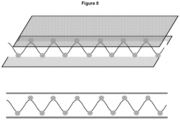
- Figure 8 schematically depicts a layer of cardboard comprising one layer of corrugated paper having the flutes tips coated with adhesive as well as an upper and a lower liner.
- a schematic illustration of "fluted" (“corrugated") piece of paper, i.e. a piece of paper that has been brought into contact with heat or steam, or both, on corrugating rolls, in order to have a corrugated (“fluted") shape is illustrated, which also shows how to exemplary apply glue to the tips of the flutes.
- the glue may be applied along the entire tip or only along parts thereof.
- the figure also illustrates an upper and a lower liner as applied onto the upper and lower tips of the fluted paper, called single facer and double backer side of the board, resulting in a single walled cardboard.
- MFC Microfibrillated cellulose
- Microfibrillated cellulose (also known as “reticulated” cellulose or as “superfine” cellulose, or as “cellulose nanofibrils”, among others) is a cellulose-based product and is described, for example, in US 4 481 077 , US 4 374 702 and US 4 341 807 .
- US 4 374 702 (“Turbak")
- microfibrillated cellulose has distinct properties vis-à-vis cellulose products not subjected to the mechanical treatment disclosed in US 4 374 702 .
- the microfibrillated cellulose described in these documents has reduced length scales (diameter, fiber length), improved water retention and adjustable viscoelastic properties.
- MFC with further improved properties and/or properties tailor-made for specific applications is known, among others, from WO 2007/091942 and WO 2015/180844 .
- cellulose which is the starting product for producing microfibrillated cellulose (typically present as a "cellulose pulp” ).
- cellulose which is the starting product for producing microfibrillated cellulose (typically present as a "cellulose pulp” )
- the cellulose in wood fibres is an aggregation of fibrils.
- pulp elementary fibrils are aggregated into microfibrils which are further aggregated into larger fibril bundles and finally into cellulosic fibres.
- the diameter of wood based fibres is typically in the range 10-50 ⁇ m (with the length of these fibres being even greater).
- cellulose fibres are microfibrillated
- a heterogeneous mixture of "released" fibrils with cross-sectional dimensions and lengths from nm to ⁇ m may result. Fibrils and bundles of fibrils may coexist in the resulting microfibrillated cellulose.
- microfibrillated cellulose 'MFC'
- individual fibrils or fibril bundles can be identified and easily discerned by way of conventional optical microscopy, for example at a magnification of 40 x, and/or by electron microscopy.
- MFC microfibrillated cellulose
- any type of microfibrillated cellulose can be used in accordance with the present invention, as long as the fiber bundles as present in the original cellulose pulp are sufficiently disintegrated in the process of making MFC so that the average diameter of the resulting fibers/fibrils is in the nanometer-range and therefore more surface of the overall cellulose-based material has been created, vis-à-vis the surface available in the original cellulose material.
- MFC may be prepared according to any of the processes described in the art, including the prior art specifically cited in the "Background"-Section above.
- the raw material for the cellulose microfibrils may be any cellulosic material, in particular wood, annual plants, cotton, flax, straw, ramie, bagasse (from sugar cane), suitable algae, jute, sugar beet, citrus fruits, waste from the food processing industry or energy crops or cellulose of bacterial origin or from animal origin, e.g. from tunicates.
- wood-based materials are used as raw materials, either hardwood or softwood or both (in mixtures). Further preferably softwood is used as a raw material, either one kind or mixtures of different soft wood types. Bacterial microfibrillated cellulose is also preferred, due to its comparatively high purity.
- the microfibrillated cellulose in accordance with the present invention may be unmodified in respect to its functional groups or may be physically modified or chemically modified, or both.
- the microfibrillated cellulose is non-modified or physically modified, preferably non-modified.
- Chemical modification of the surface of the cellulose microfibrils may be achieved by various possible reactions of the surface functional groups of the cellulose microfibrils and more particularly of the hydroxyl functional groups, preferably by: oxidation, silylation reactions, etherification reactions, condensations with isocyanates, alkoxylation reactions with alkylene oxides, or condensation or substitution reactions with glycidyl derivatives. Chemical modification may take place before or after the defibrillation step.
- the cellulose microfibrils may, in principle, also be modified by a physical route, either by adsorption at the surface, or by spraying, or by coating, or by encapsulation of the microfibril.
- Preferred modified microfibrils can be obtained by physical adsorption of at least one compound.
- the MFC may also be modified by association with an amphiphilic compound (surfactant).
- microfibrillated cellulose as used in step (iii) is prepared by a process, which comprises at least the following steps:
- the mechanical pretreatment step preferably is or comprises a refining step.
- the purpose of the mechanical pretreatment is to "beat" the cellulose pulp in order to increase the accessibility of the cell walls, i.e. to increase the surface area.
- a refiner that is preferably used in the mechanical pretreatment step comprises at least one rotating disk. Therein, the cellulose pulp slurry is subjected to shear forces between the at least one rotating disk and at least one stationary disk.
- enzymatic (pre)treatment of the cellulose pulp is an optional additional step that may be preferred for some applications.
- enzymatic pretreatment in conjunction with microfibrillating cellulose the respective content of WO 2007/091942 is incorporated herein by reference. Any other type of pretreatment, including chemical pretreatment is also within the scope of the present invention.
- step (b) which is to be conducted after the (mechanical) pretreatment step, the cellulose pulp slurry from step (a) is passed through a homogenizer at least once, preferably at least two times, as described, for example, in PCT/EP2015/001 103 .
- MFC as used to make the compositions in accordance with the present invention is commercially available and commercialized, for example, by Borregaard as "Exilva Microfibrillated cellulose PBX 01-V", based on cellulose pulp from Norwegian spruce (softwood).
- the MFC used in the example was present as a paste, having a solids content of 10%, i.e. the dry matter content of microfibrillated fibers in the MFC paste was 10 %, while the remaining 90% were water, which was the sole solvent in this case.
- a starch-based adhesive as known from the art was prepared based on the following components and using the following steps:
- Borax was added after the addition and mixing of the secondary non-swollen starch.
- concentration of borax in the final formulation was 0.15%.
- the Lory viscosity of this starch-based adhesive according to the art including borax was decreasing readily with mixing time, at high shear.
- a starch-based adhesive in accordance with the present invention was prepared based on the following components and using the following steps:
- the adhesive consisted of a primary starch portion in which most of the granules are partially swollen, in which uncooked raw starch was suspended. Microfibrillated cellulose was added under high speed stirring (1500 rpm), after the addition and inmix of the borax. The concentration of MFC in the final formulation was 0.12%.
- Lory viscosity was measured with a Lory viscosity cup (Elcometer 2215/1), which is commonly used in the adhesive, paint and coatings industry and which essentially consists of a conventional cylindrical cup with a needle fixed to the bottom. The cup is first dipped into the adhesive, which then empties through an escape hole. The flow time was measured as soon as the point of the needle was visible.
- Elcometer 2215/1 which is commonly used in the adhesive, paint and coatings industry and which essentially consists of a conventional cylindrical cup with a needle fixed to the bottom. The cup is first dipped into the adhesive, which then empties through an escape hole. The flow time was measured as soon as the point of the needle was visible.
- the Lory viscosity and Brookfield viscosity were measured initially, and over time under laboratory conditions, i.e. at 20°C and under standard ambient conditions. The samples were left on the bench without stirring.
- the initial Lory viscosity was 36 seconds. After 1 hour, the viscosity was 137 seconds (critical viscosity), and the reference adhesive could no longer be measured by Lory viscosity without being pre-stirred for 30 seconds by a propeller mixer. After 4 hours, the viscosity of the reference adhesive was too high to be measured by Lory viscosity, even with 30 seconds pre-stirring (see Figure 1 ) .
- the initial Lory viscosity was 34 and only increased to 43 seconds 1 and 2 hours after preparation. Moreover, the Lory viscosity was still measureable 22.5 hours after preparation and the critical viscosity limit for measuring Lory viscosity was not reached before 25 hours after preparation. After 25 hours, pre-stirring with propeller mixer for 30 seconds had to be performed before the measurements. The final measurement of Lory viscosity was performed 94 hours after the adhesive was prepared (see Figure 2 ) .
- Brookfield viscosity measurements for the reference starch-based adhesive and the starch-based adhesive with MFC likewise show a slower increase in viscosity over time with MFC added to the starch-based adhesive (see Figures 1 and 2 ). Brookfield viscosity was measured with Brookfield Viscometer - RVT model, spindle no. 4.
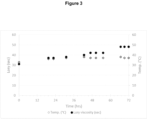
- the Lory viscosity and temperature for the starch-based adhesive with MFC were also measured over time in the storage tank, see Figure 3 .
- the glues are stirred for 5 minutes every hour.
- the starch-based adhesive with MFC the sufficient time between the stirring was tested: The first 24 hours of storage, the adhesive was stirred for 5 minutes every hour, after 24-48 hours the stirring was 5 minutes every third hour, and from 48-72 hours the adhesive was stirred for 5 minutes every fourth hour.
- the frequency of stirring during storage was significantly reduced for the adhesive with MFC.
- the Lory viscosity of the starch-based adhesive with MFC was measured to be 48 seconds after 72 hours storage in tank and the starch-based adhesive could be used directly without adjustment with water for the production of corrugated boards.
- the temperature of the starch-based adhesive in the tank was 37° C (see Figure 3 ) .
- corrugator from BHS (wet end) and Fosber (dry end) was used, which is a set of machines designed to bring together several sheets of paper to form single, double or triple wall board in a continuous process. The process starts with a paper sheet conditioned with heat and steam on corrugating rolls in order to be given its fluted shape in the single facer.
- Starch-based adhesive is then applied to the tips of the flutes on one side and the inner liner is glued to the fluting (see Figures 7 and 8 for a schematic depiction of such a process).
- the corrugated fluting medium with one liner attached to it (single facer) is then brought to the double backer where the outer liner is glued to the single facer.
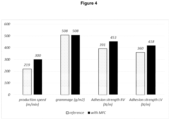
- Figure 4 shows a comparison of the grammage and adhesion strength of corrugated boards, using the reference starch-based adhesive run at 219 m/min (left column) compared to the starch-based adhesive with MFC run at 300 m/min (right column, respectively).
- the starch-based adhesive containing MFC provides greater adhesion strength to the corrugated boards (on both sides, inner and outer liner, respectively RV and LV), even when the production is run 37% faster. Since the grammage of the cardboard was similar for both adhesives, the improvement of the adhesion strength can be compared and improvements can be attributed to the better performance of the starch-based adhesive with MFC. It was also observed that the boards produced with the MFC starch-based adhesive were flatter than the boards produced with the reference starch adhesive.
- the viscosity of the starch-based adhesive with MFC is unexpectedly stable over a long period of time, in particular during storage (at least 72 hours) contrary to a starch-based adhesive without MFC, the viscosity of which increases dramatically already after 1 hour.
- the starch-based adhesive with MFC is usable for corrugated board production even after 72 hours storage and performs even better than a fresh made reference at high speed production. Therefore production can be run at faster speeds, while better quality and flatter boards are obtained.
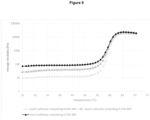
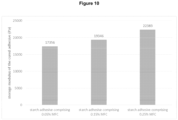
- Figure 9 and Figure 10 show the effect of MFC concentration on the gelatinization speed of the starch adhesive, and storage modulus of the cured adhesive.
- the solid content and caustic soda concentration are equal for the three glues, which do not comprise borax.
- the MFC content varies from 0.05 to 0.25 w-% of the overall adhesive composition.
- the higher the concentration of MFC the slower the gelatinization speed and the longer the open time of the adhesive is (see Figure 9 ).
- the advantage of a long open time in a full scale production is that there is more time to adjust for warps on the boards which results in flatter and more stable boards. Furthermore, the longer the "open" time, the more time for the secondary starch to fully gelatinize, and for the formation of a strong entangled microfibrillar cellulose-starch gel network. In fact, the MFC concentration can be varied to control the bond strength of the adhesive as well as its open time, allowing for a better control of the warps and an overall better quality of the corrugated boards.
- the microfibrillated cellulose is providing an extremely high shear stable viscosity, here shown for a Stein-Hall starch adhesive comprising 0.1% MFC and no borax ( Figure 11 B ). After an instant increase in viscosity upon addition of MFC, the viscosity remains constant under high shear stirring for 15 minutes ( Figure 11 B ). In comparison, the viscosity of the reference adhesive comprising 0.3% borax ( Figure 11 A ), decreased by 27% after 15 minutes of high shear stirring.
- a target viscosity of the adhesive can be predetermined and achieved, regardless of stirring time during manufacturing, before it is used on the corrugator or transferred to the storage tank.
- the corrugator can be run with the same settings for the adhesive over time, facilitating a continuous production and high production volumes of corrugated boards.
- MFC can be used advantageously to replace parts or all of the borax as typically used as an additive in starch based adhesives.
Landscapes
- Chemical & Material Sciences (AREA)
- Organic Chemistry (AREA)
- Chemical Kinetics & Catalysis (AREA)
- Medicinal Chemistry (AREA)
- Polymers & Plastics (AREA)
- Health & Medical Sciences (AREA)
- Life Sciences & Earth Sciences (AREA)
- Engineering & Computer Science (AREA)
- Materials Engineering (AREA)
- Wood Science & Technology (AREA)
- Biochemistry (AREA)
- Adhesives Or Adhesive Processes (AREA)
- Compositions Of Macromolecular Compounds (AREA)
- Paints Or Removers (AREA)
- Paper (AREA)
- Polysaccharides And Polysaccharide Derivatives (AREA)
- Wrappers (AREA)
Claims (15)
- Composition adhésive comprenant :• au moins un amidon et/ou au moins un dérivé d'amidon, en une quantité de 22 % p/p à 46 % p/p, en matière sèche, de la composition adhésive totale ;• au moins un solvant, où ledit solvant, préférentiellement, comprend ou consiste en de l'eau, en une quantité de 30 % p/p à 95 % p/p de la composition adhésive totale ;• de la cellulose microfibrillée en une quantité de 0,001 % p/p à 10 % p/p, en matière sèche, de la composition adhésive totale, préférentiellement de 0,01 % p/p à 10 % p/p, en matière sèche, de la composition adhésive totale,dans laquelle la quantité de cellulose microfibrillée, telle que mesurée par rapport à la quantité totale d'amidon, dans la composition adhésive est comprise entre 0,003 % p/p et 22 % p/p, et dans laquelle la cellulose microfibrillée est une cellulose microfibrillée non modifiée (native) ou une cellulose microfibrillée physiquement modifiée.
- Composition selon la revendication 1, dans laquelle
la quantité de cellulose microfibrillée dans ladite composition est comprise entre 0,01 % et 10 % de matière sèche par rapport au poids total de la composition, préférentiellement entre 0,05 % et 5 %, plus préférentiellement entre 0,05 % et 2 %, encore plus préférentiellement entre 0,05 % et 0,15 %, ou dans laquelle la quantité de cellulose microfibrillée dans ladite composition est comprise entre 0,02 % p/p et 8 % p/p par rapport au poids total de la composition, plus préférentiellement entre 0,05 % p/p et 0,5 % p/p et/ou dans laquelle la quantité de cellulose microfibrillée, telle que mesurée par rapport à la quantité totale d'amidon dans la composition adhésive, est comprise entre 0,02 % p/p et 20 % p/p, ou entre 0,04 % p/p et 4 % p/p ou entre 0,1 % p/p et 2 % p/p, plus préférentiellement entre 0,2 % p/p et 1,4 % p/p, encore plus préférentiellement entre 0,2 % p/p et 0,6 % p/p. - Composition selon la revendication 1 ou la revendication 2, dans laquelle la quantité totale d'amidon dans ladite composition est comprise entre 22 % p/p et 35 % p/p, préférentiellement entre 30 % p/p et 46 % p/p, plus préférentiellement entre 35 % p/p et 45 % p/p, de la composition adhésive totale.
- Composition selon l'une quelconque des revendications précédentes, dans laquelle le pH de la composition adhésive est compris entre 8 et 14, préférentiellement entre 10 et 13, plus préférentiellement entre 11,5 et 12,5 et/ou
dans laquelle l'au moins un amidon est un amidon natif, ou un amidon modifié chimiquement ou physiquement, ou un dérivé d'amidon ou un mélange de ceux-ci. - Composition selon l'une quelconque des revendications précédentes, dans laquelle la cellulose microfibrillée est caractérisée en ce qu'elle conduit à une dispersion de type gel qui a une viscosité à cisaillement nul, η0, d'au moins 2000 Pa*s, préférentiellement d'au moins 3000 Pa*s ou 4000 Pa*s, plus préférentiellement d'au moins 5000 Pa*s, plus préférentiellement d'au moins 6000 Pa*s, plus préférentiellement d'au moins 7000 Pa*s, telle que mesurée dans du polyéthylène glycol (PEG) comme solvant, et à une teneur en solides de MFC de 0,65 %, dans laquelle la méthode de mesure est celle décrite dans la description et/ou
dans laquelle la cellulose microfibrillée est caractérisée par une capacité de rétention d'eau supérieure à 30, préférentiellement supérieure à 40 ou 50, plus préférentiellement supérieure à 60 ou 70 ou 75, encore plus préférentiellement supérieure à 80 ou 90, encore plus préférentiellement supérieure à 100, telle que mesurée en diluant les échantillons de MFC jusqu'à une teneur en solides de 0,3 % dans l'eau, puis en centrifugeant les échantillons à 1000 G pendant 15 minutes, après quoi la phase d'eau claire est séparée du sédiment et le sédiment est pesé, dans laquelle la capacité de rétention d'eau est donnée par la formule (mV/mT)-1 où mV est la masse du sédiment humide et mT est la masse de MFC sèche analysée, dans laquelle la méthode de mesure est telle que décrite dans la description. - Composition selon l'une quelconque des revendications précédentes, dans laquelle la cellulose microfibrillée est une cellulose microfibrillée non modifiée dérivée d'une matière végétale.
- Procédé de préparation d'un adhésif à base d'amidon selon les revendications 1 à 6, ou d'un adhésif à base d'un dérivé d'amidon, lequel procédé comprend les étapes suivantes :(a) le mélange d'au moins un amidon et/ou d'au moins un dérivé d'amidon, ou d'un mélange de ceux-ci, avec au moins un solvant, en particulier un solvant comprenant de l'eau ou constitué d'eau ;(b) éventuellement l'ajout d'un ou plusieurs additifs au mélange obtenu à l'étape (a) ;(c) pendant ou après l'étape (a), ou pendant ou après l'étape optionnelle (b) : l'ajout de cellulose microfibrillée, qui est préférentiellement présente dans un solvant, préférentiellement un solvant comprenant de l'eau ou constitué principalement d'eau ;(d) éventuellement l'ajout d'un alcalin, préférentiellement un hydroxyde alcalin, plus préférentiellement NaOH, au mélange de l'étape (a) et/ou au mélange de l'étape (b) et/ou au mélange de l'étape (c), dans un rapport alcalin sec, préférentiellement hydroxyde alcalin, plus préférentiellement NaOH, par rapport à l'amidon sec, en une quantité préférentiellement comprise entre 0,1 % p/p et 3 % p/p, plus préférentiellement entre 0,5 % p/p et 2 % p/p ;(e) éventuellement l'ajout d'une quantité supplémentaire de l'au moins un solvant, en particulier un solvant comprenant de l'eau ou constitué d'eau, au mélange de l'étape (b) et/ou (c) et/ou (d) ;(f) éventuellement l'ajout d'une quantité supplémentaire d'au moins un amidon ou d'au moins un dérivé d'amidon, ou d'un mélange de ceux-ci, et/ou d'une quantité supplémentaire de cellulose microfibrillée au mélange de l'étape (b), (c) et/ou (d) ;(g) la dispersion du mélange de l'étape (c), (d), (e) ou (f) jusqu'à l'obtention d'un mélange homogène,dans lequel l'au moins un amidon et/ou l'au moins un dérivé d'amidon est présent dans l'adhésif à base d'amidon ou l'adhésif à base d'un dérivé d'amidon en une quantité de 22 % p/p à 46 % p/p, en matière sèche, de la composition adhésive totale,dans lequel la quantité de cellulose microfibrillée est comprise entre 0,003 % p/p et 22 % p/p, telle que mesurée par rapport à la quantité totale d'amidon dans la composition adhésive, et dans lequel la cellulose microfibrillée est une cellulose microfibrillée non modifiée (native) ou une cellulose microfibrillée physiquement modifiée.
- Procédé selon la revendication 7, dans lequel la viscosité du mélange augmente d'au moins 10 %, préférentiellement d'au moins 25 %, plus préférentiellement d'au moins 35 %, à l'étape (c) et par rapport à la viscosité du mélange de l'étape (a) ou de l'étape (b).
- Procédé selon la revendication 7 ou la revendication 8, dans lequel, à l'étape (a), un amidon primaire est d'abord ajouté à une quantité prédéterminée de solvant jusqu'à l'obtention d'une viscosité prédéterminée, puis, à l'étape (b) ou après celle-ci, un amidon secondaire est ajouté, c'est-à-dire une deuxième quantité du même amidon ou dérivé d'amidon ou d'un amidon ou dérivé d'amidon différent.
- Utilisation de cellulose microfibrillée en tant qu'agent modificateur de rhéologie dans des adhésifs selon les revendications 1 à 6 comprenant de l'amidon et/ou des dérivés de l'amidon, dans laquelle la cellulose microfibrillée est une cellulose microfibrillée non modifiée (native) ou une cellulose microfibrillée physiquement modifiée.
- Utilisation de la composition adhésive selon l'une quelconque des revendications 1 à 6 ou de la composition adhésive telle qu'obtenue selon un procédé issu des revendications 7 à 9 pour la fabrication de cartons ondulés.
- Procédé de fabrication de cartons ondulés, ledit procédé comprenant au moins les étapes suivantes :la fourniture d'une composition adhésive à base d'amidon selon l'une quelconque des revendications 1 à 6, etl'application desdits adhésifs à base d'amidon sur au moins une partie des sommets des cannelures d'une feuille de papier ondulé, sur au moins un côté, préférentiellement sur les deux côtés ; etdans une machine à onduler, l'application d'au moins une couverture sur ladite feuille de papier ondulé, préférentiellement l'application d'une couverture supplémentaire sur l'autre côté de la feuille de papier ondulé, etla préparation d'un carton à simple, double, triple ou multiple paroi, préférentiellement lors d'un procédé en continu.
- Cartons ondulés ayant au moins une cannelure et au moins une couverture comprenant la composition adhésive à base d'amidon selon l'une quelconque des revendications 1 à 6.
- Utilisation de la composition adhésive à base d'amidon de l'une quelconque des revendications 1 à 6 dans la fabrication de cartons ondulés.
- Procédé ou utilisation ou carton ondulé selon l'une quelconque des revendications 7 à 14, dans lequel/laquelle la quantité de cellulose microfibrillée dans ladite composition est comprise entre 0,001 % et 10 % de matière sèche, par rapport au poids total de la composition, préférentiellement entre 0,01 % et 10 % de matière sèche, par rapport au poids total de la composition, préférentiellement entre 0,05 % et 5 %, plus préférentiellement entre 0,05 % et 2 %, encore plus préférentiellement entre 0,05 % et 0,15 %, ou dans lequel/laquelle la quantité de cellulose microfibrillée dans ladite composition est comprise entre 0,02 % p/p et 8 % p/p par rapport au poids total de la composition, plus préférentiellement entre 0,05 % p/p et 0,5 % p/p, plus préférentiellement entre 0,05 % p/p et 0,15 % p/p et/ou dans lequel/laquelle la quantité de cellulose microfibrillée est comprise entre 0,003 % p/p et 22 % p/p, préférentiellement entre 0,02 % p/p et 20 % p/p, ou entre 0,04 % p/p et 4 % p/p ou entre 0,1 % p/p et 2 % p/p, plus préférentiellement entre 0,2 % p/p et 1,4 % p/p, encore plus préférentiellement entre 0,2 % p/p et 0,6 % p/p, telle que mesurée par rapport à la quantité totale d'amidon dans la composition adhésive.
Applications Claiming Priority (4)
| Application Number | Priority Date | Filing Date | Title |
|---|---|---|---|
| EP17186201.4A EP3444310A1 (fr) | 2017-08-14 | 2017-08-14 | Cellulose microfibrillée comme modificateurs de rhéologie dans des adhésifs |
| EP17186166.9A EP3444282A1 (fr) | 2017-08-14 | 2017-08-14 | Cellulose microfibrillée qu'un agent de réticulation et le remplacement de borax |
| EP18182239.6A EP3591018A1 (fr) | 2018-07-06 | 2018-07-06 | Cellulose microfibrillée pour contrôler la viscosité et la température de gel dans des adhésifs à base d'amidon |
| PCT/EP2018/072008 WO2019034644A1 (fr) | 2017-08-14 | 2018-08-14 | Cellulose microfibrillée en tant que modificateur de rhéologie dans des adhésifs |
Publications (3)
| Publication Number | Publication Date |
|---|---|
| EP3668712A1 EP3668712A1 (fr) | 2020-06-24 |
| EP3668712C0 EP3668712C0 (fr) | 2024-10-16 |
| EP3668712B1 true EP3668712B1 (fr) | 2024-10-16 |
Family
ID=65362372
Family Applications (2)
| Application Number | Title | Priority Date | Filing Date |
|---|---|---|---|
| EP18753188.4A Active EP3668712B1 (fr) | 2017-08-14 | 2018-08-14 | Cellulose microfibrillée comme modificateur de rhéologie dans des adhésifs |
| EP18753418.5A Pending EP3668903A1 (fr) | 2017-08-14 | 2018-08-14 | Cellulose microfibrillée utilisée en tant qu'agent de réticulation |
Family Applications After (1)
| Application Number | Title | Priority Date | Filing Date |
|---|---|---|---|
| EP18753418.5A Pending EP3668903A1 (fr) | 2017-08-14 | 2018-08-14 | Cellulose microfibrillée utilisée en tant qu'agent de réticulation |
Country Status (9)
| Country | Link |
|---|---|
| US (2) | US11820920B2 (fr) |
| EP (2) | EP3668712B1 (fr) |
| JP (2) | JP7112484B2 (fr) |
| CN (2) | CN111183032B (fr) |
| CA (2) | CA3072837A1 (fr) |
| ES (1) | ES2996557T3 (fr) |
| MX (2) | MX2020001721A (fr) |
| PL (1) | PL3668712T3 (fr) |
| WO (2) | WO2019034644A1 (fr) |
Families Citing this family (19)
| Publication number | Priority date | Publication date | Assignee | Title |
|---|---|---|---|---|
| ES2858631T3 (es) * | 2014-05-30 | 2021-09-30 | Borregaard As | Celulosa microfibrilada |
| CA3016377A1 (fr) * | 2016-03-23 | 2017-09-28 | Stora Enso Oyj | Planche presentant une resistance a la compression amelioree |
| EP3668712B1 (fr) | 2017-08-14 | 2024-10-16 | Borregaard AS | Cellulose microfibrillée comme modificateur de rhéologie dans des adhésifs |
| EP3591018A1 (fr) * | 2018-07-06 | 2020-01-08 | Borregaard AS | Cellulose microfibrillée pour contrôler la viscosité et la température de gel dans des adhésifs à base d'amidon |
| SE542997C2 (en) * | 2018-04-25 | 2020-09-22 | Stora Enso Oyj | A method to produce an adhesive comprising starch and microfibrillated cellulose, a corrugated board and an adhesive |
| WO2020127017A1 (fr) | 2018-12-17 | 2020-06-25 | Borregaard As | Pulvérisation de cellulose microfibrillée |
| JP7510420B2 (ja) | 2018-12-20 | 2024-07-03 | ボレガード アーエス | ミクロフィブリル化セルロースの固形分を増加させるための方法及びシステム |
| CN110387202B (zh) * | 2019-08-22 | 2021-05-11 | 广东茂丰科技有限公司 | 一种改性环保玉米淀粉粘合剂的制备方法 |
| TWI838573B (zh) * | 2019-08-30 | 2024-04-11 | 芬蘭商無限纖維公司 | 纖維素預處理 |
| CN110746927B (zh) * | 2019-10-28 | 2020-07-24 | 厦门大学 | 一种基于超高压复合改性的油菜籽蛋白胶黏剂的制备方法 |
| CN110790984B (zh) * | 2019-12-03 | 2022-03-08 | 陕西科技大学 | 一种纤维素纳米晶/硼砂复合薄膜及其制备方法 |
| WO2021156413A1 (fr) | 2020-02-07 | 2021-08-12 | Borregaard As | Compositions adhésives comprenant une combinaison (i) de cellulose microfibrillée et (ii) d'un métal dans un état d'oxydation de ii ou plus |
| SE544848C2 (en) * | 2020-06-01 | 2022-12-13 | Stora Enso Oyj | A method for the production of an adhesive component and an adhesive comprising starch and microfibrillated cellulose |
| GB2587897B (en) * | 2020-07-23 | 2022-03-09 | Sundeala Ltd | A method of production |
| CA3192730A1 (fr) | 2020-09-16 | 2022-03-24 | Liangbing Hu | Bioplastiques et composites lignocellulosiques, et leurs procedes de formation et d'utilisation |
| EP4314086A4 (fr) * | 2021-03-23 | 2025-02-26 | Junion Labs Pte. Ltd. | Hydrogels superabsorbants |
| CN114573878B (zh) * | 2022-03-18 | 2023-03-17 | 潍坊潍森纤维新材料有限公司 | 一种食品医药级生物纤维素透明材料的制备方法及应用 |
| CN118085817B (zh) * | 2024-03-08 | 2025-05-30 | 福建农林大学 | 一种全生物基胶黏剂及其制备方法和应用 |
| CN118852925A (zh) * | 2024-07-09 | 2024-10-29 | 雅士利涂料(苏州)有限公司 | 一种复配改性微纤化纤维素的丙烯酸弹性涂料及制备方法 |
Family Cites Families (37)
| Publication number | Priority date | Publication date | Assignee | Title |
|---|---|---|---|---|
| US2886541A (en) | 1955-06-08 | 1959-05-12 | Staley Mfg Co A E | Method of preparing an adhesive which comprises reacting an amylaceous material, a phenol and an aldehyde |
| US2884389A (en) | 1957-08-02 | 1959-04-28 | Koppers Co Inc | Method of preparing an adhesive which comprises reacting gelatinized and ungelatinized starch, a phenolic compound and an aldehyde |
| US3294716A (en) | 1963-03-18 | 1966-12-27 | Staley Mfg Co A E | Moisture resistant starch base corrugating adhesive |
| US3434901A (en) | 1965-10-23 | 1969-03-25 | West Virginia Pulp & Paper Co | Method for manufacturing corrugated board |
| US4374702A (en) | 1979-12-26 | 1983-02-22 | International Telephone And Telegraph Corporation | Microfibrillated cellulose |
| US4341807A (en) | 1980-10-31 | 1982-07-27 | International Telephone And Telegraph Corporation | Food products containing microfibrillated cellulose |
| US4481077A (en) | 1983-03-28 | 1984-11-06 | International Telephone And Telegraph Corporation | Process for preparing microfibrillated cellulose |
| GB9926423D0 (en) | 1999-11-09 | 2000-01-12 | Cerestar Holding Bv | Adhesive composition and application thereof in the preparation of paper and corrugating board |
| EP1352939A1 (fr) * | 2002-04-12 | 2003-10-15 | Remy Industries N.V. | Compositions de pâte de colle à base d'amidon |
| US20110282048A1 (en) | 2005-01-25 | 2011-11-17 | Swe Tree Technologies Ab | Cross-Linking Involving a Polymeric Carbohydrate Material |
| AU2007212781B2 (en) | 2006-02-08 | 2011-01-27 | Stfi-Packforsk Ab | Method for the manufacturing of microfibrillated cellulose |
| JP2008106178A (ja) * | 2006-10-26 | 2008-05-08 | Asahi Kasei Chemicals Corp | 水溶性高分子乾燥組成物 |
| EP3095912B1 (fr) | 2008-04-03 | 2019-02-06 | Rise Innventia AB | Composition pour le couchage d'un papier d'impression |
| FI124724B (fi) * | 2009-02-13 | 2014-12-31 | Upm Kymmene Oyj | Menetelmä muokatun selluloosan valmistamiseksi |
| HUE045496T2 (hu) | 2009-03-30 | 2019-12-30 | Fiberlean Tech Ltd | Eljárás nano-fibrilláris cellulóz szuszpenziók elõállítására |
| FI124464B (fi) | 2009-04-29 | 2014-09-15 | Upm Kymmene Corp | Menetelmä massalietteen valmistamiseksi, massaliete ja paperi |
| US20100291822A1 (en) * | 2009-05-18 | 2010-11-18 | Anil Netravali | Starch based composites and process of manufacture |
| JP5883393B2 (ja) * | 2009-11-06 | 2016-03-15 | ストラ エンソ オーワイジェイ | 紙または板紙製品の製造方法およびこれらの方法に従い製造される紙または板紙 |
| SE535014C2 (sv) * | 2009-12-03 | 2012-03-13 | Stora Enso Oyj | En pappers eller kartongprodukt och en process för tillverkning av en pappers eller kartongprodukt |
| ES2494665T3 (es) * | 2010-01-19 | 2014-09-15 | C-Ip S.A. | Composición adhesiva mejorada |
| WO2011125801A1 (fr) * | 2010-04-01 | 2011-10-13 | 三菱化学株式会社 | Procédé de fabrication d'une dispersion de fibres de cellulose fines |
| WO2013009253A1 (fr) * | 2011-07-08 | 2013-01-17 | Chalmers Tekniska Högskola Aktiebolag | Films de cellulose microfibrillée pour la libération contrôlée d'agents actifs |
| EP2599823A1 (fr) | 2011-12-03 | 2013-06-05 | BK Giulini GmbH | Compositions de colle à base d'amidon sans borax |
| EP2653508A1 (fr) * | 2012-04-19 | 2013-10-23 | Imerys S.A. | Compositions de peinture |
| US9790350B2 (en) * | 2012-08-01 | 2017-10-17 | Cornell University | Crosslinked native and waxy starch resin compositions and processes for their manufacture |
| CN103590281B (zh) | 2012-08-14 | 2015-12-16 | 金东纸业(江苏)股份有限公司 | 表胶液及应用该表胶液的施胶纸 |
| PL2799618T3 (pl) | 2013-04-29 | 2016-12-30 | Zastosowanie mikronizowanej celulozy oraz fluorescencyjnego środka bielącego do powierzchniowej obróbki celulozowych materiałów | |
| BR112015030976B1 (pt) * | 2013-06-13 | 2020-12-22 | Coöperatie Avebe U.A | composição adesiva aquosa e seu método para preparação, método para adesão de um primeiro substrato a um segundo substrato e produto colado, colável ou laminado |
| ES2858631T3 (es) * | 2014-05-30 | 2021-09-30 | Borregaard As | Celulosa microfibrilada |
| US20170283669A1 (en) | 2014-09-04 | 2017-10-05 | 3M Innovative Properties Company | Pressure-sensitive adhesive containing nanocrystalline cellulose |
| CN104558996B (zh) * | 2015-01-08 | 2017-01-25 | 江南大学 | 一种光交联聚乙烯醇/微纤化纤维素pva/mfc复合膜的制备方法 |
| US9822285B2 (en) * | 2015-01-28 | 2017-11-21 | Gpcp Ip Holdings Llc | Glue-bonded multi-ply absorbent sheet |
| WO2017111103A1 (fr) | 2015-12-25 | 2017-06-29 | レンゴー株式会社 | Nanofibres de xanthate de cellulose |
| US10774476B2 (en) * | 2016-01-19 | 2020-09-15 | Gpcp Ip Holdings Llc | Absorbent sheet tail-sealed with nanofibrillated cellulose-containing tail-seal adhesives |
| CN105542676B (zh) | 2016-01-26 | 2017-11-10 | 中南林业科技大学 | 一种以纳米氧化纤维素浆液为母体的淀粉胶黏剂及其制备方法 |
| SE540343C2 (en) * | 2016-11-01 | 2018-07-17 | Stora Enso Oyj | A corrugated board comprising an adhesive comprising starch and fine microfibrillated cellulose |
| EP3668712B1 (fr) | 2017-08-14 | 2024-10-16 | Borregaard AS | Cellulose microfibrillée comme modificateur de rhéologie dans des adhésifs |
-
2018
- 2018-08-14 EP EP18753188.4A patent/EP3668712B1/fr active Active
- 2018-08-14 EP EP18753418.5A patent/EP3668903A1/fr active Pending
- 2018-08-14 PL PL18753188.4T patent/PL3668712T3/pl unknown
- 2018-08-14 WO PCT/EP2018/072008 patent/WO2019034644A1/fr not_active Ceased
- 2018-08-14 JP JP2020507572A patent/JP7112484B2/ja active Active
- 2018-08-14 CA CA3072837A patent/CA3072837A1/fr active Pending
- 2018-08-14 CA CA3072852A patent/CA3072852A1/fr active Pending
- 2018-08-14 ES ES18753188T patent/ES2996557T3/es active Active
- 2018-08-14 MX MX2020001721A patent/MX2020001721A/es unknown
- 2018-08-14 MX MX2020001718A patent/MX2020001718A/es unknown
- 2018-08-14 US US16/637,205 patent/US11820920B2/en active Active
- 2018-08-14 JP JP2020507571A patent/JP7307717B2/ja active Active
- 2018-08-14 US US16/637,245 patent/US11332647B2/en active Active
- 2018-08-14 WO PCT/EP2018/072017 patent/WO2019034649A1/fr not_active Ceased
- 2018-08-14 CN CN201880065496.7A patent/CN111183032B/zh active Active
- 2018-08-14 CN CN201880066526.6A patent/CN111212855B/zh active Active
Also Published As
| Publication number | Publication date |
|---|---|
| WO2019034649A1 (fr) | 2019-02-21 |
| JP7112484B2 (ja) | 2022-08-03 |
| CN111212855A (zh) | 2020-05-29 |
| US20200270428A1 (en) | 2020-08-27 |
| US11332647B2 (en) | 2022-05-17 |
| MX2020001718A (es) | 2020-09-25 |
| CN111183032B (zh) | 2023-07-04 |
| ES2996557T3 (en) | 2025-02-12 |
| JP7307717B2 (ja) | 2023-07-12 |
| WO2019034644A1 (fr) | 2019-02-21 |
| PL3668712T3 (pl) | 2025-01-27 |
| CA3072837A1 (fr) | 2019-02-21 |
| WO2019034649A8 (fr) | 2020-02-27 |
| MX2020001721A (es) | 2020-09-25 |
| CA3072852A1 (fr) | 2019-02-21 |
| CN111212855B (zh) | 2023-03-24 |
| EP3668712C0 (fr) | 2024-10-16 |
| JP2020530515A (ja) | 2020-10-22 |
| US11820920B2 (en) | 2023-11-21 |
| US20200248042A1 (en) | 2020-08-06 |
| EP3668712A1 (fr) | 2020-06-24 |
| JP2020530869A (ja) | 2020-10-29 |
| CN111183032A (zh) | 2020-05-19 |
| EP3668903A1 (fr) | 2020-06-24 |
Similar Documents
| Publication | Publication Date | Title |
|---|---|---|
| US11332647B2 (en) | Microfibrillated cellulose as rheology modifier in adhesives | |
| KR102782754B1 (ko) | 화학적으로 처리된 종이를 포함하는 주름진 페이퍼보드 및 카드보드의 제조 | |
| EP3818122B1 (fr) | Cellulose microfibrillee pour controler la viscosite et la température de gélatinisation dans des adhesifs a base d'amidon | |
| EP3444310A1 (fr) | Cellulose microfibrillée comme modificateurs de rhéologie dans des adhésifs | |
| EP3784744B1 (fr) | Procédé de production d'un adhésif comprenant de l'amidon et de la cellulose microfibrillée, panneau ondulé et adhésif | |
| EP3444282A1 (fr) | Cellulose microfibrillée qu'un agent de réticulation et le remplacement de borax | |
| CN107849411B (zh) | 含有淀粉的粘合剂组合物及其用途 | |
| US12391851B2 (en) | Adhesive compositions comprising a combination of (I) microfibrillated cellulose and (II) a metal in an oxidation state of II or greater |
Legal Events
| Date | Code | Title | Description |
|---|---|---|---|
| STAA | Information on the status of an ep patent application or granted ep patent |
Free format text: STATUS: UNKNOWN |
|
| STAA | Information on the status of an ep patent application or granted ep patent |
Free format text: STATUS: THE INTERNATIONAL PUBLICATION HAS BEEN MADE |
|
| PUAI | Public reference made under article 153(3) epc to a published international application that has entered the european phase |
Free format text: ORIGINAL CODE: 0009012 |
|
| STAA | Information on the status of an ep patent application or granted ep patent |
Free format text: STATUS: REQUEST FOR EXAMINATION WAS MADE |
|
| 17P | Request for examination filed |
Effective date: 20200203 |
|
| AK | Designated contracting states |
Kind code of ref document: A1 Designated state(s): AL AT BE BG CH CY CZ DE DK EE ES FI FR GB GR HR HU IE IS IT LI LT LU LV MC MK MT NL NO PL PT RO RS SE SI SK SM TR |
|
| AX | Request for extension of the european patent |
Extension state: BA ME |
|
| DAV | Request for validation of the european patent (deleted) | ||
| DAX | Request for extension of the european patent (deleted) | ||
| STAA | Information on the status of an ep patent application or granted ep patent |
Free format text: STATUS: EXAMINATION IS IN PROGRESS |
|
| 17Q | First examination report despatched |
Effective date: 20210302 |
|
| GRAP | Despatch of communication of intention to grant a patent |
Free format text: ORIGINAL CODE: EPIDOSNIGR1 |
|
| STAA | Information on the status of an ep patent application or granted ep patent |
Free format text: STATUS: GRANT OF PATENT IS INTENDED |
|
| INTG | Intention to grant announced |
Effective date: 20240605 |
|
| RIN1 | Information on inventor provided before grant (corrected) |
Inventor name: BERG, JAN Inventor name: LIAPIS, KATERINA Inventor name: HOLTAN, SYNNOVE |
|
| GRAS | Grant fee paid |
Free format text: ORIGINAL CODE: EPIDOSNIGR3 |
|
| GRAA | (expected) grant |
Free format text: ORIGINAL CODE: 0009210 |
|
| STAA | Information on the status of an ep patent application or granted ep patent |
Free format text: STATUS: THE PATENT HAS BEEN GRANTED |
|
| AK | Designated contracting states |
Kind code of ref document: B1 Designated state(s): AL AT BE BG CH CY CZ DE DK EE ES FI FR GB GR HR HU IE IS IT LI LT LU LV MC MK MT NL NO PL PT RO RS SE SI SK SM TR |
|
| REG | Reference to a national code |
Ref country code: GB Ref legal event code: FG4D |
|
| REG | Reference to a national code |
Ref country code: DE Ref legal event code: R096 Ref document number: 602018075501 Country of ref document: DE Ref country code: CH Ref legal event code: EP |
|
| REG | Reference to a national code |
Ref country code: IE Ref legal event code: FG4D |
|
| U01 | Request for unitary effect filed |
Effective date: 20241018 |
|
| U07 | Unitary effect registered |
Designated state(s): AT BE BG DE DK EE FI FR IT LT LU LV MT NL PT RO SE SI Effective date: 20241107 |
|
| REG | Reference to a national code |
Ref country code: ES Ref legal event code: FG2A Ref document number: 2996557 Country of ref document: ES Kind code of ref document: T3 Effective date: 20250212 |
|
| PG25 | Lapsed in a contracting state [announced via postgrant information from national office to epo] |
Ref country code: HR Free format text: LAPSE BECAUSE OF FAILURE TO SUBMIT A TRANSLATION OF THE DESCRIPTION OR TO PAY THE FEE WITHIN THE PRESCRIBED TIME-LIMIT Effective date: 20241016 Ref country code: IS Free format text: LAPSE BECAUSE OF FAILURE TO SUBMIT A TRANSLATION OF THE DESCRIPTION OR TO PAY THE FEE WITHIN THE PRESCRIBED TIME-LIMIT Effective date: 20250216 |
|
| PG25 | Lapsed in a contracting state [announced via postgrant information from national office to epo] |
Ref country code: GR Free format text: LAPSE BECAUSE OF FAILURE TO SUBMIT A TRANSLATION OF THE DESCRIPTION OR TO PAY THE FEE WITHIN THE PRESCRIBED TIME-LIMIT Effective date: 20250117 |
|
| PG25 | Lapsed in a contracting state [announced via postgrant information from national office to epo] |
Ref country code: RS Free format text: LAPSE BECAUSE OF FAILURE TO SUBMIT A TRANSLATION OF THE DESCRIPTION OR TO PAY THE FEE WITHIN THE PRESCRIBED TIME-LIMIT Effective date: 20250116 |
|
| PG25 | Lapsed in a contracting state [announced via postgrant information from national office to epo] |
Ref country code: SM Free format text: LAPSE BECAUSE OF FAILURE TO SUBMIT A TRANSLATION OF THE DESCRIPTION OR TO PAY THE FEE WITHIN THE PRESCRIBED TIME-LIMIT Effective date: 20241016 |
|
| PG25 | Lapsed in a contracting state [announced via postgrant information from national office to epo] |
Ref country code: SK Free format text: LAPSE BECAUSE OF FAILURE TO SUBMIT A TRANSLATION OF THE DESCRIPTION OR TO PAY THE FEE WITHIN THE PRESCRIBED TIME-LIMIT Effective date: 20241016 |
|
| PG25 | Lapsed in a contracting state [announced via postgrant information from national office to epo] |
Ref country code: CZ Free format text: LAPSE BECAUSE OF FAILURE TO SUBMIT A TRANSLATION OF THE DESCRIPTION OR TO PAY THE FEE WITHIN THE PRESCRIBED TIME-LIMIT Effective date: 20241016 |
|
| PLBE | No opposition filed within time limit |
Free format text: ORIGINAL CODE: 0009261 |
|
| STAA | Information on the status of an ep patent application or granted ep patent |
Free format text: STATUS: NO OPPOSITION FILED WITHIN TIME LIMIT |
|
| 26N | No opposition filed |
Effective date: 20250717 |
|
| U20 | Renewal fee for the european patent with unitary effect paid |
Year of fee payment: 8 Effective date: 20250826 |
|
| PGFP | Annual fee paid to national office [announced via postgrant information from national office to epo] |
Ref country code: ES Payment date: 20250917 Year of fee payment: 8 |
|
| PGFP | Annual fee paid to national office [announced via postgrant information from national office to epo] |
Ref country code: NO Payment date: 20250820 Year of fee payment: 8 |
|
| PGFP | Annual fee paid to national office [announced via postgrant information from national office to epo] |
Ref country code: PL Payment date: 20250812 Year of fee payment: 8 |
|
| PGFP | Annual fee paid to national office [announced via postgrant information from national office to epo] |
Ref country code: GB Payment date: 20250822 Year of fee payment: 8 |
|
| U1N | Appointed representative for the unitary patent procedure changed after the registration of the unitary effect |
Representative=s name: CASALONGA; DE |
|
| REG | Reference to a national code |
Ref country code: CH Ref legal event code: H13 Free format text: ST27 STATUS EVENT CODE: U-0-0-H10-H13 (AS PROVIDED BY THE NATIONAL OFFICE) Effective date: 20260324 |
|
| PG25 | Lapsed in a contracting state [announced via postgrant information from national office to epo] |
Ref country code: MC Free format text: LAPSE BECAUSE OF FAILURE TO SUBMIT A TRANSLATION OF THE DESCRIPTION OR TO PAY THE FEE WITHIN THE PRESCRIBED TIME-LIMIT Effective date: 20241016 |
|
| PG25 | Lapsed in a contracting state [announced via postgrant information from national office to epo] |
Ref country code: CH Free format text: LAPSE BECAUSE OF NON-PAYMENT OF DUE FEES Effective date: 20250831 |