EP3668884B1 - Duplex stabilisierende fluorescenz quencher für nuklein säure sonden. - Google Patents
Duplex stabilisierende fluorescenz quencher für nuklein säure sonden. Download PDFInfo
- Publication number
- EP3668884B1 EP3668884B1 EP18759216.7A EP18759216A EP3668884B1 EP 3668884 B1 EP3668884 B1 EP 3668884B1 EP 18759216 A EP18759216 A EP 18759216A EP 3668884 B1 EP3668884 B1 EP 3668884B1
- Authority
- EP
- European Patent Office
- Prior art keywords
- oligonucleotide
- mmol
- solid
- dsq
- pfp
- Prior art date
- Legal status (The legal status is an assumption and is not a legal conclusion. Google has not performed a legal analysis and makes no representation as to the accuracy of the status listed.)
- Active
Links
- 0 *c1c(C=*)nc(C(O)=O)[n]1* Chemical compound *c1c(C=*)nc(C(O)=O)[n]1* 0.000 description 20
- BBQNDABJSPSKOJ-UHFFFAOYSA-N CC(N1c2ccc3[nH]c(C(N4C5=CC=C6NC(C(Oc(c(F)c(c(F)c7F)F)c7F)=O)=CC6C5CC4)=O)cc3c2CC1)=O Chemical compound CC(N1c2ccc3[nH]c(C(N4C5=CC=C6NC(C(Oc(c(F)c(c(F)c7F)F)c7F)=O)=CC6C5CC4)=O)cc3c2CC1)=O BBQNDABJSPSKOJ-UHFFFAOYSA-N 0.000 description 1
- VRIJHNITVMGYOB-UHFFFAOYSA-N CC(N1c2ccc3[nH]c(C(N4c5ccc6[nH]c(C(O)=O)cc6c5CC4)=O)cc3c2CC1)=O Chemical compound CC(N1c2ccc3[nH]c(C(N4c5ccc6[nH]c(C(O)=O)cc6c5CC4)=O)cc3c2CC1)=O VRIJHNITVMGYOB-UHFFFAOYSA-N 0.000 description 1
- HOSWIJRTWNEACT-UPRQXYPZSA-N CC(OCCCN(C)c(cc1)ccc1/N=N/c1nc(ccc(C(N(CC2)c(cc3)c2c2c3[nH]c(C(N(CC3)C4=C3C3C=C(C(Oc(c(F)c(c(F)c5F)F)c5F)=O)NC3C=C4)=O)c2)=O)c2)c2[s]1)=O Chemical compound CC(OCCCN(C)c(cc1)ccc1/N=N/c1nc(ccc(C(N(CC2)c(cc3)c2c2c3[nH]c(C(N(CC3)C4=C3C3C=C(C(Oc(c(F)c(c(F)c5F)F)c5F)=O)NC3C=C4)=O)c2)=O)c2)c2[s]1)=O HOSWIJRTWNEACT-UPRQXYPZSA-N 0.000 description 1
- UJQXKENTWHXROO-CPHIHMHPSA-N CC(OCCCN(C)c(cc1)ccc1/N=N/c1nc(ccc(C(N(CC2)c(cc3)c2c2c3[nH]c(C(N3c4ccc5[nH]c(C(O)=O)cc5c4CC3)=O)c2)=O)c2)c2[s]1)=O Chemical compound CC(OCCCN(C)c(cc1)ccc1/N=N/c1nc(ccc(C(N(CC2)c(cc3)c2c2c3[nH]c(C(N3c4ccc5[nH]c(C(O)=O)cc5c4CC3)=O)c2)=O)c2)c2[s]1)=O UJQXKENTWHXROO-CPHIHMHPSA-N 0.000 description 1
- NQUJZHJZUTUYRD-UHFFFAOYSA-N CC(OCCCN(C)c1ccccc1)=O Chemical compound CC(OCCCN(C)c1ccccc1)=O NQUJZHJZUTUYRD-UHFFFAOYSA-N 0.000 description 1
- SRVCTZTWLLTJNW-BYYHNAKLSA-N CCOC(c1cc(cc(cc2)/N=N/c3c(-c4ccccc4)nc(N4CCCC4)[s]3)c2[nH]1)=O Chemical compound CCOC(c1cc(cc(cc2)/N=N/c3c(-c4ccccc4)nc(N4CCCC4)[s]3)c2[nH]1)=O SRVCTZTWLLTJNW-BYYHNAKLSA-N 0.000 description 1
- UWMNHCHWSRJVMW-BYYHNAKLSA-N CCOC(c1ccc2nc(/N=N/c(cc3)ccc3N(C)CCCCCCOC(C)=O)[s]c2c1)=O Chemical compound CCOC(c1ccc2nc(/N=N/c(cc3)ccc3N(C)CCCCCCOC(C)=O)[s]c2c1)=O UWMNHCHWSRJVMW-BYYHNAKLSA-N 0.000 description 1
- PTZQJLUTBLKJQK-BSLTZQBWSA-N CN(C)c(cc1)ccc1/N=N/c(c(OC)c1)cc(OC)c1/N=N/c(cc1)ccc1C(N(CC1)c(cc2)c1c1c2[nH]c(C(N2c3ccc4[nH]c(C(O)=O)cc4c3CC2)=O)c1)=O Chemical compound CN(C)c(cc1)ccc1/N=N/c(c(OC)c1)cc(OC)c1/N=N/c(cc1)ccc1C(N(CC1)c(cc2)c1c1c2[nH]c(C(N2c3ccc4[nH]c(C(O)=O)cc4c3CC2)=O)c1)=O PTZQJLUTBLKJQK-BSLTZQBWSA-N 0.000 description 1
- LZRJDMLOGRSQLN-VGFSZAGXSA-N CN(C)c(cc1)ccc1/N=N/c1ccc2[nH]c(C(N(CC3)c(cc4)c3c3c4[nH]c(C(N4c5ccc6[nH]c(C(O)=O)cc6c5CC4)=O)c3)=O)cc2c1 Chemical compound CN(C)c(cc1)ccc1/N=N/c1ccc2[nH]c(C(N(CC3)c(cc4)c3c3c4[nH]c(C(N4c5ccc6[nH]c(C(O)=O)cc6c5CC4)=O)c3)=O)cc2c1 LZRJDMLOGRSQLN-VGFSZAGXSA-N 0.000 description 1
- YSODOWJVQZXXSR-SBZZGWGOSA-N CN(C)c(cc1)ccc1/N=N/c1ccc2[nH]c(C(N(CC3)c(cc4)c3c3c4[nH]c(C(N4c5ccc6[nH]c(C(Oc(c(F)c(c(F)c7F)F)c7F)=O)cc6c5CC4)=O)c3)=O)cc2c1 Chemical compound CN(C)c(cc1)ccc1/N=N/c1ccc2[nH]c(C(N(CC3)c(cc4)c3c3c4[nH]c(C(N4c5ccc6[nH]c(C(Oc(c(F)c(c(F)c7F)F)c7F)=O)cc6c5CC4)=O)c3)=O)cc2c1 YSODOWJVQZXXSR-SBZZGWGOSA-N 0.000 description 1
- FTOZHHYMADCKSH-HBSCQBRPSA-N CN(C)c(cc1)ccc1/N=N/c1nc(ccc(C(N(CC2)c(cc3)c2c2c3[nH]c(C(N3c4ccc5[nH]c(C(O)=O)cc5c4CC3)=O)c2)=O)c2)c2[s]1 Chemical compound CN(C)c(cc1)ccc1/N=N/c1nc(ccc(C(N(CC2)c(cc3)c2c2c3[nH]c(C(N3c4ccc5[nH]c(C(O)=O)cc5c4CC3)=O)c2)=O)c2)c2[s]1 FTOZHHYMADCKSH-HBSCQBRPSA-N 0.000 description 1
- HXNXYHXTEXUCSM-WCWDXBQESA-N CN(CCCCCCO)c(cc1)ccc1/N=N/c([s]c1c2)nc1ccc2C(O)=O Chemical compound CN(CCCCCCO)c(cc1)ccc1/N=N/c([s]c1c2)nc1ccc2C(O)=O HXNXYHXTEXUCSM-WCWDXBQESA-N 0.000 description 1
- CKHVORTZWLJSOT-GHVJWSGMSA-N COC(c(cc1)cc(Cl)c1/N=N/c(c(OC)c1)cc(OC)c1N1CCCC1)=O Chemical compound COC(c(cc1)cc(Cl)c1/N=N/c(c(OC)c1)cc(OC)c1N1CCCC1)=O CKHVORTZWLJSOT-GHVJWSGMSA-N 0.000 description 1
- IQYHIRVSLVDXNQ-GHVJWSGMSA-N COc(c(N1CCCC1)c1)cc(/N=N/c([s]c2c3)nc2ccc3C(O)=O)c1OC Chemical compound COc(c(N1CCCC1)c1)cc(/N=N/c([s]c2c3)nc2ccc3C(O)=O)c1OC IQYHIRVSLVDXNQ-GHVJWSGMSA-N 0.000 description 1
- KAMFWZDKIOVWGY-NTDNRIHLSA-N COc(c(N1CCCC1)c1)cc(/N=N/c2ccc3[nH]c(C(N(CC4)c(cc5)c4c4c5[nH]c(C(N5c6ccc7[nH]c(C(Oc(c(F)c(c(F)c8F)F)c8F)=O)cc7c6CC5)=O)c4)=O)cc3c2)c1OC Chemical compound COc(c(N1CCCC1)c1)cc(/N=N/c2ccc3[nH]c(C(N(CC4)c(cc5)c4c4c5[nH]c(C(N5c6ccc7[nH]c(C(Oc(c(F)c(c(F)c8F)F)c8F)=O)cc7c6CC5)=O)c4)=O)cc3c2)c1OC KAMFWZDKIOVWGY-NTDNRIHLSA-N 0.000 description 1
- PARRGRLWRXEGMF-VGFSZAGXSA-N C[n]1c(C(N(CC2)c(cc3)c2c2c3[nH]c(C(N3c4ccc5[nH]c(C(O)=O)cc5c4CC3)=O)c2)=O)cc(/N=N/c(c(OC)c2)cc(OC)c2N2CCCC2)c1 Chemical compound C[n]1c(C(N(CC2)c(cc3)c2c2c3[nH]c(C(N3c4ccc5[nH]c(C(O)=O)cc5c4CC3)=O)c2)=O)cc(/N=N/c(c(OC)c2)cc(OC)c2N2CCCC2)c1 PARRGRLWRXEGMF-VGFSZAGXSA-N 0.000 description 1
- ITFITBRMXNZSAC-FMQUCBEESA-N C[n]1c(C(O)=O)cc(/N=N/c(cc(c(N2CCCC2)c2)OC)c2OC)c1 Chemical compound C[n]1c(C(O)=O)cc(/N=N/c(cc(c(N2CCCC2)c2)OC)c2OC)c1 ITFITBRMXNZSAC-FMQUCBEESA-N 0.000 description 1
- NWDXPLAXDZJHPY-BSRQYYOTSA-N O=C(c1cc(cc(cc2)/N=N/c3c(-c4ccccc4)nc(N4CCCC4)[s]3)c2[nH]1)Oc(c(F)c(c(F)c1F)F)c1F Chemical compound O=C(c1cc(cc(cc2)/N=N/c3c(-c4ccccc4)nc(N4CCCC4)[s]3)c2[nH]1)Oc(c(F)c(c(F)c1F)F)c1F NWDXPLAXDZJHPY-BSRQYYOTSA-N 0.000 description 1
- FYFOPTWFQACKDT-QJGAVIKSSA-N O=C(c1cc2c(CCN3C(c(cc4)cc5c4nc(/N=N/c4c(-c6ccccc6)nc(N6CCCC6)[s]4)[s]5)=O)c3ccc2[nH]1)Oc(c(F)c(c(F)c1F)F)c1F Chemical compound O=C(c1cc2c(CCN3C(c(cc4)cc5c4nc(/N=N/c4c(-c6ccccc6)nc(N6CCCC6)[s]4)[s]5)=O)c3ccc2[nH]1)Oc(c(F)c(c(F)c1F)F)c1F FYFOPTWFQACKDT-QJGAVIKSSA-N 0.000 description 1
- LAZVRFOOMMAXTN-SBZZGWGOSA-N O=C(c1cc2cc(/N=N/c3cnc(N4CCCC4)[s]3)ccc2[nH]1)N(CC1)c(cc2)c1c1c2[nH]c(C(N2c3ccc4[nH]c(C(Oc(c(F)c(c(F)c5F)F)c5F)=O)cc4c3CC2)=O)c1 Chemical compound O=C(c1cc2cc(/N=N/c3cnc(N4CCCC4)[s]3)ccc2[nH]1)N(CC1)c(cc2)c1c1c2[nH]c(C(N2c3ccc4[nH]c(C(Oc(c(F)c(c(F)c5F)F)c5F)=O)cc4c3CC2)=O)c1 LAZVRFOOMMAXTN-SBZZGWGOSA-N 0.000 description 1
- GQQKPBMSUBMFMX-HEFFKOSUSA-N OC(c1cc2c(CCN3C(c4cc(cc(cc5)/N=N/c6c(-c7ccccc7)nc(N7CCCC7)[s]6)c5[nH]4)=O)c3ccc2[nH]1)=O Chemical compound OC(c1cc2c(CCN3C(c4cc(cc(cc5)/N=N/c6c(-c7ccccc7)nc(N7CCCC7)[s]6)c5[nH]4)=O)c3ccc2[nH]1)=O GQQKPBMSUBMFMX-HEFFKOSUSA-N 0.000 description 1
- OGIIIZCYJDRNPE-QNEJGDQOSA-N OC(c1cc2c(CCN3C(c4cc(cc(cc5)/N=N/c6cnc(N7CCCC7)[s]6)c5[nH]4)=O)c3ccc2[nH]1)=O Chemical compound OC(c1cc2c(CCN3C(c4cc(cc(cc5)/N=N/c6cnc(N7CCCC7)[s]6)c5[nH]4)=O)c3ccc2[nH]1)=O OGIIIZCYJDRNPE-QNEJGDQOSA-N 0.000 description 1
Images













Classifications
-
- G—PHYSICS
- G01—MEASURING; TESTING
- G01N—INVESTIGATING OR ANALYSING MATERIALS BY DETERMINING THEIR CHEMICAL OR PHYSICAL PROPERTIES
- G01N21/00—Investigating or analysing materials by the use of optical means, i.e. using sub-millimetre waves, infrared, visible or ultraviolet light
- G01N21/62—Systems in which the material investigated is excited whereby it emits light or causes a change in wavelength of the incident light
- G01N21/63—Systems in which the material investigated is excited whereby it emits light or causes a change in wavelength of the incident light optically excited
- G01N21/64—Fluorescence; Phosphorescence
- G01N21/6428—Measuring fluorescence of fluorescent products of reactions or of fluorochrome labelled reactive substances, e.g. measuring quenching effects, using measuring "optrodes"
-
- C—CHEMISTRY; METALLURGY
- C07—ORGANIC CHEMISTRY
- C07H—SUGARS; DERIVATIVES THEREOF; NUCLEOSIDES; NUCLEOTIDES; NUCLEIC ACIDS
- C07H21/00—Compounds containing two or more mononucleotide units having separate phosphate or polyphosphate groups linked by saccharide radicals of nucleoside groups, e.g. nucleic acids
- C07H21/04—Compounds containing two or more mononucleotide units having separate phosphate or polyphosphate groups linked by saccharide radicals of nucleoside groups, e.g. nucleic acids with deoxyribosyl as saccharide radical
-
- C—CHEMISTRY; METALLURGY
- C07—ORGANIC CHEMISTRY
- C07D—HETEROCYCLIC COMPOUNDS
- C07D403/00—Heterocyclic compounds containing two or more hetero rings, having nitrogen atoms as the only ring hetero atoms, not provided for by group C07D401/00
- C07D403/02—Heterocyclic compounds containing two or more hetero rings, having nitrogen atoms as the only ring hetero atoms, not provided for by group C07D401/00 containing two hetero rings
- C07D403/10—Heterocyclic compounds containing two or more hetero rings, having nitrogen atoms as the only ring hetero atoms, not provided for by group C07D401/00 containing two hetero rings linked by a carbon chain containing aromatic rings
-
- C—CHEMISTRY; METALLURGY
- C07—ORGANIC CHEMISTRY
- C07D—HETEROCYCLIC COMPOUNDS
- C07D487/00—Heterocyclic compounds containing nitrogen atoms as the only ring hetero atoms in the condensed system, not provided for by groups C07D451/00 - C07D477/00
- C07D487/02—Heterocyclic compounds containing nitrogen atoms as the only ring hetero atoms in the condensed system, not provided for by groups C07D451/00 - C07D477/00 in which the condensed system contains two hetero rings
- C07D487/04—Ortho-condensed systems
-
- C—CHEMISTRY; METALLURGY
- C08—ORGANIC MACROMOLECULAR COMPOUNDS; THEIR PREPARATION OR CHEMICAL WORKING-UP; COMPOSITIONS BASED THEREON
- C08L—COMPOSITIONS OF MACROMOLECULAR COMPOUNDS
- C08L77/00—Compositions of polyamides obtained by reactions forming a carboxylic amide link in the main chain; Compositions of derivatives of such polymers
- C08L77/02—Polyamides derived from omega-amino carboxylic acids or from lactams thereof
-
- C—CHEMISTRY; METALLURGY
- C09—DYES; PAINTS; POLISHES; NATURAL RESINS; ADHESIVES; COMPOSITIONS NOT OTHERWISE PROVIDED FOR; APPLICATIONS OF MATERIALS NOT OTHERWISE PROVIDED FOR
- C09B—ORGANIC DYES OR CLOSELY-RELATED COMPOUNDS FOR PRODUCING DYES, e.g. PIGMENTS; MORDANTS; LAKES
- C09B29/00—Monoazo dyes prepared by diazotising and coupling
- C09B29/34—Monoazo dyes prepared by diazotising and coupling from other coupling components
- C09B29/36—Monoazo dyes prepared by diazotising and coupling from other coupling components from heterocyclic compounds
-
- C—CHEMISTRY; METALLURGY
- C12—BIOCHEMISTRY; BEER; SPIRITS; WINE; VINEGAR; MICROBIOLOGY; ENZYMOLOGY; MUTATION OR GENETIC ENGINEERING
- C12Q—MEASURING OR TESTING PROCESSES INVOLVING ENZYMES, NUCLEIC ACIDS OR MICROORGANISMS; COMPOSITIONS OR TEST PAPERS THEREFOR; PROCESSES OF PREPARING SUCH COMPOSITIONS; CONDITION-RESPONSIVE CONTROL IN MICROBIOLOGICAL OR ENZYMOLOGICAL PROCESSES
- C12Q1/00—Measuring or testing processes involving enzymes, nucleic acids or microorganisms; Compositions therefor; Processes of preparing such compositions
- C12Q1/68—Measuring or testing processes involving enzymes, nucleic acids or microorganisms; Compositions therefor; Processes of preparing such compositions involving nucleic acids
- C12Q1/6813—Hybridisation assays
- C12Q1/6832—Enhancement of hybridisation reaction
-
- G—PHYSICS
- G01—MEASURING; TESTING
- G01N—INVESTIGATING OR ANALYSING MATERIALS BY DETERMINING THEIR CHEMICAL OR PHYSICAL PROPERTIES
- G01N21/00—Investigating or analysing materials by the use of optical means, i.e. using sub-millimetre waves, infrared, visible or ultraviolet light
- G01N21/62—Systems in which the material investigated is excited whereby it emits light or causes a change in wavelength of the incident light
- G01N21/63—Systems in which the material investigated is excited whereby it emits light or causes a change in wavelength of the incident light optically excited
- G01N21/64—Fluorescence; Phosphorescence
- G01N21/6428—Measuring fluorescence of fluorescent products of reactions or of fluorochrome labelled reactive substances, e.g. measuring quenching effects, using measuring "optrodes"
- G01N2021/6432—Quenching
-
- G—PHYSICS
- G01—MEASURING; TESTING
- G01N—INVESTIGATING OR ANALYSING MATERIALS BY DETERMINING THEIR CHEMICAL OR PHYSICAL PROPERTIES
- G01N21/00—Investigating or analysing materials by the use of optical means, i.e. using sub-millimetre waves, infrared, visible or ultraviolet light
- G01N21/62—Systems in which the material investigated is excited whereby it emits light or causes a change in wavelength of the incident light
- G01N21/63—Systems in which the material investigated is excited whereby it emits light or causes a change in wavelength of the incident light optically excited
- G01N21/64—Fluorescence; Phosphorescence
- G01N21/6428—Measuring fluorescence of fluorescent products of reactions or of fluorochrome labelled reactive substances, e.g. measuring quenching effects, using measuring "optrodes"
- G01N2021/6439—Measuring fluorescence of fluorescent products of reactions or of fluorochrome labelled reactive substances, e.g. measuring quenching effects, using measuring "optrodes" with indicators, stains, dyes, tags, labels, marks
Definitions
- This disclosure pertains to oligonucleotide-quencher conjugates with improved fluorescence characteristics, and to reagents suitable for incorporating novel quencher moieties into oligonucleotides.
- the disclosure also pertains to the use of oligonucleotide-quencher conjugates in detection methods for nucleic acid targets.
- MGB and quenchers are two key features of fluorescence-based DNA probe technologies.
- the first feature provides improved duplex stabilization and hybridization specificity, whereas the second one is required for reduction of background fluorescence of unhybridized probes.
- the MGB and quenchers have been introduced into DNA probes using two reagents such as MGB-modified DNA synthesis solid supports and Quencher phosphoramidites.
- a MGB-Quencher solid support is utilized wherein MGB and quencher are linked together via a flexible spacer with each group serving its unique function.
- the existing MGB-Quencher structures and respective DNA synthesis reagents as disclosed in U.S. Patent No. 6,492,346 are complicated and costly to manufacture.
- the present disclosure relates to certain diaryl-azo derivatives wherein said derivatives are efficient fluorescence quenchers as well as nucleic acid duplex-stabilizing agents.
- the present disclosure also relates to oligonucleotide conjugates bearing said diaryl-azo derivatives.
- MGB Minor groove binding
- fluorescence quenching Fluorescence quenching
- One approach to this problem is to convert part of the MGB moiety into a fluorescence quencher as Illustrated in FIG. 1 . It is, however, not clear that such functional unification can be achieved within one structure without affecting the minor groove binding or fluorescence quenching properties. Surprisingly, certain preferred embodiments described herein can successfully accomplish this goal.
- the disclosed diaryl-azo derivatives are especially useful for modification of certain types of known MGB agents (such as oliogomers of 3,6,7,8-tetrahydro-benzo[1,2-b:4,3-b']dipyrrole-2-carboxylic acid (CDPI)) wherein a portion of the MGB structure is replaced with a disclosed diaryl-azo derivative.
- MGB agents such as oliogomers of 3,6,7,8-tetrahydro-benzo[1,2-b:4,3-b']dipyrrole-2-carboxylic acid (CDPI)
- CDPI 3,6,7,8-tetrahydro-benzo[1,2-b:4,3-b']dipyrrole-2-carboxylic acid
- the two portions of such hybrid molecules are connected via a rigid amide bond with no ability for internal folding and limited rotation and, therefore, act as a single entity.
- certain types of such hybrid molecules are as efficient or more efficient duplex stabilizing agent than their parent MGB moieties
- aryl encompasses the definitions of both terms “aryl” and “heteroaryl”.
- aromatic amino acid refers to an aromatic compound comprising an aromatic carboxylic and an aromatic amino group.
- MGB, FI, Q, CPG and ODN refer to "minor groove binder”, “fluorescent label” or “fluorophore”, “quencher”, “controlled pore glass” (as an example of a solid support) and “oligonucleotide” moieties or molecules, respectively, and in a manner which is apparent from context.
- minor groove binder refers to a moiety that is capable of forming a complex (typically non-covalent) with the minor groove of DNA.
- the minor groove binders of the invention are oligonucleotide conjugates (or "probes") as described in U.S. Patent No. 5,801,155 and U.S. Patent No. 6,312,894 . These conjugates form hyperstabilized duplexes with complementary DNA. In particular, sequence specificity of short minor groove binder probes is excellent for high temperature applications such as PCR.
- the probes/conjugates of the present disclosure can also have a covalently attached minor groove binder.
- suitable minor groove binders have been described in the literature ( U.S. Patent No.
- fluorescent label or fluorophore refers to an organic moiety that is capable of absorbing and re-emitting light. Typically, fluorophores absorb light of certain wavelength range (excitation spectrum) and re-emitting it at a longer wavelength range (emission spectrum) with respective excitation and emission maxima.
- the fluorophores of the invention have excitation and emission maxima between 400 and 900 nm. Examples of these dye classes can be found in Haugland, et al., HANDBOOK OF FLUORESCENT PROBES AND RESEARCH CHEMICALS, SIXTH ED., Molecular Probes, Eugene, Oreg.
- quencher refers to an organic moiety that is capable of reducing the efficiency of light re-mission by a fluorophore. Quenchers have been disclosed in U.S. Patent No. 3,996,345 , in co-owned U.S. Patent Nos. 6,727,356 and 6,790,945 , and in Matayoshi et al., 1990.
- oligonucleotide refers to a fragment of natural or artificial nucleic acid or combination of thereof.
- artificial nucleic acids include analogs with modified sugar-phosphate backbone such as 2-OMe nucleic acid, peptide nucleic acid (PNA), locked nucleic acid (LNA), threose nucleic acid (TNA), glycol nucleic acid (GNA) (U.S. Pat. No. US 5,539,082 , US 8,293,684 and 9,464,316 ) .
- Artificial nucleic acid U.S. Pat. No. 9,169,256
- modified nucleobases or modified bases refers to those bases that differ from the naturally-occurring bases (adenine, cytosine, guanine, thymine, and uracil) by addition or deletion of one or more functional groups, differences in the heterocyclic ring structure ( i.e., substitution of carbon for a heteroatom, or vice versa ), and/or attachment of one or more linker arm structures to the base.
- Modified bases include naturally-occurring and synthetic modifications and analogues of the major bases such as, for example, hypoxanthine, 2-aminoadenine, 2-thiouracil, 2-thiothymine, inosine, 5-N 4 -ethenocytosine, 4-aminopyrrazolo[3,4-d]pyrimidine and 6-amino-4-hydroxy-[3,4-d]pyrimidine.
- Any modified nucleotide or nucleotide analogue compatible with hybridization of probe with a nucleic acid conjugate to a target sequence is useful, even if the modified nucleotide or nucleotide analogue itself does not participate in base-pairing, or has altered base-pairing properties compared to naturally-occurring nucleotides.
- modified bases are disclosed in U.S. Pat. Nos. 7,045,610 ; 5,824,796 ; 6,127,121 ; 5,912,340 ; and PCT Publications WO 01/38584 and WO 01/64958 .
- Preferred modified bases include 5-hydroxybutynyl uridine for uridine; 4-(4,6-Diamino- 1 H-pyrazolo[3,4-d]pyrimidin-3-yl)-but-3-yn-1-ol, 4-amino- 1 H-pyrazolo[3,4-d]pyrimidine, and 4-amino- 1 H-pyrazolo[3,4-d]pyrimidine for adenine; 5-(4-Hydroxy-but-1-ynyl)-1H-pyrimidine-2,4-dione for thymine; and 6-amino- 1 H-pyrazolo[3,4-d]pyrimidin-4(5H)-one for guanine.
- modified bases are "Super A ® : 4-(4,6-Diamino-1H-pyrazolo[3,4-d]pyrimidin-3-yl)-but-3-yn-1-ol," "Super G ® : 4-hydroxy-6-amino pyrazolopyrimidine” (elitechgroup.com) and "Super T ® : 5-(4-hydroxy-but-1-ynyl)-1H-pyrimidine-2,4-dione".
- Super-D TM 3-Alkynyl pyrazolopyrimidine
- linker refers to a moiety that is used to assemble various portions of the molecule or to covalently attach the molecule (or portions thereof) to a solid support.
- a linker or linking group has functional groups that are used to interact with and form covalent bonds with functional groups in the ligands or components (e.g., fluorophores, oligonucleotides, minor groove binders, or quenchers) of the oligonucleotide probes described and used herein.
- a linker can include linear or acyclic portions, cyclic portions, aromatic rings or combinations thereof ( U.S. Patent Nos. 5,419,966 ; 5,696,251 ; 5,585,481 ; 5,942,610 and 5,736,626 ).
- Suitable and “reactive” groups in this invention are used interchangeably and refer to chemical groups and moieties that are suitable for the formation of a chemical bond. They are exemplified but not limited to amines, oxyamines, hydrazines, hydrazides, semi-carbazides, semi-thiocarbazides, hydroxyl-substituted compounds, sulfur compounds (such as thiols, dithiols, thiocarbonyl compounds, phosphorothiates), carboxylates, phosphates, phosphonates, aromatic nitrogens (such as in pyridine), amide nitrogens, azides, electron-rich aromatics, etc.), acids (in the presence of activating agents), esters, imidoesters, anhydrides, acid chlorides, acyl azides, lactones, azlactones, isocyanates, isothiocyanates, o-acylisoureas, acid amides (such as acyl imidazolides
- Functional or reactive groups include photo-reactive (azides, benzophenones, diazirines, etc.), metal chelating groups (aminodiacetic acid), substrates for metal-catalyzed coupling, ligands for molecular recognition (such as biotin), antigens and haptens.
- Functional and reactive groups of this invention may also be used in conjunction with bi-functional or polyfunctional cross-linking reagents (such as bis-amines, bis-aldehydes, maleimido-NHS esters, etc).
- bi-functional or polyfunctional cross-linking reagents such as bis-amines, bis-aldehydes, maleimido-NHS esters, etc.
- Other examples of reactive groups and cross-linking reaction can be found in literature ( Hermanson, Bioconjugate Techniques, Elsevier, 1996 ).
- leaving group means a molecular fragment that departs with a pair of electrons in heterolytic bond cleavage. Common leaving groups are halides such as CI-, Br-, and I-, sulfonate esters such as tosylate (TsO-), phenolates such as 4-nitrophenylate, and water (Smith, 2007).
- Protecting group or “protected form thereof” or “protected functional group” or “PFP” or “blocking group” refers to a grouping of atoms that, when attached to a reactive group in a molecule, masks, reduces or prevents that reactivity. Examples of protecting groups can be found in T. W. Greene and P. G. Wuts, 2007 and Harrison and Harrison et al 1971 to 1996.
- Representative amino protecting groups include formyl, acetyl, trifluoroacetyl, benzyl, benzyloxycarbonyl (CBZ), tert-butoxycarbonyl (Boc), trimethyl silyl (TMS), 2-trimethylsilylethanesulfonyl (SES), trityl and substituted trityl groups, allyloxycarbonyl, 9-fluorenylmethyloxycarbonyl (FMOC), nitro-veratryloxycarbonyl (NVOC) and the like.
- hydroxy protecting groups include those where the hydroxy group is either acylated or alkylated such as benzyl and trityl ethers as well as alkyl ethers, tetrahydropyranyl ethers, trialkylsilyl ethers and allyl ethers.
- solid support or "synthesis solid support” refers to any support that is compatible with oligonucleotide synthesis including, for example, glass, controlled pore glass, polymeric materials, polystyrene, beads, coated glass and the like.
- exocyclic amino group means an amino group situated outside of a chemical ring, such as in aniline.
- alkyl refers to a linear, branched, or cyclic saturated monovalent hydrocarbon substituent or a combination of cyclic and linear or branched saturated monovalent substituents having the number of carbon atoms indexed in the prefix.
- (C 1 -C 8 )alkyl is meant to include methyl, ethyl, n-propyl, 2-propyl, tert-butyl, pentyl, cyclopentyl, cyclopropylmethyl and the like.
- alkylene refers to a linear saturated divalent hydrocarbon substituent or a branched saturated divalent hydrocarbon substituent having the number of carbon atoms indicated in the prefix.
- (C 1 -C 6 )alkylene is meant to include methylene, ethylene, propylene, 2-methylpropylene, pentylene, and the like.
- aromatic or aryl means a monovalent or bivalent (e.g., arylene) monocyclic, bicyclic aromatic or tricyclic hydrocarbon substituent of 5 to 14 ring atoms which is unsubstituted or substituted. If substituted the substituents are selected from those groups provided below.
- heteromatic or “heteroaryl” refers to aryl wherein one or more heteroatoms or heteroatom functional groups have replaced a ring carbon, while retaining aromatic properties, e.g., pyridyl, quinolinyl, quinazolinyl, thienyl, and the like.
- aryl and heteroaryl include, but are not limited to, phenyl, 1-naphthyl, 2-naphthyl, thienyl, thiazolyl and benzothiazolyl, and the substituted forms thereof.
- Preferred substituents are -OH, Halogen, OR', -OC(O)R′, -NR′R ⁇ , - SR′, -R′, -CN and -NO 2 - where R′ and R ⁇ are independently -H- or -(C 1 -C 4 ).
- halo and the term “halogen,” when used to describe a substituent, refer to -F, -Cl, -Br and -I.
- Certain compounds or oligonucleotides of the present disclosure may exist in a salt form.
- Such salts include base addition salts such as sodium, potassium, calcium, ammonium, organic amino, or magnesium salt, or a similar salt.
- acid addition salts can be obtained by contacting the neutral form of such compounds with a sufficient amount of the desired acid, either neat or in a suitable inert solvent.
- acceptable acid addition salts include those derived from inorganic acids like hydrochloric, hydrobromic, nitric, carbonic, monohydrogencarbonic, phosphoric, monohydrogenphosphoric, dihydrogenphosphoric, sulfuric, monohydrogensulfuric, hydriodic, or phosphorous acids and the like, as well as the salts derived from organic acids like acetic, propionic, isobutyric, maleic, malonic, lactic, benzoic, succinic, suberic, fumaric, mandelic, phthalic, benzenesulfonic, p-tolylsulfonic, citric, tartaric, methanesulfonic, and the like.
- salts of amino acids such as arginate and the like, and salts of organic acids like glucuronic or galactunoric acids and the like (Berge, S. M., et al. 1977).
- Certain specific compounds described herein contain both basic and acidic functionalities that allow the compounds to be converted into either base or acid addition salts.
- the neutral forms of the compounds may be regenerated by contacting the salt with a base or acid and isolating the parent compound in the conventional manner.
- the parent form of the compound differs from the various salt forms in certain physical properties, such as solubility in polar solvents, but otherwise the salts are equivalent to the parent form of the compound for the purposes of the present disclosure.
- Certain compounds of the present disclosure can exist in unsolvated forms as well as solvated forms, including hydrated forms. In general, the solvated forms are equivalent to unsolvated forms and are intended to be encompassed within the scope of the present disclosure. Certain compounds of the present disclosure may exist in multiple crystalline or amorphous forms. In general, all physical forms are equivalent for the uses contemplated by the present disclosure and are intended to be within the scope of the present disclosure.
- Certain compounds of the present disclosure possess asymmetric carbon atoms (optical centers) or double bonds; the racemates, diastereomers, geometric isomers and individual isomers are all intended to be encompassed within the scope of the present disclosure.
- the methods for the determination of stereochemistry and the separation of isomers are well-known in the art (March J. 1992).
- the compounds of the present disclosure may also contain unnatural proportions of atomic isotopes at one or more of the atoms that constitute such compounds.
- the compounds may be radiolabeled with radioactive isotopes, such as for example tritium ( 3 H), iodine-125 ( 125 I) or carbon-14 ( 14 C). All isotopic variations of the compounds of the present disclosure, whether radioactive or not (e.g, 2 H), are intended to be encompassed within the scope of the present disclosure.
- aryl optionally mono- or di-substituted with an alkyl group means that the alkyl group may, but need not, be present, and the description includes situations where the aryl group is mono- or bis-substituted with an alkyl group and situations where the aryl group is not substituted with the alkyl group.
- amplification is carried out using a polymerase.
- the polymerase can, but need not, have 5' nuclease activity.
- primer extension is carried out using a reverse transcriptase and amplification is carried out using a polymerase ( U.S. Patent No. 6,312,894 , and 7,381,818 ).
- the amplification is isothermal ( U.S. Patent Application No. 2014 0255928 ).
- the amplified targets are detected, with dual FRET DSQ-conjugute probes, as taught in U.S. Patent No. 6,312,894 , 7,381,818 and U.S. Patent Application No. 2014 0255928 .
- digital PCR refers to an approach to nucleic acid detection and quantification, which is a method of absolute quantification since it directly counts the number of target molecules rather than relying on reference standards or endogenous controls (Sedlak and Jerome 2013).
- arrays refers to hybridization of the probes of the invention to an immobilized oligonucleotide ( U.S. Patent No 6,045,996 ). In some arrays, the probes described herein are immobilized to a solid support ( U.S. Patent No 6,821,727 ).
- diaryl-azo derivatives are described herein, wherein said derivatives are efficient fluorescence quenchers as well as nucleic acid duplex-stabilizing agents. These derivates may also be referred to as Duplex-Stabilizing Quenching (DSQ) compounds, derivatives or agents.
- DSQ Duplex-Stabilizing Quenching
- DSQ derivatives comprise a diaryl-azo carboxylic acid of general Formula I: wherein Ar 1 and Ar 2 are aromatic moieties, optionally comprising a functional group or a linker with a functional group or protected functional group.
- diaryl-azo carboxylic acids of Formula I are coupled via a carboxamide bond to a minor groove binding aromatic amino acid (or peptide) of Formula II to yield DSQ compounds of Formula III:
- Table 1 below shows examples of HOOC-Ar 1 and Ar 2 groups in accordance with preferred embodiments disclosed herein, where the HOOC-Ar 1 and Ar 2 groups are substituted with preferred substituents.
- the wavy bond indicates the attachment point to the azo group in Formula III.
- Table 2 below shows examples of minor groove binding aromatic amino acids (HOOC-Ar 3 -NH(R 1 )) of Formula II in accordance with preferred embodiments disclosed herein, where the minor groove binding aromatic amino acids are substituted with preferred substituents.
- the wavy bond indicates the attachment point to the azo group in Formula II.
- diaryl-azo caroboxylic acids are coupled to a minor groove binding aromatic amino acid that is 3,6,7,8-tetrahydro-benzo[1,2-b:4,3-b']dipyrrole-2-carboxylic acid (CDPI) yielding DSQ derivatives of Formula III (a):
- the Ar 1 moiety is an indole or benzothiazole ring yielding DSQ derivatives of Formula III (b) and Formula III (c):
- the Ar 2 moiety is an aromatic or hetero-aromatic ring with an exocyclic amino group, in which said exocyclic amino group is optionally substituted with one or two of an alkyl, a linker with a functional group or protected functional group, or a linker connecting to a synthesis solid support; n is between 0 and 3; X is -OH, a leaving group, a linker with a functional group or protected functional group, or a linker connecting to a synthesis solid support.
- Additional preferred embodiments include Formula III derivatives represented by Formula III (d) and III (e): wherein X is hydroxyl, -OPFP, or a leaving group, and n is 0, 1 or 2.
- ODN is an oligonucleotide
- L is a linking group having from 0 to 100 main chain atoms selected from C, N, O, S, P and Si and can be acyclic, cyclic or aromatic or combinations thereof
- R 1 is H, alkyl, or alkyl covalently connected to Ar 3
- R 3 is hydroxyl, a linking or blocking group
- Ar 1 and Ar 2 are aromatic or hetero-aromatic moieties
- Ar 3 is an aromatic moiety. If n is greater than 1, each Ar 3 may be the same or different.
- the oligonucleotide conjugate may further comprise a fluorophore connected to the oligonucleotide, and the fluorophore may be any suitable fluorophire including FAM, AP525, AP559, AP593 or AP662.
- the oligonucleotide may further comprise a minor groove binder connected to the oligonucleotide.
- the oligonucleotide conjugate may also include one or more modified nucleobases or modified bases.
- the linker L may be connected to the oligonucleotide at its 3'-end or its 5'-end, or it may be connected to the oligonucleotide at a position other than a 3'- or 5'-end.
- the oligonucleotide conjugates of Formula IV (a) are represented by Formula IV (c): wherein n is 1, 2, or 3.
- the oligonucleotide conjugates of Formula IV (c) are represented by Formula IV (d) or IV (e): wherein n is 1, 2 or 3.
- Oligonucleotide conjugates of the disclosure can be synthesized in a variety of ways.
- One way is to use the activated derivatives of Formula III, wherein X is a leaving group.
- One such leaving group is the pentafluorophenyloxy (-OPFP) group exemplified in this disclosure.
- Other examples of suitable leaving groups are N-succinimidyloxy and p-nitrophenyloxy groups as practiced in Greg T. Hermanson, Bioconjugate Techniques, Elsevier 1996 .
- activated derivatives can also be used to introduce a variety of functional groups suitable for other types of conjugation reactions examples of which are reviewed in Hermanson, in Bioconjugate Techniques, Elsevier, 1996 , and Kolb et al., Angewandte Chemie, 2001, 40, (11), 2004-2021 .
- the diaryl-azo acid g5 is converted to PFP ester g6 by reaction with pentafluorophenyl trifluoroacetate (PFP-TFA).
- PFP-TFA pentafluorophenyl trifluoroacetate
- a variety of different activated esters can be prepared starting from carboxylic acids g5.
- the activated PFP esters g6 are reacted with minor groove binding aromatic amino acids (or peptides) g7 to yield carboxylic acids g8.
- CDPI 3,6,7,8-tetrahydro-benzo[1,2-b:4,3-b']dipyrrole-2-carboxylic acid
- CDPI 2 3,6,7,8-tetrahydro-6-[(3,6,7,8-tetrahydrobenzo[1,2-b:4,3-b']dipyrrol-2-yl)carbonyl]benzo[1,2-b:4,3-b']dipyrrole]-2-carboxylic acid
- CDPI and CDPI 2 are fragments of known minor grove binding agent CDPI 3 ( Boger et al. J. Org. Chem., 1987, 52, 1521 ).
- Suitable g7 compounds are based on N-methylpyrrole, N-methylimidazole, N-methylhydroxypyrrole, thiazole amino carboxylic acids, building blocks of distamycin and lexitropsin, known minor groove binding antibiotics.
- the carboxylic acid g8 is reacted with PFP-TFA PFP to yield the desired activated esters g9 suitable for conjugation with amine-modified oligonucleotides to yield oligonucleotide conjugates of Formula IV (a).
- non-activated g8 acid derivatives can be conjugated to amine-modified oligonucleotides in the presence of activating agents such as 1-ethyl-3-(3-dimethylaminopropyl)carbodiimide (EDC).
- activating agents such as 1-ethyl-3-(3-dimethylaminopropyl)carbodiimide (EDC).
- EDC 1-ethyl-3-(3-dimethylaminopropyl)carbodiimide
- the activated esters g9 are also used to react with linker moieties.
- linker moieties may be mono- or poly functional and contain various functional groups such as maleimide, biotin, azide, alkyne, amine, hydroxyl, DMT-protected hydroxyl, etc.
- One particular type of poly functional linker is a 6-aminohexane-1,2-diol and is suitable for the preparation of solid synthesis supports as illustrated in scheme 1 ( FIG. 2 ).
- the linker is attached to the solid support via a cleavable (during oligonucleotide cleavage and deprotection step) succinate linker utilizing the secondary hydroxyl group while the primary hydroxyl and the amino groups are protected with the DMT and FMOC groups, respectively.
- This support is prepared in the manner described in U.S. Patent No. 6,492,346 .
- the FMOC group can be selectively removed by treating the starting solid support with DBU yielding free amino group available for the following reaction with PFP esters g9.
- the resultant solid supports g10 are suitable for on-line oligonucleotide synthesis starting from the DMT-protected primary hydroxyl group.
- oligonucleotide conjugates of Formula IV (a) are obtained. Both 3' end and 5' end conjugation can be achieved depending on whether 3' or 5' nucleoside phosphoramidites are used in the synthesis.
- FIG. 3A shows the HPLC analysis and
- FIG. 3B shows the UV spectra of an oligonucleotide synthesized using a synthesis support of type g10. This example demonstrates that the general approach described in scheme 1 provides the desired oligonucleotide conjugates in good yield and the conjugates can be readily purified by reverse phase chromatography.
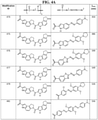
- FIG. 4A - 4D show the structures and absorption maxima of the T8 oligonucleotide conjugates synthesized according to reaction scheme 1.
- FIG. 4A - 4D show the relationship between the DSQ structures and absorption maxima of the T8 oligonucleotide conjugates synthesized according to reaction Scheme 1.
- the benzothiazole-substututed DSQ demonstrate more red-shifted absorption spectra than the phenyl or indole-substituted ones.
- the position of the absorption band is directly related to the efficiency of FRET-based fluorescence quenching as specified by Lakowicz, 2007.
- a suitable linker for the preparation of DNA synthesis supports of the disclosure is hydroxyprolinol, a trifunctional reagent that has an amino, a primary and a secondary hydroxyl group.
- This linker as well as examples of other trifunctional reagents having an amino, primary and a secondary hydroxyl group, are described in U.S. Patent No. 5,512,667 .
- the primary hydroxyl group in this example is protected with a dimethoxytrityl group whereas the secondary hydroxyl and amino groups are available for further modifications.
- the synthesis support used in synthetic Scheme 1 is a highly cross-linked porous styrene-divinylbenzene copolymer further aminomethylated to enable the surface chemistry (Applied Biosystems, PN 360865C).
- Another example of synthesis support is Controlled Pore Glass (CPG) (Glen Research, Sterling, VA), which is commercially available in different pore sizes and with long chain alkylamine extension for more efficient phosphoramidite coupling.
- CPG Controlled Pore Glass
- Oligonucleotide conjugates of Formula IV (a) can also be obtained using a polystyrene synthesis support ID # 480 exemplified in reaction scheme 3 ( FIG. 7A-7B ).
- the synthesis supports of this type can be prepared using reagents of general Formula III, wherein X is a linking group with a DMT-protected hydroxyl group and either Ar 1 or Ar 2 contain a functional group for covalent attachment to a synthesis solid support via a cleavable (during oligonucleotide deprotection) linker.
- diaryl-azo-dye 66 is prepared by diazotization of 2-amino-1,3-benzothiazole-6-carboxylic acid followed by coupling with N-substituted aniline analog 65.
- the acid 66 is converted into activated PFP ester 67 for the following condensation with CDPI 2 dipeptide yielding intermediate 68.
- This intermediate is activated via the formation of PFP ester 69 and then reacted with O-DMT-protected aminohexanol to afford intermediate 70 with two orthogonally-protected hydroxyl groups.
- the acetyl protection of the intermediate 70 is selectively saponified to give hydroxyl intermediate 71.
- hydroxyl intermediate 71 is reacted with succinic anhydride and then activated with PFP-TFA.
- the obtained PFP ester 72 is reacted with aminomethyl polystyrene support (e.g. used in synthetic scheme 1) to yield synthesis support ID# 480.
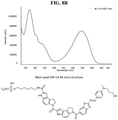
- Analytical HPLC is shown in FIG. 8A and PDA UV-VIS spectra is shown in FIG. 8B for an example of oligonucleotide synthesis using the synthesis support ID# 480. It demonstrates that the DSQ ID#480-modified oligonucleotide conjugates can be synthesized in exellent yield and be readily purified by reverse phase chromatography.
- Some oligonucleotide conjugates of Formula IV (b) can be prepared using the synthesis solid support ID # 478 prepared according to the reaction scheme 2 ( FIG. 5A-5B ).
- the approach depicted in this scheme requires an introduction of a hydroxyl group, starting point for oligonucleotide synthesis, into the diaryl-azo section of compounds of Formula I. This is achieved in the first step of the reaction scheme by using 6-[methyl(phenyl)amino]hexyl acetate ( WO 2008008481 ), an aniline analog with a protected 6-hydroxyhexyl linker. This aniline is coupled with ethyl 2-diazo-1,3-benzothiazole-6-carboxylate to yield diaryl-azo dye 60.
- the bis-ester 60 is then saponified to give hydroxyl acid 61.
- the hydroxyl group is then DMT-protected followed by activation with PFP-TFA to afford PFP ester 62.
- Condensation of the ester with CDPI 2 produced intermediate 63, which then was activated with PFP-TFA to afford the desired PFP ester 64, suitable for the following solid support chemistry.
- the starting N-MMT-5-aminopentylglycolate polystyrene support (prepared according to U.S. Patent No. 7,759,126 ) was first deprotected with trichloroacetic acid in dichloromethane and then reacted with the PFP ester 64 to give polystyrene synthesis support ID # 478.
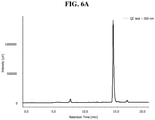
- FIG. 6A An analytical C18 HPLC trace of a T8 oligonucleotide synthesis using this support is shown in FIG. 6A , with PDA UV-VIS spectra of the main peak and product structure shown in FIG. 6B .
- This example demonstrates that the oligonucleotide conjugates prepared according to scheme 2 can be synthesized in excellent yield and be readily purified by reverse phase chromatography.
- 2-Cyanoethyl N,N-diisopropylphosphoramidite chemistry is another way to prepare oligonucleotides bearing the compounds of the disclosure.
- One example of a suitable phosphoramidite reagent is shown in reaction scheme 4 ( FIG. 9A-9B ).
- the intermediate 70 (reaction scheme 3) is first reacted with diethylpyrocarbonate to protect the indole and amide NH groups yielding intermediate 73.
- the DMT group is then selectively removed and the resultant alcohol 74 is converted into the phosphoramidite 75 by reaction with 2-cyanoethyl N,N,N',N'-tetraisopropylphosphordiamidite.
- FIG. 9A-9B 2-Cyanoethyl N,N-diisopropylphosphoramidite chemistry
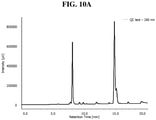
- FIG. 10A shows an analytical C18 HPLC trace of a T8 oligonucleotide synthesis using this phosphoramidite
- FIG. 10B shows PDA UV-VIS spectra of the main peak and product structure.
- FIG. 11A - 11C show UV-VIS absorption spectra of T8-DSQ conjugates.
- the absorption bands of these exemplary compounds cover the wavelength range between 400 and 700 nm, which is suitable for efficient FRET quenching of common fluorophores for real-time PCR applications.
- Oligonucleotide conjugates of Formula IV (a) and (b) are useful for various application as described below.
- Preferred embodiments include a method for detecting a target nucleic acid sequence in a sample, comprising contacting the sample with embodiments of the oligonucleotide conjugates described herein, wherein the oligonucleotide conjugate has a nucleic acid sequence at least partially complementary to the target nucleic acid sequence, and wherein the oligonucleotide conjugate further comprises a fluorophore, and detecting a fluorescent signal from the oligonucleotide conjugate upon hybridization to the target nucleic acid sequence.
- Further preferred embodiments also include the step of amplifying the target nucleic acid sequence.
- the oligonucleotide conjugate is a primer or a probe.
- the DSQ-conjugates comprise a 3'-DSQ and a 5'-fluorophore to yield oligonucleotides of general Formula V: 5'-FI-ODN-DSQ Formula V wherein Fl is a fluorophore and ODN-DSQ is an oligonucleotide conjugate of Formula IV (a) or (b).
- Conjugates of Formula V are particularly useful as DNA probes for fluorescence-based real-time and endpoint PCR applications that rely on the hybridization-dependent 5'-exonuclease activity of DNA polymerase for fluorophore cleavage, also known as the TaqMan technology. Examples of TaqMan PCR applications using conjugates of Formula V are shown in FIG. 16 .
- the oligonucleotide conjugates comprise a 5' DSQ and a 3' fluorophore as represented by Formula VI: 5'-DSQ-ODN-FI Formula VI wherein Fl is a fluorophore and DSQ-ODN is an oligonucleotide conjugate of Formula IV (a) or (b).
- Oligonucleotide conjugates of Formula VI are useful as DNA probes for fluorogenic probes whose fluorescence signal is generated due to the hybridization with a target.
- the 5' DSQ moiety prevents the 5' exonuclease probe degradation.
- One particular type of such fluorogenic probes is the Molecular Beacon technology, which relies on the stem-loop structure to improve signal-to-background ratio and mismatch discrimination.
- the oligonucleoptide conjugates comprise a 5'-DSQ and a 5'-fluorophore positioned adjacent to each other as represented by Formula VII: 5'-DSQ-FI-ODN Formula VII
- Such oligonucleotides are useful as hybridization-triggered fuorogenic probes and primers as illustrated in FIG. 14A - 14B and Table 14.
- the oligonucleotides of Formula IV could be used in digital PCR and arrays ( U.S. Pat No. 9,328,384 and 7,759,126 .
- the DSQ moiety is covalently attached to an internal position of an oligonucleotide, for example to an amine-tailed nucleobase.
- the DSQ oligonucleotides are used to differentiate single nucleotide polymorphisms as taught in U.S. Pat No. 6,312,894 and, 7,718,374 .
- different targets are detected utilizing melting curve analys as taught in Hymas and Hillyard, 2009.
- the precipitated solid was collected by filtration, washed with water and resuspended in 50 mL of MeOH. The suspension was heated to reflux then cooled and filtered to collect the precipitated solid. Drying in vacuo afforded 2.9 g (59% yield) of the desired dye 1 as a brown-orange solid.
- Pentafluorophenyl 3,6,7,8-tetrahydro-6-[[3,6,7,8-tetrahydro-6-[(5- ⁇ ( E )-[4-(dimethylamino)phenyl]diazenyl ⁇ -1 H -indol-2-yl)carbonyl]benzo[1,2- b :4,3- b ']dipyrrol-2-yl]carbonyl]benzo[1,2- b :4,3- b ']dipyrrole-2-carboxylate (5)
- Pentafluorophenyl 3,6,7,8-tetrahydro-6-[[3,6,7,8-tetrahydro-6-[(5- ⁇ ( E )-[2,5-dimethoxy-4-(pyrrolidin-1-yl)phenyl]diazenyl ⁇ -1H-indol-2-yl)carbonyl]benzo[1,2- b :4,3- b ']dipyrrol-2-yl]carbonyl]benzo[1,2- b :4,3- b ']dipyrrole-2-carboxylate (10)
- Ethyl 2-amino-1,3-benzothiazole-6-carboxylate (4.44 g, 20 mmol) was resuspended in 100 mL of a 1:1 mixture of acetic and propionic acids. The partial solution was cooled to 0-4°C and treated with 6.7 mL of 40% nitrosylsulfuric acid maintaining the temperature below 10°C. The reaction was stirred for 5 h then allowed to briefly warm to room temperature before cooling again to 0-4°C.
- the obtained solution of diazonium salt was added via an addition funnel to a stirred cold (ice/water bath) mixture prepared by combining a solution of N,N-dimethylaniline (3 mL) in 25 mL of MeOH and a solution of 0.6 g of sulfamic acid in 200 mL of water. The stirring was continued for 3 h before the reaction was neutralized by adding approx. 200 mL of 40% aqueous trimethylamine to a pH of 6-7. The resultant solid was collected by filtration, washed with water and resuspended in hot MeOH (50 mL).
- Pentafluorophenyl 3,6,7,8-tetrahydro-6-[[3,6,7,8-tetrahydro-6-[(2- ⁇ ( E )-[4-(dimethylamino)phenyl]diazenyl ⁇ -1,3-benzothiazol-6-yl)carbonyl]benzo[1,2- b :4,3- b ']dipyrrol-2-yl]carbonyl]benzo[1,2- b :4,3- b ']dipyrrole-2-carboxylate (15)
- Pentafluorophenyl 3,6,7,8-tetrahydro-6-[[3,6,7,8-tetrahydro-6-[(2- ⁇ ( E )-[ 2,5-dimethoxy-4-(pyrrolidin-1-yl)phenyl]diazenyl ⁇ -1,3-benzothiazol-6-yl)carbonyl]benzo[1,2- b :4,3- b ']dipyrrol-2-yl]carbonyl]benzo[1,2- b :4,3- b ']dipyrrole-2-carboxylate (20)
- Acid 22 (1.7 g, 4.3 mmol) was dried by co-evaporation with 25 mL of anhydrous DMF and 1 mL of triethylamine. The dried material was re-dissolved in another portion (25 mL) of DMF with 1 mL of triethylamine and treated with 0.75 mL (4.3 mmol) of PFP-TFA. The reaction was stirred for 60 min to give a thick suspension due to the product precipitation. DMF was removed in vacuo and the resultant solid resuspended in water. The precipitate was collected by filtration, washed with MeOH and dried in vacuo over P 2 O 5 .
- Pentafluorophenyl 3,6,7,8-tetrahydro-6-[[3,6,7,8-tetrahydro-6-[3-chloro-4- ⁇ ( E )-[2,5-dimethoxy-4-(pyrrolidin-1-yl)phenyl]diazenyl ⁇ benzoyl]benzo[1,2- b :4,3- b ']dipyrrol-2-yl]carbonyl]benzo[1,2- b :4,3- b ']dipyrrole-2-carboxylate (25)
- the resulting dark suspension was stirred at room temperature for 16 h and then filtered to collect the precipitated solid.
- the crude dye was purified by trituration in hot MeOH (20 mL) followed by cooling and filtration to yield 2.2 g (41%) of dye 27 as a black solid.
- PFP-TFA (1.2 mL, 6.9 mmol) was added in two portions to a solution of 27 (2.2 g, 5.07 mmol) and triethylamine (2 mL) in 50 mL of anhydrous CH 2 Cl 2 . After being stirred for 2 h the reaction was concentrated and the obtained semi-solid residue resuspended in 2-propanol (25 mL). The resulting solid was collected by filtration and dried in vacuo to afford crude ester 28, which was then further purified by trituration in hot 4:1 mixture of hexane and ethyl acetate (20 mL) followed by cooling and filtration. Drying in vacuo afforded 2.2 g (72%) of PFP ester 28.
- Pentafluorophenyl 3,6,7,8-tetrahydro-6-[[3,6,7,8-tetrahydro-6-[4-[( E )-(2,5-dimethoxy-4- ⁇ ( E )-[4-(dimethylamino)phenyl]diazenyl ⁇ phenyl)diazenyl]benzo yl]benzo[1,2- b :4,3- b ']dipyrrol-2-yl]carbonyl]benzo[1,2- b :4,3- b ']dipyrrole-2-carboxylate (30)
- Pentafluorophenyl 3,6,7,8-tetrahydro-6-[(5- ⁇ ( E )-[2-(pyrrolidin-1-yl)-1,3-thiazol-5-yl]diazenyl ⁇ -1 H -indol-2-yl)carbonyl]benzo[1,2- b :4,3- b ']dipyrrole-2-carboxylate (35)
- Pentafluorophenyl 3,6,7,8-tetrahydro-6-[[3,6,7,8-tetrahydro-6-[(5- ⁇ ( E )-[2-(pyrrolidin-1-yl)-1,3-thiazol-5-yl]diazenyl ⁇ -1 H -indol-2-yl)carbonyl]benzo[1,2- b :4,3- b ']dipyrrol-2-yl]carbonyl]benzo[1,2- b :4,3- b ']dipyrrole-2-carboxylate (37)
- Pentafluorophenyl 3,6,7,8-tetrahydro-6-[[3,6,7,8-tetrahydro-6-[(4- ⁇ ( E )-[2,5-dimethoxy-4-(pyrrolidin-1-yl)phenyl]diazenyl ⁇ -1-methyl-1 H -pyrrol-2-yl)carbonyl]benzo[1,2- b :4,3- b ']dipyrrol-2-yl]carbonyl]benzo[1,2- b :4,3- b ']dipyrrole-2-carboxylate (41)
- Pentafluorophenyl 3,6,7,8-tetrahydro-6-[[3,6,7,8-tetrahydro-6[(2-[( E )-2,3,6,7-tetrahydro-1 H ,5 H -pyrido[3,2,1- ij ]quinolin-9-yldiazenyl]-1,3-benzothiazol-6-yl)carbonyl]benzo[1,2- b :4,3- b ']dipyrrol-2-yl]carbonyl]benzo[1,2- b :4,3- b' ]dipyrrole-2-carboxylic acid (46)
- PFP-TFA (a total of 0.35 mL, 1.63 mmol) was added in several portions over the course of 20 h to a suspension of 50 (0.36 g, 0.66 mmol) and triethylamine (0.4 mL) in 5 mL of anhydrous DMF until no more starting material was found by HPLC analysis.
- the reaction was concentrated under reduced pressure and the obtained semi-solid residue resuspended in methanol (25 mL).
- the resulting solid was collected by centrifugation at 4,000 rpm for 10 min, methanol decanted and the procedure was repeated two more times. Drying under reduced pressure afforded 0.340 g (72%) of PFP ester 51 as a brick-red solid.
- Acid 54 (1.22g, 2.92 mmol) was first dried by co-evaporation with anhydrous DMF (15 mL) then re-dissolved in fresh portion of DMF (15 mL) and treated with triethylamine (1 mL) and PFP-TFA (0.57 mL, 3.3 mmol). After being stirred at room temperature for 3 h the reaction was concentrated under reduced pressure and the resultant sold resuspended in methanol (15 mL). The insoluble material was collected by filtration, washed with methanol (2x5 mL) and dried to afford 1.71 g (87% as a DMF adduct) of PFP ester 55 as an orange solid.
- Acetic anhydride (0.12 mL, 1.27 mmol) was added to a solution of 3,6,7,8-tetrahydro-6-[(3,6,7,8-tetrahydrobenzo[1,2-b:4,3-b']dipyrrol-2-yl)carbonyl]benzo[1,2-b:4,3-b']dipyrrole]-2-carboxylic acid (1.0 mmol) and 0.4 mL of triethylamine in 10 mL of DMF. Precipitation of the product started within minutes after the addition.
- PFP-TFA was added in several portions (0.04 -0.12 mL each) with stirring over the period of 20 h to a solution of 58 (0.35 g, 0.82 mmol) and triethylamine (0.4 mL) in 10 mL of anhydrous DMF until no more starting material was found by HPLC analysis. DMF was removed under reduced pressure and the residue resuspended in acetone (10 mL). The insoluble material was collected by filtration, washed with acetone and dried to afford 0.46 g (94%) of 59 as an off-white solid.
- Polystyrene support (ID# 349 PS) (2.0 g) was resuspended in 15 mL of 0.2 M solution of 1,8-diazabicyclo[5.4.0]undec-7-ene (DBU) in DMF and agitated on an orbit shaker for 10 min. DMF was removed by filtration and the procedure was repeated two more times. The polystyrene support was then washed with either DMF or N-Methyl-2-pyrrolidone (NMP) (3x50 mL), depending on the choice of solvent in the next step, and immediately reacted with a PFP ester as described below.
- DBU 1,8-diazabicyclo[5.4.0]undec-7-ene
- step 2 The support from step 2 was resuspended in 18 mL of pyridine and treated with 2 mL of acetic anhydride. The suspension was agitated for 30 min, then filtered, washed with DMF (3x50 mL) and acetone (3x50 mL) and dried under reduced pressure.
- the solution of diazonium salt was added in several portions to a cold (0-4°C) mixture prepared by combining a solution of 6-[methyl(phenyl)amino]hexyl acetate ( WO 2008008481 ) (0.6 g, 2.4 mmol) in 2.5 mL of MeOH and a solution of sulfamic acid (0.060 g) in 20 mL of water.
- the reaction was stirred at 0-4°C for 2 hours, neutralized by adding saturated NaHCO 3 in several portions and the precipitated material extracted with ethyl acetate.
- the extract was concentrated under reduced pressure and the obtained residue triturated with 4:1 hexane-ethyl acetate (30 mL).
- Pentafluorophenyl 3,6,7,8-tetrahydro-6-[[3,6,7,8-tetrahydro-6[(2-[( E )- ⁇ 4-[(6-(bis-(4-methoxyphenyl))(phenyl)methoxyhexyl)(methyl)amino]phenyl ⁇ diazenyl]-1,3-benzothiazol-6-yl)carbonyl]benzo[1,2- b :4,3- b ']dipyrrol-2-yl]carbonyl]benzo[1,2- b :4,3-b']dipyrrole-2-carboxylate (64)
- N-MMT-5-aminopentyl)glycolate polystyrene support (U.S. Patent No. 7,381,818 ) (5.0 g, 20 umol/g MMT loading) was deprotected by suspending in 30 mL of 3% trichloactetic acid in CH 2 Cl 2 and filtration. The procedure was repeated approx. 10 times until no more yellow color was observed.
- the support then was washed with CH 2 Cl 2 , 10% triethylamine/CH 2 Cl 2 and N-methylpyrrolidinone (NMP) before being resuspended in a solution of 64 (0.156 g, 0.12 mmol, 25 umol/g offering) and triethylamine (0.2 mL) in 25 mL of NMP.
- the suspension was swirled on an orbital shaker for 18 h then filtered and washed with NMP.
- the support was suspended in pyridine (22.5 mL), treated with acetic anhydride (2.5 mL) and swirled for 30 min.
- Pentafluorophenyl 3,6,7,8-tetrahydro-6-[[3,6,7,8-tetrahydro-6[(2-[( E )-(4- ⁇ [3-(acetyloxy)propyl](methyl)amino ⁇ phenyl)diazenyl]-1,3-benzothiazol-6-yl)carbonyl]benzo[1,2- b :4,3- b ']dipyrrol-2-yl]carbonyl]benzo[1,2- b :4,3- b ']dipyrrole-2-carboxylate (69)
- Aminomethyl-polystyrene support (33 umol/g amine capacity, Applied Biosystems, PN 360865C) (5.0 g) was added to a solution of 72 (0.12 g, 0.14 mmol, 17 umol/g offering) and triethylamine (0.5 mL) in 25 ml of DMF. The suspension was swirled on an orbital shaker for 22 h then filtered and washed with DMF. To block unreacted aminogroups the support was suspended in pyridine (22.5 mL), treated with acetic anhydride (2.5 mL) and swirled for 30 min.
- Acid 76 (0.69 g, 1.58 mmol) was first dried by co-evaporation with DMF (20 mL) supplemented with triethylamine (0.5 mL) then re-dissolved in a mixture of CH 2 Cl 2 (20 mL) and triethylamine (0.5 mL). PFP-TFA (0.4 mL, 2.33 mmol) was added in one portion. The reaction was stirred for 1 h then concentrated and the obtained solid re-suspended in cold methanol (20 mL). The resultant precipitate was collected by filtration, washed with methanol (2x5 mL) and dried under reduced pressure to afford 0.76 g (80%) of PFP ester 77 as a black solid.
- PFP-TFA was added in two, 0.05 mL portions over the period of 2 h to a solution of 78 (0.154 g, 0.25 mmol) and triethylamine (0.1 mL) in 5 mL of anhydrous DMF.
- the initial solution turned into a suspension by the end of this time.
- the suspension was cooled on ice, the insoluble material was cooled by filtration, washed with methanol and dried to afford 0.15 (76%) of PFP ester 79 as a black metallic solid.
- Example 8 Absorption spectra of exemplary octadeoxythymidylate conjugates of the disclosure
- FIG. 11A - 11C show UV-VIS absorption spectra of representative oligonucleotide conjugates in accordance with preferred embodiments.
- oligonucleotides and oligonucleotide conjugates used in Examples 10-14 were synthesized using the instrumentation, synthesis and purification conditions described in Table 5 below.
- Table 5 Instrumentation and synthesis conditions Instrument ABI 3900 DNA synthesizer Scale 200 nmol Deblocking 3% TCA Amidite conc. 100 mM (double coupling for all dye and quencher amidites) Activator 5-Ethylthiotetrazole Oxidation I 2 /Pyridine/Water Capping Ac 2 O/Pyridine/Melm Deprotection conc.
- the mass spectrometry for the d(T 8 )-3'-DSQ conjugates is listed in Table 6 below. Table 6. Summary of ESI mass-spectroscopy of the d(T 8 )-3'-DSQ conjugates Conjugate Name DSQ ID # MW Calc.
- the probes 200 nM FAM-5'-G ⁇ CAGGTTCCGGTTTTG-DSQ (SEQ ID NO:1) or AP525-5'-G ⁇ ACCACGTACCGCATTG-DSQ (SEQ ID NO:2) probes were hybridized in a PCR buffer with 1 ⁇ M of the respective complement (FAM complement: 5'-TCAAAACCGGAACCTGCT (SEQ ID NO:3); AP525 complement: TCAATGCGGTACGTGGTCT (SEQ ID NO:4) by briefly heating the solution to 80°C, cooling to 20°C, then ramping to 90 °C while monitoring fluorescence.
- FAM complement 5'-TCAAAACCGGAACCTGCT
- AP525 complement TCAATGCGGTACGTGGTCT
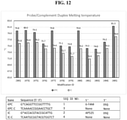
- FIG. 12 shows a melting temperature comparison for duplexes formed between two DNA probes and their respective complementary targets.
- the probes are labeled with various exemplary DSQ derivatives at the 3' end and one of the fluorophores, FAM or AP 525, at the 5' end.
- probes ID # 385), which have the traditional structure of both the MGB and the quencher (CDPI 3 + Eclipse quencher, FIG. 18 ), are also included in the comparison. It is clear that probes with certain DSQ derivatives (e.g. modification ID # 473, 477, 480, 485) have melting temperatures that are equal or exceed the values of the reference probes.
- the probes labeled with DSQ ID # 485 outperform the reference probes (ID # 385) indicating that, at least in this particular sequence context, the diaryl-azo groups bring more to duplex stability than the displaced CDPI unit.
- the least efficient duplex-stabilizing DSQ derivatives (ID # 479, 481, 483) contained either a 1,4-subsituted phenyl or an 2,4-substituted-N-methylpyrrol ring as the Ar 1 group of formula III. The latter result is unexpected in view of the report by Ong et al. (2012) on the properties 4-(1-methylpyrrol-2- yl)azo-1-methylpyrrole-2-carboxylates.
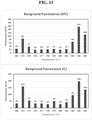
- FIG. 13 addresses the fluorescence quenching properties of preferred embodiments of the DSQ derivatives.
- background fluorescence of unhybridized probes is the measure of quenching efficiency.
- the derivatives with the best spectral overlap between fluorophore's emission (FAM emission maximum - 515 nm, AP525 emission maximum - 549 nm) and quencher's absorption ( FIG. 11 ) demonstrate the lowest background fluorescence thus confirming that the main quenching occurs via the FRET mechanism (Didenko (2001)).
- Instrumentation and measurement conditions were as shown in Table 8 below. Results are summarized in Table 9 and Figure 14 . Table 8. Instrumentation and experimental conditions Instrumentation and measurement conditions Instrument Varian Cary Eclipse Fluorimeter Data mode Fluorescence Ex. Wavelength (nm) 496 (FAM), 527 (AP525) Em. Wavelength (nm) 517 (FAM), 549 (AP525) Ex. Slit (nm) 5 Em.
- FIG. 14A shows the effects of various DSQ ligands on the d(T 8 )/d(A 8 ) duplex stability
- FIG. 14B shows the effects of various DSQ ligands on the d(T 8 )/d(A 8 ) duplex melting temperature, another demonstration of duplex-stabilizing properties of new DSQ derivatives.
- a short d(T 8 )/d(A 8 CC) duplex is used to enhance the differences between the derivatives.
- a CDPl 2 -labeled d(T 8 ) oligonucleotide is also included.
- the d(A 8 CC) complement is labeled with a fluorescein group at the 5'-end, which is quenched in the duplex form and unquenched upon duplex denaturation allowing for fluorescence-based melting detection.
- DSQ analogs composed of certain aryl-azo moieties and two CDPI units (e.g. DSQ ID # 473, 475, 477, 478, 479, 480, 483, 485 and 486), outperform the control CDPl 2 -conjugate thus confirming that the aryl-azo moiety effectively contributes to the duplex stabilization according to the statements of this specification.
- the DSQ ID # 484 conjugate which has a diaryl-azo moiety coupled to a single CDPI unit, outperforms the control CDPl 2 -conjugates showing that this particular structure has especially high affinity for DNA duplex.
- Instrumentation and experimental conditions Instrumentation and measurement conditions Instrument Cary Bio 400 Wavelength monitor 260 nm Measurement temperature (°C) 20 - 70 or 20.0 - 90.0, 1 °C/min ramp Buffer 1 20 mM Na 2 -PIPES, pH 8 Buffer 2 10 mM Na 2 -PIPES, 100 mM NaCl, 10 mM MgCl 2 , pH 7 Test Oligo Concentration 3 ⁇ M Complement Concentration 6 ⁇ M Table 11 Tm (°C) SEQ ID NO: Sequence (5'-3') none 5'-[482] 5'-[391] 5'-[385] 5'-[477] 6 ACACAAGCTACA 56.85 60.38 73.05 65.56 71.00 7 TTATATGCCACG 53.50 61.37 73.89 68.87 63.61 8 TACACTGGACAT 55.75 61.44 66.18 60.40 66.80 9 CAGAGCTTACAT 53.75 58
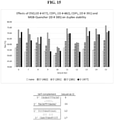
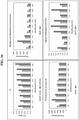
- PCR was conducted using two DSQ-Iabeled TaqMan probes (TaqMan assay). PCR Monoreagent formulation and PCR conditions are shown in Table 12. Result are summarized in Table 13 and FIG. 16 .
- FIG. 16 shows PCR performance of representative conjugates of the disclosure.
- Two TaqMan probes, one (KPC) labeled with FAM and the other one (IC2) with AP525 at the 5'-end ( FIG. 12 ) were synthesized using the DNA synthesis supports described in this specification.
- the same two probes were also synthesized using the traditional MGB-Quencher reagent (modification ID # 385).
- Target DNAs amplification was performed in the presence of the probes, target-specific primers and Taq polymerase.
- threshold cycle (Ct) baseline fluorescence (background), fluorescence signal (fluorescence at cycle 45) and signal-to-background ratio were compared as summarized in Table 12 and FIG. 16 .
- the new probes provided similar amplification efficiency and overall test sensitivity as the control probe with Ct values generally varying within one amplification cycle.
- Background fluorescence with the exception of the DSQ ID 473 and 475 were same as or lower than the background of the control probe.
- some of the new DSQ probes demonstrated improved Signal-to-Background ratios (e.g DSQ ID # 476, 477, 478 and 480).
- oligonucleotides of Formula VII To evaluate fluorogenic properties of oligonucleotides of Formula VII, the duplex fluorescence at 50°C (Signal), single strand fluorescence at 50°C (Background) and Signal-to-background ratio (S/B) of two oligonucleotides labeled at the 5'-end with DSQ ID # 473 and either FAM-HEG (ELITechGroup Inc., product #M830100) or AP525-HEG (ELITechGroup Inc., product # M100104) were synthesized and tested.
- FAM-HEG ELITechGroup Inc., product #M830100
- AP525-HEG ELITechGroup Inc., product # M100104
- the new DSQ derivatives can also be used for the preparation of hybridization probes and primers, which rely on spatial separation between the quenching and fluorescent moieties upon hybridization to target to generate fluorescent signal.
- the DSQ and fluorophore moieties are positioned at the same end of an oligonucleotide. In such configuration, spatial separation between the quencher and fluorophore is achieved via the DSQ binding within the duplex minor groove.
- Such conjugates can be synthesized starting from a DSQ synthesis support followed by a fluorophore phosphoramidite that is suitable for internal incorporation (for example FAM-HEG and AP525-HEG phosphoramidites available from ELITechGroup Inc.), and then an oligonucleotide sequence.
- FIG. 17A and 17B show results of a thermal melting experiment involving such fluorogenic oligonucleotide labeled with the DSQ ID # 473 in combination with either FAM or AP525 fluorophore. Due to its blue-shifted absorption spectrum ( FIG. 11 ), this DSQ mostly relies on the contact quenching (( U.S. Patent No.
Landscapes
- Chemical & Material Sciences (AREA)
- Organic Chemistry (AREA)
- Health & Medical Sciences (AREA)
- Life Sciences & Earth Sciences (AREA)
- Biochemistry (AREA)
- Molecular Biology (AREA)
- Engineering & Computer Science (AREA)
- General Health & Medical Sciences (AREA)
- Wood Science & Technology (AREA)
- Zoology (AREA)
- Immunology (AREA)
- Genetics & Genomics (AREA)
- Biotechnology (AREA)
- Proteomics, Peptides & Aminoacids (AREA)
- Physics & Mathematics (AREA)
- Chemical Kinetics & Catalysis (AREA)
- Analytical Chemistry (AREA)
- Microbiology (AREA)
- Bioinformatics & Cheminformatics (AREA)
- General Engineering & Computer Science (AREA)
- Biophysics (AREA)
- Optics & Photonics (AREA)
- Nuclear Medicine, Radiotherapy & Molecular Imaging (AREA)
- General Physics & Mathematics (AREA)
- Pathology (AREA)
- Medicinal Chemistry (AREA)
- Polymers & Plastics (AREA)
- Measuring Or Testing Involving Enzymes Or Micro-Organisms (AREA)
Claims (13)
- Ein Quencher-Reagens für die Oligonucleotid-Markierung mit der Formel:
 wobei Ar1 und Ar2 aromatische oder heteroaromatische Einheiten sind;X Hydroxyl, eine Abgangsgruppe, ein Linker mit einer funktionellen Gruppe oder einer geschützten funktionellen Gruppe, oder ein Linker, der mit einem festen Syntheseträger verbunden ist, ist; undn von 1 bis 3 ist.
 - Das Quencher-Reagens nach Anspruch 1, wobei eines oder beide von Ar1 und Ar2 mit einer reaktiven Gruppe, einem Linker mit einer funktionellen Gruppe oder einer geschützten funktionellen Gruppe oder einem Linker, der mit einem festen Syntheseträger verbunden ist, substituiert sind.
- Das Quencher-Reagens nach Anspruch 1, mit der Formel:


- Das Quencher-Reagens nach Anspruch 1, wobei die exocyclische Aminogruppe mit einem oder zwei aus einem Alkylrest, einem Linker mit einer funktionellen Gruppe oder einer geschützten funktionellen Gruppe oder einem Linker, der mit einem festen Syntheseträger verbunden ist, substituiert ist.
- Das Quencher-Reagens nach Anspruch 4, mit der Formel:


- Ein Verfahren zur Herstellung eines Oligonucleotidkonjugats, das mit einem Quencher markiert ist, umfassend:
Umsetzen eines Oligonucleotids mit dem Quencher-Reagens nach den Ansprüchen 1 bis 5, um ein mit einem Quencher markiertes Oligonucleotidkonjugat herzustellen. - Ein Oligonucleotidkonjugat, das eine Fluoreszenz löschende Verbindung umfasst und die folgende Formel aufweist:


 wobei ODN ein Oligonucleotid ist;L eine Verbindungsgruppe mit 0 bis 100 Hauptkettenatomen ist, ausgewählt aus C, N, O, S, P und Si, wobei L acyklische, cyklische oder aromatische Gruppen oder Kombinationen davon beinhalten kann;Ar1 und Ar2 aromatische oder heteroaromatische Einheiten sind;R7 Hydroxyl, eine Verbindungsgruppe oder eine blockierende Gruppe ist; undn von 1 bis 3 ist.
 - Das Oligonucleotidkonjugat nach Anspruch 7, wobei das Oligonucleotid ferner ein Fluorophor umfasst, der mit dem Oligonucleotid verbunden ist, oder wobei das Oligonucleotid ferner einen Minor-Groove-Binder umfasst, der mit dem Oligonucleotid verbunden ist, oder wobei das Oligonucleotid eine oder mehrere modifizierte Nucleobasen oder modifizierte Basen umfasst.
- Das Oligonucleotidkonjugat nach Anspruch 7, wobei L mit dem Oligonucleotid an einem 3'-Ende oder an einem 5'-Ende verbunden ist, oder wobei L mit dem Oligonucleotid an einer anderen Position als einem 3'- oder 5'-Ende verbunden ist.
- Ein Verfahren zum Nachweis einer Nucleinsäurezielsequenz in einer Probe, umfassend:Inkontaktbringen der Probe mit dem Oligonucleotidkonjugat nach Anspruch 8, wobei das Oligonucleotidkonjugat eine Nucleinsäuresequenz aufweist, die zumindest teilweise komplementär zu der Nucleinsäurezielsequenz ist, und wobei das Oligonucleotidkonjugat ferner einen Fluorophor umfasst; undNachweis eines Fluoreszenzsignals, das aus der Hybridisierung des Oligonucleotidkonjugats mit der Nucleinsäurezielsequenz resultiert.
- Das Verfahren nach Anspruch 10, wobei das Fluoreszenzsignal durch die Wirkung einer Polymerase mit 5'-Nuclease-Aktivität erzeugt wird.
- Das Verfahren nach Anspruch 10, wobei das Oligonucleotidkonjugat ein Primer oder eine Probe ist.
- Das Verfahren nach Anspruch 10, ferner umfassend den Schritt des Amplifizierens der Nucleinsäurezielsequenz.
Applications Claiming Priority (2)
| Application Number | Priority Date | Filing Date | Title |
|---|---|---|---|
| US201762546965P | 2017-08-17 | 2017-08-17 | |
| PCT/US2018/045548 WO2019036225A1 (en) | 2017-08-17 | 2018-08-07 | FLUORESCENCE EXTINGUISHERS STABILIZING DUPLEX FOR NUCLEIC PROBES |
Publications (2)
| Publication Number | Publication Date |
|---|---|
| EP3668884A1 EP3668884A1 (de) | 2020-06-24 |
| EP3668884B1 true EP3668884B1 (de) | 2022-03-09 |
Family
ID=63350612
Family Applications (1)
| Application Number | Title | Priority Date | Filing Date |
|---|---|---|---|
| EP18759216.7A Active EP3668884B1 (de) | 2017-08-17 | 2018-08-07 | Duplex stabilisierende fluorescenz quencher für nuklein säure sonden. |
Country Status (4)
| Country | Link |
|---|---|
| US (3) | US10677728B2 (de) |
| EP (1) | EP3668884B1 (de) |
| ES (1) | ES2909351T3 (de) |
| WO (1) | WO2019036225A1 (de) |
Families Citing this family (1)
| Publication number | Priority date | Publication date | Assignee | Title |
|---|---|---|---|---|
| AU2021307437A1 (en) * | 2020-07-16 | 2023-03-16 | Cepheid | Fluorescent dyes |
Family Cites Families (57)
| Publication number | Priority date | Publication date | Assignee | Title |
|---|---|---|---|---|
| US3996345A (en) | 1974-08-12 | 1976-12-07 | Syva Company | Fluorescence quenching with immunological pairs in immunoassays |
| JPS5837646A (ja) * | 1981-08-31 | 1983-03-04 | Konishiroku Photo Ind Co Ltd | カラ−転写像の形成方法 |
| US5585481A (en) | 1987-09-21 | 1996-12-17 | Gen-Probe Incorporated | Linking reagents for nucleotide probes |
| USRE38416E1 (en) | 1988-09-28 | 2004-02-03 | Epoch Biosciences, Inc. | Cross-linking oligonucleotides |
| US5824796A (en) | 1988-09-28 | 1998-10-20 | Epoch Pharmaceuticals, Inc. | Cross-linking oligonucleotides |
| US5451463A (en) | 1989-08-28 | 1995-09-19 | Clontech Laboratories, Inc. | Non-nucleoside 1,3-diol reagents for labeling synthetic oligonucleotides |
| US5512667A (en) | 1990-08-28 | 1996-04-30 | Reed; Michael W. | Trifunctional intermediates for preparing 3'-tailed oligonucleotides |
| US5539082A (en) | 1993-04-26 | 1996-07-23 | Nielsen; Peter E. | Peptide nucleic acids |
| US5419966A (en) | 1991-06-10 | 1995-05-30 | Microprobe Corporation | Solid support for synthesis of 3'-tailed oligonucleotides |
| US6045996A (en) | 1993-10-26 | 2000-04-04 | Affymetrix, Inc. | Hybridization assays on oligonucleotide arrays |
| US6821727B1 (en) | 1993-11-15 | 2004-11-23 | Applera Corporation | Hybridization assay using self-quenching fluorescence probe |
| JP3379612B2 (ja) * | 1995-03-03 | 2003-02-24 | 日本化薬株式会社 | 感熱転写用シート及びベンゾチアゾールアゾ系化合物 |
| US5801155A (en) | 1995-04-03 | 1998-09-01 | Epoch Pharmaceuticals, Inc. | Covalently linked oligonucleotide minor grove binder conjugates |
| US6312894B1 (en) | 1995-04-03 | 2001-11-06 | Epoch Pharmaceuticals, Inc. | Hybridization and mismatch discrimination using oligonucleotides conjugated to minor groove binders |
| US5912340A (en) | 1995-10-04 | 1999-06-15 | Epoch Pharmaceuticals, Inc. | Selective binding complementary oligonucleotides |
| US5736626A (en) | 1996-01-29 | 1998-04-07 | The Perkin-Elmer Corporation | Solid support reagents for the direct synthesis of 3'-labeled polynucleotides |
| AU713667B2 (en) | 1996-04-12 | 1999-12-09 | Phri Properties, Inc. | Detection probes, kits and assays |
| US6274728B1 (en) * | 1997-01-27 | 2001-08-14 | Ciba Specialty Chemicals Corp. | Soluble chromophores having improved solubilizing groups |
| US6080868A (en) | 1998-01-23 | 2000-06-27 | The Perkin-Elmer Corporation | Nitro-substituted non-fluorescent asymmetric cyanine dye compounds |
| GB9804355D0 (en) * | 1998-03-03 | 1998-04-22 | Zeneca Ltd | Method |
| US7045610B2 (en) | 1998-04-03 | 2006-05-16 | Epoch Biosciences, Inc. | Modified oligonucleotides for mismatch discrimination |
| US6127121A (en) | 1998-04-03 | 2000-10-03 | Epoch Pharmaceuticals, Inc. | Oligonucleotides containing pyrazolo[3,4-D]pyrimidines for hybridization and mismatch discrimination |
| EP1046717B1 (de) | 1999-04-20 | 2010-10-06 | National Institute of Advanced Industrial Science and Technology | Verfahren und Sonden zur Bestimmung der Konzentration von Nukleinsäure-Molekülen und Verfahren zur Analyse der gewonnenen Daten |
| WO2000064988A1 (en) | 1999-04-23 | 2000-11-02 | Molecular Probes, Inc. | Xanthene dyes and their application as luminescence quenching compounds |
| EP1230398B1 (de) | 1999-11-16 | 2004-06-30 | Atto-tec GmbH | Farbstoffmarkiertes oligonukleotid zum markieren eines nukleinsäuremoleküls |
| US6660845B1 (en) | 1999-11-23 | 2003-12-09 | Epoch Biosciences, Inc. | Non-aggregating, non-quenching oligomers comprising nucleotide analogues; methods of synthesis and use thereof |
| US6727356B1 (en) | 1999-12-08 | 2004-04-27 | Epoch Pharmaceuticals, Inc. | Fluorescent quenching detection reagents and methods |
| US20040081959A9 (en) * | 1999-12-08 | 2004-04-29 | Epoch Biosciences, Inc. | Fluorescent quenching detection reagents and methods |
| US7205105B2 (en) | 1999-12-08 | 2007-04-17 | Epoch Biosciences, Inc. | Real-time linear detection probes: sensitive 5′-minor groove binder-containing probes for PCR analysis |
| EP1261616B1 (de) | 2000-03-01 | 2010-08-18 | Epoch Biosciences, Inc. | Modifizierte oligonukleotide zur unterscheidung von fehlpaarungen |
| US7019129B1 (en) | 2000-05-09 | 2006-03-28 | Biosearch Technologies, Inc. | Dark quenchers for donor-acceptor energy transfer |
| US6323337B1 (en) | 2000-05-12 | 2001-11-27 | Molecular Probes, Inc. | Quenching oligonucleotides |
| US20030082547A1 (en) | 2001-08-27 | 2003-05-01 | Ewing Gregory J. | Non-fluorescent quencher compounds and biomolecular assays |
| US6972339B2 (en) | 2001-09-07 | 2005-12-06 | Epoch Biosciences, Inc. | Compounds and methods for fluorescent labeling |
| AU2003213836A1 (en) | 2002-03-11 | 2003-09-29 | Epoch Biosciences, Inc. | Negatively charged minor groove binders |
| CA2433473A1 (en) | 2002-07-23 | 2004-01-23 | F. Hoffmann-La Roche Ag | Fluorescent hybridization probes with reduced background |
| EP1543154A4 (de) | 2002-08-21 | 2006-08-16 | Epoch Biosciences Inc | Assay mit endonuklease für abasische stellen |
| CA2498320A1 (en) | 2002-09-20 | 2004-04-01 | Integrated Dna Technologies, Inc. | Anthraquinone quencher dyes, their methods of preparation and use |
| WO2004043350A2 (en) | 2002-11-14 | 2004-05-27 | The Scripps Research Institute | PURIFIED COMPOUNDS THAT INHIBIT INTRACELLULAR α4/PAXILLIN BINDING |
| US7348146B2 (en) | 2003-10-02 | 2008-03-25 | Epoch Biosciences, Inc. | Single nucleotide polymorphism analysis of highly polymorphic target sequences |
| US7381818B2 (en) | 2003-10-28 | 2008-06-03 | Epoch Biosciences, Inc. | Fluorescent probes containing 5′-minor groove binder, fluorophore and quenching moieties and methods of use thereof |
| WO2005049849A2 (en) | 2003-11-14 | 2005-06-02 | Integrated Dna Technologies, Inc. | Fluorescence quenching azo dyes, their methods of preparation and use |
| US7767834B2 (en) | 2004-08-13 | 2010-08-03 | Elitech Holding B.V. | Phosphonylated fluorescent dyes and conjugates |
| JP5214967B2 (ja) | 2004-08-13 | 2013-06-19 | エポック バイオサイエンシズ インコーポレーティッド | ホスホン酸蛍光色素および複合体 |
| EP1844161A4 (de) | 2005-02-04 | 2010-10-27 | Berry & Associates Inc | Dunkle quencher, sonden und andere konjugate damit sowie deren verwendung |
| JP2008529516A (ja) | 2005-02-11 | 2008-08-07 | インヴィトロジェン ダイナル エーエス | エチレングリコール多量体の使用を含む核酸の単離方法 |
| US7759470B2 (en) | 2006-02-20 | 2010-07-20 | Roche Diagnostics Operations, Inc. | Labeling reagent |
| WO2008008481A2 (en) | 2006-07-12 | 2008-01-17 | Georgia Tech Research Corporation | Deprotection of functional groups by multi-photon induced electron transfer |
| US7564567B2 (en) | 2006-09-25 | 2009-07-21 | Massachusetts Institute Of Technology | Sensor for measuring a vibrating surface obscured from view |
| US8293684B2 (en) | 2006-11-29 | 2012-10-23 | Exiqon | Locked nucleic acid reagents for labelling nucleic acids |
| US8163910B2 (en) | 2007-10-03 | 2012-04-24 | Elitech Holding B.V. | Amide-substituted xanthene dyes |
| US20110213124A1 (en) | 2010-02-26 | 2011-09-01 | Gryshuk Amy L | Methods and systems for synthesis of a d-aminoluciferin precursor and related compounds |
| WO2012129547A1 (en) | 2011-03-23 | 2012-09-27 | Elitech Holding B.V. | Functionalized 3-alkynyl pyrazolopyrimidine analogues as universal bases and methods of use |
| WO2013016321A1 (en) | 2011-07-26 | 2013-01-31 | Elitech Holding B.V. | Minor groove binder phosphoramidites and methods of use |
| WO2014164479A1 (en) | 2013-03-11 | 2014-10-09 | Elitech Holding B.V. | Methods for true isothermal strand displacement amplification |
| US9169256B2 (en) | 2013-03-13 | 2015-10-27 | Elitechgroup B.V. | Artificial nucleic acids |
| US9328384B2 (en) | 2013-05-13 | 2016-05-03 | Elitechgroup B.V. | Droplet digital PCR with short minor groove probes |
-
2018
- 2018-08-07 EP EP18759216.7A patent/EP3668884B1/de active Active
- 2018-08-07 ES ES18759216T patent/ES2909351T3/es active Active
- 2018-08-07 US US16/057,016 patent/US10677728B2/en active Active
- 2018-08-07 WO PCT/US2018/045548 patent/WO2019036225A1/en not_active Ceased
-
2020
- 2020-02-12 US US16/788,588 patent/US10890529B2/en active Active
- 2020-10-09 US US17/066,623 patent/US11320376B2/en active Active
Also Published As
| Publication number | Publication date |
|---|---|
| US10890529B2 (en) | 2021-01-12 |
| WO2019036225A1 (en) | 2019-02-21 |
| US10677728B2 (en) | 2020-06-09 |
| US20190064067A1 (en) | 2019-02-28 |
| US20210041360A1 (en) | 2021-02-11 |
| ES2909351T3 (es) | 2022-05-06 |
| EP3668884A1 (de) | 2020-06-24 |
| US11320376B2 (en) | 2022-05-03 |
| US20200173924A1 (en) | 2020-06-04 |
Similar Documents
| Publication | Publication Date | Title |
|---|---|---|
| US7897736B2 (en) | Fluorescent quenching detecting reagents and methods | |
| DK1687609T3 (en) | Fluorescent probes for DNA detection by hybridization with improved sensitivity and low background | |
| US7851606B2 (en) | Negatively charged minor groove binders | |
| US6653473B2 (en) | Fluorescent quenching detection reagents and methods | |
| CA2387084A1 (en) | Hybridization-triggered fluorescent detection of nucleic acids | |
| US11920040B2 (en) | Carborhodamine compounds and methods of preparation thereof | |
| AU2004279810A1 (en) | Single nucleotide polymorphism analysis of highly polymorphic target sequences | |
| US11242554B2 (en) | Nitrodiarylethenes as fluorescence quenchers for nucleic acid probes | |
| EP3668884B1 (de) | Duplex stabilisierende fluorescenz quencher für nuklein säure sonden. | |
| Yanagi et al. | A fluorescent 3, 7-bis-(naphthalen-1-ylethynylated)-2′-deoxyadenosine analogue reports thymidine in complementary DNA by a large emission Stokes shift | |
| US12379315B2 (en) | Nitrodiarylethenes as fluorescence quenchers for nucleic acid probes |
Legal Events
| Date | Code | Title | Description |
|---|---|---|---|
| STAA | Information on the status of an ep patent application or granted ep patent |
Free format text: STATUS: UNKNOWN |
|
| STAA | Information on the status of an ep patent application or granted ep patent |
Free format text: STATUS: THE INTERNATIONAL PUBLICATION HAS BEEN MADE |
|
| PUAI | Public reference made under article 153(3) epc to a published international application that has entered the european phase |
Free format text: ORIGINAL CODE: 0009012 |
|
| STAA | Information on the status of an ep patent application or granted ep patent |
Free format text: STATUS: REQUEST FOR EXAMINATION WAS MADE |
|
| 17P | Request for examination filed |
Effective date: 20200214 |
|
| AK | Designated contracting states |
Kind code of ref document: A1 Designated state(s): AL AT BE BG CH CY CZ DE DK EE ES FI FR GB GR HR HU IE IS IT LI LT LU LV MC MK MT NL NO PL PT RO RS SE SI SK SM TR |
|
| AX | Request for extension of the european patent |
Extension state: BA ME |
|
| RIN1 | Information on inventor provided before grant (corrected) |
Inventor name: SCARR, NOAH Inventor name: LUKHTANOV, EUGENY, A. |
|
| DAV | Request for validation of the european patent (deleted) | ||
| DAX | Request for extension of the european patent (deleted) | ||
| STAA | Information on the status of an ep patent application or granted ep patent |
Free format text: STATUS: EXAMINATION IS IN PROGRESS |
|
| 17Q | First examination report despatched |
Effective date: 20210225 |
|
| GRAP | Despatch of communication of intention to grant a patent |
Free format text: ORIGINAL CODE: EPIDOSNIGR1 |
|
| STAA | Information on the status of an ep patent application or granted ep patent |
Free format text: STATUS: GRANT OF PATENT IS INTENDED |
|
| RIC1 | Information provided on ipc code assigned before grant |
Ipc: C07H 21/04 20060101ALI20210930BHEP Ipc: C07D 487/04 20060101ALI20210930BHEP Ipc: C07D 403/10 20060101ALI20210930BHEP Ipc: C12Q 1/6832 20180101ALI20210930BHEP Ipc: C07H 21/00 20060101ALI20210930BHEP Ipc: C07H 19/00 20060101AFI20210930BHEP |
|
| INTG | Intention to grant announced |
Effective date: 20211020 |
|
| RIN1 | Information on inventor provided before grant (corrected) |
Inventor name: SCARR, NOAH Inventor name: LUKHTANOV, EUGENY A. |
|
| GRAS | Grant fee paid |
Free format text: ORIGINAL CODE: EPIDOSNIGR3 |
|
| GRAA | (expected) grant |
Free format text: ORIGINAL CODE: 0009210 |
|
| STAA | Information on the status of an ep patent application or granted ep patent |
Free format text: STATUS: THE PATENT HAS BEEN GRANTED |
|
| AK | Designated contracting states |
Kind code of ref document: B1 Designated state(s): AL AT BE BG CH CY CZ DE DK EE ES FI FR GB GR HR HU IE IS IT LI LT LU LV MC MK MT NL NO PL PT RO RS SE SI SK SM TR |
|
| REG | Reference to a national code |
Ref country code: CH Ref legal event code: EP Ref country code: AT Ref legal event code: REF Ref document number: 1474097 Country of ref document: AT Kind code of ref document: T Effective date: 20220315 |
|
| REG | Reference to a national code |
Ref country code: DE Ref legal event code: R096 Ref document number: 602018032026 Country of ref document: DE |
|
| REG | Reference to a national code |
Ref country code: IE Ref legal event code: FG4D |
|
| REG | Reference to a national code |
Ref country code: SE Ref legal event code: TRGR |
|
| REG | Reference to a national code |
Ref country code: NL Ref legal event code: FP |
|
| REG | Reference to a national code |
Ref country code: ES Ref legal event code: FG2A Ref document number: 2909351 Country of ref document: ES Kind code of ref document: T3 Effective date: 20220506 |
|
| REG | Reference to a national code |
Ref country code: FI Ref legal event code: FGE |
|
| REG | Reference to a national code |
Ref country code: DE Ref legal event code: R081 Ref document number: 602018032026 Country of ref document: DE Owner name: ELITECHGROUP MDX LLC, BOTHELL, US Free format text: FORMER OWNERS: ELITECHGROUP INC., LOGAN, UT, US; LUKHTANOV, EUGENY A., BOTHELL, WA, US; SCARR, NOAH, SEATTLE, WA, US |
|
| REG | Reference to a national code |
Ref country code: LT Ref legal event code: MG9D |
|
| REG | Reference to a national code |
Ref country code: NL Ref legal event code: PD Owner name: ELITECHGROUP MDX LLC; US Free format text: DETAILS ASSIGNMENT: CHANGE OF OWNER(S), ASSIGNMENT; FORMER OWNER NAME: SCARR, NOAH Effective date: 20220620 |
|
| RAP2 | Party data changed (patent owner data changed or rights of a patent transferred) |
Owner name: ELITECHGROUP MDX LLC |
|
| PG25 | Lapsed in a contracting state [announced via postgrant information from national office to epo] |
Ref country code: RS Free format text: LAPSE BECAUSE OF FAILURE TO SUBMIT A TRANSLATION OF THE DESCRIPTION OR TO PAY THE FEE WITHIN THE PRESCRIBED TIME-LIMIT Effective date: 20220309 Ref country code: NO Free format text: LAPSE BECAUSE OF FAILURE TO SUBMIT A TRANSLATION OF THE DESCRIPTION OR TO PAY THE FEE WITHIN THE PRESCRIBED TIME-LIMIT Effective date: 20220609 Ref country code: LT Free format text: LAPSE BECAUSE OF FAILURE TO SUBMIT A TRANSLATION OF THE DESCRIPTION OR TO PAY THE FEE WITHIN THE PRESCRIBED TIME-LIMIT Effective date: 20220309 Ref country code: HR Free format text: LAPSE BECAUSE OF FAILURE TO SUBMIT A TRANSLATION OF THE DESCRIPTION OR TO PAY THE FEE WITHIN THE PRESCRIBED TIME-LIMIT Effective date: 20220309 Ref country code: BG Free format text: LAPSE BECAUSE OF FAILURE TO SUBMIT A TRANSLATION OF THE DESCRIPTION OR TO PAY THE FEE WITHIN THE PRESCRIBED TIME-LIMIT Effective date: 20220609 |
|
| REG | Reference to a national code |
Ref country code: BE Ref legal event code: PD Owner name: ELITECHGROUP MDX LLC; US Free format text: DETAILS ASSIGNMENT: CHANGE OF OWNER(S), ASSIGNMENT; FORMER OWNER NAME: SCARR, NOAH Effective date: 20220630 |
|
| REG | Reference to a national code |
Ref country code: AT Ref legal event code: MK05 Ref document number: 1474097 Country of ref document: AT Kind code of ref document: T Effective date: 20220309 |
|
| PG25 | Lapsed in a contracting state [announced via postgrant information from national office to epo] |
Ref country code: LV Free format text: LAPSE BECAUSE OF FAILURE TO SUBMIT A TRANSLATION OF THE DESCRIPTION OR TO PAY THE FEE WITHIN THE PRESCRIBED TIME-LIMIT Effective date: 20220309 Ref country code: GR Free format text: LAPSE BECAUSE OF FAILURE TO SUBMIT A TRANSLATION OF THE DESCRIPTION OR TO PAY THE FEE WITHIN THE PRESCRIBED TIME-LIMIT Effective date: 20220610 |
|
| REG | Reference to a national code |
Ref country code: GB Ref legal event code: 732E Free format text: REGISTERED BETWEEN 20220901 AND 20220907 |
|
| PG25 | Lapsed in a contracting state [announced via postgrant information from national office to epo] |
Ref country code: SM Free format text: LAPSE BECAUSE OF FAILURE TO SUBMIT A TRANSLATION OF THE DESCRIPTION OR TO PAY THE FEE WITHIN THE PRESCRIBED TIME-LIMIT Effective date: 20220309 Ref country code: SK Free format text: LAPSE BECAUSE OF FAILURE TO SUBMIT A TRANSLATION OF THE DESCRIPTION OR TO PAY THE FEE WITHIN THE PRESCRIBED TIME-LIMIT Effective date: 20220309 Ref country code: RO Free format text: LAPSE BECAUSE OF FAILURE TO SUBMIT A TRANSLATION OF THE DESCRIPTION OR TO PAY THE FEE WITHIN THE PRESCRIBED TIME-LIMIT Effective date: 20220309 Ref country code: PT Free format text: LAPSE BECAUSE OF FAILURE TO SUBMIT A TRANSLATION OF THE DESCRIPTION OR TO PAY THE FEE WITHIN THE PRESCRIBED TIME-LIMIT Effective date: 20220711 Ref country code: EE Free format text: LAPSE BECAUSE OF FAILURE TO SUBMIT A TRANSLATION OF THE DESCRIPTION OR TO PAY THE FEE WITHIN THE PRESCRIBED TIME-LIMIT Effective date: 20220309 Ref country code: CZ Free format text: LAPSE BECAUSE OF FAILURE TO SUBMIT A TRANSLATION OF THE DESCRIPTION OR TO PAY THE FEE WITHIN THE PRESCRIBED TIME-LIMIT Effective date: 20220309 Ref country code: AT Free format text: LAPSE BECAUSE OF FAILURE TO SUBMIT A TRANSLATION OF THE DESCRIPTION OR TO PAY THE FEE WITHIN THE PRESCRIBED TIME-LIMIT Effective date: 20220309 |
|
| PG25 | Lapsed in a contracting state [announced via postgrant information from national office to epo] |
Ref country code: PL Free format text: LAPSE BECAUSE OF FAILURE TO SUBMIT A TRANSLATION OF THE DESCRIPTION OR TO PAY THE FEE WITHIN THE PRESCRIBED TIME-LIMIT Effective date: 20220309 Ref country code: IS Free format text: LAPSE BECAUSE OF FAILURE TO SUBMIT A TRANSLATION OF THE DESCRIPTION OR TO PAY THE FEE WITHIN THE PRESCRIBED TIME-LIMIT Effective date: 20220709 Ref country code: AL Free format text: LAPSE BECAUSE OF FAILURE TO SUBMIT A TRANSLATION OF THE DESCRIPTION OR TO PAY THE FEE WITHIN THE PRESCRIBED TIME-LIMIT Effective date: 20220309 |
|
| REG | Reference to a national code |
Ref country code: DE Ref legal event code: R097 Ref document number: 602018032026 Country of ref document: DE |
|
| PLBE | No opposition filed within time limit |
Free format text: ORIGINAL CODE: 0009261 |
|
| STAA | Information on the status of an ep patent application or granted ep patent |
Free format text: STATUS: NO OPPOSITION FILED WITHIN TIME LIMIT |
|
| PG25 | Lapsed in a contracting state [announced via postgrant information from national office to epo] |
Ref country code: DK Free format text: LAPSE BECAUSE OF FAILURE TO SUBMIT A TRANSLATION OF THE DESCRIPTION OR TO PAY THE FEE WITHIN THE PRESCRIBED TIME-LIMIT Effective date: 20220309 |
|
| 26N | No opposition filed |
Effective date: 20221212 |
|
| PG25 | Lapsed in a contracting state [announced via postgrant information from national office to epo] |
Ref country code: SI Free format text: LAPSE BECAUSE OF FAILURE TO SUBMIT A TRANSLATION OF THE DESCRIPTION OR TO PAY THE FEE WITHIN THE PRESCRIBED TIME-LIMIT Effective date: 20220309 |
|
| PG25 | Lapsed in a contracting state [announced via postgrant information from national office to epo] |
Ref country code: MC Free format text: LAPSE BECAUSE OF FAILURE TO SUBMIT A TRANSLATION OF THE DESCRIPTION OR TO PAY THE FEE WITHIN THE PRESCRIBED TIME-LIMIT Effective date: 20220309 |
|
| PG25 | Lapsed in a contracting state [announced via postgrant information from national office to epo] |
Ref country code: LU Free format text: LAPSE BECAUSE OF NON-PAYMENT OF DUE FEES Effective date: 20220807 |
|
| PG25 | Lapsed in a contracting state [announced via postgrant information from national office to epo] |
Ref country code: IE Free format text: LAPSE BECAUSE OF NON-PAYMENT OF DUE FEES Effective date: 20220807 |
|
| PG25 | Lapsed in a contracting state [announced via postgrant information from national office to epo] |
Ref country code: CY Free format text: LAPSE BECAUSE OF FAILURE TO SUBMIT A TRANSLATION OF THE DESCRIPTION OR TO PAY THE FEE WITHIN THE PRESCRIBED TIME-LIMIT Effective date: 20220309 |
|
| PG25 | Lapsed in a contracting state [announced via postgrant information from national office to epo] |
Ref country code: MK Free format text: LAPSE BECAUSE OF FAILURE TO SUBMIT A TRANSLATION OF THE DESCRIPTION OR TO PAY THE FEE WITHIN THE PRESCRIBED TIME-LIMIT Effective date: 20220309 Ref country code: HU Free format text: LAPSE BECAUSE OF FAILURE TO SUBMIT A TRANSLATION OF THE DESCRIPTION OR TO PAY THE FEE WITHIN THE PRESCRIBED TIME-LIMIT; INVALID AB INITIO Effective date: 20180807 |
|
| PG25 | Lapsed in a contracting state [announced via postgrant information from national office to epo] |
Ref country code: MT Free format text: LAPSE BECAUSE OF FAILURE TO SUBMIT A TRANSLATION OF THE DESCRIPTION OR TO PAY THE FEE WITHIN THE PRESCRIBED TIME-LIMIT Effective date: 20220309 |
|
| PGFP | Annual fee paid to national office [announced via postgrant information from national office to epo] |
Ref country code: NL Payment date: 20250814 Year of fee payment: 8 |
|
| PGFP | Annual fee paid to national office [announced via postgrant information from national office to epo] |
Ref country code: ES Payment date: 20250909 Year of fee payment: 8 Ref country code: FI Payment date: 20250814 Year of fee payment: 8 |
|
| PGFP | Annual fee paid to national office [announced via postgrant information from national office to epo] |
Ref country code: DE Payment date: 20250805 Year of fee payment: 8 |
|
| PGFP | Annual fee paid to national office [announced via postgrant information from national office to epo] |
Ref country code: IT Payment date: 20250825 Year of fee payment: 8 |
|
| PGFP | Annual fee paid to national office [announced via postgrant information from national office to epo] |
Ref country code: BE Payment date: 20250818 Year of fee payment: 8 Ref country code: GB Payment date: 20250807 Year of fee payment: 8 |
|
| PGFP | Annual fee paid to national office [announced via postgrant information from national office to epo] |
Ref country code: FR Payment date: 20250808 Year of fee payment: 8 |
|
| PGFP | Annual fee paid to national office [announced via postgrant information from national office to epo] |
Ref country code: CH Payment date: 20250901 Year of fee payment: 8 Ref country code: SE Payment date: 20250812 Year of fee payment: 8 |
|
| PG25 | Lapsed in a contracting state [announced via postgrant information from national office to epo] |
Ref country code: TR Free format text: LAPSE BECAUSE OF FAILURE TO SUBMIT A TRANSLATION OF THE DESCRIPTION OR TO PAY THE FEE WITHIN THE PRESCRIBED TIME-LIMIT Effective date: 20220309 |