EP3669689A1 - Einlegesohleneinsatz für schuhwerk - Google Patents
Einlegesohleneinsatz für schuhwerk Download PDFInfo
- Publication number
- EP3669689A1 EP3669689A1 EP18845502.6A EP18845502A EP3669689A1 EP 3669689 A1 EP3669689 A1 EP 3669689A1 EP 18845502 A EP18845502 A EP 18845502A EP 3669689 A1 EP3669689 A1 EP 3669689A1
- Authority
- EP
- European Patent Office
- Prior art keywords
- insole
- sock
- modified
- footwear
- type
- Prior art date
- Legal status (The legal status is an assumption and is not a legal conclusion. Google has not performed a legal analysis and makes no representation as to the accuracy of the status listed.)
- Withdrawn
Links
- 238000000034 method Methods 0.000 claims abstract description 11
- 210000003371 toe Anatomy 0.000 claims abstract description 11
- 239000000853 adhesive Substances 0.000 claims abstract description 6
- 230000001070 adhesive effect Effects 0.000 claims abstract description 6
- 230000007246 mechanism Effects 0.000 claims abstract description 6
- 210000002683 foot Anatomy 0.000 claims description 25
- 238000013461 design Methods 0.000 claims description 9
- 239000000463 material Substances 0.000 claims description 8
- 238000003780 insertion Methods 0.000 claims 2
- 230000037431 insertion Effects 0.000 claims 2
- 210000004744 fore-foot Anatomy 0.000 abstract description 3
- 230000010354 integration Effects 0.000 abstract description 2
- 238000013459 approach Methods 0.000 description 17
- 230000008901 benefit Effects 0.000 description 8
- 239000004744 fabric Substances 0.000 description 2
- 206010020649 Hyperkeratosis Diseases 0.000 description 1
- 230000008859 change Effects 0.000 description 1
- 230000006835 compression Effects 0.000 description 1
- 238000007906 compression Methods 0.000 description 1
- 230000000694 effects Effects 0.000 description 1
- 230000008030 elimination Effects 0.000 description 1
- 238000003379 elimination reaction Methods 0.000 description 1
- 239000007943 implant Substances 0.000 description 1
- 238000004519 manufacturing process Methods 0.000 description 1
- 238000012986 modification Methods 0.000 description 1
- 230000004048 modification Effects 0.000 description 1
- 238000007789 sealing Methods 0.000 description 1
- 238000012800 visualization Methods 0.000 description 1
Images




Classifications
-
- A—HUMAN NECESSITIES
- A43—FOOTWEAR
- A43B—CHARACTERISTIC FEATURES OF FOOTWEAR; PARTS OF FOOTWEAR
- A43B17/00—Insoles for insertion, e.g. footbeds or inlays, for attachment to the shoe after the upper has been joined
- A43B17/003—Insoles for insertion, e.g. footbeds or inlays, for attachment to the shoe after the upper has been joined characterised by the material
-
- A—HUMAN NECESSITIES
- A43—FOOTWEAR
- A43B—CHARACTERISTIC FEATURES OF FOOTWEAR; PARTS OF FOOTWEAR
- A43B1/00—Footwear characterised by the material
- A43B1/0081—Footwear characterised by the material made at least partially of hook-and-loop type material
-
- A—HUMAN NECESSITIES
- A43—FOOTWEAR
- A43B—CHARACTERISTIC FEATURES OF FOOTWEAR; PARTS OF FOOTWEAR
- A43B17/00—Insoles for insertion, e.g. footbeds or inlays, for attachment to the shoe after the upper has been joined
- A43B17/16—Insoles for insertion, e.g. footbeds or inlays, for attachment to the shoe after the upper has been joined with heel or toe caps
-
- A—HUMAN NECESSITIES
- A43—FOOTWEAR
- A43B—CHARACTERISTIC FEATURES OF FOOTWEAR; PARTS OF FOOTWEAR
- A43B17/00—Insoles for insertion, e.g. footbeds or inlays, for attachment to the shoe after the upper has been joined
- A43B17/18—Arrangements for attaching removable insoles to footwear
-
- A—HUMAN NECESSITIES
- A43—FOOTWEAR
- A43B—CHARACTERISTIC FEATURES OF FOOTWEAR; PARTS OF FOOTWEAR
- A43B23/00—Uppers; Boot legs; Stiffeners; Other single parts of footwear
- A43B23/28—Devices to put in shoes in order to prevent slipping at the heel or to prevent abrading the stockings
Definitions
- the present invention belongs to the field of foot inserts (insoles, socks, tines, amongst others) that are used for footwear. Particularly, we are referring to an insole-sock type insert for shoes, with improvements in the configuration and usefulness, which gives advantages in comparison to other type of foot inserts, whetherthey being-soles, inserts, socks, tines, amongst others.
- the Spanish patent with application number 200101632 is also mentioned, which describes a perfected sock characterized because it presents a second layer within the knit of the foot's sole that jointly defines with that one a cavity fitted with an opening for the introduction of an insole inside, being impossible to remove such insole with respect to the foot.
- the invention is outlined below, mentioning the problems resolved, the advantages in its use, its configuration and other relevant characteristics that achieve a high degree of novelty and inventiveness.
- the present utility model describes an insole-sock type insert for shoes, which presents a functional technical configuration which provides advantages and functionalities that are superior to other type of insoles, socks, foot inserts, loafers, short socks, sock inserts, and/or any other type of shoe or garment.
- the short sock only covers the front part of the foot (toes, front part of the arch and front part of the foot) and is attached to the insole on just one axis at a medium height.
- the distance of the point of attachment of which the short sock attaches with the insole can vary depending on the type of insole-sole type insert which will be tailored, since certain footwear needs a sock that that has to be in the front part of the insole (such as is the case for women, "ballerina type"), and for others, the sock should practically cover half or more of the insole if used with sneakers, nautical shoes, amongst others.
- the distance with which the sock and the insole are attached may vary depending on the type of footwear, since one of the primary functions is to obtain an insole-sock type insert that upon being used creates the impression that socks are not being worn, given the sock-less look.
- the insole plays an important role in our invention, since it presents different modalities: 1. Traditional size insoles; 2. Modified insoles with variable configurations in such a manner that they show empty spaces in smaller sections than the total area of the insole, with these mainly being within the front part but also being able to be present throughout the majority of it, with only the contour remaining (forming a frame with a variable thickness perimeter), as well as having crossed lines with a variable thickness between such spaces of the same material as the insole in order to create firmness and stability to the structure of the insole; and 3. Incomplete insoles with a variable distance, being very useful for us its rear part (half where the heel is located). For descriptive reasons with respect to the invention the three types of the previously mentioned insoles will be defined as: Traditional insole, modified insole, and incomplete insole, respectively.
- the traditional and modified insoles are of a manually adjustable size, cutting part of the insole in order to reduce the corresponding shoe size. Such cut can be made in the frontal or rear part, depending on the insole configuration.
- the incomplete insole when required, uses any type of system or mechanism in order to avoid it from moving or slipping towards the front of the shoe. This effect can happen upon using this type of insole-sock type insert for shoes.
- modified and incomplete insole allow for a greater space or fit for the user's foot, in comparison with the traditional type insole (complete insole).
- any approach of the insole-sock type insert for shoes can be used with such a configuration that prevents that the short sock moves outward (towards the rear part of the insole) once the foot of the user is removed from the sock.
- the insole of any approach of the invention has its own extension, a flap or wing on each side, at variable distance, design, and size, of the same or different material than the insole, that upon being in contact with the sock, allows that the sock keeps and opening in order to facilitate the introduction of the user's foot.
- the invention deals with a certain type of modular insert when using a temporary attachment device of the traditional, incomplete, or modified insole with the short sock, such as in the case of the Velcro type system.
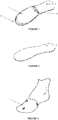
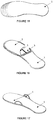
- FIG 1 we can see an isometric view of one of the approaches of the insole-sock type insert for shoes, which is used to give a general view of the invention in question and all of its approaches.
- attachment method (3) within where, in a descriptive manner, we refer to a seam (3) that keeps the insole (1) in place, and the sock (2), where the height of this seam (3) can vary depending on the characteristics of the insole to be used and/or the footwear.
- a gap (4) can be seen, which has no insole (1) without a sock (2); this Figure 1 , shows one of the invention approaches, but the main characteristic of the invention is that the sock (2) and the insole (1) are only attached where the seam (3) is placed, which means, the sock (2) is free and adjusts to the size of the user's foot.
- Figure 1 there is a gap (4) under the sock (2), which prevents the elimination of a proper fit from the corresponding footwear.
- the rear surface of the insole can have a layer comprised by cloth of the same material of the short sock (2) that is used, or, it is the short sock (2) that also extends over the rear surface of the insole (1); being able to apply this in any insole that may be possible.
- FIG 2 we can see a traditional insole (1), which can store a sock (2) of a short, medium, or modified size at a desired distance, attaching them with a seam (3), or of any other type of mechanism that serves for the same purpose.
- a short, medium, or modified sock (2) in orderto understand the way it is used in our invention, which adjusts in a simple manner to the user's foot.
- a short sock (2) can be seen, attached to a traditional insole (1) (complete). It can be seen that the sock has free mobility and it feels as if you were not wearing an insole.
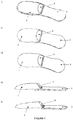
- Figure 7 shows insole-socks inserts for shoes, where the sock (2) is short, medium, or modified and is attached to the insoles (1) of a variable size.
- the insert i) is a traditional (1) insole; ii) and iii) show top views, where the insoles are incomplete, where ii) is bigger than iii). Additionally, iv) and v) have side views of ii) and iii) respectively.
- Figure 8 shows two other different approaches of our invention, where the sock (2) used is short, medium, or modified, and smaller size than the one previously represented in this description.
- This sock size (2) is ideal when the user only wants that the sock protects his toes.
- Image i) and ii) use a traditional insole, while iii), iv), and v) show different views where the insole is an incomplete insole, in a manner that one minimum front part of the insole (1) is absent, or, the insole (1) is incomplete at a distance that is very near to the height of the user's toes.
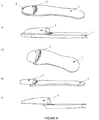
- figures 9 and 10 show different views of one of the approaches of our invention, where there are insoles used that are (1) modified.
- Figure 9 shows top views
- Figure 10 shows lower views with different configurations of insoles. Such configurations vary depending on the hollowness or gap wanted, or, of the stability that is to be given to the insole (1).
- Figure 11 shows variable views with a zoom of figures ii) or iii) of Figure 10 , in order to see the configuration in more detail. It can be seen more clearly that the sock (2) is found unattached from the front part of the modified insole (1), being attached only at a distance defined by the seam (3), which varies depending on the invention approach.
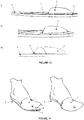
- Image 12 shows an approach that uses a short sock (2), which only covers the user's toes and a modified insole (1) with the same configuration that can be seen in iv) of Figure 6 .
- This approach can also be used with an insole as v) of Figure 6 , or with some other particular design of the modified insole (1) that has a surface at the corresponding height to make a seam or use some other type of attaching method between the short sock (2) and the modified insole (1) at a distance that is equal or similar to the one shown in Figure 12 .
- the modified insole (1) still has two gaps (4) that are totally free, which means, there is no sock (2) present in regards to these gaps (4), but it is present over the gap (4) of the front part of the insole, gap that is at the same height of the user's toes.
- Figure 13 shows different views at variable zoom from the approach shown in Figure 12 , where the zone where the sock is located can be seen up-close (2).
- Figure 14 shows two different approaches of our invention with the visualization of a foot from a user.
- the one on the left is shown with an insole (1) that is modified in which there exists a frontal surface; and the one in the right side is dealing with an incomplete insole (1) approach.
- Figure 15 represents an example of an adjustable insole, with our invention being of an adjustable size to a certain size number. It should be made clear that incomplete insoles would not have this problem, and modified insoles can be adjustable, as long as the configuration allows doing so, whether it is by cutting the front part or the heel part. Moreover, even if part of the insole is cutout in order to obtain a smaller size, the short sock (2) will not have problems since it will adjust to the user's foot.
- Figure 17 shows two extensions or flaps (6) of a traditional type insole (1) (which can also be incomplete and modified insoles) on each one of its sides, at a variable distance, design, or of the same or different material than the insole, that upon being in contact with the sock (2) allows the sock (2) keeping an opening in order to facilitate the introduction of the user's foot. It should be clarified that any type of method or device can be used, which allows for the sock to remain open for greater ease upon inserting the user's foot.
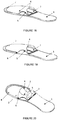
- Figures 18, 19, and 20 show isometric views of the insole-sock type insert for shoes, where it can be seen that the use of the seam (5) prevents the sock from coming out completely, and there are also two different types of extensions or flaps (6) ( figures 18 and 20 use the same design, in contrast to the flaps of Figure 19 ) connected to the short, medium, or modified sock (2), in order to keep to some extent an opening within the sock (2).
- the insoles (1) of figures 18 and 19 are traditional, and insole (1) of Figure 20 is modified, where only the front part of the insole has a gap, allowing for greater fit.
- the insole-sock type insert for shoes is a product that can be washed without altering the functional and technical combination of the structure that is described in this report.
- the present invention is better used in nautical type shoes or those of the similar type; however, the present invention fulfills the functions described in this report when used in any type of footwear.
Landscapes
- Life Sciences & Earth Sciences (AREA)
- Chemical & Material Sciences (AREA)
- Engineering & Computer Science (AREA)
- Materials Engineering (AREA)
- Wood Science & Technology (AREA)
- Footwear And Its Accessory, Manufacturing Method And Apparatuses (AREA)
- Socks And Pantyhose (AREA)
Applications Claiming Priority (2)
| Application Number | Priority Date | Filing Date | Title |
|---|---|---|---|
| MX2017000369 | 2017-08-14 | ||
| PCT/MX2018/000072 WO2019035706A1 (es) | 2017-08-14 | 2018-08-14 | Inserto tipo plantilla-calcetín para calzado |
Publications (2)
| Publication Number | Publication Date |
|---|---|
| EP3669689A1 true EP3669689A1 (de) | 2020-06-24 |
| EP3669689A4 EP3669689A4 (de) | 2021-09-08 |
Family
ID=65362345
Family Applications (1)
| Application Number | Title | Priority Date | Filing Date |
|---|---|---|---|
| EP18845502.6A Withdrawn EP3669689A4 (de) | 2017-08-14 | 2018-08-14 | Einlegesohleneinsatz für schuhwerk |
Country Status (3)
| Country | Link |
|---|---|
| US (1) | US11470916B2 (de) |
| EP (1) | EP3669689A4 (de) |
| WO (1) | WO2019035706A1 (de) |
Families Citing this family (1)
| Publication number | Priority date | Publication date | Assignee | Title |
|---|---|---|---|---|
| USD974023S1 (en) * | 2020-01-14 | 2023-01-03 | Christopher Warren King | Sock |
Family Cites Families (26)
| Publication number | Priority date | Publication date | Assignee | Title |
|---|---|---|---|---|
| US1501349A (en) * | 1921-01-07 | 1924-07-15 | Jr George H Jung | Arch support |
| US1436463A (en) * | 1921-02-05 | 1922-11-21 | Myer S Silver | Stocking protector |
| US1805035A (en) * | 1930-02-21 | 1931-05-12 | Branley Harry | Hosiery |
| US2482333A (en) * | 1945-08-04 | 1949-09-20 | Joseph H Everston | Removable insert for shoes |
| FR1010420A (fr) * | 1948-08-13 | 1952-06-11 | Semelle protectrice pour intérieur de chaussure | |
| US2776500A (en) * | 1953-09-28 | 1957-01-08 | Mary U Gonsalves | Protective partial foot-covering or sock |
| US3243901A (en) * | 1963-09-05 | 1966-04-05 | Scholl Mfg Co Inc | Athlete's foot protector |
| US3334356A (en) * | 1965-09-24 | 1967-08-08 | Ursula E Abel | Toe cover |
| US4813162A (en) * | 1987-08-25 | 1989-03-21 | Evelyn D. Gliege | Device for receiving an orthotic insert |
| US5259126A (en) * | 1989-08-02 | 1993-11-09 | Rosen Henri E | Shoe construction having improved backpart fit |
| US5473781A (en) * | 1994-11-04 | 1995-12-12 | Greenberg; Bert | Sock having a foot arch support |
| US5469641A (en) * | 1995-01-30 | 1995-11-28 | Subotic; Goran | Custom ballet pointe shoe |
| DE19512499C1 (de) * | 1995-04-04 | 1996-06-05 | Gore W L & Ass Gmbh | Wärmeisolierkappe und damit ausgerüstetes Schuhwerk |
| US5867838A (en) * | 1998-05-06 | 1999-02-09 | Corry; Charles | Sock for use with open toe sandal type footwear |
| US6393620B2 (en) | 2000-06-28 | 2002-05-28 | Renfro Corporation | Partial sock |
| US6336227B1 (en) * | 2000-09-12 | 2002-01-08 | Carolyn Liput | Concealed sock for boat-type shoes |
| US7434336B2 (en) * | 2003-07-19 | 2008-10-14 | Dale Kosted | Footwear incorporating a self-locking sock |
| CN2907274Y (zh) | 2006-04-28 | 2007-06-06 | 洪坤旺 | 多用途之袜鞋结构 |
| US7726044B2 (en) * | 2006-06-09 | 2010-06-01 | Kevin Levin Gray | Cushioning foot insert |
| US20080250669A1 (en) * | 2007-04-13 | 2008-10-16 | Michele Laurie Hallivis | Protective foot membrane |
| US20110061148A1 (en) | 2009-09-17 | 2011-03-17 | Robert David Egozi | Sock constructed with an insole |
| KR200463024Y1 (ko) * | 2010-05-20 | 2012-10-12 | 곽효일 | 신발 내부 앞창 |
| US9839259B2 (en) * | 2012-10-02 | 2017-12-12 | Jca Investment Holdings, Inc. | Adhesive, washable, antimicrobial insert liner for shoes and method of manufacturing the same |
| US11129442B2 (en) * | 2012-10-02 | 2021-09-28 | Jca Investment Holdings Inc. | Insert liner for footwear and method of manufacturing the same |
| US20160128427A1 (en) * | 2014-11-10 | 2016-05-12 | Judith Meghani | Antimicrobial Adhesive Footwear Insert |
| WO2017003275A1 (es) * | 2015-06-30 | 2017-01-05 | Dávila Moreno Horacio | Plantilla mejorada combinada con calcetín para calzado |
-
2018
- 2018-08-14 WO PCT/MX2018/000072 patent/WO2019035706A1/es not_active Ceased
- 2018-08-14 EP EP18845502.6A patent/EP3669689A4/de not_active Withdrawn
- 2018-08-14 US US16/639,303 patent/US11470916B2/en active Active
Also Published As
| Publication number | Publication date |
|---|---|
| WO2019035706A1 (es) | 2019-02-21 |
| EP3669689A4 (de) | 2021-09-08 |
| US11470916B2 (en) | 2022-10-18 |
| US20200260822A1 (en) | 2020-08-20 |
Similar Documents
| Publication | Publication Date | Title |
|---|---|---|
| US6588124B2 (en) | Ballet shoe sole with gusset | |
| US3143812A (en) | Insoles for footwear | |
| US4624061A (en) | Running shoes | |
| AU674283B2 (en) | Orthotic device | |
| US11172733B1 (en) | Shoe | |
| WO2001082734A1 (en) | Healing shoe or sandal | |
| US9781971B2 (en) | Integrated medical shoe device | |
| KR20200029371A (ko) | 샌들이나 슬리퍼로 변환되는 신발 | |
| US8490300B1 (en) | Insert for footwear | |
| JP2023526516A (ja) | 3サイズ以上の着用者/ユーザの足で成長することができる改良された伸縮可能な靴 | |
| US20190246737A1 (en) | Top accessible footwear | |
| US11771177B2 (en) | Shoe with flexible upper | |
| EP3669689A1 (de) | Einlegesohleneinsatz für schuhwerk | |
| US11617410B1 (en) | Pair of shoes | |
| US20060000114A1 (en) | Heel balancing insole | |
| JP6638957B2 (ja) | フットカバー | |
| US10506844B1 (en) | Foot pad | |
| US11786012B1 (en) | Insert for footwear | |
| US3175307A (en) | Shoe attachment | |
| KR200400474Y1 (ko) | 뒤꿈치 없는 발레무용화. | |
| CN105077829A (zh) | 一种新型鞋底及护士鞋 | |
| USD1078250S1 (en) | Foot orthotic | |
| US2164465A (en) | Shoe with extensible upper margin | |
| KR102867306B1 (ko) | 일회용 슬리퍼 | |
| KR200313713Y1 (ko) | 치수보정물과, 치수보정물이 부착된 신발 |
Legal Events
| Date | Code | Title | Description |
|---|---|---|---|
| STAA | Information on the status of an ep patent application or granted ep patent |
Free format text: STATUS: THE INTERNATIONAL PUBLICATION HAS BEEN MADE |
|
| PUAI | Public reference made under article 153(3) epc to a published international application that has entered the european phase |
Free format text: ORIGINAL CODE: 0009012 |
|
| STAA | Information on the status of an ep patent application or granted ep patent |
Free format text: STATUS: REQUEST FOR EXAMINATION WAS MADE |
|
| 17P | Request for examination filed |
Effective date: 20200316 |
|
| AK | Designated contracting states |
Kind code of ref document: A1 Designated state(s): AL AT BE BG CH CY CZ DE DK EE ES FI FR GB GR HR HU IE IS IT LI LT LU LV MC MK MT NL NO PL PT RO RS SE SI SK SM TR |
|
| AX | Request for extension of the european patent |
Extension state: BA ME |
|
| DAV | Request for validation of the european patent (deleted) | ||
| DAX | Request for extension of the european patent (deleted) | ||
| A4 | Supplementary search report drawn up and despatched |
Effective date: 20210805 |
|
| RIC1 | Information provided on ipc code assigned before grant |
Ipc: A43B 23/28 20060101ALI20210730BHEP Ipc: A43B 17/18 20060101ALI20210730BHEP Ipc: A43B 17/16 20060101ALI20210730BHEP Ipc: A43B 1/04 20060101ALI20210730BHEP Ipc: A43B 1/00 20060101ALI20210730BHEP Ipc: A43B 7/28 20060101ALI20210730BHEP Ipc: A41B 11/00 20060101ALI20210730BHEP Ipc: A43B 13/00 20060101ALI20210730BHEP Ipc: A43B 17/00 20060101AFI20210730BHEP |
|
| STAA | Information on the status of an ep patent application or granted ep patent |
Free format text: STATUS: THE APPLICATION IS DEEMED TO BE WITHDRAWN |
|
| 18D | Application deemed to be withdrawn |
Effective date: 20220301 |