EP3669978A1 - Nanohybrides bi-fonctionnels - Google Patents
Nanohybrides bi-fonctionnels Download PDFInfo
- Publication number
- EP3669978A1 EP3669978A1 EP18306736.2A EP18306736A EP3669978A1 EP 3669978 A1 EP3669978 A1 EP 3669978A1 EP 18306736 A EP18306736 A EP 18306736A EP 3669978 A1 EP3669978 A1 EP 3669978A1
- Authority
- EP
- European Patent Office
- Prior art keywords
- group
- formula
- aryl
- triazine
- hydrogen atom
- Prior art date
- Legal status (The legal status is an assumption and is not a legal conclusion. Google has not performed a legal analysis and makes no representation as to the accuracy of the status listed.)
- Withdrawn
Links
- QDIURVLTYFGLCN-UHFFFAOYSA-N CNC(C1C(C2)C=CC2C1)=O Chemical compound CNC(C1C(C2)C=CC2C1)=O QDIURVLTYFGLCN-UHFFFAOYSA-N 0.000 description 2
Images


Classifications
-
- B—PERFORMING OPERATIONS; TRANSPORTING
- B01—PHYSICAL OR CHEMICAL PROCESSES OR APPARATUS IN GENERAL
- B01J—CHEMICAL OR PHYSICAL PROCESSES, e.g. CATALYSIS OR COLLOID CHEMISTRY; THEIR RELEVANT APPARATUS
- B01J31/00—Catalysts comprising hydrides, coordination complexes or organic compounds
- B01J31/16—Catalysts comprising hydrides, coordination complexes or organic compounds containing coordination complexes
- B01J31/1616—Coordination complexes, e.g. organometallic complexes, immobilised on an inorganic support, e.g. ship-in-a-bottle type catalysts
- B01J31/1625—Coordination complexes, e.g. organometallic complexes, immobilised on an inorganic support, e.g. ship-in-a-bottle type catalysts immobilised by covalent linkages, i.e. pendant complexes with optional linking groups
-
- C—CHEMISTRY; METALLURGY
- C07—ORGANIC CHEMISTRY
- C07D—HETEROCYCLIC COMPOUNDS
- C07D403/00—Heterocyclic compounds containing two or more hetero rings, having nitrogen atoms as the only ring hetero atoms, not provided for by group C07D401/00
- C07D403/02—Heterocyclic compounds containing two or more hetero rings, having nitrogen atoms as the only ring hetero atoms, not provided for by group C07D401/00 containing two hetero rings
- C07D403/12—Heterocyclic compounds containing two or more hetero rings, having nitrogen atoms as the only ring hetero atoms, not provided for by group C07D401/00 containing two hetero rings linked by a chain containing hetero atoms as chain links
-
- B—PERFORMING OPERATIONS; TRANSPORTING
- B01—PHYSICAL OR CHEMICAL PROCESSES OR APPARATUS IN GENERAL
- B01J—CHEMICAL OR PHYSICAL PROCESSES, e.g. CATALYSIS OR COLLOID CHEMISTRY; THEIR RELEVANT APPARATUS
- B01J23/00—Catalysts comprising metals or metal oxides or hydroxides, not provided for in group B01J21/00
- B01J23/70—Catalysts comprising metals or metal oxides or hydroxides, not provided for in group B01J21/00 of the iron group metals or copper
- B01J23/74—Iron group metals
- B01J23/745—Iron
-
- B—PERFORMING OPERATIONS; TRANSPORTING
- B01—PHYSICAL OR CHEMICAL PROCESSES OR APPARATUS IN GENERAL
- B01J—CHEMICAL OR PHYSICAL PROCESSES, e.g. CATALYSIS OR COLLOID CHEMISTRY; THEIR RELEVANT APPARATUS
- B01J31/00—Catalysts comprising hydrides, coordination complexes or organic compounds
- B01J31/16—Catalysts comprising hydrides, coordination complexes or organic compounds containing coordination complexes
- B01J31/18—Catalysts comprising hydrides, coordination complexes or organic compounds containing coordination complexes containing nitrogen, phosphorus, arsenic or antimony as complexing atoms, e.g. in pyridine ligands, or in resonance therewith, e.g. in isocyanide ligands C=N-R or as complexed central atoms
- B01J31/1805—Catalysts comprising hydrides, coordination complexes or organic compounds containing coordination complexes containing nitrogen, phosphorus, arsenic or antimony as complexing atoms, e.g. in pyridine ligands, or in resonance therewith, e.g. in isocyanide ligands C=N-R or as complexed central atoms the ligands containing nitrogen
- B01J31/181—Cyclic ligands, including e.g. non-condensed polycyclic ligands, comprising at least one complexing nitrogen atom as ring member, e.g. pyridine
- B01J31/1815—Cyclic ligands, including e.g. non-condensed polycyclic ligands, comprising at least one complexing nitrogen atom as ring member, e.g. pyridine with more than one complexing nitrogen atom, e.g. bipyridyl, 2-aminopyridine
-
- B—PERFORMING OPERATIONS; TRANSPORTING
- B01—PHYSICAL OR CHEMICAL PROCESSES OR APPARATUS IN GENERAL
- B01J—CHEMICAL OR PHYSICAL PROCESSES, e.g. CATALYSIS OR COLLOID CHEMISTRY; THEIR RELEVANT APPARATUS
- B01J31/00—Catalysts comprising hydrides, coordination complexes or organic compounds
- B01J31/16—Catalysts comprising hydrides, coordination complexes or organic compounds containing coordination complexes
- B01J31/18—Catalysts comprising hydrides, coordination complexes or organic compounds containing coordination complexes containing nitrogen, phosphorus, arsenic or antimony as complexing atoms, e.g. in pyridine ligands, or in resonance therewith, e.g. in isocyanide ligands C=N-R or as complexed central atoms
- B01J31/1805—Catalysts comprising hydrides, coordination complexes or organic compounds containing coordination complexes containing nitrogen, phosphorus, arsenic or antimony as complexing atoms, e.g. in pyridine ligands, or in resonance therewith, e.g. in isocyanide ligands C=N-R or as complexed central atoms the ligands containing nitrogen
- B01J31/181—Cyclic ligands, including e.g. non-condensed polycyclic ligands, comprising at least one complexing nitrogen atom as ring member, e.g. pyridine
- B01J31/184—Cyclic ligands, including e.g. non-condensed polycyclic ligands, comprising at least one complexing nitrogen atom as ring member, e.g. pyridine mixed aromatic/aliphatic ring systems, e.g. indoline
-
- B—PERFORMING OPERATIONS; TRANSPORTING
- B01—PHYSICAL OR CHEMICAL PROCESSES OR APPARATUS IN GENERAL
- B01J—CHEMICAL OR PHYSICAL PROCESSES, e.g. CATALYSIS OR COLLOID CHEMISTRY; THEIR RELEVANT APPARATUS
- B01J31/00—Catalysts comprising hydrides, coordination complexes or organic compounds
- B01J31/26—Catalysts comprising hydrides, coordination complexes or organic compounds containing in addition, inorganic metal compounds not provided for in groups B01J31/02 - B01J31/24
- B01J31/28—Catalysts comprising hydrides, coordination complexes or organic compounds containing in addition, inorganic metal compounds not provided for in groups B01J31/02 - B01J31/24 of the platinum group metals, iron group metals or copper
-
- B—PERFORMING OPERATIONS; TRANSPORTING
- B01—PHYSICAL OR CHEMICAL PROCESSES OR APPARATUS IN GENERAL
- B01J—CHEMICAL OR PHYSICAL PROCESSES, e.g. CATALYSIS OR COLLOID CHEMISTRY; THEIR RELEVANT APPARATUS
- B01J35/00—Catalysts, in general, characterised by their form or physical properties
- B01J35/20—Catalysts, in general, characterised by their form or physical properties characterised by their non-solid state
- B01J35/23—Catalysts, in general, characterised by their form or physical properties characterised by their non-solid state in a colloidal state
-
- C—CHEMISTRY; METALLURGY
- C07—ORGANIC CHEMISTRY
- C07D—HETEROCYCLIC COMPOUNDS
- C07D257/00—Heterocyclic compounds containing rings having four nitrogen atoms as the only ring hetero atoms
- C07D257/02—Heterocyclic compounds containing rings having four nitrogen atoms as the only ring hetero atoms not condensed with other rings
- C07D257/08—Six-membered rings
-
- B—PERFORMING OPERATIONS; TRANSPORTING
- B01—PHYSICAL OR CHEMICAL PROCESSES OR APPARATUS IN GENERAL
- B01J—CHEMICAL OR PHYSICAL PROCESSES, e.g. CATALYSIS OR COLLOID CHEMISTRY; THEIR RELEVANT APPARATUS
- B01J2231/00—Catalytic reactions performed with catalysts classified in B01J31/00
- B01J2231/40—Substitution reactions at carbon centres, e.g. C-C or C-X, i.e. carbon-hetero atom, cross-coupling, C-H activation or ring-opening reactions
- B01J2231/42—Catalytic cross-coupling, i.e. connection of previously not connected C-atoms or C- and X-atoms without rearrangement
- B01J2231/4277—C-X Cross-coupling, e.g. nucleophilic aromatic amination, alkoxylation or analogues
- B01J2231/4283—C-X Cross-coupling, e.g. nucleophilic aromatic amination, alkoxylation or analogues using N nucleophiles, e.g. Buchwald-Hartwig amination
-
- B—PERFORMING OPERATIONS; TRANSPORTING
- B01—PHYSICAL OR CHEMICAL PROCESSES OR APPARATUS IN GENERAL
- B01J—CHEMICAL OR PHYSICAL PROCESSES, e.g. CATALYSIS OR COLLOID CHEMISTRY; THEIR RELEVANT APPARATUS
- B01J2231/00—Catalytic reactions performed with catalysts classified in B01J31/00
- B01J2231/70—Oxidation reactions, e.g. epoxidation, (di)hydroxylation, dehydrogenation and analogues
- B01J2231/72—Epoxidation
-
- B—PERFORMING OPERATIONS; TRANSPORTING
- B01—PHYSICAL OR CHEMICAL PROCESSES OR APPARATUS IN GENERAL
- B01J—CHEMICAL OR PHYSICAL PROCESSES, e.g. CATALYSIS OR COLLOID CHEMISTRY; THEIR RELEVANT APPARATUS
- B01J2531/00—Additional information regarding catalytic systems classified in B01J31/00
- B01J2531/02—Compositional aspects of complexes used, e.g. polynuclearity
- B01J2531/0238—Complexes comprising multidentate ligands, i.e. more than 2 ionic or coordinative bonds from the central metal to the ligand, the latter having at least two donor atoms, e.g. N, O, S, P
- B01J2531/0241—Rigid ligands, e.g. extended sp2-carbon frameworks or geminal di- or trisubstitution
- B01J2531/025—Ligands with a porphyrin ring system or analogues thereof, e.g. phthalocyanines, corroles
-
- B—PERFORMING OPERATIONS; TRANSPORTING
- B01—PHYSICAL OR CHEMICAL PROCESSES OR APPARATUS IN GENERAL
- B01J—CHEMICAL OR PHYSICAL PROCESSES, e.g. CATALYSIS OR COLLOID CHEMISTRY; THEIR RELEVANT APPARATUS
- B01J2531/00—Additional information regarding catalytic systems classified in B01J31/00
- B01J2531/70—Complexes comprising metals of Group VII (VIIB) as the central metal
- B01J2531/72—Manganese
-
- B—PERFORMING OPERATIONS; TRANSPORTING
- B01—PHYSICAL OR CHEMICAL PROCESSES OR APPARATUS IN GENERAL
- B01J—CHEMICAL OR PHYSICAL PROCESSES, e.g. CATALYSIS OR COLLOID CHEMISTRY; THEIR RELEVANT APPARATUS
- B01J35/00—Catalysts, in general, characterised by their form or physical properties
- B01J35/40—Catalysts, in general, characterised by their form or physical properties characterised by dimensions, e.g. grain size
- B01J35/45—Nanoparticles
-
- Y—GENERAL TAGGING OF NEW TECHNOLOGICAL DEVELOPMENTS; GENERAL TAGGING OF CROSS-SECTIONAL TECHNOLOGIES SPANNING OVER SEVERAL SECTIONS OF THE IPC; TECHNICAL SUBJECTS COVERED BY FORMER USPC CROSS-REFERENCE ART COLLECTIONS [XRACs] AND DIGESTS
- Y02—TECHNOLOGIES OR APPLICATIONS FOR MITIGATION OR ADAPTATION AGAINST CLIMATE CHANGE
- Y02P—CLIMATE CHANGE MITIGATION TECHNOLOGIES IN THE PRODUCTION OR PROCESSING OF GOODS
- Y02P20/00—Technologies relating to chemical industry
- Y02P20/50—Improvements relating to the production of bulk chemicals
Definitions
- the present invention relates to bi-functional nanohybrids, to catalysts built up from these nanohybrids, to processes for the production of these nanohybrids and to the use of said nanohybrids in catalytic processes.
- Catalysis in industry is widely used for the synthesis of chemicals in large quantities (about 90% of chemical processes are catalysed).
- supported catalysts are mainly used in the fine chemical industry where the added value of the product to be synthesized is high.
- the supported catalysis is in line with a concern for compliance with environmental standards (simplicity of filtration, less solvent and recycling of metal facilitated which is in line with the principles of green chemistry).
- Catalysts may be mono- or multi-functional, in particular bi-functional.
- a monofunctional catalyst contains only one type of catalytic site, i.e. every catalytic site or surface exhibits the same qualitative catalytic property as to what reaction or reaction its can catalyse. On the contrary in a multi-functional catalyst, each site catalyses different reactions and reaction steps.
- Many bifunctional catalysts possess either Lewis or Bronsted basic functionality and a hydrogen-bond donor group suitably positioned over a chiral scaffold. Compared to monofunctional group catalysts, the cooperative effect of the two complementary functional groups can lead to new reactivity and new stereocontrol in reactions.
- the invention may allow the modular recreation of other sophisticated bi-nuclear systems, whether the metals are identical, model Cu/Cu, or Fe/Fe, or Mn/Mn or Ru/Ru (R.M. Haak cited above) or different as Fe/Cu (Collman, J. P and R.M. Haak cited above) or whether the ligands of these metals are identical (two tris-pyridyl ligands for example) or different (a porphyrin ligand and a tris-pyridine ligand for example).
- This same approach can be considered for the design of tri-nuclear species, in particular tri-metallic catalysts for which the synthesis of ligands to obtain a catalyst in homogeneous phase would become a real challenge.
- the present invention will partly remedy such efforts and such costs by proposing the immobilization on specific bi-functional nanohybrids of inexpensive catalysts that eventually may not be totally functional catalysts because of an incomplete coordination sphere.
- the structure of the nanohybrids according to the invention offers such an environment, which:
- the rationale objective of the invention is to bring a key partner to a catalyst in order to turn on a specific type of activity. Hence, such a partner combined to a given catalyst will allow:
- the first object of the instant invention is a bi-functional nanohybrid comprising a nanoparticle to the surface of which are covalently coupled one or more, identical or different, groups selected from:
- a (C 1 -C 4 )alkyl group includes, for example, straight-chain or branched lower alkyl groups having 1 to 4 carbon atoms, such as methyl, ethyl, propyl, isopropyl, butyl, isobutyl and tert-butyl. They may include one or more double and triple bounds and thus include ethylenyl, propylenyl, iso-propylenyl, butylenyl, iso-butylenyl, ethynyl and the like, wherein the divalent and triple bonds may be at any of the carbon atoms of the alkyl group or as specifically indicated.
- a (C 1 -C 26 )alkyl group includes, for example, straight-chain or branched alkyl groups having 1 to 26 carbon atoms, or 1 to 7 carbon atoms or 2 to 6 carbon atoms, said chains including optionally one or more double or triple bonds such as methyl, ethyl, propyl, isopropyl, butyl, isobutyl and tert-butyl, pentyl, neopentyl, isopentyl, hexyl, heptyl, octanyl, nonyl, capryl, lauryl, stearyl, eicosyl, hexacosyl, ethylenyl, propylenyl, iso-propylenyl, butylenyl, iso-butylenyl, ethynyl and the like, wherein the divalent and triple bonds may be at any of the carbon atoms of the alkyl group or as
- a (C 3 -C 6 )cycloalkyl group includes, for example, cycloalkyl groups having 3 to 6 carbon atoms and optionally one or more double and triple bonds, such as cyclopropyl, cyclobutyl and the like. Said group may be substituted.
- alkylenyl group includes, for example, straight or branched alkyl groups having 1 to 20 or 1 to 10 or 1 to 4 carbon atoms and comprising at least one double bond.
- exemplary alkylenyl groups include ethylenyl, propylenyl, iso-propylenyl, butylenyl, iso-butylenyl, pentylenyl, 1-methylbutylenyl, 1-ethylpropylenyl, 3-methylpentylenyl, and the like, wherein the divalent bonds may be at any of the carbon atoms of the alkylenyl group, or as specifically indicated.
- alkylenyl also includes cycloalkylenyl when three or more carbon atoms are referenced.
- a (C 1 -C 4 )alkynyl group includes monoradicals of an unsaturated hydrocarbon, having at least 1 triple bond.
- Preferred alkynyl groups include ethynyl, (-C ⁇ CH), propargyl (or propynyl, -C ⁇ CCH3), and the like. Said group may be substituted.
- a bioorthogonal function is a chemical function that is not encountered in biomolecules in natural systems, (amine, carboxylic acid, ester, thiols, alcohols, phosphates, etc..) and that does not react with these functions.
- bioorthogonal functions are designed by Ra and Ra1.
- Halogen atoms include chlorine, bromine, iodine and fluorine atoms.
- An aryl group includes aromatic hydrocarbons having 6 to 14 carbon atoms.
- Exemplary aryl groups include phenyl, naphthyl and anthracenyl.
- the radicals may also be fused to other saturated, (partially) unsaturated or aromatic ring systems. It is possible for the linkage to particles to take place via any possible ring member of the aryl radical. Said group may be substituted.
- An heteroaryl group includes 5-, 6- or 7-membered cyclic aromatic radical, which comprises at least 1, where appropriate also 2, 3, 4 or 5, heteroatoms, the heteroatoms being identical or different. It is possible for the linkage to the particles and to A to take place via any possible ring member of the heteroaryl radical.
- the heterocycle may also be part of a bi- or polycyclic system. Preferred heteroatoms are nitrogen, oxygen and sulphur.
- heteroaryl radical is selected from the group comprising pyrrolyl, furyl, thienyl, thiazolyl, oxazolyl, isoxazolyl, pyrazolyl, imidazolyl, pyridinyl, pyrimidinyl, pyridazinyl, pyrazinyl, phthalazinyl, indolyl, indazolyl, indolizinyl, quinolinyl, isoquinolinyl, quinoxalinyl, quinazolinyl, carbazolyl, phenazinyl, phenothiazinyl, acridinyl. Said group may be substituted.
- nanoparticle means a natural material, accidentally formed or manufactured containing free particles, in the form of an aggregate or an agglomerate, of which at least 50% of the particles, in the size distribution, have one or more external dimensions between 1 nm and 100 nm.
- the focus is made on metal oxide-, metal-, and carbon-based nanoparticles.
- an integer between 0 and 10 means 0, 1, 2, 3, 4, 5, 6, 7, 8, 9, and 10.
- Ra and Rb are mutually compatible means that they do not react together and the one skilled in the art will be able to choose them in view of his general knowledge.
- Ra in formula (1) and (1') is a 1,2,4-triazine of formula (a1) wherein
- Ra in formula (1) and (1') is a 1,2,4,5-tetrazine of formula (b1) wherein
- Ra1 of formula (2) corresponds to a 1,2,4-triazine of formula (e1) wherein
- Ra1 of formula (2) corresponds to a 1,2,4,5-tetrazine of formula (f1) wherein
- Another object according to the invention is a method for synthesizing a bi-functional nanohybrid according to the invention, comprising the step of attachment on a nanoparticle bearing at its surface a substituent Xa at least one compound of formula (I) or of formula (I') or of formula (II) wherein
- An activated ester group includes any ester that can be characterized as having an increased chemical reactivity due to the presence of a better leaving group. Depending upon available reagents, resources and desired results, one skilled in the art may choose the appropriate activated ester.
- a triflate group is equivalent to a trifluoromethane sulfonyl group.
- a mesylate group is an ester of methanesulfonic acid.
- acid halide group may be cited acyl chloride functional group, such as acetyl chloride functional group.
- acid anhydride group may be cited carboxylic anhydride functional group.
- the covalent bond may be any one of a by classical chemical reactions non-degradable bond.
- examples of the non-degradable bond may include amine, ammonium, ether, thioether, ester and amide and the like, but the present invention is not necessarily limited thereto. All these bonds are well known from the one skilled in the art.
- the step of attachment is realised by known methods in the art as for example the one according to Chem. Comm. 2013, 7394-7396 .
- Another object of the invention is a compound of formulas (Ia), (Ib), (Ic), (Id) or (Ie) wherein
- Another object of the invention is a compound of formula (II) wherein Ra1 is a 1,2,4-triazine corresponds to formula (e1) and corresponding to formula (IIa) wherein
- Another object according to the invention is a method for bringing a key partner for example a ligand, a chiral moiety, another metal complex to a catalyst comprising a step of contacting said key partner with a nanohybrid according to the invention in order to turn on a specific type of activity.
- the method according to the invention permits to create / to complete a mono- / bi-nuclear catalyst coordination sphere.
- a ligand L1 able to coordinate with a metal M is bound to Ra (Scheme 1A) or Ra1 (Scheme 1B) ;
- Rb remains unmodified and may be for example an imidazole, a thiol or an amine and acts as a ligand. Rb will make it possible to complete the coordination sphere of the metal.
- a ligand L1 able to coordinate with a metal M1 is bound to Ra (Scheme 2A) or Ra1 (Scheme 2B); Rb remains unmodified and may be for example an imidazole, a thiol or an amine and acts as a ligand. Rb will coordinate a second metal (M2) to develop a binuclear catalyst or two catalytic sites (M1 and M2)
- Ra Scheme 3A
- Ra1 Scheme 3B
- Rb are both modified in order to permit the binding of a ligand L1 and a ligand L2 respectively said ligands being able to recreate the complete coordination sphere of a unique metal (M).
- Ra Scheme 4A
- Ra1 Scheme 4B
- Rb are both modified in order to permit the binding of a ligand L1 and a ligand L2 respectively said ligands being able to recreate the coordination sphere of two metals (M1) and (M2) to give a binuclear catalyst or two catalytic sites.
- Another object according to the invention is the use of a nanohybrid according to the present invention as support for at least one catalyst.
- the catalyst may be any catalyst known from the one in the art in particular it may be chosen in the group comprising:
- Another object according to the invention is a method for catalysing a chemical reaction comprising adding a nanohybrid according to the invention supporting at least one catalyst in the reaction medium.
- nanohybrids may be used for example for oxidation, C-C coupling, hydrogenation etc. according to the catalyst supported by said nanohybrid.
- This magnetic solution allows easy catalyst recovery in a solution where only the supported catalyst is present (no solvents, reagents or products), which allows either to re-engage the catalyst in a new run (easy reuse) or to treat the catalyst at the end of its life (easy recycling).
- EXAMPLE I SYNTHESIS OF AN OXIDATION CATALYST NANOHYBRID 1 FROM A MAGNETIC IRON OXIDE NANOPARTICLE, A 1,2,4,5-TETRAZINE AS BIOORTHOGONAL FUNCTION (Ra1), AN IMIDAZOL AS CHEMICAL FUNCTION (Rb) AND A BICYCLONONYNE-CONTAINING MANGANESE PORPHYRIN
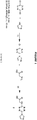
- a first step 3,6-dichloro-1,2,4,5-tetrazine (100 mg, 0.66 mmol) is reacted with imidazole (45 mg, 0.66 mmol) and N,N-diisopropylethylamine (DIPEA) (120 ⁇ L, 0.66 mmol) in acetonitrile (ACN) (6 mL) at room temperature. After 5 minutes, the formation of the product is confirmed by TLC (ethyl acetate/dichloromethane, 2:8) and HPLC-MS.
- DIPEA N,N-diisopropylethylamine
- glycine 50 mg, 0.66 mmol solubilized in water (1mL) and DIPEA (120 ⁇ L, 0.66 mmol) are added to the reaction mixture. After 10 minutes, the formation of the final product 2 is confirmed by TLC (methanol/dichloromethane, 1:1) and HPLC-MS. Solvents are eliminated under reduced pressure and the crude final product is purified by semi-preparative HPLC to give the final product 2 according to scheme 1 given in figure 1 .
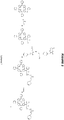
- the manganese porphyrin has been synthetized according to and adapted from methods described in the literature ( Org. Lett. 2004, 6, 1033-1036 ; J. Phys. Chem. B 2006, 110, 15955 and Synlett 1999 (1) 61-62 ) and modified by the introduction of a (bicyclo[6.1.0]non-4-yn-9-ylmethanol) moiety according to the following method illustrated in scheme 2 in figure 2 .
- This function makes the specific and selective binding of the catalyst to the nanohybrid possible.
- an -NH 2 function is introduced at the surface of the nanoparticles with (3-aminopropyl)triethoxysilane.
- Nanoparticles coating -NH 2 groups were subjected to an equivalent mass ratio of compound 2 in the presence of N -(3-dimethylaminopropyl)- N -2-ethylcarbodiimide hydrochloride (EDC) and N -hydroxysuccinimide (NHS) at 2.0 and 2.2 molar equivalent respectively according to scheme 3.
- EDC N -(3-dimethylaminopropyl)- N -2-ethylcarbodiimide hydrochloride
- NHS N -hydroxysuccinimide
- the covalent binding of the porphyrin is achieved via the bioorthogonal function 1,2,4,5-tetrazine of the bi-functional nanohybrid 4 and the partner bioorthogonal function (a bicyclo[6.1.0]non-4-yn-9-ylmethanol function) of the modified manganese porphyrin 3 according to scheme 4.
- the mixture was stirred at room temperature into 30 mL of a 1:1 tetrahydrofuran/water mixture for 15h followed by magnetic decantation and washing with 3x50 mL tetrahydrofuran and 3x50 mL water.
- the manganese porphyrin immobilised on the bi-functional nanohybrid prepared according to example I has been tested in an epoxydation reaction to examine its catalytic activities.
- the reaction was examined with styrene in the presence of the immobilized manganese porphyrin and iodosylbenzene as an oxydant.
- the bi-functional nanohybrid consists of iron oxide nanoparticles (magnetic properties), a 1,2,4,5-tetrazine as bioorthogonal function (Ra1) and an imidazole as chemical function (Rb).
- the 1,2,4,5-tetrazine allows the specific and selective binding of the porphyrin ligand.
- the imidazole function then plays the role of second ligand by coordinating manganese, thus stabilizing manganese porphyrin and increasing its catalytic activity.
Landscapes
- Chemical & Material Sciences (AREA)
- Organic Chemistry (AREA)
- Engineering & Computer Science (AREA)
- Materials Engineering (AREA)
- Chemical Kinetics & Catalysis (AREA)
- Inorganic Chemistry (AREA)
- Catalysts (AREA)
- Dispersion Chemistry (AREA)
- Acyclic And Carbocyclic Compounds In Medicinal Compositions (AREA)
Priority Applications (6)
| Application Number | Priority Date | Filing Date | Title |
|---|---|---|---|
| EP18306736.2A EP3669978A1 (fr) | 2018-12-19 | 2018-12-19 | Nanohybrides bi-fonctionnels |
| KR1020217022607A KR20210102429A (ko) | 2018-12-19 | 2019-12-19 | 이중-작용성 나노 하이브리드 |
| US17/311,964 US20220024899A1 (en) | 2018-12-19 | 2019-12-19 | Bi-functional nanohybrids |
| EP19829542.0A EP3897977B1 (fr) | 2018-12-19 | 2019-12-19 | Nanohybrides bi-fonctionnels |
| PCT/EP2019/086180 WO2020127644A1 (fr) | 2018-12-19 | 2019-12-19 | Nanohybrides bifonctionnels |
| CA3122956A CA3122956A1 (fr) | 2018-12-19 | 2019-12-19 | Nanohybrides bifonctionnels |
Applications Claiming Priority (1)
| Application Number | Priority Date | Filing Date | Title |
|---|---|---|---|
| EP18306736.2A EP3669978A1 (fr) | 2018-12-19 | 2018-12-19 | Nanohybrides bi-fonctionnels |
Publications (1)
| Publication Number | Publication Date |
|---|---|
| EP3669978A1 true EP3669978A1 (fr) | 2020-06-24 |
Family
ID=65278153
Family Applications (2)
| Application Number | Title | Priority Date | Filing Date |
|---|---|---|---|
| EP18306736.2A Withdrawn EP3669978A1 (fr) | 2018-12-19 | 2018-12-19 | Nanohybrides bi-fonctionnels |
| EP19829542.0A Active EP3897977B1 (fr) | 2018-12-19 | 2019-12-19 | Nanohybrides bi-fonctionnels |
Family Applications After (1)
| Application Number | Title | Priority Date | Filing Date |
|---|---|---|---|
| EP19829542.0A Active EP3897977B1 (fr) | 2018-12-19 | 2019-12-19 | Nanohybrides bi-fonctionnels |
Country Status (5)
| Country | Link |
|---|---|
| US (1) | US20220024899A1 (fr) |
| EP (2) | EP3669978A1 (fr) |
| KR (1) | KR20210102429A (fr) |
| CA (1) | CA3122956A1 (fr) |
| WO (1) | WO2020127644A1 (fr) |
Citations (2)
| Publication number | Priority date | Publication date | Assignee | Title |
|---|---|---|---|---|
| US20160223559A1 (en) * | 2015-02-02 | 2016-08-04 | The Regents Of The University Of California | Tetrazine-containing compounds and synthetic methods thereof |
| WO2017093263A1 (fr) * | 2015-11-30 | 2017-06-08 | Universite De Bourgogne | Procédé de préparation de composés 1,2,4,5-tétrazine fonctionnalisés |
-
2018
- 2018-12-19 EP EP18306736.2A patent/EP3669978A1/fr not_active Withdrawn
-
2019
- 2019-12-19 CA CA3122956A patent/CA3122956A1/fr active Pending
- 2019-12-19 KR KR1020217022607A patent/KR20210102429A/ko not_active Ceased
- 2019-12-19 US US17/311,964 patent/US20220024899A1/en not_active Abandoned
- 2019-12-19 WO PCT/EP2019/086180 patent/WO2020127644A1/fr not_active Ceased
- 2019-12-19 EP EP19829542.0A patent/EP3897977B1/fr active Active
Patent Citations (2)
| Publication number | Priority date | Publication date | Assignee | Title |
|---|---|---|---|---|
| US20160223559A1 (en) * | 2015-02-02 | 2016-08-04 | The Regents Of The University Of California | Tetrazine-containing compounds and synthetic methods thereof |
| WO2017093263A1 (fr) * | 2015-11-30 | 2017-06-08 | Universite De Bourgogne | Procédé de préparation de composés 1,2,4,5-tétrazine fonctionnalisés |
Non-Patent Citations (21)
| Title |
|---|
| CHEM. COMM., 2013, pages 7394 - 7396 |
| COLLMAN, J. P.; DECREAU, R. A.; ZHANG, C.: "Synthesis of Cytochrome c Oxidase Models Bearing a Tyr244 Mimic", J. ORG. CHEM., vol. 69, 2004, pages 3546 - 3549 |
| COLLMAN, J. P.; DEVARAJ, N. K.; DECREAU, R. A.; YANG, Y.; YAN, Y.; EBINA, W.; EBERSPACHER, T. P. A.; CHIDSEY. C. E. D: "A Functional mimic of cytochrome c oxidase selectively reduces oxygen by four electrons under rate-limiting electron flux: the role of CUB and Tyr-244", SCIENCE, vol. 315, 2007, pages 1565 - 1568 |
| EBERSPACHER, T. A.; COLLMAN, J.P.; CHIDSEY, C.E.D.; DONOHUE, D.L.; VAN RYSWYK, H.: "Modular Assembly and Air-Stable Electrochemistry of Ruthenium Porphyrin Monolayers", LANGMUIR, vol. 19, no. 9, 2003, pages 3814 - 3821 |
| J. M. READY; E. N. JACOBSEN: "Cooperative multimetallic catalysis using metallosalens", J. AM. CHEM. SOC., vol. 123, 2001, pages 2687 - 2688 |
| J. PARIS ET AL: "Phthalocyanine-titanate nanotubes: a promising nanocarrier detectable by optical imaging in the so-called imaging window", RSC ADVANCES, vol. 5, no. 9, 1 January 2015 (2015-01-01), UK, pages 6315 - 6322, XP055619848, ISSN: 2046-2069, DOI: 10.1039/C4RA13988G * |
| J. PARK; K. LANG; K. A. ABBOUD; S. HONG: "Self-Assembled Dinuclear Cobalt(II)-Salen Catalyst Through Hydrogen-Bonding and Its Application to Enantioselective Nitro-Aldol (Henry) Reaction", J. AM. CHEM. SOC., vol. 130, 2008, pages 16484 - 16485 |
| J. PHYS. CHEM. B, vol. 110, 2006, pages 15955 |
| JEREMY PARIS: "Iron oxides nanoparticles and titanate nanotubes dedicated to multimodal imaging and anticancer therapy", 2013, UNIVERSITE DE BOURGOGNE |
| JONES, N. D.; JAMES, B. R: "Homo- and Heterobimetallic Precursor Catalysts for the Heck Reaction, and a Proposal for a General Catalytic Cooperativity Index", ADV. SYNTH. CATAL., vol. 344, 2002, pages 1126 |
| JULIEN BOUDON ET AL: "Magneto-optical nanomaterials: a SPIO-phthalocyanine scaffold built step-by-step towards bimodal imaging", CHEMICAL COMMUNICATIONS, vol. 49, no. 67, 1 January 2013 (2013-01-01), UK, pages 7394, XP055619851, ISSN: 1359-7345, DOI: 10.1039/c3cc41898g * |
| MARK R. KARVER ET AL: "Synthesis and Evaluation of a Series of 1,2,4,5-Tetrazines for Bioorthogonal Conjugation", BIOCONJUGATE CHEMISTRY, vol. 22, no. 11, 16 November 2011 (2011-11-16), pages 2263 - 2270, XP055122288, ISSN: 1043-1802, DOI: 10.1021/bc200295y * |
| MCCRORY, C. C. L.; DEVADOSS, A.; OTTENWAELDER, X.; LOWE, R. D.; STACK, T. D. P.; CHIDSEY, C. E. D.: "Electrocatalytic 0 Reduction by Covalently Immobilized Mononuclear Copper(I) Complexes: Evidence for a Binuclear C 0 Intermediate", J. AM. CHEM. SOC., vol. 133, 2011, pages 3696 - 3699 |
| MOHAMMAD SALEH SAEEDI ET AL: "Manganese porphyrin immobilized on magnetite nanoparticles as a recoverable nanocatalyst for epoxidation of olefins", MATERIALS CHEMISTRY AND PHYSICS, vol. 146, no. 1-2, 1 July 2014 (2014-07-01), Switzerland, Taiwan, Republic of China, pages 113 - 120, XP055619857, ISSN: 0254-0584, DOI: 10.1016/j.matchemphys.2014.03.007 * |
| MOJTABA BAGHERZADEH ET AL: "Nanoparticle supported, magnetically separable manganese porphyrin as an efficient retrievable nanocatalyst in hydrocarbon oxidation reactions", RSC ADVANCES, vol. 6, no. 47, 1 January 2016 (2016-01-01), UK, pages 41551 - 41560, XP055619853, ISSN: 2046-2069, DOI: 10.1039/C6RA02123A * |
| ORG. LETT., vol. 6, 2004, pages 1033 - 1036 |
| PAULIN BUCHWALTER; JACKY ROSE; PIERRE BRAUNSTEIN: "Multimetallic Catalysis Based on Heterometallic Complexes and Clusters", CHEM. REV., vol. 115, 2015, pages 28 - 126 |
| R. M. HAAK; M. MARTINEZ BELMONTE; E. C. ESCUDERO-ADAN; J. BENET-BUCHHOLZ; A. W. KLEIJ: "Olefin metathesis as a tool for multinuclear Co(III)salen catalyst construction: access to cooperative catalysts", DALTON TRANS., vol. 39, 2010, pages 593 - 602 |
| SAEEDI, M. S.; TANGESTANINEJAD S.; MOGHADAM M.; MIRKHANIIRAJ V.; MOHAMMADPOOR-BALTORK I.; KHOSROPOUR R. A.: "Manganese porphyrin immobilized on magnetite nanoparticles as a recoverable nanocatalyst for epoxidation of olefins", MATERIALS CHEMISTRY AND PHYSICS, vol. 146, 2014, pages 113 - 120 |
| SYNLETT, vol. 1, 1999, pages 61 - 62 |
| TOHRU WADA; SHUNSUKE NISHIMURA; TARO MOCHIZUKI; TOMOHIRO ANDO; YUJI MIYAZATO: "Mechanism of Water Oxidation Catalyzed by a Dinuclear Ruthenium Complex Bridged by Anthraquinone", CATALYSTS, vol. 7, 2017, pages 56 |
Also Published As
| Publication number | Publication date |
|---|---|
| EP3897977A1 (fr) | 2021-10-27 |
| US20220024899A1 (en) | 2022-01-27 |
| KR20210102429A (ko) | 2021-08-19 |
| CA3122956A1 (fr) | 2020-06-25 |
| EP3897977B1 (fr) | 2024-11-27 |
| WO2020127644A1 (fr) | 2020-06-25 |
| EP3897977C0 (fr) | 2024-11-27 |
Similar Documents
| Publication | Publication Date | Title |
|---|---|---|
| Doherty et al. | Highly selective and solvent-dependent reduction of nitrobenzene to N-phenylhydroxylamine, azoxybenzene, and aniline catalyzed by phosphino-modified polymer immobilized ionic liquid-stabilized AuNPs | |
| Zaera | Designing sites in heterogeneous catalysis: are we reaching selectivities competitive with those of homogeneous catalysts? | |
| Goodman et al. | Design of organic/inorganic hybrid catalysts for energy and environmental applications | |
| Tada et al. | Advanced design of catalytically active reaction space at surfaces for selective catalysis | |
| Campisciano et al. | Modified nanocarbons for catalysis | |
| Dhakshinamoorthy et al. | Metal organic frameworks as versatile hosts of Au nanoparticles in heterogeneous catalysis | |
| Habibi et al. | Characterization and catalytic activity of a novel Fe nano-catalyst as efficient heterogeneous catalyst for selective oxidation of ethylbenzene, cyclohexene, and benzylalcohol | |
| US6028025A (en) | Metalloporphyrin oxidation catalyst covalently coupled to an inorganic surface and method making same | |
| Thomas et al. | Catalytic significance of organometallic compounds immobilized on mesoporous silica: economically and environmentally important examples | |
| An et al. | Recent advances in the chemistry of N‐heterocyclic‐carbene‐functionalized metal‐nanoparticles and their applications | |
| WO1998017389A9 (fr) | Catalyseur d'oxydation de metalloporphyrines indirectement liees de maniere covalente a une surface inorganique et procede de preparation | |
| Molnár | Synthetic application of cyclodextrins in combination with metal ions, complexes, and metal particles | |
| Haghshenas Kashani et al. | Ruthenium nanoparticles immobilized on nano-silica functionalized with thiol-based dendrimer: a nanocomposite material for oxidation of alcohols and epoxidation of alkenes | |
| Govan et al. | Penta-coordinated transition metal macrocycles as electrocatalysts for the oxygen reduction reaction | |
| Habibi et al. | Preparation, characterization and catalytic activity of a nano-Co (II)-catalyst as a high efficient heterogeneous catalyst for the selective oxidation of ethylbenzene, cyclohexene, and benzyl alcohol | |
| Fardjahromi et al. | Manganese (iii) salophen supported on a silica containing triazine dendrimer: An efficient catalyst for epoxidation of alkenes with sodium periodate | |
| Jiang et al. | Aryl-aryl bond formation by Ullmann reaction: from mechanistic aspects to catalyst | |
| Zhou et al. | Asymmetric epoxidation of alkenes catalysed by chromium binaphthyl Schiff base complex supported on MCM-41 | |
| Wilton-Ely | The surface functionalisation of gold nanoparticles with metal complexes | |
| Hajji et al. | Hyperbranched polymers as platforms for catalysts | |
| Huang et al. | Iron (II) phthalocyanine immobilized SBA-15 catalysts: preparation, characterization and application for toluene selective aerobic oxidation | |
| Dongil et al. | Graphite oxide as support for the immobilization of Ru-BINAP: Application in the enantioselective hydrogenation of methylacetoacetate | |
| Wang et al. | N-Heterocyclic carbene-functionalized metal nanoparticles and nanoclusters for nanocatalysis | |
| Payamifar et al. | Recent Advances in Porphyrin‐Based Magnetic Nanocomposites: Preparation, Characterization, and Catalytic Application in the Epoxidation of Olefins | |
| EP3897977B1 (fr) | Nanohybrides bi-fonctionnels |
Legal Events
| Date | Code | Title | Description |
|---|---|---|---|
| PUAI | Public reference made under article 153(3) epc to a published international application that has entered the european phase |
Free format text: ORIGINAL CODE: 0009012 |
|
| STAA | Information on the status of an ep patent application or granted ep patent |
Free format text: STATUS: THE APPLICATION HAS BEEN PUBLISHED |
|
| AK | Designated contracting states |
Kind code of ref document: A1 Designated state(s): AL AT BE BG CH CY CZ DE DK EE ES FI FR GB GR HR HU IE IS IT LI LT LU LV MC MK MT NL NO PL PT RO RS SE SI SK SM TR |
|
| AX | Request for extension of the european patent |
Extension state: BA ME |
|
| STAA | Information on the status of an ep patent application or granted ep patent |
Free format text: STATUS: REQUEST FOR EXAMINATION WAS MADE |
|
| 17P | Request for examination filed |
Effective date: 20201221 |
|
| RBV | Designated contracting states (corrected) |
Designated state(s): AL AT BE BG CH CY CZ DE DK EE ES FI FR GB GR HR HU IE IS IT LI LT LU LV MC MK MT NL NO PL PT RO RS SE SI SK SM TR |
|
| RAP1 | Party data changed (applicant data changed or rights of an application transferred) |
Owner name: SON |
|
| STAA | Information on the status of an ep patent application or granted ep patent |
Free format text: STATUS: EXAMINATION IS IN PROGRESS |
|
| 17Q | First examination report despatched |
Effective date: 20220407 |
|
| STAA | Information on the status of an ep patent application or granted ep patent |
Free format text: STATUS: THE APPLICATION IS DEEMED TO BE WITHDRAWN |
|
| 18D | Application deemed to be withdrawn |
Effective date: 20221018 |