EP3670576A1 - Matières de moulage de polyamide pour vitrages composites - Google Patents
Matières de moulage de polyamide pour vitrages composites Download PDFInfo
- Publication number
- EP3670576A1 EP3670576A1 EP18214070.7A EP18214070A EP3670576A1 EP 3670576 A1 EP3670576 A1 EP 3670576A1 EP 18214070 A EP18214070 A EP 18214070A EP 3670576 A1 EP3670576 A1 EP 3670576A1
- Authority
- EP
- European Patent Office
- Prior art keywords
- weight
- percent
- range
- component
- polyamide
- Prior art date
- Legal status (The legal status is an assumption and is not a legal conclusion. Google has not performed a legal analysis and makes no representation as to the accuracy of the status listed.)
- Granted
Links
Images
Classifications
-
- C—CHEMISTRY; METALLURGY
- C08—ORGANIC MACROMOLECULAR COMPOUNDS; THEIR PREPARATION OR CHEMICAL WORKING-UP; COMPOSITIONS BASED THEREON
- C08L—COMPOSITIONS OF MACROMOLECULAR COMPOUNDS
- C08L77/00—Compositions of polyamides obtained by reactions forming a carboxylic amide link in the main chain; Compositions of derivatives of such polymers
-
- C—CHEMISTRY; METALLURGY
- C08—ORGANIC MACROMOLECULAR COMPOUNDS; THEIR PREPARATION OR CHEMICAL WORKING-UP; COMPOSITIONS BASED THEREON
- C08G—MACROMOLECULAR COMPOUNDS OBTAINED OTHERWISE THAN BY REACTIONS ONLY INVOLVING UNSATURATED CARBON-TO-CARBON BONDS
- C08G69/00—Macromolecular compounds obtained by reactions forming a carboxylic amide link in the main chain of the macromolecule
- C08G69/02—Polyamides derived from amino-carboxylic acids or from polyamines and polycarboxylic acids
- C08G69/26—Polyamides derived from amino-carboxylic acids or from polyamines and polycarboxylic acids derived from polyamines and polycarboxylic acids
-
- B—PERFORMING OPERATIONS; TRANSPORTING
- B32—LAYERED PRODUCTS
- B32B—LAYERED PRODUCTS, i.e. PRODUCTS BUILT-UP OF STRATA OF FLAT OR NON-FLAT, e.g. CELLULAR OR HONEYCOMB, FORM
- B32B17/00—Layered products essentially comprising sheet glass, or glass, slag, or like fibres
- B32B17/06—Layered products essentially comprising sheet glass, or glass, slag, or like fibres comprising glass as the main or only constituent of a layer, next to another layer of a specific material
-
- B—PERFORMING OPERATIONS; TRANSPORTING
- B32—LAYERED PRODUCTS
- B32B—LAYERED PRODUCTS, i.e. PRODUCTS BUILT-UP OF STRATA OF FLAT OR NON-FLAT, e.g. CELLULAR OR HONEYCOMB, FORM
- B32B27/00—Layered products comprising a layer of synthetic resin
- B32B27/06—Layered products comprising a layer of synthetic resin as the main or only constituent of a layer, which is next to another layer of the same or of a different material
- B32B27/08—Layered products comprising a layer of synthetic resin as the main or only constituent of a layer, which is next to another layer of the same or of a different material of synthetic resin
-
- B—PERFORMING OPERATIONS; TRANSPORTING
- B32—LAYERED PRODUCTS
- B32B—LAYERED PRODUCTS, i.e. PRODUCTS BUILT-UP OF STRATA OF FLAT OR NON-FLAT, e.g. CELLULAR OR HONEYCOMB, FORM
- B32B27/00—Layered products comprising a layer of synthetic resin
- B32B27/28—Layered products comprising a layer of synthetic resin comprising synthetic resins not wholly covered by any one of the sub-groups B32B27/30 - B32B27/42
-
- B—PERFORMING OPERATIONS; TRANSPORTING
- B32—LAYERED PRODUCTS
- B32B—LAYERED PRODUCTS, i.e. PRODUCTS BUILT-UP OF STRATA OF FLAT OR NON-FLAT, e.g. CELLULAR OR HONEYCOMB, FORM
- B32B27/00—Layered products comprising a layer of synthetic resin
- B32B27/34—Layered products comprising a layer of synthetic resin comprising polyamides
-
- B—PERFORMING OPERATIONS; TRANSPORTING
- B32—LAYERED PRODUCTS
- B32B—LAYERED PRODUCTS, i.e. PRODUCTS BUILT-UP OF STRATA OF FLAT OR NON-FLAT, e.g. CELLULAR OR HONEYCOMB, FORM
- B32B7/00—Layered products characterised by the relation between layers; Layered products characterised by the relative orientation of features between layers, or by the relative values of a measurable parameter between layers, i.e. products comprising layers having different physical, chemical or physicochemical properties; Layered products characterised by the interconnection of layers
- B32B7/04—Interconnection of layers
- B32B7/12—Interconnection of layers using interposed adhesives or interposed materials with bonding properties
-
- C—CHEMISTRY; METALLURGY
- C08—ORGANIC MACROMOLECULAR COMPOUNDS; THEIR PREPARATION OR CHEMICAL WORKING-UP; COMPOSITIONS BASED THEREON
- C08G—MACROMOLECULAR COMPOUNDS OBTAINED OTHERWISE THAN BY REACTIONS ONLY INVOLVING UNSATURATED CARBON-TO-CARBON BONDS
- C08G69/00—Macromolecular compounds obtained by reactions forming a carboxylic amide link in the main chain of the macromolecule
- C08G69/02—Polyamides derived from amino-carboxylic acids or from polyamines and polycarboxylic acids
- C08G69/26—Polyamides derived from amino-carboxylic acids or from polyamines and polycarboxylic acids derived from polyamines and polycarboxylic acids
- C08G69/265—Polyamides derived from amino-carboxylic acids or from polyamines and polycarboxylic acids derived from polyamines and polycarboxylic acids from at least two different diamines or at least two different dicarboxylic acids
-
- C—CHEMISTRY; METALLURGY
- C08—ORGANIC MACROMOLECULAR COMPOUNDS; THEIR PREPARATION OR CHEMICAL WORKING-UP; COMPOSITIONS BASED THEREON
- C08J—WORKING-UP; GENERAL PROCESSES OF COMPOUNDING; AFTER-TREATMENT NOT COVERED BY SUBCLASSES C08B, C08C, C08F, C08G or C08H
- C08J3/00—Processes of treating or compounding macromolecular substances
- C08J3/20—Compounding polymers with additives, e.g. colouring
- C08J3/203—Solid polymers with solid and/or liquid additives
-
- C—CHEMISTRY; METALLURGY
- C08—ORGANIC MACROMOLECULAR COMPOUNDS; THEIR PREPARATION OR CHEMICAL WORKING-UP; COMPOSITIONS BASED THEREON
- C08J—WORKING-UP; GENERAL PROCESSES OF COMPOUNDING; AFTER-TREATMENT NOT COVERED BY SUBCLASSES C08B, C08C, C08F, C08G or C08H
- C08J5/00—Manufacture of articles or shaped materials containing macromolecular substances
- C08J5/12—Bonding of a preformed macromolecular material to the same or other solid material such as metal, glass, leather, e.g. using adhesives
- C08J5/124—Bonding of a preformed macromolecular material to the same or other solid material such as metal, glass, leather, e.g. using adhesives using adhesives based on a macromolecular component
-
- C—CHEMISTRY; METALLURGY
- C08—ORGANIC MACROMOLECULAR COMPOUNDS; THEIR PREPARATION OR CHEMICAL WORKING-UP; COMPOSITIONS BASED THEREON
- C08K—Use of inorganic or non-macromolecular organic substances as compounding ingredients
- C08K3/00—Use of inorganic substances as compounding ingredients
- C08K3/01—Use of inorganic substances as compounding ingredients characterized by their specific function
- C08K3/013—Fillers, pigments or reinforcing additives
-
- C—CHEMISTRY; METALLURGY
- C08—ORGANIC MACROMOLECULAR COMPOUNDS; THEIR PREPARATION OR CHEMICAL WORKING-UP; COMPOSITIONS BASED THEREON
- C08L—COMPOSITIONS OF MACROMOLECULAR COMPOUNDS
- C08L77/00—Compositions of polyamides obtained by reactions forming a carboxylic amide link in the main chain; Compositions of derivatives of such polymers
- C08L77/02—Polyamides derived from omega-amino carboxylic acids or from lactams thereof
-
- C—CHEMISTRY; METALLURGY
- C08—ORGANIC MACROMOLECULAR COMPOUNDS; THEIR PREPARATION OR CHEMICAL WORKING-UP; COMPOSITIONS BASED THEREON
- C08L—COMPOSITIONS OF MACROMOLECULAR COMPOUNDS
- C08L77/00—Compositions of polyamides obtained by reactions forming a carboxylic amide link in the main chain; Compositions of derivatives of such polymers
- C08L77/06—Polyamides derived from polyamines and polycarboxylic acids
-
- C—CHEMISTRY; METALLURGY
- C08—ORGANIC MACROMOLECULAR COMPOUNDS; THEIR PREPARATION OR CHEMICAL WORKING-UP; COMPOSITIONS BASED THEREON
- C08L—COMPOSITIONS OF MACROMOLECULAR COMPOUNDS
- C08L79/00—Compositions of macromolecular compounds obtained by reactions forming in the main chain of the macromolecule a linkage containing nitrogen with or without oxygen or carbon only, not provided for in groups C08L61/00 - C08L77/00
- C08L79/02—Polyamines
-
- C—CHEMISTRY; METALLURGY
- C09—DYES; PAINTS; POLISHES; NATURAL RESINS; ADHESIVES; COMPOSITIONS NOT OTHERWISE PROVIDED FOR; APPLICATIONS OF MATERIALS NOT OTHERWISE PROVIDED FOR
- C09J—ADHESIVES; NON-MECHANICAL ASPECTS OF ADHESIVE PROCESSES IN GENERAL; ADHESIVE PROCESSES NOT PROVIDED FOR ELSEWHERE; USE OF MATERIALS AS ADHESIVES
- C09J177/00—Adhesives based on polyamides obtained by reactions forming a carboxylic amide link in the main chain; Adhesives based on derivatives of such polymers
- C09J177/06—Polyamides derived from polyamines and polycarboxylic acids
-
- B—PERFORMING OPERATIONS; TRANSPORTING
- B29—WORKING OF PLASTICS; WORKING OF SUBSTANCES IN A PLASTIC STATE IN GENERAL
- B29C—SHAPING OR JOINING OF PLASTICS; SHAPING OF MATERIAL IN A PLASTIC STATE, NOT OTHERWISE PROVIDED FOR; AFTER-TREATMENT OF THE SHAPED PRODUCTS, e.g. REPAIRING
- B29C45/00—Injection moulding, i.e. forcing the required volume of moulding material through a nozzle into a closed mould; Apparatus therefor
- B29C45/0001—Injection moulding, i.e. forcing the required volume of moulding material through a nozzle into a closed mould; Apparatus therefor characterised by the choice of material
-
- B—PERFORMING OPERATIONS; TRANSPORTING
- B29—WORKING OF PLASTICS; WORKING OF SUBSTANCES IN A PLASTIC STATE IN GENERAL
- B29K—INDEXING SCHEME ASSOCIATED WITH SUBCLASSES B29B, B29C OR B29D, RELATING TO MOULDING MATERIALS OR TO MATERIALS FOR MOULDS, REINFORCEMENTS, FILLERS OR PREFORMED PARTS, e.g. INSERTS
- B29K2077/00—Use of PA, i.e. polyamides, e.g. polyesteramides or derivatives thereof, as moulding material
-
- B—PERFORMING OPERATIONS; TRANSPORTING
- B32—LAYERED PRODUCTS
- B32B—LAYERED PRODUCTS, i.e. PRODUCTS BUILT-UP OF STRATA OF FLAT OR NON-FLAT, e.g. CELLULAR OR HONEYCOMB, FORM
- B32B2375/00—Polyureas; Polyurethanes
-
- B—PERFORMING OPERATIONS; TRANSPORTING
- B32—LAYERED PRODUCTS
- B32B—LAYERED PRODUCTS, i.e. PRODUCTS BUILT-UP OF STRATA OF FLAT OR NON-FLAT, e.g. CELLULAR OR HONEYCOMB, FORM
- B32B2457/00—Electrical equipment
-
- C—CHEMISTRY; METALLURGY
- C08—ORGANIC MACROMOLECULAR COMPOUNDS; THEIR PREPARATION OR CHEMICAL WORKING-UP; COMPOSITIONS BASED THEREON
- C08J—WORKING-UP; GENERAL PROCESSES OF COMPOUNDING; AFTER-TREATMENT NOT COVERED BY SUBCLASSES C08B, C08C, C08F, C08G or C08H
- C08J2377/00—Characterised by the use of polyamides obtained by reactions forming a carboxylic amide link in the main chain; Derivatives of such polymers
- C08J2377/06—Polyamides derived from polyamines and polycarboxylic acids
-
- C—CHEMISTRY; METALLURGY
- C08—ORGANIC MACROMOLECULAR COMPOUNDS; THEIR PREPARATION OR CHEMICAL WORKING-UP; COMPOSITIONS BASED THEREON
- C08J—WORKING-UP; GENERAL PROCESSES OF COMPOUNDING; AFTER-TREATMENT NOT COVERED BY SUBCLASSES C08B, C08C, C08F, C08G or C08H
- C08J2477/00—Characterised by the use of polyamides obtained by reactions forming a carboxylic amide link in the main chain; Derivatives of such polymers
- C08J2477/06—Polyamides derived from polyamines and polycarboxylic acids
-
- C—CHEMISTRY; METALLURGY
- C08—ORGANIC MACROMOLECULAR COMPOUNDS; THEIR PREPARATION OR CHEMICAL WORKING-UP; COMPOSITIONS BASED THEREON
- C08J—WORKING-UP; GENERAL PROCESSES OF COMPOUNDING; AFTER-TREATMENT NOT COVERED BY SUBCLASSES C08B, C08C, C08F, C08G or C08H
- C08J2479/00—Characterised by the use of macromolecular compounds obtained by reactions forming in the main chain of the macromolecule a linkage containing nitrogen with or without oxygen, or carbon only, not provided for in groups C08J2461/00 - C08J2477/00
- C08J2479/02—Polyamines
-
- C—CHEMISTRY; METALLURGY
- C08—ORGANIC MACROMOLECULAR COMPOUNDS; THEIR PREPARATION OR CHEMICAL WORKING-UP; COMPOSITIONS BASED THEREON
- C08K—Use of inorganic or non-macromolecular organic substances as compounding ingredients
- C08K2201/00—Specific properties of additives
- C08K2201/002—Physical properties
- C08K2201/003—Additives being defined by their diameter
-
- C—CHEMISTRY; METALLURGY
- C08—ORGANIC MACROMOLECULAR COMPOUNDS; THEIR PREPARATION OR CHEMICAL WORKING-UP; COMPOSITIONS BASED THEREON
- C08K—Use of inorganic or non-macromolecular organic substances as compounding ingredients
- C08K2201/00—Specific properties of additives
- C08K2201/002—Physical properties
- C08K2201/004—Additives being defined by their length
-
- C—CHEMISTRY; METALLURGY
- C08—ORGANIC MACROMOLECULAR COMPOUNDS; THEIR PREPARATION OR CHEMICAL WORKING-UP; COMPOSITIONS BASED THEREON
- C08L—COMPOSITIONS OF MACROMOLECULAR COMPOUNDS
- C08L2205/00—Polymer mixtures characterised by other features
- C08L2205/02—Polymer mixtures characterised by other features containing two or more polymers of the same C08L -group
- C08L2205/025—Polymer mixtures characterised by other features containing two or more polymers of the same C08L -group containing two or more polymers of the same hierarchy C08L, and differing only in parameters such as density, comonomer content, molecular weight, structure
-
- C—CHEMISTRY; METALLURGY
- C08—ORGANIC MACROMOLECULAR COMPOUNDS; THEIR PREPARATION OR CHEMICAL WORKING-UP; COMPOSITIONS BASED THEREON
- C08L—COMPOSITIONS OF MACROMOLECULAR COMPOUNDS
- C08L2205/00—Polymer mixtures characterised by other features
- C08L2205/03—Polymer mixtures characterised by other features containing three or more polymers in a blend
-
- C—CHEMISTRY; METALLURGY
- C08—ORGANIC MACROMOLECULAR COMPOUNDS; THEIR PREPARATION OR CHEMICAL WORKING-UP; COMPOSITIONS BASED THEREON
- C08L—COMPOSITIONS OF MACROMOLECULAR COMPOUNDS
- C08L2205/00—Polymer mixtures characterised by other features
- C08L2205/06—Polymer mixtures characterised by other features having improved processability or containing aids for moulding methods
Definitions
- the present invention relates to thermoplastic polyamide molding compositions which are particularly suitable for composite structures with mineral glass using a layer of polyurethane as an adhesion promoter.
- the present invention further relates to corresponding polyamide / mineral glass material composites and the use of specific additives for polyamide molding compositions, specifically polyethyleneimines, to improve the adhesion to polyurethane.
- Thermoplastic polyamide materials have established themselves in many areas for the production of structural components, among other things because of their good mechanical properties, resistance to chemicals, good processability, low specific weight, etc., especially in the automotive sector, but also in the electronics sector , for example for the housing of portable devices.
- Glass panes are used for display applications, in particular in the field of mobile telephones, but also in the field of computers and portable computers. These mineral glass panes must be bonded to the housing components and the bond should be as strong as possible. As a rule, polyurethane glue is used for gluing glass in the industrial sector. This adheres excellently to the mineral glass and can be optimally processed, especially if it is designed as a hot glue.
- thermoplastic polyamide molding composition which has mechanical properties suitable for the abovementioned applications, but at the same time can also be combined with mineral glass using polyurethane adhesives in a simple process and with excellent holding forces.
- thermoplastic polyamide molding composition modified according to the invention by a composite of at least one layer based on polyamide, an adjoining adhesive layer made of polyurethane, and an adjoining layer made of mineral glass, and the Use of polyethyleneimines, or copolymers or derivatives thereof, in a polyamide molding composition to improve the bond to polyurethane.
- a core of the invention is that, unexpectedly, it was found that the addition of polyethyleneimines to a thermoplastic polyamide matrix leads to the adhesion to polyurethane, in particular to polyurethane, which is usually used for bonding with mineral glass, is increased exceptionally. This without losing the advantageous mechanical properties.
- This is surprising, among other things, because the mere increase in the number of amino end groups of the polyamide, for example by appropriately guiding the reaction to produce a polyamide material, cannot improve the adhesive properties compared to polyurethane to the same extent, and also the disadvantage shows that by increasing the amino end groups, the mechanical properties of the polyamide material are drastically impaired.
- polyethyleneimines can be mixed into a polyamide material, but not in connection with the question of bond adhesion to polyurethane, and also not in connection with specific polyamide matrix systems as described here.
- thermoplastic Molding compositions based in particular on polyoxymethylenes (POM), containing as essential components A) 29 to (100% by weight minus 1 ppb) at least one thermoplastic polymer, B) 1 ppb to 1% by weight of at least one polyethyleneimine homo- or copolymer , as well as C) 0 to 70% by weight of further additives, the weight percentages of components A) to C) always giving 100%.
- POM polyoxymethylenes
- thermoplastic molding compositions containing: A) 10 to 99% by weight of at least one thermoplastic polyamide, in particular polyamide 6, B) 0.1 to 5% by weight. % of at least one polyethyleneimine homopolymer or copolymer, C) 0.05 to 3% by weight of a lubricant, D) 0.05 to 3% by weight of a copper-containing stabilizer or a sterically hindered phenol or mixtures thereof, E) 0 up to 60% by weight of further additives, the sum of the percentages by weight of components (A) to (E) giving 100%.
- thermoplastic polyamide molding compositions proposed here in the context of this application are preferably free of lubricants of this type, which can be designed, for example, as follows: aluminum, alkali metal, alkaline earth metal salts or ester or amides of fatty acids with 10 to 44 C atoms, for example with 12 up to 40 carbon atoms.
- the metal ions are, for example, alkaline earth and Al, and Ca or Mg can also be used.
- the metal salts are, for example, Ca stearate and Ca montanate and Al stearate. Mixtures of different salts can also be used as such lubricants, the mixing ratio being arbitrary.
- the carboxylic acids can be 1- or 2-valent.
- the aliphatic alcohols can be 1- to 4-valent. Examples of alcohols are n-butanol, n-octanol, stearyl alcohol, ethylene glycol, propylene glycol, neopentyl glycol, pentaerythritol, whereby glycerol and pentaerythritol are common.
- the aliphatic amines can be 1- to 3-valent.
- esters or amides are correspondingly glycerol distearate, glycerol tristearate, ethylenediamine distearate, glycerol monopalmitate, glycerol trilaurate, glycerol monobehenate and pentaerythritol tetrastearate.
- Mixtures of different esters or amides or Esters with amides can be used in combination, the mixing ratio being arbitrary. As already mentioned, such lubricants are preferably not contained in the molding composition proposed here.
- thermoplastic molding compositions containing A) 10 to 99.94 wt .-% of a polyamide, in particular polyamide 6, B) 0.05 to 5 wt. % of a polyethyleneimine homopolymer or copolymer, C) 0.01 to 20% by weight of iron powder, D) 0 to 70% by weight of further additives, the sum of the percentages by weight A to D being 100%.
- thermoplastic polyamide molding compositions proposed here in the context of this application are preferably free of such iron powder.
- WO-A-2015024912 and similar WO2015024911 describe a composite plastic part which has a first plastic component and a second plastic component and which contains a polyethyleneimine to improve the adhesion therebetween. Furthermore, it relates to a method for producing this composite plastic part, a method for improving the adhesion between a first plastic component and a second plastic component in a composite plastic part, and the use of polyethyleneimine to improve the adhesion between a first plastic component and a second plastic component in a composite plastic part. In the process described here, the parts are molded directly onto one another without an adhesion promoter; the effects are shown exclusively for two components made of polyamide 6.
- WO-A-2011138300 describes a composite part consisting of at least one section made of a polyamide molding compound and at least one section made of a vulcanized elastomer, for example EPDM, EPM, ACM, fluororubber, NBR, H-NBR or AEM, individually or in combination.
- a vulcanized elastomer for example EPDM, EPM, ACM, fluororubber, NBR, H-NBR or AEM, individually or in combination.
- At least 40% by weight of the polyamide molding composition consists of the mixture of the following components: a) 60 to 99 parts by weight of polyamide and b) 1 to 40 parts by weight of a graft copolymer which can be prepared using the following monomers: a ) 0.5 to 25% by weight, based on the graft copolymer, of a polyamine having at least 4 nitrogen atoms and b) 75 to 99.5% by weight, based on the graft copolymer, of polyamide-forming monomers selected from lactams, ⁇ -aminocarboxylic acids and / or equimolar combinations of diamine and dicarboxylic acid, the sum of the parts by weight of a) and b) being 100.
- the presence of the graft copolymer is said to cause improved adhesion between the sections.
- thermoplastic polyamide molding compositions or composite parts proposed here in the context of this application are free of such elastomer elements, which can be, for example, EPDM, EPM, ACM, fluororubber, NBR, H-NBR or AEM, individually or in combination.
- the elastomers can be used in the form of a rubber compound which contains, for example, vulcanizing agents, vulcanization activators, oils and / or fillers.
- thermoplastic polyamide molding compositions proposed here are also preferably free of graft copolymer, which can be produced using the following monomers: a) 0.5 to 25% by weight, based on the graft copolymer, of a polyamine with at least 4 nitrogen atoms and b) 75 up to 99.5% by weight, based on the graft copolymer, of polyamide-forming monomers, selected from lactams, ⁇ -aminocarboxylic acids and / or equimolar combinations of diamine and dicarboxylic acid, the sum of the parts by weight of a) and b) being 100 .
- grafted polyethyleneimines are used as component (B), i.e. the molding compound as a whole is free from grafted polyethyleneimines.
- EP-A-1541336 relates to a thermoplastic multilayer composite composed of at least one first layer based on fluoropolymers, and at least one further second layer, at least in some areas directly adjacent to the first layer.
- adhesion between the two layers is achieved by the second layer being based on polyamide / polyamine copolymers.
- Such a second layer can particularly advantageously be used as an adhesion promoter layer for a further, third layer which is based on polyamide.
- a structure made up of at least 3 layers can be used as a fuel line in the motor vehicle sector.
- component (B) preference is given to using exclusively polyethyleneimines as component (B) which do not contain any amide-forming copolymer units, i.e. the molding composition as a whole is free from polyethyleneimines which contain amide-forming copolymer building blocks.
- EP-A-1065236 describes a graft copolymer that has an improved solvent and Has fuel resistance, and which is produced using the following monomers: a) 0.5 to 25 wt .-%, based on the graft copolymer, of a polyamine with at least 11 nitrogen atoms and a number average molecular weight of at least 500 g / mol; b) polyamide-forming monomers selected from lactams and ⁇ -aminocarboxylic acids; c) oligocarboxylic acid, selected from 0.015 to about 3 mol% of dicarboxylic acid and 0.01 to about 1.2 mol% of tricarboxylic acid, in each case based on lactam or ⁇ -aminocarboxylic acid, the amino group concentration of the graft copolymer being in the range from 100 to 2500 mmol / kg.
- polyamide (abbreviation PA) is understood to be a generic term which includes homopolyamides and copolyamides.
- the chosen spellings and abbreviations for polyamides and their monomers correspond to those specified in ISO standard 16396-1 (2015 (D)).
- the abbreviations used are used in the following synonym for the IUPAC names of the monomers, in particular the following abbreviations for monomers occur: MACM for bis (4-amino-3-methyl-cyclohexyl) methane (also as 3,3'-dimethyl-4 , 4'-diaminodicyclohexylmethane, CAS No.
- PACM bis (4-aminocyclohexyl) methane
- TMDC bis (4-amino-3,5-dimethyl-cyclohexyl) methane (also as 3,3 ', 5,5'-tetramethyl-4,4'-diaminodicyclohexylmethane referred to, CAS no. 65962-45-0)
- T for terephthalic acid (CAS No. 100-21-0)
- I for isophthalic acid (CAS No. 121-95-5).
- amorphous polyamides Compared to the semi-crystalline polyamides, amorphous polyamides have no or only a very low, hardly detectable heat of fusion.
- DSC dynamic differential calorimetry
- the amorphous polyamides preferably show a heat of fusion of at most 5 J / g, particularly preferably of at most 3 J / at a heating rate of 20 K / min. g, very particularly preferably from 0 to 1 J / g.
- Amorphous polyamides have no melting point due to their amorphous nature.
- partially crystalline polyamides are those polyamides which, in dynamic differential calorimetry (DSC) according to ISO 11357 (2013) at a heating rate of 20 K / min, preferably have a heat of fusion of more than 5 J / g , particularly preferably of at least 25 J / g, very particularly preferably of at least 30 J / g.
- DSC dynamic differential calorimetry
- the C / N ratio of the respective polyamides results from the sum of the carbon atoms (C) of the monomers that make up the polyamides, i.e. the dicarboxylic acids, diamines and, if appropriate, lactams and aminocarboxylic acids, in relation to the sum of the nitrogen atoms (N) in these monomers that can react in the polyamide to form amide bonds.
- C carbon atoms
- N nitrogen atoms
- the molding composition is characterized in that component (A) is present in a proportion of 32-94.4 percent by weight, preferably in the range of 44.5-69.0 percent by weight.
- At least one or all of the polyamides of component (A1) preferably have a C to N ratio of at least 8.
- the polyamides of component (A2) can also have a C to N ratio of at least 8.
- polyamides of component (A1) of type AABB i.e. H. constructed from dicarboxylic acids and diamines, with lactams and amino acids also being able to be present as components in a minor proportion.
- diamines for component (A1) are following monomers in question: 1,4-butanediamine, 2-methyl-1,5-pentanediamine, 2-butyl-2-ethyl-1,5-pentanediamine, 1,6-hexanediamine, 2,2,4-trimethylhexamethylenediamine, 2 , 4,4-trimethylhexamethylene diamine, 1,7-heptane diamine, 1,8-octane diamine, 2-methyl-1,8-octane diamine, 1,9-nonane diamine, 1,10-decane diamine, 1,11-undecane diamine, 1,12 -Dodecanediamine, 1,13-tridecanediamine, 1,14-tetradecanediamine, m-xylylenediamine and p-xylylenediamine, 1,6-hexanediamine, 1,10-decanediamine and 1,12-dodecanediamine being preferred.
- dicarboxylic acids for component (A1) include the following monomers in question: adipic acid, suberic acid, azelaic acid, sebacic acid, undecanedioic acid, dodecanedioic acid, tridecanedioic acid, tetradecanedioic acid, pentadecanedioic acid, hexadecanedioic acid, heptadecanedioic acid, octadecanedioic acid, C36-dimer fatty acid, cyclo-dicarboxylic acid and / or trans cis- and / or trans-cyolohexane-1,3-dicarboxylic acid (CHDA), terephthalic acid, isophthalic acid, naphthalenedicarboxylic acid, in particular 1,5-naphthalenedicarboxylic acid and 2,6-naphthalenedicarboxylic acid, and mixtures thereof.
- the polyamides (A) may also contain lactams or aminocarboxylic acids, in particular ⁇ , ⁇ -amino acids or lactams with 6 to 12 carbon atoms, the following selection being mentioned by way of example: m-aminobenzoic acid, p-aminobenzoic acid caprolactam (CL), ⁇ , ⁇ - Aminocaproic acid, ⁇ , ⁇ -aminoheptanoic acid, ⁇ , ⁇ -aminooctanoic acid, ⁇ , ⁇ -aminononanoic acid, ⁇ , ⁇ -aminodecanoic acid, ⁇ , ⁇ -amino undecanoic acid (AUA), laurolactam (LL) and ⁇ , ⁇ -aminododecanoic acid (ADA) Caprolactam, aminocaproic acid, ⁇ , ⁇ -aminoundecanoic acid, laurolactam and ⁇ , ⁇ -aminodode
- the partially crystalline aliphatic polyamides of component (A1) are selected from the group consisting of: PA 46, 66, 66/6, 69, 610, 612, 614, 616, 618, 810, 1010, 1012, 1212, 11, 12 , 6/12, 66/6/610, with 612, 614 and 616 being preferred.
- the polyamides of component (A1) preferably have a melting point of at least 170 ° C., preferably in the range of 180-340 ° C. or, preferably if aliphatic, in the range of 180-230 ° C.
- the polyamides of component (A), of (A1), of (A2), or of (A1) and (A2) furthermore preferably have a relative viscosity measured in m-cresol (0.5% by weight, 20 °) C) in the range from 1.4 to 3.0, preferably in the range from 1.45 to 2.70, in particular in the range from 1.50 to 2.40.
- the cycloaliphatic polyamides of component (A2) are preferably selected from the group consisting of MACM12 / PACM12, MACM14 / PACM14, MACM16 / PACM16, MACM18 / PACM18, 6I / 6T / MACMI / MACMT / 12, 6I / 6T / 612 / MACMI / MACMT / MACM12, 61 / 6T / 614 / MACMI / MACMT / MACM14, 6I / 6T / 616 / MACMI / MACMT / MACM16, 6I / MACMI / MACMT, 6I / PACMI / PACMT, MACMI / MACMT / 12, 6I / 6T / MACMI, MACMI / MACM36, 12 / PACMI, 12 / MACMI, 6I / PACMT, 6 / IPDT, MACM10, MACM12, MACM
- the diamines for the cycloaliphatic polyamides of component (A2) are preferably selected from the group consisting of bis (4-amino-3-methylcyclohexyl) methane (MACM), bis (4-amino-cyclohexyl) methane (PACM), bis (4-amino-3-ethylcyclohexyl) methane (EACM), bis (4-amino-3,5-dimethylcyclohexyl) methane (TMDC), 2,6-norbornane diamine ( 2,6-bis (aminomethyl) norbornane), 1,3-diaminocyclohexane, 1,4-diaminocyclohexane diamine, isophoronediamine, 1,3-bis (aminomethyl) cyclohexane, 1,4-bis (aminomethyl) cyclohexane, 2 , 2- (4,4'-diaminodicyclohexyl) propane, meta
- the diamines are particularly preferably selected from the group consisting of bis (4-amino-3-methylcyclohexyl) methane (MACM) and bis (4-amino-cyclohexyl) methane (PACM) and mixtures thereof.
- Dicarboxylic acids for the cycloaliphatic polyamide component (A2) are preferably selected from the group consisting of terephthalic acid, isophthalic acid, naphthalenedicarboxylic acids (NDA), in particular 1,5-naphthalenedicarboxylic acid and 2,6-naphthalenedicarboxylic acid, 1,6-hexanedioic acid, 1,9-nonanedioic acid , 1,10-decanedioic acid, 1,11-undecanedioic acid, 1,12-dodecanedioic acid, 1,13-tridecanedioic acid, 1,14-tetradecanedioic acid, 1,16-hexadecanedioic acid, 1,18-octadecanedioic acid, and mixtures thereof.
- NDA naphthalenedicarboxylic acids
- 1,6-Hexanedioic acid, 1,10-decanedioic acid, 1,12-dodecanedioic acid, terephthalic acid, isophthalic acid and mixtures thereof are particularly preferred.
- Capro- and laurolactam are also preferred monomers for the preparation of the cycloaliphatic polyamides of component (A2).
- the polyamides of component (A2) preferably have a glass transition point Tg above 90 ° C., preferably above 110 ° C., particularly preferably above 120 ° C.
- the molding composition has a certain proportion of polyethyleneimine as component (B) in addition to the polyamide matrix .
- the proportion of component (B) is preferably in the range of 0.5-4.0 percent by weight, preferably in the range of 0.8-3.5 percent by weight, in the molding composition.
- polyethyleneimines are understood to mean polymers in the main chains of which are NH or N groups, each separated from one another by two methylene groups, and as exemplified by them in Encycl. Polym. Sci. Closely. 1, 680-739 to be discribed.
- both homoals also includes copolymers and their derivatives.
- Branched polyethyleneimines are preferably used.
- the homopolymers are generally obtainable by polymerizing ethyleneimine (aziridine) in aqueous or organic solution in the presence of acid-releasing compounds, acids or Lewis acids.
- Such homopolymers are branched polymers which generally contain primary, secondary and tertiary amino groups in a ratio of approximately 30% to 40% to 30%.
- the distribution of the amino groups is preferably in the range from 1: 0.7: 0.5 to 1: 1.5: 1, in particular 1: 0.8: 0.6 to 1, for the ratio of primary to secondary to tertiary amino groups : 1.2: 0.8.
- Suitable comonomers are, for example, alkylenediamines having 2 to 10 carbon atoms in the alkylene radical, ethylenediamine and propylenediamine being preferred.
- Other suitable comonomers are diethylenetriamine, triethylenetetramine, tetraethylenepentamine, dipropylenetriamine, tripropylenetriamine, diehexamethylenetriamine, aminopropylethylenediamine and bisaminopropylethylenediamine.
- suitable polyethyleneimines (PEI) in the sense of the invention are amidated polymers which are usually obtainable by reacting polyethyleneimines (PEI) with carboxylic acids, their esters or anhydrides, carboxamides or carboxylic acid halides.
- alkoxylated polyethyleneimines which can be obtained, for example, by reacting polyethyleneimine (PEI) with ethylene oxide and / or propylene oxide.
- PI polyethyleneimine
- Such alkoxylated polymers can also subsequently be crosslinked.
- PEI polyethyleneimines
- PEI hydroxyl-containing polyethyleneimines
- PEI amphoteric polyethyleneimines
- PEI lipophilic polyethyleneimines
- Polyethyleneimines usually have a weight average molecular weight (weight average) Mw of 600 to 3,000,000, preferably 700 to 2,000,000.
- the preferred Mw is 800 to 50,000, in particular from 1,100 to 25,000.
- the weight average molecular weight Mw is determined by means of light scattering in accordance with ASTM D4001.
- the polyethyleneimine of component (B) can be a branched polyethyleneimine with a number-average molar mass Mn in the range from 500-50,000 or 500-25,000 g / mol, preferably in the range from 1000-2,500 or 600-2000 g / mol.
- the polyethyleneimine of component (B) is preferably a branched polyethyleneimine which in particular has a ratio of primary to secondary amines in the range from 1: 2-2: 1, preferably in the range from 1.2: 1-1: 1.2 and / or a ratio of primary to tertiary amines in the range of 3: 1-1: 1, preferably in the range of 2: 1-1.4: 1 and / or a ratio of secondary to tertiary amines in the range of 3: 1-1: 1 , preferably in the range of 2: 1-1.2: 1.
- the polyethyleneimine of component (B) is preferably a branched polyethyleneimine with a content of primary amino end groups in the range from 5000-20,000 ⁇ eq / g (mmol / kg), preferably in the range from 7,000-12,000 ⁇ eq / g (mmol / kg) .
- the polyethyleneimine of component (B) is furthermore preferably a branched polyethyleneimine with a water content of less than 4 percent by weight, preferably less than 3 percent by weight, particularly preferably less than 2 percent by weight.
- the proposed molding composition can also contain additives in the form of fillers and / or reinforcing materials, specifically as component (C).
- component (C) is preferably present in a proportion in the range of 5-60 percent by weight, preferably in the range of 30-50 percent by weight.
- the ratio of the fibrous additives (C2) to the particulate additives (C1) is in the range from 10: 1 to 1: 1.5 or in the range from 8: 1 to 1: 1.
- the fillers C1 can also be surface-treated.
- Component (C1) preferably has an average particle size (D50) in the range of 0.1-80 ⁇ m, preferably in the range of 0.2-60 ⁇ m, in particular in the range of 10-60 ⁇ m.
- D50 average particle size
- a form of the particulate fillers is preferred in which the aspect ratios L / bl and L / b2 are both at most 10, in particular at most 5, the aspect ratios being described by the quotients from the greatest length L of the particle and its mean width bl or b2.
- bl and b2 which are arranged perpendicular to one another, lie in a plane perpendicular to the length L.
- component (C1) preferably has a non-zero absorption coefficient for UV, VIS or IR radiation, in particular for laser radiation, preferably at a wavelength in the range of 1064 nm, more preferably with an absorption capacity in the visible and / or infrared Radiation area with an absorption coefficient of at least 0.05, preferably at least 0.1, and particularly preferably at least 0.2.
- component (C1) Inorganic white pigments or carbon black and mica for improved surface properties are particularly preferably used as component (C1).
- component (C1) is formed exclusively from these constituents, preferably exclusively from carbon black and mica.
- Component (C2) is preferably a glass fiber which essentially consists of the Components silicon dioxide, calcium oxide, magnesium oxide and aluminum oxide is built up or exists and the weight ratio SiO 2 / (CaO + MgO) is less than 2.7, preferably less than 2.5 and in particular between 2.1 and 2.4.
- component C2 is an E-glass fiber according to ASTM D578-00.
- the glass fiber (component C2) can also be a high-strength glass fiber which is preferably based on the ternary system silicon dioxide-aluminum oxide-magnesium oxide or on the quaternary system silicon dioxide-aluminum oxide-magnesium oxide-calcium oxide, a composition of 58-70 % By weight of silicon dioxide (SiO 2 ), 15-30% by weight of aluminum oxide (Al 2 O 3 ), 5-15% by weight of magnesium oxide (MgO), 0-10% by weight of calcium oxide (CaO) and 0 -2% by weight of further oxides, such as zirconium dioxide (ZrO 2 ), boron oxide (B 2 O 3 ), titanium dioxide (TiO 2 ) or lithium oxide (Li 2 O) is preferred.
- silicon dioxide SiO 2
- Al 2 O 3 aluminum oxide
- MgO magnesium oxide
- CaO calcium oxide
- further oxides such as zirconium dioxide (ZrO 2 ), boron oxide (B 2 O 3 ),
- the high-strength glass fiber preferably has a tensile strength of greater than or equal to 4000 MPa, and / or an elongation at break of at least 5% and a tensile modulus of elasticity of greater than 80 GPa.
- Specific examples of these high-strength glass fibers of component (C2) are S glass fibers from Owens Corning with 910 or 995 size, T glass fibers from Nittobo, HiPertex from 3B, HS4 glass fibers from Sinoma Jinjing Fiberglass, R glass fibers from Vetrotex as well S-1 and S-2 glass fibers from AGY.
- the glass fibers of component (C2) can be in the form of short fibers, preferably in the form of chopped glass with a length in the range from 0.2 to 20 mm, or in the form of continuous fibers (rovings).
- the glass fibers of component (C2) according to the invention preferably have a circular or non-circular cross-sectional area.
- Glass fibers with a circular cross section typically have a diameter in the range of 5-20 ⁇ m, preferably in the range of 6-17 ⁇ m and particularly preferably in the range of 6-13 ⁇ m. They are preferably used as short glass fibers (chopped glass with a length of 0.2 to 20 mm, preferably 2-12 mm).
- the flat glass fibers of component (C2) i.e. glass fibers with a non-circular cross-sectional area
- those with a dimension ratio of the main cross-sectional axis to the secondary cross-sectional axis perpendicular to it are preferably used from more than 2, preferably from 2 to 8, in particular from 2 to 5.
- These so-called flat glass fibers have an oval, elliptical, constricted elliptical (so-called cocoon or cocoon fiber), polygonal, rectangular or almost rectangular cross-sectional area.
- the length of the main cross-sectional axis is preferably in the range from 6 to 40 ⁇ m, in particular in the range from 15 to 30 ⁇ m, and the length of the secondary cross-sectional axis in the range from 3 to 20 ⁇ m, in particular in the range of 4 to 10 ⁇ m.
- the flat glass fibers have the highest possible packing density, ie the cross-sectional area of the glass fibers fills at least 70%, preferably at least 80% and particularly preferably at least 85% of a rectangle that surrounds the glass fiber cross section as precisely as possible.
- Mixtures of glass fibers with circular and non-circular cross-section can also be used to reinforce the molding compositions according to the invention, the proportion of flat glass fibers preferably predominating, i.e. accounts for more than 50% by weight of the total mass of the fibers.
- the glass fibers according to the invention are preferably provided with a size suitable for the respective thermoplastic, in particular for polyamide, for example containing an adhesion promoter based on an amino or epoxysilane compound.
- the e-glass fibers or high-strength glass fibers used as roving within component (C2) preferably have a diameter of 8 to 20 ⁇ m, preferably 12 to 18 ⁇ m, the cross section of the glass fibers being round, oval, elliptical, provided with an elliptical constriction (s), polygonal, rectangular or almost rectangular. So-called flat glass fibers with a ratio of the cross-sectional axes of 2 to 5 are particularly preferred.
- These continuous fibers are incorporated into the polyamide molding compositions according to the invention by known processes for producing long-fiber-reinforced rod pellets (fiber length and pellet length are identical), in particular by pultrusion processes, in which the endless fiber strand (roving) is completely saturated with the polymer melt and then cooled and cut.
- the long-fiber-reinforced rod pellets obtained in this way which preferably have a pellet length of 3 to 25 mm, in particular 4 to 12 mm, can be further processed into molded parts using customary processing methods (such as injection molding, pressing).
- Endless fibers long glass fibers
- cut fibers short glass fibers
- the proposed molding compound can also contain additives as a component (D) included.
- Component (D) is preferably present in a proportion in the range of 0.1-4.0 percent by weight, preferably 0.2-2.0 percent by weight.
- the additives of component (D) can be selected from the group consisting of: stabilizers, anti-aging agents, antioxidants, antiozonants, light stabilizers, UV stabilizers, UV absorbers, UV blockers, inorganic heat stabilizers, in particular based on copper halides and alkali halides, organic Heat stabilizers, conductivity additives, optical brighteners, processing aids, nucleating agents, crystallization accelerators, crystallization retardants, flow aids, lubricants, mold release agents, plasticizers, organic pigments and dyes, marking substances and mixtures thereof.
- Such a composite is preferably characterized in that layer (I) is formed from a polyamide molding compound as described above.
- the polyurethane layer (II) is preferably based on a reactive polyurethane (PU) adhesive system, preferably on a 1-component polyurethane adhesive or 2-component polyurethane adhesive, particularly preferably based on a reactive polyurethane hot-melt adhesive, which is preferably moisture-crosslinking.
- PU reactive polyurethane
- Reactive moisture-curing hot melt adhesives have found widespread use in industrial practice and, like thermoplastic hot melt adhesives, are applied from the melt. After the application, the joining of the substrate parts to be joined and the cooling of this melt, there is first a rapid physical setting of the hot melt adhesive by its solidification. In the case of moisture-reactive hotmelt adhesives, this is followed by a chemical reaction of those that are still present reactive groups with the moisture from the environment, so that a cross-linked and infusible adhesive is formed.
- the reactive PU hot melt adhesives are designed in such a way that both the initial strength through solidification and the final strength through moisture crosslinking take place as quickly as possible, so that the joined components can either be processed further or can be put to final use.
- the adhesives can contain solvents, but they are preferably free of solvents.
- the crosslinking of the suitable polyurethane adhesives according to the invention is based on the reaction of reactive NCO groups with H-acidic functional groups, for example OH groups, amino groups or carboxyl groups.
- An alternative crosslinking method is that the NCO groups react with moisture from the applied adhesive, the substrate or the environment to form urea groups.
- catalysts can be introduced into the adhesive, for example amine, titanium or tin catalysts.
- the adhesive is a 1-component polyurethane adhesive.
- a resin can contain at least one NCO-terminated polyurethane prepolymer and cures by reaction of the NCO groups with moisture from the applied adhesive, the substrate, or the environment.
- the isocyanate (NCO) terminated polyurethane prepolymers of the resin component are obtained by reacting a polyol or a polyol mixture with a stoichiometric excess of polyisocyanate.
- the polyols used in the preparation of the prepolymer can be any of the polyols usually used for polyurethane synthesis, for example polyester polyols, polyether polyols, polyester ether polyols, polycarbonate polyols or mixtures of two or more of the above.
- Polyether polyols can be prepared from a large number of alcohols which contain one or more primary or secondary alcohol groups, such as, for example: ethylene glycol, propylene glycol, glycerol, butanediol, butanetriol, trimethylolethane, pentaerythritol, hexanediol, 3-hydroxyphenol, hexanetriol, trimethylolpropane, octanediol, Neopentylglycol, 1,4-hydroxymethylcyclohexane, bis (4-hydroxyphenyl) dimethylmethane and sorbitol.
- primary or secondary alcohol groups such as, for example: ethylene glycol, propylene glycol, glycerol, butanediol, butanetriol, trimethylolethane, pentaerythritol, hexanediol, 3-hydroxyphenol, hexanetriol, trimethylolpropane, oc
- Alkylene oxides such as ethylene oxide, propylene oxide, butylene oxide, epichlorohydrin and styrene oxide come as cyclic ethers for the preparation of the polyethers described above or tetrahydrofuran or mixtures of these alkylene oxides.
- Polyester polyols can be produced, for example, by reacting low molecular weight alcohols, in particular ethylene glycol, diethylene glycol, neopentyl glycol, hexanediol, butanediol, propylene glycol, glycerol or trimethylolpropane with caprolactone.
- polyester polyols are 1,4-hydroxymethylcyclohexane, 2-methyl-1,3-propanediol, 1,2,4-butanetriol, triethylene glycol, tetraethylene glycol, polyethylene glycol, dipropylene glycol, polypropylene glycol, dibutylene glycol and polybutylene glycol.
- Other suitable polyester polyols can be produced by polycondensation.
- difunctional and / or trifunctional alcohols can be condensed to give polyester polyols with a deficit of dicarboxylic acids or tricarboxylic acids or mixtures of dicarboxylic acids or tricarboxylic acids or their reactive derivatives.
- Suitable dicarboxylic acids are, for example, adipic acid or succinic acid or dodecanedioic acid and their higher homologues with up to 16 carbon atoms, furthermore unsaturated dicarboxylic acids such as maleic acid or fumaric acid and aromatic dicarboxylic acids, in particular the isomeric phthalic acids such as phthalic acid, isophthalic acid or terephthalic acid.
- Citric acid or trimellitic acid for example, are suitable as tricarboxylic acids.
- the acids mentioned can be used individually or as mixtures of two or more of them.
- Polycarbonate polyols can be obtained, for example, by the reaction of diols such as propylene glycol, 1,4-butanediol or 1,6-hexanediol, diethylene glycol, triethylene glycol or tetraethylene glycol or mixtures of these diols with diaryl carbonates, for example diphenyl carbonates or phosgene.
- diols such as propylene glycol, 1,4-butanediol or 1,6-hexanediol
- diethylene glycol triethylene glycol or tetraethylene glycol or mixtures of these diols
- diaryl carbonates for example diphenyl carbonates or phosgene.
- the molecular weight of the polyols used for the synthesis of the prepolymer is preferably in the range from 100 to 20,000 g / mol, in particular 300 to 5,000 g / mol.
- the average functionality can range from 2 to 4.5.
- the PU prepolymer preferably has a polyether / polyester backbone.
- the stoichiometric excess of polyisocyanate, based on the molar ratio of NCO to OH groups, is in particular 1: 1 to 2.5: 1, preferably 1: 1 to 2: 1 and particularly preferably 1.05: 1 to 1.8: 1.
- Polyisocyanates with two or more isocyanate groups can be used as polyisocyanates.
- Suitable polyisocyanates are, for example, 1,5-naphthylene diisocyanate (NDI), 2,4- or 4,4'-diphenylmethane diisocyanate (MDI), hydrogenated MDI (H12MDI), xylylene diisocyanate (XDI), tetramethylxylylene diisocyanate (TMXDI), and tetraalkylene diphenylmethane diisocyanate, 4,4'-dibenzyl diisocyanate, 1,3- or 1,4-phenylene diisocyanate, tolylene diisocyanate (TDI), 1-methyl-2,4-diisocyanate -cyclohexane, 1,6-diisocyanato-2,2,4-trimethylhexane, 1,6-diisocyanato-2,4,4-trimethylhexane,
- Suitable at least trifunctional isocyanates are polyisocyanates which are formed by trimerization or oligomerization of diisocyanates or by reaction of diisocyanates with low molecular weight, polyfunctional compounds containing hydroxyl or amino groups.
- Commercially available examples are trimerization products of the isocyanates HOI, MDI or IPDI or adducts from diisocyanates and low molecular weight triols, such as trimethylolpropane or glycerol.
- Further examples are isocyanurates of hexamethylene diisocyanate (HOI) and isocyanurates of isophorone diisocyanate (IPDI).
- Aliphatic, cycloaliphatic or aromatic isocyanates can be used, but aromatic diisocyanates are particularly suitable due to the reactivity.
- suitable diisocyanates are methylene diphenyl diisocyanates (MDI), such as 4,4'-methylene diphenyl diisocyanate, 2,4'-methylene diphenyl diisocyanate or 2,2'-methylene diphenyl diisocyanate.
- PU prepolymers can be prepared in a known manner from the polyols and the polyisocyanates mentioned above.
- An NCO group-containing prepolymer can be prepared from the polyols and the isocyanates. Examples of this are in the EP-A951493 , EPA1341832 , EP-A 150444 , EP-A 1456265 , WO 2005/097861 described.
- the PU prepolymers are preferably an aromatic isocyanate-terminated, more preferably MDI-terminated, polyurethane prepolymer composed of a polyester polyol mixture and an aromatic diisocyanate, such as MDI.
- the corresponding prepolymers usually have an NCO content of 0.25 to 5.0% by weight (determined in accordance with DIN EN ISO 11909: 2007-05), preferably 0.25 to 4.0% by weight, and have an average NCO Functionality from 2 to 3, especially 2.
- the molecular weight (Mn) of the prepolymer is in the range from 300 to 20,000 g / mol, preferably less than 12,000, in particular less than 8,000 g / mol.
- the adhesive systems described preferably contain the prepolymers described above in amounts of 50 to 99% by weight, more preferably in amounts of 75 to 98% by weight, based on the total weight of the adhesive composition.
- the hot melt adhesives can furthermore contain at least one further thermoplastic polymer, in particular a thermoplastic polyester.
- the number average molecular weight of the thermoplastic polyester is preferably below 6000 g / mol.
- the usual additives can furthermore be contained in the adhesive according to the invention.
- the other constituents are, for example, tackifying resins (tackifiers), adhesion promoters, crosslinking agents or viscosity regulators, pigments, plasticizers, stabilizers and / or catalysts, waxes or antioxidants. In total, the additives can contain up to 25% by weight in the adhesive.
- Such suitable polyurethane adhesive systems are known as H.B. Fuller PU reactive hot melt systems from H.B. Fuller, USA.
- the polyurethane layer (II) can therefore preferably be formed on the basis of a 1-component polyurethane hotmelt adhesive system which is moisture-crosslinking.
- the polyurethane layer (II) is preferably based on a crosslinked system, preferably a chemically and / or physically crosslinked, in particular moisture-crosslinked or electromagnetically crosslinked system.
- the layer (III) of the composite is a mineral glass.
- the mineral glass has a refractive index of 1.50 to 1.53 and is preferably based on the ternary system silica-alumina-magnesium oxide or on the quaternary system silica-alumina-magnesium oxide-calcium oxide, a composition of 58 to 70% by weight.
- SiO 2 Silicon dioxide
- Al 2 O 3 aluminum oxide
- MgO magnesium oxide
- CaO calcium oxide
- .-% other oxides such as zirconium dioxide (ZrO 2 ), boron oxide (B 2 O 3 ), titanium dioxide (TiO 2 ), iron oxide (Fe 2 O 3 ), sodium oxide, potassium oxide or lithium oxide (Li 2 O) is preferred.
- ZrO 2 zirconium dioxide
- B 2 O 3 boron oxide
- TiO 2 titanium dioxide
- Fe 2 O 3 iron oxide
- sodium oxide potassium oxide
- Li 2 O lithium oxide
- Gorilla glass Gorilla Glass, Corning, USA
- Gorilla Glass is particularly preferably a thin chemically toughened glass from the group of alkali alumosilicate glasses.
- the glass with a preferred thickness between 0.4 and 2 mm is characterized by a high breaking and Scratch resistance. This is achieved by replacing sodium with potassium ions in an approximately 400 ° C potassium salt melt in the near-surface glass layers and thus introducing a superficial compressive stress that makes crack growth difficult. While normal glass shows cracks at a point load of 5 Newton, this only occurs with gorilla glass at loads of over 40 Newton. The same applies to scratch resistance. According to the manufacturer, the product should be about two to three times as scratch-resistant as conventional glass. Asahi Glass and Schott offer similar glasses under the brand names Dragontrail and Xensation Cover, respectively. These two products are also made of alkali alumosilicate glass.
- the present invention further relates to the use of a thermoplastic molding composition, as described above, for producing such a composite.
- the present invention relates to a method for producing such a composite, wherein a polyamide is mixed with a polyethyleneimine (PEI) or a copolymer or derivative thereof, and optionally fibrous reinforcing materials and particulate additives, preferably to a polyamide as described above, this material in an injection molding process or extrusion process is processed into a molded part, and this molded part is brought into contact with a layer (III) of mineral glass as a layer (I) via a layer (II) of polyurethane adhesive, and the layer (II) is then cured , preferably by crosslinking the layer (II), preferably under the action of moisture and / or the action of electromagnetic waves.
- PEI polyethyleneimine
- a copolymer or derivative thereof optionally fibrous reinforcing materials and particulate additives
- the present invention relates to the use of polyethyleneimine (PEI) or a copolymer or derivative thereof in a polyamide molding composition to improve the bond to polyurethane, preferably to form a bond as described above.
- the polyethyleneimine is preferably present in the polyamide molding composition in a proportion in the range from 0.5-4.0 percent by weight, preferably in the range from 0.8-3.5 percent by weight, based on the total weight of the polyamide molding composition
- the polyethyleneimine is a branched polyethyleneimine which preferably has a ratio of primary to secondary amines in the range from 1: 2-2: 1, preferably in the range from 1.2: 1-1: 1.2 and / or a ratio of primary to tertiary amines in the Range of 3: 1-1: 1, preferably in the range of 2: 1-1.4: 1 and / or a ratio of secondary to tertiary amines in the range of 3: 1-1: 1, preferably in the range of 2: 1- 1.2:
- the polyethyleneimine is more preferably a branched polyethyleneimine with a number average molecular weight M n in the range from 500-50,000 or 500-25,000 g / mol, preferably in the range from 600-2000 or 1000-2,500 g / mol.
- the polyethyleneimine can preferably have the other properties which have already been described above in connection with the thermoplastic polyamide molding composition.
- Table 1 The components listed in Table 1 were compounded in the proportions given in Tables 2 and 3 in a twin-screw extruder from Werner and Pfleiderer with a screw diameter of 25 mm at given process parameters (see Table 4), the polyamide granules and the Additives were dosed into the feed zone, while the glass fiber was dosed into the polymer melt via a sidefeeder 3 housing units in front of the nozzle.
- the compounds summarized in Tables 2 and 3 were drawn off as a strand from a nozzle with a diameter of 3 mm and granulated after water cooling. The granules were dried for 24 hours at 100 ° C. in a vacuum of 30 mbar.
- the compounds were injected with an Arburg Allrounder 320-210-750 injection molding machine into test specimens at defined cylinder temperatures of zones 1 to 4 from 240 to 280 ° C and a mold temperature of 100 ° C.
- the melting point and enthalpy of fusion were determined according to ISO 11357-3 (2013) on the granulate.
- the DSC (differential scanning calorimetry) measurements were carried out at a heating rate of 20 K / min.
- the glass transition temperature T g was determined in accordance with ISO 11357-2 (2013) on granules by means of differential scanning calorimetry (DSC). This was carried out with a heating rate of 20 K / min in each of the two heating operations. After the first heating, the sample was quenched in dry ice. The glass transition temperature (T g ) was determined on the second heating. The midpoint of the glass transition area, which was specified as the glass transition temperature, was determined using the "half height" method.
- the tensile modulus of elasticity was determined according to ISO 527 (2012) at 23 ° C with a tensile speed of 1 mm / min on an ISO tensile rod (type A1, dimensions 170 x 20/10 x 4) according to the standard: ISO / CD 3167 (2003).
- the tensile strength and elongation at break were determined in accordance with ISO 527 (2012) at 23 ° C with a tensile speed of 5 mm / min on an ISO tensile rod, type A1 (dimensions 170 x 20/10 x 4 mm), according to the ISO standard / CD 3167 (2003).
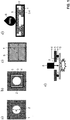
- the procedure for measuring the bond adhesion was as follows: A square test specimen 1 with a side length a of 50 mm and a thickness of 3.5 mm as well as a central circular through opening 2 with a diameter b of 10 mm was injection molded as indicated above (compare Figure 1a ). Then (compare Figure 1b ) with a tape strip of a thickness of 240 ⁇ m a square web 3 with an outer width d of 17 mm and an inner width c of 14 mm taped. Subsequently, a strip 4 of 1 mm width made of PU hot-melt adhesive type EH9651 from HB Fuller was likewise applied warm to a thickness of 240 ⁇ m on the inside of this web, and then (cf.
- Figure 1c a square disc 5 made of mineral glass (Gorilla Glass 5. Corning) with a side length e of 20 mm and a thickness of 3 millimeters, with the help of a template. The composite was then dried for 2 hours while applying a load 6 of 500 g at 23 ° and 50% relative humidity, or the PU adhesive was crosslinked (cf. Figure 1 d) .
- the adhesion was measured in a structure according to Figure 1 e) , whereby a metallic, cylindrical falling body 8 with a diameter of 7 mm, depending on the measurement of 50 g, 100 g, 120-220 g weight, falls from the increasing height in the range of 50-500 mm through the opening 2 onto the glass pane 5 was left until the bond broke; the kinetic energy of the falling body 8 upon impact the last harmless drop test included the value for the group liability.
- the content of amino end groups is determined by potentiometric titration with perchloric acid.
Landscapes
- Chemical & Material Sciences (AREA)
- Chemical Kinetics & Catalysis (AREA)
- Organic Chemistry (AREA)
- Health & Medical Sciences (AREA)
- Medicinal Chemistry (AREA)
- Polymers & Plastics (AREA)
- Engineering & Computer Science (AREA)
- Manufacturing & Machinery (AREA)
- Materials Engineering (AREA)
- Compositions Of Macromolecular Compounds (AREA)
- Laminated Bodies (AREA)
Priority Applications (7)
| Application Number | Priority Date | Filing Date | Title |
|---|---|---|---|
| EP18214070.7A EP3670576B8 (fr) | 2018-12-19 | 2018-12-19 | Matières de moulage de polyamide pour vitrages composites |
| EP19210866.0A EP3670577B1 (fr) | 2018-12-19 | 2019-11-22 | Matières de moulage de polyamide pour vitrages composites |
| MX2024004132A MX2024004132A (es) | 2018-12-19 | 2019-12-16 | Composiciones de moldeo de poliamida para materiales de vidrio compuestos. |
| CN201911301573.7A CN111334034B (zh) | 2018-12-19 | 2019-12-17 | 用于玻璃复合材料的聚酰胺模塑组合物 |
| US16/719,277 US11807718B2 (en) | 2018-12-19 | 2019-12-18 | Polyamide moulding compositions for glass composites |
| KR1020190169794A KR102805934B1 (ko) | 2018-12-19 | 2019-12-18 | 글라스 복합체용 폴리아미드 몰딩 조성물 |
| US18/476,682 US12240946B2 (en) | 2018-12-19 | 2023-09-28 | Polyamide moulding compositions for glass composites |
Applications Claiming Priority (1)
| Application Number | Priority Date | Filing Date | Title |
|---|---|---|---|
| EP18214070.7A EP3670576B8 (fr) | 2018-12-19 | 2018-12-19 | Matières de moulage de polyamide pour vitrages composites |
Publications (3)
| Publication Number | Publication Date |
|---|---|
| EP3670576A1 true EP3670576A1 (fr) | 2020-06-24 |
| EP3670576B1 EP3670576B1 (fr) | 2020-10-14 |
| EP3670576B8 EP3670576B8 (fr) | 2020-12-09 |
Family
ID=64746180
Family Applications (2)
| Application Number | Title | Priority Date | Filing Date |
|---|---|---|---|
| EP18214070.7A Active EP3670576B8 (fr) | 2018-12-19 | 2018-12-19 | Matières de moulage de polyamide pour vitrages composites |
| EP19210866.0A Active EP3670577B1 (fr) | 2018-12-19 | 2019-11-22 | Matières de moulage de polyamide pour vitrages composites |
Family Applications After (1)
| Application Number | Title | Priority Date | Filing Date |
|---|---|---|---|
| EP19210866.0A Active EP3670577B1 (fr) | 2018-12-19 | 2019-11-22 | Matières de moulage de polyamide pour vitrages composites |
Country Status (5)
| Country | Link |
|---|---|
| US (2) | US11807718B2 (fr) |
| EP (2) | EP3670576B8 (fr) |
| KR (1) | KR102805934B1 (fr) |
| CN (1) | CN111334034B (fr) |
| MX (1) | MX2024004132A (fr) |
Cited By (2)
| Publication number | Priority date | Publication date | Assignee | Title |
|---|---|---|---|---|
| CN112679800A (zh) * | 2020-12-28 | 2021-04-20 | 湖北工业大学 | 一种用于沥青耐老化的材料的制备方法及应用 |
| EP3931247A1 (fr) * | 2019-02-25 | 2022-01-05 | Basf Se | Matière à mouler thermoplastique |
Families Citing this family (2)
| Publication number | Priority date | Publication date | Assignee | Title |
|---|---|---|---|---|
| CN112552676B (zh) * | 2020-12-11 | 2022-04-08 | 天津金发新材料有限公司 | 一种可气辅成型聚酰胺复合材料 |
| CN116355401B (zh) * | 2021-12-28 | 2024-04-30 | 金发科技股份有限公司 | 一种聚酰胺组合物及其制备方法和应用 |
Citations (16)
| Publication number | Priority date | Publication date | Assignee | Title |
|---|---|---|---|---|
| EP0150444A2 (fr) | 1984-01-14 | 1985-08-07 | Henkel Kommanditgesellschaft auf Aktien | Procédé pour la préparation de prépolymères de polyuréthane mélangés |
| EP0951493A1 (fr) | 1997-01-02 | 1999-10-27 | Henkel Kommanditgesellschaft auf Aktien | Prepolymer polyurethane pauvre en monomeres |
| EP1065236A2 (fr) | 1999-06-29 | 2001-01-03 | Degussa-Hüls Aktiengesellschaft | Copolyamides greffes hautement ramifiées |
| WO2002000780A2 (fr) | 2000-06-29 | 2002-01-03 | Basf Aktiengesellschaft | Matieres moulables thermoplastiques stabilisees |
| US20020037972A1 (en) * | 2000-01-25 | 2002-03-28 | Degussa-Huels Aktiengesellschaft | Free-flowing transparent polyamide molding composition |
| EP1341832A2 (fr) | 2000-12-15 | 2003-09-10 | Henkel Kommanditgesellschaft auf Aktien | Prepolymeres polyurethane comprenant des groupes nco et une faible teneur en polyisocyanate monomere |
| EP1456265A1 (fr) | 2001-12-18 | 2004-09-15 | Henkel Kommanditgesellschaft auf Aktien | Procede pour produire des prepolymeres polyurethanne a faible teneur en monomeres |
| EP1541336A1 (fr) | 2003-12-12 | 2005-06-15 | EMS-Chemie AG | Multi-couche thermoplastique |
| WO2005097861A1 (fr) | 2004-04-08 | 2005-10-20 | Henkel Kommanditgesellschaft Auf Aktien | Procede de fabrication de prepolymeres de polyurethanne |
| WO2006084862A1 (fr) | 2005-02-08 | 2006-08-17 | Basf Aktiengesellschaft | Polyamides resistants au vieillissement thermique |
| WO2010076145A1 (fr) | 2008-12-16 | 2010-07-08 | Basf Se | Polyamides résistants au vieillissement thermique |
| WO2011138300A1 (fr) | 2010-05-04 | 2011-11-10 | Evonik Degussa Gmbh | Composite constitué d'une composition à mouler à base de polyamide et d'élastomère vulcanisé |
| US20120214904A1 (en) * | 2009-10-27 | 2012-08-23 | Basf Se | Polyamide resistant to heat aging |
| WO2015024911A1 (fr) | 2013-08-21 | 2015-02-26 | Basf Se | Pièce en matière plastique composite présentant une résistance améliorée au vieillissement thermique |
| WO2015024912A1 (fr) | 2013-08-21 | 2015-02-26 | Basf Se | Pièce en plastique composite à adhérence améliorée entre les constituants contenus dans le plastique |
| JP2015199938A (ja) * | 2014-04-03 | 2015-11-12 | 旭化成ケミカルズ株式会社 | ポリアミド樹脂組成物及び成形品 |
Family Cites Families (7)
| Publication number | Priority date | Publication date | Assignee | Title |
|---|---|---|---|---|
| FR2834345B1 (fr) * | 2001-12-27 | 2004-03-26 | Essilor Int | Article d'optique comportant une lame quart d'onde et son procede de fabrication |
| DE102004045775B4 (de) * | 2004-09-21 | 2009-01-08 | Ems-Chemie Ag | Verwendung von stabilisierten, thermoplastischen Polyamid-Formmassen als Beschichtung von Lichtwellenleitern |
| CN102037079A (zh) * | 2008-03-18 | 2011-04-27 | 巴斯夫欧洲公司 | 含有超支化聚乙烯亚胺的聚酰胺纳米复合物 |
| JP2014227505A (ja) * | 2013-05-23 | 2014-12-08 | ユニチカ株式会社 | 接着剤組成物および積層体 |
| CA2934611C (fr) * | 2013-12-20 | 2022-03-29 | Ems-Patent Ag | Matiere a mouler a base de polyamides et son utilisation |
| KR102283356B1 (ko) * | 2013-12-20 | 2021-07-29 | 이엠에스-패턴트 에이지 | 플라스틱 몰딩 컴파운드 및 이의 용도 |
| EP2930212B1 (fr) * | 2014-04-08 | 2019-04-10 | Ems-Patent Ag | Masse de formage en polyamide électro-conductrice |
-
2018
- 2018-12-19 EP EP18214070.7A patent/EP3670576B8/fr active Active
-
2019
- 2019-11-22 EP EP19210866.0A patent/EP3670577B1/fr active Active
- 2019-12-16 MX MX2024004132A patent/MX2024004132A/es unknown
- 2019-12-17 CN CN201911301573.7A patent/CN111334034B/zh active Active
- 2019-12-18 KR KR1020190169794A patent/KR102805934B1/ko active Active
- 2019-12-18 US US16/719,277 patent/US11807718B2/en active Active
-
2023
- 2023-09-28 US US18/476,682 patent/US12240946B2/en active Active
Patent Citations (17)
| Publication number | Priority date | Publication date | Assignee | Title |
|---|---|---|---|---|
| EP0150444A2 (fr) | 1984-01-14 | 1985-08-07 | Henkel Kommanditgesellschaft auf Aktien | Procédé pour la préparation de prépolymères de polyuréthane mélangés |
| EP0951493A1 (fr) | 1997-01-02 | 1999-10-27 | Henkel Kommanditgesellschaft auf Aktien | Prepolymer polyurethane pauvre en monomeres |
| EP1065236A2 (fr) | 1999-06-29 | 2001-01-03 | Degussa-Hüls Aktiengesellschaft | Copolyamides greffes hautement ramifiées |
| US20020037972A1 (en) * | 2000-01-25 | 2002-03-28 | Degussa-Huels Aktiengesellschaft | Free-flowing transparent polyamide molding composition |
| WO2002000780A2 (fr) | 2000-06-29 | 2002-01-03 | Basf Aktiengesellschaft | Matieres moulables thermoplastiques stabilisees |
| EP1341832A2 (fr) | 2000-12-15 | 2003-09-10 | Henkel Kommanditgesellschaft auf Aktien | Prepolymeres polyurethane comprenant des groupes nco et une faible teneur en polyisocyanate monomere |
| EP1456265A1 (fr) | 2001-12-18 | 2004-09-15 | Henkel Kommanditgesellschaft auf Aktien | Procede pour produire des prepolymeres polyurethanne a faible teneur en monomeres |
| EP1541336A1 (fr) | 2003-12-12 | 2005-06-15 | EMS-Chemie AG | Multi-couche thermoplastique |
| WO2005097861A1 (fr) | 2004-04-08 | 2005-10-20 | Henkel Kommanditgesellschaft Auf Aktien | Procede de fabrication de prepolymeres de polyurethanne |
| WO2006084862A1 (fr) | 2005-02-08 | 2006-08-17 | Basf Aktiengesellschaft | Polyamides resistants au vieillissement thermique |
| WO2010076145A1 (fr) | 2008-12-16 | 2010-07-08 | Basf Se | Polyamides résistants au vieillissement thermique |
| US20120004353A1 (en) * | 2008-12-16 | 2012-01-05 | Basf Se | Heat aging resistant polyamides |
| US20120214904A1 (en) * | 2009-10-27 | 2012-08-23 | Basf Se | Polyamide resistant to heat aging |
| WO2011138300A1 (fr) | 2010-05-04 | 2011-11-10 | Evonik Degussa Gmbh | Composite constitué d'une composition à mouler à base de polyamide et d'élastomère vulcanisé |
| WO2015024911A1 (fr) | 2013-08-21 | 2015-02-26 | Basf Se | Pièce en matière plastique composite présentant une résistance améliorée au vieillissement thermique |
| WO2015024912A1 (fr) | 2013-08-21 | 2015-02-26 | Basf Se | Pièce en plastique composite à adhérence améliorée entre les constituants contenus dans le plastique |
| JP2015199938A (ja) * | 2014-04-03 | 2015-11-12 | 旭化成ケミカルズ株式会社 | ポリアミド樹脂組成物及び成形品 |
Non-Patent Citations (6)
| Title |
|---|
| CHEMICAL ABSTRACTS, Columbus, Ohio, US; abstract no. 100-21-0 |
| CHEMICAL ABSTRACTS, Columbus, Ohio, US; abstract no. 121-95-5 |
| CHEMICAL ABSTRACTS, Columbus, Ohio, US; abstract no. 1761-71-3 |
| CHEMICAL ABSTRACTS, Columbus, Ohio, US; abstract no. 65962-45-0 |
| CHEMICAL ABSTRACTS, Columbus, Ohio, US; abstract no. 6864-37-5 |
| ENCYCL. POLYM. SCI. ENG., vol. 1, pages 680 - 739 |
Cited By (2)
| Publication number | Priority date | Publication date | Assignee | Title |
|---|---|---|---|---|
| EP3931247A1 (fr) * | 2019-02-25 | 2022-01-05 | Basf Se | Matière à mouler thermoplastique |
| CN112679800A (zh) * | 2020-12-28 | 2021-04-20 | 湖北工业大学 | 一种用于沥青耐老化的材料的制备方法及应用 |
Also Published As
| Publication number | Publication date |
|---|---|
| EP3670577A1 (fr) | 2020-06-24 |
| KR20200077440A (ko) | 2020-06-30 |
| CN111334034B (zh) | 2024-02-27 |
| MX2024004132A (es) | 2024-04-22 |
| US20200199362A1 (en) | 2020-06-25 |
| EP3670576B1 (fr) | 2020-10-14 |
| EP3670576B8 (fr) | 2020-12-09 |
| US11807718B2 (en) | 2023-11-07 |
| KR102805934B1 (ko) | 2025-05-09 |
| US12240946B2 (en) | 2025-03-04 |
| US20240026079A1 (en) | 2024-01-25 |
| CN111334034A (zh) | 2020-06-26 |
| EP3670577B1 (fr) | 2026-04-15 |
Similar Documents
| Publication | Publication Date | Title |
|---|---|---|
| EP3670577B1 (fr) | Matières de moulage de polyamide pour vitrages composites | |
| EP3336131B1 (fr) | Matières moulables en polyamide transparent présentant un allongement à la rupture élevé | |
| EP3444114B1 (fr) | Matières à mouler en polyamide renforcé à faible valeur haze et corps ainsi moulé | |
| EP3156435B1 (fr) | Copolyamides, compositions de moulage les contenant et moulures produites à partir de ceux-ci | |
| EP2451862B1 (fr) | Matière moulable à base d'un copolyamide comportant des motifs d'acide téréphtalique et de triméthylhexaméthylènediamine | |
| CN104684972B (zh) | 纤维强化聚酰胺树脂材料 | |
| EP2708569B1 (fr) | Polyamide-imides transparentes | |
| EP3309199A1 (fr) | Masses de formage polyamide renforcées de charge de verre sur base de copolyamide amorphe | |
| EP3083805B1 (fr) | Polyamides renforcés par des fibres longues | |
| EP3444113A1 (fr) | Matières à mouler en polyamide renforcé à faible valeur haze et corps ainsi moulé | |
| EP2857437B2 (fr) | Mélange de polyamide | |
| EP2123694B1 (fr) | Copolyamides | |
| DE10201903A1 (de) | Formmasse auf Basis von Polyetheramiden | |
| EP3444112A1 (fr) | Matières à mouler en polyamide renforcé à faible valeur haze et corps ainsi moulé | |
| EP1217039A2 (fr) | Composition à mouler de polyester s'écoulant facilement | |
| EP2252647B1 (fr) | Élastomère de polyamide | |
| EP3725833A1 (fr) | Matière thermoplastique de moulage renforcé | |
| EP1563009A1 (fr) | Matiere moulable polyamide, pieces moulees pouvant etre fabriquees a partir de cette matiere et utilisation de ladite matiere | |
| DE2931689A1 (de) | Polyamid-formmassen mit verbesserter zaehigkeit | |
| EP2202260B1 (fr) | Elastomère polyamide stabilisé inhérent et son procédé de fabrication | |
| DE4306708A1 (de) | Formmassen auf der Grundlage von Polyarylenethern mit Anhydridgruppen | |
| EP3772521B1 (fr) | Copolyamides partiellement cristallins, matières de moulage contenant lesdits copolyamides et leur utilisation ainsi que corps moulés fabriqués à partir des dites matières de moulage | |
| DE102021100760A1 (de) | Härtbare Harzzusammensetzung, deren Verwendung und Verfahren zu deren Herstellung | |
| EP4227365B1 (fr) | Masse à mouler en polyamide renforcée par des fibres | |
| EP0612798B1 (fr) | Matières moulables et leur utilisation |
Legal Events
| Date | Code | Title | Description |
|---|---|---|---|
| PUAI | Public reference made under article 153(3) epc to a published international application that has entered the european phase |
Free format text: ORIGINAL CODE: 0009012 |
|
| STAA | Information on the status of an ep patent application or granted ep patent |
Free format text: STATUS: REQUEST FOR EXAMINATION WAS MADE |
|
| 17P | Request for examination filed |
Effective date: 20191010 |
|
| AK | Designated contracting states |
Kind code of ref document: A1 Designated state(s): AL AT BE BG CH CY CZ DE DK EE ES FI FR GB GR HR HU IE IS IT LI LT LU LV MC MK MT NL NO PL PT RO RS SE SI SK SM TR |
|
| AX | Request for extension of the european patent |
Extension state: BA ME |
|
| GRAP | Despatch of communication of intention to grant a patent |
Free format text: ORIGINAL CODE: EPIDOSNIGR1 |
|
| STAA | Information on the status of an ep patent application or granted ep patent |
Free format text: STATUS: GRANT OF PATENT IS INTENDED |
|
| RIC1 | Information provided on ipc code assigned before grant |
Ipc: B32B 17/10 20060101ALI20200625BHEP Ipc: C08G 69/26 20060101AFI20200625BHEP Ipc: B32B 7/12 20060101ALI20200625BHEP Ipc: C08L 77/06 20060101ALI20200625BHEP Ipc: B32B 27/40 20060101ALI20200625BHEP Ipc: B32B 27/08 20060101ALI20200625BHEP Ipc: B32B 17/06 20060101ALI20200625BHEP Ipc: B32B 27/34 20060101ALI20200625BHEP Ipc: B29C 45/03 20060101ALI20200625BHEP |
|
| RBV | Designated contracting states (corrected) |
Designated state(s): AL AT BE BG CH CY CZ DE DK EE ES FI FR GB GR HR HU IE IS IT LI LT LU LV MC MK MT NL NO PL PT RO RS SE SI SK SM TR |
|
| INTG | Intention to grant announced |
Effective date: 20200723 |
|
| GRAS | Grant fee paid |
Free format text: ORIGINAL CODE: EPIDOSNIGR3 |
|
| GRAA | (expected) grant |
Free format text: ORIGINAL CODE: 0009210 |
|
| STAA | Information on the status of an ep patent application or granted ep patent |
Free format text: STATUS: THE PATENT HAS BEEN GRANTED |
|
| AK | Designated contracting states |
Kind code of ref document: B1 Designated state(s): AL AT BE BG CH CY CZ DE DK EE ES FI FR GB GR HR HU IE IS IT LI LT LU LV MC MK MT NL NO PL PT RO RS SE SI SK SM TR |
|
| REG | Reference to a national code |
Ref country code: GB Ref legal event code: FG4D Free format text: NOT ENGLISH |
|
| REG | Reference to a national code |
Ref country code: AT Ref legal event code: REF Ref document number: 1323492 Country of ref document: AT Kind code of ref document: T Effective date: 20201015 Ref country code: CH Ref legal event code: EP |
|
| REG | Reference to a national code |
Ref country code: DE Ref legal event code: R081 Ref document number: 502018002739 Country of ref document: DE Owner name: EMS-CHEMIE AG, CH Free format text: FORMER OWNER: EMS-PATENT AG, DOMAT / EMS, CH |
|
| REG | Reference to a national code |
Ref country code: DE Ref legal event code: R096 Ref document number: 502018002739 Country of ref document: DE |
|
| REG | Reference to a national code |
Ref country code: IE Ref legal event code: FG4D Free format text: LANGUAGE OF EP DOCUMENT: GERMAN |
|
| REG | Reference to a national code |
Ref country code: CH Ref legal event code: PK Free format text: BERICHTIGUNG B8 |
|
| RAP2 | Party data changed (patent owner data changed or rights of a patent transferred) |
Owner name: EMS-CHEMIE AG |
|
| REG | Reference to a national code |
Ref country code: DE Ref legal event code: R082 Ref document number: 502018002739 Country of ref document: DE Representative=s name: PFENNING, MEINIG & PARTNER MBB PATENTANWAELTE, DE |
|
| REG | Reference to a national code |
Ref country code: NL Ref legal event code: MP Effective date: 20201014 |
|
| PG25 | Lapsed in a contracting state [announced via postgrant information from national office to epo] |
Ref country code: GR Free format text: LAPSE BECAUSE OF FAILURE TO SUBMIT A TRANSLATION OF THE DESCRIPTION OR TO PAY THE FEE WITHIN THE PRESCRIBED TIME-LIMIT Effective date: 20210115 Ref country code: NO Free format text: LAPSE BECAUSE OF FAILURE TO SUBMIT A TRANSLATION OF THE DESCRIPTION OR TO PAY THE FEE WITHIN THE PRESCRIBED TIME-LIMIT Effective date: 20210114 Ref country code: FI Free format text: LAPSE BECAUSE OF FAILURE TO SUBMIT A TRANSLATION OF THE DESCRIPTION OR TO PAY THE FEE WITHIN THE PRESCRIBED TIME-LIMIT Effective date: 20201014 Ref country code: PT Free format text: LAPSE BECAUSE OF FAILURE TO SUBMIT A TRANSLATION OF THE DESCRIPTION OR TO PAY THE FEE WITHIN THE PRESCRIBED TIME-LIMIT Effective date: 20210215 Ref country code: RS Free format text: LAPSE BECAUSE OF FAILURE TO SUBMIT A TRANSLATION OF THE DESCRIPTION OR TO PAY THE FEE WITHIN THE PRESCRIBED TIME-LIMIT Effective date: 20201014 |
|
| REG | Reference to a national code |
Ref country code: LT Ref legal event code: MG4D |
|
| PG25 | Lapsed in a contracting state [announced via postgrant information from national office to epo] |
Ref country code: BG Free format text: LAPSE BECAUSE OF FAILURE TO SUBMIT A TRANSLATION OF THE DESCRIPTION OR TO PAY THE FEE WITHIN THE PRESCRIBED TIME-LIMIT Effective date: 20210114 Ref country code: LV Free format text: LAPSE BECAUSE OF FAILURE TO SUBMIT A TRANSLATION OF THE DESCRIPTION OR TO PAY THE FEE WITHIN THE PRESCRIBED TIME-LIMIT Effective date: 20201014 Ref country code: IS Free format text: LAPSE BECAUSE OF FAILURE TO SUBMIT A TRANSLATION OF THE DESCRIPTION OR TO PAY THE FEE WITHIN THE PRESCRIBED TIME-LIMIT Effective date: 20210214 Ref country code: PL Free format text: LAPSE BECAUSE OF FAILURE TO SUBMIT A TRANSLATION OF THE DESCRIPTION OR TO PAY THE FEE WITHIN THE PRESCRIBED TIME-LIMIT Effective date: 20201014 Ref country code: SE Free format text: LAPSE BECAUSE OF FAILURE TO SUBMIT A TRANSLATION OF THE DESCRIPTION OR TO PAY THE FEE WITHIN THE PRESCRIBED TIME-LIMIT Effective date: 20201014 Ref country code: ES Free format text: LAPSE BECAUSE OF FAILURE TO SUBMIT A TRANSLATION OF THE DESCRIPTION OR TO PAY THE FEE WITHIN THE PRESCRIBED TIME-LIMIT Effective date: 20201014 |
|
| PG25 | Lapsed in a contracting state [announced via postgrant information from national office to epo] |
Ref country code: NL Free format text: LAPSE BECAUSE OF FAILURE TO SUBMIT A TRANSLATION OF THE DESCRIPTION OR TO PAY THE FEE WITHIN THE PRESCRIBED TIME-LIMIT Effective date: 20201014 Ref country code: HR Free format text: LAPSE BECAUSE OF FAILURE TO SUBMIT A TRANSLATION OF THE DESCRIPTION OR TO PAY THE FEE WITHIN THE PRESCRIBED TIME-LIMIT Effective date: 20201014 |
|
| REG | Reference to a national code |
Ref country code: DE Ref legal event code: R097 Ref document number: 502018002739 Country of ref document: DE |
|
| PG25 | Lapsed in a contracting state [announced via postgrant information from national office to epo] |
Ref country code: SM Free format text: LAPSE BECAUSE OF FAILURE TO SUBMIT A TRANSLATION OF THE DESCRIPTION OR TO PAY THE FEE WITHIN THE PRESCRIBED TIME-LIMIT Effective date: 20201014 Ref country code: SK Free format text: LAPSE BECAUSE OF FAILURE TO SUBMIT A TRANSLATION OF THE DESCRIPTION OR TO PAY THE FEE WITHIN THE PRESCRIBED TIME-LIMIT Effective date: 20201014 Ref country code: CZ Free format text: LAPSE BECAUSE OF FAILURE TO SUBMIT A TRANSLATION OF THE DESCRIPTION OR TO PAY THE FEE WITHIN THE PRESCRIBED TIME-LIMIT Effective date: 20201014 Ref country code: EE Free format text: LAPSE BECAUSE OF FAILURE TO SUBMIT A TRANSLATION OF THE DESCRIPTION OR TO PAY THE FEE WITHIN THE PRESCRIBED TIME-LIMIT Effective date: 20201014 Ref country code: RO Free format text: LAPSE BECAUSE OF FAILURE TO SUBMIT A TRANSLATION OF THE DESCRIPTION OR TO PAY THE FEE WITHIN THE PRESCRIBED TIME-LIMIT Effective date: 20201014 Ref country code: LT Free format text: LAPSE BECAUSE OF FAILURE TO SUBMIT A TRANSLATION OF THE DESCRIPTION OR TO PAY THE FEE WITHIN THE PRESCRIBED TIME-LIMIT Effective date: 20201014 |
|
| PLBE | No opposition filed within time limit |
Free format text: ORIGINAL CODE: 0009261 |
|
| STAA | Information on the status of an ep patent application or granted ep patent |
Free format text: STATUS: NO OPPOSITION FILED WITHIN TIME LIMIT |
|
| PG25 | Lapsed in a contracting state [announced via postgrant information from national office to epo] |
Ref country code: DK Free format text: LAPSE BECAUSE OF FAILURE TO SUBMIT A TRANSLATION OF THE DESCRIPTION OR TO PAY THE FEE WITHIN THE PRESCRIBED TIME-LIMIT Effective date: 20201014 Ref country code: MC Free format text: LAPSE BECAUSE OF FAILURE TO SUBMIT A TRANSLATION OF THE DESCRIPTION OR TO PAY THE FEE WITHIN THE PRESCRIBED TIME-LIMIT Effective date: 20201014 |
|
| REG | Reference to a national code |
Ref country code: BE Ref legal event code: MM Effective date: 20201231 |
|
| 26N | No opposition filed |
Effective date: 20210715 |
|
| PG25 | Lapsed in a contracting state [announced via postgrant information from national office to epo] |
Ref country code: AL Free format text: LAPSE BECAUSE OF FAILURE TO SUBMIT A TRANSLATION OF THE DESCRIPTION OR TO PAY THE FEE WITHIN THE PRESCRIBED TIME-LIMIT Effective date: 20201014 Ref country code: LU Free format text: LAPSE BECAUSE OF NON-PAYMENT OF DUE FEES Effective date: 20201219 Ref country code: IE Free format text: LAPSE BECAUSE OF NON-PAYMENT OF DUE FEES Effective date: 20201219 |
|
| PG25 | Lapsed in a contracting state [announced via postgrant information from national office to epo] |
Ref country code: SI Free format text: LAPSE BECAUSE OF FAILURE TO SUBMIT A TRANSLATION OF THE DESCRIPTION OR TO PAY THE FEE WITHIN THE PRESCRIBED TIME-LIMIT Effective date: 20201014 |
|
| PG25 | Lapsed in a contracting state [announced via postgrant information from national office to epo] |
Ref country code: IS Free format text: LAPSE BECAUSE OF FAILURE TO SUBMIT A TRANSLATION OF THE DESCRIPTION OR TO PAY THE FEE WITHIN THE PRESCRIBED TIME-LIMIT Effective date: 20210214 Ref country code: TR Free format text: LAPSE BECAUSE OF FAILURE TO SUBMIT A TRANSLATION OF THE DESCRIPTION OR TO PAY THE FEE WITHIN THE PRESCRIBED TIME-LIMIT Effective date: 20201014 Ref country code: MT Free format text: LAPSE BECAUSE OF FAILURE TO SUBMIT A TRANSLATION OF THE DESCRIPTION OR TO PAY THE FEE WITHIN THE PRESCRIBED TIME-LIMIT Effective date: 20201014 Ref country code: CY Free format text: LAPSE BECAUSE OF FAILURE TO SUBMIT A TRANSLATION OF THE DESCRIPTION OR TO PAY THE FEE WITHIN THE PRESCRIBED TIME-LIMIT Effective date: 20201014 |
|
| PG25 | Lapsed in a contracting state [announced via postgrant information from national office to epo] |
Ref country code: MK Free format text: LAPSE BECAUSE OF FAILURE TO SUBMIT A TRANSLATION OF THE DESCRIPTION OR TO PAY THE FEE WITHIN THE PRESCRIBED TIME-LIMIT Effective date: 20201014 |
|
| PG25 | Lapsed in a contracting state [announced via postgrant information from national office to epo] |
Ref country code: BE Free format text: LAPSE BECAUSE OF NON-PAYMENT OF DUE FEES Effective date: 20201231 |
|
| P01 | Opt-out of the competence of the unified patent court (upc) registered |
Effective date: 20230412 |
|
| GBPC | Gb: european patent ceased through non-payment of renewal fee |
Effective date: 20221219 |
|
| PG25 | Lapsed in a contracting state [announced via postgrant information from national office to epo] |
Ref country code: GB Free format text: LAPSE BECAUSE OF NON-PAYMENT OF DUE FEES Effective date: 20221219 |
|
| REG | Reference to a national code |
Ref country code: AT Ref legal event code: MM01 Ref document number: 1323492 Country of ref document: AT Kind code of ref document: T Effective date: 20231219 |
|
| PG25 | Lapsed in a contracting state [announced via postgrant information from national office to epo] |
Ref country code: AT Free format text: LAPSE BECAUSE OF NON-PAYMENT OF DUE FEES Effective date: 20231219 |
|
| REG | Reference to a national code |
Ref country code: CH Ref legal event code: U11 Free format text: ST27 STATUS EVENT CODE: U-0-0-U10-U11 (AS PROVIDED BY THE NATIONAL OFFICE) Effective date: 20260101 |
|
| PGFP | Annual fee paid to national office [announced via postgrant information from national office to epo] |
Ref country code: DE Payment date: 20251211 Year of fee payment: 8 |
|
| PGFP | Annual fee paid to national office [announced via postgrant information from national office to epo] |
Ref country code: IT Payment date: 20251223 Year of fee payment: 8 |
|
| PGFP | Annual fee paid to national office [announced via postgrant information from national office to epo] |
Ref country code: FR Payment date: 20251229 Year of fee payment: 8 |
|
| PGFP | Annual fee paid to national office [announced via postgrant information from national office to epo] |
Ref country code: AT Payment date: 20260410 Year of fee payment: 5 |
|
| PGFP | Annual fee paid to national office [announced via postgrant information from national office to epo] |
Ref country code: CH Payment date: 20260101 Year of fee payment: 8 |