EP3670700A1 - Verfahren zur umwandlung von kohlendioxid (co2) in synthesegas durch eine elektrolysereaktion - Google Patents
Verfahren zur umwandlung von kohlendioxid (co2) in synthesegas durch eine elektrolysereaktion Download PDFInfo
- Publication number
- EP3670700A1 EP3670700A1 EP18306750.3A EP18306750A EP3670700A1 EP 3670700 A1 EP3670700 A1 EP 3670700A1 EP 18306750 A EP18306750 A EP 18306750A EP 3670700 A1 EP3670700 A1 EP 3670700A1
- Authority
- EP
- European Patent Office
- Prior art keywords
- metal
- zinc
- salt
- electrode
- notably
- Prior art date
- Legal status (The legal status is an assumption and is not a legal conclusion. Google has not performed a legal analysis and makes no representation as to the accuracy of the status listed.)
- Pending
Links
Images




Classifications
-
- C—CHEMISTRY; METALLURGY
- C25—ELECTROLYTIC OR ELECTROPHORETIC PROCESSES; APPARATUS THEREFOR
- C25B—ELECTROLYTIC OR ELECTROPHORETIC PROCESSES FOR THE PRODUCTION OF COMPOUNDS OR NON-METALS; APPARATUS THEREFOR
- C25B11/00—Electrodes; Manufacture thereof not otherwise provided for
- C25B11/04—Electrodes; Manufacture thereof not otherwise provided for characterised by the material
- C25B11/051—Electrodes formed of electrocatalysts on a substrate or carrier
- C25B11/073—Electrodes formed of electrocatalysts on a substrate or carrier characterised by the electrocatalyst material
- C25B11/075—Electrodes formed of electrocatalysts on a substrate or carrier characterised by the electrocatalyst material consisting of a single catalytic element or catalytic compound
- C25B11/081—Electrodes formed of electrocatalysts on a substrate or carrier characterised by the electrocatalyst material consisting of a single catalytic element or catalytic compound the element being a noble metal
-
- C—CHEMISTRY; METALLURGY
- C25—ELECTROLYTIC OR ELECTROPHORETIC PROCESSES; APPARATUS THEREFOR
- C25B—ELECTROLYTIC OR ELECTROPHORETIC PROCESSES FOR THE PRODUCTION OF COMPOUNDS OR NON-METALS; APPARATUS THEREFOR
- C25B1/00—Electrolytic production of inorganic compounds or non-metals
- C25B1/01—Products
- C25B1/23—Carbon monoxide or syngas
-
- C—CHEMISTRY; METALLURGY
- C25—ELECTROLYTIC OR ELECTROPHORETIC PROCESSES; APPARATUS THEREFOR
- C25B—ELECTROLYTIC OR ELECTROPHORETIC PROCESSES FOR THE PRODUCTION OF COMPOUNDS OR NON-METALS; APPARATUS THEREFOR
- C25B11/00—Electrodes; Manufacture thereof not otherwise provided for
- C25B11/02—Electrodes; Manufacture thereof not otherwise provided for characterised by shape or form
- C25B11/03—Electrodes; Manufacture thereof not otherwise provided for characterised by shape or form perforated or foraminous
- C25B11/031—Porous electrodes
-
- C—CHEMISTRY; METALLURGY
- C25—ELECTROLYTIC OR ELECTROPHORETIC PROCESSES; APPARATUS THEREFOR
- C25B—ELECTROLYTIC OR ELECTROPHORETIC PROCESSES FOR THE PRODUCTION OF COMPOUNDS OR NON-METALS; APPARATUS THEREFOR
- C25B11/00—Electrodes; Manufacture thereof not otherwise provided for
- C25B11/04—Electrodes; Manufacture thereof not otherwise provided for characterised by the material
- C25B11/051—Electrodes formed of electrocatalysts on a substrate or carrier
- C25B11/052—Electrodes comprising one or more electrocatalytic coatings on a substrate
-
- C—CHEMISTRY; METALLURGY
- C25—ELECTROLYTIC OR ELECTROPHORETIC PROCESSES; APPARATUS THEREFOR
- C25B—ELECTROLYTIC OR ELECTROPHORETIC PROCESSES FOR THE PRODUCTION OF COMPOUNDS OR NON-METALS; APPARATUS THEREFOR
- C25B11/00—Electrodes; Manufacture thereof not otherwise provided for
- C25B11/04—Electrodes; Manufacture thereof not otherwise provided for characterised by the material
- C25B11/051—Electrodes formed of electrocatalysts on a substrate or carrier
- C25B11/054—Electrodes comprising electrocatalysts supported on a carrier
-
- C—CHEMISTRY; METALLURGY
- C25—ELECTROLYTIC OR ELECTROPHORETIC PROCESSES; APPARATUS THEREFOR
- C25B—ELECTROLYTIC OR ELECTROPHORETIC PROCESSES FOR THE PRODUCTION OF COMPOUNDS OR NON-METALS; APPARATUS THEREFOR
- C25B11/00—Electrodes; Manufacture thereof not otherwise provided for
- C25B11/04—Electrodes; Manufacture thereof not otherwise provided for characterised by the material
- C25B11/051—Electrodes formed of electrocatalysts on a substrate or carrier
- C25B11/055—Electrodes formed of electrocatalysts on a substrate or carrier characterised by the substrate or carrier material
-
- C—CHEMISTRY; METALLURGY
- C25—ELECTROLYTIC OR ELECTROPHORETIC PROCESSES; APPARATUS THEREFOR
- C25B—ELECTROLYTIC OR ELECTROPHORETIC PROCESSES FOR THE PRODUCTION OF COMPOUNDS OR NON-METALS; APPARATUS THEREFOR
- C25B11/00—Electrodes; Manufacture thereof not otherwise provided for
- C25B11/04—Electrodes; Manufacture thereof not otherwise provided for characterised by the material
- C25B11/051—Electrodes formed of electrocatalysts on a substrate or carrier
- C25B11/055—Electrodes formed of electrocatalysts on a substrate or carrier characterised by the substrate or carrier material
- C25B11/057—Electrodes formed of electrocatalysts on a substrate or carrier characterised by the substrate or carrier material consisting of a single element or compound
- C25B11/061—Metal or alloy
-
- C—CHEMISTRY; METALLURGY
- C25—ELECTROLYTIC OR ELECTROPHORETIC PROCESSES; APPARATUS THEREFOR
- C25B—ELECTROLYTIC OR ELECTROPHORETIC PROCESSES FOR THE PRODUCTION OF COMPOUNDS OR NON-METALS; APPARATUS THEREFOR
- C25B11/00—Electrodes; Manufacture thereof not otherwise provided for
- C25B11/04—Electrodes; Manufacture thereof not otherwise provided for characterised by the material
- C25B11/051—Electrodes formed of electrocatalysts on a substrate or carrier
- C25B11/073—Electrodes formed of electrocatalysts on a substrate or carrier characterised by the electrocatalyst material
- C25B11/075—Electrodes formed of electrocatalysts on a substrate or carrier characterised by the electrocatalyst material consisting of a single catalytic element or catalytic compound
- C25B11/089—Alloys
-
- C—CHEMISTRY; METALLURGY
- C25—ELECTROLYTIC OR ELECTROPHORETIC PROCESSES; APPARATUS THEREFOR
- C25B—ELECTROLYTIC OR ELECTROPHORETIC PROCESSES FOR THE PRODUCTION OF COMPOUNDS OR NON-METALS; APPARATUS THEREFOR
- C25B11/00—Electrodes; Manufacture thereof not otherwise provided for
- C25B11/04—Electrodes; Manufacture thereof not otherwise provided for characterised by the material
- C25B11/051—Electrodes formed of electrocatalysts on a substrate or carrier
- C25B11/073—Electrodes formed of electrocatalysts on a substrate or carrier characterised by the electrocatalyst material
- C25B11/091—Electrodes formed of electrocatalysts on a substrate or carrier characterised by the electrocatalyst material consisting of at least one catalytic element and at least one catalytic compound; consisting of two or more catalytic elements or catalytic compounds
-
- C—CHEMISTRY; METALLURGY
- C25—ELECTROLYTIC OR ELECTROPHORETIC PROCESSES; APPARATUS THEREFOR
- C25B—ELECTROLYTIC OR ELECTROPHORETIC PROCESSES FOR THE PRODUCTION OF COMPOUNDS OR NON-METALS; APPARATUS THEREFOR
- C25B9/00—Cells or assemblies of cells; Constructional parts of cells; Assemblies of constructional parts, e.g. electrode-diaphragm assemblies; Process-related cell features
- C25B9/17—Cells comprising dimensionally-stable non-movable electrodes; Assemblies of constructional parts thereof
- C25B9/19—Cells comprising dimensionally-stable non-movable electrodes; Assemblies of constructional parts thereof with diaphragms
- C25B9/23—Cells comprising dimensionally-stable non-movable electrodes; Assemblies of constructional parts thereof with diaphragms comprising ion-exchange membranes in or on which electrode material is embedded
-
- C—CHEMISTRY; METALLURGY
- C25—ELECTROLYTIC OR ELECTROPHORETIC PROCESSES; APPARATUS THEREFOR
- C25C—PROCESSES FOR THE ELECTROLYTIC PRODUCTION, RECOVERY OR REFINING OF METALS; APPARATUS THEREFOR
- C25C1/00—Electrolytic production, recovery or refining of metals by electrolysis of solutions
- C25C1/24—Alloys obtained by cathodic reduction of all their ions
-
- C—CHEMISTRY; METALLURGY
- C25—ELECTROLYTIC OR ELECTROPHORETIC PROCESSES; APPARATUS THEREFOR
- C25D—PROCESSES FOR THE ELECTROLYTIC OR ELECTROPHORETIC PRODUCTION OF COATINGS; ELECTROFORMING; APPARATUS THEREFOR
- C25D1/00—Electroforming
- C25D1/08—Perforated or foraminous objects, e.g. sieves
-
- C—CHEMISTRY; METALLURGY
- C25—ELECTROLYTIC OR ELECTROPHORETIC PROCESSES; APPARATUS THEREFOR
- C25D—PROCESSES FOR THE ELECTROLYTIC OR ELECTROPHORETIC PRODUCTION OF COATINGS; ELECTROFORMING; APPARATUS THEREFOR
- C25D3/00—Electroplating: Baths therefor
- C25D3/02—Electroplating: Baths therefor from solutions
- C25D3/56—Electroplating: Baths therefor from solutions of alloys
- C25D3/565—Electroplating: Baths therefor from solutions of alloys containing more than 50% by weight of zinc
-
- C—CHEMISTRY; METALLURGY
- C25—ELECTROLYTIC OR ELECTROPHORETIC PROCESSES; APPARATUS THEREFOR
- C25D—PROCESSES FOR THE ELECTROLYTIC OR ELECTROPHORETIC PRODUCTION OF COATINGS; ELECTROFORMING; APPARATUS THEREFOR
- C25D3/00—Electroplating: Baths therefor
- C25D3/02—Electroplating: Baths therefor from solutions
- C25D3/56—Electroplating: Baths therefor from solutions of alloys
- C25D3/64—Electroplating: Baths therefor from solutions of alloys containing more than 50% by weight of silver
-
- C—CHEMISTRY; METALLURGY
- C25—ELECTROLYTIC OR ELECTROPHORETIC PROCESSES; APPARATUS THEREFOR
- C25B—ELECTROLYTIC OR ELECTROPHORETIC PROCESSES FOR THE PRODUCTION OF COMPOUNDS OR NON-METALS; APPARATUS THEREFOR
- C25B3/00—Electrolytic production of organic compounds
- C25B3/20—Processes
- C25B3/25—Reduction
- C25B3/26—Reduction of carbon dioxide
-
- Y—GENERAL TAGGING OF NEW TECHNOLOGICAL DEVELOPMENTS; GENERAL TAGGING OF CROSS-SECTIONAL TECHNOLOGIES SPANNING OVER SEVERAL SECTIONS OF THE IPC; TECHNICAL SUBJECTS COVERED BY FORMER USPC CROSS-REFERENCE ART COLLECTIONS [XRACs] AND DIGESTS
- Y02—TECHNOLOGIES OR APPLICATIONS FOR MITIGATION OR ADAPTATION AGAINST CLIMATE CHANGE
- Y02E—REDUCTION OF GREENHOUSE GAS [GHG] EMISSIONS, RELATED TO ENERGY GENERATION, TRANSMISSION OR DISTRIBUTION
- Y02E60/00—Enabling technologies; Technologies with a potential or indirect contribution to GHG emissions mitigation
- Y02E60/30—Hydrogen technology
- Y02E60/36—Hydrogen production from non-carbon containing sources, e.g. by water electrolysis
-
- Y—GENERAL TAGGING OF NEW TECHNOLOGICAL DEVELOPMENTS; GENERAL TAGGING OF CROSS-SECTIONAL TECHNOLOGIES SPANNING OVER SEVERAL SECTIONS OF THE IPC; TECHNICAL SUBJECTS COVERED BY FORMER USPC CROSS-REFERENCE ART COLLECTIONS [XRACs] AND DIGESTS
- Y02—TECHNOLOGIES OR APPLICATIONS FOR MITIGATION OR ADAPTATION AGAINST CLIMATE CHANGE
- Y02E—REDUCTION OF GREENHOUSE GAS [GHG] EMISSIONS, RELATED TO ENERGY GENERATION, TRANSMISSION OR DISTRIBUTION
- Y02E60/00—Enabling technologies; Technologies with a potential or indirect contribution to GHG emissions mitigation
- Y02E60/30—Hydrogen technology
- Y02E60/50—Fuel cells
-
- Y—GENERAL TAGGING OF NEW TECHNOLOGICAL DEVELOPMENTS; GENERAL TAGGING OF CROSS-SECTIONAL TECHNOLOGIES SPANNING OVER SEVERAL SECTIONS OF THE IPC; TECHNICAL SUBJECTS COVERED BY FORMER USPC CROSS-REFERENCE ART COLLECTIONS [XRACs] AND DIGESTS
- Y02—TECHNOLOGIES OR APPLICATIONS FOR MITIGATION OR ADAPTATION AGAINST CLIMATE CHANGE
- Y02P—CLIMATE CHANGE MITIGATION TECHNOLOGIES IN THE PRODUCTION OR PROCESSING OF GOODS
- Y02P20/00—Technologies relating to chemical industry
- Y02P20/10—Process efficiency
- Y02P20/133—Renewable energy sources, e.g. sunlight
Definitions
- the present invention relates to a method for CO 2 electroreduction to syngas, a mixture of carbon monoxide (CO) and hydrogen (H 2 ), using a cathode comprising an alloy of zinc and a second metal selected from copper, silver, gold and mixtures thereof, as well as to an electrode useful for performing this method, a process for preparing such an electrode and an electrolysis device comprising such an electrode.
- Electroreduction of CO 2 into energy-dense compounds such as carbon monoxide, formic acid, hydrocarbons and alcohols offers a promising route to store intermittent renewable energies.
- Multi-carbon products ethanol, ethylene, propanol, etc.
- the multi-electronic and multi-protonic nature of the reactions at work commonly results in very high overpotential, low faradaic efficiency and complex product mixtures.
- This process is commonly carried out in aqueous media, with the anodic oxidation of water providing the source of protons and electrons.
- the use of aqueous electrolyte is highly challenging considering the kinetically and thermodynamically facile alternative reduction of H + to H 2 .
- Syngas can be used to produce hydrocarbons and alcohols through well-established industrial technologies.
- a two-step process that couples CO 2 electroreduction to syngas with its subsequent transformation to high added-value products has been proposed to be more favorable from an economic perspective since i) CO 2 reduction to CO occurs at moderate overpotentials and ii) a highly energy-demanding product separation step is not required ( Foit et al. Angew. Chem. Int. Ed. 2017, 56, 5402-5411 ).
- H 2 :CO ratios typically required for methanol synthesis and the Fischer-Tropsch reaction; 3 for the methanation reaction; and 1 is typically required for hydroformylation and fine chemical synthesis ( Foit et al. Angew. Chem. Int. Ed. 2017, 56, 5402-5411 ).
- electrochemical syngas generation is a more versatile and sustainable alternative, allowing a broad range of H 2 :CO ratios to be produced from renewable precursors (H 2 O and CO 2 ) ( Francke et al. Chem. Rev. 2018, 118, 4631-4701 ; Zheng et al. Adv. Mat. 2018, doi:10.1002/adma.201802066 ).
- the electrochemical conversion of CO 2 to syngas is particularly relevant in the context of renewable electricity conversion, which requires the design of electrolytic devices tolerant to the significant variations of power provided by intermittent energy sources, such as photovoltaic panels, as syngas conversion requires the H 2 :CO ratio to be constant for optimal further transformation. Nevertheless, to the best of our knowledge all the electrocatalytic systems for syngas generation present a significant variation of the H 2 :CO ratio with applied potential, preventing an efficient coupling with such sources of electricity.
- Catalytic systems based on Cu and Zn have also been reported in the art but they aim to the production of ethanol ( Ren et al. ACS Catal. 2016, 6, 8239-8247 ) and to the production of CO only ( Moreno-Garcia et al. ACS Appl. Mater. Interfaces 2018, 10, 31355-31365 ). These differences of behavior are due to the use of different deposition regimes to prepare the catalytic systems leading to catalytic material having different chemical compositions and different structures.
- the present invention thus relates to a method for converting carbon dioxide (CO 2 ) into syngas, which is a mixture of carbon monoxide (CO) and hydrogen (H 2 ), comprising the following steps:
- a cathode comprising, as catalytic material, a metal deposit of zinc and of a second metal, such as copper, as defined above (i.e. comprising one or several phases of an alloy of zinc and of the second metal) allows CO 2 electroreduction into syngas, a mixture of CO and H 2 . No other gaseous products are obtained so that the formed syngas can be directly used, for example for hydroformylation, in a Fischer-Tropsch reaction or for methanol synthesis. Moreover, the mixture of CO and H 2 represents at least 80% of the total products formed.
- the selectivity of the catalytic material according to the invention differs from both Cu-based catalysts (typically producing multi-carbon products) and Zn-based catalysts (typically producing CO and formic acid) ( Y. Hori, in Modern Aspects of Electrochemistry (Eds.: C. G. Vayenas, R. E. White, M. E. Gamboa-Aldeco), Springer New York, New York, NY, 2008, pp. 89-189 ).
- the H 2 /CO ratio in the obtained syngas depends on the Zn/second metal ratio incorporated in the catalytic material, the content of H 2 increasing with the content of the second metal such as copper. Moreover, for zinc/second metal weight ratios comprised between 99/1 and 35/65, the obtained H 2 /CO ratio is substantially not dependent on the applied potential over a range of at least 300 mV, so that the electrolysis device can be coupled to an intermittent source of energy, and allows obtaining a broad range of H 2 :CO ratios from 0.2 to 1.6.
- H 2 :CO ratio is essential for the downstream transformation of syngas via known industrial processes and the invariance of this ratio over a wide range of potentials allows the coupling of the electrolysis device to a source of intermittent energy (e.g. photovoltaic panels).
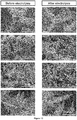
- the cathode shows a remarkable stability over time. Indeed, stable currents and selectivity were observed over >3 h constant potential electrolysis. It has been shown also that the composition and nanoscale morphology of the catalytic material are preserved during electrolysis.
- the present invention relates also to an electrode comprising an electrically conductive support of which at least a part of the surface is covered by a metal deposit of zinc and of a second metal selected from copper, silver, gold and mixtures thereof, and being preferably copper, wherein said metal deposit comprises at least 1 wt% of one or several phases of an alloy of zinc and of the second metal and has a specific surface area greater than or equal to 0.1 m 2 .g -1 .
- the invention relates also to a process for preparing such an electrode, as well as to an electrolysis device comprising such an electrode.
- syngas is meant a mixture of carbon monoxide (CO) and hydrogen (H 2 ).
- electrolysis device also called “electrolyzer”
- electrolysis device is intended to mean a device for converting electrical energy, in particular renewable electrical energy, into chemical energy.
- electrode in the sense of the present invention an electronic conductor capable of capturing or releasing electrons.
- the electrode that releases electrons is called an "anode”.
- the electrode that captures electrons is called a “cathode”.
- electrolyte solution is meant, in the present invention, a solution, preferably an aqueous solution, in which a substance is dissolved so that the solution becomes electrically conductive. This substance is named “electrolyte”.
- a “catholyte solution” is an “electrolyte solution” used at the cathode.
- a “anolyte solution” is an “electrolyte solution” used at the anode.
- electrically conductive support means a support capable of conducting electricity.
- immersed in a solution/fluid means that the electrode is plunged into the solution/fluid at least partially.
- phase of an alloy of zinc and of the second metal is meant a homogeneous phase comprising zinc and the second metal.
- each alloy phase can have for example the following composition: Cu 3 Zn, Cu 5 Zn 8 or Cu 0.2 Zn 0.8 .
- homogeneous phase is meant a phase for which the composition is substantially the same in any point of the phase.
- specific surface area of the metal deposit is meant the specific surface area of the metal deposit determined by BET. More particularly, the specific surface area can be determined by BET analysis based on Kr sorption isotherms measured for instance on a BelSorp Max set-up at 77 K.
- a H 2 /CO ratio substantially not dependent on the applied potential
- a range of applied potentials e.g. between -0.6 V vs RHE and -1.4 V vs RHE, notably between -0.7 V vs RHE and -1.2 V vs RHE, preferably between -0.8 V vs RHE and -1.1 V vs RHE
- the syngas is obtained with a H 2 /CO ratio value having a relative standard deviation (RSD) equal or below 30%, notably equal or below 25%, preferably equal or below 20%.
- RSS relative standard deviation
- the method according to the present invention for converting carbon dioxide (CO 2 ) into syngas comprises the following steps:
- the electrolysis device used in the method of the present invention comprises an anode and a cathode.
- the cathode of the electrolysis device comprises an electrically conductive support of which at least a part of the surface is covered by a metal deposit of zinc and of a second metal selected from copper, silver, gold and mixtures thereof, and preferably being copper, said metal deposit comprising at least 1 wt% of one or several phases of an alloy of zinc and of the second metal.
- the electrically conductive support will comprise or consist of an electrically conductive material which may be a composite material consisting of several distinct electroconductive materials.
- the electrically conductive material may be chosen in particular from a metal such as copper, steel, aluminum, zinc or titanium; a metal oxide such as Fluorine-doped Titanium Oxide (FTO) or Indium Tin Oxide (ITO); a metal sulphide such as cadmium sulphide or zinc sulphide; carbon in particular in the form of carbon felt, graphite, vitreous carbon, boron-doped diamond; a semiconductor such as silicon; and a mixture thereof.
- a metal such as copper, steel, aluminum, zinc or titanium
- FTO Fluorine-doped Titanium Oxide
- ITO Indium Tin Oxide
- a metal sulphide such as cadmium sulphide or zinc sulphide
- carbon in particular in the form of carbon felt, graphite, vitreous carbon, boron-doped diamond
- This support may take any form suitable for use as an electrode, the person skilled in the art being able to determine the shape and dimensions of such a support according to the intended use.
- it can be in the form of a sheet, a foil, a plate, a mesh, or a foam.
- the surface of such a support is at least partially covered by the metal deposit.
- at least 5%, in particular at least 20%, especially at least 50%, preferably at least 80%, of the surface of the support is covered by the metal deposit.
- the entire surface of the support is covered by the metal deposit.
- the metals i.e. zinc and the second metal such as copper, is advantageously deposited on the support by electrodeposition.
- the metal deposit comprises at least 1 wt%, notably at least 5 wt%, in particular at least 10 wt%, for example at least 20 wt%, such as at least 30 wt% of one or several phases of an alloy of zinc and of the second metal.
- the metal deposit can consist of 100 wt% of one or several phases of an alloy of zinc and of the second metal.
- the presence of one or several phases of an alloy of zinc and of the second metal and its/their amount can be determined by X-ray diffraction.
- the metal deposit advantageously has a thickness of between 1 ⁇ m and 250 ⁇ m, notably between 5 ⁇ m and 250 ⁇ m, preferably between 5 and 200 ⁇ m.
- a thickness can be measured in particular by measuring a sample cut by Scanning Electron Microscopy (SEM), for example using a scanning electron microscope Hitachi S-4800.
- the metal deposit has a specific surface area of at least 0.1 m 2 .g -1 , notably at least 0.5 m 2 .g -1 , such as at least 1 m 2 .g -1 .
- the metal deposit has a specific surface area for example comprised between 0.1 and 500 m 2 .g -1 , notably between 0.5 and 200 m 2 .g -1 , in particular between 1 and 100 m 2 .g -1 , preferably between 1 and 50 m 2 .g -1 .
- the metal deposit will also advantageously have a porous structure.
- the metal deposit will advantageously have a porosity with an average pore size of between 1 ⁇ m and 500 ⁇ m, in particular between 1 ⁇ m and 200 ⁇ m, preferably between 20 ⁇ m and 100 ⁇ m.
- the average pore size can be determined by means of images obtained by Scanning Electron Microscopy (SEM) or Scanning Tunneling Microscopy (STM), preferably by Scanning Electron Microscopy (SEM), for example using a scanning electron microscope Hitachi S-4800.
- the anode may be any electrode traditionally used in the art as anode and with which the skilled person is well familiar.
- Such an anode may be made of for example platinum, cobalt, copper, etc. in metallic or oxide form.
- the cathode and the electrolysis device can be as defined below (cf. 'electrode' and 'electrolysis device' parts below).
- the cathode can be prepared as defined below (cf. 'preparation of the electrode' part).
- the cathode of the electrolysis device will be exposed to a CO 2 -containing aqueous catholyte solution. More particularly, the cathode will be immersed in such a catholyte solution. More particularly, the part of the cathode covered with the metal deposit must be at least partially, preferably completely, immersed into the catholyte solution.
- the aqueous solution is saturated with CO 2 , notably by bubbling the CO 2 gas directly into the solution.
- the catholyte solution comprises a salt of hydrogen carbonate (HCO 3 - ), such as an alkali metal salt or a quaternary ammonium salt of hydrogen carbonate.
- the alkali metal can be potassium, sodium or cesium, preferably cesium.
- the quaternary ammonium can have the formula NR 1 R 2 R 3 R 4 + wherein R 1 , R 2 , R 3 and R 4 , identical or different, preferably identical, are a (C 1 - 6 )alkyl, such as methyl or ethyl.
- the quaternary ammonium can be in particular a tetramethylammonium or a tetraethylammonium.
- the salt of hydrogen carbonate is CsHCO 3 . It should be noted that the continuous CO 2 bubbling in the catholyte solution allows regenerating the diffused bicarbonate anions.
- the concentration of the salt of hydrogen carbonate advantageously is below 1 M, notably below 0.5M. It can be comprised between 0.01 M and 0.5 M, notably between 0.05 M and 0.2 M. For example, it can be about 0.1 M.
- the catholyte solution is advantageously prepared using deionized water to better control the ionic composition of the solution.
- the anode of the electrolysis device will be exposed to an anolyte fluid, such as an anolyte solution. More particularly, the anode will be immersed in this anolyte fluid.
- the catholyte solution and the anolyte solution may be the same solution so that the anode and the cathode are exposed to / immersed in the same solution. If the anode and cathode are not exposed to the same fluid, the catholyte solution and the anolyte fluid may be separated for example by an ion (e.g. proton) exchange, osmotic or dialysis membrane in order to allow charges or solvent molecules to pass from one fluid to another.
- an ion e.g. proton
- the anolyte fluid is an aqueous anolyte solution.
- the anolyte aqueous solution advantageously comprises a salt of carbonate (CO 3 2- ), such as an alkali metal salt or a quaternary ammonium salt of hydrogen carbonate.
- the alkali metal can be potassium, sodium or cesium, preferably cesium.
- the quaternary ammonium can be as defined above and have the formula NR 1 R 2 R 3 R 4 + wherein R 1 , R 2 , R 3 and R 4 , identical or different, preferably identical, are a (C 1 - 6 )alkyl, such as methyl or ethyl.
- the quaternary ammonium can be in particular a tetramethylammonium or a tetraethylammonium.
- the quaternary ammonium can be a tetraalkylated cyclic imidazolium of the formula 1-R 1 -2-R 2 -4-R 3 -5-R 4 imidazolium, wherein R 1 , R 2 , R 3 and R 4 , identical or different, preferably identical, are a (C 1 - 6 )alkyl, such as methyl or ethyl.
- the salt of carbonate is Cs 2 CO 3 .
- the concentration of the salt of carbonate advantageously is below 1 M, notably below 0.5 M. It can be comprised between 0.01 M and 0.5 M, notably between 0.05 M and 0.2 M. For example, it can be about 0.1 M.
- the anolyte aqueous solution is advantageously prepared using deionized water to better control the ionic composition of the solution.
- the H 2 /CO ratio in the obtained syngas mixture depends on the Zn/second metal (e.g. Cu) ratio in the metal deposit, with the content in H 2 increasing with the content of the second metal.
- the current applied between the two electrodes will depend on the nature of the anode. This current can be determined by the one skilled in the art based on the fact that the potential applied between the cathode according to the present invention and a reversible hydrogen electrode (RHE) as reference electrode must be between -0.6 V vs RHE and -1.4 V vs RHE, notably between -0.7 V vs RHE and -1.2 V vs RHE and preferably between -0.8 V vs RHE and -1.1 V vs RHE.
- RHE reversible hydrogen electrode
- the weight ratio zinc/second metal (e.g. Cu) in the metal deposit is comprised between 99/1 and 35/65, notably between 95/5 and 40/60.
- the obtained H 2 /CO ratio is substantially not dependent on the applied potential, so that the syngas composition is a characteristic of the metal deposit composition.
- the H 2 :CO ratio can vary from 0.2 to 1.6.
- the weight ratio zinc/second metal in the metal deposit is less than 35/65 and notably is comprised between 1/99 and 35/65.
- higher H 2 :CO ratios up to 3.65 can be obtained but this H 2 :CO ratio will depend on the applied potential.
- the obtained syngas can then be converted into saturated or unsaturated hydrocarbons, alcohols and/or aldehydes, for example by a Fischer-Tropsch reaction, a methanol synthesis, a methanation reaction, a hydroformylation or a syngas fermentation (e.g. by means of enzymes).
- a Fischer-Tropsch reaction e.g., a Fischer-Tropsch reaction, a methanol synthesis, a methanation reaction, a hydroformylation or a syngas fermentation (e.g. by means of enzymes).
- the performed reaction will depend on the H 2 :CO ratio in the obtained syngas or more exactly, the H 2 :CO ratio of the obtained syngas (and thus the weight ratio of zinc/second metal in the metal deposit) will be chosen in view of the targeted reaction of conversion of the syngas.
- optimal H 2 :CO ratios of 1.5-2.2 are typically required for methanol synthesis and the Fischer-Tropsch reaction; 3 for the methanation reaction; and 1 is typically required for hydroformylation.
- An electrode according to the present invention comprises an electrically conductive support of which at least a part of the surface is covered by a metal deposit of zinc and of a second metal selected from copper, silver, gold and mixtures thereof, and preferably being copper, wherein said metal deposit comprises at least 1 wt% of one or several phases of an alloy of zinc and of the second metal and has a specific surface area greater than or equal to 0.1 m 2 .g -1 .
- the electrically conductive support will comprise or consist of an electrically conductive material which may be a composite material consisting of several distinct electroconductive materials.
- the electrically conductive material may be chosen in particular from a metal such as copper, steel, aluminum, zinc or titanium; a metal oxide such as Fluorine-doped Titanium Oxide (FTO) or Indium Tin Oxide (ITO); a metal sulphide such as cadmium sulphide or zinc sulphide; carbon in particular in the form of carbon felt, graphite, vitreous carbon, boron-doped diamond; a semiconductor such as silicon; and a mixture thereof.
- a metal such as copper, steel, aluminum, zinc or titanium
- FTO Fluorine-doped Titanium Oxide
- ITO Indium Tin Oxide
- a metal sulphide such as cadmium sulphide or zinc sulphide
- carbon in particular in the form of carbon felt, graphite, vitreous carbon, boron-doped diamond
- This support may take any form suitable for use as an electrode, the person skilled in the art being able to determine the shape and dimensions of such a support according to the intended use.
- it can be in the form of a sheet, a foil, a plate, a mesh, or a foam.
- the surface of such a support is at least partially covered by the metal deposit.
- at least 5%, in particular at least 20%, especially at least 50%, preferably at least 80%, of the surface of the support is covered by the metal deposit.
- the entire surface of the support is covered by the metal deposit.
- the metals i.e. zinc and the second metal such as copper, is advantageously deposited on the support by electrodeposition.
- the metal deposit comprises at least 1 wt%, notably at least 5 wt%, in particular at least 10 wt%, for example at least 20 wt%, such as at least 30 wt% of one or several phases of an alloy of zinc and of the second metal.
- the metal deposit can consist of 100 wt% of one or several phases of an alloy of zinc and of the second metal.
- the presence of one or several phases of an alloy of zinc and of the second metal and its/their amount can be determined by X-ray diffraction.
- the metal deposit has a specific surface area of at least 0.1 m 2 .g -1 , notably at least 0.5 m 2 .g -1 , such as at least 1 m 2 .g -1 .
- the metal deposit has a specific surface area for example comprised between 0.1 and 500 m 2 .g -1 , notably between 0.5 and 200 m 2 .g -1 , in particular between 1 and 100 m 2 .g -1 , preferably between 1 and 50 m 2 .g -1 .
- the metal deposit advantageously has a thickness of between 1 ⁇ m and 250 ⁇ m, notably between 5 ⁇ m and 250 ⁇ m, preferably between 5 and 200 ⁇ m.
- a thickness can be measured in particular by measuring a sample cut by Scanning Electron Microscopy (SEM), for example using a scanning electron microscope Hitachi S-4800.
- the metal deposit will also advantageously have a porous structure.
- the metal deposit will advantageously have a porosity with an average pore size of between 1 ⁇ m and 500 ⁇ m, in particular between 1 ⁇ m and 200 ⁇ m, preferably between 20 ⁇ m and 100 ⁇ m.
- the average pore size can be determined by means of photographs obtained by Scanning Electron Microscopy (SEM) or Scanning Tunneling Microscopy (STM), preferably by Scanning Electron Microscopy (SEM), for example using a scanning electron microscope Hitachi S-4800.
- such an electrode can be used to convert CO 2 into syngas by electroreduction with a high selectivity, a high activity and a high stability over time.
- the weight ratio zinc/second metal (e.g. Cu) in the metal deposit is comprised between 99/1 and 35/65, notably between 95/5 and 40/60.
- the syngas formed by CO 2 electroreduction has a H 2 /CO ratio which is substantially not dependent on the applied potential, so that the syngas composition is a characteristic of the metal deposit composition.
- the H 2 :CO ratio can vary from 0.2 to 1.6.
- the weight ratio zinc/second metal in the metal deposit is less than 35/65 and notably is comprised between 1/99 and 35/65.
- higher H 2 :CO ratios up to 3.65 can be obtained in the syngas formed by CO 2 electroreduction but this H 2 :CO ratio will depend on the applied potential.
- Such an electrode is obtainable by the method detailed below.
- the present invention relates also to a process for preparing an electrode according to the invention comprising the following successive steps:
- the electrode according to the present invention can thus be prepared by one step of electrodeposition.
- the electrically conductive support will be as defined above.
- a support will comprise or consist of an electrically conductive material which may be a composite material consisting of several distinct electrically conductive materials.
- the electrically conductive material may be selected notably from a metal such as copper, steel, aluminium, zinc, titanium; a metal oxide such as titanium oxide doped with fluorine (FTO - Fluorine-doped Tin Oxide) or tin oxide doped with indium (ITO - Indium Tin Oxide); a metal sulphide such as cadmium sulphide or zinc sulphide; carbon, notably in the form of carbon felt, graphite, vitreous carbon, boron-doped diamond; a semiconductor such as silicon; and a mixture thereof.
- a metal such as copper, steel, aluminium, zinc, titanium
- a metal oxide such as titanium oxide doped with fluorine (FTO - Fluorine-doped Tin Oxide) or tin oxide doped with indium (I
- This support may take any form suitable for use as an electrode, the person skilled in the art being able to determine the shape and dimensions of such a support according to the intended use.
- it can be in the form of a sheet, a foil, a plate, a mesh, or a foam.
- the surface of such a support is at least partially covered by the metal deposit.
- at least 5%, in particular at least 20%, especially at least 50%, preferably at least 80%, of the surface of the support is covered by the metal deposit.
- the entire surface of the support is covered by the metal deposit.
- This electrically conductive support will advantageously be cleaned and polished before steps (ii) and (iii) is carried out according techniques well known to the skilled person.
- the acidic aqueous solution containing ions of zinc and ions of the second metal to be deposited will more particularly be an acidic aqueous solution containing:
- the acidic aqueous solution containing ions of zinc and ions of the second metal to be deposited will more particularly be an acidic aqueous solution containing:
- the total metal ions i.e. zinc and second metal ions
- the total metal ions will be present in the solution advantageously at a concentration comprised between 0.1 mM and 10 M, notably comprised between 1 mM and 1 M, such as comprised between 0.05 M and 0.5 M.
- the ratio zinc ions/second metal ions in the acidic solution will depend on the ratio zinc/second metal which is expected in the final electrode. With copper, the Cu:Zn ratio in the final electrode is typically 1.5 times higher than the Cu:Zn ratio present in the acidic solution.
- the acid introduced into the aqueous solution may be any acid, whether organic or inorganic. It may be for example sulphuric acid, hydrochloric acid, hydrobromic acid, formic acid or acetic acid, notably sulphuric acid. Preferably, it will not be nitric acid.
- This acid may be present in the acidic aqueous solution advantageously at a concentration comprised between 0.1 mM and 10M, notably comprised between 10 mM and 3 M, notably between 0.1 M and 2 M, in particular between 0.5 M and 1.5 M, for example at about 0.5 M.
- the acidic aqueous solution is advantageously prepared using deionized water to better control the ionic composition of the solution.
- the electrically conductive support will be totally or partially immersed in the acidic aqueous solution containing the metal ions to be deposited depending on whether a deposit over the entire surface or only a part of the surface of the support is desired.
- the complete support, on which the mask has been applied may be immersed in the acidic aqueous solution containing the metal ions to be deposited. This mask will be removed from the support after the metal has been deposited.
- the electrically conductive support will act as cathode, while the second electrode will act as anode.
- the second electrode will advantageously be immersed in the acidic aqueous solution containing the metal ions to be deposited but may also be immersed in another electrolyte solution electrically connected to the first.
- the nature of the second electrode is not critical. It is only necessary for carrying out electrodeposition by an electrolysis process. It may be for example a platinum or titanium electrode.
- the current applied between the electrically conductive support and the second electrode has a current density equal or less than -0.1 A.cm -2 , notably between -5 A.cm -2 and -0.1 A.cm -2 , preferably between -4 A.cm -2 and -0.5 A.cm -2 . It may be alternating or direct, preferably direct. Alternatively, a voltage to generate an equivalent current density may be applied between the electrodes.
- the current will be applied for a sufficient time to obtain the desired amount of metal deposit, notably for a duration comprised between 10 and 200 s, notably between 20 and 180 s, preferably between 30 and 160 s.
- Electrodeposition will be carried out advantageously by a galvanostatic method, that is to say, by application of a constant current throughout the deposition process.
- an oxidation reaction will occur at the anode when the current is applied.
- the nature of this oxidation reaction is not crucial. This may be for example the oxidation of water.
- a dendritic Zn:second metal e.g. Zn:Cu foam electrode is obtained with a high nano- and meso-porosity within the Zn-based 'fern-like' structures.
- the incorporated copper as second metal then presents sites for hydrogen evolution in the metal deposit, while zinc present sites for CO evolution, such that H 2 :CO ratios in the syngas obtained by CO 2 electroreduction using such an electrode are found to correlate directly to the second metal:Zn (Cu:Zn) ratio present in the metal deposit.
- the electrically conductive support of which at least one part of the surface is covered with a metal deposit may be removed from the solution in which it was immersed. It should be cleaned, notably with water (for example distilled water), before being dried, notably under vacuum, or under a stream of inert gas (argon, nitrogen, helium, etc.).
- water for example distilled water
- inert gas argon, nitrogen, helium, etc.
- the present invention relates also to an electrolysis device comprising an electrode according to the present invention, as defined above.
- Such an electrolysis device will include a second electrode.
- One electrode will act as anode where oxidation will occur, the other electrode will act as cathode where reduction will occur.
- this device will use the electrode according to the present invention as cathode, in particular to convert CO 2 into syngas.
- Such devices will include in particular other elements well known to the person skilled in the field of electrochemistry, such as one or more other electrodes (in particular a potential reference electrode), an energy source, a membrane, a supporting salt, a device allowing the flow of reagents, a device for collecting the gases formed, etc.
- electrodes in particular a potential reference electrode
- the electrolysis device can be coupled to a source of electrical energy, such as an intermittent source of energy. It can be in particular a source of renewable electricity, more particularly an intermittent source of renewable energy, such as a photovoltaic panel or a wind turbine. However, any other source of electrical energy can be used.
- a source of electrical energy such as an intermittent source of energy. It can be in particular a source of renewable electricity, more particularly an intermittent source of renewable energy, such as a photovoltaic panel or a wind turbine.
- any other source of electrical energy can be used.
- the analyzer pass energy was 50 eV for survey spectra and 20 eV for high-resolution spectra.
- the spectrometer was calibrated using Au 4f7/2 at 84.1 eV. Charging effects were not compensated during analysis. Spectra were recorded and analyzed using Thermo Avantage software version 5.966.
- Electrocatalytic measurements and constant potential electrolysis were carried out using a Bio-logic SP300 potentiostat.
- a H-type cell was used with the two compartments being separated by an anion exchange membrane (AMV SelemionTM, ACG Engineering) with an inter-electrode distance of 6 cm between the working and Pt counter and an Ag/AgCl reference (saturated KCl) placed at 0.7 cm from the working.
- 0.1 M CsHCO 3 Sigma-Aldrich, 99.9%
- aqueous solution was used as both anolyte and catholyte, the latter being CO 2 -saturated preceding the experiment (CO 2 , Linde, HiQ 5.2) until the catholyte pH reached 6.8.
- H 2 and gaseous CO 2 reduction products were analyzed by a gas chromatography set-up (GC, Multi-Gas Analyzer #5 SRI Instruments) equipped with Haysep D and MoleSieve 5A columns, thermal conductivity detector (TCD) and flame ionization detector (FID) with methanizer using Argon as a carrier gas.
- GC gas chromatography set-up
- TCD thermal conductivity detector
- FID flame ionization detector
- n product [mol] is the quantity of analyzed product
- n e [no unit] is the number of electrons involved in the formation of this product
- F is the Faraday's constant equal to 96485 C.mol -1
- the support (S) employed for electrode preparation was a 1 cm 2 Zn foil (GoodFellow, 99,99+%, 1 mm) successively polished by P1200, P2400 emery paper and Al-powder followed by sonication in water before deposition.
- the support employed was Cu, the same mechanical polishing procedure was applied on a 1 cm 2 Cu foil (GoodFellow, 99,999%, 1 mm).
- the support employed was a Gas diffusion Layer (GDL- AVCarbGDS 3250, FuelCellStore), it was used as commercially available without any pre-treatment before deposition.
- the Zn foam (Mesh 4, Zn003811, Good Fellow) was used without any treatment previous to electrodeposition as well.
- Example 1 Preparation of a range of Zn-Cu foams
- the percentage of doping salt, X was varied between 0, 1, 5, 10, 20, 25, 30 and 35 leading to the generation of 8 different electrodes labelled as follows: Zn
- ZnSO 4 (100-X)% CuSO 4 X% were prepared as described in Example 1 with X being equal to 0, 1, 5, 10, 20, 25, 30 and 35 and their structure observed by SEM.
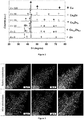
- the as-prepared electrode materials display an increasing structuration with the amount of CuSO 4 doping ( Figure 1 ).
- Elemental composition of the electrodeposited alloys was probed by ICP-AES measurements and is presented in Table 1 below.
- Table 1 Relationship between the CuSO 4 percentage in the precursor solution, the subsequent percentage of incorporated Cu either in the electrode bulk (determined by ICP-AES) or on the electrode surface (determined by XPS) and resulting electrode specific surface area (BET) and corresponding Roughness Factor (RF).
- X-ray diffraction analysis was also performed to gain insight in the phase composition of the electrodes.
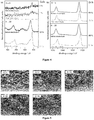
- ZnSO 4 (100-X)% CuSO 4 X% electrodes confirmed the strong correlation of alloy content and the relative metal stoichiometry of the soluble precursors ( Figure 2 ).
- ZnSO 4 (100-X)% CuSO4 X% structures show hexagonal-Zn phases with slight variations of lattice parameters, suggesting a solid solution of Cu in these materials, as well as additional hexagonal phases attributed to a Cu 0.2 Zn 0.8 alloy.
- Cu content (10 ⁇ X ⁇ 30)
- ZnSO 4 (100-X)% CuSO 4 X% electrodes confirms that both Cu and Zn are present at the surface of the electrode at low and high Cu loading (Table 1).
- the quantification of the relative Cu:Zn surface ratio indicates that the surface Cu content is around 6 times lower than the bulk Cu content determined by ICP-AES. This Cu:Zn surface ratio is unchanged before and after electrolysis ( Figure 4 ).
- rough quantification of the alloy content could be obtained by analysis of the XRD spectra and are summarized in the following Table 2 according to the CuSO 4 content in the precursor solution. Table 2 . Relationship between the CuSO 4 percentage in the precursor solution and the alloy content and composition in the deposited metal.
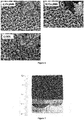
- ZnSO 4 70% CuSO 4 30% were prepared as described in Example 1 and their surface vertically scratched with a wooden tip. An estimation of the thicknesses of the resulting surfaces was provided by SEM in each case ( Figure 5 ). The thickness increases by about ten-fold between 1% CuSO 4 doping and 5% CuSO 4 and by twelve-fold between 1% and 10%. Beyond 10%, the thickness only increases marginally ( ⁇ 5% between 10% and 20%).
- Example 6 Scaling-up to a homogeneous 8 cm 2 Zn-Cu foam
- Example 7 Catalytic activity of the Zn-Cu foams used as cathode for CO 2 eR
- ZnSO 4 70% CuSO 4 30% materials used as cathodes for CO 2 eR was assessed in the H-type cell using a 0.1 M CsHCO 3 supporting electrolyte in both cathodic and anodic compartments. Before experiment, the catholyte was CO 2 -saturated and CO 2 was continuously bubbled at 20 mL.min -1 during experiment.
- H 2 :CO ratios ranging from 0.2 to 1.6 could be achieved, extreme values being obtained using Zn
- catalytic activity increased with the CuSO 4 doping as revealed by the measurement of catalytic current density for syngas production, j syngas , ( Figure 8b ) performed in CO 2 -saturated 0.1 M CsHCO 3 with continuous 20 mL.min -1 CO 2 bubbling in the catholyte: for example at -1.0 V vs.
- Example 9 Turning-off the formic acid production with increasing CuSO 4 doping
- Example 10 Relevancy of the syngas production process presented herein compared to benchmarking fossil-fuel-based techniques
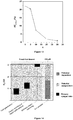
- the electrode materials presented herein for CO 2 conversion to syngas are particularly relevant from two perspectives compared to existing industrial syngas production devices. First, they allow reaching a wide range of H 2 :CO ratios ranging from 0.2 to 3.65 depending on the alloy stoichiometry which cannot be achieved by the current fossil-fuel based processes which ensure most of syngas production ( Figure 14 ).
- ZnSO 4 90% AgNO 3 10% was prepared using ZnSO 4 as main metal salt and AgNO 3 as doping metal salt, according to the procedure described in the 'Electrode General preparation' section.
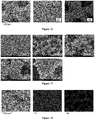
- the as-prepared electrode exhibits a hierarchical porosity that cannot be attained with the pure Zn equivalent, also referred as Zn
- the presence of both Zn and Ag in the electrodeposited structure could be confirmed by EDX elemental mapping ( Figure 16 ).
Landscapes
- Chemical & Material Sciences (AREA)
- Engineering & Computer Science (AREA)
- Chemical Kinetics & Catalysis (AREA)
- Electrochemistry (AREA)
- Materials Engineering (AREA)
- Metallurgy (AREA)
- Organic Chemistry (AREA)
- Inorganic Chemistry (AREA)
- Electrodes For Compound Or Non-Metal Manufacture (AREA)
- Electrolytic Production Of Non-Metals, Compounds, Apparatuses Therefor (AREA)
- Electrolytic Production Of Metals (AREA)
Priority Applications (10)
| Application Number | Priority Date | Filing Date | Title |
|---|---|---|---|
| EP18306750.3A EP3670700A1 (de) | 2018-12-19 | 2018-12-19 | Verfahren zur umwandlung von kohlendioxid (co2) in synthesegas durch eine elektrolysereaktion |
| ES19191080T ES2929181T3 (es) | 2018-12-19 | 2019-08-09 | Método para convertir dióxido de carbono (CO2) en CO mediante una reacción de electrólisis |
| EP19191080.1A EP3670701B1 (de) | 2018-12-19 | 2019-08-09 | Verfahren zur umwandlung von kohlendioxid (co2) in co durch eine elektrolysereaktion |
| DK19191080.1T DK3670701T3 (da) | 2018-12-19 | 2019-08-09 | Fremgangsmåde til omdannelse af kuldioxid (CO2) til CO ved hjælp af en elektrolysereaktion |
| PCT/EP2019/086363 WO2020127772A1 (en) | 2018-12-19 | 2019-12-19 | Method for converting carbon dioxide (co2) into syngas by an electrolysis reaction |
| US17/415,102 US20220056602A1 (en) | 2018-12-19 | 2019-12-19 | Method for Converting Carbon Dioxide (CO2) into CO by an Electrolysis Reaction |
| CA3123971A CA3123971A1 (en) | 2018-12-19 | 2019-12-19 | Method for converting carbon dioxide (co2) into co by an electrolysis reaction |
| US17/415,051 US20220064804A1 (en) | 2018-12-19 | 2019-12-19 | Method for Converting Carbon Dioxide (CO2) into Syngas by an Electrolysis Reaction |
| JP2021535880A JP2022515169A (ja) | 2018-12-19 | 2019-12-19 | 電解反応により二酸化炭素(co2)をcoに変換する方法 |
| PCT/EP2019/086440 WO2020127821A1 (en) | 2018-12-19 | 2019-12-19 | Method for converting carbon dioxide (co2) into co by an electrolysis reaction |
Applications Claiming Priority (1)
| Application Number | Priority Date | Filing Date | Title |
|---|---|---|---|
| EP18306750.3A EP3670700A1 (de) | 2018-12-19 | 2018-12-19 | Verfahren zur umwandlung von kohlendioxid (co2) in synthesegas durch eine elektrolysereaktion |
Publications (1)
| Publication Number | Publication Date |
|---|---|
| EP3670700A1 true EP3670700A1 (de) | 2020-06-24 |
Family
ID=65278161
Family Applications (2)
| Application Number | Title | Priority Date | Filing Date |
|---|---|---|---|
| EP18306750.3A Pending EP3670700A1 (de) | 2018-12-19 | 2018-12-19 | Verfahren zur umwandlung von kohlendioxid (co2) in synthesegas durch eine elektrolysereaktion |
| EP19191080.1A Active EP3670701B1 (de) | 2018-12-19 | 2019-08-09 | Verfahren zur umwandlung von kohlendioxid (co2) in co durch eine elektrolysereaktion |
Family Applications After (1)
| Application Number | Title | Priority Date | Filing Date |
|---|---|---|---|
| EP19191080.1A Active EP3670701B1 (de) | 2018-12-19 | 2019-08-09 | Verfahren zur umwandlung von kohlendioxid (co2) in co durch eine elektrolysereaktion |
Country Status (7)
| Country | Link |
|---|---|
| US (2) | US20220056602A1 (de) |
| EP (2) | EP3670700A1 (de) |
| JP (1) | JP2022515169A (de) |
| CA (1) | CA3123971A1 (de) |
| DK (1) | DK3670701T3 (de) |
| ES (1) | ES2929181T3 (de) |
| WO (2) | WO2020127772A1 (de) |
Cited By (11)
| Publication number | Priority date | Publication date | Assignee | Title |
|---|---|---|---|---|
| WO2022031726A3 (en) * | 2020-08-03 | 2022-04-21 | Opus 12 Incorporated | System and method for carbon dioxide reactor control |
| US11512403B2 (en) | 2018-01-22 | 2022-11-29 | Twelve Benefit Corporation | System and method for carbon dioxide reactor control |
| US11939284B2 (en) | 2022-08-12 | 2024-03-26 | Twelve Benefit Corporation | Acetic acid production |
| US12060483B2 (en) | 2020-10-20 | 2024-08-13 | Twelve Benefit Corporation | Semi-interpenetrating and crosslinked polymers and membranes thereof |
| AU2023229473A1 (en) * | 2023-03-23 | 2024-10-10 | Kabushiki Kaisha Toshiba | Carbon dioxide electrolytic device and method of electrolyzing carbon dioxide |
| US12286716B2 (en) | 2018-01-22 | 2025-04-29 | Twelve Benefit Corporation | System and method for carbon dioxide reactor control |
| US12359325B2 (en) | 2016-05-03 | 2025-07-15 | Twelve Benefit Corporation | Membrane electrode assembly for COx reduction |
| US12416088B2 (en) | 2019-11-25 | 2025-09-16 | Twelve Benefit Corporation | Membrane electrode assembly for COx reduction |
| US12421392B2 (en) | 2020-10-20 | 2025-09-23 | Twelve Benefit Corporation | Ionic polymers and copolymers |
| US12460310B2 (en) | 2023-04-04 | 2025-11-04 | Twelve Benefit Corporation | Integrated systems employing carbon oxide electrolysis in aluminum production |
| US12577690B2 (en) | 2021-12-08 | 2026-03-17 | Twelve Benefit Corporation | Systems and methods for ethylene production |
Families Citing this family (16)
| Publication number | Priority date | Publication date | Assignee | Title |
|---|---|---|---|---|
| US20230151501A1 (en) * | 2020-04-17 | 2023-05-18 | The University Of British Columbia | Electrolytic conversion of carbon-containing ions using porous metal electrodes |
| WO2022073071A1 (en) * | 2020-10-07 | 2022-04-14 | Newsouth Innovations Pty Limited | Plasma assisted electrocatalytic conversion |
| CN112813480A (zh) * | 2021-01-07 | 2021-05-18 | 江苏大学 | 一种原位生长的银纳米团材料及其制备方法和电催化还原co2应用 |
| US11519089B1 (en) | 2021-08-16 | 2022-12-06 | Dioxycle | Methods and systems for automated optimization of COx electrolysis reactor |
| CN114044502B (zh) * | 2021-10-28 | 2024-06-21 | 华东理工大学 | 一种单斜相焦磷酸锌、制备方法及其应用 |
| JP7760935B2 (ja) * | 2022-02-25 | 2025-10-28 | 株式会社豊田中央研究所 | 電解反応装置 |
| CN114737218A (zh) * | 2022-04-07 | 2022-07-12 | 东南大学 | 利用废弃电路板电还原co2制合成燃料的方法 |
| JP2023162774A (ja) * | 2022-04-27 | 2023-11-09 | 株式会社豊田中央研究所 | 電気化学反応器用の電極及び電気化学反応器用の電極の製造方法 |
| CN114959761B (zh) * | 2022-05-05 | 2023-11-03 | 中国科学院上海高等研究院 | 一种银中空纤维电极的制备方法及应用 |
| CN114836769B (zh) * | 2022-06-10 | 2024-03-22 | 浙江工业大学 | 一种2,6-二氨基吡啶/银多孔光电极材料及其制备方法和应用 |
| FR3137306B1 (fr) | 2022-06-30 | 2024-07-05 | Suez Int | Procédé de conversion du dioxyde de carbone avec production d’hydrogène, de méthane et/ou d’hydrocarbures |
| KR20240018056A (ko) | 2022-08-02 | 2024-02-13 | 주식회사 엘지화학 | 전기분해 장치 작동 방법 |
| JPWO2024225310A1 (de) * | 2023-04-24 | 2024-10-31 | ||
| JP7778120B2 (ja) * | 2023-10-24 | 2025-12-01 | 本田技研工業株式会社 | カソード、カソードの製造方法および電解装置 |
| WO2026015615A1 (en) * | 2024-07-09 | 2026-01-15 | Northeastern University | Electrochemical reactor and method for carbon dioxide capture and reduction |
| CN119133399B (zh) * | 2024-09-09 | 2025-09-26 | 河南硅烷科技发展股份有限公司 | 一种低膨胀率的硅碳负极材料及其制备方法与应用 |
Citations (1)
| Publication number | Priority date | Publication date | Assignee | Title |
|---|---|---|---|---|
| WO2016178590A1 (en) * | 2015-05-06 | 2016-11-10 | Omnidea, Lda. | Electrochemical reduction of carbon dioxide in aqueous ionic liquid containing electrolytes |
Family Cites Families (8)
| Publication number | Priority date | Publication date | Assignee | Title |
|---|---|---|---|---|
| US3356538A (en) * | 1964-09-29 | 1967-12-05 | Gen Electric | Electrodeposited ion exchange membrane and method of forming |
| US7628903B1 (en) * | 2000-05-02 | 2009-12-08 | Ishihara Chemical Co., Ltd. | Silver and silver alloy plating bath |
| TWI505348B (zh) * | 2010-10-08 | 2015-10-21 | 華康半導體股份有限公司 | And a method of forming a microporous structure or a groove structure on the surface of the silicon substrate |
| KR101636024B1 (ko) * | 2014-07-18 | 2016-07-05 | 한국과학기술연구원 | 이산화탄소 환원 전극 및 이의 제조방법 |
| JP6804286B2 (ja) * | 2015-12-28 | 2020-12-23 | Dowaエレクトロニクス株式会社 | 銀合金粉末およびその製造方法 |
| WO2017115462A1 (ja) * | 2015-12-28 | 2017-07-06 | Dowaエレクトロニクス株式会社 | 銀合金粉末およびその製造方法 |
| CN107252705B (zh) * | 2017-07-14 | 2020-05-19 | 碳能科技(北京)有限公司 | 用于电化学还原二氧化碳的催化剂及其制备方法 |
| CN109137058B (zh) * | 2018-11-16 | 2020-04-21 | 南京工业大学 | 利用循环伏安法制备银纳米粒子枝状团簇的方法 |
-
2018
- 2018-12-19 EP EP18306750.3A patent/EP3670700A1/de active Pending
-
2019
- 2019-08-09 DK DK19191080.1T patent/DK3670701T3/da active
- 2019-08-09 EP EP19191080.1A patent/EP3670701B1/de active Active
- 2019-08-09 ES ES19191080T patent/ES2929181T3/es active Active
- 2019-12-19 US US17/415,102 patent/US20220056602A1/en not_active Abandoned
- 2019-12-19 US US17/415,051 patent/US20220064804A1/en not_active Abandoned
- 2019-12-19 JP JP2021535880A patent/JP2022515169A/ja active Pending
- 2019-12-19 CA CA3123971A patent/CA3123971A1/en active Pending
- 2019-12-19 WO PCT/EP2019/086363 patent/WO2020127772A1/en not_active Ceased
- 2019-12-19 WO PCT/EP2019/086440 patent/WO2020127821A1/en not_active Ceased
Patent Citations (1)
| Publication number | Priority date | Publication date | Assignee | Title |
|---|---|---|---|---|
| WO2016178590A1 (en) * | 2015-05-06 | 2016-11-10 | Omnidea, Lda. | Electrochemical reduction of carbon dioxide in aqueous ionic liquid containing electrolytes |
Non-Patent Citations (22)
| Title |
|---|
| ELGRISHI ET AL., CHEM. SCI., vol. 6, 2015, pages 2522 - 2531 |
| FOIT ET AL., ANGEW. CHEM. INT. ED., vol. 56, 2017, pages 5402 - 5411 |
| FOIT, S. R.; I. C. VINKE ET AL.: "Power-to-Syngas: An Enabling Technology for the Transition of the Energy System?", ANGEWANDTE CHEMIE INTERNATIONAL EDITION, vol. 56, no. 20, 2017, pages 5402 - 5411, XP055405367, DOI: doi:10.1002/anie.201607552 |
| FRANCKE ET AL., CHEM. REV., vol. 118, 2018, pages 4631 - 4701 |
| HE ET AL., ADV. MAT., vol. 30, 2018, pages 1705872 |
| HORI, Y.: "Modern Aspects of Electrochemistry", 2008, SPRINGER, pages: 89 - 189 |
| KANG ET AL., ENERGY ENVIRON. SCI., vol. 7, 2014, pages 4007 - 4012 |
| LULIANELLI ET AL., CATALYSIS REVIEWS, vol. 58, 2016, pages 1 - 35 |
| LV ET AL., ADV. FUNCT. MATER., 2018 |
| MARQUES MOTA ET AL., ACS CATAL., vol. 8, 2018, pages 4364 - 4374 |
| MISTRY ET AL., J. AM. CHEM. SOC., vol. 136, 2014, pages 16473 - 16476 |
| MORENO-GARCIA ET AL., ACS APPL. MATER. INTERFACES, vol. 10, 2018, pages 31355 - 31365 |
| NGUYEN ET AL., ACS SUSTAIN. CHEM. ENG., vol. 5, 2017, pages 11377 - 11386 |
| PAVEL MORENO-GARCÍA ET AL: "Selective Electrochemical Reduction of CO 2 to CO on Zn-Based Foams Produced by Cu 2+ and Template-Assisted Electrodeposition", ACS APPLIED MATERIALS & INTERFACES, vol. 10, no. 37, 23 August 2018 (2018-08-23), US, pages 31355 - 31365, XP055594419, ISSN: 1944-8244, DOI: 10.1021/acsami.8b09894 * |
| QIN ET AL., ACS APPL. MATER. INTERFACES, vol. 10, 2018, pages 20530 - 20539 |
| REN ET AL., ACS CATAL., vol. 6, 2016, pages 8239 - 8247 |
| ROSS ET AL., J. AM. CHEM. SOC., vol. 139, 2017, pages 9359 - 9363 |
| SHENG ET AL., ENERGY ENVIRON. SCI., vol. 10, 2017, pages 1180 - 1185 |
| URBAIN ET AL., ENERGY ENVIRON. SCI., vol. 10, 2017, pages 2256 - 2266 |
| WANG ET AL., ACS CATAL., vol. 8, 2018, pages 7612 - 7620 |
| Y. HORI: "Modern Aspects of Electrochemistry", 2008, SPRINGER, pages: 89 - 189 |
| ZHENG ET AL., ADV. MAT., 2018 |
Cited By (13)
| Publication number | Priority date | Publication date | Assignee | Title |
|---|---|---|---|---|
| US12359325B2 (en) | 2016-05-03 | 2025-07-15 | Twelve Benefit Corporation | Membrane electrode assembly for COx reduction |
| US12286716B2 (en) | 2018-01-22 | 2025-04-29 | Twelve Benefit Corporation | System and method for carbon dioxide reactor control |
| US11512403B2 (en) | 2018-01-22 | 2022-11-29 | Twelve Benefit Corporation | System and method for carbon dioxide reactor control |
| US12320022B2 (en) | 2018-01-22 | 2025-06-03 | Twelve Benefit Corporation | System and method for carbon dioxide reactor control |
| US12416088B2 (en) | 2019-11-25 | 2025-09-16 | Twelve Benefit Corporation | Membrane electrode assembly for COx reduction |
| WO2022031726A3 (en) * | 2020-08-03 | 2022-04-21 | Opus 12 Incorporated | System and method for carbon dioxide reactor control |
| US12060483B2 (en) | 2020-10-20 | 2024-08-13 | Twelve Benefit Corporation | Semi-interpenetrating and crosslinked polymers and membranes thereof |
| US12421392B2 (en) | 2020-10-20 | 2025-09-23 | Twelve Benefit Corporation | Ionic polymers and copolymers |
| US12577690B2 (en) | 2021-12-08 | 2026-03-17 | Twelve Benefit Corporation | Systems and methods for ethylene production |
| US11939284B2 (en) | 2022-08-12 | 2024-03-26 | Twelve Benefit Corporation | Acetic acid production |
| AU2023229473A1 (en) * | 2023-03-23 | 2024-10-10 | Kabushiki Kaisha Toshiba | Carbon dioxide electrolytic device and method of electrolyzing carbon dioxide |
| AU2023229473B2 (en) * | 2023-03-23 | 2025-07-03 | Kabushiki Kaisha Toshiba | Carbon dioxide electrolytic device and method of electrolyzing carbon dioxide |
| US12460310B2 (en) | 2023-04-04 | 2025-11-04 | Twelve Benefit Corporation | Integrated systems employing carbon oxide electrolysis in aluminum production |
Also Published As
| Publication number | Publication date |
|---|---|
| US20220064804A1 (en) | 2022-03-03 |
| WO2020127821A1 (en) | 2020-06-25 |
| EP3670701B1 (de) | 2022-09-14 |
| US20220056602A1 (en) | 2022-02-24 |
| ES2929181T3 (es) | 2022-11-25 |
| CA3123971A1 (en) | 2020-06-25 |
| EP3670701A1 (de) | 2020-06-24 |
| WO2020127772A1 (en) | 2020-06-25 |
| DK3670701T3 (da) | 2022-10-03 |
| JP2022515169A (ja) | 2022-02-17 |
Similar Documents
| Publication | Publication Date | Title |
|---|---|---|
| EP3670700A1 (de) | Verfahren zur umwandlung von kohlendioxid (co2) in synthesegas durch eine elektrolysereaktion | |
| Li et al. | Facile synthesis of porous Cu-Sn alloy electrode with prior selectivity of formate in a wide potential range for CO2 electrochemical reduction | |
| Yue et al. | Triple-phase electrocatalysis for the enhanced CO2 reduction to HCOOH on a hydrophobic surface | |
| Iarchuk et al. | Novel Ni foam catalysts for sustainable nitrate to ammonia electroreduction | |
| Jiang et al. | Auto-programmed synthesis of metallic aerogels: Core-shell Cu@ Fe@ Ni aerogels for efficient oxygen evolution reaction | |
| Kim et al. | Enhanced catalytic activity of electrodeposited Ni-Cu-P toward oxygen evolution reaction | |
| Darband et al. | Electrodeposition of self-supported transition metal phosphides nanosheets as efficient hydrazine-assisted electrolytic hydrogen production catalyst | |
| Dutta et al. | Morphology matters: tuning the product distribution of CO2 electroreduction on oxide-derived Cu foam catalysts | |
| EP3791010B1 (de) | Kern/schale-vacancy-engineering (csve) von katalysatoren zur elektrochemischen co2-reduktion | |
| US11390959B2 (en) | Boron-doped copper catalysts for efficient conversion of CO2 to multi-carbon hydrocarbons and associated methods | |
| Shen et al. | Theoretical calculation guided design of single atom-alloyed bismuth catalysts for ampere-level CO2 electrolysis to formate | |
| Feng et al. | Nanoporous copper incorporated platinum composites for electrocatalytic reduction of CO2 in ionic liquid BMIMBF4 | |
| Zhang et al. | Three-dimension porous Zn-Cu alloy: An inexpensive electrocatalyst for highly selective CO2 reduction to CO in non-aqueous electrolyte | |
| Gan et al. | Redirecting surface reconstruction of CoP-Cu heterojunction to promote ammonia synthesis at industrial-level current density | |
| Marepally et al. | Electrocatalytic reduction of CO2 over dendritic-type Cu-and Fe-based electrodes prepared by electrodeposition | |
| Zulfiqar et al. | Electro-synthesis of valuable products by coupling energy-saving anodic alcohol oxidation reaction with cathodic CO2 reduction reaction | |
| Chen et al. | Hollow fiber gas-diffusion electrodes with tailored crystal facets for tuning syngas production in electrochemical CO2 reduction | |
| Suryawanshi et al. | Dopant induced hollow Ni2P nanocrystals regulate dehydrogenation kinetics for highly efficient solar-driven hydrazine assisted H2 production | |
| Wen et al. | Electrooxidation of methanol and ethanol catalyzed by high-performance three-dimensional graphene-supported PdM (Co, Cu) binder-free electrode | |
| Mahyoub et al. | 3D Cu/In nanocones by morphological and interface engineering design in achieving a high current density for electroreduction of CO2 to syngas under elevated pressure | |
| Gugtapeh et al. | Facile electrochemical synthesis of Ni-Sb nanostructure supported on graphite as an affordable bifunctional electrocatalyst for hydrogen and oxygen evolution reactions | |
| EP3656892B1 (de) | Verfahren für co2-reduktion zu kohlenwasserstoffen | |
| He et al. | Heterostructure WC/Ni/Cu nanorod array towards ultra-long hydrogen evolution durability at room temperature and industrial conditions | |
| Xu et al. | Nanowire arrays with abundant Cu–Ni interfaces for electroreduction of CO2 to ethylene | |
| Dutta et al. | Insights from Operando and Identical Location (IL) Techniques on the Activation of Electrocatalysts for the Conversion of CO₂: A Mini-Review |
Legal Events
| Date | Code | Title | Description |
|---|---|---|---|
| PUAI | Public reference made under article 153(3) epc to a published international application that has entered the european phase |
Free format text: ORIGINAL CODE: 0009012 |
|
| STAA | Information on the status of an ep patent application or granted ep patent |
Free format text: STATUS: THE APPLICATION HAS BEEN PUBLISHED |
|
| AK | Designated contracting states |
Kind code of ref document: A1 Designated state(s): AL AT BE BG CH CY CZ DE DK EE ES FI FR GB GR HR HU IE IS IT LI LT LU LV MC MK MT NL NO PL PT RO RS SE SI SK SM TR |
|
| AX | Request for extension of the european patent |
Extension state: BA ME |
|
| STAA | Information on the status of an ep patent application or granted ep patent |
Free format text: STATUS: REQUEST FOR EXAMINATION WAS MADE |
|
| STAA | Information on the status of an ep patent application or granted ep patent |
Free format text: STATUS: EXAMINATION IS IN PROGRESS |
|
| 17P | Request for examination filed |
Effective date: 20210111 |
|
| RBV | Designated contracting states (corrected) |
Designated state(s): AL AT BE BG CH CY CZ DE DK EE ES FI FR GB GR HR HU IE IS IT LI LT LU LV MC MK MT NL NO PL PT RO RS SE SI SK SM TR |
|
| 17Q | First examination report despatched |
Effective date: 20210216 |
|
| RAP3 | Party data changed (applicant data changed or rights of an application transferred) |
Owner name: COLLEGE DE FRANCE Owner name: PARIS SCIENCES ET LETTRES |