EP3670956A1 - Revêtement d'usure de dissipateur thermique de frein d'avion - Google Patents
Revêtement d'usure de dissipateur thermique de frein d'avion Download PDFInfo
- Publication number
- EP3670956A1 EP3670956A1 EP19218283.0A EP19218283A EP3670956A1 EP 3670956 A1 EP3670956 A1 EP 3670956A1 EP 19218283 A EP19218283 A EP 19218283A EP 3670956 A1 EP3670956 A1 EP 3670956A1
- Authority
- EP
- European Patent Office
- Prior art keywords
- core
- carbon
- rotor
- wear liner
- disk
- Prior art date
- Legal status (The legal status is an assumption and is not a legal conclusion. Google has not performed a legal analysis and makes no representation as to the accuracy of the status listed.)
- Withdrawn
Links
- 239000000463 material Substances 0.000 claims abstract description 51
- 239000011203 carbon fibre reinforced carbon Substances 0.000 claims abstract description 29
- ZOXJGFHDIHLPTG-UHFFFAOYSA-N Boron Chemical compound [B] ZOXJGFHDIHLPTG-UHFFFAOYSA-N 0.000 claims abstract description 22
- 229910052796 boron Inorganic materials 0.000 claims abstract description 22
- 239000011153 ceramic matrix composite Substances 0.000 claims abstract description 21
- CREMABGTGYGIQB-UHFFFAOYSA-N carbon carbon Chemical compound C.C CREMABGTGYGIQB-UHFFFAOYSA-N 0.000 claims abstract description 10
- 238000001764 infiltration Methods 0.000 claims abstract description 10
- 230000008595 infiltration Effects 0.000 claims abstract description 10
- 239000000126 substance Substances 0.000 claims abstract description 7
- 238000000034 method Methods 0.000 claims description 31
- 229910052580 B4C Inorganic materials 0.000 claims description 28
- INAHAJYZKVIDIZ-UHFFFAOYSA-N boron carbide Chemical compound B12B3B4C32B41 INAHAJYZKVIDIZ-UHFFFAOYSA-N 0.000 claims description 26
- 239000000919 ceramic Substances 0.000 claims description 14
- OKTJSMMVPCPJKN-UHFFFAOYSA-N Carbon Chemical compound [C] OKTJSMMVPCPJKN-UHFFFAOYSA-N 0.000 claims description 13
- 229910052799 carbon Inorganic materials 0.000 claims description 13
- IUHFWCGCSVTMPG-UHFFFAOYSA-N [C].[C] Chemical group [C].[C] IUHFWCGCSVTMPG-UHFFFAOYSA-N 0.000 claims description 12
- 239000011159 matrix material Substances 0.000 claims description 10
- 230000008569 process Effects 0.000 claims description 10
- 229910052581 Si3N4 Inorganic materials 0.000 claims description 6
- 239000002131 composite material Substances 0.000 claims description 5
- 239000003575 carbonaceous material Substances 0.000 claims description 4
- 239000000203 mixture Substances 0.000 claims description 3
- 239000011162 core material Substances 0.000 description 57
- 239000000306 component Substances 0.000 description 44
- 230000008901 benefit Effects 0.000 description 11
- 239000002002 slurry Substances 0.000 description 7
- 238000000429 assembly Methods 0.000 description 5
- 230000000712 assembly Effects 0.000 description 5
- 230000007246 mechanism Effects 0.000 description 5
- 229910010293 ceramic material Inorganic materials 0.000 description 4
- 230000003647 oxidation Effects 0.000 description 4
- 238000007254 oxidation reaction Methods 0.000 description 4
- 238000006243 chemical reaction Methods 0.000 description 3
- 150000001875 compounds Chemical class 0.000 description 3
- 230000004044 response Effects 0.000 description 3
- 229920000049 Carbon (fiber) Polymers 0.000 description 2
- 238000013459 approach Methods 0.000 description 2
- KGBXLFKZBHKPEV-UHFFFAOYSA-N boric acid Chemical compound OB(O)O KGBXLFKZBHKPEV-UHFFFAOYSA-N 0.000 description 2
- 239000004327 boric acid Substances 0.000 description 2
- 239000004917 carbon fiber Substances 0.000 description 2
- 230000006835 compression Effects 0.000 description 2
- 238000007906 compression Methods 0.000 description 2
- 238000010276 construction Methods 0.000 description 2
- 239000008358 core component Substances 0.000 description 2
- 238000000280 densification Methods 0.000 description 2
- 239000000835 fiber Substances 0.000 description 2
- VNWKTOKETHGBQD-UHFFFAOYSA-N methane Chemical compound C VNWKTOKETHGBQD-UHFFFAOYSA-N 0.000 description 2
- 230000004048 modification Effects 0.000 description 2
- 238000012986 modification Methods 0.000 description 2
- 239000000843 powder Substances 0.000 description 2
- 230000001902 propagating effect Effects 0.000 description 2
- 230000003068 static effect Effects 0.000 description 2
- XUIMIQQOPSSXEZ-UHFFFAOYSA-N Silicon Chemical compound [Si] XUIMIQQOPSSXEZ-UHFFFAOYSA-N 0.000 description 1
- PPWPWBNSKBDSPK-UHFFFAOYSA-N [B].[C] Chemical compound [B].[C] PPWPWBNSKBDSPK-UHFFFAOYSA-N 0.000 description 1
- 230000009471 action Effects 0.000 description 1
- 239000000654 additive Substances 0.000 description 1
- 239000007767 bonding agent Substances 0.000 description 1
- 238000005524 ceramic coating Methods 0.000 description 1
- 239000011248 coating agent Substances 0.000 description 1
- 238000000576 coating method Methods 0.000 description 1
- 230000008878 coupling Effects 0.000 description 1
- 238000010168 coupling process Methods 0.000 description 1
- 238000005859 coupling reaction Methods 0.000 description 1
- 230000008021 deposition Effects 0.000 description 1
- 238000009792 diffusion process Methods 0.000 description 1
- 239000002270 dispersing agent Substances 0.000 description 1
- 238000005516 engineering process Methods 0.000 description 1
- 230000007613 environmental effect Effects 0.000 description 1
- 238000000626 liquid-phase infiltration Methods 0.000 description 1
- 238000004519 manufacturing process Methods 0.000 description 1
- 239000002184 metal Substances 0.000 description 1
- 238000002156 mixing Methods 0.000 description 1
- 239000002245 particle Substances 0.000 description 1
- 238000002360 preparation method Methods 0.000 description 1
- 229910052710 silicon Inorganic materials 0.000 description 1
- 239000010703 silicon Substances 0.000 description 1
- 238000007582 slurry-cast process Methods 0.000 description 1
- 238000003786 synthesis reaction Methods 0.000 description 1
- XLYOFNOQVPJJNP-UHFFFAOYSA-N water Substances O XLYOFNOQVPJJNP-UHFFFAOYSA-N 0.000 description 1
- 239000000080 wetting agent Substances 0.000 description 1
Images


Classifications
-
- F—MECHANICAL ENGINEERING; LIGHTING; HEATING; WEAPONS; BLASTING
- F16—ENGINEERING ELEMENTS AND UNITS; GENERAL MEASURES FOR PRODUCING AND MAINTAINING EFFECTIVE FUNCTIONING OF MACHINES OR INSTALLATIONS; THERMAL INSULATION IN GENERAL
- F16D—COUPLINGS FOR TRANSMITTING ROTATION; CLUTCHES; BRAKES
- F16D65/00—Parts or details
- F16D65/02—Braking members; Mounting thereof
- F16D65/12—Discs; Drums for disc brakes
- F16D65/125—Discs; Drums for disc brakes characterised by the material used for the disc body
-
- F—MECHANICAL ENGINEERING; LIGHTING; HEATING; WEAPONS; BLASTING
- F16—ENGINEERING ELEMENTS AND UNITS; GENERAL MEASURES FOR PRODUCING AND MAINTAINING EFFECTIVE FUNCTIONING OF MACHINES OR INSTALLATIONS; THERMAL INSULATION IN GENERAL
- F16D—COUPLINGS FOR TRANSMITTING ROTATION; CLUTCHES; BRAKES
- F16D65/00—Parts or details
- F16D65/02—Braking members; Mounting thereof
- F16D65/12—Discs; Drums for disc brakes
- F16D65/125—Discs; Drums for disc brakes characterised by the material used for the disc body
- F16D65/126—Discs; Drums for disc brakes characterised by the material used for the disc body the material being of low mechanical strength, e.g. carbon, beryllium; Torque transmitting members therefor
-
- B—PERFORMING OPERATIONS; TRANSPORTING
- B32—LAYERED PRODUCTS
- B32B—LAYERED PRODUCTS, i.e. PRODUCTS BUILT-UP OF STRATA OF FLAT OR NON-FLAT, e.g. CELLULAR OR HONEYCOMB, FORM
- B32B18/00—Layered products essentially comprising ceramics, e.g. refractory products
-
- B—PERFORMING OPERATIONS; TRANSPORTING
- B64—AIRCRAFT; AVIATION; COSMONAUTICS
- B64C—AEROPLANES; HELICOPTERS
- B64C25/00—Alighting gear
- B64C25/32—Alighting gear characterised by elements which contact the ground or similar surface
- B64C25/42—Arrangement or adaptation of brakes
-
- C—CHEMISTRY; METALLURGY
- C04—CEMENTS; CONCRETE; ARTIFICIAL STONE; CERAMICS; REFRACTORIES
- C04B—LIME, MAGNESIA; SLAG; CEMENTS; COMPOSITIONS THEREOF, e.g. MORTARS, CONCRETE OR LIKE BUILDING MATERIALS; ARTIFICIAL STONE; CERAMICS; REFRACTORIES; TREATMENT OF NATURAL STONE
- C04B35/00—Shaped ceramic products characterised by their composition; Ceramics compositions; Processing powders of inorganic compounds preparatory to the manufacturing of ceramic products
- C04B35/515—Shaped ceramic products characterised by their composition; Ceramics compositions; Processing powders of inorganic compounds preparatory to the manufacturing of ceramic products based on non-oxide ceramics
- C04B35/56—Shaped ceramic products characterised by their composition; Ceramics compositions; Processing powders of inorganic compounds preparatory to the manufacturing of ceramic products based on non-oxide ceramics based on carbides or oxycarbides
- C04B35/563—Shaped ceramic products characterised by their composition; Ceramics compositions; Processing powders of inorganic compounds preparatory to the manufacturing of ceramic products based on non-oxide ceramics based on carbides or oxycarbides based on boron carbide
-
- C—CHEMISTRY; METALLURGY
- C04—CEMENTS; CONCRETE; ARTIFICIAL STONE; CERAMICS; REFRACTORIES
- C04B—LIME, MAGNESIA; SLAG; CEMENTS; COMPOSITIONS THEREOF, e.g. MORTARS, CONCRETE OR LIKE BUILDING MATERIALS; ARTIFICIAL STONE; CERAMICS; REFRACTORIES; TREATMENT OF NATURAL STONE
- C04B35/00—Shaped ceramic products characterised by their composition; Ceramics compositions; Processing powders of inorganic compounds preparatory to the manufacturing of ceramic products
- C04B35/515—Shaped ceramic products characterised by their composition; Ceramics compositions; Processing powders of inorganic compounds preparatory to the manufacturing of ceramic products based on non-oxide ceramics
- C04B35/56—Shaped ceramic products characterised by their composition; Ceramics compositions; Processing powders of inorganic compounds preparatory to the manufacturing of ceramic products based on non-oxide ceramics based on carbides or oxycarbides
- C04B35/565—Shaped ceramic products characterised by their composition; Ceramics compositions; Processing powders of inorganic compounds preparatory to the manufacturing of ceramic products based on non-oxide ceramics based on carbides or oxycarbides based on silicon carbide
-
- C—CHEMISTRY; METALLURGY
- C04—CEMENTS; CONCRETE; ARTIFICIAL STONE; CERAMICS; REFRACTORIES
- C04B—LIME, MAGNESIA; SLAG; CEMENTS; COMPOSITIONS THEREOF, e.g. MORTARS, CONCRETE OR LIKE BUILDING MATERIALS; ARTIFICIAL STONE; CERAMICS; REFRACTORIES; TREATMENT OF NATURAL STONE
- C04B35/00—Shaped ceramic products characterised by their composition; Ceramics compositions; Processing powders of inorganic compounds preparatory to the manufacturing of ceramic products
- C04B35/515—Shaped ceramic products characterised by their composition; Ceramics compositions; Processing powders of inorganic compounds preparatory to the manufacturing of ceramic products based on non-oxide ceramics
- C04B35/58—Shaped ceramic products characterised by their composition; Ceramics compositions; Processing powders of inorganic compounds preparatory to the manufacturing of ceramic products based on non-oxide ceramics based on borides, nitrides, i.e. nitrides, oxynitrides, carbonitrides or oxycarbonitrides or silicides
- C04B35/583—Shaped ceramic products characterised by their composition; Ceramics compositions; Processing powders of inorganic compounds preparatory to the manufacturing of ceramic products based on non-oxide ceramics based on borides, nitrides, i.e. nitrides, oxynitrides, carbonitrides or oxycarbonitrides or silicides based on boron nitride
-
- C—CHEMISTRY; METALLURGY
- C04—CEMENTS; CONCRETE; ARTIFICIAL STONE; CERAMICS; REFRACTORIES
- C04B—LIME, MAGNESIA; SLAG; CEMENTS; COMPOSITIONS THEREOF, e.g. MORTARS, CONCRETE OR LIKE BUILDING MATERIALS; ARTIFICIAL STONE; CERAMICS; REFRACTORIES; TREATMENT OF NATURAL STONE
- C04B35/00—Shaped ceramic products characterised by their composition; Ceramics compositions; Processing powders of inorganic compounds preparatory to the manufacturing of ceramic products
- C04B35/515—Shaped ceramic products characterised by their composition; Ceramics compositions; Processing powders of inorganic compounds preparatory to the manufacturing of ceramic products based on non-oxide ceramics
- C04B35/58—Shaped ceramic products characterised by their composition; Ceramics compositions; Processing powders of inorganic compounds preparatory to the manufacturing of ceramic products based on non-oxide ceramics based on borides, nitrides, i.e. nitrides, oxynitrides, carbonitrides or oxycarbonitrides or silicides
- C04B35/584—Shaped ceramic products characterised by their composition; Ceramics compositions; Processing powders of inorganic compounds preparatory to the manufacturing of ceramic products based on non-oxide ceramics based on borides, nitrides, i.e. nitrides, oxynitrides, carbonitrides or oxycarbonitrides or silicides based on silicon nitride
-
- C—CHEMISTRY; METALLURGY
- C04—CEMENTS; CONCRETE; ARTIFICIAL STONE; CERAMICS; REFRACTORIES
- C04B—LIME, MAGNESIA; SLAG; CEMENTS; COMPOSITIONS THEREOF, e.g. MORTARS, CONCRETE OR LIKE BUILDING MATERIALS; ARTIFICIAL STONE; CERAMICS; REFRACTORIES; TREATMENT OF NATURAL STONE
- C04B35/00—Shaped ceramic products characterised by their composition; Ceramics compositions; Processing powders of inorganic compounds preparatory to the manufacturing of ceramic products
- C04B35/71—Ceramic products containing macroscopic reinforcing agents
- C04B35/78—Ceramic products containing macroscopic reinforcing agents containing non-metallic materials
- C04B35/80—Fibres, filaments, whiskers, platelets, or the like
-
- C—CHEMISTRY; METALLURGY
- C04—CEMENTS; CONCRETE; ARTIFICIAL STONE; CERAMICS; REFRACTORIES
- C04B—LIME, MAGNESIA; SLAG; CEMENTS; COMPOSITIONS THEREOF, e.g. MORTARS, CONCRETE OR LIKE BUILDING MATERIALS; ARTIFICIAL STONE; CERAMICS; REFRACTORIES; TREATMENT OF NATURAL STONE
- C04B35/00—Shaped ceramic products characterised by their composition; Ceramics compositions; Processing powders of inorganic compounds preparatory to the manufacturing of ceramic products
- C04B35/71—Ceramic products containing macroscopic reinforcing agents
- C04B35/78—Ceramic products containing macroscopic reinforcing agents containing non-metallic materials
- C04B35/80—Fibres, filaments, whiskers, platelets, or the like
- C04B35/83—Carbon fibres in a carbon matrix
-
- F—MECHANICAL ENGINEERING; LIGHTING; HEATING; WEAPONS; BLASTING
- F16—ENGINEERING ELEMENTS AND UNITS; GENERAL MEASURES FOR PRODUCING AND MAINTAINING EFFECTIVE FUNCTIONING OF MACHINES OR INSTALLATIONS; THERMAL INSULATION IN GENERAL
- F16D—COUPLINGS FOR TRANSMITTING ROTATION; CLUTCHES; BRAKES
- F16D55/00—Brakes with substantially-radial braking surfaces pressed together in axial direction, e.g. disc brakes
- F16D55/24—Brakes with substantially-radial braking surfaces pressed together in axial direction, e.g. disc brakes with a plurality of axially-movable discs, lamellae, or pads, pressed from one side towards an axially-located member
- F16D55/26—Brakes with substantially-radial braking surfaces pressed together in axial direction, e.g. disc brakes with a plurality of axially-movable discs, lamellae, or pads, pressed from one side towards an axially-located member without self-tightening action
- F16D55/36—Brakes with a plurality of rotating discs all lying side by side
-
- F—MECHANICAL ENGINEERING; LIGHTING; HEATING; WEAPONS; BLASTING
- F16—ENGINEERING ELEMENTS AND UNITS; GENERAL MEASURES FOR PRODUCING AND MAINTAINING EFFECTIVE FUNCTIONING OF MACHINES OR INSTALLATIONS; THERMAL INSULATION IN GENERAL
- F16D—COUPLINGS FOR TRANSMITTING ROTATION; CLUTCHES; BRAKES
- F16D65/00—Parts or details
- F16D65/02—Braking members; Mounting thereof
- F16D65/12—Discs; Drums for disc brakes
- F16D65/127—Discs; Drums for disc brakes characterised by properties of the disc surface; Discs lined with friction material
-
- F—MECHANICAL ENGINEERING; LIGHTING; HEATING; WEAPONS; BLASTING
- F16—ENGINEERING ELEMENTS AND UNITS; GENERAL MEASURES FOR PRODUCING AND MAINTAINING EFFECTIVE FUNCTIONING OF MACHINES OR INSTALLATIONS; THERMAL INSULATION IN GENERAL
- F16D—COUPLINGS FOR TRANSMITTING ROTATION; CLUTCHES; BRAKES
- F16D69/00—Friction linings; Attachment thereof; Selection of coacting friction substances or surfaces
- F16D69/02—Composition of linings ; Methods of manufacturing
- F16D69/023—Composite materials containing carbon and carbon fibres or fibres made of carbonizable material
-
- C—CHEMISTRY; METALLURGY
- C04—CEMENTS; CONCRETE; ARTIFICIAL STONE; CERAMICS; REFRACTORIES
- C04B—LIME, MAGNESIA; SLAG; CEMENTS; COMPOSITIONS THEREOF, e.g. MORTARS, CONCRETE OR LIKE BUILDING MATERIALS; ARTIFICIAL STONE; CERAMICS; REFRACTORIES; TREATMENT OF NATURAL STONE
- C04B2235/00—Aspects relating to ceramic starting mixtures or sintered ceramic products
- C04B2235/02—Composition of constituents of the starting material or of secondary phases of the final product
- C04B2235/30—Constituents and secondary phases not being of a fibrous nature
- C04B2235/38—Non-oxide ceramic constituents or additives
- C04B2235/3817—Carbides
- C04B2235/3821—Boron carbides
-
- C—CHEMISTRY; METALLURGY
- C04—CEMENTS; CONCRETE; ARTIFICIAL STONE; CERAMICS; REFRACTORIES
- C04B—LIME, MAGNESIA; SLAG; CEMENTS; COMPOSITIONS THEREOF, e.g. MORTARS, CONCRETE OR LIKE BUILDING MATERIALS; ARTIFICIAL STONE; CERAMICS; REFRACTORIES; TREATMENT OF NATURAL STONE
- C04B2235/00—Aspects relating to ceramic starting mixtures or sintered ceramic products
- C04B2235/02—Composition of constituents of the starting material or of secondary phases of the final product
- C04B2235/30—Constituents and secondary phases not being of a fibrous nature
- C04B2235/38—Non-oxide ceramic constituents or additives
- C04B2235/3817—Carbides
- C04B2235/3826—Silicon carbides
-
- C—CHEMISTRY; METALLURGY
- C04—CEMENTS; CONCRETE; ARTIFICIAL STONE; CERAMICS; REFRACTORIES
- C04B—LIME, MAGNESIA; SLAG; CEMENTS; COMPOSITIONS THEREOF, e.g. MORTARS, CONCRETE OR LIKE BUILDING MATERIALS; ARTIFICIAL STONE; CERAMICS; REFRACTORIES; TREATMENT OF NATURAL STONE
- C04B2235/00—Aspects relating to ceramic starting mixtures or sintered ceramic products
- C04B2235/02—Composition of constituents of the starting material or of secondary phases of the final product
- C04B2235/30—Constituents and secondary phases not being of a fibrous nature
- C04B2235/38—Non-oxide ceramic constituents or additives
- C04B2235/3852—Nitrides, e.g. oxynitrides, carbonitrides, oxycarbonitrides, lithium nitride, magnesium nitride
- C04B2235/386—Boron nitrides
-
- C—CHEMISTRY; METALLURGY
- C04—CEMENTS; CONCRETE; ARTIFICIAL STONE; CERAMICS; REFRACTORIES
- C04B—LIME, MAGNESIA; SLAG; CEMENTS; COMPOSITIONS THEREOF, e.g. MORTARS, CONCRETE OR LIKE BUILDING MATERIALS; ARTIFICIAL STONE; CERAMICS; REFRACTORIES; TREATMENT OF NATURAL STONE
- C04B2235/00—Aspects relating to ceramic starting mixtures or sintered ceramic products
- C04B2235/02—Composition of constituents of the starting material or of secondary phases of the final product
- C04B2235/30—Constituents and secondary phases not being of a fibrous nature
- C04B2235/38—Non-oxide ceramic constituents or additives
- C04B2235/3852—Nitrides, e.g. oxynitrides, carbonitrides, oxycarbonitrides, lithium nitride, magnesium nitride
- C04B2235/3873—Silicon nitrides, e.g. silicon carbonitride, silicon oxynitride
-
- C—CHEMISTRY; METALLURGY
- C04—CEMENTS; CONCRETE; ARTIFICIAL STONE; CERAMICS; REFRACTORIES
- C04B—LIME, MAGNESIA; SLAG; CEMENTS; COMPOSITIONS THEREOF, e.g. MORTARS, CONCRETE OR LIKE BUILDING MATERIALS; ARTIFICIAL STONE; CERAMICS; REFRACTORIES; TREATMENT OF NATURAL STONE
- C04B2235/00—Aspects relating to ceramic starting mixtures or sintered ceramic products
- C04B2235/60—Aspects relating to the preparation, properties or mechanical treatment of green bodies or pre-forms
- C04B2235/614—Gas infiltration of green bodies or pre-forms
-
- F—MECHANICAL ENGINEERING; LIGHTING; HEATING; WEAPONS; BLASTING
- F16—ENGINEERING ELEMENTS AND UNITS; GENERAL MEASURES FOR PRODUCING AND MAINTAINING EFFECTIVE FUNCTIONING OF MACHINES OR INSTALLATIONS; THERMAL INSULATION IN GENERAL
- F16D—COUPLINGS FOR TRANSMITTING ROTATION; CLUTCHES; BRAKES
- F16D65/00—Parts or details
- F16D65/02—Braking members; Mounting thereof
- F16D2065/13—Parts or details of discs or drums
- F16D2065/1304—Structure
- F16D2065/132—Structure layered
-
- F—MECHANICAL ENGINEERING; LIGHTING; HEATING; WEAPONS; BLASTING
- F16—ENGINEERING ELEMENTS AND UNITS; GENERAL MEASURES FOR PRODUCING AND MAINTAINING EFFECTIVE FUNCTIONING OF MACHINES OR INSTALLATIONS; THERMAL INSULATION IN GENERAL
- F16D—COUPLINGS FOR TRANSMITTING ROTATION; CLUTCHES; BRAKES
- F16D2200/00—Materials; Production methods therefor
- F16D2200/0034—Materials; Production methods therefor non-metallic
- F16D2200/0039—Ceramics
- F16D2200/0047—Ceramic composite, e.g. C/C composite infiltrated with Si or B, or ceramic matrix infiltrated with metal
-
- F—MECHANICAL ENGINEERING; LIGHTING; HEATING; WEAPONS; BLASTING
- F16—ENGINEERING ELEMENTS AND UNITS; GENERAL MEASURES FOR PRODUCING AND MAINTAINING EFFECTIVE FUNCTIONING OF MACHINES OR INSTALLATIONS; THERMAL INSULATION IN GENERAL
- F16D—COUPLINGS FOR TRANSMITTING ROTATION; CLUTCHES; BRAKES
- F16D2200/00—Materials; Production methods therefor
- F16D2200/0034—Materials; Production methods therefor non-metallic
- F16D2200/0052—Carbon
Definitions
- the present disclosure relates generally to aircraft wheel and brake assemblies and, more particularly, to wear liners and heatsinks used in aircraft wheel and brake assemblies.
- Aircraft typically utilize brake systems on wheels to slow or stop the aircraft during landings, taxiing and rejected takeoffs.
- Aircraft brake systems generally employ a brake stack comprising a series of friction disks that may be forced into sliding contact with one another during brake actuation to slow or stop the aircraft.
- the brake stack typically comprises rotor disks and stator disks that, in response to axial compressive pressure, convert the kinetic energy of the aircraft into heat through frictional forces experienced between the friction disks.
- Brake stacks may exhibit static and dynamic frictional performance that vary greatly in response to environmental conditions (e.g., ambient temperature or humidity) and to the type of braking operation being performed ( e.g ., short runway take-off, landing or rejected take off).
- Brake stacks comprising combinations of carbon-carbon and ceramic matrix composite materials may prove advantageous in addressing frictional and wear performance, and related concerns.
- the brake disk includes a core having a carbon-carbon material and a high specific heat component present in the core in a component range of about ten percent to about thirty percent by volume.
- the brake disk includes a first wear liner and a second wear liner, both the first wear liner and the second wear liner comprising a ceramic matrix composite material.
- the core has a core thickness and the first wear liner and the second wear liner have a liner thickness that is less than the core thickness.
- the liner thickness is within a thickness range of about ten percent to about fifty percent of the core thickness.
- the high specific heat component is a boron component.
- the ceramic matrix composite material comprises a matrix composition having at least one of SiC, B 4 C, BN and Si 3 N 4 .
- the boron component present in the core comprises B 4 C or other boron or carbon containing compounds.
- the brake disk is one of a rotor disk and a stator disk.
- the brake stack includes a pressure plate; an end plate; a rotor disk disposed between the pressure plate and the end plate, the rotor disk including a rotor core comprising a carbon-carbon material and a high specific heat component; and a stator disk disposed between the pressure plate and the end plate, the stator disk including a stator core comprising the carbon-carbon material and the specific heat raising component.
- the rotor disk comprises a first rotor wear liner comprising a ceramic matrix composite material and a second rotor wear liner comprising the ceramic composite material.
- at least one of the pressure plate and the end plate comprises the ceramic matrix composite material.
- the stator disk comprises a first stator wear liner comprising the ceramic composite material and a second stator wear liner comprising the ceramic matrix composite material.
- the high specific heat component is a boron component present in the rotor core and in the stator core in a range of about one percent to about thirty percent by volume.
- the boron component comprises boron carbide.
- the ceramic matrix composite material comprises a matrix composition having at least one of SiC, B 4 C, BN and Si 3 N 4 .
- the at least one of SiC, B 4 C, BN and Si 3 N 4 is infiltrated into the ceramic matrix composite material using a chemical vapor infiltration process.
- a method of forming a brake disk includes the steps of preparing a carbon preform; densifying the carbon preform with a carbon material to form a carbon-carbon core; and infiltrating a high specific heat component into the carbon-carbon core to form a high specific heat carbon-carbon core.
- the method further includes attaching a first wear liner and a second wear liner to the high specific heat carbon-carbon core.
- the first wear liner and the second wear liner comprise a ceramic matrix composite material.
- the high specific heat component is a boron component.
- a first component that is "radially outward" of a second component means that the first component is positioned at a greater distance away from a common axis than the second component.
- a first component that is “radially inward” of a second component means that the first component is positioned closer to the common axis than the second component.
- a first component that is radially inward of a second component rotates through a circumferentially shorter path than the second component.
- distal refers to the direction outward, or generally, away from a reference component.
- proximal and/or proximate refer to a direction inward, or generally, towards the reference component. All ranges may include the upper and lower values, and all ranges and ratio limits disclosed herein may be combined. Unless specifically stated otherwise, reference to “a,” “an” or “the” may include one or more than one and reference to an item in the singular may also include the item in the plural.
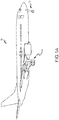
- an aircraft 10 is illustrated.
- the aircraft 10 includes landing gear, which may include a left main landing gear 12, a right main landing gear 14 and a nose landing gear 16.
- the landing gear support the aircraft 10 when it is not flying, allowing the aircraft 10 to taxi, take off and land without damage. While the disclosure refers to the three landing gear configurations just described, the disclosure nevertheless contemplates any number of landing gear configurations.
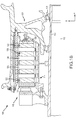
- a brake mechanism 100 configured for use on a landing gear, such as, for example, each of the left main landing gear 12 and the right main landing gear 14 described above with reference to FIG. 1A .
- the brake mechanism is mounted on an axle 102 for use with a wheel 104 disposed on and configured to rotate about the axle 102 via one or more bearing assemblies 103.
- a central axis 112 extends through the axle 102 and defines a center of rotation of the wheel 104.
- a torque plate barrel 114 (sometimes referred to as a torque tube or barrel or a torque plate) is aligned concentrically with the hub 106, and the wheel 104 is rotatable relative to the torque plate barrel 114.
- the brake mechanism 100 includes a piston assembly 116, a pressure plate 118 disposed adjacent the piston assembly 116, an end plate 120 positioned a distal location from the piston assembly 116, and a plurality of rotor disks 122 interleaved with a plurality of stator disks 124 positioned intermediate the pressure plate 118 and the end plate 120.
- the pressure plate 118, the plurality of rotor disks 122, the plurality of stator disks 124 and the end plate 120 together form a brake heat sink or brake stack 126.
- the pressure plate 118, the end plate 120 and the plurality of stator disks 124 are mounted to the torque plate barrel 114 and remain rotationally stationary relative to the axle 102.
- the plurality of rotor disks 122 is mounted to the wheel 104 and rotate with respect to each of the pressure plate 118, the end plate 120 and the plurality of stator disks 124.
- An actuating mechanism for the brake mechanism 100 includes a plurality of piston assemblies, including the piston assembly 116, circumferentially spaced around a piston housing 156 (only one piston assembly is illustrated in FIG. 1B ).
- the plurality of piston assemblies affects a braking action by urging the pressure plate 118 and the plurality of stator disks 124 into frictional engagement with the plurality of rotor disks 122 and against the end plate 120.
- the resulting frictional contact slows or stops or otherwise prevents rotation of the wheel 104.
- the brake stack 200 includes a pressure plate 202 disposed at a first end 204 of the brake stack 200, an end plate 206 disposed at a second end 208 of the brake stack 200, and a plurality of rotor disks 210 interleaved with a plurality of stator disks 212 positioned intermediate the pressure plate 202 and the end plate 206.
- each of the plurality of rotor disks 210 is configured to rotate in accordance with a wheel, such as, for example, the wheel 104 described above with reference to FIG. 1B .
- a plurality of circumferentially spaced rotor lugs 214 is disposed on each of the plurality of rotor disks 210 and configured to engage the wheel to affect co-rotation between the wheel and the plurality of rotor disks 210.
- the plurality of stator disks 212 is configured to remain stationary relative to the plurality of rotor disks 210 during rotation of the wheel and the plurality of rotor disks 210.
- a plurality of circumferentially spaced stator lugs 216 is disposed on each of the plurality of stator disks 212 and configured to engage an axle, such as, for example, the axle 102 described above with reference to FIG. 1B to affect stationarity between the axle and the plurality of stator disks 212.
- one or more rams or pistons may axially urge the pressure plate 202, whether directly or through an intermediate object, into forceful engagement with the plurality of rotor disks 210 and the plurality of stator disks 212.
- the axial compression of the plurality of rotor disks 210, which are rotating with the wheel, and the plurality of stator disks 212, which are stationary relative to the axle, causes friction between the various surfaces comprising the brake stack 200, including a first surface 218 between the pressure plate 202 and a first rotor disk 220 disposed adjacent the pressure plate 202, an Nth surface 222 between the end plate 206 and an Mth rotor disk 224 disposed adjacent the end plate 206, and a plurality of intermediate surfaces 226 between adjacent pairs of the plurality of rotor disks 210 and the plurality of stator disks 212.
- the number of surfaces, N is typically equal to twice the number of rotor disks, M.
- the friction occurring at the various surfaces just defined results in the conversion of kinetic energy (e.g ., the translational kinetic energy of an aircraft) into heat energy that is ultimately dissipated throughout the brake stack 200.
- each of the plurality of rotor disks 210 such as, for example, the first rotor disk 220, includes a rotor core 230 disposed between a first rotor wear liner 232 and a second rotor wear liner 234.
- each of the plurality of stator disks 212 such as, for example, a first stator disk 236 disposed adjacent the first rotor disk 220, includes a stator core 238 disposed between a first stator wear liner 240 and a second stator wear liner 242.
- the plurality of intermediate surfaces 226 may thus be more specifically identified as the opposing faces occurring between adjacent pairs of rotor and stator wear liners, such as, for example, the opposing faces occurring between the second rotor wear liner 234 and the first stator wear liner 240.
- the first surface 218 between the pressure plate 202 and the first rotor disk 220 may be more specifically identified as the opposing faces occurring between the pressure plate 202 and the first rotor wear liner 232 of the first rotor disk 220
- the Nth surface 222 between the end plate 206 and the Mth rotor disk 224 may be more specifically identified as the opposing faces occurring between the end plate 206 and the second rotor wear liner 234 of the Mth rotor disk 224.
- the rotor core 230 within each of the plurality of rotor disks 210 is comprised of a carbon-carbon (C/C) material having a non-carbon, high specific heat component interspersed throughout the rotor core 230, where high specific heat component includes any component (typically ceramic) that raises the specific heat of the core material above that of the C/C material alone.
- the rotor core 230 may comprise a C/C material that includes a percentage of boron, a boron component, or other material having a high specific heat ( i.e ., a specific heat higher than that of the C/C material alone), including ceramic materials.
- the rotor core 230 may comprise a C/C material with a percentage of boron carbide (B 4 C) disposed substantially throughout the core.
- B 4 C boron carbide
- the rotor core 230 comprises a C/C material with between about one percent (1%) and about thirty percent (30%) of B 4 C dispersed throughout the core; in various embodiments, the rotor core 230 comprises a C/C material with between about ten percent (10%) and about twenty percent (20%) of B 4 C dispersed throughout the core; and in various embodiments, the rotor core 230 comprises a C/C material with about fifteen percent (15%) of B 4 C dispersed throughout the core.
- the percentage values recited above may be determined by either volume or weight.
- the process of interspersing the boron carbide (or other high specific heat component) into the C/C material is performed by a slurry casting process.
- the process starts with a carbon fiber preform that is subsequently densified - e.g., by a chemical vapor infiltration (CVI) process - with carbon.
- the resulting C/C core component is then interspersed with boron carbide (or B 4 C) particulate by a slurry cast infiltration process.
- the slurry cast infiltration process comprises preparation of an aqueous B 4 C-based slurry and immersing the C/C core into the slurry for a period of time sufficient for the B 4 C to infiltrate the core.
- the B 4 C-based slurry may be prepared by mixing B 4 C powder in water with appropriate additives, such as wetting agents and dispersants.
- the B 4 C powder may comprise particle sizes from sub-micron up to about 20 microns.
- the C/C core is then loaded into a vacuum chamber and the B 4 C slurry is drawn therein and allowed to infiltrate into and disperse throughout the C/C core.
- the boron containing component may be dispersed into the C/C core by various other methods including chemical vapor infiltration, slurry infiltration or chemical synthesis including through infiltration with boric acid or other boron containing compounds and subsequent reaction with matrix carbon.
- the various methods for incorporating the ceramic materials are broad, any of which could be used to create the high specific heat matrix material.
- the process for incorporating the boron containing component (or other high specific heat components) may be accomplished through a reaction of boric acid or other boron containing components to form boron carbide or other high specific heat boron, or boron carbon containing, compounds.
- Various advantages of dispersing B 4 C throughout the C/C material comprising the rotor core 230 include the heat capacity Cp (e.g ., the material specific heat, c p multiplied by the material density, p) of the resulting core being increased beyond that of the heat capacity of the C/C material by itself.
- a higher heat capacity of the rotor core 230 provides a greater ability to absorb and store the heat energy generated at the first rotor wear liner 232 and at the second rotor wear liner 234 without the attendant increase in temperature that accompanies materials having lower heat capacities.
- the ability to absorb and store greater amounts of heat energy at lower temperatures enables the rotor core 230 to be run harder and at higher energies for longer periods of time, without increasing the brake temperature and the corresponding rate of oxidation of the brake core, than is possible for core materials having lower heat capacities.
- the same or similar material and physical considerations and embodiments just described with respect to the rotor core 230 apply equally to construction of the stator core 238 disposed within each of the plurality of stator disks 212.
- the boron carbide material described above comprises a substantial equivalent to B 4 C, such as, for example and without limitation, B 12 C 3 .
- the first rotor wear liner 232 and the second rotor wear liner 234 within each of the plurality of rotor disks 210 is comprised of a ceramic matrix composite (CMC) material.
- the CMC material may be made using known techniques, such as, for example, silicon melt infiltration (SMI) or chemical vapor infiltration (CVI) of carbonized preforms.
- the first rotor wear liner 232 and the second rotor wear liner 234 are made using CVI, which enables deposition of ceramic materials, such as, for example, SiC, B 4 C, BN and Si 3 N 4 , into the matrix during manufacture to tailor the frictional and wear properties of the wear liners.
- the first rotor wear liner 232 and the second rotor wear liner 234 have a wear liner thickness 244 that is much less than a core thickness 246 of the rotor core 230.
- the liner thickness 244 is between about ten percent (10%) and about fifty percent (50%) of the core thickness 246; in various embodiments, the liner thickness 244 is between about twenty percent (20%) and about forty percent (40%) of the core thickness 246; and in various embodiments, the liner thickness 244 is about thirty percent (30%) of the core thickness 246.
- first rotor wear liner 232 and the second rotor wear liner 234 may be attached to the rotor core 230 using known techniques, such as mechanical rivets and the like, chemical bonding agents or diffusion bonding.
- known techniques such as mechanical rivets and the like, chemical bonding agents or diffusion bonding.
- the same or similar material considerations and embodiments just described with respect to the first rotor wear liner 232 and the second rotor wear liner 234 apply equally to construction of the first stator wear liner 240 and the second stator wear liner 242 disposed within each of the plurality of stator disks 212.
- the proposed method offers the advantage of having hard ceramic surfaces on both the core and the liner so as to improve the mechanical durability of the interface.
- both the core and the liner interface surfaces are hard and durable, much like hardening gear teeth in metal components.
- relatively thin wear liners facilitate achieving adequate densities by CVI which, for thick materials, is difficult to accomplish using typical ceramic CVI technology. The disclosure thus contemplates both cores having high specific heats and ceramic liners optimized for wear using CVI techniques.
- the brake stack 200 similar to the brake stack 126 described above with reference to FIG. 1B , exhibits several advantages.
- the addition of a percentage of B 4 C to the C/C material comprising the rotor core 230 and the stator core 238 raises the heat capacity of the core structures beyond that currently achieved using C/C material alone.
- the higher heat capacity facilitates use of relatively thin wear liners, which may be constructed of CMC materials using CVI or similar techniques.
- the rotor core 230 and the stator core 238 comprising the addition of ceramic materials that exhibit relatively high heat capacities to the C/C material, including, for example B 4 C, may also be amenable to an oxidation protection system placed onto the core material, with the advantage of providing an oxidation resistant core that is reusable.
- Advantages of thinner wear liners includes their being more amenable to complete densification of the ceramic matrix into the fiber preform, e.g., using a ceramic CVI process, than are thicker wear liners. Wear liners made from CMC materials also provide for higher coefficients of static and dynamic friction, leading to more effective braking and lower wear rates.
- the various components of the brake stack including the stator disks and the rotor disks, exhibit a high specific heat core component that maintains a hard ceramic coating and that provides both oxidation protection and a hard surface for mechanical integrity and durability.
- the various components of the brake stack also exhibit a thin ceramic liner that is optimized for wear and also provides a hard surface for mechanical durability.
- a method 300 of forming a brake disk includes preparing a carbon preform.
- a second step 304 includes densifying the carbon preform with a carbon material to form a carbon-carbon core.
- a third step 306 includes infiltrating a high specific heat component into the carbon-carbon core to form a high specific heat carbon-carbon core.
- the method further includes attaching a first wear liner and a second wear liner to the high specific heat carbon-carbon core, where the wear liners are formed as described above.
- the first wear liner and the second wear liner comprise a ceramic matrix material.
- the high specific heat component is a boron component.
- the densifying step covers a range including a coating on the fiber preform to near-complete or complete densification of the carbon preform.
- the disclosure contemplates fabricating a high specific heat composite core having little to no carbon in the matrix, e.g., a carbon fiber preform with a 100% high specific heat ceramic matrix.
- references to "one embodiment,” “an embodiment,” “various embodiments,” etc. indicate that the embodiment described may include a particular feature, structure, or characteristic, but every embodiment may not necessarily include the particular feature, structure, or characteristic. Moreover, such phrases are not necessarily referring to the same embodiment. Further, when a particular feature, structure, or characteristic is described in connection with an embodiment, it is submitted that it is within the knowledge of one skilled in the art to affect such feature, structure, or characteristic in connection with other embodiments whether or not explicitly described. After reading the description, it will be apparent to one skilled in the relevant art(s) how to implement the disclosure in alternative embodiments.
- system program instructions or controller instructions may be loaded onto a tangible, non-transitory, computer-readable medium (also referred to herein as a tangible, non-transitory, memory) having instructions stored thereon that, in response to execution by a controller, cause the controller to perform various operations.
- a tangible, non-transitory, computer-readable medium also referred to herein as a tangible, non-transitory, memory
- non-transitory is to be understood to remove only propagating transitory signals per se from the claim scope and does not relinquish rights to all standard computer-readable media that are not only propagating transitory signals per se.
Landscapes
- Engineering & Computer Science (AREA)
- Chemical & Material Sciences (AREA)
- General Engineering & Computer Science (AREA)
- Ceramic Engineering (AREA)
- Mechanical Engineering (AREA)
- Materials Engineering (AREA)
- Manufacturing & Machinery (AREA)
- Structural Engineering (AREA)
- Organic Chemistry (AREA)
- Composite Materials (AREA)
- Chemical Kinetics & Catalysis (AREA)
- Aviation & Aerospace Engineering (AREA)
- Braking Arrangements (AREA)
Applications Claiming Priority (1)
| Application Number | Priority Date | Filing Date | Title |
|---|---|---|---|
| US16/226,192 US20200200227A1 (en) | 2018-12-19 | 2018-12-19 | Aircraft brake heatsink wear liner |
Publications (1)
| Publication Number | Publication Date |
|---|---|
| EP3670956A1 true EP3670956A1 (fr) | 2020-06-24 |
Family
ID=69411000
Family Applications (1)
| Application Number | Title | Priority Date | Filing Date |
|---|---|---|---|
| EP19218283.0A Withdrawn EP3670956A1 (fr) | 2018-12-19 | 2019-12-19 | Revêtement d'usure de dissipateur thermique de frein d'avion |
Country Status (2)
| Country | Link |
|---|---|
| US (1) | US20200200227A1 (fr) |
| EP (1) | EP3670956A1 (fr) |
Families Citing this family (4)
| Publication number | Priority date | Publication date | Assignee | Title |
|---|---|---|---|---|
| FR3126962B1 (fr) * | 2021-09-15 | 2025-09-05 | Safran Landing Systems | Ecran thermique et dispositif de freinage associé |
| US12540651B2 (en) * | 2023-09-05 | 2026-02-03 | Goodrich Corporation | Ceramic particulate coating for wear improvement |
| US12577998B2 (en) | 2023-09-26 | 2026-03-17 | Goodrich Corporation | Material life extension for refurbished 2-for-1 carbon brakes via ceramic solutions |
| US20250115524A1 (en) * | 2023-10-09 | 2025-04-10 | Goodrich Corporation | Ceramic infiltration of aircraft brakes via injection for wear improvement |
Citations (5)
| Publication number | Priority date | Publication date | Assignee | Title |
|---|---|---|---|---|
| CA2251792A1 (fr) * | 1996-05-02 | 1997-11-06 | Aleksander J. Pyzik | Cermet pour composants de freins et sa fabrication |
| US20040058154A1 (en) * | 2000-09-29 | 2004-03-25 | Sai-Kwing Lau | Boron carbide based ceramic matrix composites |
| GB2403989A (en) * | 2003-07-15 | 2005-01-19 | Dunlop Aerospace Ltd | Composite article for use in an aircraft brake |
| US20120118685A1 (en) * | 2010-11-17 | 2012-05-17 | Johnson David C | Composite article |
| EP3112328A1 (fr) * | 2015-07-02 | 2017-01-04 | Goodrich Corporation | Procédé de formation de borures dans des composites de carbone |
Family Cites Families (14)
| Publication number | Priority date | Publication date | Assignee | Title |
|---|---|---|---|---|
| DE4438456C2 (de) * | 1994-10-28 | 2002-07-11 | Deutsch Zentr Luft & Raumfahrt | Reibeinheit |
| US5895716A (en) * | 1995-07-18 | 1999-04-20 | The B.F. Goodrich Company | Wet friction materials, methods of making them, and apparatus containing the same |
| EP0835853A1 (fr) * | 1996-10-14 | 1998-04-15 | Societe Europeenne De Propulsion | Elément de friction en matériau composite carbone/carbone-carbure de silicium et procédé pour sa fabrication |
| US6935470B1 (en) * | 2002-12-31 | 2005-08-30 | Robert P. Smith, Jr. | Disk brake |
| FR2858318B1 (fr) * | 2003-07-31 | 2007-03-02 | Snecma Propulsion Solide | Protection contre l'oxydation de pieces en materiau composite contenant du carbone et pieces ainsi protegees |
| US20050276961A1 (en) * | 2003-08-04 | 2005-12-15 | Sherwood Walter J | Materials and methods for making ceramic matrix composites |
| WO2008007401A1 (fr) * | 2006-07-14 | 2008-01-17 | Brembo Ceramic Brake Systems S.P.A. | Structure composite pour bande de frein |
| US7806243B2 (en) * | 2007-07-23 | 2010-10-05 | Gerald Martino | Vehicular brake rotors |
| GB2518032B (en) * | 2014-06-13 | 2016-04-06 | Meggitt Aerospace Ltd | A carbon article having an improved primer coating and an improved anti-oxidant coating |
| US10323339B2 (en) * | 2015-03-25 | 2019-06-18 | Goodrich Corporation | Aircraft brake disc materials and methods |
| US9970497B2 (en) * | 2015-12-18 | 2018-05-15 | Goodrich Corporation | Systems and methods for carbon-carbon materials incorporating yttrium and zirconium compounds |
| US10131985B2 (en) * | 2016-03-21 | 2018-11-20 | Goodrich Corporation | System and method for enhancing a diffusion limited CVI/CVD process |
| US10151362B1 (en) * | 2017-05-16 | 2018-12-11 | Goodrich Corporation | Rapid ceramic matrix composite fabrication of aircraft brakes via field assisted sintering |
| US10450236B2 (en) * | 2017-09-25 | 2019-10-22 | Goodrich Corporation | Carbon/carbon composites and methods of making carbon/carbon composites having increased fiber volume and ceramic compounds |
-
2018
- 2018-12-19 US US16/226,192 patent/US20200200227A1/en not_active Abandoned
-
2019
- 2019-12-19 EP EP19218283.0A patent/EP3670956A1/fr not_active Withdrawn
Patent Citations (5)
| Publication number | Priority date | Publication date | Assignee | Title |
|---|---|---|---|---|
| CA2251792A1 (fr) * | 1996-05-02 | 1997-11-06 | Aleksander J. Pyzik | Cermet pour composants de freins et sa fabrication |
| US20040058154A1 (en) * | 2000-09-29 | 2004-03-25 | Sai-Kwing Lau | Boron carbide based ceramic matrix composites |
| GB2403989A (en) * | 2003-07-15 | 2005-01-19 | Dunlop Aerospace Ltd | Composite article for use in an aircraft brake |
| US20120118685A1 (en) * | 2010-11-17 | 2012-05-17 | Johnson David C | Composite article |
| EP3112328A1 (fr) * | 2015-07-02 | 2017-01-04 | Goodrich Corporation | Procédé de formation de borures dans des composites de carbone |
Also Published As
| Publication number | Publication date |
|---|---|
| US20200200227A1 (en) | 2020-06-25 |
Similar Documents
| Publication | Publication Date | Title |
|---|---|---|
| EP3670956A1 (fr) | Revêtement d'usure de dissipateur thermique de frein d'avion | |
| EP3925942B1 (fr) | Procédé de formation de composites ayant un volume accru de particules céramiques | |
| US20200148340A1 (en) | High temperature oxidation protection for composites | |
| US11649191B2 (en) | Fabrication of high heat capacity ceramic matrix composite aircraft brakes using spark plasma sintering | |
| US12565452B2 (en) | Z-direction reinforced composites and methods of forming z-direction reinforced composites | |
| US12146539B2 (en) | Composites and methods of forming composites having friction and wear plugs | |
| US11578774B2 (en) | Method of manufacturing CMC components using boron carbide | |
| JP2012501955A (ja) | 内部冷却チャネルを有するセラミックブレーキディスクロータの製造方法 | |
| EP3858804A1 (fr) | Poudre de bore/carbure de bore, fibres de carbone hachées et composites à base de carbone pour dissipateurs thermiques | |
| EP3859186B1 (fr) | Procédé de fabrication d'un disque de friction à partir d'un matériau composite ayant des inserts en céramique | |
| EP2775161B1 (fr) | Systèmes et procédés pour alterner les matériaux d'un empilement de disques de frein | |
| EP3569400B1 (fr) | Bouclier thermique à base de nanotubes de carbone | |
| EP4321335A2 (fr) | Procédé pour limiter le silicium dans des composites cmc à base de particules b4c | |
| EP4635932A1 (fr) | Dépôt chimique en phase vapeur (cvd) après traitement par hea pour traitement amélioré par infiltration de silicium fondu | |
| US12448679B2 (en) | Oxidation protection systems and methods | |
| US12305725B2 (en) | All-CMC brake with wear debris delivery system | |
| EP4556741A1 (fr) | Revêtement d'un disque de carbone/carbone (c/c) fournissant une protection contre l'oxydation et une amélioration de l'usure |
Legal Events
| Date | Code | Title | Description |
|---|---|---|---|
| PUAI | Public reference made under article 153(3) epc to a published international application that has entered the european phase |
Free format text: ORIGINAL CODE: 0009012 |
|
| STAA | Information on the status of an ep patent application or granted ep patent |
Free format text: STATUS: THE APPLICATION HAS BEEN PUBLISHED |
|
| AK | Designated contracting states |
Kind code of ref document: A1 Designated state(s): AL AT BE BG CH CY CZ DE DK EE ES FI FR GB GR HR HU IE IS IT LI LT LU LV MC MK MT NL NO PL PT RO RS SE SI SK SM TR |
|
| AX | Request for extension of the european patent |
Extension state: BA ME |
|
| STAA | Information on the status of an ep patent application or granted ep patent |
Free format text: STATUS: THE APPLICATION IS DEEMED TO BE WITHDRAWN |
|
| 18D | Application deemed to be withdrawn |
Effective date: 20210112 |