EP3671103A1 - Munition - Google Patents
Munition Download PDFInfo
- Publication number
- EP3671103A1 EP3671103A1 EP18275186.7A EP18275186A EP3671103A1 EP 3671103 A1 EP3671103 A1 EP 3671103A1 EP 18275186 A EP18275186 A EP 18275186A EP 3671103 A1 EP3671103 A1 EP 3671103A1
- Authority
- EP
- European Patent Office
- Prior art keywords
- munition
- water
- fuze
- launched
- explosive
- Prior art date
- Legal status (The legal status is an assumption and is not a legal conclusion. Google has not performed a legal analysis and makes no representation as to the accuracy of the status listed.)
- Ceased
Links
- XLYOFNOQVPJJNP-UHFFFAOYSA-N water Substances O XLYOFNOQVPJJNP-UHFFFAOYSA-N 0.000 claims abstract description 104
- 239000002360 explosive Substances 0.000 claims abstract description 59
- 238000000034 method Methods 0.000 claims description 17
- 238000001514 detection method Methods 0.000 claims description 14
- 230000005684 electric field Effects 0.000 claims description 3
- 239000003380 propellant Substances 0.000 claims description 3
- 241000251729 Elasmobranchii Species 0.000 description 7
- 238000013459 approach Methods 0.000 description 7
- 239000004570 mortar (masonry) Substances 0.000 description 7
- 238000004880 explosion Methods 0.000 description 6
- 230000000977 initiatory effect Effects 0.000 description 6
- 238000002955 isolation Methods 0.000 description 4
- 230000005540 biological transmission Effects 0.000 description 3
- 230000008859 change Effects 0.000 description 3
- 230000000694 effects Effects 0.000 description 3
- 230000008569 process Effects 0.000 description 3
- 230000000712 assembly Effects 0.000 description 2
- 238000000429 assembly Methods 0.000 description 2
- 230000008901 benefit Effects 0.000 description 2
- 239000000470 constituent Substances 0.000 description 2
- 230000001419 dependent effect Effects 0.000 description 2
- 238000005516 engineering process Methods 0.000 description 2
- 238000010304 firing Methods 0.000 description 2
- 230000008685 targeting Effects 0.000 description 2
- 230000001960 triggered effect Effects 0.000 description 2
- 230000006978 adaptation Effects 0.000 description 1
- 238000013461 design Methods 0.000 description 1
- 230000030808 detection of mechanical stimulus involved in sensory perception of sound Effects 0.000 description 1
- 230000007613 environmental effect Effects 0.000 description 1
- 230000003116 impacting effect Effects 0.000 description 1
- 238000007689 inspection Methods 0.000 description 1
- 238000013507 mapping Methods 0.000 description 1
- 239000000463 material Substances 0.000 description 1
- 230000007246 mechanism Effects 0.000 description 1
- 238000012986 modification Methods 0.000 description 1
- 230000004048 modification Effects 0.000 description 1
- 230000037452 priming Effects 0.000 description 1
- 238000012545 processing Methods 0.000 description 1
- 230000006641 stabilisation Effects 0.000 description 1
- 230000000087 stabilizing effect Effects 0.000 description 1
Images




Classifications
-
- F—MECHANICAL ENGINEERING; LIGHTING; HEATING; WEAPONS; BLASTING
- F42—AMMUNITION; BLASTING
- F42B—EXPLOSIVE CHARGES, e.g. FOR BLASTING, FIREWORKS, AMMUNITION
- F42B21/00—Depth charges
-
- F—MECHANICAL ENGINEERING; LIGHTING; HEATING; WEAPONS; BLASTING
- F42—AMMUNITION; BLASTING
- F42B—EXPLOSIVE CHARGES, e.g. FOR BLASTING, FIREWORKS, AMMUNITION
- F42B12/00—Projectiles, missiles or mines characterised by the warhead, the intended effect, or the material
- F42B12/02—Projectiles, missiles or mines characterised by the warhead, the intended effect, or the material characterised by the warhead or the intended effect
- F42B12/20—Projectiles, missiles or mines characterised by the warhead, the intended effect, or the material characterised by the warhead or the intended effect of high-explosive type
- F42B12/201—Projectiles, missiles or mines characterised by the warhead, the intended effect, or the material characterised by the warhead or the intended effect of high-explosive type characterised by target class
- F42B12/204—Projectiles, missiles or mines characterised by the warhead, the intended effect, or the material characterised by the warhead or the intended effect of high-explosive type characterised by target class for attacking structures, e.g. specific buildings or fortifications, ships or vehicles
-
- F—MECHANICAL ENGINEERING; LIGHTING; HEATING; WEAPONS; BLASTING
- F42—AMMUNITION; BLASTING
- F42B—EXPLOSIVE CHARGES, e.g. FOR BLASTING, FIREWORKS, AMMUNITION
- F42B12/00—Projectiles, missiles or mines characterised by the warhead, the intended effect, or the material
- F42B12/02—Projectiles, missiles or mines characterised by the warhead, the intended effect, or the material characterised by the warhead or the intended effect
- F42B12/36—Projectiles, missiles or mines characterised by the warhead, the intended effect, or the material characterised by the warhead or the intended effect for dispensing materials; for producing chemical or physical reaction; for signalling ; for transmitting information
- F42B12/365—Projectiles transmitting information to a remote location using optical or electronic means
-
- F—MECHANICAL ENGINEERING; LIGHTING; HEATING; WEAPONS; BLASTING
- F42—AMMUNITION; BLASTING
- F42B—EXPLOSIVE CHARGES, e.g. FOR BLASTING, FIREWORKS, AMMUNITION
- F42B30/00—Projectiles or missiles, not otherwise provided for, characterised by the ammunition class or type, e.g. by the launching apparatus or weapon used
- F42B30/08—Ordnance projectiles or missiles, e.g. shells
-
- F—MECHANICAL ENGINEERING; LIGHTING; HEATING; WEAPONS; BLASTING
- F42—AMMUNITION; BLASTING
- F42B—EXPLOSIVE CHARGES, e.g. FOR BLASTING, FIREWORKS, AMMUNITION
- F42B10/00—Means for influencing, e.g. improving, the aerodynamic properties of projectiles or missiles; Arrangements on projectiles or missiles for stabilising, steering, range-reducing, range-increasing or fall-retarding
- F42B10/32—Range-reducing or range-increasing arrangements; Fall-retarding means
- F42B10/48—Range-reducing, destabilising or braking arrangements, e.g. impact-braking arrangements; Fall-retarding means, e.g. balloons, rockets for braking or fall-retarding
-
- F—MECHANICAL ENGINEERING; LIGHTING; HEATING; WEAPONS; BLASTING
- F42—AMMUNITION; BLASTING
- F42C—AMMUNITION FUZES; ARMING OR SAFETY MEANS THEREFOR
- F42C13/00—Proximity fuzes; Fuzes for remote detonation
- F42C13/06—Proximity fuzes; Fuzes for remote detonation operated by sound waves
-
- F—MECHANICAL ENGINEERING; LIGHTING; HEATING; WEAPONS; BLASTING
- F42—AMMUNITION; BLASTING
- F42C—AMMUNITION FUZES; ARMING OR SAFETY MEANS THEREFOR
- F42C13/00—Proximity fuzes; Fuzes for remote detonation
- F42C13/08—Proximity fuzes; Fuzes for remote detonation operated by variations in magnetic field
-
- F—MECHANICAL ENGINEERING; LIGHTING; HEATING; WEAPONS; BLASTING
- F42—AMMUNITION; BLASTING
- F42C—AMMUNITION FUZES; ARMING OR SAFETY MEANS THEREFOR
- F42C3/00—Fuzes actuated by exposure to a liquid, e.g. seawater
-
- F—MECHANICAL ENGINEERING; LIGHTING; HEATING; WEAPONS; BLASTING
- F42—AMMUNITION; BLASTING
- F42C—AMMUNITION FUZES; ARMING OR SAFETY MEANS THEREFOR
- F42C5/00—Fuzes actuated by exposure to a predetermined ambient fluid pressure
-
- F—MECHANICAL ENGINEERING; LIGHTING; HEATING; WEAPONS; BLASTING
- F42—AMMUNITION; BLASTING
- F42C—AMMUNITION FUZES; ARMING OR SAFETY MEANS THEREFOR
- F42C7/00—Fuzes actuated by application of a predetermined mechanical force, e.g. tension, torsion, pressure
-
- F—MECHANICAL ENGINEERING; LIGHTING; HEATING; WEAPONS; BLASTING
- F42—AMMUNITION; BLASTING
- F42C—AMMUNITION FUZES; ARMING OR SAFETY MEANS THEREFOR
- F42C9/00—Time fuzes; Combined time and percussion or pressure-actuated fuzes; Fuzes for timed self-destruction of ammunition
Definitions
- the present invention relates generally to a munition, and in particular to a munition that is adapted to be launched, into the air, from a gun barrel.
- a related artillery shell, assembly, method, and reconnaissance projectile are also provided.
- Munitions are provided in a number of different forms, for a number of different applications. Typically, a particular munition will be used for a particular application or intention. A good example of this is when an application involves engaging with or generally interacting with an underwater object (e.g. a target).
- an underwater object e.g. a target
- a typical approach is to use a depth charge.
- the depth charge is dropped off the side of a vessel, or from a helicopter or similar, and the depth charge then descends in the water to a predetermined depth where the depth charge is activated (i.e. detonates).
- this depth will be in the general vicinity of the object or target to be engaged, to damage or disable that target.
- One of the main disadvantages is range.
- the depth charge may inflict the required damage on the underwater target, this may be difficult or impossible to achieve if the underwater target is not located immediately below the vessel engaged with that target, but is instead located some distance away from the vessel (e.g. measured across the surface of the water), for example hundreds of metres, or kilometres. Additionally, it may be difficult to engage the target with multiple depth charges simultaneously, or simultaneously from multiple vessels. Also, any explosion caused by the depth charge may, if in the vicinity of the vessel itself, risk damaging the actual vessel that deployed the depth charge.
- helicopters can of course significantly increase the range of the use of depth charge from the vessel deploying the depth charge or helicopter, this then necessarily involves the use of a helicopter, which can be expensive or risky.
- helicopters it is not practical, and sometimes not possible, to use one or more, or a swarm, of helicopters in order to deploy multiple, or a swarm, of depth charges at any significant distance from the vessel.
- helicopters are fast moving, it may take a significant amount of time for a helicopter to reach a target location, and deploy the depth charge. This is particularly the case when the helicopter is not already in flight, when a command or instruction to engage is issued.
- Mortar bombs may be launched from the deck of a vessel, and into the surrounding water, where the mortar bombs then descend to a particular depth and explode to disable or damage the underwater target. While these mortar bombs perhaps have an increased range in comparison with the use of depth charges, their explosive capability is perhaps not as significant as a depth charge. Also, the firing accuracy is not ideal, and the range of the mortar bomb, is still limited.
- torpedoes for example deck-launched torpedoes launched from the deck of a vessel, or those launched from a submarine, helicopter or airplane.
- the use of torpedoes might overcome some of the problems discussed above with regard to range, mainly because torpedoes are self-propelled.
- torpedoes are ultimately too expensive to be used speculatively, or too expensive to use multiple torpedoes at any one time to cause multiple explosions in or around the vicinity of an expected or determined location of the target.
- a munition comprising an explosive charge and a fuze.
- the munition is adapted to be launched, into the air, from a gun barrel, and enter a body of water.
- the fuze is adapted to trigger the explosive charge under water.
- the fuze may be a programmable fuze.
- the munition may be arranged to be launched from a smooth bore.
- the munition may be fin-stabilised.
- the munition may be arranged to be launched from a rifled bore.
- the munition may comprise a deployable configuration that is arranged, when deployed, to slow the munition in the air before entry to the water.
- the deployable configuration may comprise a parachute, one or more wings or fins, optionally to provide autorotation, or a combination of both.
- the fins and/or wings may be controllable to provide directional control of said munition, optionally via a moveable control surface.
- the fuze may be adapted to trigger the explosive charge in accordance with one or more of: after a predetermined time period after entering water; upon detection of a target sonar signature; upon detection of a target magnetic signature; upon detection of a target electric field signature; at a predetermined pressure under the water surface; at a predetermined depth under the water surface; at a predetermined salinity of water; at a predetermined temperature of water; at a predetermined speed-of-sound in water; and upon impact with a target under the water surface.
- the munition may have a diameter of 200mm or less.
- an artillery shell comprising a munition according to the first aspect of the invention, an explosive propellant, and a primer.
- the shell may comprise a casing to hold the munition, explosive and primer.
- an assembly comprising a gun (comprising a gun barrel) and a munition according to the first aspect of the invention.
- the munition is adapted to be launched, into the air, from the gun barrel, and enter a body of water.
- the fuze is adapted to trigger the explosive charge under water.
- a method of launching a munition comprising launching the munition into the air, from a gun barrel, and into the body of water.
- a reconnaissance projectile wherein the reconnaissance projectile is adapted to be launched, into the air, from a gun barrel, and into contact with a body of water.
- the reconnaissance projectile is arranged to initiate a reconnaissance function when in contact with the body of water, optionally to emit and/or detect a pressure wave in the body of water.
- the features described in relation to the munition of the present invention may be used in combination with or in place of any one or more features of the reconnaissance projectile aspect.
- the munition may be adapted to initiate the main charge according to certain criteria
- the reconnaissance projectile might be configured to initiate the reconnaissance function according to those particular criteria.
- the launching, stabilizing, deceleration, and degree of directional control of the decent of the reconnaissance projectile might be as described in relation to the same features of the munition aspect.
- any one or more features described in relation to any one aspect may be used in combination with, or in place of, any one or more feature of any one or more other aspects of the invention, unless such replacement or combination would be understood by the skilled person to be mutually exclusive, after a reading of the present disclosure.
- the present invention provides a munition.
- the munition comprises an explosive charge and a fuze.
- the munition is adapted to be launched, into the air.
- the munition is adapted to be launched from a gun barrel.
- the munition typically (and practically likely) includes, or is at least used in conjunction with, a propelling explosive, and is capable of being explosively propelled and withstanding such explosive propulsion. This is in contrast with, for example, a depth charge, or torpedo. Being launched from a gun barrel, this is also in contrast with a mortar bomb.
- the munition is adapted to be launched and then enter a body of water, typically within which body of water a target or object to be engaged would be located.
- the fuze of the munition is adapted to trigger the explosive charge of the munition under water, for example in accordance with pre-set criteria.
- the use of a gun barrel also ensures high degree of accuracy in terms of ranging and general targeting.
- the invention is subtle but powerful.
- the invention is subtle because it perhaps takes advantage of some existing technologies, in the form of firing a munition from a gun barrel. This means that the range of the munition would be hundreds of metres, or even kilometres, overcoming range problems associated with existing apparatus or methodology.
- the munition will typically be a projectile, therefore being unpropelled and/or including no form of self-propulsion.
- the munition is relatively simple and inexpensive. Altogether then, this means that the munition according to example embodiments can be used to accurately, cheaply, effectively, and generally efficiently engage with targets located at quite some distance from an assembly (e.g. a platform, vessel, vehicle, and so on, or a related gun) that launches the projectile.
- an assembly e.g. a platform, vessel, vehicle, and so on, or a related gun
- a munition that is capable of being launched from a gun barrel means that multiple munitions can be launched very quickly in succession from the same gun barrel, or in succession and/or in parallel from multiple gun barrels, optionally from different assemblies, or optionally being targeted onto or into the same location/vicinity of the same body of water. Again then, target engagement efficiency and effectiveness may be increased, in a relatively simple manner.
- Figure 1 schematically depicts an assembly in accordance with an example embodiment.
- the assembly comprises a vessel 2 located on a body of water 4.
- the vessel comprises a gun 6 having a gun barrel 8.
- the assembly need not include a particular vehicle, and could simply comprise a gun.
- the munition 10 is shown as being explosively launched into the air. As discussed above, this gives the munition 10 significant range, and accuracy at range.
- the munition 10 Prior to being launched into the air, the munition 10 (or more specifically its fuze) might be programmed in some way.
- the programming might take place within the gun 6, within the barrel 8, or even within a particular range after launch of the munition 10, for example by a wireless transmission or similar.
- the programming might be undertaken to implement or change particular fuze criteria, for example to trigger explosive within the munition 10 in accordance with particular criteria. This will be explained in more detail below.
- the munition 10 will comprise a programmable fuze. That is, the fuze is able to be configured.
- the munition will typically be arranged to be launched from a smooth bore gun barrel.
- the munition may be fin-stabilised, providing spin stabilisation.
- the munition may be arranged to be launched from a rifled bore. The exact configuration will be dependent on the required application.
- munition properties e.g. size, weight, shape and so on
- launch specifications e.g. explosive propulsion
- Such concepts will be known or derivable from munitions technologies typically involved in gun-based launching.
- Figure 2 shows the munition as it is directed to and is about to enter the body of water 4. Having been explosively launched from a gun barrel 8, the munition 10 will enter the body of water 4 with significant speed. In a practical implementation, care will need to be undertaken to ensure that the combination of munition properties (e.g. size, weight, shape and so on) and impact speed with the water 4 is such that the munition 10 does not explode on impact. This might require particular care to be given to the impact resistance of the munition 10, or at least constituent parts located within the munition, typically associated with initiating an explosion of the munition 10.
- munition properties e.g. size, weight, shape and so on
- impact speed with the water 4 is such that the munition 10 does not explode on impact. This might require particular care to be given to the impact resistance of the munition 10, or at least constituent parts located within the munition, typically associated with initiating an explosion of the munition 10.
- a simple but effective feature which may assist in this regard is the head or tip 20 of the munition being ogive-shaped, roundly-shaped or tapering, in accordance with the typical shape of munitions. Again, this is in contrast with a depth charge or similar. However, this may not be sufficient in isolation, or even in combination with structural impact-resistant features of a munition, to prevent explosion of the munition 10 on impact with the water, or to prevent damage to the munition such that it does not work satisfactorily under the water 4.
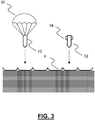
- Figure 3 shows that in addition to, or alternatively to, an impact resistant or accommodating structure of the munition 10, the munition 10 may be provided with a deployable configuration that is arranged, when deployed, to slow the munition 10 in the air before entry into the water 4.
- the speed of decent of the munition downward, through the water 4 to the target may be less important than the speed of delivery of the munition from the gun to the location at/above the target.
- the munition 10 does not need to enter the water 4 at a particularly high velocity. Therefore, deceleration of the munition 10 prior to entering the water 4 is acceptable, and may actually be desirable.
- slowing the munition 10 prior to entering the water 4 may be far simpler or easier to achieve than designing the munition to withstand high speed impact with the water 4. This is because such a design might mean that the cost of the munition is excessive, or that the weight of the munition is excessive, or such that the space within the munition for important explosive material is reduced. In other words, some form of air brake might be advantageous.
- Figure 3 shows that, in one example, the deployable configuration could comprise a parachute 30.
- the parachute could be deployed after a certain time from launch of the munition 10, or could, with appropriate sensing or similar, be deployed upon particular distance proximity sensing with respect to the water 4.
- a similar munition 32 is shown.
- this similar munition 32 comprises a different deployable configuration in the form of one or more deployable wings or fins 34.
- These deployable wings or fins 34 may be deployed in the same manner as the parachute 30 previously described.
- the wings or fins 34 might optionally provide a degree of auto rotation to slow or further slow the munition 32.
- the fins and/or wings 34 previously described may be controllable to provide directional control of the descent of the munition 32, for example via a moveable control surface provided in or by the fins or wings.
- Such control is typically not to be used during projectile-like flight of the munition 32, for example immediately after launch, but instead might be used for a degree of tuning control of the descent of the projectile into the body of water. This might improve engagement accuracy and effectiveness with a target located in the body of water 4.
- the munition according to example embodiments may be free of such directional (descent) control, to ensure that the cost and complexity of the munition is minimised, and such that any related cost or space budget is taken up with more core aspects, such as volume of explosive.
- the munition After entering the body of water, the munition may be arranged to retract or dispose of the deployable configuration, so that the deployable configuration does not slow (or slow to too great an extent) the descent of the munition toward the target.
- the munition might be free of any such deployable configuration, such that there is no impact on descent in the water. Descent through the water may need to be as fast as possible (e.g. to avoid the target moving to avoid the munition).
- the munition After entering the body of water, the munition will descend within the body of water.
- the fuze within the munition is adapted to trigger the explosive charge within the munition in the water (that is under the water surface). This triggering can be achieved in one of a number of different ways. Figures 4 to 6 give typical examples.
- Figure 4 shows that the fuze may be adapted to trigger 40 explosive within the munition 10 in order to successfully and effectively engage an underwater target 42.
- This might be achieved by triggering the explosive charge after a particular time 44, for example from one or more of a combination of launch from the gun barrel described above, and/or a predetermined time period after entering the water 4.
- This time period will typically equate to a particular depth 46 within the water 4 (e.g. based on expected or calculate rate of descent).
- the triggering 40 may occur at the particular depth 46 in combination with or irrespective of the timing 44.
- an alternative or additional approach might involve the direct detection of depth (via one or more sensors or similar).
- Depth may be detected based on time, as above, or perhaps based on water pressure under the surface, the salinity of the water, the temperature of the water, or even at a predetermined speed-of-sound in the water. All of these may be indicative of depth within the water, for example which may be known in advance from mapping of the area, and/or sensed by the munition 10 via one or more sensors when descending through the water.
- the fuze may be also be adapted to trigger the explosive charge upon impact with the target 42.
- it may be safer to employ some form of depth-activation, so that the munition explodes at/near the depth of the target, avoiding possible unintentional explosions at or near objects that are not targets.
- the fuze may be programmed with such criteria, or related criteria necessary for the fuze to trigger the explosive as and when intended.
- Figure 5 shows a different adaptation for triggering 40 an explosive charge of the munition 10 under the water, this time upon magnetic detection 50 of a target magnetic signature 52.
- the target magnetic signature could simply be the detection of anything magnetic, indicating the presence of a magnetic or magnetisable structure. For instance, once a detected magnetic a field strength is above a relevant threshold, the munition 10 might explode.
- it may be known or derivable in advance to determine what the expected magnetic signature 52 of the particular target 42 might be, might look like, or might approximate to. This might equate to field strength, or field lines, or changes therein.
- the munition 10 might not be triggered 40 to explode until the magnetic detection 50 detects a very particular magnetic signature 52, and not simply any magnetic field or change therein. While Figure 5 discusses the use of magnetic fields, much the same principle may be used to detect electric field signatures.
- Figure 6 shows another example of triggering.
- the triggering 40 of the explosive charge in the munition 10 is undertaken based on the detection of pressure waves in the water 4, thereby implementing a sonar-like system 60.
- the system may be implemented in one of a number of different ways.
- the munition 10 may be arranged to detect a pressure wave 62 emanating from target object 42. This could be a sonar pulse 62 originating from the object 42, or simply detection of sound generated by the object 42, or could instead be a reflection 62 of a sonar pulse 64 originating from the munition 10. That is, the projectile 10 may not only detect pressure waves, but may emit pressure waves.
- the explosive charge may be triggered 40 when a target sonar signature is detected 60, and this could be when any pressure wave is detected, or more likely when a pressure wave above a certain threshold is detected, or when a particular pressure wave or a series of pressure waves is detected which is indicative of the presence of a particular target 42.
- the munition may be able to detect or infer entry into the water, or making contact with the water. This might be useful in initiating or priming fuze activity, for example starting a timer, taking a base or initial reading of pressure, salinity, temperature, and so on (or any relevant criteria), or anything which may assist in the subsequent use of the fuze to trigger the explosive.
- This sensing or inference could be via an environmental sensor or similar that is (already) present in order to perform another function, for example those discussed or alluded to above.
- the sensing or inference could be via a dedicated sensor, for example a dedicated impact or water/moisture sensor, or temperate sensor, pressure sensor, salinity sensor, and so on.
- the munition may be able to detect or infer entry into the water, or making contact with the water, for safety reasons, where some (e.g. explosive) function is prevented prior to water contact/entry.
- the munition is adapted to be launched, into the air, from a gun barrel. This gives good range, good targeting accuracy, and good engagement speed, all at relatively low cost.
- the munition may be described as, or form part of, an artillery shell.
- Figure 7 shows such an artillery shell 70.
- the artillery shell 70 comprises a munition 10 according to any embodiment described herein.
- the munition 10 will typically comprise a fuze 72 (likely a programmable fuze, as discussed above), which is adapted to trigger an explosive charge 74 also located within a munition.
- the artillery shell 70 will also comprise a primer 76 and an explosive propellant 78 which may be cased (as shown in Figure 7 ) or bagged.
- a casing 80 might also be provided, to hold the munition 10, explosive 78, and primer 76.
- the fuze could be located in the nose of the munition (e.g. as opposed to behind the nose as shown in Figure 7 ).
- the munition according to the present invention is capable of withstanding explosive propulsion-based launch from a gun barrel, in contrast with for instance a depth charge or torpedo.
- the munition and/or artillery shell (which could be the same thing) will typically have a diameter of 200mm or less, in contrast with depth charges.
- the gun barrel-munition/artillery shell assembly typically will be such that the munition has a range of well over 100 metres, typically over 500 metres, and quite possibly in excess of 1 kilometre or more.
- the munition will be projectile-like, that is not including any self-propulsion, in contrast with a torpedo or similar.
- One or more assemblies can be used to launch one or more munitions with such range and effectiveness, in contrast with the launching of depth charges, helicopters including such depth charges, or multiple torpedoes.
- Figure 8 schematically depicts general principles associated with the method of launching a munition according to an example embodiment.
- the munition comprises an explosive charge, and a fuze.
- the munition is adapted to be launched, into the air, from a gun barrel, and enter a body of water.
- the fuze is adapted to trigger the explosive charge under the water.
- the method comprises launching the munition into the air, from a gun barrel 90.
- the launch is configured such that the munition is launched into the body of water 92, such that, as discussed above, the fuze may then be adapted to trigger the explosive charge under the water 92.
- a munition has been described and detailed.
- the munition includes an explosive charge.
- many of the principles discussed above can still be taken advantage of, but without using a projectile including an explosive charge. That is, the above principles can be used to ensure that a projectile can be launched from a gun barrel and into a body of water, when the projectile is then arranged to interact or engage with an object in the water, but without necessarily including an explosive charge to disable or damage that object.
- the present invention additionally provides a reconnaissance projectile.
- the reconnaissance projectile is adapted to be launched, into the air, from a gun barrel, and then into contact with a body of water (onto the water surface, or to descend below the surface).
- the projectile may be launched at a high range, with a high degree of accuracy, relatively cheaply and quickly.
- the reconnaissance projectile is arranged to initiate a reconnaissance function when in contact with the body of water (which includes when impacting the water, when on the body of water, or, as above, typically when located under the surface of the water).
- the reconnaissance function could be anything of particular use in relation to the particular application, but would typically comprise emission and/or detection of a pressure wave in the body of water, in a manner similar to that discussed above in relation to Figure 6 .
- FIG. 9 shows a reconnaissance projectile 100 in accordance with an example embodiment.
- the reconnaissance projectile 100 comprises a sensor 102.
- the sensor may be used to detect when the projectile 100 has come into contact with a body of water, and/or provide some other sensing functionality, for example one or more of the sensing or initiation criteria described above in relation to the munition.
- the sensor 102 may be arranged to detect a particular passage of time, or a particular pressure change, or particular depth, and so on.
- the reconnaissance projectile 100 also comprises a transceiver 104, in this example.
- the transceiver may be arranged to emit and/or detect pressure waves in the body of water.
- the sensor 102 may initiate or process transmission or detection of the waves by transceiver 104.
- the sensor 102 might, instead or additionally, be or comprise a processor for processing implementing one or more of these functions.
- the reconnaissance projectile may take one of a number of different forms, similar or different to that shown in Figure 9.
- Figure 9 is shown simply as a way of schematically depicting what such a projectile 100 might look like.
- the reconnaissance projectile 100 might be used or fired or launched in isolation in some way. However, it is likely that the projectile, being explosively propelled, might take the form of, or form part of, an artillery shell 110.
- the artillery shell 110 might comprise much the same primer 112, explosive 114 and casing 116 as is already described above in relation to the arrangement of Figure 7 . Referring back to Figure 9 , a difference here is that the artillery shell 110 comprises a non-explosive projectile 100, as opposed to an explosive-carrying munition.
- a reconnaissance projectile may be launched into a body of water in order to perform a reconnaissance function in relation to a target. That reconnaissance projectile may be provided with a transmitter for transmitting reconnaissance information back to the assembly from which the projectile was launched. This reconnaissance information or data may then be used in the programming of subsequently fired or launched explosive munitions according to example embodiments.
- a volley of projectiles may be launched toward an underwater target in accordance with an example embodiment.
- One or more of those projectiles may be a munition as described herein, and one or more of those projectiles may be a reconnaissance projectile as described herein.
- the munitions projectile and the reconnaissance projectile may be arranged to communicate with one another.
- a first-fired reconnaissance projectile may enter the body of water and detect or otherwise signal the presence of a target
- a subsequently fired munitions projectile which may be in the air or in the body of water at the same time as a reconnaissance projectile, may receive reconnaissance information from a reconnaissance projectile and use this in the initiation (or otherwise) of the explosive charge of the munitions projectile.
- This may mean that the munitions projectile does not need to carry sophisticated (or as sophisticated) transmission or sensing equipment, which could reduce overall cost or system complexity.
- the reconnaissance projectile described above could actually be a munitions projectile, for example one of those shown in relation to Figures 5 and 6 .
- One or more munitions projectiles may be arranged to perform a reconnaissance functionality, but not necessarily initiate the explosive charge. Any acquired information on the target may be used to initiate the explosives charge of subsequently launched munitions projectiles.
- Or, or more reconnaissance projectiles may be arranged to perform an explosive function, but not necessarily use the reconnaissance function.
- FIG 10 shows a projectile 120 with reconnaissance functionality 122, 124 entering the body of water 4 in the vicinity of the target 42.
- Reconnaissance functionality 122, 124 might include emission 122 and/or detection 124 of pressure waves.
- the reconnaissance functionality 122, 124 may be completely independent of any explosives charge that the munition 120 is, or is not, provided with. That is, the projectile 120 might have explosive capability, reconnaissance functionality, or a combination of both. Different projectiles 120 launched into the water may have different combinations of such explosive/reconnaissance functionality.
- the explosive charge could be cartridged or bagged charge.
- the casing could be reactive. Any explosive might be dependent on how the system is to be used, for example getting the munition near the target, or simply close enough. In the former, an explosive yielding a high bubble effect might be useful. In the latter, simply the level of blast might be more important.
Landscapes
- Engineering & Computer Science (AREA)
- General Engineering & Computer Science (AREA)
- Chemical & Material Sciences (AREA)
- Combustion & Propulsion (AREA)
- Aiming, Guidance, Guns With A Light Source, Armor, Camouflage, And Targets (AREA)
Priority Applications (38)
| Application Number | Priority Date | Filing Date | Title |
|---|---|---|---|
| EP18275186.7A EP3671103A1 (de) | 2018-12-19 | 2018-12-19 | Munition |
| GB1917754.2A GB2583394B (en) | 2018-12-19 | 2019-12-05 | Munitions and projectiles |
| GB1917753.4A GB2580776B (en) | 2018-12-19 | 2019-12-05 | Munitions and projectiles |
| PCT/GB2019/053533 WO2020128437A2 (en) | 2018-12-19 | 2019-12-13 | A munition and munition assembly |
| EP19821198.9A EP3899413B1 (de) | 2018-12-19 | 2019-12-13 | Munition und munitionsanordnung |
| US17/415,938 US11859953B2 (en) | 2018-12-19 | 2019-12-13 | Munition and munition assembly |
| PL19821198.9T PL3899413T3 (pl) | 2018-12-19 | 2019-12-13 | Amunicja i zespół amunicji |
| CA3122350A CA3122350A1 (en) | 2018-12-19 | 2019-12-17 | Improved apparatus and method suitable for use with a munition |
| GB1918624.6A GB2580785B (en) | 2018-12-19 | 2019-12-17 | A further apparatus and method suitable for use with a munition |
| EP19828295.6A EP3899416B1 (de) | 2018-12-19 | 2019-12-17 | Verbesserte vorrichtung und verfahren zur verwendung mit einer munition |
| PCT/GB2019/053583 WO2020128453A1 (en) | 2018-12-19 | 2019-12-17 | Improvements relating to apparatus and method suitable for use with a munition |
| AU2019403985A AU2019403985B2 (en) | 2018-12-19 | 2019-12-17 | Improved apparatus and method suitable for use with a munition |
| US17/413,233 US11846496B2 (en) | 2018-12-19 | 2019-12-17 | Techniques suitable for use with an object for moving through a fluid, such as a munition or reconnaissance projectile |
| AU2019411517A AU2019411517B2 (en) | 2018-12-19 | 2019-12-17 | Improvements relating to apparatus and method suitable for use with a munition |
| PL19828292.3T PL3899415T3 (pl) | 2018-12-19 | 2019-12-17 | Urządzenie i sposób odpowiednie do stosowania z amunicją |
| CA3123743A CA3123743C (en) | 2018-12-19 | 2019-12-17 | Apparatus and method suitable for use with a munition |
| US17/413,141 US11619475B2 (en) | 2018-12-19 | 2019-12-17 | Fuze arming techniques for a submunition |
| GB1918622.0A GB2580784B (en) | 2018-12-19 | 2019-12-17 | Apparatus and method suitable for use with a munition |
| EP19828294.9A EP3899414B1 (de) | 2018-12-19 | 2019-12-17 | Verbesserungen in bezug auf eine vorrichtung und ein verfahren zur verwendung mit einer munition |
| GB1918630.3A GB2582050B (en) | 2018-12-19 | 2019-12-17 | Improved apparatus and method suitable for use with a munition |
| GB1918625.3A GB2581426B (en) | 2018-12-19 | 2019-12-17 | Improvements relating to apparatus and method suitable for use with a munition |
| PCT/GB2019/053586 WO2020128454A1 (en) | 2018-12-19 | 2019-12-17 | Improved apparatus and method suitable for use with a munition |
| AU2019411513A AU2019411513B2 (en) | 2018-12-19 | 2019-12-17 | Apparatus and method suitable for use with a munition |
| PCT/GB2019/053579 WO2020128451A1 (en) | 2018-12-19 | 2019-12-17 | Apparatus and method suitable for use with a munition |
| EP19828292.3A EP3899415B1 (de) | 2018-12-19 | 2019-12-17 | Vorrichtung und verfahren zur verwendung mit einer munition |
| US17/413,149 US12181264B2 (en) | 2018-12-19 | 2019-12-17 | Programmable system and method for a munition |
| PL19828294.9T PL3899414T3 (pl) | 2018-12-19 | 2019-12-17 | Ulepszenia dotyczące urządzenia i sposobu odpowiednie do stosowania z amunicją |
| CA3123525A CA3123525A1 (en) | 2018-12-19 | 2019-12-17 | Improvements relating to apparatus and method suitable for use with a munition |
| PCT/GB2019/053581 WO2020128452A1 (en) | 2018-12-19 | 2019-12-17 | A further apparatus and method suitable for use with a munition |
| US17/415,929 US11821716B2 (en) | 2018-12-19 | 2019-12-18 | Munitions and projectiles |
| EP19828298.0A EP3899412B1 (de) | 2018-12-19 | 2019-12-18 | Munition und geschosse |
| PCT/GB2019/053598 WO2020128460A1 (en) | 2018-12-19 | 2019-12-18 | Munitions and projectiles |
| PL19828298.0T PL3899412T3 (pl) | 2018-12-19 | 2019-12-18 | Amunicja i pociski |
| PCT/GB2019/053599 WO2020128461A1 (en) | 2018-12-19 | 2019-12-18 | Munitions and projectiles |
| CA3124293A CA3124293C (en) | 2018-12-19 | 2019-12-18 | Munitions and projectiles |
| AU2019403987A AU2019403987B2 (en) | 2018-12-19 | 2019-12-18 | Munitions and projectiles |
| US17/415,909 US12173995B2 (en) | 2018-12-19 | 2019-12-18 | Munitions and projectiles |
| KR1020217022817A KR102705635B1 (ko) | 2018-12-19 | 2019-12-18 | 탄환 및 발사체 |
Applications Claiming Priority (1)
| Application Number | Priority Date | Filing Date | Title |
|---|---|---|---|
| EP18275186.7A EP3671103A1 (de) | 2018-12-19 | 2018-12-19 | Munition |
Publications (1)
| Publication Number | Publication Date |
|---|---|
| EP3671103A1 true EP3671103A1 (de) | 2020-06-24 |
Family
ID=64901446
Family Applications (1)
| Application Number | Title | Priority Date | Filing Date |
|---|---|---|---|
| EP18275186.7A Ceased EP3671103A1 (de) | 2018-12-19 | 2018-12-19 | Munition |
Country Status (1)
| Country | Link |
|---|---|
| EP (1) | EP3671103A1 (de) |
Cited By (1)
| Publication number | Priority date | Publication date | Assignee | Title |
|---|---|---|---|---|
| CN118500209A (zh) * | 2024-05-23 | 2024-08-16 | 哈尔滨工程大学三亚南海创新发展基地 | 一种基于水下高压气泡弹的舰船阻停方法 |
Citations (4)
| Publication number | Priority date | Publication date | Assignee | Title |
|---|---|---|---|---|
| GB2277980A (en) * | 1993-05-13 | 1994-11-16 | Marconi Gec Ltd | Gun launchable shell and fuse |
| US5955698A (en) * | 1998-01-28 | 1999-09-21 | The United States Of America As Represented By The Secretary Of The Navy | Air-launched supercavitating water-entry projectile |
| DE102007048072A1 (de) * | 2007-10-05 | 2009-04-09 | Rheinmetall Waffe Munition Gmbh | Artillerie- oder Mörser-Sprenggeschoss |
| US20140338555A1 (en) * | 2012-04-05 | 2014-11-20 | Lockheed Martin Corporation | Explosive Device and Mini Depth Charge Grenade |
-
2018
- 2018-12-19 EP EP18275186.7A patent/EP3671103A1/de not_active Ceased
Patent Citations (4)
| Publication number | Priority date | Publication date | Assignee | Title |
|---|---|---|---|---|
| GB2277980A (en) * | 1993-05-13 | 1994-11-16 | Marconi Gec Ltd | Gun launchable shell and fuse |
| US5955698A (en) * | 1998-01-28 | 1999-09-21 | The United States Of America As Represented By The Secretary Of The Navy | Air-launched supercavitating water-entry projectile |
| DE102007048072A1 (de) * | 2007-10-05 | 2009-04-09 | Rheinmetall Waffe Munition Gmbh | Artillerie- oder Mörser-Sprenggeschoss |
| US20140338555A1 (en) * | 2012-04-05 | 2014-11-20 | Lockheed Martin Corporation | Explosive Device and Mini Depth Charge Grenade |
Cited By (1)
| Publication number | Priority date | Publication date | Assignee | Title |
|---|---|---|---|---|
| CN118500209A (zh) * | 2024-05-23 | 2024-08-16 | 哈尔滨工程大学三亚南海创新发展基地 | 一种基于水下高压气泡弹的舰船阻停方法 |
Similar Documents
| Publication | Publication Date | Title |
|---|---|---|
| GB2580784A (en) | Apparatus and method suitable for use with a munition | |
| US11859953B2 (en) | Munition and munition assembly | |
| AU2019411513B2 (en) | Apparatus and method suitable for use with a munition | |
| WO2020128461A1 (en) | Munitions and projectiles | |
| GB2586820A (en) | A munition and munition assembly | |
| US11821716B2 (en) | Munitions and projectiles | |
| WO2020128460A1 (en) | Munitions and projectiles | |
| US12173995B2 (en) | Munitions and projectiles | |
| EP3671103A1 (de) | Munition | |
| CA3123743C (en) | Apparatus and method suitable for use with a munition | |
| CA3124293C (en) | Munitions and projectiles |
Legal Events
| Date | Code | Title | Description |
|---|---|---|---|
| PUAI | Public reference made under article 153(3) epc to a published international application that has entered the european phase |
Free format text: ORIGINAL CODE: 0009012 |
|
| AK | Designated contracting states |
Kind code of ref document: A1 Designated state(s): AL AT BE BG CH CY CZ DE DK EE ES FI FR GB GR HR HU IE IS IT LI LT LU LV MC MK MT NL NO PL PT RO RS SE SI SK SM TR |
|
| AX | Request for extension of the european patent |
Extension state: BA ME |
|
| STAA | Information on the status of an ep patent application or granted ep patent |
Free format text: STATUS: THE APPLICATION HAS BEEN REFUSED |
|
| 18R | Application refused |
Effective date: 20200712 |