EP3671330A1 - Rückbeleuchtungsmodul, anzeigevorrichtung und verfahren zur anpassung der helligkeit des aus einem rückbeleuchtungsmodul ausgegebenen lichts - Google Patents
Rückbeleuchtungsmodul, anzeigevorrichtung und verfahren zur anpassung der helligkeit des aus einem rückbeleuchtungsmodul ausgegebenen lichts Download PDFInfo
- Publication number
- EP3671330A1 EP3671330A1 EP18845689.1A EP18845689A EP3671330A1 EP 3671330 A1 EP3671330 A1 EP 3671330A1 EP 18845689 A EP18845689 A EP 18845689A EP 3671330 A1 EP3671330 A1 EP 3671330A1
- Authority
- EP
- European Patent Office
- Prior art keywords
- electrode
- substrate
- backlight module
- reflective component
- brightness
- Prior art date
- Legal status (The legal status is an assumption and is not a legal conclusion. Google has not performed a legal analysis and makes no representation as to the accuracy of the status listed.)
- Withdrawn
Links
- 238000000034 method Methods 0.000 title claims abstract description 17
- 238000002310 reflectometry Methods 0.000 claims abstract description 17
- 239000000758 substrate Substances 0.000 claims description 114
- 239000002245 particle Substances 0.000 claims description 44
- 238000005192 partition Methods 0.000 claims description 27
- 239000003094 microcapsule Substances 0.000 claims description 24
- 239000000463 material Substances 0.000 claims description 17
- 230000005684 electric field Effects 0.000 claims description 13
- 239000004020 conductor Substances 0.000 claims description 6
- 229920000139 polyethylene terephthalate Polymers 0.000 claims description 5
- 239000005020 polyethylene terephthalate Substances 0.000 claims description 5
- 239000002184 metal Substances 0.000 claims description 4
- 229910052751 metal Inorganic materials 0.000 claims description 4
- -1 polyethylene terephthalate Polymers 0.000 claims description 4
- OKTJSMMVPCPJKN-UHFFFAOYSA-N Carbon Chemical compound [C] OKTJSMMVPCPJKN-UHFFFAOYSA-N 0.000 claims description 3
- 239000004642 Polyimide Substances 0.000 claims description 3
- 239000011521 glass Substances 0.000 claims description 3
- 229910002804 graphite Inorganic materials 0.000 claims description 3
- 239000010439 graphite Substances 0.000 claims description 3
- 229920003229 poly(methyl methacrylate) Polymers 0.000 claims description 3
- 229920001721 polyimide Polymers 0.000 claims description 3
- 239000004926 polymethyl methacrylate Substances 0.000 claims description 3
- 230000000694 effects Effects 0.000 abstract description 24
- 238000002360 preparation method Methods 0.000 abstract description 4
- 238000010586 diagram Methods 0.000 description 7
- 230000008901 benefit Effects 0.000 description 6
- 239000004973 liquid crystal related substance Substances 0.000 description 5
- 238000013461 design Methods 0.000 description 4
- 238000009792 diffusion process Methods 0.000 description 4
- 238000004519 manufacturing process Methods 0.000 description 3
- 238000002834 transmittance Methods 0.000 description 3
- 210000002858 crystal cell Anatomy 0.000 description 2
- 230000004075 alteration Effects 0.000 description 1
- 239000011248 coating agent Substances 0.000 description 1
- 238000000576 coating method Methods 0.000 description 1
- 239000003086 colorant Substances 0.000 description 1
- 230000008094 contradictory effect Effects 0.000 description 1
- 238000009826 distribution Methods 0.000 description 1
- 238000002474 experimental method Methods 0.000 description 1
- 230000004907 flux Effects 0.000 description 1
- 239000007769 metal material Substances 0.000 description 1
- 238000012986 modification Methods 0.000 description 1
- 230000004048 modification Effects 0.000 description 1
- 230000003287 optical effect Effects 0.000 description 1
- 238000011160 research Methods 0.000 description 1
- 230000000717 retained effect Effects 0.000 description 1
- 229910052709 silver Inorganic materials 0.000 description 1
- 239000004332 silver Substances 0.000 description 1
Images


Classifications
-
- G—PHYSICS
- G02—OPTICS
- G02F—OPTICAL DEVICES OR ARRANGEMENTS FOR THE CONTROL OF LIGHT BY MODIFICATION OF THE OPTICAL PROPERTIES OF THE MEDIA OF THE ELEMENTS INVOLVED THEREIN; NON-LINEAR OPTICS; FREQUENCY-CHANGING OF LIGHT; OPTICAL LOGIC ELEMENTS; OPTICAL ANALOGUE/DIGITAL CONVERTERS
- G02F1/00—Devices or arrangements for the control of the intensity, colour, phase, polarisation or direction of light arriving from an independent light source, e.g. switching, gating or modulating; Non-linear optics
- G02F1/01—Devices or arrangements for the control of the intensity, colour, phase, polarisation or direction of light arriving from an independent light source, e.g. switching, gating or modulating; Non-linear optics for the control of the intensity, phase, polarisation or colour
- G02F1/13—Devices or arrangements for the control of the intensity, colour, phase, polarisation or direction of light arriving from an independent light source, e.g. switching, gating or modulating; Non-linear optics for the control of the intensity, phase, polarisation or colour based on liquid crystals, e.g. single liquid crystal display cells
- G02F1/133—Constructional arrangements; Operation of liquid crystal cells; Circuit arrangements
- G02F1/1333—Constructional arrangements; Manufacturing methods
- G02F1/1335—Structural association of cells with optical devices, e.g. polarisers or reflectors
- G02F1/1336—Illuminating devices
- G02F1/133615—Edge-illuminating devices, i.e. illuminating from the side
-
- G—PHYSICS
- G02—OPTICS
- G02B—OPTICAL ELEMENTS, SYSTEMS OR APPARATUS
- G02B6/00—Light guides; Structural details of arrangements comprising light guides and other optical elements, e.g. couplings
- G02B6/0001—Light guides; Structural details of arrangements comprising light guides and other optical elements, e.g. couplings specially adapted for lighting devices or systems
- G02B6/0011—Light guides; Structural details of arrangements comprising light guides and other optical elements, e.g. couplings specially adapted for lighting devices or systems the light guides being planar or of plate-like form
- G02B6/0033—Means for improving the coupling-out of light from the light guide
- G02B6/005—Means for improving the coupling-out of light from the light guide provided by one optical element, or plurality thereof, placed on the light output side of the light guide
- G02B6/0055—Reflecting element, sheet or layer
-
- G—PHYSICS
- G02—OPTICS
- G02F—OPTICAL DEVICES OR ARRANGEMENTS FOR THE CONTROL OF LIGHT BY MODIFICATION OF THE OPTICAL PROPERTIES OF THE MEDIA OF THE ELEMENTS INVOLVED THEREIN; NON-LINEAR OPTICS; FREQUENCY-CHANGING OF LIGHT; OPTICAL LOGIC ELEMENTS; OPTICAL ANALOGUE/DIGITAL CONVERTERS
- G02F1/00—Devices or arrangements for the control of the intensity, colour, phase, polarisation or direction of light arriving from an independent light source, e.g. switching, gating or modulating; Non-linear optics
- G02F1/01—Devices or arrangements for the control of the intensity, colour, phase, polarisation or direction of light arriving from an independent light source, e.g. switching, gating or modulating; Non-linear optics for the control of the intensity, phase, polarisation or colour
- G02F1/13—Devices or arrangements for the control of the intensity, colour, phase, polarisation or direction of light arriving from an independent light source, e.g. switching, gating or modulating; Non-linear optics for the control of the intensity, phase, polarisation or colour based on liquid crystals, e.g. single liquid crystal display cells
- G02F1/133—Constructional arrangements; Operation of liquid crystal cells; Circuit arrangements
- G02F1/1333—Constructional arrangements; Manufacturing methods
- G02F1/1335—Structural association of cells with optical devices, e.g. polarisers or reflectors
- G02F1/1336—Illuminating devices
- G02F1/133601—Illuminating devices for spatial active dimming
-
- G—PHYSICS
- G02—OPTICS
- G02F—OPTICAL DEVICES OR ARRANGEMENTS FOR THE CONTROL OF LIGHT BY MODIFICATION OF THE OPTICAL PROPERTIES OF THE MEDIA OF THE ELEMENTS INVOLVED THEREIN; NON-LINEAR OPTICS; FREQUENCY-CHANGING OF LIGHT; OPTICAL LOGIC ELEMENTS; OPTICAL ANALOGUE/DIGITAL CONVERTERS
- G02F1/00—Devices or arrangements for the control of the intensity, colour, phase, polarisation or direction of light arriving from an independent light source, e.g. switching, gating or modulating; Non-linear optics
- G02F1/01—Devices or arrangements for the control of the intensity, colour, phase, polarisation or direction of light arriving from an independent light source, e.g. switching, gating or modulating; Non-linear optics for the control of the intensity, phase, polarisation or colour
- G02F1/13—Devices or arrangements for the control of the intensity, colour, phase, polarisation or direction of light arriving from an independent light source, e.g. switching, gating or modulating; Non-linear optics for the control of the intensity, phase, polarisation or colour based on liquid crystals, e.g. single liquid crystal display cells
- G02F1/133—Constructional arrangements; Operation of liquid crystal cells; Circuit arrangements
- G02F1/1333—Constructional arrangements; Manufacturing methods
- G02F1/1335—Structural association of cells with optical devices, e.g. polarisers or reflectors
- G02F1/1336—Illuminating devices
- G02F1/133602—Direct backlight
- G02F1/133605—Direct backlight including specially adapted reflectors
-
- G—PHYSICS
- G02—OPTICS
- G02F—OPTICAL DEVICES OR ARRANGEMENTS FOR THE CONTROL OF LIGHT BY MODIFICATION OF THE OPTICAL PROPERTIES OF THE MEDIA OF THE ELEMENTS INVOLVED THEREIN; NON-LINEAR OPTICS; FREQUENCY-CHANGING OF LIGHT; OPTICAL LOGIC ELEMENTS; OPTICAL ANALOGUE/DIGITAL CONVERTERS
- G02F1/00—Devices or arrangements for the control of the intensity, colour, phase, polarisation or direction of light arriving from an independent light source, e.g. switching, gating or modulating; Non-linear optics
- G02F1/01—Devices or arrangements for the control of the intensity, colour, phase, polarisation or direction of light arriving from an independent light source, e.g. switching, gating or modulating; Non-linear optics for the control of the intensity, phase, polarisation or colour
- G02F1/165—Devices or arrangements for the control of the intensity, colour, phase, polarisation or direction of light arriving from an independent light source, e.g. switching, gating or modulating; Non-linear optics for the control of the intensity, phase, polarisation or colour based on translational movement of particles in a fluid under the influence of an applied field
- G02F1/166—Devices or arrangements for the control of the intensity, colour, phase, polarisation or direction of light arriving from an independent light source, e.g. switching, gating or modulating; Non-linear optics for the control of the intensity, phase, polarisation or colour based on translational movement of particles in a fluid under the influence of an applied field characterised by the electro-optical or magneto-optical effect
- G02F1/167—Devices or arrangements for the control of the intensity, colour, phase, polarisation or direction of light arriving from an independent light source, e.g. switching, gating or modulating; Non-linear optics for the control of the intensity, phase, polarisation or colour based on translational movement of particles in a fluid under the influence of an applied field characterised by the electro-optical or magneto-optical effect by electrophoresis
-
- G—PHYSICS
- G02—OPTICS
- G02F—OPTICAL DEVICES OR ARRANGEMENTS FOR THE CONTROL OF LIGHT BY MODIFICATION OF THE OPTICAL PROPERTIES OF THE MEDIA OF THE ELEMENTS INVOLVED THEREIN; NON-LINEAR OPTICS; FREQUENCY-CHANGING OF LIGHT; OPTICAL LOGIC ELEMENTS; OPTICAL ANALOGUE/DIGITAL CONVERTERS
- G02F1/00—Devices or arrangements for the control of the intensity, colour, phase, polarisation or direction of light arriving from an independent light source, e.g. switching, gating or modulating; Non-linear optics
- G02F1/01—Devices or arrangements for the control of the intensity, colour, phase, polarisation or direction of light arriving from an independent light source, e.g. switching, gating or modulating; Non-linear optics for the control of the intensity, phase, polarisation or colour
- G02F1/165—Devices or arrangements for the control of the intensity, colour, phase, polarisation or direction of light arriving from an independent light source, e.g. switching, gating or modulating; Non-linear optics for the control of the intensity, phase, polarisation or colour based on translational movement of particles in a fluid under the influence of an applied field
- G02F1/1675—Constructional details
- G02F1/16757—Microcapsules
-
- G—PHYSICS
- G02—OPTICS
- G02F—OPTICAL DEVICES OR ARRANGEMENTS FOR THE CONTROL OF LIGHT BY MODIFICATION OF THE OPTICAL PROPERTIES OF THE MEDIA OF THE ELEMENTS INVOLVED THEREIN; NON-LINEAR OPTICS; FREQUENCY-CHANGING OF LIGHT; OPTICAL LOGIC ELEMENTS; OPTICAL ANALOGUE/DIGITAL CONVERTERS
- G02F1/00—Devices or arrangements for the control of the intensity, colour, phase, polarisation or direction of light arriving from an independent light source, e.g. switching, gating or modulating; Non-linear optics
- G02F1/01—Devices or arrangements for the control of the intensity, colour, phase, polarisation or direction of light arriving from an independent light source, e.g. switching, gating or modulating; Non-linear optics for the control of the intensity, phase, polarisation or colour
- G02F1/165—Devices or arrangements for the control of the intensity, colour, phase, polarisation or direction of light arriving from an independent light source, e.g. switching, gating or modulating; Non-linear optics for the control of the intensity, phase, polarisation or colour based on translational movement of particles in a fluid under the influence of an applied field
- G02F1/1675—Constructional details
- G02F1/1676—Electrodes
-
- G—PHYSICS
- G02—OPTICS
- G02F—OPTICAL DEVICES OR ARRANGEMENTS FOR THE CONTROL OF LIGHT BY MODIFICATION OF THE OPTICAL PROPERTIES OF THE MEDIA OF THE ELEMENTS INVOLVED THEREIN; NON-LINEAR OPTICS; FREQUENCY-CHANGING OF LIGHT; OPTICAL LOGIC ELEMENTS; OPTICAL ANALOGUE/DIGITAL CONVERTERS
- G02F1/00—Devices or arrangements for the control of the intensity, colour, phase, polarisation or direction of light arriving from an independent light source, e.g. switching, gating or modulating; Non-linear optics
- G02F1/01—Devices or arrangements for the control of the intensity, colour, phase, polarisation or direction of light arriving from an independent light source, e.g. switching, gating or modulating; Non-linear optics for the control of the intensity, phase, polarisation or colour
- G02F1/165—Devices or arrangements for the control of the intensity, colour, phase, polarisation or direction of light arriving from an independent light source, e.g. switching, gating or modulating; Non-linear optics for the control of the intensity, phase, polarisation or colour based on translational movement of particles in a fluid under the influence of an applied field
- G02F1/1675—Constructional details
- G02F1/1677—Structural association of cells with optical devices, e.g. reflectors or illuminating devices
-
- G—PHYSICS
- G09—EDUCATION; CRYPTOGRAPHY; DISPLAY; ADVERTISING; SEALS
- G09G—ARRANGEMENTS OR CIRCUITS FOR CONTROL OF INDICATING DEVICES USING STATIC MEANS TO PRESENT VARIABLE INFORMATION
- G09G3/00—Control arrangements or circuits, of interest only in connection with visual indicators other than cathode-ray tubes
- G09G3/20—Control arrangements or circuits, of interest only in connection with visual indicators other than cathode-ray tubes for presentation of an assembly of a number of characters, e.g. a page, by composing the assembly by combination of individual elements arranged in a matrix no fixed position being assigned to or needed to be assigned to the individual characters or partial characters
- G09G3/34—Control arrangements or circuits, of interest only in connection with visual indicators other than cathode-ray tubes for presentation of an assembly of a number of characters, e.g. a page, by composing the assembly by combination of individual elements arranged in a matrix no fixed position being assigned to or needed to be assigned to the individual characters or partial characters by control of light from an independent source
- G09G3/3406—Control of illumination source
Definitions
- the present disclosure relates to the field of display technology, and particularly to a backlight module, a display device and a method for adjusting a brightness of the backlight module.
- High dynamic range (HDR) images can provide more dynamic range and image detail, which improves the contrast of the images. Therefore, high dynamic range image technology has unparalleled advantages in the field of liquid crystal display. It can present more vivid colors, black is deeper, objects in the image are more clear, and the color gamut is also expanded.
- the liquid crystal display also needs to be adjusted accordingly: in the liquid crystal display device that realizes the display effect of the high dynamic range image, the backlight brightness also needs to be dynamically adjusted by the backlight module to improve the contrast, thereby meeting the requirements of displaying high dynamic range images.
- a backlight module in an aspect of the present disclosure, includes: a light guide plate including a light emitting surface and a first surface opposite to the light emitting surface; and a reflective component on a side of the light guide plate away from the light emitting surface; the reflective component having a reflectivity adjustable to adjust a brightness of the backlight module.
- the reflective component includes electronic ink.
- the reflective component includes: a first substrate and a second substrate opposite to each other, and electronic ink between the first substrate and the second substrate; the first substrate is closer to the light guide plate than the second substrate; the first substrate is provided with at least one first electrode, and the second substrate is provided with at least one second electrode; the at least one first electrode is in one-to-one correspondence with the at least one second electrode.
- the reflective component further includes: a reflective layer between the first substrate and the second substrate, and located on the second substrate.
- the reflective layer and the at least one second electrode are disposed on a same side of the second substrate; alternatively, the reflective layer and the at least one second electrode are respectively disposed on both sides of the second substrate.
- a material of the first electrode is a transparent conductive material
- a material of the second electrode includes at least one of graphite, a metal, and a transparent conductive material.
- a material of at least one of the first substrate and the second substrate includes at least one of polyethylene terephthalate, glass, polyimide, and polymethyl methacrylate.
- the electronic ink includes a plurality of microcapsules; each microcapsule is encapsulated with first particles and second particles; the first particles and the second particles are oppositely charged; the first particles are black and the second particles are white.
- an orthographic projection of the at least one first electrode on the first substrate and an orthographic projection of a corresponding second electrode on the first substrate are substantially overlapping.
- each first electrode includes a plurality of first sub-electrodes
- the corresponding second electrode includes a plurality of second sub-electrodes; the first sub-electrodes are in one-to-one correspondence with the plurality of second sub-electrodes.
- the reflective component further includes: at least one retaining wall between the first substrate and the second substrate separating the electronic ink.
- the reflective component is divided into a plurality of display partitions, each of the plurality of display partitions being provided with one first electrode and one second electrode.
- a display device in another aspect of the present disclosure, includes the backlight module described in any one of the above-mentioned embodiments.
- a method for adjusting a brightness of a backlight module includes: a light guide plate including a light emitting surface and a first surface opposite to the light emitting surface; and a reflective component on a side of the light guide plate away from the light emitting surface; the reflective component having a reflectivity adjustable to adjust the brightness of the backlight module.
- the method includes: adjusting the reflectivity of the reflective component to adjust the brightness of the backlight module.
- the reflective component includes: a first substrate and a second substrate opposite to each other, and electronic ink between the first substrate and the second substrate; the first substrate is closer to the light guide plate than the second substrate; the first substrate is provided with at least one first electrode, and the second substrate is provided with at least one second electrode; the at least one first electrode is in one-to-one correspondence with the at least one second electrode.
- the step of adjusting the reflectivity of the reflective component to adjust the brightness of the backlight module includes: applying opposite voltages to the first electrode and the corresponding second electrode respectively, thereby adjusting the reflectivity of the backlight module using the electronic ink.
- the method further includes: separately controlling an electric field between each first electrode and a corresponding second electrode.
- the step of separately controlling an electric field between each first electrode and a corresponding second electrode includes: separately controlling an electric field direction and/or electric field strength between each first electrode and the corresponding second electrode.
- the inventors have found that current backlight modules and display devices generally have problems such as immutable brightness of backlight module, low contrast, excessive thickness, poor service life, high cost, complicated preparation methods, and the like, and they cannot realize the display effect of the high dynamic range image.
- the inventors have conducted in-depth research and a large number of experiments and found that this is mainly because the backlight brightness of the conventional display cannot be dynamically adjusted by the backlight module.
- the brightness at different positions of the backlight module is uniform, and only the gray scale is used to display multiple brightnesses. Therefore, the contrast is not high, and it is difficult to meet the requirement on the contrast in the HDR display.
- the backlight module includes: a light guide plate 100 including a light emitting surface 110 and a first surface 120 opposite to the light emitting surface 110.
- a reflective component 200 is disposed on a side of the light guide plate 100 away from the light emitting surface 110.
- the reflective component 200 has an adjustable reflectivity, thereby adjusting a brightness of the backlight module.
- the reflective component 200 in the backlight module can be used to dynamically adjust the brightness of the backlight and improve the contrast between multiple regions of the backlight module, thereby realizing the display effect of the high dynamic range image.
- the backlight module is low in cost, simple in preparation, and suitable for various types of display devices.
- the reflective component 200 includes electronic ink.
- the backlight brightness can be dynamically adjusted by using the electronic ink in the reflective component 200, and the contrast between multiple regions of the backlight module can be improved, thereby realizing the display effect of the high dynamic range image.
- the inventors have unexpectedly discovered that the above backlight module manufactured by the electronic ink technology can be used in a display device. Since the display effect of the high dynamic range image is realized by modifying the backlight module, the display effect of the high dynamic range image can be realized in the full-size display device, and is not subject to the arrangement and control mode of the LED.
- the structure, circuit and IC control of the display device do not need to be changed. That is to say, the display device manufactured by using the electronic ink only needs to manufacture the backlight module by using the electronic ink technology. Only the backlight module is modified, and other structures of the display device (for example, a driving circuit) need not to be modified. Some designs are the fastest to achieve high dynamic range image display.
- the display device is lighter and thinner, the light transmittance is not affected, and there is no light consumption in the optical path. Furthermore, by applying the backlight module according to the embodiment of the present disclosure, it is possible to avoid adding an array of LEDs into the backlight module, or adding a design of a liquid crystal cell for adjusting brightness, thereby realizing HDR display without significantly increasing the thickness of the backlight module.
- the display device manufactured by using the backlight module is lighter and thinner, can dynamically adjust the backlight brightness, improve the contrast between multiple regions of the backlight module, and the display effect of the high dynamic range image is thus realized.
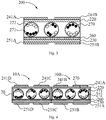
- the reflective component 200 includes: a first substrate 220 and a second substrate 230 disposed opposite to each other, and electronic ink between the first substrate 220 and the second substrate 230.
- the first substrate 220 is closer to the light guide plate 100 than the second substrate 230; the first substrate 220 is provided with at least one first electrode 240, and the second substrate 230 is provided with at least one second electrode 250; the at least one first electrode 240 is in one-to-one correspondence with the at least one second electrode 250.
- the electronic ink includes a plurality of microcapsules 270; each microcapsule 270 is encapsulated with first particles 271 and second particles 272; the first particles 271 and the second particles 272 are oppositely charged; the first particles 271 are black and the second particles 272 are white.
- the first substrate 220 is provided with the first electrode 240
- the second substrate 230 is provided with the second electrode 250
- the first electrode 240 and the second electrode 250 are correspondingly disposed. Therefore, the display of the electronic ink can be controlled by the first electrode 240 and the second electrode 250. In this way, the display effect of the display device using the backlight module can be further improved.
- first substrate and “second substrate” are for the purpose of description only, and are used to distinguish two substrates above and below the electronic ink, and are not to be understood as indicating or suggesting relative importance or position limitation.
- the arrangement position of the first electrode 240 is not particularly limited.
- the first electrode 240 may be disposed on a side of the first substrate 220 away from the microcapsules 270, or may be disposed on a side of the first substrate 220 close to the microcapsules 270.
- the arrangement position of the second electrode 250 is not particularly limited.
- the second electrode 250 may be disposed on a side of the second substrate 230 away from the microcapsules 270, or may be disposed on a side of the second substrate 230 close to the microcapsules 270.
- the first substrate 220 is disposed above the microcapsules 270 and close to the light guide plate 100, and the first electrode 240 is disposed on a side of the first substrate 220 away from the microcapsules 270; the second substrate 230 is disposed under the microcapsules 270 and away from the light guide plate 100, and the second electrode 250 is disposed on a side of the second substrate 230 away from the microcapsules 270.
- the specific types of the first particle 271 and the second particle 272 are not particularly limited. It's only required that one of them is required to be black, the other is white, and they are charged oppositely.
- the first particles 271 can be black and negatively charged; the second particles 272 can be white and positively charged. Therefore, the reflectance can be adjusted by the first particles 271 and the second particles 272 in the microcapsules 270 to achieve dynamic adjustment of the backlight brightness.
- the specific number of the first particles 271 and the second particles 272 encapsulated by each microcapsule 270 is not particularly limited, and it is only necessary to achieve dynamic adjustment of the backlight brightness by using the microcapsules 270 in the electronic ink.
- the negatively charged black first particles 271 and positively charged white second particles 272 are attracted and repelled, respectively.
- the second electrode 250 is provided with a positive voltage
- the negatively charged black first particles 271 are attracted, and the positively charged white second particles 272 are repelled.
- the first electrode 240 is provided with a negative voltage
- the positively charged white second particles 272 are attracted, and the negatively charged black first particles 271 are repelled.
- the black first particles 271 absorb light
- the white second particles 272 reflect light.
- the ratio between the black first particles 271 and the white second particles 272 can be adjusted by changing the magnitude of the voltage of the first electrode 240 and the second electrode 250, thereby achieving optimal reflection adjustment and realizing adjustment of brightness. That is, the number of the first particles 271 and the second particles 272 that are attracted and repelled is changed, the amount of the reflected light is further changed, the brightness of the backlight is dynamically adjusted. In this way, the contrast between multiple regions of the backlight module is improved, and the display effect of high dynamic range images is realized.
- each first electrode 240 includes a plurality of first sub-electrodes 241 (indicated with 241A and 241B in Fig. 3 ), and the corresponding second electrode 250 includes a plurality of second sub-electrodes 251 (indicated with 251A and 251B in Fig. 3 ); the first sub-electrodes 241 are in one-to-one correspondence with the plurality of second sub-electrodes 251.
- the reflection for the backlight by the microcapsules 270 disposed between the first sub-electrode 241 and the second sub-electrode 251 can be adjusted by the correspondingly disposed first sub-electrode 241 and second sub-electrode 251.
- the second sub-electrode 251A may be provided with a positive voltage
- the first sub-electrode 241A may be provided with a negative voltage.
- the negatively charged black first particles 271 may be attracted by the second sub-electrode 251A, and the positively charged white second particles 272 are repelled by the second sub-electrode 251A.
- first and second sub-electrodes may be provided with voltages different from 241A and 251A. In this way, the electronic ink provided between the first substrate and the second substrate can have multiple states, thereby realizing the display effect of the high dynamic range image.
- the first particles 271 and the second particles 272 are voltage-controlled without conduction of current, such a control mode has low power consumption, is more convenient and efficient for controlling. This control mode does not require complicated driving circuits and driving chips, thereby improving design feasibility and versatility.
- a viewing angle of nearly 180 degrees can be achieved, and light in all directions can be sufficiently reflected, thereby achieving an optimal display effect.
- the reflective component 200 further includes: a reflective layer 260.
- the first substrate 220 is disposed close to the first surface 120 of the light guide plate; the reflective layer 260 is arranged between the first substrate 220 and the second substrate 230, and located on the second substrate 230.
- the reflective layer 260 and the at least one second electrode 250 are disposed on a same side of the second substrate 230; alternatively, the reflective layer 260 and the at least one second electrode 250 are respectively disposed on both sides of the second substrate 230.
- the reflective layer 260 may be disposed on a side of the second substrate 230 adjacent to the microcapsules 270, and the second electrode 250 is disposed on a side of the second substrate 230 away from the microcapsules 270, that is, the reflective layer 260 and the second electrode 250 are respectively disposed on both sides of the second substrate 230.
- the second electrode 250 may also be multiplexed as a reflective layer 260.
- the second electrode 250 formed using a reflective metal may be multiplexed as the reflective layer 260.
- the second electrode 250 also functions as a reflective layer.
- the material of the reflective layer 260 is not particularly limited, and it is only necessary to increase the light reflectance to meet the brightness requirement. For example, at least one of bright mirror silver and a conventional white reflective coating can be used.
- a material of the first electrode 240 is a transparent conductive material. In this way, the reflection of the backlight by the electronic ink is not affected.
- a material of the second electrode 250 includes at least one of graphite, a metal, and a transparent conductive material. Since the electrode disposed away from the light guide plate does not affect the reflection for the backlight, it is not necessary to consider the light transmittance of the material of this electrode. Therefore, the electrode disposed away from the light guide plate 100 can be formed of a metal material having a low light transmittance, so that the production cost can be further reduced.
- the materials of the first substrate 220 and the second substrate 230 are not particularly limited, and those skilled in the art can select the materials according to actual needs.
- a material of at least one of the first substrate 220 and the second substrate 230 includes at least one of polyethylene terephthalate, glass, polyimide, and polymethyl methacrylate.
- PET polyethylene terephthalate
- PET may be selected as the material of the first substrate 220 and/or the second substrate 230.
- the backlight module may be partitioned.
- the first substrate is provided with a plurality of first electrodes
- the second substrate is provided with a plurality of second electrodes. Therefore, the reflective component 200 can be divided into a plurality of display partitions 10, and each of the plurality of display partitions 10 is provided with a first electrode 240 (not shown) and a second electrode 250 (not shown).
- partitions can independently adjust the electric field applied to the microcapsules 270 through the first electrode 240 and the second electrode 250, so that the reflection for the backlight by the microcapsules 270 at different partitions can be different. Therefore, when the HDR display is performed, the entire screen has a sufficiently large contrast, so that the bright portion of the displayed image can have appropriate brightness and be kept clear, and the portion in the dark can also retain all the details, realizing high-definition display for the bright and dark partitions.
- a plurality of display partitions 10 (10A and 10B as shown in the drawing) are included on the first substrate 220 or the second substrate 230.
- the voltages applied on the first electrode and the second electrode can be different.
- the display partitions may have different reflectivities for backlight.
- the reflective component 200 may further include a retaining wall 20.
- the reflective component further includes at least one retaining wall 20 disposed between the first substrate 220 and the second substrate 230 for separating the electronic ink (i.e., dividing the electronic ink into a plurality of display partitions).
- the plurality of display partitions can be utilized to further realize the display effect of the high dynamic range image.
- a first electrode 240 may include a plurality of first sub-electrodes 241
- a second electrode 250 may include a plurality of second sub-electrodes 251
- the first sub-electrodes 241 are one-to-one corresponding to the second sub-electrodes 251. Therefore, the display effect of the high dynamic range image can be achieved.
- the first sub-electrode 241A corresponds to the second sub-electrode 251A
- the first sub-electrode 241B corresponds to the second sub-electrode 251B
- the first sub-electrode 241A corresponds to the second sub-electrode 251A
- the first sub-electrode 241B corresponds to the second sub-electrode 251B.
- different voltages different polarities or different voltage values
- the first sub-electrodes e.g., 241C and 241D as shown in the drawing. Therefore, it is possible to more accurately control the reflection for the backlight by the electronic ink in the same display partition.
- opposite voltages are applied to the first sub-electrode 241 and the second sub-electrode 251 that are disposed correspondingly.
- a positive voltage is applied to the first sub-electrode 241A
- a negative voltage is applied to the second sub-electrode 251A.
- the voltage applied between the first sub-electrodes 241 of the same display partition is not particularly limited.
- the first sub-electrode 241A and the first sub-electrode 241B may be provided with the same voltage or different voltages. Therefore, the backlight brightness of each display partition can be separately controlled.
- the number of the display partitions 10 in the reflective component 200 is not particularly limited, and those skilled in the art can select it according to actual needs.
- a plurality of display partitions 10 are included on the first substrate 220 or the second substrate 230.
- the plurality of display partitions 10 are distributed in a central area of the first substrate 220 or the second substrate 230, and are arranged in an array. In this way, the main display area of the screen can be arrayed and partitioned, thereby meeting most of the HDR display requirements.
- a plurality of elongated display partitions 10 may be included in the reflective component 200. Therefore, the entire display area of the display screen using the backlight module can be partitioned.
- the backlight module 1000 further includes a light source 300 and a brightness enhancement component 400.
- the light source 300 is arranged to provide light to the light guide plate 100, and the brightness enhancement component 400 is disposed on a side of the light guide plate 100 away from the reflective component 200.
- the type of the light source 300 is not particularly limited, and those skilled in the art can select it according to actual needs.
- the light source 300 may be a lateral-type light source or a direct light source.
- the position of the lateral-type light source or the direct light source is not particularly limited, and those skilled in the art can set the position according to the relative position between the conventional lateral-type/direct light source and the light guide plate.
- the backlight module can be applied to various types of display devices.
- the brightness enhancement component 400 further includes a diffusion film 410 and a brightness enhancement film 420.
- the diffusion film 410 is disposed on a side of the light guide plate 100 away from the reflective component 200
- the brightness enhancement film 420 is disposed on a side of the diffusion film 410 away from the light guide plate 100.
- the brightness enhancement disposed 400 may further include: a prism film.
- the prism film can improve the angular distribution of light. The light emitted from the diffusion film 410 and uniformly diverged at various angles can be concentrated to an axial angle, i.e., a front view angle. The axial brightness is thus increased without increasing the total luminous flux.
- the backlight module according to the embodiment of the present disclosure has a simple structure and a small thickness, and does not involve preparing an array of LEDs or additionally adding a liquid crystal cell to dynamically adjust the backlight brightness.
- the contrast between multiple regions of the backlight module is improved, and the display effect of the high dynamic range image is realized.
- the backlight module is low in cost, simple in preparation, and suitable for various types of display devices.
- only the reflective structure at the bottom of the conventional backlight module needs to be modified, without changing other structures of the display device.
- the conventional backlight module can be utilized and improved easily, which is advantageous for reducing the cost of production. Further, the dynamic brightness adjustment of the display partition can be realized easily, thereby realizing the display effect of the high dynamic range image.
- a display device in another aspect of the present disclosure, includes the backlight module described in any one of the above-mentioned embodiments. Therefore, the display device has all the features and advantages of the backlight module described above, and details are not described herein again. In general, the display device has high contrast for realizing the display effect of the high dynamic range image, and the display device is also low in cost and thinner in thickness.
- the backlight module includes: a light guide plate including a light emitting surface and a first surface opposite to the light emitting surface; and a reflective component on a side of the light guide plate away from the light emitting surface; the reflective component having a reflectivity adjustable to adjust the brightness of the backlight module.
- the backlight module has all the features and advantages of the backlight module described above, and details are not described herein again.
- the method includes: adjusting the reflectivity of the reflective component to adjust the brightness of the backlight module. In this way, the method can easily utilize the reflective component in the backlight module, dynamically adjust the brightness of the backlight, and improve the contrast between multiple regions of the backlight module, thereby realizing the display effect of the high dynamic range image.
- the reflective component includes: a first substrate and a second substrate opposite to each other, and electronic ink between the first substrate and the second substrate; the first substrate is closer to the light guide plate than the second substrate; the first substrate is provided with at least one first electrode, and the second substrate is provided with at least one second electrode; the at least one first electrode is in one-to-one correspondence with the at least one second electrode.
- the step of adjusting the reflectivity of the reflective component to adjust the brightness of the backlight module includes: applying opposite voltages to the first electrode and the corresponding second electrode respectively, thereby adjusting the reflectivity of the backlight module using the electronic ink.
- the specific features, materials, or characteristics of the first substrate, the second substrate, the first electrode, and the second electrode have been previously described in detail and are not described herein again.
- the electronic ink has all of the features and advantages of the electronic ink described above, and will not be described herein.
- the method further includes: separately controlling an electric field between each first electrode and a corresponding second electrode.
- the step of separately controlling an electric field between each first electrode and a corresponding second electrode includes: separately controlling an electric field direction and/or electric field strength between each first electrode and the corresponding second electrode.
- the method can easily utilize the reflective component in the backlight module, dynamically adjust the brightness of the backlight, and improve the contrast between multiple regions of the backlight module, thereby realizing the display effect of the high dynamic range image.
- the description of the terms “an embodiment”, “another embodiment” or the like means that the specific features, structures, materials or characteristics described in connection with the embodiments are included in at least one embodiment of the present disclosure.
- the schematic representation of the above terms is not necessarily directed to the same embodiment or example.
- the particular features, structures, materials, or characteristics may be combined in a suitable manner in any one or more embodiments or examples.
- combinations of different embodiments or examples described in the specification and features of the various embodiments or examples may be combined by those skilled in the art without contradicting each other.
- the terms “first” and “second” are used for descriptive purposes only, and are not to be construed as indicating or implying a relative importance or implicitly indicating the number of the technical features indicated.
Landscapes
- Physics & Mathematics (AREA)
- Nonlinear Science (AREA)
- General Physics & Mathematics (AREA)
- Optics & Photonics (AREA)
- Chemical & Material Sciences (AREA)
- Mathematical Physics (AREA)
- Crystallography & Structural Chemistry (AREA)
- Engineering & Computer Science (AREA)
- Chemical Kinetics & Catalysis (AREA)
- Health & Medical Sciences (AREA)
- Life Sciences & Earth Sciences (AREA)
- Electrochemistry (AREA)
- Molecular Biology (AREA)
- Theoretical Computer Science (AREA)
- Computer Hardware Design (AREA)
- Planar Illumination Modules (AREA)
Applications Claiming Priority (2)
| Application Number | Priority Date | Filing Date | Title |
|---|---|---|---|
| CN201710706498.7A CN107315283B (zh) | 2017-08-17 | 2017-08-17 | 背光模组、显示装置和调节背光模组出光亮度的方法 |
| PCT/CN2018/088144 WO2019033816A1 (zh) | 2017-08-17 | 2018-05-24 | 背光模组、显示装置和调节背光模组出光亮度的方法 |
Publications (2)
| Publication Number | Publication Date |
|---|---|
| EP3671330A1 true EP3671330A1 (de) | 2020-06-24 |
| EP3671330A4 EP3671330A4 (de) | 2021-04-21 |
Family
ID=60177260
Family Applications (1)
| Application Number | Title | Priority Date | Filing Date |
|---|---|---|---|
| EP18845689.1A Withdrawn EP3671330A4 (de) | 2017-08-17 | 2018-05-24 | Rückbeleuchtungsmodul, anzeigevorrichtung und verfahren zur anpassung der helligkeit des aus einem rückbeleuchtungsmodul ausgegebenen lichts |
Country Status (4)
| Country | Link |
|---|---|
| US (1) | US10928580B2 (de) |
| EP (1) | EP3671330A4 (de) |
| CN (1) | CN107315283B (de) |
| WO (1) | WO2019033816A1 (de) |
Families Citing this family (16)
| Publication number | Priority date | Publication date | Assignee | Title |
|---|---|---|---|---|
| CN107315283B (zh) | 2017-08-17 | 2021-03-05 | 京东方科技集团股份有限公司 | 背光模组、显示装置和调节背光模组出光亮度的方法 |
| CN110133790B (zh) * | 2018-02-02 | 2020-07-31 | 福州京东方光电科技有限公司 | 一种背光模组及控制方法、穿戴设备 |
| CN110727132B (zh) * | 2018-06-28 | 2021-12-31 | 京东方科技集团股份有限公司 | 面光源模组及其控制方法、显示装置 |
| CN110208980A (zh) * | 2019-05-14 | 2019-09-06 | 深圳市华星光电技术有限公司 | 液晶显示器 |
| CN112305765B (zh) * | 2020-11-03 | 2022-04-08 | 中山大学 | 光学装置和增强现实显示设备 |
| CN112992083B (zh) * | 2021-04-01 | 2022-11-04 | 上海天马微电子有限公司 | 驱动电路、显示面板以及显示装置 |
| CN113204148B (zh) * | 2021-05-13 | 2023-10-13 | 业成科技(成都)有限公司 | 调光组件、电子设备 |
| CN113793907B (zh) * | 2021-08-31 | 2023-12-22 | 京东方科技集团股份有限公司 | 有机发光显示面板及其制备方法、显示设备 |
| CN114725174B (zh) * | 2022-03-31 | 2025-12-19 | 京东方科技集团股份有限公司 | 显示装置、控制方法以及电子设备 |
| CN114660852A (zh) * | 2022-05-25 | 2022-06-24 | 南京惠华电子技术有限公司 | 一种新型的背光组件 |
| CN115116403B (zh) | 2022-08-29 | 2023-01-31 | 惠科股份有限公司 | 电子墨水屏及其控制方法、装置和计算机可读存储介质 |
| CN116300241B (zh) * | 2023-04-07 | 2026-05-01 | 深圳市志腾永盛科技有限公司 | 一种电子设备的亮度调节系统 |
| CN116736593A (zh) * | 2023-06-13 | 2023-09-12 | 上海中航光电子有限公司 | 显示面板及显示装置 |
| CN116699905A (zh) * | 2023-06-27 | 2023-09-05 | 福州京东方光电科技有限公司 | 一种背光模组和显示装置 |
| CN118011684B (zh) * | 2024-02-22 | 2025-10-14 | 惠科股份有限公司 | 背光模组及显示装置 |
| CN118131535B (zh) * | 2024-03-29 | 2025-09-12 | 惠科股份有限公司 | 背光模组及显示装置 |
Family Cites Families (14)
| Publication number | Priority date | Publication date | Assignee | Title |
|---|---|---|---|---|
| US7852430B1 (en) * | 2001-11-29 | 2010-12-14 | Palm, Inc. | Light guide spacers for backlighting a reflective display |
| KR101400285B1 (ko) * | 2007-08-03 | 2014-05-30 | 삼성전자주식회사 | 프런트 라이트 유닛 및 이를 채용한 평판 디스플레이장치 |
| KR20100029633A (ko) | 2008-09-08 | 2010-03-17 | 삼성전자주식회사 | 능동형 반투과 소자를 구비하는 디스플레이 장치 |
| US8786643B2 (en) * | 2009-07-07 | 2014-07-22 | Dolby Laboratories Licensing Corporation | Edge-lit local dimming displays, display components and related methods |
| JP2011048332A (ja) * | 2009-07-29 | 2011-03-10 | Seiko Epson Corp | 電気泳動表示体、電気泳動表示装置、及び電子機器 |
| JP5947000B2 (ja) * | 2010-07-01 | 2016-07-06 | 株式会社半導体エネルギー研究所 | 電界駆動型表示装置 |
| KR20120108565A (ko) * | 2011-03-24 | 2012-10-05 | 엘지디스플레이 주식회사 | 반사판과 이를 포함하는 디스플레이 장치 |
| JP2016057587A (ja) * | 2014-09-12 | 2016-04-21 | 富士フイルム株式会社 | 反射型表示装置 |
| CN104834052B (zh) * | 2015-05-29 | 2018-11-30 | 合肥鑫晟光电科技有限公司 | 一种导光板组件及侧入式背光源模组、显示装置 |
| US10078977B2 (en) * | 2015-12-04 | 2018-09-18 | Chromera, Inc. | Optically determining messages on a display |
| TWI592722B (zh) * | 2016-03-16 | 2017-07-21 | 揚昇照明股份有限公司 | 背光模組以及顯示裝置 |
| TWI730018B (zh) * | 2016-09-06 | 2021-06-11 | 日商半導體能源硏究所股份有限公司 | 顯示裝置、輸入輸出裝置、半導體裝置 |
| US10503041B2 (en) * | 2016-11-30 | 2019-12-10 | E Ink Corporation | Laminated electro-optic displays and methods of making same |
| CN107315283B (zh) * | 2017-08-17 | 2021-03-05 | 京东方科技集团股份有限公司 | 背光模组、显示装置和调节背光模组出光亮度的方法 |
-
2017
- 2017-08-17 CN CN201710706498.7A patent/CN107315283B/zh not_active Expired - Fee Related
-
2018
- 2018-05-24 EP EP18845689.1A patent/EP3671330A4/de not_active Withdrawn
- 2018-05-24 US US16/331,396 patent/US10928580B2/en not_active Expired - Fee Related
- 2018-05-24 WO PCT/CN2018/088144 patent/WO2019033816A1/zh not_active Ceased
Also Published As
| Publication number | Publication date |
|---|---|
| WO2019033816A1 (zh) | 2019-02-21 |
| US20200183078A1 (en) | 2020-06-11 |
| CN107315283B (zh) | 2021-03-05 |
| EP3671330A4 (de) | 2021-04-21 |
| US10928580B2 (en) | 2021-02-23 |
| CN107315283A (zh) | 2017-11-03 |
Similar Documents
| Publication | Publication Date | Title |
|---|---|---|
| US10928580B2 (en) | Backlight module, display device and method for adjusting brightness of backlight module | |
| KR101112542B1 (ko) | 발광다이오드와 그 렌즈 | |
| US11086183B2 (en) | Dimmer, manufacturing method thereof, backlight unit and display device | |
| KR100964466B1 (ko) | 디스플레이 장치 | |
| JP4845178B2 (ja) | 表示装置用バックライト | |
| JP5827302B2 (ja) | 発光ダイオード | |
| KR100964467B1 (ko) | 디스플레이 장치 | |
| EP3059633B1 (de) | Optische anordnung, hintergrundbeleuchtungseinheit und anzeigevorrichtung mit denselben | |
| CN101661711B (zh) | 背光单元、显示装置和显示动态图像的方法 | |
| JP7373582B2 (ja) | デュアルビューゾーンバックライト、デュアルモードディスプレイ、及び指向性エミッタを使用する方法 | |
| CN110750009A (zh) | 显示装置 | |
| KR20130061796A (ko) | 광학 어셈블리, 백라이트 유닛 및 그를 이용한 디스플레이 장치 | |
| WO2018214422A1 (zh) | 显示装置及显示装置的驱动方法 | |
| US8054402B2 (en) | Optical member, backlight assembly and display apparatus having the same | |
| US11294235B2 (en) | Optical film for mini LED or micro LED backlight unit | |
| EP4231088B1 (de) | Rückbeleuchtungsmodul und anzeigebildschirm | |
| CN109143687A (zh) | 背光模组、液晶显示模组以及电子设备 | |
| CN109212833B (zh) | 一种曲面显示装置 | |
| EP4490569A1 (de) | Schaltbare 2d/multiview-lentikuläre anzeige, system und verfahren | |
| CN116400543A (zh) | 光路控制装置和包括光路控制装置的显示装置 | |
| KR101112552B1 (ko) | 발광 다이오드용 렌즈, 발광 다이오드, 이를 포함하는 백라이트 어셈블리 및 액정 표시 장치 | |
| CN109581750B (zh) | 一种背光模组及显示装置 | |
| CN109116630A (zh) | 背光模组、液晶显示模组以及电子设备 | |
| CN108563069B (zh) | 背光面光源及液晶显示装置 | |
| CN110618553A (zh) | 一种hdr显示模组及控制方法 |
Legal Events
| Date | Code | Title | Description |
|---|---|---|---|
| STAA | Information on the status of an ep patent application or granted ep patent |
Free format text: STATUS: THE INTERNATIONAL PUBLICATION HAS BEEN MADE |
|
| PUAI | Public reference made under article 153(3) epc to a published international application that has entered the european phase |
Free format text: ORIGINAL CODE: 0009012 |
|
| STAA | Information on the status of an ep patent application or granted ep patent |
Free format text: STATUS: REQUEST FOR EXAMINATION WAS MADE |
|
| 17P | Request for examination filed |
Effective date: 20190304 |
|
| AK | Designated contracting states |
Kind code of ref document: A1 Designated state(s): AL AT BE BG CH CY CZ DE DK EE ES FI FR GB GR HR HU IE IS IT LI LT LU LV MC MK MT NL NO PL PT RO RS SE SI SK SM TR |
|
| AX | Request for extension of the european patent |
Extension state: BA ME |
|
| DAV | Request for validation of the european patent (deleted) | ||
| DAX | Request for extension of the european patent (deleted) | ||
| A4 | Supplementary search report drawn up and despatched |
Effective date: 20210324 |
|
| RIC1 | Information provided on ipc code assigned before grant |
Ipc: G02F 1/1335 20060101AFI20210318BHEP Ipc: G02F 1/167 20190101ALI20210318BHEP |
|
| STAA | Information on the status of an ep patent application or granted ep patent |
Free format text: STATUS: EXAMINATION IS IN PROGRESS |
|
| 17Q | First examination report despatched |
Effective date: 20230210 |
|
| STAA | Information on the status of an ep patent application or granted ep patent |
Free format text: STATUS: THE APPLICATION HAS BEEN WITHDRAWN |
|
| 18W | Application withdrawn |
Effective date: 20230614 |