EP3671454B1 - Ausführungsverfahren einer aufgabe in einem superrechner, entsprechendes computerprogramm und entsprechender superrechner - Google Patents
Ausführungsverfahren einer aufgabe in einem superrechner, entsprechendes computerprogramm und entsprechender superrechner Download PDFInfo
- Publication number
- EP3671454B1 EP3671454B1 EP19219175.7A EP19219175A EP3671454B1 EP 3671454 B1 EP3671454 B1 EP 3671454B1 EP 19219175 A EP19219175 A EP 19219175A EP 3671454 B1 EP3671454 B1 EP 3671454B1
- Authority
- EP
- European Patent Office
- Prior art keywords
- task
- allocated
- subnetwork
- link
- nodes
- Prior art date
- Legal status (The legal status is an assumption and is not a legal conclusion. Google has not performed a legal analysis and makes no representation as to the accuracy of the status listed.)
- Active
Links
Images



Classifications
-
- G—PHYSICS
- G06—COMPUTING OR CALCULATING; COUNTING
- G06F—ELECTRIC DIGITAL DATA PROCESSING
- G06F1/00—Details not covered by groups G06F3/00 - G06F13/00 and G06F21/00
- G06F1/26—Power supply means, e.g. regulation thereof
- G06F1/32—Means for saving power
- G06F1/3203—Power management, i.e. event-based initiation of a power-saving mode
- G06F1/3234—Power saving characterised by the action undertaken
- G06F1/3287—Power saving characterised by the action undertaken by switching off individual functional units in the computer system
-
- G—PHYSICS
- G06—COMPUTING OR CALCULATING; COUNTING
- G06F—ELECTRIC DIGITAL DATA PROCESSING
- G06F1/00—Details not covered by groups G06F3/00 - G06F13/00 and G06F21/00
- G06F1/26—Power supply means, e.g. regulation thereof
- G06F1/32—Means for saving power
- G06F1/3203—Power management, i.e. event-based initiation of a power-saving mode
- G06F1/3206—Monitoring of events, devices or parameters that trigger a change in power modality
-
- G—PHYSICS
- G06—COMPUTING OR CALCULATING; COUNTING
- G06F—ELECTRIC DIGITAL DATA PROCESSING
- G06F1/00—Details not covered by groups G06F3/00 - G06F13/00 and G06F21/00
- G06F1/26—Power supply means, e.g. regulation thereof
- G06F1/32—Means for saving power
- G06F1/3203—Power management, i.e. event-based initiation of a power-saving mode
- G06F1/3234—Power saving characterised by the action undertaken
- G06F1/325—Power saving in peripheral device
- G06F1/3278—Power saving in modem or I/O interface
-
- G—PHYSICS
- G06—COMPUTING OR CALCULATING; COUNTING
- G06F—ELECTRIC DIGITAL DATA PROCESSING
- G06F15/00—Digital computers in general; Data processing equipment in general
- G06F15/16—Combinations of two or more digital computers each having at least an arithmetic unit, a program unit and a register, e.g. for a simultaneous processing of several programs
- G06F15/163—Interprocessor communication
- G06F15/173—Interprocessor communication using an interconnection network, e.g. matrix, shuffle, pyramid, star, snowflake
- G06F15/17306—Intercommunication techniques
- G06F15/17312—Routing techniques specific to parallel machines, e.g. wormhole, store and forward, shortest path problem congestion
-
- G—PHYSICS
- G06—COMPUTING OR CALCULATING; COUNTING
- G06F—ELECTRIC DIGITAL DATA PROCESSING
- G06F9/00—Arrangements for program control, e.g. control units
- G06F9/06—Arrangements for program control, e.g. control units using stored programs, i.e. using an internal store of processing equipment to receive or retain programs
- G06F9/46—Multiprogramming arrangements
- G06F9/48—Program initiating; Program switching, e.g. by interrupt
- G06F9/4806—Task transfer initiation or dispatching
- G06F9/4843—Task transfer initiation or dispatching by program, e.g. task dispatcher, supervisor, operating system
- G06F9/4881—Scheduling strategies for dispatcher, e.g. round robin, multi-level priority queues
- G06F9/4893—Scheduling strategies for dispatcher, e.g. round robin, multi-level priority queues taking into account power or heat criteria
-
- G—PHYSICS
- G06—COMPUTING OR CALCULATING; COUNTING
- G06F—ELECTRIC DIGITAL DATA PROCESSING
- G06F9/00—Arrangements for program control, e.g. control units
- G06F9/06—Arrangements for program control, e.g. control units using stored programs, i.e. using an internal store of processing equipment to receive or retain programs
- G06F9/46—Multiprogramming arrangements
- G06F9/50—Allocation of resources, e.g. of the central processing unit [CPU]
- G06F9/5061—Partitioning or combining of resources
- G06F9/5066—Algorithms for mapping a plurality of inter-dependent sub-tasks onto a plurality of physical CPUs
-
- G—PHYSICS
- G06—COMPUTING OR CALCULATING; COUNTING
- G06F—ELECTRIC DIGITAL DATA PROCESSING
- G06F9/00—Arrangements for program control, e.g. control units
- G06F9/06—Arrangements for program control, e.g. control units using stored programs, i.e. using an internal store of processing equipment to receive or retain programs
- G06F9/46—Multiprogramming arrangements
- G06F9/50—Allocation of resources, e.g. of the central processing unit [CPU]
- G06F9/5061—Partitioning or combining of resources
- G06F9/5072—Grid computing
-
- G—PHYSICS
- G06—COMPUTING OR CALCULATING; COUNTING
- G06F—ELECTRIC DIGITAL DATA PROCESSING
- G06F9/00—Arrangements for program control, e.g. control units
- G06F9/06—Arrangements for program control, e.g. control units using stored programs, i.e. using an internal store of processing equipment to receive or retain programs
- G06F9/46—Multiprogramming arrangements
- G06F9/50—Allocation of resources, e.g. of the central processing unit [CPU]
- G06F9/5094—Allocation of resources, e.g. of the central processing unit [CPU] where the allocation takes into account power or heat criteria
-
- H—ELECTRICITY
- H04—ELECTRIC COMMUNICATION TECHNIQUE
- H04L—TRANSMISSION OF DIGITAL INFORMATION, e.g. TELEGRAPHIC COMMUNICATION
- H04L49/00—Packet switching elements
- H04L49/10—Packet switching elements characterised by the switching fabric construction
-
- Y—GENERAL TAGGING OF NEW TECHNOLOGICAL DEVELOPMENTS; GENERAL TAGGING OF CROSS-SECTIONAL TECHNOLOGIES SPANNING OVER SEVERAL SECTIONS OF THE IPC; TECHNICAL SUBJECTS COVERED BY FORMER USPC CROSS-REFERENCE ART COLLECTIONS [XRACs] AND DIGESTS
- Y02—TECHNOLOGIES OR APPLICATIONS FOR MITIGATION OR ADAPTATION AGAINST CLIMATE CHANGE
- Y02D—CLIMATE CHANGE MITIGATION TECHNOLOGIES IN INFORMATION AND COMMUNICATION TECHNOLOGIES [ICT], I.E. INFORMATION AND COMMUNICATION TECHNOLOGIES AIMING AT THE REDUCTION OF THEIR OWN ENERGY USE
- Y02D10/00—Energy efficient computing, e.g. low power processors, power management or thermal management
-
- Y—GENERAL TAGGING OF NEW TECHNOLOGICAL DEVELOPMENTS; GENERAL TAGGING OF CROSS-SECTIONAL TECHNOLOGIES SPANNING OVER SEVERAL SECTIONS OF THE IPC; TECHNICAL SUBJECTS COVERED BY FORMER USPC CROSS-REFERENCE ART COLLECTIONS [XRACs] AND DIGESTS
- Y02—TECHNOLOGIES OR APPLICATIONS FOR MITIGATION OR ADAPTATION AGAINST CLIMATE CHANGE
- Y02D—CLIMATE CHANGE MITIGATION TECHNOLOGIES IN INFORMATION AND COMMUNICATION TECHNOLOGIES [ICT], I.E. INFORMATION AND COMMUNICATION TECHNOLOGIES AIMING AT THE REDUCTION OF THEIR OWN ENERGY USE
- Y02D30/00—Reducing energy consumption in communication networks
- Y02D30/50—Reducing energy consumption in communication networks in wire-line communication networks, e.g. low power modes or reduced link rate
Definitions
- the present invention relates to a method for implementing a task in a supercomputer, a corresponding computer program and a supercomputer.
- the document EP 2 988 215 describes a method/system for deploying a task in a multi-processor computing device of the network-on-chip type. It describes among other things the determination, in the network, of a subnetwork, of interconnection of the allocated nodes, satisfying one or more predefined determination criteria.
- the method comprises, to place a link in the inactive state, turning off the two network interfaces that this link connects so that no current or light flows through this link.
- the method comprises, to place a link in the inactive state, decreasing an operating frequency of at least one of the two network interfaces that this link connects.
- the subnetwork determination criterion(s) include a criterion that the subnetwork uses only links that are not allocated to any other already deployed task or that are allocated to less than N other already deployed tasks, N being a predefined number equal to one or more.
- each task feels to be the only one (or almost) to use the interconnection network.
- the execution environment varies little, since it is little affected by the other tasks currently being executed.
- the predefined number N is equal to one.
- the criterion(s) for determining the subnetwork include a criterion for minimizing the switches used, according to which the subnetwork determined is the one, among at least two subnetworks satisfying the criterion(s) other than this criterion for minimizing the switches used, using the most switches each already allocated to at least one task already deployed.
- the determination of the subnetwork includes the determination of the at least two subnetworks satisfying the criterion(s) other than this criterion of minimizing switches used, then the selection from among these at least two subnetworks of the one using the most switches already allocated each to at least one task already deployed.
- the computer cluster 100 groups together independent computers 102, 104 appearing from the outside as a single computer with very high computing power, called a high-performance computing computer or HPC (High Performance Computing) computer or supercomputer.
- Each computer 102, 104 comprises, as is known per se, a central processing unit, a main memory in which instructions for the central processing unit are intended to be recorded and at least one network interface.
- the network interfaces respectively form nodes 1...16 of the computer cluster 100.
- Several network interfaces (and therefore several nodes 1...16) can belong to the same computer 102, 104, or, as in the example described, each computer 102, 104 can have only one network interface forming one of the nodes 1...16.
- the computers 102, 104 of the computer cluster 100 comprise calculation computers 102 and storage computers 104, the latter comprising mass memories such as hard disks for recording data used and/or produced by the calculation computers 102.
- the network interfaces of the storage computers 104 are optical network interfaces, while the network interfaces of the computing computers 102 are electrical network interfaces having a lower throughput than the optical network interfaces. Indeed, the storage computers 104 generally exchange more data than the computing computers 102.
- the computer cluster 100 further comprises a network 110 for interconnecting the nodes 1...16.
- the network 110 comprises, on the one hand, switches 1.1...4.8 each having at least one network interface and, on the other hand, communication links 114 each connecting either a node 1...16 and a network interface of a switch 1.1...1.8, or two network interfaces of two respective switches 1.1...4.8.
- the computer cluster 100 has a certain topology defining the relative arrangement of the nodes 1...16, the switches 1.1...4.8 and the links of communication 114.
- the topology is that of a Parallel Generalized Fat Tree (PGFT).
- PGFT Parallel Generalized Fat Tree
- the topology of a PGFT is generally defined by the following nomenclature: PGFT(h; m_1... m_h; w 1...wh; p_1...
- the topology of the computer cluster 100 is PGFT(4; 2, 2, 2, 2; 1, 2, 2, 2; 1, 1, 1, 1).
- the first level switches are switches 1.1 ... 1.8
- the second level switches are switches 2.1 ... 2.8, etc.
- Each switch 1.1...4.8 has connection ports present in the network interface(s) of this switch 1.1...4.8, to which the communication links 114 are respectively connected.
- the communication links 114 are all bidirectional, so that all the ports are both incoming and outgoing ports.
- each switch 1.1...4.8 has local routing tables respectively associated with its incoming ports.
- Each local routing table associates an outgoing port of the switch with each destination of a message arriving via the incoming port considered.
- each 1.1...4.8 switch has local default routing tables.
- the default routing tables are for example previously determined by the d-mod-k algorithm or by the s-mod-k algorithm.
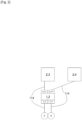
- switch 1.3 is shown in the figure 2 with the four communication links 114 connecting it to its neighboring nodes 5 and 6 and to its neighboring switches 2.3 and 2.4.
- Switch 1.3 thus has the four ports: P_5, P_6, P_2.3 and P_2.4, which are both incoming and outgoing ports.
- P_5, P_6, P_2.3 and P_2.4 An example of a default local routing table of port P_6 of switch 1.3, obtained by the d-mod-k algorithm, is shown in Table 1 below.
- the computer cluster 100 further comprises an administration server 112.
- the administration server 112 is in particular designed to communicate with clients wishing to use the computer cluster 100, the latter then being seen by the clients as a single machine.
- the administration server 112 is designed to implement a method for implementing tasks, as will be described later.
- the administration server 112 comprises software and/or hardware means, such as for example a resource manager (such as the “slurm” software) and a routing establishment module, to carry out the steps that will be described later.
- the administration server 112 comprises, as is known per se, a central processing unit and a main memory in which instructions for the central processing unit are intended to be recorded.
- the means are software means, in the form of a computer program downloadable from a communication network and/or recorded on a computer-readable medium and/or executable by a processor, comprising instructions for executing the steps of the method when said computer program is executed on the administration server.
- the administration server 112 could be an electronic device composed solely of digital circuits (without a computer program) for carrying out the same actions.
- the various functions of the administration server 112 could be distributed among several devices, for example among several computers.
- the resource manager could be implemented on one computer and the routing establishment module on another computer.
- the computer cluster 100 allows the distribution of complex processing and/or parallel calculations on at least some of the computing computers 102.
- each deployed task is allocated, on the one hand, nodes and, on the other hand, switches and links between these switches, forming a subnetwork of interconnection of the allocated nodes.
- a link is said to be unused when it is not allocated to any task. Thus, no task uses this link, so that no data related to the execution of a task passes through this link.
- the link is said to be used in the opposite case, that is to say when it is allocated to at least one task, so that data related to the execution of this or these tasks passes through this link.
- a link is said to be available when it is unused (i.e., as explained above, allocated to no task) or when it is allocated to fewer than N other tasks, N being a predefined number equal to at least one.
- the predefined number N therefore represents the maximum number of task(s) that can use the same link.
- the number N can be equal to one, in which case the two branches of the preceding alternative are equivalent. Alternatively, the number N can be equal to two or more.
- the number N is for example defined before tasks are deployed in the computer cluster 100, and applies to all tasks deployed subsequently, until this number N is redefined. This redefinition takes place for example when no task is deployed in the computer cluster 100.
- a switch is said to be unused when it is not allocated to any task. It is said to be used when it is allocated to at least one task.
- a method 300 for implementing a task, hereinafter called a current task, in the computer cluster 100 will now be described.
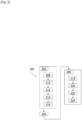
- the method 300 comprises a step 302 of deploying the current task in the computer cluster 100, a step 304 of executing the current task and a step 306 of cleaning up after execution.
- Step 302 of deploying the current task includes the following steps 308 to 316.
- Step 308 is for example performed by the resource manager, while steps 310 to 316 are performed by the routing establishment module.
- the administration server 112 receives the current task, as well as a number representing the number of nodes that the current task requires for its execution.
- the administration server 112 allocates nodes to the current task, connected to the minimum possible number of unused switches. For example, the administration server 112 allocates as a priority the nodes connected to the switches already in use, then consecutive nodes.
- the administration server 112 determines a subnetwork of the network 110, satisfying predefined determination criteria.
- the determination criteria include in particular a first criterion according to which the subnetwork interconnects the allocated nodes.
- the determination criteria further comprise a second criterion according to which the subnetwork uses only available links (i.e. allocated to no other task or allocated to less than N other tasks already deployed) and a third criterion according to which the determined subnetwork is the one, among at least two subnetworks satisfying the other criteria, using the most switches already used (i.e. allocated to at least one task already deployed).
- the at least two subnets include all subnets that meet the other criteria.
- the subnets searched are trees.
- the administration server 112 traverses the switches, for example in ascending order of level, to find each tree (i) having this switch as its origin, (ii) using only available links and (iii) serving all the nodes allocated to the current task.
- the administration server 112 determines all possible trees having the same minimum level for serve all allocated nodes (indeed, trees with a higher-level top will necessarily require more unused switches) and selects, among these possible trees, the one using the most switches already in use.
- the construction itself would ensure that the subnet constructed would be the one using the most switches already in use.
- a subtopology is for example a set of one or more switches among which none is connected to a lower-level switch.
- the entire topology is an example of a subtopology.
- Each first-level switch is also an example of a subtopology.
- This paper defines the concept of sub-topology ("enclosing sub-topology”), represented by a tuple (d 1 ,...d 1 ), l ⁇ l max -1 : the set of switches of level k, k ⁇ l max -l with topological addresses in the form of (k, d 1 , ..., d l , e i ..., e lmax-1 ): they all share the same infix given by the sub-topology notation.
- the administration server 112 allocates the subnetwork determined in step 312 to the current task.
- the links and switches of this subnetwork are thus allocated to the current task.
- each link is dedicated to a maximum of N tasks, which makes it possible to reduce the impact of the tasks on each other.
- the variance of the successive execution times of the same task Indeed, at each execution of this task, the links that it will use will be shared with a limited number of other tasks. At best, when the number N is equal to one, the links used by this task will be completely dedicated to it.
- the execution environment of this task varies little with each new execution, which leads to the reduction of the variance of execution times.
- the administration server 112 implements, in the interconnection network 110, inter-node communication routes in the allocated subnetwork.
- this implementation is carried out by modifying, if necessary, the local routing tables. More precisely, in the example described where a PGFT network is used, it is only necessary to modify the uplink routing tables, i.e. to move to a higher level. Furthermore, the uplink routing tables must only be modified in the case where nodes allocated to the task do not form a complete subtopology. Thus, the possible modifications to be made are very limited in number, which does not significantly slow down the deployment of the task.
- step 302 After deployment step 302, the current task runs during step 304.
- Post-execution cleanup step 306 includes the following steps 318 through 324.
- step 318 the administration server 112 cancels the modifications made in step 316 in the local routing tables. This return to the default routing tables allows the deployment of a new task to require only few modifications to the default routing tables, as explained above with respect to step 316.
- the administration server 112 releases (i.e., deallocates) the nodes and the subnetwork allocated to the current task.
- the administration server 112 searches for the unused links of the computer cluster 100 (i.e. which are not allocated to any task). Preferably, the search is carried out only among the links released in step 320.
- the administration server places each link found in an inactive state in which the link requires an energy consumption lower than an energy consumption required by an active link associated with at least one task (and therefore used by this or these tasks).
- the management server 112 turns off both network interfaces that this link connects so that no current or light flows through this link. In another embodiment, the management server 112 decreases an operating frequency of both network interfaces that this link connects.
- the computer cluster 100 is configured such that the predefined number N is one. Thus, each link in the computer cluster 100 can only be allocated to at most one task. Furthermore, it is assumed that initially no task is deployed in the computer cluster 100. Thus, all links are available. Therefore, the default local routing tables are used and the links are placed in the inactive state in order to decrease the power consumption of the computer cluster 100.
- the administration server 112 implements step 308 and receives a task t1 requiring n1 nodes of the computer cluster 100.
- n1 is five.
- the administration server 112 implements step 310 and allocates the following n1 nodes to the task t1: 1, 2, 3, 4, 5.
- the administration server 112 implements step 312 and determines an interconnection subnetwork of the allocated nodes.
- the administration server 112 browses the switches in ascending order of level and, in the example described, by ascending number on the same level (from left to right on the figure 4 ).
- the administration server 112 traverses the first-level switches, then the second-level switches.
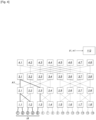
- the administration server 112 arrives at switch 3.1, from where the tree A1 shown in bold on the figure 4 .
- Tree A1 uses only available links and interconnects all allocated nodes 1, 2, 3, 4, 5.
- the administration server 112 implements step 314 and then allocates the tree A1 to the task t1.
- the administration server 112 implements step 316 and implements, in the tree A1, communication routes between the allocated nodes. For this, in the example described, the administration server 112 modifies, if necessary, the local routing tables.
- task t1 is deployed and is executed (step 304) by the computer cluster 100, on the allocated nodes which communicate with each other following the routes of the tree A1.
- the administration server 112 implements step 308 and then receives a task t2 requiring n2 nodes of the computer cluster 100.
- n2 is five.
- the administration server 112 implements step 310 and allocates nodes to task t2 by allocating as a priority the nodes connected to the switches already used, i.e. node 6. Thus, in the example described, the administration server 112 allocates the following n2 nodes to task t2: 6, 7, 8, 9, 10.
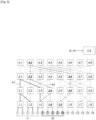
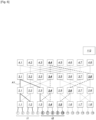
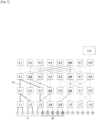
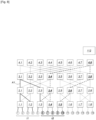
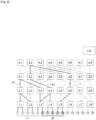
- the administration server 112 implements step 312 and determines an interconnection subnetwork of the allocated nodes. As previously, the administration server 112 traverses the switches in ascending order. The first switch from which a tree serving the allocated nodes 6, 7, 8, 9, 10 starts is the switch 4.1. This tree nevertheless includes the link between the switches 2.3 and 3.1, which is already allocated to the task t1 and therefore not available. Thus, the administration server 112 does not retain this tree and goes to the switch 4.2, from which the tree A2 starts. This tree only uses available links and serves all the allocated nodes 6, 7, 8. In the same way, the administration server 112 determines the trees from the switches 4.4, 4.6, and 4.8 respectively illustrated in the figures 6 , 7 And 8 . These four trees have the same number of unused switches. Thus, the administration server 112 can select any one, for example tree A2 from switch 4.2 ( figure 9 ).
- the administration server 112 implements step 314 and allocates the tree A2 to the task t2.
- the administration server 112 implements step 316 and implements, in the tree A2, communication routes between the allocated nodes.
- the administration server 112 modifies, if necessary, the local routing tables.
- the local routing table of port P_6 of switch 1.3 is modified as illustrated in Table 2 below (modification indicated in bold and italics).
- [Table 2] Modified local routing table of port P 6 of switch 1.3 Destination nodes Output port 1 P 2.3 2 P 2.4 3 P 2.3 4 P 2.4 5 P 5 6 P 6 7 P 2.4 8 P 2.4 9 P 2.3 10 P 2.4 11 P 2.3 12 P 2.4 13 P 2.3 14 P 2.4 15 P 2.3 16 P 2.4
- the tasks t1, t2 are deployed and executed (step 304) by the computer cluster 100, on the respectively allocated nodes which communicate with each other by following the routes of the trees A1 and A2 respectively.
- the administration server 112 implements step 308 and then receives a task t3 requiring n3 nodes of the computer cluster 100.
- n3 is three.
- the administration server 112 implements step 310 and allocates nodes to task t3 by allocating in priority the nodes connected to the switches already used (none at this stage), then consecutive nodes. Thus, in the example described, the administration server 112 allocates to the task t3 the following n3 nodes: 11, 12, 13.
- the administration server 112 implements step 312 and determines a subnetwork for interconnecting the allocated nodes.
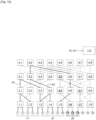
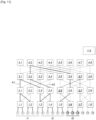
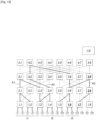
- the administration server 112 therefore finds the three trees originating respectively from the switches 3.5, 3.7, 3.8, respectively illustrated in the Figures 10 , 11 And 12 , satisfying the first and second determination criteria.
- the one from switch 3.8 hereinafter called A3
- has four unused switches numbered in bold on the figure 12
- the other two trees each require five unused switches (numbered in bold on the Figures 10 And 11 ).
- the tree from switch 3.8 (tree A3) satisfies the third determination criterion and is therefore retained by the administration server 112.
- the administration server 112 implements step 314 and allocates the tree A3 to the task t3.
- the administration server 112 implements step 316 and implements, in the tree A3, communication routes between the allocated nodes, by modifying, if necessary, the local routing tables.
- tasks t1, t2 and t3 are deployed and executed (step 304) by the computer cluster 100, on the respectively allocated nodes which communicate with each other by following the routes of the trees A1, A2 and A3 respectively ( figure 13 ).
- task t2 completes its execution.
- the administration server 112 implements step 318 and cancels the modifications made in the local routing tables to deploy the task t2.
- the administration server 112 implements step 320 and releases (i.e., deallocates) the nodes and the subnet A2 allocated to the task t2.
- the released links are represented by dotted and bold lines.
- the administration server 112 implements step 322 and searches for links in the computer cluster 100 that are not allocated to any task. Preferably, the search is performed only among the links of task t2. In the example described, since a link can only be allocated to at most one task (N is equal to one), all links that were allocated to task t2 become unused.
- the administration server 112 implements step 324 and places each link found (i.e. in the example described all the links which were allocated to the task t2, represented in dotted and bold lines) in the inactive state.
Landscapes
- Engineering & Computer Science (AREA)
- Theoretical Computer Science (AREA)
- Software Systems (AREA)
- Physics & Mathematics (AREA)
- General Engineering & Computer Science (AREA)
- General Physics & Mathematics (AREA)
- Computer Hardware Design (AREA)
- Computer Networks & Wireless Communication (AREA)
- Signal Processing (AREA)
- Mathematical Physics (AREA)
- Computing Systems (AREA)
- Data Exchanges In Wide-Area Networks (AREA)
Claims (9)
- Verfahren (300) zum operativen Umsetzen einer Aufgabe in einem Cluster von Computern, die einen Superrechner ausbilden, umfassend:- Computer (102, 104), die jeweils mindestens eine Netzwerkschnittstelle aufweisen, die einen Knoten (1... 16) ausbildet; und- ein Netzwerk (110) für die Vernetzung der Knoten (1...16), umfassend:• Schalter (1.1...4.8), die jeweils Netzwerkschnittstellen aufweisen, und• Verbindungsleitungen (114), die jeweils entweder einen Knoten (1...16) und eine Netzwerkschnittstelle eines Schalters (1.1...1.8) oder zwei Netzwerkschnittstellen zweier jeweiliger Schalter (2.1...4.8) verbinden;das Verfahren (300) umfassend:- Einsetzen der Aufgabe in dem Superrechner, dieses Einsetzen umfassend:• Zuweisen (310) von Knoten (1... 16) in der Aufgabe,• Bestimmen (312), in dem Netzwerk (110), eines Teilnetzwerks für die Vernetzung der zugewiesenen Knoten, das eine oder mehrere vordefinierte Bestimmungskriterien erfüllt,• Zuweisen (314) des Teilnetzwerks und insbesondere der Verbindungsleitungen, die zu diesem Teilnetzwerk gehören, zu der Aufgabe, und• Implementieren (316) von Interknoten-Kommunikationswegen in dem zugewiesenen Teilnetzwerk; und- Ausführen (304) der Aufgabe;wobei das Verfahren (300) dadurch gekennzeichnet ist, dass es ferner umfasst:- am Ende der Ausführung der Aufgabe, Freigeben (320) der Verbindungsleitungen, die der Aufgabe zugewiesen sind, dann:• Erkennen (322) mindestens einer Verbindungsleitung, die keiner Aufgabe zugewiesen ist, und• Platzieren (324) jeder erkannten Verbindungsleitung in einen inaktiven Zustand, wobei die Verbindungsleitung einen geringeren Energieverbrauch als ein Energieverbrauch benötigt, der von einer Verbindungsleitung benötigt wird, die mindestens einer Aufgabe zugeordnet ist.
- Verfahren (300) nach Anspruch 1, umfassend, zum Platzieren einer Verbindungsleitung in den inaktiven Zustand, Löschen der zwei Netzwerkschnittstellen, die diese Verbindungsleitung verbindet, sodass kein Strom oder Licht durch diese Verbindungsleitung fließt.
- Verfahren (300) nach Anspruch 1, umfassend, zum Platzieren einer Verbindungsleitung in den inaktiven Zustand, Verringern einer Betriebsfrequenz von mindestens einer der zwei Netzwerkschnittstellen, die diese Verbindungsleitung verbindet.
- Verfahren (300) nach einem der Ansprüche 1 bis 3, wobei das Bestimmungskriterium oder die Bestimmungskriterien für das Teilnetzwerk ein Kriterium umfassen, nach dem das Teilnetzwerk einzig Verbindungsleitungen verwendet, die keiner anderen Aufgabe, die bereits eingesetzt ist, zugewiesen sind, oder die weniger als N anderen Aufgaben, die bereits eingesetzt sind, zugewiesen sind, wobei N eine vordefinierte Zahl im Wert von eins oder mehr ist.
- Verfahren (300) nach einem der Ansprüche 1 bis 4, wobei das Erkennen (322) von mindestens einer Verbindungsleitung, die keiner Aufgabe zugewiesen ist, einzig unter den Verbindungsleitungen durchgeführt wird, die nach ihrer Ausführung (304) von der Aufgabe freigegeben werden, und im Erkennen (322) mindestens einer Verbindungsleitung, die keiner anderen Aufgabe zugewiesen ist, besteht.
- Verfahren (300) nach einem der Ansprüche 1 bis 5, wobei das Bestimmungskriterium oder die Bestimmungskriterien für das Teilnetzwerk ein Minimierungskriterium für die verwendeten Schalter umfassen, nach dem das bestimmte Teilnetzwerk dasjenige unter mindestens zwei Teilnetzwerken ist, die das Kriterium oder die Kriterien, außer dem Minimierungskriterium für die verwendeten Schalter, erfüllen, die die meisten Schalter, die jeweils bereits mindestens einer Aufgabe, die bereits eingesetzt ist, zugewiesen sind, verwenden.
- Verfahren (300) nach Anspruch 6, wobei das Bestimmen des Teilnetzwerks das Bestimmen der mindestens zwei Teilnetzwerke umfasst, die das Kriterium oder die Kriterien, außer dem Minimierungskriterium für die verwendeten Schalter, erfüllen, dann Auswählen unter diesen mindestens zwei Teilnetzwerken, desjenigen, das die meisten Schalter, die jeweils bereits mindestens einer Aufgabe, die bereits eingesetzt ist, zugewiesen sind, verwendet.
- Computerprogramm, das von einem Kommunikationsnetzwerk heruntergeladen und/oder auf einem computerlesbaren Träger gespeichert und/oder durch einen Prozessor ausgeführt werden kann,
dadurch gekennzeichnet, dass es Anweisungen für die Ausführung der Schritte eines Verfahrens nach einem der Ansprüche 1 bis 7 einschließt, wenn das Programm auf einem oder mehreren Computern ausgeführt wird. - Cluster von Computern, die einen Superrechner ausbilden, umfassend:- Computer (102, 104), die jeweils mindestens eine Netzwerkschnittstelle aufweisen, die einen Knoten (1... 16) ausbildet;- ein Netzwerk (110) für die Vernetzung der Knoten (1...16), umfassend:• Schalter (1.1...4.8), die jeweils Netzwerkschnittstellen aufweisen, und• Verbindungsleitungen (114), die jeweils entweder einen Knoten (1...16) und eine Netzwerkschnittstelle eines Schalters (1.1...1.8) oder zwei Netzwerkschnittstellen zweier jeweiliger Schalter (2.1...4.8) verbinden;
der Superrechner ferner umfassend Software- und/oder Hardwaremittel zum Einsetzen einer Aufgabe, die zum operativen Umsetzen der folgenden Schritte konzipiert ist:- Einsetzen der Aufgabe in dem Superrechner, das Einsetzen umfassend:• Zuweisen (310) von Knoten (1... 16) in der Aufgabe,• Bestimmen (312), in dem Netzwerk (110), eines Teilnetzwerks für die Vernetzung der zugewiesenen Knoten, das eine oder mehrere vordefinierte Bestimmungskriterien erfüllt,• Zuweisen (314) des Teilnetzwerks und insbesondere der Verbindungsleitungen, die zu diesem Teilnetzwerk gehören, zu der Aufgabe, und• Implementieren (316) von Interknoten-Kommunikationswegen in dem zugewiesenen Teilnetzwerk; und- Ausführen (304) der Aufgabe;- am Ende der Ausführung der Aufgabe, Freigeben (320) der Verbindungsleitungen, die der Aufgabe zugewiesen sind, dann:• Erkennen (322) mindestens einer Verbindungsleitung, die keiner Aufgabe zugewiesen ist, und• Platzieren (324) jeder erkannten Verbindungsleitung in einen inaktiven Zustand, wobei die Verbindungsleitung einen geringeren Energieverbrauch als ein Energieverbrauch benötigt, der von einer Verbindungsleitung benötigt wird, die mindestens einer Aufgabe zugeordnet ist.
Applications Claiming Priority (2)
| Application Number | Priority Date | Filing Date | Title |
|---|---|---|---|
| FR1873793A FR3091771A1 (fr) | 2018-12-21 | 2018-12-21 | Execution/Isolation d’application par allocation de ressources réseau au travers du mécanisme de routage |
| FR1904669A FR3091772B1 (fr) | 2018-12-21 | 2019-05-03 | Procédé de mise en œuvre d’une tâche dans un supercalculateur, programme d’ordinateur correspondant et supercalculateur |
Publications (2)
| Publication Number | Publication Date |
|---|---|
| EP3671454A1 EP3671454A1 (de) | 2020-06-24 |
| EP3671454B1 true EP3671454B1 (de) | 2025-03-05 |
Family
ID=68916458
Family Applications (1)
| Application Number | Title | Priority Date | Filing Date |
|---|---|---|---|
| EP19219175.7A Active EP3671454B1 (de) | 2018-12-21 | 2019-12-20 | Ausführungsverfahren einer aufgabe in einem superrechner, entsprechendes computerprogramm und entsprechender superrechner |
Country Status (2)
| Country | Link |
|---|---|
| US (1) | US11327796B2 (de) |
| EP (1) | EP3671454B1 (de) |
Families Citing this family (2)
| Publication number | Priority date | Publication date | Assignee | Title |
|---|---|---|---|---|
| CN117793036A (zh) * | 2022-09-29 | 2024-03-29 | 华为技术有限公司 | 节点控制方法、装置、处理系统 |
| US12468549B2 (en) | 2023-06-13 | 2025-11-11 | Bank Of America Corporation | Automated system for restarting large scale cluster supercomputers |
Family Cites Families (6)
| Publication number | Priority date | Publication date | Assignee | Title |
|---|---|---|---|---|
| US7757033B1 (en) * | 2004-02-13 | 2010-07-13 | Habanero Holdings, Inc. | Data exchanges among SMP physical partitions and I/O interfaces enterprise servers |
| US8155022B1 (en) * | 2009-03-24 | 2012-04-10 | Qlogic, Corporation | Method and system for controlling power consumption in network nodes |
| US8934377B2 (en) | 2013-03-11 | 2015-01-13 | Netspeed Systems | Reconfigurable NoC for customizing traffic and optimizing performance after NoC synthesis |
| CN104156267B (zh) * | 2013-05-14 | 2017-10-10 | 华为技术有限公司 | 任务分配方法、任务分配装置及片上网络 |
| US9485197B2 (en) * | 2014-01-15 | 2016-11-01 | Cisco Technology, Inc. | Task scheduling using virtual clusters |
| JP6220482B2 (ja) * | 2015-09-30 | 2017-10-25 | 株式会社日立製作所 | Vm配置管理システム、及び、vm配置管理方法 |
-
2019
- 2019-12-20 EP EP19219175.7A patent/EP3671454B1/de active Active
- 2019-12-20 US US16/722,546 patent/US11327796B2/en active Active
Also Published As
| Publication number | Publication date |
|---|---|
| US20200348972A1 (en) | 2020-11-05 |
| EP3671454A1 (de) | 2020-06-24 |
| US11327796B2 (en) | 2022-05-10 |
Similar Documents
| Publication | Publication Date | Title |
|---|---|---|
| EP3155771B1 (de) | Datenstreckenplanung und vermittler in einem netzwerk | |
| US10798005B2 (en) | Optimizing application throughput | |
| US20150088827A1 (en) | File block placement in a distributed file system network | |
| FR2702859A1 (fr) | Dispositif de recherche d'un plus court chemin dans un réseau. | |
| EP3189636B1 (de) | Verfahren zur überwachung und zur warnung von routing-informationen in einem cluster mit statischen kommunikationslinks und computerprogramm zur implementierung dieses verfahrens | |
| EP3671454B1 (de) | Ausführungsverfahren einer aufgabe in einem superrechner, entsprechendes computerprogramm und entsprechender superrechner | |
| EP2572478B1 (de) | Verfahren zur routing-optimierung bei einem cluster mit statischen kommunikationsverbindungen und computerprogramm zur umsetzung dieses verfahrens | |
| EP3671456B1 (de) | Zuweisungsverfahren einer aufgabe in einem superrechner, ausführungsverfahren einer aufgabe in einem superrechner, entsprechendes computerprogramm und entsprechender superrechner | |
| WO2007147990A1 (fr) | Procede de routage de liens virtuels dans un reseau a commutation de trames a determinisme garanti | |
| FR3091774A1 (fr) | Procédé de déploiement d’une tâche dans un supercalculateur, procédé de mise en œuvre d’une tâche dans un supercalculateur, programme d’ordinateur correspondant et supercalculateur | |
| EP3531641B1 (de) | Verfahren zur erzeugung von kommunikationswegen zwischen den knoten eines computer-clusters, entsprechendes computerprogramm und entsprechender computer-cluster | |
| FR2903548A1 (fr) | Procede de pilotage automatique d'un reseau de telecommunications avec mutualisation locale de connaissances | |
| EP2577920B1 (de) | Verfahren des pseudodynamischen routing in einem cluster mit statischen kommunikationslinks und computerprogramm, das dieses verfahren implementiert | |
| FR2843263A1 (fr) | Dispositif et procede de determination de chemins de routage dans un reseau de communications, en presence d'attributs de selection | |
| EP3671455B1 (de) | Zuweisungsverfahren einer aufgabe in einem superrechner, ausführungsverfahren einer aufgabe in einem superrechner, entsprechendes computerprogramm und entsprechender superrechner | |
| EP1432184B1 (de) | Vorrichtung zur Ermittlung eines Nachrichtenpfades in einem etikettvermittelndem Kommunikationsnetzwerk mit vorhandenen Auswahlattributen | |
| FR3091772A1 (fr) | Procédé de mise en œuvre d’une tâche dans un supercalculateur, programme d’ordinateur correspondant et supercalculateur | |
| FR3091770A1 (fr) | Procédé de déploiement d’une tâche dans un supercalculateur, procédé de mise en œuvre d’une tâche dans un supercalculateur, programme d’ordinateur correspondant et supercalculateur | |
| WO2013050682A1 (fr) | Procédé de routage adaptatif pseudo-dynamique dans un cluster comprenant des liens de communication statiques et programme d'ordinateur mettant en oeuvre ce procédé | |
| EP2955887B1 (de) | Verfahren zur dynamischen Lastverteilung in einem privaten Netz | |
| FR3072528B1 (fr) | Systeme de gestion distribuee pour un reseau de communication comportant une pluralite de fonctions reseau virtualisees | |
| Podili et al. | Effective resource provisioning for QoS-aware virtual networks in SDN | |
| FR3009466A1 (fr) | Reseau sur puce multiprocesseur |
Legal Events
| Date | Code | Title | Description |
|---|---|---|---|
| PUAI | Public reference made under article 153(3) epc to a published international application that has entered the european phase |
Free format text: ORIGINAL CODE: 0009012 |
|
| STAA | Information on the status of an ep patent application or granted ep patent |
Free format text: STATUS: THE APPLICATION HAS BEEN PUBLISHED |
|
| AK | Designated contracting states |
Kind code of ref document: A1 Designated state(s): AL AT BE BG CH CY CZ DE DK EE ES FI FR GB GR HR HU IE IS IT LI LT LU LV MC MK MT NL NO PL PT RO RS SE SI SK SM TR |
|
| AX | Request for extension of the european patent |
Extension state: BA ME |
|
| STAA | Information on the status of an ep patent application or granted ep patent |
Free format text: STATUS: REQUEST FOR EXAMINATION WAS MADE |
|
| 17P | Request for examination filed |
Effective date: 20201210 |
|
| RBV | Designated contracting states (corrected) |
Designated state(s): AL AT BE BG CH CY CZ DE DK EE ES FI FR GB GR HR HU IE IS IT LI LT LU LV MC MK MT NL NO PL PT RO RS SE SI SK SM TR |
|
| P01 | Opt-out of the competence of the unified patent court (upc) registered |
Effective date: 20230330 |
|
| RAP1 | Party data changed (applicant data changed or rights of an application transferred) |
Owner name: COMMISSARIAT A L'ENERGIE ATOMIQUE ET AUX ENERGIES ALTERNATIVES Owner name: BULL SAS |
|
| GRAP | Despatch of communication of intention to grant a patent |
Free format text: ORIGINAL CODE: EPIDOSNIGR1 |
|
| STAA | Information on the status of an ep patent application or granted ep patent |
Free format text: STATUS: GRANT OF PATENT IS INTENDED |
|
| RAP3 | Party data changed (applicant data changed or rights of an application transferred) |
Owner name: COMMISSARIAT A L'ENERGIE ATOMIQUE ET AUX ENERGIESALTERNATIVES Owner name: BULL SAS |
|
| INTG | Intention to grant announced |
Effective date: 20241004 |
|
| GRAS | Grant fee paid |
Free format text: ORIGINAL CODE: EPIDOSNIGR3 |
|
| GRAA | (expected) grant |
Free format text: ORIGINAL CODE: 0009210 |
|
| STAA | Information on the status of an ep patent application or granted ep patent |
Free format text: STATUS: THE PATENT HAS BEEN GRANTED |
|
| AK | Designated contracting states |
Kind code of ref document: B1 Designated state(s): AL AT BE BG CH CY CZ DE DK EE ES FI FR GB GR HR HU IE IS IT LI LT LU LV MC MK MT NL NO PL PT RO RS SE SI SK SM TR |
|
| REG | Reference to a national code |
Ref country code: GB Ref legal event code: FG4D Free format text: NOT ENGLISH |
|
| REG | Reference to a national code |
Ref country code: CH Ref legal event code: EP |
|
| REG | Reference to a national code |
Ref country code: IE Ref legal event code: FG4D Free format text: LANGUAGE OF EP DOCUMENT: FRENCH |
|
| REG | Reference to a national code |
Ref country code: DE Ref legal event code: R096 Ref document number: 602019066793 Country of ref document: DE |
|
| PG25 | Lapsed in a contracting state [announced via postgrant information from national office to epo] |
Ref country code: RS Free format text: LAPSE BECAUSE OF FAILURE TO SUBMIT A TRANSLATION OF THE DESCRIPTION OR TO PAY THE FEE WITHIN THE PRESCRIBED TIME-LIMIT Effective date: 20250605 |
|
| PG25 | Lapsed in a contracting state [announced via postgrant information from national office to epo] |
Ref country code: FI Free format text: LAPSE BECAUSE OF FAILURE TO SUBMIT A TRANSLATION OF THE DESCRIPTION OR TO PAY THE FEE WITHIN THE PRESCRIBED TIME-LIMIT Effective date: 20250305 |
|
| REG | Reference to a national code |
Ref country code: NL Ref legal event code: MP Effective date: 20250305 |
|
| PG25 | Lapsed in a contracting state [announced via postgrant information from national office to epo] |
Ref country code: ES Free format text: LAPSE BECAUSE OF FAILURE TO SUBMIT A TRANSLATION OF THE DESCRIPTION OR TO PAY THE FEE WITHIN THE PRESCRIBED TIME-LIMIT Effective date: 20250305 |
|
| REG | Reference to a national code |
Ref country code: LT Ref legal event code: MG9D |
|
| PG25 | Lapsed in a contracting state [announced via postgrant information from national office to epo] |
Ref country code: NO Free format text: LAPSE BECAUSE OF FAILURE TO SUBMIT A TRANSLATION OF THE DESCRIPTION OR TO PAY THE FEE WITHIN THE PRESCRIBED TIME-LIMIT Effective date: 20250605 |
|
| PG25 | Lapsed in a contracting state [announced via postgrant information from national office to epo] |
Ref country code: HR Free format text: LAPSE BECAUSE OF FAILURE TO SUBMIT A TRANSLATION OF THE DESCRIPTION OR TO PAY THE FEE WITHIN THE PRESCRIBED TIME-LIMIT Effective date: 20250305 |
|
| PG25 | Lapsed in a contracting state [announced via postgrant information from national office to epo] |
Ref country code: LV Free format text: LAPSE BECAUSE OF FAILURE TO SUBMIT A TRANSLATION OF THE DESCRIPTION OR TO PAY THE FEE WITHIN THE PRESCRIBED TIME-LIMIT Effective date: 20250305 |
|
| PG25 | Lapsed in a contracting state [announced via postgrant information from national office to epo] |
Ref country code: GR Free format text: LAPSE BECAUSE OF FAILURE TO SUBMIT A TRANSLATION OF THE DESCRIPTION OR TO PAY THE FEE WITHIN THE PRESCRIBED TIME-LIMIT Effective date: 20250606 Ref country code: BG Free format text: LAPSE BECAUSE OF FAILURE TO SUBMIT A TRANSLATION OF THE DESCRIPTION OR TO PAY THE FEE WITHIN THE PRESCRIBED TIME-LIMIT Effective date: 20250305 |
|
| REG | Reference to a national code |
Ref country code: AT Ref legal event code: MK05 Ref document number: 1773541 Country of ref document: AT Kind code of ref document: T Effective date: 20250305 |
|
| PG25 | Lapsed in a contracting state [announced via postgrant information from national office to epo] |
Ref country code: NL Free format text: LAPSE BECAUSE OF FAILURE TO SUBMIT A TRANSLATION OF THE DESCRIPTION OR TO PAY THE FEE WITHIN THE PRESCRIBED TIME-LIMIT Effective date: 20250305 |
|
| PG25 | Lapsed in a contracting state [announced via postgrant information from national office to epo] |
Ref country code: SE Free format text: LAPSE BECAUSE OF FAILURE TO SUBMIT A TRANSLATION OF THE DESCRIPTION OR TO PAY THE FEE WITHIN THE PRESCRIBED TIME-LIMIT Effective date: 20250305 |
|
| PG25 | Lapsed in a contracting state [announced via postgrant information from national office to epo] |
Ref country code: SM Free format text: LAPSE BECAUSE OF FAILURE TO SUBMIT A TRANSLATION OF THE DESCRIPTION OR TO PAY THE FEE WITHIN THE PRESCRIBED TIME-LIMIT Effective date: 20250305 |
|
| PG25 | Lapsed in a contracting state [announced via postgrant information from national office to epo] |
Ref country code: PT Free format text: LAPSE BECAUSE OF FAILURE TO SUBMIT A TRANSLATION OF THE DESCRIPTION OR TO PAY THE FEE WITHIN THE PRESCRIBED TIME-LIMIT Effective date: 20250707 |
|
| PG25 | Lapsed in a contracting state [announced via postgrant information from national office to epo] |
Ref country code: PL Free format text: LAPSE BECAUSE OF FAILURE TO SUBMIT A TRANSLATION OF THE DESCRIPTION OR TO PAY THE FEE WITHIN THE PRESCRIBED TIME-LIMIT Effective date: 20250305 Ref country code: IT Free format text: LAPSE BECAUSE OF FAILURE TO SUBMIT A TRANSLATION OF THE DESCRIPTION OR TO PAY THE FEE WITHIN THE PRESCRIBED TIME-LIMIT Effective date: 20250305 |
|
| PG25 | Lapsed in a contracting state [announced via postgrant information from national office to epo] |
Ref country code: AT Free format text: LAPSE BECAUSE OF FAILURE TO SUBMIT A TRANSLATION OF THE DESCRIPTION OR TO PAY THE FEE WITHIN THE PRESCRIBED TIME-LIMIT Effective date: 20250305 |
|
| PG25 | Lapsed in a contracting state [announced via postgrant information from national office to epo] |
Ref country code: CZ Free format text: LAPSE BECAUSE OF FAILURE TO SUBMIT A TRANSLATION OF THE DESCRIPTION OR TO PAY THE FEE WITHIN THE PRESCRIBED TIME-LIMIT Effective date: 20250305 Ref country code: EE Free format text: LAPSE BECAUSE OF FAILURE TO SUBMIT A TRANSLATION OF THE DESCRIPTION OR TO PAY THE FEE WITHIN THE PRESCRIBED TIME-LIMIT Effective date: 20250305 |
|
| PG25 | Lapsed in a contracting state [announced via postgrant information from national office to epo] |
Ref country code: RO Free format text: LAPSE BECAUSE OF FAILURE TO SUBMIT A TRANSLATION OF THE DESCRIPTION OR TO PAY THE FEE WITHIN THE PRESCRIBED TIME-LIMIT Effective date: 20250305 |
|
| PG25 | Lapsed in a contracting state [announced via postgrant information from national office to epo] |
Ref country code: SK Free format text: LAPSE BECAUSE OF FAILURE TO SUBMIT A TRANSLATION OF THE DESCRIPTION OR TO PAY THE FEE WITHIN THE PRESCRIBED TIME-LIMIT Effective date: 20250305 |
|
| PG25 | Lapsed in a contracting state [announced via postgrant information from national office to epo] |
Ref country code: IS Free format text: LAPSE BECAUSE OF FAILURE TO SUBMIT A TRANSLATION OF THE DESCRIPTION OR TO PAY THE FEE WITHIN THE PRESCRIBED TIME-LIMIT Effective date: 20250705 |
|
| REG | Reference to a national code |
Ref country code: DE Ref legal event code: R097 Ref document number: 602019066793 Country of ref document: DE |
|
| PGFP | Annual fee paid to national office [announced via postgrant information from national office to epo] |
Ref country code: GB Payment date: 20251218 Year of fee payment: 7 |
|
| PLBE | No opposition filed within time limit |
Free format text: ORIGINAL CODE: 0009261 |
|
| STAA | Information on the status of an ep patent application or granted ep patent |
Free format text: STATUS: NO OPPOSITION FILED WITHIN TIME LIMIT |
|
| PG25 | Lapsed in a contracting state [announced via postgrant information from national office to epo] |
Ref country code: DK Free format text: LAPSE BECAUSE OF FAILURE TO SUBMIT A TRANSLATION OF THE DESCRIPTION OR TO PAY THE FEE WITHIN THE PRESCRIBED TIME-LIMIT Effective date: 20250305 |
|
| REG | Reference to a national code |
Ref country code: CH Ref legal event code: L10 Free format text: ST27 STATUS EVENT CODE: U-0-0-L10-L00 (AS PROVIDED BY THE NATIONAL OFFICE) Effective date: 20260114 |
|
| PGFP | Annual fee paid to national office [announced via postgrant information from national office to epo] |
Ref country code: FR Payment date: 20251218 Year of fee payment: 7 |
|
| 26N | No opposition filed |
Effective date: 20251208 |
|
| PGFP | Annual fee paid to national office [announced via postgrant information from national office to epo] |
Ref country code: DE Payment date: 20251222 Year of fee payment: 7 |