EP3671531A1 - Semantische segmentierung von nicht-euklidischen 3d-datensätzen mit tiefenlernen - Google Patents
Semantische segmentierung von nicht-euklidischen 3d-datensätzen mit tiefenlernen Download PDFInfo
- Publication number
- EP3671531A1 EP3671531A1 EP18213246.4A EP18213246A EP3671531A1 EP 3671531 A1 EP3671531 A1 EP 3671531A1 EP 18213246 A EP18213246 A EP 18213246A EP 3671531 A1 EP3671531 A1 EP 3671531A1
- Authority
- EP
- European Patent Office
- Prior art keywords
- point
- points
- dnn
- point cloud
- network
- Prior art date
- Legal status (The legal status is an assumption and is not a legal conclusion. Google has not performed a legal analysis and makes no representation as to the accuracy of the status listed.)
- Withdrawn
Links
Images






Classifications
-
- G—PHYSICS
- G06—COMPUTING OR CALCULATING; COUNTING
- G06N—COMPUTING ARRANGEMENTS BASED ON SPECIFIC COMPUTATIONAL MODELS
- G06N3/00—Computing arrangements based on biological models
- G06N3/02—Neural networks
- G06N3/08—Learning methods
- G06N3/084—Backpropagation, e.g. using gradient descent
-
- G—PHYSICS
- G06—COMPUTING OR CALCULATING; COUNTING
- G06F—ELECTRIC DIGITAL DATA PROCESSING
- G06F18/00—Pattern recognition
- G06F18/20—Analysing
- G06F18/21—Design or setup of recognition systems or techniques; Extraction of features in feature space; Blind source separation
- G06F18/217—Validation; Performance evaluation; Active pattern learning techniques
- G06F18/2178—Validation; Performance evaluation; Active pattern learning techniques based on feedback of a supervisor
- G06F18/2185—Validation; Performance evaluation; Active pattern learning techniques based on feedback of a supervisor the supervisor being an automated module, e.g. intelligent oracle
-
- G—PHYSICS
- G06—COMPUTING OR CALCULATING; COUNTING
- G06F—ELECTRIC DIGITAL DATA PROCESSING
- G06F18/00—Pattern recognition
- G06F18/20—Analysing
- G06F18/22—Matching criteria, e.g. proximity measures
-
- G—PHYSICS
- G06—COMPUTING OR CALCULATING; COUNTING
- G06F—ELECTRIC DIGITAL DATA PROCESSING
- G06F18/00—Pattern recognition
- G06F18/20—Analysing
- G06F18/24—Classification techniques
-
- G—PHYSICS
- G06—COMPUTING OR CALCULATING; COUNTING
- G06F—ELECTRIC DIGITAL DATA PROCESSING
- G06F18/00—Pattern recognition
- G06F18/20—Analysing
- G06F18/24—Classification techniques
- G06F18/243—Classification techniques relating to the number of classes
- G06F18/2431—Multiple classes
-
- G—PHYSICS
- G06—COMPUTING OR CALCULATING; COUNTING
- G06N—COMPUTING ARRANGEMENTS BASED ON SPECIFIC COMPUTATIONAL MODELS
- G06N3/00—Computing arrangements based on biological models
- G06N3/02—Neural networks
- G06N3/04—Architecture, e.g. interconnection topology
- G06N3/045—Combinations of networks
-
- G—PHYSICS
- G06—COMPUTING OR CALCULATING; COUNTING
- G06N—COMPUTING ARRANGEMENTS BASED ON SPECIFIC COMPUTATIONAL MODELS
- G06N3/00—Computing arrangements based on biological models
- G06N3/02—Neural networks
- G06N3/04—Architecture, e.g. interconnection topology
- G06N3/0464—Convolutional networks [CNN, ConvNet]
-
- G—PHYSICS
- G06—COMPUTING OR CALCULATING; COUNTING
- G06N—COMPUTING ARRANGEMENTS BASED ON SPECIFIC COMPUTATIONAL MODELS
- G06N3/00—Computing arrangements based on biological models
- G06N3/02—Neural networks
- G06N3/04—Architecture, e.g. interconnection topology
- G06N3/048—Activation functions
-
- G—PHYSICS
- G06—COMPUTING OR CALCULATING; COUNTING
- G06N—COMPUTING ARRANGEMENTS BASED ON SPECIFIC COMPUTATIONAL MODELS
- G06N3/00—Computing arrangements based on biological models
- G06N3/02—Neural networks
- G06N3/08—Learning methods
- G06N3/09—Supervised learning
-
- G—PHYSICS
- G06—COMPUTING OR CALCULATING; COUNTING
- G06N—COMPUTING ARRANGEMENTS BASED ON SPECIFIC COMPUTATIONAL MODELS
- G06N3/00—Computing arrangements based on biological models
- G06N3/02—Neural networks
- G06N3/08—Learning methods
- G06N3/094—Adversarial learning
-
- G—PHYSICS
- G06—COMPUTING OR CALCULATING; COUNTING
- G06T—IMAGE DATA PROCESSING OR GENERATION, IN GENERAL
- G06T7/00—Image analysis
-
- G—PHYSICS
- G06—COMPUTING OR CALCULATING; COUNTING
- G06T—IMAGE DATA PROCESSING OR GENERATION, IN GENERAL
- G06T7/00—Image analysis
- G06T7/0002—Inspection of images, e.g. flaw detection
- G06T7/0012—Biomedical image inspection
-
- G—PHYSICS
- G06—COMPUTING OR CALCULATING; COUNTING
- G06T—IMAGE DATA PROCESSING OR GENERATION, IN GENERAL
- G06T7/00—Image analysis
- G06T7/10—Segmentation; Edge detection
- G06T7/11—Region-based segmentation
-
- G—PHYSICS
- G06—COMPUTING OR CALCULATING; COUNTING
- G06V—IMAGE OR VIDEO RECOGNITION OR UNDERSTANDING
- G06V10/00—Arrangements for image or video recognition or understanding
- G06V10/20—Image preprocessing
- G06V10/26—Segmentation of patterns in the image field; Cutting or merging of image elements to establish the pattern region, e.g. clustering-based techniques; Detection of occlusion
-
- G—PHYSICS
- G06—COMPUTING OR CALCULATING; COUNTING
- G06V—IMAGE OR VIDEO RECOGNITION OR UNDERSTANDING
- G06V10/00—Arrangements for image or video recognition or understanding
- G06V10/40—Extraction of image or video features
- G06V10/44—Local feature extraction by analysis of parts of the pattern, e.g. by detecting edges, contours, loops, corners, strokes or intersections; Connectivity analysis, e.g. of connected components
- G06V10/443—Local feature extraction by analysis of parts of the pattern, e.g. by detecting edges, contours, loops, corners, strokes or intersections; Connectivity analysis, e.g. of connected components by matching or filtering
- G06V10/449—Biologically inspired filters, e.g. difference of Gaussians [DoG] or Gabor filters
- G06V10/451—Biologically inspired filters, e.g. difference of Gaussians [DoG] or Gabor filters with interaction between the filter responses, e.g. cortical complex cells
- G06V10/454—Integrating the filters into a hierarchical structure, e.g. convolutional neural networks [CNN]
-
- G—PHYSICS
- G06—COMPUTING OR CALCULATING; COUNTING
- G06V—IMAGE OR VIDEO RECOGNITION OR UNDERSTANDING
- G06V10/00—Arrangements for image or video recognition or understanding
- G06V10/70—Arrangements for image or video recognition or understanding using pattern recognition or machine learning
- G06V10/764—Arrangements for image or video recognition or understanding using pattern recognition or machine learning using classification, e.g. of video objects
-
- G—PHYSICS
- G06—COMPUTING OR CALCULATING; COUNTING
- G06V—IMAGE OR VIDEO RECOGNITION OR UNDERSTANDING
- G06V10/00—Arrangements for image or video recognition or understanding
- G06V10/70—Arrangements for image or video recognition or understanding using pattern recognition or machine learning
- G06V10/82—Arrangements for image or video recognition or understanding using pattern recognition or machine learning using neural networks
-
- G—PHYSICS
- G06—COMPUTING OR CALCULATING; COUNTING
- G06V—IMAGE OR VIDEO RECOGNITION OR UNDERSTANDING
- G06V20/00—Scenes; Scene-specific elements
- G06V20/60—Type of objects
- G06V20/64—Three-dimensional [3D] objects
-
- G—PHYSICS
- G06—COMPUTING OR CALCULATING; COUNTING
- G06T—IMAGE DATA PROCESSING OR GENERATION, IN GENERAL
- G06T2200/00—Indexing scheme for image data processing or generation, in general
- G06T2200/04—Indexing scheme for image data processing or generation, in general involving 3D image data
-
- G—PHYSICS
- G06—COMPUTING OR CALCULATING; COUNTING
- G06T—IMAGE DATA PROCESSING OR GENERATION, IN GENERAL
- G06T2207/00—Indexing scheme for image analysis or image enhancement
- G06T2207/10—Image acquisition modality
- G06T2207/10028—Range image; Depth image; 3D point clouds
-
- G—PHYSICS
- G06—COMPUTING OR CALCULATING; COUNTING
- G06T—IMAGE DATA PROCESSING OR GENERATION, IN GENERAL
- G06T2207/00—Indexing scheme for image analysis or image enhancement
- G06T2207/20—Special algorithmic details
- G06T2207/20076—Probabilistic image processing
-
- G—PHYSICS
- G06—COMPUTING OR CALCULATING; COUNTING
- G06T—IMAGE DATA PROCESSING OR GENERATION, IN GENERAL
- G06T2207/00—Indexing scheme for image analysis or image enhancement
- G06T2207/20—Special algorithmic details
- G06T2207/20081—Training; Learning
-
- G—PHYSICS
- G06—COMPUTING OR CALCULATING; COUNTING
- G06T—IMAGE DATA PROCESSING OR GENERATION, IN GENERAL
- G06T2207/00—Indexing scheme for image analysis or image enhancement
- G06T2207/20—Special algorithmic details
- G06T2207/20084—Artificial neural networks [ANN]
-
- G—PHYSICS
- G06—COMPUTING OR CALCULATING; COUNTING
- G06T—IMAGE DATA PROCESSING OR GENERATION, IN GENERAL
- G06T2207/00—Indexing scheme for image analysis or image enhancement
- G06T2207/30—Subject of image; Context of image processing
- G06T2207/30004—Biomedical image processing
- G06T2207/30036—Dental; Teeth
-
- G—PHYSICS
- G06—COMPUTING OR CALCULATING; COUNTING
- G06V—IMAGE OR VIDEO RECOGNITION OR UNDERSTANDING
- G06V2201/00—Indexing scheme relating to image or video recognition or understanding
- G06V2201/03—Recognition of patterns in medical or anatomical images
Definitions
- the invention relates to automated semantic segmentation of non-Euclidean 3D data sets using deep learning, and, in particular, though not exclusively, to systems and methods for semantic segmentation of non-Euclidean 3D data sets using deep learning, a method for training such deep learning neural network, and a computer program product for using such method.
- 3D CT scans provide very useful information, but the resolution of these scans cannot provide the accuracy and detail that is required for optimal dental planning in areas where accurate and detailed information about a dentition and more general the dento-maxillofacial structure of a patient is essential. Hence, in that case one would like to rely on more accurate data sources such as high-resolution 3D data representations of scanned surfaces of teeth and gingiva (gums) determined by an intra-oral scanner.
- Accurate automated semantic segmentation of such 3D data representations is an essential feature for a dental treatment system and includes assignment of a label based on the Federation Dentaire Internationale (FDI) standard to each data point, e.g. labelling all points belonging to a specific tooth crown.
- the FDI specifies 32 labels, referring to e.g. 16 teeth in each upper and lower jaw as may be present in a healthy adult.
- the problem involves finding a plurality of classes (e.g. 16 or 32 classes plus one for the gingiva) in a large 3D data set.
- One problem relates to the dentition (the arrangement of teeth on the dental arch) wherein the appearance of two adjacent tooth crowns (e.g. two molar teeth) are very similar. Therefore, assigning a correct label to points in the 3D data set requires additional information such as the relative position of one tooth with respect to one or more other teeth on the dental arch. Furthermore, the presence of abnormalities in the dentition (e.g. the absence of one or more teeth) and/or shape deformation, makes automated semantic segmentation of 3D data representing dentition a challenging task for a computer. Further problems are related to the data acquisition like partially missing data (e.g. because of occlusion during scanning), lack of a universal coordinate system, presence of noise, outliers, etc.
- Extra-oral imaging data such as 3D X-ray data
- Extra-oral imaging data are typically provided in Euclidean type format, e.g. a voxel representation wherein the voxels wherein each voxel is associated with a predetermined position in a 3D grid.
- Systems that are capable of performing semantic segmentation (taxonomy) on voxelized CBCT data using deep learning are known in the art. For example, in the article by Miki et al, "Classification of teeth in cone-beam CT using deep convolutional neural network", Computers in Biology and Medicine 80 (2017) pp. 24-29 , a 2D deep convolutional neural network system is described that was trained to classify 2D CBCT images of teeth into 7 different tooth types.
- Euclidean type 3D data sets such as voxelized 3D data representations are particular suitable for processing by a trained deep neural network as the voxel representation both provides local information and global information (e.g. information about voxels relative to a particular voxel representation) about features in the data set.
- 3D data sets e.g. point cloud or surfaces meshes, generated by an intra-oral scanning equipment however are of the non-Euclidean type.
- each point may be represented by a 3D vector in a 3D Cartesian coordinate system which is not universal (i.e. the Cartesian coordinate system can be different between two IOS data sets).
- three points may define a triangular surface, which builds a 3D surface mesh.
- a normal vector associated with the triangular surface defines an orientation in the 3D space.
- Non-Euclidean data sets such as point clouds and surface meshes, are irregular, permutation-invariant and have a variable number of points per sample. For that reason, Non-Euclidean data sets, e.g. raw point cloud data, cannot be directly applied to a conventional deep learning models (e.g. CNN) for image analysis, such as segmentation.
- a conventional deep learning models e.g. CNN
- US2017/0169562 describes a system for automatic tooth type recognition on the basis of intra-oral optical 3D scans. 3D surface meshes of each crown are generated and used to determine aggregated features for each tooth. These features are then used as training data for training classifiers making use of traditional machine learning methodologies such as support vector machines or decision trees.
- a similar feature-based approach was made by (Guo et al., 2015; Fang et al., 2015) wherein set of standard shape features (e.g. based on computer graphic algorithms) is extracted from the point cloud and subsequently a neural network (e.g. a CNN) is used to classify the features.
- a neural network e.g. a CNN
- Point cloud deep learning models are configured to directly receive and process raw point clouds. Each point may have some attributes, e.g. the 3D coordinates and sometimes other attributes like the normal of the surface, colour, etc. Point cloud deep learning does not exhibit some of the shortcomings that are related to handcrafted features, quantization errors or high processing demands, associated with the aforementioned approaches.
- DNNs deep neural networks
- PointNet Qi, et al.. Pointnet: Deep learning on point sets for 3d classification and segmentation. Proc. Computer Vision and Pattern Recognition (CVPR), IEEE, 1(2):4, 2017 .
- DeepSets Ravanbakhsh, et al. Deep learning with sets and point clouds.
- arXiv preprint arXiv:1611.04500, 2016 are deep neural networks based on so-called multi-layer perceptron (MLP) networks.
- MLP multi-layer perceptron
- the performance of these MLP networks was improved by Le and Duan.(Pointgrid: A deep network for 3d shape understanding. In Proceedings of the IEEE Conference on Computer Vision and Pattern Recognition, pages 9204-9214, 2018 ).based on techniques for the handling the above-mentioned data irregularity and permutation invariance. Additionally, a resampling technique was used for fixing the number of points that are offered to the input of the neural network. Although such approach is suitable for many applications, it is not suitable for classifying a point cloud representing fine high-resolution details (e.g. classifying a point close to the borderline of a tooth and gingiva).
- aspects of the present invention may be embodied as a system, method or computer program product. Accordingly, aspects of the present invention may take the form of an entirely hardware embodiment, an entirely software embodiment (including firmware, resident software, micro-code, etc.) or an embodiment combining software and hardware aspects that may all generally be referred to herein as a "circuit," “module” or “system”. Functions described in this disclosure may be implemented as an algorithm executed by a microprocessor of a computer. Furthermore, aspects of the present invention may take the form of a computer program product embodied in one or more computer readable medium(s) having computer readable program code embodied, e.g., stored, thereon.
- the computer readable medium may be a computer readable signal medium or a computer readable storage medium.
- a computer readable storage medium may be, for example, but not limited to, an electronic, magnetic, optical, electromagnetic, infrared, or semiconductor system, apparatus, or device, or any suitable combination of the foregoing.
- a computer readable storage medium may be any tangible medium that can contain, or store a program for use by or in connection with an instruction execution system, apparatus, or device.
- a computer readable signal medium may include a propagated data signal with computer readable program code embodied therein, for example, in baseband or as part of a carrier wave. Such a propagated signal may take any of a variety of forms, including, but not limited to, electro-magnetic, optical, or any suitable combination thereof.
- a computer readable signal medium may be any computer readable medium that is not a computer readable storage medium and that can communicate, propagate, or transport a program for use by or in connection with an instruction execution system, apparatus, or device.
- Program code embodied on a computer readable medium may be transmitted using any appropriate medium, including but not limited to wireless, wireline, optical fiber, cable, RF, etc., or any suitable combination of the foregoing.
- Computer program code for carrying out operations for aspects of the present invention may be written in any combination of one or more programming languages, including a functional or an object oriented programming language such as Java(TM), Scala, C++, Python or the like and conventional procedural programming languages, such as the "C" programming language or similar programming languages.
- the program code may execute entirely on the user's computer, partly on the user's computer, as a stand-alone software package, partly on the user's computer and partly on a remote computer, or entirely on the remote computer, server or virtualized server.
- the remote computer may be connected to the user's computer through any type of network, including a local area network (LAN) or a wide area network (WAN), or the connection may be made to an external computer (for example, through the Internet using an Internet Service Provider).
- LAN local area network
- WAN wide area network
- Internet Service Provider an Internet Service Provider
- These computer program instructions may be provided to a processor, in particular a microprocessor or central processing unit (CPU), or graphics processing unit (GPU), of a general purpose computer, special purpose computer, or other programmable data processing apparatus to produce a machine, such that the instructions, which execute via the processor of the computer, other programmable data processing apparatus, or other devices create means for implementing the functions/acts specified in the flowchart and/or block diagram block or blocks.
- a processor in particular a microprocessor or central processing unit (CPU), or graphics processing unit (GPU), of a general purpose computer, special purpose computer, or other programmable data processing apparatus to produce a machine, such that the instructions, which execute via the processor of the computer, other programmable data processing apparatus, or other devices create means for implementing the functions/acts specified in the flowchart and/or block diagram block or blocks.
- CPU central processing unit
- GPU graphics processing unit
- These computer program instructions may also be stored in a computer readable medium that can direct a computer, other programmable data processing apparatus, or other devices to function in a particular manner, such that the instructions stored in the computer readable medium produce an article of manufacture including instructions which implement the function/act specified in the flowchart and/or block diagram block or blocks.
- the computer program instructions may also be loaded onto a computer, other programmable data processing apparatus, or other devices to cause a series of operational steps to be performed on the computer, other programmable apparatus or other devices to produce a computer implemented process such that the instructions which execute on the computer or other programmable apparatus provide processes for implementing the functions/acts specified in the flowchart and/or block diagram block or blocks.
- each block in the flowchart or block diagrams may represent a module, segment, or portion of code, which comprises one or more executable instructions for implementing the specified logical function(s).
- the functions noted in the blocks may occur out of the order noted in the figures. For example, two blocks shown in succession may, in fact, be executed substantially concurrently, or the blocks may sometimes be executed in the reverse order, depending upon the functionality involved.
- the invention relates to a computer-implemented method for semantic segmentation of a point cloud comprising: receiving a point cloud, the point cloud including points representing a vector in a 3D space, the points representing a predetermined object; determining one or more subsets of the point cloud using a non-uniform resampling algorithm, each of the one or more subsets including a first number of points densely arranged within a predetermined spatial distance of a selected point of the point cloud and a second number of points sparsely arranged at spatial distances larger than the predetermined spatial distance, the first number of point representing one or more fine features of the object around the selected point and the second number of points representing one or more global features of the object; providing each of one or more subsets of points to the input of a deep neural network, DNN, the deep neural network being trained to semantically segment points of each of the one or more subsets that is provided to the input of the DNN according to a plurality of classes associated with the object; and, for
- Non-uniform resampling is used to resample a subset of points from the point cloud which then can be fed directly to the input of the deep neural network of the segmentation module.
- the non-uniform resampling is needed in order to deal with the data irregularity, the permutation-invariance and the variable number of points of different point cloud sets.
- the non-uniform resampling algorithm generates a locally-dense and globally-sparse subset of points. This way, the subset of points defines a fixed-size resampled point cloud which contains different levels of spatial resolution, involving both local, fine details and the global shape structure. These fine details and global shape information may be used for training a deep neural network.
- the non-uniform resampling facilitates the training and deployment of deep learning approach to semantic segmentation of e.g. 3D Point Cloud IOS the network on a fixed-size resampled point cloud which comprises different levels of spatial resolution, involving both local, fine details and the global shape structure.
- the object may be part of a dento-maxillofacial structure, the dento-maxillofacial structure including a dentition comprising teeth.
- the invention may be used for semantic segmentation of irregular high-resolution point cloud representations.
- the non-uniform resampling algorithm may include: randomly selecting a point from the point cloud; determining the first number of point by densely sampling points of the point cloud which are positioned within the predetermined distance from the randomly selected point and determining the second number of points by sparsely sampling points of the point cloud which are positioned at a distance larger than the predetermined distance from the randomly selected point; and, combining the first points and second points into a subset of points.
- the predetermined spatial distance may be determined based on a random number, preferably a Monte Carlo technique.
- the spatial distance may be based on a weighted distance metric.
- the weighted distance metric may be based an exponential function.
- the DNN may be trained based on a training set comprising one or more point clouds, each of the one or more point clouds representing the predetermined object and each point of the one or more point clouds being associated with a target label; preferably the training of the DNN including determining subsets of the one or more point clouds using the non-uniform resampling algorithm and training the parameters of the DNN by minimizing a loss function representing a deviation between labels predicted by the DNN and the target labels.
- the loss function may be a weighted loss function ( L p ), the loss function defining a weight to each point based on the distance metric.
- the DNN may be trained based on a discriminator network, wherein the discriminator network is configured to distinguish between a target label and a label generated by the DNN or between at least one feature associated with a target label and at least one feature associated with a label generated by the DNN.
- the point-wise cross-entropy loss for semantic segmentation of a point cloud is an ill-posed problem since the relative geometrical structure between the instances (e.g. the teeth) are not formulated.
- a heavy post-processing stage e.g. iterative energy minimization of a constructed graph for relational modelling
- a feedback module randomly provides a target label or a label generated by the DNN to the input of the discriminator network and in response, the discriminator network generating an indication whether the input of the discriminator is associated a target label or a label generated by the DNN.
- the invention may relate to a computer-implemented method for training a deep neural network DNN to semantically segment a point cloud, the method comprising: receiving training data, the training data comprising one or more point clouds, each of the one or more point clouds representing a predetermined object, and each point of the one or more point clouds being associated with a target label, preferably the predetermined object being part of a dento-maxillofacial structure, the dento-maxillofacial structure including a dentition comprising teeth; determining subsets of the one or more point clouds of the training data using a non-uniform resampling algorithm, each of the one or more subsets being associated with target labels and each of the one or more subsets including a first number of points densely arranged within a predetermined spatial distance of a selected point of the point cloud and a second number of points sparsely arranged at spatial distances larger than the predetermined spatial distance, the first number of point representing one or more fine features of the object around the selected
- the non-uniform resampling algorithm may include: randomly selecting a point from the point cloud; determining the first number of point by densely sampling points of the point cloud which are positioned within the predetermined distance from the randomly selected point and determining the second number of points by sparsely sampling points of the point cloud which are positioned at a distance larger than the predetermined distance from the randomly selected point; and, combining the first points and second points into a subset of points.
- the DNN may be trained based on a discriminator network, the discriminator network being configured to distinguish between a target label and a label generated by the DNN or between at least one feature associated with a target label and at least one feature associated with a label generated by the DNN.
- the method may comprise: a feedback module randomly providing a target label or a label generated by the DNN to a feature extraction module; the feature extraction module determining one or more features based on the received target label or label generated by the DNN and providing the one or more features to the input of the discriminator network; in response the discriminator network generating an indication whether the one or more features are associated a target label or a label generated by the DNN; providing the indication to the input of the DNN.
- an adversary loss may be used for training the DNN in an adversarial setting.
- the segmentation network is empowered to learn the realistic layout of the labelling space and improving the classification of points by involving the high-level semantics and preserving the valid arrangement of the teeth labels on the dental arch.
- the invention may relate to a computer system, preferably a server system, adapted to semantically segment of a point cloud comprising: a computer readable storage medium having computer readable program code embodied therewith, the program code including a non-uniform sampling module and at least a trained deep neural network DNN, the computer readable program code; and a processor, preferably a microprocessor, coupled to the computer readable storage medium, wherein responsive to executing the first computer readable program code, the processor is configured to perform executable operations may comprise: receiving a point cloud, the point cloud including points representing a vector in a 3D space, the points representing a predetermined object, preferably part of a dento-maxillofacial structure, the dento-maxillofacial structure including a dentition comprising teeth; determining one or more subsets of the point cloud using a non-uniform resampling algorithm, each of the one or more subsets including a first number of points densely arranged within a predetermined
- the invention may relate to a computer system, preferably a server system, adapted to train a deep neural network DNN to semantically segment a point cloud
- a computer system preferably a server system, adapted to train a deep neural network DNN to semantically segment a point cloud
- the program code including a non-uniform sampling module and at least a trained deep neural network DNN, the computer readable program code
- a processor preferably a microprocessor, coupled to the computer readable storage medium, wherein responsive to executing the first computer readable program code, the processor is configured to perform executable operations may comprise: receiving training data, the training data comprising one or more point clouds, each of the one or more point clouds representing a predetermined object, and each point of the one or more point clouds being associated with a target label, preferably the predetermined object being part of a dento-maxillofacial structure, the dento-maxillofacial structure including a dentition comprising teeth; determining subsets of the one or more point clouds of the training data
- the DNN described above may comprise one or more multi-layer perceptron (MLP) networks and/or one or more ⁇ -Conv operator layers of a pointCNN network.
- the discriminator network described above may comprise one or more multi-layer perceptron (MLP) networks.
- the deep neural network may be configured directly process 'raw' point cloud data.
- the deep neural network may include a multi-layer perceptron (MLP) network.
- the deep neural network may be configured as a pointCNN network as described in the article by Li et al.
- PointCNN convolution on ⁇ -transformed points, arXiv:1801.07791v5 of 5 November 2018 (to be published in Neural Information Processing Systems (NIPS) 2018 .
- the pointCNN network may be trained in an adversarial setting using a discriminator network providing accurate semantic segmentation of IOS data representing dentations.
- the invention relates to an end-to-end deep learning framework for semantic segmentation of individual teeth as well as the gingiva from points clouds derived from IOS point clouds.
- the model may be trained and deployed on the highest available spatial resolution where it learns the local fine-details along with the global coarse structure of IOS.
- the invention may also relate of a computer program product comprising software code portions configured for, when run in the memory of a computer, executing any of the methods as described above.
- a non-Euclidian 3D data set refers to a data set defining a 3D representation of an object, wherein the data sets comprises a collection of points and wherein each point may be represented by a vector in a 3D Cartesian coordinate system which is not universal (i.e. the Cartesian coordinate system can be different between two IOS data sets).
- Examples of such non-Euclidian 3D data sets include point clouds and 3D surface meshes.
- a 3D surface mesh includes points that define a triangular surface, which collectively describe a surface mesh in a 3D space.
- a normal vector associated with a triangular surface defines an orientation in the 3D space.
- non-Euclidean data sets such as point clouds and surface mesh representations, are irregular, permutation-invariant and may have a variable number of points per sample, a sample here intended to mean a representation of a surface, and the number of points being variable across multiple instances of recording (sampling) the same surface.
- point cloud is used to refer to any non-Euclidian 3D data set for representing an object in 3D space based on points that define a vector in a 3D space.
- a computer system may comprise at least a non-uniform resampling module for generating non-uniform samples of a point cloud (a subset of the original point cloud), wherein each sample (subset) has a constant number points and wherein the non-uniform resample includes dense local information around a certain point of the point cloud and sparse global information associated with the global shape of the object, e.g. the dentition, represented by the point cloud.
- the computer system according to the invention may include at least a segmentation module comprising a deep neural network that is trained to receive the resampled subset of point cloud data at its input and to label each of the points of the resampled subset according to the labels of a training set.
- the deep neural network may be configured directly process 'raw' point cloud data.
- the deep neural network may include a multi-layer perceptron (MLP) network.
- MLP multi-layer perceptron
- the deep neural network may be configured as a pointCNN network as described in the article by Li et al. PointCNN: convolution on ⁇ -transformed points, arXiv:1801.07791v5 of 5 November 2018 (to be published in Neural Information Processing Systems (NIPS) 2018 .
- the pointCNN network may be trained in an adversarial setting using a discriminator network providing accurate semantic segmentation of IOS data representing dentations. Examples of such networks as described in more detail with reference to Fig. 7 and 8 .
- Non-uniformly resampled subsets of 3D point cloud labelled training data may result in a trained segmentation deep neural network that can accurately segment high-resolution point cloud data sets, such as IOS point cloud data sets representing dentitions.
- the computer system, the non-uniform resampling module, the segmentation module as well as the training of the neural network of the segmentation module are described hereunder in more detail.
- Fig. 1A and 1B depict a system according to an embodiment of the invention.
- Fig. 1A and 1B depict a system 100 for automated semantic segmentation of non-Euclidean 3D data sets, e.g. point cloud and/or 3D surface meshes.
- the system may be implemented on one or more computers comprising one or more processing units 101 connected to memory 103.
- the system may be configured to execute a plurality of modules, including 3D deep neural networks that may be trained to receive (part(s) of) one or more non-Euclidean 3D data sets as their input and process the data according to a trained model.
- the system may be implemented as a stand-alone system (e.g.
- the system may include a non-uniform resampling module 104, a storage 106 (e.g. a buffer or a cache) for (temporarily) storing resampled data, e.g. a non-uniform resampled point cloud or 3D surface mesh data, generated by the non-uniform resampling module and a segmentation module 108 comprising a deep neural network (DNN) for semantic segmentation of the resampled data.
- a non-uniform resampling module 104 e.g. a buffer or a cache
- resampled data e.g. a non-uniform resampled point cloud or 3D surface mesh data
- a segmentation module 108 comprising a deep neural network (DNN) for semantic segmentation of the resampled data.
- DNN deep neural network
- the non-uniform resampling module is configured to resample a subset of points from the point cloud which then can be fed directly to the input of the deep neural network of the segmentation module.
- the non-uniform resampling is needed in order to deal with the data irregularity, the permutation-invariance and the variable number of points of different point cloud sets.
- the non-uniform resampling algorithm is configured to generate a locally-dense and globally-sparse subset of points. This way, the subset of points defines a fixed-size resampled point cloud which contains different levels of spatial resolution, involving both local, fine details and the global shape structure. These fine details and global shape information may be used for training a deep neural network.
- the non-uniform resampling is described hereunder in more detail with reference to Fig. 2 and Fig. 3 .
- the system may include a training modus and an inference modus.
- Fig. 1A depicts the system in the training modus.
- the system is configured to train the DNN of the segmentation module using labelled point cloud training data 102.
- the inference modus of the system may be used to apply the trained 3D model to new point cloud data as shown in Fig. 1B .
- a so-called discriminator network 110 i.e. a secondary deep neural network
- the trained neural network will be capable of accurately predicting labels 114 from resampled point cloud data 106 that are offered to the input of the segmentation module.
- the training data 102 may comprise a plurality of point cloud data sets, wherein each set represents a dentition. Such data may be generated by an intra-oral scanner (IOS) which is capable of generating high-resolution point cloud data.
- IOS intra-oral scanner
- the points of each point cloud data set of the training data may be labelled based on tooth classes, the so-called target labels.
- the target labels may be based on the Federation Dentaire Internationale (FDI) standard, which defines 32 labels, referring to 16 teeth in each upper and lower jaw in the case of a healthy adult dentition.
- FDI Federation Dentaire Internationale
- the training data may be augmented by various operations including: random 3D rotation, permutation and/or adding artificial noise (jitter) to the position of each point.
- instance dropouts may be applied to the data set. Such dropout of instances here is intended to mean randomly removing all points or at least a substantial part of the points that belong to a specific tooth from the point cloud in each batch of the training data.
- the augmentation may help a deep neural network to learn the labels that lacking and do not occur in the training set.
- a pre-processing step may be applied to a point cloud data set so that the data are normalized, more specifically a normalization of the vectors representing the points, such that within the point set, the data has a mean approximating 0 and a unit variance (standard deviation approaching 1 as much as possible).).
- the DNN of the segmentation module 108 is trained to predict a suitable class (e.g. 16 or 32 classes plus one for the gingiva) for each point in a point cloud data set.
- the training data are used to iteratively update a model (represented by the network parameters, e.g. the weights, of the neural network) a large number of times.
- a known stochastic gradient descent optimization method may be used to learn the most beneficial values for the network parameters of the DNN by reducing the error between the output of the neural network and the correct labels. When the error rate stops decreasing the training phase of a network may be considered as completed.
- a predetermined loss function may be used to determine the error that is used in the stochastic gradient descent optimization method.
- the generator network may receive non-uniform subsamples of the point cloud training data. Additionally, the generator network may receive feedback from a discriminator network 110.
- the main task of the discriminator network is to distinguish whether the predicted labels it receives as input are either labels generated by the generator network out its output or the target labels that are part of the training data. Hence, in that case, the target labels are used as a ground truth for training the generator network.
- the discriminator in return receives feedback if the output it has given was correct, i.e. if the point labels were indeed 'predicted' or 'real' as the discriminator indicated. This information helps the generator network to effectively learn labelling of the points of the non-uniform subsample, since both generator and discriminator learn from the given feedback.
- the discriminator network is configured to distinguish between the target labels and labels that are predicted by the generator network.
- a feedback module 112 (randomly) presents either the target labels or the output labels of the generator network to the discriminator network.
- the discriminator network generates an indication whether the input of the discriminator is associated with 'real' labels or predicted labels generated by the generator network.
- the discriminator network will then generate a 'score' indicating whether the information it receives is real or corrected.
- the discriminator may have output between zero and one wherein a '1' may indicate that the information is related to target labels and a '0' may indicate that the information is associated with labels predicted by the generator network.
- the generator network If during training, the generator network generates predicted labels which the discriminator can distinguish from the target labels, then this will be a signal for the system that the predicted labels are not sufficiently 'realistic'. Hence, this way, the generator network will be stimulated to produce predicted labels which are similar to the target labels of the training data.
- the ability of the discriminator to distinguish between both is a measure of the quality of the labels generated by the generator.
- This information may be fed back to the discriminator as well as the generator network through backpropagation.
- the loss function used in the backpropagation method may include a point-wise classification loss and an adversarial loss for enabling the segmentation network to learn the realistic layout of the labelling space and improving the classification of points by involving the high-level semantics and preserving the valid arrangement of the teeth labels on the dental arch.
- the training modus of the system as well as the loss function are described hereunder in more detail with reference to Fig. 4 and Fig. 5 .
- the system is configured to provide new point cloud data 120, e.g. an IOS point cloud representing a dentition, to the input of the non-uniform resampling module 104.
- Resampled data e.g. resampled point cloud data sets 106 (representing non-uniformly resampled subset of the point cloud that was provided to the input) may be provided to the input of the segmentation module 108 wherein the trained deep neural network will predict labels for each point of the subset of points.
- the labelling process may be applied to different subsets of the point cloud until all points of the input point cloud are labelled by the trained neural network.
- the interference process and exemplary segmentation outputs of the system are described hereunder with reference to Fig. 6 and Fig. 9 .
- training a deep learning model based on all or at least a substantial part of the points of a IOS point cloud may introduce problems which are related to the nature of large-sized high-resolution point cloud data sets. For example, it would in principle require processing matrices with a variable ranking due to the fact that the number of points for different IOS data sets may vary considerably (for example between 100.000 and 500.000 points or even larger). Additionally, hardware limitations may require a maximum to the size of a point cloud that can be processed. Such problems may be solved using a patch-classification technique which is common for large-size images data sets.
- This technique relies on determining a number of patches (local subsets of a large data set) by resampling the point cloud and classifying each data point of each subset. The use of such technique however may degrade the classification results because the extracted patches (a local subset of the point cloud) do not provide sufficient information about the global structure of the object(s) the point cloud represents.
- a non-uniform resampling method based on a Monte Carlo sampling technique may be used.
- Monte Carlo sampling techniques allow the application of non-uniform resampling methods on high-resolution point clouds resulting in a locally-dense and globally-sparse subset of points for efficiently training a deep neural network that is capable of processing such data.
- a radial basis kernel function (RBF) denoted by K may be defined, wherein the RBF may be positioned on a randomly chosen point. This point may be referred to as the fovea: x fovea ⁇ X. Then, a geometrical similarity (spatial distance) to the fovea may be determined based on a weighted distance metric.
- a subset Y out of X with M1 points may be chosen (M1 ⁇ N) so that dense sampling around the fovea and sparse sampling for positions further away from the fovea may be achieved.
- M1 ⁇ N dense sampling around the fovea and sparse sampling for positions further away from the fovea may be achieved.
- the selected point may be inserted into subset Y only if the condition K(x i ,x fovea ) > r ⁇ is satisfied. If the condition is not satisfied the point is rejected.
- the variable r ⁇ may be a random number selected from a uniform distribution in the unity interval as defined by the applicable Monte Carlo technique. This resampling process may continue until M1 - 1 unique points are accepted.
- Table 1 depicts an example of a non-uniform resampling algorithm:
- the algorithm may be used to determine a non-uniform sample Y from point cloud X.
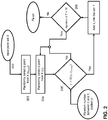
- Fig. 2 depicts a block scheme for determining a non-uniform sample Y comprising M points according to an embodiment of the invention.
- the algorithm may be implemented as a module comprising a memory comprising code portions and a processor for executing the code portions.
- the input of the module may consist of a non-Euclidian data set X, such as a point cloud or a 3D surface mesh.
- a point (called fovea) from the non-Euclidian data set X may be selected randomly. The fovea point is added to the set Y as its first member.
- x i another point from the set X (called x i ) may be randomly selected and compared with the fovea according to the RBF kernel as described with respect to Equation 1.
- the value of the RBF kernel may be compared 205 with a random value drawn from a uniform distribution in range of 0 and 1. If the kernel value be greater than the random value, the selected point may be added to the set Y, otherwise it may be rejected. This procedure may continueuntil the set Y has M points 206. Depending on the bandwidth of such RBF kernel, the compactness of resampled data may vary.
- the resampling may be very compact and hence produce local patches.
- 1 which is the variance of normalized point cloud
- the non-uniform resampling may closely approximate uniform resampling. In this sense patch extraction and uniform resampling may be considered as two special cases of such non-uniform resampling algorithm.
- Fig. 3 illustrates the resampling of a point cloud using non-uniform resampling according to an embodiment of the invention.
- a high-resolution IOS point cloud 302 representation of a dentition comprising 80.000 points may be resampled based on a non-uniform resampling scheme 304, e.g. a non-uniform resampling scheme as described with reference to Fig. 2 .
- the resampling may result in a first resampled subset 306 of 30.000 points wherein the resampling was based on e.g. selected point 308.
- the figure also depicts a second resampled subset 312 of 30.000 points which may be obtained by applying a uniform resampling 310 to the point cloud.
- the first resampled subset comprises different levels of granularity: a relatively dense regions of points around the fovea providing high-resolution local information on the part of the dentition at the position of the fovea and a relatively sparse region of points away from the fovea providing global information on the dentition.
- Resampled subsets based on non-uniform resampling for multiple foveas may be employed to train a deep neural network to learn both detailed local features as well as global features of a dentition.
- the above-described resampling scheme may be applied to other non-Euclidian 3D data sets, e.g. a 3D surface meshes.
- a 3D surface meshes e.g. a 3D surface meshes.
- faces may be represented by a most representative point (e.g. a point at the average positions of all points describing such face). Effectively this would reduce a set of faces to a set of representative points upon which the described methods may be applied.
- Fig. 4 illustrates a method of training a deep neural network according to an embodiment of the invention.
- the figure depicts a flow diagram of training a deep neural network for classification and segmentation of, in the case of this exemplary embodiment, dento-maxillofacial 3D image data according to an embodiment of the invention.
- a discriminator 3D deep learning neural network 420 may be used in an adversarial training setting, with the goal of improving the training quality of the segmentation 3D deep learning neural network of the segmentation module 422 which will be used for the semantic segmentation of point cloud data as described with reference to Fig. 6 .
- training data is used in order to train a 3D deep learning neural network so that it is able to automatically perform semantic segmentation from 3D optical scanning data of a dento-maxillofacial structure.
- the computer may extract point clouds and/or surface normals, i.e. elements associated with coordinate values in 3D space, from 3D surface meshes of the dento-maxillofacial structure on the basis of the optical scanning data.
- a corresponding ground truth class label 410 is assigned for each point in the 3D image data, as may be determined by a dental professional.
- labelled 3D image data belonging to a single dento-maxillofacial structure 404 may be randomly selected from the training data stack of labelled dento-maxillofacial 3D image data 402. Then a point x fovea 406 may be randomly chosen from the point cloud represented in 404, and a set of M elements may be selected based on point x fovea according to the non-uniform resampling scheme 408 (as described in detail with respect to Fig. 2 ). This set of M elements can then either be directly fed forward together with their ground truth labels 410 to a feature extractor 418 or can be fed to the input of the semantic segmentation 3D deep learning neural network 422, which outputs a prediction of the labels 414.
- ground truth or predicted labels may be determined with equal chance at each training iteration.
- the set of M elements and their (ground truth or predicted) labels are then fed into a feature extractor 418, which groups the elements based on their label and extrapolates features from each group of elements. These features may include for example a mean and a variance of each class (group of elements with the same label).
- Features of specific classes, e.g. the gingiva may be omitted from calculation due to a detrimental contribution to the desired performance.
- the set of all features for all classes may then be fed as input to a discriminator network 420.
- the function of such discriminator network may be to determine if the input features are associated with the ground truth (the target labels) or the labels 414 predicted by the segmentation network. Afterwards, the feedback (loss) from the discriminator performance is used to improve both the discriminator network 420 and segmentation network of the segmentation module 422. For example, if the discriminator network receives a negative feedback for failing its classification task, the segmentation network may receive a feedback of equal amount, but positive.
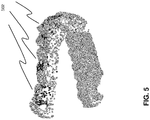
- Fig. 5 This effect is illustrated in Fig. 5 , where the certainty of label classification is presented for each point, predicted by the network with an equally weighted loss function.
- the points shown in darker color 502 are points whose label prediction was uncertain according to the trained deep neural network.
- the sparse regions with low sampling rate exhibit low classification certainty (i.e. will often be miss-classified by a trained network) because the lack of data in the sparse regions makes it difficult for the model to perform as accurately as it performs in dense regions.
- a trade-off may need to be found, e.g.
- a weight may be applied to each point. This weight may be computed based on the distance metric of the RBF kernel as defined by equation (1) above.
- a discriminator network may be used to discriminate between labels generated by the segmentation network and the (real) target labels.
- an embedded loss distance between the features of the hidden layer in the discriminator network
- one or more statistical parameters may be computed based on the predicted and real labels by a feature extractor. These parameters may be used to quickly and efficiently train the discriminator network.
- the stacked feature set ( û ) may represent a soft computation of central positions of teeth in a dentition and their variance (i.e. their soft bounding boxes) in the 3D space, according to the predicted labels (p ij ).
- the statistical mean and variance may be computed only for L - 1 classes, such as those belonging to teeth.
- the counterpart feature-set of ( û ), denoted by ( u ), may be obtained.
- a vector of zeros may be inserted.
- the feature set ( u ) represents a realistic statistical measurement of the labelled data.
- Fig. 6 schematically depicts a computer system for classification and segmentation of 3D dento-maxillofacial structures according to an embodiment of the invention.
- the computer system may be configured to receive a 3D image data 602 of a dento-maxillofacial structure.
- the structure may include gingiva- and individual teeth crowns- structure.
- the 3D image data may comprise point clouds and/or surface normals, i.e. elements associated with coordinate values in 3D space.
- the 3D image data may include a IOS image data according a predetermined format, e.g. a triangular mesh format or a derivative thereof.
- the computer system may comprise a pre-processor for pre-processing the 3D image data into a point cloud.
- a prediction cycle may be started, which continues until all elements of the point cloud have been assigned at least one predicted label: if there are still unlabelled elements, one random unlabelled element x fovea is chosen 606, and a set of M elements is taken from around x fovea according to the non-uniform resampling 608 as described with respect to Fig. 2 .
- the combination of 606 and 608 may be considered a non-uniform resampling module 611.
- the set of M elements is fed to the input of a first 3D deep learning neural network 610, which has been trained to produce a semantic segmentation, i.e. a label probability 612 for each element of M to belonging to each possible class (as is described with respect to Fig. 4 ). If all elements of the point cloud have been assigned at least one predicted label, an average of all the label probabilities 614 may be taken for each element of the point cloud, and the most probable class may be selected for each element to obtain labelled data 616
- the system depicted in Fig. 1 and 4 may include at least two deep learning networks: a segmentation network and a discriminator network.
- the segmentation network may be based on any deep learning network architecture that is capable of analyzing a point cloud taking into account spatial correlations between different points of the point cloud.
- the semantic segmentation network may be based on the PointCNN model.
- FIG. 7A and 7B A schematic of such deep neural network is depicted in Fig. 7A and 7B .
- the PointCNN model 702 is based on a stack of ⁇ -Conv operators 704 1-9 which weights and permutes the input points and their corresponding features, prior to processing them by a conventional convolution operator.
- the structure of a ⁇ -Conv operator is depicted in more detail in Fig. 7B .
- a ⁇ -Conv operator may be controlled by the parameters N, c, K and D, wherein N defines the number of points of the resampled point cloud that is fed to the input of the segmentation module.
- each ⁇ -Conv operator includes a fixed set of K-nearest neighbour (KNN) points 709. Additionally, the ⁇ -Conv operator may include two MLP networks 710, 712. These two MLP networks learn a ⁇ -transformation of K ⁇ K for the coordinates of K input points.
- the outcome of the ⁇ -Conv operation is the aggregation and projection of KNN point features into a representative set of points, after which a typical convolution is applied to them.
- the PointCNN model depicted in Fig. 7 is capable of learning local correlations from data represented in the point cloud. Additionally, the PointCNN model has a considerably lower amount of learning parameters in comparison with other deep learning models for point clouds. This is beneficial for our case study, because it is less prone to severe overfitting on a small dataset.
- the inputs to the segmentation network may be the resampled points and its output is a multi-element vector for each point, wherein each element of the vector represents a class probability.
- the multi-vector element may comprise 17 elements representing 16 tooth classes and the gingiva.
- the discriminator network aims to discriminate feature set u from ( û ). In an embodiment, the discriminator network may be configured as a deep convolutional neural network.
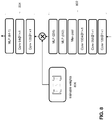
- FIG. 8 An example of a discriminator network is depicted in Fig. 8 .
- the network may comprise two cascaded parts 802,804.
- the first part 802 estimates an affine transformation applied on the input 96-element vector.
- the second part 804 includes a MLP network, in this example a 3-layer MLP network, which maps the transformed input vector into a scalar value by a sigmoidal activation function at its output node.
- the network may be trained to produce the scalar 1 at its output if the network is applied to ( u ), while the scalar 0 may be produced if the network is applied to ( û ).
- the total loss for the segmentation network is a contribution of the losses L p as defined by equation (2) and L Adv as defined by equation (5).
- adaptive loss weighting may be used.
- the system may be configured in its inference modus as described with reference to Fig. 1B above.
- the segmentation network is trained on the non-uniform resampled data, therefore in order to predict labels for the whole point cloud several subset of points need to be formed based on the non-uniform resampling algorithm as described above with reference to Fig. 2 and 3 .
- the prediction of all points in the point cloud may be obtained by aggregating the predicted labels for each of the subsets.
- the pseudocode of the algorithm is provided in table 2:
- the training data included 120 optical scans of dentitions from 60 adult subjects, each containing one upper and one lower jaw scan.
- the dataset includes scans from healthy dentition and different type of abnormalities among subjects.
- the IOS data was generated using a 3Shape d500 optical scanner (3Shape AS, Copenhagen, Denmark). On average, each IOS point cloud comprises 180.000 points (varying in between 100.000 and 310.000). All optical scan meshes were manually segmented and their respective points were categorized into one of the 32+1 classes by a dental professional and reviewed and adjusted by one dental expert (DAM) with Meshmixer 3.4 (Autodesk Inc, San Rafael CA, USA). Labelling of the tooth categories was performed according to the international tooth numbering standard, Federation Dentaire Internationale (FDI). Segmentation of each optical scan takes approximately 45 minutes on average, which shows its intensive laborious task for a human.
- DAI Federation Dentaire Internationale
- the performance of the model was evaluated by 5-fold cross validation and the results are compared by the average Jaccard Index, also known as intersection over union (IoU). Additional to the IoU, the precision and recall for the multi-class segmentation problem is reported. For computing the precision and recall, each class treats individually (one versus all), as a binary problem and finally the average score are reported.
- the experiments were partitioned into three parts: (1) benchmarking the performance of the PointCNN network in comparison with two other state-of-the-art deep learning models on IOS segmentation.
- Table 3 shows the obtained results under different experimental setups. Examples of predicted labels for IOS point cloud generated by the model as provided in Fig. 9-11 .
- the PointCNN performs better than two other state-of-the-art models when a naive uniform sampling is used. This is mostly because of the x-Conv operator in the PointCNN being capable of using spatial-correlation information of points in the point cloud. Additionally, PointCNN uses relatively few of parameters so that the system is less prone to overfitting.
- the PointGrid samples points of the point cloud inside a predefined grid and uses convolutional operators to predict labels. In this case however, its performance is limited to the spatial resolution of the spatial quantization grid.
- PointNet model ignores the spatial correlation between points in the point cloud.
- the results on the PointCNN in table 3 illustrate the effectiveness of using non-uniform sampling and/or adversarial loss. Both techniques individually improve the performance of the PointCNN. The combination of non-uniform sampling and adversarial loss provides the highest performance.
- the accuracy of the system is illustrated by the semantically segmented IOS point cloud data depicted in Fig. 8-11 .
- Fig. 9 depicts illustrations of 3D dento-maxillofacial image data, more specifically data as may be derived from intra-oral scans, labelled as predicted by an embodiment of the invention, more specifically an embodiment incorporating a discriminator network as described with respect to Fig. 4 and 8 , during training. All four dento-maxillofacial images are held-out samples (samples not used during training). For the purpose if these visualizations, labelling as was applied to point clouds representing meshes was applied back to the representative faces of the surface meshes of intra-oral scans. Detailed sections 902-908 show the accuracy of the segmentations, especially in areas that may be considered difficult such as the borders between teeth, and between teeth and gingiva
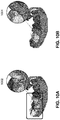
- Fig. 10A shows examples of 3D dento-maxillofacial image data labelled as predicted by a segmentation network which has been trained without the support of a discriminator network. As shown in the highlighted circle 1002 the segmentation network as trained without such discriminator incorrectly predicted labels for four different tooth objects across three teeth. For comparison, in Fig. 10B , the same dento-maxillofacial 3D image data is shown with ground truth labelling. Results as can be seen with respect to Fig. 9 , utilizing training with employing a discriminator as described with respect to Fig. 4 and 8 , may be considered highly accurate when compared to ground truth labels, especially in border regions 1004.
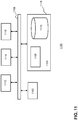
- Data processing system 1100 may include at least one processor 1102 coupled to memory elements 1104 through a system bus 1106. As such, the data processing system may store program code within memory elements 1104. Further, processor 1102 may execute the program code accessed from memory elements 1104 via system bus 1106.
- data processing system may be implemented as a computer that is suitable for storing and/or executing program code. It should be appreciated, however, that data processing system 1100 may be implemented in the form of any system including a processor and memory that is capable of performing the functions described within this specification.
- Memory elements 1104 may include one or more physical memory devices such as, for example, local memory 1108 and one or more bulk storage devices 1110.
- Local memory may refer to random access memory or other non-persistent memory device(s) generally used during actual execution of the program code.
- a bulk storage device may be implemented as a hard drive or other persistent data storage device.
- the processing system 1100 may also include one or more cache memories (not shown) that provide temporary storage of at least some program code in order to reduce the number of times program code must be retrieved from bulk storage device 1110 during execution.
- I/O devices depicted as input device 1112 and output device 1114 optionally can be coupled to the data processing system.
- input device may include, but are not limited to, for example, a keyboard, a pointing device such as a mouse, or the like.
- output device may include, but are not limited to, for example, a monitor or display, speakers, or the like.
- Input device and/or output device may be coupled to data processing system either directly or through intervening I/O controllers.
- a network adapter 1116 may also be coupled to data processing system to enable it to become coupled to other systems, computer systems, remote network devices, and/or remote storage devices through intervening private or public networks.
- the network adapter may comprise a data receiver for receiving data that is transmitted by said systems, devices and/or networks to said data and a data transmitter for transmitting data to said systems, devices and/or networks.
- Modems, cable modems, and Ethernet cards are examples of different types of network adapter that may be used with data processing system 1100.
- memory elements 1104 may store an application 1118.
- data processing system 1100 may further execute an operating system (not shown) that can facilitate execution of the application.
- Application being implemented in the form of executable program code, can be executed by data processing system 1100, e.g., by processor 1102. Responsive to executing application, data processing system may be configured to perform one or more operations to be described herein in further detail.
- data processing system 1100 may represent a client data processing system.
- application 1118 may represent a client application that, when executed, configures data processing system 1100 to perform the various functions described herein with reference to a "client".
- Examples of a client can include, but are not limited to, a personal computer, a portable computer, a mobile phone, or the like.
- data processing system may represent a server.
- data processing system may represent an (HTTP) server in which case application 1118, when executed, may configure data processing system to perform (HTTP) server operations.
- data processing system may represent a module, unit or function as referred to in this specification.
Landscapes
- Engineering & Computer Science (AREA)
- Theoretical Computer Science (AREA)
- Physics & Mathematics (AREA)
- General Physics & Mathematics (AREA)
- Evolutionary Computation (AREA)
- Artificial Intelligence (AREA)
- Data Mining & Analysis (AREA)
- Computer Vision & Pattern Recognition (AREA)
- Health & Medical Sciences (AREA)
- General Health & Medical Sciences (AREA)
- Life Sciences & Earth Sciences (AREA)
- General Engineering & Computer Science (AREA)
- Software Systems (AREA)
- Computing Systems (AREA)
- Multimedia (AREA)
- Molecular Biology (AREA)
- Biomedical Technology (AREA)
- Computational Linguistics (AREA)
- Biophysics (AREA)
- Mathematical Physics (AREA)
- Medical Informatics (AREA)
- Bioinformatics & Cheminformatics (AREA)
- Evolutionary Biology (AREA)
- Bioinformatics & Computational Biology (AREA)
- Databases & Information Systems (AREA)
- Biodiversity & Conservation Biology (AREA)
- Quality & Reliability (AREA)
- Radiology & Medical Imaging (AREA)
- Nuclear Medicine, Radiotherapy & Molecular Imaging (AREA)
- Image Analysis (AREA)
- Dental Tools And Instruments Or Auxiliary Dental Instruments (AREA)
Priority Applications (10)
| Application Number | Priority Date | Filing Date | Title |
|---|---|---|---|
| EP18213246.4A EP3671531A1 (de) | 2018-12-17 | 2018-12-17 | Semantische segmentierung von nicht-euklidischen 3d-datensätzen mit tiefenlernen |
| CN201980092326.2A CN113454637A (zh) | 2018-12-17 | 2019-12-17 | 使用深度学习对非欧式3d数据集的自动语义分割 |
| PCT/EP2019/085819 WO2020127398A1 (en) | 2018-12-17 | 2019-12-17 | Automated semantic segmentation of non-euclidean 3d data sets using deep learning |
| IL283988A IL283988B2 (en) | 2018-12-17 | 2019-12-17 | Automatic semantic segmentation of non-Euclidean 3D datasets using deep learning |
| KR1020217021771A KR102935128B1 (ko) | 2018-12-17 | 2019-12-17 | 딥 러닝을 이용한 비 유클리드 3d 데이터 세트의 자동 의미론적 분할 |
| US17/415,465 US12141702B2 (en) | 2018-12-17 | 2019-12-17 | Automated semantic segmentation of non-euclidean 3D data sets using deep learning |
| JP2021534797A JP7665515B2 (ja) | 2018-12-17 | 2019-12-17 | ディープラーニングを使用した非ユークリッド3dデータセットの自動セマンティックセグメンテーション |
| EP19818173.7A EP3899780A1 (de) | 2018-12-17 | 2019-12-17 | Automatische semantische segmentierung von nicht-euklidischen 3d-datensätzen mit tiefenlernen |
| CA3123509A CA3123509A1 (en) | 2018-12-17 | 2019-12-17 | Automated semantic segmentation of non-euclidean 3d data sets using deep learning |
| BR112021011722-9A BR112021011722A2 (pt) | 2018-12-17 | 2019-12-17 | Método implementado em computador, sistema e produto de programa de computador |
Applications Claiming Priority (1)
| Application Number | Priority Date | Filing Date | Title |
|---|---|---|---|
| EP18213246.4A EP3671531A1 (de) | 2018-12-17 | 2018-12-17 | Semantische segmentierung von nicht-euklidischen 3d-datensätzen mit tiefenlernen |
Publications (1)
| Publication Number | Publication Date |
|---|---|
| EP3671531A1 true EP3671531A1 (de) | 2020-06-24 |
Family
ID=64744532
Family Applications (2)
| Application Number | Title | Priority Date | Filing Date |
|---|---|---|---|
| EP18213246.4A Withdrawn EP3671531A1 (de) | 2018-12-17 | 2018-12-17 | Semantische segmentierung von nicht-euklidischen 3d-datensätzen mit tiefenlernen |
| EP19818173.7A Pending EP3899780A1 (de) | 2018-12-17 | 2019-12-17 | Automatische semantische segmentierung von nicht-euklidischen 3d-datensätzen mit tiefenlernen |
Family Applications After (1)
| Application Number | Title | Priority Date | Filing Date |
|---|---|---|---|
| EP19818173.7A Pending EP3899780A1 (de) | 2018-12-17 | 2019-12-17 | Automatische semantische segmentierung von nicht-euklidischen 3d-datensätzen mit tiefenlernen |
Country Status (9)
| Country | Link |
|---|---|
| US (1) | US12141702B2 (de) |
| EP (2) | EP3671531A1 (de) |
| JP (1) | JP7665515B2 (de) |
| KR (1) | KR102935128B1 (de) |
| CN (1) | CN113454637A (de) |
| BR (1) | BR112021011722A2 (de) |
| CA (1) | CA3123509A1 (de) |
| IL (1) | IL283988B2 (de) |
| WO (1) | WO2020127398A1 (de) |
Cited By (26)
| Publication number | Priority date | Publication date | Assignee | Title |
|---|---|---|---|---|
| CN111950643A (zh) * | 2020-08-18 | 2020-11-17 | 创新奇智(上海)科技有限公司 | 模型训练方法、图像分类方法及对应装置 |
| CN112633330A (zh) * | 2020-12-06 | 2021-04-09 | 西安电子科技大学 | 点云分割方法、系统、介质、计算机设备、终端及应用 |
| CN113129311A (zh) * | 2021-03-10 | 2021-07-16 | 西北大学 | 一种标签优化点云实例分割方法 |
| CN113223173A (zh) * | 2021-05-11 | 2021-08-06 | 华中师范大学 | 基于图模型的三维模型重建迁移方法及系统 |
| CN113221903A (zh) * | 2021-05-11 | 2021-08-06 | 中国科学院自动化研究所 | 跨域自适应语义分割方法及系统 |
| CN113361538A (zh) * | 2021-06-22 | 2021-09-07 | 中国科学技术大学 | 一种基于自适应选择邻域的点云分类和分割方法及系统 |
| CN113674286A (zh) * | 2021-08-31 | 2021-11-19 | 浙江工商大学 | 基于跨图注意力机制和代价函数学习的牙模点云分割方法 |
| US11379975B2 (en) | 2017-06-30 | 2022-07-05 | Promaton Holding B.V. | Classification and 3D modelling of 3D dento-maxillofacial structures using deep learning methods |
| CN114897692A (zh) * | 2022-05-06 | 2022-08-12 | 广州紫为云科技有限公司 | 搭载基于零样本学习的整体点云上采样算法的手持设备 |
| US11455774B2 (en) | 2017-12-22 | 2022-09-27 | Promaton Holding B.V. | Automated 3D root shape prediction using deep learning methods |
| CN115294179A (zh) * | 2022-07-26 | 2022-11-04 | 大连理工大学 | 用于对点云进行上采样的方法、电子设备及存储介质 |
| CN115496899A (zh) * | 2022-08-29 | 2022-12-20 | 厦门大学 | 基于稀疏标记的序列点云语义分割方法、装置及设备 |
| US11568533B2 (en) | 2017-10-02 | 2023-01-31 | Promaton Holding B.V. | Automated classification and taxonomy of 3D teeth data using deep learning methods |
| CN116152611A (zh) * | 2023-04-14 | 2023-05-23 | 山东省凯麟环保设备股份有限公司 | 一种多级多尺度点云补全方法、系统、设备及存储介质 |
| CN116309616A (zh) * | 2023-01-29 | 2023-06-23 | 西安电子科技大学 | 一种递进式三维牙齿自动分割方法、设备及存储介质 |
| CN116758497A (zh) * | 2023-03-21 | 2023-09-15 | 湖南大学 | 一种基于无人系统的激光点云三维目标检测方法 |
| CN116993748A (zh) * | 2023-07-31 | 2023-11-03 | 西安邮电大学 | 基于并行特征提取的点云语义分割方法 |
| US11842484B2 (en) | 2021-01-04 | 2023-12-12 | James R. Glidewell Dental Ceramics, Inc. | Teeth segmentation using neural networks |
| US12136208B2 (en) | 2021-03-31 | 2024-11-05 | James R. Glidewell Dental Ceramics, Inc. | Automatic clean up of jaw scans |
| US12141702B2 (en) | 2018-12-17 | 2024-11-12 | Promaton Holding B.V. | Automated semantic segmentation of non-euclidean 3D data sets using deep learning |
| CN119339081A (zh) * | 2024-10-14 | 2025-01-21 | 湖南大学 | 一种基于有监督学习的输电线路树木分割方法及系统 |
| US12210802B2 (en) | 2021-04-30 | 2025-01-28 | James R. Glidewell Dental Ceramics, Inc. | Neural network margin proposal |
| US12232923B2 (en) | 2018-09-04 | 2025-02-25 | Promaton Holding B.V. | Automated orthodontic treatment planning using deep learning |
| US12295806B2 (en) | 2022-01-10 | 2025-05-13 | James R. Glidewell Dental Ceramics, Inc. | Automatic determination of trim-line for aligners |
| CN120747522A (zh) * | 2025-09-04 | 2025-10-03 | 深圳大学 | 基于多通道注意力机制的城市场景点云自动语义分割方法、系统、终端及介质 |
| US12616559B2 (en) | 2019-07-15 | 2026-05-05 | Promaton Holding B.V. | Object detection and instance segmentation of 3D point clouds based on deep learning |
Families Citing this family (32)
| Publication number | Priority date | Publication date | Assignee | Title |
|---|---|---|---|---|
| EP3561778A1 (de) | 2018-04-26 | 2019-10-30 | Promaton Holding B.V. | Automatisierte korrektur von metallbehafteten voxeldarstellungen von röntgendaten mit hilfe von tiefenlerntechniken |
| EP3591616A1 (de) | 2018-07-03 | 2020-01-08 | Promaton Holding B.V. | Automatisierte bestimmung einer kanonischen lage eines 3d-zahnmodells und überlagerung von 3d-zahnstrukturen mittels tiefenlernen |
| US11669729B2 (en) * | 2019-09-27 | 2023-06-06 | Canon Medical Systems Corporation | Model training method and apparatus |
| CN113223140B (zh) * | 2020-01-20 | 2025-05-13 | 杭州朝厚信息科技有限公司 | 利用人工神经网络生成牙科正畸治疗效果的图像的方法 |
| US11694333B1 (en) * | 2020-02-05 | 2023-07-04 | State Farm Mutual Automobile Insurance Company | Performing semantic segmentation of 3D data using deep learning |
| CN111460150B (zh) * | 2020-03-27 | 2023-11-10 | 北京小米松果电子有限公司 | 一种分类模型的训练方法、分类方法、装置及存储介质 |
| US11443193B2 (en) * | 2020-04-24 | 2022-09-13 | Adobe Inc. | Domain adaptation for machine learning models |
| CN114930402B (zh) * | 2020-11-12 | 2026-02-06 | 深圳元戎启行科技有限公司 | 点云法向量计算方法、装置、计算机设备和存储介质 |
| KR20220069655A (ko) * | 2020-11-20 | 2022-05-27 | 주식회사 쓰리디산업영상 | Ct 영상에서의 치아 분할 시스템 및 방법 |
| CN112465840B (zh) * | 2020-12-10 | 2023-02-17 | 重庆紫光华山智安科技有限公司 | 语义分割模型训练方法、语义分割方法及相关装置 |
| US11430218B2 (en) * | 2020-12-31 | 2022-08-30 | Toyota Research Institute, Inc. | Using a bird's eye view feature map, augmented with semantic information, to detect an object in an environment |
| US12579656B2 (en) * | 2021-02-12 | 2026-03-17 | Align Technology, Inc. | Machine learning dental segmentation system and methods using graph-based approaches |
| CN113936027B (zh) * | 2021-10-14 | 2025-03-07 | 深圳市华汉伟业科技有限公司 | 获取物体位置的方法、点云分割的方法 |
| CN113808133B (zh) * | 2021-11-19 | 2022-01-25 | 西南交通大学 | 一种基于三维点云的地铁闸瓦故障检测方法 |
| CN114529553A (zh) * | 2021-12-21 | 2022-05-24 | 河北科技大学 | 一种自动牙颌数字模型分割算法 |
| CN114549806B (zh) * | 2022-03-04 | 2025-08-05 | 宁波梵兴信息技术有限公司 | 一种针对PointCNN可解释性的可视分析方法 |
| CN114862692B (zh) * | 2022-04-01 | 2024-04-02 | 华南理工大学 | 一种基于标准化流理论的三维点云去噪方法 |
| CN115311407B (zh) * | 2022-04-19 | 2023-09-12 | 北京和华瑞博医疗科技有限公司 | 一种特征点标记方法、装置、设备及存储介质 |
| CN115841585B (zh) * | 2022-05-31 | 2024-06-11 | 上海人工智能创新中心 | 一种对点云分割网络进行知识蒸馏的方法 |
| CN114743010B (zh) * | 2022-06-13 | 2022-08-26 | 山东科技大学 | 基于深度学习的超高压输电线路点云数据语义分割方法 |
| CN115239954B (zh) * | 2022-06-21 | 2024-06-14 | 上海人工智能创新中心 | 一种用于点云全景分割的系统及方法 |
| KR102741821B1 (ko) * | 2022-07-22 | 2024-12-11 | 포항공과대학교 산학협력단 | 영상처리 장치 및 영상처리 장치를 위한 3차원 형상 잠재공간의 기계 학습 방법 |
| KR102822516B1 (ko) * | 2022-08-17 | 2025-06-23 | 한국과학기술연구원 | 인공지능 기반 크라운 디자인 자동화 방법 및 시스템 |
| US20240062331A1 (en) * | 2022-08-19 | 2024-02-22 | GE Precision Healthcare LLC | Deep learning robustness against display field of view variations |
| US12059316B2 (en) * | 2022-09-08 | 2024-08-13 | Enamel Pure | Systems and methods for dental treatment and verification |
| US12555366B2 (en) * | 2022-09-15 | 2026-02-17 | Waymo Llc | Semantic segmentation neural network for point clouds |
| KR102941662B1 (ko) | 2022-10-28 | 2026-03-18 | 한양대학교 산학협력단 | 준지도 학습을 이용한 학습 장치 및 방법 |
| CN115471663A (zh) * | 2022-11-15 | 2022-12-13 | 上海领健信息技术有限公司 | 基于深度学习的三阶段牙冠分割方法、装置、终端及介质 |
| KR102826814B1 (ko) * | 2022-12-28 | 2025-06-30 | 주식회사 덴티움 | 딥러닝을 이용하여 3차원으로 치아를 스캔한 데이터에서 치아를 분할하기 위한 장치 및 이를 위한 방법 |
| US12481722B2 (en) * | 2023-03-07 | 2025-11-25 | Gm Cruise Holdings Llc | Pipeline for generating synthetic point cloud data |
| CN116563356B (zh) * | 2023-05-12 | 2024-06-11 | 北京长木谷医疗科技股份有限公司 | 全局3d配准方法、装置及电子设备 |
| CN118279486B (zh) * | 2024-03-29 | 2025-01-24 | 成都东软学院 | 一种基于深度学习的三维模型构建方法 |
Citations (1)
| Publication number | Priority date | Publication date | Assignee | Title |
|---|---|---|---|---|
| US20170169562A1 (en) | 2015-12-10 | 2017-06-15 | 3M Innovative Properties Company | Method for automatic tooth type recognition from 3d scans |
Family Cites Families (68)
| Publication number | Priority date | Publication date | Assignee | Title |
|---|---|---|---|---|
| WO2001010339A2 (en) | 1999-08-11 | 2001-02-15 | Case Western Reserve University | Method and apparatus for producing an implant |
| US6721387B1 (en) | 2001-06-13 | 2004-04-13 | Analogic Corporation | Method of and system for reducing metal artifacts in images generated by x-ray scanning devices |
| US7004754B2 (en) * | 2003-07-23 | 2006-02-28 | Orametrix, Inc. | Automatic crown and gingiva detection from three-dimensional virtual model of teeth |
| JP2007520300A (ja) | 2004-02-05 | 2007-07-26 | コーニンクレッカ フィリップス エレクトロニクス エヌ ヴィ | ボクセル組織クラスを分散するctにおける高減衰オブジェクトにより生じる画像全体のアーティファクトの縮小 |
| US7987099B2 (en) | 2004-02-27 | 2011-07-26 | Align Technology, Inc. | Dental data mining |
| US9492245B2 (en) | 2004-02-27 | 2016-11-15 | Align Technology, Inc. | Method and system for providing dynamic orthodontic assessment and treatment profiles |
| US7711406B2 (en) | 2005-11-23 | 2010-05-04 | General Electric Company | System and method for detection of electromagnetic radiation by amorphous silicon x-ray detector for metal detection in x-ray imaging |
| US7844429B2 (en) | 2006-07-19 | 2010-11-30 | Align Technology, Inc. | System and method for three-dimensional complete tooth modeling |
| US9730663B2 (en) | 2007-08-31 | 2017-08-15 | Koninklijke Philips N.V. | Uncertainty maps for segmentation in the presence of metal artifacts |
| US8439672B2 (en) | 2008-01-29 | 2013-05-14 | Align Technology, Inc. | Method and system for optimizing dental aligner geometry |
| US8108189B2 (en) | 2008-03-25 | 2012-01-31 | Align Technologies, Inc. | Reconstruction of non-visible part of tooth |
| JP4717935B2 (ja) | 2009-03-23 | 2011-07-06 | 富士フイルム株式会社 | 画像処理装置および方法並びにプログラム |
| US8503750B2 (en) | 2009-10-06 | 2013-08-06 | General Electric Company | Method and apparatus for reduction of metal artifacts in CT images |
| KR101531440B1 (ko) | 2010-04-20 | 2015-06-24 | 이미징 사이언시즈 인터내셔널 엘엘씨 | 표면 스캔 정보를 이용한 3차원 치과용 x 레이 데이터 세트로부터의 아티팩트의 감소 및 제거 |
| CN101853485A (zh) * | 2010-06-04 | 2010-10-06 | 浙江工业大学 | 一种基于近邻传播聚类的非均匀点云简化处理方法 |
| EP2598034B1 (de) | 2010-07-26 | 2018-07-18 | Kjaya, LLC | Adaptive visualisierung zur direkten ärztlichen verwendung |
| US8761493B2 (en) | 2011-07-21 | 2014-06-24 | Carestream Health, Inc. | Method and system for tooth segmentation in dental images |
| DE102012206714A1 (de) | 2011-08-10 | 2013-02-14 | Friedrich-Alexander-Universität Erlangen-Nürnberg | Verfahren, Recheneinheit, CT-System und C-Bogen-System zur Reduktion von Metallartefakten in CT-Bilddatensätzen |
| US9135498B2 (en) | 2012-12-14 | 2015-09-15 | Ormco Corporation | Integration of intra-oral imagery and volumetric imagery |
| US20140227655A1 (en) | 2013-02-12 | 2014-08-14 | Ormco Corporation | Integration of model data, surface data, and volumetric data |
| US9349198B2 (en) | 2013-07-26 | 2016-05-24 | General Electric Company | Robust artifact reduction in image reconstruction |
| WO2015169910A1 (en) | 2014-05-09 | 2015-11-12 | 3Shape A/S | Scanning of edentulous patients |
| DE102014007095A1 (de) | 2014-05-14 | 2015-11-19 | Universität Zu Lübeck | Verfahren und Vorrichtung zur Reduktion von Artefakten in computertomographischen Bildern |
| US20170258420A1 (en) | 2014-05-22 | 2017-09-14 | Carestream Health, Inc. | Method for 3-D Cephalometric Analysis |
| US9953425B2 (en) * | 2014-07-30 | 2018-04-24 | Adobe Systems Incorporated | Learning image categorization using related attributes |
| US9934597B2 (en) | 2014-09-11 | 2018-04-03 | Carestream Health, Inc. | Metal artifacts reduction in cone beam reconstruction |
| US9655580B2 (en) | 2014-10-24 | 2017-05-23 | General Electric Company | Systems and methods for metal artifact reduction |
| JP6458860B2 (ja) | 2015-03-09 | 2019-01-30 | 富士通株式会社 | 歯冠情報取得プログラム、情報処理装置、及び歯冠情報取得方法 |
| US9498179B1 (en) | 2015-05-07 | 2016-11-22 | General Electric Company | Methods and systems for metal artifact reduction in spectral CT imaging |
| US10013779B2 (en) | 2015-06-22 | 2018-07-03 | Toshiba Medical Systems Corporation | Metal artifact reduction for 3D-digtial subtraction angiography |
| US10235606B2 (en) | 2015-07-22 | 2019-03-19 | Siemens Healthcare Gmbh | Method and system for convolutional neural network regression based 2D/3D image registration |
| CN110688891B (zh) | 2015-08-15 | 2024-05-31 | 硕动力公司 | 采用3d批归一化的三维(3d)卷积 |
| JP2017102622A (ja) | 2015-11-30 | 2017-06-08 | キヤノン株式会社 | 画像処理装置、画像処理方法及びプログラム |
| JP6873600B2 (ja) | 2016-03-04 | 2021-05-19 | キヤノン株式会社 | 画像認識装置、画像認識方法及びプログラム |
| DE102016204226A1 (de) | 2016-03-15 | 2017-09-21 | Siemens Healthcare Gmbh | Vorrichtung und Verfahren zum Abgrenzen eines Metallobjekts für eine Artefaktreduktion in Tomographiebildern |
| JP6780948B2 (ja) | 2016-03-28 | 2020-11-04 | キヤノンメディカルシステムズ株式会社 | X線ct装置 |
| KR102419552B1 (ko) | 2016-06-21 | 2022-07-11 | 노벨 바이오케어 서비시스 아게 | 치아 수복물의 형상, 위치 및 배향 중 적어도 하나를 추정하는 방법 |
| US10304190B2 (en) * | 2016-06-29 | 2019-05-28 | 3M Innovative Properties Company | Virtual model of articulation from intra-oral scans |
| WO2018022752A1 (en) * | 2016-07-27 | 2018-02-01 | James R. Glidewell Dental Ceramics, Inc. | Dental cad automation using deep learning |
| CN119423483A (zh) | 2016-08-22 | 2025-02-14 | 科利布里有限公司 | 用于依从性监测的口腔卫生系统及远程-牙科系统 |
| US20200022790A1 (en) | 2016-10-10 | 2020-01-23 | 3Shape A/S | Common Placement Support for Artificial Teeth |
| US10660728B2 (en) | 2016-10-20 | 2020-05-26 | Baliram Maraj | Systems and methods for dental treatment utilizing mixed reality and deep learning |
| US10229533B2 (en) * | 2016-11-03 | 2019-03-12 | Mitsubishi Electric Research Laboratories, Inc. | Methods and systems for fast resampling method and apparatus for point cloud data |
| CN106618760B (zh) | 2016-12-07 | 2019-11-08 | 上海牙典医疗器械有限公司 | 一种设计正畸矫治方案的方法 |
| CN108205806B (zh) | 2016-12-20 | 2020-10-09 | 北京大学 | 一种锥束ct图像三维颅面结构的自动解析方法 |
| EP3562426B1 (de) | 2016-12-30 | 2022-05-04 | Carestream Dental Technology Topco Limited | Rekonstruktion eines virtuellen computertomografievolumens zur verfolgung der entwicklung einer kieferorthopädischen behandlung |
| US10546242B2 (en) * | 2017-03-03 | 2020-01-28 | General Electric Company | Image analysis neural network systems |
| WO2018175486A1 (en) | 2017-03-20 | 2018-09-27 | Align Technology, Inc. | Generating a virtual depiction of an orthodontic treatment of a patient |
| JP2020525258A (ja) | 2017-06-30 | 2020-08-27 | プロマトン・ホールディング・ベー・フェー | 深層学習法を使用する3d歯顎顔面構造の分類および3dモデリング |
| EP3645964B1 (de) | 2017-06-30 | 2023-08-23 | Dental Imaging Technologies Corporation | Oberflächenkartierung mit einem intraoralen scanner mit penetrationsfähigkeiten |
| FR3069355B1 (fr) | 2017-07-21 | 2023-02-10 | Dental Monitoring | Procédé d’entrainement d’un réseau de neurones par enrichissement de sa base d’apprentissage pour l’analyse d’une image d’arcade dentaire |
| FR3069359B1 (fr) | 2017-07-21 | 2019-08-23 | Dental Monitoring | Procede d'analyse d'une image d'une arcade dentaire |
| EP3462373A1 (de) | 2017-10-02 | 2019-04-03 | Promaton Holding B.V. | Automatisierte klassifizierung und taxonomie von 3d-zahndaten mit tieflernverfahren |
| US10997727B2 (en) | 2017-11-07 | 2021-05-04 | Align Technology, Inc. | Deep learning for tooth detection and evaluation |
| US10824862B2 (en) | 2017-11-14 | 2020-11-03 | Nuro, Inc. | Three-dimensional object detection for autonomous robotic systems using image proposals |
| EA201700561A1 (ru) | 2017-11-16 | 2019-05-31 | Общество С Ограниченной Ответственностью "Доммар" | Способ и система выравнивания зубов на основании моделирования движения коронок и корней |
| US11120551B2 (en) | 2017-11-27 | 2021-09-14 | Rensselaer Polytechnic Institute | Training a CNN with pseudo ground truth for CT artifact reduction |
| EP3503038A1 (de) | 2017-12-22 | 2019-06-26 | Promaton Holding B.V. | Automatisierte 3d-vorhersage einer wurzelform mithilfe von tiefenlernverfahren |
| CN108305684A (zh) | 2018-02-28 | 2018-07-20 | 成都贝施美医疗科技股份有限公司 | 正畸治疗模拟方法、装置及终端设备 |
| EP3561778A1 (de) | 2018-04-26 | 2019-10-30 | Promaton Holding B.V. | Automatisierte korrektur von metallbehafteten voxeldarstellungen von röntgendaten mit hilfe von tiefenlerntechniken |
| CN110473283B (zh) | 2018-05-09 | 2024-01-23 | 无锡时代天使医疗器械科技有限公司 | 牙齿三维数字模型的局部坐标系设定方法 |
| EP3591616A1 (de) | 2018-07-03 | 2020-01-08 | Promaton Holding B.V. | Automatisierte bestimmung einer kanonischen lage eines 3d-zahnmodells und überlagerung von 3d-zahnstrukturen mittels tiefenlernen |
| EP3620130A1 (de) | 2018-09-04 | 2020-03-11 | Promaton Holding B.V. | Automatische planung zahnmedizinischer behandlungen mit deep learning |
| KR102856647B1 (ko) | 2018-09-27 | 2025-09-05 | 코닝 인코포레이티드 | 모듈형 용융 유리 이송 장치 |
| EP3671531A1 (de) | 2018-12-17 | 2020-06-24 | Promaton Holding B.V. | Semantische segmentierung von nicht-euklidischen 3d-datensätzen mit tiefenlernen |
| EP3767521A1 (de) | 2019-07-15 | 2021-01-20 | Promaton Holding B.V. | Objektdetektion und instanzsegmentierung von 3d-punktwolken auf basis von tiefenlernen |
| US10932890B1 (en) | 2019-11-14 | 2021-03-02 | Pearl Inc. | Enhanced techniques for determination of dental margins in intraoral scans |
| US20230263605A1 (en) * | 2022-02-24 | 2023-08-24 | Voyager Dental, Inc. | Color digital denture design and replacement |
-
2018
- 2018-12-17 EP EP18213246.4A patent/EP3671531A1/de not_active Withdrawn
-
2019
- 2019-12-17 EP EP19818173.7A patent/EP3899780A1/de active Pending
- 2019-12-17 CN CN201980092326.2A patent/CN113454637A/zh active Pending
- 2019-12-17 WO PCT/EP2019/085819 patent/WO2020127398A1/en not_active Ceased
- 2019-12-17 KR KR1020217021771A patent/KR102935128B1/ko active Active
- 2019-12-17 JP JP2021534797A patent/JP7665515B2/ja active Active
- 2019-12-17 US US17/415,465 patent/US12141702B2/en active Active
- 2019-12-17 BR BR112021011722-9A patent/BR112021011722A2/pt unknown
- 2019-12-17 CA CA3123509A patent/CA3123509A1/en active Pending
- 2019-12-17 IL IL283988A patent/IL283988B2/en unknown
Patent Citations (1)
| Publication number | Priority date | Publication date | Assignee | Title |
|---|---|---|---|---|
| US20170169562A1 (en) | 2015-12-10 | 2017-06-15 | 3M Innovative Properties Company | Method for automatic tooth type recognition from 3d scans |
Non-Patent Citations (13)
| Title |
|---|
| FARHAD GHAZVINIAN ZANJANI ET AL: "Deep Learning Approach to Semantic Segmentation in 3D Point Cloud Intra-oral Scans of Teeth", 13 December 2018 (2018-12-13), pages 1 - 15, XP055596314, Retrieved from the Internet <URL:https://openreview.net/pdf?id=ByxLSoblgV> [retrieved on 20190613] * |
| FARHAD GHAZVINIAN ZANJANI ET AL: "Deep Learning Approach to Semantic Segmentation in 3D Point Cloud Intra-oral Scans of Teeth", 13 December 2018 (2018-12-13), XP055596330, Retrieved from the Internet <URL:view-source:https://openreview.net/forum?id=ByxLSoblgV> [retrieved on 20190613] * |
| GIL SILVA ET AL: "Automatic segmenting teeth in X-ray images: Trends, a novel data set, benchmarking and future perspectives", 9 February 2018 (2018-02-09), XP055596369, Retrieved from the Internet <URL:https://arxiv.org/pdf/1802.03086.pdf> [retrieved on 20190613] * |
| LE; DUAN: "Pointgrid: A deep network for 3d shape understanding", PROCEEDINGS OF THE IEEE CONFERENCE ON COMPUTER VISION AND PATTERN RECOGNITION, 2018, pages 9204 - 9214, XP033473846, DOI: doi:10.1109/CVPR.2018.00959 |
| LI ET AL.: "PointCNN: convolution on X-transformed points", ARXIV:1801.07791 V5, 5 November 2018 (2018-11-05) |
| LI ET AL.: "PointCNN: convolution on X-transformed points", ARXIV:1801.07791V5, 5 November 2018 (2018-11-05) |
| MIKI ET AL.: "Classification of teeth in cone-beam CT using deep convolutional neural network", COMPUTERS IN BIOLOGY AND MEDICINE, vol. 80, 2017, pages 24 - 29, XP029910769, DOI: doi:10.1016/j.compbiomed.2016.11.003 |
| MOHSEN GHAFOORIAN ET AL: "EL-GAN: Embedding Loss Driven Generative Adversarial Networks for Lane Detection", ARXIV.ORG, CORNELL UNIVERSITY LIBRARY, 201 OLIN LIBRARY CORNELL UNIVERSITY ITHACA, NY 14853, 5 July 2018 (2018-07-05), XP081109166, Retrieved from the Internet <URL:https://arxiv.org/pdf/1806.05525.pdf> * |
| PEDRO HERMOSILLA ET AL: "Monte Carlo Convolution for Learning on Non-Uniformly Sampled Point Clouds", ARXIV.ORG, CORNELL UNIVERSITY LIBRARY, 201 OLIN LIBRARY CORNELL UNIVERSITY ITHACA, NY 14853, ARXIV:1806.01759V2, 25 September 2018 (2018-09-25), XP081197198, Retrieved from the Internet <URL:https://arxiv.org/pdf/1806.01759.pdf> * |
| QI ET AL.: "Proc. Computer Vision and Pattern Recognition (CVPR", vol. 1, 2017, IEEE, article "Pointnet: Deep learning on point sets for 3d classification and segmentation", pages: 4 |
| RAFAEL BESERRA GOMES ET AL: "Efficient 3D object recognition using foveated point clouds", COMPUTERS AND GRAPHICS., vol. 37, no. 5, 1 May 2013 (2013-05-01), GB, pages 496 - 508, XP055596366, ISSN: 0097-8493, DOI: 10.1016/j.cag.2013.03.005 * |
| RAVANBAKHSH ET AL.: "Deep learning with sets and point clouds", ARXIV PREPRINT ARXIV:1611.04500, 2016 |
| WEIKAI CHEN ET AL: "Deep RBFNet: Point Cloud Feature Learning using Radial Basis Functions", ARXIV.ORG, CORNELL UNIVERSITY LIBRARY, 201 OLIN LIBRARY CORNELL UNIVERSITY ITHACA, NY 14853, 11 December 2018 (2018-12-11), XP080991627, Retrieved from the Internet <URL:https://arxiv.org/abs/1812.04302v1> * |
Cited By (35)
| Publication number | Priority date | Publication date | Assignee | Title |
|---|---|---|---|---|
| US11379975B2 (en) | 2017-06-30 | 2022-07-05 | Promaton Holding B.V. | Classification and 3D modelling of 3D dento-maxillofacial structures using deep learning methods |
| US11568533B2 (en) | 2017-10-02 | 2023-01-31 | Promaton Holding B.V. | Automated classification and taxonomy of 3D teeth data using deep learning methods |
| US11455774B2 (en) | 2017-12-22 | 2022-09-27 | Promaton Holding B.V. | Automated 3D root shape prediction using deep learning methods |
| US12232923B2 (en) | 2018-09-04 | 2025-02-25 | Promaton Holding B.V. | Automated orthodontic treatment planning using deep learning |
| US12141702B2 (en) | 2018-12-17 | 2024-11-12 | Promaton Holding B.V. | Automated semantic segmentation of non-euclidean 3D data sets using deep learning |
| US12616559B2 (en) | 2019-07-15 | 2026-05-05 | Promaton Holding B.V. | Object detection and instance segmentation of 3D point clouds based on deep learning |
| CN111950643A (zh) * | 2020-08-18 | 2020-11-17 | 创新奇智(上海)科技有限公司 | 模型训练方法、图像分类方法及对应装置 |
| CN112633330B (zh) * | 2020-12-06 | 2024-02-02 | 西安电子科技大学 | 点云分割方法、系统、介质、计算机设备、终端及应用 |
| CN112633330A (zh) * | 2020-12-06 | 2021-04-09 | 西安电子科技大学 | 点云分割方法、系统、介质、计算机设备、终端及应用 |
| US12236594B2 (en) | 2021-01-04 | 2025-02-25 | James R. Glidewell Dental Ceramics, Inc. | Teeth segmentation using neural networks |
| US11842484B2 (en) | 2021-01-04 | 2023-12-12 | James R. Glidewell Dental Ceramics, Inc. | Teeth segmentation using neural networks |
| CN113129311A (zh) * | 2021-03-10 | 2021-07-16 | 西北大学 | 一种标签优化点云实例分割方法 |
| CN113129311B (zh) * | 2021-03-10 | 2024-05-31 | 西北大学 | 一种标签优化点云实例分割方法 |
| US12136208B2 (en) | 2021-03-31 | 2024-11-05 | James R. Glidewell Dental Ceramics, Inc. | Automatic clean up of jaw scans |
| US12210802B2 (en) | 2021-04-30 | 2025-01-28 | James R. Glidewell Dental Ceramics, Inc. | Neural network margin proposal |
| CN113223173B (zh) * | 2021-05-11 | 2022-06-07 | 华中师范大学 | 基于图模型的三维模型重建迁移方法及系统 |
| CN113223173A (zh) * | 2021-05-11 | 2021-08-06 | 华中师范大学 | 基于图模型的三维模型重建迁移方法及系统 |
| CN113221903A (zh) * | 2021-05-11 | 2021-08-06 | 中国科学院自动化研究所 | 跨域自适应语义分割方法及系统 |
| CN113221903B (zh) * | 2021-05-11 | 2021-10-15 | 中国科学院自动化研究所 | 跨域自适应语义分割方法及系统 |
| CN113361538A (zh) * | 2021-06-22 | 2021-09-07 | 中国科学技术大学 | 一种基于自适应选择邻域的点云分类和分割方法及系统 |
| CN113674286B (zh) * | 2021-08-31 | 2023-12-26 | 浙江工商大学 | 基于跨图注意力机制和代价函数学习的牙模点云分割方法 |
| CN113674286A (zh) * | 2021-08-31 | 2021-11-19 | 浙江工商大学 | 基于跨图注意力机制和代价函数学习的牙模点云分割方法 |
| US12295806B2 (en) | 2022-01-10 | 2025-05-13 | James R. Glidewell Dental Ceramics, Inc. | Automatic determination of trim-line for aligners |
| CN114897692A (zh) * | 2022-05-06 | 2022-08-12 | 广州紫为云科技有限公司 | 搭载基于零样本学习的整体点云上采样算法的手持设备 |
| CN114897692B (zh) * | 2022-05-06 | 2024-04-26 | 广州紫为云科技有限公司 | 搭载基于零样本学习的整体点云上采样算法的手持设备 |
| CN115294179A (zh) * | 2022-07-26 | 2022-11-04 | 大连理工大学 | 用于对点云进行上采样的方法、电子设备及存储介质 |
| CN115496899A (zh) * | 2022-08-29 | 2022-12-20 | 厦门大学 | 基于稀疏标记的序列点云语义分割方法、装置及设备 |
| CN116309616A (zh) * | 2023-01-29 | 2023-06-23 | 西安电子科技大学 | 一种递进式三维牙齿自动分割方法、设备及存储介质 |
| CN116758497A (zh) * | 2023-03-21 | 2023-09-15 | 湖南大学 | 一种基于无人系统的激光点云三维目标检测方法 |
| CN116152611A (zh) * | 2023-04-14 | 2023-05-23 | 山东省凯麟环保设备股份有限公司 | 一种多级多尺度点云补全方法、系统、设备及存储介质 |
| CN116152611B (zh) * | 2023-04-14 | 2023-08-25 | 山东省凯麟环保设备股份有限公司 | 一种多级多尺度点云补全方法、系统、设备及存储介质 |
| CN116993748A (zh) * | 2023-07-31 | 2023-11-03 | 西安邮电大学 | 基于并行特征提取的点云语义分割方法 |
| CN119339081A (zh) * | 2024-10-14 | 2025-01-21 | 湖南大学 | 一种基于有监督学习的输电线路树木分割方法及系统 |
| CN120747522A (zh) * | 2025-09-04 | 2025-10-03 | 深圳大学 | 基于多通道注意力机制的城市场景点云自动语义分割方法、系统、终端及介质 |
| CN120747522B (zh) * | 2025-09-04 | 2025-11-14 | 深圳大学 | 基于多通道注意力机制的城市场景点云自动语义分割方法、系统、终端及介质 |
Also Published As
| Publication number | Publication date |
|---|---|
| BR112021011722A2 (pt) | 2021-08-31 |
| IL283988B2 (en) | 2025-10-01 |
| EP3899780A1 (de) | 2021-10-27 |
| JP7665515B2 (ja) | 2025-04-21 |
| US20220067943A1 (en) | 2022-03-03 |
| IL283988B1 (en) | 2025-06-01 |
| KR20210104777A (ko) | 2021-08-25 |
| WO2020127398A1 (en) | 2020-06-25 |
| CA3123509A1 (en) | 2020-06-25 |
| KR102935128B1 (ko) | 2026-03-06 |
| CN113454637A (zh) | 2021-09-28 |
| IL283988A (en) | 2021-07-29 |
| US12141702B2 (en) | 2024-11-12 |
| JP2022513275A (ja) | 2022-02-07 |
Similar Documents
| Publication | Publication Date | Title |
|---|---|---|
| US12141702B2 (en) | Automated semantic segmentation of non-euclidean 3D data sets using deep learning | |
| EP3999999B1 (de) | Objektdetektion und instanzsegmentierung von 3d-punktwolken auf basis von tiefenlernen | |
| Zanjani et al. | Deep learning approach to semantic segmentation in 3D point cloud intra-oral scans of teeth | |
| JP7803988B2 (ja) | 深層学習法を使用する3d歯顎顔面構造の分類および3dモデリング | |
| US11430123B2 (en) | Sampling latent variables to generate multiple segmentations of an image | |
| JP2022116080A (ja) | マルチモーダル医用画像処理 | |
| US20200320685A1 (en) | Automated classification and taxonomy of 3d teeth data using deep learning methods | |
| US8411948B2 (en) | Up-sampling binary images for segmentation | |
| US11816185B1 (en) | Multi-view image analysis using neural networks | |
| CN110570492A (zh) | 神经网络训练方法和设备、图像处理方法和设备以及介质 | |
| Sangeetha et al. | Diagnosis of pneumonia using image recognition techniques | |
| Bizopoulos et al. | Comprehensive comparison of deep learning models for lung and covid-19 lesion segmentation in ct scans | |
| EP4459548A1 (de) | Vorrichtung und verfahren zur automatisierten mikrodissektion von gewebe aus objektträgern zur optimierung der gewebeentnahme aus bestimmten regionen | |
| Abboud et al. | Sparse Bayesian networks: efficient uncertainty quantification in medical image analysis | |
| Costa et al. | Genetic adaptation of segmentation parameters | |
| Bhattacharjya et al. | A genetic algorithm for intelligent imaging from quantum-limited data | |
| WO2025200079A1 (en) | Learnable encoder converting point cloud to grid for visual recognition | |
| Elngar et al. | Enhancing Oral Disease Diagnosis Using Deep Learning-Driven Classification of RGB Images with Transfer Learning | |
| Anitha et al. | Melanoma Detection Using Deep Convolutional Neural Networks: A High-Resolution Image-Based Approach | |
| CA3131246A1 (en) | Generation of microscopy images | |
| CN121746832A (zh) | 经由隐藏特征级联的训练图像策管 | |
| Lombaert12 et al. | Sparse Bayesian Networks: Efficient Uncertainty Quantification in Medical Image Analysis |
Legal Events
| Date | Code | Title | Description |
|---|---|---|---|
| PUAI | Public reference made under article 153(3) epc to a published international application that has entered the european phase |
Free format text: ORIGINAL CODE: 0009012 |
|
| STAA | Information on the status of an ep patent application or granted ep patent |
Free format text: STATUS: THE APPLICATION HAS BEEN PUBLISHED |
|
| AK | Designated contracting states |
Kind code of ref document: A1 Designated state(s): AL AT BE BG CH CY CZ DE DK EE ES FI FR GB GR HR HU IE IS IT LI LT LU LV MC MK MT NL NO PL PT RO RS SE SI SK SM TR |
|
| AX | Request for extension of the european patent |
Extension state: BA ME |
|
| STAA | Information on the status of an ep patent application or granted ep patent |
Free format text: STATUS: THE APPLICATION IS DEEMED TO BE WITHDRAWN |
|
| 18D | Application deemed to be withdrawn |
Effective date: 20210112 |