EP3671591A2 - Procédé et système de détermination d'un nettoyage pour un véhicule - Google Patents
Procédé et système de détermination d'un nettoyage pour un véhicule Download PDFInfo
- Publication number
- EP3671591A2 EP3671591A2 EP19214027.5A EP19214027A EP3671591A2 EP 3671591 A2 EP3671591 A2 EP 3671591A2 EP 19214027 A EP19214027 A EP 19214027A EP 3671591 A2 EP3671591 A2 EP 3671591A2
- Authority
- EP
- European Patent Office
- Prior art keywords
- vehicle
- information
- cleaning
- control unit
- server
- Prior art date
- Legal status (The legal status is an assumption and is not a legal conclusion. Google has not performed a legal analysis and makes no representation as to the accuracy of the status listed.)
- Pending
Links
Images


Classifications
-
- B—PERFORMING OPERATIONS; TRANSPORTING
- B60—VEHICLES IN GENERAL
- B60S—SERVICING, CLEANING, REPAIRING, SUPPORTING, LIFTING, OR MANOEUVRING OF VEHICLES, NOT OTHERWISE PROVIDED FOR
- B60S3/00—Vehicle cleaning apparatus not integral with vehicles
- B60S3/008—Vehicle cleaning apparatus not integral with vehicles for interiors of land vehicles
-
- B—PERFORMING OPERATIONS; TRANSPORTING
- B60—VEHICLES IN GENERAL
- B60S—SERVICING, CLEANING, REPAIRING, SUPPORTING, LIFTING, OR MANOEUVRING OF VEHICLES, NOT OTHERWISE PROVIDED FOR
- B60S3/00—Vehicle cleaning apparatus not integral with vehicles
- B60S3/04—Vehicle cleaning apparatus not integral with vehicles for exteriors of land vehicles
-
- B—PERFORMING OPERATIONS; TRANSPORTING
- B60—VEHICLES IN GENERAL
- B60S—SERVICING, CLEANING, REPAIRING, SUPPORTING, LIFTING, OR MANOEUVRING OF VEHICLES, NOT OTHERWISE PROVIDED FOR
- B60S3/00—Vehicle cleaning apparatus not integral with vehicles
- B60S3/04—Vehicle cleaning apparatus not integral with vehicles for exteriors of land vehicles
- B60S3/06—Vehicle cleaning apparatus not integral with vehicles for exteriors of land vehicles with rotary bodies contacting the vehicle
-
- B—PERFORMING OPERATIONS; TRANSPORTING
- B60—VEHICLES IN GENERAL
- B60S—SERVICING, CLEANING, REPAIRING, SUPPORTING, LIFTING, OR MANOEUVRING OF VEHICLES, NOT OTHERWISE PROVIDED FOR
- B60S3/00—Vehicle cleaning apparatus not integral with vehicles
- B60S3/04—Vehicle cleaning apparatus not integral with vehicles for exteriors of land vehicles
- B60S3/06—Vehicle cleaning apparatus not integral with vehicles for exteriors of land vehicles with rotary bodies contacting the vehicle
- B60S3/063—Vehicle cleaning apparatus not integral with vehicles for exteriors of land vehicles with rotary bodies contacting the vehicle the axis of rotation being approximately vertical
-
- B—PERFORMING OPERATIONS; TRANSPORTING
- B60—VEHICLES IN GENERAL
- B60S—SERVICING, CLEANING, REPAIRING, SUPPORTING, LIFTING, OR MANOEUVRING OF VEHICLES, NOT OTHERWISE PROVIDED FOR
- B60S3/00—Vehicle cleaning apparatus not integral with vehicles
- B60S3/04—Vehicle cleaning apparatus not integral with vehicles for exteriors of land vehicles
- B60S3/06—Vehicle cleaning apparatus not integral with vehicles for exteriors of land vehicles with rotary bodies contacting the vehicle
- B60S3/066—Vehicle cleaning apparatus not integral with vehicles for exteriors of land vehicles with rotary bodies contacting the vehicle the axis of rotation being approximately horizontal
-
- G—PHYSICS
- G06—COMPUTING OR CALCULATING; COUNTING
- G06Q—INFORMATION AND COMMUNICATION TECHNOLOGY [ICT] SPECIALLY ADAPTED FOR ADMINISTRATIVE, COMMERCIAL, FINANCIAL, MANAGERIAL OR SUPERVISORY PURPOSES; SYSTEMS OR METHODS SPECIALLY ADAPTED FOR ADMINISTRATIVE, COMMERCIAL, FINANCIAL, MANAGERIAL OR SUPERVISORY PURPOSES, NOT OTHERWISE PROVIDED FOR
- G06Q10/00—Administration; Management
- G06Q10/06—Resources, workflows, human or project management; Enterprise or organisation planning; Enterprise or organisation modelling
- G06Q10/063—Operations research, analysis or management
- G06Q10/0631—Resource planning, allocation, distributing or scheduling for enterprises or organisations
- G06Q10/06315—Needs-based resource requirements planning or analysis
-
- G—PHYSICS
- G06—COMPUTING OR CALCULATING; COUNTING
- G06Q—INFORMATION AND COMMUNICATION TECHNOLOGY [ICT] SPECIALLY ADAPTED FOR ADMINISTRATIVE, COMMERCIAL, FINANCIAL, MANAGERIAL OR SUPERVISORY PURPOSES; SYSTEMS OR METHODS SPECIALLY ADAPTED FOR ADMINISTRATIVE, COMMERCIAL, FINANCIAL, MANAGERIAL OR SUPERVISORY PURPOSES, NOT OTHERWISE PROVIDED FOR
- G06Q50/00—Information and communication technology [ICT] specially adapted for implementation of business processes of specific business sectors, e.g. utilities or tourism
- G06Q50/10—Services
-
- G—PHYSICS
- G06—COMPUTING OR CALCULATING; COUNTING
- G06Q—INFORMATION AND COMMUNICATION TECHNOLOGY [ICT] SPECIALLY ADAPTED FOR ADMINISTRATIVE, COMMERCIAL, FINANCIAL, MANAGERIAL OR SUPERVISORY PURPOSES; SYSTEMS OR METHODS SPECIALLY ADAPTED FOR ADMINISTRATIVE, COMMERCIAL, FINANCIAL, MANAGERIAL OR SUPERVISORY PURPOSES, NOT OTHERWISE PROVIDED FOR
- G06Q50/00—Information and communication technology [ICT] specially adapted for implementation of business processes of specific business sectors, e.g. utilities or tourism
- G06Q50/40—Business processes related to the transportation industry
-
- G—PHYSICS
- G16—INFORMATION AND COMMUNICATION TECHNOLOGY [ICT] SPECIALLY ADAPTED FOR SPECIFIC APPLICATION FIELDS
- G16Y—INFORMATION AND COMMUNICATION TECHNOLOGY SPECIALLY ADAPTED FOR THE INTERNET OF THINGS [IoT]
- G16Y10/00—Economic sectors
- G16Y10/40—Transportation
-
- G—PHYSICS
- G16—INFORMATION AND COMMUNICATION TECHNOLOGY [ICT] SPECIALLY ADAPTED FOR SPECIFIC APPLICATION FIELDS
- G16Y—INFORMATION AND COMMUNICATION TECHNOLOGY SPECIALLY ADAPTED FOR THE INTERNET OF THINGS [IoT]
- G16Y40/00—IoT characterised by the purpose of the information processing
- G16Y40/40—Maintenance of things
Definitions
- the invention relates to a method for determining cleaning for a vehicle, in particular a method of a control unit of a vehicle or a control unit of a mobile terminal and a method of a server for determining cleaning for a vehicle.
- the invention further relates to a system for performing the method according to the invention.
- Known driver assistance systems are, for example, lane keeping assistants, brake assistants for pedestrian detection and cruise control, particularly for traffic jams.
- the decentralized car sharing concepts in particular require a certain minimum number of ready-to-use vehicles at all times. This is the only way to ensure sufficient availability of vehicles for users.
- car sharing in the broader sense also means ride pooling and ride hailing.
- An autonomous vehicle fleet can thus also be a fleet of private vehicles that are only made available temporarily for driving services, in particular for autonomous driving services.
- a fleet operator is to be understood as the provider of an application, the application being used to connect users and providers of driving services.
- the invention is based on the object of overcoming or at least reducing the problems of the prior art and of providing methods for determining the cleaning of vehicles, in particular for cleaning autonomous vehicles used in car sharing concepts or by individuals become.
- the object according to the invention is achieved by a method, a control unit, a method of a server and a system for carrying out the method according to the independent patent claims and the preferred developments of the subclaims.
- a first aspect of the present invention relates to a method of a control unit for determining the cleaning of a vehicle, in particular an autonomous vehicle designed for autonomous driving and operating in an operating area.
- the vehicles can preferably be used by users for autonomous driving services within the operating range, regardless of whether they are vehicles from a car sharing provider or private vehicles.
- the infrastructure required for autonomous driving of the vehicles is preferably present.
- the operating area also preferably has at least one service station equipped for cleaning the vehicle.
- at least one server of an operator of a fleet of autonomous vehicles, an operator of a cleaning service or a vehicle manufacturer is provided for the operating area.
- the method according to the invention is preferably implemented in such an operating range.
- a system according to the invention is particularly preferably arranged in the operating area.
- the control unit of a vehicle which carries out the method according to the invention is preferably a control unit of the vehicle itself.
- the method according to the invention is preferably carried out by a control unit of a mobile terminal, in particular a mobile terminal of a user of the vehicle.
- the method is also preferably carried out partly by a control unit of the vehicle and partly by a control unit of the mobile terminal.
- a need for cleaning of the vehicle is determined on the basis of first information using first information.
- the cleaning requirement does not yet characterize the pollution of the vehicle or the type of cleaning to be carried out, but merely indicates the basic need for cleaning the vehicle.
- the first information is periodically updated by the Control unit itself generates, for example, in the same way as maintenance or service intervals.
- the first information is likewise preferably received by a server, the server also being able to generate the first information at regular intervals.
- the first information is preferably based on user input, which takes place, for example, via an interface of the instrument cluster of the vehicle or of the mobile terminal.
- At least one input request is issued to a user, with which the user is prompted to carry out user input.
- the input request preferably specifies the information to be entered by the user and / or the user interface to be used by the user for the input.
- the input request can take place on the same or a different user interface than the required user input. For example, a request for input by means of a mobile terminal can take place on a combination instrument of a vehicle or, conversely, a request for input by means of a combination instrument of a vehicle can take place on a screen of a mobile terminal.
- a user input is recorded in a next step of the method according to the invention.
- the user input is preferably carried out via a user interface specified in the input request.
- the user input also preferably contains information specified in the input request. Second information on contamination of the vehicle is recorded by means of the user input. Preferred forms of second information are explained in detail below.
- the captured second information is transmitted to a server in the method according to the invention.
- the server is preferably a server of a fleet operator of an autonomous vehicle fleet. It is also preferably a server of a cleaning service provider or operator of a service station, as explained in detail below. It is also preferably a server from a vehicle manufacturer.
- the second information is preferably transmitted by means of corresponding communication modules of the vehicle or mobile terminal and the server.
- a message is also received from the server which contains third information about cleaning to be carried out on the vehicle.
- the third information contains in particular a cleaning decision that determines whether the vehicle should actually be cleaned.
- the third information preferably further specifies the cleaning to be carried out.
- the third Information furthermore the location at which the cleaning is to be carried out, in particular a (position of a) service station which has been selected for carrying out the cleaning. Further details on the third information are explained below in connection with the inventive method of the server.
- the control unit controls a driving system of the vehicle for an autonomous drive to a service station specified in the third information.
- the method according to the invention advantageously enables a vehicle to be determined to be cleaned by a server, the server having sufficient information available for a qualified decision. This ensures that the vehicles always have a clean appearance and prevents damage to the vehicle (rust film) associated with soiling. In particular with regard to car sharing providers, the need to clean the vehicles in line with their needs ensures that they can be used commercially in a cost-effective manner.
- the input request specifically prompts for the type of pollution of the vehicle.
- the input prompt preferably asks for a choice between exterior cleaning, interior cleaning, underbody cleaning, upholstery cleaning, etc.
- the input request also preferably specifically prompts for the location of a pollution of the vehicle.
- a specific vehicle seat or a body area on which there is contamination is preferably to be specified.
- the input prompt preferably specifically prompts for the degree of pollution of the vehicle.
- the driver is preferably given a selection, for example in the form of a scale, by means of which a user can enter the degree of contamination.
- the second information then preferably includes information on the type, location and / or degree of contamination corresponding to the input request.
- the input request prompts a user to take at least one photo of the vehicle.
- the input request can be made on the instrument cluster of the vehicle or on a display of the mobile terminal.
- the prompt will usually prompt you to take a photo with the mobile terminal, preferably the connected mobile terminal.
- the second information points accordingly at least a photo of the vehicle. If the vehicle control unit carries out corresponding steps of the method, the photo is transmitted from the mobile terminal to the vehicle.
- the prompt prompts for information relating to the use of the vehicle.
- the second information characterizes a successful use of the vehicle, for example by having information about the transport of animals, children or sports fans. Based on the usage information, typical soiling associated with the respective type of use and finally the suitable cleaning methods can be determined.
- the information is transmitted from the vehicle to the mobile device for forwarding to the server or directly to the server.
- the second information also includes information about the pollution of the vehicle, which is recorded by the vehicle itself.
- the vehicle preferably has at least one second sensor designed to record vehicle data.
- the sensor is preferably an interior camera for detecting a degree of contamination of an interior. It is also preferably a camera designed to detect image signals of the body surface of the vehicle, for example a camera arranged on the dashboard or rear view mirror and directed towards the bonnet or a camera directed at the side mirror and onto the fender or the door. These are also preferably sensors for detecting a degree of reflection of the vehicle paint. It is also preferably a sensor for detecting particles in the indoor air.
- the information is transmitted from the vehicle to the mobile device for forwarding to the server or directly to the server.
- the server is preferably the server of an operator of a fleet of autonomous vehicles, the server of an operator of a cleaning service or the service of a vehicle manufacturer.
- the server has, in particular, a control unit and a (fourth) communication module set up to establish at least one communication connection.
- this server receives fourth information for the utilization of at least one service station set up for cleaning a vehicle.
- the service station is preferably an autonomous one Cleaning vehicles-designed service station with a control unit, a communication module and at least one service module. It is preferably at least one of a large number of service stations arranged in the operating area.
- the server preferably receives fourth information for the utilization of a large number of service stations of the operating area set up for cleaning a vehicle.
- the fourth information preferably also contains information on the equipment of at least one service station, in particular on service modules present in the service station.
- the service modules are each designed to carry out a specific cleaning procedure and thus characterize the cleaning options of a service station.
- the information relating to the equipment of the service station is preferably present in the server, since, in contrast to the data on the utilization of the service station, it is fixed.
- the server receives second information relating to contamination of a vehicle as described above from a control unit, in particular from a control unit of the vehicle or from the control unit of a mobile terminal.
- the second information preferably contains information on the type, location and / or degree of contamination and at least one photo of the vehicle, as described above.
- the server determines third information about cleaning the vehicle in the method according to the invention.
- the server determines information on a type and degree of cleaning on the basis of the second information.
- the second information on pollution of the vehicle is preferably information on a status property of the vehicle, which indicates that and to what extent an actual status of the pollution of the vehicle deviates from a target status thereof, the target status generally or for a specific one Vehicle applies.
- a cleaning describes in the most general form an action on the vehicle in order to convert it from the present actual state of the pollution to a desired target state.
- the server therefore preferably determines a cleaning which, in view of the actual state, is suitable for producing the desired target state.
- the server uses the fourth information to take into account the workload of the individual service stations and, if necessary, the equipment of the individual service stations.
- the third information preferably contains information on a service station selected for performing the determined cleaning. The server makes this selection, taking into account the workload and equipment of the service stations.
- the third information preferably contains information on a necessary cleaning which is determined on the basis of the second information and can be carried out in view of the fourth information by a service station arranged in the operating area.
- the server also transmits the determined third information to the control unit of the vehicle and / or to the control unit of the mobile terminal.
- the control unit is thus advantageously informed about cleaning to be carried out on the vehicle.
- the server preferably transmits the third information to the control unit from which the second information was received.
- the server always (also) transmits the third information to the control unit of the vehicle in question, so that it advantageously contains the information about the cleaning to be carried out and particularly preferably about the selected service station. The vehicle can thus navigate to the selected service station.
- the method according to the invention advantageously enables a vehicle to be determined to be cleaned by a server, the server always having sufficient information available for a qualified decision. This ensures that the vehicles always have a clean appearance and prevents damage to the vehicle (rust film) associated with soiling. In particular with regard to car sharing providers, the need to clean the vehicles in line with their needs ensures that they can be used commercially in a cost-effective manner.
- the server also determines the third information on the basis of received or retrieved further external information, which is preferably driver-unspecific and vehicle-unspecific information.
- the external information preferably characterizes framework conditions that can cause a specific degree of contamination with a certain probability.
- the external information contains data on the weather, the season, seasonal allergens or the prevalence of a flu wave.
- the external information is suitable for initiating appropriate countermeasures, such as underbody washing for de-icing salt, upholstery disinfection for the flu season or cleaning a pollen filter.
- the server in the method of the server according to the invention, it is also preferred to generate first information about a cleaning requirement of a vehicle.
- the first information for a specific vehicle is particularly preferably generated at fixed intervals, for example analogously to service or maintenance intervals.
- the server takes into account the workload of the service stations according to the fourth information when determining the first information. For example, cleaning can take place at any time within a tolerance range around the end of a fixed cleaning interval if the service stations are fully utilized.
- the server transmits the first information to the control unit.
- the server also transmits the third information to a service station selected for carrying out the determined cleaning.
- the selected service station is thus informed of a cleaning to be carried out therein, in particular that a specific cleaning is to be carried out on a specific vehicle.
- the service station can thus advantageously assign the corresponding cleaning to the arriving vehicle.
- the third information also preferably contains termination information for the cleaning to be carried out, so that the control unit and the vehicle are informed of the date of the cleaning to be carried out.
- the second information preferably contains information about the vehicle or such information is requested by the server from the control unit, preferably the control unit of the vehicle.
- the server preferably forwards the information about the vehicle to the service station, so that the latter can adapt the cleaning to be carried out for the vehicle in question, for example with regard to upholstery or leather.
- the third information preferably contains information about a service station selected for carrying out the determined cleaning.
- the third information has a position of the selected service station.
- the third information preferably has information about service modules or services available in the selected service station.
- a user can preferably use the information in the third information to select further cleaning or care options, such as a wax application, a lacquer seal or the like.
- a corresponding information and input request are preferably output, a user input is recorded and transmitted to the server for forwarding to the service station.
- the server also preferably already receives information on a customer request from the control unit and takes this into account when determining the cleaning to be carried out, in particular when determining a suitable service station.
- the server also preferably receives or ascertains information about an expected duration or the anticipated costs of the determined cleaning and adds this information to the third information transmitted to the control unit.
- a user can make a final decision about the actual execution of the cleaning.
- corresponding information and a prompt are preferably output in the method of the control unit, a user input is recorded and transmitted to the server.
- a user of the vehicle can specify a period of time during which the vehicle is required by the user and cleaning is therefore not possible.
- the method steps of the method according to the invention can be implemented by electrical or electronic components or components (hardware), by firmware (ASIC) or by executing a suitable program (software).
- the methods according to the invention are likewise preferably implemented or implemented by a combination of hardware, firmware and / or software.
- individual components for carrying out individual method steps are designed as a separately integrated circuit or arranged on a common integrated circuit.
- Individual components set up to carry out individual method steps are also preferably arranged on a (flexible) printed circuit board (FPCB / PCB), a tape carrier package (TCP) or another substrate.
- FPCB / PCB flexible printed circuit board
- TCP tape carrier package
- the individual method steps of the method according to the invention are also preferably designed as one or more processes that run on one or more processors in one or more electronic computing devices and are generated when one or more computer programs are executed.
- the computing devices are preferably designed to work together with other components, for example a communication module and one or more sensors or cameras, in order to implement the functionalities described here.
- the instructions of the computer programs are preferably stored in a memory, such as a RAM element.
- the computer programs can also be stored in a non-volatile storage medium, such as a CD-ROM, a flash memory or the like.
- Another aspect of the present invention relates to a system for performing the inventive methods of a control unit and a server, as described above.
- the system according to the invention has at least one vehicle with a control unit which is set up to carry out the method according to the invention of a control unit.
- the at least one vehicle is preferably at least one autonomously driving vehicle and also has at least one interface for recording user input and a first communication module set up for establishing at least one communication connection.
- the system preferably has a plurality of such vehicles.
- Each vehicle preferably has at least one first sensor designed to record environmental data, at least one second sensor designed to record vehicle data, and a driving system designed to perform autonomous driving maneuvers.
- the interface is preferably an instrument cluster of the vehicle, particularly preferably a touchscreen of the instrument cluster of the vehicle.
- the system according to the invention also has at least one service station arranged in the operating area, which has at least one control unit and a second communication module set up to establish at least one communication connection.
- the service station also has a first service module designed to carry out interior cleaning of the vehicle or a second service module designed to perform exterior cleaning of the vehicle. Preferred configurations of the at least one service station are described in detail below.
- the system according to the invention also preferably has a mobile terminal, preferably a smartphone of a user of one of the at least one autonomous vehicle.
- the mobile terminal has at least one control unit which is set up in particular to carry out the method of a control unit according to the invention.
- the mobile terminal also has an at least one touchscreen or an equivalent user interface.
- the mobile terminal has a third communication module set up to establish at least one communication connection.
- the system according to the invention also has a server, in particular a server of a fleet operator of an autonomous vehicle fleet, a server of a
- the server has a control unit set up to carry out the inventive method of a server and a fourth communication module set up to establish at least one communication connection.
- the server can have further components, for example memory, etc.
- the service station of the system according to the invention is preferably a service station set up and designed for autonomous cleaning of a vehicle.
- the second communication module is set up in particular for communication with the server, the vehicle and the mobile terminal.
- the second communication module is, for example, a WLAN or mobile radio module and is preferably designed to carry out Car2X communication.
- the first to fourth communication modules are particularly preferably designed to communicate in accordance with a common communication protocol.
- the first service module of the service station is particularly preferably designed as a robot or has robotics.
- the second service module is preferably designed like a known automatic car wash.
- the service station is thus advantageously designed for autonomous vehicle interior cleaning and vehicle exterior cleaning.
- the first service module is preferably a robot arm which carries tools suitable for cleaning the interior of the vehicle.
- the robot arm is preferably designed to be introduced into the vehicle interior through an open door or an open window of the vehicle.
- the tools are particularly preferably a vacuum cleaner nozzle, an upholstery brush, an applicator for applying cleaning agents and / or agents for cleaning shelves and / or windows.
- the first service module has a mobile cleaning robot which is designed to penetrate a vehicle interior through an open door or an open window of the vehicle.
- the mobile cleaning robot also preferably has tools suitable for interior cleaning, such as particularly preferably a vacuum cleaner nozzle, an upholstery brush, means for applying cleaning agent and / or means for cleaning shelves or windows.
- the mobile cleaning robot is designed to perform autonomous interior cleaning with the doors and windows closed.
- the second service module is preferably designed as an automatic car wash and preferably has at least one applicator for applying at least one cleaning liquid, rotating brushes and / or rags attached to pivotable cloth carriers for removing dirt from the vehicle and / or a hair dryer for drying the vehicle.
- the second service module particularly preferably has further washing elements, such as brushes specially designed for washing the rims, and / or means for applying wax.
- the second service module preferably also has means for transporting the vehicle in the service module.
- the service station preferably has a first control module upstream of the service modules with at least one third sensor, the third sensor being designed to detect at least one variable that characterizes a degree of contamination of the vehicle.
- the first control module is designed (set up) to detect a degree of pollution of the vehicle.
- the service station also preferably has a second control module downstream of the service modules with at least one fourth sensor, the fourth sensor being designed to detect at least one variable that characterizes the degree of pollution of the vehicle.
- the second control module is also designed to detect a degree of pollution of the vehicle.
- the service station preferably has a third service module designed to fill an energy store of the vehicle.
- the third service module is particularly preferably designed to charge a battery system of the vehicle or to fill a fuel tank of the vehicle.
- the service station also preferably has a fourth service module designed to carry out maintenance and / or repair of the vehicle.
- the fourth service module is particularly preferably designed to fill up operating fluids of the vehicle, such as, for example, coolant, brake fluid, washer fluid or the like.
- the fourth service module is designed to replace wear parts of the vehicle, such as brake pads, wiper blades, air filters or the like.
- the service station also preferably has a logistics module designed for loading and / or unloading the vehicle.
- the logistics module is preferably designed to load ordered goods or goods into a vehicle. Orders of a user who has requested an autonomous vehicle can thus be loaded into this vehicle before it starts the autonomous journey to the user. Alternatively or additionally, goods or goods can be removed from a vehicle returning from a trip with a specific user by means of the logistics module. These goods are, for example, intended for transport to more distant places and are collected in the service station in order to finally to be able to be handed over to a logistics company.
- the service station also preferably has parking spaces for autonomous vehicles that are not in operation. This means that these autonomous vehicles can be safely stored in the service station. Furthermore, an effective control of the number of vehicles in the operating area is possible. The density of the vehicles in the operating area can thus be adjusted.
- the first, the second and possibly further service modules are arranged in a common area of the service station. All service modules are particularly preferably arranged in the service station in such a way that they can perform their functions on a vehicle located in the first service station without the vehicle having to move in the service station. In such a service station, interior cleaning and exterior cleaning are advantageously carried out sequentially or in parallel on a vehicle located in a fixed position in the service station.
- the first service module and the second service module and optionally further service modules are arranged in different areas of the service station. According to this embodiment, a movement of the vehicle between the execution of the individual cleaning operations is therefore required. According to a particularly preferred embodiment, all the service modules are arranged separately from one another in the service station, and the service station is therefore constructed in a completely modular manner. The corresponding cleaning takes place in each of the service modules and then the vehicle moves to the next module. The movement of the vehicle between the modules is preferably mediated by a building management system.
- a further aspect of the invention relates to a computer program, comprising commands which, when the program is executed by a computer, cause the computer to execute the inventive method of a control unit.
- Another aspect of the invention relates to a computer-readable storage medium, comprising commands which, when executed by a computer, cause the computer to execute the inventive method of a control unit.
- Another aspect of the invention relates to a computer program, comprising commands which, when the program is executed by a computer, cause the computer to execute the inventive method of a server.
- Another aspect of the invention relates to a computer-readable storage medium, comprising commands which, when executed by a computer, cause the computer to carry out the inventive method of a server.
- Figure 1 shows a schematic representation of a system according to the invention for carrying out the method according to the invention, comprising an autonomous vehicle 10, a server 70, a mobile terminal 80 and a service station 90.
- FIG. 1 A block diagram of a two-lane vehicle 10 with an electric motor 37 is shown.
- the vehicle 10 includes a large number of first sensors, in particular a first sensor 11, a second sensor 12, and a third sensor 13.
- the first sensors 11, 12, 13 are set up to record environmental information or environmental data of the vehicle 10 and, for example, assign temperature sensors Detecting an ambient temperature, a camera for capturing an image of an environment immediately surrounding the vehicle 10, a microphone for capturing noises from an environment immediately surrounding the vehicle 10, and distance sensors such as, for example, ultrasound sensors for capturing distances to objects surrounding the vehicle 10.
- the first sensors 11, 12, 13 transmit the environmental signals detected by them to a first control unit 40 of the vehicle 10.
- the vehicle 10 also has a plurality of second sensors, in particular a fourth sensor 51, a fifth sensor 52, and a sixth sensor 53.
- the second sensors 51, 52, 53 are sensors for determining state data relating to the vehicle 10 itself, such as current position and movement information of the vehicle 10.
- the second sensors are consequently, for example, speed sensors, acceleration sensors, inclination sensors , Interior motion detectors, pressure sensors in the vehicle seats or the like.
- the second sensors 51, 52, 53 are designed to detect a degree of pollution of the vehicle.
- the second sensors designed for this purpose include, for example, an interior camera for capturing image signals of the vehicle interior, a dashboard camera for capturing image signals of the bonnet, a camera in a side mirror for capturing image signals of a side door of the vehicle and other sensors for capturing contamination, for example based on a reflectance of the vehicle paint or the like.
- the second sensors 51, 52, 53 transmit the status signals which they have detected to the first control unit 40 of the vehicle 10.
- at least some of the second sensors 51, 52, 53 transmit their measurement results directly to a driving system 30 of the vehicle 10.
- the vehicle 10 also has a first communication module 20 with a memory 21 and one or more transponders or transceivers 22.
- the transponders 22 are radio, WLAN, GPS or Bluetooth transceivers or the like.
- the transponder communicates with the internal memory 21 of the first communication module 20, for example via a suitable one Data bus.
- the transponder 22 for example, the current position of the vehicle 10 can be determined by communication with a GPS satellite 61 and this can be stored in the internal memory 21.
- authorization information stored in the memory 21 can be transmitted to an external communication module by means of the transponder 22.
- the first communication module 20 communicates with the first control unit 40.
- the first communication module 20 is set up to communicate with a server 70, in particular a fourth communication module 71 of a server 70, for example via a UMTS (Universal Mobile Telecommunication Service) or LTE (Long Term Evolution) mobile radio network.
- the first communication module 20 is also set up to communicate with a second communication module 92 of a service station 90 and is also set up to communicate with a third communication module 81 of a mobile terminal 84, for example via a UMTS or LTE mobile radio network. Communication via the mobile radio network takes place via one or more base stations 62.
- the vehicle 10 also has the driving system 30, which is set up for fully autonomous driving, in particular for longitudinal and transverse guidance, of the motor vehicle 10.
- the driving system 30 has a navigation module 32 which is set up to calculate routes between a starting point and a destination and to determine the maneuvers to be carried out by the motor vehicle 10 along this route.
- the driving system 30 includes an internal memory 31, for example for map materials, which communicates with the navigation module 32, for example via a suitable data bus.
- At least a part of the second sensors 51, 52, 53 of the motor vehicle transmits its measurement results directly to the driving system 30.
- These data, which are transmitted directly to the driving system 30, are in particular current position and movement information of the vehicle 10. These are preferred by Speed sensors, acceleration sensors, inclination sensors, etc. detected.
- the vehicle 10 also has an electrical driving system 35 which provides the functionalities necessary for the electrical drive of the vehicle 10.
- the electric driving system 35 has an electrical energy store 36, which provides an electric motor 37 with the electrical energy required to drive the vehicle 10.
- the electric driving system 35 also has a charging device (not shown) for charging the electrical energy store 36.
- the vehicle 10 can also be a hybrid vehicle which has a hydrogen tank for supplying a fuel cell system arranged in the vehicle.
- the vehicle also has a user interface 38, which is designed to detect an input of at least one user of the vehicle 10.
- the user interface 38 is preferably designed as a touchscreen of an instrument cluster of the vehicle 10. Menus and information can be displayed on the instrument cluster, for example, and corresponding input from a user can be received.
- the user interface 38 receives and sends data from or to the control unit 40.
- the vehicle 10 also has a first control unit 40.
- the first control unit 40 has an internal memory 41 and a CPU 42 which communicate with one another, for example via a suitable data bus.
- the first control unit 40 is in communication connection with at least the first sensors 11, 12, 13, the second sensors 51, 52, 53, the first communication module 20 and the driving system 30, the electric driving system 35 and the user interface 38, for example via a or several respective CAN connections, one or several respective SPI connections, or other suitable data connections.
- the first control unit 40 is preferably designed to control the execution of the steps of the inventive method of a control unit.
- the system according to the invention for performing the method according to the invention also preferably has a server 70.
- the server 70 is preferably operated by a fleet operator of an autonomous vehicle fleet, for example as part of a car sharing concept, and / or by a service provider for vehicle cleaning and / or by a vehicle manufacturer.
- the server 70 has a fourth communication module 71, which is set up to communicate with the same protocol as the first communication module 20 of the vehicle 10.
- the server 70 also has a fourth control unit 72.
- the server 70 preferably has a memory (not shown).
- the system according to the invention for performing the method according to the invention also has a plurality of service stations 90 according to the invention, of which Figure 1 one shows.
- the service station 90 has a second communication module 91, which is designed for communication with the first communication module 20 of the vehicle 10, for communication with the fourth communication module 71 of the server 70 and for communication with a third communication module 81 of a mobile terminal 80.
- the second communication module 91 is for communication with the same protocol as the first Communication module 20 of the vehicle 10, such as the fourth communication module 71 of the server 70 and the third communication module 81 of the mobile terminal 80.
- the service station 90 has a second control unit 92, which has a memory 93 and a CPU 94, which communicate with one another via a suitable data bus, for example a CAN bus or SPI bus.
- a suitable data bus for example a CAN bus or SPI bus.
- the service station 90 further has a first service module 95 for performing an interior cleaning of the vehicle 10 and a second service module 96 for performing an exterior cleaning of the vehicle 10. Furthermore, the service station 90 has a third service module 97, which is designed to fill an energy store 36 of the vehicle. In addition, the service station 90 has a first control module 98 upstream of the service modules 95, 96, 97, which is designed to record first information on a degree of contamination of the vehicle 10. Furthermore, the service station 90 has a second control module 99, which is arranged downstream of the service modules 95, 96, 97 and which is designed to record second information relating to a degree of pollution of the vehicle 10.
- the service station 90 can furthermore have a fourth service module (not shown) for carrying out maintenance and / or repair of the vehicle 10.
- the fourth service module is designed, for example, to fill up operating fluids of the vehicle 10, such as, for example, coolant, brake fluid, washer fluid or the like.
- the fourth service module is designed to replace wear parts of the vehicle 10, for example brake pads, wiper blades or air filters.
- the service station 90 can also have a logistics module (not shown) for loading and / or unloading the vehicle 10.
- a logistics module for loading and / or unloading the vehicle 10.
- the logistics module preferably ordered goods of a user who has ordered an autonomous fleet vehicle 10 are loaded into this fleet vehicle 10 before it starts the autonomous journey to the user.
- goods or goods can be removed from a vehicle returning from a trip with a specific user by means of the logistics module.
- the logistics module is equipped with an automatic shelf warehouse.
- Each of the aforementioned service modules 95, 96, 97 and the control modules 98, 99 are designed for communication with the control unit 92.
- the second control unit 92 is designed to communicate with the second communication module 91 Service modules 95, 96, 97 and the control modules 98, 99 to control the execution of the steps of the inventive method of a control unit 90.
- the system according to the invention has a mobile terminal 80, for example a personal communication device such as a smartphone or a tablet of a driver.
- the mobile terminal 80 has a third communication module 81.
- the third communication module 81 has a memory 83 and one or more transponders 82 or transceivers 82.
- the transponders 82 are radio, WLAN, GPS or Bluetooth transceivers or the like.
- the transponder 82 communicates with the internal memory 83 of the third communication module 81, for example via a suitable data bus.
- the third communication module 81 is preferably set up to communicate with one another via a UMTS or LTE (Long Term Evolution) mobile radio network.
- the mobile terminal 80 also has a third control unit 84, which is set up to carry out the respective steps of the method according to the invention.
- the third control unit 80 has an internal memory 85 and a CPU 86 which communicate with one another, for example via a suitable data bus.
- the second control unit 84 is in communication connection with at least one camera 87 of the mobile terminal, for example a mono camera 87 or a stereo camera 87.
- the second control unit 84 is in communication connection with a touchscreen 88 of the mobile terminal 80 and controls the touchscreen 88 Touchscreen 88 is designed in particular to display information and to record user input.
- the communication connections are implemented via one or more respective CAN connections, SPI connections, or other data connections.
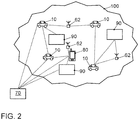
- FIG 2 shows a schematic representation of an operating area 100 for carrying out the method according to the invention by means of the in Figure 1 shown system.
- the operating area 100 preferably extends over an urban conurbation, for example a city or a city center.
- There is a plurality of autonomous vehicles 10 within the operating area 100 each of which has a basic configuration as related to Figure 1 explained.
- Each of the autonomous vehicles 10 can be called up by users of a car sharing service or else permanently assigned to a specific user.
- the operating area 100 has a plurality of service stations 90. Furthermore, a server 70 is arranged outside the operating area 100. However, the server 70 can also be arranged in the operating area 100.
- the autonomous vehicles 10 are for communication with one another, in particular by means of the first communication modules 20 and via base stations 62 of a mobile radio network.
- the vehicles 10 are also designed for communication with the service stations 90, with the mobile terminal of a user 80 and with the server 70. Communication takes place directly between the elements or via base stations 62 of a mobile radio network, as indicated by the dashed lines.
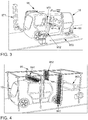
- FIG 3 shows a schematic representation of a first service module 95 for cleaning the interior of the vehicle 10.
- the latter moves into the service module 95 in order to come to a stop at a stop position 953.
- the vehicle doors 18 of the vehicle 10 open automatically. This is preferably initiated by the control unit 92 of the service station 90 or the control unit 40 of the vehicle 10.
- a first robot arm 951 and a second robot arm 952 are inserted into the vehicle.
- Tools for carrying out interior cleaning in particular a vacuum cleaner nozzle, an applicator for applying a cleaning agent and means for cleaning the upholstery, are arranged on the robot arms 951, 952.
- the first service module 95 shown also has a charging connection 971 for charging an electrical energy store 36 of the vehicle 10.
- FIG. 4 shows a schematic representation of a second service module 96 for external cleaning of the vehicle 10.
- the second service module 96 largely corresponds to automatic washing lines for autonomous external cleaning of a vehicle 10 known from the prior art.
- the second service module 96 has in particular means (not shown) for applying a cleaning fluid, such as nozzles for applying a soap barrel.
- the second service module 96 has a rotatable upper wash brush 961 and rotatable lateral wash brushes 962 for distributing the cleaning fluid and for loosening the dirt.
- the second service module 96 has a drying hair dryer 963 for drying the vehicle 10.
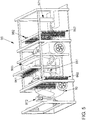
- Figure 5 shows a schematic representation of a service station 90 according to the invention, having the first service module 95 of FIG Figure 3 and the second service module 96 of the Figure 4 according to a first embodiment.
- the first and second service modules 95, 96 are arranged in a common area of the service station 90.
- the service station 90 also has a first control module 98 and a second control module 99.
- a sequence of the autonomously performed service action in the service station 90 begins with the autonomous entry of the vehicle 10 into the service station 90.
- This entry is preferably mediated by the driving system 30 of the vehicle 10, the control unit 40 of the vehicle 10 using the communication modules 20, 91 communicates with the control unit 92 of the service station 90.
- a degree of soiling of the vehicle interior and the vehicle surface is recorded by means of a first control module 98 (not shown).
- the doors 18 of the vehicle 10 open automatically and a mobile cleaning robot drives autonomously into the interior or is introduced into the interior of the vehicle 10.
- the mobile cleaning robot starts the interior cleaning and starts an exterior cleaning of the vehicle 10 by means of the second service module 97, in particular by means of the washing brushes 961, 962 and the dryer 963.
- Figure 6 shows a schematic representation of a service station 90 according to the invention, having the first service module 95 of FIG Figure 3 and the second service module 96 of the Figure 4 according to a second embodiment.
- the first service module 95 and the second service module 96 are arranged in different areas of the service station 90.
- the service station 90 also has a first control module 98 and a second control module 99.
- a sequence of the service action carried out autonomously in the service station 90 begins with the autonomous entry of the vehicle 10 into a first area of the service station 90.
- This entry is preferably mediated by the driving system 30 of the vehicle 10
- the control unit 40 of the vehicle 10 communicates with the control unit 92 of the service station 90 by means of the communication modules 20, 91.
- a degree of soiling of the vehicle interior and the vehicle surface is recorded by means of a first control module 98 (not shown). If the vehicle 10 has reached a stopping position in the first area of the service station 90, the exterior cleaning of the vehicle 10 begins by means of the second service module 96 arranged in the first area, in particular by means of the washing brushes 961, 962 and the drying hair dryer 963.
- the vehicle 10 drives autonomously to a second area of the service station 90 downstream of the first area or is moved by means of a conveyor belt of the service station 90 transported from the first to the second area.
- the doors 18 of the vehicle 10 open automatically and robot arms 951, 952 move autonomously into the interior.
- the interior of the vehicle 10 is cleaned by means of tools located on the robot arms 951, 952.
- an electrical energy store 36 of the vehicle 10 is filled by means of the charging connection 971 and the hydrogen tank of the vehicle 10 is filled by means of hydrogen refueling 972.
- the robot arms 951, 952 are moved out of the vehicle 10.
- the interior cleaning of the vehicle 10 may be checked via cameras (not shown) or other sensors of a second control module 99.
- the filling elements of the charging connection 971 and hydrogen refueling 972 are removed and the vehicle 10 drives out of the service station 90 autonomously.
- the dryer 963 is arranged in the second area and the vehicle 10 is dried in parallel with the interior cleaning and for filling the energy store 36.
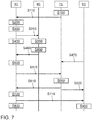
- Figure 7 shows a schematic flow diagram of a system according to the invention, comprising an autonomously driving vehicle 10, a server 70 of a service provider for the autonomous vehicle 10, a mobile terminal device of a user of the vehicle 10 and a Service station, as described above, performed method for determining an autonomous cleaning for the vehicle 10 according to an embodiment.
- the server 70 In a first step S100 of the method, the server 70 generates first information about a cleaning requirement of a vehicle 10, since a predetermined interval has elapsed since the vehicle was last cleaned. The interval is generated by the server depending on external information, especially about the season and the weather. In a step S110, the server 70 transmits the first information to a vehicle 10, in particular to a first control unit 40 and via a communication module 20 of the vehicle 10.
- a step S200 of the method the vehicle 10 determines its need for cleaning on the basis of the first information previously received from the server 70.
- the vehicle then issues a first input request via a combination instrument of the vehicle 10 in step S300.
- a user of the vehicle 10 is asked to enter information on the type, location and degree of contamination of the vehicle 10 by means of the instrument cluster of the vehicle 10.
- step S310 the vehicle 10 transmits a message to a mobile terminal 80 connected to the vehicle 10.
- the mobile terminal 80 is, in particular, a smartphone of the user, which is connected to the vehicle 10 by means of Bluetooth.
- the vehicle informs the mobile terminal 80 about the cleaning requirement of the vehicle 10.
- the message is addressed to an application of the smartphone 80 designed for the method according to the invention and is received by the latter.
- the message causes the application to control the smartphone 80 so that in step S350 the latter issues a second input request on a screen 88 of the smartphone 80.
- the second input prompt prompts the user of the vehicle 10 to take at least one photo of an interior and an exterior surface of the vehicle 10.
- step S400 the user inputs information on the type, location and degree of contamination of the vehicle 10 by means of the instrument cluster of the vehicle 10. To do this, he is guided through several menus, in which the relevant information is queried using scales and pre-formulated answer options. Then, in step S450, the user takes a plurality of photographs of the vehicle interior and of the exterior surface of the vehicle 10 using a camera 87 of the smartphone 80. The image information acquired in this way is transmitted to the vehicle in step S460.
- step S500 the vehicle 10 links the information on the type, location and degree of pollution of the vehicle 10 detected by the user input with the photographs received by the smartphone 80 to second information about the pollution of the vehicle 10. This second information about the pollution of the vehicle 10 is transmitted this to the server 70 in step S510.
- the vehicle 10 also transmits information about its position to the server in step S510.
- the server 70 previously received information on the utilization of the service station 90 from at least one service station 90 in step S470. Furthermore, information about equipment of the service station is stored on the server 70.
- step S600 the server 70 determines a cleaning to be carried out on the vehicle 10 on the basis of the second information received from the vehicle 10 and on the basis of the information received from the service station 90 on the utilization of the service station 90 and on the basis of information about the equipment of the service station 90.
- the cleaning to be carried out is preferably determined automatically in the server 70, for example based on a database, by means of at least one look-up table, LUT, by means of at least one algorithm and / or by means of artificial intelligence and in particular taking into account those that are present in the individual service stations 90 Service modules and the cleaning actions that can be carried out with them.
- the server 70 takes into account the position of the vehicle and the positions of the service stations 90 and ultimately determines a cleaning to be carried out on the vehicle 10 by means of a specific service station 90.
- step S610 the server 70 transmits information about the determined cleaning to be carried out to the vehicle 10.
- This information contains information about the type of cleaning to be carried out, the estimated duration of the cleaning in the service station 90, and the estimated cost of the cleaning in the service station 90 and the position of the service station 90.
- step S620 the service 70 transmits information about the cleaning to be carried out to the service station 90. This information specifies in particular the type of cleaning to be carried out and vehicle-specific information about the vehicle 10 and, if applicable, user-specific information about the user of the same. The service station is thus informed about the cleaning to be carried out determined by the server 70 for the vehicle 10, the information in step S710 simultaneously functioning as legitimation for carrying out the determined cleaning on the vehicle 10.
- step S700 the vehicle 10 issues a further input request to the user and informs the user of the determined cleaning of the vehicle 10 to be carried out, the estimated duration and the estimated costs of the determined cleaning to be carried out. Of the The user can then confirm the determined cleaning to be carried out and in step S710 a corresponding confirmation is sent to the service station 90.
- the sent confirmation contains an estimated time of arrival of the vehicle 10 at the service station 90 based on the position of the vehicle 10 and based on the position of the service station 90.
- step S800 the vehicle 10 uses the position of the service station 90 obtained in step S610 to autonomously travel to the service station 90.
- the autonomous drive takes place at a point in time specified by the user in step S700. This point in time is selected from a list of possible times of cleaning determined by the server 70 on the basis of the load on the service station 90 received in step S470. The selection of the user is also transmitted to the service station 90 in step S710.
- step S900 the service station 90 recognizes the arrival of the vehicle 10 using the information received from the server 70 in step S620 for the vehicle 10. As soon as the arrival of the correct vehicle 10 is recognized, the service station 90 guides from the server 70 in step S620 received information on the cleaning to be carried out by autonomous cleaning on the vehicle 10 with an interior cleaning by means of the first service module 95 and an exterior cleaning by means of the second service module 96. In a further step (not shown), the vehicle 10 autonomously returns to the previous position or the user after the cleaning has been carried out successfully.
Landscapes
- Business, Economics & Management (AREA)
- Engineering & Computer Science (AREA)
- Human Resources & Organizations (AREA)
- Economics (AREA)
- General Business, Economics & Management (AREA)
- Mechanical Engineering (AREA)
- Tourism & Hospitality (AREA)
- Strategic Management (AREA)
- Theoretical Computer Science (AREA)
- Marketing (AREA)
- General Physics & Mathematics (AREA)
- Physics & Mathematics (AREA)
- General Health & Medical Sciences (AREA)
- Primary Health Care (AREA)
- Health & Medical Sciences (AREA)
- Computing Systems (AREA)
- Operations Research (AREA)
- Development Economics (AREA)
- Entrepreneurship & Innovation (AREA)
- Accounting & Taxation (AREA)
- Educational Administration (AREA)
- Game Theory and Decision Science (AREA)
- Quality & Reliability (AREA)
- Management, Administration, Business Operations System, And Electronic Commerce (AREA)
- Traffic Control Systems (AREA)
Applications Claiming Priority (1)
| Application Number | Priority Date | Filing Date | Title |
|---|---|---|---|
| DE102018222636.9A DE102018222636A1 (de) | 2018-12-20 | 2018-12-20 | Verfahren und System zum Ermitteln einer Reinigung für ein Fahrzeug |
Publications (2)
| Publication Number | Publication Date |
|---|---|
| EP3671591A2 true EP3671591A2 (fr) | 2020-06-24 |
| EP3671591A3 EP3671591A3 (fr) | 2020-07-01 |
Family
ID=68834952
Family Applications (1)
| Application Number | Title | Priority Date | Filing Date |
|---|---|---|---|
| EP19214027.5A Pending EP3671591A3 (fr) | 2018-12-20 | 2019-12-06 | Procédé et système de détermination d'un nettoyage pour un véhicule |
Country Status (3)
| Country | Link |
|---|---|
| EP (1) | EP3671591A3 (fr) |
| CN (1) | CN111348005B (fr) |
| DE (1) | DE102018222636A1 (fr) |
Cited By (2)
| Publication number | Priority date | Publication date | Assignee | Title |
|---|---|---|---|---|
| WO2022194446A1 (fr) * | 2021-03-19 | 2022-09-22 | Bayerische Motoren Werke Aktiengesellschaft | Procédé et dispositif pour mettre fin à l'utilisation d'un véhicule |
| EP4180280A1 (fr) * | 2021-11-15 | 2023-05-17 | WashTec Holding GmbH | Procédé mis en oeuvre par ordinateur pour évaluer d'un lavage de véhicules et système pour modifier les données de processus d'une installation de lavage de véhicules |
Families Citing this family (3)
| Publication number | Priority date | Publication date | Assignee | Title |
|---|---|---|---|---|
| CN112172750A (zh) * | 2020-09-28 | 2021-01-05 | 郑素珍 | 一种智能摩托车洗车房及智能洗车方法 |
| DE102021129798A1 (de) | 2021-11-16 | 2023-05-17 | Bayerische Motoren Werke Aktiengesellschaft | Steuern eines autonomen Fahrzeugs |
| JP7800398B2 (ja) * | 2022-11-28 | 2026-01-16 | トヨタ自動車株式会社 | 車両清掃システム |
Family Cites Families (19)
| Publication number | Priority date | Publication date | Assignee | Title |
|---|---|---|---|---|
| CN1145316A (zh) * | 1995-07-26 | 1997-03-19 | 日成建筑工业株式会社 | 洗车装置 |
| JP2002137719A (ja) * | 2000-11-01 | 2002-05-14 | Yasui:Kk | 洗車装置 |
| DE202007000532U1 (de) * | 2007-01-09 | 2008-05-21 | Otto Christ Aktiengesellschaft | Verwaltungssystem für Fahrzeugbehandlungsanlagen |
| DE102009000004A1 (de) * | 2009-01-02 | 2010-07-08 | Robert Bosch Gmbh | Kameraanordnung für ein Kraftfahrzeug und Kraftfahrzeug mit einer Kameraanordnung |
| DE102012222668A1 (de) * | 2012-12-10 | 2014-06-12 | Robert Bosch Gmbh | Vorrichtung zur Fahrzeugumfeldüberwachung |
| US9783024B2 (en) * | 2015-03-09 | 2017-10-10 | Bergstrom Inc. | System and method for remotely managing climate control systems of a fleet of vehicles |
| US9805519B2 (en) * | 2015-08-12 | 2017-10-31 | Madhusoodhan Ramanujam | Performing services on autonomous vehicles |
| CN205344841U (zh) * | 2015-12-25 | 2016-06-29 | 张亦煌 | 具有洗车功能的智能停车系统 |
| DE102016203537B4 (de) * | 2016-03-03 | 2022-11-10 | Volkswagen Aktiengesellschaft | Mobiles Anwenderendgerät, technisches Gerät und Verfahren zur Unterstützung eines Anwenders bei der Fernbedienung eines technischen Gerätes |
| US20170329346A1 (en) * | 2016-05-12 | 2017-11-16 | Magna Electronics Inc. | Vehicle autonomous parking system |
| CN106013871A (zh) * | 2016-07-18 | 2016-10-12 | 张致琛 | 一种智能车库 |
| JP2019529202A (ja) * | 2016-08-04 | 2019-10-17 | アルフレッド ケルヒャー エスエー ウント コンパニー カーゲー | 車両ケアのためのシステム及び方法、並びに、この種類のシステムの使用 |
| DE102016218012A1 (de) * | 2016-09-20 | 2018-03-22 | Volkswagen Aktiengesellschaft | Verfahren für eine Datenverarbeitungsanlage zur Erhaltung eines Betriebszustands eines ersten autonomen Fahrzeugs sowie Verfahren für eine Datenverarbeitungsanlage zum Verwalten einer Mehrzahl autonomer Fahrzeuge |
| US10479328B2 (en) * | 2016-11-04 | 2019-11-19 | Ford Global Technologies, Llc | System and methods for assessing the interior of an autonomous vehicle |
| DE102017209711A1 (de) * | 2017-06-08 | 2018-12-13 | Audi Ag | Verfahren zum Vorbereiten eines Fahrzeugs |
| DE102017006094A1 (de) * | 2017-06-28 | 2018-02-22 | Daimler Ag | Vorrichtung und Verfahren zur Überwachung eines Verschmutzungsgrads eines vorausfahrenden Fahrzeugs |
| CN108009888A (zh) * | 2017-12-06 | 2018-05-08 | 东营市九方商贸有限公司 | 全自动洗车多级联网运营系统 |
| CN107944576A (zh) * | 2017-12-07 | 2018-04-20 | 湖州华科信息咨询有限公司 | 一种用于车辆自动清洗和美化的方法和装置 |
| DE102018102842A1 (de) * | 2018-02-08 | 2019-08-08 | Alfred Kärcher SE & Co. KG | System und Verfahren zur Fahrzeugpflege |
-
2018
- 2018-12-20 DE DE102018222636.9A patent/DE102018222636A1/de not_active Withdrawn
-
2019
- 2019-12-06 EP EP19214027.5A patent/EP3671591A3/fr active Pending
- 2019-12-20 CN CN201911325359.5A patent/CN111348005B/zh active Active
Non-Patent Citations (1)
| Title |
|---|
| KOSCH TIMO ET AL: "Automotive Inter-networking (Intelligent Transport Systems)", 16 March 2012, WILEY, ISBN: 978-0-470-74979-1, pages: ToC,Ch01 - Ch03, XP055846499 * |
Cited By (3)
| Publication number | Priority date | Publication date | Assignee | Title |
|---|---|---|---|---|
| WO2022194446A1 (fr) * | 2021-03-19 | 2022-09-22 | Bayerische Motoren Werke Aktiengesellschaft | Procédé et dispositif pour mettre fin à l'utilisation d'un véhicule |
| EP4180280A1 (fr) * | 2021-11-15 | 2023-05-17 | WashTec Holding GmbH | Procédé mis en oeuvre par ordinateur pour évaluer d'un lavage de véhicules et système pour modifier les données de processus d'une installation de lavage de véhicules |
| US12294921B2 (en) | 2021-11-15 | 2025-05-06 | Washtec Holding Gmbh | Data exchange between a mobile terminal and a control module of a car wash for feedback of evaluation signals |
Also Published As
| Publication number | Publication date |
|---|---|
| DE102018222636A1 (de) | 2020-06-25 |
| CN111348005A (zh) | 2020-06-30 |
| EP3671591A3 (fr) | 2020-07-01 |
| CN111348005B (zh) | 2023-07-25 |
Similar Documents
| Publication | Publication Date | Title |
|---|---|---|
| EP3670276B1 (fr) | Station de service pour un nettoyage autonome de véhicules | |
| EP3671621A1 (fr) | Procédé de fonctionnement d'une flotte de véhicules autonomes et module de service pour un véhicule de flotte autonome | |
| EP3671591A2 (fr) | Procédé et système de détermination d'un nettoyage pour un véhicule | |
| EP3948720B1 (fr) | Station de service pour l'identification de salissures d'un composant de véhicule et procédé pour faire fonctionner la station de service | |
| DE102018222650A1 (de) | Verfahren einer Servicestation zur autonomen Reinigung eines Fahrzeugs und Servicestation | |
| DE102016222006B4 (de) | Verfahren zum Betreiben eines Kraftfahrzeugs in einem vollautonomen Fahrmodus | |
| WO2018024336A1 (fr) | Système et procédé d'entretien des véhicules et utilisation d'un tel système | |
| WO2020126371A1 (fr) | Procédé pour le nettoyage de véhicule autonome | |
| WO2020229275A1 (fr) | Procédé de fonctionnement d'une station de service destinée à un véhicule et système d'exécution du procédé selon l'invention | |
| DE112016006488T5 (de) | System und verfahren zum bereitstellen eines mobilitätsnetzes | |
| DE102022127436A1 (de) | Ladeinfrastruktur und entferntes rechensystem für elektrofahrzeugrechenknoten | |
| WO2020156761A1 (fr) | Dispositif de transport mobile et procédé permettant de transporter au moins un produit à transporter | |
| WO2023011947A1 (fr) | Procédé d'agencement de services associés à un véhicule, et plateforme de gestion de flotte | |
| DE102024122743A1 (de) | Systeme und verfahren zum vereinfachen einer bestandsverwaltung | |
| EP3736182B1 (fr) | Station de service destinée au nettoyage d'une vitre de véhicule et procédé de fonctionnement de la station de service | |
| DE102020209546A1 (de) | Verfahren zur Unterstützung der Reinigung eines Fahrzeugs | |
| EP3956186B1 (fr) | Procédé permettant le nettoyage de l'habitacle d'un véhicule, station d'entretien permettant le nettoyage de l'habitacle d'un véhicule et véhicule | |
| DE102019208133A1 (de) | Verfahren zur Sitzreinigung eines Fahrzeugs, Servicestation zur Sitzreinigung eines Fahrzeugs und Fahrzeug | |
| DE102018222638A1 (de) | Verfahren zum Betrieb einer autonomen Fahrzeugflotte und Servicestation | |
| DE102022127437A1 (de) | Verfahren und system zur verwendung der inaktiven rechenleistung eines elektrofahrzeugs | |
| DE102018209066A1 (de) | Konzept zum Versorgen hochautomatisierter oder autonomer Fortbewegungsmittel | |
| WO2020225033A1 (fr) | Robot de nettoyage pour un véhicule automobile, station de service pour nettoyer un véhicule automobile et procédé pour le fonctionnement du robot de nettoyage et de la station de service. | |
| DE102019206994A1 (de) | Verfahren zum Betrieb eines Kraftfahrzeugs und Servicestation für ein Fahrzeug | |
| WO2019233718A1 (fr) | Concept d'alimentation de moyens de locomotion à automatisation élevée ou autonomes | |
| DE102015210994A1 (de) | Verfahren zum Betreiben einer Verladeanlage sowie Verladeanlage |
Legal Events
| Date | Code | Title | Description |
|---|---|---|---|
| PUAI | Public reference made under article 153(3) epc to a published international application that has entered the european phase |
Free format text: ORIGINAL CODE: 0009012 |
|
| STAA | Information on the status of an ep patent application or granted ep patent |
Free format text: STATUS: THE APPLICATION HAS BEEN PUBLISHED |
|
| PUAL | Search report despatched |
Free format text: ORIGINAL CODE: 0009013 |
|
| AK | Designated contracting states |
Kind code of ref document: A2 Designated state(s): AL AT BE BG CH CY CZ DE DK EE ES FI FR GB GR HR HU IE IS IT LI LT LU LV MC MK MT NL NO PL PT RO RS SE SI SK SM TR |
|
| AX | Request for extension of the european patent |
Extension state: BA ME |
|
| AK | Designated contracting states |
Kind code of ref document: A3 Designated state(s): AL AT BE BG CH CY CZ DE DK EE ES FI FR GB GR HR HU IE IS IT LI LT LU LV MC MK MT NL NO PL PT RO RS SE SI SK SM TR |
|
| AX | Request for extension of the european patent |
Extension state: BA ME |
|
| RIC1 | Information provided on ipc code assigned before grant |
Ipc: G06Q 10/06 20120101AFI20200528BHEP Ipc: B60S 3/06 20060101ALI20200528BHEP Ipc: G06Q 50/30 20120101ALI20200528BHEP Ipc: B60S 3/00 20060101ALI20200528BHEP Ipc: G16Y 10/40 20200101ALI20200528BHEP Ipc: G16Y 40/40 20200101ALI20200528BHEP |
|
| STAA | Information on the status of an ep patent application or granted ep patent |
Free format text: STATUS: REQUEST FOR EXAMINATION WAS MADE |
|
| 17P | Request for examination filed |
Effective date: 20210111 |
|
| RBV | Designated contracting states (corrected) |
Designated state(s): AL AT BE BG CH CY CZ DE DK EE ES FI FR GB GR HR HU IE IS IT LI LT LU LV MC MK MT NL NO PL PT RO RS SE SI SK SM TR |
|
| STAA | Information on the status of an ep patent application or granted ep patent |
Free format text: STATUS: EXAMINATION IS IN PROGRESS |
|
| 17Q | First examination report despatched |
Effective date: 20211007 |