EP3671602A1 - Procédé d'échange direct d'un ensemble de données de pièce de monnaie entre des éléments de sécurité - Google Patents
Procédé d'échange direct d'un ensemble de données de pièce de monnaie entre des éléments de sécurité Download PDFInfo
- Publication number
- EP3671602A1 EP3671602A1 EP19020680.5A EP19020680A EP3671602A1 EP 3671602 A1 EP3671602 A1 EP 3671602A1 EP 19020680 A EP19020680 A EP 19020680A EP 3671602 A1 EP3671602 A1 EP 3671602A1
- Authority
- EP
- European Patent Office
- Prior art keywords
- coin
- derived
- coin data
- record
- root
- Prior art date
- Legal status (The legal status is an assumption and is not a legal conclusion. Google has not performed a legal analysis and makes no representation as to the accuracy of the status listed.)
- Granted
Links
Images




Classifications
-
- G—PHYSICS
- G06—COMPUTING OR CALCULATING; COUNTING
- G06Q—INFORMATION AND COMMUNICATION TECHNOLOGY [ICT] SPECIALLY ADAPTED FOR ADMINISTRATIVE, COMMERCIAL, FINANCIAL, MANAGERIAL OR SUPERVISORY PURPOSES; SYSTEMS OR METHODS SPECIALLY ADAPTED FOR ADMINISTRATIVE, COMMERCIAL, FINANCIAL, MANAGERIAL OR SUPERVISORY PURPOSES, NOT OTHERWISE PROVIDED FOR
- G06Q20/00—Payment architectures, schemes or protocols
- G06Q20/04—Payment circuits
- G06Q20/06—Private payment circuits, e.g. involving electronic currency used among participants of a common payment scheme
- G06Q20/065—Private payment circuits, e.g. involving electronic currency used among participants of a common payment scheme using e-cash
-
- G—PHYSICS
- G06—COMPUTING OR CALCULATING; COUNTING
- G06Q—INFORMATION AND COMMUNICATION TECHNOLOGY [ICT] SPECIALLY ADAPTED FOR ADMINISTRATIVE, COMMERCIAL, FINANCIAL, MANAGERIAL OR SUPERVISORY PURPOSES; SYSTEMS OR METHODS SPECIALLY ADAPTED FOR ADMINISTRATIVE, COMMERCIAL, FINANCIAL, MANAGERIAL OR SUPERVISORY PURPOSES, NOT OTHERWISE PROVIDED FOR
- G06Q20/00—Payment architectures, schemes or protocols
- G06Q20/30—Payment architectures, schemes or protocols characterised by the use of specific devices or networks
- G06Q20/36—Payment architectures, schemes or protocols characterised by the use of specific devices or networks using electronic wallets or electronic money safes
- G06Q20/367—Payment architectures, schemes or protocols characterised by the use of specific devices or networks using electronic wallets or electronic money safes involving electronic purses or money safes
- G06Q20/3678—Payment architectures, schemes or protocols characterised by the use of specific devices or networks using electronic wallets or electronic money safes involving electronic purses or money safes e-cash details, e.g. blinded, divisible or detecting double spending
Definitions
- the invention relates to a method for the direct exchange of an electronic coin data record between security elements. To this end, the invention relates to a payment system between at least two terminals, each of the terminals having a security element.
- one robot arm could be paid for each movement.
- the movement could be registered and this could then be settled.
- a control unit in the machine monitors the receipt of an amount of money and controls a movement depending on the amount of money received.
- monetary amounts in the form of electronic data records are primarily used as a payment medium in computer networks.
- a bank provides software for generating a bank signature and asymmetric key pairs, with the help of which a customer can shop securely and anonymously in the computer networks mentioned.
- Payment in the "pay-per-use” approach could be carried out, for example, via so-called decentralized transaction databases, English Distributed Ledger Technology, DLT, in which monetary amounts are exchanged using the block chain process.
- DLT Distributed Ledger Technology
- This decentralized solution requires a very complex encryption and transmission of the monetary amounts, which is unsuitable for use between end devices, such as machines, due to the slowness and also the complexity of a large number of end devices.
- From the DE 10 2009 038 645 A1 and the DE 10 2009 034 436 A1 are systems for the transfer of monetary amounts in the form of electronic data records, in which payment with duplicates of the data record is prevented and a high degree of manipulation security is provided, whereby complex structures and complex encryption and signing processes are required for the exchange.
- direct payment between end devices, such as machines or production units is to be created, which is uncomplicated and fast.
- the necessary transfer of monetary amounts in electronic form between the terminals should be counterfeit-proof and trustworthy.
- the data records should have small amounts of data in order to ensure rapid exchange. Several data records should be able to be combined with one another as desired in order to enable flexible exchange.
- the object is achieved in particular by a method for the direct exchange of an electronic (digital) coin data record between security elements of terminal devices with the following steps: receiving a coin data record in a first security element, the coin data set having a number of elements and each element of the received coin data set being the result of a cryptographic function from a random number unknown to the security elements and the position of the element in the coin data set; Transferring a coin data record derived from the received coin data record from the first security element to a second security element, the derived coin data record having at least one element of the received coin data record and the position of the element in the received coin data record; and displaying the ownership of the derived coin record from the second security element to a verification unit.
- An electronic coin data record is, in particular, an electronic data record that represents a monetary amount and is colloquially referred to as "digital coin” or "electronic coin". This monetary amount changes in the process from a first security element to another security element.
- a monetary amount is understood to be a digital amount that can be credited to an account.
- the coin record represents, for example, cash in electronic form, which is credited to a cash account.
- the electronic data records for transferring monetary amounts differ significantly from electronic data records for data exchange or data transfer, since, for example, a classic data transaction takes place on the basis of a question-answer principle or on intercommunication between the data transfer partners.
- monetary amounts in the form of electronic data records are characterized by uniqueness, uniqueness and security features (signatures, encryption).
- a digital coin data record contains all the data required for a receiving instance with regard to verification, authentication and forwarding to other instances. Intercommunication is therefore generally not necessary with this type of data record.
- a security element is preferably special software, in particular in the form of a secure runtime environment within an operating system of a terminal device, English Trusted Execution Environments, TEE.
- the security element is, for example, special hardware, in particular in the form of a secured hardware platform module, or Trusted Platform Module, TPM or designed as an embedded security module, eUICC, eSIM.
- TPM Trusted Platform Module
- the security element provides a trustworthy environment and secures, for example, a machine-2-machine, M2M, application.
- the communication between two security elements can be wireless or wired and can be designed as a secure channel.
- the exchange of the coin record is thus secured by cryptographic keys, for example a session key negotiated for an exchange of coin records or a symmetrical or asymmetrical pair of keys.
- the exchanged coin data records are protected against theft or manipulation.
- the level of security elements thus replaces the lack of security, established blockchain technology.
- Knowledge of the random number in the verification unit also creates a very transparent system that quickly identifies and prevents manipulation or attempted attacks.
- a device intended for M2M applications such as a machine, tool, automat or container and vehicle, is regarded as a terminal.
- a terminal device according to the invention is thus either stationary or mobile.
- M2M stands for the (fully) automated exchange of information between these devices, for example using the Internet and the corresponding access networks, such as the mobile network.
- the coin data record received in the first security element has a number of elements.
- a monetary amount is determined, which is then represented as a coin data set according to the number of elements.
- These elements preferably have the same weight.
- individual elements of this coin data set or several elements of this coin data set can now be transmitted simultaneously to a second security element.
- the elements represent the result of a cryptographic function.
- This cryptographic function is, for example, a cryptographic scatter value function, English: hash function.
- the cryptographic function is a function of elliptic curves.
- This cryptographic function means that every element in the process is unique and no second identical element can coexist. Every item was instead it is formed from a random number and a position in the coin record. The random number is the same for all elements of this coin data set. The elements are thus individualized by their position in the data record.
- This method enables simple exchange of individual elements of a coin data set.
- the elements can be taken individually from the data set.
- the second security element receives at least one element of the original (received data record) whose base (random number) it does not know and a position of the element in this original data record as a derived coin data record.
- the random number unknown to the security elements ensures that the elements are secure against forgery and thus the security of the method.
- the coin data set is therefore comparable to a digital stripe card, the individual elements of which can be exchanged between security elements.
- the possession of an element of this coin record is displayed to a verification unit that knows the random number and uses the position of the element in the original coin record to verify the authenticity of the element.
- the verification unit can log the display so that an element cannot be output multiple times. The element can only be redeemed by the respective security element after the possession of the element has been displayed in the verification unit.
- At least two elements of the received coin data set are transmitted to the second security element, the at least two elements forming a sequence of elements of the received coin data set arranged next to one another.
- the number of elements in the sequence of the coin data set is less than the maximum number of elements in the coin data set.
- the derived coin data set consists only of an initial element of a sequence to be transmitted, an end element of the sequence to be transmitted and their respective positions in the received (original) coin data set.
- the derived coin data record comprises an initial element of the sequence and its position in the received coin data record as well as the number of elements of the sequence.
- the method after the display at the verification unit also comprises the steps: calculating a cryptographic function for at least one element, preferably the starting element, of the sequence using a derived value from the sequence and the position of the element in the sequence ; Adding the result of the cryptographic function and the position of the element in the received coin data record to the derived coin data record in order to obtain a further derived coin data record; and transferring the coin data record further derived from the derived coin data record from the second security element to the first security element or to a third security element.
- the second security element is thus not limited to the complete transfer of the derived coin data set (the sequence) or only as individual coin elements.
- the derived value is preferably a logical link between the start element of the sequence and the end element of the sequence.
- a logical link is a simple computer operation in Boolean algebra, such as conjunction, disjunction, implication and equivalence.
- a conjunction AND
- XOR equivalence
- the derived value is a scatter value function, for example from the start element and the end element of the sequence.
- a scatter value function (also hash function) is a mapping of a large input quantity to a smaller target quantity.
- the result of the hash function is a hash value.
- a hash function is not injective.
- the hash values have a fixed length even with different input parameters, so that the amount of data is predictive.
- a scatter value function enables the method to be unambiguous despite the reduction in the amount of data, which speeds up the transfer and verification.
- the cryptographic function is preferably a function of elliptic curves, which also enables uniqueness and quick transmission and verification.
- the verification unit is aware of the random number. By displaying the derived coin data record of the second security element, the uniqueness and authenticity of the received coin data record or the derived coin data record can be verified by the verification unit at any time.
- Each security element is preferably clearly assigned to exactly one terminal.
- This security element can preferably also be assigned to at least one component of the terminal.
- components of a terminal can be secured by a security element, which on the one hand advantageously reduces the number of security elements in the system and on the other hand enables components with less computing power or a lack of security architecture to participate in the method according to the invention.
- the coin data set is preferably requested from a transaction database.
- the coin data record is then generated by the transaction database or an affiliated coin issuer and made available to the first security element.
- the generation includes in particular the generation of a random number and the use of a cryptographic function for generating each individual element of the coin record by using the random number and a position of the element in the coin record.
- the coin data record is then made available to the first security element in a cryptographically secured manner, for example by the coin issuer.
- the random number is made available to the verification unit.
- the received coin data set is then displayed to the verification unit in order to be used in the process.
- the coin data record is generated by the verification unit or output by it, which means that it is no longer necessary to display the coin data record after it has been received.
- the received or derived coin data set can be redeemed in a decentralized transaction database to credit the associated monetary amount.
- the second security element receives at least two derived coin data sets, the second security element combining the two coin data sets into a common coin data set.
- the result of the cryptographic function and the position of the respective (intermediate) elements added by the derivation can be deleted in order to obtain the common coin data record.
- the received coin data record has a unique identifier, which is also contained in the derived coin data records.
- the coin data record is thus clearly referenced and assigned more quickly in the verification unit.
- All elements of the coin data set are preferably equivalent, ie the coin value of one element of the coin data set is the same for all elements.
- the object is achieved by a further method for the direct exchange of electronic coin data sets between security elements of terminal devices. All statements already made continue to apply to this method and preferred configurations of one method can be combined with the other method.
- These methods include the step of receiving a coin data set already described above. This is followed by a transmission of a first coin data record derived from the received coin data record from the first security element to a second security element, the derived coin data record having at least one element of the received coin data record and the position of the element in the received coin data record.
- a second coin data record derived from the received coin data record is transmitted to the second security element, the second derived coin data record having at least one further element of the received coin data record directly following the element of the first derived coin data record and the position of the further element in the received coin data record. Both derived coin data sets therefore derive from the received coin data set.
- these derived coin data sets do not have to be treated separately, but there follows a combination of the first derived coin data set with the second derived coin data set to obtain a combined derived coin data set and finally an indication of the possession of the combined derived coin data set by the second security element at a verification unit .
- the amounts of data to be transferred for transmission, crediting and / or verification are significantly reduced, thus enabling a faster exchange of electronic coin data sets between terminals.
- the first derived coin data record and / or the second derived coin data record are (preferably) displayed on the verification unit.
- the verification unit in its function described above can thus also recognize and log a sequence of the elements in the different derived coin data records. This increases the security in the procedure.
- At least two are generated with the first derived coin data record and / or with the second derived coin data record Transfer elements of the received coin data set to the second security element, the at least two elements forming a sequence of elements of the received coin data set arranged next to one another.
- the advantage of transferring sequences instead of individual elements has already been described above. If two sequences following one another are now transmitted, a combinability of the sequences in the second security element is recognized.
- the first derived coin data record and / or the second derived coin data record preferably each have only one initial element of the sequence; an end element of the sequence; and their respective positions in the received (original) coin data record.
- the start and end elements simply form the boundaries of the sequence.
- other elements can alternatively be sent as long as it is ensured that the sequence of elements is thus clearly represented (and also recognized).
- the element of the received coin data set is the result of a cryptographic function from the random number unknown to the receiving security elements and the position of the element in the coin data set, as described above and, if appropriate, using an additional transmission count value specific to the coin data set.
- the transmission record value specific to the coin data set is generated and monitored in the transmitting security element.
- the element of the received derived coin data record is further preferably the result of a second cryptographic function from the previously calculated cryptographic function and a coin count record-specific transmission count.
- the (coin record) element-specific result of the cryptographic function from the random number and position is preferably provided by a transaction database or the verification unit. This result is then combined with the transmission count, preferably via the second cryptographic function. In this way, the count value can be generated in a derivation-specific manner by the security element and transmitted in a tamper-proof manner.
- the count value is increased by one count value for each derivation of a coin data record from the received coin data record.
- the transmission record value specific to the coin data set is derived from the second one Coin data set deviates from the coin data set-specific transmission count of the first derived coin data set by more than one count.
- a combined derived coin data record can now be treated like a derived coin data record and, for example, as already described above, can be sent to further security elements or to a transaction database for crediting.
- the method further comprises calculating a cryptographic function for at least one element of the sequence of the first or second derived coin data record using a derived value from the sequence of the first or second derived coin data record and the position of the element in the sequence and adding the result of the cryptographic function and the position of the element in the received coin data set to the combined derived coin data set.
- the derived value is preferably - as already explained above - a logical link between the start element of the sequence of the first derived coin data record and the end element of the sequence of the second derived coin data record.
- the derived value is preferably a scatter value function consisting of the start element of the sequence of the first derived coin data set and the end element of the sequence of the second derived coin data set and, if appropriate, also a derived coin data set-specific transmission count of the sequence.
- the transmission count only applies at the respective derivation level. If a further coin data record is derived from a derived coin data record, a further division of a sequence is carried out, so to speak, the transmission count starts to count in the derived level from one.
- Both the count value of the current derivation level and the count values of all superordinate derivation levels are preferably used for each derived coin data record, in order to ensure a highly flexible combination of derived coin data records.
- the second derived coin data set is transmitted by the first security element or a third security element. This means that the times for receiving the respective coin data sets can be far apart, but this does not conflict with the principle that they can be combined.
- a payment system for exchanging monetary amounts between at least two terminals.
- Each of the terminals has a security element.
- the payment system comprises a decentrally managed transaction database, for example DLT, for transferring monetary amounts between the terminals, a verification unit for verifying digital coin data sets; and a direct transaction layer in which each of the methods described here can be carried out.
- the distributed ledger technology describes a technology for networked computers that come to an agreement about the order of certain transactions and that these transactions update data. It corresponds to a decentralized account book or a decentralized transaction database.
- the data managed by the distributed ledger can be, for example, the balance of a Bitcoin address, the status of a smart contract or the origin of a diamond.
- DLTs differ in the way the networked computers come to an agreement, so-called consensus protocols, such as "Proof of Work", “Proof of Stake” etc.
- Fig. 1 shows an embodiment of a payment system with terminals M1, M2, M3 according to the invention.
- the system according to the invention is based on the approach that each terminal M1, M2, M3 participating in the system is assigned an account 5 in order to be able to settle electronic invoices, that is to say to exchange monetary amounts.
- Account 5 can be a money account, such as a bank account or a Be a blockchain wallet.
- the system shown here for exchanging a digital coin data record between terminals M1, M2, M3 consists of several layers 1, 2, 3, 4 in order to be able to map different security requirements for the transactions.
- the safest environment is in layer 1.
- This layer 1 represents a decentralized transaction database 1, which is also referred to as distributed ledger technology, DLT for short.
- Accounts 5 are assigned to each terminal M1, M2, M3 in this transaction database 1.
- the monetary amounts exchanged here are digital online coin data sets, English: online coins.
- a terminal M1, M2, M3 can, in addition to transferring money using the digital online coin data sets in layer 1, also withdraw digital online coin data sets as coin data sets according to the invention in order to obtain digital electronic offline coin data sets.
- These digital coin data sets are provided for the direct exchange according to the invention between the terminals M1, M2, M3 and do not require the transaction database 1 and the verification unit 2 for this. The exchange takes place in the direct transaction layer 3.
- each terminal M1, M2, M3 has a security element SE1, SE2, SE3 assigned to it.
- These security elements SE1, SE2, SE3 are trustworthy entities with certified, secured and specified functionality. Any transaction between terminals M1, M2, M3 in this direct transaction layer 3 for the exchange of digital coin data records requires the security elements SE1, SE2, SE3 to be integrated.
- the communication between the security elements SE1, SE2, SE3 is preferably cryptographically secured, for example by means of appropriately distributed cryptographic keys, a PKI infrastructure or symmetrical keys or session keys negotiated per exchange of a coin data record.
- the security elements SE1, SE2, SE3 accordingly provide the secure infrastructure that would otherwise be missing if the transaction database 1 were not used.
- the terminals M1, M2, M3 generally consist of several components MxUx. These components MxUx sometimes have their own “pay-per-use” functionality but do not have their own security element SE.
- a component layer 4 is provided so that these components MxUx can act safely in the system according to the invention.
- the components M1U1, M1U2, M1U3 of a first terminal M1, for example three actuators, such as a motor, robot arm and treadmill, are logically connected to the security element SE1 and use them to exchange the digital coin data records.
- the component M2U1 of a second terminal M2, for example a sensor is logically connected to the second security element SE2 and uses it to exchange the digital coin data records.
- the component M3U1 of a third terminal M3, for example a counter is logically connected to the third security element SE3 and uses it to exchange the digital coin data records.
- the component MxUx of the terminal Mx can transfer the payment requests to the security element SEx of the terminal Mx.
- the security element SEx uses predefined and implemented rules to decide how to react to the payment request of this component MxUx and takes over the transaction accordingly.
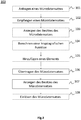
- the Fig. 2 shows an embodiment of a process flow of a method 100 for the direct exchange of coin data sets between a first security element SE1 and a second security element SE2 according to the invention and also a direct exchange of coin data sets between the second security element SE2 and a third security element SE3 according to the invention.
- the Fig. 3 also shows an exemplary embodiment of a process flow diagram of the method 100 according to the invention Fig. 2 and Fig. 3 in combination with the system according to Fig. 1 explained.
- Step 101 shows a request for withdrawing (debiting) online coin data records of a number n from the transaction database 1 by the first security element 1.
- the online coin data sets have a monetary amount (coin value) of C max .
- the first security element SE1 sends a debit command to the transaction database 1 in step 101.
- the debit command is signed, for example, with a private key PrK of the terminal M1 or of the security element SE1.
- the transaction database 1 decides whether the debit command can be followed, for example whether the account of the terminal 1 has sufficient cover for the monetary amount C max . If yes, the monetary amount C max is withdrawn from the account 5 (M1) of the terminal M1 as a coin data record.
- a trustworthy verification unit 2 monitors all actions of the transaction database 1 and in step 102 sends a digital electronic coin data record C root with the maximum value C max to the first security element SE1 of the terminal M1 as the publisher.
- a coin record generation step is provided, which is carried out either in the transaction database 1 or in the verification unit 2.
- a number n of elements for the coin data set is determined on the basis of the monetary amount C max .
- the elements are equivalent for this exemplary embodiment, but can in principle also have different weightings.
- a real random number r is generated.
- This random number r and a position x of an element C x in the coin data record C root are the input parameters for a cryptographic function f (r) x .
- the result of the cryptographic function f (r) x represents the element C x at position x.
- n 24, then 24 elements C x can be generated by means of the random number r and the respective position x of the 24 elements C x in the coin data record C root .
- For a sample coin record C root is on Fig. 4 referred.
- the random number r is sent to the verification unit 2 before the step 102 (dashed arrow in FIG Fig. 2 ).
- the coin record C root in the security element SE1 After receiving the coin record C root in the security element SE1, it may be used for registration purposes in step 103 (not in Fig. 2 shown) is displayed in the verification unit 2. You can also use a confirmation command are exchanged, which may include a signature of the verification unit 2.
- the coin record C root is generated in the verification unit 2, the coin record C root is sent to the first security element 102 in step 102.
- a confirmation command can also be exchanged, which may include a signature of the verification unit 2.
- the maximum value C max is securely managed in a memory area of the first security element SE1, hereinafter referred to as a depot.
- the terminal M1 is now configured to carry out direct transactions with other terminals M2, M3 in the direct transaction layer 3 in the maximum value C max .
- the total monetary amount C max of the coin record C root changes between the first security element SE1 and the second security element SE2 by completely transferring the coin record Croot (not shown in FIG Fig. 2 or Fig. 3 ). Because of the trustworthy security elements SE1, SE2, the monetary amount C max is transmitted securely.
- the security element SE2 can then display this coin data record C root at the verification unit 2 in step 107 and then exchange this coin data record C root with other security elements SE1, SE3 for further payment processes.
- the coin record C root is formed from n elements and can be divided according to the invention. This enables more flexible payment.
- the terminal M1 calculates a monetary amount C b1 to be paid and creates a derived coin record C 1 .
- a derived coin record C 1 For this purpose, according to step 105, at least one element C x of the coin data record C root received in step 102 and the position x of this element C x are derived and a derived coin data record C 1 is generated therefrom. This derived coin data record C 1 is transmitted to the second security element SE2 in step 106.
- a monetary amount C b1 to be transferred was determined, which is formed by a sequence of elements C x of the coin data record C root obtained .
- the division of a coin record C root to obtain a derived coin record C 1 consisting of a sequence is shown in FIGS Fig. 4 and Fig. 5 explained in detail.
- Step 106 can be viewed as a pay step.
- a coin data record C 1 derived from the received coin data record Croot is sent in the terminal device M1 to the terminal device M2.
- a send address can also be used; a receiving address; and / or a signature of the verification unit 2 are transmitted in order to increase the credibility of the payment.
- the first security element SE1 of the terminal M1 marks the value C b1 of the derived coin data set C 1 in the received coin data record C root as "derived".
- the value in the depot is reduced accordingly to C max - C b1 .
- the second security element SE2 receives the derived coin data set C 1 in step 106 in the second terminal M2
- a verification is carried out in the verification unit 2 from the coin data set C root , in particular the random number r known from the verification unit 2 and the derived coin data set C 1 whether the existing value C b1 could at all be derived from the C root coin data set, and is therefore genuine and valid.
- the security element SE2 possibly confirms receipt to the first security element SE1 and displays the derived coin data record C 1 in the verification unit 2 in step 107.
- a confirmation command can also be exchanged, which may include a signature of the derived coin data record C 1 from the verification unit 2.
- the value of the derived coin record C 1 is credited to the deposit of the second security element SE2 by adding the value + C b1 to the amount already contained in the deposit.
- the second security element SE2 now has (at least) one coin data record C 1 , which it can either redeem at the transaction database 1 (not shown in FIG Fig. 2 ) or used to pay for another terminal M3.
- the terminal M2 calculates a monetary amount C b2 to be paid.
- the monetary amount C b2 may be less than that in the derived coin record existing maximum amount C b1 .
- a coin data record C 2 further derived from the derived coin data record C 1 is thus to be created.
- the amount C b2 is formed here from a further sequence within the sequence of elements C C1 of the coin data set C 1 .
- a cryptographic function f (r ' k1 ) x is first used in step 104. At least one element of the sequence of the derived coin data set C 1 is used as the input parameter using a derived value r ′ k1 from the sequence of the derived coin data set C 1 and the position x of the element in the sequence of the derived coin data set C 1 .
- the resulting derived coin record C 2 has the result of the cryptographic function f (r ' k1 ) x and the position x of the element in the received coin record Croot.
- the derived coin data record C 2 is transmitted to the third security element SE3.
- the sharing of a coin record C root to obtain derived coin records C 1 and C 2 consisting of sequences of different lengths is shown in FIGS Fig. 4 and Fig. 5 explained in detail.
- the step 106 between the second security element SE2 and the third security element SE3 can also be regarded as a payment step.
- the terminal M2 sends the further derived coin data record C 2 from the previously received derived coin data record C 1 to the terminal M3.
- this step 106 can also include a send address; a receiving address; and / or include a signature of the verification unit 2 in order to increase the credibility of the payment.
- the security element SE2 of the terminal M2 marks the monetary amount C b2 as "derived" in the derived coin data record C 1 .
- the monetary amount of the remaining derived coin record C 1 ' is reduced accordingly to C b1 - C b2 .
- the verification unit 2 carries out an authenticity check in which the coin data set C 1 , in particular by the random number known to the verification unit 2 and the derived coin record C 2 .
- the third security element SE3 possibly confirms receipt to the second security element SE2 and displays the further derived coin data record C 2 in the verification unit 2 in step 107.
- You can also use a confirmation command are exchanged, which may include a signature of the further derived coin data set C 2 from the verification unit 2.
- the monetary amount C b2 of the further derived coin data set C 2 is added to the amount in the deposit of the third security element SE3.
- the third security element SE3 now has at least one coin data record C 2 which it can redeem in the transaction database 1 in step 108.
- the third security element SE3 sends a credit command to the transaction database 1.
- the credit command in accordance with step 108 contains the send address from the terminal M3, the monetary amount C b2 that is to be credited and the further-derived coin record C 2 .
- the amount C b2 to be credited is deleted from the deposit of the third security element SE3.
- the first terminal M1 has an amount in its account 5 (M1) reduced by the monetary amount C max
- the third terminal M3 has an amount in its account 5 (M3) increased by the monetary amount C b2
- the account balance of the account 5 (M2) of the second terminal M2 in the transaction database 1 is unchanged since the second security element SE2 has not yet credited the difference between the amounts C b1 and C b2 .
- the transaction database 1 is not aware of the whereabouts of the difference between C b1 and C b2 in the second terminal M2, which creates an anonymous M2M payment system.
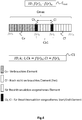
- Fig. 4 a coin data set C root according to the invention and a derived coin data set C 1 according to the invention are now shown.
- This coin record C root was between step 101 and step 102 of the Fig. 2 and Fig. 3 generated and has a maximum value of C max , which is evenly divided into 24 elements f (r) 1 to f (r) n .
- the number n of elements is therefore 24, so that one element corresponds to a value C x of 1/24 ⁇ C max .
- the C root coin record also has a unique identifier ID.
- Fig. 4 a kind of digital strip map with a sequence of 24 elements f (r) 1 to f (r) n arranged side by side. These elements were calculated using a cryptographic function.
- f r k hash r k to get the 24 elements f (r) 1 to f (r) n .
- Fig. 4 It is shown that the coin record C root already has 10 used elements C v in the range from f (r) 1 to f (r) 10 , which have already been issued to other security elements SEx using the method according to the invention.
- Fig. 4 a sequence of seven elements f (r) k to f (r) 1 arranged side by side is shown.
- the start element f (r) k and the end element f (r) l of the sequence are marked separately for clarification.
- This sequence corresponds to a monetary amount of C b1 and is provided for the payment of the second terminal M2 according to step 106.
- the remaining seven elements f (r) l + 1 to f (r) n have not yet been used in the process.
- a derived coin data set C 1 is provided, which in Fig. 4 is also expressed as data record C 1 by: ID ; k ; l ; f r k ; f r l
- C 1 is derived from the C root by using the unique ID of the C root and the sequence of seven elements is specified.
- the coin record C 1 of the Fig. 4 is transmitted to the second security element SE2 in step 106 and is displayed there to the verification unit 2 in step 107.
- None of the security elements SE1, SE2, SE3 knows the random number r with the help of which the elements f (r) 1 to f (r) n are calculated. Without this random number r, the elements f (r) 1 to f (r) n cannot be calculated.
- the second security element SE2 indicates the legitimate possession of the coin record C 1 .
- the verification unit 2 logs the display, so that the first security element SE1 cannot issue this coin data record C 1 a second time. In such a prohibited repetition, the verification unit 2 would notice the assignment of this sequence and would warn the indicating security element SEx accordingly and would not confirm the authenticity.
- Fig. 5 the coin data set C 1 and a coin data set C 2 derived therefrom are shown according to the invention.
- the coin record C 1 is used after the display step 107 to derive the coin record C 2 .
- step 104 a cryptographic function for at least one element of the sequence is calculated using a derived value r ' k1 from the sequence f (r) k to f (r) 1 and the position of the element in the sequence.
- Equation 5 describes the logical AND combination of start element f (r) k and end element f (r) 1 of the sequence in order to obtain the derived value r ' k1 .
- Equation 6 describes the logical XOR combination of start element f (r) k and end element f (r) 1 of the sequence in order to obtain the derived value r ' k1 .
- Other logical combinations are also conceivable, for example a NAND; XNOR; Shortcut. The aim of these links is to obtain a derived value r ' k1 which is unambiguous in the method, with the least possible computational effort.
- Equation 7 alternatively describes a scatter value function from the start element f (r) k and end element f (r) 1 of the sequence in order to obtain the derived value r ' k1 .
- the generation of the derived value r ' k1 is also known to the verification unit 2, so that coin data records derived in this way can still be verified.
- the derived value r ' k1 is then used to calculate the starting element f (r' k1 ) p and the ending element f (r ' k1 ) q of the derived coin data set C 2 , for example according to equation 8 or 9:
- f r ⁇ small p hash r ⁇ small p
- F r ⁇ small p r ⁇ small p * G
- the derived value r ' k1 is a secret. If the formation rule for obtaining the derived value r ' k1 is known in the verification unit 2, then any further coin data record, for example C 2 , can be verified. All derivations (including subdivisions) of the received coin data record C root can therefore be traced and verified by the verification unit 2.
- the coin data set C 2 is a sequence of the coin data set C 1 and comprises three elements.
- the initial value f (r ' k1 ) p and the final value f (r' k1 ) q each replace the initial value f (r) k and the end element f (r) 1 in the coin data record C 1 .
- the respective positions p and q are now contained in the coin data record C 2 according to the received coin data record C root , so that the resulting coin data record C 2 is: ID ; k ; l ; p ; q ; f r ⁇ small p ; f r ⁇ small q
- the resulting sequence corresponds to the monetary amount C b2 and is intended for the payment of the third terminal M3 according to step 106.
- the position and the initial element with the initial value and the number of elements of the segment could also be transmitted.
- the above variant is safer in that two elements are transmitted, the authenticity of which can be checked in the verification unit 2, while the alternative provides only one element for verification.
- This coin data record C 2 can be redeemed in the transaction database 1 in accordance with step 108.
- the transaction database 1 calculates the derived values f (r ' k1 ) p f (r' k1 ) q from r, k, 1, p, q from the random number r and verifies if f (r ' k1 ) p f ( r ' k1 ) q the authenticity of the derived coin data set C 2 .
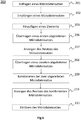
- FIG. 6 A further exemplary embodiment of a method sequence for the direct exchange of coin data sets between three security elements SE1, SE2, SE3 according to the invention is shown. This procedure is concerned with combining derived coin records. Reference is made in full to the statements described above. Deriving (dividing) and combining (merging) coin data sets according to the invention is thus possible in a flexible manner and the skillful transmission of very small data sets creates a fast method for exchanging monetary amounts in a "pay-per-use" M2M application area.
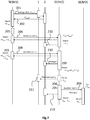
- FIG. 7 A further exemplary embodiment of a method flow diagram of a method 200 according to the invention is also shown.
- the Fig. 6 and Fig. 7 are considered together below and the method steps described therein can be carried out in a system according to Fig. 1 executed or carried out.
- Steps 201 and 202 correspond to steps 101 and 102 of FIG Fig. 2 and Fig. 3 and will not be described again below.
- a data record generation step is provided, which is carried out either in the transaction database 1 or in the verification unit 2, as is the case with respect to FIG Fig. 2 and Fig. 3 has already been described.
- a confirmation command can also be exchanged, which may include a signature of the verification unit 2.
- the maximum value C max is securely managed in a memory area of the first security element SE1, hereinafter referred to as a depot.
- the terminal M1 is now configured to carry out direct transactions with other terminals M2, M3 in the direct transaction layer 3 of the maximum value C max Fig. 1 perform.
- the coin record C root is formed from n elements and can be divided according to the invention. This enables more flexible payment. Steps 205 and 206 correspond to steps 105 and 106 of FIG Fig. 2 and Fig. 3 .
- the terminal M1 calculates an amount C b3 to be paid in a first payment process and creates a first derived coin data record C 3 .
- the terminal M1 calculates an amount C b3 to be paid in a first payment process and creates a first derived coin data record C 3 .
- step 205 at least one element C x of the coin data record C root received in step 202 and the position x of this element C x are derived and a first derived coin data record C 3 is generated therefrom.
- This first derived coin data record C 3 is transmitted to the second security element SE2 in step 206.
- Fig. 7 not only an element C x of the coin record C root is transmitted in step 206.
- a monetary amount C b3 to be transferred was determined, which is formed by a sequence of elements C x of the coin data record Croot obtained.
- the division of a coin record C root to obtain a derived coin record C 3 is shown in FIGS Fig. 4 and Fig. 5 has already been explained in detail and will not be repeated here.
- the derivation of the first coin data set C 3 takes place, for example, analogously to the derivation of the coin data set C 1 according to Fig. 4 .
- the security element SE1 of the terminal M1 marks in the received coin data record C root the value C b3 of the derived coin data record C 3 as "derived". The value of the remaining coin record is reduced accordingly to C max - C b3 .
- the second security element SE2 receives the first derived coin data record C 3 in step 106 in the second terminal M2 a verification is carried out in the verification unit 2 from the coin root record C root , in particular from the random number r known to the verification unit 2 and the derived coin data record C max .
- the security element SE2 possibly confirms receipt to the first security element SE1 and displays the derived coin data record C 3 in the verification unit 2 in step 210.
- a confirmation command can also be exchanged, which may include a signature of the derived coin data record C 3 from the verification unit 2.
- the value of the derived coin data set C 3 is credited to the deposit of the second security element SE2 by adding the value + C b3 to the amount already contained in the deposit.
- the second security element SE2 (at least) a coin data record C 3 is available, which it can either redeem at the transaction database 1 (not shown in FIG Fig. 2 ) or used to pay for another terminal M3 (also not shown in Fig. 2 ).
- step 208 a further payment process is now carried out between the first terminal M1 and the second terminal M2.
- step 208 is similar to step 206 and further execution is dispensed with.
- the depots of the security elements SE1, SE2 change accordingly, the authenticity checks and the display on the verification unit 2 become optional, preferably at a time when a certain number of coin data sets C 3 , C 4 , ... are available, carried out.
- the chronological sequence of the two payment steps 206, 208, the times and also the transfer of the monetary amounts C b3 C b4 is not essential to the invention.
- this method is not limited to two payment processes. Rather, three or more payment processes can be carried out.
- step 209 it is checked whether the three derived coin data sets C 3 , C 4 can be combined with one another. To do this, it must be ensured that the ID of each coin data record C 3 , C 4 is identical, as a result of which a derivative of the received coin data record C root is indicated. In addition, it is checked whether the elements of the coin data sets C 3 , C 4 follow one another directly and whether there are gaps between the elements of the coin data sets C 3 , C 4 in relation to the received coin data set C root . For this purpose, derivative-dependent count values t, t 'can be used in the data records C 3 , C 4 .
- step 209 a combined derived data set C 6 is obtained.
- the combined derived coin data record C 6 has a monetary amount which corresponds to the sum of all individual coin data records C 3 , C 4 .
- the combined derived coin record C 6 is displayed in step 210 to the verification unit 2, which is independent checks the combinability of the security element SE2 and thus verifies the authenticity.
- the monetary amount C 6 can be redeemed by the second security element SE2 in the transaction database 1 in step 211.
- the second security element SE2 sends a credit command to the transaction database 1.
- the credit command according to step 211 contains the send address from the terminal M2, the monetary amount C b6 to be credited and the combined derived coin data record C 6 .
- the amount C b6 to be credited is deleted from the deposit of the second security element SE2.
- the first terminal M1 has an amount in its account 5 (M1) reduced by the monetary amount C max
- the second terminal M2 has an amount in its account 5 (M2) increased by the monetary amount C b6
- the account balance the account 5 (M3) of the third terminal M3 in the transaction database 1 is unchanged.
- the transaction database 1 is not aware of the whereabouts of the difference between C b6 and C max , which creates an anonymous M2M payment system.
- the second terminal M2 can also continue to use the combined monetary amount C b6 for payment in the direct transaction layer 3.
- the terminal M2 (or the security element SE2) calculates a monetary amount C b7 to be paid.
- the monetary amount C b7 is less than the monetary amount C b6 present in the combined derived coin data set C 6 .
- a coin data record C 7 which is further derived from the derived coin data record C 6 can thus be created.
- the amount C b7 is formed here from a further sequence within the sequence of elements of the coin data set C 6 .
- a cryptographic function f (r ' k1 ) x is used in step 204.
- At least one element of the sequence using a derived value r ' k1 from the sequence and the position x of the element in the sequence of the derived coin data set C 1 is used as the input parameter.
- the derived value r ' k1 is preferably also made dependent on a transfer data set value t, t' specific to the coin data set and would thus be used as the derived value r ' t, k1 .
- the coin data record C 7 which is further derived has this Result of the cryptographic function f (r ' k1 ) x or, in the case of a transmission count t, t' dependent derived value, the result of the cryptographic function f '(r' k1, t ) x and the position x of the element in the received coin data record C root .
- the further derived coin data record C 7 is transmitted to the third security element SE3.
- step 206 in addition to the further derived coin data record C 7 , a send address is also added; a receiving address; and / or a signature of the verification unit 2 in order to increase the credibility.
- the security element SE2 of the terminal M2 marks in the received coin data record C 6 the monetary amount C b7 of the further derived coin data record C 7 as "derived".
- the monetary amount of the remaining derived coin record C 6 ' is reduced accordingly to C b6 -C b7 .
- the third security element SE3 receives the further derived coin data record C 7 in step 206 in the third terminal M3, a plausibility check may be carried out again, see check C b7 ⁇ C b6 ?
- the third security element SE3 possibly confirms receipt to the second security element SE2 and displays the further derived coin data record C 7 in the verification unit 2.
- a confirmation command can also be exchanged, which may include a signature of the further derived coin data record C 7 of the verification unit 2.
- Fig. 8 an inventive merging of the coin data sets C 3 , C 4 is now described.
- the monetary amounts C b3 and C b4 of coin data sets C 3 , C 4 are received at different times in one of the security elements SEx. It is sometimes conceivable that none of the individually received monetary amounts C b3 , C b4 is sufficient to settle an outstanding claim on one of the terminals M1, M2, but the combination thereof.
- the coin data sets C 3 , C 4 could be transmitted individually, but this increases the transmission and reception effort and also increases the requirements for the verification unit 2 and the display of the coin data sets C 3 , C 4 required for this.
- combinable data sets should be combined in order to reduce the amount of data when exchanging the coin data sets to a minimum.
- a prerequisite for the combination is that the coin data sets C 3 , C 4 come from a received coin data set C root and have the same ID. This can be checked using the unique identifier ID. If this matches, the coin data sets C 3 , C 4 were derived from a Croot coin data set.
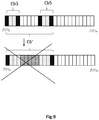
- Fig. 9 a manipulation attempt when combining is shown.
- the coin data sets C 3 and C 5 could be combined in accordance with step 209, since the identifier ID is the same.
- An attempt could be made to determine the monetary amount C b6 resulting from the addition of the amounts C b3 + C b4 + C b5 for all thirteen Redeem items at transaction database 1.
- transmission count values t, t ' are preferably used, which can be checked both in the security element SEx and in the verification unit 2, as will be described below.
- the coin record C root becomes as in Fig. 4 generated and output described, see equation (1).
- a derivative-specific transmission count t is now used in the security element SEx or the verification unit 2 when the coin data record C 1 is derived . With each new derivation level, a further count is generated and started from one.
- a further derived coin data record C 7 accordingly has a first count t (first level) and a second count t '(second level).
- the derivation of the first level in dependence on the derivation-specific transmission count t is now explained using the example of the coin data record C 3 .
- the coin record C 3 derived from the received coin record C root has the elements f (r) 1 to f (r) 4 .
- the elements can then be lined up again and then result in the monetary amount C b6 from the addition of the individual monetary amounts C b3 , C b4 , as shown below.
- the resulting coin data record for the value C b6 would actually be: ID ; 1 ; 4th ; 6 ; 9 ; 10th ; 13 ; f ⁇ r 1 ; f ⁇ r 4th ; f ⁇ r 5 ; f ⁇ r 9
- the combined derived coin record C 6 with the monetary amount C b6 is according to (15): ID ; 1 ; 9 ; f ⁇ r 1 ; f ⁇ r 9
- equation (11) With regard to equations (11) to (16), it should be noted that the combination can in principle also be used without the derivative-specific transmission count t, then equation (11) would simply be omitted and equations (12) to (16) would also Operate f (r) x instead of f '(r) x .
- Fig. 8 It is shown below that the coin data record C 6 can now be divided again and the further derived coin data record C 7 is derived from it, which is according to a derived value r ' k1 Fig. 5 and the additional dependency on the count value t, that is to say a derived value r ' t, k1 .
- step 204 a cryptographic function for at least one element of the sequence is calculated using the derived value r ' t, k1 from the sequence f' (r) k to f '(r) 1 and the position of the element in the sequence. According to Fig.
- the transmission count t ' is used depending on the levels of the derivative and is therefore derivative-specific.
- the remaining steps of the Fig. 5 repeat themselves for a derivative according to Fig. 8 .
- the transmission count t ' is used to log whether the elements of each derived coin record are related or not, so that the manipulation attempt according to Fig. 9 is discovered and can be prevented.
- coin data records of different lead levels can also be safely combined.
Landscapes
- Business, Economics & Management (AREA)
- Accounting & Taxation (AREA)
- Finance (AREA)
- Engineering & Computer Science (AREA)
- Strategic Management (AREA)
- Physics & Mathematics (AREA)
- General Business, Economics & Management (AREA)
- General Physics & Mathematics (AREA)
- Theoretical Computer Science (AREA)
- Computer Networks & Wireless Communication (AREA)
- Financial Or Insurance-Related Operations Such As Payment And Settlement (AREA)
Applications Claiming Priority (1)
| Application Number | Priority Date | Filing Date | Title |
|---|---|---|---|
| DE102018009951.3A DE102018009951A1 (de) | 2018-12-18 | 2018-12-18 | Verfahren zum direkten Austausch eines Münzdatensatzes zwischen Sicherheitselementen |
Publications (2)
| Publication Number | Publication Date |
|---|---|
| EP3671602A1 true EP3671602A1 (fr) | 2020-06-24 |
| EP3671602B1 EP3671602B1 (fr) | 2024-02-07 |
Family
ID=69055633
Family Applications (1)
| Application Number | Title | Priority Date | Filing Date |
|---|---|---|---|
| EP19020680.5A Active EP3671602B1 (fr) | 2018-12-18 | 2019-12-09 | Procédé d'échange direct d'un ensemble de données de pièce de monnaie entre des éléments de sécurité |
Country Status (2)
| Country | Link |
|---|---|
| EP (1) | EP3671602B1 (fr) |
| DE (1) | DE102018009951A1 (fr) |
Cited By (3)
| Publication number | Priority date | Publication date | Assignee | Title |
|---|---|---|---|---|
| WO2023011755A1 (fr) * | 2021-08-04 | 2023-02-09 | Giesecke+Devrient Advance52 Gmbh | Procédé de transfert direct de jetons |
| EP4435700A1 (fr) * | 2023-03-22 | 2024-09-25 | Giesecke+Devrient advance52 GmbH | Procédé d'enregistrement de jeton, registre de référence de jeton, unité de transaction sécurisée et système de transaction de paiement électronique |
| EP4502903A1 (fr) * | 2023-08-01 | 2025-02-05 | Giesecke+Devrient advance52 GmbH | Système de service et structure de données de paiement |
Families Citing this family (2)
| Publication number | Priority date | Publication date | Assignee | Title |
|---|---|---|---|---|
| DE102020004116A1 (de) * | 2020-07-08 | 2022-01-13 | Giesecke+Devrient Gesellschaft mit beschränkter Haftung | Herausgabeinstanz und verfahren zum herausgeben von elektronischen münzdatensätzen sowie bezahlsystem |
| DE102020004117A1 (de) * | 2020-07-08 | 2022-01-13 | Giesecke+Devrient Gesellschaft mit beschränkter Haftung | Verfahren, endgerät sowie münzregister zum übertragen von elektronischen münzdatensätzen |
Citations (4)
| Publication number | Priority date | Publication date | Assignee | Title |
|---|---|---|---|---|
| US5872844A (en) * | 1996-11-18 | 1999-02-16 | Microsoft Corporation | System and method for detecting fraudulent expenditure of transferable electronic assets |
| DE102005008610A1 (de) | 2005-02-23 | 2006-08-31 | Grünauer, Gerold | Verfahren zum Bezahlen in Rechnernetzen |
| DE102009034436A1 (de) | 2009-07-23 | 2011-01-27 | Giesecke & Devrient Gmbh | Verfahren und System zum Bezahlen mit geldwerten Beträgen in Form elektronischer Datensätze |
| DE102009038645A1 (de) | 2009-08-24 | 2011-03-24 | Giesecke & Devrient Gmbh | Verfahren und tragbarer Datenträger zum Übertragen eines geldwerten Betrages in Form eines elektronischen Datensatzes zwischen einer ersten nichtzentralen Instanz und einer zweiten nichtzentralen Instanz |
Family Cites Families (1)
| Publication number | Priority date | Publication date | Assignee | Title |
|---|---|---|---|---|
| US10805349B2 (en) * | 2017-03-29 | 2020-10-13 | At&T Intellectual Property I, L.P. | Method and system to secure and dynamically share IOT information cross multiple platforms in 5G network |
-
2018
- 2018-12-18 DE DE102018009951.3A patent/DE102018009951A1/de not_active Withdrawn
-
2019
- 2019-12-09 EP EP19020680.5A patent/EP3671602B1/fr active Active
Patent Citations (4)
| Publication number | Priority date | Publication date | Assignee | Title |
|---|---|---|---|---|
| US5872844A (en) * | 1996-11-18 | 1999-02-16 | Microsoft Corporation | System and method for detecting fraudulent expenditure of transferable electronic assets |
| DE102005008610A1 (de) | 2005-02-23 | 2006-08-31 | Grünauer, Gerold | Verfahren zum Bezahlen in Rechnernetzen |
| DE102009034436A1 (de) | 2009-07-23 | 2011-01-27 | Giesecke & Devrient Gmbh | Verfahren und System zum Bezahlen mit geldwerten Beträgen in Form elektronischer Datensätze |
| DE102009038645A1 (de) | 2009-08-24 | 2011-03-24 | Giesecke & Devrient Gmbh | Verfahren und tragbarer Datenträger zum Übertragen eines geldwerten Betrages in Form eines elektronischen Datensatzes zwischen einer ersten nichtzentralen Instanz und einer zweiten nichtzentralen Instanz |
Non-Patent Citations (2)
| Title |
|---|
| ISABELLE SIMPLOT-RYL ET AL: "Distributed architectures for electronic cash schemes: a survey1", INTERNATIONAL JOURNAL OF PARALLEL, EMERGENT AND DISTRIBUTED SYSTEMS, vol. 24, no. 3, 1 June 2009 (2009-06-01), United Kingdom, pages 243 - 271, XP055672436, ISSN: 1744-5760, DOI: 10.1080/17445760802441671 * |
| YEN CHOON CHING ET AL: "FairCASH: Concepts and Framework", NEXT GENERATION MOBILE APPLICATIONS, SERVICES AND TECHNOLOGIES, 2008. NGMAST '08. THE SECOND INTERNATIONAL CONFERENCE ON, IEEE, PISCATAWAY, NJ, USA, 16 September 2008 (2008-09-16), pages 269 - 274, XP031409676, ISBN: 978-0-7695-3333-9 * |
Cited By (3)
| Publication number | Priority date | Publication date | Assignee | Title |
|---|---|---|---|---|
| WO2023011755A1 (fr) * | 2021-08-04 | 2023-02-09 | Giesecke+Devrient Advance52 Gmbh | Procédé de transfert direct de jetons |
| EP4435700A1 (fr) * | 2023-03-22 | 2024-09-25 | Giesecke+Devrient advance52 GmbH | Procédé d'enregistrement de jeton, registre de référence de jeton, unité de transaction sécurisée et système de transaction de paiement électronique |
| EP4502903A1 (fr) * | 2023-08-01 | 2025-02-05 | Giesecke+Devrient advance52 GmbH | Système de service et structure de données de paiement |
Also Published As
| Publication number | Publication date |
|---|---|
| DE102018009951A1 (de) | 2020-06-18 |
| EP3671602B1 (fr) | 2024-02-07 |
Similar Documents
| Publication | Publication Date | Title |
|---|---|---|
| EP3671514B1 (fr) | Procédé d'échange direct d'un ensemble de données de pièce de monnaie entre des éléments de sécurité | |
| EP3671602B1 (fr) | Procédé d'échange direct d'un ensemble de données de pièce de monnaie entre des éléments de sécurité | |
| EP4399632B1 (fr) | Procédé et système de transaction pour transmettre des jetons dans un système de transaction électronique | |
| EP4111348B1 (fr) | Procédé de transmission directe de jeux de données de pièces de monnaie électroniques entre terminaux, système de paiement, système de protection et unité de surveillance | |
| EP3108610B1 (fr) | Procédé et système d'établissement et vérification de validité de certificats d'appareil | |
| DE19539801C2 (de) | Überwachung von Transaktionen mit Chipkarten | |
| EP3654222B1 (fr) | Véhicule, composant de réseau, procédé, programme informatique et dispositif de génération d'un identificateur pour un état d'équipement d'un véhicule | |
| WO2020212337A1 (fr) | Procédé pour le transfert direct de jeux de données électroniques de monnaie entre des terminaux ainsi que système de paiement | |
| DE102019002731A1 (de) | Gerät zum direkten Übertragen von elektronischen Münzdatensätzen an ein anderes Gerät sowie Bezahlsystem | |
| DE102016215914A1 (de) | Absichern einer Gerätenutzungsinformation eines Gerätes | |
| EP4381408A1 (fr) | Élément sécurisé, procédé d'enregistrement de jetons et registre de référence de jeton | |
| WO2020126078A1 (fr) | Procédé de génération d'une signature aveugle | |
| EP4334872A1 (fr) | Procédé d'enregistrement d'un ensemble de données de pièces électroniques dans un registre de pièces; registre de pièces; unité d'abonné et produit de programme d'ordinateur | |
| WO2024027869A1 (fr) | Élément sécurisé, procédé d'enregistrement de jetons et registre de référence de jeton | |
| EP4143644B1 (fr) | Systèmes et procédé de certification numérique des données utiles d'une installation d'automatisation | |
| EP4111399B1 (fr) | Procédé, terminal, entité de surveillance et système de paiement pour gérer des ensembles de données électroniques de pièces de monnaie | |
| DE102021004023A1 (de) | Verfahren zum direkten übertragen von token | |
| EP3671513B1 (fr) | Procédé d'échange direct d'un ensemble de données de pièce de monnaie entre des éléments de sécurité | |
| WO2024012624A1 (fr) | Procédé de génération sécurisée d'un jeton pouvant être émis, procédé de destruction sécurisée d'un jeton et émetteur de jeton | |
| WO2020126079A1 (fr) | Procédé pour obtenir une signature aveugle | |
| EP3254432A1 (fr) | Procédé de gestion d'autorisation dans un ensemble comportant plusieurs systèmes informatiques | |
| EP3619885B1 (fr) | Procédé de gestion de clés asymétrique, basé sur une chaîne de blocs et installation relative à la sécurité | |
| EP3283999B1 (fr) | Système électronique servant à produire un certificat | |
| EP4177808B1 (fr) | Transfert de cryptomonnaie à anonymisation sélective | |
| DE68904540T2 (de) | Verfahren und vorrichtung zur beglaubigung. |
Legal Events
| Date | Code | Title | Description |
|---|---|---|---|
| PUAI | Public reference made under article 153(3) epc to a published international application that has entered the european phase |
Free format text: ORIGINAL CODE: 0009012 |
|
| STAA | Information on the status of an ep patent application or granted ep patent |
Free format text: STATUS: THE APPLICATION HAS BEEN PUBLISHED |
|
| AK | Designated contracting states |
Kind code of ref document: A1 Designated state(s): AL AT BE BG CH CY CZ DE DK EE ES FI FR GB GR HR HU IE IS IT LI LT LU LV MC MK MT NL NO PL PT RO RS SE SI SK SM TR |
|
| AX | Request for extension of the european patent |
Extension state: BA ME |
|
| STAA | Information on the status of an ep patent application or granted ep patent |
Free format text: STATUS: REQUEST FOR EXAMINATION WAS MADE |
|
| 17P | Request for examination filed |
Effective date: 20210111 |
|
| RBV | Designated contracting states (corrected) |
Designated state(s): AL AT BE BG CH CY CZ DE DK EE ES FI FR GB GR HR HU IE IS IT LI LT LU LV MC MK MT NL NO PL PT RO RS SE SI SK SM TR |
|
| STAA | Information on the status of an ep patent application or granted ep patent |
Free format text: STATUS: EXAMINATION IS IN PROGRESS |
|
| 17Q | First examination report despatched |
Effective date: 20211124 |
|
| RAP1 | Party data changed (applicant data changed or rights of an application transferred) |
Owner name: GIESECKE+DEVRIENT ADVANCE52 GMBH |
|
| P01 | Opt-out of the competence of the unified patent court (upc) registered |
Effective date: 20230519 |
|
| GRAP | Despatch of communication of intention to grant a patent |
Free format text: ORIGINAL CODE: EPIDOSNIGR1 |
|
| STAA | Information on the status of an ep patent application or granted ep patent |
Free format text: STATUS: GRANT OF PATENT IS INTENDED |
|
| INTG | Intention to grant announced |
Effective date: 20230925 |
|
| GRAS | Grant fee paid |
Free format text: ORIGINAL CODE: EPIDOSNIGR3 |
|
| GRAA | (expected) grant |
Free format text: ORIGINAL CODE: 0009210 |
|
| STAA | Information on the status of an ep patent application or granted ep patent |
Free format text: STATUS: THE PATENT HAS BEEN GRANTED |
|
| AK | Designated contracting states |
Kind code of ref document: B1 Designated state(s): AL AT BE BG CH CY CZ DE DK EE ES FI FR GB GR HR HU IE IS IT LI LT LU LV MC MK MT NL NO PL PT RO RS SE SI SK SM TR |
|
| REG | Reference to a national code |
Ref country code: GB Ref legal event code: FG4D Free format text: NOT ENGLISH |
|
| REG | Reference to a national code |
Ref country code: CH Ref legal event code: EP |
|
| REG | Reference to a national code |
Ref country code: IE Ref legal event code: FG4D Free format text: LANGUAGE OF EP DOCUMENT: GERMAN |
|
| REG | Reference to a national code |
Ref country code: DE Ref legal event code: R096 Ref document number: 502019010521 Country of ref document: DE |
|
| REG | Reference to a national code |
Ref country code: LT Ref legal event code: MG9D |
|
| REG | Reference to a national code |
Ref country code: NL Ref legal event code: MP Effective date: 20240207 |
|
| PG25 | Lapsed in a contracting state [announced via postgrant information from national office to epo] |
Ref country code: IS Free format text: LAPSE BECAUSE OF FAILURE TO SUBMIT A TRANSLATION OF THE DESCRIPTION OR TO PAY THE FEE WITHIN THE PRESCRIBED TIME-LIMIT Effective date: 20240607 |
|
| PG25 | Lapsed in a contracting state [announced via postgrant information from national office to epo] |
Ref country code: LT Free format text: LAPSE BECAUSE OF FAILURE TO SUBMIT A TRANSLATION OF THE DESCRIPTION OR TO PAY THE FEE WITHIN THE PRESCRIBED TIME-LIMIT Effective date: 20240207 |
|
| PG25 | Lapsed in a contracting state [announced via postgrant information from national office to epo] |
Ref country code: GR Free format text: LAPSE BECAUSE OF FAILURE TO SUBMIT A TRANSLATION OF THE DESCRIPTION OR TO PAY THE FEE WITHIN THE PRESCRIBED TIME-LIMIT Effective date: 20240508 |
|
| PG25 | Lapsed in a contracting state [announced via postgrant information from national office to epo] |
Ref country code: NL Free format text: LAPSE BECAUSE OF FAILURE TO SUBMIT A TRANSLATION OF THE DESCRIPTION OR TO PAY THE FEE WITHIN THE PRESCRIBED TIME-LIMIT Effective date: 20240207 Ref country code: HR Free format text: LAPSE BECAUSE OF FAILURE TO SUBMIT A TRANSLATION OF THE DESCRIPTION OR TO PAY THE FEE WITHIN THE PRESCRIBED TIME-LIMIT Effective date: 20240207 Ref country code: RS Free format text: LAPSE BECAUSE OF FAILURE TO SUBMIT A TRANSLATION OF THE DESCRIPTION OR TO PAY THE FEE WITHIN THE PRESCRIBED TIME-LIMIT Effective date: 20240507 |
|
| PG25 | Lapsed in a contracting state [announced via postgrant information from national office to epo] |
Ref country code: ES Free format text: LAPSE BECAUSE OF FAILURE TO SUBMIT A TRANSLATION OF THE DESCRIPTION OR TO PAY THE FEE WITHIN THE PRESCRIBED TIME-LIMIT Effective date: 20240207 |
|
| PG25 | Lapsed in a contracting state [announced via postgrant information from national office to epo] |
Ref country code: RS Free format text: LAPSE BECAUSE OF FAILURE TO SUBMIT A TRANSLATION OF THE DESCRIPTION OR TO PAY THE FEE WITHIN THE PRESCRIBED TIME-LIMIT Effective date: 20240507 Ref country code: NO Free format text: LAPSE BECAUSE OF FAILURE TO SUBMIT A TRANSLATION OF THE DESCRIPTION OR TO PAY THE FEE WITHIN THE PRESCRIBED TIME-LIMIT Effective date: 20240507 Ref country code: NL Free format text: LAPSE BECAUSE OF FAILURE TO SUBMIT A TRANSLATION OF THE DESCRIPTION OR TO PAY THE FEE WITHIN THE PRESCRIBED TIME-LIMIT Effective date: 20240207 Ref country code: LT Free format text: LAPSE BECAUSE OF FAILURE TO SUBMIT A TRANSLATION OF THE DESCRIPTION OR TO PAY THE FEE WITHIN THE PRESCRIBED TIME-LIMIT Effective date: 20240207 Ref country code: IS Free format text: LAPSE BECAUSE OF FAILURE TO SUBMIT A TRANSLATION OF THE DESCRIPTION OR TO PAY THE FEE WITHIN THE PRESCRIBED TIME-LIMIT Effective date: 20240607 Ref country code: HR Free format text: LAPSE BECAUSE OF FAILURE TO SUBMIT A TRANSLATION OF THE DESCRIPTION OR TO PAY THE FEE WITHIN THE PRESCRIBED TIME-LIMIT Effective date: 20240207 Ref country code: GR Free format text: LAPSE BECAUSE OF FAILURE TO SUBMIT A TRANSLATION OF THE DESCRIPTION OR TO PAY THE FEE WITHIN THE PRESCRIBED TIME-LIMIT Effective date: 20240508 Ref country code: FI Free format text: LAPSE BECAUSE OF FAILURE TO SUBMIT A TRANSLATION OF THE DESCRIPTION OR TO PAY THE FEE WITHIN THE PRESCRIBED TIME-LIMIT Effective date: 20240207 Ref country code: ES Free format text: LAPSE BECAUSE OF FAILURE TO SUBMIT A TRANSLATION OF THE DESCRIPTION OR TO PAY THE FEE WITHIN THE PRESCRIBED TIME-LIMIT Effective date: 20240207 Ref country code: BG Free format text: LAPSE BECAUSE OF FAILURE TO SUBMIT A TRANSLATION OF THE DESCRIPTION OR TO PAY THE FEE WITHIN THE PRESCRIBED TIME-LIMIT Effective date: 20240207 |
|
| PG25 | Lapsed in a contracting state [announced via postgrant information from national office to epo] |
Ref country code: PL Free format text: LAPSE BECAUSE OF FAILURE TO SUBMIT A TRANSLATION OF THE DESCRIPTION OR TO PAY THE FEE WITHIN THE PRESCRIBED TIME-LIMIT Effective date: 20240207 Ref country code: PT Free format text: LAPSE BECAUSE OF FAILURE TO SUBMIT A TRANSLATION OF THE DESCRIPTION OR TO PAY THE FEE WITHIN THE PRESCRIBED TIME-LIMIT Effective date: 20240607 |
|
| PG25 | Lapsed in a contracting state [announced via postgrant information from national office to epo] |
Ref country code: SE Free format text: LAPSE BECAUSE OF FAILURE TO SUBMIT A TRANSLATION OF THE DESCRIPTION OR TO PAY THE FEE WITHIN THE PRESCRIBED TIME-LIMIT Effective date: 20240207 Ref country code: PT Free format text: LAPSE BECAUSE OF FAILURE TO SUBMIT A TRANSLATION OF THE DESCRIPTION OR TO PAY THE FEE WITHIN THE PRESCRIBED TIME-LIMIT Effective date: 20240607 Ref country code: PL Free format text: LAPSE BECAUSE OF FAILURE TO SUBMIT A TRANSLATION OF THE DESCRIPTION OR TO PAY THE FEE WITHIN THE PRESCRIBED TIME-LIMIT Effective date: 20240207 Ref country code: LV Free format text: LAPSE BECAUSE OF FAILURE TO SUBMIT A TRANSLATION OF THE DESCRIPTION OR TO PAY THE FEE WITHIN THE PRESCRIBED TIME-LIMIT Effective date: 20240207 |
|
| PG25 | Lapsed in a contracting state [announced via postgrant information from national office to epo] |
Ref country code: DK Free format text: LAPSE BECAUSE OF FAILURE TO SUBMIT A TRANSLATION OF THE DESCRIPTION OR TO PAY THE FEE WITHIN THE PRESCRIBED TIME-LIMIT Effective date: 20240207 |
|
| PG25 | Lapsed in a contracting state [announced via postgrant information from national office to epo] |
Ref country code: SM Free format text: LAPSE BECAUSE OF FAILURE TO SUBMIT A TRANSLATION OF THE DESCRIPTION OR TO PAY THE FEE WITHIN THE PRESCRIBED TIME-LIMIT Effective date: 20240207 |
|
| PG25 | Lapsed in a contracting state [announced via postgrant information from national office to epo] |
Ref country code: EE Free format text: LAPSE BECAUSE OF FAILURE TO SUBMIT A TRANSLATION OF THE DESCRIPTION OR TO PAY THE FEE WITHIN THE PRESCRIBED TIME-LIMIT Effective date: 20240207 Ref country code: CZ Free format text: LAPSE BECAUSE OF FAILURE TO SUBMIT A TRANSLATION OF THE DESCRIPTION OR TO PAY THE FEE WITHIN THE PRESCRIBED TIME-LIMIT Effective date: 20240207 |
|
| PG25 | Lapsed in a contracting state [announced via postgrant information from national office to epo] |
Ref country code: SK Free format text: LAPSE BECAUSE OF FAILURE TO SUBMIT A TRANSLATION OF THE DESCRIPTION OR TO PAY THE FEE WITHIN THE PRESCRIBED TIME-LIMIT Effective date: 20240207 |
|
| PG25 | Lapsed in a contracting state [announced via postgrant information from national office to epo] |
Ref country code: SM Free format text: LAPSE BECAUSE OF FAILURE TO SUBMIT A TRANSLATION OF THE DESCRIPTION OR TO PAY THE FEE WITHIN THE PRESCRIBED TIME-LIMIT Effective date: 20240207 Ref country code: SK Free format text: LAPSE BECAUSE OF FAILURE TO SUBMIT A TRANSLATION OF THE DESCRIPTION OR TO PAY THE FEE WITHIN THE PRESCRIBED TIME-LIMIT Effective date: 20240207 Ref country code: RO Free format text: LAPSE BECAUSE OF FAILURE TO SUBMIT A TRANSLATION OF THE DESCRIPTION OR TO PAY THE FEE WITHIN THE PRESCRIBED TIME-LIMIT Effective date: 20240207 Ref country code: EE Free format text: LAPSE BECAUSE OF FAILURE TO SUBMIT A TRANSLATION OF THE DESCRIPTION OR TO PAY THE FEE WITHIN THE PRESCRIBED TIME-LIMIT Effective date: 20240207 Ref country code: DK Free format text: LAPSE BECAUSE OF FAILURE TO SUBMIT A TRANSLATION OF THE DESCRIPTION OR TO PAY THE FEE WITHIN THE PRESCRIBED TIME-LIMIT Effective date: 20240207 Ref country code: CZ Free format text: LAPSE BECAUSE OF FAILURE TO SUBMIT A TRANSLATION OF THE DESCRIPTION OR TO PAY THE FEE WITHIN THE PRESCRIBED TIME-LIMIT Effective date: 20240207 |
|
| REG | Reference to a national code |
Ref country code: DE Ref legal event code: R097 Ref document number: 502019010521 Country of ref document: DE |
|
| PG25 | Lapsed in a contracting state [announced via postgrant information from national office to epo] |
Ref country code: IT Free format text: LAPSE BECAUSE OF FAILURE TO SUBMIT A TRANSLATION OF THE DESCRIPTION OR TO PAY THE FEE WITHIN THE PRESCRIBED TIME-LIMIT Effective date: 20240207 |
|
| PLBE | No opposition filed within time limit |
Free format text: ORIGINAL CODE: 0009261 |
|
| STAA | Information on the status of an ep patent application or granted ep patent |
Free format text: STATUS: NO OPPOSITION FILED WITHIN TIME LIMIT |
|
| PG25 | Lapsed in a contracting state [announced via postgrant information from national office to epo] |
Ref country code: IT Free format text: LAPSE BECAUSE OF FAILURE TO SUBMIT A TRANSLATION OF THE DESCRIPTION OR TO PAY THE FEE WITHIN THE PRESCRIBED TIME-LIMIT Effective date: 20240207 |
|
| 26N | No opposition filed |
Effective date: 20241108 |
|
| PG25 | Lapsed in a contracting state [announced via postgrant information from national office to epo] |
Ref country code: SI Free format text: LAPSE BECAUSE OF FAILURE TO SUBMIT A TRANSLATION OF THE DESCRIPTION OR TO PAY THE FEE WITHIN THE PRESCRIBED TIME-LIMIT Effective date: 20240207 |
|
| PG25 | Lapsed in a contracting state [announced via postgrant information from national office to epo] |
Ref country code: MC Free format text: LAPSE BECAUSE OF FAILURE TO SUBMIT A TRANSLATION OF THE DESCRIPTION OR TO PAY THE FEE WITHIN THE PRESCRIBED TIME-LIMIT Effective date: 20240207 |
|
| PG25 | Lapsed in a contracting state [announced via postgrant information from national office to epo] |
Ref country code: LU Free format text: LAPSE BECAUSE OF NON-PAYMENT OF DUE FEES Effective date: 20241209 |
|
| REG | Reference to a national code |
Ref country code: BE Ref legal event code: MM Effective date: 20241231 |
|
| PG25 | Lapsed in a contracting state [announced via postgrant information from national office to epo] |
Ref country code: BE Free format text: LAPSE BECAUSE OF NON-PAYMENT OF DUE FEES Effective date: 20241231 |
|
| PG25 | Lapsed in a contracting state [announced via postgrant information from national office to epo] |
Ref country code: IE Free format text: LAPSE BECAUSE OF NON-PAYMENT OF DUE FEES Effective date: 20241209 |
|
| REG | Reference to a national code |
Ref country code: CH Ref legal event code: U11 Free format text: ST27 STATUS EVENT CODE: U-0-0-U10-U11 (AS PROVIDED BY THE NATIONAL OFFICE) Effective date: 20260101 |
|
| PGFP | Annual fee paid to national office [announced via postgrant information from national office to epo] |
Ref country code: GB Payment date: 20251218 Year of fee payment: 7 |
|
| PGFP | Annual fee paid to national office [announced via postgrant information from national office to epo] |
Ref country code: FR Payment date: 20251217 Year of fee payment: 7 |
|
| REG | Reference to a national code |
Ref country code: AT Ref legal event code: MM01 Ref document number: 1655828 Country of ref document: AT Kind code of ref document: T Effective date: 20241209 |
|
| PGFP | Annual fee paid to national office [announced via postgrant information from national office to epo] |
Ref country code: DE Payment date: 20251222 Year of fee payment: 7 |
|
| PG25 | Lapsed in a contracting state [announced via postgrant information from national office to epo] |
Ref country code: AT Free format text: LAPSE BECAUSE OF NON-PAYMENT OF DUE FEES Effective date: 20241209 |
|
| PGFP | Annual fee paid to national office [announced via postgrant information from national office to epo] |
Ref country code: CH Payment date: 20260101 Year of fee payment: 7 |