EP3671632B1 - Prévision d'entretien à base d'image et détection de fausses man uvres - Google Patents
Prévision d'entretien à base d'image et détection de fausses man uvres Download PDFInfo
- Publication number
- EP3671632B1 EP3671632B1 EP19215579.4A EP19215579A EP3671632B1 EP 3671632 B1 EP3671632 B1 EP 3671632B1 EP 19215579 A EP19215579 A EP 19215579A EP 3671632 B1 EP3671632 B1 EP 3671632B1
- Authority
- EP
- European Patent Office
- Prior art keywords
- microscope system
- image
- maintenance
- feature
- images
- Prior art date
- Legal status (The legal status is an assumption and is not a legal conclusion. Google has not performed a legal analysis and makes no representation as to the accuracy of the status listed.)
- Active
Links
Images
Classifications
-
- G—PHYSICS
- G06—COMPUTING OR CALCULATING; COUNTING
- G06T—IMAGE DATA PROCESSING OR GENERATION, IN GENERAL
- G06T7/00—Image analysis
- G06T7/0002—Inspection of images, e.g. flaw detection
- G06T7/0004—Industrial image inspection
-
- G—PHYSICS
- G02—OPTICS
- G02B—OPTICAL ELEMENTS, SYSTEMS OR APPARATUS
- G02B21/00—Microscopes
- G02B21/36—Microscopes arranged for photographic purposes or projection purposes or digital imaging or video purposes including associated control and data processing arrangements
- G02B21/365—Control or image processing arrangements for digital or video microscopes
-
- G—PHYSICS
- G06—COMPUTING OR CALCULATING; COUNTING
- G06N—COMPUTING ARRANGEMENTS BASED ON SPECIFIC COMPUTATIONAL MODELS
- G06N3/00—Computing arrangements based on biological models
- G06N3/02—Neural networks
- G06N3/04—Architecture, e.g. interconnection topology
- G06N3/044—Recurrent networks, e.g. Hopfield networks
-
- G—PHYSICS
- G06—COMPUTING OR CALCULATING; COUNTING
- G06N—COMPUTING ARRANGEMENTS BASED ON SPECIFIC COMPUTATIONAL MODELS
- G06N3/00—Computing arrangements based on biological models
- G06N3/02—Neural networks
- G06N3/04—Architecture, e.g. interconnection topology
- G06N3/045—Combinations of networks
-
- G—PHYSICS
- G06—COMPUTING OR CALCULATING; COUNTING
- G06Q—INFORMATION AND COMMUNICATION TECHNOLOGY [ICT] SPECIALLY ADAPTED FOR ADMINISTRATIVE, COMMERCIAL, FINANCIAL, MANAGERIAL OR SUPERVISORY PURPOSES; SYSTEMS OR METHODS SPECIALLY ADAPTED FOR ADMINISTRATIVE, COMMERCIAL, FINANCIAL, MANAGERIAL OR SUPERVISORY PURPOSES, NOT OTHERWISE PROVIDED FOR
- G06Q10/00—Administration; Management
- G06Q10/20—Administration of product repair or maintenance
-
- G—PHYSICS
- G06—COMPUTING OR CALCULATING; COUNTING
- G06T—IMAGE DATA PROCESSING OR GENERATION, IN GENERAL
- G06T7/00—Image analysis
- G06T7/0002—Inspection of images, e.g. flaw detection
-
- G—PHYSICS
- G06—COMPUTING OR CALCULATING; COUNTING
- G06T—IMAGE DATA PROCESSING OR GENERATION, IN GENERAL
- G06T2207/00—Indexing scheme for image analysis or image enhancement
- G06T2207/10—Image acquisition modality
- G06T2207/10056—Microscopic image
-
- G—PHYSICS
- G06—COMPUTING OR CALCULATING; COUNTING
- G06T—IMAGE DATA PROCESSING OR GENERATION, IN GENERAL
- G06T2207/00—Indexing scheme for image analysis or image enhancement
- G06T2207/20—Special algorithmic details
- G06T2207/20081—Training; Learning
-
- G—PHYSICS
- G06—COMPUTING OR CALCULATING; COUNTING
- G06T—IMAGE DATA PROCESSING OR GENERATION, IN GENERAL
- G06T2207/00—Indexing scheme for image analysis or image enhancement
- G06T2207/20—Special algorithmic details
- G06T2207/20084—Artificial neural networks [ANN]
-
- G—PHYSICS
- G06—COMPUTING OR CALCULATING; COUNTING
- G06T—IMAGE DATA PROCESSING OR GENERATION, IN GENERAL
- G06T2207/00—Indexing scheme for image analysis or image enhancement
- G06T2207/30—Subject of image; Context of image processing
- G06T2207/30168—Image quality inspection
Definitions
- the invention relates generally to a system for predicting the need for maintenance measures and, more particularly, to a computer-implemented method for predictive maintenance for a microscope system, a corresponding maintenance monitoring system and a computer program product.
- Modern technical devices often require complex and time-consuming maintenance measures according to a predetermined maintenance plan. This uses experience from the past to determine the maintenance intervals so that the technical devices do not fail due to a lack of maintenance work. This circumstance results in the fact that maintenance measures are actually carried out more frequently than would be necessary for some of the technical devices. This is especially true when the devices are handled by high-quality personnel in a system-appropriate and careful manner. This applies not only to pilots, who sometimes even receive increased compensation for treating engines carefully (very rarely under full load), but also to high-precision instruments such as highly complex precision microscope systems. These are used in the medical, biomedical or material science fields, for example; and here too, system downtime due to maintenance work should be kept as short as possible in order to enable the investment in these devices to be amortized as quickly as possible.
- a computer-implemented method for determining a need for predictive maintenance for an optical microscope system comprises providing an optical microscope system having an image sensor for capturing digital images of a sample, and capturing digital images using the image sensor during regular operation of the optical microscope system.
- a recorded digital image is made available to an image analysis system as at least one input data set. Based on this, at least one feature is determined by the image analysis system in the at least one recorded digital image, wherein the feature is correlated to a malfunction of the optical microscope system during regular operation.
- the method further comprises generating a status signal for a state of the optical microscope system by the image analysis system on the basis of the at least one digital image and the at least one feature contained therein and determining - by using the status signal - a component group of the optical microscope system for which a maintenance measure is required.
- a maintenance monitoring system for determining a need for predictive maintenance for an optical microscope system.
- the maintenance monitoring system includes an optical microscope system having an image sensor for capturing digital images of a sample and an image sensor for capturing digital images during regular operation of the optical microscope system.
- the maintenance monitoring system has an image analysis system which is adapted to receive at least one recorded digital image as at least one input data set for an image analysis system.
- the image analysis system is adapted to determine at least one feature by the image analysis system in the at least one recorded digital image, wherein the feature is correlated to a malfunction of the optical microscope system during regular operation.
- the maintenance monitoring system has a generation of a status signal for a state of the optical microscope system by the image analysis system on the basis of the at least one digital image and the at least one feature contained therein, and a determination, by using the status signal, of a component group of the optical microscope system that requires maintenance.
- embodiments may be implemented in the form of a corresponding computer program product accessible by a computer-usable or computer-readable medium comprising program code for use by or in connection with a computer or instruction execution system.
- a computer-usable or computer-readable medium may be any device comprising means for storing, communicating, forwarding or transporting the program for use by or in connection with an instruction execution system, device or apparatus.
- the proposed concept allows the implementation of the principle of predictive maintenance without taking the consistent path of the Internet of Things (Industry 4.0), i.e. without equipping the microscope systems with additional, complex, internal sensors.
- the proposed concept does not require any additional, costly recording and collection of temperature data, voltage values and/or usage data directly on the components of the microscope system to be monitored.
- the proposed concept is based on an evaluation and use of data that is generated during normal operation and use of the microscope system. Furthermore, it is not necessary to record additional (reference) images. The analysis for determining the need for predictive maintenance measures is carried out on the basis of the images that a user takes during normal use of the device, for example in experiments. Additional maintenance or calibration recordings are not required.
- the proposed concept allows a status determination and detection of existing errors in the system - e.g. defective components, misalignment, etc. - an estimation of future errors - including a time horizon - and a root cause analysis - e.g. a distinction between device-related, sample-related and usage-related errors.
- the main advantage is that necessary or recommended maintenance measures do not have to be supplemented and extended by additional devices and/or extensions - in particular mechanical, electromechanical and/or electronic sensors - but that existing components of the microscope system are used to determine the need for predictive maintenance measures. This does not increase the complexity of the microscope system, so that no additional maintenance measures are required for these unnecessary extensions. Rather, the existing subsystems are used and - according to the procedure - better used in the proper, routine, regular operation of the microscope system, in particular through improved evaluations of the recorded digital images, which are recorded anyway during regular operation. An appropriately adapted image analysis system forms the basis for this solution.
- the image analysis system can have a learning system with machine learning properties.
- the method can additionally include training the learning system with a set of digital images by means of machine learning to generate a learning model for recognizing the at least one feature - for example anomalies or other abnormalities - in one of the recorded digital images of samples during regular operation of the microscope system.
- the learning system can, for example, be a system for supervised learning, for example a deep neural network (DNN) or another suitable system for artificial intelligence or machine learning.
- DNN deep neural network
- the images of the set of digital images for supervised learning for generating the learning model with metadata can be annotated for this purpose, i.e.
- the respective images of the set of digital images for supervised learning are supplemented by metadata which, for example, describe anomalies or other peculiarities and features in the training images.
- suggested maintenance measures based on the peculiarities, anomalies and features in the images can also be supplemented in the metadata.
- the metadata can accordingly comprise at least one selected from the group consisting of the following: a time interval value in which the maintenance measure is required, an expected failure time of a component of the microscope system, a numerical status indication - for example rating levels 1 to 10 - of an individual component (or a group) of the microscope system, and a designation of a defective component of the microscope system.
- the learning system is trained by the method to determine maintenance measures required on individual components or component groups of the microscope system from certain features of the recorded images during regular operation of the microscope system.
- determining the component group of the microscope system can additionally include determining a time interval value in which the maintenance measure is required. This allows future maintenance measures to be dynamically stored in a maintenance plan. Similar maintenance measures or maintenance measures on microscope systems at different locations can be better coordinated by the maintenance personnel in this way.
- At least one additional sensor value - in particular not from the image sensor - of the microscope system can be recorded, which is/are used as additional input data for the learning system. It is useful to take such sensor measurements into account when training the learning system. For this purpose, it can be helpful to annotate the input data sets of the additional sensor values that are also made available to the learning system accordingly, so that a combination of the sensor values together with the analyzed Maintenance measures can be derived from the images taken during regular operation.
- intensity values of the lighting can be evaluated - either passively, ie, measured by a sensor, or actively, ie, for example, by means of the current flow through the light source.
- the at least one feature contained in the at least one recorded digital image in regular operation has at least one that is included in the group consisting of the following: stripes, jitter, uneven brightness - for example due to uneven field illumination - reduced resolution, excessive image noise - for example derived from one or more predetermined or dynamically determined limit values - low signal-to-background ratio, low laser power, reduced sensitivity and defects in the digital image.
- these can be all detectable and executable parameters of a digital image.
- the learning model can be generated for a single microscope system or for a plurality of microscope systems. This means that the learning model can be used, for example, for all microscope systems of a series that belong to a microscope series without having to retrain it each time.
- At least one operating parameter value - ideally as a time series - of an operating element - whereby user behavior is recorded - of the microscope system can be measured, which is additionally used in determining the status signal or influences it.
- manual readjustments are repeatedly made to individual actuators of the microscope system during regular operation, which deviate from normal operation of the microscope system in terms of their number and time intervals and are therefore recognized as anomalies or conspicuous features that are generated by sensor measurements in proper normal operation.
- the learning system is adapted to detect abnormalities and anomalies in the recorded time series of measured parameter values of individual control elements.
- the learning model for recognizing the at least one feature can involve at least one category selected from the group consisting of: classification of service levels of the microscope system, regression to the expected failure time of the microscope system, correlation of the at least one feature or a combination of several features of the digital image with determination of a maintenance requirement of an assignable component or component group of the microscope system.
- at least one category selected from the group consisting of: classification of service levels of the microscope system, regression to the expected failure time of the microscope system, correlation of the at least one feature or a combination of several features of the digital image with determination of a maintenance requirement of an assignable component or component group of the microscope system.
- the status signal can be generated from a combination of control signals.
- one of the control signals can relate to at least one of the following: a source of error in the microscope system, a confidence factor of the signal of the source of error, a type of error - in particular defect or wear - a numerical equivalent (e.g. percentage) of a loss of quality, a required maintenance measure, a time interval for a recommended or required maintenance measure, an indication of the component for which the maintenance measure is or will be required, information - in particular a recommendation - about alternative microscope system settings to at least partially compensate for a malfunction of a component, information about a source of error in positioning or incorrect preparation of the sample and the like.
- all components and setting options - but especially the components that are subject to regular maintenance - can be recorded in this way.
- the status signal can be determined by the learning system in that a comparison with time sequences recorded during regular operation of a combination of sensor parameters of operating elements of the microscope system with expected values of the combination of sensor parameters of operating elements of the microscope system results in a significant deviation - for example, greater than a dynamically determined threshold value.
- time sequences can also be used by means of the learning system - in particular by unsupervised learning during regular operation of the microscope system - for an assessment of the sensor parameters, a determination of Deviations and a determination or recommendation of maintenance measures or maintenance times.
- the deviation(s) to be determined from values in the normal range can be determined by systems and/or techniques such as AutoEncoder, OneClassClassification and Novelty Detection.
- the determination of at least one feature by the image analysis system can be determined by detecting in a sequence of recorded images of the microscope system in regular operation, a repeating feature which has a gradient or oscillations or sudden, irregular deviations in the temporally ordered sequence of recorded images, or which occurs identically in each image (faulty), so that a systematic deviation from normal values or anomalies becomes recognizable.
- the determination of a normal value - or several - can be carried out by unsupervised learning before the microscope system is actually used or during regular operation of the microscope.
- the gradient determined can have either a positive or a negative value.
- a laser that becomes weaker over time would result in a negative gradient in the illumination values.
- gradual deterioration that an average user of the microscope system would not normally notice immediately can be elegantly recorded.
- What has been said about the laser also applies to other sensor values or features in the recorded digital images. This would also make it possible to record systematic errors that a human user would not normally notice, such as individual defective pixels on the image sensor, a slightly crooked aperture and the like.
- vibrations occurring could be that a control unit for the main image sensor of the microscope system no longer functions properly, which can lead to vibration-like irregularities in the captured digital images over time.
- An example of erratic behavior could be a defective lighting with a loose connection, causing the intensity of the illumination of the samples to vary - possibly even without the human eye detecting it.
- the sequence of recorded images of the microscope system in regular operation can be a selected subset from a total of recorded images of the microscope system in regular operation.
- different filters can be used for the selection.
- the captured images could also be selected according to the metadata stored with the captured images; the metadata of each capture can include, for example: time/date, user identification of the respective operator, dyes used for the samples, sample type, type and number of color channels used, setting parameters of the light path, experiment class (or a complete data set for this), general experiment data (via full-text search), etc.
- the learning system can be a neural network - or, for example, a support vector machine.
- the neural network can be trained using supervised learning or unsupervised learning. The learning then allows classification, detection and/or regression (e.g. to predict a future maintenance time). MultiClass algorithms or OneClass algorithms can be used for classification.
- the neural network can be designed as a deep neural network as a CNN (convolutional NN) or RNN (recursive NN).
- unsupervised learning algorithms such as deep autoencoder, one-class classification, multi-class classification or novelty detection can be used.
- all learning systems can be used that allow the detection and determination of anomalies and trained features in the recorded digital images during regular operation.
- preventive maintenance sometimes also preventive maintenance - in the context of this document describes how maintenance measures can be optimized by only carrying out the measures that are required at a specific time according to the condition of the device - in this case the microscope system. This does not follow a fixed schedule, but rather it is determined dynamically based on the determined condition of the microscope system that a maintenance measure is recommended in order to prevent the microscope system from failing.
- the decision data for deriving a corresponding signal indicating that a group of components or an individual component requires maintenance is obtained from the ongoing operation or use of the microscope system. Additional maintenance measures or special settings are not required.
- maintenance measure here refers to any measure of care, repair, adjustment or calibration, whereby the continuous use of the microscope system is ensured and downtime is minimized. Through constant observation (evaluation of the images recorded) when using the microscope system, even gradual deterioration can be easily detected.
- microscope system describes an optical or optical/electronic system for magnifying and displaying small structures.
- the small structures which are captured by one or more lenses, are captured using an image sensor, which allows the images to be processed electronically and digitally.
- Samples to be examined are typically displayed on a screen or in an eyepiece in magnified form.
- a modern high-performance microscope system also has other components, many of which are mechanical in nature and require maintenance from time to time. These can include a sample table that can be moved in all three spatial directions, apertures, a tripod for holding the sample table, one or more lighting systems, a plurality of manual and/or automated operating and adjustment elements, etc.
- image sensor describes a light-sensitive electronic semiconductor component, which in microscope systems can often be designed as an area sensor in which the recorded images are converted directly into pixel information.
- sample describes an object to be examined, e.g. on a sample carrier such as a multiwell plate.
- Regular operation describes the daily or regular use of the microscope system by one or more users - or in an automated process - to directly generate useful data in the form of digital images of samples to be examined. Regular operation does not include separate additional recordings of digital images that are intended exclusively for maintenance or other calibration purposes. Rather, the digital images recorded during regular, daily operation are used to derive appropriate maintenance measures.
- image analysis system describes a system - often in conjunction with appropriate software - which is generally suitable for generating metadata from the pixel information of captured images.
- This metadata can be based on a classification of the pixels to segment image sub-areas or regression techniques can be used to extrapolate to a value, for example.
- Machine learning techniques can also be used.
- learning system describes a hardware-supported or software system from the field of artificial intelligence that is adapted to learn from examples in order to assign, for example, the contents of images or their sub-areas to abstract terms - for example "good” or “bad” or meaning constructs - e.g. a segmentation of image content - without procedurally specified and manually generated program instructions.
- a mapping of input data to output data is learned.
- training the learning system means that, for example, a machine learning system uses a number of example images to adjust parameters in a neural network, for example, by partially repeatedly evaluating the example images in such a way that, after the training phase, unknown images can also be assigned to one or more categories with which the learning system was trained.
- the example images are typically annotated - i.e. provided with metadata - in order to generate desired results based on the input images, such as information on maintenance measures to be carried out.
- machine learning is a basic term in artificial intelligence, where, for example, statistical methods are used to give computer systems the ability to "learn”. For example, certain behavioral patterns are optimized within a specific task area. The methods used enable the machine learning systems to analyze data without the need for explicit procedural programming.
- CNN Convolutional Neural Network
- a machine learning system a network of nodes that act as artificial neurons and artificial connections between the artificial neurons - so-called links - where parameters - for example weight parameters for the connection - can be assigned to the artificial connections.
- the weight parameters of the connections adapt automatically based on input signals to produce a desired result.
- supervised learning the images provided as input values are supplemented with metadata (annotations) to display a desired output value. In unsupervised learning, such annotations are not necessary.
- recursive neural networks should also be mentioned, which are also a type of deep neural network in which the weight adjustment is carried out recursively so that a structured prediction can be generated using input data of variable size.
- RNNs are used for sequential input data.
- back-propagation functions are used in addition to the forward weight adjustment.
- RNNs can also be used in image analysis.
- convolutional neural network describes a class of artificial neural networks based on feed-forward techniques. They are often used for image analysis with images as input data.
- the main component of convolutional neural networks are convolutional layers (hence the name), which enable efficient evaluation through parameter sharing.
- deep neural networks consist of several layers with different functions: for example, an input layer, an output layer and one or more intermediate layers, for example for convolution operations, application of non-linear functions, dimension reduction, normalization functions, etc.
- the functions can be carried out in software or special hardware components can take over the calculation of the respective function values. Combinations of hardware and software elements are also known.
- Deep autoencoder refers to an auto-encoder system that is based on the principle of a DNN.
- the typical goal when using auto-encoders is to learn a compressed representation (encoding) for a set of data and also to extract essential features. This means that it can be used for dimensionality reduction and/or anomaly detection.
- the actual encoder layer lies between the input layer of artificial neurons and the output layer.
- one-class classification also comes into play in this context. Such methods are also known as “unary classification” or “class modeling” and attempt to classify certain objects in a recorded digital image as a specific class among other objects. Training runs are also required for this. This allows anomalies to be identified in a series of digital images.
- novelty detection describes a mechanism by which an "intelligent” system (for example an intelligent organism) can classify an incoming sensor pattern as previously unknown. This principle can also be applied to artificial neural networks. If a sensor pattern arriving at the artificial neural network does not generate an output signal with a detection probability above a predetermined (or dynamically adjusted) threshold, or If a plurality of output signals are generated for which the recognition probabilities are approximately equal, the incoming sensor pattern - for example a digital image - can be classified as one with a new content (novelty).
- the autoencoder should be able to reconstruct the new example image at the output. This is possible because the new example image is heavily compressed when it passes through the autoencoder, and then expanded/reconstructed again by the neural network. If the new input image (largely) matches the expanded/reconstructed image, the new example image corresponds to a known pattern or is very similar to the contents of the training image database. If there is a clear difference when comparing the new example image with the expanded/reconstructed image, i.e. if the reconstruction errors are significant, then the example image is one with a previously unknown distribution (image content). This means that if a neural network cannot represent the data distribution, this is an anomaly compared to the known database that is assumed to be the norm.
- known example images e.g. configured as an autoencoder
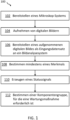
- Fig. 1 shows a block diagram of an embodiment of the inventive computer-implemented method for determining a need for maintenance action for a microscope system.
- the method comprises providing 102 a microscope system having an image sensor for recording digital images of a sample, recording 104 digital images by means of the image sensor during regular operation of the microscope system, and providing 106 at least one recorded digital image as at least one input data set to an image analysis system.
- the method further comprises: determining 108 at least one feature by the image analysis system in the at least one recorded digital image, the feature being correlated with a malfunction of the microscope system during normal operation, generating 110 a status signal for a state of the microscope system by the image analysis system on the basis of the at least one digital image and the at least one feature contained therein, and determining 112 by using the status signal a component group of the microscope system for which a maintenance measure is required.
- This required or to be carried out maintenance measure is displayed to the user. This can be done in text form or as a graphic representation by displaying an image of the microscope system and the component to be maintained being shown with a special mark.
- information on the type of maintenance measure can be output (e.g. cleaning the optical system, replacing the lighting, etc.).
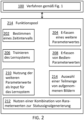
- Fig. 2 provides a block diagram of possible extensions of the Fig. 1
- a function pool 214 is available for this purpose, from which additional functions can be added to the method 100 according to Fig. 1 can be integrated. This includes determining 202 a time interval for a required or recommended maintenance measure on the microscope system, recording 204 further parameter values of components of the microscope system, training 206 the learning system in different forms (supervised/unsupervised learning), recording 208 parameter values of control elements - possibly also time-dependent - using 210 a combination of parameter values to generate status signals for a determined maintenance measure for the microscope system and using 212 the further parameter values as input data for the learning system.
- the further parameter values - advantageously as a time series - are made available to the learning system as input data.
- the function "Selection of a subset of the recorded images" is also available in the function pool. The selection can be made using the selection parameters mentioned above.
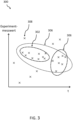
- Fig. 3 shows an example graph 300 for selecting recorded images.
- the time (time/date combination) at which the recorded images were created or on which the corresponding experiment was carried out is plotted on the x-axis.
- Example experimental measurement values are plotted on the y-axis.
- Each measurement point 308 represents a recorded image.
- the selection of images can then be made according to different criteria (see above). Depending on the Selection criteria different groups 302, 306 and 308 of captured images, as illustrated by the example circles.
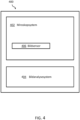
- Fig. 4 illustrates a block diagram of an embodiment of the maintenance monitoring system 400 for determining a need for maintenance action for the microscope system.
- the maintenance monitoring system comprises: a microscope syscope system 402 having an image sensor 406 for capturing digital images of a sample, the image sensor 406 being used to capture digital images during regular operation of the microscope system 402.
- the maintenance monitoring system has an image analysis system 404 which is adapted to receive at least one recorded digital image as at least one input data set.
- the image analysis system 404 is further adapted to determine at least one feature in the at least one recorded digital image, wherein the feature is correlated to a malfunction of the microscope system in regular operation, generating a status signal for a state of the microscope system by the image analysis system based on the at least one digital image and the at least one feature contained therein, and determining by using the status signal a component group of the microscope system for which a maintenance measure is required.
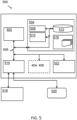
- Fig. 5 depicts a block diagram of a computer system that may include at least portions of the maintenance monitoring system. Embodiments of the concept proposed herein may in principle be used with virtually any type of computer, regardless of the platform used therein for storing and/or executing program code.
- Fig. 5 represents an example of a computer system 500 which is suitable for executing program code in accordance with the method presented here.
- a computer system already present in the microscope system can also serve - if necessary with appropriate extensions - as a computer system for executing the concept presented here.
- the computer system 500 has a plurality of general purpose functions.
- the computer system can be a tablet computer, a laptop/notebook computer, another portable or mobile electronic device, a microprocessor system, a microprocessor-based system, a smartphone or a computer system with specially configured special functions.
- the computer system 500 can be set up to execute computer system executable instructions - such as program modules - that can be executed to implement functions of the concepts proposed here.
- the program modules can have routines, programs, objects, components, logic, data structures, etc. to implement specific tasks or specific abstract data types.
- the components of the computer system may include one or more processors or processing units 502, a memory system 504, and a bus system 506 that connects various system components, including the memory system 504, to the processor 502.
- the computer system 400 includes a plurality of volatile or non-volatile storage media accessible by the computer system 400.
- the data and/or instructions (commands) of the storage media may be stored in volatile form—such as in a RAM (random access memory) 408—in order to be executed by the processor 402.
- RAM random access memory
- Other components of the memory system 504 may be a permanent memory (ROM) 510 and a long-term memory 512 in which the program modules and data (reference numeral 516) may be stored.
- the computer system has a number of dedicated devices for communication (keyboard 518, mouse/pointing device (not shown), screen 520, etc.). These dedicated devices can also be combined in a touch-sensitive display.
- a separately provided I/O controller 514 ensures smooth data exchange with external devices.
- a network adapter 522 is available for communication via a local or global network (LAN, WAN, for example via the Internet). The network adapter can be accessed by other components of the computer system 500 via the bus system 506. It is understood that - although not shown - other devices can also be connected to the computer system 500.
- the maintenance monitoring system 400 may be connected to the bus system 506, such as the image sensor 406 and/or the image analysis system 404.
- the digital image data of the image sensor 406 may also be processed by a separate preprocessing system (not shown).
- the principle presented here can be embodied as a system, a method, combinations thereof and/or as a computer program product.
- the computer program product can comprise one or more computer-readable storage media which comprise computer-readable program instructions for causing a processor or a control system to carry out various aspects of the present invention.
- Electronic, magnetic, optical, electromagnetic, infrared media or semiconductor systems are used as the transmission medium; for example SSDs (solid state device/drive), RAM (Random Access Memory) and/or ROM (Read-Only Memory), EEPROM (Electrically Eraseable ROM) or any combination thereof.
- Solid state device/drive solid state device/drive
- RAM Random Access Memory
- ROM Read-Only Memory
- EEPROM Electrically Eraseable ROM
- Propagating electromagnetic waves, electromagnetic waves in waveguides or other transmission media (e.g. light pulses in optical cables) or electrical signals transmitted in wires can also be used as transmission media.
- the computer-readable storage medium may be an embodied device that stores instructions for use by an instruction execution device.
- the computer-readable program instructions described herein may also be downloaded to a corresponding computer system, for example as a (smartphone) app from a service provider via a cable-based connection or a cellular network.
- the computer-readable program instructions for carrying out operations of the invention described herein may be machine-dependent or machine-independent instructions, microcode, firmware, state-defining data, or any source code or object code written, for example, in C++, Java or the like, or in conventional procedural programming languages such as the "C" programming language or similar programming languages.
- the computer-readable program instructions can be carried out entirely by a computer system. In some embodiments, it can also be electronic circuits such as programmable logic circuits, field programmable gate arrays (FPGA) or programmable logic arrays (PLA) that execute the computer-readable program instructions by using status information of the computer-readable program instructions to configure or individualize the electronic circuits according to aspects of the present invention.
- FPGA field programmable gate arrays
- PLA programmable logic arrays
- the computer-readable program instructions may be provided to a general purpose computer, a special purpose computer, or another programmable data processing system to produce a machine, such that the instructions executed by the processor or the computer or other programmable data processing device produce means for implementing the functions or operations depicted in the flowchart and/or block diagrams.
- These computer-readable program instructions may also be stored on a computer-readable storage medium accordingly.
- each block in the illustrated flowchart or block diagrams may represent a module, segment, or portion of instructions that represents multiple executable instructions for implementing the specific logic function.
Landscapes
- Engineering & Computer Science (AREA)
- Physics & Mathematics (AREA)
- General Physics & Mathematics (AREA)
- Theoretical Computer Science (AREA)
- Computer Vision & Pattern Recognition (AREA)
- Multimedia (AREA)
- Quality & Reliability (AREA)
- Business, Economics & Management (AREA)
- Optics & Photonics (AREA)
- Analytical Chemistry (AREA)
- Chemical & Material Sciences (AREA)
- Evolutionary Computation (AREA)
- Health & Medical Sciences (AREA)
- General Engineering & Computer Science (AREA)
- Molecular Biology (AREA)
- Mathematical Physics (AREA)
- Software Systems (AREA)
- General Health & Medical Sciences (AREA)
- Data Mining & Analysis (AREA)
- Computational Linguistics (AREA)
- Biophysics (AREA)
- Biomedical Technology (AREA)
- Artificial Intelligence (AREA)
- Life Sciences & Earth Sciences (AREA)
- Computing Systems (AREA)
- Human Resources & Organizations (AREA)
- Economics (AREA)
- Entrepreneurship & Innovation (AREA)
- Marketing (AREA)
- Operations Research (AREA)
- Strategic Management (AREA)
- Tourism & Hospitality (AREA)
- General Business, Economics & Management (AREA)
- Image Analysis (AREA)
- Microscoopes, Condenser (AREA)
- Image Processing (AREA)
Claims (18)
- Procédé mis en œuvre par ordinateur (100), permettant d'établir la nécessité d'une maintenance prédictive pour un système de microscope optique (402), le procédé (100) présentant les étapes consistant à- fournir (102) un système de microscope optique (402) qui présente un capteur d'image (406) pour enregistrer des images numériques d'un échantillon,- enregistrer (104) des images numériques au moyen du capteur d'images (406) pendant un fonctionnement normal du système de microscope optique (402),- fournir (106) à un système d'analyse d'image (404) au moins une image numérique enregistrée sous la forme d'au moins un jeu de données d'entrée,- déterminer (108) au moins une particularité par le système d'analyse d'image (404) sur ladite au moins une image numérique enregistrée, la particularité étant en corrélation avec un dysfonctionnement du système de microscope optique (402) en fonctionnement normal,- générer (110) un signal d'état pour un état du système de microscope optique (402) par le système d'analyse d'image (404) sur la base de ladite au moins une image numérique et de ladite au moins une particularité comprise sur celle-ci, et- déterminer (112), par l'exploitation du signal d'état, un groupe de composants du système de microscope optique (402), pour lequel une opération de maintenance est nécessaire.
- Procédé (100) selon la revendication 1, dans lequel le système d'analyse d'image (404) est un système d'apprentissage ayant des propriétés de l'apprentissage machine, et dans lequel le procédé (100) présente en outre :- l'entraînement (206) du système d'apprentissage à l'aide d'un jeu d'images numériques au moyen d'un apprentissage machine pour générer un modèle d'apprentissage permettant de reconnaître ladite au moins une particularité sur l'une des images numériques enregistrées d'échantillons en fonctionnement normal du système de microscope (402).
- Procédé (100) selon la revendication 2, dans lequel le système d'apprentissage est un système d'apprentissage surveillé, et dans lequel les images du jeu d'images numériques pour l'apprentissage surveillé sont annotées avec des métadonnées pour la génération du modèle d'apprentissage.
- Procédé (100) selon la revendication 3, dans lequel les métadonnées présentent au moins un élément sélectionné dans le groupe composé d'une valeur d'intervalle de temps dans lequel l'opération de maintenance est nécessaire, d'un temps de défaillance attendu d'un composant du système de microscope (402), d'une indication d'état numérique d'un composant individuel du système de microscope (402), et d'une désignation d'un composant défectueux du système de microscope (402).
- Procédé (100) selon l'une quelconque des revendications précédentes, dans lequel la détermination du groupe de composants du système de microscope (402) présente en outre :- la détermination d'une valeur d'intervalle de temps dans lequel l'opération de maintenance est nécessaire.
- Procédé (100) selon l'une quelconque des revendications précédentes, dans lequel au moins une valeur de capteur détectée supplémentaire du système de microscope (402) qui sont utilisées en tant que données d'entrée supplémentaires pour le système d'apprentissage en vue de la génération du signal d'état par le système d'analyse d'image (404).
- Procédé (100) selon l'une quelconque des revendications précédentes, dans lequel ladite au moins particularité comprise sur ladite au moins une image numérique enregistrée en fonctionnement normal est au moins l'une du groupe composé de stries, d'instabilité, d'une luminosité irrégulière, d'une résolution réduite, d'un bruit d'image excessif, d'un rapport signal/arrière-plan faible, d'une puissance laser faible, d'une sensibilité réduite et de lacunes sur l'image numérique.
- Procédé (100) selon l'une quelconque des revendications 2 à 7, dans lequel le modèle d'apprentissage est généré pour un seul système de microscope (402) ou pour une pluralité de systèmes de microscope (402).
- Procédé (100) selon l'une quelconque des revendications précédentes, dans lequel pendant le fonctionnement normal du système de microscope (402), au moins une valeur de paramètre de commande d'un élément de commande du système de microscope (402) est mesurée qui est exploitée en plus lors de la détermination du signal d'état.
- Procédé (100) selon l'une quelconque des revendications 2 à 9, dans lequel le modèle d'apprentissage concerne en plus de la reconnaissance de ladite au moins une particularité au moins une catégorie qui est sélectionnée dans le groupe composé de : la classification de niveaux de service du système de microscope (402), la régression au temps de défaillance attendu du système de microscope (402), la corrélation de ladite au moins une particularité ou d'une combinaison de plusieurs particularités de l'image numérique avec la détermination d'un besoin de maintenance d'un composant ou d'un groupe de composants pouvant être associé du système de microscope (402).
- Procédé (100) selon l'une quelconque des revendications précédentes, dans lequel la génération du signal d'état tient compte en plus d'une combinaison de signaux de commande, dans lequel respectivement l'un des signaux de commande se réfère à un élément parmi : une source d'erreur dans le système de microscope (402), un facteur de confiance du signal de la source d'erreur, un type d'une erreur, une valeur numérique d'une perte de qualité, une opération de maintenance nécessaire, un intervalle de temps pour une opération de maintenance, une indication du composant pour lequel une opération de maintenance est nécessaire, une information concernant des réglages alternatifs du système de microscope afin de compenser au moins partiellement un dysfonctionnement d'un composant, une information concernant une source d'erreur d'un positionnement ou une mauvaise préparation de l'échantillon.
- Procédé (100) selon l'une quelconque des revendications 2 à 11, dans lequel le signal d'état est déterminé par le système d'apprentissage en plus en ce qu'une comparaison utilisant des séries chronologiques détectées en fonctionnement normal d'une combinaison de paramètres de capteur d'éléments de commande du système de microscope (402) avec des valeurs de comparaison de la combinaison de paramètres de capteur d'éléments de commande du système de microscope (402) produit un écart significatif.
- Procédé (100) selon l'une quelconque des revendications précédentes, dans lequel la détermination d'au moins une particularité est effectuée par le système d'analyse d'image (404), par- la détection, dans une séquence d'images enregistrées du système de microscope (402) en fonctionnement normal d'une particularité récurrente qui présente dans la séquence chronologique d'images enregistrées un gradient, des oscillations ou un comportement irrégulier ou qui survient de manière identique sur chaque image.
- Procédé (100) selon la revendication 13, dans lequel la séquence d'images enregistrées du système de microscope (402) en fonctionnement normal est un sousensemble d'une totalité d'images enregistrées du système de microscope (402) en fonctionnement normal.
- Procédé selon l'une quelconque des revendications 2 à 14, dans lequel le système d'apprentissage est un réseau neuronal.
- Procédé selon l'une quelconque des revendications 13 ou 15, dans lequel le réseau neuronal est basé sur au moins l'une des technologies suivantes : Deep Autoencoder, One-Class-Classification ou Novelty Detection.
- Système de surveillance de maintenance (400) pour la maintenance prédictive destinée à un système de microscope optique (402), le système de surveillance de maintenance (400) présentant- un système de microscope optique (402) qui présente un capteur d'image (406) pour enregistrer des images numériques d'un échantillon, dans lequel le capteur d'image est adapté pour enregistrer des images numériques pendant un fonctionnement normal du système de microscope optique (402),- un système d'analyse d'image (404) adapté pour recevoir au moins une image numérique enregistrée sous la forme d'au moins un jeu de données d'entrée au système d'analyse d'image, le système d'analyse d'image (404) étant adapté pour- déterminer au moins une particularité par le système d'analyse d'image (404) sur ladite au moins une image numérique enregistrée, dans lequel la particularité est en corrélation avec un dysfonctionnement du système de microscope optique (402) en fonctionnement normal,- générer un signal d'état pour un état du système de microscope optique (402) par le système d'analyse d'image (404) sur la base de ladite au moins une image numérique et de ladite au moins une particularité comprise sur celle-ci, et- déterminer, par l'exploitation du signal d'état, un groupe de composants du système de microscope optique pour lequel une opération de maintenance est nécessaire.
- Produit de programme informatique permettant d'établir une maintenance prédictive pour un système de microscope optique (402) avec un capteur d'image pour enregistrer des images numériques d'un échantillon, dans lequel le produit de programme informatique présente un support de stockage lisible par ordinateur qui présente des instructions de programme stockées sur celui-ci, dans lequel les instructions de programme peuvent être exécutées par un ou plusieurs ordinateurs (400) ou une ou plusieurs unités de commande et font que ledit un ou les plusieurs ordinateurs (400) ou ladite une ou les plusieurs unités de commande exécutent les étapes suivantes consistant à :- enregistrer (104) des images numériques au moyen du capteur d'image pendant un fonctionnement normal su système de microscope optique,- retransmettre (106) à un système d'analyse d'image au moins une image numérique enregistrée sous la forme d'au moins un jeu de données d'entrée,- déterminer (108) au moins une particularité par le système d'analyse d'image sur ladite au moins une image numérique enregistrée, la particularité étant en corrélation avec un dysfonctionnement du système de microscope optique en fonctionnement normal,- générer (110) un signal d'état pour un état du système de microscope optique (402) par le système d'analyse d'image (404) sur la base de ladite au moins une image numérique et de ladite au moins une particularité comprise sur celle-ci, et- déterminer (112), par l'utilisation du signal d'état, un groupe de composants du système de microscope optique (402) pour qui une opération de maintenance est nécessaire.
Applications Claiming Priority (1)
| Application Number | Priority Date | Filing Date | Title |
|---|---|---|---|
| DE102018133196.7A DE102018133196A1 (de) | 2018-12-20 | 2018-12-20 | Bildbasierte wartungsvorhersage und detektion von fehlbedienungen |
Publications (2)
| Publication Number | Publication Date |
|---|---|
| EP3671632A1 EP3671632A1 (fr) | 2020-06-24 |
| EP3671632B1 true EP3671632B1 (fr) | 2024-10-16 |
Family
ID=68887291
Family Applications (1)
| Application Number | Title | Priority Date | Filing Date |
|---|---|---|---|
| EP19215579.4A Active EP3671632B1 (fr) | 2018-12-20 | 2019-12-12 | Prévision d'entretien à base d'image et détection de fausses man uvres |
Country Status (5)
| Country | Link |
|---|---|
| US (1) | US11024019B2 (fr) |
| EP (1) | EP3671632B1 (fr) |
| JP (1) | JP6999635B2 (fr) |
| CN (1) | CN111353971B (fr) |
| DE (1) | DE102018133196A1 (fr) |
Families Citing this family (12)
| Publication number | Priority date | Publication date | Assignee | Title |
|---|---|---|---|---|
| DK3916556T3 (da) * | 2020-05-29 | 2023-05-30 | Ovh | Fremgangsmåde og system til detektering af anomalier i en datapipeline |
| CA3186058A1 (fr) * | 2020-07-27 | 2022-02-03 | Benjamin Marc Feder Fogelson | Techniques d'analyse et de detection d'artefacts d'execution dans des plaques de micropuits |
| US11361438B2 (en) * | 2020-07-27 | 2022-06-14 | Recursion Pharmaceuticals, Inc. | Techniques for analyzing and detecting executional artifacts in microwell plates |
| DE102020123562A1 (de) | 2020-09-09 | 2022-03-10 | Carl Zeiss Microscopy Gmbh | Mikroskopiesystem und verfahren zum überprüfen einer mikroskopkalibrierung |
| DE102020126549A1 (de) | 2020-10-09 | 2022-04-14 | Carl Zeiss Microscopy Gmbh | Mikroskopiesystem und verfahren zur kalibrierungsüberprüfung |
| DE102020126554A1 (de) | 2020-10-09 | 2022-04-14 | Carl Zeiss Microscopy Gmbh | Mikroskopiesystem und verfahren zum überprüfen von eingabedaten |
| DE102020126598A1 (de) | 2020-10-09 | 2022-04-14 | Carl Zeiss Microscopy Gmbh | Mikroskopiesystem und verfahren zur verifizierung eines trainierten bildverarbeitungsmodells |
| DE102020132787A1 (de) | 2020-12-09 | 2022-06-09 | Leica Microsystems Cms Gmbh | Wartungsvorhersage für Baugruppen eines Mikroskops |
| DE102022200819A1 (de) | 2022-01-25 | 2023-07-27 | Carl Zeiss Meditec Ag | Verfahren zum Betreiben eines stereoskopischen medizinischen Mikroskops und medizinisches Mikroskop |
| DE102022200820A1 (de) | 2022-01-25 | 2023-07-27 | Carl Zeiss Meditec Ag | Verfahren zum Betreiben eines medizinischen Mikroskops und medizinische Mikroskopanordnung |
| EP4695763A1 (fr) * | 2023-04-12 | 2026-02-18 | Samson Rope Technologies, Inc. | Systèmes et procédés utilisant une intelligence artificielle pour une inspection visuelle automatisée de cordes |
| EP4692890A1 (fr) * | 2024-08-09 | 2026-02-11 | Leica Microsystems CMS GmbH | Procédé et dispositif informatique pour faire fonctionner un système de microscopie |
Family Cites Families (12)
| Publication number | Priority date | Publication date | Assignee | Title |
|---|---|---|---|---|
| JPH0748090B2 (ja) * | 1987-04-09 | 1995-05-24 | オリンパス光学工業株式会社 | 手術用顕微鏡 |
| EP0565761B1 (fr) * | 1992-04-15 | 1997-07-09 | Mita Industrial Co. Ltd. | Appareil de formation d'images avec un système d'autodiagnostic |
| DE10161655A1 (de) * | 2000-12-14 | 2003-01-16 | Siemens Corp Res Inc | Verfahren und Vorrichtung zur Bereitstellung einer prädiktiven Wartung einer Komponente durch Verwendung von Markov-Übergangswahrscheinlichkeiten |
| DE10161633A1 (de) * | 2000-12-14 | 2002-08-08 | Siemens Corp Res Inc | Verfahren und Vorrichtung zum Bereitstellen einer virtuellen Altersschätzung für die Vorhersage der verbleibenden Lebensdauer eines Systems unter Verwendung eines neuronalen Netzes |
| US20070031043A1 (en) * | 2005-08-02 | 2007-02-08 | Perz Cynthia B | System for and method of intelligently directed segmentation analysis for automated microscope systems |
| US7478014B2 (en) * | 2006-09-29 | 2009-01-13 | Tokyo Electron Limited | Method and system for facilitating preventive maintenance of an optical inspection tool |
| US20140149296A1 (en) * | 2012-11-29 | 2014-05-29 | Applied Materials, Inc. | Enhanced preventative maintenance utilizing direct part marking |
| JP6091866B2 (ja) | 2012-11-30 | 2017-03-08 | 株式会社キーエンス | 計測顕微鏡装置、画像生成方法及び計測顕微鏡装置操作プログラム並びにコンピュータで読み取り可能な記録媒体 |
| US9812222B2 (en) * | 2015-04-20 | 2017-11-07 | Qualcomm Incorporated | Method and apparatus for in-system management and repair of semi-conductor memory failure |
| JP6474334B2 (ja) * | 2015-07-30 | 2019-02-27 | 株式会社キーエンス | 画像検査装置、画像検査方法および画像検査プログラム |
| JP6530779B2 (ja) | 2017-04-20 | 2019-06-12 | ファナック株式会社 | 加工不良要因推定装置 |
| JP7107518B2 (ja) * | 2018-03-15 | 2022-07-27 | 株式会社エビデント | 情報処理装置、システム、動作方法、及び、プログラム |
-
2018
- 2018-12-20 DE DE102018133196.7A patent/DE102018133196A1/de not_active Withdrawn
-
2019
- 2019-12-12 EP EP19215579.4A patent/EP3671632B1/fr active Active
- 2019-12-17 CN CN201911324378.6A patent/CN111353971B/zh active Active
- 2019-12-19 JP JP2019229638A patent/JP6999635B2/ja active Active
- 2019-12-19 US US16/720,761 patent/US11024019B2/en active Active
Also Published As
| Publication number | Publication date |
|---|---|
| CN111353971A (zh) | 2020-06-30 |
| DE102018133196A1 (de) | 2020-06-25 |
| JP2020101800A (ja) | 2020-07-02 |
| CN111353971B (zh) | 2024-02-23 |
| JP6999635B2 (ja) | 2022-01-18 |
| US11024019B2 (en) | 2021-06-01 |
| EP3671632A1 (fr) | 2020-06-24 |
| US20200202508A1 (en) | 2020-06-25 |
Similar Documents
| Publication | Publication Date | Title |
|---|---|---|
| EP3671632B1 (fr) | Prévision d'entretien à base d'image et détection de fausses man uvres | |
| DE102019110721B4 (de) | Workflow zum trainieren eines klassifikators für die qualitätsprüfung in der messtechnik | |
| DE102017011896B4 (de) | Vorrichtung zum Schätzen einer Werkzeuglebensdauer | |
| EP3767403B1 (fr) | Mesure de forme et de surface assistée par apprentissage automatique destinée à la surveillance de production | |
| DE102019114117B3 (de) | Automatische Workflows basierend auf einer Erkennung von Kalibrierproben | |
| DE102018128158A1 (de) | Vorrichtung zur inspektion des erscheinungsbilds | |
| DE112019001512T5 (de) | EINSPRITZGIEßMASCHINENSYSTEM | |
| EP3876061B1 (fr) | Procédé de validation et de sélection de modèles basés sur l'apprentissage automatique destiné à la surveillance d'état d'une machine | |
| EP3876060B1 (fr) | Procédé et unité de calcul destinés à l'analyse des causes d'un état anormal d'une machine | |
| DE102019103825A1 (de) | Fehlerdiagnosevorrichtung und maschinelle lernvorrichtung | |
| DE112017005651T5 (de) | Vorrichtung zur Klassifizierung von Daten | |
| DE102019204139A1 (de) | Training für künstliche neuronale Netzwerke mit besserer Ausnutzung der Lern-Datensätze | |
| DE102020126554A1 (de) | Mikroskopiesystem und verfahren zum überprüfen von eingabedaten | |
| DE102019217613A1 (de) | Verfahren zur diagnose eines motorzustands und diagnostisches modellierungsverfahren dafür | |
| DE102018203280A1 (de) | Zustandsdiagnosevorrichtung | |
| EP3340250B1 (fr) | L'identification des composants dans le traitement des erreurs des dispositifs médicaux | |
| DE102008032885A1 (de) | Verfahren und Vorrichtung zur Überprüfung und Feststellung von Zuständen eines Sensors | |
| DE102022207326B4 (de) | Verfahren und Vorrichtung zum Überwachen eines Hydrauliksystems auf Eintrag von Fremdfluiden | |
| WO2025238269A1 (fr) | Procédé de fabrication d'un produit | |
| EP3605404A1 (fr) | Procédé et dispositif d'entraînement d'une routine d'apprentissage mécanique permettant de commander un système technique | |
| WO2022122308A1 (fr) | Prédiction de maintenance pour modules d'un microscope | |
| DE102019117680A1 (de) | Automatisiertes segmentierungsverfahren für die qualitätsprüfung | |
| DE102019133174A1 (de) | Kontextsensitiver Weißabgleich für Operationsmikroskope | |
| EP4505254B1 (fr) | Procédé et système mis en oeuvre par ordinateur pour la détection d'anomalie | |
| DE102022208921A1 (de) | System zur verwaltung einer vorrichtung, verfahren zur schätzung einer störungsursache in einer vorrichtung und programm |
Legal Events
| Date | Code | Title | Description |
|---|---|---|---|
| PUAI | Public reference made under article 153(3) epc to a published international application that has entered the european phase |
Free format text: ORIGINAL CODE: 0009012 |
|
| STAA | Information on the status of an ep patent application or granted ep patent |
Free format text: STATUS: REQUEST FOR EXAMINATION WAS MADE |
|
| 17P | Request for examination filed |
Effective date: 20191212 |
|
| AK | Designated contracting states |
Kind code of ref document: A1 Designated state(s): AL AT BE BG CH CY CZ DE DK EE ES FI FR GB GR HR HU IE IS IT LI LT LU LV MC MK MT NL NO PL PT RO RS SE SI SK SM TR |
|
| AX | Request for extension of the european patent |
Extension state: BA ME |
|
| RBV | Designated contracting states (corrected) |
Designated state(s): AL AT BE BG CH CY CZ DE DK EE ES FI FR GB GR HR HU IE IS IT LI LT LU LV MC MK MT NL NO PL PT RO RS SE SI SK SM TR |
|
| STAA | Information on the status of an ep patent application or granted ep patent |
Free format text: STATUS: EXAMINATION IS IN PROGRESS |
|
| 17Q | First examination report despatched |
Effective date: 20220204 |
|
| GRAP | Despatch of communication of intention to grant a patent |
Free format text: ORIGINAL CODE: EPIDOSNIGR1 |
|
| STAA | Information on the status of an ep patent application or granted ep patent |
Free format text: STATUS: GRANT OF PATENT IS INTENDED |
|
| INTG | Intention to grant announced |
Effective date: 20240516 |
|
| GRAS | Grant fee paid |
Free format text: ORIGINAL CODE: EPIDOSNIGR3 |
|
| GRAA | (expected) grant |
Free format text: ORIGINAL CODE: 0009210 |
|
| STAA | Information on the status of an ep patent application or granted ep patent |
Free format text: STATUS: THE PATENT HAS BEEN GRANTED |
|
| AK | Designated contracting states |
Kind code of ref document: B1 Designated state(s): AL AT BE BG CH CY CZ DE DK EE ES FI FR GB GR HR HU IE IS IT LI LT LU LV MC MK MT NL NO PL PT RO RS SE SI SK SM TR |
|
| REG | Reference to a national code |
Ref country code: GB Ref legal event code: FG4D Free format text: NOT ENGLISH |
|
| REG | Reference to a national code |
Ref country code: CH Ref legal event code: EP |
|
| REG | Reference to a national code |
Ref country code: IE Ref legal event code: FG4D Free format text: LANGUAGE OF EP DOCUMENT: GERMAN |
|
| REG | Reference to a national code |
Ref country code: DE Ref legal event code: R096 Ref document number: 502019012297 Country of ref document: DE |
|
| REG | Reference to a national code |
Ref country code: LT Ref legal event code: MG9D |
|
| REG | Reference to a national code |
Ref country code: NL Ref legal event code: MP Effective date: 20241016 |
|
| PG25 | Lapsed in a contracting state [announced via postgrant information from national office to epo] |
Ref country code: NL Free format text: LAPSE BECAUSE OF FAILURE TO SUBMIT A TRANSLATION OF THE DESCRIPTION OR TO PAY THE FEE WITHIN THE PRESCRIBED TIME-LIMIT Effective date: 20241016 |
|
| PG25 | Lapsed in a contracting state [announced via postgrant information from national office to epo] |
Ref country code: NL Free format text: LAPSE BECAUSE OF FAILURE TO SUBMIT A TRANSLATION OF THE DESCRIPTION OR TO PAY THE FEE WITHIN THE PRESCRIBED TIME-LIMIT Effective date: 20241016 |
|
| PG25 | Lapsed in a contracting state [announced via postgrant information from national office to epo] |
Ref country code: HR Free format text: LAPSE BECAUSE OF FAILURE TO SUBMIT A TRANSLATION OF THE DESCRIPTION OR TO PAY THE FEE WITHIN THE PRESCRIBED TIME-LIMIT Effective date: 20241016 Ref country code: IS Free format text: LAPSE BECAUSE OF FAILURE TO SUBMIT A TRANSLATION OF THE DESCRIPTION OR TO PAY THE FEE WITHIN THE PRESCRIBED TIME-LIMIT Effective date: 20250216 Ref country code: PT Free format text: LAPSE BECAUSE OF FAILURE TO SUBMIT A TRANSLATION OF THE DESCRIPTION OR TO PAY THE FEE WITHIN THE PRESCRIBED TIME-LIMIT Effective date: 20250217 |
|
| PG25 | Lapsed in a contracting state [announced via postgrant information from national office to epo] |
Ref country code: FI Free format text: LAPSE BECAUSE OF FAILURE TO SUBMIT A TRANSLATION OF THE DESCRIPTION OR TO PAY THE FEE WITHIN THE PRESCRIBED TIME-LIMIT Effective date: 20241016 |
|
| PG25 | Lapsed in a contracting state [announced via postgrant information from national office to epo] |
Ref country code: BG Free format text: LAPSE BECAUSE OF FAILURE TO SUBMIT A TRANSLATION OF THE DESCRIPTION OR TO PAY THE FEE WITHIN THE PRESCRIBED TIME-LIMIT Effective date: 20241016 |
|
| PG25 | Lapsed in a contracting state [announced via postgrant information from national office to epo] |
Ref country code: ES Free format text: LAPSE BECAUSE OF FAILURE TO SUBMIT A TRANSLATION OF THE DESCRIPTION OR TO PAY THE FEE WITHIN THE PRESCRIBED TIME-LIMIT Effective date: 20241016 |
|
| PG25 | Lapsed in a contracting state [announced via postgrant information from national office to epo] |
Ref country code: NO Free format text: LAPSE BECAUSE OF FAILURE TO SUBMIT A TRANSLATION OF THE DESCRIPTION OR TO PAY THE FEE WITHIN THE PRESCRIBED TIME-LIMIT Effective date: 20250116 |
|
| PG25 | Lapsed in a contracting state [announced via postgrant information from national office to epo] |
Ref country code: LV Free format text: LAPSE BECAUSE OF FAILURE TO SUBMIT A TRANSLATION OF THE DESCRIPTION OR TO PAY THE FEE WITHIN THE PRESCRIBED TIME-LIMIT Effective date: 20241016 Ref country code: GR Free format text: LAPSE BECAUSE OF FAILURE TO SUBMIT A TRANSLATION OF THE DESCRIPTION OR TO PAY THE FEE WITHIN THE PRESCRIBED TIME-LIMIT Effective date: 20250117 |
|
| PG25 | Lapsed in a contracting state [announced via postgrant information from national office to epo] |
Ref country code: PL Free format text: LAPSE BECAUSE OF FAILURE TO SUBMIT A TRANSLATION OF THE DESCRIPTION OR TO PAY THE FEE WITHIN THE PRESCRIBED TIME-LIMIT Effective date: 20241016 |
|
| PG25 | Lapsed in a contracting state [announced via postgrant information from national office to epo] |
Ref country code: RS Free format text: LAPSE BECAUSE OF FAILURE TO SUBMIT A TRANSLATION OF THE DESCRIPTION OR TO PAY THE FEE WITHIN THE PRESCRIBED TIME-LIMIT Effective date: 20250116 |
|
| PG25 | Lapsed in a contracting state [announced via postgrant information from national office to epo] |
Ref country code: SM Free format text: LAPSE BECAUSE OF FAILURE TO SUBMIT A TRANSLATION OF THE DESCRIPTION OR TO PAY THE FEE WITHIN THE PRESCRIBED TIME-LIMIT Effective date: 20241016 |
|
| PG25 | Lapsed in a contracting state [announced via postgrant information from national office to epo] |
Ref country code: MC Free format text: LAPSE BECAUSE OF FAILURE TO SUBMIT A TRANSLATION OF THE DESCRIPTION OR TO PAY THE FEE WITHIN THE PRESCRIBED TIME-LIMIT Effective date: 20241016 |
|
| PG25 | Lapsed in a contracting state [announced via postgrant information from national office to epo] |
Ref country code: DK Free format text: LAPSE BECAUSE OF FAILURE TO SUBMIT A TRANSLATION OF THE DESCRIPTION OR TO PAY THE FEE WITHIN THE PRESCRIBED TIME-LIMIT Effective date: 20241016 |
|
| REG | Reference to a national code |
Ref country code: DE Ref legal event code: R097 Ref document number: 502019012297 Country of ref document: DE |
|
| PG25 | Lapsed in a contracting state [announced via postgrant information from national office to epo] |
Ref country code: EE Free format text: LAPSE BECAUSE OF FAILURE TO SUBMIT A TRANSLATION OF THE DESCRIPTION OR TO PAY THE FEE WITHIN THE PRESCRIBED TIME-LIMIT Effective date: 20241016 |
|
| PG25 | Lapsed in a contracting state [announced via postgrant information from national office to epo] |
Ref country code: RO Free format text: LAPSE BECAUSE OF FAILURE TO SUBMIT A TRANSLATION OF THE DESCRIPTION OR TO PAY THE FEE WITHIN THE PRESCRIBED TIME-LIMIT Effective date: 20241016 |
|
| PG25 | Lapsed in a contracting state [announced via postgrant information from national office to epo] |
Ref country code: SK Free format text: LAPSE BECAUSE OF FAILURE TO SUBMIT A TRANSLATION OF THE DESCRIPTION OR TO PAY THE FEE WITHIN THE PRESCRIBED TIME-LIMIT Effective date: 20241016 |
|
| PG25 | Lapsed in a contracting state [announced via postgrant information from national office to epo] |
Ref country code: CZ Free format text: LAPSE BECAUSE OF FAILURE TO SUBMIT A TRANSLATION OF THE DESCRIPTION OR TO PAY THE FEE WITHIN THE PRESCRIBED TIME-LIMIT Effective date: 20241016 |
|
| PG25 | Lapsed in a contracting state [announced via postgrant information from national office to epo] |
Ref country code: IT Free format text: LAPSE BECAUSE OF FAILURE TO SUBMIT A TRANSLATION OF THE DESCRIPTION OR TO PAY THE FEE WITHIN THE PRESCRIBED TIME-LIMIT Effective date: 20241016 |
|
| REG | Reference to a national code |
Ref country code: CH Ref legal event code: PL |
|
| PG25 | Lapsed in a contracting state [announced via postgrant information from national office to epo] |
Ref country code: LU Free format text: LAPSE BECAUSE OF NON-PAYMENT OF DUE FEES Effective date: 20241212 |
|
| PLBE | No opposition filed within time limit |
Free format text: ORIGINAL CODE: 0009261 |
|
| STAA | Information on the status of an ep patent application or granted ep patent |
Free format text: STATUS: NO OPPOSITION FILED WITHIN TIME LIMIT |
|
| PG25 | Lapsed in a contracting state [announced via postgrant information from national office to epo] |
Ref country code: SE Free format text: LAPSE BECAUSE OF FAILURE TO SUBMIT A TRANSLATION OF THE DESCRIPTION OR TO PAY THE FEE WITHIN THE PRESCRIBED TIME-LIMIT Effective date: 20241016 |
|
| 26N | No opposition filed |
Effective date: 20250717 |
|
| REG | Reference to a national code |
Ref country code: BE Ref legal event code: MM Effective date: 20241231 |
|
| PG25 | Lapsed in a contracting state [announced via postgrant information from national office to epo] |
Ref country code: BE Free format text: LAPSE BECAUSE OF NON-PAYMENT OF DUE FEES Effective date: 20241231 |
|
| PG25 | Lapsed in a contracting state [announced via postgrant information from national office to epo] |
Ref country code: CH Free format text: LAPSE BECAUSE OF NON-PAYMENT OF DUE FEES Effective date: 20241231 |
|
| PG25 | Lapsed in a contracting state [announced via postgrant information from national office to epo] |
Ref country code: IE Free format text: LAPSE BECAUSE OF NON-PAYMENT OF DUE FEES Effective date: 20241212 |
|
| PGFP | Annual fee paid to national office [announced via postgrant information from national office to epo] |
Ref country code: DE Payment date: 20251211 Year of fee payment: 7 |
|
| PGFP | Annual fee paid to national office [announced via postgrant information from national office to epo] |
Ref country code: GB Payment date: 20251219 Year of fee payment: 7 |
|
| PGFP | Annual fee paid to national office [announced via postgrant information from national office to epo] |
Ref country code: FR Payment date: 20251229 Year of fee payment: 7 |
|
| REG | Reference to a national code |
Ref country code: AT Ref legal event code: MM01 Ref document number: 1733538 Country of ref document: AT Kind code of ref document: T Effective date: 20241212 |
|
| PG25 | Lapsed in a contracting state [announced via postgrant information from national office to epo] |
Ref country code: AT Free format text: LAPSE BECAUSE OF NON-PAYMENT OF DUE FEES Effective date: 20241212 |