EP3671658A1 - Positionierungsverfahren und realitätsdarstellungsvorrichtung - Google Patents
Positionierungsverfahren und realitätsdarstellungsvorrichtung Download PDFInfo
- Publication number
- EP3671658A1 EP3671658A1 EP18215038.3A EP18215038A EP3671658A1 EP 3671658 A1 EP3671658 A1 EP 3671658A1 EP 18215038 A EP18215038 A EP 18215038A EP 3671658 A1 EP3671658 A1 EP 3671658A1
- Authority
- EP
- European Patent Office
- Prior art keywords
- image
- images
- environment
- presenting device
- virtual
- Prior art date
- Legal status (The legal status is an assumption and is not a legal conclusion. Google has not performed a legal analysis and makes no representation as to the accuracy of the status listed.)
- Withdrawn
Links
Images


Classifications
-
- G—PHYSICS
- G06—COMPUTING OR CALCULATING; COUNTING
- G06T—IMAGE DATA PROCESSING OR GENERATION, IN GENERAL
- G06T17/00—Three-dimensional [3D] modelling for computer graphics
-
- G—PHYSICS
- G06—COMPUTING OR CALCULATING; COUNTING
- G06T—IMAGE DATA PROCESSING OR GENERATION, IN GENERAL
- G06T15/00—Three-dimensional [3D] image rendering
- G06T15/10—Geometric effects
- G06T15/20—Perspective computation
-
- G—PHYSICS
- G06—COMPUTING OR CALCULATING; COUNTING
- G06T—IMAGE DATA PROCESSING OR GENERATION, IN GENERAL
- G06T19/00—Manipulating three-dimensional [3D] models or images for computer graphics
- G06T19/006—Mixed reality
Definitions
- the present disclosure relates to a positioning method and a reality presenting device, and more particularly, to a positioning method and a reality presenting device capable of computing an initial virtual position corresponding to a real location.
- Users or players may play games in a virtual environment and the virtual environment may be constructed to emulate a real environment.
- the user/player is at a predefined virtual location in a virtual word when the user/player initiates the game, and the virtual location does not have relation with a real location in the real world at which the user/player stands.
- the application aims at providing a positioning method and a reality presenting device.
- the positioning method comprises collecting a plurality of first images of a real environment and constructing a virtual environment corresponding to the real environment according to the plurality of first images; obtaining, by a reality presenting device, a second image of the real environment; computing an initial virtual position in the virtual environment corresponding to the second image according to the plurality of first images and the second image; and displaying, by the reality presenting device, the virtual environment in a perspective from the initial virtual position at a time which a specific application of the reality presenting device is initiated; wherein the initial virtual position is corresponding to an initial real location in the real environment at which the reality presenting device captures the second image.
- a reality presenting device capable of displaying a virtual environment to a user, the virtual environment is constructed based on a plurality of first images captured from a real environment, the reality presenting device.
- the reality presenting device comprises an image capturing module, configured to capture a second image from the real environment; a processing unit, configured to perform the following steps: constructing the virtual environment corresponding to the real environment according to the plurality of first images; and computing an initial virtual position in the virtual environment corresponding to the second image according to the plurality of first images and the second image; and a displaying screen, configured to display the virtual environment in a perspective from the initial virtual position at a time which a specific application of the reality presenting device is initiated; wherein the initial virtual position is corresponding to an initial real location in the real environment at which the reality presenting device captures the second image.
- FIG. 1 Another embodiment of the present disclosure discloses a system capable of displaying a virtual environment to a user, the virtual environment is constructed based on a plurality of first images captured from a real environment, the reality presenting device.
- the system comprises a reality presenting device, comprising an image capturing module, configured to capture a second image from the real environment; and a displaying screen, configured to display the virtual environment in a perspective from an initial virtual position at a time which a specific application of the reality presenting device is initiated; and a remote computing device, configured to perform the following steps: constructing the virtual environment corresponding to the real environment according to the plurality of first images; and computing the initial virtual position in the virtual environment corresponding to the second image according to the plurality of first images and the second image; and wherein the initial virtual position is corresponding to an initial real location in the real environment at which the reality presenting device captures the second image.
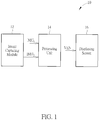
- FIG. 1 is a functional block diagram of a reality presenting device 10 according to an embodiment of the present disclosure.
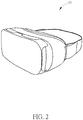
- FIG. 2 is an illustrative appearance diagram of the reality presenting device 10.
- the reality presenting device 10 may be a virtual reality (VR) device, an augmented reality (AR) device, a mixed reality (MR) device, or an extended reality (XR) device.
- VR virtual reality
- AR augmented reality
- MR mixed reality
- XR extended reality
- the reality presenting device 10 is able to compute a virtual position in a virtual environment corresponding to a real location in a real environment, in addition to simply constructing the virtual environment.
- the reality presenting device 10 comprises an image capturing module 12, a processing unit 14 and a displaying screen 16.
- the image capturing module 12 may comprise a lens and a light sensing pixel array and is configured to capture images.
- the images generated by the image capturing module 12 may comprise two dimensional (2D) images, e.g., RGB images, and/or three dimensional (3D) images including depth information, which may be obtained via infrared ray (IR).
- the processing unit 14 may be, for example, an application processor, a micro-controller, or an application-specific integrated circuit (ASIC), and not limited thereto.
- the displaying screen is configured to display a reality environment, a virtual environment or a combination thereof to a user/player.
- FIG. 3 is a schematic diagram of a process 30 according to an embodiment of the present invention.
- the process 30 comprises the following steps:
- Step 302 and Step 304 (which may be in an off-line stage), the image capturing module 12 captures a plurality of first images IMG 1 from a real environment REN, a virtual environment VEN corresponding to the real environment REN is constructed based on the plurality of first images IMG 1 .
- the virtual environment VEN may be constructed by the processing unit 14.
- the real environment REN may be, for example, an office, a living room, a meeting room, and the like, in real life.
- the virtual environment VEN may comprise a plurality of VR images, e.g., VR 360° images, displayed by the reality presenting device 10, such that when the user/player wears the reality presenting device 10 shown in FIG.
- all or a part of the plurality of first images IMG 1 can be collected from another source other than the image capturing module 12, for example, a cloud database or the Internet.
- a user/player may walk around the real environment REN and the image capturing module 12 takes various pictures, i.e., the plurality of first images IMG 1 , such that the processing unit 14 is able to construct the virtual environment VEN corresponding to the real environment REN according to the plurality of first images IMG 1 .
- the user/player may stand at a plurality of predefined location in the real environment REN and the image capturing module 12 may take pictures in different perspectives, such that the plurality of first images IMG 1 are captured.
- the processing unit 14 is able to construct the virtual environment VEN corresponding to the real environment REN according to the plurality of first images IMG 1 . Details of constructing the virtual environment VEN corresponding to the real environment REN, according to the plurality of first images IMG 1 captured from the real environment REN, are known by the art, which is not narrated for brevity.
- Step 306 after the virtual environment VEN is constructed, the image capturing module 12 captures a second image IMG 2 of the real environment REN, which may be in a real-time stage.
- Step 306 may be executed when/before the user/player starts to enter the virtual environment VEN, e.g., at the time when the user/player turns on (powers on) the reality presenting device 10, or when/before a specific software application, e.g., a game involving virtual reality, is initiated.
- Step 308 an initial virtual position VP I in the virtual environment VEN corresponding to the second image IMG 2 is computed, according to the plurality of first images IMG 1 and the second image IMG 2 .
- Step 308 may be executed the processing unit 14.
- Step 308 Details of Step 308 are known by the art. For example, comparing the second image IMG 2 with the plurality of first images IMG 1 may be performed and a plurality of correlation coefficients c of the plurality of first images IMG 1 versus the second image IMG 2 may be obtained.
- the plurality of first images IMG 1 may comprise first images IMG 1,1 ,..., IMG 1,N
- the plurality of correlation coefficients c may comprise correlation coefficients c 1 ,..., c N .
- Each correlation coefficient c n represents a quantified correlation of the first image IMG 1,n and/versus the second image IMG 2 .
- the higher the correlation coefficient c n the more correlation between the first image IMG 1,n and the second image IMG 2 . That is, the higher the correlation coefficient c n indicates that the first image IMG 1,n and the second image IMG 2 are more correlated.
- Feature extraction operation on the plurality of first images IMG 1 and also on the second image IMG 2 may be performed.
- Feature extraction operation known by the art, includes feature identification and appearance number accumulation.
- the specific feature may be identified as being complying with a specific geometric shape. Whether the specific feature appears within the image (i.e., feature identification) may be determined and how many times the specific feature appears within the image (i.e., appearance number accumulation) may be further accumulated.
- the accumulation result is an appearance time or an appearance number of the specific feature.
- determining whether the specific feature appears within the image may be determining whether a part of the image or an image object within the image complies with the specific geometric shape, which may be achieved by using some machine learning or computer vision method. If they do, it is recognized that the specific feature appears once.
- a quantifying vector includes a plurality of appearance numbers corresponding to the plurality of features. For example, after performing feature identification and appearance number accumulation on a first feature, a second feature and a third feature on an image, a quantifying vector corresponding to the image may be obtained.
- the quantifying vector may, for example, be [2, 3, 1]. It means that the first feature appears twice within the image, the second feature appears three times within the image and the first feature appears once within the image.
- the first feature may comply with a circle shape
- the second feature may comply with a triangular shape
- the third feature may comply with a rectangular shape.
- the feature extraction operation may be performed on the plurality of first images IMG 1 to obtain a plurality of first quantifying vector QV 1 , which can be done off-line, and perform the feature extraction operation on the second image IMG 2 to obtain a second quantifying vector QV 2 , which can be done in real-time.
- the plurality of first quantifying vector QV 1 may comprise first quantifying vector QV 1,1 ,..., QV 1,n corresponding to the first images IMG 1,1 ,..., IMG 1,N , and each first quantifying vector QV 1,n comprises a plurality of appearance numbers appn n,1 ,..., appn n,K corresponding to the K features, where an appearance number appn n,k indicates that a feature k appears appn n,k times within the first image IMG 1,n .
- the correlation coefficients c 1 ,..., c N corresponding to the first images IMG 1,1 ,..., IMG 1,N may be computed.
- the larger the correlation coefficient c n the more the first image IMG 1,n and the second image IMG 2 are correlated.
- At least a filtered image(s) IMG k within the first images IMG 1,1 ,..., IMG 1,N are selected.
- the filtered image(s) IMG k is/are selected such that at least a filtered correlation coefficient(s) c k corresponding to the filtered image(s) IMG k is/are greater than a specific threshold TH value (e.g.
- the correlation coefficient c k is greater than 0.8), wherein the filtered image(s) IMG k is/are corresponding to at least a virtual position(s) VP k in the virtual environment VEN, and the virtual position(s) VP k is/are corresponding to at least a real location(s) RL k in the real environment REN at which the reality presenting device 10 captures the filtered image(s) IMG k .
- one specific filtered image IMG k * is selected among the filtered image(s) IMG k , and a specific virtual position VP k * corresponding to the specific filtered image IMG k * is computed.
- the virtual position VP k * is corresponding to a real location RL k * in the real environment REN at which the reality presenting device 10 or the image capturing module 12 captures the first image IMG k * .
- a relative virtual position RVP k * related to the virtual position VP k * (within the virtual position(s) VP *) is computed according to the specific filtered image IMG k * (within the filtered image(s) IMG * ) and the second image IMG 2 .
- the relative virtual position RVP k * corresponding to the specific filtered image IMG k * is computed.
- Selecting the specific filtered image IMG k * from the filtered image(s) IMG k can be achieved by counting and comparing a number of inliers and a number of outliers, and not limited thereto.
- a filtered image IMG n * within the first images IMG 1,1 ,..., IMG 1,N may be obtained, such that a correlation coefficient c n * corresponding to the filtered image IMG n * is a maximum correlation coefficient among the correlation coefficients c 1 ,..., c N .
- the filtered image IMG n * corresponding to the correlation coefficient c n * may be obtained, wherein the filtered image IMG n * is the most correlated first image versus the second image IMG 2 among the first images IMG 1,1 ,..., IMG 1,N .
- a virtual position VP n * in the virtual environment VEN corresponding/according to the first image IMG n * may be obtained.
- the virtual position VP n * is corresponding to a real location RL n * in the real environment REN at which the reality presenting device 10 or the image capturing module 12 captures the first image IMG n * .
- the method of the processing unit 14 obtaining the virtual position VP n * is not limited.
- the user/player may stand at a pre-defined real location RL' and a virtual position VP' corresponding to the real location RL' may be computed. If an first image IMG' captured at the real location RL' is the first image correlated to the second image IMG 2 most, then the virtual position VP n * is obtained as the virtual position VP'.
- An initial virtual position VP I in the virtual environment VEN corresponding to the second image IMG 2 may be computed, according to the first image IMG n * and the second image IMG 2 .
- the method of computing the initial virtual position VP I is not limited.
- a relative virtual position RVP related to the virtual position VP n * may be computed according to the first image IMG n * and the second image IMG 2 , and compute the initial virtual position VP I according to the virtual position VP n * and the relative virtual position RVP.
- the reality presenting device 10 is able to obtain the virtual position in the virtual environment VEN corresponding to the real location in the real environment REN.
- the user/player can power on the reality presenting device 10 at any place in the real environment REN, and the processing unit 14 would compute the initial virtual position VP I corresponding to the real location RL at which the user/player and the reality presenting device 10 locate.
- the reality presenting device 10 may generate VR 360° image(s) according to the initial virtual position VP I , such that the user/player would see the perspective from the initial virtual position VP I in the virtual environment VEN, which is similar to (or the same as) the perspective from the real location RL in the real environment REN.
- the displaying screen 16 displays the virtual environment VEN, at the time the user/player initiated the specific software application, in a perspective from the initial virtual position VP I .
- the specific software application may be a game involving virtual reality.
- the displaying screen 16 may display the plurality of VR images corresponding to the virtual environment VEN which is in the perspective of the initial virtual position VP I .
- the initial virtual position VP I is corresponding to a real location RL I in the real environment REN at which the reality presenting device 10 or the image capturing module 12 captures the second image IMG 2 .
- the user/player would perceive the plurality of VR images of the virtual environment VEN, the user/player is immersed in the virtual environment VEN, and experience the virtual environment VEN just like he/she is at the real location RL I in the real environment REN.
- the process 30 may be simply executed by the reality presenting device 10. That is, Step 304 and Step 308 may be executed by the processing unit 14 of the reality presenting device 10, which is not limited therein.
- the process 30 may be executed by a system.
- FIG. 4 is a schematic diagram of a system 41 according to an embodiment of the present disclosure.
- the system 41 comprises a reality presenting device 40 and a remote computing device 43.
- the reality presenting device 40 and the remote computing device 43 may be connected through a wireless connection or a wireless interface.
- the reality presenting device 40 comprises an image capturing module 42 and a displaying screen 46.
- the remote computing device 43 may be a cloud computing device, an edge computing device, or a combination of the cloud computing device and the edge computing device, wherein the cloud computing device and the edge computing device may be a computer cluster or a server.
- the process 30 may be executed by the system 41, where Step 302 and Step 306 may be executed by the image capturing module 42, Step 304 and Step 308 may be executed by the remote computing device 43, and Step 310 may be executed by displaying screen 46, which is also within the scope of the present disclosure.
- the present disclosure is able to compute the initial virtual position corresponding to the real location at which the user/player and the reality presenting device locate.
- the user/player may initiate the game involving the virtual environment at any real location in the real environment. No significant difference between the virtual environment VEN and the real environment REN experienced by the user/player. Hence, the sense of immersion experienced by user/player is further enhanced.
Landscapes
- Engineering & Computer Science (AREA)
- Physics & Mathematics (AREA)
- Theoretical Computer Science (AREA)
- Computer Graphics (AREA)
- General Physics & Mathematics (AREA)
- Geometry (AREA)
- Software Systems (AREA)
- Computing Systems (AREA)
- Computer Hardware Design (AREA)
- General Engineering & Computer Science (AREA)
- Processing Or Creating Images (AREA)
- User Interface Of Digital Computer (AREA)
Priority Applications (1)
| Application Number | Priority Date | Filing Date | Title |
|---|---|---|---|
| EP18215038.3A EP3671658A1 (de) | 2018-12-21 | 2018-12-21 | Positionierungsverfahren und realitätsdarstellungsvorrichtung |
Applications Claiming Priority (1)
| Application Number | Priority Date | Filing Date | Title |
|---|---|---|---|
| EP18215038.3A EP3671658A1 (de) | 2018-12-21 | 2018-12-21 | Positionierungsverfahren und realitätsdarstellungsvorrichtung |
Publications (1)
| Publication Number | Publication Date |
|---|---|
| EP3671658A1 true EP3671658A1 (de) | 2020-06-24 |
Family
ID=65013472
Family Applications (1)
| Application Number | Title | Priority Date | Filing Date |
|---|---|---|---|
| EP18215038.3A Withdrawn EP3671658A1 (de) | 2018-12-21 | 2018-12-21 | Positionierungsverfahren und realitätsdarstellungsvorrichtung |
Country Status (1)
| Country | Link |
|---|---|
| EP (1) | EP3671658A1 (de) |
Citations (2)
| Publication number | Priority date | Publication date | Assignee | Title |
|---|---|---|---|---|
| GB2411532A (en) * | 2004-02-11 | 2005-08-31 | British Broadcasting Corp | Camera position determination |
| US20130187905A1 (en) * | 2011-12-01 | 2013-07-25 | Qualcomm Incorporated | Methods and systems for capturing and moving 3d models and true-scale metadata of real world objects |
-
2018
- 2018-12-21 EP EP18215038.3A patent/EP3671658A1/de not_active Withdrawn
Patent Citations (2)
| Publication number | Priority date | Publication date | Assignee | Title |
|---|---|---|---|---|
| GB2411532A (en) * | 2004-02-11 | 2005-08-31 | British Broadcasting Corp | Camera position determination |
| US20130187905A1 (en) * | 2011-12-01 | 2013-07-25 | Qualcomm Incorporated | Methods and systems for capturing and moving 3d models and true-scale metadata of real world objects |
Non-Patent Citations (2)
| Title |
|---|
| SAAD KHATTAK ET AL: "A real-time reconstructed 3D environment augmented with virtual objects rendered with correct occlusion", 2014 IEEE GAMES MEDIA ENTERTAINMENT, 1 October 2014 (2014-10-01), pages 1 - 8, XP055570292, ISBN: 978-1-4799-7546-4, DOI: 10.1109/GEM.2014.7048102 * |
| WEI WANG ET AL: "Fast object recognition and 6D pose estimation using viewpoint oriented color-shape histogram", 2013 IEEE INTERNATIONAL CONFERENCE ON MULTIMEDIA AND EXPO (ICME), 1 July 2013 (2013-07-01), pages 1 - 6, XP055570274, ISBN: 978-1-4799-0015-2, DOI: 10.1109/ICME.2013.6607542 * |
Similar Documents
| Publication | Publication Date | Title |
|---|---|---|
| JP6644833B2 (ja) | アルベドモデルにより拡張現実コンテンツをレンダリングするシステムおよび方法 | |
| CN104102412B (zh) | 一种基于增强现实技术的手持式阅览设备及其方法 | |
| CN107820593B (zh) | 一种虚拟现实交互方法、装置及系统 | |
| JP5791433B2 (ja) | 情報処理プログラム、情報処理システム、情報処理装置および情報処理方法 | |
| CN110866977B (zh) | 增强现实处理方法及装置、系统、存储介质和电子设备 | |
| CN112148197A (zh) | 增强现实ar交互方法、装置、电子设备及存储介质 | |
| CN110716645A (zh) | 一种增强现实数据呈现方法、装置、电子设备及存储介质 | |
| US20140357369A1 (en) | Group inputs via image sensor system | |
| CN109246463B (zh) | 用于显示弹幕的方法和装置 | |
| US20200097732A1 (en) | Markerless Human Movement Tracking in Virtual Simulation | |
| CN112882576B (zh) | Ar交互方法、装置、电子设备及存储介质 | |
| CN110545442B (zh) | 一种直播互动方法、装置、电子设备及可读存储介质 | |
| CN109840946B (zh) | 虚拟对象显示方法及装置 | |
| JP5791434B2 (ja) | 情報処理プログラム、情報処理システム、情報処理装置および情報処理方法 | |
| CN111679742A (zh) | 基于ar的交互控制方法、装置、电子设备及存储介质 | |
| CN111638797A (zh) | 一种展示控制方法及装置 | |
| US10602117B1 (en) | Tool for onsite augmentation of past events | |
| CN112198959A (zh) | 虚拟现实交互方法、装置及系统 | |
| CN111833457A (zh) | 图像处理方法、设备及存储介质 | |
| CN112950711B (zh) | 一种对象的控制方法、装置、电子设备及存储介质 | |
| CN204028887U (zh) | 一种基于增强现实技术的手持式阅览设备 | |
| CN112905014A (zh) | Ar场景下的交互方法、装置、电子设备及存储介质 | |
| CN111970557A (zh) | 图像显示方法、装置、电子设备及存储介质 | |
| JP2020135290A (ja) | 画像生成装置、画像生成方法、画像生成システム、及びプログラム | |
| CN110737326A (zh) | 虚拟对象的显示方法、装置、终端设备及存储介质 |
Legal Events
| Date | Code | Title | Description |
|---|---|---|---|
| PUAI | Public reference made under article 153(3) epc to a published international application that has entered the european phase |
Free format text: ORIGINAL CODE: 0009012 |
|
| STAA | Information on the status of an ep patent application or granted ep patent |
Free format text: STATUS: REQUEST FOR EXAMINATION WAS MADE |
|
| 17P | Request for examination filed |
Effective date: 20190912 |
|
| AK | Designated contracting states |
Kind code of ref document: A1 Designated state(s): AL AT BE BG CH CY CZ DE DK EE ES FI FR GB GR HR HU IE IS IT LI LT LU LV MC MK MT NL NO PL PT RO RS SE SI SK SM TR |
|
| AX | Request for extension of the european patent |
Extension state: BA ME |
|
| STAA | Information on the status of an ep patent application or granted ep patent |
Free format text: STATUS: THE APPLICATION HAS BEEN WITHDRAWN |
|
| 18W | Application withdrawn |
Effective date: 20210727 |