EP3671704B1 - Dispositif de décoration et procédé de fabrication d'un dispositif de décoration - Google Patents
Dispositif de décoration et procédé de fabrication d'un dispositif de décoration Download PDFInfo
- Publication number
- EP3671704B1 EP3671704B1 EP19216163.6A EP19216163A EP3671704B1 EP 3671704 B1 EP3671704 B1 EP 3671704B1 EP 19216163 A EP19216163 A EP 19216163A EP 3671704 B1 EP3671704 B1 EP 3671704B1
- Authority
- EP
- European Patent Office
- Prior art keywords
- liquid mixture
- decorative
- propanediol
- cavity
- approximately
- Prior art date
- Legal status (The legal status is an assumption and is not a legal conclusion. Google has not performed a legal analysis and makes no representation as to the accuracy of the status listed.)
- Active
Links
Images



Classifications
-
- G—PHYSICS
- G09—EDUCATION; CRYPTOGRAPHY; DISPLAY; ADVERTISING; SEALS
- G09F—DISPLAYING; ADVERTISING; SIGNS; LABELS OR NAME-PLATES; SEALS
- G09F13/00—Illuminated signs; Luminous advertising
- G09F13/24—Illuminated signs; Luminous advertising using tubes or the like filled with liquid, e.g. bubbling liquid
-
- A—HUMAN NECESSITIES
- A44—HABERDASHERY; JEWELLERY
- A44C—PERSONAL ADORNMENTS, e.g. JEWELLERY; COINS
- A44C25/00—Miscellaneous fancy ware for personal wear, e.g. pendants, crosses, crucifixes, charms
- A44C25/001—Pendants
- A44C25/002—Pendants forming a container, e.g. for pictures
-
- A—HUMAN NECESSITIES
- A44—HABERDASHERY; JEWELLERY
- A44C—PERSONAL ADORNMENTS, e.g. JEWELLERY; COINS
- A44C1/00—Brooches or clips in their decorative or ornamental aspect
-
- A—HUMAN NECESSITIES
- A44—HABERDASHERY; JEWELLERY
- A44C—PERSONAL ADORNMENTS, e.g. JEWELLERY; COINS
- A44C5/00—Bracelets; Wrist-watch straps; Fastenings for bracelets or wrist-watch straps
-
- A—HUMAN NECESSITIES
- A44—HABERDASHERY; JEWELLERY
- A44C—PERSONAL ADORNMENTS, e.g. JEWELLERY; COINS
- A44C7/00—Ear-rings; Devices for piercing the ear-lobes
-
- A—HUMAN NECESSITIES
- A44—HABERDASHERY; JEWELLERY
- A44C—PERSONAL ADORNMENTS, e.g. JEWELLERY; COINS
- A44C9/00—Finger-rings
- A44C9/0084—Accessories
-
- A—HUMAN NECESSITIES
- A45—HAND OR TRAVELLING ARTICLES
- A45D—HAIRDRESSING OR SHAVING EQUIPMENT; EQUIPMENT FOR COSMETICS OR COSMETIC TREATMENTS, e.g. FOR MANICURING OR PEDICURING
- A45D8/00—Hair-holding devices; Accessories therefor
-
- A—HUMAN NECESSITIES
- A45—HAND OR TRAVELLING ARTICLES
- A45D—HAIRDRESSING OR SHAVING EQUIPMENT; EQUIPMENT FOR COSMETICS OR COSMETIC TREATMENTS, e.g. FOR MANICURING OR PEDICURING
- A45D8/00—Hair-holding devices; Accessories therefor
- A45D8/002—Accessories therefor
-
- B—PERFORMING OPERATIONS; TRANSPORTING
- B44—DECORATIVE ARTS
- B44C—PRODUCING DECORATIVE EFFECTS; MOSAICS; TARSIA WORK; PAPERHANGING
- B44C5/00—Processes for producing special ornamental bodies
-
- G—PHYSICS
- G09—EDUCATION; CRYPTOGRAPHY; DISPLAY; ADVERTISING; SEALS
- G09F—DISPLAYING; ADVERTISING; SIGNS; LABELS OR NAME-PLATES; SEALS
- G09F19/00—Advertising or display means not otherwise provided for
- G09F19/02—Advertising or display means not otherwise provided for incorporating moving display members
-
- G—PHYSICS
- G09—EDUCATION; CRYPTOGRAPHY; DISPLAY; ADVERTISING; SEALS
- G09F—DISPLAYING; ADVERTISING; SIGNS; LABELS OR NAME-PLATES; SEALS
- G09F13/00—Illuminated signs; Luminous advertising
- G09F13/20—Illuminated signs; Luminous advertising with luminescent surfaces or parts
- G09F13/22—Illuminated signs; Luminous advertising with luminescent surfaces or parts electroluminescent
- G09F2013/222—Illuminated signs; Luminous advertising with luminescent surfaces or parts electroluminescent with LEDs
-
- G—PHYSICS
- G09—EDUCATION; CRYPTOGRAPHY; DISPLAY; ADVERTISING; SEALS
- G09F—DISPLAYING; ADVERTISING; SIGNS; LABELS OR NAME-PLATES; SEALS
- G09F23/00—Advertising on or in specific articles, e.g. ashtrays, letter-boxes
- G09F2023/0025—Advertising on or in specific articles, e.g. ashtrays, letter-boxes on containers
-
- G—PHYSICS
- G09—EDUCATION; CRYPTOGRAPHY; DISPLAY; ADVERTISING; SEALS
- G09F—DISPLAYING; ADVERTISING; SIGNS; LABELS OR NAME-PLATES; SEALS
- G09F21/00—Mobile visual advertising
- G09F21/02—Mobile visual advertising by a carrier person or animal
Definitions
- the invention relates to a decoration device and a method for producing a decoration device.
- the US 2006/105091 A1 , the WO 2009/037506 A1 and the US 1,850,190 A each show decoration devices according to the state of the art.
- the advantage of this process is that the liquids are harmless to health, so that even when the liquid mixture is introduced into the cavity, any health risks are essentially eliminated. Furthermore, the decorative device produced ensures that if the liquid mixture or a portion thereof escapes from the decorative device, any health risks to persons are essentially eliminated, particularly if parts of the vaporized liquid mixture are inhaled or if contact with the liquid mixture occurs. Furthermore, the liquid mixture creates a lens effect, so that the at least one decorative element appears optically enlarged in the liquid mixture of the produced decorative device. Furthermore, the specific density of the two liquids is lower than the specific density of conventional decorative elements or gemstones, ensuring that the decorative elements or gemstones do not float on the liquid mixture, which is undesirable, but sink to the bottom. Furthermore, the process is technically simple and cost-effective to implement. Another advantage is that the liquid mixture does not evaporate, does not form bubbles and does not foam.
- the liquid mixture has such a viscosity and/or such a density that the at least one After a shaking (or rotating) motion, the gemstone and/or precious stone sinks into the cavity due to gravity in the liquid mixture at a predetermined sinking speed.
- the advantage of this is that the effective force acting on the decorative elements in the liquid mixture due to gravity is particularly low.
- the advantage of this is that the decorative elements sink particularly slowly. This creates a snowflake effect.
- the mixing ratio between glycerin and propanediol, in particular 1,2-propanediol is such that the viscosity of the liquid mixture is adapted to the at least one gemstone and/or precious stone. This allows the sinking speed of the at least one decorative element to be adjusted to a desired value in a technically simple manner. This reliably prevents the decorative element from sinking too quickly.
- the weight fraction of glycerin in the liquid mixture is between approximately 25% and approximately 50%.
- the viscosity of the liquid mixture is particularly high.
- decorative elements or gemstones with a particularly high density can be used, yet they still sink slowly in the liquid mixture.
- the weight fraction of glycerin in the liquid mixture is between approximately 10% and approximately 25%.
- the advantage of this is that the viscosity of the liquid mixture is particularly low.
- decorative elements or gemstones with a particularly low density can be used, yet still sink within a reasonable period of time (e.g., within approximately 10 seconds or approximately 20 seconds).
- the weight proportion of glycerin in the liquid mixture is between about 10% and about 12% and the weight proportion
- the propanediol content, particularly 1,2-propanediol, in the liquid mixture is between approximately 85% and approximately 90%, particularly between approximately 88% and approximately 90%.
- a closable opening for introducing the liquid mixture into the cavity is formed in a base and/or roof of the decoration device. This allows for technically simple introduction of the liquid mixture into the cavity. Furthermore, the opening is not located in the field of view through the viewing element.
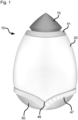
- Fig. 1 shows a front view of an embodiment of the decoration device 10 according to the invention.
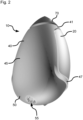
- Fig. 2 shows a perspective rear view of the decoration device 10 from Fig. 1 .
- Fig. 3 shows a side view of the decoration device 10 from Fig. 1 .
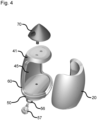
- Fig. 4 shows an exploded view of the decoration device 10 from Fig. 1 .
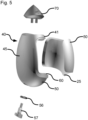
- Fig. 5 shows a further exploded view of the decoration device 10 from Fig. 1 .
- Fig. 6 shows a further exploded view of the decoration device 10 from Fig. 1 .
- Fig. 7 shows an exploded view of the main component 40 of the decoration device 10 from Fig. 1 .
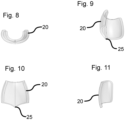
- Fig. 8-11 show views of the visible element 20 of the decoration device 10 from Fig. 1 .
- the decoration device 10 is in Fig. 1 or Fig. 2 designed as a pendant.
- the decorative device 10 has a fastening recess 80 near its upper tip or in the end element 70 or the decorative element.
- a chain or the like can be pulled through the fastening recess 80. Using the chain, the decorative device 10 can be worn around the neck, for example.
- the decorative device 10 can alternatively be, for example, a (finger) ring, a necklace such as a pendant, a necklace, or a jewelry clasp. It is also possible for the decorative device 10 to be an earring such as an earring, a hoop earring, an ear stud, or a hoop earring pendant. Furthermore, it is conceivable for the decorative device 10 to be an arm jewelry such as a bracelet, a flexible bracelet, a bangle, or an anklet. Further possibilities are for the decorative device 10 to be a cufflink, a brooch, a hair accessory, a key chain, a belt buckle, a bag charm, a lamp, a perfume bottle, or a container for cosmetics.
- the decorative device 10 comprises a main component 40 and a viewing element 20.
- the viewing element 20 is transparent. In the drawings, the viewing element is not shown transparent for illustrative purposes.
- the main component 40 is designed to be connected to the viewing element 20.
- a central part of the main component 40 forms a rear wall 45 of the decorative device 10, which is visible from the outside through the viewing element 20.
- the upper part of the main component 40 projects forward and forms a type of roof 41.
- the lower part of the main component 40 also projects forward and forms a type of floor 50.
- the rear wall 45 is not flat, but has a curved shape. Both the outer surface (surface facing away from the cavity) of the rear wall 45 and the inner surface (surface facing the cavity) of the rear wall 45 are curved. From left to right in Fig. 1 The rear wall 45 has a curved shape. The curve points away from the visible element 20, i.e., the turning point of the curved rear wall 45 is farther away from the visible element 20 than the other areas of the rear wall 45. The thickness of the rear wall 45 varies at different points or locations.
- the material of the viewing element 20 can comprise or consist of plastic, acrylic glass, genuine glass such as borosilicate glass, sapphire glass, crystal glass, silicon glass, or glass with a special vapor coating. It is also possible for the material of the viewing element 20 to comprise or consist of soft and/or elastic materials such as silicone.
- a liquid mixture is arranged in the cavity 30.
- the cavity 30 is completely filled with the liquid mixture.
- Completely filled means that essentially no air bubbles are present in the cavity 30.
- a small air bubble is present, e.g., less than 1% of the volume of the cavity 30 is not filled with the liquid mixture.
- the liquid mixture contains no other components besides glycerin and propanediol, in particular 1,2-propanediol. However, it is also conceivable that the liquid mixture contains other components besides glycerin and propanediol or 1,2-propanediol.
- the liquid mixture may contain precious metal powder, colloidal precious metal, fluorescent particles or other nanoparticles.
- color pigments other colored liquids or solids or similar are added to the liquid mixture so that the decorative elements and/or the decorative figure are not seen in their original color, but in a different color or shade.
- the liquid mixture contains thermochromic dyes (where the color depends on the temperature), photochromic dyes (where the color changes due to light or UV light), phosphorescent dyes (afterglow dyes), reflective dyes (e.g. with embedded metallic flakes), magnetic dyes (e.g. dyes with embedded magnetic particles that contain computer-readable information) and/or electrical dyes (where the color is changed by an electric field or an electric current) in addition to the glycerin and propanediol.
- thermochromic dyes where the color depends on the temperature
- photochromic dyes where the color changes due to light or UV light
- phosphorescent dyes afterglow dyes
- reflective dyes e.g. with embedded metallic flakes
- magnetic dyes e.g. dyes with embedded magnetic particles that contain computer-readable information
- electrical dyes where the color is changed by an electric field or an electric current
- the two liquids have different viscosities.
- the viscosity of the liquid mixture can be adjusted to different values depending on the proportion of glycerol and 1,2-propanediol in the liquid mixture.
- Glycerin has a higher viscosity than 1,2-propanediol.
- the viscosity of the liquid mixture can be reduced by increasing the proportion of 1,2-propanediol in the liquid mixture.
- the viscosity of the liquid mixture can be increased by decreasing the proportion of 1,2-propanediol.
- Glycerin and 1,2-propanediol have different densities, so the density of the liquid mixture can be adjusted to the density of the decorative elements by appropriately changing the weight proportions of glycerin and 1,2-propanediol.
- the density of the decorative elements can be adjusted to be only slightly (e.g., approximately 1% or approximately 2%) higher than the density of the liquid mixture, so that the decorative elements sink slowly in the liquid mixture.
- the density of the liquid mixture can be adjusted to the density of diamonds used as decorative elements by adding appropriate amounts of glycerin and propanediol, particularly 1,2-propanediol, such that the density of the liquid mixture is less than approximately 5% below the density of the diamonds. This causes the diamonds to sink slowly or at a low rate in the liquid mixture.
- the viscosity of the liquid mixture can also be adjusted depending on the size and/or shape of the decorative elements. For larger objects, the liquid mixture may have a higher viscosity.
- Decorative elements are arranged in the cavity 30.
- the decorative elements are movably arranged in the cavity 30 or the liquid.
- the decorative elements can be gemstones.
- the decorative elements can comprise cut or uncut gemstones, such as rubies, diamonds, or emeralds.
- the decorative elements can contain fluorescent elements.
- the decorative elements can comprise one, two, three, four, or more than four decorative elements.
- the decorative elements are arranged movably in the cavity 30. This means that the decorative elements can basically move freely within the cavity 30.
- the decorative elements have a higher density than the liquid mixture, so that they sink downwards due to gravity, for example towards the bottom 50 when the bottom 50 of the decorative device 10 is at the bottom.
- the decorative elements are distributed within the cavity 30. This can be achieved, for example, by shaking or rotating, or by carrying the decorative device 10.
- the density of the decorative elements is typically only slightly (e.g., approximately 2%, approximately 5%, or approximately 10%) higher than the density of the liquid mixture, so that the decorative elements sink at a low speed in the direction of gravity.
- the decorative elements essentially float in the liquid mixture for a short time.
- the base 50 has a closable opening 55.
- the opening 55 extends from the outside or the outer surface of the decoration device 10 through the main component 40 into the cavity 30 of the decoration device 10.
- the opening 55 serves to introduce or fill the liquid mixture into the cavity 30 of the decoration device 10.
- the two liquids can be introduced individually one after the other into the cavity 30 and mixed therein. It is also possible for the two liquids to be introduced into the cavity 30 already mixed as a liquid mixture.
- the opening 55 can be closed in a liquid-tight, in particular airtight, manner by means of a pin or screw 57, which is adapted to the opening 55, and by means of a sealing ring 56, which is arranged around the pin or screw 57.
- the upper part of the base 50 which is in direct contact with the liquid mixture or which delimits the cavity 30, can be an independent or initially separate element of the decoration device 10.
- the base 50 can be hollow.
- a chip, an electronic component, an RFID and/or EMV chip, or the like can be present or inserted in the cavity.
- the chip or electronic component can wirelessly transmit information stored in the chip or component.
- the information can include a serial number of the decoration device 10 or measures to prevent counterfeiting of the decoration device 10.
- the weight fraction of glycerin in the liquid mixture can be between approximately 25% and approximately 50%.
- the weight fraction of glycerin in the liquid mixture can be approximately 30% or approximately 40%.
- the weight fraction of glycerin in the liquid mixture is approximately 10% to approximately 25%, for example approximately 15% or approximately 20%.
- the weight fraction of glycerin is also possible for the weight fraction of glycerin to be between approximately 1% and approximately 10%, for example approximately 5% or approximately 8%.
- the liquid mixture to contain or consist of 8 parts by weight of propanediol, in particular 1,2-propanediol, and 1 part by weight of glycerin.
- the missing weight fraction of the liquid mixture to 100% can be completely made up by 1,2-propanediol. This means that, for example, with a weight fraction of glycerol of approximately 15%, the weight fraction of 1,2-propanediol is approximately 85%.
- 1,2-propanediol only almost makes up the missing weight fraction to 100%.
- the liquid mixture contains a small amount of another liquid.
- the weight fraction of 1,2-propanediol can be approximately 14%, i.e., approximately 1% of the weight fraction of the liquid mixture is made up of one or more other liquids.
- One or more decorative figures, abstract or concrete objects, representations, motifs, paintings, engravings in various materials such as precious metals, gemstones, diamonds, enamels, etc. can be arranged in the liquid mixture.
- the decorative figure or objects in the liquid mixture are arranged such that the decorative figure or objects can be seen at least partially, in particular completely, from the outside through the viewing element.
- the decorative figure is usually attached directly or indirectly to the main component 40.
- the decorative figure can be attached to the base 50 of the decorative device 10.
- the decorative figure can be completely surrounded by the liquid mixture. This protects the decorative figure, in particular from air or oxygen.
- the decorative device 10 can have self-luminous elements, e.g., LED elements.
- the LED elements can, for example, illuminate the cavity 30.
- the LED elements can be part of the decorative elements, i.e., for the LED elements to be movably arranged in the liquid mixture.
- a closing element 70 or decorative element is arranged on the roof 41 of the decorative device 10.
- the closing element 70 has two pins.
- the closing element 70 has the shape of a tapered cone with an elliptical base.
- the two pins are inserted into two recesses in the main component 40 or the roof 41 of the main component 40 in order to connect the closing element 70 to the main component 40 or to fasten it thereto.
- the recesses run in Fig. 1 into the cavity 30. However, they can also be designed as blind holes.
- the decoration device 10 is manufactured as follows: First, the main component 40 is manufactured or prepared. Subsequently, the visible element 20 is connected to the main component 40 by means of adhesive or the like. A seal can be arranged between the visible element 20 and the main component 40. The liquid mixture is then introduced into the cavity 30 through the opening 55.
- the weight proportions of the glycerin and the 1,2-propanediol are or will be adapted to the decorative elements in such a way that the decorative elements move downwards (i.e., in the direction of gravity) in the liquid mixture at a low speed (e.g., approximately 5 seconds for a distance of approximately 10 cm) due to gravity.
- the decorative device 10 also has a decorative strip 47 on the bottom 50 on both sides of the recess 49, on which further decorative elements, e.g. gemstones, can be arranged.
- the decoration device 10 is designed to decorate a person, an object or a room.
Landscapes
- Physics & Mathematics (AREA)
- General Physics & Mathematics (AREA)
- Engineering & Computer Science (AREA)
- Theoretical Computer Science (AREA)
- Business, Economics & Management (AREA)
- Accounting & Taxation (AREA)
- Marketing (AREA)
- Adornments (AREA)
- Pinball Game Machines (AREA)
Claims (15)
- Dispositif de décoration (10) comprenantune cavité (30) pour recevoir des pierres précieuses et/ou des pierres fines,la cavité (30) étant au moins partiellement remplie d'un mélange de liquides,un élément de visualisation transparent (20) à travers lequel la cavité (30) est au moins partiellement visible,au moins une pierre précieuse et/ou une pierre fine, ladite au moins pierre précieuse et/ou pierre fine étant disposée de manière mobile dans le mélange liquide par un mouvement d'agitation,caractérisé en ce quele mélange liquide comprend du glycérol et du propanediol.
- Dispositif de décoration (10) selon la revendication 1, dans lequel
le mélange de liquides présente une viscosité et/ou une densité telle que la au moins une pierre précieuse et/ou pierre fine descend dans la cavité (30) après un mouvement d'agitation par la gravitation dans le mélange de liquides à une vitesse de descente prédéterminée. - Dispositif de décoration (10) selon la revendication 1 ou 2, dans lequel
le rapport de mélange entre le glycérol et le propanediol, en particulier le 1,2-propanediol, est tel que la viscosité du mélange liquide est adaptée à la au moins une pierre précieuse et/ou pierre fine. - Dispositif de décoration (10) selon l'une quelconque des revendications précédentes, dans lequel
la proportion en poids de glycérol dans le mélange liquide est comprise entre environ 25% et environ 50%. - Dispositif de décoration (10) selon l'une quelconque des revendications 1 à 3, dans lequel la proportion en poids de glycérol dans le mélange liquide est comprise entre environ 10% et environ 25%.
- Dispositif de décoration (10) selon l'une quelconque des revendications 1 à 3, dans lequel la proportion en poids de glycérol dans le mélange liquide est comprise entre environ 1% et environ 10%.
- Dispositif de décoration (10) selon l'une quelconque des revendications 1 à 3, dans lequel la proportion en poids de glycérol dans le mélange liquide est comprise entre environ 10% et environ 12% et la proportion en poids de propanediol, en particulier de 1,2-propanediol, dans le mélange liquide est comprise entre environ 85% et environ 90%, en particulier entre environ 88% et environ 90%.
- Dispositif de décoration (10) selon l'une quelconque des revendications précédentes, dans lequel
le mélange de liquides est constitué exclusivement de glycérol et de propanediol, en particulier de glycérol et de 1,2-propanediol. - Dispositif de décoration (10) selon l'une quelconque des revendications précédentes, dans lequel
l'élément de visualisation (20) est relié à plat à un retrait (60, 62) d'une paroi arrière (45) du dispositif de décoration (10). - Dispositif de décoration (10) selon l'une quelconque des revendications précédentes, dans lequel
une ouverture (55) pouvant être fermée est formée dans un fond (50) et/ou un toit (41) du dispositif de décoration (10) pour introduire le mélange de liquides dans la cavité (30). - Dispositif de décoration (10) selon l'une quelconque des revendications précédentes, dans lequel
une paroi arrière (45) du dispositif de décoration (10) présente une forme incurvée. - Dispositif de décoration (10) selon l'une quelconque des revendications précédentes, dans lequel
une ou plusieurs figurines de bijoux sont disposées dans la cavité (30). - Procédé de fabrication d'un dispositif de décoration (10) avec un mélange de liquides dans une cavité (30) du dispositif de décoration (10),
le procédé comprenant les étapes suivantes :fournir le dispositif de décoration (10), dans lequel le dispositif de décoration (10) comprend une cavité (30) pour recevoir des pierres précieuses et/ou des pierres fines, dans lequel la cavité (30) est au moins partiellement remplie d'un mélange liquide,un élément visible transparent (20), à travers lequel la cavité (30) est au moins partiellement visible, et présente au moins une pierre précieuse et/ou une pierre fine, la au moins pierre précieuse et/ou pierre fine étant disposée de manière mobile dans le mélange liquide par un mouvement d'agitation du dispositif de décoration (10); etintroduire du mélange de liquides dans la cavité (30) du dispositif de décoration (10), dans lequel le mélange de liquides comprend du glycérol et du propanediol. - Procédé selon la revendication 13, dans lequel
une viscosité et/ou une densité du mélange de liquides est adaptée au moyen de la pondération des parts en poids de la glycérol et du propanediol, en particulier du 1,2-propanediol, au mélange de liquides de telle sorte que la au moins une pierre précieuse et/ou pierre fine descend dans la cavité (30) après un mouvement d'agitation par la gravitation dans le mélange de liquides avec une vitesse de descente prédéterminée. - Procédé selon la revendication 13 ou 14, dans lequel
le mélange de liquides est constitué exclusivement de glycérol et de propanediol, en particulier de glycérol et de 1,2-propanediol.
Applications Claiming Priority (1)
| Application Number | Priority Date | Filing Date | Title |
|---|---|---|---|
| DE102018133485.0A DE102018133485B3 (de) | 2018-12-21 | 2018-12-21 | Dekorationsvorrichtung und Verfahren zum Herstellen einer Dekorationsvorrichtung |
Publications (3)
| Publication Number | Publication Date |
|---|---|
| EP3671704A1 EP3671704A1 (fr) | 2020-06-24 |
| EP3671704C0 EP3671704C0 (fr) | 2025-07-02 |
| EP3671704B1 true EP3671704B1 (fr) | 2025-07-02 |
Family
ID=68499648
Family Applications (1)
| Application Number | Title | Priority Date | Filing Date |
|---|---|---|---|
| EP19216163.6A Active EP3671704B1 (fr) | 2018-12-21 | 2019-12-13 | Dispositif de décoration et procédé de fabrication d'un dispositif de décoration |
Country Status (3)
| Country | Link |
|---|---|
| EP (1) | EP3671704B1 (fr) |
| CN (1) | CN111345549A (fr) |
| DE (1) | DE102018133485B3 (fr) |
Families Citing this family (2)
| Publication number | Priority date | Publication date | Assignee | Title |
|---|---|---|---|---|
| CH717628B1 (fr) | 2020-07-14 | 2024-05-31 | Chopard Tech Sa | Article de joaillerie. |
| CN113747716B (zh) * | 2021-09-06 | 2023-07-04 | Oppo广东移动通信有限公司 | 装饰件、壳体组件及其制备方法及电子设备 |
Citations (1)
| Publication number | Priority date | Publication date | Assignee | Title |
|---|---|---|---|---|
| US1850190A (en) * | 1924-08-22 | 1932-03-22 | Horace H Welch | Composite gem and jewel |
Family Cites Families (15)
| Publication number | Priority date | Publication date | Assignee | Title |
|---|---|---|---|---|
| GB1186769A (en) * | 1967-11-14 | 1970-04-02 | Crestworth Ltd | Display Device |
| US4142383A (en) * | 1977-08-17 | 1979-03-06 | Eberhart Glass Blowing Ltd. | Liquid filled sealed glass ornament and method |
| US4551363A (en) | 1984-05-02 | 1985-11-05 | Brian Fenech | Electro luminescence visual device |
| US5305292A (en) | 1992-12-18 | 1994-04-19 | Daniel Reynoso | Fluid filled watch apparatus |
| US20060105091A1 (en) * | 2004-11-12 | 2006-05-18 | Sanford L.P. | Non-toxic lava fluids for use in children's products |
| EP1862873A1 (fr) | 2006-06-02 | 2007-12-05 | Montres Rado S.A. | Dispositif d'affichage pour un instrument portable, tel qu'une montre |
| JP2008023297A (ja) * | 2006-07-22 | 2008-02-07 | Sakamoto Co Ltd | 微細発泡ビーズの動きを利用した装飾性立体部材 |
| GB0718283D0 (en) * | 2007-09-19 | 2007-10-31 | Univ Belfast | Ionic liquid display devices |
| CH701885B1 (fr) | 2009-09-18 | 2016-03-15 | Preciflex Sa | Montre-bracelet. |
| DE202013101178U1 (de) * | 2013-03-20 | 2013-03-27 | Chin-Sheng Yang | Schüttelkugel-Konstruktion |
| WO2015138951A1 (fr) | 2014-03-14 | 2015-09-17 | Chamber Works, Llc | Articles de bijouterie contenant un additif de personnalisation tel qu'un fragment d'adn, et leurs procédés de fabrication |
| JP2016007307A (ja) * | 2014-06-24 | 2016-01-18 | ピースサンプラス株式会社 | 装飾品 |
| CH712113B1 (fr) | 2016-02-12 | 2019-10-31 | Cartier Int Ag | Objet décoratif, en particulier glace de montre, à effet optique. |
| CH712182B1 (fr) * | 2016-02-17 | 2019-11-15 | Cartier Int Ag | Objet décoratif, en particulier glace de montre, à effet optique. |
| EP3515230A1 (fr) | 2016-09-20 | 2019-07-31 | Preciflex SA | Bijou liquide dynamique |
-
2018
- 2018-12-21 DE DE102018133485.0A patent/DE102018133485B3/de active Active
-
2019
- 2019-12-12 CN CN201911276383.4A patent/CN111345549A/zh active Pending
- 2019-12-13 EP EP19216163.6A patent/EP3671704B1/fr active Active
Patent Citations (1)
| Publication number | Priority date | Publication date | Assignee | Title |
|---|---|---|---|---|
| US1850190A (en) * | 1924-08-22 | 1932-03-22 | Horace H Welch | Composite gem and jewel |
Also Published As
| Publication number | Publication date |
|---|---|
| EP3671704A1 (fr) | 2020-06-24 |
| CN111345549A (zh) | 2020-06-30 |
| EP3671704C0 (fr) | 2025-07-02 |
| DE102018133485B3 (de) | 2019-11-28 |
Similar Documents
| Publication | Publication Date | Title |
|---|---|---|
| Clark | Symbols of excellence: precious materials as expressions of status | |
| EP3671704B1 (fr) | Dispositif de décoration et procédé de fabrication d'un dispositif de décoration | |
| CN116941868A (zh) | 动态流体首饰 | |
| DE60312888T2 (de) | Behälter aus lichtdurchlässigem werkstoff mit einem einsatz in einer seitenwand | |
| WO2019223907A1 (fr) | Ensemble de pierres précieuses et procédé de fabrication d'un ensemble de pierres précieuses | |
| CH714059B1 (de) | Plattenförmiges Bauteil und Armbanduhr, Schmuckgegenstand, Etikette und Reissverschluss mit dem plattenförmigen Bauteil, sowie Zierring | |
| DE19621479C2 (de) | Schmuckstück | |
| DE102020112523B3 (de) | Uhrglas mit einem dekorativen Element | |
| Hendley | INDIAN JEWELLERY. | |
| HK40032768A (en) | Decoration device and method for producing same | |
| KR102291831B1 (ko) | 온도에 따라 색이 변하는 펜던트 및 이를 포함한 목걸이 | |
| AT556U1 (de) | Schmuckgegenstand | |
| DE29718372U1 (de) | Schmuck | |
| CH714961B1 (de) | Bauteil zum Schutz vor Produktfälschungen und Armbanduhr, Tasche, Schmuckgegenstand, Schild oder Verschluss mit dem Bauteil. | |
| EP3090644B1 (fr) | Élément de joaillerie | |
| DE2922104A1 (de) | Schmuckstueck, vorzugsweise fingerring | |
| CN210747640U (zh) | 一种钟表多运用钻石不出轨道首饰 | |
| DE351414C (de) | Schmuckstueck mit bewegbaren Ziersteinen o. dgl. | |
| Mastin | The Chemistry, Properties and Tests of Precious Stones: Unlocking the Science Behind Gemstone Beauty | |
| Mousavipak et al. | Gemstones in Achaemenid Culture: A brief Exploration through the Oxus Treasure | |
| Kanda | Notes on ancient stone implements, &c., of Japan | |
| JP6539806B2 (ja) | ハイブリット型蒸散装置の宝石輝盛方法 | |
| DE884560C (de) | Christbaumschmuck | |
| DE20320962U1 (de) | Schmuckstück | |
| DE10328550A1 (de) | Schmuckstück |
Legal Events
| Date | Code | Title | Description |
|---|---|---|---|
| PUAI | Public reference made under article 153(3) epc to a published international application that has entered the european phase |
Free format text: ORIGINAL CODE: 0009012 |
|
| STAA | Information on the status of an ep patent application or granted ep patent |
Free format text: STATUS: THE APPLICATION HAS BEEN PUBLISHED |
|
| AK | Designated contracting states |
Kind code of ref document: A1 Designated state(s): AL AT BE BG CH CY CZ DE DK EE ES FI FR GB GR HR HU IE IS IT LI LT LU LV MC MK MT NL NO PL PT RO RS SE SI SK SM TR |
|
| AX | Request for extension of the european patent |
Extension state: BA ME |
|
| STAA | Information on the status of an ep patent application or granted ep patent |
Free format text: STATUS: REQUEST FOR EXAMINATION WAS MADE |
|
| 17P | Request for examination filed |
Effective date: 20201218 |
|
| RBV | Designated contracting states (corrected) |
Designated state(s): AL AT BE BG CH CY CZ DE DK EE ES FI FR GB GR HR HU IE IS IT LI LT LU LV MC MK MT NL NO PL PT RO RS SE SI SK SM TR |
|
| REG | Reference to a national code |
Ref country code: HK Ref legal event code: DE Ref document number: 40032768 Country of ref document: HK |
|
| TPAC | Observations filed by third parties |
Free format text: ORIGINAL CODE: EPIDOSNTIPA |
|
| STAA | Information on the status of an ep patent application or granted ep patent |
Free format text: STATUS: EXAMINATION IS IN PROGRESS |
|
| 17Q | First examination report despatched |
Effective date: 20211223 |
|
| TPAC | Observations filed by third parties |
Free format text: ORIGINAL CODE: EPIDOSNTIPA |
|
| GRAP | Despatch of communication of intention to grant a patent |
Free format text: ORIGINAL CODE: EPIDOSNIGR1 |
|
| STAA | Information on the status of an ep patent application or granted ep patent |
Free format text: STATUS: GRANT OF PATENT IS INTENDED |
|
| INTG | Intention to grant announced |
Effective date: 20250219 |
|
| GRAS | Grant fee paid |
Free format text: ORIGINAL CODE: EPIDOSNIGR3 |
|
| GRAA | (expected) grant |
Free format text: ORIGINAL CODE: 0009210 |
|
| STAA | Information on the status of an ep patent application or granted ep patent |
Free format text: STATUS: THE PATENT HAS BEEN GRANTED |
|
| AK | Designated contracting states |
Kind code of ref document: B1 Designated state(s): AL AT BE BG CH CY CZ DE DK EE ES FI FR GB GR HR HU IE IS IT LI LT LU LV MC MK MT NL NO PL PT RO RS SE SI SK SM TR |
|
| REG | Reference to a national code |
Ref country code: GB Ref legal event code: FG4D Free format text: NOT ENGLISH |
|
| REG | Reference to a national code |
Ref country code: CH Ref legal event code: EP |
|
| REG | Reference to a national code |
Ref country code: DE Ref legal event code: R096 Ref document number: 502019013545 Country of ref document: DE |
|
| REG | Reference to a national code |
Ref country code: IE Ref legal event code: FG4D Free format text: LANGUAGE OF EP DOCUMENT: GERMAN |
|
| U01 | Request for unitary effect filed |
Effective date: 20250731 |
|
| U07 | Unitary effect registered |
Designated state(s): AT BE BG DE DK EE FI FR IT LT LU LV MT NL PT RO SE SI Effective date: 20250811 |
|
| U20 | Renewal fee for the european patent with unitary effect paid |
Year of fee payment: 7 Effective date: 20251106 |
|
| REG | Reference to a national code |
Ref country code: CH Ref legal event code: U11 Free format text: ST27 STATUS EVENT CODE: U-0-0-U10-U11 (AS PROVIDED BY THE NATIONAL OFFICE) Effective date: 20260101 |
|
| PG25 | Lapsed in a contracting state [announced via postgrant information from national office to epo] |
Ref country code: IS Free format text: LAPSE BECAUSE OF FAILURE TO SUBMIT A TRANSLATION OF THE DESCRIPTION OR TO PAY THE FEE WITHIN THE PRESCRIBED TIME-LIMIT Effective date: 20251102 |
|
| PG25 | Lapsed in a contracting state [announced via postgrant information from national office to epo] |
Ref country code: NO Free format text: LAPSE BECAUSE OF FAILURE TO SUBMIT A TRANSLATION OF THE DESCRIPTION OR TO PAY THE FEE WITHIN THE PRESCRIBED TIME-LIMIT Effective date: 20251002 |
|
| PG25 | Lapsed in a contracting state [announced via postgrant information from national office to epo] |
Ref country code: HR Free format text: LAPSE BECAUSE OF FAILURE TO SUBMIT A TRANSLATION OF THE DESCRIPTION OR TO PAY THE FEE WITHIN THE PRESCRIBED TIME-LIMIT Effective date: 20250702 |
|
| PG25 | Lapsed in a contracting state [announced via postgrant information from national office to epo] |
Ref country code: GR Free format text: LAPSE BECAUSE OF FAILURE TO SUBMIT A TRANSLATION OF THE DESCRIPTION OR TO PAY THE FEE WITHIN THE PRESCRIBED TIME-LIMIT Effective date: 20251003 |
|
| PGFP | Annual fee paid to national office [announced via postgrant information from national office to epo] |
Ref country code: TR Payment date: 20251208 Year of fee payment: 7 |
|
| PG25 | Lapsed in a contracting state [announced via postgrant information from national office to epo] |
Ref country code: CZ Free format text: LAPSE BECAUSE OF FAILURE TO SUBMIT A TRANSLATION OF THE DESCRIPTION OR TO PAY THE FEE WITHIN THE PRESCRIBED TIME-LIMIT Effective date: 20250702 |
|
| PG25 | Lapsed in a contracting state [announced via postgrant information from national office to epo] |
Ref country code: PL Free format text: LAPSE BECAUSE OF FAILURE TO SUBMIT A TRANSLATION OF THE DESCRIPTION OR TO PAY THE FEE WITHIN THE PRESCRIBED TIME-LIMIT Effective date: 20250702 |
|
| PG25 | Lapsed in a contracting state [announced via postgrant information from national office to epo] |
Ref country code: RS Free format text: LAPSE BECAUSE OF FAILURE TO SUBMIT A TRANSLATION OF THE DESCRIPTION OR TO PAY THE FEE WITHIN THE PRESCRIBED TIME-LIMIT Effective date: 20251002 |
|
| PG25 | Lapsed in a contracting state [announced via postgrant information from national office to epo] |
Ref country code: ES Free format text: LAPSE BECAUSE OF FAILURE TO SUBMIT A TRANSLATION OF THE DESCRIPTION OR TO PAY THE FEE WITHIN THE PRESCRIBED TIME-LIMIT Effective date: 20250702 |
|
| PG25 | Lapsed in a contracting state [announced via postgrant information from national office to epo] |
Ref country code: SM Free format text: LAPSE BECAUSE OF FAILURE TO SUBMIT A TRANSLATION OF THE DESCRIPTION OR TO PAY THE FEE WITHIN THE PRESCRIBED TIME-LIMIT Effective date: 20250702 |
|
| PGFP | Annual fee paid to national office [announced via postgrant information from national office to epo] |
Ref country code: GB Payment date: 20260129 Year of fee payment: 7 |
|
| PGFP | Annual fee paid to national office [announced via postgrant information from national office to epo] |
Ref country code: CH Payment date: 20260101 Year of fee payment: 7 |
|
| PG25 | Lapsed in a contracting state [announced via postgrant information from national office to epo] |
Ref country code: SK Free format text: LAPSE BECAUSE OF FAILURE TO SUBMIT A TRANSLATION OF THE DESCRIPTION OR TO PAY THE FEE WITHIN THE PRESCRIBED TIME-LIMIT Effective date: 20250702 |