EP3671876A1 - Verfahren und induktive vorrichtung - Google Patents
Verfahren und induktive vorrichtung Download PDFInfo
- Publication number
- EP3671876A1 EP3671876A1 EP18213335.5A EP18213335A EP3671876A1 EP 3671876 A1 EP3671876 A1 EP 3671876A1 EP 18213335 A EP18213335 A EP 18213335A EP 3671876 A1 EP3671876 A1 EP 3671876A1
- Authority
- EP
- European Patent Office
- Prior art keywords
- magnetic
- bias
- magnetic core
- main operation
- frequency
- Prior art date
- Legal status (The legal status is an assumption and is not a legal conclusion. Google has not performed a legal analysis and makes no representation as to the accuracy of the status listed.)
- Granted
Links
Images

Classifications
-
- H—ELECTRICITY
- H10—SEMICONDUCTOR DEVICES; ELECTRIC SOLID-STATE DEVICES NOT OTHERWISE PROVIDED FOR
- H10D—INORGANIC ELECTRIC SEMICONDUCTOR DEVICES
- H10D1/00—Resistors, capacitors or inductors
- H10D1/20—Inductors
Definitions
- the invention relates to a method for operating an inductive device and an inductive device.
- Soft magnetic materials are characterized in that they are easily magnetized or demagnetized. They feature low coercivity and high permeability and are suitable for conducting or channelling the magnetic flux. Low coercivity also ensures low magnetic losses and provides linear and reproducible magnetic response of the magnetic core.
- the magnetic response characterizes the relationship between the magnetic flux density and the magnetic field and can be determined for example from magnetic hysteresis measurements or from electrical impedance measurements.
- Magnetic cores made from soft magnetic materials are widely applied in the construction of inductive devices employed for sensing or transforming some physical parameter.
- the magnetic core can be described as a structure made from soft magnetic material being inductively coupled to one or more electrical windings of the sensor.
- the high permeability of the magnetic core typically ensures good magnetic coupling and allows achieving high inductance values in small volumes.
- Soft magnetic materials are subject to further non-linear effects related to the dependence of their magnetic permeability on the magnitude of the magnetic field. This is the case even when the magnetic materials are operated well below their saturation limit.
- the value of the initial permeability which is the permeability measured at weak magnetic field in demagnetized state, e.g. at 0.1 A/m, is smaller than the maximum value of the permeability, which usually occurs at stronger magnetic field having a value greater than the coercivity of the material.
- the value of the permeability usually depends on the magnetization state of the magnetic core.
- the magnetic hysteresis and the non-linear effects of the magnetic core limit the performance of inductive devices, which can be practically achieved.
- the performance can be engineered within limited margins by optimizing the construction of the inductive device and the selection of soft magnetic materials.
- soft magnetic materials commonly employed in inductive devices are iron and low-carbon steels, iron-silicon alloys, nickel-iron alloys, amorphous alloys, nanocrystalline alloys, and ferrites. Selecting a specific material depends on many factors such as desired performance of the inductive device like accuracy, operation frequency, and operation range, but also on the price of the material and its suitability for specific construction types and manufacturing processes.
- amorphous alloys or nanocrystalline alloys are only available in thin ribbons having the thickness typically comprised between 20 ⁇ m and 40 ⁇ m, being most suitable for magnetic cores of tape-wound type.
- Ferrite magnetic core structures are commonly fabricated by pressing and sintering.
- Nickel-iron alloys can be produced with very low coercivity and are available in many forms such as bulk, bar, sheet, or thin ribbon. However, they have limited saturation magnetic flux density and are very costly.
- the demagnetization sequence must be triggered externally and it interrupts the normal operation of the device, which is usually not desired. Further, the method would require the inductive device to feature additional interfacing and external control to trigger the demagnetization cycle. Deciding when demagnetization is needed may not be straightforward and performing demagnetization is not always possible because the normal operation of the device would need to be interrupted. In order to run a demagnetization sequence, the operation of the inductive device must be interrupted and all magnetic fields other than that employed for demagnetization must be set to null, which may not be desired or possible in practical situations. Common demagnetization techniques require specific control interfaces and must be well understood by the user in order to guarantee proper performance and to avoid miss manipulation. Employing solutions based on demagnetization would increase the application complexity and cost, while addressing only partly the technical problems.
- a method for operating an inductive device with a magnetic core comprises the steps:
- the bias frequency is at least ten times higher than the main operation frequency.
- the bias frequency is at least one hundred times higher than the main operation frequency.
- the bias frequency is between 100 Hz and 50 kHz.
- the frequency of the magnetic bias field is much higher than the magnetic main operation field, a significant amount of the irreversible magnetization is switched by the magnetic bias field and no longer by the magnetic main operation field. It is thus sensitive to select a frequency of the magnetic bias field, which is at least 10 times higher than the main operation frequency of the magnetic main operation field. In some applications, it can be beneficial to use a ratio between the main operation frequency and the bias frequency of even larger than 100. This is particularly the case for inductive devices, where excellent operation is required at the main operation frequency, but operation with relaxed requirements is still needed over a frequency range exceeding the main operation frequency.
- the main operation frequency can be considered to be 0.1 Hz.
- the main operation frequency can be represented by the lowest frequency in the range.
- the main operation frequency is usually close to DC, e.g. 0.1 Hz, as low offset and good DC linearity are typically desired.
- sufficiently good operation may also be needed, for example, in a range from 0.1 Hz to 100 Hz.
- the bias frequency can be selected to be mainly comprised in a range from 100 Hz to 50 kHz.
- the method using high frequency biasing addresses the magnetic problems directly at the source by shifting the irreversible magnetization effects from the low frequency of the main operation signal to the high frequency of the bias signal. Relative to the main operation signal, the hysteresis of the magnetic core is then practically eliminated and very linear response of the magnetic core is achieved with smooth magnetization curve and almost constant permeability from very low field up to saturation.
- the magnetic bias field produces a bias magnetic flux density in the magnetic core, wherein the bias magnetic flux density does not exceed 30% of a saturation flux density of the magnetic core.
- the magnitude of the magnetic bias field does not exceed four times the coercivity of the magnetic core and/or the bias magnetic flux density does not exceed 10% of the saturation flux density of the magnetic core.
- the magnetic bias field In order to maximize the operation range of the magnetic core and to provide a practical solution, which is simple to implement using inexpensive signal sources and/or drivers, it is beneficial to keep the magnitude of the magnetic bias field as low as it is needed to provide the desired improvements. It is thus practical to employ a high frequency magnetic bias field whose magnitude is smaller than four times the value of the coercivity of the magnetic core.
- the magnetic flux density produced in the magnetic core by the magnetic bias field may be smaller than 10% of the saturation magnetic flux density of the magnetic core.
- the magnitude of the magnetic bias field can be selected in a range from 0.5 A/m to 20 A/m and the exact value would depend on the magnetic material, magnetic core structure, application, and desired performance.
- the method comprises: simultaneously superimposing the magnetic bias field and the magnetic main operation field.
- the high frequency magnetic bias field can be continuously active in the background of the magnetic main operation field in the magnetic core.
- the magnetic bias field may enable the bias signal based on the value of a secondary signal, being related to the main primary signal. It is also possible to modulate or vary the magnitude of the bias signal, for example, depending on operating conditions.
- the high frequency magnetic bias field runs in the background of the main device operation, simultaneously to the main electrical signal. It does not require interrupting the operation of the inductive device and it allows to reliably and seamlessly remove the magnetic hysteresis and non-linear effects experienced by the magnetic main operation field in the magnetic core.
- the operation range of the magnetic core is thus extended to extremely low field values. In addition, it eliminates the magnetization jumps caused for example by irreversible magnetic domain-wall motion.
- the bias signal is a periodic waveform, in particular a sine, square or saw-tooth, or a band pass filtered white noise.
- an inductive device comprises a magnetic core and an alternating bias source, wherein the inductive device is configured to be operated by an electrical main operation signal with a main operation frequency producing a magnetic main operation field in the magnetic core.
- the alternating bias source is configured to provide an electrical bias signal with a bias frequency higher than the main operation frequency producing a magnetic bias field in the magnetic core superimposed to the magnetic main operation field, such that non-linear and/or hysteresis effects in the magnetic core are shifted from the main operation frequency to the bias frequency.
- the method allows improving the response of the magnetic core, it also enables using materials which have less appealing magnetic properties but which are better suitable for manufacturing and which are more economical. New structures of inductive devices are thus possible and even lower overall cost. For example, inductive devices with better performance and lower cost compared to known technology can be reached.
- the high frequency bias solution allows drastic improvement of the accuracy of closed loop current sensors.
- the magnetic offset and magnetic offset jumps are practically eliminated and the linearity is improved. Reaching DC errors, which are around an order of magnitude lower compared to common implementation is possible.
- the AC linearity and the Barkhausen noise at low and medium frequency are also significantly improved.
- the solution disclosed can be implemented with moderate additional complexity and cost, while the much improved accuracy allows for new applications of closed loop current sensors such as for electricity metering. Electricity meters for DC and/or AC applications can be thus conveniently designed and produced.
- the bias frequency is at least ten times higher than the main operation frequency.
- the bias frequency is at least one hundred times higher than the main operation frequency.
- the bias frequency is between 100 Hz and 50 kHz.
- the magnitude of the magnetic bias field is at least 0.2 A/m.
- the magnitude of the magnetic bias field is larger than a coercivity of the magnetic core.
- the magnetic bias field produces a bias magnetic flux density in the magnetic core, wherein the bias magnetic flux density does not exceed 30% of a saturation flux density of the magnetic core.
- the magnitude of the magnetic bias field does not exceed four times the coercivity of the magnetic core and/or the bias magnetic flux density does not exceed 10% of the saturation flux density of the magnetic core.
- the inductive device comprises a separation filter, being configured to separate the bias signal from the main operation signal.
- the alternating bias source comprises an oscillator, a broadband source or a white noise generator combined with a bandpass filter.
- the bias signal is a periodic waveform, in particular a sine, square or saw-tooth, or a band pass filtered white noise.
- the inductive device comprises at least one primary winding around the magnetic core, to which the main operation signal is applied, a magnetic transducer, being configured to measure a magnetic field in the magnetic core, at least one secondary winding around the magnetic core, a signal driver, being configured to apply a compensation signal to the second winding, such that a magnetic compensation field produced by the compensation signal cancels the main operation field, wherein the compensation signal comprises the electrical bias signal.
- Such inductive devices include inductive transducers, electrical transformers, or current sensors like closed loop current sensors.
- inductive transducers include proximity sensors, position sensors like linear variable differential transformers, angular displacement sensors like rotary variable differential transformer, elasto-magnetic sensors, etc.
- Electrical transformers can be for example voltage or current transformers.
- the inductive device comprises a magnetic core provided with one or more windings, one winding carrying a main electrical signal, means to measure the current or voltage in one or more windings, and means to produce a high frequency bias current into one winding.
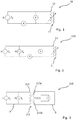
- Fig. 1 shows an inductive device 10 comprising a magnetic core 11 according to a first embodiment.
- the inductive device 10 is configured as a variable inductance sensor such like an inductive position sensor or an elasto-magnetic sensor.
- An inductance of the inductive position sensor depends on the position of a magnetic object with respect to a primary winding 12, where the primary winding 12 can be applied around a magnetic structure.
- the magnetic structure and the magnetic object are part of the magnetic core 11.
- the winding primary 12 is energized by an alternating electrical main operation signal having a main operation frequency f m .
- the main operation signal is produced by a main voltage generator G, being a voltage source.
- the main operation signal is produced by a current source.
- the impedance and/or inductance of the variable inductance sensor can be determined by measuring a current signal and/or a voltage signal produced at the primary winding 12 by an ampere meter A and/or a voltage meter V, respectively.
- Fig. 2 shows an inductive device 110 according to a second embodiment.
- the inductive device 110 is configured as a variable inductance sensor such like an inductive position sensor or an elasto-magnetic sensor, as already shown in Fig. 1 .
- a high frequency bias signal is superimposed to the main operation signal in order to improve the magnetic response of the magnetic core 11 experienced by the main operation signal.
- the bias signal is provided by a high frequency bias signal source, which can be seen as an equivalent bias voltage generator G b in parallel to the equivalent main voltage generator G of the main operation signal.
- a high frequency bias signal source which can be seen as an equivalent bias voltage generator G b in parallel to the equivalent main voltage generator G of the main operation signal.
- practical implementations may be different and could employ other generator types and/or different circuit architectures. It is possible, for example, to use one generator for producing both the main electrical signal and the high frequency bias signal.
- the high frequency signal "consumes" irreversible magnetization effects such that the main operation signal experiences mainly reversible magnetization processes.
- the main operation signal is provided thus with an idealized behaviour of the magnetic core, where hysteresis effects, non-linear B-H curve, and Barkhausen noise are minimized or eliminated. Better linearity, better reproducibility, lower magnitude errors, and lower phase errors are thus achieved, resulting in much improved measurement accuracy.
- the solution is relatively easy to implement, as generating a high frequency bias signal is uncomplicated.
- the same circuitry for producing the main operation signal or a significant part of it is preferably used for producing the bias signal.
- the bias frequency f b preferably is sufficiently high in order to have little effect on the processing of the main operation signal being applied for the measurement.
- the bias frequency f b is ten times higher than the main operation frequency f m .
- the magnitude of the bias signal is selected to be sufficiently small, which also minimizes the impact of the bias signal on the signal processing applied in the inductive device 110.
- the inductive device 110 comprises a low-pass filter and/or a band-pass filter, if it is necessary to better separate the bias signal from the main operation signal for processing the measurement values.
- the low-pass filter and/or the band-pass filter is preferably implemented in hardware or in software.
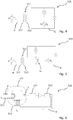
- Fig. 4 shows an inductive device 310 comprising a magnetic core 311 according to a fourth embodiment.
- the inductive device 310 is configured as a signal transformer.
- the term signal transformer covers various types of current transformers and/or voltage transformers, in particular including instrument transformers.
- the signal transformer comprises a primary circuit P with a primary winding 312, to which a primary signal with a main operation frequency f m is applied and a secondary circuit S with a secondary winding 313, to which a secondary signal is applied.
- the primary signal preferably is the main operation signal applied to the transformer.
- the secondary signal preferably is an image of the primary signal.
- the primary signal preferably has a main operation frequency f m , in particular around 50 Hz.
- the secondary signal is ideally proportional to the primary signal according to an accurate, linear, and reproducible transformation ratio.
- the transformation ratio is affected by magnitude and phase errors caused by the magnetic hysteresis of the magnetic core.
- the non-linear B-H curve causes measurement errors, which depend on the magnitude of the primary signal. For example, the measurement errors increase at smaller primary signals because the initial permeability of the magnetic core is smaller than its maximum permeability. Further, the value of the initial permeability depends on the magnetization state of the magnetic core, being lower if the magnetic core is in a remanent magnetized state. The residual magnetization would also limit the operation range of the transformer. The response of the signal transformer is thus non-linear and non-reproducible, causing limited accuracy and reduced measurement range of the device.
- the secondary circuit S of the transformer can be thus provided with a bias voltage generator G b or a current generator for producing the bias signal.
- the secondary circuit S preferably also comprises a voltage meter V and/or a current meter A and an appropriate electrical burden depending on the type and purpose of the transformer.
- Fig. 5 shows an inductive device 410 as shown in Fig. 4 according to a fifth embodiment.
- auxiliary transformer Ta which can be seen as a coupling transformer, provides flexibility to easily match impedance and signal levels. It also allows separating the secondary circuit of the signal transformer from the bias voltage generator G b enabling functionalities such as electrical insulation and/or filtering. Since bias frequency fb is relatively high, e.g. between 500 Hz to 50 kHz, the auxiliary transformer would be small and economical. The solution preferably allows thus to improve the performance of the signal transformer and saving cost and complexity on the construction of the signal transformer, allowing for better overall performance and competitive cost.
- the accuracy and the operation range of the signal transformer can be drastically improved by applying the bias signal in order to improve the response of the magnetic core experienced by the main electrical signal.
- the magnitude and phase accuracy errors caused by the magnetic hysteresis at the characteristic frequency of the transformer can be thus eliminated or drastically reduced.
- Almost constant permeability of the magnetic core is achieved from very small value of the main operation signal up to saturation, without being affected by the history of the magnetization signals applied to the magnetic core.
- the Barkhausen noise is also removed from frequencies close to the main operation frequency f m .
- Very high accuracy, wide operation range, excellent linearity and reproducibility are thus achieved even with common magnetic materials.
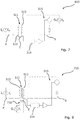
- Fig. 6 shows an inductive device 510 comprising a magnetic core 511 according to a sixth embodiment.
- the inductive device 510 is configured as a closed loop current sensor, also known as zero-flux current sensor.
- the closed loop current sensor comprises a primary circuit P with a primary winding 512, to which a primary signal with a main operation frequency f m is applied and a secondary circuit S with a secondary winding 513, to which a secondary signal is applied.
- Closed loop current sensors allow measuring both a DC and an AC primary current I p flowing in the primary circuit.
- the closed looped current sensors additionally comprises a magnetic transducer T to sense magnetic flux in the magnetic core 511, a suitable processing unit 514, and a drive unit 515 to apply a secondary current I s , comprising a compensation current in the secondary winding S in order to cancel the magnetic flux produced by the primary current I p .
- the processing unit 514 and the drive unit 515 preferably are analogue circuits and/or integrated circuits, in particular processors.
- the sensor is usually designed to actively compensate the flux induced by the primary current I p at DC and low frequency. At high frequency, the sensor is usually designed to have passive compensation of the flux induced by the primary current I p like in a current transformer.
- the compensation current is proportional to the primary current I p and to the ratio of the turns, both for DC and AC current.
- the accuracy of common closed loop current sensors is compromised by the non-linear response of the magnetic core, by the magnetic hysteresis of the magnetic core, and by the Barkhausen noise in the magnetic core.
- the impact of the non-linear response of the magnetic core on the accuracy of the sensor is reduced to a high extent by the closed loop principle of the sensor.
- non-linearity errors in the order of 0.1% are still common for DC operation and can be higher for AC operation.
- the remanent magnetic flux in the magnetic core 511 causes an error which is commonly known as magnetic offset error and which depends on the magnetization state of the magnetic core.
- the magnetic offset error depends on the magnetization state of the magnetic core 511.
- the magnetic core 511 features a gap and a magnetic transducer is located in the gap where it senses the magnetic flux density, which is representative for the magnetic flux in the magnetic core.
- the closed loop principle is attractive because it effectively eliminates most errors related to the magnetic transducer, allowing to use economical components such as Hall transducers or miniature fluxgate transducers.
- the high frequency bias waveform can be added to the output of the processing unit 514 in order to apply it to the secondary driver, which would produce a signal in the secondary winding 513 comprising the compensation current and the bias current.
- the high frequency bias waveform can be added to the output of the processing unit 514 in order to apply it to the secondary driver, which would produce a signal in the secondary winding 513 comprising the compensation current and the bias current.
- Fig. 8 shows an inductive device 710 as shown in Fig. 6 and Fig. 7 according to an eighth embodiment. Additionally, it is possible to apply the high frequency bias waveform to a bias coil 716, which is inductively or magnetically coupled to the magnetic transducer T.
- the corresponding bias current in the secondary circuit would be much smaller than the compensation current reached during normal operation of the current sensor.
- the frequency of the bias current can be selected in a frequency range where the performance requirements for the current sensor are more relaxed. For example, closed loop current sensors are often required to provide optimum performance in a frequency range from DC to 50 Hz, and less stringent requirements apply from 50 Hz to 100 kHz. It can be judicious in such case to select a bias frequency comprised between 500 Hz and 10 kHz.
Landscapes
- Measuring Magnetic Variables (AREA)
Priority Applications (1)
| Application Number | Priority Date | Filing Date | Title |
|---|---|---|---|
| EP18213335.5A EP3671876B1 (de) | 2018-12-18 | 2018-12-18 | Verfahren und induktive vorrichtung |
Applications Claiming Priority (1)
| Application Number | Priority Date | Filing Date | Title |
|---|---|---|---|
| EP18213335.5A EP3671876B1 (de) | 2018-12-18 | 2018-12-18 | Verfahren und induktive vorrichtung |
Publications (2)
| Publication Number | Publication Date |
|---|---|
| EP3671876A1 true EP3671876A1 (de) | 2020-06-24 |
| EP3671876B1 EP3671876B1 (de) | 2021-12-01 |
Family
ID=64744580
Family Applications (1)
| Application Number | Title | Priority Date | Filing Date |
|---|---|---|---|
| EP18213335.5A Active EP3671876B1 (de) | 2018-12-18 | 2018-12-18 | Verfahren und induktive vorrichtung |
Country Status (1)
| Country | Link |
|---|---|
| EP (1) | EP3671876B1 (de) |
Cited By (2)
| Publication number | Priority date | Publication date | Assignee | Title |
|---|---|---|---|---|
| CN114157969A (zh) * | 2021-11-29 | 2022-03-08 | 国光电器股份有限公司 | 一种防止反磁跳磁的装置 |
| CN121741267A (zh) * | 2026-02-28 | 2026-03-27 | 国网山西省电力有限公司太原供电分公司 | 一种变压器直流偏磁电流测量方法 |
Citations (3)
| Publication number | Priority date | Publication date | Assignee | Title |
|---|---|---|---|---|
| US4280162A (en) * | 1977-08-04 | 1981-07-21 | North American Philips Corporation | Ground fault circuit interrupter |
| US20110248812A1 (en) * | 2010-04-09 | 2011-10-13 | Delta Electronics Inc. | Current-controlled variable inductor |
| US20180268982A1 (en) * | 2014-06-23 | 2018-09-20 | Ferric Inc. | Apparatus and Methods for Magnetic Core Inductors with Biased Permeability |
-
2018
- 2018-12-18 EP EP18213335.5A patent/EP3671876B1/de active Active
Patent Citations (3)
| Publication number | Priority date | Publication date | Assignee | Title |
|---|---|---|---|---|
| US4280162A (en) * | 1977-08-04 | 1981-07-21 | North American Philips Corporation | Ground fault circuit interrupter |
| US20110248812A1 (en) * | 2010-04-09 | 2011-10-13 | Delta Electronics Inc. | Current-controlled variable inductor |
| US20180268982A1 (en) * | 2014-06-23 | 2018-09-20 | Ferric Inc. | Apparatus and Methods for Magnetic Core Inductors with Biased Permeability |
Cited By (3)
| Publication number | Priority date | Publication date | Assignee | Title |
|---|---|---|---|---|
| CN114157969A (zh) * | 2021-11-29 | 2022-03-08 | 国光电器股份有限公司 | 一种防止反磁跳磁的装置 |
| CN114157969B (zh) * | 2021-11-29 | 2024-03-29 | 国光电器股份有限公司 | 一种防止反磁跳磁的装置 |
| CN121741267A (zh) * | 2026-02-28 | 2026-03-27 | 国网山西省电力有限公司太原供电分公司 | 一种变压器直流偏磁电流测量方法 |
Also Published As
| Publication number | Publication date |
|---|---|
| EP3671876B1 (de) | 2021-12-01 |
Similar Documents
| Publication | Publication Date | Title |
|---|---|---|
| US4506214A (en) | Measuring transformer | |
| US4309655A (en) | Measuring transformer | |
| CN100454024C (zh) | 磁桥型电流传感器及磁桥型电流检测方法、以及用于该传感器与检测方法的磁桥 | |
| CN1083981C (zh) | 具有小磁滞回线操作的电流互感器的直流与交流电流传感器 | |
| US6411078B1 (en) | Current sensor apparatus | |
| US7365535B2 (en) | Closed-loop magnetic sensor system | |
| EP2871485B1 (de) | Stromerkennungsvorrichtung | |
| JPH0769130B2 (ja) | 磁気的変位センサ | |
| EP2749891A1 (de) | Stromsensor | |
| JP2004523909A (ja) | 電流検出器用変成器 | |
| EP0380562B1 (de) | Magnetometer mit einer saettigbaren kern aufweisenden spule | |
| JP2000055999A (ja) | 磁気センサ装置および電流センサ装置 | |
| EP3246713B1 (de) | Vorrichtung und verfahren für gleichstrommessung | |
| US12313657B2 (en) | Method and system for improved current sensor | |
| CN205210163U (zh) | 一种巨磁阻效应电流传感器 | |
| US20060192550A1 (en) | Current sensor with magnetic toroid single frequency detection scheme | |
| EP3671876B1 (de) | Verfahren und induktive vorrichtung | |
| Yang et al. | Analysis and design of a self-oscillating bidirectionally saturated fluxgate current sensor | |
| Schrittwieser et al. | Novel principle for flux sensing in the application of a DC+ AC current sensor | |
| JP2000055998A (ja) | 磁気センサ装置および電流センサ装置 | |
| Dimitropoulos et al. | Boosting the performance of miniature fluxgates with novel signal extraction techniques | |
| US7145321B2 (en) | Current sensor with magnetic toroid | |
| Takayama et al. | Integrated thin film magneto-impedance sensor head using plating process | |
| JP3639727B2 (ja) | 磁気センサ | |
| US20240387084A1 (en) | Magnetic Core for Current Sensors |
Legal Events
| Date | Code | Title | Description |
|---|---|---|---|
| PUAI | Public reference made under article 153(3) epc to a published international application that has entered the european phase |
Free format text: ORIGINAL CODE: 0009012 |
|
| STAA | Information on the status of an ep patent application or granted ep patent |
Free format text: STATUS: THE APPLICATION HAS BEEN PUBLISHED |
|
| AK | Designated contracting states |
Kind code of ref document: A1 Designated state(s): AL AT BE BG CH CY CZ DE DK EE ES FI FR GB GR HR HU IE IS IT LI LT LU LV MC MK MT NL NO PL PT RO RS SE SI SK SM TR |
|
| AX | Request for extension of the european patent |
Extension state: BA ME |
|
| STAA | Information on the status of an ep patent application or granted ep patent |
Free format text: STATUS: REQUEST FOR EXAMINATION WAS MADE |
|
| 17P | Request for examination filed |
Effective date: 20201124 |
|
| RBV | Designated contracting states (corrected) |
Designated state(s): AL AT BE BG CH CY CZ DE DK EE ES FI FR GB GR HR HU IE IS IT LI LT LU LV MC MK MT NL NO PL PT RO RS SE SI SK SM TR |
|
| GRAP | Despatch of communication of intention to grant a patent |
Free format text: ORIGINAL CODE: EPIDOSNIGR1 |
|
| STAA | Information on the status of an ep patent application or granted ep patent |
Free format text: STATUS: GRANT OF PATENT IS INTENDED |
|
| INTG | Intention to grant announced |
Effective date: 20210629 |
|
| GRAS | Grant fee paid |
Free format text: ORIGINAL CODE: EPIDOSNIGR3 |
|
| GRAA | (expected) grant |
Free format text: ORIGINAL CODE: 0009210 |
|
| STAA | Information on the status of an ep patent application or granted ep patent |
Free format text: STATUS: THE PATENT HAS BEEN GRANTED |
|
| AK | Designated contracting states |
Kind code of ref document: B1 Designated state(s): AL AT BE BG CH CY CZ DE DK EE ES FI FR GB GR HR HU IE IS IT LI LT LU LV MC MK MT NL NO PL PT RO RS SE SI SK SM TR |
|
| RAP3 | Party data changed (applicant data changed or rights of an application transferred) |
Owner name: ABB SCHWEIZ AG |
|
| REG | Reference to a national code |
Ref country code: GB Ref legal event code: FG4D |
|
| REG | Reference to a national code |
Ref country code: AT Ref legal event code: REF Ref document number: 1452642 Country of ref document: AT Kind code of ref document: T Effective date: 20211215 Ref country code: CH Ref legal event code: EP |
|
| REG | Reference to a national code |
Ref country code: IE Ref legal event code: FG4D |
|
| REG | Reference to a national code |
Ref country code: DE Ref legal event code: R096 Ref document number: 602018027438 Country of ref document: DE |
|
| REG | Reference to a national code |
Ref country code: LT Ref legal event code: MG9D |
|
| REG | Reference to a national code |
Ref country code: NL Ref legal event code: MP Effective date: 20211201 |
|
| REG | Reference to a national code |
Ref country code: AT Ref legal event code: MK05 Ref document number: 1452642 Country of ref document: AT Kind code of ref document: T Effective date: 20211201 |
|
| PG25 | Lapsed in a contracting state [announced via postgrant information from national office to epo] |
Ref country code: RS Free format text: LAPSE BECAUSE OF FAILURE TO SUBMIT A TRANSLATION OF THE DESCRIPTION OR TO PAY THE FEE WITHIN THE PRESCRIBED TIME-LIMIT Effective date: 20211201 Ref country code: LT Free format text: LAPSE BECAUSE OF FAILURE TO SUBMIT A TRANSLATION OF THE DESCRIPTION OR TO PAY THE FEE WITHIN THE PRESCRIBED TIME-LIMIT Effective date: 20211201 Ref country code: FI Free format text: LAPSE BECAUSE OF FAILURE TO SUBMIT A TRANSLATION OF THE DESCRIPTION OR TO PAY THE FEE WITHIN THE PRESCRIBED TIME-LIMIT Effective date: 20211201 Ref country code: BG Free format text: LAPSE BECAUSE OF FAILURE TO SUBMIT A TRANSLATION OF THE DESCRIPTION OR TO PAY THE FEE WITHIN THE PRESCRIBED TIME-LIMIT Effective date: 20220301 Ref country code: AT Free format text: LAPSE BECAUSE OF FAILURE TO SUBMIT A TRANSLATION OF THE DESCRIPTION OR TO PAY THE FEE WITHIN THE PRESCRIBED TIME-LIMIT Effective date: 20211201 |
|
| PG25 | Lapsed in a contracting state [announced via postgrant information from national office to epo] |
Ref country code: SE Free format text: LAPSE BECAUSE OF FAILURE TO SUBMIT A TRANSLATION OF THE DESCRIPTION OR TO PAY THE FEE WITHIN THE PRESCRIBED TIME-LIMIT Effective date: 20211201 Ref country code: PL Free format text: LAPSE BECAUSE OF FAILURE TO SUBMIT A TRANSLATION OF THE DESCRIPTION OR TO PAY THE FEE WITHIN THE PRESCRIBED TIME-LIMIT Effective date: 20211201 Ref country code: NO Free format text: LAPSE BECAUSE OF FAILURE TO SUBMIT A TRANSLATION OF THE DESCRIPTION OR TO PAY THE FEE WITHIN THE PRESCRIBED TIME-LIMIT Effective date: 20220301 Ref country code: LV Free format text: LAPSE BECAUSE OF FAILURE TO SUBMIT A TRANSLATION OF THE DESCRIPTION OR TO PAY THE FEE WITHIN THE PRESCRIBED TIME-LIMIT Effective date: 20211201 Ref country code: HR Free format text: LAPSE BECAUSE OF FAILURE TO SUBMIT A TRANSLATION OF THE DESCRIPTION OR TO PAY THE FEE WITHIN THE PRESCRIBED TIME-LIMIT Effective date: 20211201 Ref country code: GR Free format text: LAPSE BECAUSE OF FAILURE TO SUBMIT A TRANSLATION OF THE DESCRIPTION OR TO PAY THE FEE WITHIN THE PRESCRIBED TIME-LIMIT Effective date: 20220302 Ref country code: ES Free format text: LAPSE BECAUSE OF FAILURE TO SUBMIT A TRANSLATION OF THE DESCRIPTION OR TO PAY THE FEE WITHIN THE PRESCRIBED TIME-LIMIT Effective date: 20211201 |
|
| PG25 | Lapsed in a contracting state [announced via postgrant information from national office to epo] |
Ref country code: NL Free format text: LAPSE BECAUSE OF FAILURE TO SUBMIT A TRANSLATION OF THE DESCRIPTION OR TO PAY THE FEE WITHIN THE PRESCRIBED TIME-LIMIT Effective date: 20211201 |
|
| PG25 | Lapsed in a contracting state [announced via postgrant information from national office to epo] |
Ref country code: SM Free format text: LAPSE BECAUSE OF FAILURE TO SUBMIT A TRANSLATION OF THE DESCRIPTION OR TO PAY THE FEE WITHIN THE PRESCRIBED TIME-LIMIT Effective date: 20211201 Ref country code: SK Free format text: LAPSE BECAUSE OF FAILURE TO SUBMIT A TRANSLATION OF THE DESCRIPTION OR TO PAY THE FEE WITHIN THE PRESCRIBED TIME-LIMIT Effective date: 20211201 Ref country code: RO Free format text: LAPSE BECAUSE OF FAILURE TO SUBMIT A TRANSLATION OF THE DESCRIPTION OR TO PAY THE FEE WITHIN THE PRESCRIBED TIME-LIMIT Effective date: 20211201 Ref country code: PT Free format text: LAPSE BECAUSE OF FAILURE TO SUBMIT A TRANSLATION OF THE DESCRIPTION OR TO PAY THE FEE WITHIN THE PRESCRIBED TIME-LIMIT Effective date: 20220401 Ref country code: EE Free format text: LAPSE BECAUSE OF FAILURE TO SUBMIT A TRANSLATION OF THE DESCRIPTION OR TO PAY THE FEE WITHIN THE PRESCRIBED TIME-LIMIT Effective date: 20211201 Ref country code: CZ Free format text: LAPSE BECAUSE OF FAILURE TO SUBMIT A TRANSLATION OF THE DESCRIPTION OR TO PAY THE FEE WITHIN THE PRESCRIBED TIME-LIMIT Effective date: 20211201 |
|
| REG | Reference to a national code |
Ref country code: CH Ref legal event code: PL |
|
| PG25 | Lapsed in a contracting state [announced via postgrant information from national office to epo] |
Ref country code: MC Free format text: LAPSE BECAUSE OF FAILURE TO SUBMIT A TRANSLATION OF THE DESCRIPTION OR TO PAY THE FEE WITHIN THE PRESCRIBED TIME-LIMIT Effective date: 20211201 |
|
| REG | Reference to a national code |
Ref country code: DE Ref legal event code: R097 Ref document number: 602018027438 Country of ref document: DE |
|
| REG | Reference to a national code |
Ref country code: BE Ref legal event code: MM Effective date: 20211231 |
|
| PG25 | Lapsed in a contracting state [announced via postgrant information from national office to epo] |
Ref country code: IS Free format text: LAPSE BECAUSE OF FAILURE TO SUBMIT A TRANSLATION OF THE DESCRIPTION OR TO PAY THE FEE WITHIN THE PRESCRIBED TIME-LIMIT Effective date: 20220401 |
|
| PLBE | No opposition filed within time limit |
Free format text: ORIGINAL CODE: 0009261 |
|
| STAA | Information on the status of an ep patent application or granted ep patent |
Free format text: STATUS: NO OPPOSITION FILED WITHIN TIME LIMIT |
|
| PG25 | Lapsed in a contracting state [announced via postgrant information from national office to epo] |
Ref country code: LU Free format text: LAPSE BECAUSE OF NON-PAYMENT OF DUE FEES Effective date: 20211218 Ref country code: IE Free format text: LAPSE BECAUSE OF NON-PAYMENT OF DUE FEES Effective date: 20211218 Ref country code: DK Free format text: LAPSE BECAUSE OF FAILURE TO SUBMIT A TRANSLATION OF THE DESCRIPTION OR TO PAY THE FEE WITHIN THE PRESCRIBED TIME-LIMIT Effective date: 20211201 Ref country code: AL Free format text: LAPSE BECAUSE OF FAILURE TO SUBMIT A TRANSLATION OF THE DESCRIPTION OR TO PAY THE FEE WITHIN THE PRESCRIBED TIME-LIMIT Effective date: 20211201 |
|
| 26N | No opposition filed |
Effective date: 20220902 |
|
| REG | Reference to a national code |
Ref country code: DE Ref legal event code: R079 Ref document number: 602018027438 Country of ref document: DE Free format text: PREVIOUS MAIN CLASS: H01L0049020000 Ipc: H10N0097000000 |
|
| PG25 | Lapsed in a contracting state [announced via postgrant information from national office to epo] |
Ref country code: SI Free format text: LAPSE BECAUSE OF FAILURE TO SUBMIT A TRANSLATION OF THE DESCRIPTION OR TO PAY THE FEE WITHIN THE PRESCRIBED TIME-LIMIT Effective date: 20211201 Ref country code: FR Free format text: LAPSE BECAUSE OF NON-PAYMENT OF DUE FEES Effective date: 20220201 Ref country code: BE Free format text: LAPSE BECAUSE OF NON-PAYMENT OF DUE FEES Effective date: 20211231 |
|
| PG25 | Lapsed in a contracting state [announced via postgrant information from national office to epo] |
Ref country code: LI Free format text: LAPSE BECAUSE OF NON-PAYMENT OF DUE FEES Effective date: 20211231 Ref country code: CH Free format text: LAPSE BECAUSE OF NON-PAYMENT OF DUE FEES Effective date: 20211231 |
|
| PG25 | Lapsed in a contracting state [announced via postgrant information from national office to epo] |
Ref country code: IT Free format text: LAPSE BECAUSE OF FAILURE TO SUBMIT A TRANSLATION OF THE DESCRIPTION OR TO PAY THE FEE WITHIN THE PRESCRIBED TIME-LIMIT Effective date: 20211201 |
|
| PG25 | Lapsed in a contracting state [announced via postgrant information from national office to epo] |
Ref country code: CY Free format text: LAPSE BECAUSE OF FAILURE TO SUBMIT A TRANSLATION OF THE DESCRIPTION OR TO PAY THE FEE WITHIN THE PRESCRIBED TIME-LIMIT Effective date: 20211201 |
|
| PG25 | Lapsed in a contracting state [announced via postgrant information from national office to epo] |
Ref country code: HU Free format text: LAPSE BECAUSE OF FAILURE TO SUBMIT A TRANSLATION OF THE DESCRIPTION OR TO PAY THE FEE WITHIN THE PRESCRIBED TIME-LIMIT; INVALID AB INITIO Effective date: 20181218 |
|
| GBPC | Gb: european patent ceased through non-payment of renewal fee |
Effective date: 20221218 |
|
| PG25 | Lapsed in a contracting state [announced via postgrant information from national office to epo] |
Ref country code: GB Free format text: LAPSE BECAUSE OF NON-PAYMENT OF DUE FEES Effective date: 20221218 |
|
| PG25 | Lapsed in a contracting state [announced via postgrant information from national office to epo] |
Ref country code: MK Free format text: LAPSE BECAUSE OF FAILURE TO SUBMIT A TRANSLATION OF THE DESCRIPTION OR TO PAY THE FEE WITHIN THE PRESCRIBED TIME-LIMIT Effective date: 20211201 |
|
| PG25 | Lapsed in a contracting state [announced via postgrant information from national office to epo] |
Ref country code: MT Free format text: LAPSE BECAUSE OF FAILURE TO SUBMIT A TRANSLATION OF THE DESCRIPTION OR TO PAY THE FEE WITHIN THE PRESCRIBED TIME-LIMIT Effective date: 20211201 |
|
| PG25 | Lapsed in a contracting state [announced via postgrant information from national office to epo] |
Ref country code: TR Free format text: LAPSE BECAUSE OF FAILURE TO SUBMIT A TRANSLATION OF THE DESCRIPTION OR TO PAY THE FEE WITHIN THE PRESCRIBED TIME-LIMIT Effective date: 20211201 |
|
| PGFP | Annual fee paid to national office [announced via postgrant information from national office to epo] |
Ref country code: DE Payment date: 20251211 Year of fee payment: 8 |