EP3672243B1 - Verfahren und vorrichtung zur bildcodierung nach einem niederwertigen codierungsmodus sowie verfahren und vorrichtung zur bilddecodierung - Google Patents
Verfahren und vorrichtung zur bildcodierung nach einem niederwertigen codierungsmodus sowie verfahren und vorrichtung zur bilddecodierung Download PDFInfo
- Publication number
- EP3672243B1 EP3672243B1 EP18874338.9A EP18874338A EP3672243B1 EP 3672243 B1 EP3672243 B1 EP 3672243B1 EP 18874338 A EP18874338 A EP 18874338A EP 3672243 B1 EP3672243 B1 EP 3672243B1
- Authority
- EP
- European Patent Office
- Prior art keywords
- region
- image
- target region
- texture
- target
- Prior art date
- Legal status (The legal status is an assumption and is not a legal conclusion. Google has not performed a legal analysis and makes no representation as to the accuracy of the status listed.)
- Active
Links
Images



Classifications
-
- H—ELECTRICITY
- H04—ELECTRIC COMMUNICATION TECHNIQUE
- H04N—PICTORIAL COMMUNICATION, e.g. TELEVISION
- H04N19/00—Methods or arrangements for coding, decoding, compressing or decompressing digital video signals
- H04N19/10—Methods or arrangements for coding, decoding, compressing or decompressing digital video signals using adaptive coding
- H04N19/134—Methods or arrangements for coding, decoding, compressing or decompressing digital video signals using adaptive coding characterised by the element, parameter or criterion affecting or controlling the adaptive coding
- H04N19/157—Assigned coding mode, i.e. the coding mode being predefined or preselected to be further used for selection of another element or parameter
-
- G—PHYSICS
- G06—COMPUTING OR CALCULATING; COUNTING
- G06N—COMPUTING ARRANGEMENTS BASED ON SPECIFIC COMPUTATIONAL MODELS
- G06N3/00—Computing arrangements based on biological models
- G06N3/02—Neural networks
- G06N3/04—Architecture, e.g. interconnection topology
- G06N3/045—Combinations of networks
-
- G—PHYSICS
- G06—COMPUTING OR CALCULATING; COUNTING
- G06N—COMPUTING ARRANGEMENTS BASED ON SPECIFIC COMPUTATIONAL MODELS
- G06N3/00—Computing arrangements based on biological models
- G06N3/02—Neural networks
- G06N3/04—Architecture, e.g. interconnection topology
- G06N3/0464—Convolutional networks [CNN, ConvNet]
-
- G—PHYSICS
- G06—COMPUTING OR CALCULATING; COUNTING
- G06T—IMAGE DATA PROCESSING OR GENERATION, IN GENERAL
- G06T5/00—Image enhancement or restoration
- G06T5/20—Image enhancement or restoration using local operators
-
- H—ELECTRICITY
- H04—ELECTRIC COMMUNICATION TECHNIQUE
- H04N—PICTORIAL COMMUNICATION, e.g. TELEVISION
- H04N19/00—Methods or arrangements for coding, decoding, compressing or decompressing digital video signals
- H04N19/10—Methods or arrangements for coding, decoding, compressing or decompressing digital video signals using adaptive coding
- H04N19/102—Methods or arrangements for coding, decoding, compressing or decompressing digital video signals using adaptive coding characterised by the element, parameter or selection affected or controlled by the adaptive coding
- H04N19/103—Selection of coding mode or of prediction mode
- H04N19/105—Selection of the reference unit for prediction within a chosen coding or prediction mode, e.g. adaptive choice of position and number of pixels used for prediction
-
- H—ELECTRICITY
- H04—ELECTRIC COMMUNICATION TECHNIQUE
- H04N—PICTORIAL COMMUNICATION, e.g. TELEVISION
- H04N19/00—Methods or arrangements for coding, decoding, compressing or decompressing digital video signals
- H04N19/10—Methods or arrangements for coding, decoding, compressing or decompressing digital video signals using adaptive coding
- H04N19/169—Methods or arrangements for coding, decoding, compressing or decompressing digital video signals using adaptive coding characterised by the coding unit, i.e. the structural portion or semantic portion of the video signal being the object or the subject of the adaptive coding
- H04N19/182—Methods or arrangements for coding, decoding, compressing or decompressing digital video signals using adaptive coding characterised by the coding unit, i.e. the structural portion or semantic portion of the video signal being the object or the subject of the adaptive coding the unit being a pixel
-
- H—ELECTRICITY
- H04—ELECTRIC COMMUNICATION TECHNIQUE
- H04N—PICTORIAL COMMUNICATION, e.g. TELEVISION
- H04N19/00—Methods or arrangements for coding, decoding, compressing or decompressing digital video signals
- H04N19/10—Methods or arrangements for coding, decoding, compressing or decompressing digital video signals using adaptive coding
- H04N19/169—Methods or arrangements for coding, decoding, compressing or decompressing digital video signals using adaptive coding characterised by the coding unit, i.e. the structural portion or semantic portion of the video signal being the object or the subject of the adaptive coding
- H04N19/184—Methods or arrangements for coding, decoding, compressing or decompressing digital video signals using adaptive coding characterised by the coding unit, i.e. the structural portion or semantic portion of the video signal being the object or the subject of the adaptive coding the unit being bits, e.g. of the compressed video stream
-
- H—ELECTRICITY
- H04—ELECTRIC COMMUNICATION TECHNIQUE
- H04N—PICTORIAL COMMUNICATION, e.g. TELEVISION
- H04N19/00—Methods or arrangements for coding, decoding, compressing or decompressing digital video signals
- H04N19/85—Methods or arrangements for coding, decoding, compressing or decompressing digital video signals using pre-processing or post-processing specially adapted for video compression
-
- G—PHYSICS
- G06—COMPUTING OR CALCULATING; COUNTING
- G06N—COMPUTING ARRANGEMENTS BASED ON SPECIFIC COMPUTATIONAL MODELS
- G06N3/00—Computing arrangements based on biological models
- G06N3/02—Neural networks
- G06N3/08—Learning methods
Definitions
- the present disclosure relates to the field of encoding and decoding an image. More specifically, the present disclosure relates to a method and device for encoding an image according to a low-quality coding mode, and a method and device for decoding an image.
- one picture may be split into blocks and each of the blocks may be predictively encoded and predictively decoded by inter prediction or intra prediction.
- Intra prediction is a method of compressing an image by removing spatial redundancy in a picture
- inter prediction is a method of compressing an image by removing temporal redundancy between pictures and a representative example thereof is motion estimation coding.
- blocks of a current picture are predicted using at least one reference picture.
- a certain evaluation function may be used to search for a reference block most similar to a current block in a certain search range.
- a current block is predicted, based on an adjacent pixel or a reference block, and a block predicted as a result of predicting the current block is subtracted from the current block to generate and encode a residual block.
- a motion vector of either previously encoded blocks adjacent to a current block or blocks included in a previously coded picture is used as a prediction motion vector of the current block to predict a motion vector of the current block for inter prediction.
- a differential motion vector which is the difference between the motion vector of the current block and the prediction motion vector, is signaled to a decoder side in a certain manner.
- WO 2016/199330 A1 discloses an image coding method, an image decoding method, an image coding device and an image decoding device.
- Slot K et al “Fast generation of natural textures with Cellular Neural Networks-based stitching", Cellular Nanoscale Networks and Their Applications (CNNA), 2010 12th International Workshop on, IEEE, Piscataway, NJ, USA, 3 February 2010, pages 1-4, ISBN: 978-1-4244-6679-5 presents a novel method for texture synthesis.
- US 2011/019910 A1 discloses an image processing system. Anonymous: “Overview of Scalable Video Coding", 84.
- a method of decoding an image includes determining at least one reference region to be referenced by a target region in the image to which a low-quality coding mode is applied; extracting a certain type of information from the determined at least one reference region; and changing pixel values of the target region, based on the extracted type of information.
- the type of information may include a certain type of reference texture feature
- the changing of the pixel values of the target region may include changing the pixel values of the target region such that a type of target texture feature of the target region is the same as or similar to the reference texture feature.
- the changing of the pixel values of the target region may include changing the pixel values of the target region by applying the target region and the at least one reference region to a machine learning model.
- the method may further include reconstructing the target region encoded at low quality, based on information obtained from a bitstream, before changing the pixel values of the target region.
- the method may further include post-processing the reconstructed target region before changing the pixel values of the target region.
- the post-processing of the reconstructed target region may include post-processing the reconstructed target region by at least one of up-sampling or high-pass filtering
- the reconstructing of the target region may include reconstructing the reference region by obtaining, from the bitstream, information generated as a result of encoding a reference region included in an original image; and reconstructing the target region by obtaining, from the bitstream, information generated as a result of encoding a target region included in a low-quality image corresponding to the original image.
- the method may further include, when the determined at least one reference region includes a plurality of reference regions, identifying types of reference texture features to be extracted from the plurality of reference regions, the extracting of the certain type of information may include extracting the identified types of reference texture features from the plurality of reference regions, and the changing of the pixel values of the target region may include changing the pixel values of the target region such that target texture features of the target region corresponding to the identified types of reference texture features are the same as or similar to the extracted reference texture features.
- a method of encoding an image includes determining at least one reference region to be referenced by a target region in a first image to which a low-quality coding mode is to be applied; encoding the target region at low quality; and generating a bitstream to include information generated as a result of encoding the target region and information indicating the at least one reference region.
- the encoding of the target region at low quality may include pre-processing the target region of the first image, based on at least one of down-sampling, low-pass filtering, or pixel-value filtering; and encoding the pre-processed target region according to at least one of an intra mode, an inter mode, a skip mode, or a merge mode
- the encoding of the target region at low quality may include encoding the target region according to at least one of an intra mode, an inter mode, or a merge mode, based on a quantization parameter larger than a quantization parameter of regions other than the target region and the reference region of the first image.
- the encoding of the target region at low quality may include obtaining a second image of lower quality than the quality of the first image; determining a region in the second image corresponding to the target region of the first image; and encoding the determined region of the second image.
- the method may further include encoding the at least one reference region at high quality
- the generating of the bitstream may include generating the bitstream to additionally include information generated as a result of encoding the at least one reference region and information related to the encoding of the at least one reference region at high quality.
- an image decoding device includes a processor; and a memory storing at least one instruction, wherein the processor is configured to execute the at least one instruction to: determine at least one reference region to be referenced by a target region in an image to which a low-quality coding mode is applied; extract a certain type of information from the determined at least one reference region; and change pixel values of the target region, based on the extracted type of information.
- an image encoding device includes a processor; and a memory storing at least one instruction, wherein the processor is configured to execute the at least one instruction to: determine at least one reference region to be referenced by a target region in a first image to which a low-quality coding mode is to be applied; encode the target region at low quality; and generate a bitstream to include information generated as a result of encoding the target region and information indicating the at least one reference region.
- Two or more of components referred to as ' ⁇ unit', 'module', or the like may be merged into one component or one of them may be divided into two or more sub-components according to a function.
- Each of components to be described below may additionally perform some or all of functions of another component, as well as a main function thereof, and some of main functions of each of the components are may be performed exclusively by another component.
- the term 'image' or 'picture' may refer to a still image of a video or a moving picture, i.e., a video itself.
- the term 'low-quality coding mode' may refer to a coding method of performing encoding at low quality in terms of an encoding side, and a coding method applied to a region which is reconstructed and in which texture changing is performed by referring to at least one reference region, in terms of a decoding side.
- FIG. 1 is a diagram illustrating an image 10 with a texture region 11.
- the image 10 may include the texture region 11 in which the amount of change in a pixel value is not uniform spatially.
- the texture region 11 may refer to a region in which a degree of change in pixel values of pixels is large and random, and a large number of bits are generated when the image 10 is encoded by a general encoding method.
- the image 10 may include the texture region 11 which is a forested region.
- the texture region 11 is encoded according to an existing codec, e.g., H.264 AVC or HEVC, a large number of bits should be used.
- a bit rate is reduced by removing temporal redundancy and spatial redundancy, but there are limitations in reducing the bit rate of the texture region 11 and thus a method of effectively encoding and decoding the texture region 11 is required.
- FIG. 2 is a diagram illustrating an encoding process and a decoding process according to an embodiment.
- a target region and a reference region which are included in an image are encoded by an encoding side to generate a bitstream including encoded data.
- the target region may be encoded at low quality.
- low-quality encoding may refer to encoding with lower quality than normal quality
- high-quality encoding may refer to encoding with higher quality than normal quality.
- the reference region may be encoded with normal quality or high quality.
- a decoding side receives a bitstream and restores the target region and the reference region, based on the bitstream. Because the target region is encoded at low quality, an image quality of the reconstructed target region is worse than that of the target region included in an original image.
- Certain information is extracted from the reconstructed reference region and the reconstructed target region is changed according to the extracted information. For example, when this information includes a certain texture feature, pixel values of the reconstructed target region may be changed such that a texture feature of the reconstructed target region may be the same as or similar to the texture feature extracted from the reconstructed reference region. As the pixel values are changed, a final target region that is almost the same as the target region of the original image may be generated.
- the certain information may include various types of information obtainable from the regions of the image.
- the target region which may cause a large number of bits when encoded with normal quality may be encoded at low quality, the number of bits could be reduced.
- the reconstructed target region may be changed based on the information extracted from the reference region to be substantially the same as the original image, the quality of a finally reconstructed image could be increased.
- Image decoding and encoding according to an embodiment will be described in detail with reference to FIG. 3 below.
- FIG. 3 is a flowchart of a method of decoding an image according to an embodiment. Operations of the method of FIG. 3 may be performed by an image decoding device 700 described with reference to FIG. 7 below.
- the image decoding device 700 determines a reference region to be referenced by a current region of an image to which a low-quality coding mode is applied.
- the current region refers to a certain region of the image, which is to be decoded.
- the image decoding device 700 may split the image into block units such as largest coding units, coding units, prediction units, transform units, or the like, and the current region may correspond to at least one largest coding unit, at least one coding unit, at least one prediction unit, or at least one transform unit.
- the image decoding device 700 may identify whether the current region that is a current decoding target corresponds to the target region to which a low-quality coding mode is applied.
- the image decoding device 700 may determine target regions and reference regions included in the image and a reference region to be referenced by each of the target regions by extracting, from a bitstream, information about at least one of positions of the target regions in the image, sizes of the target regions, positions of the reference regions, sizes of the reference region, or the reference region to be referenced by each of the target regions.
- the image decoding device 700 may identify whether each of the blocks corresponds to a target region, a reference region, or another region, based on the information obtained from the bitstream. For example, when a first block and a second block are located in the image, the image decoding device 700 may obtain information about the first block from the bitstream and determine that the first block corresponds to a reference region, and obtain information regarding the second block and determine that the second block is a target region and the first block is to be referenced by the second block.
- the image decoding device 700 may specify, in an image 400, a position and size of a reference region 411 and a position and size of a target region 413.
- the reference region 411 and the target region 413 may be included in a texture region 410.
- the image decoding device 700 may reconstruct the current region in a general manner. For example, the image decoding device 700 may identify a coding mode of the current region and reconstruct the current region according to at least one of an intra mode, an inter mode, a merge mode, or a skip mode.
- the image decoding device 700 extracts a certain type of reference texture feature from the reference region referenced by the current region.
- the reference texture feature may refer to at least one texture feature that is a reference for changing a texture feature of the target region among texture features extractable from the reference region.
- the texture features extractable from the reference region may include, for example, statistic values of the intensity of an image (e.g., a mean, a variance, a 3rd order moment, a 4th order moment, statistics from a histogram, second order statistics representing a relationship between each pixel pairs, higher order statistics, a gray level co-occurrence matrix, etc.), a color distribution, a gradient histogram, gradient statistics, transform coefficients in a frequency domain, parameters for distributions (e.g., the type of distributions, etc.), texture features extracted based on a neural network model, and the like, but are not limited thereto and may include various types of information extractable from the reference region.
- the texture feature extracted based on the neural network model will be described with reference to FIG. 6 below.
- the image decoding device 700 may extract a predetermined type of reference texture feature from the reference region or may identify the type of reference texture feature to be extracted from the bitstream and then extract the identified type of reference texture feature from the region.
- the image decoding device 700 changes pixel values of the current region such that the predetermined type of target texture feature may be the same as or similar to the reference texture feature.
- the image decoding device 700 may obtain, from the bitstream, information on which unit the pixel values of the current region should be changed.
- the image decoding device 700 may obtain, from the bitstream, information on which unit, from among a coding unit, a prediction unit, or a transform unit, the pixel values of the current region should be changed, and change the pixel values of the current region for each of the units determined from the obtained information.
- the image decoding device 700 may change the pixel values of the current region such that a texture feature of the current region extracted from the neural network model is the same as or similar to the reference texture feature.
- the image decoding device 700 may apply the current region and the reference region to a machine learning model to change the pixel values of the current region such that the target texture feature is the same as or similar to the reference texture feature.
- the machine learning model may include, for example, a convolutional neural network (CNN). Changing a texture feature of one image according to a texture feature of another image by applying the two images to the CNN is disclosed in " Texture Synthesis Using Convolutional Neural Networks, NIPS 2015 ", introduced in the present specification.
- the image decoding device 700 may reconstruct the current region, based on information obtained from the bitstream (e.g., information related to a residual of the current region) before changing the pixel values of the current region, and thereafter change the pixel values of the constructed current region.
- the current region may be encoded at low quality by an encoding side and thus an image quality of the current region reconstructed by the image decoding device 700 may be lower than that of a current region included in the original image.
- regions of an image other than a target region may be encoded in the original image, and the target region may be encoded in a low-quality image.
- the image decoding device 700 may reconstruct the reference region by obtaining, from the bitstream, information generated as a result of encoding the reference region in the original image, and reconstruct the current region by obtaining, from the bitstream, information generated as a result of encoding the target region in the low-quality image. Post-processing described below may further be applied to the reconstructed current region.
- the image decoding device 700 may check the bitstream to identify a coding mode applied to the current region and reconstruct the current region according to the identified coding mode.
- the coding mode may include, for example, at least one of an inter mode, an intra mode, a merge mode, or a skip mode.
- the inter mode, the intra mode, the merge mode, and the skip mode are encoding/decoding tools used in codecs such as HEVC and thus a detailed description thereof will be omitted herein.
- FIG. 5 is a diagram illustrating an image 500 which includes a reconstructed reference region 511 and a reconstructed target region 513.
- the reconstructed target region 513 of FIG. 5 is reconstructed after being encoded at low quality and thus an image quality thereof is worse than that of the reference region 511.
- the image decoding device 700 may post-process a reconstructed current region before changing pixel values of a current region.
- the image decoding device 700 may post-process the reconstructed current region by at least one of up-sampling or high-pass filtering.
- Up-sampling may refer to a process of increasing the number of pixels of the restored current region
- high-pass filtering may refer to a process of improving high-frequency characteristics of the restored current region.
- the image decoding device 700 may post-process the reconstructed the reconstructed current region. In this case, the image decoding device 700 may obtain information about a processing method applied to the current region from a bitstream.
- the image decoding device 700 may up-sample a reconstructed current region (here, the reconstructed current region has a down-sampled size) according to information about a size of an original current region obtained from the bitstream.
- the bitstream may further include location information of the down-sampled current region of the image.
- the down-sampling of the current region means that an original size of the current region is reduced and thus an image encoding device 900 may include, in the bitstream, information about a position of the current region having the reduced size.
- the image decoding device 700 may obtain encoded data of the down-sampled current region of the image by referring to the location information of the down-sampled current region, reconstruct the current region, based on the obtained encoded data, and up-sample the reconstructed current region.
- the image decoding device 700 may identify that low-pass filtering has been applied to the current region, based on the bitstream, and perform high-pass filtering on the reconstructed current image.
- both high-pass filtering and up-sampling may be applied to post-process the reconstructed current region.
- the image decoding device 700 may apply at least one of up-sampling or high-pass filtering to the reconstructed current region.
- low-quality encoding may include skipping encoding of a target region.
- the image decoding device 700 cannot obtain the encoded data of the current region from the bitstream and thus a process of reconstructing the current region may be skipped, and may change a texture feature of the current region.
- the image decoding device 700 may skip a reconstruction process according to the inter mode, the intra mode, the merge mode, the skip mode or the like for the current region, allocate predetermined pixel values to pixels of the current region, and apply the current region and a reference region to a machine learning model, thereby changing pixel values of the pixels in the current region.
- the image decoding device 700 may reconstruct the reference region at high quality, based on obtained information regarding the reference region from bitstream (e.g., data generated by encoding the reference region and information about a high-quality encoding method of the reference region).
- An example of high-quality encoding/decoding may include applying a small quantization parameter, as described later.
- the reference region may be encoded and decoded before encoding and decoding a target region.
- a plurality of reference regions may be referenced by one target region.
- the image decoding device 700 may identify the type of reference texture feature to be extracted from each of a plurality of reference regions referenced by the current region (i.e., the target region), based on the bitstream.
- the image decoding device 700 may extract the identified reference texture feature from each of the plurality of reference regions.
- the image decoding device 700 may change pixel values of the current region such that each of the target texture features of the current region may be the same as or similar to one of the extracted reference texture features.
- reference regions referenced by the target region include a first reference region and a second reference region
- the type of reference texture feature to be extracted from the first reference region is an A texture feature
- the type of reference texture feature to be extracted from the second reference region is a B texture feature.
- the image decoding device 700 may change pixel values of the target region such that an A texture feature of the target region may be the same as or similar to the A texture feature extracted from the first reference region and a B texture feature of the target region may be the same as or similar to the B texture feature extracted from the second reference region.
- one reference region may be referenced by each of a plurality of target regions.
- the type of reference texture feature to be extracted from one reference region for each of the plurality of target regions may be individually determined for each of the plurality of target regions.
- an A texture feature may be extracted from a certain reference region for the first target region
- a B texture feature may be extracted from the same reference region for the second target region.
- the image decoding device 700 may change pixel values of the first target region such that the A texture feature of the first target region may be the same as or similar to the A texture feature of the reference region and change pixel values of the second target region such that the B texture feature of the second target region may be the same as or similar to the B texture feature of the same reference region.
- FIG. 6 is a diagram illustrating a structure of a machine learning model.
- the machine learning model illustrated in FIG. 6 is discussed in 'Texture Synthesis Using Convolutional Neural Networks, NIPS 2015' and may include a first CNN 610 for extracting a texture feature and a second CNN 630 for changing a texture feature of a target region 670.
- the first CNN 610 may extract, as a texture feature, a GRAM matrix corresponding to a correlation between filter responses of layers.
- the first CNN 610 may correspond to a Visual Geometry Group (VGG) network model.
- VCG Visual Geometry Group
- a reference region 650 is input to the first CNN 610 to extract a texture feature of the reference region 650.
- the target region 670 and the reference region 650 are input to the second CNN 630 to change pixel values of the target region 670 such that a texture feature of the target region 670 may be the same as or similar to that of the reference region 650.
- the second CNN 630 may be trained to minimize the distance between the texture feature of the target region 670 and the texture feature of the reference region 650 and thus may change the texture feature of the target region 670 when the target region 670 and the reference region 650 are input thereto.
- FIG. 7 is a block diagram illustrating a configuration of an image decoding device 700 according to an embodiment.
- the image decoding device 700 may include an obtainer 710 and a decoder 730.
- the obtainer 710 and the decoder 730 may be embodied as a processor, and the processor may be operated according to at least one instruction stored in a memory (not shown).
- the image decoding device 700 may further include at least one data storage (not shown) in which data input to or output from the obtainer 710 and the decoder 730 is stored.
- the image decoding device 700 may include a memory controller (not shown) that controls inputting of data to and outputting data from the at least one data storage unit.
- the image decoding device 700 may perform an image decoding operation, including prediction, through an internal or external video decoding processor to reconstruct an image through image decoding.
- the obtainer 710 receives a bitstream.
- the received bitstream may include at least one of information about a target region included an image (e.g., location information, size information, etc. of the target region), information regarding a reference region (e.g., location information, size information, etc. of the reference region), information about a reference region referenced by each target region, information about the type of a reference texture feature to be extracted from each reference region, information about low-quality encoding method of each target region, or information about a high-quality encoding method of each reference region.
- the decoder 730 decodes an image, based on the information included in the bitstream.
- the decoder 730 may reconstruct regions of the image other than a target region by a general decoding method, e.g., at least one of the intra mode, the inter mode, the skip mode, or the merge mode.
- the decoder 730 may decode the target region in a low-quality decoding mode. In detail, the decoder 730 determines a reference region referenced by the target region in the image, and extracts a certain type of reference texture feature from the reference region.
- the decoder 730 may reconstruct the target region according to at least one of the intra mode, the inter mode, the merge mode, or the skip mode, based on the information included in the bitstream, and change pixel values of the reconstructed target region such that a certain type of target texture feature of the reconstructed target region may be the same as or similar to the reference texture feature.
- the decoder 730 may post-process the reconstructed target region.
- the post-processing of the reconstructed target region may refer to processing the target region by at least one of high-pass filtering or up-sampling.
- the image decoding device 700 may skip a reconstruction process according to at least one of the intra mode, the inter mode, the merge mode, or the skip mode and change the pixel values of the target region such that the target texture feature of the target region may be the same as or similar to the reference texture feature.
- the decoder 730 may input the target region and the reference region into a machine learning model to change the pixel values of the target region.
- the machine learning model may include a CNN but is not limited thereto.
- the decoder 730 may identify the types of reference texture features to be extracted from the plurality of reference regions and extract the identified types of reference texture features from the plurality of reference regions. In addition, the decoder 730 may change the pixel values of the target region such that target texture features of the target region corresponding to the identified types of reference texture features may be the same as or similar to the extracted reference texture features.
- FIG. 8 is a flowchart of a method of encoding an image according to an unclaimed example. Operations of the method of FIG. 8 may be performed by the mage encoding device 900 to be described with reference to FIG. 9 below.
- the image encoding device 900 determines a reference region to be referenced by a current region corresponding to a target region to which the low-quality coding mode is to be applied.
- the current region refers to a region of an image that is to be currently encoded.
- the image encoding device 900 may split the image into block units such as largest coding units, coding units, prediction units, transform units, or the like, and the current region may correspond to at least one largest coding unit, at least one coding unit, at least one prediction unit, or at least one transform unit.
- the image encoding device 900 may determine a texture region in the image to be encoded and determine at least one reference region and at least one target region in the texture region.
- the image encoding device 900 may determine the texture region in the image, in consideration of characteristics of the image, for example, pixel values, an intensity variance, an edge direction, an edge distribution, etc. in the image.
- the texture region may refer to a region having similar characteristics, i.e., similar texture features.
- the image encoding device 900 determine at least one reference region and at least one target region in the texture region.
- the image encoding device 900 may determine a reference region and a target region in a texture region according to a predetermined criterion. For example, the image encoding device 900 may determine an uppermost and leftmost region having a certain size of the texture region as a reference region and determine the other regions as target regions.
- the image encoding device 900 may split the texture region of the image into a plurality of regions in consideration of features of the texture region and select at least one reference region and at least one from among the plurality of regions.
- the image encoding device 900 may determine a reference region to referenced and the type of reference texture feature to be extracted from each of the at least one reference region.
- the image encoding device 900 may determine at least one texture feature among a plurality of texture features extractable from a reference region as a reference texture feature for the target region.
- the determined reference region when one reference region is determined in the texture region, the determined reference region may be automatically determined to be referenced by a target region in the texture region.
- the type of reference texture feature to be extracted from the reference region may be predetermined.
- the image encoding device 900 may encode the current region corresponding to the target region at low quality.
- the image encoding device 900 may encode the current region by one of various low-quality encoding methods. Low-quality encoding methods available will be described below.
- the image encoding device 900 may pre-process the current region in the image and thereafter encode the pre-processed current region according to at least one of the inter mode, the intra mode, the merge mode, or the skip mode.
- the pre-processing of the current region may include, for example, processing the current region, based on at least one of down-sampling, low-pass filtering, or pixel-value filtering.
- Down-sampling may refer to a process of reducing the number of pixels included in an original current region
- low-pass filtering may refer to a process of reducing high-frequency characteristics included in the current region
- pixel-value filtering may refer to a process of excluding, from encoding targets, pixels other than pixels having a predetermined value among pixel values of the current region, or setting the pixels other than the pixels having the predetermined value to a default value, e.g., zero. For example, only pixels having a certain pixel value among the pixel values may be encoded.
- the pre-processed current region is encoded according to a certain coding mode, the number of bits may be lower than when a non-pre-processed current region is encoded.
- the image encoding device 900 may include, in a bitstream, information about a position of encoded data of the down-sampled current region in the image and size information of the current region that has not been down-sampled.
- the image encoding device 900 may include, in the bitstream, information indicating that the current region has been low-pass filtered.
- the image encoding device 900 may apply, to the current region, prediction based on at least one of the inter mode, the intra mode, or the merge mode and frequency transformation, and quantize residual data, which is generated by the application of the prediction and the frequency transformation, with a quantization parameter of a certain value.
- the quantization parameter of the certain value may be a value larger than a quantization parameter value applied to regions other than the reference region and the target region in the image.
- the image encoding device 900 may obtain a low-quality image by applying at least one of down-sampling and low-pass filtering to an original image to be encoded, and determine a region in the low-quality image corresponding to a target region of the original image.
- the image encoding device 900 may encode the region determined in the low-quality image. That is, the image encoding device 900 may encode regions other than the target region, based on the original image, and encode a region corresponding to the target region, based on the low-quality image. For example, as illustrated in FIG.
- the image encoding device 900 may down-sample an original image 1210 to generate a low-quality image 1220, encode a region 1221 corresponding to a target region, based on the low-quality image 1220, and encode a region 1211 other than the target region, based on the original image 1210.
- the image encoding device 900 may skip encoding of the current region according to the inter mode, the intra mode, the merge mode, and the skip mode, and include, in a bitstream, information indicating that the encoding of the current region has been skipped.
- the image encoding device 900 may generate a bitstream which includes at least one of information generated by encoding the current region, information indicating a reference region to be referenced by the current region, information indicating whether pre-processing has been applied to the current region, information indicating whether the current region has been encoded, based on the low-quality image, or information indicating a generation method of the low-quality image.
- information about a reference region to be referenced by each target region may not be included in the bitstream, but when a plurality of reference regions are determined in the texture region, the image encoding device 900 may further include information about a reference region to be referenced by each target region in the bitstream.
- the image encoding device 900 may further include, in the bitstream, information about a low-quality encoding method of each target region and information about the type of reference texture feature to be extracted from the reference region.
- the image encoding device 900 may encode the reference region according to a general coding mode, similar to other general regions, but in one embodiment, the image encoding device 900 may encode the reference region at high quality.
- the reference region is a region referenced by the target region and thus may be decoded with higher image quality than other general regions.
- the image encoding device 900 may encode the reference region with a value of a quantization parameter smaller than a quantization parameter applied to regions of the image other than the reference region and the target region. Specifically, the image encoding device 900 may apply, to the reference region, prediction based on at least one of the inter mode, the intra mode, or the merge mode, and frequency transformation, and quantize residual data, which is generated by the application of the prediction and the frequency transformation, with a quantization parameter of a certain value smaller than a quantization parameter used in the other regions. In this case, the image encoding device 900 may generate a bitstream further including information indicating that the reference region has been encoded at high quality and information about the quantization parameter applied to the reference region.
- the image encoding device 900 may also include some functions of the image decoding device 700.
- the image encoding device 900 may reconstruct a target region encoded at low quality by inversely quantizing, inversely transforming, and predictively reconstructing encoded data according to the low-quality coding mode of the target region, e.g., quantized frequency coefficients generated by encoding the target region at low quality.
- the image encoding device 900 may change pixel values of the reconstructed target region such that a target texture feature of the reconstructed target region may be the same as or similar to a reference texture feature of the reference region reconstructed in advance.
- deblocking filtering, sample adaptive offset (SAO) filtering, or the like may be performed on a resultant final target region.
- FIG. 9 is a block diagram illustrating a configuration of the image encoding device 900 according to an unclaimed example.
- the image encoding device 900 may include an encoder 910 and a generator 930.
- the encoder 910 and the generator 930 may be implemented as a processor, and the processor may perform an encoding operation based on at least one instruction stored in a memory (not shown).
- the image encoding device 900 may include at least one data storage (not shown) in which data input to or output from the encoder 910 and the generator 930 is stored.
- the image encoding device 900 may include a memory controller (not shown) that controls inputting of data to or outputting of data from the at least one data storage unit,
- the image encoding device 900 may perform an image encoding operation, including prediction, through an internal or external video encoding processor.
- the encoder 910 encodes an image
- the generator 930 generates a bitstream which includes data generated as a result of encoding the image and various parameter information.
- the encoder 910 may determine a texture region in the image, and determine a reference region and a target region in the texture region.
- the encoder 910 determines a reference region to be referenced by the current region, and the generator 930 generates a bitstream which includes information about the determined reference region, i.e., location information of the reference region.
- the image decoding device 700 may specify a reference region to be referenced by the current region corresponding to the target region, based on the location information included in the bitstream.
- the encoder 910 encodes the current region at low quality
- the generator 930 generates a bitstream which includes information generated as a result of encoding the current region.
- the encoder 910 may encode the current region by a general encoding method, e.g., at least one of the intra mode, the inter mode, the merge mode, or the skip mode.
- FIG. 10 is a diagram illustrating an original image.
- FIG. 11 is a diagram illustrating an image with a down-sampled target region.
- FIG. 12 is a diagram illustrating an image which includes a reconstructed reference region and a reconstructed and up-sampled target region.
- FIG. 13 is a diagram illustrating a finally reconstructed image.
- the image encoding device 900 may determine a texture region 1000 in an original image, and determine a reference region 1010 and a target region 1030 within the texture region 1000. Referring to FIG. 11 , the image encoding device 900 may down-sample the target region 1030 to generate a down-sampled target region 1040, and encode the down-sampled target region 1040.
- the image decoding device 700 may reconstruct the reference region 1010 to generate a reconstructed reference region 1020, and reconstruct the target region 1040 pre-processed by an encoding side and up-sample the target region 1040 to generate an up-sampled target region 1050.
- the image decoding device 700 may generate a final target region 1060 by changing pixel values of the up-sampled target region 1050, based on a reference texture feature of the reconstructed reference region 1020.
- FIG. 12 A comparison between FIG. 12 and FIG. 13 reveals that an image quality of the final target region 1060 is much better than that of the up-sampled target region 1050.
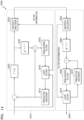
- FIG. 14 is a block diagram of an image encoding and decoding system according to an unclaimed example.
- An encoding terminal 2010 of the image encoding and decoding system 2000 transmits a bitstream which includes encoded data of an image, and a decoding terminal 2050 thereof receives and decodes the bitstream and outputs a reconstructed image.
- the encoding terminal 2010 may have a configuration similar to that of the image encoding device 900 described above, and the decoding terminal 2050 may have a configuration similar to that of the image decoding device 700.
- a predictive encoder 2015 outputs an image predicted by inter prediction and intra prediction, and a transform and quantization unit 2020 transforms and quantizes residual data between the predicted image and an input current image, and outputs quantized transform coefficients.
- the predictive encoder 2015 may encode a region, to which the low-quality coding mode is to be applied, at low quality.
- An entropy encoder 2025 encodes the quantized transform coefficient and outputs a result of encoding in the form of a bitstream.
- the quantized transform coefficient is reconstructed to spatial-domain data through an inverse quantization and inverse transform unit 2030, and the reconstructed spatial-domain data is output as a reconstructed image through a deblocking filter 2035 and a loop filter 2040.
- the reconstructed image may be used as a reference image for a next input image through the predictive encoder 2015.
- the predictive encoder 2015 and the transform and quantization unit 2020 of the encoder terminal 2010 may correspond to the encoder 910 of the image encoding device 900, and the entropy encoder 2025 may correspond to the generator 930 of the image encoding device 900.
- the encoded data of the image in the bitstream, which is received by the decoding terminal 2050, is reconstructed as spatial-domain residual data through an entropy decoder 2055 and an inverse quantization and inverse transform unit 2060.
- the predicted image which are output from a predictive decoder 2075 and the residual data may be combined together to form spatial-domain image data, and a deblocking filter 2065 and a loop filter 2070 may filter the spatial-domain image data and output a reconstructed image of a current original image.
- the reconstructed image may be used as a reference image for a next original image by the predictive decoder 2075.
- the entropy decoder 2055 of the decoding terminal 2050 may correspond to the obtainer 710 of the image decoding device 700, and the inverse quantization and inverse transform unit 2060 and the predictive decoder 2075 may correspond to the decoder 730.
- the predictive decoder 2075 may reconstruct a region encoded at low quality and change a texture feature of the reconstructed region.
- the loop filter 2040 of the encoding terminal 2010 performs loop filtering using filter information input according to a user input or system setting.
- the filter information used by the loop filter 2040 is output to the entropy encoder 2025 and the entropy encoder 2025 transmits the filter information to the decoding terminal 2050, together with the encoded image data.
- the loop filter 2070 of the decoding terminal 2050 may perform loop filtering, based on the filter information input from the decoding terminal 2050.
- the above-described embodiments of the present disclosure may be written as a program executable in a computer, and the program may be stored in a medium.
- the medium may continuously store a computer executable program or temporarily store the computer executable program to execute or download it.
- Examples of the medium may include various types of recording means or storage means, each of which may be a single hardware device or a combination of several hardware devices, are not limited to media directly connected to a computer system and may be distributed in a network.
- Examples of the medium include magnetic media such as hard disks, floppy disks and magnetic tapes, optical recording media such as CD-ROMs and DVDs, magneto-optical media such as floptical disks, ROM, RAM, flash memory, and the like, and may be configured to store program instructions.
- Examples of the medium may further include recording media or storage media managed by an application store that distributes applications, sites that supply or distribute various types of software, servers, or the like.
Landscapes
- Engineering & Computer Science (AREA)
- Signal Processing (AREA)
- Multimedia (AREA)
- Physics & Mathematics (AREA)
- Theoretical Computer Science (AREA)
- General Physics & Mathematics (AREA)
- General Health & Medical Sciences (AREA)
- General Engineering & Computer Science (AREA)
- Data Mining & Analysis (AREA)
- Evolutionary Computation (AREA)
- Biophysics (AREA)
- Molecular Biology (AREA)
- Computing Systems (AREA)
- Computational Linguistics (AREA)
- Biomedical Technology (AREA)
- Mathematical Physics (AREA)
- Software Systems (AREA)
- Artificial Intelligence (AREA)
- Life Sciences & Earth Sciences (AREA)
- Health & Medical Sciences (AREA)
- Compression Or Coding Systems Of Tv Signals (AREA)
Claims (4)
- Verfahren zum Decodieren eines Bildes, wobei das Verfahren umfasst:Rekonstruieren eines Zielbereichs und mindestens eines Referenzbereichs in dem Bild basierend auf Informationen, die aus einem Bitstrom erhalten werden, wobei der Zielbereich nach Anwendung von mindestens einem von Downsampling oder Tiefpassfilterung auf den Zielbereich codiert wird und der mindestens eine Referenzbereich mit normaler Qualität oder hoher Qualität codiert wird;Bestimmen (S310) des mindestens einen Referenzbereichs, auf den durch den Zielbereich verwiesen werden soll;Extrahieren (S320) eines Referenztexturmerkmals aus dem bestimmten mindestens einen Referenzbereich durch Eingeben des mindestens einen Referenzbereichs in ein erstes faltendes neuronales Netzwerk, (Convolutional Neural Network - CNN), das konfiguriert ist, dass es Texturmerkmale extrahiert;Nachbearbeiten des Zielbereichs durch Anwenden von mindestens Upsampling oder Hochpassfilterung auf den Zielbereich, undÄndern (S330) von Pixelwerten des nachbearbeiteten Zielbereichs basierend auf dem Referenztexturmerkmal durch Anwenden des Zielbereichs und des mindestens einen Referenzbereichs auf ein zweites CNN, das trainiert ist, den Abstand zwischen einem Texturmerkmal des Zielbereichs und dem Referenztexturmerkmal des mindestens einen Referenzbereichs zu minimieren,wobei ein Texturbereich in dem Bild unter Berücksichtigung von Eigenschaften des Bildes einschließlich Pixelwerten bestimmt wird, wobei der Texturbereich ein Bereich mit ähnlichen Texturmerkmalen ist,wobei der Texturbereich des Bildes unter Berücksichtigung von Merkmalen des Texturbereichs in eine Vielzahl von Bereichen aufgeteilt wird und der Zielbereich und der mindestens eine Referenzbereich aus der Vielzahl von Bereichen ausgewählt werden.
- Verfahren nach Anspruch 1, wobei das Rekonstruieren des Zielbereichs umfasst:Rekonstruieren des mindestens einen Referenzbereichs durch Erhalten, aus dem Bitstrom, von Informationen, die als ein Ergebnis des Codierens eines Referenzbereichs, der in einem Originalbild enthalten ist, erzeugt werden; undRekonstruieren des Zielbereichs durch Erhalten, aus dem Bitstrom, von Informationen, die als ein Ergebnis von Codieren des Zielbereichs, der in einem Bild geringer Qualität enthalten ist, das dem Originalbild entspricht, erzeugt werden.
- Verfahren nach Anspruch 1, ferner umfassend, wenn der bestimmte mindestens eine Referenzbereich mehrere Referenzbereiche enthält, Identifizieren von Typen von Referenztexturmerkmalen, die aus der Vielzahl von Referenzbereichen zu extrahieren sind, und
wobei das Extrahieren des Referenztexturmerkmals das Extrahieren der identifizierten Typen von Referenztexturmerkmalen aus der Vielzahl von Referenzbereichen umfasst. - Bilddecodierungsvorrichtung (700), umfassend:einen Prozessor; undeinen Speicher, der mindestens eine Anweisung speichert, wobei der Prozessor konfiguriert ist, dass er die mindestens eine folgende Anweisung ausführt:Rekonstruieren eines Zielbereichs und mindestens eines Referenzbereichs in dem Bild basierend auf Informationen, die aus einem Bitstrom erhalten werden, wobei der Zielbereich nach Anwendung von mindestens Downsampling oder Tiefpassfilterung auf den Zielbereich codiert wird und der mindestens eine Referenzbereich mit normaler Qualität oder hoher Qualität codiert wird;Bestimmen des mindestens einen Referenzbereichs, auf den durch den Zielbereich verwiesen werden soll;Extrahieren eines Referenztexturmerkmals aus dem bestimmten mindestens einen Referenzbereich durch Eingeben des mindestens einen Referenzbereichs in ein erstes faltendes neuronales Netzwerk (CNN), das konfiguriert ist, dass es Texturmerkmale extrahiert;Nachbearbeiten des Zielbereichs durch Anwenden von mindestens Upsampling oder Hochpassfilterung auf den Zielbereich, undÄndern der Pixelwerte des nachbearbeiteten Zielbereichs basierend auf dem Referenztexturmerkmal durch Anwenden des Zielbereichs und des mindestens einen Referenzbereichs auf ein zweites CNN, das trainiert ist, den Abstand zwischen einem Texturmerkmal des Zielbereichs und dem Referenztexturmerkmal des mindestens einen Referenzbereichs zu minimieren,wobei ein Texturbereich in dem Bild unter Berücksichtigung von Eigenschaften des Bildes einschließlich Pixelwerten bestimmt wird, wobei der Texturbereich ein Bereich mit ähnlichen Texturmerkmalen ist,wobei der Texturbereich des Bildes unter Berücksichtigung von Merkmalen des Texturbereichs in eine Vielzahl von Bereichen aufgeteilt wird und der Zielbereich und der mindestens eine Referenzbereich aus der Vielzahl von Bereichen ausgewählt werden.
Applications Claiming Priority (2)
| Application Number | Priority Date | Filing Date | Title |
|---|---|---|---|
| US201762580684P | 2017-11-02 | 2017-11-02 | |
| PCT/KR2018/010126 WO2019088435A1 (ko) | 2017-11-02 | 2018-08-31 | 로우-퀄리티 부호화 모드에 따라 영상을 부호화하는 방법 및 장치, 및 영상을 복호화하는 방법 및 장치 |
Publications (3)
| Publication Number | Publication Date |
|---|---|
| EP3672243A1 EP3672243A1 (de) | 2020-06-24 |
| EP3672243A4 EP3672243A4 (de) | 2020-07-29 |
| EP3672243B1 true EP3672243B1 (de) | 2025-03-26 |
Family
ID=66332037
Family Applications (1)
| Application Number | Title | Priority Date | Filing Date |
|---|---|---|---|
| EP18874338.9A Active EP3672243B1 (de) | 2017-11-02 | 2018-08-31 | Verfahren und vorrichtung zur bildcodierung nach einem niederwertigen codierungsmodus sowie verfahren und vorrichtung zur bilddecodierung |
Country Status (4)
| Country | Link |
|---|---|
| US (1) | US20200296358A1 (de) |
| EP (1) | EP3672243B1 (de) |
| KR (1) | KR102323395B1 (de) |
| WO (1) | WO2019088435A1 (de) |
Families Citing this family (3)
| Publication number | Priority date | Publication date | Assignee | Title |
|---|---|---|---|---|
| WO2021245278A1 (en) * | 2020-06-05 | 2021-12-09 | Unity IPR ApS | Methods and systems for optimal transport of non-linear transformations |
| CN116095309B (zh) * | 2022-01-19 | 2024-10-25 | 杭州海康威视数字技术股份有限公司 | 一种解码、编码方法、装置及其设备 |
| CN117437310B (zh) * | 2023-12-21 | 2024-02-27 | 天津市第五中心医院 | 一种类器官培养图像压缩方法 |
Citations (2)
| Publication number | Priority date | Publication date | Assignee | Title |
|---|---|---|---|---|
| US20080152243A1 (en) * | 2006-12-20 | 2008-06-26 | Samsung Electronics Co., Ltd. | Image encoding and decoding method and apparatus using texture synthesis |
| US20090322778A1 (en) * | 2002-02-21 | 2009-12-31 | At&T Corp. | System and method for encoding and decoding using texture replacement |
Family Cites Families (9)
| Publication number | Priority date | Publication date | Assignee | Title |
|---|---|---|---|---|
| US8155184B2 (en) * | 2008-01-16 | 2012-04-10 | Sony Corporation | Video coding system using texture analysis and synthesis in a scalable coding framework |
| US8447128B2 (en) * | 2008-04-07 | 2013-05-21 | Fujifilm Corporation | Image processing system |
| US8577158B2 (en) * | 2008-06-27 | 2013-11-05 | Thomson Licensing | Methods and apparatus for texture compression using patch-based sampling texture synthesis |
| WO2012090181A1 (en) * | 2010-12-29 | 2012-07-05 | Nokia Corporation | Depth map coding |
| WO2014010583A1 (ja) * | 2012-07-09 | 2014-01-16 | 日本電信電話株式会社 | 映像符号化/復号方法、装置、プログラム、記録媒体 |
| KR20160078984A (ko) * | 2013-11-08 | 2016-07-05 | 톰슨 라이센싱 | 오리지널 이미지의 저품질 버전 및 에피톰으로부터 오리지널 이미지의 추정치를 구축하기 위한 방법 및 장치 |
| CN107736027B (zh) | 2015-06-12 | 2021-06-01 | 松下知识产权经营株式会社 | 图像编码方法、图像解码方法、图像编码装置及图像解码装置 |
| JP6530304B2 (ja) * | 2015-11-13 | 2019-06-12 | 日本電信電話株式会社 | 符号化方法、符号化装置及び符号化プログラム |
| US9836820B2 (en) * | 2016-03-03 | 2017-12-05 | Mitsubishi Electric Research Laboratories, Inc. | Image upsampling using global and local constraints |
-
2018
- 2018-08-31 KR KR1020207006644A patent/KR102323395B1/ko not_active Expired - Fee Related
- 2018-08-31 EP EP18874338.9A patent/EP3672243B1/de active Active
- 2018-08-31 US US16/759,540 patent/US20200296358A1/en not_active Abandoned
- 2018-08-31 WO PCT/KR2018/010126 patent/WO2019088435A1/ko not_active Ceased
Patent Citations (2)
| Publication number | Priority date | Publication date | Assignee | Title |
|---|---|---|---|---|
| US20090322778A1 (en) * | 2002-02-21 | 2009-12-31 | At&T Corp. | System and method for encoding and decoding using texture replacement |
| US20080152243A1 (en) * | 2006-12-20 | 2008-06-26 | Samsung Electronics Co., Ltd. | Image encoding and decoding method and apparatus using texture synthesis |
Non-Patent Citations (1)
| Title |
|---|
| LEON A GATYS ET AL: "Texture Synthesis Using Convolutional Neural Networks", 27 May 2015 (2015-05-27), XP055430132, Retrieved from the Internet <URL:https://pdfs.semanticscholar.org/f54a/e5229960b828db7cd963150c8b8bc2684737.pdf> [retrieved on 20171129] * |
Also Published As
| Publication number | Publication date |
|---|---|
| KR20200033339A (ko) | 2020-03-27 |
| KR102323395B1 (ko) | 2021-11-08 |
| EP3672243A1 (de) | 2020-06-24 |
| US20200296358A1 (en) | 2020-09-17 |
| WO2019088435A1 (ko) | 2019-05-09 |
| EP3672243A4 (de) | 2020-07-29 |
Similar Documents
| Publication | Publication Date | Title |
|---|---|---|
| US12192537B2 (en) | Temporal signalling for video coding technology | |
| CN112889283B (zh) | 编码方法及其设备以及解码方法及其设备 | |
| JP5907941B2 (ja) | ビデオ画像の刈り取り方法及び装置 | |
| US8223837B2 (en) | Learning-based image compression | |
| US8249154B2 (en) | Method and apparatus for encoding/decoding image based on intra prediction | |
| EP4142289A1 (de) | Verfahren, vorrichtung und computerprogrammprodukt zur videocodierung und videodecodierung | |
| EP3672243B1 (de) | Verfahren und vorrichtung zur bildcodierung nach einem niederwertigen codierungsmodus sowie verfahren und vorrichtung zur bilddecodierung | |
| WO2011045758A1 (en) | Method and device for processing a video sequence | |
| EP4480176A1 (de) | Verfahren, vorrichtung und computerprogrammprodukt zur videocodierung | |
| WO2023111384A1 (en) | A method, an apparatus and a computer program product for video encoding and video decoding | |
| WO2023208638A1 (en) | Post processing filters suitable for neural-network-based codecs | |
| Ma et al. | DeepFGS: Fine-grained scalable coding for learned image compression | |
| WO2023073281A1 (en) | A method, an apparatus and a computer program product for video coding | |
| US20240073425A1 (en) | Image encoding apparatus and image decoding apparatus both based on artificial intelligence, and image encoding method and image decoding method performed by the image encoding apparatus and the image decoding apparatus | |
| WO2024074231A1 (en) | A method, an apparatus and a computer program product for image and video processing using neural network branches with different receptive fields | |
| Ahonen et al. | NN-VVC: Versatile Video Coding boosted by self-supervisedly learned image coding for machines | |
| WO2023089231A1 (en) | A method, an apparatus and a computer program product for video encoding and video decoding | |
| US12549718B2 (en) | Image processing method and device for AI-based filtering | |
| Seppälä et al. | Enhancing image coding for machines with compressed feature residuals | |
| KR20230065888A (ko) | Ai 기반 필터링을 위한 영상 처리 방법 및 장치 | |
| Ahonen et al. | Nn-vvc: A hybrid learned-conventional video codec targeting humans and machines | |
| KR20250149586A (ko) | 최적화된 후처리 기반의 비디오 부/복호화 방법 및 장치 | |
| WO2025202411A1 (en) | Rate distortion optimisation implementation and method | |
| Zain et al. | Adaptive conventional-learning video signal compression framework using texture fulfillment | |
| KR20250020262A (ko) | 최적화된 후처리를 위한 비디오 부/복호화 방법 및 장치 |
Legal Events
| Date | Code | Title | Description |
|---|---|---|---|
| STAA | Information on the status of an ep patent application or granted ep patent |
Free format text: STATUS: THE INTERNATIONAL PUBLICATION HAS BEEN MADE |
|
| PUAI | Public reference made under article 153(3) epc to a published international application that has entered the european phase |
Free format text: ORIGINAL CODE: 0009012 |
|
| STAA | Information on the status of an ep patent application or granted ep patent |
Free format text: STATUS: REQUEST FOR EXAMINATION WAS MADE |
|
| REG | Reference to a national code |
Ref country code: DE Ref legal event code: R079 Free format text: PREVIOUS MAIN CLASS: H04N0019157000 Ipc: H04N0019850000 |
|
| 17P | Request for examination filed |
Effective date: 20200319 |
|
| AK | Designated contracting states |
Kind code of ref document: A1 Designated state(s): AL AT BE BG CH CY CZ DE DK EE ES FI FR GB GR HR HU IE IS IT LI LT LU LV MC MK MT NL NO PL PT RO RS SE SI SK SM TR |
|
| AX | Request for extension of the european patent |
Extension state: BA ME |
|
| A4 | Supplementary search report drawn up and despatched |
Effective date: 20200626 |
|
| RIC1 | Information provided on ipc code assigned before grant |
Ipc: H04N 19/182 20140101ALI20200622BHEP Ipc: H04N 19/124 20140101ALI20200622BHEP Ipc: H04N 19/105 20140101ALI20200622BHEP Ipc: H04N 19/136 20140101ALI20200622BHEP Ipc: G06T 5/00 20060101ALI20200622BHEP Ipc: G06N 3/02 20060101ALI20200622BHEP Ipc: H04N 19/85 20140101AFI20200622BHEP Ipc: H04N 19/59 20140101ALI20200622BHEP Ipc: G06N 99/00 20190101ALI20200622BHEP Ipc: H04N 19/17 20140101ALI20200622BHEP |
|
| DAV | Request for validation of the european patent (deleted) | ||
| DAX | Request for extension of the european patent (deleted) | ||
| STAA | Information on the status of an ep patent application or granted ep patent |
Free format text: STATUS: EXAMINATION IS IN PROGRESS |
|
| 17Q | First examination report despatched |
Effective date: 20230615 |
|
| GRAP | Despatch of communication of intention to grant a patent |
Free format text: ORIGINAL CODE: EPIDOSNIGR1 |
|
| STAA | Information on the status of an ep patent application or granted ep patent |
Free format text: STATUS: GRANT OF PATENT IS INTENDED |
|
| INTG | Intention to grant announced |
Effective date: 20241205 |
|
| GRAS | Grant fee paid |
Free format text: ORIGINAL CODE: EPIDOSNIGR3 |
|
| GRAA | (expected) grant |
Free format text: ORIGINAL CODE: 0009210 |
|
| STAA | Information on the status of an ep patent application or granted ep patent |
Free format text: STATUS: THE PATENT HAS BEEN GRANTED |
|
| AK | Designated contracting states |
Kind code of ref document: B1 Designated state(s): AL AT BE BG CH CY CZ DE DK EE ES FI FR GB GR HR HU IE IS IT LI LT LU LV MC MK MT NL NO PL PT RO RS SE SI SK SM TR |
|
| REG | Reference to a national code |
Ref country code: GB Ref legal event code: FG4D |
|
| REG | Reference to a national code |
Ref country code: CH Ref legal event code: EP |
|
| REG | Reference to a national code |
Ref country code: DE Ref legal event code: R096 Ref document number: 602018080571 Country of ref document: DE |
|
| REG | Reference to a national code |
Ref country code: IE Ref legal event code: FG4D |
|
| PG25 | Lapsed in a contracting state [announced via postgrant information from national office to epo] |
Ref country code: RS Free format text: LAPSE BECAUSE OF FAILURE TO SUBMIT A TRANSLATION OF THE DESCRIPTION OR TO PAY THE FEE WITHIN THE PRESCRIBED TIME-LIMIT Effective date: 20250626 |
|
| PG25 | Lapsed in a contracting state [announced via postgrant information from national office to epo] |
Ref country code: FI Free format text: LAPSE BECAUSE OF FAILURE TO SUBMIT A TRANSLATION OF THE DESCRIPTION OR TO PAY THE FEE WITHIN THE PRESCRIBED TIME-LIMIT Effective date: 20250326 |
|
| REG | Reference to a national code |
Ref country code: LT Ref legal event code: MG9D |
|
| PG25 | Lapsed in a contracting state [announced via postgrant information from national office to epo] |
Ref country code: NO Free format text: LAPSE BECAUSE OF FAILURE TO SUBMIT A TRANSLATION OF THE DESCRIPTION OR TO PAY THE FEE WITHIN THE PRESCRIBED TIME-LIMIT Effective date: 20250626 |
|
| PG25 | Lapsed in a contracting state [announced via postgrant information from national office to epo] |
Ref country code: HR Free format text: LAPSE BECAUSE OF FAILURE TO SUBMIT A TRANSLATION OF THE DESCRIPTION OR TO PAY THE FEE WITHIN THE PRESCRIBED TIME-LIMIT Effective date: 20250326 |
|
| PG25 | Lapsed in a contracting state [announced via postgrant information from national office to epo] |
Ref country code: LV Free format text: LAPSE BECAUSE OF FAILURE TO SUBMIT A TRANSLATION OF THE DESCRIPTION OR TO PAY THE FEE WITHIN THE PRESCRIBED TIME-LIMIT Effective date: 20250326 |
|
| PG25 | Lapsed in a contracting state [announced via postgrant information from national office to epo] |
Ref country code: GR Free format text: LAPSE BECAUSE OF FAILURE TO SUBMIT A TRANSLATION OF THE DESCRIPTION OR TO PAY THE FEE WITHIN THE PRESCRIBED TIME-LIMIT Effective date: 20250627 Ref country code: BG Free format text: LAPSE BECAUSE OF FAILURE TO SUBMIT A TRANSLATION OF THE DESCRIPTION OR TO PAY THE FEE WITHIN THE PRESCRIBED TIME-LIMIT Effective date: 20250326 |
|
| REG | Reference to a national code |
Ref country code: NL Ref legal event code: MP Effective date: 20250326 |
|
| PG25 | Lapsed in a contracting state [announced via postgrant information from national office to epo] |
Ref country code: NL Free format text: LAPSE BECAUSE OF FAILURE TO SUBMIT A TRANSLATION OF THE DESCRIPTION OR TO PAY THE FEE WITHIN THE PRESCRIBED TIME-LIMIT Effective date: 20250326 |
|
| PG25 | Lapsed in a contracting state [announced via postgrant information from national office to epo] |
Ref country code: SE Free format text: LAPSE BECAUSE OF FAILURE TO SUBMIT A TRANSLATION OF THE DESCRIPTION OR TO PAY THE FEE WITHIN THE PRESCRIBED TIME-LIMIT Effective date: 20250326 |
|
| REG | Reference to a national code |
Ref country code: AT Ref legal event code: MK05 Ref document number: 1780156 Country of ref document: AT Kind code of ref document: T Effective date: 20250326 |
|
| PG25 | Lapsed in a contracting state [announced via postgrant information from national office to epo] |
Ref country code: SM Free format text: LAPSE BECAUSE OF FAILURE TO SUBMIT A TRANSLATION OF THE DESCRIPTION OR TO PAY THE FEE WITHIN THE PRESCRIBED TIME-LIMIT Effective date: 20250326 |
|
| PG25 | Lapsed in a contracting state [announced via postgrant information from national office to epo] |
Ref country code: PT Free format text: LAPSE BECAUSE OF FAILURE TO SUBMIT A TRANSLATION OF THE DESCRIPTION OR TO PAY THE FEE WITHIN THE PRESCRIBED TIME-LIMIT Effective date: 20250728 Ref country code: ES Free format text: LAPSE BECAUSE OF FAILURE TO SUBMIT A TRANSLATION OF THE DESCRIPTION OR TO PAY THE FEE WITHIN THE PRESCRIBED TIME-LIMIT Effective date: 20250326 |
|
| PGFP | Annual fee paid to national office [announced via postgrant information from national office to epo] |
Ref country code: DE Payment date: 20250721 Year of fee payment: 8 |
|
| PG25 | Lapsed in a contracting state [announced via postgrant information from national office to epo] |
Ref country code: IT Free format text: LAPSE BECAUSE OF FAILURE TO SUBMIT A TRANSLATION OF THE DESCRIPTION OR TO PAY THE FEE WITHIN THE PRESCRIBED TIME-LIMIT Effective date: 20250326 Ref country code: PL Free format text: LAPSE BECAUSE OF FAILURE TO SUBMIT A TRANSLATION OF THE DESCRIPTION OR TO PAY THE FEE WITHIN THE PRESCRIBED TIME-LIMIT Effective date: 20250326 |
|
| PGFP | Annual fee paid to national office [announced via postgrant information from national office to epo] |
Ref country code: GB Payment date: 20250722 Year of fee payment: 8 |
|
| PG25 | Lapsed in a contracting state [announced via postgrant information from national office to epo] |
Ref country code: AT Free format text: LAPSE BECAUSE OF FAILURE TO SUBMIT A TRANSLATION OF THE DESCRIPTION OR TO PAY THE FEE WITHIN THE PRESCRIBED TIME-LIMIT Effective date: 20250326 |
|
| PG25 | Lapsed in a contracting state [announced via postgrant information from national office to epo] |
Ref country code: EE Free format text: LAPSE BECAUSE OF FAILURE TO SUBMIT A TRANSLATION OF THE DESCRIPTION OR TO PAY THE FEE WITHIN THE PRESCRIBED TIME-LIMIT Effective date: 20250326 |
|
| PG25 | Lapsed in a contracting state [announced via postgrant information from national office to epo] |
Ref country code: RO Free format text: LAPSE BECAUSE OF FAILURE TO SUBMIT A TRANSLATION OF THE DESCRIPTION OR TO PAY THE FEE WITHIN THE PRESCRIBED TIME-LIMIT Effective date: 20250326 |
|
| PG25 | Lapsed in a contracting state [announced via postgrant information from national office to epo] |
Ref country code: SK Free format text: LAPSE BECAUSE OF FAILURE TO SUBMIT A TRANSLATION OF THE DESCRIPTION OR TO PAY THE FEE WITHIN THE PRESCRIBED TIME-LIMIT Effective date: 20250326 |
|
| PG25 | Lapsed in a contracting state [announced via postgrant information from national office to epo] |
Ref country code: IS Free format text: LAPSE BECAUSE OF FAILURE TO SUBMIT A TRANSLATION OF THE DESCRIPTION OR TO PAY THE FEE WITHIN THE PRESCRIBED TIME-LIMIT Effective date: 20250726 |
|
| REG | Reference to a national code |
Ref country code: DE Ref legal event code: R097 Ref document number: 602018080571 Country of ref document: DE |
|
| PG25 | Lapsed in a contracting state [announced via postgrant information from national office to epo] |
Ref country code: DK Free format text: LAPSE BECAUSE OF FAILURE TO SUBMIT A TRANSLATION OF THE DESCRIPTION OR TO PAY THE FEE WITHIN THE PRESCRIBED TIME-LIMIT Effective date: 20250326 |
|
| PG25 | Lapsed in a contracting state [announced via postgrant information from national office to epo] |
Ref country code: CZ Free format text: LAPSE BECAUSE OF FAILURE TO SUBMIT A TRANSLATION OF THE DESCRIPTION OR TO PAY THE FEE WITHIN THE PRESCRIBED TIME-LIMIT Effective date: 20250326 |
|
| PLBE | No opposition filed within time limit |
Free format text: ORIGINAL CODE: 0009261 |
|
| STAA | Information on the status of an ep patent application or granted ep patent |
Free format text: STATUS: NO OPPOSITION FILED WITHIN TIME LIMIT |
|
| REG | Reference to a national code |
Ref country code: CH Ref legal event code: L10 Free format text: ST27 STATUS EVENT CODE: U-0-0-L10-L00 (AS PROVIDED BY THE NATIONAL OFFICE) Effective date: 20260211 |
|
| 26N | No opposition filed |
Effective date: 20260105 |
|
| REG | Reference to a national code |
Ref country code: CH Ref legal event code: H13 Free format text: ST27 STATUS EVENT CODE: U-0-0-H10-H13 (AS PROVIDED BY THE NATIONAL OFFICE) Effective date: 20260324 |
|
| PG25 | Lapsed in a contracting state [announced via postgrant information from national office to epo] |
Ref country code: MC Free format text: LAPSE BECAUSE OF FAILURE TO SUBMIT A TRANSLATION OF THE DESCRIPTION OR TO PAY THE FEE WITHIN THE PRESCRIBED TIME-LIMIT Effective date: 20250326 |
|
| PG25 | Lapsed in a contracting state [announced via postgrant information from national office to epo] |
Ref country code: LU Free format text: LAPSE BECAUSE OF NON-PAYMENT OF DUE FEES Effective date: 20250831 |
|
| PG25 | Lapsed in a contracting state [announced via postgrant information from national office to epo] |
Ref country code: CH Free format text: LAPSE BECAUSE OF NON-PAYMENT OF DUE FEES Effective date: 20250831 |