EP3672334A1 - Procédé d'estimation d'avance de synchronisation dans une zone à grandes cellules - Google Patents
Procédé d'estimation d'avance de synchronisation dans une zone à grandes cellules Download PDFInfo
- Publication number
- EP3672334A1 EP3672334A1 EP18213649.9A EP18213649A EP3672334A1 EP 3672334 A1 EP3672334 A1 EP 3672334A1 EP 18213649 A EP18213649 A EP 18213649A EP 3672334 A1 EP3672334 A1 EP 3672334A1
- Authority
- EP
- European Patent Office
- Prior art keywords
- base station
- user equipment
- timing advance
- value
- enb
- Prior art date
- Legal status (The legal status is an assumption and is not a legal conclusion. Google has not performed a legal analysis and makes no representation as to the accuracy of the status listed.)
- Withdrawn
Links
- 238000000034 method Methods 0.000 title claims abstract description 58
- 230000001413 cellular effect Effects 0.000 claims abstract description 16
- 230000008054 signal transmission Effects 0.000 claims abstract description 6
- 238000004364 calculation method Methods 0.000 claims description 26
- 238000012937 correction Methods 0.000 claims description 23
- 230000004044 response Effects 0.000 claims description 22
- 230000011664 signaling Effects 0.000 claims description 9
- 238000013459 approach Methods 0.000 description 16
- 230000005540 biological transmission Effects 0.000 description 12
- 238000004891 communication Methods 0.000 description 10
- 238000005516 engineering process Methods 0.000 description 7
- 238000012545 processing Methods 0.000 description 5
- 238000010586 diagram Methods 0.000 description 4
- 230000008569 process Effects 0.000 description 2
- 239000002699 waste material Substances 0.000 description 2
- 230000010267 cellular communication Effects 0.000 description 1
- 238000012790 confirmation Methods 0.000 description 1
- 238000001514 detection method Methods 0.000 description 1
- 238000011161 development Methods 0.000 description 1
- 230000018109 developmental process Effects 0.000 description 1
- 230000003993 interaction Effects 0.000 description 1
- 238000005259 measurement Methods 0.000 description 1
- 230000009467 reduction Effects 0.000 description 1
- 230000003068 static effect Effects 0.000 description 1
- 230000001360 synchronised effect Effects 0.000 description 1
- 239000003039 volatile agent Substances 0.000 description 1
Images


Classifications
-
- H—ELECTRICITY
- H04—ELECTRIC COMMUNICATION TECHNIQUE
- H04W—WIRELESS COMMUNICATION NETWORKS
- H04W56/00—Synchronisation arrangements
- H04W56/0055—Synchronisation arrangements determining timing error of reception due to propagation delay
- H04W56/0065—Synchronisation arrangements determining timing error of reception due to propagation delay using measurement of signal travel time
- H04W56/009—Closed loop measurements
-
- H—ELECTRICITY
- H04—ELECTRIC COMMUNICATION TECHNIQUE
- H04W—WIRELESS COMMUNICATION NETWORKS
- H04W56/00—Synchronisation arrangements
- H04W56/001—Synchronization between nodes
- H04W56/0015—Synchronization between nodes one node acting as a reference for the others
-
- H—ELECTRICITY
- H04—ELECTRIC COMMUNICATION TECHNIQUE
- H04W—WIRELESS COMMUNICATION NETWORKS
- H04W56/00—Synchronisation arrangements
- H04W56/004—Synchronisation arrangements compensating for timing error of reception due to propagation delay
- H04W56/0045—Synchronisation arrangements compensating for timing error of reception due to propagation delay compensating for timing error by altering transmission time
-
- H—ELECTRICITY
- H04—ELECTRIC COMMUNICATION TECHNIQUE
- H04W—WIRELESS COMMUNICATION NETWORKS
- H04W56/00—Synchronisation arrangements
- H04W56/0055—Synchronisation arrangements determining timing error of reception due to propagation delay
- H04W56/006—Synchronisation arrangements determining timing error of reception due to propagation delay using known positions of transmitter and receiver
Definitions
- the present invention relates to a method for estimating an initial timing advance value for a user equipment.
- the invention also pertains to a user equipment using said method.
- the invention further relates to a method for a base station said user equipment is operating with.
- the invention also pertains to a base station using said method.
- the timing advance is known as a measure that is elaborated for synchronization of the user equipment with a base station.
- the value indicates the time gap that a wireless user equipment needs to send earlier in order to arrive at the base station at the expected time slot, under consideration of signal propagation delay. This applies especially to all cellular networks in 2G, 4G and beyond being based on a time-frequency grid.
- the timing advance (TA) is needed to ensure the arrival of the signals from different users having different distances to arrive at the base station at the designated time to comply to the time x frequency grid.
- the initial timing advance calculation is in particular performed during RACH access to the base station. It is known the 4-step RACH access and the 2-step RACH access.
- the base station calculates a timing advance based on first uplink transmission (msg1) and reports said value during RACH procedure (msg2) to the user equipment.
- msg1 first uplink transmission
- msg2 RACH procedure
- the timing advance is either supposed to be known in advance or the cell is very small so that timing deviations due to signal travelling times do not matter. The latter is in particular appropriate for fixed devices in very small cells, where timing advance does not need to be considered.
- the 2-step RACH is advantageous for the user equipment as it is way faster and hence results in less latency, and additionally requires less signalling for base station and user equipments.
- it requires a pre-known accurate timing advance which can be used/re-used in order to successfully carry out preferably the 2-step RACH.
- the first aspect of the invention it is proposed a method for a user equipment operating in a cellular network comprising a plurality of base stations, where the user equipment is operating with at least one base station supplying a cell, hereinafter the addressed base station, the method comprising the steps for the user equipment of:
- the inventive method relates to a user equipment being capable of operating with a base station of a cellular network for wireless communication, in particular those implementing the wireless technology standards like 4G (LTE), 5G (New Radio) or beyond.
- LTE Long Term Evolution
- 5G New Radio
- a cell of a base station is in particular rated as a large cell, when the timing advance needed for a user equipment is larger than the specified RACH window.
- the RACH window has a size of 200 ⁇ s.
- the inventive method is in the first place applied to large cell base stations, however for a user equipment it is needed to operate with large cell base stations and non-large cell base stations.
- Mainly the inventive method relates to the initial RACH message on the PRACH channel with the preamble for a contention based RACH communication.
- the user equipment would send the RACH message to the base station and in normal sized cells the request could be received by the base station in a respective RACH window comprising a RACH preamble.
- the base station With a PRACH response message the base station provides information to the requesting user equipment including a timing advance value which the base station derives from the received initial RACH message.
- the initial RACH message does not arrive in the prior mentioned RACH window.
- the initial message for setting up a connection resp. for registering on the base station might fail.
- the RACH window needs to be enhanced correspondingly which leads to a loss of UL resources as during said extension time the UL resources cannot be used for other purposes.
- the inventive method comes into play. According to that the user equipment carries out before sending a preamble message, in particular mentioned initial RACH message, to the base station a couple of additional steps.
- the user equipment receives information from the base station regarding an expected submission time of the preamble message.
- the submission time depicts the point in time when the preamble message is expected to be received by the base station. It lies among the RACH window.
- this information is submitted by means of a broadcast, in particular as part of the SIBs or the MIB (the latter for LTE and beyond) which refers to the received DL.
- the indication related to the submission time is typically depicted as a system frame number (SFN).
- SFN system frame number
- the next step carried out by the user equipment comprises estimation of a timing advance value relating to a signal transmission from the user equipment to the addressed base station.
- Timing advance as such is a negative offset, at the user equipment, between the start of a received downlink subframe and a transmitted uplink subframe. This offset at the user equipment is necessary to ensure that the downlink and uplink subframes are synchronized at the base station resp. eNodeB.
- the time for transmission is needed to be determined, so that with the timing advance value a value is estimated that the user equipment needs to signal earlier than the submission time received from the base station, in order to achieve that the preamble message arrives as good as possible at the submission time.
- the timing advance value gets larger when the cell is getting larger. hence the distance between the user equipment and the base station plays a decisive role.
- the distance may be calculated in time or spatial distance.
- the timing advance value can easily be translated, as taking into account the radio wave travelling time as speed of light in 3*10 ⁇ 8 m/s.
- the timing advance value is usually coded as incrementing values with respect to TS where TS is 1/(2048x15000).
- Translating this to a travelling time with speed of light it corresponds to 100,15km.
- the step of estimating the timing advance value from the user equipment to the addressed base station comprises:
- the distance is calculated by deriving the delay resp. pathloss of signals from the received reference signals of the base station. This is preferably for large cell situations advantageous, as such cells are supposed to appear in areas without many buildings or other obstacles, e.g. over the sea, in a desert or other outbacks.
- the user equipment receives and measure signals from the base station comprising so-called reference signals.
- the user equipment can derive the attenuation of said reference signals by means of measuring the received signal strength in comparison with the signal strength at its source.
- the base station broadcasts - e.g. in the SIBs - with which signal strength the reference signal is transmitted.
- this information is already available at the user equipment, e.g. from a previous attachment to the base station or another base station of the cellular network, in case the signal strength of the reference signal is a network defined constant.
- the determined pathloss can be calculated into a distance in meters.
- the formula is well known in literature.
- the broadcast or another repeatedly occurring signal could also include a timestamp being referenced to the beginning or the end of the transmitted signal i.e. when the entire message left the base station and the user equipment would record the receiving time and once processed compare receiving and transmitting time. Or knowing its processing and deriving from that the reception time.
- the step of calculating the distance comprises ascertaining the geographical position of the user equipment and the geographical position of the addressed base station, and carrying out a bee line distance calculation between both positions.
- GNSS global navigation satellite system
- sensors like beacon, dead-reckoning, and also cellular network based positioning, or a combination thereof, are also encompassed by this embodiment.
- the current position may even be preconfigured, e.g. through manual input or automatic detection through a temporary connected positioning sensor.
- the first option comprises that the user equipment has available a lookup table, like a codebook, where for a certain global cell Id the geographic position is maintained.
- this codebook mainly comprises the positions for large cell base stations. These will most probably be quite stable and do not require frequent updates.
- the step of ascertaining the geographical position of the address base station comprises retrieving a broadcast signals transmitted by the addressed base station comprising a representation of the current geographical position of the base station.
- the base station itself provides its current position. This is in particular preferably for base stations which are not fixed.
- the geographic position is provided by way of latitude/longitude or a representation there of, like a quadtree-code or other type of two-dimensional index.
- the distance is then simply calculated, where depending upon the needed accuracy and the processing power various calculation formulas are available.
- the most accurate, based on a sphere, is the orthodrome calculation, which basically calculates a great circle (a virtual meridian) linking both positions, and derives which share of the great circle lies between both positions.
- the great circle has assumed the length of the equator (40075km), hence with the share the distance is easily calculated.
- the step of calculating the distance comprises said calculation of the distance based on attenuation value and said calculation of the distance based on geographical positions, and wherein in case of a difference between said calculating distances, the step of translating the distance value into the timing advance value considering the larger of said calculated distances.
- This embodiment comprises that a combination of distance calculation methods are carried out, in particular via pathloss calculation and geospacial calculation. However, when both calculations lead to different values, then preferably the larger value is taken into account.
- the signal offset is a time value in ⁇ s , and this can be derived from the timing advance value, as mentioned before, that 1 timing advance value unit relates to 3,69 ⁇ s .
- inventive method comprises that the preamble message is submitted at the calculated point in time by the user equipment to the base station.
- This preamble message additionally comprises the value relating to the estimated timing advance value.
- That estimated timing advance value informs the addressed base station about the estimation the user equipment made based on the available information about the distance between both, and consequently the applied timing advance, on which basis the point in time of submitting the preamble message was induced.
- the indicated submission time is relative to frame borders, it is recurring. Hence, should the calculated point in time have already passed, then the user equipment waits for the next frame, when sufficient time before the indicated submission time arrives.
- This embodiment relates to the response from the base station when the preamble message was well received. With that the user equipment is mainly informed about a timing advance correction value. This timing advance correction value is supposed to be used for the subsequent communication.
- the timing advance correction value is based on the estimated timing advance value which was provided by the user equipment with the preamble message and was taken into account for defining the point in time for submitting the preamble message in order to meet the indicated submission time.
- the estimated timing advance value it is achieved first that the user equipment can also in large cell areas submit its preamble message without increasing the RACH window size at the base station and waste resources there.
- the 2-step-RACH procedure expects that the user equipment can apply an accurate timing advance value. It is known that in particular in the case of very small cells or for stationary operated user equipments, who received the timing advance value in earlier interaction with the same base station, the 2-step RACH procedure is applicable.
- the 2-step-RACH procedure saves signalling, delay and power consumption, hence it is advantageous both for the user equipment and the cellular network resp. the addressed base station.
- a user equipment for operating in a cellular network comprising a plurality of base stations, where the user equipment is configured to operate with at least one base station supplying a cell, hereinafter the addressed base station, wherein the user equipment is configured to:
- the user equipment provides a couple of components for conducting wireless communication. This comprises at least processing circuitry for executing operation software, in particular those implementing the method of the first aspect of the invention.
- the user equipment comprises transmitting and receiving circuitry in connection with at least one antenna, typically a transceiver for exchanging wireless communication signals with a base station of the cellular network.
- a memory unit for volatiles and/or permanent storage of executable software, configuration data like a codebook and measured data e.g. before receiving the transmission from the serving base station.
- the second aspect of the invention shares the advantages of the first aspect of the invention.
- the base station serving at least one user equipment, wherein the method comprises the steps of:
- This aspect of the invention relates to the base station as counterpart on the air interface for a user equipment according to the second aspect of the invention.
- the base station is one of a plurality of base station of the cellular network, and configured to implement the technology standard of 4G, 5G or beyond.
- This base station is in particular covering a large area cell, which means that the cell has a radius larger than 35 km.
- a preamble message from a user equipment operating in the cell area may be received.
- the preamble message complements to the RACH preamble for setting up a communication link of the user equipment with the base station.
- the base station For getting preamble messages the base station preferably reserves a certain time window on the respective channel PRACH.
- the time window is situated around a system frame depicting the expected submission time of the RACH preamble message.
- the system frame number of the expected submission time is signaled to the user equipment, in particular by way of a broadcast, e.g. the SIBs.
- the time window considering the submission time, in particular a certain gap before and after the submission time, is reserved by the base station for preamble messages.
- Such step of reservation might in particular carried out constantly, that is in each frame at a certain symbol etc.
- This preamble message is supposed to comprise a timing advance value. That is the value that is expected to be taken into account by the transmitting user equipment according to the second aspect of the invention. That means, the preamble message is shifted before the indicated submission time by a time gap relating to the timing advance value.
- This aspect of the invention is advantageous as the expected time window has a limited size and no resources need to be reserved in vain.
- the window size is consequently not or merely influenced by the cell size. This further leads to faster connection setup, therefore allowing also in large cell areas to a acceptable response time.
- the base station is supposed to inform the user equipment about the accuracy of the estimation of the timing advance value.
- the method comprises that the timing advance value received with the preamble message is put into relation to the reception time of the preamble message.
- the base station has means for measuring and maintaining that time.
- the base station may calculate if the arrival time was too early in comparison to the indicated transmission time, then the timing advance value needed to be reduced. Should the arrival time be too late, then the timing advance value needed to be increased.
- timing advance correction value representing the calculated increase or decrease of the timing advance value is submitted to the user equipment.
- the response message is either a simple RACH response confirming arrival and providing the user equipment with additional information, or it is a connection setup message.
- the two step RACH already contains in its first message a UE-ID which is directly re-used in the second step by the base station i.e. the assignment.
- next message from the user equipment is expected to consider the timing advance correction value for the timing of the next message.
- the two step RACH is preferably only enhanced by the method of providing an initial TA estimate by the UE to the base-station so that its usage is not only restricted to user equipments having pre-knowledge on their TA such as static user equipments in a subsequent attempt or user equipments in small cells but also available for user equipments being able to perform decent good TA estimate and including said estimate in their first transmission.
- the method comprises the step of signalling an indication to the user equipment relating to the capability of the base station of supporting receiving from a user equipment a preamble message comprising an timing advance value estimated by said user equipment.
- the base station informs prior to the transmission of the preamble message that the base station supports the submission of a preamble message with the timing advance value.
- this indication might be achieved by an indication of being a large cell base station.
- a RACH preamble message would be expected to be transmitted at a point in time considering an estimation of the timing advance value.
- the method comprises the step of transmitting at least one broadcast message, said broadcast message comprising a representation of the current geographical position of the base station.
- the base station informs the user equipment about its geographic position. This is irrespective of if the base station is stationary (as usual) or somehow moving.
- the user equipment With the geographic position of the base station and its own geographic position the user equipment can very accurately calculate the distance between user equipment and the base station. Hence according to an embodiment of the first aspect of the invention an accurate timing advance value estimation is possible.
- the timing advance value may be calculated even better, and hence used for the RACH preamble message by the user equipment.
- a base station of a cellular network serving at least one user equipment, wherein the base station is configured to:
- the base station comprises receiving and transmitting circuitry as well as at least one antenna. Further it comprises processing circuitry for controlling operation of the base station. Additionally it comprises volatile and/or permanent memory at least for storing configuration and operating software.
- the base station according to this aspect of the invention shares the advantages of the third aspect of the invention.
- the base station is deployed on a satellite.
- the line of sight will not be disturbed apart from (constant) atmospheric refraction.
- the user equipment may have good chances to make a good distance estimation and consequently calculate a quite accurate timing advance value for use for the preamble message.
- this invention advantageously solves the depicted problem and suggests an improved way of connection setup of a user equipment, in particular in large area cells.
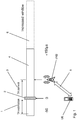
- FIG. 1 schematically shows for a user equipment UE of the type to which the present invention is applied as an embodiment the situation relating to the timing of an initial RACH message from the user equipment UE to the base station eNB.
- the user equipment UE is situated in the cell area of base station eNB, the user equipment being situated in a certain distance 5 from the base station eNB.
- RACH stands for Random Access Channel and it is typically the first message from a user equipment to the base station when starting to operate together.
- the base station as suitable and best available base station, and received the broadcast signals, in particular the SIBs, transmitted by the base station eNB.
- the base station eNB reserves a RACH window 4, for receiving such initial RACH messages.
- the RACH window 4 might not be sufficient, due to the time the signalling from the user equipment UE to the base station eNB is running. In a trivial approach the RACH window would needed to be enlarged by the increased window area 6.
- the user equipment is capable to send the initial RACH message to the base station eNB at a time so that the RACH message arrives at the base station in the RACH window 4.
- the user equipment UE carries out a estimation of the timing advance, resulting in a timing advance estimation value 1.
- a submission time Prior to that the user equipment receives from the base station eNB, in particular by means of the SIBs, an indication about a submission time 2. That submission time is in particular indicated by a system frame number (SFN).
- SFN system frame number
- the submission time 2 indicates the time when the initial RACH message is in the ideal case expected to arrive at the base station eNB.
- the timing advance estimation value 1 is based on the calculation of the distance 5 between the user equipment UE and the base station eNB. In a large cell the distance is most probably the decisive parameter for calculating the timing advance.
- the timing advance estimation value 1 is directly translated from the distance, as one timing advance unit is defined in the technology standard to relate to -1100 m.
- the timing advance unit likewise stands for 3,69 ⁇ s, taking into account the speed of light. So the timing advance estimation 1 can be shown as time.
- the point in time for transmission of the initial RACH message is calculated by subtracting the time difference represented by the estimated timing advance value 1 versus the submission time 2.
- the timing advance value is translated in a signal offset value indicating the time offset in prior to the submission time. It is basically a time value, while the timing advance value might be any kind of unit, which uniquely translates into a time offset value.
- the base station eNB responds with a timing advance correction value 3, which indicates how the estimated timing advance value 1 of the user equipment UE needs to be corrected for subsequent message transmissions. For that the base station needs to know the estimated timing advance value 1 the user equipment has used.
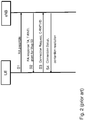
- the RACH preamble S1 starts with a RACH preamble S1 sent from the user equipment to the base station eNB. This is the start of any dedicated communication between the user equipment and the base station.
- the RACH preamble S1 comprises a RA_RNTI value, which indicates a subframe number of the RACH transmission.
- a RACH response S2 This comprises a timing advance value calculated from the received subframe number and the time when the message arrived. Further information, in particular a grant for sending a third message are usually provided.
- connection request S3 the user equipment sends a message that requests a connection setup.
- This message already takes into account the timing advance value received with the RACH response message S2. So it is assured that the message arrives at the right time at the base station eNB.
- the base station consequently as fourth step responds to the connection request, usually with a connection setup message S4.
- This prior art call sequence shows that the first message from the user equipment, which is the RACH preamble message S1, is sent into the blue.
- the user equipment in the prior art does not know anything about when will this message arrive at the base station, and if the base station is ready to receive it at the time of arrival.
- timing advance value is either known from a previous connection to the base station, provided the user equipment is known as operated stationary. Or the cell of the base station is that small, that a constant timing advance value of ⁇ 0 is to be considered. This approach is consequently not applicable for a user equipment that is moving and operates in a large area cell.
- the environment of the call sequence complements to that in FIG 2 , except that the base station eNB is in this example covering a large cell. This means this cell is larger than 35km.
- step S10 the user equipment carries out a estimation of the timing advance by means of RSCP comparison with the line of sight (LOS) of the base station.
- LOS line of sight
- the user equipment can derive from the signal strength measurements at its receiving circuitry the pathloss resp. the attenuation. From that a value either the distance between user equipment and base station, or directly translated the timing advance value is derived.
- the attenuation is for a large cell a good basis for calculating the distance as it is not expected that a lot of buildings or other obstacles lead to reflections etc. that would impact the distance calculation.
- the timing advance value is applied to the RACH preamble message in the sense that the point in time for sending the message considers the timing advance value, in relation to an expected submission time, which is broadcasted by the base station.
- the derived timing advance value or a representative of it is also part of the RACH preamble message S11.
- the base station Based on this message the base station sends a RACH response message S12 comprising a Timing Advance correction value.
- This TA correction value considers the timing advance value received through RACH preamble message S11, and the time when the RACH message actually arrives at the base station. Still there might be a gap between the expected transmission time and the real arrival time.
- the RACH preamble message will in any case arrive in a narrow window around the broadcasted submission time. That means that for a large area cell a much smaller window needs to be reserved for RACH preamble messages.
- connection setup is finalized, in particular by connection setup message S13 sent by the user equipment to the base station.
- the timing of this message now takes into account the TA correction value received with message S12, in relationship to the estimated timing advance value.
- connection setup message S14 the connection setup is finalized.
- the RACH access is with the exemplifying embodiment of the inventive method improved in particular for large area cells.
- step S20 Basically the same calculation is carried out in step S20, where the timing advance value is calculated.
- Other ways of calculating e.g. when the distance is e.g. derived from the geospatial information, are applicable here as well. With exact positions and a flat, deserted area a very accurate timing advance value can be calculated.
- this RACH preamble message S21 taking into account that calculated timing advance value is transmitted.
- this RACH preamble message comprises the calculated timing advance value or a representative of it.
- the RACH preamble message already comprises an indication that a connection is requested.
- RACH response message S22 provides not only a RACH response, but also a connection setup. Additionally it comprises the timing advance correction value. This timing advance correction value is used for the subsequent communication, after S22, provided a RACH confirmation is transmitted.
- the base station When the user equipment is moving during the connection session, the base station will inform about further changes of the timing advance as part of the regular operation, as already known from the art.
- the user equipment is able to operate in large cells without large waste of resource on the base station side. Additionally the 2-step approach may be taken way more often than by now, and hence reduce signalling, speed up the connection setup and save power consumption on the user equipment side.
Landscapes
- Engineering & Computer Science (AREA)
- Computer Networks & Wireless Communication (AREA)
- Signal Processing (AREA)
- Mobile Radio Communication Systems (AREA)
Priority Applications (3)
| Application Number | Priority Date | Filing Date | Title |
|---|---|---|---|
| EP18213649.9A EP3672334A1 (fr) | 2018-12-18 | 2018-12-18 | Procédé d'estimation d'avance de synchronisation dans une zone à grandes cellules |
| PCT/EP2019/085195 WO2020126945A1 (fr) | 2018-12-18 | 2019-12-13 | Procédé d'estimation de l'avance temporelle dans une grande zone cellulaire |
| EP19832599.5A EP3900447B1 (fr) | 2018-12-18 | 2019-12-13 | Procédé d'estimation d'avance de synchronisation dans une zone à grandes cellules |
Applications Claiming Priority (1)
| Application Number | Priority Date | Filing Date | Title |
|---|---|---|---|
| EP18213649.9A EP3672334A1 (fr) | 2018-12-18 | 2018-12-18 | Procédé d'estimation d'avance de synchronisation dans une zone à grandes cellules |
Publications (1)
| Publication Number | Publication Date |
|---|---|
| EP3672334A1 true EP3672334A1 (fr) | 2020-06-24 |
Family
ID=64745950
Family Applications (2)
| Application Number | Title | Priority Date | Filing Date |
|---|---|---|---|
| EP18213649.9A Withdrawn EP3672334A1 (fr) | 2018-12-18 | 2018-12-18 | Procédé d'estimation d'avance de synchronisation dans une zone à grandes cellules |
| EP19832599.5A Active EP3900447B1 (fr) | 2018-12-18 | 2019-12-13 | Procédé d'estimation d'avance de synchronisation dans une zone à grandes cellules |
Family Applications After (1)
| Application Number | Title | Priority Date | Filing Date |
|---|---|---|---|
| EP19832599.5A Active EP3900447B1 (fr) | 2018-12-18 | 2019-12-13 | Procédé d'estimation d'avance de synchronisation dans une zone à grandes cellules |
Country Status (2)
| Country | Link |
|---|---|
| EP (2) | EP3672334A1 (fr) |
| WO (1) | WO2020126945A1 (fr) |
Cited By (1)
| Publication number | Priority date | Publication date | Assignee | Title |
|---|---|---|---|---|
| WO2025029272A1 (fr) * | 2023-08-01 | 2025-02-06 | Dell Products, L.P. | Avance temporelle de canal d'accès aléatoire physique basée sur la distance pour faciliter l'amélioration de la plage de cellules |
Families Citing this family (2)
| Publication number | Priority date | Publication date | Assignee | Title |
|---|---|---|---|---|
| WO2022015004A1 (fr) | 2020-07-13 | 2022-01-20 | Samsung Electronics Co., Ltd. | Procédé et dispositif de détermination d'informations de synchronisation |
| CN114007184A (zh) * | 2020-07-13 | 2022-02-01 | 北京三星通信技术研究有限公司 | 定时信息的确认方法和设备 |
Citations (3)
| Publication number | Priority date | Publication date | Assignee | Title |
|---|---|---|---|---|
| US20090161599A1 (en) * | 2006-04-07 | 2009-06-25 | Jacobus Cornelius Haartsen | Method, user equipment and radio base station for random access in a cellular telecommunications system technical field of the invention |
| US20170111908A1 (en) * | 2014-07-01 | 2017-04-20 | Huawei Technologies Co., Ltd. | Random access method and apparatus |
| WO2018141179A1 (fr) * | 2017-02-03 | 2018-08-09 | Jrd Communication (Shenzhen) Ltd | Systèmes et procédés destinés à l'extension de portée de cellules |
-
2018
- 2018-12-18 EP EP18213649.9A patent/EP3672334A1/fr not_active Withdrawn
-
2019
- 2019-12-13 WO PCT/EP2019/085195 patent/WO2020126945A1/fr not_active Ceased
- 2019-12-13 EP EP19832599.5A patent/EP3900447B1/fr active Active
Patent Citations (3)
| Publication number | Priority date | Publication date | Assignee | Title |
|---|---|---|---|---|
| US20090161599A1 (en) * | 2006-04-07 | 2009-06-25 | Jacobus Cornelius Haartsen | Method, user equipment and radio base station for random access in a cellular telecommunications system technical field of the invention |
| US20170111908A1 (en) * | 2014-07-01 | 2017-04-20 | Huawei Technologies Co., Ltd. | Random access method and apparatus |
| WO2018141179A1 (fr) * | 2017-02-03 | 2018-08-09 | Jrd Communication (Shenzhen) Ltd | Systèmes et procédés destinés à l'extension de portée de cellules |
Cited By (2)
| Publication number | Priority date | Publication date | Assignee | Title |
|---|---|---|---|---|
| WO2025029272A1 (fr) * | 2023-08-01 | 2025-02-06 | Dell Products, L.P. | Avance temporelle de canal d'accès aléatoire physique basée sur la distance pour faciliter l'amélioration de la plage de cellules |
| US20250048430A1 (en) * | 2023-08-01 | 2025-02-06 | Dell Products L.P. | Distance-based physical random-access channel timing advance to facilitate cell range improvement |
Also Published As
| Publication number | Publication date |
|---|---|
| EP3900447B1 (fr) | 2023-11-29 |
| EP3900447A1 (fr) | 2021-10-27 |
| WO2020126945A1 (fr) | 2020-06-25 |
| EP3900447C0 (fr) | 2023-11-29 |
Similar Documents
| Publication | Publication Date | Title |
|---|---|---|
| US11864142B2 (en) | User equipment and method for timing alignment | |
| US11792758B2 (en) | Method and device for determining timing advance | |
| KR102626661B1 (ko) | 무선 네트워크에서의 타이밍 어드밴스 결정 | |
| CN111565472B (zh) | 一种确定定时提前量的方法及设备 | |
| US11943706B2 (en) | Selecting a non-terrestrial network based public land mobile network | |
| US9363778B2 (en) | Method, user equipment and radio base station for random access in a cellular telecommunications system technical field of the invention | |
| CN115280734B (zh) | 在非陆地网络中操作的方法及相关设备 | |
| US9084127B2 (en) | Techniques for measuring a location of UE | |
| US8849300B2 (en) | Method, system and device for positioning mobile terminal | |
| EP4044748B1 (fr) | Procédé et appareil pour des communications satellite | |
| WO2022175872A1 (fr) | Évitement d'une perte d'accès au réseau due à une absence de couverture d'un système de navigation | |
| EP3900447B1 (fr) | Procédé d'estimation d'avance de synchronisation dans une zone à grandes cellules | |
| CN115918230A (zh) | 用于ul prach传输的无线通信方法和用户设备 | |
| CN118891834A (zh) | 用于无线网络的用户设备特定随机接入前导接收错误指示和辅助信息 | |
| US20240365262A1 (en) | Method for wireless communication, and device | |
| US12593289B2 (en) | Systems and methods for indication of valid time | |
| CN115209494B (zh) | 一种接入网络的方法、终端及网络设备 | |
| US20240106531A1 (en) | Receipt of satellite assistance information at a user equipment | |
| WO2022207382A1 (fr) | Procédé, appareil et programme informatique |
Legal Events
| Date | Code | Title | Description |
|---|---|---|---|
| PUAI | Public reference made under article 153(3) epc to a published international application that has entered the european phase |
Free format text: ORIGINAL CODE: 0009012 |
|
| STAA | Information on the status of an ep patent application or granted ep patent |
Free format text: STATUS: THE APPLICATION HAS BEEN PUBLISHED |
|
| AK | Designated contracting states |
Kind code of ref document: A1 Designated state(s): AL AT BE BG CH CY CZ DE DK EE ES FI FR GB GR HR HU IE IS IT LI LT LU LV MC MK MT NL NO PL PT RO RS SE SI SK SM TR |
|
| AX | Request for extension of the european patent |
Extension state: BA ME |
|
| STAA | Information on the status of an ep patent application or granted ep patent |
Free format text: STATUS: THE APPLICATION IS DEEMED TO BE WITHDRAWN |
|
| 18D | Application deemed to be withdrawn |
Effective date: 20210112 |