EP3672946B1 - N-acylaminooxadiazoles stables d'un point de vue métabolique utiles en tant qu'agents antibactériens - Google Patents
N-acylaminooxadiazoles stables d'un point de vue métabolique utiles en tant qu'agents antibactériens Download PDFInfo
- Publication number
- EP3672946B1 EP3672946B1 EP18848959.5A EP18848959A EP3672946B1 EP 3672946 B1 EP3672946 B1 EP 3672946B1 EP 18848959 A EP18848959 A EP 18848959A EP 3672946 B1 EP3672946 B1 EP 3672946B1
- Authority
- EP
- European Patent Office
- Prior art keywords
- ring
- substituents
- atoms
- carbon
- nitrogen
- Prior art date
- Legal status (The legal status is an assumption and is not a legal conclusion. Google has not performed a legal analysis and makes no representation as to the accuracy of the status listed.)
- Active
Links
Images


Classifications
-
- A—HUMAN NECESSITIES
- A01—AGRICULTURE; FORESTRY; ANIMAL HUSBANDRY; HUNTING; TRAPPING; FISHING
- A01N—PRESERVATION OF BODIES OF HUMANS OR ANIMALS OR PLANTS OR PARTS THEREOF; BIOCIDES, e.g. AS DISINFECTANTS, AS PESTICIDES OR AS HERBICIDES; PEST REPELLANTS OR ATTRACTANTS; PLANT GROWTH REGULATORS
- A01N43/00—Biocides, pest repellants or attractants, or plant growth regulators containing heterocyclic compounds
- A01N43/02—Biocides, pest repellants or attractants, or plant growth regulators containing heterocyclic compounds having rings with one or more oxygen or sulfur atoms as the only ring hetero atoms
- A01N43/04—Biocides, pest repellants or attractants, or plant growth regulators containing heterocyclic compounds having rings with one or more oxygen or sulfur atoms as the only ring hetero atoms with one hetero atom
- A01N43/06—Biocides, pest repellants or attractants, or plant growth regulators containing heterocyclic compounds having rings with one or more oxygen or sulfur atoms as the only ring hetero atoms with one hetero atom five-membered rings
- A01N43/08—Biocides, pest repellants or attractants, or plant growth regulators containing heterocyclic compounds having rings with one or more oxygen or sulfur atoms as the only ring hetero atoms with one hetero atom five-membered rings with oxygen as the ring hetero atom
-
- A—HUMAN NECESSITIES
- A01—AGRICULTURE; FORESTRY; ANIMAL HUSBANDRY; HUNTING; TRAPPING; FISHING
- A01N—PRESERVATION OF BODIES OF HUMANS OR ANIMALS OR PLANTS OR PARTS THEREOF; BIOCIDES, e.g. AS DISINFECTANTS, AS PESTICIDES OR AS HERBICIDES; PEST REPELLANTS OR ATTRACTANTS; PLANT GROWTH REGULATORS
- A01N43/00—Biocides, pest repellants or attractants, or plant growth regulators containing heterocyclic compounds
- A01N43/34—Biocides, pest repellants or attractants, or plant growth regulators containing heterocyclic compounds having rings with one nitrogen atom as the only ring hetero atom
- A01N43/36—Biocides, pest repellants or attractants, or plant growth regulators containing heterocyclic compounds having rings with one nitrogen atom as the only ring hetero atom five-membered rings
- A01N43/38—Biocides, pest repellants or attractants, or plant growth regulators containing heterocyclic compounds having rings with one nitrogen atom as the only ring hetero atom five-membered rings condensed with carbocyclic rings
-
- A—HUMAN NECESSITIES
- A01—AGRICULTURE; FORESTRY; ANIMAL HUSBANDRY; HUNTING; TRAPPING; FISHING
- A01N—PRESERVATION OF BODIES OF HUMANS OR ANIMALS OR PLANTS OR PARTS THEREOF; BIOCIDES, e.g. AS DISINFECTANTS, AS PESTICIDES OR AS HERBICIDES; PEST REPELLANTS OR ATTRACTANTS; PLANT GROWTH REGULATORS
- A01N43/00—Biocides, pest repellants or attractants, or plant growth regulators containing heterocyclic compounds
- A01N43/48—Biocides, pest repellants or attractants, or plant growth regulators containing heterocyclic compounds having rings with two nitrogen atoms as the only ring hetero atoms
- A01N43/60—1,4-Diazines; Hydrogenated 1,4-diazines
-
- A—HUMAN NECESSITIES
- A01—AGRICULTURE; FORESTRY; ANIMAL HUSBANDRY; HUNTING; TRAPPING; FISHING
- A01N—PRESERVATION OF BODIES OF HUMANS OR ANIMALS OR PLANTS OR PARTS THEREOF; BIOCIDES, e.g. AS DISINFECTANTS, AS PESTICIDES OR AS HERBICIDES; PEST REPELLANTS OR ATTRACTANTS; PLANT GROWTH REGULATORS
- A01N43/00—Biocides, pest repellants or attractants, or plant growth regulators containing heterocyclic compounds
- A01N43/72—Biocides, pest repellants or attractants, or plant growth regulators containing heterocyclic compounds having rings with nitrogen atoms and oxygen or sulfur atoms as ring hetero atoms
- A01N43/82—Biocides, pest repellants or attractants, or plant growth regulators containing heterocyclic compounds having rings with nitrogen atoms and oxygen or sulfur atoms as ring hetero atoms five-membered rings with three ring hetero atoms
-
- A—HUMAN NECESSITIES
- A61—MEDICAL OR VETERINARY SCIENCE; HYGIENE
- A61K—PREPARATIONS FOR MEDICAL, DENTAL OR TOILETRY PURPOSES
- A61K31/00—Medicinal preparations containing organic active ingredients
- A61K31/33—Heterocyclic compounds
- A61K31/395—Heterocyclic compounds having nitrogen as a ring hetero atom, e.g. guanethidine or rifamycins
- A61K31/435—Heterocyclic compounds having nitrogen as a ring hetero atom, e.g. guanethidine or rifamycins having six-membered rings with one nitrogen as the only ring hetero atom
- A61K31/47—Quinolines; Isoquinolines
- A61K31/472—Non-condensed isoquinolines, e.g. papaverine
- A61K31/4725—Non-condensed isoquinolines, e.g. papaverine containing further heterocyclic rings
-
- A—HUMAN NECESSITIES
- A61—MEDICAL OR VETERINARY SCIENCE; HYGIENE
- A61K—PREPARATIONS FOR MEDICAL, DENTAL OR TOILETRY PURPOSES
- A61K31/00—Medicinal preparations containing organic active ingredients
- A61K31/33—Heterocyclic compounds
- A61K31/395—Heterocyclic compounds having nitrogen as a ring hetero atom, e.g. guanethidine or rifamycins
- A61K31/495—Heterocyclic compounds having nitrogen as a ring hetero atom, e.g. guanethidine or rifamycins having six-membered rings with two or more nitrogen atoms as the only ring heteroatoms, e.g. piperazine or tetrazines
- A61K31/496—Non-condensed piperazines containing further heterocyclic rings, e.g. rifampin, thiothixene or sparfloxacin
-
- A—HUMAN NECESSITIES
- A61—MEDICAL OR VETERINARY SCIENCE; HYGIENE
- A61K—PREPARATIONS FOR MEDICAL, DENTAL OR TOILETRY PURPOSES
- A61K31/00—Medicinal preparations containing organic active ingredients
- A61K31/33—Heterocyclic compounds
- A61K31/395—Heterocyclic compounds having nitrogen as a ring hetero atom, e.g. guanethidine or rifamycins
- A61K31/495—Heterocyclic compounds having nitrogen as a ring hetero atom, e.g. guanethidine or rifamycins having six-membered rings with two or more nitrogen atoms as the only ring heteroatoms, e.g. piperazine or tetrazines
- A61K31/4985—Pyrazines or piperazines ortho- or peri-condensed with heterocyclic ring systems
-
- A—HUMAN NECESSITIES
- A61—MEDICAL OR VETERINARY SCIENCE; HYGIENE
- A61L—METHODS OR APPARATUS FOR STERILISING MATERIALS OR OBJECTS IN GENERAL; DISINFECTION, STERILISATION OR DEODORISATION OF AIR; CHEMICAL ASPECTS OF BANDAGES, DRESSINGS, ABSORBENT PADS OR SURGICAL ARTICLES; MATERIALS FOR BANDAGES, DRESSINGS, ABSORBENT PADS OR SURGICAL ARTICLES
- A61L2/00—Disinfection or sterilisation of materials or objects, in general; Accessories therefor
- A61L2/16—Disinfection or sterilisation of materials or objects, in general; Accessories therefor using chemical substances
-
- A—HUMAN NECESSITIES
- A61—MEDICAL OR VETERINARY SCIENCE; HYGIENE
- A61P—SPECIFIC THERAPEUTIC ACTIVITY OF CHEMICAL COMPOUNDS OR MEDICINAL PREPARATIONS
- A61P31/00—Antiinfectives, i.e. antibiotics, antiseptics, chemotherapeutics
- A61P31/04—Antibacterial agents
-
- C—CHEMISTRY; METALLURGY
- C07—ORGANIC CHEMISTRY
- C07D—HETEROCYCLIC COMPOUNDS
- C07D271/00—Heterocyclic compounds containing five-membered rings having two nitrogen atoms and one oxygen atom as the only ring hetero atoms
- C07D271/02—Heterocyclic compounds containing five-membered rings having two nitrogen atoms and one oxygen atom as the only ring hetero atoms not condensed with other rings
- C07D271/10—1,3,4-Oxadiazoles; Hydrogenated 1,3,4-oxadiazoles
-
- C—CHEMISTRY; METALLURGY
- C07—ORGANIC CHEMISTRY
- C07D—HETEROCYCLIC COMPOUNDS
- C07D271/00—Heterocyclic compounds containing five-membered rings having two nitrogen atoms and one oxygen atom as the only ring hetero atoms
- C07D271/02—Heterocyclic compounds containing five-membered rings having two nitrogen atoms and one oxygen atom as the only ring hetero atoms not condensed with other rings
- C07D271/10—1,3,4-Oxadiazoles; Hydrogenated 1,3,4-oxadiazoles
- C07D271/107—1,3,4-Oxadiazoles; Hydrogenated 1,3,4-oxadiazoles with two aryl or substituted aryl radicals attached in positions 2 and 5
-
- C—CHEMISTRY; METALLURGY
- C07—ORGANIC CHEMISTRY
- C07D—HETEROCYCLIC COMPOUNDS
- C07D271/00—Heterocyclic compounds containing five-membered rings having two nitrogen atoms and one oxygen atom as the only ring hetero atoms
- C07D271/02—Heterocyclic compounds containing five-membered rings having two nitrogen atoms and one oxygen atom as the only ring hetero atoms not condensed with other rings
- C07D271/10—1,3,4-Oxadiazoles; Hydrogenated 1,3,4-oxadiazoles
- C07D271/113—1,3,4-Oxadiazoles; Hydrogenated 1,3,4-oxadiazoles with oxygen, sulfur or nitrogen atoms, directly attached to ring carbon atoms, the nitrogen atoms not forming part of a nitro radical
-
- C—CHEMISTRY; METALLURGY
- C07—ORGANIC CHEMISTRY
- C07D—HETEROCYCLIC COMPOUNDS
- C07D413/00—Heterocyclic compounds containing two or more hetero rings, at least one ring having nitrogen and oxygen atoms as the only ring hetero atoms
- C07D413/02—Heterocyclic compounds containing two or more hetero rings, at least one ring having nitrogen and oxygen atoms as the only ring hetero atoms containing two hetero rings
- C07D413/12—Heterocyclic compounds containing two or more hetero rings, at least one ring having nitrogen and oxygen atoms as the only ring hetero atoms containing two hetero rings linked by a chain containing hetero atoms as chain links
-
- C—CHEMISTRY; METALLURGY
- C07—ORGANIC CHEMISTRY
- C07D—HETEROCYCLIC COMPOUNDS
- C07D471/00—Heterocyclic compounds containing nitrogen atoms as the only ring hetero atoms in the condensed system, at least one ring being a six-membered ring with one nitrogen atom, not provided for by groups C07D451/00 - C07D463/00
- C07D471/02—Heterocyclic compounds containing nitrogen atoms as the only ring hetero atoms in the condensed system, at least one ring being a six-membered ring with one nitrogen atom, not provided for by groups C07D451/00 - C07D463/00 in which the condensed system contains two hetero rings
- C07D471/04—Ortho-condensed systems
-
- A—HUMAN NECESSITIES
- A61—MEDICAL OR VETERINARY SCIENCE; HYGIENE
- A61L—METHODS OR APPARATUS FOR STERILISING MATERIALS OR OBJECTS IN GENERAL; DISINFECTION, STERILISATION OR DEODORISATION OF AIR; CHEMICAL ASPECTS OF BANDAGES, DRESSINGS, ABSORBENT PADS OR SURGICAL ARTICLES; MATERIALS FOR BANDAGES, DRESSINGS, ABSORBENT PADS OR SURGICAL ARTICLES
- A61L2103/00—Materials or objects being the target of disinfection or sterilisation
- A61L2103/15—Laboratory, medical or dentistry appliances, e.g. catheters or sharps
-
- Y—GENERAL TAGGING OF NEW TECHNOLOGICAL DEVELOPMENTS; GENERAL TAGGING OF CROSS-SECTIONAL TECHNOLOGIES SPANNING OVER SEVERAL SECTIONS OF THE IPC; TECHNICAL SUBJECTS COVERED BY FORMER USPC CROSS-REFERENCE ART COLLECTIONS [XRACs] AND DIGESTS
- Y02—TECHNOLOGIES OR APPLICATIONS FOR MITIGATION OR ADAPTATION AGAINST CLIMATE CHANGE
- Y02A—TECHNOLOGIES FOR ADAPTATION TO CLIMATE CHANGE
- Y02A50/00—TECHNOLOGIES FOR ADAPTATION TO CLIMATE CHANGE in human health protection, e.g. against extreme weather
- Y02A50/30—Against vector-borne diseases, e.g. mosquito-borne, fly-borne, tick-borne or waterborne diseases whose impact is exacerbated by climate change
Definitions
- This invention relates to metabolically stable antibacterial agents and to their use. More particularly, the invention relates to metabolically stable N-acylaminooxadiazole derivatives containing either ureido moieties, their use in the preparation of a pharmaceutical composition and as a bactericide.
- MDROs drug-resistant organisms
- MDR multidrug-resistant Neisseria gonorrhoeae
- XDR extensively drug resistant
- MDR Mycobacterium tuberculosis methicillin-resistant Staphylococcus aureus
- CAP Community-Acquired Pneumonia pathogens
- MRSA Streptococcus pneumonia, Mycoplasma pneumonia, Moraxella catarrhalis, Legionella pneumophila, and Haemophilus influenzae
- CAP Community-Acquired Pneumonia
- Multidrug-resistant (MDR) gonorrhea is an urgent threat to public health.
- the CDC lists MDR Neisseria gonorrhoeae ( Ng ) as one of the three most urgent antibiotic resistance threats in the United States ( Antibiotic Resistance Threats in the United States, Centers for Disease Control, U.S. Dept. of Health and Human Services (2013 )).
- Ng MDR Neisseria gonorrhoeae
- a Gram-negative fastidious organism, Ng causes gonorrhea, the second-most prevalent sexually transmitted bacterial infection (STI), with more than 800,000 cases in the United States and 78 million cases estimated worldwide [ Cornelissen, C. N. and Hollander, A.
- Ng has evolved resistance to nearly every antibiotic used to treat it, leaving a combination of azithromycin (AZM) and ceftriaxone (CTX) as the only recommended treatment option ( Whiley et al., J Antimicrob Chemother, 67:2059 (2012 ); Obstetrics and gynecology, 127(5):e95-99 (2016 )).
- ZAM azithromycin
- CX ceftriaxone
- Strains resistant to sulfonamides Unemo, M. and Shafer, W. M., Annals of the New York Academy of Sciences, 1230:E19 (2011 )
- penicillin, streptomycin, erythromycin, tetracycline, spectinomycin, fluoroquinolones Goldstein et al., Emerg.
- Mtb Mycobacterium tuberculosis alone is annually responsible for ⁇ 1.5 million deaths ( Global Tuberculosis Report, World Health Organization, 2017 ). Over 1.8 billion people are infected with Mtb worldwide, 10% of whom are predicted to develop active disease.( Global Tuberculosis Teport, World Health Organization, 2017 ). These infections produce 1.5 million deaths annually. While antibiotic therapy represents the foundation for global health efforts to curb TB, the rise of multi-drug resistant (MDR-TB) and extensively drug resistant (XDR-TB) strains has produced an urgent need for new antibiotics. ( Global Tuberculosis Teport, World Health Organization, 2017 ).
- MDR-TB multi-drug resistant
- XDR-TB extensively drug resistant
- MRSA Methicillin-Resistant Staphylococcus aureus
- SSTIs skin and soft tissue infections
- bacteremia infective endocarditis
- pneumonia bone and joint infections
- meningitis meningitis, among others.
- SSTIs skin and soft tissue infections
- MRSA has a tendency to relapse and recurrence, likely through biofilm formation and its tendency to survive and multiply in eukaryotic cells, features that add additional challenges to treatment.
- VAP Ventilator-Associated Pneumonia
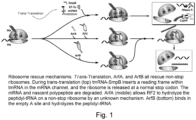
- the trans-translation process resolves non-stop translation complexes using a ribonucleoprotein complex containing transfer-messenger RNA (tmRNA) and a small protein, SmpB. All species of bacteria tested to date require at least one ribosome rescue mechanism for viability. ( Keiler, K. C., Nat. Rev. Microbiol., 13:285 (2015 )).
- tmRNA transfer-messenger RNA
- SmpB small protein
- tmRNA encoded by the ssrA gene, is a highly structured RNA with properties of both a tRNA and an mRNA.
- the 5' and 3' ends of tmRNA fold into a tRNA-like structure, which is charged with alanine by alanyl-tRNA synthetase (AlaRS).
- AlRS alanyl-tRNA synthetase
- the nascent polypeptide is transferred to alanyl-tmRNA by a normal transpeptidation reaction, and then the translational reading frame switches from the original mRNA to a reading frame within tmRNA. The original mRNA is released and degraded. Continued translation of the tmRNA reading frame results in the addition of a peptide tag to the nascent polypeptide and release of the ribosome.
- the tmRNA-encoded peptide tag targets the incomplete protein for rapid proteolysis.
- trans -translation is essential for viability in many species, including S. aureus, ( Chaudhuri et al., BMC Genomics, 10:291 (2009 ); Fey et al., MBio, 4(1): e00537-00512 (2013 )), N.
- Therapeutics based on small molecule inhibitors of trans -translation represent a promising and safe opportunity for treating a broad range of bacterial infections, notably including N. gonorrhoeae, Methicillin-Resistant Staphylococcus aureus (MRSA), B. anthracis, M. tuberculosis, and S. flexnieri, among others.
- Target-related toxicity of inhibitors of non-stop ribosome rescue is unlikely as trans -translation genes are not found in metazoans.
- luciferase-based reporter assay was developed and used to screen a library of 663,000 small molecules to isolate inhibitors of trans -translation. Briefly, to prepare the luciferase reporter assay, a copy of the trpAt transcriptional terminator was inserted before the stop codon of luc, the gene encoding firefly luciferase, on a multicopy plasmid.
- trans-translation activity can be monitored by assaying luciferase activity in cells expressing luc-trpAt. Using the luciferase assay, 24 potential trans -translation inhibitor compounds were identified from the library.
- KKL-35 One compound, designated KKL-35, was shown to be a specific inhibitor of trans -translation with advantageously no effect on translation. Additionally, KKL-35 demonstrated a lack of cytotoxicity, even in the context of prolonged exposure, indicating that KKL-35 does not inhibit ICT1 and is unlikely to have target-related toxicity in mammalian systems. KKL-35, having an oxadiazole core structure, demonstrated an IC 50 value of 0.9 ⁇ M in a dose response assay. ( Ramadoss et al., PNAS, 110(25):10282-87 (2013 )). KKKL-35 was also found to be bactericidal against Myobacterium tuberculosis under both aerobic and anaerobic conditions.
- KKL-35 demonstrates poor stability in the presence of mouse or human liver microsomes in vitro and preliminary PK studies indicated extremely poor bioavailability in mice as evidenced by no detectable material after 5 min in the presence of microsomes or within 6 h of IV or IP dosing in mice at 10 mg/kg (data not shown), prohibiting further development of this and closely related analogs.
- trans -translation is a viable target for controlling bacterial infections, but there remains a need to develop trans -translation inhibitors with improved exposure in living systems that are suitable for safe and effective administration to mammals and in particular administration to humans.
- Therapeutic compositions based on effective trans -translation inhibitors have the potential for treating and/or preventing a wide range of both Gram-positive and Gram-negative bacterial infections.
- the present invention is directed to the identification, isolation, and characterization of small molecule inhibitors of trans -translation for use in the treatment and/or prevention of bacterial infections in mammals, and in particular the treatment and/or prevention of bacterial infections in humans.
- the present invention is related to the discovery of novel broad-spectrum inhibitors of trans -translation as antibacterial agents suitable for use in treating and/or preventing a wide array of bacterial infections, methods of making such inhibitors, methods of using the inhibitors, pharmaceutical compositions comprising the inhibitors as active ingredients, and one or more of the novel trans -translation inhibitors described herein for use in methods of treating and/or preventing bacterial infections, as defined in the claims.
- the inhibitors of trans -translation disclosed herein will also be useful as adjuncts to existing antibiotic therapies, and there are likely to be synergies between other antibiotics and the present inhibitors of trans -translation when used in combination.
- combinations with drugs such as colistin that disrupt Gram-negative bacterial membranes that could provide improved spectrum and activity against multiple drug-resistant pathogens.
- the present invention is related to the discovery of novel broad-spectrum antibacterial agents suitable for use in treating and/or preventing bacterial infections, the compounds comprising substituted N-acylaminooxadiazole derivatives.
- novel broad-spectrum antibacterial agents suitable for use in treating and/or preventing bacterial infections
- the compounds comprising substituted N-acylaminooxadiazole derivatives.
- compounds having trans -translation inhibitory properties comprising a ureido oxadiazole moiety (as shown in Formula I and Formula Ia) are disclosed and claimed herein.
- the present invention is directed to a bacterial trans -translation inhibitor ureido oxadiazole compound having the structure of Formula I: wherein:
- the present invention is directed to the compounds of Formula I for use in a method for treating or preventing a bacterial infection in a mammalian subject, comprising administering to a subject in need thereof an effective amount of at least one compound of Formula I: wherein:
- a trans -translation inhibitor ureido oxadiazole compound has the structure of Formula Ia: wherein:
- the present invention is directed the compounds of Formual I(a) for use in a method for treating or preventing a bacterial infection in a mammal by administration of one or more of the compounds of Formula Ia: wherein:
- compositions comprising a therapeutically effective amount of at least one aminooxadiazole compound of Formula I, Formula Ia, or a pharmaceutically acceptable salt, solvate, or polymorph thereof, and a pharmaceutically acceptable carrier.
- the pharmaceutical compositions are suitable for use in the disclosed methods for treating or preventing a bacterial infection in a mammalian subject.
- the mammalian subject is a human.
- the pharmaceutical compositions may be formulated for both parenteral and/or nonparenteral administration to a subject or patient in need thereof.
- novel aminooxadiazole derivatives of the present invention act as inhibitors of the trans -translation mechanism found in most bacterial species.
- the compounds of the present invention are suitable for treating or preventing bacterial infections by preventing the synthesis of proteins necessary for bacterial cell viability and infectivity.
- novel compounds of the present invention may be administered to a subject in need thereof optionally in combination with one or more known antibacterial agents.
- the compounds of the present invention are formulated into a pharmaceutically acceptable carrier and can be administered to a mammalian subject in need thereof by an injection, including, without limitation, intradermal, transdermal, intramuscular, intraperitoneal and intravenous injection.
- an injection including, without limitation, intradermal, transdermal, intramuscular, intraperitoneal and intravenous injection.
- the administration is oral and the compound may be presented, for example, in the form of a tablet or encased in a gelatin capsule or a microcapsule, which simplifies oral administration.
- the production of these forms of administration is within the general technical experience of practitioners in this art. Multiple routes of administration are envisioned for these drug-like molecules, and highly cost-effective production strategies can be easily achieved.
- the antibacterial aminooxadiazole compounds of the present invention exhibit an inhibitory concentration of ⁇ 10 ⁇ M against trans -translation and a cytotoxicity (CC 50 ) of ⁇ 25 ⁇ M.
- trans -translation inhibitors are suitable to disinfect devices and surfaces such as bandages, bodily appliances, catheters, surgical instruments, patient examination tables, counters, etc.
- the trans -translation inhibitors described herein are particularly useful in preventing or inhibiting bacterial growth on surfaces exposed to or contaminated with Gram-positive and/or Gram-negative bacteria.
- Such surfaces include, but are not limited to, surfaces of implantable medical devices (including, but not limited to, central venous catheters (CVCs), implantable pumps, artificial heart valve, and cardiac pacemakers); cardiopulmonary bypass (CPB) pumps (heart-lung machine); dialysis equipment; artificial respirators; breathing apparatuses (oxygen and air supplies); water pipes; plumbing fixtures; and air ducts.
- CVCs central venous catheters
- CVB cardiopulmonary bypass
- the present invention also provides a method for inhibiting bacterial contamination or colonization on a solid surface comprising treating said surface with at least one compound of Formula I and/or Formula Ia.
- the trans -translation inhibitor compound may be applied to the surface prior to its exposure or infection with a bacterium, after bacteria have contacted the surface, or after a bacterial colony has already formed on the surface.
- the trans -translation inhibitor compounds disclosed herein may thus be advantageously employed to prevent bacterial contamination of a surface or to arrest bacterial colonization on a surface.
- a trans- translation inhibitor compound described herein is applied to a surface prior to the formation of a bacterial colony on the surface. More preferably, a trans -translation inhibitor compound described herein is applied to or present on a surface before bacteria contact the surface.
- a trans -translation inhibitor described herein may be applied to a desired solid surface by any of a variety methods including, but not limited to, coating, impregnation, and covalent conjugation.
- a trans -translation inhibitor described herein may also be employed in a solution or suspension to fill the lumen of a catheter or other medical device prior to use.
- composition or method described herein as “comprising” (or which "comprises”) one or more named elements or steps is open-ended, meaning that the named elements or steps are essential, but other elements or steps may be added within the scope of the composition or method.
- any composition or method described as “comprising” one or more named elements or steps also describes the corresponding, more limited, composition or method “consisting essentially of” (or which "consists essentially of") the same named elements or steps, meaning that the composition or method includes the named essential elements and may also include additional elements or steps that do not materially affect the basic and novel characteristic(s) of the composition or method.
- composition or method described herein as “comprising” or “consisting essentially of” one or more named elements or steps also describes the corresponding, more limited, and closed-ended composition or method “consisting of” (or which "consists of") the named elements or steps to the exclusion of any other element or step.
- known or disclosed equivalents of any named essential element or step may be substituted for that element or step, respectively.
- a weight percent (wt. %) of a component is based on the total weight of the formulation or composition in which the component is included.
- the terms “effective amount” and “amount effective” refer to an amount that is sufficient to achieve the desired result or to have an effect on an undesired condition.
- a “therapeutically effective amount” refers to an amount that is sufficient to achieve the desired therapeutic result or to have an effect on undesired symptoms, but is generally insufficient to cause adverse side effects.
- the specific therapeutically effective dose level of a therapeutic for any particular patient will depend upon a variety of factors including the disorder being treated and the severity of the disorder; the specific composition employed; the age, body weight, general health, sex and diet of the patient; the time of administration; the route of administration; the rate of excretion of the specific compound employed; the duration of the treatment; drugs used in combination or coincidentally with the specific compound employed and like factors well known in the medical arts. For example, it is well within the skill of the art to start doses of a compound at levels lower than those required to achieve the desired therapeutic effect and to gradually increase the dosage until the desired effect is achieved. If desired, the effective daily dose can be divided into multiple doses for purposes of administration.
- compositions can contain such amounts or submultiples thereof to make up the daily dose.
- the dosage can be adjusted by the individual physician in the event of any contraindications. Dosage can vary, and can be administered in one or more dose administrations daily, for one or several days. Guidance can be found in the literature for appropriate dosages for given classes of pharmaceutical products.
- a preparation can be administered in a "prophylactically effective amount"; that is, an amount effective for prevention of a disease or condition.
- pharmaceutically acceptable describes a material that is not biologically or otherwise undesirable, i.e., without causing an unacceptable level of undesirable biological effects or interacting in a deleterious manner.
- aqueous and nonaqueous carriers include water, ethanol, polyols (such as glycerol, propylene glycol, polyethylene glycol and the like), carboxymethylcellulose and suitable mixtures thereof, vegetable oils (such as olive oil) and injectable organic esters such as ethyl oleate.
- Proper fluidity can be maintained, for example, by the use of coating materials such as lecithin, by the maintenance of the required particle size in the case of dispersions and by the use of surfactants.
- These compositions can also contain additives such as preservatives, wetting agents, emulsifying agents and dispersing agents.
- Prevention of the action of microorganisms can be ensured by the inclusion of various antibacterial and antifungal agents such as paraben, chlorobutanol, phenol, sorbic acid and the like. It can also be desirable to include isotonic agents such as sugars, sodium chloride and the like.
- Prolonged absorption of the injectable pharmaceutical form can be brought about by the inclusion of agents, such as aluminum monostearate and gelatin, which delay absorption.
- Injectable depot forms are made by forming microencapsule matrices of the drug in biodegradable polymers such as polylactide-polyglycolide, poly(orthoesters) and poly(anhydrides). Depending upon the ratio of drug to polymer and the nature of the particular polymer employed, the rate of drug release can be controlled. Depot injectable formulations are also prepared by entrapping the drug in liposomes or microemulsions which are compatible with body tissues.
- the injectable formulations can be sterilized, for example, by filtration through a bacterial-retaining filter or by incorporating sterilizing agents in the form of sterile solid compositions which can be dissolved or dispersed in sterile water or other sterile injectable media just prior to use.
- Suitable inert carriers can include sugars such as lactose. Desirably, at least 95% by weight of the particles of the active ingredient have an effective particle size in the range of 0.01 to 10 micrometers.
- polymorph refers to different crystal structures of a crystalline compound.
- the different polymorphs may result from differences in crystal packing (packing polymorphism) or differences in packing between different conformers of the same molecule (conformational polymorphism).
- solvate refers to forms of the compound that are associated with a solvent, usually by a solvolysis reaction. This physical association may include hydrogen bonding.
- solvents include water, methanol, ethanol, acetic acid, DMSO, THF, diethyl ether, and the like.
- the compounds of the present invention may be prepared, e.g., in crystalline form, and may be solvated.
- Suitable solvates include pharmaceutically acceptable solvates and further include both stoichiometric solvates and non-stoichiometric solvates.
- the term "solvate” encompasses both solution-phase and isolable solvates. Representative solvates include hydrates, ethanolates, and methanolates.
- the term "substituted" is contemplated to include all permissible substituents of organic compounds.
- the permissible substituents include acyclic and cyclic, branched and unbranched, carbocyclic and heterocyclic, and aromatic and nonaromatic substituents of organic compounds.
- Illustrative substituents include, for example, those described below.
- the permissible substituents can be one or more and the same or different for appropriate organic compounds.
- the heteroatoms, such as nitrogen can have hydrogen substituents and/or any permissible substituents of organic compounds described herein which satisfy the valences of the heteroatoms.
- substitution or “substituted with” include the implicit proviso that such substitution is in accordance with permitted valence of the substituted atom and the substituent, and that the substitution results in a stable compound, e.g., a compound that does not spontaneously undergo transformation such as by rearrangement, cyclization, elimination, etc. It is also contemplated that, in certain aspects, unless expressly indicated to the contrary, individual substituents can be further optionally substituted (i.e., further substituted or unsubstituted).
- the term "subject” can be a human, non-human primate, horse, pig, rabbit, dog, sheep, goat, cow, cat, guinea pig or rodent.
- a "patient” or “subject in need thereof” refers to a mammal afflicted with a disease or disorder.
- the term “patient” includes human and veterinary subjects.
- parenteral refers to routes or modes of administration of a compound or composition to an individual other than along the alimentary canal.
- parenteral routes of administration include, without limitation, subcutaneous (s.c.), intravenous (i.v.), intramuscular (i.m.), intra-arterial (i.a.), intraperitoneal (i.p.), transdermal (absorption through the skin or dermal layers), nasal ("intranasal”; absorption across nasal mucosa), pulmonary (e.g., by inhalation for absorption across the lung tissue), vaginal, direct injections or infusions into body cavities or organs other than those of the alimentary canal, as well as by implantation of any of a variety of devices into the body (e.g., of a composition, depot, or device that permits active or passive release of a compound or composition into the body).
- non-parenteral refers to administration of a compound or composition to an individual by a route or mode along the alimentary canal.
- enteral routes of administration include, without limitation, oral, as in swallowing solid (e.g., tablet) or liquid (e.g., syrup) dosage forms, sublingual (absorption through the mucosal membranes lining the floor of the mouth, e.g., under the tongue), buccal (absorption through the mucosal membranes lining the cheeks), nasojejunal or gastrostomy tubes (delivery into the stomach), intraduodenal administration, as well as rectal administration (e.g., suppositories for release of a drug composition into and absorption by the lower intestinal tract of the alimentary canal).
- substituents may be "stacked" or combined to form compound substituents.
- substituents including alkyl and aryl substituents
- the compound aralkyl and alkaryl substituents are also contemplated.
- aliphatic group is intended to mean a saturated hydrocarbon radical having 1-10 carbon atoms, which may be straight-chain or branched, e.g., methyl, ethyl, n-propyl, isopropyl, n-butyl, tert -butyl, n-pentyl, n-hexyl, n-heptyl and n-octyl, etc.
- halo or halogen means fluorine, chlorine, bromine, or iodine.
- alkyl as used herein is intended to mean a branched, straight-chain saturated hydrocarbon group of 1 to 24 carbon atoms, preferably 1-10 carbon atoms, such as methyl, ethyl, n -propyl, isopropyl, n -butyl, isobutyl, s -butyl, t -butyl, n -pentyl, isopentyl, s- pentyl, neopentyl, hexyl, heptyl, octyl, nonyl, decyl, and the like.
- An alkyl group can be branched or unbranched.
- alkyl group can also be substituted or unsubstituted.
- substituted alkyl denotes an alkyl group substituted with one or more groups including, but not limited to, alkyl, haloalkyl, nitro, halogen, alkoxy, alkylthio, haloalkoxy, sulfonyl, sulfinyl, carboxy, alkoxycarbonyl, amino, or amido groups.
- sulfonyl is intended to mean a sulfur radical that is doubly bound to two oxygens (-SO 2 -).
- a sulfonyl group may be linked via the sulfur atom with an amino, alkylamino, alkyl, cycloalkyl, aryl, heterocycloalkyl, or heteroaryl moiety to produce a monovalent radical.
- sulfurinyl is intended to mean a sulfur radical that is doubly bound to one oxygen (-S(O)-), and the sulfur atom may be substituted with an amino, alkylamino, alkyl, cycloalkyl, aryl, heterocycloalkyl, or heteroaryl moiety to produce a monovalent radical.
- hydroxyl or "hydroxy” is intended to mean the radical -OH.
- alkoxy is intended to mean the radical -OR, where R is an alkyl group.
- haloalkyl is intended to mean an alkyl moiety wherein one or more hydrogen atoms is replaced with the same or different halogen atoms, e.g., -CH 2 Cl, -CF 3 , -CH 2 CF 3 , -CH 2 CCl 3 , and the like.
- haloalkoxy is intended to mean an alkoxy radical wherein one or more hydrogen atoms are replaced with the same or different halogen atoms, e.g. -OCHF 2 , -OCF 3 , - OCH 2 CF 3 , -OCH 2 CCl 3 , and the like.
- alkenyl is intended to mean a straight-chain, branched, or cyclic hydrocarbon radical having from 2-8 carbon atoms and at least one double bond, e.g., ethenyl, 3-buten-1-yl, 3-hexen-1-yl, cyclopent-1-en-3-yl, and the like.
- the alkenyl group can be unsubstituted or substituted with one or more groups including, but not limited to, alkyl, haloalkyl, nitro, halogen, alkoxy, alkylthio, haloalkoxy, sulfonyl, sulfinyl, carboxy, alkoxycarbonyl, amido, cycloalkyl, alkenyl, cycloalkenyl, alkynyl, cycloalkynyl, aryl, heteroaryl, aldehyde, amino, carboxylic acid, ester, ether, hydroxy, ketone, or thiol.
- groups including, but not limited to, alkyl, haloalkyl, nitro, halogen, alkoxy, alkylthio, haloalkoxy, sulfonyl, sulfinyl, carboxy, alkoxycarbonyl, amido, cycloalkyl, alkenyl,
- alkynyl is intended to mean a straight-chain or branched hydrocarbon radical having from 2-8 carbon atoms an at least one triple bond, e.g., ethynyl, 3-butyn-1-yl, 2-butyn-1-yl, 3-pentyn-1-yl, and the like.
- the alkynyl group can be unsubstituted or substituted with one or more groups including, but not limited to, alkyl, haloalkyl, nitro, halogen, alkoxy, alkylthio, haloalkoxy, sulfonyl, sulfinyl, carboxy, alkoxycarbonyl, amido, cycloalkyl, alkenyl, cycloalkenyl, alkynyl, cycloalkynyl, aryl, heteroaryl, aldehyde, amino, carboxylic acid, ester, ether, hydroxy, ketone, azide, nitro, or thiol, as described herein.
- groups including, but not limited to, alkyl, haloalkyl, nitro, halogen, alkoxy, alkylthio, haloalkoxy, sulfonyl, sulfinyl, carboxy, alkoxycarbonyl, amido,
- carbon substituent is intended to refer to substituent groups wherein the first atom of the substituent bound at the site of attachment is carbon, e.g., as in -CH 3 (methyl), - COOH (carboxyl), -C 6 H 5 (phenyl), -C ⁇ N (cyano), etc., which may be contrasted with "nitrogen substituents” such as -NH 2 (amino), -NO 2 (nitro), etc., wherein the first atom bound at the site of attachment is nitrogen.
- cycloalkyl or "aliphatic ring” is intended to mean a non-aromatic monovalent cyclic or polycyclic hydrocarbon radical having from 3-12 carbon atoms.
- substituted cycloalkyl groups, e.g., substituted cyclopentyl, cyclohexyl, decalinyl, may be substituted with one or more groups including, but not limited to, alkyl, haloalkyl, nitro, halogen, alkoxy, alkylthio, haloalkoxy, sulfonyl, sulfinyl, carboxy, alkoxycarbonyl, amido, cycloalkyl, alkoxy, amino, ether, hydroxy, or thiol as described herein.
- heterocycloalkyl is intended to mean a non-aromatic monovalent monocyclic or polycyclic radical having from 2-12 carbon atoms, and 1-5 heteroatoms selected from nitrogen (N), oxygen (O), or sulfur (S).
- substituted heterocycloalkyl groups, e.g., substituted pyrrolodinyl, tetrahydropyranyl, morpholinyl, piperazinyl, oxiranyl groups, and the like, may be substituted with one or more groups including, but not limited to, alkyl, haloalkyl, nitro, halogen, alkoxy, alkylthio, haloalkoxy, sulfonyl, sulfinyl, carboxy, alkoxycarbonyl, amido, cycloalkyl, alkoxy, amino, ether, hydroxy, or thiol as described herein.
- aryl is intended to mean an aromatic, monovalent monocyclic or polycyclic radical comprising from 5 and 18 carbon ring members, e.g., phenyl, biphenyl, naphthyl, phenanthryl, and the like.
- a "substituted aryl” group is an aryl group substituted with one or more groups including, but not limited to, alkyl, haloalkyl, nitro, halogen, alkoxy, alkylthio, haloalkoxy, sulfonyl, sulfinyl, carboxy, alkoxycarbonyl, amino, amido, cycloalkyl, alkoxy, alkenyl, cycloalkenyl, alkynyl, cycloalkynyl, aryl, heteroaryl, aldehyde, carboxylic acid, ester, ether, hydroxy, ketone, or thiol as described herein.
- the aryl group can be a single ring structure or comprise multiple ring structures that are either fused ring structures or attached via one or more bridging groups such as a carbon-carbon bond, a hydrocarbon bridge (such as alkylene), or an ether or alkylether bridge.
- bridging groups such as a carbon-carbon bond, a hydrocarbon bridge (such as alkylene), or an ether or alkylether bridge.
- heteroaryl is intended to mean an aromatic, monovalent monocyclic or polycyclic radical comprising from 3 and 18 carbon ring members and at least 1 heteroatom selected from nitrogen (N), oxygen (O), or sulfur (S), e.g., pyridyl, pyrazinyl, pyridizinyl, pyrimidinyl, furanyl, thienyl, triazolyl, quinolinyl, imidazolinyl, benzimidazolinyl, indolyl, and the like.
- Substituted heteroaryl is a heteroaryl group substituted with one or more groups including, but not limited to, alkyl, haloalkyl, nitro, halogen, alkoxy, alkylthio, haloalkoxy, sulfonyl, sulfinyl, carboxy, alkoxycarbonyl, amido, cycloalkyl, amino, ether, hydroxy, or thiol as described herein.
- Heteroaryl groups can be monocyclic, or alternatively fused ring systems.
- aryloxy is intended to mean the radical -OAr where Ar is an aryl group.
- heteroaryloxy is intended to mean the radical -O(heteroAr) where heteroAr is a heteroaryl group.
- acyl is intended to mean a -C(O)R radical, where R is alkyl, alkenyl, alkynyl, cycloalkyl, aryl, heteroaryl, or heterocycloalkyl, e.g., acetyl, benzoyl, and the like.
- alkoxycarbonyl is intended to mean a RO-C(O)- radical where R is alkyl or cycloalkyl.
- alkylcarbonyl refers to a RC(O)- radical where R is alkyl or cycloalkyl.
- aryloxycarbonyl is intended to mean a RO-C(O)- radical where R is aryl; "heteroaryloxycarbonyl” refers to a radical of the same structure RO-C(O)- where R is heteroaryl.
- amino is intended to mean the radical -NH 2 .
- alkylamino is intended to mean the radical -NHR where R is an alkyl group, or -NRR', where R and R' are each independently, hydrogen or alkyl.
- Representative examples include, but are not limited to, methylamino, ethylamino, propylamino, isopropylamino, butylamino, isobutylamino, (sec-butyl)amino, (tert-butyl)amino, pentylamino, isopentylamino, (tert-pentyl)amino, hexylamino, dimethylamino, methylethylamino, diethylamino, methylpentylamino, and the like.
- acylamino is intended to mean the radical -NHC(O)R, where R is a monovalent organic radical such as, e.g., alkyl, alkenyl, alkynyl, cycloalkyl, aryl, heteroaryl, or heterocycloalkyl.
- R and R' are, independently, hydrogen, or monovalent organic radicals, such as, e.g., alkyl, alkenyl, alkynyl, cycloalkyl, aryl, heteroaryl, or heterocycloalkyl.
- amino is intended to mean the radical -C(:NR)NR'R", where R, R', and R" are, independently, hydrogen, alkyl, alkenyl, alkynyl, cycloalkyl, aryl, or heteroaryl, and wherein R, R', and R" may form heterocycloalkyl rings, e.g. carboxamido, imidazolinyl, tetrahydropyrimidinyl.
- guanidino is intended to mean the radical -NHC(:NR)NR'R", where R, R', and R" are, independently, hydrogen, alkyl, alkenyl, alkynyl, cycloalkyl, aryl, or heteroaryl, and wherein R, R', and R" may form heterocycloalkyl rings.
- sulfonylamino is intended to mean the radical -NHSO 2 R where R is a monvalent organic radical such as, e.g., alkyl, alkenyl, alkynyl, cycloalkyl, aryl, heteroaryl, or heterocycloalkyl.
- aminosulfonyl is intended to mean the radical -SO 2 NRR' where R and R' are, independently, hydrogen, or a monovalent organic radical such as, e.g., alkyl, alkenyl, alkynyl, cycloalkyl, aryl, or heteroaryl, or heterocycloalkyl.
- sulfhydryl or "mercapto” is intended to mean the radical -SH.
- alkylthio is intended to mean the radical -SR where R is an alkyl or cycloalkyl group.
- arylthio is intended to mean the radical -SAr where Ar is an aryl group.
- the present invention is directed to the identification, isolation, and characterization of small molecule inhibitors of the bacterial trans -translation mechanism for use in the treatment and/or prevention of bacterial infections in mammals, and in particular the treatment and/or prevention of bacterial infections in humans.
- the compounds of the present invention may also be used for the sterilization or pretreatment of surfaces, e.g., catheters, colonized by bacteria to kill or prevent bacterial growth.
- the trans -translation mechanism is a key component of multiple quality control pathways in bacteria that ensure proteins are synthesized with high fidelity in spite of challenges such as transcription errors, mRNA damage, and translational frameshifting.
- the trans- translation process is carried out by a ribonucleoprotein complex composed of tmRNA, a specialized RNA with properties of both a tRNA and mRNA, and the small protein SmpB.
- the tmRNA-SmpB complex interacts with translational complexes stalled at the 3' end of an mRNA to release the stalled ribosomes and target the nascent polypeptides and mRNAs for degradation.
- the released ribosomes can then be recycled and reused for a new translation process. (See, Figure 1 .)
- trans-translation activity was monitored by assaying luciferase activity in cells expressing luc-trpAt. Screening the small molecule library identified twenty-four potential trans -translation inhibitor compounds.
- Potent drug-like small molecules having a ureido-aminooxadiazole structure appear to target the stalled ribosome complex and show low to sub- ⁇ M activity.
- This novel ureido-aminooxadiazole series provides potent and broad protection against bacterial infections.
- the antibacterial utility of compounds described herein is novel since no similar compounds have been described previously as inhibitors of trans -translation.
- an aryl- or heteroaryl-amidooxadiazole series of compounds has been identified that contains effective inhibitors of bacterial trans -translation.
- Both series of trans -translation inhibitor compounds advantageously target the stalled ribosome complex at low to sub- ⁇ M potency and the core scaffolds are generally stable to microsomal degradation, unlike the original hit series, making them excellent candidates for the development of novel therapeutics to treat or prevent a wide variety of bacterial infections.
- the present invention is directed to a bacterial trans- translation inhibitor ureido oxadiazole compound having the structure of Formula I: as defined above and in the claims or a pharmaceutically acceptable salt thereof.
- Compounds of Formula I include but are not limited to, the following: Compound No. MBX- Structure 4132 4198 4199 4200 4201 4330 4333 4347 4348 4349 4366 4380 4381 4406 4464 4497 4684 4685 4686 4698 4701 4735 4736 4737 4738 4739 4740 4767 4768 4769 4776 4777 4805 4806 4807 4808 4839 4840 4841 4842 4843 4922 4923 4930 4931 4932 4933 4934 4935 4936 4937 4938 4939 4940 4993 4994 4995 5200 5202 5203 5204 5212 5214 5215 5216
- the present invention is directed to the use of ureido oxadiazole compounds of Formula I in a method of treating or preventing a bacterial infection in a mammalian subject, comprising administering to a subject in need thereof an effective amount of at least one compound of Formula I:
- Compounds of Formula I for use in a method for treating or preventing bacterial infection according to the present invention include but are not limited to, the following: Compound No. MBX- Structure 4132 4198 4199 4200 4201 4330 4333 4347 4348 4349 4366 4380 4381 4406 4464 4497 4684 4685 4686 4698 4701 4735 4736 4737 4738 4739 4740 4767 4768 4769 4776 4777 4805 4806 4807 4808 4839 4840 4841 4842 4843 4922 4923 4930 4931 4932 4933 4934 4935 4936 4937 4938 4939 4940 4993 4994 4995 5200 5202 5203 5204 5212 5214 5215 5216
- the present invention is directed to a novel trans-translation inhibitor ureido oxadiazole compound having the structure of Formula Ia:
- Compounds according to Formula Ia of the present invention include, but are not limited to, the following: Compound No. MBX- Structure 4132 4198 4199 4200 4201 4330 4333 4347 4348 4349 4366 4380 4381 4406 4464 4497
- the present invention is directed to use of the ureido oxadiazole compounds of Formula I(a) in a method for treating or preventing a bacterial infection in a mammalian subject by administration of one or more of the compounds of Formula Ia:
- Compounds for use according to the method for treating or preventing a bacterial infection by administering a compound of Formula Ia include but are not limited to, the following: Compound No. MBX- Structure 4132 4198 4199 4200 4201 4330 4333 4347 4348 4349 4366 4380 4381 4406 4464 4497
- Aminooxadizole compounds as described herein may be synthesized by the following general scheme:
- aminooxadiazoles were either prepared in this manner or obtained from commercial sources. Problematic aminooxadiazoles could also be generated by the condensation of an appropriately substituted aldehyde with semicarbazide hydrochloride followed by oxidation with a dihalide such as bromine or iodine as described by Rajak, H. et. al. Biorg. Med. Chem. Lett. 21(19):5735 (2011 ) and related publications.
- 1,1'-carbonyldiimidazole (0.543g, 3.35mmol) was added to a suspension of 5-(4-fluorophenyl)-1,3,4-oxadiazol-2-amine (0.500g, 2.79mmol) in NMP (7mL) and stirred at 65°C for 18 hrs. To this was added a solution of tetrahydroisoquinoline (0.886mL, 6.98mmol) in NMP (3 mL) in a dropwise manner over ⁇ 5 minutes. The reaction mixture was removed from heat and allowed to cool to room temperature over 2 hrs.
- aryl- or heteroaryl-substituted amidooxadiazoles were prepared in a similar manner from appropriate starting materials. Acids used in this step were either obtained from commercial sources or generated using standard chemical procedures from the literature.
- aminooxadiazole small molecule inhibitors described herein are suitable for use in a method for treating or preventing bacterial infections in a mammal by administration of one or more inhibitors described herein to a patient or subject in need thereof.
- the trans -translation inhibitors described herein are suitable for use in a method for treating or preventing bacterial infections in humans.
- the invention described herein provides new therapeutic compounds useful to treat or prevent bacterial infections via inhibition of trans -translation.
- the compounds should be especially effective to treat or prevent infection by M. tuberculosis, N. gonorrhoeae, S. flexneri, H. influenzae, S. aureus, and other species in which trans -translation is essential and which are resistant to many existing antibiotics.
- the compounds of the present invention can also be expected to prevent infection by S. enterica, Y. pestis, F. tularensis, S. pneumoniae, and other species that require trans-translation for virulence.
- the trans-translation inhibitor compounds described herein can be administered as pharmaceutically acceptable salts.
- Such pharmaceutically acceptable salts include the gluconate, lactate, acetate, tartarate, citrate, phosphate, maleate, borate, nitrate, sulfate, and hydrochloride salts.
- the salts of the compounds described herein can be prepared, for example, by reacting the base compound with the desired acid in solution. After the reaction is complete, the salts are crystallized from solution by the addition of an appropriate amount of solvent in which the salt is insoluble.
- the hydrochloride salt is made by passing hydrogen chloride gas into an ethanolic solution of the free base. Accordingly, in some embodiments, the pharmaceutically acceptable salt is a hydrochloride salt.
- the trans -translation inhibitor compounds are formulated into a pharmaceutically acceptable carrier or excipient for administration to a subject in need thereof.
- the compounds may be formulated into a pharmaceutical formulation and further comprise an additional antibacterial compound.
- the pharmaceutical formulation may be formulated to be administered orally, parenterally, or topically.
- compositions according to the invention show useful oral bioavailability, and thus oral dosage forms are particularly preferred as the most convenient and rapid method of administration.
- the compounds described herein may be administered by any suitable route, including intravenous, subcutaneous, intramuscular, intra-arterial, intraperitoneal, transdermal, intranasal, pulmonary, or vaginal administration in addition to oral administration.
- trans- translation inhibitor compound in a composition or method also encompasses the embodiment wherein one or a combination of two or more trans -translation inhibitor compounds are employed as the source of bacterial inhibitory activity in a composition or method of the invention.
- compositions according to the invention comprise a trans -translation inhibitor compound as described herein, or a pharmaceutically acceptable salt thereof, as the "active ingredient” and a pharmaceutically acceptable carrier (or “vehicle”), which may be a liquid, solid, or semi-solid compound.
- the presently disclosed subject matter is related to a method of treating or preventing a bacterial infection in a subject in need of treatment thereof wherein the method comprises administering to the subject an effective amount of a composition comprising a compound of one of Formulas I, and/or I(a) as disclosed herein.
- the compounds may be administered alone or optionally in combination with one or more additional antibacterial agents.
- compositions of the presently disclosed invention are useful for treating and/or preventing bacterial infections in that they inhibit the onset, growth, or spread of the condition, cause regression of the condition, cure the condition, or otherwise improve the general well-being of a mammalian subject, preferably a human, afflicted with, or at risk of, contracting the condition.
- the terms “treat”, “treating”, and grammatical variations thereof, as well as the phrase “method of treating” or “method of use” or “use for treating”, are meant to encompass any desired therapeutic intervention, including but not limited to a method for treating an existing bacterial infection in a subject, and a method for the prophylaxis (i.e., preventing) of bacterial infection, such as in a subject that has been exposed to a bacteria as disclosed herein or that has an expectation of being exposed to the bacteria as disclosed herein.
- the invention relates to pharmaceutical compositions comprising one or more compounds according to Formula I, or Formula I(a) herein, or a pharmaceutically acceptable salt, solvate, hydrate, or polymorph thereof, and a pharmaceutically acceptable carrier. That is, a pharmaceutical composition can be provided comprising at least one disclosed compound of the present invention, at least one product of a disclosed method, or a pharmaceutically acceptable salt, solvate, hydrate, or polymorph thereof, and a pharmaceutically acceptable carrier.
- the pharmaceutical composition is used to treat a mammal.
- the mammal treated is a human.
- the mammal has been diagnosed with a bacterial infection.
- the mammal has been diagnosed with a need for treatment of a bacterial infection.
- the pharmaceutical composition is a solid dosage form selected from a capsule, a tablet, a pill, a powder, a granule, an effervescing granule, a gel, a paste, a troche, and a pastille.
- the pharmaceutical composition is a liquid dosage form selected from an emulsion, a solution, a suspension, a syrup, and an elixir.
- the disclosed pharmaceutical compositions comprise at least one of the disclosed compounds according to Formula I, , or Formula I(a) herein, (including pharmaceutically acceptable salt(s) thereof) as an active ingredient, a pharmaceutically acceptable carrier, and, optionally, other therapeutic ingredients.
- the instant compositions include those suitable for oral, rectal, topical, and parenteral (including subcutaneous, intramuscular, and intravenous) administration, although the most suitable route in any given case will depend on the particular host, and nature and severity of the conditions for which the active ingredient is being administered.
- the pharmaceutical compositions can be conveniently presented in unit dosage form and prepared by any of the methods well known in the art of pharmacy.
- salts refers to salts prepared from pharmaceutically acceptable non-toxic bases or acids.
- the compound of the present invention is acidic, its corresponding salt can be conveniently prepared from pharmaceutically acceptable non-toxic bases, including inorganic bases and organic bases.
- Salts derived from such inorganic bases include aluminum, ammonium, calcium, copper (cupric and cuprous), ferric, ferrous, lithium, magnesium, manganese (manganous and manganic), potassium, sodium, zinc and the like salts.
- Salts derived from pharmaceutically acceptable organic non-toxic bases include salts of primary, secondary, and tertiary amines, as well as cyclic amines and substituted amines such as naturally occurring and synthesized substituted amines.
- organic non-toxic bases from which salts can be formed include ion exchange resins such as, for example, arginine, betaine, caffeine, choline, N,N'-dibenzylethylenediamine, diethylamine, 2-diethylaminoethanol, 2-dimethylaminoethanol, ethanolamine, ethylenediamine, N-ethylmorpholine, N-ethylpiperidine, glucamine, glucosamine, histidine, hydrabamine, isopropylamine, lysine, methylglucamine, morpholine, piperazine, piperidine, polyamine resins, procaine, purines, theobromine, triethylamine, trimethylamine, tripropylamine, tromethamine and the like.
- ion exchange resins such as, for example, arginine, betaine, caffeine, choline, N,N'-dibenzylethylenediamine, diethylamine, 2-die
- the term "pharmaceutically acceptable non-toxic acids” includes inorganic acids, organic acids, and salts prepared therefrom, for example, acetic, benzenesulfonic, benzoic, camphorsulfonic, citric, ethanesulfonic, fumaric, gluconic, glutamic, hydrobromic, hydrochloric, isethionic, lactic, maleic, malic, mandelic, methanesulfonic, mucic, nitric, pamoic, pantothenic, phosphoric, succinic, sulfuric, tartaric, p-toluenesulfonic acid and the like.
- the compounds of the invention, or pharmaceutically acceptable salts thereof, of this invention can be combined as the active ingredient in intimate admixture with a pharmaceutical carrier according to conventional pharmaceutical compounding techniques.
- the carrier can take a wide variety of forms depending on the form of preparation desired for administration, e.g., oral or parenteral (including intravenous).
- the pharmaceutical compositions of the present invention can be presented as discrete units suitable for oral administration such as capsules, cachets, or tablets each containing a predetermined amount of the active ingredient.
- compositions can be presented as a powder, as granules, as a solution, as a suspension in an aqueous liquid, as a non-aqueous liquid, as an oil-in-water emulsion or as a water-in-oil liquid emulsion.
- the compounds of the invention, and/or pharmaceutically acceptable salt(s) thereof can also be administered by controlled release means and/or delivery devices.
- the compositions can be prepared by any of the methods of pharmacy. In general, such methods include a step of bringing into association the active ingredient with the carrier that constitutes one or more necessary ingredients. In general, the compositions are prepared by uniformly and intimately admixing the active ingredient with liquid carriers or finely divided solid carriers or both. The product can then be conveniently shaped into the desired presentation.
- compositions of this invention can include a pharmaceutically acceptable carrier and a compound or a pharmaceutically acceptable salt of the compounds of the invention.
- the compounds of the invention, or pharmaceutically acceptable salts thereof, can also be included in pharmaceutical compositions in combination with one or more other therapeutically active compounds.
- the pharmaceutical carrier employed can be, for example, a solid, liquid, or gas.
- solid carriers include lactose, terra alba, sucrose, talc, gelatin, agar, pectin, acacia, magnesium stearate, and stearic acid.
- liquid carriers are sugar syrup, peanut oil, olive oil, and water.
- gaseous carriers include carbon dioxide and nitrogen.
- any convenient pharmaceutical media can be employed.
- water, glycols, oils, alcohols, flavoring agents, preservatives, coloring agents and the like can be used to form oral liquid preparations such as suspensions, elixirs and solutions; while carriers such as starches, sugars, microcrystalline cellulose, diluents, granulating agents, lubricants, binders, disintegrating agents, and the like can be used to form oral solid preparations such as powders, capsules and tablets.
- carriers such as starches, sugars, microcrystalline cellulose, diluents, granulating agents, lubricants, binders, disintegrating agents, and the like can be used to form oral solid preparations such as powders, capsules and tablets.
- tablets and capsules are the preferred oral dosage units whereby solid pharmaceutical carriers are employed.
- tablets can be coated by standard aqueous or nonaqueous techniques.
- a tablet containing the composition of this invention can be prepared by compression or molding, optionally with one or more accessory ingredients.
- Compressed tablets can be prepared by compressing, in a suitable machine, the active ingredient in a free-flowing form such as powder or granules, optionally mixed with a binder, lubricant, inert diluent, surface active or dispersing agent.
- Molded tablets can be made by molding in a suitable machine, a mixture of the powdered compound moistened with an inert liquid diluent.
- compositions of the present invention suitable for parenteral administration can be prepared as solutions or suspensions of the active compounds in water.
- a suitable surfactant can be included such as, for example, hydroxypropylcellulose.
- Dispersions can also be prepared in glycerol, liquid polyethylene glycols, and mixtures thereof in oils. Further, a preservative can be included to prevent the detrimental growth of microorganisms.
- compositions of the present invention suitable for injectable use include sterile aqueous solutions or dispersions.
- the compositions can be in the form of sterile powders for the extemporaneous preparation of such sterile injectable solutions or dispersions.
- the final injectable form must be sterile and must be effectively fluid for easy syringability.
- the pharmaceutical compositions must be stable under the conditions of manufacture and storage; thus, preferably should be preserved against the contaminating action of microorganisms such as bacteria and fungi.
- the carrier can be a solvent or dispersion medium containing, for example, water, ethanol, polyol (e.g., glycerol, propylene glycol and liquid polyethylene glycol), vegetable oils, and suitable mixtures thereof.
- compositions of the present invention can be in a form suitable for topical use such as, for example, an aerosol, cream, ointment, lotion, dusting powder, mouth washes, gargles, and the like. Further, the compositions can be in a form suitable for use in transdermal devices. These formulations can be prepared, utilizing a compound of the invention, or pharmaceutically acceptable salts thereof, via conventional processing methods. As an example, a cream or ointment is prepared by mixing hydrophilic material and water, together with about 5 wt% to about 10 wt% of the compound, to produce a cream or ointment having a desired consistency.
- compositions of this invention can be in a form suitable for rectal administration wherein the carrier is a solid. It is preferable that the mixture forms unit dose suppositories. Suitable carriers include cocoa butter and other materials commonly used in the art. The suppositories can be conveniently formed by first admixing the composition with the softened or melted carrier(s) followed by chilling and shaping in molds.
- the present invention is further directed to a method for the manufacture of a medicament for treating or preventing bacterial infection in mammals (e.g., humans) comprising combining one or more disclosed trans -translation inhibitor compounds of the present invention, products, or compositions with a pharmaceutically acceptable carrier or diluent.
- the invention relates to a method for manufacturing a medicament comprising combining at least one disclosed trans -translation inhibitor compound according to the present invention or at least one disclosed product with a pharmaceutically acceptable carrier or diluent.
- the trans -translation inhibitor compounds of the present invention are also suitable for a method for disinfecting or sterilizing devices and solid surfaces.
- inhibition or prevention of bacterial contamination on a solid surface comprises bringing at least one trans -translation inhibitor described herein into contact with bacterial cells that are on such surface.
- a trans -translation inhibitor described herein may be brought into contact with a surface prior to the presence of contaminating bacteria, or a trans -translation inhibitor may be brought into contact with a surface that already bears bacterial cells that are forming or capable of forming bacterial colonies thereon.
- a trans -translation inhibitor compound described herein may be brought into contact with a solid surface composed of or comprising any of a variety of materials that are exposed to bacteria or that can support bacterial colonization.
- materials include, but are not limited to, plastic, glass, silicon, metal, nylon, cellulose, nylon, polymeric resin, and combinations thereof.
- compositions of the invention may be in any of a variety of forms particularly suited for the intended mode of applying a trans -translation inhibitor compound to a solid surface.
- a carrier is any compound that provides a medium for using the trans -translation inhibitor compound.
- a carrier may be liquid, solid, or semi-solid.
- a carrier for use in the compositions described herein includes, but is not limited to, water, an aqueous buffer, an organic solvent, and a solid dispersing agent.
- liquid compositions conventional nontoxic solid carriers are preferred and include, but are not limited to, mannitol, lactose, starch, magnesium stearate, sodium saccharin, talc, cellulose, glucose, sucrose, magnesium carbonate, and the like.
- Liquid compositions may, for example, be prepared by dissolving or dispersing a trans -translation inhibitor compound as described herein in a liquid carrier to form a solution or suspension.
- a composition will include, as noted above, an effective amount of the selected trans- translation inhibitor compound in combination with an acceptable carrier, and, optionally, may include one or more other agents, diluents, fillers, and excipients.
- An excipient is a compound that provides a desirable property to a composition other than inhibition of trans -translation.
- An excipient useful in a composition described herein includes, but is not limited to, a wetting agent, an emulsifying agent, pH buffering agent, a dispersing agent, co-solvent, surfactant, a gelling agent, and a drying agent.
- a trans -translation inhibitor described herein may be incorporated into any of a variety of compositions to provide the benefit of bacterial trans -translation inhibition to the particular composition or to a surface to which the composition may be applied.
- Compositions comprising a trans -translation inhibitor described herein include, but are not limited to, solutions, suspensions, dry mixtures, gels, petroleum products, porous membranes, porous filters, liposomes, resin particles, plastics, paints, glues, pastes, cellulose products, textiles (fiber, yarn, or cloth), and nanoparticles.
- a trans -translation inhibitor may also be formulated by standard methods for delivery to a surface in an aerosol of fine solid particles or liquid droplets mixed with a gas.
- a composition described herein may optionally comprise an antibacterial growth agent (e.g., citrate, EDTA, antibiotic, or other microbial biocide) at a concentration effective to inhibit growth of or kill one or more strains of potentially contaminating bacteria that may contact the composition.
- an antibacterial growth agent e.g., citrate, EDTA, antibiotic, or other microbial biocide
- a trans- translation inhibitor described herein may be applied to, coated on, impregnated, or otherwise incorporated into a surface that is susceptible to contact with Gram-positive and/or Gram-negative bacteria that form colonies on solid surfaces.
- Such surfaces are found on a variety of manufactured products including, but not limited to, implantable medical devices (such as central venous catheters (CVCs), implantable pumps, artificial heart valves, and cardiac pacemakers); cardio-pulmonary bypass (CPB) pumps (heart-lung machines); dialysis equipment; artificial respirators; breathing apparatuses (oxygen and air supplies); water pipes; air ducts, air filters, water filters, and plumbing fixtures.
- Implantable medical devices that have surfaces that may be treated with a trans- translation inhibitor described herein include, but are not limited to, central venous catheters (CVCs), implantable pumps, artificial heart valves, and cardiac pacemakers.
- CVCs central venous catheters
- the surfaces of a medical device may be coated with a trans -translation inhibitor in a manner that is dependent on the specific chemical structure of the trans -translation inhibitor compound and the type of material of which the device is constructed (reviewed by Zilberman and Elsner, Journal of Controlled Release, 130: 202-215 (2008 )).
- a trans -translation inhibitor may be impregnated into a material, such as a hydrogel or polymer, which would then be used to coat a medical device.
- biodegradable plastic resins such as poly(D,L-lactic acid) and poly(D,L-lactic acid):coglycolide
- an anti-bacterial agent to produce antibacterial device coatings
- Such technology may be readily adapted for preparing anti-trans-translation coatings comprising a trans -translation inhibitor compound described herein.
- a trans -translation inhibitor as described herein may also be employed in a "lock solution” (solution or suspension) for use with a central venous catheter (CVC).
- a lock solution comprising an anti-bacterial agent (e.g., antiseptic, antibiotic) to prevent bacterial contamination of the device.
- the lock solution is introduced into the lumen(s) of the device when the device is not in use and then expelled shortly before use.
- a lock solution according to the invention is a solution or suspension comprising a trans -translation inhibitor described herein at a concentration sufficient to inhibit bacterial trans- translation formation by potentially contaminating bacteria.
- a lock solution comprising a trans -translation inhibitor as described herein may further comprise any of a variety of other compounds that enhance the prevention of bacterial contamination and infection in a medical device.
- additional compounds that may be used in preparing a lock solution of the invention include, but are not limited, one or more antibacterial growth agents (e.g., citrate, EDTA, antibiotic, microbial biocide) at a concentration effective to inhibit growth of (or kill) one or more strains of potentially contaminating bacteria and one or more excipients that provide an additional desirable property to the lock solution other than inhibition of bacterial growth and prevention of trans -translation.
- an excipient may provide a density, osmolarity, or viscosity to the lock solution that is similar to the fluid (e.g., blood) that will fill the device lumen when the device is used or implanted.
- An excipient of a lock solution may also prevent occlusion of the catheter lumen caused by blood clotting and/or formation of a fibrin sheath.
- Effective amounts of a trans- translation inhibitor to be applied to a surface or otherwise employed in a method or composition to inhibit or prevent trans -translation formation may be determined by the skilled practitioner who is familiar with methods for assessing effective amounts of antibiotics, antiseptics (biocides), or previously described trans -translation inhibitors on surfaces to meet or exceed standards of authoritative agencies. See, e.g., Guidelines for the prevention of intravascular device-related infections such as those issued by the United States Center for Disease Control (Atlanta, Georgia) ( O'Grady et al., Am. J. Infect. Control, 30: 476-489 (2002 ); examples of biocide and antibiotic impregnated catheters ( C.
- kits comprising:
- kits can also comprise compounds and/or products co-packaged, co-formulated, and/or co-delivered with other components.
- a drug manufacturer, a drug reseller, a physician, a compounding shop, or a pharmacist can provide a kit comprising a disclosed compound of the present invention and/or product and another component for delivery to a patient.
- the kit further comprises a plurality of dosage forms, the plurality comprising one or more doses, wherein each dose comprises an amount of the trans -translation inhibitor compound known to have antibacterial activity.
- the kit further comprises a plurality of dosage forms, the plurality comprising one or more doses, wherein each dose comprises an effective amount of the compound known to have antibacterial activity.
- an effective amount is a therapeutically effective amount.
- an effective amount is a prophylactically effective amount.
- Novel compounds were characterized by 1 H NMR spectra at 300 MHz and LCMS with the m/z (typically M+1) using an electrospray ionization strategy.
- Table 1 delineates representative data for select examples. Note: This data represents signals necessary to delineate basic structure and does not necessarily represent complete data either for all protons or coupling interactions in the proton NMR spectra or all mass signals in the mass spectroscopy experiment.
- Table 1 Potency of Select trans -Translation Inhibitors Cmpd No.
- the reporter contains a gene encoding luciferase with a strong transcriptional terminator inserted before the stop codon, such that transcription results in a nonstop mRNA.
- E. coli cells containing the reporter were screened in high-throughput format to identify compounds that inhibit trans-translation. When no inhibitor is present, translation of the nonstop mRNA results in trans-translation followed by proteolysis of luciferase, and cells produce no luminescence. Conversely, active luciferase is produced when a trans-translation inhibitor is present, resulting in luminescence. (See, Fig. 2 .)
- MIC minimal inhibitory concentration
- strains listed in Table 2 were determined using the broth microdilution method as described in the CLSI guidelines (M7-A9).
- CLSI Methods for Dilution Antimicrobial Susceptibility Tests for Bacteria That Grow Aerobically; Approved Standard M07-A10. Wayne, PA: Clinical and Laboratory Standards Institute (2015)).
- MICs for the most potent analogs are carried out in the presence of 10% fetal calf serum in order to more closely mimic human serum conditions and identify compounds with strong protein binding. Compounds that exhibit MICs ⁇ 100 ⁇ M are considered active, and those exhibiting MICs ⁇ 5 ⁇ M and ⁇ 16-fold increase in the presence of serum are preferred.
- the selectivity of analogs with potent antibacterial activity was evaluated by measuring the cytotoxicity against mammalian cell lines.
- the half maximal cytotoxic concentration (CC 50 ) for each inhibitor compound against HeLa (ATCC accession no. CCL-2) and Vero (ATCC accession no. CCL-81) cell lines is determined as previously described in Marshall et al., Growth Regul., 5(2): 69-84 (1995 ).
- Analogs that exhibit a high level of selectivity (CC 50 /MIC ⁇ 10) are preferred.
- CYP450 inhibition was measured using commercially available Human Cytochrome P450 kits (BD Gentest Corp., Woburn, MA) for the major CYP450s: CYP3A4 and CYP2D6.
- the assays were performed according to the manufacturer's instructions. Compounds that exhibited minimal inhibition of CYP3A4 and 2D6 (30% at 10 ⁇ M) are preferred.
- the MIC 90 values for a select number of the most preferred compounds was analyzed.
- the MIC 90 represents the MIC for 90% of the isolates tested.
- the MIC 90 was determined using as many as 20 recent clinically important isolates that are representative of the prevalent antibiotic-resistant and -sensitive phenotypes. These assays were performed by Micromyx, LLC (Kalamazoo, MI) as needed. Compounds exhibiting a MIC 90 ⁇ 5 ⁇ g/ml are preferred.
- Murine PK studies were carried out by administering each trans -translation inhibitor compound with a suitable vehicle by IV and PO at doses that fall below the MTD.
- Blood was collected via tail vein or retinal bleed (for plasma concentration determinations) at 6 different time intervals (5 minutes, 0.5, 1, 4, 8 and 24 hours).
- Three individual plasma samples for each time point were analyzed to estimate the rate and extent of uptake, time of peak plasma concentration, peak plasma concentration (Cmax), terminal plasma half-life (t1 ⁇ 2), area under the curve (AUC), volume of distribution and clearance using standard procedures.
- Compound levels were determined by extraction followed by LC/MS-MS quantification.
- one untreated control group was euthanized (CO 2 inhalation) and harvested.
- all treated groups and the second untreated control group were euthanized (CO 2 inhalation) and harvested.
- the right thigh of each animal was weighed, homogenized, plated and CFUs determined to provide a calculated CFU/gram.
- test agent was MBX-4132 given as an oral dosage at either 3.3 mg/kg or 10 mg/kg via a single oral dosage.
- mice Two days prior to experiments, female BALB/c mice were treated with 17 ⁇ -estradiol and antibiotics to increase their susceptibility to Ng as described previously ( Jerse et. al., Frontiers Microbial., 2: 107 (2011 )).
- mice were inoculated vaginally with 20 ⁇ l of strain H041(STM R ) suspended in PBS; suspensions adjusted to 5 ⁇ 10 5 CFU/ml (infectious dose 80; ID 80 ).
- ID 80 is 10 4 CFU/mouse.
- Vaginal swabs were quantitatively cultured for Ng on days 1 and 2 following vaginal inoculation to confirm infection prior to treatment. A portion of the swab sample was also inoculated onto HIA agar to monitor commensal flora. Test and control antibiotics were administered on day 2 post-bacterial inoculation after the day 2 culture was collected and for four more consecutive days.
- Test conditions (MBX-4132 at 10 mg/kg or 3.3 mg/kg) and the vehicle control were administered a single time orally (PO) on day 2.
- Gentamycin (GEN) the positive control, was administered via intraperitoneal (IP) injection once daily (QD) for 5 days initiating on day 2.
- Vaginal swabs were quantitatively cultured for N. gonorrhoeae for 8 consecutive days following treatment. Vaginal material was collected by wetting a swab in sterile PBS, gently inserting the swab into the vagina, and suspending the swab in 1 mL of GC Broth.
- Broth suspensions were diluted and diluted and undiluted samples were cultured on GC-VCNTS agar using the Autoplater automated plating system (Spiral Biotech). The number of viable bacteria recovered was determined using the Spiral Biotech Q-Counter Software. At the study endpoint (Day +10 post-inoculation), mice were euthanized by CO 2 asphyxiation and a final vaginal swab was obtained. The limit of detection for N. gonorrhoeae was 20 CFU/ml.
- cells are treated with gentamicin (50 ⁇ g/mL), rinsed and lysed (triton-X 100). Viable intracellular bacteria in the lysate are then quantified by a standard serial dilution and plating method. Each assay is performed in triplicate and statistical comparisons are used to establish activity. Compounds that exhibited significantly improved outcomes compared with vancomycin (P value ⁇ 0.05) are preferred.
- gonorrhoeae 49226 0.12 0.18 0.16 0.089
- N. gonorrhoeae H041 MDR including AZM and CTX
- Shigella flexneri 2.0 Yersinia pestis 0.98 8.46 Brucella suis 0.064 4.23 Franciscella tularensis (Schu13) ⁇ 0.03 0.13 Moraxella catarrhalis 8176 0.034 Legionella pneumophila 33153 8.46 Haemophilus influenza 35056 16.91 MIC90 N. gonorrhoeae 0.25 0.54 Franciscella tularensis 0.13
- MBX-4132 was tested to characterize in vivo exposure and potential for toxicity. Consistent with its poor microsomal stability, preliminary PK studies of KKL-35 had indicated extremely poor bioavailability in mice (undetectable in mouse serum at 6 h). In contrast, PK studies of MBX-4132 showed excellent bioavailability (>75% available from oral dosing), area under the curve (AUC), half-life and volume of distribution. See, Figure 3 .
- PK toxicological data, tolerability and in vitro efficacy of MBX-4132
- n 10/group
- MBX-4132 was administered once 2 d following infection PO (10 mg/kg), with animals monitored for continuing infection for the following 8 days.
- PO 10 mg/kg
- mice treated with MBX-4132 at 10 mg/kg were completely cleared of infection within 6 days of treatment, unambiguously demonstrating reproducible efficacy in this model.
- mice treated with a lower dose (3.3 mg/kg) of MBX-4132 demonstrated a lower 60% clearance rate, demonstrating a dose response to this compound in this model of infection.
- the results are shown in Figure 5 .
Landscapes
- Chemical & Material Sciences (AREA)
- Organic Chemistry (AREA)
- Health & Medical Sciences (AREA)
- Life Sciences & Earth Sciences (AREA)
- General Health & Medical Sciences (AREA)
- Animal Behavior & Ethology (AREA)
- Public Health (AREA)
- Veterinary Medicine (AREA)
- Medicinal Chemistry (AREA)
- Pharmacology & Pharmacy (AREA)
- General Chemical & Material Sciences (AREA)
- Chemical Kinetics & Catalysis (AREA)
- Wood Science & Technology (AREA)
- Agronomy & Crop Science (AREA)
- Engineering & Computer Science (AREA)
- Dentistry (AREA)
- Pest Control & Pesticides (AREA)
- Zoology (AREA)
- Environmental Sciences (AREA)
- Plant Pathology (AREA)
- Epidemiology (AREA)
- Nuclear Medicine, Radiotherapy & Molecular Imaging (AREA)
- Oncology (AREA)
- Communicable Diseases (AREA)
- Pharmaceuticals Containing Other Organic And Inorganic Compounds (AREA)
- Nitrogen Condensed Heterocyclic Rings (AREA)
- Heterocyclic Carbon Compounds Containing A Hetero Ring Having Nitrogen And Oxygen As The Only Ring Hetero Atoms (AREA)
- Apparatus For Disinfection Or Sterilisation (AREA)
- Plural Heterocyclic Compounds (AREA)
- Heterocyclic Carbon Compounds Containing A Hetero Ring Having Oxygen Or Sulfur (AREA)
- Nitrogen And Oxygen Or Sulfur-Condensed Heterocyclic Ring Systems (AREA)
- Agricultural Chemicals And Associated Chemicals (AREA)
- Materials For Medical Uses (AREA)
- Medicines That Contain Protein Lipid Enzymes And Other Medicines (AREA)
Claims (13)
- Composé de formule I pour une utilisation comme inhibiteur de la trans-traduction bactérienne, le composé de formule I ayant la structure :
 R1 représenteun noyau aryle portant 1 à 4 substituants (en plus du groupe oxadiazole) choisis parmi les groupes alkyle, halogénalkyle, halogéno, alkoxy ou hydroxy ;un noyau hétéroaryle hexagonal portant 1 à 4 substituants (en plus du groupe oxadiazole) choisis parmi les groupes halogénalkyle, halogéno, hydroxy ou alkoxy ;un noyau hétéroaryle hexagonal contenant 2 hétéroatomes choisi parmi l'azote, l'oxygène ou le soufre et portant 0 à 3 substituants (en plus du groupe oxadiazole) choisis parmi les groupes halogénalkyle ou alkoxy ;un noyau hétéroaryle pentagonal contenant 2, 3 ou 4 hétéroatomes choisi parmi l'azote, l'oxygène ou le soufre et portant 0 à 3 substituants (en plus du groupe oxadiazole) choisis parmi les groupes alkyle ;un noyau cycloalkyle non substitué ayant 6 atomes de carbone ;un noyau hétérocyclique hexagonal constitué d'atomes de carbone et d'au moins un hétéroatome de noyau choisi indépendamment parmi l'oxygène, l'azote ou le soufre, où l'atome de noyau fixé au noyau oxadiazole est le carbone et ledit noyau hétérocyclique porte 0 à 8 substituants choisis parmi les groupes halogénalkyle, lequel noyau hétérocyclique peut facultativement être fusionné avec un noyau aryle ;un noyau hétérocyclique pentagonal constitué d'atomes de carbone et d'au moins un hétéroatome de noyau choisi indépendamment parmi l'atome d'oxygène, où l'atome de noyau fixé au noyau oxadiazole est le carbone et à condition que les atomes de noyau aux positions 2 et 5 (par rapport au point de fixation en position 1 au groupement oxadiazole) ne soient pas l'azote, et où les atomes de noyau aux positions 2 et 5 (par rapport au point de fixation en position 1 au groupement oxadiazole) peuvent chacun facultativement porter 1 ou 2 substituants choisis parmi les groupes alkyle ou alkoxy ;R2 représente l'hydrogène ;R3 représente un radical hydrocarboné saturé à chaîne droite ayant 1 à 10 atomes de carbone ou un groupe cycloalkyle ;R4 représente un radical hydrocarboné saturé à chaîne ramifiée ayant 1 à 10 atomes de carbone ou un groupe cycloalkyle ; ou, en variante,R3 et R4 peuvent être liés ensemble pour former un noyau hétérocyclique tri- à octogonal substitué composé d'atomes de carbone et d'oxygène et/ou d'azote, le noyau ayant 0 à 3 degrés d'insaturation et portant jusqu'à quatre substituants sur les chaînons cycliques carbone et/ou azote, avec des substituants de l'azote comprenant les groupes alkyle, halogénalkyle, alkoxy et/ou carbonyle ; et avec des substituants du carbone comprenant les groupes alkyle, halogénalkyle, halogéno, alkoxy, carboxy ou alkoxycarbonyle, et/ou un noyau spirocycloalkyle/spirocyclohétéroalkyle avec 3 à 6 atomes de noyau portant 1 à 2 substituants constitués de 1 à 6 atomes lourds choisis parmi les halogènes, et un quelconque nombre d'atomes d'hydrogène,lesquels substituants peuvent facultativement être fusionnés avec un ou plusieurs noyaux aryle, hétéroaryle, cycloalkyle ou hétérocycloalkyle par des fixations soit au carbone soit à l'azote, et lesquels substituants peuvent également facultativement se lier à travers le noyau pour former des ponts de 1 à 4 atomes de carbone et/ou hétéroatomes par des fixations d'atomes de carbone ;ou un de ses sels pharmaceutiquement acceptables.
 - Composé pour une utilisation selon la revendication 1, où le composé est choisi dans le groupe consistant en
Composé n° MBX- Structure 4132 
4198 
4199 
4200 
4201 
4330 
4333 
4347 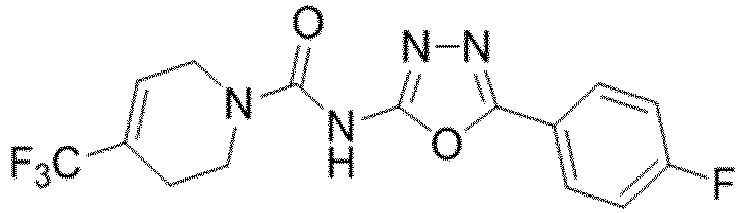
4348 
4349 
4366 
4380 
4381 
4406 
4464 
4497 
4684 
4685 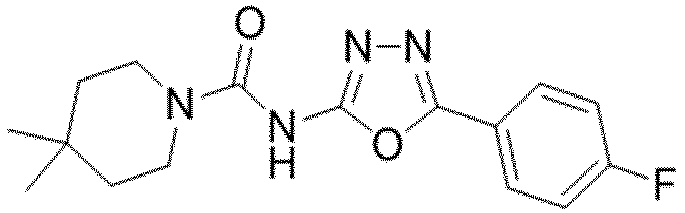
4686 
4698 
4701 
4735 
4736 
4737 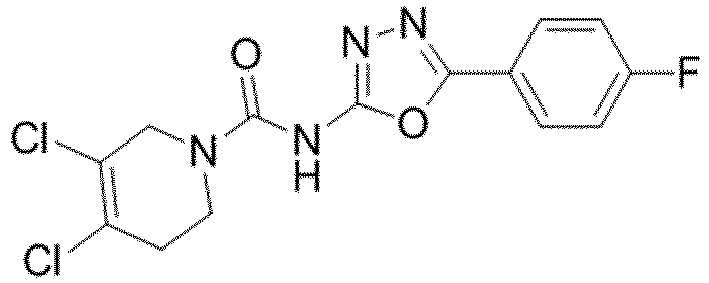
4738 
4739 
4740 
4767 
4768 
4769 
4776 
4777 
4805 
4806 
4807 
4808 
4839 
4840 
4841 
4842 
4843 
4922 
4923 
4930 
4931 
4932 
4933 
4934 
4935 
4936 
4937 
4938 
4939 
4940 
4993 
4994 
4995 
5200 
5202 
5203 
5204 
5212 
5214 
5215 
5216 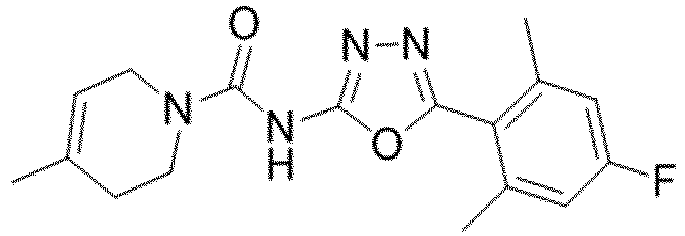
- Composé inhibiteur de la trans-traduction bactérienne ayant la structure de formule I :
 R1 représenteun noyau aryle portant 1 à 4 substituants (en plus du groupe oxadiazole) choisis parmi les groupes alkyle, halogénalkyle, halogéno, alkoxy, hydroxy ;un noyau hétéroaryle hexagonal portant 1 à 4 substituants (en plus du groupe oxadiazole) choisis parmi les groupes halogénalkyle, halogéno, hydroxy ou alkoxy ;un noyau hétéroaryle hexagonal contenant 2 hétéroatomes choisi parmi l'azote, l'oxygène ou le soufre et portant 0 à 3 substituants (en plus du groupe oxadiazole) choisis parmi les groupes halogénalkyle ou alkoxy ;un noyau hétéroaryle pentagonal contenant 2, 3 ou 4 hétéroatomes choisi parmi l'azote, l'oxygène ou le soufre et portant 0 à 3 substituants (en plus du groupe oxadiazole) choisis parmi les groupes alkyle ;un noyau cycloalkyle non substitué ayant 6 atomes de carbone ;un noyau hétérocyclique hexagonal constitué d'atomes de carbone et d'au moins un hétéroatome de noyau choisi indépendamment parmi l'oxygène, l'azote ou le soufre, où l'atome de noyau fixé au noyau oxadiazole est le carbone et ledit noyau hétérocyclique porte 0 à 8 substituants choisis parmi les groupes halogénalkyle, lequel noyau hétérocyclique peut facultativement être fusionné avec un noyau aryle ;un noyau hétérocyclique pentagonal constitué d'atomes de carbone et d'au moins un hétéroatome de noyau choisi indépendamment parmi les atomes d'oxygène, où l'atome de noyau fixé au noyau oxadiazole est le carbone et à condition que les atomes de noyau aux positions 2 et 5 (par rapport au point de fixation en position 1 au groupement oxadiazole) ne soient pas l'azote, et où les atomes de noyau aux positions 2 et 5 (par rapport au point de fixation en position 1 au groupement oxadiazole) peuvent chacun facultativement porter 1 ou 2 substituants choisis parmi les groupes alkyle ou alkoxy ;R2 représente l'hydrogène ;R3 représente un radical hydrocarboné saturé à chaîne droite ayant 1 à 10 atomes de carbone ou un groupe cycloalkyle ;R4 représente un radical hydrocarboné saturé à chaîne ramifiée ayant 1 à 10 atomes de carbone ou un groupe cycloalkyle ; ou, en variante,R3 et R4 peuvent être liés ensemble pour former un noyau hétérocyclique tri- à octogonal substitué composé d'atomes de carbone et d'oxygène et/ou d'azote, le noyau ayant 0 à 3 degrés d'insaturation et portant jusqu'à quatre substituants sur les chaînons cycliques carbone et/ou azote, avec des substituants de l'azote comprenant les groupes alkyle, halogénalkyle, alkoxy et/ou carbonyle ; et avec des substituants du carbone comprenant les groupes alkyle, halogénalkyle, halogéno, alkoxy, carboxy ou alkoxycarbonyle, et/ou un noyau spirocycloalkyle/spirocyclohétéroalkyle avec 3 à 6 atomes de noyau portant 1 à 2 substituants constitués de 1 à 6 atomes lourds choisis parmi les halogènes, et un quelconque nombre d'atomes d'hydrogène,lesquels substituants peuvent facultativement être fusionnés avec un ou plusieurs noyaux aryle, hétéroaryle, cycloalkyle ou hétérocycloalkyle par des fixations soit au carbone soit à l'azote, et lesquels substituants peuvent également facultativement se lier à travers le noyau pour former des ponts de 1 à 4 atomes de carbone et/ou hétéroatomes par des fixations d'atomes de carbone ;ou un de ses sels pharmaceutiquement acceptables.
 - Composé inhibiteur de la trans-traduction selon la revendication 3, choisi dans le groupe consistant en :
Composé n° MBX- Structure 4132 
4198 
4199 
4200 
4201 
4330 
4333 
4347 
4348 
4349 
4366 
4380 
4381 
4406 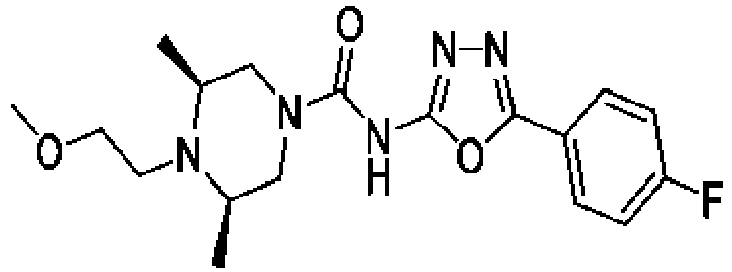
4464 
4497 
4684 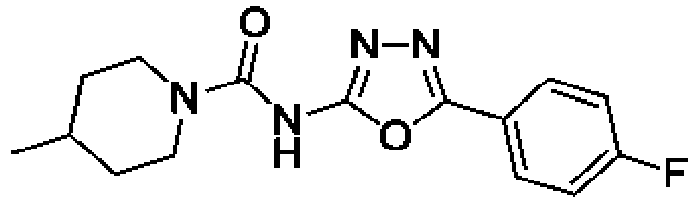
4685 
4686 
4698 
4701 
4735 
4736 
4737 
4738 
4739 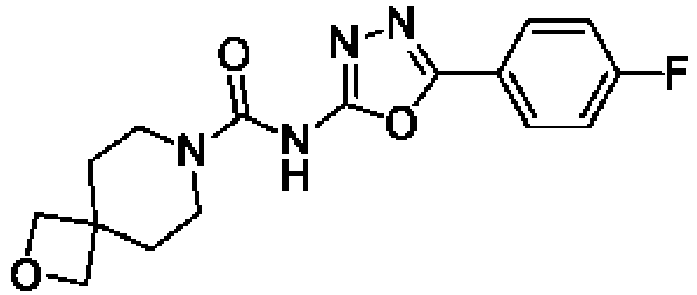
4740 
4767 
4768 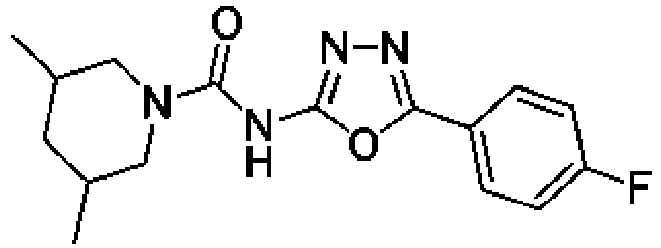
4769 
4776 
4777 
4805 
4806 
4807 
4808 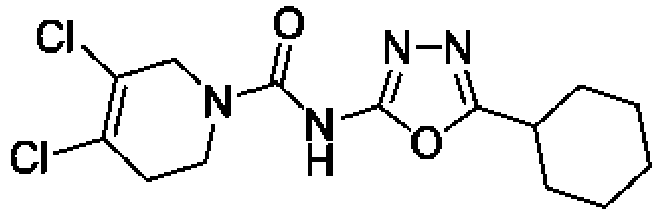
4839 
4840 
4841 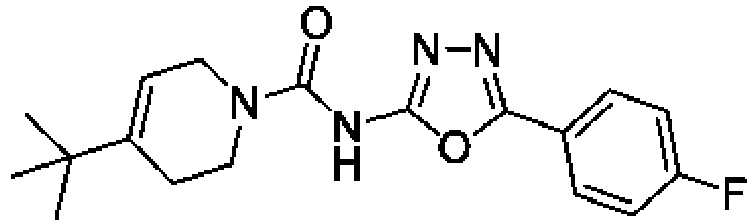
4842 
4843 
4922 
4923 
4930 
4931 
4932 
4933 
4934 
4935 
4936 
4937 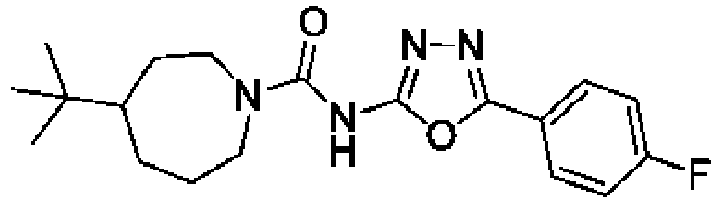
4938 
4939 
4940 
4993 
4994 
4995 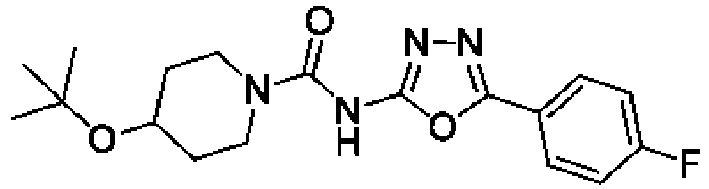
5200 
5202 
5203 
5204 
5212 
5214 
5215 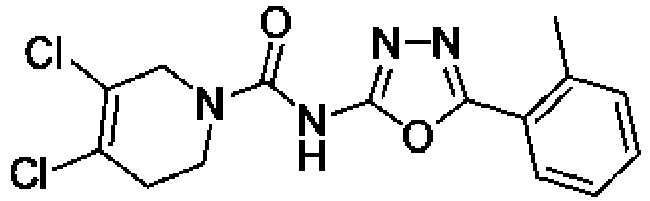
5216 
- Composé inhibiteur de la trans-traduction selon la revendication 3, ayant la structure

dans lequel :R1 représenteun noyau aryle portant 1 à 4 substituants (en plus du groupe oxadiazole) choisis parmi les groupes alkyle, halogénalkyle, halogéno, alkoxy, ou hydroxy ;un noyau hétéroaryle hexagonal portant 1 à 4 substituants (en plus du groupe oxadiazole) choisis parmi les groupes halogénalkyle, halogéno, hydroxy ou alkoxy ;un noyau hétéroaryle hexagonal contenant 2 hétéroatomes choisi parmi l'azote, l'oxygène ou le soufre et portant 0 à 3 substituants (en plus du groupe oxadiazole) choisis parmi les groupes halogénalkyle ou alkoxy ;un noyau hétéroaryle pentagonal contenant 2, 3 ou 4 hétéroatomes choisi parmi l'azote, l'oxygène ou le soufre et portant 0 à 3 substituants (en plus du groupe oxadiazole) choisis parmi les groupes alkyle ;un noyau cycloalkyle non substitué ayant 6 atomes de carbone ;un noyau hétérocyclique hexagonal constitué d'atomes de carbone et d'au moins un hétéroatome de noyau choisi indépendamment parmi l'oxygène, l'azote ou le soufre, où l'atome de noyau fixé au noyau oxadiazole est le carbone et ledit noyau hétérocyclique porte 0 à 8 substituants choisis parmi les groupes halogénalkyle, lequel noyau hétérocyclique peut facultativement être fusionné avec un noyau aryle ;un noyau hétérocyclique pentagonal constitué d'atomes de carbone et d'au moins un hétéroatome de noyau choisi indépendamment parmi les atomes d'oxygène, où l'atome de noyau fixé au noyau oxadiazole est le carbone et à condition que les atomes de noyau aux positions 2 et 5 (par rapport au point de fixation en position 1 au groupement oxadiazole) ne soient pas l'azote, et où les atomes de noyau aux positions 2 et 5 (par rapport au point de fixation en position 1 au groupement oxadiazole) peuvent chacun facultativement porter 1 ou 2 substituants choisis parmi les groupes alkyle ou alkoxy ;R2 représente l'hydrogène ;R3 représente un radical hydrocarboné saturé à chaîne droite ayant 1 à 10 atomes de carbone ou un groupe cycloalkyle ;R4 représente un radical hydrocarboné saturé à chaîne ramifiée ayant 1 à 10 atomes de carbone ou un groupe cycloalkyle ; ou, en variante,R3 et R4 peuvent être liés ensemble pour former un noyau hétérocyclique tri- à octogonal substitué composé d'atomes de carbone et d'oxygène et/ou d'azote, le noyau ayant 0 à 3 degrés d'insaturation et portant jusqu'à quatre substituants sur les chaînons cycliques carbone et/ou azote, avec des substituants du carbone comprenant les groupes alkyle, halogénalkyle, alkoxy, carboxy et/ou alkoxycarbonyle, et avec des substituants de l'azote comprenant les groupes alkyle, halogénalkyle, alkoxy et/ou carbonyle, lesquels substituants peuvent facultativement être fusionnés avec un ou plusieurs noyaux aryle, hétéroaryle, cycloalkyle ou hétérocycloalkyle par des fixations soit au carbone soit à l'azote,ou un de ses sels pharmaceutiquement acceptables ; - Composé inhibiteur de la trans-traduction selon la revendication 3, choisi dans le groupe consistant en :
Composé n° MBX- Structure 4132 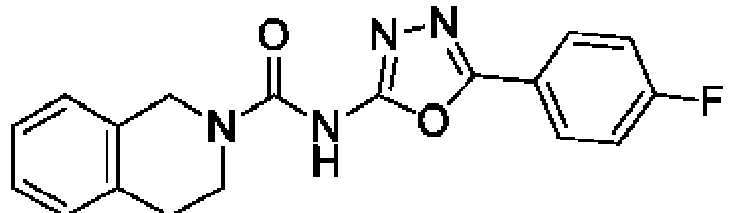
4198 
4199 
4200 
4201 
4330 
4333 
4347 
4348 
4349 
4366 
4380 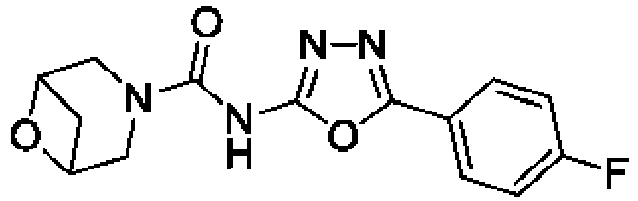
4381 
4406 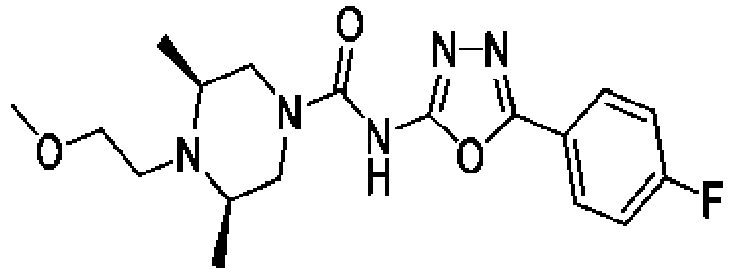
4464 
4497 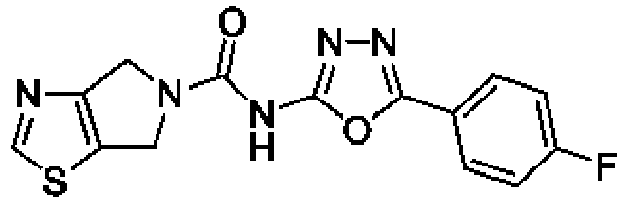
- Composé pour une utilisation dans un procédé de traitement ou de prévention d'une infection bactérienne chez un sujet mammifère, ledit procédé comprenant l'administration à un sujet en ayant besoin d'une quantité efficace d'un composé inhibiteur de la trans-traduction, le composé ayant la structure de formule I :
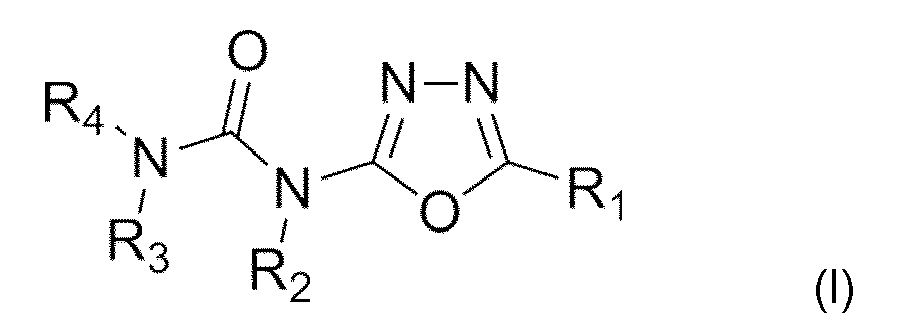 R1 représenteun noyau aryle portant 1 à 4 substituants (en plus du groupe oxadiazole) choisis parmi les groupes alkyle, halogénalkyle, halogéno, alkoxy ou hydroxy ;un noyau hétéroaryle hexagonal portant 1 à 4 substituants (en plus du groupe oxadiazole) choisis parmi les groupes halogénalkyle, halogéno, hydroxy ou alkoxy ;un noyau hétéroaryle hexagonal contenant 2 hétéroatomes choisi parmi l'azote, l'oxygène ou le soufre et portant 0 à 3 substituants (en plus du groupe oxadiazole) choisis parmi les groupes halogénalkyle ou alkoxy ;un noyau hétéroaryle pentagonal contenant 2, 3 ou 4 hétéroatomes choisi parmi l'azote, l'oxygène ou le soufre et portant 0 à 3 substituants (en plus du groupe oxadiazole) choisis parmi les groupes alkyle ;un noyau cycloalkyle non substitué ayant 6 atomes de carbone ;un noyau hétérocyclique hexagonal constitué d'atomes de carbone et d'au moins un hétéroatome de noyau choisi indépendamment parmi l'oxygène, l'azote ou le soufre, où l'atome de noyau fixé au noyau oxadiazole est le carbone et ledit noyau hétérocyclique porte 0 à 8 substituants choisis parmi les groupes halogénalkyle, lequel noyau hétérocyclique peut facultativement être fusionné avec un noyau aryle ;un noyau hétérocyclique pentagonal constitué d'atomes de carbone et d'au moins un hétéroatome de noyau choisi indépendamment parmi les atomes d'oxygène, où l'atome de noyau fixé au noyau oxadiazole est le carbone et à condition que les atomes de noyau aux positions 2 et 5 (par rapport au point de fixation en position 1 au groupement oxadiazole) ne soient pas l'azote, et les atomes de noyau aux positions 2 et 5 (par rapport au point de fixation en position 1 au groupement oxadiazole) peuvent chacun facultativement porter 1 ou 2 substituants choisis parmi les groupes alkyle ou alkoxy ;R2 représente l'hydrogène ;R3 représente un radical hydrocarboné saturé à chaîne droite ayant 1 à 10 atomes de carbone ou un groupe cycloalkyle ;R4 représente un radical hydrocarboné saturé à chaîne ramifiée ayant 1 à 10 atomes de carbone ou un groupe cycloalkyle ; ou, en variante,R3 et R4 peuvent être liés ensemble pour former un noyau hétérocyclique tri- à octogonal substitué composé d'atomes de carbone et d'oxygène et/ou d'azote, le noyau ayant 0 à 3 degrés d'insaturation et portant jusqu'à quatre substituants sur les chaînons cycliques carbone et/ou azote, avec des substituants de l'azote comprenant les groupes alkyle, halogénalkyle, alkoxy et/ou carbonyle ; et avec des substituants du carbone comprenant les groupes alkyle, halogénalkyle, halogéno, alkoxy, carboxy ou alkoxycarbonyle, et/ou un noyau spirocycloalkyle/spirocyclohétéroalkyle avec 3 à 6 atomes de noyau portant 1 à 2 substituants constitués de 1 à 6 atomes lourds choisis parmi les halogènes, et un quelconque nombre d'atomes d'hydrogène,lesquels substituants peuvent facultativement être fusionnés avec un ou plusieurs noyaux aryle, hétéroaryle, cycloalkyle ou hétérocycloalkyle par des fixations soit au carbone soit à l'azote, et lesquels substituants peuvent également facultativement se lier à travers le noyau pour former des ponts de 1 à 4 atomes de carbone et/ou hétéroatomes par des fixations d'atomes de carbone ;ou un de ses sels pharmaceutiquement acceptables
 - Composition pour une utilisation dans un procédé d'inhibition de la croissance bactérienne médiée par la trans-traduction chez un mammifère, ledit procédé comprenant l'administration d'une quantité efficace d'une composition comprenant au moins un composé ayant la structure
 R1 représente un noyau aryle portant 1 à 4 substituants (en plus du groupe oxadiazole) choisis parmi les groupes alkyle, halogénalkyle, halogéno, alkoxy ou hydroxy ;un noyau hétéroaryle hexagonal portant 1 à 4 substituants (en plus du groupe oxadiazole) choisis parmi les groupes halogénalkyle, halogéno, alkoxy ou hydroxy ;un noyau hétéroaryle hexagonal contenant 2 hétéroatomes choisi parmi l'azote, l'oxygène ou le soufre et portant 0 à 3 substituants (en plus du groupe oxadiazole) choisis parmi les groupes halogénalkyle ou alkoxy ;un noyau hétéroaryle pentagonal contenant 2, 3 ou 4 hétéroatomes choisi parmi l'azote, l'oxygène ou le soufre et portant 0 à 3 substituants (en plus du groupe oxadiazole) choisis parmi les groupes alkyle ;un noyau cycloalkyle non substitué ayant 6 atomes de carbone ;un noyau hétérocyclique hexagonal constitué d'atomes de carbone et d'au moins un hétéroatome de noyau choisi indépendamment parmi l'oxygène, l'azote ou le soufre, où l'atome de noyau fixé au noyau oxadiazole est le carbone et ledit noyau hétérocyclique porte 0 à 8 substituants choisis parmi les groupes halogénalkyle, lequel noyau hétérocyclique peut facultativement être fusionné avec un noyau aryle ;un noyau hétérocyclique pentagonal constitué d'atomes de carbone et d'au moins un hétéroatome de noyau choisi indépendamment parmi les atomes d'oxygène, où l'atome de noyau fixé au noyau oxadiazole est le carbone et à condition que les atomes de noyau aux positions 2 et 5 (par rapport au point de fixation en position 1 au groupement oxadiazole) ne soient pas l'azote, et où les atomes de noyau aux positions 2 et 5 (par rapport au point de fixation en position 1 au groupement oxadiazole) peuvent chacun facultativement porter 1 ou 2 substituants choisis parmi les groupes alkyle ou alkoxyR2 représente l'hydrogène ;R3 représente un radical hydrocarboné saturé à chaîne droite ayant 1 à 10 atomes de carbone ou un groupe cycloalkyle ;R4 représente un radical hydrocarboné saturé à chaîne ramifiée ayant 1 à 10 atomes de carbone ou un groupe cycloalkyle ; ou, en variante,R3 et R4 peuvent être liés ensemble pour former un noyau hétérocyclique tri- à octogonal substitué composé d'atomes de carbone et d'oxygène et/ou d'azote, le noyau ayant 0 à 3 degrés d'insaturation et portant jusqu'à quatre substituants sur les chaînons cycliques carbone et/ou azote, avec des substituants de l'azote comprenant les groupes alkyle, halogénalkyle, alkoxy et/ou carbonyle, et avec des substituants du carbone comprenant les groupes alkyle, halogénalkyle, halogéno, alkoxy, carboxy ou alkoxycarbonyle, et/ou un noyau spirocycloalkyle/spirocyclohétéroalkyle avec 3 à 6 atomes de noyau portant 1 à 2 substituants constitués de 1 à 6 atomes lourds choisis parmi les halogènes, et un quelconque nombre d'atomes d'hydrogène,lesquels substituants peuvent facultativement être fusionnés avec un ou plusieurs noyaux aryle, hétéroaryle, cycloalkyle ou hétérocycloalkyle par des fixations soit au carbone soit à l'azote, et lesquels substituants peuvent également facultativement se lier à travers le noyau pour former des ponts de 1 à 4 atomes de carbone et/ou hétéroatomes par des fixations d'atomes de carbone ;ou un de ses sels pharmaceutiquement acceptables.
 - Composition pour une utilisation selon la revendication 8, dans laquelle l'infection bactérienne est choisie parmi M. tuberculosis, N. gonorrhoeae, S. flexneri, H. influenzae, S. aureus, S. enterica, Y. pestis, F. tularensis et S. pneumoniae.
- Composition pharmaceutique comprenant au moins un composé inhibiteur de la trans-traduction selon l'une quelconque des revendications 3 à 6, et un support ou excipient pharmaceutiquement acceptable.
- Procédé non thérapeutique d'inhibition de la croissance de cellules bactériennes sur une surface solide comprenant l'étape de mise en contact de la surface avec au moins un composé inhibiteur de la trans-traduction, le composé ayant la structure de formule I
 R1 représenteun noyau aryle portant 1 à 4 substituants (en plus du groupe oxadiazole) choisis parmi les groupes alkyle, halogénalkyle, halogéno, alkoxy ou hydroxy ;un noyau hétéroaryle hexagonal portant 1 à 4 substituants (en plus du groupe oxadiazole) choisis parmi les groupes halogénalkyle ou alkoxy ;un noyau hétéroaryle hexagonal contenant 2, 3 ou 4 hétéroatomes choisi parmi l'azote, l'oxygène ou le soufre et portant 0 à 3 substituants (en plus du groupe oxadiazole) choisis parmi les groupes halogénalkyle ou alkoxy ;un noyau hétéroaryle pentagonal contenant 2, 3 ou 4 hétéroatomes choisi parmi l'azote, l'oxygène ou le soufre et portant 0 à 3 substituants (en plus du groupe oxadiazole) choisis parmi les groupes alkyle ;un noyau cycloalkyle non substitué ayant 6 atomes de carbone ;un noyau hétérocyclique hexagonal constitué d'atomes de carbone et d'au moins un hétéroatome de noyau choisi indépendamment parmi l'oxygène, l'azote ou le soufre, où l'atome de noyau fixé au noyau oxadiazole est le carbone et ledit noyau hétérocyclique porte 0 à 8 substituants choisis parmi les groupes halogénalkyle, lequel noyau hétérocyclique peut facultativement être fusionné avec un noyau aryle ;un noyau hétérocyclique pentagonal constitué d'atomes de carbone et d'au moins un hétéroatome de noyau choisi indépendamment parmi les atomes d'oxygène, où l'atome de noyau fixé au noyau oxadiazole est le carbone et à condition que les atomes de noyau aux positions 2 et 5 (par rapport au point de fixation en position 1 au groupement oxadiazole) ne soient pas l'azote, et où les atomes de noyau aux positions 2 et 5 (par rapport au point de fixation en position 1 au groupement oxadiazole) peuvent chacun facultativement porter 1 ou 2 substituants choisis parmi les groupes alkyle ou alkoxy,R2 représente l'hydrogène ;R3 représente un radical hydrocarboné saturé à chaîne droite ayant 1 à 10 atomes de carbone ou un groupe cycloalkyle ;R4 représente un radical hydrocarboné saturé à chaîne ramifiée ayant 1 à 10 atomes de carbone ou un groupe cycloalkyle ; ou, en variante,R3 et R4 peuvent être liés ensemble pour former un noyau hétérocyclique tri- à octogonal substitué composé d'atomes de carbone et d'oxygène et/ou d'azote, le noyau ayant 0 à 3 degrés d'insaturation et portant jusqu'à quatre substituants sur les chaînons cycliques carbone et/ou azote, avec des substituants de l'azote comprenant les groupes alkyle, halogénalkyle, alkoxy et/ou carbonyle ; et avec des substituants du carbone comprenant les groupes alkyle, halogénalkyle, halogéno, alkoxy, carboxy ou alkoxycarbonyle, et/ou un noyau spirocycloalkyle/spirocyclohétéroalkyle avec 3 à 6 atomes de noyau portant 1 à 2 substituants constitués de 1 à 6 atomes lourds choisis parmi les halogènes, et un quelconque nombre d'atomes d'hydrogène,lesquels substituants peuvent facultativement être fusionnés avec un ou plusieurs noyaux aryle, hétéroaryle, cycloalkyle ou hétérocycloalkyle par des fixations au carbone ou à l'azote, et lesquels substituants peuvent également facultativement se lier à travers le noyau pour former des ponts de 1 à 4 atomes de carbone et/ou hétéroatomes par des fixations d'atomes de carbone ;ou un de ses sels pharmaceutiquement acceptables.
 - Procédé non thérapeutique de désinfection d'une surface solide comprenant l'étape de mise en contact de la surface avec au moins un composé inhibiteur de la trans-traduction, le composé ayant la structure de formule I
 R1 représenteun noyau aryle portant 1 à 4 substituants (en plus du groupe oxadiazole) choisis parmi les groupes alkyle, halogénalkyle, halogéno, alkoxy ou hydroxy ;un noyau hétéroaryle hexagonal portant 1 à 4 substituants (en plus du groupe oxadiazole) choisis parmi les groupes halogénalkyle ou alkoxy ;un noyau hétéroaryle hexagonal contenant 2 hétéroatomes choisi parmi l'azote, l'oxygène ou le soufre et portant 0 à 3 substituants (en plus du groupe oxadiazole) choisis parmi les groupes halogénalkyle ou alkoxy ;un noyau hétéroaryle pentagonal contenant 2, 3 ou 4 hétéroatomes choisi parmi l'azote, l'oxygène ou le soufre et portant 0 à 3 substituants (en plus du groupe oxadiazole) choisis parmi les groupes alkyle ;un noyau cycloalkyle non substitué ayant 6 atomes de carbone ;un noyau hétérocyclique hexagonal constitué d'atomes de carbone et d'au moins un hétéroatome de noyau choisi indépendamment parmi l'oxygène, l'azote ou le soufre, où l'atome de noyau fixé au noyau oxadiazole est le carbone et ledit noyau hétérocyclique porte 0 à 8 substituants choisis parmi les groupes halogénalkyle, lequel noyau hétérocyclique peut facultativement être fusionné avec un noyau aryle ;un noyau hétérocyclique pentagonal constitué d'atomes de carbone et d'au moins un hétéroatome de noyau choisi indépendamment parmi les atomes d'oxygène, où l'atome de noyau fixé au noyau oxadiazole est le carbone et à condition que les atomes de noyau aux positions 2 et 5 (par rapport au point de fixation en position 1 au groupement oxadiazole) ne soient pas l'azote, et où les atomes de noyau aux positions 2 et 5 (par rapport au point de fixation en position 1 au groupement oxadiazole) peuvent chacun facultativement porter 1 ou 2 substituants choisis parmi les groupes alkyle ou alkoxy ;R2 représente l'hydrogène ;R3 représente un radical hydrocarboné saturé à chaîne droite ayant 1 à 10 atomes de carbone ou un groupe cycloalkyle ;R4 représente un radical hydrocarboné saturé à chaîne ramifiée ayant 1 à 10 atomes de carbone ou un groupe cycloalkyle ; ou, en variante,R3 et R4 peuvent être liés ensemble pour former un noyau hétérocyclique tri- à octogonal substitué composé d'atomes de carbone et d'oxygène et/ou d'azote, le noyau ayant 0 à 3 degrés d'insaturation et portant jusqu'à quatre substituants sur les chaînons cycliques carbone et/ou azote, avec des substituants de l'azote comprenant les groupes alkyle, halogénalkyle, alkoxy et/ou carbonyle ; et avec des substituants du carbone comprenant les groupes alkyle, halogénalkyle, halogéno, alkoxy, carboxy ou alkoxycarbonyle, et/ou un noyau spirocycloalkyle/spirocyclohétéroalkyle avec 3 à 6 atomes de noyau portant 1 à 2 substituants constitués de 1 à 6 atomes lourds choisis parmi les halogènes, et un quelconque nombre d'atomes d'hydrogène, lesquels substituants peuvent facultativement être fusionnés avec un ou plusieurs noyaux aryle, hétéroaryle, cycloalkyle ou hétérocycloalkyle par des fixations soit au carbone soit à l'azote, et lesquels substituants peuvent également facultativement se lier à travers le noyau pour former des ponts de 1 à 4 atomes de carbone et/ou hétéroatomes par des fixations d'atomes de carbone ;ou un de ses sels pharmaceutiquement acceptables.
 - Procédé selon la revendication 11 ou 12, dans lequel ladite surface solide est choisie dans le groupe consistant en dispositifs médicaux implantables, cathéters veineux centraux (CVC), pompes implantables, valves cardiaques artificielles, stimulateurs cardiaques, pompes de circulation extracorporelle (CEC), coeur-poumon artificiels, matériel de dialyse, respirateurs artificiels, appareils respiratoires, conduites d'eau, conduits d'air, filtres à air, filtres à eau et équipements sanitaires.
Applications Claiming Priority (2)
| Application Number | Priority Date | Filing Date | Title |
|---|---|---|---|
| US201762548019P | 2017-08-21 | 2017-08-21 | |
| PCT/US2018/047181 WO2019040404A1 (fr) | 2017-08-21 | 2018-08-21 | N-acylaminooxadiazoles stables d'un point de vue métabolique utiles en tant qu'agents antibactériens |
Publications (3)
| Publication Number | Publication Date |
|---|---|
| EP3672946A1 EP3672946A1 (fr) | 2020-07-01 |
| EP3672946A4 EP3672946A4 (fr) | 2021-06-16 |
| EP3672946B1 true EP3672946B1 (fr) | 2024-12-04 |
Family
ID=65438844
Family Applications (1)
| Application Number | Title | Priority Date | Filing Date |
|---|---|---|---|
| EP18848959.5A Active EP3672946B1 (fr) | 2017-08-21 | 2018-08-21 | N-acylaminooxadiazoles stables d'un point de vue métabolique utiles en tant qu'agents antibactériens |
Country Status (8)
| Country | Link |
|---|---|
| US (2) | US11505533B2 (fr) |
| EP (1) | EP3672946B1 (fr) |
| JP (2) | JP7408064B2 (fr) |
| KR (1) | KR20200049797A (fr) |
| CN (1) | CN111511723A (fr) |
| AU (1) | AU2018321845B2 (fr) |
| CA (1) | CA3072103A1 (fr) |
| WO (1) | WO2019040404A1 (fr) |
Families Citing this family (1)
| Publication number | Priority date | Publication date | Assignee | Title |
|---|---|---|---|---|
| CA3184471A1 (fr) * | 2020-05-27 | 2021-12-02 | The Penn State Research Foundation | Composes antibacteriens |
Family Cites Families (22)
| Publication number | Priority date | Publication date | Assignee | Title |
|---|---|---|---|---|
| AU2003265382A1 (en) * | 2002-08-23 | 2004-03-11 | Pharmacia & Upjohn Company Llc | Antibacterial benzoic acid derivatives |
| DE102004028862A1 (de) * | 2004-06-15 | 2005-12-29 | Merck Patent Gmbh | 3-Aminoindazole |
| WO2007008541A2 (fr) * | 2005-07-08 | 2007-01-18 | Kalypsys, Inc. | Modificateurs d'absorption de cholesterol cellulaire |
| DE102007002717A1 (de) * | 2007-01-18 | 2008-07-24 | Merck Patent Gmbh | Heterocyclische Indazolderivate |
| GB0706793D0 (en) * | 2007-04-05 | 2007-05-16 | Evotec Ag | Compounds |
| CA2934114A1 (fr) * | 2007-06-12 | 2008-12-18 | Achaogen, Inc. | Agents antibacteriens |
| EP2310388B1 (fr) * | 2008-06-17 | 2015-08-05 | Institut Pasteur Korea | Composes de pyridopyrimidine comme agents anti-tuberculaire |
| DE102008038220A1 (de) * | 2008-08-18 | 2010-02-25 | Merck Patent Gmbh | Oxadiazolderivate |
| US20100113465A1 (en) | 2008-10-30 | 2010-05-06 | Pfizer Inc. | 7-azaspiro[3.5]nonane-7-carboxamide compounds |
| EA026386B1 (ru) * | 2011-03-22 | 2017-04-28 | Байер Интеллектуэль Проперти Гмбх | Амид n-(1,3,4-оксадиазол-2-ил)арилкарбоновой кислоты или его соль и его применение в качестве гербицида |
| WO2013074965A1 (fr) | 2011-11-16 | 2013-05-23 | Microbiotix, Inc. | Inhibiteurs d'aminoalkyl phénol éther du virus de la grippe a |
| CN102746253A (zh) * | 2012-07-25 | 2012-10-24 | 山东理工大学 | 含藜芦醛的噁二唑衍生物及其制备方法 |
| US20150246024A1 (en) * | 2012-08-20 | 2015-09-03 | The University Of Chicago | Methods and compositions for inhibiting gram positive bacteria |
| FR3000491B1 (fr) * | 2012-09-27 | 2015-08-28 | Univ Lille Ii Droit & Sante | Composes utilisables dans le traitement des infections mycobacteriennes |
| CA2892991A1 (fr) * | 2013-01-09 | 2014-07-17 | Actelion Pharmaceuticals Ltd | Derives d'oxadiazolone antibacteriens |
| WO2014144710A1 (fr) * | 2013-03-15 | 2014-09-18 | The University Of Chicago | Méthodes et compositions utilisées pour les infections bactériennes |
| GB201307233D0 (en) * | 2013-04-22 | 2013-05-29 | Vib Vzw | Compounds and uses thereof |
| ES2718550T3 (es) * | 2013-05-13 | 2019-07-02 | Glaxosmithkline Llc | Análogos de urea con puente sustituidos como moduladores de sirtuinas |
| CA2941908A1 (fr) * | 2014-03-11 | 2015-09-17 | Bayer Cropscience Aktiengesellschaft | Utilisation de n-(1,3,4-oxadiazol-2-yl)arylcarboxamides ou de leurs sels pour lutter contre les plantes indesirables dans des zones de culture de plantes transgeniques tolerantes aux herbicides inhibiteurs de la hppd |
| US10662164B2 (en) * | 2014-09-25 | 2020-05-26 | University Of Notre Dame Du Lac | Non-beta lactam antibiotics |
| CN105646391B (zh) * | 2016-03-07 | 2017-12-12 | 滨州医学院 | 具有抑菌活性的恶二唑杂环取代的双羟基季铵盐及其制备方法 |
| JP7357934B2 (ja) * | 2018-04-12 | 2023-10-10 | パーデュー・リサーチ・ファウンデーション | ベンズアミド抗菌剤 |
-
2018
- 2018-08-21 WO PCT/US2018/047181 patent/WO2019040404A1/fr not_active Ceased
- 2018-08-21 US US16/640,642 patent/US11505533B2/en active Active
- 2018-08-21 KR KR1020207008271A patent/KR20200049797A/ko not_active Ceased
- 2018-08-21 EP EP18848959.5A patent/EP3672946B1/fr active Active
- 2018-08-21 AU AU2018321845A patent/AU2018321845B2/en active Active
- 2018-08-21 JP JP2020510555A patent/JP7408064B2/ja active Active
- 2018-08-21 CA CA3072103A patent/CA3072103A1/fr active Pending
- 2018-08-21 CN CN201880059872.1A patent/CN111511723A/zh active Pending
-
2022
- 2022-10-13 US US17/964,994 patent/US20230109833A1/en not_active Abandoned
-
2023
- 2023-08-04 JP JP2023127478A patent/JP2023166378A/ja active Pending
Also Published As
| Publication number | Publication date |
|---|---|
| US20200361882A1 (en) | 2020-11-19 |
| WO2019040404A1 (fr) | 2019-02-28 |
| JP2020531496A (ja) | 2020-11-05 |
| CA3072103A1 (fr) | 2019-02-28 |
| US20230109833A1 (en) | 2023-04-13 |
| EP3672946A1 (fr) | 2020-07-01 |
| AU2018321845A1 (en) | 2020-02-20 |
| EP3672946A4 (fr) | 2021-06-16 |
| AU2018321845B2 (en) | 2023-03-16 |
| CN111511723A (zh) | 2020-08-07 |
| JP7408064B2 (ja) | 2024-01-05 |
| JP2023166378A (ja) | 2023-11-21 |
| KR20200049797A (ko) | 2020-05-08 |
| US11505533B2 (en) | 2022-11-22 |
Similar Documents
| Publication | Publication Date | Title |
|---|---|---|
| US20150266827A1 (en) | Antibiotic Tolerance Inhibitors | |
| US20140249073A1 (en) | Broad spectrum antibiotics | |
| US9708368B2 (en) | Linear peptide antibiotics | |
| US12459936B2 (en) | Benzamide antibacterial agents | |
| US20250051300A1 (en) | Gram-negative specific antibiotics sparing effect on gut microbiome | |
| US20200024309A1 (en) | Macrocyclic broad spectrum antibiotics | |
| US20230109833A1 (en) | Metabolically stable n-acylaminooxadiazoles useful as antibacterial agents | |
| EP3719020B1 (fr) | Forme cristalline d'un inhibiteur de beta-lactamase et son procédé de préparation | |
| CA2868253A1 (fr) | Derive d'acide nipecotique et son utilisation a des fins medicales | |
| KR102099980B1 (ko) | 알라닌 및 프롤린 아미노산의 기능적 유도체 화합물 및 이를 포함하는 약학적 조성물 | |
| US10501493B2 (en) | Broad spectrum antibiotics | |
| CN102827247B (zh) | 新的尿苷肽类抗生素及其作为抗结核病药物的用途 | |
| US9862680B2 (en) | Peripherally substituted monocyclic beta-lactams | |
| US20200147086A1 (en) | Inhibitors of nucleotidyltransferase superfamily enzymes as antibiotics | |
| DK2285802T3 (en) | Oxo-imidazolyl compounds with antibacterial activity | |
| US20260125371A1 (en) | Method for inhibiting clostridioides difficile spore germination | |
| CN110759889B (zh) | 2-芳酰胺基取代的噻吩酰亚胺酯类化合物及其制备方法和用途 | |
| AU2015287695B2 (en) | N- (hydrophobe-substituted) vancosaminyl [Ψ[C(=NH) NH] Tpg4] vancomycin and [Ψ[CH2NH] Tpg4] vancomycin | |
| JP2017105714A (ja) | 多剤排出ポンプ阻害剤 | |
| CN101591298A (zh) | 含1,3-二杂苯并五元环的异羟肟酸类衍生物、其制备方法和用途 | |
| FR2941956A1 (fr) | NOUVELLES MOLECULES HYBRIDES VANCOMYCINE-AMINOQUINOLEINE DENOMMEES "VANCOMYQUINESr", LEUR PREPARATION ET LEUR APPLICATION EN THERAPEUTIQUE |
Legal Events
| Date | Code | Title | Description |
|---|---|---|---|
| STAA | Information on the status of an ep patent application or granted ep patent |
Free format text: STATUS: THE INTERNATIONAL PUBLICATION HAS BEEN MADE |
|
| PUAI | Public reference made under article 153(3) epc to a published international application that has entered the european phase |
Free format text: ORIGINAL CODE: 0009012 |
|
| STAA | Information on the status of an ep patent application or granted ep patent |
Free format text: STATUS: REQUEST FOR EXAMINATION WAS MADE |
|
| 17P | Request for examination filed |
Effective date: 20200212 |
|
| AK | Designated contracting states |
Kind code of ref document: A1 Designated state(s): AL AT BE BG CH CY CZ DE DK EE ES FI FR GB GR HR HU IE IS IT LI LT LU LV MC MK MT NL NO PL PT RO RS SE SI SK SM TR |
|
| AX | Request for extension of the european patent |
Extension state: BA ME |
|
| DAV | Request for validation of the european patent (deleted) | ||
| DAX | Request for extension of the european patent (deleted) | ||
| RIN1 | Information on inventor provided before grant (corrected) |
Inventor name: ARON, ZACHARY, D. Inventor name: KWASNY, STEVEN, M. Inventor name: BARBOR, JAY P. Inventor name: KEILER, KENNETH, C. Inventor name: CARDINALE, STEVEN, C. Inventor name: OPPERMAN, TIMOTHY, J. Inventor name: TORHAN, MATTHEW, C. Inventor name: BUTLER, MICHELLE, M. |
|
| REG | Reference to a national code |
Ref country code: HK Ref legal event code: DE Ref document number: 40033434 Country of ref document: HK |
|
| RIC1 | Information provided on ipc code assigned before grant |
Ipc: C07D 271/10 20060101AFI20210318BHEP Ipc: C07D 271/107 20060101ALI20210318BHEP Ipc: C07D 271/113 20060101ALI20210318BHEP Ipc: C07D 413/12 20060101ALI20210318BHEP Ipc: A61P 31/04 20060101ALI20210318BHEP Ipc: A61K 31/4245 20060101ALI20210318BHEP |
|
| A4 | Supplementary search report drawn up and despatched |
Effective date: 20210518 |
|
| RIC1 | Information provided on ipc code assigned before grant |
Ipc: C07D 271/10 20060101AFI20210511BHEP Ipc: C07D 271/107 20060101ALI20210511BHEP Ipc: C07D 271/113 20060101ALI20210511BHEP Ipc: C07D 413/12 20060101ALI20210511BHEP Ipc: A61P 31/04 20060101ALI20210511BHEP Ipc: A61K 31/4245 20060101ALI20210511BHEP |
|
| STAA | Information on the status of an ep patent application or granted ep patent |
Free format text: STATUS: EXAMINATION IS IN PROGRESS |
|
| 17Q | First examination report despatched |
Effective date: 20220502 |
|
| GRAP | Despatch of communication of intention to grant a patent |
Free format text: ORIGINAL CODE: EPIDOSNIGR1 |
|
| STAA | Information on the status of an ep patent application or granted ep patent |
Free format text: STATUS: GRANT OF PATENT IS INTENDED |
|
| INTG | Intention to grant announced |
Effective date: 20240624 |
|
| GRAS | Grant fee paid |
Free format text: ORIGINAL CODE: EPIDOSNIGR3 |
|
| GRAA | (expected) grant |
Free format text: ORIGINAL CODE: 0009210 |
|
| STAA | Information on the status of an ep patent application or granted ep patent |
Free format text: STATUS: THE PATENT HAS BEEN GRANTED |
|
| AK | Designated contracting states |
Kind code of ref document: B1 Designated state(s): AL AT BE BG CH CY CZ DE DK EE ES FI FR GB GR HR HU IE IS IT LI LT LU LV MC MK MT NL NO PL PT RO RS SE SI SK SM TR |
|
| REG | Reference to a national code |
Ref country code: GB Ref legal event code: FG4D |
|
| REG | Reference to a national code |
Ref country code: CH Ref legal event code: EP |
|
| REG | Reference to a national code |
Ref country code: DE Ref legal event code: R096 Ref document number: 602018077337 Country of ref document: DE |
|
| REG | Reference to a national code |
Ref country code: IE Ref legal event code: FG4D |
|
| REG | Reference to a national code |
Ref country code: LT Ref legal event code: MG9D |
|
| REG | Reference to a national code |
Ref country code: NL Ref legal event code: MP Effective date: 20241204 |
|
| PG25 | Lapsed in a contracting state [announced via postgrant information from national office to epo] |
Ref country code: HR Free format text: LAPSE BECAUSE OF FAILURE TO SUBMIT A TRANSLATION OF THE DESCRIPTION OR TO PAY THE FEE WITHIN THE PRESCRIBED TIME-LIMIT Effective date: 20241204 |
|
| PG25 | Lapsed in a contracting state [announced via postgrant information from national office to epo] |
Ref country code: FI Free format text: LAPSE BECAUSE OF FAILURE TO SUBMIT A TRANSLATION OF THE DESCRIPTION OR TO PAY THE FEE WITHIN THE PRESCRIBED TIME-LIMIT Effective date: 20241204 |
|
| PG25 | Lapsed in a contracting state [announced via postgrant information from national office to epo] |
Ref country code: BG Free format text: LAPSE BECAUSE OF FAILURE TO SUBMIT A TRANSLATION OF THE DESCRIPTION OR TO PAY THE FEE WITHIN THE PRESCRIBED TIME-LIMIT Effective date: 20241204 |
|
| PG25 | Lapsed in a contracting state [announced via postgrant information from national office to epo] |
Ref country code: ES Free format text: LAPSE BECAUSE OF FAILURE TO SUBMIT A TRANSLATION OF THE DESCRIPTION OR TO PAY THE FEE WITHIN THE PRESCRIBED TIME-LIMIT Effective date: 20241204 |
|
| PG25 | Lapsed in a contracting state [announced via postgrant information from national office to epo] |
Ref country code: NO Free format text: LAPSE BECAUSE OF FAILURE TO SUBMIT A TRANSLATION OF THE DESCRIPTION OR TO PAY THE FEE WITHIN THE PRESCRIBED TIME-LIMIT Effective date: 20250304 |
|
| PG25 | Lapsed in a contracting state [announced via postgrant information from national office to epo] |
Ref country code: LV Free format text: LAPSE BECAUSE OF FAILURE TO SUBMIT A TRANSLATION OF THE DESCRIPTION OR TO PAY THE FEE WITHIN THE PRESCRIBED TIME-LIMIT Effective date: 20241204 Ref country code: GR Free format text: LAPSE BECAUSE OF FAILURE TO SUBMIT A TRANSLATION OF THE DESCRIPTION OR TO PAY THE FEE WITHIN THE PRESCRIBED TIME-LIMIT Effective date: 20250305 |
|
| PG25 | Lapsed in a contracting state [announced via postgrant information from national office to epo] |
Ref country code: RS Free format text: LAPSE BECAUSE OF FAILURE TO SUBMIT A TRANSLATION OF THE DESCRIPTION OR TO PAY THE FEE WITHIN THE PRESCRIBED TIME-LIMIT Effective date: 20250304 |
|
| PG25 | Lapsed in a contracting state [announced via postgrant information from national office to epo] |
Ref country code: NL Free format text: LAPSE BECAUSE OF FAILURE TO SUBMIT A TRANSLATION OF THE DESCRIPTION OR TO PAY THE FEE WITHIN THE PRESCRIBED TIME-LIMIT Effective date: 20241204 |
|
| REG | Reference to a national code |
Ref country code: AT Ref legal event code: MK05 Ref document number: 1748054 Country of ref document: AT Kind code of ref document: T Effective date: 20241204 |
|
| P01 | Opt-out of the competence of the unified patent court (upc) registered |
Free format text: CASE NUMBER: APP_17978/2025 Effective date: 20250414 |
|
| PG25 | Lapsed in a contracting state [announced via postgrant information from national office to epo] |
Ref country code: SM Free format text: LAPSE BECAUSE OF FAILURE TO SUBMIT A TRANSLATION OF THE DESCRIPTION OR TO PAY THE FEE WITHIN THE PRESCRIBED TIME-LIMIT Effective date: 20241204 |
|
| PG25 | Lapsed in a contracting state [announced via postgrant information from national office to epo] |
Ref country code: PL Free format text: LAPSE BECAUSE OF FAILURE TO SUBMIT A TRANSLATION OF THE DESCRIPTION OR TO PAY THE FEE WITHIN THE PRESCRIBED TIME-LIMIT Effective date: 20241204 |
|
| PG25 | Lapsed in a contracting state [announced via postgrant information from national office to epo] |
Ref country code: IS Free format text: LAPSE BECAUSE OF FAILURE TO SUBMIT A TRANSLATION OF THE DESCRIPTION OR TO PAY THE FEE WITHIN THE PRESCRIBED TIME-LIMIT Effective date: 20250404 |
|
| PG25 | Lapsed in a contracting state [announced via postgrant information from national office to epo] |
Ref country code: PT Free format text: LAPSE BECAUSE OF FAILURE TO SUBMIT A TRANSLATION OF THE DESCRIPTION OR TO PAY THE FEE WITHIN THE PRESCRIBED TIME-LIMIT Effective date: 20250404 |
|
| PG25 | Lapsed in a contracting state [announced via postgrant information from national office to epo] |
Ref country code: EE Free format text: LAPSE BECAUSE OF FAILURE TO SUBMIT A TRANSLATION OF THE DESCRIPTION OR TO PAY THE FEE WITHIN THE PRESCRIBED TIME-LIMIT Effective date: 20241204 |
|
| PG25 | Lapsed in a contracting state [announced via postgrant information from national office to epo] |
Ref country code: AT Free format text: LAPSE BECAUSE OF FAILURE TO SUBMIT A TRANSLATION OF THE DESCRIPTION OR TO PAY THE FEE WITHIN THE PRESCRIBED TIME-LIMIT Effective date: 20241204 Ref country code: RO Free format text: LAPSE BECAUSE OF FAILURE TO SUBMIT A TRANSLATION OF THE DESCRIPTION OR TO PAY THE FEE WITHIN THE PRESCRIBED TIME-LIMIT Effective date: 20241204 |
|
| PG25 | Lapsed in a contracting state [announced via postgrant information from national office to epo] |
Ref country code: SK Free format text: LAPSE BECAUSE OF FAILURE TO SUBMIT A TRANSLATION OF THE DESCRIPTION OR TO PAY THE FEE WITHIN THE PRESCRIBED TIME-LIMIT Effective date: 20241204 |
|
| PG25 | Lapsed in a contracting state [announced via postgrant information from national office to epo] |
Ref country code: CZ Free format text: LAPSE BECAUSE OF FAILURE TO SUBMIT A TRANSLATION OF THE DESCRIPTION OR TO PAY THE FEE WITHIN THE PRESCRIBED TIME-LIMIT Effective date: 20241204 |
|
| PG25 | Lapsed in a contracting state [announced via postgrant information from national office to epo] |
Ref country code: IT Free format text: LAPSE BECAUSE OF FAILURE TO SUBMIT A TRANSLATION OF THE DESCRIPTION OR TO PAY THE FEE WITHIN THE PRESCRIBED TIME-LIMIT Effective date: 20241204 |
|
| REG | Reference to a national code |
Ref country code: DE Ref legal event code: R097 Ref document number: 602018077337 Country of ref document: DE |
|
| PG25 | Lapsed in a contracting state [announced via postgrant information from national office to epo] |
Ref country code: SE Free format text: LAPSE BECAUSE OF FAILURE TO SUBMIT A TRANSLATION OF THE DESCRIPTION OR TO PAY THE FEE WITHIN THE PRESCRIBED TIME-LIMIT Effective date: 20241204 |
|
| PG25 | Lapsed in a contracting state [announced via postgrant information from national office to epo] |
Ref country code: DK Free format text: LAPSE BECAUSE OF FAILURE TO SUBMIT A TRANSLATION OF THE DESCRIPTION OR TO PAY THE FEE WITHIN THE PRESCRIBED TIME-LIMIT Effective date: 20241204 |
|
| PGFP | Annual fee paid to national office [announced via postgrant information from national office to epo] |
Ref country code: DE Payment date: 20250827 Year of fee payment: 8 |
|
| PLBE | No opposition filed within time limit |
Free format text: ORIGINAL CODE: 0009261 |
|
| STAA | Information on the status of an ep patent application or granted ep patent |
Free format text: STATUS: NO OPPOSITION FILED WITHIN TIME LIMIT |
|
| PGFP | Annual fee paid to national office [announced via postgrant information from national office to epo] |
Ref country code: GB Payment date: 20250827 Year of fee payment: 8 |
|
| PGFP | Annual fee paid to national office [announced via postgrant information from national office to epo] |
Ref country code: FR Payment date: 20250825 Year of fee payment: 8 |
|
| PGFP | Annual fee paid to national office [announced via postgrant information from national office to epo] |
Ref country code: CH Payment date: 20250901 Year of fee payment: 8 |
|
| PGFP | Annual fee paid to national office [announced via postgrant information from national office to epo] |
Ref country code: IE Payment date: 20250827 Year of fee payment: 8 |
|
| 26N | No opposition filed |
Effective date: 20250905 |
|
| PG25 | Lapsed in a contracting state [announced via postgrant information from national office to epo] |
Ref country code: MC Free format text: LAPSE BECAUSE OF FAILURE TO SUBMIT A TRANSLATION OF THE DESCRIPTION OR TO PAY THE FEE WITHIN THE PRESCRIBED TIME-LIMIT Effective date: 20241204 |
|
| PG25 | Lapsed in a contracting state [announced via postgrant information from national office to epo] |
Ref country code: LU Free format text: LAPSE BECAUSE OF NON-PAYMENT OF DUE FEES Effective date: 20250821 |