EP3673027B1 - Composition adhésive à double durcissement et ses procédés de préparation et d'utilisation - Google Patents
Composition adhésive à double durcissement et ses procédés de préparation et d'utilisation Download PDFInfo
- Publication number
- EP3673027B1 EP3673027B1 EP18779835.0A EP18779835A EP3673027B1 EP 3673027 B1 EP3673027 B1 EP 3673027B1 EP 18779835 A EP18779835 A EP 18779835A EP 3673027 B1 EP3673027 B1 EP 3673027B1
- Authority
- EP
- European Patent Office
- Prior art keywords
- subscript
- alternatively
- tin
- sio
- starting material
- Prior art date
- Legal status (The legal status is an assumption and is not a legal conclusion. Google has not performed a legal analysis and makes no representation as to the accuracy of the status listed.)
- Active
Links
Classifications
-
- C—CHEMISTRY; METALLURGY
- C09—DYES; PAINTS; POLISHES; NATURAL RESINS; ADHESIVES; COMPOSITIONS NOT OTHERWISE PROVIDED FOR; APPLICATIONS OF MATERIALS NOT OTHERWISE PROVIDED FOR
- C09D—COATING COMPOSITIONS, e.g. PAINTS, VARNISHES OR LACQUERS; FILLING PASTES; CHEMICAL PAINT OR INK REMOVERS; INKS; CORRECTING FLUIDS; WOODSTAINS; PASTES OR SOLIDS FOR COLOURING OR PRINTING; USE OF MATERIALS THEREFOR
- C09D183/00—Coating compositions based on macromolecular compounds obtained by reactions forming in the main chain of the macromolecule a linkage containing silicon, with or without sulfur, nitrogen, oxygen, or carbon only; Coating compositions based on derivatives of such polymers
- C09D183/14—Coating compositions based on macromolecular compounds obtained by reactions forming in the main chain of the macromolecule a linkage containing silicon, with or without sulfur, nitrogen, oxygen, or carbon only; Coating compositions based on derivatives of such polymers in which at least two but not all the silicon atoms are connected by linkages other than oxygen atoms
-
- C—CHEMISTRY; METALLURGY
- C09—DYES; PAINTS; POLISHES; NATURAL RESINS; ADHESIVES; COMPOSITIONS NOT OTHERWISE PROVIDED FOR; APPLICATIONS OF MATERIALS NOT OTHERWISE PROVIDED FOR
- C09J—ADHESIVES; NON-MECHANICAL ASPECTS OF ADHESIVE PROCESSES IN GENERAL; ADHESIVE PROCESSES NOT PROVIDED FOR ELSEWHERE; USE OF MATERIALS AS ADHESIVES
- C09J183/00—Adhesives based on macromolecular compounds obtained by reactions forming in the main chain of the macromolecule a linkage containing silicon, with or without sulfur, nitrogen, oxygen, or carbon only; Adhesives based on derivatives of such polymers
- C09J183/14—Adhesives based on macromolecular compounds obtained by reactions forming in the main chain of the macromolecule a linkage containing silicon, with or without sulfur, nitrogen, oxygen, or carbon only; Adhesives based on derivatives of such polymers in which at least two but not all the silicon atoms are connected by linkages other than oxygen atoms
-
- C—CHEMISTRY; METALLURGY
- C08—ORGANIC MACROMOLECULAR COMPOUNDS; THEIR PREPARATION OR CHEMICAL WORKING-UP; COMPOSITIONS BASED THEREON
- C08G—MACROMOLECULAR COMPOUNDS OBTAINED OTHERWISE THAN BY REACTIONS ONLY INVOLVING UNSATURATED CARBON-TO-CARBON BONDS
- C08G77/00—Macromolecular compounds obtained by reactions forming a linkage containing silicon with or without sulfur, nitrogen, oxygen or carbon in the main chain of the macromolecule
- C08G77/04—Polysiloxanes
- C08G77/06—Preparatory processes
- C08G77/08—Preparatory processes characterised by the catalysts used
-
- C—CHEMISTRY; METALLURGY
- C08—ORGANIC MACROMOLECULAR COMPOUNDS; THEIR PREPARATION OR CHEMICAL WORKING-UP; COMPOSITIONS BASED THEREON
- C08G—MACROMOLECULAR COMPOUNDS OBTAINED OTHERWISE THAN BY REACTIONS ONLY INVOLVING UNSATURATED CARBON-TO-CARBON BONDS
- C08G77/00—Macromolecular compounds obtained by reactions forming a linkage containing silicon with or without sulfur, nitrogen, oxygen or carbon in the main chain of the macromolecule
- C08G77/04—Polysiloxanes
- C08G77/14—Polysiloxanes containing silicon bound to oxygen-containing groups
- C08G77/16—Polysiloxanes containing silicon bound to oxygen-containing groups to hydroxyl groups
-
- C—CHEMISTRY; METALLURGY
- C08—ORGANIC MACROMOLECULAR COMPOUNDS; THEIR PREPARATION OR CHEMICAL WORKING-UP; COMPOSITIONS BASED THEREON
- C08G—MACROMOLECULAR COMPOUNDS OBTAINED OTHERWISE THAN BY REACTIONS ONLY INVOLVING UNSATURATED CARBON-TO-CARBON BONDS
- C08G77/00—Macromolecular compounds obtained by reactions forming a linkage containing silicon with or without sulfur, nitrogen, oxygen or carbon in the main chain of the macromolecule
- C08G77/04—Polysiloxanes
- C08G77/20—Polysiloxanes containing silicon bound to unsaturated aliphatic groups
-
- C—CHEMISTRY; METALLURGY
- C09—DYES; PAINTS; POLISHES; NATURAL RESINS; ADHESIVES; COMPOSITIONS NOT OTHERWISE PROVIDED FOR; APPLICATIONS OF MATERIALS NOT OTHERWISE PROVIDED FOR
- C09J—ADHESIVES; NON-MECHANICAL ASPECTS OF ADHESIVE PROCESSES IN GENERAL; ADHESIVE PROCESSES NOT PROVIDED FOR ELSEWHERE; USE OF MATERIALS AS ADHESIVES
- C09J183/00—Adhesives based on macromolecular compounds obtained by reactions forming in the main chain of the macromolecule a linkage containing silicon, with or without sulfur, nitrogen, oxygen, or carbon only; Adhesives based on derivatives of such polymers
- C09J183/10—Block or graft copolymers containing polysiloxane sequences
-
- C—CHEMISTRY; METALLURGY
- C08—ORGANIC MACROMOLECULAR COMPOUNDS; THEIR PREPARATION OR CHEMICAL WORKING-UP; COMPOSITIONS BASED THEREON
- C08G—MACROMOLECULAR COMPOUNDS OBTAINED OTHERWISE THAN BY REACTIONS ONLY INVOLVING UNSATURATED CARBON-TO-CARBON BONDS
- C08G77/00—Macromolecular compounds obtained by reactions forming a linkage containing silicon with or without sulfur, nitrogen, oxygen or carbon in the main chain of the macromolecule
- C08G77/04—Polysiloxanes
- C08G77/14—Polysiloxanes containing silicon bound to oxygen-containing groups
- C08G77/18—Polysiloxanes containing silicon bound to oxygen-containing groups to alkoxy or aryloxy groups
-
- C—CHEMISTRY; METALLURGY
- C08—ORGANIC MACROMOLECULAR COMPOUNDS; THEIR PREPARATION OR CHEMICAL WORKING-UP; COMPOSITIONS BASED THEREON
- C08G—MACROMOLECULAR COMPOUNDS OBTAINED OTHERWISE THAN BY REACTIONS ONLY INVOLVING UNSATURATED CARBON-TO-CARBON BONDS
- C08G77/00—Macromolecular compounds obtained by reactions forming a linkage containing silicon with or without sulfur, nitrogen, oxygen or carbon in the main chain of the macromolecule
- C08G77/42—Block-or graft-polymers containing polysiloxane sequences
- C08G77/442—Block-or graft-polymers containing polysiloxane sequences containing vinyl polymer sequences
-
- C—CHEMISTRY; METALLURGY
- C08—ORGANIC MACROMOLECULAR COMPOUNDS; THEIR PREPARATION OR CHEMICAL WORKING-UP; COMPOSITIONS BASED THEREON
- C08G—MACROMOLECULAR COMPOUNDS OBTAINED OTHERWISE THAN BY REACTIONS ONLY INVOLVING UNSATURATED CARBON-TO-CARBON BONDS
- C08G77/00—Macromolecular compounds obtained by reactions forming a linkage containing silicon with or without sulfur, nitrogen, oxygen or carbon in the main chain of the macromolecule
- C08G77/48—Macromolecular compounds obtained by reactions forming a linkage containing silicon with or without sulfur, nitrogen, oxygen or carbon in the main chain of the macromolecule in which at least two but not all the silicon atoms are connected by linkages other than oxygen atoms
-
- C—CHEMISTRY; METALLURGY
- C08—ORGANIC MACROMOLECULAR COMPOUNDS; THEIR PREPARATION OR CHEMICAL WORKING-UP; COMPOSITIONS BASED THEREON
- C08K—Use of inorganic or non-macromolecular organic substances as compounding ingredients
- C08K5/00—Use of organic ingredients
- C08K5/04—Oxygen-containing compounds
- C08K5/14—Peroxides
-
- C—CHEMISTRY; METALLURGY
- C08—ORGANIC MACROMOLECULAR COMPOUNDS; THEIR PREPARATION OR CHEMICAL WORKING-UP; COMPOSITIONS BASED THEREON
- C08K—Use of inorganic or non-macromolecular organic substances as compounding ingredients
- C08K5/00—Use of organic ingredients
- C08K5/16—Nitrogen-containing compounds
- C08K5/22—Compounds containing nitrogen bound to another nitrogen atom
- C08K5/23—Azo-compounds
-
- C—CHEMISTRY; METALLURGY
- C08—ORGANIC MACROMOLECULAR COMPOUNDS; THEIR PREPARATION OR CHEMICAL WORKING-UP; COMPOSITIONS BASED THEREON
- C08K—Use of inorganic or non-macromolecular organic substances as compounding ingredients
- C08K5/00—Use of organic ingredients
- C08K5/56—Organo-metallic compounds, i.e. organic compounds containing a metal-to-carbon bond
- C08K5/57—Organo-tin compounds
Definitions
- the adhesive composition has a dual (radical and condensation) cure system.
- the adhesive composition contains a clustered functional polyorganosiloxane and poly-alkoxy functional polyorganosiloxane starting materials.
- (Meth)acrylic free radical curable compositions often suffer from the drawback that the bulk cures faster than the open-to-air surface, which leads to uncured or under-cured liquid-like layers.
- the underlying mechanism is thought to be that oxygen in air can quench the propagation of the free radicals, resulting in physical retardation of the crosslinking on the surface.
- polymeric (meth)acrylates may be more susceptible to oxygen inhibition than small molecule (meth)acrylates. Compared to methacrylates, acrylates may be more prone to oxygen inhibition.
- Adhesive compositions are disclosed in WO2014124388 and WO2014124378 .
- condensation cure Commercially available (meth)acrylic adhesives may employ silanol condensation cure to mitigate oxygen inhibition.
- a dual cure system comprising both free-radical cure and silanol-based condensation cure has been proposed. In this system, oxygen inhibition was lessened to certain extent, but was still unsatisfactory.
- the condensation cure component contained silicone resins treated with trimethoxysilylethyl tetramethyldisiloxane (also known as ETM converter).
- ETM converter is synthesized via Pt-catalyzed hydrosilylation.
- hydrosilylation reaction of vinyltrimethoxysilane with 1,1 ,3,3-tetramethyldisiloxane using a platinum catalyst yields ETM converter as a mixture including the ⁇ -adduct branched isomer and ⁇ -adduct linear isomer as reaction products.
- Adhesives containing silicone resins and polymers endblocked with ETM converter made via the route described above still exhibited unsatisfactory surface wetness and/or cure speed for some applications. There is an industry need for improved adhesive compositions that cure to form adhesives with faster cure speeds, improved surface cure, or both.
- An adhesive composition comprises:
- the poly(meth)acrylate clustered functional polyorganosiloxane comprises units of formulae: (R 2 R 1 SiO 1/2 ) aa (RR 1 SiO 2/2 ) bb (R 2 SiO 2/2 ) cc (RSiO 3/2 ) dd (SiO 4/2 ) ee ((R ff )O (3-ff)/2 SiD 1 SiR ff O (3-ff)/2 ) gg , where each D 1 independently represents a divalent hydrocarbon group of 2 to 18 carbon atoms; each R independently represents a monovalent hydrocarbon group of 1 to 18 carbon atoms or a monovalent halogenated hydrocarbon group of 1 to 18 carbon atoms, each R 1 independently represents a methacryl-functional alkyl group or an acryl-functional alkyl group, subscript aa ⁇ 0, subscript bb ⁇ 0, a quantity (aa + bb) ⁇ 4, subscript cc >
- Each R is independently a monovalent hydrocarbon group (as defined hereinbelow), or a monovalent halogenated hydrocarbon group (as defined herein below).
- Monovalent hydrocarbon groups and monovalent halogenated hydrocarbon groups may have 1 to 18 carbon atoms.
- Suitable monovalent hydrocarbon groups for R include, but are not limited to, alkyl and aryl groups. Suitable alkyl groups are exemplified by methyl, ethyl, propyl, butyl and hexyl. Suitable aryl groups are exemplified by phenyl, tolyl, xylyl, and phenyl-methyl.
- Each R 1 independently represents a methacryl-functional alkyl group or an acryl-functional alkyl group. Suitable groups for R 1 include methyl methacrylate, methyl acrylate, butyl methacrylate, 2-ethylhexylacrylate, and 2-ethylhexylmethacrylate.
- Each D 1 independently represents a divalent hydrocarbon group of 2 to 18 carbon atoms.
- each D 1 may be selected from alkylene such as ethylene or propylene, arylene such as phenylene, or alkaralkylene.
- each D 1 may be an alkylene group such as ethylene or propylene.
- the quantity (aa + bb) may be ⁇ 6.
- the quantity (aa + bb) may be ⁇ 8.
- poly(meth)acrylate clustered functional siloxane By the term “poly(meth)acrylate clustered functional siloxane”, it is meant that the siloxane has a linear or branched siloxane backbone structure and in the terminal and/or pendent positions of the siloxane there are methacrylate or acrylate functional groups spatially close to each other.
- the siloxane has at least 4 total methacrylate plus acrylate functional groups and at least two of them are in close proximity to each other, i.e., they are "clustered".
- the poly(meth)acrylate clustered functional polyorganosiloxane may have formula: where R, R 1 , and D 1 are as described above.
- Subscript j is 0 to 2,000,000, and each subscript k is independently 1 to 12 ( i.e., such that each ring has 4 to 15 silicon atoms).
- subscript j is 5 to 500,000, alternatively 5 to 100,000, alternatively 5 to 50,000, alternatively 10 to 50,000, alternatively 10 to 10,000, alternatively 10 to 5,000, alternatively 20 to 2,000.
- the poly(meth)acrylate clustered functional polyorganosiloxane may have formula: , where R, R 1 , D 1 , and subscripts j and k are as described above.
- Poly(meth)acrylate clustered functional polyorganosiloxanes may be prepared by known methods, such as disclosed in U.S. Patent Application Publication 2016/0009865 .
- the poly(meth)acrylate clustered functional polyorganosiloxane used herein may be a hydrosilylation reaction product of starting materials comprising:
- Starting material B) in the adhesive composition described above is a poly-alkoxy endblocked resin-polymer blend.
- the poly-alkoxy endblocked resin-polymer blend comprises a reaction product of
- the siloxane resin used to prepare starting material B) is i) a siloxane resin comprising units of formulae (R 2' 3 SiO 1/2 ) and (SiO 4/2 ), where each R 2' is independently a monovalent hydrocarbon group, with the proviso that at least one R 2' per molecule has terminal aliphatic unsaturation, where the siloxane resin has a molar ratio of (R 2' 3 SiO 1/2 ) units (M units) to (SiO 4/2 ) units (Q units) ranging from 0.5:1 to 1.5:1 (M:Q ratio),
- Starting material i) may contain an average of 3 to 30 mole percent of aliphatically unsaturated groups, alternatively 0.1 to 30 mole percent, alternatively 0.1 to 5 mole percent, alternatively 3 to 100 mole percent.
- the aliphatically unsaturated groups for R 2' may have 2 to 18 carbon atoms.
- the aliphatically unsaturated groups for R 2' may be alkenyl groups, alkynyl groups, or a combination thereof.
- the mole percent of aliphatically unsaturated groups in the siloxane resin is the ratio of the number of moles of unsaturated group-containing siloxane units in the resin to the total number of moles of siloxane units in the resin, multiplied by 100.
- the remaining monovalent hydrocarbon groups for R 2' may be, for example, alkyl or aryl groups of 1 to 18 carbon atoms.
- resin may be prepared by treating a resin copolymer produced by the silica hydrosol capping process of Daudt, et al. with at least an alkenyl-containing endblocking reagent.
- the method of Daudt et al. is disclosed in U.S. Patent 2,676,182 .
- the method of Daudt, et al. involves reacting a silica hydrosol under acidic conditions with a hydrolyzable triorganosilane such as trimethylchlorosilane, a siloxane such as hexamethyldisiloxane, or mixtures thereof, and recovering a copolymer having M units and Q units.
- a hydrolyzable triorganosilane such as trimethylchlorosilane, a siloxane such as hexamethyldisiloxane, or mixtures thereof
- the resulting copolymers generally contain from 2 to 5 percent by weight of hydroxyl groups.
- the siloxane resin which typically contains less than 2% of silicon-bonded hydroxyl groups, may be prepared by reacting the product of Daudt, et al. with an unsaturated organic group-containing endblocking agent and an endblocking agent free of aliphatic unsaturation, in an amount sufficient to provide from 3 to 30 mole percent of unsaturated organic groups in the final product.
- endblocking agents include, but are not limited to, silazanes, siloxanes, and silanes. Suitable endblocking agents are known in the art and exemplified in U.S. Patents 4,584,355 ; 4,591,622 ; and 4,585,836 . A single endblocking agent or a mixture of such agents may be used to prepare the siloxane resin used as starting material i).
- the polydiorganosiloxane used to prepare starting material B) comprises units of formulae (R 2' 3 SiO 1/2 ) ii and (R 2 SiO 2/2 ) hh (D units), where R and R 2' are as described above, subscript hh is 20 to 1000 and subscript ii has an average value of 2.
- starting material ii) may comprise a polydiorganosiloxane of Formula (I'): R 2 R 2 SiO(R 2 SiO) a (RR 2 SiO) b SiR 2 R 2 , Formula (I'I): R 3 SiO(R 2 SiO) c (RR 2 SiO) d SiR 3 , or a combination of both (I') and (II'); where R is as described above and each R 2 is independently a monovalent hydrocarbon group having terminal aliphatic unsaturation, as described above for R 2' .
- Subscript a may be 0 or a positive number. Alternatively, subscript a has an average value of at least 2. Alternatively subscript a may have a value ranging from 2 to 2000.
- Subscript b may be 0 or a positive number. Alternatively, subscript b may have an average value ranging from 0 to 2000.
- Subscript c may be 0 or a positive number. Alternatively, subscript c may have an average value ranging from 0 to 2000.
- Subscript d has an average value of at least 2. Alternatively subscript d may have an average value ranging from 2 to 2000.
- each R is a monovalent hydrocarbon group exemplified by alkyl such as methyl and aryl such as phenyl.
- R 2 is exemplified by alkenyl groups such as vinyl, allyl, butenyl, and hexenyl; and alkynyl groups such as ethynyl and propynyl.
- Starting material ii) may comprise a polydiorganosiloxane such as
- starting material B Methods of preparing polydiorganosiloxanes suitable for use as starting material ii) to prepare starting material B), such as hydrolysis and condensation of the corresponding organohalosilanes or equilibration of cyclic polydiorganosiloxanes, are known in the art.
- Starting material iii) is an alkoxy-functional organohydrogensiloxane oligomer.
- Starting material iii) may be prepared by a method comprising
- Ingredient (a) useful in the method for making iii) the alkoxy-functional organohydrogensiloxane oligomer described above is a polyorganohydrogensiloxane oligomer of unit formula (III): (HR 2 SiO 1/2 ) e (R 3 SiO 1/2 ) f (HRSiO 2/2 ) g (R 2 SiO 2/2 ) h (RSiO 3/2 ) i (HSiO 3/2 ) jj (SiO 4/2 ) kk , where R is as described above, subscripts e, f, g, h, i, jj, and kk have values such that 5 ⁇ e ⁇ 0, 5 ⁇ f ⁇ 0, 10 ⁇ g ⁇ 0, 5 ⁇ h ⁇ 0, subscript i is 0 or 1, 5 ⁇ jj ⁇ 0, subscript kk is 0 or 1, with the proviso that a quantity (e + g + jj) ⁇ 2, and
- ingredient (a) is an ⁇ , ⁇ -hydrogen terminated organohydrogensiloxane oligomer of formula (IV): where each R is independently an alkyl group of 1 to 6 carbon atoms, an aryl group of 6 to 10 carbon atoms, a halogenated alkyl group of 1 to 6 carbon atoms, or a halogenated aryl group of 6 to 10 carbon atoms; and subscript a is an integer up to 20.
- subscript a is 0 to 20
- alternatively subscript a is 0 to 10
- alternatively subscript a is 0 to 5
- alternatively subscript a is 0 or 1.
- subscript a may be 2 to 10; alternatively subscript a is 2 to 5.
- suitable organohydrogensiloxane oligomers include 1,1,3,3,5,5-hexamethyltrisiloxane, 1,1,3,3-tetramethyldisiloxane, 1,1,3,3,5,5-hexaethyltrisiloxane, and 1,1,3,3-tetraethyldisiloxane.
- ingredient (a) may be 1,1,3,3- tetramethyldisiloxane.
- the product comprises an alkoxy-functional organohydrogensiloxane oligomer produced of formula (V): where R and subscripts a and c are as described above, D is a divalent hydrocarbon group of 2 to 18 carbon atoms, with the proviso that > 90 mol% of D are linear divalent hydrocarbon groups.
- ingredient (a) the organohydrogensiloxane oligomer has unit formula (VI): (HR 2 SiO- 1/2 ) 3 (R 2 SiO 2/2 ) q (RSiO 3/2 ), where subscript q is 0 to 3.
- the polyorganohydrogensiloxane oligomer of this unit formula may have formula (VII): where R is as described above.
- organohydrogensiloxane oligomers include siloxanes of formula (Me 2 HSiO 1/2 ) 3 (PrSiO 3/2 ), where Me represents a methyl group and Pr represents a propyl group.
- the product comprises an alkoxy-functional organohydrogensiloxane oligomer of formula (VIII), where formula (VIII) is: where R and subscript c are as described above, each D is independently a divalent hydrocarbon group of 2 to 18 carbon atoms, with the proviso that > 90 mol% of D are linear divalent hydrocarbon groups.
- ingredient (a) the organohydrogensiloxane oligomer may have unit formula (IX): (HR 2 SiO 1/2 ) 2 (R 2 SiO 2/2 ) q (HRSiO 2/2 ) r , where R is as described above, subscript q is 0 to 3, and subscript r is 0 to 3.
- the organohydrogensiloxane oligomer may have formula (X): where R is as described above. Examples of such organohydrogensiloxane oligomers include 1,1,3,5,5- pentamethyltrisiloxane.
- the product comprises an alkoxy-functional organohydrogensiloxane oligomer of formula (XI), formula (XII), or a combination thereof, where formula (XI) is and formula (XII) is where R and subscript c are as described above.
- the organohydrogensiloxane oligomer is cyclic.
- the cyclic organohydrogensiloxane oligomer may have unit formula: (R 2 SiO 2/2 ) v (RHSiO 2/2 ) s , where R is as described above, subscript s ⁇ 3, and subscript v ⁇ 0.
- subscript s may be 3 to 14; alternatively 3 to 9, alternatively 3 to 6, alternatively 3 to 5, and alternatively 4.
- subscript v may be 0 to 14; alternatively 0 to 9, alternatively 0 to 6, alternatively 0 to 5, and alternatively 0.
- Ingredient (b) useful in the method described above is an aliphatically unsaturated alkoxysilane of formula (II): R 2 (R c )Si(OR 2 ) (3-c) , where R, R 2 , and R 3 and subscript c are as described above.
- each R 3 may be a monovalent hydrocarbon group of 1 to 12 carbon atoms, alternatively 1 to 6 carbon atoms, alternatively 1 to 4 carbon atoms, and alternatively 1 to 2 carbon atoms.
- each R3 may be methyl.
- Ingredient (b) may comprise an aliphatically unsaturated alkoxysilane exemplified by a dialkoxysilane, such as a dialkenyldialkoxysilane; a trialkoxysilane, such as an alkenyltrialkoxysilane; or a combination thereof.
- a dialkoxysilane such as a dialkenyldialkoxysilane
- a trialkoxysilane such as an alkenyltrialkoxysilane
- Suitable aliphatically unsaturated alkoxysilanes include vinyltrimethoxysilane, allyltriethoxysilane, allyltrimethoxysilane, vinyltriethoxysilane, hexenyltrimethoxysilane, vinylmethyldimethoxysilane, hexenylmethyldimethoxysilane, hexenyltriethoxysilane, and a combination thereof, and alternatively vinyltrimethoxysilane.
- Ingredient (a) and ingredient (b) are present in relative molar amounts of ingredient (a):ingredient (b) of 1:1 to > 1:1, alternatively greater than or equal to 1, i.e., (a):(b) ratio ⁇ 1:1.
- (a):(b) ratio may range from 5:1 to 1:1, alternatively 2:1 to 1:1; and alternatively 1.5:1 to 1:1.
- a molar excess of ingredient (a) relative to ingredient (b) may favorably affect yield in the product.
- ingredient (c) useful in the method to prepare starting material iii) is a selective hydrosilylation catalyst.
- ingredient (c) is a cobalt complex.
- Each R 5 is a ligand selected from carbon monoxide (CO), an isonitrile (CNR 8 ), a cyanoalkyl (NCR 8 ), NO + (called a nitrosyl or nitrosonium) or cyano (CN), where each R 8 is independently an alkyl group of 1 to 18 carbon atoms.
- the positively charged nitrosyl ligand for R 5 renders the catalyst positively charged.
- a negatively charged counteranion such as a halogen atom (e.g., Cl or Br), tetrafluoroborate, hexafluorophosphate, or triflate.
- the negatively charged cyano ligand renders the catalyst negatively charged.
- a positively charged counter cation is present, such as sodium, potassium, tetrabutylammonium, or bis(triphenylphosphine) iminium.
- Each R 6 is independently a phosphine ligand exemplified by a diphenyl-bisphosphino alkane ligand, such as diphenylbisphosphinoethane (dppe) or diphenylbisphosphinomethane (dppm).
- a diphenyl-bisphosphino alkane ligand such as diphenylbisphosphinoethane (dppe) or diphenylbisphosphinomethane (dppm).
- dppe diphenylbisphosphinoethane
- dppm diphenylbisphosphinomethane
- Each R 7 is a ligand, for example, an anionic ligand such as a halide (e.g., Br - , or Cl - ), an alkoxide or related oxygenate (OR 8- , or acetyl acetonate), an amide (NR 8 2 - ), an alkyl group of 1 to 18 carbon atoms, or a hydride (H).
- a halide e.g., Br - , or Cl -
- OR 8- alkoxide or related oxygenate
- NR 8 2 - amide
- the complex needs to be activated in order to remove this ligand.
- Halides could be activated by treatment with a hydride such as Li[HBEt 3 ] where Et represents an ethyl group, or reduction with a silver salt or an alkali metal such as sodium or lithium.
- Alkoxides or amides may activated upon reaction with a hydrosilane (either separately or the hydrosilane in the catalytic reaction).
- a hydrosilane either separately or the hydrosilane in the catalytic reaction.
- alkyl ligands an anionic carbon ligand, such as [CH 2 SiMe 3 ] - , where Me represents a methyl group, or Me - , or butyl -
- these may activate upon with the hydrosilane as well.
- the hydride ligand is typically present in the active form of the catalyst.
- Co 2 (CO) 8 is used as the catalyst, it is expected to be activated in situ to form Co(H)(CO) 4 .
- the method to make starting material iii) described herein may be performed at 1 atmosphere of pressure or higher. Alternatively, the method may be performed at 1 atmosphere to 1.5 atmosphere.
- Step 1) may be performed at 0°C to 150°C, alternatively 20°C to 150°C, alternatively 30°C to 150°C, and alternatively 50°C to 100°C.
- the temperature for heating in step 1) depends on various factors including the pressure selected, however, heating may be performed at least 20°C to ensure the reaction proceeds quickly enough to be practical.
- the upper limit for temperature during heating is not critical and depends on the ingredients selected, i.e., the upper limit should be such that the ingredients do not vaporize out of the reactor selected for performing the method.
- heating may be from 250°C to 150°C, alternatively 30°C to 100°C.
- the exact temperature selected depends on various factors including the selection of ligands present on the catalyst. For example, when Co 2 (CO) 8 , is used, the reaction temperature may be lower, such as 0°C to 50°C. When the catalyst includes a dppm or dppe ligand, this may impart improved storage stability to the catalyst and allow for higher reaction temperatures. For example, when the catalyst is Co 2 (CO) 6 (dppm), it may be stored at room temperature, whereas Co 2 (CO) 8 may decompose unless stored at low temperatures (typically ⁇ 0°C).
- Activating with respect to R 10 may be performed by any convenient means, such as heating at a temperature less than the boiling point of the organohydrogensiloxane oligomer, adding a silver salt, or by photochemical or electrochemical means in step 1) of the method described herein.
- ligands suitable for R 10 include a halogen atom, a beta-ketoester ligand, a halogenated beta-ketoester ligand, an alkoxy ligand, a cyanoalkyl ligand, an aryl ligand, and a heteroaryl ligand.
- suitable halogen atoms include bromine (Br), chlorine (CI) and iodine (I).
- the halogen atom may be CI.
- beta-ketoester ligands include acetyl acetonate (acac).
- halogenated beta-ketoesters include hexafluoro acetylacetonate (hfacac).
- alkoxy ligands include methoxy, ethoxy, and propoxy.
- the alkoxy ligand may be methoxy.
- suitable cyanoalkyl ligands include CH 3 CN, acetonitrile, and tetrahydrofuran (THF).
- suitable aryl ligands include phenyl, benzyl, or indenyl.
- suitable heteroaryl ligands include pyridine.
- iridium catalysts for ingredient (c) include, but are not limited to [Ir(I)CODCl-dimer, Ir(I)CODacac, Ir(I)COD 2 BARF, Ir(I)COD(OMe)-dimer, Ir(I)COD(hfacac), Ir(I)COD(CH 3 CN) 2 , Ir(I)COD(pyridine), Ir(I)COD(indenyl), and mixtures thereof; wherein COD represents a 1,5-cyclooctadiene group, BARF represents tetrakis(3,5-bis(trifluoromethyl)phenyl)borate, acac represents acetyl acetonate, and hfacac represents hexafluoro acetylacetonate.
- step 1) of the method for making starting material iii) may be performed in the presence of an oxidant, such as oxygen gas (O 2 ), an organic oxidant such as a quinone, or an inorganic oxidant such as an oxide (as described, for example, in DE102005030581 ).
- an oxidant such as oxygen gas (O 2 )
- an organic oxidant such as a quinone
- an inorganic oxidant such as an oxide
- the stabilizer may be a diene or polyene added in excess to further stabilize the Ir catalyst to allow better overall performance (as described, for example in WO 2008107332 A1 , EP1156052 B1 , EP1633761 B1 , EP1201671 B1 , DE10232663 C1 ).
- the method may be performed at 1 atmosphere of pressure or higher. Alternatively, the method may be performed at 1 atmosphere to 1.5 atmosphere.
- Step 1) may be performed at 0°C to 150°C, alternatively 50°C to 150°C, alternatively 60°C to 150°C, and alternatively 50°C to 100°C.
- the temperature for heating in step 1) depends on various factors including the pressure selected, however, heating may be performed at least 70°C to ensure the reaction proceeds quickly enough to be practical.
- the upper limit for temperature during heating is not critical and depends on the ingredients selected, i.e., the upper limit should be such that the ingredients do not vaporize out of the reactor selected for performing the method.
- heating may be from 70°C to 150°C, alternatively 70°C to 100°C.
- ingredient (c) may be a chelated rhodium diphosphine complex.
- the chelated rhodium diphosphine complex may have formula (c1): [R 4 (R 11 2 P) 2 RhR 12 ] 2 , formula (c2): [R 4 (R 11 2 P) 2 Rh(R 14 )]R 13 , or a mixture thereof.
- each R 4 is independently a divalent hydrocarbon group
- each R 11 is independently a monovalent hydrocarbon group
- each R 12 is independently a negatively charged ligand
- each R 13 is independently an anion.
- the divalent hydrocarbon group for R 4 may be an alkylene group alkylene group of 1 to 6 carbon atoms.
- R 4 may be methylene, ethylene, or hexylene; and alternatively R 4 may be ethylene.
- the monovalent hydrocarbon group for R 11 may be an alkyl group or an aryl group, as defined hereinbelow.
- the alkyl group for R 11 may be methyl, ethyl or propyl.
- Suitable aryl groups for R 11 are exemplified by, but not limited to, phenyl, tolyl, xylyl, benzyl, and 2-phenylethyl.
- 11 may be an ethyl group or a phenyl group.
- Examples of negatively charged ligand suitable for R 12 include a halogen atom, an alkoxy ligand, an aryl ligand, and a heteroaryl ligand.
- suitable halogen atoms include bromine (Br), chlorine (CI) and iodine (I).
- the halogen atom may be CI.
- alkoxy ligands include methoxy, ethoxy, and propoxy.
- the alkoxy ligand may be methoxy.
- suitable aryl ligands include phenyl, benzyl, or indenyl.
- R 13 is an anion.
- the anion may be what is referred to by those skilled in the art as a 'weakly coordinating anion' or a 'non-coordinating anion', including perchlorate, trifluoromethylsulfonate, tetrafluoroborate, tetrakisphenylborate, tetrakis(pentafluorophenyl)borate, methyltris(pentafluorophenyl)borate, tetrakis(3,5-bis(trifluoromethyl)phenyl)borate, hexafluoroantimonate, hexafluorophosphate, [Al(C(CF 3 ) 3 ) 4 ]-, carboranes such as [HCB 11 Me 5 Br 6 ]-, (where Me represents a methyl group).
- R 14 represents a donor ligand.
- donor ligands are nitriles such as acetonitrile, cyclized or non-cyclized ethers such as tetrahydrofuran or diethylether, dimethylsulfoxide, olefins such as 1,2-cis-cyclooctene or 1-octene or ethylene, dienes such as 1,5-cyclooctadiene or 2,5-norbornadiene or 1,5-hexadiene, ketones such as acetone, or alkynes such as acetylene or 1,2-diphenylacetylene.
- rhodium catalysts for ingredient (c) include, but are not limited to [1,2-bis(diphenylphosphino)ethane]dichlorodirhodium and [1,2-bis(diethylphospino)ethane]dichlorodirhodium, and mixtures thereof.
- the method for making starting material iii) may be performed under inert conditions, i.e., where the containers for the ingredients are purged with an inert gas, such as nitrogen, before the reaction.
- the oligomers used may be purified by contacting with basic Al 2 O 3 to decrease acid concentration before step 1).
- the method may be performed at 1 atmosphere of pressure or higher. Alternatively, the method may be performed at 1 atmosphere to 1.5 atmosphere.
- Step 1) may be performed at 0°C to 150°C, alternatively 50°C to 150°C, alternatively 60°C to 150°C, and alternatively 50°C to 100°C.
- the temperature for heating in step 1) depends on various factors including the pressure selected, however, heating may be performed at least 70°C to ensure the reaction proceeds quickly enough to be practical.
- the upper limit for temperature during heating is not critical and depends on the ingredients selected, i.e., the upper limit should be such that the ingredients do not vaporize out of the reactor selected for performing the method.
- heating may be from 70°C to 150°C, alternatively 70°C to 100°C.
- the amount of ingredient (c) used in step 1) of the method described above depends on various factors including the specific polyorganohydrogensiloxane oligomer selected for ingredient (a), the specific aliphatically unsaturated alkoxysilane selected for ingredient (b), and the temperature to which the mixture can be heated without boiling away the polyorganohydrogensiloxane oligomer selected for ingredient (a).
- the amount of ingredient (c) may be sufficient to provide a molar amount of cobalt metal in the mixture of 1 parts per million (ppm) to 100 ppm, alternatively 5 ppm to 80 ppm, alternatively 5 ppm to 20 ppm based on combined weights of ingredients (a) and (b).
- the method may optionally further comprise deactivation or removal of the catalyst.
- the step of deactivation or removal of the catalyst may be omitted.
- Step 1) of the method described above produces a product comprising an alkoxy-functional organohydrogensiloxane oligomer.
- step 1) of the method described above form a mixture, which may be homogeneous or heterogeneous.
- additional ingredients i.e., in addition to ingredients (a), (b), and (c) described above, may optionally be used in the method and composition described herein.
- the additional ingredient when present, may be (d) a solvent or (e) a stabilizer, or both (d) and (e).
- Ingredient (d) is a solvent that may be added to the mixture used in step 1) of the method described herein.
- One or more of ingredients (a), (b), and/or (c) may be provided in a solvent.
- the ingredient (c) may be dissolved in a solvent that is added to the mixture in step 1).
- the solvent may facilitate contacting of reactants and catalyst, flow of the mixture and/or introduction of certain ingredients, such as the catalyst.
- Solvents used herein are those that help fluidize the ingredients of the mixture but essentially do not react with any of these ingredients. Solvents may be selected based on solubility the ingredients in the mixture and volatility. The solubility refers to the solvent being sufficient to dissolve ingredients of the mixture. Volatility refers to vapor pressure of the solvent.
- the solvent may not remain in solution during heating. However, if the solvent is not volatile enough (too low vapor pressure) the solvent may be difficult to remove from the product or isolate from the alkoxy-functional organohydrogensiloxane oligomer.
- the solvent may be an organic solvent.
- the organic solvent can be an aromatic hydrocarbon such as benzene, toluene, or xylene, or a combination thereof.
- Ingredient (d) may be one solvent. Alternatively, ingredient (d) may comprise two or more different solvents.
- the amount of solvent can depend on various factors including the specific solvent selected and the amount and type of other ingredients selected for the mixture. However, the amount of solvent may range from 0 % to 99 %, or when present, 1 % to 99 %, and alternatively 2 % to 50 %, based on the weight of the mixture.
- the method may optionally further comprise one or more additional steps.
- the method may further comprise a step of: recovering a fraction containing the alkoxy-functional organohydrogensiloxane oligomer from the product.
- the alkoxy-functional organohydrogensiloxane oligomer may comprise a ⁇ -adduct compound ( i.e., where D is linear) and a corresponding ⁇ -adduct compound ( i.e., where D is not linear) are difficult and/or costly to separate from one another, a fraction comprising both ⁇ -adduct compound and ⁇ -adduct compound may be recovered from the product after step 1) described above.
- this fraction contain > 90% ⁇ -adduct compound, alternatively > 90% to 100% ⁇ -adduct compound, alternatively 92% to 100%, alternatively > 90% to ⁇ 100%, alternatively 92% to ⁇ 100%, and alternatively 95% to ⁇ 100% ⁇ -adduct compound, based on the combined amounts of ⁇ -adduct compound and ⁇ -adduct compound in the fraction.
- Recovering this fraction may be performed by any convenient means, such as stripping or distillation, with heating or under vacuum, or a combination thereof.
- the fraction described above comprising the ⁇ -adduct compound alkoxy-functional organohydrogensiloxane oligomer above is useful for functionalization of polyorganosiloxanes resins and polymers ( e.g ., starting materials i) and ii) described above) containing aliphatically unsaturated functionality.
- a hydrosilylation reaction of the SiH group in the alkoxy-functional organohydrogensiloxane oligomer of formula (X) with an aliphatically unsaturated group bonded to silicon starting material i) and starting material ii) will produce an alkoxy-functional polyorganosiloxane resin polymer blend. This reaction is catalyzed by starting material iv).
- Starting material iv) is a hydrosilylation reaction catalyst other than the catalyst used in preparation of starting material iii).
- Conventional catalysts for catalyzing hydrosilylation reaction are suitable, are known in the art, and are commercially available.
- Such hydrosilylation catalysts can be a platinum group metal, such as platinum.
- the hydrosilylation catalyst may be a compound of such a metal, for example, chloroplatinic acid, chloroplatinic acid hexahydrate, platinum dichloride, and complexes of said compounds with low molecular weight organopolysiloxanes or platinum compounds microencapsulated in a matrix or core/shell type structure.
- Complexes of platinum with low molecular weight organopolysiloxanes include 1,3-diethenyl-1,1,3,3-tetramethyldisiloxane complexes with platinum. These complexes may be microencapsulated in a resin matrix.
- Exemplary hydrosilylation catalysts are described in U.S. Patents 3,159,601 ; 3,220,972 ; 3,296,291 ; 3,419,593 ; 3,516,946 ; 3,814,730 ; 3,989,668 ; 4,784,879 ; 5,036,117 ; and 5,175,325 and EP 0 347 895 B.
- Microencapsulated hydrosilylation catalysts and methods of preparing them are known in the art, as exemplified in U.S. Patents 4,766,176 and 5,017,654 . Combining the starting materials may be performed at elevated temperature, such as heating at 50°C to 250°C.
- the condensation reaction catalyst may be selected from common condensation catalysts that are effective for silanol-silanol condensation reaction, include organometallic compounds, amines, and a wide range of organic and inorganic bases and acids.
- Organometallic compounds include organic compounds of tin, titanium, zinc, zirconium, hafnium, and others.
- the condensation reaction catalysts can be an organotin compound and an organotitanium compound.
- Exemplary organotin compounds may be selected from the group consisting of: a) stannic salts of carboxylic acids such as i) dibutyl tin dilaurate, ii) dimethyl tin dilaurate, iii) di-(n-butyl)tin bis-ketonate, iv) dibutyl tin diacetate, v) dibutyl tin maleate, vi) dibutyl tin diacetylacetonate, vii) dibutyl tin dimethoxide, viii) carbomethoxyphenyl tin tris-uberate, ix) dibutyl tin dioctanoate, x) dibutyl tin diformate, xi) isobutyl tin triceroate, xii) dimethyl tin dibutyrate, xiii) dimethyl tin di-neodeconoate,
- Exemplary organotitanium compounds may be selected from the group consisting of: i) tetra-n-butyl titanate, ii) tetraisopropyl titanate, iii) tetra-t-butyl titanate, iv) tetrakis(2-ethylhexyl) titanate, v) acetylacetonate titanate chelate, vi) ethyl acetoacetate titanate chelate, vii) triethanolamine titanate chelate, and a combination of two or more of i), ii), iii), iv), v), vi) and vii).
- the amount of condensation reaction catalyst in the adhesive composition depends on various factors including the selection of the other starting materials, whether any additional starting materials are added, and the end use of the adhesive composition. However, the condensation reaction catalyst may be present in an amount ranging from 0.01% to 25% based on combined weights of all starting materials in the adhesive composition. Alternatively, the condensation reaction catalyst may be present in an amount of 0.1% to 25%, alternatively 0.1% to 15%, alternatively 0.5% to 15%, alternatively 0.5% to 10%, alternatively 0.1% to 5%.
- the free radical initiator may comprise an azo compound or an organic peroxide compound.
- Suitable azo compounds include azobenzene, azobenzene-p-sulfonic acid, azobisdimethylvaleronitrile, azobisisobutyronitrile, and a combination thereof.
- Suitable organic peroxide compounds include dialkyl peroxides, diaryl peroxides, diacyl peroxides, alkyl hydroperoxides, and aryl hydroperoxides.
- organic peroxide compounds are exemplified by benzoyl peroxide; dibenzoyl peroxide; 4-monochlorobenzoyl peroxide; dicumyl peroxide; tert-butylperoxybenzoate; tert-butyl cumyl peroxide; tert-butyloxide 2,5-dimethyl-2,5-di-tert-butylperoxyhexane; 2,4-dichlorobenzoyl peroxide; di-tertbutylperoxy-diisopropyl benzene; 1,1-bis(tert-butylperoxy)-3,3,5-trimethylcyclohexane; 2,5-di-tert-butylperoxyhexane-3,2,5-dimethyl-2,5-bis(tert-butylperoxy) hexane; cumyl-tert-butyl peroxide; or combinations of two or more thereof.
- the amount of free radical initiator added to the adhesive composition depends on various factors including the type and amount of condensation reaction catalyst selected and the selection of other starting materials in the adhesive composition, however, the free radical initiator may be present in an amount of 0.1% to 5%, alternatively 0.2% to 3%, alternatively 0.5% to 2%, based on the combined weights of all starting materials in the adhesive composition.
- the adhesive composition described above may further comprise one or more additional starting materials (distinct from and added in addition to starting materials A), B), C) and D) described above).
- the additional starting materials selected from the group consisting of E) a dual cure compound, F) an adhesion promoter, G) a corrosion inhibitor, H) a rheology modifier, I) a drying agent, J) a crosslinker, K) a filler, L) a spacer, M) an acid scavenger, N) a silanol functional polydiorganosiloxane, O) a fluorescent optical brightener, P) a chain transfer agent, Q) a (meth)acrylate monomer, R) a poly-alkoxy terminated polydiorganosiloxane, S) a colorant, and two or more of E), F), G), H), I), J), K), L), M), N), O), P), Q), R), and S).
- the adhesive composition described above may optionally further comprise starting material E) a dual cure compound.
- the dual cure compound is an organosilicon compound having, per molecule, at least one hydrolyzable group and at least one free radical reactive group.
- the organosilicon compound for starting material E) may comprise a silane of formula R 1 mm R nn SiX (4-mm-nn) , where R and R 1 are as described above, X is a hydrolysable group, subscript mm is 1 to 2, subscript nn is 0 to 2, and a quantity (mm + nn) is 2 to 3.
- Each X independently represents a hydrolyzable group, which may be selected from an acetamido group, an acyloxy group such as acetoxy, an alkoxy group, an amido group, an amino group, an aminoxy group, an oximo group, a ketoximo group, and a methylacetamido group.
- X is not a hydroxyl group.
- each X may be an acetoxy group or an alkoxy group.
- each X is an alkoxy group, such as methoxy, ethoxy, propoxy or butoxy; alternatively methoxy.
- the organosilicon compound for starting material E) may comprise a polyorganosiloxane of unit formula: (X mm R( 3-mm )SiO 1/2 ) oo (R 1 R 2 SiO 1/2 ) pp (R 2 SiO 2/2 ) qq (RXSiO 2/2 ) rr (R 1 RSiO 2/2 ) ss (R 1 SiO 3/2 ) ww (RSiO 3/2 ) tt (SiO 4/2 ) uu , where R, R 1 , and X and subscript mm are as described above, subscript oo ⁇ 0, subscript pp ⁇ 0, subscript qq ⁇ 0, subscript rr ⁇ 0, subscript ss ⁇ 0, subscript ww ⁇ 0, subscript tt ⁇ 0, and subscript uu ⁇ 0, with the provisos that a quantity (oo + rr) ⁇ 1, a quantity (pp + ss + ww)
- subscript oo is 0 to 100, alternatively 0 to 50, alternatively 0 to 20, alternatively 0 to 10, alternatively, 1 to 50, alternatively, 1 to 20, and alternatively 1 to 10.
- subscript pp may be 0 to 100, alternatively 0 to 50, alternatively 0 to 20, alternatively 0 to 10, alternatively 1 to 50, alternatively 1 to 20, and alternatively 1 to 10.
- subscript qq is 0 to 1,000, alternatively 0 to 500, alternatively 0 to 200, alternatively 0 to 100, alternatively 1 to 500, alternatively 1 to 200, and alternatively 1 to 100.
- subscript rr is 0 to 100, alternatively 0 to 50, alternatively 0 to 20; alternatively 0 to 10, alternatively 1 to 50, alternatively 1 to 20, and alternatively 1 to 10.
- subscript ss is 0 to 100, alternatively 0 to 50, alternatively 0 to 20, alternatively 0 to 10, alternatively 1 to 50, alternatively 1 to 20, and alternatively 1 to 10.
- subscript ww is 0 to 100, alternatively 0 to 50, alternatively 0 to 20, alternatively 0 to 10, alternatively 1 to 50, alternatively 1 to 20, and alternatively 1 to 10.
- subscript tt is 0 to 1,000, alternatively 0 to 500, alternatively 0 to 200; alternatively 0 to 100, alternatively 1 to 500, alternatively 1 to 200, and alternatively 1 to 100.
- subscript uu is 0 to 1,000, alternatively 0 to 500, alternatively 0 to 200, alternatively 0 to 100, alternatively 1 to 500, alternatively 1 to 200, and alternatively 1 to 100.
- starting material E) examples include silanes, such as methacryloxypropyltrimethoxysilane, acryloxypropyltrimethoxysilane, acryloxypropyltriethoxysilane, methacryloxypropyltriethoxysilane, methacryloxypropylmethyldimethoxysilane, acryloxypropylmethyldimethoxysilane, acryloxypropyldimethylmethoxysilane, and methacryloxypropyldimethylmethoxysilane.
- silanes such as methacryloxypropyltrimethoxysilane, acryloxypropyltrimethoxysilane, acryloxypropyltrimethoxysilane, acryloxypropyltriethoxysilane, methacryloxypropylmethyldimethoxysilane, acryloxypropylmethyldimethoxysilane, and methacryloxypropyldimethylmethoxysilane.
- the amount of dual cure compound in the adhesive composition depends on various factors including the selection of the other starting materials, whether any additional starting materials are added, and the end use of the composition. However, the dual cure compound may be present in an amount ranging from 0.01% to 25% based on combined weights of all starting materials in the adhesive composition. Alternatively, the dual cure compound may be present in an amount of 0.1% to 25%, alternatively 0.1% to 15%, alternatively 0.5% to 15%, alternatively 0.5% to 10%, alternatively 0.1% to 5%.
- the adhesive composition described above may optionally further comprise F) an adhesion promoter.
- Suitable adhesion promoters may comprise a transition metal chelate, a hydrocarbonoxysilane such as an alkoxysilane, a combination of an alkoxysilane and a hydroxy-functional polyorganosiloxane, an aminofunctional silane, or a combination thereof.
- Adhesion promoters may comprise silanes having the formula R 15 aaa R 16 bbb Si(OR 17 ) 4-(aaa + bbb) where each R 15 is independently a monovalent organic group having at least 3 carbon atoms; R 16 contains at least one SiC bonded substituent having an adhesion-promoting group, such as amino, epoxy, mercapto or acrylate groups; each R 17 is independently a saturated hydrocarbon group such as an alkyl group of 1 to 4 carbon atoms; subscript aaa has a value ranging from 0 to 2; subscript bbb is either 1 or 2; and a quantity (aaa + bbb) is not greater than 3.
- the adhesion promoter may comprise a partial condensate of the above silane.
- the adhesion promoter may comprise a combination of an alkoxysilane and a hydroxy-functional polyorganosiloxane.
- the adhesion promoter may comprise an unsaturated or epoxy-functional compound.
- the adhesion promoter may comprise an unsaturated or epoxy-functional alkoxysilane.
- the functional alkoxysilane can have the formula R 18 ccc Si(OR 19 ) (4-ccc) , where subscript ccc is 1, 2, or 3, alternatively subscript ccc is 1.
- Each R 18 is independently a monovalent organic group with the proviso that at least one R 18 is an unsaturated organic group or an epoxy-functional organic group.
- Epoxy-functional organic groups for R 18 are exemplified by 3-glycidoxypropyl and (epoxycyclohexyl)ethyl.
- Unsaturated organic groups for R 18 are exemplified by 3-methacryloyloxypropyl, 3-acryloyloxypropyl, and unsaturated monovalent hydrocarbon groups such as vinyl, allyl, hexenyl, undecylenyl.
- Each R 19 is independently a saturated hydrocarbon group of 1 to 4 carbon atoms, alternatively 1 to 2 carbon atoms.
- R 19 is exemplified by methyl, ethyl, propyl, and butyl.
- suitable epoxy-functional alkoxysilanes include 3-glycidoxypropyltrimethoxysilane, 3-glycidoxypropyltriethoxysilane, (epoxycyclohexyl)ethyldimethoxysilane, (epoxycyclohexyl)ethyldiethoxysilane, (epoxycyclohexyl)ethyltrimethoxysilane, (epoxycyclohexyl)ethyltriethoxysilane, and combinations thereof.
- Suitable unsaturated alkoxysilanes include vinyltrimethoxysilane, allyltrimethoxysilane, allyltriethoxysilane, hexenyltrimethoxysilane, undecylenyltrimethoxysilane, 3-methacryloyloxypropyl trimethoxysilane, 3-methacryloyloxypropyl triethoxysilane, 3-acryloyloxypropyl trimethoxysilane, 3-acryloyloxypropyl triethoxysilane, and combinations thereof.
- the adhesion promoter may comprise an epoxy-functional siloxane such as a reaction product of a hydroxy-terminated polyorganosiloxane with an epoxy-functional alkoxysilane, as described above, or a physical blend of the hydroxy-terminated polyorganosiloxane with the epoxy-functional alkoxysilane.
- the adhesion promoter may comprise a combination of an epoxy-functional alkoxysilane and an epoxy-functional siloxane.
- the adhesion promoter is exemplified by a mixture of 3-glycidoxypropyltrimethoxysilane and a reaction product of hydroxy-terminated methylvinylsiloxane with 3-glycidoxypropyltrimethoxysilane, or a mixture of 3-glycidoxypropyltrimethoxysilane and a hydroxy-terminated methylvinylsiloxane, or a mixture of 3-glycidoxypropyltrimethoxysilane and a hydroxy-terminated methylvinyl/dimethylsiloxane copolymer.
- the adhesion promoter may comprise an aminofunctional silane, such as an aminofunctional alkoxysilane exemplified by H 2 N(CH 2 ) 2 Si(OCH 3 ) 3 , H 2 N(CH 2 ) 2 Si(OCH 2 CH 3 ) 3 , H 2 N(CH 2 ) 3 Si(OCH 3 ) 3 , H 2 N(CH 2 ) 3 Si(OCH 2 CH 3 ) 3 , CH 3 NH(CH 2 ) 3 Si(OCH 3 ) 3 , CH 3 NH(CH 2 ) 3 Si(OCH 2 CH 3 ) 3 , CH 3 NH(CH 2 ) 5 Si(OCH 3 ) 3 , CH 3 NH(CH 2 ) 5 Si(OCH 2 CH 3 ) 3 , H 2 N(CH 2 ) 2 NH(CH 2 ) 3 Si(OCH 3 ) 3 , H 2 N(CH 2 ) 2 NH(CH 2 ) 3 Si(OCH 3 ) 3 , H 2 N(CH
- the adhesion promoter may comprise a transition metal chelate.
- Suitable transition metal chelates include titanates, zirconates such as zirconium acetylacetonate, aluminum chelates such as aluminum acetylacetonate, and combinations thereof.
- the adhesion promoter may comprise a triazine based compound that bears functionality to react with starting material A), starting material B), or, when present, starting material E), or two or more thereof.
- the triazine ring can be mono-, di-, or tri-substituted and at least one of the substitute group is the functionality to react.
- the functionality can be a free radical reactive one or a condensation reactive one.
- triazine compound with free radical reactive functional groups examples include triallylisocyanurate, diallylpropyl isocyan urate, tri-(methacryloxypropyl)isocyanurate, triallyloxytriazine, trimethacryloxytriazine, triacryloylhexahydrotriazine, and tris[2-(acryloyloxy)ethyl] isocyanurate.
- triazine compound with condensation reactive group include 2,4,6-tris(methyldimethoxysilyl)triazine, and tris[3-(trimethoxysilyl)propyl] isocyanurate.
- adhesion promoter depends on various factors including the selection and amounts of other starting materials in the adhesive composition. However, the adhesion promoter, when present, may be added to the adhesive composition in an amount of 0.01 to 50 weight parts based on combined weight of all starting materials in the composition, alternatively 0.01 to 10 weight parts, and alternatively 0.01 to 5 weight parts. Examples of suitable adhesion promoters are described in U.S. Patent 9,156,948 .
- the adhesive composition may optionally further comprise starting material G), a corrosion inhibitor.
- suitable corrosion inhibitors include benzotriazole, mercaptobenzothiazole, mercaptabenzotriazole and commercially available corrosion inhibitors such as 2,5-dimercapto-1,3,4-thiadiazole derivative (CUVAN ® 826) and alkylthiadiazole (CUVAN ® 484) from R. T. Vanderbilt of Norwalk, Connecticut, U.S.A.
- suitable corrosion inhibitors are exemplified by those described in U.S. Patent 9,156,948 . When present, the amount of corrosion inhibitor) may be 0.05% to 0.5% based on combined weights of all starting materials in the adhesive composition.
- the adhesive composition may optionally further comprise up to 5%, alternatively 1% to 2% based on combined weights of all starting materials in the composition, of starting material H) a rheology modifier.
- Rheology modifiers are commercially available. Examples of suitable rheology modifiers include polyamides, hydrogenated castor oil derivatives, metal soaps, microcrystalline waxes, and combinations thereof. Examples of suitable rheology modifiers are exemplified by those described in U.S. Patent 9,156,948 .
- the amount of rheology modifier depends on various factors including the specific rheology modifier selected and the selections of the other starting materials used in the composition. However, the amount of rheology modifier may be 0 parts to 20 parts, alternatively 1 part to 15 parts, and alternatively 1 part to 5 parts based on combined weights of all starting materials in the composition.
- the composition described above may optionally further comprise starting material I) a drying agent.
- the drying agent binds water from various sources.
- the drying agent may bind by-products of the condensation reaction, such as water and alcohols.
- suitable drying agents are disclosed, for example, in U.S. Patent 9,156,948 .
- suitable adsorbents for the drying agent may be inorganic particulates, e.g., zeolites such as chabasite, mordenite, and analcite; molecular sieves such as alkali metal alumino silicates, silica gel, silica-magnesia gel, activated carbon, activated alumina, calcium oxide, and combinations thereof.
- the adsorbent may have a particle size of 10 micrometers or less.
- the adsorbent may have average pore size sufficient to adsorb water and alcohols, for example 10 ⁇ (Angstroms) or less.
- the drying agent may bind the water and/or other by-products by chemical means.
- An amount of a silane crosslinker added to the composition may function as a chemical drying agent.
- the chemical drying agent may be added to the dry part of a multiple part composition to keep the composition free from water after the parts of the composition are mixed together.
- alkoxysilanes suitable as drying agents include vinyltrimethoxysilane, vinyltriethoxysilane, isobutyltrimethoxysilane, and combinations thereof. The amount of drying agent depends on the specific drying agent selected.
- starting material I when starting material I) is a chemical drying agent, the amount may range from 0 parts to 15 parts, alternatively 0 parts to 10 parts, alternatively 0 parts to 5 parts, alternatively 0.1 parts to 0.5 parts, based on combined weights of all starting materials in the composition.
- the composition described above may optionally further comprise starting material J) a crosslinker.
- the crosslinker may comprise a silane crosslinker having hydrolyzable groups or partial or full hydrolysis products thereof.
- the crosslinker has an average, per molecule, of greater than two substituents reactive with the hydrolyzable groups on starting material B).
- suitable silane crosslinkers for starting material J) may have the general formula R 20 ddd Si(R 21 )( 4-ddd ), where each R 20 is independently a monovalent hydrocarbon group such as an alkyl group; each R 21 is a hydrolyzable substituent, which may be a group the same as X described above.
- each R 21 may be, for example, a hydrogen atom, a halogen atom, an acetamido group, an acyloxy group such as acetoxy, an alkoxy group, an amido group, an amino group, an aminoxy group, a hydroxyl group, an oximo group, a ketoximo group, or a methylacetamido group; and each instance of subscript ii may be 0, 1, 2, or 3.
- subscript ii has an average value greater than 2.
- subscript ddd may have a value ranging from 3 to 4.
- each R 21 may be independently selected from hydroxyl, alkoxy, acetoxy, amide, or oxime.
- the silane crosslinker may be selected from an acyloxysilane, an alkoxysilane, a ketoximosilane, and an oximosilane.
- the silane crosslinker may comprise an alkoxysilane exemplified by a dialkoxysilane, such as a dialkyldialkoxysilane; a trialkoxysilane, such as an alkyltrialkoxysilane; a tetraalkoxysilane; or partial or full hydrolysis products thereof, or another combination thereof.
- Suitable trialkoxysilanes include methyltrimethoxysilane, methyltriethoxysilane, ethyltrimethoxysilane, ethyltriethoxysilane, isobutyltrimethoxysilane, isobutyltriethoxysilane, and a combination thereof, and alternatively methyltrimethoxysilane.
- suitable tetraalkoxysilanes include tetraethoxysilane.
- the silane crosslinker may comprise an acyloxysilane, such as an acetoxysilane.
- Acetoxysilanes include a tetraacetoxysilane, an organotriacetoxysilane, a diorganodiacetoxysilane, or a combination thereof.
- Exemplary acetoxysilanes include, but are not limited to, tetraacetoxysilane, methyltriacetoxysilane, ethyltriacetoxysilane, vinyltriacetoxysilane, propyltriacetoxysilane, butyltriacetoxysilane, phenyltriacetoxysilane, octyltriacetoxysilane, dimethyldiacetoxysilane, phenylmethyldiacetoxysilane, vinylmethyldiacetoxysilane, diphenyl diacetoxysilane, tetraacetoxysilane, and combinations thereof.
- the crosslinker may comprise organotriacetoxysilanes, for example mixtures comprising methyltriacetoxysilane and ethyltriacetoxysilane.
- organotriacetoxysilanes for example mixtures comprising methyltriacetoxysilane and ethyltriacetoxysilane.
- silanes suitable for starting material J) containing both alkoxy and acetoxy groups that may be used in the composition include methyldiacetoxymethoxysilane, methylacetoxydimethoxysilane, vinyldiacetoxymethoxysilane, vinylacetoxydimethoxysilane, methyldiacetoxyethoxysilane, metylacetoxydiethoxysilane, and combinations thereof.
- the crosslinker may comprise an aminofunctional such as H 2 N(CH 2 ) 2 Si(OCH 3 ) 3 , H 2 N(CH 2 ) 2 Si(OCH 2 CH 3 ) 3 , H 2 N(CH 2 ) 3 Si(OCH 3 ) 3 , H 2 N(CH 2 ) 3 Si(OCH 2 CH 3 ) 3 , CH 3 NH(CH 2 ) 3 Si(OCH 3 ) 3 , CH 3 NH(CH 2 ) 3 Si(OCH 2 CH 3 ) 3 , CH 3 NH(CH 2 ) 5 Si(OCH 3 ) 3 , CH 3 NH(CH 2 ) 5 Si(OCH 2 CH 3 ) 3 , H 2 N(CH 2 ) 2 NH(CH 2 ) 3 Si(OCH 3 ) 3 , H 2 N(CH 2 ) 2 NH(CH 2 ) 3 Si(OCH 3 ) 3 , H 2 N(CH 2 ) 2 NH(CH 2 ) 3 Si(OCH 3 ) 3
- the crosslinker may comprise a multifunctional (meth)acrylate crosslinker, such as a di(meth)acrylate exemplified
- a multifunctional (meth)acrylate crosslinker such as a di(meth)acrylate exemplified
- Such crosslinkers are exemplified by ethylene glycol dimethacrylate, ethylene glycol diacrylate, triethylene glycol dimethacrylate, diethylene glycol bismethacryloxy carbonate, polyethylene glycol diacrylate, tetraethylene glycol dimethacrylate, diglycerol diacrylate, diethylene glycol dimethacrylate, pentaerythritol triacrylate, trimethylolpropane triglycidyl ether, trimethylolpropane tris(2-methyl-1-aziridine)propionate, trimethylol propane trimethacrylate, acrylate tipped urethane containing prepolymers, polyether diacrylates, and dimethacrylates, and
- the crosslinker may be added in an amount ranging from 0.1% to 10% based on the combined weights of all starting materials in the adhesive composition.
- the composition described above may optionally further comprise K) a filler.
- the filler may comprise a reinforcing filler, an extending filler, a conductive filler, or a combination thereof.
- the composition may optionally further comprise ingredient (K1), a reinforcing filler, which when present may be added in an amount of 0.1% to 95%, alternatively 1% to 60%, based on combined weights of all starting materials in the adhesive composition.
- the exact amount of ingredient (K1) depends on various factors including the form of the reaction product of the composition and whether any other fillers are added.
- suitable reinforcing fillers include reinforcing silica fillers such as fume silica, silica aerogel, silica xerogel, and precipitated silica. Fumed silicas are known in the art and commercially available; e.g., fumed silica sold under the name CAB-O-SIL by Cabot Corporation of Massachusetts, U.S.A.
- the composition may optionally further comprise ingredient (K2) an extending filler in an amount ranging from 0.1% to 95%, alternatively 1% to 60%, and alternatively 1% to 20%, based on combined weights of all starting materials in the adhesive composition.
- extending fillers include crushed quartz, aluminium oxide, magnesium oxide, calcium carbonate such as precipitated calcium carbonate, zinc oxide, talc, diatomaceous earth, iron oxide, clays, mica, chalk, titanium dioxide, zirconia, sand, carbon black, graphite, or a combination thereof.
- Extending fillers are known in the art and commercially available; such as a ground silica sold under the name MIN-U-SIL by U.S. Silica of Berkeley Springs, WV.
- Suitable precipitated calcium carbonates included Winnofil ® SPM from Solvay and Ultrapflex ® and Ultrapflex ® 100 from SMI. Examples of suitable fillers are disclosed in U.S. Patent 9,156,948 .
- Spacers can comprise organic particles, inorganic particles, or a combination thereof. Spacers can be thermally conductive, electrically conductive, or both. Spacers can have a desired particle size, for example, particle size may range from 25 micrometers ( ⁇ m) to 125 ⁇ m. Spacers can comprise monodisperse beads, such as glass or polymer (e.g., polystyrene) beads. Spacers can comprise thermally conductive fillers such as alumina, aluminum nitride, atomized metal powders, boron nitride, copper, and silver.
- the amount of spacer depends on various factors including the particle size distribution, pressure to be applied during use of the composition prepared by mixing the parts, or the cured product prepared therefrom, temperature during use, and desired thickness of the mixed composition or the cured product prepared therefrom.
- the composition may contain an amount of spacer of 0.05% to 2%, alternatively 0.1% to 1% based on combined weights of all starting materials in the composition.
- composition described above may optionally further comprise M) an acid scavenger.
- Suitable acid scavengers include various inorganic and organic compounds that are basic in nature, such as magnesium oxide, calcium oxide, and combinations thereof.
- the composition may comprise 0% to 10% of acid scavenger based on the combined weights of all starting materials in the composition.
- composition described above may optionally further comprise N) a silanol functional polydiorganosiloxane.
- Starting material N) may comprise a polydiorganosiloxane of the formula HOR 2 SiO(R 2 SiO) eee ((HO)RSiO) fff SiR 2 OH, the formula R 3 SiO(R 2 SiO) ggg ((HO)RSiO) hhh SiR 3 , or a combination thereof, where R is as described above.
- Subscript eee may be 0 or a positive number. Alternatively, subscript eee has an average value of at least 2. Alternatively subscript eee may have a value ranging from 2 to 2000.
- Subscript fff may be 0 or a positive number. Alternatively, subscript fff may have an average value ranging from 0 to 2000. Subscript ggg may be 0 or a positive number. Alternatively, subscript ggg may have an average value ranging from 0 to 2000. Subscript hhh has an average value of at least 2. Alternatively subscript hhh may have an average value ranging from 2 to 2000.
- Starting material N may comprise a polydiorganosiloxane such as
- Hydroxyl-endblocked polydiorganosiloxanes suitable for use as starting material N may be prepared by methods known in the art, such as hydrolysis and condensation of the corresponding organohalosilanes or equilibration of cyclic polydiorganosiloxanes.
- starting material N) When added to the adhesive composition, starting material N) may be present in an amount of 0.1% to 20%, alternatively 0.1% to 10%, and alternatively 0.1% to 5% based on combined weights of all starting materials in the adhesive composition.
- the adhesive composition described above may optionally further comprise starting material O), an optical brightener.
- Suitable optical brighteners are commercially available, such as 2,5-thiophenediylbis(5-tert-butyl-1,3-benzoxazole), commercially available as TINOPAL OB.
- the optical brightener When added to the composition, the optical brightener may be present in an amount of 0.1% to 2% based on combined weights of all starting materials in the adhesive composition.
- the adhesive composition described above may optionally further comprise a P) chain transfer agent.
- the chain transfer agent When added to the adhesive composition, the chain transfer agent may be present in an amount of 0.01% to 5%, alternatively 0.01% to 2%, and alternatively 0.1 to 2%, based on combined weights of all starting materials in the composition.
- the adhesive composition described above may optionally further comprise starting material Q), a (meth)acrylate monomer.
- the (meth)acrylate monomer is exemplified by methylacrylate, butylacrylate, 2-ethylhexylacrylate, isobornylacrylate, terahydrofurfuryl acrylate, cyclohexylmethylacrylate methyl methacrylate, butylmethacrylate, 2-ethylhexylmethacrylate, isobornylmethacrylate, terahydrofurfuryl methacrylate, and cyclohexylmethylmethacrylate.
- the (meth)acrylate monomer When added to the adhesive composition, the (meth)acrylate monomer may be present in an amount of 0.1% to 35%, alternatively 0.1% to 25%, alternatively 0.1 to 15%, and alternatively 0.1% to 10%, based on combined weights of all starting materials in the adhesive composition.
- Starting material R) is a poly-alkoxy terminated polydiorganosiloxane, in addition to any that would be prepared via preparation of starting material B), described above.
- Starting material R) may be a poly-alkoxy terminated polydiorganosiloxane prepared as described above for starting material B), except without including the siloxane resin.
- starting material R) may be a poly-alkoxy terminated polydiorganosiloxane prepared via a platinum catalyzed hydrosilylation reaction, as described above.
- the adhesive composition described above may optionally further comprise starting material S), a colorant.
- the colorant may be a dye or pigment, such as carbon black.
- starting materials for the adhesive composition described above there may be overlap between types of ingredients because certain starting materials described herein may have more than one function.
- certain alkoxysilanes may be useful as crosslinkers and/or adhesion promoters and/or drying agents.
- Certain particulates may be useful as fillers and spacers.
- the adhesive composition described above may be prepared by 1) combining starting materials B) i) the organosiloxane resin and B) ii) the polydiorganosiloxane to form a resin polymer blend (RPB). Solvent may optionally be used to homogenize the RPB.
- One or more of the starting materials, such as the organosiloxane resin may be dissolved or dispersed in a solvent, such as benzene, toluene or xylene.
- the amount of solvent may be 0 to 60%, alternatively 10% to 50%, and alternatively 20% to 40% based on combined weights of all starting materials in the adhesive composition.
- Starting materials B) iii) and B) iv) as described above may be combined with the RPB to form a converted RPB.
- the method may further comprise: 2) combining the converted RPB and starting materials A), C), and D) by any convenient means, such as mixing.
- One or more additional starting materials E) to S) as described above may be added during step 1), step 2) or both.
- the starting materials may be combined at 20°C to 150°C.
- the method may further comprise heating the starting materials at a temperature of 50°C to 150°C, alternatively 60°C to 120°C in step 1), step 2) or both.
- the pressure is not critical; the method may be performed at ambient pressure.
- a resin-polymer blend (84.5 parts), magnesium oxide (3.57 parts), and a pigment (1.02 parts) were mixed for 10 minutes in a 2-Gal Ross mixer.
- methyltrimethoxysilane (0.95 part)
- hexamethyldisilazane (0.09 part).
- the mixture was further blended for 10 minutes under nitrogen protection.
- the temperature was raised to 60 oC and held for 30 minutes.
- the temperature was elevated to 120 oC, and the mixture was stripped under full vacuum (1 Torr) for 60 minutes.
- the mixture was cooled to 35 oC.
- An endblocker (either XCF3-6105 or linear ETM, 5.41 parts) and 1,1,1,3,5,5,5-heptamethyltrisiloxane (4.34 parts) were added.
- the mixture was blended for 10 minutes under nitrogen protection.
- Karstedt's catalyst (0.096 part) was added.
- the reactants were mixed again for 10 minutes.
- the temperature was raised to 80 oC and held for 40 minutes. Once IR indicated the hydrosilylation was complete, the mixture was stripped at 150 oC under full vacuum (1 Torr) for 30 minutes.
- the product was obtained as a thick liquid.
- Converted RPBs were prepared according to the procedure in Example 1 using the starting materials shown below in Table 2.
- Table 2 Converted RPBs Starting RPB Endcapper Gelation time* Viscosity (minutes) (Pa ⁇ s)@1% strain Comparative, Conventionally Endblocked RPB 1 RPB 1 Conventional 22.5 108 Comparative, Converted RPB 1 RPB 1 Conventional 26.7 74.8 Comparative, Converted RPB 1 RPB 1 Conventional 33.0 238 Comparative, Converted RPB 2 RPB 2 Conventional 30.1 34.5 Comparative, Converted RPB 3 RPB 3 Conventional 8.3 20.2 Comparative, Converted RPB 4 RPB 4 Conventional 121.4 151 Converted RPB 5 RPB 1 Linear 11.0 182 Converted RPB 6 .
- dumbbell intermediate (71.73 parts), the converted RPBs provided as described in Table 1, above, (19.34 parts), Poly-alkoxy terminated PDMS (0.1 part), and Tinopal OB (0.02 part) were loaded.
- the mixture was mixed for 10 minutes at 10 °C.
- BPO Perkadox L-50S-ps, 2.95 parts
- Z-6030 (1.97 parts
- triallyl isocyanurate (0.49 part)
- 2-mercaptobenzothiazole (0.15 part) in A186 (0.59 part).
- the mixture was mixed again for 10 minutes at 10 °C.
- Adhesive compositions prepared according to the procedure in Example 2 are summarized in Table 3. Table 3.
- Thin films of the adhesives were made by a draw-down bar with 50 mil gap (1.27 mm) on aluminum Q panels (3.5 ⁇ 10 inches). The films were cured in an oven in air at 100 °C for an hour. The films were allowed to cool to room temperature for 15 minutes, before their surface wetness was measured via an Impact test.
- the impact test was carried out on a drop impact tester (Qualtech Products).
- a pre-weighed filter paper (Gilman, quantitative, Grade 2) was place on a cured adhesive film (Thickness: 50 mil, 1.27 mm) on aluminum Q-panel (3.5 ⁇ 10").
- a steel block (0.3 Kg) was dropped from a height of 30 cm onto a cylindrical metal bar which makes an imprint on the filter paper. The drop was repeated a couple of times at different areas of the filter paper. The filter paper was carefully peeled off the specimen and weighed. The difference before and after the impact in milligrams is referred as the surface wetness of the sample.
- Dumbbell intermediate 1 was chosen to test the efficacy of the new converted RPBs on the surface wetness control.
- Commercially available EA-7100 adhesive showed an initial surface wetness of 24 mg, and dried completely in about 305 hours.
- the initial surface wetness of the adhesive containing converted RPB 2 (endblocked with Conventional Endblocker) decreased to 16.1 mg, with the drying time reduced to 170 hours.
- converted RPB 6 (endblocked with Linear Endblocker) was able to reduce the initial surface wetness of the adhesive to 9.3 mg, and the drying time to 60 hours.
- disclosure of a range of, for example, 2.0 to 4.0 includes the subsets of, for example, 2.1 to 3.5, 2.3 to 3.4, 2.6 to 3.7, and 3.8 to 4.0, as well as any other subset subsumed in the range.
- disclosure of Markush groups includes the entire group and also any individual members and subgroups subsumed therein.
- disclosure of the Markush group a hydrogen atom, an alkyl group, an alkenyl group, or an aryl group includes the member alkyl individually; the subgroup alkyl and aryl; and any other individual member and subgroup subsumed therein.
- Alkyl means a saturated monovalent hydrocarbon group. Alkyl is exemplified by, but not limited to, methyl, ethyl, propyl ( e.g., iso-propyl and/or n-propyl), butyl ( e.g., isobutyl, n-butyl, tert-butyl, and/or sec-butyl), pentyl (e.g., isopentyl, neopentyl, and/or tert-pentyl); hexyl, heptyl, octyl, nonyl, and decyl, as well as branched saturated monovalent hydrocarbon groups of 6 or more carbon atoms.
- Alkenyl means a monovalent hydrocarbon group containing a double bond. Alkenyl groups are exemplified by, but not limited to, ethenyl, propenyl (e.g ., isopropenyl and/or n-propenyl), butenyl ( e.g ., isobutenyl, n-butenyl, tert-butenyl, and/or sec-butenyl), pentenyl ( e.g ., isopentenyl, n-pentenyl, and/or tert-pentenyl), hexenyl, heptenyl, octenyl, nonenyl, and decenyl, as well as such branched groups of 6 or more carbon atoms.
- ethenyl propenyl (e.g ., isopropenyl and/or n-propenyl), butenyl ( e.g .,
- Alkynyl means a monovalent hydrocarbon group containing a triple bond. Alkynyl groups are exemplified by, but not limited to, ethynyl, propynyl ( e.g. , iso-propynyl and/or n-propynyl), butynyl ( e.g ., isobutynyl, n-butynyl, tert-butynyl, and/or sec-butynyl), pentynyl ( e.g ., isopentynyl, n-pentynyl, and/or tert-pentynyl), hexynyl, heptynyl, octynyl, nonynyl, and decynyl, as well as such branched groups of 6 or more carbon atoms.
- ethynyl propynyl (e.g. ,
- Aryl means a cyclic, fully unsaturated, hydrocarbon group.
- Aryl is exemplified by, but not limited to, cyclopentadienyl, phenyl, anthracenyl, and naphthyl.
- Monocyclic aryl groups may have 5 to 9 carbon atoms, alternatively 6 to 7 carbon atoms, and alternatively 5 to 6 carbon atoms.
- Polycyclic aryl groups may have 10 to 18 carbon atoms, alternatively 10 to 14 carbon atoms, and alternatively 12 to 14 carbon atoms.
- Alkyl means an alkyl group having a pendant and/or terminal aryl group or an aryl group having a pendant alkyl group.
- exemplary aralkyl groups include tolyl, xylyl, benzyl, phenylethyl, phenyl propyl, and phenyl butyl.
- Carbocycle and “carbocyclic” each mean a hydrocarbon ring.
- Carbocycles may be monocyclic or alternatively may be fused, bridged, or spiro polycyclic rings.
- Monocyclic carbocycles may have 3 to 9 carbon atoms, alternatively 4 to 7 carbon atoms, and alternatively 5 to 6 carbon atoms.
- Polycyclic carbocycles may have 7 to 18 carbon atoms, alternatively 7 to 14 carbon atoms, and alternatively 9 to 10 carbon atoms.
- Carbocycles may be saturated or partially unsaturated.
- Cycloalkyl means saturated carbocycle.
- Monocyclic cycloalkyl groups are exemplified by cyclobutyl, cyclopentyl, and cyclohexyl.
- monovalent hydrocarbon group includes alkyl, alkenyl, aryl, aralkyl, and carbocyclic groups, as defined above.
- Divalent hydrocarbon group includes alkylene groups such as ethylene, propylene (including isopropylene and n-propylene), and butylene (including n-butylene, t-butylene and isobutylene); and pentylene, hexylene, heptylene, octylene, and branched and linear isomers thereof; arylene groups such as phenylene; and alkaralkylene groups such as:
- each divalent hydrocarbon group may be ethylene, propylene, butylene or hexylene.
- each divalent hydrocarbon group may be ethylene or propylene.
- Halogenated hydrocarbon means a hydrocarbon group as defined above, but where one or more hydrogen atoms bonded to a carbon atom have been formally replaced with a halogen atom.
- monovalent halogenated hydrocarbon groups can be any one of alkyl, alkenyl, aryl, aralkyl, and carbocyclic groups in which one or more hydrogen atoms bonded to a carbon atom have been replaced with a halogen atom.
- Monovalent halogenated hydrocarbon groups include haloalkyl groups, halogenated carbocyclic groups, and haloalkenyl groups.
- Halogenated alkyl groups include fluorinated alkyl groups such as trifluoromethyl (CF 3 ), fluoromethyl, trifluoroethyl, 2-fluoropropyl, 3,3,3-trifluoropropyl, 4,4,4-trifluorobutyl, 4,4,4,3,3-pentafluorobutyl, 5,5,5,4,4,3,3-heptafluoropentyl, 6,6,6,5,5,4,4,3,3-nonafluorohexyl, and 8,8,8,7,7-pentafluorooctyl; and chlorinated alkyl groups such as chloromethyl and 3-chloropropyl.
- fluorinated alkyl groups such as trifluoromethyl (CF 3 ), fluoromethyl, trifluoroethyl, 2-fluoropropyl, 3,3,3-trifluoropropyl, 4,4,4-trifluorobutyl, 4,4,4,3,3-pentafluorobutyl
- Halogenated carbocyclic groups include fluorinated cycloalkyl groups such as 2,2-difluorocyclopropyl, 2,3-difluorocyclobutyl, 3,4-difluorocyclohexyl, and 3,4-difluoro-5-methylcycloheptyl; and chlorinated cycloalkyl groups such as 2,2-dichlorocyclopropyl, 2,3-dichlorocyclopentyl.
- Halogenated alkenyl groups include chloro allyl.
Landscapes
- Chemical & Material Sciences (AREA)
- Chemical Kinetics & Catalysis (AREA)
- Organic Chemistry (AREA)
- Health & Medical Sciences (AREA)
- Medicinal Chemistry (AREA)
- Polymers & Plastics (AREA)
- Life Sciences & Earth Sciences (AREA)
- Engineering & Computer Science (AREA)
- Materials Engineering (AREA)
- Wood Science & Technology (AREA)
- Adhesives Or Adhesive Processes (AREA)
- Silicon Polymers (AREA)
Claims (10)
- Composition adhésive comprenant :A) un polyorganosiloxane fonctionnel à poly(méth)acrylate regroupé comprenant des motifs de formules :
(R2R1SiO1/2)aa(RR1SiO2/2)bb(R2SiO2/2)cc(RSiO3/2)dd(SiO4/2)ee((Rff)O(3-ff)/2SiD1SiRffO(3-ff)/2)gg, où chaque D1 représente indépendamment un groupe hydrocarboné divalent de 2 à 18 atomes de carbone ; chaque R représente indépendamment un groupe hydrocarboné monovalent de 1 à 18 atomes de carbone ou un groupe hydrocarboné halogéné monovalent de 1 à 18 atomes de carbone, chaque R1 représente indépendamment un groupe alkyle à fonctionnalité méthacrylique ou un groupe alkyle à fonctionnalité acryle, l'indice aa ≥ 0, l'indice bb ≥ 0, une quantité (aa + bb) ≥ 4, l'indice cc > 0, l'indice dd ≥ 0, l'indice ee ≥ 0, l'indice ff vaut 0, 1 ou 2, l'indice gg ≥ 2 ;B) un mélange résine-polymère à extrémités bloquées par poly-alcoxy comprenant un produit réactionnel dei) une résine de siloxane comprenant des motifs de formules (R2' 3SiO1/2) et (SiO4/2), où chaque R2' est indépendamment un groupe hydrocarboné monovalent, à condition qu'au moins un R2' par molécule ait une insaturation aliphatique terminale, où la résine de siloxane a un rapport molaire des motifs (R2' 3SiO1/2) aux motifs (SiO4/2) dans une plage allant de 0,5:1 à 1,5:1,ii) un polydiorganosiloxane comprenant des motifs de formules (R2' 3SiO1/2)ii et (R2SiO2/2)hh, où R2' est tel que décrit ci-dessus, l'indice hh vaut de 20 à 1000 et l'indice ii a une valeur moyenne de 2 ;iii) un oligomère organohydrogénosiloxane à fonctionnalité alcoxy. L'oligomère organohydrogénosiloxane à fonctionnalité alcoxy a la formule unitaire iv) un catalyseur de réaction d'hydrosilylation sélective ;C) un catalyseur de réaction de condensation ; etD) un initiateur de radicaux libres.
 - Composition selon la revendication 1, comprenant en outre un ou plusieurs matériaux de départ supplémentaires choisis dans le groupe constitué de E) un composé à double durcissement, F) un promoteur d'adhésion, G) un inhibiteur de corrosion, H) un modificateur de rhéologie, I) un agent de séchage, J) un agent de réticulation, K) une charge, L) un espaceur, M) un piégeur d'acide, N) un polydiorganosiloxane à fonctionnalité silanol, O) un azurant optique fluorescent, P) un agent de transfert de chaîne, Q) un monomère (méth)acrylate, R) un polydiorganosiloxane à terminaison poly-alcoxy, S) un colorant, et deux de E), F), G), H), I), J), K), L), M), N), O), P), Q), R) et S) ou plus.
- Composition adhésive selon la revendication 1, où A) le polyorganosiloxane fonctionnel à poly(méth)acrylate regroupé a une formule :

- Composition adhésive selon la revendication 1, où A) le polyorganosiloxane fonctionnel à poly(méth)acrylate regroupé a une formule :

- Composition adhésive selon la revendication 1, où le matériau de départ B) i) a 3 à 30 % en moles de groupes vinyle.
- Composition adhésive selon la revendication 1, où le matériau de départ B) ii) est un polydiorganosiloxane choisi dans le groupe constitué dei) polydiméthylsiloxane à terminaison diméthylvinylsiloxy,ii) poly(diméthylsiloxane/méthylvinylsiloxane) à terminaison diméthylvinylsiloxy,iii) polyméthylvinylsiloxane à terminaison diméthylvinylsiloxy,iv) poly(diméthylsiloxane/méthylvinylsiloxane) à terminaison triméthylsiloxy,v) polyméthylvinylsiloxane à terminaison triméthylsiloxy,vi) poly(diméthylsiloxane/méthylvinylsiloxane) à terminaison diméthylvinylsiloxy,vii) poly(diméthylsiloxane/méthylphénylsiloxane) à terminaison diméthylvinylsiloxy,viii) poly(diméthylsiloxane/diphénylsiloxane) à terminaison diméthylvinylsiloxy,ix) polydiméthylsiloxane à terminaison phényl,méthyl,vinyl-siloxy,x) polydiméthylsiloxane à terminaison diméthylhexénylsiloxy,xi) poly(diméthylsiloxane/méthylhexénylsiloxane) à terminaison diméthylhexénylsiloxy,xii) polyméthylhexénylsiloxane à terminaison diméthylhexénylsiloxy,xiii) poly(diméthylsiloxane/méthylhexénylsiloxane) à terminaison triméthylsiloxy,xiv) polyméthylhexénylsiloxane à terminaison triméthylsiloxyxv) poly(diméthylsiloxane/méthylhexénylsiloxane) à terminaison diméthylhexényl-siloxy,xvi) poly(diméthylsiloxane/méthylhexénylsiloxane) à terminaison diméthylvinylsiloxyxvii) une combinaison de deux de i), ii), iii), iv), v) vi), vii), viii) ix), x), xi), xii), xiii), xiv), xv), et xvi) ou plus.
- Composition adhésive selon la revendication 1, où le matériau de départ B) iii) comprend un oligomère organohydrogénosiloxane à fonctionnalité alcoxy de formule (V) :

- Composition adhésive selon la revendication 1, où le matériau de départ B) iii) comprend un oligomère organohydrogénosiloxane à fonctionnalité alcoxy de formule (XI), de formule (XII), ou une
une combinaison de celles-ci, où la formule (XI) est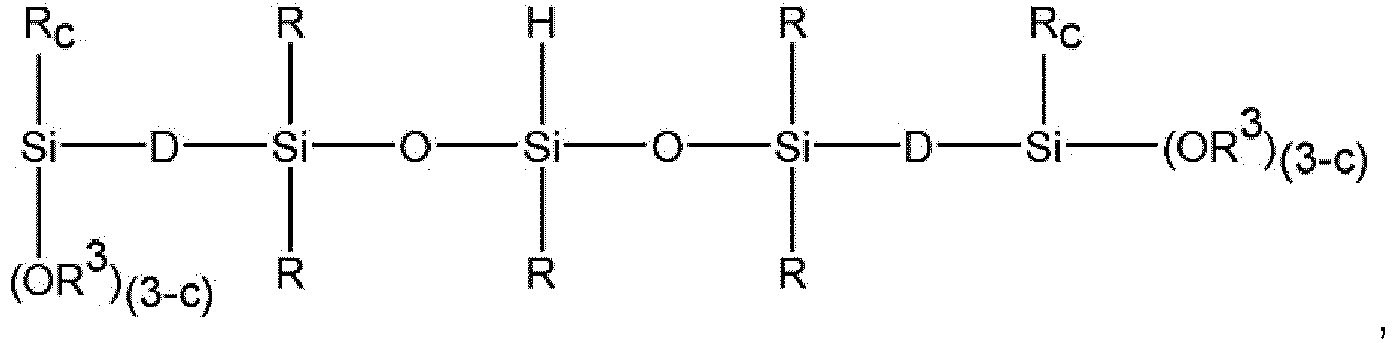

- Composition adhésive selon la revendication 1, où le matériau de départ C) est choisi dans le groupe constitué de : a) sels stanniques d'acides carboxyliques tels que i) dilaurate de dibutylétain, ii) dilaurate de diméthylétain, iii) bis-cétonate de di-(n-butyl)étain, iv) diacétate de dibutylétain, v) maléate de dibutylétain, vi) diacétylacétylacétonate de dibutylétain, vii) diméthoxyde de dibutylétain, viii) tris-ubérate de carbométhoxyphénylétain, ix) dioctanoate de dibutylétain, x) diformiate de dibutylétain, xi) tricéroate d'isobutylétain, xii) dibutyrate de diméthylétain, xiii) dinéodéconoate de diméthylétain, xiv) dinéodéconoate de dibutylétain, xv) tartrate de triéthylétain, xvi) dibenzoate de dibutylétain, xvii) tri-2-éthylhexanoate de butylétain, xviii) diacétate de dioctylétain, xix) octylate d'étain, xx) oléate d'étain, xxi) butyrate d'étain, xxii) naphténate d'étain, xxiii) dichlorure de diméthylétain ; b) sels d'étain (II) d'acides carboxyliques organiques tels que xxiv) diacétate d'étain (II), xxv) dioctanoate d'étain (II), xxvi) diéthylhexanoate d'étain (II), xxvii) dilaurate d'étain (II), c) sels stanneux d'acides carboxyliques tels que xxviii) octoate stanneux, xxix) oléate stanneux, xxx) acétate stanneux, xxxi) laurate stanneux, xxxii) stéarate stanneux, xxxiii) naphtanate stanneux, xxxiv) hexanoate stanneux, xxxv) succinate stanneux, xxxvi) caprylate stanneux, et une combinaison de deux de i) à xxxvi) ou plus. Des composés organotitane à titre d'exemple peuvent être choisis dans le groupe constitué de : i) titanate de tétra-n-butyle, ii) titanate de tétraisopropyle, iii) titanate de tétra-t-butyle, iv) titanate de tétrakis(2-éthylhexyle), v) chélate de titanate d'acétylacétonate, vi) chélate de titanate d'acétoacétate d'éthyle, vii) chélate de titanate de triéthanolamine, et une combinaison de deux de i), ii), iii), iv), v), vi) et vii) ou plus.
- Composition adhésive selon la revendication 1, où le matériau de départ D) est choisi parmi un composé azo ou un composé peroxyde organique.
Applications Claiming Priority (2)
| Application Number | Priority Date | Filing Date | Title |
|---|---|---|---|
| US201762548558P | 2017-08-22 | 2017-08-22 | |
| PCT/US2018/047125 WO2019040383A1 (fr) | 2017-08-22 | 2018-08-21 | Composition adhésive à double durcissement et ses procédés de préparation et d'utilisation |
Publications (2)
| Publication Number | Publication Date |
|---|---|
| EP3673027A1 EP3673027A1 (fr) | 2020-07-01 |
| EP3673027B1 true EP3673027B1 (fr) | 2023-11-01 |
Family
ID=63714005
Family Applications (1)
| Application Number | Title | Priority Date | Filing Date |
|---|---|---|---|
| EP18779835.0A Active EP3673027B1 (fr) | 2017-08-22 | 2018-08-21 | Composition adhésive à double durcissement et ses procédés de préparation et d'utilisation |
Country Status (6)
| Country | Link |
|---|---|
| US (1) | US11028297B2 (fr) |
| EP (1) | EP3673027B1 (fr) |
| JP (1) | JP7252207B2 (fr) |
| KR (1) | KR102634994B1 (fr) |
| CN (1) | CN111051461B (fr) |
| WO (1) | WO2019040383A1 (fr) |
Families Citing this family (10)
| Publication number | Priority date | Publication date | Assignee | Title |
|---|---|---|---|---|
| KR102861859B1 (ko) | 2018-12-21 | 2025-09-22 | 다우 실리콘즈 코포레이션 | 다작용성 유기실록산의 제조 방법 및 이를 함유하는 조성물 |
| EP3898774B1 (fr) | 2018-12-21 | 2023-06-07 | Dow Silicones Corporation | Méthode de préparation d'un organopolysiloxane fonctionalisé |
| KR102798860B1 (ko) | 2018-12-21 | 2025-04-25 | 다우 실리콘즈 코포레이션 | 다작용성 유기실록산, 이를 함유하는 조성물, 및 이의 제조 방법 |
| WO2020131367A1 (fr) | 2018-12-21 | 2020-06-25 | Dow Silicones Corporation | Organosiloxanes polyfonctionnels, compositions les contenant et procédés pour leur préparation |
| JP7484196B2 (ja) * | 2020-02-03 | 2024-05-16 | 信越化学工業株式会社 | 付加硬化型シリコーン粘着剤組成物およびその硬化物 |
| US12163068B2 (en) * | 2020-05-07 | 2024-12-10 | Dow Silicones Corporation | Silicone hybrid pressure sensitive adhesive and methods for its preparation and use on uneven surfaces |
| JP2023524667A (ja) * | 2020-05-07 | 2023-06-13 | ダウ シリコーンズ コーポレーション | シリコーンハイブリッド感圧接着剤、及びその調製方法、及び(光)電子デバイスを製作するための保護フィルムにおける使用 |
| TWI900640B (zh) * | 2020-09-01 | 2025-10-11 | 美商陶氏全球科技公司 | 用於快速空氣uv固化之有機聚矽氧烷簇狀聚合物 |
| WO2022141146A1 (fr) * | 2020-12-30 | 2022-07-07 | 3M Innovative Properties Company | Composition d'adhésif de silicone durcie |
| CN115772264B (zh) * | 2022-12-30 | 2024-02-06 | 桂林宝龙达新材料有限公司 | 具有自粘接特性的烷氧基封端聚硅氧烷及其制备方法和应用 |
Family Cites Families (34)
| Publication number | Priority date | Publication date | Assignee | Title |
|---|---|---|---|---|
| US2676182A (en) | 1950-09-13 | 1954-04-20 | Dow Corning | Copolymeric siloxanes and methods of preparing them |
| US3220972A (en) | 1962-07-02 | 1965-11-30 | Gen Electric | Organosilicon process using a chloroplatinic acid reaction product as the catalyst |
| US3296291A (en) | 1962-07-02 | 1967-01-03 | Gen Electric | Reaction of silanes with unsaturated olefinic compounds |
| US3159601A (en) | 1962-07-02 | 1964-12-01 | Gen Electric | Platinum-olefin complex catalyzed addition of hydrogen- and alkenyl-substituted siloxanes |
| NL131800C (fr) | 1965-05-17 | |||
| US3516946A (en) | 1967-09-29 | 1970-06-23 | Gen Electric | Platinum catalyst composition for hydrosilation reactions |
| US3814730A (en) | 1970-08-06 | 1974-06-04 | Gen Electric | Platinum complexes of unsaturated siloxanes and platinum containing organopolysiloxanes |
| US3989668A (en) | 1975-07-14 | 1976-11-02 | Dow Corning Corporation | Method of making a silicone elastomer and the elastomer prepared thereby |
| US4784479A (en) | 1984-05-30 | 1988-11-15 | Canon Kabushiki Kaisha | Varifocal optical system |
| US4591622A (en) | 1984-10-29 | 1986-05-27 | Dow Corning Corporation | Silicone pressure-sensitive adhesive process and product thereof |
| US4585836A (en) | 1984-10-29 | 1986-04-29 | Dow Corning Corporation | Silicone pressure-sensitive adhesive process and product with improved lap-shear stability-II |
| US4584355A (en) | 1984-10-29 | 1986-04-22 | Dow Corning Corporation | Silicone pressure-sensitive adhesive process and product with improved lap-shear stability-I |
| US4766176A (en) | 1987-07-20 | 1988-08-23 | Dow Corning Corporation | Storage stable heat curable organosiloxane compositions containing microencapsulated platinum-containing catalysts |
| US4784879A (en) | 1987-07-20 | 1988-11-15 | Dow Corning Corporation | Method for preparing a microencapsulated compound of a platinum group metal |
| JP2630993B2 (ja) | 1988-06-23 | 1997-07-16 | 東レ・ダウコーニング・シリコーン株式会社 | ヒドロシリル化反応用白金系触媒含有粒状物およびその製造方法 |
| JPH0214244A (ja) | 1988-06-30 | 1990-01-18 | Toray Dow Corning Silicone Co Ltd | 加熱硬化性オルガノポリシロキサン組成物 |
| US5036117A (en) | 1989-11-03 | 1991-07-30 | Dow Corning Corporation | Heat-curable silicone compositions having improved bath life |
| GB9103191D0 (en) | 1991-02-14 | 1991-04-03 | Dow Corning | Platinum complexes and use thereof |
| JP3856081B2 (ja) | 2000-05-15 | 2006-12-13 | 信越化学工業株式会社 | ハロプロピルジメチルクロロシラン化合物の製造方法 |
| DE10053037C1 (de) | 2000-10-26 | 2002-01-17 | Consortium Elektrochem Ind | Herstellung von Organosilanen |
| DE10232663C1 (de) | 2002-07-18 | 2003-10-16 | Wacker Chemie Gmbh | Kontinuierliche Herstellung von Organosilanen |
| FR2856402B1 (fr) | 2003-06-17 | 2005-08-26 | Rhodia Chimie Sa | Procede de preparation d'halogenoalkylchlorosilane |
| US7045586B2 (en) * | 2003-08-14 | 2006-05-16 | Dow Corning Corporation | Adhesives having improved chemical resistance and curable silicone compositions for preparing the adhesives |
| DE102005030581A1 (de) | 2005-06-30 | 2007-01-04 | Wacker Chemie Ag | Kontinuierliche Herstellung von Organosilanen in Gegenwart von Iridium-Katalysatoren und Cokatalysatoren |
| JP4821991B2 (ja) | 2005-08-15 | 2011-11-24 | 信越化学工業株式会社 | 1−(アルコキシシリル)エチル−1,1,3,3−テトラメチルジシロキサンの製造方法 |
| DE102007011158A1 (de) | 2007-03-07 | 2008-09-11 | Wacker Chemie Ag | Iridiumkatalysiertes Herstellungsverfahren für siliciumorganische Verbindungen |
| CN102197039A (zh) | 2008-10-23 | 2011-09-21 | 陶氏环球技术有限责任公司 | 用于有机硼烷化合物的封闭剂 |
| TWI502004B (zh) * | 2009-11-09 | 2015-10-01 | Dow Corning | 群集官能性聚有機矽氧烷之製法及其使用方法 |
| WO2013052588A1 (fr) | 2011-10-04 | 2013-04-11 | Dow Corning Corporation | Complexe contenant du fer(ii)et catalyseurs de réaction de condensation, procédés pour préparer ces catalyseurs et compositions contenant ces catalyseurs |
| CN104321366B (zh) * | 2012-03-21 | 2017-08-25 | 道康宁公司 | 树脂‑线性有机硅氧烷嵌段共聚物的组合物 |
| CN104968748B (zh) * | 2013-02-11 | 2017-03-29 | 道康宁公司 | 烷氧基官能化有机聚硅氧烷树脂和聚合物及其相关形成方法 |
| WO2014124362A1 (fr) | 2013-02-11 | 2014-08-14 | Dow Corning Corporation | Polyorganosiloxanes fonctionnels agrégés, procédés pour former ceux-ci et procédés pour leur utilisation |
| US9670392B2 (en) | 2013-02-11 | 2017-06-06 | Dow Corning Corporation | Stable thermal radical curable silicone adhesive compositions |
| US9718925B2 (en) * | 2013-02-11 | 2017-08-01 | Dow Corning Corporation | Curable silicone compositions comprising clustered functional polyorganosiloxanes and silicone reactive diluents |
-
2018
- 2018-08-21 JP JP2020508559A patent/JP7252207B2/ja active Active
- 2018-08-21 WO PCT/US2018/047125 patent/WO2019040383A1/fr not_active Ceased
- 2018-08-21 EP EP18779835.0A patent/EP3673027B1/fr active Active
- 2018-08-21 KR KR1020207006808A patent/KR102634994B1/ko active Active
- 2018-08-21 CN CN201880052319.5A patent/CN111051461B/zh active Active
- 2018-08-21 US US16/621,756 patent/US11028297B2/en active Active
Also Published As
| Publication number | Publication date |
|---|---|
| WO2019040383A1 (fr) | 2019-02-28 |
| KR102634994B1 (ko) | 2024-02-13 |
| JP2020531620A (ja) | 2020-11-05 |
| US20200208033A1 (en) | 2020-07-02 |
| KR20200043411A (ko) | 2020-04-27 |
| US20210002532A9 (en) | 2021-01-07 |
| JP7252207B2 (ja) | 2023-04-04 |
| CN111051461A (zh) | 2020-04-21 |
| CN111051461B (zh) | 2022-04-26 |
| US11028297B2 (en) | 2021-06-08 |
| EP3673027A1 (fr) | 2020-07-01 |
Similar Documents
| Publication | Publication Date | Title |
|---|---|---|
| EP3673027B1 (fr) | Composition adhésive à double durcissement et ses procédés de préparation et d'utilisation | |
| EP3645606B1 (fr) | Procédé d'hydrosilylation d'alcoxysilanes aliphatiquement insaturés et d'oligomères d'organosiloxane à terminaison hydrogène pour préparer des polymères à terminaison alcoxysilyle utiles pour fonctionnaliser des polyorganosiloxanes à l'aide d'un catalyseur au rhodium | |
| EP3645607B1 (fr) | Procédé d'hydrosilylation d'alcoxysilanes aliphatiquement insaturés et d'oligomères d'organosiloxane à terminaison hydrogène pour préparer des polymères à terminaison alcoxysilyle utiles pour fonctionnaliser des polyorganosiloxanes à l'aide d'un catalyseur à l'iridium | |
| US11492448B2 (en) | Method for hydrosilylation of aliphatically unsaturated alkoxysilanes and hydrogen terminated organosiloxane oligomers to prepare alkoxysilyl terminated polymers useful for functionalizing polyorganosiloxanes using a cobalt catalyst | |
| EP3898776B1 (fr) | Organosiloxanes polyfonctionnels, compositions les contenant et procédés pour leur préparation | |
| EP2937352B1 (fr) | Nouveau composé contenant du silicium, terminé par un groupe alcoxysilyl-éthylène, composition d'organopolysiloxane durcissable à température ambiante et objet moulé obtenu par le durcissement de ladite composition | |
| KR102861859B1 (ko) | 다작용성 유기실록산의 제조 방법 및 이를 함유하는 조성물 | |
| CN112789282B (zh) | 用于使用纯化的起始物质的烷氧基官能有机氢硅氧烷低聚物的制备用途和低聚物的用途的方法 | |
| CN112789283B (zh) | 用于制备烷氧基官能有机氢硅氧烷低聚物的方法和所述低聚物的用途 | |
| EP3898775B1 (fr) | Organosiloxanes polyfonctionnels, compositions les contenant, et leurs procédés de préparation | |
| CN104870524A (zh) | 新颖含乙炔基的有机聚硅氧烷化合物、分子链两末端含乙炔基的直链状有机聚硅氧烷化合物的制造方法、烷氧基硅烷基-亚乙基末端有机硅氧烷聚合物的制造方法、室温固化性组合物及作为其固化物的成型物 | |
| US20180163001A1 (en) | Polyorganosiloxane compositions with metal based n-heterocyclic carbene condensation reaction catalysts and methods for the preparation thereof | |
| CN105209425B (zh) | 铝螯合化合物以及含有铝螯合化合物的室温固化性树脂组合物 |
Legal Events
| Date | Code | Title | Description |
|---|---|---|---|
| STAA | Information on the status of an ep patent application or granted ep patent |
Free format text: STATUS: UNKNOWN |
|
| STAA | Information on the status of an ep patent application or granted ep patent |
Free format text: STATUS: THE INTERNATIONAL PUBLICATION HAS BEEN MADE |
|
| PUAI | Public reference made under article 153(3) epc to a published international application that has entered the european phase |
Free format text: ORIGINAL CODE: 0009012 |
|
| STAA | Information on the status of an ep patent application or granted ep patent |
Free format text: STATUS: REQUEST FOR EXAMINATION WAS MADE |
|
| 17P | Request for examination filed |
Effective date: 20200316 |
|
| AK | Designated contracting states |
Kind code of ref document: A1 Designated state(s): AL AT BE BG CH CY CZ DE DK EE ES FI FR GB GR HR HU IE IS IT LI LT LU LV MC MK MT NL NO PL PT RO RS SE SI SK SM TR |
|
| AX | Request for extension of the european patent |
Extension state: BA ME |
|
| DAV | Request for validation of the european patent (deleted) | ||
| DAX | Request for extension of the european patent (deleted) | ||
| GRAP | Despatch of communication of intention to grant a patent |
Free format text: ORIGINAL CODE: EPIDOSNIGR1 |
|
| STAA | Information on the status of an ep patent application or granted ep patent |
Free format text: STATUS: GRANT OF PATENT IS INTENDED |
|
| P01 | Opt-out of the competence of the unified patent court (upc) registered |
Effective date: 20230526 |
|
| INTG | Intention to grant announced |
Effective date: 20230623 |
|
| GRAS | Grant fee paid |
Free format text: ORIGINAL CODE: EPIDOSNIGR3 |
|
| GRAA | (expected) grant |
Free format text: ORIGINAL CODE: 0009210 |
|
| STAA | Information on the status of an ep patent application or granted ep patent |
Free format text: STATUS: THE PATENT HAS BEEN GRANTED |
|
| AK | Designated contracting states |
Kind code of ref document: B1 Designated state(s): AL AT BE BG CH CY CZ DE DK EE ES FI FR GB GR HR HU IE IS IT LI LT LU LV MC MK MT NL NO PL PT RO RS SE SI SK SM TR |
|
| REG | Reference to a national code |
Ref country code: GB Ref legal event code: FG4D |
|
| REG | Reference to a national code |
Ref country code: CH Ref legal event code: EP |
|
| REG | Reference to a national code |
Ref country code: IE Ref legal event code: FG4D |
|
| REG | Reference to a national code |
Ref country code: DE Ref legal event code: R096 Ref document number: 602018060441 Country of ref document: DE |
|
| REG | Reference to a national code |
Ref country code: LT Ref legal event code: MG9D |
|
| REG | Reference to a national code |
Ref country code: NL Ref legal event code: MP Effective date: 20231101 |
|
| PG25 | Lapsed in a contracting state [announced via postgrant information from national office to epo] |
Ref country code: GR Free format text: LAPSE BECAUSE OF FAILURE TO SUBMIT A TRANSLATION OF THE DESCRIPTION OR TO PAY THE FEE WITHIN THE PRESCRIBED TIME-LIMIT Effective date: 20240202 |
|
| PG25 | Lapsed in a contracting state [announced via postgrant information from national office to epo] |
Ref country code: IS Free format text: LAPSE BECAUSE OF FAILURE TO SUBMIT A TRANSLATION OF THE DESCRIPTION OR TO PAY THE FEE WITHIN THE PRESCRIBED TIME-LIMIT Effective date: 20240301 |
|
| PG25 | Lapsed in a contracting state [announced via postgrant information from national office to epo] |
Ref country code: LT Free format text: LAPSE BECAUSE OF FAILURE TO SUBMIT A TRANSLATION OF THE DESCRIPTION OR TO PAY THE FEE WITHIN THE PRESCRIBED TIME-LIMIT Effective date: 20231101 |
|
| REG | Reference to a national code |
Ref country code: AT Ref legal event code: MK05 Ref document number: 1627214 Country of ref document: AT Kind code of ref document: T Effective date: 20231101 |
|
| PG25 | Lapsed in a contracting state [announced via postgrant information from national office to epo] |
Ref country code: NL Free format text: LAPSE BECAUSE OF FAILURE TO SUBMIT A TRANSLATION OF THE DESCRIPTION OR TO PAY THE FEE WITHIN THE PRESCRIBED TIME-LIMIT Effective date: 20231101 |
|
| PG25 | Lapsed in a contracting state [announced via postgrant information from national office to epo] |
Ref country code: AT Free format text: LAPSE BECAUSE OF FAILURE TO SUBMIT A TRANSLATION OF THE DESCRIPTION OR TO PAY THE FEE WITHIN THE PRESCRIBED TIME-LIMIT Effective date: 20231101 |
|
| PG25 | Lapsed in a contracting state [announced via postgrant information from national office to epo] |
Ref country code: ES Free format text: LAPSE BECAUSE OF FAILURE TO SUBMIT A TRANSLATION OF THE DESCRIPTION OR TO PAY THE FEE WITHIN THE PRESCRIBED TIME-LIMIT Effective date: 20231101 |
|
| PG25 | Lapsed in a contracting state [announced via postgrant information from national office to epo] |
Ref country code: NL Free format text: LAPSE BECAUSE OF FAILURE TO SUBMIT A TRANSLATION OF THE DESCRIPTION OR TO PAY THE FEE WITHIN THE PRESCRIBED TIME-LIMIT Effective date: 20231101 Ref country code: LT Free format text: LAPSE BECAUSE OF FAILURE TO SUBMIT A TRANSLATION OF THE DESCRIPTION OR TO PAY THE FEE WITHIN THE PRESCRIBED TIME-LIMIT Effective date: 20231101 Ref country code: IS Free format text: LAPSE BECAUSE OF FAILURE TO SUBMIT A TRANSLATION OF THE DESCRIPTION OR TO PAY THE FEE WITHIN THE PRESCRIBED TIME-LIMIT Effective date: 20240301 Ref country code: GR Free format text: LAPSE BECAUSE OF FAILURE TO SUBMIT A TRANSLATION OF THE DESCRIPTION OR TO PAY THE FEE WITHIN THE PRESCRIBED TIME-LIMIT Effective date: 20240202 Ref country code: ES Free format text: LAPSE BECAUSE OF FAILURE TO SUBMIT A TRANSLATION OF THE DESCRIPTION OR TO PAY THE FEE WITHIN THE PRESCRIBED TIME-LIMIT Effective date: 20231101 Ref country code: BG Free format text: LAPSE BECAUSE OF FAILURE TO SUBMIT A TRANSLATION OF THE DESCRIPTION OR TO PAY THE FEE WITHIN THE PRESCRIBED TIME-LIMIT Effective date: 20240201 Ref country code: AT Free format text: LAPSE BECAUSE OF FAILURE TO SUBMIT A TRANSLATION OF THE DESCRIPTION OR TO PAY THE FEE WITHIN THE PRESCRIBED TIME-LIMIT Effective date: 20231101 Ref country code: PT Free format text: LAPSE BECAUSE OF FAILURE TO SUBMIT A TRANSLATION OF THE DESCRIPTION OR TO PAY THE FEE WITHIN THE PRESCRIBED TIME-LIMIT Effective date: 20240301 |
|
| PG25 | Lapsed in a contracting state [announced via postgrant information from national office to epo] |
Ref country code: SE Free format text: LAPSE BECAUSE OF FAILURE TO SUBMIT A TRANSLATION OF THE DESCRIPTION OR TO PAY THE FEE WITHIN THE PRESCRIBED TIME-LIMIT Effective date: 20231101 Ref country code: RS Free format text: LAPSE BECAUSE OF FAILURE TO SUBMIT A TRANSLATION OF THE DESCRIPTION OR TO PAY THE FEE WITHIN THE PRESCRIBED TIME-LIMIT Effective date: 20231101 Ref country code: PL Free format text: LAPSE BECAUSE OF FAILURE TO SUBMIT A TRANSLATION OF THE DESCRIPTION OR TO PAY THE FEE WITHIN THE PRESCRIBED TIME-LIMIT Effective date: 20231101 Ref country code: NO Free format text: LAPSE BECAUSE OF FAILURE TO SUBMIT A TRANSLATION OF THE DESCRIPTION OR TO PAY THE FEE WITHIN THE PRESCRIBED TIME-LIMIT Effective date: 20240201 Ref country code: LV Free format text: LAPSE BECAUSE OF FAILURE TO SUBMIT A TRANSLATION OF THE DESCRIPTION OR TO PAY THE FEE WITHIN THE PRESCRIBED TIME-LIMIT Effective date: 20231101 Ref country code: HR Free format text: LAPSE BECAUSE OF FAILURE TO SUBMIT A TRANSLATION OF THE DESCRIPTION OR TO PAY THE FEE WITHIN THE PRESCRIBED TIME-LIMIT Effective date: 20231101 |
|
| PG25 | Lapsed in a contracting state [announced via postgrant information from national office to epo] |
Ref country code: DK Free format text: LAPSE BECAUSE OF FAILURE TO SUBMIT A TRANSLATION OF THE DESCRIPTION OR TO PAY THE FEE WITHIN THE PRESCRIBED TIME-LIMIT Effective date: 20231101 |
|
| PG25 | Lapsed in a contracting state [announced via postgrant information from national office to epo] |
Ref country code: CZ Free format text: LAPSE BECAUSE OF FAILURE TO SUBMIT A TRANSLATION OF THE DESCRIPTION OR TO PAY THE FEE WITHIN THE PRESCRIBED TIME-LIMIT Effective date: 20231101 |
|
| PG25 | Lapsed in a contracting state [announced via postgrant information from national office to epo] |
Ref country code: SK Free format text: LAPSE BECAUSE OF FAILURE TO SUBMIT A TRANSLATION OF THE DESCRIPTION OR TO PAY THE FEE WITHIN THE PRESCRIBED TIME-LIMIT Effective date: 20231101 |
|
| PG25 | Lapsed in a contracting state [announced via postgrant information from national office to epo] |
Ref country code: SM Free format text: LAPSE BECAUSE OF FAILURE TO SUBMIT A TRANSLATION OF THE DESCRIPTION OR TO PAY THE FEE WITHIN THE PRESCRIBED TIME-LIMIT Effective date: 20231101 Ref country code: SK Free format text: LAPSE BECAUSE OF FAILURE TO SUBMIT A TRANSLATION OF THE DESCRIPTION OR TO PAY THE FEE WITHIN THE PRESCRIBED TIME-LIMIT Effective date: 20231101 Ref country code: IT Free format text: LAPSE BECAUSE OF FAILURE TO SUBMIT A TRANSLATION OF THE DESCRIPTION OR TO PAY THE FEE WITHIN THE PRESCRIBED TIME-LIMIT Effective date: 20231101 Ref country code: EE Free format text: LAPSE BECAUSE OF FAILURE TO SUBMIT A TRANSLATION OF THE DESCRIPTION OR TO PAY THE FEE WITHIN THE PRESCRIBED TIME-LIMIT Effective date: 20231101 Ref country code: DK Free format text: LAPSE BECAUSE OF FAILURE TO SUBMIT A TRANSLATION OF THE DESCRIPTION OR TO PAY THE FEE WITHIN THE PRESCRIBED TIME-LIMIT Effective date: 20231101 Ref country code: CZ Free format text: LAPSE BECAUSE OF FAILURE TO SUBMIT A TRANSLATION OF THE DESCRIPTION OR TO PAY THE FEE WITHIN THE PRESCRIBED TIME-LIMIT Effective date: 20231101 |
|
| REG | Reference to a national code |
Ref country code: DE Ref legal event code: R097 Ref document number: 602018060441 Country of ref document: DE |
|
| PLBE | No opposition filed within time limit |
Free format text: ORIGINAL CODE: 0009261 |
|
| STAA | Information on the status of an ep patent application or granted ep patent |
Free format text: STATUS: NO OPPOSITION FILED WITHIN TIME LIMIT |
|
| 26N | No opposition filed |
Effective date: 20240802 |
|
| PG25 | Lapsed in a contracting state [announced via postgrant information from national office to epo] |
Ref country code: SI Free format text: LAPSE BECAUSE OF FAILURE TO SUBMIT A TRANSLATION OF THE DESCRIPTION OR TO PAY THE FEE WITHIN THE PRESCRIBED TIME-LIMIT Effective date: 20231101 |
|
| PG25 | Lapsed in a contracting state [announced via postgrant information from national office to epo] |
Ref country code: SI Free format text: LAPSE BECAUSE OF FAILURE TO SUBMIT A TRANSLATION OF THE DESCRIPTION OR TO PAY THE FEE WITHIN THE PRESCRIBED TIME-LIMIT Effective date: 20231101 |
|
| REG | Reference to a national code |
Ref country code: CH Ref legal event code: PL |
|
| PG25 | Lapsed in a contracting state [announced via postgrant information from national office to epo] |
Ref country code: LU Free format text: LAPSE BECAUSE OF NON-PAYMENT OF DUE FEES Effective date: 20240821 |
|
| GBPC | Gb: european patent ceased through non-payment of renewal fee |
Effective date: 20240821 |
|
| PG25 | Lapsed in a contracting state [announced via postgrant information from national office to epo] |
Ref country code: MC Free format text: LAPSE BECAUSE OF FAILURE TO SUBMIT A TRANSLATION OF THE DESCRIPTION OR TO PAY THE FEE WITHIN THE PRESCRIBED TIME-LIMIT Effective date: 20231101 Ref country code: CH Free format text: LAPSE BECAUSE OF NON-PAYMENT OF DUE FEES Effective date: 20240831 |
|
| REG | Reference to a national code |
Ref country code: BE Ref legal event code: MM Effective date: 20240831 |
|
| PG25 | Lapsed in a contracting state [announced via postgrant information from national office to epo] |
Ref country code: GB Free format text: LAPSE BECAUSE OF NON-PAYMENT OF DUE FEES Effective date: 20240821 |
|
| PG25 | Lapsed in a contracting state [announced via postgrant information from national office to epo] |
Ref country code: BE Free format text: LAPSE BECAUSE OF NON-PAYMENT OF DUE FEES Effective date: 20240831 |
|
| PG25 | Lapsed in a contracting state [announced via postgrant information from national office to epo] |
Ref country code: FR Free format text: LAPSE BECAUSE OF NON-PAYMENT OF DUE FEES Effective date: 20240831 |
|
| PG25 | Lapsed in a contracting state [announced via postgrant information from national office to epo] |
Ref country code: IE Free format text: LAPSE BECAUSE OF NON-PAYMENT OF DUE FEES Effective date: 20240821 |
|
| PG25 | Lapsed in a contracting state [announced via postgrant information from national office to epo] |
Ref country code: FI Free format text: LAPSE BECAUSE OF FAILURE TO SUBMIT A TRANSLATION OF THE DESCRIPTION OR TO PAY THE FEE WITHIN THE PRESCRIBED TIME-LIMIT Effective date: 20231101 |
|
| PGFP | Annual fee paid to national office [announced via postgrant information from national office to epo] |
Ref country code: DE Payment date: 20250624 Year of fee payment: 8 |
|
| PG25 | Lapsed in a contracting state [announced via postgrant information from national office to epo] |
Ref country code: RO Free format text: LAPSE BECAUSE OF FAILURE TO SUBMIT A TRANSLATION OF THE DESCRIPTION OR TO PAY THE FEE WITHIN THE PRESCRIBED TIME-LIMIT Effective date: 20231101 |
|
| PG25 | Lapsed in a contracting state [announced via postgrant information from national office to epo] |
Ref country code: CY Free format text: LAPSE BECAUSE OF FAILURE TO SUBMIT A TRANSLATION OF THE DESCRIPTION OR TO PAY THE FEE WITHIN THE PRESCRIBED TIME-LIMIT; INVALID AB INITIO Effective date: 20180821 |
|
| PG25 | Lapsed in a contracting state [announced via postgrant information from national office to epo] |
Ref country code: HU Free format text: LAPSE BECAUSE OF FAILURE TO SUBMIT A TRANSLATION OF THE DESCRIPTION OR TO PAY THE FEE WITHIN THE PRESCRIBED TIME-LIMIT; INVALID AB INITIO Effective date: 20180821 |