EP3673679B1 - Verfahren und vorrichtung zur kommunikation im inaktiven zustand - Google Patents
Verfahren und vorrichtung zur kommunikation im inaktiven zustand Download PDFInfo
- Publication number
- EP3673679B1 EP3673679B1 EP17922646.9A EP17922646A EP3673679B1 EP 3673679 B1 EP3673679 B1 EP 3673679B1 EP 17922646 A EP17922646 A EP 17922646A EP 3673679 B1 EP3673679 B1 EP 3673679B1
- Authority
- EP
- European Patent Office
- Prior art keywords
- timer
- network
- periodic
- update
- response
- Prior art date
- Legal status (The legal status is an assumption and is not a legal conclusion. Google has not performed a legal analysis and makes no representation as to the accuracy of the status listed.)
- Active
Links
Images



Classifications
-
- H—ELECTRICITY
- H04—ELECTRIC COMMUNICATION TECHNIQUE
- H04W—WIRELESS COMMUNICATION NETWORKS
- H04W60/00—Affiliation to network, e.g. registration; Terminating affiliation with the network, e.g. de-registration
- H04W60/04—Affiliation to network, e.g. registration; Terminating affiliation with the network, e.g. de-registration using triggered events
-
- H—ELECTRICITY
- H04—ELECTRIC COMMUNICATION TECHNIQUE
- H04W—WIRELESS COMMUNICATION NETWORKS
- H04W56/00—Synchronisation arrangements
- H04W56/001—Synchronization between nodes
-
- H—ELECTRICITY
- H04—ELECTRIC COMMUNICATION TECHNIQUE
- H04W—WIRELESS COMMUNICATION NETWORKS
- H04W52/00—Power management, e.g. Transmission Power Control [TPC] or power classes
- H04W52/02—Power saving arrangements
- H04W52/0209—Power saving arrangements in terminal devices
- H04W52/0251—Power saving arrangements in terminal devices using monitoring of local events, e.g. events related to user activity
-
- H—ELECTRICITY
- H04—ELECTRIC COMMUNICATION TECHNIQUE
- H04W—WIRELESS COMMUNICATION NETWORKS
- H04W60/00—Affiliation to network, e.g. registration; Terminating affiliation with the network, e.g. de-registration
-
- H—ELECTRICITY
- H04—ELECTRIC COMMUNICATION TECHNIQUE
- H04W—WIRELESS COMMUNICATION NETWORKS
- H04W68/00—User notification, e.g. alerting and paging, for incoming communication, change of service or the like
- H04W68/005—Transmission of information for alerting of incoming communication
-
- H—ELECTRICITY
- H04—ELECTRIC COMMUNICATION TECHNIQUE
- H04W—WIRELESS COMMUNICATION NETWORKS
- H04W56/00—Synchronisation arrangements
-
- H—ELECTRICITY
- H04—ELECTRIC COMMUNICATION TECHNIQUE
- H04W—WIRELESS COMMUNICATION NETWORKS
- H04W60/00—Affiliation to network, e.g. registration; Terminating affiliation with the network, e.g. de-registration
- H04W60/02—Affiliation to network, e.g. registration; Terminating affiliation with the network, e.g. de-registration by periodical registration
-
- Y—GENERAL TAGGING OF NEW TECHNOLOGICAL DEVELOPMENTS; GENERAL TAGGING OF CROSS-SECTIONAL TECHNOLOGIES SPANNING OVER SEVERAL SECTIONS OF THE IPC; TECHNICAL SUBJECTS COVERED BY FORMER USPC CROSS-REFERENCE ART COLLECTIONS [XRACs] AND DIGESTS
- Y02—TECHNOLOGIES OR APPLICATIONS FOR MITIGATION OR ADAPTATION AGAINST CLIMATE CHANGE
- Y02D—CLIMATE CHANGE MITIGATION TECHNOLOGIES IN INFORMATION AND COMMUNICATION TECHNOLOGIES [ICT], I.E. INFORMATION AND COMMUNICATION TECHNOLOGIES AIMING AT THE REDUCTION OF THEIR OWN ENERGY USE
- Y02D30/00—Reducing energy consumption in communication networks
- Y02D30/70—Reducing energy consumption in communication networks in wireless communication networks
Definitions
- the present disclosure is directed to wireless communication technology and, more particularly, to the mobility management in wireless communication. There is disclosed herein a method performed by a user equipment and a user equipment.
- Mobility management is one of important issues in mobile applications.
- a new mobility management framework has been proposed in which a user equipment (UE) can be configured to enter into an inactive state, in addition to the existing connected state and the idle state.
- the inactive state may help the UE to get synchronized with the wireless network in a more efficient manner while keeping the power consumption to be comparable to the idle state.
- the inactive state may provide benefits for mobile UEs, some issues remain to be solved.
- a periodic RAN (radio access network) notification update is required for such UE so that the current location of the inactive UE can be tracked by the wireless network.
- the UE may not be covered by the wireless network signal and could be losing the signal temporally. Proposals are discussed that if a UE experiences signal losing when the timer for periodic RAN notification area update expires, the UE may be configured at the idle state.
- the period of the timer for periodic RAN notification area update is relatively long, the user connection status may vary when the timer for periodic RAN notification area update is still running.
- R2-1708712 is a 3GPP discussion paper titled "Discussion on CN location Update and RNA Update for inactive state" submitted by Huawei and HiSilicon at the TSG-RAN WG2 Meeting #99 in Berlin, Germany on 21 August 2017 .
- RNA notification area
- Claim 1 defines a method performed by a user equipment and claim 12 defines a user equipment.
- any method and/or apparatus referred to as embodiments but nevertheless do not fall within the scope of the appended claims are to be understood as examples helpful in understanding the invention.
- One objective of the disclosure is to provide a technical solution for mobility management with respect to the active state in a wireless network.
- a method includes: receiving a configuration for setting a user equipment (UE) in an inactive state, and performing a non-periodic notification update to a network in response to determining a synchronization with the network as failed and in response to a second timer expiring while a first timer is running.
- UE user equipment
- a method may include: transmitting a configuration to set a user equipment (UE) at an inactive state, and receiving one of a non-periodic notification update signal, before a first timer for a periodic notification update expires, and a registration update signal from the UE, before a second timer for a registration update expires.
- UE user equipment
- Embodiments of the disclosure also provide apparatuses for performing the above methods.
- an apparatus may include a processor that determines whether a user equipment (UE) performs synchronization with a network successfully, a transmitter coupled to the processor that transmits a non-periodic notification update signal to a network, and a receiver coupled to the processor that receives a configuration for setting the UE in an inactive state.
- UE user equipment
- an apparatus may include a processor that generates a configuration setting an inactive state for a user equipment (UE), a transmitter coupled to the processor that transmits the configuration and a synchronization signal to the UE, and a receiver coupled to the processor that receives one of a non-periodic notification update signal and a registration update signal from the UE.
- UE user equipment
- Embodiments of the disclosure solve the technical problem concerning mobility management for inactive UEs, and thus can facilitate operations of inactive modes for mobile UEs.
- FIG. 1 depicts a wireless communication system 100 according to an embodiment of the disclosure.
- the wireless communication system 100 includes a plurality of base stations 10 including base stations 10a, 10b, and an exemplary UE 12.
- the plurality of base stations 10 may be based on the standards of long-term evolution (LTE), LTE-Advanced (LTE-A), new radio (NR), or other suitable standards.
- LTE long-term evolution
- LTE-A LTE-Advanced
- NR new radio
- the plurality of base stations 10 may be a plurality of eNBs, or a plurality of gNBs.
- the plurality of base stations 10 may be controlled by a control unit (not shown).
- Each base station 10 may define one or more cells 16, such as cell 16a or 16b, and each cell 16 may support mobility management through the radio resource control (RRC) signaling.
- RRC radio resource control
- the UE 12 may be a computing device, a wearable device, and a mobile device, etc.
- the UEs with reference numerals 12a, 12b and 12c represent the same UE 12 moving in different locations within the coverage of the cell 16a or 16b.
- Persons skilled in the art should understand that as the 3GPP and the communication technology develop, the terminologies recited in the specification may change, which should not affect the principle of the disclosure.
- a group of cells 16 may form a radio access network-based (RAN-based) notification area (RNA).
- RNA radio access network-based
- An inactive state for a UE is established with an associated RNA.
- the coverage area of an RNA is contiguous across the constituent cells.
- a UE may be informed of its current RNA through a cell list for the RNA, or is provided a RNA area identity (ID) representing a group of cells.
- ID RNA area identity
- An UE may be configured to enter the inactive state through an RRC signaling along with the associated RNA information.
- the mobile UE 12 may move from cell to cell, for example, the UE 12 may be configured to enter the inactive state by the cell 16a when it is in the location of UE 12a. Subsequently, the UE 12 moves to the cell 16b and reaches a location of UE 12b around a building 20. In some examples, the building 20 may deteriorate signal transmission between the base station 10b and the UE 12b. Consequently, the UE 12b may experience a temporal signal loss. Next, the UE 12b may move towards the location of UE 12c where the signal quality is improved and the UE 12c can return to the coverage of the network and be synchronized with the base station 10b.
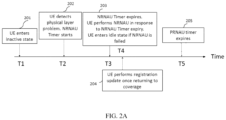
- FIGS. 2A and 2B are a time diagram and a flow chart, respectively, illustrating a method of performing mobility management for the inactive UE 12, according to an embodiment of the disclosure.
- the method of performing mobility management may be performed by the base station 10 (may be a gNB 10 or a control unit controlling the base station 10) and the UE 12.
- the UE 12 detects a lower layer problem, such as a synchronization failure of the physical layer.
- the problem may be due to poor signal quality of the wireless network at the coverage hole.
- the UE 12 may be deemed as ⁇ losing signal temporally' between time instants T2 and T4, where T4 denotes a time instant for the UE 12 to return to the coverage of the network (block 204).
- a physical layer problem of the UE 12 is detected through identifying a predetermined number (say n1) of out-of-synchronization indicators provided from the physical layer.
- it is required that the physical layer problem is detected through identifying consecutive n1 out-of-synchronization indicators.
- the gNB 10 may want to communicate with the UE 12 and page the UE 12 at a time between the time instants T2 and T4. If the UE 12 fails to respond to the gNB 10 promptly enough (e.g., the UE 12 fails to to respond before expiry of a timer of a paging operation), the gNB 10 would configure the UE 12 at the idle state. In the meantime, the gNB 10 would release the context of the UE 12. However, the UE 12 may transmit data on or after the time instant T4, which may make sense for the UE 12 since existing technologies allow an inactive UE to transmit data in a manner similar to what the UE performs in the connected state.
- the gNB 10 has released the context of the UE 12. Consequently, status mismatch between the gNB 10 and the UE 12 occurs that hinders the UE 12 from transmitting data efficiently. As a result, unnecessary processing delay and resource consumption may incur.
- a non-periodic RAN-based notification area update (NRNAU) is proposed as a remedy.
- NRNAU non-periodic RAN-based notification area update
- a new timer TM2 associated with the NRNAU is utilized to trigger the NRNAU.
- the timer TM2 can be regarded a new event trigger for the PRNAU.
- the timer TM1 for the PRNAU may be reset or restart.
- a timer may automatically restart upon being reset.
- the expiry period for the timer TM2 may be determined by the gNB 10.
- the timer TM2 in response to a physical layer problem detected, the timer TM2 starts.
- the timer TM2 may expire at a time instant T3, as shown in block 203.
- the UE 12 if it is detected at a later time that the physical layer problem is resolved at a time instant (say T21 which is not shown) prior to the expiry of the timer TM2 (e.g., the UE 12 returns to the coverage of the gNB 10), the UE 12 would transmit a NRNAU signal to the gNB 10. If the report of NRNAU is deemed successful, the UE 12 may return to the connected state.
- the report of the NRNAU may occur at a time instant which is prior to time instant T3 and the PRNAU at time instant T5.
- the transmission of the NRNAU at a time ahead of the expiry of the timer TM1 for PRNAU is equivalent to resetting the timer TM1 the PRNAU at an earlier time.
- the dark period in which the gNB fails to page the UE 12 and the UE stays at the inactive state is reduced from (T5-T2) to (T3-T2) or less since T21 is ahead of time instant T3. The chances of state mismatch between the gNB 10 and the UE 12 can be lowered accordingly.
- the condition that UE 12 returns to the coverage of the network is determined through identifying a number (say n2) of in-synchronization indicators from the physical layer. In an embodiment, it is detected that the UE 12 returns to the coverage of the network through identifying a consecutive number of in-synchronization indicators.
- the UE 12 before the UE 12 returns to the coverage of the network (e.g., before time instant T4), it is not allowed to transmit data. Once returning to the coverage of the network (e.g., on or after time instant T4), the UE 12 is allowed to transmit data.
- the UE 12 may not be able to return to the coverage of the network before the timer TM2 expires at time instant T3. For example, the UE 12 may stay at the location 12b for a relatively long period.
- an NRNAU signal is transmitted to the gNB 10 at time instant T3 in response to the expiry of the NRNAU timer TM2.
- the transmission of the NRNAU at a timing (i.e., T3) ahead of the expiry (i.e., T5) of a PRNAU update is equivalent to a timer resetting of the PRNAU report.
- the UE 12 is set or configured at the idle state.
- the scheme of the idle state configuration under the failed NRNAU report is substantially consistent with the existing technology which configures the UE 12 at the idle state when an attempt of PRNAU report is deemed failed.
- a non-periodic registration update signal is submitted to the gNB 10.
- the UE 12 may return to the coverage of the network through reselecting a suitable cell or synchronizing with cells of the same RNA.
- a suitable cell is selected through examining that the strength of a reference signal received from the suitable cell is greater than a predetermined signal threshold.
- the condition that the UE 12 synchronizes with the cells of the same RNA is determined through identifying a predetermined number (say n3) of in-synchronization indicators provided from the physical layer. Similar to the functionality of the NRNAU report, the transmission of the non-periodic registration update signal at a timing (i.e., T4) ahead of the timer expiry (e.g., T5) of a periodic registration update is equivalent to resetting the timer of the periodic registration update at an earlier time.
- the timer of the periodic registration update in response to transmission of the non-periodic registration update signal, is reset or restarted. The chances of state mismatch between the gNB 10 (or an access and mobility management function entity) and the UE 12 can be lowered effectively.
- the UE 12 it is detected that the UE 12 is within the coverage of the network by examining that the UE 12 is synchronized with the network again. In an embodiment, the UE 12 stays synchronized with the cells 16 of the same RNA. Alternatively, the UE 12 may return to the coverage of the network through reselecting a suitable cell other than the cells of its originally associated RNA. In an embodiment, a suitable cell is selected through examining that the strength of a reference signal received from the suitable cell is greater than a predetermined signal threshold. For example, a representative value of a reference signal received power (RSRP) received by the UE 12 may serve as the strength of the reference signal. In an embodiment, the predetermined signal threshold is provided by the gNB 10 or the UE 12.
- RSRP reference signal received power
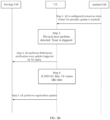
- FIG. 2B shows a flow chart illustrating a method of performing mobility management in FIG. 2A according to an embodiment of the disclosure.
- the UE 12 receives a configuration that sets the UE 12 at an inactive state.
- the configuration may be provided by an anchor cell (e.g., cell 16a) through an RRC signaling.
- a first timer TM1 for the PRNAU is started.
- a physical layer problem is detected.
- a second timer TM2 for the NRNAU is started.
- the physical layer problem of the UE 12 is detected through identifying a consecutive number (say n1) of out-of-synchronization indicators provided from the physical layer.
- the timer TM2 stops if the UE 12 returns to the coverage of the network. The NRUAN would not be transmitted if the timer TM2 stops.
- the condition that the UE 12 returns to the coverage of the network is determined through identification of a consecutive number (n2) of in-synchronization indicators.
- step 3 the UE 12 performs an NRNAU triggered in response to the expiry of the timer TM2.
- the UE 12 may transmit the NRNAU signal to a serving cell.
- the serving cell e.g., cell 16b
- the UE 12 enters the idle state.
- step 5 the idle UE 12 performs a registration update to the gNB 10 once it reselects a suitable cell or synchronizes with the cells of the same RNA again.
- the condition that the UE 12 synchronizes with the cells of the same RNA is determined through identifying a predetermined number (say n3) of in-synchronization indicators provided from the physical layer.
- the number n3 may be the same as or different from the number n2.
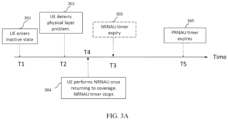
- FIGS. 3A and 3B are a time diagram and a flow chart, respectively, illustrating a method of performing mobility management with respect to the inactive UE 12 according to another embodiment of the disclosure.
- the method of performing mobility management may be performed by the gNB 10 (or a control unit controlling the base station 10) and the UE 12.
- a major difference in FIG. 3A is that the UE 12 returns to the coverage of the network at the time instant T4 prior to the time instant T3 when the second timer TM2 expires.
- Another difference of the depicted example in FIG. 3 lies in that the second timer TM2 can be optional.
- the UE 12 enters the inactive state, as shown in block 301.
- the timer TM1 for the PRNAU starts at time instant T1 and expires at time instant T5 (block 305).
- the UE 12 detects a lower layer problem, such as a synchronization failure in the physical layer.
- the UE 12 may be deemed as ⁇ losing signal temporally' between the time instants T2 and T4.
- a physical layer problem of the UE 12 is detected through identifying a predetermined number (say m1) of out-of-synchronization indicators provided from the physical layer.
- the gNB 10 may not be notified of the current status of the UE 12 until the time instant T5 when a PRNAU signal is sent. Since the time instant T2 occurs prior to the time instant T5, the gNB 10 may not be aware of the disconnection of the UE 12 for the moment. Therefore, in existing protocols, the gNB 10 would assume that the UE 12 stays in the inactive state absent the updated PRNAU information.
- the gNB 10 may want to communicate with the UE 12 and page the UE 12 at a time between the time instants T2 and T4 even in the case of the time instant T4 being ahead of time instant T3. Because the UE 12 does not respond to the gNB 10 promptly, the gNB 10 would configure the UE 12 at the idle state. In the meantime, the gNB 10 would release the context of the UE 12. However, the UE 12 may transmit data on or after the time instant T4. However, due to the signal loss event and the paging failure occurred between time instants T2 and T4, the gNB 10 has released the context of the UE 12. Consequently, status mismatch between the gNB 10 and the UE 12 occurs that hinders the UE 12 from transmit data efficiently.
- the NRNAU scheme is applied as a remedy.
- the timer TM2 in FIG. 2A associated with the NRNAU may be utilized to trigger the NRNAU if the timer option is activated.
- the timer TM1 for the PRNAU may be reset.
- the UE 12 in response to a physical layer problem detected, the UE 12 is suspended from transmitting data. Under that situation, the UE 12 stays in the inactive state without starting the timer TM2, while refraining itself from transmitting data.
- the UE 12 returns to the coverage of the network by reselecting a suitable cell or synchronizing the cells of the same RNA. In response to returning to the coverage of the network, the UE 12 is allowed to transmit data again, just like what it does in a normal inactive state.
- the condition that the UE 12 synchronizes with the cells of the same RNA is determined through identifying a predetermined number (say m2) of in-synchronization indicators provided from the physical layer. In an embodiment, the condition that the UE 12 synchronizes with the cells of the same RNA is determined through identifying a consecutive number (say m2) of in-synchronization indicators provided from the physical layer.
- the UE 12 if it is detected that the physical layer problem is resolved at time instant T4, e.g., the UE 12 returns to the coverage of the gNB 10, the UE 12 would transmit a NRNAU signal to the gNB 10. If the report of NRNAU is deemed successful, the UE 12 may return to the connected state.
- the condition of returning to the coverage of the network may be fulfilled by re-synchronizing with the cells of the RNA or reselecting a suitable cell.
- the condition that the UE 12 synchronizes with the cells of the same RNA is determined through identifying a consecutive number (say m3) of in-synchronization indicators provided from the physical layer. The chances of state mismatch between the gNB 10 (or alternatively an access and mobility management function entity) and the UE 12 can be lowered effectively.
- the timer TM2 for the NRNAU may be activated optionally. If the timer TM2 is not activated, the inactive UE 12 would not enter the idle state in the absence of the event trigger, i.e., timer TM2. If activated, the timer TM2 is started at time instant T2 and expires at time instant T3 (dashed block 303) in a similar manner described and illustrated in FIG. 2A . Once the UE 12 returns to the coverage of the network, the second timer TM2 stops at time instant T4 ahead of time instant T3. Therefore, the expiry of the second timer TM2 may not occur. Additionally, an NRNAU signal is transmitted to the gNB 10 at time instant T4. In other words, the transmission of the NRNAU at a timing (i.e., T4) ahead of the expiry (i.e., T5) of a PRNAU update is equivalent to resetting the timer of the PRNAU at an earlier time.
- FIG. 3B shows a flow chart illustrating a method of performing mobility management in FIG. 3A according to an embodiment of the disclosure.
- the UE 12 receives a configuration that sets the UE 12 at an inactive state by an anchor cell (e.g., cell 16a in FIG. 1 ) through an RRC signaling.
- an anchor cell e.g., cell 16a in FIG. 1
- a first timer TM1 for the PRNAU is started.
- step 2 physical layer problems are detected.
- the physical layer problem of the UE 12 is detected through identifying a consecutive number (say m1) of out-of-synchronization indicators provided from the physical layer.
- a second timer TM2 for the NRNAU is activated and started.
- the physical layer problem is resolved, e.g., the UE 12 returns to the coverage of the network.
- the condition of returning to the coverage of the network may be fulfilled by re-synchronizing with the cells of the RNA or reselecting a suitable cell.
- the condition that the UE 12 synchronizes with the cells of the same RNA is determined through identifying a consecutive number (say m3) of in-synchronization indicators provided from the physical layer.
- the timer TM2 stops if the UE 12 returns to the coverage of the network.
- the condition that the UE 12 returns to the coverage of the network through identifying a consecutive number (m2) of in-synchronization indicators. Before the UE 12 returns to the coverage of the network, it is not allowed to transmit data. Once returning to the coverage of the network, the UE 12 is allowed to transmit data.
- step 4 the UE 12 performs an NRNAU triggered in response to returning to the coverage of the network.
- the UE 12 may transmit the NRNAU signal to a serving cell.
- the serving cell e.g., cell 16b
- the serving cell is different from the anchor cell.
- FIG. 4 is a time diagram illustrating a method of performing mobility management according to another embodiment of the disclosure. Specifically, the method of performing mobility management may be performed by the gNB 10 (or a control unit controlling the base station 10) and the UE 12.
- an anchor cell configures the UE 12 to enters the inactive state, as shown in block 401, which may correspond to the block 201 in FIG. 2A .
- the activation of the inactive state for the UE 12 may be initiated by the gNB 10 through the RRC signaling.
- a timer TM1 for a periodic RAN-based notification area update (PRNAU) starts at time instant T1 and expires at a predetermined time instant T5 (block 405).
- a timer TM3 for a periodic registration update starts at time instant (e.g., T1) and expires at time instant (e.g., T5).
- the gNB 10 may want to communicate with the UE 12 and page the UE 12 at a time at time instant T22 (block 402). If the UE 12 fails to respond to the gNB 10 promptly (e.g., the UE 12 fails to respond before expiry of a timer of a paging operation), the gNB 10 would configure the UE 12 at the idle state. In the meantime, the gNB 10 would release the context of the UE 12.
- the gNB 10 receives a non-periodic registration update signal from the UE 12 if the paging operation is deemed failed. The gNB 10 then updates the status of the UE 12. If the non-periodic registration update is deemed successful, the gNB 10 may configure the UE 12 at the connected state. In the depicted embodiment, the report of the non-periodic registration update may occur at a time instant T4, which is ahead of the timing of the report of a periodic registration update at time instant T5. In an embodiment, the non-periodic registration update is received in response to the failed paging operation at time instant T22.
- the gNB 10 may not transmit any paging signal to UE 12 from time instant T1 to time instant T3 (dashed lines of block 402 signifies that the paging action may not occur).
- Time instant T3 may be prior to time instant T4.
- the gNB 10 regards the UE 12 as staying in the inactive state until time instant T3.
- the gNB 10 receives an NRNAU signal from the UE 12 if no paging operation is performed prior to time instant T3 (box 403).
- the reception of the NRNAU signal may correspond to scenario of the NRNAU triggering described and illustrated in the block 203 of FIG. 2A ).
- the gNB 10 then updates the status of the UE 12.
- the gNB 10 may configure the UE 12 at the connected state.
- the triggering of the NRNAU may occur at a time instant T3, which is ahead of the triggering of PRNAU at time instant T5.
- the failed NRNAU report transmitted at time instant T3 may lead to the non-periodic registration update signal received by the gNB 10 at time instant T4.
- the gNB 10 may receive one of a NRNAU signal or a non-periodic registration signal if the UE 12 experiences temporal signal loss before the timer PRNAU expires, regardless of the transmission of the paging signal. Furthermore, as illustrated in block 404, the gNB 10 would receive the non-periodic registration signal under the condition that the paging signal has been performed but failed or that no paging signal has been performed while the UE 12 fails to successfully transmit an NRNAU signal.
- the method of this disclosure can be implemented on a programmed processor.
- the controllers, flowcharts, and modules may also be implemented on a general purpose or special purpose computer, a programmed microprocessor or microcontroller and peripheral integrated circuit elements, an integrated circuit, a hardware electronic or logic circuit such as a discrete element circuit, a programmable logic device, or the like.
- any device on which resides a finite state machine capable of implementing the flowcharts shown in the figures may be used to implement the processor functions of this disclosure.
- FIG. 5 illustrates a block diagram of a system 500 for performing mobility management with respect to the inactive state, according to an embodiment of the disclosure.
- the system 500 includes a first apparatus 52 performing mobility management in the network side and a second apparatus 54 performing mobility management in the terminal side.
- the first apparatus 52 may be a base station 10 of a control unit, or other apparatus that can execute the method of performing mobility management in the network side, such as that illustrated in FIGS. 2A , 2B , 3A , 3B and 4 .
- the second apparatus 54 may be a UE 12, or other apparatus that can execute the method of performing mobility management in the terminal side, such as that illustrated in FIGS. 2A , 2B , 3A and 3B .
- the first apparatus 52 in an embodiment of the disclosure may transmit signals or information to the second apparatus 54, and receive signals or information transmitted by the second apparatus 54.
- the first apparatus 52 may include a first processor 520 that that generates a configuration for setting an inactive state for a UE, a first transmitter 522 coupled to the first processor 520 and a first receiver 524 coupled to the first processor 520.
- the first transmitter 522 may transmit the configuration to the UE 12.
- the first transmitter 522 may transmit a synchronization signal to the UE 12.
- the first transmitter 522 may perform a paging operation by transmitting a paging signal to the UE 12.
- the first receiver 524 may receive one of a non-periodic notification update signal and a registration update signal from the UE 12.
- the first receiver 524 may receive the registration update signal in response to failing to receive the non-periodic notification update signal as determined by the first processor 520.
- the first processor 520 determines the paging operation to the UE as failed, and the first receiver 524 receives the registration update signal in response to the failed paging operation.
- the second apparatus 54 in an embodiment of the disclosure may transmit signals or information to the first apparatus 52, and receive signals or information transmitted/broadcasted by the first apparatus 52.
- the second apparatus 54 may include a second processor 544, a second transmitter 542 coupled to the second processor 544 and a second receiver 540 coupled to the second processor 544.
- the second processor 544 may determine whether a UE performs synchronization with a network successfully.
- the second transmitter 542 may transmit a non-periodic notification update signal to a network.
- the second receiver 540 may receive a configuration for setting the UE in an inactive state.
- the second processor 544 configures the UE to enter an idle state in response to a result of transmitting the notification update as being failed.
- the second processor 544 determines the UE as being synchronized with the network subsequent to configuring the UE to enter the idle state; and wherein the transmitter transmits a registration update signal to the network.
- the second processor 544 determines the UE as being synchronized with the network through receiving a first number of in-synchronization indicators.
- the second processor 544 determines the UE as being synchronized with the network through reselecting a suitable cell.
- the second receiver 540 receives a reference signal from the suitable cell.
- the second processor 544 further determines the UE as being synchronized with the network subsequent to determining synchronization with the network as failed; and the second transmitter 542 transmits another non-periodic notification update signal to the network.
- the second processor 544 determines the UE as being synchronized with the network through receiving a second number of in-synchronization indicators.
- the second processor 544 configures the UE not to transmit data in response to the synchronization as being failed.
- the second processor 544 sets a timer with a period; and starting the timer in response to determining synchronization with the network as failed.
- the second transmitter 542 transmits the non-periodic notification update to the network in response to the timer as expiring.
- the second processor 544 determines the synchronization with the network as failed through receiving a third number of out-of-synchronization indicators.
- the second transmitter 542 transmits a non-periodic notification update signal to the network in response to a second timer for a periodic notification update being running.
- Embodiments of the disclosure discuss mobility management schemes in an inactive state and propose operations to improve status alignment between the network side and the terminal side.
- Embodiments of the disclosure determine the scenarios in which the UEs may lose signal temporally and a paging failure may occur. More specifically, a non-periodic RAN-based notification area update signals and a non-periodic registration update signal is utilized to lower the chances of status mismatch between the network and the UE.
- embodiments of the disclosure solve the technical problem of mobility management in the inactive state, and can facilitate the development and application of wireless network managing mobile UEs.
Landscapes
- Engineering & Computer Science (AREA)
- Computer Networks & Wireless Communication (AREA)
- Signal Processing (AREA)
- Mobile Radio Communication Systems (AREA)
Claims (12)
- Verfahren, das von einer Benutzerausrüstung, UE, durchgeführt wird, wobei das Verfahren umfasst:
Empfangen (201) einer Konfiguration, um eine Benutzerausrüstung in einen inaktiven Zustand zu versetzen, wobei die UE in einen inaktiven Zustand überführt wird und ein erster Zeitgeber für eine periodische RAN-basierte Benachrichtigungsbereichsaktualisierung (PRNAU-Zeitgeber) mit einer ersten Periode gestartet wird:Einstellen eines zweiten Zeitgebers für eine nichtperiodische RAN-basierte Benachrichtigungsbereichsaktualisierung (NRNAU-Zeitgeber) mit einer zweiten Periode;Bestimmen der Synchronisierung mit einem Netzwerk als fehlgeschlagen, Starten (202) des zweiten Zeitgebers als Reaktion auf das Bestimmen der Synchronisierung mit dem Netzwerk als fehlgeschlagen;Bestimmen des zweiten Zeitgebers als ablaufend, während der erste Zeitgeber läuft, und Durchführen (203) einer nichtperiodischen, RAN-basierten Benachrichtigungsaktualisierung an dem Netzwerk als Reaktion auf das Bestimmen der Synchronisierung mit dem Netzwerk als fehlgeschlagen und als Reaktion auf den Ablauf des zweiten Zeitgebers, während der erste Zeitgeber läuft; undÜberführen (203) der UE in einen Ruhezustand als Reaktion darauf, dass die Benachrichtigungsaktualisierung als fehlgeschlagen gilt. - Verfahren nach Anspruch 1, ferner umfassend:Bestimmen der UE als mit dem Netzwerk synchronisiert, nachdem die UE in den Ruhezustand überführt wurde; undDurchführen (204) einer nichtperiodischen Registrierungsaktualisierung an dem Netzwerk.
- Verfahren nach Anspruch 2, wobei das Bestimmen der UE als mit dem Netzwerk synchronisiert das Empfangen einer ersten Anzahl von aufeinanderfolgenden In-Synchronisationsanzeigen umfasst.
- Verfahren nach Anspruch 2, wobei das Bestimmen der UE als mit dem Netzwerk synchronisiert das erneute Auswählen einer geeigneten Zelle umfasst.
- Verfahren nach Anspruch 4, wobei das erneute Auswählen einer geeigneten Zelle das Bestimmen einer Stärke eines Referenzsignals, das von der geeigneten Zelle empfangen wird, größer als ein vorbestimmter Schwellenwert ist, und das Auswählen der geeigneten Zelle als Reaktion auf eine Stärke eines Referenzsignals, das von der geeigneten Zelle empfangen wird, größer als ein vorbestimmter Schwellenwert ist, umfasst.
- Verfahren nach Anspruch 3, wobei das Durchführen (204) einer nichtperiodischen Registrierungsaktualisierung an dem Netzwerk das Bestimmen eines ersten Zeitgebers für eine periodische Registrierungsaktualisierung und das Durchführen der nichtperiodischen Registrierungsaktualisierung an dem Netzwerk als Reaktion darauf, dass ein erster Zeitgeber für eine periodische Registrierungsaktualisierung läuft, umfasst.
- Verfahren nach Anspruch 6, ferner umfassend das Neustarten des ersten Zeitgebers für die periodische Registrierungsaktualisierung als Reaktion auf die Durchführung der nichtperiodischen Registrierungsaktualisierung an dem Netzwerk.
- Verfahren nach Anspruch 1, ferner umfassend:
Konfigurieren der UE so, dass sie keine Daten sendet, bevor der zweite Zeitgeber abläuft. - Verfahren nach Anspruch 1, wobei das Bestimmen der Synchronisierung mit dem Netzwerk als fehlgeschlagen das Empfangen einer dritten Anzahl von aufeinanderfolgenden Nicht-Synchronisierungsanzeigen umfasst.
- Verfahren nach Anspruch 1, wobei das Durchführen einer nichtperiodischen Benachrichtigungsaktualisierung an dem Netzwerk das Bestimmen eines dritten Zeitgebers für eine periodische Benachrichtigungsaktualisierung und das Durchführen der nichtperiodischen Benachrichtigungsaktualisierung an dem Netzwerk als Reaktion darauf, dass ein dritter Zeitgeber für eine periodische Benachrichtigungsaktualisierung läuft, umfasst.
- Verfahren nach Anspruch 10, ferner umfassend das Neustarten des dritten Zeitgebers für die periodische Benachrichtigungsaktualisierung als Reaktion auf die Durchführung einer nichtperiodischen Benachrichtigungsaktualisierung an dem Netzwerk.
- Benutzerausrüstung, UE, (54), umfassend:einen Empfänger (540), der eingerichtet ist, um eine Konfiguration zum Versetzen der UE (54) in einen inaktiven Zustand zu empfangen, die UE in einen inaktiven Zustand zu überführen und einen ersten Zeitgeber für eine periodische RAN-basierte Benachrichtigungsbereichsaktualisierung (PRNAU-Zeitgeber) mit einer ersten Periode zu starten;einen Prozessor (544), der eingerichtet ist zum:Einstellen eines zweiten Zeitgebers für eine nichtperiodische RAN-basierte Benachrichtigungsbereichsaktualisierung (NRNAU-Zeitgeber) mit einer zweiten Periode;Bestimmen der Synchronisierung mit einem Netzwerk als fehlgeschlagen;Starten des zweiten Zeitgebers als Reaktion auf das Bestimmen der Synchronisierung mit dem Netzwerk als fehlgeschlagen;Durchführen einer nichtperiodischen, RAN-basierten Benachrichtigungsaktualisierung an dem Netzwerk als Reaktion auf das Bestimmen der Synchronisierung mit dem Netzwerk als fehlgeschlagen und als Reaktion auf den Ablauf des zweiten Zeitgebers, während der erste Zeitgeber läuft; undÜberführen der UE in einen Ruhezustand als Reaktion darauf, dass die Benachrichtigungsaktualisierung als fehlgeschlagen gilt.
Applications Claiming Priority (1)
| Application Number | Priority Date | Filing Date | Title |
|---|---|---|---|
| PCT/CN2017/098541 WO2019036911A1 (en) | 2017-08-22 | 2017-08-22 | METHOD AND APPARATUS FOR COMMUNICATION IN INACTIVE STATUS |
Publications (4)
| Publication Number | Publication Date |
|---|---|
| EP3673679A1 EP3673679A1 (de) | 2020-07-01 |
| EP3673679A4 EP3673679A4 (de) | 2021-04-07 |
| EP3673679B1 true EP3673679B1 (de) | 2024-08-14 |
| EP3673679C0 EP3673679C0 (de) | 2024-08-14 |
Family
ID=65439348
Family Applications (1)
| Application Number | Title | Priority Date | Filing Date |
|---|---|---|---|
| EP17922646.9A Active EP3673679B1 (de) | 2017-08-22 | 2017-08-22 | Verfahren und vorrichtung zur kommunikation im inaktiven zustand |
Country Status (4)
| Country | Link |
|---|---|
| US (1) | US11490343B2 (de) |
| EP (1) | EP3673679B1 (de) |
| CN (1) | CN111066343B (de) |
| WO (1) | WO2019036911A1 (de) |
Families Citing this family (4)
| Publication number | Priority date | Publication date | Assignee | Title |
|---|---|---|---|---|
| TWI680690B (zh) * | 2017-11-16 | 2019-12-21 | 香港商鴻穎創新有限公司 | 用於使用者設備及用於基地台的無線存取網路通報區域管理方法 |
| CN109803272B (zh) * | 2017-11-17 | 2021-06-01 | 华为技术有限公司 | 一种通信方法、装置及系统 |
| US11206629B2 (en) * | 2019-02-15 | 2021-12-21 | Samsung Electronics Co., Ltd. | Method and apparatus for controlling UE for cellular IoT service in 5G mobile communication system |
| CN116546663A (zh) * | 2022-01-26 | 2023-08-04 | 上海朗帛通信技术有限公司 | 一种被用于无线通信中的方法和装置 |
Family Cites Families (6)
| Publication number | Priority date | Publication date | Assignee | Title |
|---|---|---|---|---|
| KR20090074454A (ko) * | 2008-01-02 | 2009-07-07 | 삼성전자주식회사 | 이동통신 단말에서 인접 셀 관리 방법 및 장치 |
| CN102665245B (zh) * | 2012-04-19 | 2016-03-30 | 华为技术有限公司 | 一种用于减少切换信令的方法和设备 |
| CN105453689A (zh) * | 2013-08-06 | 2016-03-30 | 联发科技股份有限公司 | 自适应tdd系统中drx以及harq运作 |
| WO2016198098A1 (en) * | 2015-06-09 | 2016-12-15 | Telefonaktiebolaget Lm Ericsson (Publ) | Methods and apparatuses for monitoring a radio link |
| US20190007874A1 (en) * | 2017-01-05 | 2019-01-03 | Telefonaktiebolaget Lm Ericsson (Publ) | Method and Apparatus for Cell Reselection in a Wireless Communication System |
| US10368334B2 (en) * | 2017-03-17 | 2019-07-30 | Ofinno Technologies, Llc | Radio access network paging area configuration |
-
2017
- 2017-08-22 EP EP17922646.9A patent/EP3673679B1/de active Active
- 2017-08-22 WO PCT/CN2017/098541 patent/WO2019036911A1/en not_active Ceased
- 2017-08-22 CN CN201780094235.3A patent/CN111066343B/zh active Active
- 2017-08-22 US US16/641,157 patent/US11490343B2/en active Active
Also Published As
| Publication number | Publication date |
|---|---|
| CN111066343A (zh) | 2020-04-24 |
| CN111066343B (zh) | 2022-10-25 |
| WO2019036911A1 (en) | 2019-02-28 |
| EP3673679C0 (de) | 2024-08-14 |
| US20200205097A1 (en) | 2020-06-25 |
| US11490343B2 (en) | 2022-11-01 |
| EP3673679A1 (de) | 2020-07-01 |
| EP3673679A4 (de) | 2021-04-07 |
Similar Documents
| Publication | Publication Date | Title |
|---|---|---|
| CN110798867B (zh) | 用户设备的控制方法以及用户设备 | |
| JP6645583B2 (ja) | Rrcコネクションの再開手順 | |
| US11191020B2 (en) | Terminal state conversion method and apparatus | |
| US20190021134A1 (en) | User plane optimization for narrowband internet of things | |
| EP3845030B1 (de) | Frühzeitige datenübertragung und aktualisierung des benachrichtigungsbereichs eines funkzugangsnetzwerks | |
| CN107006056A (zh) | 用于具有突发性交互式业务的用户设备的延迟减少 | |
| WO2014137259A1 (en) | Radio link monitoring | |
| EP3673679B1 (de) | Verfahren und vorrichtung zur kommunikation im inaktiven zustand | |
| US20260107342A1 (en) | Method and apparatus for sidelink communication during fast mcg link recovery procedure | |
| CN118511606A (zh) | 非地面无线通信方法、设备、和存储介质 | |
| US12262303B2 (en) | Applying access control in a communication device | |
| US12363670B2 (en) | Method and apparatus for core network registration and radio access network notification update | |
| US12114392B2 (en) | Methods, wireless device, network node and core node for managing reachability of the wireless device | |
| TWI685273B (zh) | 位置追踪方法及使用其之基站與用戶設備 | |
| US12432739B2 (en) | Sidelink advanced notification | |
| US20240172324A1 (en) | Method, Apparatus and Computer Program Product For Controlling Device-to-Device Communication | |
| WO2022236632A1 (en) | Method and apparatus for ue-to-network relay handover | |
| CN118679841A (zh) | 用于执行侧链路drx的方法和设备 | |
| KR102023421B1 (ko) | 이동 단말 위치 정보를 이용한 ptt 서비스 방법 | |
| US20250098012A1 (en) | Methods and apparatuses for timers and behavior in l2 u2n relay case | |
| JP2019068145A (ja) | ユーザ装置 | |
| WO2024013587A1 (en) | Managing central unit failure |
Legal Events
| Date | Code | Title | Description |
|---|---|---|---|
| STAA | Information on the status of an ep patent application or granted ep patent |
Free format text: STATUS: THE INTERNATIONAL PUBLICATION HAS BEEN MADE |
|
| PUAI | Public reference made under article 153(3) epc to a published international application that has entered the european phase |
Free format text: ORIGINAL CODE: 0009012 |
|
| STAA | Information on the status of an ep patent application or granted ep patent |
Free format text: STATUS: REQUEST FOR EXAMINATION WAS MADE |
|
| 17P | Request for examination filed |
Effective date: 20200224 |
|
| AK | Designated contracting states |
Kind code of ref document: A1 Designated state(s): AL AT BE BG CH CY CZ DE DK EE ES FI FR GB GR HR HU IE IS IT LI LT LU LV MC MK MT NL NO PL PT RO RS SE SI SK SM TR |
|
| AX | Request for extension of the european patent |
Extension state: BA ME |
|
| DAV | Request for validation of the european patent (deleted) | ||
| DAX | Request for extension of the european patent (deleted) | ||
| REG | Reference to a national code |
Ref legal event code: R079 Free format text: PREVIOUS MAIN CLASS: H04W0036000000 Ipc: H04W0060040000 Ref country code: DE Ref legal event code: R079 Ref document number: 602017084168 Country of ref document: DE Free format text: PREVIOUS MAIN CLASS: H04W0036000000 Ipc: H04W0060040000 |
|
| A4 | Supplementary search report drawn up and despatched |
Effective date: 20210305 |
|
| RIC1 | Information provided on ipc code assigned before grant |
Ipc: H04W 60/02 20090101ALN20210301BHEP Ipc: H04W 60/04 20090101AFI20210301BHEP |
|
| STAA | Information on the status of an ep patent application or granted ep patent |
Free format text: STATUS: EXAMINATION IS IN PROGRESS |
|
| 17Q | First examination report despatched |
Effective date: 20230206 |
|
| GRAP | Despatch of communication of intention to grant a patent |
Free format text: ORIGINAL CODE: EPIDOSNIGR1 |
|
| STAA | Information on the status of an ep patent application or granted ep patent |
Free format text: STATUS: GRANT OF PATENT IS INTENDED |
|
| RIC1 | Information provided on ipc code assigned before grant |
Ipc: H04W 60/02 20090101ALN20240411BHEP Ipc: H04W 60/04 20090101AFI20240411BHEP |
|
| INTG | Intention to grant announced |
Effective date: 20240426 |
|
| GRAS | Grant fee paid |
Free format text: ORIGINAL CODE: EPIDOSNIGR3 |
|
| GRAA | (expected) grant |
Free format text: ORIGINAL CODE: 0009210 |
|
| STAA | Information on the status of an ep patent application or granted ep patent |
Free format text: STATUS: THE PATENT HAS BEEN GRANTED |
|
| AK | Designated contracting states |
Kind code of ref document: B1 Designated state(s): AL AT BE BG CH CY CZ DE DK EE ES FI FR GB GR HR HU IE IS IT LI LT LU LV MC MK MT NL NO PL PT RO RS SE SI SK SM TR |
|
| REG | Reference to a national code |
Ref country code: GB Ref legal event code: FG4D |
|
| REG | Reference to a national code |
Ref country code: CH Ref legal event code: EP |
|
| REG | Reference to a national code |
Ref country code: DE Ref legal event code: R096 Ref document number: 602017084168 Country of ref document: DE |
|
| REG | Reference to a national code |
Ref country code: IE Ref legal event code: FG4D |
|
| U01 | Request for unitary effect filed |
Effective date: 20240830 |
|
| U07 | Unitary effect registered |
Designated state(s): AT BE BG DE DK EE FI FR IT LT LU LV MT NL PT RO SE SI Effective date: 20240911 |
|
| U20 | Renewal fee for the european patent with unitary effect paid |
Year of fee payment: 8 Effective date: 20241025 |
|
| PG25 | Lapsed in a contracting state [announced via postgrant information from national office to epo] |
Ref country code: NO Free format text: LAPSE BECAUSE OF FAILURE TO SUBMIT A TRANSLATION OF THE DESCRIPTION OR TO PAY THE FEE WITHIN THE PRESCRIBED TIME-LIMIT Effective date: 20241114 |
|
| PG25 | Lapsed in a contracting state [announced via postgrant information from national office to epo] |
Ref country code: GR Free format text: LAPSE BECAUSE OF FAILURE TO SUBMIT A TRANSLATION OF THE DESCRIPTION OR TO PAY THE FEE WITHIN THE PRESCRIBED TIME-LIMIT Effective date: 20241115 Ref country code: PL Free format text: LAPSE BECAUSE OF FAILURE TO SUBMIT A TRANSLATION OF THE DESCRIPTION OR TO PAY THE FEE WITHIN THE PRESCRIBED TIME-LIMIT Effective date: 20240814 |
|
| PG25 | Lapsed in a contracting state [announced via postgrant information from national office to epo] |
Ref country code: IS Free format text: LAPSE BECAUSE OF FAILURE TO SUBMIT A TRANSLATION OF THE DESCRIPTION OR TO PAY THE FEE WITHIN THE PRESCRIBED TIME-LIMIT Effective date: 20241214 |
|
| PG25 | Lapsed in a contracting state [announced via postgrant information from national office to epo] |
Ref country code: HR Free format text: LAPSE BECAUSE OF FAILURE TO SUBMIT A TRANSLATION OF THE DESCRIPTION OR TO PAY THE FEE WITHIN THE PRESCRIBED TIME-LIMIT Effective date: 20240814 |
|
| PG25 | Lapsed in a contracting state [announced via postgrant information from national office to epo] |
Ref country code: RS Free format text: LAPSE BECAUSE OF FAILURE TO SUBMIT A TRANSLATION OF THE DESCRIPTION OR TO PAY THE FEE WITHIN THE PRESCRIBED TIME-LIMIT Effective date: 20241114 Ref country code: ES Free format text: LAPSE BECAUSE OF FAILURE TO SUBMIT A TRANSLATION OF THE DESCRIPTION OR TO PAY THE FEE WITHIN THE PRESCRIBED TIME-LIMIT Effective date: 20240814 |
|
| PG25 | Lapsed in a contracting state [announced via postgrant information from national office to epo] |
Ref country code: RS Free format text: LAPSE BECAUSE OF FAILURE TO SUBMIT A TRANSLATION OF THE DESCRIPTION OR TO PAY THE FEE WITHIN THE PRESCRIBED TIME-LIMIT Effective date: 20241114 Ref country code: PL Free format text: LAPSE BECAUSE OF FAILURE TO SUBMIT A TRANSLATION OF THE DESCRIPTION OR TO PAY THE FEE WITHIN THE PRESCRIBED TIME-LIMIT Effective date: 20240814 Ref country code: NO Free format text: LAPSE BECAUSE OF FAILURE TO SUBMIT A TRANSLATION OF THE DESCRIPTION OR TO PAY THE FEE WITHIN THE PRESCRIBED TIME-LIMIT Effective date: 20241114 Ref country code: IS Free format text: LAPSE BECAUSE OF FAILURE TO SUBMIT A TRANSLATION OF THE DESCRIPTION OR TO PAY THE FEE WITHIN THE PRESCRIBED TIME-LIMIT Effective date: 20241214 Ref country code: HR Free format text: LAPSE BECAUSE OF FAILURE TO SUBMIT A TRANSLATION OF THE DESCRIPTION OR TO PAY THE FEE WITHIN THE PRESCRIBED TIME-LIMIT Effective date: 20240814 Ref country code: GR Free format text: LAPSE BECAUSE OF FAILURE TO SUBMIT A TRANSLATION OF THE DESCRIPTION OR TO PAY THE FEE WITHIN THE PRESCRIBED TIME-LIMIT Effective date: 20241115 Ref country code: ES Free format text: LAPSE BECAUSE OF FAILURE TO SUBMIT A TRANSLATION OF THE DESCRIPTION OR TO PAY THE FEE WITHIN THE PRESCRIBED TIME-LIMIT Effective date: 20240814 |
|
| REG | Reference to a national code |
Ref country code: CH Ref legal event code: PL |
|
| PG25 | Lapsed in a contracting state [announced via postgrant information from national office to epo] |
Ref country code: SM Free format text: LAPSE BECAUSE OF FAILURE TO SUBMIT A TRANSLATION OF THE DESCRIPTION OR TO PAY THE FEE WITHIN THE PRESCRIBED TIME-LIMIT Effective date: 20240814 |
|
| PG25 | Lapsed in a contracting state [announced via postgrant information from national office to epo] |
Ref country code: CH Free format text: LAPSE BECAUSE OF NON-PAYMENT OF DUE FEES Effective date: 20240831 |
|
| PG25 | Lapsed in a contracting state [announced via postgrant information from national office to epo] |
Ref country code: CZ Free format text: LAPSE BECAUSE OF FAILURE TO SUBMIT A TRANSLATION OF THE DESCRIPTION OR TO PAY THE FEE WITHIN THE PRESCRIBED TIME-LIMIT Effective date: 20240814 |
|
| PG25 | Lapsed in a contracting state [announced via postgrant information from national office to epo] |
Ref country code: SK Free format text: LAPSE BECAUSE OF FAILURE TO SUBMIT A TRANSLATION OF THE DESCRIPTION OR TO PAY THE FEE WITHIN THE PRESCRIBED TIME-LIMIT Effective date: 20240814 |
|
| PLBE | No opposition filed within time limit |
Free format text: ORIGINAL CODE: 0009261 |
|
| STAA | Information on the status of an ep patent application or granted ep patent |
Free format text: STATUS: NO OPPOSITION FILED WITHIN TIME LIMIT |
|
| PG25 | Lapsed in a contracting state [announced via postgrant information from national office to epo] |
Ref country code: MC Free format text: LAPSE BECAUSE OF FAILURE TO SUBMIT A TRANSLATION OF THE DESCRIPTION OR TO PAY THE FEE WITHIN THE PRESCRIBED TIME-LIMIT Effective date: 20240814 |
|
| 26N | No opposition filed |
Effective date: 20250515 |
|
| PG25 | Lapsed in a contracting state [announced via postgrant information from national office to epo] |
Ref country code: IE Free format text: LAPSE BECAUSE OF NON-PAYMENT OF DUE FEES Effective date: 20240822 |
|
| U20 | Renewal fee for the european patent with unitary effect paid |
Year of fee payment: 9 Effective date: 20250825 |
|
| PGFP | Annual fee paid to national office [announced via postgrant information from national office to epo] |
Ref country code: GB Payment date: 20250826 Year of fee payment: 9 |
|
| PG25 | Lapsed in a contracting state [announced via postgrant information from national office to epo] |
Ref country code: CY Free format text: LAPSE BECAUSE OF FAILURE TO SUBMIT A TRANSLATION OF THE DESCRIPTION OR TO PAY THE FEE WITHIN THE PRESCRIBED TIME-LIMIT; INVALID AB INITIO Effective date: 20170822 |
|
| PG25 | Lapsed in a contracting state [announced via postgrant information from national office to epo] |
Ref country code: HU Free format text: LAPSE BECAUSE OF FAILURE TO SUBMIT A TRANSLATION OF THE DESCRIPTION OR TO PAY THE FEE WITHIN THE PRESCRIBED TIME-LIMIT; INVALID AB INITIO Effective date: 20170822 |