EP3673687B1 - Communication sans fil multi-rat - Google Patents
Communication sans fil multi-rat Download PDFInfo
- Publication number
- EP3673687B1 EP3673687B1 EP17761609.1A EP17761609A EP3673687B1 EP 3673687 B1 EP3673687 B1 EP 3673687B1 EP 17761609 A EP17761609 A EP 17761609A EP 3673687 B1 EP3673687 B1 EP 3673687B1
- Authority
- EP
- European Patent Office
- Prior art keywords
- rat
- module
- wireless communication
- subset
- functions
- Prior art date
- Legal status (The legal status is an assumption and is not a legal conclusion. Google has not performed a legal analysis and makes no representation as to the accuracy of the status listed.)
- Active
Links
Images




Classifications
-
- H—ELECTRICITY
- H04—ELECTRIC COMMUNICATION TECHNIQUE
- H04W—WIRELESS COMMUNICATION NETWORKS
- H04W52/00—Power management, e.g. Transmission Power Control [TPC] or power classes
- H04W52/02—Power saving arrangements
- H04W52/0209—Power saving arrangements in terminal devices
- H04W52/0261—Power saving arrangements in terminal devices managing power supply demand, e.g. depending on battery level
- H04W52/0274—Power saving arrangements in terminal devices managing power supply demand, e.g. depending on battery level by switching on or off the equipment or parts thereof
- H04W52/028—Power saving arrangements in terminal devices managing power supply demand, e.g. depending on battery level by switching on or off the equipment or parts thereof switching on or off only a part of the equipment circuit blocks
-
- H—ELECTRICITY
- H04—ELECTRIC COMMUNICATION TECHNIQUE
- H04W—WIRELESS COMMUNICATION NETWORKS
- H04W52/00—Power management, e.g. Transmission Power Control [TPC] or power classes
- H04W52/02—Power saving arrangements
- H04W52/0209—Power saving arrangements in terminal devices
- H04W52/0225—Power saving arrangements in terminal devices using monitoring of external events, e.g. the presence of a signal
- H04W52/0229—Power saving arrangements in terminal devices using monitoring of external events, e.g. the presence of a signal where the received signal is a wanted signal
- H04W52/0235—Power saving arrangements in terminal devices using monitoring of external events, e.g. the presence of a signal where the received signal is a wanted signal where the received signal is a power saving command
-
- H—ELECTRICITY
- H04—ELECTRIC COMMUNICATION TECHNIQUE
- H04W—WIRELESS COMMUNICATION NETWORKS
- H04W52/00—Power management, e.g. Transmission Power Control [TPC] or power classes
- H04W52/02—Power saving arrangements
- H04W52/0209—Power saving arrangements in terminal devices
- H04W52/0261—Power saving arrangements in terminal devices managing power supply demand, e.g. depending on battery level
- H04W52/0264—Power saving arrangements in terminal devices managing power supply demand, e.g. depending on battery level by selectively disabling software applications
-
- H—ELECTRICITY
- H04—ELECTRIC COMMUNICATION TECHNIQUE
- H04W—WIRELESS COMMUNICATION NETWORKS
- H04W52/00—Power management, e.g. Transmission Power Control [TPC] or power classes
- H04W52/02—Power saving arrangements
- H04W52/0209—Power saving arrangements in terminal devices
- H04W52/0261—Power saving arrangements in terminal devices managing power supply demand, e.g. depending on battery level
- H04W52/0274—Power saving arrangements in terminal devices managing power supply demand, e.g. depending on battery level by switching on or off the equipment or parts thereof
-
- H—ELECTRICITY
- H04—ELECTRIC COMMUNICATION TECHNIQUE
- H04W—WIRELESS COMMUNICATION NETWORKS
- H04W76/00—Connection management
- H04W76/10—Connection setup
- H04W76/15—Setup of multiple wireless link connections
-
- H—ELECTRICITY
- H04—ELECTRIC COMMUNICATION TECHNIQUE
- H04W—WIRELESS COMMUNICATION NETWORKS
- H04W88/00—Devices specially adapted for wireless communication networks, e.g. terminals, base stations or access point devices
- H04W88/02—Terminal devices
- H04W88/06—Terminal devices adapted for operation in multiple networks or having at least two operational modes, e.g. multi-mode terminals
-
- H—ELECTRICITY
- H04—ELECTRIC COMMUNICATION TECHNIQUE
- H04W—WIRELESS COMMUNICATION NETWORKS
- H04W36/00—Hand-off or reselection arrangements
- H04W36/0005—Control or signalling for completing the hand-off
- H04W36/0083—Determination of parameters used for hand-off, e.g. generation or modification of neighbour cell lists
- H04W36/0085—Hand-off measurements
Definitions
- the present application relates generally to wireless communication and particularly to wireless communication using multiple radio access technologies, RATs.
- RATs radio access technologies
- 3GPP 3rd Generation Partnership Project
- 3GPP2 have simultaneously developed competing RAT standards, based on Wideband Code Division Multiple Access (WCDMA) and CDMA2000, respectively.
- WCDMA Wideband Code Division Multiple Access
- 3GPP2 itself develops different RAT standards, some evolutionary with a concern for backwards compatibility and some revolutionary with a focus on performance irrespective of backwards compatibility. The same can be said of 3GPP2.
- 3GPP and 3GPP2 continue to develop their respective RAT standards, each develop different technology stages or releases (e.g., 3GPP provides different releases of LTE, including Release 13, 14, etc.).
- WLAN wireless local area network
- WiMax wireless local area network
- multiple different RATs may be accessible to a wireless communication device or other radio node.
- a multi-RAT radio node supports multiple RATs, and can therefore use any of multiple different RATs for communication. Different RATs, however, may impact power consumption of the radio node to different degrees. Moreover, combined use of multiple RATs, especially at the same time, may dramatically affect the radio's nodes power consumption.
- US 2015/156717 A1 discloses a power saving method in a wireless mobile device.
- the wireless mobile device communicates with two wireless communication systems using a first and a second wireless modem respectively.
- a paging offload function included in one of the two wireless communication systems is used to monitor signals of the other wireless communication system on behalf of the wireless mobile device.
- Embodiments herein include a wireless communication device that comprises different radio access technology (RAT) modules configured to perform functions relating to respective RATs.
- RAT radio access technology
- at least one of the RAT modules is configured to perform a subset of the functions relating to another RAT on behalf of another RAT module, e.g., as part of supporting or serving as a proxy for the other RAT module.
- this creates relating to the first RAT on behalf of the first RAT module (18-1) opportunities for the other RAT module to operate in a low-power mode and thereby reduce the device's overall power consumption.
- embodiments herein include a method performed by a wireless communication device configured for performing the method steps of the attached claims.
- FIG. 1 shows a wireless communication system 10 according to some embodiments.
- the system 10 includes a wireless communication device 12 (e.g., a user equipment) that supports multiple radio access technologies (RATs), such as Long Term Evolution (LTE) and New Radio (NR).
- RATs radio access technologies
- LTE Long Term Evolution
- NR New Radio
- Figure 1 shows that the wireless communication device 12 is configured to communicate with a first radio network node 14-1 using a first RAT 16-1 and to communicate with a second radio network node 14-2 using a second RAT 16-2, where the first and second radio network nodes may or may not be co-located.
- RATs radio access technologies
- LTE Long Term Evolution
- NR New Radio
- the wireless communication device 12 in this regard includes a first RAT module 18-1 and a second RAT module 18-2.
- the first and second RAT modules 18-1, 18-2 in some embodiments may comprise or be hosted on respective first and second chipsets 20-1, 20-2, or in other embodiments may be hosted on a single shared chipset 20.
- the first RAT module 18-1 is configured to perform functions 22-1 relating to the first RAT 16-1. Such functions may relate to the first RAT 16-1 in the sense that they govern, control, or otherwise support communication via the first RAT 16-1.
- the functions may include for instance (i) receiving from the first radio network node 14-1 system information for the first RAT 16-1 that indicates parameters for communicating via the first RAT 16-1; (ii) performing initial (e.g., random) access and/or search procedures for the first RAT 16-1 in order to detect and connect to the first radio network node 14-1 using the first RAT 16-1, such as by performing a procedure to setup or resume a radio resource control (RRC) connection on the first RAT 16-1; (iii) performing signal measurements for the first RAT 16-1, including for instance mobility measurements for the first RAT 16-1; (iv) performing paging operations for the first RAT 16-1, e.g., in order to establish a device-terminated call or session via the first RAT 16-1; and (iv) transmitting or receiving control signaling and/or user data via the first RAT 16-1.
- RRC radio resource control
- the first RAT module 18-1 may in fact be configured to only perform the functions 22-1 that relate to the first RAT 16-1; the first RAT module 18-1 may not be capable of or configured to perform any functions that relate to the second RAT 16-2.
- the wireless communication device 12 in this regard includes the second RAT module 18-2 for performing functions 22-2 relating to the second RAT 16-2.
- Such functions may similarly relate to the second RAT 16-2 in the sense that they govern, control, or otherwise support communication via the second RAT 16-2.
- at least some of the functions may be similar to those listed for the first RAT 16-1 above (e.g., receiving system information, performing initial access and/or searching procedures, performing signal measurements, etc.), but be related to the second RAT 16-2.
- the second RAT module 18-2 is also configured to perform a subset 22-1S of the functions 22-1 relating to the first RAT 16-1, e.g., RRC idle mode functions. That is, in at least some embodiments, both the first RAT module 18-1 and the second RAT module 18-2 are configured to perform this subset 22-1A of functions 22-1 relating to the first RAT 16-1, e.g., such that the wireless communication device 12 duplicates the capability for performing any function in this subset 22-1S across the first and second RAT modules 18-1, 18-2.
- a subset 22-1S of the functions 22-1 relating to the first RAT 16-1 e.g., RRC idle mode functions. That is, in at least some embodiments, both the first RAT module 18-1 and the second RAT module 18-2 are configured to perform this subset 22-1A of functions 22-1 relating to the first RAT 16-1, e.g., such that the wireless communication device 12 duplicates the capability for performing any function in this subset 22-1S across the first
- the second RAT module 18-2 When the second RAT module 18-2 performs the subset 22-1S of functions 22-1 relating to the first RAT 16-1, though, the second RAT module 18-2 does so on behalf of the first RAT module 18-1.
- the second RAT module 18-2 may for instance be configured to perform this subset 22-1S of functions 22-1 as part of supporting, or serving as a proxy for, the first RAT module 18-1.
- the second RAT module 18-2 in some embodiments may thereby perform any function in the subset 22-1S instead of or in cooperation with the first RAT module 18-1.
- the second RAT module's ability to perform any function in the subset 22-1S on behalf of the first RAT module 18-1 means that in some embodiments coordination occurs regarding which RAT module(s) 18-1, 18-2 perform a function in the subset 22-1S, e.g., at any given time and/or for any given purpose. Such coordination may occur on a dynamic, as-needed basis or by embodied in a predefined schedule that governs the times at which each RAT module handles performance of the subset 22-1S of functions. Moreover, coordination may take place directly between the RAT modules themselves (e.g., as direct inter-module cooperation 24), or may be governed, controlled, or otherwise facilitated via a separate controller or control module (not shown).
- Figure 2 illustrates some embodiments involving direct coordination between the RAT modules 18-1, 18-2.
- the first RAT module 18-1 initially handles performance of the subset 22-1S of functions (Block 105), in the sense that the first RAT module 18-1 remains responsible for performing any function in the subset 22-1S if and when needed.
- Block 105 the first and second RAT modules 18-1, 18-2 engage in signaling 115 for coordinating which module is to handle performance of the subset 22-1S.
- this coordination signaling 115 is initiated by the first RAT module 18-1, whereas in other embodiments the coordination signaling 116 is initiated by the second RAT module 18-2.
- the coordination signaling 116 may involve only one-way communication (e.g., in the form of a one-way notification or command) or may involve two-way communication (e.g., as part of a negotiation).
- the second RAT module 18-2 takes over handling performance of the subset 22-1S of RAT 1 functions (Block 120). Later, the first and second RAT modules 18-1, 18-2 again engage in coordination signaling 125 resulting in the first RAT module 18-1 taking back over handling performance of the subset 22-1S of RAT 1 functions (Block 130).
- the second RAT module 18-2 is inherently better optimized for performing the subset 20-1S of functions 20-1 as compared to the first RAT module 18-1, e.g., optimized processing efficiency may yield better energy efficiency. In this case, then, power efficiency improvements may be realized any time the second RAT module 18-2 handles performance of the subset 22-1S of RAT 1 functions, instead of or in conjunction with the first RAT module 18-1.
- coordination may offload performance of the subset 20-1S of first RAT functions onto the second RAT module 18-2 in a way or to an extent that creates opportunities for the first RAT module 18-1 to operate in a low-power mode, sleep mode, or disabled mode and correspondingly reduce the device's overall power consumption.
- the first RAT module 18-1 operates in a sleep mode when the second RAT module 18-2 handles performance of the subset 22-1S of RAT 1 functions on behalf of the first RAT module 18-1.
- the first RAT module 18-1 initially handles performance of the subset 22-1S of functions (Block 205), in the sense that the first RAT module 18-1 remains responsible for performing any function in the subset 22-1S if and when needed.
- the first RAT module 18-1 initiates coordination signaling 115 in the form of a sleep notification 210 that notifies the second RAT module 18-2 that the first RAT module 18-1 is or is going to transition to operating in the sleep mode.
- the first RAT module 18-1 may seek to transition to operating in a sleep mode, in favor of the second RAT module 18-2 handling performance of the subset 20-1S of functions 20-1 if and when needed.
- the subset 22-1S includes RRC idle mode functions
- the first RAT module 18-1 may seek to transition to operating in the sleep mode when an RRC connection on the first RAT 16-1 goes into idle mode.
- the second RAT module 18-2 takes over handling performance of the subset 22-1S of RAT 1 functions (Block 215).
- the second RAT module 18-2 in some embodiments is configured to do so unconditionally. In other embodiments, though, the second RAT module 18-2 conditions taking over performance of the subset 22-1S of RAT 1 functions on one or more conditions being met. As shown, for instance, the second RAT module 18-2 determines whether to handle performance of the subset 22-1S of RAT 1 functions based on whether the condition(s) are met (Block 220) and transmits a response 225 to the RAT 1 module 18-1 that indicates whether the second RAT module 18-2 accepts or rejects responsibility for performing the subset 22-1S of RAT 1 functions.
- the condition(s) include the second RAT module 18-2 being in an active (i.e., non-sleep) mode itself in order to handle performance of at least one function relating to the second RAT 16-2. That is, when such a condition is met, the second RAT module 18-2 would have been awake anyway in order to perform a RAT 2 function, irrespective of whether the second RAT module 18-2 is responsible for performing the subset 22-1S of RAT 1 functions. Taking over responsibility for the subset 22-1S of RAT 1 functions therefore does not prevent the second RAT module 18-2 itself from operating in a sleep mode in this case.
- condition(s) may include the second RAT module 18-2 not being preoccupied with certain (prioritized) functions relating to the second RAT 16-2.
- Such function may include for instance the second RAT module 18-2 actively communicating using the second RAT 16-2 (e.g., during the middle of a user data transmission).
- the condition(s) may include the second RAT module 18-2 being in a discontinuous reception (DRX) OFF cycle in which it is not required to monitor the control or paging channel of the second RAT 16-2.
- DRX discontinuous reception
- the first RAT module 18-1 in Figure 3 operates in the sleep mode (Block 230) when the second RAT module 18-2 handles performance of the subset 22-1S (Block 215).
- the first RAT module 18-1 may inactivate or reduce certain communication and/or processing resources (e.g., receiver circuitry) configured to perform all or part of the functions 22-1 related to the first RAT 16-1. This may in turn reduce power consumption attributable to the first RAT module 18-1.
- Different sleep modes or degrees of low-power operation may be used in some embodiments, e.g., to offer different tradeoffs between power efficiency and wake-up speed.
- the first RAT module 18-1 in the sleep mode, may be incapable of performing not only the subset 22-1S of functions but also any function outside that subset 22-1 related to the first RAT.
- the first RAT module 18-1 may awake to perform that function, e.g., in response to an wake signal.
- the second RAT module 18-2 handles performance of the subset 22-1S of RAT 1 functions but meanwhile monitors for whether a function relating to the first RAT 16-1 is to be performed but is not included in the subset 22-1S of functions that the second RAT module 18-2 is configured to perform on behalf of the first RAT module 18-1 (Block 235).
- the second RAT module 18-2 implements coordination signaling 125 in the form of signaling (e.g., a wake request or command 240) that prompts the first RAT module 18-1 to exist the sleep mode. Indeed, in response to the wake command 240 in Figure 3 , the first RAT module 18-1 transitions from the sleep mode to an awake mode so as to handle performance of any function relating to the first RAT 16-1. In some embodiments, for example, this means that the first RAT module 18-1 resumes responsibility for handling performance of the subset 22-1S of RAT 1 functions (Block 245).
- signaling e.g., a wake request or command 240
- the second RAT module 18-2 transfers its state (resulting from having performed the subset 22-1S of functions) to the first RAT module 18-1, so that the first RAT module 18-1 may (seamlessly) continue performing those or other functions relating to the first RAT 16-1 using the transferred state.
- the subset 22-1S of functions relating to the first RAT 16-1 may include any portion of the functions 22-1 that the first RAT module 18-1 is configured to perform for the first RAT 16-1, but not all of those functions 22-1.
- the subset 22-1S of functions relating to the first RAT 16-1 is limited to one or more of: receiving system information for the first RAT 16-1 (e.g., on a broadcast channel), receiving synchronization signals for the first RAT 16-1 (e.g., primary and secondary synchronization signals for time and frequency synchronization), performing signal measurements (e.g., mobility measurements) on the first RAT 16-1, and monitoring for and/or receiving paging messages on the first RAT 16-1.
- the subset 22-1S may be limited to functions that the second RAT module 18-2 is able to perform on its own without transmitting towards the network.
- the subset 22-1S of functions relating to the first RAT 16-1 is alternatively or additionally limited to one or more of: performing at least a portion of a random access procedure for the first RAT 16-1 (e.g., transmitting a random access preamble and/or a contention resolution message), performing paging operations for the first RAT 16-1 (e.g., receiving a page and/or transmitting a page response), and performing at least a portion of a procedure to setup or resume an RRC connection on the first RAT 16-1.
- the subset 22-1S may include at least some functions that the second RAT module 18-2 performs by transmitting towards the network on behalf of the first RAT module 18-1.
- the first RAT module 18-1 when the first RAT module 18-1 has an RRC connection established with the first radio access node 14-1, the first RAT module 18-1 operates in an RRC CONNECTED state. During this state, the first RAT module 18-1 performs operations such as monitoring for scheduling grants, performing user data transmissions, and the like. When the first RAT module 18-1 does not have an RRC connection established with the first radio network node 14-1, the first RAT module 18-1 operates in an RRC IDLE state. In this state, the first RAT module 18-1 may perform operations such as receiving broadcast data, monitoring a paging channel, and performing neighbor cell measurements.
- the first RAT module 18-1 This requires the first RAT module 18-1 to be awake and active for only short time periods.
- the lower activity in the RRC IDLE state means lower power consumption for the first RAT module 18-1 and the device 12 as a whole.
- the first RAT module 18-1 may transition to the RRC IDLE state once an inactivity timer expires.
- RRC INACTIVE or RRC SUSPENDED is defined as an intermediate state between RRC CONNECTED and RRC IDLE states, e.g., whereby the RRC connection is viewed as inactive or suspended.
- the first RAT module 18-1 is perceived as being in the RRC CONNECTED state from a core network point of view, but is perceived as being in the RRC IDLE state from a radio access network point of view. This allows for reduced signaling towards the core network for transition to RRC CONNECTED state, while maintaining the power savings advantages of RRC IDLE state.
- the first RAT module 18-1 sends an RRC Connection Setup Request message to the first radio network node 14-1 and receives an RRC Connection Setup command in response.
- the first RAT module 18-1 sends an RRC Connection Resume Request message to the first radio network node 14-1 and receives an RRC Connection Resume command in response.
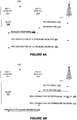
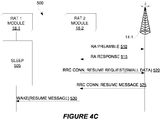
- Figures 4A-4C illustrate embodiments where the second RAT module 18-2 may perform, on behalf of the first RAT module 18-1, at least a portion of a random access procedure and/or a procedure for setting up or resuming an RRC connection on the first RAT 16-1.
- the second RAT module 18-2 transmits a random access (RA) preamble 310 to the first radio access node 14-1 on behalf of the first RAT module 18-1.
- the second RAT module 18-2 also monitors for a RA response 315 from the first radio access node 14-1. Meanwhile, the first RAT module 18-1 operates in the sleep mode 305.
- RA random access
- the second RAT module 18-2 Responsive to receiving the monitored-for RA response 315, the second RAT module 18-2 transmits a wake signal 320 to the first RAT module 18-1, optionally also by passing the first RAT module 18-1 the received random access response.
- the first RAT module 18-1 may then proceed with the remainder of the random access procedure, by transmitting an RRC connection setup or resume request 325 and receiving a corresponding RRC connection setup or resume (command) message 330. This approach allows the first RAT module 18-1 to remain in sleep mode until a response to the RA preamble is successfully received.
- Figure 4B shows an example where the second RAT module 18-2 performs even more of the random access procedure on behalf of the first RAT module 18-1, waking the first RAT module 18-1 only after it receives the RRC connection setup or resume command from the first radio access node 14-1.
- the second RAT module 18-2 transmits a random access (RA) preamble 410 to the first radio access node 14-1 on behalf of the first RAT module 18-1.
- the second RAT module 18-2 also monitors for a RA response 415 from the first radio access node 14-1. Meanwhile, the first RAT module 18-1 operates in the sleep mode 405.
- RA random access
- the second RAT module 18-2 Responsive to receiving the monitored-for RA response 415, rather the second RAT module 18-2 transmitting a wake signal to the first RAT module 18-1 as in Figure 4A , the second RAT module 18-2 itself proceeds with the remainder of the random access procedure, by transmitting an RRC connection setup or resume request 420 and receiving a corresponding RRC connection setup or resume (command) message 425 on behalf of the first RAT module 18-1. Once the RRC connection setup or resume (command) message 425 is received, the second RAT module 18-2 transmits the wake signal 430 to the first RAT module 18-1.
- the first RAT 16-1 is LTE and the second RAT 16-2 is NR.
- the second RAT module 18-2 sends RA preamble 410 and RRC connection setup or resume request 420 to the first radio network node 14-1 (e.g., LTE base station) on behalf of the first RAT module 18-1.
- the first radio network node 14-1 e.g., LTE base station
- these messages in some embodiments are indistinguishable from messages that are actually sent from the first RAT module 18-1.
- the second RAT module 18-2 alternatively or additionally transmits or receives user data via the first RAT 16-1, at least when one or more defined conditions are met.
- the conditions may include for instance one or more of: an amount of the user data over a defined time period being less than a defined amount threshold (e.g., "small" data amounts); a frequency of transmitting or receiving the user data is less than a defined frequency threshold; and a latency requirement for the user data is more than a first defined latency requirement and/or less than a second defined latency requirement.
- a defined amount threshold e.g., "small" data amounts
- a frequency of transmitting or receiving the user data is less than a defined frequency threshold
- a latency requirement for the user data is more than a first defined latency requirement and/or less than a second defined latency requirement.
- Figure 4C shows one example of this.
- the second RAT module 18-2 performs a "small" uplink data transmission on behalf of the first RAT module 18-1 without necessarily performing a full state transition to RRC CONNECTED (assuming a 4-step random access procedure). If the radio network node 14-1 decides that transition to RRC CONNECTED should occur, the second RAT module 18-2 may receive the RRC connection resume message 525 on behalf of the first RAT module 18-1, and thereafter transmit the wake signal 530 to the first RAT module 18-1. Otherwise, if no transition to RRC CONNECTED is to occur, the first RAT module 18-1 may remain in the sleep mode 505.
- the second RAT module 18-2 may listen to a paging channel of the first RAT 16-1 on behalf of the first RAT module 18-1 and receive user data on behalf of the first RAT module 18-1, e.g., under one or more defined conditions.
- the second RAT module 18-2 may transmit or receive information relating to the first RAT 16-1 via the second radio network node 14-2 (e.g., the second RAT base station). The information may be transmitted via the second radio network node 14-2 in this way, for instance, using a container or tunnel between the second RAT module 18-2 and the first radio network node 14-1.
- the first RAT 16-1 is LTE and the second RAT 16-2 is NR
- the second RAT module 18-2 may send an RRC Resume Request message towards the second radio network node 14-2 as an NR base station.
- the second radio network node 14-2 may then forward the message to the first radio network node 14-1 as an LTE base station.
- the first radio network node 14-1 may transmit the response towards the second radio network nod 14-2, which in turn forwards the response to the second RAT module 18-2.
- the second RAT module 18-2 may then wake up the first RAT module 18-1.
- the subset 22-1S of RAT 1 functions that the second RAT module 18-2 is configured to perform on behalf of the first RAT module 18-1 may include RRC IDLE mode functions and/or RRC INACTIVE mode functions.
- this subset 22-1S of RAT 1 functions is strictly limited to RRC IDLE mode functions and/or RRC INACTIVE mode functions, e.g., in the sense that the subset 22-1A excludes any functions in the RRC CONNECTED mode such that the first RAT module 18-1 always handles performance of those functions.
- the subset 22-1S in some embodiments may be defined so as to effectively exploit commonalities that the first and second RATs 16-1, 16-2 have in terms of underlying signal structure, frequency band, hardware (e.g., circuitry), processing, or other characteristics.
- these RAT commonalities are such that the first and second RAT modules 18-1, 18-2 share the same, or have in common the same type of, certain underlying hardware (e.g., circuitry), including one or more of: radio frequency (RF) circuitry, sampling circuitry, Fourier transform circuitry, and synchronization signal detection circuitry (e.g., hardware accelerator).
- RF radio frequency
- the subset 22-1S may include receiver functionality required for cell detection, quality estimation, or any idle mode or radio resource management (RRM) operation.
- RRM radio resource management
- some embodiments define the subset 22-1S of RAT 1 functions as including those RAT 1 functions which are implemented on that certain hardware, e.g., potentially with modified software, such as for cell detection, reference signal received power (RSRP) estimation, measurement reporting, etc.
- RSRP reference signal received power
- some embodiments herein exploit a generic RAT module that is able to fully or partially carry out at least some functions related to both RATs, e.g., with different software for different RATs.
- Figure 6 shows one such embodiment.
- the generic RAT module 26 is able to fully or partially carry out at least some of the subset 22-1S of RAT 1 functions and a corresponding subset 22-2S of RAT 2 functions.
- Either the first or the second RAT module 18-1, 18-2 may invoke the generic RAT module 26 to carry out such a function.
- the second RAT module 18-2 is configured to perform at least one function in the subset 22-1S of RAT 1 functions by invoking the generic RAT module 26 for carrying out at least a portion of that function with respect to the first RAT 16-1.
- the generic RAT module 26 provides the same functionality no matter the invoking RAT module.
- the generic RAT module 26 is able to perform a signal measurement (e.g., for mobility) on both RATs 16-1, 16-2, and may be invoked by either the first or second RAT module 18-1, 18-2 to perform a signal measurement on a particular RAT.
- the second RAT module 18-2 may for instance invoke the generic RAT module 26 to perform a signal measurement on the first RAT 16-1, or invoke the generic RAT module 26 to perform the same signal measurement on the second RAT 16-2.
- Such invocation in some embodiments may be by way of a procedure call, e.g., performMeasurement(firstRAT) or performMeasurement(secondRAT).
- the generic RAT module 26 may provide different functionality depending on the invoking RAT module.
- the generic RAT module 26 performs different types of signal measurements or performs the same signal measurement in different ways depending on whether the invoking module is the first RAT module 18-1 or the second RAT module 18-2.
- the second RAT module 18-2 configured to perform a subset 22-1S of RAT 1 functions, but the first RAT module 18-1 is also configured to perform a subset 22-2S of RAT 2 functions.
- These subsets may overlap in the type of functions that they include, but differ in how they are implemented.
- differences in waveform numerologies are taken into account when performing functions related to the different RATs.
- the RATs are NR and LTE
- NR is designed for sub-GHz to 100 GHz operations and this difference compared to LTE may be accounted for such as by performing synchronization signal detection with different subcarrier spacing and raster settings.
- the first and second RAT modules 18-1, 18-2 herein may each be implemented fully or partially in hardware, e.g., as circuitry, chipset(s), etc.
- the modules 18-1, 18-2 comprise different chips or chipsets, e.g., with (high-level) coordination implemented between them.
- the modules 18-1, 18-2 may be implemented on the same die or integrated circuit.
- the modules 18-1, 18-2 are implemented on a single, integrated chip, with hardware shared between the modules 18-1, 18-2.
- each module 18-1, 18-2 herein may include hardware that is dedicated to that module and/or hardware that is shared with the other module.
- the first and second RAT modules 18-1, 18-2 may each be implemented fully or partially in software, e.g., as hosted on shared or dedicated hardware. In these and other embodiments, then, the first and second RAT modules 18-1, 18-2 may be realized at least in part as different software services or software stacks. Broadly, therefore, the first and second RAT modules 18-1, 18-2, herein may comprise or be hosted on circuitry.
- the second RAT module 18-2 performs the subset 22-1S of RAT 1 functions on behalf of the first RAT module 18-1 when one or more defined conditions are met.
- the one or more conditions may simply include the first RAT module 18-1 being in a sleep mode, as described above.
- the one or more conditions may include a remaining battery level of the wireless communication device 12 being below a defined threshold, e.g., so as to exploit the power-saving advantages of some embodiments herein only when needed.
- a radio node herein is any type of node capable of communicating over radio signals.
- a radio network node herein is any type of network node (e.g., a base station) capable of communicating with another node over radio signals.
- a wireless communication device 12 is any type device capable of communicating with a radio network node or another wireless communication device over radio signals.
- a wireless communication device 12 may therefore refer to a machine-to-machine (M2M) device, a machine-type communications (MTC) device, a narrowband internet of things (NB-loT) device, etc.
- M2M machine-to-machine
- MTC machine-type communications
- NB-loT narrowband internet of things
- a wireless communication device 12 may also be referred to as a radio device, a radio communication device, a wireless terminal, or simply a terminal - unless the context indicates otherwise, the use of any of these terms is intended to include device-to-device devices, machine-type devices or devices capable of machine-to-machine communication, sensors equipped with a wireless device, wireless-enabled table computers, mobile terminals, smart phones, laptop-embedded equipped (LEE), laptopmounted equipment (LME), USB dongles, wireless customer-premises equipment (CPE), etc. It should be understood that these devices may be user equipments, but are generally configured to transmit and/or receive data without direct human interaction.
- a wireless communication device 12 as described herein may be, or may be comprised in, a machine or device that performs monitoring or measurements, and transmits the results of such monitoring measurements to another device or a network.
- machines are power meters, industrial machinery, or home or personal appliances, e.g. refrigerators, televisions, personal wearables such as watches etc.
- a wireless communication device 12 as described herein may be comprised in a vehicle and may perform monitoring and/or reporting of the vehicle's operational status or other functions associated with the vehicle.
- Figure 6 illustrates a method 600 performed by a wireless communication device 12 according to some embodiments herein.
- the method 600 includes performing, by a first RAT module 18-1 of the wireless communication device 12, functions 22-1 relating to a first RAT 16-1 (Block 610).
- the method 600 also include performing, by a second RAT module 18-2 of the wireless communication device 12, functions 22-2 relating to a second RAT 16-2 (Block 620).
- the method 600 further includes performing, by the second RAT module 18-2, a subset 22-1S of functions 22-1 relating to the first RAT 16-1 on behalf of the first RAT module 18-1 (Block 630).
- Figure 7 correspondingly illustrates a method 700 performed by the second RAT module 18-2 of the wireless communication device 12 according to some embodiments.
- the method 700 includes performing, by the second RAT module 18-2 of the wireless communication device 12, functions 22-2 relating to a second RAT 16-2 (Block 710).
- the method 700 further includes performing, by the second RAT module 18-2, a subset 22-1S of functions 22-1 relating to the first RAT 16-1 on behalf of the first RAT module 18-1 (Block 720).
- Figure 8 illustrates a method 800 performed by the second radio network node 14-2 according to still other embodiments.
- the method 800 in one or more embodiments includes establishing communication path(s) with the first radio network node 14-1 and with the second RAT module 18-2 of the wireless communication device 12 (Block 810).
- the established path(s) may include for instance a communication tunnel, e.g., to tunnel RAT 1 information within a RAT 2 tunnel.
- the method 800 as shown comprises forwarding information relating to the first RAT 16-1 between the first RAT radio network node 14-1 and the second RAT module 18-2 of the wireless communication device 12 (Block 820).
- the wireless communication device 12 as described above may perform the method in Figure 6 and any other processing herein by implementing any functional means or units.
- the wireless communication device 12 comprises respective circuits or circuitry configured to perform the steps shown in Figure 6 .
- the circuits or circuitry in this regard may comprise circuits dedicated to performing certain functional processing and/or one or more microprocessors in conjunction with memory.
- memory which may comprise one or several types of memory such as read-only memory (ROM), random-access memory, cache memory, flash memory devices, optical storage devices, etc.
- the memory stores program code that, when executed by the one or more processors, carries out the techniques described herein.
- Figure 9 illustrates a wireless communication device 12 implemented in accordance with one or more embodiments.
- the wireless communication device 12 includes processing circuitry 900 and communication circuitry 910.
- the communication circuitry 910 is configured to transmit and/or receive information to and/or from one or more other nodes, e.g., via any communication technology. Such communication may occur via one or more antennas that are either internal or external to the wireless communication device 12.
- the processing circuitry 900 is configured to perform processing described above, e.g., in Figure 6 , such as by executing instructions stored in memory 920.
- the processing circuitry 900 in this regard may implement certain functional means or units for realizing the first and second RAT modules 18-1, 18-2 described above.
- Figure 10 illustrates a wireless communication device 12 implemented in accordance with one or more other embodiments.
- the wireless communication device 12 implements various functional means (or units), e.g., via the processing circuitry 900 in Figure 9 and/or via software code.
- These functional means e.g., for implementing the method in Figure 6 , include for instance first RAT means 930 for implementing the first RAT module 18-1 and second RAT means 940 for implementing the second RAT module 18-2.
- the second radio network node 14-2 as described above may perform the method in Figure 8 and any other processing herein by implementing any functional means or units.
- the second radio network node 14-2 comprises respective circuits or circuitry configured to perform the steps shown in Figure 6 .
- the circuits or circuitry in this regard may comprise circuits dedicated to performing certain functional processing and/or one or more microprocessors in conjunction with memory.
- memory which may comprise one or several types of memory such as read-only memory (ROM), random-access memory, cache memory, flash memory devices, optical storage devices, etc.
- the memory stores program code that, when executed by the one or more processors, carries out the techniques described herein.
- FIG 11 illustrates a second radio network node 14-2 implemented in accordance with one or more embodiments.
- the second radio network node 14-2 includes processing circuitry 1000 and communication circuitry 1010.
- the communication circuitry 1010 is configured to transmit and/or receive information to and/or from one or more other nodes, e.g., via any communication technology. Such communication may occur via one or more antennas that are either internal or external to the second radio network node 14-2.
- the processing circuitry 1000 is configured to perform processing described above, e.g., in Figure 8 , such as by executing instructions stored in memory 1020.
- FIG 12 illustrates a second radio network node 14-2 implemented in accordance with one or more other embodiments.
- the second radio network node 14-2 implements various functional means (or units), e.g., via the processing circuitry 1000 in Figure 11 and/or via software code.
- These functional means e.g., for implementing the method in Figure 8 , include for instance a communication unit or module 1030 for forwarding information relating to the first RAT 16-1 between the first RAT radio network node 14-1 and the second RAT module 18-2 of the wireless communication device 12.
- a computer program comprises instructions which, when executed on at least one processor of a radio node (e.g., wireless communication device 12 or second radio network nod 14-2), cause the radio node to carry out any of the respective processing described above.
- a radio node e.g., wireless communication device 12 or second radio network nod 14-2
- a computer program in this regard may comprise one or more code modules corresponding to the means or units described above.
- embodiments herein also include a computer program product stored on a non-transitory computer readable (storage or recording) medium and comprising instructions that, when executed by a processor of a node, cause the node to perform as described above.
- Embodiments further include a computer program product comprising program code portions for performing the steps of any of the embodiments herein when the computer program product is executed by a computing device.
- This computer program product may be stored on a computer readable recording medium.
Landscapes
- Engineering & Computer Science (AREA)
- Computer Networks & Wireless Communication (AREA)
- Signal Processing (AREA)
- Mobile Radio Communication Systems (AREA)
Claims (17)
- Procédé réalisé par un dispositif de communication sans fil (12) configuré pour l'utilisation dans un système de communication sans fil (10), le procédé comprenant :la réalisation (610), par un premier module de technologie d'accès radio, RAT, (18-1) du dispositif de communication sans fil (12), de fonctions concernant une première RAT ;la réalisation (620), par un second module de RAT (18-2) du dispositif de communication sans fil (12), de fonctions concernant une seconde RAT ; etla réalisation (630), par le second module de RAT, d'un sous-ensemble (22-1S) de fonctions concernant la première RAT pour le compte du premier module de RAT (18-1) lorsqu'une ou plusieurs conditions définies sont respectées, caractérisé en ce que les une ou plusieurs conditions définies incluent le cas où un niveau de batterie restant du dispositif de communication sans fil (12) est inférieur à un seuil défini.
- Procédé selon la revendication 1, comprenant en outre, par le premier module de RAT (18-1), le fonctionnement dans un mode à basse puissance, un mode en veille, ou un mode désactivé lorsque le second module de RAT (18-2) traite des performances du sous-ensemble (22-1S) des fonctions concernant la première RAT pour le compte du premier module de RAT (18-1).
- Procédé selon la revendication 2, comprenant en outre, en réponse à la détermination qu'une fonction concernant la première RAT doit être réalisée mais n'est pas incluse dans le sous-ensemble (22-1S) de fonctions que le second module de RAT (18-2) est configuré pour réaliser pour le compte du premier module de RAT (18-1), la transmission de signalisation au premier module de RAT (18-1) qui invite le premier module de RAT (18-1) à sortir du module à basse puissance, du mode de veille, ou du mode désactivé.
- Procédé selon l'une quelconque des revendications 1 à 3, comprenant la réalisation, par le second module de RAT (18-2), du sous-ensemble (22-1S) de fonctions concernant la première RAT pour le compte du premier module de RAT (18-1) lorsque le second module de RAT (18-2) est dans un mode actif afin de traiter des performances d'au moins une fonction concernant la seconde RAT.
- Procédé selon l'une quelconque des revendications 1 à 4, comprenant la réalisation, par le second module de RAT (18-2), du sous-ensemble (22-1S) de fonctions concernant la première RAT pour le compte du premier module de RAT (18-1) lorsque le second module de RAT (18-2) n'est pas activement en communication en utilisant la seconde RAT.
- Procédé selon l'une quelconque des revendications 1 à 5, dans lequel le sous-ensemble (22-1S) de fonctions concernant la première RAT comprend des fonctions de mode IDLE de contrôle de ressources radio, RRC, et/ou des fonctions de mode INACTIVE de RRC pour la première RAT.
- Procédé selon l'une quelconque des revendications 1 à 6, dans lequel le sous-ensemble (22-1S) de fonctions concernant la première RAT comprend une ou plusieurs de : la réception d'informations de système pour la première RAT, la réalisation de mesures de signal sur la première RAT, la réalisation d'au moins une partie d'une procédure d'accès aléatoire pour la première RAT, et la réalisation d'opérations de radiomessagerie pour la première RAT.
- Procédé selon l'une quelconque des revendications 1 à 7, dans lequel le sous-ensemble (22-1S) de fonctions concernant la première RAT comprend la réalisation d'au moins une partie d'une procédure pour établir ou reprendre une connexion de contrôle de ressources radio, RRC, sur la première RAT.
- Procédé selon l'une quelconque des revendications 1 à 8, dans lequel le sous-ensemble (22-1S) de fonctions concernant la première RAT comprend la transmission ou la réception de données utilisateur par l'intermédiaire de la première RAT lorsqu'une ou plusieurs conditions définies sont respectées, dans lequel les une ou plusieurs conditions définies incluent une ou plusieurs de : une quantité des données utilisateur durant une période définie est inférieure à un seuil de quantité défini ; une fréquence de la transmission ou de la réception des données utilisateur est inférieure à un seuil de fréquence défini ; et une nécessité de latence pour les données utilisateur est supérieure à une première nécessité de latence définie et/ou une seconde nécessité de latence définie.
- Procédé selon l'une quelconque des revendications 1 à 9, dans lequel le sous-ensemble (22-1S) de fonctions concernant la première RAT comprennent la transmission ou la réception d'informations concernant la première RAT, et dans lequel le procédé comprend, par le second module de RAT (18-2), la transmission ou la réception des informations par l'intermédiaire d'une seconde station de base de RAT.
- Procédé selon l'une quelconque des revendications 1 à 10, comprenant en outre, par à la fois le premier module de RAT (18-1) et le second module de RAT (18-2), l'appel à un module de RAT générique du dispositif de communication sans fil (12) pour réaliser le sous-ensemble (22-1S) de fonctions concernant la première radio RAT, dans lequel le module de RAT générique est configuré pour réaliser le sous-ensemble (22-1S) de fonctions pour à la fois la première RAT et la seconde RAT.
- Procédé selon l'une quelconque des revendications 1 à 11, dans lequel le premier module de RAT (18-1) et le second module de RAT (18-2) partagent le même, ou ont en commun le même type d'une ou de plusieurs de : circuiterie à radiofréquence, circuiterie d'échantillonnage, circuiterie à transformée de Fourier, et circuiterie de détection de signal de synchronisation.
- Procédé selon l'une quelconque des revendications 1 à 12, dans lequel la première RAT est New Radio et la seconde RAT est évolution à long terme, ou la première RAT est évolution à long terme et la seconde RAT est New Radio.
- Dispositif de communication sans fil (12) configuré pour l'utilisation dans un système de communication sans fil (10), le dispositif de communication sans fil (12) comprenant :
une circuiterie de traitement (900) et une mémoire (920), la mémoire (920) contenant des instructions exécutables par la circuiterie de traitement (900), dans lequel le dispositif de communication sans fil (12) est configuré pour mettre en œuvre :un premier module de technologie d'accès radio, RAT, (18-1) configuré pour réaliser des fonctions concernant une première RAT ; etun second module de RAT (18-2) configuré pour réaliser des fonctions concernant une seconde RAT et réaliser un sous-ensemble (22-1S) des fonctions concernant la première RAT pour le compte du premier module de RAT (18-1) lorsqu'une ou plusieurs conditions définies sont respectées, caractérisé en ce que les une ou plusieurs conditions définies incluent le cas où un niveau de batterie restant du dispositif de communication sans fil (12) est inférieur à un seuil défini. - Dispositif de communication sans fil (12) selon la revendication 14, la mémoire (920) contenant des instructions exécutables par la circuiterie de traitement (900), dans lequel le dispositif de communication sans fil (12) est configuré pour réaliser le procédé selon l'une quelconque des revendications 2 à 13.
- Procédé réalisé par un second nœud de réseau radio de technologie d'accès radio (RAT) configuré pour l'utilisation dans un système de communication sans fil (10), le procédé comprenant :le réacheminement (820) d'informations concernant une première RAT entre un premier nœud de réseau radio RAT et un second module de RAT (18-2) d'un dispositif de communication sans fil (12),la réalisation, par le second module de RAT, de fonctions concernant la seconde RAT et la réalisation d'un sous-ensemble de fonctions concernant la première RAT,dans lequel le sous-ensemble (22-1S) de fonctions a inclus la transmission ou la réception des informations concernant la première RAT pour le compte d'un première module de RAT (18-1) du dispositif de communication sans fil (12) lorsqu'une ou plusieurs conditions définies sont respectées, caractérisé en ce que les une ou plusieurs conditions définies incluent le cas où un niveau de batterie restant du dispositif de communication sans fil (12) est inférieur à un seuil défini.
- Second nœud de réseau radio de technologie d'accès radio (RAT) configuré pour l'utilisation dans un système de communication sans fil (10), le second nœud de réseau radio RAT étant configuré pour :
réacheminer des informations concernant une première RAT entre un premier nœud de réseau radio RAT et un second module de RAT (18-2) d'un dispositif de communication sans fil (12), dans lequel le second module de RAT (18-2) est configuré pour réaliser des fonctions concernant la seconde RAT et pour réaliser un sous-ensemble (22-1S) de fonctions concernant la première RAT, dans lequel le sous-ensemble (22-1S) de fonctions a inclus la transmission ou la réception des informations concernant la première RAT pour le compte d'un premier module de RAT (18-1) du dispositif de communication sans fil (12) lorsqu'une ou plusieurs conditions définies sont respectées, caractérisé en ce que les une ou plusieurs conditions définies incluent le cas où un niveau de batterie restant du dispositif de communication sans fil (12) est inférieur à un seuil défini.
Applications Claiming Priority (1)
| Application Number | Priority Date | Filing Date | Title |
|---|---|---|---|
| PCT/SE2017/050835 WO2019039975A1 (fr) | 2017-08-21 | 2017-08-21 | Communication sans fil multi-rat |
Publications (2)
| Publication Number | Publication Date |
|---|---|
| EP3673687A1 EP3673687A1 (fr) | 2020-07-01 |
| EP3673687B1 true EP3673687B1 (fr) | 2021-04-28 |
Family
ID=59772680
Family Applications (1)
| Application Number | Title | Priority Date | Filing Date |
|---|---|---|---|
| EP17761609.1A Active EP3673687B1 (fr) | 2017-08-21 | 2017-08-21 | Communication sans fil multi-rat |
Country Status (4)
| Country | Link |
|---|---|
| US (2) | US11363534B2 (fr) |
| EP (1) | EP3673687B1 (fr) |
| ES (1) | ES2874530T3 (fr) |
| WO (1) | WO2019039975A1 (fr) |
Families Citing this family (9)
| Publication number | Priority date | Publication date | Assignee | Title |
|---|---|---|---|---|
| US10973008B2 (en) * | 2018-03-12 | 2021-04-06 | Apple Inc. | Wireless device preferred bandwidth part configuration and duty cycle indication |
| KR20210017030A (ko) | 2019-08-06 | 2021-02-17 | 삼성전자주식회사 | 전력 소모를 줄이기 위한 전자 장치 및 그의 동작 방법 |
| US11089555B2 (en) | 2019-01-07 | 2021-08-10 | Qualcomm Incorporated | Dynamic configuration of operation power parameters |
| AU2020203964B2 (en) | 2019-04-04 | 2021-10-21 | Samsung Electronics Co., Ltd. | Electronic device for reporting communication quality measurement result and method of operating the electronic device |
| US20200351792A1 (en) * | 2019-05-01 | 2020-11-05 | Qualcomm Incorporated | Power savings in a multi-connectivity user equipment |
| US12192898B2 (en) * | 2019-11-01 | 2025-01-07 | Nokia Technologies Oy | Network assistance information on UE context retrieval latency for enabling power saving |
| CN116349277A (zh) * | 2020-10-30 | 2023-06-27 | 瑞典爱立信有限公司 | 用于设计无线电接入网的方法和装置 |
| WO2022200033A1 (fr) * | 2021-03-26 | 2022-09-29 | Nokia Technologies Oy | Transmission de données dans une connexion à l'état inactif |
| BR102022011599A2 (pt) * | 2021-06-18 | 2022-12-27 | Apple Inc. | Recuperação do serviço em uma tecnologia de acesso por rádio (rat) para um equipamento de usuário (ue) multimodo |
Family Cites Families (12)
| Publication number | Priority date | Publication date | Assignee | Title |
|---|---|---|---|---|
| US8600434B2 (en) * | 2010-01-25 | 2013-12-03 | Lg Electronics Inc. | Method and apparatus of cell searching in a wireless communication system |
| FI3319395T3 (fi) * | 2010-12-03 | 2023-08-01 | Interdigital Patent Holdings Inc | Menetelmä ja laite moniradioliityntätekniikan kantoaaltojen yhdistämisen suorittamiseksi |
| US9155037B2 (en) * | 2012-02-07 | 2015-10-06 | Qualcomm Incorporated | Mobile assisted disparate radio access technology interfacing |
| EP2755429A1 (fr) * | 2013-01-10 | 2014-07-16 | Fujitsu Limited | Mobilité et gestion de connexion d'appareils de communication sans fil de faible puissance |
| US20150156717A1 (en) | 2013-12-03 | 2015-06-04 | Motorola Mobility Llc | Apparatus and method for wireless mobile device power savings |
| US9136892B2 (en) * | 2013-12-11 | 2015-09-15 | Qualcomm Incorporated | Apparatus and method for utilizing a smart receiver switch for improving idle mode performance |
| US9288721B2 (en) * | 2014-03-05 | 2016-03-15 | Apple Inc. | Using a frequency error estimate of a first radio access technology (RAT) for a second RAT |
| US10356839B2 (en) * | 2014-11-04 | 2019-07-16 | Qualcomm Incorporated | Low power discontinuous reception with a second receiver |
| US9775153B2 (en) * | 2015-01-28 | 2017-09-26 | Alcatel Lucent | Allocation of unlicensed frequency bands for a wireless hotspot |
| WO2018013019A1 (fr) * | 2016-07-11 | 2018-01-18 | Telefonaktiebolaget Lm Ericsson (Publ) | Nœud de réseau radio, dispositif sans fil, et procédés réalisés associés |
| US9913216B1 (en) * | 2016-09-02 | 2018-03-06 | Qualcomm, Incorporated | Techniques to reduce power consumption in mobile device during low-power mode |
| WO2018227617A1 (fr) * | 2017-06-16 | 2018-12-20 | 富士通株式会社 | Procédé d'envoi de signaux, procédé de détection, appareil, et système de communication |
-
2017
- 2017-08-21 WO PCT/SE2017/050835 patent/WO2019039975A1/fr not_active Ceased
- 2017-08-21 EP EP17761609.1A patent/EP3673687B1/fr active Active
- 2017-08-21 ES ES17761609T patent/ES2874530T3/es active Active
- 2017-08-21 US US15/561,380 patent/US11363534B2/en active Active
-
2022
- 2022-05-13 US US17/743,820 patent/US20220286960A1/en not_active Abandoned
Non-Patent Citations (1)
| Title |
|---|
| None * |
Also Published As
| Publication number | Publication date |
|---|---|
| ES2874530T3 (es) | 2021-11-05 |
| US20220286960A1 (en) | 2022-09-08 |
| EP3673687A1 (fr) | 2020-07-01 |
| US20190059051A1 (en) | 2019-02-21 |
| WO2019039975A1 (fr) | 2019-02-28 |
| US11363534B2 (en) | 2022-06-14 |
Similar Documents
| Publication | Publication Date | Title |
|---|---|---|
| US20220286960A1 (en) | Multi-RAT Wireless Communication | |
| US12167334B2 (en) | Reference signal receiving method, reference signal sending method, and apparatus | |
| US10412780B2 (en) | Adapting discontinuous reception cycles using scheduling requests | |
| US12114263B2 (en) | Method and device for discontinuous reception | |
| WO2021148711A1 (fr) | Wus pour la radiorecherche d'états inactifs rrc | |
| US10375646B2 (en) | Coordination between application and baseband layer operation | |
| JP7797604B2 (ja) | 通信機器の作動方法及び通信機器 | |
| CN112567670A (zh) | 用于在功率节省与通信效率之间平衡的动态c-drx配置以及使用dci激活载波分量 | |
| CN113473596A (zh) | 一种寻呼方法、设备及系统 | |
| EP4207884A1 (fr) | Procédé et dispositif de communication | |
| US20240357501A1 (en) | Wireless communication method, terminal device, and network device | |
| CN118785370A (zh) | 寻呼方法及通信设备 | |
| US12127124B2 (en) | Method for dynamically changing parameter of wake up signaling, terminal, and medium | |
| JP2022514841A (ja) | 時間周波数リソース決定方法、装置、チップ及びコンピュータプログラム | |
| EP4213558B1 (fr) | Procédé de transmission de données et appareil associé | |
| JP2021520700A (ja) | 信号伝送方法および機器 | |
| WO2025038275A1 (fr) | Adaptation de fonctionnement de wur-lp d'ue pour différentes conditions de couverture | |
| CN118679793A (zh) | 用于操作用户设备(ue)的drx间协助方法 | |
| WO2024092653A1 (fr) | Procédé de communication sans fil, dispositif terminal et dispositif de réseau | |
| EP4723766A1 (fr) | Procédé de communication sans fil, dispositif terminal et dispositif réseau | |
| US20260075530A1 (en) | Assistance information sending method and receiving method, terminal, and network side device | |
| EP4718916A1 (fr) | Procédé de communication sans fil et dispositif | |
| EP4633282A1 (fr) | Procédé de communication et appareil associé | |
| CN119678583A (zh) | 无线通信的方法、终端设备及网络设备 | |
| RU2813262C1 (ru) | Способ и устройство связи и считываемый компьютером носитель данных |
Legal Events
| Date | Code | Title | Description |
|---|---|---|---|
| STAA | Information on the status of an ep patent application or granted ep patent |
Free format text: STATUS: UNKNOWN |
|
| STAA | Information on the status of an ep patent application or granted ep patent |
Free format text: STATUS: THE INTERNATIONAL PUBLICATION HAS BEEN MADE |
|
| PUAI | Public reference made under article 153(3) epc to a published international application that has entered the european phase |
Free format text: ORIGINAL CODE: 0009012 |
|
| STAA | Information on the status of an ep patent application or granted ep patent |
Free format text: STATUS: REQUEST FOR EXAMINATION WAS MADE |
|
| 17P | Request for examination filed |
Effective date: 20191212 |
|
| AK | Designated contracting states |
Kind code of ref document: A1 Designated state(s): AL AT BE BG CH CY CZ DE DK EE ES FI FR GB GR HR HU IE IS IT LI LT LU LV MC MK MT NL NO PL PT RO RS SE SI SK SM TR |
|
| AX | Request for extension of the european patent |
Extension state: BA ME |
|
| STAA | Information on the status of an ep patent application or granted ep patent |
Free format text: STATUS: EXAMINATION IS IN PROGRESS |
|
| 17Q | First examination report despatched |
Effective date: 20200916 |
|
| DAV | Request for validation of the european patent (deleted) | ||
| DAX | Request for extension of the european patent (deleted) | ||
| GRAP | Despatch of communication of intention to grant a patent |
Free format text: ORIGINAL CODE: EPIDOSNIGR1 |
|
| STAA | Information on the status of an ep patent application or granted ep patent |
Free format text: STATUS: GRANT OF PATENT IS INTENDED |
|
| INTG | Intention to grant announced |
Effective date: 20210120 |
|
| GRAS | Grant fee paid |
Free format text: ORIGINAL CODE: EPIDOSNIGR3 |
|
| GRAA | (expected) grant |
Free format text: ORIGINAL CODE: 0009210 |
|
| STAA | Information on the status of an ep patent application or granted ep patent |
Free format text: STATUS: THE PATENT HAS BEEN GRANTED |
|
| AK | Designated contracting states |
Kind code of ref document: B1 Designated state(s): AL AT BE BG CH CY CZ DE DK EE ES FI FR GB GR HR HU IE IS IT LI LT LU LV MC MK MT NL NO PL PT RO RS SE SI SK SM TR |
|
| REG | Reference to a national code |
Ref country code: GB Ref legal event code: FG4D |
|
| REG | Reference to a national code |
Ref country code: CH Ref legal event code: EP |
|
| REG | Reference to a national code |
Ref country code: DE Ref legal event code: R096 Ref document number: 602017037649 Country of ref document: DE |
|
| REG | Reference to a national code |
Ref country code: AT Ref legal event code: REF Ref document number: 1388551 Country of ref document: AT Kind code of ref document: T Effective date: 20210515 |
|
| REG | Reference to a national code |
Ref country code: IE Ref legal event code: FG4D |
|
| REG | Reference to a national code |
Ref country code: NL Ref legal event code: FP |
|
| REG | Reference to a national code |
Ref country code: LT Ref legal event code: MG9D |
|
| REG | Reference to a national code |
Ref country code: AT Ref legal event code: MK05 Ref document number: 1388551 Country of ref document: AT Kind code of ref document: T Effective date: 20210428 |
|
| PG25 | Lapsed in a contracting state [announced via postgrant information from national office to epo] |
Ref country code: HR Free format text: LAPSE BECAUSE OF FAILURE TO SUBMIT A TRANSLATION OF THE DESCRIPTION OR TO PAY THE FEE WITHIN THE PRESCRIBED TIME-LIMIT Effective date: 20210428 Ref country code: BG Free format text: LAPSE BECAUSE OF FAILURE TO SUBMIT A TRANSLATION OF THE DESCRIPTION OR TO PAY THE FEE WITHIN THE PRESCRIBED TIME-LIMIT Effective date: 20210728 Ref country code: AT Free format text: LAPSE BECAUSE OF FAILURE TO SUBMIT A TRANSLATION OF THE DESCRIPTION OR TO PAY THE FEE WITHIN THE PRESCRIBED TIME-LIMIT Effective date: 20210428 Ref country code: FI Free format text: LAPSE BECAUSE OF FAILURE TO SUBMIT A TRANSLATION OF THE DESCRIPTION OR TO PAY THE FEE WITHIN THE PRESCRIBED TIME-LIMIT Effective date: 20210428 Ref country code: LT Free format text: LAPSE BECAUSE OF FAILURE TO SUBMIT A TRANSLATION OF THE DESCRIPTION OR TO PAY THE FEE WITHIN THE PRESCRIBED TIME-LIMIT Effective date: 20210428 |
|
| REG | Reference to a national code |
Ref country code: ES Ref legal event code: FG2A Ref document number: 2874530 Country of ref document: ES Kind code of ref document: T3 Effective date: 20211105 |
|
| PG25 | Lapsed in a contracting state [announced via postgrant information from national office to epo] |
Ref country code: RS Free format text: LAPSE BECAUSE OF FAILURE TO SUBMIT A TRANSLATION OF THE DESCRIPTION OR TO PAY THE FEE WITHIN THE PRESCRIBED TIME-LIMIT Effective date: 20210428 Ref country code: SE Free format text: LAPSE BECAUSE OF FAILURE TO SUBMIT A TRANSLATION OF THE DESCRIPTION OR TO PAY THE FEE WITHIN THE PRESCRIBED TIME-LIMIT Effective date: 20210428 Ref country code: LV Free format text: LAPSE BECAUSE OF FAILURE TO SUBMIT A TRANSLATION OF THE DESCRIPTION OR TO PAY THE FEE WITHIN THE PRESCRIBED TIME-LIMIT Effective date: 20210428 Ref country code: NO Free format text: LAPSE BECAUSE OF FAILURE TO SUBMIT A TRANSLATION OF THE DESCRIPTION OR TO PAY THE FEE WITHIN THE PRESCRIBED TIME-LIMIT Effective date: 20210728 Ref country code: PT Free format text: LAPSE BECAUSE OF FAILURE TO SUBMIT A TRANSLATION OF THE DESCRIPTION OR TO PAY THE FEE WITHIN THE PRESCRIBED TIME-LIMIT Effective date: 20210830 Ref country code: PL Free format text: LAPSE BECAUSE OF FAILURE TO SUBMIT A TRANSLATION OF THE DESCRIPTION OR TO PAY THE FEE WITHIN THE PRESCRIBED TIME-LIMIT Effective date: 20210428 Ref country code: GR Free format text: LAPSE BECAUSE OF FAILURE TO SUBMIT A TRANSLATION OF THE DESCRIPTION OR TO PAY THE FEE WITHIN THE PRESCRIBED TIME-LIMIT Effective date: 20210729 Ref country code: IS Free format text: LAPSE BECAUSE OF FAILURE TO SUBMIT A TRANSLATION OF THE DESCRIPTION OR TO PAY THE FEE WITHIN THE PRESCRIBED TIME-LIMIT Effective date: 20210828 |
|
| PG25 | Lapsed in a contracting state [announced via postgrant information from national office to epo] |
Ref country code: SK Free format text: LAPSE BECAUSE OF FAILURE TO SUBMIT A TRANSLATION OF THE DESCRIPTION OR TO PAY THE FEE WITHIN THE PRESCRIBED TIME-LIMIT Effective date: 20210428 Ref country code: SM Free format text: LAPSE BECAUSE OF FAILURE TO SUBMIT A TRANSLATION OF THE DESCRIPTION OR TO PAY THE FEE WITHIN THE PRESCRIBED TIME-LIMIT Effective date: 20210428 Ref country code: CZ Free format text: LAPSE BECAUSE OF FAILURE TO SUBMIT A TRANSLATION OF THE DESCRIPTION OR TO PAY THE FEE WITHIN THE PRESCRIBED TIME-LIMIT Effective date: 20210428 Ref country code: DK Free format text: LAPSE BECAUSE OF FAILURE TO SUBMIT A TRANSLATION OF THE DESCRIPTION OR TO PAY THE FEE WITHIN THE PRESCRIBED TIME-LIMIT Effective date: 20210428 Ref country code: EE Free format text: LAPSE BECAUSE OF FAILURE TO SUBMIT A TRANSLATION OF THE DESCRIPTION OR TO PAY THE FEE WITHIN THE PRESCRIBED TIME-LIMIT Effective date: 20210428 Ref country code: RO Free format text: LAPSE BECAUSE OF FAILURE TO SUBMIT A TRANSLATION OF THE DESCRIPTION OR TO PAY THE FEE WITHIN THE PRESCRIBED TIME-LIMIT Effective date: 20210428 |
|
| REG | Reference to a national code |
Ref country code: DE Ref legal event code: R097 Ref document number: 602017037649 Country of ref document: DE |
|
| PLBE | No opposition filed within time limit |
Free format text: ORIGINAL CODE: 0009261 |
|
| STAA | Information on the status of an ep patent application or granted ep patent |
Free format text: STATUS: NO OPPOSITION FILED WITHIN TIME LIMIT |
|
| REG | Reference to a national code |
Ref country code: CH Ref legal event code: PL |
|
| PG25 | Lapsed in a contracting state [announced via postgrant information from national office to epo] |
Ref country code: MC Free format text: LAPSE BECAUSE OF FAILURE TO SUBMIT A TRANSLATION OF THE DESCRIPTION OR TO PAY THE FEE WITHIN THE PRESCRIBED TIME-LIMIT Effective date: 20210428 |
|
| 26N | No opposition filed |
Effective date: 20220131 |
|
| REG | Reference to a national code |
Ref country code: BE Ref legal event code: MM Effective date: 20210831 |
|
| PG25 | Lapsed in a contracting state [announced via postgrant information from national office to epo] |
Ref country code: LI Free format text: LAPSE BECAUSE OF NON-PAYMENT OF DUE FEES Effective date: 20210831 Ref country code: CH Free format text: LAPSE BECAUSE OF NON-PAYMENT OF DUE FEES Effective date: 20210831 |
|
| PG25 | Lapsed in a contracting state [announced via postgrant information from national office to epo] |
Ref country code: IS Free format text: LAPSE BECAUSE OF FAILURE TO SUBMIT A TRANSLATION OF THE DESCRIPTION OR TO PAY THE FEE WITHIN THE PRESCRIBED TIME-LIMIT Effective date: 20210828 Ref country code: LU Free format text: LAPSE BECAUSE OF NON-PAYMENT OF DUE FEES Effective date: 20210821 Ref country code: AL Free format text: LAPSE BECAUSE OF FAILURE TO SUBMIT A TRANSLATION OF THE DESCRIPTION OR TO PAY THE FEE WITHIN THE PRESCRIBED TIME-LIMIT Effective date: 20210428 |
|
| PG25 | Lapsed in a contracting state [announced via postgrant information from national office to epo] |
Ref country code: BE Free format text: LAPSE BECAUSE OF NON-PAYMENT OF DUE FEES Effective date: 20210831 |
|
| PGFP | Annual fee paid to national office [announced via postgrant information from national office to epo] |
Ref country code: IE Payment date: 20220829 Year of fee payment: 6 |
|
| P01 | Opt-out of the competence of the unified patent court (upc) registered |
Effective date: 20230523 |
|
| PG25 | Lapsed in a contracting state [announced via postgrant information from national office to epo] |
Ref country code: CY Free format text: LAPSE BECAUSE OF FAILURE TO SUBMIT A TRANSLATION OF THE DESCRIPTION OR TO PAY THE FEE WITHIN THE PRESCRIBED TIME-LIMIT Effective date: 20210428 |
|
| PG25 | Lapsed in a contracting state [announced via postgrant information from national office to epo] |
Ref country code: HU Free format text: LAPSE BECAUSE OF FAILURE TO SUBMIT A TRANSLATION OF THE DESCRIPTION OR TO PAY THE FEE WITHIN THE PRESCRIBED TIME-LIMIT; INVALID AB INITIO Effective date: 20170821 |
|
| PGFP | Annual fee paid to national office [announced via postgrant information from national office to epo] |
Ref country code: IT Payment date: 20230822 Year of fee payment: 7 Ref country code: ES Payment date: 20230901 Year of fee payment: 7 |
|
| PG25 | Lapsed in a contracting state [announced via postgrant information from national office to epo] |
Ref country code: MK Free format text: LAPSE BECAUSE OF FAILURE TO SUBMIT A TRANSLATION OF THE DESCRIPTION OR TO PAY THE FEE WITHIN THE PRESCRIBED TIME-LIMIT Effective date: 20210428 |
|
| REG | Reference to a national code |
Ref country code: IE Ref legal event code: MM4A |
|
| PG25 | Lapsed in a contracting state [announced via postgrant information from national office to epo] |
Ref country code: TR Free format text: LAPSE BECAUSE OF FAILURE TO SUBMIT A TRANSLATION OF THE DESCRIPTION OR TO PAY THE FEE WITHIN THE PRESCRIBED TIME-LIMIT Effective date: 20210428 |
|
| PG25 | Lapsed in a contracting state [announced via postgrant information from national office to epo] |
Ref country code: IE Free format text: LAPSE BECAUSE OF NON-PAYMENT OF DUE FEES Effective date: 20230821 |
|
| PG25 | Lapsed in a contracting state [announced via postgrant information from national office to epo] |
Ref country code: IE Free format text: LAPSE BECAUSE OF NON-PAYMENT OF DUE FEES Effective date: 20230821 |
|
| PG25 | Lapsed in a contracting state [announced via postgrant information from national office to epo] |
Ref country code: MT Free format text: LAPSE BECAUSE OF FAILURE TO SUBMIT A TRANSLATION OF THE DESCRIPTION OR TO PAY THE FEE WITHIN THE PRESCRIBED TIME-LIMIT Effective date: 20210428 |
|
| PG25 | Lapsed in a contracting state [announced via postgrant information from national office to epo] |
Ref country code: IT Free format text: LAPSE BECAUSE OF NON-PAYMENT OF DUE FEES Effective date: 20240821 |
|
| PGFP | Annual fee paid to national office [announced via postgrant information from national office to epo] |
Ref country code: NL Payment date: 20250826 Year of fee payment: 9 |
|
| REG | Reference to a national code |
Ref country code: ES Ref legal event code: FD2A Effective date: 20250930 |
|
| PG25 | Lapsed in a contracting state [announced via postgrant information from national office to epo] |
Ref country code: ES Free format text: LAPSE BECAUSE OF NON-PAYMENT OF DUE FEES Effective date: 20240822 |
|
| PGFP | Annual fee paid to national office [announced via postgrant information from national office to epo] |
Ref country code: DE Payment date: 20250827 Year of fee payment: 9 |
|
| PGFP | Annual fee paid to national office [announced via postgrant information from national office to epo] |
Ref country code: GB Payment date: 20250827 Year of fee payment: 9 |
|
| PGFP | Annual fee paid to national office [announced via postgrant information from national office to epo] |
Ref country code: FR Payment date: 20250825 Year of fee payment: 9 |