EP3673978A1 - Catalyseur d'oxydation pour un moteur à combustion interne à mélange pauvre - Google Patents
Catalyseur d'oxydation pour un moteur à combustion interne à mélange pauvre Download PDFInfo
- Publication number
- EP3673978A1 EP3673978A1 EP20156727.8A EP20156727A EP3673978A1 EP 3673978 A1 EP3673978 A1 EP 3673978A1 EP 20156727 A EP20156727 A EP 20156727A EP 3673978 A1 EP3673978 A1 EP 3673978A1
- Authority
- EP
- European Patent Office
- Prior art keywords
- oxidation catalyst
- catalyst
- exhaust gas
- oxidation
- disposed
- Prior art date
- Legal status (The legal status is an assumption and is not a legal conclusion. Google has not performed a legal analysis and makes no representation as to the accuracy of the status listed.)
- Granted
Links
Images


Classifications
-
- F—MECHANICAL ENGINEERING; LIGHTING; HEATING; WEAPONS; BLASTING
- F01—MACHINES OR ENGINES IN GENERAL; ENGINE PLANTS IN GENERAL; STEAM ENGINES
- F01N—GAS-FLOW SILENCERS OR EXHAUST APPARATUS FOR MACHINES OR ENGINES IN GENERAL; GAS-FLOW SILENCERS OR EXHAUST APPARATUS FOR INTERNAL-COMBUSTION ENGINES
- F01N3/00—Exhaust or silencing apparatus having means for purifying, rendering innocuous, or otherwise treating exhaust
- F01N3/08—Exhaust or silencing apparatus having means for purifying, rendering innocuous, or otherwise treating exhaust for rendering innocuous
- F01N3/0807—Exhaust or silencing apparatus having means for purifying, rendering innocuous, or otherwise treating exhaust for rendering innocuous by using absorbents or adsorbents
- F01N3/0814—Exhaust or silencing apparatus having means for purifying, rendering innocuous, or otherwise treating exhaust for rendering innocuous by using absorbents or adsorbents combined with catalytic converters, e.g. NOx absorption/storage reduction catalysts
-
- B—PERFORMING OPERATIONS; TRANSPORTING
- B01—PHYSICAL OR CHEMICAL PROCESSES OR APPARATUS IN GENERAL
- B01D—SEPARATION
- B01D53/00—Separation of gases or vapours; Recovering vapours of volatile solvents from gases; Chemical or biological purification of waste gases, e.g. engine exhaust gases, smoke, fumes, flue gases, aerosols
- B01D53/34—Chemical or biological purification of waste gases
- B01D53/92—Chemical or biological purification of waste gases of engine exhaust gases
- B01D53/94—Chemical or biological purification of waste gases of engine exhaust gases by catalytic processes
- B01D53/944—Simultaneously removing carbon monoxide, hydrocarbons or carbon making use of oxidation catalysts
-
- B—PERFORMING OPERATIONS; TRANSPORTING
- B01—PHYSICAL OR CHEMICAL PROCESSES OR APPARATUS IN GENERAL
- B01J—CHEMICAL OR PHYSICAL PROCESSES, e.g. CATALYSIS OR COLLOID CHEMISTRY; THEIR RELEVANT APPARATUS
- B01J38/00—Regeneration or reactivation of catalysts, in general
- B01J38/04—Gas or vapour treating; Treating by using liquids vaporisable upon contacting spent catalyst
-
- F—MECHANICAL ENGINEERING; LIGHTING; HEATING; WEAPONS; BLASTING
- F01—MACHINES OR ENGINES IN GENERAL; ENGINE PLANTS IN GENERAL; STEAM ENGINES
- F01N—GAS-FLOW SILENCERS OR EXHAUST APPARATUS FOR MACHINES OR ENGINES IN GENERAL; GAS-FLOW SILENCERS OR EXHAUST APPARATUS FOR INTERNAL-COMBUSTION ENGINES
- F01N3/00—Exhaust or silencing apparatus having means for purifying, rendering innocuous, or otherwise treating exhaust
- F01N3/08—Exhaust or silencing apparatus having means for purifying, rendering innocuous, or otherwise treating exhaust for rendering innocuous
- F01N3/10—Exhaust or silencing apparatus having means for purifying, rendering innocuous, or otherwise treating exhaust for rendering innocuous by thermal or catalytic conversion of noxious components of exhaust
-
- B—PERFORMING OPERATIONS; TRANSPORTING
- B01—PHYSICAL OR CHEMICAL PROCESSES OR APPARATUS IN GENERAL
- B01D—SEPARATION
- B01D53/00—Separation of gases or vapours; Recovering vapours of volatile solvents from gases; Chemical or biological purification of waste gases, e.g. engine exhaust gases, smoke, fumes, flue gases, aerosols
- B01D53/34—Chemical or biological purification of waste gases
- B01D53/92—Chemical or biological purification of waste gases of engine exhaust gases
- B01D53/94—Chemical or biological purification of waste gases of engine exhaust gases by catalytic processes
-
- B—PERFORMING OPERATIONS; TRANSPORTING
- B01—PHYSICAL OR CHEMICAL PROCESSES OR APPARATUS IN GENERAL
- B01D—SEPARATION
- B01D53/00—Separation of gases or vapours; Recovering vapours of volatile solvents from gases; Chemical or biological purification of waste gases, e.g. engine exhaust gases, smoke, fumes, flue gases, aerosols
- B01D53/34—Chemical or biological purification of waste gases
- B01D53/96—Regeneration, reactivation or recycling of reactants
-
- B—PERFORMING OPERATIONS; TRANSPORTING
- B01—PHYSICAL OR CHEMICAL PROCESSES OR APPARATUS IN GENERAL
- B01J—CHEMICAL OR PHYSICAL PROCESSES, e.g. CATALYSIS OR COLLOID CHEMISTRY; THEIR RELEVANT APPARATUS
- B01J23/00—Catalysts comprising metals or metal oxides or hydroxides, not provided for in group B01J21/00
- B01J23/38—Catalysts comprising metals or metal oxides or hydroxides, not provided for in group B01J21/00 of noble metals
- B01J23/40—Catalysts comprising metals or metal oxides or hydroxides, not provided for in group B01J21/00 of noble metals of the platinum group metals
-
- B—PERFORMING OPERATIONS; TRANSPORTING
- B01—PHYSICAL OR CHEMICAL PROCESSES OR APPARATUS IN GENERAL
- B01J—CHEMICAL OR PHYSICAL PROCESSES, e.g. CATALYSIS OR COLLOID CHEMISTRY; THEIR RELEVANT APPARATUS
- B01J23/00—Catalysts comprising metals or metal oxides or hydroxides, not provided for in group B01J21/00
- B01J23/38—Catalysts comprising metals or metal oxides or hydroxides, not provided for in group B01J21/00 of noble metals
- B01J23/54—Catalysts comprising metals or metal oxides or hydroxides, not provided for in group B01J21/00 of noble metals combined with metals, oxides or hydroxides provided for in groups B01J23/02 - B01J23/36
- B01J23/56—Platinum group metals
- B01J23/63—Platinum group metals with rare earths or actinides
-
- B—PERFORMING OPERATIONS; TRANSPORTING
- B01—PHYSICAL OR CHEMICAL PROCESSES OR APPARATUS IN GENERAL
- B01J—CHEMICAL OR PHYSICAL PROCESSES, e.g. CATALYSIS OR COLLOID CHEMISTRY; THEIR RELEVANT APPARATUS
- B01J23/00—Catalysts comprising metals or metal oxides or hydroxides, not provided for in group B01J21/00
- B01J23/38—Catalysts comprising metals or metal oxides or hydroxides, not provided for in group B01J21/00 of noble metals
- B01J23/54—Catalysts comprising metals or metal oxides or hydroxides, not provided for in group B01J21/00 of noble metals combined with metals, oxides or hydroxides provided for in groups B01J23/02 - B01J23/36
- B01J23/56—Platinum group metals
- B01J23/64—Platinum group metals with arsenic, antimony, bismuth, vanadium, niobium, tantalum, polonium, chromium, molybdenum, tungsten, manganese, technetium or rhenium
- B01J23/656—Manganese, technetium or rhenium
-
- B—PERFORMING OPERATIONS; TRANSPORTING
- B01—PHYSICAL OR CHEMICAL PROCESSES OR APPARATUS IN GENERAL
- B01J—CHEMICAL OR PHYSICAL PROCESSES, e.g. CATALYSIS OR COLLOID CHEMISTRY; THEIR RELEVANT APPARATUS
- B01J23/00—Catalysts comprising metals or metal oxides or hydroxides, not provided for in group B01J21/00
- B01J23/70—Catalysts comprising metals or metal oxides or hydroxides, not provided for in group B01J21/00 of the iron group metals or copper
- B01J23/89—Catalysts comprising metals or metal oxides or hydroxides, not provided for in group B01J21/00 of the iron group metals or copper combined with noble metals
-
- B—PERFORMING OPERATIONS; TRANSPORTING
- B01—PHYSICAL OR CHEMICAL PROCESSES OR APPARATUS IN GENERAL
- B01J—CHEMICAL OR PHYSICAL PROCESSES, e.g. CATALYSIS OR COLLOID CHEMISTRY; THEIR RELEVANT APPARATUS
- B01J23/00—Catalysts comprising metals or metal oxides or hydroxides, not provided for in group B01J21/00
- B01J23/90—Regeneration or reactivation
- B01J23/96—Regeneration or reactivation of catalysts comprising metals, oxides or hydroxides of the noble metals
-
- B—PERFORMING OPERATIONS; TRANSPORTING
- B01—PHYSICAL OR CHEMICAL PROCESSES OR APPARATUS IN GENERAL
- B01J—CHEMICAL OR PHYSICAL PROCESSES, e.g. CATALYSIS OR COLLOID CHEMISTRY; THEIR RELEVANT APPARATUS
- B01J29/00—Catalysts comprising molecular sieves
-
- B—PERFORMING OPERATIONS; TRANSPORTING
- B01—PHYSICAL OR CHEMICAL PROCESSES OR APPARATUS IN GENERAL
- B01J—CHEMICAL OR PHYSICAL PROCESSES, e.g. CATALYSIS OR COLLOID CHEMISTRY; THEIR RELEVANT APPARATUS
- B01J29/00—Catalysts comprising molecular sieves
- B01J29/04—Catalysts comprising molecular sieves having base-exchange properties, e.g. crystalline zeolites
- B01J29/06—Crystalline aluminosilicate zeolites; Isomorphous compounds thereof
- B01J29/70—Crystalline aluminosilicate zeolites; Isomorphous compounds thereof of types characterised by their specific structure not provided for in groups B01J29/08 - B01J29/65
- B01J29/7007—Zeolite Beta
-
- B—PERFORMING OPERATIONS; TRANSPORTING
- B01—PHYSICAL OR CHEMICAL PROCESSES OR APPARATUS IN GENERAL
- B01J—CHEMICAL OR PHYSICAL PROCESSES, e.g. CATALYSIS OR COLLOID CHEMISTRY; THEIR RELEVANT APPARATUS
- B01J29/00—Catalysts comprising molecular sieves
- B01J29/04—Catalysts comprising molecular sieves having base-exchange properties, e.g. crystalline zeolites
- B01J29/06—Crystalline aluminosilicate zeolites; Isomorphous compounds thereof
- B01J29/70—Crystalline aluminosilicate zeolites; Isomorphous compounds thereof of types characterised by their specific structure not provided for in groups B01J29/08 - B01J29/65
- B01J29/72—Crystalline aluminosilicate zeolites; Isomorphous compounds thereof of types characterised by their specific structure not provided for in groups B01J29/08 - B01J29/65 containing iron group metals, noble metals or copper
- B01J29/74—Noble metals
- B01J29/7415—Zeolite Beta
-
- B—PERFORMING OPERATIONS; TRANSPORTING
- B01—PHYSICAL OR CHEMICAL PROCESSES OR APPARATUS IN GENERAL
- B01J—CHEMICAL OR PHYSICAL PROCESSES, e.g. CATALYSIS OR COLLOID CHEMISTRY; THEIR RELEVANT APPARATUS
- B01J29/00—Catalysts comprising molecular sieves
- B01J29/90—Regeneration or reactivation
-
- B—PERFORMING OPERATIONS; TRANSPORTING
- B01—PHYSICAL OR CHEMICAL PROCESSES OR APPARATUS IN GENERAL
- B01J—CHEMICAL OR PHYSICAL PROCESSES, e.g. CATALYSIS OR COLLOID CHEMISTRY; THEIR RELEVANT APPARATUS
- B01J35/00—Catalysts, in general, characterised by their form or physical properties
- B01J35/19—Catalysts containing parts with different compositions
-
- B—PERFORMING OPERATIONS; TRANSPORTING
- B01—PHYSICAL OR CHEMICAL PROCESSES OR APPARATUS IN GENERAL
- B01J—CHEMICAL OR PHYSICAL PROCESSES, e.g. CATALYSIS OR COLLOID CHEMISTRY; THEIR RELEVANT APPARATUS
- B01J35/00—Catalysts, in general, characterised by their form or physical properties
- B01J35/50—Catalysts, in general, characterised by their form or physical properties characterised by their shape or configuration
- B01J35/56—Foraminous structures having flow-through passages or channels, e.g. grids or three-dimensional [3D] monoliths
-
- B—PERFORMING OPERATIONS; TRANSPORTING
- B01—PHYSICAL OR CHEMICAL PROCESSES OR APPARATUS IN GENERAL
- B01J—CHEMICAL OR PHYSICAL PROCESSES, e.g. CATALYSIS OR COLLOID CHEMISTRY; THEIR RELEVANT APPARATUS
- B01J37/00—Processes, in general, for preparing catalysts; Processes, in general, for activation of catalysts
- B01J37/02—Impregnation, coating or precipitation
- B01J37/024—Multiple impregnation or coating
- B01J37/0244—Coatings comprising several layers
-
- B—PERFORMING OPERATIONS; TRANSPORTING
- B01—PHYSICAL OR CHEMICAL PROCESSES OR APPARATUS IN GENERAL
- B01J—CHEMICAL OR PHYSICAL PROCESSES, e.g. CATALYSIS OR COLLOID CHEMISTRY; THEIR RELEVANT APPARATUS
- B01J37/00—Processes, in general, for preparing catalysts; Processes, in general, for activation of catalysts
- B01J37/02—Impregnation, coating or precipitation
- B01J37/024—Multiple impregnation or coating
- B01J37/0246—Coatings comprising a zeolite
-
- F—MECHANICAL ENGINEERING; LIGHTING; HEATING; WEAPONS; BLASTING
- F01—MACHINES OR ENGINES IN GENERAL; ENGINE PLANTS IN GENERAL; STEAM ENGINES
- F01N—GAS-FLOW SILENCERS OR EXHAUST APPARATUS FOR MACHINES OR ENGINES IN GENERAL; GAS-FLOW SILENCERS OR EXHAUST APPARATUS FOR INTERNAL-COMBUSTION ENGINES
- F01N3/00—Exhaust or silencing apparatus having means for purifying, rendering innocuous, or otherwise treating exhaust
- F01N3/08—Exhaust or silencing apparatus having means for purifying, rendering innocuous, or otherwise treating exhaust for rendering innocuous
- F01N3/0807—Exhaust or silencing apparatus having means for purifying, rendering innocuous, or otherwise treating exhaust for rendering innocuous by using absorbents or adsorbents
- F01N3/0871—Exhaust or silencing apparatus having means for purifying, rendering innocuous, or otherwise treating exhaust for rendering innocuous by using absorbents or adsorbents using means for controlling, e.g. purging, the absorbents or adsorbents
- F01N3/0885—Regeneration of deteriorated absorbents or adsorbents, e.g. desulfurization of NOx traps
-
- F—MECHANICAL ENGINEERING; LIGHTING; HEATING; WEAPONS; BLASTING
- F01—MACHINES OR ENGINES IN GENERAL; ENGINE PLANTS IN GENERAL; STEAM ENGINES
- F01N—GAS-FLOW SILENCERS OR EXHAUST APPARATUS FOR MACHINES OR ENGINES IN GENERAL; GAS-FLOW SILENCERS OR EXHAUST APPARATUS FOR INTERNAL-COMBUSTION ENGINES
- F01N3/00—Exhaust or silencing apparatus having means for purifying, rendering innocuous, or otherwise treating exhaust
- F01N3/08—Exhaust or silencing apparatus having means for purifying, rendering innocuous, or otherwise treating exhaust for rendering innocuous
- F01N3/10—Exhaust or silencing apparatus having means for purifying, rendering innocuous, or otherwise treating exhaust for rendering innocuous by thermal or catalytic conversion of noxious components of exhaust
- F01N3/18—Exhaust or silencing apparatus having means for purifying, rendering innocuous, or otherwise treating exhaust for rendering innocuous by thermal or catalytic conversion of noxious components of exhaust characterised by methods of operation; Control
-
- F—MECHANICAL ENGINEERING; LIGHTING; HEATING; WEAPONS; BLASTING
- F01—MACHINES OR ENGINES IN GENERAL; ENGINE PLANTS IN GENERAL; STEAM ENGINES
- F01N—GAS-FLOW SILENCERS OR EXHAUST APPARATUS FOR MACHINES OR ENGINES IN GENERAL; GAS-FLOW SILENCERS OR EXHAUST APPARATUS FOR INTERNAL-COMBUSTION ENGINES
- F01N3/00—Exhaust or silencing apparatus having means for purifying, rendering innocuous, or otherwise treating exhaust
- F01N3/08—Exhaust or silencing apparatus having means for purifying, rendering innocuous, or otherwise treating exhaust for rendering innocuous
- F01N3/10—Exhaust or silencing apparatus having means for purifying, rendering innocuous, or otherwise treating exhaust for rendering innocuous by thermal or catalytic conversion of noxious components of exhaust
- F01N3/18—Exhaust or silencing apparatus having means for purifying, rendering innocuous, or otherwise treating exhaust for rendering innocuous by thermal or catalytic conversion of noxious components of exhaust characterised by methods of operation; Control
- F01N3/20—Exhaust or silencing apparatus having means for purifying, rendering innocuous, or otherwise treating exhaust for rendering innocuous by thermal or catalytic conversion of noxious components of exhaust characterised by methods of operation; Control specially adapted for catalytic conversion
-
- F—MECHANICAL ENGINEERING; LIGHTING; HEATING; WEAPONS; BLASTING
- F01—MACHINES OR ENGINES IN GENERAL; ENGINE PLANTS IN GENERAL; STEAM ENGINES
- F01N—GAS-FLOW SILENCERS OR EXHAUST APPARATUS FOR MACHINES OR ENGINES IN GENERAL; GAS-FLOW SILENCERS OR EXHAUST APPARATUS FOR INTERNAL-COMBUSTION ENGINES
- F01N3/00—Exhaust or silencing apparatus having means for purifying, rendering innocuous, or otherwise treating exhaust
- F01N3/08—Exhaust or silencing apparatus having means for purifying, rendering innocuous, or otherwise treating exhaust for rendering innocuous
- F01N3/10—Exhaust or silencing apparatus having means for purifying, rendering innocuous, or otherwise treating exhaust for rendering innocuous by thermal or catalytic conversion of noxious components of exhaust
- F01N3/24—Exhaust or silencing apparatus having means for purifying, rendering innocuous, or otherwise treating exhaust for rendering innocuous by thermal or catalytic conversion of noxious components of exhaust characterised by constructional aspects of converting apparatus
- F01N3/28—Construction of catalytic reactors
-
- F—MECHANICAL ENGINEERING; LIGHTING; HEATING; WEAPONS; BLASTING
- F01—MACHINES OR ENGINES IN GENERAL; ENGINE PLANTS IN GENERAL; STEAM ENGINES
- F01N—GAS-FLOW SILENCERS OR EXHAUST APPARATUS FOR MACHINES OR ENGINES IN GENERAL; GAS-FLOW SILENCERS OR EXHAUST APPARATUS FOR INTERNAL-COMBUSTION ENGINES
- F01N3/00—Exhaust or silencing apparatus having means for purifying, rendering innocuous, or otherwise treating exhaust
- F01N3/08—Exhaust or silencing apparatus having means for purifying, rendering innocuous, or otherwise treating exhaust for rendering innocuous
- F01N3/10—Exhaust or silencing apparatus having means for purifying, rendering innocuous, or otherwise treating exhaust for rendering innocuous by thermal or catalytic conversion of noxious components of exhaust
- F01N3/24—Exhaust or silencing apparatus having means for purifying, rendering innocuous, or otherwise treating exhaust for rendering innocuous by thermal or catalytic conversion of noxious components of exhaust characterised by constructional aspects of converting apparatus
- F01N3/28—Construction of catalytic reactors
- F01N3/2803—Construction of catalytic reactors characterised by structure, by material or by manufacturing of catalyst support
-
- F—MECHANICAL ENGINEERING; LIGHTING; HEATING; WEAPONS; BLASTING
- F02—COMBUSTION ENGINES; HOT-GAS OR COMBUSTION-PRODUCT ENGINE PLANTS
- F02D—CONTROLLING COMBUSTION ENGINES
- F02D41/00—Electrical control of supply of combustible mixture or its constituents
- F02D41/02—Circuit arrangements for generating control signals
- F02D41/021—Introducing corrections for particular conditions exterior to the engine
- F02D41/0235—Introducing corrections for particular conditions exterior to the engine in relation with the state of the exhaust gas treating apparatus
- F02D41/027—Introducing corrections for particular conditions exterior to the engine in relation with the state of the exhaust gas treating apparatus to purge or regenerate the exhaust gas treating apparatus
-
- F—MECHANICAL ENGINEERING; LIGHTING; HEATING; WEAPONS; BLASTING
- F02—COMBUSTION ENGINES; HOT-GAS OR COMBUSTION-PRODUCT ENGINE PLANTS
- F02D—CONTROLLING COMBUSTION ENGINES
- F02D41/00—Electrical control of supply of combustible mixture or its constituents
- F02D41/02—Circuit arrangements for generating control signals
- F02D41/021—Introducing corrections for particular conditions exterior to the engine
- F02D41/0235—Introducing corrections for particular conditions exterior to the engine in relation with the state of the exhaust gas treating apparatus
- F02D41/027—Introducing corrections for particular conditions exterior to the engine in relation with the state of the exhaust gas treating apparatus to purge or regenerate the exhaust gas treating apparatus
- F02D41/0275—Introducing corrections for particular conditions exterior to the engine in relation with the state of the exhaust gas treating apparatus to purge or regenerate the exhaust gas treating apparatus the exhaust gas treating apparatus being a NOx trap or adsorbent
-
- B—PERFORMING OPERATIONS; TRANSPORTING
- B01—PHYSICAL OR CHEMICAL PROCESSES OR APPARATUS IN GENERAL
- B01D—SEPARATION
- B01D2255/00—Catalysts
- B01D2255/10—Noble metals or compounds thereof
- B01D2255/102—Platinum group metals
- B01D2255/1021—Platinum
-
- B—PERFORMING OPERATIONS; TRANSPORTING
- B01—PHYSICAL OR CHEMICAL PROCESSES OR APPARATUS IN GENERAL
- B01D—SEPARATION
- B01D2255/00—Catalysts
- B01D2255/20—Metals or compounds thereof
- B01D2255/206—Rare earth metals
- B01D2255/2065—Cerium
-
- B—PERFORMING OPERATIONS; TRANSPORTING
- B01—PHYSICAL OR CHEMICAL PROCESSES OR APPARATUS IN GENERAL
- B01D—SEPARATION
- B01D2255/00—Catalysts
- B01D2255/20—Metals or compounds thereof
- B01D2255/207—Transition metals
- B01D2255/2073—Manganese
-
- B—PERFORMING OPERATIONS; TRANSPORTING
- B01—PHYSICAL OR CHEMICAL PROCESSES OR APPARATUS IN GENERAL
- B01D—SEPARATION
- B01D2255/00—Catalysts
- B01D2255/20—Metals or compounds thereof
- B01D2255/207—Transition metals
- B01D2255/20738—Iron
-
- B—PERFORMING OPERATIONS; TRANSPORTING
- B01—PHYSICAL OR CHEMICAL PROCESSES OR APPARATUS IN GENERAL
- B01D—SEPARATION
- B01D2255/00—Catalysts
- B01D2255/20—Metals or compounds thereof
- B01D2255/207—Transition metals
- B01D2255/20746—Cobalt
-
- B—PERFORMING OPERATIONS; TRANSPORTING
- B01—PHYSICAL OR CHEMICAL PROCESSES OR APPARATUS IN GENERAL
- B01D—SEPARATION
- B01D2255/00—Catalysts
- B01D2255/20—Metals or compounds thereof
- B01D2255/207—Transition metals
- B01D2255/20761—Copper
-
- B—PERFORMING OPERATIONS; TRANSPORTING
- B01—PHYSICAL OR CHEMICAL PROCESSES OR APPARATUS IN GENERAL
- B01D—SEPARATION
- B01D2255/00—Catalysts
- B01D2255/20—Metals or compounds thereof
- B01D2255/209—Other metals
- B01D2255/2094—Tin
-
- B—PERFORMING OPERATIONS; TRANSPORTING
- B01—PHYSICAL OR CHEMICAL PROCESSES OR APPARATUS IN GENERAL
- B01D—SEPARATION
- B01D2258/00—Sources of waste gases
- B01D2258/01—Engine exhaust gases
- B01D2258/012—Diesel engines and lean burn gasoline engines
-
- B—PERFORMING OPERATIONS; TRANSPORTING
- B01—PHYSICAL OR CHEMICAL PROCESSES OR APPARATUS IN GENERAL
- B01D—SEPARATION
- B01D53/00—Separation of gases or vapours; Recovering vapours of volatile solvents from gases; Chemical or biological purification of waste gases, e.g. engine exhaust gases, smoke, fumes, flue gases, aerosols
- B01D53/34—Chemical or biological purification of waste gases
- B01D53/92—Chemical or biological purification of waste gases of engine exhaust gases
- B01D53/94—Chemical or biological purification of waste gases of engine exhaust gases by catalytic processes
- B01D53/9459—Removing one or more of nitrogen oxides, carbon monoxide, or hydrocarbons by multiple successive catalytic functions; systems with more than one different function, e.g. zone coated catalysts
- B01D53/9477—Removing one or more of nitrogen oxides, carbon monoxide, or hydrocarbons by multiple successive catalytic functions; systems with more than one different function, e.g. zone coated catalysts with catalysts positioned on separate bricks, e.g. exhaust systems
-
- B—PERFORMING OPERATIONS; TRANSPORTING
- B01—PHYSICAL OR CHEMICAL PROCESSES OR APPARATUS IN GENERAL
- B01J—CHEMICAL OR PHYSICAL PROCESSES, e.g. CATALYSIS OR COLLOID CHEMISTRY; THEIR RELEVANT APPARATUS
- B01J37/00—Processes, in general, for preparing catalysts; Processes, in general, for activation of catalysts
- B01J37/02—Impregnation, coating or precipitation
- B01J37/0215—Coating
- B01J37/0225—Coating of metal substrates
Definitions
- the present invention relates to an oxidation catalyst for a lean-burn internal combustion engine and in particular it relates to recovering catalytic oxidation activity following ageing in engine exhaust gas.
- the oxidation catalyst has particular application in the treatment of exhaust gas from vehicular internal combustion engines.
- a primary purpose of a Diesel Oxidation Catalyst is to oxidise certain components of Diesel engine exhaust gas in order to meet a relevant emission standard, such as vehicular regulations including Euro 5. Particularly important reactions include oxidation of carbon monoxide to carbon dioxide, oxidation of gas phase hydrocarbons (derived from unburned fuel) to carbon monoxide and water (H 2 O) and - for Diesel exhaust gas - oxidation of the liquid soluble organic fraction (SOF) of Diesel particulate matter, which is derived from unburned fuel and lubricating oils.
- DOC Diesel Oxidation Catalyst
- a conventional Diesel oxidation catalyst for use in treating exhaust gas emitted from a vehicle comprises a noble metal, such as platinum or a mixture of platinum and palladium, supported on an inert high surface area refractory metal oxide, such as optionally stabilised alumina.
- platinum is particularly active amongst precious metals for promoting oxidation reactions, because it is better able to remain in its active metallic form, rather than the less active oxide form, following extended exposure to relatively high temperature lean-burn internal combustion engine exhaust gases, such as those encountered in a so-called "close coupled" position of Diesel-fuelled compression ignition engines, platinum can become oxidised.
- the close coupled position is generally where an inlet to a monolith substrate carrying a catalyst is at ⁇ 75cm, such as ⁇ 50cm downstream of an engine exhaust manifold).
- NO x absorber catalysts are known e.g. from US patent no. 5,473,887 and are designed to adsorb nitrogen oxides (NO x ) from lean exhaust gas (lambda >1) and to desorb the NO x when the oxygen concentration in the exhaust gas is decreased.
- NO x nitrogen oxides
- desorbed NO x may be reduced to N 2 with a suitable reductant, e.g. gasoline fuel, promoted by a catalyst component, such as rhodium, of the NAC itself or located downstream of the NAC.
- control of oxygen concentration can be adjusted to a desired redox composition intermittently in response to a calculated remaining NO x adsorption capacity of the NAC, e.g.
- oxygen concentration can be adjusted by a number of means, e.g. throttling, injection of additional hydrocarbon fuel into an engine cylinder such as during the exhaust stroke or injecting hydrocarbon fuel directly into exhaust gas downstream of an engine manifold.
- a typical NAC formulation includes a catalytic oxidation component, such as platinum, a significant quantity, i.e. substantially more than is required for use as a promoter such as a promoter in a TWC, of a NO x -storage component, such as barium, and a reduction catalyst, e.g. rhodium.
- a catalytic oxidation component such as platinum
- NO x -storage component such as barium
- a reduction catalyst e.g. rhodium.
- One mechanism commonly given for NO x -storage from a lean exhaust gas for this formulation is: NO + 1 ⁇ 2 O 2 ⁇ NO 2 (1); and BaO + NO 2 + 1 ⁇ 2 O 2 ⁇ Ba(NO 3 ) 2 (2), wherein in reaction (2), the nitric oxide reacts with oxygen on active oxidation sites on the platinum to form NO 2 .
- Reaction (3) involves adsorption of the NO 2 by the storage material in the form of an inorganic n
- reaction (3) At lower oxygen concentrations and/or at elevated temperatures, the nitrate species become thermodynamically unstable and decompose, producing NO or NO 2 according to reaction (3) below. In the presence of a suitable reductant, these nitrogen oxides are subsequently reduced by carbon monoxide, hydrogen and hydrocarbons to N 2 , which can take place over the reduction catalyst (see reaction (4)).
- the reactive barium species is given as the oxide. However, it is understood that in the presence of air most of the barium is in the form of the carbonate or possibly the hydroxide. The skilled person can adapt the above reaction schemes accordingly for species of barium other than the oxide and sequence of catalytic coatings in the exhaust stream.
- Conventional Diesel oxidation catalysts generally use the platinum group metal (PGM) Pt, or a combination of both Pt and Pd, each supported on high surface area metal oxide supports such as alumina, silica-alumina, zirconia, titania, or mixtures thereof.
- PGM platinum group metal
- light-off herein we mean the temperature at which a catalyst catalyses a reaction at a desired conversion activity.
- CO T 50 is a temperature at which the catalyst catalyses the conversion of carbon monoxide in a feed gas e.g. to carbon dioxide at least 50% efficiency.
- HC T 80 is the temperature at which hydrocarbon, perhaps a particular hydrocarbon such as octane or propene, is converted e.g. to water (steam) and carbon dioxide at 80% efficiency or greater.
- a problem with these commercially available catalysts is that a lower, less active, dispersion of PGM is obtained after exposure of the catalyst to higher exhaust gas temperatures, e.g. >300°C.
- Such lower PGM dispersion, caused by sintering causes loss of active catalyst sites for the hydrocarbon and carbon monoxide oxidation reactions, and therefore typically temperatures of more than 150°C are needed to reach complete light-off in Diesel (compression ignition) applications.
- the combination of Pt with Pd possibly as an alloy, can desirably reduce Pt sintering. However, this can increase catalyst costs and can reduce Pt's renowned fresh oxidation activity (Pt is most active in its metallic state, whereas Pd is more easily oxidised).
- US Patent 5,627,124 discloses a DOC comprising a relatively low loading ( ⁇ 2g/ft 3 ) of platinum supported on stabilized alumina and ceria in approximately equal proportions.
- Alumina and ceria may be mixed together to form one layer, or may be applied as two separate washcoat layers.
- the ceria component is active for SOF oxidation.
- the Pt oxidises gas phase hydrocarbon and carbon monoxide.
- Specific examples in US '124 comprise Pt loaded on a gamma-alumina underlayer and a mixture of gamma-alumina alumina-stabilized ceria (2.5% Al 2 O 3 ) in a top layer.
- WO 2004/076829 discloses the use of Pt/ceria or a Pt/ceria-zirconia mixed oxide as a thermally regenerable NO x storage catalyst, i.e. no periodic changing of the air/fuel mixture fed to the internal combustion engine to rich air/fuel mixtures is necessary; reaction (4) is not actively used.
- WO 01/19500 discloses regenerating a sulphur poisoned Diesel catalyst by modulating the air/fuel ratio (lambda) to 0.90 or richer for a time which is in aggregate sufficient to cause release of significant quantities of sulphur-containing species from the catalyst or catalyst components, whereby the catalyst is regenerated.
- the regeneration can be carried out using pulses of air/fuel ratio modulation from 250 milliseconds to 5 seconds in duration.
- WO 2004/025093 discloses a compression ignition engine operable in a first, normal running mode and a second mode producing exhaust gas comprising an increased level of carbon monoxide (CO) relative to the first mode and means when in use to switch engine operation between the two modes, which engine comprising an exhaust system comprising a supported palladium (Pd) catalyst associated with at least one base metal promoter and an optionally supported platinum (Pt) catalyst associated with and/or downstream of the Pd catalyst wherein CO is oxidised by the supported Pd catalyst during second mode operation.
- second running mode producing rich exhaust gas, i.e. lambda ⁇ 1 is wherein the catalyst comprises a NO x absorber.
- US 2010/0221161 discloses an device for the purification of Diesel exhaust gases, which device comprises, in the flow direction of the exhaust gas, an oxidation catalyst, a Diesel particle filter with catalytically active coating, and downstream of a device for introducing a reducing agent from an external reducing agent source, and SCR catalyst.
- the oxidation catalyst and the catalytically active coating of the Diesel particle filter contain palladium and platinum.
- the ratio of the noble metals platinum and palladium in the overall system and on the individual components, oxidation catalyst and catalytically coated Diesel particle filter, are coordinated with one another in such a way as to obtain firstly an optimum NO/NO 2 ratio in the exhaust gas upstream of the downstream SCR catalyst, and secondly optimum heating and HC conversion behaviour during an active particle filter regeneration.
- the invention provides an apparatus comprising a lean-burn internal combustion engine, engine management means and an exhaust system for treating exhaust gas of the engine, which exhaust system comprising a first oxidation catalyst disposed on a first honeycomb monolith substrate, which first oxidation catalyst comprising platinum supported on a first metal oxide support comprising at least one reducible oxide, wherein the first oxidation catalyst is substantially free of alkali metals and alkaline earth metals, wherein the engine management means is arranged, when in use, intermittently to modulate the lambda composition of the exhaust gas contacting the first oxidation catalyst to a rich lambda composition.
- the term "bulk” to refer to a reducible oxide such as ceria (or any other component) means that the ceria is present as solid particles thereof. These particles are usually very fine, of the order of at least 90 percent of the particles being from about 0.5 to 15 microns in diameter.
- the term “bulk” is intended to distinguish from the situation in which ceria is "dispersed" on a refractory support material e.g. by being impregnated into the support material from a solution e.g. cerium nitrate or some other liquid dispersion of the component and then dried and calcined to convert the impregnated cerium nitrate to a dispersion of ceria particles on a surface of the refractory support.
- the resultant ceria is thus "dispersed" onto and, to a greater or lesser extent, within a surface layer of the refractory support.
- the dispersed ceria is not present in bulk form, because bulk ceria comprises fine, solid particles of ceria.
- the dispersion can also take the form of a sol, i.e. finely divided particles of e.g. ceria on the nanometer scale.
- the proposed new catalyst comprises a multiple-layer DOC, with at least one layer desirably, though not essentially, exhibiting SMSI (Strong Metal Support Interaction) characteristics (see (1) hereinbelow) and at least one layer being a "conventional" DOC as described hereinabove (see also (3) hereinbelow).
- the catalyst may be part of a system configuration which is configured to provide rich events (see (3) hereinbelow):
- the catalyst may be activated by exposure to rich exhaust gas conditions for a short period of time. Following the rich activation step, the catalyst remains active in the normal lean operating conditions for a substantial duration. Exposure of the catalyst to high temperature lean conditions can deactivate the catalyst, and therefore a predetermined algorithm is used to determine when catalyst re-activation is required.
- reducible oxides are oxides, composite oxides and mixed oxides of at least one metal selected from the group consisting of manganese, iron, tin, copper, cobalt and cerium, such as at least one of MnO 2 , Mn 2 O 3 , Fe 2 O 3 , SnO 2 , CuO, CoO and CeO 2 . It is believed that at least one of these reducible oxides exhibit SMSI activity supporting platinum for oxidation hydrocarbons and carbon monoxide.
- the reducible oxide can be dispersed on a suitable support and/or the support per se can comprise particulate bulk reducible oxide.
- An advantage of, e.g. CeO 2 is that it is relatively thermally stable, but it is susceptible to sulphur poisoning.
- Manganese oxides are not as thermally stable, but they are more resistant to sulphur poisoning.
- Manganese oxide thermal stability can be improved by combining it in a composite oxide or mixed oxide with a stabiliser, such as zirconium.
- a stabiliser such as zirconium.
- ceria can be made more sulphur tolerant by forming a composite oxide or a mixed oxide with a suitable stabiliser, such as zirconium and/or a rare earth metal (other than cerium).
- reducible oxide herein, we mean that an oxide is present in situ wherein the metal has more than one oxidation state.
- the metal can be introduced as a non-oxide compound and oxidised by calcinations to the reducible oxide.
- Composite oxide as defined herein means a largely amorphous oxide material comprising oxides of at least two elements which are not true mixed oxides consisting of the at least two elements.
- the ceria can be stabilised with zirconia, at least one non-cerium rare earth oxide or both zirconia and at least one non-cerium rare earth oxide.
- a ceria-containing mixed oxide can include 86% by weight ceria, 10% by weight zirconia and lanthana balance; or 80% ceria, 10% zirconia, 3% lanthana, 7% praseodymia; or 65% ceria, 27% zirconia and 8% praseodymia.
- the first metal oxide support consists essentially of bulk at least one reducible oxide or optionally stabilised homologues thereof.
- the at least one reducible oxide or optionally stabilised homologue thereof can be supported, i.e. as a dispersion on the first metal oxide support with the platinum.
- the first oxidation catalyst can comprise palladium supported on the first metal oxide support.
- the first oxidation catalyst is substantially free of palladium.
- Platinum group metals, in the first oxidation catalyst can be loaded on the monolith substrate at any suitable loading, such as >10 gft -3 .
- the platinum loading can be 10-120gft -3 and is preferably 30-60gft -3 .
- the total platinum group metal loading can be from 15 to 300 gft -3 , such as from 30 to 150 gft -3 , e.g. 40 to 120 gft -3 .
- the first oxidation catalyst can comprise one or more molecular sieve, e.g. aluminosilicate zeolites.
- a duty of the molecular sieve in the first oxidation catalyst is for improving hydrocarbon conversion over a duty cycle by storing hydrocarbon following cold start or during cold phases of a duty cycle and releasing stored hydrocarbon at higher temperatures when associated platinum group metal catalyst components are more active for HC conversion. See for example Applicant/Assignee's EP 0830201 .
- Molecular sieves are typically used in catalyst compositions according to the invention for light-duty Diesel vehicles, whereas they are rarely used in catalyst compositions for heavy duty Diesel applications because the exhaust gas temperatures in heavy duty Diesel engines mean that hydrocarbon trapping functionality is generally not required.
- the first oxidation catalyst according to the invention comprises two or more layers
- at least one of the two or more layers includes molecular sieve.
- both the first (or bottom) layer and the second (top) layer include molecular sieve.
- the first oxidation catalyst comprises a molecular sieve at ⁇ 30% by weight (such as ⁇ 25% by weight, ⁇ 20% by weight e.g. ⁇ 15% by weight) of the individual washcoat coating layer.
- the composition of the first oxidation catalyst may also comprise at least one metal oxide selected from the group consisting of optionally stabilised alumina, amorphous silica-alumina, optionally stabilised zirconia, titania and mixtures of any two or more thereof.
- Preferred molecular sieves for use as support materials/hydrocarbon adsorbers are medium pore zeolites, preferably aluminosilicate zeolites, i.e. those having a maximum ring size of ten tetrahedral atoms, and large pore zeolites (maximum ring size of twelve tetrahedral atoms) preferably aluminosilicate zeolites, include natural or synthetic zeolites such as faujasite, clinoptilolite, mordenite, silicalite, ferrierite, zeolite X, zeolite Y, ultrastable zeolite Y, ZSM-5 zeolite, ZSM-12 zeolite, SSZ-3 zeolite, SAPO-5 zeolite, offretite or a beta zeolite, preferably ZSM-5, beta and Y zeolites.
- natural or synthetic zeolites such as faujasite, clin
- Preferred zeolite adsorbent materials have a high silica to alumina ratio, for improved hydrothermal stability.
- the zeolite may have a silica/alumina molar ratio of from at least about 25/1, preferably at least about 50/1, with useful ranges of from about 25/1 to 1000/1, 50/1 to 500/1 as well as about 25/1 to 100/1, 25/1 to 300/1, from about 100/1 to 250/1.
- a recognised problem with the use of ceria or ceria-based components in oxidation catalysts is that its activity can be compromised if it becomes sulphated with sulphur-containing species present in engine fuel or engine lubricant.
- the present inventors propose to reduce or prevent this effect by including at least one component in the first oxidation catalyst which acts as a "sink" for the sulphur, i.e. a component which disproportionately adsorbs sulphur from exhaust gas relative to other components of the first oxidation catalyst thereby reducing or preventing sulphur poisoning of active components of the first oxidation catalyst.
- this "sulphur sink” is regenerable, i.e. it is possible to release sulphur species absorbed (or adsorbed) thereon so that the capacity of the "sulphur sink” is not finite.
- the "sulphur sink” component comprises a molecular sieve comprising copper and/or iron, which molecular sieve is preferably an aluminosilicate zeolite.
- the copper and/or iron can be impregnated, ion exchanged or present in a lattice structure of the molecular sieve per se.
- the copper and/or iron containing molecular sieve also comprises one or more platinum group metal, preferably palladium, at relatively low loading, e.g. ⁇ 30gft -3 , which one or more platinum group metal may be impregnated as an aqueous salt thereof onto the copper and/or iron-containing molecular sieve.
- the molecular sieve comprising copper and/or iron, optionally also comprising platinum group metals, are regenerable when in use, for example when exposed to lean exhaust gas at temperatures of up to about 650°C.
- Such conditions may occur when the first oxidation catalyst is disposed upstream of a catalysed filter and a filter regeneration event is triggered (see also below for further explanation).
- a primary purpose of the filter regeneration event is to combust particulate matter held on the filter, and for this purpose the exhaust gas temperature is raised.
- the filter regeneration event requires the temperature to be raised, as a beneficial side-effect, the first oxidation catalyst is exposed to lean, high temperature exhaust gas which can cause sulphur-containing species absorbed on the sulphur sink component to the first oxidation catalyst to be desorbed.
- the first oxidation catalyst preferably comprises two layers, wherein a first (or lower) layer comprises the sulfur sink component and a second (or upper) layer comprises the platinum supported on a first metal oxide support comprising at least one reducible oxide.
- quantities of the copper and/or iron-containing molecular sieve-based sulfur sink component are present in the first oxidation catalyst, e.g. the lower layer, at ⁇ 50% by weight of the first oxidation catalyst as a whole. This is in addition to any molecular sieve hydrocarbon trap component, mentioned hereinabove.
- the first oxidation catalyst comprises two layers, with a lower layer of the copper and/or iron-based molecular sieve-based sulfur sink component at a washcoat loading of 2.0 gin -3 and an upper layer comprising the platinum supported on a first metal oxide support comprising at least one reducible oxide and a molecular sieve for hydrocarbon trapping, which upper layer is also at a washcoat loading of 2.0 gin -3
- the total molecular sieve content of the first oxidation catalyst i.e. the lower and upper layers of the catalyst combined, can be ⁇ 65 wt% (i.e.
- the sulfur sink component and the platinum supported on a first metal oxide support comprising at least one reducible oxide and optional hydrocarbon trap molecular sieve components can be mixed and applied in a single washcoat layer.
- Molecular sieves with particular application in this "sulphur sink" aspect of the present invention include any of those mentioned hereinabove and include also small pore molecular sieves, i.e. those having a maximum ring size of eight tetrahedral atoms.
- Molecular sieves for use in embodiments include a beta zeolite, a faujasite (such as an X-zeolite or a Y-zeolite, including NaY and USY), a L-zeolite, a ZSM zeolite (e.g., ZSM-5, ZSM-48), a SSZ-zeolite (e.g., SSZ-13, SSZ-41, SSZ-33), a mordenite, a chabazite, an offretite, an erionite, a clinoptilolite, a silicalite, an aluminium phosphate zeolite (including metalloaluminophosphates such as SAPO-34), a mesoporous zeolite (e.g., MCM-41, MCM-49, SBA-15), a metal-incorporated zeolite, or mixtures thereof; more preferably, the zeolites are beta zeolite, ZSM
- the first oxidation catalyst is combined with a second oxidation catalyst different from the first oxidation catalyst, which second oxidation catalyst comprises at least one precious metal supported on a second metal oxide support.
- the first and second oxidation catalysts are each disposed in separate layers.
- the second oxidation catalyst is disposed on the first honeycomb monolith substrate in an underlayer and the first oxidation catalyst is disposed in a layer overlying the second oxidation catalyst (either directly on the underlayer or an intermediate layer(s) is interposed therebetween).
- the order of the first and second oxidation catalyst can be reversed, as desired.
- the metal oxide support of the first oxidation catalyst and the metal oxide support of the second oxidation catalyst are combined in a single layer disposed on the first honeycomb monolith substrate.
- the first oxidation catalyst is located in a first zone disposed on the first honeycomb monolith substrate and the second oxidation catalyst is located in a second zone on the first honeycomb monolith substrate, wherein the first honeycomb monolith substrate is oriented so that exhaust gas contacts the first zone prior to the second zone.
- the first honeycomb monolith substrate can be oriented so that exhaust gas contacts the second zone prior to the first zone as desired.
- the first honeycomb monolith substrate comprising the first oxidation catalyst is disposed upstream of a second honeycomb monolith substrate comprising the second oxidation catalyst.
- the second monolith substrate can be oriented so that exhaust gas contacts the second monolith substrate prior to the first monolith substrate as desired.
- the honeycomb monolith substrate for use in the present invention can be made from a ceramic material such as cordierite or silicon carbide, or a metal such as FecralloyTM.
- the arrangement is preferably a so-called flow-through configuration, in which a plurality of channels extend in parallel from an open inlet end to an open outlet end.
- the honeycombed monolith substrate may also take the form of a filtering substrate such as a so-called wall-flow filter or a ceramic foam.
- Wall-flow filters are ceramic porous filter substrates comprising a plurality of inlet channels arranged in parallel with a plurality of outlet channels, wherein each inlet channel and each outlet channel is defined in part by a ceramic wall of porous structure, wherein each inlet channel is alternatingly separated from an outlet channel by a ceramic wall of porous structure and vice versa.
- the wall-flow filter is a honeycomb arrangement defining a plurality of first channels plugged at an upstream end and a plurality of second channels not plugged at the upstream end but plugged at a downstream end. Channels vertically and laterally adjacent to a first channel are plugged at a downstream end. When viewed from either end, the alternately plugged and open ends of the channels take on the appearance of a chessboard.
- each monolith substrate may be selected from flow-through and filtering configurations.
- the filtering monolith substrate is disposed downstream of the flow-through monolith substrate, to obtain the benefits of combusting particulate matter trapped on the filtering substrates at less than 400°C in NO 2 generated from oxidising NO on the upstream flow-through monolith substrate (as disclosed in EP 341832 ).
- the apparatus comprises a single monolith substrate, i.e. with no downstream monolith substrate, e.g. filtering substrate.
- the first honeycomb monolith substrate or, where present, the first and second honeycomb monolith substrates can be used without any additional exhaust gas aftertreatment components, i.e. exhaust gas exiting the first honeycomb monolith substrate or, where present, the second honeycomb monolith substrate is exhausted directly to atmosphere without first encountering additional catalyst(s).
- oxidation catalysts according to the present invention can be integrated into more complex exhaust system architecture.
- the first honeycomb monolith substrate, and where present the second honeycomb monolith substrate is disposed upstream of a filter for filtering particulate matter from the exhaust gas.
- the filter is catalysed.
- the filter catalyst is for oxidising carbon monoxide and unburned hydrocarbon in the exhaust gas, i.e. a so-called catalysed soot filter for treating, e.g. particulate matter emitted by Diesel (compression ignition) engines.
- a further embodiment features a NH 3 -SCR catalyst disposed downstream of the filter.
- Such arrangement can include means for introducing nitrogenous reductant, including precursors, to upstream of the SCR catalyst, e.g. nitrogenous reductant can be introduced between the filter and the SCR catalyst.
- the NH 3 -SCR catalyst can be coated on the filter.
- the filter catalyst is a catalyst for selectively catalysing the reduction of oxides of nitrogen using a nitrogenous reductant.
- a nitrogenous reductant can include means for introducing nitrogenous reductant, including precursors, to upstream of the SCR catalysed filter.
- engine management means is provided for enriching exhaust gas such that ammonia gas is generated in situ by reduction of NO x on the first oxidation catalyst.
- enriched exhaust gas i.e.
- PGM-promoted ceria or ceria-zirconia can promote the water-gas shift reaction, i.e. CO ( g ) + H 2 O ( v ) ⁇ CO 2( g ) + H 2(g) evolving H 2.
- NH 3 can be generated in situ and stored for NO x reduction on the downstream SCR catalyst.
- the catalytic reduction of oxides of nitrogen using nitrogenous reductants can be promoted by adjusting - preferably, as far as is possible passively - the ratio of NO:NO 2 to approximately 1:1.
- the oxidation catalyst can be optimised for use in embodiments including SCR catalysts to generate approximately 1:1 NO:NO 2 ratio for the benefit of NO x reduction on a downstream SCR catalyst in as wide a temperature window as possible.
- Catalysts for selectively catalysing the reduction of oxides of nitrogen using nitrogenous reductant are known and can be selected from the group consisting of at least one of Cu, Hf, La, Au, In, V, lanthanides and Group VIII transition metals, such as Fe, supported on a refractory oxide or molecular sieve.
- Suitable refractory oxides include Al 2 O 3 , TiO 2 , CeO 2 , SiO 2 , ZrO 2 and mixed oxides containing two or more thereof.
- the non-zeolite catalyst can also include tungsten oxide, e.g. V 2 O 5 /WO 3 /TiO 2 .
- the SCR catalyst comprises at least one molecular sieve, such as an aluminosilicate zeolite or a SAPO.
- the at least one molecular sieve can be a small, a medium or a large pore molecular sieve, for example.
- small pore molecular sieve herein we mean molecular sieves containing a maximum ring size of 8 tetrahedral atoms, such as CHA; by “medium pore molecular sieve” herein we mean a molecular sieve containing a maximum ring size of 10 tetrahedral atoms, such as ZSM-5; and by “large pore molecular sieve” herein we mean a molecular sieve having a maximum ring size of 12 tetrahedral atoms, such as beta. Small pore molecular sieves are potentially advantageous for use in SCR catalysts - see for example WO 2008/132452 (the entire contents of which is incorporated herein by reference).
- Particular molecular sieves with application in the present invention are selected from the group consisting of AEI, ZSM-5, ZSM-20, ERI including ZSM-34, mordenite, ferrierite, BEA including Beta, Y, CHA, LEV including Nu-3, MCM-22 and EU-1.
- CHA molecular sieves are currently preferred, particularly in combination with Cu as promoter, e.g. ion-exchanged and/or impregnated.
- the molecular sieves can be un-metallised or metallised with at least one metal selected from the group consisting of groups IB, IIB, IIIA, IIIB, VB, VIB, VIB and VIII of the periodic table.
- the metal can be selected from the group consisting of Cr, Co, Cu, Fe, Hf, La, Ce, In, V, Mn, Ni, Zn, Ga and the precious metals Ag, Au, Pt, Pd and Rh.
- Such metallised molecular sieves can be used in a process for selectively catalysing the reduction of nitrogen oxides in positive ignition exhaust gas using a reductant.
- molecular sieves including one or more metals incorporated into a framework of the molecular sieve e.g. Fe in-framework Beta and Cu in-framework CHA.
- Molecular sieves can be ion-exchanged with any of the above metals.
- Suitable nitrogenous reductants include ammonia.
- the nitrogenous reductant or a precursor thereof can be injected directly into the exhaust gas.
- Suitable precursors include ammonium formate, urea and ammonium carbamate. Decomposition of the precursor to ammonia and other by-products can be by hydrothermal or catalytic hydrolysis.
- a flow-through monolith substrate comprising a SCR catalyst for reducing oxides of nitrogen using nitrogenous reductant can be located downstream of the first monolith substrate, and where present the second monolith substrate, thereby beneficially to adjust the NO:NO 2 ratio in exhaust gas entering the SCR catalyst.
- the SCR catalyst is coated on a filtering substrate monolith, preferably a wall-flow monolith. It is also possible to make a wall-flow filter from an extruded SCR catalyst (see Applicant/Assignee's WO 2009/093071 and WO 2011/092521 ).
- Engines for use in the apparatus according to the invention can be a gasoline, spark ignition engine, but has particular relevance to compression ignition engines, generally known as Diesel engines, though some compression ignition engines can operate on other fuels, such as natural gas, biodiesel or Diesel fuel blended with biodiesel and/or Fischer-Tropsch fuels.
- the invention provides a vehicle comprising an apparatus according to any preceding claim.
- the invention provides a method of recovering an oxidation activity of a first oxidation catalyst aged in an exhaust gas of a lean-burn internal combustion engine, which first oxidation catalyst comprising platinum supported on a first metal oxide support and disposed on a honeycomb monolith substrate, which method comprising the step of intermittently contacting the first oxidation catalyst with exhaust gas modulated to a rich lambda composition, wherein the first metal oxide support comprises at least one reducible oxide and wherein the first oxidation catalyst is substantially free of alkali metals and alkaline earth metals.
- the engine management means is configured, e.g. by programming of an electronic processor, to modulate the lambda composition of the exhaust gas contacting the first oxidation catalyst to a rich lambda composition.
- Preferred configurations include frequently modulating ⁇ ("lean/rich" switching) for a period of time sufficient to recover oxidation activity to a desired degree.
- lean/rich switching can set up exotherms in the oxidation catalyst, increasing catalyst temperature e.g. >550° C.
- Lean/rich switching configurations for use in the present invention are known, e.g.
- NO x trap desulfation regimes take place approximately once about every 2,000-3,000 km that a vehicle has driven.
- Limits of enrichment may depend on the apparatus design but may be >0.80, e.g. ⁇ 0.90, such as ⁇ 0.95.
- it is essential that the exhaust gas composition is at ⁇ 1 during oxidation catalyst activity regeneration.
- the method step of recovering an oxidation activity of a first oxidation catalyst is conducted immediately following a step to regenerate the filter.
- the system is designed to run a protocol which heats the exhaust system components, e.g.
- filter temperatures can reach 600-650°C in an overall lean exhaust gas (despite increased hydrocarbon injection).
- filter regeneration protocols are typically done approximately once every 500 km a vehicle has driven.
- the method of the present invention can be fuel intensive, in that a rich exhaust gas is used.
- the preferred aspect of the invention takes advantage of the temperature increase developed by the filter regeneration step so that when the engine is operated by engine management means to contact the first oxidation catalyst with rich exhaust (or increased hydrocarbon is injected into the exhaust gas downstream of the engine) the first oxidation catalyst is already at a relatively high temperature. This has the advantage that oxidation activity of the first oxidation catalyst is recovered more quickly when the first oxidation catalyst is hotter and at a reduced fuel penalty to the system.
- the invention can also be defined according to any one of the following definitions:
- a honeycomb 400 cells per square inch flow-through cordierite monolith substrate was coated with a two-layer Conventional catalyst, wherein a first layer comprised 1.67 gin -3 Al 2 O 3 and 0.33 gin -3 Beta zeolite (2 gin -3 washcoat loading in total for the bottom layer) and PtPd and a second, overlayer comprised 0.833 gin -3 Al 2 O 3 and 0.167 gin -3 Beta zeolite (1 gin -3 washcoat loading in total for the top layer) and Pt only.
- the first layer was applied to a virgin monolith substrate as a washcoat containing salts of Pt and Pd using the methods disclosed in WO 99/47260 , i.e.
- a coating from a first end of application can be dried and the dried substrate monolith can be flipped through 180 degrees and the same procedure can be done to a top, second end of the substrate monolith, with substantially no overlap in layers between applications from the first and second ends of the substrate monolith.
- the resulting coating product is then dried, then calcined.
- the process can be repeated with a second washcoat coating component, to provide a catalysed (bi-layered) substrate monolith according to the invention.
- the resulting coated monolith substrate was coated with a washcoat of the second catalyst containing Pt salts followed by same drying and firing steps.
- the amounts and concentrations of the Pt and Pd salts used were calculated to result in a total platinum group metal loading (for the two layer construct) of 100 gft -3 at a 2Pt:Pd ratio.
- the bottom layer comprised 33 gft -3 Pd and 63 gft -3 Pt and the top layer comprised 3 gft -3 Pt.
- the finished catalyst was lean hydrothermally aged at 800°C for 16 hours in 10% H 2 O, 10% O 2 , balance N 2 .
- a two-layer catalyst for use in the present invention was made using the same techniques used to make the Conventional two-layer catalyst and comprised a bottom layer comprising 2 gin -3 of a 60:40 mixture by weight of CeO 2 : Al 2 O 3 and 45 gft -3 platinum group metal in total at a 2Pt:Pd ratio and a top layer of 2 gin -3 Al 2 O 3 only supporting 45 gft -3 total platinum group metal at 2Pt:Pd ratio (90 gft -3 total platinum group metal loading).
- This catalyst was lean hydrothermally aged in a similar manner to the Conventional catalyst.
- Example 1 The catalyst of Example 1 was fitted in a pre-existing close-coupled position (i.e. close to the engine exhaust manifold) to a 2.0 litre Diesel bench-mounted engine having an engine management system with a NO x trap engine calibration, i.e. the vehicle as sold is fitted with a NO x trap and NO x trap engine calibration. In our tests, the NO x trap was removed and replaced with a DOC. In a first run, the cumulative CO conversion of the lean hydrothermally aged DOC was tested over the European MVEG-B cycle and the exhaust gas composition was monitored both upstream and downstream of the DOC using an engine dynamometer. No "rich purge” occurred during the cycle, i.e. the engine management system did not switch to a condition adapted to remove and reduce NO x adsorbed on the catalyst. A “rich purge” is used to activate catalysts according to the invention and any rich purge effected during the tests would have made comparison of the results difficult.
- the DOC was activated off-cycle.
- the activation used was done by overriding the engine management control to produce 4 cycles each of 30 seconds lean followed by 10 seconds rich.
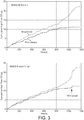
- Example 1 An identical, lean-hydrothermally aged catalyst according to the invention was prepared as described in Example 1. This catalyst was fitted in the close-coupled position to a bench-mounted 2.0 litre Diesel engine different from the engine used in Example 2, but an engine that was also calibrated for NO x trap regeneration. The engine was run over the European MVEG-B emission cycle and the CO content of the exhaust gas both at engine-out and downstream of the catalyst was monitored using an engine dynamometer. The cumulative CO content of the exhaust gas is shown in the graph at Figure 3 , top left, with the top trace showing CO content in engine-out emissions. CO emissions for this first run were 1.04 g/km.
- the catalyst for use in the present invention can be activated (and hence repeatedly reactivated) intermittently in use to maintain CO and hydrocarbon conversion at limited fuel penalty for each activation.
Landscapes
- Chemical & Material Sciences (AREA)
- Engineering & Computer Science (AREA)
- Chemical Kinetics & Catalysis (AREA)
- Organic Chemistry (AREA)
- Materials Engineering (AREA)
- Combustion & Propulsion (AREA)
- Health & Medical Sciences (AREA)
- Mechanical Engineering (AREA)
- General Engineering & Computer Science (AREA)
- Biomedical Technology (AREA)
- Environmental & Geological Engineering (AREA)
- Analytical Chemistry (AREA)
- General Chemical & Material Sciences (AREA)
- Oil, Petroleum & Natural Gas (AREA)
- Toxicology (AREA)
- Crystallography & Structural Chemistry (AREA)
- Sustainable Development (AREA)
- Life Sciences & Earth Sciences (AREA)
- Catalysts (AREA)
- Exhaust Gas After Treatment (AREA)
- Exhaust Gas Treatment By Means Of Catalyst (AREA)
- Electrical Control Of Air Or Fuel Supplied To Internal-Combustion Engine (AREA)
- Processes For Solid Components From Exhaust (AREA)
Applications Claiming Priority (4)
| Application Number | Priority Date | Filing Date | Title |
|---|---|---|---|
| US201061425464P | 2010-12-21 | 2010-12-21 | |
| GB201021887A GB201021887D0 (en) | 2010-12-21 | 2010-12-23 | Oxidation catalyst for a lean burn internal combustion engine |
| EP11805159.8A EP2654929B1 (fr) | 2010-12-21 | 2011-12-21 | Catalyseur d'oxydation pour un moteur à combustion interne à mélange pauvre |
| PCT/GB2011/052547 WO2012085572A2 (fr) | 2010-12-21 | 2011-12-21 | Catalyseur d'oxydation pour un moteur à combustion interne à mélange pauvre |
Related Parent Applications (1)
| Application Number | Title | Priority Date | Filing Date |
|---|---|---|---|
| EP11805159.8A Division EP2654929B1 (fr) | 2010-12-21 | 2011-12-21 | Catalyseur d'oxydation pour un moteur à combustion interne à mélange pauvre |
Publications (2)
| Publication Number | Publication Date |
|---|---|
| EP3673978A1 true EP3673978A1 (fr) | 2020-07-01 |
| EP3673978B1 EP3673978B1 (fr) | 2025-01-29 |
Family
ID=43598924
Family Applications (2)
| Application Number | Title | Priority Date | Filing Date |
|---|---|---|---|
| EP20156727.8A Active EP3673978B1 (fr) | 2010-12-21 | 2011-12-21 | Méthode pour la régénération d'un catalyseur d'oxydation pour un moteur à combustion interne à mélange pauvre |
| EP11805159.8A Active EP2654929B1 (fr) | 2010-12-21 | 2011-12-21 | Catalyseur d'oxydation pour un moteur à combustion interne à mélange pauvre |
Family Applications After (1)
| Application Number | Title | Priority Date | Filing Date |
|---|---|---|---|
| EP11805159.8A Active EP2654929B1 (fr) | 2010-12-21 | 2011-12-21 | Catalyseur d'oxydation pour un moteur à combustion interne à mélange pauvre |
Country Status (10)
| Country | Link |
|---|---|
| US (2) | US9140167B2 (fr) |
| EP (2) | EP3673978B1 (fr) |
| JP (3) | JP6463887B2 (fr) |
| KR (1) | KR101909303B1 (fr) |
| CN (1) | CN103269775B (fr) |
| BR (1) | BR112013014585A2 (fr) |
| DE (1) | DE102011089371B4 (fr) |
| GB (2) | GB201021887D0 (fr) |
| RU (1) | RU2577856C2 (fr) |
| WO (1) | WO2012085572A2 (fr) |
Families Citing this family (42)
| Publication number | Priority date | Publication date | Assignee | Title |
|---|---|---|---|---|
| US9173967B1 (en) | 2007-05-11 | 2015-11-03 | SDCmaterials, Inc. | System for and method of processing soft tissue and skin with fluids using temperature and pressure changes |
| US8507401B1 (en) | 2007-10-15 | 2013-08-13 | SDCmaterials, Inc. | Method and system for forming plug and play metal catalysts |
| DE102012018629A1 (de) | 2012-09-21 | 2014-03-27 | Clariant International Ltd. | Verfahren zur Reinigung von Abgas und zur Regenerierung eines Oxidationskatalysators |
| GB201220912D0 (en) | 2012-11-21 | 2013-01-02 | Johnson Matthey Plc | Oxidation catalyst for treating the exhaust gas of a compression ignition engine |
| GB201221025D0 (en) * | 2012-11-22 | 2013-01-09 | Johnson Matthey Plc | Zoned catalysed substrate monolith |
| US9138725B2 (en) | 2013-03-12 | 2015-09-22 | Basf Corporation | Catalyst materials for NO oxidation |
| GB2519403A (en) * | 2013-07-30 | 2015-04-22 | Johnson Matthey Plc | Ammonia slip catalyst |
| JP6236995B2 (ja) | 2013-08-28 | 2017-11-29 | マツダ株式会社 | 排気ガス浄化用触媒及びその製造方法並びにそれを用いた排気ガス浄化方法 |
| CN106061600A (zh) * | 2013-10-22 | 2016-10-26 | Sdc材料公司 | 用于重型柴油机的催化剂设计 |
| US10335776B2 (en) | 2013-12-16 | 2019-07-02 | Basf Corporation | Manganese-containing diesel oxidation catalyst |
| US10864502B2 (en) | 2013-12-16 | 2020-12-15 | Basf Corporation | Manganese-containing diesel oxidation catalyst |
| US9687811B2 (en) | 2014-03-21 | 2017-06-27 | SDCmaterials, Inc. | Compositions for passive NOx adsorption (PNA) systems and methods of making and using same |
| GB201405868D0 (en) * | 2014-04-01 | 2014-05-14 | Johnson Matthey Plc | Diesel oxidation catalyst with NOx adsorber activity |
| CN104190413B (zh) * | 2014-08-12 | 2017-01-18 | 无锡威孚力达催化净化器有限责任公司 | 基于scr的no氧化催化剂及其制备方法 |
| GB201504986D0 (en) * | 2015-02-13 | 2015-05-06 | Johnson Matthey Plc | Oxidation catalyst for treating a natural gas emission |
| US20160310933A1 (en) * | 2015-04-23 | 2016-10-27 | Ut-Battelle, Llc | Catalyst for low temperature emission control and methods for using same |
| JP6759330B2 (ja) * | 2015-07-30 | 2020-09-23 | ビーエーエスエフ コーポレーション | ディーゼル酸化触媒 |
| WO2017037006A1 (fr) * | 2015-09-04 | 2017-03-09 | Basf Se | Systèmes de catalyseur à oxydation d'ammoniac et scr intégrés |
| GB201517580D0 (en) * | 2015-10-06 | 2015-11-18 | Johnson Matthey Plc | Exhaust system comprising a passive nox adsorber |
| BR112018009112A8 (pt) * | 2015-11-06 | 2019-02-26 | Basf Corp | composição de catalisador de oxidação de diesel, artigo de catalisador, método para tratar uma corrente de escape, e, sistema para tratamento de emissão. |
| GB201521123D0 (en) | 2015-11-30 | 2016-01-13 | Johnson Matthey Plc | Diesel oxidation catalyst having a capture region for exhaust gas impurities |
| US10092897B2 (en) * | 2016-04-20 | 2018-10-09 | Ford Global Technologies, Llc | Catalyst trap |
| KR102381849B1 (ko) | 2016-06-13 | 2022-04-05 | 바스프 코포레이션 | 촉매 복합체, 및 NOx의 선택적 접촉 환원에서의 이의 용도 |
| GB201613849D0 (en) * | 2016-08-12 | 2016-09-28 | Johnson Matthey Plc | Exhaust system for a compression ignition engine having a capture region for volatilised platinum |
| GB201614677D0 (en) | 2016-08-30 | 2016-10-12 | Johnson Matthey Plc | Oxidation catalyst for a diesel engine exhaust |
| EP3351300A1 (fr) * | 2017-01-20 | 2018-07-25 | SASOL Germany GmbH | Composition d'alumine contenant de l'oxyde de manganèse, son procédé de fabrication et son utilisation |
| WO2018185666A1 (fr) * | 2017-04-04 | 2018-10-11 | Basf Corporation | Système intégré de régulation d'émission |
| US10898889B2 (en) * | 2018-01-23 | 2021-01-26 | Umicore Ag & Co. Kg | SCR catalyst and exhaust gas cleaning system |
| AT522350B1 (de) * | 2019-04-04 | 2022-02-15 | Avl List Gmbh | Verfahren zur Effizienzverbesserung einer Abgasnachbehandlungsanlage und eine Verbrennungskraftmaschinenanordnung |
| CN110252338A (zh) * | 2019-06-06 | 2019-09-20 | 安徽建筑大学 | 一种金负载磁性氧化物催化剂及其制备方法和应用 |
| KR102305781B1 (ko) | 2019-07-30 | 2021-09-30 | 한국조선해양 주식회사 | 메탄 산화 촉매 재생 시스템 및 이를 포함하는 메탄 산화 반응 장치 |
| KR102390017B1 (ko) | 2019-07-30 | 2022-04-26 | 한국조선해양 주식회사 | 저온 메탄 산화 반응용 촉매 |
| KR102218996B1 (ko) * | 2019-09-23 | 2021-02-22 | 희성촉매 주식회사 | 지지체에 망간이 도핑된 산화 촉매조성물 |
| CN112547115B (zh) * | 2019-09-26 | 2025-02-07 | 中国石油化工股份有限公司 | 一种废气净化多效催化剂及废气净化方法 |
| DE102019133498B4 (de) * | 2019-12-09 | 2022-02-03 | Dr. Ing. H.C. F. Porsche Aktiengesellschaft | Verfahren zur Reaktivierung einer Abgasnachbehandlungskomponente und Antriebsvorrichtung |
| KR102753696B1 (ko) | 2021-09-27 | 2025-01-14 | 에이치디현대중공업 주식회사 | 메탄산화촉매 재생장치 및 재생방법 |
| KR102738889B1 (ko) | 2021-09-27 | 2024-12-05 | 에이치디현대중공업 주식회사 | 메탄산화촉매 재생장치 |
| KR102738881B1 (ko) | 2021-11-01 | 2024-12-05 | 에이치디현대중공업 주식회사 | 교번식 메탄산화촉매 재생장치 및 재생방법 |
| KR102623977B1 (ko) | 2021-11-03 | 2024-01-11 | 에이치디현대중공업 주식회사 | 메탄산화촉매 재생장치 및 재생방법 |
| KR102687688B1 (ko) | 2022-01-28 | 2024-07-23 | 한국화학연구원 | 메탄 산화반응용 촉매 및 이를 이용한 메탄 산화방법 |
| KR102722374B1 (ko) | 2022-02-11 | 2024-10-25 | 한국화학연구원 | 메탄 산화반응용 촉매 및 이의 제조방법 |
| WO2023146260A1 (fr) | 2022-01-28 | 2023-08-03 | 한국화학연구원 | Catalyseur pour réaction d'oxydation du méthane, son procédé de préparation et procédé d'oxydation du méthane l'utilisant |
Citations (14)
| Publication number | Priority date | Publication date | Assignee | Title |
|---|---|---|---|---|
| EP0341832A2 (fr) | 1988-05-13 | 1989-11-15 | Johnson Matthey Inc. | Traitement de gaz d'échappement de moteur diesel |
| US5473887A (en) | 1991-10-03 | 1995-12-12 | Toyota Jidosha Kabushiki Kaisha | Exhaust purification device of internal combustion engine |
| US5627124A (en) | 1991-11-26 | 1997-05-06 | Engelhard Corporation | Ceria-alumina oxidation catalyst |
| EP0830201A1 (fr) | 1995-06-06 | 1998-03-25 | Johnson Matthey Public Limited Company | Systeme de purification de gaz d'echappement d'un moteur diesel |
| JPH11169669A (ja) * | 1997-12-15 | 1999-06-29 | Petroleum Energy Center Found | 排ガス浄化方法 |
| WO1999047260A1 (fr) | 1998-03-19 | 1999-09-23 | Johnson Matthey Public Limited Company | Appareil de revetement de support monolithique et son procede de fabrication |
| WO2001019500A1 (fr) | 1999-09-10 | 2001-03-22 | Johnson Matthey Public Limited Company | Regeneration de catalyseurs diesel contamines par du soufre |
| WO2004025093A1 (fr) | 2002-09-13 | 2004-03-25 | Johnson Matthey Public Limited Company | Moteur a allumage par compression et systeme d'echappement |
| WO2004076829A1 (fr) | 2003-02-26 | 2004-09-10 | Umicore Ag & Co. Kg | Systeme d'epuration de gaz d'echappement pour la reduction catalytique selective d'oxydes d'azote dans le gaz d'echappement de melange pauvre des moteurs a combustion interne et procede d'epuration de gaz d'echappement |
| WO2008132452A2 (fr) | 2007-04-26 | 2008-11-06 | Johnson Matthey Public Limited Company | Catalyseurs de scr en métal de transition/zéolite |
| WO2009093071A1 (fr) | 2008-01-23 | 2009-07-30 | Johnson Matthey Public Limited Company | Filtre catalysé |
| US20100221161A1 (en) | 2008-05-23 | 2010-09-02 | Wolfgang Schneider | Device for the Purification of Diesel Exhaust Gases |
| WO2010114873A2 (fr) * | 2009-04-03 | 2010-10-07 | Basf Catalysts Llc | Système de traitement des émissions avec des catalyseurs scr et générant de l'ammoniac |
| WO2011092523A1 (fr) * | 2010-02-01 | 2011-08-04 | Johnson Matthey Plc | Catalyseurs absorbeurs de nox |
Family Cites Families (34)
| Publication number | Priority date | Publication date | Assignee | Title |
|---|---|---|---|---|
| US5286699A (en) | 1988-12-09 | 1994-02-15 | Nippon Shokubai Kagaku Kogyo Co., Ltd. | Exhaust gas purifying catalyst suppressing the generation of hydrogen sulfide and method of making the catalyst |
| CA2011484C (fr) * | 1989-04-19 | 1997-03-04 | Joseph C. Dettling | Catalyseur au platine, comportant palladium et support cerium, et groupe catalyseur connexe |
| GB2234450A (en) | 1989-07-25 | 1991-02-06 | Uop Ltd | Low temperature oxidation catalysts |
| CA2124439A1 (fr) * | 1991-11-26 | 1993-06-10 | Kenneth E. Voss | Catalyseur d'oxydation et applications |
| US6248684B1 (en) * | 1992-11-19 | 2001-06-19 | Englehard Corporation | Zeolite-containing oxidation catalyst and method of use |
| GB9226434D0 (en) | 1992-12-18 | 1993-02-10 | Johnson Matthey Plc | Catalyst |
| KR960700801A (ko) * | 1993-03-29 | 1996-02-24 | 스티븐 아이. 밀러 | 개선된 제올라이트 함유 산화 촉매 및 그의 사용 방법(Improved Zeolite-Containing Oxidation Catalyst and Method of Use) |
| JP3899534B2 (ja) * | 1995-08-14 | 2007-03-28 | トヨタ自動車株式会社 | ディーゼル機関の排気浄化方法 |
| DE10054877A1 (de) * | 2000-11-06 | 2002-05-29 | Omg Ag & Co Kg | Abgasreinigungsanlage für die selektive katalytische Reduktion von Stickoxiden unter mageren Abgasbedingungen und Verfahren zur Abgasreinigung |
| US6699448B2 (en) | 2001-01-26 | 2004-03-02 | Engelhard Corporation | SOx tolerant NOx trap catalysts and methods of making and using the same |
| DE10103771A1 (de) | 2001-01-27 | 2002-08-14 | Omg Ag & Co Kg | Verfahren zur Wiederherstellung der katalytischen Aktivität eines Katalysators, welcher im Abgastrakt eines Dieselmotors angeordnet ist und wenigstens eine Oxidationsfunktion aufweist |
| JP2002349254A (ja) * | 2001-05-18 | 2002-12-04 | Tokyo Gas Co Ltd | 内燃機関の排気ガス浄化装置及びその制御方法 |
| DE10214343A1 (de) * | 2002-03-28 | 2003-10-09 | Omg Ag & Co Kg | Partikelfilter mit einer katalytisch aktiven Beschichtung zur Beschleunigung der Verbrennung der auf dem Filter gesammelten Rußpartikel während einer Regenerationsphase |
| JP4019867B2 (ja) * | 2002-09-10 | 2007-12-12 | トヨタ自動車株式会社 | 内燃機関の排気浄化装置 |
| DE10308288B4 (de) | 2003-02-26 | 2006-09-28 | Umicore Ag & Co. Kg | Verfahren zur Entfernung von Stickoxiden aus dem Abgas eines mager betriebenen Verbrennungsmotors und Abgasreinigungsanlage hierzu |
| JP3972864B2 (ja) * | 2003-06-04 | 2007-09-05 | トヨタ自動車株式会社 | 内燃機関の排気浄化システム |
| US7229597B2 (en) | 2003-08-05 | 2007-06-12 | Basfd Catalysts Llc | Catalyzed SCR filter and emission treatment system |
| JP3876874B2 (ja) * | 2003-10-28 | 2007-02-07 | トヨタ自動車株式会社 | 触媒再生方法 |
| JP2005186002A (ja) * | 2003-12-26 | 2005-07-14 | Honda Motor Co Ltd | ディーゼルエンジン用排ガス浄化装置 |
| DE102004005997A1 (de) * | 2004-02-06 | 2005-09-01 | Hte Ag The High Throughput Experimentation Company | Mit Eisenoxid stabilisierter Edelmetall-Katalysator zur Entfernung von Schadstoffen aus Abgasen von Mager-Motoren |
| CN1917957B (zh) * | 2004-12-20 | 2014-07-30 | 田中贵金属工业株式会社 | 柴油机排气处理用的燃烧催化剂以及柴油机排气的处理方法 |
| US7771669B2 (en) * | 2006-03-20 | 2010-08-10 | Ford Global Technologies, Llc | Soot oxidation catalyst and method of making |
| DE102006043350B3 (de) | 2006-09-15 | 2008-04-17 | Enerday Gmbh | Verfahren und System zur Regelung/Steuerung einer Gesamtluftverhältniszahl eines Reformers |
| US7669409B2 (en) * | 2006-10-31 | 2010-03-02 | Caterpillar Inc. | Selective oxidation catalyst injection based on temperature |
| JP4758391B2 (ja) * | 2007-05-09 | 2011-08-24 | トヨタ自動車株式会社 | 排ガス浄化用触媒の再生装置及び再生方法 |
| JP5122195B2 (ja) * | 2007-07-17 | 2013-01-16 | 本田技研工業株式会社 | NOx浄化触媒 |
| ATE491088T1 (de) | 2007-09-26 | 2010-12-15 | Magneti Marelli Spa | Steuerverfahren für das mischverhältnis in einem mehrzylinder-verbrennungsmotor mit mindestens zwei vor einem katalysator befindlichen lambdasonden |
| US20090180943A1 (en) * | 2008-01-16 | 2009-07-16 | Basf Catalysts Llc | Selective Ammonia Oxidation Catalysts |
| JP2009209766A (ja) * | 2008-03-04 | 2009-09-17 | Toyota Motor Corp | 内燃機関の排気浄化装置 |
| CN102076412B (zh) * | 2008-07-04 | 2013-04-24 | 日产自动车株式会社 | 废气净化用催化剂 |
| US8505279B2 (en) * | 2009-03-26 | 2013-08-13 | GM Global Technology Operations LLC | Exhaust gas treatment system including a four-way catalyst and urea SCR catalyst and method of using the same |
| US8637426B2 (en) * | 2009-04-08 | 2014-01-28 | Basf Corporation | Zoned catalysts for diesel applications |
| US8745973B2 (en) * | 2009-08-20 | 2014-06-10 | GM Global Technology Operations LLC | System and method for controlling reducing agent injection in a selective catalytic reduction system |
| US8707684B2 (en) * | 2010-11-11 | 2014-04-29 | GM Global Technology Operations LLC | Control method and apparatus for regenerating a particulate filter |
-
2010
- 2010-12-23 GB GB201021887A patent/GB201021887D0/en not_active Ceased
-
2011
- 2011-12-21 EP EP20156727.8A patent/EP3673978B1/fr active Active
- 2011-12-21 JP JP2013545500A patent/JP6463887B2/ja active Active
- 2011-12-21 WO PCT/GB2011/052547 patent/WO2012085572A2/fr not_active Ceased
- 2011-12-21 US US13/996,575 patent/US9140167B2/en active Active
- 2011-12-21 DE DE201110089371 patent/DE102011089371B4/de not_active Revoked
- 2011-12-21 CN CN201180058350.8A patent/CN103269775B/zh active Active
- 2011-12-21 RU RU2013133964/04A patent/RU2577856C2/ru active
- 2011-12-21 GB GB201121961A patent/GB2486810B/en active Active
- 2011-12-21 BR BR112013014585-4A patent/BR112013014585A2/pt not_active Application Discontinuation
- 2011-12-21 EP EP11805159.8A patent/EP2654929B1/fr active Active
- 2011-12-21 KR KR1020137015713A patent/KR101909303B1/ko active Active
-
2015
- 2015-09-04 US US14/845,854 patent/US20150375221A1/en not_active Abandoned
-
2017
- 2017-06-30 JP JP2017128907A patent/JP6670273B2/ja active Active
-
2019
- 2019-12-06 JP JP2019220956A patent/JP2020076408A/ja active Pending
Patent Citations (15)
| Publication number | Priority date | Publication date | Assignee | Title |
|---|---|---|---|---|
| EP0341832A2 (fr) | 1988-05-13 | 1989-11-15 | Johnson Matthey Inc. | Traitement de gaz d'échappement de moteur diesel |
| US5473887A (en) | 1991-10-03 | 1995-12-12 | Toyota Jidosha Kabushiki Kaisha | Exhaust purification device of internal combustion engine |
| US5627124A (en) | 1991-11-26 | 1997-05-06 | Engelhard Corporation | Ceria-alumina oxidation catalyst |
| EP0830201A1 (fr) | 1995-06-06 | 1998-03-25 | Johnson Matthey Public Limited Company | Systeme de purification de gaz d'echappement d'un moteur diesel |
| JPH11169669A (ja) * | 1997-12-15 | 1999-06-29 | Petroleum Energy Center Found | 排ガス浄化方法 |
| WO1999047260A1 (fr) | 1998-03-19 | 1999-09-23 | Johnson Matthey Public Limited Company | Appareil de revetement de support monolithique et son procede de fabrication |
| WO2001019500A1 (fr) | 1999-09-10 | 2001-03-22 | Johnson Matthey Public Limited Company | Regeneration de catalyseurs diesel contamines par du soufre |
| WO2004025093A1 (fr) | 2002-09-13 | 2004-03-25 | Johnson Matthey Public Limited Company | Moteur a allumage par compression et systeme d'echappement |
| WO2004076829A1 (fr) | 2003-02-26 | 2004-09-10 | Umicore Ag & Co. Kg | Systeme d'epuration de gaz d'echappement pour la reduction catalytique selective d'oxydes d'azote dans le gaz d'echappement de melange pauvre des moteurs a combustion interne et procede d'epuration de gaz d'echappement |
| WO2008132452A2 (fr) | 2007-04-26 | 2008-11-06 | Johnson Matthey Public Limited Company | Catalyseurs de scr en métal de transition/zéolite |
| WO2009093071A1 (fr) | 2008-01-23 | 2009-07-30 | Johnson Matthey Public Limited Company | Filtre catalysé |
| US20100221161A1 (en) | 2008-05-23 | 2010-09-02 | Wolfgang Schneider | Device for the Purification of Diesel Exhaust Gases |
| WO2010114873A2 (fr) * | 2009-04-03 | 2010-10-07 | Basf Catalysts Llc | Système de traitement des émissions avec des catalyseurs scr et générant de l'ammoniac |
| WO2011092523A1 (fr) * | 2010-02-01 | 2011-08-04 | Johnson Matthey Plc | Catalyseurs absorbeurs de nox |
| WO2011092521A1 (fr) | 2010-02-01 | 2011-08-04 | Johnson Matthey Plc | Filtre de réduction catalytique sélective (rcs) extrudé |
Non-Patent Citations (1)
| Title |
|---|
| S.E. GOLUNSKI ET AL.: "Origins of low-temperature three-way activity in Pt/Ce0", APPLIED CATALYSIS B: ENVIRONMENTAL, vol. 5, 1995, pages 367 - 376, XP022321621, DOI: 10.1016/0926-3373(94)00057-3 |
Also Published As
| Publication number | Publication date |
|---|---|
| JP2014510220A (ja) | 2014-04-24 |
| GB201021887D0 (en) | 2011-02-02 |
| GB2486810A (en) | 2012-06-27 |
| JP2020076408A (ja) | 2020-05-21 |
| GB201121961D0 (en) | 2012-02-01 |
| DE102011089371A1 (de) | 2012-06-21 |
| RU2577856C2 (ru) | 2016-03-20 |
| JP2017214928A (ja) | 2017-12-07 |
| JP6670273B2 (ja) | 2020-03-18 |
| EP3673978B1 (fr) | 2025-01-29 |
| EP2654929B1 (fr) | 2020-02-12 |
| KR20130132862A (ko) | 2013-12-05 |
| WO2012085572A3 (fr) | 2012-09-07 |
| CN103269775A (zh) | 2013-08-28 |
| KR101909303B1 (ko) | 2018-10-17 |
| US20150375221A1 (en) | 2015-12-31 |
| EP2654929A2 (fr) | 2013-10-30 |
| DE102011089371B4 (de) | 2013-07-18 |
| US20130340414A1 (en) | 2013-12-26 |
| JP6463887B2 (ja) | 2019-02-06 |
| US9140167B2 (en) | 2015-09-22 |
| BR112013014585A2 (pt) | 2019-02-19 |
| WO2012085572A2 (fr) | 2012-06-28 |
| CN103269775B (zh) | 2016-03-02 |
| GB2486810B (en) | 2013-09-11 |
| RU2013133964A (ru) | 2015-01-27 |
Similar Documents
| Publication | Publication Date | Title |
|---|---|---|
| US9140167B2 (en) | Oxidation catalyst for a lean burn internal combustion engine | |
| US10773251B2 (en) | Oxidation catalyst for internal combustion engine exhaust gas treatment | |
| EP2790813B1 (fr) | Système d'échappement pour moteur à combustion interne à mélange pauvre comprenant un catalyseur de scr | |
| US8668891B2 (en) | Exhaust system for a lean-burn IC engine comprising a PGM component and a SCR catalyst | |
| US9046022B2 (en) | Catalysed substrate monolith |
Legal Events
| Date | Code | Title | Description |
|---|---|---|---|
| PUAI | Public reference made under article 153(3) epc to a published international application that has entered the european phase |
Free format text: ORIGINAL CODE: 0009012 |
|
| STAA | Information on the status of an ep patent application or granted ep patent |
Free format text: STATUS: THE APPLICATION HAS BEEN PUBLISHED |
|
| AC | Divisional application: reference to earlier application |
Ref document number: 2654929 Country of ref document: EP Kind code of ref document: P |
|
| AK | Designated contracting states |
Kind code of ref document: A1 Designated state(s): AL AT BE BG CH CY CZ DE DK EE ES FI FR GB GR HR HU IE IS IT LI LT LU LV MC MK MT NL NO PL PT RO RS SE SI SK SM TR |
|
| STAA | Information on the status of an ep patent application or granted ep patent |
Free format text: STATUS: REQUEST FOR EXAMINATION WAS MADE |
|
| 17P | Request for examination filed |
Effective date: 20201210 |
|
| RBV | Designated contracting states (corrected) |
Designated state(s): AL AT BE BG CH CY CZ DE DK EE ES FI FR GB GR HR HU IE IS IT LI LT LU LV MC MK MT NL NO PL PT RO RS SE SI SK SM TR |
|
| P01 | Opt-out of the competence of the unified patent court (upc) registered |
Effective date: 20230526 |
|
| STAA | Information on the status of an ep patent application or granted ep patent |
Free format text: STATUS: EXAMINATION IS IN PROGRESS |
|
| 17Q | First examination report despatched |
Effective date: 20231023 |
|
| GRAP | Despatch of communication of intention to grant a patent |
Free format text: ORIGINAL CODE: EPIDOSNIGR1 |
|
| STAA | Information on the status of an ep patent application or granted ep patent |
Free format text: STATUS: GRANT OF PATENT IS INTENDED |
|
| INTG | Intention to grant announced |
Effective date: 20240502 |
|
| GRAJ | Information related to disapproval of communication of intention to grant by the applicant or resumption of examination proceedings by the epo deleted |
Free format text: ORIGINAL CODE: EPIDOSDIGR1 |
|
| STAA | Information on the status of an ep patent application or granted ep patent |
Free format text: STATUS: EXAMINATION IS IN PROGRESS |
|
| INTC | Intention to grant announced (deleted) | ||
| GRAP | Despatch of communication of intention to grant a patent |
Free format text: ORIGINAL CODE: EPIDOSNIGR1 |
|
| STAA | Information on the status of an ep patent application or granted ep patent |
Free format text: STATUS: GRANT OF PATENT IS INTENDED |
|
| INTG | Intention to grant announced |
Effective date: 20241017 |
|
| GRAS | Grant fee paid |
Free format text: ORIGINAL CODE: EPIDOSNIGR3 |
|
| GRAA | (expected) grant |
Free format text: ORIGINAL CODE: 0009210 |
|
| STAA | Information on the status of an ep patent application or granted ep patent |
Free format text: STATUS: THE PATENT HAS BEEN GRANTED |
|
| AC | Divisional application: reference to earlier application |
Ref document number: 2654929 Country of ref document: EP Kind code of ref document: P |
|
| AK | Designated contracting states |
Kind code of ref document: B1 Designated state(s): AL AT BE BG CH CY CZ DE DK EE ES FI FR GB GR HR HU IE IS IT LI LT LU LV MC MK MT NL NO PL PT RO RS SE SI SK SM TR |
|
| REG | Reference to a national code |
Ref country code: GB Ref legal event code: FG4D |
|
| REG | Reference to a national code |
Ref country code: CH Ref legal event code: EP |
|
| REG | Reference to a national code |
Ref country code: DE Ref legal event code: R096 Ref document number: 602011075225 Country of ref document: DE |
|
| REG | Reference to a national code |
Ref country code: IE Ref legal event code: FG4D |
|
| RAP4 | Party data changed (patent owner data changed or rights of a patent transferred) |
Owner name: JOHNSON MATTHEY PUBLIC LIMITED COMPANY |
|
| REG | Reference to a national code |
Ref country code: NL Ref legal event code: MP Effective date: 20250129 |
|
| PG25 | Lapsed in a contracting state [announced via postgrant information from national office to epo] |
Ref country code: NL Free format text: LAPSE BECAUSE OF FAILURE TO SUBMIT A TRANSLATION OF THE DESCRIPTION OR TO PAY THE FEE WITHIN THE PRESCRIBED TIME-LIMIT Effective date: 20250129 |
|
| PG25 | Lapsed in a contracting state [announced via postgrant information from national office to epo] |
Ref country code: RS Free format text: LAPSE BECAUSE OF FAILURE TO SUBMIT A TRANSLATION OF THE DESCRIPTION OR TO PAY THE FEE WITHIN THE PRESCRIBED TIME-LIMIT Effective date: 20250429 |
|
| PG25 | Lapsed in a contracting state [announced via postgrant information from national office to epo] |
Ref country code: FI Free format text: LAPSE BECAUSE OF FAILURE TO SUBMIT A TRANSLATION OF THE DESCRIPTION OR TO PAY THE FEE WITHIN THE PRESCRIBED TIME-LIMIT Effective date: 20250129 |
|
| PG25 | Lapsed in a contracting state [announced via postgrant information from national office to epo] |
Ref country code: PL Free format text: LAPSE BECAUSE OF FAILURE TO SUBMIT A TRANSLATION OF THE DESCRIPTION OR TO PAY THE FEE WITHIN THE PRESCRIBED TIME-LIMIT Effective date: 20250129 |
|
| PG25 | Lapsed in a contracting state [announced via postgrant information from national office to epo] |
Ref country code: ES Free format text: LAPSE BECAUSE OF FAILURE TO SUBMIT A TRANSLATION OF THE DESCRIPTION OR TO PAY THE FEE WITHIN THE PRESCRIBED TIME-LIMIT Effective date: 20250129 |
|
| REG | Reference to a national code |
Ref country code: LT Ref legal event code: MG9D |
|
| PG25 | Lapsed in a contracting state [announced via postgrant information from national office to epo] |
Ref country code: IS Free format text: LAPSE BECAUSE OF FAILURE TO SUBMIT A TRANSLATION OF THE DESCRIPTION OR TO PAY THE FEE WITHIN THE PRESCRIBED TIME-LIMIT Effective date: 20250529 Ref country code: NO Free format text: LAPSE BECAUSE OF FAILURE TO SUBMIT A TRANSLATION OF THE DESCRIPTION OR TO PAY THE FEE WITHIN THE PRESCRIBED TIME-LIMIT Effective date: 20250429 |
|
| REG | Reference to a national code |
Ref country code: AT Ref legal event code: MK05 Ref document number: 1762900 Country of ref document: AT Kind code of ref document: T Effective date: 20250129 |
|
| PG25 | Lapsed in a contracting state [announced via postgrant information from national office to epo] |
Ref country code: HR Free format text: LAPSE BECAUSE OF FAILURE TO SUBMIT A TRANSLATION OF THE DESCRIPTION OR TO PAY THE FEE WITHIN THE PRESCRIBED TIME-LIMIT Effective date: 20250129 |
|
| PG25 | Lapsed in a contracting state [announced via postgrant information from national office to epo] |
Ref country code: LV Free format text: LAPSE BECAUSE OF FAILURE TO SUBMIT A TRANSLATION OF THE DESCRIPTION OR TO PAY THE FEE WITHIN THE PRESCRIBED TIME-LIMIT Effective date: 20250129 Ref country code: PT Free format text: LAPSE BECAUSE OF FAILURE TO SUBMIT A TRANSLATION OF THE DESCRIPTION OR TO PAY THE FEE WITHIN THE PRESCRIBED TIME-LIMIT Effective date: 20250529 |
|
| PG25 | Lapsed in a contracting state [announced via postgrant information from national office to epo] |
Ref country code: GR Free format text: LAPSE BECAUSE OF FAILURE TO SUBMIT A TRANSLATION OF THE DESCRIPTION OR TO PAY THE FEE WITHIN THE PRESCRIBED TIME-LIMIT Effective date: 20250430 Ref country code: BG Free format text: LAPSE BECAUSE OF FAILURE TO SUBMIT A TRANSLATION OF THE DESCRIPTION OR TO PAY THE FEE WITHIN THE PRESCRIBED TIME-LIMIT Effective date: 20250129 |
|
| PG25 | Lapsed in a contracting state [announced via postgrant information from national office to epo] |
Ref country code: AT Free format text: LAPSE BECAUSE OF FAILURE TO SUBMIT A TRANSLATION OF THE DESCRIPTION OR TO PAY THE FEE WITHIN THE PRESCRIBED TIME-LIMIT Effective date: 20250129 |
|
| PG25 | Lapsed in a contracting state [announced via postgrant information from national office to epo] |
Ref country code: SE Free format text: LAPSE BECAUSE OF FAILURE TO SUBMIT A TRANSLATION OF THE DESCRIPTION OR TO PAY THE FEE WITHIN THE PRESCRIBED TIME-LIMIT Effective date: 20250129 |
|
| PG25 | Lapsed in a contracting state [announced via postgrant information from national office to epo] |
Ref country code: SM Free format text: LAPSE BECAUSE OF FAILURE TO SUBMIT A TRANSLATION OF THE DESCRIPTION OR TO PAY THE FEE WITHIN THE PRESCRIBED TIME-LIMIT Effective date: 20250129 |
|
| PG25 | Lapsed in a contracting state [announced via postgrant information from national office to epo] |
Ref country code: DK Free format text: LAPSE BECAUSE OF FAILURE TO SUBMIT A TRANSLATION OF THE DESCRIPTION OR TO PAY THE FEE WITHIN THE PRESCRIBED TIME-LIMIT Effective date: 20250129 |
|
| PG25 | Lapsed in a contracting state [announced via postgrant information from national office to epo] |
Ref country code: IT Free format text: LAPSE BECAUSE OF FAILURE TO SUBMIT A TRANSLATION OF THE DESCRIPTION OR TO PAY THE FEE WITHIN THE PRESCRIBED TIME-LIMIT Effective date: 20250129 |
|
| PG25 | Lapsed in a contracting state [announced via postgrant information from national office to epo] |
Ref country code: EE Free format text: LAPSE BECAUSE OF FAILURE TO SUBMIT A TRANSLATION OF THE DESCRIPTION OR TO PAY THE FEE WITHIN THE PRESCRIBED TIME-LIMIT Effective date: 20250129 Ref country code: CZ Free format text: LAPSE BECAUSE OF FAILURE TO SUBMIT A TRANSLATION OF THE DESCRIPTION OR TO PAY THE FEE WITHIN THE PRESCRIBED TIME-LIMIT Effective date: 20250129 |
|
| PG25 | Lapsed in a contracting state [announced via postgrant information from national office to epo] |
Ref country code: RO Free format text: LAPSE BECAUSE OF FAILURE TO SUBMIT A TRANSLATION OF THE DESCRIPTION OR TO PAY THE FEE WITHIN THE PRESCRIBED TIME-LIMIT Effective date: 20250129 |
|
| PG25 | Lapsed in a contracting state [announced via postgrant information from national office to epo] |
Ref country code: SK Free format text: LAPSE BECAUSE OF FAILURE TO SUBMIT A TRANSLATION OF THE DESCRIPTION OR TO PAY THE FEE WITHIN THE PRESCRIBED TIME-LIMIT Effective date: 20250129 |
|
| REG | Reference to a national code |
Ref country code: DE Ref legal event code: R097 Ref document number: 602011075225 Country of ref document: DE |
|
| PLBE | No opposition filed within time limit |
Free format text: ORIGINAL CODE: 0009261 |
|
| STAA | Information on the status of an ep patent application or granted ep patent |
Free format text: STATUS: NO OPPOSITION FILED WITHIN TIME LIMIT |
|
| 26N | No opposition filed |
Effective date: 20251030 |
|
| PGFP | Annual fee paid to national office [announced via postgrant information from national office to epo] |
Ref country code: DE Payment date: 20251126 Year of fee payment: 15 |