EP3673979A1 - Dispositif de filtration, système de filtration et procédé de filtration - Google Patents
Dispositif de filtration, système de filtration et procédé de filtration Download PDFInfo
- Publication number
- EP3673979A1 EP3673979A1 EP18857812.4A EP18857812A EP3673979A1 EP 3673979 A1 EP3673979 A1 EP 3673979A1 EP 18857812 A EP18857812 A EP 18857812A EP 3673979 A1 EP3673979 A1 EP 3673979A1
- Authority
- EP
- European Patent Office
- Prior art keywords
- filtration
- liquid
- liquid feeding
- distribution port
- membrane
- Prior art date
- Legal status (The legal status is an assumption and is not a legal conclusion. Google has not performed a legal analysis and makes no representation as to the accuracy of the status listed.)
- Withdrawn
Links
- 238000001914 filtration Methods 0.000 title claims abstract description 365
- 239000012528 membrane Substances 0.000 claims abstract description 181
- 239000007788 liquid Substances 0.000 claims abstract description 179
- 238000009826 distribution Methods 0.000 claims abstract description 162
- 239000006285 cell suspension Substances 0.000 claims description 66
- 238000000034 method Methods 0.000 claims description 53
- 238000007599 discharging Methods 0.000 claims description 31
- 238000011282 treatment Methods 0.000 description 105
- 230000000052 comparative effect Effects 0.000 description 31
- 230000005856 abnormality Effects 0.000 description 21
- 238000001514 detection method Methods 0.000 description 18
- 230000007423 decrease Effects 0.000 description 9
- 238000011084 recovery Methods 0.000 description 9
- 238000000926 separation method Methods 0.000 description 9
- 239000002245 particle Substances 0.000 description 5
- XLYOFNOQVPJJNP-UHFFFAOYSA-N water Substances O XLYOFNOQVPJJNP-UHFFFAOYSA-N 0.000 description 5
- 238000010586 diagram Methods 0.000 description 4
- 239000011148 porous material Substances 0.000 description 4
- 238000004113 cell culture Methods 0.000 description 3
- 239000012510 hollow fiber Substances 0.000 description 3
- 239000012466 permeate Substances 0.000 description 3
- 230000002159 abnormal effect Effects 0.000 description 2
- 230000002401 inhibitory effect Effects 0.000 description 2
- 230000002093 peripheral effect Effects 0.000 description 2
- 238000005520 cutting process Methods 0.000 description 1
- 238000005374 membrane filtration Methods 0.000 description 1
- 238000001471 micro-filtration Methods 0.000 description 1
- 238000005192 partition Methods 0.000 description 1
Images







Classifications
-
- B—PERFORMING OPERATIONS; TRANSPORTING
- B01—PHYSICAL OR CHEMICAL PROCESSES OR APPARATUS IN GENERAL
- B01D—SEPARATION
- B01D61/00—Processes of separation using semi-permeable membranes, e.g. dialysis, osmosis or ultrafiltration; Apparatus, accessories or auxiliary operations specially adapted therefor
- B01D61/14—Ultrafiltration; Microfiltration
- B01D61/18—Apparatus therefor
-
- B—PERFORMING OPERATIONS; TRANSPORTING
- B01—PHYSICAL OR CHEMICAL PROCESSES OR APPARATUS IN GENERAL
- B01D—SEPARATION
- B01D61/00—Processes of separation using semi-permeable membranes, e.g. dialysis, osmosis or ultrafiltration; Apparatus, accessories or auxiliary operations specially adapted therefor
- B01D61/14—Ultrafiltration; Microfiltration
- B01D61/147—Microfiltration
-
- B—PERFORMING OPERATIONS; TRANSPORTING
- B01—PHYSICAL OR CHEMICAL PROCESSES OR APPARATUS IN GENERAL
- B01D—SEPARATION
- B01D61/00—Processes of separation using semi-permeable membranes, e.g. dialysis, osmosis or ultrafiltration; Apparatus, accessories or auxiliary operations specially adapted therefor
- B01D61/14—Ultrafiltration; Microfiltration
- B01D61/20—Accessories; Auxiliary operations
-
- B—PERFORMING OPERATIONS; TRANSPORTING
- B01—PHYSICAL OR CHEMICAL PROCESSES OR APPARATUS IN GENERAL
- B01D—SEPARATION
- B01D61/00—Processes of separation using semi-permeable membranes, e.g. dialysis, osmosis or ultrafiltration; Apparatus, accessories or auxiliary operations specially adapted therefor
- B01D61/14—Ultrafiltration; Microfiltration
- B01D61/22—Controlling or regulating
-
- B—PERFORMING OPERATIONS; TRANSPORTING
- B01—PHYSICAL OR CHEMICAL PROCESSES OR APPARATUS IN GENERAL
- B01D—SEPARATION
- B01D63/00—Apparatus in general for separation processes using semi-permeable membranes
- B01D63/08—Flat membrane modules
- B01D63/087—Single membrane modules
-
- C—CHEMISTRY; METALLURGY
- C12—BIOCHEMISTRY; BEER; SPIRITS; WINE; VINEGAR; MICROBIOLOGY; ENZYMOLOGY; MUTATION OR GENETIC ENGINEERING
- C12M—APPARATUS FOR ENZYMOLOGY OR MICROBIOLOGY; APPARATUS FOR CULTURING MICROORGANISMS FOR PRODUCING BIOMASS, FOR GROWING CELLS OR FOR OBTAINING FERMENTATION OR METABOLIC PRODUCTS, i.e. BIOREACTORS OR FERMENTERS
- C12M3/00—Tissue, human, animal or plant cell, or virus culture apparatus
- C12M3/06—Tissue, human, animal or plant cell, or virus culture apparatus with filtration, ultrafiltration, inverse osmosis or dialysis means
-
- C—CHEMISTRY; METALLURGY
- C12—BIOCHEMISTRY; BEER; SPIRITS; WINE; VINEGAR; MICROBIOLOGY; ENZYMOLOGY; MUTATION OR GENETIC ENGINEERING
- C12M—APPARATUS FOR ENZYMOLOGY OR MICROBIOLOGY; APPARATUS FOR CULTURING MICROORGANISMS FOR PRODUCING BIOMASS, FOR GROWING CELLS OR FOR OBTAINING FERMENTATION OR METABOLIC PRODUCTS, i.e. BIOREACTORS OR FERMENTERS
- C12M33/00—Means for introduction, transport, positioning, extraction, harvesting, peeling or sampling of biological material in or from the apparatus
- C12M33/14—Means for introduction, transport, positioning, extraction, harvesting, peeling or sampling of biological material in or from the apparatus with filters, sieves or membranes
-
- B—PERFORMING OPERATIONS; TRANSPORTING
- B01—PHYSICAL OR CHEMICAL PROCESSES OR APPARATUS IN GENERAL
- B01D—SEPARATION
- B01D2313/00—Details relating to membrane modules or apparatus
- B01D2313/08—Flow guidance means within the module or the apparatus
- B01D2313/086—Meandering flow path over the membrane
-
- B—PERFORMING OPERATIONS; TRANSPORTING
- B01—PHYSICAL OR CHEMICAL PROCESSES OR APPARATUS IN GENERAL
- B01D—SEPARATION
- B01D2313/00—Details relating to membrane modules or apparatus
- B01D2313/10—Specific supply elements
-
- B—PERFORMING OPERATIONS; TRANSPORTING
- B01—PHYSICAL OR CHEMICAL PROCESSES OR APPARATUS IN GENERAL
- B01D—SEPARATION
- B01D2313/00—Details relating to membrane modules or apparatus
- B01D2313/12—Specific discharge elements
-
- B—PERFORMING OPERATIONS; TRANSPORTING
- B01—PHYSICAL OR CHEMICAL PROCESSES OR APPARATUS IN GENERAL
- B01D—SEPARATION
- B01D2313/00—Details relating to membrane modules or apparatus
- B01D2313/18—Specific valves
-
- B—PERFORMING OPERATIONS; TRANSPORTING
- B01—PHYSICAL OR CHEMICAL PROCESSES OR APPARATUS IN GENERAL
- B01D—SEPARATION
- B01D2315/00—Details relating to the membrane module operation
- B01D2315/10—Cross-flow filtration
-
- B—PERFORMING OPERATIONS; TRANSPORTING
- B01—PHYSICAL OR CHEMICAL PROCESSES OR APPARATUS IN GENERAL
- B01D—SEPARATION
- B01D2315/00—Details relating to the membrane module operation
- B01D2315/18—Time sequence of one or more process steps carried out periodically within one apparatus
-
- B—PERFORMING OPERATIONS; TRANSPORTING
- B01—PHYSICAL OR CHEMICAL PROCESSES OR APPARATUS IN GENERAL
- B01D—SEPARATION
- B01D2321/00—Details relating to membrane cleaning, regeneration, sterilization or to the prevention of fouling
- B01D2321/20—By influencing the flow
- B01D2321/2033—By influencing the flow dynamically
-
- B—PERFORMING OPERATIONS; TRANSPORTING
- B01—PHYSICAL OR CHEMICAL PROCESSES OR APPARATUS IN GENERAL
- B01D—SEPARATION
- B01D2321/00—Details relating to membrane cleaning, regeneration, sterilization or to the prevention of fouling
- B01D2321/20—By influencing the flow
- B01D2321/2083—By reversing the flow
Definitions
- the disclosed technique relates to a filtration device, a filtration system, and a filtration method.
- the following techniques are known as techniques related to a filtration device including a filtration membrane, for example.
- JP1996-024590A JP-H08-024590A discloses in-to-out filtration using a hollow fiber membrane module in which both open ends of a hollow fiber membrane are separately focused and fixed, in which supply of a liquid to be treated to a hollow portion of the hollow fiber membrane is performed by alternately switching from a first liquid inlet and discharge port and a second liquid inlet and discharge port, and immediately after switching a liquid flow direction, filtration is performed while discharging a part of the liquid to be treated from the liquid inlet and discharge port on the supply stop side.
- JP2009-291744A discloses a membrane filtration method using a filtration device in which a filtration treatment is performed by a cross flow method in which water to be treated flows from one end side to the other end side of a membrane module along a membrane surface of the membrane module, the filtered water is collected at the other end side.
- JP2017-104832A discloses a membrane separation device including a filtration membrane that partitions a casing into a concentrated side space to which water to be treated is supplied and a permeation side space in which permeated water separated from the water to be treated is stored, in which a plurality of U-shaped tubular first connection members that connect one end of a plurality of filtration membranes and the other end so that the plurality of filtration membranes are connected in series.
- a membrane separation treatment is performed to remove a medium used, dead cells, and the like from a cell suspension.
- a tangential flow method also referred to as a cross flow method
- the tangential flow method is a method in which a permeation component is sent to a permeation side while flowing a cell suspension that is a target of membrane separation treatment along a membrane surface of the filtration membrane. According to the tangential flow method, it is possible to reduce damage to cells as compared to a dead end method.
- filtration efficiency In order to realize the mass culture of cells, it is necessary to increase a treatment amount per time of membrane separation treatment, that is, filtration efficiency.
- a method for increasing filtration efficiency increasing a feeding speed of a cell suspension flowing on a membrane surface of a filtration membrane is considered, but in this case, there is a concern about damage to the cells. Accordingly, increasing an area of the filtration membrane is considered effective to as the method for increasing filtration efficiency. For example, an area of a filtration membrane can be increased while maintaining area efficiency by meandering a flow path of the cell suspension flowing on the membrane surface of the filtration membrane.
- a differential pressure in the membrane surface of the filtration membrane (hereinafter referred to as a filtration pressure) tends to be non-uniform.
- a filtration pressure is non-uniform on the membrane surface of the filtration membrane, clogging of cells occurs in a portion where the filtration pressure of the filtration membrane is relatively high, and a cell recovery rate decreases.
- a decrease in cell recovery rate leads to a decrease in cell culture efficiency, resulting in an increase in the cost of cell culture.
- a filtration device, a filtration system, and a filtration method by which an area of a filtration membrane can be increased while ensuring uniformity in filtration pressure on a membrane surface of the filtration membrane are provided.
- a filtration device comprises: a flow path that meanders; a filtration membrane that separates a supply side and a permeation side of the flow path; a first distribution port that is provided at one end of the supply side of the flow path; a second distribution port that is provided at the other end of the supply side of the flow path; a first discharge port that is provided on the permeation side of the flow path; and a second discharge port that is provided at a position different from that of the first discharge port on the permeation side of the flow path.
- a distance from a center of the first distribution port to a farthest position on a membrane surface of the filtration membrane is W1
- a distance from the center of the first distribution port to a center of the first discharge port is d1
- a distance from a center of the second distribution port to the farthest position on the membrane surface of the filtration membrane is W2
- a distance from the center of the second distribution port to a center of the second discharge port is d2
- the flow path may include a plurality of folded portions, and respective distances from one of the folded portions to a next folded portion may be the same as each other.
- One end and the other end of the flow path, and the respective folded portions on one side may be provided on a first straight line, and the respective folded portions on the other side may be provided on a second straight line parallel to the first straight line.
- the flow path may include a plurality of folded portions, and a distance from one of the folded portions to a next folded portion may be shorter than other distances.
- a filtration system comprises: the above-described filtration device; and a controller that performs first liquid feeding control for controlling liquid feeding of a liquid passing through the first distribution port and the second distribution port, and performs, in conjunction with the first liquid feeding control, second liquid feeding control for controlling liquid feeding of the liquid discharged from the first discharge port and the second discharge port.
- the controller may alternately perform, as the first liquid feeding control, first liquid feeding for discharging a liquid flowed in from the first distribution port from the second distribution port, and second liquid feeding for discharging a liquid flowed in from the second distribution port from the first distribution port.
- the controller may perform, as the second liquid feeding control, discharge of a liquid that has passed through the filtration membrane from the first discharge port while performing the first liquid feeding, and discharge of the liquid that has passed through the filtration membrane from the second discharge port while performing the second liquid feeding.
- the liquid may be a cell suspension.
- a filtration method is a liquid filtration method using the above-described filtration device, the method comprising: alternately performing first liquid feeding for allowing a liquid flowed in from the first distribution port to flow out from the second distribution port, and second liquid feeding for allowing a liquid flowed in from the second distribution port to flow out from the first distribution port; and discharging a liquid that has passed through the filtration membrane from the first discharge port while performing the first liquid feeding, and discharging the liquid that has passed through the filtration membrane from the second discharge port while performing the second liquid feeding.
- a cell suspension may be a target of the first liquid feeding and the second liquid feeding.
- a filtration device, a filtration system, and a filtration method by which an area of a filtration membrane can be increased while ensuring uniformity in filtration pressure on a membrane surface of the filtration membrane are provided.
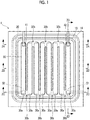
- Fig. 1 is a plan view showing an example of a configuration of a filtration device 1 according to an embodiment of the disclosed technique
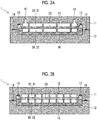
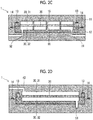
- Figs. 2A, 2B , 2C, and 2D are respectively a cross-sectional view taken along line 2A-2A, a cross-sectional view taken along line 2B-2B, a cross-sectional view taken along line 2C-2C, and a cross-sectional view taken along line 2D-2D in Fig. 1 .
- the filtration device 1 can be used for membrane separation treatment of a cell suspension by a tangential flow method.
- the filtration device 1 includes an upper case 11 and a lower case 12, and a filtration membrane 20 provided between the upper case 11 and the lower case 12.
- the filtration device 1 also has an O-ring 13 provided along the outer edge of the filtration membrane 20, and an O-ring 14 surrounding the outer periphery of the filtration membrane 20.
- the O-ring 13 ensures adhesiveness between the filtration membrane 20 and the upper case 11, and the O-ring 14 ensures adhesiveness between the upper case 11 and the lower case 12.
- the upper case 11 and the lower case 12 are respectively provided with projections 15 and 16 that protrude toward the filtration membrane 20 and whose tip portions are in contact with the filtration membrane 20, and a flow path 30 through which a cell suspension passes is formed by these projections 15 and 16. That is, the projections 15 and 16 form a wall surface of the flow path 30.
- the filtration membrane 20 separates a supply side 31 and a permeation side 32 of the flow path 30.
- the flow path 30 is configured by connecting a plurality of unit flow paths 30a at a plurality of folded portions 30b. That is, the flow path 30 meanders as shown in Fig. 1 .
- the filtration membrane 20 has a rectangular shape, and each unit flow path 30a has the same length. That is, each of the one end and the other end of the flow path 30 and the folded portion 30b on one side is provided on a first straight line, and each of the folded portions 30b on the other side is provided on a second straight line parallel to the first straight line. Respective distances from one of the plurality of folded portions 30b to the next folded portion 30b are the same as each other.
- a case in which respective lengths of the unit flow path 30a are the same as each other means that the difference in length of each of the unit flow paths 30a falls within the range of a processing accuracy error (for example, about 0.05 mm) within the range that can be caused from a cutting process.
- the filtration membrane 20 has a plurality of pores having a diameter smaller than the diameter of the cells contained in the cell suspension. As the filtration membrane 20, for example, a microfiltration membrane (MF membrane) can be used.
- MF membrane microfiltration membrane
- a first distribution port 41 is provided at one end of the supply side 31 of the flow path 30, and a second distribution port 42 is provided at the other end of the supply side 31 of the flow path 30. That is, the first distribution port 41 and the second distribution port 42 are each provided in the vicinity of the corner of the filtration membrane 20 which has a rectangular shape.
- the cell suspension flows along the membrane surface of the filtration membrane 20 between the first distribution port 41 and the second distribution port 42 on the supply side 31 of the flow path 30.
- the cell suspension flowing from the first distribution port 41 flows along the supply side 31 of the meandering flow path 30 along the membrane surface of the filtration membrane 20 and flows out from the second distribution port 42.
- the cell suspension flowed in from the second distribution port 42 flows along the supply side 31 of the meandering flow path 30 along the membrane surface of the filtration membrane 20 and flows out from the first distribution port 41.
- the permeation side 32 of the flow path 30 is maintained at a lower pressure than the supply side 31, and while the cell suspension flows through the supply side 31 of the flow path 30, the component smaller than the pore diameter of the filtration membrane 20 is transmitted to the permeation side 32. Cells contained in the cell suspension do not permeate the filtration membrane 20 and flow out of the first distribution port 41 or the second distribution port 42 and are collected.
- a first discharge port 51 and a second discharge port 52 for discharging the permeation liquid that has passed through the filtration membrane 20 are provided at different positions on the permeation side 32 of the flow path 30.
- the first discharge port 51 is provided at a position farthest from the first distribution port 41 of the flow path 30, and the second discharge port 52 is provided at a position farthest from the second distribution port 42 in the flow path 30.
- the "position farthest from the first distribution port 41" refers to a position on the flow path 30 where the straight-line distance from the first distribution port 41 is the longest.
- the "position farthest from the second distribution port 42" refers to the position on the flow path 30 where the straight-line distance from the second distribution port 42 is the longest.
- the first discharge port 51 may be provided in the vicinity of the position farthest from the first distribution port 41, and the second discharge port 52 may be provided in the vicinity of the position farthest from the second distribution port 42. That is, as shown in Fig. 3 , the first discharge port 51 may be provided in a vicinity region R1 of the corner A3 that is diagonal to the corner A1 of the filtration membrane 20 where the first distribution port 41 is disposed, and the second discharge port 52 may be disposed in a vicinity region R2 of the corner A4 that is diagonal to the corner A2 of the filtration membrane 20 where the second distribution port 42 is disposed.
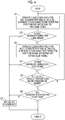
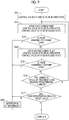
- Step S1 first liquid feeding is performed in which the cell suspension is caused to flow from the first distribution port 41 and flow out from the second distribution port 42.
- the cell suspension flowing in from the first distribution port 41 flows along the membrane surface of the filtration membrane 20 while meandering the supply side 31 of the flow path 30. While the cell suspension is flowing through the supply side 31 of the flow path 30, a component smaller than the pore diameter of the filtration membrane 20 contained in the cell suspension permeates the permeation side 32. Thereby, the cell suspension is concentrated.
- the concentrated cell suspension that has flowed out of the second distribution port 42 is once collected in a container (not shown).
- the permeation liquid that has passed through the filtration membrane 20 is discharged from the first discharge port 51 during the first liquid feeding.
- the second discharge port 52 is closed so that the permeation liquid is not discharged from the second discharge port 52.
- a pump may be connected on the flow path communicating with the first discharge port 51, and a suction force may be generated at the first discharge port 51 by operating this pump.
- Step S2 the presence and absence of abnormality during the first liquid feeding is determined. For example, in a case where it is detected that the liquid feeding load in the first liquid feeding is excessive, it may be determined that there is an abnormality as the clogging of the cells in the filtration membrane 20 has occurred. In a case where it is determined that there is an abnormality, the treatment proceeds to Step S7, and it is notified that cell clogging has occurred in the filtration membrane 20. On the other hand, in a case where it is determined that there is no abnormality, the treatment proceeds to Step S3.
- Step S2 is repeatedly performed during the first liquid feeding in Step S1.
- the treatment proceeds to Step S3.
- the condition for ending the first liquid feeding is, for example, the case where all predetermined treatment amounts have been treated.
- determination of Step S2 may be performed after the conditions which complete the first liquid feeding are satisfied.
- Step S3 second liquid feeding is performed in which the cell suspension collected in the container is caused to flow from the second distribution port 42 and flow out from the first distribution port 41. That is, a flow direction of the cell suspension flowing through the supply side 31 of the flow path 30 is reversed.
- the cell suspension flowing in from the second distribution port 42 flows along the membrane surface of the filtration membrane 20 while meandering the supply side of the flow path 30.
- a component smaller than the pore diameter of the filtration membrane 20 contained in the cell suspension permeates the permeation side 32. Thereby, the cell suspension is concentrated.
- the concentrated cell suspension that has flowed out of the first distribution port 41 is once collected in a container (not shown).
- Step S3 the permeation liquid that has passed through the filtration membrane 20 is discharged from the second discharge port 52 during the second liquid feeding.
- the first discharge port 51 is closed so that the permeation liquid is not discharged from the first discharge port 51.
- a pump may be connected on the flow path communicating with the second discharge port 52, and a suction force may be generated at the second discharge port 52 by operating this pump.
- Step S4 the presence and absence of abnormality during the second liquid feeding is determined. For example, in a case where it is detected that the liquid feeding load in the second liquid feeding is excessive, it may be determined that there is an abnormality as the clogging of the cells in the filtration membrane 20 has occurred. In a case where it is determined that there is an abnormality, the treatment proceeds to Step S7, and it is notified that cell clogging has occurred in the filtration membrane. On the other hand, in a case where it is determined that there is no abnormality, the treatment proceeds to Step S5.
- Step S4 is repeatedly performed during the second liquid feeding in Step S3.
- the treatment proceeds to Step S5.
- the condition for ending the second liquid feeding is, for example, the case where all predetermined treatment amounts have been treated.
- determination of Step S4 may be performed after the conditions which complete the second liquid feeding are satisfied.
- Step S5 it is determined whether or not the number of treatment cycles in which a series of treatment including steps S1 and S2 is one unit has reached a predetermined number. In a case where it is determined that the number of cycles in the series of treatments has not reached the predetermined number, the treatment returns to Step S1. In a case where it is determined that the number of cycles in the series of treatments has reached a predetermined number, the treatment proceeds to Step S6.
- Step S6 it is determined whether or not a concentration of cells in the concentrated cell suspension (hereinafter referred to as cell concentration) has reached a target value. In a case where it is determined that the cell concentration has reached the target value, the treatment ends. On the other hand, in a case where it is determined that the cell concentration has not reached the target value, the treatment proceeds to Step S7 to notify that some abnormality has occurred. In a case where it is determined in Step S6 that the cell concentration has not reached the target value, the treatment may be returned to Step S1.
- cell concentration a concentration of cells in the concentrated cell suspension
- the first liquid feeding that causes the cell suspension flowed in from the first distribution port 41 to flow out from the second distribution port 42, and the second liquid feeding that causes the cell suspension flowed in from the second distribution port 42 to flow out from the first distribution port 41 are alternately performed. Then, the permeation liquid that has permeated through the filtration membrane 20 is discharged from the first discharge port 51 during the first liquid feeding, and the permeation liquid that has permeated through the filtration membrane 20 is discharged from the second discharge port 52 during the second liquid feeding.
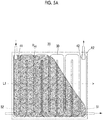
- Fig. 5A is a view showing an example of distribution of the region (hereinafter referred to as an appropriate filtration pressure region) R A1 in which an appropriate filtration pressure (a membrane surface differential pressure of the filtration membrane 20) in the membrane surface of the filtration membrane 20 has arisen in a case of performing a process of discharging the permeation liquid that has passed through the filtration membrane 20 from the first discharge port 51 (hereinafter referred to as a first process) while performing the first liquid feeding for discharging the cell suspension flowed in from the first distribution port 41 through the second distribution port 42.
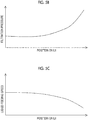
- Fig. 5B is a graph showing an example of distribution of a filtration pressure at each position on a dashed-dotted line L1 in Fig. 5A .
- a liquid feeding speed refers to the flow rate of the cell suspension that flows on the supply side 31 of the flow path 30.
- the liquid feeding speed on the dashed-dotted line L1 becomes lower as approaching the disposed position of the first discharge port 51 as shown in Fig. 5C .
- the filtration pressure on the dashed-dotted line L1 increases as the disposed position of the first discharge port 51 is approached.
- a region in which the filtration pressure becomes higher than that in the appropriate range (a region not hatched in Fig. 5A , hereinafter referred to as an excessive filtration pressure region) is generated.
- the excessive filtration pressure region is thought to be related to the generation of a region in which the flow direction of the cell suspension flowing on the supply side 31 of the flow path 30 and the flow direction of the permeation liquid flowing on the permeation side 32 of the flow path 30 are opposite to each other.
- the excessive filtration pressure region In the excessive filtration pressure region, clogging of cells is likely to occur, and therefore, it is preferable to inhibit occurrence of the excessive filtration pressure region.
- the permeation liquid that has permeated through the filtration membrane 20 is discharged from the first discharge port 51 provided at a position farthest from the first distribution port 41 or in the vicinity thereof.
- Fig. 6A is a view showing an example of distribution of the appropriate filtration pressure region R A2 in the membrane surface of the filtration membrane 20 in a case of performing a process of discharging the permeation liquid that has passed through the filtration membrane 20 from the second discharge port 52 (hereinafter referred to as a second process) while performing the second liquid feeding that causes the cell suspension flowed in from the second distribution port 42 to flow out from the first distribution port 41.
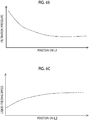
- Fig. 6B is a graph showing an example of distribution of a filtration pressure on a dashed-dotted line L2 in Fig. 6A .
- Fig. 6C is a graph showing an example of distribution of a liquid feeding speed at each position on a dashed-dotted line L2 in Fig. 6A .
- the permeation liquid that has permeated through the filtration membrane 20 is discharged from the second discharge port 52 provided at a position farthest from the second distribution port 42 or in the vicinity thereof.
- This can minimize the area of the region in which the flow direction of the cell suspension flowing on the supply side 31 of the flow path 30 and the flow direction of the permeation liquid flowing on the permeation side 32 of the flow path 30 are opposite to each other.
- the area of the appropriate filtration pressure region R A2 can be maximized, and the area of the excessive filtration pressure region can be minimized.
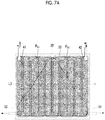
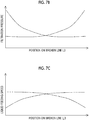
- Fig. 7A is a view showing overlapped appropriate filtration pressure regions R A1 and R A2 shown in Figs. 5A and 6A .
- Fig. 7B is a graph of overlapped filtration pressure distributions shown in Fig. 5B and Fig. 6B , and is a graph showing an example of the filtration pressure distribution on the dashed-dotted line L3 in Fig. 7A .
- Fig. 7C is a graph of overlapped liquid feeding speed distributions shown in Fig. 5C and Fig. 6C , and is a graph showing an example of the liquid feeding speed distribution on the dashed-dotted line L3 in Fig. 7A .
- the first treatment for discharging the permeation liquid from the first discharge port 51 while performing the first liquid feeding, and the second treatment for discharging the permeation liquid from the second discharge port 52 while performing the second liquid feeding are alternately performed.
- the entire excessive filtration pressure region in the first treatment is included in the appropriate filtration pressure region R A2 in the second treatment
- the entire excessive filtration pressure region in the second treatment is included in the appropriate filtration pressure region R A1 in the first treatment. That is, a region where the appropriate filtration pressure region R A1 in the first treatment and the appropriate filtration pressure region R A2 in the second treatment are combined covers the entire filtration membrane 20.
- the uniformity in time average value of the filtration pressure on the membrane surface of the filtration membrane 20 can be improved. Thereby, it becomes possible to suppress the occurrence of clogging of cells in the filtration membrane 20.
- the entire excessive filtration pressure region in the first treatment is difficult to be included in the appropriate filtration pressure region R A2 in the second treatment, and the entire excessive filtration pressure region in the second treatment is difficult to be included in the appropriate filtration pressure region R A1 in the first treatment.
- the length of the filtration membrane 20 in the direction in which the unit flow paths 30a are arranged (the number of connected unit flow paths 30a) such that the unit flow path 30a disposed near the center of the filtration membrane 20 in the direction in which the unit flow paths 30a are arranged are included in both the appropriate filtration pressure region R A1 in the first process and the appropriate filtration pressure region R A2 in the second process.
- Fig. 8 is a view showing an example of a configuration of a filtration system 100 according to an embodiment of the disclosed technique that realizes the filtration method according to the embodiment of the disclosed technique.
- the filtration system 100 includes a filtration device 1, a first syringe 111, a second syringe 112, a first syringe pump 121, a second syringe pump 122, a first cell concentration detection unit 123, and a second cell concentration detection unit 124, a collection container 130, a controller 140, a notification unit 150, valves V1, V2, V3, and V4, and pipes P1, P2, P3, and P4.
- Each of the first syringe 111 and the second syringe 112 functions as a container that temporarily stores a cell suspension that is a target of concentration treatment by the filtration device 1, and functions as a part of a cell suspension feeding unit.
- the jetting port of the first syringe 111 is connected to the first distribution port 41 of the filtration device 1 via the pipe P1.
- the jetting port of the second syringe 112 is connected to the second distribution port 42 of the filtration device 1 via the pipe P2.
- the first cell concentration detection unit 123 outputs a concentration detection signal D3 indicating the concentration of cells accommodated in the first syringe 111.
- the second cell concentration detection unit 124 outputs a concentration detection signal D4 indicating the concentration of cells accommodated in the second syringe 112.
- the first syringe pump 121 has a slide mechanism that slides the plunger of the first syringe 111, and by sliding the plunger of the first syringe 111 according to the control signal C1 supplied from the controller 140, the cell suspension accommodated in the first syringe 111 is fed.
- the first syringe pump 121 outputs a load amount detection signal D1 indicating the magnitude of the load in a case where the plunger of the first syringe 111 is slid.
- the load in a case where the plunger of the first syringe 111 is slid increases, for example, as clogging of cells occurs in the filtration membrane 20 and the liquid feeding load increases.
- the second syringe pump 122 has a slide mechanism that slides the plunger of the second syringe 112, and by sliding the plunger of the second syringe 112 according to the control signal C2 supplied from the controller 140, the cell suspension accommodated in the second syringe 112 is fed.
- the second syringe pump 122 outputs a load amount detection signal D2 indicating the magnitude of the load in a case where the plunger of the second syringe 112 is slid.
- the load in a case where the plunger of the second syringe 112 is slid increases, for example, as clogging of cells occurs in the filtration membrane 20 and the liquid feeding load increases.
- the collection container 130 is a container in which the permeation liquid that has passed through the filtration membrane 20 is collected.
- the first discharge port 51 of the filtration device 1 is connected to the collection container 130 via the pipe P4, and the second discharge port 52 of the filtration device 1 is connected to the collection container 130 via the pipe P3.
- the valve V1 is provided in the middle of the pipe P1, and the valve V2 is provided in the middle of the pipe P2.
- the valve V3 is provided in the middle of the pipe P3, and the valve V4 is provided in the middle of the pipe P4.
- Each of the valves V1, V2, V3, and V4 has a form of a solenoid valve, and is controlled to be in an open state or a closed state according to control signals C3, C4, C5, and C6 supplied from the controller 140.
- the controller 140 includes, for example, a microcomputer, and performs liquid feeding control in the filtration system 100 by outputting control signals C1 to C6 at a predetermined timing. In addition, the controller 140 determines the presence or absence of abnormality in filtration treatment based on the load amount detection signals D1 and D2 and the concentration detection signals D3 and D4, and outputs an error signal E1 in a case where it is determined that there is an abnormality.
- the notification unit 150 notifies that an abnormality has occurred in the filtration system 100 in a case where the error signal E1 is output from the controller 140.
- Step S11 the controller 140 controls the valves V1 and V2 to be in an open state by outputting control signals C3 and C4, respectively.
- Step S12 the controller 140 drives the first syringe pump 121 by outputting the control signal C1.
- the controller 140 outputs the control signals C5 and C6, thereby controlling the valve V4 to an open state and controlling the valve V3 to a closed state.
- the cell suspension accommodated in the first syringe 111 flows in into the inside of the filtration device 1 from the first distribution port 41, and the cell suspension flows along the membrane surface of the filtration membrane 20 with the supply side 31 of a flow path to flow out from the second distribution port 42.
- the cell suspension that has flowed out of the second distribution port 42 is accommodated in the second syringe 112.
- the permeation liquid that has passed through the filtration membrane 20 is discharged from the first discharge port 51 and stored in the collection container 130.
- Step S13 the controller 140 determines whether an abnormality has occurred in the load amount of the first syringe pump 121 based on the load amount detection signal D1.
- the controller 140 determines that there is an abnormality when the load amount indicated by the load amount detection signal D1 exceeds a predetermined amount, and otherwise determines that there is no abnormality.
- the treatment proceeds to Step S18.
- Step S18 the controller 140 outputs an error signal E1. Based on the error signal E1, the notification unit 150 notifies that the cell clogging has occurred in the filtration membrane 20.
- Step S14 the controller 140 drives the second syringe pump 122 by outputting the control signal C2.
- the controller 140 outputs the control signals C5 and C6, thereby controlling the valve V3 to an open state and controlling the valve V4 to a closed state.
- the cell suspension accommodated in the second syringe 112 flows in into the inside of the filtration device 1 from the second distribution port 42, and the cell suspension flows along the membrane surface of the filtration membrane 20 with the supply side 31 of a flow path to flow out from the first distribution port 41.
- the cell suspension that has flowed out of the first distribution port 41 is accommodated in the first syringe 111.
- the permeation liquid that has passed through the filtration membrane 20 is discharged from the second discharge port 52 and stored in the collection container 130.
- Step S15 the controller 140 determines whether an abnormality has occurred in the load amount of the second syringe pump 122 based on the load amount detection signal D2.
- the controller 140 determines that there is an abnormality when the load amount indicated by the load amount detection signal D2 exceeds a predetermined amount, and otherwise determines that there is no abnormality.
- the treatment proceeds to Step S18.
- Step S18 the controller 140 outputs an error signal E1. Based on the error signal E1, the notification unit 150 notifies that the cell clogging has occurred in the filtration membrane 20.
- Step S16 the controller 140 determines whether or not the number of treatment cycles in which a series of treatment including each treatment from step S12 to step S15 is one unit has reached a predetermined number. In a case where the controller 140 determines that the number of cycles of the series of treatments has not reached the predetermined number, the treatment returns to Step S12. On the other hand, in a case where the controller 140 determines that the number of cycles of the series of treatments has reached a predetermined number, the treatment proceeds to Step S17.
- Step S17 the controller 140 determines whether the concentration of cells that have undergone each of the treatments has reached a target value, which is indicated by the concentration detection signal D1 output from the first cell concentration detection unit 123 or the concentration detection signal D2 output from the second cell concentration detection unit 124. In a case where the controller 140 determines that the concentration of cells that have undergone each of the treatments has not reached the target value, the treatment proceeds to Step S18.
- the notification unit 150 notifies that some abnormality has occurred in the filtration system 100 based on the error signal E1.
- the controller 140 ends the treatment.
- the controller 140 resets a count value of a treatment cycle number in a case where it determines that the concentration of cells that have undergone each treatment has not reached the target value, and each treatment from Step S11 to Step S16 may be performed again.
- the controller 140 controls the first syringe pump 121 and the second syringe pump 122 to perform the first liquid feeding control that controls liquid feeding of a liquid passing through the first distribution port 41 and the second distribution port 42.
- the controller 140 performs opening and closing control of the valves V3 and V4 in conjunction with the first liquid feeding control, thereby performing the second liquid feeding control for controlling the liquid feeding of the permeation liquid discharged from the first discharge port 51 and the second discharge port 52.
- the controller 140 alternately performs, as the first liquid feeding control, the first liquid feeding for discharging a cell suspension flowed in from the first distribution port 41 from the second distribution port 42, and the second liquid feeding for discharging a cell suspension flowed in from the second distribution port 42 from the first distribution port 41.
- the controller 140 discharges the permeation liquid that has permeated through the filtration membrane 20 from the first discharge port 51 during the first liquid feeding, and discharges the permeation liquid that has permeated through the filtration membrane 20 from the second discharge port 52 during the second liquid feeding.
- Fig. 10 is a diagram showing an example of the distribution of the appropriate filtration pressure region R A3 on the membrane surface of the filtration membrane 20 in a case where the filtration method according to the First Comparative Example using a filtration device IX according to the comparative example is performed.
- the filtration device IX has only one discharge port for discharging the permeation liquid that has passed through the filtration membrane 20.
- a discharge port 50 is provided on a permeation side, which is opposite to the end on the side where the first distribution port 41 is provided, of an end of the unit flow path 30a to which the first distribution port 41 is connected.
- a treatment of discharging the permeation liquid from the discharge port 50 while the cell suspension flowed in from the first distribution port 41 flows out of the second distribution port 42 is continuously performed. That is, the filtration method according to First Comparative Example does not switch the liquid feeding direction on the supply side.
- the area of the appropriate filtration pressure region R A3 is smaller than the area of the appropriate filtration pressure region R A1 in a case where the filtration method according to the embodiment of the disclosed technique is applied (refer to Figs. 5A to 5C ).
- the appropriate filtration pressure region R A3 does not cover the entire filtration membrane 20. Accordingly, according to the filtration method according to First Comparative Example, as compared with the filtration method according to the embodiment of the disclosed technique, the risk of occurrence of cell clogging increases, and the cell recovery rate decreases.
- Fig. 11 is a diagram showing an example of the distribution of the appropriate filtration pressure regions R A3 and R A4 on the membrane surface of the filtration membrane 20 in a case where the filtration method according to Second Comparative Example using a filtration device IX is performed.
- a first treatment for discharging the permeation liquid that has passed through the filtration membrane 20 from the discharge port 50 while performing the first liquid feeding that causes the cell suspension flowed in from the first distribution port 41 to flow out from the second distribution port 42, and a second treatment of discharging the permeation liquid that has passed through the filtration membrane 20 from the discharge port 50 while performing the second liquid feeding that causes the cell suspension flowed in from the second distribution port 42 to flow out from the first distribution port 41 are performed alternately.
- a part of the excessive filtration pressure region in the first treatment can be included in the appropriate filtration pressure region R A4 in the second treatment, and a part of the excessive filtration pressure region in the second treatment can be included in the appropriate filtration pressure region R A3 in the first treatment.
- the entire excessive filtration pressure region in the first treatment cannot be included in the appropriate filtration pressure region R A4 in the second treatment.
- the entire excessive filtration pressure region in the second treatment cannot be included in the appropriate filtration pressure region R A3 in the first treatment.
- a region where the appropriate filtration pressure region R A3 in the first treatment and the appropriate filtration pressure region R A4 in the second treatment are combined does not cover the entire filtration membrane 20. Accordingly, according to the filtration method according to Second Comparative Example, as compared with the filtration method according to the embodiment of the disclosed technique, the risk of occurrence of cell clogging increases, and the cell recovery rate decreases.
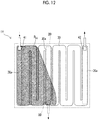
- Fig. 12 is a diagram showing an example of the distribution of the appropriate filtration pressure region R A5 on the membrane surface of the filtration membrane 20 in a case where the filtration method according to Third Comparative Example using a filtration device 1Y according to the comparative example is performed.
- the filtration device 1Y has only one discharge port for discharging the permeation liquid that has passed through the filtration membrane 20.
- the discharge port 50 is provided on the permeation side of the end, which is opposite to the end on which the first distribution port 41 and the second distribution port 42 are provided, of the unit flow path 30a located between the unit flow path 30a provided with the first distribution port 41 and the unit flow path 30a connected with the second distribution port 42.
- a treatment of discharging the permeation liquid from the discharge port 50 while the cell suspension flowed in from the first distribution port 41 flows out of the second distribution port 42 is continuously performed. That is, the filtration method according to Third Comparative Example does not switch the liquid feeding direction on the supply side.
- the area of the appropriate filtration pressure region R A5 becomes larger than the area of the appropriate filtration pressure region R A3 in a case where the filtration method according to First Comparative Example using the filtration device IX is performed (refer to Figs. 5A to 5C ).
- the area of the appropriate filtration pressure region R A5 is smaller than the area of the appropriate filtration pressure region R A1 in a case where the filtration method according to the embodiment of the disclosed technique is performed (refer to Figs. 5A to 5C ).
- the appropriate filtration pressure region R A5 does not cover the entire filtration membrane 20. Accordingly, according to the filtration method according to Third Comparative Example, as compared with the filtration method according to the embodiment of the disclosed technique, the risk of occurrence of cell clogging increases, and the cell recovery rate decreases.
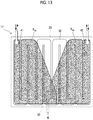
- Fig. 13 is a diagram showing an example of the distribution of the appropriate filtration pressure regions R A5 and R A6 on the membrane surface of the filtration membrane 20 in a case where the filtration method according to Fourth Comparative Example using a filtration device 1Y is performed.
- a first treatment for discharging the permeation liquid that has passed through the filtration membrane 20 from the discharge port 50 while performing the first liquid feeding that causes the cell suspension flowed in from the first distribution port 41 to flow out from the second distribution port 42, and a second treatment of discharging the permeation liquid that has passed through the filtration membrane 20 from the discharge port 50 while performing the second liquid feeding that causes the cell suspension flowed in from the second distribution port 42 to flow out from the first distribution port 41 are performed alternately.
- a part of the excessive filtration pressure region in the first treatment can be included in the appropriate filtration pressure region R A6 in the second treatment, and a part of the excessive filtration pressure region in the second treatment can be included in the appropriate filtration pressure region R A5 in the first treatment.
- the entire excessive filtration pressure region in the first treatment cannot be included in the appropriate filtration pressure region R A6 in the second treatment.
- the entire excessive filtration pressure region in the second treatment cannot be included in the appropriate filtration pressure region R A5 in the first treatment.
- a region where the appropriate filtration pressure region R A5 in the first treatment and the appropriate filtration pressure region R A6 in the second treatment are combined does not cover the entire filtration membrane 20. Accordingly, according to the filtration method according to Fourth Comparative Example, as compared with the filtration method according to the embodiment of the disclosed technique, the risk of occurrence of cell clogging increases, and the cell recovery rate decreases.
- a first treatment of discharging the permeation liquid from the first discharge port 51 provided at the farthest position from the first distribution port 41 or in the vicinity thereof while performing the first liquid feeding that causes the cell suspension flowed in from the first distribution port 41 to flow out from the second distribution port 42, and a second treatment of discharging the permeation liquid from the second discharge port 52 provided at the farthest position from the second distribution port 42 or in the vicinity thereof while performing the second liquid feeding that causes the cell suspension flowed in from the second distribution port 42 to flow out from the first distribution port 41 are alternately performed.
- the entire excessive filtration pressure region in the first treatment is included in the appropriate filtration pressure region R A2 in the second treatment
- the entire excessive filtration pressure region in the second treatment is included in the appropriate filtration pressure region R A1 in the first treatment. That is, a region where the appropriate filtration pressure region R A1 in the first treatment and the appropriate filtration pressure region R A2 in the second treatment are combined covers the entire filtration membrane 20.
- a time average value of the filtration pressure on the membrane surface of the filtration membrane 20 can be made substantially uniform. Therefore, the risk of occurrence of cell clogging can be inhibited, and the cell recovery rate can be increased as compared with First to Fourth Comparative Examples.
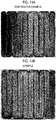
- Fig. 14A is a photograph showing a state of a filtration membrane after performing a membrane separation treatment of a liquid containing simulated particles simulating cells by the filtration method according to Second Comparative Example using the filtration device IX (refer to Fig. 11 ).
- Fig. 14B is a photograph showing an example of a state of a filtration membrane after performing a membrane separation treatment of a liquid containing simulated particles simulating cells by a filtration method according to an embodiment of the disclosed technique using the filtration device 1.
- colored portions are portions where simulated particles are deposited, and portions with a high coloration concentration are portions with a relatively high filtration pressure.
- a portion with a high coloration concentration and a portion with a low coloration concentration are clearly separated.
- the difference between the high filtration pressure portion and the low filtration pressure portion is remarkable on the membrane surface of the filtration membrane, that is, the filtration pressure on the membrane surface of the filtration membrane is not uniform.
- the coloration concentration is generally uniform as shown in Fig. 14B . This indicates that the filtration pressure on the membrane surface of the filtration membrane is substantially uniform.
- the filtration device 1, the filtration system 100, and the filtration method according to the embodiment of the disclosed technique it is possible to increase the area of the filtration membrane while ensuring the uniformity of the filtration pressure on the membrane surface of the filtration membrane 20. Therefore, the filtration efficiency can be increased while suppressing a decrease in the cell recovery rate.
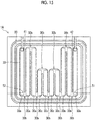
- Fig. 15 is a plan view showing a configuration of a filtration device 1A according to a second embodiment of the disclosed technique.
- the filtration device 1A is different from the filtration device 1 according to the first embodiment in that the flow path 30 has a plurality of unit flow paths 30a, and a plurality of unit flow paths 30c whose flow path length is shorter than that of the unit flow paths 30a.
- the flow path 30 has a portion where the distance from one of the folded portions 30b to the next folded portion 30b is shorter than the other portions.
- the length of the unit flow path 30a is La and the length of the unit flow path 30c is Lc, it is preferable that Formula (5) be satisfied.
- the first treatment of discharging the permeation liquid from the first discharge port 51 while performing the first liquid feeding for causing the cell suspension flowed in from the first distribution port 41 to flow out from the second distribution port 42 and the second treatment of discharging the permeation liquid from the second discharge port 52 while performing the second liquid feeding for causing the cell suspension flowed in from the second distribution port 42 to flow out from the first distribution port 41 are alternately performed using the filtration device 1 according to the first embodiment, as shown in Fig.
- the risk of occurrence of cell clogging increases, and the cell recovery rate may decrease in the part that becomes the excessive filtration pressure region in both the first treatment and the second treatment.
- the flow path portion that becomes the excessive filtration pressure region is deleted in both the first treatment and the second treatment, and thereby the risk of occurrence of cell clogging can be inhibited.
- one end of the flow path 30 and the first distribution port 41 may be disposed in the vicinity of the corner A1 of the filtration membrane 20 having a rectangular shape, and the other end of the flow path 30 and the second distribution port 42 may be disposed in the vicinity of the corner A3 that is a diagonal of the corner A1 of the filtration membrane 20.
- the first discharge port 51 is disposed, for example in the vicinity of corner A3 of the filtration membrane 20, that is, immediately below the second distribution port 42
- the second discharge port 52 is disposed, for example, in the vicinity of the corner A1 of the filtration membrane 20, that is, immediately below the first distribution port 41.
Landscapes
- Engineering & Computer Science (AREA)
- Water Supply & Treatment (AREA)
- Chemical & Material Sciences (AREA)
- Chemical Kinetics & Catalysis (AREA)
- Health & Medical Sciences (AREA)
- Life Sciences & Earth Sciences (AREA)
- Wood Science & Technology (AREA)
- Organic Chemistry (AREA)
- Zoology (AREA)
- Bioinformatics & Cheminformatics (AREA)
- Biomedical Technology (AREA)
- Biotechnology (AREA)
- Sustainable Development (AREA)
- Microbiology (AREA)
- Biochemistry (AREA)
- General Engineering & Computer Science (AREA)
- General Health & Medical Sciences (AREA)
- Genetics & Genomics (AREA)
- Virology (AREA)
- Cell Biology (AREA)
- Molecular Biology (AREA)
- Separation Using Semi-Permeable Membranes (AREA)
Applications Claiming Priority (2)
| Application Number | Priority Date | Filing Date | Title |
|---|---|---|---|
| JP2017183956 | 2017-09-25 | ||
| PCT/JP2018/034688 WO2019059241A1 (fr) | 2017-09-25 | 2018-09-19 | Dispositif de filtration, système de filtration et procédé de filtration |
Publications (2)
| Publication Number | Publication Date |
|---|---|
| EP3673979A1 true EP3673979A1 (fr) | 2020-07-01 |
| EP3673979A4 EP3673979A4 (fr) | 2020-10-21 |
Family
ID=65810310
Family Applications (1)
| Application Number | Title | Priority Date | Filing Date |
|---|---|---|---|
| EP18857812.4A Withdrawn EP3673979A4 (fr) | 2017-09-25 | 2018-09-19 | Dispositif de filtration, système de filtration et procédé de filtration |
Country Status (6)
| Country | Link |
|---|---|
| US (1) | US20200215491A1 (fr) |
| EP (1) | EP3673979A4 (fr) |
| JP (1) | JPWO2019059241A1 (fr) |
| KR (1) | KR20200041968A (fr) |
| CN (1) | CN111148564A (fr) |
| WO (1) | WO2019059241A1 (fr) |
Families Citing this family (2)
| Publication number | Priority date | Publication date | Assignee | Title |
|---|---|---|---|---|
| CN112553054A (zh) * | 2020-12-10 | 2021-03-26 | 上海艾众生物科技有限公司 | 用于生物反应器的细胞分离设备 |
| JP7622510B2 (ja) | 2021-03-26 | 2025-01-28 | 横河電機株式会社 | 濃縮装置及び濃縮方法 |
Family Cites Families (27)
| Publication number | Priority date | Publication date | Assignee | Title |
|---|---|---|---|---|
| JPS5119640Y2 (fr) * | 1971-09-11 | 1976-05-24 | ||
| JPS5814919U (ja) * | 1981-07-17 | 1983-01-29 | 東ソー株式会社 | 薄層流路型膜分離装置 |
| JPS62163706A (ja) * | 1986-01-13 | 1987-07-20 | Kurita Water Ind Ltd | 膜分離装置 |
| US6022742A (en) * | 1986-11-26 | 2000-02-08 | Kopf; Henry B. | Culture device and method |
| DE3914326C2 (de) * | 1988-05-07 | 1997-07-17 | Sartorius Gmbh | Filtergerät zur Filtration von Suspensionen, zur Klärfiltration und zur Ultra- und Mikrofiltration von Flüssigkeiten |
| JPH0295421A (ja) * | 1988-09-30 | 1990-04-06 | Daikin Ind Ltd | 液体分離装置 |
| JPH0679142A (ja) * | 1992-09-07 | 1994-03-22 | Mitsubishi Heavy Ind Ltd | 逆浸透モジュールにおける液の給排方法 |
| JPH0824590A (ja) | 1994-07-21 | 1996-01-30 | Mitsubishi Rayon Co Ltd | 高濃度有機液の濾過方法 |
| DE50113701D1 (de) * | 2000-03-07 | 2008-04-17 | Mat Adsorption Technologies Gm | Modul mit membranelementen in cross-flow und in dead-end anordnung |
| DE10126311A1 (de) * | 2000-06-10 | 2002-03-14 | Sartorius Gmbh | Vorrichtung zur Crossflow-Filtration von Füssigkeiten |
| JP4798644B2 (ja) * | 2001-01-16 | 2011-10-19 | オルガノ株式会社 | 逆浸透膜を用いる脱塩方法 |
| JP2003024947A (ja) * | 2001-07-12 | 2003-01-28 | Matsushita Electric Ind Co Ltd | 電気透析槽 |
| KR100354613B1 (ko) * | 2001-11-06 | 2002-10-11 | 박헌휘 | 교체 가능한 침지형 중공사막 모듈 |
| JP4251879B2 (ja) * | 2002-08-29 | 2009-04-08 | オルガノ株式会社 | 分離膜モジュールの運転方法 |
| US8828226B2 (en) * | 2003-03-01 | 2014-09-09 | The Trustees Of Boston University | System for assessing the efficacy of stored red blood cells using microvascular networks |
| JP4145721B2 (ja) * | 2003-05-30 | 2008-09-03 | ピジョン株式会社 | 海洋深層水中の電解質と非電解質との分離方法および分離装置 |
| CN101394917B (zh) * | 2006-03-02 | 2012-03-07 | 真锅征一 | 孔扩散式平膜分离装置 |
| US20090057210A1 (en) * | 2007-09-04 | 2009-03-05 | Kenneth Charles Barrett | In-line filtration systems |
| JP2009291744A (ja) | 2008-06-06 | 2009-12-17 | Asahi Kasei Chemicals Corp | 膜濾過方法及び濾過装置 |
| CN102847441A (zh) * | 2012-08-10 | 2013-01-02 | 艾欧史密斯(上海)水处理产品有限公司 | 一种反渗透膜元件 |
| WO2015031654A2 (fr) * | 2013-08-28 | 2015-03-05 | Cytonics Corporation | Systèmes, compositions et procédés de transplantation et de traitement d'états pathologiques |
| JP5896571B2 (ja) * | 2013-10-15 | 2016-03-30 | キム ホンKim Hong | 全血から高濃縮血漿を抽出する装置及び方法 |
| GB201319141D0 (en) * | 2013-10-30 | 2013-12-11 | Exmoor Pharma Concepts Ltd | Volume reduction devices and method |
| CN106659979A (zh) * | 2014-09-03 | 2017-05-10 | 三菱重工业株式会社 | 水处理装置及水处理装置的运行方法 |
| JP2017104832A (ja) | 2015-12-11 | 2017-06-15 | 三菱重工環境・化学エンジニアリング株式会社 | 膜分離装置 |
| JP2017183956A (ja) | 2016-03-30 | 2017-10-05 | アイシン・エィ・ダブリュ株式会社 | 通信制御システムおよび通信制御プログラム |
| CN109415679A (zh) * | 2016-06-30 | 2019-03-01 | 富士胶片株式会社 | 细胞悬液的膜分离方法以及细胞培养装置 |
-
2018
- 2018-09-19 WO PCT/JP2018/034688 patent/WO2019059241A1/fr not_active Ceased
- 2018-09-19 CN CN201880061083.1A patent/CN111148564A/zh active Pending
- 2018-09-19 KR KR1020207008071A patent/KR20200041968A/ko not_active Abandoned
- 2018-09-19 JP JP2019543681A patent/JPWO2019059241A1/ja not_active Abandoned
- 2018-09-19 EP EP18857812.4A patent/EP3673979A4/fr not_active Withdrawn
-
2020
- 2020-03-18 US US16/822,113 patent/US20200215491A1/en not_active Abandoned
Also Published As
| Publication number | Publication date |
|---|---|
| CN111148564A (zh) | 2020-05-12 |
| EP3673979A4 (fr) | 2020-10-21 |
| US20200215491A1 (en) | 2020-07-09 |
| WO2019059241A1 (fr) | 2019-03-28 |
| JPWO2019059241A1 (ja) | 2020-10-15 |
| KR20200041968A (ko) | 2020-04-22 |
Similar Documents
| Publication | Publication Date | Title |
|---|---|---|
| EP3185996B1 (fr) | Systèmes de filtration à écoulement tangentiel à passage unique et systèmes de filtration à écoulement tangentiel avec recirculation de rétentat | |
| KR101584052B1 (ko) | 유로가 측면에 형성되는 역삼투막 필터 | |
| CN108325391B (zh) | 过滤液体进料的方法 | |
| US11612861B2 (en) | Crossflow filtration unit for continuous diafiltration | |
| US10967309B2 (en) | Water purifying system and backwash module control method thereof | |
| EP3202484B1 (fr) | Diafiltration en ligne au moyen de pompe à canaux multiples | |
| EP3790610B1 (fr) | Filtre pour lignes médicales de perfusion | |
| EP2708249B1 (fr) | Dispositif de dialyse | |
| WO2015195452A4 (fr) | Systèmes et procédés de filtration à simple passage | |
| US20200215491A1 (en) | Filtration device, filtration system, and filtration method | |
| US20190152802A1 (en) | Fluid filtration system and method | |
| CN112292444A (zh) | 模块化的处理系统和用于模块化构建处理系统的方法 | |
| EP3843884A1 (fr) | Système de filtration et procédé associé | |
| EP3659694A1 (fr) | Module à membranes à fibres creuses | |
| US10080832B2 (en) | Artificial dialysis device | |
| EP3856278B1 (fr) | Dispositif de dialyse destiné à être utilisé avec des milieux d'interface, systèmes de dialyse, utilisation de dispositif de dialyse, procédé d'établissement de système de dialyse, procédé de remplissage et/ou d'amorçage d'un système de dialyse et procédé d'élimination de l'air d'un système de dialyse | |
| JP2016083307A (ja) | 血液透析装置 | |
| JP5560954B2 (ja) | 血液浄化装置における返血作動方法および血液浄化装置 | |
| US11246969B2 (en) | Apparatus for extracorporeal blood treatment and method for operating an extracorporeal blood treatment apparatus | |
| KR20140087416A (ko) | 중공사막 모듈 | |
| US9993774B2 (en) | Filtration system and filtration method | |
| CN108472593A (zh) | 筒夹紧装置 | |
| CN203428960U (zh) | 硅冷却液废液处理装置 | |
| KR20170023626A (ko) | 수처리용 트리코트 여과수로 및 이를 포함하는 수처리용 역삼투압 필터 모듈 | |
| WO2019131292A1 (fr) | Dispositif de filtration et procédé de filtration |
Legal Events
| Date | Code | Title | Description |
|---|---|---|---|
| STAA | Information on the status of an ep patent application or granted ep patent |
Free format text: STATUS: THE INTERNATIONAL PUBLICATION HAS BEEN MADE |
|
| PUAI | Public reference made under article 153(3) epc to a published international application that has entered the european phase |
Free format text: ORIGINAL CODE: 0009012 |
|
| STAA | Information on the status of an ep patent application or granted ep patent |
Free format text: STATUS: REQUEST FOR EXAMINATION WAS MADE |
|
| 17P | Request for examination filed |
Effective date: 20200324 |
|
| AK | Designated contracting states |
Kind code of ref document: A1 Designated state(s): AL AT BE BG CH CY CZ DE DK EE ES FI FR GB GR HR HU IE IS IT LI LT LU LV MC MK MT NL NO PL PT RO RS SE SI SK SM TR |
|
| AX | Request for extension of the european patent |
Extension state: BA ME |
|
| A4 | Supplementary search report drawn up and despatched |
Effective date: 20200921 |
|
| RIC1 | Information provided on ipc code assigned before grant |
Ipc: C12M 3/00 20060101ALI20200915BHEP Ipc: B01D 61/18 20060101AFI20200915BHEP Ipc: C12M 3/06 20060101ALI20200915BHEP Ipc: B01D 63/08 20060101ALI20200915BHEP |
|
| DAV | Request for validation of the european patent (deleted) | ||
| DAX | Request for extension of the european patent (deleted) | ||
| RAP3 | Party data changed (applicant data changed or rights of an application transferred) |
Owner name: FUJIFILM CORPORATION |
|
| STAA | Information on the status of an ep patent application or granted ep patent |
Free format text: STATUS: THE APPLICATION HAS BEEN WITHDRAWN |
|
| 18W | Application withdrawn |
Effective date: 20210526 |