EP3674031A1 - Hybrides schweissverfahren und hybrides schweissgerät - Google Patents
Hybrides schweissverfahren und hybrides schweissgerät Download PDFInfo
- Publication number
- EP3674031A1 EP3674031A1 EP18847454.8A EP18847454A EP3674031A1 EP 3674031 A1 EP3674031 A1 EP 3674031A1 EP 18847454 A EP18847454 A EP 18847454A EP 3674031 A1 EP3674031 A1 EP 3674031A1
- Authority
- EP
- European Patent Office
- Prior art keywords
- welding
- joint
- laser
- hybrid
- hybrid welding
- Prior art date
- Legal status (The legal status is an assumption and is not a legal conclusion. Google has not performed a legal analysis and makes no representation as to the accuracy of the status listed.)
- Pending
Links
Images



Classifications
-
- B—PERFORMING OPERATIONS; TRANSPORTING
- B23—MACHINE TOOLS; METAL-WORKING NOT OTHERWISE PROVIDED FOR
- B23K—SOLDERING OR UNSOLDERING; WELDING; CLADDING OR PLATING BY SOLDERING OR WELDING; CUTTING BY APPLYING HEAT LOCALLY, e.g. FLAME CUTTING; WORKING BY LASER BEAM
- B23K26/00—Working by laser beam, e.g. welding, cutting or boring
- B23K26/20—Bonding
- B23K26/21—Bonding by welding
- B23K26/24—Seam welding
- B23K26/244—Overlap seam welding
-
- B—PERFORMING OPERATIONS; TRANSPORTING
- B23—MACHINE TOOLS; METAL-WORKING NOT OTHERWISE PROVIDED FOR
- B23K—SOLDERING OR UNSOLDERING; WELDING; CLADDING OR PLATING BY SOLDERING OR WELDING; CUTTING BY APPLYING HEAT LOCALLY, e.g. FLAME CUTTING; WORKING BY LASER BEAM
- B23K26/00—Working by laser beam, e.g. welding, cutting or boring
- B23K26/08—Devices involving relative movement between laser beam and workpiece
- B23K26/0869—Devices involving movement of the laser head in at least one axial direction
-
- B—PERFORMING OPERATIONS; TRANSPORTING
- B23—MACHINE TOOLS; METAL-WORKING NOT OTHERWISE PROVIDED FOR
- B23K—SOLDERING OR UNSOLDERING; WELDING; CLADDING OR PLATING BY SOLDERING OR WELDING; CUTTING BY APPLYING HEAT LOCALLY, e.g. FLAME CUTTING; WORKING BY LASER BEAM
- B23K26/00—Working by laser beam, e.g. welding, cutting or boring
- B23K26/20—Bonding
- B23K26/21—Bonding by welding
- B23K26/24—Seam welding
- B23K26/26—Seam welding of rectilinear seams
-
- B—PERFORMING OPERATIONS; TRANSPORTING
- B23—MACHINE TOOLS; METAL-WORKING NOT OTHERWISE PROVIDED FOR
- B23K—SOLDERING OR UNSOLDERING; WELDING; CLADDING OR PLATING BY SOLDERING OR WELDING; CUTTING BY APPLYING HEAT LOCALLY, e.g. FLAME CUTTING; WORKING BY LASER BEAM
- B23K26/00—Working by laser beam, e.g. welding, cutting or boring
- B23K26/346—Working by laser beam, e.g. welding, cutting or boring in combination with welding or cutting covered by groups B23K5/00 - B23K25/00, e.g. in combination with resistance welding
- B23K26/348—Working by laser beam, e.g. welding, cutting or boring in combination with welding or cutting covered by groups B23K5/00 - B23K25/00, e.g. in combination with resistance welding in combination with arc heating, e.g. tungsten inert gas [TIG], metal inert gas [MIG] or plasma welding
-
- B—PERFORMING OPERATIONS; TRANSPORTING
- B23—MACHINE TOOLS; METAL-WORKING NOT OTHERWISE PROVIDED FOR
- B23K—SOLDERING OR UNSOLDERING; WELDING; CLADDING OR PLATING BY SOLDERING OR WELDING; CUTTING BY APPLYING HEAT LOCALLY, e.g. FLAME CUTTING; WORKING BY LASER BEAM
- B23K9/00—Arc welding or cutting
- B23K9/095—Monitoring or automatic control of welding parameters
- B23K9/0956—Monitoring or automatic control of welding parameters using sensing means, e.g. optical
-
- B—PERFORMING OPERATIONS; TRANSPORTING
- B23—MACHINE TOOLS; METAL-WORKING NOT OTHERWISE PROVIDED FOR
- B23K—SOLDERING OR UNSOLDERING; WELDING; CLADDING OR PLATING BY SOLDERING OR WELDING; CUTTING BY APPLYING HEAT LOCALLY, e.g. FLAME CUTTING; WORKING BY LASER BEAM
- B23K9/00—Arc welding or cutting
- B23K9/23—Arc welding or cutting taking account of the properties of the materials to be welded
Definitions
- the present invention relates to a hybrid welding method and a hybrid welding apparatus, and in particular, to a hybrid welding method and a hybrid welding apparatus that are suitable for butt-welding in which a gap is present between base materials.
- a boom that is a component of a crane vehicle, an aerial work vehicle, a bridge inspection vehicle or the like is a long steel structure having a hollow tubular shape.
- a boom is formed into a long tubular shape by butt-welding both open end portions of steel materials having a substantially U-shaped cross section.
- Patent Literature 1 discloses a welding method of welding an upper steel plate that is a long high-tension steel plate bent into a U-shaped cross section to a lower steel plate that is a long high-tension steel plate which is bent into a U-shaped cross section with a larger bending radius than that of the upper steel plate and has a larger plate thickness than the upper steel plate at their end surfaces to produce a boom having a tubular cross section.
- a butt joint part of edges of the upper steel plate and the lower steel plate is welded by hybrid welding in which arc welding precedes laser welding without using a backing strip.
- a butt surface of the upper steel plate and the lower steel plate is melted and a molten metal of a filler metal is added to a molten metal of the base material.
- the molten metal and the base materials in the butt joint part are melted in a depth direction of the joint part.
- Patent Literature 1 Japanese Patent No. 6085010
- the present invention has been achieved in view of such problems, and an object of the invention is to provide a hybrid welding method and a hybrid welding apparatus that can perform welding without dropping a weld metal even in a case of butt-welding in which a gap is present between base materials.
- a hybrid welding method that butt-welds a first joint and a second joint using laser welding and arc welding.
- the hybrid welding method includes performing horizontal welding in which the laser welding precedes the arc welding with the first joint and the second joint disposed vertically.
- the first joint and the second joint may have a gap along a weld line at least partially.
- the arc welding may be performed while the gap is filled with a base material melted by the laser welding.
- a light diameter of laser light used for the laser welding may be set to be larger than a maximum value of the gap, and a diameter of a filler metal used for the arc welding may be set to be smaller than the maximum value of the gap.
- An incident angle of laser light at a time of the laser welding is about 90°, for example.
- a joint having a larger plate thickness may be disposed on a lower side.
- the first joint may be constituted by both end portions of a cross section of a steel material having a substantially U-shaped or substantially semicircular cross section
- the second joint may be constituted by a steel material having a cross section including both end portions facing the both end portions of the first joint.
- two weld lines on the left and right of the steel material may be simultaneously welded in the same direction, or the two weld lines on the left and right of the steel material may be simultaneously welded in opposite directions.
- a hybrid welding apparatus that butt-welds a first joint and a second joint using laser welding and arc welding.
- the hybrid welding apparatus includes a laser head that irradiates laser light to a welded portion, and a welding torch that supplies a filler metal to the welded portion.
- the laser head is capable of performing horizontal welding and disposed on an upstream side in a welding direction
- the welding torch is capable of performing horizontal welding and disposed on a downstream side in the welding direction
- horizontal welding is performed with the first joint and the second joint disposed vertically.
- the base material (molten metal) melted by the preceding laser welding drops by its own weight, and thus even when the gap is present between the first joint and the second joint, the gap can be filled with the melted base material (molten metal) and the arc welding can be effectively performed without dropping a weld metal.
- Fig. 1 is a plan view illustrating an overall configuration of a hybrid welding apparatus according to an embodiment of the present invention.
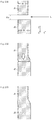
- Fig. 2 is a cross-sectional view illustrating the principle of a hybrid welding method according to a first embodiment of the present invention, where (A) illustrates an initial state, (B) illustrates a state before arc welding, and (C) illustrates a state after welding is completed.
- a hybrid welding apparatus 1 is, as illustrated in Fig. 1 for example, a hybrid welding apparatus that butt-welds a first joint J1 and a second joint J2 using laser welding and arc welding, and includes a laser welding device 2 that includes a laser head 21 that irradiates laser light L to a welded portion and an arc welding device 3 that includes a welding torch 31 that supplies a filler metal W to the welded portion. It is configured such that the laser head 21 is capable of performing horizontal welding and disposed on an upstream side in a welding direction, the welding torch 31 is capable of performing horizontal welding and disposed on a downstream side in the welding direction, and horizontal welding is performed with the first joint J1 and the second joint J2 disposed vertically.
- an X axis is set in a direction along a weld line
- a Y axis is set in a horizontal direction perpendicular to the X axis
- a Z axis is set in a vertical direction.
- the laser welding device 2 includes, for example, the laser head 21, a laser oscillator 22 that generates laser light, and an optical fiber 23 that transports laser light from the laser oscillator 22 to the laser head 21.
- the laser welding device 2 may include a fixing unit that fixes the laser head 21 at a predetermined position and a robot arm that movably supports the laser head 21.
- the laser head 21 is positioned such that the laser light L is irradiated perpendicularly to a welded portion. That is, an incident angle ⁇ of the laser light L on an XY plane is set to about 90°. Consequently, even when the laser light L is irradiated perpendicularly, if a gap is formed in the welded portion, the amount of reflection of the laser light L is small and the laser light L is absorbed by a base material (molten metal) melted by the laser light L. The laser head 21 is thus less damaged by reflected light of the laser light L.
- the incident angle ⁇ of the laser light L may be set to be smaller than 90°.
- the arc welding device 3 includes, for example, the welding torch 31, a welding wire drum 32 in which the filler metal W (welding wire) is wound in a coil shape, and a welding wire feeding device 33 that feeds the filler metal W from the welding wire drum 32 to the welding torch 31.
- the arc welding device 3 may include a fixing unit that fixes the welding torch 31 at a predetermined position and a shielding gas supply unit that supplies a shielding gas to a welded portion.
- the welding torch 31 is positioned such that an incident angle ⁇ of the filler metal W on the XY plane is about 45°.
- the welding torch 31 may be positioned so as to be parallel to a YZ plane, or may be positioned so as to be inclined to the YZ plane.
- the laser welding device 2 is disposed upstream of the arc welding device 3 in the welding direction (X-axis direction). That is, the laser head 21 is disposed upstream of the welding torch 31 in the welding direction (X-axis direction). Consequently, the hybrid welding apparatus 1 according to the present embodiment is configured such that laser welding precedes arc welding in hybrid welding using both laser welding and arc welding.
- the first joint J1 and the second joint J2 are, for example, steel plates having a predetermined shape. As illustrated in Fig. 2(A) , the first joint J1 and the second joint J2 are butt-welded with the second joint J2 disposed downward and the first joint J1 disposed upward. It is assumed that a plate thickness D2 of the second joint J2 is larger than a plate thickness D1 of the first joint J1. That is, in the present embodiment, among the first joint J1 and the second joint J2, a joint having a larger plate thickness is disposed on a lower side.
- first joint J1 and the second joint J2 are formed of a steel plate, not a few machining errors and deformations are included in these joints.
- a gap ⁇ g is formed in the welded portion in the Z axis direction.
- the laser light L is irradiated horizontally (Y axis direction) to the welded portion including this gap ⁇ g, the base material of the first joint J1 is melted to drop downward by its own weight as illustrated in Fig. 2(B) .
- the gap ⁇ g formed between the first joint J1 and the second joint J2 is thus filled with the base material (molten metal) melted by the laser light L.
- the melted base material (molten metal) of the first joint J1 drops on an end portion of the second joint J2.
- the plate thickness D2 of the second joint J2 is thus preferably larger than the plate thickness D1 of the first joint J1 from the viewpoint that the second joint J2 functions as a tray receiving the melted base material of the first joint J1. It is needless to mention that the plate thickness D2 of the second joint J2 may be equal to the plate thickness D1 of the first joint J1, or the plate thickness D2 of the second joint J2 may be less than the plate thickness D1 of the first joint J1, if necessary.
- arc welding can be performed while the gap ⁇ g is filled with the melted base material (molten metal), and an excellent bead with less weld defects can be formed as illustrated in Fig. 2(C) .
- the laser light L When irradiated to the welded portion, the laser light L needs to heat at least a lower end of the first joint J1. A light diameter of the laser light L is thus set to be larger than a maximum value of the gap ⁇ g on the weld line. Meanwhile, as the gap ⁇ g is narrowed at a time of arc welding, a diameter of the filler metal W may be set to be smaller than the maximum value of the gap ⁇ g.
- Fig. 3 is a view illustrating a cross-sectional macro of a test piece, where (A) illustrates a first comparative example, (B) illustrates a second comparative example, (C) illustrates a first test piece, and (D) illustrates a second test piece.
- the division of the scale is 1 mm in each figure.
- the first comparative example illustrates a case where conventional downward welding is performed with a gap of 0 mm
- the second comparative example illustrates a case where the conventional downward welding is performed with a gap of 1 mm
- the first test piece illustrates a case where horizontal welding is performed with a gap of 0 mm
- the second test piece illustrates a case where the horizontal welding is performed with a gap of 1 mm.
- hybrid welding is performed under the same conditions while laser welding precedes and arc welding.
- horizontal welding is performed in which laser welding precedes arc welding with the first joint J1 and the second joint J2 disposed vertically.
- the base material (molten metal) melted by the preceding laser welding can thus drop by its own weight. Consequently, even when the gap ⁇ g is present between the first joint J1 and the second joint J2, the gap ⁇ g can be filled with the melted base material (molten metal) and arc welding can be effectively performed without dropping a weld metal.
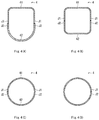
- FIG. 4 is a cross-sectional view illustrating an example of a workpiece that is a welding target, where (A) illustrates a first example, (B) illustrates a second example, (C) illustrates a third example, and (D) illustrates a fourth example.
- the workpiece 4 illustrated in Fig. 4(A) is a tubular steel material such as a boom or a jib used for a crane vehicle and an aerial work vehicle, for example.
- the workpiece 4 in an orientation in use is vertically divided into two portions.
- An upper workpiece 41 has an angular U-shaped cross section
- a lower workpiece 42 has a round U-shaped cross section.
- the plate thickness of the lower workpiece 42 is formed to be larger than the plate thickness of the upper workpiece 41.
- the first joint J1 is constituted by both end portions of the upper workpiece 41
- the second joint J2 is constituted by both end portions of the lower workpiece 42.
- the workpiece 4 illustrated in Fig. 4(B) is a hollow steel material having a substantially quadrangular prism shape used for a column of a steel structure, for example.
- the workpiece 4 is divided into two portions along a longitudinal direction, and at the time of welding, one is disposed on the upper side to be the upper workpiece 41 and the other is disposed on the lower side to be the lower workpiece 42.
- the upper workpiece 41 and the lower workpiece 42 have the same shape, and each has an angular U-shaped cross section.
- the first joint J1 is constituted by both end portions of the upper workpiece 41
- the second joint J2 is constituted by both end portions of the lower workpiece 42.
- the workpiece 4 illustrated in Fig. 4(C) is a hollow cylindrical steel material used for a pipe, for example.
- the workpiece 4 is divided into two portions along the longitudinal direction, and at the time of welding, one is disposed on the upper side to be the upper workpiece 41 and the other is disposed on the lower side to be the lower workpiece 42.
- the upper workpiece 41 and the lower workpiece 42 have the same shape, and each has a semicircular cross section.
- the first joint J1 is constituted by both end portions of the upper workpiece 41
- the second joint J2 is constituted by both end portions of the lower workpiece 42.
- the workpieces 4 described above are merely examples and are not limited to these shapes. That is, it is only required that the first joint J1 is constituted by both end portions of the cross section of a steel material having a substantially U-shaped or substantially semicircular cross section, and the second joint J2 is constituted by a steel material having a cross section including both end portions facing the both end portions of the first joint J1.
- the workpiece 4 illustrated in Fig. 4(D) is a hollow cylindrical steel material used for a pipe, for example.
- the workpiece 4 is formed by bending a long steel plate into a circular shape, and at the time of welding, joints at both ends are placed horizontally.
- the first joint J1 is constituted by an end portion of the steel plate disposed on the upper side
- the second joint J2 is constituted by an end portion of the steel plate disposed on the lower side.
- the workpiece 4 may have a welded portion only on one side in the longitudinal direction.
- FIG. 5 is a view illustrating a hybrid welding method according to other embodiments of the present invention, where (A) illustrates a second embodiment and (B) illustrates a third embodiment.
- the laser welding device 2 and the arc welding device 3 are simplified.
- the hybrid welding apparatus 1 that performs these welding methods includes a movement unit 5 that moves the laser head 21 and the welding torch 31 horizontally along the workpiece 4.
- the movement unit 5 includes a rail 51 disposed in parallel on both sides of the workpiece 4 and a carriage 52 that travels on the rail 51.
- the carriage 52 includes a support member 53 that supports the laser head 21 and the welding torch 31, and a drive motor 54 that causes the carriage 52 to travel by itself.
- a unit that drives the carriage 52 is not limited to the illustrated configuration.
- the carriages 52 placed on the left and right sides of the workpiece 4 are set on the same side (left side in Fig. 5(A) ) on the rails 51, and are synchronized to be moved in the same direction.
- the carriages 52 placed on the left and right sides of the workpiece 4 are set on the opposite sides (left side and right side in Fig. 5(B) ) on the rails 51, and are synchronized to be moved in opposite directions.
- the weld time can be reduced and deformations of the workpiece 4 due to a heat input during welding can be reduced.
- the movement unit 5 having the rail 51 and the carriage 52 may be disposed only on one side of the workpiece 4.
Landscapes
- Engineering & Computer Science (AREA)
- Physics & Mathematics (AREA)
- Optics & Photonics (AREA)
- Plasma & Fusion (AREA)
- Mechanical Engineering (AREA)
- Chemical & Material Sciences (AREA)
- Materials Engineering (AREA)
- Laser Beam Processing (AREA)
- Arc Welding In General (AREA)
Applications Claiming Priority (2)
| Application Number | Priority Date | Filing Date | Title |
|---|---|---|---|
| JP2017160787A JP6722625B2 (ja) | 2017-08-24 | 2017-08-24 | ハイブリッド溶接方法及びハイブリッド溶接装置 |
| PCT/JP2018/031087 WO2019039529A1 (ja) | 2017-08-24 | 2018-08-23 | ハイブリッド溶接方法及びハイブリッド溶接装置 |
Publications (2)
| Publication Number | Publication Date |
|---|---|
| EP3674031A1 true EP3674031A1 (de) | 2020-07-01 |
| EP3674031A4 EP3674031A4 (de) | 2021-05-19 |
Family
ID=65438924
Family Applications (1)
| Application Number | Title | Priority Date | Filing Date |
|---|---|---|---|
| EP18847454.8A Pending EP3674031A4 (de) | 2017-08-24 | 2018-08-23 | Hybrides schweissverfahren und hybrides schweissgerät |
Country Status (5)
| Country | Link |
|---|---|
| US (1) | US20210162538A1 (de) |
| EP (1) | EP3674031A4 (de) |
| JP (1) | JP6722625B2 (de) |
| CN (1) | CN110997219B (de) |
| WO (1) | WO2019039529A1 (de) |
Families Citing this family (3)
| Publication number | Priority date | Publication date | Assignee | Title |
|---|---|---|---|---|
| WO2021015216A1 (ja) * | 2019-07-24 | 2021-01-28 | 株式会社Ihiインフラシステム | 補修用レーザ溶接方法及び補修用レーザ溶接装置 |
| CN114012265B (zh) * | 2021-09-27 | 2023-05-12 | 华北水利水电大学 | 一种双束激光电弧复合单面横焊方法及装置 |
| CN113996932B (zh) * | 2021-11-15 | 2023-05-16 | 哈焊国创(青岛)焊接工程创新中心有限公司 | 一种消除焊缝余高及咬边缺陷的焊接系统及焊接方法 |
Family Cites Families (12)
| Publication number | Priority date | Publication date | Assignee | Title |
|---|---|---|---|---|
| US2737565A (en) * | 1953-11-03 | 1956-03-06 | Graver Tank & Mfg Co Inc | Welding tool manipulator |
| ATE164104T1 (de) * | 1994-09-23 | 1998-04-15 | Fraunhofer Ges Forschung | Verfahren zum verschweissen von werkstücken |
| WO1997043073A1 (en) * | 1996-05-10 | 1997-11-20 | Mitsubishi Heavy Industries, Ltd. | Horizontal welding method and welding equipment |
| JPH10216972A (ja) * | 1997-02-04 | 1998-08-18 | Kubota Corp | レ−ザと消耗電極式ア−クの複合溶接方法 |
| DE102004019448A1 (de) * | 2004-04-19 | 2005-11-10 | Muhr Und Bender Kg | Hybrid hergestelltes Blechelement und Verfahren zu seiner Herstellung |
| JP2007260716A (ja) * | 2006-03-28 | 2007-10-11 | Jfe Steel Kk | 変形能に優れた超高強度溶接鋼管の製造方法 |
| CA2830594C (en) * | 2011-04-15 | 2018-10-30 | Magna International Inc. | Laser welding assembly and method |
| CN102922153B (zh) * | 2012-11-27 | 2014-10-15 | 哈尔滨工业大学 | 一种激光引导gmaw电弧复合横向焊接方法 |
| CN103071935B (zh) * | 2013-01-04 | 2015-05-27 | 哈尔滨工程大学 | 基于热输入控制的激光与电弧复合焊接装置及焊接方法 |
| ES2627220T3 (es) * | 2014-05-09 | 2017-07-27 | Gestamp Hardtech Ab | Métodos para la unión de dos formatos y los formatos y los productos obtenidos |
| JP6576448B2 (ja) * | 2015-06-22 | 2019-09-18 | 川崎重工業株式会社 | 両側サブマージアーク溶接方法 |
| JP6085010B2 (ja) | 2015-07-22 | 2017-02-22 | 株式会社タダノ | ブームの溶接方法 |
-
2017
- 2017-08-24 JP JP2017160787A patent/JP6722625B2/ja active Active
-
2018
- 2018-08-23 CN CN201880053286.6A patent/CN110997219B/zh active Active
- 2018-08-23 WO PCT/JP2018/031087 patent/WO2019039529A1/ja not_active Ceased
- 2018-08-23 EP EP18847454.8A patent/EP3674031A4/de active Pending
- 2018-08-23 US US16/640,860 patent/US20210162538A1/en not_active Abandoned
Also Published As
| Publication number | Publication date |
|---|---|
| CN110997219A (zh) | 2020-04-10 |
| WO2019039529A1 (ja) | 2019-02-28 |
| JP6722625B2 (ja) | 2020-07-15 |
| JP2019038004A (ja) | 2019-03-14 |
| US20210162538A1 (en) | 2021-06-03 |
| CN110997219B (zh) | 2021-12-07 |
| EP3674031A4 (de) | 2021-05-19 |
Similar Documents
| Publication | Publication Date | Title |
|---|---|---|
| US11801573B2 (en) | Tack welding method and tack welding apparatus | |
| CN107921584B (zh) | 激光焊接方法 | |
| CN102615428B (zh) | 钢板的激光焊接方法和激光焊接装置 | |
| CN1890049A (zh) | 用于管道架设的轨道焊接装置 | |
| JP2019202351A (ja) | 複数ワークの溶接方法及びその方法の使用 | |
| CA2432259C (en) | Laser welding boiler tube wall panels | |
| JP6391412B2 (ja) | レーザ溶接方法及びレーザ溶接装置 | |
| CN105880829B (zh) | 激光焊接方法 | |
| US20210162538A1 (en) | Hybrid welding method and hybrid welding apparatus | |
| US20260034610A1 (en) | Repairing laser welding method and repairing laser welding device | |
| CN101711192A (zh) | 用于进行具有随后的mag焊接的混合焊接的方法和装置 | |
| JP2020082287A (ja) | 溶接ロボット | |
| US10981248B2 (en) | Hybrid welding apparatuses, systems and methods for spatially offset components | |
| JP7132550B2 (ja) | 突き合わせ溶接方法 | |
| JP2007000909A (ja) | レーザ溶接装置およびレーザ溶接方法 | |
| JP2000176663A (ja) | 溶接方法 | |
| JPWO2020054309A1 (ja) | 突き合わせ溶接台車及び突き合わせ溶接方法 | |
| JP7294565B1 (ja) | 突合せレーザビーム溶接方法 | |
| JP7185192B2 (ja) | 上向き突き合わせ溶接方法及び上向き突き合わせ溶接台車 | |
| TWI696512B (zh) | 板材的對接雷射焊接法及雷射焊接部件 | |
| RU187501U1 (ru) | Автомат для двухсторонней лазерно-дуговой сварки тавровых балок | |
| CN115464266A (zh) | 一种激光双光束双螺旋点焊方法 | |
| Dworak | Laser-welding technologies. Results of investigations and possible applications | |
| Carter et al. | Developing performance validation & acceptance procedures for commercially built tailored blank laser welding systems | |
| JPS60213359A (ja) | Tigアーク溶接法におけるフイラワイヤ挿入位置の制御方法 |
Legal Events
| Date | Code | Title | Description |
|---|---|---|---|
| STAA | Information on the status of an ep patent application or granted ep patent |
Free format text: STATUS: THE INTERNATIONAL PUBLICATION HAS BEEN MADE |
|
| PUAI | Public reference made under article 153(3) epc to a published international application that has entered the european phase |
Free format text: ORIGINAL CODE: 0009012 |
|
| STAA | Information on the status of an ep patent application or granted ep patent |
Free format text: STATUS: REQUEST FOR EXAMINATION WAS MADE |
|
| 17P | Request for examination filed |
Effective date: 20200219 |
|
| AK | Designated contracting states |
Kind code of ref document: A1 Designated state(s): AL AT BE BG CH CY CZ DE DK EE ES FI FR GB GR HR HU IE IS IT LI LT LU LV MC MK MT NL NO PL PT RO RS SE SI SK SM TR |
|
| AX | Request for extension of the european patent |
Extension state: BA ME |
|
| DAV | Request for validation of the european patent (deleted) | ||
| DAX | Request for extension of the european patent (deleted) | ||
| A4 | Supplementary search report drawn up and despatched |
Effective date: 20210416 |
|
| RIC1 | Information provided on ipc code assigned before grant |
Ipc: B23K 26/348 20140101AFI20210412BHEP Ipc: B23K 9/16 20060101ALI20210412BHEP Ipc: B23K 26/21 20140101ALI20210412BHEP Ipc: B23K 26/26 20140101ALI20210412BHEP |
|
| STAA | Information on the status of an ep patent application or granted ep patent |
Free format text: STATUS: EXAMINATION IS IN PROGRESS |
|
| 17Q | First examination report despatched |
Effective date: 20230203 |
|
| GRAP | Despatch of communication of intention to grant a patent |
Free format text: ORIGINAL CODE: EPIDOSNIGR1 |
|
| STAA | Information on the status of an ep patent application or granted ep patent |
Free format text: STATUS: GRANT OF PATENT IS INTENDED |
|
| INTG | Intention to grant announced |
Effective date: 20251119 |
|
| STAA | Information on the status of an ep patent application or granted ep patent |
Free format text: STATUS: THE APPLICATION IS DEEMED TO BE WITHDRAWN |