EP3674205A1 - Bec de bord d'attaque à structure optimisée - Google Patents
Bec de bord d'attaque à structure optimisée Download PDFInfo
- Publication number
- EP3674205A1 EP3674205A1 EP19202335.6A EP19202335A EP3674205A1 EP 3674205 A1 EP3674205 A1 EP 3674205A1 EP 19202335 A EP19202335 A EP 19202335A EP 3674205 A1 EP3674205 A1 EP 3674205A1
- Authority
- EP
- European Patent Office
- Prior art keywords
- leading edge
- skin
- spar
- spout
- bosses
- Prior art date
- Legal status (The legal status is an assumption and is not a legal conclusion. Google has not performed a legal analysis and makes no representation as to the accuracy of the status listed.)
- Granted
Links
Images
Classifications
-
- B—PERFORMING OPERATIONS; TRANSPORTING
- B64—AIRCRAFT; AVIATION; COSMONAUTICS
- B64C—AEROPLANES; HELICOPTERS
- B64C3/00—Wings
- B64C3/28—Leading or trailing edges attached to primary structures, e.g. forming fixed slots
-
- B—PERFORMING OPERATIONS; TRANSPORTING
- B64—AIRCRAFT; AVIATION; COSMONAUTICS
- B64C—AEROPLANES; HELICOPTERS
- B64C3/00—Wings
- B64C3/26—Construction, shape, or attachment of separate skins, e.g. panels
-
- B—PERFORMING OPERATIONS; TRANSPORTING
- B64—AIRCRAFT; AVIATION; COSMONAUTICS
- B64C—AEROPLANES; HELICOPTERS
- B64C3/00—Wings
- B64C3/18—Spars; Ribs; Stringers
- B64C3/185—Spars
-
- B—PERFORMING OPERATIONS; TRANSPORTING
- B64—AIRCRAFT; AVIATION; COSMONAUTICS
- B64C—AEROPLANES; HELICOPTERS
- B64C9/00—Adjustable control surfaces or members, e.g. rudders
- B64C9/14—Adjustable control surfaces or members, e.g. rudders forming slots
- B64C9/22—Adjustable control surfaces or members, e.g. rudders forming slots at the front of the wing
- B64C9/24—Adjustable control surfaces or members, e.g. rudders forming slots at the front of the wing by single flap
-
- B—PERFORMING OPERATIONS; TRANSPORTING
- B29—WORKING OF PLASTICS; WORKING OF SUBSTANCES IN A PLASTIC STATE IN GENERAL
- B29L—INDEXING SCHEME ASSOCIATED WITH SUBCLASS B29C, RELATING TO PARTICULAR ARTICLES
- B29L2031/00—Other particular articles
- B29L2031/30—Vehicles, e.g. ships or aircraft, or body parts thereof
- B29L2031/3076—Aircrafts
- B29L2031/3082—Fuselages
-
- B—PERFORMING OPERATIONS; TRANSPORTING
- B29—WORKING OF PLASTICS; WORKING OF SUBSTANCES IN A PLASTIC STATE IN GENERAL
- B29L—INDEXING SCHEME ASSOCIATED WITH SUBCLASS B29C, RELATING TO PARTICULAR ARTICLES
- B29L2031/00—Other particular articles
- B29L2031/30—Vehicles, e.g. ships or aircraft, or body parts thereof
- B29L2031/3076—Aircrafts
- B29L2031/3085—Wings
-
- B—PERFORMING OPERATIONS; TRANSPORTING
- B32—LAYERED PRODUCTS
- B32B—LAYERED PRODUCTS, i.e. PRODUCTS BUILT-UP OF STRATA OF FLAT OR NON-FLAT, e.g. CELLULAR OR HONEYCOMB, FORM
- B32B2605/00—Vehicles
- B32B2605/18—Aircraft
-
- B—PERFORMING OPERATIONS; TRANSPORTING
- B64—AIRCRAFT; AVIATION; COSMONAUTICS
- B64C—AEROPLANES; HELICOPTERS
- B64C1/00—Fuselages; Constructional features common to fuselages, wings, stabilising surfaces or the like
- B64C1/06—Frames; Stringers; Longerons ; Fuselage sections
- B64C1/12—Construction or attachment of skin panels
-
- B—PERFORMING OPERATIONS; TRANSPORTING
- B64—AIRCRAFT; AVIATION; COSMONAUTICS
- B64C—AEROPLANES; HELICOPTERS
- B64C1/00—Fuselages; Constructional features common to fuselages, wings, stabilising surfaces or the like
- B64C2001/0054—Fuselage structures substantially made from particular materials
- B64C2001/0072—Fuselage structures substantially made from particular materials from composite materials
-
- B—PERFORMING OPERATIONS; TRANSPORTING
- B64—AIRCRAFT; AVIATION; COSMONAUTICS
- B64C—AEROPLANES; HELICOPTERS
- B64C3/00—Wings
- B64C3/18—Spars; Ribs; Stringers
- B64C3/187—Ribs
Definitions
- the invention relates to an aircraft wing leading edge beak such as a tilting leading edge beak, or “ slat ”, the structure of the beak of which is optimized.
- the invention relates to a stiffening structure of such a leading edge spout.
- the wing leading edge slats are present on an aircraft both on the horizontal planes, wings and horizontal drift planes, as well as on the vertical planes such as on the drift.
- the slats present on an aircraft wing are tilting leading edges which allow, by their controlled displacement, to modify the aerodynamic flow around the wing and to modify its lift at a given speed.
- a civil transport aircraft generally comprises 3 to 5 slats distributed over the leading edges of the wings, from the root of the wing to the salmon, which follow the evolution of the section of the wing between its two ends .
- a slat is thus a bearing surface of the wing which can recover, at a given span position, up to 30% of the total lift of the wing section.
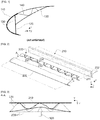
- the figure 1 schematically represents the section, in the xz plane of a slat according to the prior art.
- the axis system shown is that of the airplane, the fuselage extends parallel to the x axis and the airfoil essentially along the y axis .
- Such a slat comprises an upper skin (110) extending from the leading edge (beak) to the trailing edge.
- a spar (120) is assembled to the upper skin (110) to which ribs are linked.
- An inner skin (130) is linked to the upper surface skin (110) by means of a stiffening system (140) such as beams, ribs, or even a honeycomb structure according to the mode of production.
- a stiffening system such as beams, ribs, or even a honeycomb structure according to the mode of production.
- ribs distributed along the y axis are linked to the spar and to the upper skin providing a box structure, both on the side of the leading edge and on the side of the trailing edge.
- the slat is linked to the wing by means of one or more interface fittings (not shown) connected via arms or maneuvering rails to mechanical or hydraulic actuator means to achieve the controlled relative movement. of the slat in relation to the wing.
- the structure schematically represented figure 1 corresponds to an example of metal construction, but the composite constructions of the prior art are similar.
- a slat In terms of rigidity, a slat must be rigid enough to resist aerodynamic forces.
- the aerodynamic forces undergone by the slat are transferred to the airfoil via the interface fittings and the rails or maneuvering arms which must be dimensioned accordingly according to the number of fittings.
- connection of the slat with the wing comprises more than two fittings, which is frequent, the mounting is hyperstatic.
- This hyperstatism combined with the differences in deformities is responsible for half of the stresses to which said fittings and the slat are subjected, the rest coming from aerodynamic loading.
- leading edges of the wing elements are exposed to impacts, in particular to impacts with birds.
- the skin format the leading edge beak is linked to the spar and stiffened by straight ribs (150) perpendicular to the spar.
- straight ribs 150
- up to 18 ribs are thus distributed along the y axis between the spar and the skin forming the leading edge, thus forming a structure in multiple boxes.
- each of these ribs (150) weighs approximately 200 grams, ie a total weight attributable to this stiffening of the order of 3.6 kg.
- the majority component of the speed of impact of an object or a bird on the leading edge is parallel to the x axis, and corresponds to the speed of movement of the aircraft.
- Multiplying the ribs in addition to increasing the mass, increases the rigidity of the slat and reduces its ability to follow the deformations of the wing, increasing the interface forces linked to the differences in deformation between the wing and the slat.
- the invention aims to solve the drawbacks of the prior art and for this purpose relates to a leading edge spout of a wing element of an aircraft, said aircraft defining a reference frame comprising a main fuselage axis x and a span axis y, the wing element providing a lift along a z axis , comprising a skin forming the leading edge spout, a spar linked to said skin and a stiffening structure linked on the leading edge side to said spar and to the skin, in which the stiffening structure consists of a formed sheet comprising a plurality of bosses distributed along the length of the leading edge, said bosses extending between the spar and the inner face of the skin and in which the bosses form domes having an area in contact with the skin and tangent thereto, the hollows between the bosses being in contact with the tang and tangent thereto.
- this stiffening structure makes it possible to distribute the impact energy over a larger surface, limiting the
- said spout is a movable spout of the leading edge or slat.
- the stiffening provided by the structure object of the invention is less than equal impact absorption capacity, thus favoring the monitoring of the deformations of the wing and limiting the deformation incompatibility constraints.
- the sides of the bosses form an angle of less than 90 ° relative to the surface of the spar and to the surface of the skin.
- the inclination of the sides of the bosses favors the absorption of impact energy both by the stiffening plate and by the skin forming the leading edge beak.
- the stiffening structure consists of a composite material with continuous fibers in a thermoplastic matrix. This embodiment makes it possible to lighten the structure, by taking advantage of the better distribution of impact energy to allow construction in composite material.
- the skin forming the spout and the spar also consist of a composite material with continuous fibers and a polymer matrix, and the stiffening structure is linked to the spar and to the skin by welding.
- This embodiment allows a gain in mass facilitates assemblies.
- the pitch of the bosses is variable over the length of the leading edge spout.
- Figure 2 corresponding for example to the leading edge of a slat, the structure of a leading edge according to the invention, comprises a spar (210) of substantially U-shaped section, and a skin (220), in partial representation in this figure, forming the leading edge.
- the skin is extended in one piece or in several assembled parts, upper side and lower side.
- the spar (210) comprises a core (211) extending in the plane y - z according to this embodiment and flanges (212) on either side of the core.
- the spar (210) and the skin (220) are linked by the flanges (212) of the spar on the upper and lower sides by riveting or by welding according to the embodiments.
- the spar (210) and the skin (220) are made of a metallic material, for example an aluminum alloy or are made of a composite with continuous reinforcement in a thermosetting or thermoplastic polymer matrix.
- a stiffening structure (230) extends between the skin (220) and the spar (210) it is fixed on the one hand to the core (211) of the spar and on the other hand to the inner face of the skin .
- the stiffening structure (230) is a sheet comprising a plurality of bosses (231), distributed over the length, here the y axis, of the leading edge.
- Each boss (231) forms a dome comprising, on the skin side, a zone (232) tangent to the inner surface of the skin, and in the hollow between two bumps, a zone (233) tangent to the surface of the core (211) of the spar.
- None of the sides of the domes constituting the bosses (231) is parallel to normal to the core of the spar, so that no surface of said domes is parallel to the main component of the speed vector, directed essentially along the x- axis, of an object impacting the leading edge.
- the stiffening structure comprises 9 domes (231) distributed in a regular pitch along the y axis. It advantageously replaces 9 straight ribs between the spar and the leading edge skin.
- the pitch of the bosses is variable and preferably increases along the y axis away from the root of the element of airfoil so as to adapt the stiffening to the rigidity of said airfoil element.
- the stiffening structure consists of a sheet formed from aluminum alloy. Such a shape is obtained by hydroforming, superplastic forming or even by incremental forming.
- the sheet has a thickness of 1 mm and weighs around 500 grams, thus representing a gain of 1.3 kg compared to a solution of the prior art using 9 straight ribs of 200 grams. each.
- the stiffening structure (230) consists of a composite material comprising a continuous reinforcement, for example in the form of carbon fibers, in a thermoplastic polymer matrix, for example made of polyetheretherketone (PEEK).
- PEEK polyetheretherketone
- thermoplastic polymer matrix ensures superior resistance to impact in comparison with a thermosetting matrix.
- Welding is carried out by ultrasound or by bringing the assembly to be assembled to an appropriate temperature in a tool. If one of the skin or the spar consists of a composite with a thermosetting matrix, a thermoplastic film capable of bonding with the polymer constituting the matrix of this element is previously deposited on the surfaces corresponding to the assembly zones.
- this film is deposited by an additive manufacturing process according to a method as described in the document. EP 3,242,790 .
- the pitch of the bosses as well as the angles of their sides are chosen so as to facilitate the passage of a fiber placement head for their production.
- leading edge structure according to the invention allows both: weight gain, better impact resistance and stiffening better preserving the compatibility of deformation between the leading edge and the wing element when this leading edge is mobile.
- the structure which is the subject of the invention opens the possibility of producing a leading edge according to a composite construction capable of meeting the requirements for impact resistance.
Landscapes
- Engineering & Computer Science (AREA)
- Aviation & Aerospace Engineering (AREA)
- Mechanical Engineering (AREA)
- Laminated Bodies (AREA)
Abstract
Description
- L'invention concerne un bec de bord d'attaque de voilure d'aéronef tel qu'un bec basculant de bord d'attaque, ou « slat », dont la structure du bec est optimisée.
- Plus particulièrement l'invention concerne une structure de raidissement d'un tel bec de bord d'attaque.
- Les becs de bord d'attaque de voilure sont présents sur un aéronef tant sur les plans horizontaux, ailes et plans horizontaux de dérive, que les plans verticaux tel que sur la dérive.
- Les slats présents sur une aile d'aéronef, sont des bords d'attaque basculants qui permettent, par leur déplacement contrôlé, de modifier l'écoulement aérodynamique autour de l'aile et d'en modifier la portance à une vitesse donnée.
- Un avion de transport civil comprend généralement 3 à 5 slats répartis sur les bords d'attaque des ailes, depuis l'emplanture de l'aile jusqu'au saumon, lesquels suivent l'évolution de la section de l'aile entre ses deux extrémités.
- Un slat est ainsi une surface portante de la voilure qui peut récupérer, à une position d'envergure donnée, jusqu'à 30 % de la portance totale de la section de voilure.
- La
figure 1 représente schématiquement la section, dans le plan x-z d'un slat selon l'art antérieur. Le système d'axe représenté est celui de l'avion le fuselage s'étend parallèlement à l'axe x et la voilure essentiellement selon l'axe y. - Un tel slat comprend une peau extrados (110) s'étendant depuis le bord d'attaque (bec) jusqu'au bord de fuite. Laquelle est, selon certains modes de réalisation, constituée de plusieurs parties.
- Un longeron (120) est assemblé à la peau extrados (110) auquel sont liées des nervures.
- Une peau intérieure (130) est liée à la peau d'extrados (110) par l'intermédiaire d'un système de raidissement (140) tel que des lisses, des nervures, voire une structure en nid d'abeille selon le mode de réalisation.
- Plusieurs nervures réparties selon l'axe y, sont liées au longeron et à la peau extrados réalisant une structure en caisson, tant du côté du bord d'attaque que du côté du bord de fuite.
- Le slat est lié à l'aile par l'intermédiaire d'une ou plusieurs ferrures d'interface (non représentées) connectées par l'intermédiaire de bras ou de rails de manœuvre à des moyens actionneur mécaniques ou hydrauliques pour réaliser le déplacement relatif contrôlé du slat par rapport à l'aile.
- La structure schématiquement représentée
figure 1 correspond à un exemple de construction métallique, mais les constructions en composite de l'art antérieur sont similaires. - Cette conception mécanique a peu évolué.
- En termes de rigidité, un slat doit être suffisamment rigide pour résister aux efforts aérodynamiques.
- Les efforts aérodynamiques subis par le slat sont transférés à la voilure via les ferrures d'interface et les rails ou bras de manœuvre qui doivent être dimensionnés en conséquence selon le nombre de ferrures.
- Lorsqu'un slat est lié à l'aile par plus de deux ferrures d'interface, les différences de déformée entre l'aile et le slat produisent des surcontraintes dans les ferrures d'interface et les éléments de manœuvre, d'autant plus importantes que le nombre de ferrures d'interface est élevé.
- En effet, lorsque la liaison du slat avec l'aile comprend plus de deux ferrures, ce qui est fréquent, le montage est hyperstatique. Cet hyperstatisme combiné aux différences de déformées est responsable de la moitié des efforts auxquels sont soumises lesdites ferrures et le slat, le reste provenant du chargement aérodynamique.
- Ce phénomène oblige à dimensionner les ferrures d'interface et les moyens de manœuvre, en conséquence ce qui a influence sur la masse, et augmente les risques de grippage ou de coincement, qui doivent être pris en compte dans le dimensionnement.
- Par ailleurs, les bords d'attaques des éléments de voilure sont exposés aux chocs, notamment aux chocs avec des oiseaux.
- Dans une conception classique telle que représentée
figure 1 , la peau format le bec de bord d'attaque, est liée au longeron et raidie par des nervures droites (150) perpendiculaires au longeron. Selon des exemples de réalisation jusqu'à 18 nervures sont ainsi réparties selon l'axe y entre le longeron et la peau formant le bord d'attaque, formant ainsi une structure en caissons multiples. - Selon un exemple de réalisation d'un slat, chacune de ces nervures (150) pèse environ 200 grammes soit un poids total imputable à ce raidissement de l'ordre de 3,6 kg.
- En cas de choc, sur le bec, ces nervures droites, très rigides génèrent un transfert direct de l'énergie d'impact vers le longeron.
- La composante majoritaire de la vitesse d'impact d'un objet ou d'un oiseau sur le bord d'attaque est parallèle à l'axe x, et correspond à la vitesse de déplacement de l'aéronef.
- De par la raideur importante des nervures (150) dans la direction x, ces nervures ne favorisent pas la diffusion de l'énergie d'impact. Le risque est un endommagement du longeron.
- Dans le cas où le longeron est endommagé, la tenue résiduelle de la structure après impact est remise en cause.
- Multiplier les nervures, outre l'augmentation de la masse, augmente la rigidité du slat et réduit sa capacité à suivre les déformations de l'aile, augmentant les efforts d'interface liés aux différences de déformation entre l'aile et le slat.
- De plus, cette solution architecturale de l'art antérieur est encore plus défavorable vis-à-vis de la tenue au choc dans le cas d'une construction réalisée en matériau composite, de type de matériau présentant une capacité d'absorption d'énergie à la rupture, à rigidité égale, inférieure à celle des matériaux métalliques.
- Le document
US 9,708,030 - L'invention vise à résoudre les inconvénients de l'art antérieur et concerne à cette fin un bec de bord d'attaque d'un élément de voilure d'un aéronef, ledit aéronef définissant un repère comprenant un axe principal de fuselage x et un axe d'envergure y, l'élément de voilure procurant une portance selon un axe z, comprenant une peau formant le bec de bord d'attaque, un longeron lié à ladite peau et une structure de raidissement liée côté bord d'attaque audit longeron et à la peau, dans lequel la structure de raidissement est constituée d'une tôle formée comprenant une pluralité de bossages répartis selon la longueur du bord d'attaque, lesdits bossages s'étendant entre le longeron et la face interne de la peau et dans lequel les bossages forment des dômes comportant une zone en contact avec la peau et tangent à celle-ci, les creux entre les bossages étant en contact avec le longeron et tangents à celui-ci. En comparaison de l'art antérieur, cette structure de raidissement permet de répartir l'énergie d'impact sur une plus grande surface, limitant les risques de dégradation du longeron, mais aussi dans un volume de matière plus important, rendant cette solution compatible avec une construction composite, tout en conservant une facilité d'assemblage.
- L'invention est mise en œuvre selon les modes de réalisation et les variantes exposés ci-après, lesquels sont à considérer individuellement ou selon toute combinaison techniquement opérante.
- Selon un exemple de réalisation, ledit bec est un bec mobile de bord d'attaque ou slat. Dans cet exemple de réalisation et en comparaison de l'art antérieur, le raidissement procuré par la structure objet de l'invention est inférieur à capacité d'absorption d'impact égal, favorisant ainsi le suivi des déformations de l'aile et limitant les contraintes d'incompatibilité de déformation.
- Avantageusement, les flancs des bossages forment un angle inférieur à 90° par rapport à la surface du longeron et à la surface de la peau. L'inclinaison des flancs des bossages favorise l'absorption de l'énergie d'impact tant par la tôle de raidissement que par la peau formant le bec de bord d'attaque.
- Selon un mode de réalisation, la structure de raidissement est constituée d'un matériau composite à fibres continues dans une matrice thermoplastique. Ce mode de réalisation permet d'alléger la structure, en tirant avantage de la meilleure répartition d'énergie d'impact pour permettre une construction en matériau composite.
- Avantageusement, la peau formant le bec et le longeron sont également constitués d'un matériau composite à fibres continues et à matrice polymère, et la structure de raidissement est liée au longeron et à la peau par soudure. Ce mode de réalisation permet un gain de masse facilite les assemblages.
- Selon un mode de réalisation particulier, le pas des bossages est variable sur la longueur du bec de bord d'attaque.
- L'invention est exposée ci-après selon ses modes de réalisation préférés, nullement limitatifs, et en référence aux
figures 1 à 3 dans lesquelles ; - [
fig. 1 ] lafigure 1 relative à l'art antérieur représente, selon une vue en section, un exemple schématique de réalisation d'un slat selon l'art antérieur ; - [
fig. 2 ] la figure représente selon une vue en perspective et en éclaté, un exemple de réalisation d'un bord d'attaque selon l'invention ; - [
fig. 3 ] et lafigure 3 représente schématiquement selon un plan de coupe AA représentéfigure 2 , la réponse de la structure de lafigure 2 au cours d'un impact, avec en pointillé la forme des éléments avant impact et en trait plein la déformation de ces éléments au cours de l'impact. -
Figure 2 , selon un exemple de réalisation, correspondant par exemple au bord d'attaque d'un slat, la structure d'un bord d'attaque selon l'invention, comprend un longeron (210) de section sensiblement en forme de U, et une peau (220), en représentation partielle sur cette figure, formant le bord d'attaque. La peau se prolonge d'une seule pièce ou en plusieurs parties assemblées, côté extrados et côté intrados. - Le longeron (210) comprend une âme (211) s'étendant dans le plan y-z selon ce mode de réalisation et des semelles (212) de part et d'autre de l'âme.
- Le longeron (210) et la peau (220) sont liés par les semelles (212) du longeron côtés extrados et intrados par rivetage ou par soudage selon les modes de réalisation.
- Selon les variantes de réalisation le longeron (210) et la peau (220) sont constitués d'un matériau métallique, par exemple un alliage d'aluminium ou sont constitués d'un composite à renfort continu dans une matrice polymère thermodurcissable ou thermoplastique.
- Une structure de raidissement (230) s'étend entre la peau (220) et le longeron (210) elle est fixée d'une part à l'âme (211) du longeron et d'autre part à la face intérieure de la peau.
- La structure de raidissement (230) est une tôle comprenant une pluralité de bossages (231), répartis sur la longueur, ici l'axe y, du bord d'attaque.
- Chaque bossage (231) forme un dôme comportant, côté peau, une zone (232) tangente à la surface intérieure de la peau, et au creux entre deux bosses, une zone (233) tangente à la surface de l'âme (211) du longeron.
- Aucun des flancs des dômes constituants les bossages (231) n'est parallèle à la normale à l'âme du longeron, de sorte qu'aucune surface desdits dôme n'est parallèle à la composante principale du vecteur vitesse, dirigé essentiellement selon l'axe x, d'un objet impactant le bord d'attaque.
- Selon cet exemple de réalisation, la structure de raidissement comporte 9 dômes (231) répartis selon un pas régulier le long de l'axe y. Elle remplace avantageusement 9 nervures droites entre le longeron et la peau de bord d'attaque.
- Alternativement, le pas des bossages est variable et préférentiellement augmente selon l'axe y en s'éloignant de l'emplanture de l'élément de voilure de sorte à adapter le raidissement à la rigidité dudit élément de voilure.
- Selon un exemple de réalisation, la structure de raidissement est constituée d'une tôle formée en alliage d'aluminium. Une telle forme est obtenue par hydroformage, formage superplastique ou encore par formage incrémental.
- A titre d'exemple non limitatif, la tôle a une épaisseur de 1 mm et pèse environ 500 grammes, représentant ainsi un gain de 1,3 kg par rapport à une solution de l'art antérieur mettant en œuvre 9 nervures droites de 200 grammes chacune.
- Selon un autre mode de réalisation la structure de raidissement (230) est constituée d'un matériau composite comportant un renfort continu, par exemple sous la forme de fibres de carbone, dans une matrice polymère thermoplastique par exemple en polyétheréthercétone (PEEK).
- L'utilisation d'une matrice polymère thermoplastique assure une tenue supérieure à l'impact en comparaison d'une matrice thermodurcissable.
- Selon cette configuration composite, la structure de raidissement (230) est avantageusement assemblée au longeron (210) et à la peau (220) par soudure, ceux-ci étant également de structure composite.
- La soudure est réalisée par ultrasons ou en portant l'ensemble à assembler à une température appropriée dans un outillage. Si l'un de la peau ou du longeron est constitué d'un composite à matrice thermodurcissable, un film thermoplastique apte à se lier avec le polymère constituant la matrice de cet élément est préalablement déposé sur les surfaces correspondant aux zones d'assemblage.
- Selon un exemple de réalisation ce film est déposé par un procédé de fabrication additive selon une méthode telle que décrite dans le document
EP 3 242 790 . - Selon cet exemple de réalisation de la structure de raidissement en matériau composite, le pas des bossages ainsi que les angles de leurs flancs sont choisis de sorte à faciliter le passage d'une tête de placement de fibres pour leur réalisation.
-
Figure 3 , en cas d'impact sur la structure objet de l'invention avec une direction d'impact (300) dont la composante principale est orientée selon l'axe x, la déformation de la peau (220) sollicite la déformation de plusieurs bossages de la structure de raidissement (230) répartissant ainsi l'énergie d'impact dans un volume de matière important et l'effort de réaction sur une surface importante du longeron (210) qui est ainsi préservé. - Du fait de l'inclinaison des flancs des bossages, plus la pénétration de l'impacteur selon x est importante et plus le nombre de bossages affectés par la déformation est important, augmentant d'autant plus les capacités de dissipation de l'énergie d'impact.
- La déformation plastique de la peau (220) et de la structure de raidissement (230) lorsque celles-ci sont constituées d'un matériau métallique, ou leur dégradation par délaminage lorsqu'elles sont constituées d'un matériau composite, seuille l'effort transmis au longeron sur une grande distance de déplacement de l'impacteur, quasiment jusqu'à ce que celui-ci atteigne le longeron.
- La description ci-avant montre que la structure de bord d'attaque selon l'invention permet à la fois : un gain de masse, une meilleure tenue à l'impact et un raidissement préservant mieux la compatibilité de déformation entre le bord d'attaque et l'élément de voilure lorsque ce bord d'attaque est mobile.
- De plus, la structure objet de l'invention ouvre la possibilité de réalisation d'un bord d'attaque selon une construction composite apte à répondre aux exigences de tenue au choc.
Claims (6)
- Bec de bord d'attaque d'un élément de voilure d'un aéronef, ledit aéronef définissant un repère comprenant un axe principal de fuselage x et un axe d'envergure y, l'élément de voilure procurant une portance selon un axe z, comprenant une peau (220) formant le bec de bord d'attaque, un longeron (210) lié à ladite peau et une structure de raidissement (230) liée côté bord d'attaque audit longeron et à la peau, la structure de raidissement (230) étant constituée d'une tôle formée comprenant une pluralité de bossages (231) répartis selon la longueur du bord d'attaque, lesdits bossages s'étendant entre le longeron et la face interne de la peau, caractérisé en ce que les bossages (231) forment des dômes comportant une zone (232) en contact avec la peau et tangent à celle-ci, les creux (233) entre les bossages étant en contact avec le longeron (210) et tangents à celui-ci.
- Bec de bord d'attaque selon la revendication 1, dans lequel ledit bec est un bec mobile de bord d'attaque ou slat.
- Bec de bord d'attaque selon la revendication 1, dans lequel les flancs des bossages (231) forment un angle inférieur à 90° par rapport à la surface du longeron et à la surface de la peau avec lesquels ils sont en contact.
- Bec de bord d'attaque selon la revendication 1, dans lequel la structure de raidissement (230) est constituée d'un matériau composite à fibres continues dans une matrice thermoplastique.
- Bec de bord d'attaque selon la revendication 4, dans lequel la peau (220) formant le bec et le longeron (210) sont constitué d'un matériau composite à fibres continues dans une matrice polymère, et dans lequel la structure de raidissement (230) est liée au longeron et à la peau par soudure.
- Bec de bord d'attaque selon la revendication 1, dans lequel le pas de répartition des bossages (231) est variable sur la longueur du bec de bord d'attaque.
Applications Claiming Priority (1)
| Application Number | Priority Date | Filing Date | Title |
|---|---|---|---|
| FR1874356A FR3091263A1 (fr) | 2018-12-28 | 2018-12-28 | Bec de bord d’attaque à structure optimisée |
Publications (2)
| Publication Number | Publication Date |
|---|---|
| EP3674205A1 true EP3674205A1 (fr) | 2020-07-01 |
| EP3674205B1 EP3674205B1 (fr) | 2021-05-05 |
Family
ID=66690612
Family Applications (1)
| Application Number | Title | Priority Date | Filing Date |
|---|---|---|---|
| EP19202335.6A Active EP3674205B1 (fr) | 2018-12-28 | 2019-10-09 | Bec de bord d'attaque à structure optimisée |
Country Status (3)
| Country | Link |
|---|---|
| US (1) | US11260956B2 (fr) |
| EP (1) | EP3674205B1 (fr) |
| FR (1) | FR3091263A1 (fr) |
Families Citing this family (3)
| Publication number | Priority date | Publication date | Assignee | Title |
|---|---|---|---|---|
| EP4303122A1 (fr) * | 2022-07-07 | 2024-01-10 | Airbus Operations GmbH | Aile pour un aéronef |
| WO2025229479A1 (fr) * | 2024-04-29 | 2025-11-06 | Leonardo S.P.A. | Système de bord d'attaque pour aéronef muni d'un ensemble d'absorption d'impacts |
| CN121364051B (zh) * | 2025-12-22 | 2026-02-24 | 中国航空工业集团公司沈阳空气动力研究所 | 一种结冰风洞热气防冰试验模型 |
Citations (5)
| Publication number | Priority date | Publication date | Assignee | Title |
|---|---|---|---|---|
| JP2003291895A (ja) * | 2002-04-05 | 2003-10-15 | Japan Aircraft Mfg Co Ltd | 航空機翼前縁部及びこの製造方法 |
| US7923096B2 (en) * | 2007-08-16 | 2011-04-12 | Eads Deutschland Gmbh | Impulse-absorbing structural component |
| EP2522572A1 (fr) * | 2011-05-12 | 2012-11-14 | EADS Deutschland GmbH | Pare-chocs pour véhicules, en particulier pour aéronefs |
| US9708030B1 (en) | 2011-12-08 | 2017-07-18 | The Boeing Company | Impact-energy tolerant method and structures |
| EP3242790A1 (fr) | 2015-01-09 | 2017-11-15 | Daher Aerospace | Procédé pour la fabrication d'un pièce composite complexe, notamment à matrice thermoplastique et pièce obtenue par un tel procédé |
Family Cites Families (10)
| Publication number | Priority date | Publication date | Assignee | Title |
|---|---|---|---|---|
| US5366177A (en) * | 1992-10-05 | 1994-11-22 | Rockwell International Corporation | Laminar flow control apparatus for aerodynamic surfaces |
| JP3647612B2 (ja) * | 1997-07-24 | 2005-05-18 | 富士重工業株式会社 | 航空機の前縁構造及びその製造方法 |
| US20040237763A1 (en) * | 2003-06-02 | 2004-12-02 | Ashok Bhatnagar | Corrugated ballistic armor |
| DE602005002144D1 (de) * | 2004-05-13 | 2007-10-04 | Airbus Gmbh | Flugzeugbauteil, insbesondere flügel |
| DE102004029485B4 (de) * | 2004-06-18 | 2007-05-31 | Eads Deutschland Gmbh | Impuls-absorbierendes Struktur-Bauteil |
| GB0720387D0 (en) * | 2007-10-18 | 2007-11-28 | Airbus Uk Ltd | Panel with impact protection membrane |
| GB0900494D0 (en) * | 2009-01-14 | 2009-02-11 | Airbus Uk Ltd | Aerofoil Structure |
| US10556670B2 (en) * | 2010-08-15 | 2020-02-11 | The Boeing Company | Laminar flow panel |
| JP6238168B2 (ja) * | 2014-02-04 | 2017-11-29 | 三菱重工業株式会社 | 複合材構造 |
| GB201522327D0 (en) * | 2015-12-17 | 2016-02-03 | Airbus Operations Ltd | Wing structure |
-
2018
- 2018-12-28 FR FR1874356A patent/FR3091263A1/fr not_active Withdrawn
-
2019
- 2019-10-09 EP EP19202335.6A patent/EP3674205B1/fr active Active
- 2019-12-26 US US16/727,189 patent/US11260956B2/en active Active
Patent Citations (5)
| Publication number | Priority date | Publication date | Assignee | Title |
|---|---|---|---|---|
| JP2003291895A (ja) * | 2002-04-05 | 2003-10-15 | Japan Aircraft Mfg Co Ltd | 航空機翼前縁部及びこの製造方法 |
| US7923096B2 (en) * | 2007-08-16 | 2011-04-12 | Eads Deutschland Gmbh | Impulse-absorbing structural component |
| EP2522572A1 (fr) * | 2011-05-12 | 2012-11-14 | EADS Deutschland GmbH | Pare-chocs pour véhicules, en particulier pour aéronefs |
| US9708030B1 (en) | 2011-12-08 | 2017-07-18 | The Boeing Company | Impact-energy tolerant method and structures |
| EP3242790A1 (fr) | 2015-01-09 | 2017-11-15 | Daher Aerospace | Procédé pour la fabrication d'un pièce composite complexe, notamment à matrice thermoplastique et pièce obtenue par un tel procédé |
Also Published As
| Publication number | Publication date |
|---|---|
| US11260956B2 (en) | 2022-03-01 |
| US20200207458A1 (en) | 2020-07-02 |
| EP3674205B1 (fr) | 2021-05-05 |
| FR3091263A1 (fr) | 2020-07-03 |
Similar Documents
| Publication | Publication Date | Title |
|---|---|---|
| EP1706315B1 (fr) | Volet mobile de bord d'attaque d'une aile principale de la voilure d'un aeronef, et aile principale munie d'un tel volet | |
| EP2653377B1 (fr) | Surface aérodynamique portante d'aéronef, et aéronef muni de ladite surface aérodynamique portante | |
| EP2242683B1 (fr) | Panneau composite monolithique auto-raidi et pivotant, notamment pour une partie mobile d'aeronef | |
| EP3674205B1 (fr) | Bec de bord d'attaque à structure optimisée | |
| EP3670331B1 (fr) | Elément de voilure avec un elément mobile | |
| EP2706011A1 (fr) | Ensemble propulsif latéral pour aéronef comprenant un arceau de support d'un turbomoteur | |
| EP3505439B1 (fr) | Ensemble pour aeronef comprenant une structure primaire de mat d'accrochage fixee a un caisson de voilure par des attaches presentant un encombrement reduit dans la zone de bord d'attaque | |
| FR2993942A1 (fr) | Aube composite de turbomachine a renfort structurel | |
| FR2946013A1 (fr) | Avion comportant une aile mobile suivant l'axe longitudinal du fuselage | |
| EP3670325B1 (fr) | Structure d'un fuselage d'un aeronef presentant un panneau renforce par un treillis | |
| EP3521173B1 (fr) | Ensemble pour aeronef comprenant une structure primaire de mat d'accrochage fixee a un caisson de voilure a l'aide d'une liaison boulonnee | |
| FR3099464A1 (fr) | Mat reacteur pour coupler un turboreacteur a une aile d’un aeronef | |
| CA2951757C (fr) | Procede d'assemblage d'un ensemble de pieces composites et ensemble obtenu par un tel procede | |
| EP2818408B1 (fr) | Pale à rigidité en torsion réduite et rotor muni d'une telle pale | |
| EP1961658B1 (fr) | Pale de giravion pourvue d'un tronçon radial et d'au moins un tronçon en fléche avant et/ou arrière | |
| EP2655919B1 (fr) | Pièce structurale à capacité de dissipation d'énergie | |
| EP4186785B1 (fr) | Pilier flexible pour une ossature flexible d'une gouverne à géométrie variable | |
| EP3287363B1 (fr) | Extension de voilure pour une aile d'aeronef | |
| FR3069185A1 (fr) | Profil aerodynamique a noyau creux oblong arrondi en materiau composite renforce par un textile a fibres unidirectionnelles | |
| EP1768898B1 (fr) | Volet mobile de bord d'attaque d'une aile principale de la voilure d'un aeronef | |
| EP4540501B1 (fr) | Aube a structure composite presentant une orientation de sortie de couche amelioree | |
| EP4061702B1 (fr) | Element aerodynamique comportant deux pieces aerodynamiques formant une jonction de profil ascendant | |
| WO2026002807A1 (fr) | Volet mobile de bord d'attaque d'une aile d'aéronef, présentant une forme nominale courbe afin de s'adapter à la déformée de l'aile en vol | |
| FR2988074A1 (fr) | Aeronef comprenant des carenages visant a corriger sa dissymetrie ou son asymetrie laterale | |
| FR2980451A1 (fr) | Procede d'optimisation de la tenue mecanique d'un caisson de structure autonome et caisson de mise en oeuvre |
Legal Events
| Date | Code | Title | Description |
|---|---|---|---|
| PUAI | Public reference made under article 153(3) epc to a published international application that has entered the european phase |
Free format text: ORIGINAL CODE: 0009012 |
|
| STAA | Information on the status of an ep patent application or granted ep patent |
Free format text: STATUS: REQUEST FOR EXAMINATION WAS MADE |
|
| 17P | Request for examination filed |
Effective date: 20191009 |
|
| AK | Designated contracting states |
Kind code of ref document: A1 Designated state(s): AL AT BE BG CH CY CZ DE DK EE ES FI FR GB GR HR HU IE IS IT LI LT LU LV MC MK MT NL NO PL PT RO RS SE SI SK SM TR |
|
| AX | Request for extension of the european patent |
Extension state: BA ME |
|
| GRAP | Despatch of communication of intention to grant a patent |
Free format text: ORIGINAL CODE: EPIDOSNIGR1 |
|
| STAA | Information on the status of an ep patent application or granted ep patent |
Free format text: STATUS: GRANT OF PATENT IS INTENDED |
|
| INTG | Intention to grant announced |
Effective date: 20201125 |
|
| GRAS | Grant fee paid |
Free format text: ORIGINAL CODE: EPIDOSNIGR3 |
|
| GRAA | (expected) grant |
Free format text: ORIGINAL CODE: 0009210 |
|
| STAA | Information on the status of an ep patent application or granted ep patent |
Free format text: STATUS: THE PATENT HAS BEEN GRANTED |
|
| AK | Designated contracting states |
Kind code of ref document: B1 Designated state(s): AL AT BE BG CH CY CZ DE DK EE ES FI FR GB GR HR HU IE IS IT LI LT LU LV MC MK MT NL NO PL PT RO RS SE SI SK SM TR |
|
| REG | Reference to a national code |
Ref country code: GB Ref legal event code: FG4D Free format text: NOT ENGLISH |
|
| REG | Reference to a national code |
Ref country code: CH Ref legal event code: EP |
|
| REG | Reference to a national code |
Ref country code: AT Ref legal event code: REF Ref document number: 1389508 Country of ref document: AT Kind code of ref document: T Effective date: 20210515 |
|
| REG | Reference to a national code |
Ref country code: IE Ref legal event code: FG4D Free format text: LANGUAGE OF EP DOCUMENT: FRENCH |
|
| REG | Reference to a national code |
Ref country code: DE Ref legal event code: R096 Ref document number: 602019004469 Country of ref document: DE |
|
| REG | Reference to a national code |
Ref country code: NL Ref legal event code: FP |
|
| REG | Reference to a national code |
Ref country code: LT Ref legal event code: MG9D |
|
| REG | Reference to a national code |
Ref country code: AT Ref legal event code: MK05 Ref document number: 1389508 Country of ref document: AT Kind code of ref document: T Effective date: 20210505 |
|
| PG25 | Lapsed in a contracting state [announced via postgrant information from national office to epo] |
Ref country code: HR Free format text: LAPSE BECAUSE OF FAILURE TO SUBMIT A TRANSLATION OF THE DESCRIPTION OR TO PAY THE FEE WITHIN THE PRESCRIBED TIME-LIMIT Effective date: 20210505 Ref country code: LT Free format text: LAPSE BECAUSE OF FAILURE TO SUBMIT A TRANSLATION OF THE DESCRIPTION OR TO PAY THE FEE WITHIN THE PRESCRIBED TIME-LIMIT Effective date: 20210505 Ref country code: FI Free format text: LAPSE BECAUSE OF FAILURE TO SUBMIT A TRANSLATION OF THE DESCRIPTION OR TO PAY THE FEE WITHIN THE PRESCRIBED TIME-LIMIT Effective date: 20210505 Ref country code: AT Free format text: LAPSE BECAUSE OF FAILURE TO SUBMIT A TRANSLATION OF THE DESCRIPTION OR TO PAY THE FEE WITHIN THE PRESCRIBED TIME-LIMIT Effective date: 20210505 Ref country code: BG Free format text: LAPSE BECAUSE OF FAILURE TO SUBMIT A TRANSLATION OF THE DESCRIPTION OR TO PAY THE FEE WITHIN THE PRESCRIBED TIME-LIMIT Effective date: 20210805 |
|
| PG25 | Lapsed in a contracting state [announced via postgrant information from national office to epo] |
Ref country code: PL Free format text: LAPSE BECAUSE OF FAILURE TO SUBMIT A TRANSLATION OF THE DESCRIPTION OR TO PAY THE FEE WITHIN THE PRESCRIBED TIME-LIMIT Effective date: 20210505 Ref country code: LV Free format text: LAPSE BECAUSE OF FAILURE TO SUBMIT A TRANSLATION OF THE DESCRIPTION OR TO PAY THE FEE WITHIN THE PRESCRIBED TIME-LIMIT Effective date: 20210505 Ref country code: NO Free format text: LAPSE BECAUSE OF FAILURE TO SUBMIT A TRANSLATION OF THE DESCRIPTION OR TO PAY THE FEE WITHIN THE PRESCRIBED TIME-LIMIT Effective date: 20210805 Ref country code: PT Free format text: LAPSE BECAUSE OF FAILURE TO SUBMIT A TRANSLATION OF THE DESCRIPTION OR TO PAY THE FEE WITHIN THE PRESCRIBED TIME-LIMIT Effective date: 20210906 Ref country code: RS Free format text: LAPSE BECAUSE OF FAILURE TO SUBMIT A TRANSLATION OF THE DESCRIPTION OR TO PAY THE FEE WITHIN THE PRESCRIBED TIME-LIMIT Effective date: 20210505 Ref country code: SE Free format text: LAPSE BECAUSE OF FAILURE TO SUBMIT A TRANSLATION OF THE DESCRIPTION OR TO PAY THE FEE WITHIN THE PRESCRIBED TIME-LIMIT Effective date: 20210505 Ref country code: IS Free format text: LAPSE BECAUSE OF FAILURE TO SUBMIT A TRANSLATION OF THE DESCRIPTION OR TO PAY THE FEE WITHIN THE PRESCRIBED TIME-LIMIT Effective date: 20210905 Ref country code: GR Free format text: LAPSE BECAUSE OF FAILURE TO SUBMIT A TRANSLATION OF THE DESCRIPTION OR TO PAY THE FEE WITHIN THE PRESCRIBED TIME-LIMIT Effective date: 20210806 |
|
| PG25 | Lapsed in a contracting state [announced via postgrant information from national office to epo] |
Ref country code: ES Free format text: LAPSE BECAUSE OF FAILURE TO SUBMIT A TRANSLATION OF THE DESCRIPTION OR TO PAY THE FEE WITHIN THE PRESCRIBED TIME-LIMIT Effective date: 20210505 Ref country code: EE Free format text: LAPSE BECAUSE OF FAILURE TO SUBMIT A TRANSLATION OF THE DESCRIPTION OR TO PAY THE FEE WITHIN THE PRESCRIBED TIME-LIMIT Effective date: 20210505 Ref country code: SK Free format text: LAPSE BECAUSE OF FAILURE TO SUBMIT A TRANSLATION OF THE DESCRIPTION OR TO PAY THE FEE WITHIN THE PRESCRIBED TIME-LIMIT Effective date: 20210505 Ref country code: CZ Free format text: LAPSE BECAUSE OF FAILURE TO SUBMIT A TRANSLATION OF THE DESCRIPTION OR TO PAY THE FEE WITHIN THE PRESCRIBED TIME-LIMIT Effective date: 20210505 Ref country code: DK Free format text: LAPSE BECAUSE OF FAILURE TO SUBMIT A TRANSLATION OF THE DESCRIPTION OR TO PAY THE FEE WITHIN THE PRESCRIBED TIME-LIMIT Effective date: 20210505 Ref country code: RO Free format text: LAPSE BECAUSE OF FAILURE TO SUBMIT A TRANSLATION OF THE DESCRIPTION OR TO PAY THE FEE WITHIN THE PRESCRIBED TIME-LIMIT Effective date: 20210505 Ref country code: SM Free format text: LAPSE BECAUSE OF FAILURE TO SUBMIT A TRANSLATION OF THE DESCRIPTION OR TO PAY THE FEE WITHIN THE PRESCRIBED TIME-LIMIT Effective date: 20210505 |
|
| REG | Reference to a national code |
Ref country code: DE Ref legal event code: R097 Ref document number: 602019004469 Country of ref document: DE |
|
| PLBE | No opposition filed within time limit |
Free format text: ORIGINAL CODE: 0009261 |
|
| STAA | Information on the status of an ep patent application or granted ep patent |
Free format text: STATUS: NO OPPOSITION FILED WITHIN TIME LIMIT |
|
| 26N | No opposition filed |
Effective date: 20220208 |
|
| PG25 | Lapsed in a contracting state [announced via postgrant information from national office to epo] |
Ref country code: IS Free format text: LAPSE BECAUSE OF FAILURE TO SUBMIT A TRANSLATION OF THE DESCRIPTION OR TO PAY THE FEE WITHIN THE PRESCRIBED TIME-LIMIT Effective date: 20210905 Ref country code: AL Free format text: LAPSE BECAUSE OF FAILURE TO SUBMIT A TRANSLATION OF THE DESCRIPTION OR TO PAY THE FEE WITHIN THE PRESCRIBED TIME-LIMIT Effective date: 20210505 |
|
| PG25 | Lapsed in a contracting state [announced via postgrant information from national office to epo] |
Ref country code: MC Free format text: LAPSE BECAUSE OF FAILURE TO SUBMIT A TRANSLATION OF THE DESCRIPTION OR TO PAY THE FEE WITHIN THE PRESCRIBED TIME-LIMIT Effective date: 20210505 |
|
| PG25 | Lapsed in a contracting state [announced via postgrant information from national office to epo] |
Ref country code: LU Free format text: LAPSE BECAUSE OF NON-PAYMENT OF DUE FEES Effective date: 20211009 Ref country code: IT Free format text: LAPSE BECAUSE OF FAILURE TO SUBMIT A TRANSLATION OF THE DESCRIPTION OR TO PAY THE FEE WITHIN THE PRESCRIBED TIME-LIMIT Effective date: 20210505 |
|
| REG | Reference to a national code |
Ref country code: CH Ref legal event code: PL |
|
| PG25 | Lapsed in a contracting state [announced via postgrant information from national office to epo] |
Ref country code: CY Free format text: LAPSE BECAUSE OF FAILURE TO SUBMIT A TRANSLATION OF THE DESCRIPTION OR TO PAY THE FEE WITHIN THE PRESCRIBED TIME-LIMIT Effective date: 20210505 |
|
| PG25 | Lapsed in a contracting state [announced via postgrant information from national office to epo] |
Ref country code: LI Free format text: LAPSE BECAUSE OF NON-PAYMENT OF DUE FEES Effective date: 20221031 Ref country code: HU Free format text: LAPSE BECAUSE OF FAILURE TO SUBMIT A TRANSLATION OF THE DESCRIPTION OR TO PAY THE FEE WITHIN THE PRESCRIBED TIME-LIMIT; INVALID AB INITIO Effective date: 20191009 Ref country code: CH Free format text: LAPSE BECAUSE OF NON-PAYMENT OF DUE FEES Effective date: 20221031 |
|
| PG25 | Lapsed in a contracting state [announced via postgrant information from national office to epo] |
Ref country code: MK Free format text: LAPSE BECAUSE OF FAILURE TO SUBMIT A TRANSLATION OF THE DESCRIPTION OR TO PAY THE FEE WITHIN THE PRESCRIBED TIME-LIMIT Effective date: 20210505 |
|
| PG25 | Lapsed in a contracting state [announced via postgrant information from national office to epo] |
Ref country code: MT Free format text: LAPSE BECAUSE OF FAILURE TO SUBMIT A TRANSLATION OF THE DESCRIPTION OR TO PAY THE FEE WITHIN THE PRESCRIBED TIME-LIMIT Effective date: 20210505 |
|
| PGFP | Annual fee paid to national office [announced via postgrant information from national office to epo] |
Ref country code: NL Payment date: 20251030 Year of fee payment: 7 |
|
| PG25 | Lapsed in a contracting state [announced via postgrant information from national office to epo] |
Ref country code: TR Free format text: LAPSE BECAUSE OF FAILURE TO SUBMIT A TRANSLATION OF THE DESCRIPTION OR TO PAY THE FEE WITHIN THE PRESCRIBED TIME-LIMIT Effective date: 20210505 |
|
| PGFP | Annual fee paid to national office [announced via postgrant information from national office to epo] |
Ref country code: DE Payment date: 20251030 Year of fee payment: 7 |
|
| PGFP | Annual fee paid to national office [announced via postgrant information from national office to epo] |
Ref country code: GB Payment date: 20251030 Year of fee payment: 7 |
|
| PGFP | Annual fee paid to national office [announced via postgrant information from national office to epo] |
Ref country code: FR Payment date: 20251030 Year of fee payment: 7 |
|
| PGFP | Annual fee paid to national office [announced via postgrant information from national office to epo] |
Ref country code: BE Payment date: 20251030 Year of fee payment: 7 |
|
| PGFP | Annual fee paid to national office [announced via postgrant information from national office to epo] |
Ref country code: IE Payment date: 20251030 Year of fee payment: 7 |