EP3674327A1 - Bindung von chimärem antigen-rezeptor (car) an bcma und verwendungen davon - Google Patents
Bindung von chimärem antigen-rezeptor (car) an bcma und verwendungen davon Download PDFInfo
- Publication number
- EP3674327A1 EP3674327A1 EP19746770.7A EP19746770A EP3674327A1 EP 3674327 A1 EP3674327 A1 EP 3674327A1 EP 19746770 A EP19746770 A EP 19746770A EP 3674327 A1 EP3674327 A1 EP 3674327A1
- Authority
- EP
- European Patent Office
- Prior art keywords
- car
- seq
- cell
- amino acid
- cells
- Prior art date
- Legal status (The legal status is an assumption and is not a legal conclusion. Google has not performed a legal analysis and makes no representation as to the accuracy of the status listed.)
- Pending
Links
Images





Classifications
-
- C—CHEMISTRY; METALLURGY
- C07—ORGANIC CHEMISTRY
- C07K—PEPTIDES
- C07K14/00—Peptides having more than 20 amino acids; Gastrins; Somatostatins; Melanotropins; Derivatives thereof
- C07K14/435—Peptides having more than 20 amino acids; Gastrins; Somatostatins; Melanotropins; Derivatives thereof from animals; from humans
- C07K14/705—Receptors; Cell surface antigens; Cell surface determinants
- C07K14/70503—Immunoglobulin superfamily
- C07K14/7051—T-cell receptor (TcR)-CD3 complex
-
- C—CHEMISTRY; METALLURGY
- C07—ORGANIC CHEMISTRY
- C07K—PEPTIDES
- C07K16/00—Immunoglobulins [IG], e.g. monoclonal or polyclonal antibodies
- C07K16/18—Immunoglobulins [IG], e.g. monoclonal or polyclonal antibodies against material from animals or humans
- C07K16/28—Immunoglobulins [IG], e.g. monoclonal or polyclonal antibodies against material from animals or humans against receptors, cell surface antigens or cell surface determinants
- C07K16/2878—Immunoglobulins [IG], e.g. monoclonal or polyclonal antibodies against material from animals or humans against receptors, cell surface antigens or cell surface determinants against the NGF-receptor/TNF-receptor superfamily, e.g. CD27, CD30, CD40, CD95
-
- A—HUMAN NECESSITIES
- A61—MEDICAL OR VETERINARY SCIENCE; HYGIENE
- A61K—PREPARATIONS FOR MEDICAL, DENTAL OR TOILETRY PURPOSES
- A61K40/00—Cellular immunotherapy
- A61K40/10—Cellular immunotherapy characterised by the cell type used
- A61K40/11—T-cells, e.g. tumour infiltrating lymphocytes [TIL] or regulatory T [Treg] cells; Lymphokine-activated killer [LAK] cells
-
- A—HUMAN NECESSITIES
- A61—MEDICAL OR VETERINARY SCIENCE; HYGIENE
- A61K—PREPARATIONS FOR MEDICAL, DENTAL OR TOILETRY PURPOSES
- A61K40/00—Cellular immunotherapy
- A61K40/30—Cellular immunotherapy characterised by the recombinant expression of specific molecules in the cells of the immune system
- A61K40/31—Chimeric antigen receptors [CAR]
-
- A—HUMAN NECESSITIES
- A61—MEDICAL OR VETERINARY SCIENCE; HYGIENE
- A61K—PREPARATIONS FOR MEDICAL, DENTAL OR TOILETRY PURPOSES
- A61K40/00—Cellular immunotherapy
- A61K40/40—Cellular immunotherapy characterised by antigens that are targeted or presented by cells of the immune system
- A61K40/41—Vertebrate antigens
- A61K40/42—Cancer antigens
- A61K40/4202—Receptors, cell surface antigens or cell surface determinants
- A61K40/4214—Receptors for cytokines
- A61K40/4215—Receptors for tumor necrosis factors [TNF], e.g. lymphotoxin receptor [LTR], CD30
-
- A—HUMAN NECESSITIES
- A61—MEDICAL OR VETERINARY SCIENCE; HYGIENE
- A61P—SPECIFIC THERAPEUTIC ACTIVITY OF CHEMICAL COMPOUNDS OR MEDICINAL PREPARATIONS
- A61P35/00—Antineoplastic agents
-
- C—CHEMISTRY; METALLURGY
- C12—BIOCHEMISTRY; BEER; SPIRITS; WINE; VINEGAR; MICROBIOLOGY; ENZYMOLOGY; MUTATION OR GENETIC ENGINEERING
- C12N—MICROORGANISMS OR ENZYMES; COMPOSITIONS THEREOF; PROPAGATING, PRESERVING, OR MAINTAINING MICROORGANISMS; MUTATION OR GENETIC ENGINEERING; CULTURE MEDIA
- C12N15/00—Mutation or genetic engineering; DNA or RNA concerning genetic engineering, vectors, e.g. plasmids, or their isolation, preparation or purification; Use of hosts therefor
- C12N15/09—Recombinant DNA-technology
- C12N15/11—DNA or RNA fragments; Modified forms thereof; Non-coding nucleic acids having a biological activity
- C12N15/62—DNA sequences coding for fusion proteins
-
- C—CHEMISTRY; METALLURGY
- C12—BIOCHEMISTRY; BEER; SPIRITS; WINE; VINEGAR; MICROBIOLOGY; ENZYMOLOGY; MUTATION OR GENETIC ENGINEERING
- C12N—MICROORGANISMS OR ENZYMES; COMPOSITIONS THEREOF; PROPAGATING, PRESERVING, OR MAINTAINING MICROORGANISMS; MUTATION OR GENETIC ENGINEERING; CULTURE MEDIA
- C12N15/00—Mutation or genetic engineering; DNA or RNA concerning genetic engineering, vectors, e.g. plasmids, or their isolation, preparation or purification; Use of hosts therefor
- C12N15/09—Recombinant DNA-technology
- C12N15/63—Introduction of foreign genetic material using vectors; Vectors; Use of hosts therefor; Regulation of expression
- C12N15/79—Vectors or expression systems specially adapted for eukaryotic hosts
- C12N15/85—Vectors or expression systems specially adapted for eukaryotic hosts for animal cells
- C12N15/86—Viral vectors
-
- C—CHEMISTRY; METALLURGY
- C12—BIOCHEMISTRY; BEER; SPIRITS; WINE; VINEGAR; MICROBIOLOGY; ENZYMOLOGY; MUTATION OR GENETIC ENGINEERING
- C12N—MICROORGANISMS OR ENZYMES; COMPOSITIONS THEREOF; PROPAGATING, PRESERVING, OR MAINTAINING MICROORGANISMS; MUTATION OR GENETIC ENGINEERING; CULTURE MEDIA
- C12N5/00—Undifferentiated human, animal or plant cells, e.g. cell lines; Tissues; Cultivation or maintenance thereof; Culture media therefor
- C12N5/06—Animal cells or tissues; Human cells or tissues
- C12N5/0602—Vertebrate cells
- C12N5/0634—Cells from the blood or the immune system
- C12N5/0636—T lymphocytes
-
- A—HUMAN NECESSITIES
- A61—MEDICAL OR VETERINARY SCIENCE; HYGIENE
- A61K—PREPARATIONS FOR MEDICAL, DENTAL OR TOILETRY PURPOSES
- A61K2239/00—Indexing codes associated with cellular immunotherapy of group A61K40/00
- A61K2239/31—Indexing codes associated with cellular immunotherapy of group A61K40/00 characterized by the route of administration
-
- A—HUMAN NECESSITIES
- A61—MEDICAL OR VETERINARY SCIENCE; HYGIENE
- A61K—PREPARATIONS FOR MEDICAL, DENTAL OR TOILETRY PURPOSES
- A61K2239/00—Indexing codes associated with cellular immunotherapy of group A61K40/00
- A61K2239/38—Indexing codes associated with cellular immunotherapy of group A61K40/00 characterised by the dose, timing or administration schedule
-
- A—HUMAN NECESSITIES
- A61—MEDICAL OR VETERINARY SCIENCE; HYGIENE
- A61K—PREPARATIONS FOR MEDICAL, DENTAL OR TOILETRY PURPOSES
- A61K2239/00—Indexing codes associated with cellular immunotherapy of group A61K40/00
- A61K2239/46—Indexing codes associated with cellular immunotherapy of group A61K40/00 characterised by the cancer treated
- A61K2239/48—Blood cells, e.g. leukemia or lymphoma
-
- A—HUMAN NECESSITIES
- A61—MEDICAL OR VETERINARY SCIENCE; HYGIENE
- A61K—PREPARATIONS FOR MEDICAL, DENTAL OR TOILETRY PURPOSES
- A61K38/00—Medicinal preparations containing peptides
-
- A—HUMAN NECESSITIES
- A61—MEDICAL OR VETERINARY SCIENCE; HYGIENE
- A61K—PREPARATIONS FOR MEDICAL, DENTAL OR TOILETRY PURPOSES
- A61K48/00—Medicinal preparations containing genetic material which is inserted into cells of the living body to treat genetic diseases; Gene therapy
-
- C—CHEMISTRY; METALLURGY
- C07—ORGANIC CHEMISTRY
- C07K—PEPTIDES
- C07K2317/00—Immunoglobulins specific features
- C07K2317/60—Immunoglobulins specific features characterized by non-natural combinations of immunoglobulin fragments
- C07K2317/62—Immunoglobulins specific features characterized by non-natural combinations of immunoglobulin fragments comprising only variable region components
- C07K2317/622—Single chain antibody (scFv)
-
- C—CHEMISTRY; METALLURGY
- C07—ORGANIC CHEMISTRY
- C07K—PEPTIDES
- C07K2319/00—Fusion polypeptide
- C07K2319/01—Fusion polypeptide containing a localisation/targetting motif
- C07K2319/02—Fusion polypeptide containing a localisation/targetting motif containing a signal sequence
-
- C—CHEMISTRY; METALLURGY
- C07—ORGANIC CHEMISTRY
- C07K—PEPTIDES
- C07K2319/00—Fusion polypeptide
- C07K2319/01—Fusion polypeptide containing a localisation/targetting motif
- C07K2319/03—Fusion polypeptide containing a localisation/targetting motif containing a transmembrane segment
-
- C—CHEMISTRY; METALLURGY
- C07—ORGANIC CHEMISTRY
- C07K—PEPTIDES
- C07K2319/00—Fusion polypeptide
- C07K2319/50—Fusion polypeptide containing protease site
-
- C—CHEMISTRY; METALLURGY
- C12—BIOCHEMISTRY; BEER; SPIRITS; WINE; VINEGAR; MICROBIOLOGY; ENZYMOLOGY; MUTATION OR GENETIC ENGINEERING
- C12N—MICROORGANISMS OR ENZYMES; COMPOSITIONS THEREOF; PROPAGATING, PRESERVING, OR MAINTAINING MICROORGANISMS; MUTATION OR GENETIC ENGINEERING; CULTURE MEDIA
- C12N2510/00—Genetically modified cells
-
- C—CHEMISTRY; METALLURGY
- C12—BIOCHEMISTRY; BEER; SPIRITS; WINE; VINEGAR; MICROBIOLOGY; ENZYMOLOGY; MUTATION OR GENETIC ENGINEERING
- C12N—MICROORGANISMS OR ENZYMES; COMPOSITIONS THEREOF; PROPAGATING, PRESERVING, OR MAINTAINING MICROORGANISMS; MUTATION OR GENETIC ENGINEERING; CULTURE MEDIA
- C12N2740/00—Reverse transcribing RNA viruses
- C12N2740/00011—Details
- C12N2740/10011—Retroviridae
- C12N2740/16011—Human Immunodeficiency Virus, HIV
- C12N2740/16041—Use of virus, viral particle or viral elements as a vector
- C12N2740/16043—Use of virus, viral particle or viral elements as a vector viral genome or elements thereof as genetic vector
Definitions
- the present application relates to the field of biomedicine, and in particular to a chimeric antigen receptor capable of specifically binding to the BCMA protein.
- BCMA B-cell maturation antigen
- BCMA can bind with a B-cell activating factor receptor (BAFF) and a B-cell proliferation-inducing ligand (APRIL) to promote the survival of B cells at different stages of development.
- BAFF B-cell activating factor receptor
- APRIL B-cell proliferation-inducing ligand
- the chimeric antigen receptor is an antigen receptor that is designed to identify a cell surface antigen in a human leucocyte antigen-independent manner.
- the present application provides a chimeric antigen receptor capable of specifically binding to the BCMA and an application thereof.
- the BCMA chimeric antigen receptor provided by the present application has one or more of the following properties: 1) a higher affinity to the BCMA protein; 2) the CAR being able to be stably expressed in CAR-T cells that are prepared with the CAR; 3) a higher GFP positive rate in the CAR-T cells that are prepared with the CAR; 4) the release of cytokines being promoted by the CAR; 5) the chimeric antigen receptor being able to be used to treat diseases or conditions associated with the expression of BCMA.
- the present application includes a chimeric antigen receptor (CAR), wherein the CAR contains a BCMA-binding domain, a transmembrane domain, a costimulatory domain and an intracellular signal transduction domain, the BCMA-binding domain comprises an antibody or a fragment thereof capable of specifically binding a BCMA, and the antibody contains a heavy chain complementary determining region 1 (HCDR1), a heavy chain complementary determining region 2 (HCDR2) and a heavy chain complementary determining region 3 (HCDR3), wherein the HCDR1 comprises an amino acid sequence of SEQ ID NO: 9, the HCDR2 comprises an amino acid sequence of SEQ ID NO: 10, and the HCDR3 comprises an amino acid sequence of SEQ ID NO: 11.
- CAR chimeric antigen receptor
- the antibody contains a light chain complementary determining region 1 (LCDR1), a light chain complementary determining region 2 (LCDR2) and a light chain complementary determining region 3 (LCDR3), and wherein the LCDR1 comprises an amino acid sequence of SEQ ID NO: 17, the LCDR2 comprises an amino acid sequence of SEQ ID NO: 18, and the LCDR3 comprises an amino acid sequence of SEQ ID NO: 19.
- the antibody contains a heavy chain variable region, and the heavy chain variable region comprises an amino acid sequence of SEQ ID NO: 7.
- the antibody contains a light chain variable region, and the light chain variable region comprises an amino acid sequence of SEQ ID NO: 15.
- the antibody is a single-chain antibody fragment.
- the antibody comprises an amino acid sequence of SEQ ID NO: 43.
- the transmembrane domain of the CAR includes transmembrane domains derived from proteins selected from a group of consisting of ⁇ , ⁇ or ⁇ chain of the T cell receptor, CD28, CD3e, CD45, CD4, CD5, CD8a, CD9, CD16, CD22, CD33, CD37, CD64, CD80, CD86, CD134, CD137 and CD154.
- the transmembrane domain comprises an amino acid sequence of SEQ ID NO: 27.
- the costimulatory domain of the CAR includes costimulatory domains derived from proteins selected from a group consisting of CD28, 4-1BB, OX-40 and ICOS. In some embodiments, the costimulatory domain contains an amino acid sequence of SEQ ID NO: 29 or SEQ ID NO: 31.
- the intracellular signal transduction domain of the CAR includes a signal transduction domain derived from CD3 ⁇ . In some embodiments, the intracellular signal transduction domain contains an amino acid sequence of SEQ ID NO: 33.
- the CAR also contains a hinge region that links the BCMA-binding domain to the transmembrane domain.
- the hinge region contains an amino acid sequence of SEQ ID NO: 25.
- the CAR is also linked to a signal peptide.
- the signal peptide contains an amino acid sequence of SEQ ID NO: 3.
- the CAR is also linked to a cleaving peptide.
- the cleaving peptide contains an amino acid sequence derived from a T2A peptide.
- the cleaving peptide contains an amino acid sequence of SEQ ID NO: 35.
- the CAR contains an amino acid sequence of SEQ ID NO: 49 or SEQ ID NO: 51.
- the present application further comprises an isolated nucleic acid molecule encoding the CAR described in the present application.
- the present application also includes an isolated nucleic acid molecule encoding the CAR, which contains a nucleotide sequence of SEQ ID NO: 50 or SEQ ID NO: 52.
- the present application also includes a vector, which contains the nucleic acid molecule of the present application.
- the vector is selected from a plasmid, a retroviral vector and a lentiviral vector.
- the present application also comprises an immune effector cell, which contains the CAR of the present application, the nucleic acid molecule of the present application, or the vector of the present application.
- the immune effector cell is selected from a T lymphocyte and a natural killer (NK) cell.
- the present application also comprises a method of preparing an immune effector cell, which includes introducing the vector of the present application into the immune effector cell.
- the present application further includes a composition, which contains the immune effector cell of the present application.
- the present application further comprises a use of the CAR, the nucleic acid molecule, the vector or the immune effector cell in the preparation of drugs used to treat diseases or conditions associated with the expression of BCMA.
- the diseases or conditions associated with the expression of BCMA are cancers or malignant tumors.
- the CAR of the present application can specifically bind to the BCMA, CAR-T cells that are prepared with the CAR can stably express the CAR, and the CAR-T cells that are prepared with the CAR have a higher CAR positive rate.
- the CAR can promote the release of cytokines, and is able to be used to treat diseases or conditions associated with the expression of BCMA.
- chimeric antigen receptor generally refers to a fusion protein that contains an extracellular domain capabal of binding with an antigen and at least one intracellular domain.
- the CAR is a core part of a chimeric antigen receptor T cell (CAR-T), and may contain an antigen (such as a tumor-associated antigen (TAA)) binding domain, a transmembrane domain, a costimulatory domain and an intracellular signal domain.
- TAA tumor-associated antigen
- the CAR may be combined with a T cell receptor-activating intracellular domain specifically based on the antigen (such as a BCMA) of an antibody.
- the genetically-modified CAR-expressing T cells can specifically identify and eliminate target antigen-expressing malignant cells.
- CAR and the CAR-T cells can be found, for example, in Sadelain M, Brentjens R, Rivi 'ere I. The basic principles of chimeric antigen receptor design. Cancer Discov. 2013; 3(4): 388-398 ; Turtle CJ, Hudecek M, Jensen MC, Riddell SR. Engineered T cells for anticancer therapy. Curr Opin Immunol. 2012; 24(5): 633-639 ; Dotti G, Gottschalk S, Savoldo B, Brenner MK. Design and development of therapies using chimeric antigen receptor-expressing T cells. Immunol Rev. 2014; 257(1): 107-126 ; WO2013154760 and WO2016014789 .
- BCMA and “B-cell maturation antigen” may be used interchangeably, and generally refer to a protein encoded by TNFRSF17 gene.
- the BCMA protein is a member of the tumor necrosis factor receptor family.
- the BCMA may be a human BCMA, with a GenBank accession number of BAB60895.1.
- the BCMA is a type-III transmembrane protein, and possesses a cysteine-rich domain (CRD) characterizing members of the TNFR family in extracellular domain (ECD), which forms a ligand-binding motif.
- CCD cysteine-rich domain
- the BCMA is expressed in a tumor cell (such as a multiple myeloma cell) or located on the surface of a tumor cell (for example, a malignant plasmocyte of multiple myeloma).
- the BCMA protein may also comprise a fragment of the BCMA, such as an extracellular domain and a fragment thereof, such as a binding domain, a transmembrane domain, a costimulatory domain, and an intracellular signal transduction domain and a fragment able to bind with any antibody of the present application.
- the term "BCMA-binding domain” generally refers to a domain that can specifically bind to the BCMA protein.
- the extracellular BCMA-binding domain may comprise a chimeric antigen receptor or a fragment thereof capable of specifically binding to a human BCMA polypeptide expressed on a B cell or, as well as an anti-BCMA antibody or an antigen-binding fragment thereof.
- Terms "binding domain”, “extracellular domain”, “extracellular binding domain”, “antigen-specific binding domain” and “extracellular antigen-specific binding domain” used in the present application can be used interchangeably, and provide a CAR domains or fragments having the ability to specifically bind to a target antigen (such as BCMA).
- the BCMA-binding domain may be derived from a natural source, a synthetic source, a semi-synthetic source or a recombinant source.
- the term “antibody” generally refers to a polypeptide molecule capable of specifically identifying and/or neutralizing a specific antigen.
- the antibody may comprise an immunoglobulin consisting of at least two heavy (H) chains and two light (L) chains that are connected to each other via disulfide bonds, and comprise any molecule containing an antigen-binding part thereof.
- the term “antibody” comprises monoclonal antibodies, antibody fragments or antibody derivatives, including but not limited to human antibodies, humanized antibodies, chimeric antibodies, single-domain antibodies (such as dAb), single-chain antibodies (such as scFv) and antigen-binding antibody fragments (such as Fab, Fab' and (Fab)2 fragments).
- antibody further comprises all recombinant forms of the antibody, such as an antibody expressed in prokaryotic cells, an unglycosylated antibody, as well as any antigen-binding antibody fragment of the present application and derivatives thereof.
- Each heavy chain can be composed of a heavy chain variable region (VH) and a heavy chain constant region.
- Each light chain can be composed of a light chain variable region (VL) and a light chain constant region.
- the VH and VL can be further divided into hypervariable regions known as complementary determining regions (CDR), which are scattered in more-conserved regions known as framework regions (FR).
- CDR complementary determining regions
- Each of the VH and VL can be composed of three CDRs and four FRs, which may be arranged from the amino terminal to the carboxyl terminal according to the following order: FR1, CDR1, FR2, CDR2, FR3, CDR3 and FR4.
- the variable regions of heavy chains and light chains comprise a binding domain interacting with antigens.
- the constant regions of the antibody may mediate the binding of the immunoglobulin to a host tissue or factor that comprises a variety of cells (such as effector cells) of the immune system and a first component (Clq) of the classical complement system.
- the term "antigen-binding molecule” generally refers to a molecule containing an antigen-binding region or antigen-binding part capable of binding a target antigen, such as a protein or a polypeptide.
- a target antigen such as a protein or a polypeptide.
- BCMA B-cell maturation antigen
- the antigen-binding molecule binding BCMA is also called as a BCMA-binding molecule.
- the antigen-binding molecules include, for example, antibodies and antigen-binding fragments thereof, single-chain scFv antibodies, as well as various fusions and conjugates constructed based on scFv (such as scFv-Fc antibodies, immunoconjugates, antibody-drug conjugates (ADCs), multispecific/bispecific antibodies, and chimeric antigen receptors (CARs)).
- scFv single-chain scFv antibodies
- ADCs antibody-drug conjugates
- CARs chimeric antigen receptors
- the antigen-binding part of the antibody generally comprises an amino acid residue derived from the "complementary determining regions" or "CDRs".
- CDRs complementary determining regions
- single-chain antibody fragment may be an antibody that is formed by the heavy chain variable regions and the light chain variable regions connected via a C-peptides.
- transmembrane domain generally refers to a domain in the CAR that passes through the cell membrane and is linked to the intracellular signal transduction domain, playing a role of signaling.
- costimulatory domain generally refers to an intracellular domain capable of providing an immunocostimulatory molecule, and the immunocostimulatory molecule is a cell surface molecule required in the effective response of lymphocytes to an antigen.
- the costimulatory domain mentioned may include a costimulatory domain of CD28, and may also include costimulatory domains of the TNF receptor family, such as costimulatory domains of CD28, OX40, 4-1BB or ICOS.
- the term "hinge region” generally refers to a connecting region between an antigen-binding region and an immunocyte Fc receptor (FcR)-binding region.
- HA-tag generally refers to a protein tag based on a human influenza hemagglutinin antigen, and its chemical nature is a short amino acid sequence derived from human influenza hemagglutinin amino acids 98-106.
- an anti-HA-tag specific antibody can be used to bind with the recombinant protein, which is favorable for the conduct of experiments such as immunohistochemistry (IHC), Western Blotting, etc. (see Schembri, Laura, et al., The HA tag is cleaved and loses immunoreactivity during apoptosis. Nature Methods. February 2007, 4 (2): 107-108 ).
- the term "intracellular signal transduction domain” generally refers to a domain that is located inside a cell and can transduce signals.
- the intracellular signal transduction domain can transduce signals into the cell.
- the intracellular signal transduction domain is an intracellular signal transduction domain of the chimeric antigen receptor.
- the intracellular signal transduction domain may be selected from a group consisting of a CD3 ⁇ intracellular domain, a CD28 intracellular domain, a 4-1BB intracellular domain and an OX40 intracellular domain.
- the term "signal peptide” generally refers to a peptide chain for guiding the protein transfer.
- the signal peptide may be a short peptide chain, which have a length of 5 to 30 amino acids.
- the term "cleaving peptide” refers to a type of polypeptides that is able to implement a protein cleaving function.
- the cleaving peptide can achieve the protein cleaving by ribosome skipping rather than protease hydrolysis.
- the cleaving peptide mentioned may be cleaving 2A peptides that may include T2A, F2A, P2A, etc.
- the term "marker detection signal” generally refers to a gene, a protein or other molecules with known functions and sequences that can play the role of a specific marker and emit detectable signals.
- the marker detection signal may be fluorescent proteins, such as GFP, RFP, YFP, etc.
- the marker detection signal mentioned may be EGFRt.
- the term "EGFRt” generally refers to a gene encoding a truncated human epidermal growth factor receptor polypeptide.
- the EGFRt lacks a membrane-distal EGF-binding domain and a cytoplasmic signal transduction tail, but keeps an extracellular epitope identified by an anti-EGFR antibody.
- the EGFRt can be used as a non-immunogenic selection tool with a function of genetically modifying cells and a tracking marker.
- the EGFRt may serve as a marker molecule for a CAR-T cell.
- the EGFRt mentioned may eliminate the cetuximab-mediated ADCC pathway for the CAR-T cells in the body if necessary (see US8802374B2 ).
- the term "Kozak sequence” generally refers to a (gcc)gccRccAUGG sequence that is common in the mRNAs of eukaryotes.
- the Kozak sequence plays an important role in initiating the translation process, and is identified as a translation initiation site by ribosomes (see, De Angioletti M, et al., a novel silent beta-thalassaemia mutation, the first in the Kozak sequence. Br J Haematol. 2004, 124 (2): 224-31 .).
- the term "isolated” generally means that an antibody which has been separated from its components in the natural environment.
- the antibody is purified to have a purity of higher than 95% or 99%, which is determined by, for example, electrophoresis (such as SDS-PAGE, isoelectric focusing (IEF) or capillary electrophoresis) or chromatography (such as ion exchange or reversed-phase HPLC).
- electrophoresis such as SDS-PAGE, isoelectric focusing (IEF) or capillary electrophoresis
- chromatography such as ion exchange or reversed-phase HPLC.
- nucleic acid molecule generally refers to an isolated nucleotide, deoxyribonucleotide or ribonucleotide of any length that is isolated from a natural environment thereof or is artificially synthesized, or an analogue thereof.
- the nucleic acid molecule of the present application may be isolated.
- the nucleic acid molecule can be produced or synthesized by the following methods: (i) in-vitro amplification, such as polymerase chain reaction (PCR) amplification; (ii) cloning and recombination; (iii) purification, such as digestion and gel electrophoresis separation; or (4) synthesis, such as chemical synthesis.
- the isolated nucleic acid is a nucleic molecule prepared by the recombinant DNA technology.
- the nucleic acid encoding the antibody or the antigen-binding fragment thereof can be prepared by a variety of methods known in the art, including but not limited to adopting restriction fragment operation or overlap extension PCR of synthesized oligonucleotide. The specific operation can be found in Sambrook, et al., Molecular Cloning, A Laboratory Manual, Cold Spring Harbor Laboratory Press, Cold Spring Harbor, N.Y., 1989 ; and Ausube, et al., Current Protocols in Molecular Biology, Greene Publishing and Wiley-Interscience, New York N.Y., 1993 .
- the "vector” generally refers to a nucleic acid molecule capable of self-replicating in a suitable host, and it is used to transfer the inserted nucleic acid molecules into host cells and/or the intercellular substance between host cells.
- the vector may comprise a vector mainly used for inserting DNA or RNA into cells, a vector mainly used for replicating DNA or RNA, and a vector mainly used for the expression of transcription and/or translation of DNA or RNA.
- the vector further includes a vector with a variety of the aforementioned functions.
- the vector may be a polynucleotide which can be transcribed and translated into a polypeptide when it is introduced into a suitable host cell.
- the vector can produce a desirable expression product by culturing the suitable host cell containing the vector.
- the vector may contain one or more types of the nucleic acid molecules.
- the vector may further contain other genes, for example, a marker gene allowing the vector to be selected in a suitable host cell and an appropriate condition.
- the vector may also contain an expression control element that allows the coding region to be correctly expressed in a suitable host.
- a control element is well-known to those skilled in the art, and, for example, can include a promoter, a ribosome-binding site, an enhancer, and other control elements for regulating gene transcription or mRNA translation.
- the expression control sequence is a regulable element.
- the specific structure of the expression control sequence can be varied according to the functions of species or cell types, but generally contains a 5' non-transcribed sequence and 5' and 3' non-translated sequences which participate in the transcription initiation and the translation initiation respectively, such as a TATA box, a capped sequence, a CAAT sequence, etc.
- 5' non-transcribed expression control sequence can contain a promoter region, which can comprise a promoter sequence for transcribing and controlling functionally-linked nucleic acids.
- the vector of the present application can be selected from a plasmid, a retroviral vector and a lentiviral vector.
- the plasmid, retroviral vector and lentiviral vector of the present application can contain the CAR.
- Plasmid generally refers to a DNA molecule other than chromosomes or nucleoids in organisms such as bacteria, saccharomycetes, etc. Plasmids, which can exist in cytoplasm, have the capability of self-replicating, so that a constant copy number therefor can be kept in offspring cells and the carried genetic information can be expressed. Plasmids can be used as vectors for genes in genetic engineering researches.
- the term "retroviral vector” generally refers to a virion that can control and express exogenous genes but cannot be self-packaged to have the proliferation capability. Most of such viruses have reverse transcriptase.
- a retrovirus comprises at least three types of genes: gag , comprising a gene for proteins forming the viral core and structure; pol , comprising a gene for reverse transcriptase and env , comprising a gene forming virus coat.
- gag comprising a gene for proteins forming the viral core and structure
- pol comprising a gene for reverse transcriptase and env , comprising a gene forming virus coat.
- the genome of the retroviral vector itself and an exogenous gene carried by it can be randomly and stably integrated into the genome of a host cell through the retrovirus transfection, for example, the CAR molecule may be integrated into the host cell.
- the term "lentiviral vector” generally refers to a diploid RNA viral vector that belongs to the retrovirus.
- the lentiviral vector is a vector that is prepared by removing multiple sequence structures associated with virus activity in the genome of a lentivirus to provide the genome with biological safety and then introducing the sequence and expression structure of a target gent needed by an experiment into this genome framework.
- the genome of the retroviral vector itself and an exogenous gene carried by it can be randomly and stably integrated into the genome of a host cell through the lentiviral vector transfection, for example, the CAR molecule can be integrated into the host cell.
- transposon generally refers to a discrete DNA fragment containing a transposase gene.
- the flanking sequences are terminal inverted repeats (TIRs) containing transposase-binding sites.
- TIRs terminal inverted repeats
- the transposase can bind with a TIR and transfer the transposon to a new site.
- the transposon of the present application is a double-component system composed of a CAR-carrying plasmid (transposon) and a transposase-carrying plasmid.
- the transposon may be introduced into a target cell by electric transduction or other methods.
- the two components are first electroporated into a peripheral blood mononuclear cell (PBMC), and the expressed transposase acts on the terminal inverted repeats (TIRs) on both sides of the CAR, so that the CAR (transposon) is cut and then integrated onto the TA dinucleotide sequence in the genome of the target cell (such as a T cell).
- PBMC peripheral blood mononuclear cell
- TIRs terminal inverted repeats
- a CAR protein can be expressed on the surface of the target cell (see Cheng Zhang, Jun Liu, Jiang F Zhong, et al. Engineering CAR-T cells. Biomarker Research. 2017, 5: 22 ).
- the term "gene editing” generally refers to a technique for site-directed modification of a targeted genome.
- the gene editing may include techniques based on zinc finger nucleases (ZFNs), transcription activator like effector nucleases (TALENs), clustered regularly interspaced short palindromic repeats/CRISPR-associated (Cas9), CRISPR/Cas9), etc.
- ZFNs zinc finger nucleases
- TALENs transcription activator like effector nucleases
- Cas9 clustered regularly interspaced short palindromic repeats/CRISPR-associated (Cas9), CRISPR/Cas9), etc.
- the gene editing can achieve the highly efficient targeted modification on a genome by adding, removing or changing the genetic material at a specific position of a genome.
- the gene editing of the present application can comprise introducing the CAR molecule into the genome of a recipient cell by a gene editing technique (such as CRISPR-Cas9).
- the term "immune effector cell” generally refers to an immunocyte that participates in removing foreign antigens and performing an effector function in the immune response.
- the immune effector cell may be a plasmocyte, a cytotoxic T cell, a NK cell, an APSC pluripotent cell, a mast cell, etc.
- the immune effector cell can be selected from a T lymphocyte and a natural killer (NK) cell.
- the term "pharmaceutically acceptable adjuvant” generally refers to a pharmaceutically acceptable preparation vector, solution or additive for enhancing preparation properties. Such additives are well-known to those skilled in the art.
- cancer generally refers to or describes the physiological condition of a mammal, and it is typically characterized in cell proliferation or survival disorder.
- hyperproliferative diseases known as cancers include but are not limited to solid tumors, such as cancers occurring in breasts, respiratory tracts, brains, reproductive organs, alimentary canals, urethrae, eyes, livers, skins, heads and necks, thyroid glands and parathyroid glands, as well as distant metastases thereof.
- diseases also include lymphomas, sarcomas and leukemias.
- the examples of breast cancers include but are not limited to invasive ductal carcinoma, invasive lobular carcinoma, ductal carcinoma in situ and lobular carcinoma in situ.
- the examples of respiratory tract cancers include but are not limited to small cell lung cancer, non-small cell lung cancer, bronchial adenoma and pleuropulmonary blastoma.
- the examples of brain cancers include but are not limited to brain stem and hypothalamic gliomas, cerebellar and cerebral astrocytomas, medulloblastoma, ependymoma and neuroectodermal and pineal tumors.
- Male genital neoplasms include but are not limited to prostatic cancers and testicular cancers.
- Female genital neoplasms include but are not limited to endometrial cancer, cervical cancer, ovarian cancer, vaginal cancer, vulvar cancer and hysteroma.
- Gastrointestinal tumors include but are not limited to anal cancer, colon cancer, colorectal cancer, esophageal cancer, gallbladder cancer, stomach cancer, pancreatic cancer, rectal cancer, small intestine cancer and salivary gland cancer.
- Urethral tumors include but are not limited to bladder cancer, penile cancer, renal carcinoma, renal pelvic carcinoma, ureteral cancer and urethral cancer.
- Eye cancers include but are not limited to intraocular melanoma and retinoblastoma.
- liver cancers include but are not limited to hepatocellular carcinoma (hepatocellular carcinoma with or without fibrolamellar variation), cholangiocarcinoma (intrahepatic cholangiocarcinoma) and combined hepatocellular-cholangiocarcinoma.
- Skin cancers include but are not limited to squamous-cell carcinoma, Kaposi's sarcoma, malignant melanoma, Merkel cell carcinoma and non-melanoma skin cancers.
- Head and neck cancers include but are not limited to laryngeal/hypopharyngeal/nasopharyngeal/oropharyngeal carcinomas, as well as lip and oral cancers.
- Lymphomas include but are not limited to AIDS-associated lymphoma, non-Hodgkin's lymphoma, cutaneous T-cell lymphoma, Hodgkin's disease and central nervous system lymphoma.
- Sarcomas include but are not limited to soft tissue sarcoma, osteosarcoma, malignant fibrous histiocytoma, lymphosarcoma and rhabdomyosarcoma.
- Leukemias include but are not limited to acute myeloid leukemia, acute lymphocytic leukemia, chronic lymphocytic leukemia, chronic myelocytic leukemia and hairy cell leukemia.
- the term “comprise” or “include” is intended to encompass the described elements, integers or steps, but does not exclude any other elements, integers or steps.
- the term “comprise” or “include” when used, it encompasses a case composed of the elements, integers or steps unless otherwise specified.
- it when it relates to "comprising" the antibody variable region of a certain specific sequence, it is also intended to cover an antibody variable region composed of the specific sequence.
- the term "about” generally refers to a variation within a range of 0.5%-10% above or below a specified value, for example, a variation within a range of 0.5%, 1%, 1.5%, 2%, 2.5%, 3%, 3.5%, 4%, 4.5%, 5%, 5.5%, 6%, 6.5%, 7%, 7.5%, 8%, 8.5%, 9%, 9.5% or 10% above or below a specified value.
- the chimeric antigen receptor may comprise an extracellular domain of a BCMA, a transmembrane domain, a costimulatory domain and an intracellular signal transduction domain.
- the extracellular domain of the CAR may comprise the single-chain antibody fragment (scFv) of the present application.
- the single-chain antibody fragment may be linked to the transmembrane domain through a hinge region (such as a CD8 hinge).
- the CAR may be used to transduce an immune effector cell (such as a T cell), and be expressed on the cell surface.
- the present application can also provide a T cell expressing the chimeric antigen receptor, as well as a use of the T cell and/or the CAR in the preparation of drugs for treating B cell-associated diseases.
- the chimeric antigen receptor may comprise a BCMA-binding domain, a transmembrane domain, a costimulatory domain and an intracellular signal transduction domain.
- the BCMA-binding domain may comprise an antibody fragment capable of specifically binding a BCMA
- the antibody may comprise a heavy chain complementary determining region 1 (HCDR1), a heavy chain complementary determining region 2 (HCDR2) and a heavy chain complementary determining region 3 (HCDR3), wherein the HCDRs 1-3 may comprise amino acid sequences of SEQ ID NOs: 9-11 in sequence; the antibody may also comprise a light chain complementary determining region 1 (LCDR1), a light chain complementary determining region 2 (LCDR2) and a light chain complementary determining region 3 (LCDR3), and the LCDRs 1-3 may comprise amino acid sequences of SEQ ID NOs: 17-19 in sequence.
- the antibody may comprise a heavy chain variable region that may comprise an amino acid sequence of SEQ ID NO: 7.
- the antibody may comprise a light chain variable region that may comprise an amino acid sequence of SEQ ID NO: 15.
- the antibody may be a single-chain antibody fragment.
- the antibody may comprise an amino acid sequence of SEQ ID NO: 43.
- the antibody of the present application or the antigen-binding fragment may include an antibody scFv0032 with a sequence of SEQ ID NO: 43.
- the single-chain antibody fragment of the present application may be scFv0032 with a sequence of SEQ ID NO: 43.
- the LCDRs 1-3 of the single-chain antibody fragment scFv0032 comprise an amino acid sequence of SEQ ID NO: 17, SEQ ID NO: 18 and SEQ ID NO: 19 respectively;
- the VL comprises an amino acid sequence of SEQ ID NO: 15;
- the HCDRs 1-3 comprise an amino acid sequence of SEQ ID NO: 9, SEQ ID NO: 10 and SEQ ID NO: 11 respectively;
- the VH comprise an amino acid sequence of SEQ ID NO: 7.
- the CAR of the present application may comprise a transmembrane domain
- the transmembrane domain may comprise a transmembrane domain derived from proteins selected from a group consisting of ⁇ , ⁇ or ⁇ chain of the T cell receptor, CD28, CD3e, CD45, CD4, CD5, CD8a, CD9, CD16, CD22, CD33, CD37, CD64, CD80, CD86, CD134, CD137 and CD154.
- the transmembrane domain may comprise an amino acid sequence of SEQ ID NO: 27 or functional variants thereof.
- the transmembrane domain of the present application may comprise CD8a, with a sequence of SEQ ID NO: 27.
- the CAR of the present application may comprise a costimulatory domain that may contain a polypeptide derived from a protein selected from a group consisting of CD28, 4-1BB, OX-40 and ICOS.
- the costimulatory domain may comprise an amino acid sequence of SEQ ID NO: 29 or SEQ ID NO: 31.
- the CAR of the present application can contain an intracellular signal transduction domain, and the intracellular signal transduction domain can include a signal transduction domain derived from CD3 ⁇ .
- the intracellular signal transduction domain may comprise an amino acid sequence of SEQ ID NO: 33.
- the CAR of the present application may contain a hinge region that links the antibody and the transmembrane domain.
- the hinge region may comprise an amino acid sequence of SEQ ID NO: 25.
- the CAR of the present application may also comprise an HA-tag that may be located at the N terminal of the CAR.
- the HA-tag may comprise an amino acid sequence of SEQ ID NO: 5.
- an anti-HA antibody may be used to specifically bind with the CAR so as to assay the expression of the CAR of the present application and enrich the CAR-T cell for functionality study.
- the CAR of the present application may be linked to a signal peptide that may comprise an amino acid sequence of SEQ ID NO: 3.
- the signal peptide may be a CD8a signal peptide with a sequence of SEQ ID NO: 3.
- CAR0043, CAR0097 and CAR0099 may be linked to the CD8a signal peptide.
- the CAR may also be linked to a cleaving peptide.
- the cleaving peptide may comprise an amino acid sequence derived from a T2A peptide.
- the cleaving peptide may comprise an amino acid sequence may comprise SEQ ID NO: 35.
- the cleaving peptide may be a T2A with a sequence of SEQ ID NO: 35.
- CAR0043 and CAR0099 can be linked to the cleaving peptide T2A.
- the CAR may also be linked to a marker detection signal that may be located at the C terminal of the CAR.
- the marker detection signal may be a fluorescent protein, which may be selected from a group consisting of GFP, RFP and YFP.
- the expression of CAR molecules may be indirectly evaluated by detecting the GFP signal.
- the CAR may comprise CAR0043 with a marker detection signal sequence of SEQ ID NO: 37.
- the marker detection signal may be EGFRt.
- CAR0099 may be linked to a marker detection signal with a sequence of SEQ ID NO: 39.
- the CAR may be linked to a Kozak sequence with a sequence of SEQ ID NO: 1.
- the CAR may be linked to a Kozak sequence that may be located at the N terminal of the CAR.
- CAR0043, CAR0097 or CAR0099 can be linked to a Kozak sequence with a sequence of SEQ ID NO: 1.
- the CAR may comprise an amino acid sequence of SEQ ID NO: 49 or SEQ ID NO: 51.
- the CAR may be selected from CAR0043 with a sequence of SEQ ID NO: 49.
- the CAR may be selected from CAR0097 with a sequence of SEQ ID NO: 51; and the CAR may be selected from CAR0099 with a sequence of SEQ ID NO: 51.
- the CAR of the present application may comprise a BCMA-binding domain, a transmembrane domain, a costimulatory domain and an intracellular signal transduction domain in sequence.
- the CAR may comprise a BCMA-binding domain, and the BCMA-binding domain comprises a sequence of SEQ ID NO: 43.
- the BCMA-binding domain may comprise HCDRs 1-3 with sequences of SEQ ID NOs: 9-11 in sequence, and the BCMA-binding domain may comprise LCDRs 1-3 with sequences of SEQ ID NO: 17-19 in sequence; and the BCMA-binding domain may comprise a heavy chain variable region with a sequence of SEQ ID NO: 7; and the BCMA-binding domain may also comprise a light chain variable region with a sequence of SEQ ID NO: 15.
- the CAR can include CAR0043, CAR0097, CAR0099 or a CAR of the present application having the same light chain variable region and heavy chain variable region as them.
- a C-peptide may also be comprised between the light chain variable region and the heavy chain variable region, which has a sequence shown as SEQ ID NO: 23.
- the CAR may comprise CAR0043, CAR0097, CAR0099 or a CAR of the present application having the same C-peptide as them.
- the transmembrane domain may comprise a transmembrane domain, and the transmembrane domain comprises a polypeptide derived from a protein selected from a group consisting of ⁇ , ⁇ or ⁇ chain of the T cell receptor, CD28, CD3e, CD45, CD4, CD5, CD8a, CD9, CD16, CD22, CD33, CD37, CD64, CD80, CD86, CD134, CD137 and CD154, and the transmembrane domain may comprises a sequence of SEQ ID NO: 27.
- the transmembrane domain may be CD8a
- the CAR may comprise CAR0043, CAR0097, CAR0099 or a CAR of the present application having the same transmembrane domain as them.
- the transmembrane domain may comprise a costimulatory domain derived from CD28, 4-1BB, OX-40 or ICOS, which comprise a sequence shown as SEQ ID NO: 29 or SEQ ID NO: 31.
- the costimulatory domain can be CD28, and the CAR can include CAR0043 or a CAR of the present application having the same costimulatory domain as CAR0043, wherein the sequence of the costimulatory domain is shown as. SEQ ID NO: 29.
- the costimulatory domain can be 4-1BB, and the CAR can include CAR0097, CAR0099 or a CAR having the same costimulatory domain as them, wherein the sequence of the costimulatory domain is shown as SEQ ID NO: 31.
- the intracellular signal transduction domain of the CAR can include a signal transduction domain derived from CD3 ⁇ , with a sequence shown as SEQ ID NO: 37.
- the CAR can include CAR0043, CAR0097, CAR0099 or a CAR of the present application having the same intracellular signal transduction domain as them.
- the CAR can also comprise a hinge region that may be linked to the C terminal of the BCMA-binding domain and located at the N terminal of the transmembrane domain, and the hinge region has a sequence of SEQ ID NO: 25.
- the CAR may comprise CAR0043, CAR0097, CAR0099 or a CAR of the present application having the same hinge region as them.
- the CAR may also comprisee an HA-tag that may be located at the N terminal of the BCMA-binding domain, and the HA-tag has a sequence of SEQ ID NO: SEQ ID NO: 5.
- the CAR may comprise CAR0043 or a CAR of the present application having the same signal peptide as CAR0043.
- the CAR may also be linked to a signal peptide that may be located at the N terminal of the CAR, and the signal peptide has a sequence ofs SEQ ID NO: 3.
- the CAR may comprise CAR0043, CAR0097, CAR0099 or a CAR having the same signal peptide as them.
- the CAR may be linked to a cleaving peptide, such as T2A, and the cleaving peptide may be located at the C terminal of the intracellular signal transduction domain, wherein the cleaving peptide has a sequence of SEQ ID NO: 35.
- CAR0043 and CAR0099 may be linked to the cleaving peptide.
- the CAR may also be linked to a marker detection signal that is located at the C terminal of the CAR, the marker detection signal may be selected from the group consisting of GFP, RFP and YFP, and the marker detection signal has a sequence of SEQ ID NO: 37.
- the marker detection signal may be a GFP
- the CAR may include CAR0043 or a CAR of the present application having the same marker detection signal as CAR0043.
- the marker detection signal may also be an EGFRt marker detection signal, with a sequence shown as SEQ ID NO: 39.
- CAR0099 may be linked to the marker detection signal.
- the CAR may comprise CAR0043, CAR0097, CAR0099 or a CAR of the present application having the same light chain variable region and heavy chain variable region as them.
- the CAR of the present application may be CAR0043, and the LCDRs 1-3 of CAR0043 comprise an amino acid sequence of SEQ ID NO: 17, SEQ ID NO: 18 and SEQ ID NO: 19 respectively;
- the VL comprises an amino acid sequence of SEQ ID NO: 15;
- the HCDRs 1-3 comprise an amino acid sequence of SEQ ID NO: 9, SEQ ID NO: 10 and SEQ ID NO: 11 respectively;
- the VH comprises an amino acid sequence of SEQ ID NO: 7;
- the C-peptide between the VH and the VL comprises a sequence of SEQ ID NO: 23; its hinge region comprises a sequence of SEQ ID NO: 25;
- its transmembrane domain comprises an amino acid sequence of SEQ ID NO: 27;
- its costimulatory domain is a CD28 costimulatory domain, with a sequence of SEQ ID NO: 29;
- its CD3 ⁇ intracellular signal transduction domain comprises an amino acid sequence of SEQ ID NO: 33;
- the CAR0043 may also
- the CAR of the present application may be CAR0097
- the LCDRs 1-3 comprise an amino acid sequence of SEQ ID NO: 17, SEQ ID NO: 18 and SEQ ID NO: 19 respectively
- the VL comprises an amino acid sequence of SEQ ID NO: 15
- the HCDRs 1-3 comprise an amino acid sequence of SEQ ID NO: 9, SEQ ID NO: 10 and SEQ ID NO: 11 respectively
- the VH comprises an amino acid sequence of SEQ ID NO: 7
- the C-peptide between the VH and the VL comprises a sequence of SEQ ID NO: 23
- its hinge region comprises a sequence of SEQ ID NO: 25
- its transmembrane domain comprises a sequence of SEQ ID NO: 27
- its costimulatory domain is a 4-1BB costimulatory domain of SEQ ID NO: 31
- its CD3 ⁇ intracellular signal transduction domain comprises a sequence of SEQ ID NO: 33
- the CAR0097 may also comprise a KOZAK sequence of SEQ ID NO: 1 and a
- the CAR of the present application may be CAR0099
- the LCDRs 1-3 comprise an amino acid sequence of SEQ ID NO: 17, SEQ ID NO: 18 and SEQ ID NO: 19 respectively
- the VL comprises an amino acid sequence of SEQ ID NO: 15
- the HCDRs 1-3 comprises an amino acid sequence of SEQ ID NO: 9, SEQ ID NO: 10 and SEQ ID NO: 11 respectively
- the VH comprises an amino acid sequence of SEQ ID NO: 7
- the C-peptide between the VH and the VL comprises a sequence of SEQ ID NO: 23
- its hinge region comprises a sequence of SEQ ID NO: 25
- its transmembrane domain comprises a sequence of SEQ ID NO: 27
- its costimulatory domain is a 4-1BB costimulatory domain of SEQ ID NO: 31
- its CD3 ⁇ intracellular signal transduction domain comprises a sequence of SEQ ID NO: 33
- the CAR0099 may also comprise a cleaving peptide of SEQ ID NO: 35 and
- proteins, the polypeptides and/or the amino acid sequences involved in the present application should also be understood to at least include functional variants or homologues having the same or similar functions as the proteins or the polypeptides.
- the functional variants may be proteins or polypeptides which are obtained by substituting, deleting or adding one or more amino acids in the amino acid sequences of the above proteins and/or polypeptides (such as antibodies able to specifically bind with the BCMA or fragments thereof).
- the functional variants can include proteins or polypeptides that have different amino acid sequences due to substitution, deletion and/or insertion of at least one amino acid, such as 1 to 30, 1 to 20 or 1 to 10, or such as 1, 2, 3, 4 or 5.
- the functional variants can substantially remain the biological characteristics of the proteins or the polypeptides that are unmodified (substitution, deletion or addition).
- the functional variants can remain at least 60%, 70%, 80%, 90% or 100% of the biological activity (such as antigen binding ability) of the original proteins or polypeptides.
- the substitution may be a conservative one.
- the homologues may be proteins or polypeptides that have at least about 85% (such as at least about 85%, 90%, 91%, 92%, 93%, 94%, 95%, 96%, 97%, 98%, 99% or higher) of amino acid sequence homology with the above proteins and/or polypeptides (such as antibodies able to specifically bind with the BCMA or fragments thereof).
- sequence homology percentage can be calculated by the following method: two to-be-compared sequences being compared in a comparison window to determine the number of positions having the same nucleic acid base (such as A, T, C, G and I) or the same amino acid residues (such as Ala, Pro, Ser, Thr, Gly, Val, Leu, Ile, Phe, Tyr, Trp, Lys, Arg, His, Asp, Glu, Asn, Gln, Cys and Met) in the two sequences so that the number of matching positions is obtained; then the number of the matching positions being divided by the total number of positions in the comparison window (i.e.
- nucleic acid base such as A, T, C, G and I
- amino acid residues such as Ala, Pro, Ser, Thr, Gly, Val, Leu, Ile, Phe, Tyr, Trp, Lys, Arg, His, Asp, Glu, Asn, Gln, Cys and Met
- sequence homology percentage can be conducted by a variety of methods known in the art, for example, using publically available computer software such as BLAST, BLAST-2, ALIGN or Megalign (DNASTAR) software. Those skilled in the art can determine appropriate parameters for sequence comparison, including any algorithm needed for implementing maximum comparison within compared full-length sequence ranges or target sequence regions.
- the homology may also be determined by the following methods: FASTA and BLAST. The description of the FASTA algorithm can be found in " Improved Tools for Biological Sequence Comparison" by W. R. Pearson and D. J. Lipman, Proceedings of the National Academy of Sciences of the United States of America (Proc. Natl.
- the present application provides an isolated nucleic acid molecule, which may encode the CAR of the present application.
- the isolated nucleic acid molecule encoding the CAR of the present application may comprise a nucleotide sequence of SEQ ID NO: 50 or SEQ ID NO: 52 or functional variants thereof.
- the nucleic acid molecule of the present application may be isolated.
- the nucleic acid molecule may be produced or synthesized by the following methods: (i) in-vitro amplification, such as polymerase chain reaction (PCR) amplification; (ii) cloning and recombination; (iii) purification, such as digestion and gel electrophoresis separation; or (iv) synthesis, such as chemical synthesis.
- the isolated nucleic acid molecule is prepared by the recombinant DNA technology.
- the present application provides a vector, which may contain the nucleic acid molecule.
- the vector can be selected from one or more of a plasmid, a retroviral vector and a lentiviral vector.
- the lentiviral vector of the present application may comprise the CAR.
- the lentiviral vector of the present application may comprise a nucleotide sequences of SEQ ID NO: 50 and/or SEQ ID NO: 52 or functional variants thereof.
- the vector can also contain other genes, for example, a marker gene allowing the vector to be selected in a suitable host cell and under an appropriate condition.
- the vector can also contain an expression control element that allows the coding region to be correctly expressed in a suitable host.
- control element is well-known to those skilled in the art, and, for example, can include a promoter, a ribosome-binding site, an enhancer, and other control elements for regulating gene transcription or mRNA translation.
- the expression control sequence is a regulable element.
- the specific structure of the expression control sequence can be varied according to the functions of species or cell types, but generally contains a 5' non-transcribed sequence and 5' and 3' non-translated sequences which participate in the transcription initiation and the translation initiation respectively, such as a TATA box, a capped sequence, a CAAT sequence, etc.
- 5' non-transcribed expression control sequence can contain a promoter region, which can comprise a promoter sequence for transcribing and controlling functionally-linked nucleic acids.
- the one or more nucleic acid molecules of the present application can be operably linked to the expression control element.
- the vector can include, for example, plasmids, cosmids, viruses, bacteriophages or other vectors commonly used in, for example, genetic engineering.
- the vector is an expression vector, including a vector scFv plasmid and/or a CAR plasmid.
- the virus-involved vector may be a lentiviral vector that may comprise vector scFv plasmids and/or CAR plasmids.
- the virus may be a lentivirus LV0002, which may comprise a vector scFv plasmid PXL0008 that may comprise a nucleic acid scFv0008 molecule, and/or a CAR plasmid PXL0009 that may comprise a nucleic acid CAR0009 molecule.
- the virus may be a lentivirus LV0011, which may comprise a vector scFv plasmid PXL0008 that may comprise a nucleic acid scFv0008 molecule, and/or a CAR plasmid PXL0041 that may comprise a nucleic acid CAR0041 molecule.
- the virus may be a lentivirus LV0013, which may a vector scFv plasmid PXL0032 that may include a nucleic acid scFv0032, and/or a CAR plasmid PXL0043 that may include a nucleic acid CAR0043.
- the virus may be a lentivirus LV0022, which may comprise a vector scFv plasmid PXL0032 that may comprise a nucleic acid scFv0032, and/or a CAR plasmid PXL0097 that may comprise a nucleic acid CAR0097.
- the virus may be a lentivirus LV0023, which may contain a vector scFv plasmid PXL0032 that may include a nucleic acid scFv0032, and/or a CAR plasmid PXL0099 that may include a nucleic acid CAR0099.
- the virus-involved vector may also comprise retroviral vectors, which may comprise the scFv plasmids and/or the CAR plasmids. In some embodiments, the virus-involved vector may also comprise retroviral vectors, which may comprise the scFv plasmids and/or the CAR plasmids.
- the T lymphocyte may comprise thymocyte, natural T lymphocyte, immature T lymphocyte, mature T lymphocyte, resting T lymphocyte or activated T lymphocyte.
- the T cell may be a helper T cell (Th), such as a helper T cell 1 (Th1) or a helper T cell 2 (Th2).
- the T lymphocyte may be a CD4 + helper T cell (HTL; CD4 + T cell), a cytotoxic T cell (CTL; CD8 + T cell), a tumor-infiltrating cytotoxic T cell (TIL; CD8 + T cell), a CD4 + /CD8 + T cell, a CD4 - /CD8 - T cell or any other T lymphocyte subtypes.
- the T lymphocyte may be a naive T cell (T N cell). In some embodiments, the T lymphocyte may be a central memory T cell (T CM cell). In some embodiments, the T lymphocyte may be an effector T cell (T EM cell). In some embodiments, the T lymphocyte may be a NK T cell. In the present application, the T lymphocyte may be derived from peripheral blood cells, umbilical cord blood cells and/or leukocytes.
- the T lymphocyte may be a T CM cell, which may have the characteristics of CD45RO + /CD62L + .
- the T lymphocyte may be a T EM cell, which may have the characteristics of CD45RO + /CD62L - .
- the T lymphocyte may be a T N cell, which may have the characteristics of CD45RO - /CD62L+.
- the T lymphocyte may be a NK T cell, which may be subdivided as NK1.1 + , NK1.1 - , CD4 + , CD4 - , CD8 + and CD8 - .
- the NK T cell can produce a large number of interferon - ⁇ , IL-4 (interleukin 4) and granulocyte-macrophage colony-stimulating factor.
- the NK T cell can also produce some cytokines and chemotactic factors (such as IL-2, IL-13, IL-17, IL-21 and tumor necrosis factor-a).
- the present application provides an immune effector cell that can contain the CAR, the nucleic acid molecule or the vector of the present application.
- the immune effector cell can be a mammalian cell.
- the immune effector cell can be selected from a T lymphocyte and a natural killer (NK) cell.
- the present application provides a method for preparing the immune effector cell, which may comprise introducing the vector of the present application into the immune effector cell.
- the vector of the present application can be introduced into the immune effector cell, such as the T lymphocyte or the natural killer (NK) cell.
- each type of or each cell may comprise one or one type of vector of the present application.
- each type of or each cell may comprise multiple (such as two or more) or multiple types (such as two or more types) of vectors of the present application.
- the vector of the present application can be introduced into the cell.
- the immune effector cell can be transfected by the retroviral vector to integrate a viral genome carrying the CAR molecule into a host genome, ensuring the long-term, stable expression of a target gene.
- the transposon can be utilized to introduce a CAR-carrying plasmid (transposon) and a transposase-carrying plasmid into a target cell.
- the CAR molecule can be added into the genome by a gene editing method (such as CRISPR/Cas9).
- the CAR molecule-carrying vector of the present application can be introduced into the cell by a method known in the art, such as electroporation, lipofectamine (lipofectamine 2000, Invitrogen), etc.
- the present application provides a composition, which may comprise the immune effector cell and a pharmaceutically acceptable adjuvant.
- the pharmaceutically acceptable adjuvants may comprise buffer, antioxidant, preservative, low-molecular weight polypeptide, protein, hydrophilic polymer, amino acid, sugar, chelating agent, counter-ion, metal complex and/or nonionic surfactant.
- the composition may be prepared for oral administration, intravenous administration (such as intravenous injection, I.V.), intramuscular administration (such as intramuscular injection, I.M.), in-situ administration in a tumor site, inhalation, rectal administration, vaginal administration, transdermal administration or subcutaneous repository administration.
- intravenous administration such as intravenous injection, I.V.
- intramuscular administration such as intramuscular injection, I.M.
- in-situ administration in a tumor site inhalation
- rectal administration vaginal administration
- transdermal administration or subcutaneous repository administration.
- composition of the present application may contain a therapeutically effective amount of the antibody or antigen-binding fragment thereof.
- the therapeutically effective amount is a dose required to prevent and/or treat (at least partially treat) a disease (such as cancer) and/or any complication thereof in a subject having that disease or a development risk therefor.
- the present application provides a use of the CAR, the nucleic acid molecule, the vector or the immune effector cell in the preparation of drugs, wherein the drugs are used to treat diseases or conditions associated with the expression of BCMA.
- the diseases or conditions associated with the expression of BCMA may be cancers or malignant tumors.
- the cancers or malignant tumors may be selected from plasmocyte malignancy diseases, such as multiple myeloma, and may also be selected from B-cell malignant diseases, such as Hodgkin's lymphoma and non-Hodgkin's lymphoma.
- the present application provides the CAR, the nucleic acid molecule, the vector or the immune effector cell, treating diseases or conditions associated with the expression of BCMA.
- the present application provides a method for treating diseases or conditions associated with the expression of BCMA, comprising administering the CAR, the nucleic acid molecule, the vector or the immune effector cell to a patent.
- KOZAK the nucleotide sequence SEQ ID NO: 2
- CD8a signal peptide the SEQ ID NO: 4
- HA-tag the nucleotide sequence SEQ ID NO: 6
- scFv0032 the nucleotide sequence SEQ ID NO: 44
- hinge region the nucleotide sequence SEQ ID NO: 26
- transmembrane domain the nucleotide sequence SEQ ID NO: 28
- CD28 costimulatory domain the nucleotide sequence SEQ ID NO: 30
- CD3 ⁇ intracellular signal transduction domain the nucleotide sequence SEQ ID NO: 34
- T2A cleaving peptide the nucleotide sequence SEQ ID NO: 36
- GFP the nucleotide sequence SEQ ID NO: 38
- EGFRt the nucleotide sequence SEQ ID NO: 40
- a scFv0008 molecule was constructed as a control, and f the scFv0008 molecule comprise an amino acid sequence of SEQ ID NO: 41 (see US9034324 , SEQ ID NO: 3 and SEQ ID NO: 4).
- the HA-tag was located at the N terminal of the CAR molecule, and directly linked to the CD8a signal peptide.
- the HA-tag could serve as a tag for detecting the CAR molecule or enriching of the CAR-T cell.
- the GFP was located at the C terminal of the CAR molecule, and directly linked to the T2A cleaving peptide. CAR molecules and the GFP protein in equal amounts could be formed after the T2A cleaving (see Szymczak, et al., correction of multi-gene deficiency in vivo using a single self-cleaving 2A peptide-based retroviral vector. nature biotechnology, 2004.
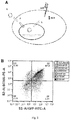
- Fig. 1B specifically shows the detection process: a lentiviral particle (1) being introduced into a cell by the cell membrane fusion (2); the package being removed (3); then the reverse transcription (4) being performed; the integration (5), transcription (6) and translation (7) then being performed; and the cleaving (8) being performed by the T2A cleaving peptide.
- the transduction efficiency can be evaluated by the expression of the GFP (9), the binding efficiency of the scFv and BCMA protein can be studied by BCMA-Fc (10), and the anti-HA antibody can be used to assay the expression of the CAR and enrich the CAR-T cell for functionality analysis (11).
- the expression of CAR molecules can also be determined by other methods.
- an appropriate amount of biotinylated BCMA and PE streptavidin can be used to mark the CAR molecules so that the expression of the CAR molecules can be reflected by PE signals.
- an appropriate amount of biotinylated anti-HA monoclonal antibody (biotinylated anti-HA mAb) and PE streptavidin can be used to mark the CAR molecules for detection.
- Table 1 Vector Types Corresponding to Lentiviruses No.
- a lentiviral vector PLVX-EFlalpha-IRES-Puro was double digested with NotI and Mlul, and vector fragments were recovered.
- the candidate scFv plasmid PXL0032 (the nucleotide sequence: SEQ ID NO: 44) was amplified by PCR, and a NotI restriction enzyme cutting site (containing a protective base), a CD8a signal peptide, an HA-tag, a hinge region, a transmembrane domain, a CD28 costimulatory factor and a CD3 ⁇ intracellular signal transduction domain were added to the 5' terminal in sequence by extension PCR for gene synthesis, and the PCR amplification was conducted; a T2A cleaving peptide and an eGFP were obtained from a plasmid pMy-BirA-T2A-eGFP by PCR amplification, with a Mlul restriction enzyme cutting site and a protective base on the 3' terminal; and then a
- the CAR plasmid numbered as PXL0097 was obtained by a similar method.
- a lentiviral vector PLVX-EFlalpha-IRES-Puro was double digested with NotI and Mlul, and vector fragments were recovered.
- the candidate scFv plasmid PXL0032 was amplified by PCR, and an a NotI restriction enzyme cutting site (containing a protective base), a CD8a signal peptide, a hinge region, a transmembrane domain, a 4-1BB costimulatory factor (nucleotide sequence: SEQ ID NO: 32) and a CD3 ⁇ intracellular signal transduction domain were added to the 5' terminal by extension PCR for gene synthesis, and the PCR amplification was performed; then a PCR fragment, with a NotI restriction enzyme cutting site at the the 5' terminal and a Mlul restriction enzyme cutting site at the 3' terminal, were obatined by overlap PCR, the obtained fragment was double digested with NotI and Mlul, and was recovered.
- the CAR plasmid numbered as PXL0097 was constructed through T4 ligation (the nucleotide sequence of the CAR molecule portion of CAR0097 was shown as SEQ ID NO: 52).
- the CAR plasmid numbered as PXL0099 was obtained by a similar method.
- a lentiviral vector PLVX-EFlalpha-IRES-Puro was double digested with NotI and Mlul, and vector fragments were recovered.
- the candidate scFv plasmid PXL0032 was amplified by PCR, and an a NotI restriction enzyme cutting site (containing a protective base), a CD8a signal peptide, a hinge region, a transmembrane domain, a 4-1BB costimulatory factor (nucleotide sequence: SEQ ID NO: 32), a CD3 ⁇ intracellular signal transduction domain, a T2A cleaving peptide and EGFRt (nucleotide sequence: SEQ ID NO: 40) were added to the 5' terminal by extension PCR for gene synthesis, and the PCR amplification was performed; then a PCR fragment, with a NotI restriction enzyme cutting site at the the 5' terminal and a Mlul restriction enzyme cutting site at the 3' terminal, were obatined by overlap PCR, the obtained fragment was double digested with NotI and Mlul, and was recovered.
- the CAR plasmid numbered as PXL0099 was constructed through T4
- a CAR plasmid containing the scFv plasmid PXL0008 was constructed as a control.
- the CAR plasmid numbered as PXL0041 was obtained through the same method (the nucleotide sequence of the CAR molecule portion of CAR0041 was shown as SEQ ID NO: 48).
- a lentiviral vector PLVX-EFlalpha-IRES-Puro was double digested with NotI and Mlul, and vector fragments were recovered.
- the candidate scFv plasmid PXL0008 (nucleotide sequence: SEQ ID NO: 42) was amplified by PCR, and a NotI restriction enzyme cutting site (containing a protective base), a CD8a signal peptide, an HA-tag, a hinge region, a transmembrane domain, a CD28 costimulatory factor and a CD3 ⁇ intracellular signal transduction domain were added to the 5' terminal in sequence by extension PCR for gene synthesis, and the PCR amplification was conducted; a T2A cleaving peptide and an GFP were obtained from a plasmid pMy-BirA-T2A-eGFP by PCR amplification, with a Mlul restriction enzyme cutting site and a protective base on the 3' terminal; and then a PCR fragment, with a NotI restriction enzyme cutting site at the 5' terminal and a Mlul restriction enzyme cutting site at the 3' terminal, were obtained by overlap PCR, the obtained fragment was double
- the CAR plasmid numbered as PXL0009 was obtained by a similar method.
- a lentiviral vector PLVX-EFlalpha-IRES-Puro was double digested with NotI and Mlul, and vector fragments were recovered.
- the candidate scFv plasmid PXL0008 was amplified by PCR, and an a NotI restriction enzyme cutting site (containing a protective base), a CD8a signal peptide, a hinge region, a transmembrane domain, a CD28 costimulatory factor and a CD3 ⁇ intracellular signal transduction domain were added to the 5' terminal by extension PCR for gene synthesis, and the PCR amplification was performed; then a PCR fragment, with a NotI restriction enzyme cutting site at the the 5' terminal and a Mlul restriction enzyme cutting site at the 3' terminal, were obatined by overlap PCR, the obtained fragment was double digested with NotI and Mlul, and was recovered.
- the CAR plasmid numbered as PXL0009 was constructed through T4 ligation (the nucleotide sequence of the CAR molecule portion of CAR0009 was shown as SEQ ID NO: 46).
- the CAR plasmids PXL0009, PXL0041 and PXL0043 prepared in example 1 were transiently transfected into 293T cells using PEI as a transfection reagent, so that a PXL0009-293T cell, a PXL0041-293T cell and a PXL0043-293T cell were respectively obtained. 72 hours after transient transfection, the PXL0009-293T cell, the PXL0041-293T cell and the PXL0043-293T cell were used to evaluate the expression capabilities of the candidate CAR molecules.
- 1 represented a plasmid and a transfection reagent
- 2 represented transient transfection
- 3 represented expression and T2A cleaving peptide cleaving.
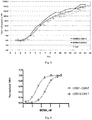
- the expressions of the CAR molecules were evaluated by utilizing the methods in example 1. Specifically, the dose of the biotinylated BCMA was changed by the gradient dilution for protein concentration in the presence of excessive PE streptavidin with a fixed concentration, so that the change of PE signals as shown in Fig. 2B was obtained.
- X axis represented GFP protein signals expressed in the cells
- Y axis represented PE signals obtained by the CAR molecules marked using the gradiently-diluted biotinylated BCMA and the fixed amount of PE streptavidin.
- the gradiently-diluted biotinylated BCMA protein (295.86 nM to 3.79 pM) was used to assay the 293T cells transiently transfected with the candidate CAR plasmids, so that a PE signal change curve (as shown in Fig. 3 ) was obtained.
- EC 50 values for the binding of BCMA proteins with CAR molecules on the surfaces of cells as measured by curve fitting, were as shown in table 2.
- Table 2 EC 50 Values for the Binding of BCMA Protein with CAR Molecules on Surfaces of Cells Sample GFP% Percentage of CAR marked with 500ng of BCMA CAR% : GFP % EC 50 (nM) PXL0009-293T N/A 18.0 N/A 1.59 PXL0041-293T 41.8 16.1 0.39 0.30 PXL0043-293T 32.3 N/A N/A N/A N/A
- the CAR molecules were marked using the biotinylated anti-HA monoclonal antibody (anti-HA mAb) and the PE streptavidin, and then GFP positive rates (GFP%), CAR positive rates (CAR%), and ratios of them were obtained by flow cytometry. The results were as shown in table 3.
- PXL0009 was a reference plasmid, and the CAR0009 molecule contained therein did not comprise a sequence encoding the GFP and the HA-tag. Therefore, no GFP signal for the PXL0009 plasmid and no PE signal for the binding of a CAR with a biotinylated anti-HA monoclonal antibody (biotinylated anti-HA mAb) could be detected in the cell sample. Therefore, a PXL0009-293T cell sample could be used as a negative control for flow cytometry.
- PXL0041 and PXL0037 as reference plasmids could encode the GFP protein and the HA tag, so that GFP signals could be detected in a PXL0041-293T cell sample, and the binding (PE signal) of the CAR with the biotinylated BCMA protein or the biotinylated anti-HA monoclonal antibody (biotinylated anti-HA mAb) could also be detected respectively, therefore, PXL0041 and PXL0037 can serve as positive controls for flow cytometry.
- the GFP signal could be detected in a PXL0043-293T cell sample, and the binding (PE signal) of the CAR with the biotinylated anti-HA monoclonal antibody (biotinylated anti-HA mAb) could also be detected, which demonstrated that the CAR molecules encoded by the PXL0043 plasmid could be expressed on cells.
- a shuttle plasmid was needed to achieve the simultaneous cotransfection of the CAR plasmids numbered as PXL0009, PXL0041 and PXL0043 that were prepared in example 1 into 293T cells with other packaging plasmids, so that the lentiviruses were packaged in the cells.
- the specific steps were as follows.
- the 293T cells were inoculated into DMEM medium containing 10% of FBS at a concentration of 6 ⁇ 10 4 cells/cm 2 , and were cultured in the environment of 37 °C, 5% CO 2 and saturated humidity for 3 days, and then the transfection was conducted.
- two EP tubes were prepared with 500 ⁇ l of opti-MEM in each EP tube, wherein, 3 ⁇ g of lentiviral helper vector PSPAX2, 2 pMD2.G and 5 ⁇ g of the vector prepared in example 1 (CAR plasmid numbered as PXL0009, PXL0041 or PXL0043) were added to one tube and the mixture solution was thoroughly mixed, so that a tube containing plasmid was obtained; and 30 ⁇ l of PEI with a concentration of 1 mg/ml was added to the other tube and the mixture solution was thoroughly mixed.
- 3 ⁇ g of lentiviral helper vector PSPAX2, 2 pMD2.G and 5 ⁇ g of the vector prepared in example 1 (CAR plasmid numbered as PXL0009, PXL0041 or PXL0043) were added to one tube and the mixture solution was thoroughly mixed, so that a tube containing plasmid was obtained; and 30 ⁇ l of PEI with a concentration of 1 mg/ml was added
- the solution containing PEI in the other tube was then added dropwise to the tube containing the plasmid while the obtained solution was thoroughly mixed, and 30 minutes after standing at room temperature, the resultant solution was uniformly added to the aforementioned 293T cells dropwise. 24 hours after transfection, 6 ml of DMEM medium containing 10% of FBS was replaced.
- the supernatant was collected and added into a centrifuge tube, and then was centrifuged at 3000 g under 4 °C for 10 minutes, and the supernatant was ready for purification after filtered by a 0.45 ⁇ m filter.
- 293T cells were inoculated into a six-well plate in a quantity of 1 ⁇ 10 5 cells/well, and were cultured with 500 ⁇ l of DMEM medium containing 10% of FBS in the environment of 37 °C, 5% CO 2 and saturated humidity. After the cells were cultured for 24 hours, lentiviral transduction was performed, and 100 ⁇ l, 50 ⁇ l, 25 ⁇ l and 12.5 ⁇ l of the supernatant were taken and added to six-well plates (two wells for each sample volume) . The cells were then continued to be cultured in the environment of 37 °C, 5% CO 2 and saturated humidity. 72 hours after the lentiviral transduction, the 293T cells were digested and resuspended for flow cytometry.
- both the CAR molecular-encoding gene and the GFP protein-encoding gene were carried in LV0013, both the CAR molecule and the GFP protein could be expressed in 293T cells transduced with LV0013 at the same time.
- the lentiviral biological titer referred to as GFP titer
- biological titer TU / ml GFP positive rate ⁇ 293 T cell number / virus sample volume
- T cells were further activated by CD3/CD28 Dynabeads.
- MOI 4
- T cell concentration about 1.5 ⁇ 10 6 cells/ml during the transduction.
- the transduced T cells were supplemented with fresh medium once. Afterwards, counting was performed every day, and the cell concentration was kept between (0.6 ⁇ 2.0) ⁇ 10 6 cells/ml, and a growth curve of the cells was plotted.
- CAR CAR positive rate
- GFP GFP positive rate
- CD4/CD8 ratio CD4/CD8 ratio
- Table 5 summarizes the aforementioned preparation process for CAR-T cells.
- the candidate CAR molecules expressed on the T cells could normally bind to the BCMA protein.
- CD107a is a marker for an intracellular microvesicle.
- a microvesicle loaded with granzyme are fused with a cell membrane, the quantity of CD107a on the cell membrane is increased. Therefore, when the microvesicle recovery is blocked by using monesin (obtained from BioLegend), the intensity of microvesicle release can be quantitatively reflected.
- monesin obtained from BioLegend
- the intensity of microvesicle release can be quantitatively reflected.
- the CAR-T is stimulated by a target antigen on a target cell, the granzyme is released.
- the activation of T cells can be determined by detecting the increase of CD107a through the flow cytometry.
- the CAR-T cells (LV0011-CAR-T cells or LV0013-CAR-T cells) obtained in example 4, together with target cells U266, monesin and a CD107a antibody were incubated for 3 to 6 hours, wherein the CAR-T cells and the target cells had the same cell concentration of 5 ⁇ 10 5 cells/ml.
- the flow cytometry was performed.
- the CAR positive cells among the CAR-T cells were detected by detecting a coexpressed GFP, while CAR positive cells among LV0011 -CAR-T cells as a control were marked by a biotinylated BCMA-Fc and PE streptavidin.
- the negative control was co-incubated with K562 cells and CAR-T cells, and a cocktail instead of target cells was used to activate the CAR-T cells in the positive control.
- a P1 gate was selected on the FSC : SSC scatter plot, and cell debris at the lower left corner were removed; for cells in the P1 gate, CD8 : PD1 could be further analyzed to obtain a CD8+/PD1- cell population (Q3); and in the CD8+/PD1- cell population, GFP : CD107a could be analyzed again to obtain the proportion of the CD107a-expressing cells in the CD8+/PD1-/CAR+ cell population (the CAR positive cell was marked by a coexpressed GFP signal) and the proportion of the CD107a-expressing cells in the CD8+/PD1-/CAR- cell population respectively.
- the cells were divided into population P1 and population P2 on the FSC : SSC scatter plot, wherein nearly no CD8 was expressed on the cells in population P2, which therefore might be K562 cells; for cells in the P1 gate, CD8 : PD1 could be further analyzed; in the CD8+/PD1- cell population (Q3), GFP : CD107a could be analyzed again to obtain the proportion of the CD107a-expressing cells in each of CD8+/PD1-/CAR+ and CD8+/PD1-/CAR- as well.
- the CAR-T cell samples (LV0011-CAR-T and LV0013-CAR-T cells) were co-incubated with target cells U266 (BCMA-positive) or K562 (BCMA-negative) respectively for 3 hours, and then the flow cytometry was performed.
- the CD107a degranulation test data results for cell samples are as shown in table 8 and Fig. 8 , and table 8 and Fig. 8 both showed the ratios of the CD107a-expressing positive cells in the CD8+/PD1-/CAR+ cell subpopulation and the CD8+/PD1-/CAR- cell subpopulation.
- Table 8 Ratios of CD107a-Expressing Positive Cells in Different Cell Subpopulations Sample CD8+/PD1-/CAR+ subpopulation CD8+/PD1-/CAR-subpopulation K562 U266 K562 U266 LV0011-CAR-T 2.01 10.70 2.71 3.33 LV0013-CAR-T 0.43 40.80 0.58 4.17 T cell N/A N/A 0.64 1.09
- the CD107a value on the CD8+/PD1-/CAR+ cell subpopulation could reflect the situation where the CAR-T cells were specifically activated; while, in the CAR-T sample co-incubated with K562, the CD107a value on the CD8+/PD1-/CAR+ cell subpopulation could reflect the situation where the CAR-T cells were nonspecifically activated.
- soluble BCMA soluble BCMA
- the content of the soluble BCMA can be increased in a patient's serum, and its concentration is positively correlated with the malignant degree of a tumor. Therefore, when the CAR-T cells were co-incubated with target cells, 1 ⁇ g/ml of BCMA protein (BCMA-Fc fusion protein) was added to the medium to evaluate the effect of the soluble BCMA on CAR-T cell activation.
- a CD107a degranulation test result for the CAR-T cell samples under a BCMA protein competition condition was as shown in table 9 and Fig. 9 .
- the effect of BCMA protein competition on the CD107a-positive cell ratio of the CD8+/PD1-/CAR+ subpopulation of the LV0013-CAR-T cell sample was minor, while the effect on the LV0011-CAR-T cell sample as a control was large.
- Table 9 CD107a Degranulation Test Data under a BCMA Protein Competition Condition Sample CD8+/PD1-/CAR+ subpopulation CD8+/PD1-/CAR-subpopulation U266 and BCMA U266 U266 and BCMA U266 LV0011-CAR-T 21.18 67.05 7.54 8.97 LV0013-CAR-T 85.47 92.20 12.39 15.92 T cell N/A N/A 0.00 8.58
- the assay result of cytokine release obtained after a portion of the CAR-T cell samples cultured in the first batch were co-incubated with the target cells respectively, was as shown in table 10 and Fig. 10 .
- the release amount of a cytokine shown in Fig. 10 is a percentage relative to the detected maximum value in a sample.
- the amounts of TNF- ⁇ , IFN- ⁇ and IL-2 secreted by the LV0013-CAR-T cells stimulated by the BCMA-positive target cells U266 (+U266) were all greatly increased.
- LV0002-CAR-T cells and LV0023-CAR-T cells were prepared by transducing the lentiviruses LV0002 and LV0023 prepared in example 3 into CAR-T cells with a experimental method similar to example 4, wherein, LV0023 viruses (corresponding to the CAR molecule encoded by the PXL0099 plasmid, with a costimulatory factor of 4-1BB) and LV0002 viruses (corresponding to the CAR molecule encoded by the PXL0009 plasmid, with a costimulatory factor of CD28) were used to transduce T cells from different donors, for preparing CAR-T cells.
- LV0023 viruses corresponding to the CAR molecule encoded by the PXL0099 plasmid, with a costimulatory factor of 4-1BB
- LV0002 viruses corresponding to the CAR molecule encoded by the PXL0009 plasmid, with a costimulatory factor of CD28
- T cells of donor 1 transduced with LV0002 viruses were named as LV0002-D01-CAR-T cells
- T cells of donor 2 transduced with LV0002 viruses were named as LV0002-D02-CAR-T cells
- T cells of donor 1 transduced with LV0023 viruses were named as LV0023-D01-CAR-T cells
- T cells of donor 2 transduced with LV0023 viruses were named as LV0023-D02-CAR-T cells.
- T cells of donors themselves were adopted as controls, wherein, T cells coming from donor 1 were named as T cell-DOl, and T cells coming from donor 2 were named as T cell-D02.
- the functions of these CAR-T cells were also assayed by using the CD107a degranulation test in example 6. The result is as shown in table 11 and Fig. 11 .
- the LV0002-CAR-T cells as a control could produce more CD107a under the stimulation of the U266 cells, which may resulted from the different scFvs and costimulatory factors for them.
- the LV0002-CAR-T cells could have higher CD107a values under both the condition of no stimulation (blank) and the condition of K562 cell stimulation.
- the CAR-T cells LV0023-D02-CAR-T from donor 2 prepared in example 8 were used for in-vitro killing function assay which was conducted by the calcein-AM fluorescence method.
- the specific steps of this assay were as follows. 5 ⁇ 10 5 BCMA-positive U266 cells and BCMA-negative K562 cells were respectively taken and resuspended in PBS + 4% FBS solution, so that cell suspensions with concentrations of 1 ⁇ 10 6 cells/ml were prepared.
- the U266 cells and the K562 cells were respectively marked with 25 ⁇ M of calcein-AM.
- the marked U266 and K562 cells were respectively inoculated into U-bottom 96-well plates according to the quantity of 5000 cells per well; the to-be-assayed CAR-T cells or T cells as a control were then respectively added to the corresponding wells according to the three effector cell/target cell ratios of 50:1, 25:1 and 5:1 (E : T value), and the solution volume in each well was 200 ⁇ l.
- a PBS solution in place of the effector cells, was added to the U266 or K562 cells, serving as a negative control for assay; and a cell lysis solution, in place of the effector cells, was added to the U266 or K562 cells, serving as a positive control for assay.
- F test is an average fluorescence value for the replicate wells containing the target cells and the to-be-assayed T/CAR-T cells
- F spont is an average fluorescence value for the replicate wells containing the target cells and PBS
- F max is an average fluorescence value for the replicate wells containing the target cells and the lysis solution.
- the in-vitro killing effect of the CAR-T cells against the target cells was as shown in Fig. 12 .
- the CAR-T cells had a strong killing effect against the BCMA-positive U266 cells, and the killing effect was enhanced as the E : T value increased, showing that a higher proportion of U266 cells were lysed to release calcein-AM.
- the CAR-T cells had a poor killing effect against the BCMA-negative K562 cells.
- the T cells had a certain degree of nonspecific killing effect against the U266 cells, and the nonspecific killing effect would not be changed as the E : T value increased. Therefore, the CAR-T cells had a remarkable BCMA-specific killing effect.
- the CAR-T cells (LV0023-D02-CAR-T) coming from donor 2 which were prepared in example 8 were used for an animal model experiment. Meanwhile, T cells coming from donor 2 (T cell-D02) were adopted as control T cells.
- Proliferating U266 cells were subcutaneously injected into immunodeficient NSG mice in a quantity of 2 ⁇ 10 6 cells per mouse, creating a U266 subcutaneous tumor-bearing model.
- the tumor-bearing mice were divided into five groups according to table 12, and the CAR-T cells (LV0023-D02-CAR-T), the control T cells (T cell-D02), PBS or cell cryopreservation medium containing 7.5% of DMSO, 23% of human serum albumin, 32.5% of compound electrolyte solution, 35% of glucose injection and 2% of normal saline) were injected into the tumor-bearing mice respectively.
- the cell cryopreservation medium of the present application contains 7.5% of DMSO, 23% of human serum albumin, 32.5% of compound electrolyte solution, 35% of glucose injection and 2% of normal saline.
- mice were continuously fed, and the tumor sizes, the mouse weights and the survival states of the mice were recorded. The result was as shown in Fig. 13 .
- the result of the mouse model experiment indicated that the high-dosage group and the low-dosage group both showed a good tumor-killing effect after a single injection of the CAR-T cells, and that 19 days after the injection, the tumors completely disappeared. On the contrary, the tumors in the mice for which the control T cells, PBS or the cell cryopreservation medium were injected continued to grow.
- Table 12 Grouping Solution for Animal Model Experiment Group Number CAR-T information Administration method Administration Dosage Frequency of administration 1 5 PBS control I.V 100 ⁇ l single administration 2 5 Control T cell I.V.
Landscapes
- Health & Medical Sciences (AREA)
- Life Sciences & Earth Sciences (AREA)
- Chemical & Material Sciences (AREA)
- Organic Chemistry (AREA)
- Genetics & Genomics (AREA)
- General Health & Medical Sciences (AREA)
- Engineering & Computer Science (AREA)
- Immunology (AREA)
- Biomedical Technology (AREA)
- Zoology (AREA)
- Biotechnology (AREA)
- Biochemistry (AREA)
- Bioinformatics & Cheminformatics (AREA)
- Wood Science & Technology (AREA)
- Animal Behavior & Ethology (AREA)
- Veterinary Medicine (AREA)
- Public Health (AREA)
- Molecular Biology (AREA)
- Medicinal Chemistry (AREA)
- General Engineering & Computer Science (AREA)
- Biophysics (AREA)
- Epidemiology (AREA)
- Cell Biology (AREA)
- Microbiology (AREA)
- Proteomics, Peptides & Aminoacids (AREA)
- Physics & Mathematics (AREA)
- Plant Pathology (AREA)
- Pharmacology & Pharmacy (AREA)
- Hematology (AREA)
- General Chemical & Material Sciences (AREA)
- Nuclear Medicine, Radiotherapy & Molecular Imaging (AREA)
- Chemical Kinetics & Catalysis (AREA)
- Gastroenterology & Hepatology (AREA)
- Toxicology (AREA)
- Virology (AREA)
- Micro-Organisms Or Cultivation Processes Thereof (AREA)
- Peptides Or Proteins (AREA)
- Medicines That Contain Protein Lipid Enzymes And Other Medicines (AREA)
- Developmental Biology & Embryology (AREA)
- Medicines Containing Material From Animals Or Micro-Organisms (AREA)
Applications Claiming Priority (3)
| Application Number | Priority Date | Filing Date | Title |
|---|---|---|---|
| CN201810100549 | 2018-02-01 | ||
| CN201811223693 | 2018-10-19 | ||
| PCT/CN2019/074213 WO2019149250A1 (zh) | 2018-02-01 | 2019-01-31 | 一种结合bcma的嵌合抗原受体(car)及其应用 |
Publications (2)
| Publication Number | Publication Date |
|---|---|
| EP3674327A1 true EP3674327A1 (de) | 2020-07-01 |
| EP3674327A4 EP3674327A4 (de) | 2021-05-05 |
Family
ID=67479591
Family Applications (1)
| Application Number | Title | Priority Date | Filing Date |
|---|---|---|---|
| EP19746770.7A Pending EP3674327A4 (de) | 2018-02-01 | 2019-01-31 | Bindung von chimärem antigen-rezeptor (car) an bcma und verwendungen davon |
Country Status (5)
| Country | Link |
|---|---|
| US (1) | US11266690B2 (de) |
| EP (1) | EP3674327A4 (de) |
| CN (1) | CN110662771B (de) |
| TW (1) | TWI728309B (de) |
| WO (1) | WO2019149250A1 (de) |
Families Citing this family (49)
| Publication number | Priority date | Publication date | Assignee | Title |
|---|---|---|---|---|
| US11162079B2 (en) | 2019-05-10 | 2021-11-02 | The Regents Of The University Of California | Blood type O Rh-hypo-immunogenic pluripotent cells |
| KR102371151B1 (ko) * | 2020-03-13 | 2022-03-07 | 주식회사 큐로셀 | 항-bcma 결합 영역, 이를 포함하는 융합단백질, 및 이를 포함하는 조성물 |
| US20220057381A1 (en) * | 2020-06-08 | 2022-02-24 | Janssen Biotech, Inc. | Cell-based assay for determining the in vitro tumor killing activity of chimeric antigen expressing immune cells |
| CN112795584B (zh) * | 2020-08-20 | 2023-01-24 | 山东省成体细胞产业技术研究院有限公司 | 抗gcc的核酸、其制备方法、具有该核酸的免疫细胞及其应用 |
| WO2022135468A1 (zh) * | 2020-12-23 | 2022-06-30 | 信达生物制药(苏州)有限公司 | 抗bcma×cd3双特异性抗体及其用途 |
| JP2024501971A (ja) | 2020-12-31 | 2024-01-17 | サナ バイオテクノロジー,インコーポレイテッド | Car-t活性を調節するための方法及び組成物 |
| CN117136199A (zh) * | 2021-04-27 | 2023-11-28 | 原启生物科技(上海)有限责任公司 | 靶向bcma的嵌合抗原受体及其应用 |
| BR112023024231A2 (pt) | 2021-05-19 | 2024-01-30 | Sana Biotechnology Inc | Células t primárias rhd negativas hipoimunogênicas |
| US20240226164A1 (en) | 2021-05-27 | 2024-07-11 | Sana Biotechnology, Inc. | Hypoimmunogenic cells comprising engineered hla-e or hla-g |
| KR20240046319A (ko) | 2021-07-14 | 2024-04-08 | 사나 바이오테크놀로지, 인크. | 저면역원성 세포에서의 y 염색체-연결 항원의 변경된 발현 |
| EP4381081A1 (de) | 2021-08-04 | 2024-06-12 | Sana Biotechnology, Inc. | Verwendung von auf cd4 gerichteten viralen vektoren |
| AU2022327174A1 (en) | 2021-08-11 | 2024-02-15 | Sana Biotechnology, Inc. | Inducible systems for altering gene expression in hypoimmunogenic cells |
| WO2023044633A1 (zh) * | 2021-09-22 | 2023-03-30 | 南京驯鹿医疗技术有限公司 | Bcma car-t在制备用于治疗自身免疫病的药物中的应用 |
| US20250313861A1 (en) | 2021-10-22 | 2025-10-09 | Sana Biotechnology, Inc. | Methods of engineering allogeneic t cells with a transgene in a tcr locus and associated compositions and methods |
| US20250059239A1 (en) | 2021-12-17 | 2025-02-20 | Sana Biotechnology, Inc. | Modified paramyxoviridae fusion glycoproteins |
| WO2023115041A1 (en) | 2021-12-17 | 2023-06-22 | Sana Biotechnology, Inc. | Modified paramyxoviridae attachment glycoproteins |
| CN119072319A (zh) | 2021-12-23 | 2024-12-03 | 萨那生物技术股份有限公司 | 用于治疗自身免疫性疾病的嵌合抗原受体(car)t细胞及相关方法 |
| EP4463135A2 (de) | 2022-01-10 | 2024-11-20 | Sana Biotechnology, Inc. | Verfahren zur ex-vivo-dosierung und -verabreichung von lipidpartikeln oder viralen vektoren sowie entsprechende systeme und verwendungen |
| EP4472646A1 (de) | 2022-02-01 | 2024-12-11 | Sana Biotechnology, Inc. | Auf cd3 abzielende lentivirale vektoren und verwendungen davon |
| WO2023150647A1 (en) | 2022-02-02 | 2023-08-10 | Sana Biotechnology, Inc. | Methods of repeat dosing and administration of lipid particles or viral vectors and related systems and uses |
| EP4479416A1 (de) | 2022-02-17 | 2024-12-25 | Sana Biotechnology, Inc. | Manipulierte cd47-proteine und verwendungen davon |
| WO2023193015A1 (en) | 2022-04-01 | 2023-10-05 | Sana Biotechnology, Inc. | Cytokine receptor agonist and viral vector combination therapies |
| WO2023225569A1 (en) | 2022-05-17 | 2023-11-23 | Umoja Biopharma, Inc. | Manufacturing viral particles |
| AU2023283552A1 (en) | 2022-06-10 | 2025-01-23 | Umoja Biopharma, Inc. | Engineered stem cells and uses thereof |
| WO2024026377A1 (en) | 2022-07-27 | 2024-02-01 | Sana Biotechnology, Inc. | Methods of transduction using a viral vector and inhibitors of antiviral restriction factors |
| WO2024064838A1 (en) | 2022-09-21 | 2024-03-28 | Sana Biotechnology, Inc. | Lipid particles comprising variant paramyxovirus attachment glycoproteins and uses thereof |
| WO2024081820A1 (en) | 2022-10-13 | 2024-04-18 | Sana Biotechnology, Inc. | Viral particles targeting hematopoietic stem cells |
| TW202434735A (zh) | 2022-11-04 | 2024-09-01 | 美商烏莫賈生物製藥股份有限公司 | 展示黏著分子融合的顆粒 |
| WO2024119157A1 (en) | 2022-12-02 | 2024-06-06 | Sana Biotechnology, Inc. | Lipid particles with cofusogens and methods of producing and using the same |
| WO2024220598A2 (en) | 2023-04-18 | 2024-10-24 | Sana Biotechnology, Inc. | Lentiviral vectors with two or more genomes |
| WO2024220560A1 (en) | 2023-04-18 | 2024-10-24 | Sana Biotechnology, Inc. | Engineered protein g fusogens and related lipid particles and methods thereof |
| EP4698666A1 (de) | 2023-04-18 | 2026-02-25 | Sana Biotechnology, Inc. | Universelle protein-g-fusogene und adaptersysteme davon sowie zugehörige lipidpartikel und verwendungen |
| EP4716750A1 (de) | 2023-05-23 | 2026-04-01 | Sana Biotechnology, Inc. | Tandem-fusogene und verwandte lipidpartikel |
| AU2024279278A1 (en) | 2023-05-31 | 2025-12-18 | Capstan Therapeutics, Inc. | Lipid nanoparticle formulations and compositions |
| WO2025006799A1 (en) | 2023-06-27 | 2025-01-02 | Capstan Therapeutics, Inc. | Extracorporeal and ex vivo engineering of select cell populations from peripheral blood |
| WO2025043172A1 (en) | 2023-08-23 | 2025-02-27 | Sana Biotechnology, Inc. | Modified cd47 proteins and their uses |
| WO2025054202A1 (en) | 2023-09-05 | 2025-03-13 | Sana Biotechnology, Inc. | Method of screening a sample comprising a transgene with a unique barcode |
| WO2025076113A1 (en) | 2023-10-05 | 2025-04-10 | Capstan Therapeutics, Inc. | Ionizable cationic lipids with conserved spacing and lipid nanoparticles |
| US20250127728A1 (en) | 2023-10-05 | 2025-04-24 | Capstan Therapeutics, Inc. | Constrained Ionizable Cationic Lipids and Lipid Nanoparticles |
| US20250144234A1 (en) | 2023-11-02 | 2025-05-08 | Capstan Therapeutics Inc. | RNA for In vivo Transfection with Increased Expression |
| WO2025129084A1 (en) | 2023-12-13 | 2025-06-19 | Umoja Biopharma, Inc. | Engineered induced stem cell derived myeloid cells and methods of differentiating and using same |
| US20250332281A2 (en) | 2023-12-15 | 2025-10-30 | Capstan Therapeutics, Inc. | Humanized anti-cd8 antibodies and uses thereof |
| WO2025151838A1 (en) | 2024-01-12 | 2025-07-17 | Sana Biotechnology, Inc. | Safety switches to control in vitro and in vivo proliferation of cell therapy products |
| US20250302763A1 (en) | 2024-02-22 | 2025-10-02 | Capstan Therapeutics, Inc. | Immune engineering amplification |
| WO2025184529A1 (en) | 2024-03-01 | 2025-09-04 | Sana Biotechnology, Inc. | Viral particles with fusogen display and related compositions and methods |
| WO2025217452A1 (en) | 2024-04-11 | 2025-10-16 | Capstan Therapeutics, Inc. | Constrained ionizable cationic lipids and lipid nanoparticles |
| WO2025217454A2 (en) | 2024-04-11 | 2025-10-16 | Capstan Therapeutics, Inc. | Ionizable cationic lipids and lipid nanoparticles |
| WO2025231174A1 (en) | 2024-04-30 | 2025-11-06 | Umoja Biopharma, Inc. | Manufacturing viral particles |
| WO2025235604A1 (en) | 2024-05-08 | 2025-11-13 | Umoja Biopharma, Inc. | Fusion protein for use as immune cell engager |
Family Cites Families (21)
| Publication number | Priority date | Publication date | Assignee | Title |
|---|---|---|---|---|
| CN1802388B (zh) * | 2003-05-09 | 2011-01-05 | 杜克大学 | Cd20特异抗体及使用它们的方法 |
| MX341884B (es) | 2009-03-10 | 2016-09-07 | Biogen Ma Inc | Anticuerpos anti-antigeno de maduracion de celulas b (bcma). |
| JO3182B1 (ar) * | 2009-07-29 | 2018-03-08 | Regeneron Pharma | مضادات حيوية بشرية عالية الالفة مع تولد الاوعية البشرية - 2 |
| TR201904484T4 (tr) | 2009-11-03 | 2019-05-21 | Hope City | Transdüse T hücre seçimine yönelik kesik epiderimal büyüme faktörü reseptörü (EGFRt). |
| EP2825199A4 (de) * | 2012-03-15 | 2016-01-27 | Janssen Biotech Inc | Antikörper gegen menschliches autotaxin und verfahren zur verwendung |
| RU2766608C2 (ru) | 2012-04-11 | 2022-03-15 | Дзе Юнайтед Стейтс Оф Америка, Эз Репрезентед Бай Дзе Секретари, Департмент Оф Хелс Энд Хьюман Сёрвисез | Химерные антигенные рецепторы, нацеленные на антиген созревания b-клеток |
| US10654926B2 (en) * | 2014-05-02 | 2020-05-19 | Medimmune Limited | P2X4 antibodies and uses thereof |
| BR112017001183A2 (pt) * | 2014-07-21 | 2017-11-28 | Novartis Ag | tratamento de câncer usando receptor de antígeno quimérico anti-bcma humanizado |
| ES2878449T3 (es) | 2014-07-24 | 2021-11-18 | 2Seventy Bio Inc | Receptores antigénicos quiméricos de BCMA |
| HRP20191873T1 (hr) | 2014-12-12 | 2020-01-24 | Bluebird Bio, Inc. | Kimerni antigenski receptori |
| US10294304B2 (en) * | 2015-04-13 | 2019-05-21 | Pfizer Inc. | Chimeric antigen receptors targeting B-cell maturation antigen |
| PL3298033T5 (pl) * | 2015-05-18 | 2023-10-30 | TCR2 Therapeutics Inc. | Kompozycje i zastosowania medyczne do reprogramowania TCR z zastosowaniem białek fuzyjnych |
| RU2018109230A (ru) * | 2015-08-17 | 2019-09-19 | ДОЙЧЕС ЦЕНТРУМ ФЮР НОЙРОДЕГЕНЕРАТИВЕ ЭРКРАНКУНГЕН е.Ф. (ДЦНЭ) | Антитело, или фрагмент антитела, или неиммуноглобулиновый каркас, связывающийся с областью связывания антитела против рецептора n-метил-d-аспартата (nmda) |
| MX2018004503A (es) * | 2015-10-15 | 2019-04-15 | Us Health | Receptores de antigeno quimerico anti-cd30. |
| RU2018127657A (ru) * | 2015-12-30 | 2020-01-31 | Новартис Аг | Виды терапии на основе иммуноэффекторных клеток с улучшенной эффективностью |
| KR20180118175A (ko) | 2016-03-04 | 2018-10-30 | 노파르티스 아게 | 다중 키메라 항원 수용체 (car) 분자를 발현하는 세포 및 그에 따른 용도 |
| CN105777911B (zh) * | 2016-04-12 | 2019-07-02 | 上海优卡迪生物医药科技有限公司 | 抗bcma嵌合抗原受体、编码基因、重组表达载体及其构建方法和应用 |
| CN109715808A (zh) | 2016-04-15 | 2019-05-03 | 诺华股份有限公司 | 用于选择性蛋白质表达的组合物和方法 |
| CN105837693A (zh) | 2016-05-30 | 2016-08-10 | 李斯文 | 一种基于bcma的抗原嵌合受体及其制备方法和应用 |
| SG10202012157QA (en) * | 2016-06-07 | 2021-01-28 | Max Delbrueck Centrum Fuer Molekulare Medizin Helmholtz Gemeinschaft | Chimeric antigen receptor and car-t cells that bind bcma |
| CN113728003A (zh) * | 2019-04-30 | 2021-11-30 | 吉加根公司 | 重组多克隆蛋白及其使用方法 |
-
2019
- 2019-01-31 EP EP19746770.7A patent/EP3674327A4/de active Pending
- 2019-01-31 CN CN201980002371.4A patent/CN110662771B/zh active Active
- 2019-01-31 US US16/650,580 patent/US11266690B2/en active Active
- 2019-01-31 TW TW108103863A patent/TWI728309B/zh active
- 2019-01-31 WO PCT/CN2019/074213 patent/WO2019149250A1/zh not_active Ceased
Also Published As
| Publication number | Publication date |
|---|---|
| CN110662771A (zh) | 2020-01-07 |
| WO2019149250A1 (zh) | 2019-08-08 |
| EP3674327A4 (de) | 2021-05-05 |
| TW201934579A (zh) | 2019-09-01 |
| US11266690B2 (en) | 2022-03-08 |
| CN110662771B (zh) | 2023-07-28 |
| US20200246381A1 (en) | 2020-08-06 |
| TWI728309B (zh) | 2021-05-21 |
Similar Documents
| Publication | Publication Date | Title |
|---|---|---|
| US11266690B2 (en) | Chimeric antigen receptor (CAR) binding to BCMA, and uses thereof | |
| EP3674328B1 (de) | Bindung von chimärem antigen-rezeptor (car) an bcma und verwendungen davon | |
| AU2017250304B2 (en) | Compositions and methods for selective protein expression | |
| IL266892B1 (en) | Synthetic immune receptors and methods of use thereof | |
| EP4279515A1 (de) | Gegen cd5 gerichteter vollständig menschlicher einzeldomänen-tandem-chimärer antigenrezeptor (car) und verwendung davon | |
| HK40030405A (en) | Chimeric antigen receptor (car) binding to bcma, and uses thereof | |
| HK40030405B (en) | Chimeric antigen receptor (car) binding to bcma, and uses thereof | |
| HK40096534A (en) | Compositions and methods for selective protein expression | |
| HK40014063A (en) | Chimeric antigen receptor (car) binding to bcma, and uses thereof | |
| HK40014063B (en) | Chimeric antigen receptor (car) binding to bcma, and uses thereof | |
| HK1261086B (en) | Compositions and methods for selective expression of chimeric antigen receptors | |
| HK1261086A1 (en) | Compositions and methods for selective expression of chimeric antigen receptors |
Legal Events
| Date | Code | Title | Description |
|---|---|---|---|
| STAA | Information on the status of an ep patent application or granted ep patent |
Free format text: STATUS: THE INTERNATIONAL PUBLICATION HAS BEEN MADE |
|
| PUAI | Public reference made under article 153(3) epc to a published international application that has entered the european phase |
Free format text: ORIGINAL CODE: 0009012 |
|
| STAA | Information on the status of an ep patent application or granted ep patent |
Free format text: STATUS: REQUEST FOR EXAMINATION WAS MADE |
|
| 17P | Request for examination filed |
Effective date: 20200324 |
|
| AK | Designated contracting states |
Kind code of ref document: A1 Designated state(s): AL AT BE BG CH CY CZ DE DK EE ES FI FR GB GR HR HU IE IS IT LI LT LU LV MC MK MT NL NO PL PT RO RS SE SI SK SM TR |
|
| AX | Request for extension of the european patent |
Extension state: BA ME |
|
| A4 | Supplementary search report drawn up and despatched |
Effective date: 20210408 |
|
| DAV | Request for validation of the european patent (deleted) | ||
| DAX | Request for extension of the european patent (deleted) | ||
| RIC1 | Information provided on ipc code assigned before grant |
Ipc: C07K 19/00 20060101AFI20210331BHEP Ipc: C07K 16/28 20060101ALI20210331BHEP Ipc: C12N 15/62 20060101ALI20210331BHEP Ipc: C12N 15/63 20060101ALI20210331BHEP Ipc: C12N 5/10 20060101ALI20210331BHEP Ipc: A61K 38/17 20060101ALI20210331BHEP Ipc: A61P 35/00 20060101ALI20210331BHEP |
|
| STAA | Information on the status of an ep patent application or granted ep patent |
Free format text: STATUS: EXAMINATION IS IN PROGRESS |
|
| 17Q | First examination report despatched |
Effective date: 20220209 |
|
| RAP3 | Party data changed (applicant data changed or rights of an application transferred) |
Owner name: INNOVENT BIOLOGICS (SUZHOU) CO., LTD. Owner name: NANJING IASO BIOTECHNOLOGY CO., LTD. |