EP3674332A1 - Revêtement antifouling - Google Patents
Revêtement antifouling Download PDFInfo
- Publication number
- EP3674332A1 EP3674332A1 EP19219729.1A EP19219729A EP3674332A1 EP 3674332 A1 EP3674332 A1 EP 3674332A1 EP 19219729 A EP19219729 A EP 19219729A EP 3674332 A1 EP3674332 A1 EP 3674332A1
- Authority
- EP
- European Patent Office
- Prior art keywords
- hydrolyzable
- polymer
- coating
- bio
- sugar
- Prior art date
- Legal status (The legal status is an assumption and is not a legal conclusion. Google has not performed a legal analysis and makes no representation as to the accuracy of the status listed.)
- Granted
Links
Classifications
-
- C—CHEMISTRY; METALLURGY
- C08—ORGANIC MACROMOLECULAR COMPOUNDS; THEIR PREPARATION OR CHEMICAL WORKING-UP; COMPOSITIONS BASED THEREON
- C08F—MACROMOLECULAR COMPOUNDS OBTAINED BY REACTIONS ONLY INVOLVING CARBON-TO-CARBON UNSATURATED BONDS
- C08F120/00—Homopolymers of compounds having one or more unsaturated aliphatic radicals, each having only one carbon-to-carbon double bond, and only one being terminated by only one carboxyl radical or a salt, anhydride, ester, amide, imide or nitrile thereof
- C08F120/02—Monocarboxylic acids having less than ten carbon atoms; Derivatives thereof
- C08F120/10—Esters
- C08F120/34—Esters containing nitrogen, e.g. N,N-dimethylaminoethyl (meth)acrylate
- C08F120/36—Esters containing nitrogen, e.g. N,N-dimethylaminoethyl (meth)acrylate containing oxygen in addition to the carboxy oxygen, e.g. 2-N-morpholinoethyl (meth)acrylate or 2-isocyanatoethyl (meth)acrylate
-
- C—CHEMISTRY; METALLURGY
- C08—ORGANIC MACROMOLECULAR COMPOUNDS; THEIR PREPARATION OR CHEMICAL WORKING-UP; COMPOSITIONS BASED THEREON
- C08F—MACROMOLECULAR COMPOUNDS OBTAINED BY REACTIONS ONLY INVOLVING CARBON-TO-CARBON UNSATURATED BONDS
- C08F220/00—Copolymers of compounds having one or more unsaturated aliphatic radicals, each having only one carbon-to-carbon double bond, and only one being terminated by only one carboxyl radical or a salt, anhydride ester, amide, imide or nitrile thereof
- C08F220/02—Monocarboxylic acids having less than ten carbon atoms; Derivatives thereof
- C08F220/10—Esters
- C08F220/34—Esters containing nitrogen, e.g. N,N-dimethylaminoethyl (meth)acrylate
- C08F220/36—Esters containing nitrogen, e.g. N,N-dimethylaminoethyl (meth)acrylate containing oxygen in addition to the carboxy oxygen, e.g. 2-N-morpholinoethyl (meth)acrylate or 2-isocyanatoethyl (meth)acrylate
- C08F220/365—Esters containing nitrogen, e.g. N,N-dimethylaminoethyl (meth)acrylate containing oxygen in addition to the carboxy oxygen, e.g. 2-N-morpholinoethyl (meth)acrylate or 2-isocyanatoethyl (meth)acrylate containing further carboxylic moieties
-
- C—CHEMISTRY; METALLURGY
- C09—DYES; PAINTS; POLISHES; NATURAL RESINS; ADHESIVES; COMPOSITIONS NOT OTHERWISE PROVIDED FOR; APPLICATIONS OF MATERIALS NOT OTHERWISE PROVIDED FOR
- C09D—COATING COMPOSITIONS, e.g. PAINTS, VARNISHES OR LACQUERS; FILLING PASTES; CHEMICAL PAINT OR INK REMOVERS; INKS; CORRECTING FLUIDS; WOODSTAINS; PASTES OR SOLIDS FOR COLOURING OR PRINTING; USE OF MATERIALS THEREFOR
- C09D133/00—Coating compositions based on homopolymers or copolymers of compounds having one or more unsaturated aliphatic radicals, each having only one carbon-to-carbon double bond, and at least one being terminated by only one carboxyl radical, or of salts, anhydrides, esters, amides, imides, or nitriles thereof; Coating compositions based on derivatives of such polymers
- C09D133/04—Homopolymers or copolymers of esters
- C09D133/14—Homopolymers or copolymers of esters of esters containing halogen, nitrogen, sulfur or oxygen atoms in addition to the carboxy oxygen
-
- C—CHEMISTRY; METALLURGY
- C09—DYES; PAINTS; POLISHES; NATURAL RESINS; ADHESIVES; COMPOSITIONS NOT OTHERWISE PROVIDED FOR; APPLICATIONS OF MATERIALS NOT OTHERWISE PROVIDED FOR
- C09D—COATING COMPOSITIONS, e.g. PAINTS, VARNISHES OR LACQUERS; FILLING PASTES; CHEMICAL PAINT OR INK REMOVERS; INKS; CORRECTING FLUIDS; WOODSTAINS; PASTES OR SOLIDS FOR COLOURING OR PRINTING; USE OF MATERIALS THEREFOR
- C09D5/00—Coating compositions, e.g. paints, varnishes or lacquers, characterised by their physical nature or the effects produced; Filling pastes
- C09D5/16—Antifouling paints; Underwater paints
- C09D5/1656—Antifouling paints; Underwater paints characterised by the film-forming substance
- C09D5/1662—Synthetic film-forming substance
- C09D5/1668—Vinyl-type polymers
-
- B—PERFORMING OPERATIONS; TRANSPORTING
- B63—SHIPS OR OTHER WATERBORNE VESSELS; RELATED EQUIPMENT
- B63B—SHIPS OR OTHER WATERBORNE VESSELS; EQUIPMENT FOR SHIPPING
- B63B59/00—Hull protection specially adapted for vessels; Cleaning devices specially adapted for vessels
- B63B59/04—Preventing hull fouling
-
- C—CHEMISTRY; METALLURGY
- C08—ORGANIC MACROMOLECULAR COMPOUNDS; THEIR PREPARATION OR CHEMICAL WORKING-UP; COMPOSITIONS BASED THEREON
- C08F—MACROMOLECULAR COMPOUNDS OBTAINED BY REACTIONS ONLY INVOLVING CARBON-TO-CARBON UNSATURATED BONDS
- C08F2438/00—Living radical polymerisation
- C08F2438/03—Use of a di- or tri-thiocarbonylthio compound, e.g. di- or tri-thioester, di- or tri-thiocarbamate, or a xanthate as chain transfer agent, e.g . Reversible Addition Fragmentation chain Transfer [RAFT] or Macromolecular Design via Interchange of Xanthates [MADIX]
Definitions
- the present invention relates to a coating for the protection of a submerged structure against marine soiling.
- the invention relates to an anti-fouling marine coating (known by the Anglo-Saxon name "antifouling").
- the present invention also relates to a bio-hydrolyzable polymer and compositions comprising it.
- SPCs generally consist of an acrylic copolymer binder and biocidal agents.
- the copolymers on the surface of the coating are hydrolyzed and the biocides dissolved, which releases the biocides in a continuous and controlled manner. Hydrolysis makes it possible to "renew" the upper layer of the coating, hence the term “self-polishing".
- the eroded layer carries with it the micro- and macro-organisms which have adhered despite the release of biocides.
- These coatings are effective in static and dynamic modes. Inexpensive, they have good antifouling performance in static mode and have a lifespan of around 5 years. On the other hand, they include biocides to be avoided and some of which are subject to special control and may even, in the long term, be prohibited, as was, for example, tributyltin (TBT) worldwide in 2008.
- TBT tributyltin
- FRCs are generally coatings based on silicone elastomers or fluoropolymers containing additives such as oils or amphiphilic copolymers having a low elastic modulus and a low surface energy. These properties make it possible to reduce the adhesion of marine organisms and to promote their elimination under mechanical stress such as setting the structure in motion or cleaning. The smooth surface of these coatings makes it possible to limit the hydrodynamic drag and therefore to reduce fuel consumption and the production of greenhouse gases. Finally, this type of coating is often not very resistant to shocks and effective only in dynamic mode, the periods at quay of a ship are therefore to be limited.
- FRC / SPC hybrid coatings are being studied to combat biofouling by combining the characteristics of two coatings (FRC / SPC, soluble matrix / FRC, etc.).
- FRC / SPC hybrid coatings will therefore have the physical properties of FRC and the chemical properties of SPC. They are composed of elastomeric silicones grafted with biocides, which migrate to the surface of the coating to inhibit the formation of biofilm. In addition, they are more effective than FRC in static mode, but this technique remains dependent on the biocides used.
- FRCs are mostly made up of a silicone matrix, they impose higher application constraints than SPCs. Not all sites are able to apply FRCs.
- the invention aims to solve the technical problem of providing a coating and / or treatment for the protection of a submerged structure against the development of marine soiling.
- the invention aims to solve the technical problem of providing an effective coating and / or treatment against marine soiling, that is to say an antifouling coating, in particular against biofouling.
- the invention aims to solve the technical problem of providing a coating and / or treatment not containing biocides.
- the invention aims to solve the technical problem of providing a coating and / or treatment that does not generate toxic waste for the maritime sector or to an acceptable and beneficial extent compared to the prior art.
- the invention aims to solve the technical problem of providing a coating and / or treatment hydrolyzable in the marine environment.
- the invention aims to solve the technical problem of providing a coating and / or treatment limiting hydrodynamic drag, for example to reduce fuel consumption and the production of greenhouse gases.
- the invention also aims to solve the technical problem of providing a coating and / or treatment resistant to impact and effective in static and dynamic modes.
- the invention relates to a coating of an immersed structure, said coating comprising at least bio-hydrolyzable polymer comprising at least one sugar hydrolyzable by a ⁇ -glucosidase enzyme.
- the bio-hydrolyzable polymer comprises at least one group of atoms covalently linking the hydrolyzable sugar with a polymerizable group.
- the linking group is a phenyl group carrying a nitro group.
- the linking group is a group of the following formula:
- the hydrolyzable sugar is a b-D-Glucopyranose unit.
- the monomer forming the polymerizable group comprises a conjugated group carrying a labile group generating a carboxylate ion after hydrolysis.
- R 1 is H or CH 3 and Gp independently represents H or a protective group at each occurrence.
- a bio-hydrolyzable polymer according to the invention comprises a monomer unit comprising a sugar hydrolyzable by a ⁇ -glucosidase enzyme.
- polymerization means both the polymerization of a homopolymer or of a copolymer, unless otherwise indicated.
- polymer denotes both a homopolymer or a copolymer, unless otherwise indicated.
- the polymer is a homopolymer.
- the polymer is a copolymer, and in particular is a random copolymer.
- the polymerizable group can therefore be formed from several monomers with different chemical structures.
- a bio-hydrolyzable polymer according to the invention comprises an alternation of one or more monomer units comprising a hydrolyzable sugar and of another monomer preferably hydrolysable by sea water.
- the random copolymers make it possible to improve the film-forming properties by lowering the Tg (glass transition temperature of the polymer) and at the same time significantly reduce the cost of production of the coating.
- the polymer is a copolymer of formula (IV) below: where R 1 independently represents at each occurrence H or CH 3 ; R 2 represents a linear or branched C 1 -C 22 alkyl, aryl, aralkyl, these radicals being able to be substituted and possibly containing heteroatoms, Gp independently represents H or a protective group at each occurrence, and where n and m are the number of units of the comonomers in the copolymer.
- R 1 independently represents at each occurrence H or CH 3
- R 2 represents a linear or branched C 1 -C 22 alkyl, aryl, aralkyl, these radicals being able to be substituted and possibly containing heteroatoms
- Gp independently represents H or a protective group at each occurrence
- n and m are the number of units of the comonomers in the copolymer.
- the polymer of the invention can advantageously be prepared in the presence of one or more comonomers to form a copolymer.
- a monomer is a fatty acid methacrylate, preferably lauryl methacrylate.
- (Meth) acrylate means both methacrylate and acrylate type monomers.
- the molar ratio of the comonomers, and for example of the monomers (III) / (II), is between 10/90 and 90/10.
- the molar ratio of the comonomers, and for example of the monomers (III) / (II), is between 20/80 and 80/20.
- the molar ratio of the comonomers, and for example of the monomers (III) / (II), is between 30/70 and 70/30.
- the molar ratio of the comonomers, and for example of the monomers (III) / (II), is between 40/60 and 60/40.
- the molar ratio of the comonomers, and for example of the monomers (III) / (II), is approximately 50/50.
- the polymer has a number-average molar mass Mn greater than 5000 g / mol or 6000 g / mol.
- the polymer has a number-average molar mass Mn of between 5,000 and 20,000 g / mol or between 6,000 and 15,000 g / mol.
- the polymer has a dispersity index ⁇ of less than 1.4 and preferably of less than 1.3 and more preferably of less than 1.2.
- the RAFT polymerization conditions are defined according to the knowledge of a person skilled in the art.
- said radical polymerization is carried out according to the RAFT process, preferably using a dithioester, such as for example cyano isopropyl dithiobenzoate (CPDB), as transfer agent.
- a dithioester such as for example cyano isopropyl dithiobenzoate (CPDB)
- the polymerization is carried out with a monomer (I) protected by protective groups (Gp), that is to say that the hydroxy functions of the hydrolyzable sugar are not substantially reactive during the polymerization.
- the protecting groups are acetyl groups, thus forming O-acetyl functions on the sugar unit.
- the polymer comprises protective groups, and typically acetyl groups, on the hydrolyzable sugar.
- the protected polymer undergoes deprotection of the functions carrying protective groups, and typically acetyl groups, on the sugar unit.
- the polymer according to the invention releases, during its enzymatic hydrolysis, a polymer chain comprising carboxylate groups.
- the polymer chain comprising carboxylate groups released from the polymer of formula (I) results in the detachment of biofoulings.
- the invention relates to a bio-hydrolyzable polymer as defined according to the present invention and in particular comprising at least one group linking a hydrolyzable sugar with a polymerizable group, said sugar being hydrolyzable by a ⁇ -glucosidase enzyme.
- the invention also relates to a composition, in particular for painting an immersed structure, characterized in that it comprises a bio-hydrolysable polymer according to the invention.
- the invention also relates to the use of a bio-hydrolyzable polymer as defined according to the present invention as a coating for an immersed structure.
- the diagram below illustrates a mechanism for bio-hydrolysis of a target polymer (9) and the by-products (10, 12 and 15) released into the surrounding medium.
- the biohydrolysable polymer according to the invention in the presence of marine microorganisms secreting a ⁇ -glucosidase enzyme is hydrolyzed in particular by cleaving the ⁇ -glucosidic bond with the binding group.
- the target polymer ( 9 ), advantageously acting as a polymeric binder in the composition, for example paint, is therefore a derivative of ⁇ -D-glucose hydrolyzable by a ⁇ -D-glucosidase enzyme. Its hydrolysis generates the carboxylate (12) which by its solubility in aqueous media leads to the detachment of biofouling.
- marine bacteria there may be mentioned the marine bacteria of the vibrio type (eg vibrio vulnificus), shewanella (eg shewanella baltica) and pseudoalteromonas ( eg pseudoalteromonas marina). Their enzymes are then capable of causing the lysis of a certain number of sugar.
- vibrio type eg vibrio vulnificus
- shewanella eg shewanella baltica
- pseudoalteromonas eg pseudoalteromonas marina.
- Their enzymes are then capable of causing the lysis of a certain number of sugar.
- Enzymatic tests were carried out in order to validate the concept of biohydrolysis of sugars by enzymes.
- the invention also relates to a submerged structure, in particular a submerged vessel or platform, characterized in that it comprises at least over part of its surface, preferably its submerged surface, a covering as defined according to the invention.
- a submerged structure in particular a submerged vessel or platform, characterized in that it comprises at least over part of its surface, preferably its submerged surface, a covering as defined according to the invention.
- it is a surface vessel, a submarine or a Renewable Marine Energy (REE) structure.
- REE Renewable Marine Energy
- the homopolymer is synthesized by the radical route and more specifically the radical polymerization method chosen is the RAFT (Reversible Addition-Fragmentation chain Transfer) polymerization because it makes it possible to control the distribution and molar masses of the polymers formed.
- the protected polymer (8) is then deprotected to form the polymer (9).
- This polymerization method makes it possible to successfully form the protected homopolymer (8) with a conversion rate greater than 86% after purification by simple precipitation in methanol. Finally, the target homopolymer (9) is obtained after deacetylation of the compound (8) with a yield of 87%.
- the thermomechanical properties of this compound are not optimal since the glass transition temperature (T g ) is too high. The coating obtained is of unsatisfactory quality for the inventors because it is too fragile (streaks, cracks, etc.).
- LM is inexpensive unlike the biohydrolysable monomer (6) which requires expensive reagents (CPDB, etc.).
- LM is a monomer used as a precursor of polymer matrices (or binders) in certain SPC antifouling coatings and in the field of chemistry, varnishes, adhesives, plastics, etc.
- the homopolymer poly (LM) has a relatively low T g under our synthesis conditions (-36 ° C for poly (LM)) and has the same polymerizable function (methacrylate) as the target monomer which avoids the problems drift in the composition of polymer chains during production.
- lauryl methacrylate (LM) is used instead of butyl methacrylate (from the schematic diagram).
- Table 2 Impact of nitrophenol on two marine bacteria, TC8 (Pseudoalteromonas lipolytica) and TC11 (Shewanella pneumatophori) Median concentration TC8 TC11 Lethal (LC 50 ) / / Inhibitor (Cl 50 ) 170 ⁇ M +/- 20.7 189.9 ⁇ M +/- 1.7 Effective (CE 50 ) / /
- Bacterial bioassays also show that this compound influences bacterial growth (IC 50 ) only at high concentrations (200 ⁇ M) but in no case bacterial adhesion (EC 50 ).
- the invention provides an effective coating and / or treatment against biofouling while respecting the environment.
Landscapes
- Chemical & Material Sciences (AREA)
- Organic Chemistry (AREA)
- Health & Medical Sciences (AREA)
- Materials Engineering (AREA)
- Wood Science & Technology (AREA)
- Engineering & Computer Science (AREA)
- Life Sciences & Earth Sciences (AREA)
- Chemical Kinetics & Catalysis (AREA)
- Medicinal Chemistry (AREA)
- Polymers & Plastics (AREA)
- Paints Or Removers (AREA)
- Addition Polymer Or Copolymer, Post-Treatments, Or Chemical Modifications (AREA)
- Application Of Or Painting With Fluid Materials (AREA)
Abstract
Description
- La présente invention porte sur un revêtement pour la protection d'une structure immergée contre les salissures marines. Ainsi l'invention concerne un revêtement anti-salissures marines (connu sous l'appellation anglo-saxonne « antifouling »).
- La présente invention concerne aussi un polymère bio-hydrolysable et des compositions le comprenant.
- La présente invention concerne aussi un procédé ou méthode de dégradation d'un revêtement par hydrolyse enzymatique.
- Actuellement, plusieurs solutions existent pour lutter contre les salissures marines. En ce qui concerne l'immersion de structures (bâtiment de surface et sous-marins principalement, voire les structures des Énergies marines renouvelables (EMR)) en eau de mer, ce sont pour le moment les revêtements antifouling qui sont le plus adaptés.
- Les revêtements antifouling les plus efficaces sont les SPC (revêtement autopolissant, en anglais « self polishing coating ») et les FRC (revêtement anti-salissure à faible adhérence, en anglais « Foul release coating »).
- Les SPC sont constitués en général d'un liant copolymère acrylique et d'agents biocides. Au contact de l'eau de mer, les copolymères à la surface du revêtement sont hydrolysés et les biocides solubilisés ce qui libère les biocides de façon continue et contrôlée. L'hydrolyse permet de « renouveler » la couche supérieure du revêtement d'où le terme « autopolissant ». La couche érodée entraîne avec elle les micro- et macro-organismes qui ont adhéré malgré le relargage de biocides. Ces revêtements sont efficaces en modes statique et dynamique. Bon marché, ils présentent une bonne performance antifouling en mode statique et ont une durée de vie de 5 ans environ. Par contre, ils comprennent des biocides à éviter et dont certains font l'objet d'un contrôle particulier et peuvent même, à terme, être interdits comme l'a été par exemple le tributylétain (TBT) au niveau mondial en 2008.
- Les FRC sont en général des revêtements à base d'élastomères silicones ou polymères fluorés contenant des additifs de type huiles ou copolymères amphiphiles possédant un faible module élastique et une faible énergie de surface. Ces propriétés permettent de diminuer l'adhésion des organismes marins et de favoriser leur élimination sous contrainte mécanique telle que la mise en mouvement de la structure ou un nettoyage. La surface lisse de ces revêtements permet de limiter la trainée hydrodynamique et donc de diminuer la consommation en carburant et la production de gaz à effet de serre. Enfin, ce type de revêtement est souvent peu résistant aux chocs et efficace seulement en mode dynamique, les périodes à quai d'un navire sont donc à limiter.
- Des revêtements hybrides sont à l'étude pour lutter contre le biofouling en combinant les caractéristiques de deux revêtements (FRC/SPC, matrice soluble/FRC, etc.). Les revêtements hybrides FRC/SPC auront donc les propriétés physiques des FRC et chimiques des SPC. Ils sont composés de silicones élastomères greffés par des biocides, qui migrent à la surface du revêtement pour inhiber la formation de biofilm. De plus, ils sont plus efficaces que les FRC en mode statique, mais cette technique reste dépendante des biocides utilisés.
- Le problème majeur de ces revêtements reste principalement le respect de l'environnement. De plus, les FRC étant pour la plupart, constitué d'une matrice silicone, ils imposent des contraintes d'application plus élevées que les SPC. Tous les chantiers ne sont pas aptes à appliquer des FRC.
- L'invention a pour but de résoudre le problème technique consistant à fournir un revêtement et/ou traitement pour la protection d'une structure immergée contre le développement de salissures marines.
- L'invention a pour but de résoudre le problème technique consistant à fournir un revêtement et/ou traitement efficace contre les salissures marines, c'est-à-dire un revêtement antifouling, en particulier contre le biofouling.
- L'invention a pour but de résoudre le problème technique consistant à fournir un revêtement et/ou traitement ne contenant pas de biocides.
- L'invention a pour but de résoudre le problème technique consistant à fournir un revêtement et/ou traitement ne générant pas de déchets toxiques pour le domaine maritime ou dans une mesure acceptable et bénéfique par rapport à l'état de la technique.
- L'invention a pour but de résoudre le problème technique consistant à fournir un revêtement et/ou traitement hydrolysable en milieu marin.
- L'invention a pour but de résoudre le problème technique consistant à fournir un revêtement et/ou traitement autopolissant, c'est-à-dire dont la couche supérieure du revêtement se renouvelle en milieu marin.
- Plus généralement, l'invention a pour but de résoudre le problème technique consistant à fournir un revêtement et/ou traitement limitant la trainée hydrodynamique, par exemple pour diminuer la consommation en carburant et la production de gaz à effet de serre.
- L'invention a aussi pour but de résoudre le problème technique consistant à fournir un revêtement et/ou traitement résistant aux chocs et efficace en modes statique et dynamique.
- L'invention a également pour but de résoudre les problèmes techniques ci-dessus en proposant un revêtement aux propriétés thermomécaniques améliorées, et en particulier de fournir un revêtement qui n'est pas fragile aux fissures ou aux stries.
- L'invention a aussi pour but de résoudre le problème technique consistant à fournir un revêtement et/ou traitement applicable sans nécessiter d'installation de chantier spécifique pour appliquer le revêtement.
- Il a été découvert qu'un revêtement et/ou traitement selon l'invention permet de résoudre un ou plusieurs des problèmes techniques posés par l'invention.
- En particulier, l'invention concerne un revêtement d'une structure immergée, ledit revêtement comprenant au moins polymère bio-hydrolysable comprenant au moins un sucre hydrolysable par une enzyme β-glucosidase.
- Le revêtement proposé est un revêtement bio-hydrolysable respectant l'environnement et le Règlement de l'Union Européenne concernant la mise à disposition sur le marché et l'utilisation des produits biocidess (EU Biocides Régulation 528/2012 (EU BPR)) par l'absence d'incorporation de biocides.
- Lors de la croissance du biofilm, les bactéries marines secrètent entre autres des enzymes dont certaines sont capables d'hydrolyser les sucres. Ce sont ces enzymes que l'on vise pour amorcer et contrôler l'érosion d'un revêtement selon l'invention. La biolyse enzymatique est suivie d'une hydrolyse classique par l'eau de mer d'où le terme « bio-hydrolysable ».
- Selon un mode de réalisation, le polymère bio-hydrolysable comprend au moins un groupe d'atomes liant par liaison covalente le sucre hydrolysable avec un groupe polymérisable.
- Par exemple, le groupe liant est un groupe phényl porteur d'un groupe nitro.
- Selon un mode de réalisation, le groupe liant est un groupe de formule suivante :
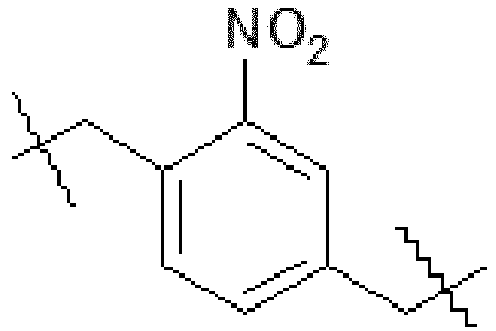
- Dans laquelle les liaisons covalentes au reste de la molécule étant représentées par

- De préférence, le sucre hydrolysable est une unité b-D-Glucopyranose.
- Selon un mode de réalisation, le monomère formant le groupe polymérisable comprend un groupe conjugué porteur d'un groupe labile générant un ion carboxylate après hydrolyse.
- Parmi les polymères bio-hydrolysables utilisés pour le revêtement selon l'invention, ceux préférés et considérés indépendamment sont les polymères bio-hydrolysables comprenant un monomère de structure chimique (I) suivante :

- Une autre représentation d'un polymère bio-hydrolysable (I) est la suivante (exemple avec Gp =H et R1 = CH3):

- L'invention concerne donc de tels polymères et les monomères permettant leur obtention. L'invention concerne en particulier les monomères de formule (II) :

- R1 est H ou CH3 et Gp représente indépendamment à chaque occurrence H ou un groupe protecteur.
- Une autre représentation d'un polymère bio-hydrolysable (I) est la suivante (exemple avec Gp =H et R1 = CH3):
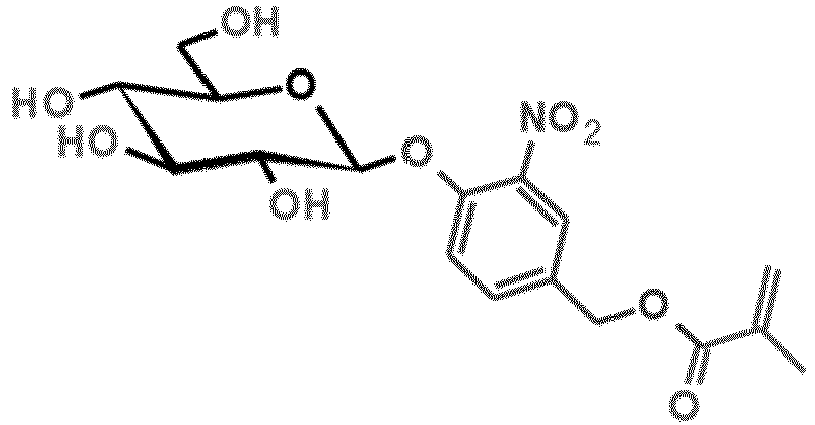
- Avantageusement, un polymère bio-hydrolysable selon l'invention comprend une unité monomère comprenant un sucre hydrolysable par une enzyme β-glucosidase.
- Selon un mode de réalisation, l'unité monomère comprenant un sucre hydrolysable par une enzyme β-glucosidase selon l'invention comprend trois parties identifiables, à savoir :
- Une tête de reconnaissance ou déclencheur ou « Récognition head » : qui représente l'extrémité du polymère reconnue et hydrolysée par les enzymes β-glucosidase. Dans ce cas, il s'agit du β-glucose (sucre) puisque ce sont les β-glucosidases qui sont visées.
- Un groupe de piégeage ou espaceur ou « Trapping device » : qui fait le lien entre le sucre facilement hydrolysable et le polymère. Avantageusement, le groupement fortement conjugué facilite la formation des ions carboxylates. Avantageusement, le groupe « nitro » est connu pour faciliter le clivage enzymatique de la liaison glycosidique.
- Un groupe polymérisable ou effecteur ou « Reporter group » : qui est constituée d'une fonction polymérisable. Avantageusement, le groupement méthacrylate est utilisé pour les revêtements selon l'invention. En effet, il est peu coûteux, facilement polymérisable et s'hydrolyse dans l'eau de mer.
- L'enzyme β-glucosidase hydrolyse le sucre.

- Au sens de l'invention on entend par « polymérisation » à la fois la polymérisation d'un homopolymère ou d'un copolymère, sauf indication contraire.
- Au sens de l'invention on désigne par « polymère » à la fois un homopolymère ou un copolymère, sauf indication contraire.
- Selon un mode de réalisation, le polymère est un homopolymère.
- Selon un mode de réalisation, le polymère est un copolymère, et notamment est un copolymère statistique. Le groupe polymérisable peut donc être constitué à partir de plusieurs monomères de structures chimiques différentes.
- Ainsi, selon un mode de réalisation, un polymère bio-hydrolysable selon l'invention comprend une alternance d'une ou plusieurs unités monomères comprenant un sucre hydrolysable et d'un autre monomère de préférence hydrolysable par l'eau de mer.
- Avantageusement, les copolymères statistiques permettent d'améliorer les propriétés filmogènes en abaissant la Tg (température de transition vitreuse du polymère) et par la même occasion de diminuer sensiblement le coût de production du revêtement.
- Selon un mode de réalisation, le polymère est un copolymère de formule (IV) suivante :

- Selon un mode de réalisation, le groupe polymérisable s'hydrolyse dans l'eau de mer.
- De préférence, le groupe polymérisable est un groupe méthacrylate.
- Le polymère de l'invention peut être avantageusement préparé en présence d'un ou plusieurs comonomères pour former un copolymère.
- Parmi les comonomères on peut citer ceux menant au motif polymérique suivant :

- avec R1 représente H ou CH3
- R2 représente un alkyle, linéaire ou ramifié, en C1-C22, aryle, aralkyle, ces radicaux pouvant être substitués et pouvant contenir des hétéroatomes.
- On peut citer comme monomère la structure (III) suivante :

- On peut citer par exemple : (méth)acrylate de lauryle, (méth)acrylate de stéaryle, (méth)acrylate de méthyle, (méth)acrylate d' éthyle, (méth)acrylate de propyle (tous les isomères), (méth)acrylate de butyle (tous les isomères), (méth)acrylate de 2-éthylhexyle, (méth)acrylate d' isobornyle, anhydride maléique, acide (méth)acrylique, (méth)acrylate de benzyle, (méth)acrylate de phényle, (méth)acrylonitrile, alpha-méthylstyrene, styrène, (méth)acrylates et styrènes fonctionnalisés sélectionnés parmi le (méth)acrylate d' hydroxypropyle (tous les isomères), (méth)acrylate d' hydroxybutyle (tous les isomères), (méth)acrylate d' hydroxyéthyle (tous les isomères), (méth)acrylate de N,N- diméthylaminoéthyle, (méth)acrylate de N,N-diéthylaminoéthyle, (méth)acrylate de triéthylène glycol, itaconic anhydride, (méth)acrylate de glycidyle, (méth)acrylamide, N-méthyl(méth)acrylamide, N,N-diméthyl(méth)acrylamide, N-tert-butyl(méth)acrylamide, N-n-butyl(méth)acrylamide, N-méthylol(méth)acrylamide, N-éthylol(méth)acrylamide, acide benzoïque vinylique (tous les isomères), diéthylaminostyrène (tous les isomères), alpha-méthyl vinyl acide benzoique (tous les isomères), diéthylaminoalpha-méthylstyrène (tous les isomères), acide sulfonique p-vinylbenzène, sel de sodium de l'acide sulfonique p-vinylbenzène, triméthoxysilylpropyl(méth)acrylate, triéthoxysilylpropyl(méth)acrylate, tributoxysilylpropyl (méth)acrylate, diméthoxyméthylsilylpropyl acrylate, diéthoxyméthylsilylpropyl acrylate, dibutoxyméthylsilylpropyl acrylate, diisopropoxysilylpropyl acrylate, acétate de vinyle, butyrate de vinyle, benzoate de vinyle, chlorure de vinyle, N-vinylpyrrolidone.
- Selon un mode de réalisation, un monomère est un méthacrylate d'acide gras, de préférence le méthacrylate de lauryle.
- Selon le standard habituel, (Méth)acrylate signifie aussi bien les monomères de type méthacrylate qu'acrylate.
- Selon une variante, le rapport molaire des comonomères, et par exemple des monomères (III)/(II), est compris entre 10/90 et 90/10.
- Selon une variante, le rapport molaire des comonomères, et par exemple des monomères (III)/(II), est compris entre 20/80 et 80/20.
- Selon une variante, le rapport molaire des comonomères, et par exemple des monomères (III)/(II), est compris entre 30/70 et 70/30.
- Selon une variante, le rapport molaire des comonomères, et par exemple des monomères (III)/(II), est compris entre 40/60 et 60/40.
- Selon une variante, le rapport molaire des comonomères, et par exemple des monomères (III)/(II), est d'environ 50/50.
- Selon une variante, le polymère présente une masse molaire moyenne en nombre Mn supérieure à 5000 g/mol ou à 6000 g/mol.
- Selon une variante, le polymère présente une masse molaire moyenne en nombre Mn comprise entre 5000 et 20000 g/mol ou entre 6000 et 15000 g/mol.
- Selon une variante, le polymère présente un indice de dispersité Ð inférieur à 1,4 et de préférence inférieur à 1,3 et encore de préférence inférieur à 1,2.
- Les conditions de polymérisation RAFT sont définies selon les connaissances de l'homme du métier.
- L'invention concerne également un procédé de préparation d'un polymère bio-hydrolysable tel que défini selon l'invention, ledit procédé comprenant la polymérisation radicalaire du groupe polymérisable pour former ledit polymère bio-hydrolysable.
- Selon une variante, ladite polymérisation radicalaire est mise en œuvre selon le procédé RAFT, de préférence en utilisant un dithioester, tel que par exemple le cyano isopropyl dithiobenzoate (CPDB), comme agent de transfert.
- De préférence, la polymérisation est réalisée avec un monomère (I) protégé par des groupes protecteurs (Gp), c'est-à-dire que les fonctions hydroxy du sucre hydrolysable ne sont sensiblement pas réactives lors de la polymérisation. Typiquement, les groupes protecteurs sont des groupes acétyles formant ainsi des fonctions O-Acétyles sur l'unité sucre.
- Ainsi, selon une variante, le polymère comprend des groupes protecteurs, et typiquement des groupes acétyles, sur le sucre hydrolysable.
- Selon une variante, le polymère protégé subit un déprotection des fonctions portant des groupes protecteurs, et typiquement des groupes acétyles, sur l'unité sucre.
- Selon un mode de réalisation, le polymère selon l'invention libère lors de son hydrolyse enzymatique une chaine polymère comprenant des groupes carboxylate.
- Avantageusement, la chaine polymère comprenant des groupes carboxylate libérée du polymère de formule (I) entraîne le détachement de biosalissures.
- L'invention concerne un polymère bio-hydrolysable tel que défini selon la présente invention et en particulier comprenant au moins un groupe liant un sucre hydrolysable avec un groupe polymérisable, ledit sucre étant hydrolysable par une enzyme β-glucosidase.
- L'invention concerne aussi une composition, notamment de peinture d'une structure immergée, caractérisée en ce qu'elle comprend un polymère bio-hydrolysable selon l'invention.
- L'invention concerne également l'utilisation d'un polymère bio-hydrolysable tel que défini selon la présente invention à titre de revêtement d'une structure immergée.
- L'invention concerne également un procédé ou méthode de dégradation d'un revêtement selon l'invention, comprenant :
- la mise en contact d'un revêtement comprenant au moins polymère bio-hydrolysable comprenant au moins un sucre hydrolysable par une enzyme β-glucosidase selon l'invention avec un microorganisme sécrétant une β-glucosidase, et
- l'hydrolyse du polymère bio-hydrolysable.
- Le schéma ci-dessous illustre un mécanisme de bio-hydrolyse d'un polymère cible (9) et les sous-produits (10, 12 et 15) relargués dans le milieu environnant.

- Ce principe peut être généralisé aux polymères biohydrolysables selon l'invention.
- De préférence, le polymère biohydrolysable selon l'invention en présence de microorganismes marins sécrétant une enzyme β-glucosidase s'hydrolyse en particulier en clivant la liaison β-glucosidique avec le groupe liant.
- Le polymère cible (9), faisant avantageusement office de liant polymère dans la composition, par exemple la peinture, est donc un dérivé du β-D-glucose hydrolysable par une enzyme β-D-glucosidase. Son hydrolyse génère le carboxylate (12) qui par sa solubilité en milieux aqueux entraîne le détachement de biosalissures.
- Parmi les bactéries marines on peut citer les bactéries marines du type vibrio (ex. vibrio vulnificus), shewanella (ex. shewanella baltica) et pseudoalteromonas (ex. pseudoalteromonas marina). Leurs enzymes sont alors capables d'engendrer la lyse d'un certain nombre de sucre.
- Des tests enzymatiques ont été réalisés afin de valider le concept de biohydrolyse des sucres par les enzymes.
- Des tests biologiques ont permis de vérifier qu'aucun des composés relargués n'est toxique pour les bactéries marines.
- Ainsi, l'invention fournit :
- un revêtement et/ou traitement pour la protection d'une structure immergée contre le développement de salissures marines ;
- un revêtement et/ou traitement efficace contre les salissures marines, c'est-à-dire un revêtement antifouling, en particulier contre le biofouling ;
- un revêtement et/ou traitement ne contenant pas de biocides ;
- un revêtement et/ou traitement ne générant pas de déchets toxiques pour le domaine maritime ou dans une mesure acceptable et bénéfique par rapport à l'état de la technique ;
- un revêtement et/ou traitement hydrolysable en milieu marin ;
- un revêtement et/ou traitement autopolissant, c'est-à-dire dont la couche supérieure du revêtement se renouvelle en milieu marin ;
- un revêtement et/ou traitement limitant la trainée hydrodynamique, par exemple pour diminuer la consommation en carburant et la production de gaz à effet de serre ;
- un revêtement et/ou traitement résistant aux chocs et efficace en modes statique et dynamique ;
- un revêtement aux propriétés thermomécaniques améliorées, et en particulier de fournir un revêtement qui n'est pas fragile aux fissures ou aux stries ;
- un revêtement et/ou traitement applicable sans nécessiter d'installation de chantier spécifique pour appliquer le revêtement.
- L'invention concerne également une structure immergée, notamment navire ou plateforme immergée, caractérisée en ce qu'elle comprend au moins sur une partie de sa surface, de préférence de sa surface immergée, un revêtement tel que défini selon l'invention. Par exemple, il s'agit d'un bâtiment de surface, d'un sous-marins ou d'une structure d'Énergie marine renouvelable (EMR).
- D'autres buts, caractéristiques et avantages de l'invention apparaîtront clairement à l'homme de l'art suite à la lecture de la description explicative qui fait référence à des exemples qui sont donnés seulement à titre d'illustration et qui ne sauraient en aucune façon limiter la portée de l'invention.
- Les exemples font partie intégrante de la présente invention et toute caractéristique apparaissant nouvelle par rapport à un état de la technique antérieure quelconque à partir de la description prise dans son ensemble, incluant les exemples, fait partie intégrante de l'invention dans sa fonction et dans sa généralité.
- Ainsi, chaque exemple a une portée générale.
- D'autre part, dans les exemples, tous les pourcentages sont donnés en masse, sauf indication contraire, et la température est exprimée en degré Celsius sauf indication contraire, et la pression est la pression atmosphérique, sauf indication contraire. La température est celle ambiante (20°C), sauf indication contraire.
- La synthèse du monomère protégé (6) est décrite dans le schéma 1. Cette méthode de synthèse permet de produire de façon reproductible le composé (6) en 3 étapes et avec d'excellents rendements pour chacune d'entre elles.

- L'homopolymère est synthétisé par voie radicalaire et plus spécifiquement la méthode de polymérisation radicalaire choisie est la polymérisation RAFT (Reversible Addition-Fragmentation chain Transfer) car elle permet de contrôler la distribution et les masses molaires des polymères formés. Le polymère protégé (8) est ensuite déprotégé pour former le polymère (9).

- Cette méthode de polymérisation permet de former avec succès l'homopolymère protégé (8) avec un taux de conversion supérieur à 86% après purification par simple précipitation dans le méthanol. Enfin, l'homopolymère cible (9) est obtenu après désacétylation du composé (8) avec un rendement de 87%. Cependant, les propriétés thermomécaniques de ce composé ne sont pas optimales puisque la température de transition vitreuse (Tg) est trop élevée. Le revêtement obtenu est de qualité insatisfaisante pour les inventeurs car il est trop fragile (stries, fissures, etc.).
- Les copolymères statistiques sont synthétisés par voie radicalaire et plus spécifiquement, la méthode de polymérisation radicalaire choisie est la polymérisation RAFT (Reversible Addition-Fragmentation chain Transfer).
- Les copolymères statistiques permettent d'améliorer les propriétés filmogènes en abaissant la Tg et par la même occasion de diminuer sensiblement le coût de production du revêtement. En effet, le co-monomère choisi (méthacrylate de lauryle, LM) est bon marché contrairement au monomère biohydrolysable (6) qui nécessite des réactifs onéreux (CPDB, etc.). Le LM est un monomère utilisé en tant que précurseur de matrices polymères (ou liants) dans certains revêtements antifouling SPC et dans le domaine de la chimie, les vernis, les adhésifs, les plastiques, etc. De plus, l'homopolymère poly(LM) a une Tg relativement basse dans nos conditions de synthèse (-36°C pour le poly(LM)) et possède la même fonction polymérisable (méthacrylate) que le monomère cible ce qui évite les problèmes de dérive dans la composition des chaînes polymères lors de la production.

- On utilise selon l'exemple 3 le méthacrylate de lauryle (LM) lieu du méthacrylate de butyle (du schéma de principe).
- La synthèse de ces copolymères statistiques à l'échelle du laboratoire (quelques grammes) a été optimisée. Plusieurs copolymères ont été synthétisés pour avoir les meilleures propriétés filmogènes (pas de craquelures, ni d'écailles).
- En réalisant des exemples en faisant varier le rapport molaire LM/monomère entre 0/100 et 50/50 on obtient des polymères présentant une Tg d'environ de 50°C à 160°C, une Mn d'environ 7000 à 12000 g/mol et où Ip (ou Ð) va de 1,1 à 1,2.
- Il s'avère que le copolymère statistique contenant 70% mol. de méthacrylate de lauryle (LM) et 30% mol. de monomère biohydrolysable, présente les meilleures propriétés filmogènes.
- Enfin, les tests de biohydrolyse réalisés (suivi par LC/MS de la concentration en nitrophénol (15) relarguée au cours du temps) dans de l'eau distillée et dans de l'eau de mer permettent de valider ce concept et de calculer le taux de relargage moyen en nitrophénol au cours du temps (1,3µg/cm2/jour).
- Deux souches bactériennes TC8 (Pseudoalteromonas lipolytica) et TC11 (Shewanella pneumatophori) pionnières du biofouling utilisées au cours de ce projet ont été extraites de la rade de Toulon.
- Le revêtement bio-hydrolysable n'a pas vocation à freiner l'adhésion des bactéries comme peuvent l'être les SPCs. Toutefois, étant donné que les bactéries qui secrètent les enzymes β-D-glucosidases sont responsables de l'érosion du revêtement, il est important de savoir si ce revêtement inhibe l'adhésion bactérienne. Plus il y aura de bactéries sur le revêtement et plus la cinétique d'érosion sera importante. Pour cela, des tests de bio-adhésion sont réalisés sur les coverslips recouverts d'un film du polymère protégé (8). Le Tableau 1, montre que le polymère (8) diminue légèrement l'adhésion de ces bactéries par rapport aux coverslips non revêtus utilisés comme témoin (taux d'adhésion de 100%).
-
Tableau 1 : Résultats des bio-essais d'anti-adhésion bactérienne Bactérie Pourcentage d'adhésion (%) Ecart type TC8 61,4 6,4 TC11 64,3 6,7 - Les images obtenues au microscope confocal mettent en évidence que la densité bactérienne est beaucoup plus faible sur le coverslip recouvert avec l'homopolymère (8).
- Les tests biologiques de croissance et de toxicité (Tableau 2) ont démontré que le nitrophénol (15) qui est déjà utilisé dans le domaine médical n'est pas toxique pour le domaine maritime (CL50) même à des concentrations élevées en nitrophénol (200 µM).
-
Tableau 2 : Impact du nitrophénol sur deux bactéries marines, TC8 (Pseudoalteromonas lipolytica) et TC11 (Shewanella pneumatophori) Concentration médiane TC8 TC11 Létale (CL50) / / Inhibitrice (Cl50) 170 µM +/- 20,7 189,9 µM +/- 1,7 Efficace (CE50) / / - Les bio-essais bactériens mettent aussi en évidence que ce composé influence la croissance bactérienne (CI50) seulement à des concentrations élevées (200 µM) mais en aucun cas l'adhésion bactérienne (CE50).
- La voie de synthèse du monomère est clairement identifiée et reproductible. Plusieurs copolymères ont également été synthétisés et les rapports optimisés pour obtenir les propriétés filmogènes souhaitées.
- Ainsi, l'invention fournit un revêtement et/ou traitement efficace contre le biofouling tout en respectant l'environnement.
Claims (12)
- Revêtement d'une structure immergée, ledit revêtement comprenant au moins polymère bio-hydrolysable comprenant au moins un sucre hydrolysable par une enzyme β-glucosidase.
- Revêtement, selon la revendication 1, caractérisé en ce que le polymère bio-hydrolysable comprend au moins un groupe d'atomes liant par liaison covalente le sucre hydrolysable et un groupe polymérisable.
- Revêtement, selon la revendication 1 ou 2, caractérisé en ce que le groupe polymérisable s'hydrolyse dans l'eau de mer.
- Revêtement, selon l'une quelconque des revendications 1 à 3, caractérisé en ce que le monomère formant le groupe polymérisable comprend un groupe conjugué porteur d'un groupe labile générant un ion carboxylate après hydrolyse.
- Revêtement, selon l'une quelconque des revendications 1 à 4, caractérisé en ce que le polymère bio-hydrolysable présente la structure chimique (I) ou (IV) suivante :


- Structure immergée, notamment navire ou plateforme immergée, caractérisée en ce qu'elle comprend au moins sur une partie de sa surface, de préférence de sa surface immergée, un revêtement tel que défini à l'une quelconque des revendications 1 à 5.
- Procédé de préparation d'un polymère bio-hydrolysable, tel que défini selon l'une quelconque des revendications 1 à 5, comprenant au moins groupe liant un sucre hydrolysable avec un groupe polymérisable, ledit sucre étant hydrolysable par une enzyme β-glucosidase, ledit procédé comprenant la polymérisation radicalaire du groupe polymérisable pour former ledit polymère bio-hydrolysable.
- Procédé selon la revendication 7, caractérisé en ce que ladite polymérisation radicalaire est mise en œuvre selon le procédé RAFT, de préférence en utilisant un dithioester, tel que par exemple le cyano isopropyl dithiobenzoate (CPDB), comme agent de transfert.
- Procédé ou méthode de dégradation d'un revêtement selon l'une quelconque des revendications 1 à 5, comprenant :la mise en contact d'un revêtement comprenant au moins polymère bio-hydrolysable comprenant au moins un sucre hydrolysable par une enzyme β-glucosidase tel que défini selon l'une quelconque des revendications 1 à 5, avec un microorganisme sécrétant une β-glucosidase, etl'hydrolyse du polymère bio-hydrolysable.
- Polymère bio-hydrolysable comprenant au moins un groupe liant un sucre hydrolysable avec un groupe polymérisable, ledit sucre étant hydrolysable par une enzyme β-glucosidase, ledit polymère étant tel que défini selon l'une quelconque des revendications 1 à 5.
- Composition, notamment de peinture d'une structure immergée, caractérisée en ce qu'elle comprend un polymère bio-hydrolysable étant tel que défini selon l'une quelconque des revendications 1 à 5 ou 10.
- Utilisation d'un polymère bio-hydrolysable comprenant au moins un sucre hydrolysable par une enzyme β-glucosidase, par exemple β-D-glucosidase, notamment ledit polymère étant tel que défini selon l'une quelconque des revendications 1 à 5 ou 10, à titre de revêtement d'une structure immergée.
Applications Claiming Priority (1)
| Application Number | Priority Date | Filing Date | Title |
|---|---|---|---|
| FR1874112A FR3091293B1 (fr) | 2018-12-26 | 2018-12-26 | Revêtement antifouling |
Publications (2)
| Publication Number | Publication Date |
|---|---|
| EP3674332A1 true EP3674332A1 (fr) | 2020-07-01 |
| EP3674332B1 EP3674332B1 (fr) | 2023-11-01 |
Family
ID=68210834
Family Applications (1)
| Application Number | Title | Priority Date | Filing Date |
|---|---|---|---|
| EP19219729.1A Active EP3674332B1 (fr) | 2018-12-26 | 2019-12-26 | Revêtement antifouling |
Country Status (2)
| Country | Link |
|---|---|
| EP (1) | EP3674332B1 (fr) |
| FR (1) | FR3091293B1 (fr) |
Citations (2)
| Publication number | Priority date | Publication date | Assignee | Title |
|---|---|---|---|---|
| EP0866103A1 (fr) * | 1997-03-17 | 1998-09-23 | Nippon Paint Co., Ltd. | Procédé pour libérer de façon controlée des composés à activité antimicrobienne et composition de revêtement |
| WO2010089378A1 (fr) * | 2009-02-06 | 2010-08-12 | Hempel A/S | Compositions de revêtements autolustrantes à base d'enzymes |
-
2018
- 2018-12-26 FR FR1874112A patent/FR3091293B1/fr active Active
-
2019
- 2019-12-26 EP EP19219729.1A patent/EP3674332B1/fr active Active
Patent Citations (2)
| Publication number | Priority date | Publication date | Assignee | Title |
|---|---|---|---|---|
| EP0866103A1 (fr) * | 1997-03-17 | 1998-09-23 | Nippon Paint Co., Ltd. | Procédé pour libérer de façon controlée des composés à activité antimicrobienne et composition de revêtement |
| WO2010089378A1 (fr) * | 2009-02-06 | 2010-08-12 | Hempel A/S | Compositions de revêtements autolustrantes à base d'enzymes |
Non-Patent Citations (1)
| Title |
|---|
| WOUTER M. J. KLOOSTERMAN ET AL: "Chemo-enzymatic synthesis route to poly(glucosyl-acrylates) using glucosidase from almonds", GREEN CHEMISTRY, vol. 16, no. 4, 1 January 2014 (2014-01-01), GB, pages 1837 - 1846, XP055239381, ISSN: 1463-9262, DOI: 10.1039/C3GC41115J * |
Also Published As
| Publication number | Publication date |
|---|---|
| FR3091293A1 (fr) | 2020-07-03 |
| FR3091293B1 (fr) | 2021-12-31 |
| EP3674332B1 (fr) | 2023-11-01 |
Similar Documents
| Publication | Publication Date | Title |
|---|---|---|
| US8192843B2 (en) | Polymers and polymer coatings | |
| JP6872672B2 (ja) | 防汚塗料組成物 | |
| EP2561021B1 (fr) | Liant pour un revêtement antisalissure auto-polissant | |
| US20080038241A1 (en) | Self-Polishing Anti-Fouling coating Compositions Comprising An Enzyme | |
| EP0896123A1 (fr) | Procédé pour ralentir la croissance et/ou l'agglomération et éventuellement retarder la formation d'hydrates dans un effluent de production | |
| JP5728390B2 (ja) | 組成物 | |
| KR20060009226A (ko) | 산-캡핑된 4차 중합체 및 이 중합체를 포함하는 조성물 | |
| NO340144B1 (no) | Grohemmende blanding som omfatter en poymer med saltgrupper | |
| CN116490575A (zh) | 防污涂料组合物 | |
| KR20190057118A (ko) | 방오 도료 조성물, 방오 도막, 방오 도막 부착 기재 및 그의 제조 방법, 및 방오 방법 | |
| EP1483341B1 (fr) | Utilisation de copolymeres a blocs portant des fonctions phosphonates comme promoteurs d'adhesion ou comme agents de protection contre la corrosion d'une surface metallique | |
| CN102307956A (zh) | 基于酶的自抛光涂料组合物 | |
| AU727547B2 (en) | Increasing the self-polishing properties of antifouling paints | |
| EP3674332B1 (fr) | Revêtement antifouling | |
| WO2003076531A1 (fr) | Utilisation de copolymeres a blocs portant des fonctions phosphates et/ou phosphonates comme promoteurs d'adhesion ou comme agents de protection contre la corrosion d'une surface metallique | |
| Dong et al. | Synergistic effect of copolymeric resin grafted 1, 2-benzisothiazol-3 (2 H)-one and heterocyclic groups as a marine antifouling coating | |
| WO2005014737A1 (fr) | Composition de revetement, film de revetement antifouling, structure sous-marine et procedes empeche le depot de salissures sur la structure sous-marine | |
| JPH08277372A (ja) | 塗料組成物 | |
| EP0270465B1 (fr) | Liants résistant aux salissures et organismes présents en milieu aqueux et leur procédé de préparation | |
| JP2022088688A (ja) | 防汚塗料組成物 | |
| KR20230151111A (ko) | 방오 도료 조성물 | |
| WO2022239567A1 (fr) | Composition de revêtement antisalissure | |
| EP2337823B1 (fr) | Compositions antisalissures photoreticulables, films obtenus a partir de ces compositions et utilisations correspondantes | |
| JP2022069873A (ja) | 防汚塗料組成物 | |
| KR20230155543A (ko) | 방오 도료 조성물 |
Legal Events
| Date | Code | Title | Description |
|---|---|---|---|
| PUAI | Public reference made under article 153(3) epc to a published international application that has entered the european phase |
Free format text: ORIGINAL CODE: 0009012 |
|
| STAA | Information on the status of an ep patent application or granted ep patent |
Free format text: STATUS: THE APPLICATION HAS BEEN PUBLISHED |
|
| AK | Designated contracting states |
Kind code of ref document: A1 Designated state(s): AL AT BE BG CH CY CZ DE DK EE ES FI FR GB GR HR HU IE IS IT LI LT LU LV MC MK MT NL NO PL PT RO RS SE SI SK SM TR |
|
| AX | Request for extension of the european patent |
Extension state: BA ME |
|
| RAP1 | Party data changed (applicant data changed or rights of an application transferred) |
Owner name: UNIVERSITE DE TOULON Owner name: NAVAL GROUP |
|
| STAA | Information on the status of an ep patent application or granted ep patent |
Free format text: STATUS: REQUEST FOR EXAMINATION WAS MADE |
|
| 17P | Request for examination filed |
Effective date: 20201210 |
|
| RBV | Designated contracting states (corrected) |
Designated state(s): AL AT BE BG CH CY CZ DE DK EE ES FI FR GB GR HR HU IE IS IT LI LT LU LV MC MK MT NL NO PL PT RO RS SE SI SK SM TR |
|
| STAA | Information on the status of an ep patent application or granted ep patent |
Free format text: STATUS: EXAMINATION IS IN PROGRESS |
|
| 17Q | First examination report despatched |
Effective date: 20220907 |
|
| GRAP | Despatch of communication of intention to grant a patent |
Free format text: ORIGINAL CODE: EPIDOSNIGR1 |
|
| STAA | Information on the status of an ep patent application or granted ep patent |
Free format text: STATUS: GRANT OF PATENT IS INTENDED |
|
| INTG | Intention to grant announced |
Effective date: 20230605 |
|
| GRAS | Grant fee paid |
Free format text: ORIGINAL CODE: EPIDOSNIGR3 |
|
| GRAA | (expected) grant |
Free format text: ORIGINAL CODE: 0009210 |
|
| STAA | Information on the status of an ep patent application or granted ep patent |
Free format text: STATUS: THE PATENT HAS BEEN GRANTED |
|
| AK | Designated contracting states |
Kind code of ref document: B1 Designated state(s): AL AT BE BG CH CY CZ DE DK EE ES FI FR GB GR HR HU IE IS IT LI LT LU LV MC MK MT NL NO PL PT RO RS SE SI SK SM TR |
|
| REG | Reference to a national code |
Ref country code: GB Ref legal event code: FG4D Free format text: NOT ENGLISH |
|
| REG | Reference to a national code |
Ref country code: CH Ref legal event code: EP |
|
| REG | Reference to a national code |
Ref country code: IE Ref legal event code: FG4D Free format text: LANGUAGE OF EP DOCUMENT: FRENCH |
|
| REG | Reference to a national code |
Ref country code: DE Ref legal event code: R096 Ref document number: 602019040497 Country of ref document: DE |
|
| REG | Reference to a national code |
Ref country code: LT Ref legal event code: MG9D |
|
| REG | Reference to a national code |
Ref country code: NL Ref legal event code: MP Effective date: 20231101 |
|
| PG25 | Lapsed in a contracting state [announced via postgrant information from national office to epo] |
Ref country code: GR Free format text: LAPSE BECAUSE OF FAILURE TO SUBMIT A TRANSLATION OF THE DESCRIPTION OR TO PAY THE FEE WITHIN THE PRESCRIBED TIME-LIMIT Effective date: 20240202 |
|
| PG25 | Lapsed in a contracting state [announced via postgrant information from national office to epo] |
Ref country code: IS Free format text: LAPSE BECAUSE OF FAILURE TO SUBMIT A TRANSLATION OF THE DESCRIPTION OR TO PAY THE FEE WITHIN THE PRESCRIBED TIME-LIMIT Effective date: 20240301 |
|
| PG25 | Lapsed in a contracting state [announced via postgrant information from national office to epo] |
Ref country code: LT Free format text: LAPSE BECAUSE OF FAILURE TO SUBMIT A TRANSLATION OF THE DESCRIPTION OR TO PAY THE FEE WITHIN THE PRESCRIBED TIME-LIMIT Effective date: 20231101 |
|
| REG | Reference to a national code |
Ref country code: AT Ref legal event code: MK05 Ref document number: 1627166 Country of ref document: AT Kind code of ref document: T Effective date: 20231101 |
|
| PG25 | Lapsed in a contracting state [announced via postgrant information from national office to epo] |
Ref country code: NL Free format text: LAPSE BECAUSE OF FAILURE TO SUBMIT A TRANSLATION OF THE DESCRIPTION OR TO PAY THE FEE WITHIN THE PRESCRIBED TIME-LIMIT Effective date: 20231101 |
|
| PG25 | Lapsed in a contracting state [announced via postgrant information from national office to epo] |
Ref country code: AT Free format text: LAPSE BECAUSE OF FAILURE TO SUBMIT A TRANSLATION OF THE DESCRIPTION OR TO PAY THE FEE WITHIN THE PRESCRIBED TIME-LIMIT Effective date: 20231101 |
|
| PG25 | Lapsed in a contracting state [announced via postgrant information from national office to epo] |
Ref country code: ES Free format text: LAPSE BECAUSE OF FAILURE TO SUBMIT A TRANSLATION OF THE DESCRIPTION OR TO PAY THE FEE WITHIN THE PRESCRIBED TIME-LIMIT Effective date: 20231101 |
|
| PG25 | Lapsed in a contracting state [announced via postgrant information from national office to epo] |
Ref country code: NL Free format text: LAPSE BECAUSE OF FAILURE TO SUBMIT A TRANSLATION OF THE DESCRIPTION OR TO PAY THE FEE WITHIN THE PRESCRIBED TIME-LIMIT Effective date: 20231101 Ref country code: LT Free format text: LAPSE BECAUSE OF FAILURE TO SUBMIT A TRANSLATION OF THE DESCRIPTION OR TO PAY THE FEE WITHIN THE PRESCRIBED TIME-LIMIT Effective date: 20231101 Ref country code: IS Free format text: LAPSE BECAUSE OF FAILURE TO SUBMIT A TRANSLATION OF THE DESCRIPTION OR TO PAY THE FEE WITHIN THE PRESCRIBED TIME-LIMIT Effective date: 20240301 Ref country code: GR Free format text: LAPSE BECAUSE OF FAILURE TO SUBMIT A TRANSLATION OF THE DESCRIPTION OR TO PAY THE FEE WITHIN THE PRESCRIBED TIME-LIMIT Effective date: 20240202 Ref country code: ES Free format text: LAPSE BECAUSE OF FAILURE TO SUBMIT A TRANSLATION OF THE DESCRIPTION OR TO PAY THE FEE WITHIN THE PRESCRIBED TIME-LIMIT Effective date: 20231101 Ref country code: BG Free format text: LAPSE BECAUSE OF FAILURE TO SUBMIT A TRANSLATION OF THE DESCRIPTION OR TO PAY THE FEE WITHIN THE PRESCRIBED TIME-LIMIT Effective date: 20240201 Ref country code: AT Free format text: LAPSE BECAUSE OF FAILURE TO SUBMIT A TRANSLATION OF THE DESCRIPTION OR TO PAY THE FEE WITHIN THE PRESCRIBED TIME-LIMIT Effective date: 20231101 Ref country code: PT Free format text: LAPSE BECAUSE OF FAILURE TO SUBMIT A TRANSLATION OF THE DESCRIPTION OR TO PAY THE FEE WITHIN THE PRESCRIBED TIME-LIMIT Effective date: 20240301 |
|
| PG25 | Lapsed in a contracting state [announced via postgrant information from national office to epo] |
Ref country code: SE Free format text: LAPSE BECAUSE OF FAILURE TO SUBMIT A TRANSLATION OF THE DESCRIPTION OR TO PAY THE FEE WITHIN THE PRESCRIBED TIME-LIMIT Effective date: 20231101 Ref country code: RS Free format text: LAPSE BECAUSE OF FAILURE TO SUBMIT A TRANSLATION OF THE DESCRIPTION OR TO PAY THE FEE WITHIN THE PRESCRIBED TIME-LIMIT Effective date: 20231101 Ref country code: PL Free format text: LAPSE BECAUSE OF FAILURE TO SUBMIT A TRANSLATION OF THE DESCRIPTION OR TO PAY THE FEE WITHIN THE PRESCRIBED TIME-LIMIT Effective date: 20231101 Ref country code: NO Free format text: LAPSE BECAUSE OF FAILURE TO SUBMIT A TRANSLATION OF THE DESCRIPTION OR TO PAY THE FEE WITHIN THE PRESCRIBED TIME-LIMIT Effective date: 20240201 Ref country code: LV Free format text: LAPSE BECAUSE OF FAILURE TO SUBMIT A TRANSLATION OF THE DESCRIPTION OR TO PAY THE FEE WITHIN THE PRESCRIBED TIME-LIMIT Effective date: 20231101 Ref country code: HR Free format text: LAPSE BECAUSE OF FAILURE TO SUBMIT A TRANSLATION OF THE DESCRIPTION OR TO PAY THE FEE WITHIN THE PRESCRIBED TIME-LIMIT Effective date: 20231101 |
|
| REG | Reference to a national code |
Ref country code: DE Ref legal event code: R119 Ref document number: 602019040497 Country of ref document: DE |
|
| PG25 | Lapsed in a contracting state [announced via postgrant information from national office to epo] |
Ref country code: DK Free format text: LAPSE BECAUSE OF FAILURE TO SUBMIT A TRANSLATION OF THE DESCRIPTION OR TO PAY THE FEE WITHIN THE PRESCRIBED TIME-LIMIT Effective date: 20231101 |
|
| PG25 | Lapsed in a contracting state [announced via postgrant information from national office to epo] |
Ref country code: CZ Free format text: LAPSE BECAUSE OF FAILURE TO SUBMIT A TRANSLATION OF THE DESCRIPTION OR TO PAY THE FEE WITHIN THE PRESCRIBED TIME-LIMIT Effective date: 20231101 |
|
| PG25 | Lapsed in a contracting state [announced via postgrant information from national office to epo] |
Ref country code: SK Free format text: LAPSE BECAUSE OF FAILURE TO SUBMIT A TRANSLATION OF THE DESCRIPTION OR TO PAY THE FEE WITHIN THE PRESCRIBED TIME-LIMIT Effective date: 20231101 |
|
| PG25 | Lapsed in a contracting state [announced via postgrant information from national office to epo] |
Ref country code: SM Free format text: LAPSE BECAUSE OF FAILURE TO SUBMIT A TRANSLATION OF THE DESCRIPTION OR TO PAY THE FEE WITHIN THE PRESCRIBED TIME-LIMIT Effective date: 20231101 Ref country code: SK Free format text: LAPSE BECAUSE OF FAILURE TO SUBMIT A TRANSLATION OF THE DESCRIPTION OR TO PAY THE FEE WITHIN THE PRESCRIBED TIME-LIMIT Effective date: 20231101 Ref country code: IT Free format text: LAPSE BECAUSE OF FAILURE TO SUBMIT A TRANSLATION OF THE DESCRIPTION OR TO PAY THE FEE WITHIN THE PRESCRIBED TIME-LIMIT Effective date: 20231101 Ref country code: EE Free format text: LAPSE BECAUSE OF FAILURE TO SUBMIT A TRANSLATION OF THE DESCRIPTION OR TO PAY THE FEE WITHIN THE PRESCRIBED TIME-LIMIT Effective date: 20231101 Ref country code: DK Free format text: LAPSE BECAUSE OF FAILURE TO SUBMIT A TRANSLATION OF THE DESCRIPTION OR TO PAY THE FEE WITHIN THE PRESCRIBED TIME-LIMIT Effective date: 20231101 Ref country code: CZ Free format text: LAPSE BECAUSE OF FAILURE TO SUBMIT A TRANSLATION OF THE DESCRIPTION OR TO PAY THE FEE WITHIN THE PRESCRIBED TIME-LIMIT Effective date: 20231101 |
|
| REG | Reference to a national code |
Ref country code: CH Ref legal event code: PL |
|
| PG25 | Lapsed in a contracting state [announced via postgrant information from national office to epo] |
Ref country code: LU Free format text: LAPSE BECAUSE OF NON-PAYMENT OF DUE FEES Effective date: 20231226 |
|
| PG25 | Lapsed in a contracting state [announced via postgrant information from national office to epo] |
Ref country code: MC Free format text: LAPSE BECAUSE OF FAILURE TO SUBMIT A TRANSLATION OF THE DESCRIPTION OR TO PAY THE FEE WITHIN THE PRESCRIBED TIME-LIMIT Effective date: 20231101 |
|
| REG | Reference to a national code |
Ref country code: BE Ref legal event code: MM Effective date: 20231231 |
|
| PG25 | Lapsed in a contracting state [announced via postgrant information from national office to epo] |
Ref country code: MC Free format text: LAPSE BECAUSE OF FAILURE TO SUBMIT A TRANSLATION OF THE DESCRIPTION OR TO PAY THE FEE WITHIN THE PRESCRIBED TIME-LIMIT Effective date: 20231101 Ref country code: LU Free format text: LAPSE BECAUSE OF NON-PAYMENT OF DUE FEES Effective date: 20231226 |
|
| PLBE | No opposition filed within time limit |
Free format text: ORIGINAL CODE: 0009261 |
|
| STAA | Information on the status of an ep patent application or granted ep patent |
Free format text: STATUS: NO OPPOSITION FILED WITHIN TIME LIMIT |
|
| 26N | No opposition filed |
Effective date: 20240802 |
|
| REG | Reference to a national code |
Ref country code: IE Ref legal event code: MM4A |
|
| PG25 | Lapsed in a contracting state [announced via postgrant information from national office to epo] |
Ref country code: DE Free format text: LAPSE BECAUSE OF NON-PAYMENT OF DUE FEES Effective date: 20240702 Ref country code: IE Free format text: LAPSE BECAUSE OF NON-PAYMENT OF DUE FEES Effective date: 20231226 |
|
| PG25 | Lapsed in a contracting state [announced via postgrant information from national office to epo] |
Ref country code: BE Free format text: LAPSE BECAUSE OF NON-PAYMENT OF DUE FEES Effective date: 20231231 |
|
| PG25 | Lapsed in a contracting state [announced via postgrant information from national office to epo] |
Ref country code: FR Free format text: LAPSE BECAUSE OF NON-PAYMENT OF DUE FEES Effective date: 20240101 |
|
| PG25 | Lapsed in a contracting state [announced via postgrant information from national office to epo] |
Ref country code: CH Free format text: LAPSE BECAUSE OF NON-PAYMENT OF DUE FEES Effective date: 20231231 |
|
| GBPC | Gb: european patent ceased through non-payment of renewal fee |
Effective date: 20240201 |
|
| PG25 | Lapsed in a contracting state [announced via postgrant information from national office to epo] |
Ref country code: SI Free format text: LAPSE BECAUSE OF FAILURE TO SUBMIT A TRANSLATION OF THE DESCRIPTION OR TO PAY THE FEE WITHIN THE PRESCRIBED TIME-LIMIT Effective date: 20231101 |
|
| PG25 | Lapsed in a contracting state [announced via postgrant information from national office to epo] |
Ref country code: SI Free format text: LAPSE BECAUSE OF FAILURE TO SUBMIT A TRANSLATION OF THE DESCRIPTION OR TO PAY THE FEE WITHIN THE PRESCRIBED TIME-LIMIT Effective date: 20231101 Ref country code: IE Free format text: LAPSE BECAUSE OF NON-PAYMENT OF DUE FEES Effective date: 20231226 Ref country code: FR Free format text: LAPSE BECAUSE OF NON-PAYMENT OF DUE FEES Effective date: 20240101 Ref country code: DE Free format text: LAPSE BECAUSE OF NON-PAYMENT OF DUE FEES Effective date: 20240702 Ref country code: CH Free format text: LAPSE BECAUSE OF NON-PAYMENT OF DUE FEES Effective date: 20231231 Ref country code: BE Free format text: LAPSE BECAUSE OF NON-PAYMENT OF DUE FEES Effective date: 20231231 |
|
| PG25 | Lapsed in a contracting state [announced via postgrant information from national office to epo] |
Ref country code: GB Free format text: LAPSE BECAUSE OF NON-PAYMENT OF DUE FEES Effective date: 20240201 |
|
| PG25 | Lapsed in a contracting state [announced via postgrant information from national office to epo] |
Ref country code: GB Free format text: LAPSE BECAUSE OF NON-PAYMENT OF DUE FEES Effective date: 20240201 |
|
| PG25 | Lapsed in a contracting state [announced via postgrant information from national office to epo] |
Ref country code: RO Free format text: LAPSE BECAUSE OF FAILURE TO SUBMIT A TRANSLATION OF THE DESCRIPTION OR TO PAY THE FEE WITHIN THE PRESCRIBED TIME-LIMIT Effective date: 20231101 |
|
| PG25 | Lapsed in a contracting state [announced via postgrant information from national office to epo] |
Ref country code: FI Free format text: LAPSE BECAUSE OF FAILURE TO SUBMIT A TRANSLATION OF THE DESCRIPTION OR TO PAY THE FEE WITHIN THE PRESCRIBED TIME-LIMIT Effective date: 20231101 |
|
| PG25 | Lapsed in a contracting state [announced via postgrant information from national office to epo] |
Ref country code: CY Free format text: LAPSE BECAUSE OF FAILURE TO SUBMIT A TRANSLATION OF THE DESCRIPTION OR TO PAY THE FEE WITHIN THE PRESCRIBED TIME-LIMIT; INVALID AB INITIO Effective date: 20191226 |
|
| PG25 | Lapsed in a contracting state [announced via postgrant information from national office to epo] |
Ref country code: HU Free format text: LAPSE BECAUSE OF FAILURE TO SUBMIT A TRANSLATION OF THE DESCRIPTION OR TO PAY THE FEE WITHIN THE PRESCRIBED TIME-LIMIT; INVALID AB INITIO Effective date: 20191226 |
|
| PG25 | Lapsed in a contracting state [announced via postgrant information from national office to epo] |
Ref country code: TR Free format text: LAPSE BECAUSE OF FAILURE TO SUBMIT A TRANSLATION OF THE DESCRIPTION OR TO PAY THE FEE WITHIN THE PRESCRIBED TIME-LIMIT Effective date: 20231101 |