EP3674717B1 - Vorrichtung zur bestimmung des spektrums eines signals über eine grosse frequenzbandbreite durch mehrfachabtastung, und entsprechendes verfahren - Google Patents
Vorrichtung zur bestimmung des spektrums eines signals über eine grosse frequenzbandbreite durch mehrfachabtastung, und entsprechendes verfahren Download PDFInfo
- Publication number
- EP3674717B1 EP3674717B1 EP19220293.5A EP19220293A EP3674717B1 EP 3674717 B1 EP3674717 B1 EP 3674717B1 EP 19220293 A EP19220293 A EP 19220293A EP 3674717 B1 EP3674717 B1 EP 3674717B1
- Authority
- EP
- European Patent Office
- Prior art keywords
- signal
- frequency
- spectrum
- frequency band
- frequencies
- Prior art date
- Legal status (The legal status is an assumption and is not a legal conclusion. Google has not performed a legal analysis and makes no representation as to the accuracy of the status listed.)
- Active
Links
Images

Classifications
-
- G—PHYSICS
- G01—MEASURING; TESTING
- G01R—MEASURING ELECTRIC VARIABLES; MEASURING MAGNETIC VARIABLES
- G01R23/00—Arrangements for measuring frequencies; Arrangements for analysing frequency spectra
- G01R23/16—Spectrum analysis; Fourier analysis
Definitions
- the technical field of the invention is that of the analysis of a wide band of frequencies and in particular that of the determination of the spectrum of signals over a wide band of frequencies.
- the present invention relates to a device for analyzing a wide band of frequencies and in particular a device for determining the spectrum of signals over a wide band of frequencies.
- the invention offers a solution to the problems mentioned previously, by making it possible to determine precisely, over a wide band of frequencies, the spectrum of each signal received with an on-board device.
- the spectrum of a signal received over a wide band of frequencies is determined thanks to the spectrum of each sampled signal subjected to the phenomenon of spectrum aliasing since it is sampled by a frequency that does not comply with Shannon's theorem.
- the determination of the spectrum of the signal received is rapid compared to that which is carried out by a superheterodyne receiver and therefore makes it possible, for example, to process two signals received simultaneously over the entire frequency band. listen.
- sampling frequencies greater than twice the bandwidth of the signal it is possible, in addition to determining the spectrum of the received signal, to extract the received signal from the sampled signals. Indeed, for each signal received, Shannon's theorem must be respected in order to preserve all the information in the sampled data. It is therefore necessary that each sampling frequency be greater than the bandwidth of the received signal.
- the extraction of the raw signal can then be carried out, for example by carrying out the inverse Fourier transform from the Fourier transform of one of the acquisition channels or even from the reconstruction of the spectrum using all the sampled data.
- sampling frequencies are chosen so that Shannon's theorem is respected for the received signal but Shannon's theorem is not respected for the spectrum of the received signal.
- the device according to a first aspect of the invention may have one or more additional characteristics among the following, considered individually or according to all the technically possible combinations.
- the signals are received on a frequency band extending from 0 MHz and 100 GHz.
- the processing module comprises at least three analog-digital converters.
- the device allows an accurate determination of the spectrum of the signal received.
- sampling frequencies are chosen so that their least common multiple is greater than the maximum frequency of the wide band of frequencies.
- the sampling frequencies are chosen so as to be spaced two by two by a value greater than twice the bandwidth of the signal.
- sampling frequencies whose spacing, i.e. the minimum difference between the sampling frequencies, is greater than twice the bandwidth of the signal, it is possible, in addition to determining the spectrum of the signal received, to extract the signal received from at least one of the sampled signals whatever the frequency of the signal in the spectrum. Indeed, in this case, the signal will not be folded between two Nyquist bands on at least one of the analog-digital converters making it possible to extract the raw signal from its sampled data, by filtering for example.
- a third aspect of the invention relates to a computer program product comprising instructions which, when the program is executed by a computer, lead the latter to implement the method according to a second aspect of the invention.
- a fourth aspect of the invention relates to a computer-readable recording medium comprising instructions which, when executed by a computer, lead the latter to implement the method according to a second aspect of the invention.
- a first aspect of the invention relates to a device 100 making it possible to determine the spectrum of signals over a wide band of frequencies.
- a wide band is defined as opposed to a narrow band.
- a narrow band is a band on which signals are acquired whose spectrum is included in a narrow range of frequencies.
- the signals used have a narrow band whose spectrum is included in the frequency band ranging from 300 Hz to 3400 Hz.
- the band is wide in view of the sampling capabilities of current analog-to-digital converters.
- the spectrum of the signal acquired over the wide band of frequencies can extend from 0 MHz to 100 GHz and more particularly from 500 MHz to 18 GHz.
- Each signal is transmitted on a frequency band characterized by a frequency bandwidth.
- a 4G signal is transmitted over a frequency band having a bandwidth of up to 20 MHz
- a 5G signal is transmitted over a frequency band having a bandwidth of up to 400 MHz
- a signal from a pulsed single-frequency radar is transmitted over a frequency band having a low bandwidth of less than 1 MHz.
- “Spectrum” means the graph representing the intensity and the phase of a signal as a function of the frequency.
- FIG. 1 shows a schematic representation of device 100.
- the device 100 comprises a reception module 101 and a processing module 102.
- the reception module 101 makes it possible to pick up the signals 103 emitted in the environment of the device 101 over a wide band of frequencies.
- the reception module 101 is capable of receiving several signals 103 at the same time over a wide band of frequencies.
- receiving a signal we mean capturing a signal and obtaining the graph of its intensity as a function of time.
- the reception module is for example an antenna or an antenna array, that is to say a system comprising at least two antennas.
- the processing module 102 comprises a set of analog-digital converters 1021 mounted in parallel allowing simultaneous sampling of a signal 103 received by the reception module 101 with different sampling frequencies. Each analog-to-digital converter 1021 supplies a sampled signal 105 with a different sampling frequency.
- the processing module 102 comprises four analog-digital converters 1021.
- a first analog-digital converter 1021 samples the received signal 103 with a sampling frequency f 1
- a second analog-digital converter 1021 samples the received signal 103 with a frequency d sampling f 2
- a third analog-digital converter 1021 samples the received signal 103 with a sampling frequency fs
- a fourth analog-digital converter 1021 samples the received signal 103 with a sampling frequency f 4 .
- the processing module 102 advantageously comprises at least three analog-digital converters 1021.
- the processing module 102 also comprises a calculation unit 1022.
- the calculation unit 1022 makes it possible to obtain the spectrum 104 of the signal received 103 according to the spectrum of each sampled signal 105 supplied by an analog-digital converter 1021.
- calculation unit refers to a device having means for storing and means for calculating the digitized signals.
- Storage means can for example be a hard disk, an SSD memory or a simple or grid-based, local or remote Flash memory.
- Calculation means can be a microprocessor or a programmable logic circuit such as an FPGA (for “Field-Programmable Gate Array”).
- the device according to a first aspect of the invention makes it possible to implement a method 200 according to a second aspect of the invention.
- the method 200 makes it possible to determine the spectrum, over a wide band of frequencies, of a signal 103 received by the reception module 101 of the device 100.
- FIG. 2 illustrates steps 201 through 204 of method 200.
- the first step 201 of the method 200 consists in receiving, over a wide band of frequencies, a signal 103 coming from the environment of the device 100.
- the first step 201 of the method 200 is carried out by the reception module 101 of the device 100.
- the second step 202 of the method consists in sampling a plurality of times the signal 103 received by the reception module 101 to obtain a plurality of sampled signals 105.
- Each signal 105 is sampled by an analog-digital converter 1021 of the processing module 102 of the device 100. There are therefore as many sampled signals 105 as there are analog-digital converters 1021 in the processing module 102.
- Each analog-digital converter 1021 performs the sampling of the received signal 103 with a sampling frequency that does not respect Shannon's theorem, that is to say with a sampling frequency less than twice the maximum frequency of the wide band of frequencies.
- the maximum frequency is 18 GHz.
- sampling frequencies are for example chosen so that their least common multiple or LCM is greater than the maximum frequency of the wide band of frequencies.
- the frequencies 1.7 GHz, 1.8 GHz and 1.9 GHz whose PPCM is 30 GHz can for example be chosen as frequencies of 'sampling
- Each sampled signal 105 is then subjected to the spectrum aliasing phenomenon.
- the signal spectrum has three discrete frequencies and three frequency bands.
- a first discrete frequency and a first frequency band are located before F e /2
- a second frequency band is located between F e /2 and F e
- a second discrete frequency is located between F e and 3F e /2
- a third discrete frequency is located between 3F e /2 and 2F e and a third band of frequencies located after 2F e.
- image frequencies are introduced into the spectrum of the sampled signal between 0 and F e /2 for each discrete frequency and frequency band of the real spectrum located beyond F e /2: this is the spectrum aliasing phenomenon.
- image frequencies are introduced for the second and third discrete frequencies and the second and third frequency bands.
- the first discrete frequency and frequency band do not have an image frequency since they are already included in the frequency interval [0; F e /2].
- the difference between the given frequency of the spectrum and the nearest multiple of F e /2 is the same as between the corresponding image frequency and F e /2.
- the difference between the image frequency of the third discrete frequency and F e /2 is identical to the difference between the third discrete frequency and 3F e /2.
- Each sampled signal 105 is sampled with a different sampling frequency F e .
- the third step 203 of the method 200 consists in calculating the spectrum of each sampled signal 105. This third step 203 is carried out by the calculation unit 2022.
- each sampled signal 105 is calculated by applying a Fourier transform to the sampled signal 105.
- the fourth step 204 of the method 200 consists in determining the spectrum 104 of the signal received 103 by the reception module 101. This fourth step 204 is carried out by the calculation unit 1022 from the spectra of the sampled signals 105 subjected to the aliasing phenomenon of spectrum.
- FIG. 4A shows a first example of the spectrum of a received signal sampled with a frequency F e equal to 100 Hz.
- FIG. 4B shows a second example of the spectrum of the same received signal sampled with a frequency F e equal to 120 Hz.
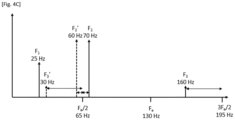
- FIG. 4C shows a third example of the spectrum of the same received signal sampled with a frequency F e equal to 130 Hz.
- the three spectra shown are subject to the spectrum aliasing phenomenon which results in the presence of image frequencies between 0 and F e /2 shown in dotted lines.
- the spectrum of the signal received to be determined is composed solely of the frequencies F 1 , F 2 and F 3 .
- the spectrum of figure 4A has two image frequencies F 2 'and F 3 '.
- the frequency F 2 ' is the image frequency of the frequency F 2
- the frequency F 3 ' is the image frequency of the frequency F 3.
- each frequency of the spectrum located beyond F e /2 will create an image between 0 and F e /2 and the difference between the frequency of the spectrum and the closest multiple of F e /2 is the same as between the corresponding image frequency and F e /2.
- the difference between F e /2 and the frequency F 2 is equal to the difference between F e /2 and the image frequency F 2 '.
- the difference between 3F e /2 and the frequency F 3 is equal to the difference between F e /2 and the image frequency F 3 '.
- the spectra of figure 4B And 4C comprise two image frequencies F 2 ' and F 3 ', the difference between F e /2 and the frequency F 2 is equal to the difference between F e /2 and the image frequency F 2 ' and the difference between 3F e /2 and the frequency F 3 is equal to the difference between F e /2 and the image frequency F 3 '.
- the determination of the spectrum 104 of the received signal 103 is carried out from the frequency interval ranging from 0 to F e /2 of the spectrum of each sampled signal 105.
- F 1 equal to 25 Hz
- F 2 ' equal to 30 Hz
- F 3 ' equal to 40 Hz.
- the spectrum 104 sought includes at least three frequencies, certain frequencies being able to overlap in the interval going from 0 to F e /2 without being identical, for example, a frequency having a difference of 10 Hz with F e /2 and another frequency having a difference of 10 Hz with 3F e /2.
- each frequency included in the interval going from 0 to F e /2 either the frequency really belongs to the spectrum of the signal received, or the frequency is an image frequency and corresponds to a frequency of the spectrum having a difference with a multiple of F e /2 equal to the difference between the image frequency and F e /2, ie both.
- the frequency F 1 really belongs to the spectrum of the signal received, or the frequency F 1 is an image frequency corresponding to a frequency having a difference of 25 Hz with F e / 2 that is to say at the frequency 75 Hz, that is to say the frequency F 1 is an image frequency corresponding to a frequency having a difference of 25 Hz with 3F e /2 that is to say that is to say the frequency 125 Hz , either the frequency 175 Hz, or a combination of the preceding propositions.
- the uncertainties on the spectrum 104 of the received signal 103 will decrease. Indeed, the sampling frequency has changed between the spectrum of the figure 4A and the spectrum of figure 4B to go from 100 Hz to 120 Hz and the spectra obtained are different.
- the spectrum of figure 4B comprises three frequencies in the interval going from 0 to F e /2: a frequency at 25 Hz, a frequency at 40 Hz and a frequency at 50 Hz.
- a frequency at 25 Hz By studying the amplitude of the signal at each of the preceding frequencies, it is possible to match the frequency of 25 Hz to the frequency F 1 of the spectrum of the figure 4A , the frequency from 40 Hz to the frequency F 3 ' of the spectrum of the figure 4A and the frequency from 50 Hz to the frequency F 2 ' of the spectrum of the figure 4A .
- the frequency F 1 really belongs to the spectrum of the received signal, or the frequency F 1 is an image frequency corresponding to a frequency having a difference of 35 Hz with F e / 2 that is to say at the frequency 95 Hz, or the frequency F 1 is an image frequency corresponding to a frequency having a difference of 35 Hz with 3F e /2 that is to say at the frequency 145 Hz .
- the frequency F 1 is not an image frequency but a frequency of the spectrum having a value of 25 Hz since the value 25 Hz is the only possible value present in the two tables for the frequency F 1 .
- the frequency F 2 ' is an image frequency of the frequency having a value of 70 Hz, or the frequency F 2 'is an image frequency of the frequency having a value of 170 Hz, or both.
- the frequency F 3 ' belongs to the spectrum of the signal received with a value of 40 Hz
- either the frequency F 3 ' is an image frequency of the frequency having a value of 160 Hz, or both.
- the spectrum of Fig. 4C comprises three frequencies in the interval going from 0 to F e /2: a frequency at 25 Hz, a frequency at 30 Hz and a frequency at 60 Hz.
- a frequency at 25 Hz By studying the amplitude of the signal at each of the preceding frequencies, it is possible to match the frequency of 25 Hz to the frequency F 1 of the spectrum of the figure 4A or 4B , the frequency from 30 Hz to the frequency F 3 ' of the spectrum of the figure 4A or 4B and the frequency from 60 Hz to the frequency F 2 ' of the spectrum of the figure 4A or 4B .
- the frequency F 2 ' is an image frequency corresponding to a frequency F 2 of the spectrum having a value of 70 Hz since the value 70 Hz is the only possible value present in the three tables for the frequency F 2 '.
- the frequency F 3 ' is an image frequency corresponding to a frequency F 3 of the spectrum having a value of 160 Hz since the value 160 Hz is the only possible value present in the three tables for the frequency F 3 '.
- the sampling frequencies can also be chosen higher than twice the width of the frequency band of the received signal 103.
- the sampling frequencies are chosen higher than 40 MHz, in the case of a 5G signal, higher than 800 MHz and in the case of a signal coming from a pulsed single-frequency radar, higher than 2 MHz.
- the sampling frequencies can also be chosen so as to be spaced two by two by a value greater than twice the bandwidth of the received signal 103.
- the sampling frequencies are spaced apart by at least 40 MHz, in the case of a 5G signal at least 800 MHz and in the case of a signal from a pulsed single frequency radar, at least 2 MHz.
- the method 200 can then include an additional step of extracting the received signal 103 from the spectrum of at least one sampled signal 105, for example by applying an inverse Fourier transform or by filtering.
Landscapes
- Physics & Mathematics (AREA)
- Mathematical Physics (AREA)
- General Physics & Mathematics (AREA)
- Radar Systems Or Details Thereof (AREA)
- Circuits Of Receivers In General (AREA)
- Superheterodyne Receivers (AREA)
Claims (7)
- Vorrichtung (100) für die Bestimmung des Spektrums (104) mindestens eines Signals (103), das auf einem bekannten Signalfrequenzband gesendet wird, das in einem breiten Frequenzband enthalten ist, die aufweist:- ein Empfangsmodul (101), das so konfiguriert ist, dass es mindestens ein Signal (103) auf einem breiten Frequenzband, das eine maximale Frequenz vorweist, empfängt;- ein Verarbeitungsmodul (102), umfassend:wobei die Vorrichtung (100) dadurch gekennzeichnet ist, dass die Abtastfrequenzen (f1, f2, f3, f4) so gewählt sind, dass sie paarweise um einen Wert beabstandet sind, der größer als das Zweifache der Bandbreite des Signals ist.o eine Vielzahl von parallelen Analog-Digital-Wandlern (1021), die so konfiguriert sind, dass sie das Abtasten des empfangenen Signals (103) mit unterschiedlichen Abtastfrequenzen (f1, f2, f3, f4) durchführen, um eine Vielzahl von abgetasteten Signalen (105) zu erhalten, wobei die Abtastfrequenzen (f1, f2, f3, f4) kleiner als oder gleich dem Zweifachen der maximalen Frequenz und größer als oder gleich dem Zweifachen der Breite des Signalfrequenzbandes sind;∘ eine Recheneinheit (1022), die so konfiguriert ist, dass sie das Spektrum (104) des empfangenen Signals (103) aus den Spektren der abgetasteten Signale (105) bestimmt;
- Vorrichtung (100) nach Anspruch 1, dadurch gekennzeichnet, dass die Signale (103) in einem Frequenzband empfangen werden, das sich von 0 MHz bis 100 GHz erstreckt.
- Vorrichtung (100) nach einem der vorstehenden Ansprüche,
dadurch gekennzeichnet, dass das Verarbeitungsmodul (102) mindestens drei Analog-Digital-Wandler (1021) umfasst. - Vorrichtung (100) nach einem der vorstehenden Ansprüche,
dadurch gekennzeichnet, dass die Abtastfrequenzen (f1, f2, f3, f4) so gewählt sind, dass ihr kleinstes gemeinsames Vielfaches größer als die maximale Frequenz des breiten Frequenzbandes ist. - Verfahren (200) zum Bestimmen des Spektrums (104) mindestens eines Signals (103), das auf einem bekannten Signalfrequenzband gesendet wird, das in einem breiten Frequenzband, das eine maximale Frequenz vorweist, enthalten ist, das durch die Vorrichtung (100) nach einem der vorstehenden Ansprüche implementiert wird, dadurch gekennzeichnet, dass es die folgenden Schritte aufweist:- einen Schritt (201) des Empfangens des Signals (103), der durch das Empfangsmodul (101) durchgeführt wird;- einen Schritt (202) des Abtastens des empfangenen Signals (103), der durch jeden Analog-Digital-Wandler (1021) des Verarbeitungsmoduls (102) durchgeführt wird, wobei die Analog-Digital-Wandler (1021) unterschiedliche Abtastfrequenzen (f1, f2, f3, f4) verwenden, die kleiner als oder gleich dem Zweifachen der maximalen Frequenz sind, und jeweils ein abgetastetes Signal (105) liefern und größer als oder gleich dem Zweifachen der Breite des Signalfrequenzbandes sind;- einen Schritt (203) zum Berechnen des Spektrums jedes abgetasteten Signals (105), der durch die Recheneinheit (1022) durchgeführt wird;- einen Schritt (204) zum Bestimmen des Spektrums (104) des empfangenen Signals (103) aus den Spektren der abgetasteten Signale (105), der durch die Recheneinheit (1022) durchgeführt wird.
- Computerprogrammprodukt, umfassend Anweisungen, die, wenn das Programm durch einen Computer ausgeführt wird, diesen veranlassen, das Verfahren (200) nach Anspruch 5 zu implementieren.
- Computerlesbares Aufzeichnungsmedium, umfassend Anweisungen, die, wenn sie durch einen Computer ausgeführt werden, diesen veranlassen, das Verfahren (200) nach Anspruch 5 zu implementieren.
Applications Claiming Priority (1)
| Application Number | Priority Date | Filing Date | Title |
|---|---|---|---|
| FR1874397A FR3091352B1 (fr) | 2018-12-31 | 2018-12-31 | Dispositif pour la determination du spectre d’un signal sur une large bande de frequences par echantillonnages multiples et procede associe |
Publications (2)
| Publication Number | Publication Date |
|---|---|
| EP3674717A1 EP3674717A1 (de) | 2020-07-01 |
| EP3674717B1 true EP3674717B1 (de) | 2023-07-05 |
Family
ID=67185173
Family Applications (1)
| Application Number | Title | Priority Date | Filing Date |
|---|---|---|---|
| EP19220293.5A Active EP3674717B1 (de) | 2018-12-31 | 2019-12-31 | Vorrichtung zur bestimmung des spektrums eines signals über eine grosse frequenzbandbreite durch mehrfachabtastung, und entsprechendes verfahren |
Country Status (2)
| Country | Link |
|---|---|
| EP (1) | EP3674717B1 (de) |
| FR (1) | FR3091352B1 (de) |
Family Cites Families (2)
| Publication number | Priority date | Publication date | Assignee | Title |
|---|---|---|---|---|
| FR3028320B1 (fr) * | 2014-11-12 | 2016-11-11 | Thales Sa | Procede de detection de signaux dans un recepteur numerique ambigu en frequences et recepteur numerique mettant en oeuvre un tel procede |
| WO2016186998A1 (en) * | 2015-05-15 | 2016-11-24 | Massachusetts Institute Of Technology | Methods and apparatus for array-based compressed sensing |
-
2018
- 2018-12-31 FR FR1874397A patent/FR3091352B1/fr active Active
-
2019
- 2019-12-31 EP EP19220293.5A patent/EP3674717B1/de active Active
Also Published As
| Publication number | Publication date |
|---|---|
| FR3091352A1 (fr) | 2020-07-03 |
| FR3091352B1 (fr) | 2021-04-02 |
| EP3674717A1 (de) | 2020-07-01 |
Similar Documents
| Publication | Publication Date | Title |
|---|---|---|
| EP2027476B1 (de) | System zur extraktion und analyse von funksignalen | |
| EP1982209B1 (de) | Frequenz zur messung des breitbanddigitalempfängers | |
| EP3218738B1 (de) | Verfahren zur signalerfassung bei einem frequenzuneindeutigen digitalempfänger und digitalempfänger zur durchführung dieses verfahrens | |
| EP3394630B1 (de) | Verfahren zur bestimmung der ankunftsrichtung in gegenwart von aliasing und zugehörige vorrichtung | |
| EP3049822A1 (de) | Verfahren zur nichtüberwachten entschachtelung durch n-dimensionale anreicherung | |
| WO2015007734A1 (fr) | Dispositif de detection de signaux electromagnetiques | |
| EP3671250A1 (de) | Digitales interferometer mit unterabtastung | |
| EP3674717B1 (de) | Vorrichtung zur bestimmung des spektrums eines signals über eine grosse frequenzbandbreite durch mehrfachabtastung, und entsprechendes verfahren | |
| EP3232212B1 (de) | System und verfahren zur detektion eines lichtbogens | |
| EP2870740B1 (de) | Verfahren zur suche eines nutzsignales in einem multiplexing-band | |
| EP3672088B1 (de) | Bipolarisiertes digitales interferometer mit unterabtastung | |
| EP3470871B1 (de) | Radarsignal-detektionsverfahren | |
| EP3111247B1 (de) | Zur ausrüstung eines küstenüberwachungssystems geeignete radarvorrichtung und küstenüberwachungssystem mit solch einer vorrichtung | |
| EP1940023A2 (de) | Kaskadierbare, digitale Filterbank und darin enthaltene Empfangsschaltung | |
| EP2504926B1 (de) | Mehrkanaliges empfangssystem mit einem superheterodyn-empfänger im zusammenhang mit spektralanalysatoren mit momentan-bandbreite | |
| EP4305446B1 (de) | Verfahren zur schnellen und robusten entschachtelung von impulsfolgen | |
| EP3259606B1 (de) | Verfahren und system zur erkennung von nützlichen signalen mit entsprechendem unvernachlässigbaren frequenzdrift in einem gesamtsignal | |
| EP4009068B1 (de) | System und verfahren zum abfangen von nicht-diskursiven elektromagnetischen signalen, die in einem breiten frequenzbereich übertragen werden | |
| FR2997252A1 (fr) | Procede et systeme de detection de signaux de diffusion emis par des sources terrestres et recus par un satellite | |
| EP3506578B1 (de) | Verfahren zur detektion von funksignalsendern, und entsprechende vorrichtung | |
| EP3036841A1 (de) | Verfahren zur detektion eines elektromagnetischen signals durch ein antennenarray mit strukturdiversität und vorrichtung zur durchführung des verfahrens | |
| EP3400457B1 (de) | Verfahren zum löschen eines signals aus einem bordradar | |
| EP3674739A1 (de) | Verfahren zur gemeinsamen bestimmung der eintreffrichtung und der polarisierung eines signals | |
| FR3034612A1 (fr) | Procede et systeme d'estimation d'une capacite de detection de messages dans une bande frequentielle | |
| EP3671232A1 (de) | Signalanalysevorrichtung und entsprechendes verfahren |
Legal Events
| Date | Code | Title | Description |
|---|---|---|---|
| PUAI | Public reference made under article 153(3) epc to a published international application that has entered the european phase |
Free format text: ORIGINAL CODE: 0009012 |
|
| STAA | Information on the status of an ep patent application or granted ep patent |
Free format text: STATUS: THE APPLICATION HAS BEEN PUBLISHED |
|
| AK | Designated contracting states |
Kind code of ref document: A1 Designated state(s): AL AT BE BG CH CY CZ DE DK EE ES FI FR GB GR HR HU IE IS IT LI LT LU LV MC MK MT NL NO PL PT RO RS SE SI SK SM TR |
|
| AX | Request for extension of the european patent |
Extension state: BA ME |
|
| STAA | Information on the status of an ep patent application or granted ep patent |
Free format text: STATUS: REQUEST FOR EXAMINATION WAS MADE |
|
| 17P | Request for examination filed |
Effective date: 20201228 |
|
| RBV | Designated contracting states (corrected) |
Designated state(s): AL AT BE BG CH CY CZ DE DK EE ES FI FR GB GR HR HU IE IS IT LI LT LU LV MC MK MT NL NO PL PT RO RS SE SI SK SM TR |
|
| RIC1 | Information provided on ipc code assigned before grant |
Ipc: G01R 23/16 20060101AFI20221123BHEP |
|
| GRAP | Despatch of communication of intention to grant a patent |
Free format text: ORIGINAL CODE: EPIDOSNIGR1 |
|
| STAA | Information on the status of an ep patent application or granted ep patent |
Free format text: STATUS: GRANT OF PATENT IS INTENDED |
|
| INTG | Intention to grant announced |
Effective date: 20230123 |
|
| GRAS | Grant fee paid |
Free format text: ORIGINAL CODE: EPIDOSNIGR3 |
|
| GRAA | (expected) grant |
Free format text: ORIGINAL CODE: 0009210 |
|
| STAA | Information on the status of an ep patent application or granted ep patent |
Free format text: STATUS: THE PATENT HAS BEEN GRANTED |
|
| P01 | Opt-out of the competence of the unified patent court (upc) registered |
Effective date: 20230330 |
|
| AK | Designated contracting states |
Kind code of ref document: B1 Designated state(s): AL AT BE BG CH CY CZ DE DK EE ES FI FR GB GR HR HU IE IS IT LI LT LU LV MC MK MT NL NO PL PT RO RS SE SI SK SM TR |
|
| REG | Reference to a national code |
Ref country code: CH Ref legal event code: EP |
|
| REG | Reference to a national code |
Ref country code: AT Ref legal event code: REF Ref document number: 1585322 Country of ref document: AT Kind code of ref document: T Effective date: 20230715 |
|
| REG | Reference to a national code |
Ref country code: DE Ref legal event code: R096 Ref document number: 602019032076 Country of ref document: DE |
|
| REG | Reference to a national code |
Ref country code: IE Ref legal event code: FG4D Free format text: LANGUAGE OF EP DOCUMENT: FRENCH |
|
| REG | Reference to a national code |
Ref country code: LT Ref legal event code: MG9D |
|
| REG | Reference to a national code |
Ref country code: NL Ref legal event code: MP Effective date: 20230705 |
|
| REG | Reference to a national code |
Ref country code: AT Ref legal event code: MK05 Ref document number: 1585322 Country of ref document: AT Kind code of ref document: T Effective date: 20230705 |
|
| PG25 | Lapsed in a contracting state [announced via postgrant information from national office to epo] |
Ref country code: NL Free format text: LAPSE BECAUSE OF FAILURE TO SUBMIT A TRANSLATION OF THE DESCRIPTION OR TO PAY THE FEE WITHIN THE PRESCRIBED TIME-LIMIT Effective date: 20230705 |
|
| PG25 | Lapsed in a contracting state [announced via postgrant information from national office to epo] |
Ref country code: GR Free format text: LAPSE BECAUSE OF FAILURE TO SUBMIT A TRANSLATION OF THE DESCRIPTION OR TO PAY THE FEE WITHIN THE PRESCRIBED TIME-LIMIT Effective date: 20231006 |
|
| PG25 | Lapsed in a contracting state [announced via postgrant information from national office to epo] |
Ref country code: ES Free format text: LAPSE BECAUSE OF FAILURE TO SUBMIT A TRANSLATION OF THE DESCRIPTION OR TO PAY THE FEE WITHIN THE PRESCRIBED TIME-LIMIT Effective date: 20230705 |
|
| PG25 | Lapsed in a contracting state [announced via postgrant information from national office to epo] |
Ref country code: IS Free format text: LAPSE BECAUSE OF FAILURE TO SUBMIT A TRANSLATION OF THE DESCRIPTION OR TO PAY THE FEE WITHIN THE PRESCRIBED TIME-LIMIT Effective date: 20231105 |
|
| PG25 | Lapsed in a contracting state [announced via postgrant information from national office to epo] |
Ref country code: SE Free format text: LAPSE BECAUSE OF FAILURE TO SUBMIT A TRANSLATION OF THE DESCRIPTION OR TO PAY THE FEE WITHIN THE PRESCRIBED TIME-LIMIT Effective date: 20230705 Ref country code: RS Free format text: LAPSE BECAUSE OF FAILURE TO SUBMIT A TRANSLATION OF THE DESCRIPTION OR TO PAY THE FEE WITHIN THE PRESCRIBED TIME-LIMIT Effective date: 20230705 Ref country code: PT Free format text: LAPSE BECAUSE OF FAILURE TO SUBMIT A TRANSLATION OF THE DESCRIPTION OR TO PAY THE FEE WITHIN THE PRESCRIBED TIME-LIMIT Effective date: 20231106 Ref country code: NO Free format text: LAPSE BECAUSE OF FAILURE TO SUBMIT A TRANSLATION OF THE DESCRIPTION OR TO PAY THE FEE WITHIN THE PRESCRIBED TIME-LIMIT Effective date: 20231005 Ref country code: LV Free format text: LAPSE BECAUSE OF FAILURE TO SUBMIT A TRANSLATION OF THE DESCRIPTION OR TO PAY THE FEE WITHIN THE PRESCRIBED TIME-LIMIT Effective date: 20230705 Ref country code: LT Free format text: LAPSE BECAUSE OF FAILURE TO SUBMIT A TRANSLATION OF THE DESCRIPTION OR TO PAY THE FEE WITHIN THE PRESCRIBED TIME-LIMIT Effective date: 20230705 Ref country code: IS Free format text: LAPSE BECAUSE OF FAILURE TO SUBMIT A TRANSLATION OF THE DESCRIPTION OR TO PAY THE FEE WITHIN THE PRESCRIBED TIME-LIMIT Effective date: 20231105 Ref country code: HR Free format text: LAPSE BECAUSE OF FAILURE TO SUBMIT A TRANSLATION OF THE DESCRIPTION OR TO PAY THE FEE WITHIN THE PRESCRIBED TIME-LIMIT Effective date: 20230705 Ref country code: GR Free format text: LAPSE BECAUSE OF FAILURE TO SUBMIT A TRANSLATION OF THE DESCRIPTION OR TO PAY THE FEE WITHIN THE PRESCRIBED TIME-LIMIT Effective date: 20231006 Ref country code: FI Free format text: LAPSE BECAUSE OF FAILURE TO SUBMIT A TRANSLATION OF THE DESCRIPTION OR TO PAY THE FEE WITHIN THE PRESCRIBED TIME-LIMIT Effective date: 20230705 Ref country code: ES Free format text: LAPSE BECAUSE OF FAILURE TO SUBMIT A TRANSLATION OF THE DESCRIPTION OR TO PAY THE FEE WITHIN THE PRESCRIBED TIME-LIMIT Effective date: 20230705 Ref country code: AT Free format text: LAPSE BECAUSE OF FAILURE TO SUBMIT A TRANSLATION OF THE DESCRIPTION OR TO PAY THE FEE WITHIN THE PRESCRIBED TIME-LIMIT Effective date: 20230705 |
|
| PG25 | Lapsed in a contracting state [announced via postgrant information from national office to epo] |
Ref country code: PL Free format text: LAPSE BECAUSE OF FAILURE TO SUBMIT A TRANSLATION OF THE DESCRIPTION OR TO PAY THE FEE WITHIN THE PRESCRIBED TIME-LIMIT Effective date: 20230705 |
|
| REG | Reference to a national code |
Ref country code: DE Ref legal event code: R097 Ref document number: 602019032076 Country of ref document: DE |
|
| PG25 | Lapsed in a contracting state [announced via postgrant information from national office to epo] |
Ref country code: SM Free format text: LAPSE BECAUSE OF FAILURE TO SUBMIT A TRANSLATION OF THE DESCRIPTION OR TO PAY THE FEE WITHIN THE PRESCRIBED TIME-LIMIT Effective date: 20230705 Ref country code: RO Free format text: LAPSE BECAUSE OF FAILURE TO SUBMIT A TRANSLATION OF THE DESCRIPTION OR TO PAY THE FEE WITHIN THE PRESCRIBED TIME-LIMIT Effective date: 20230705 Ref country code: EE Free format text: LAPSE BECAUSE OF FAILURE TO SUBMIT A TRANSLATION OF THE DESCRIPTION OR TO PAY THE FEE WITHIN THE PRESCRIBED TIME-LIMIT Effective date: 20230705 Ref country code: DK Free format text: LAPSE BECAUSE OF FAILURE TO SUBMIT A TRANSLATION OF THE DESCRIPTION OR TO PAY THE FEE WITHIN THE PRESCRIBED TIME-LIMIT Effective date: 20230705 Ref country code: CZ Free format text: LAPSE BECAUSE OF FAILURE TO SUBMIT A TRANSLATION OF THE DESCRIPTION OR TO PAY THE FEE WITHIN THE PRESCRIBED TIME-LIMIT Effective date: 20230705 Ref country code: SK Free format text: LAPSE BECAUSE OF FAILURE TO SUBMIT A TRANSLATION OF THE DESCRIPTION OR TO PAY THE FEE WITHIN THE PRESCRIBED TIME-LIMIT Effective date: 20230705 |
|
| PLBE | No opposition filed within time limit |
Free format text: ORIGINAL CODE: 0009261 |
|
| STAA | Information on the status of an ep patent application or granted ep patent |
Free format text: STATUS: NO OPPOSITION FILED WITHIN TIME LIMIT |
|
| PG25 | Lapsed in a contracting state [announced via postgrant information from national office to epo] |
Ref country code: IT Free format text: LAPSE BECAUSE OF FAILURE TO SUBMIT A TRANSLATION OF THE DESCRIPTION OR TO PAY THE FEE WITHIN THE PRESCRIBED TIME-LIMIT Effective date: 20230705 |
|
| 26N | No opposition filed |
Effective date: 20240408 |
|
| PG25 | Lapsed in a contracting state [announced via postgrant information from national office to epo] |
Ref country code: SI Free format text: LAPSE BECAUSE OF FAILURE TO SUBMIT A TRANSLATION OF THE DESCRIPTION OR TO PAY THE FEE WITHIN THE PRESCRIBED TIME-LIMIT Effective date: 20230705 |
|
| REG | Reference to a national code |
Ref country code: CH Ref legal event code: PL |
|
| PG25 | Lapsed in a contracting state [announced via postgrant information from national office to epo] |
Ref country code: LU Free format text: LAPSE BECAUSE OF NON-PAYMENT OF DUE FEES Effective date: 20231231 |
|
| PG25 | Lapsed in a contracting state [announced via postgrant information from national office to epo] |
Ref country code: MC Free format text: LAPSE BECAUSE OF FAILURE TO SUBMIT A TRANSLATION OF THE DESCRIPTION OR TO PAY THE FEE WITHIN THE PRESCRIBED TIME-LIMIT Effective date: 20230705 |
|
| REG | Reference to a national code |
Ref country code: BE Ref legal event code: MM Effective date: 20231231 |
|
| PG25 | Lapsed in a contracting state [announced via postgrant information from national office to epo] |
Ref country code: MC Free format text: LAPSE BECAUSE OF FAILURE TO SUBMIT A TRANSLATION OF THE DESCRIPTION OR TO PAY THE FEE WITHIN THE PRESCRIBED TIME-LIMIT Effective date: 20230705 Ref country code: LU Free format text: LAPSE BECAUSE OF NON-PAYMENT OF DUE FEES Effective date: 20231231 |
|
| REG | Reference to a national code |
Ref country code: IE Ref legal event code: MM4A |
|
| PG25 | Lapsed in a contracting state [announced via postgrant information from national office to epo] |
Ref country code: IE Free format text: LAPSE BECAUSE OF NON-PAYMENT OF DUE FEES Effective date: 20231231 |
|
| PG25 | Lapsed in a contracting state [announced via postgrant information from national office to epo] |
Ref country code: BE Free format text: LAPSE BECAUSE OF NON-PAYMENT OF DUE FEES Effective date: 20231231 |
|
| PG25 | Lapsed in a contracting state [announced via postgrant information from national office to epo] |
Ref country code: CH Free format text: LAPSE BECAUSE OF NON-PAYMENT OF DUE FEES Effective date: 20231231 |
|
| PG25 | Lapsed in a contracting state [announced via postgrant information from national office to epo] |
Ref country code: IE Free format text: LAPSE BECAUSE OF NON-PAYMENT OF DUE FEES Effective date: 20231231 Ref country code: CH Free format text: LAPSE BECAUSE OF NON-PAYMENT OF DUE FEES Effective date: 20231231 Ref country code: BE Free format text: LAPSE BECAUSE OF NON-PAYMENT OF DUE FEES Effective date: 20231231 |
|
| PG25 | Lapsed in a contracting state [announced via postgrant information from national office to epo] |
Ref country code: BG Free format text: LAPSE BECAUSE OF FAILURE TO SUBMIT A TRANSLATION OF THE DESCRIPTION OR TO PAY THE FEE WITHIN THE PRESCRIBED TIME-LIMIT Effective date: 20230705 |
|
| PG25 | Lapsed in a contracting state [announced via postgrant information from national office to epo] |
Ref country code: BG Free format text: LAPSE BECAUSE OF FAILURE TO SUBMIT A TRANSLATION OF THE DESCRIPTION OR TO PAY THE FEE WITHIN THE PRESCRIBED TIME-LIMIT Effective date: 20230705 |
|
| PG25 | Lapsed in a contracting state [announced via postgrant information from national office to epo] |
Ref country code: CY Free format text: LAPSE BECAUSE OF FAILURE TO SUBMIT A TRANSLATION OF THE DESCRIPTION OR TO PAY THE FEE WITHIN THE PRESCRIBED TIME-LIMIT; INVALID AB INITIO Effective date: 20191231 |
|
| PG25 | Lapsed in a contracting state [announced via postgrant information from national office to epo] |
Ref country code: HU Free format text: LAPSE BECAUSE OF FAILURE TO SUBMIT A TRANSLATION OF THE DESCRIPTION OR TO PAY THE FEE WITHIN THE PRESCRIBED TIME-LIMIT; INVALID AB INITIO Effective date: 20191231 |
|
| PG25 | Lapsed in a contracting state [announced via postgrant information from national office to epo] |
Ref country code: TR Free format text: LAPSE BECAUSE OF FAILURE TO SUBMIT A TRANSLATION OF THE DESCRIPTION OR TO PAY THE FEE WITHIN THE PRESCRIBED TIME-LIMIT Effective date: 20230705 |
|
| PGFP | Annual fee paid to national office [announced via postgrant information from national office to epo] |
Ref country code: GB Payment date: 20251218 Year of fee payment: 7 |
|
| PGFP | Annual fee paid to national office [announced via postgrant information from national office to epo] |
Ref country code: FR Payment date: 20251218 Year of fee payment: 7 |
|
| PGFP | Annual fee paid to national office [announced via postgrant information from national office to epo] |
Ref country code: DE Payment date: 20251222 Year of fee payment: 7 |