EP3674883A1 - Multiplikationsschaltung, system auf einem chip und elektronische vorrichtung - Google Patents
Multiplikationsschaltung, system auf einem chip und elektronische vorrichtung Download PDFInfo
- Publication number
- EP3674883A1 EP3674883A1 EP18858914.7A EP18858914A EP3674883A1 EP 3674883 A1 EP3674883 A1 EP 3674883A1 EP 18858914 A EP18858914 A EP 18858914A EP 3674883 A1 EP3674883 A1 EP 3674883A1
- Authority
- EP
- European Patent Office
- Prior art keywords
- data
- bits
- bit
- value
- subcircuit
- Prior art date
- Legal status (The legal status is an assumption and is not a legal conclusion. Google has not performed a legal analysis and makes no representation as to the accuracy of the status listed.)
- Granted
Links
Images




Classifications
-
- G—PHYSICS
- G06—COMPUTING OR CALCULATING; COUNTING
- G06F—ELECTRIC DIGITAL DATA PROCESSING
- G06F7/00—Methods or arrangements for processing data by operating upon the order or content of the data handled
- G06F7/38—Methods or arrangements for performing computations using exclusively denominational number representation, e.g. using binary, ternary, decimal representation
- G06F7/48—Methods or arrangements for performing computations using exclusively denominational number representation, e.g. using binary, ternary, decimal representation using non-contact-making devices, e.g. tube, solid state device; using unspecified devices
- G06F7/52—Multiplying; Dividing
- G06F7/523—Multiplying only
- G06F7/5235—Multiplying only using indirect methods, e.g. quarter square method, via logarithmic domain
-
- G—PHYSICS
- G06—COMPUTING OR CALCULATING; COUNTING
- G06F—ELECTRIC DIGITAL DATA PROCESSING
- G06F7/00—Methods or arrangements for processing data by operating upon the order or content of the data handled
- G06F7/38—Methods or arrangements for performing computations using exclusively denominational number representation, e.g. using binary, ternary, decimal representation
- G06F7/48—Methods or arrangements for performing computations using exclusively denominational number representation, e.g. using binary, ternary, decimal representation using non-contact-making devices, e.g. tube, solid state device; using unspecified devices
- G06F7/4806—Computations with complex numbers
- G06F7/4812—Complex multiplication
-
- G—PHYSICS
- G06—COMPUTING OR CALCULATING; COUNTING
- G06F—ELECTRIC DIGITAL DATA PROCESSING
- G06F7/00—Methods or arrangements for processing data by operating upon the order or content of the data handled
- G06F7/38—Methods or arrangements for performing computations using exclusively denominational number representation, e.g. using binary, ternary, decimal representation
- G06F7/48—Methods or arrangements for performing computations using exclusively denominational number representation, e.g. using binary, ternary, decimal representation using non-contact-making devices, e.g. tube, solid state device; using unspecified devices
- G06F7/483—Computations with numbers represented by a non-linear combination of denominational numbers, e.g. rational numbers, logarithmic number system or floating-point numbers
- G06F7/487—Multiplying; Dividing
-
- G—PHYSICS
- G06—COMPUTING OR CALCULATING; COUNTING
- G06F—ELECTRIC DIGITAL DATA PROCESSING
- G06F7/00—Methods or arrangements for processing data by operating upon the order or content of the data handled
- G06F7/38—Methods or arrangements for performing computations using exclusively denominational number representation, e.g. using binary, ternary, decimal representation
- G06F7/48—Methods or arrangements for performing computations using exclusively denominational number representation, e.g. using binary, ternary, decimal representation using non-contact-making devices, e.g. tube, solid state device; using unspecified devices
- G06F7/52—Multiplying; Dividing
- G06F7/523—Multiplying only
Definitions
- This application relates to the data processing field, and more specifically, to a multiplication circuit, a system-on-a-chip, and an electronic device.
- the integral part of c is a sum of an integral part of a and an integral part of b; and the fractional part of c is a sum of a fractional part of a and a fractional part of b.
- both A and B include 1+j+k binary bits, both j and k are positive integers, a first bit is a sign bit, j bits are an integral part, and k bits are a fractional part.
- the exponentiation operation result is a number greater than or equal to 1 and less than 2; and the operation result includes 1+w binary bits, where a first bit is an integral part, w bits are a fractional part, and w is a positive integer greater than or equal to 1; and when the shift subcircuit is configured to shift the exponentiation operation result based on the integral part of c, the shift subcircuit is specifically configured to shift the exponentiation operation result to the left by X bits, where X is equal to the integral part of c minus (w-k), the shift result is an absolute value of the product of A and B, an integral part of the absolute value of the product includes j binary bits, a fractional part includes k binary bits, and when a quantity of bits for the left shift is less than 0, shifting to the left by x bits is equal to shifting to the right by bits of an absolute value of x.
- the multiplication circuit in the first aspect implements multiplication by using the addition subcircuit, the exponentiation operation subcircuit, the shift subcircuit, and the output subcircuit.
- a complex exponentiation operation circuit is not required.
- implementation of these subcircuits saves more resources and occupies less logical resources, thereby reducing an area occupied by a device and power consumption.
- a system-on-a-chip including a processor core, a multiplication hardware circuit array consisting of one or more multiplication hardware circuits according to any one of the first aspect or the possible implementations of the first aspect, a data input buffer, a data output buffer, and a control circuit, where the control circuit is connected to the processor core, the data input circuit, and the data output circuit; the data input circuit is configured to obtain data from the processor core by using the control circuit; the multiplication hardware circuit array is configured to: obtain data in the data input buffer for processing, obtain a processed result, and output the processed result to the data output buffer; and the control circuit is further configured to interact with the processor core, so that the processor core obtains data in the data output buffer.
- the decimal computing subcircuit is specifically configured to: compare a value corresponding to s bits after the non-zero highest bit from a high bit to a low bit of A1 with preset 2 n comparison values, where an i th comparison value is less than an (i+1) th comparison value, and the i th comparison value corresponds to one value Ni; when the value corresponding to s bits after the non-zero highest bit from the high bit to the low bit of A1 is greater than or equal to a T1 comparison value, and is less than a (T1+1) th comparison value, determine that N1 is N T1 ; compare a value corresponding to s bits after the non-zero highest bit from a high bit to a low bit of A2 with the preset 2 n comparison values, where the i th comparison value is less than the (i+1) th comparison value, and the i th comparison value corresponds to one value Ni; and when the value corresponding to s bits after the non
- this application provides a multiplication hardware circuit used for a multiplication operation.
- the hardware circuit herein is a circuit implemented based on an ASIC, an FPGA, and the like, and is not implemented based on a general purpose processor (for example, a processor that is based on an x86 and ARM architecture and that needs to read an instruction to perform a specific operation).
- the general purpose processor may also be used for implementation, but efficiency is not high. Therefore, to process data more efficiently, the hardware circuit implemented based on the ASIC and the FPGA needs to be used.
- the multiplication hardware circuit in the embodiments refers to a hardware circuit that can implement multiplication, and performing some other operations, such as an accumulation operation, based on the multiplication is not limited.
- multiplication is implemented by using the exponentiation operation subcircuit, the shift subcircuit, and the sign bit determining subcircuit.
- a complex exponentiation operation subcircuit is not required.
- implementation of these subcircuits saves more resources and occupies less logical resources, thereby reducing an area occupied by a device and power consumption.
- N' is a binary number formed by 1+w bits, and is used to represent a decimal greater than or equal to 1 and less than 2, where a number represented by 1 bit is a value of an integral part of the decimal, and a number represented by w bits is a value of a fractional part of the decimal.
- the shift circuit is specifically configured to shift N ' to the left by M1-(w-k) bits to obtain a final shift result.
- Rightmost k bits of the final shift result are used to indicate a value of a fractional part of the absolute value of C1
- j bits on the left of the rightmost k bits of the final shift result are used to indicate a value of an integral part of the absolute value of C1.
- the first shift subcircuit is configured to shift N' to the left by M1 bits. Note: shifting a negative digit to the left is actually shifting a positive digit to the right.
- the exponentiation operation subcircuit is a decoding subcircuit, and the decoding subcircuit is configured to obtain N' based on N1 of c1 through decoding; or the exponentiation operation subcircuit is a table lookup subcircuit, and the table lookup subcircuit is configured to obtain N' based on N1 of c1 through table lookup.
- the multiplication hardware circuit further includes an accumulator configured to perform an accumulation operation on C1 and another piece of linear field data C2 from the multiplication hardware circuit; or the accumulator is configured to perform an accumulation operation on C1 and linear field data C3 from another multiplication hardware circuit.
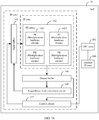
- this application discloses a system-on-a-chip SoC, including a processor core, a multiplication hardware circuit array consisting of one or more multiplication hardware circuits according to the first aspect and the implementations of the first aspect, a data input buffer, a data output buffer, and a control circuit.
- the control circuit is connected to the processor core, the multiplication hardware circuit array, the data input circuit, and the data output circuit.
- the data input circuit is configured to obtain data from the processor core by using the control circuit.
- the multiplication hardware circuit array is configured to: obtain data in the data input buffer for processing, obtain a processed result, and output the processed result to the data output buffer by using the control circuit.
- a composition of the multiplication hardware circuit array (that is, how many multiplication hardware circuits are selected, the multiplication hardware circuit array is formed in what manner, and the like) is the prior art. This application does not focus on this. Specific implementation of the multiplication hardware circuit constituting the array is the focus of this application.
- the input buffer and the output buffer may be implemented by a storage medium such as an SRAM and an eDRAM.
- the logarithmic conversion circuit is configured to perform logarithmic field conversion on output of the multiplication hardware circuit array, and input a result obtained after conversion to the data input buffer. Specifically, the logarithmic conversion circuit obtains data from the output buffer, and then converts the data and outputs the data to the input buffer. In this way, subsequently, the multiplication hardware circuit array can obtain the data from the input buffer for operation.
- the logarithmic field conversion circuit includes an integer computing subcircuit, a decimal computing subcircuit, and a second sign bit determining subcircuit, where the linear field array output data is a binary number consisting of 1+j+k bits, both j and k are positive integers, 1 bit is a second sign bit, and is used to indicate a positive/negative sign S, j bits are used to indicate a value J of an integral part of an absolute value of the linear field data, and k bits are used to indicate a value K of a fractional part of the absolute value of the linear field data.
- the integer computing subcircuit is configured to calculate a difference between h1 and k based on a value h1 of a quantity of bits in which a non-zero highest bit of the binary number of j+k bits of the linear field array output data is located, where the difference is used to indicate a value of an integral part of a result obtained by calculating a logarithm to base 2 of an absolute value of the linear field array output data, and a lowest bit of the binary number of j+k bits of the linear field array output data is denoted as a 0 th bit.
- the decimal computing subcircuit is configured to obtain, based on a predetermined quantity of s (s is greater than or equal to k, and 0 is filled if the quantity is less than s) bits after the non-zero highest bit from a high bit to a low bit of the linear field array output data, a value of a fractional part of the result obtained by calculating the logarithm to base 2 of the absolute value of the linear field array output data.
- the value may be obtained in a table lookup or decoding method.
- the second sign bit determining subcircuit is configured to separately determine, based on a sign of the linear field array output data, a sign of the logarithmic field array output data, so as to obtain the logarithmic field array output data.
- decimal computing subcircuit is specifically configured to:
- the decimal computing subcircuit may further have another implementation, to be specific, the decimal computing subcircuit is specifically configured to:
- this application discloses an electronic device (which may be any electronic device such as a mobile phone, a tablet, a smartwatch, or a smart TV), including the system-on-a-chip (SoC) according to the second aspect and the implementations of the second aspect (or the fourth aspect and the implementations of the fourth aspect) and a memory.
- SoC system-on-a-chip
- the memory is configured to store an instruction required for program running.
- the processor core in the SoC is configured to execute the instruction to run a program, and send data that needs to be processed to the multiplication hardware circuit array.
- the multiplication hardware circuit is configured to: after the data is processed, output a result obtained after processing to the data output circuit, and finally enable the processor core to obtain the result.
- the matrix operation may be a multiply-accumulate operation, or may be referred to as a multiply-add operation.
- Both P and Q may represent a matrix or a vector.
- P Q may represent a generalized matrix operation, including at least one of convolution operations: matrix x vector, matrix x matrix, and vector x vector.
- a value of P ⁇ Q may be a product piqi obtained by performing a multiplication operation on an element p i in P and a corresponding element qi in Q, and then an accumulation operation is performed on these products. This process is the multiply-accumulate operation. An element of a result matrix is obtained through the multiply-accumulate operation.
- a logarithmic operation system is used, to be specific, data is converted from a linear field (linear field) to a logarithmic field (log field) to perform a representation and operation.
- the logarithmic field and the linear field refer to two different data representation formats.
- the logarithmic field is relative to the linear field.
- logarithmic field data refers to data that is obtained by converting an absolute value of data represented by using the linear field (referred to as “linear field data” below, “linear data”, “a linear value”, “a linear field value”, or the like) into a logarithm value through a logarithm operation (for convenience of computer calculation, a logarithm operation in which 2 is used as a base is usually performed, in other words, a log2(
- a logarithmic field representation format of the data F and the data G may be first calculated.
- F and G are logarithmic field data
- Multiplication of the linear field data F and G may be converted into an addition operation of the logarithmic field data f and g through the foregoing conversion, to be specific, f+g is the logarithmic field representation format of the product F x G.
- the value of the product F x G may be obtained by converting the logarithmic field result f+g into the linear field data (that is, 2 f+g is calculated in a manner such as shifting or circuit decoding).
- multiplication of data may be changed into addition in which a logarithm to base 2 of an absolute value of the data is calculated, so as to avoid a multiplication operation.
- specific overheads are required for performing the logarithm operation, one piece of data may participate in a plurality of times of multiplication in the matrix operation. Therefore, data in logarithmic field representation is calculated once, and is subsequently used for a plurality of times. For an entire matrix operation, calculation overheads are also reduced.
- a floating-point data representation format in the IEEE-754 standard of the institute of electrical and electronics engineers is used, for example, a half-precision 16-bit (bit) floating-point data representation format (or a single-precision 32-bit floating-point data representation format is used) is used.
- FIG. 1 is a schematic diagram of a multiply-add operation, and steps the multiply-add operation are as follows:
- multiplication is implemented by using an exponentiation operation subcircuit, a shift subcircuit, and a sign bit determining subcircuit.
- a complex exponentiation operation subcircuit is not required.
- implementation of these subcircuits saves more resources and occupies less logical resources, thereby reducing an area occupied by a device and power consumption.
- FP16 floating point 16 bit addition costs a lot. For example, if two numbers V1 that equals to (-1) S x Fraction1 x 2 Exp1 and V2 that equals to (-1) S x Fraction2 x 2 Exp2 are to be added, the two numbers cannot be directly added because exps are different, and the following operations need to be performed.
- a standard floating-point data representation format is used, and a data representation bit width is relatively large, for example, 16 bits or 32 bits.
- This floating-point data representation format is relatively complex, and is not conducive to fast data conversion between a linear field and a logarithmic field.
- this application provides a data format conversion method, a circuit, a computing engine, and a convolution computing chip, so that overheads during data conversion between a linear field and a logarithmic field can be reduced, and a speed of convolution calculation is improved.
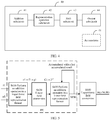
- FIG. 2 is a schematic block diagram of an advanced RISC machine (Advanced RISC Machine, ARM) system-on-a-chip (System-on-a-chip, SoC) architecture 200 according to an embodiment of this application.
- advanced RISC machine Advanced RISC Machine, ARM
- SoC System-on-a-chip
- the ARM SoC architecture 200 includes, for example, a main control central processing unit (Central Processing Unit, CPU) 210, a double data rate (Double Data Rate, DDR) memory controller 220, an advanced extensible interface (Advanced eXtensible Interface, AXI) bus 230, and a hardware calculation module 240.
- CPU Central Processing Unit
- DDR Double Data Rate
- AXI Advanced eXtensible Interface
- the hardware calculation module is configured to perform some dedicated data processing, to be specific, the hardware calculation module is configured to perform some "dedicated" processing (for example, neural network-based machine learning) on data such as an image or audio data.
- a general purpose processor for example, a CPU
- a most important feature of the hardware calculation module is that implementation is based on various logic circuits (for example, an AND gate, an OR gate, and a NOT gate).
- the CPU has a specific instruction set (for example, an x86 instruction set and an ARM instruction set), and completes data processing in a manner of executing an instruction.
- a typical hardware calculation module may be implemented based on an FPGA, an ASIC, and the like.
- the CPU usually has its own dedicated instruction set for performing, in a manner of executing an instruction, other data processing than the dedicated data processing performed by the hardware calculation module (certainly, in theory, it is not limited to using the CPU to perform the dedicated data processing performed by the hardware calculation module, but limited by a CPU hardware architecture, efficiency is relatively low).
- the DDR memory is also referred to as a DDR SDRAM, namely, a DDR synchronous dynamic random access memory (Synchronous Dynamic Random Access Memory, SDRAM).
- a convolution computing chip 240 includes an input buffer 242, a computing engine 244, and an output control module 246.
- the CPU 210 controls computing and starting by using the AXI bus 230.
- the convolution computing chip 240 obtains, from the DDR memory 220 by using the AXI bus 230, data that needs to be processed (for example, obtains image data and a training parameter for an image processor), and then sends the data to the computing engine 244.
- the computing engine 244 calculates based on input data content, writes a calculation result back to the DDR memory 220, and notifies the CPU 210 that calculation is completed.
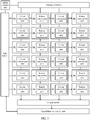
- FIG. 3 is a schematic block diagram of a structure of a computing engine.
- the computing engine 244 includes a direct memory access (Direct Memory Access, DMA) control unit, a data buffer, a parameter buffer, a plurality of processing elements (Processing Element, PE) (to form a PE array), an output buffer, and a logarithmic conversion circuit.
- DMA Direct Memory Access
- the data buffer and the parameter buffer may be considered as an input buffer, and are used to cache image data and a training parameter.
- the image data and the training parameter may be considered as data.
- the PE may be considered as a circuit used to implement a specific function.
- the PE may include a multiplication hardware circuit, and may perform various multiplication-based operations (for example, a multiplication operation or a multiply-add operation).
- the multiplication hardware circuit includes a linear conversion circuit (also referred to as a linear conversion unit, and is represented by the linear conversion unit in FIG. 3 ).
- a composition of the PE array (namely, the multiplication hardware circuit) is the prior art.
- the PE array may be formed in a manner shown in FIG. 3 . In this case, PEs at a first level (a first column and a first row) in the array transmit data to a subsequent PE, and each PE may also be connected to the input buffer (the parameter buffer and the data buffer).
- the DMA control unit (which may be considered as a control circuit) reads required image data and a required training parameter from an external DDR memory 220 to the data buffer and the parameter buffer.
- the multiply-add operation is performed on the image data and the training parameter by using the PE array.
- An operation result is output to the output buffer, and then the operation result is converted from a linear field to a logarithmic field by using the logarithmic conversion circuit.
- a final result may be returned to the data buffer as input data for a next multiply-add operation, or directly output to the DDR memory 220 for storage.
- the multiplication circuit 40 may further include an accumulator 45, configured to perform an accumulation operation on the product of the data A and the data B and another piece of data from a same multiplication circuit; or configured to perform an accumulation operation on the product of the data A and the data B and a product from another multiplication circuit.
- an accumulator 45 configured to perform an accumulation operation on the product of the data A and the data B and another piece of data from a same multiplication circuit; or configured to perform an accumulation operation on the product of the data A and the data B and a product from another multiplication circuit.
- the foregoing subcircuits may be implemented based on an ASIC or an FPGA.
- the hardware multiplier is implemented based on the ASIC.
- the hardware multiplier may be encapsulated in a chip with other hardware such as a CPU and a GPU to form an SoC (a system-on-a-chip).
- SoC system-on-a-chip
- a very simple circuit may be used for implementation of each subcircuit, so that few resources are occupied.
- implementation of an entire multiplier is also very simple, and few resources are occupied, so that more multipliers can be integrated into a chip in a same resource (for example, an area or power consumption), thereby improving an operation capability of the chip.
- an addition subcircuit 41 is specifically described in this embodiment.
- the addition subcircuit 41 is configured to add an absolute value of logarithmic field data a and an absolute value of logarithmic field data b to obtain c. Both a and b are logarithmic field data, and are obtained by separately performing logarithmic field conversion on linear field data A and B.
- a logarithmic field includes 1+m+n binary bits (which may also be represented as 1.m.n), where both m and n are positive integers, a first bit is a sign bit, and is used to indicate a positive/negative sign (referred to as "sign" below, which is not distinguished in this application), m bits are an integral part (or the m bits are used to indicate a value of the integral part), and n bits are a fractional part (or the n bits are used to indicate a value of the fractional part).
- Values of m and n may be determined based on precision required by a system. A larger quantity of bits indicates higher precision. However, some hardware resources are correspondingly increased. A person skilled in the art may select proper values of m and n with reference to a requirement of the system on precision and a hardware resource.
- adding means adding a fractional part of the absolute value of a and a fractional part of the absolute value of b to obtain a fractional part of c (there may be a carry bit), and adding an integral part of the absolute value of a and an integral part of the absolute value of b to obtain an integral part of c (a carry bit may be also added).
- the integral part of c and the fractional part of c are also represented based on m+n binary bits.
- Specific logarithmic field conversion may include a plurality of implementations. The following describes two implementations in detail.
- the logarithmic field conversion may mean that a logarithm to base 2 of an absolute value of linear field data is calculated and represented with reference to a sign bit. It may be understood that, in specific implementation of "representing with reference to a positive/negative sign bit of the data", a simplest method is directly using the sign bit of the data as a sign bit of data obtained after the logarithmic field conversion. Certainly, an opposite sign may alternatively be used as the sign bit of the data obtained after the logarithmic field conversion. Subsequently, as long as this conversion rule is remembered, mutual conversion between logarithmic field data and linear field data can be implemented.
- logarithmic field data is represented as binary data of 1+m+n bits (bits), and is also denoted as 1.m.n below. Both m and n are positive integers; 1 bit is a first sign bit S, and is used to indicate a positive or negative value of data; m bits are an integral place, and are used to indicate a value M of an integral part of a logarithm to base 2 of an absolute value of the data; and n bits are a decimal place, and are used to indicate a value N of a fractional part of the logarithm to base 2 of the absolute value of the data.
- a logarithm to base 2 of an absolute value of -8 is calculated: log 2
- 3, and then -3 is obtained with reference to a positive/negative sign (-) of -8.
- -8 is referred to as linear field data
- -3 is referred to as logarithmic field data.
- linear field conversion may alternatively be performed on the data in turn (to be specific, an absolute value power of the data is raised to 2, and a result is represented with reference to a sign bit of the data). For example, for -3, a
- one bit in m bits used to indicate an integral part of logarithmic field data may be used to represent a sign. The bit is referred to as a sign bit of the integral part in a logarithmic field.
- a value of remaining m-1 bits is equal to an absolute value of the integral part of a result obtained by calculating a logarithm to base 2 of an absolute value of the data.
- a highest bit of a 3-bit integral place in a logarithmic field representation format 1.3.2 is used as a sign bit of an integral part in a logarithmic field. Therefore, the decimal data 0.25 is represented as 0 110 00 in the logarithmic field representation format 1.3.2.
- a highest bit 1 (to be specific, on the leftmost side) in 110 is the sign bit of the integral part in the logarithmic field, and 1 is used to represent a negative number (0 represents a positive number).
- the logarithmic field conversion may mean that a logarithm to base 2 of an absolute value of linear field data is calculated, and the logarithm is converted into a number greater than or equal to 0 based on a base value and a result is represented with reference to a sign bit.
- a value of a first integral place may be a non-negative number, and the value of the first integral place is equal to a difference between a value M of an integral part of a result obtained by calculating a logarithm to base 2 of an absolute value of data (for example, F or G) and the base value (BASE).
- range limitation processing may be further performed on the value of M', so as to limit the value of M' between a minimum value and a maximum value.
- the minimum value is taken if a number is less than the minimum value
- the maximum value is taken if a number is greater than the maximum value.
- the value of M' is [-2, 5] when the value of BASE is -5.
- the value of M' may be limited to a range of [0, 3] by using a circuit. If the value of M' is less than 0 (for example, -1 or -2), 0 is taken. If the value of M' is greater than 5 (for example, 6 or 7), 5 is taken.
- the range limitation processing may be performed on M', or may be performed on M, so that M' can be finally within a predetermined range.
- the logarithmic field representation format and a linear representation format of data uses several specific examples to describe the logarithmic field representation format and a linear representation format of data in this embodiment of this application. For simplicity, assuming that the value M of the integral part of a logarithm to base 2 of an absolute value of data is non-negative, the value of BASE may be 0. Certainly, BASE may alternatively be -1 or another value less than -1. This is not limited in this embodiment of this application.
- the logarithmic field representation format is 1.3.2, and a binary representation format of data in the logarithmic field is 0 010 10, where 1 bit (0) is used to represent a sign bit, 0 represents a positive number, 1 represents a negative number, 3 bits (010) are used to represent an integral part, and 2 bits (10) are used to represent a fractional part.
- 1 bit (0) is used to represent a sign bit
- 3 bits (101) are used to represent an integral part
- 5 bits (10101) are used to represent a fractional part.
- a maximum value of a positive number is 011111 in the logarithmic field representation format 1.3.2.
- a minimum value of a negative number is 111111 in the logarithmic field representation format 1.3.2.
- a smaller quantity of bits may be used to represent a large value range.
- a range of a minimum value of a negative number to a maximum value of a positive number that may be taken by data that needs to be expressed is estimated. Therefore, a value of m and a value of n in the logarithmic field representation format 1.m.n are determined. For example, a greater result obtained by calculating a logarithm to base 2 of an absolute value of the image data or the training parameter indicates a larger value of m, and a higher precision requirement indicates a larger value of n.
- a process of determining the value of m and the value of n may be implemented by software (for example, may be implemented by using a general purpose processor such as a CPU). This is not limited in this embodiment of this application.
- an exponentiation operation subcircuit 42 is specifically described in this embodiment.
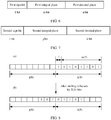
- binary 1 shifts three bits to the left, which is equivalent to multiplying by 2 ⁇ 3 in a decimal system and whose result is equal to a binary number 1000 (which is equivalent to a decimal number 8).
- a final result of the shift subcircuit is 1000.
- a subsequent circuit obtains the result, if first two bits 10 in 1000 are used as the integral part and last two bits are used as the fractional part, a result 10.00 (a binary number) is obtained, and an error occurs obviously.
- shifting the exponentiation operation result to the left by bits of the integral part of c is “essentially shifting the exponentiation operation result to the left by bits of the integral part of c to perform 2 ⁇ (the integral part of c) operation".
- linear field data is represented in a 1+j+k (or denoted as 1.j.k) format, to be specific, 1 bit is used to represent a sign, j bits are used to represent an integral part, and k bits are used to represent a fractional part.
- the shift result is equal to a product of A and B, and is linear field data.
- a specific shifting method and a corresponding data selection method may be used below for implementation.
- the final result obtained is the result 101.01101 obtained after shifting 1.0101101 to the left by bits of the integral part of c (to be specific, shifting 2 bits to the left) (the complete result is represented as 00000101 01101000 by using 8+8 bits).
- a value of the integral part and/or the fractional part may be obtained in a uniform obtaining manner in which "first high j bits are a value of the integral part and low k bits are a value of the fractional part".
- an output subcircuit 44 is specifically described in this embodiment.
- the input data f1 and g1 in the logarithmic field representation format may be preprocessed by using software (to be specific, completed by using a general purpose processor such as a CPU) or hardware (for example, completed based on a hardware device such as a field programmable gate array (Field Programmable Gate Array, FPGA) or an application-specific integrated circuit (Application Specific Integrated Circuit, ASIC)).
- software to be specific, completed by using a general purpose processor such as a CPU
- hardware for example, completed based on a hardware device such as a field programmable gate array (Field Programmable Gate Array, FPGA) or an application-specific integrated circuit (Application Specific Integrated Circuit, ASIC)).
- FPGA Field Programmable Gate Array
- ASIC Application Specific Integrated Circuit
- Data F and data G are input.
- C1 F x G
- C2 F x G
- SUM C1 + C2 that are need to be calculated in a multiply-add operation, and then SUM is represented as sum (that is, log2(SUM) is calculated) in a logarithmic field representation format 1.4.4 for subsequent multiplication.
- C1 in the logarithmic field representation format 1.4.4 is represented as c1
- C2 in the logarithmic field representation format 1.4.4 is represented as c2
- BASE 3.
- the decoding subcircuit 820 obtains, through table lookup, a linear representation format corresponding to a first decimal place. Specifically, the decoding subcircuit 820 obtains the first decimal place with n bits from the obtaining subcircuit 810, and performs a decoding operation. A result of 2 N is directly obtained in the decoding operation by using hardware combination logic, in other words, the result of 2 N is directly obtained through the table lookup. It should be understood that, because a quantity of values of the first decimal place with n bits is limited, the linear representation format corresponding to the first decimal place (under a specific precision requirement) may be enumerated.
- the logarithmic field representation format 1.3.2 is still used as an example for description.
- the shift subcircuit 830 shifts, based on a value M of an integral part of a logarithm value, the linear representation format corresponding to the first decimal place, to obtain a value that is of an absolute value of data and that is in the linear representation format. Specifically, the shift subcircuit 830 obtains the first integral place of m bits from the obtaining subcircuit 810, obtains the result of 2 N from the decoding subcircuit 820, and performs a shift operation on the decoding result of the decoding subcircuit 820.
- a value of the first integral place of m bits is M'
- a value indicated by the first integral place of m bits is M
- M is a value of an integral part of a logarithm to base 2 of an absolute value of data
- M M' + BASE.
- the decoding result of the decoding subcircuit 820 should be shifted based on M. It should be understood that, because the logarithmic field representation format 1.m.n is applied to a computing engine or a convolution computing chip, the shift subcircuit 830 may be preset to obtain the first integral place of m bits from the obtaining subcircuit 810, or a user interface is set to facilitate a user to set a value of m and/or a value of n.
- shifting, based on the value M of the integral part of the logarithm value, the linear representation format corresponding to the first decimal place, to obtain the value that is of the absolute value of the data and that is in the linear representation format in step S730 may include: when M is greater than 0, shifting the linear representation format corresponding to the first decimal place to the left by M bits, to obtain the value that is of the absolute value of the data and that is in the linear representation format; and when M is less than 0, shifting the linear representation format corresponding to the first decimal place to the right by bits of the absolute value of M, to obtain the value that is of the absolute value of the data and that is in the linear representation format.
- M' may be used instead of M in the operation. If M' is a non-negative value, only left shifting can be performed.
- the shift subcircuit 830 shifts, based on the value 010 indicated by the first decimal place, 1.0110101 in the linear representation format corresponding to the first decimal place 10 to the left by two bits, to obtain 101.10101.
- the output subcircuit 840 represents the data as binary data of 1+j+k bits in the linear representation format. Specifically, the output subcircuit 840 obtains the first sign bit of 1 bit from the obtaining subcircuit 810, and assigns a value of the first sign bit to the second sign bit. In other words, the output subcircuit 840 sets the second sign bit based on the first sign bit. For example, if the data is a positive number, the second sign bit is set to 0; or if the data is a negative number, the second sign bit is set to 1. This is not limited in this embodiment of this application.
- the output subcircuit 840 obtains a shifted result from the shift subcircuit 830, and fills zero or deletes an insignificant bit for the shifted result, so as to make the result meet a 1.j.k format.
- the output subcircuit 840 may convert the obtained result in the 1.j.k format into a result in complement representation, to obtain the final result. This is not limited in this embodiment of this application.
- the output subcircuit 840 fills zero and determines the second sign bit based on the first sign bit, and represents the data as binary data of 1+j+k bits in the linear representation format, for example, represents the data as 1 0000101 10101000 in a linear representation format 1.7.8.
- the data in the logarithmic field representation format is obtained, and data represented in the linear representation format is obtained by performing simple table lookup and shifting on the data in the logarithmic field representation format in this embodiment of this application.
- a complex power operation does not need to be performed, and this can reduce overheads during data conversion between a logarithmic field and a linear field, and improve a speed of convolution calculation.
- the obtaining subcircuit 810 obtains the data 101010 in the logarithmic field representation format 1.3.2, where the first sign bit is 1, in other words, the data sign is negative, the first integral place is 010, and the first decimal place is 01.
- the decoding subcircuit 820 obtains, through the table lookup, 1.0110101 in the linear representation format corresponding to the first decimal place 10.
- the decoding subcircuit 820 may be a device with two-significant-bit input and eight-significant-bit output shown in FIG. 10 , and stores a table of a correspondence between the two-significant-bit input and the eight-significant-bit output. It should be understood that the eight-significant-bit output is a case in this example, and a bit may be added or reduced based on an actual requirement.
- the shift subcircuit 830 shifts, based on the value 010 indicated by the first decimal place, 1.0110101 in the linear representation format corresponding to the first decimal place 10 to the left by two bits, to obtain 101.10101.
- the output subcircuit 840 fills zero and determines the second sign bit based on the first sign bit, and represents the data as binary data of 1+j+k bits in the linear representation format, for example, represents the data as 1000010110101000 in a linear representation format 1.7.8.
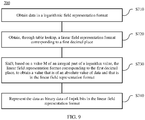
- FIG. 11 is a schematic flowchart of the data format conversion method 900 according to an embodiment of this application.
- the method 900 may be performed by a logarithmic conversion circuit 100.
- FIG. 12 is a schematic diagram of performing logarithmic field conversion by a logarithmic conversion circuit 1000 according to an embodiment of this application.
- the logarithmic conversion circuit 1000 may include an obtaining subcircuit 1010, an integer computing subcircuit 1020, a decimal computing subcircuit 1030, and an output subcircuit 1040. Each subcircuit may be implemented based on an FPGA or an ASIC.
- the subcircuits 1010 to 1040 are respectively used to perform steps S910 to S940 of the method 900.
- logarithmic field conversion is specifically described in this embodiment.
- the logarithmic field conversion is mainly calculating a logarithm to base 2 of an absolute value of a linear field number (or with reference to BASE), and a result is represented with reference to a sign bit.
- the conversion method may be implemented by using software (to be specific, a converted value is output by using a CPU operation software program).
- the conversion method may alternatively be implemented based on a specific hardware circuit (such as an ASIC or an FPGA). In this embodiment, implementation based on the hardware circuit is specifically described.
- the logarithmic field conversion is completed by a logarithmic field conversion circuit.
- the logarithmic field conversion circuit includes an obtaining subcircuit, an integer computing subcircuit, a decimal computing subcircuit, and an output subcircuit.
- a processing procedure of the subcircuits is as follows: S910.
- An obtaining subcircuit 1010 obtains data in a linear representation format 1.j.k, where 1 bit is used to represent a second sign bit, j bits are used to represent a second integral place, and k bits are used to represent a second decimal place.
- the data herein may be data that is output from an output buffer and that is obtained after an accumulated operation, or may be data obtained in another manner. This is not limited in this embodiment of this application.
- the obtaining subcircuit 1010 obtains data 0 0011001 11000000 (denoted as 25.75 in decimal notation) in a linear representation format 1.7.8, where a data sign is positive, a second integral place is 0011001, and a second decimal place is 11000000.
- An integer computing subcircuit 1020 determines that a location in which a non-zero highest bit of binary data of j+k bits is located is an h th bit (a quantity of bits of a lowest bit of the binary data of j+k bits is denoted as a 0 th bit), and determines a value M of an integral part of a logarithm to base 2 of an absolute value of data in a logarithmic field representation format, where M is equal to a difference between h and k.
- the integer computing subcircuit 1020 first finds a location of a highest bit 1, and starts encoding from 0 from the right to the left.
- a decimal computing subcircuit 1030 truncates, from a high bit to a low bit, s bits after the non-zero highest bit, to obtain an absolute value of data in the logarithmic field representation format corresponding to s bits, and calculates the logarithm to base 2 of the absolute value, to obtain a value N of a fractional part.
- the decimal computing subcircuit 1030 truncates s bits (for example, 8 bits) after the non-zero highest bit to obtain 10011100, and calculates log2(1.10011100) to learn that the value N of the fractional part of a logarithm to base 2 of an absolute value of data in a corresponding logarithmic field representation format is 0.11.
- the value N of the fractional part of the logarithm to base 2 of the absolute value of the data is represented as 0.1011 in binary.
- a quantity of bits (for example, 8 bits or 16 bits) representing a number is limited, and a value of s bits may be only limited. Therefore, under a specific precision requirement, the logarithmic field representation format corresponding to s bits may be exhaustive. That the decimal computing subcircuit 1030 truncates s bits after the non-zero highest bit is obtaining a value y of s bits after the non-zero highest bit of the data in the linear representation format 1.j.k based on the obtaining subcircuit 1010. Then the decimal computing subcircuit 1030 calculates log 2 (1.y) to obtain the value N of the fractional part of the logarithm to base 2 of the absolute value of the data. There may be a plurality of manners of obtaining N, and an example is used below for description. In specific implementation, a value of s may be determined based on a precision requirement. Optionally, s is greater than n.
- the decimal computing subcircuit 1030 may be a device with eight-significant-bit input and five-significant-bit output shown in FIG. 12 . It should be understood that the five-significant-bit output is a case in this example, and a bit may be added or reduced based on an actual requirement.
- An output subcircuit 1040 represents the data as binary data of 1+m+n bits in the logarithmic field representation format.
- the output subcircuit 1040 obtains the second sign bit of 1 bit from the obtaining subcircuit 1010, and assigns a value of the second sign bit to the first sign bit, in other words, sets the first sign bit in the logarithmic field representation format based on the second sign bit. For example, if the data is a positive number, the first sign bit is set to 0; or if the data is a negative number, the first sign bit is set to 1. This is not limited in this embodiment of this application.
- the output subcircuit 1040 adds the integral part that is of the logarithm to base 2 of the absolute value of the data and that is obtained by the integer computing subcircuit 1020, and the fractional part that is of the logarithm to base 2 of the absolute value of the data and that is obtained by the decimal computing subcircuit 1030, to separately obtain the first integral place and the first decimal place, and fills zero or deletes an insignificant bit, so as to make the result meet the 1.m.n format.
- the output subcircuit 1040 may convert the obtained result in the 1.m.n format into a result in complement representation. This is not limited in this embodiment of this application.
- the output subcircuit 1040 adds the value M of the integral part of the logarithm to base 2 of the absolute value of the data and the value N of the fractional part of the logarithm to base 2 of the absolute value of the data, and fills zero or deletes an insignificant bit for the added result.
- the first sign bit is determined based on the second sign bit, and data is represented as binary data of 1+m+n bits in the logarithmic field representation format, for example, represented as 010010 in a logarithmic field representation format 1.3.4 (the first sign bit is 0, the first integral place is three significant bits 100, and the first decimal place is four significant bits 1011).
- the data in the linear representation format is obtained, and the data represented in the logarithmic field representation format is obtained through simple truncation and comparison.
- a complex logarithmic operation does not need to be performed, and this can reduce overheads during data conversion between a linear field and a logarithmic field, and improve a speed of convolution calculation.
- the step S930 in Embodiment 8 is described in detail in this embodiment. Specifically, the step may be implemented by using at least the following three methods.
- the obtaining, in step S930, a value N of a fractional part of a result obtained by calculating a logarithm to base 2 of an absolute value of data in a logarithmic field representation format corresponding to s bits may include: obtaining, through table lookup, the value N of the fractional part of the logarithm to base 2 of the absolute value of the data in the logarithmic field representation format corresponding to s bits, where the table stores N corresponding to all possible values of s bits.
- a method for determining the value N of the fractional part of the logarithm to base 2 of the absolute value of the data is referred to as a table lookup method.
- a decimal computing subcircuit 1030 truncates 8 bits after a non-zero highest bit to obtain 10011100, and obtains a result of log2(1.10011100) through table lookup.
- the decimal computing subcircuit 1030 stores a table of a correspondence between eight-significant-bit input and five-significant-bit output.
- a result of log2(1.y) is recorded in the table. 4 bits after a decimal place is reserved for the result.
- the obtaining, in step S930, a value N of a fractional part of a logarithm to base 2 of an absolute value of data in a logarithmic field representation format corresponding to s bits may include: comparing a value corresponding to s bits with preset 2 n comparison values, where an i th comparison value is less than an (i+1) th comparison value, and the i th comparison value corresponds to one value Ni; and when the value corresponding to s bits is greater than or equal to a T th comparison value, and is less than a (T+1) th comparison value, determining that the value N of the fractional part of the logarithm to base 2 of the absolute value of the data in the logarithmic field representation format corresponding to s bits is N T .
- a method for determining the value N of the fractional part of the logarithm to base 2 of the absolute value of the data is referred to as a level-by-level comparison method.
- FIG. 12 is still used for description.
- the decimal computing subcircuit 1030 truncates 8 bits after the non-zero highest bit to obtain 10011100, and obtains, through comparison of a comparator group, the value N of the fractional part of the logarithm to base 2 of the absolute value of the data.
- FIG. 13 is a schematic diagram of determining a value N of a fractional part by a decimal computing subcircuit 1030.
- a comparison value is preset in each comparator.
- the preset comparison values are arranged in ascending order, in other words, a comparison value 0 ⁇ the comparator 1 ⁇ ... ⁇ the comparator 15.
- the comparison values are alternatively set based on the following table.
- a table lookup value with a jump in the output results of 4 bits, namely, an antilogarithm in log 2 (), is set to a comparison value.
- the comparison value 0 is set to 1.00000000.
- the comparison value 0 is directly set to 00000000.
- output results corresponding to values between any two adjacent comparison values are consistent. Therefore, based on a result of the level-by-level comparison, the value N of the fractional part of the logarithm to base 2 of the absolute value of the data may be directly obtained by using a selector. For the input 8 bits (10011100), an output result of the selector is 0.1011.
- a result of the selector is 0.0000; for the comparison value 1 greater than or equal to the comparator 1 and a comparison value 2 less than the comparator 2, a result of the selector is 0.0001; for a comparison value 14 greater than or equal to a comparator 14 and a comparison value 15 less than the comparator 15, a result of the selector is 0.1111; and for the comparison value 15 greater than or equal to the comparator 15, a result of the selector is 1.0000.
- the obtaining, in step S930, a value N of a fractional part of a logarithm to base 2 of an absolute value of data in a logarithmic field representation format corresponding to s bits may include: comparing a value corresponding high x bits of s bits with 2 n comparison values, where x is greater than 0 and less than s, an i th comparison value is less than an (i+1) th comparison value, and the i th comparison value corresponds to a pair of values A and B; and calculating a result of x x A + B, and obtaining, based on the result of x x A + B, the value N of the fractional part of the logarithm to base 2 of the absolute value of the data.
- a result obtained by multiplying the high x bits by A may be shifted to the right by k bits, a result obtained by shifting to the right by k bits is added to B, and then an added result is shifted to the left by k-n bits.
- the obtained high n bits are the value N of the fractional part of the logarithm to base 2 of the absolute value of the data in the logarithmic field representation format corresponding to s bits.
- FIG. 12 The example in FIG. 12 is still used for description.
- the decimal computing subcircuit 1030 truncates 8 bits after the non-zero highest bit to obtain 10011100, and a value of 10011100 is S.
- the table is looked up first, and then a segment and fitting result is calculated, to obtain the value N of the fractional part of the logarithm to base 2 of the absolute value of the data.
- FIG. 14 is a schematic diagram of segment and fitting according to an embodiment of this application.
- FIG. 15 is a schematic diagram of determining a value N of a fractional part by a decimal computing subcircuit 1030 according to an embodiment of this application. As shown in FIG.
- N of the fractional part of the logarithm to base 2 of the absolute value of the data is 0.1011.
- the SoC 14 includes a processor core 141 (namely, a CPU core) and a PE array 142 including one or more processing elements (PE) 1421, and each PE may include the multiplication hardware circuit 1421 described in the foregoing embodiments.
- the SoC further includes an input buffer 143, an output buffer 144, a logarithmic field conversion circuit 145, and a control circuit 147.
- Components other than the CPU core may be collectively referred to as a computing engine or a data acceleration engine, and a main function of these components is to process some specific calculation for the CPU core.
- the components on the SoC are separately described below.
- the CPU core is mainly configured to execute some general-purpose software programs, for example, run an operating system, various application programs based on the operating system, and the like by reading an instruction.
- some specific data processing for example, processing a large quantity of image data
- the CPU core may send the data to the computing engine for processing.
- the input buffer 143 is configured to store input data.
- the input data may be from the CPU core 141, or may be from the logarithmic field conversion circuit 145.
- a type of the input data is not limited, and the type of the data may be determined based on various applications. For example, for a neural network system, data and a parameter that need to be calculated may be included. Specifically, the data and the parameter may be separately stored by using a plurality of memories.
- the output buffer 144 is configured to store a result output by the PE array. If the result needs to be used again, the result may be converted by the logarithmic field conversion circuit 145 and output to the input buffer 143 for use in next calculation.
- the input buffer and the output buffer may be implemented based on a storage medium such as an SRAM and an eDRAM.
- the control circuit 147 is connected to the processor core 141 (namely, the CPU core), the input buffer 143, and the output buffer 144. After the control circuit interacts with the processor core (such as DMA protocol-based interaction or user-defined protocol and message interaction), the processor core obtains data in the output buffer.
- the processor core such as DMA protocol-based interaction or user-defined protocol and message interaction
- the SoC in this application may further include another IP core 146, such as a graphics processing unit (GPU) and a digital signal processor (DPS). This is not limited in this application.
- another IP core 146 such as a graphics processing unit (GPU) and a digital signal processor (DPS). This is not limited in this application.
- FIG. 17 is a schematic structural diagram.
- the electronic device includes an SoC 151.
- the SoC may include a plurality of IP cores (an intellectual property core), for example, a CPU core, an IP core includes a PE array, or an IP core includes a PE array, an input buffer, an output buffer, and a logarithmic field conversion circuit.
- the SoC may further include another IP core 146.
- the SoC is usually closed into a separate chip, for example, a chip of Huawei HiSilicon Kirin series (such as Kirin 950 and Kirin 960) and an SoC chip of Qualcomm Snapdragon series (such as Qualcomm 650 and Qualcomm 660).
- each IP core may be separately encapsulated into one chip, or several IP cores are encapsulated into one chip together.
- the electronic device 15 may further include another component, for example, may include a memory 152 (such as a memory or a flash memory), an input/output device 153 (such as a display screen, a touchscreen, a speaker, a mouse, and a keyboard), and various communications modules 154 (such as wifi, a USB, Bluetooth, 4G, and 5G).
- a memory 152 such as a memory or a flash memory
- an input/output device 153 such as a display screen, a touchscreen, a speaker, a mouse, and a keyboard
- various communications modules 154 such as wifi, a USB, Bluetooth, 4G, and 5G.
- each circuit or subcircuit in this embodiment of this application may be implemented based on an ASIC, an FPGA, another programmable logic device, a discrete gate or transistor logic device, a discrete hardware component, or the like. It should be noted that the ASIC, the FPGA, or the another programmable logic device, the discrete gate or the transistor logic device, and the discrete hardware component may be independent components, or may be integrated with a memory (a storage module).
- All or some of the foregoing embodiments may be implemented by using software, hardware, firmware, or any combination thereof.
- software is used to implement the embodiments, all or some of the embodiments may be implemented in a form of a computer program product.
- the computer program product includes one or more computer instructions. When the computer instructions are loaded and executed on the computer, the procedure or functions according to the embodiments of this application are all or partially generated.
- the computer may be a general-purpose computer, a dedicated computer, a computer network, or other programmable apparatuses.
- the computer instructions may be stored in a computer-readable storage medium or may be transmitted from a computer-readable storage medium to another computer-readable storage medium.
- the computer instructions may be transmitted from a website, computer, server, or data center to another website, computer, server, or data center in a wired (for example, a coaxial cable, an optical fiber, or a digital subscriber line (Digital Subscriber Line, DSL)) or wireless (for example, infrared, radio, and microwave) manner.
- the computer readable storage medium may be any usable medium accessible by a computer, or a data storage device, such as a server or a data center, integrating one or more usable media.
- the usable medium may be a magnetic medium (for example, a floppy disk, a hard disk, or a magnetic tape), an optical medium (for example, a high-density digital video disc (Digital Video Disc, DVD), a semiconductor medium (for example, a solid state disk (Solid State Disk, SSD)), or the like.
- a magnetic medium for example, a floppy disk, a hard disk, or a magnetic tape
- an optical medium for example, a high-density digital video disc (Digital Video Disc, DVD)
- a semiconductor medium for example, a solid state disk (Solid State Disk, SSD)
Landscapes
- Engineering & Computer Science (AREA)
- Physics & Mathematics (AREA)
- General Physics & Mathematics (AREA)
- Mathematical Analysis (AREA)
- Mathematical Optimization (AREA)
- Pure & Applied Mathematics (AREA)
- Computational Mathematics (AREA)
- Theoretical Computer Science (AREA)
- Computing Systems (AREA)
- General Engineering & Computer Science (AREA)
- Nonlinear Science (AREA)
- Complex Calculations (AREA)
- Error Detection And Correction (AREA)
Applications Claiming Priority (2)
| Application Number | Priority Date | Filing Date | Title |
|---|---|---|---|
| CN201710852544.4A CN109521994B (zh) | 2017-09-19 | 2017-09-19 | 乘法硬件电路、片上系统及电子设备 |
| PCT/CN2018/106559 WO2019057093A1 (zh) | 2017-09-19 | 2018-09-19 | 乘法电路、片上系统及电子设备 |
Publications (3)
| Publication Number | Publication Date |
|---|---|
| EP3674883A1 true EP3674883A1 (de) | 2020-07-01 |
| EP3674883A4 EP3674883A4 (de) | 2020-08-26 |
| EP3674883B1 EP3674883B1 (de) | 2022-01-26 |
Family
ID=65768177
Family Applications (1)
| Application Number | Title | Priority Date | Filing Date |
|---|---|---|---|
| EP18858914.7A Active EP3674883B1 (de) | 2017-09-19 | 2018-09-19 | Multiplikationsschaltung, system auf einem chip und elektronische vorrichtung |
Country Status (4)
| Country | Link |
|---|---|
| US (1) | US11249721B2 (de) |
| EP (1) | EP3674883B1 (de) |
| CN (1) | CN109521994B (de) |
| WO (1) | WO2019057093A1 (de) |
Families Citing this family (14)
| Publication number | Priority date | Publication date | Assignee | Title |
|---|---|---|---|---|
| CN108256644B (zh) * | 2018-01-05 | 2021-06-22 | 上海兆芯集成电路有限公司 | 微处理器电路以及执行神经网络运算的方法 |
| CN110222833B (zh) | 2018-03-01 | 2023-12-19 | 华为技术有限公司 | 一种用于神经网络的数据处理电路 |
| US11740932B2 (en) * | 2018-05-04 | 2023-08-29 | Apple Inc. | Systems and methods for task switching in neural network processor |
| CN110309088B (zh) * | 2019-06-19 | 2021-06-08 | 北京百度网讯科技有限公司 | Zynq fpga芯片及其数据处理方法、存储介质 |
| US10977002B2 (en) * | 2019-07-15 | 2021-04-13 | Facebook Technologies, Llc | System and method for supporting alternate number format for efficient multiplication |
| CN110633069B (zh) * | 2019-09-06 | 2022-09-16 | 安徽大学 | 一种基于静态随机存储器的乘法电路结构 |
| US11693625B2 (en) * | 2019-12-04 | 2023-07-04 | Flex Logix Technologies, Inc. | Logarithmic addition-accumulator circuitry, processing pipeline including same, and methods of operation |
| CN115244504A (zh) * | 2020-03-25 | 2022-10-25 | 华为技术有限公司 | 卷积运算系统和卷积运算方法 |
| CN112199072B (zh) * | 2020-11-06 | 2023-06-02 | 杭州海康威视数字技术股份有限公司 | 一种基于神经网络层的数据处理方法、装置及设备 |
| TWI782574B (zh) * | 2021-01-28 | 2022-11-01 | 旺宏電子股份有限公司 | 乘加運算裝置以及其乘加運算的控制方法 |
| EP4092578A1 (de) * | 2021-05-18 | 2022-11-23 | Aptiv Technologies Limited | Computerimplementiertes verfahren zum ausführen von softmax |
| CN114329330A (zh) * | 2021-12-31 | 2022-04-12 | 上海阵量智能科技有限公司 | 数据处理装置、方法、芯片、计算机设备及存储介质 |
| CN115114662B (zh) * | 2022-06-30 | 2026-01-30 | 蚂蚁区块链科技(上海)有限公司 | 隐私数据的安全处理方法和装置 |
| CN118819464B (zh) * | 2024-07-22 | 2025-06-20 | 电子科技大学 | 一种基于对数数据的cnn高效乘加单元 |
Family Cites Families (12)
| Publication number | Priority date | Publication date | Assignee | Title |
|---|---|---|---|---|
| US4626825A (en) * | 1985-07-02 | 1986-12-02 | Vlsi Technology, Inc. | Logarithmic conversion apparatus |
| CN1178588A (zh) * | 1995-03-10 | 1998-04-08 | 摩托罗拉公司 | 使用移位装置的求幂电路及其使用方法 |
| US6003058A (en) | 1997-09-05 | 1999-12-14 | Motorola, Inc. | Apparatus and methods for performing arithimetic operations on vectors and/or matrices |
| US6466633B1 (en) * | 2000-08-31 | 2002-10-15 | Shiron Satellite Communications (1996) Ltd. | Methods and apparatus for implementing a receiver filter with logarithmic coefficient multiplication |
| US20060101244A1 (en) * | 2004-11-10 | 2006-05-11 | Nvidia Corporation | Multipurpose functional unit with combined integer and floating-point multiply-add pipeline |
| US20060106905A1 (en) * | 2004-11-17 | 2006-05-18 | Chren William A Jr | Method for reducing memory size in logarithmic number system arithmetic units |
| JP4529098B2 (ja) * | 2008-07-29 | 2010-08-25 | ソニー株式会社 | 演算処理装置および方法、並びにプログラム |
| CN102436365B (zh) | 2010-12-20 | 2014-04-09 | 中国电子科技集团公司第四十一研究所 | 一种频谱分析仪中线性频谱数据转换为对数数据的方法及装置 |
| WO2013101235A1 (en) * | 2011-12-31 | 2013-07-04 | Intel Corporation | Graphics lighting engine including log and anti-log units |
| CN103455302A (zh) | 2012-05-31 | 2013-12-18 | 上海华虹集成电路有限责任公司 | 用硬件实现对数运算的电路 |
| US9317251B2 (en) * | 2012-12-31 | 2016-04-19 | Nvidia Corporation | Efficient correction of normalizer shift amount errors in fused multiply add operations |
| CN103369326B (zh) * | 2013-07-05 | 2016-06-29 | 西安电子科技大学 | 适于高性能视频编码标准hevc的变换编码器 |
-
2017
- 2017-09-19 CN CN201710852544.4A patent/CN109521994B/zh active Active
-
2018
- 2018-09-19 EP EP18858914.7A patent/EP3674883B1/de active Active
- 2018-09-19 WO PCT/CN2018/106559 patent/WO2019057093A1/zh not_active Ceased
-
2020
- 2020-03-18 US US16/822,720 patent/US11249721B2/en active Active
Also Published As
| Publication number | Publication date |
|---|---|
| WO2019057093A1 (zh) | 2019-03-28 |
| EP3674883A4 (de) | 2020-08-26 |
| CN109521994B (zh) | 2020-11-10 |
| EP3674883B1 (de) | 2022-01-26 |
| US11249721B2 (en) | 2022-02-15 |
| US20200218509A1 (en) | 2020-07-09 |
| CN109521994A (zh) | 2019-03-26 |
Similar Documents
| Publication | Publication Date | Title |
|---|---|---|
| US11249721B2 (en) | Multiplication circuit, system on chip, and electronic device | |
| CN109754074A (zh) | 一种神经网络量化方法、装置以及相关产品 | |
| US8874630B2 (en) | Apparatus and method for converting data between a floating-point number and an integer | |
| TW202109319A (zh) | 曲線函數裝置及其操作方法 | |
| WO2023029464A1 (zh) | 数据处理装置、方法、芯片、计算机设备及存储介质 | |
| WO2021073638A1 (zh) | 运行神经网络模型的方法、装置和计算机设备 | |
| US11354097B2 (en) | Compressor circuit, Wallace tree circuit, multiplier circuit, chip, and device | |
| US20240176585A1 (en) | Data processing method, computer device and storage medium | |
| CN107220025B (zh) | 处理乘加运算的装置和处理乘加运算的方法 | |
| US10133552B2 (en) | Data storage method, ternary inner product operation circuit, semiconductor device including the same, and ternary inner product arithmetic processing program | |
| CN114201140B (zh) | 指数函数处理单元、方法和神经网络芯片 | |
| CN102789376B (zh) | 浮点数加法电路及其实现方法 | |
| US20210044303A1 (en) | Neural network acceleration device and method | |
| CN111931441B (zh) | Fpga快速进位链时序模型的建立方法、装置以及介质 | |
| CN109408028B (zh) | 浮点数运算方法、装置及存储介质 | |
| CN116055278B (zh) | 一种基于可配置非标准浮点数据的5g通信内接收机 | |
| CN109558109B (zh) | 数据运算装置及相关产品 | |
| CN209895329U (zh) | 乘法器 | |
| CN109582279B (zh) | 数据运算装置及相关产品 | |
| CN119127122B (zh) | 一种除法器的实现方法 | |
| CN111047023A (zh) | 一种计算装置及相关产品 | |
| TWI776090B (zh) | 電腦可讀儲存媒體、電腦實施的方法及計算邏輯區段 | |
| CN120335865A (zh) | 一种数据处理方法、装置及电子设备 | |
| CN120892012A (zh) | 一种改进的类幂非线性函数实现方法 | |
| CN121190369A (zh) | 一种基于fpga的图像校正方法及装置 |
Legal Events
| Date | Code | Title | Description |
|---|---|---|---|
| STAA | Information on the status of an ep patent application or granted ep patent |
Free format text: STATUS: THE INTERNATIONAL PUBLICATION HAS BEEN MADE |
|
| PUAI | Public reference made under article 153(3) epc to a published international application that has entered the european phase |
Free format text: ORIGINAL CODE: 0009012 |
|
| STAA | Information on the status of an ep patent application or granted ep patent |
Free format text: STATUS: REQUEST FOR EXAMINATION WAS MADE |
|
| 17P | Request for examination filed |
Effective date: 20200325 |
|
| AK | Designated contracting states |
Kind code of ref document: A1 Designated state(s): AL AT BE BG CH CY CZ DE DK EE ES FI FR GB GR HR HU IE IS IT LI LT LU LV MC MK MT NL NO PL PT RO RS SE SI SK SM TR |
|
| AX | Request for extension of the european patent |
Extension state: BA ME |
|
| A4 | Supplementary search report drawn up and despatched |
Effective date: 20200724 |
|
| RIC1 | Information provided on ipc code assigned before grant |
Ipc: G06F 7/487 20060101AFI20200720BHEP Ipc: G06F 7/523 20060101ALI20200720BHEP |
|
| DAV | Request for validation of the european patent (deleted) | ||
| DAX | Request for extension of the european patent (deleted) | ||
| GRAP | Despatch of communication of intention to grant a patent |
Free format text: ORIGINAL CODE: EPIDOSNIGR1 |
|
| STAA | Information on the status of an ep patent application or granted ep patent |
Free format text: STATUS: GRANT OF PATENT IS INTENDED |
|
| INTG | Intention to grant announced |
Effective date: 20210909 |
|
| GRAS | Grant fee paid |
Free format text: ORIGINAL CODE: EPIDOSNIGR3 |
|
| GRAA | (expected) grant |
Free format text: ORIGINAL CODE: 0009210 |
|
| STAA | Information on the status of an ep patent application or granted ep patent |
Free format text: STATUS: THE PATENT HAS BEEN GRANTED |
|
| AK | Designated contracting states |
Kind code of ref document: B1 Designated state(s): AL AT BE BG CH CY CZ DE DK EE ES FI FR GB GR HR HU IE IS IT LI LT LU LV MC MK MT NL NO PL PT RO RS SE SI SK SM TR |
|
| REG | Reference to a national code |
Ref country code: GB Ref legal event code: FG4D |
|
| REG | Reference to a national code |
Ref country code: CH Ref legal event code: EP |
|
| REG | Reference to a national code |
Ref country code: AT Ref legal event code: REF Ref document number: 1465809 Country of ref document: AT Kind code of ref document: T Effective date: 20220215 |
|
| REG | Reference to a national code |
Ref country code: IE Ref legal event code: FG4D |
|
| REG | Reference to a national code |
Ref country code: DE Ref legal event code: R096 Ref document number: 602018030292 Country of ref document: DE |
|
| REG | Reference to a national code |
Ref country code: LT Ref legal event code: MG9D |
|
| REG | Reference to a national code |
Ref country code: NL Ref legal event code: MP Effective date: 20220126 |
|
| REG | Reference to a national code |
Ref country code: AT Ref legal event code: MK05 Ref document number: 1465809 Country of ref document: AT Kind code of ref document: T Effective date: 20220126 |
|
| PG25 | Lapsed in a contracting state [announced via postgrant information from national office to epo] |
Ref country code: NL Free format text: LAPSE BECAUSE OF FAILURE TO SUBMIT A TRANSLATION OF THE DESCRIPTION OR TO PAY THE FEE WITHIN THE PRESCRIBED TIME-LIMIT Effective date: 20220126 |
|
| PG25 | Lapsed in a contracting state [announced via postgrant information from national office to epo] |
Ref country code: SE Free format text: LAPSE BECAUSE OF FAILURE TO SUBMIT A TRANSLATION OF THE DESCRIPTION OR TO PAY THE FEE WITHIN THE PRESCRIBED TIME-LIMIT Effective date: 20220126 Ref country code: RS Free format text: LAPSE BECAUSE OF FAILURE TO SUBMIT A TRANSLATION OF THE DESCRIPTION OR TO PAY THE FEE WITHIN THE PRESCRIBED TIME-LIMIT Effective date: 20220126 Ref country code: PT Free format text: LAPSE BECAUSE OF FAILURE TO SUBMIT A TRANSLATION OF THE DESCRIPTION OR TO PAY THE FEE WITHIN THE PRESCRIBED TIME-LIMIT Effective date: 20220526 Ref country code: NO Free format text: LAPSE BECAUSE OF FAILURE TO SUBMIT A TRANSLATION OF THE DESCRIPTION OR TO PAY THE FEE WITHIN THE PRESCRIBED TIME-LIMIT Effective date: 20220426 Ref country code: LT Free format text: LAPSE BECAUSE OF FAILURE TO SUBMIT A TRANSLATION OF THE DESCRIPTION OR TO PAY THE FEE WITHIN THE PRESCRIBED TIME-LIMIT Effective date: 20220126 Ref country code: HR Free format text: LAPSE BECAUSE OF FAILURE TO SUBMIT A TRANSLATION OF THE DESCRIPTION OR TO PAY THE FEE WITHIN THE PRESCRIBED TIME-LIMIT Effective date: 20220126 Ref country code: ES Free format text: LAPSE BECAUSE OF FAILURE TO SUBMIT A TRANSLATION OF THE DESCRIPTION OR TO PAY THE FEE WITHIN THE PRESCRIBED TIME-LIMIT Effective date: 20220126 Ref country code: BG Free format text: LAPSE BECAUSE OF FAILURE TO SUBMIT A TRANSLATION OF THE DESCRIPTION OR TO PAY THE FEE WITHIN THE PRESCRIBED TIME-LIMIT Effective date: 20220426 |
|
| PG25 | Lapsed in a contracting state [announced via postgrant information from national office to epo] |
Ref country code: PL Free format text: LAPSE BECAUSE OF FAILURE TO SUBMIT A TRANSLATION OF THE DESCRIPTION OR TO PAY THE FEE WITHIN THE PRESCRIBED TIME-LIMIT Effective date: 20220126 Ref country code: LV Free format text: LAPSE BECAUSE OF FAILURE TO SUBMIT A TRANSLATION OF THE DESCRIPTION OR TO PAY THE FEE WITHIN THE PRESCRIBED TIME-LIMIT Effective date: 20220126 Ref country code: GR Free format text: LAPSE BECAUSE OF FAILURE TO SUBMIT A TRANSLATION OF THE DESCRIPTION OR TO PAY THE FEE WITHIN THE PRESCRIBED TIME-LIMIT Effective date: 20220427 Ref country code: FI Free format text: LAPSE BECAUSE OF FAILURE TO SUBMIT A TRANSLATION OF THE DESCRIPTION OR TO PAY THE FEE WITHIN THE PRESCRIBED TIME-LIMIT Effective date: 20220126 Ref country code: AT Free format text: LAPSE BECAUSE OF FAILURE TO SUBMIT A TRANSLATION OF THE DESCRIPTION OR TO PAY THE FEE WITHIN THE PRESCRIBED TIME-LIMIT Effective date: 20220126 |
|
| PG25 | Lapsed in a contracting state [announced via postgrant information from national office to epo] |
Ref country code: IS Free format text: LAPSE BECAUSE OF FAILURE TO SUBMIT A TRANSLATION OF THE DESCRIPTION OR TO PAY THE FEE WITHIN THE PRESCRIBED TIME-LIMIT Effective date: 20220526 |
|
| REG | Reference to a national code |
Ref country code: DE Ref legal event code: R097 Ref document number: 602018030292 Country of ref document: DE |
|
| PG25 | Lapsed in a contracting state [announced via postgrant information from national office to epo] |
Ref country code: SM Free format text: LAPSE BECAUSE OF FAILURE TO SUBMIT A TRANSLATION OF THE DESCRIPTION OR TO PAY THE FEE WITHIN THE PRESCRIBED TIME-LIMIT Effective date: 20220126 Ref country code: SK Free format text: LAPSE BECAUSE OF FAILURE TO SUBMIT A TRANSLATION OF THE DESCRIPTION OR TO PAY THE FEE WITHIN THE PRESCRIBED TIME-LIMIT Effective date: 20220126 Ref country code: RO Free format text: LAPSE BECAUSE OF FAILURE TO SUBMIT A TRANSLATION OF THE DESCRIPTION OR TO PAY THE FEE WITHIN THE PRESCRIBED TIME-LIMIT Effective date: 20220126 Ref country code: EE Free format text: LAPSE BECAUSE OF FAILURE TO SUBMIT A TRANSLATION OF THE DESCRIPTION OR TO PAY THE FEE WITHIN THE PRESCRIBED TIME-LIMIT Effective date: 20220126 Ref country code: DK Free format text: LAPSE BECAUSE OF FAILURE TO SUBMIT A TRANSLATION OF THE DESCRIPTION OR TO PAY THE FEE WITHIN THE PRESCRIBED TIME-LIMIT Effective date: 20220126 Ref country code: CZ Free format text: LAPSE BECAUSE OF FAILURE TO SUBMIT A TRANSLATION OF THE DESCRIPTION OR TO PAY THE FEE WITHIN THE PRESCRIBED TIME-LIMIT Effective date: 20220126 |
|
| PG25 | Lapsed in a contracting state [announced via postgrant information from national office to epo] |
Ref country code: AL Free format text: LAPSE BECAUSE OF FAILURE TO SUBMIT A TRANSLATION OF THE DESCRIPTION OR TO PAY THE FEE WITHIN THE PRESCRIBED TIME-LIMIT Effective date: 20220126 |
|
| PLBE | No opposition filed within time limit |
Free format text: ORIGINAL CODE: 0009261 |
|
| STAA | Information on the status of an ep patent application or granted ep patent |
Free format text: STATUS: NO OPPOSITION FILED WITHIN TIME LIMIT |
|
| 26N | No opposition filed |
Effective date: 20221027 |
|
| PG25 | Lapsed in a contracting state [announced via postgrant information from national office to epo] |
Ref country code: SI Free format text: LAPSE BECAUSE OF FAILURE TO SUBMIT A TRANSLATION OF THE DESCRIPTION OR TO PAY THE FEE WITHIN THE PRESCRIBED TIME-LIMIT Effective date: 20220126 |
|
| PG25 | Lapsed in a contracting state [announced via postgrant information from national office to epo] |
Ref country code: MC Free format text: LAPSE BECAUSE OF FAILURE TO SUBMIT A TRANSLATION OF THE DESCRIPTION OR TO PAY THE FEE WITHIN THE PRESCRIBED TIME-LIMIT Effective date: 20220126 |
|
| REG | Reference to a national code |
Ref country code: CH Ref legal event code: PL |
|
| REG | Reference to a national code |
Ref country code: BE Ref legal event code: MM Effective date: 20220930 |
|
| P01 | Opt-out of the competence of the unified patent court (upc) registered |
Effective date: 20230524 |
|
| PG25 | Lapsed in a contracting state [announced via postgrant information from national office to epo] |
Ref country code: LU Free format text: LAPSE BECAUSE OF NON-PAYMENT OF DUE FEES Effective date: 20220919 |
|
| PG25 | Lapsed in a contracting state [announced via postgrant information from national office to epo] |
Ref country code: LI Free format text: LAPSE BECAUSE OF NON-PAYMENT OF DUE FEES Effective date: 20220930 Ref country code: IT Free format text: LAPSE BECAUSE OF FAILURE TO SUBMIT A TRANSLATION OF THE DESCRIPTION OR TO PAY THE FEE WITHIN THE PRESCRIBED TIME-LIMIT Effective date: 20220126 Ref country code: IE Free format text: LAPSE BECAUSE OF NON-PAYMENT OF DUE FEES Effective date: 20220919 Ref country code: CH Free format text: LAPSE BECAUSE OF NON-PAYMENT OF DUE FEES Effective date: 20220930 |
|
| PG25 | Lapsed in a contracting state [announced via postgrant information from national office to epo] |
Ref country code: BE Free format text: LAPSE BECAUSE OF NON-PAYMENT OF DUE FEES Effective date: 20220930 |
|
| PG25 | Lapsed in a contracting state [announced via postgrant information from national office to epo] |
Ref country code: CY Free format text: LAPSE BECAUSE OF FAILURE TO SUBMIT A TRANSLATION OF THE DESCRIPTION OR TO PAY THE FEE WITHIN THE PRESCRIBED TIME-LIMIT Effective date: 20220126 |
|
| PG25 | Lapsed in a contracting state [announced via postgrant information from national office to epo] |
Ref country code: MK Free format text: LAPSE BECAUSE OF FAILURE TO SUBMIT A TRANSLATION OF THE DESCRIPTION OR TO PAY THE FEE WITHIN THE PRESCRIBED TIME-LIMIT Effective date: 20220126 Ref country code: HU Free format text: LAPSE BECAUSE OF FAILURE TO SUBMIT A TRANSLATION OF THE DESCRIPTION OR TO PAY THE FEE WITHIN THE PRESCRIBED TIME-LIMIT; INVALID AB INITIO Effective date: 20180919 |
|
| PG25 | Lapsed in a contracting state [announced via postgrant information from national office to epo] |
Ref country code: MT Free format text: LAPSE BECAUSE OF FAILURE TO SUBMIT A TRANSLATION OF THE DESCRIPTION OR TO PAY THE FEE WITHIN THE PRESCRIBED TIME-LIMIT Effective date: 20220126 |
|
| PGFP | Annual fee paid to national office [announced via postgrant information from national office to epo] |
Ref country code: DE Payment date: 20250730 Year of fee payment: 8 |
|
| PGFP | Annual fee paid to national office [announced via postgrant information from national office to epo] |
Ref country code: GB Payment date: 20250731 Year of fee payment: 8 |
|
| PGFP | Annual fee paid to national office [announced via postgrant information from national office to epo] |
Ref country code: FR Payment date: 20250808 Year of fee payment: 8 |
|
| PG25 | Lapsed in a contracting state [announced via postgrant information from national office to epo] |
Ref country code: TR Free format text: LAPSE BECAUSE OF FAILURE TO SUBMIT A TRANSLATION OF THE DESCRIPTION OR TO PAY THE FEE WITHIN THE PRESCRIBED TIME-LIMIT Effective date: 20220126 |